
20 Rose Tattoo Ideas for the Forearm (September 2026)
Rose tattoo ideas for the forearm are everywhere, which is exactly the problem: most of them are drawn for a shoulder or a chest, then resized onto a flat, moving strip of skin and they fall apart. A forearm is a long canvas with a clear direction to it, so the best designs treat it that way, running from wrist to elbow or wrapping around it.
Booking a rose in autumn or winter is worth planning for. The work is easier when you are not sweating through the first two weeks, and healed forearm roses photographed months later are what people actually want to see at the consultation. Give yourself four to six weeks before the session so the design is settled, not rushed.
What Does a Rose Tattoo on the Forearm Mean?
A rose tattoo on the forearm usually means you are showing something on purpose. The flower carries love, beauty and pain at once, and putting it on your forearm, the most visible arm surface, adds a layer of openness to it. Most people read it as wearing your heart on your sleeve rather than keeping it hidden.
The core symbolism falls into a few recognisable groups:
- Open expression: a visible forearm rose invites people to read your feelings
- Beauty and pain: the thorns exist because the flower is beautiful
- Resilience: a rose that is drawn blooming or recovering means surviving something
- Remembrance: a rose for a parent, partner or friend who has died
- Devotion: a wrapped stem can mark a date, a place or a promise kept
- Balance: colour realism versus black and grey often reflects where you are emotionally
A single rose is one relationship, one person or one thing carried. Three roses usually reads as the past, present and future, or three people. A bouquet shifts the meaning toward gratitude or a whole family. Whatever you pick, the meaning is the one you bring with it, not the one a stranger guesses at.
20 Rose Tattoo Ideas for the Forearm
1. Single-Stem Rose Running Along the Inner Forearm
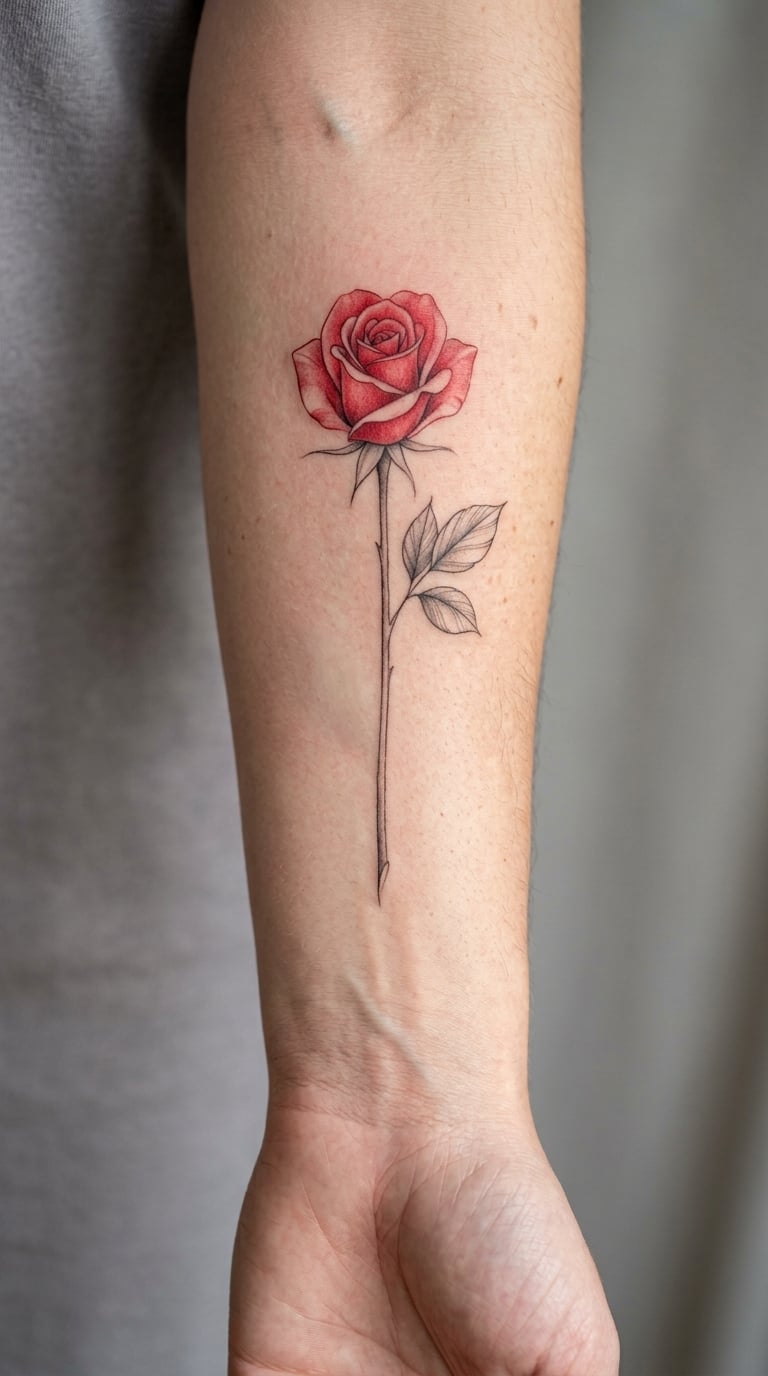
This is the cleanest forearm rose there is: one stem, one bloom, maybe two leaves, running the length of the inner arm. It is the version most people mean when they picture a rose forearm tattoo, and it works because the arm gives you a natural line to follow.
Keep it between 8 and 10 cm long and let the stem run thin, widening slightly at the bloom. Fine line with light shading holds better than dense colour here, because the inner forearm stretches every time you flex your wrist.
Pain and time: a soft, deep 4/10, and about an hour for a piece this size.
2. Blackwork Rose Wrapping the Outer Forearm
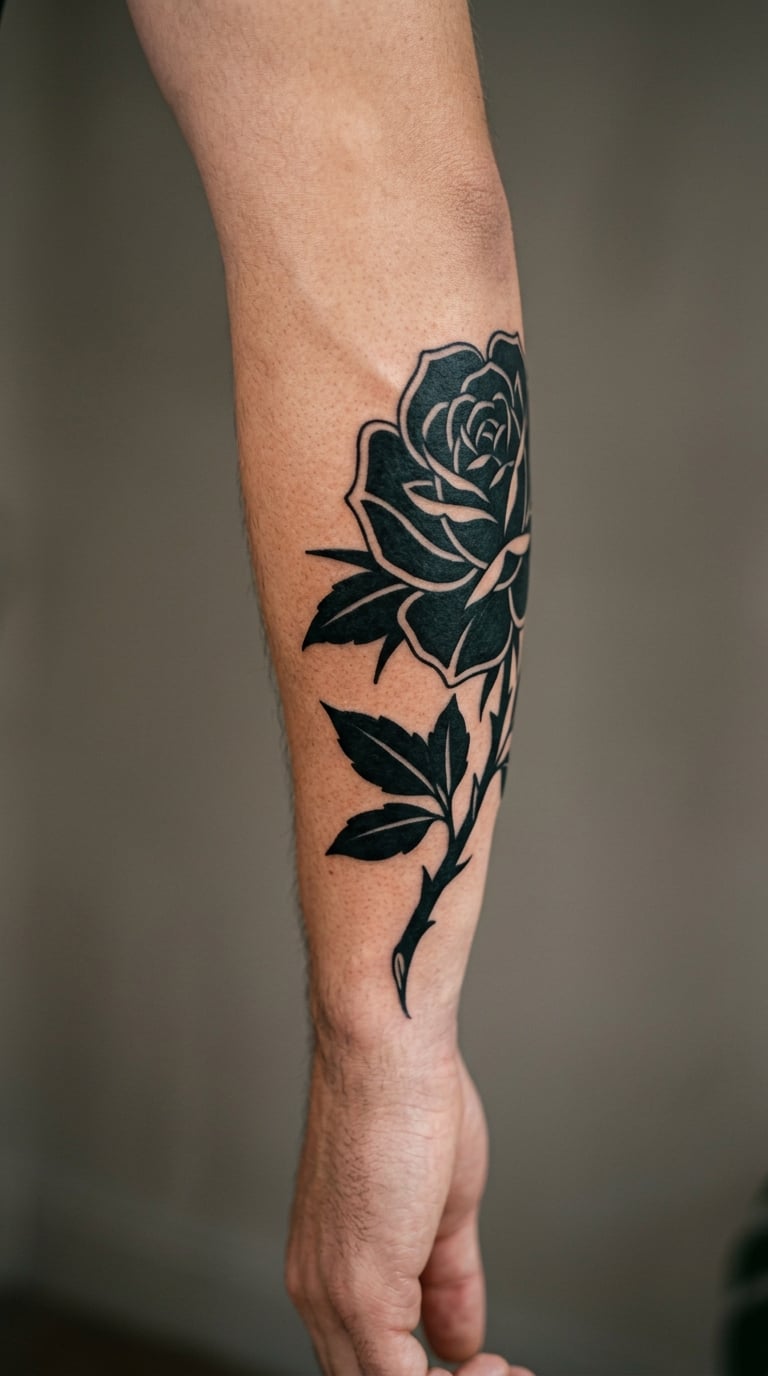
A solid black bloom reads hard and graphic, and wrapping it past the edge of the outer forearm makes it look like the design continues past your skin. People pick this one for a memento mori feel rather than a romantic one.
Solid black tattooing is the most forgiving style there is for ageing, since there is no colour to fade and no fine shading to soften. Ask for negative space in the petals so it does not become a solid lump. Allow 12 to 15 cm of arm for it to sit properly.
Pain and time: a scratchy 5/10, heavier work, roughly two hours.
3. Rose Bud Tucked Into the Inner Elbow Crease
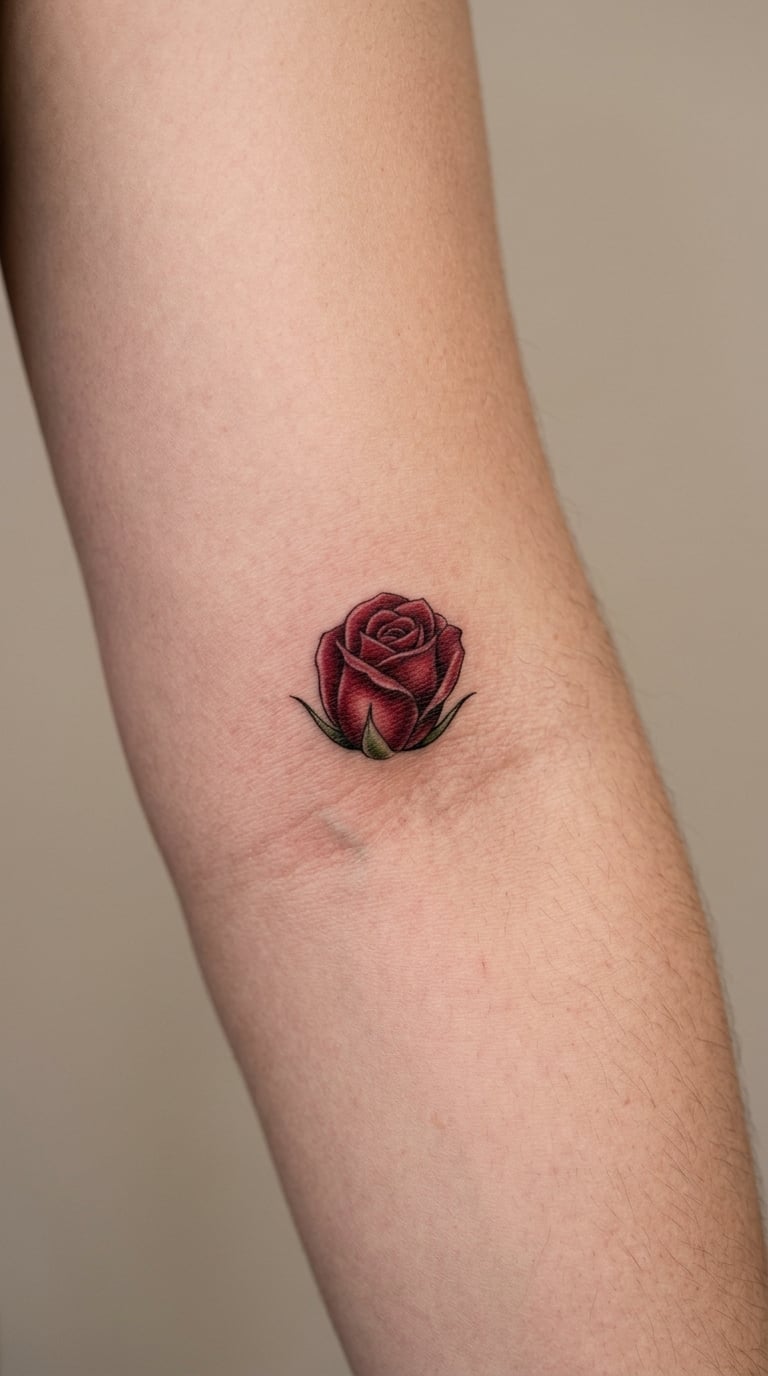
A closed bud in the elbow crease is a quieter choice than an open bloom, and the crease does the composition work for you. It is also the most requested placement after the wrist, usually for something small.
Keep it 3 to 4 cm. Skip it if you work with your elbows on a desk, because the crease wears ink and skin away faster than any other spot on the arm. Fading in that fold is normal and expected.
Pain and time: a 4/10, brief, about 30 minutes.
4. Three Small Roses in a Vertical Line
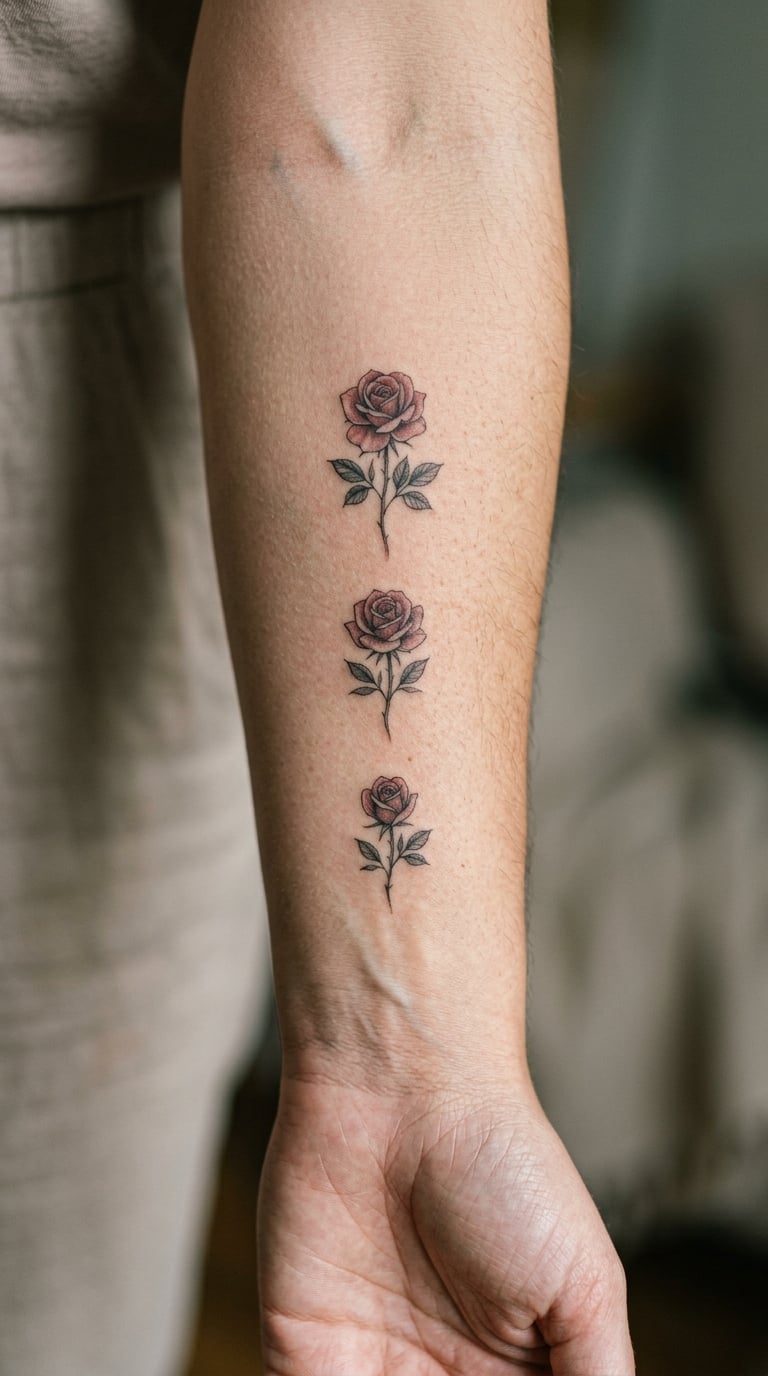
Three roses stacked down the forearm is the classic way to carry a numerology reading or three people at once. Most wearers size each one at 2 to 3 cm and grade them, largest near the elbow, smallest near the wrist.
Three separate blooms need a little breathing room between them or they read as a smudge after healing. Keep each petal count low, maybe five or six per flower, and the spacing will hold for years.
Pain and time: a 3/10 for the thin wrist end, about an hour for all three.
5. Micro Rose-Gem at the Inner Wrist
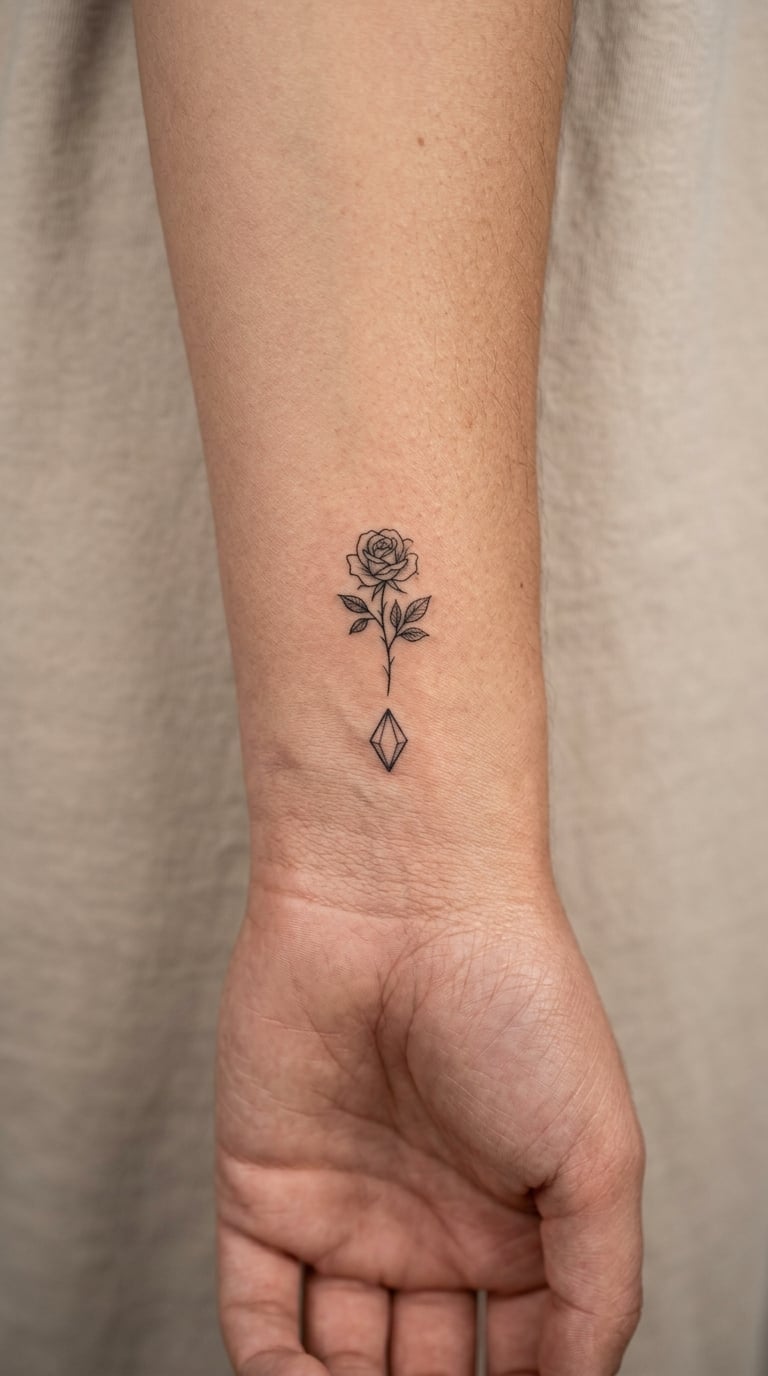
The rose-gem is a small compound motif: a rose with a faceted stone tucked into the stem. It is a good first tattoo, and it disappears under a shirt cuff when you want it to.
Single-needle work at 3 cm or under loses some of its edges as it heals, so a good artist will simplify the petal detail up front rather than let you find out later. Treat a healed micro rose as slightly softer than the reference photo, not as a mistake.
Pain and time: a sharp 5/10 on the wrist, about 45 minutes.
6. Neo-Traditional Rose With a Thorned Stem
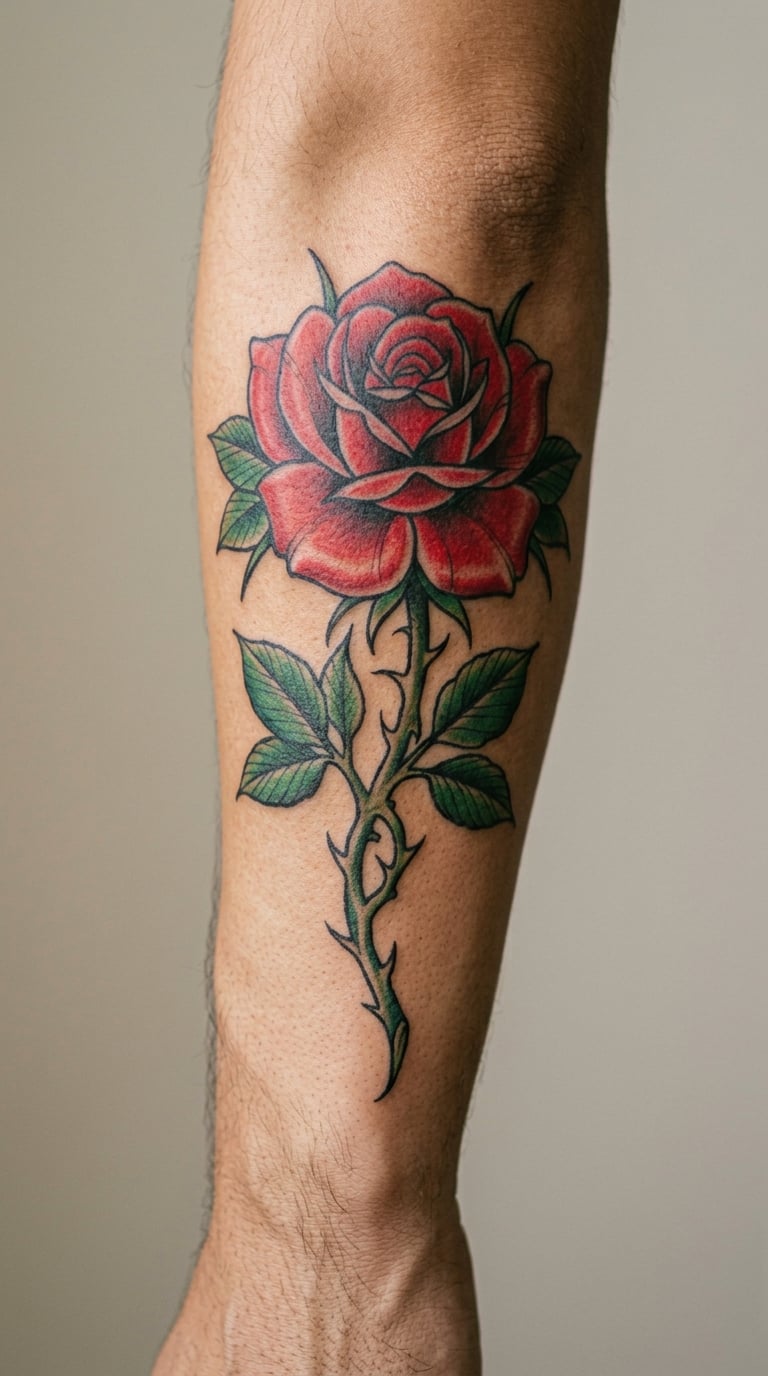
Neo-Traditional gives you the full vocabulary: heavy black outline, a limited red and green palette, and a stem that wants to be thorny. It is a bold look on a fairly bold canvas, and it is the version that most clearly says rose tattoo on forearm rather than something more abstract.
Shade-heavy petals need 8 cm or more to avoid filling in. The outer forearm holds colour well because it is less exposed, though the elbow side of the arm will fade first if you sun it.
Pain and time: a 4/10 with some slower shaded passes, about two hours.
7. Stems and Leaves Botanical Forearm Piece
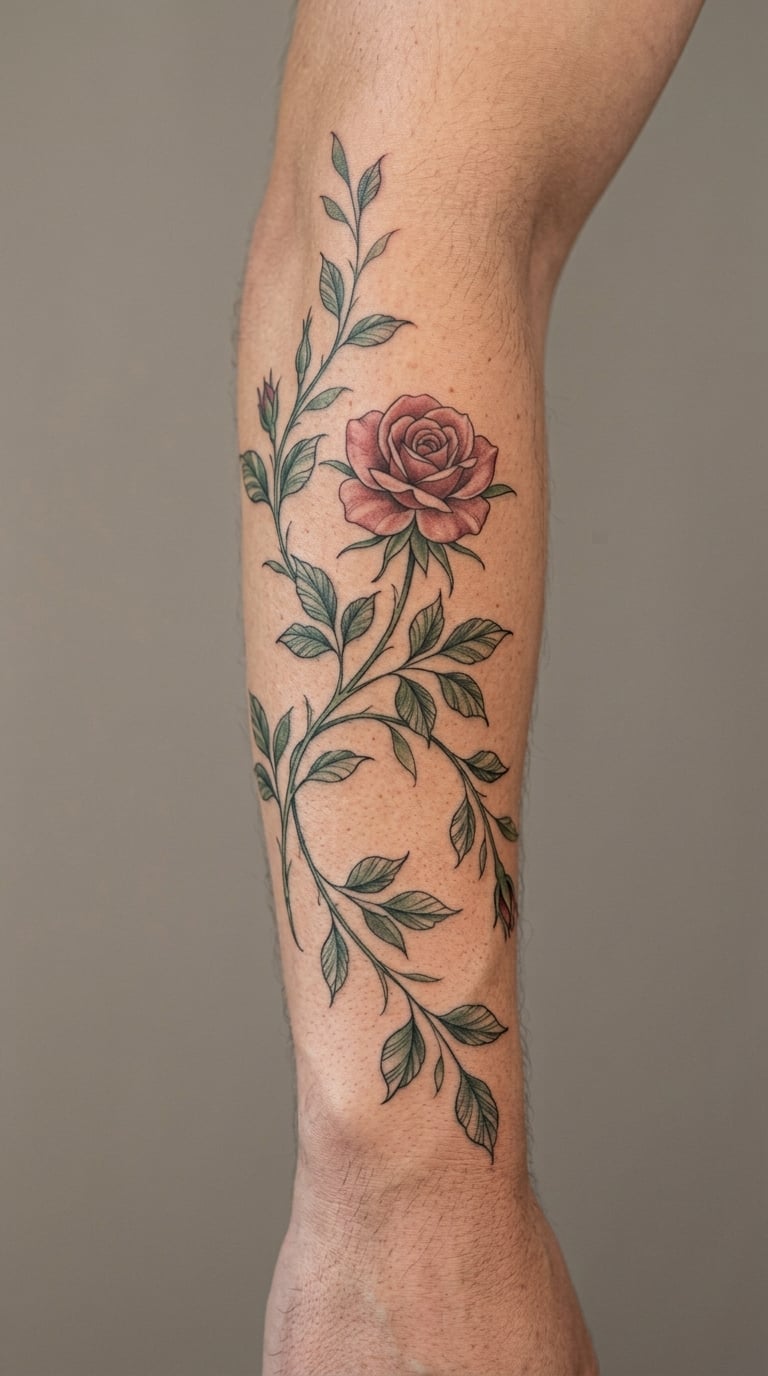
Botanical work treats the whole forearm as a growing thing rather than a single object. A trail of leaves, a couple of smaller buds and one open rose give you a composition that fills the arm without needing one giant flower.
Illustrative botanical style suits this because leaves can be simplified into solid shapes that survive ageing, while the open bloom gets the detail. Ask your artist to keep the trail inside the arm’s width so it does not disappear around the back.
Pain and time: a 4/10, and closer to three hours for a full trail.
8. Red Realistic Rose With Dewdrops
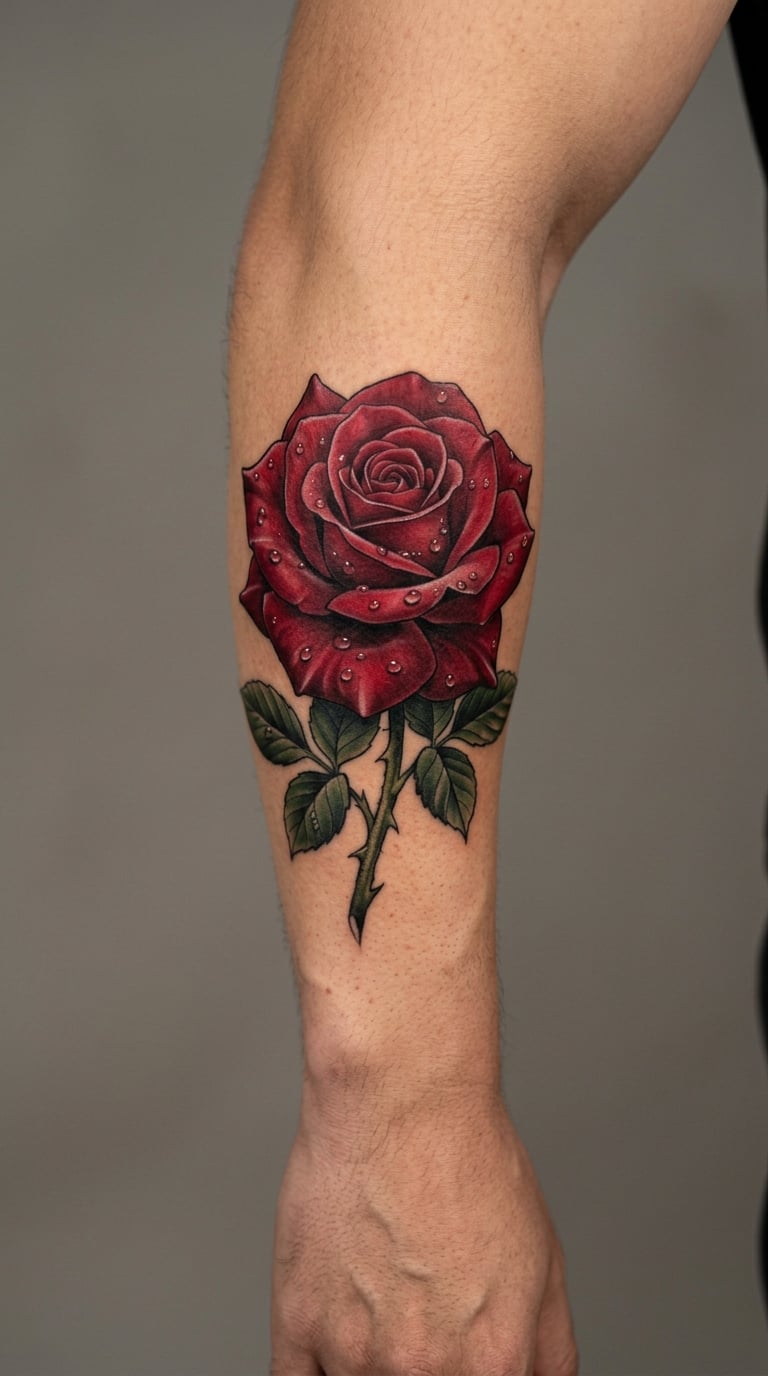
Dewdrops on a realistic red rose are the choice for anyone who wants the flower to look like a photograph instead of a flash design. The droplets give the shading somewhere to go and stop the petals looking flat.
Colour realism needs the most room of any style on this list. Below about 8 cm the gradient on each petal turns to mud, and on a forearm, which gets washed and sun-exposed daily, expect to need a colour touch-up eventually.
Pain and time: a 5/10, and two to three hours for a piece with real shading.
9. Black and Grey Rose With Open Skin Between Petals
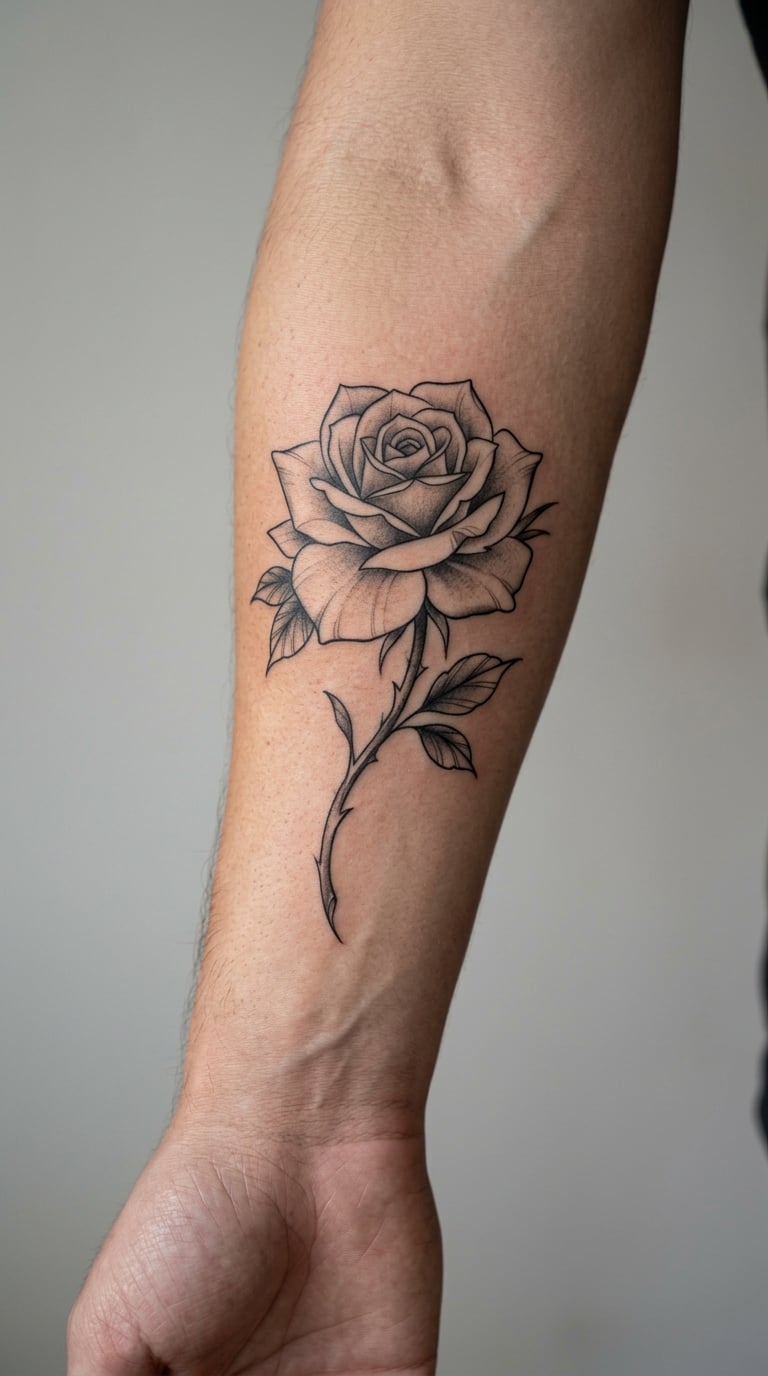
Leaving skin untouched between petals is what keeps a realistic rose readable. It is the single most useful thing you can ask for if you want a forearm rose that still looks like a rose in ten years.
Black and grey ages more predictably than colour because there is no hue to wash out, and the wash sits in the dermis where it stays. Keep the darkest blacks on the outer half of the bloom so the piece still has contrast as it lightens.
Pain and time: a 4/10, about an hour and a half.
10. Rose and Dagger
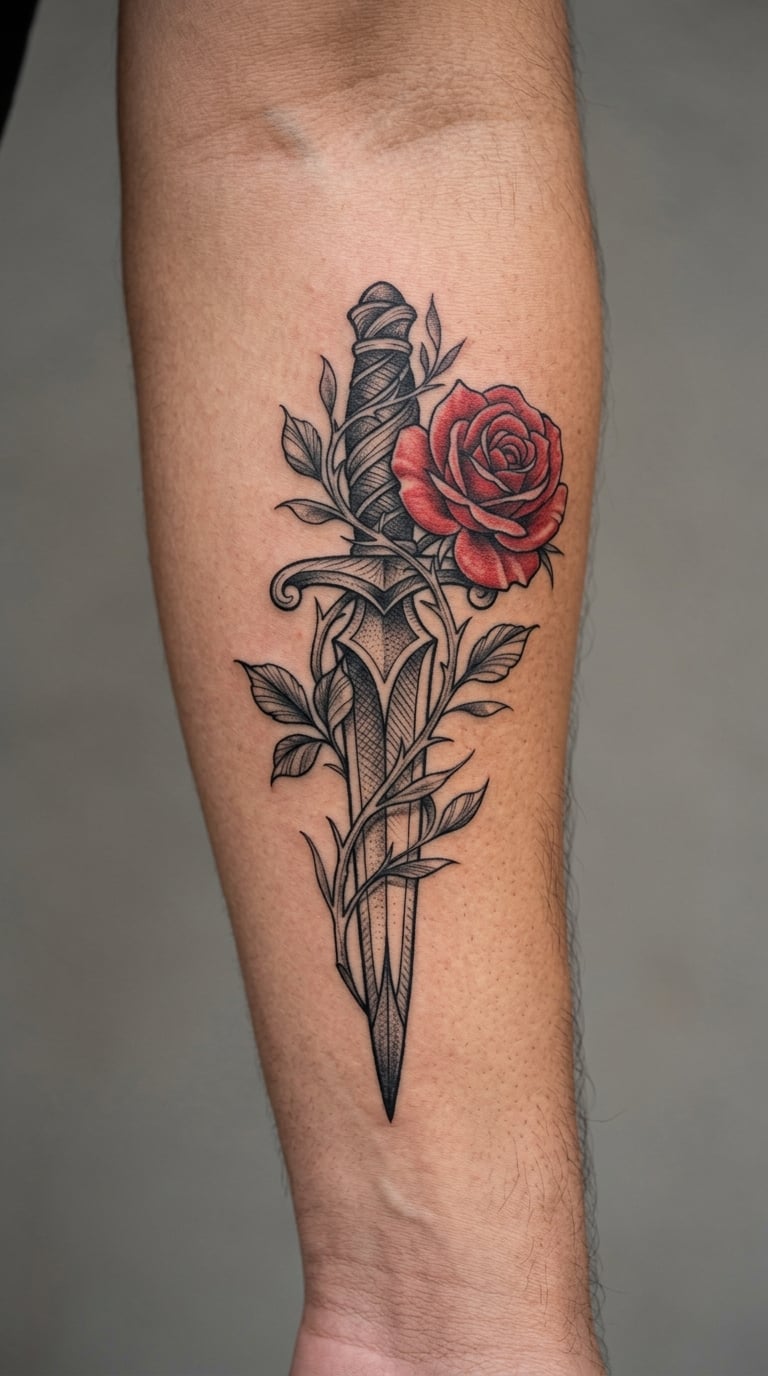
A dagger through a rose is the most traditional combination in tattooing, and the forearm is where it was designed to sit. Wrapping the stem around the handle stops the two elements looking like stickers next to each other.
Keep the dagger narrow so the composition stays vertical rather than sprawling across the arm. Black and grey with a single red rose is the version that ages best and still reads clearly from a distance.
Pain and time: a 5/10 where the dagger shading sits over bone, about two hours.
11. Rose and Clock
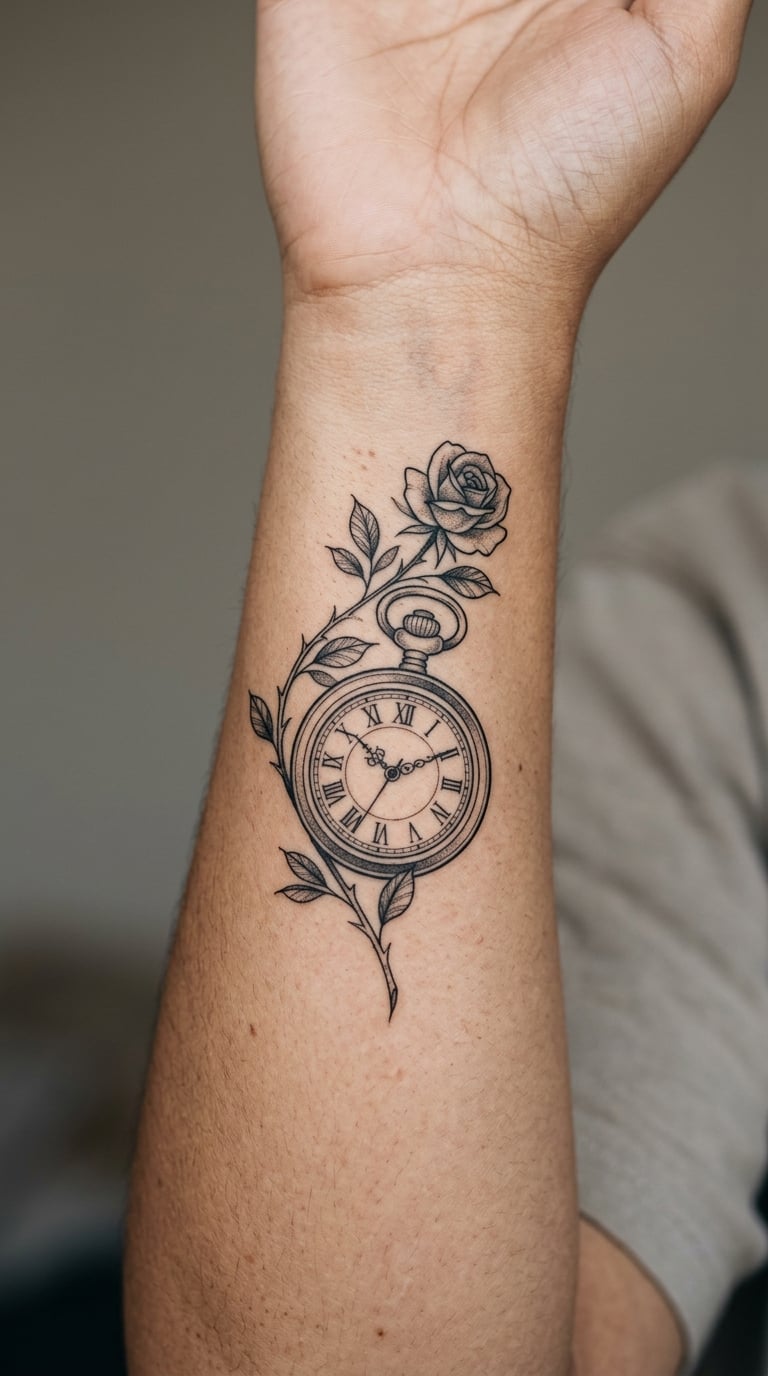
Clock-and-rose designs carry a time-and-devotion reading, which is why they show up for anniversaries and for people marking how long something took to survive. The stem solves the geometry problem of joining a circle to a flower.
On the inner forearm, keep the clock face free of tiny numerals or they will blur inside a year. Roman numerals or no numerals at all is the usual advice. This is a design that wants to be 7 cm or larger.
Pain and time: a 4/10, about an hour and a half.
12. Rose and Butterfly
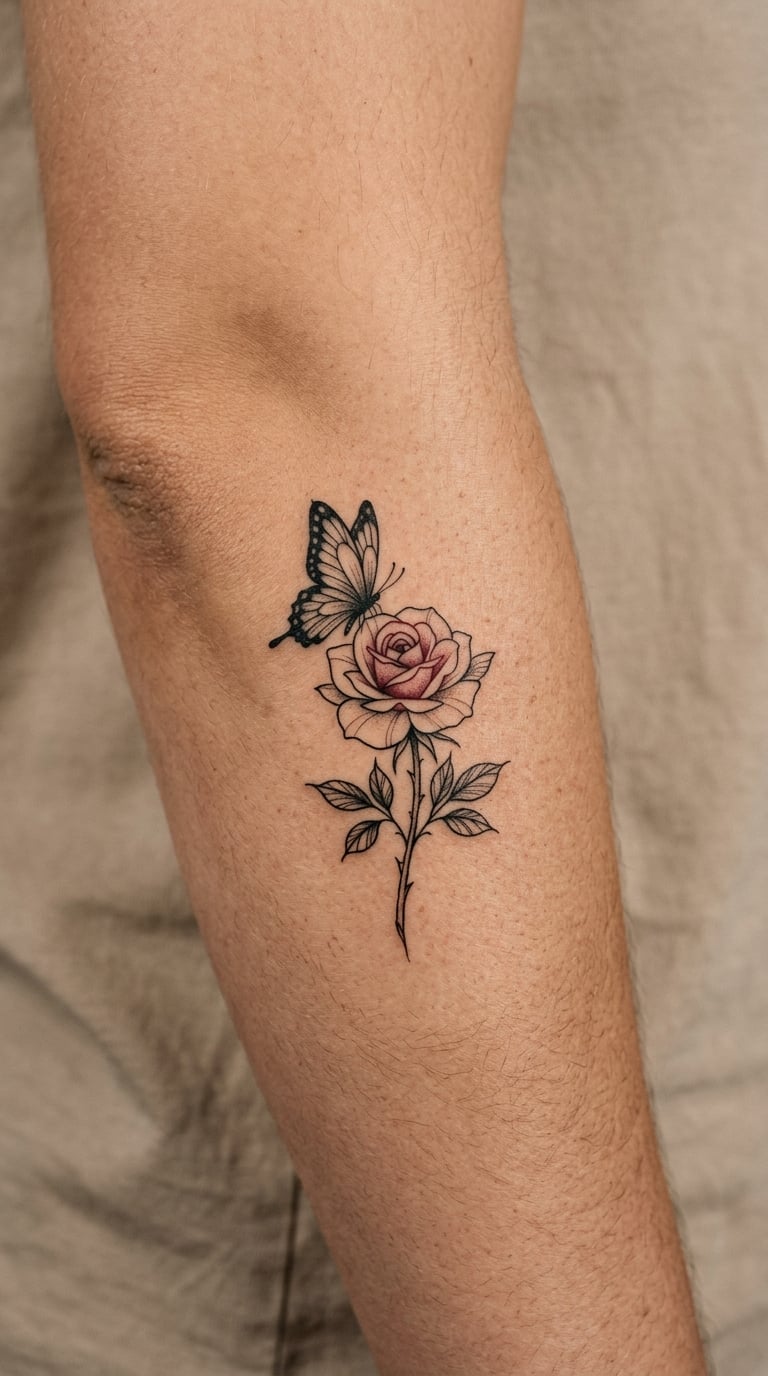
A butterfly on a rose is a transformation piece, and on the forearm it reads well because the two shapes balance: one is wide and flat, the other is small and airborne.
Fine line suits the butterfly wings, but make the rose solid enough to hold its own shape. Six centimetres is the floor here, since a butterfly under 2 cm turns into a dot once it heals.
Pain and time: a 3/10 on the fleshy outer arm, about an hour.
13. Rose and Skull, the Memento Mori Version
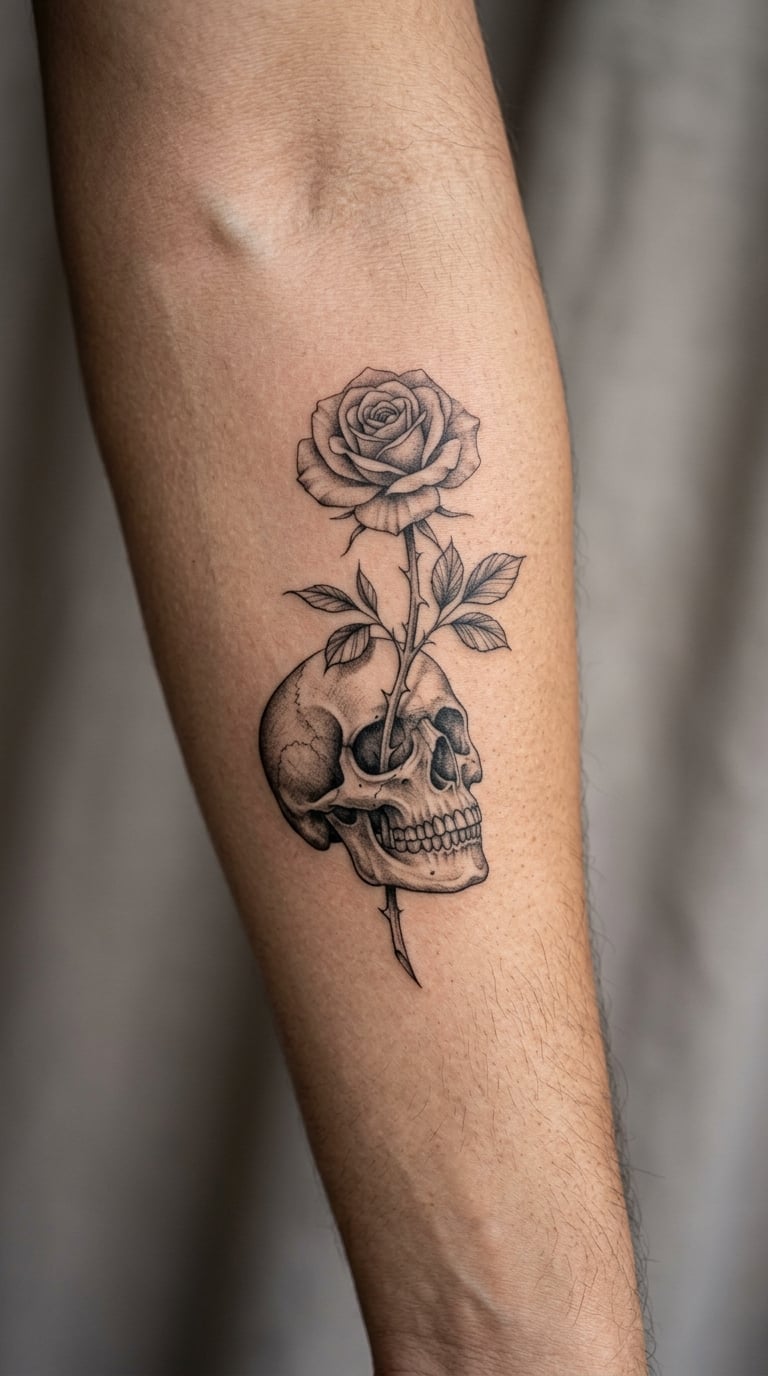
A skull with a rose growing out of it is the memento mori pairing, and it is the one rose design people come back to after a rough year. The stem growing rather than resting keeps it from being purely morbid.
Realistic skull shading needs the same room as any realistic piece on this list, so 9 cm is a sensible minimum. The outer forearm is the better side, because the inner one moves too much for a skull’s structure to stay crisp.
Pain and time: a 5/10, two hours or so.
14. Rose with a Ribbon Banner and a Name
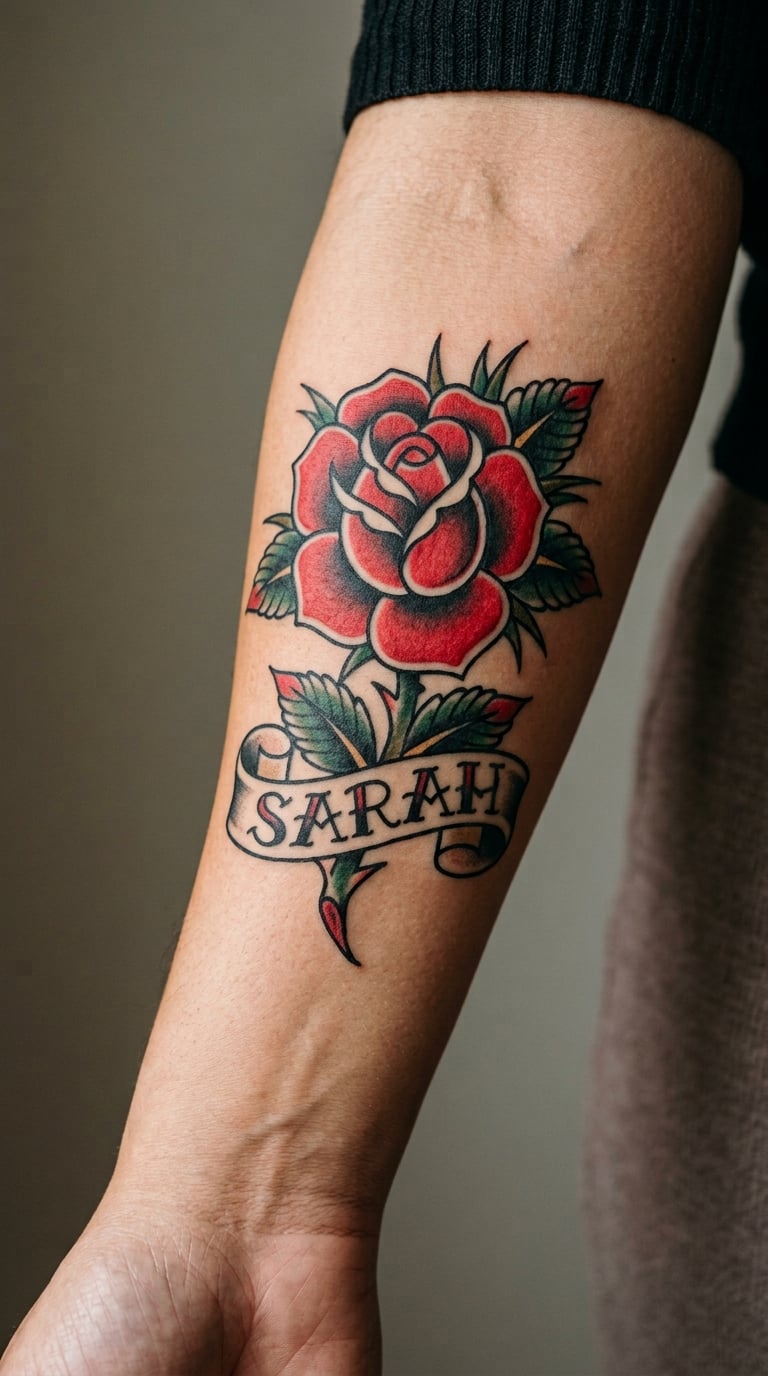
Banner-and-rose designs are the traditional route to a memorial piece, usually a first name, a short date or one word. The banner gives you a flat surface to set text into, which is far easier than curving letters around an arm.
Font choice matters more than most people expect. Anything thin and script-like will soften on the inner forearm, so a simple serif or a hand style with real weight is the safer pick. Keep the banner under 1.5 cm tall for the same reason.
Pain and time: a 4/10, about two hours.
15. One Blooming Rose and One Withering Rose
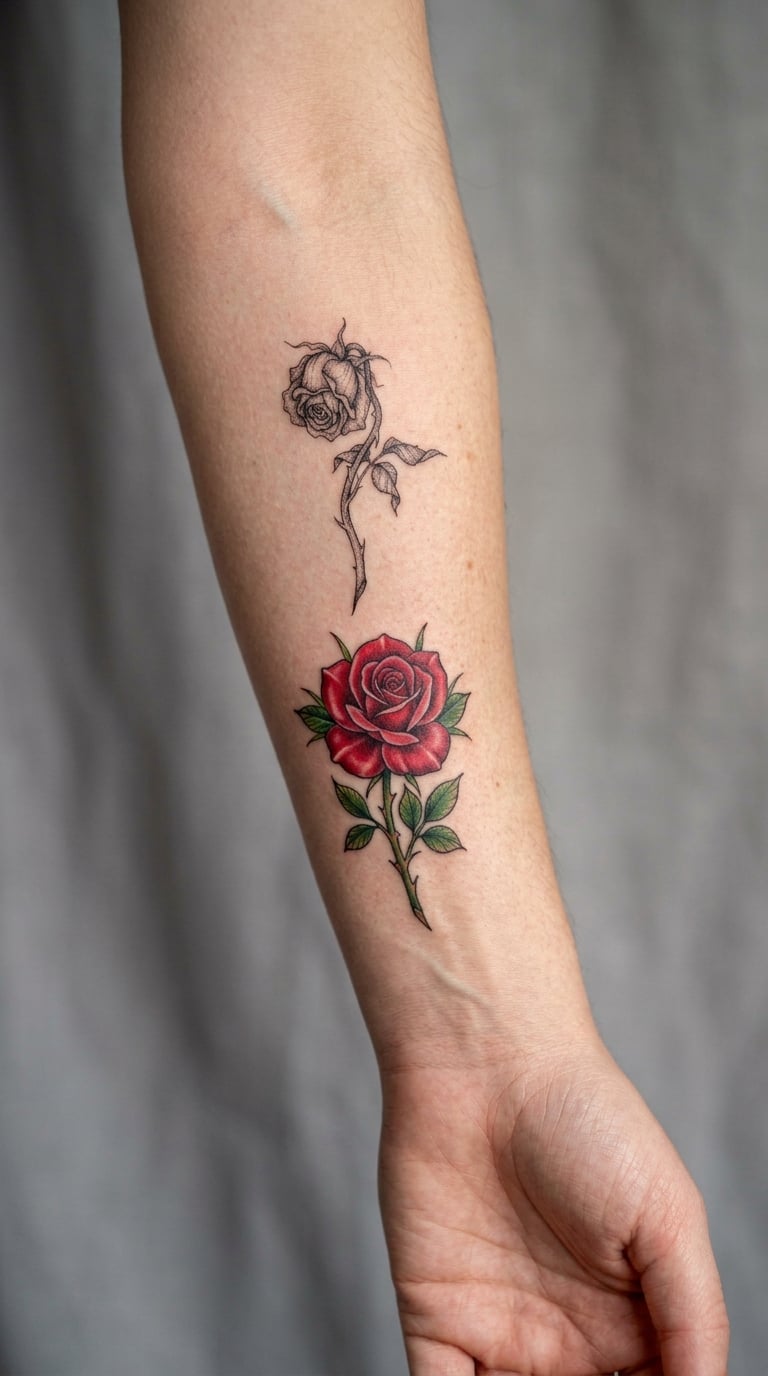
Two roses, one in full bloom and one dried, is the most direct way to draw a before-and-after on your own arm. People usually assign the meanings themselves: recovery beside what came before it, or a person beside the memory of them.
Putting the two at different stages also solves a practical problem, because the dried rose needs almost no ink and the fresh one carries all the colour. Give each bloom 4 to 5 cm and let the contrast do the work.
Pain and time: a 3/10, about an hour.
16. Stained-Glass Rose Inside a Geometric Frame
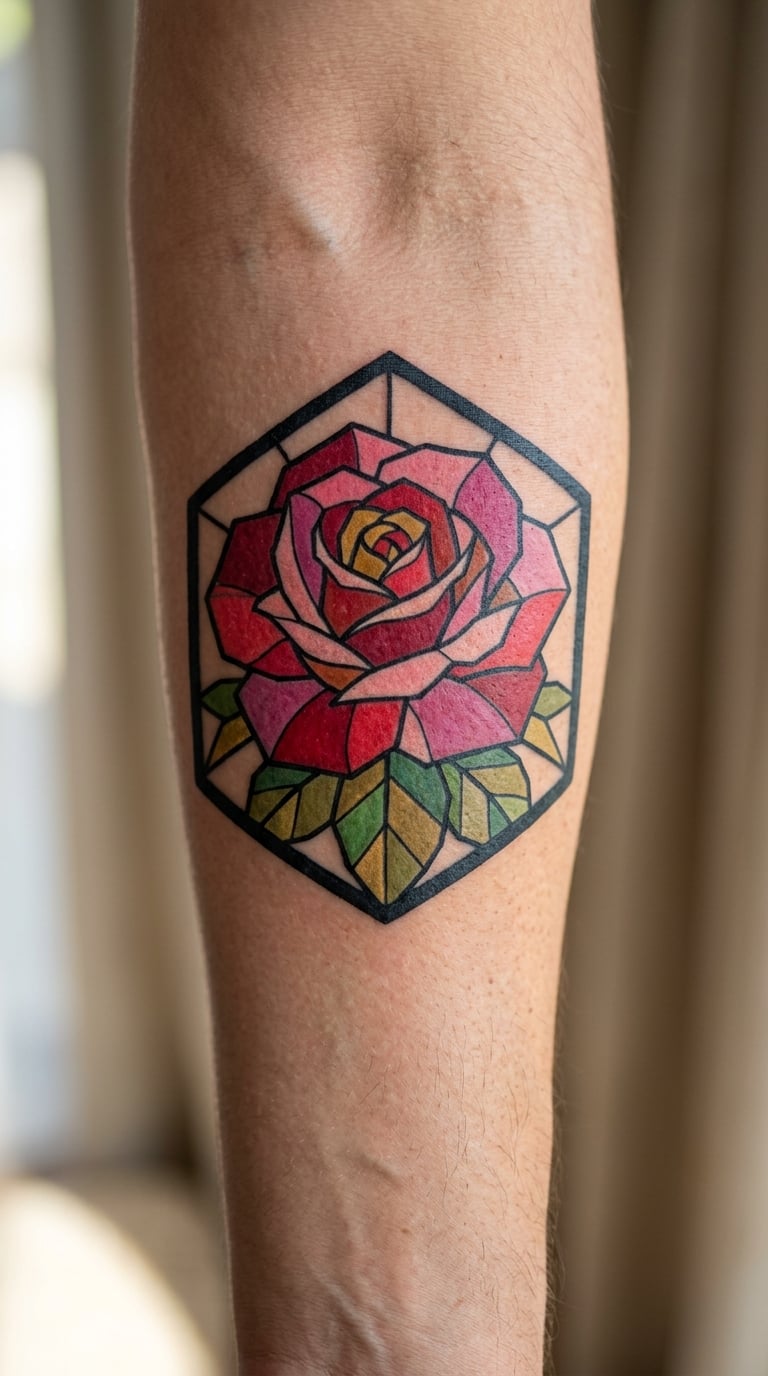
Stained-glass style suits a rose because the flower breaks into flat, solid sections of colour, which stay readable as they age. The geometric frame gives a straight edge to contrast with the organic bloom.
Every segment needs to be at least 2 mm across or the ink fills in between them, so this style scales down badly. On the outer forearm with 10 cm of height, you get clean panels and a piece that still works at sleeve distance.
Pain and time: a 5/10, a long session of around three hours.
17. Serpent Winding Around a Rose Stem
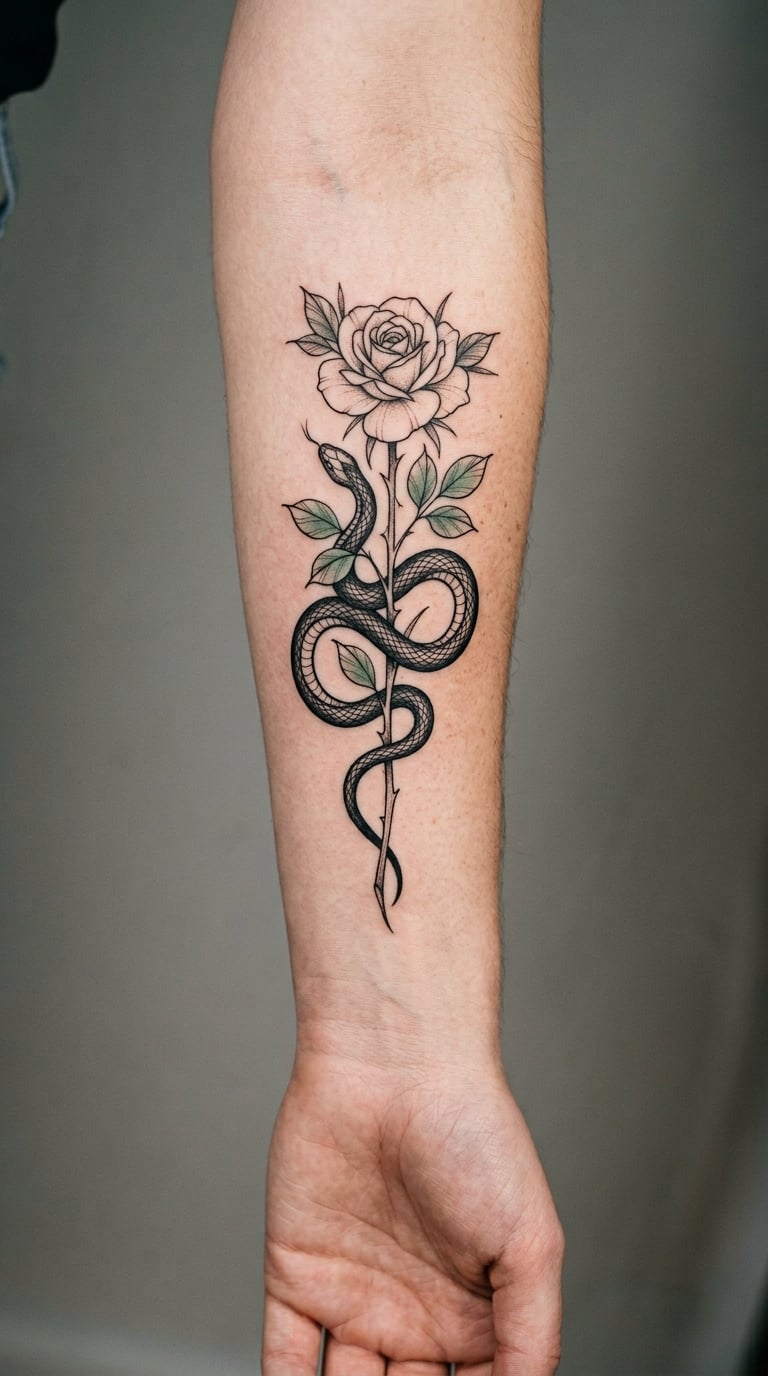
Wrapping a snake around a rose stem turns the arm into a vertical composition that follows the taper of the limb. The snake can start at the elbow and end at the wrist, which gives the whole inner-to-outer span to one design.
Illustrative line work handles this better than photorealism because the body of the snake can be built from open shapes. Let the coil widen at the elbow end and narrow at the wrist, matching the arm rather than fighting it.
Pain and time: a 4/10, about two hours.
18. Rose Half-Bloom Inside a Geometric Wedge
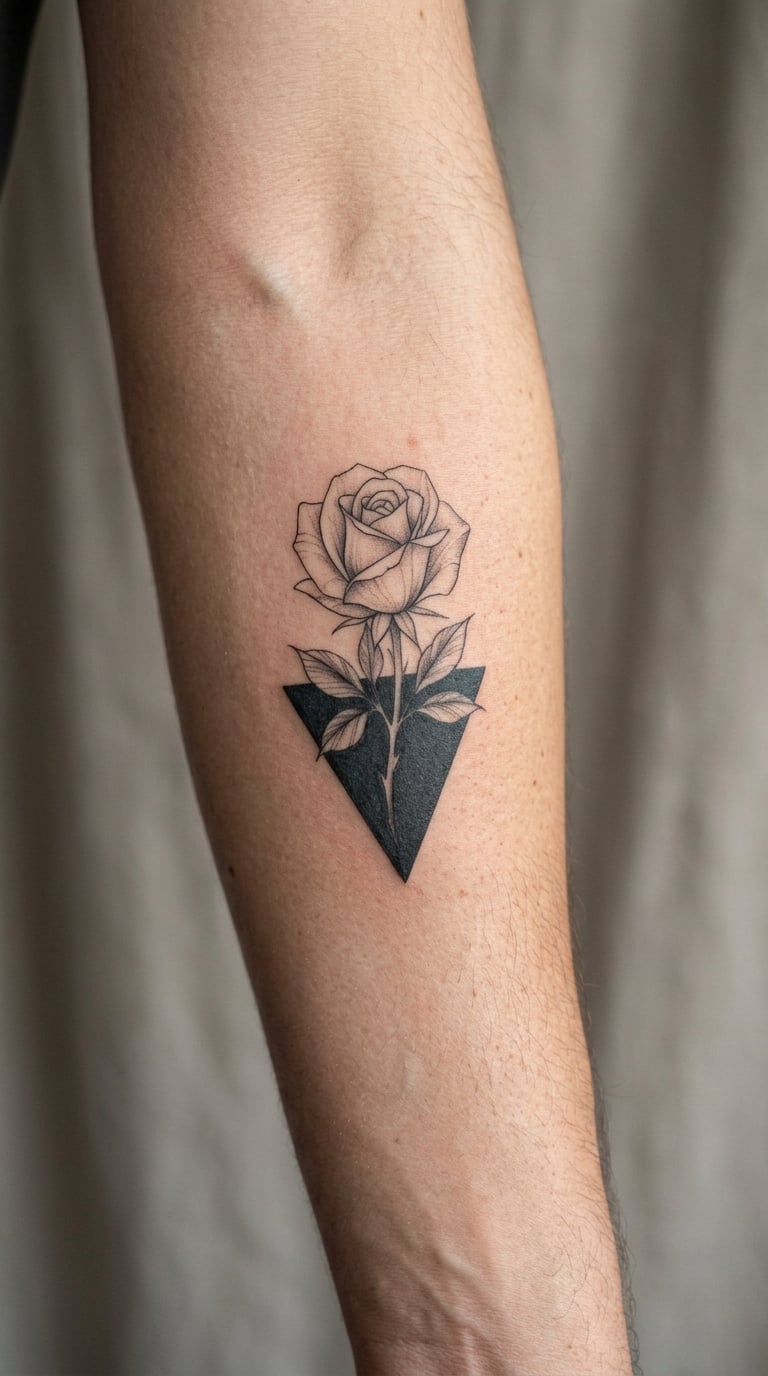
A rose cut in half by a geometric shape is a modern, graphic option that avoids both the traditional flash look and the soft botanical look. Only half the flower is drawn, and the straight edge does the visual work.
This one forgives a small size better than most, because the geometry carries the readability. Six centimetres is enough. The inner forearm works, but keep the triangle’s corners inside the arm so they do not wrap and get lost.
Pain and time: a 4/10, about an hour.
19. Rose Paired with Roman Numerals on the Inner Forearm
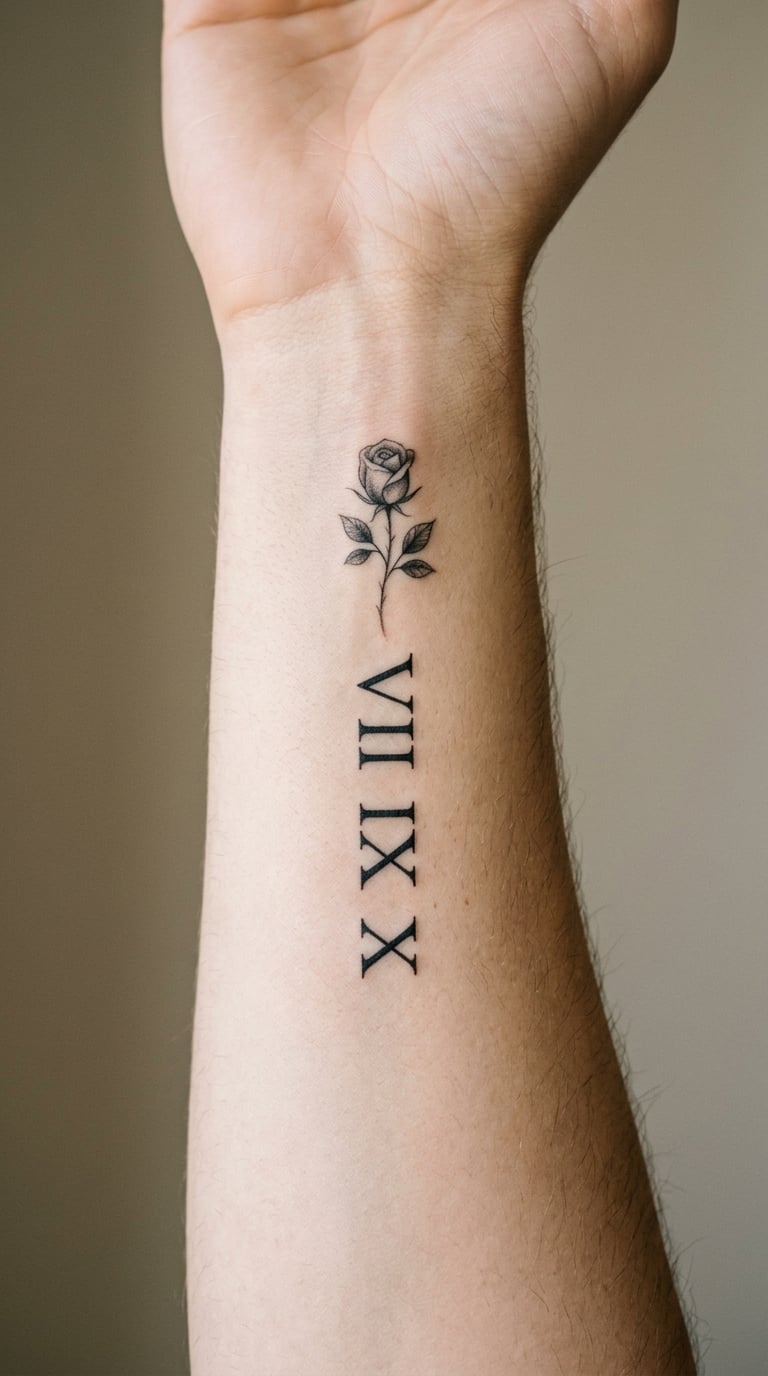
A small rose above a short set of Roman numerals is the quiet way to carry a date. On the inner forearm it stays under a sleeve in most settings, which is the reason people choose it for something personal.
Numbers need the same care as any text: plain serif lettering at 4 mm tall is about the limit before the counters close up. Keep the numerals short, three characters is plenty, and let the rose stay small so the two balance.
Pain and time: a 3/10, under an hour.
20. Rose Winding Toward the Elbow as a Sleeve Start
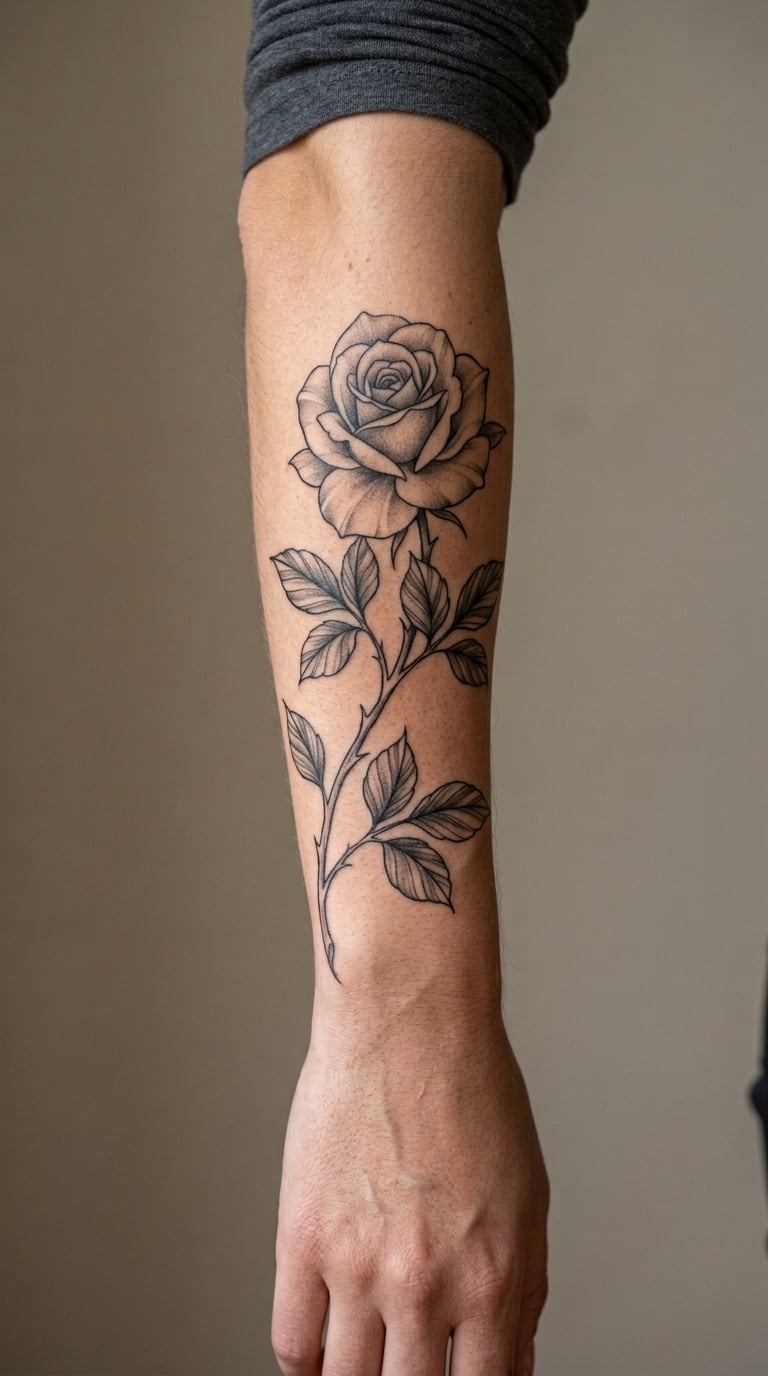
If you are somewhere near a sleeve anyway, start with a stem that is clearly going somewhere. A rose with a long trailing stem reads as the opening of a floral sleeve, and later work can grow out of it without looking bolted on.
Tell your artist this from the start rather than adding the stem later. The stem needs to taper out thin at one end, and adding a thin tail to a finished piece is much harder than planning for it. The elbow side is the end that will need covering later.
Pain and time: a 4/10, two hours or so.
What Rose Colours Mean on the Forearm
Colour does most of the meaning work in a rose design, and it also decides how the tattoo will look in five years.
- Red: the most traditional reading, usually passion, romantic love and courage. On the forearm it is the first colour to fade, so expect a touch-up every few years if it is not covered by sleeves.
- Black: grief, defiance, mortality, or simply a preference for bold line work. Solid black holds its shape better than any other choice and is the easiest to cover up later.
- White: new beginnings, honesty, silence and fresh starts. Pale ink shows every scab, so plan extra healing time and expect the brightest areas to soften first.
- Pink: gratitude, affection and a gentler, less formal version of the red rose. It fades quickest of all on exposed arm skin because the pigment is light.
- Blue: rarity and uniqueness, since blue roses do not grow naturally. Soft blue shading on a forearm gets a bruised look as it heals before it settles.
- Yellow: friendship, warmth and joy, usually paired with a friend or family piece. It blends well with warm skin tones and does not need much space to read.
- Purple: mystery, royalty and a more private kind of love. Deep purple is forgiving over time, as it simply darkens rather than washing out.
Inner vs Outer Forearm: Which Side to Choose
The inner forearm is the popular choice because it is the one people picture, but it is the harder surface. The skin there stretches every time you flex your wrist, so fine line work and tight petal edges soften noticeably within a year. It is also thinner, and the veins and tendons show through, which can make a pale or detailed design look busier on skin than it did on paper.
The outer forearm is fuller, rounder and holds detail better. It also has a higher size ceiling, so if you want a big bloom, a wrap or a half sleeve, this is the side that can carry it. The cost is visibility: it is harder to hide in a long-sleeved work shirt, which is worth thinking about before you commit.
My rule of thumb is simple. If the design is fine line, small, or text, go inner. If it is realistic, bold, or going to grow into a sleeve, go outer.
How Big Should a Forearm Rose Be?
Size is the decision that determines whether a forearm rose reads as intentional or as under-detailed years later. Measure against the arm, not against the reference photo, because most rose references online are photographed close up and look far larger than they would in real life.
- Micro, 2 to 3 cm: wrist placement, single needle, one bud. Simple line only, nothing shaded.
- Small, 4 to 5 cm: the sweet spot for a first tattoo. Room for a full bloom with a stem, and small enough to hide under a sleeve.
- Medium, 7 to 9 cm: where realism and colour start to work properly. Fits between wrist and elbow on most arms.
- Large, 12 to 15 cm: a bold bloom, a wrap or a dagger composition. Needs the outer forearm.
- Wrapping, 15 cm and over: a design that runs past the edge of the arm, or a floral trail heading toward the elbow for a future sleeve.
Measure the distance from your wrist crease to your elbow while your arm is relaxed, then take about half of that for the length of a medium rose. A rose that looks right on a flat photo is almost always too big on the arm.
The Best Tattoo Styles for a Forearm Rose
Fine Line
One-needle roses suit small pieces and subtle designs, and they are the style most people mean when they ask about a minimalist forearm rose. They need the least space and heal the fastest, but they are also the first to soften. Ask for fewer petals than the reference has, and expect a 20 percent loss of crispness as a normal part of healing rather than a mistake.
Blackwork
Solid black petals with open skin between them is the most durable option on this list. There is no colour to fade and no gradient to blur, so the shape you leave with is close to the shape you heal with. It also covers older work more easily than any other style.
Black and Grey Realism
Shaded realism gives you the most detail and the most trouble if the arm moves a lot. It wants 9 cm or more, and the outer forearm keeps it sharper for longer. Leave skin untouched between petals and it stays legible as the grey lightens over the years.
Neo-Traditional
Bold outlines and a limited red and green palette age well and read instantly from across a room. The risk is over-detailed petal shading, which turns solid as the ink settles. Ask for shading to be left out of the tightest parts of the bloom.
Illustrative and Botanical
Stems, leaves and winding trails fill a long forearm better than a single flower does. Solid leaf shapes are forgiving, and the open composition has room to grow if you end up wanting a sleeve later. This is the style to pick if you cannot decide on a single bloom.
Does a Forearm Rose Tattoo Hurt?
Most people describe forearm pain as a deep, constant scratch rather than sharp, and it is easier than the ribs, the sternum or the inside of the upper arm. The honest answer is that it depends entirely on where on the forearm the design sits and how much of it is on bone.
The wrist is the worst spot, because there is almost no muscle there and the nerve runs close to the surface. Most wearers put it at 5 or 6 out of 10. The mid-forearm is the fleshiest part and the most forgiving, closer to a 3. The inner elbow crease stings more than it hurts, and it is where people flinch most, though the session there is short.
Session length follows size. A small 5 cm rose takes 45 minutes to an hour. Medium and large colour pieces run two to three hours, and anything wrapping the arm will be split across two appointments by most artists. A numbing cream used before the session takes the edge off, though you will feel the deep passes regardless.
How a Forearm Rose Heals and Fades
For the first three to five days, wash the area twice a day with plain unscented soap and pat it dry, then apply a thin layer of a plain moisturiser. It will look red, shiny and slightly raised, and that is normal. It will flake for another week or so. Do not pick it, and do not soak the arm in a bath or swimming pool until the skin has fully closed over.
After that, the long-term picture depends mostly on the colour. The forearm is a high-exposure area: it comes out of sleeves every day, it gets washed more than anywhere else on the body, and it flexes constantly. Red and pink roses on an uncovered forearm will need a colour refresh at some point, usually somewhere between three and eight years depending on sun exposure.
Black and grey holds its shape much longer because grey is a density rather than a hue. What you notice instead is contrast loss, where the darkest areas lighten first, so a touch-up is mostly adding depth back into the shadows. If you plan to leave your arms bare, ask about this at the booking rather than the touch-up.
Why Small Forearm Roses Heal Empty
The most common regret in forearm roses is not the motif, it is the size. A detailed bloom drawn at 3 cm loses contrast as the skin settles, and the result reads as a faint smudge that looks unfinished rather than minimal. It is the single most repeated complaint in community threads about forearm roses, and it is entirely preventable.
Four things fix it. Simplify the petal count to five or six instead of twelve. Add a stem and leaves, because the extra shapes give the eye something solid to land on. Size up to 5 or 6 cm if the placement allows it. And ask for negative space between the petals so the flower is separated by skin rather than defined by hairline detail.
All four are free. That is the point: the decision is made in the drawing, and the drawing happens before the needle.
How to Brief Your Tattoo Artist
Bring healed photographs, not just the pretty fresh ones. Tattooers want to see how a design looks at two years, six months and one year, because that is the version you will live with. Screenshots from social media are fine, but bring them in a numbered order and say which one you actually want.
Give a size in centimetres, not a vague descriptor. If you want a rose that runs from wrist to elbow, say so and measure your arm beforehand. Artists work from dimensions, and a design that looked right on paper is frequently too big once it is on skin.
Say which side of the forearm, and say what you already have on the arm. If there is existing work nearby, a wrap into a composition often looks better than a cover-up, and it is much cheaper. Bring a short list of what you do not want, too: no script text, no pale yellow, nothing that depends on hairline shading.
At the consultation the artist will usually draw on your arm in purple or pencil and let you photograph it in place. Take that photo and sleep on it. It costs nothing to decide overnight.
Covering Up an Existing Forearm Rose
A small old forearm rose is one of the harder cover-up jobs, because there is very little black area to work with. Dark, solid designs can almost always be covered or wrapped. A fine-line rose at 3 cm has to be either grown around or redesigned into something with its own weight.
The most common approach is not a cover-up at all. Wrapping a new stem and leaves around the old rose turns it into one design, and the old piece becomes a detail rather than a problem. Going the other direction, into a black and grey floral or blackwork sleeve over the whole forearm, works when you have the budget and the commitment to add to it later.
Talk to two artists. A cover-up you hate because the artist pushed a solution is a second cover-up, and forearm space is not unlimited.
Rose Tattoos for Men and Women on the Forearm
There is no such thing as a masculine or feminine rose, and the styling choices that read one way or the other are all technical. Heavier line weight, a darker palette, a dagger or skull companion, and larger scale on the outer forearm all push a design toward a harder read. Thin line work, small scale on the inner wrist, soft colour and a lot of negative space push the other way.
Any of those combinations can be built on any arm. The most useful thing you can tell an artist is the tone you want and the size you are willing to live with, then let them translate it into line weight and palette. People who say “make it masculine” end up with something generic; people who say “6 cm, black and grey, one bloom” end up with a rose.
Frequently Asked Questions
What does a rose tattoo on the forearm mean?
Most people read a forearm rose as openness: the flower stands for love, beauty and pain at once, and putting it on the most visible arm surface adds the idea of wearing your heart on your sleeve. A single rose usually means one person or one thing carried. Three roses commonly read as past, present and future, or three people. Whatever you decide it means is the meaning it keeps.
How bad does a tattoo on the forearm hurt?
Most people describe forearm tattooing as a deep, constant scratch rather than sharp pain, and it ranks easier than the ribs or the sternum. The wrist is the worst spot because there is almost no muscle there, usually a 5 or 6 out of 10. The mid-forearm is fleshiest and gentler, closer to a 3. The inner elbow crease stings more than it hurts, and the session there is short.
Inner or outer forearm: where should a rose go?
Go inner for fine line work, small designs, text or anything you want to hide under a sleeve. The inner forearm is thinner and stretches whenever you flex your wrist, so fine detail softens there faster. Go outer for realistic roses, bold blackwork, large blooms or anything heading toward a sleeve. The outer forearm is fuller, holds detail better and has a higher size ceiling, but it is harder to cover at work.
Can a small rose tattoo still look good?
Yes, but only if the detail is cut to match the size. A 4 to 5 cm rose with five or six petals, a stem and a couple of leaves reads clearly for years. A 3 cm rose drawn with twelve petals and hairline shading will soften into a smudge, and that is the most common complaint about small forearm roses. Ask the artist to simplify the petal count before the session rather than after.
Should I get a colour or black and grey forearm rose?
Black and grey ages more predictably, because grey is density rather than hue, so it holds its structure longer and is easier to cover up later. Colour gives you a more photographic rose and it looks excellent while it is fresh, but red and pink on an uncovered forearm will need a refresh at some point, often within three to eight years. If your arms are bare most of the year, black and grey is the lower-maintenance choice.
How long does a forearm rose tattoo take to heal?
The surface skin closes over in two to three weeks, but the full result is not visible until around six weeks when the new skin settles and the ink lightens into its final shade. Sun exposure over that first summer matters more than anything else, so cover it with clothing or sunscreen. Full settling takes about three months. Come back after that for an assessment before deciding on any touch-up.
Conclusion: Take One Design to the Consultation
Pick one design from the twenty above, and pick it because of size and placement before you pick it because of the style. A 5 cm black and grey rose on the inner forearm and a 12 cm Neo-Traditional wrap on the outer forearm are both good tattoos, and they are completely different commitments.
Then bring healed references and a number in centimetres to your consultation. Every one of these rose tattoo ideas for the forearm works better once it is drawn on your own arm, where the artist can check the taper, the stretch and how it will sit in real light.