
20 Best UV Tattoo Ideas: Glow-Ready Designs (September 2026)
UV tattoo ideas work because the ink hides in plain light and switches on under a blacklight. A blacklight tattoo is not a white tattoo in a dark room. The pigment absorbs ultraviolet light and re-emits it as colour, so a design that looks like a faint shadow at a cafe can turn neon in a club, a festival field, or a photo shoot months later.
That makes these designs a good fit for people who enjoy nightlife, cosplay, concerts and photography, and for anyone who wants a piece of artwork that only a handful of people will ever see. If you are planning around a party, a wedding, or a Halloween set, book a good 30 to 45 days ahead so healing is done before the photos. What follows is a collection of twenty, with honest sizing, honest pain notes, and a few notes from people who already own glowing ink.
UV Tattoo Ideas: Quick Guide
The best uv tattoo ideas pair a strong black outline with fluorescent pigment, keep enough spacing between elements to stay readable from a few feet away, and sit somewhere the skin is flat and calm. A design that looks balanced in a bright studio can vanish under a blacklight if every line is thin, so heavier contour work and large filled blocks are the reliable starting points.
| Idea | Style | Best placement | Size | Pain |
|---|---|---|---|---|
| Blacklight constellation map | Illustrative realism | Forearm, upper arm, thigh | 3-5 in (7.5-13 cm) | Medium, high on ribs |
| UV-reactive rose linework | Fine line with colour accent | Forearm, wrist, thigh | 2-3 in (5-8 cm) | Low to medium |
| Glowing octopus tentacles | Blackwork with colour | Forearm, calf | 4-6 in (10-15 cm) | Medium to high |
| Micro realistic butterfly | Micro-realism | Wrist, behind ear, shoulder | 1.5-2.5 in (4-6 cm) | Low to medium |
| Fluorescent wave and sun | Minimalist linework | Forearm, calf, shoulder | 3-4 in (8-10 cm) | Low, high on ribs |
| Hidden geometric ladder | Geometric blackwork | Forearm, calf, sternum | 2.5-4 in (6-10 cm) | Medium |
| UV jellyfish cloud | Illustrative realism | Shoulder, calf, upper arm | 3-5 in (8-13 cm) | Medium |
| Fluorescent dragonfly | Fine line with accent | Forearm, calf, behind ear | 2-3 in (5-8 cm) | Low to medium |
| Glowing Tree of Life | Blackwork with colour | Forearm, calf, upper arm | 4-6 in (10-15 cm) | Medium |
| Checkered grunge block | Neo-traditional geometric | Upper arm, forearm, calf | 3-5 in (8-13 cm) | Medium |
| Glowing shark outline | Illustrative blackwork | Forearm, calf, shoulder | 3-5 in (8-13 cm) | Medium to high |
| Blacklight peony | Blackwork with colour | Forearm, thigh, shoulder | 2.5-4 in (6-10 cm) | Medium |
| Fluorescent snake coil | Traditional-inspired blackwork | Forearm, calf, thigh | 2.5-4 in (6-10 cm) | Medium |
| UV compass rose | Geometric illustrative | Forearm, ankle, chest | 2-3 in (5-8 cm) | Medium |
| Glowing moth with eyespots | Illustrative realism | Shoulder blades, back, forearm | 3-5 in (8-13 cm) | Medium to high |
| Sun and moon half-moons | Minimalist celestial | Forearm, calf, upper arm | 2-3 in each (5-8 cm) | Low to medium |
| Fluorescent pixel heart | Pixel art | Wrist, finger, ankle, chest | 1.5-3 in (4-8 cm) | Low to medium |
| UV floral mandala | Geometric floral | Forearm, calf, shoulder | 3-5 in (8-13 cm) | Medium |
| Glowing chains and lightning | Blackwork | Forearm, calf | 4-6 in (10-15 cm) | Medium to high |
| Full UV galaxy sleeve | Illustrative realism with colour | Full forearm or upper arm | 6-10 in (15-25 cm)+ | High |
Every design below assumes a blacklight source in roughly the 365-400nm UV-A range. A lamp outside that band will make a UV tattoo look switched off, which is the most common reason people think their ink is not working.
1. Blacklight Constellation Map
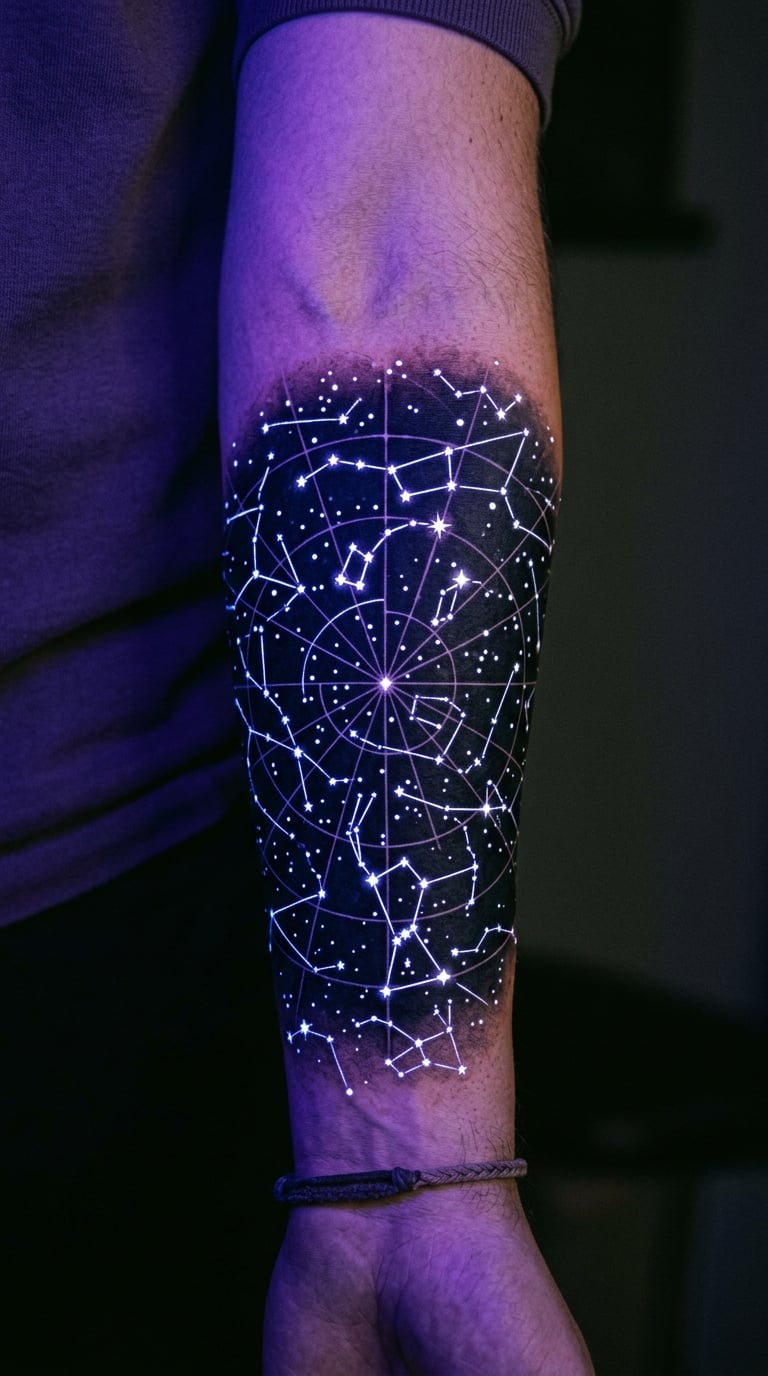
One of the most requested uv tattoo ideas: a connected star map drawn as a dark field with fluorescent white or pale blue stars, plus hairline links between the points you actually care about. The dark base gives the piece a night-sky shape in daylight, so it reads as a forearm piece rather than a smudge.
There is no fixed meaning attached to a constellation tattoo, so the meaning is entirely yours to assign. The usual reason people choose one is that the pattern is tied to a specific place, a date, or a person, and the glow adds a layer nobody else can read.
Placement: Outer forearm, upper arm, thigh, or a single line down the back. Size: 3-5 in (7.5-13 cm). Style: Illustrative realism. Pain: Medium on the forearm, high over ribs.
Ageing note: single-point stars soften and blur within a few years, and connecting lines drawn too thin disappear first. Longevity is real, but the fine stars need more weight than you would guess in a sketch.
Make it yours: Use the real coordinates of a place, or add the date the sky was clear where you were standing.
2. UV-Reactive Rose Linework
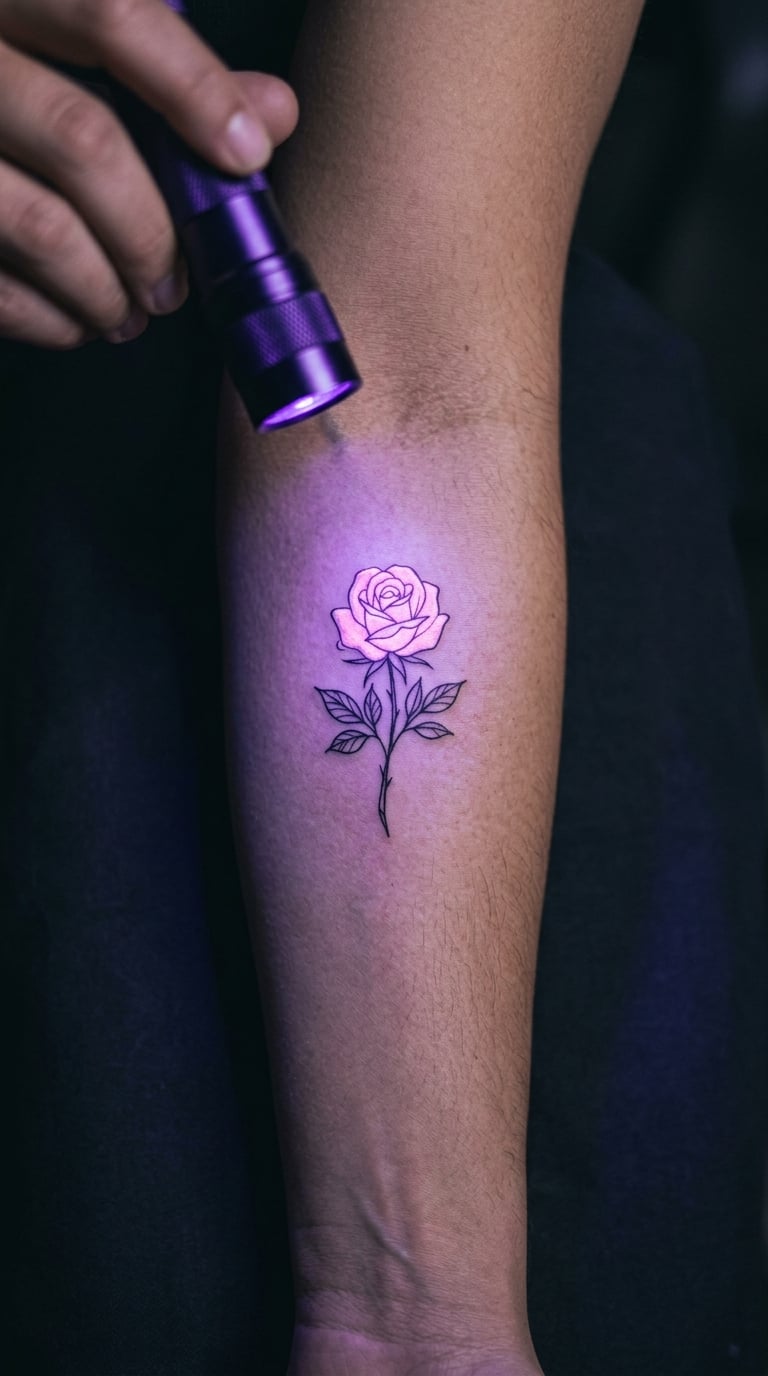
A single rose drawn with confident black contours and a UV-white or pale pink fill is the easiest way to get a tattoo that reads in daylight and behaves completely differently at night. The petals stay layered rather than blended, with two or three inner strokes per petal so the fill has something to sit inside.
People pick this one when they want a flower that is not a soft watercolour piece. The daylight read is a clean outlined rose, and the blacklight read is a glowing one. Neither version has to be a compromise.
Placement: Inner forearm, wrist, upper arm, or thigh. Size: 2-3 in (5-8 cm). Style: Fine line with a colour accent. Pain: Low to medium, depending on the spot.
Ageing note: fine petal edges on the hand and wrist fade first because of sun and hand washing. If you want it to last, the inner upper arm is the kinder spot.
Make it yours: Change the fill to your birth month colour, or tuck a date into the stem line.
3. Glowing Octopus Tentacles
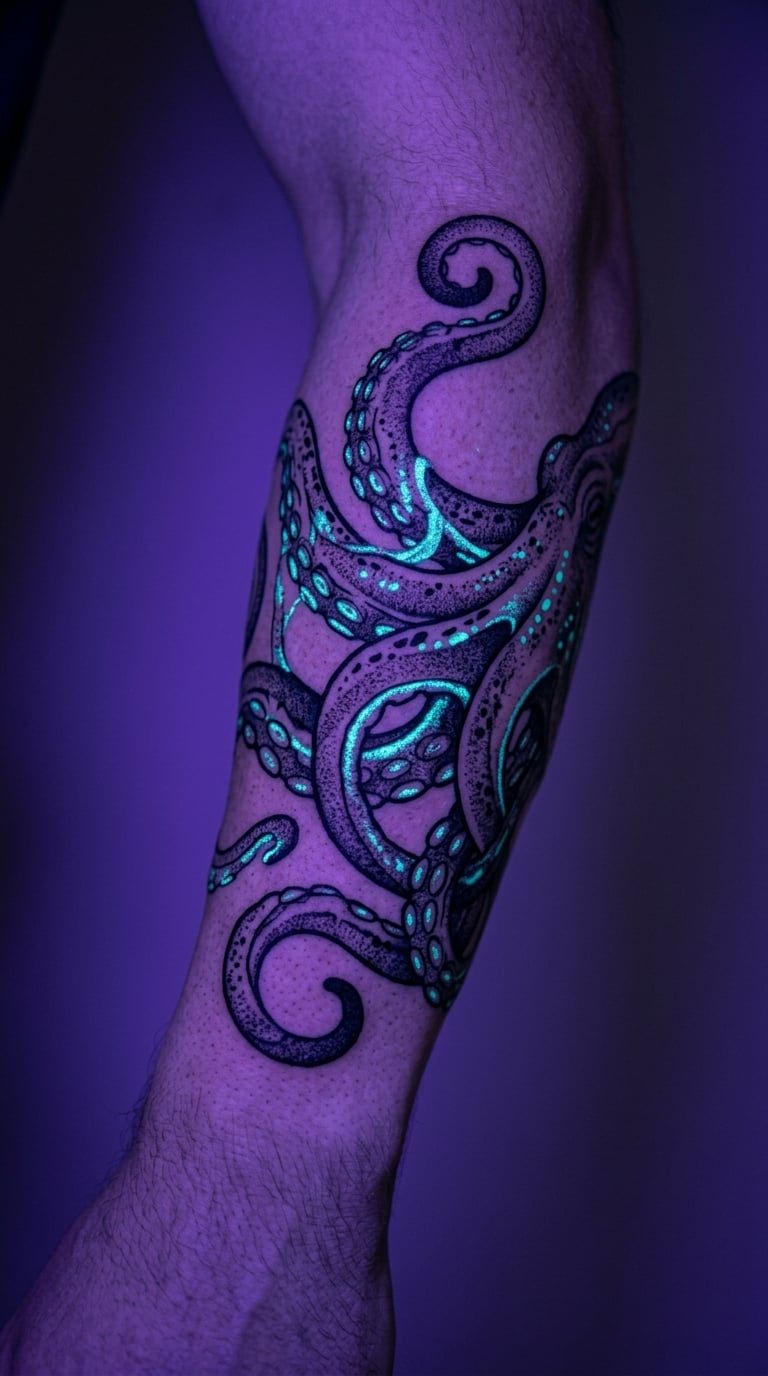
Curling blackwork tentacles with fluorescent teal, blue, or purple sitting inside the negative space give you an organic piece that transforms hard under a blacklight. The ink is not spread over the whole animal. It is concentrated in the gaps between limbs, so the daylight design is dense and graphic and the darkroom design is airy and bright.
This works for people who like marine biology, movement, or genuinely complex blackwork but do not want a full-colour sleeve. It is a design you can explain in one sentence and study for an hour.
Placement: Forearm wrap, calf, or back of the upper arm. Size: 4-6 in (10-15 cm) for a compact piece. Style: Blackwork with illustrative colour. Pain: Medium on the calf, medium to high near the elbow or ribs.
Ageing note: the smallest sucker details along the underside of each arm are the first to blur, so ask the artist to keep them chunky or drop them.
Make it yours: Set the glowing colour to match an existing piece, or add a second small tentacle cluster as a matching forearm accent.
4. Micro Realistic UV Butterfly
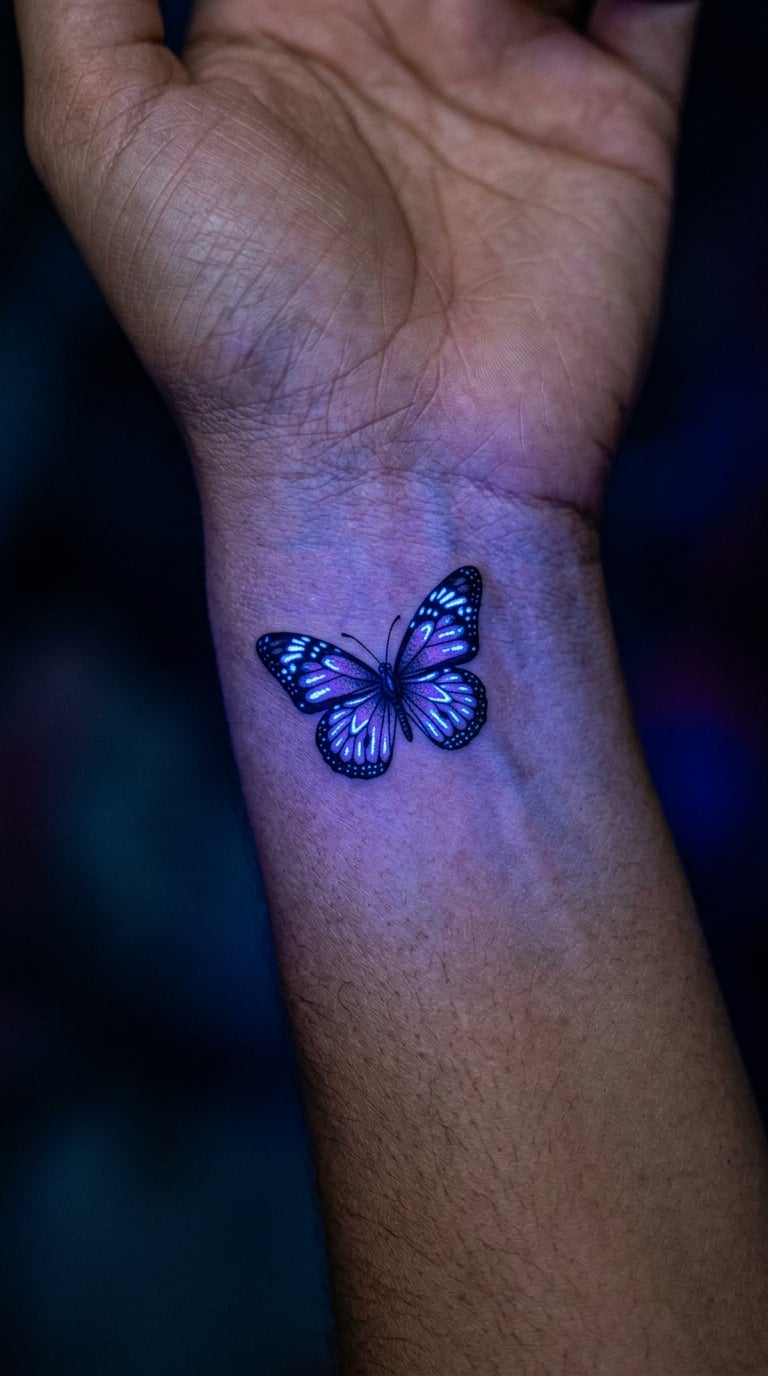
A small butterfly with a black body, dark wing veins, and fluorescent orange, blue, or violet markings across the upper wings is the classic first UV piece. In daylight it reads as a quiet grey butterfly, which is exactly why people like it. Nothing in it announces itself at a desk.
It suits anyone who wants a design with a strong reaction but a low-key footprint. The colour does the talking, so the shape can stay realistic and plain.
Placement: Wrist, behind the ear, shoulder, ankle, or a finger. Size: 1.5-2.5 in (4-6 cm). Style: Micro-realism. Pain: Low to medium depending on placement; fingers and the collarbone area sting more than the outer arm.
Ageing note: finger and hand placements take constant use, so the vein detail and edge work blur sooner than they would on the upper arm.
Make it yours: Make it a half butterfly that appears to land out of an existing floral piece.
5. Fluorescent Wave and Sun
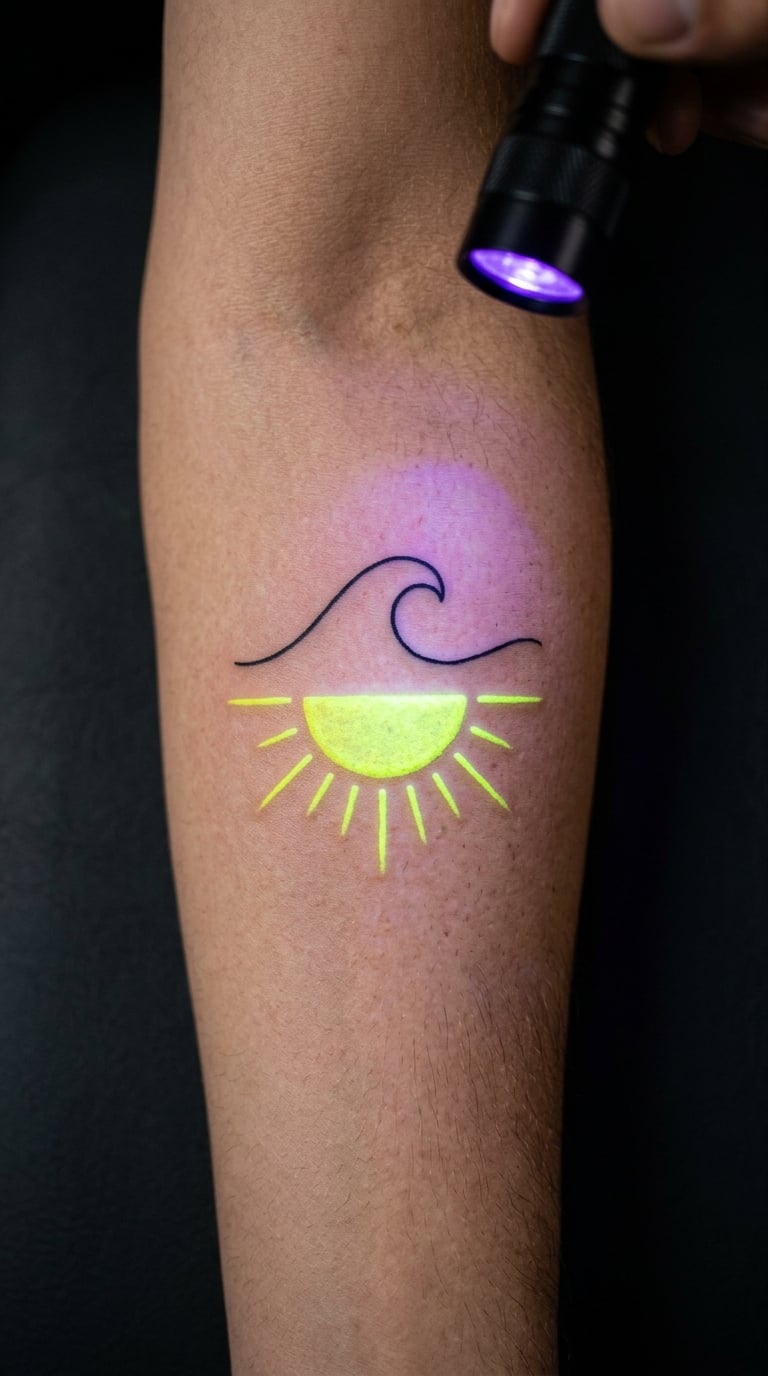
A single black wave drawn in a clean contour style, paired with a half sun filled in fluorescent yellow or orange, creates a reaction from two elements instead of a glow applied to everything. The restraint is the point. Artists who paint the whole composition fluorescent end up with a flat block under a blacklight.
Wave and sun pairs usually get chosen in spring or before a beach trip, sometimes matching a coastal childhood. That personal link is the only meaning attached to it, and different people mean different things by it.
Placement: Outer forearm, calf, ribs, or shoulder. Size: 3-4 in (8-10 cm). Style: Minimalist linework with colour. Pain: Low on the upper arm, medium to high on ribs and ankle bones.
Ageing note: the thin crest lines along the top of the wave lose definition first, especially on the ankle where footwear rubs.
Make it yours: Put a real longitude under the wave, or add a small number of dots as foam above the crest.
6. Hidden Geometric Ladder
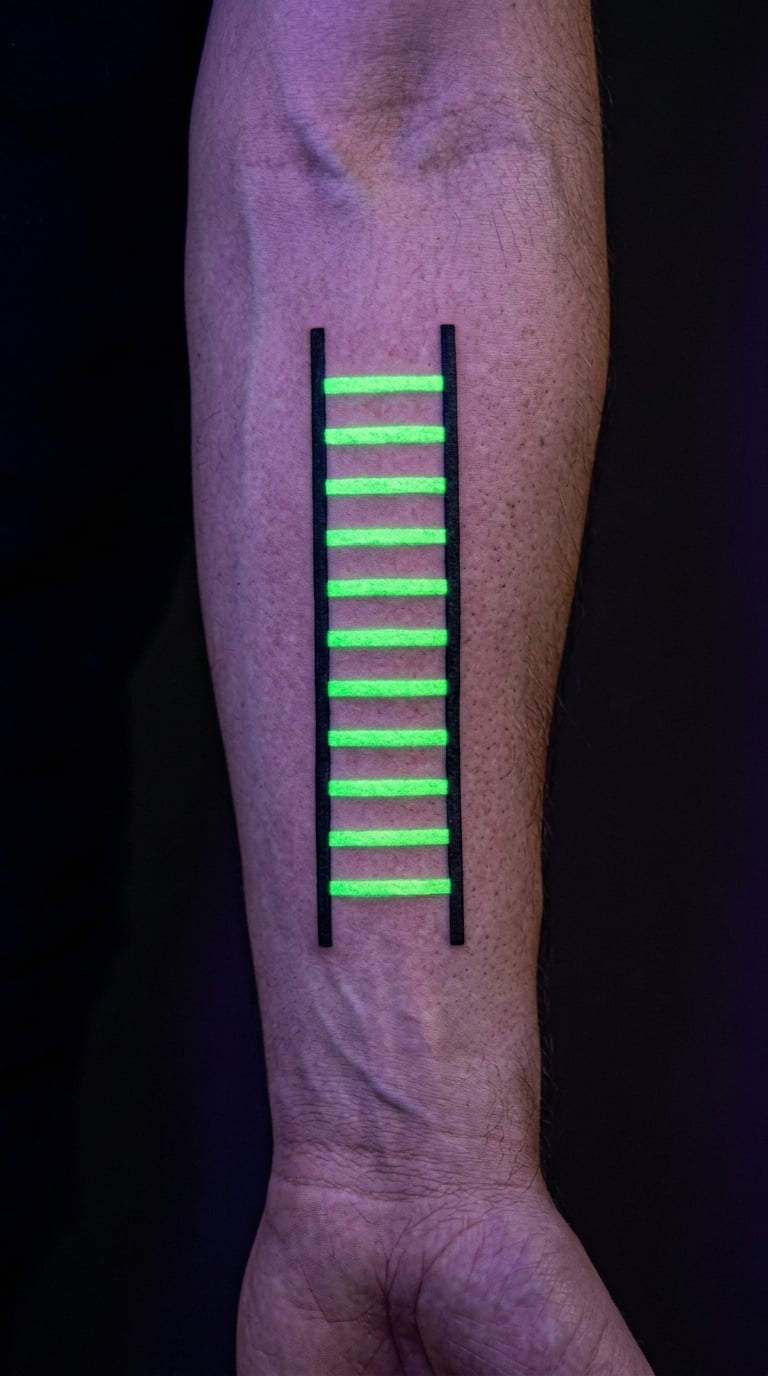
A narrow ladder with dark rails and evenly spaced rungs, finished in a fluorescent coat that peaks from a distance, is one of the cleanest geometric uv tattoo ideas here. Because the rails carry the weight, the whole design holds together even when the glowing finish fades, which is not true of more delicate pieces.
It is a good match for people who like abstract geometry and would rather avoid a figurative image entirely. The structure does the visual work on its own.
Placement: Forearm running vertically, calf, sternum, or upper arm. Size: 2.5-4 in (6-10 cm). Style: Geometric blackwork. Pain: Medium, and sharper over bony areas such as the wrist or ankle.
Ageing note: if the rungs cross a joint, the crossbars can spread and need a touch-up sooner than the rails.
Make it yours: Count the rungs for a year that mattered, or run the ladder down the spine as a ladder of individual dots on each vertebra gap.
7. UV Jellyfish Cloud
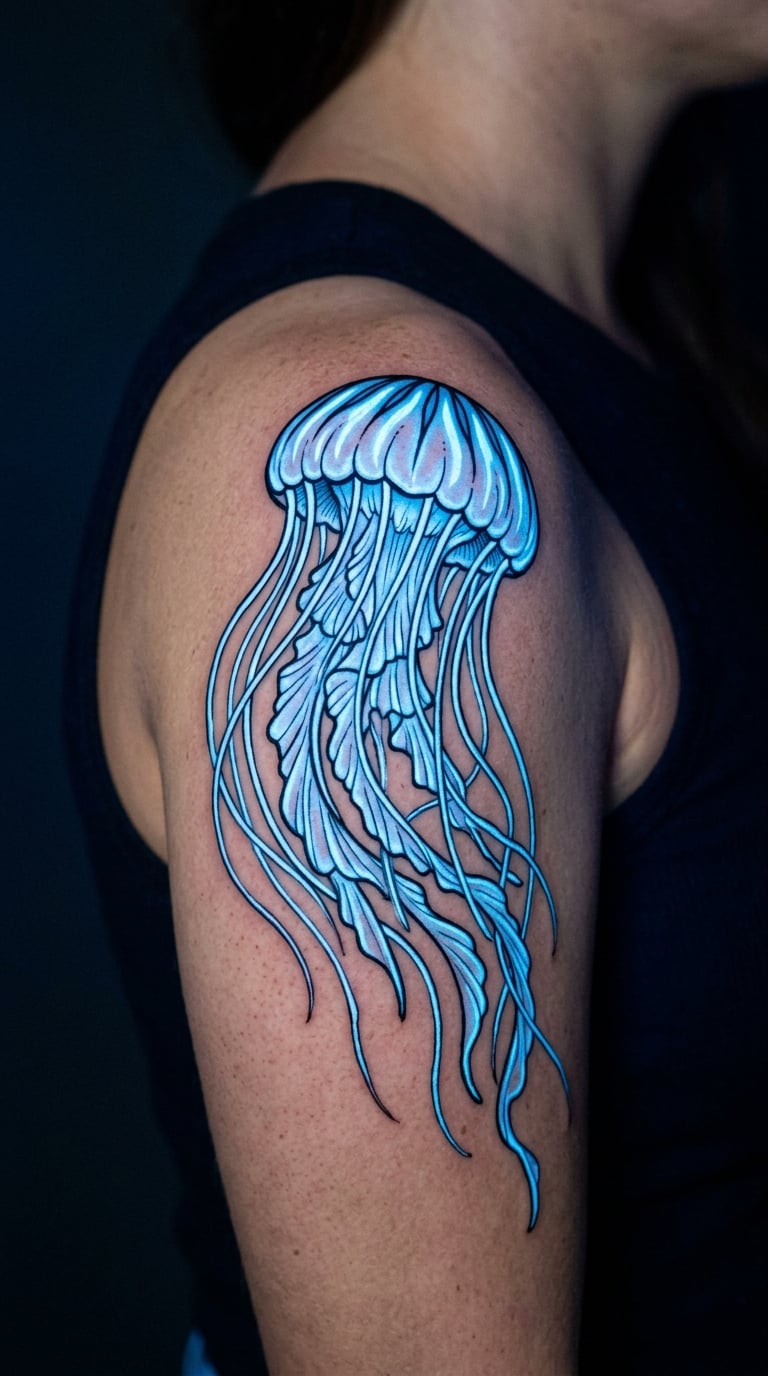
Translucent jellyfish with black linework, pale blue UV fill in the bell, and long trailing tentacles gives you a design that implies movement even when it is completely still. The tentacles can overlap a larger composition, so this one scales up or down without losing the idea.
People choose it for the coast, for drift, or simply because the change under a blacklight is dramatic. I would not attach a fixed symbolic reading to it, since what a jellyfish means depends entirely on who is wearing it.
Placement: Shoulder, back of the calf, thigh, or upper arm. Size: 3-5 in (8-13 cm). Style: Illustrative realism. Pain: Medium across most of the arm and leg; higher on the ribs.
Ageing note: sparse tentacle lines that catch the sun will fade faster than the solid bell, so keep the tail end simple and let the fade happen there.
Make it yours: Layer the tentacles into a deep sea scene you already have, or add a small second jellyfish as a drifting companion.
8. Fluorescent Dragonfly
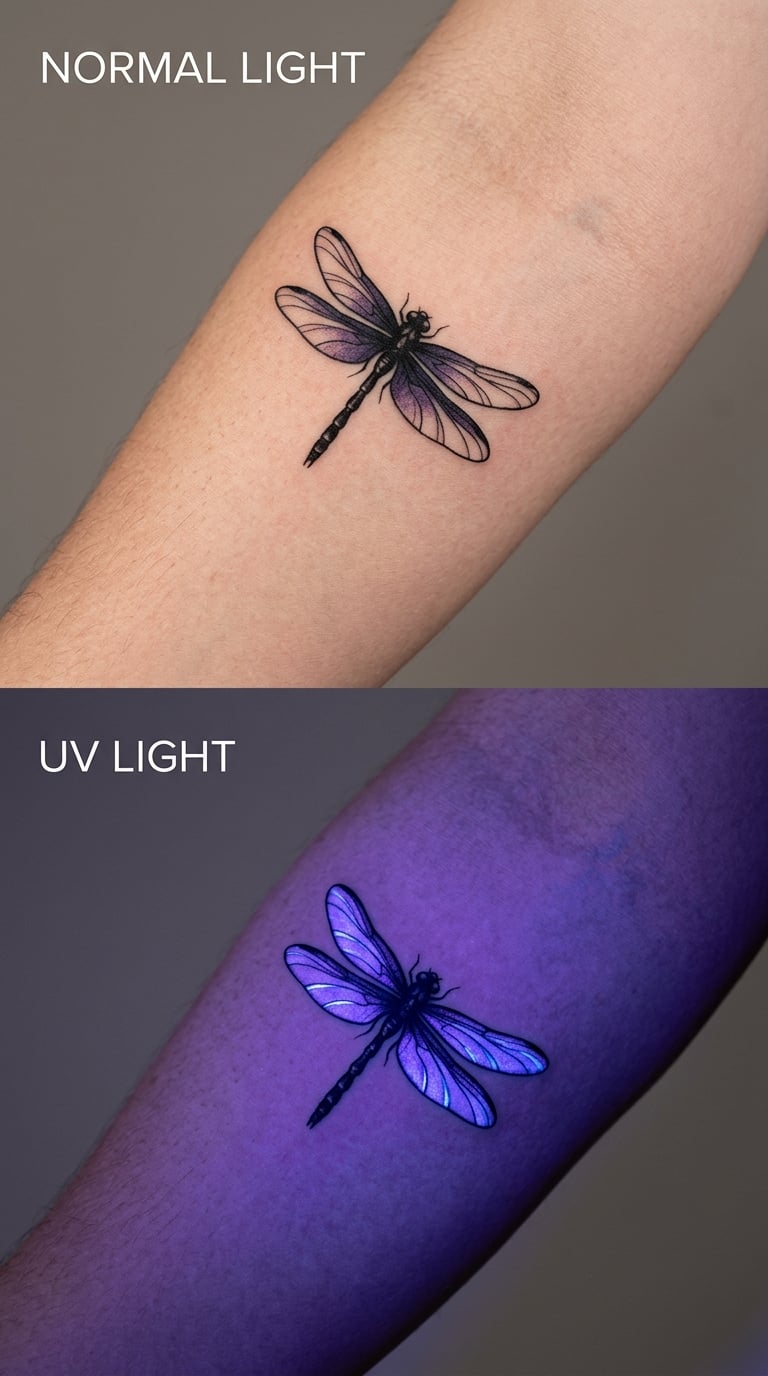
A dragonfly with a solid black silhouette, thin translucent wings, and one or two fluorescent body accents keeps its readability in both lighting conditions. The silhouette is the part that works in daylight, and the glowing panels are the part that carries the blacklight version.
It appeals to collectors who want a colour effect without committing to a full-spectrum piece. Two glowing wing panels give you the reaction while the rest stays classic.
Placement: Forearm, calf, shoulder, or behind the ear. Size: 2-3 in (5-8 cm). Style: Fine line with accent colour. Pain: Low to medium.
Ageing note: hairline wing edges blur over time, and the edge of the wing is the whole silhouette, so ask for a slightly heavier line than feels necessary.
Make it yours: Pair it with a second dragonfly in a different accent colour on the other forearm as a matched set.
9. Glowing Tree of Life
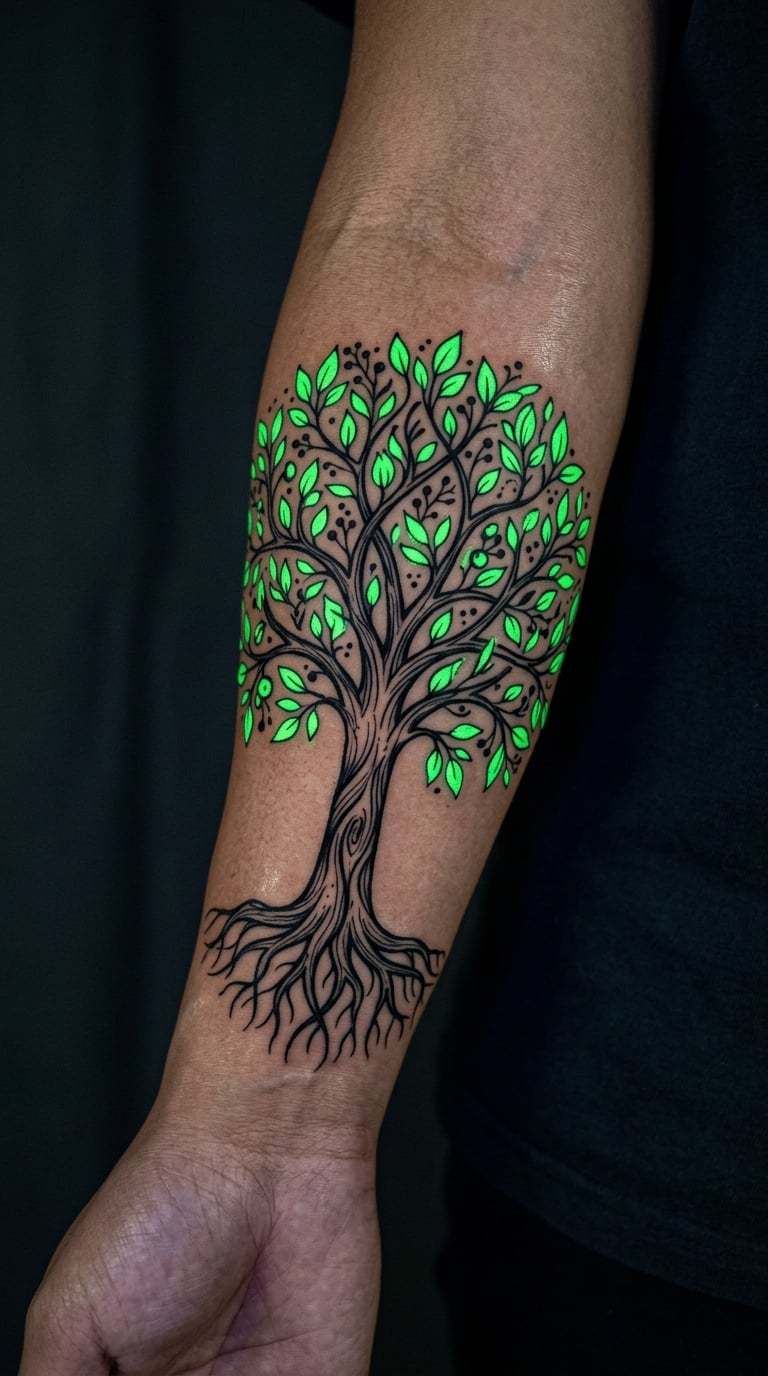
A symmetrical tree with heavy black roots and branches, sparse fluorescent leaves, and enough daylight contrast to stand on its own without a blacklight is a design that works in ordinary photos. The branches carry the structure; the leaves carry the reaction.
This is one of the most common picks in uv tattoo ideas because it is frequently used for family, continuity, or a personal value. Interpretation varies a lot between wearers, so treat the meaning as personal rather than fixed.
Placement: Forearm, calf, upper arm, or centre back. Size: 4-6 in (10-15 cm). Style: Blackwork with illustrative colour. Pain: Medium; expect more on the ribs or the inner arm.
Ageing note: the smallest leaves and thinnest inner branches lose definition first. Ask the artist to keep a minimum line weight so the tree still reads five years on.
Make it yours: Use birth flowers or small initials tucked into the root structure instead of plain roots.
10. UV Checkered Grunge Block
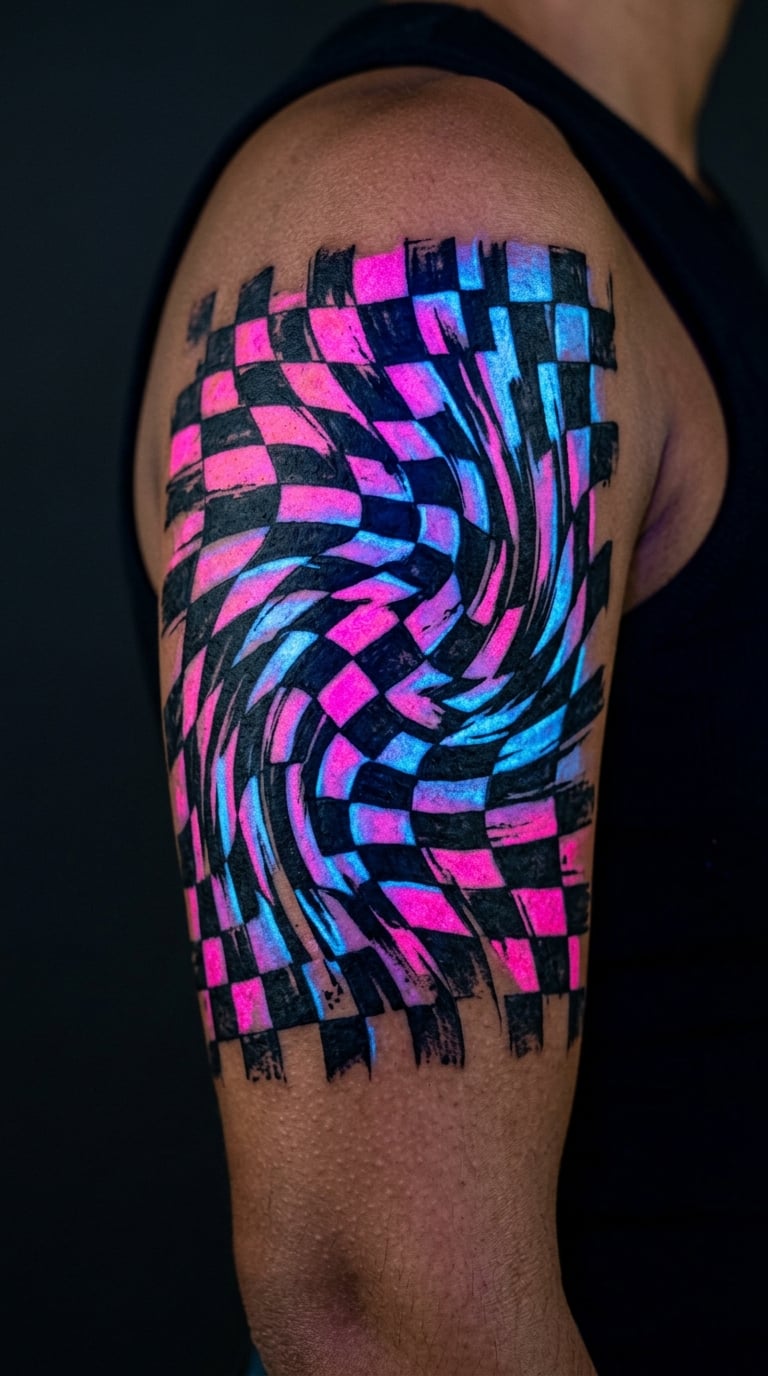
A compact checkerboard or warped grid with black outlines and alternating fluorescent pink, blue, or yellow squares suits bold, graphic, music-inspired, or alternative looks. The effect comes from contrast between filled blocks and untouched skin rather than from any realistic glow effect.
It is a design you can hear before you see, and it sits well next to existing blackwork because the heavy black grid ties the two together in daylight.
Placement: Upper arm, forearm, calf, or chest. Size: 3-5 in (8-13 cm). Style: Neo-traditional geometric. Pain: Medium.
Ageing note: broad filled blocks hold their edges far better than small checks, so a design with twelve squares ages better than one with forty.
Make it yours: Use a grunge checkerboard half hidden inside an existing sleeve so only the glowing squares appear in the dark.
11. Glowing Shark Outline
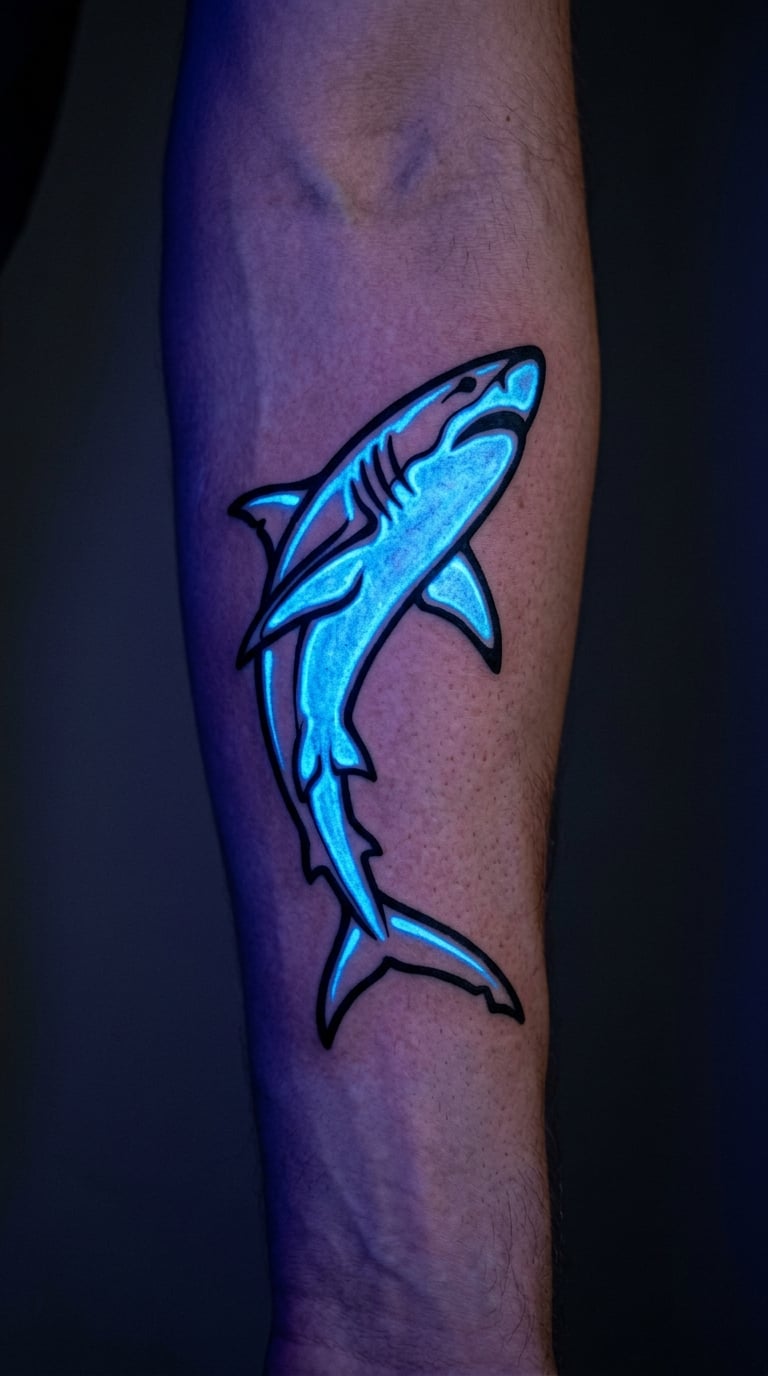
A streamlined shark outline in black, with fluorescent blue or green filling the gill area, belly, and a few interior shadow blocks, stays readable from across a room. Keep the teeth simple. A shark reads as a shark from a silhouette, so the detail budget is better spent on the interior colour.
It tends to appeal to people drawn to ocean life, motion, or a graphic predator image. Placement along the forearm or calf lets the body of the shark follow the line of the limb.
Placement: Forearm, calf, shoulder, or ribs. Size: 3-5 in (8-13 cm). Style: Illustrative blackwork. Pain: Medium on limbs, medium to high on ribs.
Ageing note: fine teeth and thin gill lines blur within a few years, and the fin edge is the part people notice first when it fades.
Make it yours: Hide the glowing interior inside an existing wave or nautical piece so the shark only materialises under a blacklight.
12. Blacklight Peony
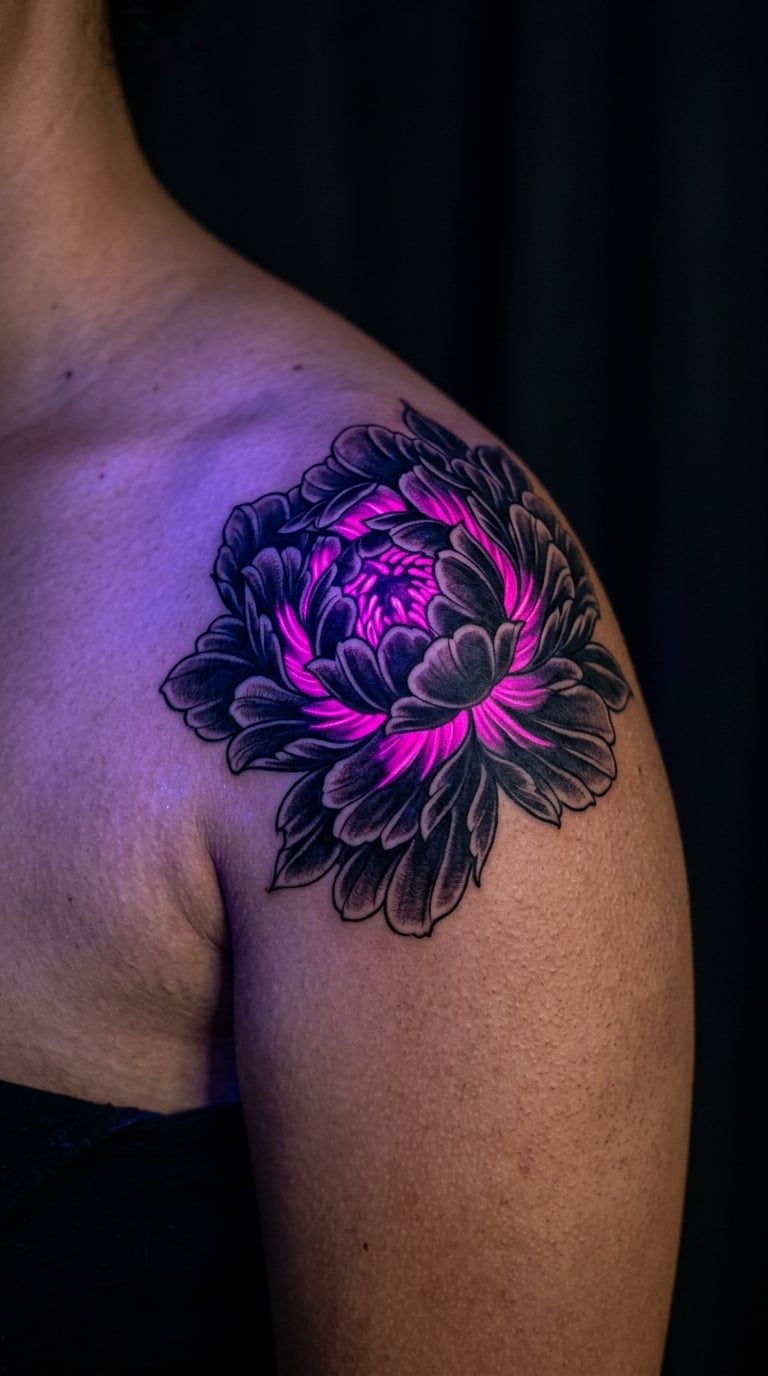
A layered peony with dark outer petals and fluorescent magenta or purple shading pushed toward the centre gives you one bold daylight piece and a genuinely different nightlife version. Concentrating the reactive pigment in the middle of the bloom is what makes the change so strong.
It works well for people who want a single statement flower rather than a matching set. The daylight read is a dark peony; the blacklight read is a lit one.
Placement: Forearm, thigh, shoulder, calf, or back. Size: 2.5-4 in (6-10 cm). Style: Blackwork with colour. Pain: Medium; higher across the ribs and shoulder blade.
Ageing note: dense petal detail softens with sun exposure, so a placement on the upper arm or thigh will hold sharper linework than one on a forearm that sees the sun daily.
Make it yours: Add a half-open bud beside the bloom, or shift the glowing centre to a colour that matches an existing piece in your collection.
13. Fluorescent Snake Coil
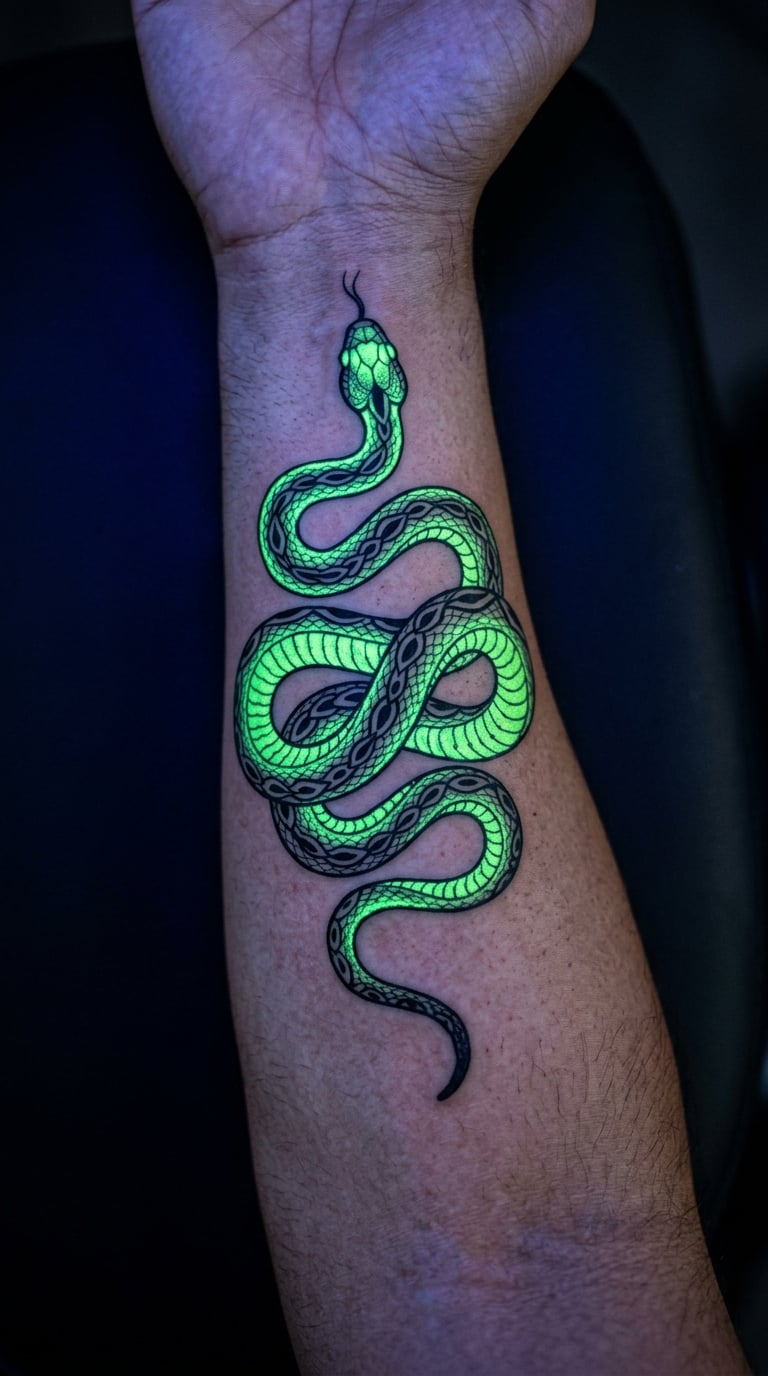
A single snake curled into a circle or an S-shape, with black scale texture and one fluorescent green, yellow, or red body section, gives you a compact symbol with a lot of surface area for the reactive ink. The coil keeps the whole design inside a small footprint.
Transformation and energy come up constantly in conversation about this one, but that is a personal reading rather than a rule. Any meaning should come from the wearer, and plenty of people just like the shape.
Placement: Forearm, calf, upper arm, or thigh. Size: 2.5-4 in (6-10 cm). Style: Traditional-inspired blackwork. Pain: Medium.
Ageing note: individual scale marks are small and blur quickly, so a solid black body with a few scale lines holds up better than a fully textured coil.
Make it yours: Wrap the coil around an existing thin-line branch or stem so the two designs interlock in daylight and separate under a blacklight.
14. UV Compass Rose
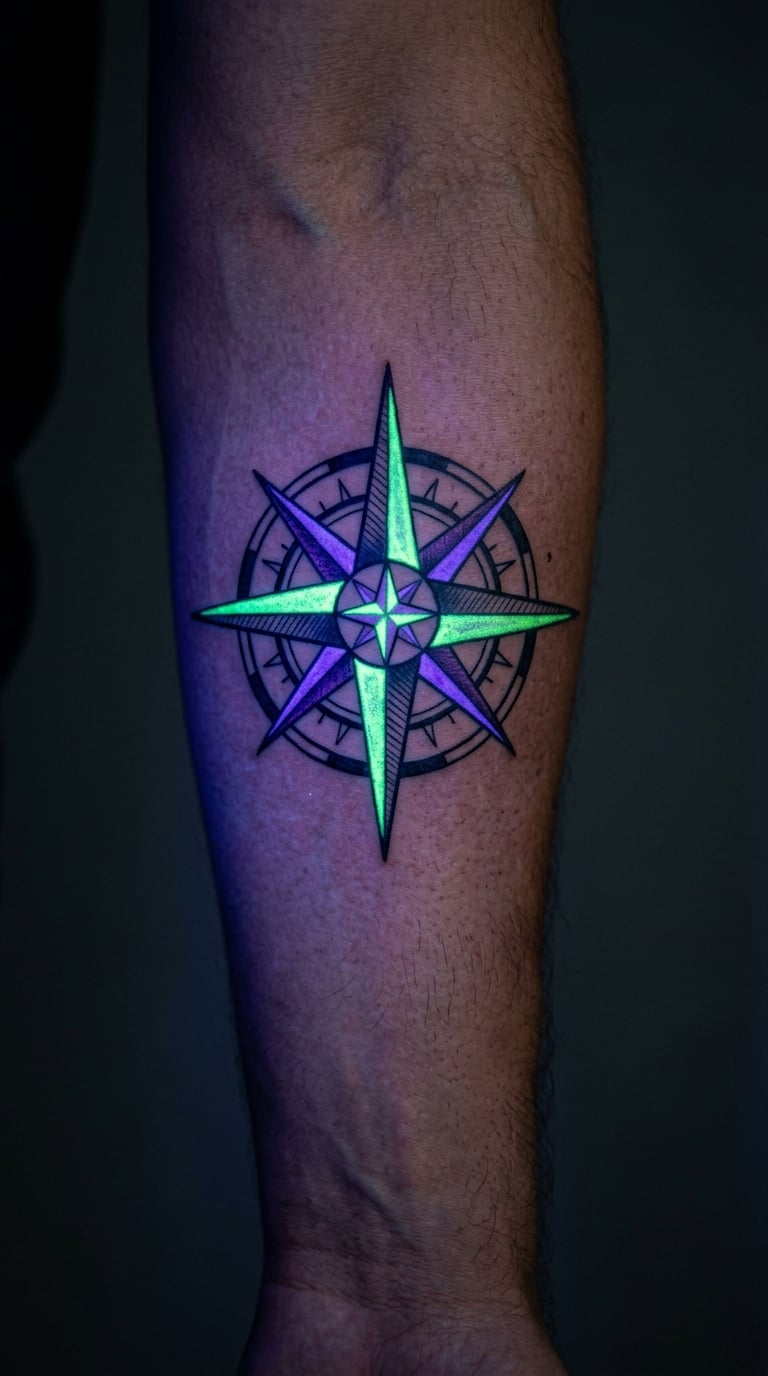
A compass rose with dark cardinal lines, alternating fluorescent green and violet points, and a restrained central star gives you a design that is balanced from every angle. The four-point structure makes it easy to place, since it works as a square or a diamond on the skin.
It gets chosen by travellers, by people who like directional artwork, and by anyone who wants a geometric piece with a slight narrative to it. The design itself has no single agreed meaning.
Placement: Forearm, ankle, chest, shoulder, or calf. Size: 2-3 in (5-8 cm). Style: Geometric illustrative. Pain: Medium, and more sensitive on the ankle or sternum.
Ageing note: miniature directional points need enough weight to stay distinct. If the points are thinner than a pencil line, they will need clarifying at the first touch-up.
Make it yours: Label the north point with a single place name, or orient the whole rose toward a real bearing.
15. Glowing Moth with Eyespots
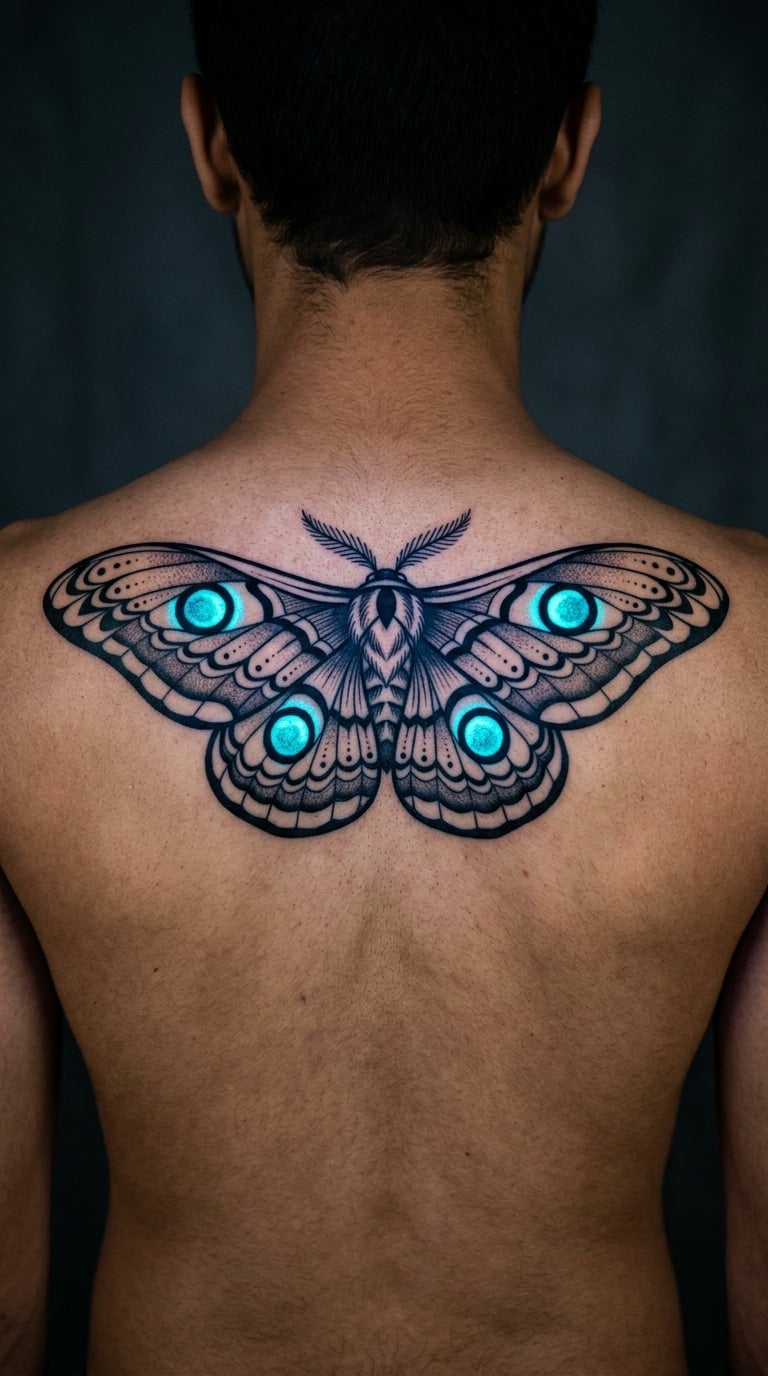
A symmetrical moth with wide black wings, fluorescent yellow or turquoise eyespots, and a dark body is one of the bolder entries here. The wing span gives you a large canvas, and the eyespots stay bright because they are solid filled circles rather than shading.
People choose moths for very personal reasons, and there is no single reading that fits everyone wearing one. The wide shape suits a back, shoulder, or forearm and photographs well from behind.
Placement: Shoulder blades, upper back, or forearm. Size: 3-5 in (8-13 cm), larger across the upper back. Style: Illustrative realism. Pain: Medium, rising across the ribs and shoulder blade.
Ageing note: tiny wing markings and the fine edge detail along the wing tips blur faster than the eyespots, so the shape survives even when the detail does not.
Make it yours: Use a real moth species from your region as the reference, or colour the eyespots to match an existing piece.
16. UV Sun and Moon Half-Moon
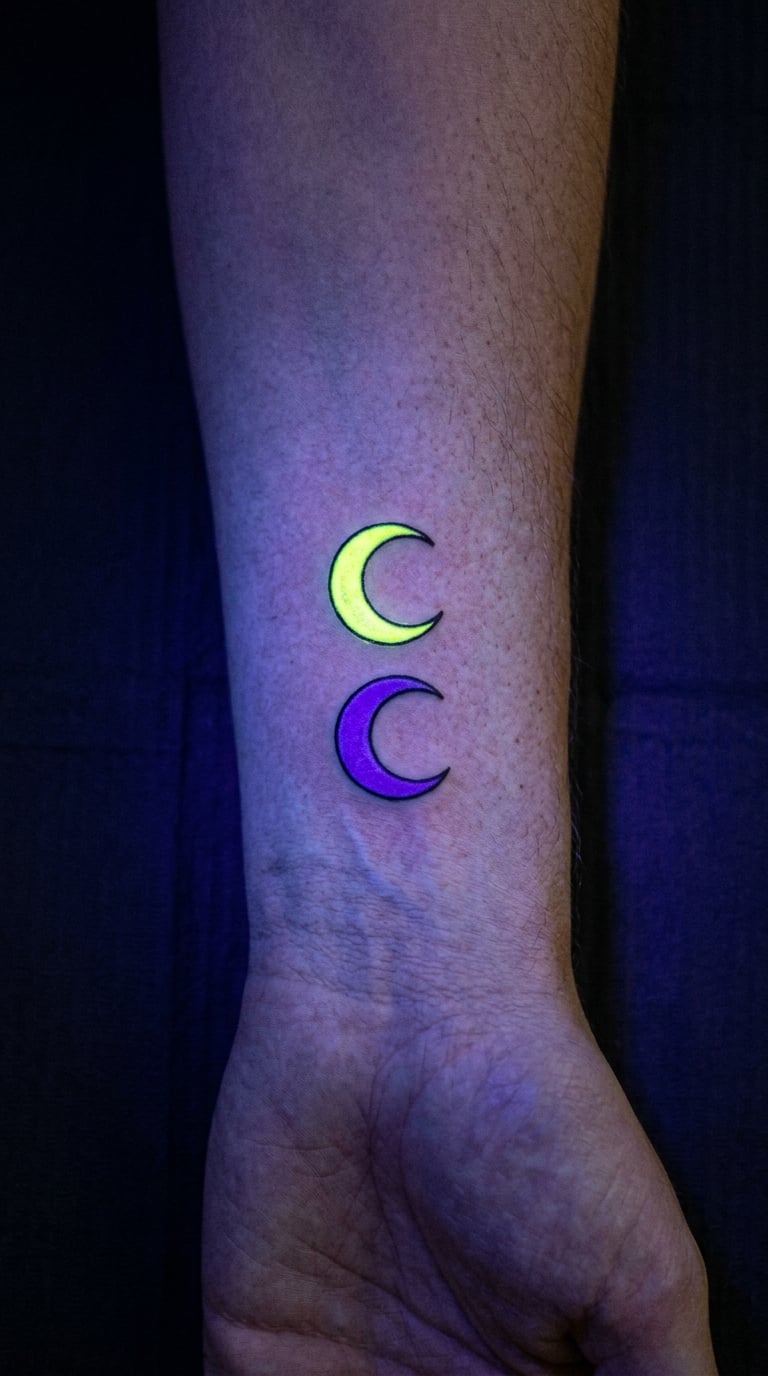
Paired half-moons with black outer contours, one filled in fluorescent yellow and one in violet, plus optional dot details, is a design where the pairing is the whole idea. The two halves give you a reason to make it a matched set rather than one large piece.
Balance and duality come up as reasons for this pairing, but there is no agreed meaning behind sun and moon tattoos. Treat any interpretation as yours alone.
Placement: Forearm, calf, ribs, or upper arm. Size: 2-3 in (5-8 cm) each, or 4-6 in (10-15 cm) as a paired composition. Style: Minimalist celestial. Pain: Low to medium; rib placement is high.
Ageing note: micro-dots around the crescents fade fastest, so keep the dot pattern simple and let it fade in place without fighting it.
Make it yours: Place the sun on the dominant side of the body and the moon on the other, or add real phase dates as small dots.
17. Fluorescent Pixel Heart
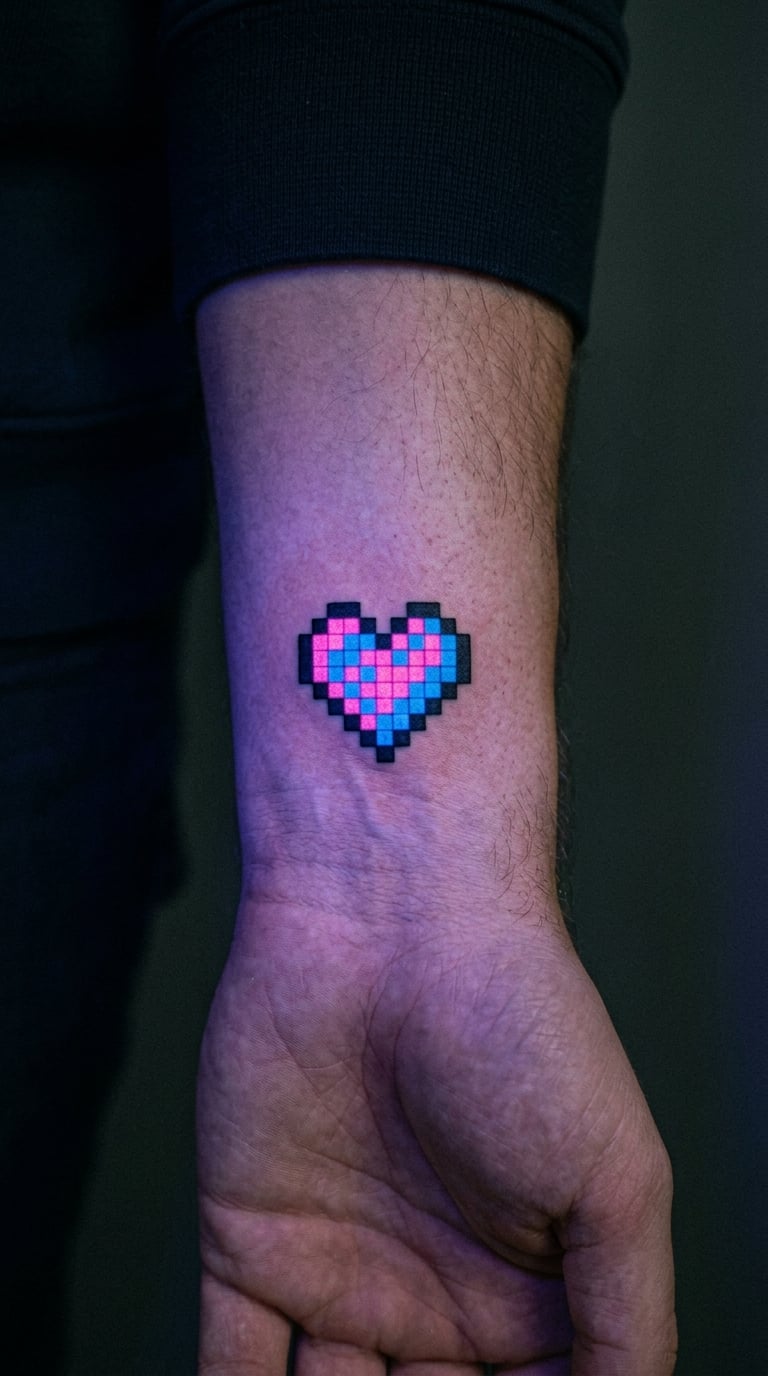
A heart assembled from square pixels with a black border and bright green, pink, or blue blocks gives you a retro digital look that reacts hard under a blacklight. The block edges are clean, which means the design reads clearly even when it is only an inch or so across.
This is a strong first UV tattoo. It is small, it is forgiving, and the effect is easy for an artist to demonstrate with a flashlight before you commit to anything.
Placement: Wrist, forearm, ankle, finger, or chest. Size: 1.5-3 in (4-8 cm). Style: Pixel art. Pain: Low to medium.
Ageing note: small squares soften on joints that bend constantly, so a wrist heart will need tidier edges than the same design on the outer forearm.
Make it yours: Build the heart from a real pixel image, or use a colour scheme that matches a second piece you already have.
18. UV Floral Mandala
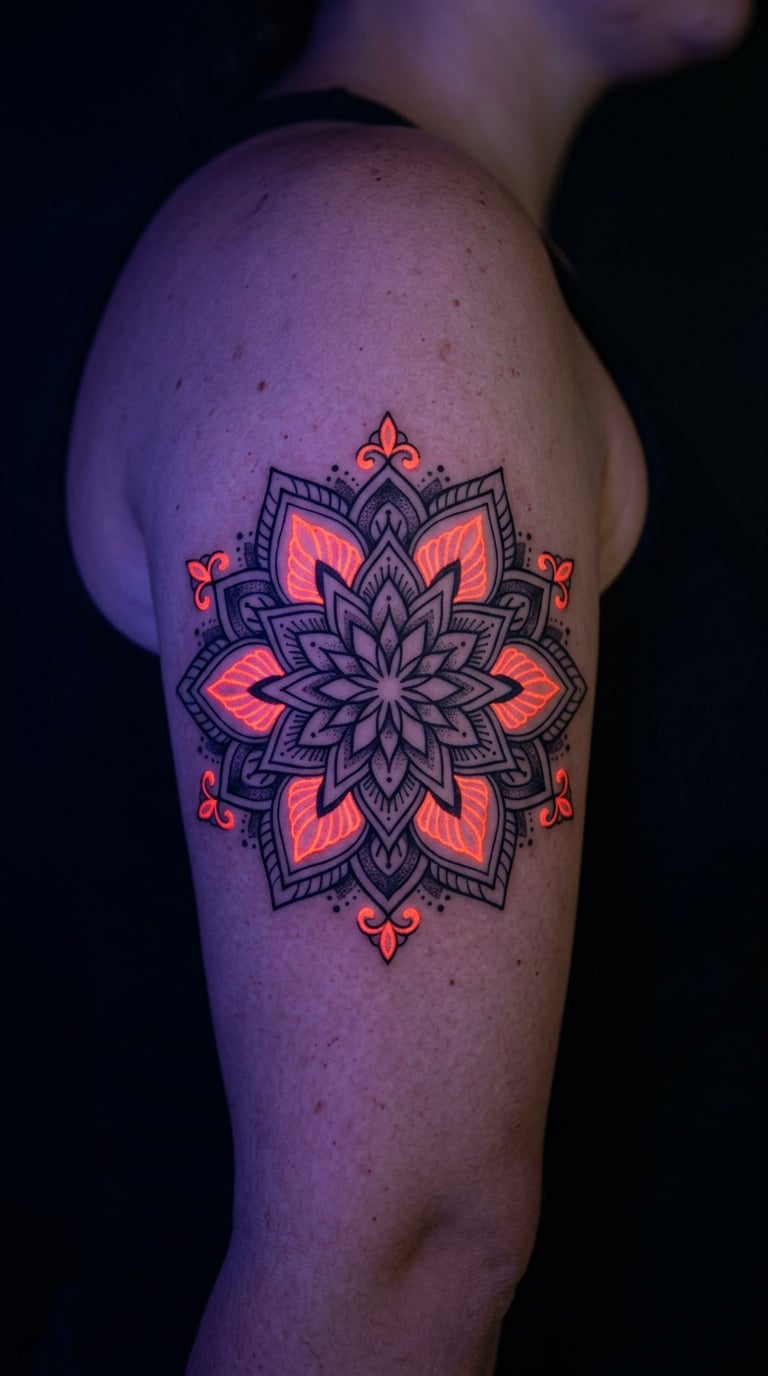
A radial flower or mandala with thick black geometry, fluorescent orange, purple, or teal petals, and a dark centre keeps the pattern grounded. The dark core stops the piece turning into a bright blob under a blacklight, and the symmetry suits a curved surface well.
It fits people who want symmetry and scale but would rather not commit to a realistic flower. A mandala can be as plain or as dense as you like without losing the structure.
Placement: Forearm, calf, shoulder, thigh, or back. Size: 3-5 in (8-13 cm). Style: Geometric floral. Pain: Medium; higher on the ribs and lower back.
Ageing note: fine radial lines blur, so ask the artist to preserve enough weight in the final drawing rather than thinning the pattern for effect.
Make it yours: Build the ring count around a meaningful number, or glow only the outer ring so the centre stays solid black in every light.
19. Glowing Chains and Lightning
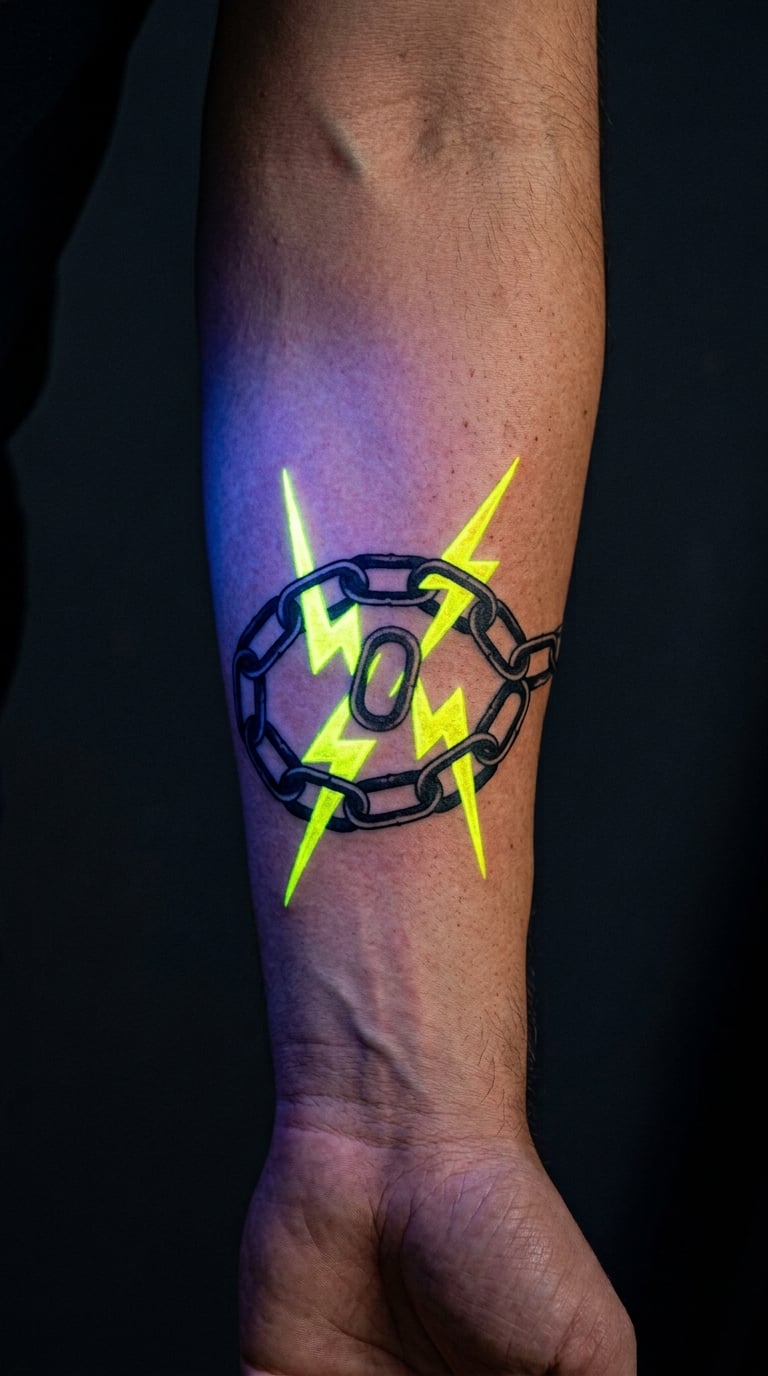
Two interlocking black chains with jagged lightning bolts filled in fluorescent yellow or white sit in one of the strongest graphic contrasts available. The chain links are solid, chunky shapes, and the lightning is the only part that reacts, which keeps the effect readable rather than busy.
Connection, energy, and change are the readings people usually attach, and any one of them can be the reason. It is a bold piece for a bold placement, usually the forearm or calf.
Placement: Forearm, calf, or across the upper arm. Size: 4-6 in (10-15 cm) for a larger composition. Style: Blackwork. Pain: Medium on the calf and forearm, medium to high on ribs.
Ageing note: lightning edges fade fastest if the zigzag is drawn too fine, so keep the bolt edges sharp and slightly heavy.
Make it yours: Thread the lightning through an existing blackwork piece so it only appears where the chains touch.
20. Full UV Galaxy Sleeve
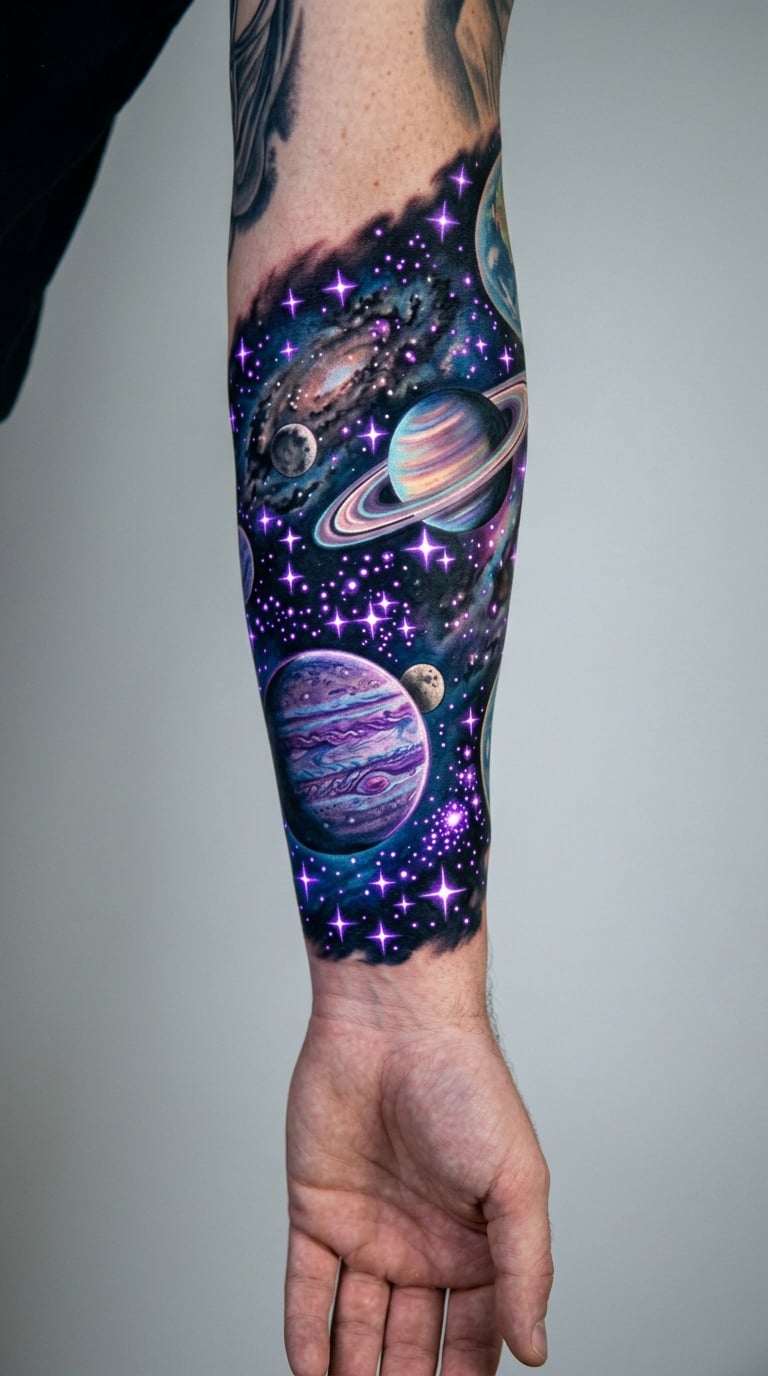
A multi-session space sleeve with layered stars, cloudy shapes, planets, and fluorescent purple, blue, or pink accents is the end goal for a collector rather than a first tattoo. The dark base is built in overlapping pieces so the sleeve reads as one continuous field, and the fluorescent elements are placed where your eye lands first.
This suits someone who already understands what multi-session work involves. Plan the session count and the spacing between appointments before you start, because a sleeve is a commitment measured in months.
Placement: Full forearm or upper arm. Size: 6-10 in (15-25 cm) or larger depending on arm circumference and session count. Style: Illustrative realism with colour. Pain: High on the inner arm.
Ageing note: many small background stars across a large area often need occasional touch-ups, since there is more of them and more sun exposure than a single small piece.
Make it yours: Put a specific date or constellation in the negative space of the sky, where only you and a blacklight will find it.
How to Choose the Right Design
Choosing between uv tattoo ideas comes down to a few practical checks, and most of them can be settled in a single conversation at a consultation.
How to test uv tattoo ideas before you commit
- Check contrast, not brightness. Fluorescent pigment reads as a dark shape in daylight, so the design needs heavy black contour work to hold together in a normal photo.
- Ask about line weight. Anything thinner than a pencil line will disappear under a blacklight. A good artist will tell you which details they plan to drop at your intended size.
- Match size to the detail count. A design with twenty elements needs more room than one with three, and a small version of a detailed design rarely reads well.
- Pick a flat placement. Inner forearms, chests, ribs, and the inner arm are curved and bony, which distorts a geometric layout. Outer arms, calves, and thighs are forgiving.
- See the ink before the stencil. Ask the artist to dab a sample of the actual pigment on their hand under a blacklight. A UV-A lamp in the 365-400nm range is what makes the reaction reliable, and a lamp outside that band can make working ink look dead.
- Expect a visible design in daylight. Plenty of people report a faint outline or a slight raised texture on early-healed UV work, particularly over the first months. If a design being completely invisible is essential to you, a hidden placement is a better answer than extra UV pigment.
One more thing worth raising: most shops do not stock UV-reactive ink. That single point decides more than any other factor whether you get the design you pictured, and it comes up in almost every advice thread. Bring the conversation up before the session, not after.
Cost and Session Time
UV ink carries a premium over standard ink, mostly because fewer studios stock it and the pigment is more expensive per bottle. The main cost drivers are the same ones that drive any tattoo: hourly rate, size, detail count, placement, and how many sessions the artist expects.
As a rough shape, a small piece under two inches is usually a single short session, something in the three to six inch range often runs longer and may need a second sitting, and a sleeve or large composition is split across several appointments spaced weeks apart. Placement changes the time too, since ribs, the inner arm, and the lower back take considerably more time per square inch than a forearm or calf.
Shop minimums, artist rates, and local competition vary widely, so two people asking the same question in different cities can get very different answers. The useful move is to ask for an itemised quote that separates the design fee from the hourly rate, and to ask what a touch-up within the first year costs or whether it is included.
Aftercare Basics
- Follow your artist’s aftercare instructions first. They know exactly what they did in your skin, and their advice overrides anything general you read online.
- Wash the area gently with unscented soap and lukewarm water, then pat it dry with a clean towel rather than rubbing it.
- Do not pick, scratch, or flake the skin. Loose pigment leaving the surface is normal and part of healing.
- Keep fresh ink away from direct sunlight, hot baths, saunas, and swimming pools while it settles.
- Keep the area clean and dry, and change bandages or dressings if your artist recommended them.
- Contact your artist, or a qualified healthcare professional, if you notice unusual irritation, swelling, or a reaction that does not settle.
Frequently Asked Questions
Is UV tattoo ink permanent?
No. UV-reactive ink is a fluorescent pigment suspended in tattoo ink, and it fades faster than standard colour because the pigment particles break down under ultraviolet light and sunlight over time. Most wearers see visible change within the first few years, while some pieces still glow after five. Treat a UV tattoo as a design you will keep refreshing, not a permanent mark.
Does ordinary black ink glow under a blacklight?
Ordinary black ink is not fluorescent, so it stays black under a blacklight and provides the dark outline a UV design needs. Only pigment that absorbs UV-A light and re-emits it as visible colour will react. That is why artists build a black structure first and add fluorescent pigment inside it, and why a tattoo with no reactive ink at all looks flat under the lamp rather than glowing.
Which placements make UV tattoo ideas look strongest?
Flat, open placements react best: outer forearm, calf, thigh, upper arm, and shoulder. Curved or bony spots such as the ribs, inner arm, sternum, and ankle both distort a geometric layout and take more ink passes, which can leave a design looking uneven. Wrist, finger, and behind-the-ear placements work for small pieces, but hands take constant use so fine detail softens there sooner.
Are UV tattoos completely invisible in daylight?
Not quite. The fluorescent pigment reads as a dark or faintly raised shape in normal light, and many wearers report a slight texture or a visible outline on early-healed work that settles over time. Strong sunlight can expose the shape more than you expect. If being completely unseen matters to you, a hidden placement and a design with heavy black structure will get you closer than extra pigment will.
How do I prepare a reference image for a UV tattoo?
Bring a clear daylight reference and say plainly that you want fluorescent pigment inside a black outline, because a lot of artists will otherwise default to a standard black-and-grey piece. Showing a second image of how you want it to look under a blacklight helps with the colour placement. Ask the artist to dab the actual pigment on their hand first, and to check your size reference at that real scale.
Conclusion: Start With One Strong Detail
If this is your first UV tattoo, a micro butterfly, a wave and sun, or a pixel heart is the strongest place to start. Each has a shape that is easy to read, a size that heals predictably, and an effect an artist can show you with a flashlight before a single line is drawn.
If you are building a collection, a galaxy sleeve or a chain-and-lightning composition makes more sense once you already know what multi-session work asks of you. Either way, ask to see the design in normal light and under a blacklight before you approve it. That single check catches more disappointing designs than any other step in the process.