
20 Best Raccoon Tattoo Ideas for Nature Lovers (September 2026)
These 20 raccoon tattoo ideas cover everything from a two-inch fine-line face to a full-colour woodland scene, and each one comes with the details most gallery pages skip: where it sits, how big it should be, how it ages, and what you can change to make it yours.
The raccoon is a lucky pick for a tattoo animal. The black bandit mask, the pale muzzle and the ringed tail give you a shape that reads instantly, even small, and it carries a personality rather than sitting there as decoration. People land on it for the animal itself, for the resourcefulness it stands for, for a memory, or because somebody in their life is nicknamed the trash panda.
What makes a raccoon piece work on skin is contrast and a clear silhouette. A design that holds up has one dark anchor, a readable outline, and enough empty space around the face that the mask stays visible. Those three things matter more than style, and they are what I look at first in every idea below.
If you are browsing on a phone, use the guide below to jump to the style that matches what you like, then read the placement and size notes before you save any references. Autumn is a popular time to book, and the shops I know usually fill three to five weeks out, so planning a few months ahead keeps your options open.
Raccoon Tattoo Ideas: Quick Guide
| Idea | Style | Best placement | Size | Pain |
|---|---|---|---|---|
| 1. Fine-Line Raccoon Face | Fine line | Inner forearm, wrist | 2-3 in (5-8 cm) | Low |
| 2. Traditional Mask-Wearing Raccoon | Traditional | Upper arm, shoulder | 4-5 in (10-13 cm) | Medium |
| 3. Tiny Curled-Up Raccoon | Minimalist | Wrist, ankle, rib | 1.5-2 in (4-5 cm) | Low |
| 4. Watercolor Raccoon in a Tree | Watercolor | Shoulder blade, back | 4-6 in (10-15 cm) | Medium |
| 5. Blackwork Raccoon Peeking Through Leaves | Blackwork | Outer thigh, calf | 5-7 in (13-18 cm) | Medium |
| 6. Minimalist Raccoon Mask | Minimalist | Forearm, chest | 2-3 in (5-8 cm) | Low |
| 7. Neo-Traditional Moonlit Raccoon | Neo-traditional | Upper arm, back of arm | 4-6 in (10-15 cm) | Medium |
| 8. Realistic Raccoon Portrait | Black and grey realism | Forearm, calf, thigh | 4-7 in (10-18 cm) | Medium |
| 9. Geometric Raccoon Head | Geometric | Calf, forearm, upper arm | 3-4 in (8-10 cm) | Low |
| 10. Dotwork Raccoon Climb | Dotwork / stippling | Forearm, calf | 3-5 in (8-13 cm) | Medium |
| 11. Raccoon Holding a Small Flash | Illustrative | Forearm, upper arm | 3-4 in (8-10 cm) | Medium |
| 12. Forest Silhouette Raccoon Scene | Black silhouette | Calf, back, thigh | 6-9 in (15-23 cm) | Medium |
| 13. Small Raccoon Behind the Ear | Fine line | Behind the ear | 1.5-2 in (4-5 cm) | Medium |
| 14. Smiling Raccoon Character | Cartoon / illustrative | Lower leg, upper arm | 3 in (8 cm) | Low |
| 15. Floral Raccoon Sleeve Detail | Botanical blackwork | Shoulder, upper arm | 5-6 in (13-15 cm) | Medium |
| 16. Raccoon and Oak Leaves | Fine line with colour accent | Forearm, calf | 4 in (10 cm) | Low |
| 17. Checkerboard Raccoon | Graphic / blackwork | Upper arm, shoulder | 4 in (10 cm) | Medium |
| 18. Sleeping Raccoon with Zzz Motif | Illustrative with lettering | Wrist, forearm | 2-2.5 in (5-6 cm) | Low |
| 19. Raccoon Climbing a Finger | Fine line | Finger, hand | 2 in (5 cm) | High |
| 20. Colorful Storybook Raccoon | Colour illustrative | Calf, shoulder | 4-5 in (10-13 cm) | Medium |
1. Fine-Line Raccoon Face
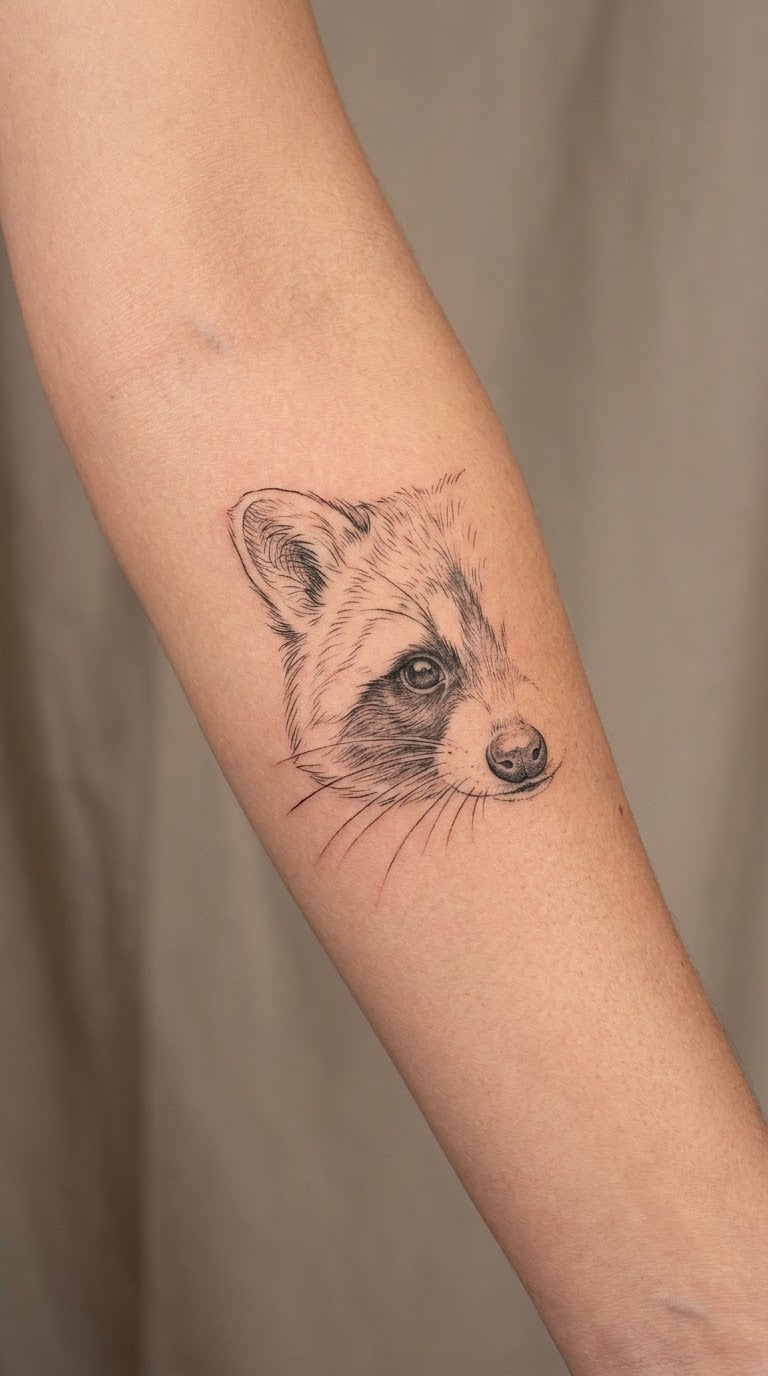
A single unbroken line draws the outside of the head, the rounded ears and the mask, with a few short flicks for whiskers and a hint of inner-ear texture. Nothing is filled in, so the whole piece lives on line weight.
This is the raccoon tattoo idea I point first-timers toward. Fine line suits anyone who wants a visible animal without committing to a large block of black, and the mask reads clearly at about 3 inches because the eye patches are the darkest element on the design.
Placement: inner forearm and wrist read best, both because the skin is flat and because you see them often. Size: 2-3 inches (5-8 cm) across. Style: fine line. Pain: low on the inner arm, though wrists are more sensitive near the wrist crease. Fine line on hands and fingers fades faster than the same drawing on an arm, so expect the whiskers to soften first.
Make it yours: add a small date or a single leaf under the chin in the same line weight, or colour only the eye patches in a single tone. If you want the raccoon to sit inside a bigger piece rather than alone, the 20 forearm band tattoo ideas for men are worth a look first, since a band changes the rules about how much empty space the face needs.
2. Traditional Mask-Wearing Raccoon
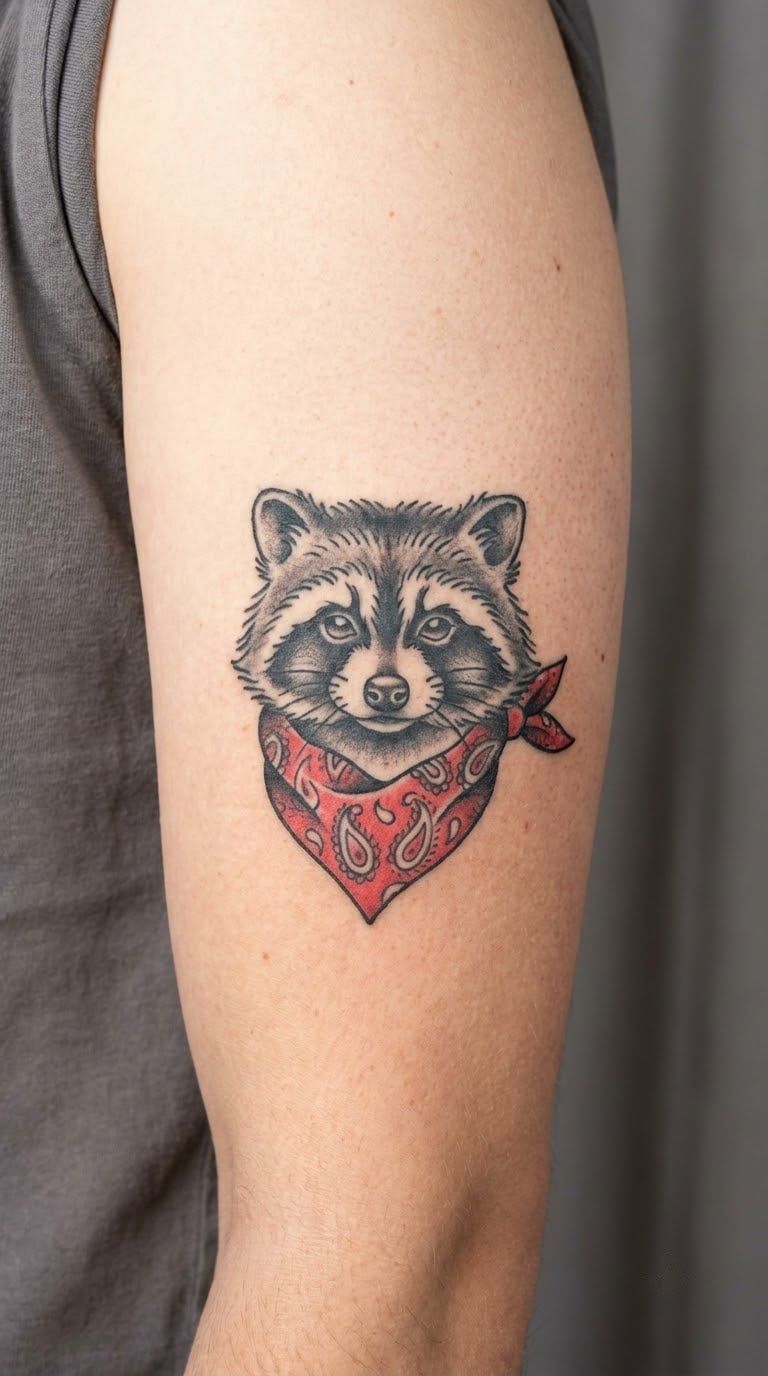
Bold black outlines, a red bandana knotted at the neck, and a head rendered in smooth grey shading with white eye highlights. Traditional style keeps the design readable from across a room, which is the point of it.
People choose this one when they want the raccoon to look like a character rather than a sketch. Vintage raccoon flash has circulated in tattoo culture for a long time, and skull-adjacent blackwork variants in particular have a long history on r/tattoos.
Placement: upper arm and outer shoulder handle a bust best, with enough flat area for the shoulders of the design to sit square. Size: 4-5 inches (10-13 cm) tall. Style: traditional. Pain: medium on the upper arm; bold fills need more passes, so expect a scratchy, insistent feeling. Ageing is good here, though heavy saturation across the bandana can soften over a decade of sun exposure.
Make it yours: swap the bandana for a hat, a scarf in a colour tied to someone specific, or a small background element that locates the piece in time and place.
3. Tiny Curled-Up Raccoon
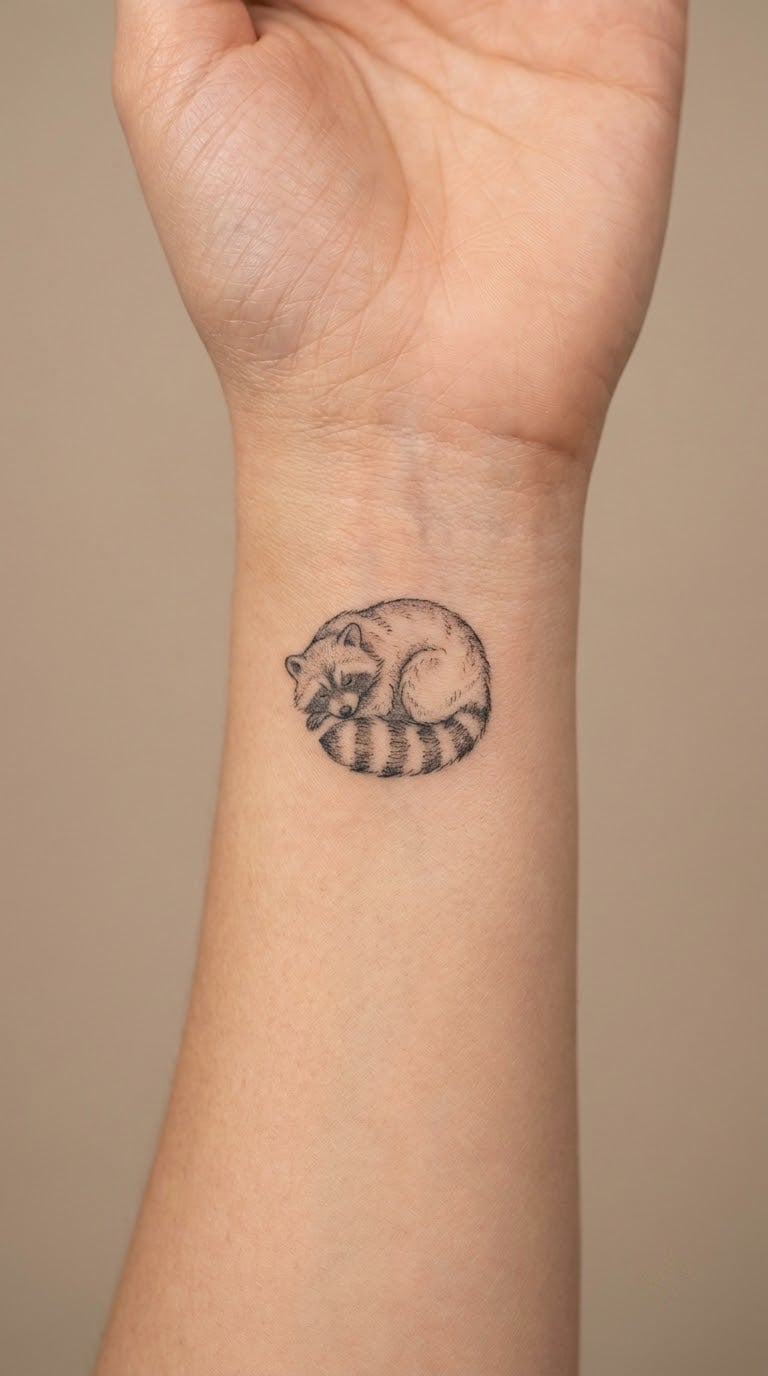
A compact raccoon asleep in a ball, tail wrapped over the nose, drawn with a solid outer contour and a handful of thin rings for the tail markings. The whole shape is a rounded blob that works at postage-stamp scale.
It suits people who like animal tattoos but want something nearly invisible under a sleeve. The curled pose is also forgiving, because the body mass does the visual work instead of the face.
Placement: inner wrist, inner arm, rib or ankle. Size: 1.5-2 inches (4-5 cm) long. Style: minimalist line and small solid fills. Pain: low anywhere on the arm; ribs and ankles sting more. The honest caveat: at this size individual toes and facial features blur within a few years, so keep the detail simple from the start.
Make it yours: have the tail rings drawn as dashes instead of full bands, or tuck a tiny moon between the body and the tail.
4. Watercolor Raccoon in a Tree
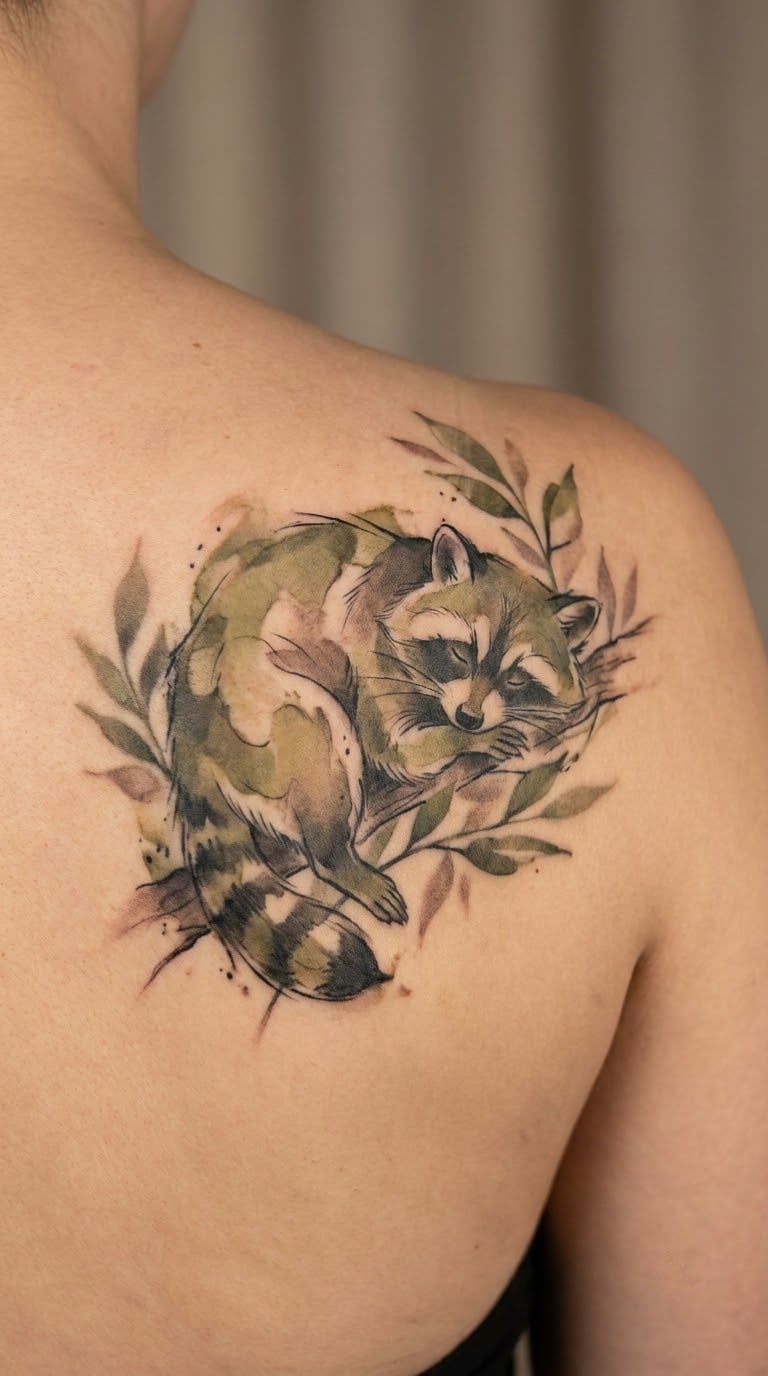
Loose washes of olive, ochre and grey spread outwards from a branch, while the raccoon’s face and mask are held in with fine dark lines. The colour bleeds beyond the outline on purpose, giving the piece a soft, painted edge.
This is the raccoon tattoo idea for someone who describes themselves as a nature lover and wants ink that looks handmade. It has movement in it, and the branch structure gives the eye a path through the composition.
Placement: shoulder blade, upper back or the flat of the upper arm, anywhere with room for the wash to move. Size: 4-6 inches (10-15 cm) wide. Style: watercolor with dark detail on top. Pain: medium, since the wash means repeated light passes. Colour softens faster than black line, and pale greens and yellows fade first.
Make it yours: choose the branch to match a real tree from somewhere you grew up, or pull the palette toward one season instead of a full rainbow.
5. Blackwork Raccoon Peeking Through Leaves
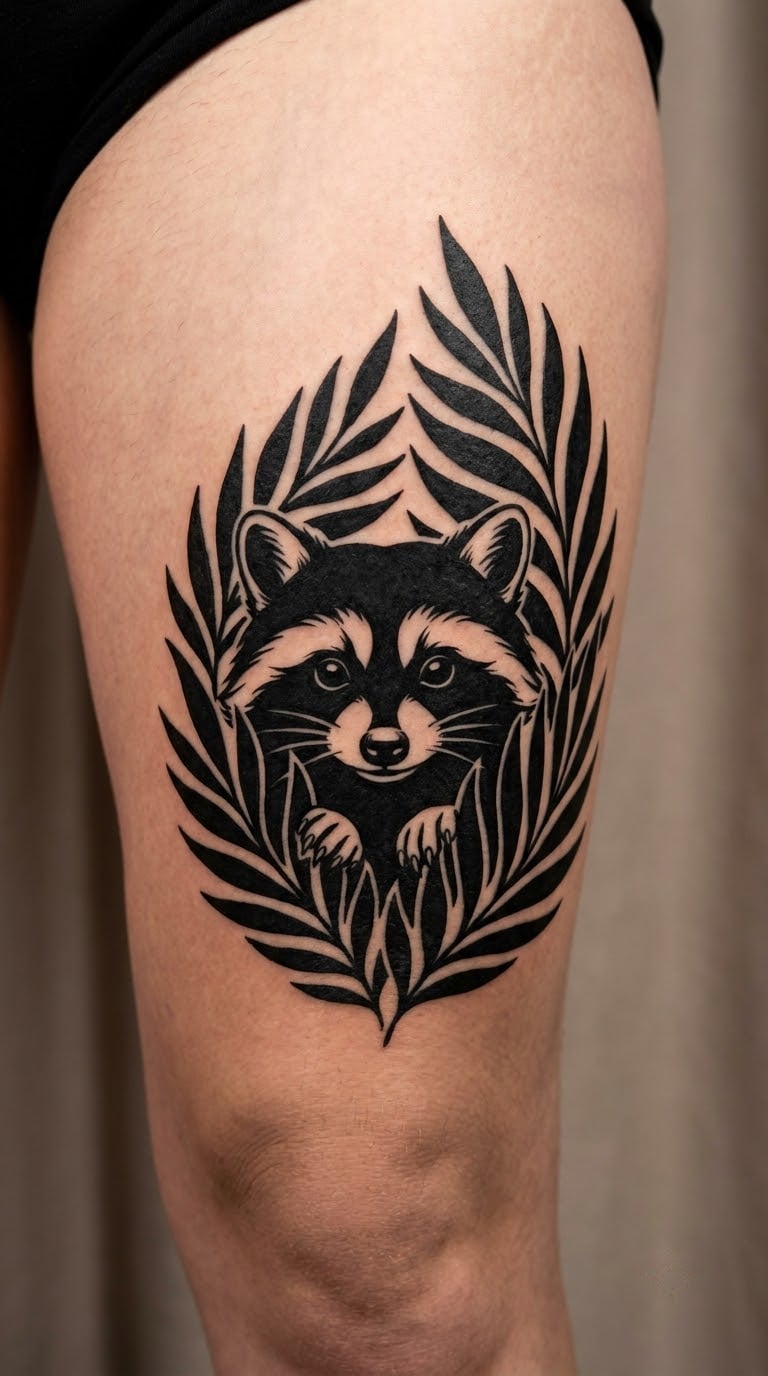
Solid black leaf shapes fill most of the frame, with a raccoon face breaking out of the middle and a few thin white gaps left as negative space. Density does the work that colour would do in a softer style.
Blackwork holds contrast better than anything else on this list, which makes it a good match for a piece you want to still read clearly in fifteen years. The trade-off is that it is a bigger commitment and a bigger session.
Placement: outer thigh, calf, or the back of the upper arm. Size: 5-7 inches (13-18 cm) wide, larger if you want the leaves to fully surround the head. Style: blackwork with negative space. Pain: medium to high in the filled areas, especially on the thigh. Small marks inside the black will soften over time, so let the artist keep the interior detail bold.
Make it yours: swap the generic leaves for a plant native to your region, or add a single red accent in the eyes to lift the whole piece.
6. Minimalist Raccoon Mask
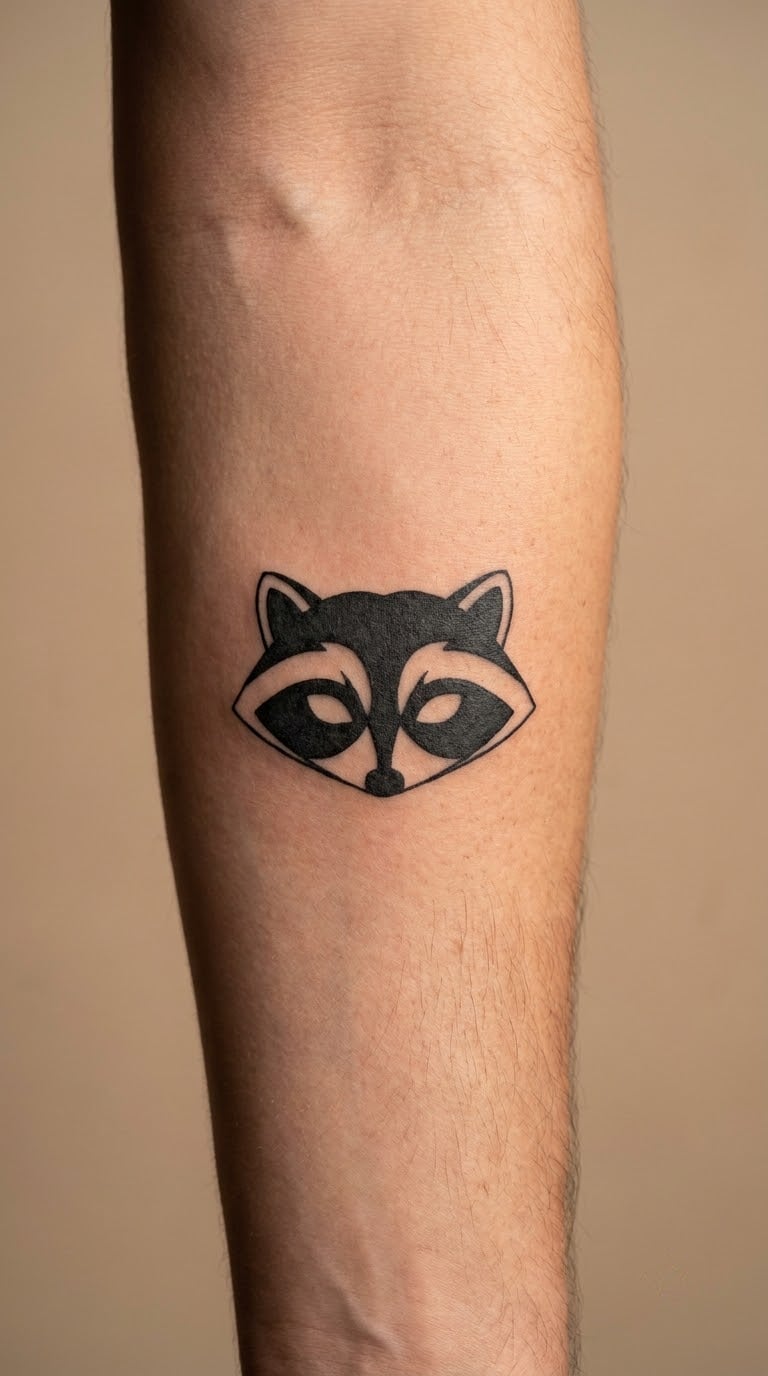
Just the face pattern: two dark eye patches, a small nose, rounded ears, no body. The geometry is simple enough that it reads as a graphic shape rather than an animal, which is exactly the appeal.
This is a good pick if you like restrained, graphic animal work but want a subject with personality. The 20 best cat silhouette tattoo ideas for minimalists follow the same logic and are a fair comparison if you are still deciding how minimal you want to go.
Placement: forearm, chest, or the back of the hand, though hands get more wear. Size: 2-3 inches (5-8 cm) wide. Style: minimalist line art. Pain: low. Ageing is the strongest of the small designs here; only the eye detail needs keeping, and at 2 inches it survives well.
Make it yours: add a date in tiny type beneath the mask, mirror the mask on the opposite arm, or line the mask with a single continuous stroke rather than outlining each shape.
7. Neo-Traditional Moonlit Raccoon
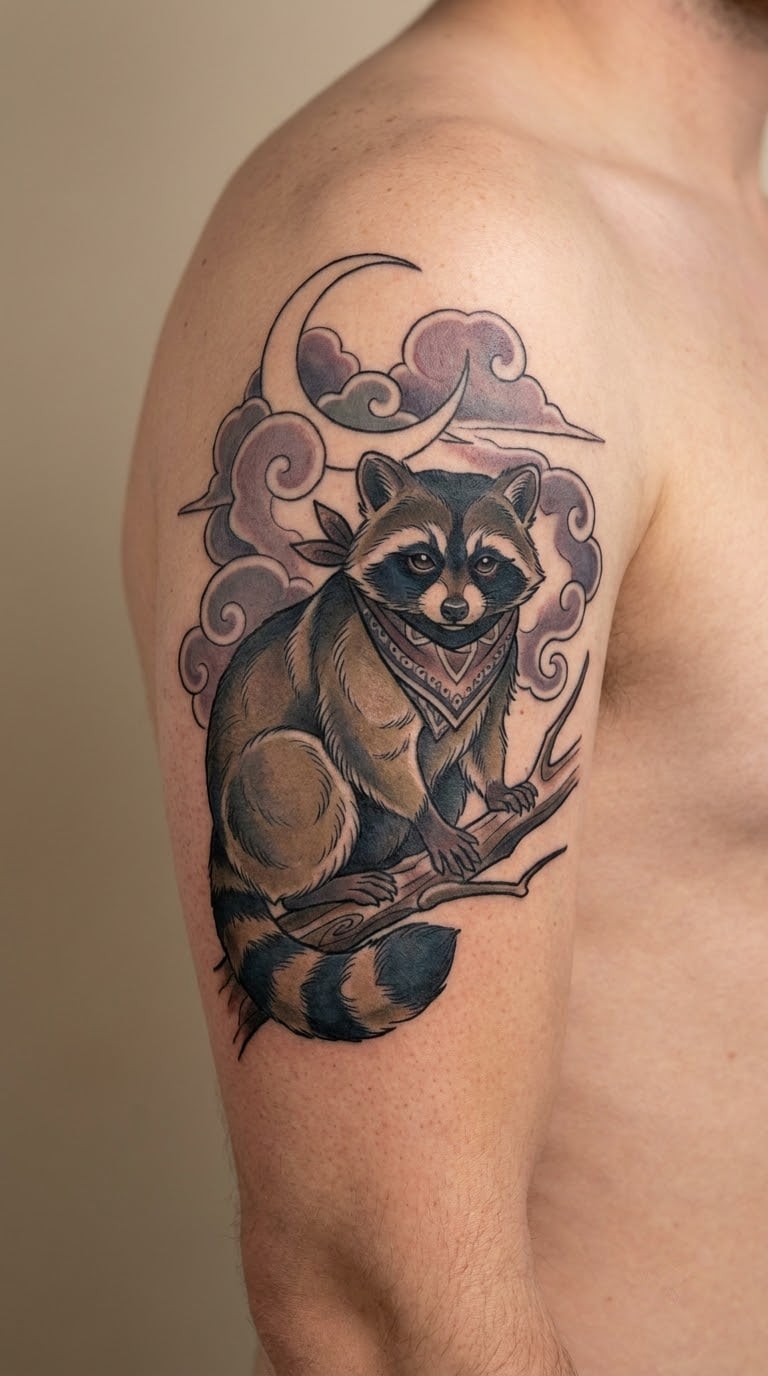
A sitting raccoon with heavy, even outlines, a warm mid-tone body, and a crescent moon with two drifting cloud shapes behind it. Neo-traditional keeps the bold line but trades flat colour for softer, slightly muted shading.
Moon imagery next to an animal is a quiet, readable pairing that many people want without having to explain. The clouds are the piece that gives the composition somewhere to breathe, so they are worth keeping even at small sizes.
Placement: upper arm, back of the arm, or the shoulder. Size: 4-6 inches (10-15 cm). Style: neo-traditional. Pain: medium, mostly from the solid outline work. Muted purples and greys hold better than a bright palette, though the moon lightens a little over time.
Make it yours: change the moon to a phase that matters to you, or replace the clouds with a low horizon line and a few stars.
8. Realistic Raccoon Portrait
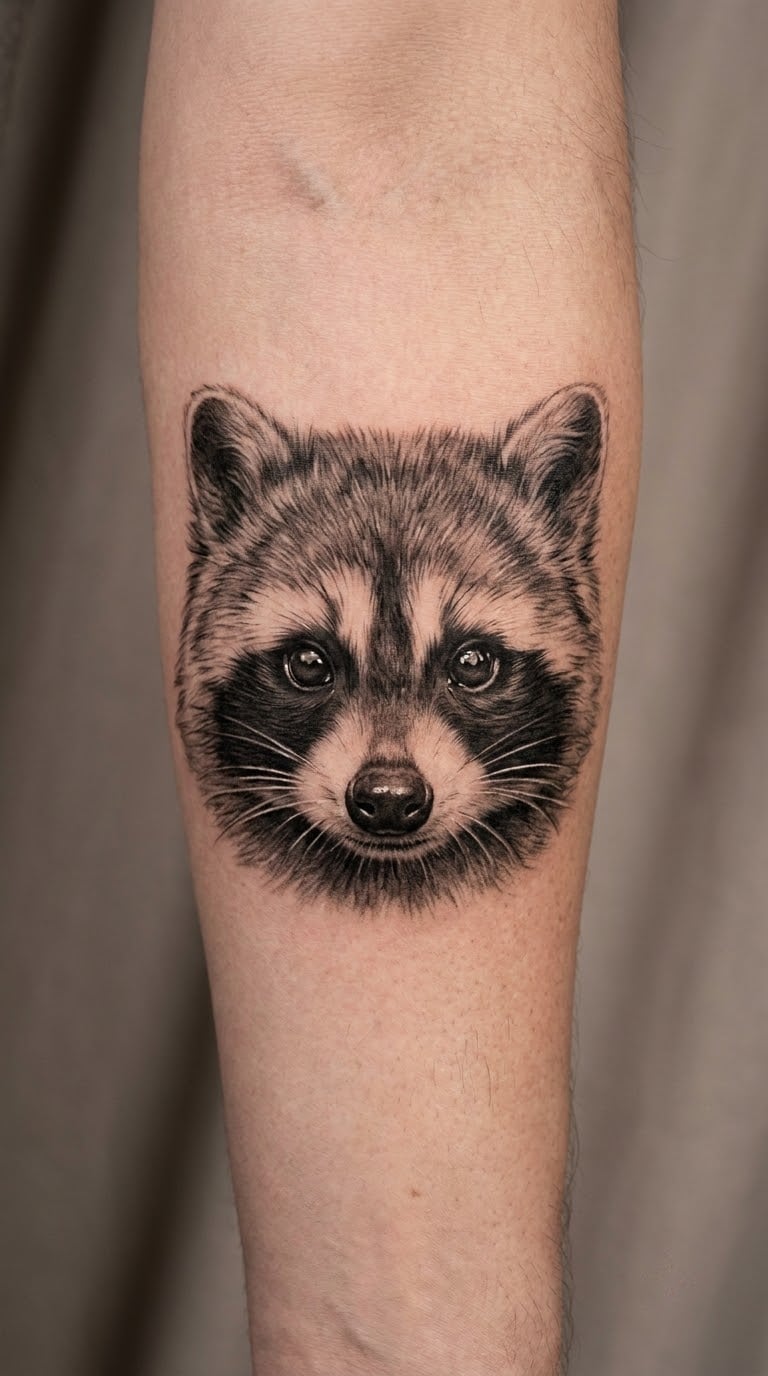
Full black and grey realism: layered grey fur following the growth direction, soft white around the muzzle, dark eyes with a single catchlight, and a ringed tail curving out of frame. This is the most technically demanding design on the list.
It suits collectors, and it is the one I would not recommend as a first tattoo. Raccoon portraits are unforgiving, because the animal’s fur is dense and light in patches, and a small mistake in tone shows as a flat patch once healed.
Placement: forearm, calf or outer thigh, all flat enough for a head to sit straight. Size: 4-7 inches (10-18 cm) long. Style: black and grey realism. Pain: medium on the arm, higher on the calf, and shade work takes real time, so expect two sessions for anything over 5 inches.
Make it yours: bring a photograph of the specific animal you are honouring, or have the tail wrapped around a hand-lettered name to link the portrait to a person.
9. Geometric Raccoon Head
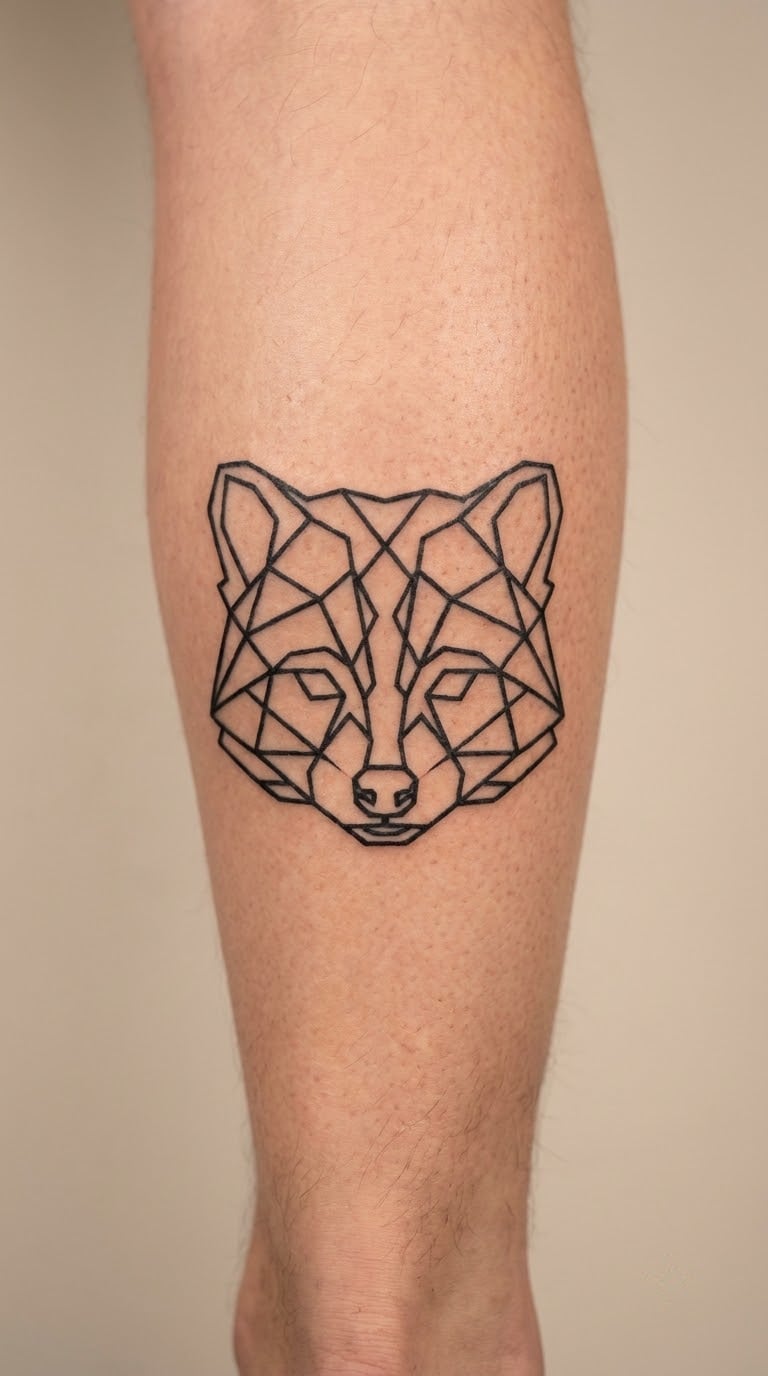
The head is broken into triangular and polygonal segments, each outlined in a consistent line weight, with the eye patches filled solid. Straight lines meet the rounded ear shapes, and the mask reads as two dark facets.
It looks contemporary without being fussy, and it is a common request from people who already have one realistic animal piece and want something with a different energy. Precision matters here, since the effect depends on the segments lining up.
Placement: calf, forearm, upper arm, or the flat of the chest. Size: 3-4 inches (8-10 cm) wide. Style: geometric line work. Pain: low to medium, with the calf at the stingier end. Thin interior lines in a geometric piece are the first thing to fade, so ask the artist to avoid hairlines.
Make it yours: fill alternate facets with a muted colour, or mirror the head so the two halves meet on the sternum or across the spine.
10. Dotwork Raccoon Climb
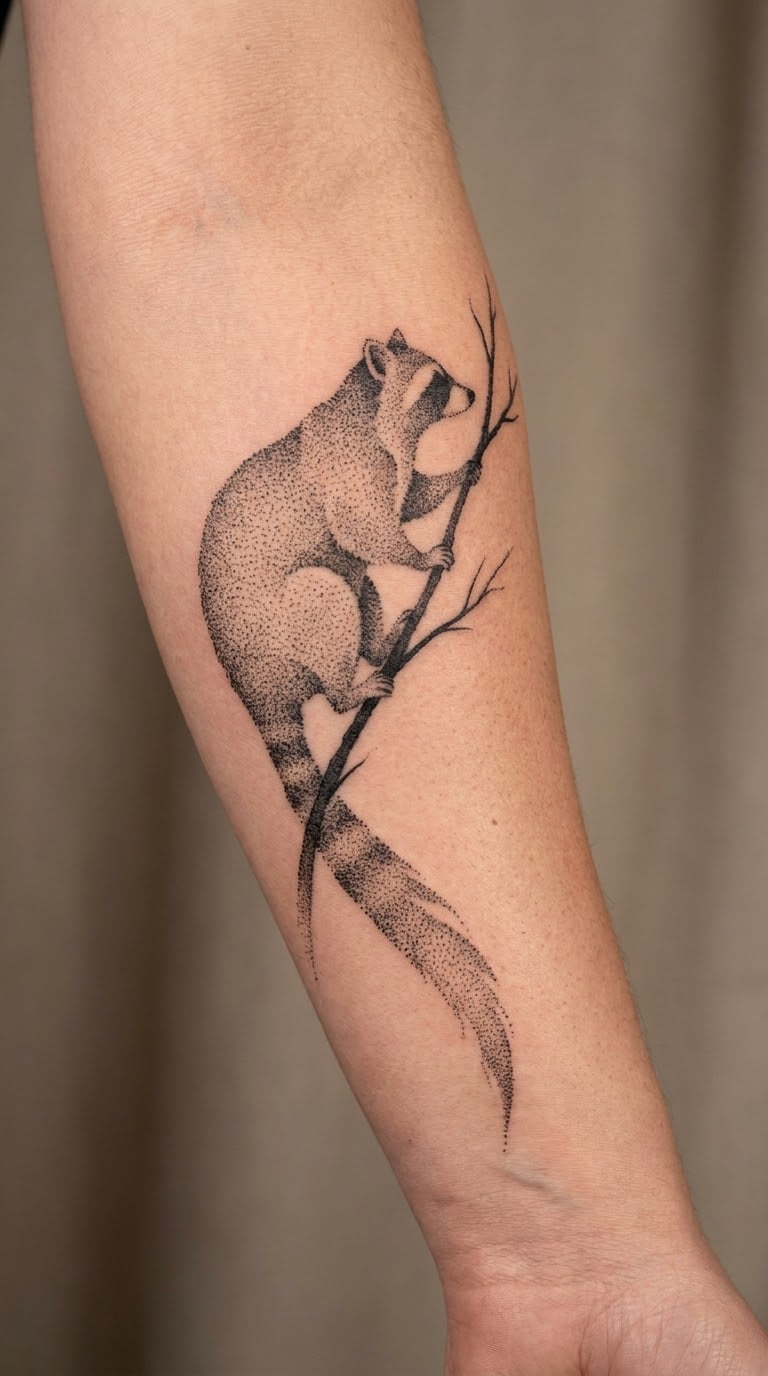
Stippling builds the whole animal: dense dot fields for the dark fur and mask, open skin left as the pale muzzle, and a gradient of dots along the tail. The branch underneath is a few confident lines.
Dotwork suits people who like texture and patience, and it rewards close viewing, which makes it a nice piece for a shoulder or a back where people can get near it. I have seen this style talked about in the raccoon community as a favourite for detail-loving clients.
Placement: forearm, calf, shoulder blade. Size: 3-5 inches (8-13 cm) long. Style: dotwork and stippling. Pain: medium, and the one to plan as multiple sessions, since stippling is slow. The trade-off is real: single dots soften and merge over the years, so the gradient needs to start with good tonal separation.
Make it yours: have the branch turn into a name or a set of coordinates, or restrict the dots to a circular field so the piece sits like a patch.
11. Raccoon Holding a Small Flash
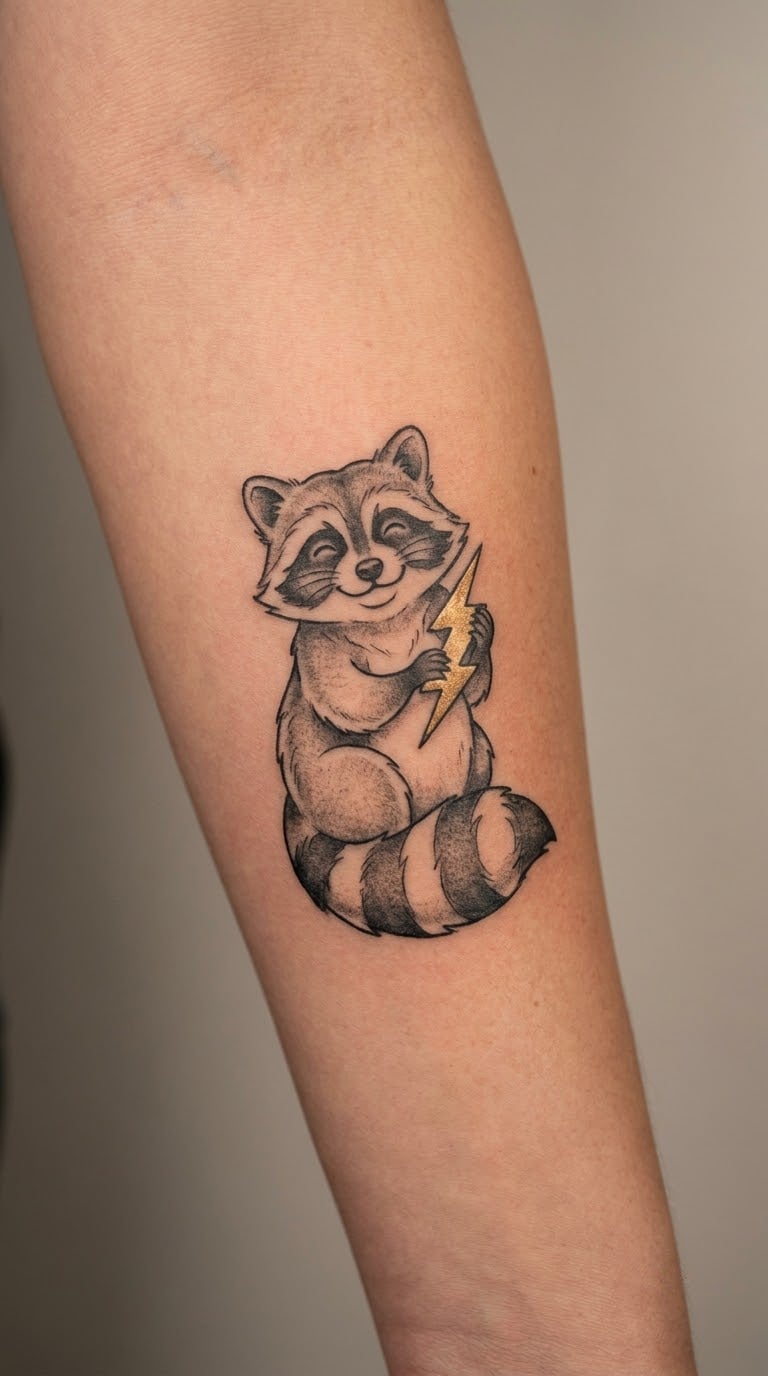
A raccoon standing upright with both front paws around a small object: a card, a star, a lightning bolt, a heart, a jar with a lid slightly off. The prop does the personalising work, and the pose is what makes it charming rather than fierce.
Prop-holding designs show up constantly in the raccoon community, and a widely shared piece of a raccoon holding balloons was described by the wearer as their first tattoo ever. That tells you something about the emotional weight these small scenes carry.
Placement: forearm, upper arm, or the inner arm above the elbow. Size: 3-4 inches (8-10 cm) long. Style: illustrative with light grey shading. Pain: medium. Standing poses need clean outlines to hold the shape, and hands gripping an object are the detail most likely to blur first.
Make it yours: hold an object with real meaning: a book, a camera, a set of keys, a small jar. Original artwork, not a licensed character, keeps the design yours and avoids the cover-up conversations that follow a film character done badly.
12. Forest Silhouette Raccoon Scene
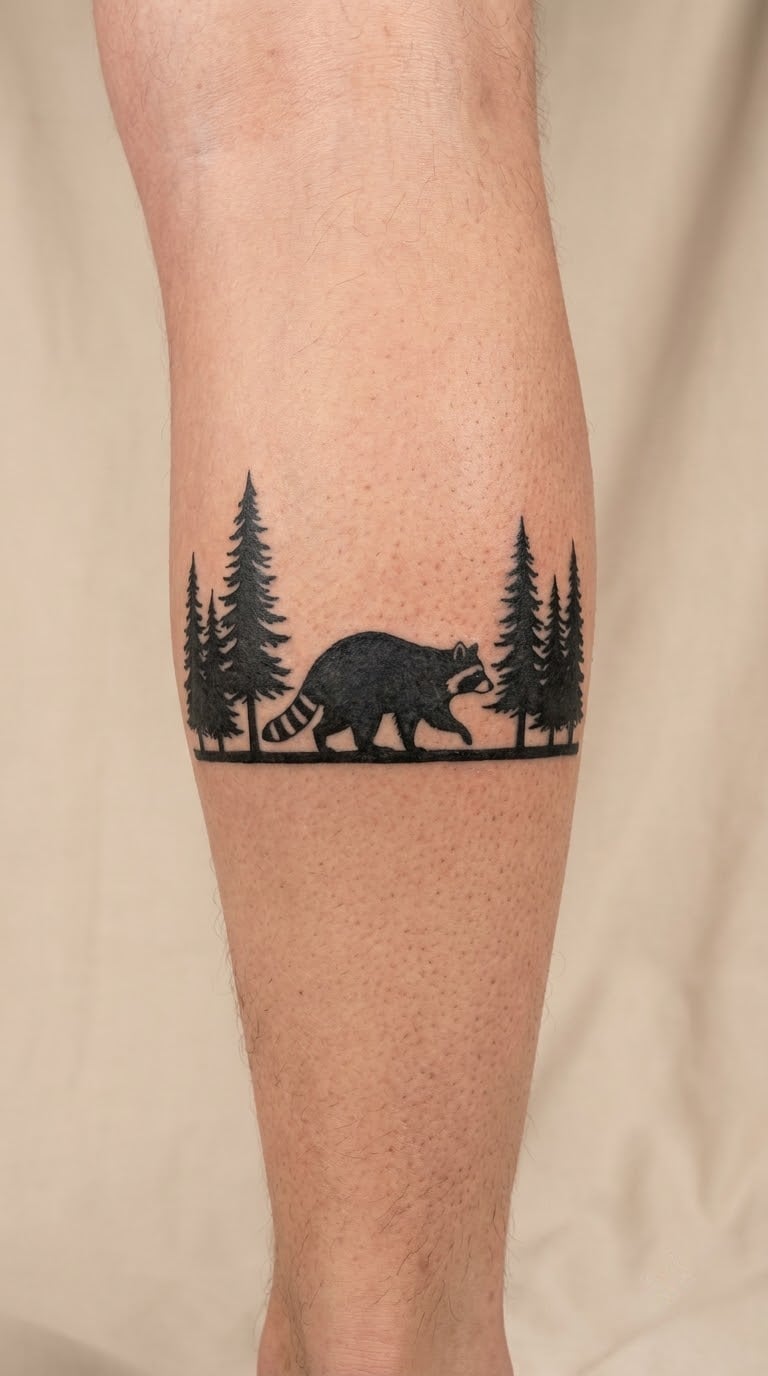
A flat black raccoon mid-stride across a forest floor, with pine trunks and low scrub cut as solid shapes and a lighter band of sky left open behind. The whole thing reads like a woodcut panel.
This is the raccoon tattoo idea for a larger flat area, and it is the one on this list that fills a section of a sleeve properly. The horizontal flow of the walking pose suits a calf better than a round shape would.
Placement: outer calf, back, outer thigh. Size: 6-9 inches (15-23 cm) wide. Style: black silhouette. Pain: medium, spread over a longer session. Solid blacks last well, but the negative gaps between the trunks are where healing can pull the design apart if they are cut too narrow.
Make it yours: make the background a real location rather than generic trees, or leave the sky band empty so a later piece can fit there.
13. Small Raccoon Behind the Ear
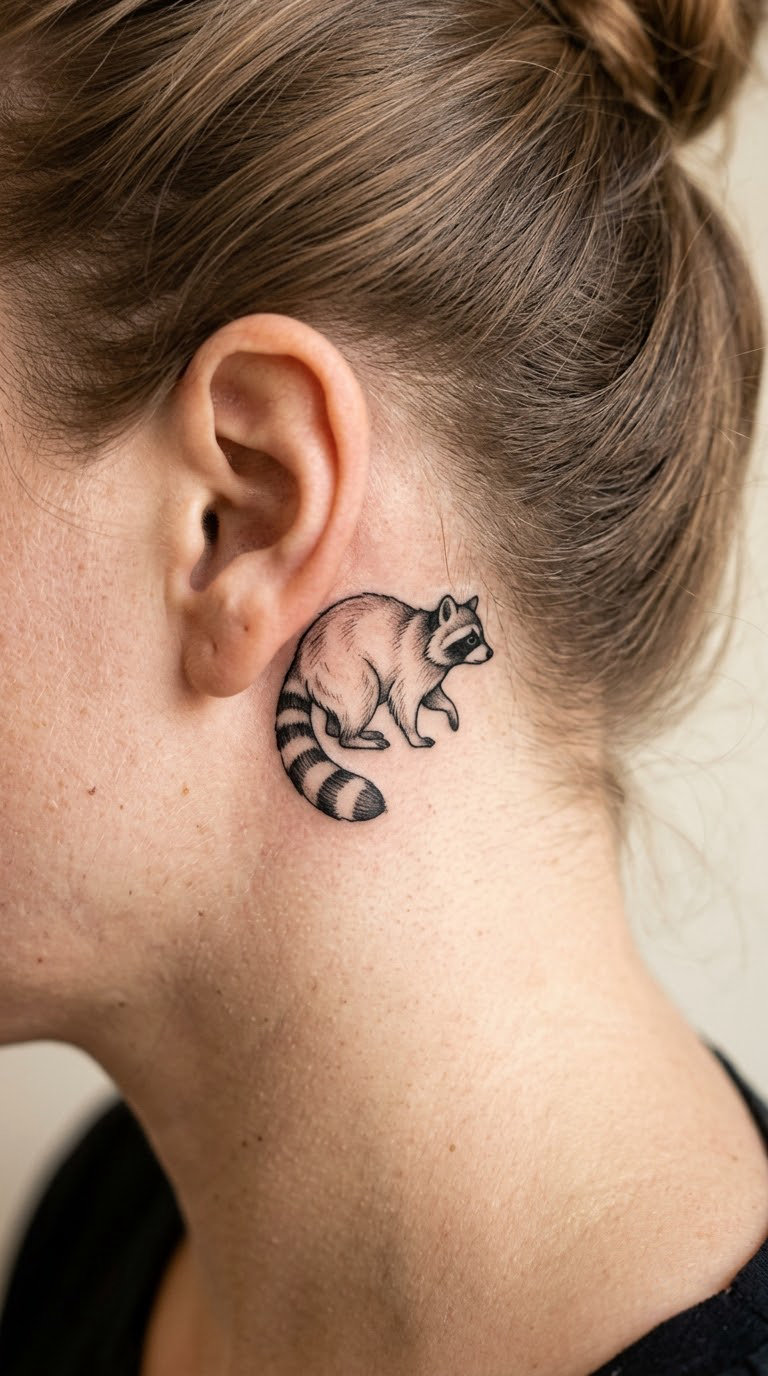
A side-profile head, one eye visible, with the ringed tail sweeping down along the curve behind the ear so the whole animal fits inside a patch a couple of inches tall. The lines are hairlines with a thicker outline on the profile.
Discreet and easy to hide under hair, which is the appeal. The awkward part is the same as with any tiny piece: the eye and the nose are the two details that decide whether it reads as a raccoon or as a small grey animal.
Placement: behind the ear is the classic spot, with the nape of the neck as the alternative. Size: 1.5-2 inches (4-5 cm) long. Style: fine line. Pain: medium; the skin behind the ear is thin and sensitive, though the session is short. Fine line here fades noticeably faster than on an arm, so expect to need a touch-up.
Make it yours: angle the head so the tail follows your ear exactly, or add a small collar line with a date where the neck meets the ear.
14. Smiling Raccoon Character
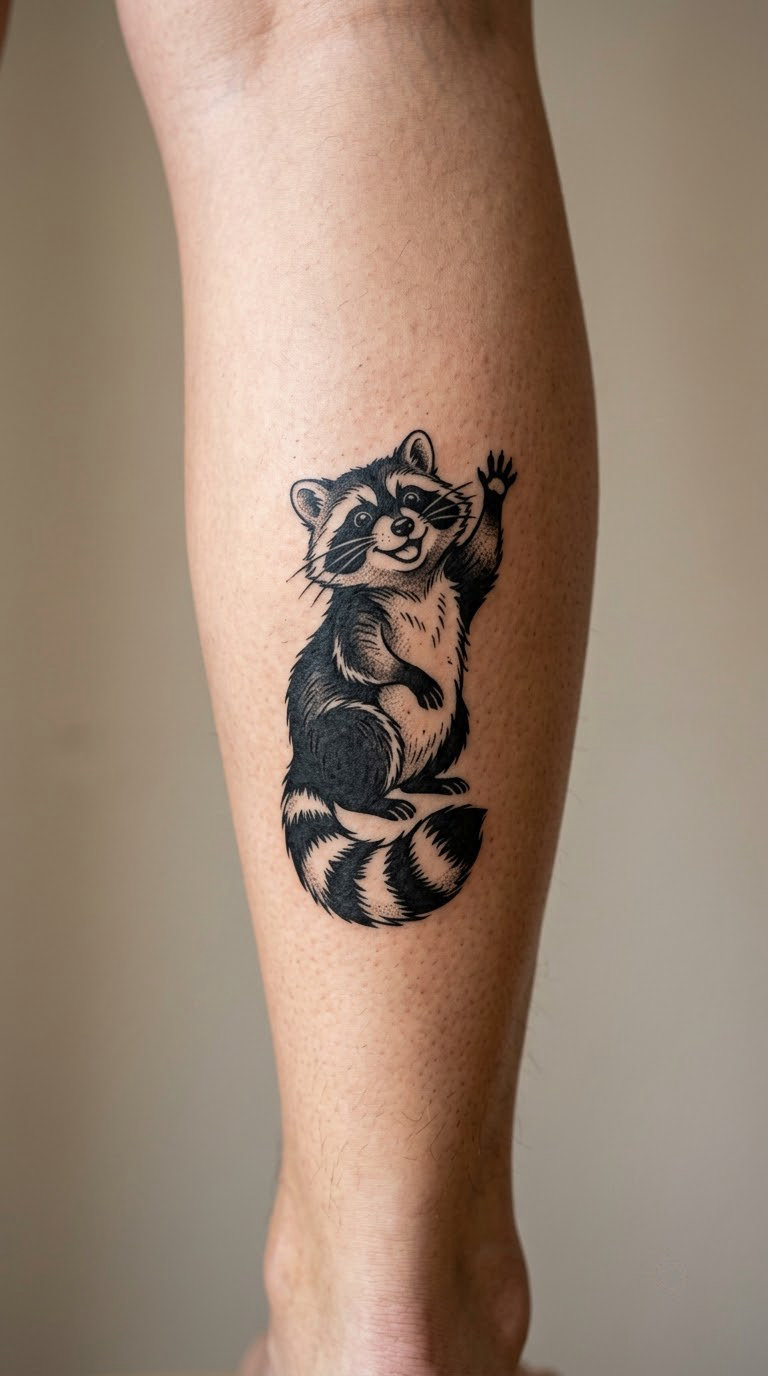
An upright character with a wide grin, closed happy eyes, one paw raised in a wave, and thick even outlines with almost no shading. It reads as a sticker, which is the entire point.
This is where the cute-versus-cool question gets answered. A raised paw and a smile push the raccoon toward charming without losing the mask, and the thick linework means there is very little to lose as the tattoo ages.
Placement: lower leg, upper arm, or the outer arm above the elbow. Size: 3 inches (8 cm) tall. Style: cartoon and illustrative. Pain: low, the session is brief and mostly outline work. Solid black outlines are among the most durable marks you can get, and the shape stays legible long after the details would have faded.
Make it yours: change the raised paw into a wave, a point, or a paw holding a small object, and colour only the paw pad in a single tone.
15. Floral Raccoon Sleeve Detail
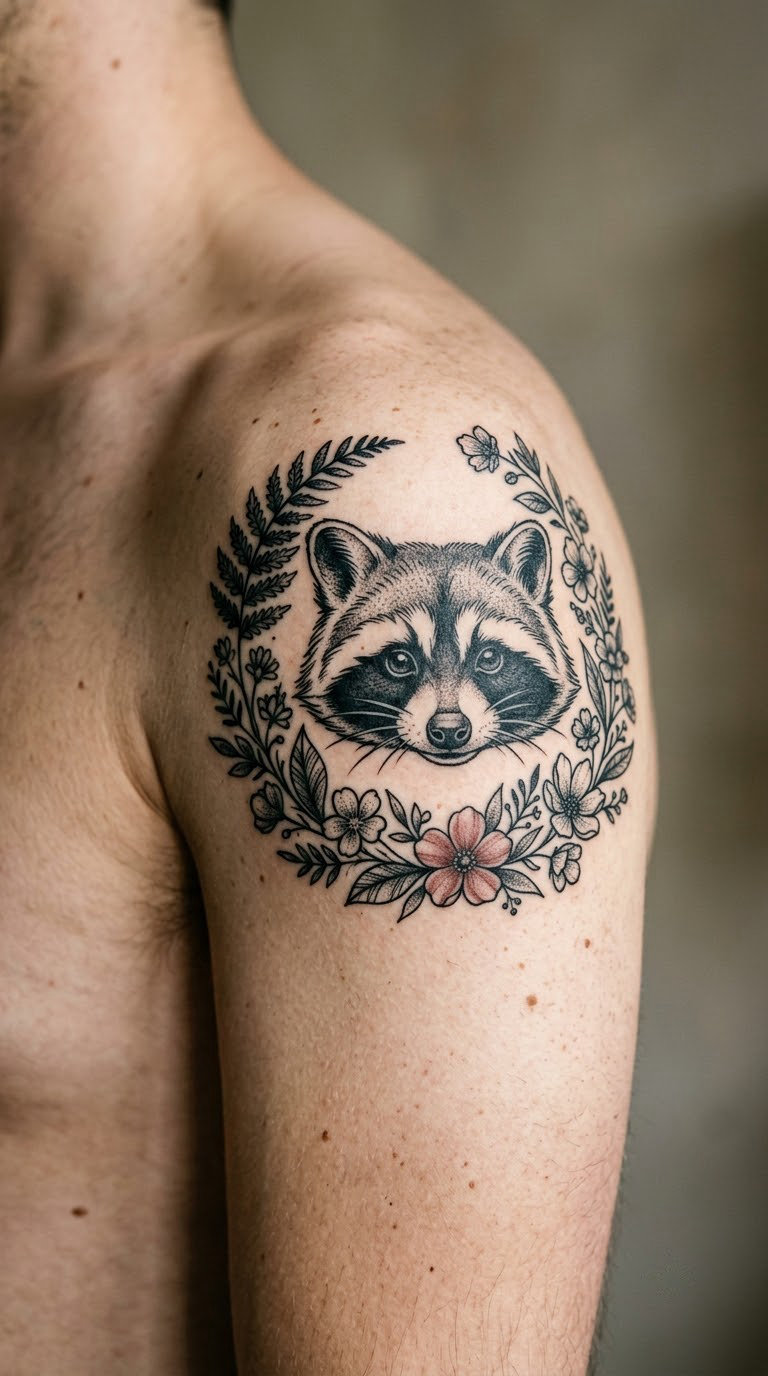
A raccoon head at the centre of a ring of stems, leaves and blossoms, with one species of flower repeated rather than a mixed bouquet. Botanical line work gives the piece its movement and its softness against the animal’s mask.
Botanical composition is a reliable way to make a single animal feel like part of something larger, and it pairs easily with other animals or insects if you are building a sleeve over time.
Placement: shoulder, upper arm, or the back of the arm. Size: 5-6 inches (13-15 cm) wide as a standalone piece. Style: botanical blackwork with an optional colour accent. Pain: medium; fine stems and petals take real time, so this is usually planned across two sessions. Stems are the first thing to blur, so the artist should build them with confident line weight.
Make it yours: use flowers with a real association, such as your birth month bloom, and keep the palette to one accent colour across every piece in the sleeve.
16. Raccoon and Oak Leaves
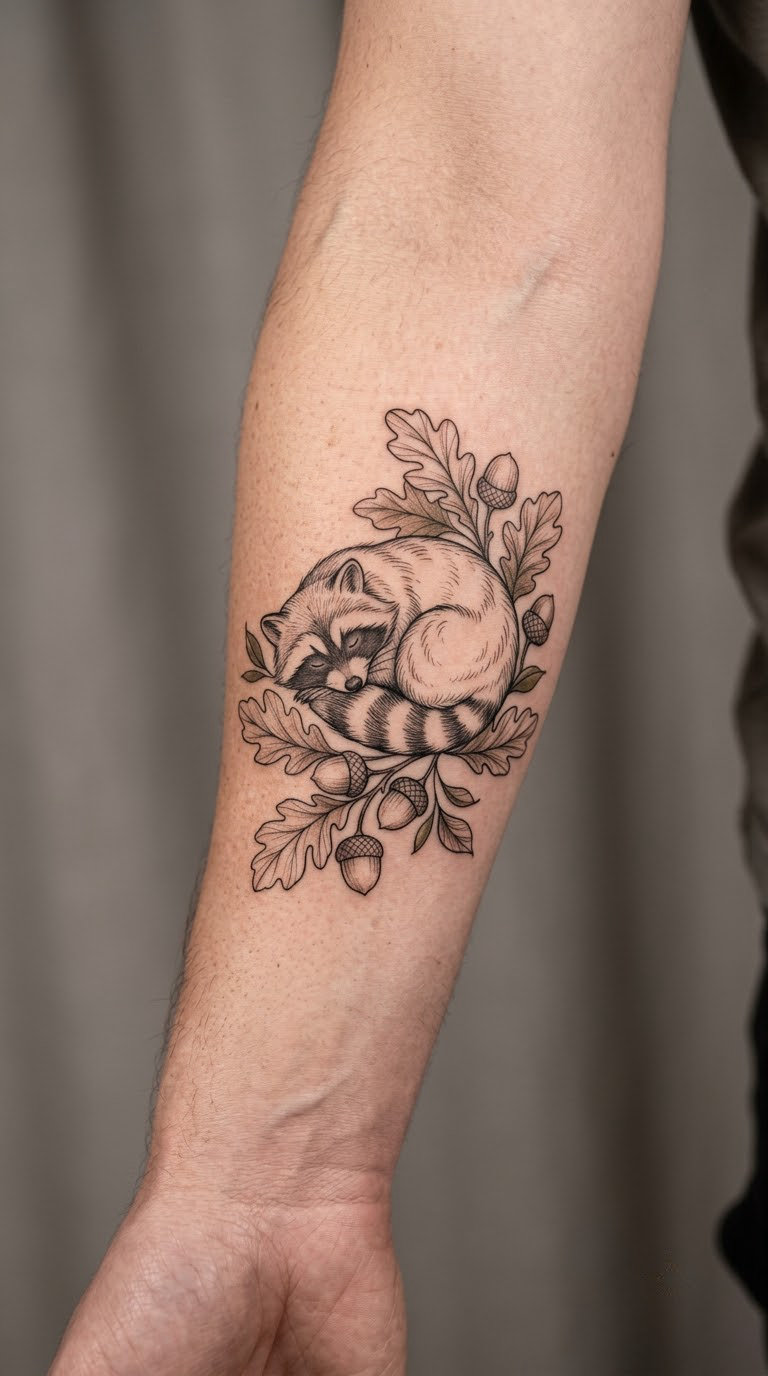
A curled raccoon at one end, a short spray of oak leaves and two acorns running along the underside, drawn in single-weight line with a muted brown wash on the acorns only. The composition is flat and horizontal.
Autumn is when most of my clients book this one, and the oak pairing gives it a seasonal feel without needing a whole scene. The asymmetry works well on a forearm, where the natural line of the bone runs left to right.
Placement: inner forearm, calf, or along the rib. Size: 4 inches (10 cm) wide. Style: fine line with a single colour accent. Pain: low on the arm. The acorn wash is the fragile part; keep that colour in a shaded area rather than over a bony edge.
Make it yours: use leaves from a tree that matters to you, or have the acorns replaced with berries in a single colour to shift the season.
17. Checkerboard Raccoon
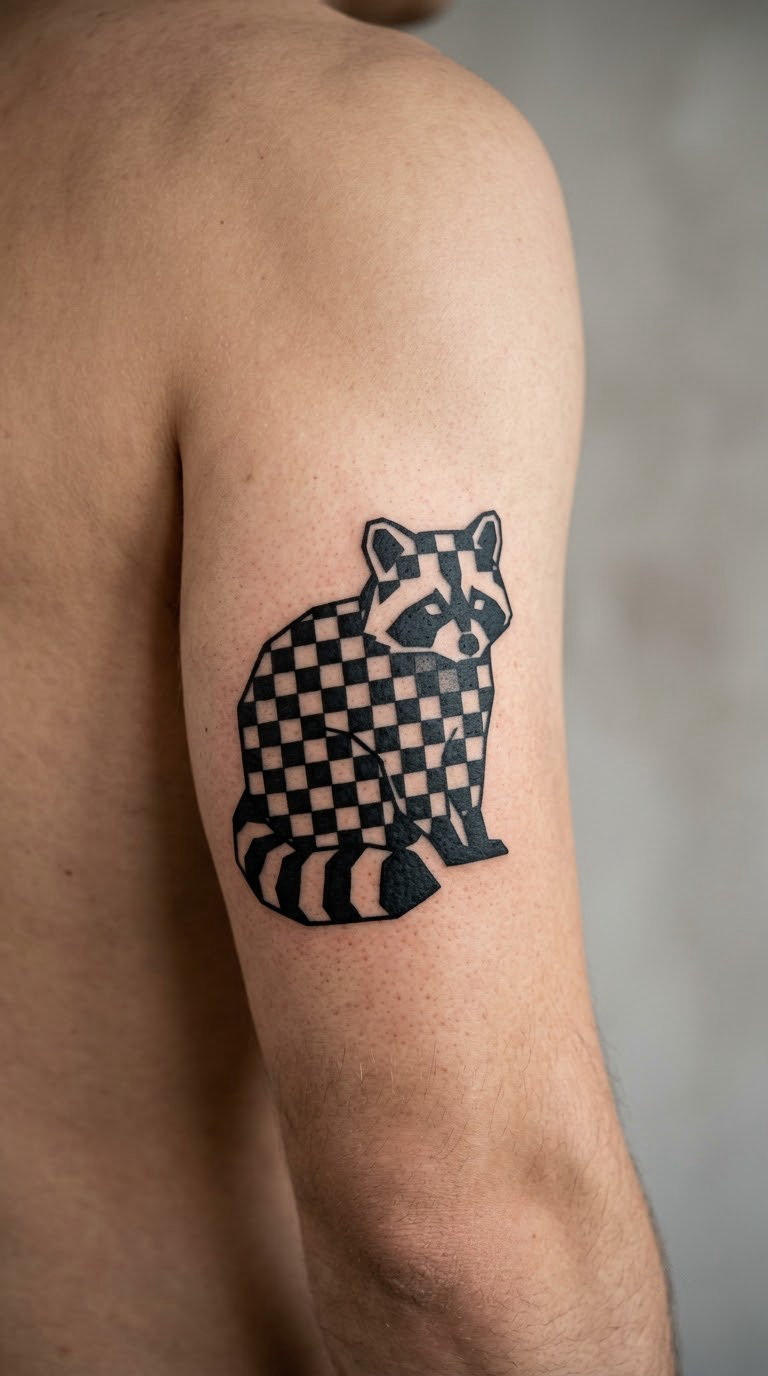
The raccoon is constructed rather than drawn: solid black squares and white squares build the head, the mask is a run of filled boxes, and the ringed tail becomes a stripe pattern. The edges stay sharp and deliberate.
People pick this when they want a graphic piece that reads as a pattern first and an animal second. It also lasts well, because there is no tonal gradient to fade, only hard edges.
Placement: upper arm, shoulder, or the flat of the chest. Size: 4 inches (10 cm) wide; smaller works if the grid is simplified. Style: graphic blackwork. Pain: medium, as the filled squares take repeated passes. The grid needs to be checked at healed size, because squares that look even on paper can look uneven once the skin moves.
Make it yours: use a pattern that belongs to someone, a quilt square, a football pitch, or a section of the year you want marked.
18. Sleeping Raccoon with Zzz Motif
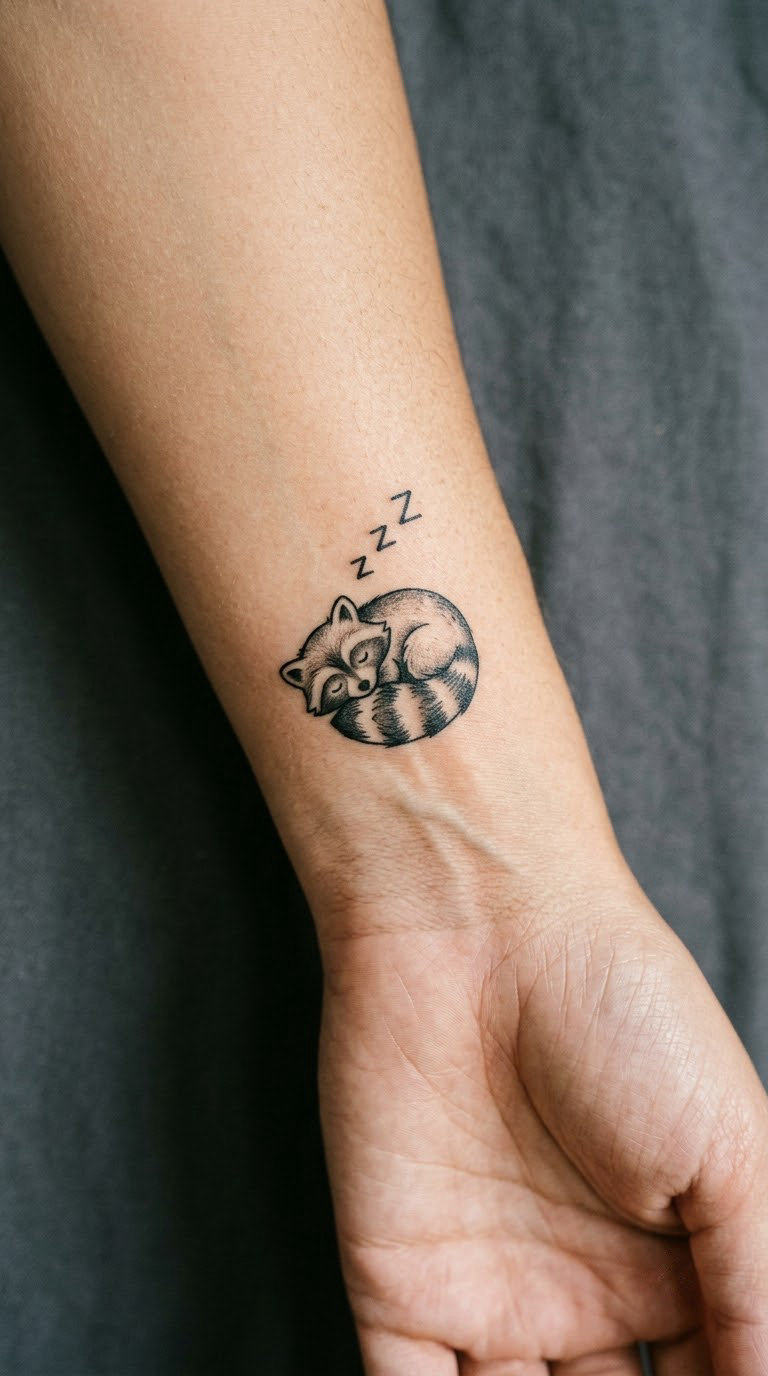
A curled raccoon with its tail over its face, drawn softly, with three small hand-lettered Z marks drifting above it. The lettering is optional and works best as the only text in the design.
It is a small joke of a tattoo, the kind that makes people ask, and it fits the curled pose without crowding it. Sleeping animals also tend to survive better than alert ones, because there is less fine facial detail to lose.
Placement: inner wrist, forearm, or the ankle. Size: 2-2.5 inches (5-6 cm) long. Style: illustrative with small lettering. Pain: low. The Z marks are the weak point: hand lettering on the inner wrist softens noticeably with sun and washing, so keep them simple and slightly larger than feels necessary.
Make it yours: replace the Z marks with a short name, or swap them for three small stars if the lettering is not the joke you want. If the name is the point rather than the sleep, the 20 fingerprint tattoo ideas for memorial cover the same emotional ground with a shape that survives small sizes better than lettering does.
19. Raccoon Climbing a Finger
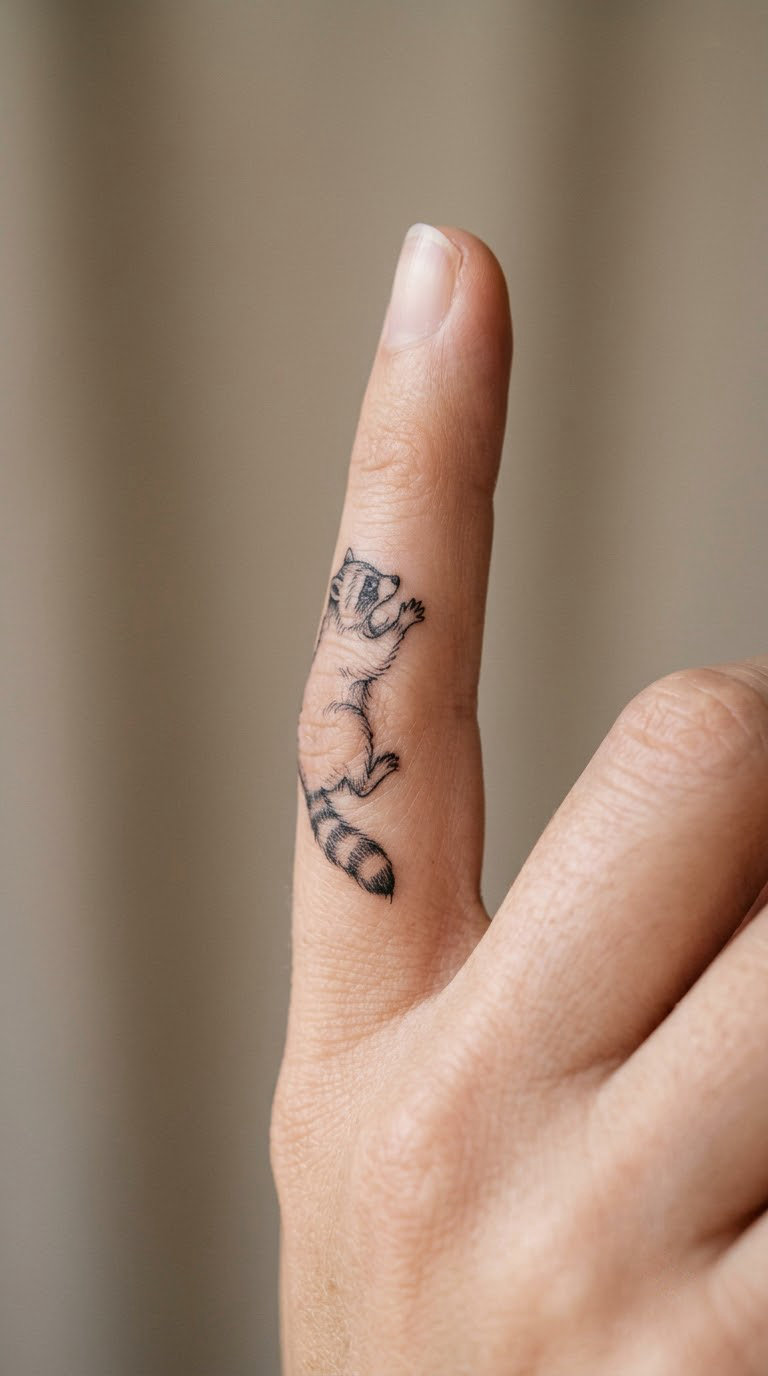
A vertical raccoon climbing up the side of the finger, front paws on the knuckle line, hind legs stretched, tail curling around and partly out of view. The pose uses the finger’s own curve instead of fighting it.
It is one of the most personal placements on the list, and one of the least forgiving. Hands get washed, sun-exposed and shaved around, and a vertical piece on a finger changes shape as the finger bends.
Placement: the side of the index or middle finger, aligned with the bone. Size: 2 inches (5 cm) tall. Style: fine line. Pain: high, and not only physical. Hand and finger detail fades the fastest of any placement, and the tail wrapping out of view will soften first. Talk it through with the artist before committing to a detailed version here.
Make it yours: run a thin line of dots from the tail down to the wrist as a trail, or align the raccoon with a ring you already wear.
20. Colorful Storybook Raccoon
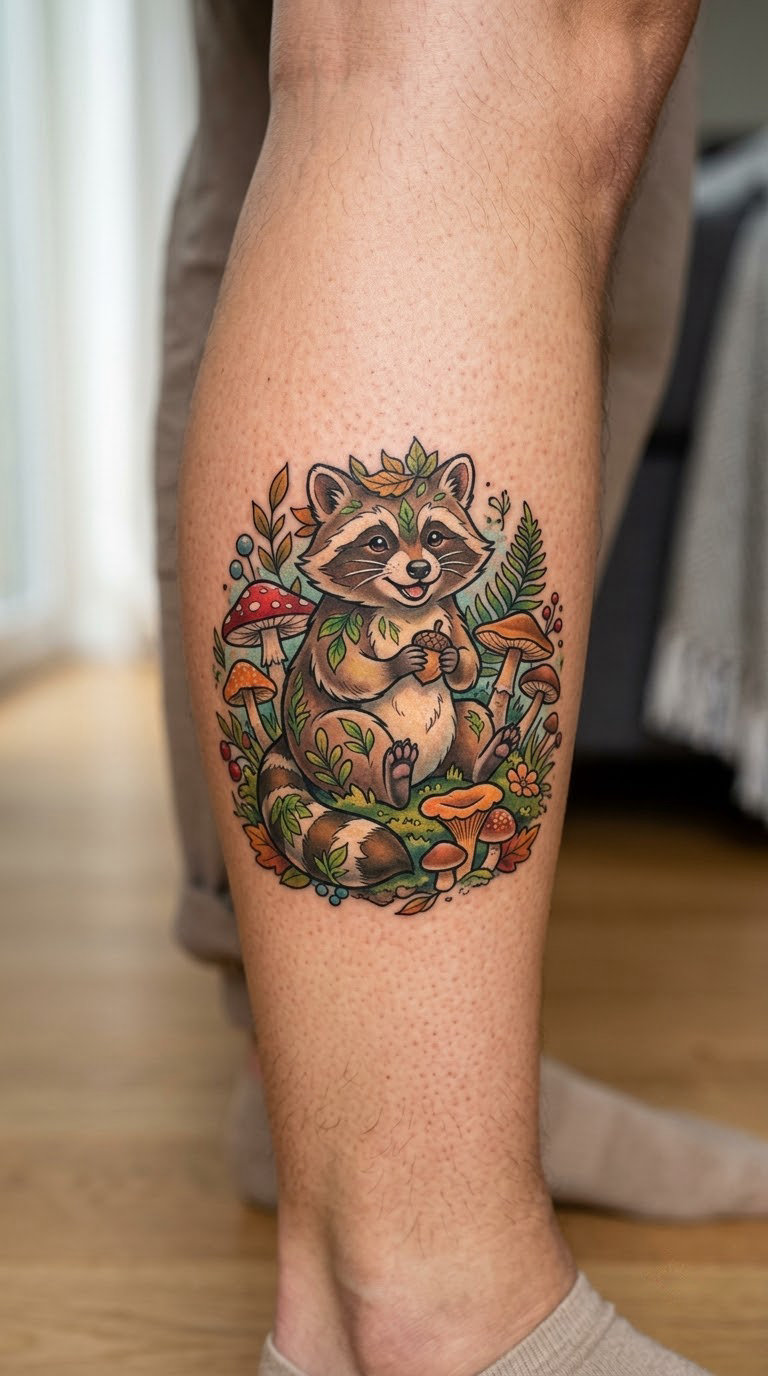
A full-colour raccoon sitting among two or three mushrooms and a few blades of grass, with warm brown fur built from small textured strokes, bright eyes, and green foliage behind it. The scene is simple enough to read at a distance.
This is the raccoon tattoo idea to pick if you want a piece that is unmistakably cheerful and you do not mind returning for colour work. Bright colour and fine fur texture are the two things that need the most session time on the whole list.
Placement: calf, shoulder, outer thigh, or the upper arm. Size: 4-5 inches (10-13 cm) tall. Style: colour illustrative. Pain: medium, and expect two sessions at this level of texture. Colour holds its brightness best on shaded, less exposed skin, and the texture strokes will soften into a flatter wash over time.
Make it yours: pick the mushrooms and plants from a place you have actually stood in, and keep the background to three species so the piece stays readable at any size.
How to Choose the Right Design
Five checks will narrow a gallery of 20 down to one that suits you. Run them before you book, not after the stencil is on your skin.
- Can you read the mask? At the size you are considering, the two dark eye patches need to be the first thing you see. If the design depends on fine fur texture, it will not survive.
- Does the style match your linework? Fine line suits restrained subjects and heals lighter. Traditional, blackwork and graphic styles hold their shape longest because they are built from solid black.
- Is the size honest? Decide the real measurement in inches, not a vague idea. A raccoon face needs 2 inches minimum to read; anything with a full body wants 3 inches and up.
- Does the placement suit the shape? Horizontal designs sit well along the forearm and calf. Round designs suit the shoulder and upper arm. Vertical designs suit fingers and the ribs.
- How much detail per inch? Count the tiny elements: whiskers, fur strokes, toe lines, dots. More than a handful inside 3 inches is the single most common reason a small animal tattoo ends up needing rework.
Existing raccoon tattoos are a recurring rework topic on r/Tattoocoverups, usually pieces that were rushed or done in low contrast. A clear brief and an artist who works in the style you want solve most of that before it starts.
Cost and Session Time
Most shops quote either a flat rate per piece or an hourly rate, and the hourly number is where a size decision actually costs you. Micro pieces under 1 inch often get charged at the shop minimum, so the price barely moves. The jump happens between 2 and 4 inches, where detail density starts to matter.
Realistic US ranges, before tip, vary widely by city and by artist. A 1-2 inch simple raccoon usually lands somewhere around 120 to 300 dollars. A 3-4 inch design with shading and a prop sits closer to 250 to 600 dollars. A 5-inch-plus piece, especially a realistic portrait or a full-colour scene, can run 600 to 1500 dollars or more. A shop minimum in a high-rent city can start well above what a single micro piece would cost by the hour, which is worth asking about directly.
Session length runs from about an hour for a small outline to two hours for most medium designs. Dotwork, fine realism and full colour almost always need two sessions, sometimes three, with a gap of several weeks between them so the first layer settles. Before the first session, ask what the full piece costs including the second one. Guessing mid-way through is the most common source of frustration on a large animal piece.
Aftercare Basics
- Follow your artist’s aftercare instructions first. They know the inks, the needle depth and the placement you chose, and their advice overrides anything general you read online.
- Wash gently with lukewarm water and unscented soap as instructed, then pat the area dry with a clean hand or paper towel rather than a terry towel.
- Apply a thin layer of whatever ointment or balm your artist recommends, and keep it light. Heavy creams trap moisture and slow things down.
- Keep it out of direct sun, out of swimming pools and hot tubs, and away from tight clothing while the surface is healing. A raccoon portrait on a sun-exposed forearm will show fading first.
- Do not scratch, pick, or soak the area. If a scab forms, leave it alone; picking is the fastest route to a patch that heals flat.
- When the surface has healed, keep up sunscreen on exposed placements. Black line lasts, but fine line and colour both fade faster on skin that gets regular sun.
Frequently Asked Questions
What does a raccoon tattoo symbolize?
A raccoon tattoo usually stands for adaptability, intelligence and resourcefulness, because the animal survives wherever it lands. People also read it as stealth and a kind of mischief, or as a masked identity, since the bandit mask is the animal’s most recognisable feature. The meaning is personal, and plenty of people choose it for the animal or a nickname rather than the symbolism.
Are raccoon tattoos suitable for first-time tattooers?
They can be. A small raccoon with a simple outline, a plain mask or a curled silhouette is a very manageable first tattoo, because the shape reads clearly and the session is short. Styles built on fine fur texture, dotwork or full colour are harder, and better saved for a second piece. Go in with a clear reference and a design you would wear at a larger size too.
What is the best placement for a small raccoon tattoo?
For a small raccoon, the inner forearm and wrist are the most reliable: flat skin, easy to show off, and enough room for a 2 to 3 inch design. Behind the ear and the ankle are the other common choices, and both work well at 1.5 to 2 inches. Avoid putting fine detail on fingers or the back of the hand, where line fades fastest.
Which raccoon tattoo style ages the best?
Blackwork and traditional styles age the best, because they are built from solid black lines and fills that hold contrast for decades. Graphic and geometric work does well too, provided interior lines are not hairlines. Fine line fades first, especially on hands and fingers, and pale colour washes lose their brightness within a few years. Choose heavier ink if long-term clarity matters to you.
Can I personalize a raccoon tattoo design?
Yes, and the most personal versions are simple swaps. Hold an object with meaning, use leaves or flowers from a real place, add a date in the same line weight, or match the colour of the design to something specific. Original artwork also avoids the legal and cover-up headaches that come with tattooing a licensed character. Bring your references to the consultation and let the artist redraw them properly.
Conclusion
For a first tattoo, the fine-line raccoon face gives you the most readable animal at the smallest commitment, and the minimalist mask works nearly as well if you want almost no line weight. For someone adding to an existing collection, the realistic portrait or the blackwork peeking design is where the craft shows.
Whichever one pulls you, save two or three references in the style you actually want, check the healed work in that artist’s portfolio, and bring your real measurements to the consultation. An artist who works in your style will tell you honestly whether your idea will still read in ten years.