
20 Fingerprint Tattoo Ideas for Memorial: Best September 2026
A fingerprint memorial tattoo reproduces the actual ridge pattern of a loved one’s fingertip, usually on the inner wrist, forearm or chest, so their touch stays close for good. If you are searching for fingerprint tattoo ideas for memorial, the choices below cover everything from a single fine-line print to paired, landscape-style compositions.
These designs suit anyone honoring a parent, spouse, child, sibling, friend or pet, and they also work for a living loved one you want a daily reminder of. What makes a memorial fingerprint hold up on skin is simple: the strongest designs keep the most legible whorls and loops, and they simplify everything else so the pattern never turns into a gray smudge. I have looked at a lot of these designs while putting this gallery together, and the one mistake that keeps coming up is choosing the composition before checking the source image. Decide what the print looks like at full size, then pick the design.
If you are booking around a loss, allow a month of planning before you book. Most people land on a design after they have seen their own print file, not before.
Fingerprint Tattoo Ideas for Memorial: Quick Guide
Here is the short version before the detail. Twenty distinct concepts, ordered exactly as the sections below run, with the style, placement, realistic size and expected pain for each.
| Idea | Style | Best placement | Size | Pain |
|---|---|---|---|---|
| Fine-line loop print | Fine line | Inner wrist | 2 to 2.5 in | Medium |
| Parent and child pair | Fine line | Inner forearm | 3 to 4 in wide | Medium |
| Overlapping prints in a circle | Fine line, gray wash | Outer forearm | 3 in across | Medium |
| Print with a memorial initial | Fine line, serif type | Forearm | 3.5 in tall | Medium |
| Print wrapped around a date | Fine line, sans-serif type | Forearm | 4 in wide | Medium |
| Heartbeat ending in a print | Fine line | Inner arm | 4 to 5 in long | Medium |
| Print over a mountain range | Fine line | Forearm or upper arm | 5 in wide | Medium to high |
| Print framed by laurel | Black and gray | Upper arm | 4 in tall | Medium |
| Micro-realism print | Micro-realism | Side of index finger | 1.5 to 2 in | High |
| Geometric print | Geometric linework | Calf | 3 in tall | Medium |
| Two prints forming a heart | Fine line | Inner wrist or chest | 3 in wide | Medium |
| Print with one bloom | Color plus black | Inner forearm | 4 in tall | Medium |
| Print inside a star map | Fine line, dotwork stars | Upper arm | 5 in wide | Medium |
| Paw print nested in a print | Blackwork | Calf | 3 in tall | Medium |
| Print beneath a handwritten name | Fine line, script | Forearm | 4 in wide | Medium |
| Print with map coordinates | Fine line | Inner upper arm | 3.5 in wide | Medium |
| Crescent moon from ridges | Fine line | Behind the ear | 3 in tall | Low to medium |
| Split matching prints | Fine line | Inner forearm | 3.5 in wide | Medium |
| Watercolor print wash | Watercolor | Outer arm | 5 in tall | Medium |
| Minimal thumbprint and initial | Minimal fine line | Outer wrist or ankle | 1.5 in wide | Medium |
1. Fine-Line Loop Fingerprint on the Inner Wrist
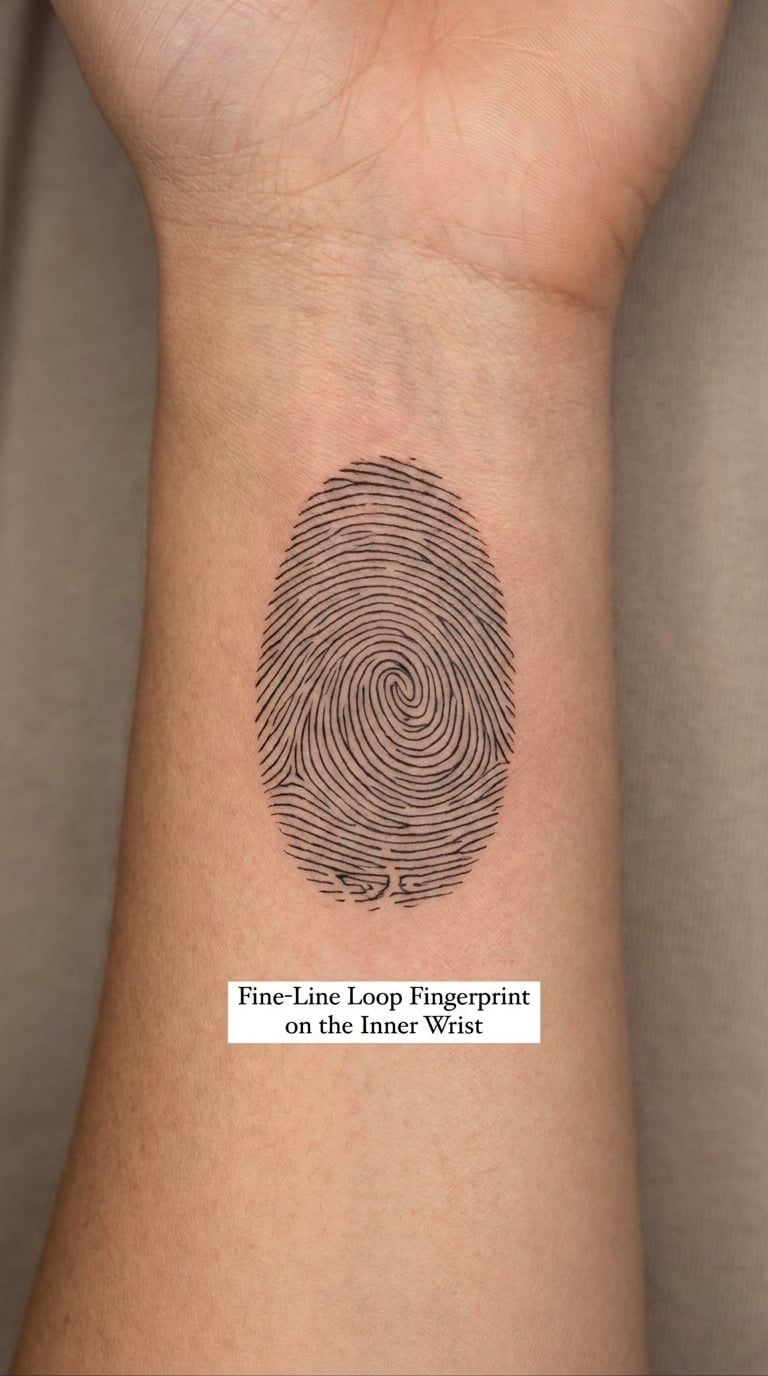
This is the design most first-time memorial clients ask about, and the reason is that a single print needs no explaining. The artist picks the clearest loops and arches from the source file and draws them with a single needle, no shading, no border.
It is intimate rather than showy. The inner wrist means it is only visible when you turn your palm up, which is what a lot of people want from a piece like this.
Placement: Inner wrist, just above the crease, or the inner forearm a few inches up. Size: 2 to 2.5 inches tall (5 to 6 cm). Style: Fine line. Pain: Medium, and the wrist flexes constantly so lines soften faster here than on a flat surface.
Make it yours: Add one small date or initial beneath the print rather than crowding the ridges themselves.
Fingerprint Tattoo Ideas for Memorial: Fine-Line Placement Notes
Start from the clearest part of the scan, not the prettiest idea. Every print has one section where ridges are wide and even, and that is the section an artist will use first.
Scale changes how ridges sit in the skin. A print reproduced too small pulls the lines together, and after healing they can read as a black blob instead of a pattern. That is exactly why size is listed in every entry here, and why most artists will talk you up to a forearm-sized version rather than a lens-sized one.
Artists sometimes reverse, crop or simplify a print to fit a curved area. That is normal and it does not make the print unrecognizable, as long as the core loop or whorl survives untouched.
2. Parent-and-Child Fingerprint Pair
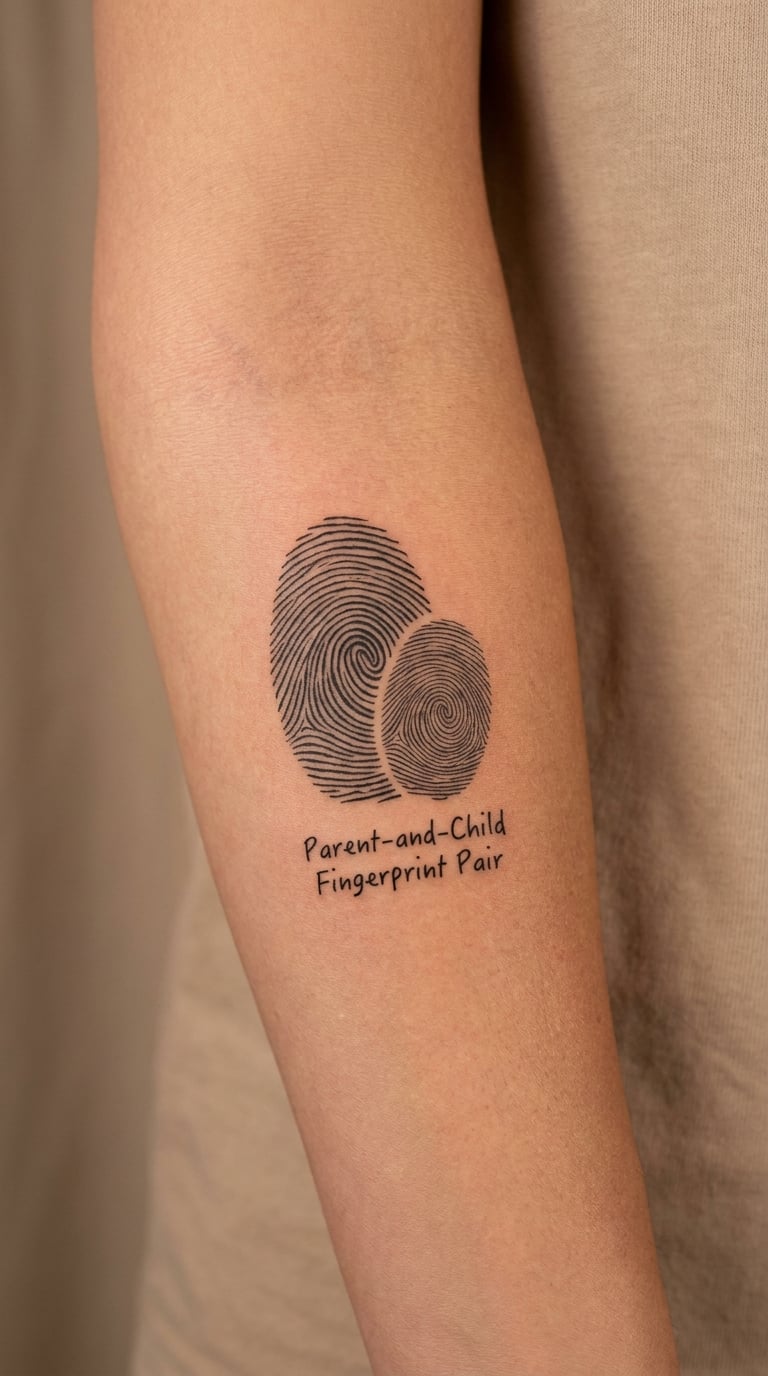
Two prints at different scales, the child’s set slightly smaller and tucked beside the adult’s, separated by a few millimeters of clean skin. Keeping that gap is what makes the pair readable; touching prints turn into a single dark shape once healed.
It is the most requested memorial design for a parent, and the reason is simple: the size difference already tells the story without a word.
Placement: Inner forearm, wrist to elbow, or a matching pair on each forearm of two family members. Size: 3 to 4 inches wide (7.5 to 10 cm). Style: Fine line. Pain: Medium, higher near the elbow crease. Over time the child’s smaller print softens first because its ridges are closer together.
Make it yours: Add a small matching birth star or a shared date under both prints.
3. Overlapping Fingerprints in a Circle
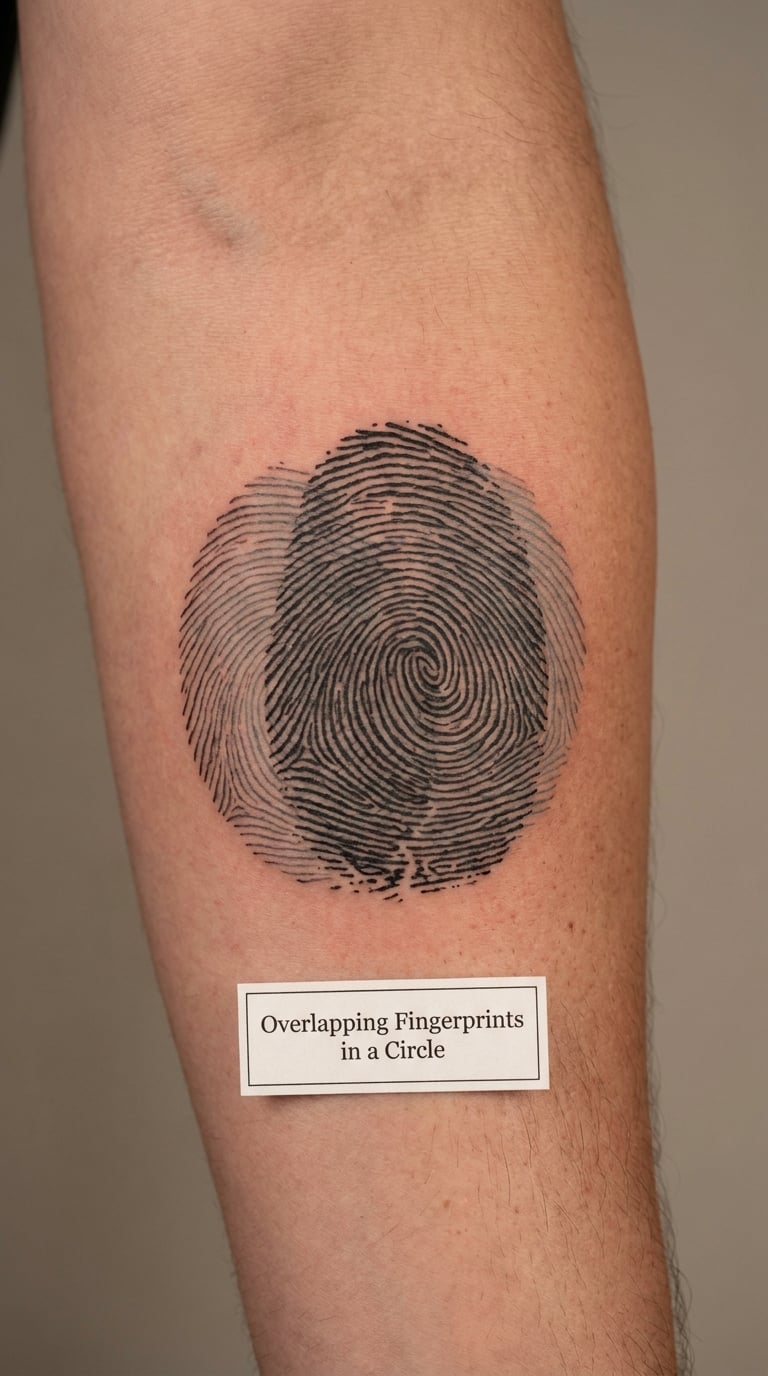
Two outlines cross inside a thin circular border, the overlap drawn a shade lighter so the crossing lines read as depth rather than mud. The circle gives the piece a finished edge, which a bare pair of prints does not have.
People choose it when they are honoring a partner or a close friend, because the crossing does the emotional work of connection without adding a second symbol.
Placement: Outer forearm, upper arm, or the inside of a calf. Size: 3 inches across (7.5 cm). Style: Fine line with a gray wash. Pain: Medium. If the circle is drawn too thin relative to the print, the border fades before the ridges do.
Make it yours: Place a hidden initial inside the circle where only you know to look for it.
4. Fingerprint with a Memorial Initial
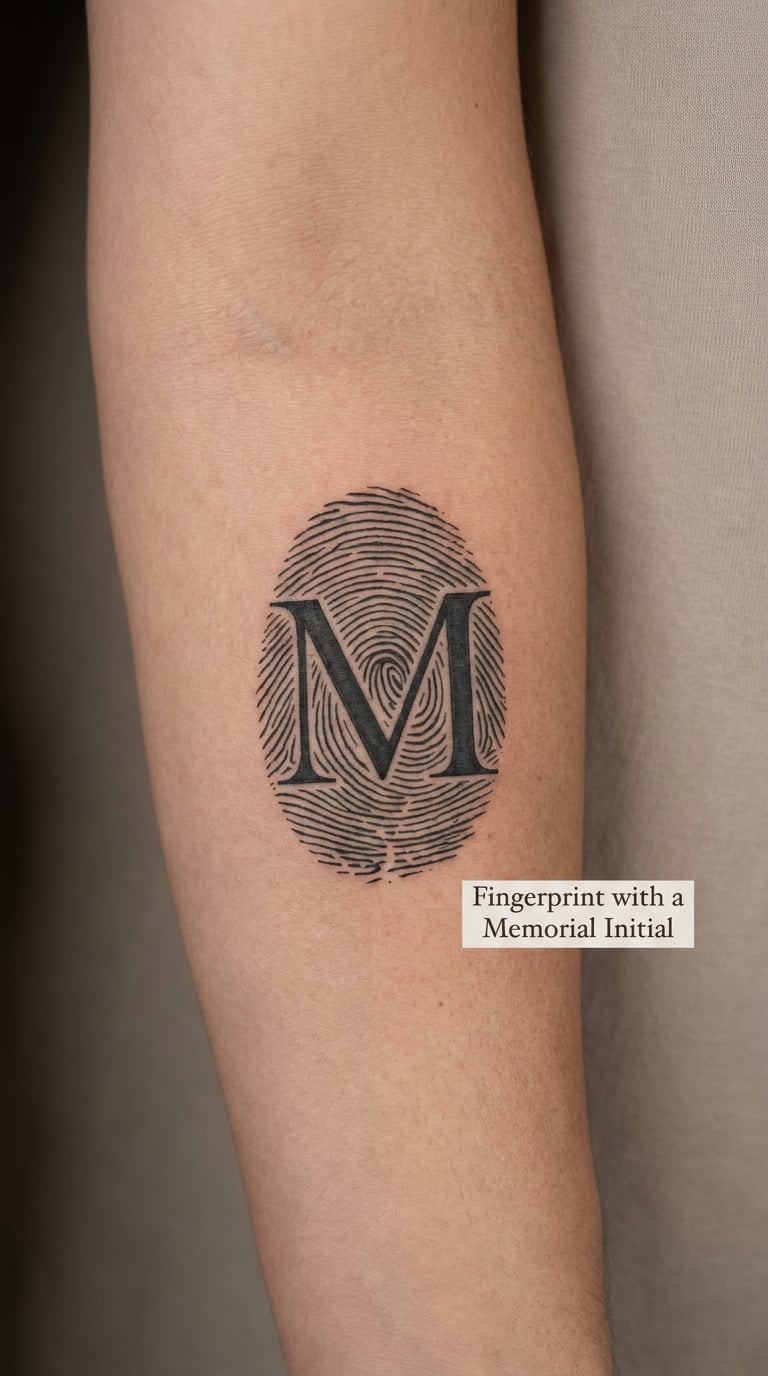
A single print anchored beneath one letter in a clean serif face, sized so the letter is roughly a third of the print’s height. That ratio is what keeps the piece balanced rather than top-heavy.
This is the design for people who want the name present without a full name. A first initial, a surname initial, or a letter only the two of you understood all work.
Placement: Side of the forearm, upper inner arm, or below the collarbone. Size: 3.5 inches tall (9 cm). Style: Fine line with serif lettering. Pain: Medium. Small serif letterforms blur first on skin that stretches, so keep the counters open rather than thin.
Make it yours: Use the initial people actually used for that person in life, not the one on official paperwork.
5. Fingerprint Wrapped Around a Date
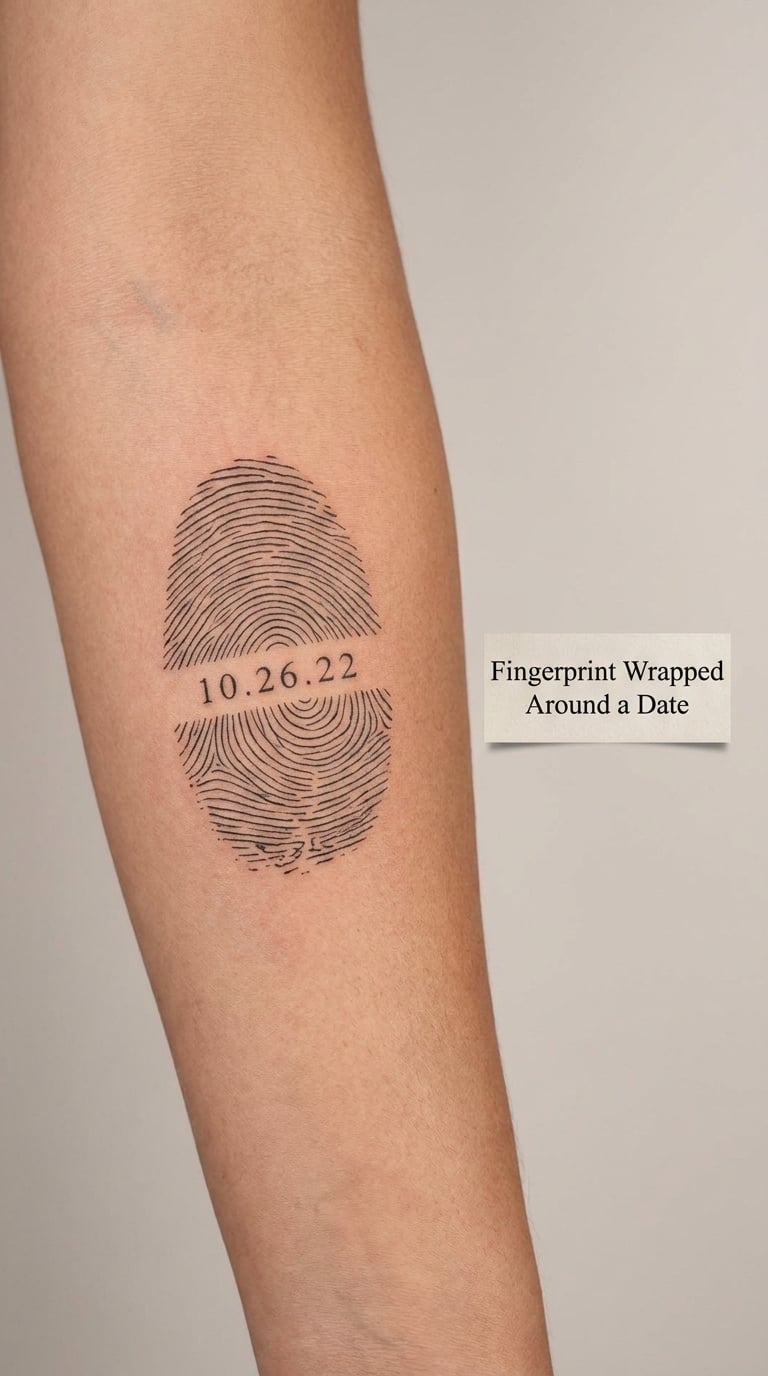
The print runs horizontally, then pauses for a date set in a plain sans-serif font, and the ridges resume after the numbers. The interruption is the whole effect: the line is holding the date rather than sitting beside it.
It suits a specific loss, since the date usually means a day rather than a birth year. Some people use two dates for a beginning and an end.
Placement: Forearm, side of the thigh, or across the ribs. Size: 4 inches wide (10 cm). Style: Fine line, sans-serif type. Pain: Medium, and rib placements run higher. Numerals need real height to stay legible, so the type should never be smaller than about a third of the print’s height.
Make it yours: Add one private word under the date, small enough to read only up close.
6. Heartbeat Line Ending in a Fingerprint
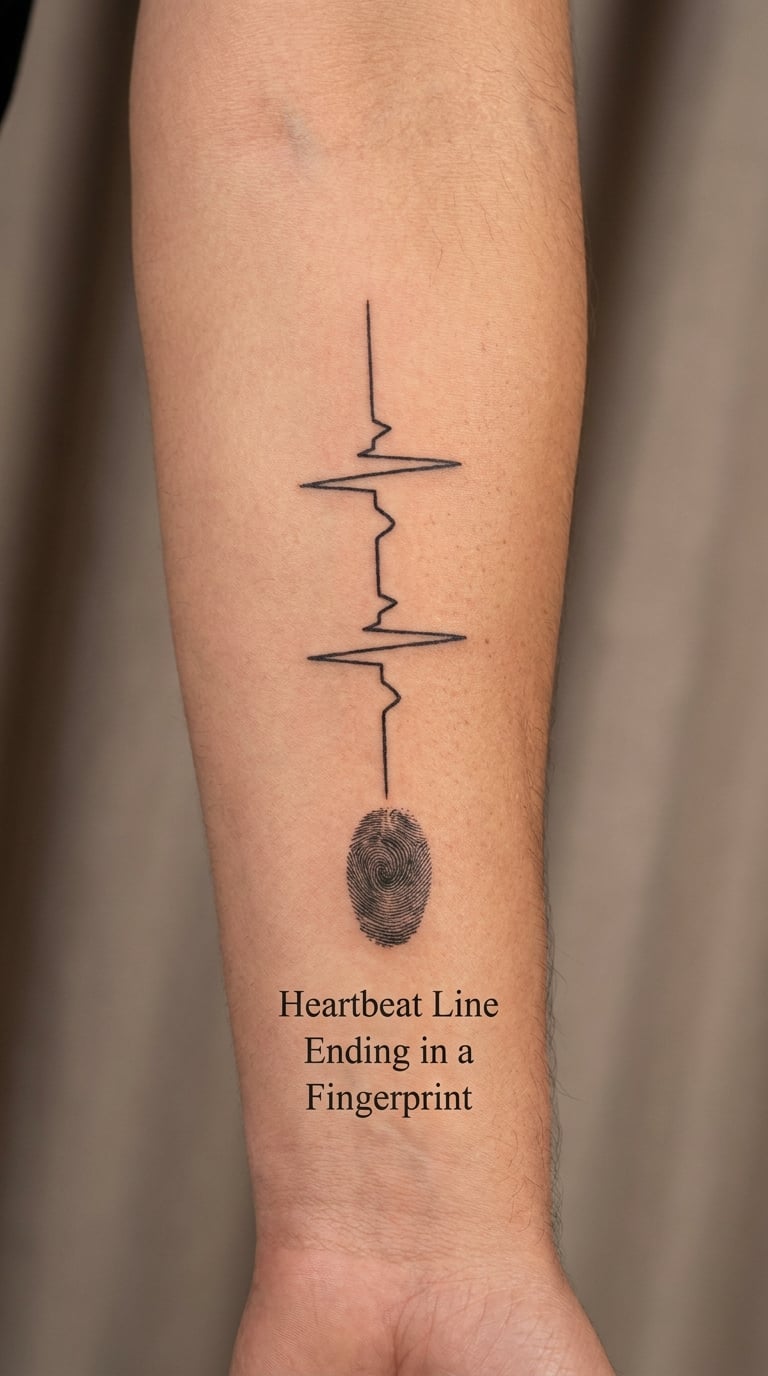
A single trace rises, falls and settles into the print at the end, so the print reads as the answer to the line. The line is thin and even-spaced; the print carries the detail.
It is one of the most searched memorial fingerprint designs, and it works well when the person is remembered through a final illness rather than a long life. The line stands in for the last stretch of time.
Placement: Inner arm, ribs, or the inside of a forearm alongside a wrist piece. Size: 4 to 5 inches long (10 to 12.5 cm). Style: Fine line. Pain: Medium. A very thin heartbeat line is the first thing to fade in this design, and on high-movement skin it can go patchy within a few years.
Make it yours: Use a real trace from a monitor print, or a single pulse of muted color at the print end.
7. Fingerprint Contouring a Mountain Range
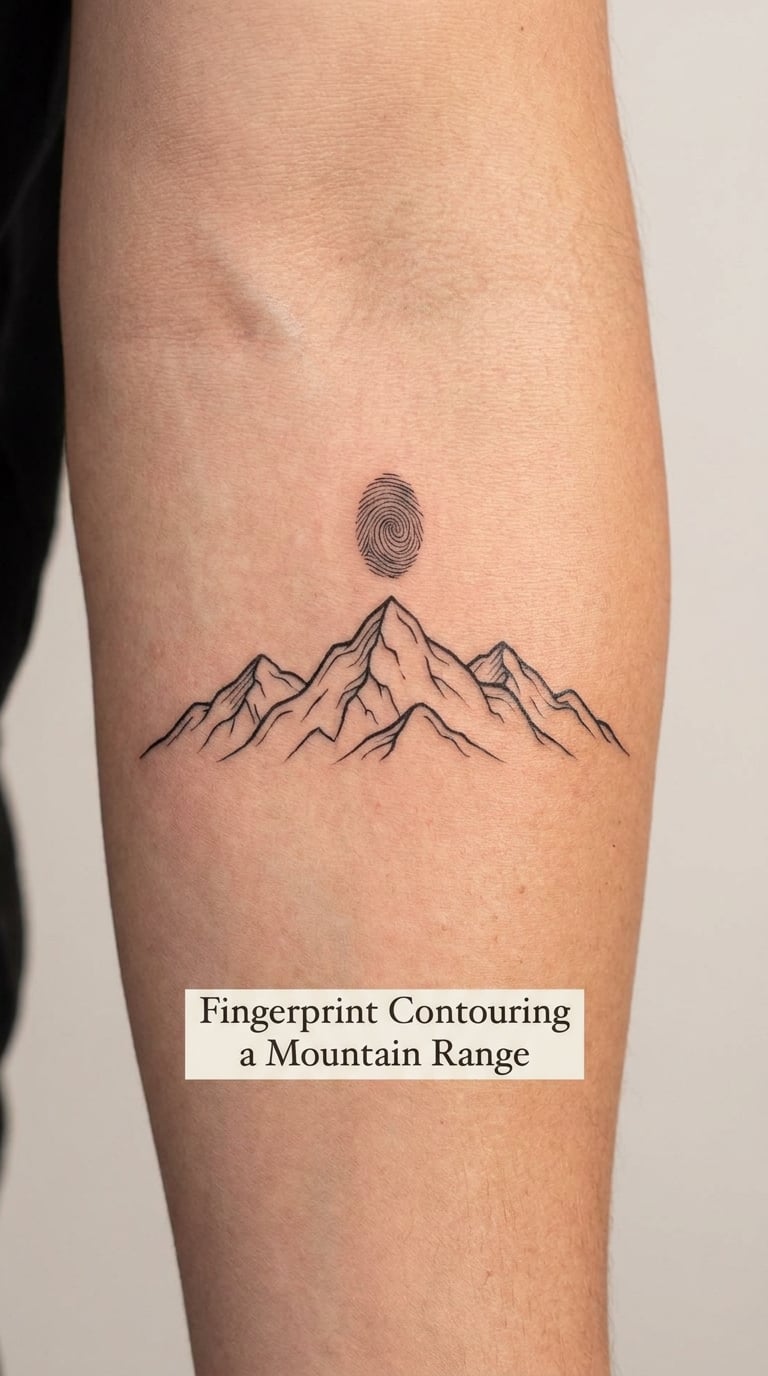
Fine-line peaks in one color, with the print sitting above the central summit or tucked just behind it. Linking the two only works when the place is genuinely tied to that person, so the print stays an annotation rather than a sticker.
Choose this when the place means something specific: a trip, a home, a view they talked about for years.
Placement: Outer forearm, upper arm, or as one element in a longer arm piece. Size: 5 inches wide (12.5 cm). Style: Fine line. Pain: Medium to high, since the total line load is high and outer arms bruise more visibly. The tiny print here needs the full piece to be at least 5 inches across or it will fill in.
Make it yours: Reproduce a favorite viewpoint instead of a generic range, and put the print at the peak they always pointed at.
8. Fingerprint Framed by Laurel Leaves
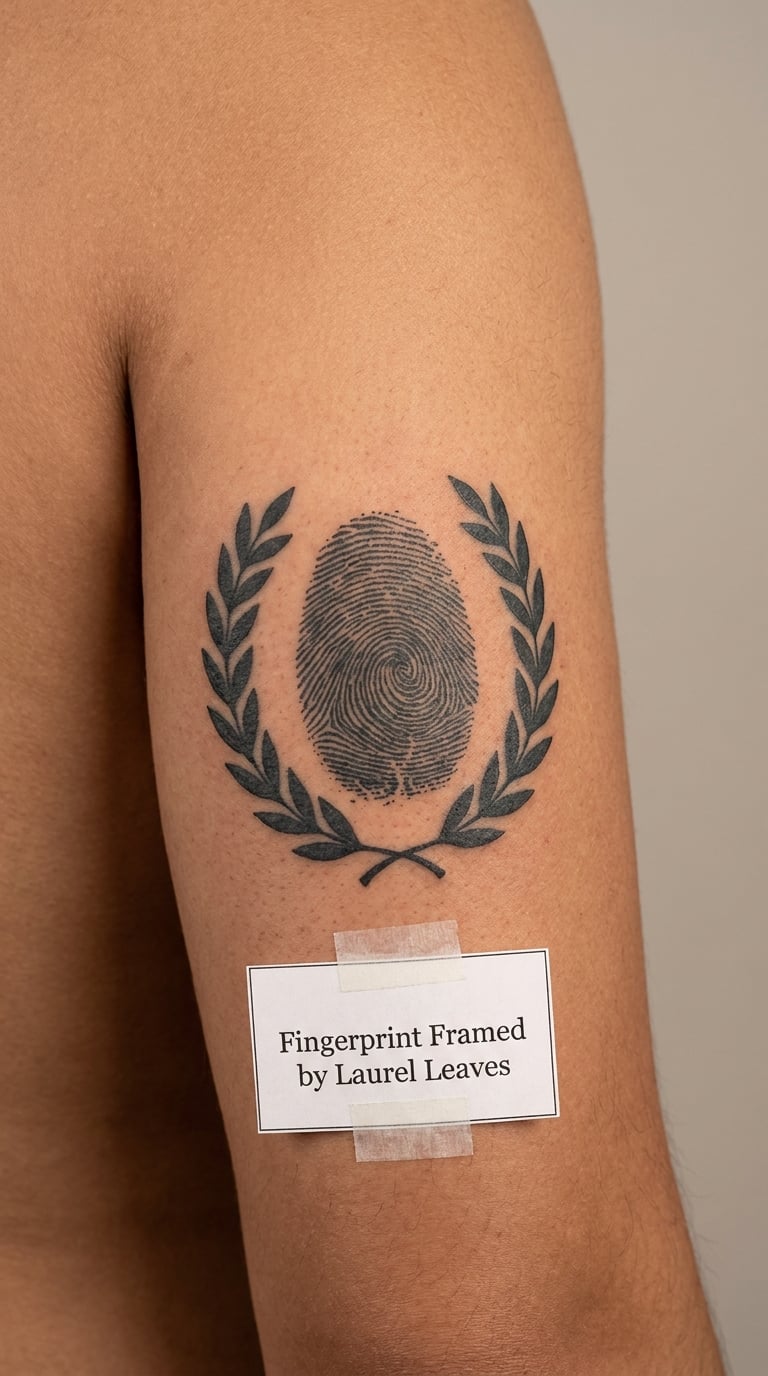
Two laurel branches curve up each side of the print, meeting near the base, done in a single ink so the whole thing reads as one piece. The organic curves balance the print’s mechanical precision.
Laurel is close to universal memorial vocabulary, which makes it a safe choice when you are not sure what else to add.
Placement: Upper arm, back of the shoulder, or outer thigh. Size: 4 inches tall (10 cm). Style: Black and gray. Pain: Medium. Leaves and ridges can merge where they meet, so a good artist leaves a clear gap at each crossing. On sun-exposed arms the leaf edges show wear before the print does.
Make it yours: Swap the laurel for a plant that was actually theirs, a rose stem, olive branch, or lavender.
9. Micro-Realism Fingerprint Portrait
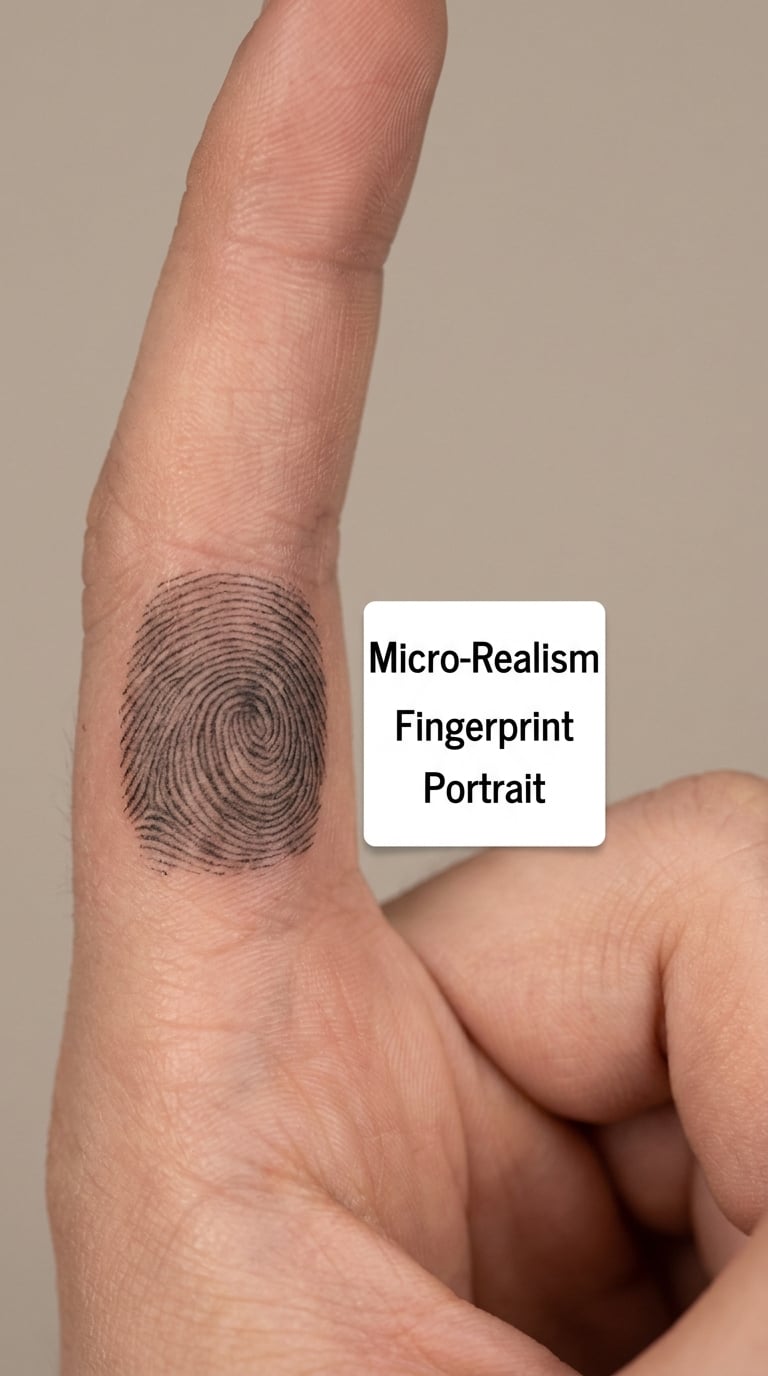
Rather than outlining the ridges, the artist shades them, giving the print a rounded, three-dimensional surface. It looks like a photograph of a fingertip sitting on your skin rather than a diagram of one.
This is the most demanding design on the list. It needs a genuinely high-resolution scan, and no artist can fake detail that the source file does not hold.
Placement: Side of the index finger, the fleshy pad below the thumb, or the side of the forearm. Size: 1.5 to 2 inches tall (4 to 5 cm). Style: Micro-realism. Pain: High, and fingers bleed more and swell visibly. This is the one placement most artists advise against for a sentimental piece, because hands and fingers wear fast and skin creases push the shading around.
Make it yours: Use a thumb rather than an index print, since thumbs have the widest, most forgiving ridge spacing.
10. Geometric Fingerprint Made from Straight Lines
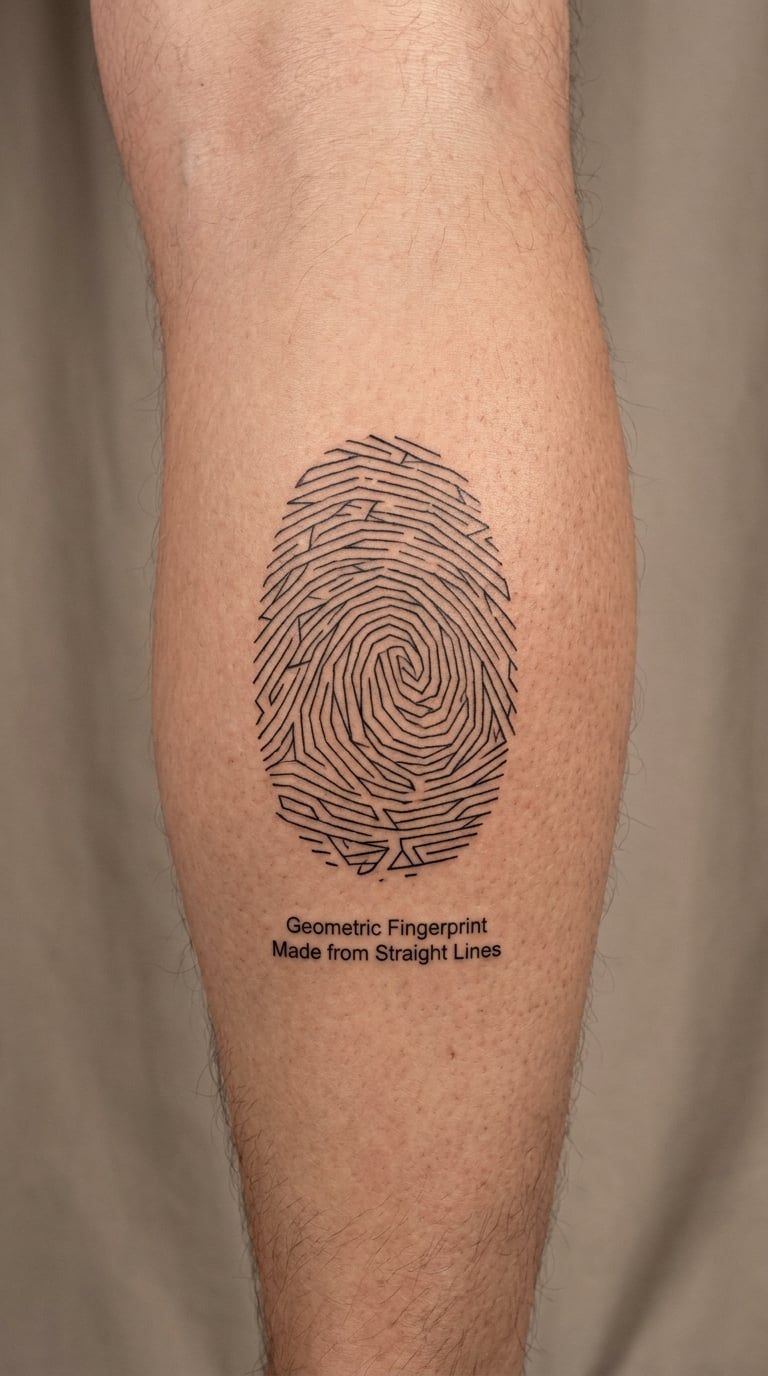
Selected ridge paths are straightened into measured angles, dots and repeated segments while the overall flow of the original print still guides the composition. It reads as contemporary graphic work rather than an illustration.
Good for someone who liked the person but not sentimental symbolism. The print is there, and you recognize it, but nothing else is stated.
Placement: Calf, forearm, or along the shin. Size: 3 inches tall (7.5 cm). Style: Geometric linework. Pain: Medium. Straight lines are more forgiving than ridges over time because they are thicker, and calves keep their shape well unless weight changes dramatically.
Make it yours: Use one ridge section rather than the whole print, and repeat it as a pattern up the calf.
11. Two Prints Forming a Heart
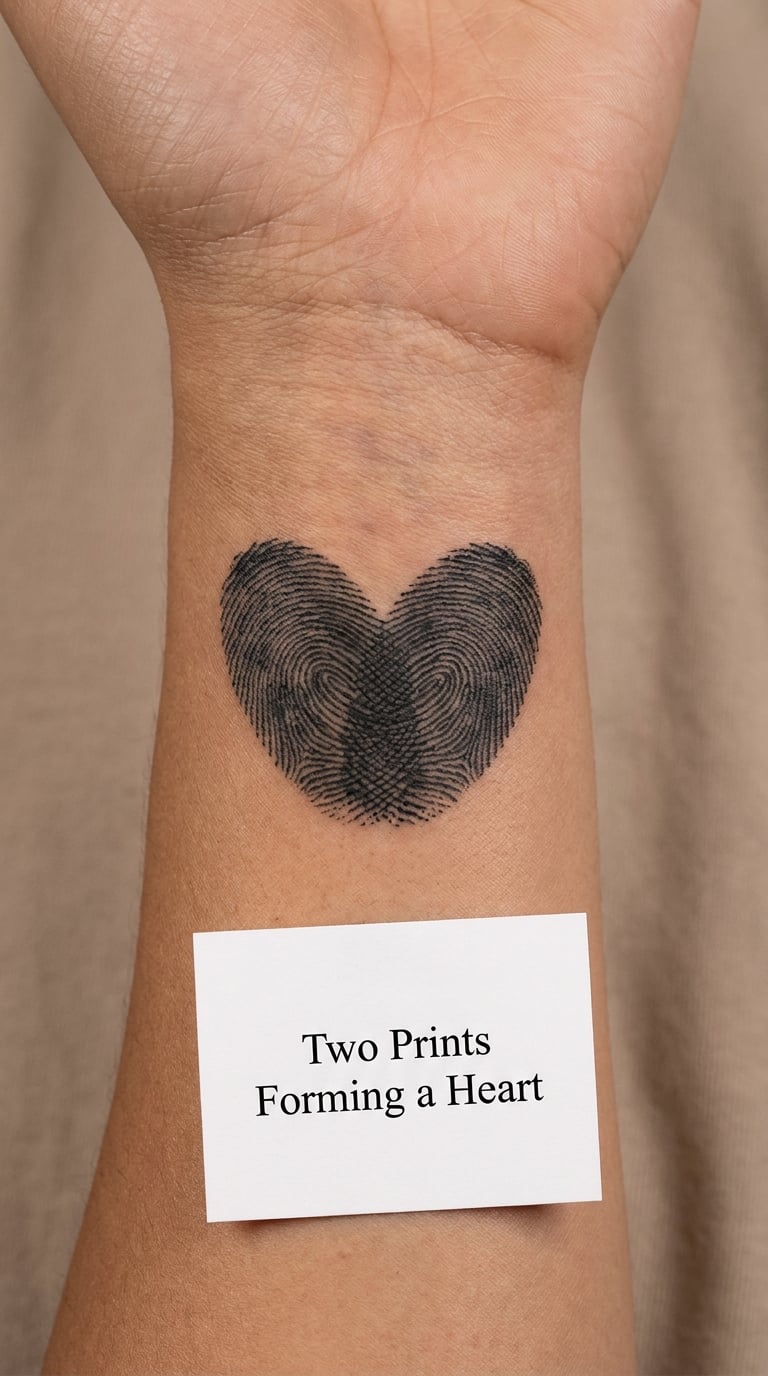
Two complete prints curve toward one another and stop just short of touching, so the negative space between them reads as a heart outline. Both prints stay real and complete, which a heart built out of invented lines could never manage.
It is the version of this design most couples and parent-and-child pairs pick.
Placement: Inner wrist, chest, or the upper inner arm. Size: 3 inches wide (7.5 cm). Style: Fine line. Pain: Medium, and sternum and chest placements sting more. A chest placement needs the two prints sized so the heart stays upright with the body, which is harder than it sounds.
Make it yours: Put the date beneath them in the same fine-line weight, or tint one print in a single muted color.
12. Fingerprint with Floral Memento
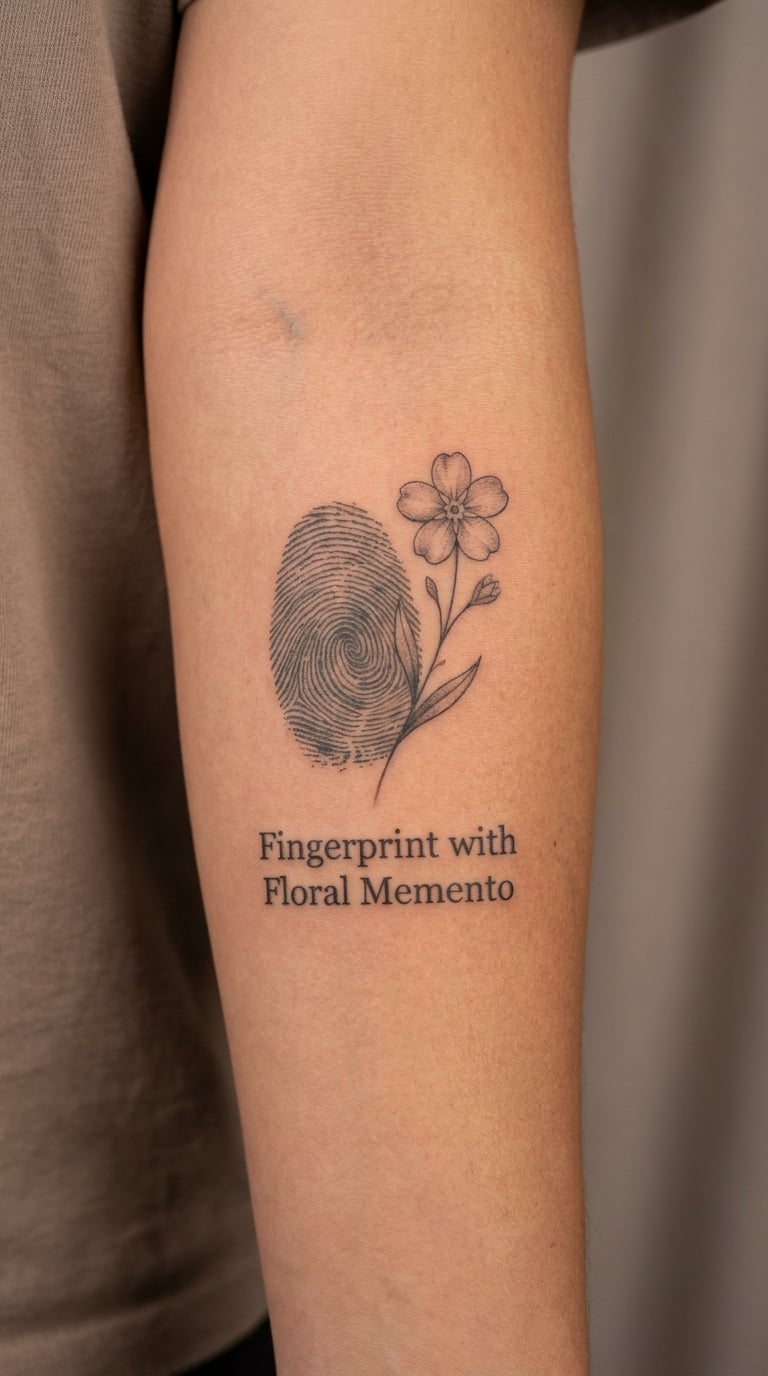
One bloom, not a bouquet. A single five-petal flower sitting beside the print keeps both elements readable, where a full arrangement would compete with the ridges and blur the piece into decoration.
Pick the flower for the person, not the symbolism. A specific variety they grew or were buried with says more than a generic rose.
Placement: Inner forearm, upper arm, or the back of the shoulder. Size: 4 inches tall (10 cm). Style: Color with a black print. Pain: Medium. Petals are thin, and sun exposure on the outer arm will fade color noticeably faster than the black print next to it.
Make it yours: Use the flower they grew, or the one from the funeral arrangement, drawn from a photograph you already have.
13. Fingerprint in a Star Map
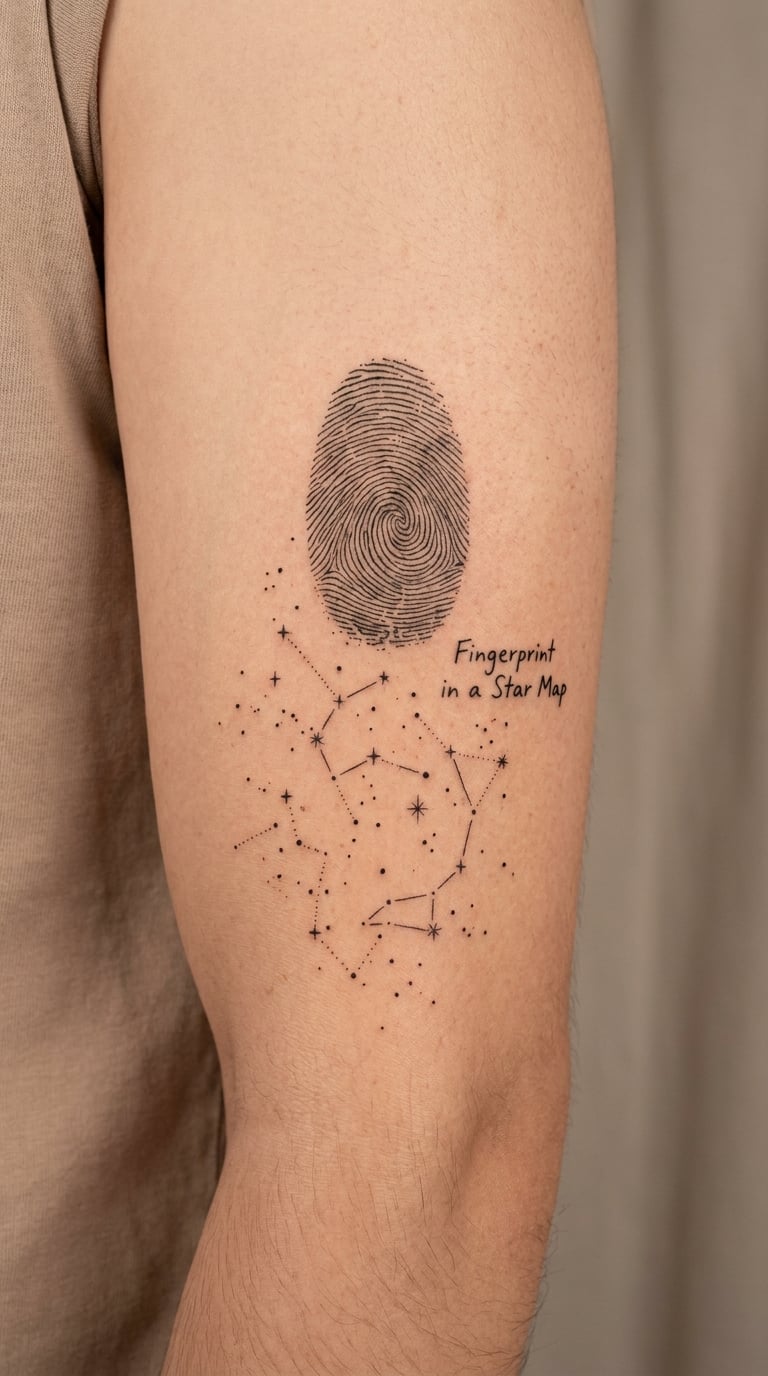
The print sits above a sparse field of dots and thin connecting lines mapping one specific night. The stars are chosen, not decorative, which is what keeps the piece from looking like a generic astronomy design.
It works well for a parent or a partner, especially when the sky over a place they loved was the last thing you saw together.
Placement: Upper arm, shoulder blade, or upper back. Size: 5 inches wide (12.5 cm). Style: Fine line with dotwork stars. Pain: Medium, and the shoulder blade is a bony spot that stays sensitive longer. Tiny stars fill in fast, so the map needs a wide area and sparse dot sizes rather than lots of small stars.
Make it yours: Map a constellation only the two of you recognized, even if it is not formally named.
14. Pet Paw Print Nested in a Fingerprint
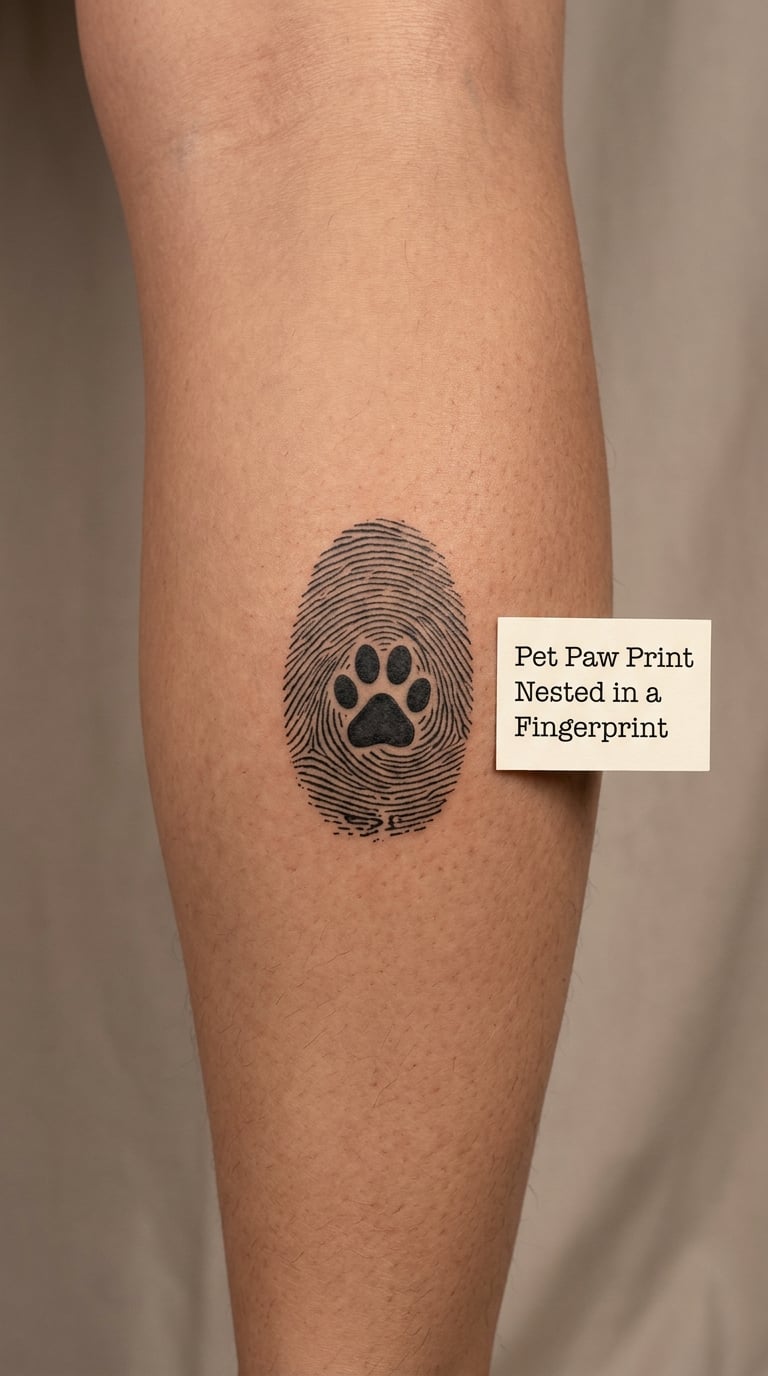
The pad and toe shapes of a paw sit in the open center of a larger human print, using the negative space rather than covering the ridges. Pet memorial designs are almost absent from editorial galleries, so this one tends to stand out.
People often pair the person’s own print with their dog’s, and some reverse the scale so the paw is the larger shape.
Placement: Calf, inner forearm, or the ankle. Size: 3 inches tall (7.5 cm). Style: Blackwork. Pain: Medium. A paw pad is a large solid shape, so it gives the composition a natural dark anchor and stops the print reading as faint.
Make it yours: Cut the pad shape to match their actual paw, or add a small collar-tag outline holding the pet’s name.
15. Fingerprint Beneath a Handwritten Name
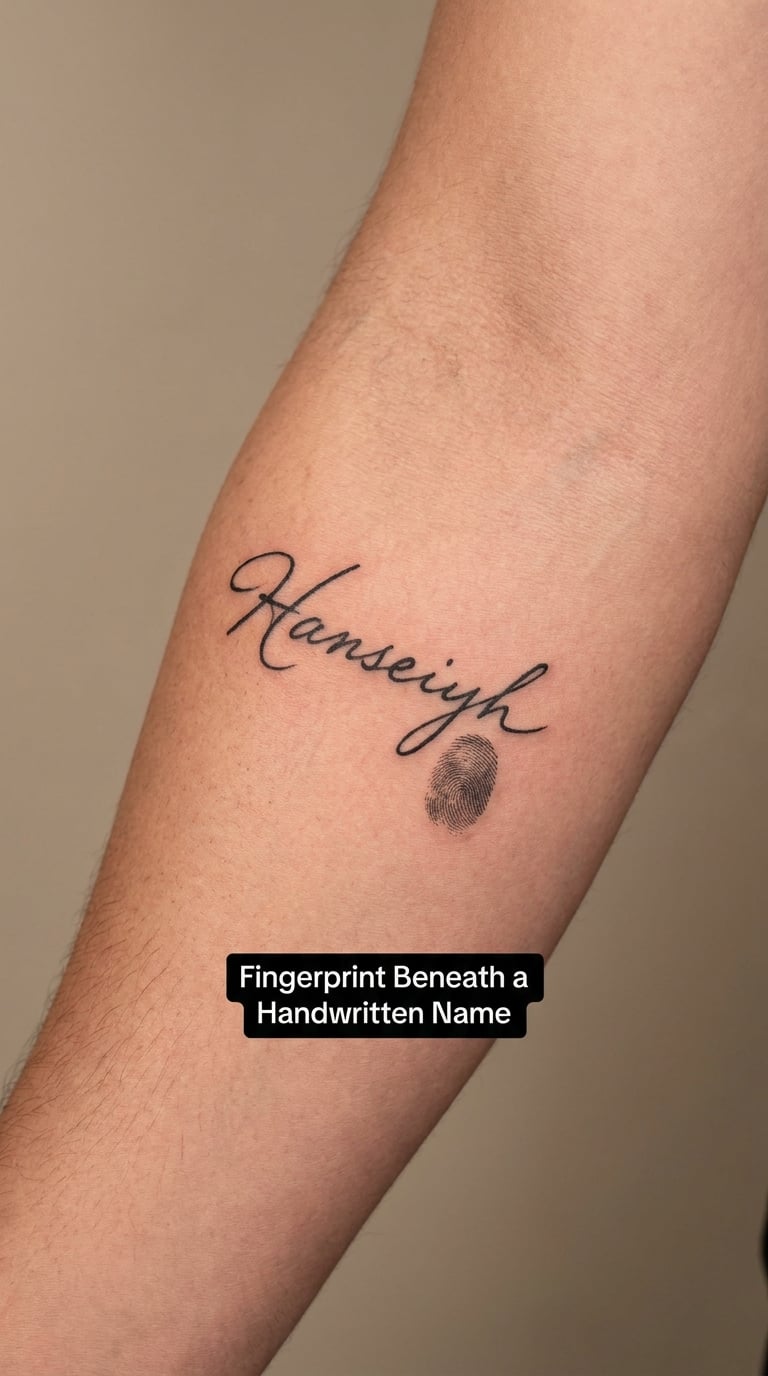
The name is traced from their actual handwriting, with a small print tucked under the last letter or worked into a longer loop of the script. The print anchors the composition instead of competing with it.
This is the strongest pairing on the list emotionally. It is also the one that most often needs a second reference, because a scan of a signature alone is rarely clean enough to trace.
Placement: Forearm, ribs, or the inner upper arm. Size: 4 inches wide (10 cm). Style: Fine line with script. Pain: Medium. Keep the piece away from the elbow and wrist crease, where stretching distorts script faster than it distorts ridges. The original writing should be preserved, not tidied up or redrawn.
Make it yours: Use one line from a letter or a card rather than a signature, so the handwriting stays at a size that reads clearly.
16. Fingerprint with Coordinates of a Meaningful Place
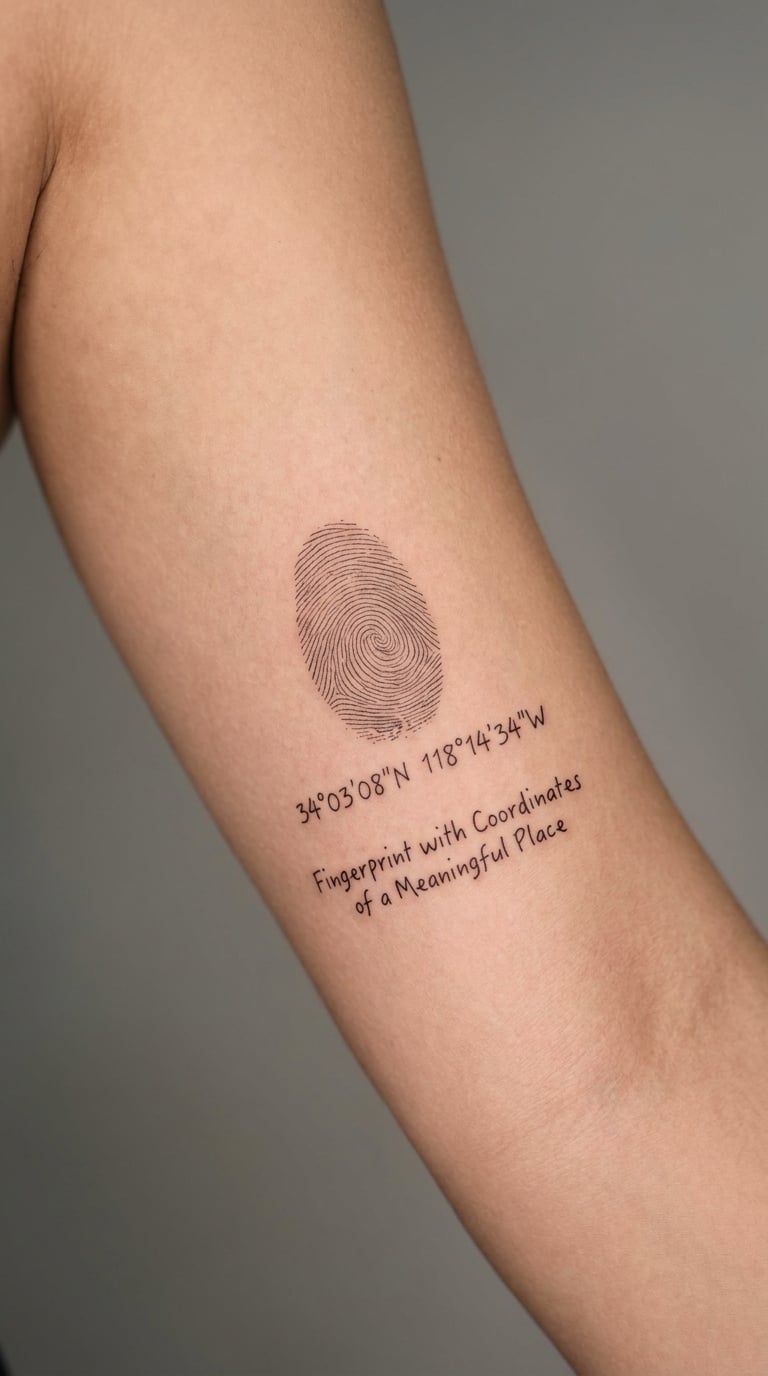
A cropped print sits above a compact set of degree, minute and second figures, set tightly enough to read as one line. Precision is the whole aesthetic here, so the numbers are drawn exactly, not approximated.
It suits a birthplace, a meeting point, or a house that no longer exists.
Placement: Inner upper arm, forearm, or the back of the calf. Size: 3.5 inches wide (9 cm). Style: Fine line. Pain: Medium. Latitude and longitude runs long, and digits under about a quarter inch start to close up after healing, so the numbers need real space or they become a row of black ticks.
Make it yours: Add a place name only if it still reads at the final size, and set it in the same weight as the coordinates.
17. Crescent Moon Made from Fingerprint Ridges
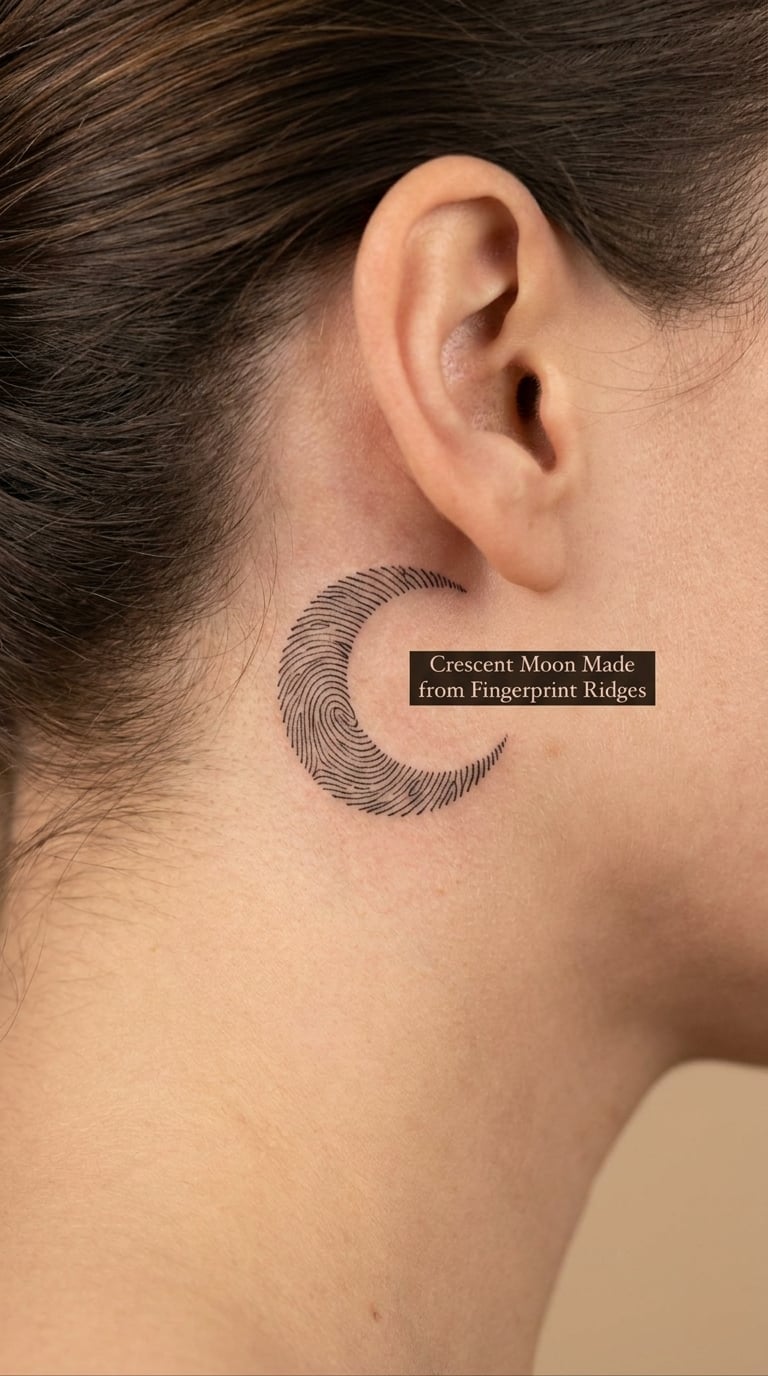
Selected lines from the print form the outer and inner edge of a crescent, with the remaining ridge pattern still faintly visible inside the shape. It is unusual without being loud, and it disappears neatly under hair.
Many people tie the moon to a date, a birth sign, or the hour somebody died, which is why this design is paired with one small personal detail rather than generic stars.
Placement: Behind the ear, along the hairline, or the inner arm. Size: 3 inches tall (7.5 cm). Style: Fine line. Pain: Low to medium, and behind the ear is one of the easier spots to sit through. Thin-line work fades faster in this area because of hair regrowth and sun exposure, so expect the faint interior ridges to soften before the crescent edge does.
Make it yours: Shape the crescent from the date you are marking instead of adding separate symbols around it.
18. Split-Level Matching Memorial Prints
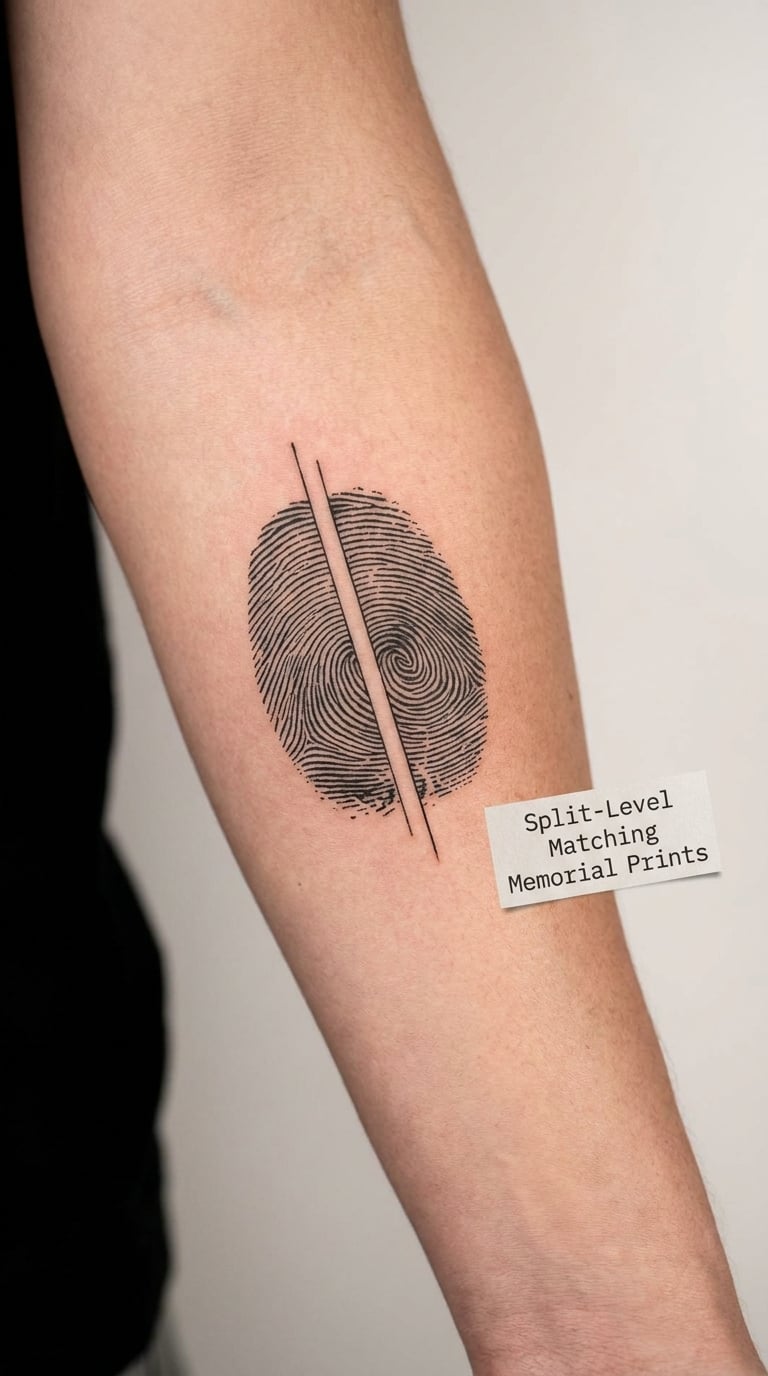
Two cropped prints of identical dimensions, one belonging to the person remembered and one to the wearer, separated by a single clean vertical line. The matching scale makes the comparison immediate.
Plenty of clients worry this is the only print they will ever have, because the match is what makes it a pair.
Placement: Inner forearm, wrist, or matching patches on two people. Size: 3.5 inches wide (9 cm). Style: Fine line. Pain: Medium. Both prints need to be prepared clearly before the session, and identical scaling matters here more than in any other design, so a live on-skin stencil check of the size is worth the extra five minutes.
Make it yours: Use one shared color on both halves, or keep the two prints in one color and the dividing line in a second.
19. Watercolor Fingerprint Wash
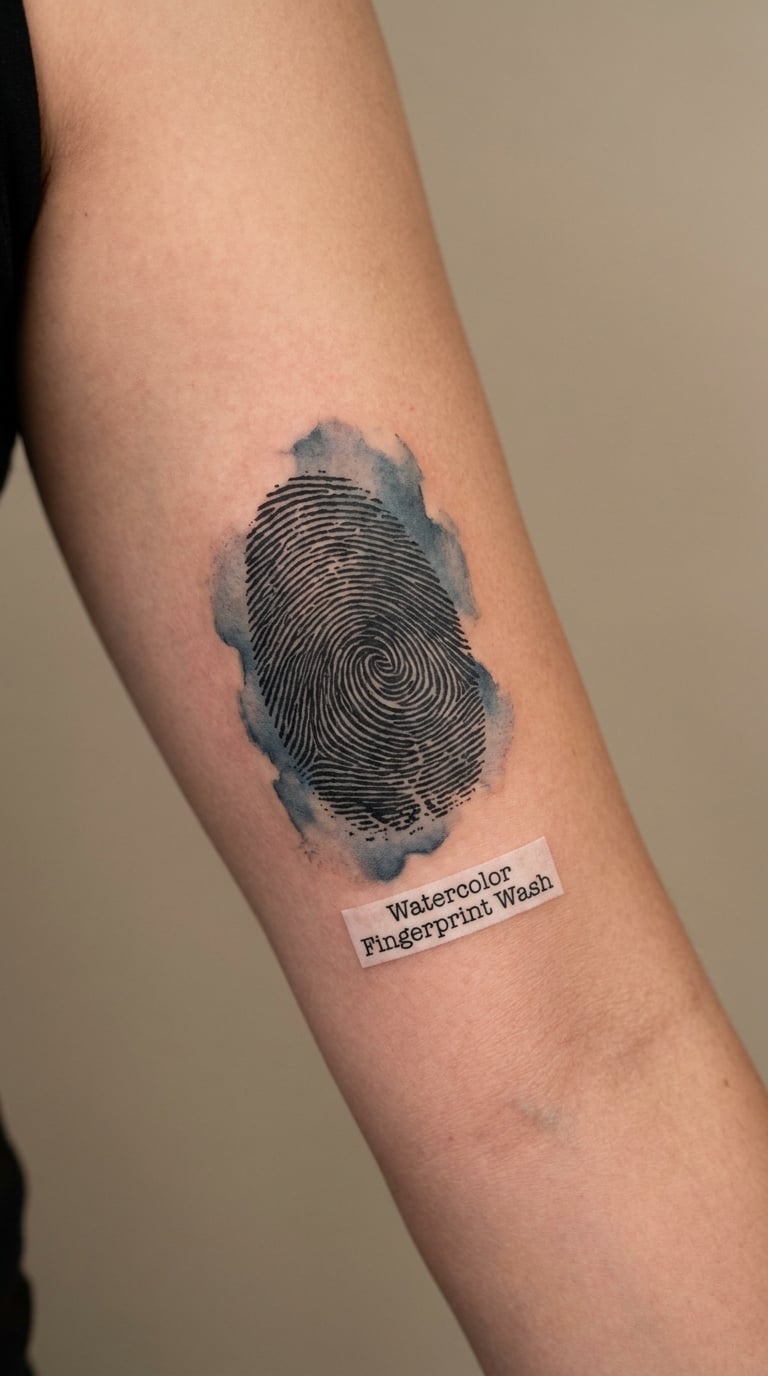
A realistic print core sitting inside controlled washes of black, gray or one muted color that bleed into the skin. The print stays crisp while everything around it softens, and the contrast is what stops it from looking like a blur.
This is the one to choose when you want a memorial piece that looks like a painting rather than a diagram, and the hardest to execute well.
Placement: Outer arm, thigh, or back of the calf, wherever there is room for the wash to breathe. Size: 5 inches tall (12.5 cm). Style: Watercolor. Pain: Medium, and sessions run longer because watercolor shades are laid in stages. Watercolor is the least predictable medium on skin, so the final look varies more between artists than the plain fine-line designs on this list.
Make it yours: Pick a color tied to them, a team, a garden, a season, and use a translucent wash so the print still reads as the subject.
20. Minimal Thumbprint Beside a Small Initial
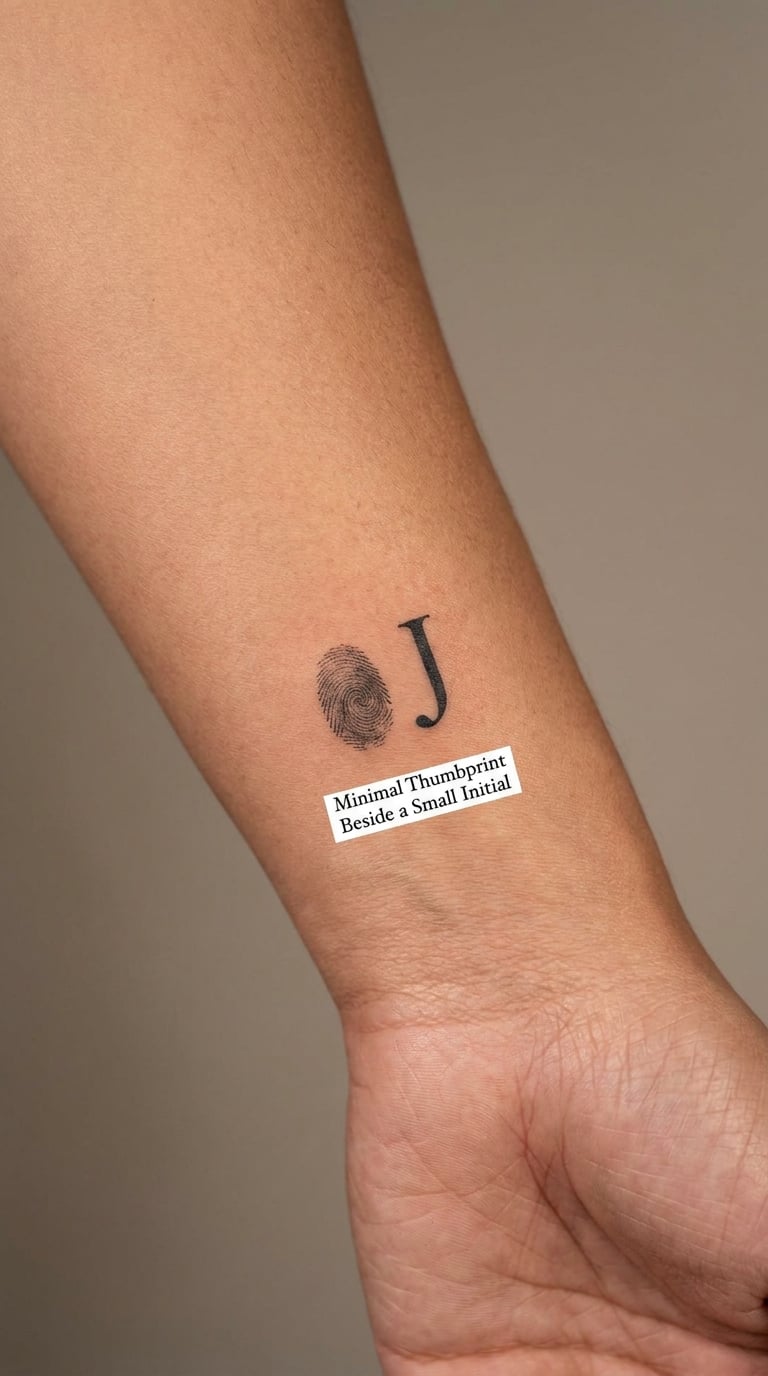
A cropped thumbprint and one letter, nothing else. It is the most discreet design here, and the right one if you want a memorial mark that other people will not recognize as a memorial tattoo at all.
Thumbprints also forgive small sizes better than index prints, because the ridge spacing is wider.
Placement: Outer wrist, inner ankle, or behind the arm. Size: 1.5 inches wide (4 cm). Style: Minimal fine line. Pain: Medium, and wrist and ankle placements age the fastest because both areas flex and stretch all day. At this size you need a high-resolution source, and a print taken from a smudged card will not survive the reduction.
Make it yours: Add one tiny dot, a two-digit year, or a second initial on the far side of the wrist.
How to Choose the Right Design
Five checks narrow the field faster than browsing another fifty gallery images. When you are cutting fingerprint tattoo ideas for memorial down to a final two, run them in this order.
- Begin with the clearest print. Open your source file at full size first. If the ridges are soft or faded there, no amount of design work will fix it on skin.
- Match line thickness to placement. Fine single-needle ridges need a flat, stable area. Curved and highly mobile spots need fewer lines and a slightly larger design.
- Choose simple or detailed work based on body area. Small ribs, ankles and the inside of a wrist reward simple compositions. A flat forearm or calf can carry density.
- Test visual balance rather than enlarging every detail. Artists usually simplify a print to fit a space, and a slightly reduced pattern reads far better than a complete one that has filled in.
- Send the artist a clean original or a high-resolution scan. A phone photo of a print on a card is usually the weakest possible source, and it is the most common reason a design has to be redrawn.
If your only print is smudged, ask the artist about digital restoration before giving up. Partial prints can often be rebuilt ridge by ridge, and a professional who works in fine line will tell you honestly when the source cannot support a design.
Cost and Session Time
Fingerprint memorial tattoos are priced by hourly rate and complexity, not by a fixed menu, so the same design can run very differently depending on who tattoos it. Here is how the tiers usually break down when you are weighing fingerprint tattoo ideas for memorial against a budget.
- Micro and simple designs, like ideas 20, 4 and 1, are the quickest to tattoo. Most fit a single short session once the stencil is placed, though the appointment itself runs longer than the line work because of setup and consultation.
- Detailed or shaded prints, like idea 9, are the slowest per inch. A micro-realism thumbprint at 2 inches can take as long as a much larger simple design.
- Custom compositions, ideas 7, 13, 15 and 16, add layout and lettering time before any tattooing starts. A piece with a star map or a traced handwritten name is usually quoted as a full design rather than a quick addition.
- Watercolor work, idea 19, is typically staged across more than one sitting, and some artists will not quote it without seeing the source file.
Artist hourly rates, city, shop minimums, deposit requirements, session length and touch-up policies all vary. Ask what the hourly rate is, what the minimum is, and whether a free touch-up within the first year is included before you commit. That last question gets forgotten easily, and it is the one that matters if a ridge blurs while the piece is still healing.
Aftercare Basics
- Follow your artist’s aftercare instructions first, since they match the technique and products used on your piece.
- Wash the area gently with clean water and a mild unscented cleanser, then pat dry with something that is not a towel.
- Protect fresh work from friction and direct sun. Loose clothing over the area is better than a tight sleeve for the first stretch of healing.
- Do not pick, scratch or flake the tattoo. Loose skin coming away on its own is normal; pulling it is how scarring starts.
- Keep lotions, sunscreens and scented products off the area while it heals, and book a professional touch-up if fine ridges blur after the initial healing settles.
Frequently Asked Questions
Can I use a photo of a fingerprint for a memorial tattoo?
A photograph works only if the ridges are still legible when enlarged. A phone photo of a print on paper often loses the fine detail a tattoo needs, and the design fills in as it heals. A flatbed scan at high resolution, or the original card or form, gives the artist far more to work with. Send the file before booking so the artist can judge it honestly.
Should I bring more than one fingerprint image?
Yes, and bring every candidate you have. Prints from different fingers have different ridge spacing, and one finger is often much clearer than another. A thumbprint usually reads best at small sizes. Bringing several also protects the design if the first choice turns out to be too faded to work from once the artist enlarges it.
Are memorial fingerprint tattoos painful to get?
Most people rate the inner forearm and upper arm as medium, similar to any fine-line tattoo of the same size. Wrists, ribs and fingers run higher, and finger placements swell visibly for a day or two. Pain also scales with the total line load, so a five-inch composition with lettering takes longer and hurts more in total than a small single print.
Will a fine-line fingerprint tattoo fade over time?
Some softening is normal, and the amount depends mostly on placement. A print on the inner forearm holds its ridges for many years, while one on a wrist, finger or shoulder near a hairline fades faster because of constant movement, sun and skin changes. Bigger designs fade more slowly than tiny ones, so scale is the single best defense against losing the pattern.
How can I personalize a memorial fingerprint design?
Add one element that only the two of you would recognize: a date, a place name, a flower they grew, a pet’s name, or a line from their handwriting. Keeping it to a single addition usually reads better than three. Personalize the print itself too, by choosing the finger that was clearest or most characteristic rather than defaulting to an index print.
Conclusion
Start by choosing the clearest fingerprint image you have, then decide whether you want a discreet minimal print or a larger paired composition. Book a consultation with an artist who has done fine-line fingerprint work before, and send your source file ahead so they can tell you honestly whether the print supports the design.
For a first memorial tattoo, idea 1, the fine-line loop print on the inner wrist, is the simplest to live with and the easiest to extend later. If you are already building a collection, idea 3, the overlapping prints inside a circle, gives you a shape you can repeat in matching pieces without looking like a duplicate. Whatever you choose, these fingerprint tattoo ideas for memorial all start the same way: with the clearest image you can get, and an artist who will tell you if it will not work.