
24 Best Squirrel Tattoo Ideas for Nature Lovers (September 2026)
Squirrel tattoo ideas run from a one-line outline that fits on a wrist to a full woodland scene across a calf. The animal reads instantly from three cues: the oversized bushy tail curving up behind the body, the compact crouched sitting pose, and the small clawed hands holding a nut. Get those right and a small design still reads as a squirrel from across a room.
These 24 designs suit nature lovers, first-tattoo clients and anyone adding to a forest-animal sleeve. If you are planning ahead, most people book 30 to 45 days out, and autumn is when woodland palettes get requested most. If minimal shapes are more your speed, my cat silhouette tattoo ideas for minimalists use the same silhouette logic on a different animal.
Squirrel Tattoo Ideas: Quick Guide
Here is all 24 designs at a glance, in the order they appear below. Sizes are realistic finished dimensions, not drawing sizes.
| Idea | Style | Best placement | Size | Pain |
|---|---|---|---|---|
| Peeking over a branch | Fine line | Inner forearm | 2.5 in wide | Low to medium |
| Realistic grey portrait | Micro-realism | Outer upper arm | 3 in tall | Medium |
| Minimalist silhouette | Solid black | Outer wrist | 1.5 in tall | Low |
| Holding an acorn | Illustrative line | Forearm | 2 in wide | Low |
| Leaping in motion | Watercolour wash | Calf | 4 in long | Medium |
| Bold traditional | Black and grey traditional | Upper arm | 5 in tall | Medium to high |
| Curled around a leaf | Fine blackwork | Above the ankle | 2 in wide | Medium |
| Running side profile | Solid line | Outer thigh | 3 in long | Medium |
| Tucked behind the ear | Minimal black line | Behind the ear | 1 in long | Low |
| Circular moonlit frame | Black and grey | Shoulder | 3.5 in across | Medium |
| Dotwork with geometry | Dotwork | Forearm | 4 in tall | Medium |
| Cartoon with fluffy tail | Cartoon outline | Calf | 2.5 in tall | Low to medium |
| Matching acorn pair | Fine line | Both wrists | 2 in and 1 in | Low |
| Red squirrel | Naturalistic colour | Outer arm | 3 in long | Medium |
| Climbing a trunk | Blackwork | Outer forearm | 6 in tall | Medium |
| Nest with babies | Soft shaded realism | Upper thigh | 4.5 in wide | Medium |
| Floral with autumn leaves | Colour illustration | Shoulder blade | 3 in wide | Medium |
| Gothic with dark fur | Dark realism | Calf | 4 in tall | Medium |
| With a coffee cup | Clean linework | Inner forearm | 2.5 in tall | Low |
| Flying squirrel | Bold black line | Upper arm | 3.5 in wide | Medium |
| Wrapped around a letter | Fine line | Inner bicep | 2 in tall | Low to medium |
| Blackwork with pinecones | Blackwork | Upper back | 5 in wide | Medium to high |
| Standing upright | Playful line cartoon | Outer arm | 2 in tall | Low |
| Woodland scene with mushrooms | Black and grey scene | Calf | 6 in wide | Medium |
1. Fine-Line Squirrel Peeking Over a Branch
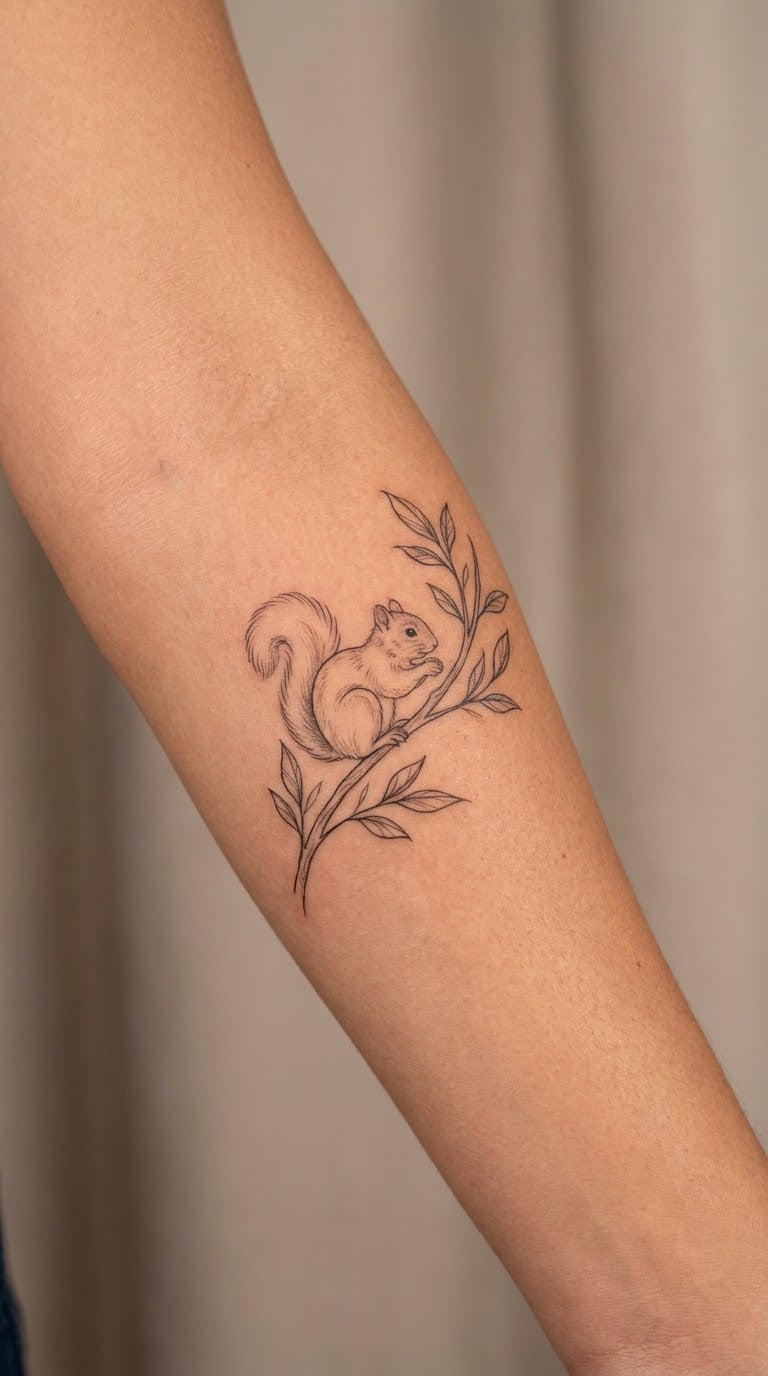
A single-needle line runs from the branch up over the squirrel’s head, with the eyes and one ear as the only interior detail. The tail is suggested with a long open curve rather than drawn fur by fur, which is what keeps the design clean at small scale.
People usually pick this one because the pose feels like a caught glimpse, something observed rather than posed. It suits a first tattoo well, since there is very little shading to disappoint you after healing.
Placement: inner forearm reads best, though the outer bicep works if you want it more visible in short sleeves.
Size: 2 to 2.5 inches wide (5 to 6 cm).
Style: fine line, single-needle.
Pain: low to medium. The forearm is bony and the wrist end of it stings a little more. One honest note: fine lines on the inner arm catch sun when your sleeve rides up, and they fade first there.
Make it yours: have the artist hide a small date in the negative space of the curve, or start the branch at a scar.
2. Realistic Grey Squirrel Portrait
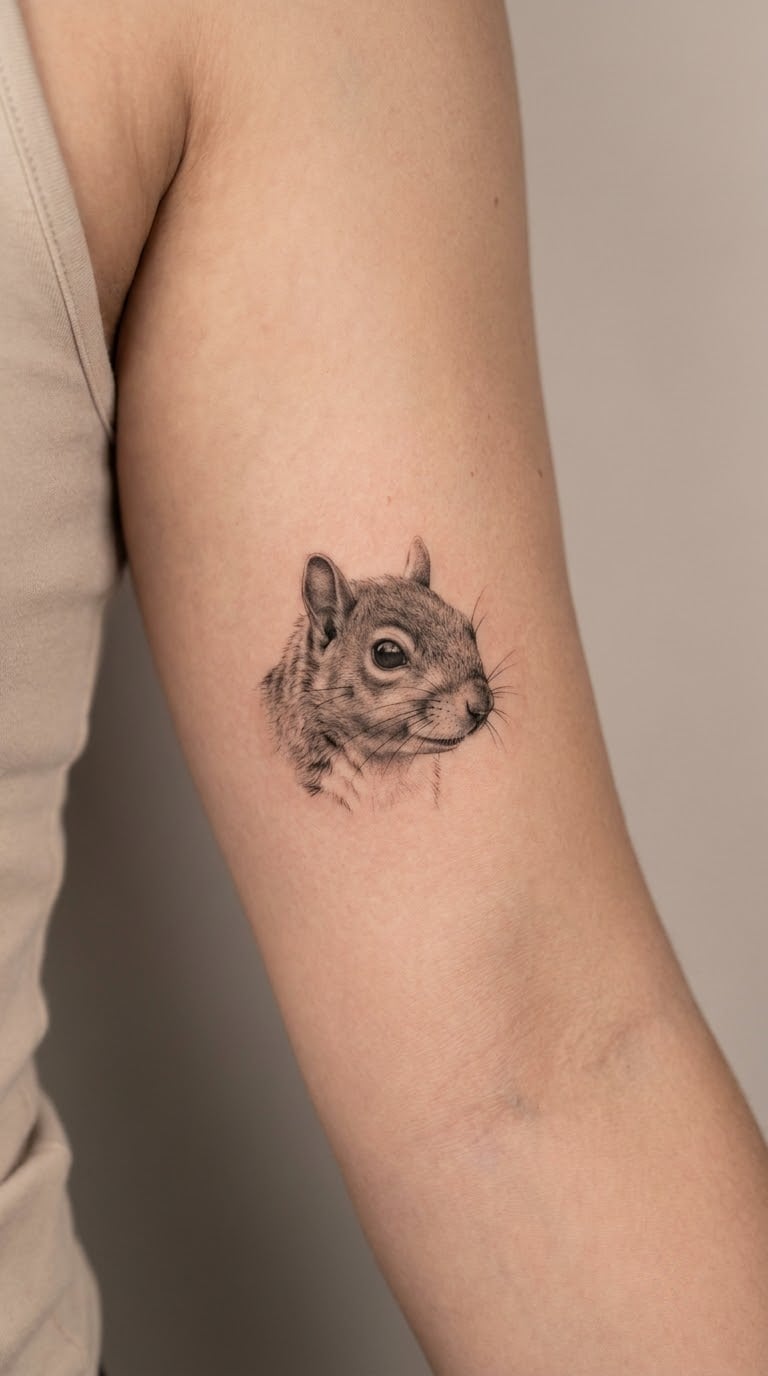
This is the version for people who want the animal to look like the grey squirrel sitting on their garden wall. The artist builds the coat with short directional strokes rather than solid shading, leaves the eye as a single dark point with a highlight, and keeps the background empty so the face carries the piece.
It is a common memorial and nickname design, often worn by people who grew up with them in the garden. Nothing about the symbolism is fixed, so let your own reason be the one that goes in the brief.
Placement: outer upper arm, upper thigh, or calf.
Size: 3 to 3.5 inches tall (7.5 to 9 cm).
Style: micro-realism, black and grey.
Pain: medium. Furry texture softens naturally as it heals, so expect a light touch-up a year later to sharpen the eye and whiskers.
Make it yours: name the specific squirrel it is for, and ask for a recognisable pose, like a cheek turned back over the shoulder.
3. Minimalist Squirrel Silhouette
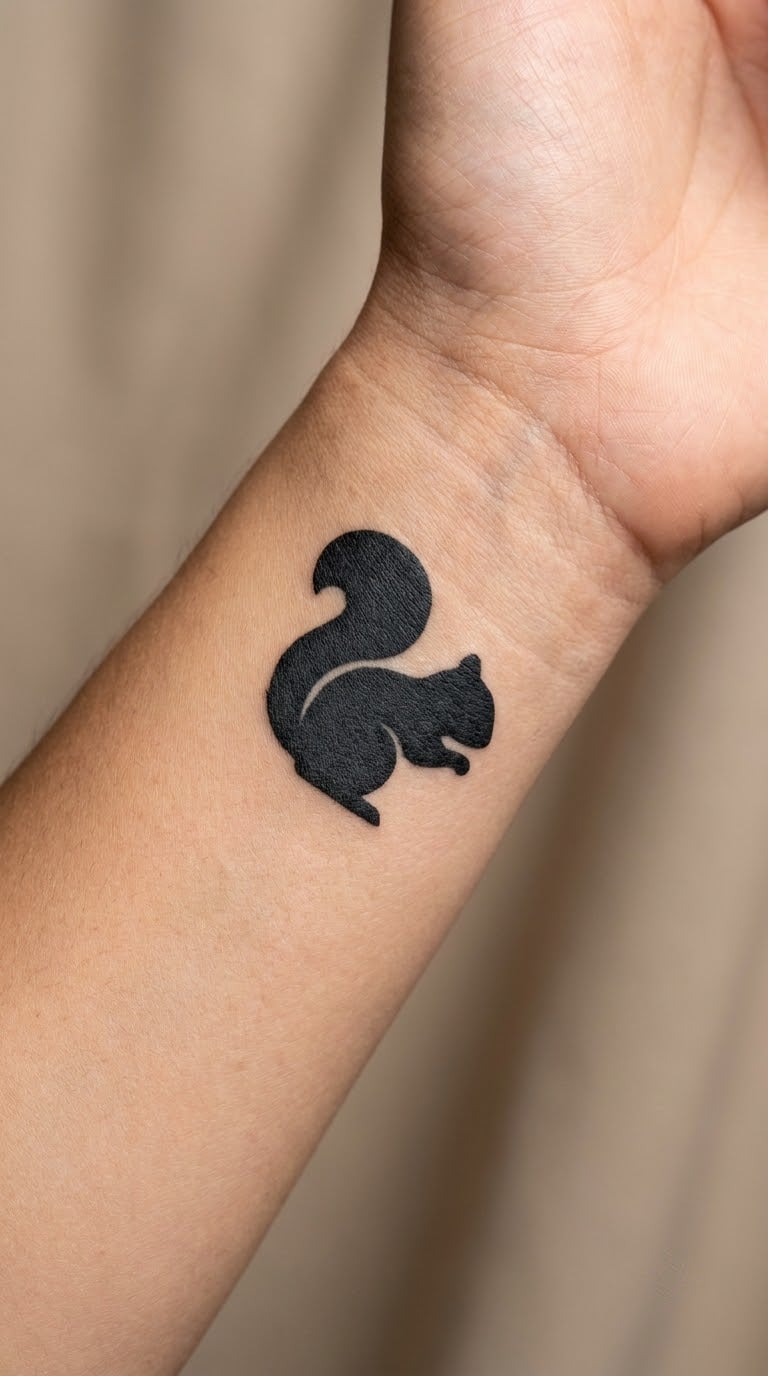
One solid black shape, tail up, nose forward, no interior lines at all. The gap between the tail and the back does all the work, so the artist has to get that curve right or the whole thing reads as a blob.
It is the safest squirrel tattoo for a first piece and the easiest to place almost anywhere. If you want a similar single-shape approach with a different animal, the cat silhouette tattoo ideas for minimalists break the same silhouette down further.
Placement: outer wrist, ankle, inner arm, or behind the ear.
Size: 1.5 to 2 inches tall (4 to 5 cm).
Style: solid black silhouette, minimalist.
Pain: low. Solids need fewer passes than shading, and a filled shape is the most forgiving thing there is as it ages.
Make it yours: run it in a solid black that matches an existing piece, or leave a small spot uninked inside the tail as a natural highlight.
4. Squirrel with an Acorn
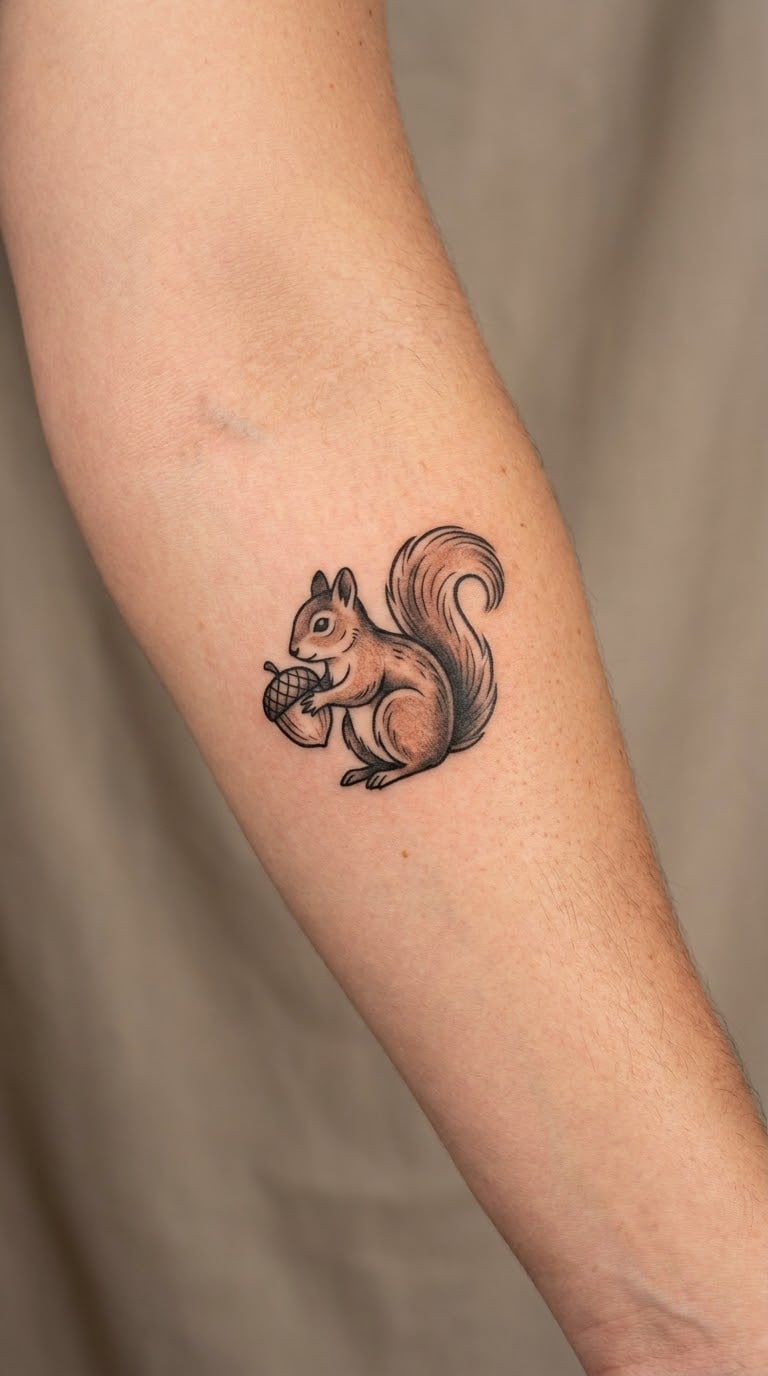
The squirrel sits upright in both front paws with an acorn the size of its head, cap hatched with short lines, body left mostly as clean outline. The nut is what gives the piece its meaning, since the acorn usually stands for the thing you are building toward.
It is one of the most requested squirrel tattoo ideas because it reads clearly without any background work.
Placement: forearm, inner bicep, or the inside of a upper arm.
Size: 2 to 2.5 inches wide (5 to 6 cm).
Style: illustrative linework with a touch of brown.
Pain: low. Expect the acorn cap hatching to soften first; ask the artist to keep the hatch lines wider than looks necessary on paper.
Make it yours: use the acorn cap of a tree from a place that matters, or add your surname’s first letter scratched into the shell.
5. Watercolour Squirrel in Motion
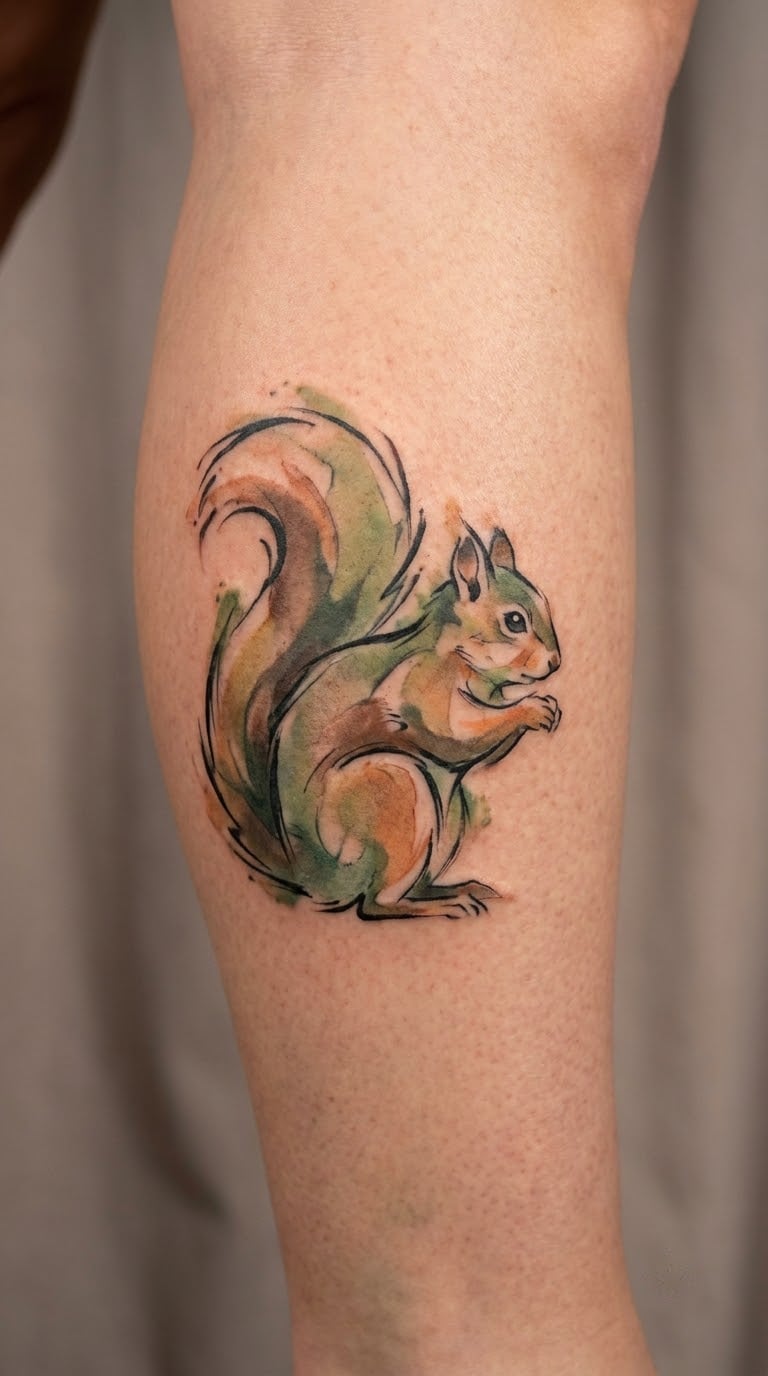
A loose wash of muted green, brown and orange sits behind a mid-leap squirrel, with the brush edges left soft and a few pigment bleeds deliberately unpainted. The tail carries the strongest colour while the body is only partly defined.
It suits people who want colour without the commitment of a fully painted piece. The style suits open skin like a calf or a flat forearm, where a wash has room to spread.
Placement: calf, outer thigh, or the back of the shoulder.
Size: 4 to 5 inches long (10 to 12.7 cm).
Style: watercolour wash with a line skeleton.
Pain: medium. Pale washes fade sooner than saturated colour, and this one is best treated as something that will soften over the years.
Make it yours: name three colours from a place, a season or a garden and let the artist mix them in the background instead of the animal.
6. Traditional Black-and-Grey Squirrel
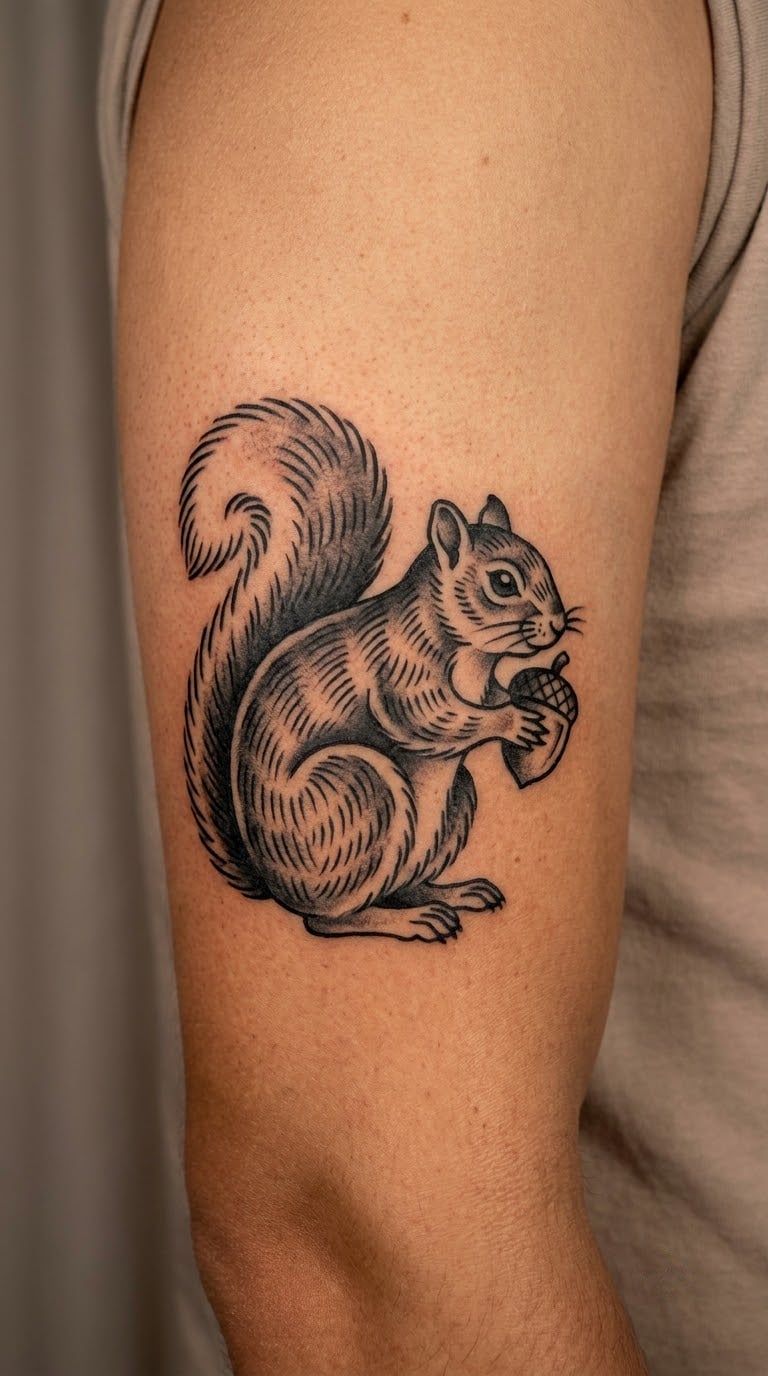
Heavy black outline, thick fur strokes, and grey wash filling the shadow side of the body and tail. This is old-school tattoo grammar, not photorealism, and the contrast is what makes it read from across a room.
People choose it when a squirrel should look bold rather than delicate, and it takes colour later if you ever want it changed.
Placement: upper arm, shoulder, or outer thigh.
Size: 5 to 6 inches tall (12.7 to 15 cm).
Style: traditional black and grey.
Pain: medium to high. Long sessions on the upper arm get uncomfortable, so ask the artist to plan a break partway through. Ageing is the best part here: bold outlines are the last thing to soften.
Make it yours: have the tail wrap a small anchor point on your body, or set it on a solid branch that continues into an existing sleeve.
7. Squirrel Curled Around a Leaf
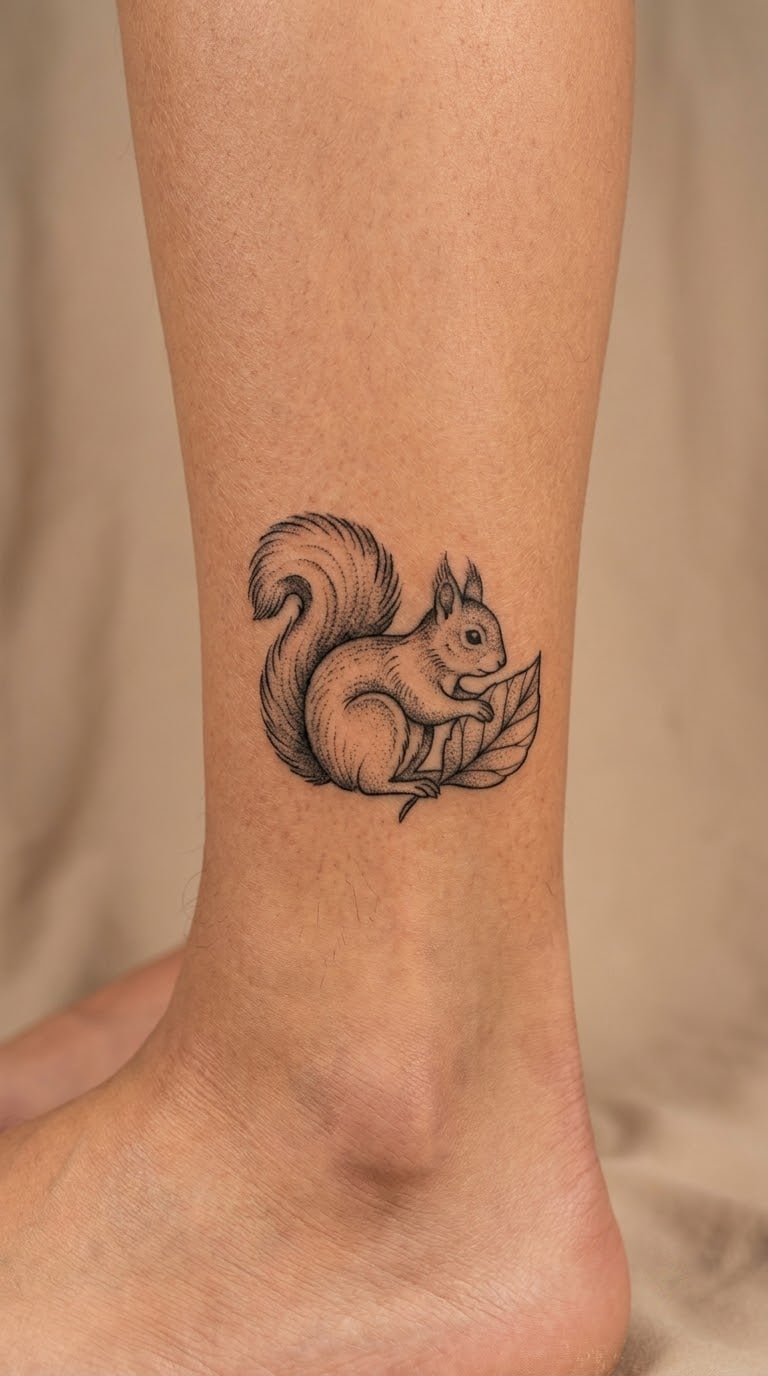
A compact squirrel sleeps curled around a single leaf, body as a tight crescent with a few interior fur lines, leaf edge cut with fine hatching. The whole thing is designed to be read as one round shape at arm’s length.
It suits people who want something soft-looking that still fits a small area. Resting poses also age better than active ones, because there is less fine detail to lose.
Placement: above the ankle, inner wrist, or the back of the hand.
Size: 2 to 2.5 inches wide (5 to 6 cm).
Style: fine blackwork with hatching.
Pain: medium. Ankle bones are prominent and the needle lands close to bone. Under 2 inches wide, the hatching and the fur lines start to blur, so push for the larger size or drop the hatching.
Make it yours: use a specific leaf, such as a maple or a paw, rather than a generic one.
8. Running Squirrel in a Side Profile
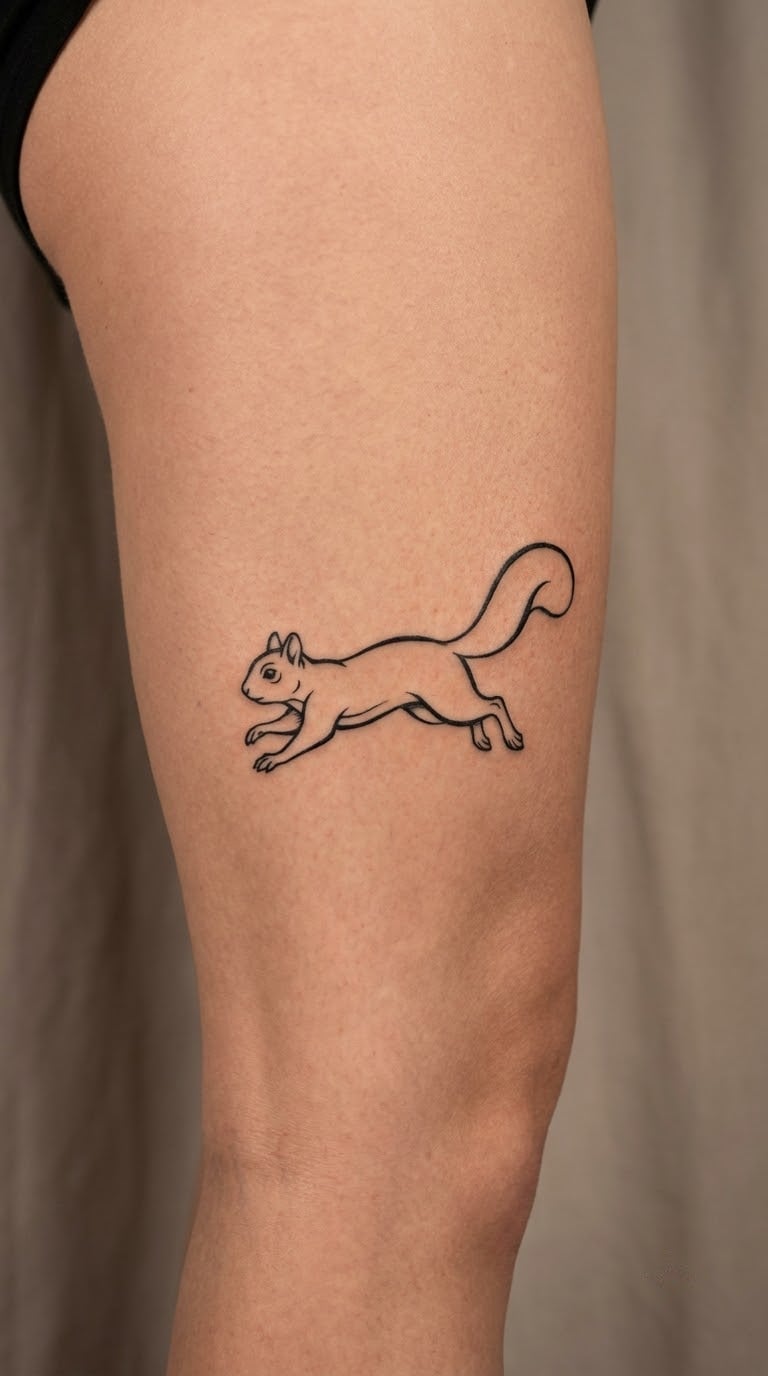
Full side profile mid-stride, front legs extended, back leg trailing, tail streaming behind, with two or three short motion lines behind the shoulder. The pose is the design, so the limbs have to be spaced enough to read as legs.
It is a common choice for someone who wants energy in the piece rather than calm, and it fills a gap in a forest-animal sleeve nicely.
Placement: outer thigh, calf, or lower back.
Size: 3 to 4 inches long (7.5 to 10 cm).
Style: solid line with light silhouette.
Pain: medium. Thigh skin is thick and forgiving, which suits the soft line style.
Make it yours: run it in the direction of a travel path or a route you keep coming back to. Motion lines blur early, so keep them to two at most and make them deep.
9. Tiny Squirrel Behind the Ear
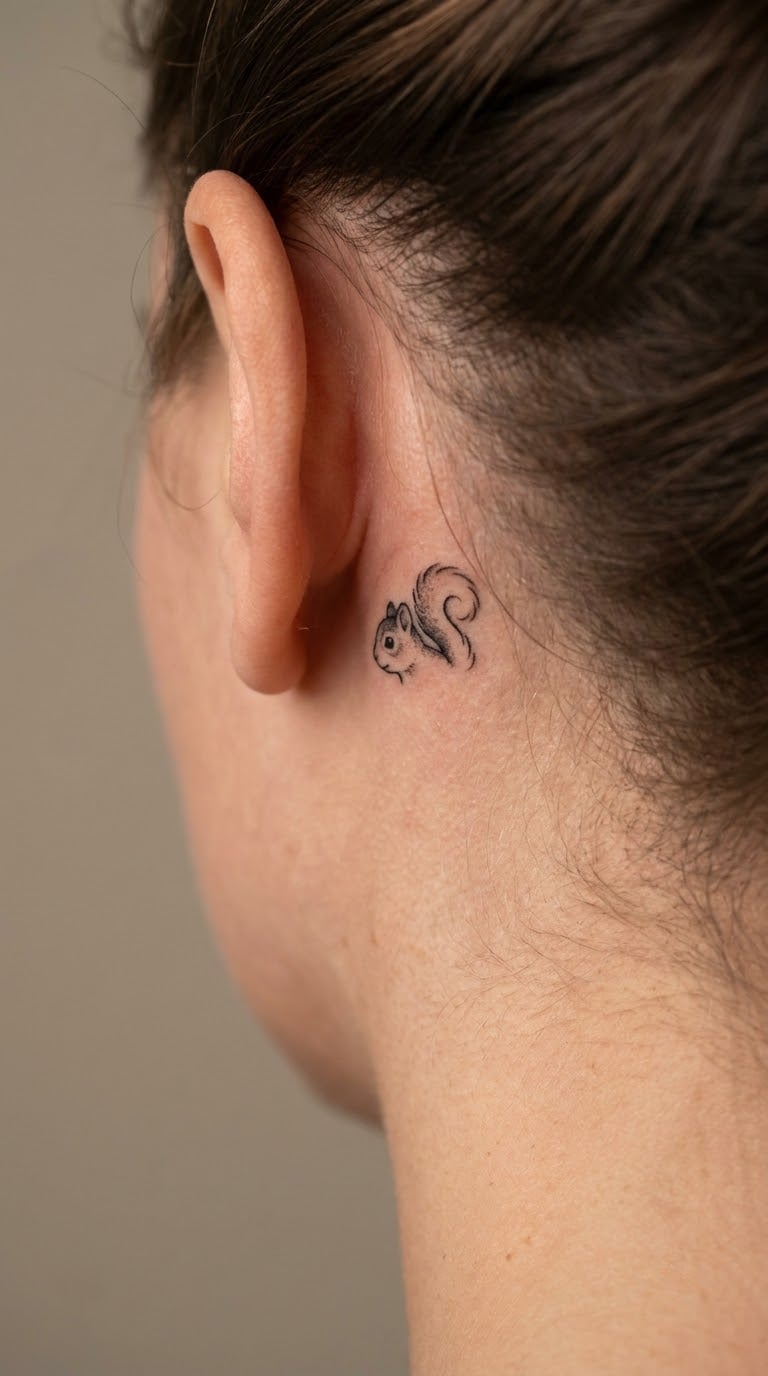
Only the head and the top of the tail show from behind the ear, in a light black line, roughly an inch long. It is an intimate design meant to be found rather than announced.
You tend to see this chosen for a nickname, a low-key personal mark, or as a first tattoo placed somewhere painful-looking but actually quite easy.
Placement: behind the ear, and the small spot at the base of the skull.
Size: 1 to 1.5 inches long (2.5 to 4 cm).
Style: minimal black line.
Pain: low, though the skin there is thin and the area near the neck feels more than the number suggests. Honest note: sun exposure and the soft skin behind the ear both work against fine detail, so expect to want a touch-up.
Make it yours: cut the design so a specific feature just appears above your jawline when you turn your head.
10. Squirrel in a Circular Moonlit Frame
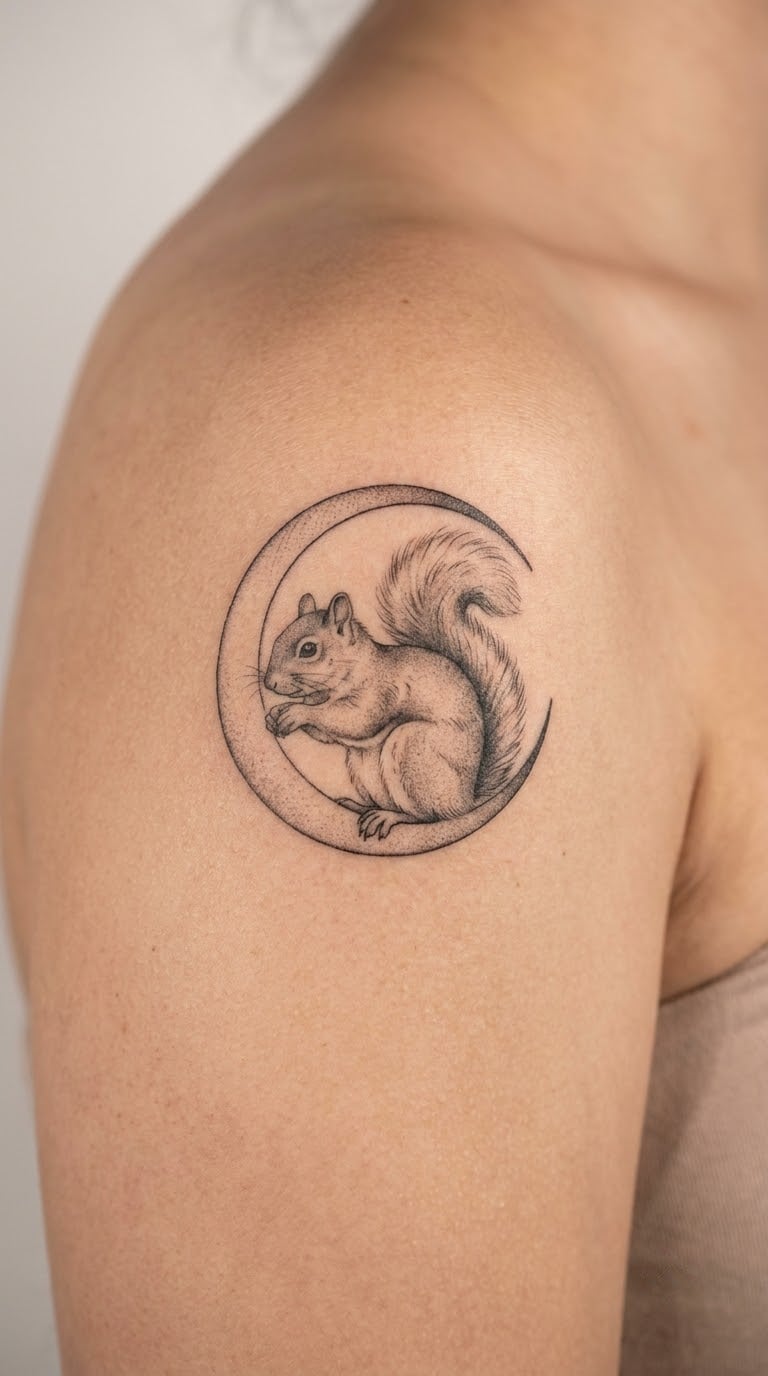
A squirrel in silhouette sits inside a slim circle, with a pale moon shape behind the upper half and a scatter of grey dots as sky. The circular border gives the whole thing an instant frame and makes any size look intentional.
It works well for people who want a detailed subject but a clear outer shape, and the circle hides uneven skin contours better than an open design.
Placement: shoulder, upper arm, or the flat of the upper back.
Size: 3.5 to 4.5 inches across (9 to 11.5 cm).
Style: black and grey with a silhouette subject.
Pain: medium. The shoulder is a rounded surface, so the artist will stretch the skin around the curve.
Make it yours: set the moon phase to the date you chose the design, or place a few real stars from your sky inside the circle.
11. Dotwork Squirrel with Geometric Background
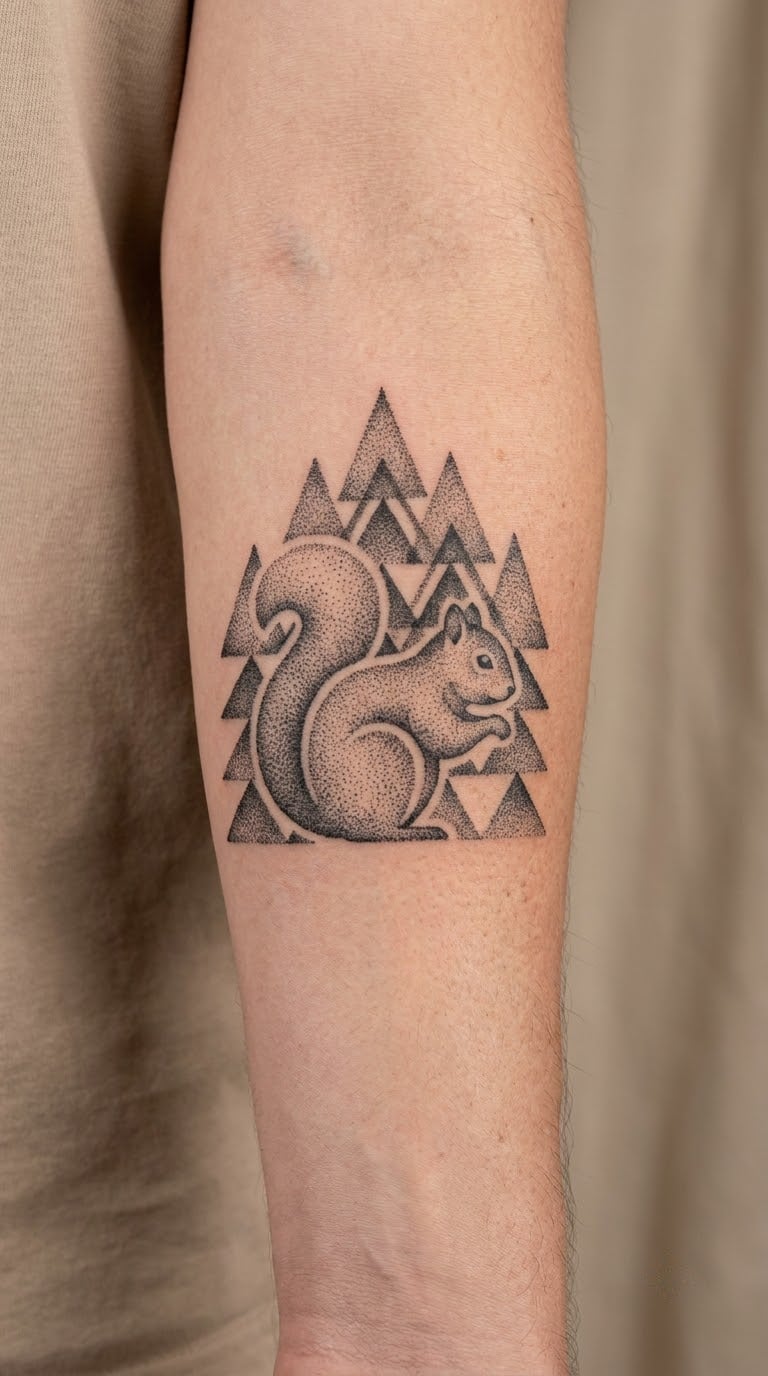
The squirrel is built entirely from stippled dots, denser along the back and tail, with a restrained background of straight-sided evergreen triangles. The contrast between soft dot shading and hard geometry is what keeps it contemporary rather than old-fashioned.
It suits people who want a woodland subject in a style that feels designed rather than sketched, and it fills a large flat area without needing a sleeve.
Placement: forearm, calf, or the back of the upper arm.
Size: 4 to 5 inches tall (10 to 12.7 cm).
Style: dotwork with geometric linework.
Pain: medium and long. Stippling takes a lot of passes, and this is usually a two-session piece. Ageing note: individual dots soften into a grey haze after several years, so the design should still read even if the texture goes.
Make it yours: use the tree line from a real forest you have walked, reduced to simple triangles.
12. Cute Cartoon Squirrel with a Fluffy Tail
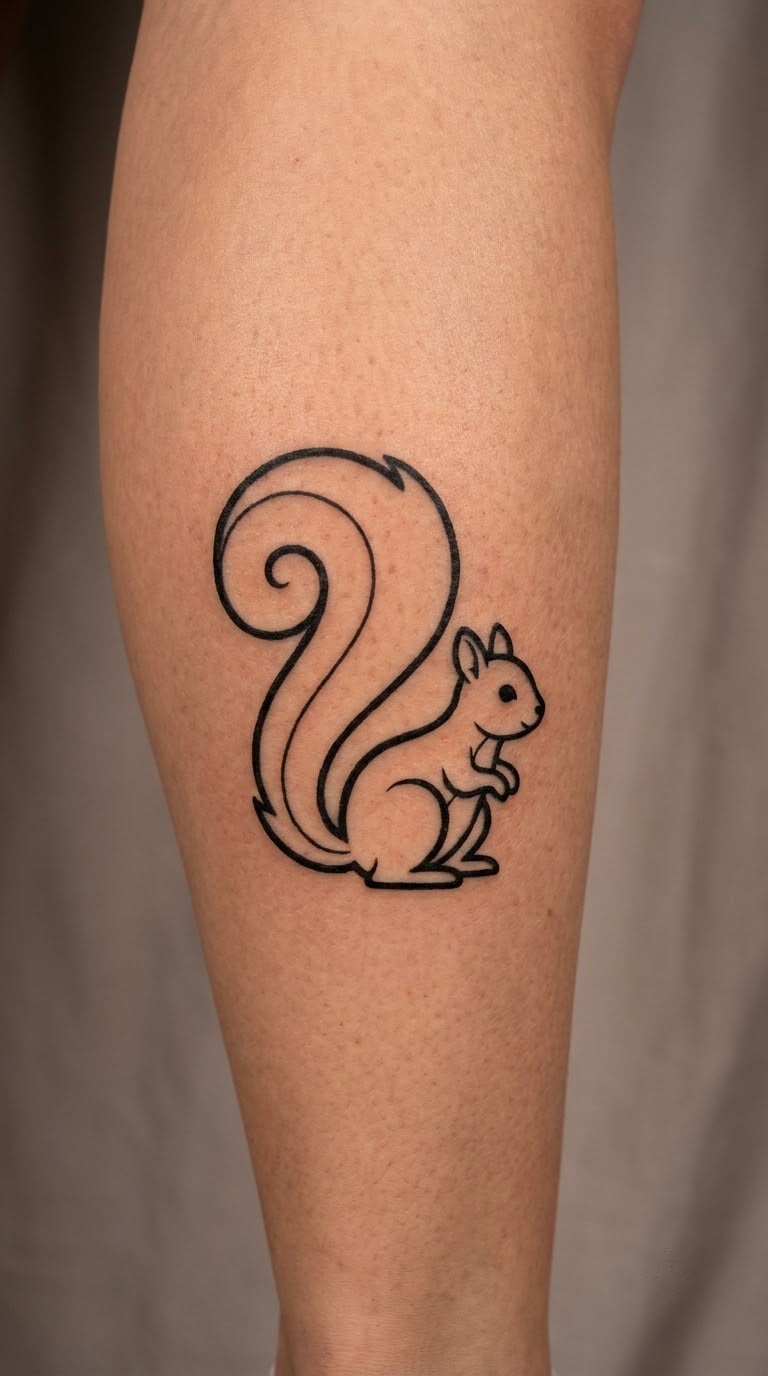
Rounded body, oversized head, and a tail about twice the length of the squirrel drawn in thick even outlines, with two solid black eyes and nothing else inside the face. The exaggeration is the design, so restraint elsewhere is what keeps it from going muddy.
It is the version most people picture when they say cute squirrel tattoo, and it takes well on a first tattoo because the shapes are simple.
Placement: calf, inner arm, or lower back.
Size: 2.5 to 3 inches tall (6.5 to 7.5 cm).
Style: cartoon with bold outline.
Pain: low to medium. Thick outlines need fewer passes and the calf is a comfortable spot to sit through.
Make it yours: add one small flat colour, such as a red scarf or a green leaf, and keep the rest black so it still works in a monochrome sleeve.
13. Squirrel and Acorn Matching Pair
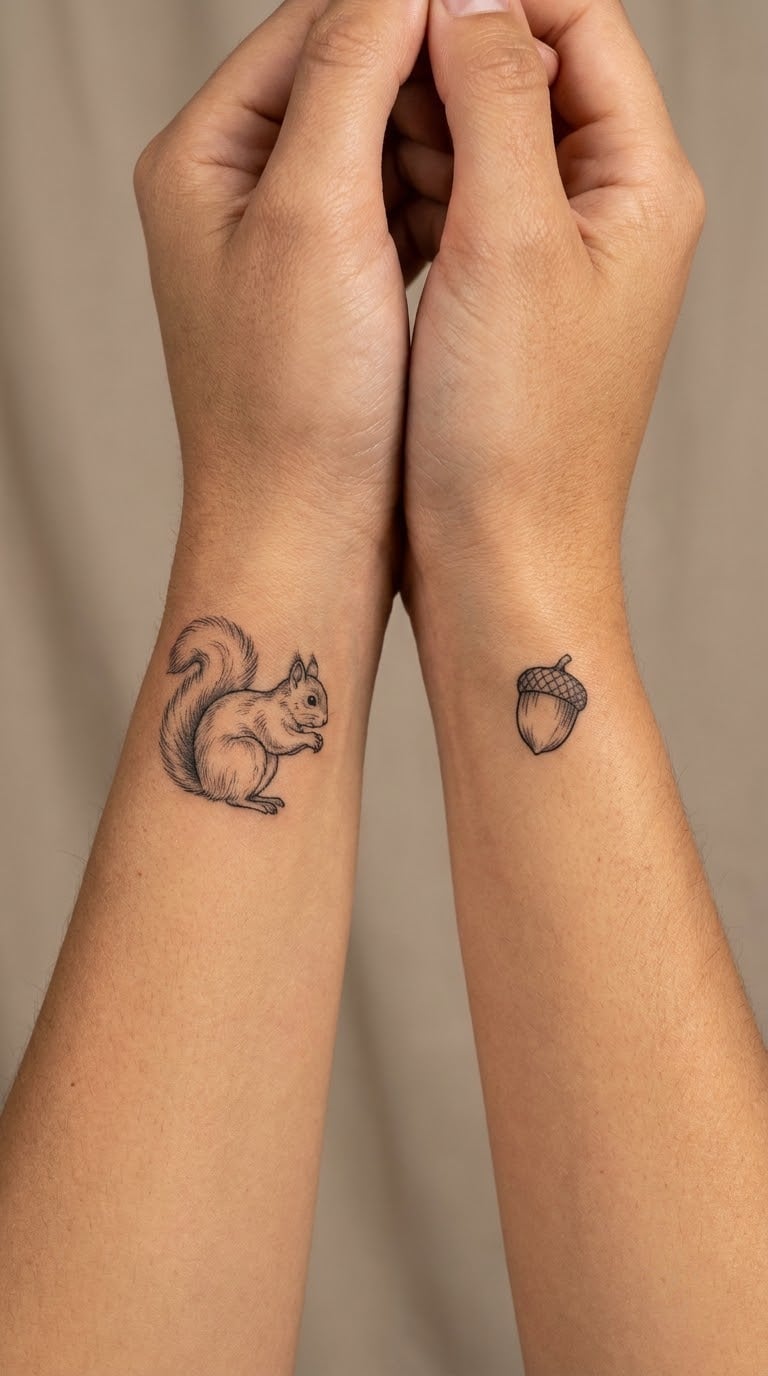
Two separate pieces, drawn in the same hand: a squirrel at about 2 inches and a plain acorn at about 1 inch, both on the same line weight. The contrast in size is deliberate, and it keeps the smaller piece from looking like an afterthought.
Matching pairs work for couples, siblings, or you and your own future collection. If you want both on one person, mirroring the wrist pair across a body is a common approach.
Placement: both wrists, or one wrist and the opposite ankle.
Size: 2 inches and 1 inch (5 cm and 2.5 cm).
Style: fine line, matched weights.
Pain: low. Ageing note: two pieces tattooed months apart will drift in scale and darkness as they fade, so try to get them done close together if the match matters to you.
Make it yours: have both drawn in the same session, even if one is placed later, so the line weight matches exactly.
14. Red Squirrel with a White Tail Tip
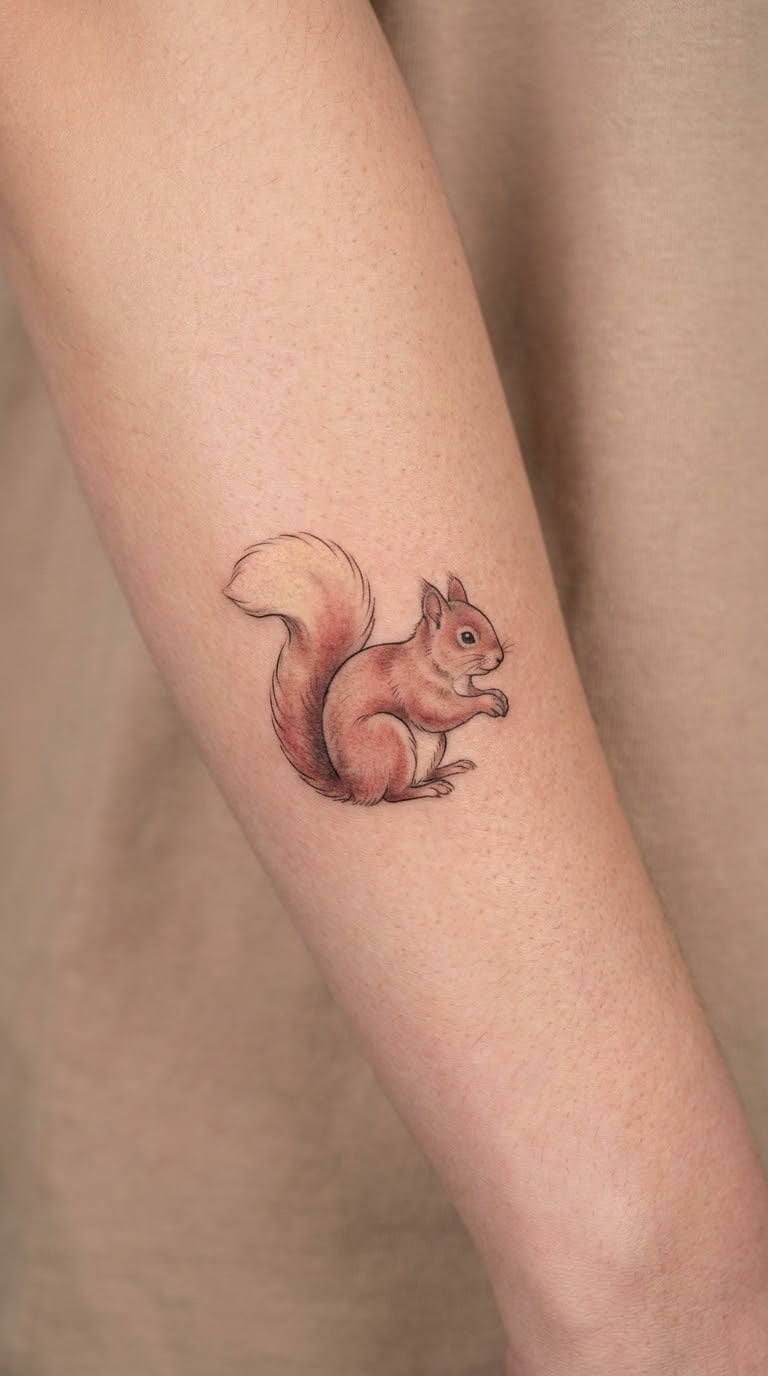
A red squirrel in naturalistic pose with a creamy tail tip left as bare skin, a rust and ochre body, and only a few areas of true saturated red. The species itself is a choice: red squirrels are smaller, more tufted and less common to see than greys, which some people like as a subtle detail.
It suits anyone who wants a grey-squirrel design with a bit of colour, and the blackwork version of the same pose works if you would rather avoid pigment.
Placement: outer arm, calf, or upper thigh.
Size: 3 to 3.5 inches long (7.5 to 9 cm).
Style: naturalistic colour, or blackwork version available.
Pain: medium. Red pigment holds its hue unevenly, so ask the artist whether they prefer a rust wash over a full red, and plan on a colour touch-up in about a year.
Make it yours: name the park or wood where you used to see them and ask for that exact colouring in the brief.
15. Squirrel Climbing a Tree Trunk
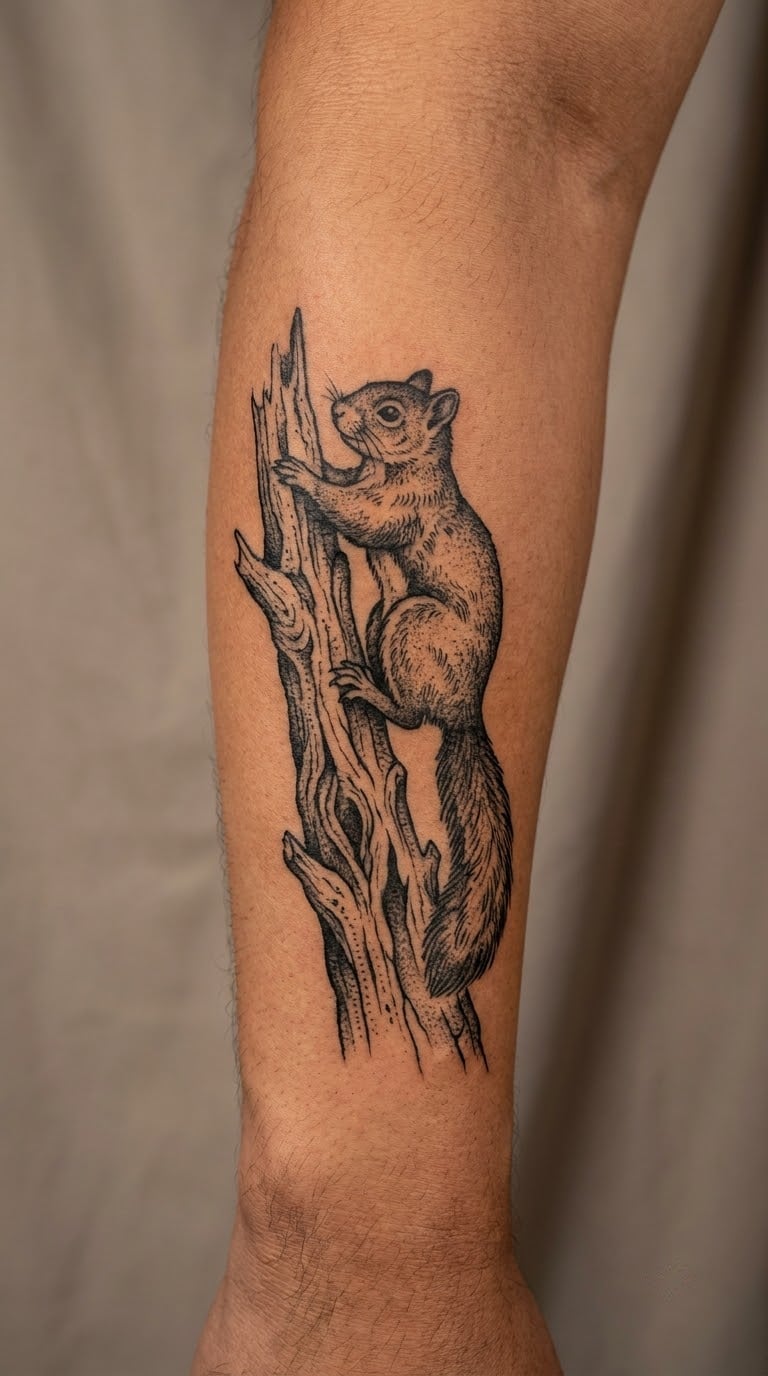
A vertical composition: a squirrel mid-climb on a textured trunk, head up, tail hanging down the bark behind it, with a couple of branch stubs. Vertical designs suit long, narrow areas of skin, and this one is drawn to be read from bottom to top.
It is a good pick if you already have forest work and want the squirrel to share the same visual language.
Placement: outer forearm, calf, or the inner arm from wrist to elbow.
Size: 5.5 to 6.5 inches tall (14 to 16.5 cm).
Style: blackwork with texture.
Pain: medium. Ask the artist to show you a healed photo of similar bark texture first, because texture is the part clients most often want changed later. Bark texture holds better over time than fur texture.
Make it yours: use a knot or hollow from a tree you know as the gap the squirrel moves through.
16. Squirrel Nest with Baby Squirrels
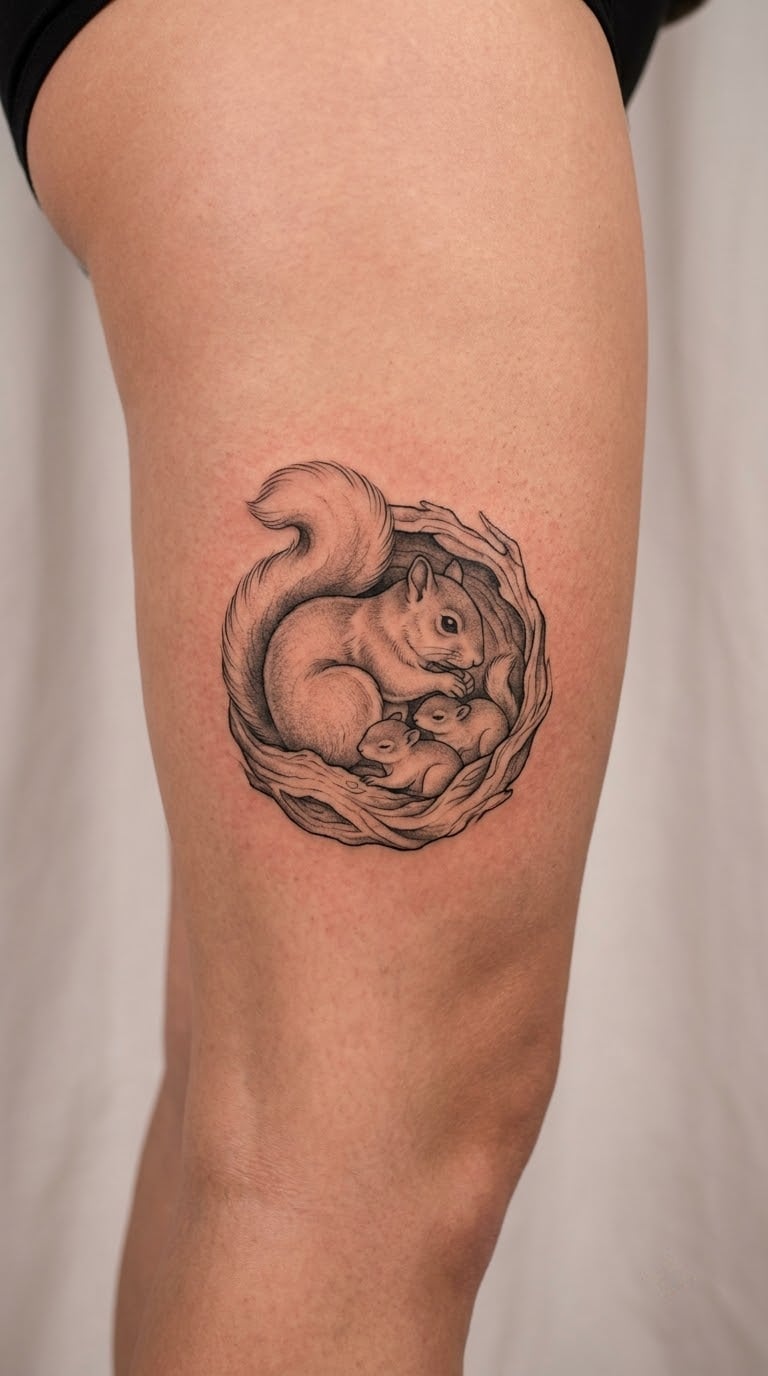
An adult sits at the edge of a woven nest with two young squirrels pressed against her, rendered in soft grey shading rather than hard line, with the faces as the focal point. It is a narrative design, so the faces have to carry it.
It reads as family, or as a memorial, and that is usually why someone brings it in. Thigh skin takes this level of soft shading well because there is little bone or tendon underneath.
Placement: upper thigh, lower back, or the upper arm.
Size: 4.5 to 5.5 inches wide (11.5 to 14 cm).
Style: soft shaded realism.
Pain: medium. Honest ageing note: the two small faces lose definition first, so keep each baby at least an inch and a half tall in the drawing and expect a later touch-up on their eyes.
Make it yours: match the number of young to a real number, like the count in a household or a litter you knew about.
17. Floral Squirrel with Autumn Leaves
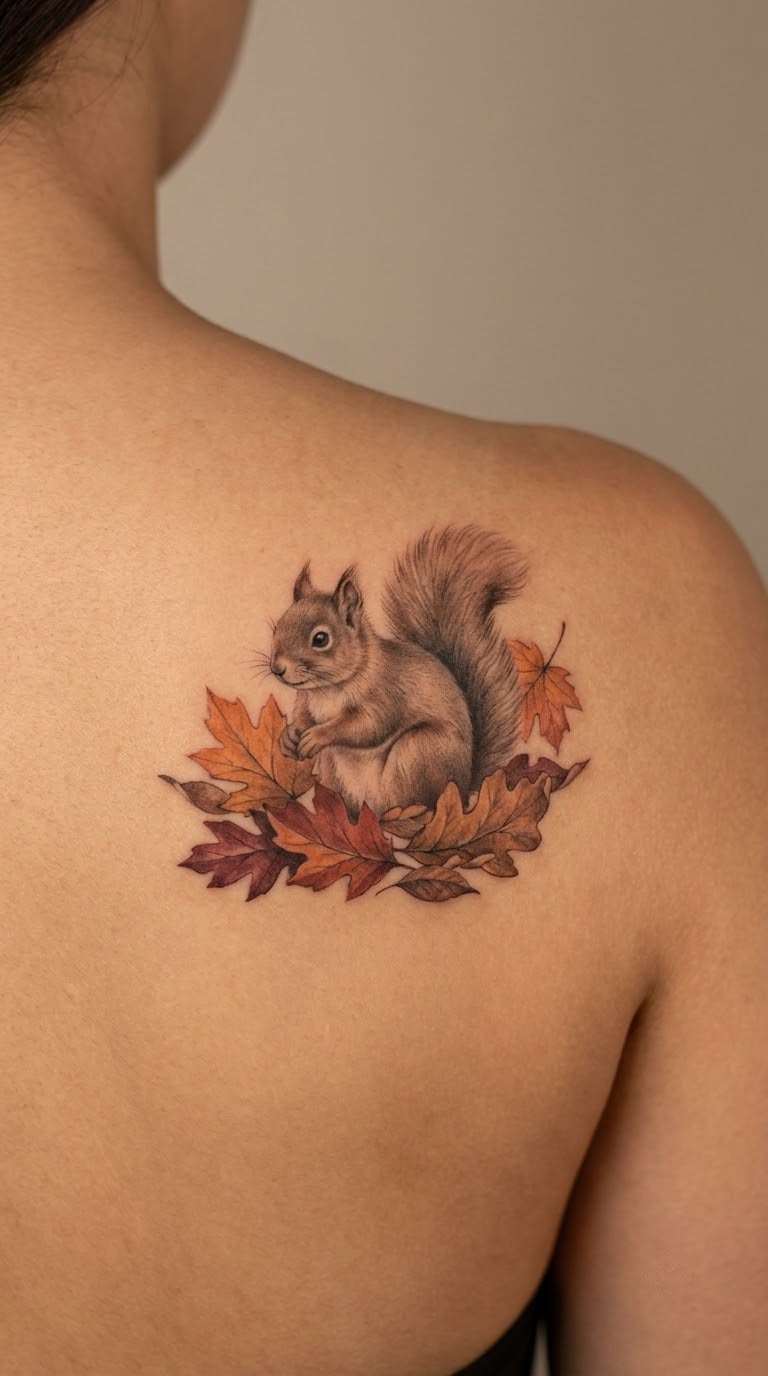
A squirrel in three-quarter profile framed by loose autumn leaves in orange, red and brown, with the leaves painted thinner than the animal so the squirrel stays the solid element. It is a decorative piece that works without being a full floral sleeve.
It suits people who want a colourful tattoo that still belongs to a nature theme, and autumn is when most people book this one.
Placement: shoulder blade, outer thigh, or the back of the calf.
Size: 3 to 4 inches wide (7.5 to 10 cm).
Style: colour illustration, botanical framing.
Pain: medium. Expect the background leaves to fade before the squirrel does, so ask the artist to leave clear negative space between each leaf rather than letting them touch.
Make it yours: use leaves collected from a place rather than a generic autumn mix, and name the season you want the palette to hold.
18. Gothic Squirrel with Detailed Fur
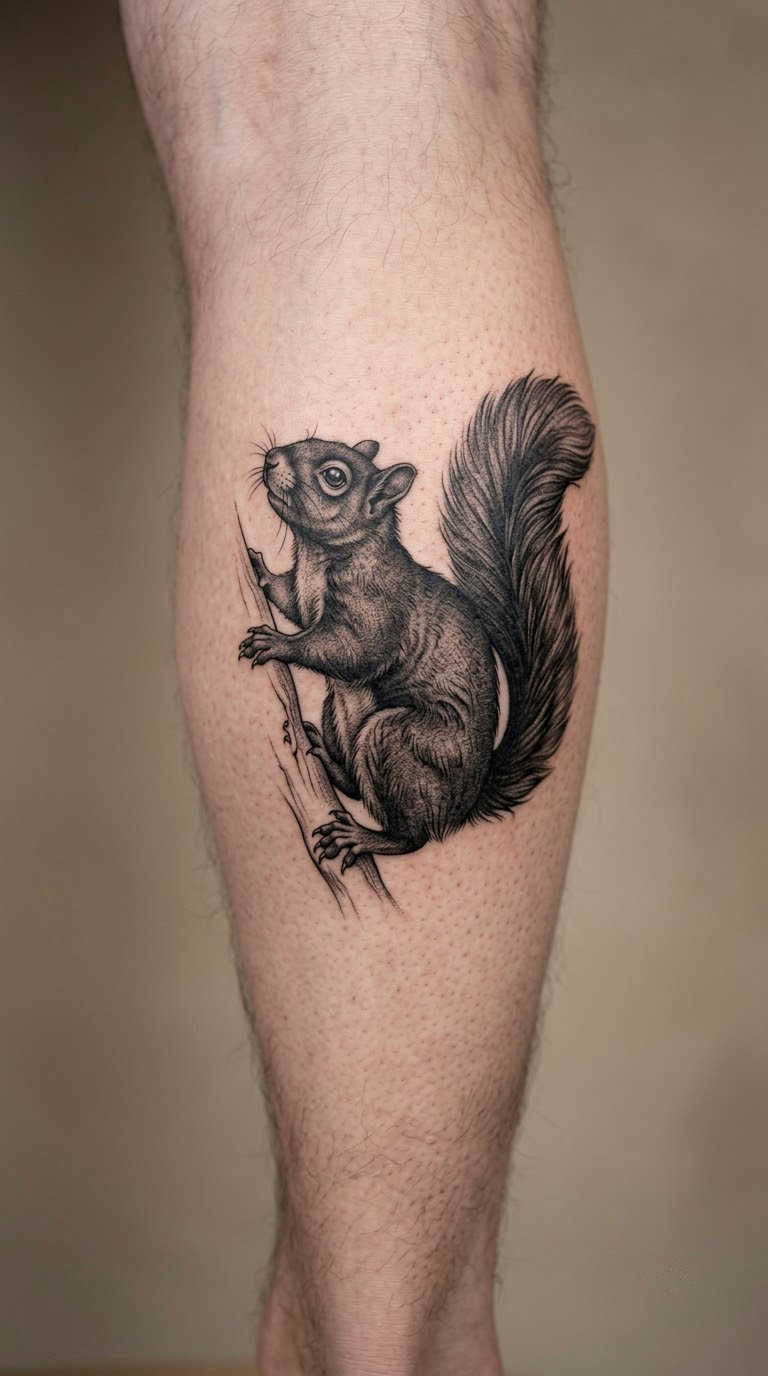
A dark rendering in charcoal greys with one bright highlight in each eye, dense directional fur strokes, and a background of near-black that pushes the animal forward. Dark pieces need planning or the whole area turns into an unreadable block.
It suits people who want a squirrel with some weight behind it, and it sits well with an all-black sleeve.
Placement: calf, upper back, or the outer arm.
Size: 4 to 5 inches tall (10 to 12.7 cm).
Style: dark black and grey realism.
Pain: medium. You will be tattooing large areas of dark, which takes time, so plan for a longer sitting and a break partway. Ask to see a healed example of the same background density.
Make it yours: keep one lighter area, like a moonlit patch or a pale hand, so the eyes have something to read against.
19. Squirrel and Coffee Cup
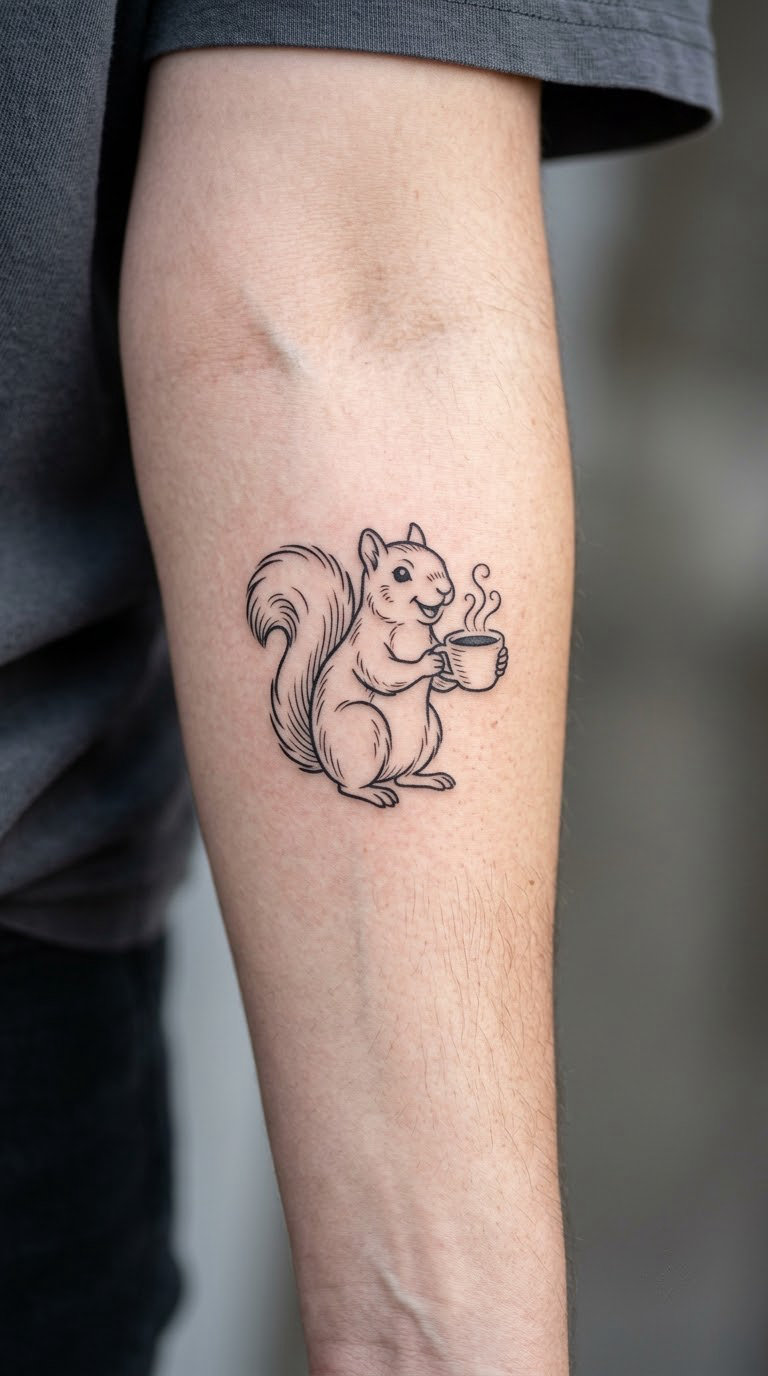
A cheerful linework squirrel holding a steaming cup with both paws, three short steam curls above the rim, no background. It is an everyday-objects design, so it works best in one thin line weight and a small scale.
People choose it for a partner, for their own routine, or as the first piece of a set of small personal-object tattoos on the same arm.
Placement: inner forearm, wrist, or the back of the hand.
Size: 2.5 to 3 inches tall (6.5 to 7.5 cm).
Style: clean linework, single weight.
Pain: low. The inner forearm bruises visibly for a few days, which is normal and settles on its own. Ageing note: the steam curls are the first lines to disappear, so ask for them a little heavier than feels right.
Make it yours: draw your actual mug shape, or put a date on the saucer in small numerals.
20. Flying Squirrel with Spread Glide Membrane
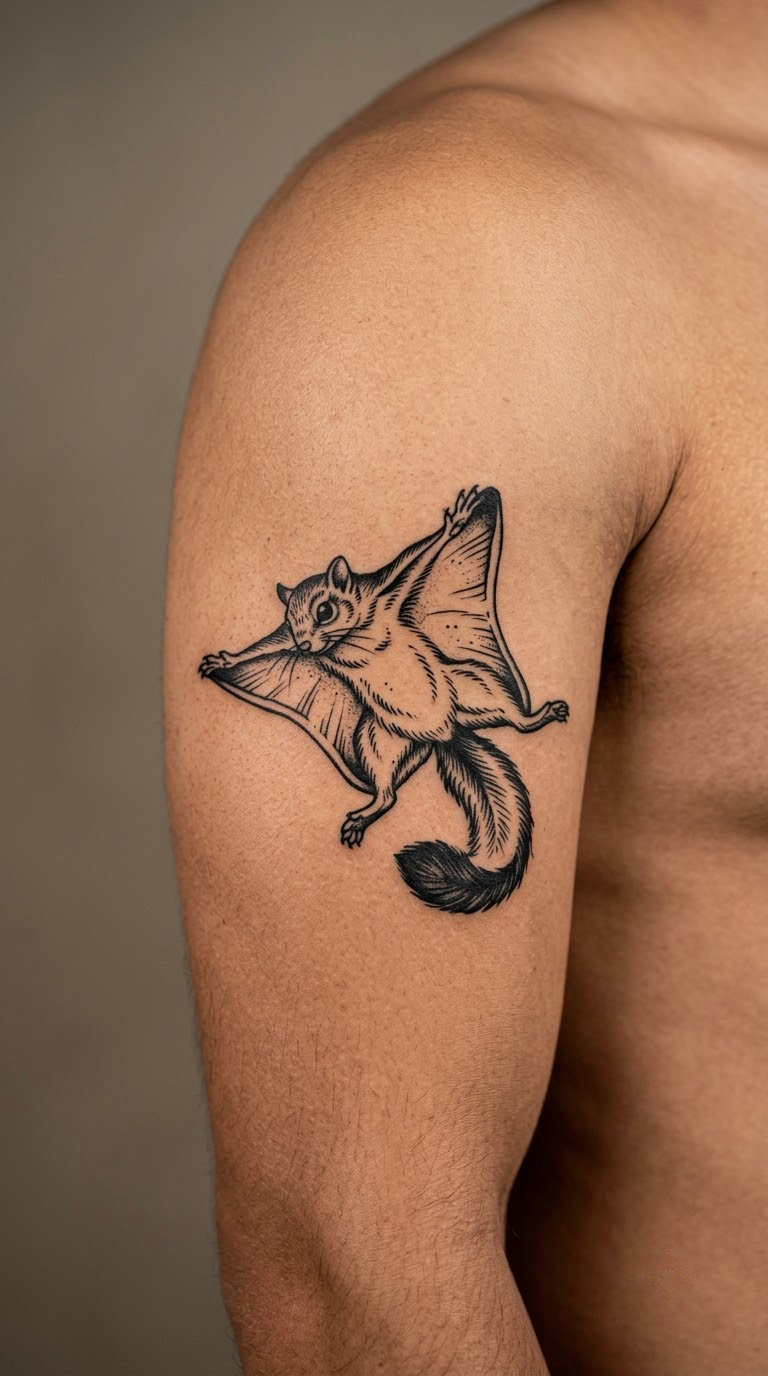
A flying squirrel in an airborne pose with the glide membrane stretched wide between front and back legs, drawn in bold black line with dark fill under the body. Getting the membrane right is most of the work, because that stretched skin is what makes it read as a flying squirrel rather than a leaping one.
It is the most unusual of these designs and a good one for anyone whose usual animals are the usual ones.
Placement: upper arm, shoulder blade, or the lower back.
Size: 3.5 to 4.5 inches wide (9 to 11.5 cm).
Style: bold black line with silhouette fill.
Pain: medium. Ageing note: the thin membrane edges blur faster than the body, so the artist should connect them to the limbs with short filled sections rather than trailing hairlines.
Make it yours: have the shape lean into an existing body line so the glide follows the curve of your shoulder or ribcage.
21. Squirrel Wrapped Around an Initial
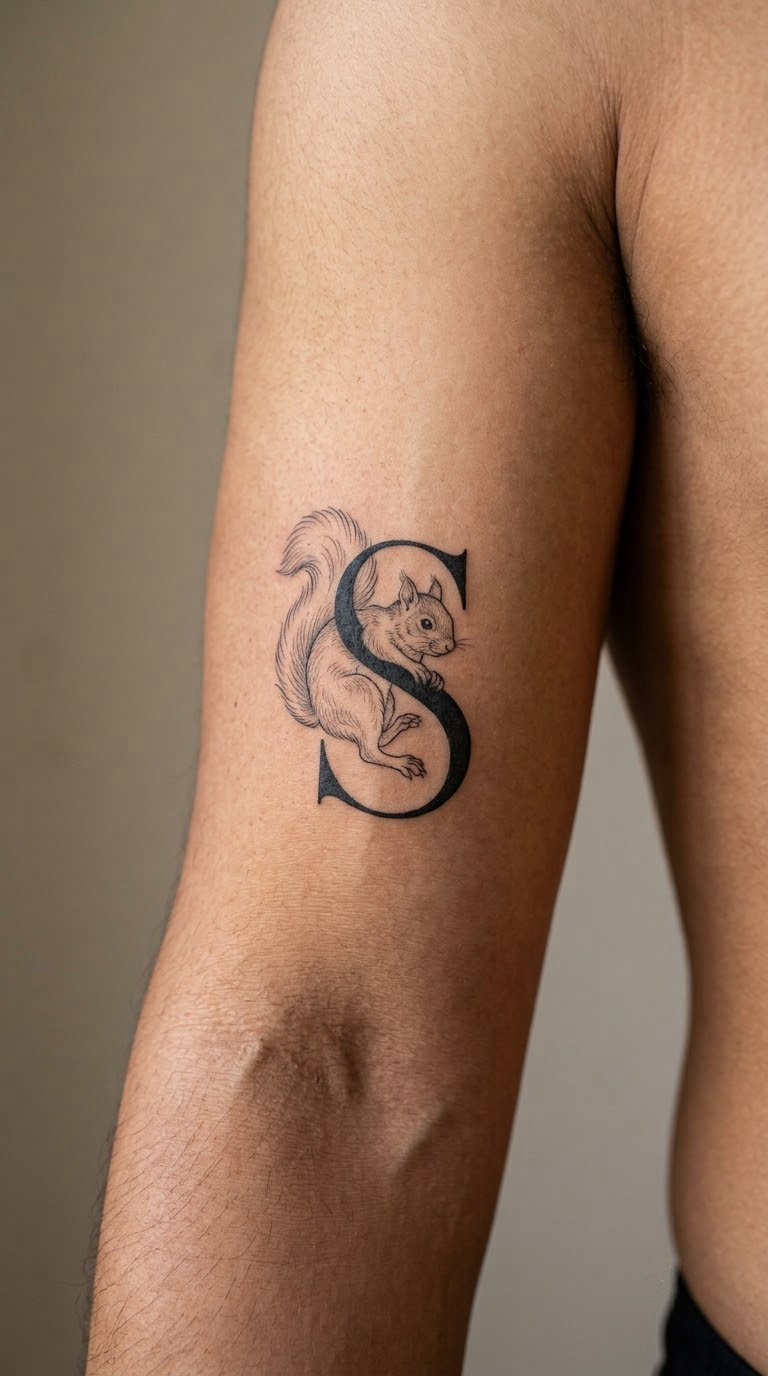
A single serif letter in fine line, with a small squirrel curled around its stem, tail crossing behind the letter and the head resting at the top serif. The letter needs even line weight or the piece falls apart, and the tail crossing point is the difficult part.
It is one of the most personal of the squirrel tattoo ideas here, and it reads as a letter tattoo first and an animal second.
Placement: inner bicep, inner forearm, or the rib area.
Size: 2 to 2.5 inches tall (5 to 6.5 cm).
Style: fine line with clean lettering.
Pain: low to medium. Rib and inner bicep placements vary a lot between bodies, so your artist may need to stretch the skin more than usual. Lettering holds up if the weight stays even.
Make it yours: bring the letter you actually want, and ask the artist to draw the squirrel around it rather than fitting the squirrel in afterwards.
22. Blackwork Squirrel Surrounded by Pinecones
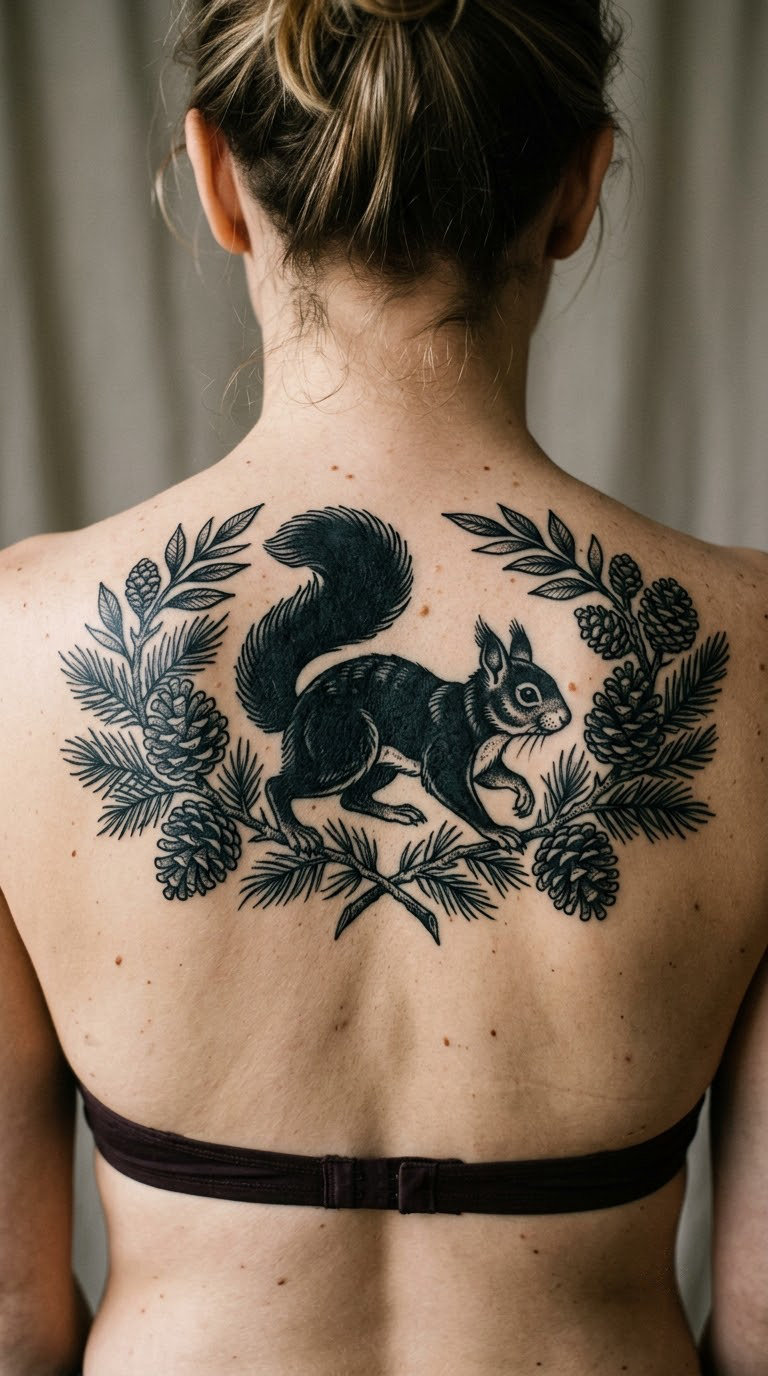
A dense blackwork piece: a solid squirrel centred, with pinecones packed around it in tight scales. This one has real visual weight, so it should sit on a flat area large enough to hold it rather than being squeezed onto a small panel.
It is a strong choice for the centre of a back piece or a wide gap in an existing blackwork sleeve.
Placement: upper back, shoulder, or upper thigh.
Size: 5 to 6 inches wide (12.7 to 15 cm).
Style: blackwork with dense texture.
Pain: medium to high. Black areas across the back are a long, uncomfortable sitting, and this is commonly split over two sessions. Ageing note: heavy black can spread slightly into surrounding skin over a decade, so leave a small gap of bare skin between each pinecone scale.
Make it yours: count the pinecones for something real, like the number of years in a place you lived.
23. Squirrel in a Tiny Standing Pose
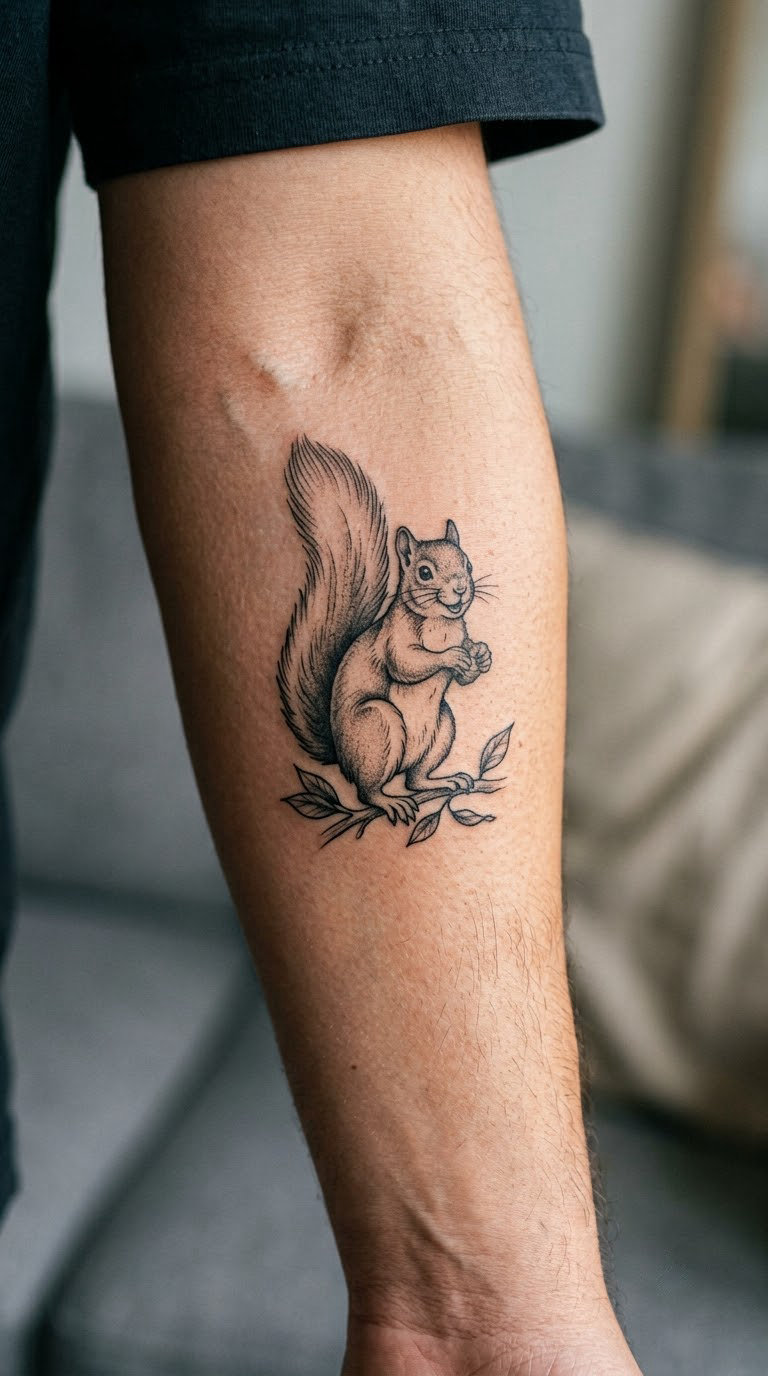
A squirrel standing on its back legs with the tail raised behind it, drawn in a simple playful line with no background and no expression. The upright pose is funny because real squirrels rarely hold it, and that is the whole appeal.
It is a design you can draw from scratch without a reference photo, which makes it a good one to bring to a consultation as a starting sketch.
Placement: outer arm, calf, or the lower back.
Size: 2 to 2.5 inches tall (5 to 6.5 cm).
Style: playful line cartoon.
Pain: low. Keep the pose simplified: a two-inch squirrel drawn with detailed paws and facial features will blur into a smudge within a few years, so ask the artist to leave the face nearly blank.
Make it yours: have it holding one small object, like a phone or a tiny bag, and leave the rest of the body as outline.
24. Woodland Squirrel Scene with Mushrooms
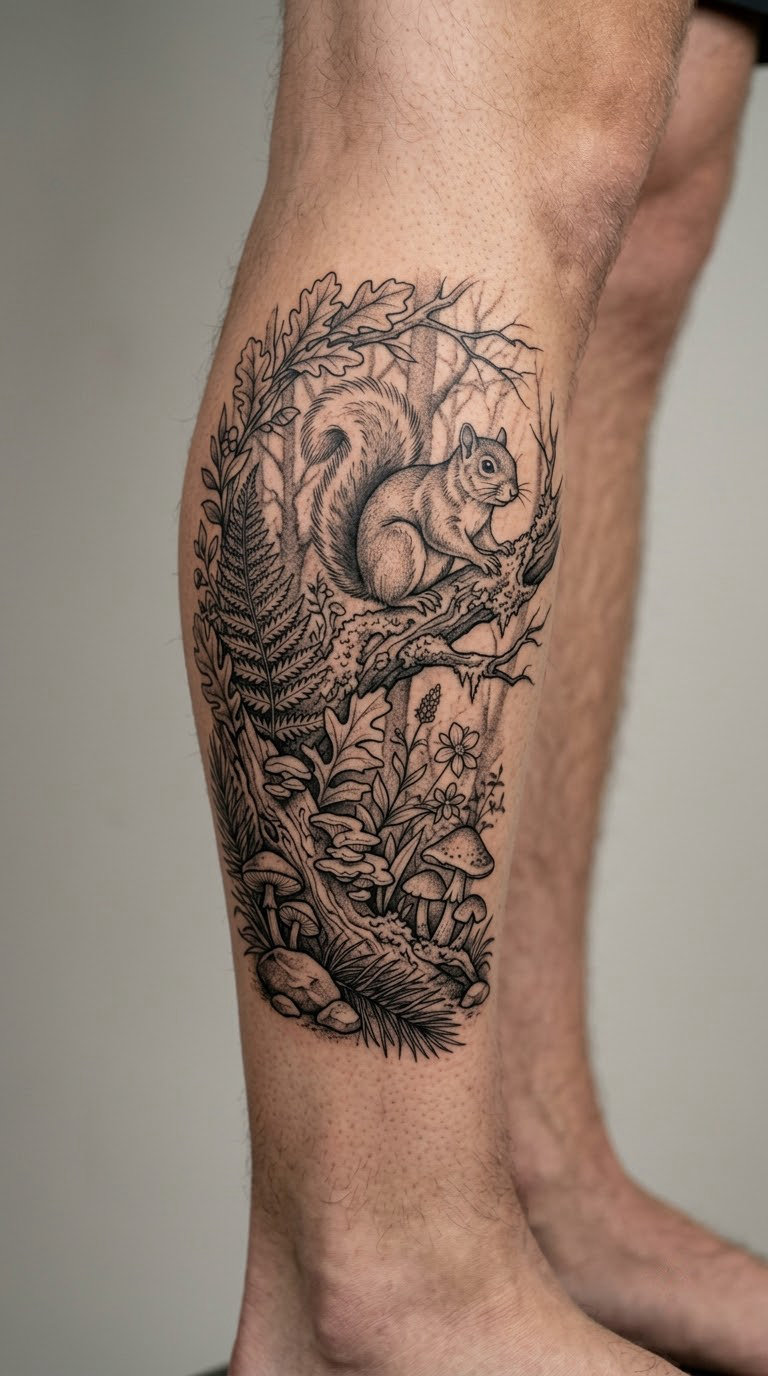
The fullest design here: a squirrel in the middle of a forest floor scene with mushrooms, ferns, a few leaves and ground texture, all in black and grey. The squirrel is the sharpest element and the rest is deliberately quieter, or the scene turns to noise.
It suits someone building a sleeve or wanting one piece that carries a whole setting rather than one animal.
Placement: calf, outer thigh, or across the upper back.
Size: 6 to 7 inches wide (15 to 18 cm).
Style: black and grey scene work.
Pain: medium, but expect two sessions at this size rather than one. Bring plenty of reference for the mood you want, because scene work is where clients and artists disagree most.
Make it yours: design the forest floor from a real walk, with the mushrooms and plants you actually remember seeing.
How to Choose the Right Design
Style is a decision about how much the tattoo will change over time, not just how it looks on day one. Most people who regret an animal tattoo regret the size, not the animal.
Fine line squirrel tattoo ideas for small placements
Fine line is the most common request and the most common source of disappointment. A pin that looks delicate on a phone screen becomes a pale, slightly fuzzy drawing after a few summers of sun. If you want fine line, choose an inner bicep, upper arm, or back of the shoulder spot rather than the wrist, the hand, or the ankle.
Minimum workable size by style
These are rough floors based on what holds together once healed, not hard rules.
- Solid silhouette: 1 to 1.5 inches. The most forgiving style at the smallest size.
- Cartoon outline: 2 inches. Thick contours survive, facial detail does not.
- Fine line: 2.5 inches for anything with fur texture, paws, or whiskers.
- Black and grey realism: 3 inches for a portrait, 4 inches for a full scene.
- Dotwork: 4 inches. Below that the dots merge into flat grey.
- Colour wash: 4 inches, and plan on the pale areas fading first.
Match the style to the body area
Curved and bony areas fight thin lines. The inner forearm, wrist, ankle and ribcage all have pronounced contours that distort a small drawing, and the ribs move under the skin. Flatter areas such as the outer forearm, calf, outer thigh and upper back hold a design’s shape far better. Curved and rounded areas such as the shoulder and upper arm take well if the artist stretches the skin properly while working.
Brief your artist in terms they recognise
Bring a small set of references, not fifty. Ask to see healed photos from the same artist, and tell them your real size limit up front. Three things help more than anything else on the first appointment:
- Say the finished size you want in inches, and ask whether they would change the drawing for that size.
- Ask the artist to draw a scale test of the smallest feature, such as a paw or a single fur line, before starting.
- Tell them which details you are willing to lose, so the simplification is your decision and not a surprise.
One more thing worth knowing. A squirrel has a lot of similar-looking features, and chipmunk, fox squirrel and grey squirrel designs are easy to confuse. Say which species you mean and, if it matters, how it looked when you last actually saw one.
Cost and Session Time
Cost depends on hourly rate, the artist’s minimum, and how long the design takes, and I would not quote a number here because rates change and shop minimums vary widely. What I can tell you is what moves the price.
- Size drives time. Most artists charge hourly, so a 6-inch scene takes two to three times as long as a 2-inch silhouette.
- Style drives the number of passes. Solid black and bold outline go down fastest. Grey shading, stippling and colour washes need far more passes over the same area.
- Detail drives touch-ups. Dense fine detail is more likely to need a free or discounted touch-up later, and many artists build that into their pricing.
- Location matters. City studios and high-demand artists charge more than shops elsewhere, and shop minimums can exceed a small tattoo’s total.
On session length, expect 30 to 60 minutes for a small design and two to three hours for anything over 5 inches, split across two sessions. Ask the artist at your consultation how they plan to break it up before you book.
Aftercare Basics
- Follow your artist’s aftercare instructions first. Every artist has their own protocol based on how they work, and it overrides anything general you read online, including this list.
- Wash it gently. Clean water and a mild unscented soap, washed with clean hands, then patted dry with something lint-free.
- Keep it moisturised. A thin layer of a plain ointment, following your artist’s product recommendation, helps with the peeling stage.
- Protect it while it heals. Loose clothing over the area for the first few days, and no swimming, hot tubs or saunas until the skin is fully closed.
- Limit sun exposure. Fresh tattoos and healed fine line work both fade faster with sun, so cover it up and use sunscreen once the area is closed.
- Do not pick at flakes. Let the dry skin come away on its own and follow your artist if anything looks off to you.
Frequently Asked Questions
How small can a detailed squirrel tattoo go before it blurs?
Around 2.5 inches is the practical floor for a fine-line squirrel with fur, paws or whiskers. Below that, hatching and thin lines fill in with healed scar tissue and the design turns soft. A solid silhouette works at 1 to 1.5 inches. Ask your artist to draw the smallest feature at your target size before you commit.
Is a squirrel tattoo a good choice for a first tattoo?
Yes, if you pick a simple version. A solid silhouette, a cartoon squirrel or a bold outline all sit easily, heal predictably, and cost less than a detailed portrait. A micro-realistic squirrel is a harder first tattoo because fine fur shading needs an experienced hand and likely a touch-up later.
Do squirrel tattoos fade over time?
They do, at the same rate as any tattoo. Fine lines on sun-exposed areas such as the inner forearm, wrist, hand and behind the ear fade fastest, and red pigment changes hue within a couple of years. Bold black outlines and solid shapes hold their shape far longer. A yearly touch-up on a fine-line piece keeps it readable.
What does a squirrel tattoo symbolise?
Most people read a squirrel as resourcefulness, preparation, agility and quick thinking, since it gathers and stores food and never stops moving. Beyond that, people usually use it personally, as a nickname, a memorial to a pet, or a mark of resilience after a hard period. Treat those as your own meanings rather than a fixed dictionary.
Where is the best placement for a small squirrel tattoo?
The outer forearm, calf and upper thigh are the flattest options, so a small drawing keeps its shape there. Wrist, hand, ankle and rib tattoos distort more because of bone, tendon and movement. If you want it discreet, the upper arm and the inner bicep stay covered by most clothing.
Should a squirrel tattoo be in colour or black and grey?
Black and grey is the more durable choice and suits every style, from silhouette to realism. Colour suits an illustrative or neotraditional design, but pale washes and red pigment fade sooner, and the piece usually wants a colour touch-up within a year. If you already have a blackwork sleeve, a grey squirrel sits in far better.
Conclusion
For a first tattoo, the minimalist silhouette or the cartoon squirrel with the oversized tail is the safest call. Both are simple shapes, both sit comfortably, and neither depends on fine detail that will soften.
If you are adding to a collection, the flying squirrel with the spread glide membrane or the woodland scene with mushrooms will read as a deliberate piece rather than an addition. Either way, decide the finished size before you book, bring three references instead of thirty, and ask to see healed work from the artist who will be doing it.