
20 Best Hedgehog Tattoo Ideas: Small & Playful (September 2026)
Hedgehog tattoo ideas are everywhere right now, and it is easy to see why. The animal is small, instantly recognisable, and it reads well even at 1.5 inches. Whether you want your first tattoo to stay quiet, you are adding to a sleeve full of animals, or you are looking for a memorial piece for a hedgehog that mattered to you, there is a version of this animal that fits.
What makes a good hedgehog design work on skin is the silhouette. A rounded body, spines that fan out rather than sit flat, and a small pointed face give an artist plenty to work with. The prop matters just as much: an acorn, a leaf, a teacup or a moon sets the mood in one line of a brief.
Below are 20 designs I would happily show an artist, each with placement, realistic size, style and an honest pain note. Autumn and winter bookings fill fast, so if you are planning ahead for cooler weather, sort the design out now.
Hedgehog Tattoo Ideas: Quick Guide
| Idea | Style | Best placement | Size | Pain |
|---|---|---|---|---|
| 1. Fine-line curled | Fine line | Inner forearm | 2 in (5 cm) | Medium |
| 2. Tiny sleeping | Micro fine line | Inner wrist | 1.5 in (4 cm) | Medium |
| 3. With an acorn | Illustrative | Calf | 2.5 in (6 cm) | Low |
| 4. Geometric portrait | Geometric blackwork | Upper arm | 3 in (7.5 cm) | Medium |
| 5. Watercolour in wildflowers | Illustrative colour | Forearm | 2.5 in (6 cm) | Low |
| 6. Minimal line art | Minimalist | Outer upper arm | 1.75 in (4.5 cm) | Low |
| 7. Blackwork spiky | Blackwork | Forearm | 3.5 in (9 cm) | Medium |
| 8. Cute cartoon | Cartoon | Lower calf | 2 in (5 cm) | Low |
| 9. Peeking from a leaf | Illustrative | Shoulder | 3 in (7.5 cm) | Low |
| 10. Realistic portrait | Black and grey realism | Thigh | 4 in (10 cm) | Medium |
| 11. In a teacup | Whimsical linework | Upper arm | 2.5 in (6 cm) | Low |
| 12. Dotwork | Dotwork | Forearm | 2.25 in (5.5 cm) | Medium |
| 13. Spine pattern | Minimal pattern | Outer forearm | 4 x 2 in | Medium |
| 14. Rose and hedgehog | Traditional | Shoulder | 4 in (10 cm) | Medium |
| 15. Moonlit | Fine line | Upper arm | 2.75 in (7 cm) | Low |
| 16. In a pumpkin | Cartoon linework | Calf | 2.25 in (5.5 cm) | Low |
| 17. Behind the ear | Micro fine line | Behind ear | 1 in (2.5 cm) | Low |
| 18. Floral sleeve element | Black and grey illustrative | Upper arm | 4.5 in (11 cm) | Medium |
| 19. Heart and hedgehog | Geometric linework | Wrist | 2 in (5 cm) | Medium |
| 20. Full-colour garden | Illustrative colour | Calf | 5 in (12.5 cm) | Medium |
1. Fine-Line Curled Hedgehog
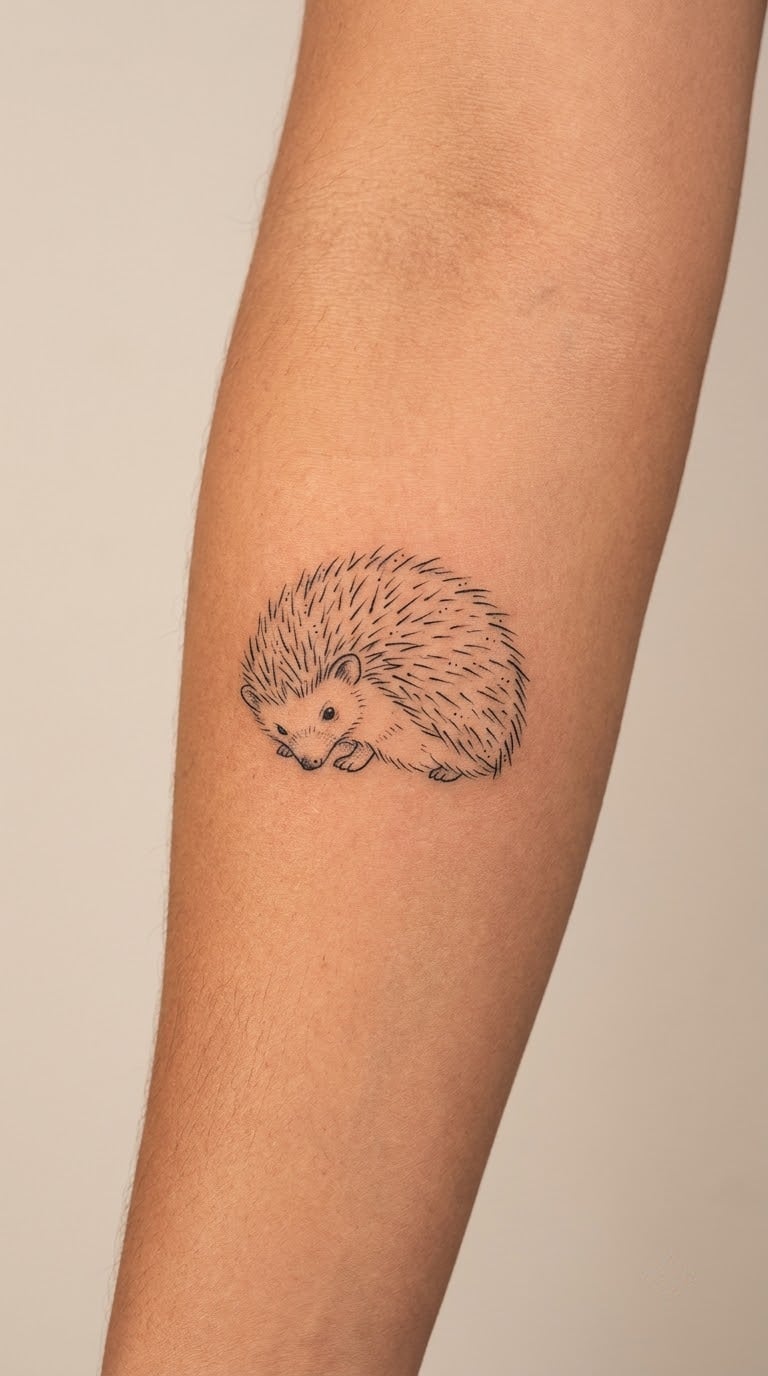
A fine-line curled hedgehog is the version I send to anyone nervous about a first tattoo. The animal is drawn as a half-circle of spines sweeping over a tucked head and one visible paw, done with single-needle work and no shading at all. It is the rolled-up defensive posture, and it usually reads as protection, self-reliance and a soft exterior with a guarded core.
Placement: inner forearm, just above the wrist crease, or the rib side of the upper arm. Size: 2 inches (5 cm) wide is the sweet spot. Style: fine line. Pain: medium, because forearm skin is thin and you feel every pass. Fine lines on the inner arm fade first, so expect a touch-up every few years.
Make it yours: tuck a small date or initial into the curl, hidden in the spines where only you will know it is there.
2. Tiny Sleeping Hedgehog
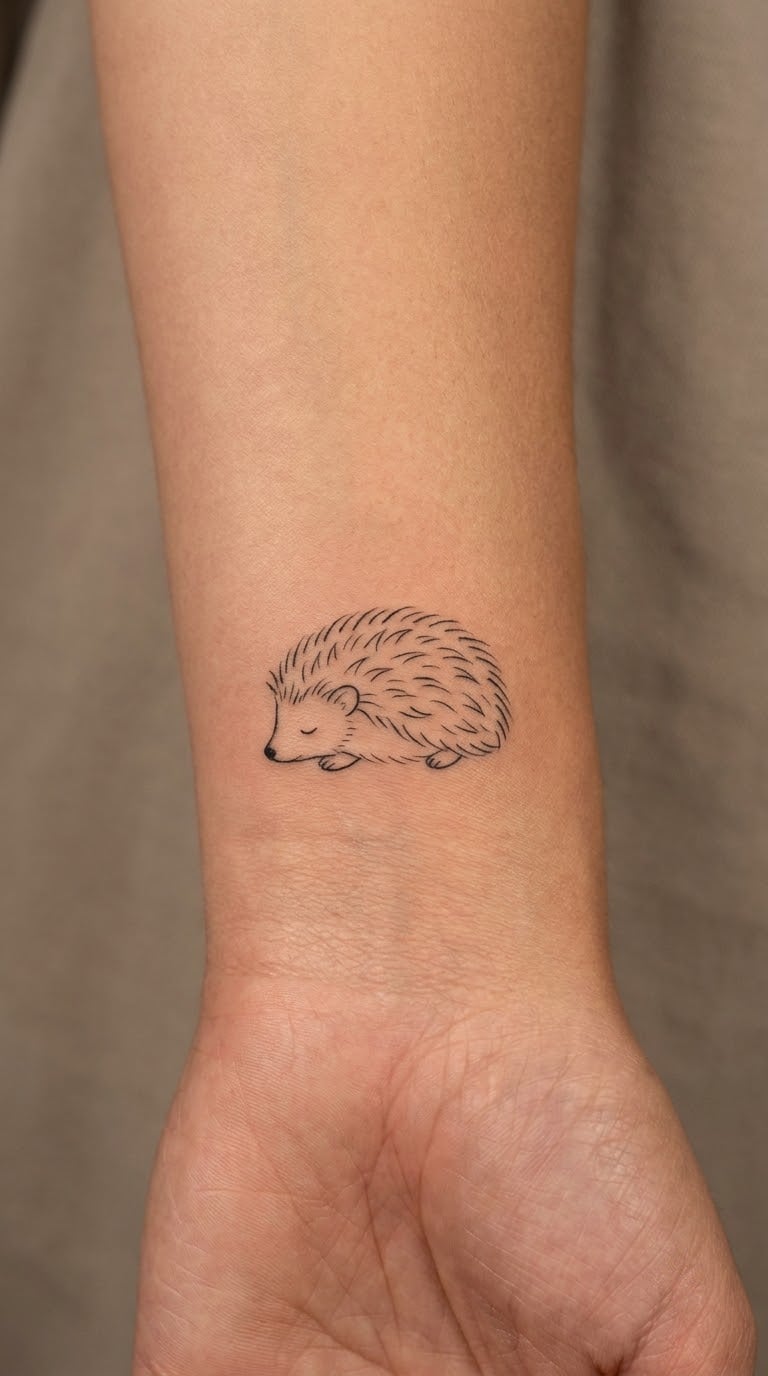
This is the quietest hedgehog tattoo ideas option: a rounded body, one closed eye as a single curved line, and just enough spines to say hedgehog without shouting it. People choose it for something small and low-key, or as a memorial piece for a hedgehog that has passed.
Placement: inner wrist, inside the elbow crease, or behind the ear. Size: 1.5 inches (4 cm) wide. Style: micro fine line. Pain: medium on the inner wrist, low behind the ear. Ageing note: at this size the eye line can soften within a few years, so ask for one confident stroke rather than two thin ones.
Make it yours: use the shape of a heart for the ear, or place it exactly where a real hedgehog used to sleep in your garden.
3. Hedgehog with an Acorn
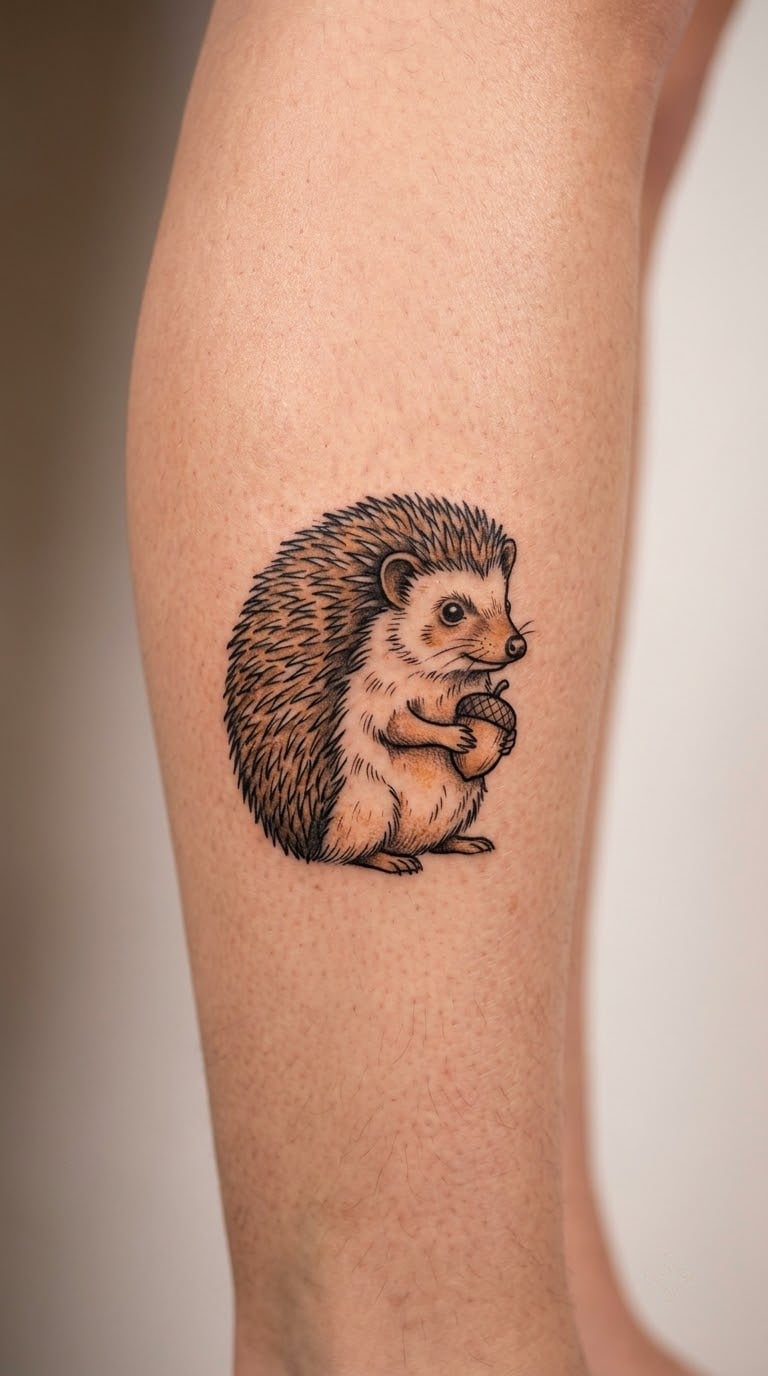
A hedgehog with an acorn turns the animal into a little woodland character. The drawing gives the hedgehog a lifted head and a front paw resting on the acorn cap, with spines suggested by clean tapered strokes and a warm brown wash filling only the nut. Foragers and nature lovers like it, and it is a common birthday gift for someone who gardens.
Placement: outer or lower calf, or the back of the upper arm. Size: 2.5 inches (6 cm) wide. Style: illustrative, with optional colour. Pain: low, calf skin has good cushioning. Brown ink softens with sun over the years faster than black, so keep the outline strong.
Make it yours: swap the acorn for a pine cone, a mushroom or a berry from somewhere that matters to you.
4. Geometric Hedgehog Portrait
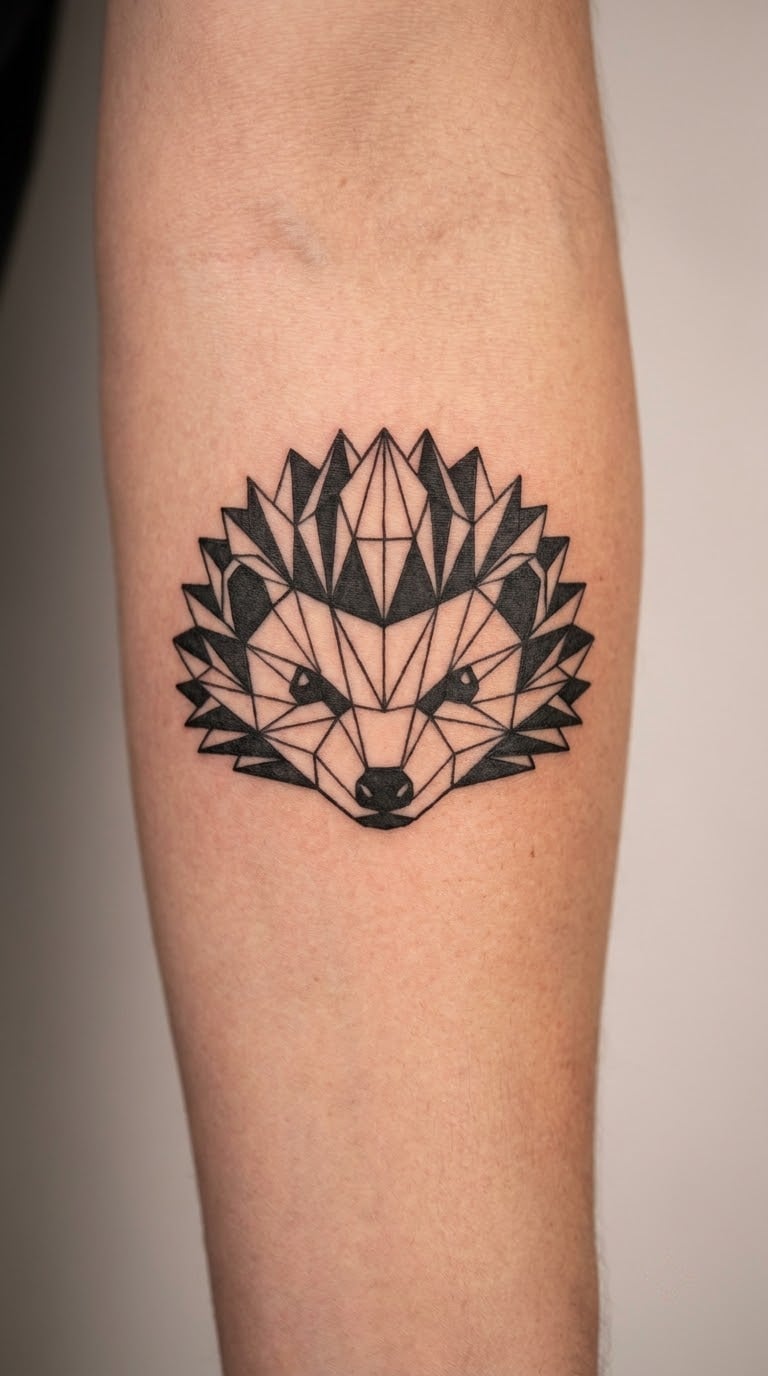
A geometric hedgehog portrait builds the face from sharp triangular facets, like a folded paper animal. The spines become a repeating sawtooth pattern running up one side of the head, and the eye is a single clean almond shape. It looks graphic and a bit architectural, which makes it a strong contrast to the cute designs most people search for first.
Placement: centred on the outer upper arm, or the sternum for a symmetrical front-facing version. Size: 3 inches (7.5 cm) wide. Style: geometric blackwork. Pain: medium, and the solid black areas take longer to tattoo than open line work.
Make it yours: add a second faceted shape, such as a hexagon moon or a faceted leaf, to tie the piece to the rest of a geometric piece.
5. Watercolour Hedgehog in Wildflowers
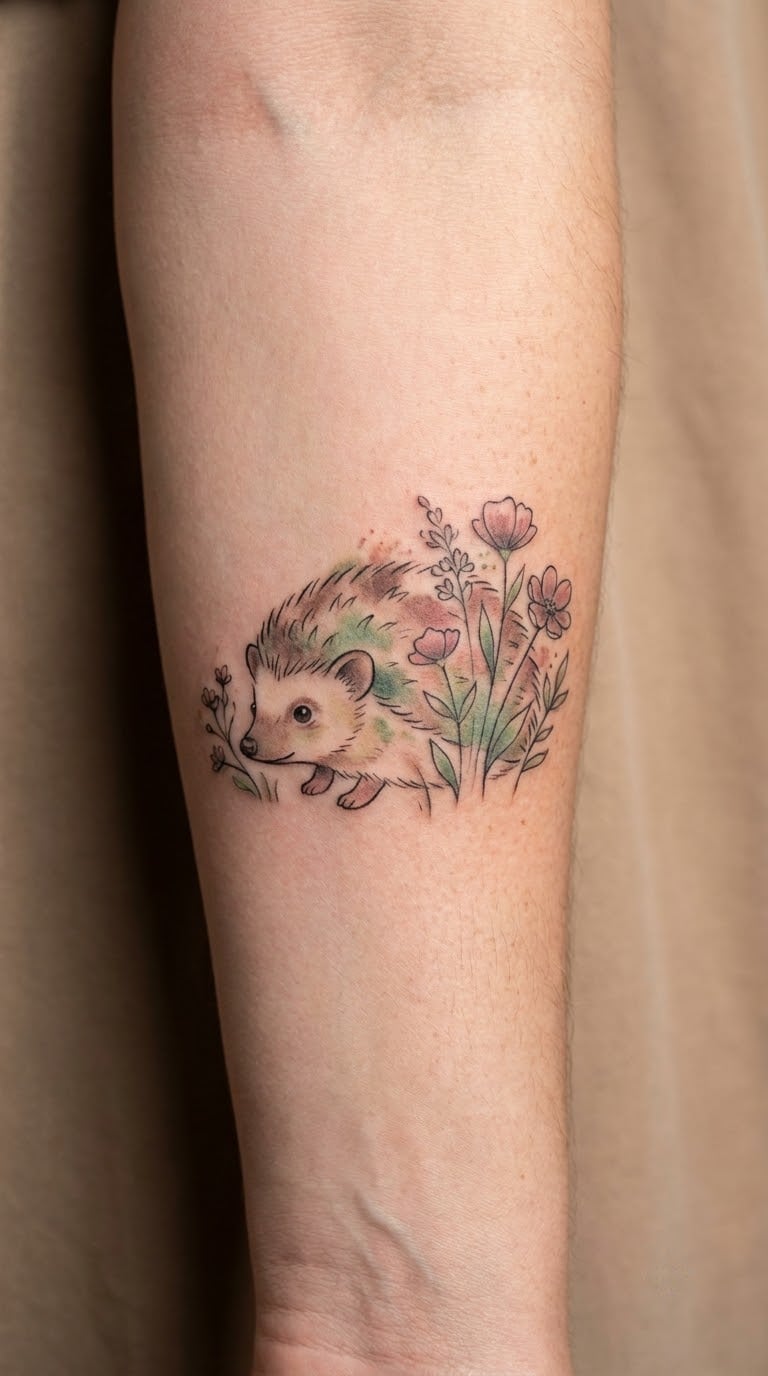
Watercolour work keeps a hedgehog light and illustrative without losing the spiny silhouette. The animal itself can stay in soft grey washes while the surrounding flowers carry the colour: loose pink, muted green and a little ochre bleeding slightly outside the lines. It suits people who find bold traditional pieces too much but still want something painterly.
Placement: forearm, upper arm, or anywhere on the thigh. Size: 2.5 inches (6 cm) for the hedgehog alone, 4 inches (10 cm) once the flowers are in. Style: illustrative colour. Pain: low to medium. Ageing note: pale washes are the first thing to fade, so expect the colour to mellow noticeably within five years.
Make it yours: use your birth flower or a wildflower from the garden where you grew up, painted in its true colours.
6. Minimal Line-Art Hedgehog
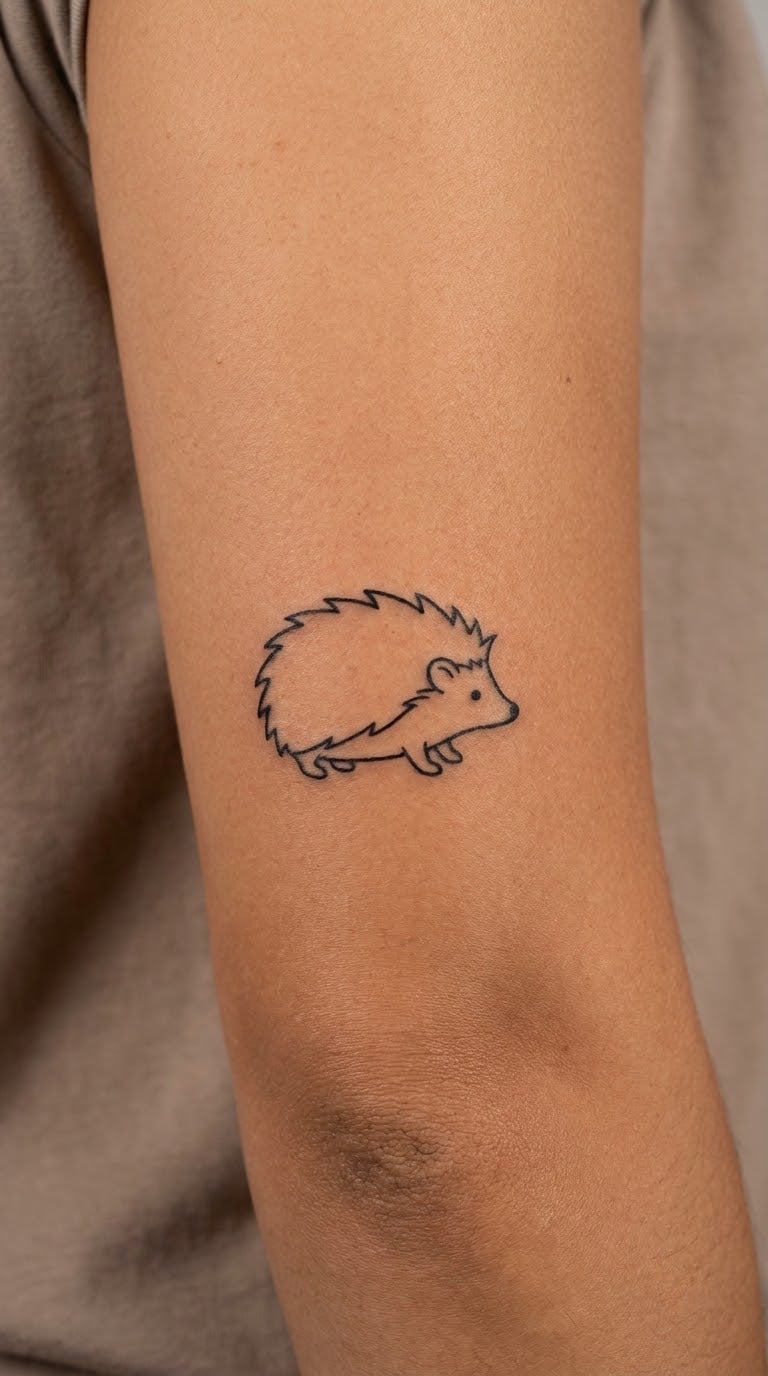
Minimal line art strips the hedgehog down to a single continuous outline, maybe six or seven spines and a lot of empty skin around it. The appeal is the negative space rather than the detail, and it is a genuinely modern look that does not depend on trends. It also heals predictably because there is very little ink in the skin.
Placement: outer upper arm, rib, or along the collarbone. Size: 1.75 inches (4.5 cm) wide. Style: minimalist. Pain: low on the upper arm, medium on the ribs and collarbone where skin is thin over bone. Line weight matters here, so ask your artist to go slightly bolder than feels right.
Make it yours: have the outline run into a thin line that continues elsewhere on the body, like a stem or a thread.
7. Blackwork Spiky Hedgehog
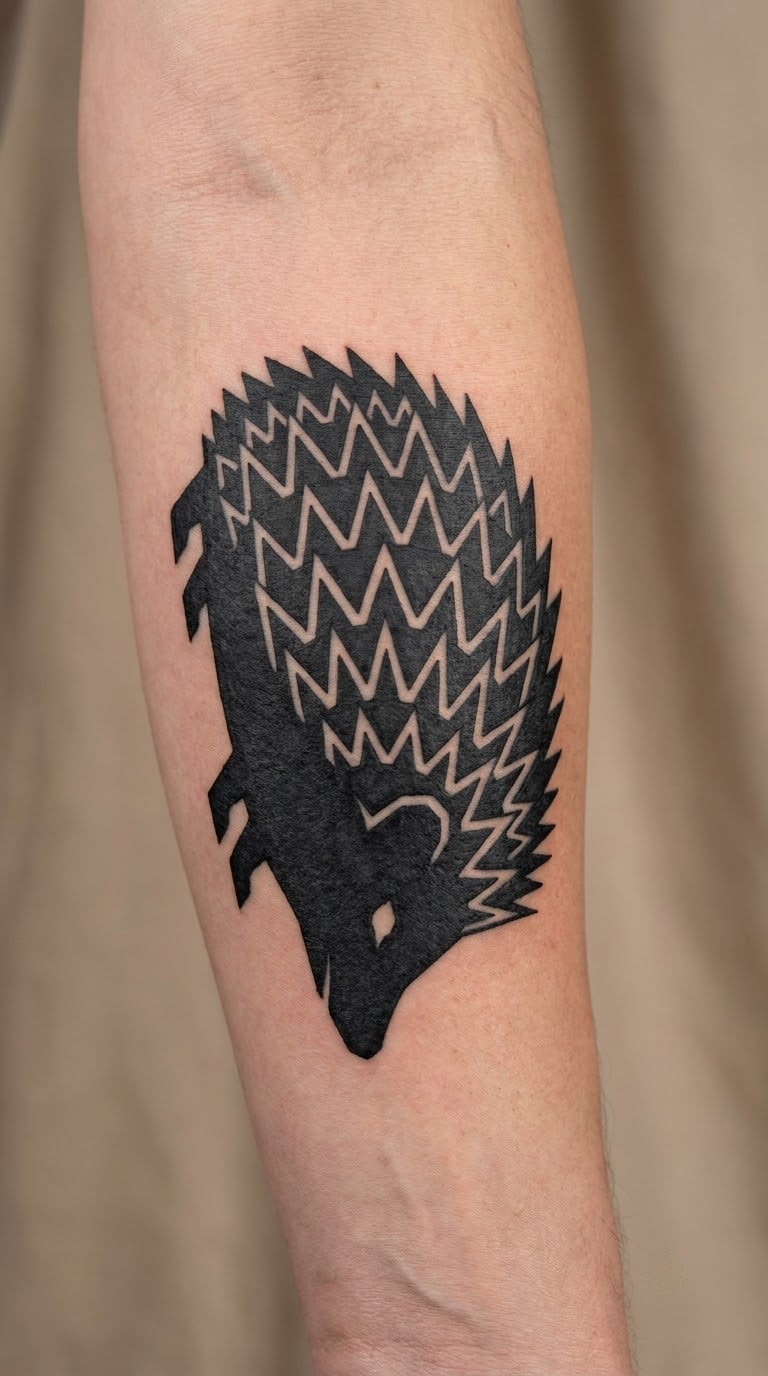
This is the loud end of the hedgehog tattoo ideas list. The body is filled solid black, the spines are dense triangles in overlapping rows, and the artist leaves controlled white gaps for the face and paw so the animal still reads. It has the weight of a traditional piece without the roses and banners, and it holds up well as a standalone statement.
Placement: forearm, upper arm, or centred on the chest. Size: 3.5 inches (9 cm) wide or larger. Style: blackwork. Pain: medium, and a forearm session with this much solid black can run long, so plan for breaks.
Make it yours: keep one small uninked spine as a gap in the pattern, and use that shape as a repeated motif in a later piece.
8. Cute Cartoon Hedgehog
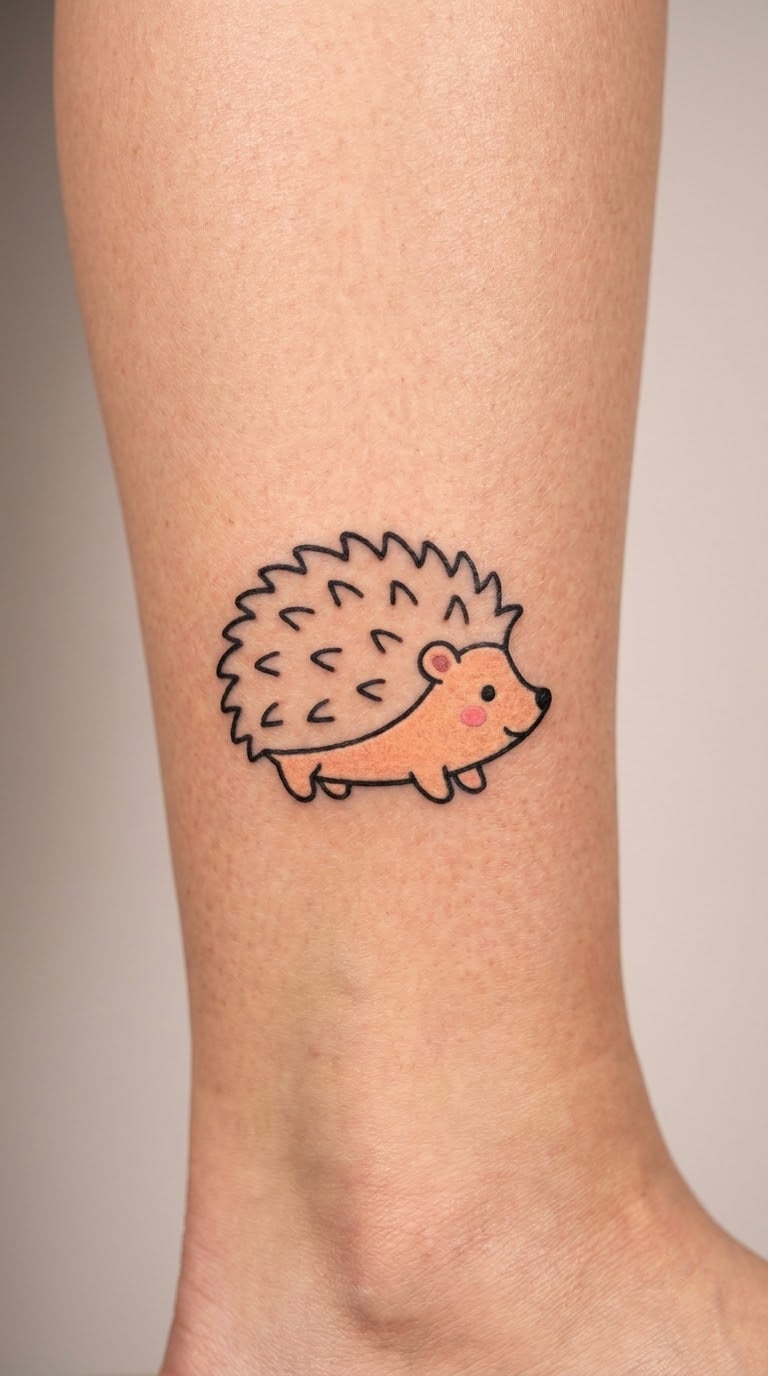
A cute cartoon hedgehog goes for rounded shapes rather than accuracy: a squat body, big eyes, spines drawn as neat half-circles like a chestnut, and a tiny smile. Warm skin tone with a blush on the cheek is the detail people react to most, but it is entirely optional. This is the design most first-time clients actually bring in a reference photo for.
Placement: lower calf, upper arm, or the back of the shoulder. Size: 2 inches (5 cm) wide. Style: cartoon with colour accents. Pain: low, the calf is one of the more forgiving spots. Colour fills need a touch-up but nothing dramatic.
Make it yours: name the hedgehog and let the artist give it one specific accessory, such as a scarf or a tiny leaf in its paw.
9. Hedgehog Peeking from a Leaf
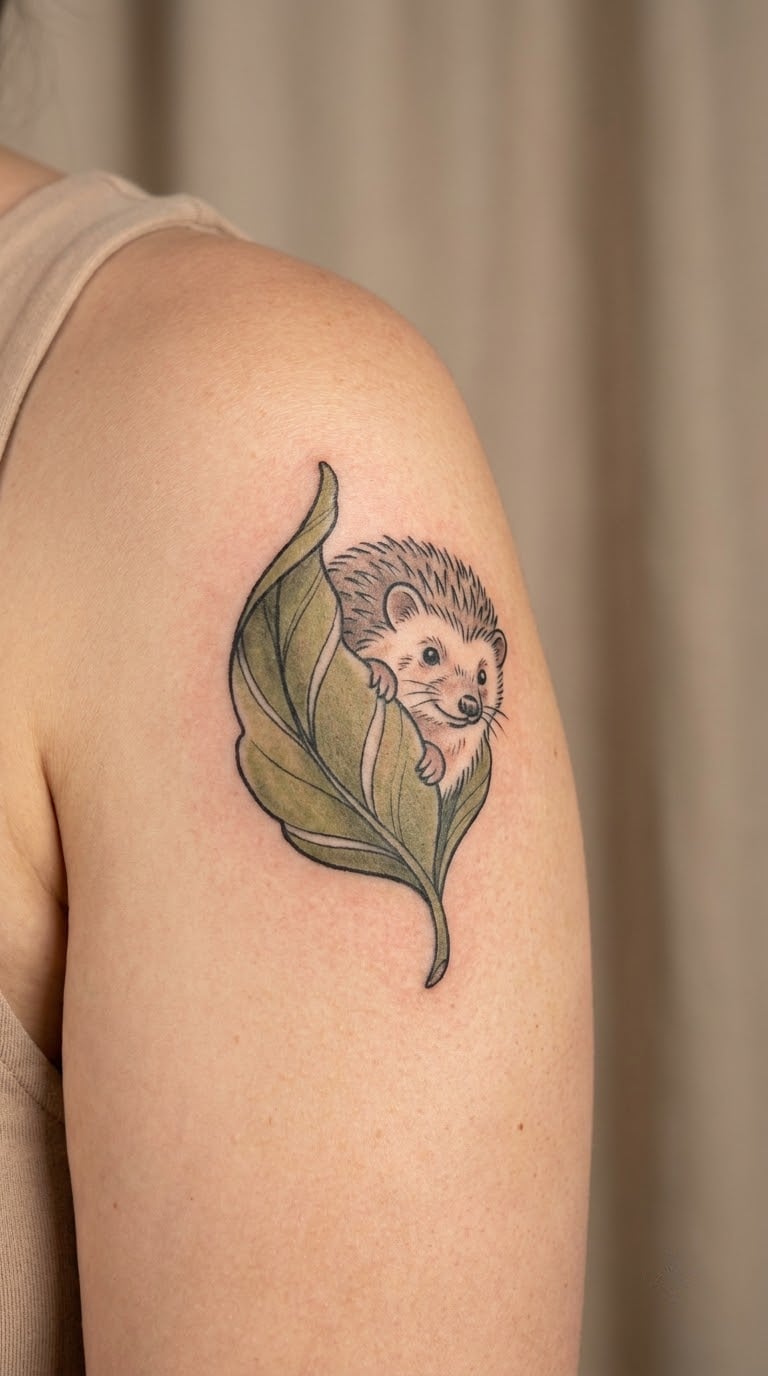
Peeking from a leaf gives the composition a frame, so the animal reads as discovered rather than displayed. The leaf is large and slightly curved, drawn in olive green with a visible central vein, and the hedgehog’s head and front paws come over its edge. A partial design like this is forgiving, because the leaf absorbs attention while the small face stays simple.
Placement: shoulder, upper back, or the outer thigh. Size: 3 inches (7.5 cm) across the whole piece. Style: illustrative. Pain: low on the shoulder and upper back. The leaf outline gives a natural excuse for spacing the ink, which helps long-term clarity.
Make it yours: run the leaf into a plant from your own garden, or add a second smaller leaf in a different green.
10. Realistic Hedgehog Portrait
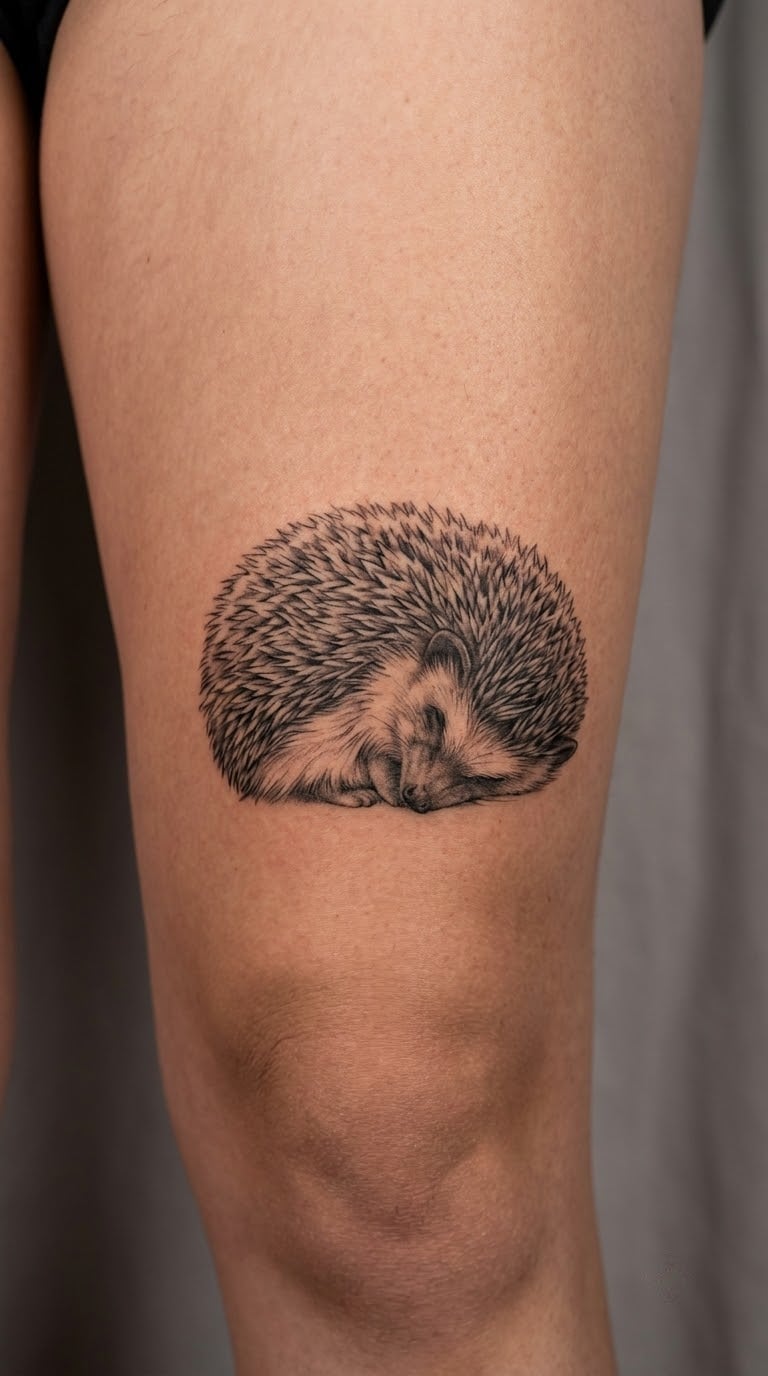
A realistic portrait layers thousands of tiny strokes: fur direction changes across the face, spines overlap in three or four depth planes, and the shading under the body gives it weight. It rewards a bigger canvas, because detail that works at 4 inches turns to grey mush at 1.5. The thigh is the classic home for this one, with plenty of flat surface to work on.
Placement: thigh, upper back, or the outer thigh above the knee. Size: 4 inches (10 cm) or more. Style: black and grey realism. Pain: medium, and greyscale shading means more passes, so budget a longer sitting and a break halfway.
Make it yours: bring a photograph of the hedgehog you want it based on, or of one you met in a garden, and let the artist work from that instead of a stock image.
11. Hedgehog in a Teacup
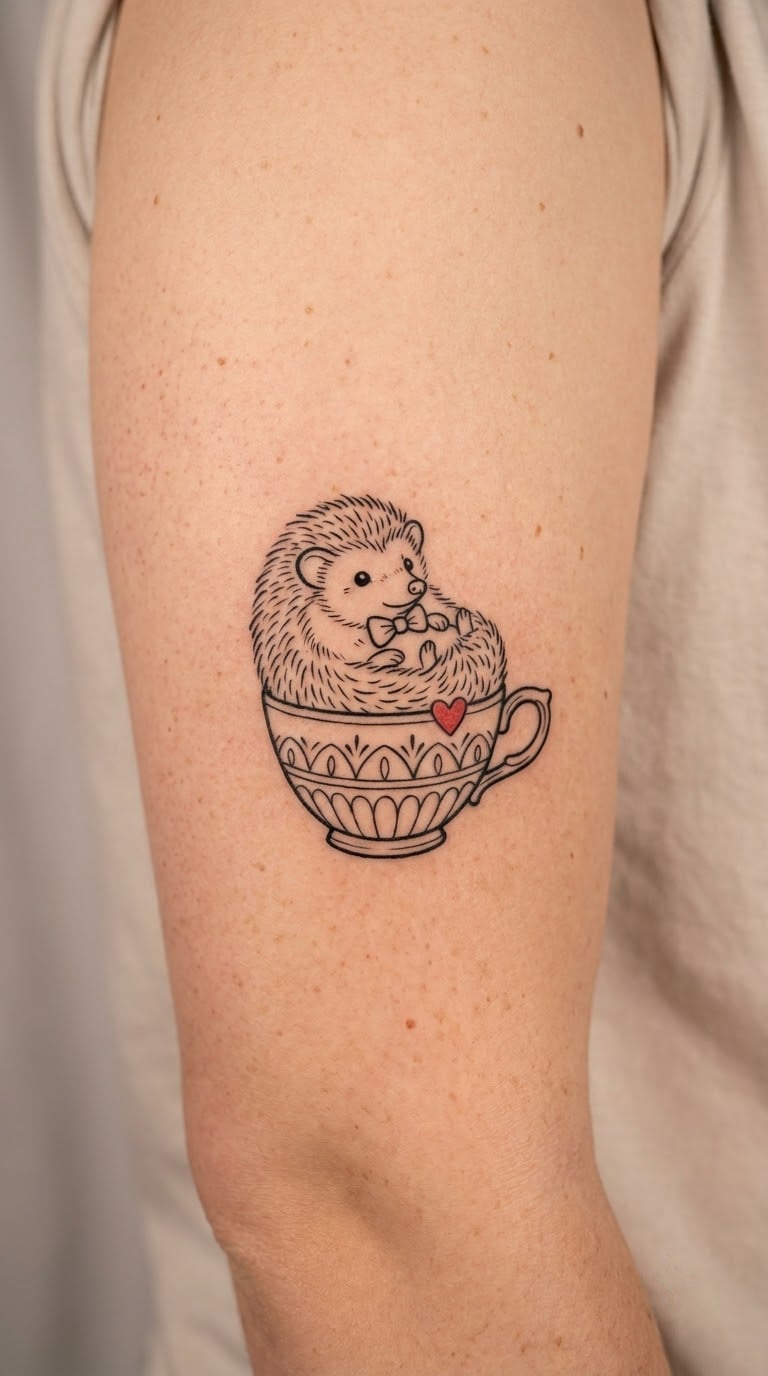
A hedgehog curled inside a teacup is a compact composition that solves the placement problem: the cup gives the piece a flat base, so it sits neatly on a curved surface like the shoulder or the side of the wrist. Steam curls up in two or three loose lines, and the animal is drawn small and round in the cup. It has become a reliable custom concept for anyone with a soft spot for British garden wildlife.
Placement: upper arm, shoulder, or inside the forearm. Size: 2.5 inches (6 cm) wide. Style: whimsical linework with a single colour accent. Pain: low to medium. Fine steam lines fade quickest in this design, so keep the cup outline heavier than the steam.
Make it yours: replace the steam with a place name or a short word, which turns the whole piece into a tribute to somewhere.
12. Dotwork Hedgehog
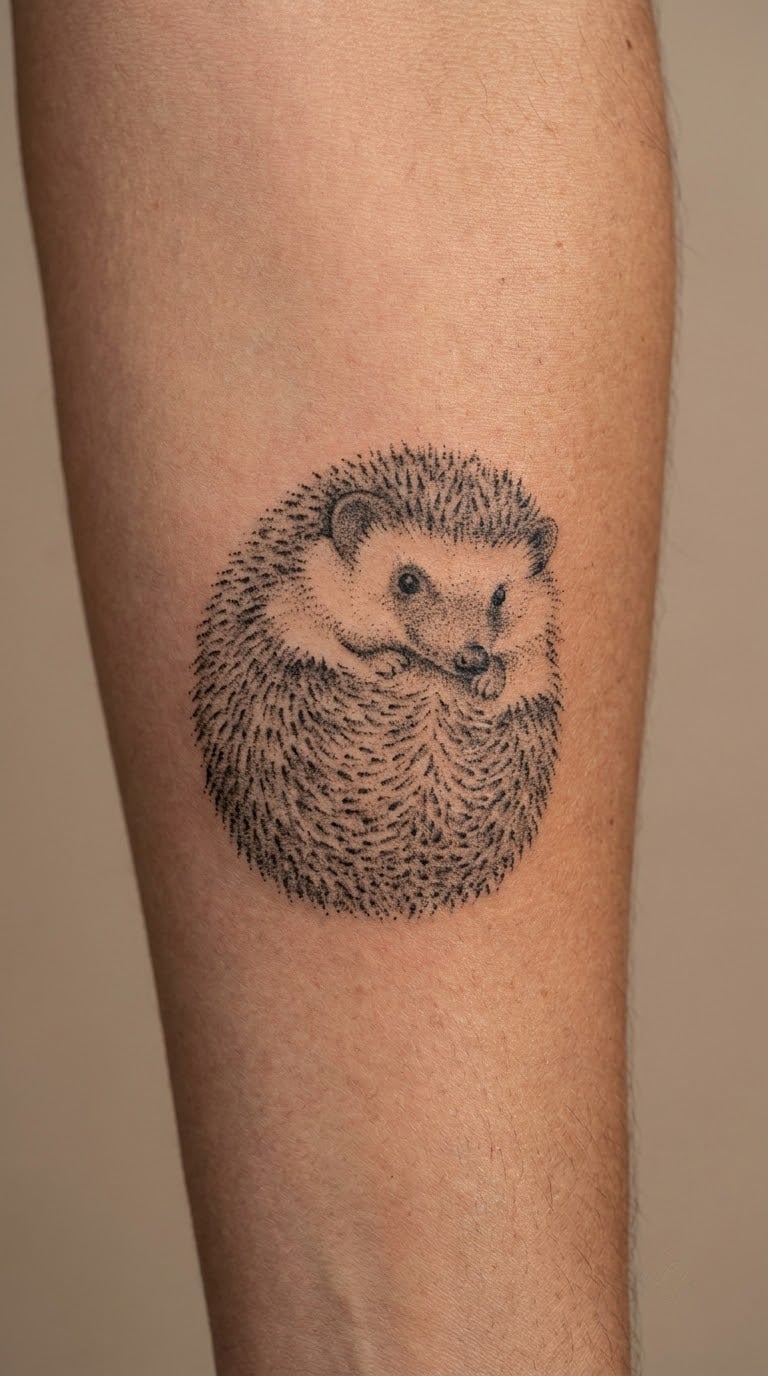
Dotwork builds the hedgehog from density rather than lines: tight dots for the shaded spines, medium dots for the face, and open skin for the highlight along the back. There is no outline at all, which is what makes it feel so different from a fine-line piece. It is also slow work, so expect the artist to change dots as they go to keep the gradient even.
Placement: forearm, upper arm, or the shoulder blade. Size: 2.25 inches (5.5 cm) wide. Style: dotwork and stippling. Pain: medium, because dotwork takes repeated passes over the same skin. Ageing note: dotwork ages better than thin lines, but sparse dot areas can disappear entirely after sun exposure.
Make it yours: let the dot pattern shift from dense to sparse across the spines, echoing a fade rather than a hard edge.
13. Minimal Hedgehog Spine Pattern
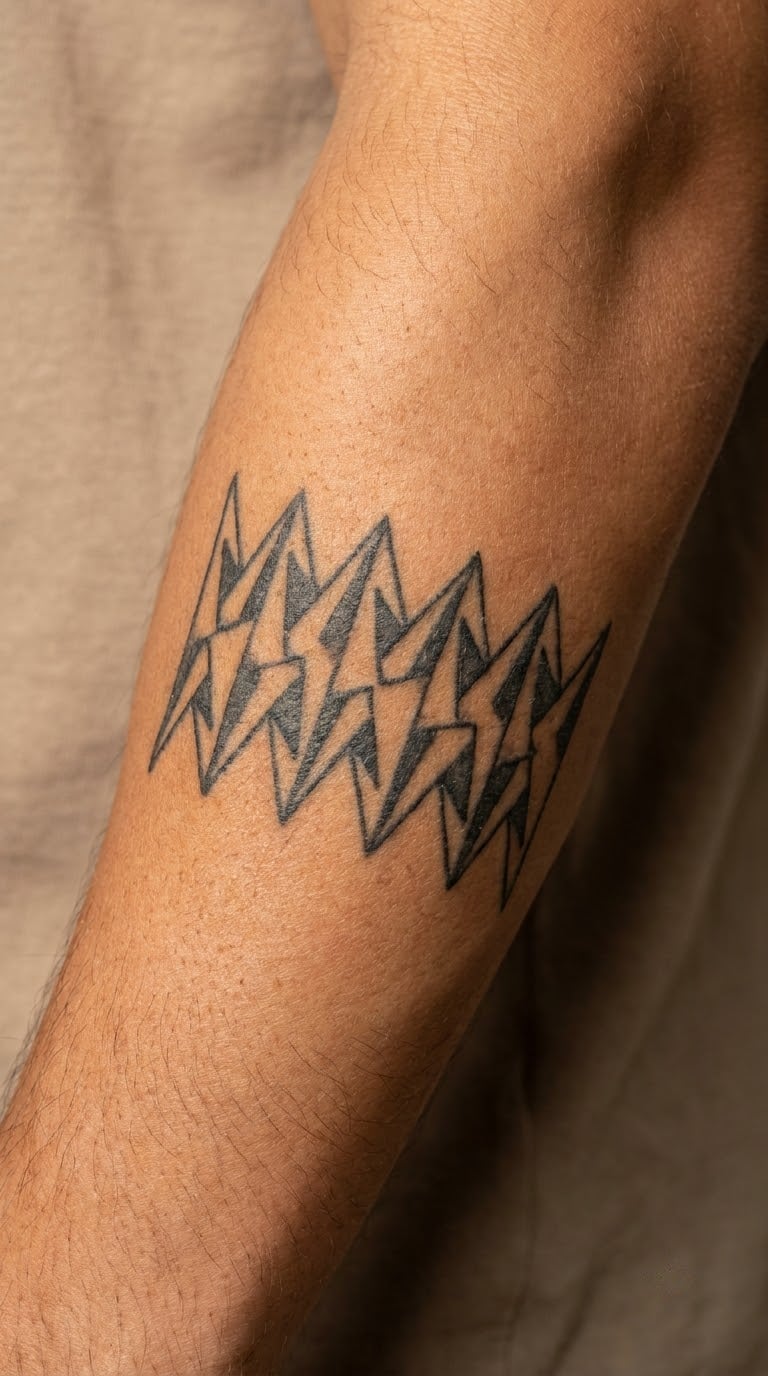
Some clients want the spines without the animal. A repeating pattern of hedgehog spine triangles, alternating size and pointing in a slow arc, fills a forearm band or the front of a calf without ever resolving into a full portrait. It works as the middle layer of a larger nature sleeve, and it is a good design for someone who likes geometry more than cuteness.
Placement: outer forearm, calf, or wrapped as a band above the ankle. Size: 4 by 2 inches (10 by 5 cm) for a small version, wider for a sleeve element. Style: minimal pattern. Pain: medium over the forearm, lower on the calf. Repetitive line work is easier on your body than freehand shading, though it takes time.
Make it yours: change the pattern spacing each year to mark something, or mirror the pattern on the other arm so the two read as a pair.
14. Traditional Rose and Hedgehog
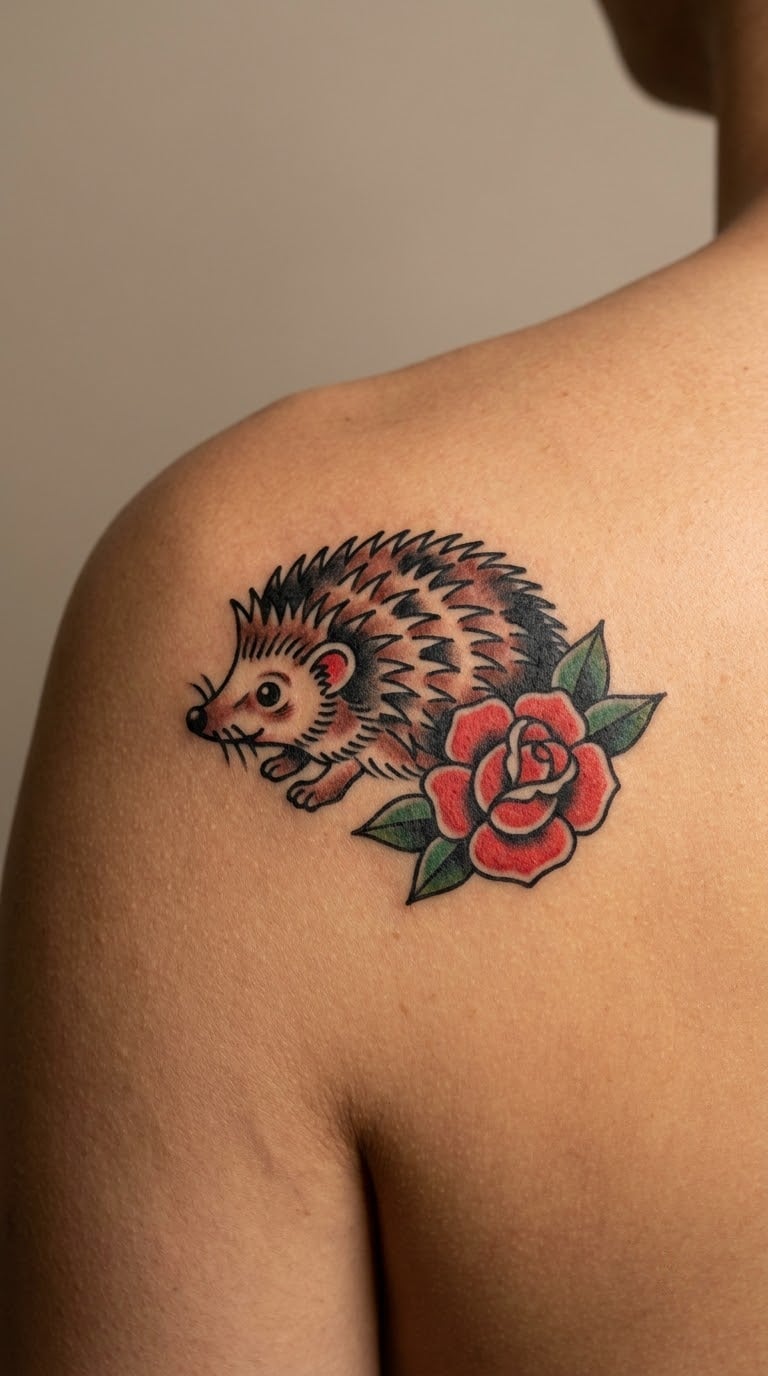
A traditional rose and hedgehog pairing is the boldest, most classic design here: heavy black outlines, a red rose with green leaves, and the hedgehog tucked beside it with outlined spines and a shaded body. Traditional work relies on clean bold lines and limited colour, which is exactly what keeps a spiky animal readable. It suits a shoulder or upper arm with room to breathe.
Placement: shoulder cap, upper arm, or the outer thigh. Size: 4 inches (10 cm) wide, 5 inches (13 cm) with the full rose. Style: traditional. Pain: medium, and colour packing on the rose adds time. Bold traditional linework holds its shape better than fine line, so it ages well if you keep it out of constant sun.
Make it yours: swap the rose for a thistle, a hawthorn branch or a national flower, and use your own colour palette rather than a standard red.
15. Moonlit Hedgehog
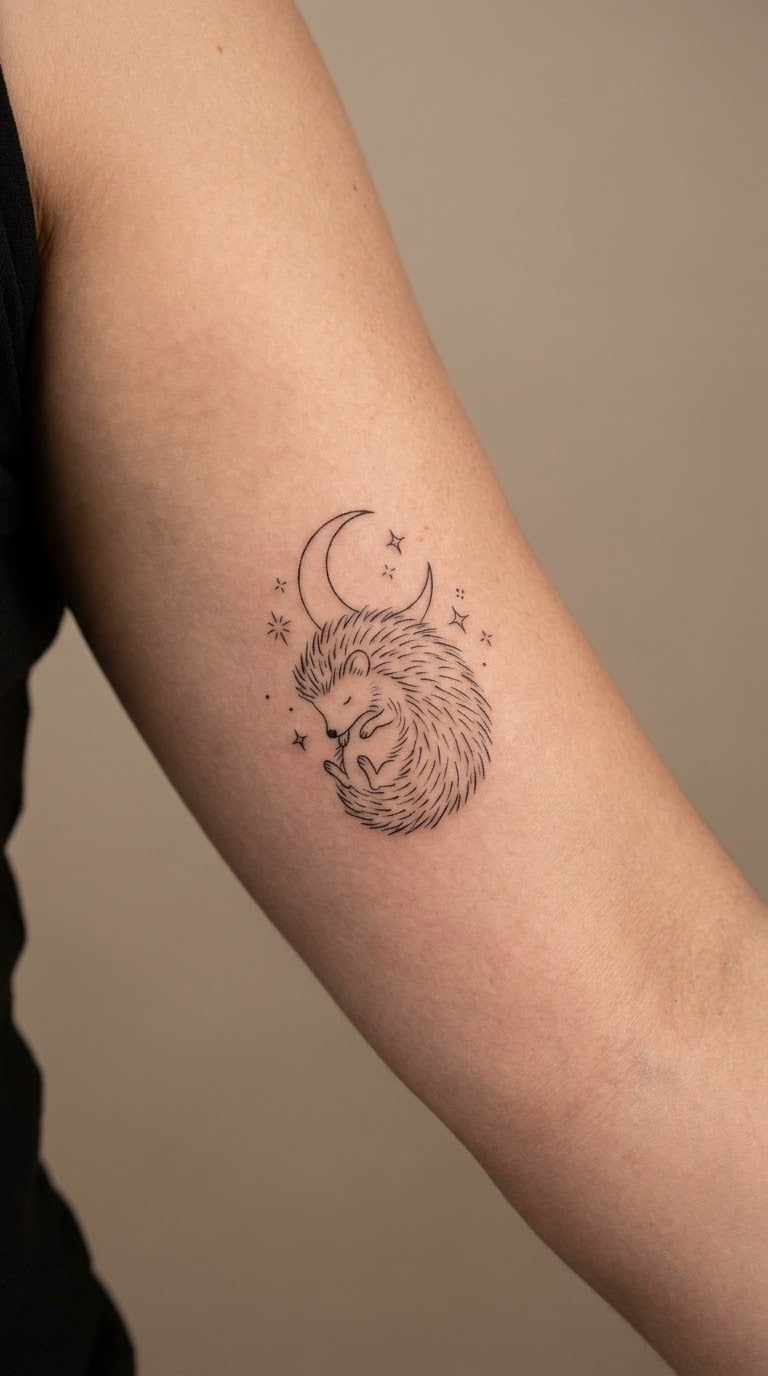
A moonlit hedgehog is a quiet composition: one crescent moon, a handful of four-point stars scattered in open skin, and a small hedgehog looking up from the bottom of the frame. Most of the design is empty space, which is what makes it feel calm rather than busy. It is a good fit for a night owl, and it pairs easily with a moon-heavy sleeve later.
Placement: outer upper arm, back of the shoulder, or the hip. Size: 2.75 inches (7 cm) wide. Style: fine line. Pain: low on the upper arm, medium on the hip. Ageing note: the smallest stars fill in or disappear within a few years, so keep only three or four and make them a touch larger.
Make it yours: use a real constellation above the hedgehog, or add a single shooting star with a short trail.
16. Hedgehog in a Pumpkin
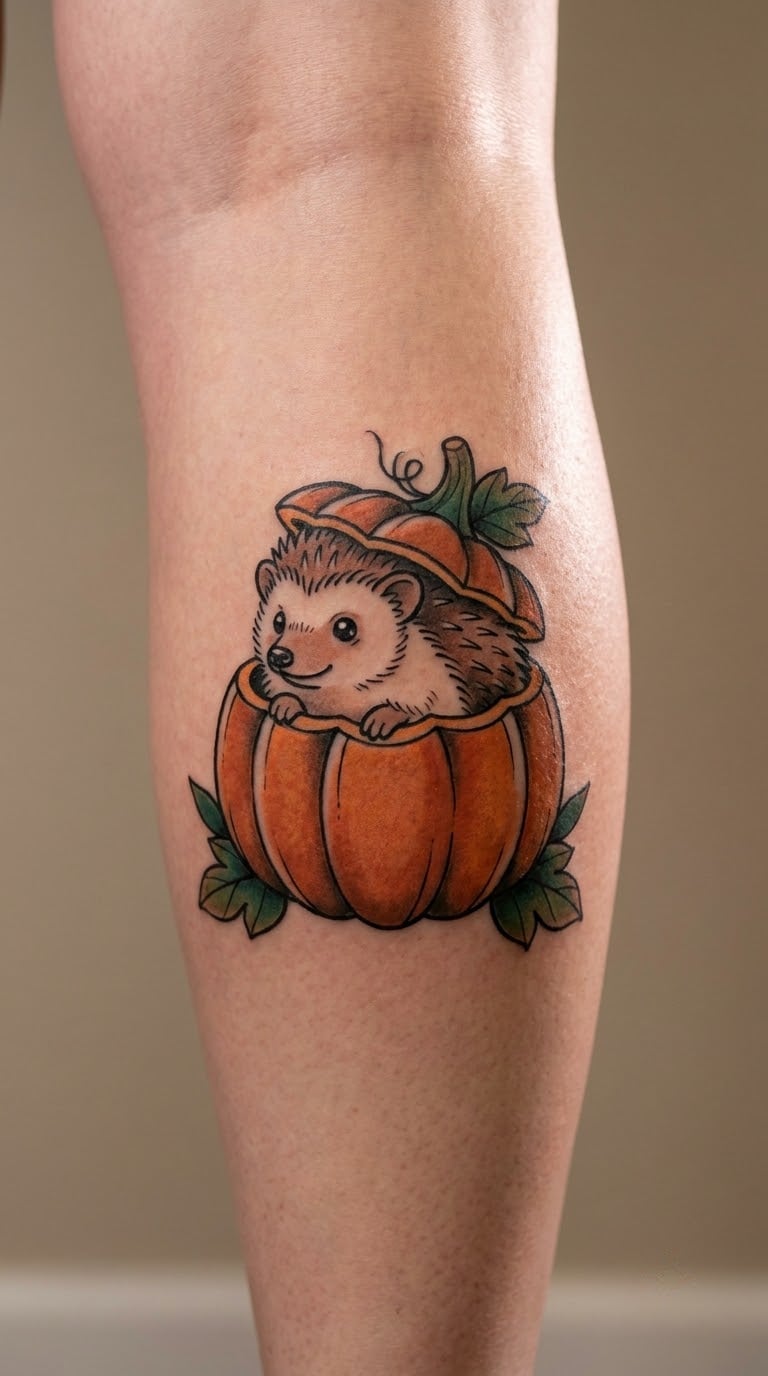
A hedgehog in a pumpkin is a seasonal design with a clean contour and a compact silhouette: the pumpkin gives a rounded base, the hedgehog sits in the opening with its paws on the rim, and a small green stem finishes the top. It works for autumn, for a Halloween group piece, or for someone who simply wants one very specific animal in one very specific gourd.
Placement: lower calf, ankle, or the back of the upper arm. Size: 2.25 inches (5.5 cm) wide. Style: cartoon linework with orange and green. Pain: low, the calf and ankle are both forgiving, though the ankle bone itself is tender. Orange fades toward yellow over time, so plan on a refresh if the colour matters to you.
Make it yours: add a year in the pumpkin’s curve, or repeat the hedgehog in a pumpkin for every member of a group.
17. Micro Hedgehog Behind the Ear
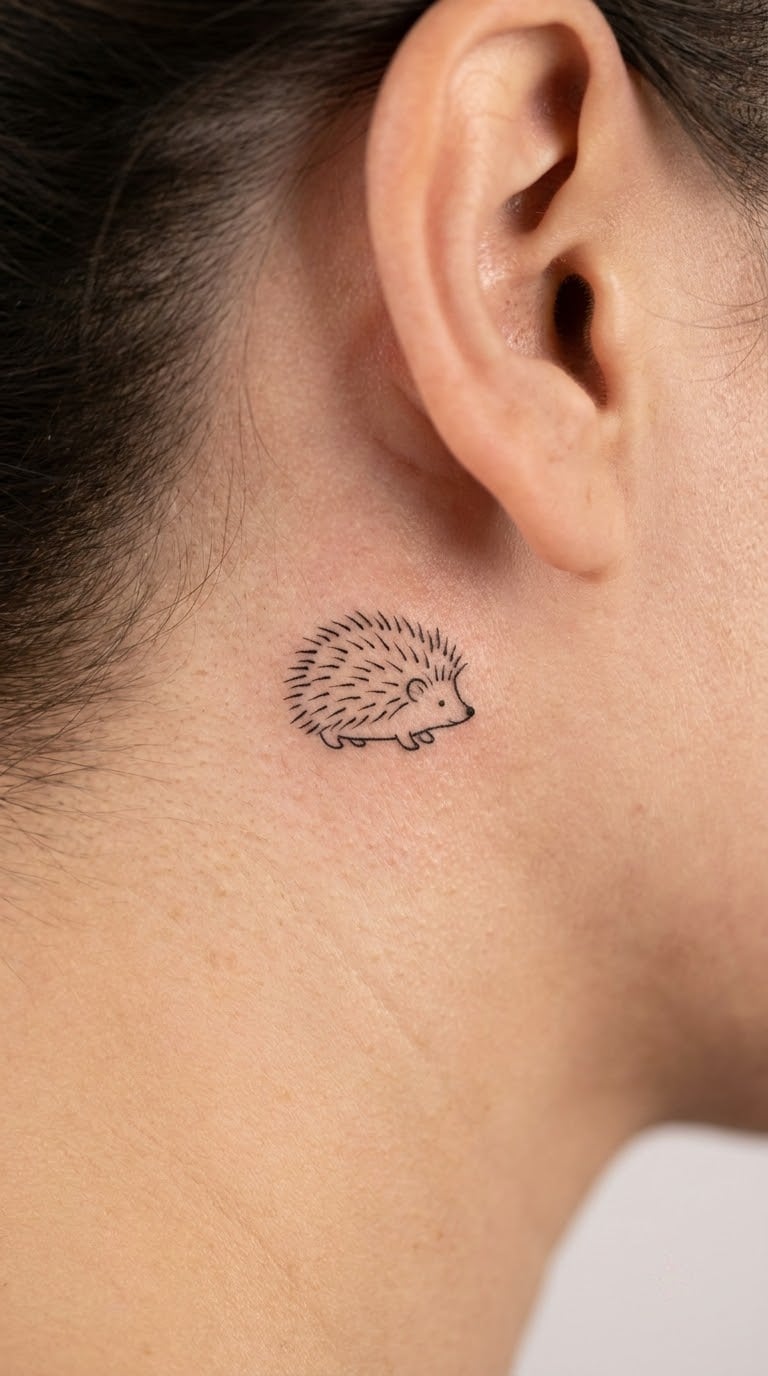
A micro hedgehog behind the ear is the most discreet option in the whole gallery. At 1 inch wide, the design can only carry a rounded body, short spines and a small ear, so your artist has to be economical. It sits in the dip behind the ear where skin is thin and mostly hidden, which is why it stays quiet. Hair length changes how much of it you actually see.
Placement: directly behind the ear, or the small hollow just below the earlobe. Size: 1 inch (2.5 cm) wide. Style: micro fine line. Pain: low, though the area is twitchy and most people find it hard to sit still. Ageing note: at this scale, expect the spines to soften into a general texture within about five years.
Make it yours: mirror it with a matching micro animal behind the other ear, done on the same day so the line weight matches.
18. Floral Hedgehog Sleeve Element
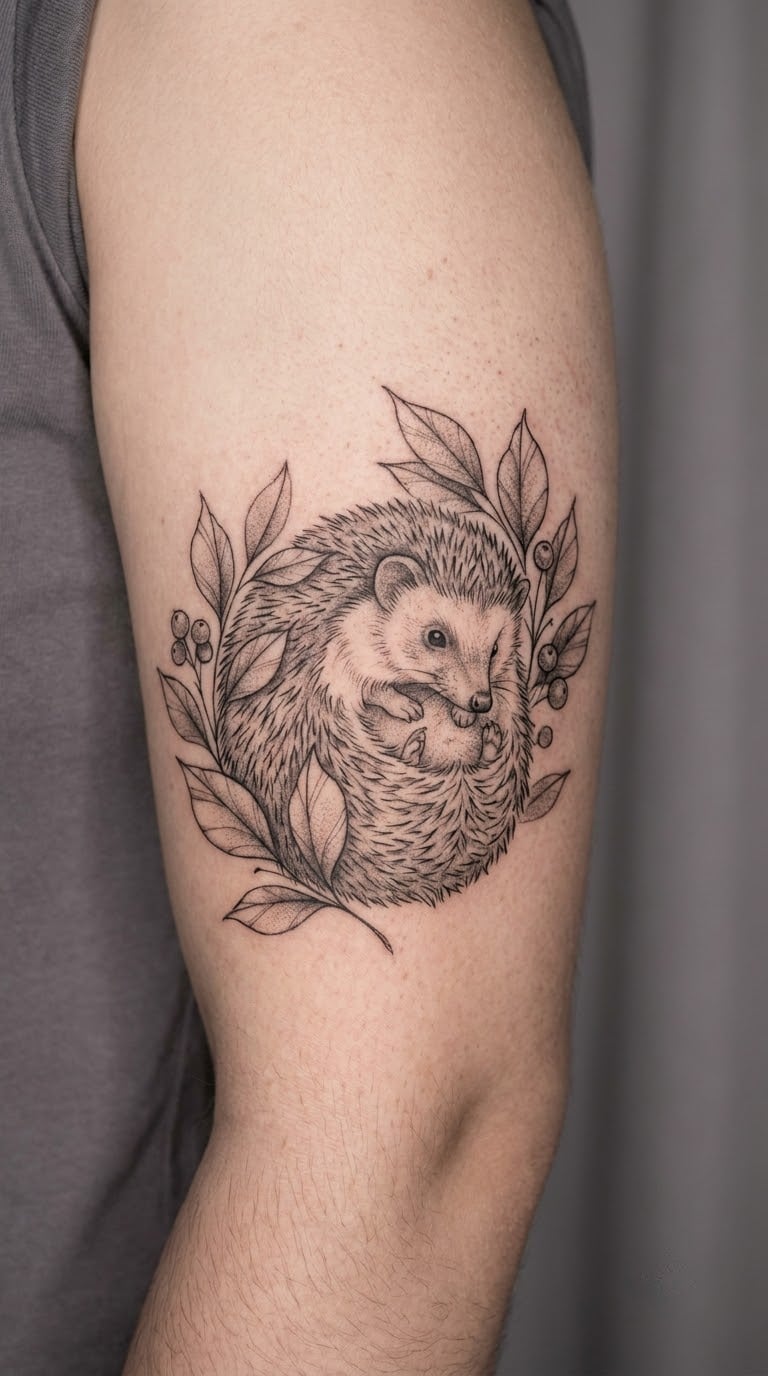
This is the element to design first if you are building a botanical sleeve. The hedgehog sits centred, drawn in black and grey with layered spines, and it is surrounded by leaves, small berries and flowers that wrap around the body to fill the curve of the arm. Because the animal is the focal point, the botanical work is kept slightly lighter so the eye lands on the face first.
Placement: upper arm for a sleeve, outer thigh, or the lower back. Size: 4.5 inches (11 cm) wide as a standalone piece. Style: black and grey illustrative. Pain: medium, and grey shading across that much area usually needs two sessions.
Make it yours: plan the full plant list before the first sitting so new pieces match the existing weight and scale rather than being tacked on.
19. Geometric Heart and Hedgehog
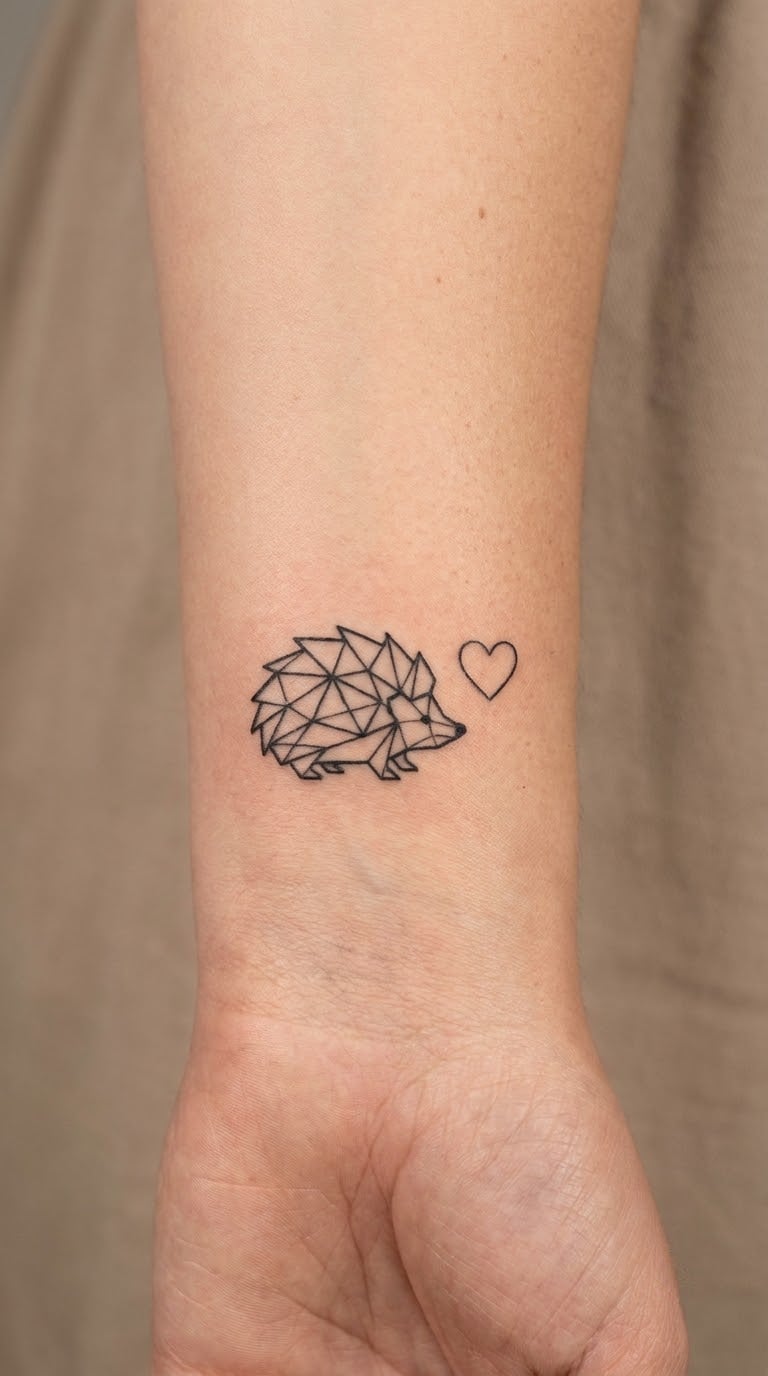
A geometric heart and hedgehog pairs a small faceted hedgehog with a plain heart outline, spaced so both shapes read at a glance without crowding each other. The hedgehog is built from a few triangular facets and the heart is a single clean line, which keeps the total weight low. It is a small, meaningful design rather than a symbolic statement, and that suits people who want a companion piece.
Placement: inside the wrist, the ankle, or the inner arm near the elbow. Size: 2 inches (5 cm) across both shapes. Style: geometric linework. Pain: medium on the inner wrist, low at the ankle. Fine work on the wrist fades faster than the same design on an arm, so ask for a slightly heavier line.
Make it yours: connect the heart and the hedgehog with a single thin line, or engrave a date inside the heart in a very small script.
20. Full-Color Garden Hedgehog
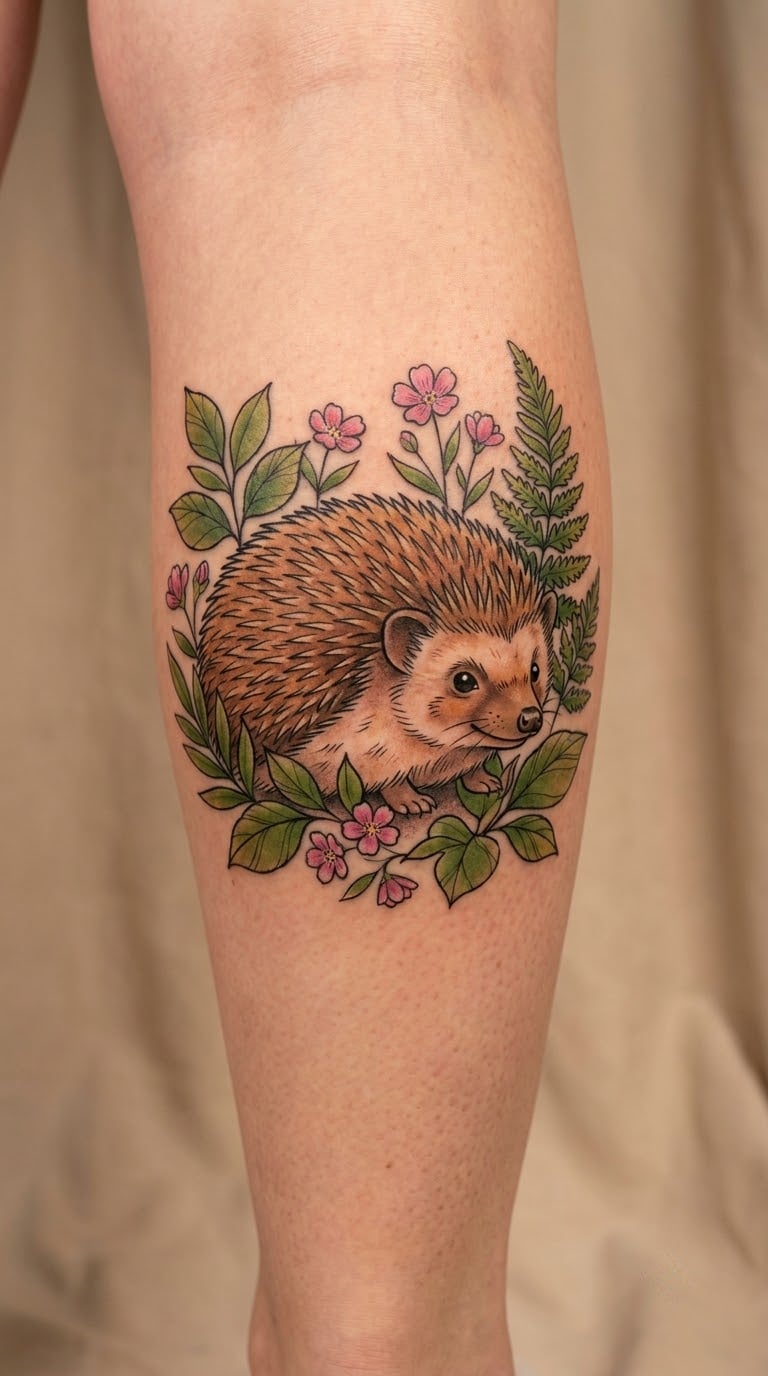
The full-colour garden hedgehog is the most ambitious design here. The spines are built from layered warm browns, ochres and blacks, and the animal sits in a bed of green foliage with pink and yellow flowers around it. Colour gives the piece depth that no amount of line work can, and it rewards a larger canvas because every new colour needs its own space.
Placement: calf, thigh, or the back of the upper arm. Size: 5 inches (12.5 cm) wide, and expect two sessions for a piece this colour-dense. Style: illustrative colour. Pain: medium, and the calf is the kinder of those placements for a long sitting.
Make it yours: bring your own garden or meadow reference and choose three to four colours only, which keeps a colourful piece from turning noisy.
How to Choose the Right Design
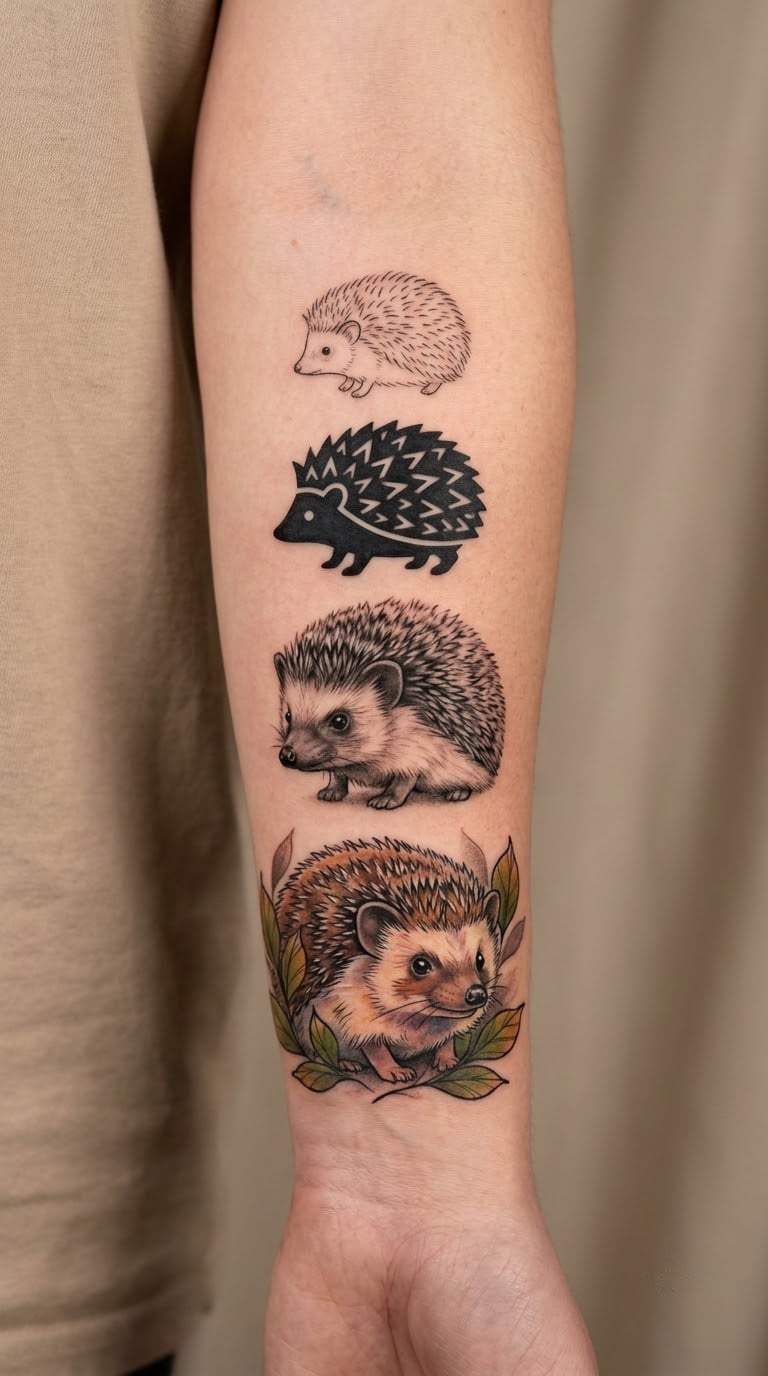
Pick the detail level before the placement. Fine line needs the most space between strokes to survive, blackwork tolerates tight spacing, and realism needs a canvas big enough to hold the shading. Choosing placement first often means scaling the design up, which is the change clients are happiest with.
For hedgehog tattoo ideas specifically, here is the order I would work through:
- Micro fine line (1 to 1.5 in): curled or sleeping animal only, no props, no shading. Under a 1 inch width the spines turn to mush, so this is the practical floor.
- Fine line (1.75 to 2.5 in): room for a leaf, an acorn or a moon. Good for a first tattoo, and easy to hide at work depending on the season.
- Geometric or dotwork (2 to 3 in): structure carries the image, so these hold their shape longer and suit a sleeve that will grow over the years.
- Blackwork or traditional (3 to 4.5 in): the boldest statement options, and the safest if you are unsure how your fine lines will age.
- Realistic or full colour (4 in and up): the best detail, the longest sessions, and the placement that needs the flattest skin you can find.
Two more practical checks. Think about what is already on your body: a small animal reads better with breathing room than squeezed between two busy pieces. And think about visibility honestly, because a design you only ever see in a mirror is a different commitment from one your colleagues see every Monday.
If your taste leans toward simple animal silhouettes rather than detail, 20 Best Cat Silhouette Tattoo Ideas for Minimalists works in the same minimal register and reads well at similar sizes.
Cost and Session Time
Tattoo pricing in the US usually follows size and time rather than a fixed price per design. A small simple hedgehog at 1 to 1.5 inches typically lands somewhere around 120 to 200 US dollars, and takes 30 to 60 minutes. Expect to add the shop minimum, which many studios set in the 50 to 150 dollar range regardless of how small the piece is.
A mid-size design at 2.5 to 3 inches usually runs 200 to 400 US dollars and takes one to two hours. Realistic and full-colour pieces at 4 inches and above commonly sit between 400 and 800 US dollars, and a dense colour piece can take three sessions. A first tattoo in this range is more expensive than it looks because a straightforward custom drawing takes longer than a flash sheet design.
Shop minimums, artist hourly rates, city and detail level all move the final number, so the range above is a starting point rather than a quote. Book a consultation first, where the cost of the drawing is usually credited toward the final tattoo.
Aftercare Basics
Follow your artist’s aftercare instructions first, since advice varies with the style and the skin. As a general baseline for a small animal tattoo like these:
- Keep it clean, and wash gently with unscented soap and lukewarm water twice a day for the first few days.
- Pat dry with a clean towel or paper, and let it air dry rather than rubbing it.
- Apply a thin layer of the ointment or aftercare balm your artist recommends, and avoid thick occlusive products unless they tell you to.
- Leave any scabs alone. Picking them is the fastest route to patchy line work and colour drop.
- Keep the area out of direct sun while it is fresh, and cover it in swimming pools and hot tubs until it has healed.
- Once healed, wear sunscreen on exposed placements like the forearm and calf, because UV fades line work and light colour faster than black.
Hedgehog spines are the first thing to blur, since fine radiating lines sit close together. A piece booked in 2026 will still be around in a decade, so ask your artist for wider spine spacing now rather than a touch-up later.
Frequently Asked Questions
What is the meaning of a hedgehog tattoo?
A hedgehog tattoo most often stands for protection, self-reliance and boundaries, because the animal curls into a spiny ball when threatened. People also choose it for intelligence and caution, since hedgehogs are known for foraging cleverly. Designs that add flowers, an apple or a leaf shift the meaning towards growth, new beginnings and a happy, settled life.
Where is the best placement for a small hedgehog tattoo?
The inner forearm and the outer upper arm are the easiest flat surfaces for a small hedgehog, and both hide well under a sleeve. The inner wrist and ankle read clearly but fade faster and sit over bone. The thigh gives the most room for a larger piece with almost no downside except visibility in summer.
How small can a hedgehog tattoo go?
One inch is the realistic floor, and even then the design has to be reduced to a rounded body and a few short spines. Between one and 1.5 inches you can keep a face and a simple curve. Below one inch, spines merge into a solid mark within a year or two, so most artists will talk you into a slightly larger version.
Do fine line hedgehog spines blur together over time?
They do, especially on the inner wrist, the ankle and anywhere with frequent sun exposure. The reason is spacing, not skill, so the fix is design-level: fewer spines, wider gaps, and slightly heavier line weight than looks comfortable in a drawing. Dotwork and blackwork versions of the same animal hold their shape noticeably longer.
Can a hedgehog tattoo include a name or a place?
Yes, and it is one of the most requested custom versions, usually as small script tucked into the spines, under a leaf, or curved through steam rising from a teacup. Keep lettering no smaller than a few millimetres tall and ask the artist to test the size in ink first, since small script fades faster than the animal around it.
How much does a small hedgehog tattoo cost and how long does it take?
In the US, a simple 1 to 1.5 inch hedgehog usually takes 30 to 60 minutes and costs roughly 120 to 200 US dollars, before the shop minimum. Mid-size designs at 2.5 to 3 inches tend to take one to two hours, and realistic or full-colour pieces at 4 inches and above often need two or three sessions.
Conclusion
If this is your first tattoo, start at number 2 or number 6. A tiny sleeping hedgehog or a minimal line-art design heals predictably, sits under a sleeve, and costs you less than a portrait you are not ready to sit through.
If you already have animals and are building a collection, go bolder: number 13 for a forearm pattern, number 18 for a sleeve element, or number 4 if you like graphic work over cute work. Bring your references to the consultation, talk through spine spacing early, and let the artist adjust the design to the skin you actually have.