
24 Best Planet Tattoo Ideas for Women: Simple (October 2026)
Planet tattoo ideas for women usually come down to one of three things: a small piece that fits anywhere, a single planet rendered beautifully, or a bigger composition that takes a whole area. This list covers all three, with 24 designs that come up again and again, each one described plainly so you can picture it on skin before you sit down with an artist.
What makes a planet design actually work on a body is simpler than most galleries suggest. Line weight has to hold at the size you pick, the shading has to suit the skin underneath it, and the placement has to match how often you will see it. Get those three right and a small ringed planet looks intentional instead of unfinished.
If you are starting from scratch, it also helps to know the range before you fall for one image. I have broken these into a quick comparison table, then walked through every design with its real size, its honest pain level and one way to make it personal. Popularity is no guarantee, so the table is organised in the same order as the list rather than as a ranking.
Planet Tattoo Ideas for Women: Quick Guide
Here is the whole collection at a glance. The same 24 designs run in the same order below, so you can jump straight to the one that fits your placement and pain tolerance.
| Idea | Style | Best placement | Size | Pain |
|---|---|---|---|---|
| 1. Fine-line crescent and planet | Fine line | Inner forearm | 2.5-3.5 inch | Low to medium |
| 2. Minimal ringed planet outline | Minimal line art | Inner wrist | 1.5-2 inch | Medium |
| 3. Crescent with micro starbursts | Fine line | Collarbone | 2-3 inch | Medium |
| 4. Watercolor Jupiter | Watercolor | Shoulder | 4-6 inch | Medium to high |
| 5. Blackwork Saturn | Blackwork | Outer upper arm | 3.5-5 inch | Medium |
| 6. Realistic Earth in black and grey | Micro-realism | Forearm | 2.5-3.5 inch | Low to medium |
| 7. Tiny Mars dot | Minimal realism | Finger, near knuckle | 0.4-0.7 inch | High |
| 8. Geometric solar system diagram | Geometric line art | Forearm | 4-6 inch | Medium |
| 9. Celestial planet sleeve preview | Fine line and black grey | Outer forearm | 5-7 inch | Medium |
| 10. Sun with planetary rings | Fine line | Upper chest | 3.5-5 inch | High |
| 11. Moon phase and Saturn arc | Fine line | Rib or hip | 4-6 inch | High |
| 12. Dotwork planet cluster | Dotwork | Shoulder blade | 3.5-5 inch | Medium to high |
| 13. Neon-colored Jupiter | Color realism | Outer thigh | 5-7 inch | Medium to high |
| 14. Retro atomic planet | Traditional accent | Upper arm | 3-4 inch | Medium |
| 15. Micro Neptune symbol | Micro fine line | Behind the ear | 1-1.5 inch | Medium to high |
| 16. Planet and rose combination | Fine line botanical | Rib | 3.5-4.5 inch | High |
| 17. Black-grey moon close-up | Realism, black and grey | Calf | 4-6 inch | Medium |
| 18. Line-art solar system forearm | Single line art | Inner forearm | 4-6 inch | Low to medium |
| 19. Planet with botanical orbit | Fine line with color accent | Hip | 3-4 inch | Medium to high |
| 20. Gothic Saturn with ornamental frame | Blackwork ornamental | Upper back or chest | 5-7 inch | High |
| 21. Pastel nebula planet | Watercolor | Side thigh | 5-7 inch | Medium |
| 22. Minimal planet constellation | Fine line | Shoulder | 2.5-4 inch | Medium |
| 23. Planet phases matching set | Fine line | Wrist or ankle | 0.8-1.2 inch each | Medium |
| 24. Celestial map with coordinates | Fine line and dotwork | Upper back | 6-8 inch | Medium to high |
1. Fine-Line Crescent Moon and Planet
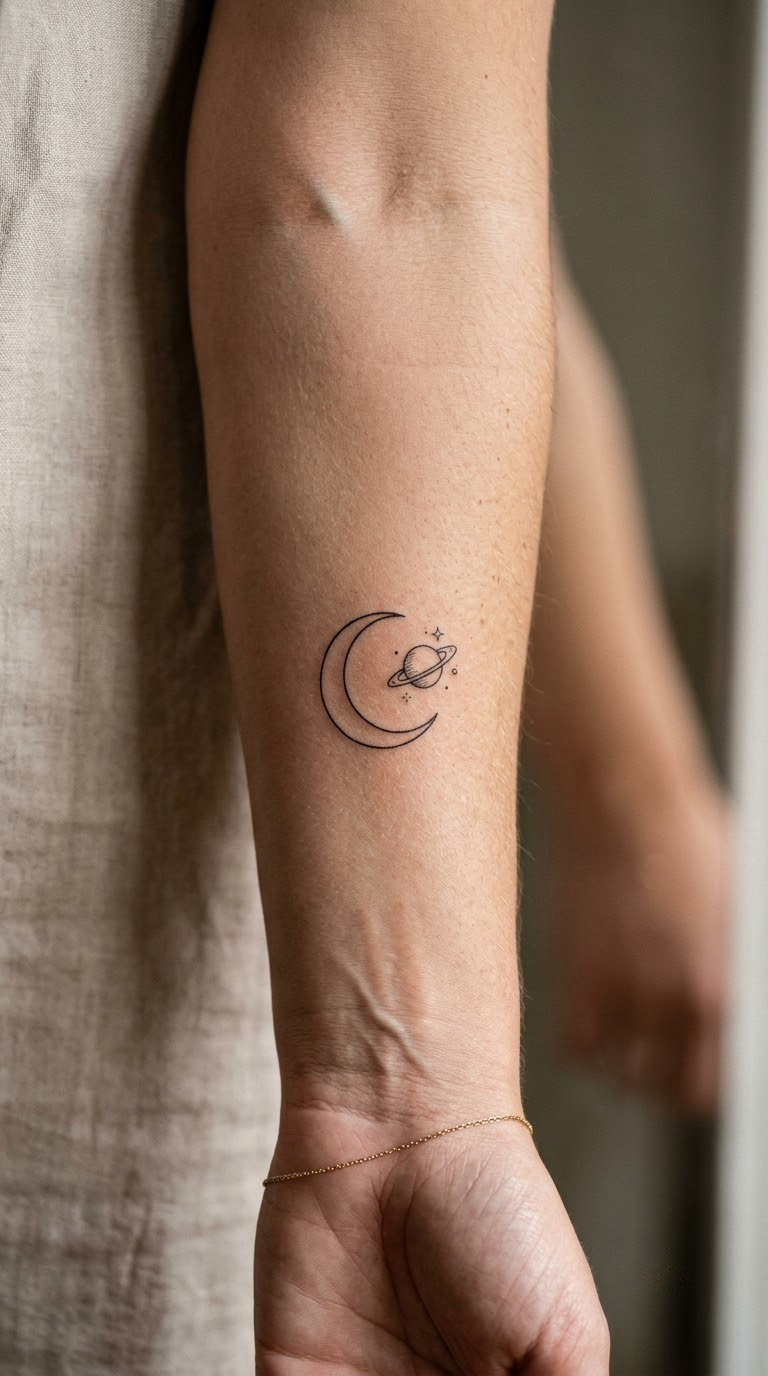
This is a thin black crescent paired with a small ringed planet sitting in the empty curve, drawn in one consistent needle weight. Most of the work is line, which is exactly why it photographs well and heals predictably on a forearm.
People usually choose it for what the pair means: change and cycles sitting next to something steady. Plenty of clients pick Saturn for the small planet and a waxing crescent for the growth-and-becoming reading, but the design works whatever you put in that space.
Placement: inner forearm, inner upper arm or behind the ear. Size: 2.5 to 3.5 inches (6 to 9 cm) across. Style: fine line, single-needle. Pain: low to medium, since the inner forearm is fleshy rather than bony.
Fine line on the inner forearm softens faster than most people expect, so ask your artist for a slightly heavier line than the reference image shows. Make it yours: place the planet where a birth chart places your sun, and the design becomes a chart fragment rather than decoration. If you are building a set around this look, our fine line tattoo ideas for women cover the line weights that actually hold up.
2. Minimal Ringed Planet Outline
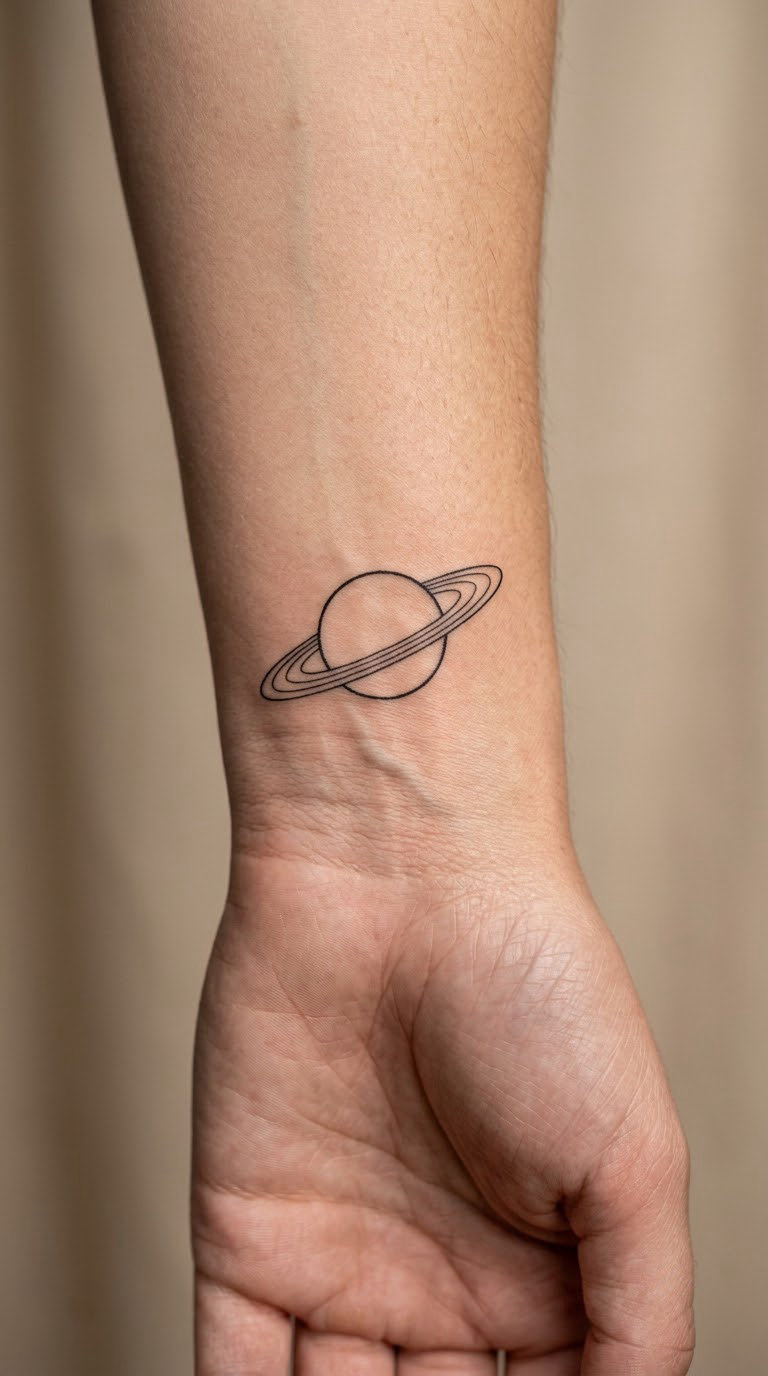
One planet, one clean outline, two thin ring lines passing behind the body and continuing in front. There is no shading and no background, which makes it a genuinely discreet first tattoo and the easiest design here to add to later.
Saturn is the most requested single planet in this space, usually because the rings give you a shape that reads clearly at tiny sizes. Clients tend to describe it as a marker for discipline, boundaries or a long project they are finishing.
Placement: inner wrist, outer wrist or the ankle bone. Size: 1.5 to 2 inches (4 to 5 cm). Style: minimal line art. Pain: medium, mostly from the wrist bone and the wrist’s thin skin.
The thin ring lines are the part that softens first, so ask for rings at least a shade heavier than the planet outline. Make it yours: place it on the wrist you wear a watch on, and the ring lines follow the band of the watch strap neatly.
3. Crescent Moon with Micro Starbursts
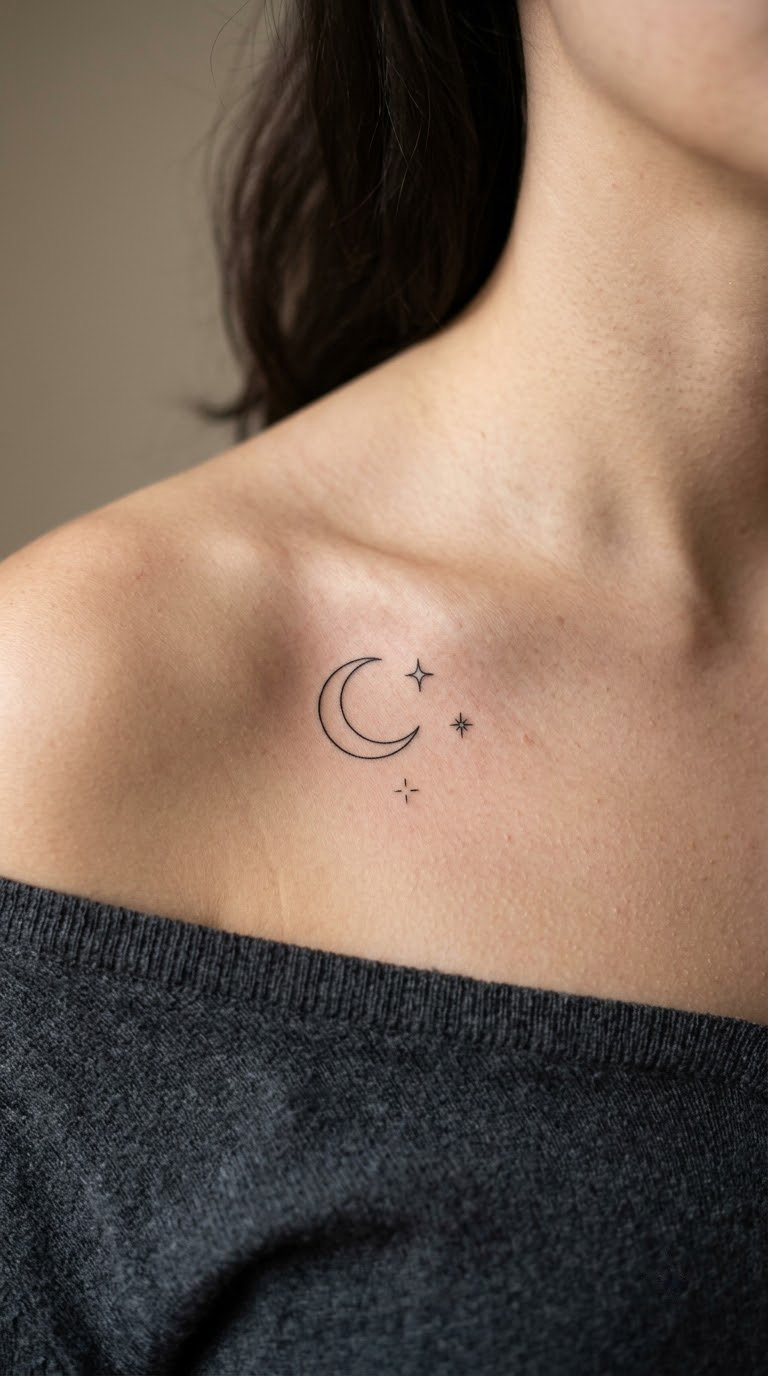
A fine-line crescent sits at the centre with three or four tiny four-point starbursts scattered around it at uneven distances. The uneven spacing is what makes it look hand-drawn instead of clip-art.
Moon phase tattoos carry the most personal symbolism in this category, because each phase is a stage rather than a fixed idea. Clients who ask for a waxing crescent are usually describing something that is growing but not finished, and the small planets add a sense of scale to it.
Placement: collarbone, wrist, behind the ear or the sternum. Size: 2 to 3 inches (5 to 8 cm). Style: fine line with micro detailing. Pain: medium, and the collarbone sits in the middle rather than at either end.
Starbursts under a quarter inch can close up during healing, so ask for them slightly larger than the reference. Make it yours: space the starbursts unevenly and let one fall below the crescent, which breaks the symmetry and suits the shape better.
4. Watercolor Jupiter
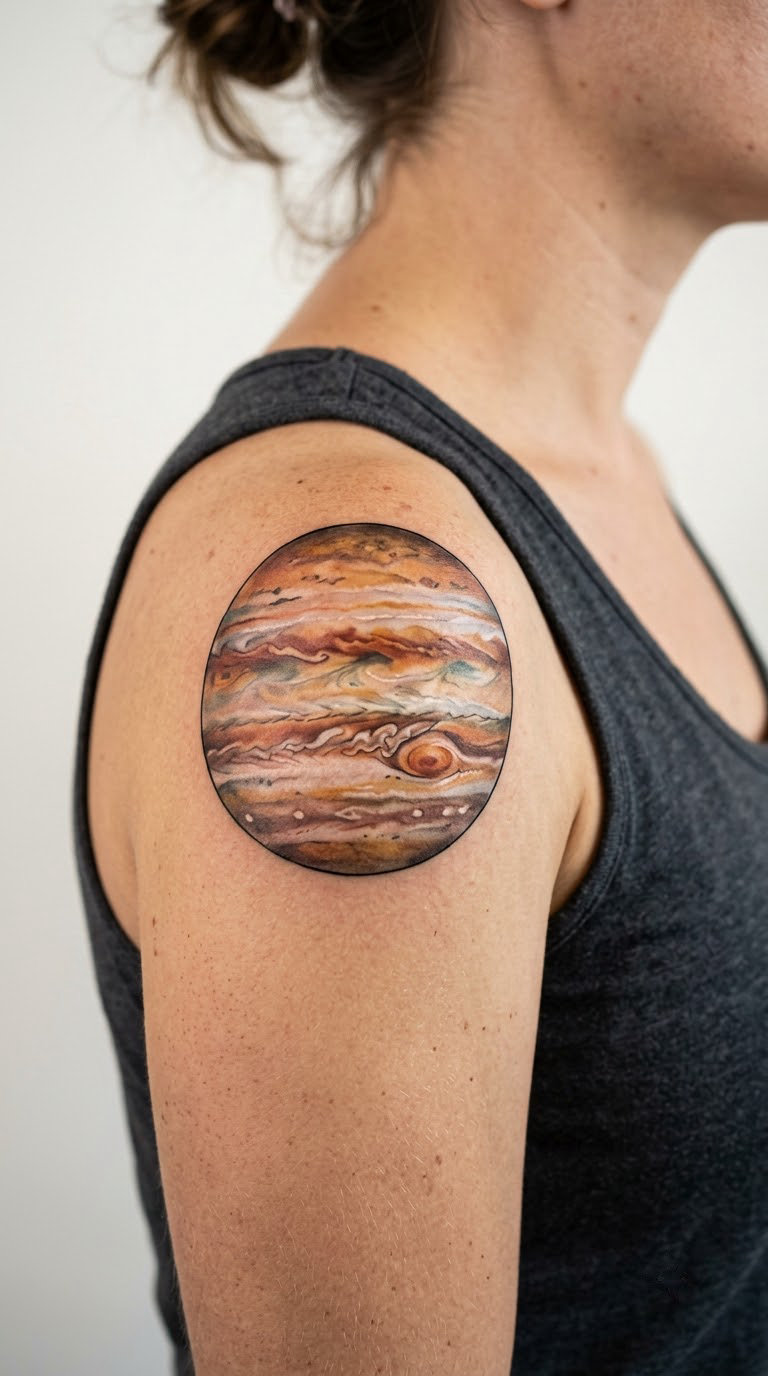
Soft blended bands of ochre, rust, cream and brown, with the edges left slightly unfinished so the planet looks painted rather than printed. The big oval spot usually gets a warmer accent to stop it disappearing into the bands.
Jupiter is the expansion planet, so it tends to get chosen for chapters rather than people, a new job, a move, a new city. It also just reads as the most beautiful planet to draw, which is a perfectly good reason on its own.
Placement: upper shoulder, outer thigh or upper back. Size: 4 to 6 inches (10 to 15 cm). Style: watercolor with soft shading. Pain: medium to high, and the shoulder cap is the tender part.
Colour on a shoulder fades unevenly, so plan on a colour refresh every few years if you want the bands to stay crisp. Make it yours: keep the band colours to three and use the fourth only on the great red spot, which keeps a large piece from turning muddy.
5. Blackwork Saturn
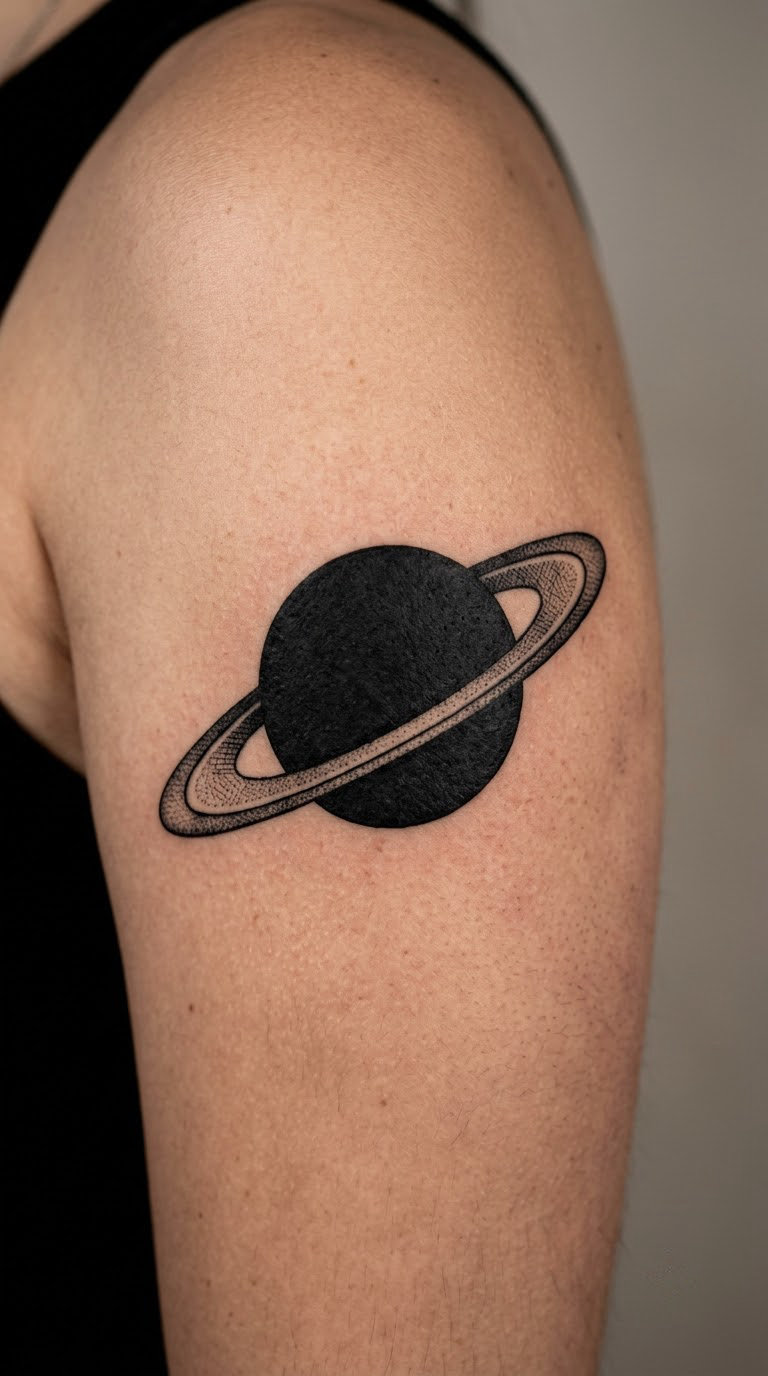
A solid circular body in flat black, with the rings cut out as sharp negative space and a fine stipple texture where the planet crosses in front of them. It is graphic rather than realistic, and it holds up at a distance in a way fine line never will.
Because there is no shading to soften it, the design reads as confident and structural. Clients tend to choose it when they want space imagery that does not look delicate, often alongside other solid work rather than on its own.
Placement: outer upper arm, back of the shoulder or outer forearm. Size: 3.5 to 5 inches (9 to 13 cm). Style: blackwork with negative space. Pain: medium, and the outer arm is one of the easier spots to sit through.
Solid black on the upper arm stays crisp for years, but the thin ring gaps can fill in slightly over a decade. Make it yours: ask the artist to widen the ring gaps by a hair, which costs nothing now and keeps the planet readable later.
6. Realistic Earth in Black and Grey
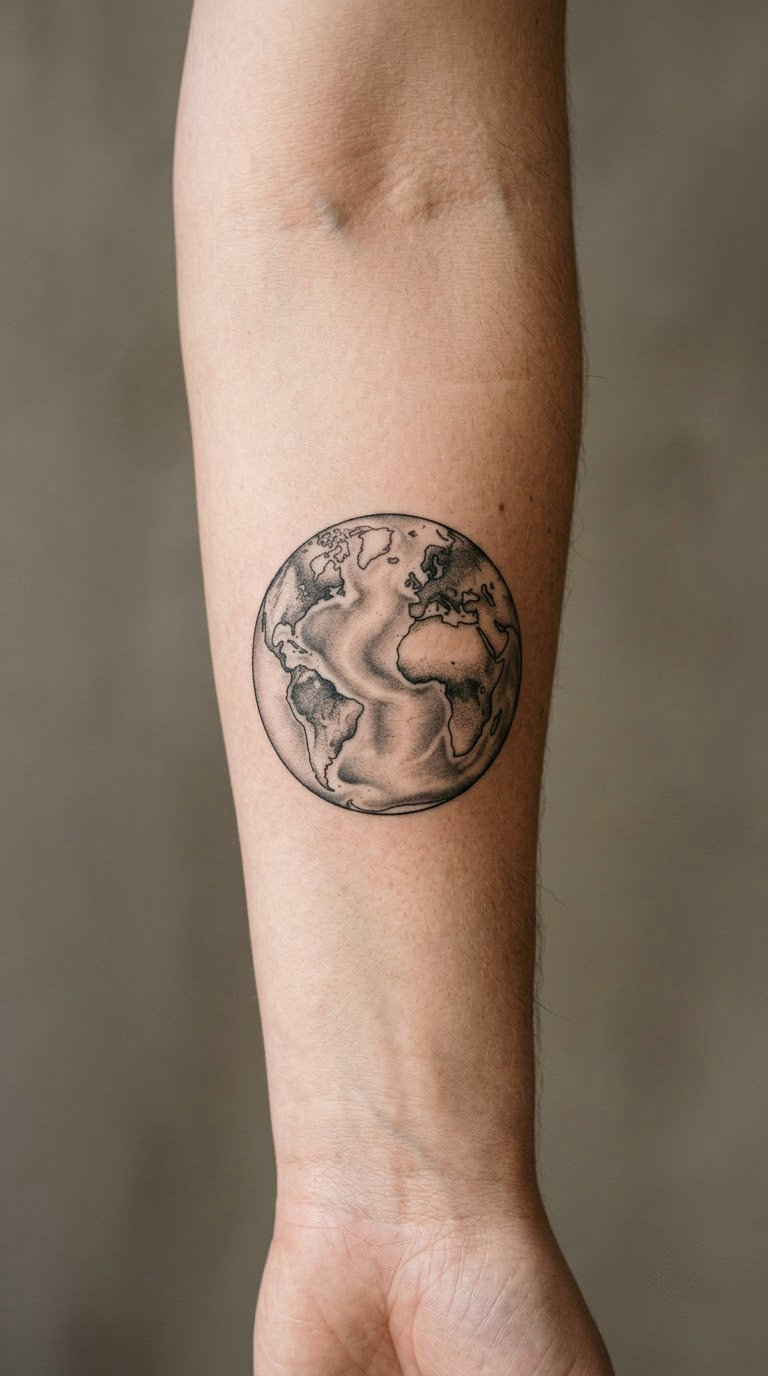
A compact globe with softly shaded oceans and continents in a map style you can actually recognise. The best versions keep the landmasses as clean shapes and put the shading in the water, so the continents stay legible once the skin has healed.
Earth is the one planet most people already carry a feeling about, which makes it an easy first pick when a client cannot name what they want. Some read it as where they are from, others as the only home they will ever have.
Placement: inner forearm, calf or upper arm. Size: 2.5 to 3.5 inches (6 to 9 cm) in diameter. Style: micro-realism in black and grey. Pain: low to medium on the forearm.
Fine continent edges blur on the inner forearm faster than on the calf, so this one ages better lower down. Make it yours: ask for your home country outlined in solid black and the rest of the world in soft grey, which makes a three-inch piece read clearly.
7. Tiny Mars Dot
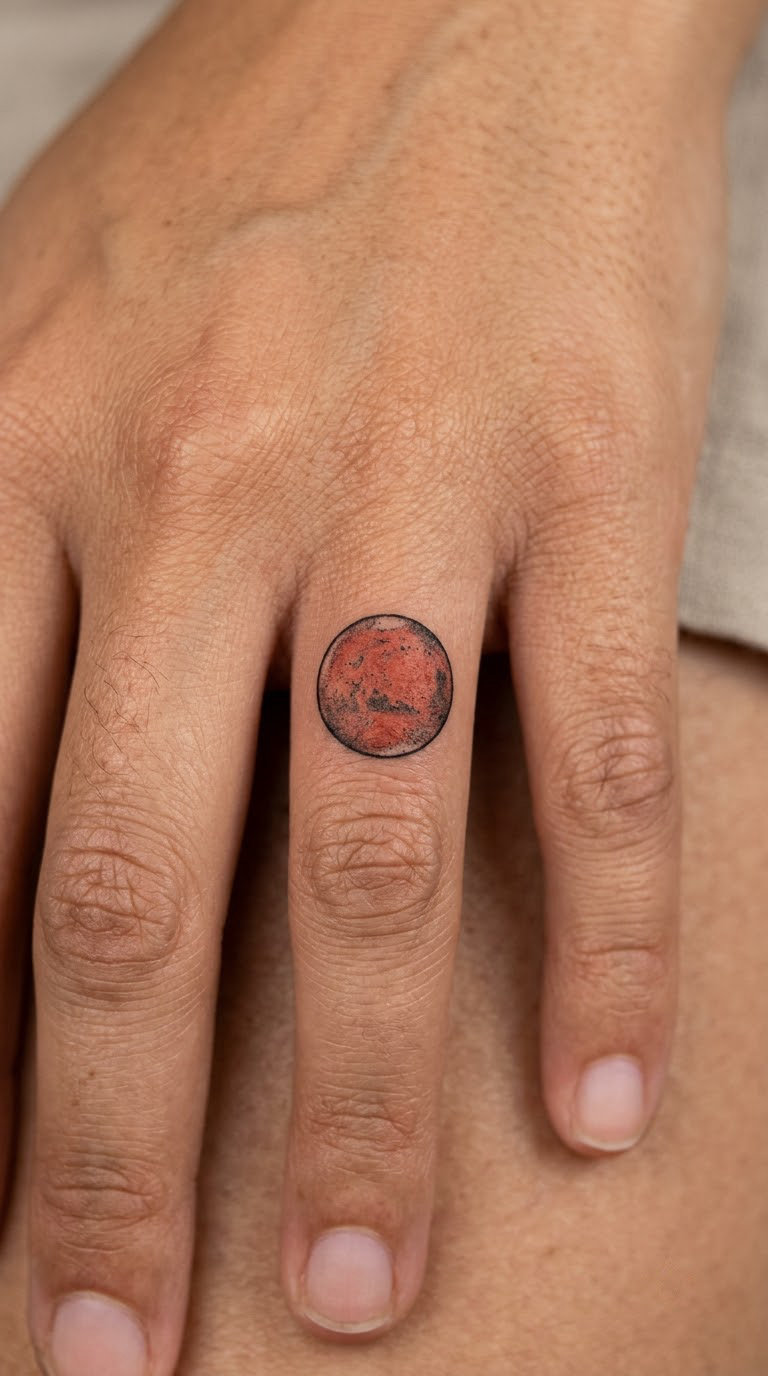
One small rust-red circle with a hint of black stippling, half an inch across. There is no ring, no orbit line and nothing else to interpret, which is the whole point of it.
Mars is the drive and the fight, and a single dot is the easiest way to wear that without announcing it. Clients with a first tattoo on a finger often choose this because there is no detail to lose during healing.
Placement: along the side of a finger near the knuckle, or the inner wrist. Size: 0.4 to 0.7 inch (1 to 1.8 cm). Style: minimal realism, one colour. Pain: high, because finger skin sits over bone with almost nothing cushioning it.
Finger tattoos catch everything, so daily hand washing softens this one faster than any other placement on this list. Make it yours: use a muted rust rather than bright orange, and ask for a slightly deeper shade than you think you want since it will lighten a lot.
8. Geometric Solar System Diagram
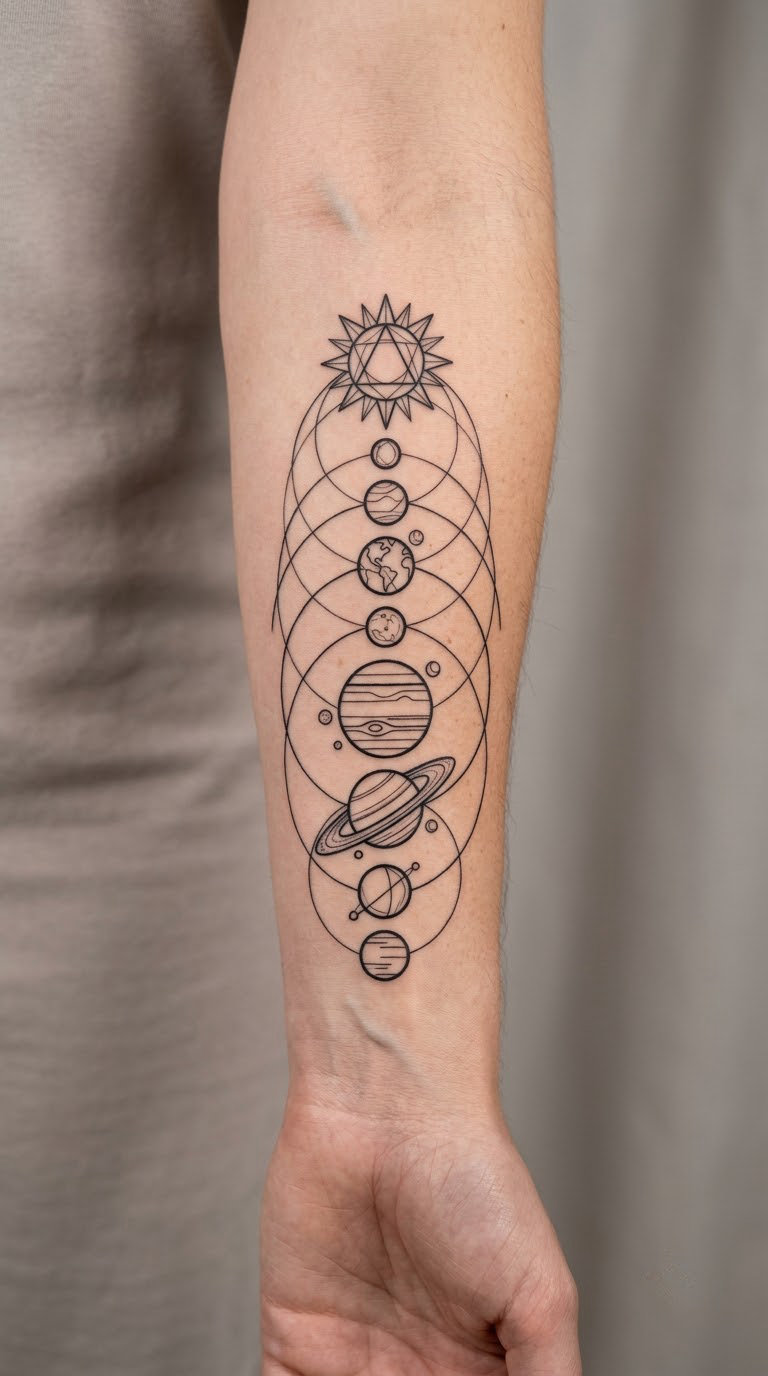
Eight outlined planets of graduated size arranged in order, with thin curved orbit lines arcing around them. The planets are simplified to circles with a band or a ring, so the whole system stays readable at a modest scale.
Where a single planet says something about you, a diagram says something about scale, order and where you sit in something much larger. It is the most popular choice for a first tattoo that already looks like a collection.
Placement: inner or outer forearm, inner thigh, upper back. Size: 4 to 6 inches (10 to 15 cm) long. Style: geometric line art. Pain: medium, rising toward the elbow crease.
Eight planets in five inches gives each one about half an inch, so ask the artist to simplify Saturn’s rings and Neptune’s detail before you commit to the size. Make it yours: have the artist size each planet accurately rather than evenly, which is the detail that makes people ask about it.
9. Celestial Planet Sleeve Preview
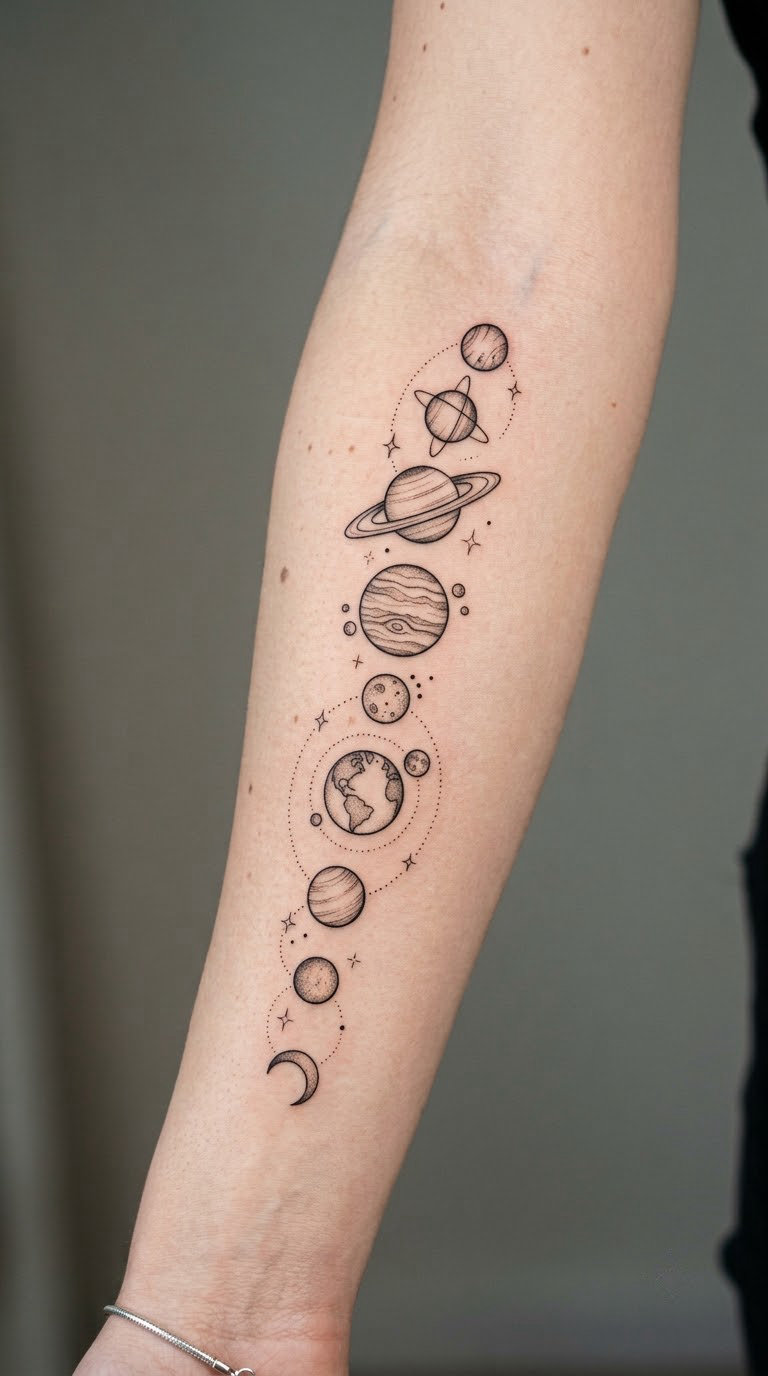
A spaced arrangement of outlined planets with a few small orbital stars between them, laid out with deliberate empty space so each body reads on its own. That spacing is what makes it work as the first piece of a sleeve rather than a finished one.
Planners usually start here because it lets you test an artist and a line weight on a large area without committing to a full composition. The planets are chosen to leave room for a background, a nebula or a matching design later.
Placement: outer forearm, upper arm, or one shoulder. Size: 5 to 7 inches (13 to 18 cm) for this starting stage. Style: fine line with black and grey accents. Pain: medium, and sessions run long on the forearm.
A sleeve built in stages needs the later work to match the earlier line weight, so agree on that number at the first appointment. Make it yours: keep a reference photo of the first healed piece, because your skin will settle the line slightly and later work has to match the settled version.
10. Sun with Planetary Rings
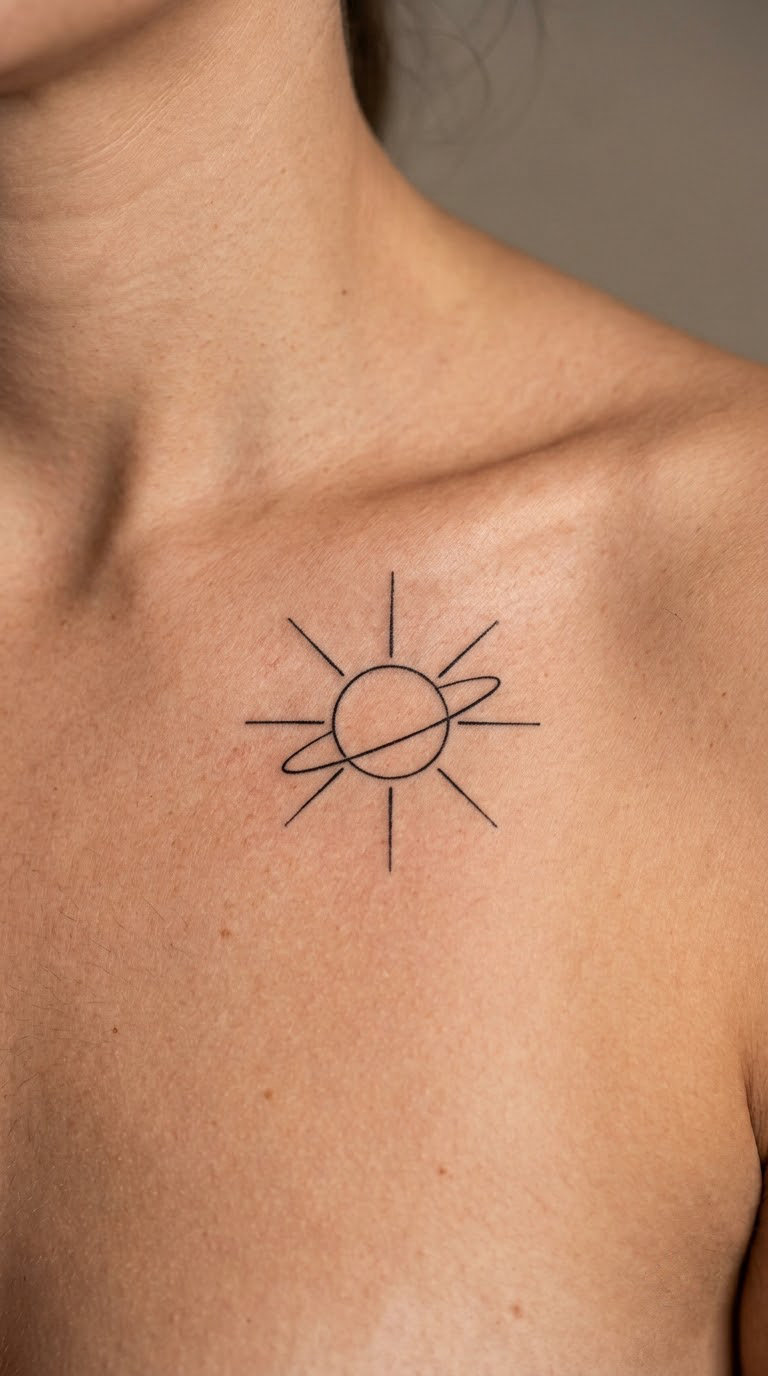
A radiant sun with eight straight rays, crossed by a thin ringed planet that sits slightly off-centre. Drawing the planet in front of the rays creates depth without any shading, and it is the reason this design looks less flat than a plain sun.
The sun is the identity planet, so this one usually gets picked by someone at a turning point rather than by someone who wants a quiet piece. It is a louder design than most of the others here, even in fine line.
Placement: upper chest near the collarbone, upper arm or the sternum. Size: 3.5 to 5 inches (9 to 13 cm). Style: fine line, illustrative. Pain: high, because the upper chest and collarbone are among the more sensitive areas to work on.
Chest skin stretches and moves with breathing, so ray ends can drift a little over time. Make it yours: count the rays and set the number to something specific, which turns a decorative sun into a deliberate one.
11. Moon Phase and Saturn Arc
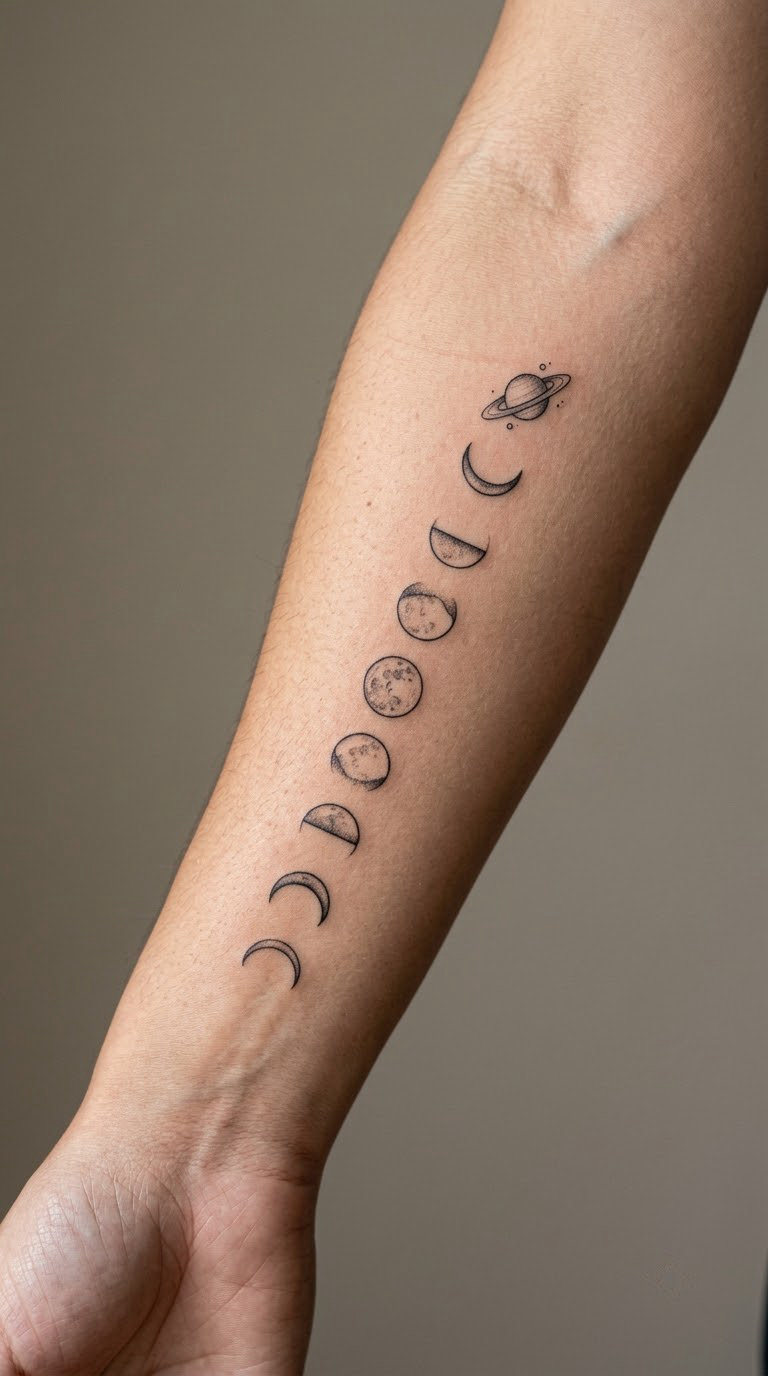
A curved run of moon phases, from new through crescent to full, with a small Saturn tucked at the end of the arc. The curve follows a body line rather than sitting straight, which is what makes it look built for the spot instead of dropped on it.
Moon phase tattoos usually map onto something that moved in stages, and the Saturn at the end gives the sequence a destination. Clients who want to explain a tattoo to other people find this one easier to talk about than a bare planet.
Placement: rib, hip, outer forearm or the ankle. Size: 4 to 6 inches (10 to 15 cm) along the curve. Style: fine line. Pain: high on the rib, medium on the forearm.
Consistent line weight matters more here than anywhere else, because a phase run with one heavy circle and one light circle looks like a mistake. Make it yours: reverse the order and start at full instead of new, which changes the reading without changing the design.
12. Dotwork Planet Cluster
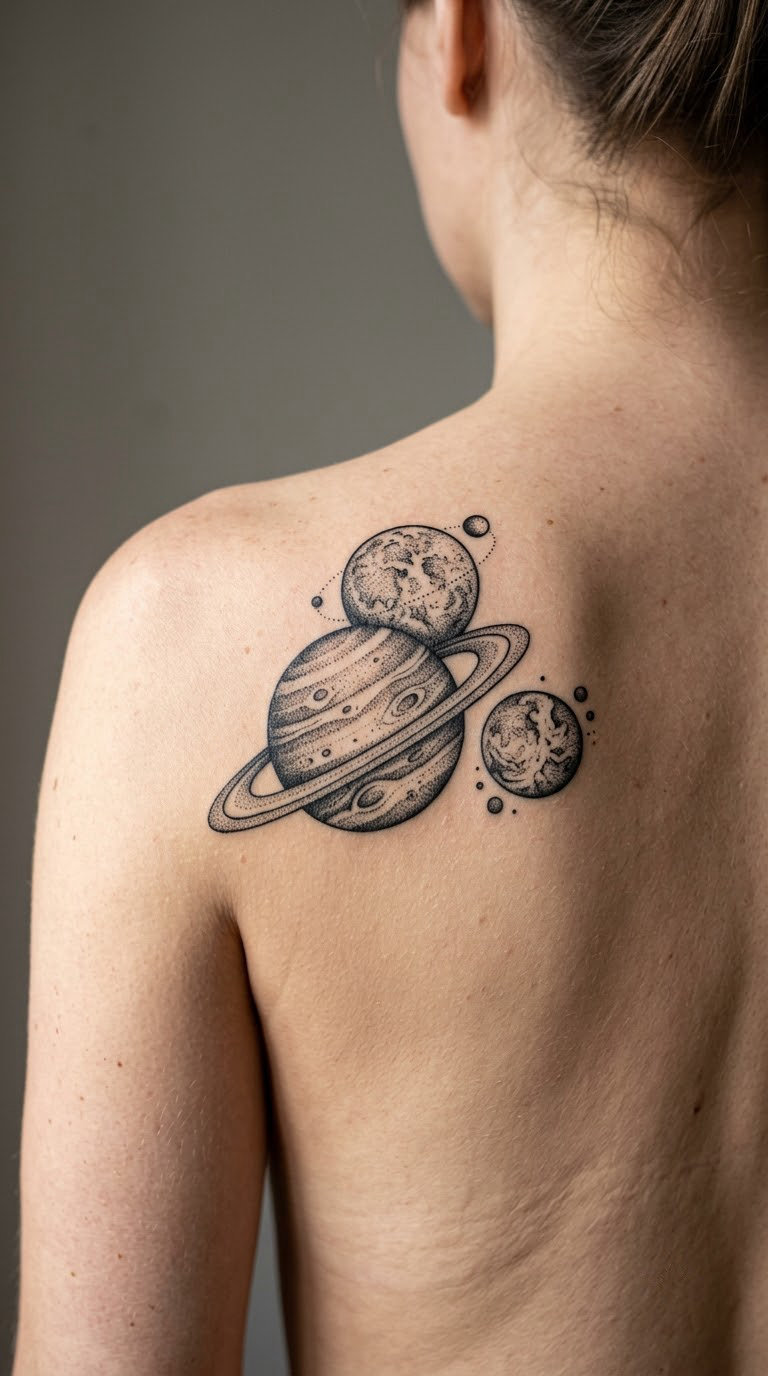
Three planets of different sizes built from dots, with the density of the stippling changing across each body so one appears lighter and one appears to be turning. Dotwork rewards a larger canvas because the pattern needs room to build up.
The cluster format works well for a piece that does not need a single story attached to it, since three planets together read as a family rather than one symbol. It also sits comfortably next to fine line without looking like an afterthought.
Placement: shoulder blade, upper back, outer thigh. Size: 3.5 to 5 inches (9 to 13 cm) wide. Style: dotwork. Pain: medium to high, and the shoulder blade is a bony surface that keeps surprising people.
Individual dots soften over the years, so a five-inch cluster holds its texture better than a two-inch one. Make it yours: ask the artist to vary the dot density rather than keeping it even, which is what gives the cluster its depth.
13. Neon-Colored Jupiter
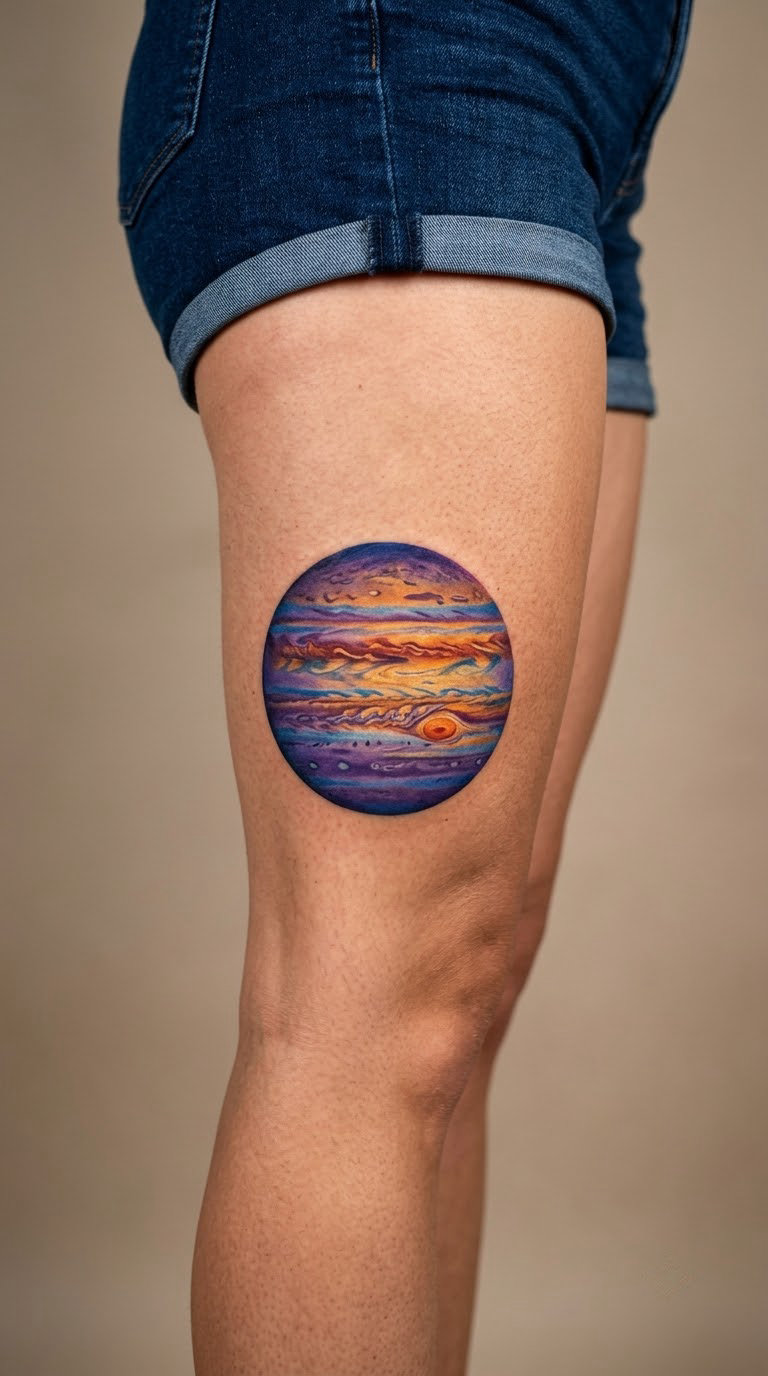
Saturated purple, blue, orange and yellow bands with a hard edge between each one, closer to poster art than to a photograph. The colours are the point: they make the stripes legible from across a room, which soft watercolor bands never do.
Colour is what separates this from a realistic Jupiter, and the reason people choose it is usually that they want the piece to be noticed. It suits a client who does not want a small discreet planetary tattoo at all.
Placement: outer thigh, shoulder, rib or calf. Size: 5 to 7 inches (13 to 18 cm). Style: colour realism with graphic banding. Pain: medium to high, and colour work takes noticeably longer per session.
Large colour fields on the thigh fade in patches where the skin sees most sun, so a refresh is usually worth planning for. Make it yours: keep the warm bands on the equator and cool bands at the poles, which stops the colour from looking arbitrary.
14. Retro Atomic Planet
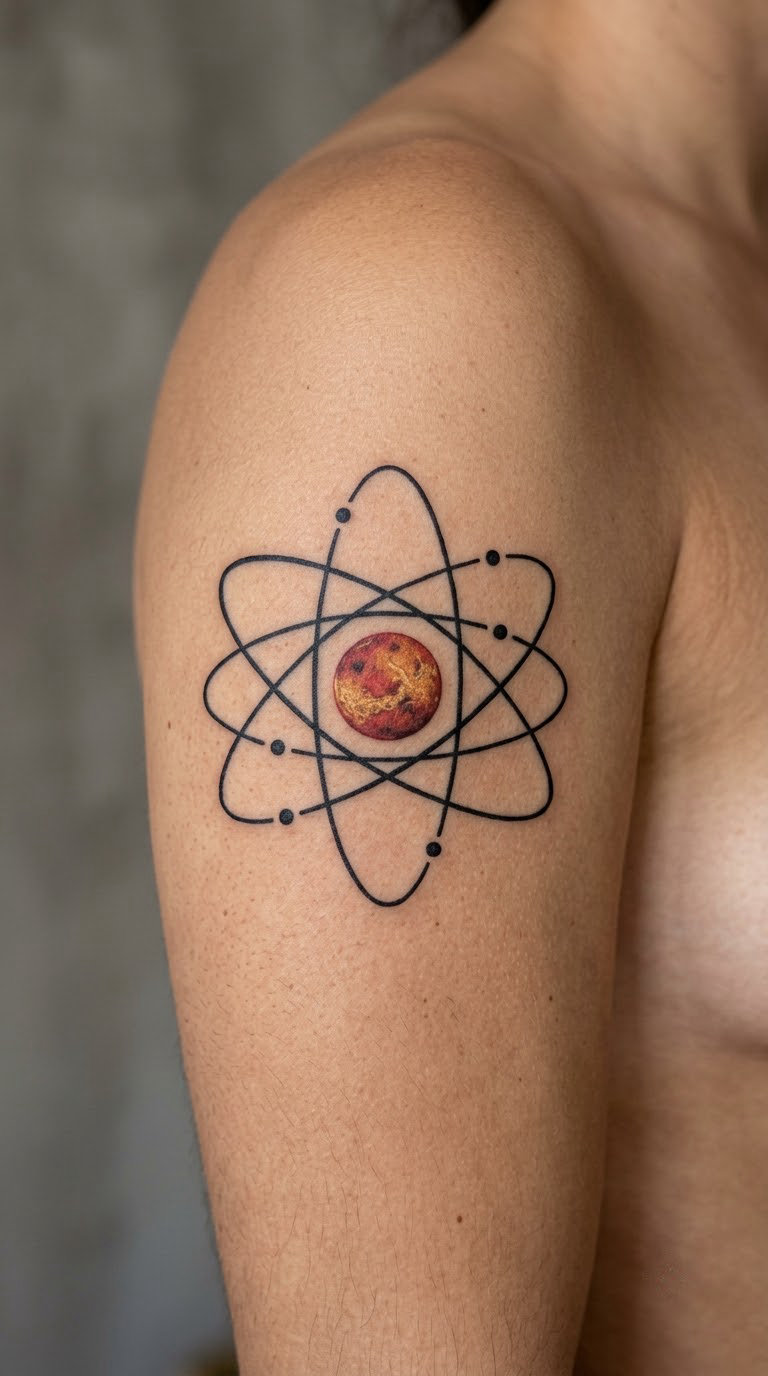
A mid-century atomic symbol, three loops crossing at the centre, wrapped around a small planet in red and gold with thin black linework. The contrast between the vintage motif and the shaded planet is what stops it looking like clip art.
Atomic imagery came out of the space race, so it reads as optimism about science and progress rather than anything darker. Clients who like retro design usually want the whole look, colours included, rather than a black and grey version.
Placement: upper arm, outer forearm or the back of the shoulder. Size: 3 to 4 inches (8 to 10 cm) wide. Style: traditional accents, retro illustration. Pain: medium on the upper arm.
The thin orbit loops are the vulnerable part here, so ask for them at a consistent medium weight. Make it yours: match the red to a specific date, a lipstick you keep repurchasing, or a colour already in your wardrobe.
15. Micro Neptune Symbol
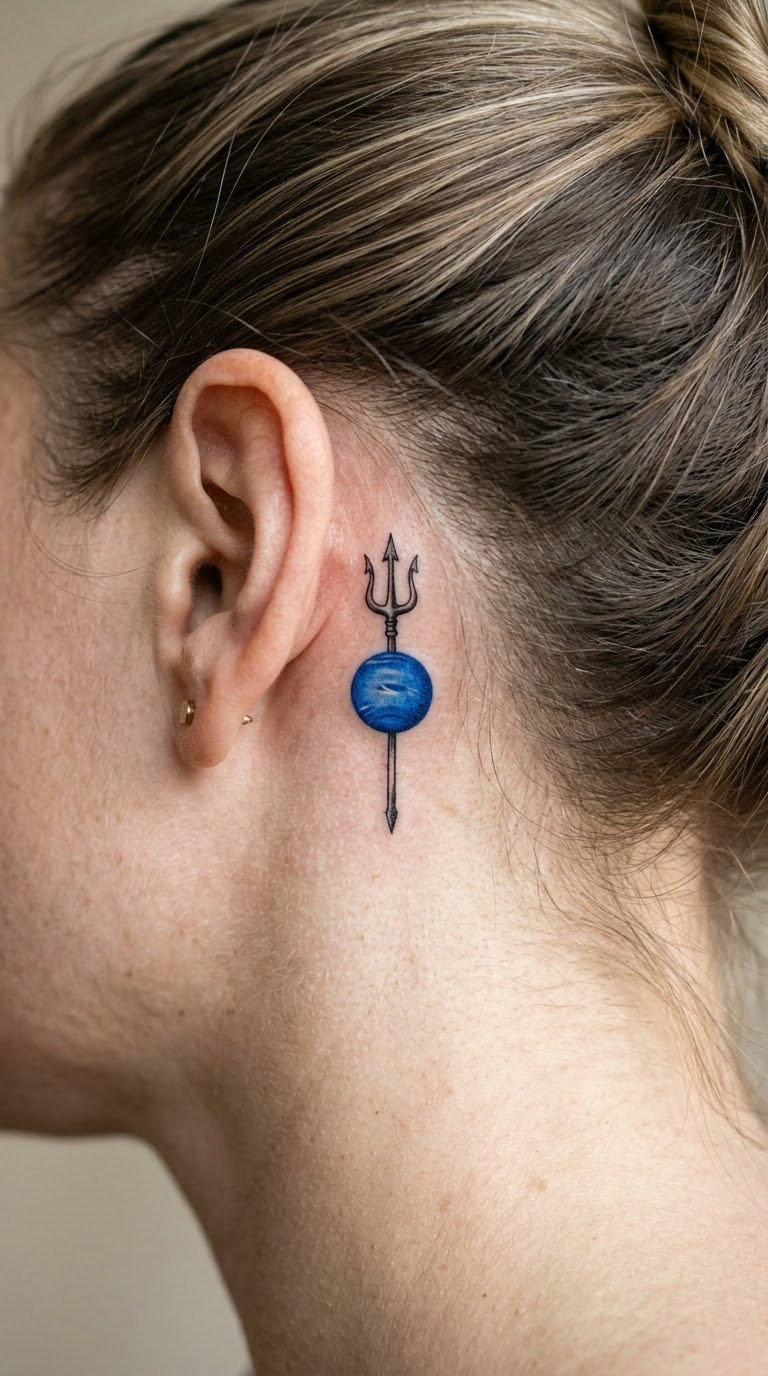
A tiny Neptune trident passing through a small blue planet, drawn with a single consistent line and nothing around it. At this scale the whole piece is basically three elements, which is exactly the number that survives healing.
Neptune is traditionally the spirituality and imagination planet, and micro versions of it usually go to people who want the meaning without the visibility. Behind the ear also means you only see it in a mirror, which many clients prefer.
Placement: behind the ear, inner wrist, ankle or the side of a finger. Size: 1 to 1.5 inches (2.5 to 4 cm) tall. Style: micro fine line with one colour accent. Pain: medium to high, since ear skin and ankle skin are both thin over bone.
Below an inch the trident head tends to blur into a dot, so this is about the practical floor for the design. Make it yours: pair it with a matching Neptune behind the other ear and a matching date on the inside of each wrist. Our guide to behind the ear tattoo ideas for women goes into how that spot heals and what tends to blur first.
16. Planet and Rose Combination
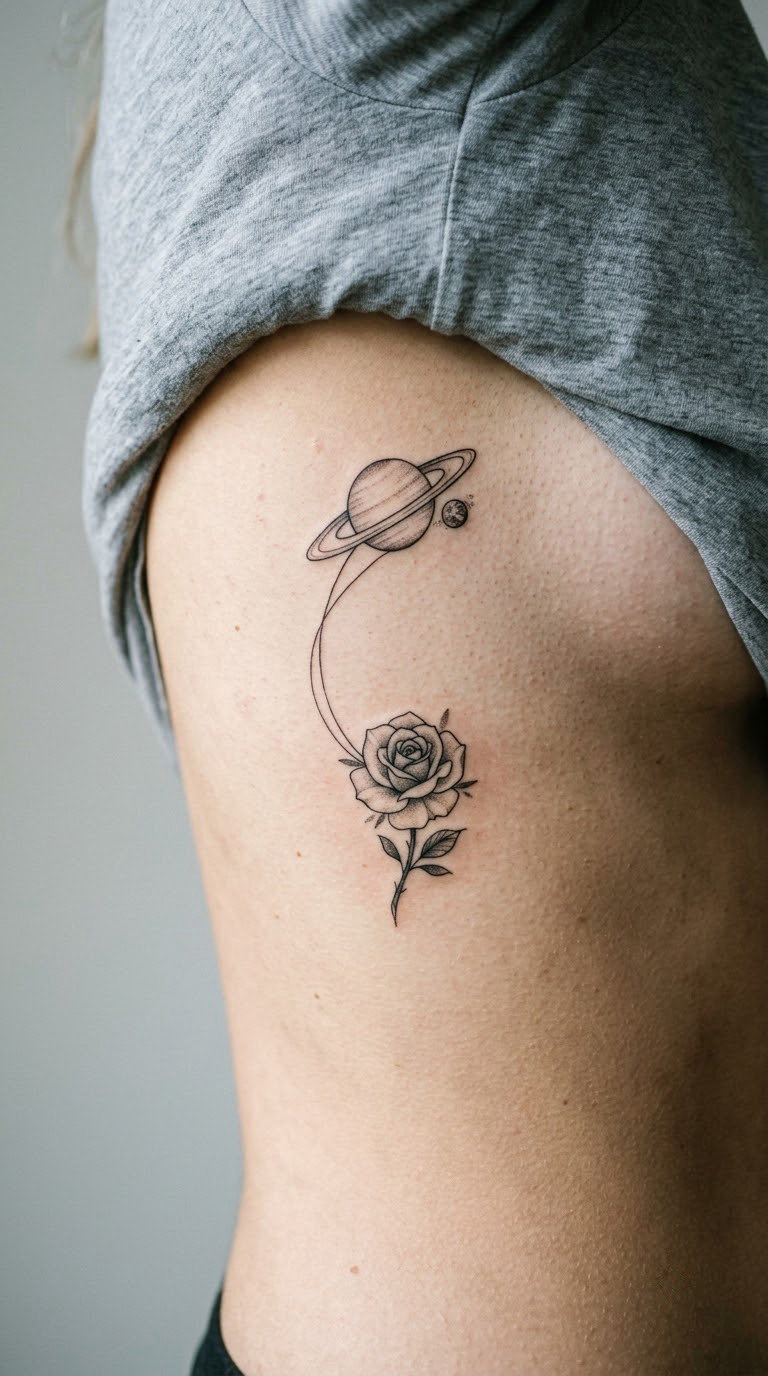
A fine-line Saturn connected by a single thin orbital curve to a small rose with soft petal shading. The curve does the work of a divider, so the two motifs read as one design rather than two tattoos that happen to be near each other.
Planet and flower combinations tend to get chosen by people who want the meaning of a space piece without the whole piece looking like a space piece. The rose brings the softness that many clients say they were actually looking for.
Placement: rib, outer forearm, hip or the back of the hand. Size: 3.5 to 4.5 inches (9 to 11 cm) wide. Style: fine line botanical with a celestial element. Pain: high on the rib, medium on the forearm.
The connecting curve is hairline-thin by nature, so ask the artist to thicken that one line slightly out of proportion to the rest. Make it yours: swap the rose for your birth flower and keep the same curve, which makes the combination specific to you rather than generic.
17. Black-Grey Moon Close-Up
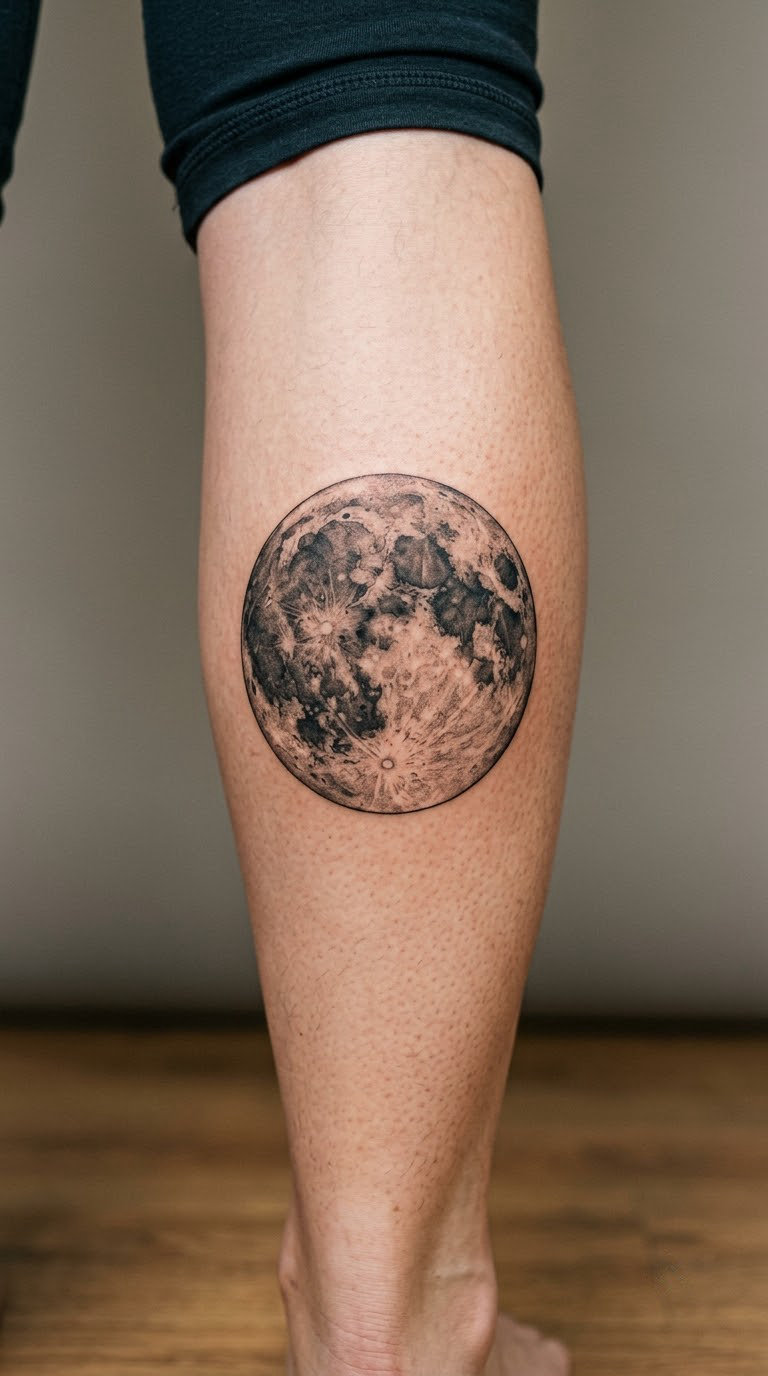
A cratered moon filling the frame, with soft grey shading and darker edges where the shadow falls. The crater detail is where the size matters: at four inches and up there is enough surface to work with, which a ringed planet never needs.
Choosing the moon rather than a planet shifts the meaning from a body in a system to something you are standing on. Clients usually describe it as the grounded option in a set of space tattoos.
Placement: calf, outer thigh, upper arm. Size: 4 to 6 inches (10 to 15 cm) in diameter. Style: realism in black and grey. Pain: medium, and the calf is muscular rather than bony, so it moves more than you expect.
Large black-and-grey shading holds its tone remarkably well, and the calf is a low-collagen area that ages better than the inner forearm. Make it yours: ask for the shading to run darkest on one side only, so the terminator line sits where you want it.
18. Line-Art Solar System Forearm
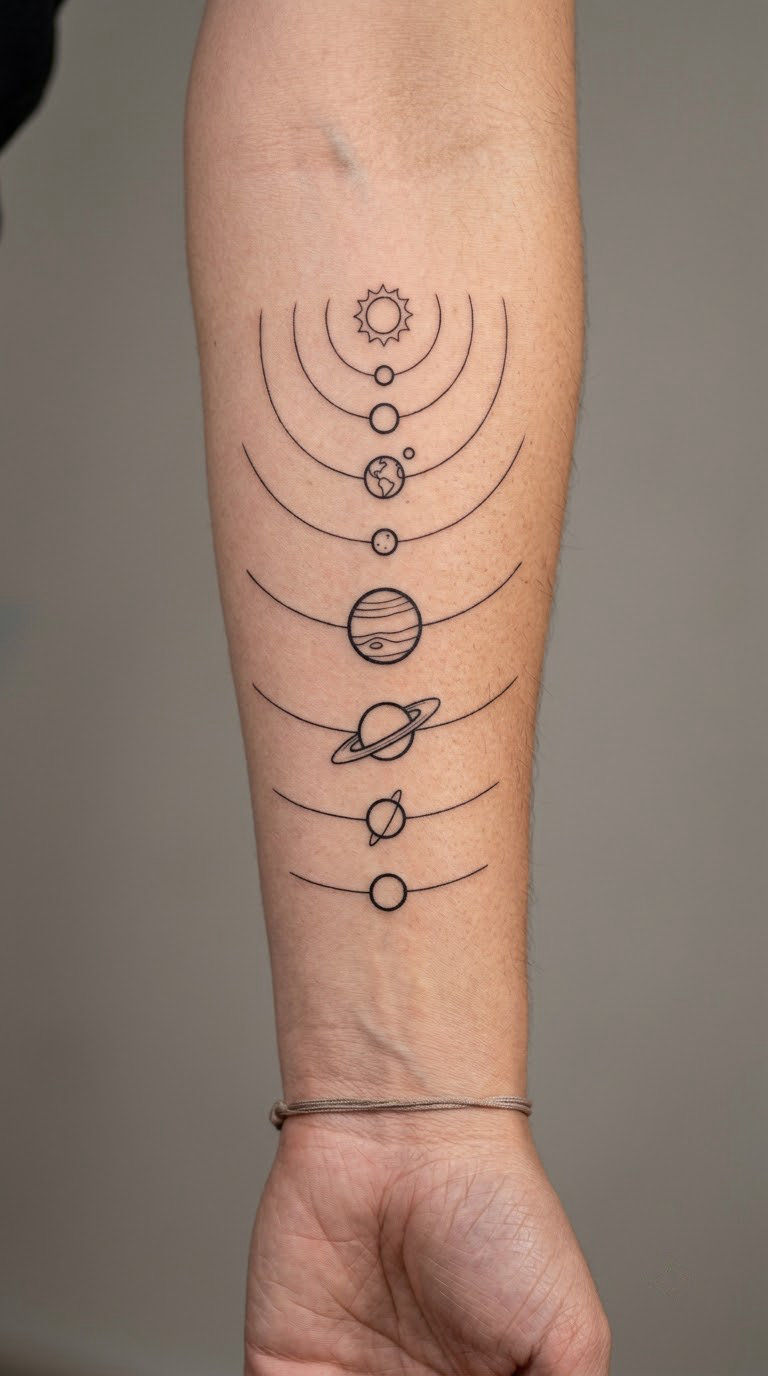
A delicate linear map of the solar system running the length of the forearm, with the sun at one end and the outer planets trailing toward the wrist. Every planet is reduced to a circle, a band or a ring, which is what keeps the line consistent from end to end.
This is the most practical version of the full system, and it is the one that survives real life best. Inner forearm skin is thin, so every planet is kept simple on purpose rather than simplified later as a compromise.
Placement: inner forearm. Size: 4 to 6 inches (10 to 15 cm) long. Style: single-line art. Pain: low to medium.
Thin lines on the inner forearm blur with sun exposure and age faster than almost anywhere else on the body. Make it yours: start the sun near the elbow and end at Neptune by the wrist, then have the artist add one small date under the sun only. Our forearm tattoo ideas for women with meaning has more layouts that fit this canvas.
19. Planet with Botanical Orbit
A small blue planet encircled by a green stem with leaves curling around it, the greenery wrapping the planet the way a ring wraps a gas giant. It is the clearest example here of nature and space sharing one line.
The combination tends to mean growth that is not only about size, which is why it shows up on people going through a change they could not otherwise describe. It is a soft design in a set that has a lot of hard-edged options.
Placement: hip, rib, outer thigh or the back of the shoulder. Size: 3 to 4 inches (8 to 10 cm) wide. Style: fine line with a colour accent. Pain: medium to high on the hip and rib.
Green ink on the hip fades fastest on this list, so expect a touch-up sooner than you would with black. Make it yours: use your birth flower as the orbiting plant rather than a generic stem, which turns the whole piece into one specific date.
20. Gothic Saturn with Ornamental Frame
A dark Saturn sitting inside symmetrical ornamental arches, with fine decorative dots filling the corners and the space around the rings. The frame is what makes it gothic rather than merely dark, and it is the reason the piece needs a big canvas.
Ornament and gothic work tend to get chosen by people who like decorative detail, and the planet is usually the personal element inside a broader visual language. It is the most involved design on this list and needs the most planning.
Placement: upper back, chest, outer thigh. Size: 5 to 7 inches (13 to 18 cm) wide. Style: blackwork with ornamental linework. Pain: high, particularly across the upper back.
Blackwork holds its line better than almost any other style, but the corner dot work softens first on this design. Make it yours: have the arches follow your own proportions rather than a symmetric template, so the frame reads as built for your back.
21. Pastel Nebula Planet
A blue and lavender planet floating in a wash of pink and violet, with the edges of the cloud left loose and unfinished. Colour blooms in the background rather than in the planet, which is the opposite of most Jupiter designs.
Nebula work reads as softness and distance, and it is the design here that most people describe as a dream rather than a space fact. It suits a large area because there is nowhere in it for detail to go wrong.
Placement: side thigh, hip, upper back. Size: 5 to 7 inches (13 to 18 cm) wide. Style: watercolor with soft blends. Pain: medium.
Blended colour needs longer to settle and the outer edges of a wash are the first part to soften. Make it yours: pick the two nebula colours first and then let the artist choose the planet colour to sit between them, which keeps the whole piece in one palette.
22. Minimal Planet Constellation
One small outlined planet linked to six fine constellation stars by thin connecting lines, with a lot of open space around the group. The sparseness is deliberate, and it is what keeps the piece light on a large flat area.
Constellation work usually borrows the pattern of a real sign or a shape the client already cared about, so the planet becomes a member of a group rather than the whole idea. Ask the artist for the star positions to be accurate if the pattern matters to you.
Placement: shoulder, sternum, upper back. Size: 2.5 to 4 inches (6 to 10 cm) wide. Style: fine line. Pain: medium.
Six hairlines connecting the stars need a minimum length or they fade into short dashes. Make it yours: use the constellation of your birth month, which most clients find more meaningful than a random pattern.
23. Planet Phases Matching Tattoo
Three separate small tattoos, one phase each, designed to be read as a set rather than a single composition. Matching line weight across all three is the whole challenge, and it is the reason they are worth getting from the same session.
Matching sets are usually for people who are not in the same house, with siblings, partners or friends, and there is no rule that says they need the same phase. Three different phases usually look better than three copies.
Placement: wrist, ankle, the inside of the arm. Size: 0.8 to 1.2 inches (2 to 3 cm) each. Style: fine line. Pain: medium.
Wear them in the same position and they read as a row; move them and they read as a collection, which ages more gracefully. Make it yours: give each person in the set their own phase, then have the artist draw all three from the same reference so the line weight matches.
24. Celestial Map with Personal Coordinates
A star map with one planet picked out in solid black, a thin orbit line crossing it and a small set of coordinates set in fine type at the edge. The map is accurate rather than invented, and that accuracy is the entire design.
Coordinate maps are the most personal option in this set, because the place and date are the meaning. Many clients use where a child was born, where they met a partner, or somewhere they have never been and still want to keep.
Placement: upper back, lower back, side thigh. Size: 6 to 8 inches (15 to 20 cm) wide. Style: fine line with dotwork stars. Pain: medium to high, and fine type means a long session.
Small coordinate type is the first thing to blur, so agree the smallest text size with your artist before you start. Make it yours: write the coordinates down twice and bring both, because a map is no use to you if the digits are wrong.
How to Choose the Right Design
Most of the wrong choice here comes down to picking the image first and the placement second. Work through it in the other order and the decision gets much easier.
- Pick the size from the placement, not the other way round. A design that is three inches across on a flat calf is a large piece; the same three inches on the side of a finger is a statement tattoo.
- Match line weight to how much skin is there. Thin inner forearm skin needs a heavier line than the drawing shows. Bony areas such as the collarbone and ankle give you very little to work with.
- Decide how loud you want it to be before you pick a style. Blackwork Saturn and a micro Neptune are opposite ends of the same spectrum, and both are legitimate choices.
- Count the detail and cut it in half if the piece is small. Rings, bands, craters and orbit lines all disappear as the size drops. If a design only works above three inches, that is the size to plan for.
- Think about sun exposure before colour. Anything on the forearm, the back of the hand or the outer thigh will fade unevenly, and colour refreshes cost money.
- Check whether you already have work in that area. A small planet next to a large sleeve has to hold its own visually, and a first small piece is always easier to place.
Cost and Session Time
Prices vary enormously by city, artist and how long a design takes, so treat the ranges below as a rough sense of proportion rather than a quote. Most studios in the US charge by the hour, and a shop minimum applies whether you are getting one small planet or something much larger.
| Size range | What it usually covers | Rough US price band | Session time |
|---|---|---|---|
| Under 1 inch | A single dot, symbol or tiny planet | 80 to 150 dollars | Under an hour |
| 1 to 3 inches | One planet, moon phases, a small cluster | 150 to 350 dollars | 1 to 2 hours |
| 3 to 5 inches | Detailed single planet or a composed design | 350 to 700 dollars | 2 to 4 hours |
| 5 inches and up | Sleeve work, colour pieces, star maps | 700 dollars upward | Several sessions |
Colour, dotwork and small type all add time, and a star map with coordinates can easily run past a single session. Artists who work in a popular style are often booked months out, so if you are planning around a season, start the conversation early rather than at the last minute.
Aftercare Basics
Whatever the design is, start from your artist’s aftercare instructions. Everything below is general, and your artist’s guidance for your skin and your piece overrides it.
- Follow your artist’s aftercare instructions first, including any product they specify.
- Wash the area gently with clean water and a mild unscented soap, then pat it dry rather than rubbing it.
- Keep it dry for the first day or two, and let it breathe instead of covering it with tight fabric.
- Do not soak, swim or use a sauna until the skin has closed over and any scabbing has settled.
- Expect some tenderness, flaking and a faded look in the first couple of weeks, which is normal rather than a problem.
- Contact the studio if you develop spreading redness, heat, swelling or discharge, and let them know early rather than waiting it out.
Frequently Asked Questions
What is the best small planet tattoo for a first piece?
The minimal ringed planet outline is the easiest first choice, usually done at 1.5 to 2 inches on the inner wrist or the ankle. It has few elements, so almost nothing is lost during healing, and it reads clearly to anyone standing next to you. If you want more softness, the fine-line crescent and planet at around 3 inches on the inner forearm is the next most forgiving option.
How small can a planet tattoo realistically go?
A single planet with a ring can hold at about 0.5 inches, and a plain circle or dot holds below that. Once you add a moon, a band detail or an orbit line, one inch is a more realistic floor. Below that, the smallest features fill in during healing, so the design you pick in 2026 may look noticeably simpler in a year.
Do fine-line planet tattoos fade over time?
Yes, and the speed depends almost entirely on where the piece sits. Fine lines on the inner forearm, the back of the hand and anywhere with frequent sun exposure soften fastest, while blackwork on the upper arm or shoulder holds its edges for years. Asking your artist for a slightly heavier line than the reference image costs you nothing and slows that down.
Which planet tattoos are the most painful to get?
Finger and knuckle tattoos, the rib area, the collarbone and the upper chest are consistently the most sensitive, because all four sit over bone with little soft tissue. The inner forearm, upper arm and calf are easier. Placement matters far more than size, so a small planet on a finger is harder than a large one on a calf.
Should I get a colour planet tattoo or black and grey?
Colour suits gas giants such as Jupiter and Saturn, where the banding is the whole point, and it works well on large flat areas. Black and grey suits anything with structure, including Earth, the moon and dotwork clusters, and it holds its line longer with no refresh appointments. If the design sits on a sun-exposed area, black and grey ages more predictably.
How do I make a planet tattoo personal rather than decorative?
Tie the planet to a real chart, date or place rather than to an image you liked. The sun, moon and rising planets from your birth chart give you three pieces that are already yours, and a coordinate map lets you use a location and date that mean something specific. Either approach gives you an answer when someone asks what it is about.
Conclusion
If this is your first tattoo, start at number 2 or number 6 on the list. Both are small enough to sit through in one short session and forgiving enough that a soft inner forearm will not blur the detail, and you can add to them later if the sleeve itch ever arrives.
If you already have work and you want something that lasts decades, the stronger option is number 5, the blackwork Saturn, or number 20, the gothic ornamental frame. Both hold their lines longer than any fine-line planetary piece, and both give a solar-system theme enough weight to sit next to other large work.
Pick from the quick guide at the top, take your two or three favourites to an artist, and ask them to scale the design to your placement rather than the other way round. That single question is where most of these 24 planet tattoo ideas get decided.