
20 Best Sleeve Tattoo Ideas with Flowers and Animals for 2026
Sleeve tattoo ideas with flowers and animals work because the two motifs solve different problems. A lone animal portrait leaves empty skin around it. A floral-only sleeve can drift into wallpaper. Put a fox in wildflowers or a wolf in peony vines and the animal becomes the subject while the botanicals carry the eye around the arm.
All twenty designs below are described closely enough that an artist could sketch them from the text, with a real style, a size range, an honest pain note and one way to make the piece yours. If you are still deciding between a floral or a wildlife direction, these flower sleeve tattoo ideas and botanical sleeve concepts are worth a look first. Book early if you can, since a large sleeve is a multi-visit project and autumn is when people plan spring work.
Sleeve Tattoo Ideas with Flowers and Animals: Quick Guide
Here is the whole list at a glance, with the dominant style, the placement that suits it best, a realistic size in inches and centimetres, and expected pain for that spot on the body.
| Idea | Style | Best placement | Size | Pain |
|---|---|---|---|---|
| 1. Fine-line fox in wildflowers | Fine line, selective colour | Outer forearm | 4-6 in (10-15 cm) | Low to medium |
| 2. Black cat and roses | Traditional American | Outer forearm | 6-9 in (15-23 cm) | Medium to high |
| 3. Koi and peonies | Watercolour | Inner forearm | 5-8 in (13-20 cm) | Medium |
| 4. Wolf in peony vines | Blackwork | Upper arm | 7-10 in (18-25 cm) | High |
| 5. Hummingbird and cherry blossom | Micro-realism | Shoulder to elbow | 3-5 in (8-13 cm) | Medium |
| 6. Moth and marigolds | Neo-traditional | Forearm, symmetrical | 6-8 in (15-20 cm) | Medium |
| 7. Crane and lotus | Japanese-style | Upper arm | 7-10 in (18-25 cm) | Medium to high |
| 8. Butterfly and daisies | Minimal fine line | Inner forearm to wrist | 3-5 in (8-13 cm) | Low |
| 9. Barn owl and ferns | Realistic, muted colour | Outer upper arm | 6-8 in (15-20 cm) | Medium |
| 10. Phoenix and sunflowers | Illustrative colour | Full forearm | 10-14 in (25-36 cm) | High |
| 11. White tiger and magnolia | Blackwork and white | Inner arm | 8-12 in (20-30 cm) | High |
| 12. Blue butterfly and delphinium | Illustrative colour | Inner forearm | 6-9 in (15-23 cm) | Medium |
| 13. Snake and proteas | Realistic or neo-traditional | Upper arm | 5-8 in (13-20 cm) | Medium to high |
| 14. Deer and wildflower splashes | Fine line plus watercolour | Outer forearm | 5-8 in (13-20 cm) | Medium |
| 15. Octopus and anemones | Blackwork with colour | Inner forearm | 8-11 in (20-28 cm) | High |
| 16. Two ravens and cherry trees | Black and grey with pink | Shoulder cap | 6-9 in (15-23 cm) | Medium |
| 17. Dragonfly and lavender | Fine line, soft colour | Wrist to inner elbow | 5-8 in (13-20 cm) | Low to medium |
| 18. Lion and sunflowers | Blackwork | Outer forearm | 8-11 in (20-28 cm) | High |
| 19. Flowering tree and songbirds | Botanical illustrative | Inner forearm | 9-13 in (23-33 cm) | Medium |
| 20. Black panther and hibiscus | Blackwork with colour | Outer upper arm | 7-10 in (18-25 cm) | High |
1. Fine-Line Fox Wrapped in Wildflowers
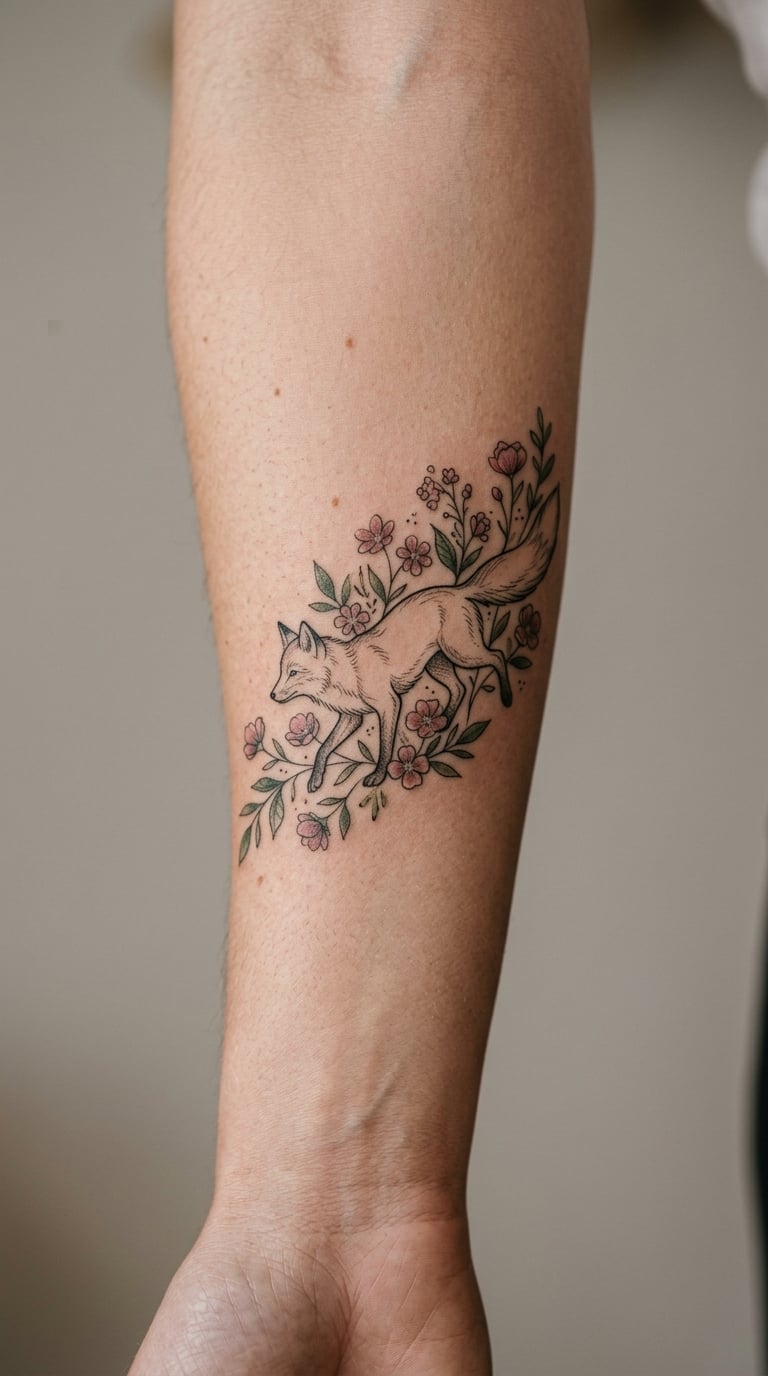
The fox is drawn in single-needle line, curled mid-leap with its brush tail trailing behind it, and the flowers are the only colour in the piece: dusty pink campion, pale cornflower, thin green stems. Nothing is shaded heavily, so the arm keeps plenty of open skin between elements.
People choose this one for its quiet look. A fox reads as clever and self-directed, and wildflowers bring the soft edge that a small animal portrait usually lacks.
Placement: outer forearm, elbow to wrist. Size: 4 to 6 inches (10 to 15 cm) long. Style: fine line with selective colour. Pain: low to medium on the forearm, mild near the wrist bone.
Fine line softens and greys out over the years, so ask for a slightly heavier line than feels right in the drawing. Make it yours: put the year a fox became yours in the negative space under the belly, in line weight so small only you can read it.
2. Traditional Rose and Black Cat Composition
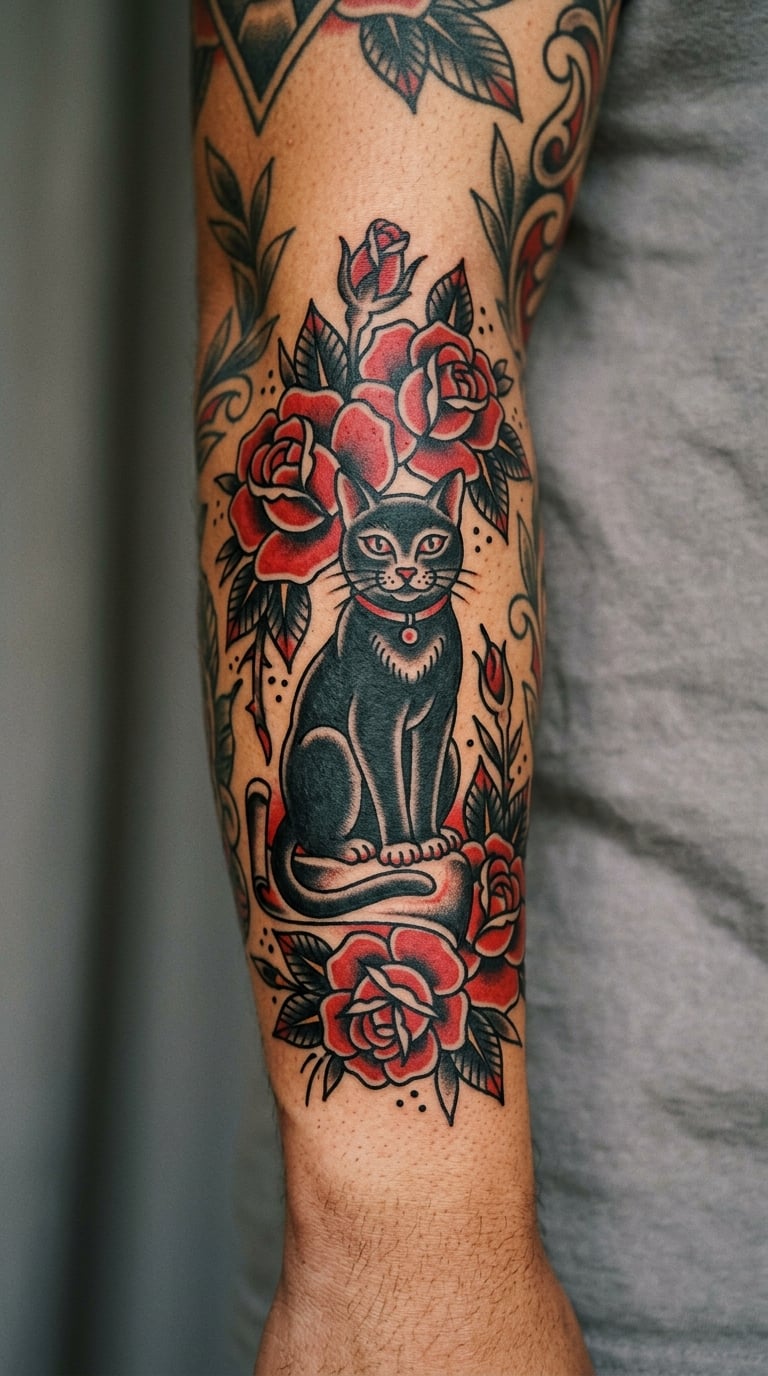
A seated black cat with bright eyes sits at the centre of a traditional American layout, ringed by three large red roses with heavy black shading and a few green leaves. Strong black outlines hold everything together, and the empty skin between the roses does the spacing work.
The pairing is old and well understood. Roses give the composition weight and colour; the cat gives it a gaze. Readers usually bring their own reason rather than a fixed meaning.
Placement: outer forearm. Size: 6 to 9 inches (15 to 23 cm). Style: traditional American, bold outlines, saturated red. Pain: medium to high, and the inner elbow and forearm dips are the sharpest parts.
Saturated red fades toward orange first, so plan for a touch-up in a few years. Make it yours: swap one rose for a second bloom tied to a date that matters to you, in the same red and shading style.
3. Watercolor Peonies and Swimming Koi
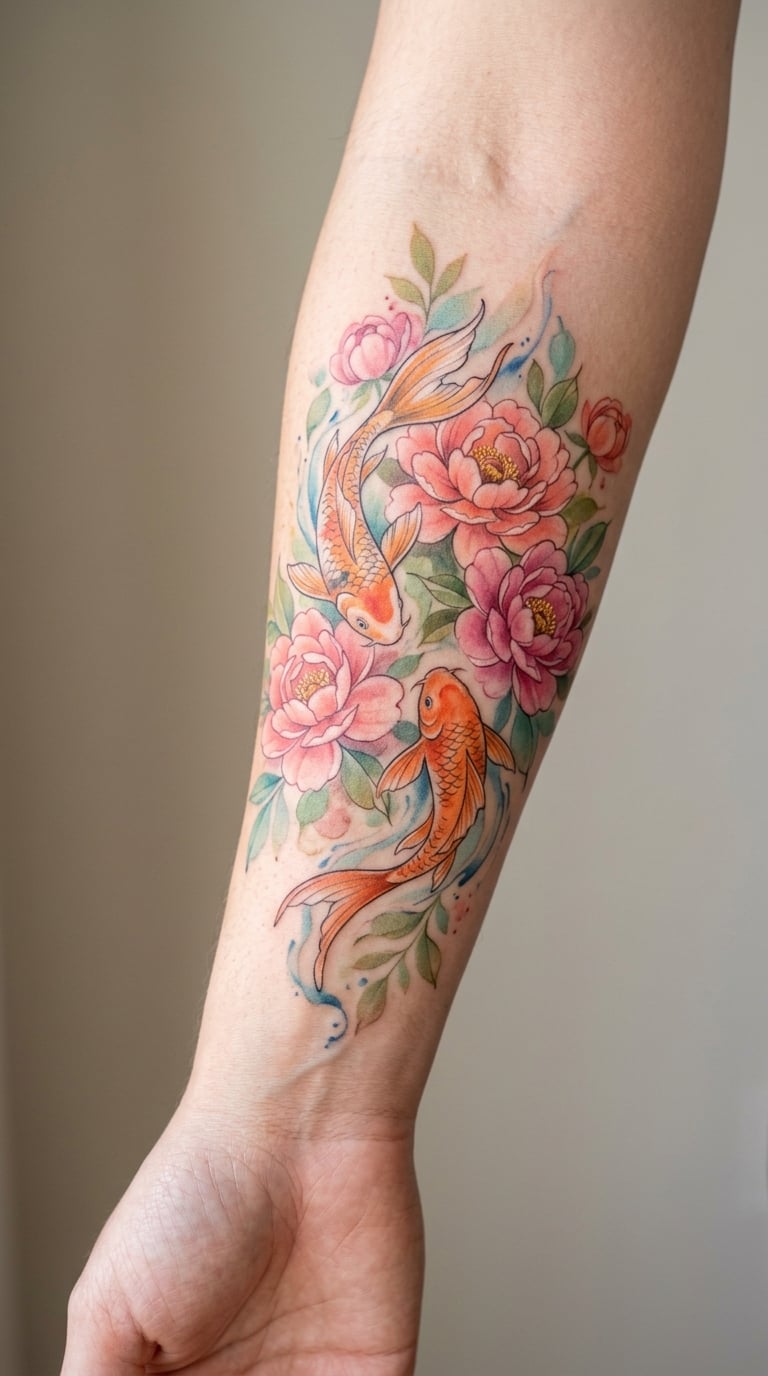
Two orange koi curve through loose peonies painted in diluted washes that bleed at the edges. The colour runs soft and wet while the fish keep enough definition to read clearly, which is what stops a watercolour sleeve turning into a blur.
Peonies carry an association with romance and good fortune, and koi are often read as persistence. Plenty of people simply like the movement of the layout.
Placement: inner forearm, wrist to elbow. Size: 5 to 8 inches (13 to 20 cm). Style: watercolour with soft edges. Pain: medium, less than blackwork of the same size.
Pale washes lighten over time and the ink can look tired in two or three years, so a re-saturation session is normal. Make it yours: name the koi count after the people or animals you keep close, and let the number decide the layout.
4. Blackwork Wolf Emerging from Peony Vines
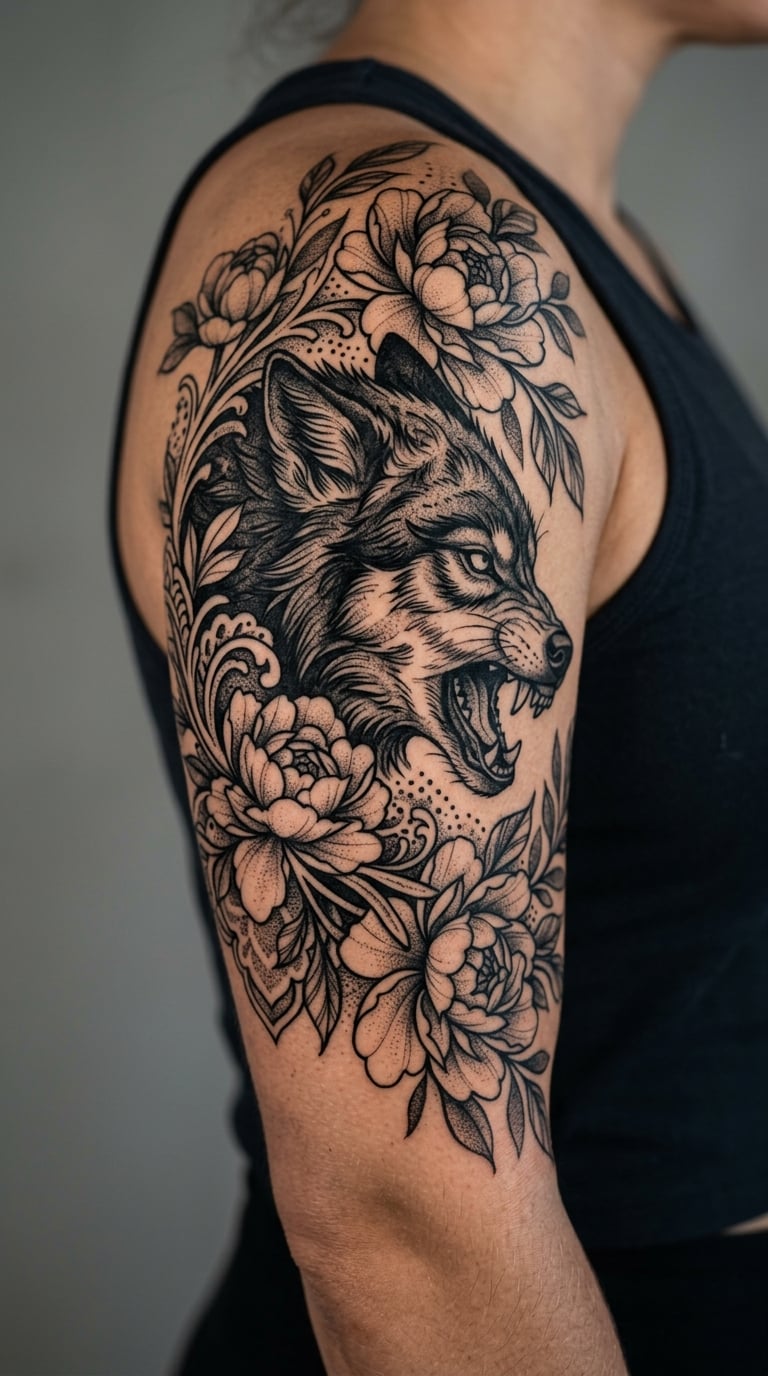
A heavy black wolf head pushes through a thicket of peony vines rendered in solid black and stipple. The vines cross in front of the muzzle, and the untouched skin around them is what makes the wolf read as emerging rather than sitting inside a frame.
This is the heavy end of the range. It suits people who want a sleeve that holds attention across a room and who are comfortable with dense black for years.
Placement: upper arm, deltoid to elbow. Size: 7 to 10 inches (18 to 25 cm). Style: blackwork with stipple shading. Pain: high. Long sessions on the upper arm get uncomfortable fast.
Solid black ages more gracefully than grey wash, though shoulder areas can bump and flatten over time. Make it yours: let one peony bud sit half-open where you would expect a full bloom, marking something still in progress.
5. Micro-Realism Hummingbird Among Cherry Blossoms
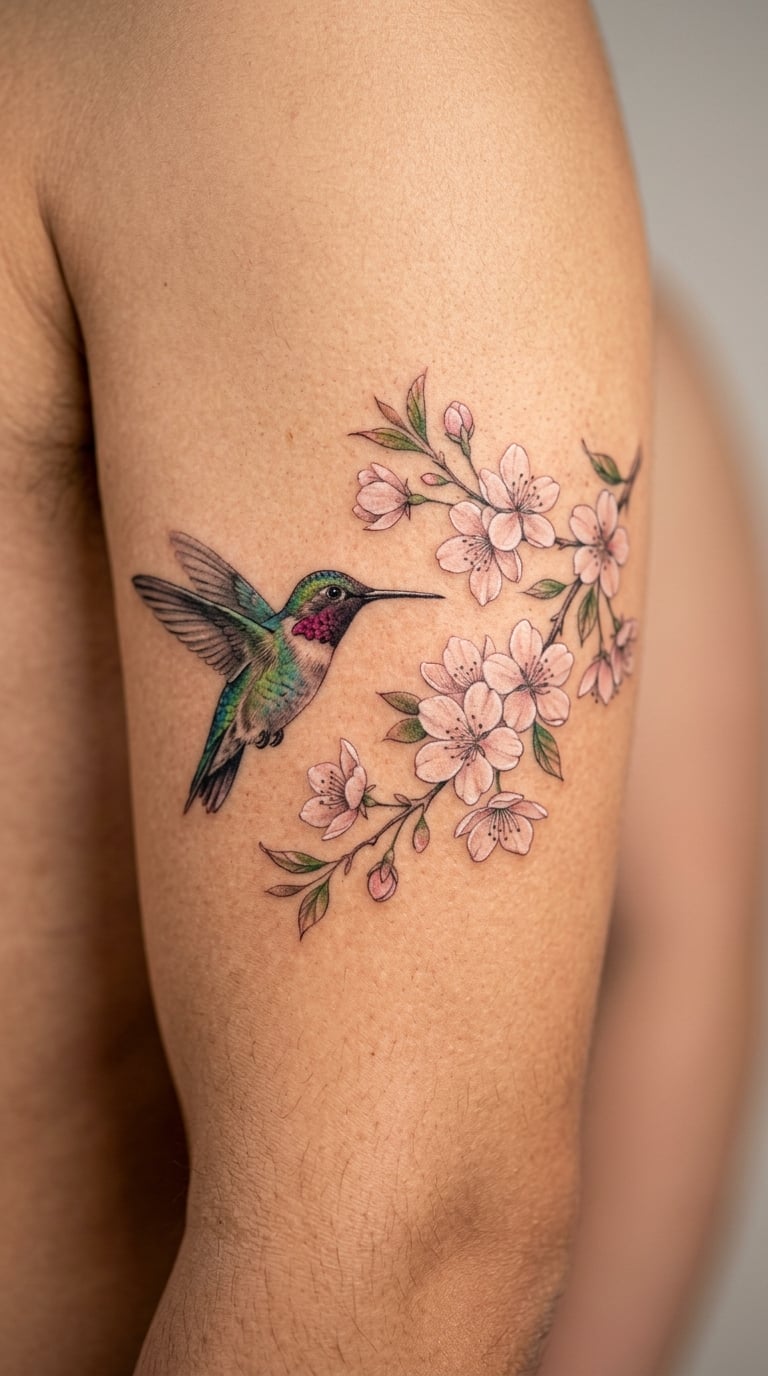
A small hummingbird hovers with its beak inside a blossom, painted in fine grey wash with a hint of warm colour on the throat. The cherry branches stay thin and sparse, so a lot of skin stays visible between them.
Small hummingbirds are popular for first larger tattoos because the subject is legible even at postage-stamp size. It reads as motion rather than detail, which is forgiving.
Placement: outer upper arm from shoulder toward elbow, or high on the outer forearm. Size: 3 to 5 inches (8 to 13 cm). Style: micro-realism. Pain: medium, with the shoulder cap the most sensitive area in this guide.
Feather micro-detail softens into a grey suggestion within roughly five years. Make it yours: have the branch run under an existing small tattoo, so the two pieces share a stem instead of sitting apart.
6. Neo-Traditional Moth and Marigold Border
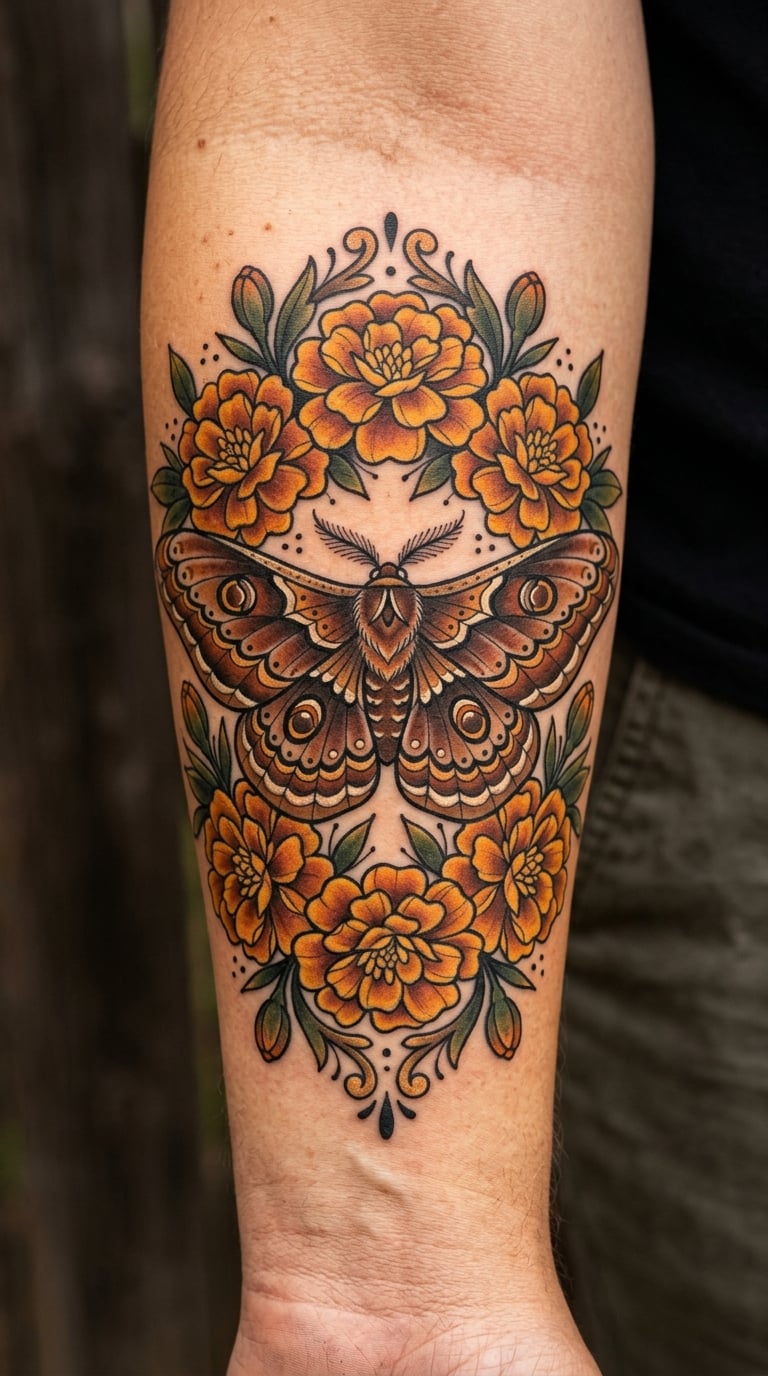
A symmetrical moth with spread wings anchors the centre of the forearm, its body built from flowing linework. Marigolds frame it on both sides in saturated gold and orange, and a warm gold accent runs through the wing edges to tie the two halves together.
Moths draw on the idea of transformation, and marigolds are often chosen for a memorial. The symmetrical layout gives a client a very clean choice to say no to, which people like when a piece runs down the arm.
Placement: inner forearm, mirrored about the centre line. Size: 6 to 8 inches (15 to 20 cm) tall. Style: neo-traditional with gold accents. Pain: medium.
Gold shifts over time and reads warmer against tan skin than against deep skin tones, so ask to see pigment swatches on your own forearm before the session. Make it yours: build a matching moth on the other arm at a smaller scale once this one is healed.
7. Japanese-Style Crane and Lotus on the Upper Arm
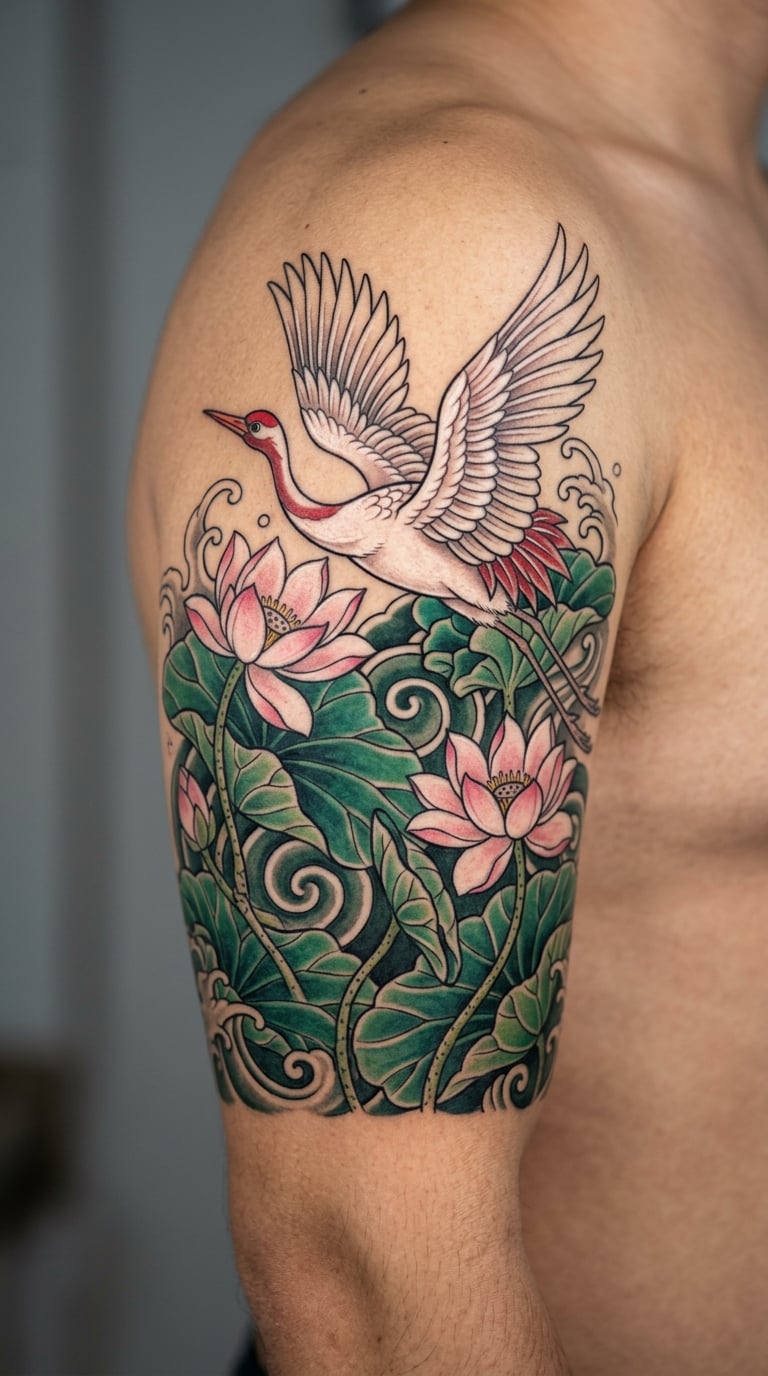
A crane in flight crosses the upper arm above lotus leaves and pale pink blooms, drawn with flowing contour lines and selective red, green and muted blue. The composition moves diagonally, so it fills the arm without a hard border.
Crane-and-lotus arrangements come from Japanese tattoo traditions, and it is worth naming that source rather than presenting the composition as generic. If that tradition matters to you, look for an artist who works in it or find a composition that borrows the visual language without borrowing the specific religious imagery.
Placement: upper arm. Size: 7 to 10 inches (18 to 25 cm). Style: Japanese-style illustration. Pain: medium to high, with long unbroken sessions.
Fine contour lines in a large piece blur faster than bold shapes, so ask where the artist intends the weight to sit. Make it yours: have the crane fly toward a small figure or landmark you care about at the far end of the sleeve.
8. Minimalist Butterfly and Daisy Linework
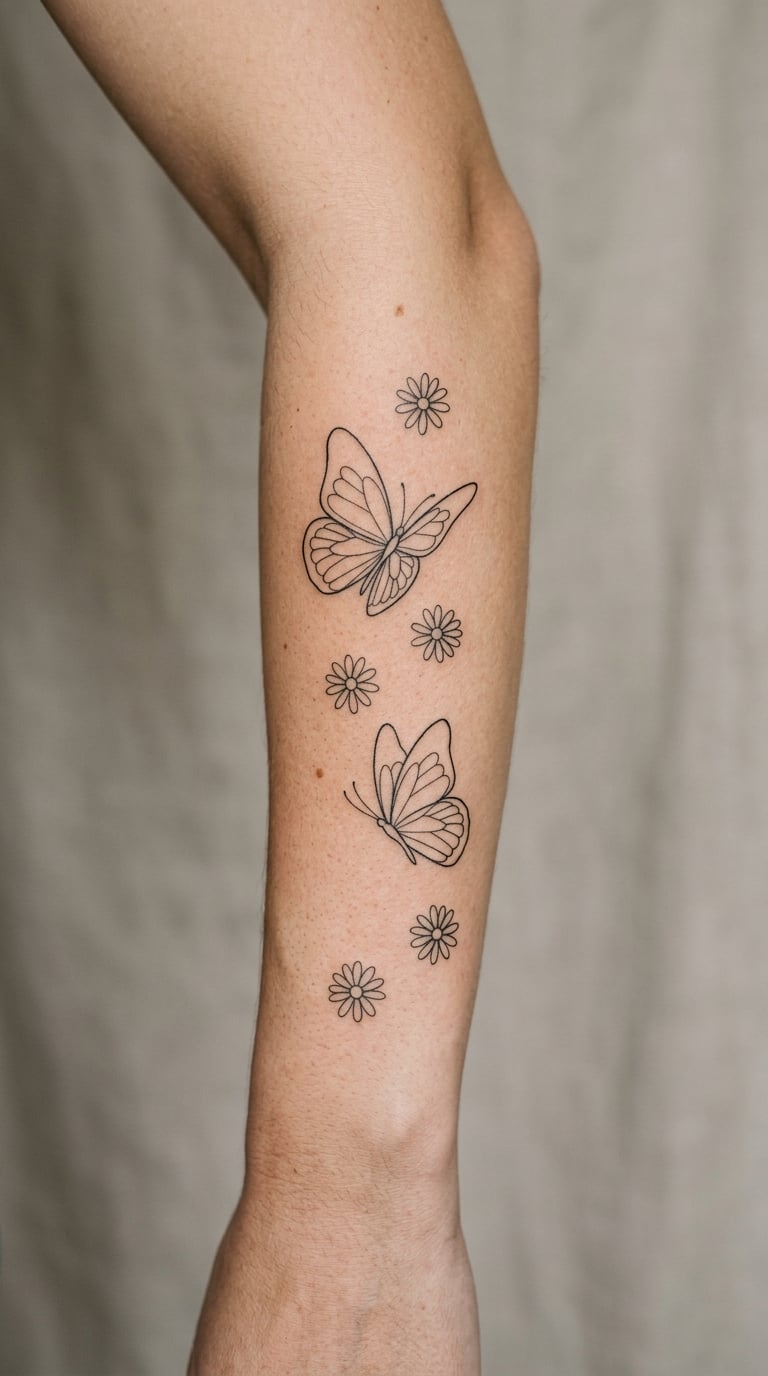
Two outlined butterflies and a handful of daisies, all in single-weight line, spread along the inner forearm. Most of the design is the space between the elements, which is the whole point: it can absorb another motif later without a redesign.
Light botanical pieces tend to get chosen by people who like sleeve tattoos but are not ready for a full dark sleeve. This one also travels well, because it reads the same in a short sleeve as in a long one.
Placement: inner forearm from wrist toward elbow. Size: 3 to 5 inches (8 to 13 cm) per cluster. Style: minimal fine line. Pain: low, mostly scratching on the inner forearm.
This is the style most likely to fade noticeably, especially on the wrist and near the elbow crease where skin moves constantly. Make it yours: let each daisy stand for a person, then add one bloom a year as the sleeve grows.
9. Barn Owl Surrounded by Ferns and Berries
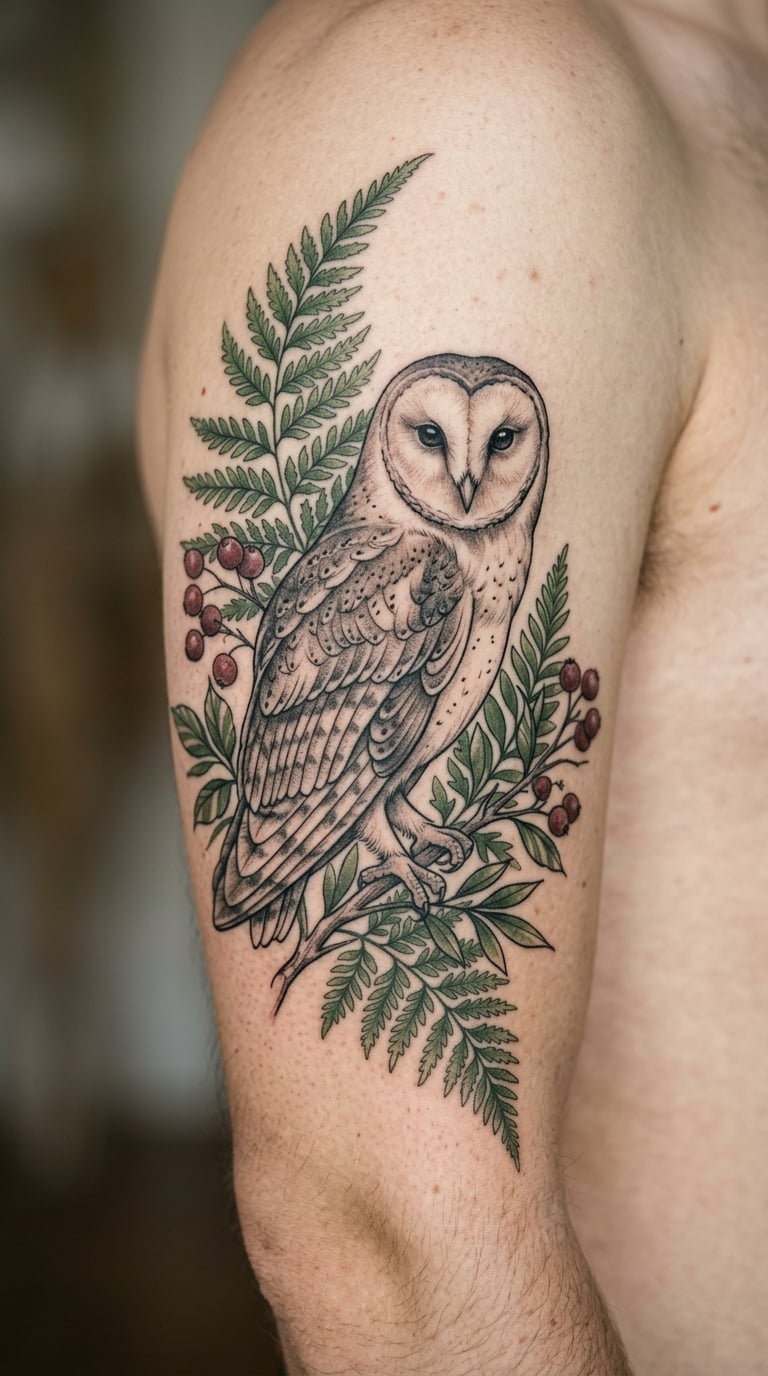
A barn owl with a heart-shaped face sits at the centre of the upper arm, its feathers built from soft grey and cream washes. Winding ferns and small muted red berries frame it, and the background stays busy enough to fill gaps without touching the bird’s outline.
Owls get chosen for the look rather than a fixed reading, though they are often read as watchfulness or quiet knowledge. The muted palette keeps it from competing with the bird.
Placement: outer upper arm. Size: 6 to 8 inches (15 to 20 cm). Style: realism with muted colour. Pain: medium.
Delicate feather shading is the first thing to soften, usually noticeable at the face after several years. Make it yours: have the berries form a small scatter of coordinates or a date, spaced so they read as texture rather than text.
10. Phoenix Rising Through a Sunflower Field
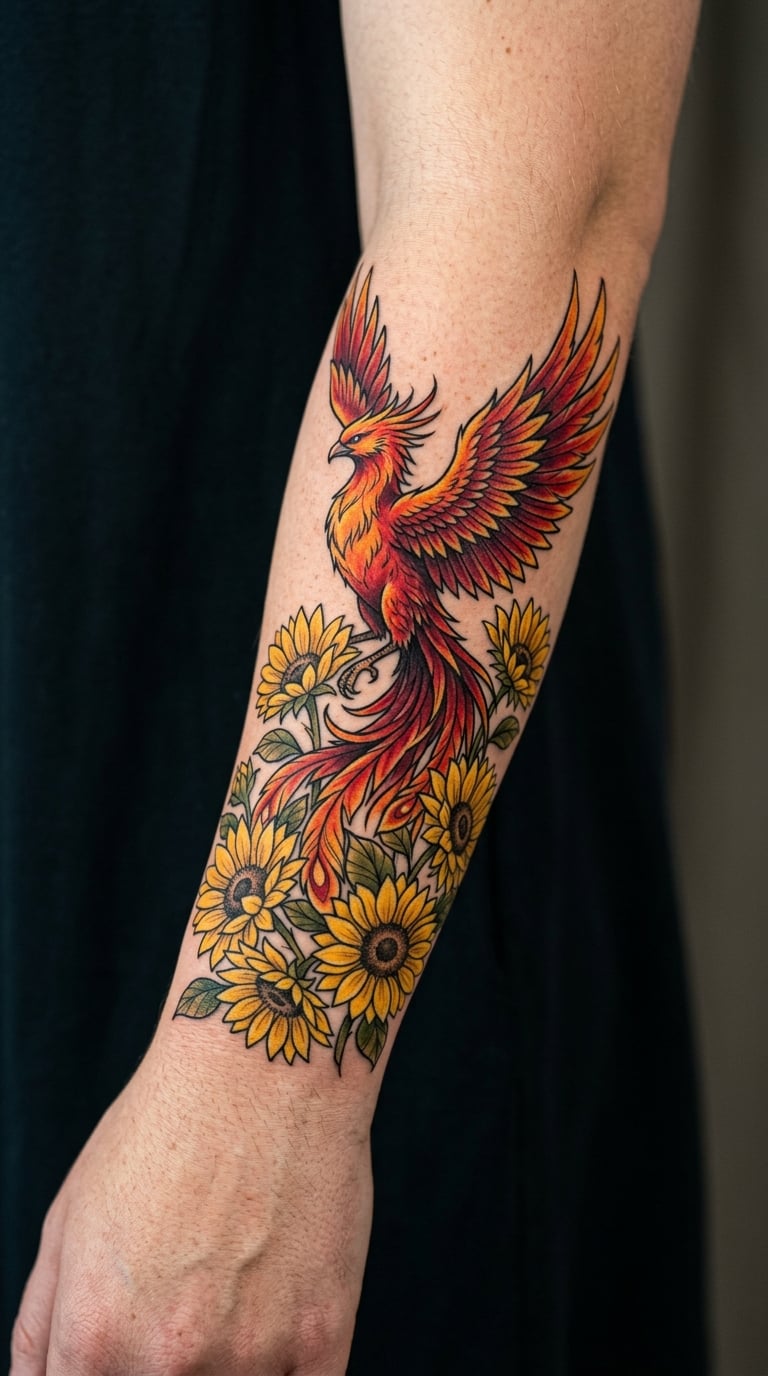
A red, orange and black phoenix rises through a field of sunflowers, with graduated colour carrying the eye from the tail at the wrist up to the wings near the elbow. Black outline work keeps the flames sharp against the softer petals.
The phoenix is the most requested rebirth image in this group, and sunflowers bring warmth and a sun motif that reads well next to fire. Together they fill a full forearm without repeating shapes.
Placement: outer forearm, wrist to elbow. Size: 10 to 14 inches (25 to 36 cm). Style: illustrative colour. Pain: high over several sessions.
Yellow fades fastest of any colour here, so expect a refresh sooner than with the reds. Make it yours: put a real date inside the flame body where the orange is lightest, invisible from more than an arm’s length away.
11. White Tiger Wrapped in Magnolia Branches
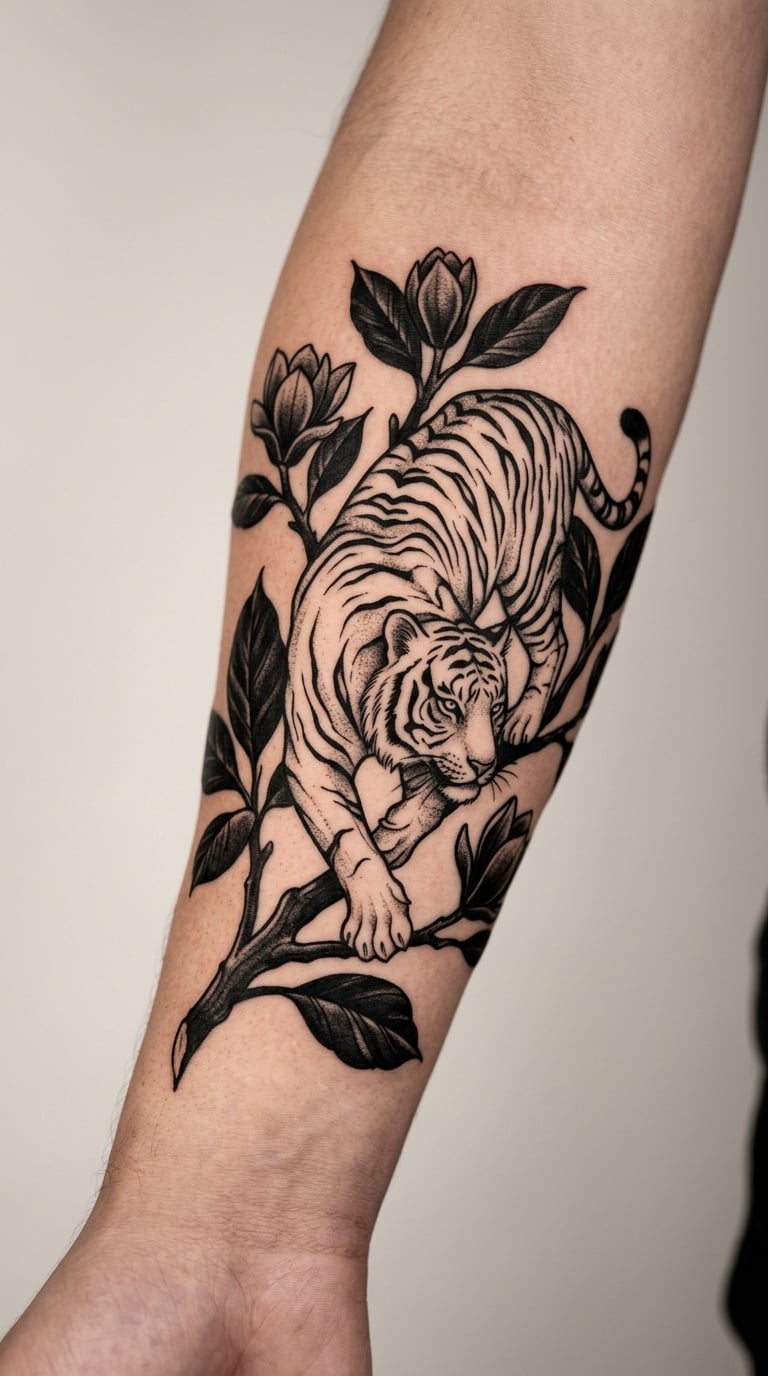
A white tiger works through black magnolia branches, and the whole piece depends on untouched skin where the fur is light. The stripes and the branches both run diagonally, which carries the eye down the arm and hides the join between sessions.
High-contrast black and white suits people who want a sleeve with presence but no colour to fade. It also rewards planning, because the white areas have to be planned in rather than treated as gaps.
Placement: inner arm, elbow toward wrist. Size: 8 to 12 inches (20 to 30 cm). Style: blackwork with white space. Pain: high, and the inner arm is a sensitive strip.
Black along the inner elbow wears from clothing contact over time. Make it yours: shape the magnolia buds into a set of initials hidden inside the branch network.
12. Blue Butterfly and Delphinium Vine Scroll
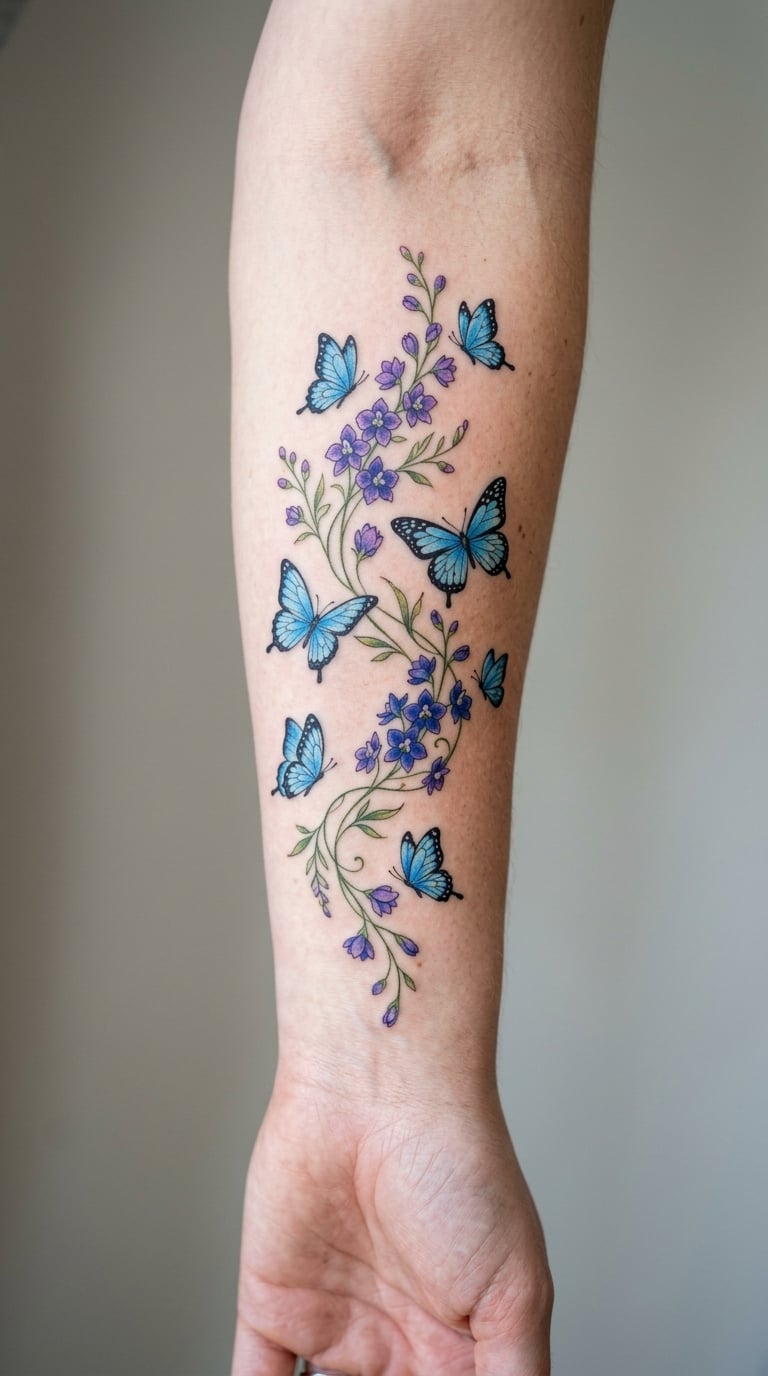
Blue butterflies rise through a trailing delphinium vine in a vertical scroll, with fine outlines carrying the stems and saturated colour reserved for the blossoms. The scroll shape gives the inner forearm a natural direction to follow.
Delphinium is often picked for its tall spire shape, which fills a narrow strip of skin better than round blooms. The butterflies add the movement that keeps a vertical layout from looking like a list.
Placement: inner forearm, wrist to elbow. Size: 6 to 9 inches (15 to 23 cm). Style: illustrative colour with fine line. Pain: medium.
Light blue and lavender both lose punch as the skin ages; saturation is worth a second visit a few years on. Make it yours: choose the blues from one photograph of a real flower, so the palette belongs to you rather than the studio.
13. Snake Coiling Through Protea Flowers
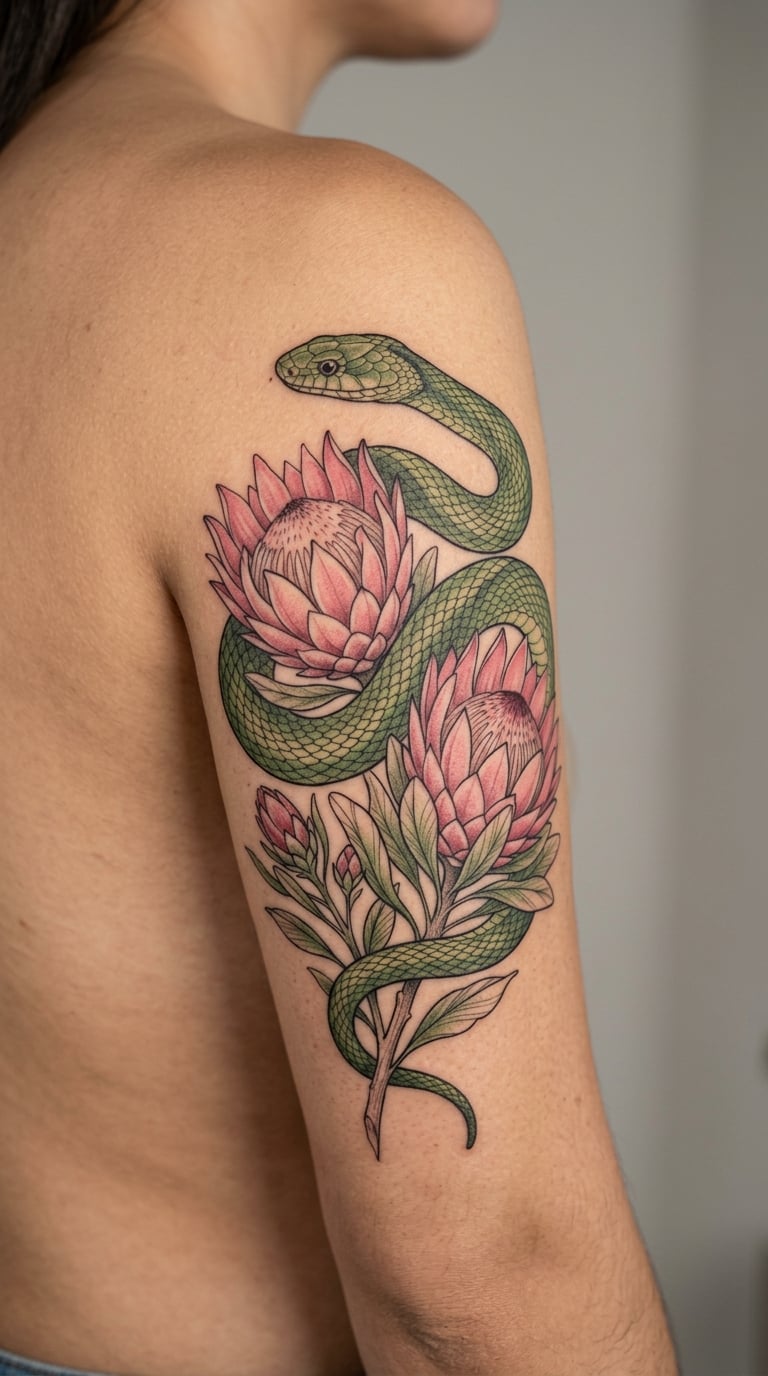
A single green snake coils through large pink protea blooms, its scales described with fine black-and-green work and the petals shaded clean and flat. Spacing is generous: each flower gets its own pocket of skin, which stops the overlap that ruins most dense floral layouts.
Snakes get chosen for transformation, renewal or protection, and most people describe their own reason. One strong curve carries the composition, so the arm does not need a second animal.
Placement: upper arm. Size: 5 to 8 inches (13 to 20 cm). Style: realism or neo-traditional. Pain: medium to high, since scale detail means slow needle work.
Scale detail softens first, so ask for the scales to be a little larger than the drawing suggests. Make it yours: have the snake’s body pattern carry a family birth month number through the scale shapes.
14. Deer Portrait Filled with Wildflower Splashes
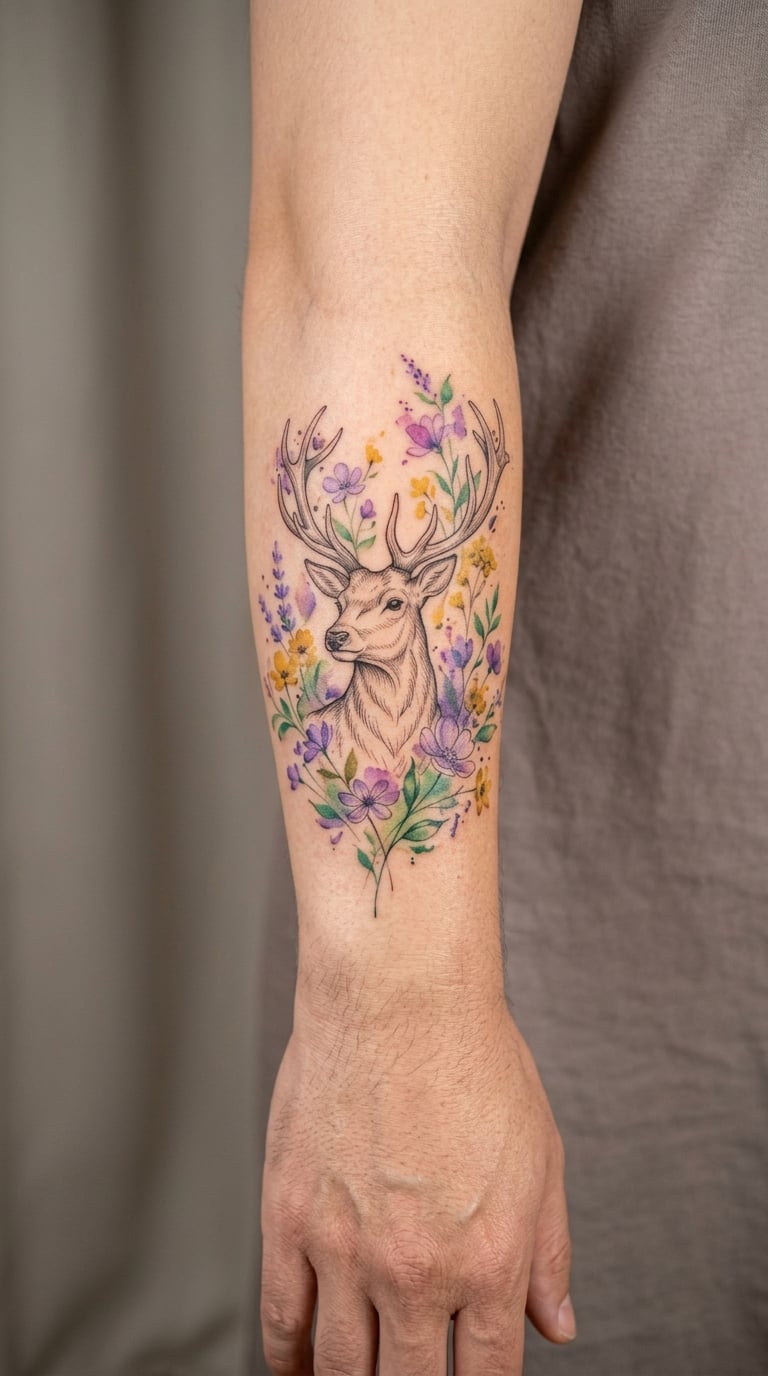
A fine-line deer head in profile sits inside loose watercolour splashes of purple, yellow and green, with a few named botanicals pinned around the edges. Precise anatomy against fluid colour is the whole idea, and the contrast is what makes it feel current rather than busy.
Deer are a common memorial subject and a common first-large-tattoo subject, since the head reads clearly at a moderate size. The colour is an accent here, not the subject.
Placement: outer forearm. Size: 5 to 8 inches (13 to 20 cm). Style: fine line with watercolour accents. Pain: medium.
Watercolour without a heavy black edge is fragile, so plan the outline work carefully or accept a touch-up every few years. Make it yours: use flowers native to the place the deer was seen or where someone you are commemorating lived.
15. Octopus and Sea Anemone Forearm Flow
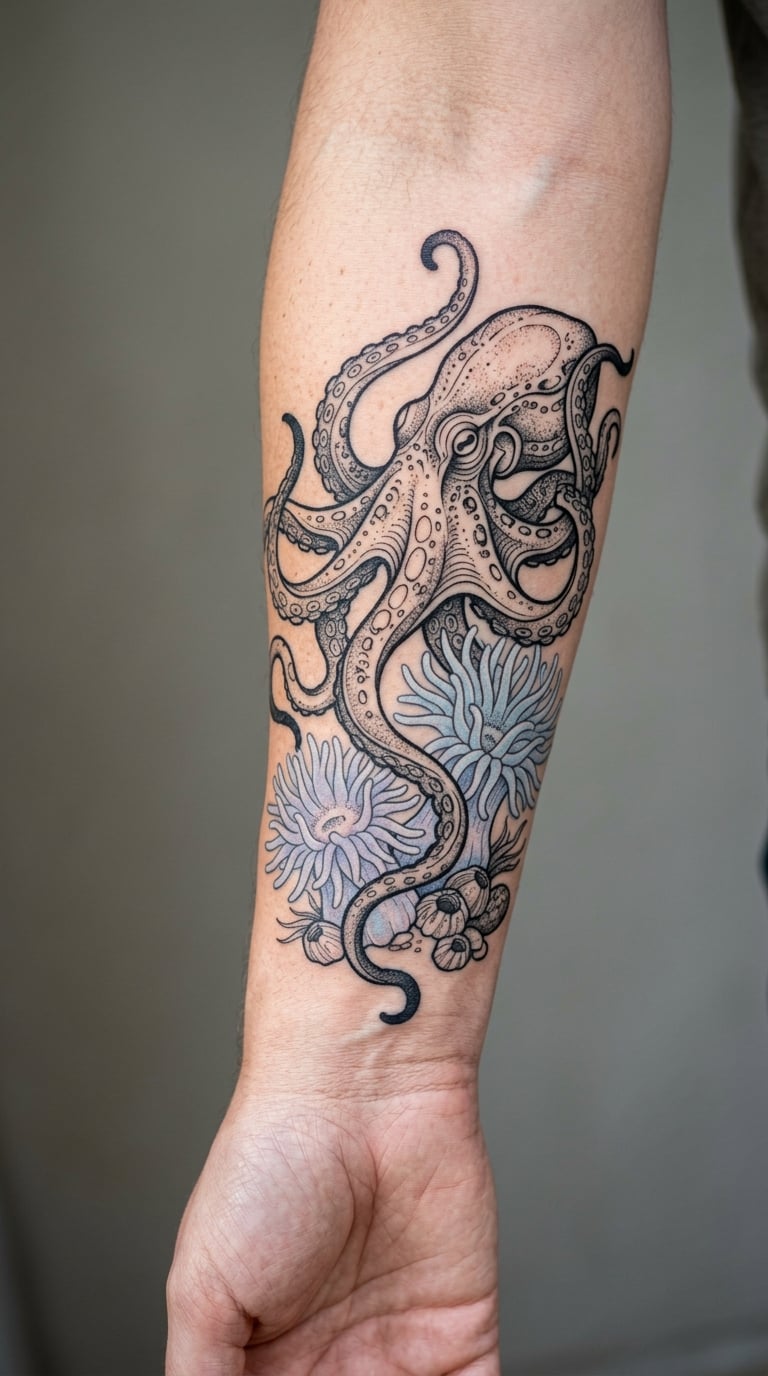
A blackwork octopus sends its tentacles along the inner forearm through pale blue and lavender anemones. Every curve is a curve, which is what makes the piece read as movement even when the arm is still.
Marine work rewards the shape of a forearm, because tentacles have somewhere natural to follow. The anemones double as filler, closing gaps between arms that would otherwise read as empty.
Placement: inner forearm. Size: 8 to 11 inches (20 to 28 cm). Style: blackwork with pastel colour. Pain: high, since eight limbs mean a lot of separate work areas.
Black outlines on the inner arm wear fastest where a sleeve rides up. Make it yours: add a small sea-glass piece or a shell from a specific beach to one of the negative spaces between tentacles.
16. Two Ravens Perched Among Cherry Trees
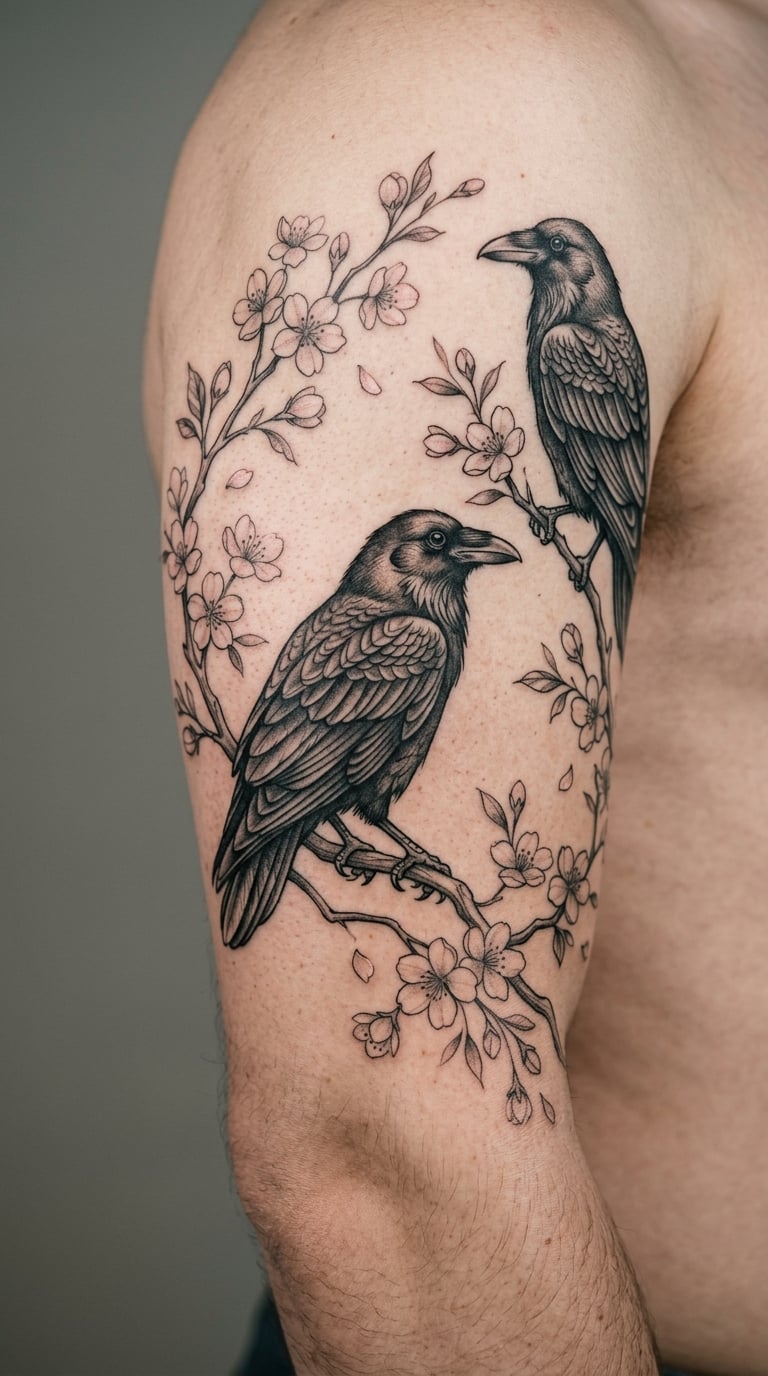
Two ravens perch on separate cherry branches, painted in black and grey with soft feather texture and sparse pale pink blossom between them. Branch lines run over the shoulder cap so the composition continues when the arm moves.
Two birds rather than a flock keeps the design readable, and ravens have a long association with memory and loss. Again, that meaning comes from the client, not the design brief.
Placement: shoulder cap and outer upper arm. Size: 6 to 9 inches (15 to 23 cm). Style: black and grey with a pink accent. Pain: medium.
Delicate grey feather work fades toward flat black over time, which most wearers end up liking. Make it yours: have the two branches lean toward each other, so the piece reads as two rather than alone.
17. Dragonfly Interwoven with Lavender Stems
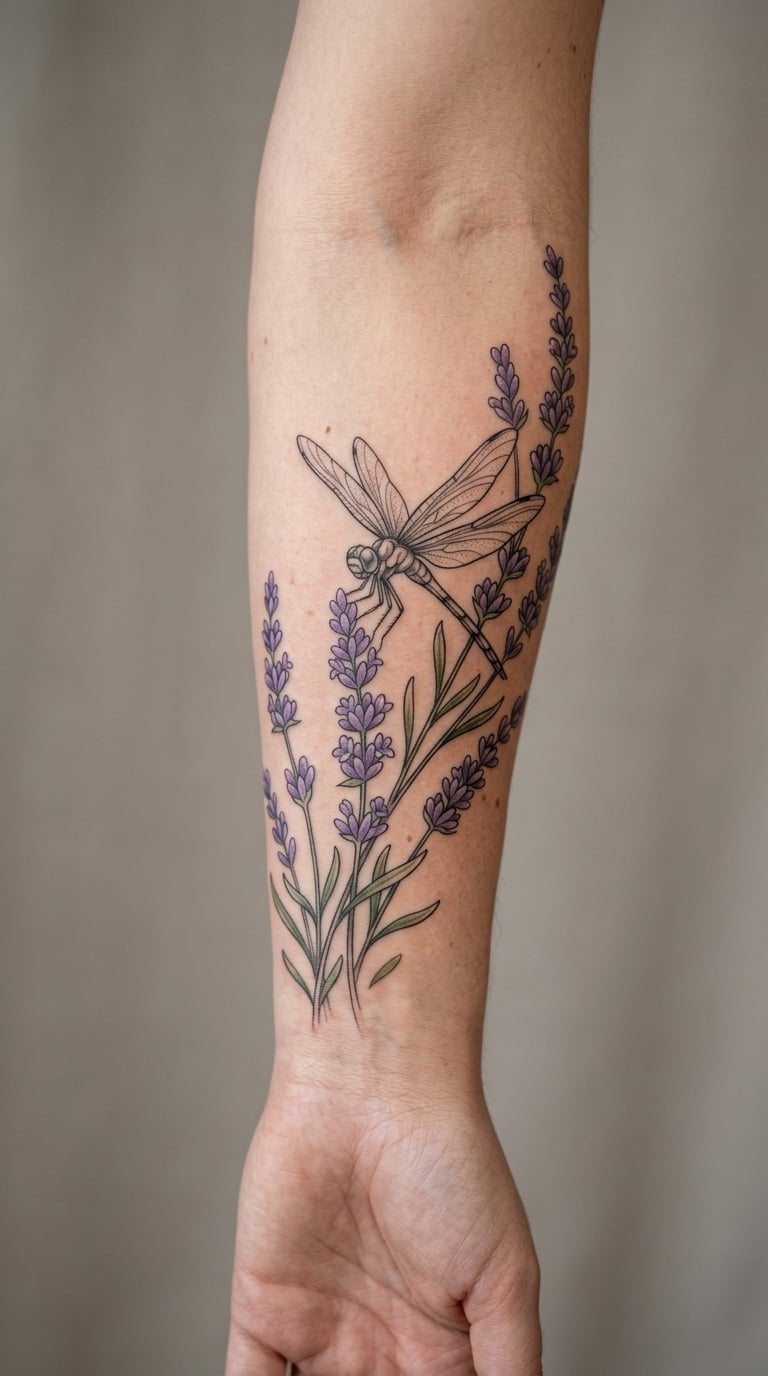
A detailed dragonfly hovers between repeated lavender stems that narrow as they approach the wrist. The stems do the structural work here: repeated verticals give a long thin shape something to hold onto.
Lavender is often chosen for calm or remembrance, and the small scale makes this one of the lighter designs in the list. It works as a first piece even at wrist length.
Placement: wrist to inner elbow. Size: 5 to 8 inches (13 to 20 cm). Style: fine line with soft colour. Pain: low to medium.
Wrist placement and fine detail are the two hardest conditions for long-term legibility, so keep the wings simple. Make it yours: run the stems down to a birth-flower bloom at the wrist end as a visual full stop.
18. Lion Crown Interlocked with Sunflowers
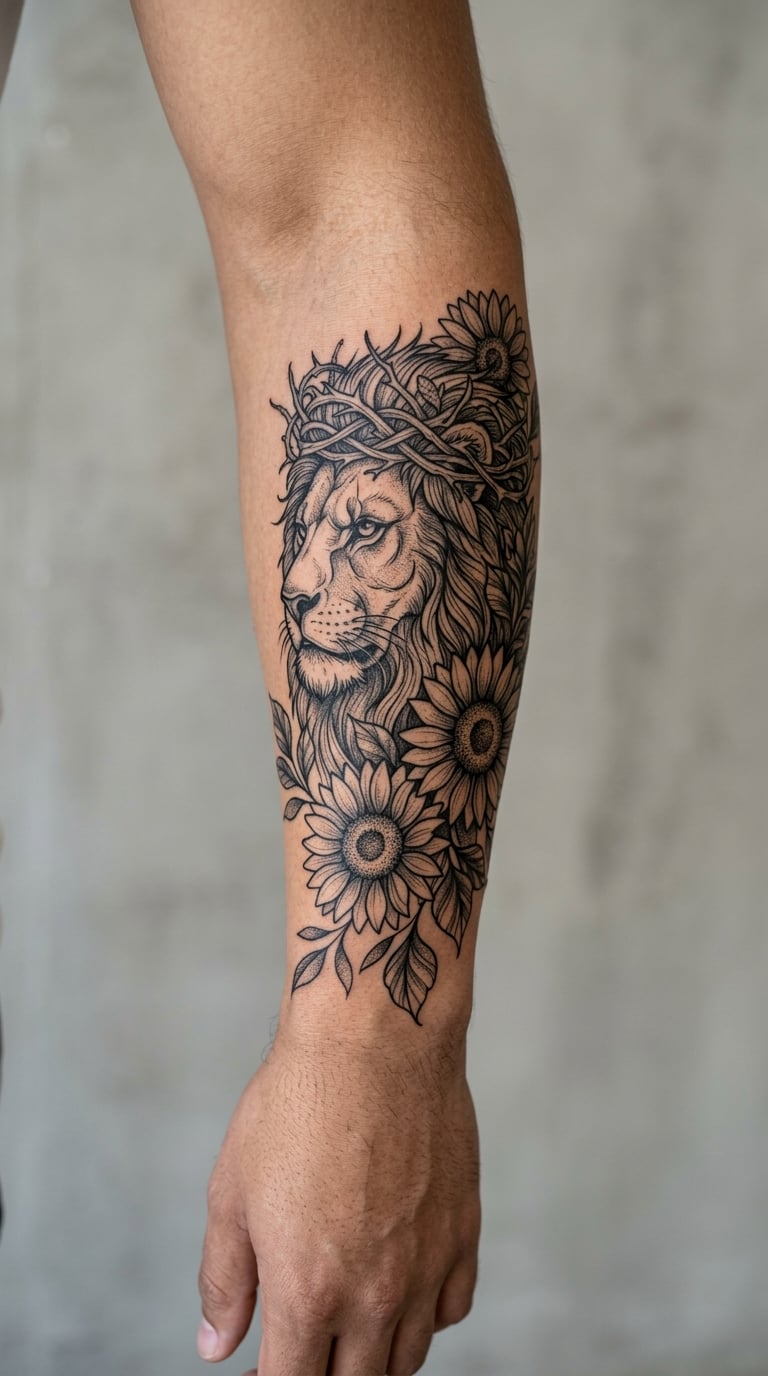
A monochrome lion portrait in blackwork anchors the outer forearm, and a woven crown runs through a field of golden sunflowers around it. The rhythm of repeated petals keeps the black mass from feeling heavy.
Lion imagery reads as courage and authority to most people who choose it. Crowns add a second, more deliberate layer, so make sure you actually want both signals.
Placement: outer forearm. Size: 8 to 11 inches (20 to 28 cm). Style: blackwork. Pain: high on the forearm, and the elbow is the difficult part.
Solid black on the outer arm holds up well; the sunflowers will need colour work before the black does. Make it yours: cut one sunflower out of the pattern and leave that section as skin, marking where the sleeve is still unfinished.
19. Botanical Tree Full of Songbirds
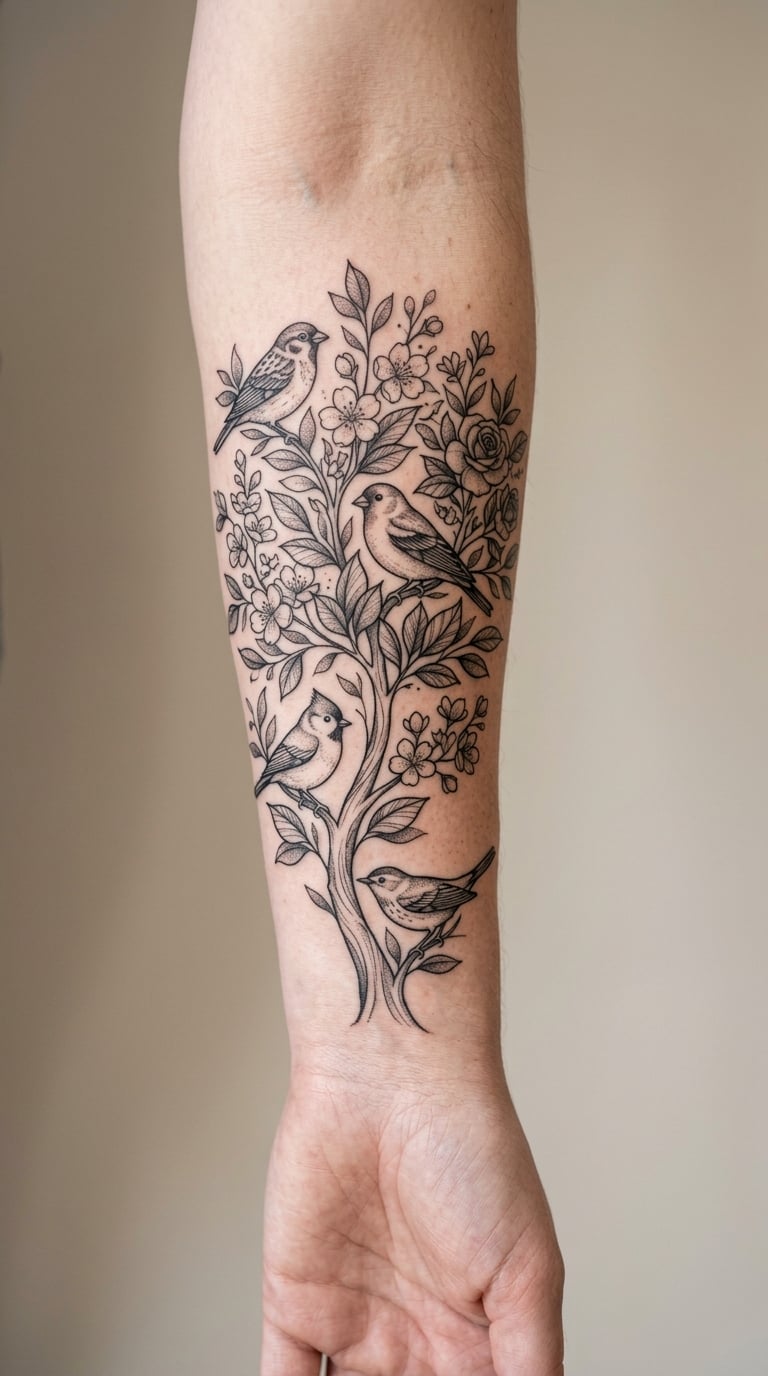
A flowering tree runs vertically along the inner forearm with layered leaves and several small songbirds distributed through the branches. Movement comes from the bird placement rather than from dense black, so the piece stays light across a long stretch of skin.
Botanical work is the most flexible option for a patchwork sleeve, since new branches can be added later. That is the practical reason people choose it, whatever the personal reason is.
Placement: inner forearm, elbow toward wrist. Size: 9 to 13 inches (23 to 33 cm). Style: botanical illustration. Pain: medium, steady across several sessions.
Leaves drawn too small merge into a single green mass over time, so size each one for a fingertip. Make it yours: draw the branch structure from a tree that actually grew near you, using a photograph as the reference.
20. Black Panther Surrounded by Hibiscus
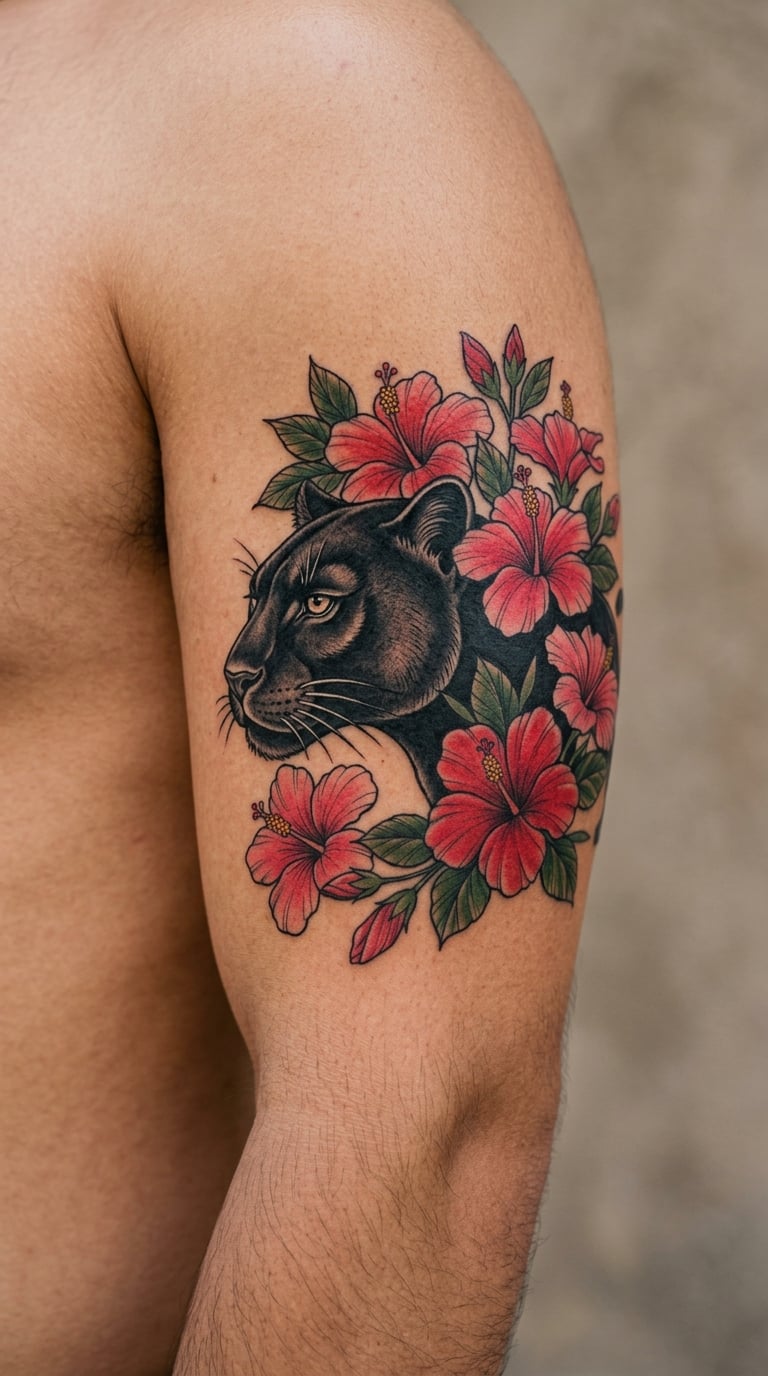
A panther in profile is filled solid black, its eyes cut as sharp white shapes, and hibiscus blooms in saturated red and pink ring the head. The solid fill against repeated petals is a big contrast, and it holds up at a distance in a way fine line does not.
Panthers come with a lot of borrowed symbolism from car and motorcycle culture, so many wearers now choose the animal for how it looks rather than what it supposedly stands for. Either is a fine reason.
Placement: outer upper arm. Size: 7 to 10 inches (18 to 25 cm). Style: blackwork with colour. Pain: high, and solid black coverage is more uncomfortable than outline work.
Hibiscus red fades toward pink over time, so expect a colour refresh before the black needs anything. Make it yours: add a single bloom behind the shoulder in a different colour each time you extend the sleeve.
How to Choose the Right Design
The best design is the one your arm can hold for thirty years. Here is how to narrow the field before you sit down with an artist.
How dense should sleeve tattoo ideas with flowers and animals be?
Match the density to the size of the canvas, not to the reference images you like. A detailed design that reads well at shoulder scale turns into a grey mass at wrist scale, and most of the disappointing healed results come from that mismatch.
Pick the focal animal first
The animal is the subject, so choose it before the flowers. Once you have a fox, a wolf or a crane in mind, the botanicals are selected to support it, and you avoid the endless flower-shopping spiral that delays most sleeve projects.
Choose a style you can maintain
Fine line, watercolour and saturated colour all age differently. Fine line greys out, pale washes lighten, and warm yellows fade first. Look at healed work from the same artist rather than fresh work, and ask what they would have done differently with more healed years behind a piece.
Decide between a patchwork sleeve and one cohesive design
One cohesive design needs more commitment in time, money and planning, and it usually looks stronger. Patchwork suits people who already have arm space partly filled, and it lets you spread the cost over years. If you already have a floral piece on one arm, a cohesive animal-and-flower composition is usually the better answer than adding a second unrelated style.
Look for a portfolio, not a render
Bringing in a finished tattoo from another person is common and most artists would rather you did not. Bring photographs of textures, line weight and a healed piece in a similar placement, and let them draw something that fits your arm.
Plan the whole arm, even if you tattoo part of it
A medium piece that fits an eventual sleeve is far more useful than a beautiful tattoo in the wrong spot. A tattooer on the other side of your arm has covered a floral half sleeve with a large dark owl and made the florals do the blending, which is a good model for planning ahead.
Cost and Session Time
Cost follows hours, and hours follow size and detail. Most artists quote hourly or by the piece, and shops have a minimum that a short session still has to meet.
- Micro and small pieces (under 3 inches): one session of roughly one to two hours.
- Small-to-medium pieces (3 to 6 inches): two to four hours, usually one session.
- Half sleeves: three to five sessions of three to five hours each.
- Full sleeves: five to eight sessions, often spanning several months with healing breaks between.
Blackwork, fine detail and heavy colour all add hours. Colour in particular is slower than line work, and a full-colour sleeve will consistently cost more than a black sleeve of the same size. Location matters too, and so does how far ahead you book.
Break sessions deliberately. Tattooers routinely outline a piece, let it heal for two or three weeks, then come back for shading, and the community treats that as normal rather than a problem. Skin that is worked flat for six hours straight needs longer to settle.
Aftercare Basics
- Follow your artist’s aftercare instructions first. They saw the skin in front of them, and their advice outranks anything general.
- Wash gently. Clean the area with lukewarm water and a mild unscented soap, then pat it dry. No soaking, no scrubbing.
- Moisturise thinly. A thin layer of a plain ointment keeps the skin from drying out. Heavy creams trap heat and can irritate.
- Leave the surface alone. Do not pick flakes or scabs, and keep pets and loose clothing off the fresh area.
- Protect it from sun. Cover the sleeve in direct sun, especially during the first weeks, and use sunscreen on exposed skin once healed.
- Give colour time to settle. Fresh ink looks brighter than healed ink. Judge the result after a few months and book a touch-up if your artist recommends it.
If anything looks wrong in a way these basics do not cover, call the artist rather than searching online. Most shops would rather answer a quick question than hear about a problem later.
Frequently Asked Questions
What are the best flowers for a sleeve tattoo?
Peonies, roses, chrysanthemums, magnolia, hibiscus and lotus are the most reliable sleeve flowers because they hold a strong outline and a large enough bloom to read at a distance. Peony and magnolia carry heavy detail, so give them the larger areas of the arm. Smaller blooms like lavender and forget-me-not work as filler and connective stems rather than as the focal point.
What is the best animal to get tattooed for a sleeve?
It depends on how much detail you want to maintain. A wolf, tiger or panther in blackwork gives you large shapes that stay legible for decades. A fox, hummingbird or butterfly gives you more freedom of movement and lighter work. Owls sit in between. Choose the animal whose level of detail you are happy to see softened over the years.
How long does a full floral and animal sleeve take?
A full sleeve usually takes five to eight sessions of three to five hours, spread over several months with healing breaks in between. A half sleeve is closer to three to five sessions. Colour adds time, because fills and shading take longer than line work. Planning the whole composition before the first session is the biggest factor in how many hours you end up needing.
Do fine line floral tattoos fade faster than bold ones?
Yes. Single-needle linework softens, spreads and greys over time, and it fades fastest on the wrist, fingers and elbow crease where skin moves constantly. Solid black and large filled shapes hold up far better. If you want a fine line sleeve, ask for slightly heavier line weight than the drawing suggests and expect a refresh every few years.
Should I combine the animal and flowers in one sleeve or split them into two?
One sleeve usually looks stronger, because the botanicals do the filler work that connects the animal to the rest of the arm. Splitting them into an animal sleeve and a floral sleeve works if you already have one and want to balance it, or if you want two very different pieces. If the arm is empty, combining them in one composition is the stronger choice.
Conclusion: Where to Start
If this is close to your first large tattoo, start with idea 1, the fine-line fox in wildflowers, or idea 8, the minimalist butterfly and daisies. Both are light on colour, they flex with the shape of the arm, and they leave room to add more later without a redesign.
If you already have arm work and want a serious composition, look at the blackwork wolf in peony vines, the white tiger in magnolia, or the black panther framed by hibiscus. Those three reward planning and pay off over decades, and they are the pieces worth spending more sessions on.
Decide on the animal first, find an artist whose healed work you like, and bring reference photos instead of somebody’s finished tattoo. That is the whole process. If you want more options beyond these twenty, bold sleeve tattoo ideas are a useful second look before you commit.