
20 Best Dotwork Tattoo Ideas for Men: Unique Picks October 2026
Dotwork tattoo ideas for men usually come down to one thing: how the dots are spaced. Get that right and the piece still reads as a shape a decade from now. Get it wrong and it turns into a flat grey patch nobody can read. The 20 designs below are built for men who want detail and texture without colour, and each comes with the placement, size and pain reality so you can walk into a consultation knowing what you want.
One scheduling note first. If you want anything done before summer, you are already behind — healed, sun-ready and photo-ready takes 8 to 12 weeks, so book 30 to 45 days ahead.
Dotwork Tattoo Ideas for Men: Quick Guide
| Idea | Style | Best placement | Size | Pain |
|---|---|---|---|---|
| 1. Geometric mountain sunrise | Geometric blackwork with stippling | Inner forearm | 5-7 in | Medium |
| 2. Blackwork mandala | Radial dotwork mandala | Outer upper arm | 5-6 in | Medium |
| 3. Stippled wolf portrait | Stipple shading | Outer calf | 7-9 in | Medium |
| 4. Coiled serpent | Fine dotwork with blackwork scales | Forearm or upper arm | 4-5 in | Medium |
| 5. Four-point compass rose | Fine-line geometric dotwork | Inner wrist | 2-3 in | Medium-high |
| 6. Topographic wave pattern | Topographic dotwork | Shoulder cap | Wraps 4-5 in deep | Medium |
| 7. Moon-phase arc | Celestial stipple and linework | Inner forearm | 6-8 in | Medium |
| 8. Geometric elephant head | Geometric blackwork with stipple | Outer upper arm | 5-6 in | Medium |
| 9. Pine forest gradient | Gradient stipple | Inner bicep | 4-5 in | Medium |
| 10. Koi in a dotwork current | Black and grey dotwork | Outer thigh or forearm | 5-6 in | Medium |
| 11. Stag skull, geometric antlers | Stipple with geometric linework | Forearm or calf | 4-5 in | Medium |
| 12. Rose-window geometry | Radial geometric dotwork | Upper chest | 8-10 in | Medium-high |
| 13. Geometric sailboat | Minimal dotwork and line | Inner forearm | 4-5 in | Medium |
| 14. Dragonfly with dotted wings | Fine line with gradient stipple | Outer shin | 3-4 in | Medium-high |
| 15. Lion portrait in black dots | Stipple shading | Upper arm or thigh | 6-7 in | Medium |
| 16. Hourglass, falling sand dots | Fine-line dotwork | Inner forearm | 3-4 in | Medium |
| 17. Raven in a stippled sky | Blackwork with stipple | Forearm or upper arm | 5-6 in | Medium |
| 18. Cactus and desert dots | Minimal stipple landscape | Inner forearm | 4-5 in | Medium |
| 19. Bull skull, stippled horizon | Stipple and geometric rays | Forearm or calf | 5-6 in | Medium |
| 20. Interlocking serpent sleeve study | Large-scale dotwork sleeve | Forearm, wrist to elbow | 12-18 in | High |
How to Compare Dotwork Tattoo Ideas for Men
Five things decide whether a dotwork design holds up: visual density, motif scale, negative space, placement and detail retention. Check each one before you pick a reference.
Density is the ratio of ink to skin. Too tight and the dots merge into a flat grey instead of a gradient. Motif scale is how large the subject is relative to the body part — a 3 inch wolf on a calf reads as a smudge, a 9 inch one reads as a wolf. Negative space is the untouched skin doing half the work; a design that fills every gap has nowhere to breathe.
Placement decides pain, sun exposure and ageing. Detail retention is the honest test: squint at the design from arm’s length. If the shape disappears, the dots are too small for the size you have in mind.
1. Geometric Mountain Sunrise on the Forearm
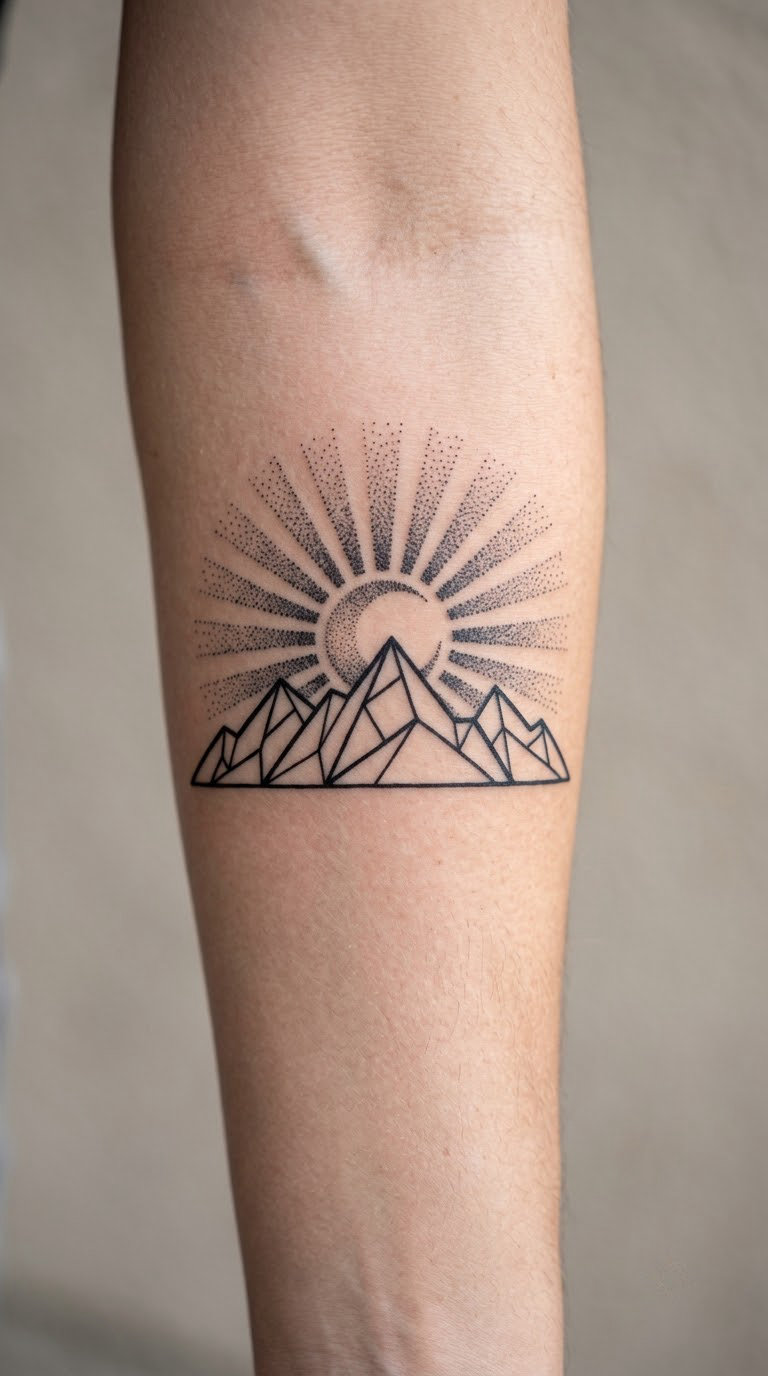
This dotwork tattoo idea for men builds a range of angular peaks in solid black, then fills the sky above them with a half circle of graduated dots so the sun reads as light rather than ink. A thin band of untouched skin usually separates ridge from sky, which keeps the whole thing from going muddy.
Most men pick it for a specific summit rather than the mountains in general — a climb, a first trip, a place that mattered.
Placement: inner forearm, elbow to wrist. Size: 5-7 in (13-18 cm) long. Style: geometric blackwork with stipple shading. Pain: medium — the inner forearm is meaty, but long dot sessions get uncomfortable before they get sharp. The smallest stipple dots in the sunrise soften noticeably within a few years, so the artist should leave them slightly larger than looks right on the day.
Make it yours: have the ridge line follow a real profile from a map.
2. Blackwork Mandala on the Upper Arm
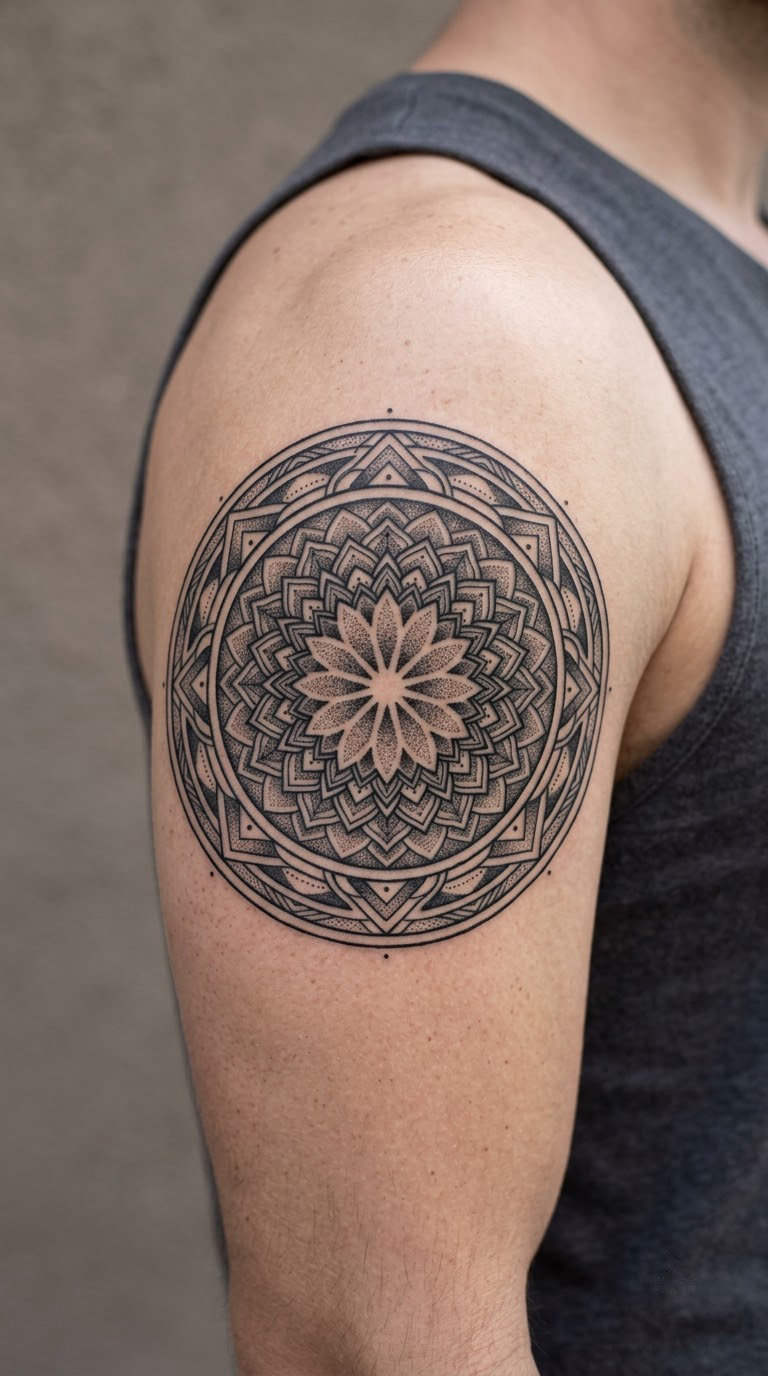
It is the most requested dotwork design in the world and also the most over-produced, so ask to see it mapped onto your arm before the needle goes anywhere. A good one is built from concentric rings of dots with open geometric bands and real space between them, not a downloaded vector traced onto skin.
It fills a flat area — the outer upper arm — without needing anything around it.
Placement: outer upper arm. Size: 5-6 in (13-15 cm) across. Style: radial dotwork mandala. Pain: medium. Dense dot fields relax as they heal, so what looks tight on day one often needs one touch-up to hold its contrast.
Make it yours: ask for a ring of stippled dots in one colour rather than black, so the piece still reads as yours after a few sun summers.
3. Stippled Wolf Portrait on the Calf
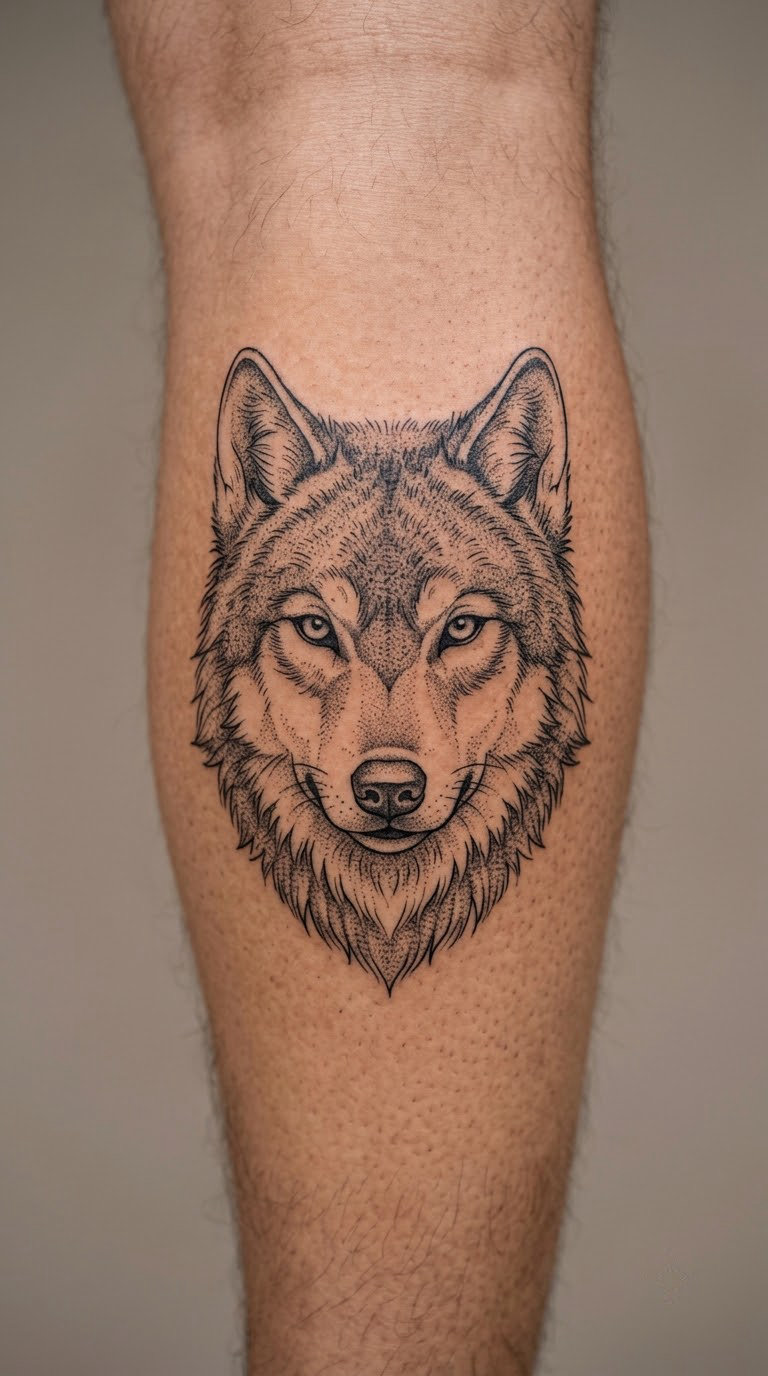
A front-facing wolf built almost entirely from dots, with only a few short black contour lines for the muzzle and ears. The depth comes from dot density: tightly packed under the eyes and along the bridge of the nose, opening out across the cheeks.
Ask for a silhouette underneath. Without one, the texture has nothing to describe and reads as noise.
Placement: outer calf, or between knee and ankle if the piece is smaller. Size: 7-9 in (18-23 cm) tall. Style: stipple shading. Pain: medium — the calf feels muscular but the session is long. The finest dots around the eyes blur first, so a good artist builds those areas heavier than the reference suggests.
Make it yours: a set of coordinates from where you saw one in the wild, tucked under the jaw.
4. Coiled Serpent With a Negative-Space Center
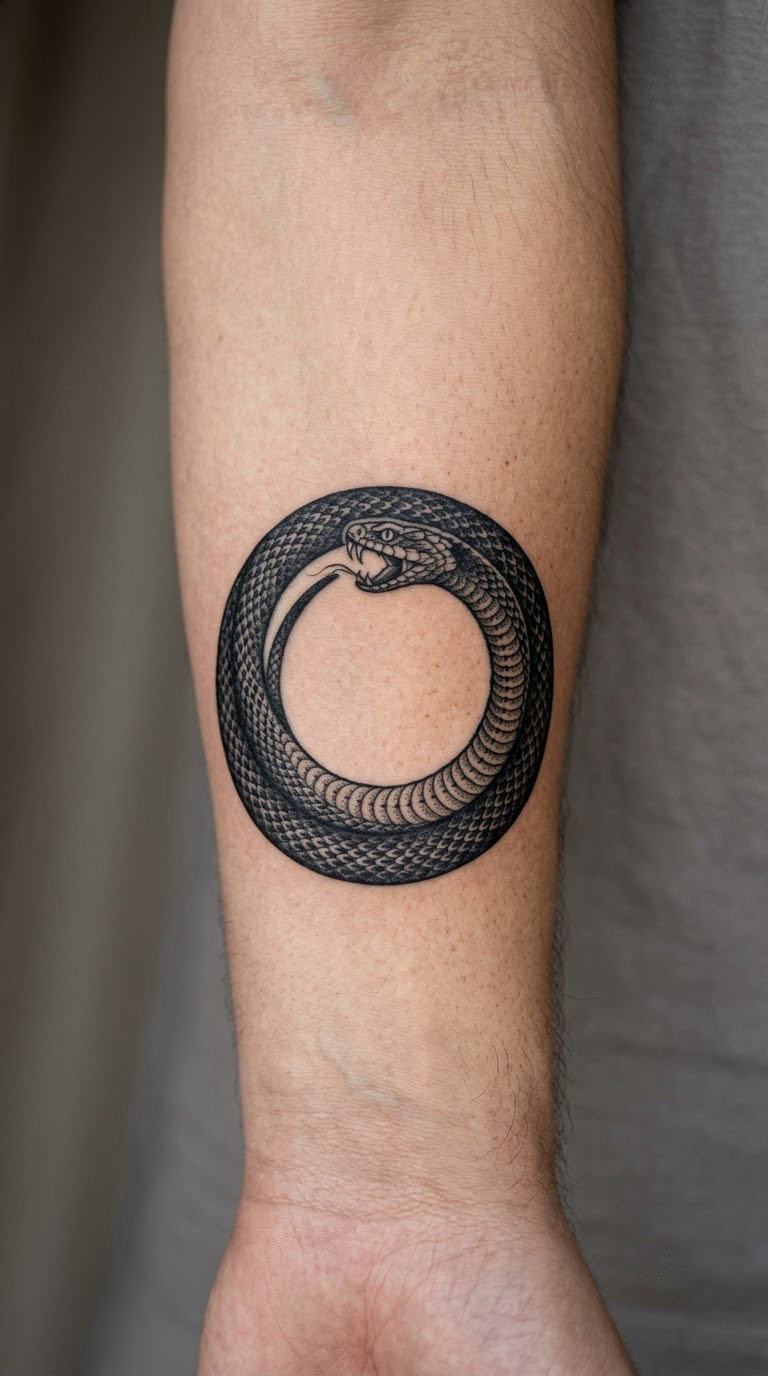
One serpent curling into a circle, with the middle left completely empty. That empty centre is doing the work — it is what stops the composition turning into a dark disc. Scales are suggested with short arcs and dot clusters, denser along the outer curve and open along the inner.
Serpents are usually chosen for the shed-and-rebirth reading, though plenty of men just like the shape.
Placement: forearm or outer upper arm. Size: 4-5 in (10-13 cm) across. Style: fine dotwork with blackwork accents. Pain: medium. Tiny scale dots are the first thing to go soft, so keep them at a size the artist is confident placing rather than chasing the lightest grey in the reference.
Make it yours: have the serpent’s head turned outward toward the wrist, so the piece follows the arm’s line rather than fighting it.
5. Four-Point Compass Rose on the Wrist
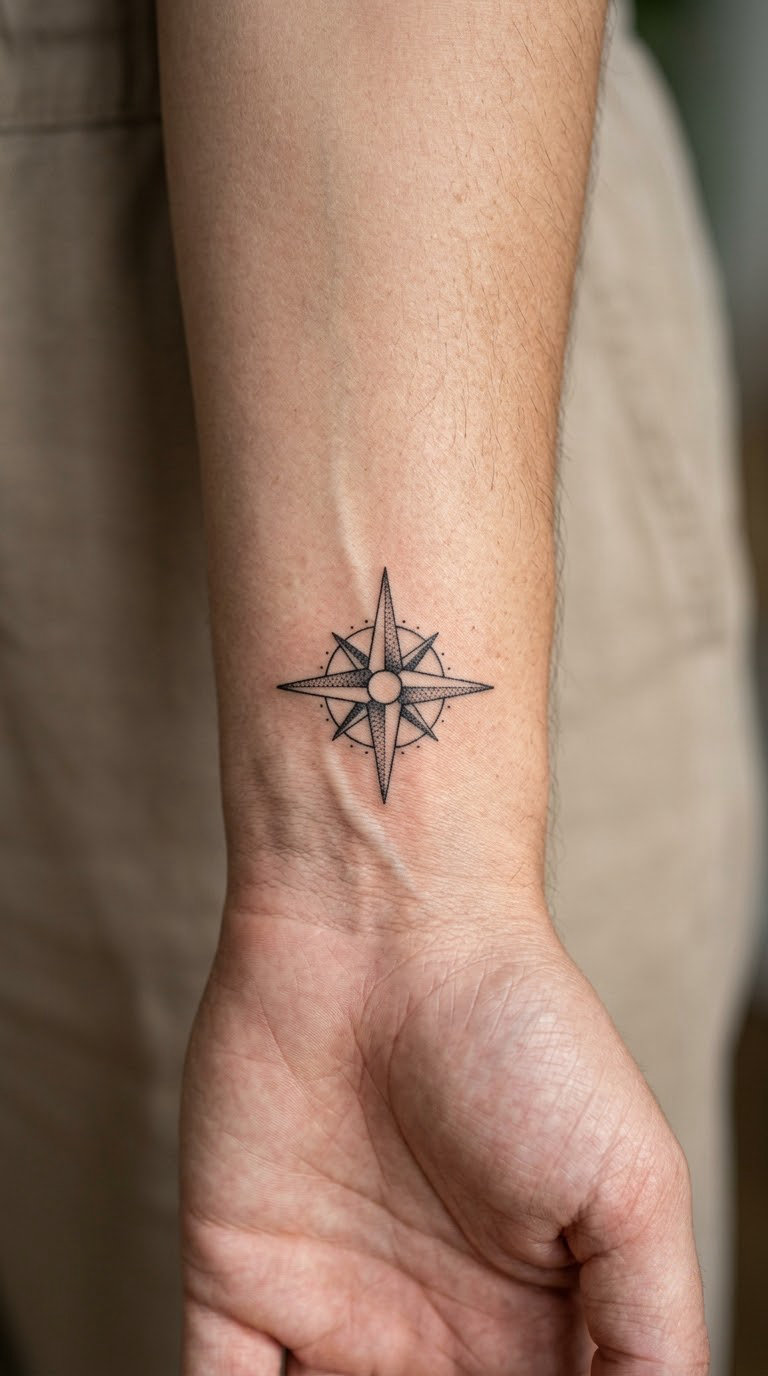
A restrained compass rose: four cardinal points, a ring of stippling between them, and a few fine geometric lines for the secondary directions. The restraint is the whole point. Compasses drawn with eight points and ornamental scrollwork end up looking like clip art from a hotel lobby.
The inner wrist is the most exposed canvas you own, which suits a design about direction.
Placement: inner wrist, just above the bone. Size: 2-3 in (5-8 cm) across. Style: fine-line geometric dotwork. Pain: medium-high on a small area, and the wrist crease means the skin moves constantly. Wrist work fades fastest of anything on this list because of sun, hand washing and movement, so expect a touch-up inside a year.
Make it yours: swap one point for a real coordinate. The 20 best wrist band tattoo ideas for minimalist looks gallery has other ideas if you want to build a full wrist set.
6. Topographic Wave Pattern on the Shoulder
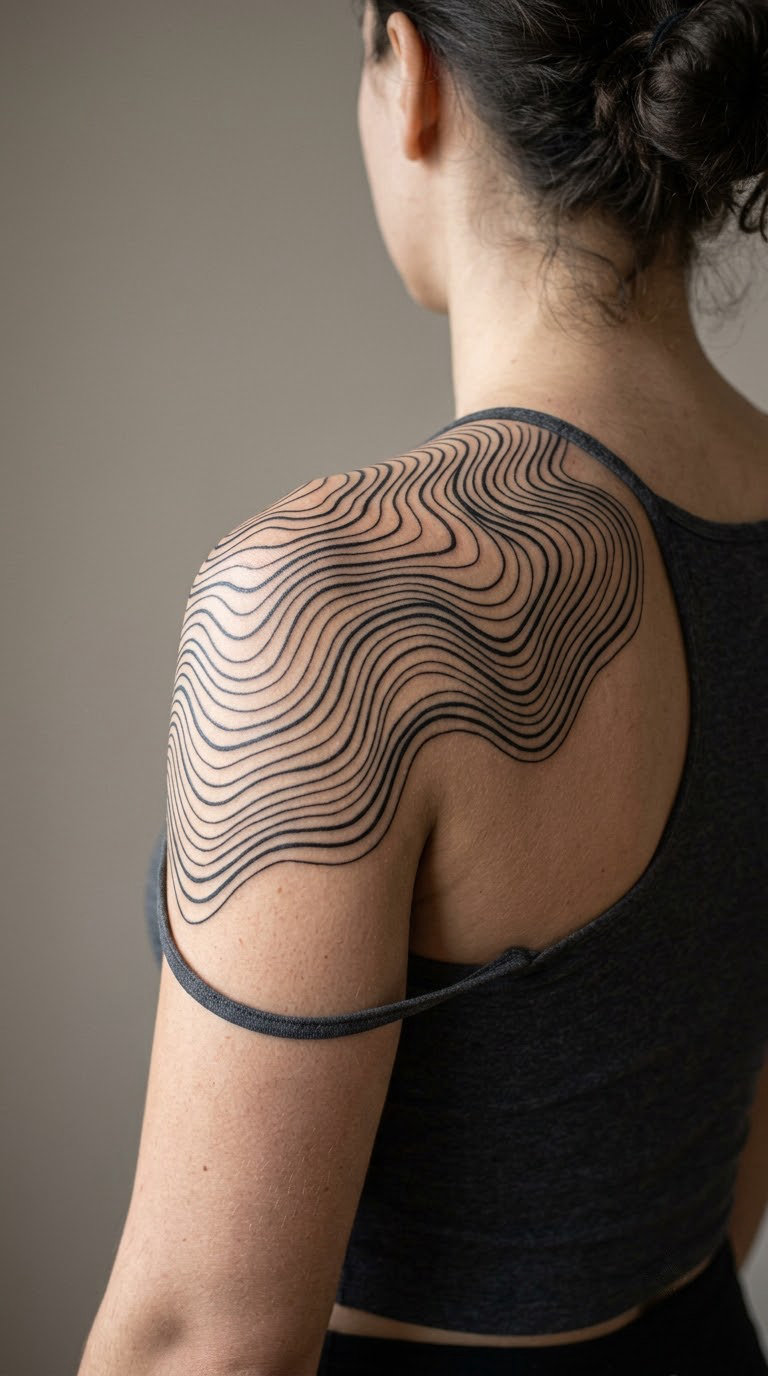
Overlapping wave contours drawn like elevation lines on a map, with the gaps between them shaded in dots instead of solid black. With no horizon and no foam, it reads as terrain rather than an ocean scene, which is what makes it look designed rather than generic.
It suits men who want something abstract that still follows the shape of the body.
Placement: shoulder cap, wrapping from the deltoid toward the upper back. Size: 4-5 in (10-13 cm) deep. Style: topographic dotwork. Pain: medium, though the shoulder moves a lot in the second hour and the artist will be stretching constantly.
Make it yours: use contours from a real map — a coastline, a canyon, a river valley you have walked.
7. Moon-Phase Arc Across the Forearm
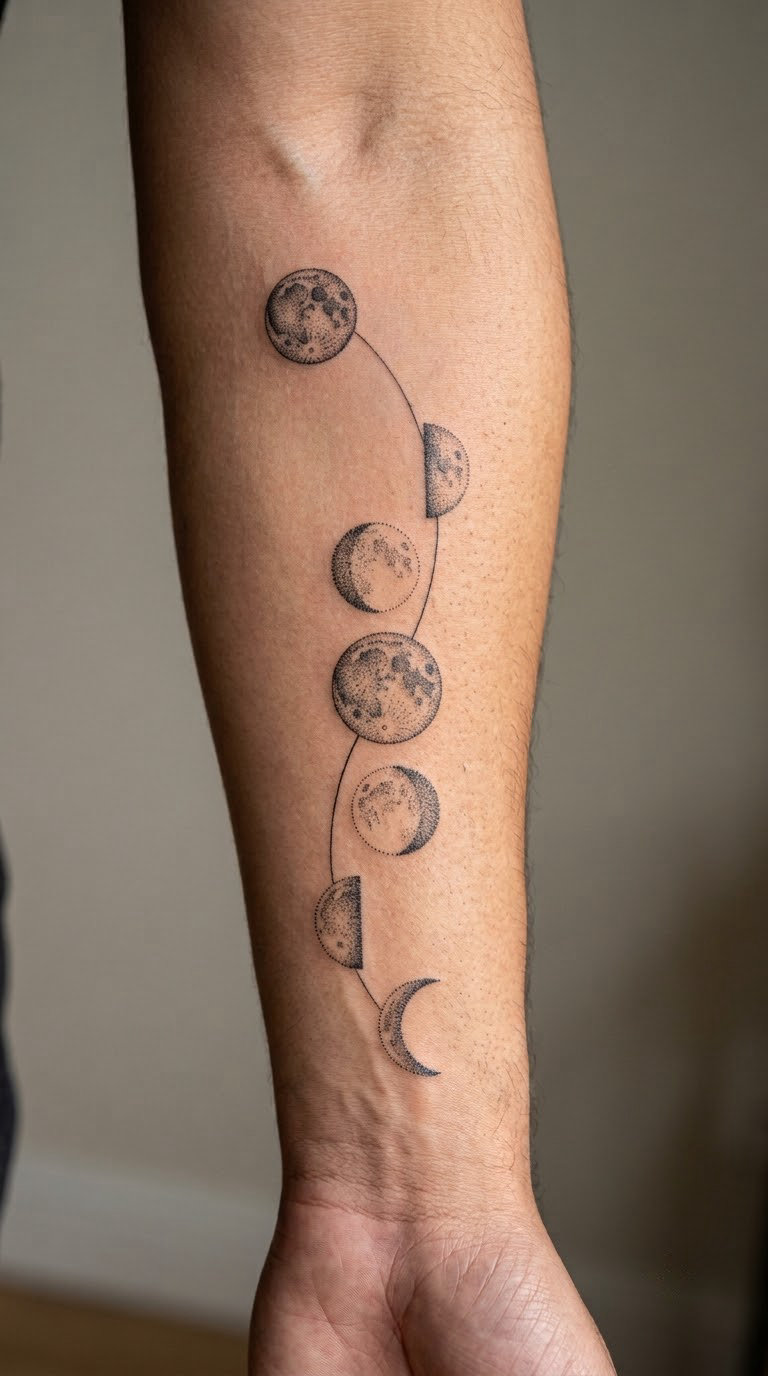
Seven moon phases linked by a shallow arc, each disc shaded at a different density: empty for the new moon, half stippled for quarters, a fine ring of dots for the full. The dots run from open to packed as the arc goes, which lets the gradient do the storytelling.
People usually reach for a cycle rather than a symbol — a new moon date, a birth chart, a year that mattered.
Placement: inner forearm, wrist to elbow. Size: 6-8 in (15-20 cm) long, discs about 1 in across. Style: celestial stipple with fine linework. Pain: medium, and one of the more forgiving sessions here because the design is mostly open skin. The thinnest shading in the crescents fades first, so ask the artist to leave those discs slightly under-shaded.
Make it yours: have the phases mapped to real dates, or add a small coordinate under the arc.
8. Geometric Elephant Head on the Upper Arm
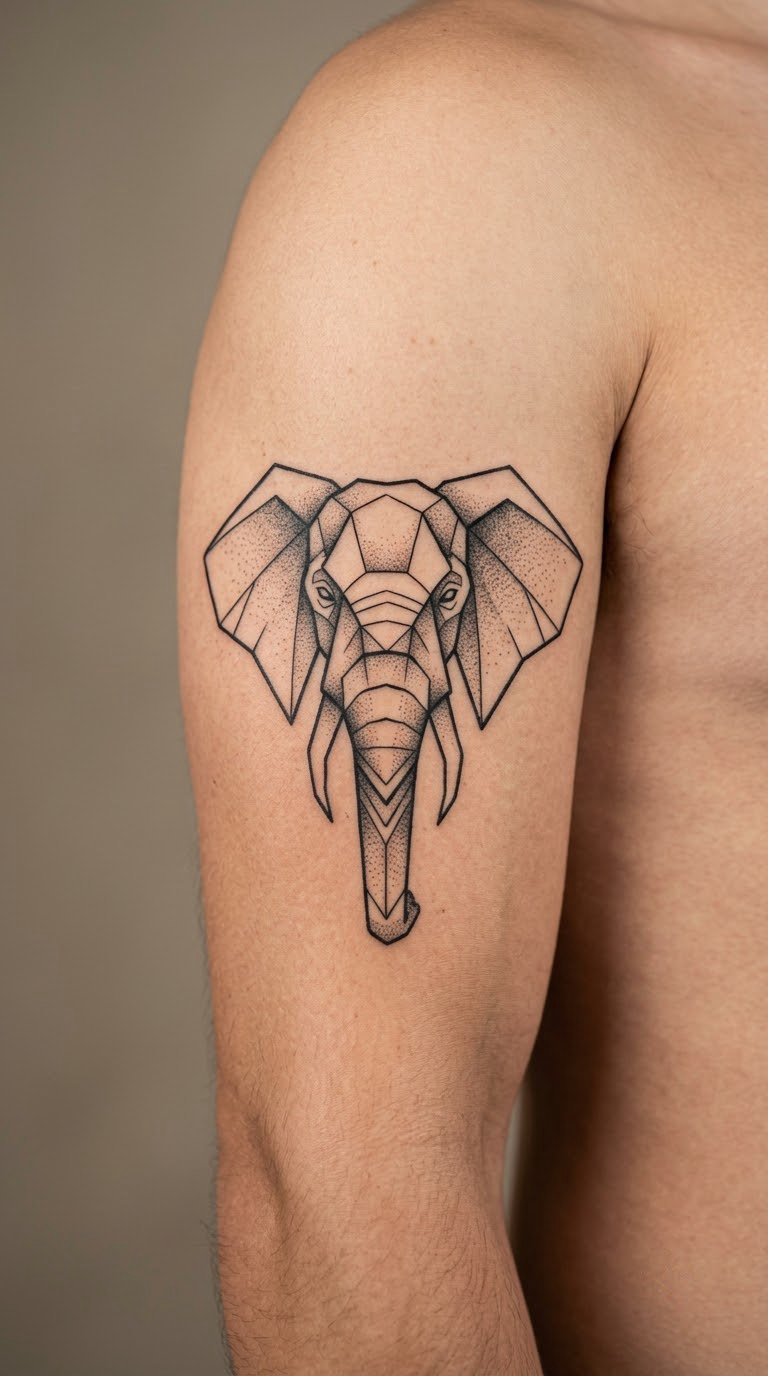
An elephant head assembled from triangles, with curved tusks drawn as clean solid lines and the shadow under the brow and inside the ears built from dot fields. The geometry gives it structure; the dot shading stops it looking like flat origami.
It is often chosen for the memory or the weight behind it, and it holds up as a standalone piece without needing a sleeve around it.
Placement: outer upper arm. Size: 5-6 in (13-15 cm) from tusk tip to tusk tip. Style: geometric blackwork with stipple. Pain: medium. Geometric linework holds up better than most of this style, but the triangular facets between the eyes fill with ink over time, so the artist should leave breathing room between them.
Make it yours: a small coordinate tucked under the left tusk, almost hidden unless someone is close.
9. Pine Forest Gradient on the Inner Bicep
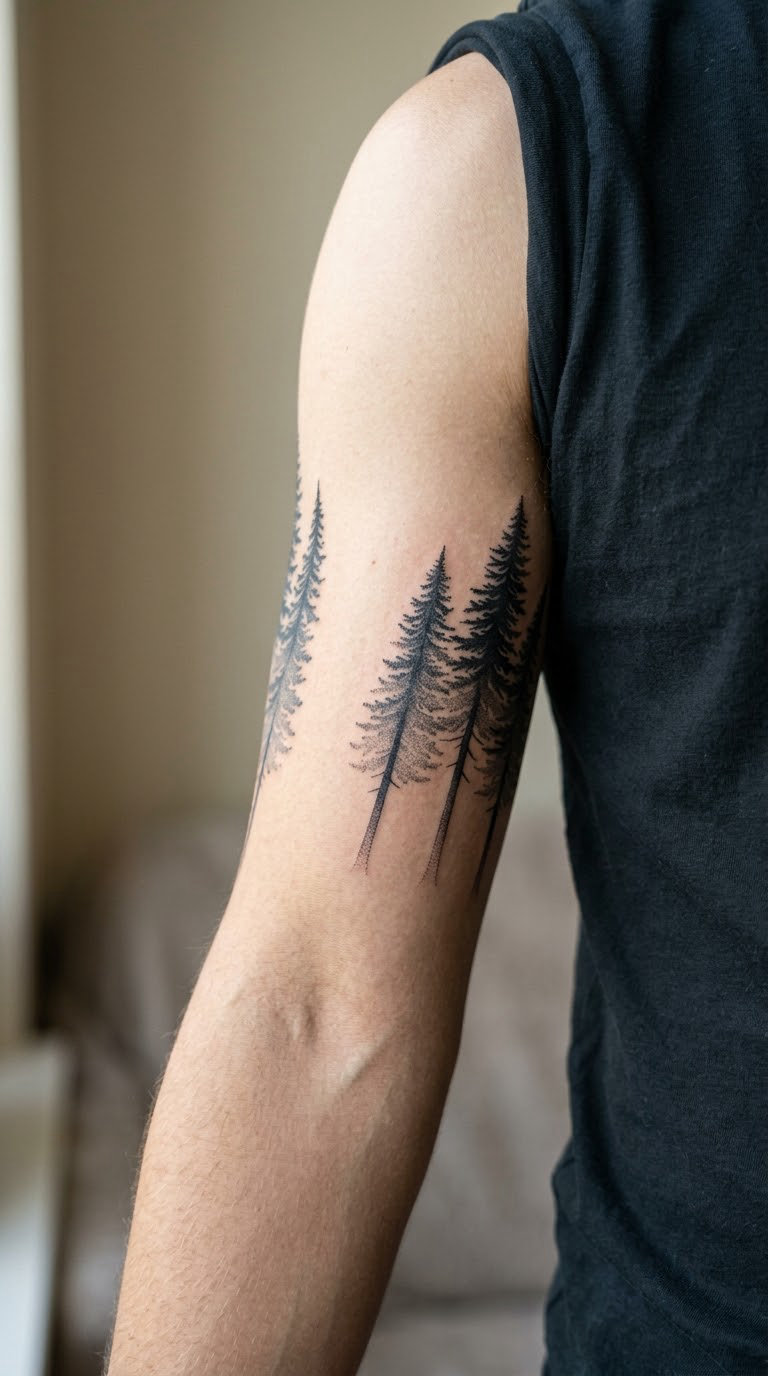
A small grove of three or four pines, solid black at the base and dissolving into sparse dots at the crown. The darker the base, the more the trees feel anchored. It is the simplest composition in this list and one of the easiest to place well.
Forests mean very different things to different people, so keep the reasoning to yourself rather than explaining it at parties.
Placement: inner bicep, where the skin is flat and stable. Size: 4-5 in (10-13 cm) tall. Style: gradient stipple. Pain: medium, and one of the shorter sittings in this guide. The sparse crown dots are the weak point — too tight and they fill in, too wide and the piece looks unfinished. Our 20 best inner bicep tattoo ideas for men has other placements worth comparing.
Make it yours: add a low mountain ridge behind the trees, or the outline of the state the forest is in.
10. Koi in a Circular Dotwork Current
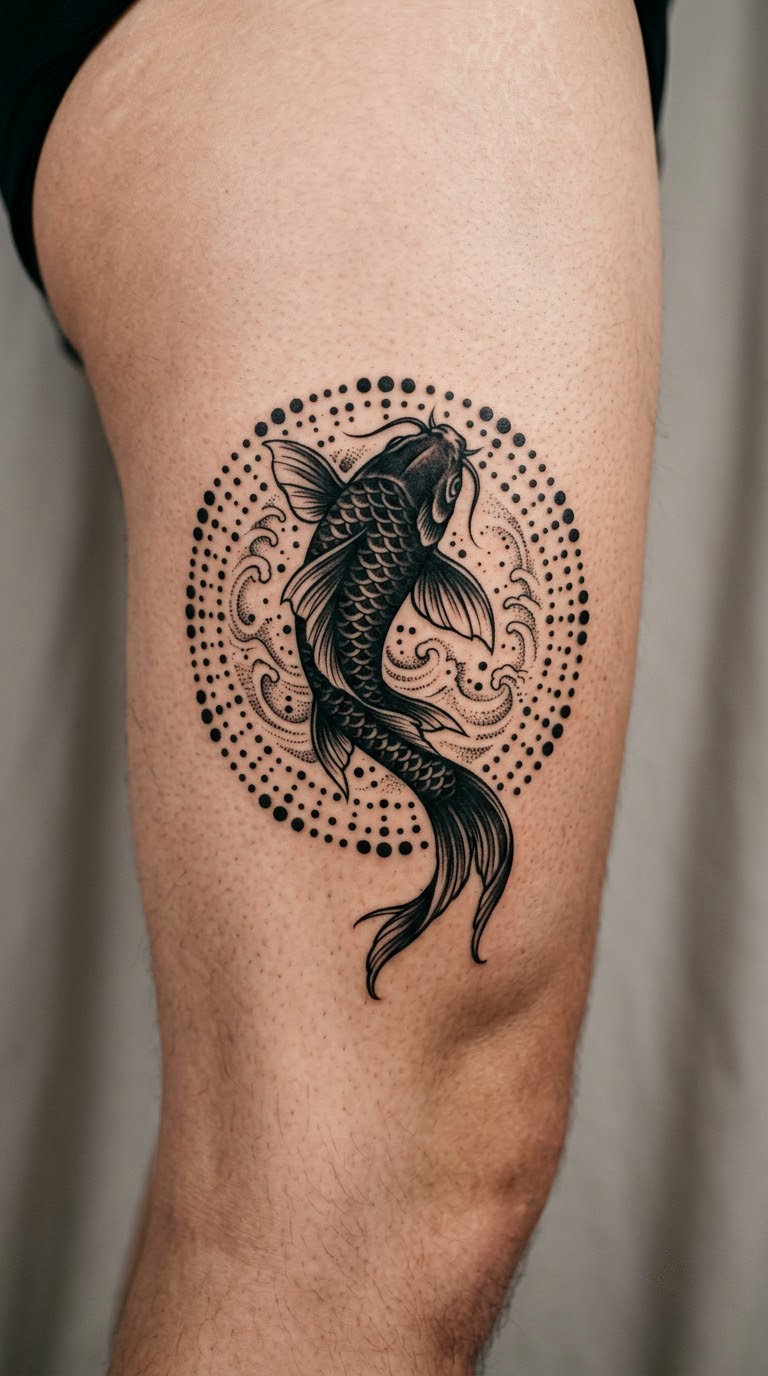
A single koi curving through a circular field of water dots, with a few geometric ripple rings breaking the pattern behind it. Keep the fish solid black and the water open, or reverse it and stipple the fish instead. Both work; the solid version ages more predictably.
Koi designs usually come from a person or a place rather than from the fish itself.
Placement: outer thigh gives the circle room to breathe; the inner forearm works if the piece drops to 4 in. Size: 5-6 in (13-15 cm) across. Style: black and grey dotwork. Pain: medium on the thigh, medium-high on the forearm. Small ripple rings blur faster than the fish, so keep them few and slightly heavier.
Make it yours: a freshwater reference — the lake, river or pond name — set into the ripple band.
11. Stag Skull with Geometric Antlers
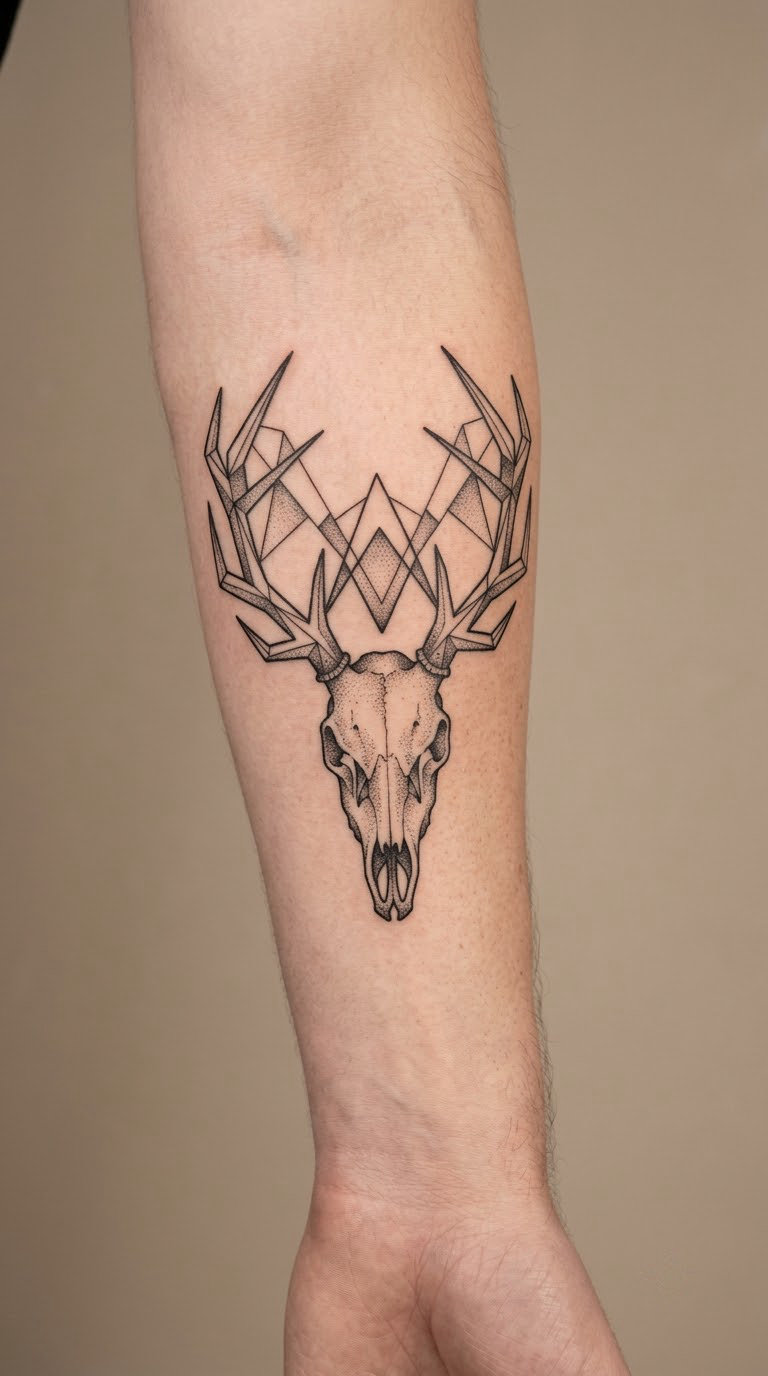
A stag skull done with sparse stippling across the cranium and brow, with the antlers built from angular segments that follow the real branching rather than a drawn flourish. Sparse is the operative word. Heavy dot fields lose the bone structure and end up looking like a dark oval.
It reads restrained rather than heavy, which is why it works on a visible forearm.
Placement: forearm or calf, centred. Size: 4-5 in (10-13 cm) tip to tip. Style: stipple with geometric linework. Pain: medium. Antler tips are line work and grey faster than anything else on the piece, so ask for solid black at the points.
Make it yours: a birth year tucked into the antler branching, where it reads as part of the shape.
12. Rose-Window Geometry on the Chest
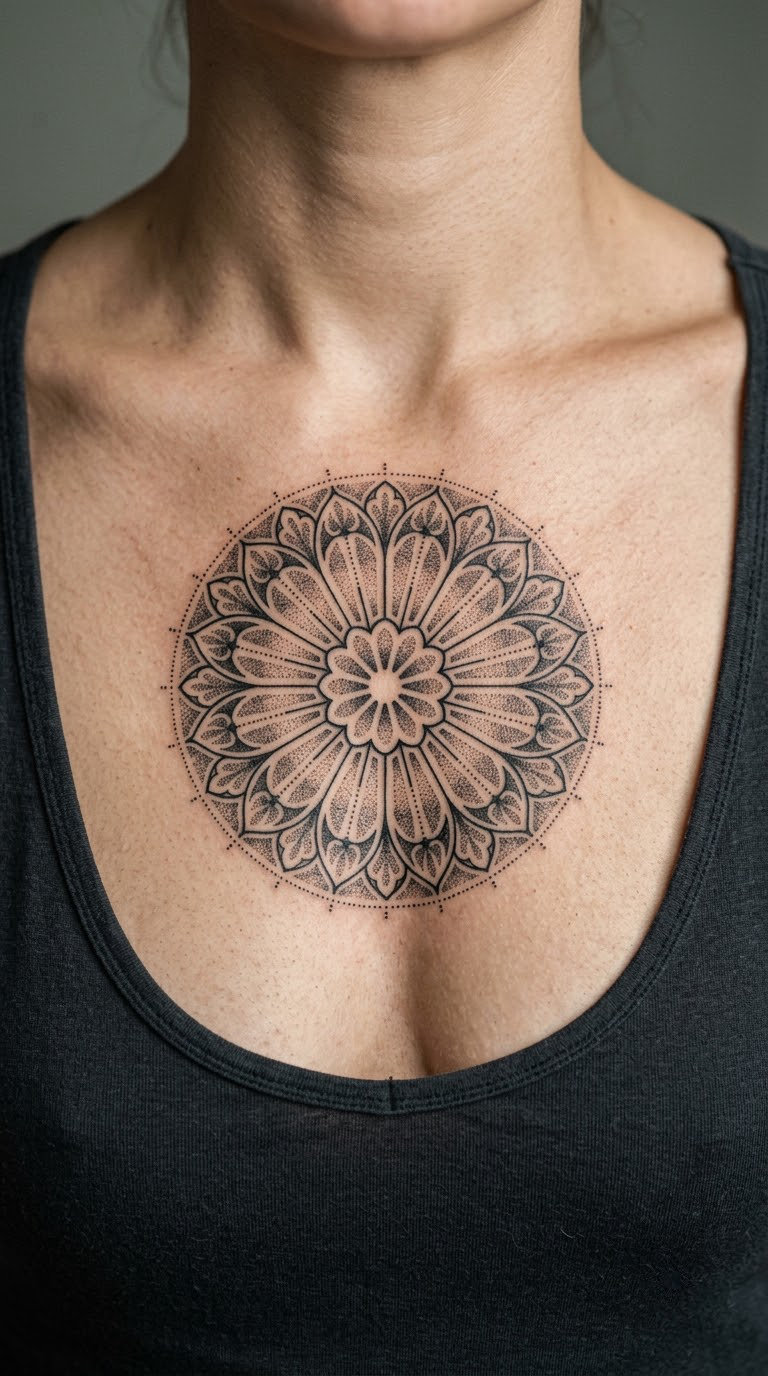
A rose-window design: repeated arches radiating from a small circular centre, with dot fields in the tracery and open skin in the panels. The symmetry is what makes it read as one piece instead of a pattern collage.
Chest placement means it is the first thing anyone sees, so it is a commitment piece rather than a quiet one.
Placement: upper chest, centred on the sternum, or split across both pectorals. Size: 8-10 in (20-25 cm) across. Style: radial geometric dotwork. Pain: medium-high, and the sternum is bone-covered with thin skin, so the session is more endurance than sharp pain. Do not plan this around existing chest work — crowding the sternum ruins both pieces.
Make it yours: one panel in a single colour, so a chest piece still reads as understated under a shirt.
13. Geometric Sailboat on the Forearm
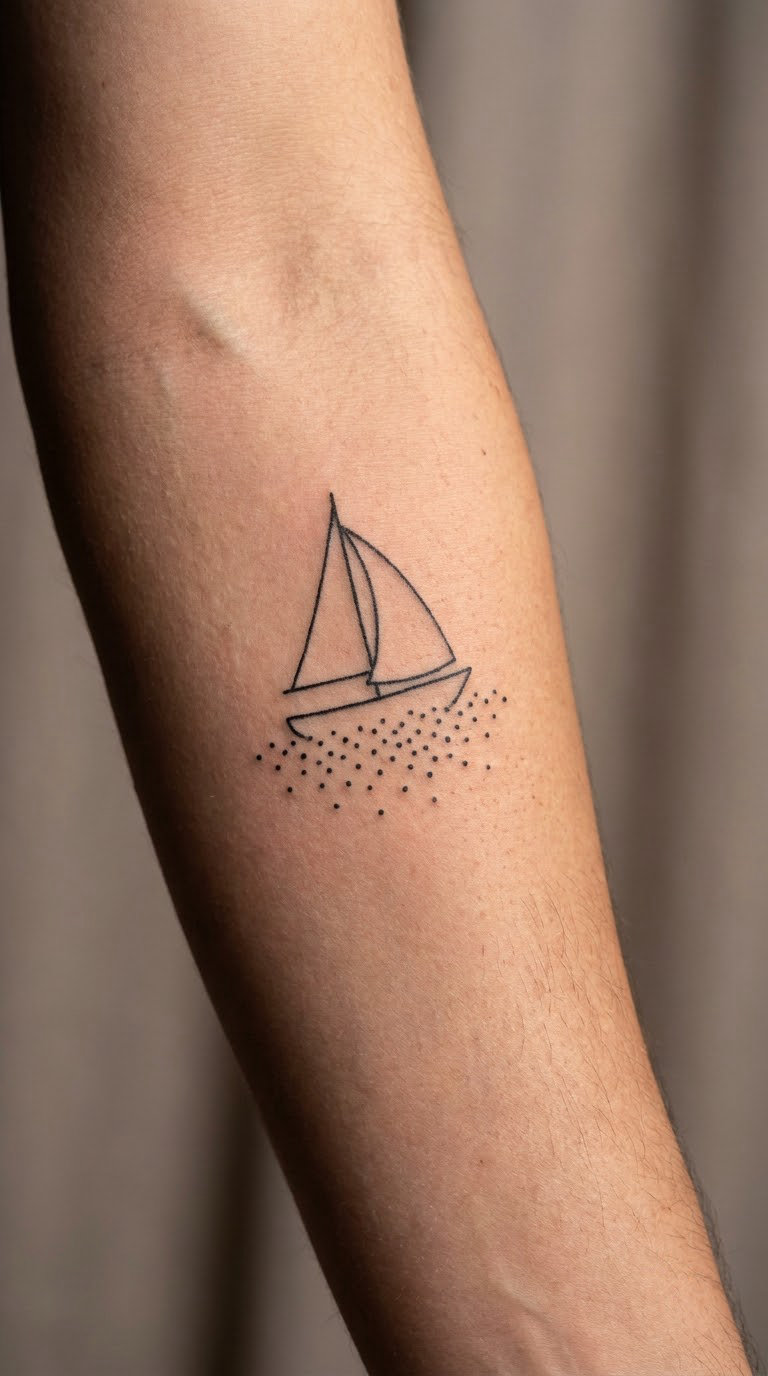
A triangular sail, a clean hull line, and a field of fine water dots underneath holding the boat up. Restraint is what makes this work: no rope, no rigging detail, no sun. A well-drawn boat with a dotted sea beneath it looks considered in a way an over-detailed ship never does.
Travel and direction are the usual reasons, though plenty of men commission it around a specific crossing or a deadline they met.
Placement: inner forearm. Size: 4-5 in (10-13 cm) long. Style: minimal dotwork and line. Pain: medium, and one of the quicker sittings here. The water dots under the hull are the part that softens first, so a slightly denser stipple in the boat’s shadow is worth asking for.
Make it yours: a date under the hull in the same stipple weight, or the longitude where the trip started.
14. Dragonfly with Dotted Wings on the Shin
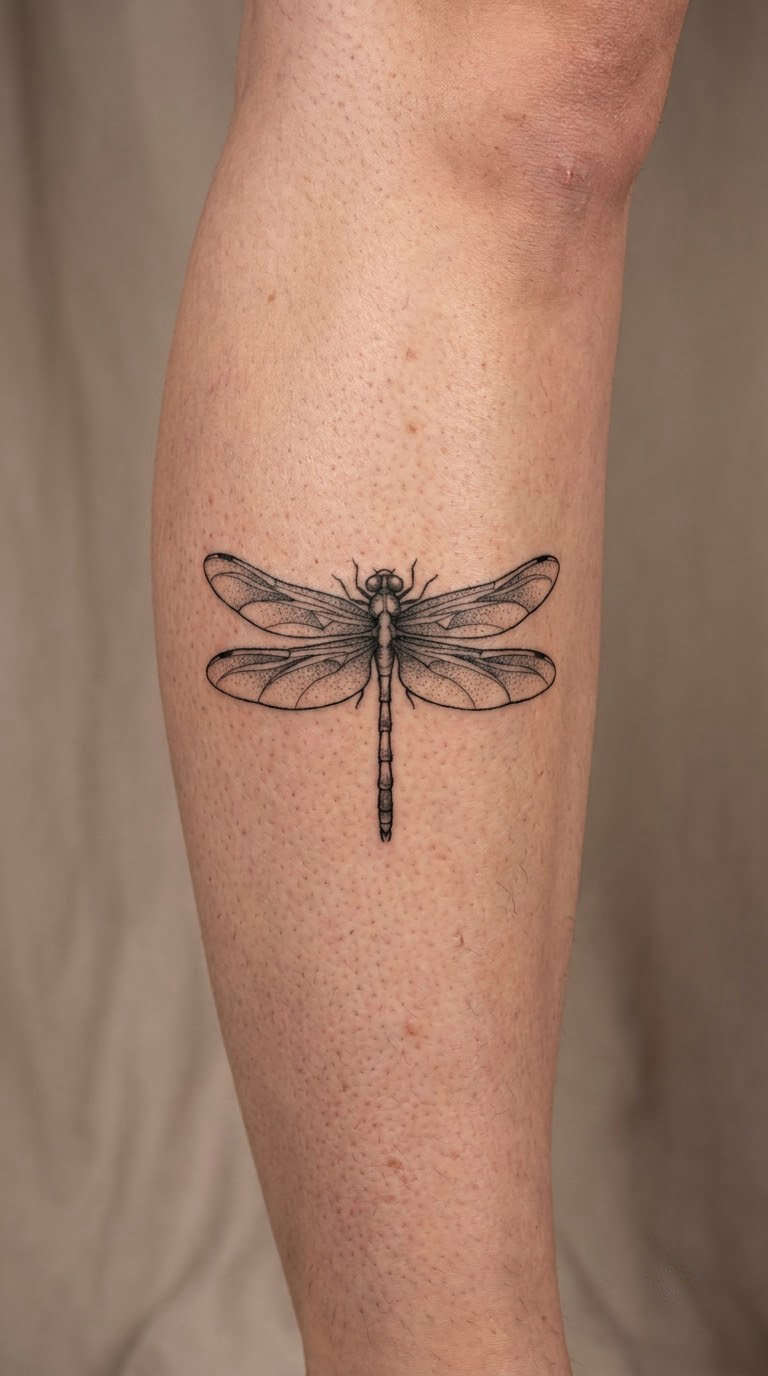
A dragonfly laid horizontally across the shin: sharp black linework for the segmented body, and four wings built from gradient stipple that fades toward the tips. The contrast between crisp body and soft wings is what sells it.
It is one of the few insects that works in dotwork because the wing membranes are naturally patterned, and men usually pick it for the calm, symmetrical read rather than for anything the insect stands for.
Placement: outer shin, running along the bone. Size: 3-4 in (8-10 cm) wide. Style: fine line with gradient stipple. Pain: medium-high — the shin is bony and the skin over it is thin. Avoid placing the tiny wing-tip dots directly over the curve of the bone, where the surface is uneven and the dots land at inconsistent depth.
Make it yours: a single colour in the wing gradient, or a small coordinate on the front wing.
15. Lion Portrait Made from Black Dots
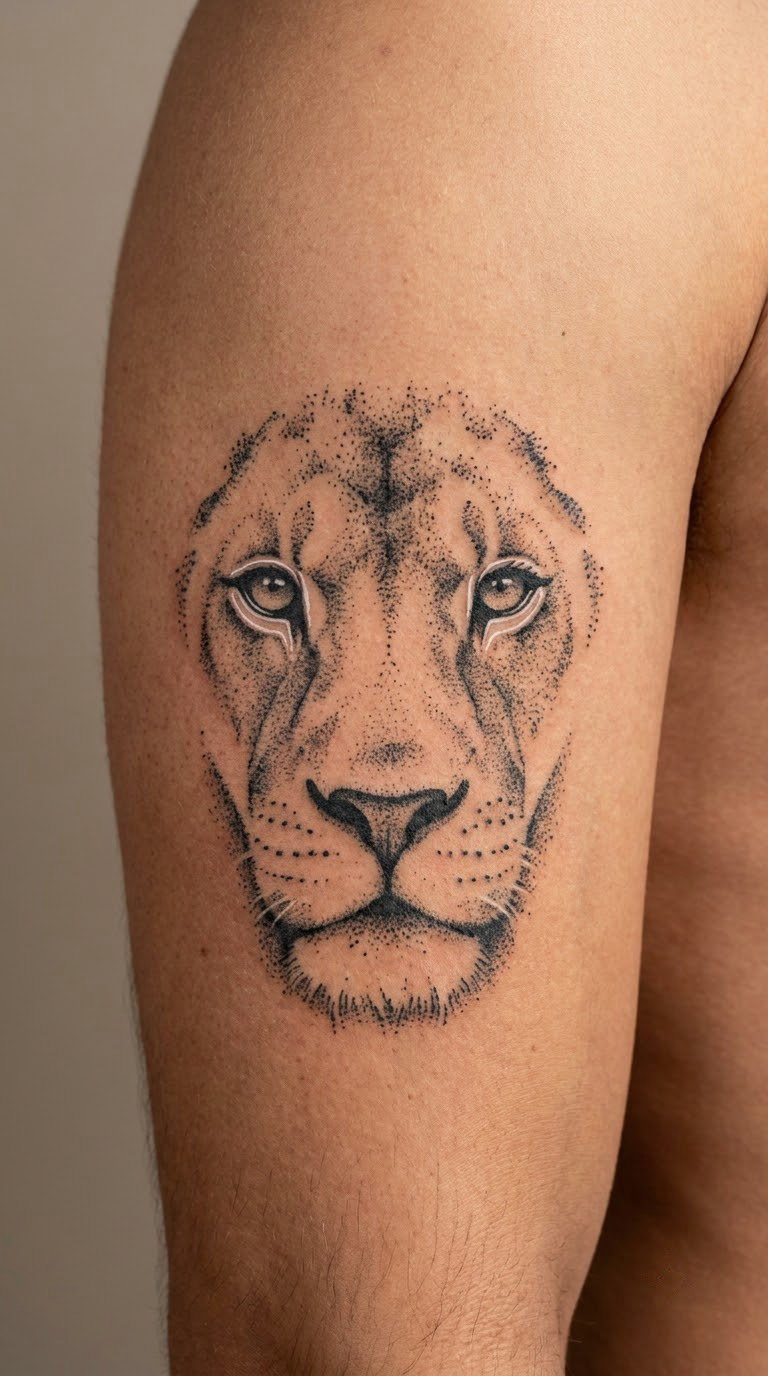
A frontal lion face where the whole form is dot density: black and packed through the mane, opening across the cheeks, and around clean white eye shapes that carry the expression. The eyes are the make-or-break detail — if they go soft, the face goes with them.
Portraits get requested around family names, school crests or a nickname, so the usual reason is personal rather than symbolic. A full-face piece at this scale is a bold, standalone commitment.
Placement: upper arm or outer thigh. Size: 6-7 in (15-18 cm) tall. Style: stipple shading. Pain: medium. The smallest facial dots around the eyes and nose bridge will be the first to lose definition, so the artist should build them a size larger than the reference image shows.
Make it yours: a single line of black solid at the brow, to anchor the whole portrait.
16. Hourglass with Falling Sand Dots
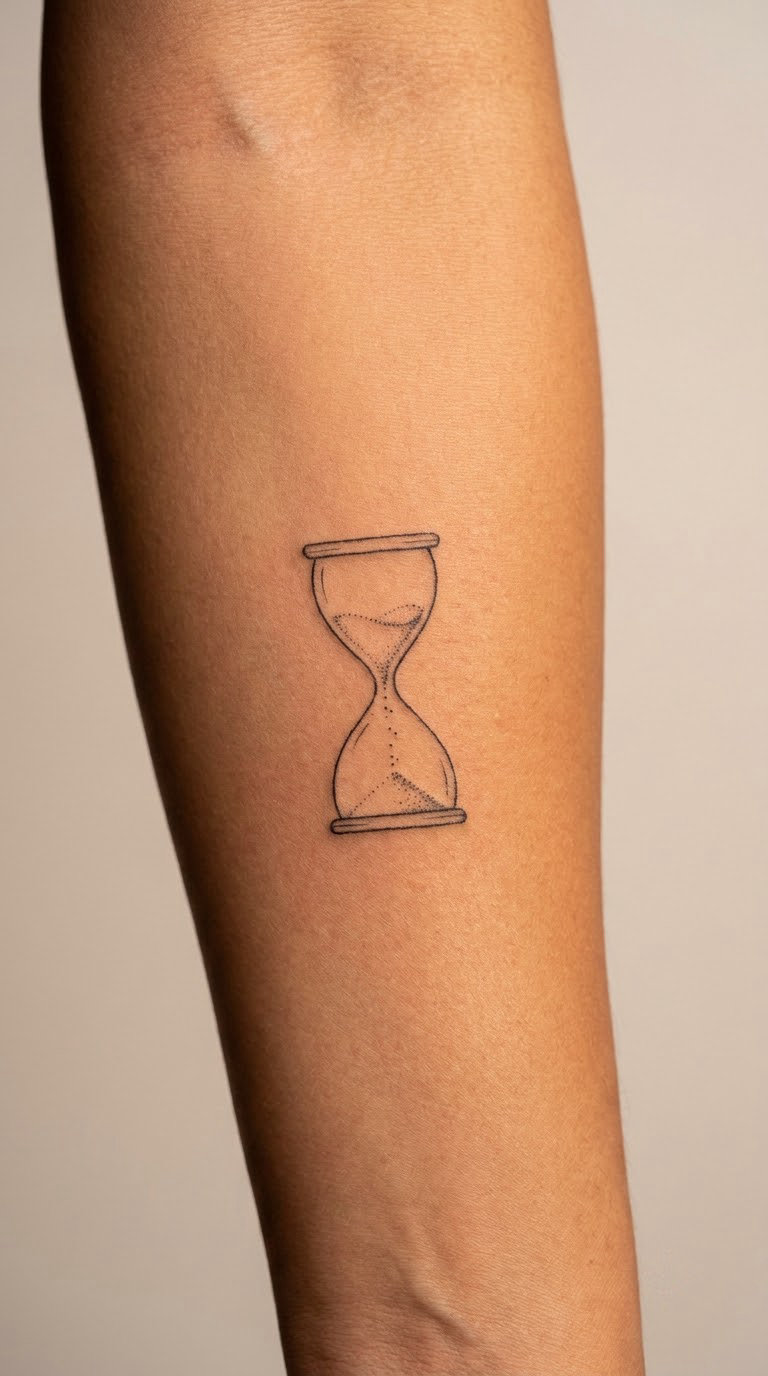
A geometric hourglass in clean lines, with the sand represented by a controlled stream of dots falling through the waist and a settled dot field in the base. Tapering the stream — wide at the neck, sparse as it drops — is what makes the movement read.
Time and mortality are the usual themes, though plenty of men wear it as a reminder about deadlines rather than as something heavier.
Placement: inner forearm, vertical along the arm. Size: 3-4 in (8-10 cm) tall. Style: fine-line dotwork. Pain: medium. Ink spreads over the years and the falling dots drift into a slightly wider column, so the artist should space them with more room than the sketch looks like it needs.
Make it yours: two dates — a start and an end — placed inside the two glass halves.
17. Raven in a Stippled Night Sky
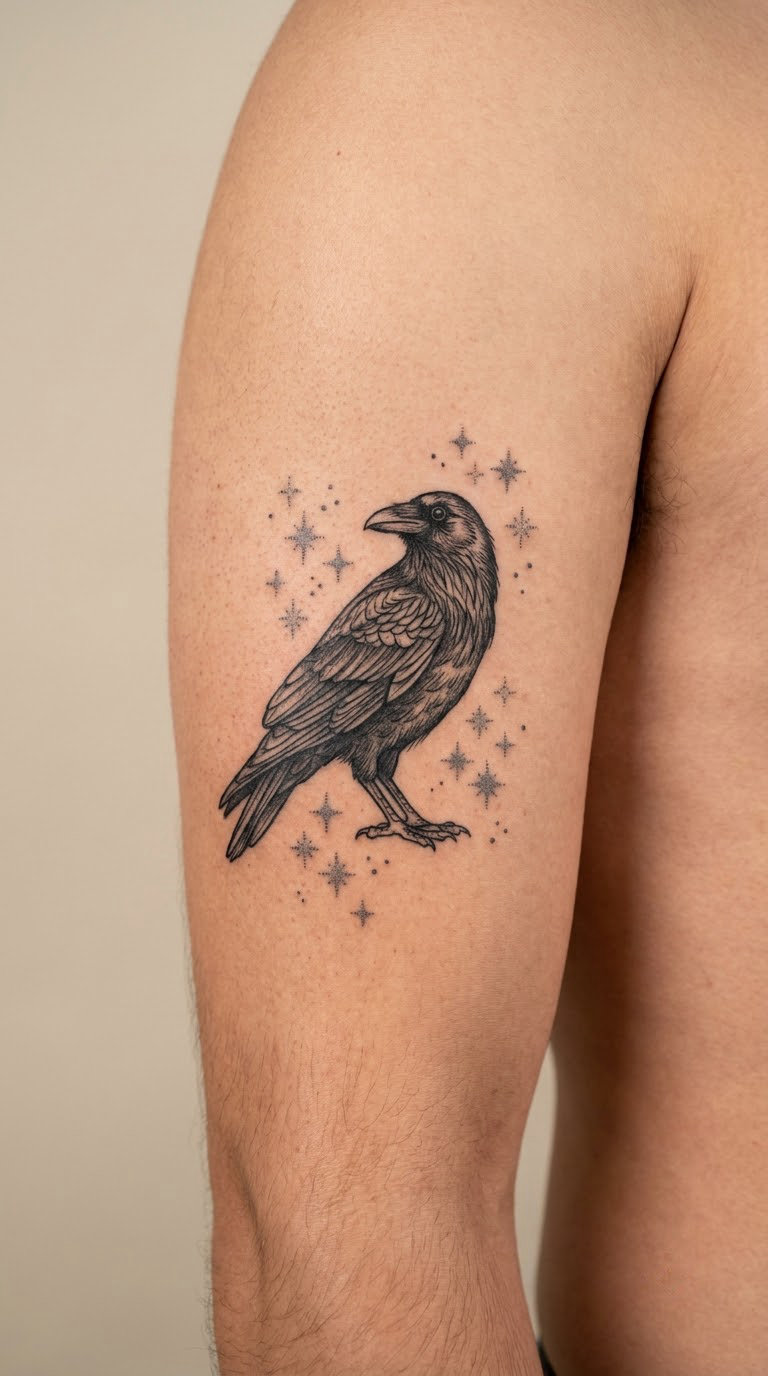
A raven in solid black, wings folded, set inside a field of graduated star dots with a restrained moon shape behind it. The solid silhouette against open skin is the contrast that makes the piece work; fill the sky in too densely and the bird disappears into it.
Corvids carry a lot of folklore, but most men pick this one because the shape is striking rather than for a specific story.
Placement: outer upper arm or forearm. Size: 5-6 in (13-15 cm) tall. Style: blackwork with stipple. Pain: medium. The star dots are tiny by necessity and they are the first to fade, so keep the star field sparse and slightly bolder than looks right fresh.
Make it yours: one accent — a small colour wash in the moon only, everything else stays black.
18. Cactus and Desert Dots on the Forearm
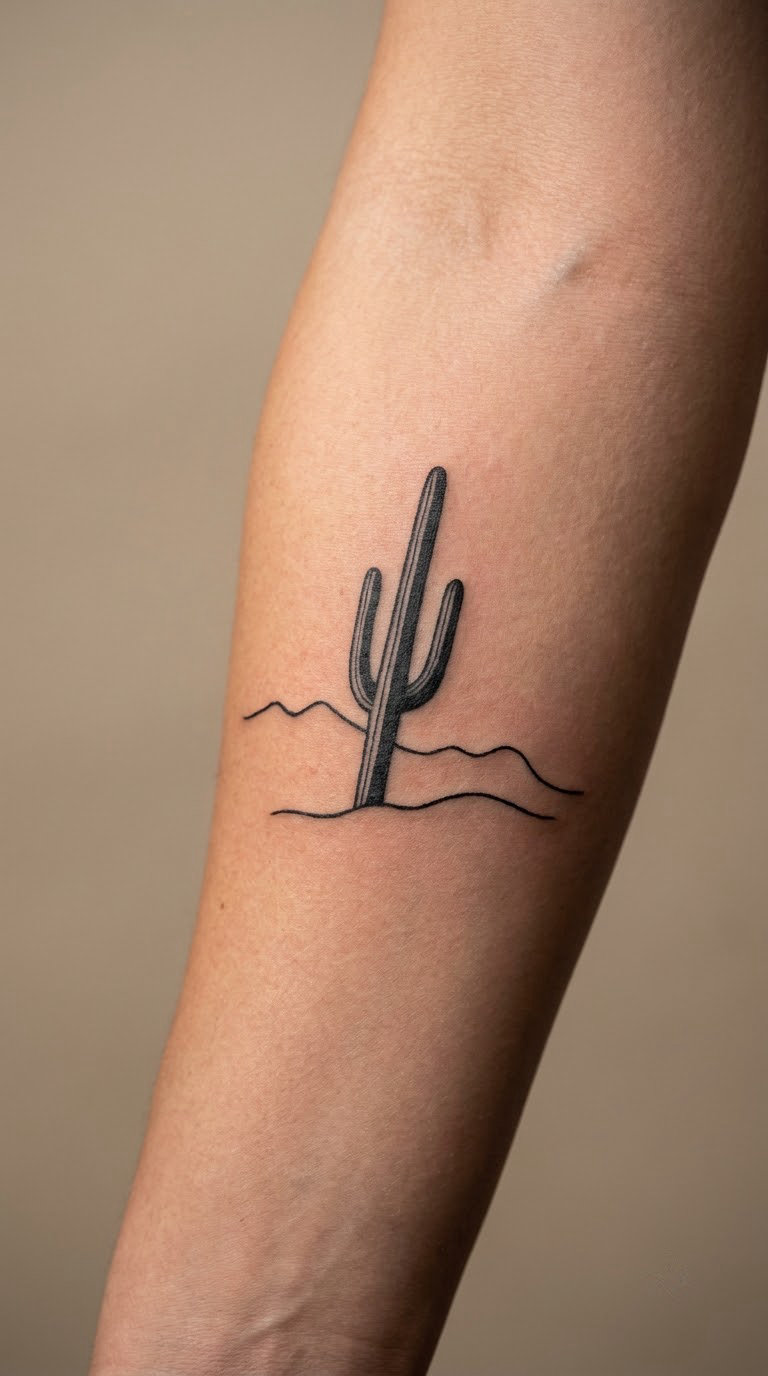
A single saguaro rising from a desert scene rendered entirely in dots: a low horizon line, a scatter of ground texture, maybe a small sun. With one subject and a lot of open skin, the piece stays legible even when the fine ground texture fades.
The desert reads as open space and patience rather than a specific place, which is why so many men use it for a state or a stretch of highway that mattered to them.
Placement: inner forearm. Size: 4-5 in (10-13 cm) tall. Style: minimal stipple. Pain: medium. During healing, contrast swings hard — a dot-heavy piece can look patchy around week two and settle back down. Sunscreen on a fresh forearm does more for the final result than anything else you do at home.
Make it yours: a state outline tucked into the horizon line, or the year you moved there.
19. Bull Skull With a Stippled Horizon
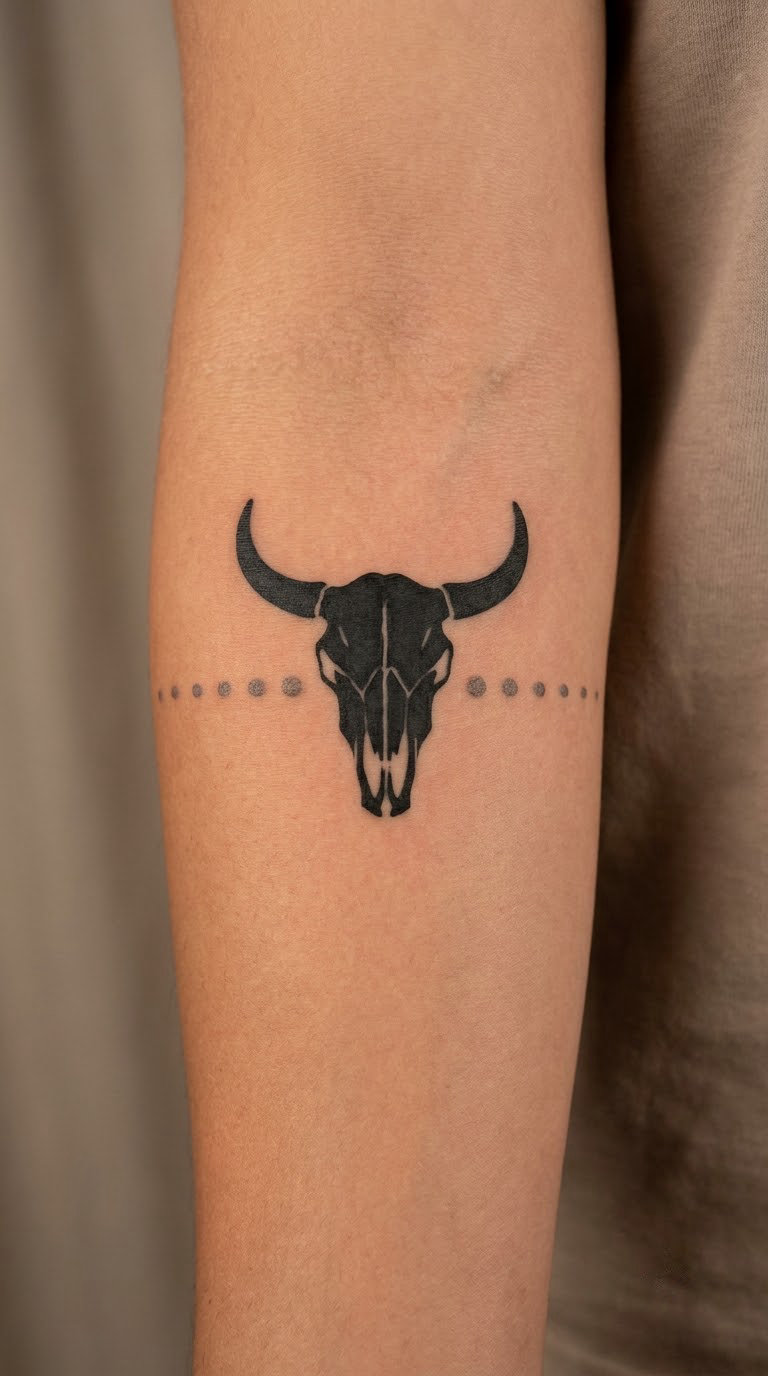
A bull skull centred and symmetrical, above a low dotted horizon with a few minimal geometric rays behind it. The symmetry does the heavy lifting: it makes a fairly simple shape look composed rather than clip-art, and it suits the flat plane of a forearm.
Western imagery has a specific draw, and it works as a single piece without a full theme around it.
Placement: forearm or calf. Size: 5-6 in (13-15 cm) across. Style: stipple and geometric linework. Pain: medium. The smallest horizon dots soften within a few years, but because they sit below the skull, the piece stays balanced as they do.
Make it yours: keep it to one detail — a ranch brand on the forehead, or a single ray pattern behind the skull.
20. Interlocking Dotwork Serpent Sleeve Study
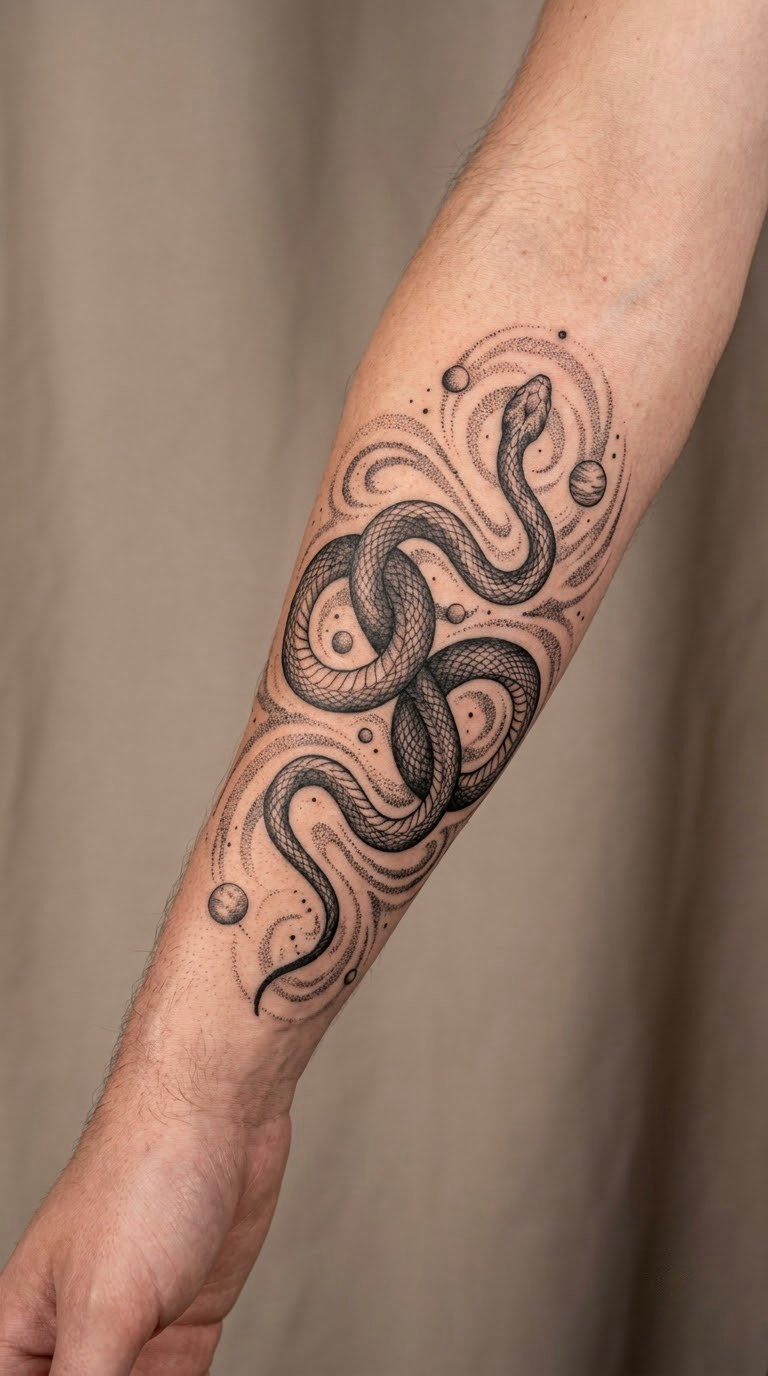
Two serpents threading through orbital dot fields and geometric bands, mapped from wrist to inner elbow. This is a composition, not a single motif, and the work is in how the fields connect rather than in the snakes. A good artist draws it on the body first so the flow follows your arm.
It belongs to someone extending an existing blackwork collection rather than starting fresh.
Placement: forearm, wrist to inner elbow. Size: 12-18 in (30-45 cm). Style: large-scale dotwork with blackwork anchors. Pain: high in places, mostly the wrist, inner elbow and bony inner forearm, and it is a multi-sitting job. Dense fields need spacing for a decade of ageing, which means less ink on the day and a bolder result after healing.
Make it yours: a matching symbol repeated at the elbow crease. Our 20 forearm band tattoo ideas for men gallery covers the other way to anchor a full forearm.
How to Choose the Right Design
- Pick a density before a motif. Decide whether you want a piece that reads as a shape from across a room or as texture up close. Dense dot portraits suit the second; mandalas and topographic fields suit the first.
- Match the motif scale to the body part. A 3 inch wolf on a calf is a smudge. Ask the artist to size the design to the flat area you have, not to the reference photo.
- Be honest about the size you will live with. Bigger means more detail survives, but it also means more appointments and a piece that is visible every day. Chest and sleeve-scale work changes how people read you, not just how the design reads.
- Decide how much open skin you want. Negative space stops dotwork turning into a grey disc. Designs with an empty centre or a clean horizon last better than fully filled ones.
- Budget appointments, not hours. Dotwork is slow per centimetre, so anything over about 4 inches is realistically two or more sittings. Ask where your artist would break the work.
Bring three or four visual references to the consultation and ask the artist to adapt them to your shape rather than tracing one flat image onto skin. If they cannot explain how the dots will be spaced for ageing, keep looking.
Cost and Session Time
Dotwork is priced by the hour nearly everywhere in the US, and it is slower per square inch than linework, so the same design costs more in this style than it would in fine line. Almost every studio runs a shop minimum, and many will not book dotwork below two hours, because the setup is not worth it. A dotwork specialist will sit at the top of a shop’s rate card and a generalist well below it.
So how long you sit is the biggest thing you control. A micro dotwork piece of 1 to 2 inches often takes an hour or two. Small pieces up to about 3 inches usually run 2 to 3 hours. Medium work of 4 to 6 inches, like most of the designs on this list, is a 3 to 5 hour sitting, often split across two appointments. Large compositions of 7 inches and up, including the serpent sleeve study, are multi-session projects that can take a dozen appointments across several months.
Two honest caveats. Rates vary widely by city and by artist, so the only number worth anything is the one your artist quotes after seeing the design. And detail level changes hours more than size does, which means a dense stipple portrait at 5 inches can take longer, and cost more, than a bold geometric design at 7. Ask for an hour estimate with the quote, and ask where the work would be broken into sittings.
Aftercare Basics
- Follow your artist’s aftercare instructions first. They know what needle depth and product were used on your skin, and general advice should never override them.
- Wash it gently, twice a day. Lukewarm water and a fragrance-free wash, patted dry rather than rubbed.
- Protect it for the first two weeks. Loose clean clothing over the area, no tight sleeves, and avoid sleeping on that side.
- Keep it out of water and friction. No swimming, hot baths, sauna or heavy gym on that area until the skin is fully healed and the sheen is back.
- Book touch-ups on healed work. Dotwork often looks flat in the first fortnight and settles back down. Most artists want to see it healed at 8 to 12 weeks, and again around six months for areas that spread.
- Use sunscreen once healed, and always after. UV is the fastest way to turn a fine stipple field into a flat grey one, and it does not stop at the edge of the design.
Frequently Asked Questions
Does dotwork fade quickly?
Not if it is spaced correctly. Dotwork ages well for one reason: the open skin between the dots gives the ink room to spread without merging into a flat grey. The dots do soften, and the smallest stipple goes first, so ask your artist to build fine areas slightly bolder than the reference looks. Book a touch-up once the piece is healed, usually at 8 to 12 weeks.
Is dotwork more painful than blackwork?
The style itself is not more painful, because a dot and a line put the needle in at the same depth. What hurts is duration and repetition. A four-hour stippling session builds a deep ache that a quick blackwork flash never reaches, and placement still dominates everything. Wrist, sternum, shin and inner elbow run hotter than forearm, thigh, calf and upper arm.
How many sessions does a detailed dotwork tattoo take?
Plan on one session for anything under 2 inches, two or three hours for a 3 to 4 inch piece, and three to five hours, usually split, for the 4 to 6 inch designs most men in this dotwork tattoo ideas for men gallery choose. Anything 7 inches or larger is a multi-session project. Dotwork is slower per inch than linework, so ask where your artist would break the work before booking.
Can dotwork be added to an existing tattoo collection?
Yes, and it is the usual way sleeves are built. The trick is matching density rather than copying a style exactly. Bring healed photos of your existing pieces to the consultation so the artist can match the dot spacing, the black level and the line weight. Leaving open skin between new work and old work is what stops the two parts looking stitched together.
What body placement shows tiny dots best?
Flat, low-movement, low-exposure skin: the outer upper arm, the calf and the outer thigh. Those areas hold even texture and see far less sun, so fine stipple stays legible longest. Wrists, fingers, hands and feet are the worst choice. High skin turnover there blurs stippling within months, and constant movement and washing speed up the softening.
Finding a Dotwork Design That Fits
If this is your first tattoo, the geometric mountain sunrise or the four-point compass rose are the safest starts. Both read as a shape, both finish in one or two sittings, and both are forgiving of the detail that fades over a few years.
If you already have blackwork and want the collection to keep growing, the moon-phase arc suits an open inner forearm, and the interlocking serpent study is the piece to talk to a specialist about. Either way, bring healed photos of the work you already have and let the artist map the composition on your body first. Check healed work in their portfolio, not fresh posts, and ask how they plan the spacing before the needle goes in.