
20 Best Neo Traditional Tattoo Ideas for Women (October 2026)
Neo traditional tattoo ideas for women come down to one thing: bold black outlines carrying colour that stays readable, whether the motif is a two-inch cherry or a half sleeve. This list covers 20 designs that hold their shape on skin, with honest notes on placement, size, pain and how each one ages.
Neo traditional borrows the structure of old-school American traditional tattooing and loosens the rules on colour and subject. That makes it a good fit for placements most fine line work struggles on: ribs, sternum, thigh, back of the hand. If you are planning a piece for autumn or winter, book early, because the larger designs here usually need two sessions and shops fill their books four to six weeks out.
Neo Traditional Tattoo Ideas for Women: Quick Guide
Every design below is listed with the style it leans on, where it sits best, a realistic size and what the placement feels like. Sizes are finished-tattoo measurements, not stencil measurements.
| Idea | Style | Best placement | Size | Pain |
|---|---|---|---|---|
| Fine-line peony | Neo traditional, restrained colour | Inner forearm | 2-3 in | Low |
| Blackwork rose | Blackwork neo traditional | Collarbone | 2-2.5 in | Medium |
| Rose and snake wrap | Neo traditional, muted palette | Outer upper arm | 5-6 in | Medium |
| Lavender moth | Neo traditional, soft colour | Behind the ear | 1.5-2 in | Medium |
| Red apple blossom | Bright neo traditional | Shoulder | 2.5-3 in | Low |
| Crescent with botanical lace | Ornamental neo traditional | Ankle | 2-3 in | Medium |
| Blue butterfly | Traditional flash, neo colouring | Inner wrist | 2-2.5 in | Medium |
| Sun and rose | Vintage neo traditional | Sternum | 4-5 in tall | High |
| Framed swallow | Classic neo traditional | Collarbone | 3 in wide | Medium |
| Peony and sparrow | Neo traditional, soft green | Outer thigh | 6-7 in | Medium |
| Snake and lily | Bold line neo traditional | Back of upper arm | 4-5 in | Low |
| Cherry pair | Simple traditional flash | Inner arm | 2 in | Low |
| Daffodil and ribbon | Neo traditional botanical | Rib | 4 in tall | High |
| Crescent and sparrows | Symmetrical neo traditional | Back of neck | 3-3.5 in | Medium |
| Red poppy | Bold neo traditional | Back of hand | 2.5 in | High |
| Black peony half sleeve | Black and grey neo traditional | Forearm | 8-10 in | Medium |
| Sparrow and laurel | Neo traditional, olive green | Shoulder | 3.5-4 in | Low |
| Lotus and moon | Symmetrical neo traditional | Lower back | 7-8 in | Medium |
| Blue jay and cherry blossom | Colour neo traditional | Upper arm | 4.5-5 in | Low |
| Rose, moon and ornament | Refined neo traditional | Back of hand | 3 in | High |
1. Fine-Line Peony Bloom on the Forearm
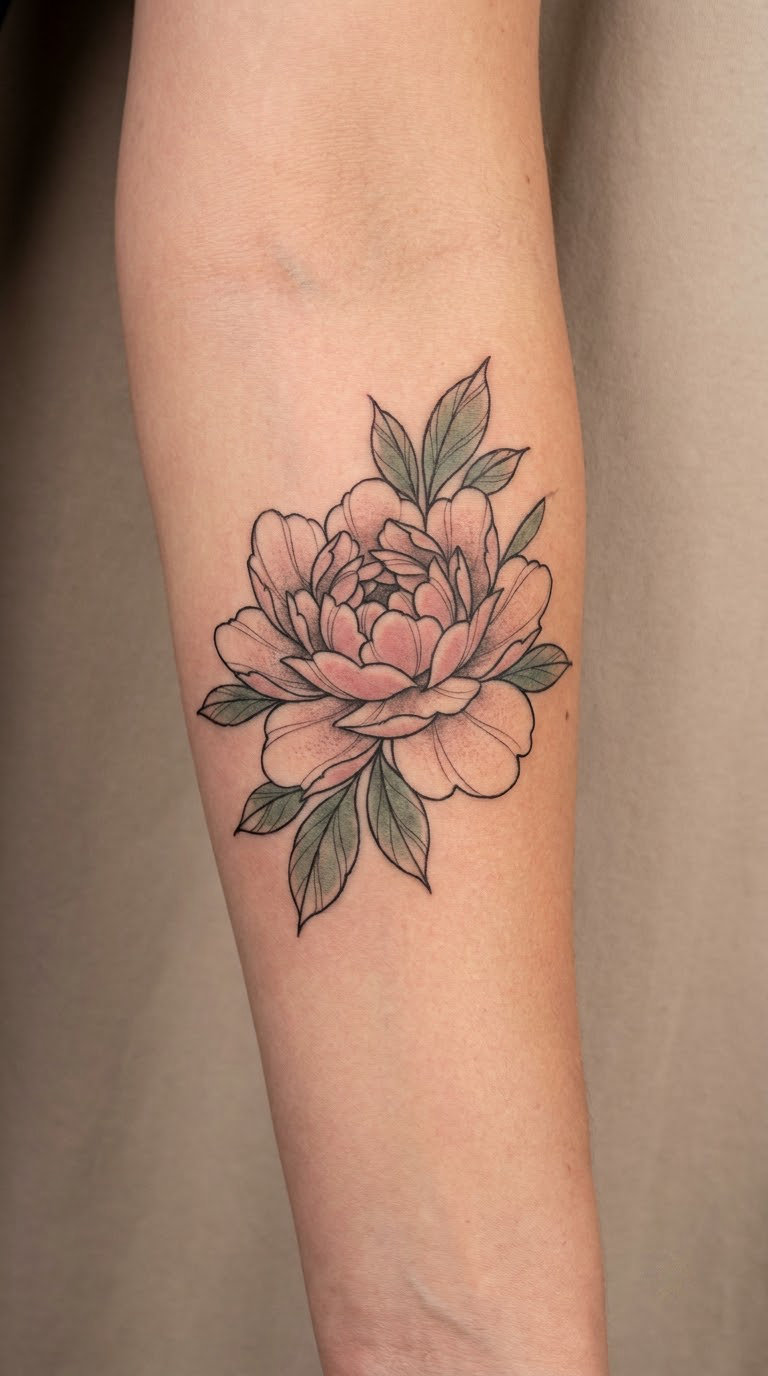
A peony drawn with restrained black outlines, dusty pink petals and two or three muted green leaves, placed where the forearm curves. The traditional version of this flower runs heavy and saturated, so the interesting choice here is pulling the colour back and letting the linework do the work.
Peonies show up in this style because the layered petal structure suits bold contour lines, not because of any fixed meaning. Plenty of people choose them simply because the flower is beautiful.
Placement: Inner forearm between wrist and elbow, or the soft inner bicep. Size: 2-3 in (5-7.5 cm). Style: Neo traditional with a fine-line hand.
Pain: Low to medium. Forearms bruise visibly for a few days, which is normal and fades. Keep colour areas generous rather than shading every petal, because tight shading on a forearm softens within a few years.
Make it yours: Use one petal in a colour you already own elsewhere, or have the centre picked out in a warm gold.
2. Blackwork Rose on the Collarbone
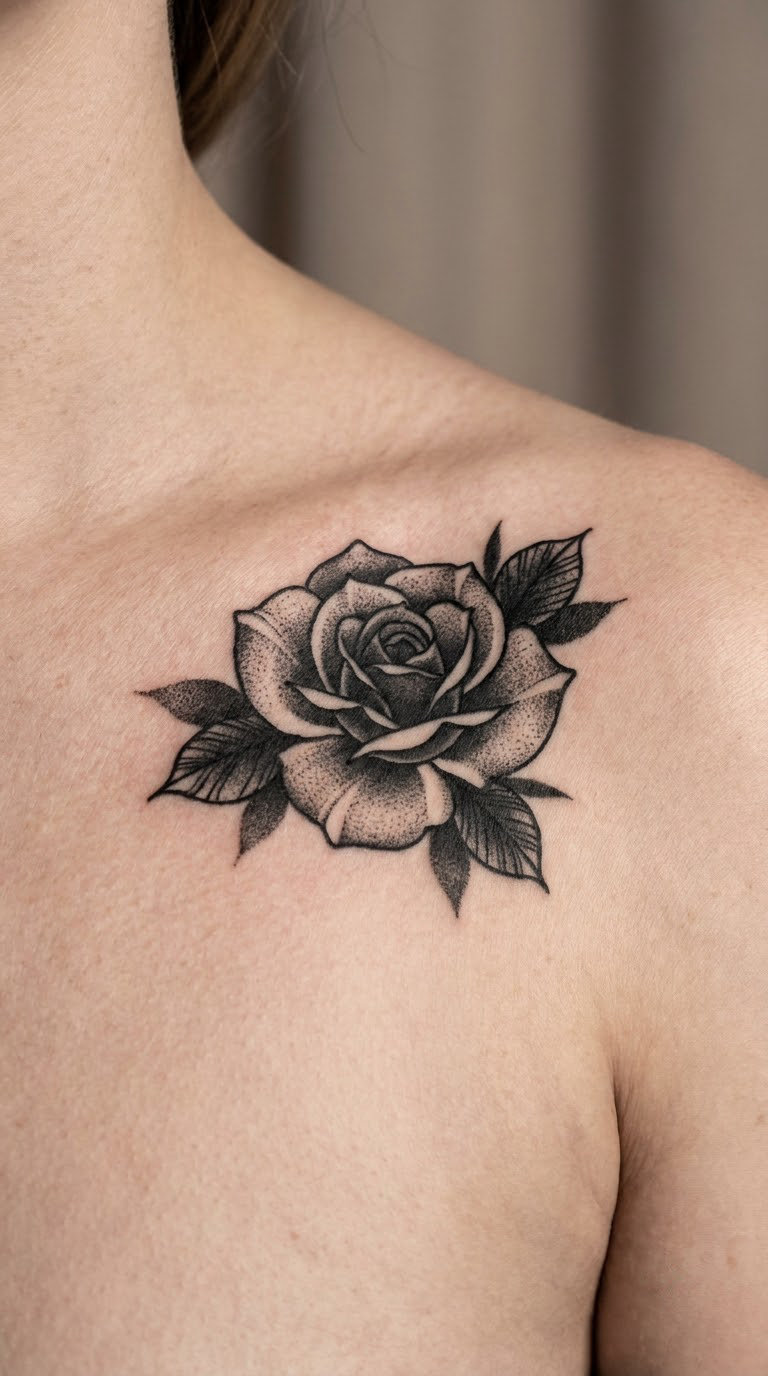
A traditional rose with dense black petals, a shaded stem and almost no colour, sitting centred or slightly off-centre between the collarbones. Removing the red changes the whole read: it goes graphic and a little severe, which works well for people who want a strong piece in a soft spot.
Roses are the oldest motif in Western tattooing, so you are choosing from a long line of predecessors rather than starting fresh.
Placement: Collarbone, either centred or over one side. Size: 2-2.5 in (5-6 cm). Style: Blackwork neo traditional.
Pain: Medium. Bone sits close to the skin here, and the collarbone area tends to stay tender for a couple of days. Black holds its line better than any other colour, and this one will barely change shape over a decade.
Make it yours: Angle it along the bone rather than sitting flat, or add three small leaves trailing toward the shoulder.
3. Muted Rose and Snake Wrap on the Upper Arm
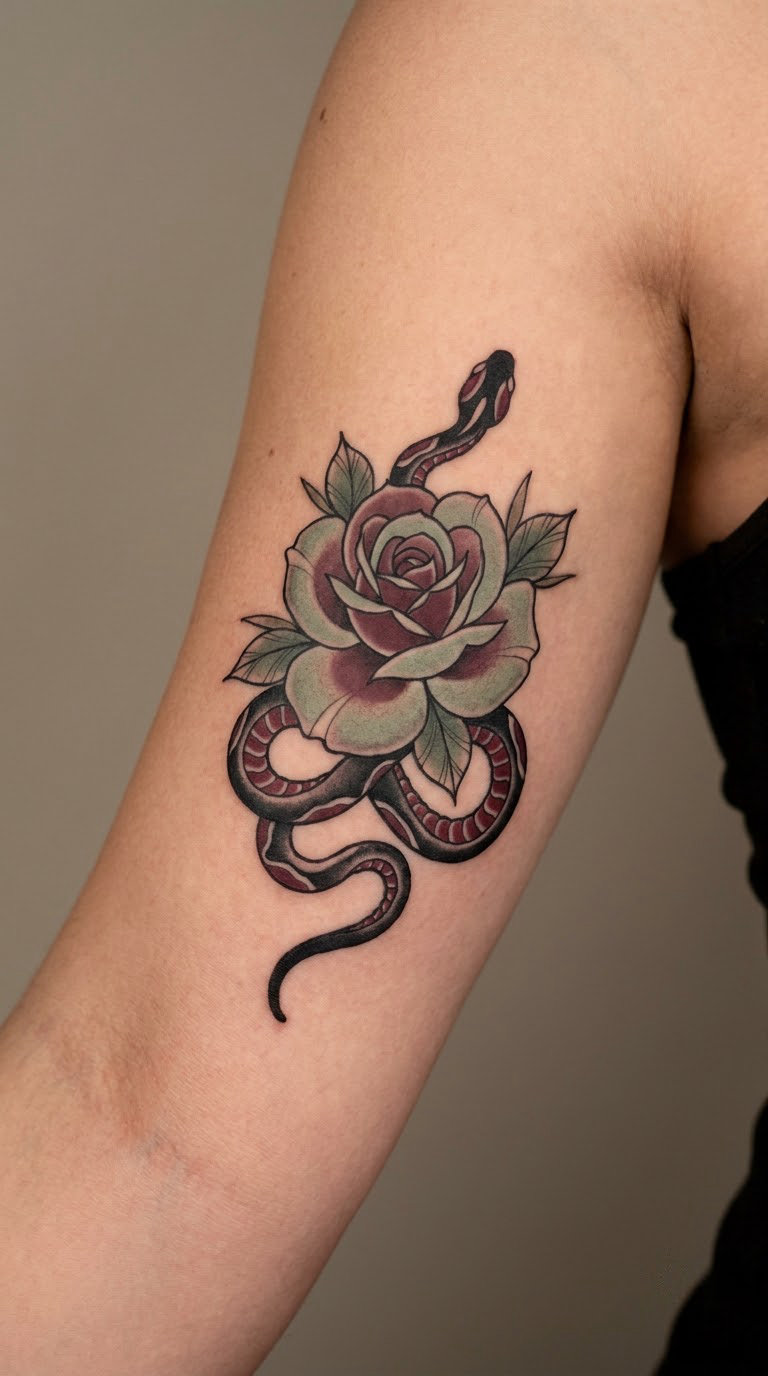
A rose and a serpent sharing one composition, with the snake curving around the flower instead of sitting beside it. Burgundy, sage and black keep the pairing from looking heavy, and the negative space between the coil and the bloom is what stops it reading as cluttered.
Rosy serpents are a studio staple for a reason: the shapes are opposite, so they balance each other. The snake brings the piece its edge.
Placement: Outer upper arm, or wrapping the bicep. Size: 5-6 in (13-15 cm). Style: Neo traditional, muted palette.
Pain: Medium over one long sitting, and split it into two. Curl the composition so the body movement carries the coil. Fine scale detail on the snake’s scales tends to soften, so keep the pattern simple and let the outline carry it.
Make it yours: Choose a snake colour that echoes a specific gemstone or a piece of clothing you already wear.
4. Moth with Lavender Wings Behind the Ear
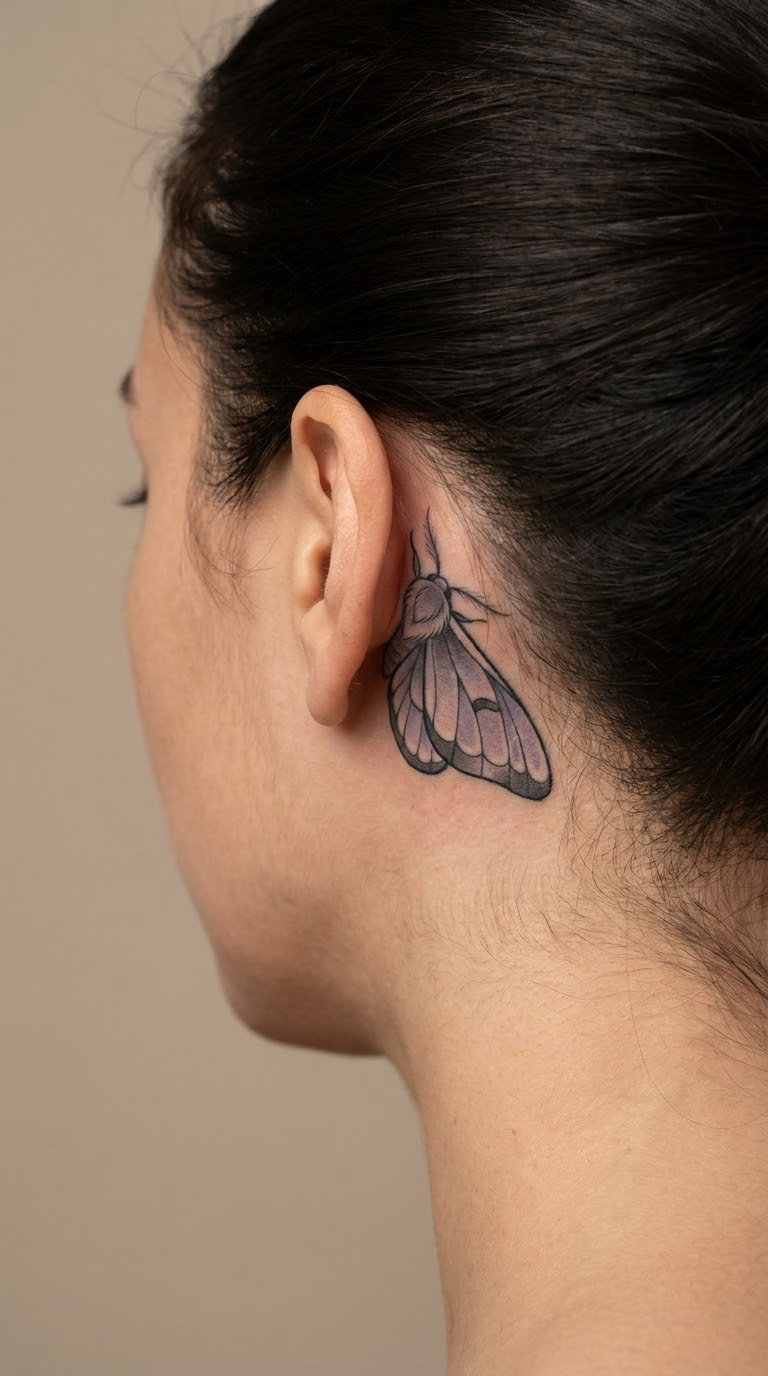
A symmetrical moth with long feathered antennae, layered wing shapes in lavender and charcoal, and a soft gradient where the wings meet the body. Behind the ear it reads as one shape rather than a diagram, which is exactly why the placement works.
Moths are drawn in this style for their patterned wings, and plenty of people attach meaning to them around transformation. Others just like the shape.
Placement: Behind the ear, or just below the ear lobe along the neck. Size: 1.5-2 in (4-5 cm). Style: Neo traditional with soft colour.
Pain: Medium, mostly from the thin skin over cartilage. Detail behind the ear blurs fastest of anywhere on the body, so ask for a bolder antenna and wing edge than feels necessary. Simplify anything finer than that.
Make it yours: Add a small moon or two stars in the negative space above the wing, and skip them if you want the moth alone.
5. Red Apple Blossom on the Shoulder
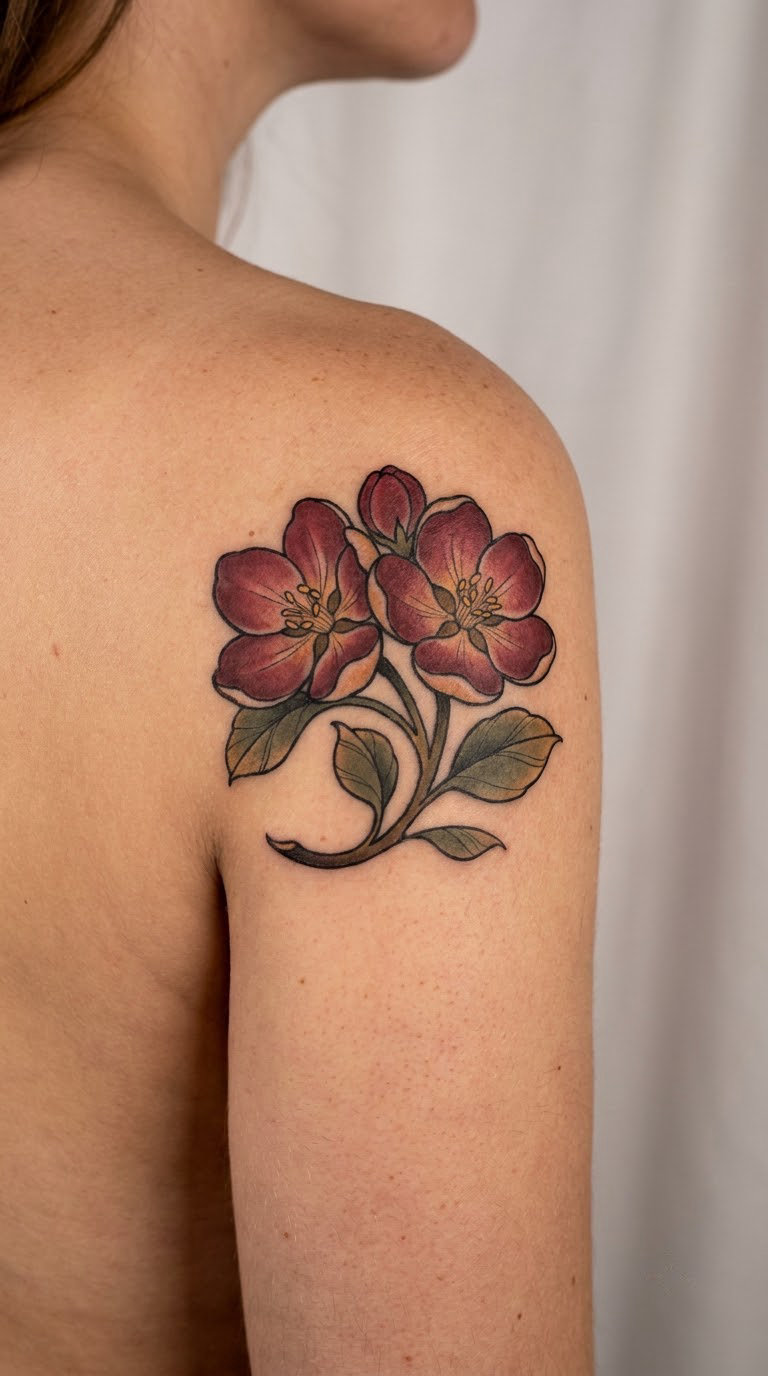
Two five-petal blossoms in bright red with a small burst of yellow at the centre, green leaves and a curved stem, arranged to follow the shoulder line. It is a cheerful design that holds a clean outline and colour blocks without needing much shading.
Blossom branches are often picked for a spring occasion, a new beginning or a specific person. Any of those reasons is fine.
Placement: Top of the shoulder, cap deltoid, or just below it on the upper arm. Size: 2.5-3 in (6-7.5 cm). Style: Bright neo traditional.
Pain: Low. Shoulders sit on muscle, which is one of the more forgiving spots, and colour packing there stings briefly rather than steadily. Shoulder designs often need a slight rotation to heal evenly on the curve. If you want more floral shoulder options, our floral shoulder tattoo ideas for women guide goes deeper on that placement.
Make it yours: Add a third smaller bud at the far end of the stem so it fades out instead of stopping abruptly.
6. Crescent Moon with Botanical Lace on the Ankle
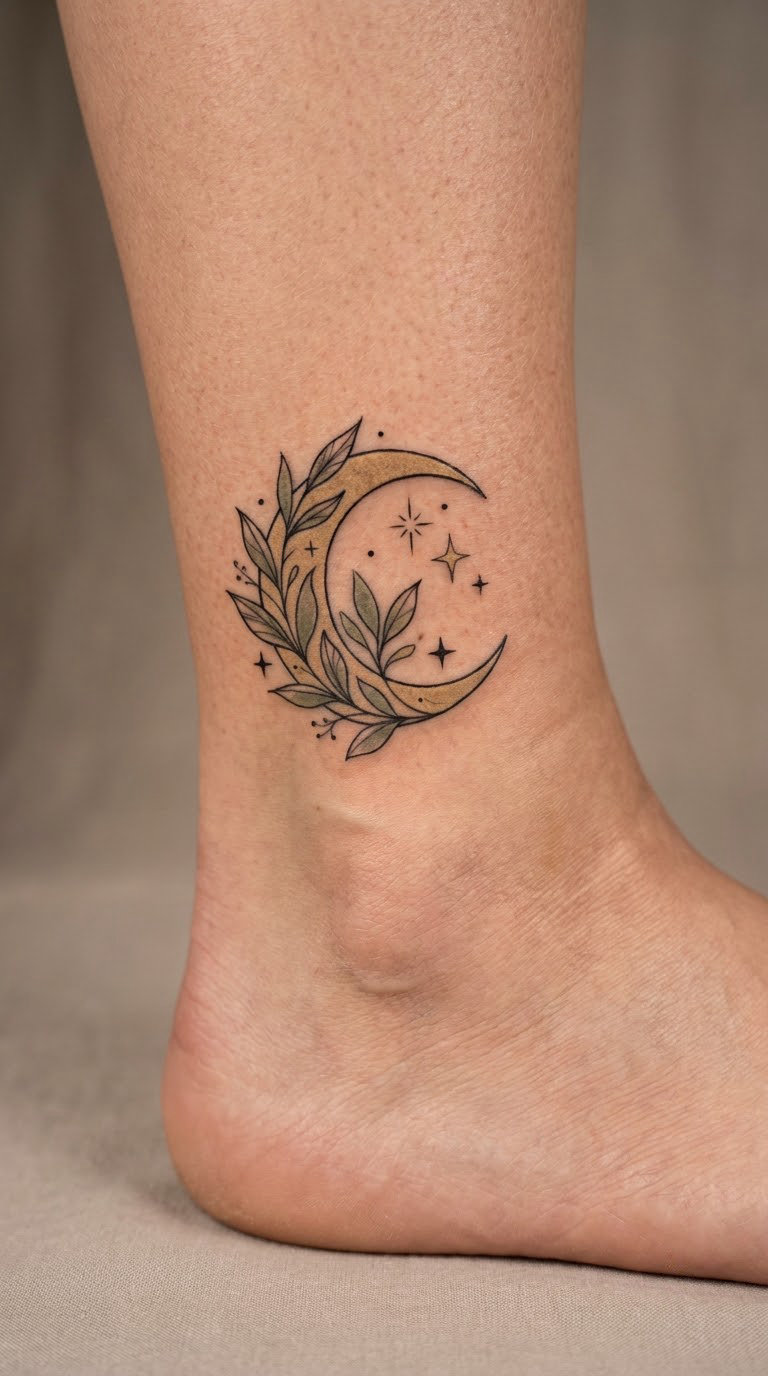
A traditional crescent with a face-free profile, trailed by small leaves, three stars and a few dots that act as lace. Black line with a muted gold crescent and sage leaves keeps the ornament light without turning into a harem drawing.
Moons are one of the most requested shapes in this style, drawn with the same confidence as a rose or a dagger.
Placement: Ankle, above the bone on the inner side, or over the outer ankle. Size: 2-3 in (5-7.5 cm). Style: Ornamental neo traditional.
Pain: Medium, and the ankle bone is the reason. Ankles swell through the day, so a design tight across the joint can distort as you stand. Place it above or below the bone, never wrapping over it. Small stars and dot work soften fastest here, so let them be accents rather than the drawing.
Make it yours: Add a personal date in a simple hand along the trailing stem, or leave the crescent plain and let the leaves do the work.
7. Blue Butterfly on the Wrist
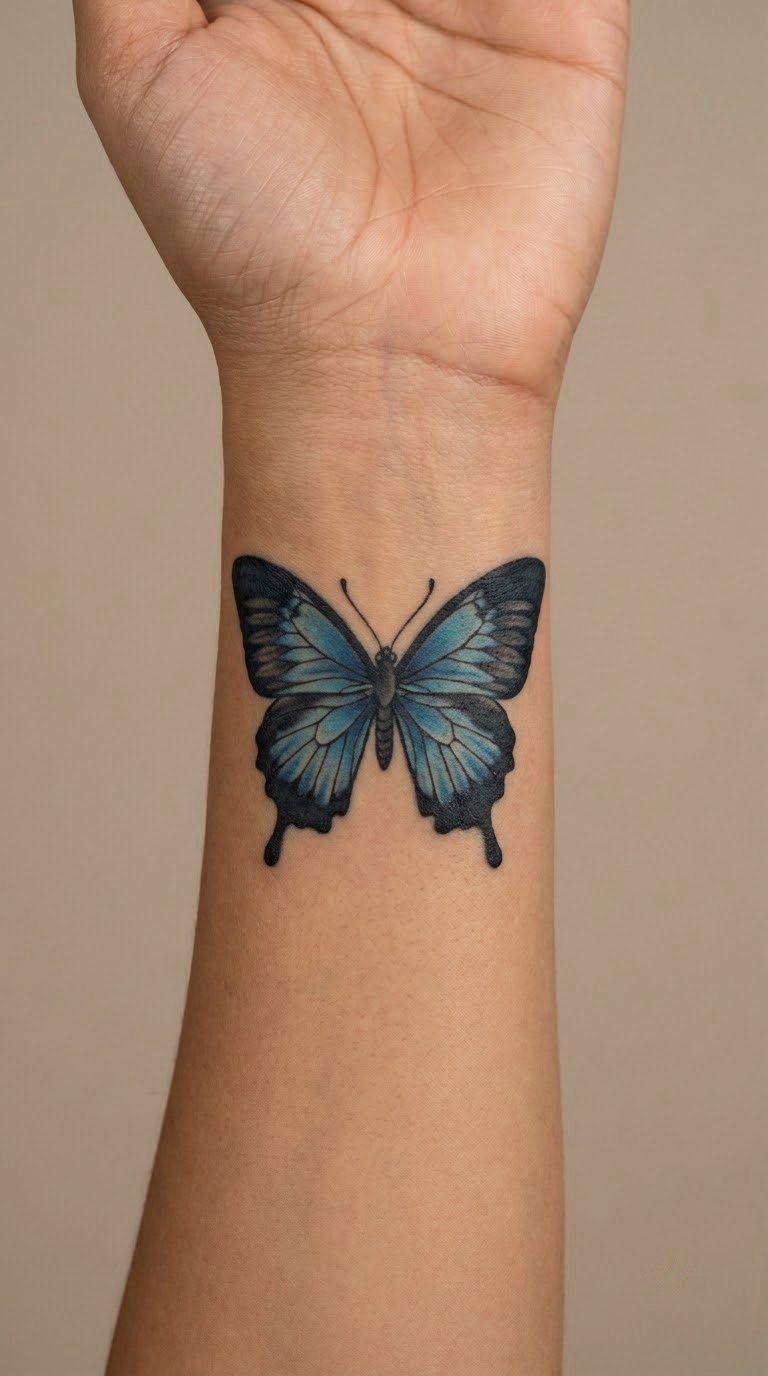
A symmetrical butterfly with bold wing contours, blue-black shading and only a few restrained vein lines. Traditional flash butterflies get more detail every decade, so pulling the veining back keeps the shape crisp instead of busy.
Butterflies are usually a change-of-season marker or a straightforward love of the form. Either way, the symmetry does the talking.
Placement: Inner wrist, aligned with the forearm rather than across it. Size: 2-2.5 in (5-6 cm). Style: Traditional flash with neo colouring.
Pain: Medium, and wrists throb for a day or so afterwards. The veins there are close to the surface. Wings that sit square to the wrist bend with every hand movement, so a slight lengthwise tilt wears better. Symmetry has to be near-perfect before it heals, because the two halves move differently.
Make it yours: Swap the blue for a muted sage or dusty rose if you want it quieter, or add a small initial on the lower wing.
8. Vintage Sun and Rose on the Sternum
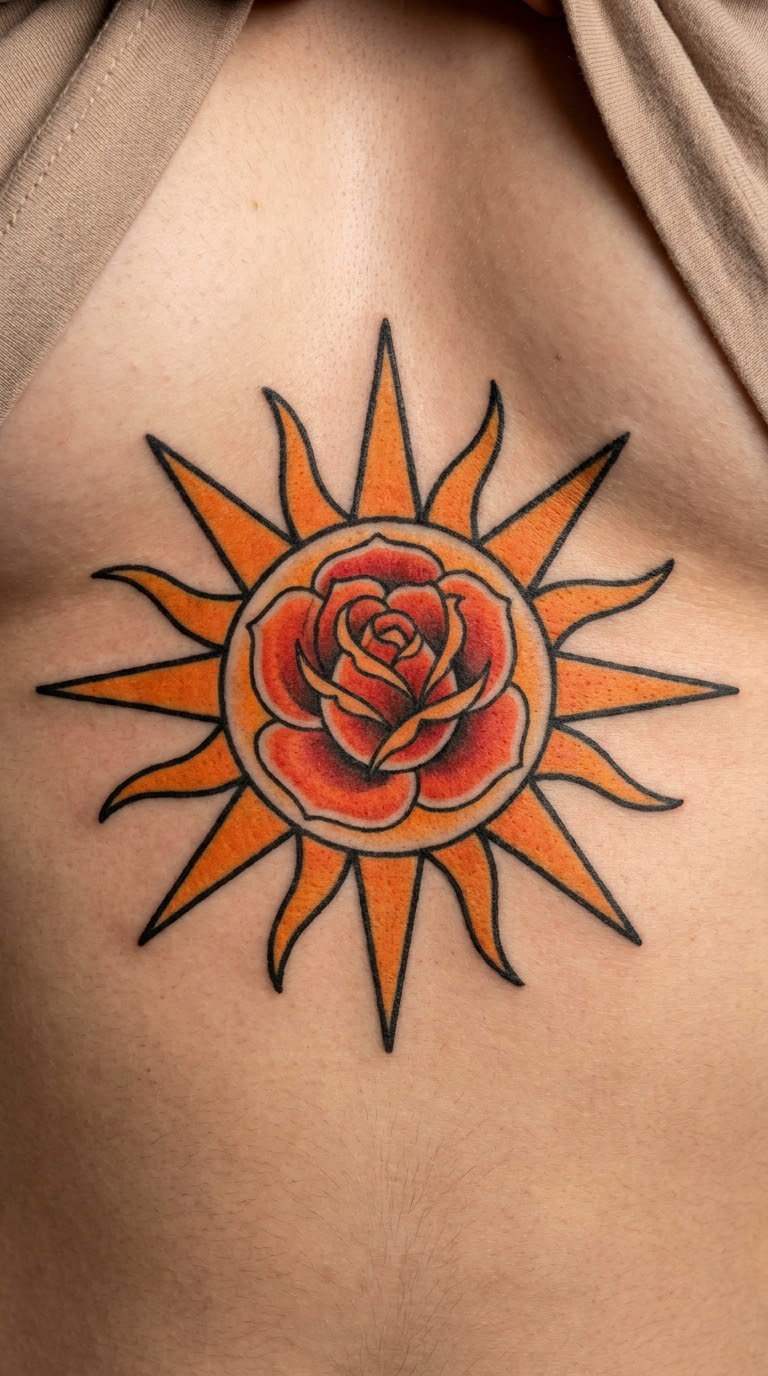
A round sun with orange and gold rays wrapping a single rose at the centre, laid out vertically down the sternum between the breasts. It is a vintage poster composition executed with traditional linework, and the vertical format suits the long flat area of the sternum.
Sun and rose together is an old pairing, and people usually choose it because the two images balance warmth against softness.
Placement: Centre of the sternum, running vertically. Size: 4-5 in tall (10-13 cm). Style: Vintage neo traditional.
Pain: High, and it is the most talked-about spot in this list. Bone, thin skin and constant movement make it a long, uncomfortable session; many people split a piece this size. Sun rays are long straight lines, so a shakier session shows quickly, and you want a rested one. Colour on the sternum can look tired sooner than elsewhere, so keep the palette concentrated in the middle.
Make it yours: Set the rose slightly off-centre and let the rays trail in one direction, which makes the piece look designed rather than symmetrical for its own sake.
9. Traditional Swallow in a Small Collarbone Frame
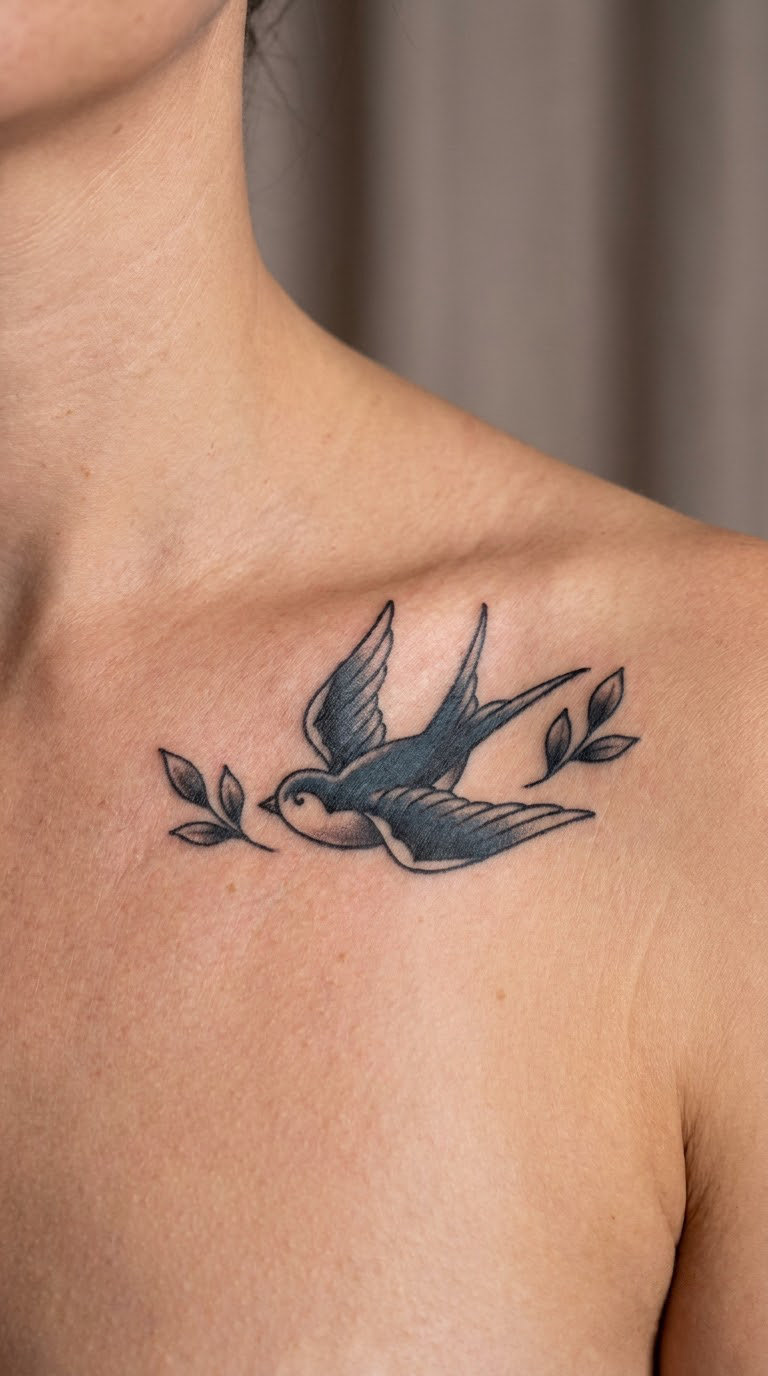
A swallow in flight with clean black linework, muted blue wings and a small orange breast, framed by two leaves so it reads as a composition rather than a bird dropped on skin. Swallows belong to the oldest part of the Western tattoo canon and were carried as symbols of travel and return.
Plenty of people today choose the bird purely for the shape, which gives a tattoo artist a lot of latitude on the wing position.
Placement: Collarbone, horizontal, or centred on the upper chest below the throat. Size: 3 in wide (7.5 cm). Style: Classic neo traditional.
Pain: Medium. Keep the frame sparse, because two leaves plus a full bird plus extra ornament is the point where a small placement starts to crowd. Feathers in the wing lose definition over time, so the outline needs to stay heavy enough on its own.
Make it yours: Turn the swallow slightly upward and add a tiny date beneath the frame in matching line weight.
10. Peony and Sparrow on the Side Thigh
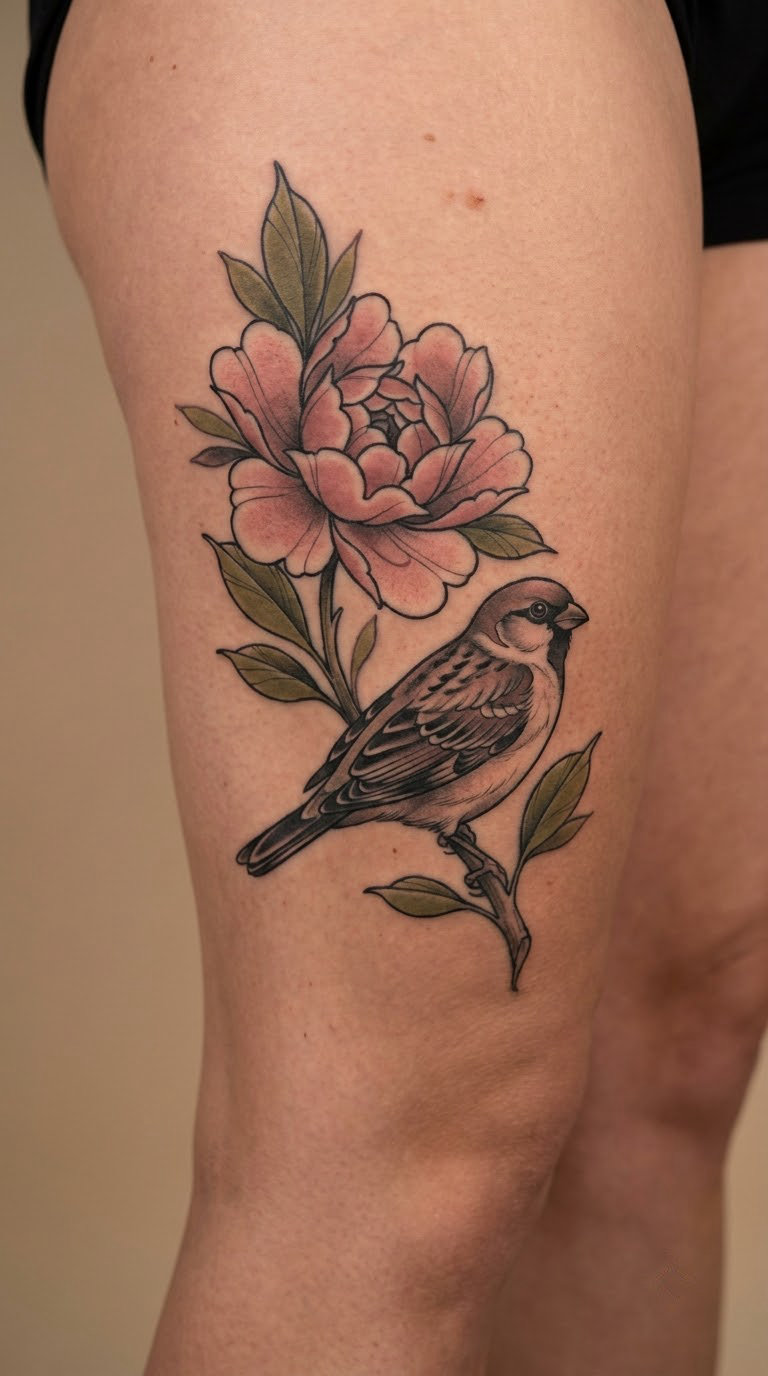
A large blooming peony in pink and deep green with a small sparrow perched on an outer petal, composed vertically so it follows the line of the thigh. Open background space around the bloom is what keeps a piece this size readable.
Thighs are where larger botanical work has room to breathe, and the curve gives the composition somewhere to go. The pairing of a big flower and a small bird keeps the eye moving.
Placement: Outer side of the thigh, aligned vertically. Size: 6-7 in (15-18 cm). Style: Neo traditional, soft green foliage.
Pain: Medium, and a piece this size runs three to five hours. Plan a two-session split rather than pushing one long sitting. Detail on a large thigh piece has good structural support, but the smallest elements will still soften, so make the sparrow simple and bold rather than finely feathered.
Make it yours: Use a flower colour that matches something you wear often, since a thigh piece is visible year round.
11. Snake and Lily on the Back of the Arm
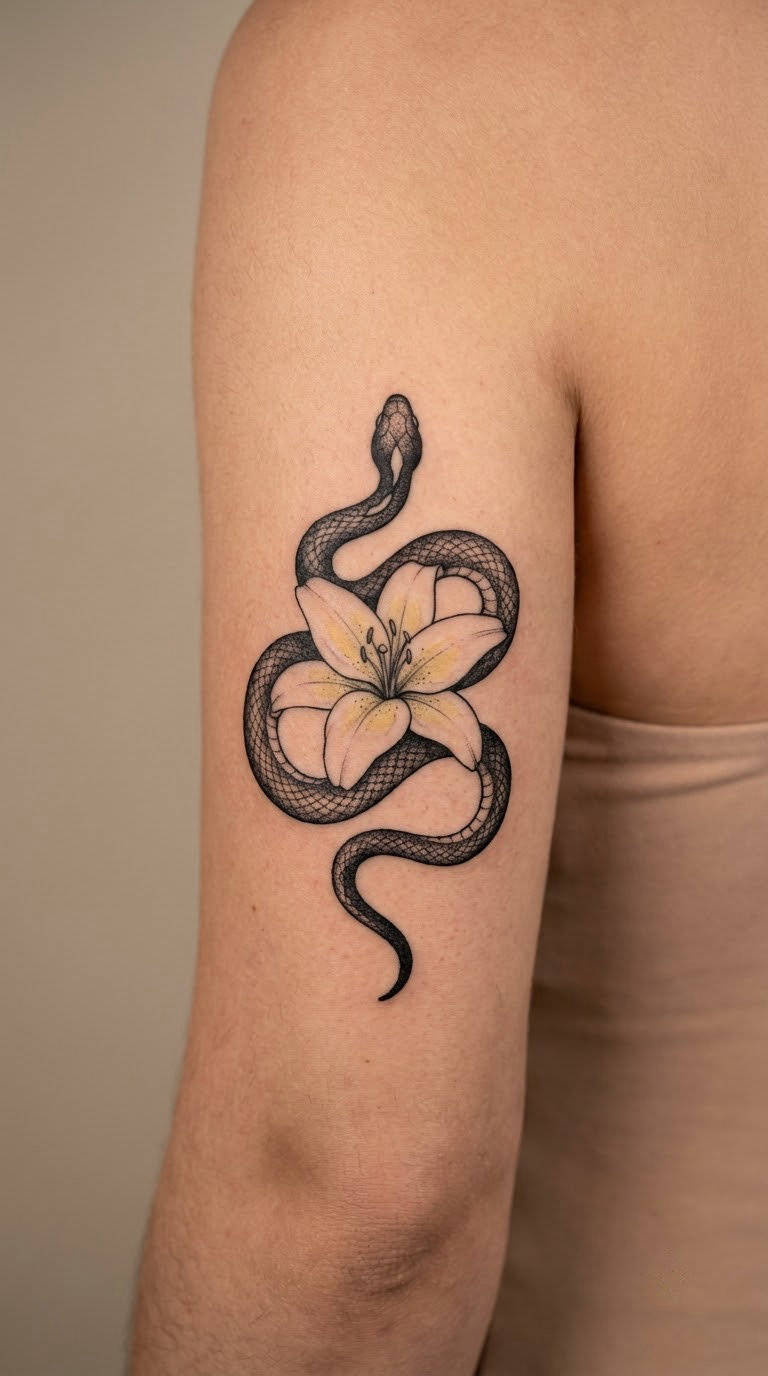
A single snake with strong black contours winding around a white lily with pale yellow centres, drawn so the stem disappears behind the coil and reappears. The contrast between the dark body and the pale flower is what makes a small piece read from across a room.
Snakes and lilies appear together often in this style because of the shape contrast, not because of a fixed symbolic code. Pick the pairing for how it looks.
Placement: Back of the upper arm, or the tricep. Size: 4-5 in (10-13 cm). Style: Bold line neo traditional.
Pain: Low. The back of the arm is muscle and fat, and this is one of the easiest spots to sit through. Pale yellow is a weak colour that can wash out, so expect a touch-up on the flower centre and decide that in advance rather than being surprised.
Make it yours: Add a small pearl or a ring of beads at the base of the lily if you want a jewellery detail without crowding.
12. Cherry Pair on the Inner Arm
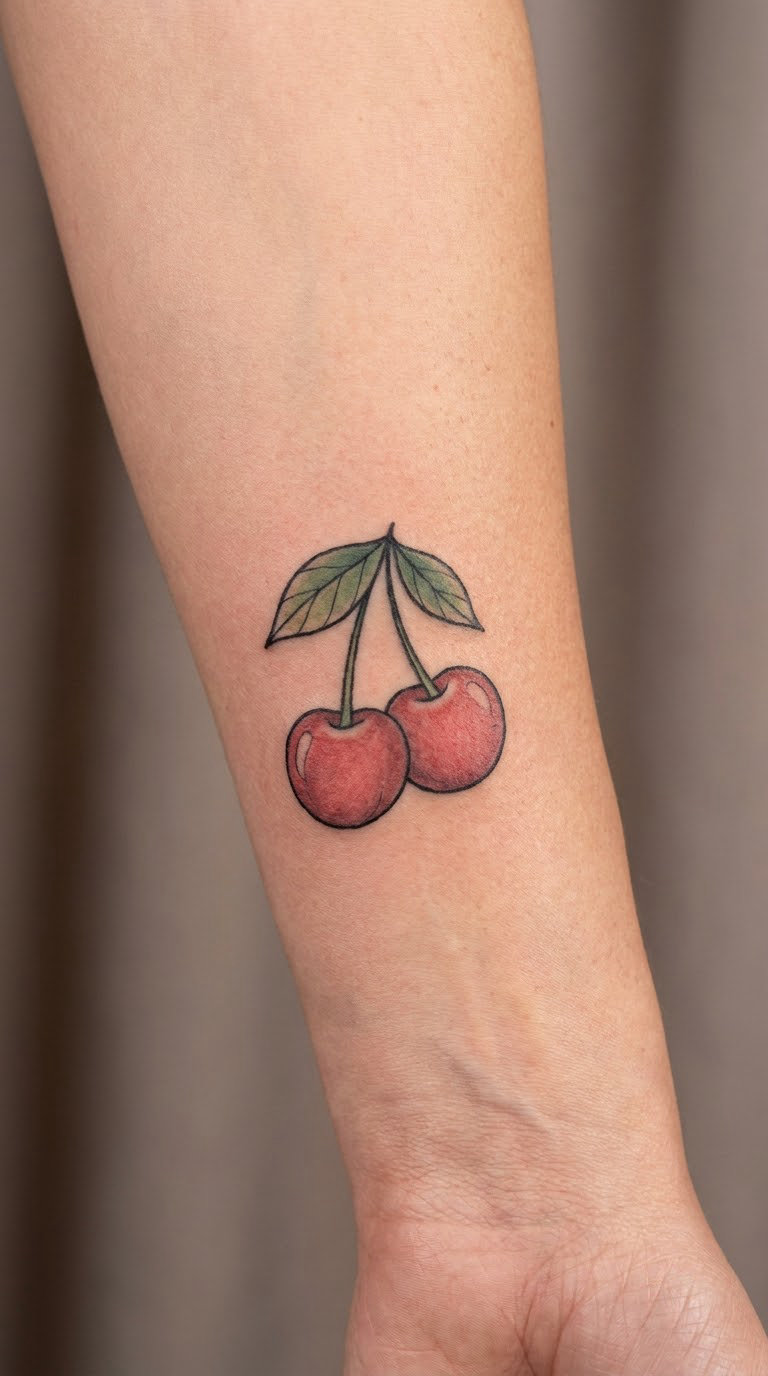
Two ripe cherries in deep red with a curved stem, two green leaves and a clean black outline. Fruit is a small-scale classic in this style because a solid block of colour hides minor linework changes as it fades.
Cherries tend to be chosen for a pairing, a nickname or no deeper reason at all, which makes them a good first neo traditional piece.
Placement: Inner forearm or inner upper arm. Size: 2 in (5 cm). Style: Simple traditional flash.
Pain: Low, and usually under an hour. Red is a strong pigment and holds well on the inner arm, though the first years can bring a little warmth in the colour that a touch-up fixes easily. The stem is the fragile part; ask for it thicker than looks right in the drawing.
Make it yours: Take the second cherry to a different spot, or repeat a pair on the other arm as matching pieces.
13. Daffodil and Ribbon on the Rib
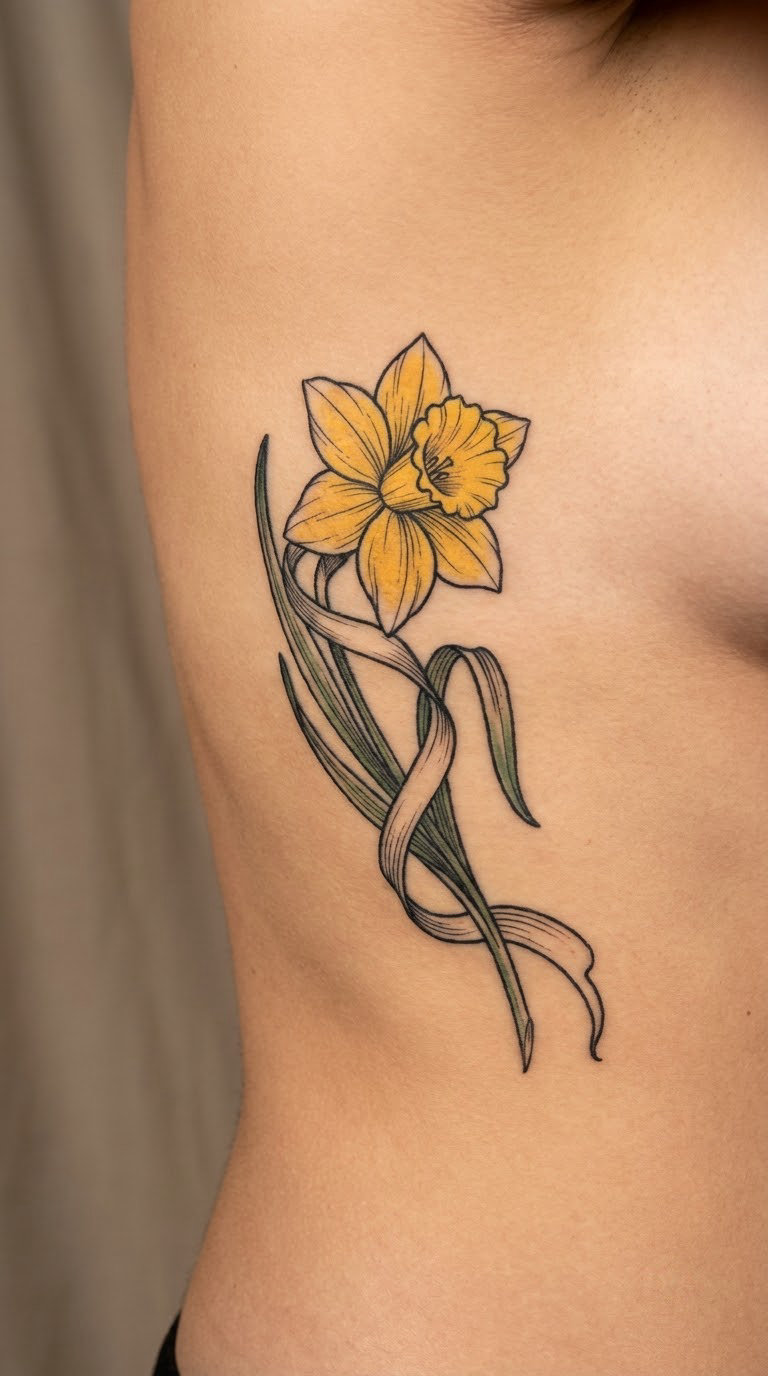
A single daffodil in warm yellow with a ruffled trumpet, green linework and a ribbon that trails along the rib line and fades out. One flower with a long trailing element uses the curve of the side without crowding it.
Daffodils are drawn for the trumpet shape and the movement of the petals, and the ribbon gives you somewhere to put a date or initials without a separate piece.
Placement: Side rib, following the curve, vertical. Size: 4 in tall (10 cm). Style: Neo traditional botanical.
Pain: High. Ribs are thin-skinned, stretch when you breathe and sit close to bone, and a design this size takes real time. Many people book a short morning session, eat afterwards and stop at two hours. Breathing movement also means the ribbon needs to be designed with the stretch, not laid across it.
Make it yours: Put a small date in the ribbon’s tail, or replace the ribbon with a second bud if you want the piece purely botanical.
14. Crescent, Sparrows and Star on the Back of the Neck
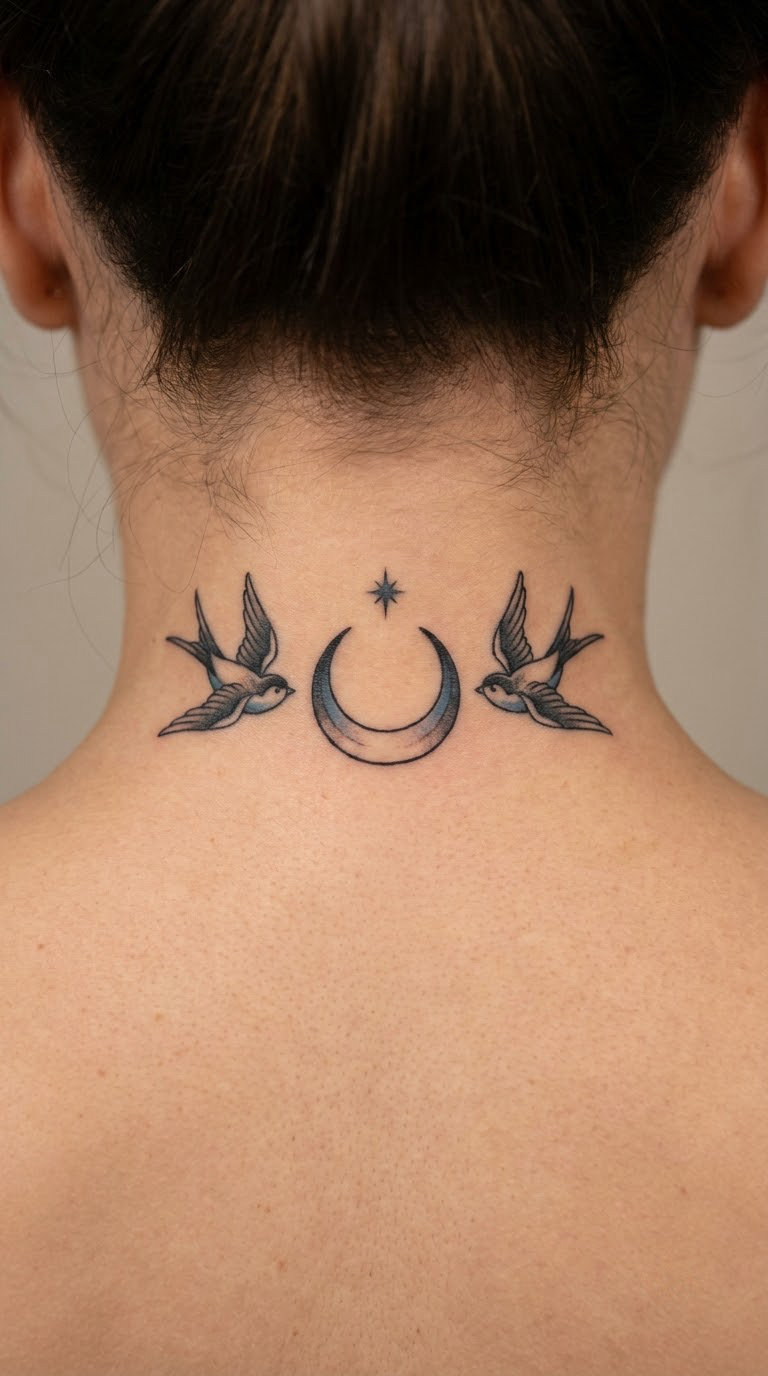
A central crescent with two small sparrows facing inward and a single star above, drawn in black with muted blue accents. Symmetrical arrangements like this suit the flat plane of the upper back and read clearly from a distance.
Birds and moons together are a common request in this style, and the symmetrical layout is the part that makes the piece feel deliberate.
Placement: Back of the neck, just above the hairline or a few centimetres below it. Size: 3-3.5 in wide (7.5-9 cm). Style: Symmetrical neo traditional.
Pain: Medium. The neck is sensitive and you cannot watch the work, so most people ask the artist to talk them through it. Hair regrowth over the top of a neck tattoo irritates the healing skin, so plan for shorter hair for the first few weeks. Two small birds are near the limit of what stays crisp here; keep them simple.
Make it yours: Add a short word or a date beneath the star, in the same line weight so it looks part of the design.
15. Red Poppy on the Hand
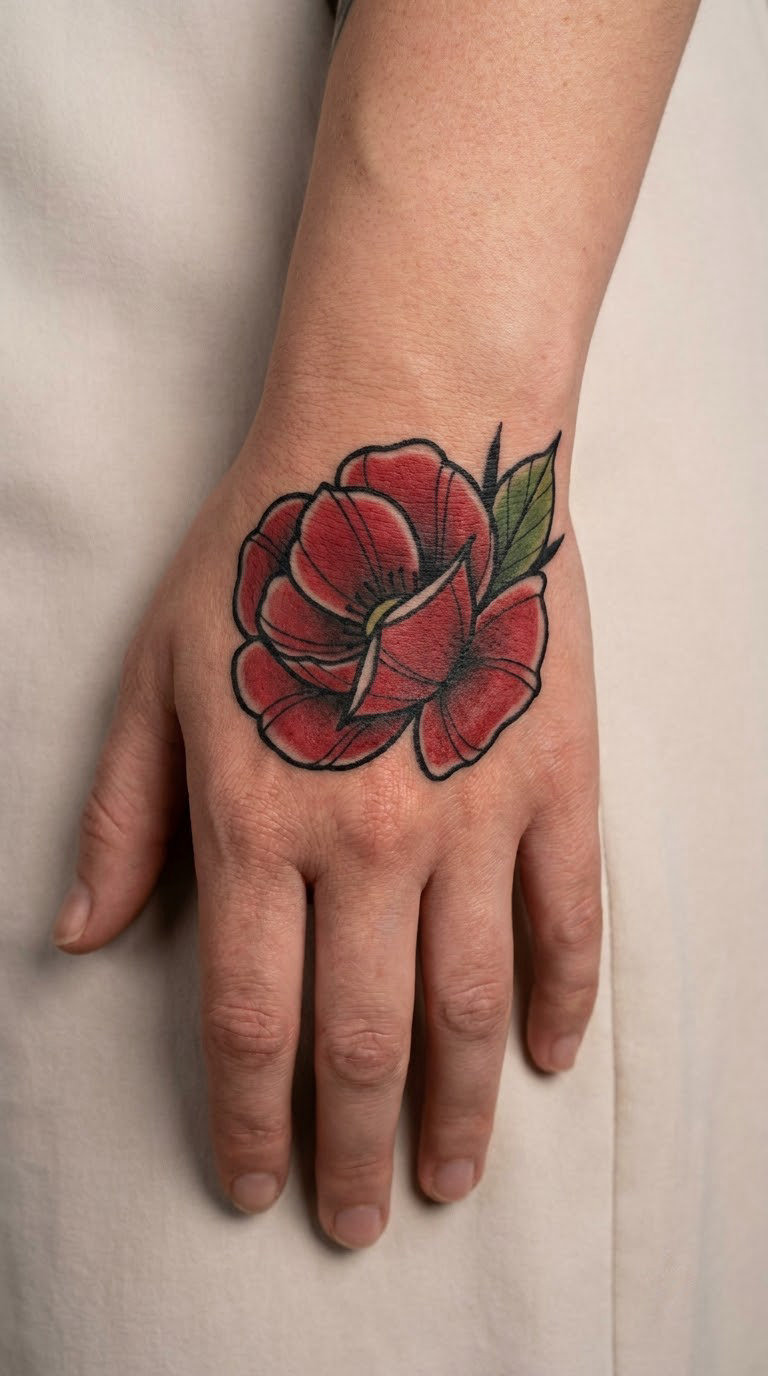
A poppy with four crinkled red petals, a dark centre, thick black contour and a single green leaf. Bold line weight is not optional on the hand here, because hands get sun, movement and washing many times a day.
Poppies are often tied to remembrance, and plenty of people just like the shape and the red. Both are ordinary reasons.
Placement: Back of the hand, between the knuckles and the wrist. Size: 2.5 in (6 cm). Style: Bold neo traditional.
Pain: High. Hand skin is thin, packed with nerves and full of moving joints, and knuckles hurt more than the fleshy part of the hand. More important than the pain is ageing: fine detail on hands fades fastest of any placement, so keep petal edges graphic and accept that the ruffled inner texture softens within a few years. Small pieces on fingers are the worst case, and most artists talk clients out of them.
Make it yours: Add a date on the inner wrist in the same line weight so the hand piece has a companion, not a sequel.
16. Black Peony Half Sleeve on the Forearm
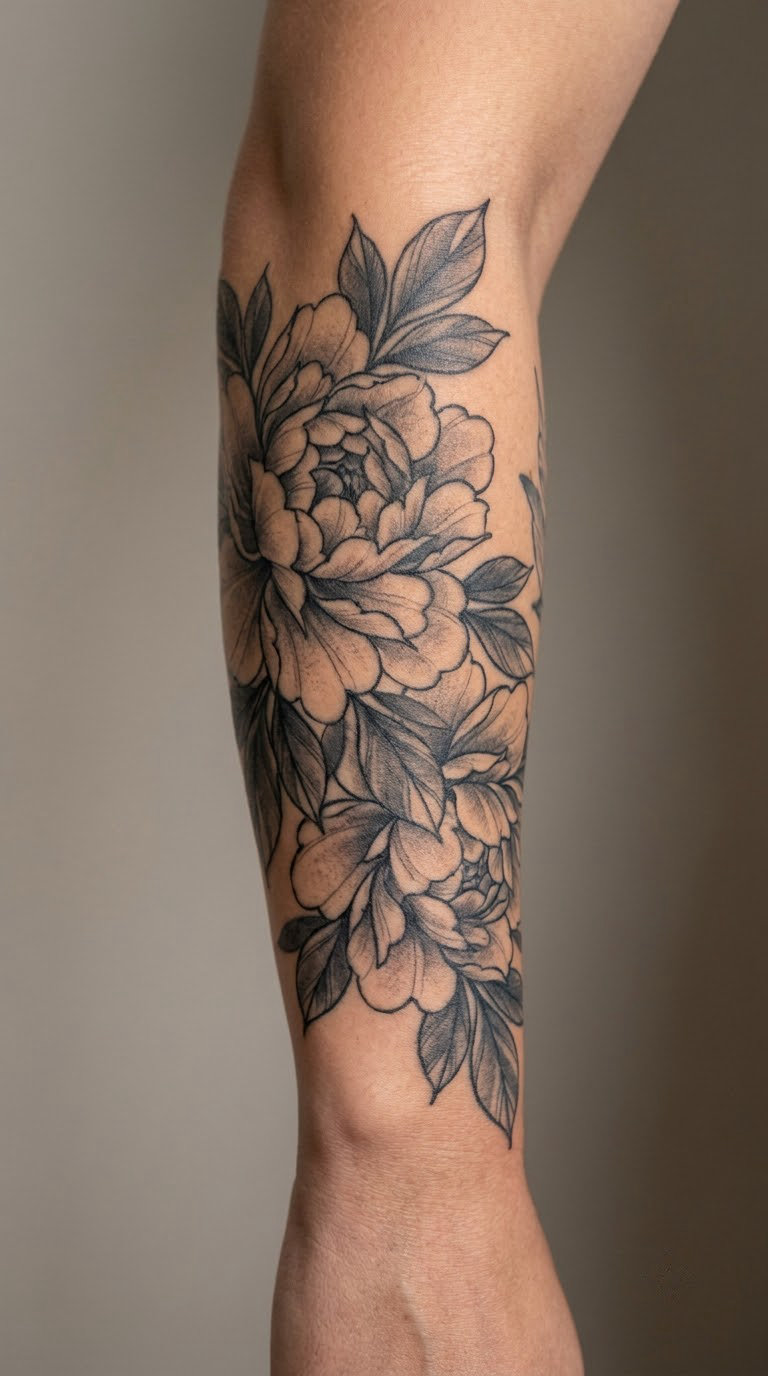
A black and grey peony half sleeve, with layered petals, dark shaded leaves and gradual grey transitions building from the elbow to mid-forearm. Dropping the colour while keeping the traditional linework is one of the more popular ways to make a bold style quieter.
People build towards this piece rather than starting with it, usually after a smaller flower or a bird. It rewards an artist working at size.
Placement: Elbow to mid-forearm, wrapping slightly. Size: 8-10 in long (20-25 cm). Style: Black and grey neo traditional.
Pain: Medium across a long session, and this is a minimum three-session piece in most shops. The elbow and inner forearm are the two areas that will make you shift. Grey shading has to be laid in light, or it turns into a flat grey slab, so the appointment count protects the result. Black and grey holds its contrast better than any colour palette, which makes it the safest large option.
Make it yours: Leave a band of bare skin near the wrist or elbow so the piece can breathe and can later be extended on one side only.
17. Sparrow and Laurel Branch on the Shoulder
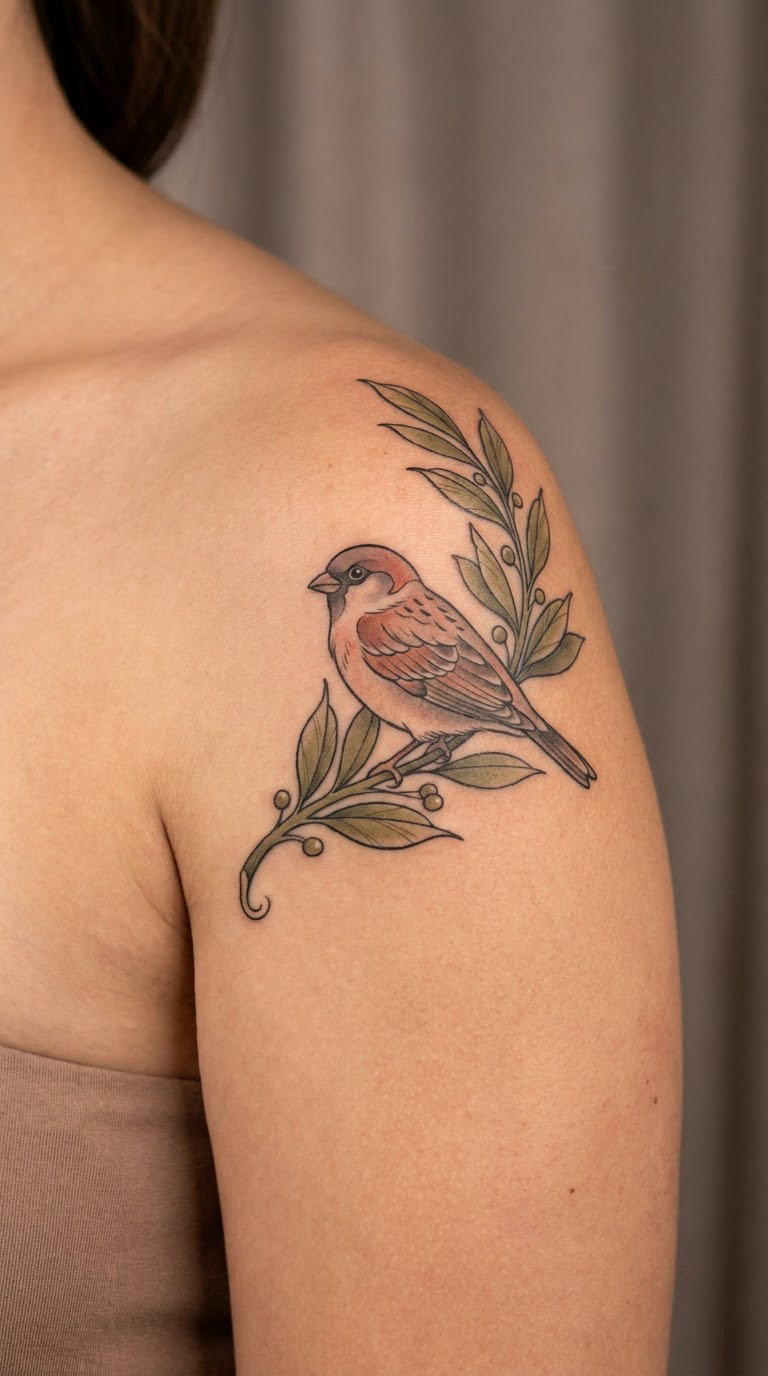
A small sparrow with a brown and cream body perched beside a curved laurel branch in olive green and black, composed horizontally so the branch follows the shoulder line. The branch does the structural work and the bird carries the detail.
Laurel is a classical motif that reads as growth and victory, though plenty of people choose the branch for the shape alone.
Placement: Top of the shoulder or along the deltoid, horizontal. Size: 3.5-4 in (9-10 cm). Style: Neo traditional with olive green.
Pain: Low. Shoulder caps take ink well and barely register as painful. Olive green and brown are muted earth tones that blend toward the skin over time, which is a gentler ageing profile than a saturated red. Leave gaps between leaves so a single faded leaf does not define the whole branch.
Make it yours: Turn the bird’s head slightly toward the front of the body, so the piece has a direction rather than sitting flat.
18. Lotus and Moon on the Lower Back
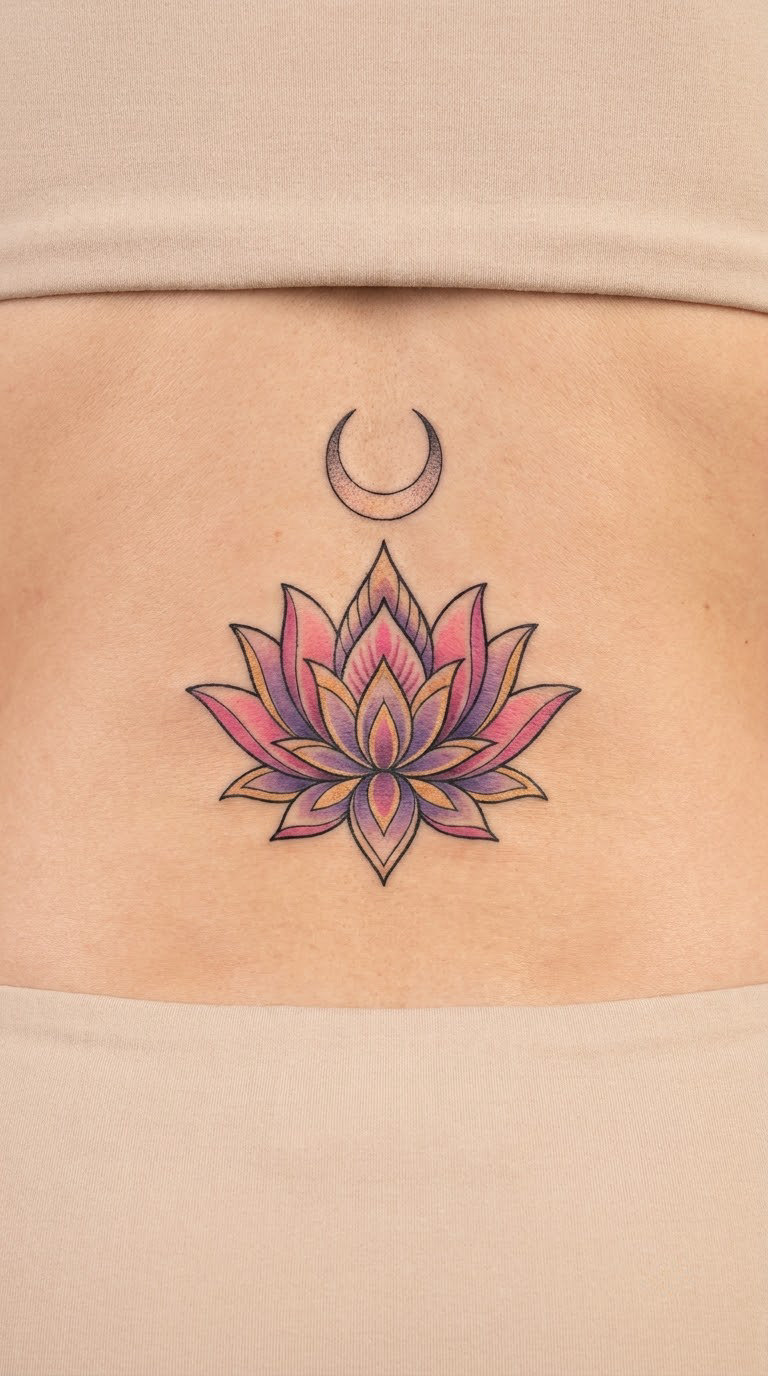
A symmetrical lotus with layered pink and violet petals, a gold crescent arcing above it and black outlines holding the whole thing together. The lower back gives a broad, flat surface, so a composition like this can be as large as you want without wrapping.
The lotus is one of the most requested motifs in this style because the petal symmetry and the pointed tips work with traditional contour lines.
Placement: Lower back, centred above the waistline. Size: 7-8 in wide (18-20 cm). Style: Symmetrical neo traditional.
Pain: Medium. Lying on your stomach is uncomfortable, and lower backs get sun through open tops, so plan sun protection if you want the colour to hold. Sitting and leaning forward often works better than lying flat. Violet and gold are the two pigments most likely to shift, so ask what your artist plans to do about them before you start.
Make it yours: Reduce it to a single lotus with no moon if you want the same shape at a much smaller scale, around 3 inches.
19. Blue Jay and Cherry Blossom on the Upper Arm
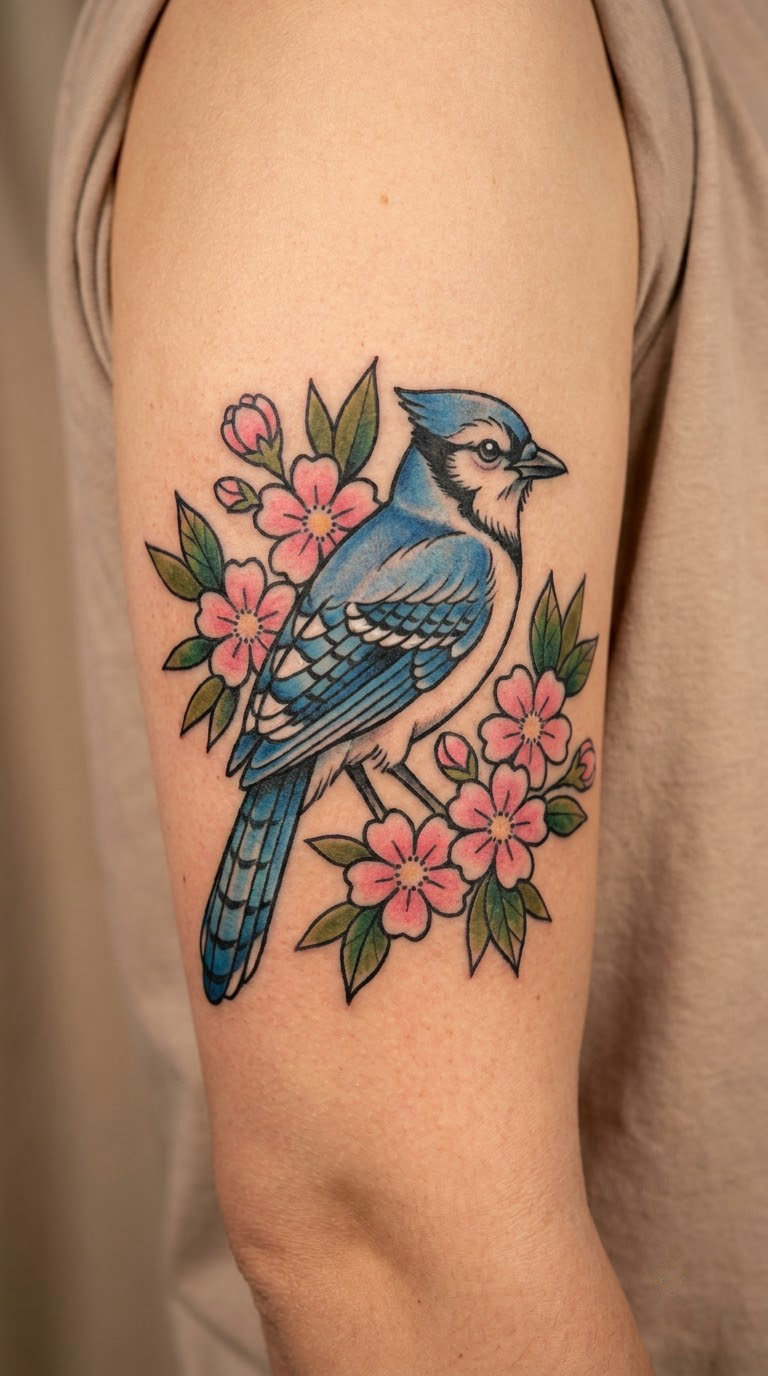
A blue jay with a layered blue and black body, a crested head and a small beak, perched on a branch of pink cherry blossoms and green leaves. Generous negative space around the bird is what keeps it legible once the piece has healed.
Blue jays are regional, which is part of the appeal for a lot of clients. The blossom branch is the softer half of the design and balances the bird’s colour.
Placement: Outer upper arm or the shoulder blade area. Size: 4.5-5 in (11-13 cm). Style: Colour neo traditional.
Pain: Low to medium, usually a three-to-four-hour session. Feather detail is the ageing risk here, so keep the wing markings in two or three values rather than individually drawn feathers, and let the black outline define the bird’s edge. Blue on skin loses a little of its brightness in the first few years, which is normal.
Make it yours: Point the jay’s head toward the front of your body, or swap the blossom branch for a single bloom if you want the bird to carry the whole piece.
20. Rose, Moon and Fine-Line Ornament on the Back of the Hand
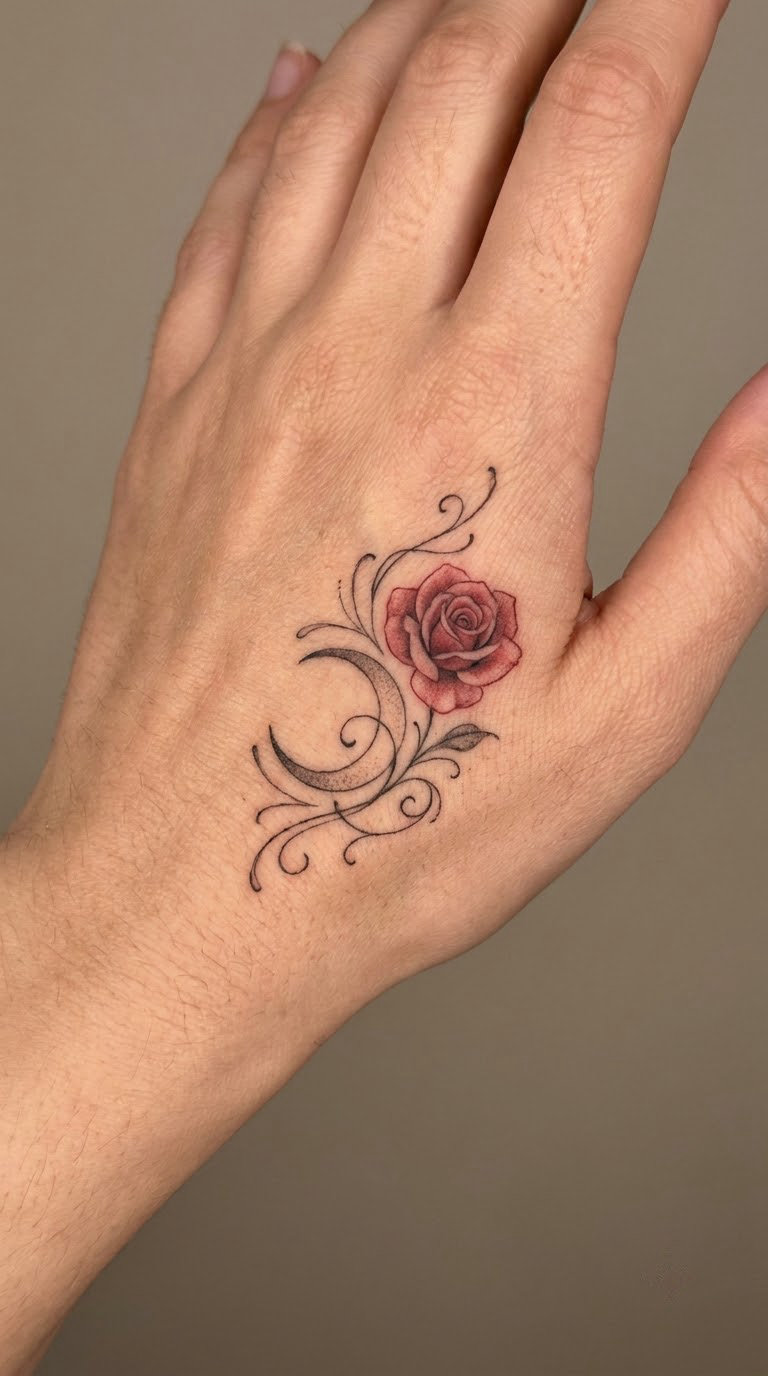
A shaded red rose with a small crescent tucked into the empty space and a few sparse ornamental lines trailing off the composition, leaving skin visible around it. The restraint is the point: a busy hand design has nowhere to hide as it fades.
Combining a traditional motif with fine ornament is a common way to soften this style, and the result suits people who want something traditional without the full weight of it.
Placement: Back of the hand, or the inside of the wrist. Size: 3 in (7.5 cm). Style: Refined neo traditional with fine ornament.
Pain: High on the hand, lower on the inner wrist. Line weight matters more here than anywhere in the list, because hand skin takes a beating and fine lines thin within a few years. Plan a touch-up schedule with your artist, and keep the ornament sparse enough that the loss of a line does not unbalance the design. Sun exposure on the back of the hand is the biggest reason these fade faster than the same design on an arm.
Make it yours: Add one small colour that only appears in this piece, so a matching design later has somewhere distinct to pick up.
How to Choose the Right Design
The right design is the one that still reads after five years, in the light you actually live in. A few checks make that decision much easier.
- Scale the motif to the detail. A bird with individually drawn feathers needs real estate. Either enlarge the design or simplify it, because a shrunken detailed piece is the most common reason a tattoo looks tired early.
- Pick a line weight and stick to it. A single heavy outline that holds the whole design is what makes neo traditional work. Hairline ornament on a hand or finger has no chance against that.
- Match the placement to the shape. Curved areas like the ankle and rib suit designs that already curve. A vertical composition down the sternum or rib needs room to run, and a horizontal one does not.
- Decide how much colour you want in five years. Black and grey and earth tones fade toward the skin. Saturated red, blue and yellow hold their identity longest. Muted palettes sit somewhere in between and often look intentional when they soften.
- Test the personal connection. A motif with meaning on your body carries weight that a purely aesthetic piece never quite does. If you cannot name why you want it, that is still fine, but it is worth knowing which of your designs are anchored and which are not.
- Check it against what you already have. If you own small florals, a bold black peony half sleeve is a different conversation from another two-inch bloom. Look at your existing pieces together before booking.
Which neo traditional placement wears best?
For most women, the forearm, upper arm, shoulder and thigh give a design enough flat surface to hold a real composition. Collarbone, sternum and rib work for smaller pieces or vertical ones that follow the line of the body. Hands and fingers are the hardest to keep sharp, so treat any detailed design there as a deliberate trade-off rather than a neutral choice.
How big should a neo traditional design be?
Size the design to the smallest detail you care about, then add roughly a third on each side of it. That extra space is what lets the outline breathe and shading spread without turning into mud. A motif that needs three colours and a full petal structure rarely survives under two inches.
Cost and Session Time
Tattoo pricing in this style is driven by time on the chair, not by the subject, so the honest way to think about it is hourly. Most shops charge by the hour with a minimum charge for small pieces, and that minimum is often the same whether the cherry takes forty minutes or the half sleeve takes six hours. Large colour-heavy work such as the peony half sleeve, the blue jay composition and the lower back lotus will need three to five sessions each, while the cherry, apple blossom, poppy and swallow are usually single sittings.
Ask for the full number before you book, and ask whether colour touch-ups are included or billed separately, because that changes the real total more than the first session does. Rates vary with city, shop and artist experience, and a half sleeve priced by the piece is worth comparing against the same design priced hourly.
Aftercare Basics
- Follow your artist’s aftercare instructions first, since they match the ink and technique used on your skin.
- Wash gently with clean water and a mild unscented soap, then pat dry with a clean towel rather than rubbing.
- Keep it clean and moisturised with whatever your artist recommends, applied in a thin layer rather than a thick one.
- Protect fresh work from direct sun, and consider sun protection later too, since ultraviolet exposure is the main reason colour and fine line fade early on the hand, the lower back and the shoulder.
- Wear loose, soft clothing over the area while it heals, and change anything that gets wet or soiled straight away.
- Contact your artist if the tattoo stays red, raised, hot, painful or starts weeping beyond the first few days, and seek medical advice for any spreading redness, swelling or fever.
Frequently Asked Questions
Do neo traditional tattoos age well?
They age better than most styles because of the thick black outline that defines the whole design. Bold will hold, as tattooers say, and the structure stays readable when shading softens. Fine ornament and small details fade first, so the artist should build the design around heavy contour lines. Placement matters as much as style: the same tattoo ages faster on a hand or a rib than on an upper arm.
What are the best colours for neo traditional tattoos?
Saturated reds, deep blues and strong yellows keep their identity longest and suit the bold outlining this style is built on. Earth tones such as olive, ochre and brown fade toward the skin over the years, which can look deliberate. Muted pastels are the hardest to hold and usually need the most touch-ups. If you want low maintenance, ask your artist to concentrate the colour in solid blocks rather than thin shading.
Can a neo traditional tattoo be small?
Yes, down to about two inches, as long as the design is simplified to suit. Small versions of flowers, fruit, swallows and moons work well because they rely on silhouette rather than detail. Avoid anything with individual feathers, tiny script or dot shading below two inches, since that detail will blur. One small, well-drawn piece is a good first tattoo and a sensible test of how you handle the process.
What is the most painful placement for a tattoo?
The sternum, ribs, collarbone and the back of the hand are the hardest, mostly because skin sits close to bone there and moves constantly. The rib and sternum combine that with a long, awkward position, and colour packing makes it sting more. The thigh, forearm, shoulder and upper arm sit on muscle and are noticeably easier, which is why many people start there. Splitting a long session into shorter ones also changes the experience.
How long does a neo traditional tattoo take to heal?
The surface usually settles within two to three weeks, with the peeling and fading that people find most unsettling. The tattoo is not fully settled until roughly three months, when the pigment finishes moving into the deeper layers of skin. Sun exposure during that period and afterwards affects how the colour settles permanently. Colour-heavy pieces take longer to heal than black and grey, and any of your artist’s specific instructions come first.
Conclusion
For a first tattoo, the cherry pair or the apple blossom are the safest way into this style: small, single sitting, and forgiving of the kinds of mistakes first-timers make. The blue butterfly on the wrist works if you want something visible but still compact.
For someone building a collection, the peony and sparrow thigh piece, the black peony half sleeve and the lotus and moon lower back are where this style shows what it can do. Take the motif, the scale and the placement that fit your body and your life, then bring a folder of references to a consultation with an artist whose healed work matches what you have in mind.