
20 Black and Gray Tattoo Ideas for Men: Best Styles (September 2026)
If you have been comparing black and gray tattoo ideas for men, this is the most forgiving palette there is. The same design in full colour goes dated, loud or both, while a black and grey version keeps its weight for decades. I have watched pieces turn grey over time and the bold ones still read clearly years later, and the delicate ones soften around the edges, which suits most people better anyway.
These twenty ideas cover the ground most men actually book: realistic portraits, dense blackwork, small symbol pieces and designs that sit between the two. Each one gets a realistic size in inches, an honest pain rating for the placement, and one way to make it yours. Plan at least a month ahead if a piece needs a touch-up session before you want it settled, and check healed work, not fresh photos, when you book.
If you are still narrowing things down, the 20 best zodiac sign tattoo ideas for men and 20 best knuckle tattoo ideas for men both translate cleanly into black and grey.
Black and Gray Tattoo Ideas for Men: Quick Guide
Here is the short version before the detail. Every design below lists its style, the spot it suits best, a realistic healed size, and how it felt to get tattooed there.
| Idea | Style | Best placement | Size | Pain |
|---|---|---|---|---|
| Lion portrait | Realism, grey wash | Inner forearm | 5-7 in | Medium |
| Blackwork eagle | Blackwork | Outer upper arm | 6-8 in | Medium-high |
| Geometric mountains | Geometric, dotwork | Outer calf | 5-6 in | Medium |
| Skull with laurel | Realism | Outer biceps | 4-5 in | Medium |
| Rose and dagger | Blackwork, grey wash | Inner forearm | 5-7 in | Medium |
| Norse raven | Blackwork | Deltoid | 5-6 in | High |
| Japanese dragon | Grey wash | Calf | 8-10 in | Medium |
| Compass rose | Fine line | Upper chest | 4-5 in | Medium-high |
| Wolf head | Blackwork realism | Shoulder blades | 7-8 in | Medium |
| Snake wrap | Realism | Forearm wrap | 4 x 8 in | Medium |
| Small rose | Realism | Outer hand | 2-2.5 in | High |
| Ship and storm waves | Blackwork | Outer forearm | 7 x 5 in | Medium |
| Micro eye | Micro-realism | Inner arm | 1.5-2 in | Low-medium |
| Dotwork skull | Dotwork | Outer thigh | 4-5 in | Low-medium |
| Mountain lion portrait | Realism | Upper chest | 8 x 6 in | Medium-high |
| Hexagon pattern | Geometric | Outer upper arm | 4-5 in | Medium |
| Crescent moon and stars | Blackwork | Shoulder cap | 4-5 in | High |
| Anchor with rope | Realism | Inner forearm | 5 x 4 in | Medium |
| Celtic knot | Black linework | Side chest | 6 x 6 in | Medium-high |
| Storm cloud and bolt | Blackwork | Inner wrist | 2.5 x 2 in | High |
1. Black and Gray Lion Portrait on the Forearm
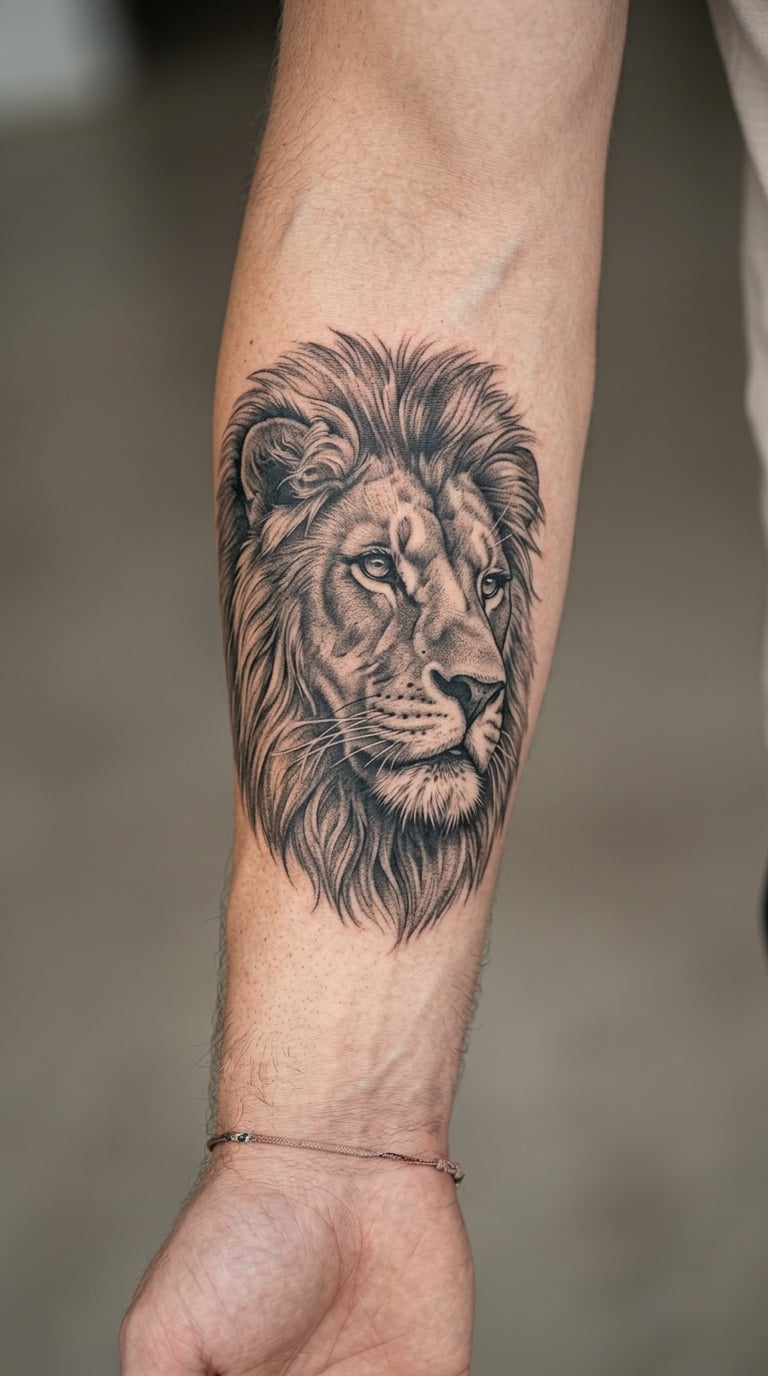
A lion portrait is built on a single hard edge for the mane and a soft grey wash for the face. The artist lays the darkest values under the brow and along the jaw, then lets the mid-grey carry the cheek and muzzle.
Most men pick it for courage and steadiness rather than for a specific story, though plenty attach their own meaning to it. The forearm reads as strength without the bravado of a full sleeve.
Placement: inner forearm, running from just below the elbow toward the wrist. Size: 5-7 in (13-18 cm) long. Style: realism with grey wash. Pain: medium, with the wrist end noticeably sharper. Hairy forearms complicate the fine eye detail, so a good artist widens the iris slightly rather than chase accuracy.
Make it yours: add a small coordinate line under the chin, or a name in narrow caps along the inner edge.
2. Blackwork Eagle Across the Upper Arm
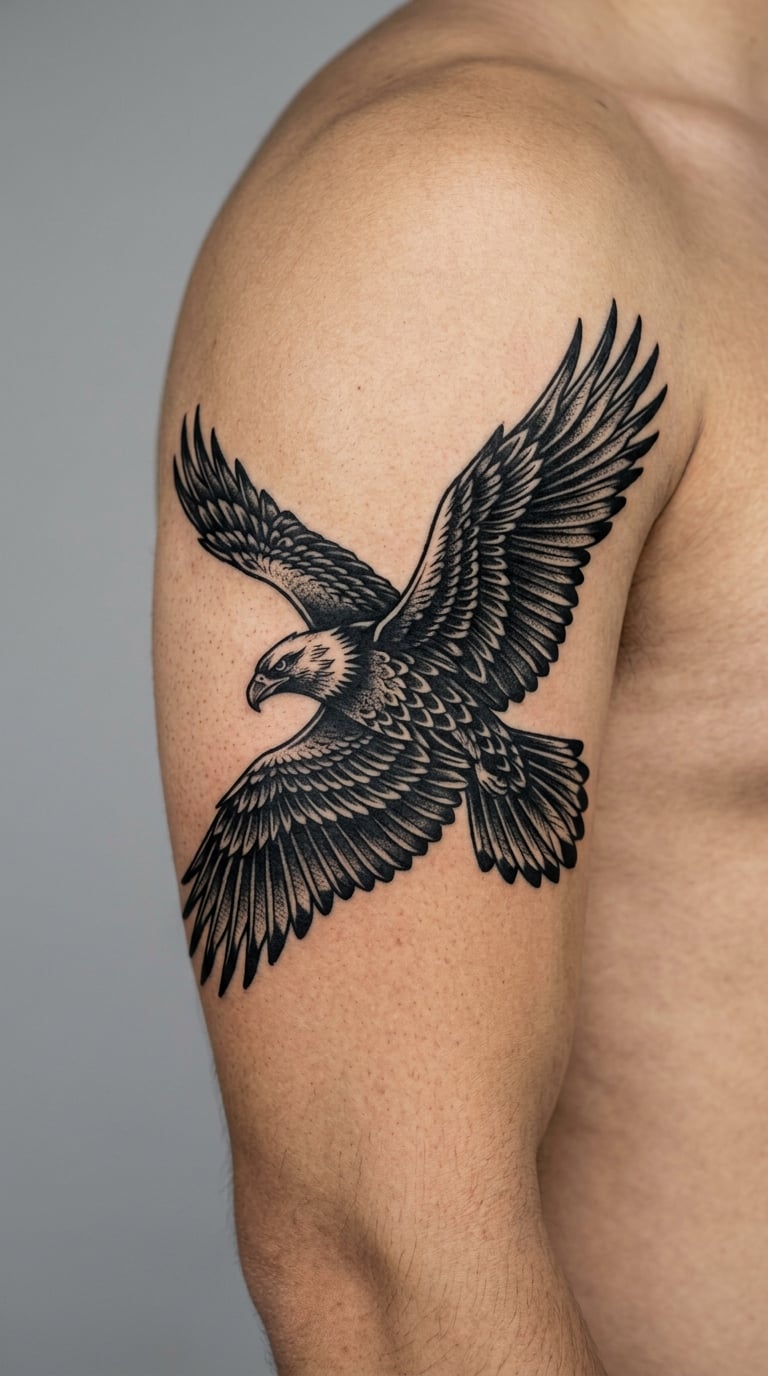
This is a solid-black design. Feathers read as overlapping curved shapes separated by thin channels of untouched skin, and the artist keeps the negative space open around the head so the eye still finds the beak at a distance.
Eagles have carried freedom, service and veteran symbolism for a long time, and men often choose the piece for something personal to them rather than the traditional meaning.
Placement: outer upper arm, angled with the shoulder so the wings follow the deltoid curve. Size: 6-8 in (15-20 cm) across. Style: blackwork. Pain: medium-high on the deltoid, and solid black on a large area is a long sitting. Raised areas hold ink more strongly, which is the point here, but skin still needs breaks.
Make it yours: put a service date or unit marker in the negative space between the wing tips.
3. Geometric Mountain Range on the Calf
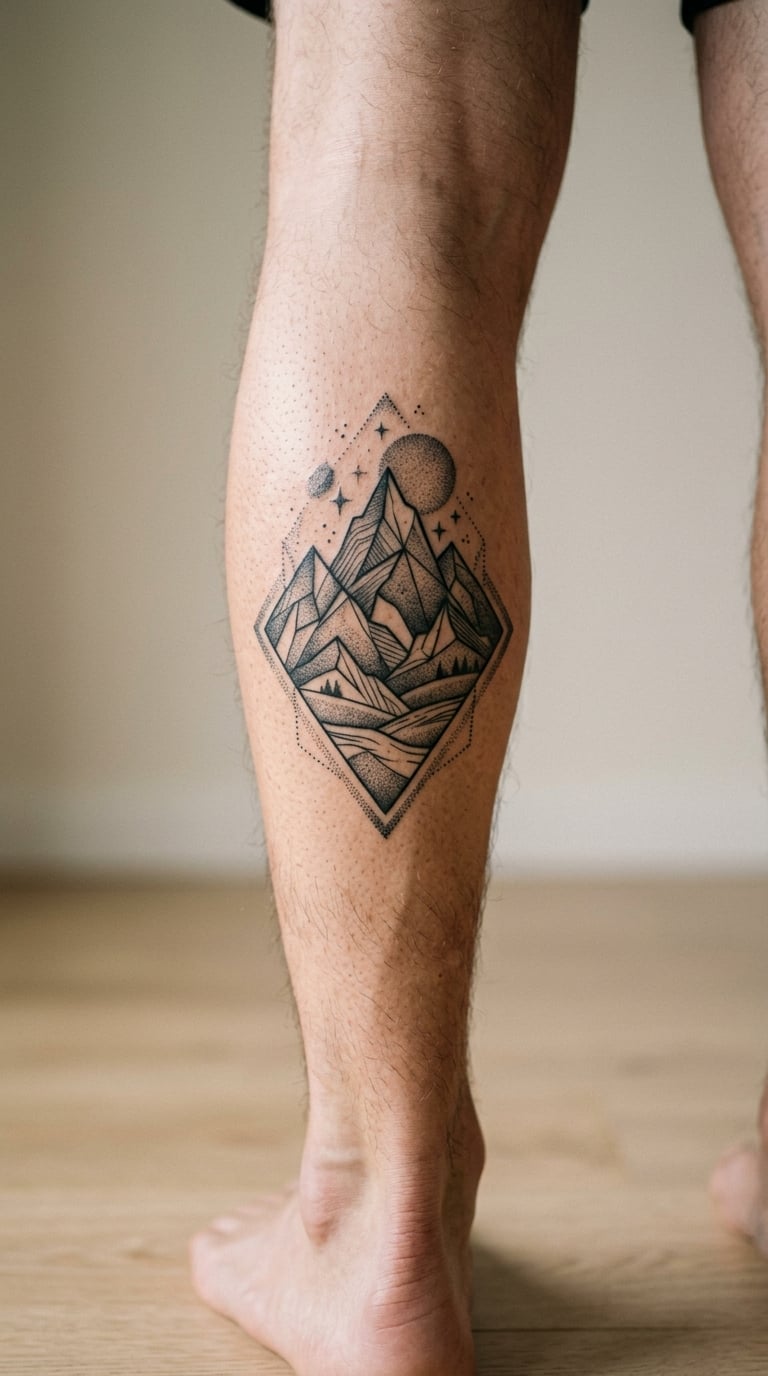
Overlapping triangular peaks in flat black, with dotwork stipple filling the valleys and a thin grey gradient behind the ridgeline for depth. The trick is restraint: too many peaks and the whole thing turns into noise.
Mountains usually stand for a place, a summit or a period of your life, and it is one of the easiest motifs to quietly personalise because the shape carries the meaning.
Placement: outer calf, following the muscle curve. Size: 5-6 in (13-15 cm) long, 3-4 in tall. Style: geometric with dotwork texture. Pain: medium. The calf is fleshy and relatively forgiving, though the outline near the shin is more sensitive. Dotwork takes its time and often needs a second pass to bring the density up.
Make it yours: replace one peak with the silhouette of a specific summit you have stood on.
4. Black-Gray Skull with Laurel Wreath on the Biceps
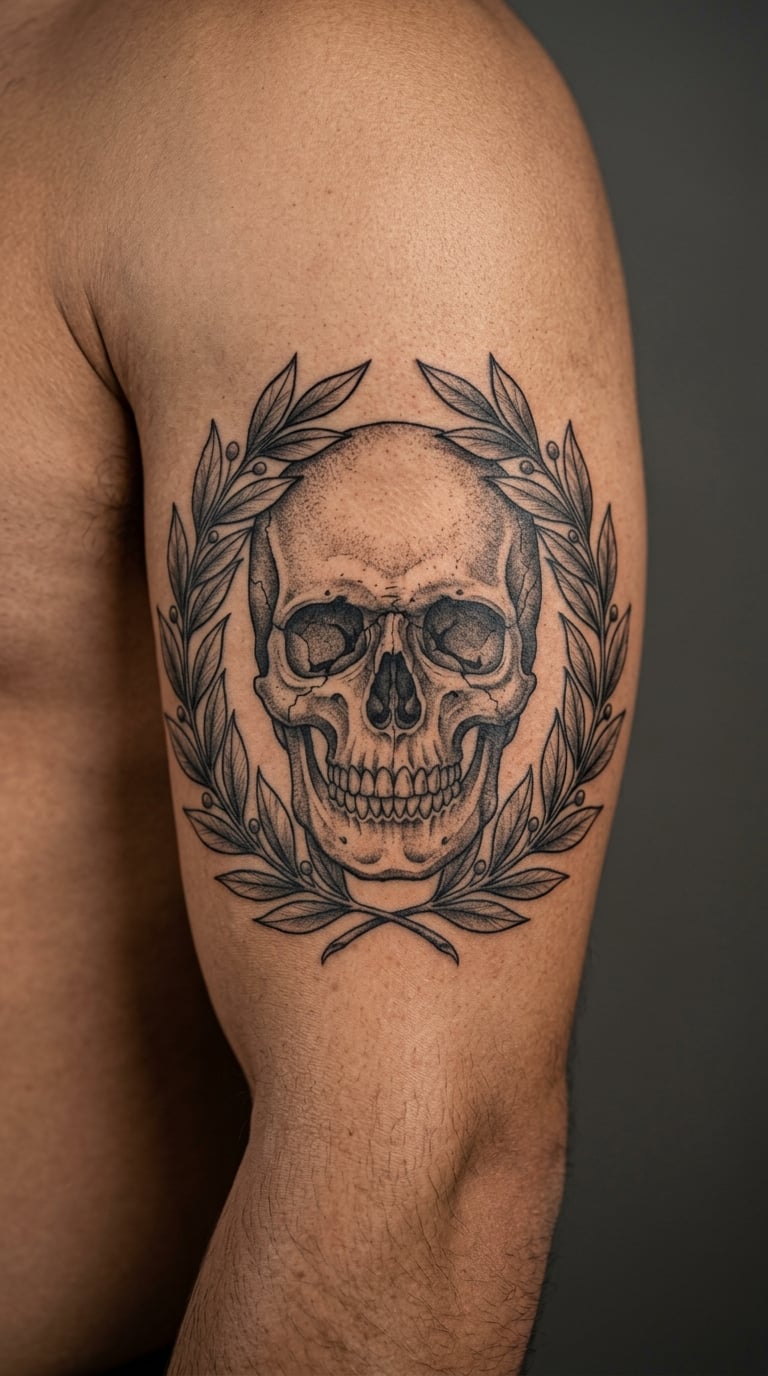
A frontal skull rendered in soft grey rather than solid black, framed by a laurel wreath with each leaf shaded individually. Slightly off-centre framing keeps it from looking like a clip-art badge.
Skulls on their own read as mortality and defiance. The laurel is the balance, standing for respect earned and held, which is why the combination gets picked so often.
Placement: outer biceps, centred and running vertically. Size: 4-5 in (10-13 cm) tall. Style: realism. Pain: medium. The inner arm near the elbow is the sharp part, so the artist usually works around the crease. The lighter mid-grey values on the cranium will soften a touch over the years, so plan contrast from the start rather than going all pale.
Make it yours: have the wreath tied with a thin ribbon and add a year along the bottom curve.
5. Traditional Rose and Dagger on the Forearm
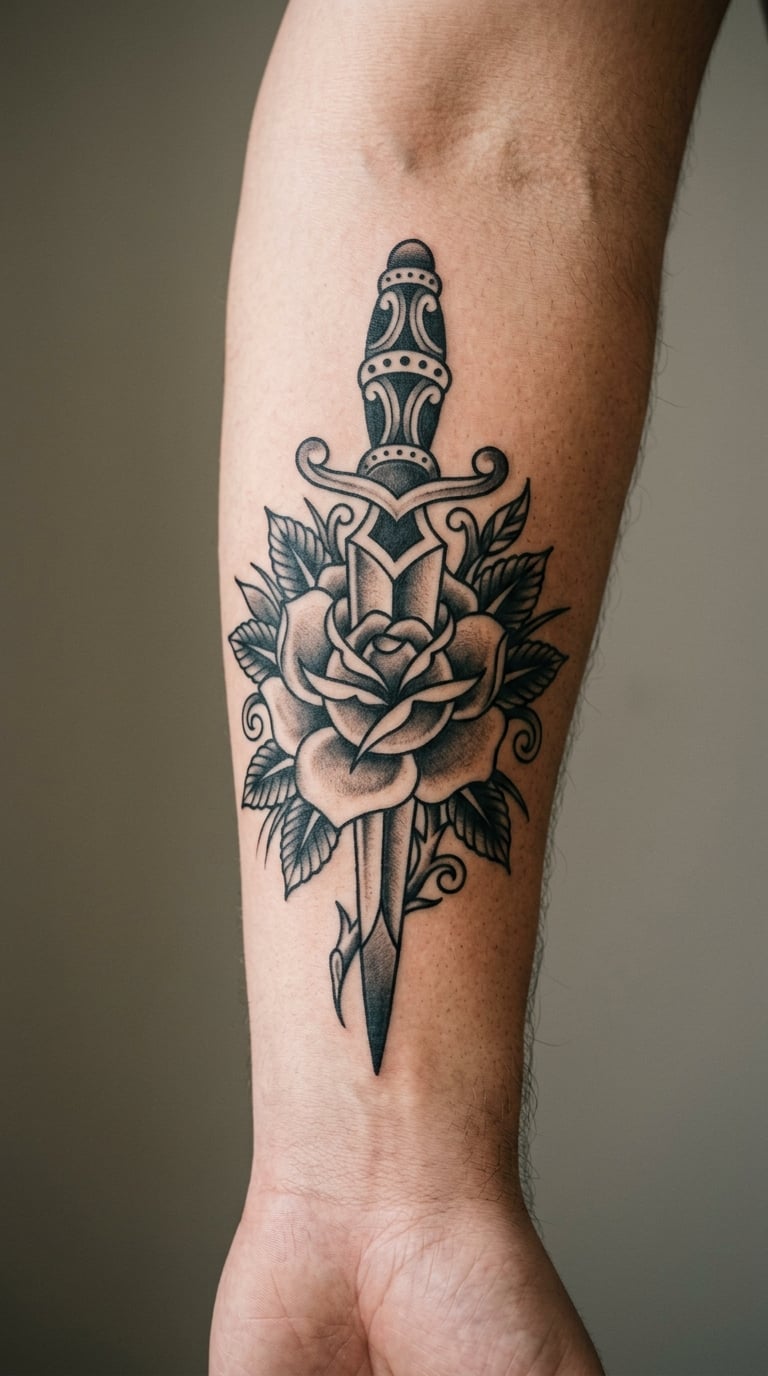
A traditional rose and dagger with heavy black outlines, petal shading in stepped greys, and a dagger crossing the stem at an angle. In black and grey the piece keeps its old-school weight without relying on the traditional red.
It is one of the few classic tattoo motifs that reads as balanced on its own, and the dagger-and-rose pairing traditionally carries a lesson about the cost of beauty.
Placement: inner forearm or the flat of the outer forearm. Size: 5-7 in (13-18 cm). Style: blackwork with grey wash. Pain: medium. The inner forearm is bony and sensitive; the outer side is more forgiving. Petal shading means the artist changes needle depth often, and shallow lines here are the first to blur.
Make it yours: swap the plain stem for a small trail of your own flower, keeping the same line weight.
6. Blackwork Norse Raven on the Shoulder
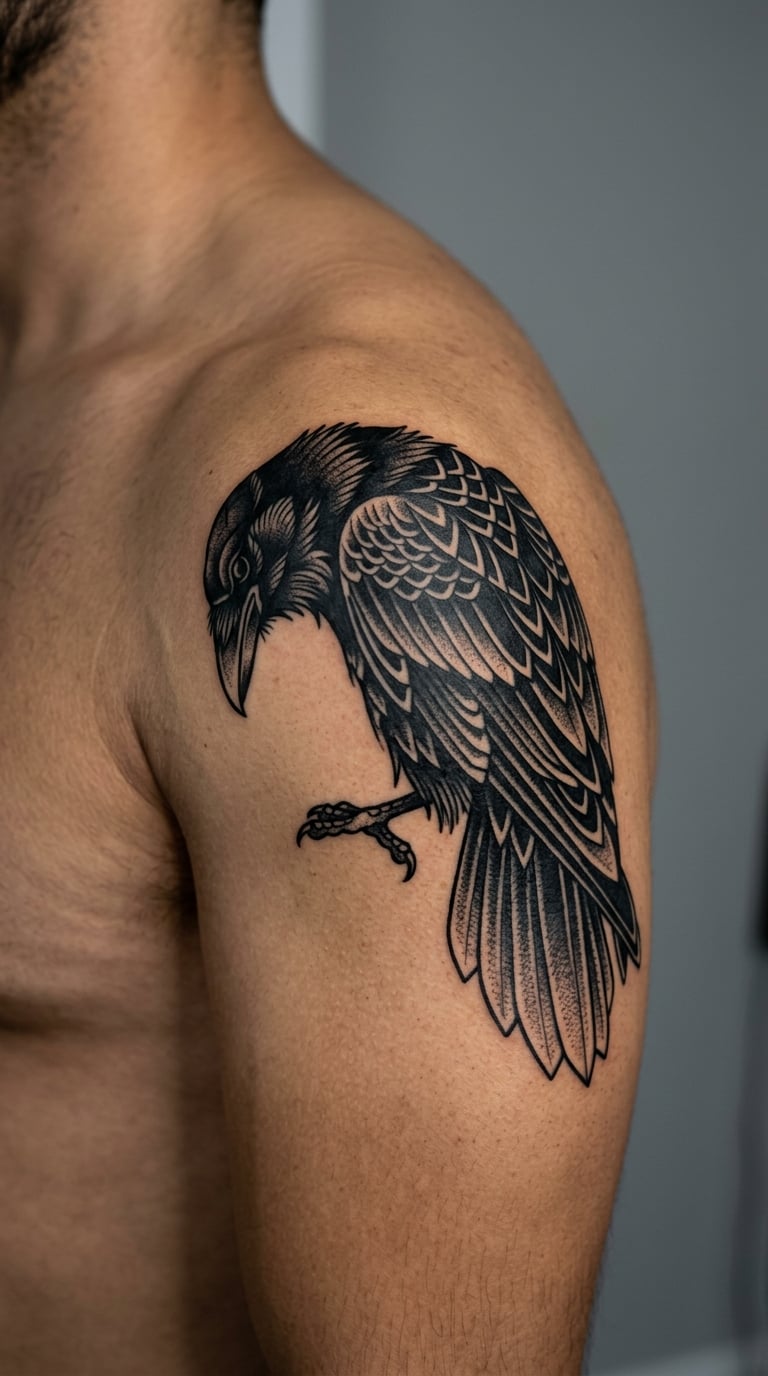
Body and wings in dense black, with the feather edges cut back into the skin in thin slivers so the bird looks like it is separating from the shoulder. The eye is left as a single white highlight, which is the whole drama of the piece.
The raven belongs to Norse and Celtic material, where it sits with the messenger gods rather than as a symbol of doom. Men who come from that background usually say so plainly; others just like the bird.
Placement: deltoid and upper shoulder, with the wing running toward the back. Size: 5-6 in (13-15 cm). Style: blackwork. Pain: high. The deltoid and collarbone are bone-close with almost no padding, and a full shoulder cap is genuinely uncomfortable. Plan a long session with breaks rather than pushing through.
Make it yours: have a Mimir mark or a single rune worked into the wing tips at the same line weight.
7. Gray-Wash Japanese Dragon Wrapping the Calf
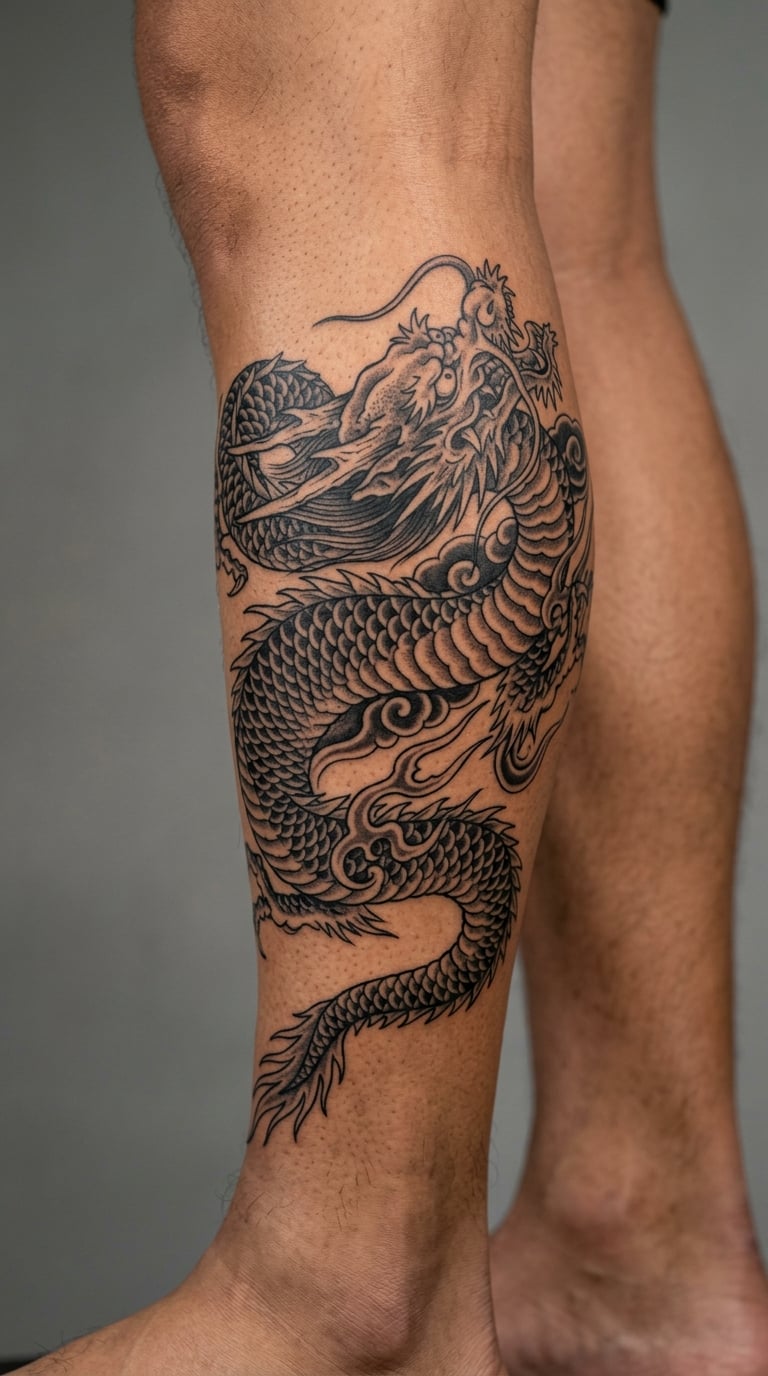
A dragon drawn in flowing black linework with grey wash for the belly and clouds, scales laid in overlapping arcs, and a body that curves around the leg rather than sitting flat. Traditional pieces usually add colour; this one holds its shape in tone alone.
In Japanese tattooing the dragon represents water, power and good fortune, and the cloud-and-wave work around it is part of the composition, not filler.
Placement: calf, wrapping from behind the knee toward the ankle. Size: 8-10 in (20-25 cm) of leg length. Style: grey wash with black linework. Pain: medium, and grey wash means a lot of passes over the same skin, so the session runs long. A wrapping design needs the artist to plan how the pieces line up before the first outline goes down.
Make it yours: add your own cloud pattern rather than a borrowed one, so the background matches the piece instead of a stock sheet.
8. Minimalist Compass Rose on the Chest
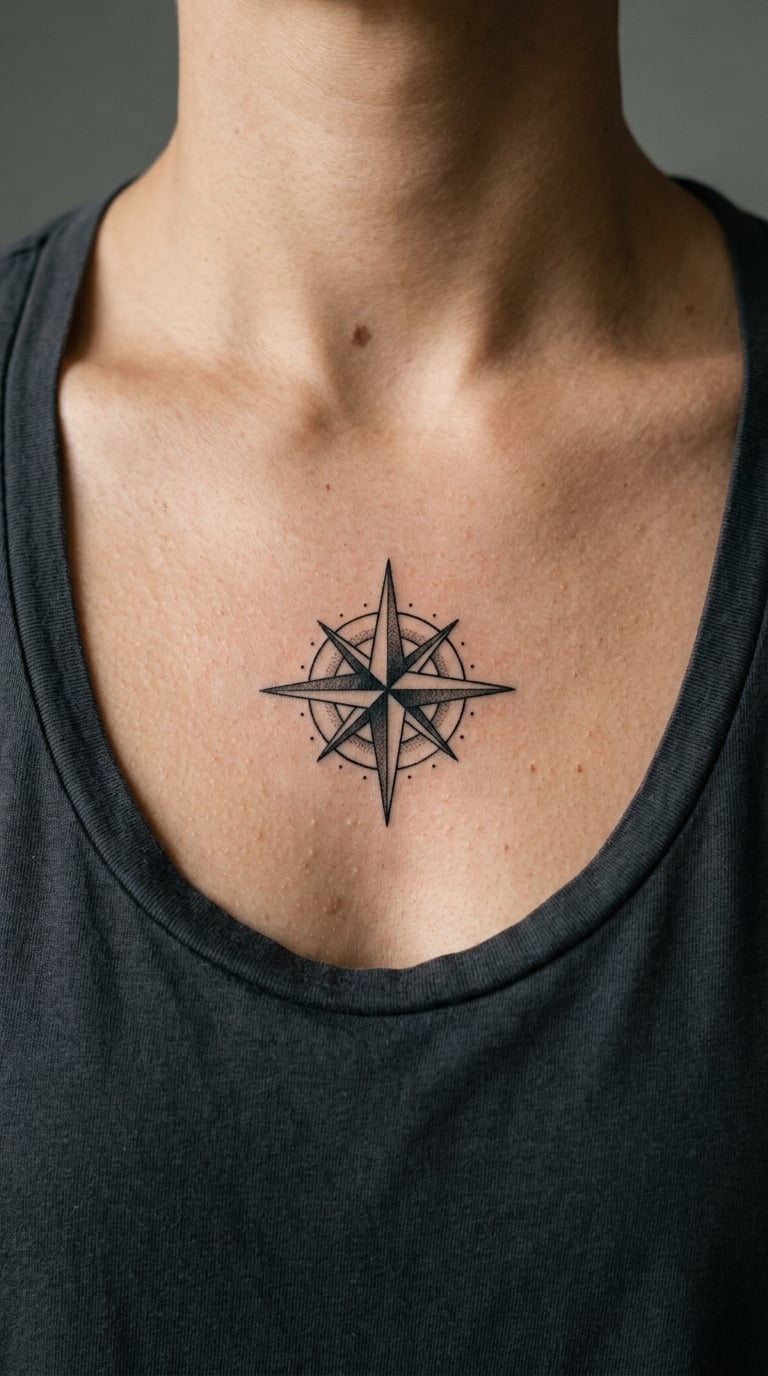
Eight points, fine black linework, a light grey wash on the two main points, and nothing else. The restraint is the design, which is why it sits well in a button-down shirt and also under a collar.
Compasses point home, which is why the piece shows up around moves, new cities and military families. It is a quiet statement that most people read as straightforward rather than loud.
Placement: centred on the upper chest, between the pecs, or a little lower to sit over the sternum. Size: 4-5 in (10-13 cm) across. Style: fine line with subtle shading. Pain: medium-high. Chest skin is thin, mobile and close to bone, and the sternum is the worst of it. Fine line over a moving area also fades faster, so your artist should run the lines at a workable weight rather than as thin as possible.
Make it yours: set the north point to a real bearing, or use a longitude and latitude you care about.
9. Blackwork Wolf Head on the Shoulder Blade
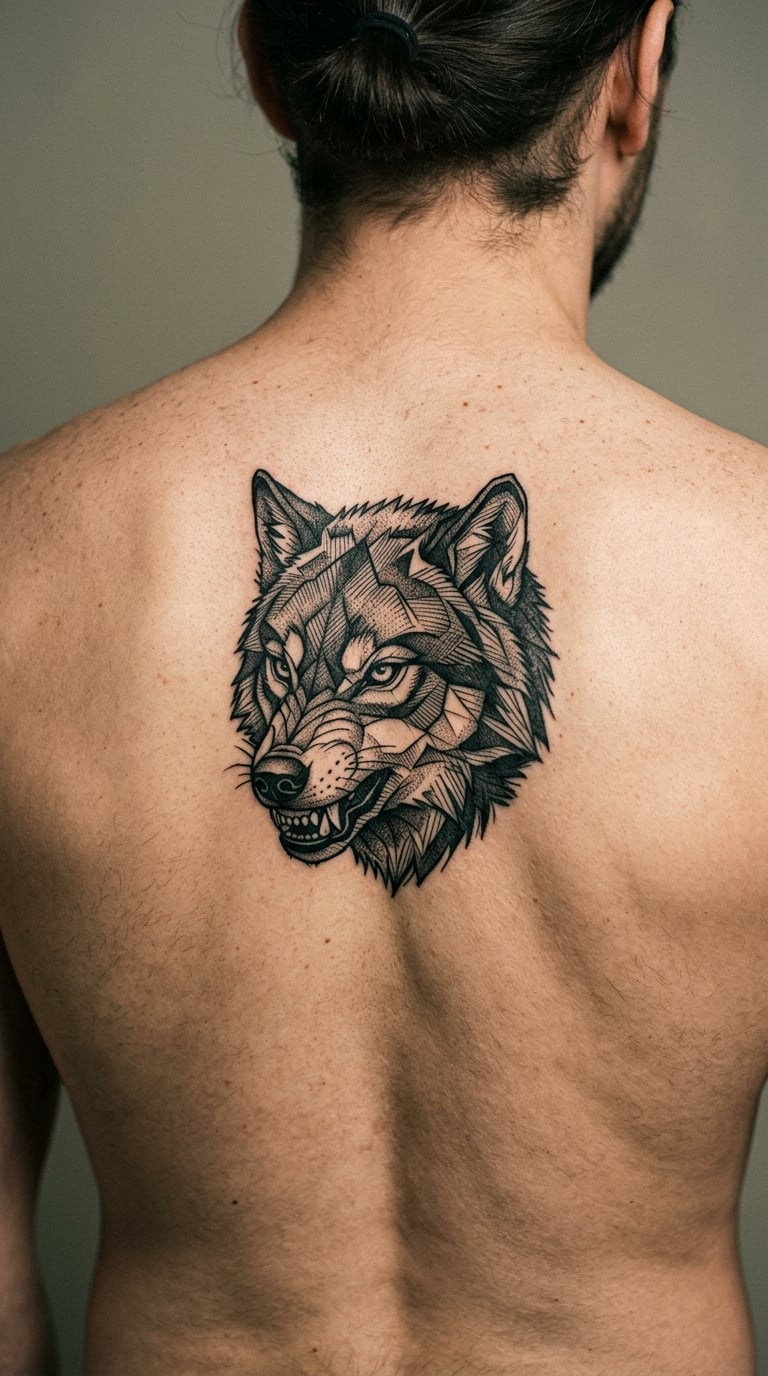
A wolf head in profile with angular shading, the planes of the face cut into flat black shapes, and a single grey transition along the muzzle. Back pieces gain real texture because the back takes ink evenly and stretches less than an arm.
Wolves are loyalty, family and instinct, chosen most often by people who see themselves as the one watching the edge of the group.
Placement: between the shoulder blades, ideally a little off-centre so it moves with the spine rather than fighting it. Size: 7-8 in (18-20 cm) wide. Style: blackwork realism. Pain: medium, though the spine itself is tender. The back is one of the better places to sit for a long session because you can lie down and the artist has good access.
Make it yours: add a second smaller wolf or an eye below it, angled to be seen only when you turn.
10. Black-and-Grey Snake Coiling Around the Arm
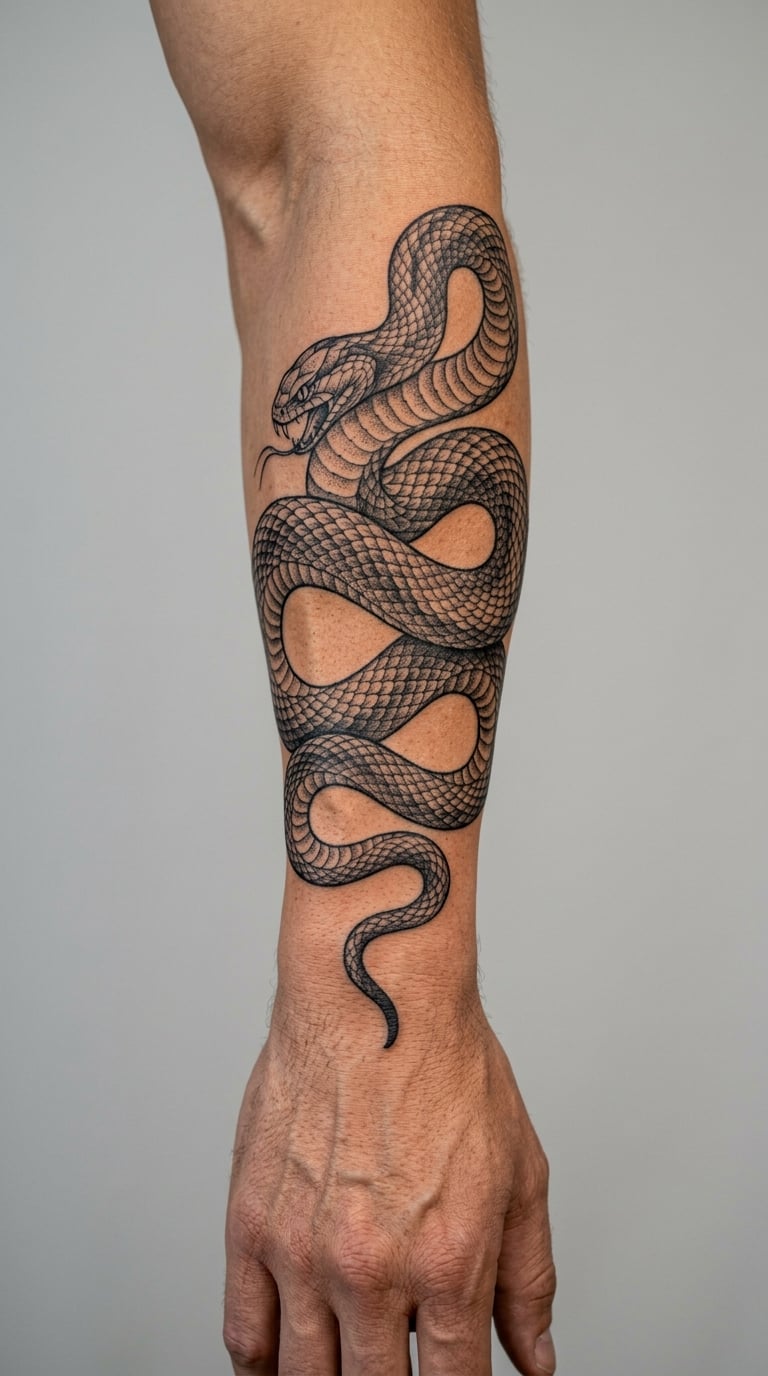
A snake wrapped in a two-turn coil with individually shaded scales, a soft shadow under each overlap, and a dark outline that holds the body apart from the arm. Getting the wrap to look convincing is the difficult part and worth paying for.
Snakes mean transformation, rebirth and timing, and older men often connect them to a period of their own change. The snake is also one of the few motifs that reads fine as a whole arm piece.
Placement: forearm wrap, roughly two thirds of the way around. Size: 4 in (10 cm) tall by 8 in (20 cm) of wrap. Style: realism with scale detail. Pain: medium. Overlapping sections get revisited, so the artist works in stages and the skin needs breaks between passes. The forearms shift when you flex, so the drawing gets placed with the arm relaxed.
Make it yours: pick the species that matches the place you got it, or add a small band of dots marking a year.
11. Realistic Rose on the Hand or Wrist
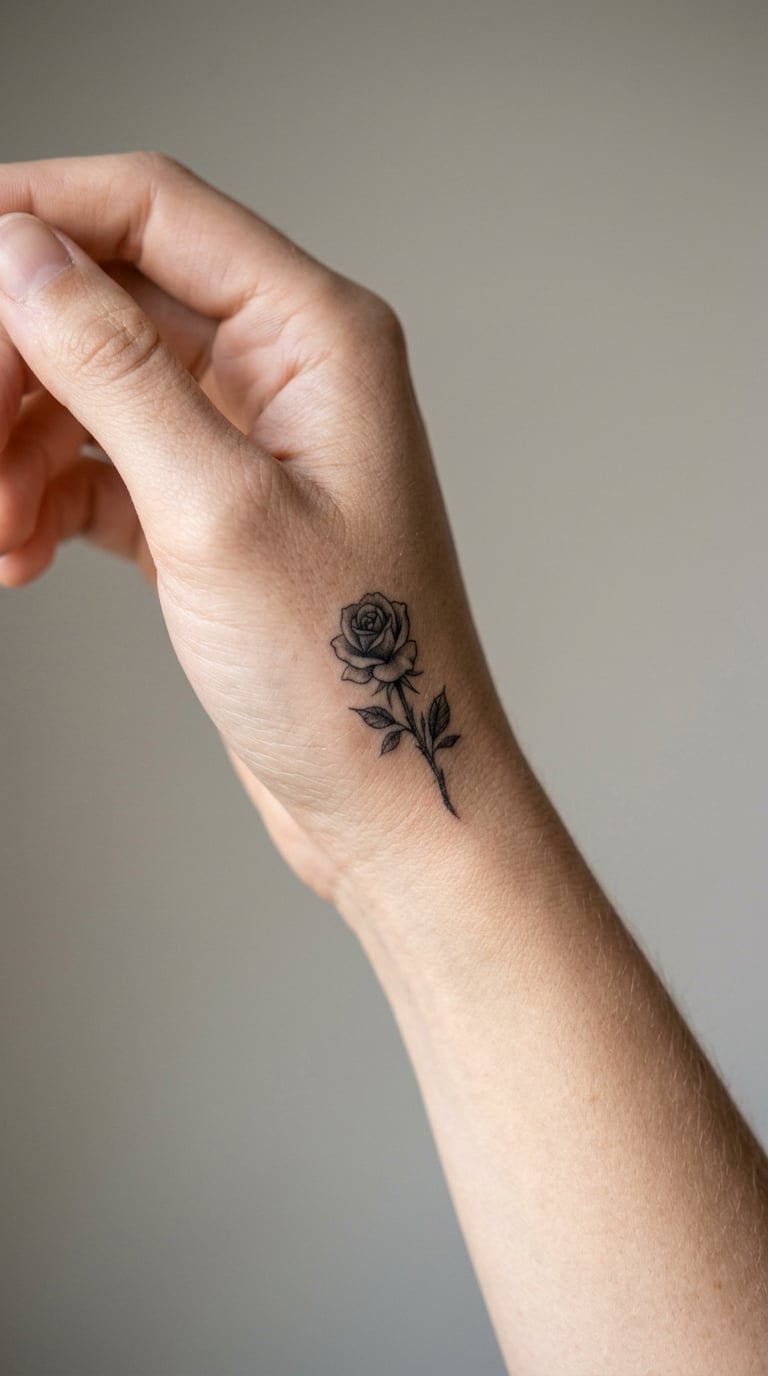
A compact rose with a heavy black outline, three or four distinct petals and soft grey shading in the centre. At this size the artist works with fewer, larger shapes, because individual petal edges would blur together within a few years.
Love and grief are the usual reasons, and a hand rose is a common memorial piece as much as a romantic one.
Placement: outer hand near the wrist, or inside the wrist. Size: 2-2.5 in (5-6 cm) across. Style: realism, simplified. Pain: high. Hands are full of nerves and the wrist has thin skin over moving tendons. More important, hands take daily wear, washing and sun, so fine grey shading here disappears fastest of any spot on the body. Budget for touch-ups and expect them every few years.
Make it yours: put a date along the stem side, kept small enough that it reads as texture from across the room.
12. Blackwork Ship and Storm Waves on the Forearm
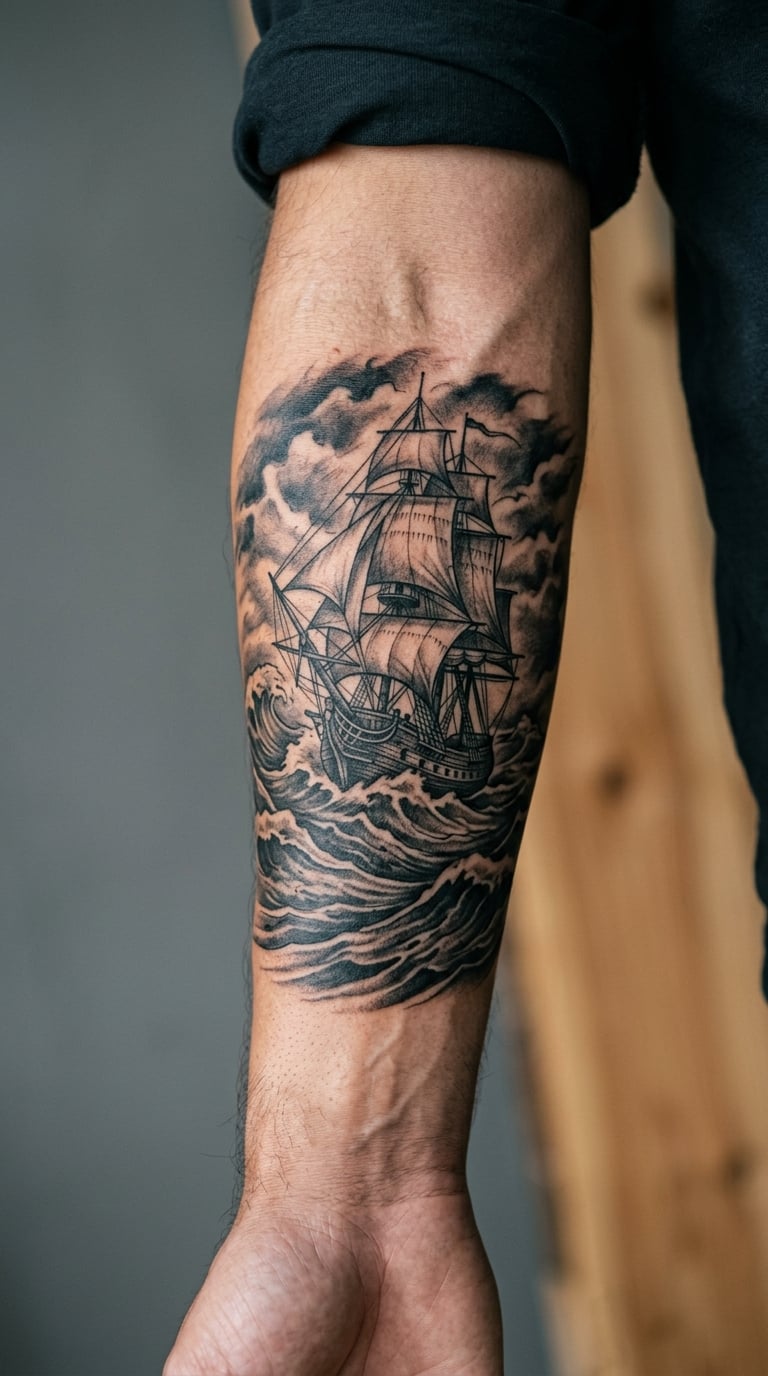
A ship working out of heavy layered waves, hull in solid black, sails left lighter with grey shading, and the water built from stacked curved bands. The contrast between the dark hull and the pale sail is what makes the piece read at a distance.
Naval and maritime tattoos lean towards service, family at sea and the idea of steady effort against bad conditions, and the storm version usually adds a harder edge to the story.
Placement: outer forearm, angled slightly so the waves follow the arm rather than sitting square. Size: 7 x 5 in (18 x 13 cm). Style: blackwork with grey wash. Pain: medium. Stacked wave bands mean repeated work on the same strip of skin, so expect the piece to be split across two sessions. Ink sitting too deep on large black areas is what leads to scarring, so a patient artist matters here.
Make it yours: use the name of a real ship, or a home port, along the hull line.
13. Micro-Realism Eye on the Inner Arm
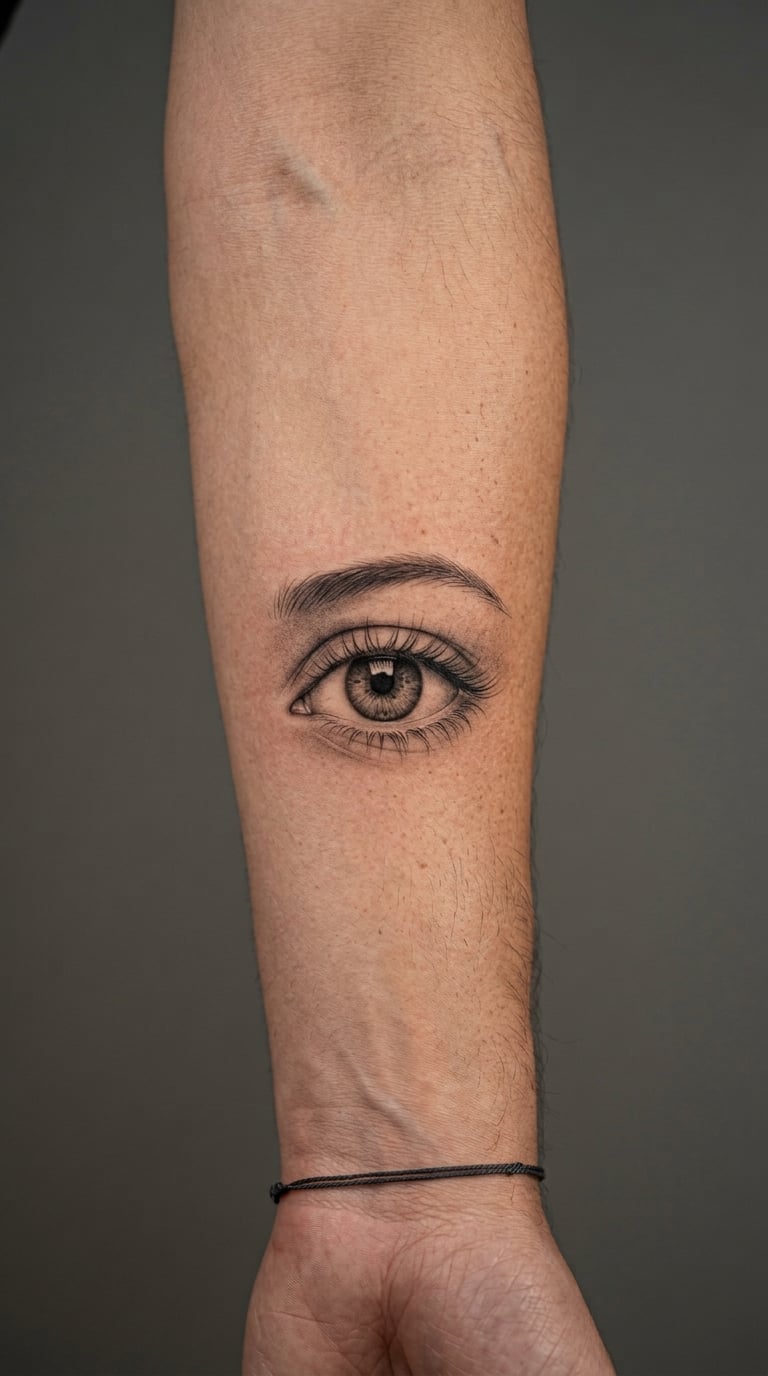
A single eye at roughly the size of a coin, drawn with fine black lash lines and a soft grey wash in the lid. At this scale the artist works in short sessions and adds depth over two or three passes.
Eyes are usually about watchfulness, protection or keeping an eye on something specific. It is also the one motif most people change their mind about, so live with it for a month before you book.
Placement: inner arm above the elbow crease, or the inner bicep. Size: 1.5-2 in (4-5 cm) wide. Style: micro-realism. Pain: low-medium, and the odd part is that it stings rather than hurts, because fine single-needle work is quick. Detail this small will blur with ink spread over time, and it is a design you have to accept changing if you want it to look good now.
Make it yours: change the iris to a real eye colour reference, or add a thin second outline so it holds up better as the shading softens.
14. Dotwork Skull on the Side of the Leg
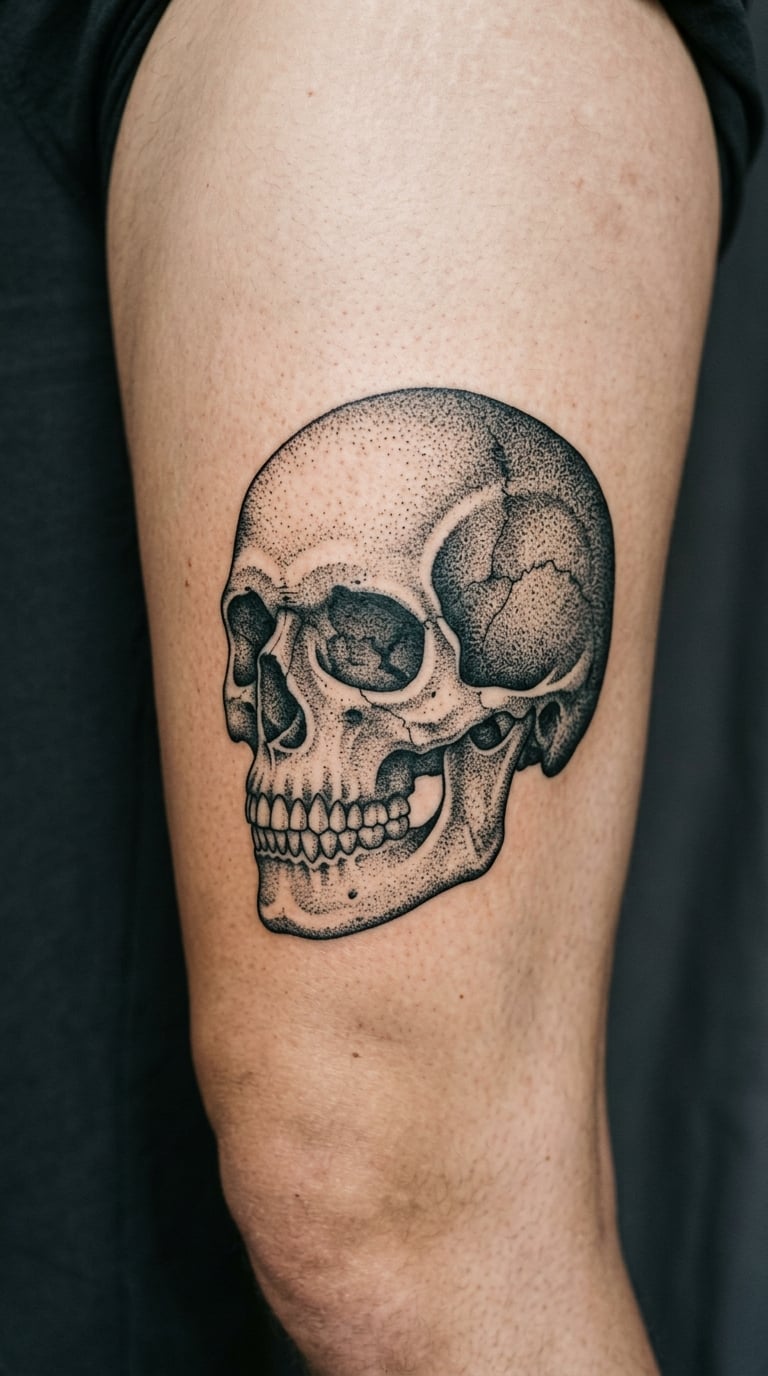
A skull built entirely from stippled dots, with density doing all the shading work and a clean contour holding the shape. Dotwork is the slowest technique in tattooing, and it is the one that rewards patience with a very even result.
A dotwork skull still carries mortality and defiance, but the softness of the technique changes the read. A lot of men choose it because it sits well next to other leg work without fighting it.
Placement: outer thigh, which has the least daily wear of any exposed spot. Size: 4-5 in (10-13 cm) tall. Style: dotwork. Pain: low-medium. The needle touches briefly and often, so it feels like persistent scratching rather than deep pain. Sessions are long because of the density, and the thigh is easy to sit through. More leg designs are in our 24 best thigh tattoo ideas for men guide if you want to see how the spacing works.
Make it yours: fade the dots out toward one edge so the skull dissolves into the skin rather than stopping abruptly.
15. Black-Gray Mountain Lion on the Chest
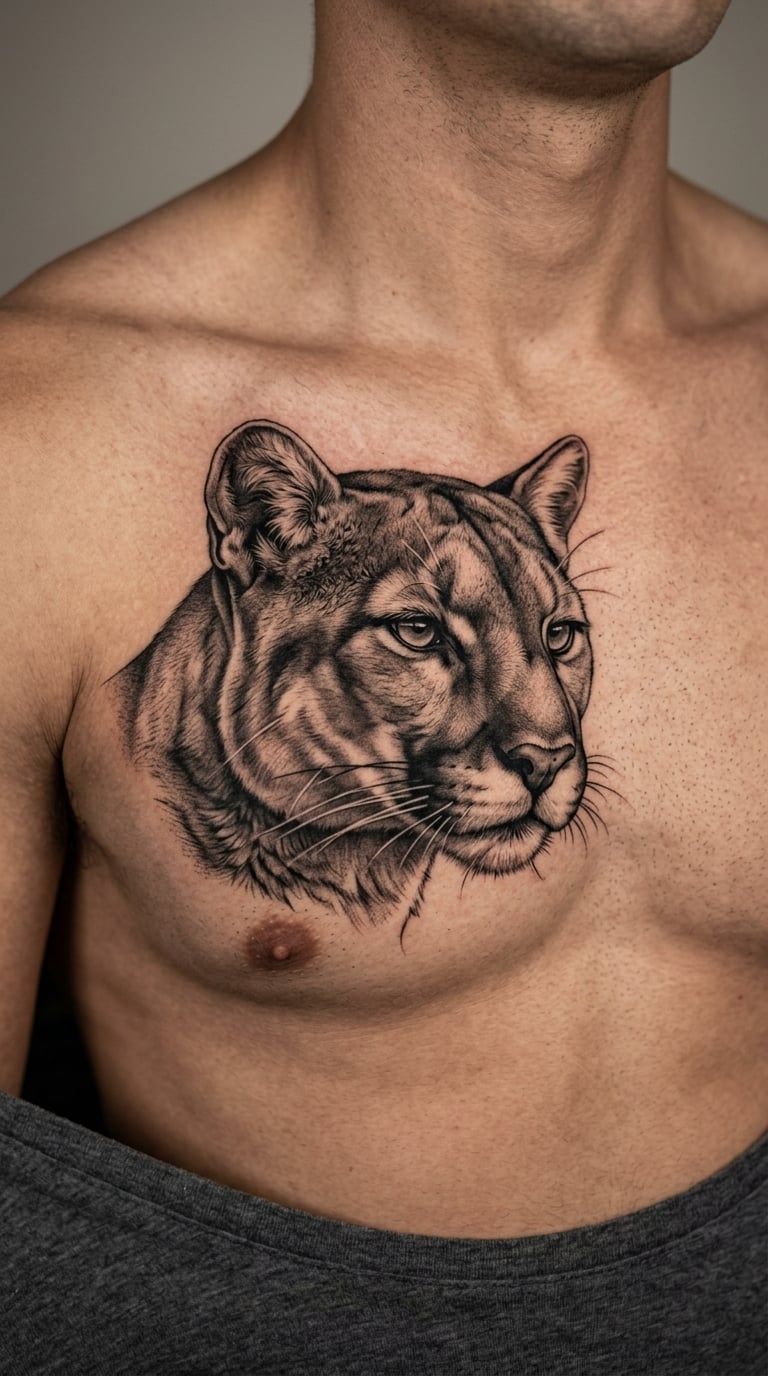
A mountain lion in profile with directional shading following the neck, a dark background mass behind the head, and a mid-grey plane across the shoulder to separate it from the body. Chest pieces flatten out, so the artist designs the whole portrait in profile rather than trying a three-quarter view.
Mountain lions stand for quiet authority and self-possession, chosen more for how they carry themselves than for any story attached to them.
Placement: across the upper chest, from one pec to the other, sitting under the collarbone. Size: 8 x 6 in (20 x 15 cm). Style: realism portrait. Pain: medium-high, and the sternum is the roughest part. Chest skin stretches and moves with breathing, so the artist places the stencil while you are sitting the way you normally sit. A solid black background across that much area is heavy, and some men drop it for a grey wash instead.
Make it yours: add your own mountain range in the background, low contrast so the cat still leads.
16. Geometric Hexagon Pattern on the Upper Arm
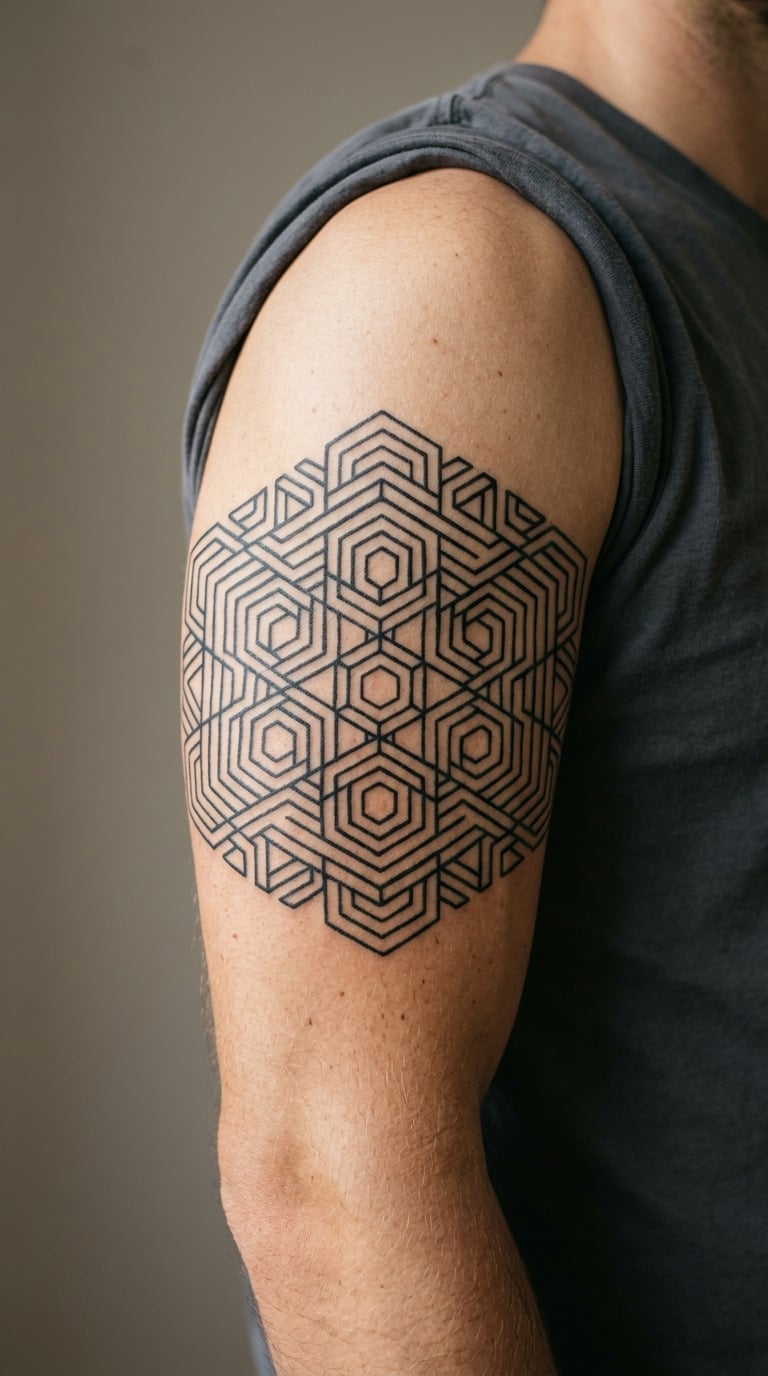
Interlocking hexagons with consistent line weight and selective black fills on maybe one hexagon in four. Uniformity is everything here, since any line that wanders shows immediately against a grid.
There is no fixed traditional meaning, which is exactly the appeal for a lot of men. It reads as structure and restraint, and it works well as the first piece of a long arm build.
Placement: outer upper arm as a block, or as a strip wrapping the bicep. Size: 4-5 in (10-13 cm) block. Style: geometric blackwork. Pain: medium. The arm is a comfortable place to sit and heal. A hex grid does not leave much untouched skin between lines, and packed areas slow down healing, so more spacing between hexagons means a better result over time.
Make it yours: leave three or four hexagons empty in a pattern that only you would read, or use a coordinate grid instead of a regular layout.
17. Blackwork Crescent Moon and Stars on the Shoulder
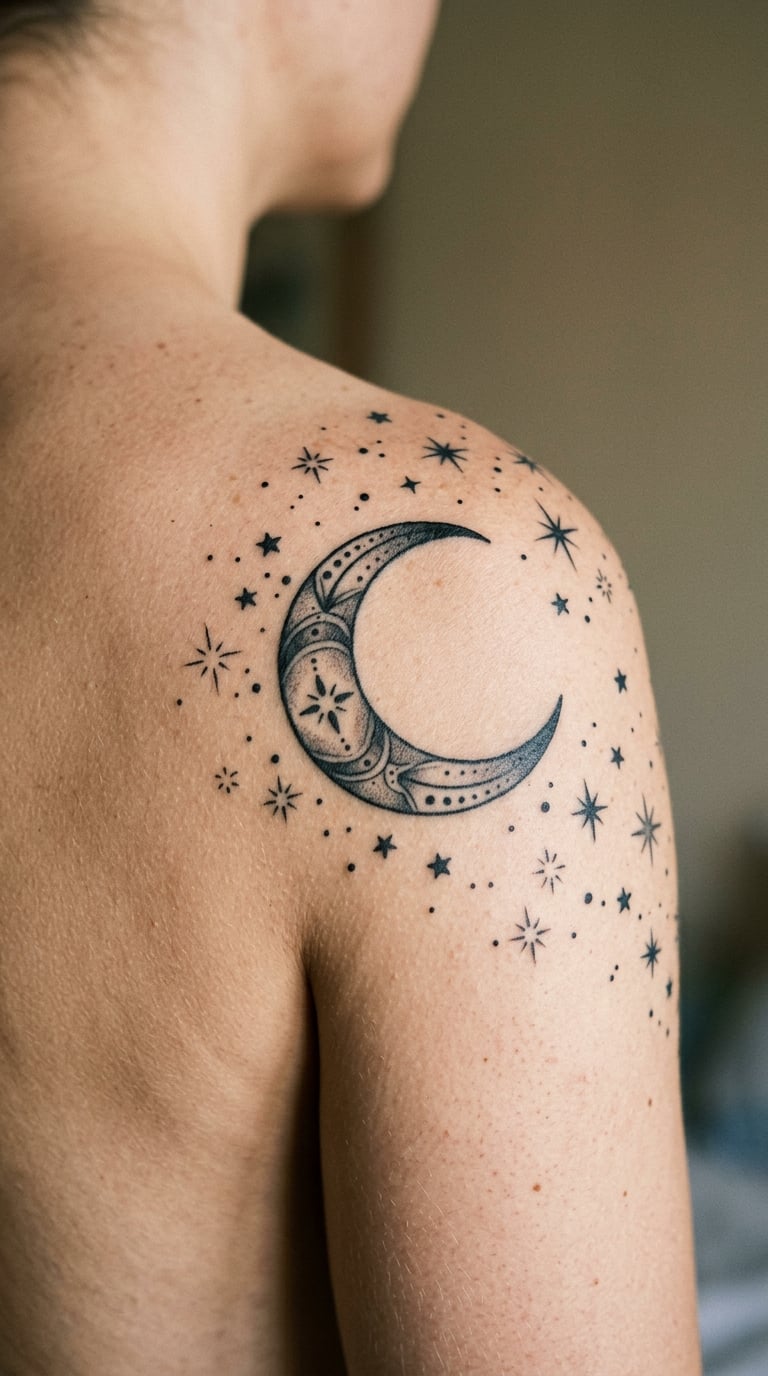
A crescent moon in solid black with a soft grey gradient trailing off the inner curve, and stars scattered at uneven distances rather than in a neat row. The irregular spacing is what keeps it from looking like a sticker.
Moons carry night, cycles, change and the passage of time, and the piece is often chosen for a specific month or year rather than a general mood.
Placement: shoulder cap, following the deltoid line. Size: 4-5 in (10-13 cm) across. Style: blackwork with grey wash. Pain: high. The shoulder cap sits on bone and has thin skin, and curved surfaces make solid black harder to keep even. Small stars are the parts that blur first, so keep the sizes generous.
Make it yours: set the moon in a different phase, or scatter a star for every person or place that matters.
18. Realistic Anchor with Rope on the Forearm
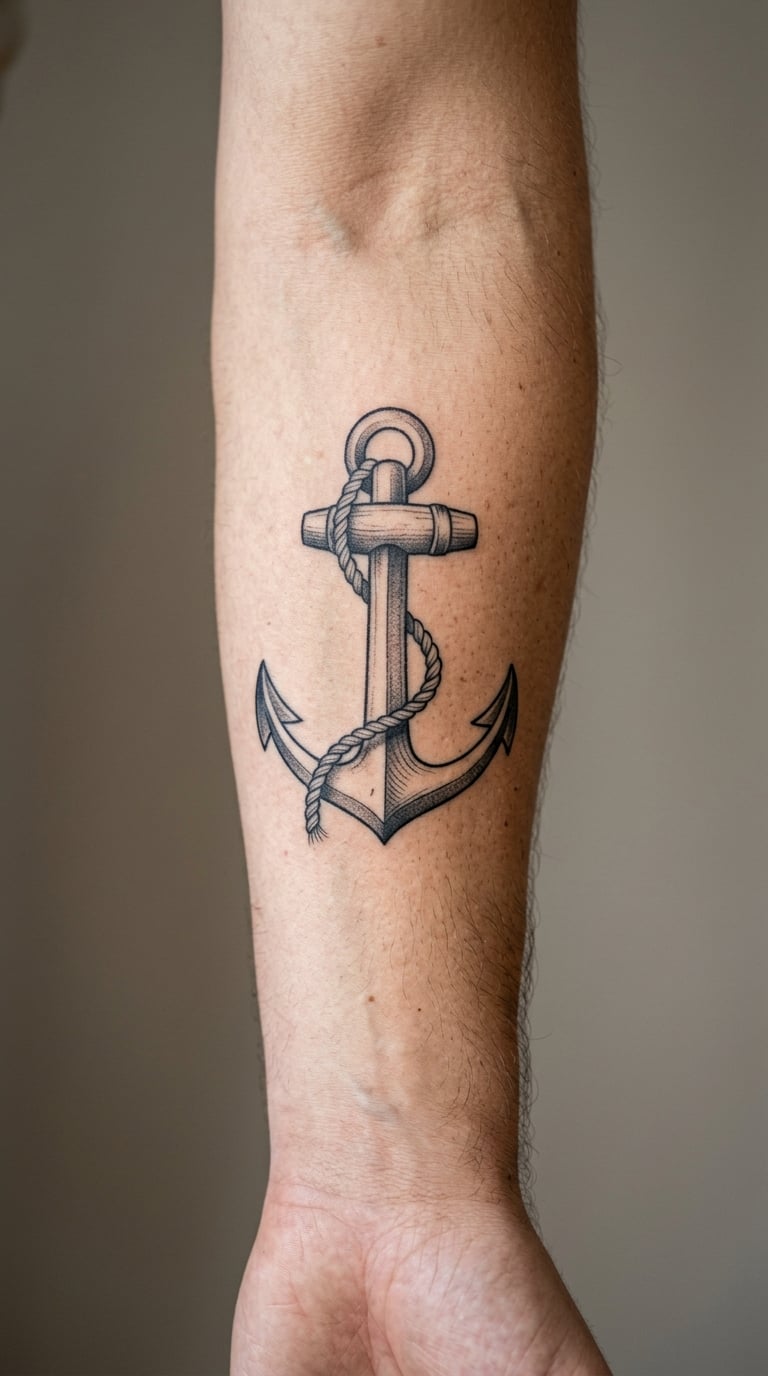
An anchor in three-quarter view with restrained grey shading on the shank, chain links and a rope looping through the ring, all in black outline with mid-tone fill. Kept simple, it holds together at a distance and up close.
Anchors mean stability, being held and not drifting, which is why the piece turns up around fishing families, Navy service and long relationships.
Placement: inner forearm running lengthwise. Size: 5 x 4 in (13 x 10 cm). Style: realism. Pain: medium, and the inner forearm is more sensitive than the outer. The rope and chain crossings create small enclosed areas that are easy to over-work, so a careful artist keeps the detail at a workable line weight.
Make it yours: have the rope tied in a knot that a specific person taught you, or add coordinates of a place that matters.
19. Black-Gray Celtic Knot on the Side of the Chest
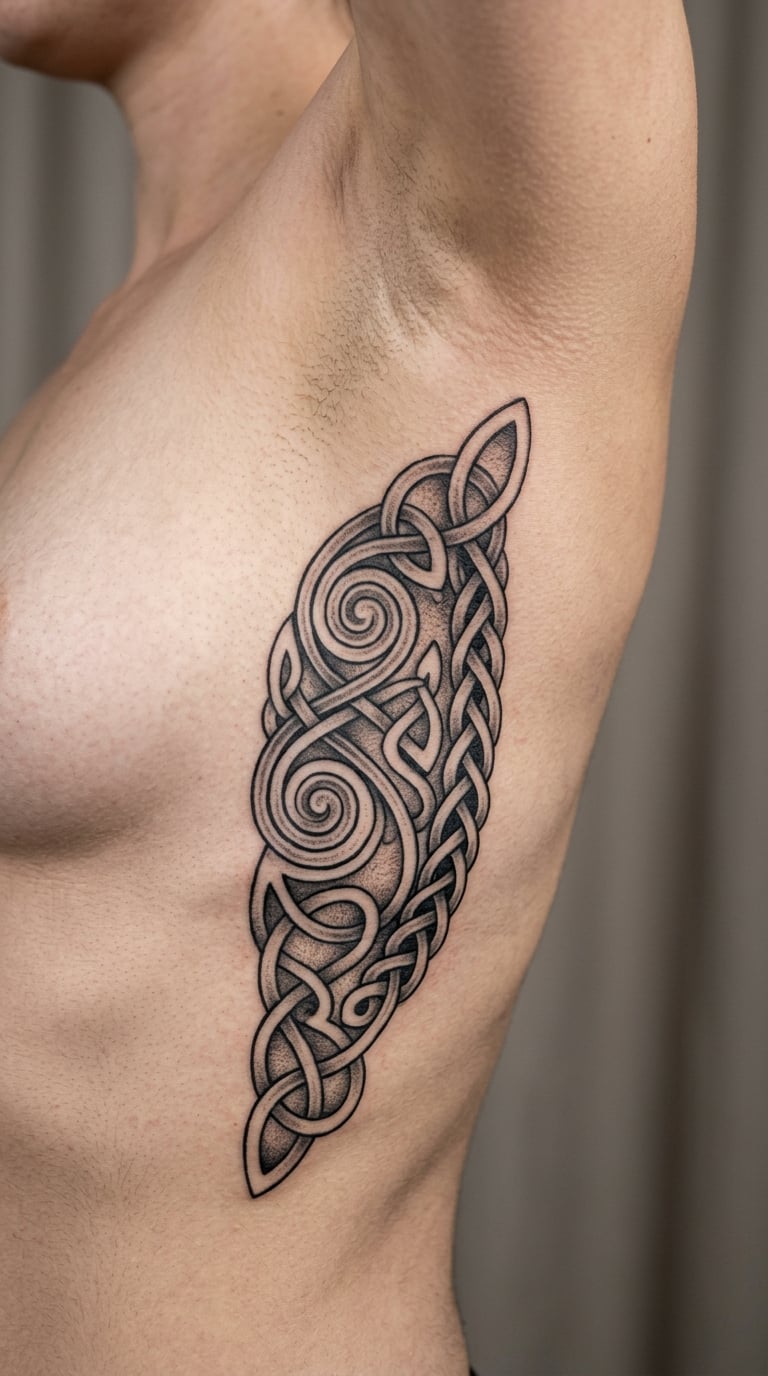
An interlaced Celtic knot drawn in even black linework, with grey drop shadows in the crossings to give it depth and a clear over-under pattern. The shadows are the hard part, and cheap versions skip them and end up flat.
Celtic knots stand for eternity, interconnectedness and family lines, and men usually know the family pattern behind the design before they book it.
Placement: side of the chest below the armpit, on the ribs. Size: 6 x 6 in (15 x 15 cm). Style: black linework with grey depth. Pain: high. Ribs are thin, bony and close to bone, and this is one of the least relaxing places to sit. Even line weight is also hard to hold on a curved surface, so expect the artist to map the pattern carefully before tattooing.
Make it yours: use your actual family knot pattern, and name a strand after a family member.
20. Blackwork Storm Cloud with Lightning on the Wrist
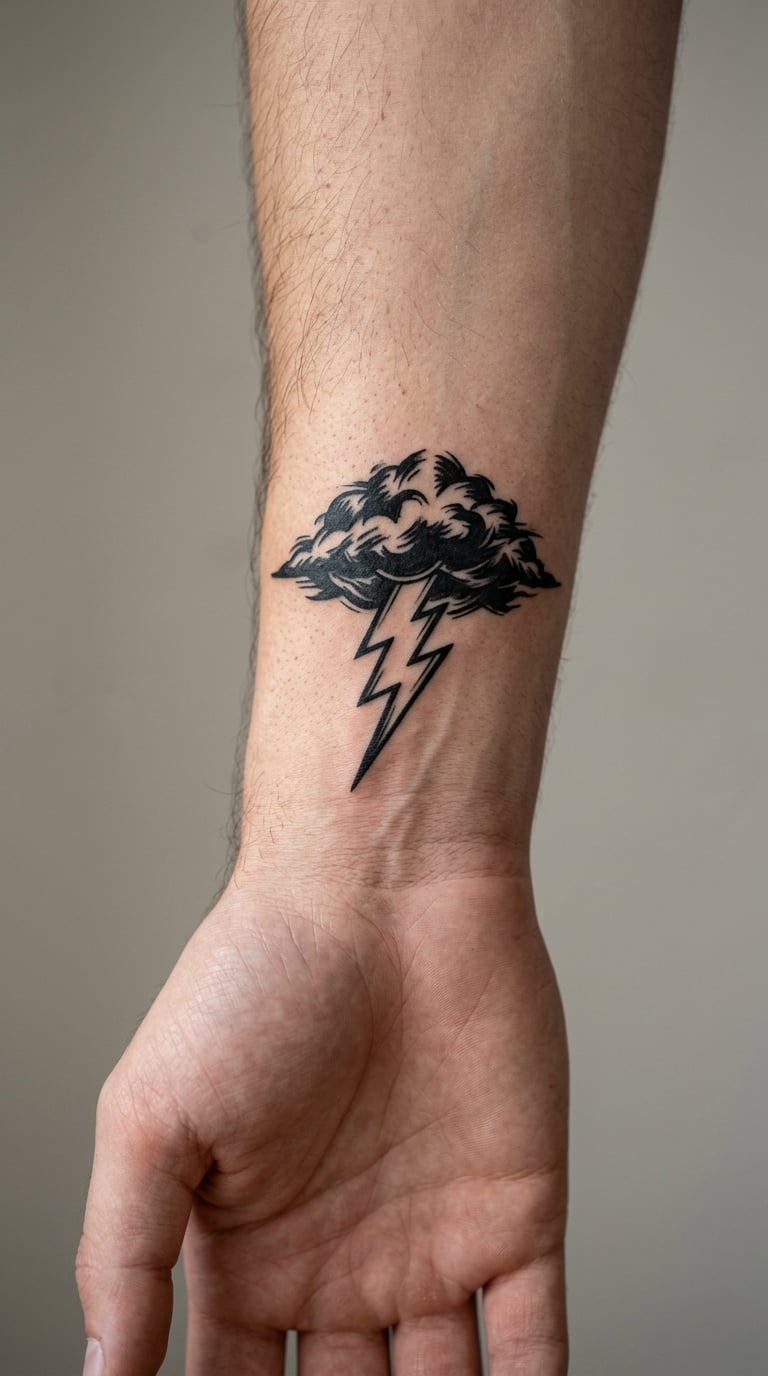
A compact cloud built from bold black masses with grey gradients underneath, and one sharp lightning bolt dropping through the centre. Rounded cloud shapes against the straight bolt is the whole composition, so the contrast has to stay clean.
Storms read as upheaval, restlessness and a hard season, and the small wrist placement suits a piece that marks a specific period rather than a lifelong statement.
Placement: inner wrist, or just above it. Size: 2.5 x 2 in (6 x 5 cm). Style: blackwork. Pain: high. The inner wrist is thin-skinned and packed with nerves, and it is visible in every hand gesture. Wrist work also wears against a desk and a watch band, and the soft grey gradient under the cloud is the first thing to go. Most people end up with a touch-up every couple of years.
Make it yours: put a date under the bolt, or have the cloud tail break into your other ink rather than ending on the skin.
How to Choose the Right Design
Pick the placement first and the design second. Of the black and gray tattoo ideas for men on this list, placement changes the outcome more often than the artwork does. A drawing that looks right on a flat screen often fails on a shoulder, because the shoulder is round and moving. Tell your artist which body part you have in mind before you discuss the artwork, and ask for it drawn on a body outline at the real size.
- Style and detail. Bold blackwork and simplified shapes age well. Micro-realism and fine dotwork look extraordinary fresh and blur first. If a design needs detail thinner than a pencil line, it will not be the same tattoo in ten years.
- Size. Anything under 2 in across has almost no room for shading, and small designs need more touch-ups than big ones. If the design is complex, scale it up rather than simplifying it.
- Body shape. Follow the muscle. A portrait placed on the outer bicep distorts as the arm flexes, so experienced artists design along the flow of the muscle instead of fighting it.
- Visibility. Hands, wrists, elbows and the inner arm are high-wear zones. The outer arm, upper back, thigh and calf take more daily punishment quietly, which matters more for the piece you want to keep.
- Sun. Black holds up better than colour, but decades of sun still fade everything. If the arm will be exposed at work or on the beach, plan for a refresh every five to ten years rather than expecting it to stay as it looks in a healed photo.
- Long-term plans. If you think you will build a sleeve, leave space rather than filling every inch. A lot of the better advice on r/tattooadvice is about the pieces people would rather not cover, not about regretting the style itself.
Cost and Session Time
Tattoo pricing is quoted by the piece, by the hour or by a shop minimum, and black and grey usually costs less per hour than full-colour work because there is no colour packing to buy. A shop minimum means a small piece takes the same booking slot as a bigger one, which is worth asking about up front.
- Small pieces (up to 2 in): roughly $80 to $250, often 30 to 60 minutes of actual tattooing, booked against the shop minimum.
- Medium pieces (3 to 5 in): roughly $250 to $800, two to four hours, sometimes split across two sittings for comfort and healing.
- Large pieces (6 in and up, chest and back portraits): roughly $800 to $2,500, usually a full day of four to six hours, with touch-ups scheduled two to six weeks after healing.
- Quarter, half, three-quarter and full sleeves: several booked days over weeks or months, often $1,500 to $6,000 depending on the artist, the hours and the detail, and most artists quote the whole project rather than a single session.
Ask for the total project number before you start, and ask what a session fee is versus an hourly rate. Artists who tell you honestly that a design will take four sessions are usually easier to work with than the ones quoting a single fast sitting.
Aftercare Basics
- Follow your artist’s aftercare instructions first. They know what they put in your skin on the day, and their advice outranks anything general.
- Leave the fresh tattoo alone for a few hours, and keep it clean rather than covered. A breathable loose covering helps with the first sleep.
- Wash once or twice a day with lukewarm water and unscented soap, pat dry, and follow the moisturiser or ointment the artist recommended. Avoid lotions with fragrance.
- Do not soak, swim, sauna, or spend long in direct sun until the piece is fully healed. Rough towels and scratchy sheets cause most of the early damage.
- Expect flaking and peeling in the first two weeks, and itch. Scratch it with clean hands if you have to, never with a towel.
- Book a free touch-up for any linework that has healed patchy. That visit is part of the work, not an extra.
Frequently Asked Questions
Are black and gray tattoos better for men than colorful designs?
Not better as such, but they age more predictably. Black pigment holds contrast longer than saturated colour, which means the design stays readable after a decade, and a greyscale piece is far easier to build into later additions. A colour piece can absolutely suit a man, it just needs more care to keep looking sharp over time.
What is the best placement for a black and gray tattoo?
The outer arm, upper back, thigh and calf are the safest long-term spots because they take ink evenly and suffer less daily wear. Hands, wrists, elbows, knees and the inner arm all work, but the skin moves more, gets washed more and sees more sun. Choose a low-wear zone if you want the piece to need the fewest touch-ups.
Do black and gray tattoos fade faster than colored tattoos?
No, they fade more slowly. Saturated colour pigments break down under UV light faster than the blacks used in greyscale work, so a black and grey piece tends to look truer for longer. What does fade first in any style is fine grey shading and thin lines, because of ink spread in the dermis over the years.
How much should a black and gray tattoo cost in the US?
It depends on size, detail, and how the shop charges, not on colour. Most artists quote a flat piece price or an hourly rate, and many shops have a minimum booking fee that a small design still has to meet. A four inch piece is usually a short sitting, while a chest portrait or any sleeve is quoted as a multi-session project.
Should I choose a bold or small blackwork design for my first tattoo?
Bold blackwork is the easier first tattoo. Large shapes hold together as ink spreads and are far more forgiving if healing is uneven. Small designs look great but need more touch-ups and carry a higher regret rate, so most first-tattoo advice points to a piece around three to four inches with clear, simple shapes.
Can black and gray tattoos hide scars?
Sometimes, but it depends entirely on the scar. Dark solid black and dense grey wash can disguise texture and colour differences, while raised keloid scars need flattening with medical treatment first. A cover-up artist will need to see the scar healed and settled, which usually means waiting months after any new wound or surgery.
Conclusion
If this is your first tattoo, the blackwork eagle on the upper arm or the blackwork wolf between the shoulder blades is the safest call. Both are bold, both hold their shape, and neither punishes a beginner’s small mistakes the way a micro-realism eye or a hand rose would.
For someone already building a collection, the grey-wash Japanese dragon wrapping the calf or the blackwork mountain lion across the chest gives you room to add to it. Whichever direction you pick, bring healed photos of that artist’s older work to the consultation and ask how the design will look in fifteen years.
Start with the placement, get the design drawn at full size on a body outline, and then book. That is the whole process, and it takes one conversation.