
20 Best Zodiac Sign Tattoo Ideas for Men (September 2026)
Zodiac sign tattoo ideas for men usually come down to a choice between three design families: the glyph, the constellation, or the animal and element motif. Pick the family first, then the placement, and the rest gets easy. Below are 20 of the strongest zodiac sign tattoo ideas for men, with a realistic size, a style and a pain note for each one.
Most people land on a zodiac tattoo because something about it fits, not because they researched it. That is fine. But the designs that still look sharp a decade in are the ones where the detail level matches the size of the patch of skin you have to work with. Autumn and winter are the busiest booking windows, so if you are planning a piece for 2026, talk to an artist now rather than in six weeks.
Quick Guide: 20 Zodiac Sign Tattoo Ideas for Men Compared
The table below sorts all 20 ideas by style, placement, realistic size and expected pain. Read the placement column first, because that is the decision you cannot change later. Size is given in inches with the centimetre equivalent in brackets.
| Idea | Style | Best placement | Size | Pain |
|---|---|---|---|---|
| 1. Fine-line Aries ram | Fine line | Inner forearm | 2-3 in (5-8 cm) | Medium |
| 2. Blackwork Taurus bull | Blackwork | Behind the ear | 1.5-2.5 in (4-6 cm) | Medium |
| 3. Minimal Gemini twins | Minimal line | Inner bicep | 2-4 in (5-10 cm) | Low to medium |
| 4. Realistic Cancer crab | Micro-realism | Outer forearm | 2.5-4 in (6-10 cm) | Medium |
| 5. Traditional Leo lion | Neo-traditional | Upper chest | 3-5 in (8-13 cm) | Medium |
| 6. Watercolour Virgo maiden | Watercolour | Shoulder | 3-5 in (8-13 cm) | Medium |
| 7. Minimal Libra scales | Fine line | Inner wrist | 1.5-2.5 in (4-6 cm) | Medium |
| 8. Blackwork Scorpio scorpion | Blackwork | Outer calf | 3-5 in (8-13 cm) | Medium |
| 9. Sagittarius arrow micro | Micro fine line | Behind the ear | 1-2 in (2.5-5 cm) | Low to medium |
| 10. Capricorn sea-goat | Illustrative | Outer forearm | 3-4 in (8-10 cm) | Medium |
| 11. Aquarius wave grid | Geometric | Outer forearm | 3-5 in (8-13 cm) | Medium |
| 12. Fine-line Pisces two fish | Fine line | Inner forearm | 2.5-4 in (6-10 cm) | Medium |
| 13. Leo sun and rays | Blackwork | Upper chest | 3-5 in (8-13 cm) | Medium |
| 14. Geometric Capricorn glyph | Geometric | Side of hand | 1.5-2.5 in (4-6 cm) | Medium |
| 15. Scorpio crescent and botanicals | Illustrative | Inner forearm | 2.5-4 in (6-10 cm) | Medium |
| 16. Cancer glyph and constellation | Minimal fine line | Inner forearm | 1.5-2.5 in (4-6 cm) | Medium |
| 17. Large Gemini celestial | Illustrative | Upper arm | 4-7 in (10-18 cm) | Medium |
| 18. Aries ram and arrow | Blackwork | Shoulder | 3-5 in (8-13 cm) | Medium |
| 19. Watercolour Pisces fish | Watercolour | Calf | 3-5 in (8-13 cm) | Medium |
| 20. Aquarius constellation forearm | Fine line | Forearm length | 5-8 in (13-20 cm) | Medium to high |
Choosing a zodiac design by placement
Start from where you want people to see it. Discreet placements, like the inner forearm, wrist and behind the ear, suit fine line and small geometric work that rewards a second look. Visible placements, like the outer forearm, shoulder, chest and calf, suit blackwork and bold traditional pieces with enough contrast to read across a room. If you would rather browse more options for a busy area, the forearm tattoo ideas built for men are worth a look before you settle.
Then match the shape of the space. A wide flat area such as the outer forearm handles horizontal pieces, waves and arrow motifs. A rounded area such as the bicep or shoulder cap takes a circular composition like a lion head or a sun. If you want the design to follow a natural line on your body, the spine and the inner thigh bend with you in a way a flat forearm does not.
1. Fine-Line Aries Ram on the Inner Forearm
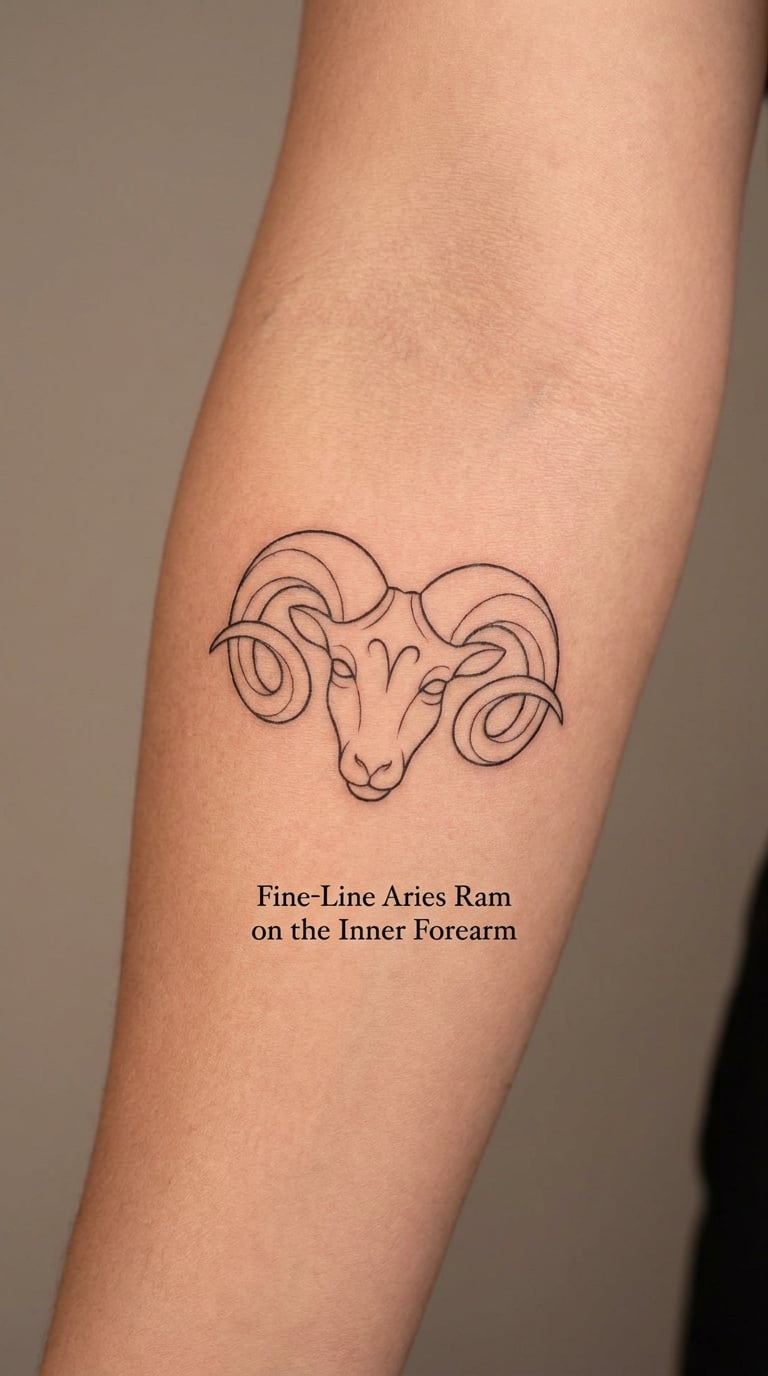
This is the cleanest way to wear a ram without a heavy ink block. A single continuous line traces the curl of the horn, the dip of the muzzle and the back of the neck, with a few short hatching strokes for the wool texture. Nothing behind it, no gradient, no banner. At 2 to 3 inches (5-8 cm) it still reads instantly as Aries from about a foot away.
Aries is traditionally read as initiative and forward motion, which is why the ram suits people who want a sign that looks active rather than decorative.
Placement: inner forearm, a few inches above the wrist, or the outer bicep. Size: 2-3 inches (5-8 cm) across. Style: fine line, single-needle weight. Pain: medium, and the inner forearm is a sore spot on most people.
Single-needle detail softens with age, so keep the horn sweep simple rather than chasing hairline texture. Make it yours: add the month you were born in small sans-serif capitals beneath the linework.
2. Blackwork Taurus Bull Behind the Ear
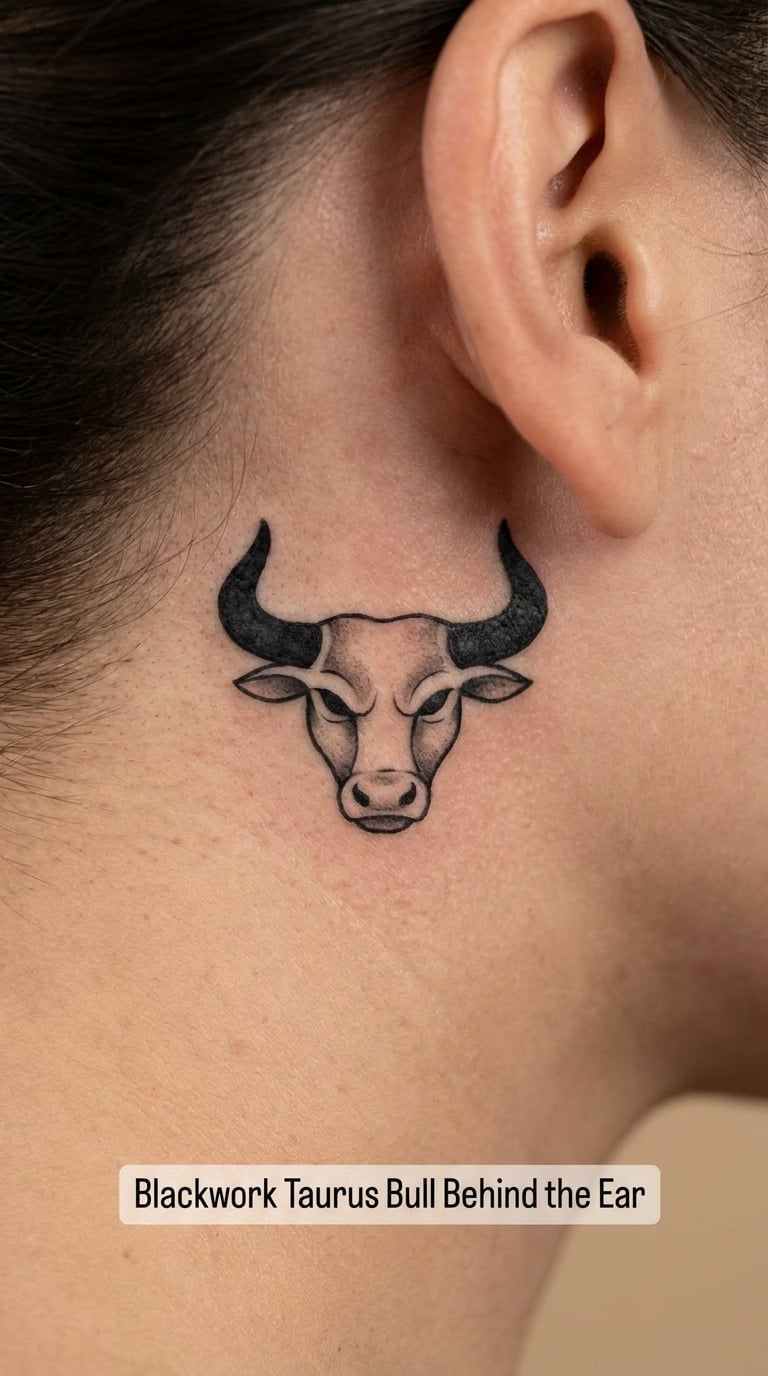
A solid black bull head, horns filled in flat with a hint of grey wash along the jaw, disappearing partly behind the ear. The trick is cropping the design so the ear hides a shoulder of the bull. From the front you see two horns and an eye. From the side, the full head. That play between angles is what makes this one worth the commitment.
Taurus is usually chosen for its steady, grounded associations rather than anything loud, which fits a piece that reveals itself slowly.
Placement: behind the ear, or along the upper neck just under the jaw. Size: 1.5-2.5 inches (4-6 cm) wide. Style: blackwork with light shading. Pain: medium. The neck skin is thin and the angle is awkward, so take breaks.
Fine detail near the ear tends to soften first as skin texture changes over the years. Make it yours: tuck one small star into the space between the horns, or set the Taurus date range under the jaw in tiny numerals.
3. Minimal Gemini Twins on the Bicep
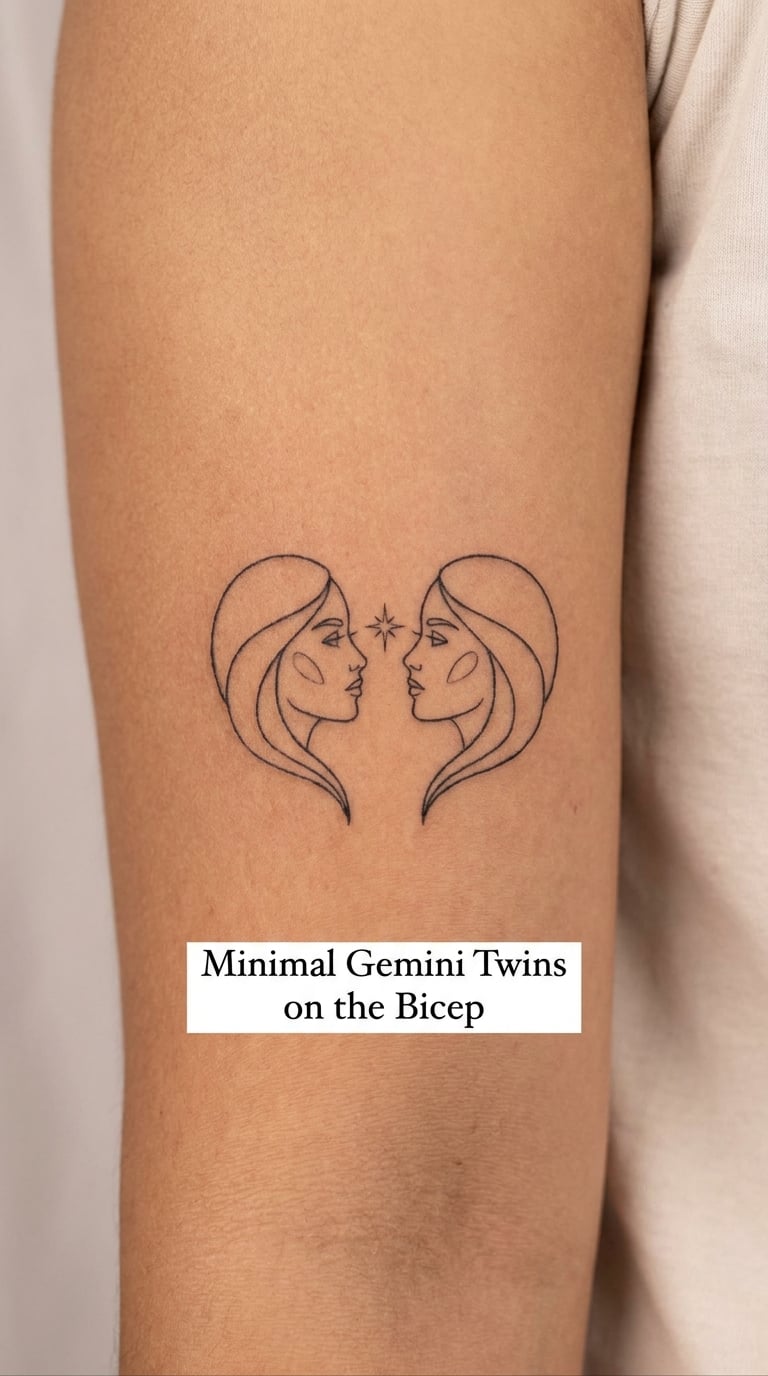
Two facing profiles in clean black linework, one reversed from the other, drawn as continuous outlines rather than portraits. Roughly 3 inches (8 cm) across, the pair sits comfortably on the inner bicep and the negative space between the two faces does most of the visual work. It is a design that scales up easily if you want a second stage later.
Gemini is the sign of pairs, so most people choose it for a twin, a partnership or a duality that feels true. Plenty of others just like the symmetry.
Placement: inner bicep, outer bicep or the rib area. Size: 2.5-4 inches (5-10 cm). Style: minimalist line art. Pain: low to medium, and the bicep is one of the calmer spots on the arm.
Profiles have thin details around the eye and hairline, so ask for slightly heavier line in those areas. Make it yours: put both birth dates beneath the pair in matching numerals, or connect the two faces with a single line that runs out past the design.
4. Black-and-Grey Cancer Crab in Micro-Realism
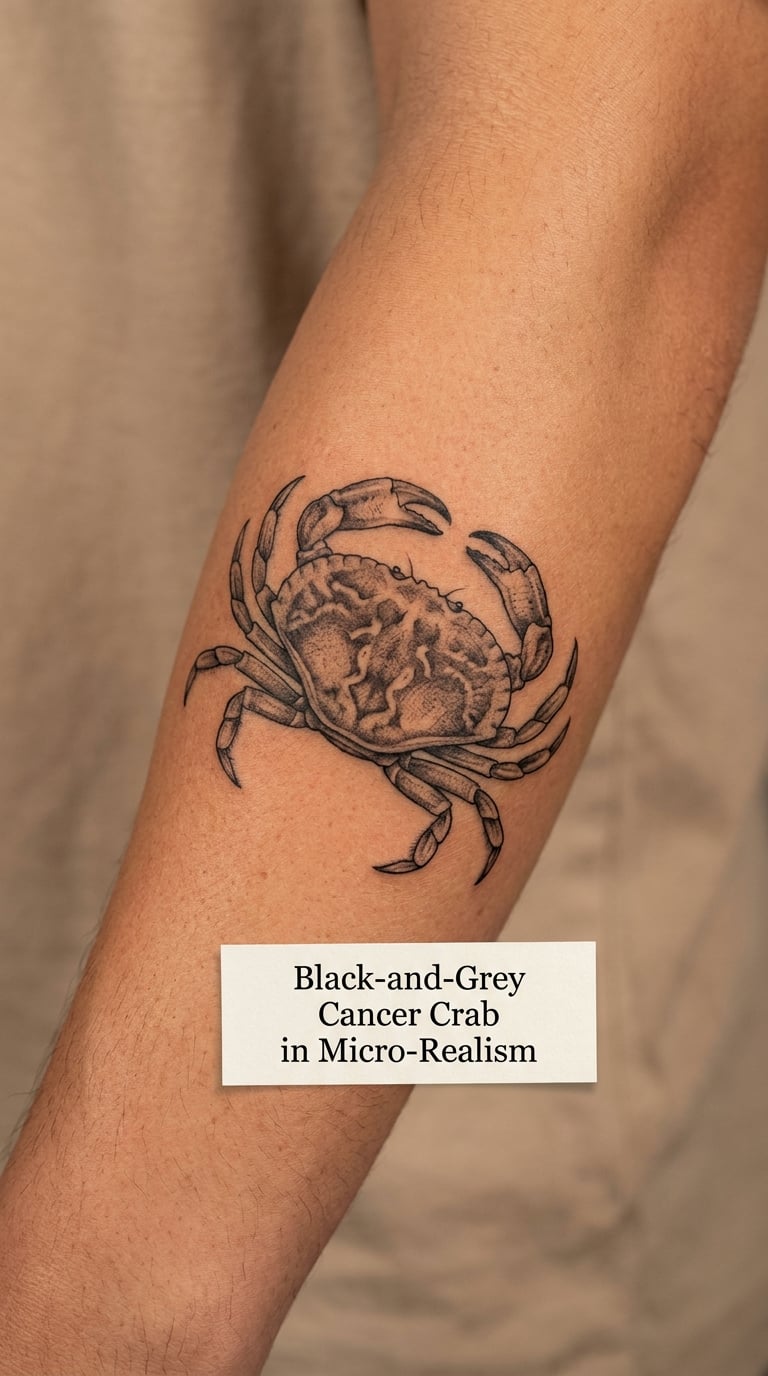
A crab rendered as if you could pick it up: segmented shell plates, small shadow pockets under the body, legs that taper and bend rather than trail off. Micro-realism means the detail is real but slightly compressed, so it holds together at 3 to 4 inches (8-10 cm). Soft stippled shading instead of hard black gives it weight without turning it into a solid mass.
Cancer is often picked for identity or for the emotional depth the sign is associated with. People also book it as one half of a matching pair with a partner’s sign.
Placement: outer forearm or calf. Size: 2.5-4 inches (6-10 cm) across, including the leg span. Style: micro-realism in black and grey. Pain: medium, and stipple shading takes longer, so the session runs long.
Shell texture reads well for years, but the thin leg tips blur first. Make it yours: run a birth date along the underside of the body in a small clean serif, curved to follow the shell.
5. Traditional-Style Leo Lion Profile on the Chest
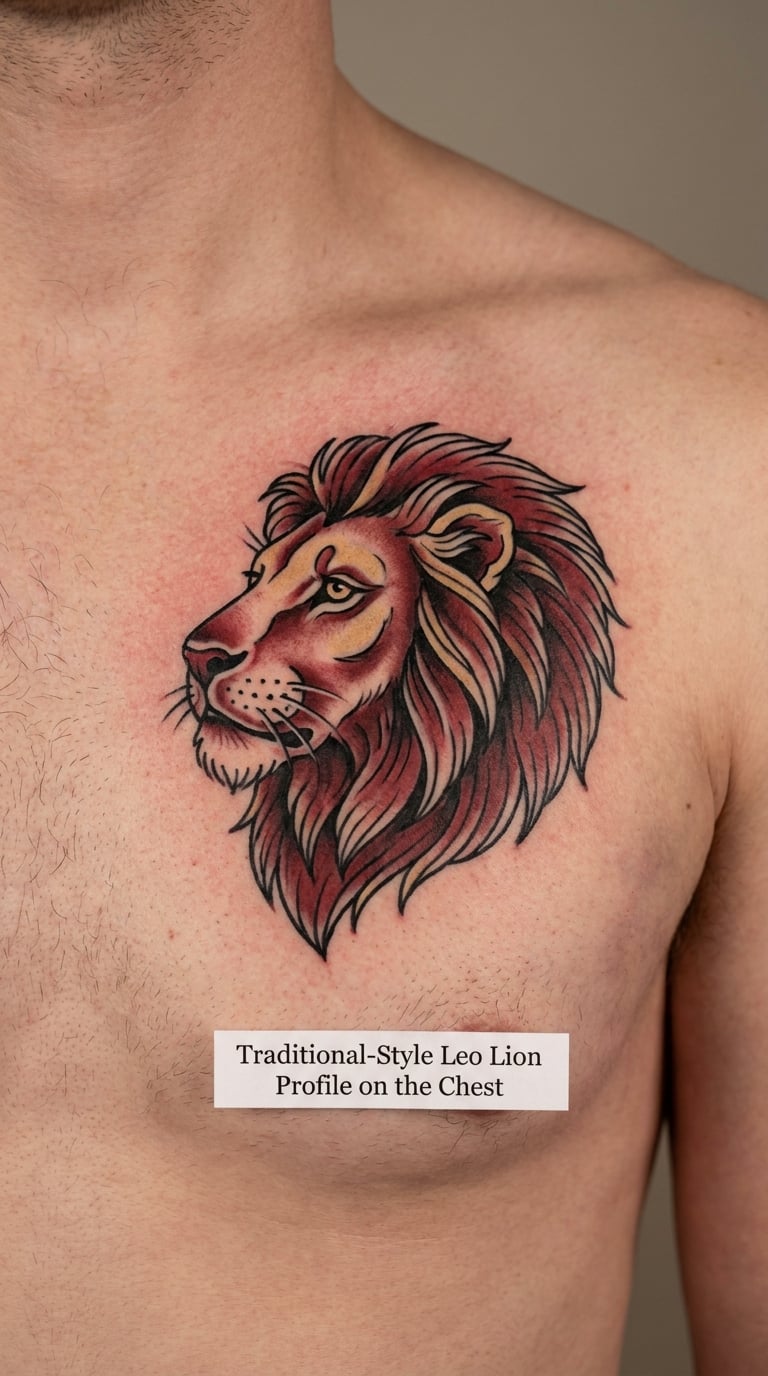
Bold black outlines, a mane built from overlapping shapes, one red accent in the mane and a restrained yellow highlight in the eye. The composition sits inside an implied badge shape, like a bookplate or a matchbook label, which is what keeps a lion from sprawling across the chest. 4 inches (10 cm) tall is enough for the linework to stay confident.
Leo is the sign most often chosen for courage and self-expression, and traditional style carries that loudness without tipping into cartoon.
Placement: upper chest, centred between the pecs or over one pec. Size: 3-5 inches (8-13 cm) tall. Style: neo-traditional with two colours. Pain: medium. The sternum is sensitive and the collarbone area feels sharper than the chest muscle.
Colour saturates best on the upper chest and fades a little faster on the rib edge, so keep the shading away from the stretchy parts. Make it yours: put the July or August dates in a ribbon under the badge, or add a small matching lion to the same chest later.
6. Watercolour Virgo Maiden on the Shoulder
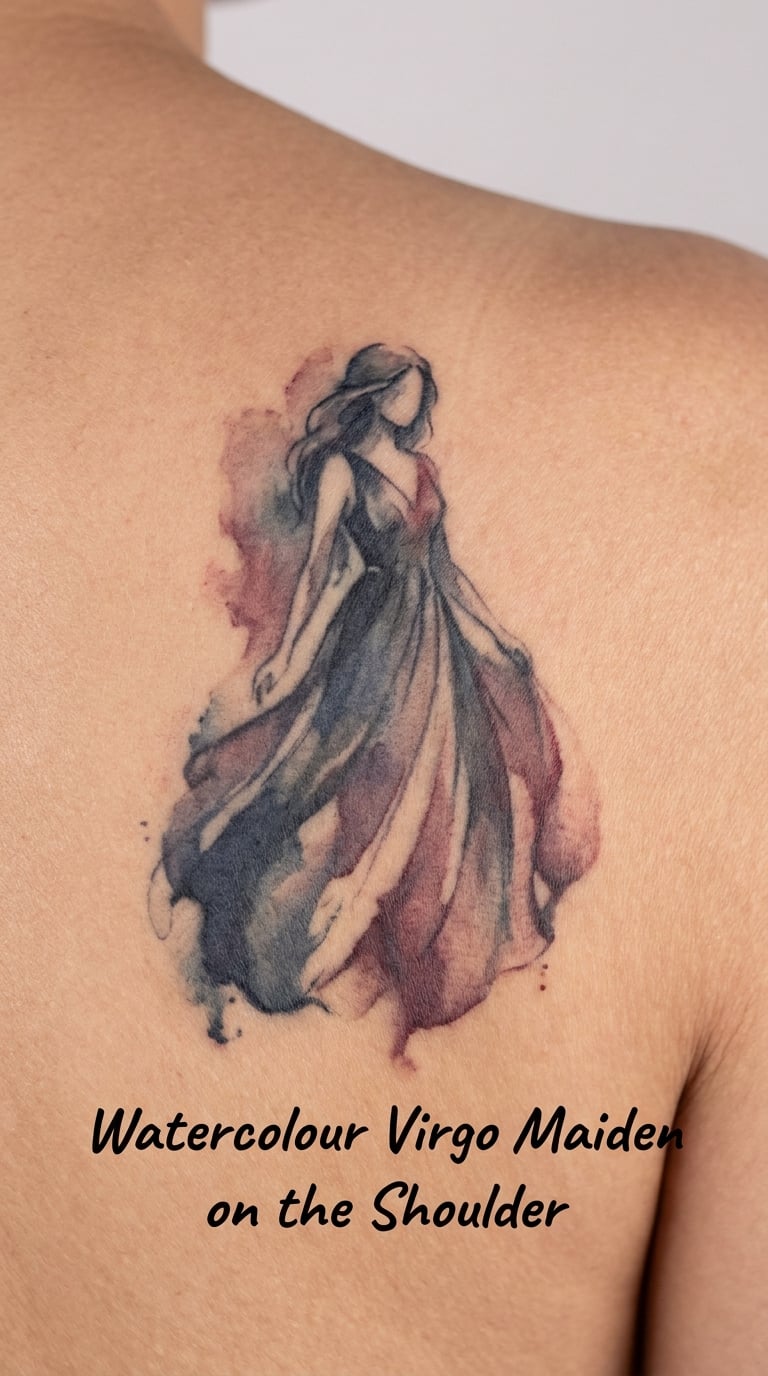
A partially formed female figure, some of the body defined in line and the rest left as loose wash. Indigo for the shadow side, a soft burgundy or ochre accent, and edges that fade into bare skin instead of ending at a hard border. The unfinished look is deliberate and it is what makes the piece feel like art rather than a chart.
Virgo draws people who want a zodiac tattoo that does not look like every other zodiac tattoo. The figure gives a traditionally delicate sign a different weight on a man’s shoulder.
Placement: shoulder cap or upper arm. Size: 3-5 inches (8-13 cm) tall. Style: watercolour with minimal outline. Pain: medium, and the shoulder cap curves sharply, so a vertical figure there will foreshorten.
Watercolour is a style that gains depth as it heals, so it often looks better at month six than on day one. Make it yours: use the colour of your birthstone, or add one botanical stem that continues past the figure into empty skin.
7. Minimal Libra Scales on the Inner Wrist
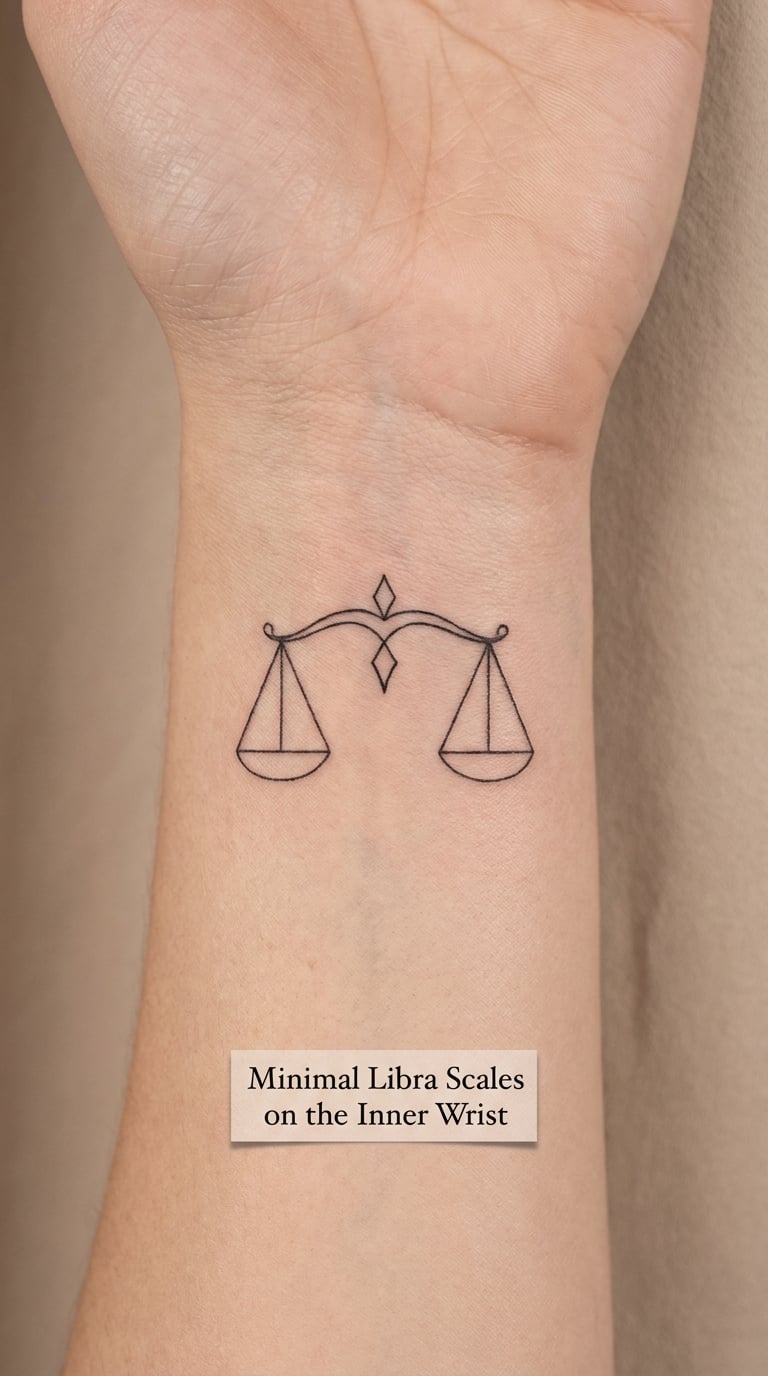
One horizontal beam, two hanging pans on matching lines, and a small diamond at the pivot point. That is the whole design, and at 2 inches (5 cm) wide it is the sort of thing people notice when you hand them something. The inner wrist gives it a natural gentle curve, so the beam can sit very slightly tilted rather than ruler-flat.
Libra is associated with balance and relationships, and the scales are a direct visual for that. Nothing more needs to be explained on your behalf.
Placement: inner wrist or inner forearm. Size: 1.5-2.5 inches (4-6 cm) wide. Style: fine line, symmetrical. Pain: medium. The inner wrist is thin, bony and very easy to feel.
This is a small line piece on a busy area, so plan for a touch-up in a year or two. Make it yours: replace the central diamond with a tiny date, or hang a small heart from one pan instead of both.
8. Blackwork Scorpio Scorpion on the Calf
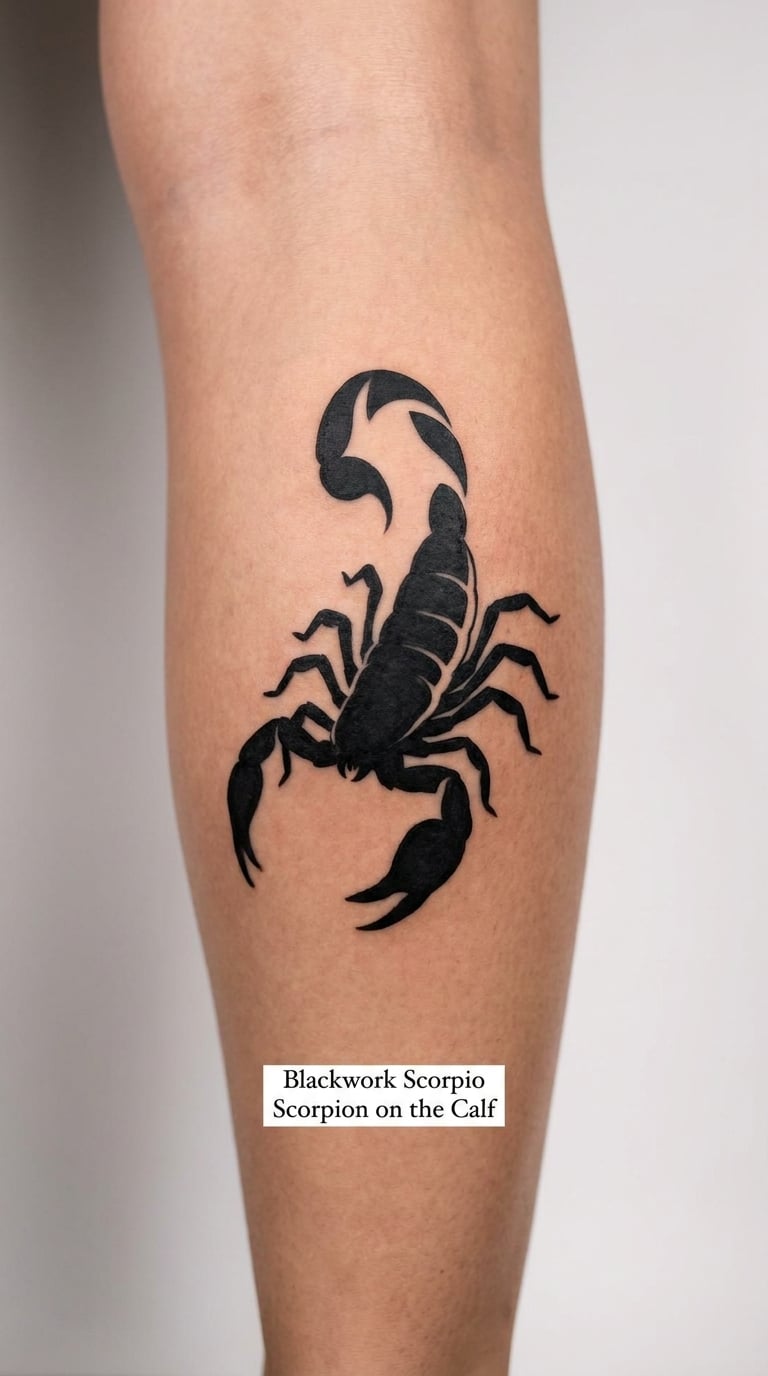
A scorpion built from solid black shapes: a heavy segmented body, claws reduced to two angular blocks, and a tail that curves over the back and ends in a stinger cut from white space rather than drawn. The design relies on contrast instead of detail, which is exactly why it holds its edge at 4 inches (10 cm) and beyond.
Scorpio is the sign most associated with intensity and depth, and this is the design language people reach for when they want that to be visible without saying so.
Placement: outer calf, thigh or outer forearm. Size: 3-5 inches (8-13 cm) long. Style: blackwork with negative space. Pain: medium. The calf is fleshy and forgiving, one of the easier spots to sit through.
Solid black hides small errors well, so this is a forgiving style for a first larger piece. Make it yours: add a single red accent in the tail, or run the birth dates in small type under the body.
9. Sagittarius Arrow and Bow Micro-Tattoo
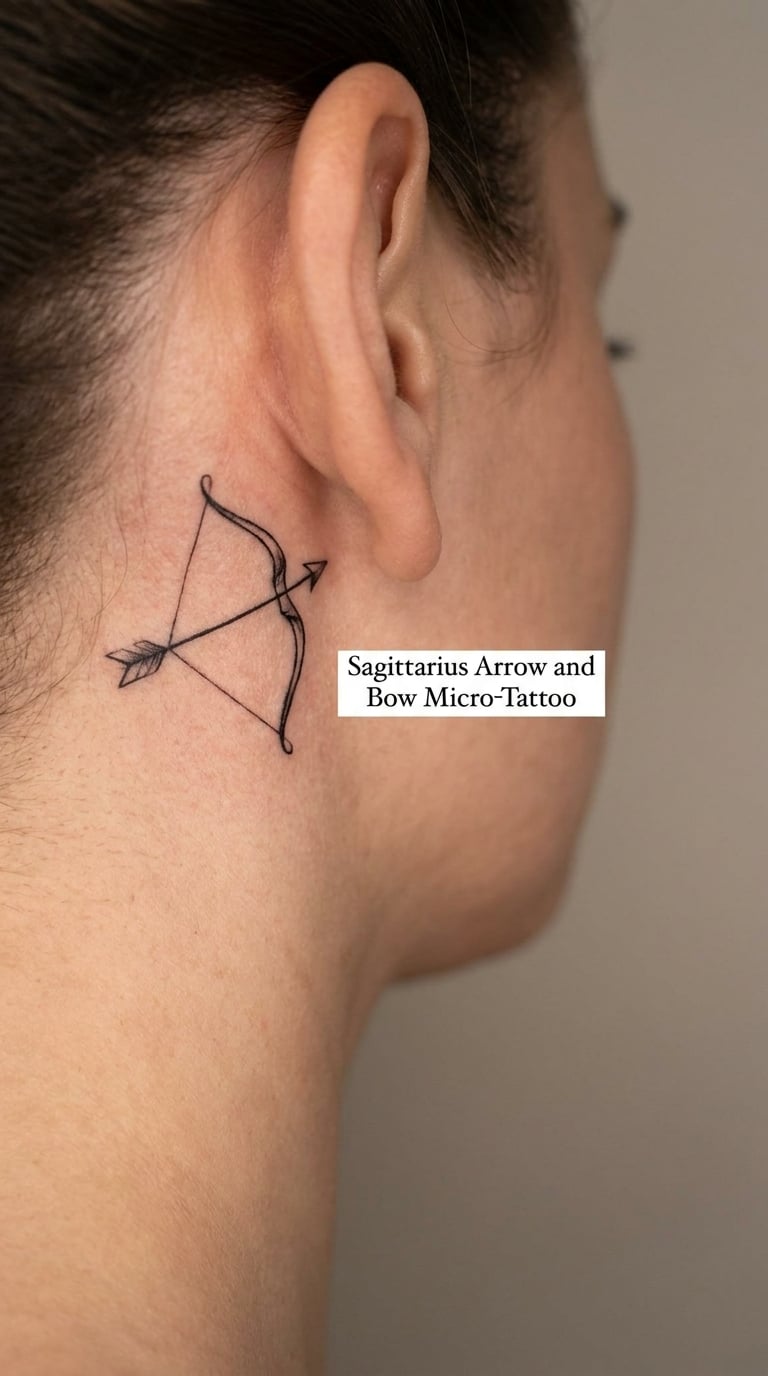
A curved bow and a straight arrow crossing it, both reduced to a few confident lines. At 1.5 inches (4 cm) the whole thing is maybe eight strokes, and every one of them has to land. Micro tattoos like this suit someone adding a first small piece alongside existing ink, or someone who wants a zodiac mark that only shows up when they lean in.
Sagittarius is the traveller’s sign, associated with exploration and forward movement, and the arrow is its most direct shorthand.
Placement: behind the ear, inner wrist or ankle. Size: 1-2 inches (2.5-5 cm) wide. Style: micro fine line. Pain: low to medium, and small sessions are over before the adrenaline settles.
This is the one to expect a touch-up on. Very fine detail at this scale softens noticeably within a few years. Make it yours: angle the arrow toward a real compass bearing, or cut the fletching down to three short lines and add a date instead.
10. Capricorn Sea-Goat on the Outer Forearm
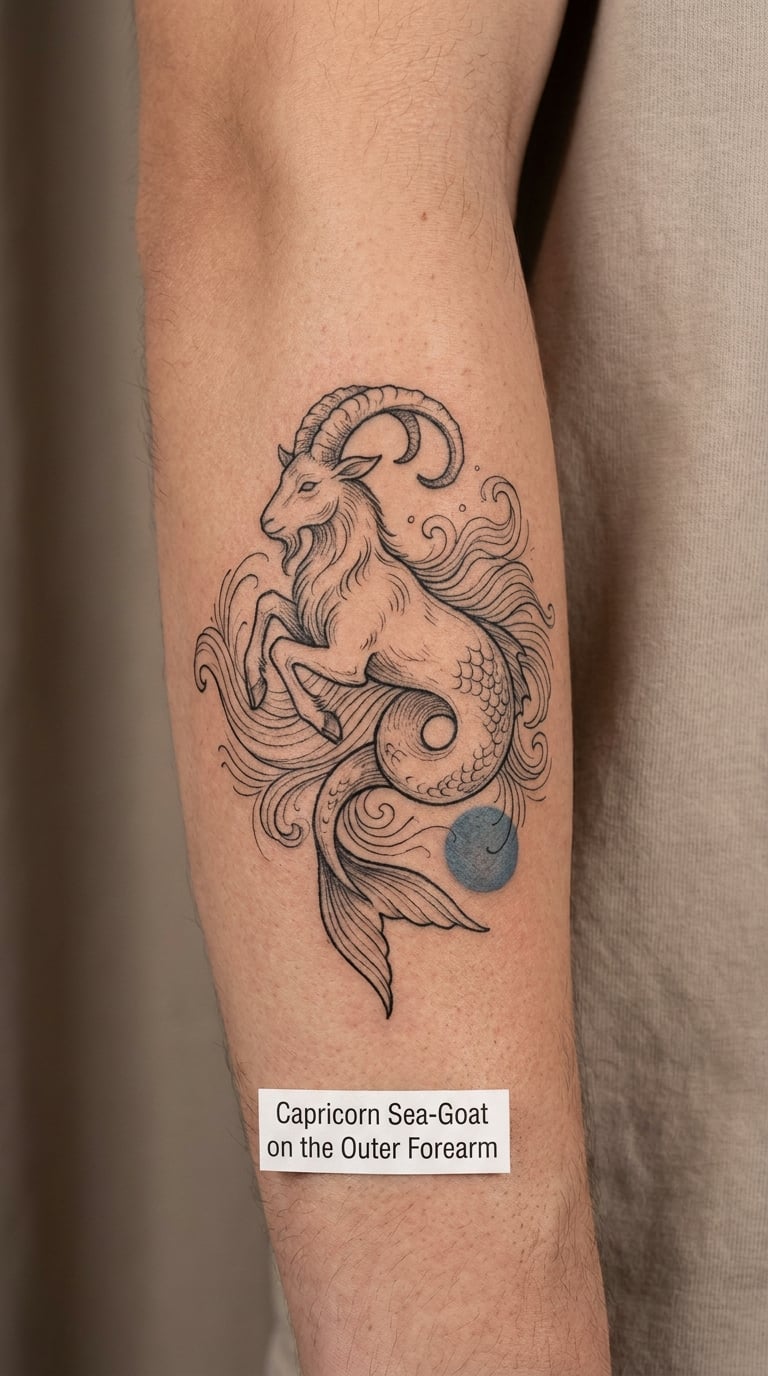
The old version of the sign, before anyone got literal about it: the goat of the land ending in a fish tail, sitting on a low band of wave lines. Drawn with a heavier line for the body and finer lines for the water, with one muted blue in the waves. At 3.5 inches (9 cm) across, the hybrid reads clearly and nobody needs a caption.
Capricorn is traditionally linked to ambition, patience and endurance. The sea-goat form is also the least generic Capricorn you can pick, which matters if you hate seeing your sign on every other forearm.
Placement: outer forearm or calf. Size: 3-4 inches (8-10 cm) wide. Style: illustrative realism with light colour. Pain: medium on the forearm, which is a common first-tattoo site.
Horn detail and the tail scales are the first parts to fade, so keep them simple. Make it yours: add a low mountain line under the wave band, or set one muted blue to match a birthstone colour.
11. Aquarius Wave Grid Along the Outer Forearm
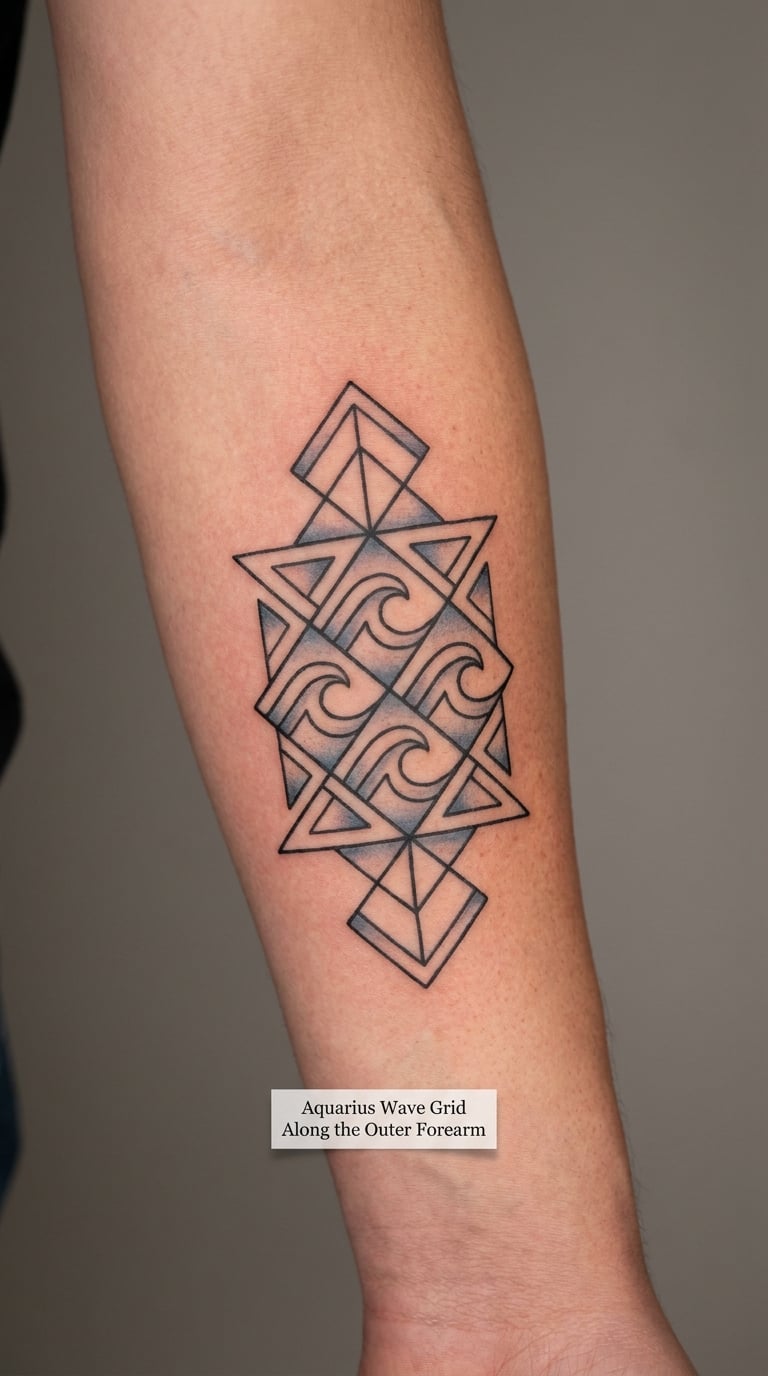
Two flowing wave bands broken by an angular grid, so the composition alternates between curve and straight edge. Line work is even and confident, with a soft blue-grey wash in the negative spaces rather than heavy shading. Running it lengthwise down the forearm gives the design a direction to travel, which keeps it from looking like a stamp.
Aquarius is an air sign, which surprises people who assume a water-bearer belongs with the water signs. That air-water tension is a good excuse for an abstract design rather than a figure holding a jug.
Placement: outer forearm, running lengthwise. Size: 3-5 inches (8-13 cm) long. Style: geometric blackwork with light shading. Pain: medium.
Grid lines are unforgiving if they are not parallel, so this is a design to pick an artist for rather than a bargain. Make it yours: change the wave pattern to match a real stretch of coastline, or thread a birth date through the grid.
12. Fine-Line Pisces Two Fish on the Inner Forearm
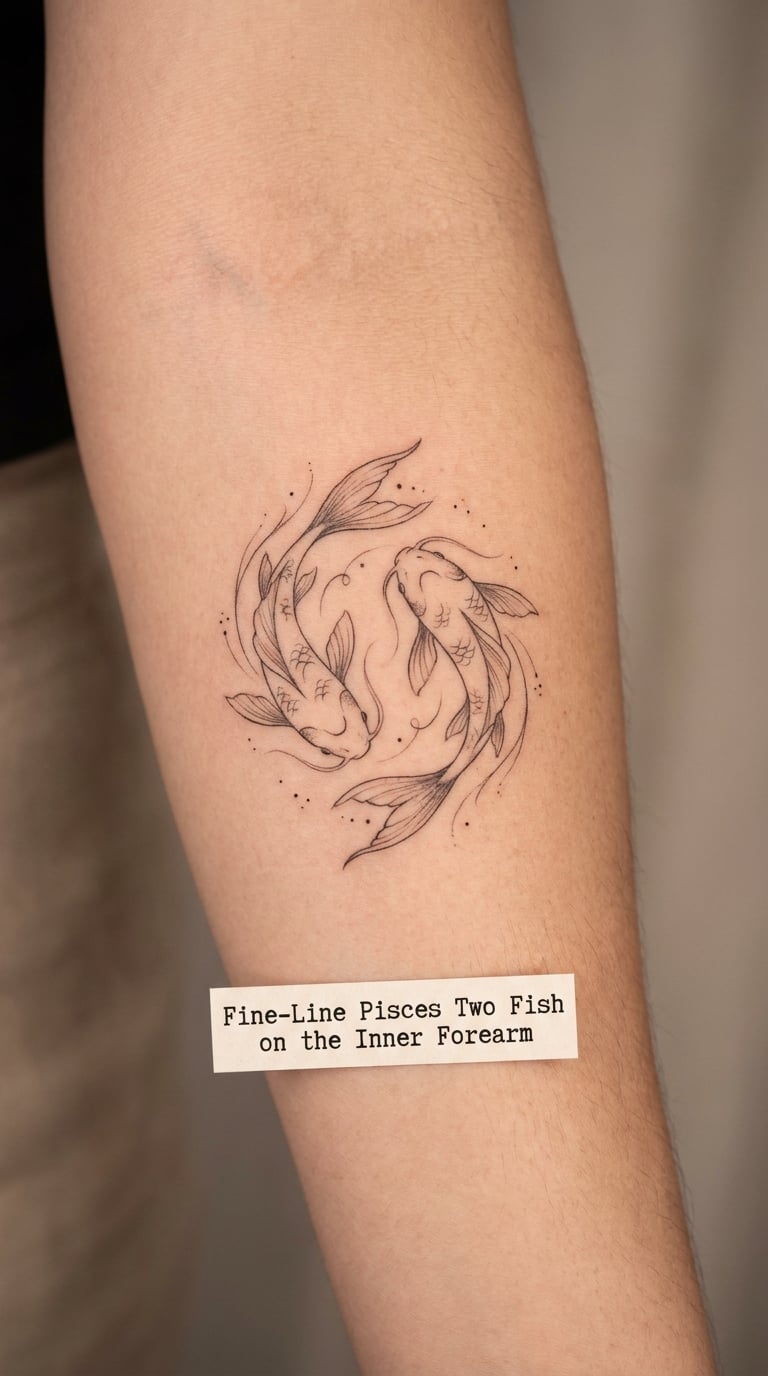
Two fish curving around one another in mirrored arcs, drawn with graceful continuous linework and a scatter of tiny dots between them for water. The arcs sit on the natural line of the inner forearm, so the pair reads as one moving shape. This avoids the standard Pisces glyph, which is two tight loops and the single most likely zodiac mark to blur into a smudge.
Pisces is often chosen as a quiet, personal piece rather than a statement, and the mirrored fish give you something to build a matching tattoo around later.
Placement: inner forearm, calf or ribs. Size: 2.5-4 inches (6-10 cm) wide. Style: fine line. Pain: medium on the forearm, noticeably worse on the ribs.
Dot accents disappear within a few years, so treat them as a bonus rather than a feature. Make it yours: use two birthstone colours instead of black ink, or add a second small fish on the opposite forearm as a matching piece.
13. Bold Sun and Ray Motif for Leo
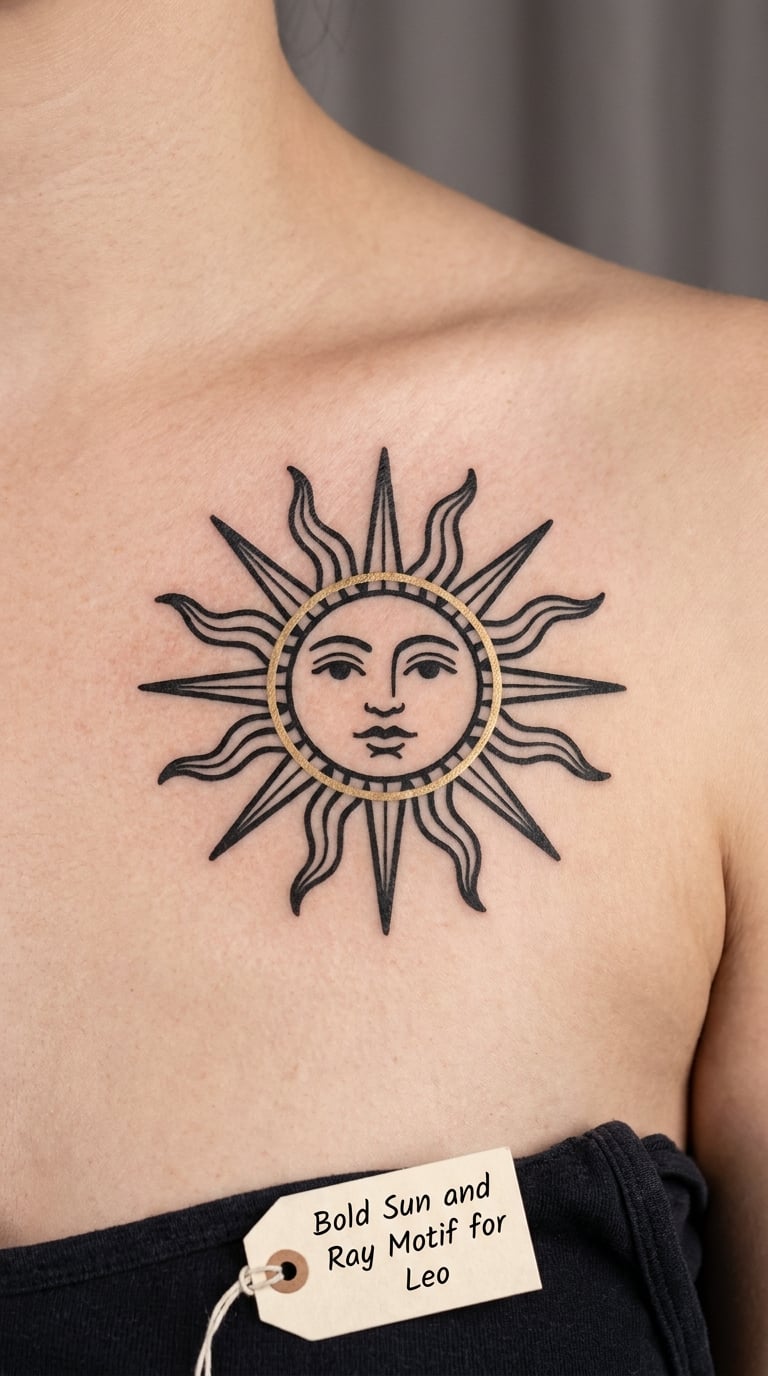
A stylised sun face at the centre, framed by alternating long and short rays that radiate in a clean ring. The face is reduced to a few decisive features, so it reads at distance. One accent colour, often a muted gold or ochre, in the eye or a single ray. This is the Leo option for someone who does not want an animal on their chest.
Leo suits graphic, symmetrical compositions because the sign already carries a sun association. The rays do the visual heavy lifting.
Placement: upper chest, sternum, upper arm or shoulder blade. Size: 3-5 inches (8-13 cm) wide. Style: blackwork or neo-traditional with one accent. Pain: medium on the chest, and the sternum bone is the sharpest part.
Radii need even spacing or the ring tilts visibly, so bring a reference image with an even ring. Make it yours: wrap the birth dates in a ring of tiny text around the outer rays, or set the accent to a colour tied to your birthday.
14. Geometric Capricorn Glyph on the Side of the Hand
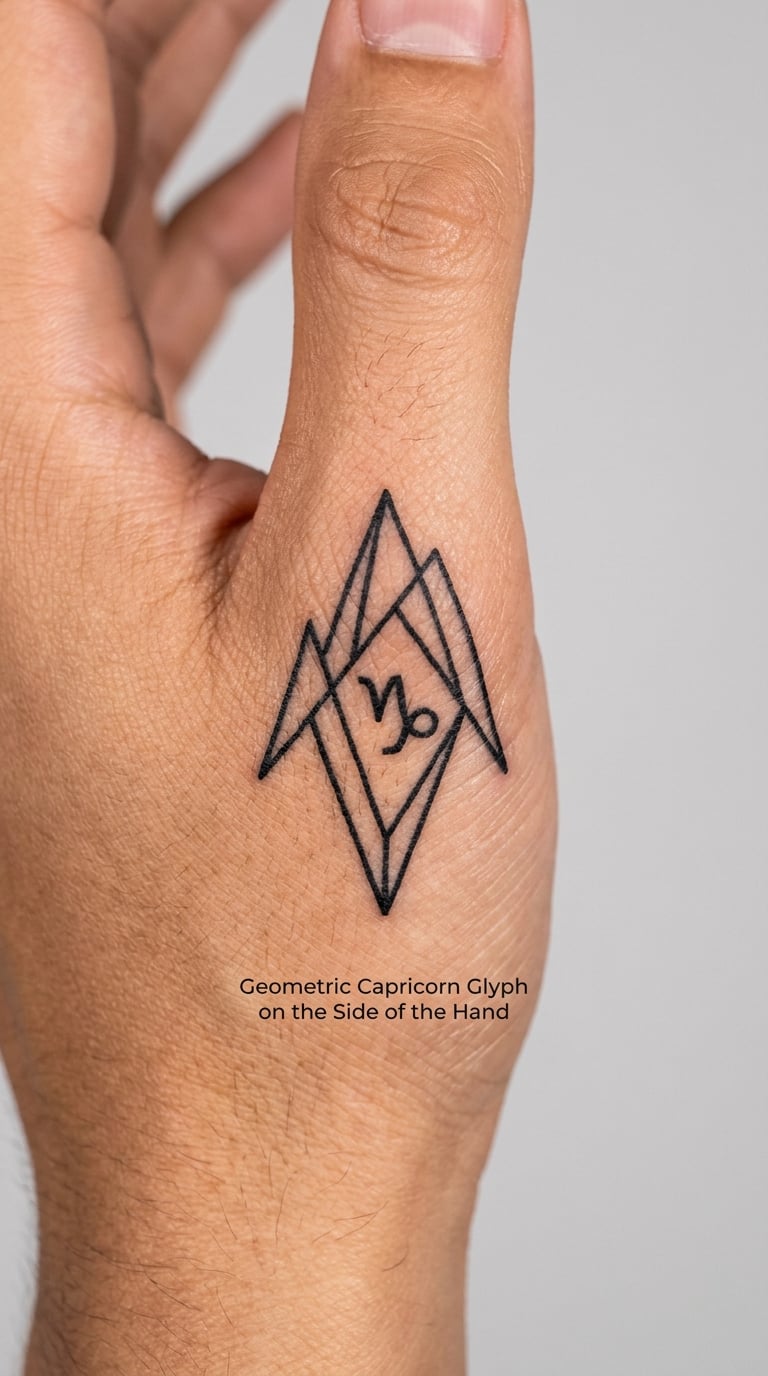
The Capricorn mark redrawn as sharp angles: straight segments, a triangular peak and a flat baseline instead of the usual curves. On the side of the hand there is a limited flat area, so the design has to be tight, and geometry is what makes that work. It is one of the more visible placements a man can choose without committing to a full forearm piece.
Discipline and long-term goals are the associations Capricorn usually gets asked to represent. Plenty of wearers just like the shape.
Placement: side of the hand, wrist or inner forearm. Size: 1.5-2.5 inches (4-6 cm) tall. Style: geometric blackwork. Pain: medium. Hand skin is thick, so the needle bites more than you expect for such a small area.
Hand tattoos catch sun and abrasion constantly, so expect a touch-up every year or two. Make it yours: add a simplified mountain line under the glyph, or place a birthdate in Roman numerals on the wrist below it.
15. Floral Scorpio Crescent on the Inner Forearm
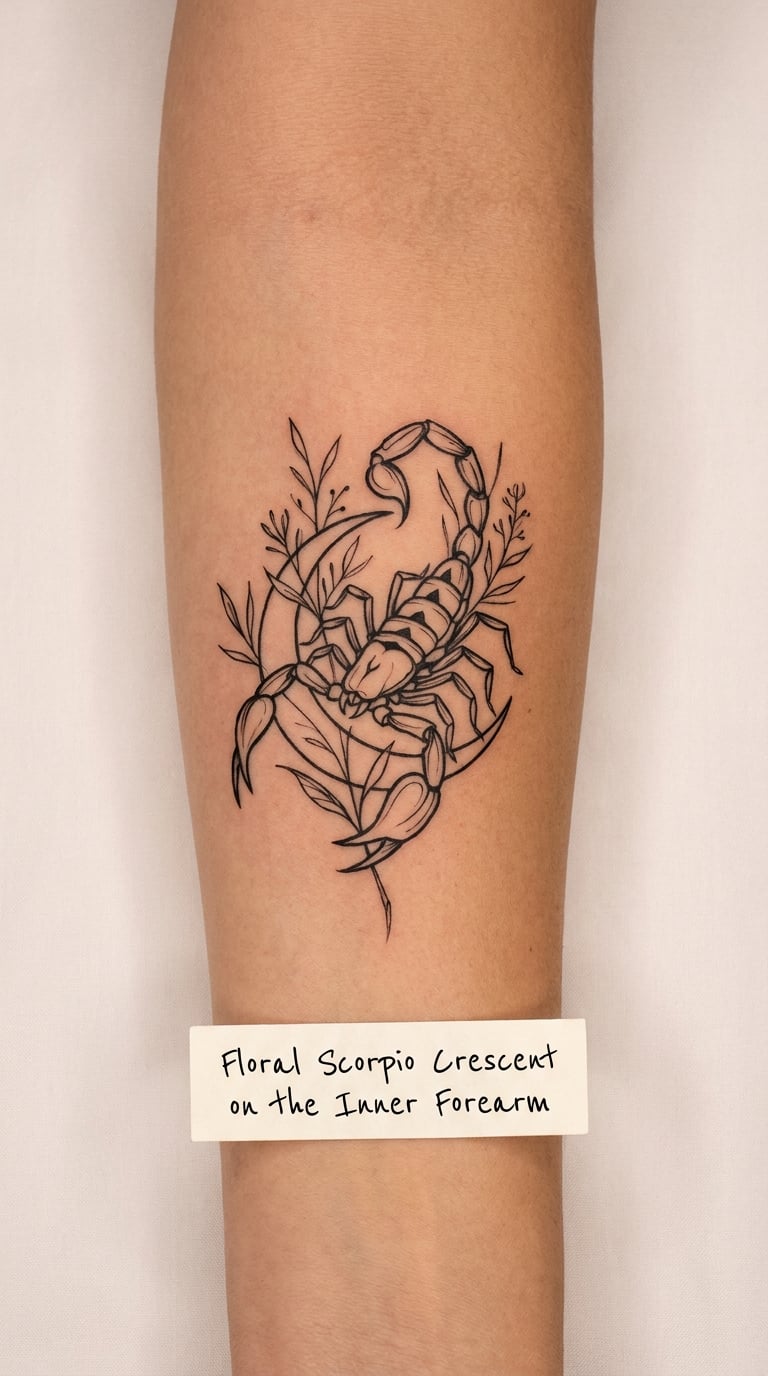
A scorpion glyph paired with a crescent moon, wrapped in a few sparse botanical stems rather than a full wreath. The scorpion stays black and graphic, the plants are drawn in a lighter illustrative hand, and the crescent holds the composition together. The contrast is the point: hard symbol, soft growth, same piece.
Scorpio carries the darker symbolism, and pairing it with a moon or a plant shifts the reading without removing the sign. It also makes the design specific to you rather than a stock glyph.
Placement: inner forearm or calf. Size: 2.5-4 inches (6-10 cm) wide. Style: illustrative blackwork. Pain: medium.
Botanical line work is the part that softens first, so keep leaves simple and few. Make it yours: use your birth flower, or add a third stem that trails off the design and ends unfinished on the skin.
16. Minimal Cancer Glyph and Birth Constellation
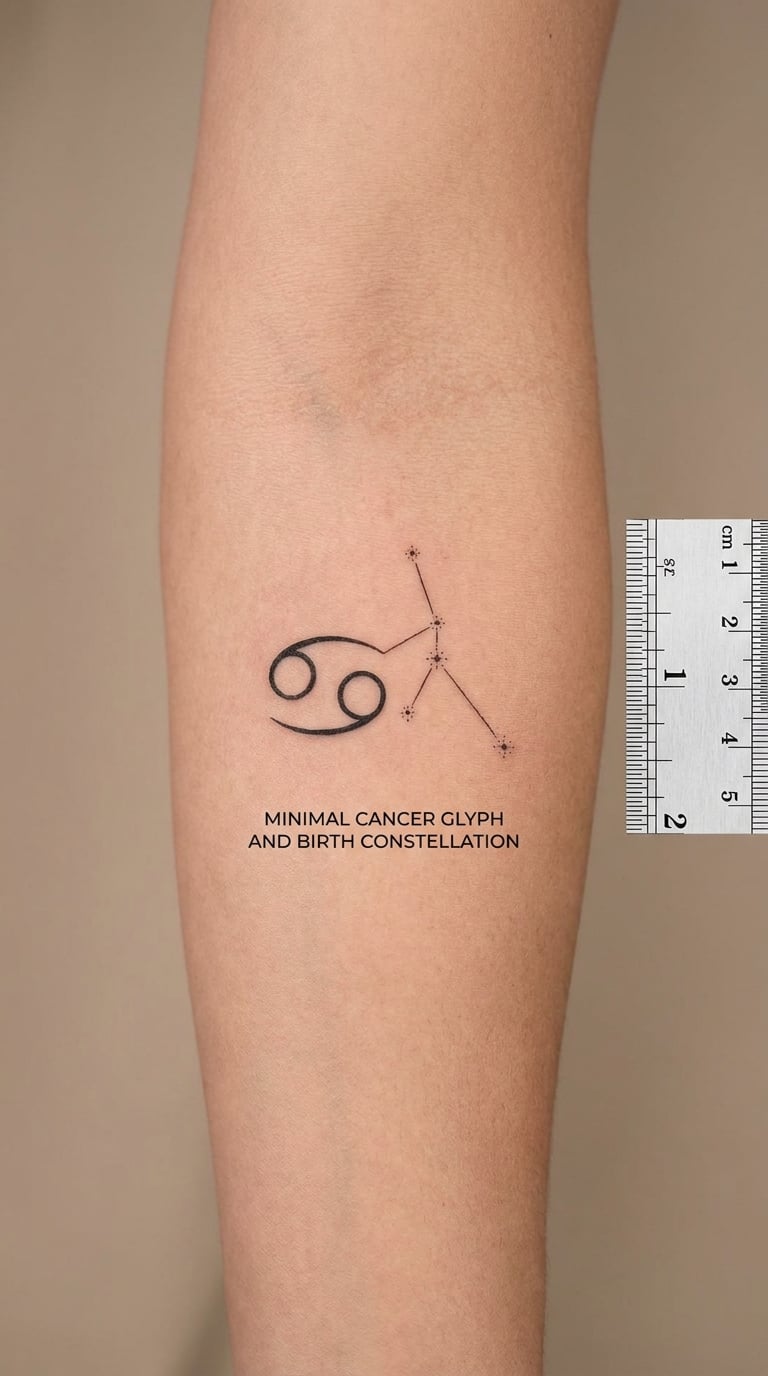
The Cancer glyph on one side, a small real constellation on the other, connected by a single hairline. The trick is capping the star count at five to seven points and stretching the connecting lines so they do not merge. Most people add too many stars and end up with a smudged cluster within a few years.
A birth sky gives a zodiac tattoo a specific date behind it. That personal detail is the easiest way past the generic look that puts most people off zodiac ink.
Placement: inner forearm, wrist or behind the ear. Size: 1.5-2.5 inches (4-6 cm) wide. Style: minimal fine line. Pain: medium.
Tiny star points soften noticeably over a decade, so a bolder dot is better than a delicate one. Make it yours: use the actual constellation that was up on your birth night, then set the date beneath in the same line weight.
17. Large-Scale Gemini Celestial Design on the Upper Arm
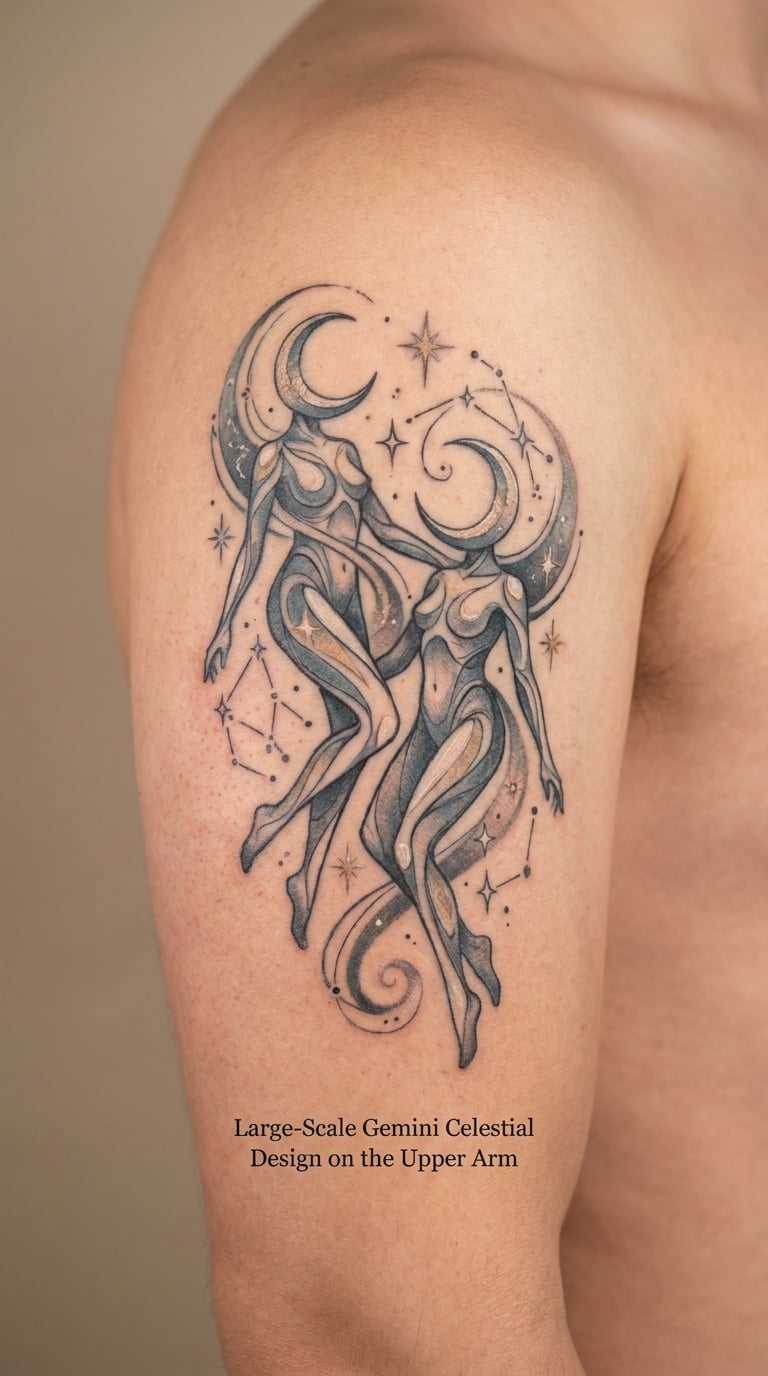
Two abstract figures, one rising and one falling, arranged as a celestial composition with stars and a soft blue-grey wash behind them. At 6 inches (15 cm) tall there is room for a real background rather than a floating symbol, and the shading gives the piece the weight of a statement piece instead of an add-on. It reads well from across a room and holds up in photos.
Large Gemini designs usually come from a partnership, a twin or a relationship theme, and they look right as the anchor piece of a sleeve.
Placement: upper arm, outer thigh or back. Size: 4-7 inches (10-18 cm) tall. Style: illustrative with shading, or neo-traditional. Pain: medium on the upper arm, rising on the back.
Soft washes on large areas need a plan for fading, so talk to your artist about how you will maintain it. Make it yours: mirror the two figures so they face each other, and add a shared constellation behind both.
18. Blackwork Aries Ram and Arrow Split Design
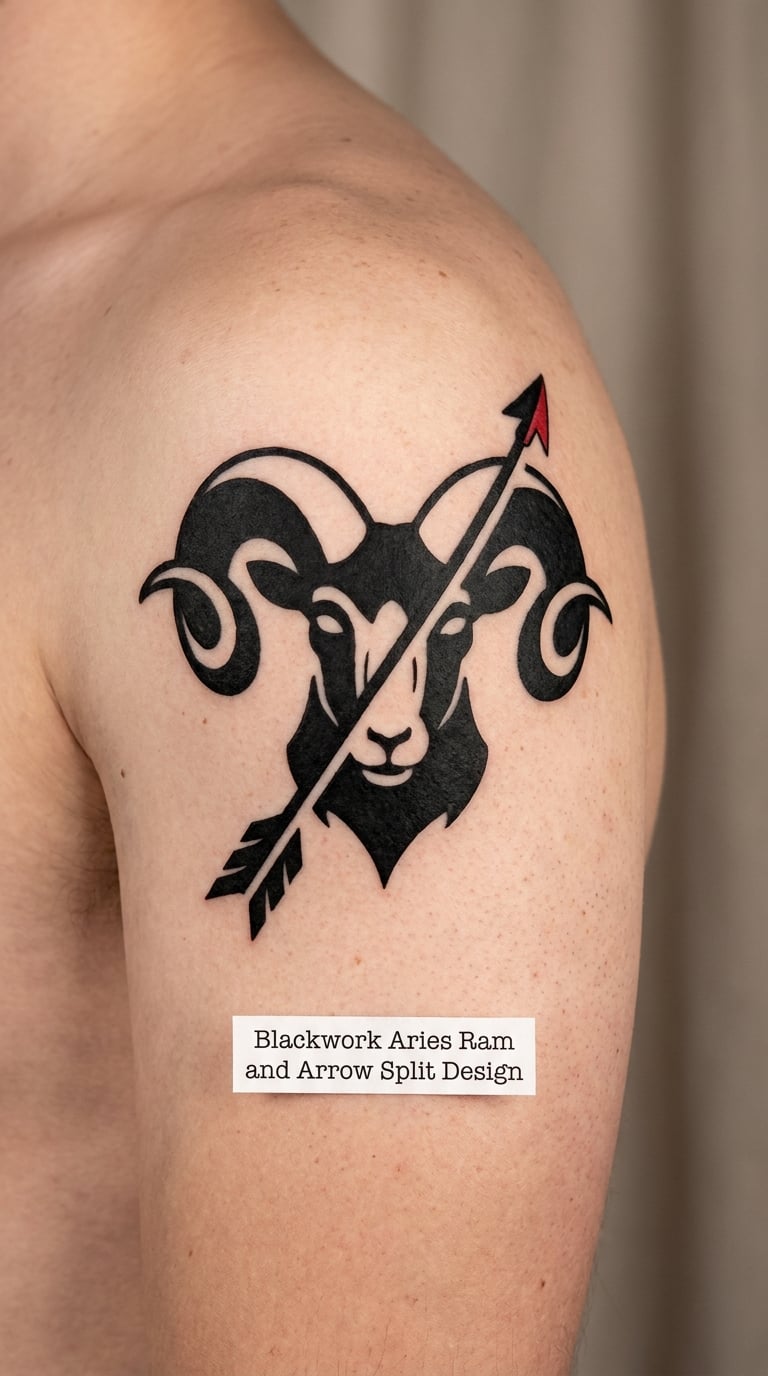
A ram profile on one side of the shoulder, a forward-pointing arrow breaking out of the same composition, the whole thing built from solid black shapes separated by white negative space. The single red accent in the arrow tip is optional but it does stop the piece reading as a flat block. At 4 inches (10 cm) the silhouette carries from any angle.
Drive and initiative are the associations Aries usually gets, and the arrow makes that plain without any lettering.
Placement: shoulder, forearm or calf. Size: 3-5 inches (8-13 cm) long. Style: blackwork with negative space. Pain: medium, and the shoulder cap is more sensitive than the flat of the shoulder.
Splitting one symbol into two shapes needs clean edges, so this is a piece where the artist’s hand matters more than the reference. Make it yours: point the arrow toward a real direction, add your birth date, or keep the red for a second small piece later.
19. Watercolour Pisces Fish on the Calf
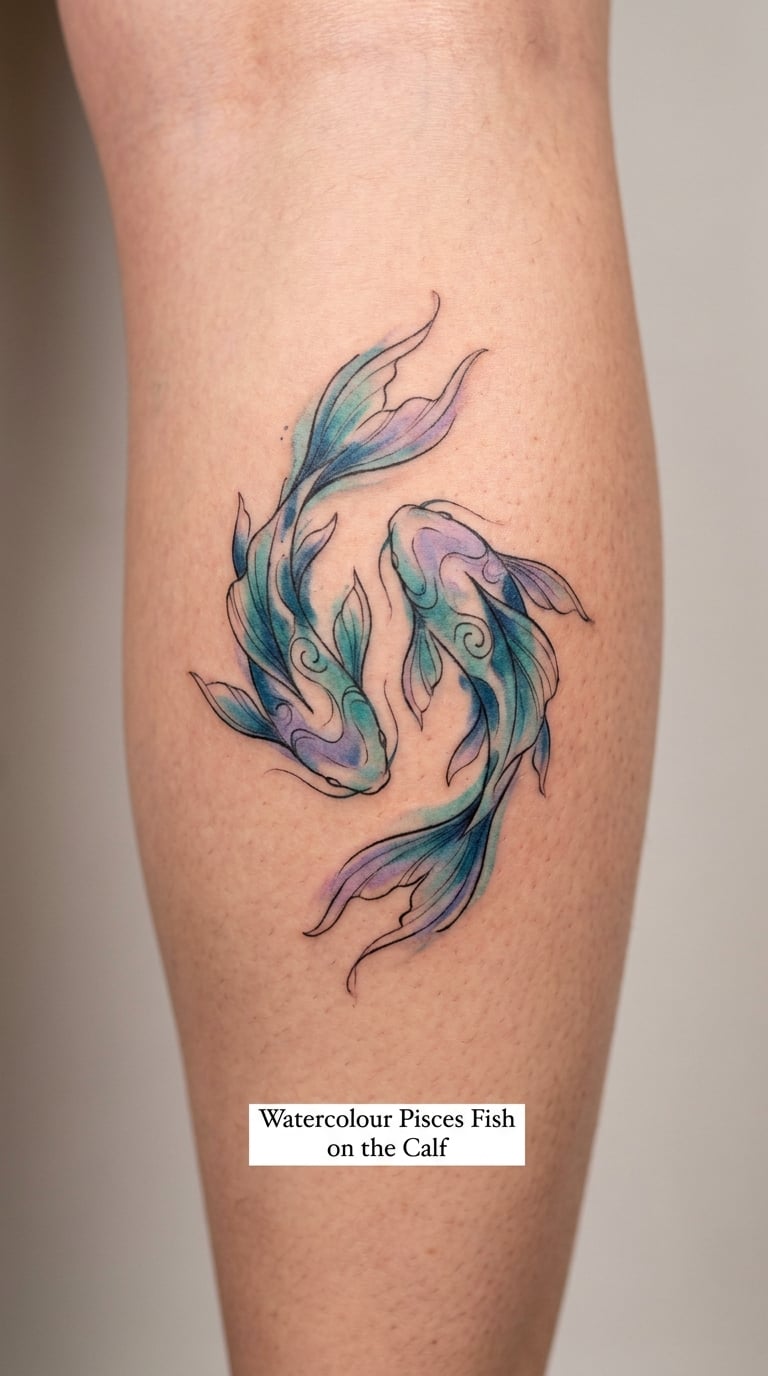
Two fish rendered in loose washes of teal, blue and violet, with almost no outline at all and edges that bleed into the skin. The colour does the work that line would normally do, so the piece has movement that a black-and-grey version could not. It is the most colourful option on this list and the one most likely to start a conversation.
Pisces is an old water sign, and the flowing medium suits it well. People usually pick this when a small black glyph would feel too anonymous on a leg.
Placement: calf, forearm or upper arm. Size: 3-5 inches (8-13 cm) wide. Style: watercolour. Pain: medium, and colour work takes longer so expect a longer sitting.
Watercolour soft edges spread slightly as they heal, so ask for slightly more saturation than looks right fresh. Make it yours: pick the palette from your birthstone, or add a small second fish beside the pair a year later.
20. Minimal Aquarius Constellation Forearm Piece
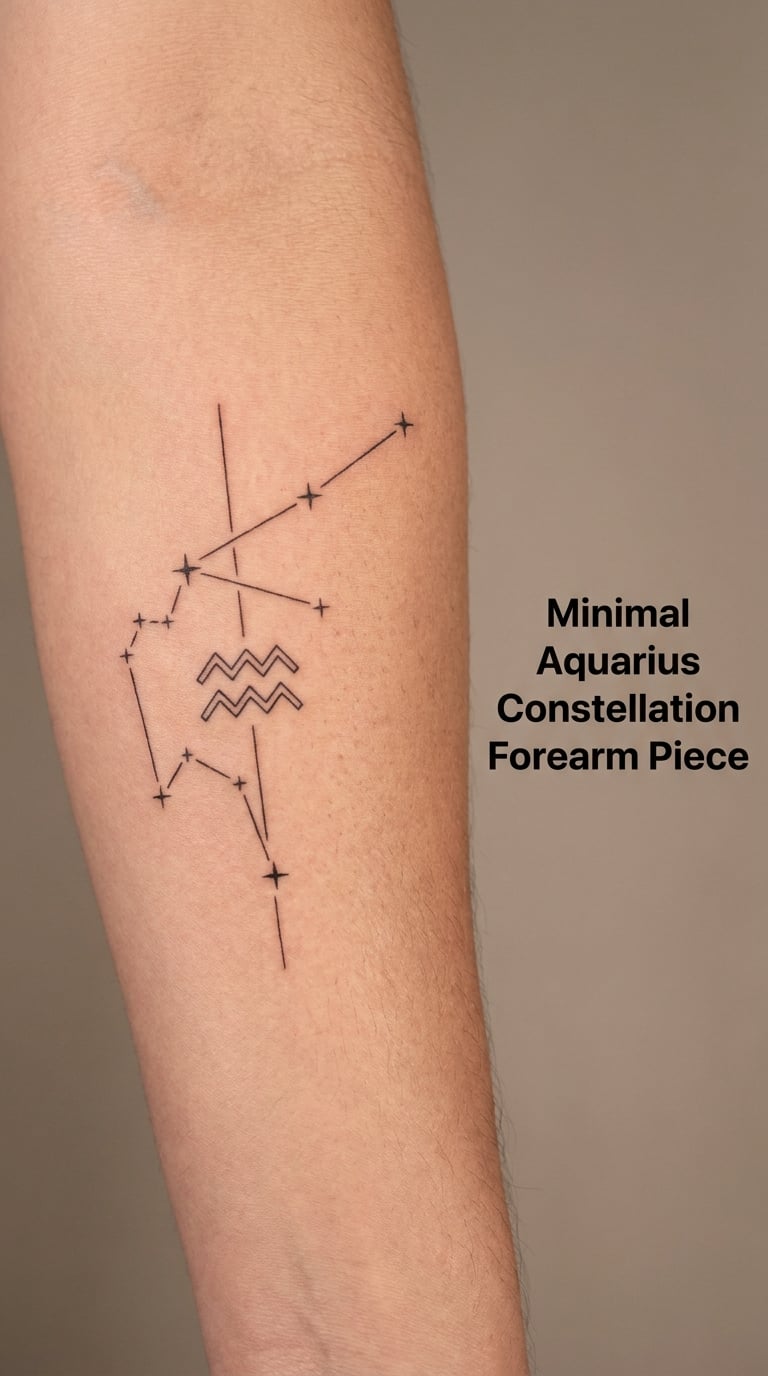
The most ambitious option here: a constellation layout running 7 inches (18 cm) down the forearm, with the geometric Aquarius glyph at the centre and star lines branching out from it. Fine line throughout, no shading, and the star points spaced far enough apart that ink settling will not merge them. This is the design to pick if you already have a sleeve or plan to build one around it.
Coordinating a whole forearm this way only works when someone has other pieces, or wants a theme tattoo. As a standalone it reads as a single design, not a set.
Placement: forearm lengthwise, or along the spine. Size: 5-8 inches (13-20 cm) long. Style: fine line constellation. Pain: medium to high, and a piece this long is a two-session job more often than not.
Long fine-line work is exactly what softens fastest, so plan on a refresh every few years. Make it yours: use real star coordinates for the night you were born, then place the glyph at the exact centre of the birth sky.
How to Choose the Right Design
Six questions settle most of the decision before you sit down with an artist:
- Style before sign. Decide whether you want blackwork, fine line, illustrative or watercolour first, then find the sign design that suits that style. Choosing the sign first is how people end up with a detailed design they cannot place.
- Size floor. Match the detail count to the finished size. A glyph with tight loops, like Virgo or Pisces, needs more room than a simple shape. If a design only works at 4 inches, plan for 4 inches.
- Placement with the body, not on it. Ribs, spine and the inner forearm all curve or shift with movement. A design stretched across them needs looser linework than the same design on a flat forearm.
- Visibility on purpose. Wrist and behind the ear are noticed late and by people close to you. Chest, shoulder, outer forearm and calf are read instantly. Neither is better, they just do different jobs.
- Personal meaning over generic meaning. A real birth constellation, a birth date or a specific direction makes the piece yours. A copied glyph is the version people recognise as generic.
- Ageing. Fine line softens, small dots merge and thin colour washes spread. Heavy blackwork and broad shapes hold their edges longest, so choose them if you want the design to look the same in ten years.
One last practical point. A design that only reads at one angle, on one part of the body, is a design that will disappoint you on a bad day. Take the design to a consultation and stand in front of a mirror while you talk through it. If you like working from symbols rather than animals, the tarot card tattoo ideas follow the same sizing logic.
Cost and Session Time
Tattoo pricing in the US almost always works by the hour rather than by the design, so a small piece can cost close to a medium one. Most shops set a minimum charge that covers the first hour, which means your 1.5 inch Sagittarius micro and your 4 inch Leo chest piece may well start at the same place and only diverge once you go past that hour.
As rough US ranges, expect a single simple hour of small fine line work on the low end of the range, a two to three hour small-to-medium piece in the middle, and anything multi-session, highly detailed or colour-heavy well above that. A 7 inch constellation forearm piece is the kind of project that lands in a second session, so quote for two.
What moves the number most: the artist’s hourly rate, the city you are in, shop minimums, how much custom drawing your version needs, and whether the design is one the artist already has in their book. Booking a flash design from an artist’s existing sheet is reliably cheaper than commissioning something drawn from scratch.
Session length matters as much as cost. Two hours is usually the point where sitting still gets hard, and a design that needs six hours of concentration in one go will be worse than one split across two sittings.
Aftercare Basics
- Follow your artist’s aftercare instructions first. They know what they did to your skin and how long that particular piece will take to settle.
- Wash it as directed with clean hands and mild soap, then pat it dry rather than rubbing it with a towel.
- Keep it moisturised with whatever your artist recommends, applied thinly and often rather than in thick layers.
- Leave it alone while it heals. No picking, no scratching, no soaking it in a pool or hot tub until it has settled.
- Once healed, treat sun as the real enemy. A tattoo that is covered up fades less than one that is always on display, especially the fine line and watercolour pieces on this list.
- Watch it rather than worrying about it. If something looks off to you weeks later, a photo of it is a better thing to send your artist than a description.
Expect visible line work to look slightly different for the first few weeks as it settles, and book a free check-in if something about the healing is not how you expected.
Frequently Asked Questions
What is the best tattoo for my zodiac sign?
There is no best tattoo, only the one that suits your sign’s design language and the space you have. Fire signs tend toward bold blackwork, earth signs toward small illustrative work, air signs toward geometric line work and water signs toward flowing illustrative or watercolour designs. Choose the style first, then the sign motif inside it, and the placement decides the size.
Where should I place a zodiac tattoo?
Wrist, inner forearm and behind the ear suit small, detailed pieces that reward a close look. Outer forearm, shoulder, chest and calf suit bold designs that need to read from a distance. Ribs and the inner thigh follow the body’s curve, so they need looser linework. Match the placement to how visible you want the tattoo, then to the shape and flatness of the area.
What size should a zodiac tattoo be?
Match detail to finished size. A simple glyph needs 1.5 to 2 inches (4-5 cm), an animal or figure piece needs 3 to 5 inches (8-13 cm), and anything with a background needs 6 inches (15 cm) or more. Glyphs built from tight loops, such as Virgo and Pisces, need the larger end of any range. Below 1 inch, most zodiac designs stop being legible.
Do zodiac tattoos age well?
It depends on style and size. Solid blackwork and broad shapes hold their edges for decades, while single-needle fine line softens, small dots merge and thin colour washes spread as skin changes. Constellations are the most common casualty, so keep them to five to seven star points with long connecting lines. Plan a refresh every few years for fine line work.
How do I make a zodiac tattoo look masculine?
Lean on weight and contrast rather than subject. Solid black fills, heavy line work, angular geometry and a restricted palette of one or two colours read as strong and graphic. A detailed realistic animal with soft shading can read as a portrait piece instead, which is a matter of taste rather than gender. Scale also matters: a design that fills the forearm reads bolder than the same motif at 2 inches.
Conclusion
If this is your first tattoo, the Sagittarius micro or the Libra scales are the least risky starting points. Small, simple, and finished in one short sitting, with none of the fine detail that turns to mush over the years.
If you already have ink and you want this one to lead, the Gemini celestial upper arm or the Aquarius constellation forearm give you a composition to build the rest around. Either way, settle the artist and the placement before you finalise the zodiac concept, because those two decisions will rule out half the designs on this list on their own.