
20 Bear Tattoo Ideas for Men: Bold and Timeless September 2026
These bear tattoo ideas for men cover the full range, from a solid blackwork bear head you can read across a room to a fine-line grizzly that sits quietly on the inner arm. Each design below comes with the placement, realistic size, style, pain level and one way to make it personal.
A bear reads well on skin because it has weight. Mass, shoulders and forward-set head shape hold up at almost any size, so the design is forgiving in a way a portrait or a landscape scene is not. Bring two or three favourites to a consultation, and be honest with your artist about how much detail you actually want preserved in ten years.
Bear Tattoo Ideas for Men: Quick Guide
Here is the short version before the details. Sizes are the realistic range for each design, not a minimum to hit exactly.
| Idea | Style | Best placement | Size | Pain |
|---|---|---|---|---|
| 1. Roaring blackwork bear head | Blackwork | Chest, outer shoulder, forearm | 4-6 in (10-15 cm) | Medium-high |
| 2. Geometric black-and-grey bear | Geometric blackwork | Outer upper arm | 5-7 in (13-18 cm) | Medium |
| 3. Realistic walking bear | Black-and-grey realism | Outer forearm, calf | 4-6 in (10-15 cm) | Medium |
| 4. Minimalist line-art bear | Fine line | Inner forearm, wrist | 2-3 in (5-8 cm) | Low-medium |
| 5. Traditional rose-and-bear | American traditional | Forearm | 8-10 in (20-25 cm) | Medium |
| 6. Mountain blackwork bear | Blackwork | Calf, upper arm | 6-8 in (15-20 cm) | Medium |
| 7. Neo-traditional fisherman’s bear | Neo-traditional | Calf, outer upper arm | 6-8 in (15-20 cm) | Medium |
| 8. Watercolour mountain bear | Watercolour | Outer upper arm, back | 7-9 in (18-23 cm) | Medium |
| 9. Dotwork bear portrait | Dotwork | Outer forearm, calf | 4-5 in (10-13 cm) | Medium |
| 10. Small blackwork bear cub | Blackwork | Inner wrist, ankle | 1.5-2.5 in (4-6 cm) | Low-medium |
| 11. Japanese-style bear and pine | Japanese-style | Outer upper arm, back | 8-10 in (20-25 cm) | Medium |
| 12. Old-school swipe bear | Old school / traditional | Inner forearm, upper arm | 5-6 in (13-15 cm) | Medium |
| 13. Blackwork bear and moon | Blackwork | Upper arm, outer forearm | 5-7 in (13-18 cm) | Medium |
| 14. Pine forest blackwork bear | Blackwork scene | Calf, back of arm | 10-12 in (25-30 cm) | Medium-high |
| 15. Fine-line grizzly linework | Fine line | Inner forearm near elbow | 3.5-5 in (9-13 cm) | Medium |
| 16. One-colour realist bear cub | Realism, black only | Inner wrist, forearm | 2-3 in (5-8 cm) | Low-medium |
| 17. Neo-traditional polar bear | Neo-traditional | Forearm, calf, shoulder | 5-7 in (13-18 cm) | Medium |
| 18. Minimal black silhouette | Black silhouette | Inner forearm, calf | 3.5-5 in (9-13 cm) | Low-medium |
| 19. Family of three minimalist bears | Minimalist / fine line | Forearm | 6-7 in (15-18 cm) | Medium |
| 20. Blackwork bear in pine circle | Blackwork | Outer upper arm, shoulder | 5-6 in (13-15 cm) | Medium |
1. Roaring Blackwork Bear Head
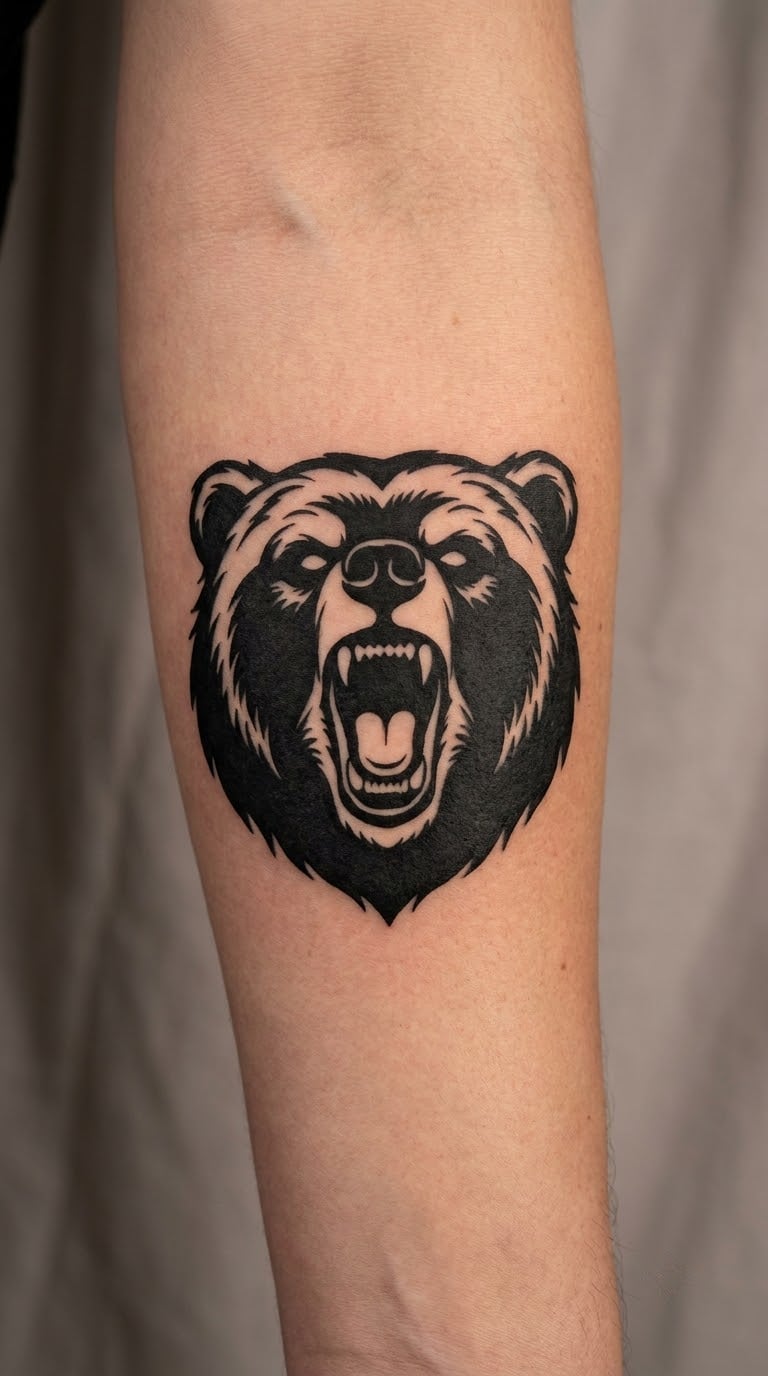
A roaring blackwork bear head is built from solid black masses with clean negative-space cuts for the teeth, eyes and ear. The whole thing should read as one heavy shape rather than a collection of lines. That weight is exactly why it works on a broad male forearm or across the chest.
People pick it because it is legible and confident, and because there is nothing in it that can look dated.
Placement: Inner forearm, outer shoulder, or centred on the chest between the pecs. Size: 4-6 inches (10-15 cm) across. Style: Blackwork. Pain: Medium to high on the chest and collarbone, medium on the forearm. Bold filled black ages well, though the smallest negative-space teeth can close up slightly over the years.
Make it yours: Tuck a birth year into the space under the jaw, or drop a small mountain silhouette inside the open mouth.
2. Geometric Black-and-Grey Bear
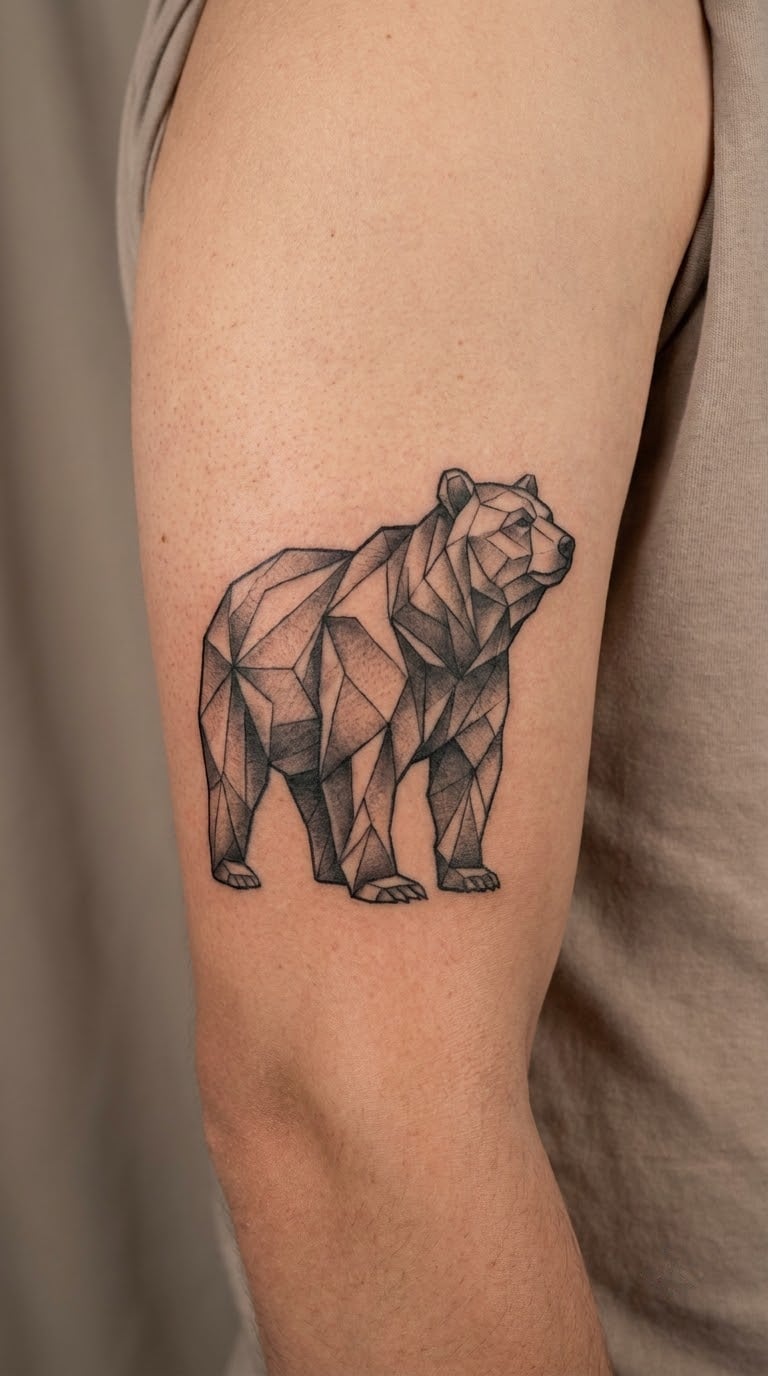
This bear is broken into angular polygons, with grey shading filling select facets and untouched skin acting as the lightest planes. Look at reference images for faceted animal work rather than circles-and-arcs geometry, or it drifts toward a logo.
It suits men who like something contemporary but not loud. The faceting gives the eye structure to follow from across a room.
Placement: Outer upper arm, vertical orientation, or the outer forearm. Size: 5-7 inches (13-18 cm). Style: Geometric blackwork with grey wash. Pain: Medium on the upper arm, medium-high over the elbow. Facet edges stay crisp, but very light grey washes on sun-exposed arms can fade toward flat.
Make it yours: Replace one central facet with a set of coordinates, or tint a single plane in a dark colour that only shows in direct light.
3. Realistic Walking Bear
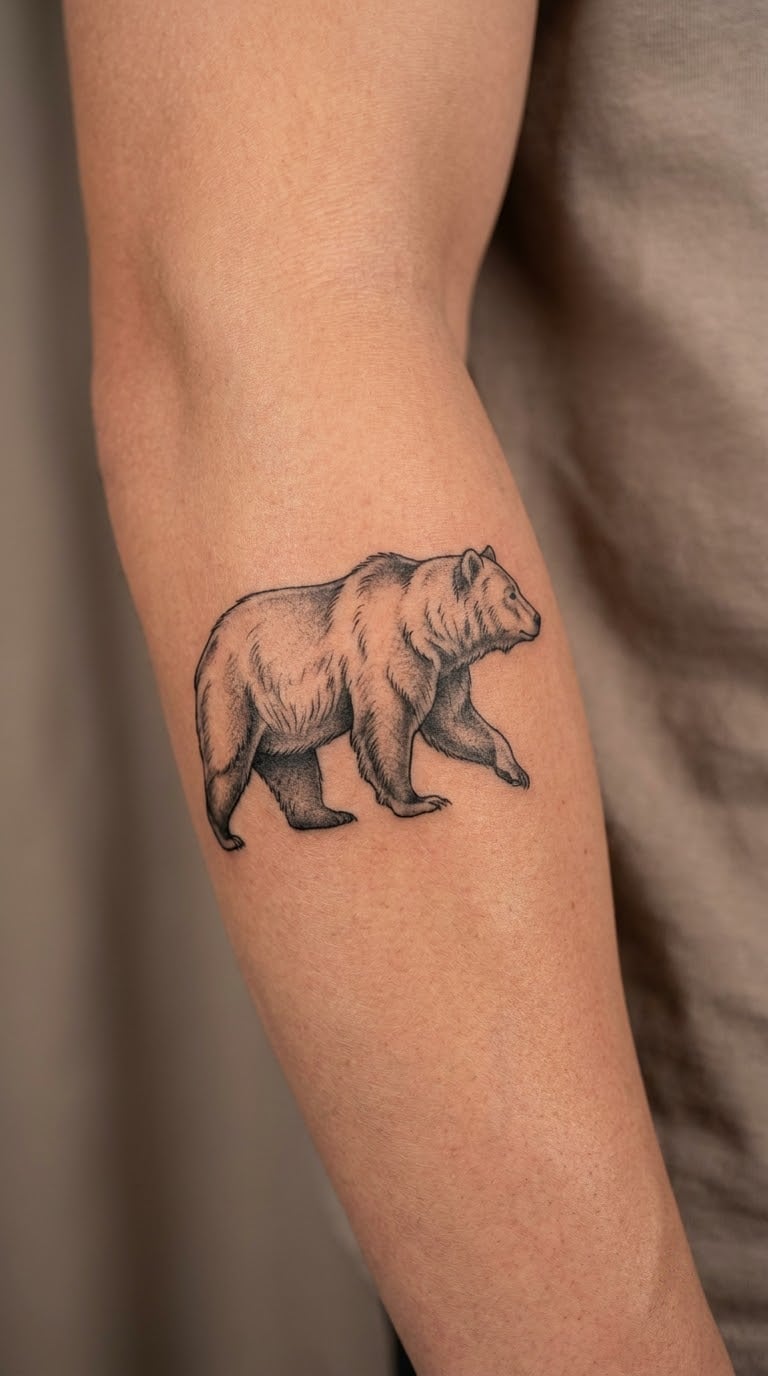
A realistic walking bear is drawn mid-stride in side profile, with textured fur, visible claws and black-and-grey shading that gets deeper under the belly and along the haunch. The motion is the whole point: one paw lifted, head forward, weight shifting.
It is one of the most requested bear designs for men because it captures an animal in action rather than posing for a portrait. A good one carries real tonal range, which is what separates it from a flat grey blob.
Placement: Outer forearm, calf, or upper arm. Size: 4-6 inches (10-15 cm) long. Style: Black-and-grey realism. Pain: Medium. Fur texture is the first thing to soften here, so expect the fine direction lines to soften within a few years even with careful care.
Make it yours: Base the posture on a real trail, a ridge you have hiked, or a specific date tied to the trip.
4. Minimalist Line-Art Bear
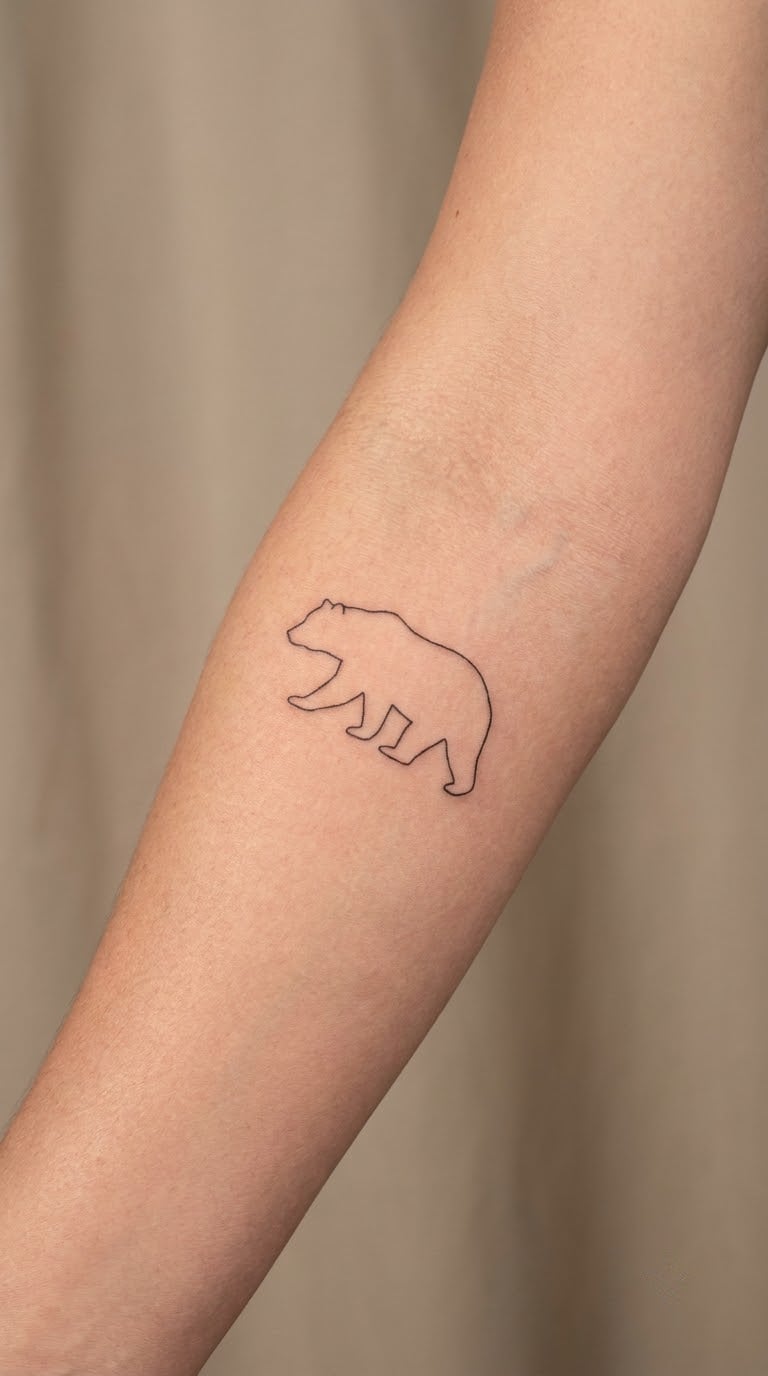
Minimalist line-art gets a seated or walking bear down to a handful of unbroken strokes: one line for the back and shoulder, one for the head, a suggestion of legs. The restraint is the style, and it is the easiest bear to live with at a small size.
Men usually choose this when they want a bear that is recognisable but not the first thing anyone notices.
Placement: Inner forearm, wrist, or high on the bicep. Size: 2-3 inches (5-8 cm). Style: Fine line / single line. Pain: Low to medium. The honest risk is fading, not pain: thin single lines on the wrist and inner forearm lose definition noticeably within a few years, so ask your artist for a slightly heavier line weight than the reference looks.
Make it yours: Add one small dot or a short horizontal line beneath the bear that marks a date or a place.
5. Traditional Rose-and-Bear Forearm Tattoo
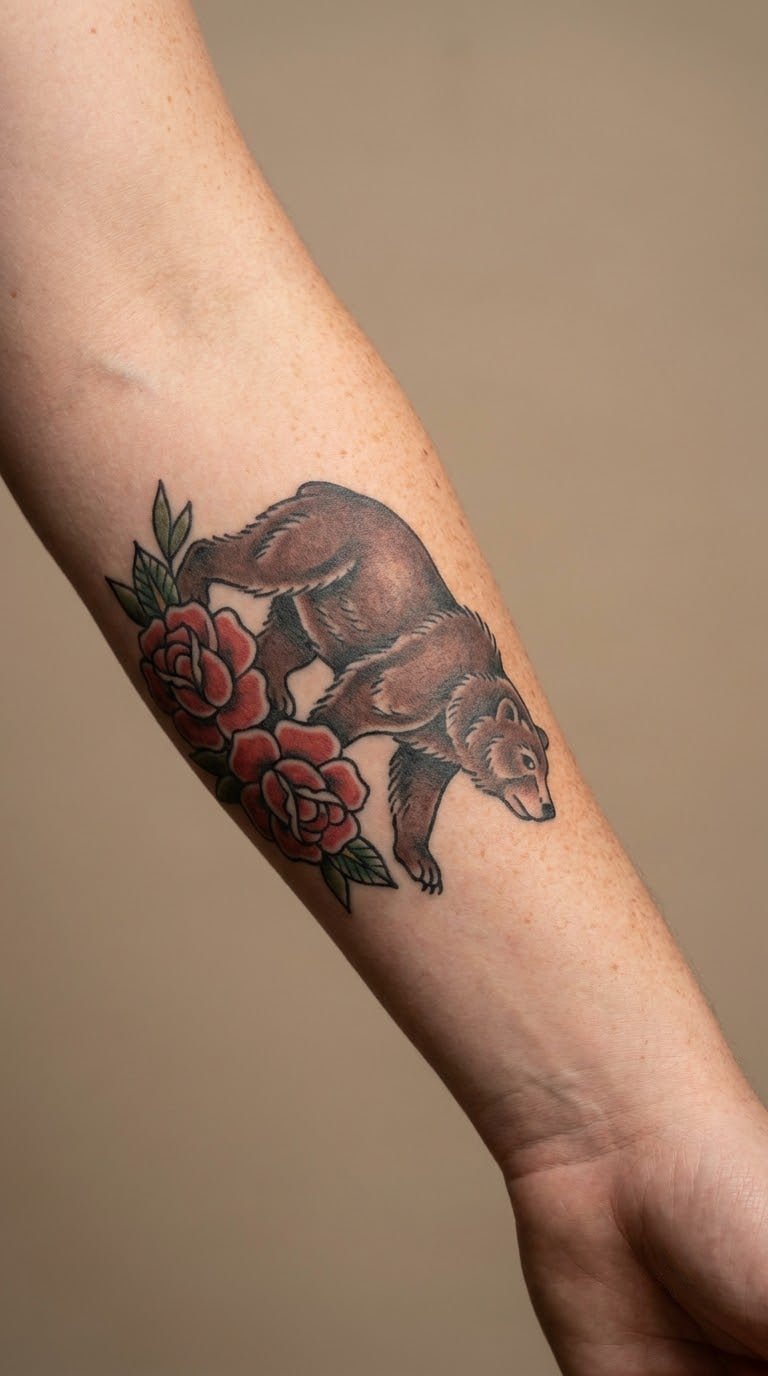
A traditional rose-and-bear composition pairs a brown or black bear with red roses, green leaves and restrained decorative shading. It is the classic layout for a full forearm: bear in the centre, flowers filling the open space above and below.
It has been the safest traditional choice for men for decades because the palette is proven and the shapes are large. It also scales up cleanly, which matters if you want a sleeve later.
Placement: Forearm, lengthwise, wrist to elbow. Size: 8-10 inches (20-25 cm). Style: American traditional. Pain: Medium, longer in one sitting. Red and green need more passes than black and will soften first, especially in strong sun.
Make it yours: Swap the roses for your own birth flower, or work an initial into the negative space behind the bear’s shoulder.
6. Mountain Blackwork Bear
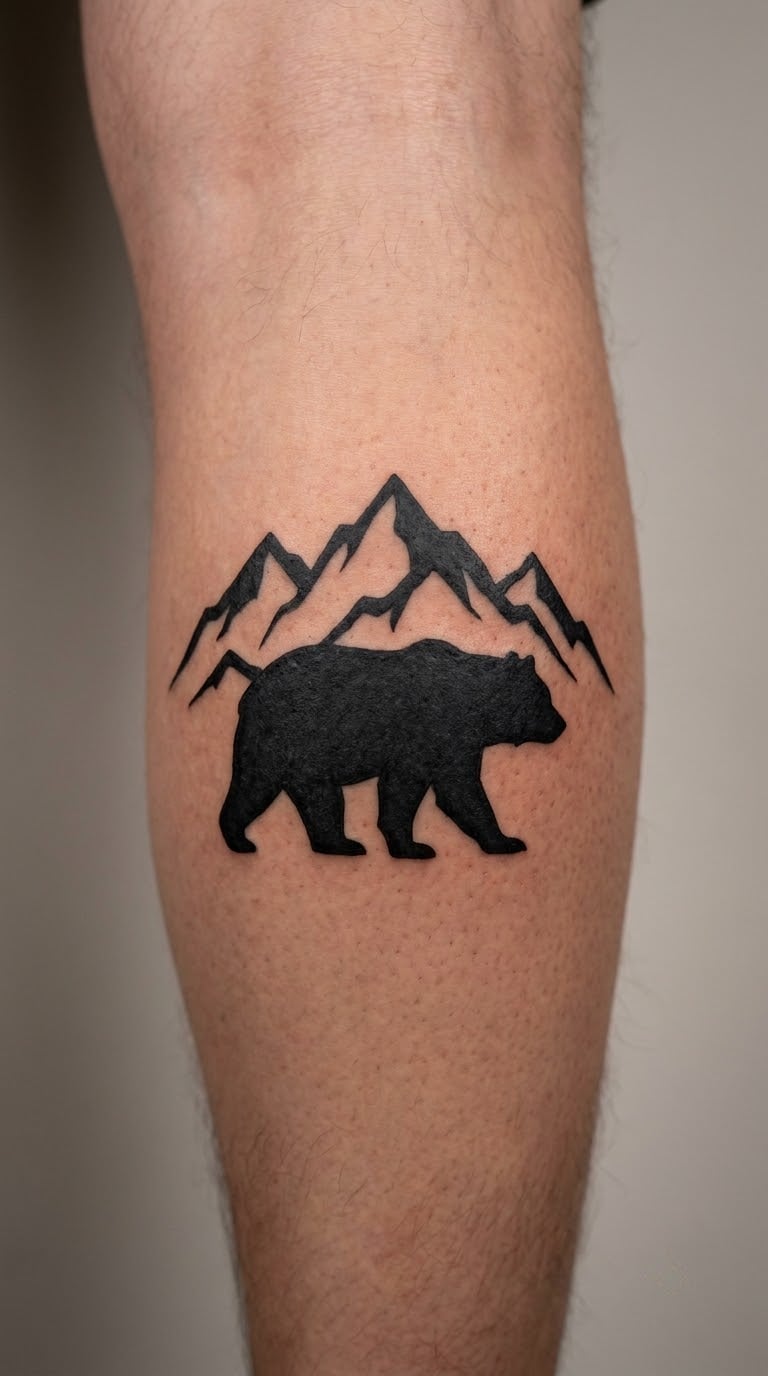
This design sets a solid black standing bear in front of a single mountain range, using two or three flat tones of grey to push the peaks back. The contrast between the solid animal and the receding scenery is what gives it depth.
It reads as an outdoors piece without tipping into illustration, and it leaves room for a personal reference without crowding the composition.
Placement: Calf, outer upper arm, shoulder, or back of the arm. Size: 6-8 inches (15-20 cm) wide. Style: Blackwork with grey background. Pain: Medium, medium-high on the inner calf. The mountains are large flat shapes and age very well; the thinnest ridge lines are what fade first.
Make it yours: Name a summit you have stood on, or add coordinates for a trailhead in a single line of fine type beneath the bear.
7. Neo-Traditional Fisherman’s Bear
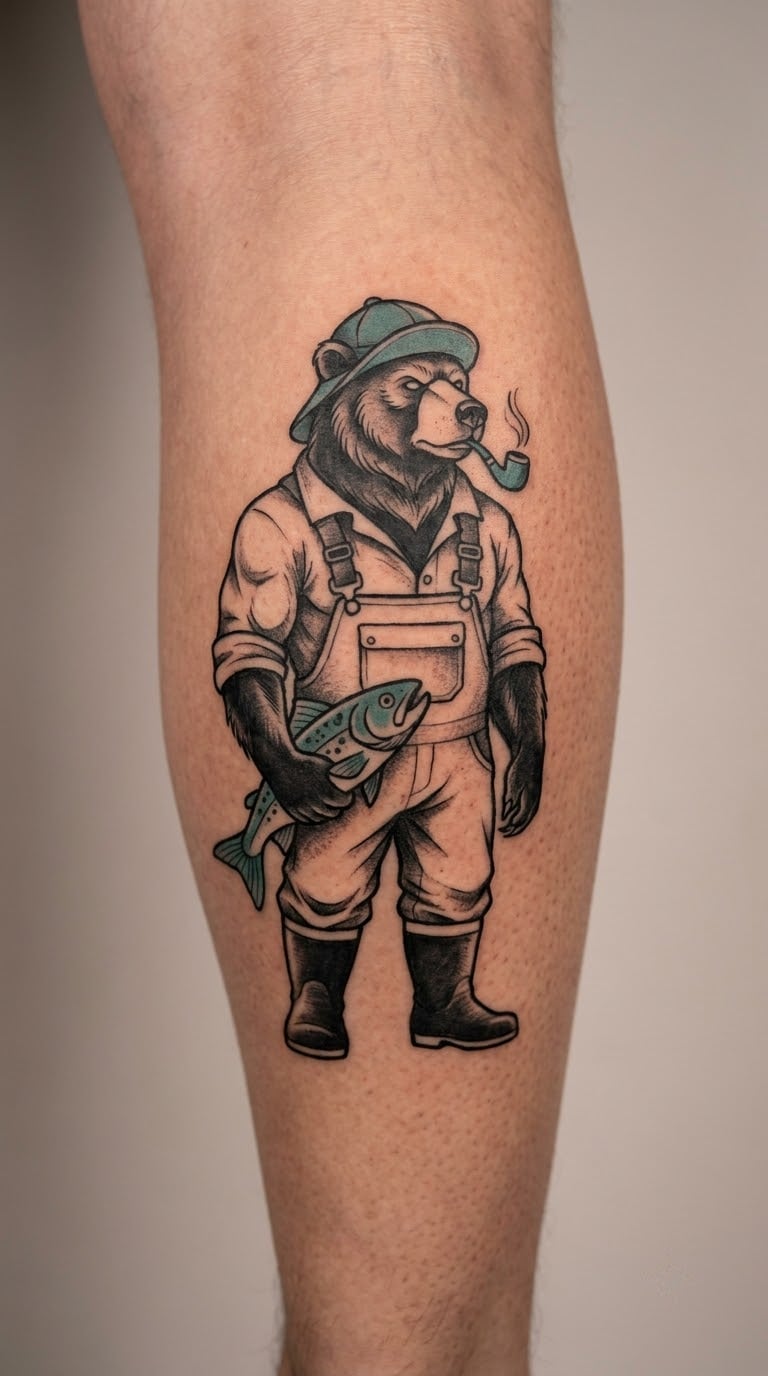
A neo-traditional fisherman’s bear is heavy-shouldered and determined, drawn with bold outlines, deep black shading and one restrained spot colour. It can stand alone or carry a small nautical accent such as an anchor, a rope coil or a wave line at the base.
Fishermen, outdoorsmen and anyone who works a physical trade gravitate to this one. It looks like a working animal rather than a mascot.
Placement: Calf, outer upper arm, or shoulder. Size: 6-8 inches (15-20 cm) tall. Style: Neo-traditional. Pain: Medium. Thick linework holds its shape for years, but a spot colour placed over a shaded area will lose saturation noticeably faster than open skin.
Make it yours: Work in a harbour name, a river you fish, or change the spot colour to one that belongs to your boat, team or unit.
8. Watercolour Mountain Bear
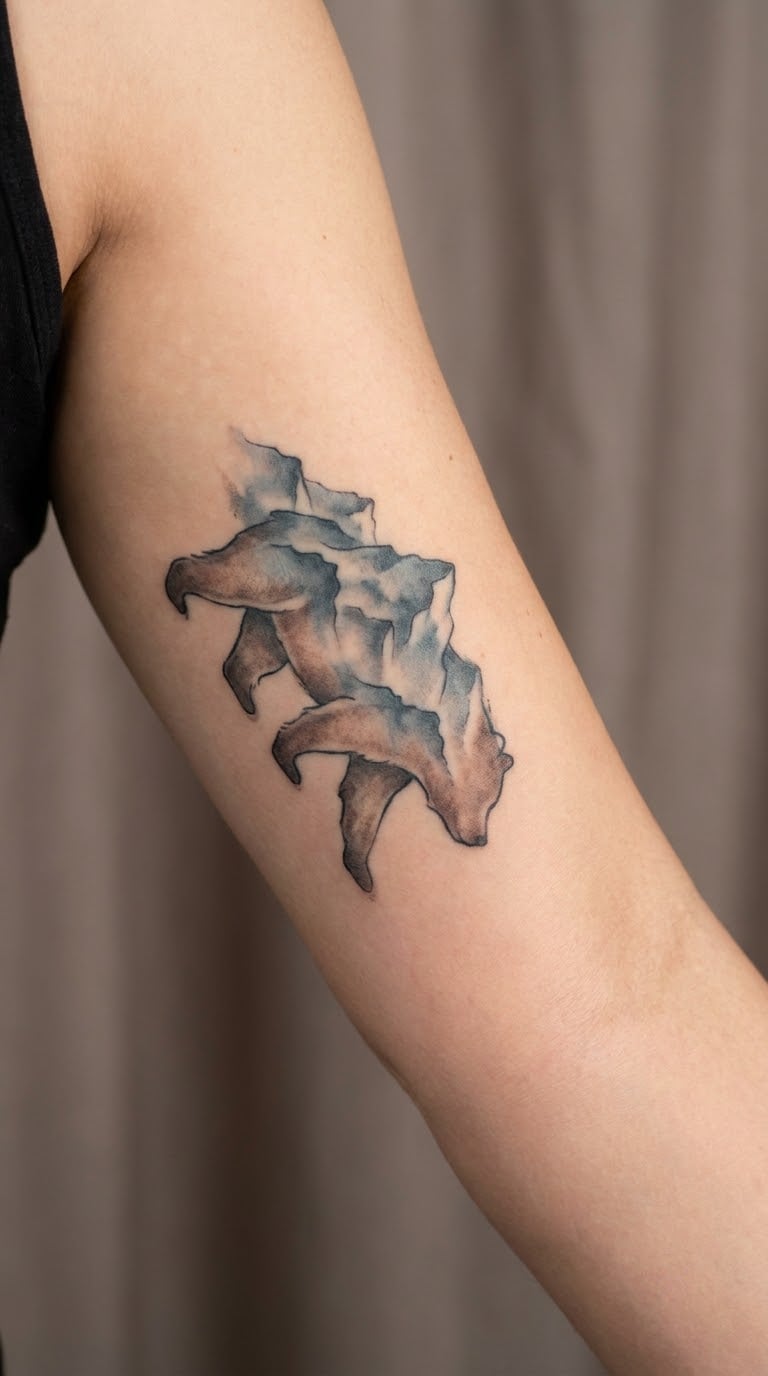
A watercolour mountain bear starts as a side-profile bear and lets the body dissolve into loose blue, grey and charcoal washes that form peaks. The transition zone does most of the work, and the negative space where the fur meets the wash is where this style lives or dies.
It is the softest option in this list, so it is worth being honest about the trade-off: watercolour has no hard edges to hold, and it needs a placement where the arm or shoulder stays covered most of the time.
Placement: Outer upper arm, back, or outer thigh. Size: 7-9 inches (18-23 cm). Style: Watercolour. Pain: Medium. Colour fades first and fades unevenly, and the light blue washes go noticeably paler in a few summers of direct sun.
Make it yours: Name a real place for the peaks, or add your birth flower in the same loose wash at the base of the design.
9. Dotwork Bear Portrait
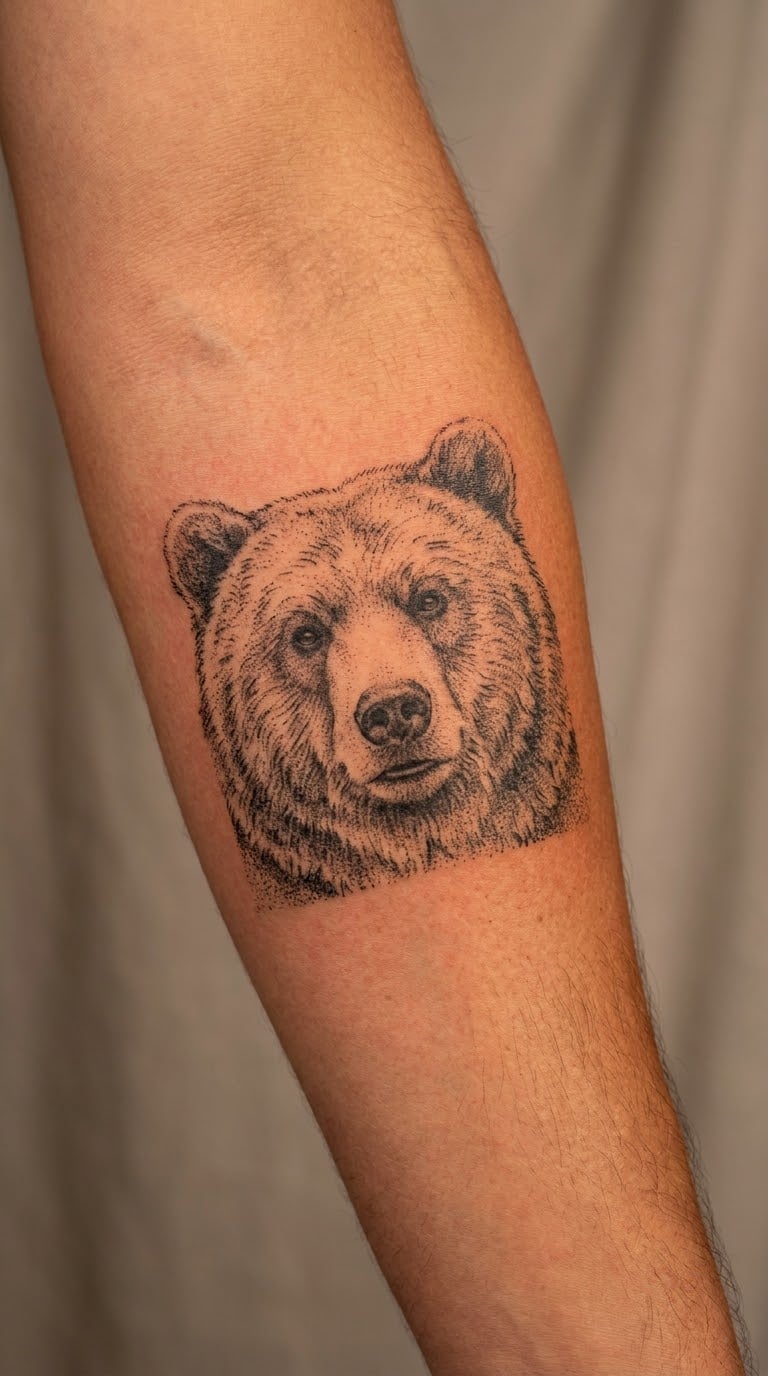
Dotwork builds a front-facing bear portrait from carefully varied dots. Densest packing at the muzzle and brow gives volume, sparse dots fade into skin at the shoulders, and the eyes are the two darkest points in the whole piece.
It lands between illustration and realism, which is why it feels more considered than a plain silhouette without demanding a large canvas. Dotwork fans tend to commission it as a standalone piece.
Placement: Outer forearm, upper arm, calf, or upper back. Size: 4-5 inches (10-13 cm) square. Style: Dotwork. Pain: Medium, and slower than it looks because each dot is a separate pass. Small dots spread and soften over time, so keep the smallest ones away from the wrist.
Make it yours: Arrange the densest dot cluster into a date, or shift the dot density to spell out a first initial inside the shadow side of the face.
10. Small Blackwork Bear Cub
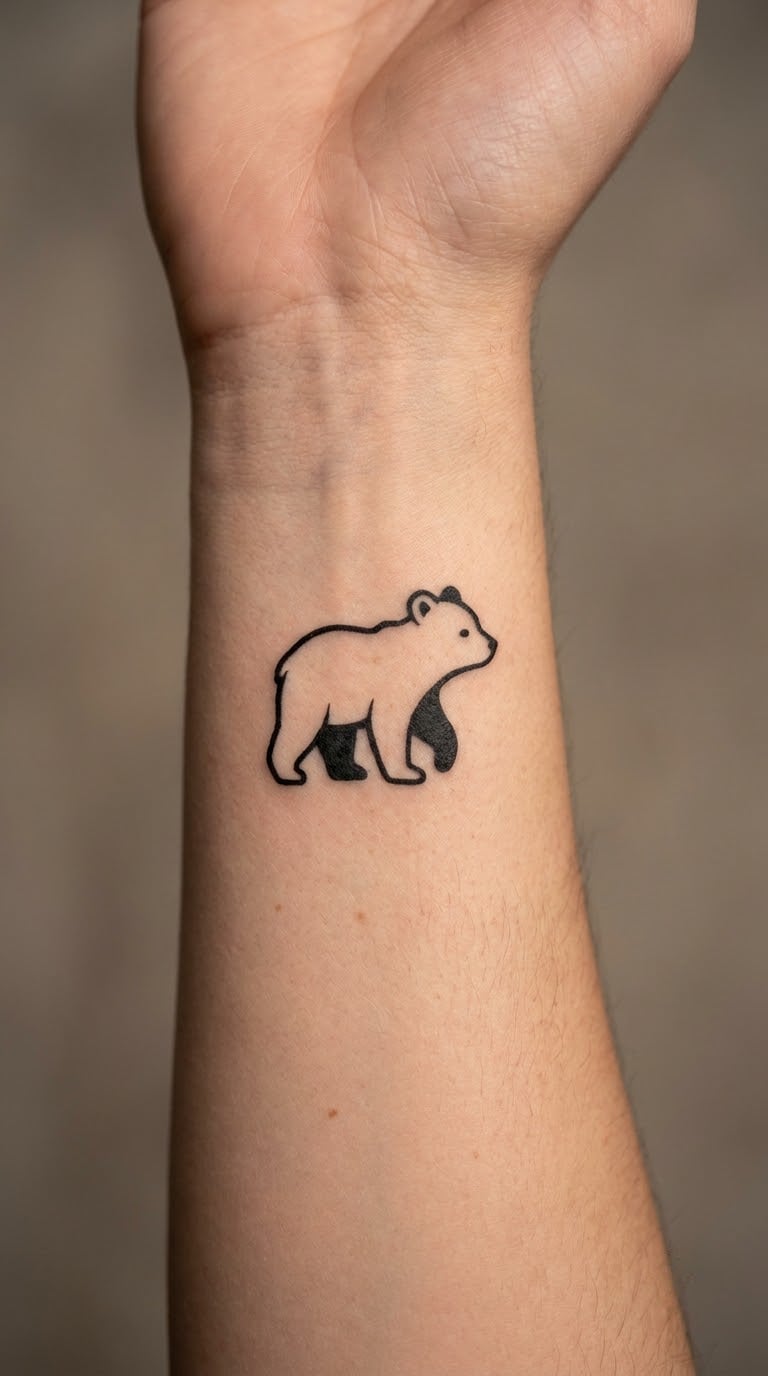
A small blackwork bear cub is one solid black mass with two clean ears, a rounded head and one suggestion of a leg. There is almost nothing to go wrong, which is precisely why it works as a first tattoo.
It also fits naturally into a collection later, either as a set of three cubs or as the small piece alongside a larger bear on another arm.
Placement: Inner wrist, finger-side forearm, ankle, or calf. Size: 1.5-2.5 inches (4-6 cm) tall. Style: Blackwork / solid. Pain: Low to medium, wrist included. Edges on a small solid shape wear slightly with sun exposure over the years, so keep the silhouette chunky rather than fiddly.
Make it yours: Add an initial, a single paw print underneath, or match it to a family member’s cub design.
11. Japanese-Style Bear and Pine
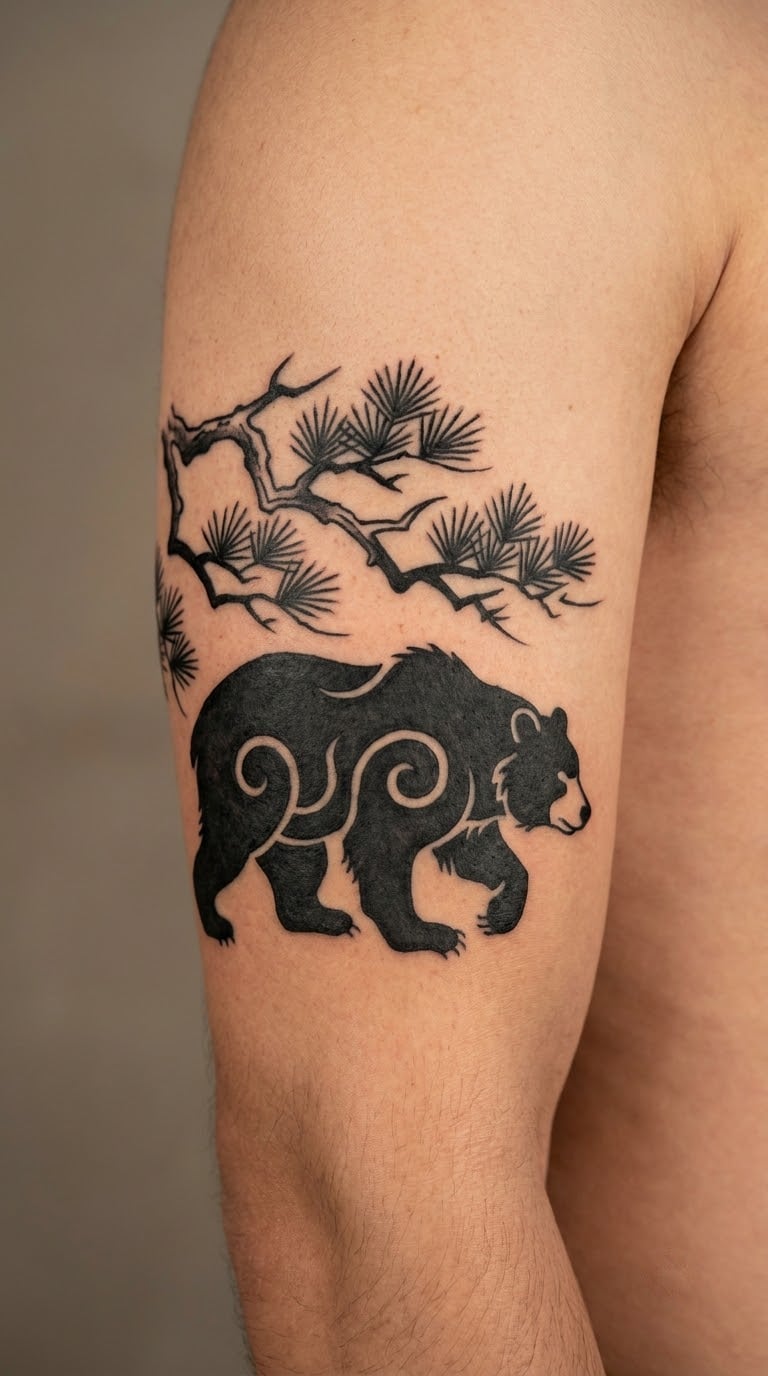
A Japanese-style bear and pine composition uses strong contour lines, flat black fills and a bear positioned beneath spreading angular pine branches. Background detail is deliberately minimal, which keeps the two subjects from fighting each other.
Negative space is doing most of the design work here. Too much background and the piece turns noisy; too little and the pine reads as decoration rather than a canopy.
Placement: Outer upper arm, shoulder, calf, or across the upper back. Size: 8-10 inches (20-25 cm) wide. Style: Japanese-style / oriental blackwork. Pain: Medium, medium-high over the shoulder blade. Contour lines and flat fills hold well; the thinnest needle lines in the branch tips soften first.
Make it yours: Use a specific bear species as the central figure, or base the pine on a family crest shape you already have.
12. Old-School Swipe Bear
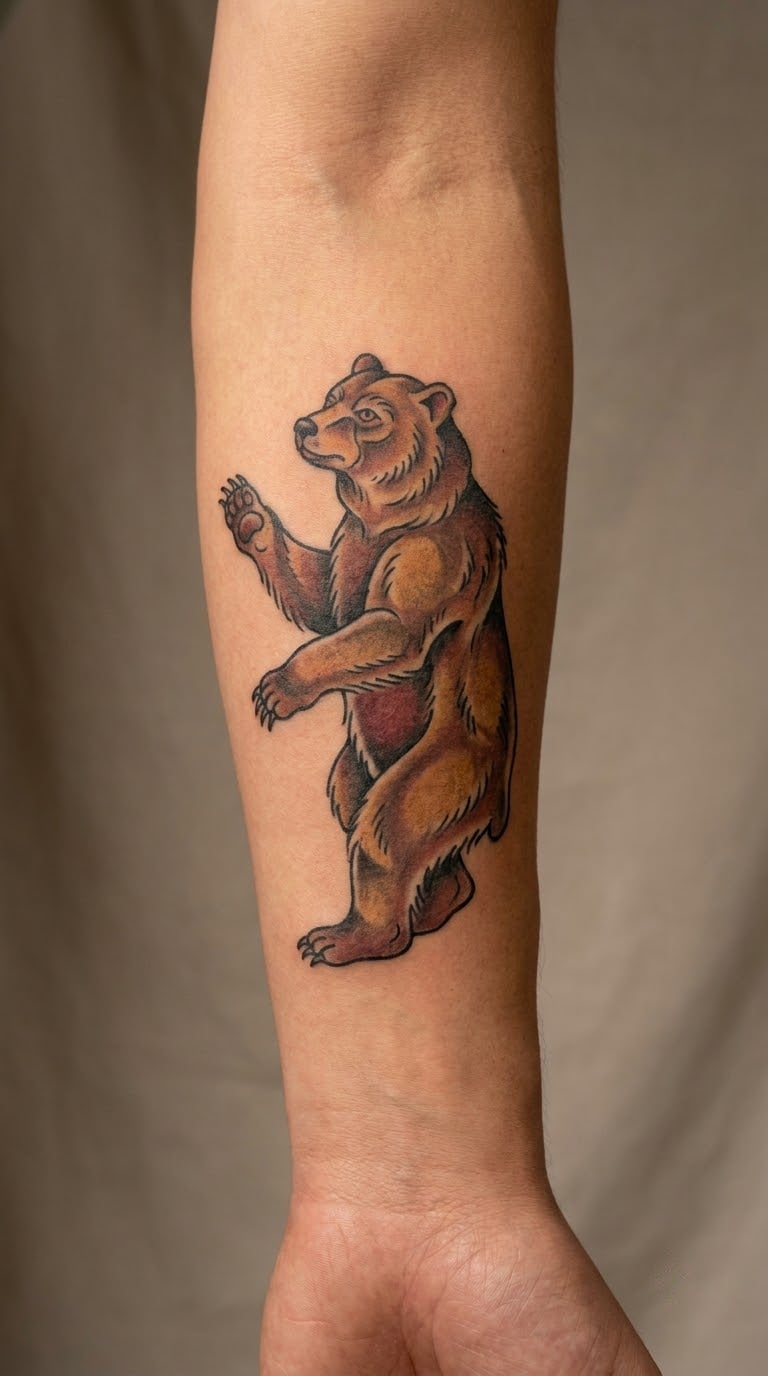
An old-school swipe bear is a single-file side-view bear with strong outlines, muted brown ink and restrained red or green accents, drawn as one element of a larger sleeve rather than as a standalone statement. It fits a nautical, woodland or Americana theme without needing the rest of the sleeve finished today.
That modular quality is why it is a common first step toward a full arm piece.
Placement: Inner forearm, outer upper arm, or lower leg as part of a sleeve plan. Size: 5-6 inches (13-15 cm) long. Style: Old school / traditional. Pain: Medium. Brown and red fill on a warm skin tone loses a little punch over time, and sleeve work often needs a touch-up session once the other elements are finished.
Make it yours: Add a coordinate, a ship’s name, or a forest element that ties the bear to the rest of your planned sleeve.
13. Blackwork Bear and Moon
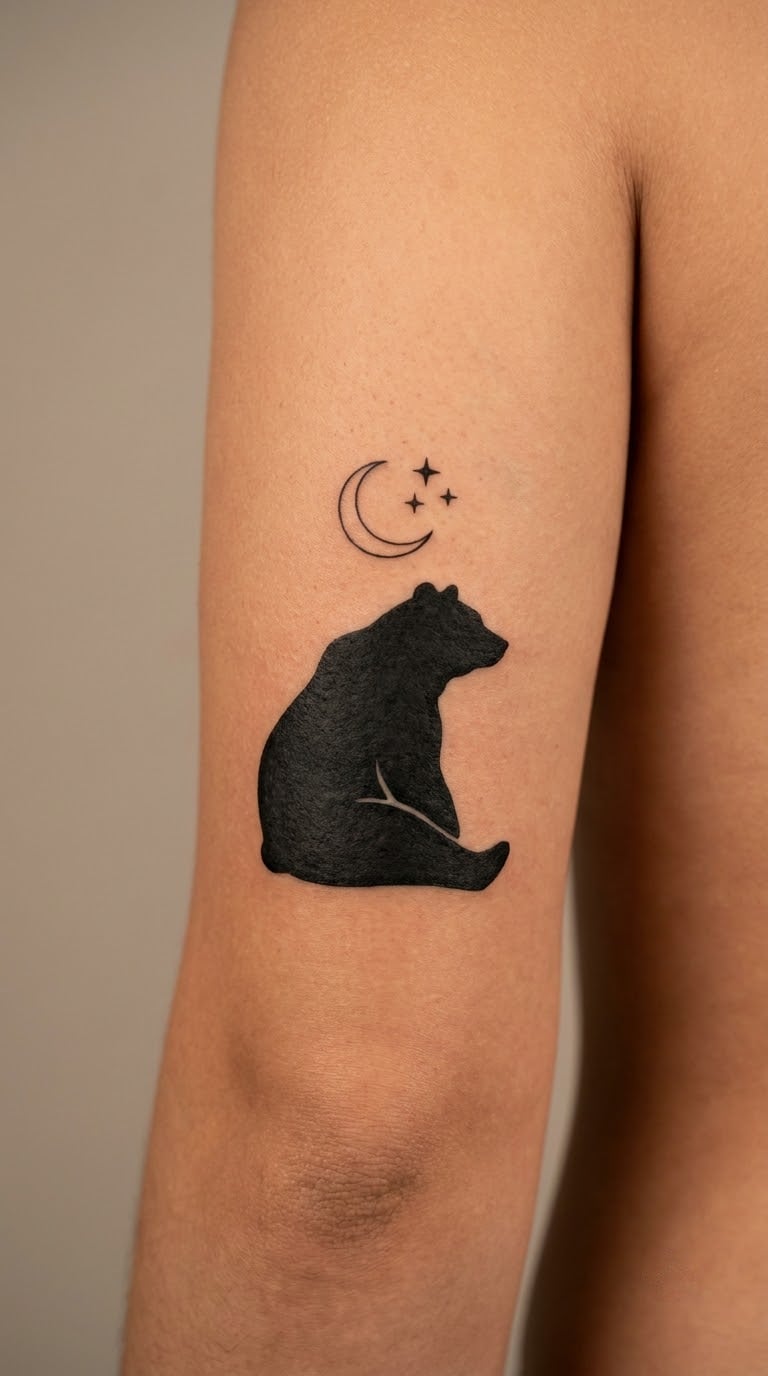
A blackwork bear and moon scene is a sitting bear in solid black, placed beneath a clean crescent and a few star-like marks. The trick is spacing: leave real skin between the bear’s back and the crescent so the two subjects never merge into a single heavy shape.
It is one of the most requested bear designs for men who want a night-time piece that still stays graphic rather than illustrative.
Placement: Upper arm, outer forearm, calf, or shoulder. Size: 5-7 inches (13-18 cm) wide. Style: Blackwork. Pain: Medium. The crescent is the vulnerable part, so keep it at least an eighth of an inch wide and out of direct sun if you can.
Make it yours: Date the moon to a real lunar event, or add one small birth star in a corner of the composition.
14. Pine Forest Blackwork Bear
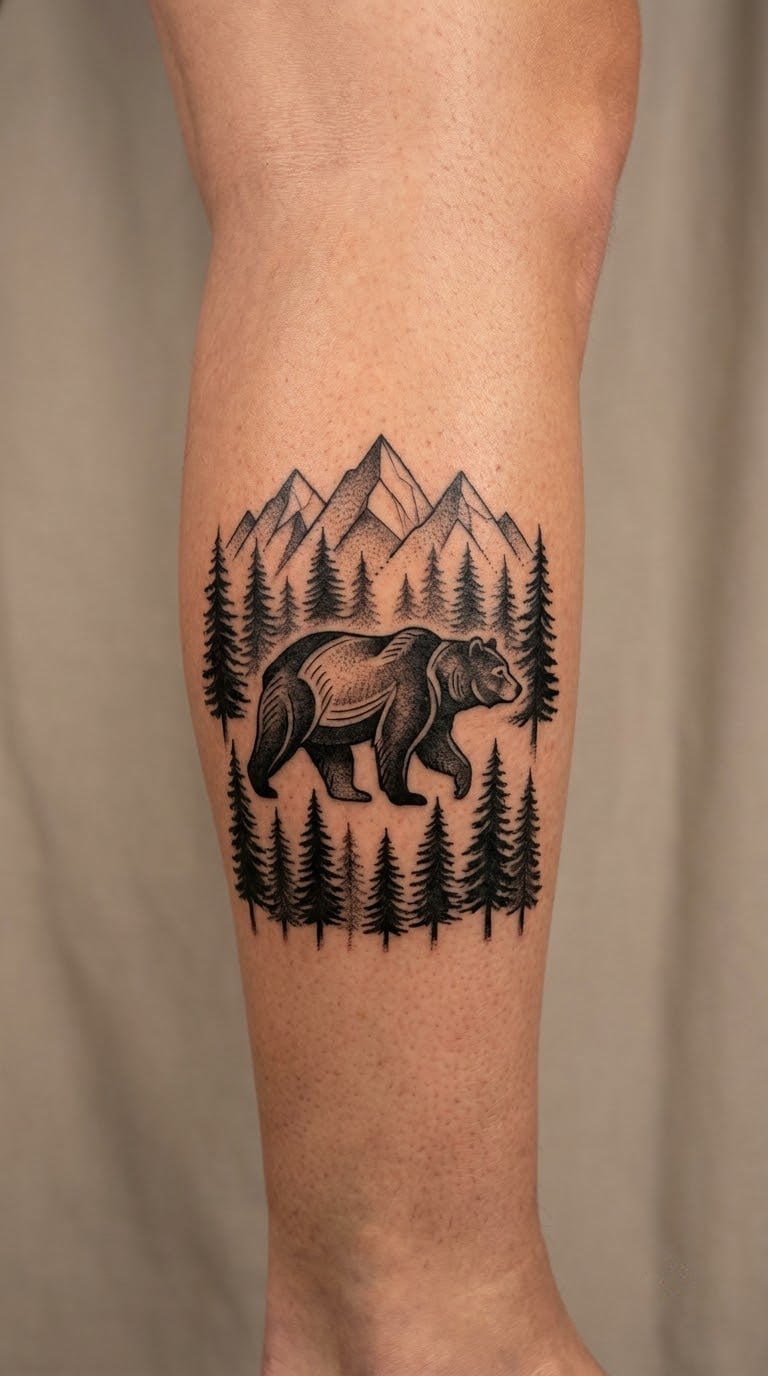
The pine forest blackwork scene is the biggest piece in this list: a walking bear moving between layered pine trees with distant peaks behind them. Foreground contrast carries the depth, so the nearest trees and the bear are solid black while the range behind is a lighter grey.
Men choose a scene like this when the subject is the place rather than the animal.
Placement: Calf, shoulder, back of the arm, or outer thigh. Size: 10-12 inches (25-30 cm) wide. Style: Blackwork scene. Pain: Medium to high over a long session, and expect a break. Smaller background details blur with age, so resist adding a fourth layer of trees.
Make it yours: Build the scene around a forest you have actually walked, or add a coordinate and leave the rest as pure scenery.
15. Fine-Line Grizzly Linework
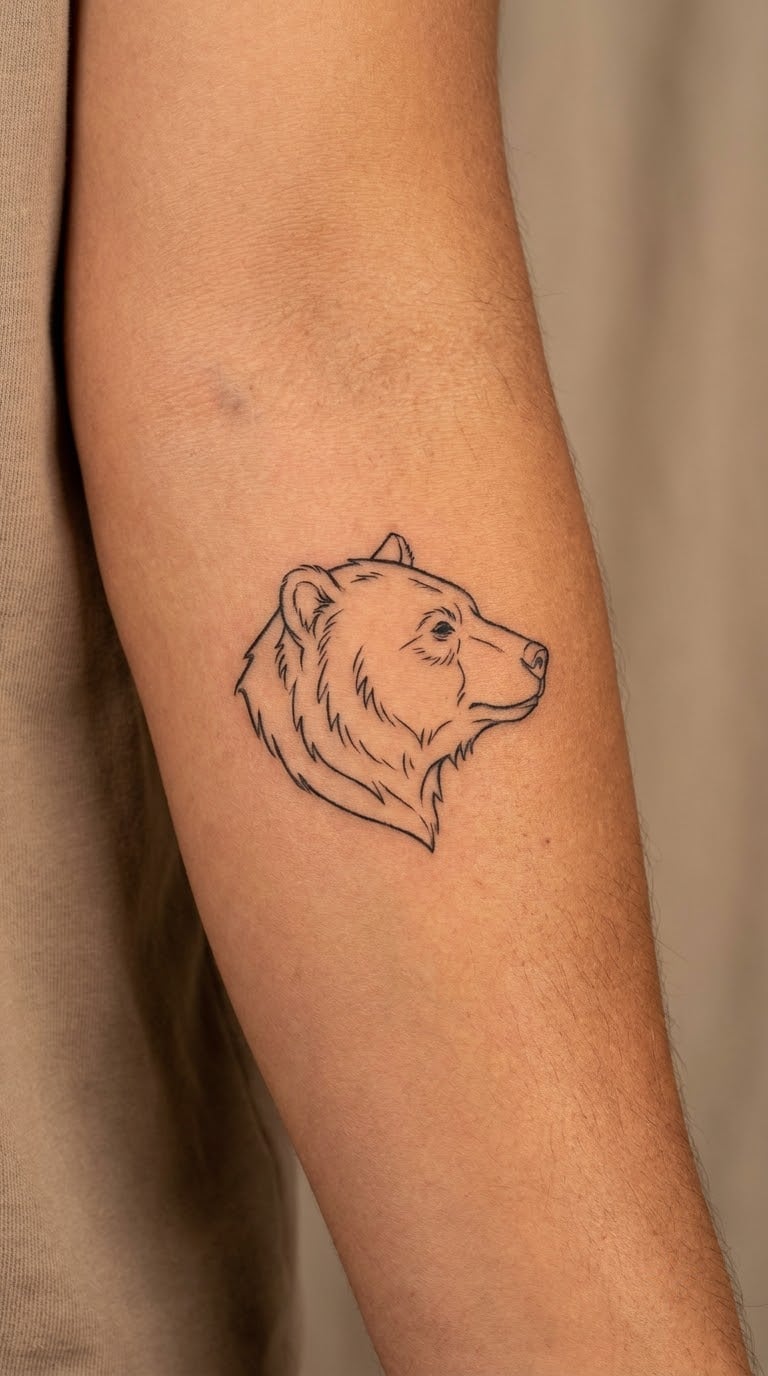
Fine-line grizzly linework draws a head in profile using economical contour strokes for the fur direction, the shoulder and the snout, with no background at all. The effect depends on restraint: too many strokes and the head greys out.
It appeals to men who want a recognisable grizzly without a full realistic rendering, and it pairs well with a small matching piece elsewhere.
Placement: Inner forearm near the elbow, outer forearm, or calf. Size: 3.5-5 inches (9-13 cm) long. Style: Fine line. Pain: Medium, higher close to the elbow bone. This is the design that fades fastest on sun-exposed and frequently moved skin, so expect a refresh or a re-work conversation within five years.
Make it yours: Pair the head with a short name rather than more micro-detail, which keeps the linework readable as it softens.
16. One-Colour Realist Bear Cub
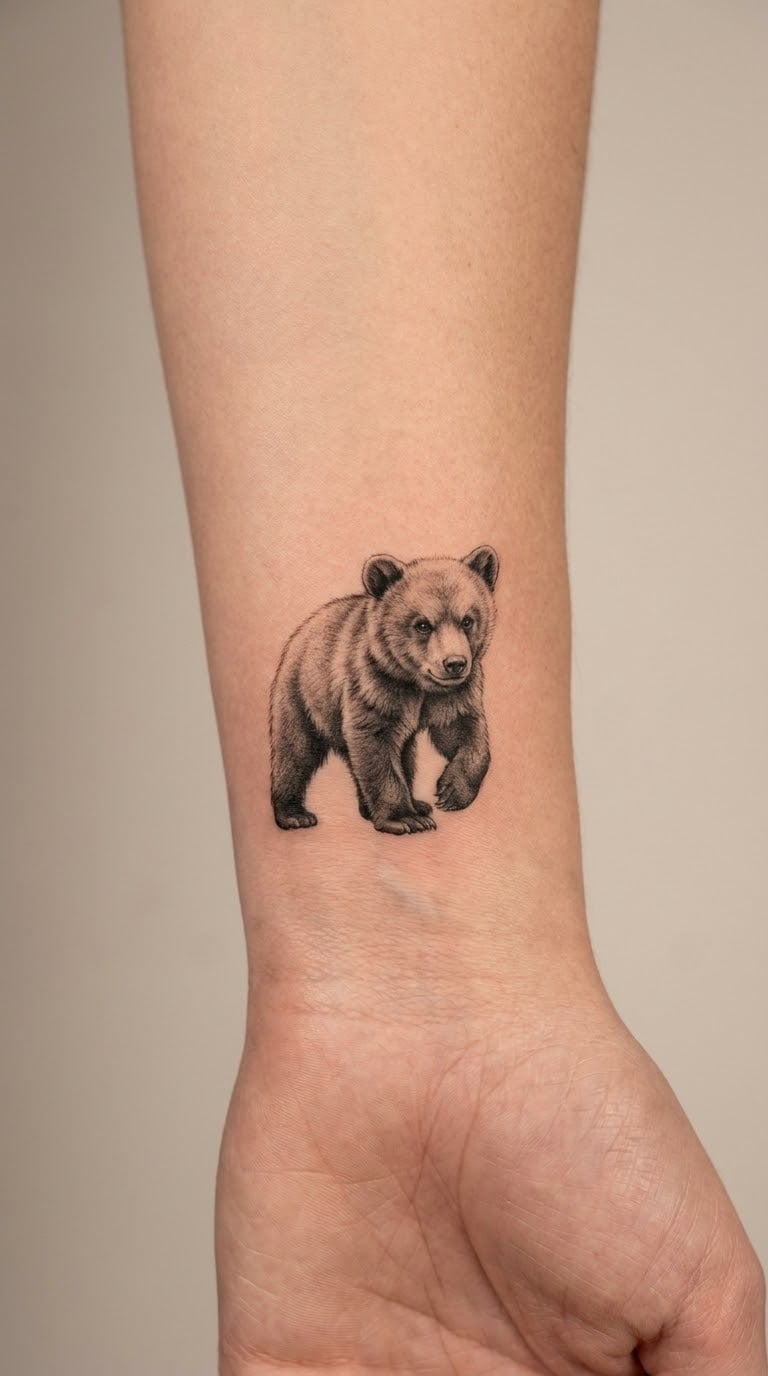
A one-colour realist bear cub is drawn in black and grey only, with careful highlights left as bare skin and no colour anywhere. The tension between the tiny size and the level of rendering is what makes it interesting to look at.
It is a slightly risky pick at 2 inches, and it works best when the artist simplifies the fur direction so the shape stays readable.
Placement: Inner wrist, forearm, calf, or shoulder. Size: 2-3 inches (5-8 cm) tall. Style: Realism, black and grey. Pain: Low to medium. Detail is the enemy at this size: fur texture and eye definition soften first, and the wrist compounds the problem with constant movement.
Make it yours: Turn a paw print into your initial, or add a small matching birth star so the piece still has a detail worth preserving.
17. Neo-Traditional Polar Bear
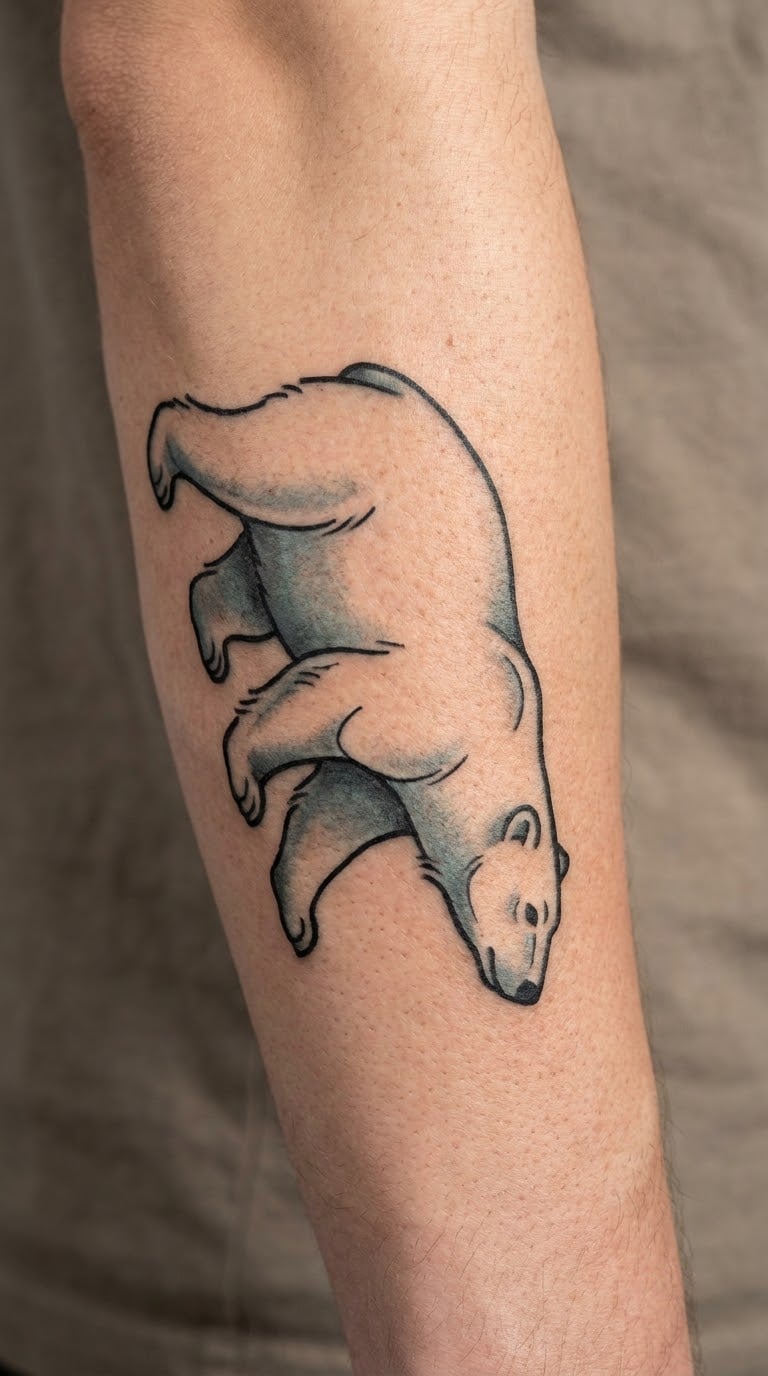
A neo-traditional polar bear is a clean profile drawn with bold black contours, white negative space for the body and a restrained icy-blue shadow underneath. Because there is no colour in the animal itself, the outline does all the work and it stays visible on bare skin.
The species choice matters more than the style here. Polar bears get chosen for a reason that is usually personal, and the pale look suits a cooler palette than a brown bear allows.
Placement: Forearm, upper arm, calf, or shoulder. Size: 5-7 inches (13-18 cm) long. Style: Neo-traditional. Pain: Medium. The blue shadow is the first thing to fade, and it will go noticeably paler without a refresh after a few summers in shorts.
Make it yours: Use coordinates from a cold-weather trip, work a snowflake formation into a date, or match the blue to a watch strap or a boat.
18. Minimal Black Silhouette on a Forearm
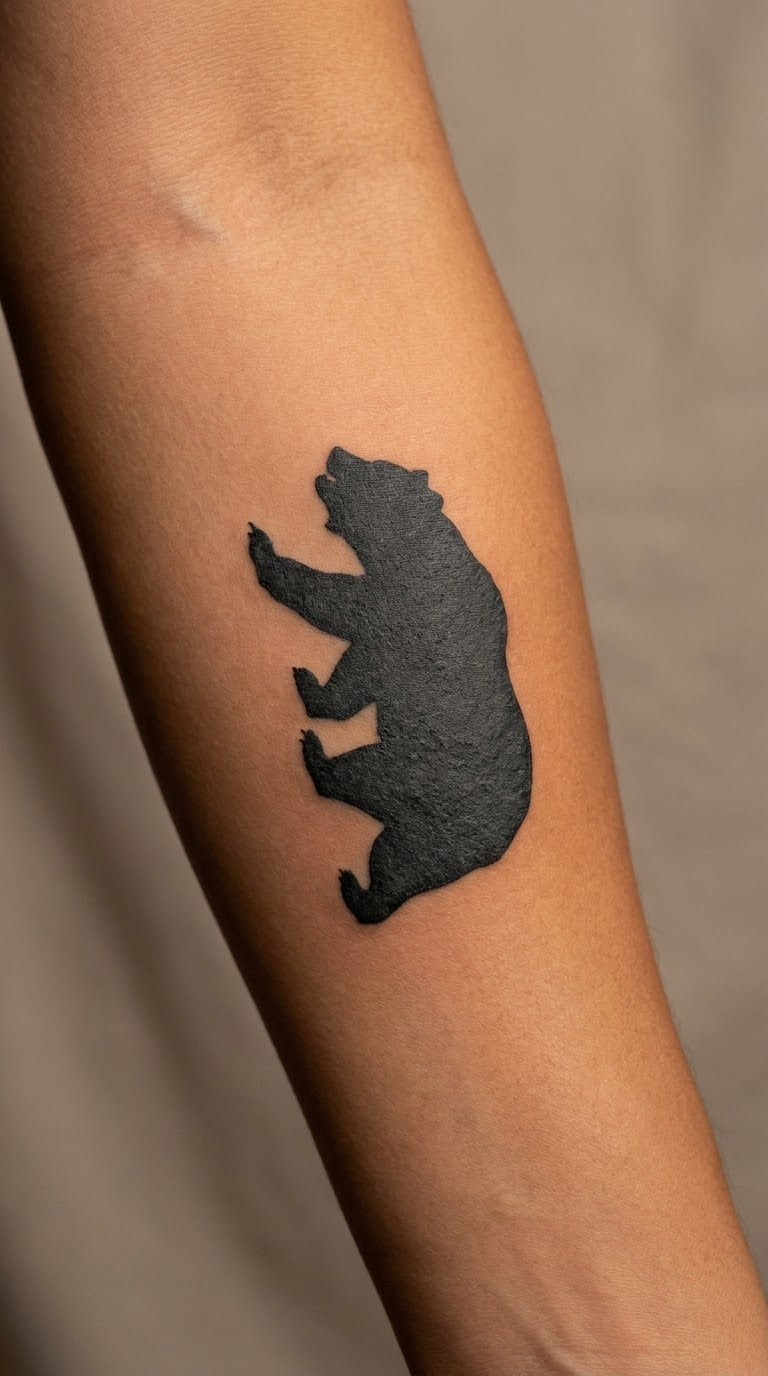
A minimal black silhouette is a featureless walking bear formed from one confident shape: no ear detail, no eye, no fur, just the outline of a bear in motion. It is strong from a distance and completely quiet up close.
Simple silhouettes are the most durable design category there is, and this one works equally well as a first tattoo or as a small anchor in a collection.
Placement: Inner or outer forearm, upper arm, calf, or shoulder. Size: 3.5-5 inches (9-13 cm) long. Style: Black silhouette. Pain: Low to medium, one of the quicker sittings here. A single solid shape shows no softening at all; only the outline edge rounds off very slightly.
Make it yours: Run a thin underline beneath it carrying a date, or align it so the bear’s stride continues an existing wrist band.
19. Family of Three Minimalist Bears
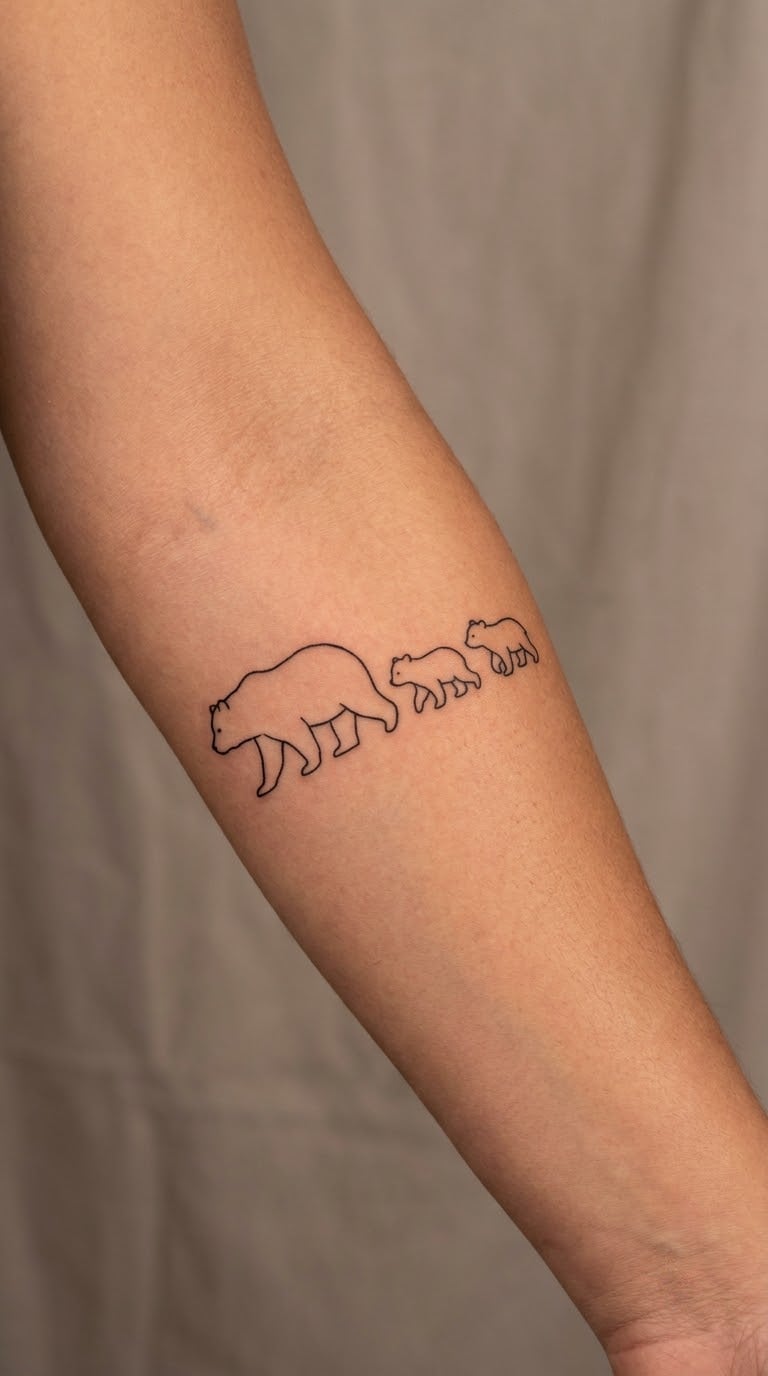
A family of three minimalist bears puts one adult and two cubs in a line, each in a slightly different pose but sharing the same line weight and level of detail. The hierarchy does the work: the adult is larger and more solid, the cubs are smaller and simpler.
It is usually chosen for children, siblings or pets, and it still reads as a man’s piece because the adult figure carries the weight of the composition.
Placement: Forearm, upper arm, or across the calf. Size: 6-7 inches (15-18 cm) long. Style: Minimalist or fine line. Pain: Medium, and slightly more time because of the three separate figures. Keep facial detail minimal; the cubs are the first part to blur.
Make it yours: Give each cub a distinct stance matched to a real person or pet, and keep all three faces to the same level of simplification.
20. Blackwork Bear in a Pine Circle
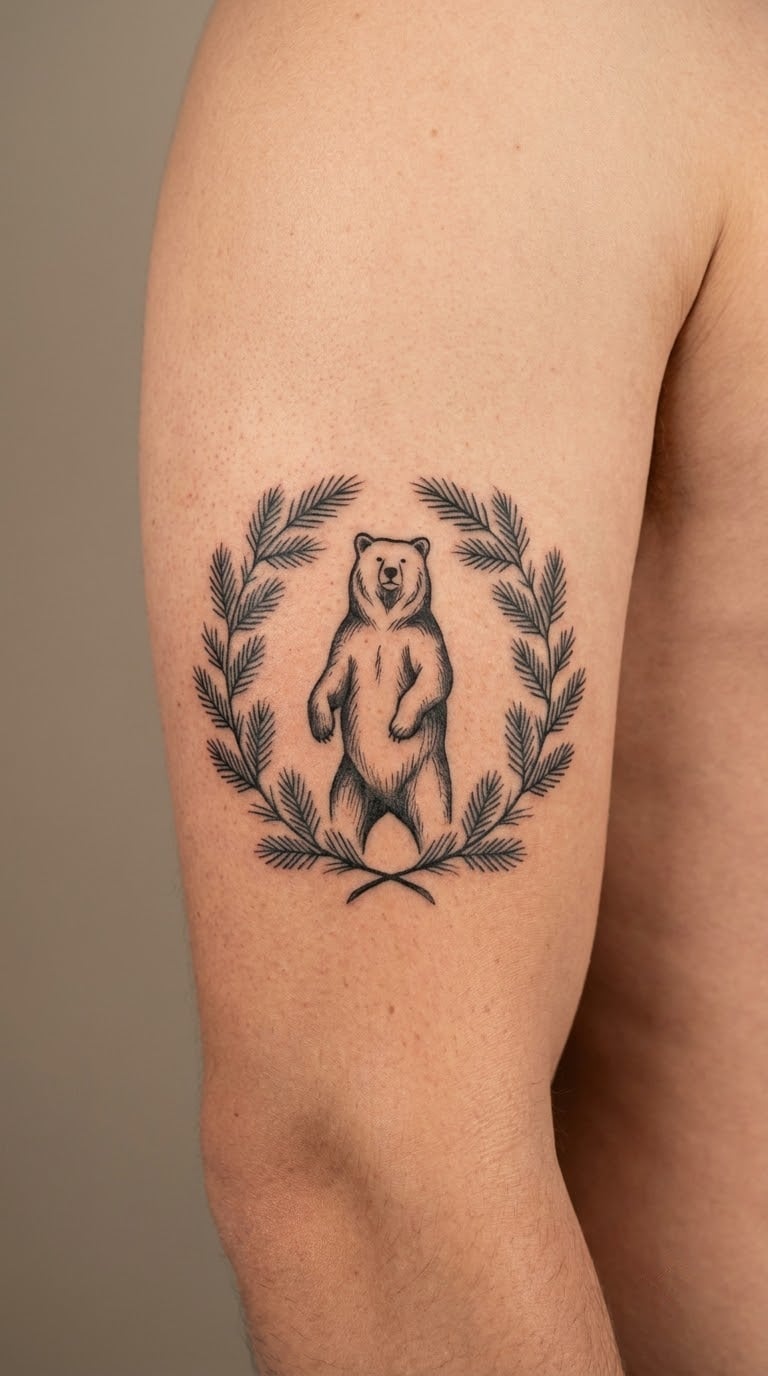
A blackwork bear in a pine circle is a bold standing bear framed by an incomplete circular wreath of pine needles, with the ring broken in one or two places. The break is deliberate, and it keeps the composition from looking like a sticker.
Framing works like this because it gives a strong central silhouette somewhere to sit. It also gives you a natural spot to hide a small personal element without wrecking the balance.
Placement: Outer upper arm, shoulder, forearm, or calf. Size: 5-6 inches (13-15 cm) tall. Style: Blackwork with a wreath frame. Pain: Medium. The solid bear holds indefinitely, while the fine needle tips in the wreath soften within a few years and need a touch-up if you want them crisp.
Make it yours: Place a meaningful year in the break in the circle, or set a covered initial into the lower needles.
How to Choose the Right Bear Tattoo
Five checkpoints will narrow twenty options down to two or three worth taking to a consultation.
Check the line weight against the placement, not the reference image
A design that looks sharp at 6 inches on a screen turns soft on an inner forearm, where skin moves and sun hits daily. Ask your artist to show you previous work at the size you are actually getting, and expect them to simplify the eye and fur detail at that scale.
Decide how much black you want on your arm
Solid blackwork covers more area in the same footprint, which is why ideas 1, 6, 10 and 18 read as bigger than their dimensions suggest. If you work with your arms bare and want something quieter, the fine-line and silhouette options in this list take up far less visual space.
Size for the real estate, not the drawing
Measure the flat area first, then check the design against it at the size you are considering. Add these bear tattoo ideas for men to a mood board at the exact scale rather than cropping screenshots, and the comparison becomes obvious fast.
Think about the next ten years, not the first week
Anything with fur texture, eyes or a fine crescent needs a refresh. If you are not the kind of person who will come back for a touch-up in five years, a solid silhouette or a bold blackwork head is the calmer choice. More forearm placement ideas are in our forearm band tattoo guide.
Match your bear tattoo ideas for men to the ink you already have
If you have existing work, the easiest blackwork designs sit next to bold pieces without competing, while a soft watercolour scene usually wants an arm to itself. Larger placements like the calf and upper arm are worth browsing in our inner bicep tattoo ideas and thigh tattoo guide before you commit to a scene.
The easiest concept here for a first tattoo is the small blackwork bear cub. For someone building a collection, the realistic walking bear, the traditional rose-and-bear or the mountain blackwork scene gives you the most to work with as a feature piece.
Cost and Session Time
Custom bear tattoos are priced by size, detail and hourly rate, so the ranges below are what you will typically see in the US. Treat them as a starting point for a conversation, not a quote.
| Size band | What it covers | Typical US price range (USD) | Chair time | Sessions |
|---|---|---|---|---|
| Micro or small (1-3 in) | Silhouette, bear cub, fine-line head | 120-400 | 1-2 hours | 1 |
| Medium (4-7 in) | Bear head, walking bear, traditional forearm piece | 400-1200 | 2-4 hours | 1-2 |
| Large (8-12 in) | Rose-and-bear, Japanese-style, forest scene | 1200-3000+ | 4-8 hours | 2-4 |
What moves the number most is artist hourly rate, which varies a lot by city and by reputation, and shop minimums, which many studios set at a flat starting charge. Detail density and colour count push the session longer: a black-and-grey scene with ten layers of grey takes far more hours than a solid silhouette of the same size. Travel adds to the total if you are chasing a specific artist, and touch-ups on colour are usually included but reworks on old blurred work are billed as new work.
Ask for the total estimate before the first session, not the per-session number. A three-session plan quoted per session can look cheaper than it is.
Aftercare Basics
The first few days decide how the piece looks in a year. Follow your artist’s aftercare instructions above anything generic you read online, including this.
- Wash it gently. Follow your artist’s aftercare instructions on cleaning, then rinse with clean lukewarm water and pat dry with something that does not shed fibres.
- Leave it alone. Follow your artist’s aftercare instructions about not picking flakes or scratching, and skip unnecessary films, lotions and heavy creams while the skin settles.
- Keep fresh ink out of long direct sun. Follow your artist’s aftercare instructions on covering it in the first weeks, and treat sun exposure as the biggest long-term cause of fading in grey shading and colour.
- Pick a cover that does not trap moisture. Follow your artist’s aftercare instructions on loose clothing and breathable fabric, since a tight wrap can hold sweat against healing skin.
- Ask a professional early. Follow your artist’s aftercare instructions first, and if irritation or a reaction persists or feels unusual, contact the studio or a healthcare professional rather than trying to fix it at home.
Frequently Asked Questions
What is the best small bear tattoo for a first piece?
A small side-view bear cub or a solid silhouette is usually the easiest starting point, because it needs fewer details and fits a compact area without crowding. Choose a design whose inner shapes stay bold enough to read at two inches. Ideas 10, 16 and 18 in this guide are all built for that size. Bring a second option in case your artist recommends a slightly larger scale.
Do bear tattoos have a specific meaning?
Bear tattoos are often connected with strength, courage, protection, resilience and family, but the personal meaning comes from the story behind your specific design. Some men choose a grizzly for a real encounter, a polar bear for a place that matters, or a cub for a child. There is no fixed dictionary entry, so the meaning is yours to set rather than inherit.
Are detailed bear tattoos likely to fade or blur?
Fine fur lines, eyes and small textures soften sooner than bold silhouettes, especially on frequently exposed areas like wrists and inner forearms. An experienced artist can simplify the composition for your chosen size so the face still reads. Plan a refresh for detailed realism work after five years or so, or choose a bold blackwork design that needs far less upkeep.
Where does a bear tattoo hurt the most?
Pain depends more on placement, scale and your own sensitivity than on the bear image itself. Ribs, sternum, spine, shoulder and areas over the elbow or kneecap usually feel sharpest, while upper arms and outer thighs are more manageable. A calm two-to-three hour forearm sitting is usually easier to sit through than a short session over the ribs.
How much should a custom bear tattoo cost?
Small bear pieces generally run from a couple of hundred dollars, medium four-to-seven inch work lands in the mid hundreds to low thousands, and large custom scenes can run well into the thousands. Artist hourly rate, shop minimums, colour count, detail density and the number of sessions all shift the final figure, so treat any range as a starting point and ask for a total estimate before the first sitting.
Best Bear Tattoo Ideas for Your First Piece or Collection
If this is your first tattoo, the small blackwork bear cub is the lowest-risk way in. One solid shape, a quick sitting, and nothing to disappoint you later. If you are adding to an existing collection, the realistic walking bear, the traditional rose-and-bear or the mountain blackwork scene gives you the scale to act as the feature piece the rest of your work sits around.
Save the two or three designs you keep coming back to, then take them to an artist who works in the style you picked rather than one who will simply trace a reference. Bring your placement, your real-world size and your honest tolerance for touch-ups, and the conversation starts in the right place. Updated for September 2026.