
25 Piano Tattoo Ideas: Best Designs for Music Lovers in 2026
Updated for October 2026
A piano tattoo usually means a private relationship with music rather than a general love of it. People who get one are often marking something specific: the instrument they practise on alone, a teacher who sat beside them, a grandparent’s upright in a hallway, a song that rearranged them, or a decade of recital photos. The 25 piano tattoo ideas below each come with a plain description, a meaning note, real sizes in inches, the placement that suits the design, and an honest word about pain and ageing.
What separates a good piano tattoo from a flat vector drawing is scale and surface. A grand piano with visible strings needs 4 inches or more of flat-ish skin to read properly, and the same image at 1.5 inches on a wrist turns to mud. So read the quick guide first, then the entries, and take the ones that interest you to an artist as references rather than final line art.
25 Piano Tattoo Ideas: Quick Guide
| Idea | Style | Best placement | Size (inches) | Pain |
|---|---|---|---|---|
| 1. Minimalist keyboard | Fine line | Inner forearm | 3.5–4 wide | Low |
| 2. Realistic upright | Realism, greywash | Outer calf | 4.5–5.5 tall | Medium |
| 3. Grand silhouette | Solid blackwork | Behind the ear | 2–2.5 wide | Medium |
| 4. Wrap-around key band | Line art | Inner wrist | 1.5–2 wide | Medium-high |
| 5. Rainbow watercolor keys | Watercolor | Inner forearm | 3–3.5 wide | Low |
| 6. Vintage grand with notes | Traditional line | Upper arm | 3.5–4.5 wide | Low |
| 7. Keys in a circle | Minimalist | Inner wrist | 1.5 diameter | Medium-high |
| 8. Micro-realism keys | Micro-realism | Side of finger | 0.8–1 wide | Medium-high |
| 9. Blackwork grand, falling notes | Blackwork | Outer upper arm | 4.5–5.5 wide | Medium |
| 10. Piano and rose | Traditional | Shoulder | 3.5–4.5 wide | Medium |
| 11. Keys into sheet music | Fine line | Inner upper arm | 3–4 tall | Low |
| 12. Neon-outline keys | Outline, colour | Outer forearm | 2.5–3 wide | Low-medium |
| 13. Piano pedals | Micro line work | Inner wrist | 0.75–1 wide | Medium-high |
| 14. Cat at a grand piano | Fine line, illustrative | Forearm | 3–3.5 wide | Low-medium |
| 15. Piano with florals | Fine line botanical | Outer forearm | 3.5–4.5 wide | Low-medium |
| 16. Cracked old upright | Semi-realism | Calf | 4–5 tall | Medium |
| 17. Matching key band | Line art | Inner wrist, mirrored | 1.5–2 wide | Medium-high |
| 18. Geometric keyboard | Geometric, blackwork | Forearm | 2.5–3.5 wide | Low-medium |
| 19. Piano inside a note | Conceptual line work | Side of neck | 1.75–2.25 tall | Medium |
| 20. Upright and crescent moon | Fine line | Inner calf | 3–3.5 wide | Low-medium |
| 21. Ink-drip keys | Blackwork | Outer upper arm | 3–3.5 wide | Medium |
| 22. Baby grand in dotwork | Dotwork | Shoulder | 3–3.5 wide | Medium |
| 23. Piano with a bow tie | Illustrative | Forearm | 2.25–2.75 wide | Low-medium |
| 24. Rib key pattern | Fine line, script | Side ribs | 6.5–7.5 tall | High |
| 25. Abstract sleeve detail | Abstract blackwork | Upper back | 5.5–7 wide | Medium-high |
Bring a printed reference at the size you want, or a clear photo on a phone, and be honest with your artist about how small it will end up. They will tell you what their line weight can hold.
1. Minimalist Piano Keyboard on the Forearm
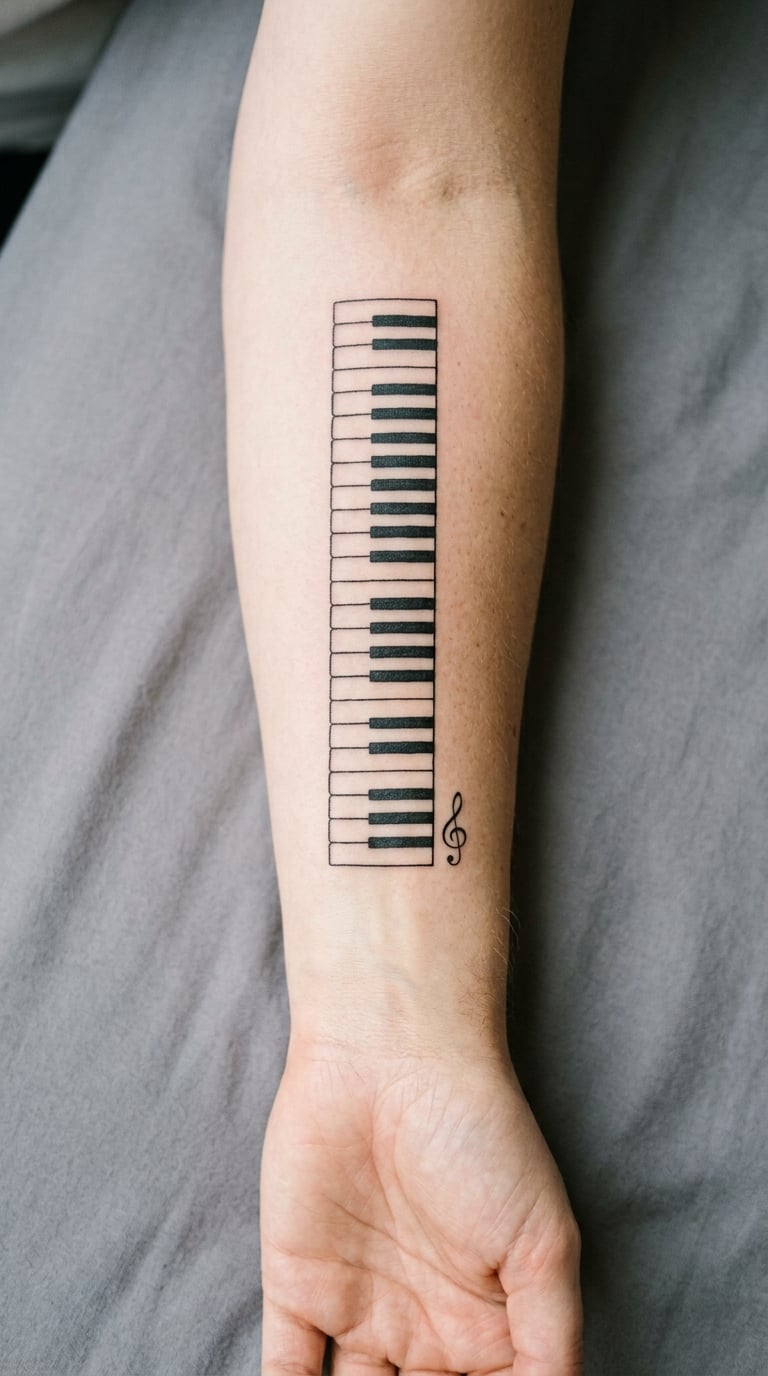
This piano tattoo idea is a single black key outline, maybe eight white keys drawn as one continuous rectangle, with a tiny treble clef tucked at the end. The whole thing can be done in one unbroken line, which is why tattooers like it as a first piece.
It gets chosen by players who want the instrument present without announcing their job. A clean key run reads as discipline and daily practice rather than as a souvenir.
Placement: inner forearm, running lengthwise from wrist crease to mid-forearm. Size: 3.5–4 inches wide. Style: fine line or single-line art. Pain: low to medium on the inner forearm; the wrist crease end stings more. Ageing note: single hairlines fade fastest on sun-exposed arms, so expect a touch-up every few years.
Make it yours: skip the clef and put your initials after the last key instead.
2. Realistic Upright Piano on the Calf
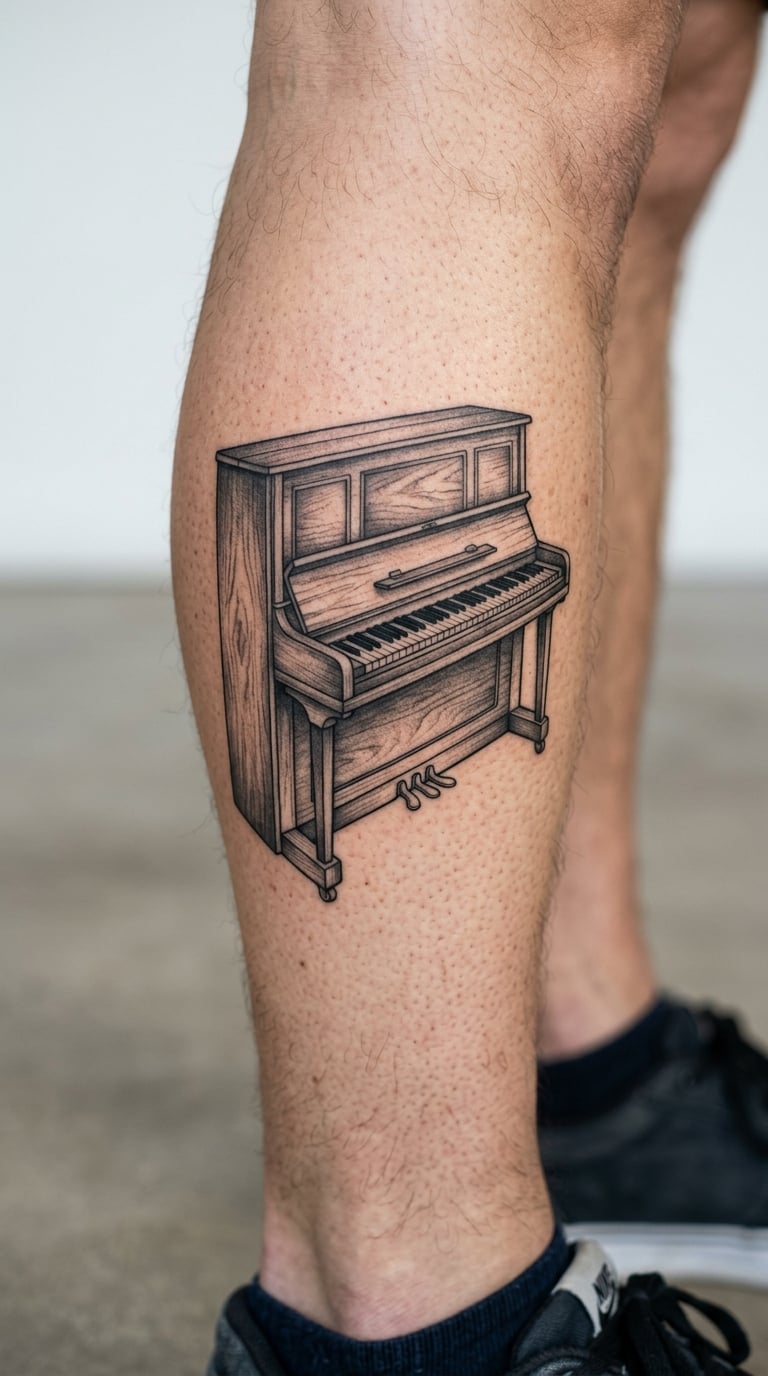
Full upright piano, black and grey, with the fallboard open, a row of visible white and black keys, two pedals, and greywash shading suggesting wood grain and shadow under the lid. This is a drawing rather than a symbol.
Plenty of players choose it for the specific instrument rather than for pianos in general: the upright in a family house, the one in a church hall, the one a teacher kept. The upright also reads as humble and working, which sits differently from a concert grand.
Placement: outer calf, vertical, or outer thigh for more room. Size: 4.5–5.5 inches tall. Style: realism with greywash. Pain: medium; the calf feels scratchy rather than sharp, and the session runs long on a detailed piece. Ageing note: grey wash softens and lightens over time, so contrast planning matters more here than anywhere else on the list.
Make it yours: add a small chipped key or a family initial carved into the side panel.
3. Grand Piano Silhouette Behind the Ear
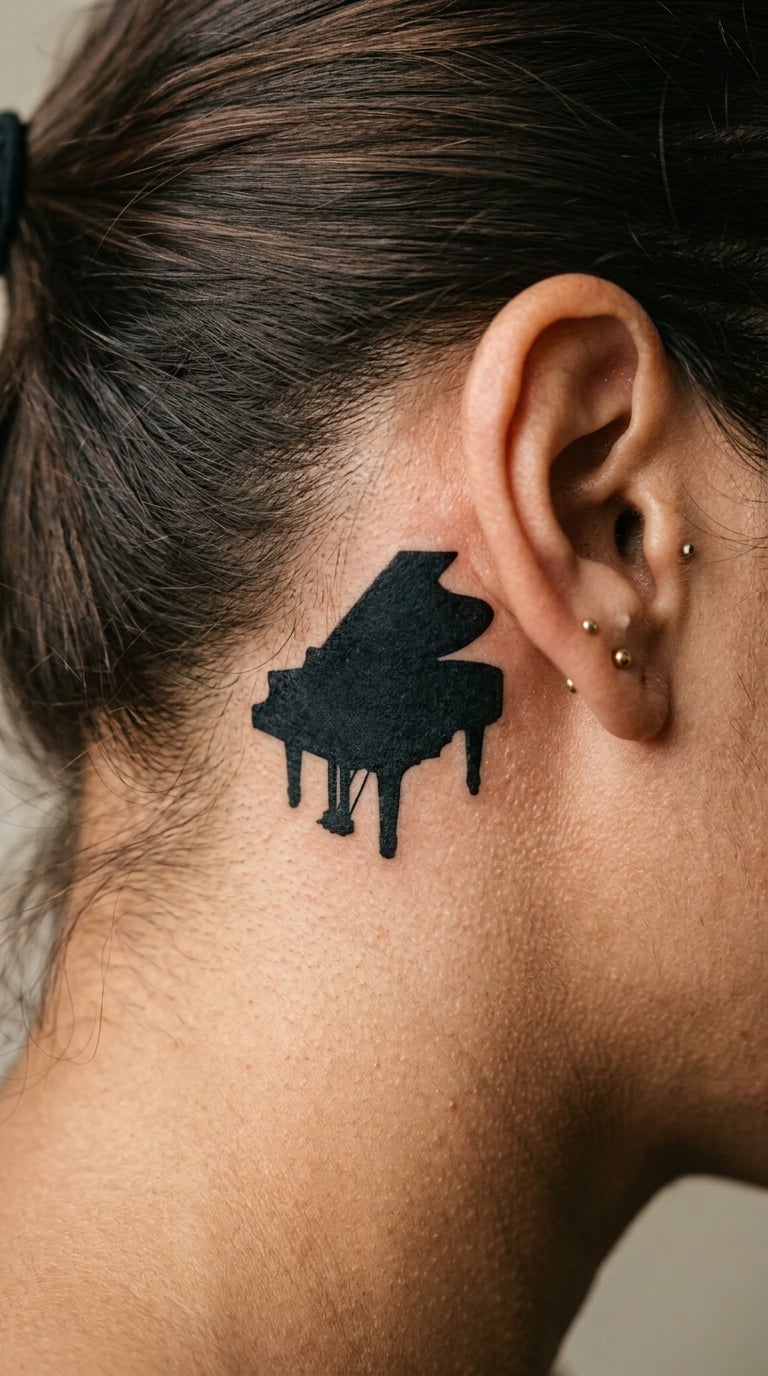
One solid black shape, no interior detail: a grand piano seen from the side with the lid raised in a single smooth curve. The bold fill is what makes it hold together at small size.
Behind the ear is a spot people choose for things they want always close to the head, and a compact silhouette works there better than anything detailed. It reads as performance and stage presence, and most wearers are musicians who play live.
Placement: behind the ear, or the nape of the neck. Size: 2–2.5 inches wide. Style: solid blackwork silhouette. Pain: medium; the neck and behind the ear are bony and sensitive. Ageing note: this one holds up well because there is no fine detail to blur, but sun exposure behind the ear fades solid black faster than most people expect.
Make it yours: have the lid angle adjusted to the tilt of a real concert lid rather than a generic curve.
4. Piano Keys Wrapping Around the Wrist
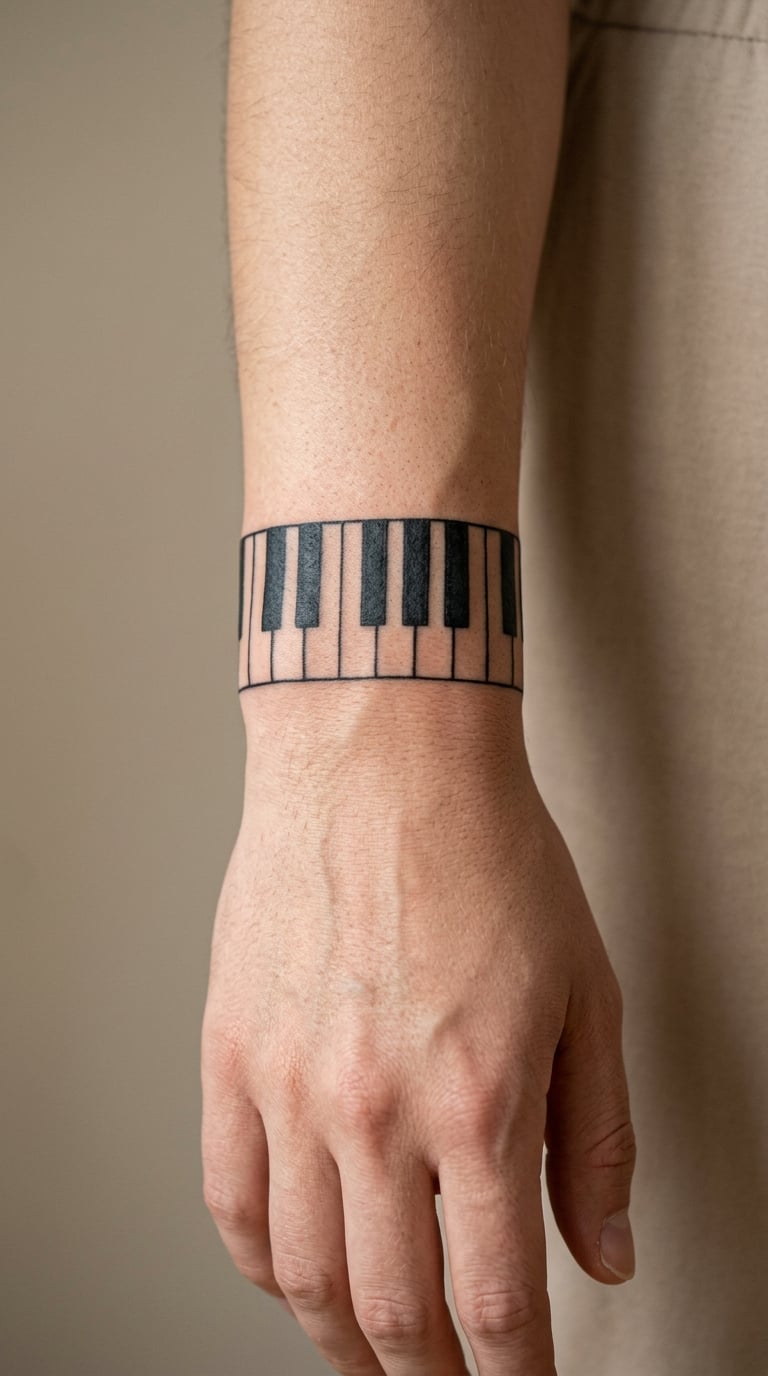
A key band that follows the curve of the wrist, black keys alternating with uninked white space, no lettering, no border. Seen from a distance it reads as a graphic stripe; from close up it reads as a keyboard.
This is the most popular piano key tattoo placement for a reason. It sits where you can see it constantly and where a hand gesture naturally frames it. Pianists tend to pick it as a quiet marker of an identity they explain often enough.
Placement: inner wrist, wrapping three-quarters of the way around. Size: 1.5–2 inches tall as a band. Style: line art or solid black keys. Pain: medium-high, and the wrist edge and inner forearm are the two spots that make people flinch. Ageing note: even key spacing is hard to keep, and a slightly wider black key is more forgiving than a hairline one.
Make it yours: run the band in one colour of your choice rather than black.
5. Watercolor Rainbow Piano Keys
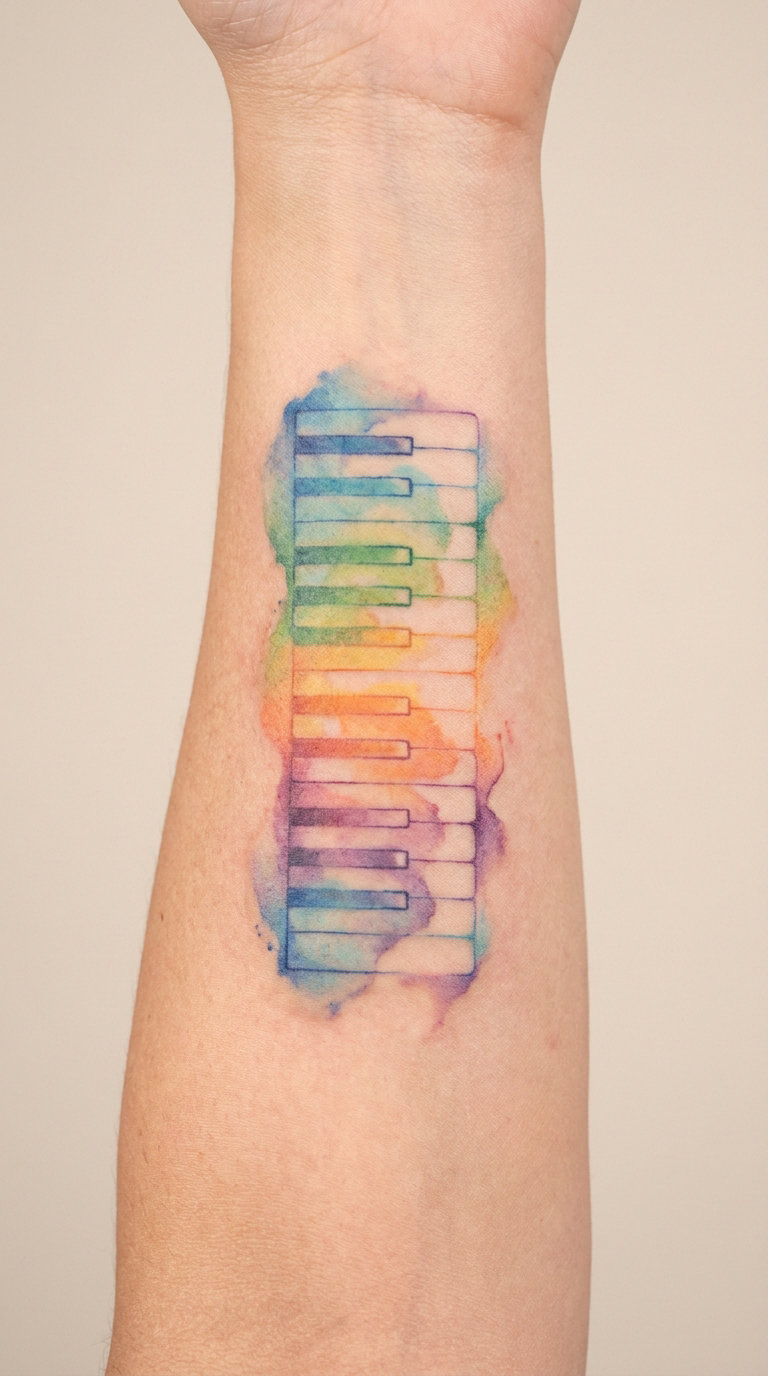
Keys rendered as loose watercolor washes in blended rainbow colour, with pigment feathering just past the edges instead of staying inside them. The keyboard stays recognisable while the colour does the emotional work.
People choose the rainbow version when the piano represents joy rather than discipline: a childhood instrument, a hobby kept purely for fun, a piece of music that fixes a mood. It is a softer, less formal read than blackwork.
Placement: inner forearm or upper arm. Size: 3–3.5 inches wide. Style: watercolor with fine black key outlines. Pain: low, since single-pass washes go fast. Ageing note: pale washes fade unevenly, and yellow goes first; ask for a warm, saturated palette rather than pastels if you want it to look the same in ten years.
Make it yours: colour only the black keys and let the whites stay bare skin for a sharper look.
6. Vintage Grand Piano with Music Notes
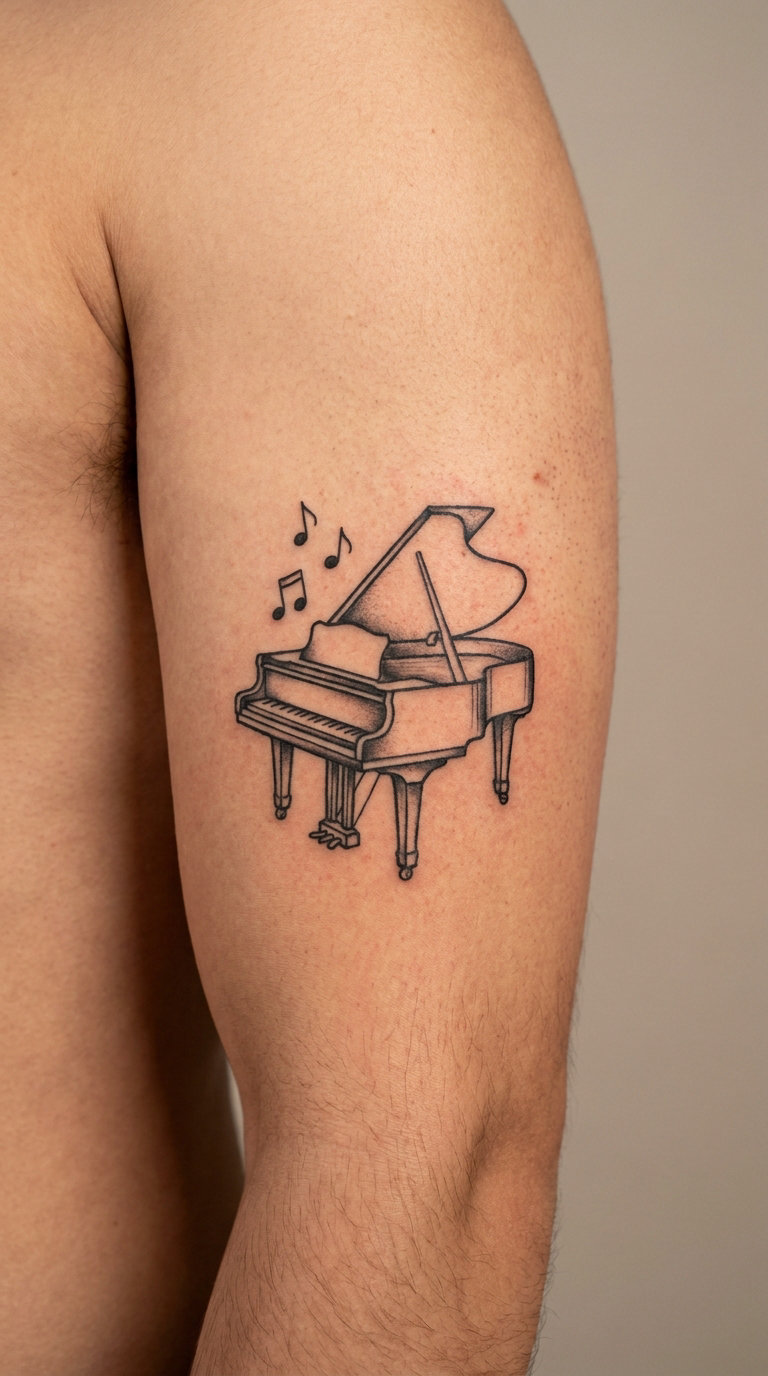
An antique grand with a curved body, a slight stylised tilt to the whole instrument, and two or three small notes drifting above the lid. Traditional black linework, some soft shading, no colour.
This suits musicians who care about the history of the thing, not just their own playing. The vintage framing reads as a nod to recital halls, old recordings, and the repertoire rather than to a modern keyboard.
Placement: outer or inner upper arm, slightly angled. Size: 3.5–4.5 inches wide. Style: traditional or neo-traditional line work. Pain: low to medium on the upper arm. Ageing note: the notes above the lid are the first detail to soften, so keep them at least an eighth of an inch thick.
Make it yours: engrave a date inside the piano body rather than adding more notes around it.
7. Piano Keyboard in a Small Circle
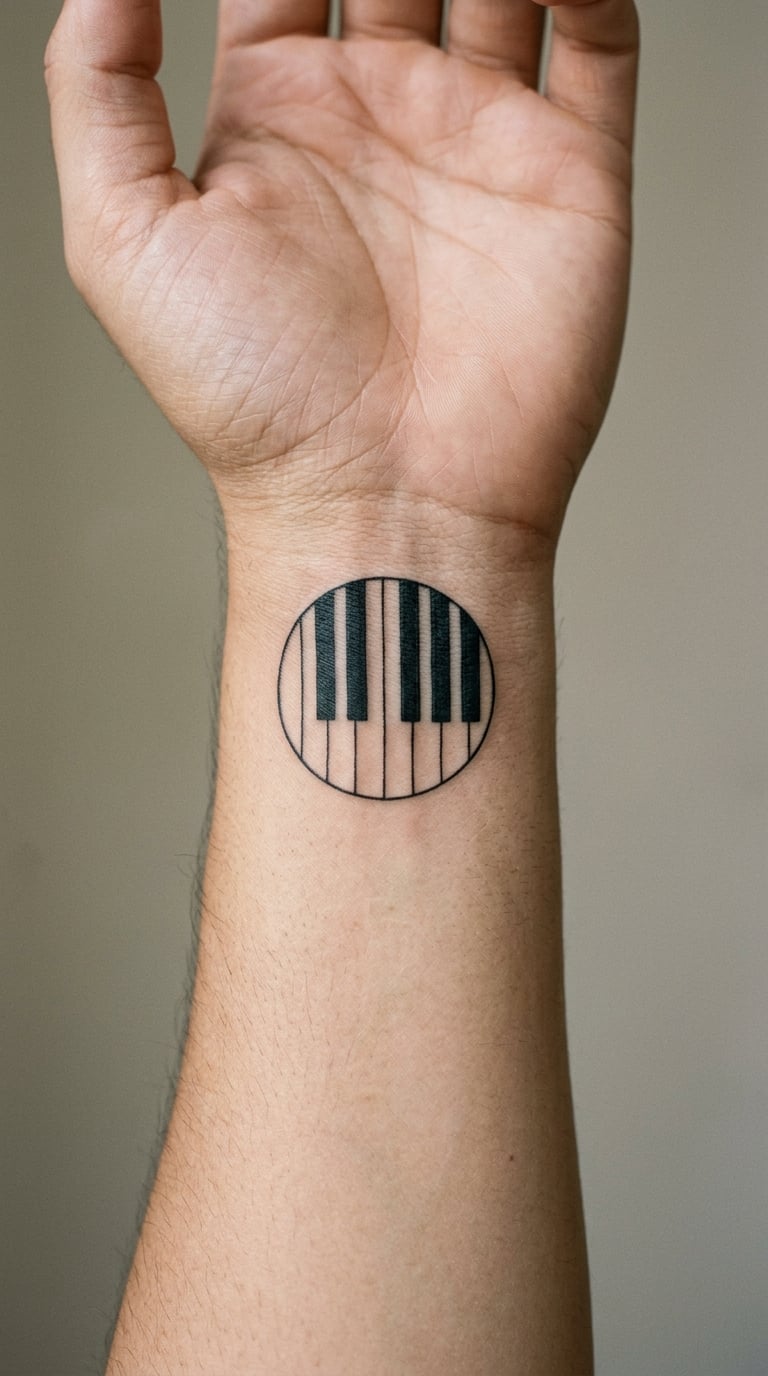
A short run of keys bent into a circle or horseshoe, with the two ends meeting like a clasp. No text, no frame, just the ring.
Circle compositions read as continuous, which people often want from a music mark. It works as a badge, a private seal, or a nod to a recurring performance ritual without needing words around it.
Placement: inner wrist, a fingertip, or the ankle bone. Size: 1.5 inches in diameter. Style: minimalist line work. Pain: medium-high on the wrist, medium on the ankle. Ageing note: the meeting point where the two ends touch is where the line usually thickens and spreads, so leave a small deliberate gap there.
Make it yours: make one key in the ring a different colour or leave one key outlined but empty.
8. Micro-Realism Piano Key Detail
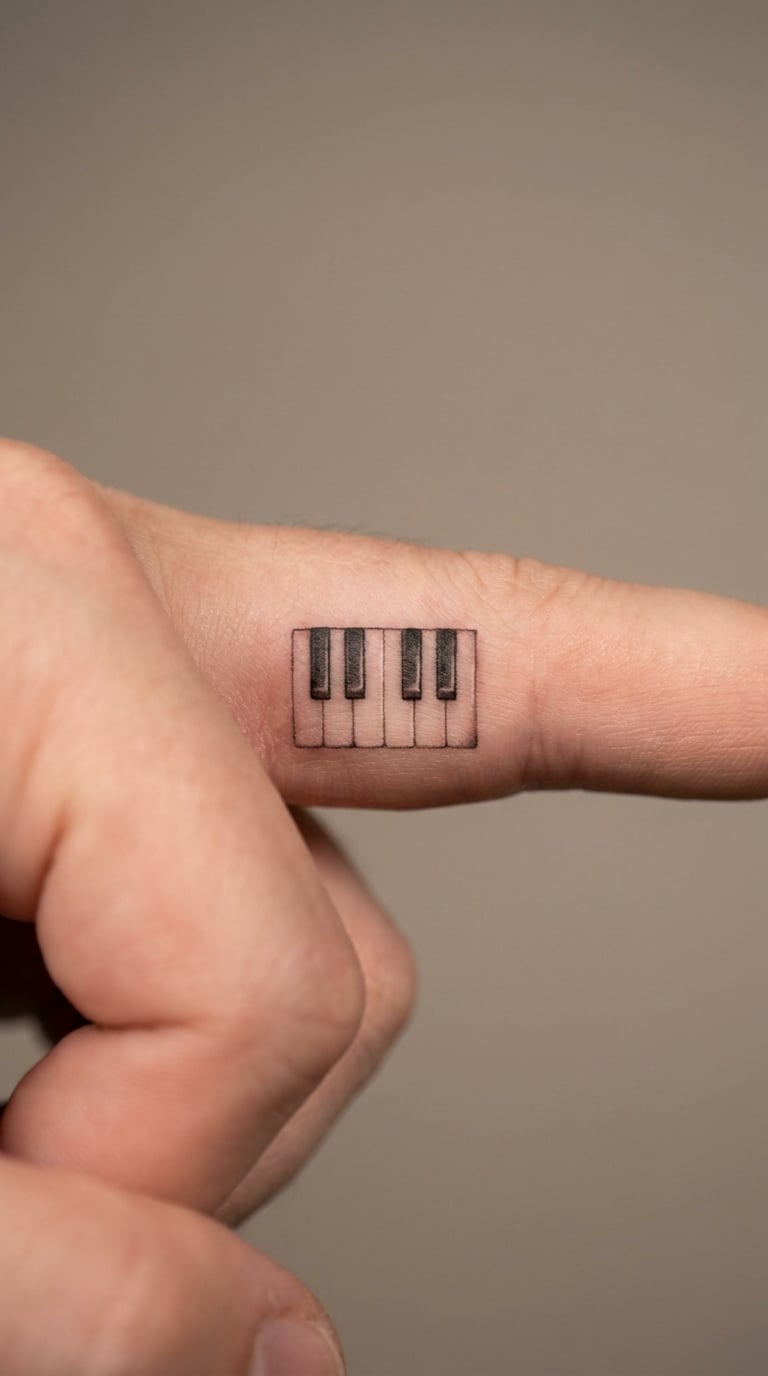
Four keys in micro-realism: a soft shadow in the gap, a faint reflection along the front edge, a hint of ivory texture, no outlines. It looks like a photograph of a keyboard rather than a drawing of one.
Musicians pick a restrained mark like this when the instrument is settled in their life and does not need announcing. On a finger it sits next to the hand that plays, which is a nice quiet reason on its own.
Placement: side of the index finger, or the inner wrist for a slightly larger version. Size: 0.8–1 inch wide. Style: micro-realism, black and grey. Pain: medium-high; fingers are bony and knuckle skin is unforgiving. Ageing note: hands get washed, sun-exposed and creased daily, so this is the fastest-fading idea on the list. Most wearers plan on a refresh every two or three years.
Make it yours: tattoo the keys in a different order, or start the run a few keys higher than you think you should.
9. Blackwork Piano with Falling Notes
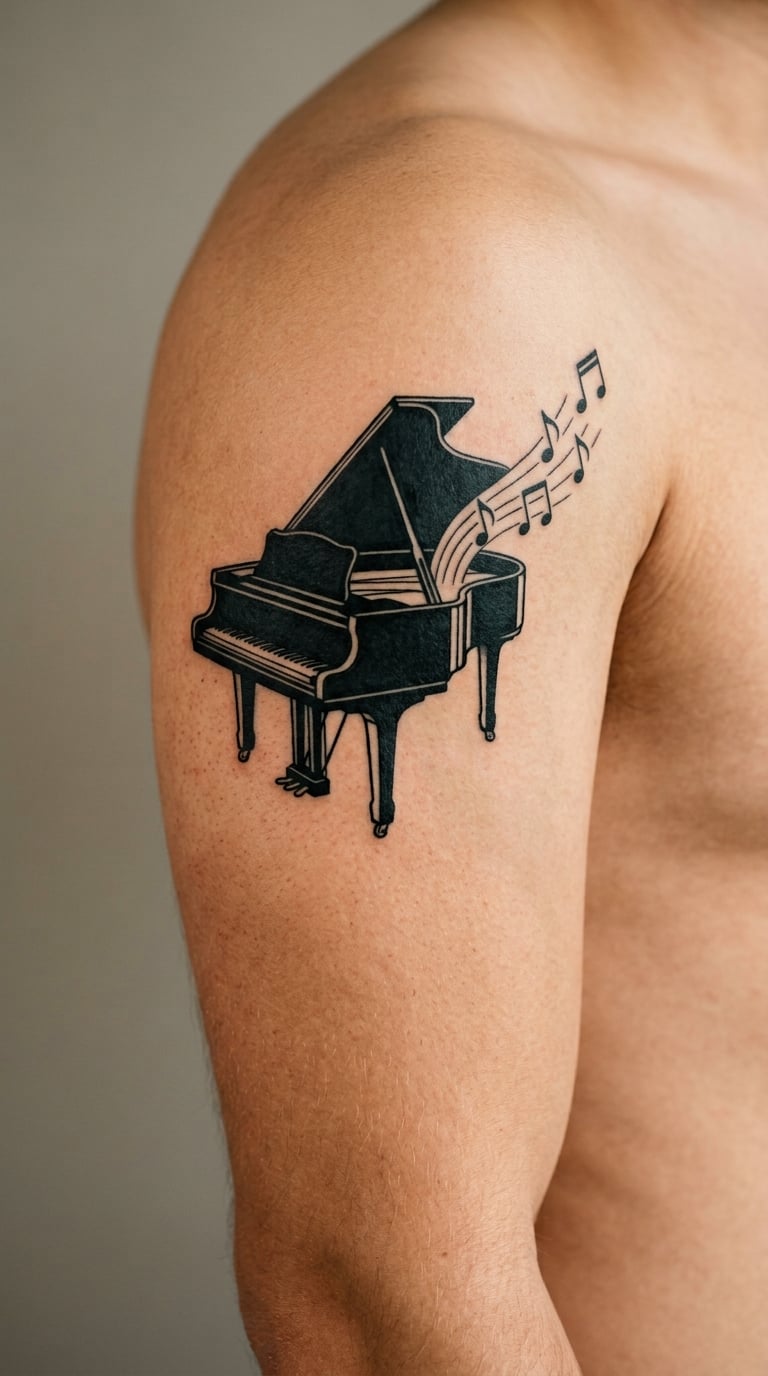
A simplified grand piano in heavy solid black, with a short trail of notes stepping downward away from the lid. Nothing grey, nothing soft. The contrast is the point of the design.
The descending notes give it motion, so it reads as rhythm rather than as an object. People often choose it when the piano is tied to performing, teaching, or a piece of music they cannot put down.
Placement: outer upper arm, shoulder, or upper chest. Size: 4.5–5.5 inches wide. Style: blackwork. Pain: medium; large solid fills take a long session and the shading pass over already-worked skin is the uncomfortable part. Ageing note: solid black is durable, but the small note heads at the trail’s end can fade before the body does.
Make it yours: make the note trail match the last four notes of a piece you play.
10. Piano and Rose on the Shoulder
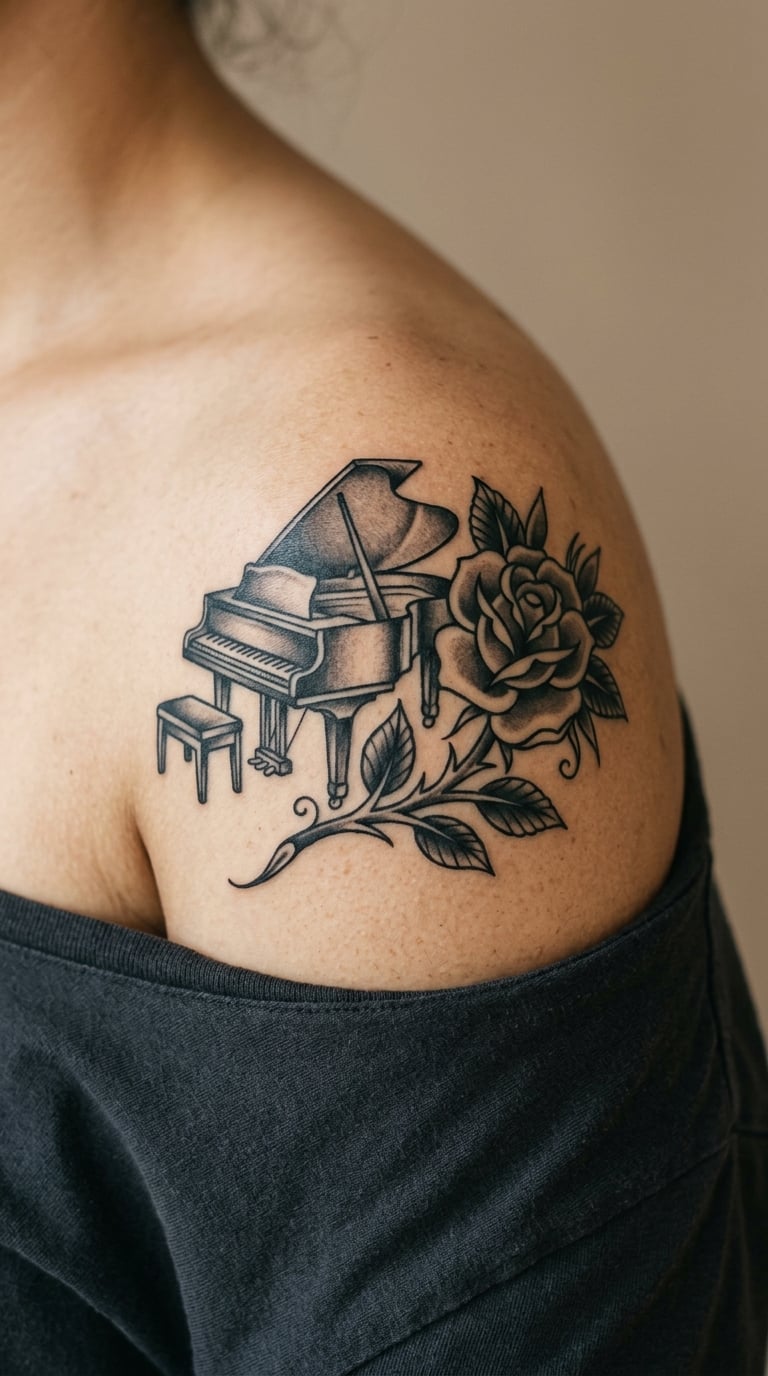
A small grand piano balanced against a single full rose, both in shaded black and grey, arranged so neither dominates. A few leaves trail off the rose stem to fill the corner.
The pairing is often chosen by people who connect music to something emotional or personal rather than technical. It shows up as a tribute piece, an anniversary design, or a way to mark someone who played.
Placement: shoulder or upper back, where a rounded composition sits naturally. Size: 3.5–4.5 inches wide. Style: traditional or neo-traditional. Pain: medium on the shoulder cap, more sensitive over the collarbone edge. Ageing note: the rose petals are the softest part of the design; traditional grey shading in petals loses definition noticeably in sunlight.
Make it yours: use a rose in a single deep red and keep everything else black and grey.
11. Sheet-Music-Inspired Piano Keys
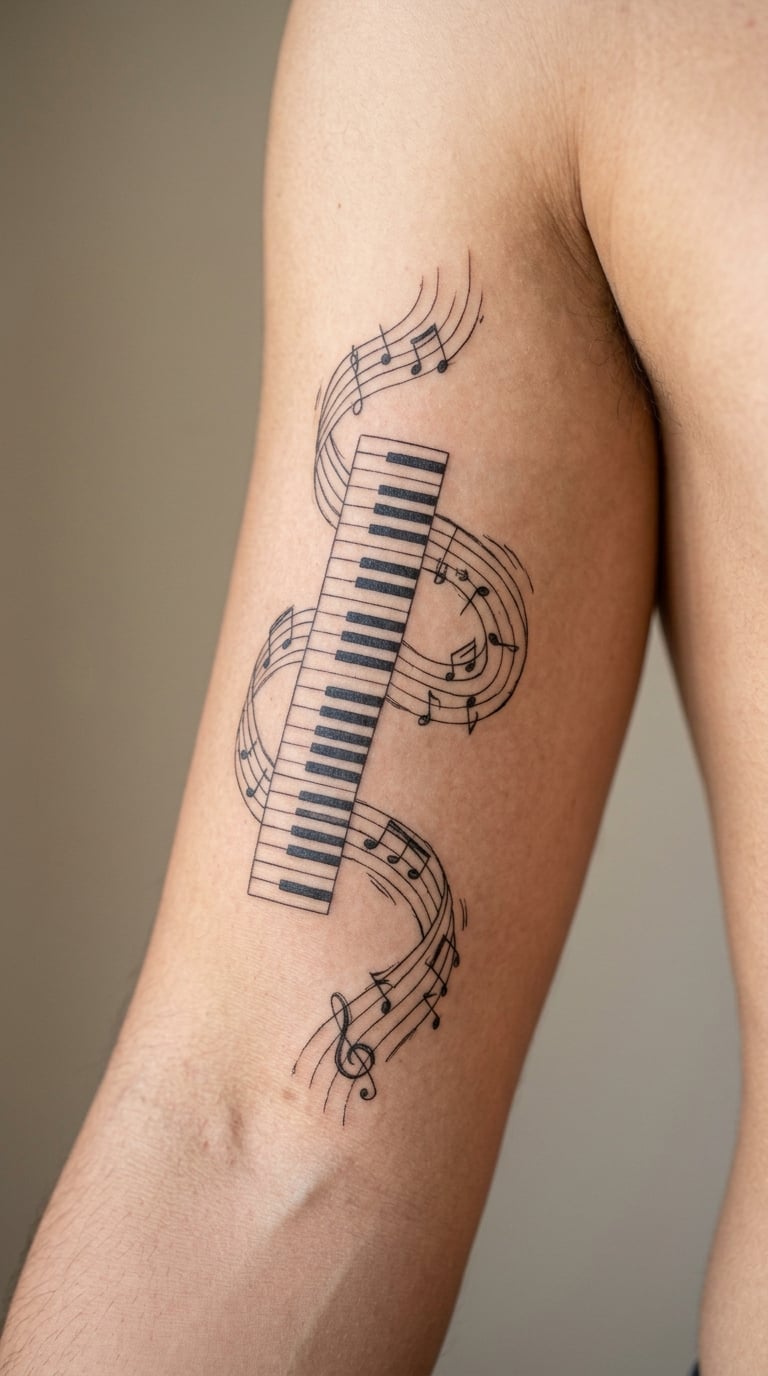
Keys at the base that dissolve upward into staves, notes and handwritten marks, as though the keyboard is printing its own music. Fine black line throughout, no lyrics, no text-heavy block.
Students and teachers gravitate here because it reads as study and practice rather than as performance. It also works for devoted listeners who never took a lesson and want that represented honestly.
Placement: inner upper arm, where there is flat surface for the staves. Size: 3–4 inches tall. Style: fine line with script notation. Pain: low to medium. Ageing note: tiny note heads are the first casualty of sun and time, so the notation should be drawn heavier than the artist might instinctually.
Make it yours: have the upper staves spell out the opening bar of a real piece rather than random notes.
12. Neon-Outline Piano Keys
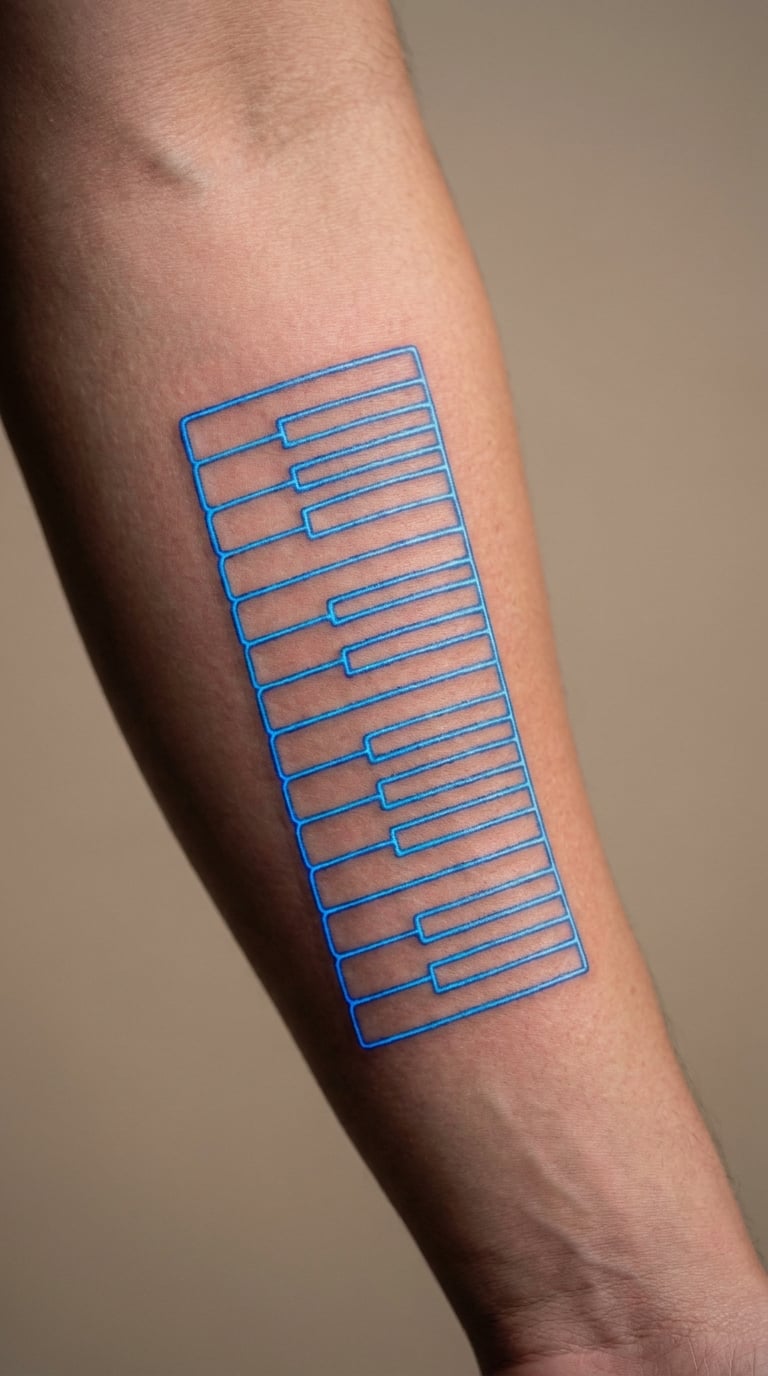
Piano keys drawn as a bright outline with a glow effect, one saturated ink colour against skin. The keys are hollow, and the glow is a soft halo rather than a filled block.
This one is aimed at performers who like stage energy and contemporary visuals. The glow gives it a light, almost screen-printed quality that reads well in photos without becoming a full-colour piece.
Placement: outer forearm, bicep, or calf. Size: 2.5–3 inches wide. Style: outline with colour and a soft halo. Pain: low to medium. Ageing note: a single bright colour fades toward the skin tone faster than black does, and glows need contrast to survive, so plan for a heavier line than feels necessary now.
Make it yours: pick the colour to match something you already own rather than defaulting to blue.
13. Piano Pedal Micro-Tattoo
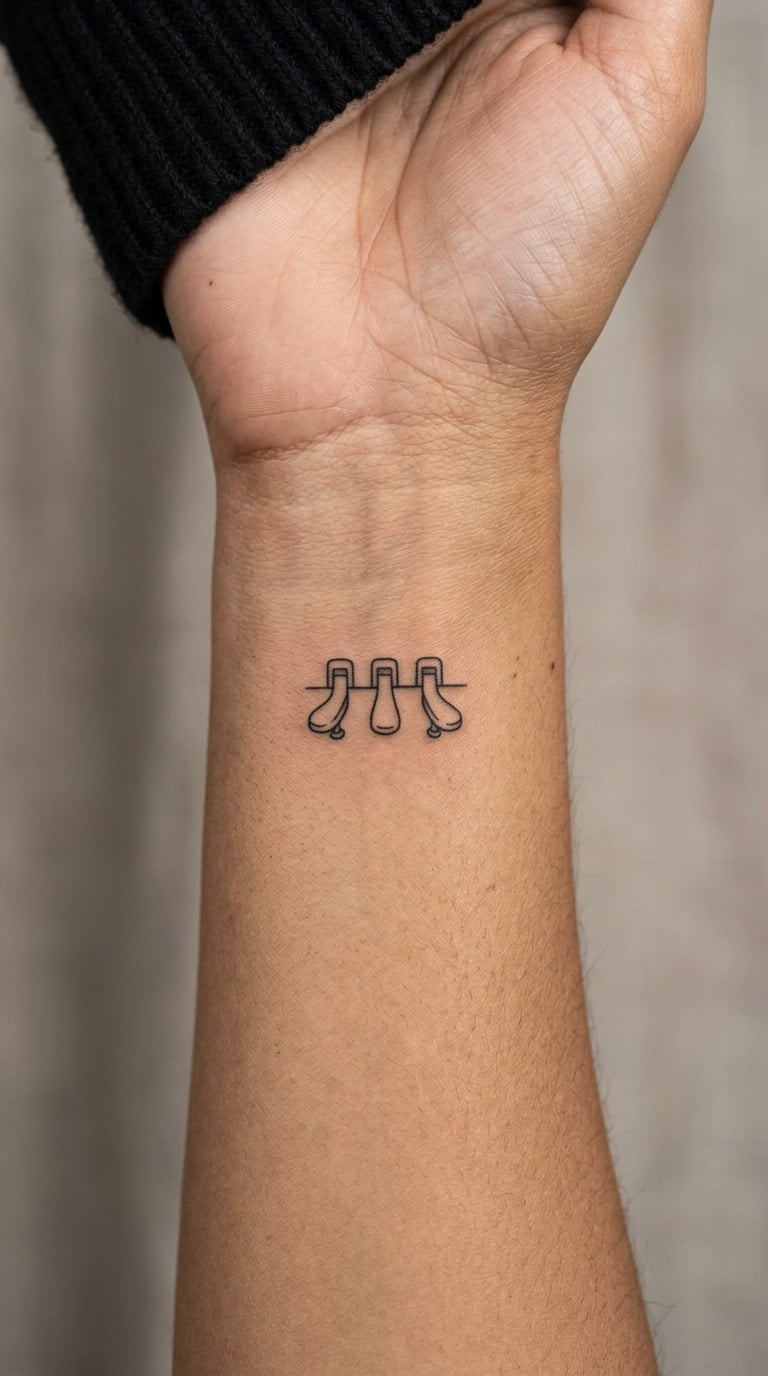
Two or three pedals, tiny, in clean minimal line work. No case, no legs, just the pedals hanging from a short line. Most wearers use the sustain pedal as the base shape and add one or two more.
It is an insider reference. Anyone who plays recognises it instantly, and most people who do not play have no idea what they are looking at, which is often the point.
Placement: inner wrist, behind the knee, or the sole-side of a finger. Size: 0.75–1 inch wide. Style: micro line work. Pain: medium-high, because the shapes are small and the wrist is sensitive. Ageing note: at under an inch, the pedal arms and the connecting line blur together within a few years. This is a design to accept as changing, or to plan to redo.
Make it yours: have the three pedals slightly uneven, the way a used upright’s are.
14. Cat Playing a Grand Piano
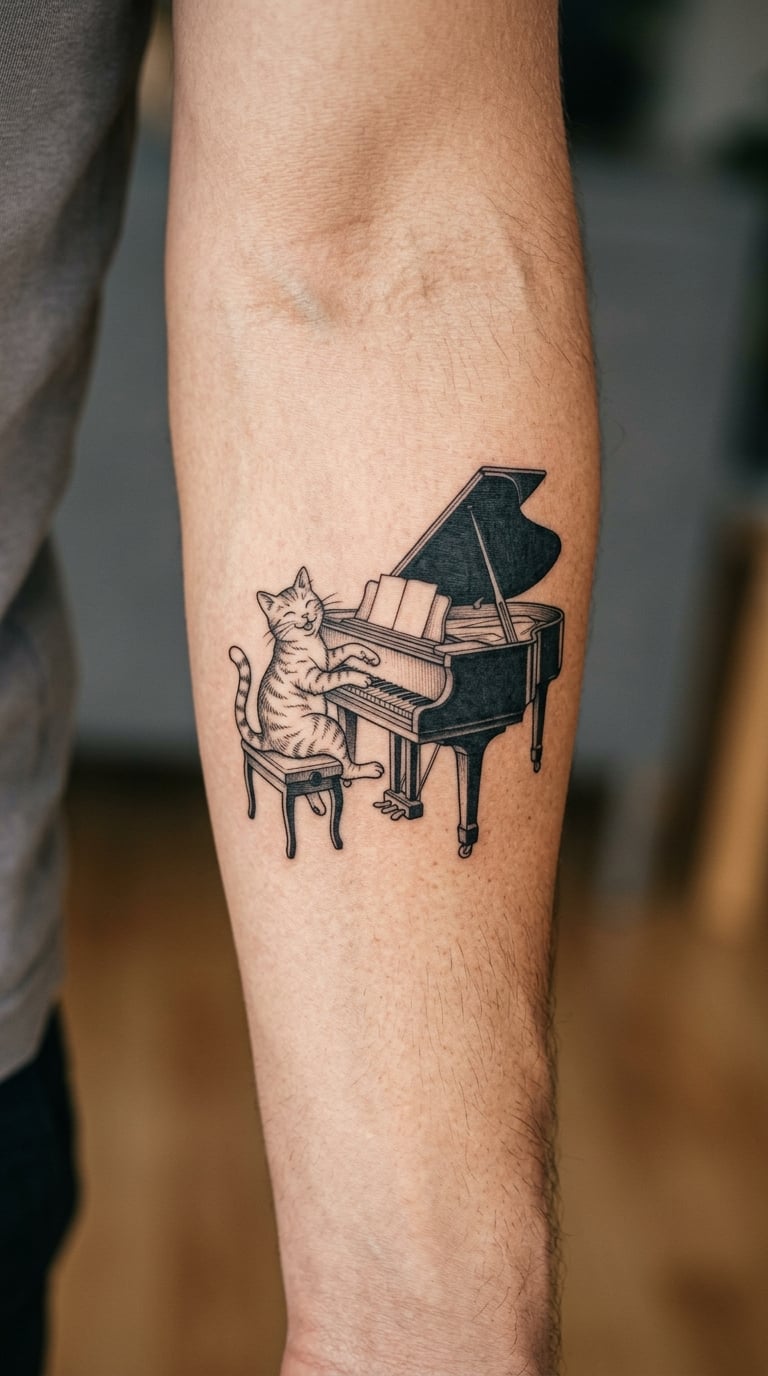
A cat seated upright at a miniature grand, front paws on the keys, tail curled, drawn in fine line with a little detail on the face. The cat stays small so the piano still reads as the subject.
It works as a personality piece: a funny, self-aware mark for someone who plays and also just likes cats. Plenty of wearers make the cat a real pet, which is what turns it into a story rather than a joke.
Placement: forearm, calf, or upper arm. Size: 3–3.5 inches wide. Style: fine line illustrative. Pain: low to medium. Ageing note: facial detail on a small cat fades within a few years, so keep eyes and whiskers simple rather than rendered.
Make it yours: have the cat’s markings copied from your own pet instead of a generic tabby.
15. Piano with Floral Flourishes
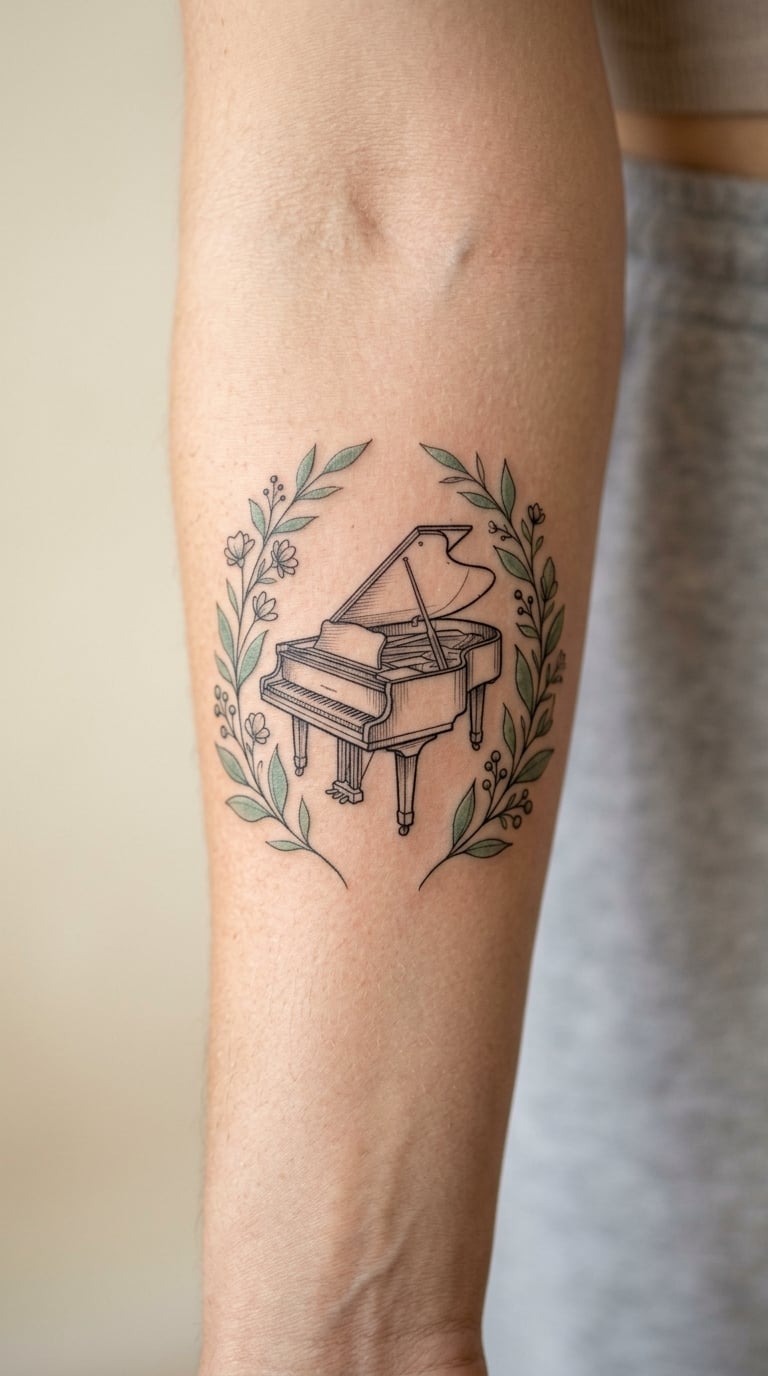
A fine-line grand piano with thin leaves, small blossoms and curling vines framing it from one side, deliberately loose so the piano stays the centre. Black line work, one muted green in the leaves if you want colour.
Floral framing reads as growth and sensitivity, and it softens an instrument that can otherwise look rigid. It is common among players who play emotionally rather than technically.
Placement: outer forearm, thigh, or shoulder. Size: 3.5–4.5 inches wide including the foliage. Style: fine line botanical. Pain: low to medium; most of the session goes on the vines. Ageing note: hairline stems are fragile, and hand placement plus daily washing will show on them sooner than on the piano.
Make it yours: use one plant that means something to you, such as lavender or a branch from a specific tree.
16. Old Piano with Cracked Wood
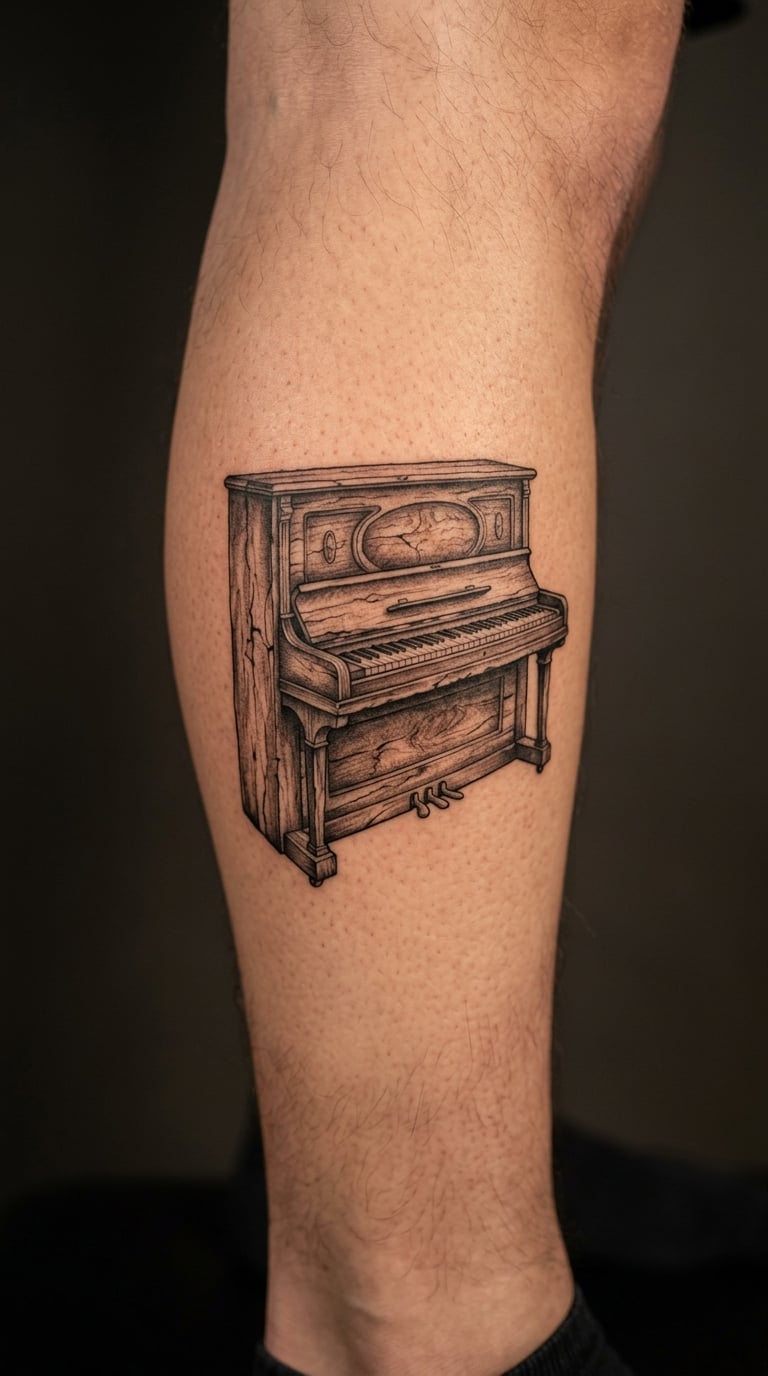
A semi-realistic upright with visible cracks running through the wood, worn edges where the finish has gone, and a few dark gaps in the panel. Black and grey realism with a hint of warm brown.
The wear is the meaning. This is usually chosen for a perseverance story, a family instrument that has seen decades of use, or a musical chapter that was hard and mattered anyway.
Placement: calf, outer thigh, or forearm for a smaller version. Size: 4–5 inches tall. Style: semi-realism with texture work. Pain: medium, and texture-heavy areas need a second pass so the session is longer. Ageing note: cracks stay crisp well because they are drawn with contrast, while the brown washes will warm and lighten with sun.
Make it yours: draw the crack pattern from a photo of the actual piano rather than inventing one.
17. Piano Keys as a Matching Tattoo
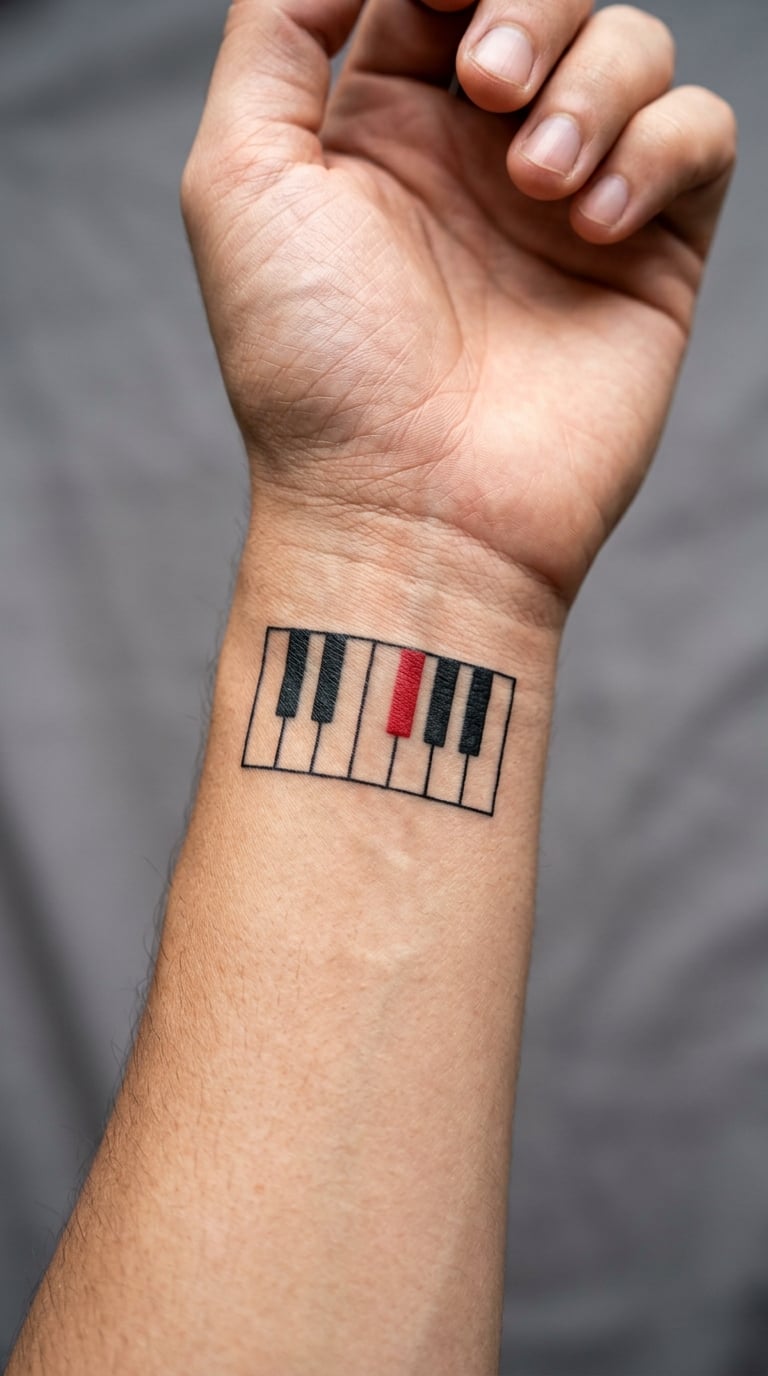
A short run of three or four keys, identical on two people. Small enough to sit on the inner wrist or the back of the hand, and usually done in a matched position on both bodies.
Shared rhythm is the reason this works for partners, siblings, roommates, or a band. The keys say you play in time together, or that one of you taught the other, without needing a date or a name. If you are pairing up with a friend rather than a partner, our matching tattoo ideas for roommates go deeper on placement and scale.
Placement: inner wrist on both, mirrored so the patterns face each other. Size: 1.5–2 inches wide. Style: line art with one shared accent colour. Pain: medium-high, doubled, because the wrist does not get kinder the second time. Ageing note: two tattoos done months apart will never fade identically, so agree on a shape that still reads clearly if one softens first.
Make it yours: split a single keyboard between you, half on each wrist, so the design only completes when you are together.
18. Geometric Piano Keyboard
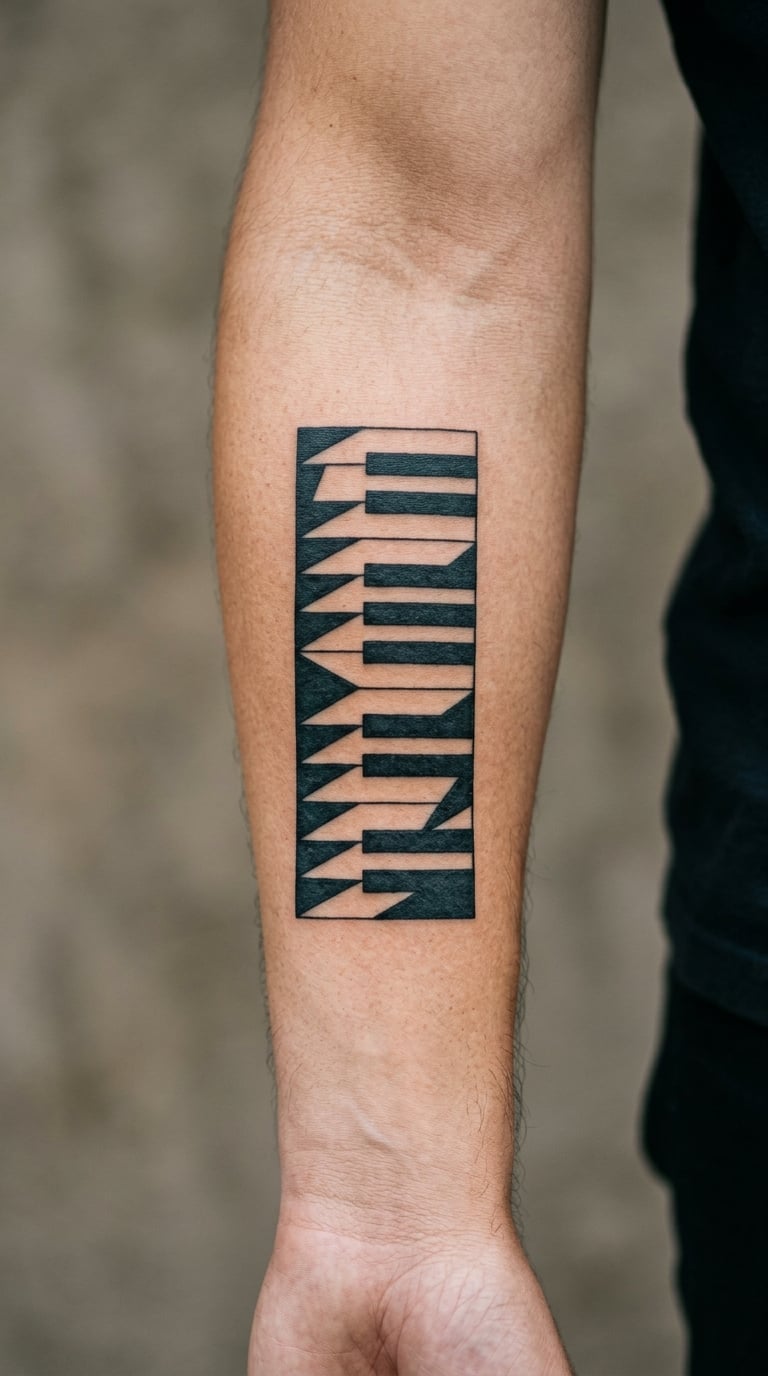
Keys reduced to hard-edged blocks and sharp triangles, no curves except the occasional straight diagonal, no shading. Pure graphic abstraction that still resolves into a keyboard at arm’s length.
This suits people who like graphic body art and do not want a literal instrument. The abstraction keeps the music reference without committing to a drawing style, which also makes it age well. If you would rather the shape say something about open road and movement than about a keyboard, our list of tattoo ideas that symbolize freedom works in the same graphic direction.
Placement: forearm, bicep, calf, or lower leg. Size: 2.5–3.5 inches wide. Style: geometric blackwork. Pain: low to medium. Ageing note: solid shapes and hard edges hold up far better than any other style in this list, which is the main argument for geometric work on a small-to-medium piece.
Make it yours: keep the whole design black except for one key, filled in a single colour.
19. Piano Inside a Music Note
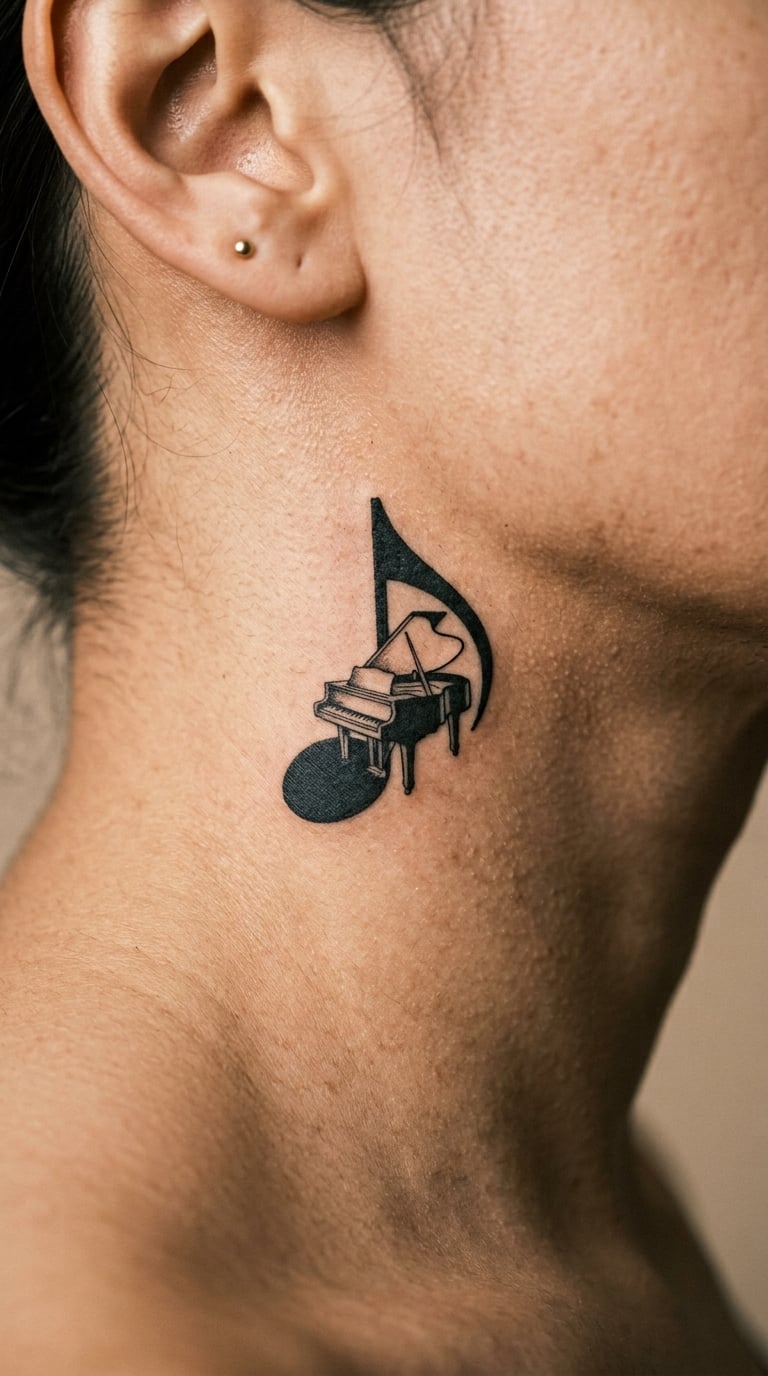
A single large note, and inside the bowl of it a tiny grand piano drawn in the negative space so the ink defines the piano rather than the note. One object, one idea, tight composition.
It compresses the whole thing into a mark that only resolves on close inspection, which suits dedicated pianists who would rather not explain themselves. The side of the neck is an unusual and effective canvas for it.
Placement: side of the neck below the ear, or the inner forearm. Size: 1.75–2.25 inches tall. Style: conceptual line work with solid black fill. Pain: medium. Ageing note: the inner piano is small by design, so it will soften before the note does. A slightly larger version ages noticeably better than a tiny one.
Make it yours: reverse it and put the piano in the stem of the note rather than the bowl.
20. Upright Piano and Moon
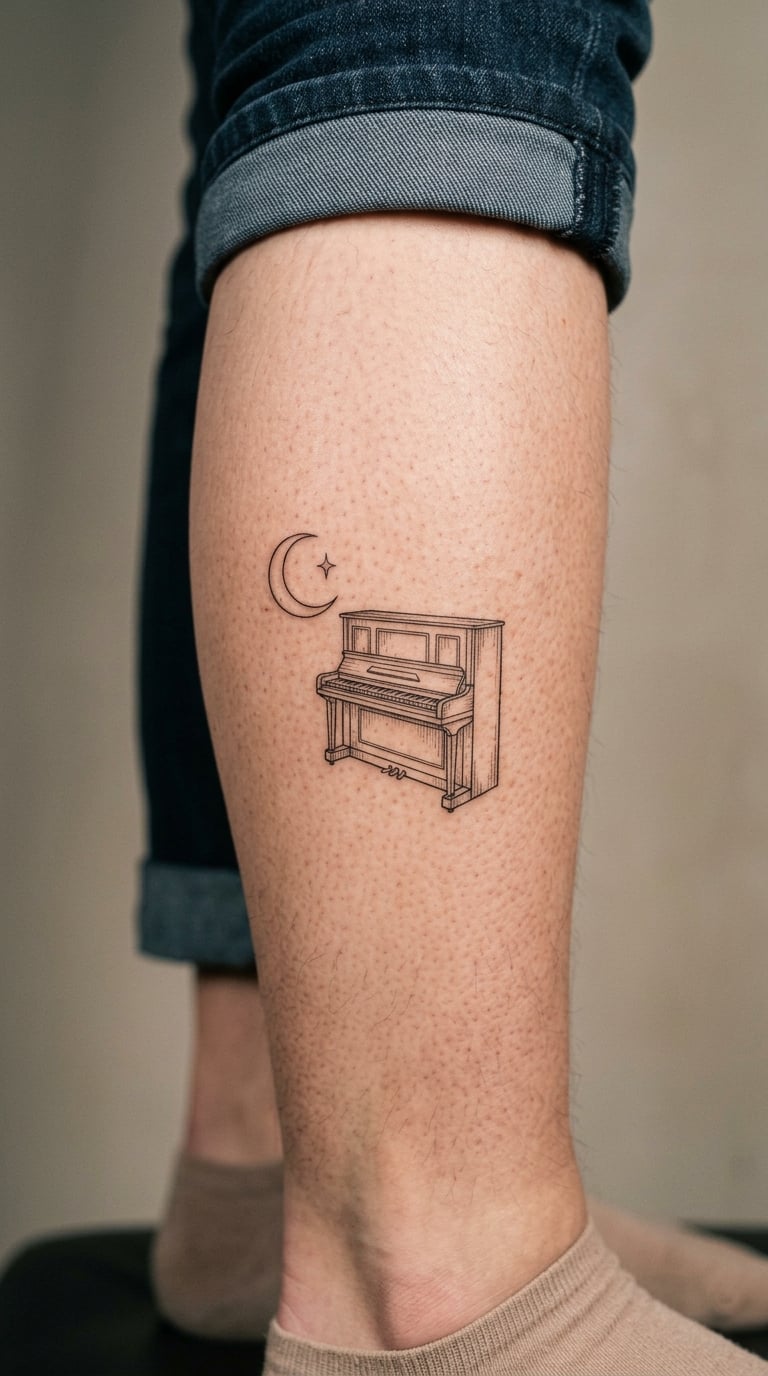
A small upright piano drawn in fine line, a crescent moon above and to one side, nothing else. No background, no stars unless you ask for one. The two objects are spaced far enough apart to breathe.
It reads as practice in the dark: late sessions, working through something difficult, a piece someone used to play before sleep. It is a quiet, slightly melancholy design that suits reflective wearers.
Placement: inner calf, inner arm, or below the collarbone. Size: 3–3.5 inches wide. Style: fine line, no shading. Pain: low to medium; the inner calf is one of the quieter sites. Ageing note: a crescent built from a single hairline curve is delicate, and inner-arm placements near a sleeve cuff get more sun than people expect.
Make it yours: put the moon open-side down beneath the keyboard for an inverted composition.
21. Ink-Drip Piano Keys
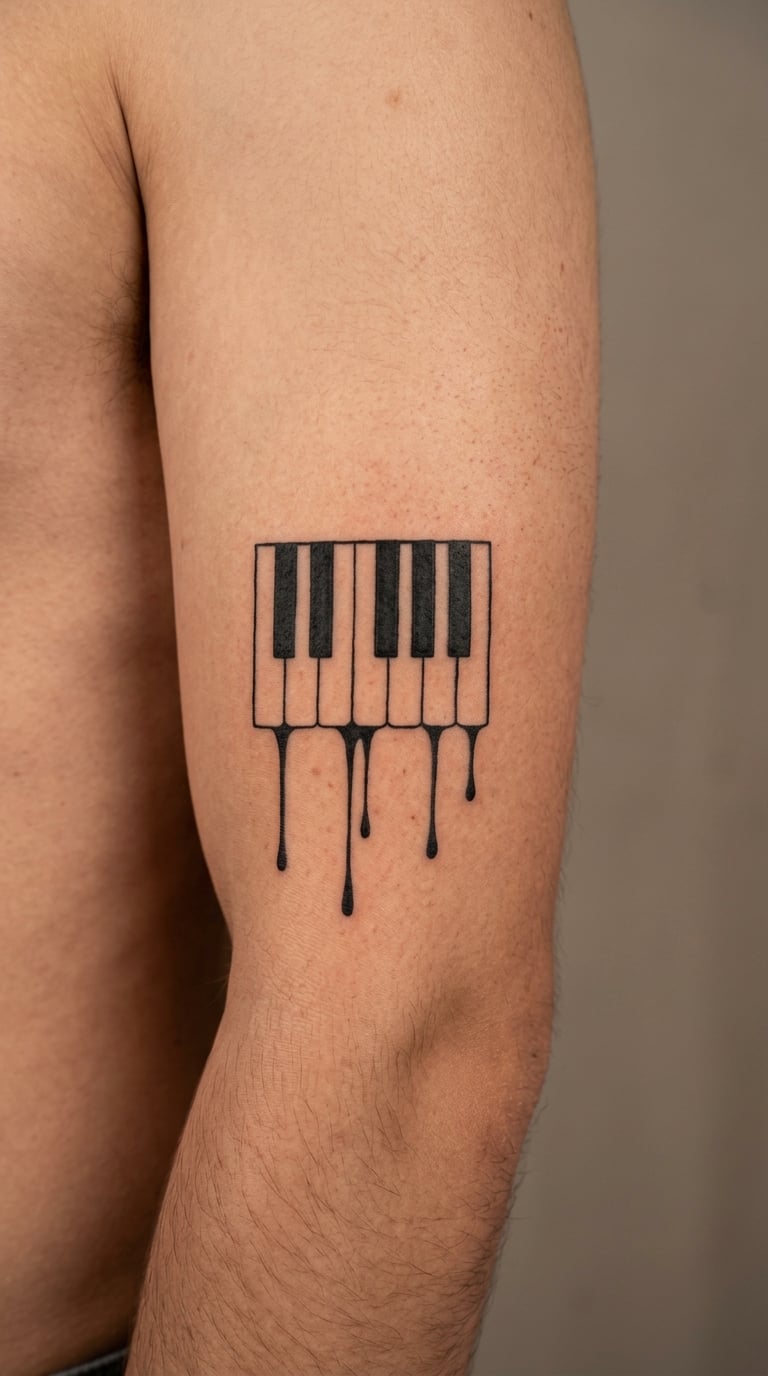
A keyboard in solid black with a small number of controlled drips running downward from the bottom edge, each ending in a rounded bead. The drips are few and deliberate, not a full wash.
The effect reads as intensity, which is why it turns up on musicians who want something with edge. It also suits a playful person who does not want the design to be too serious about itself.
Placement: outer upper arm, thigh, or calf, where gravity gives the drips somewhere to go. Size: 3–3.5 inches wide plus drip length. Style: blackwork with drip effects. Pain: medium, higher if the drips are added in a second session. Ageing note: thin drip tails disappear first, so ask for a couple of short drips and one long one rather than a uniform set.
Make it yours: have the drip lengths mirror the rhythm of a bar you play, short and long.
22. Baby-Grand Piano in Dotwork
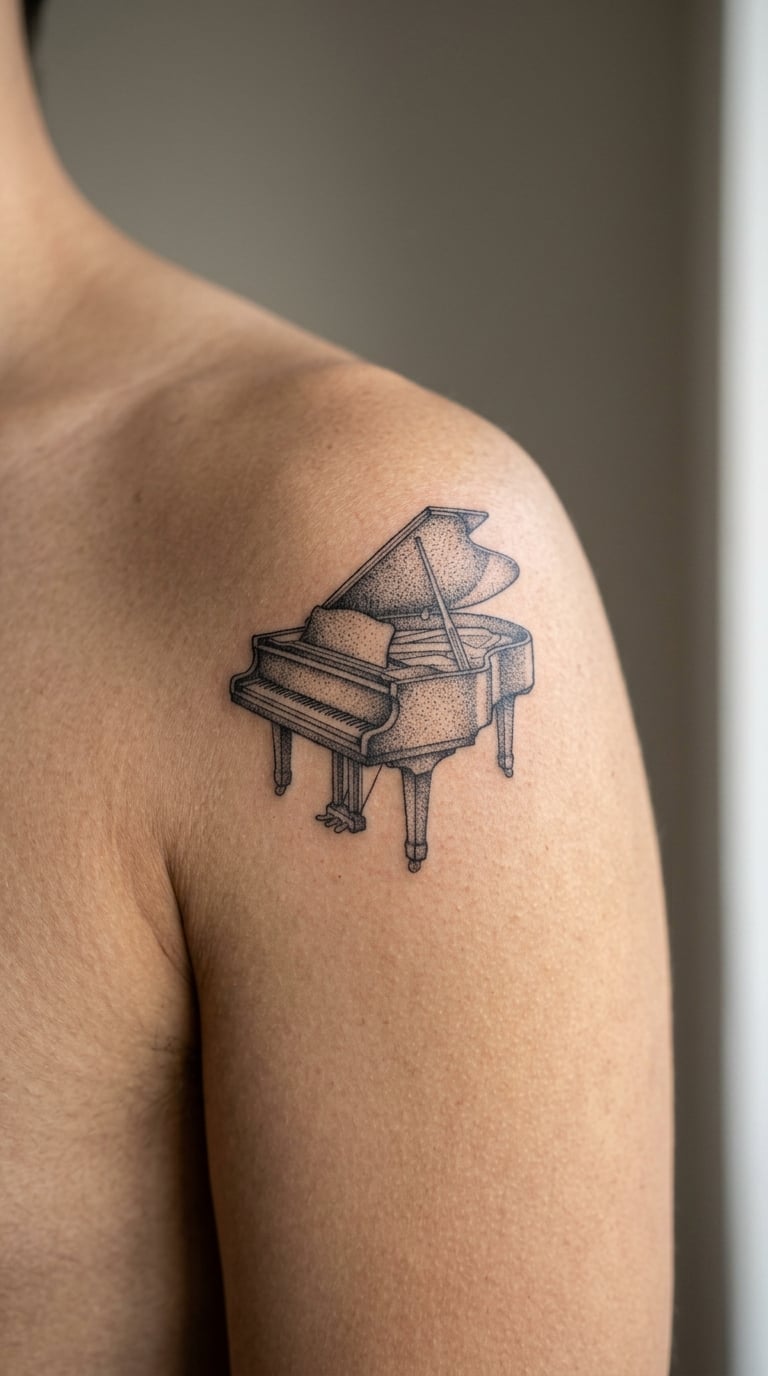
A compact baby-grand built entirely from evenly spaced dots, the shading done with density changes rather than line or grey wash. No other objects in the frame. The whole texture comes from how close the dots sit.
Dotwork suits people who want visible texture and pattern without large flat black areas, and who tend to collect sleeve work. At 3 inches the stippling reads clearly; below 2 inches the dots start to merge into a grey smudge.
Placement: shoulder, upper arm, or upper back. Size: 3–3.5 inches wide. Style: dotwork stippling. Pain: medium, and dotwork is a long, patient sitting rather than a sharp one. Ageing note: dots soften and spread over time, so a design that looks crisp in a healed photo can look greyer after several years. That is the medium working as intended, not a failure.
Make it yours: vary the dot density so the piano fades gradually into bare skin on one side.
23. Piano with a Playful Bow Tie
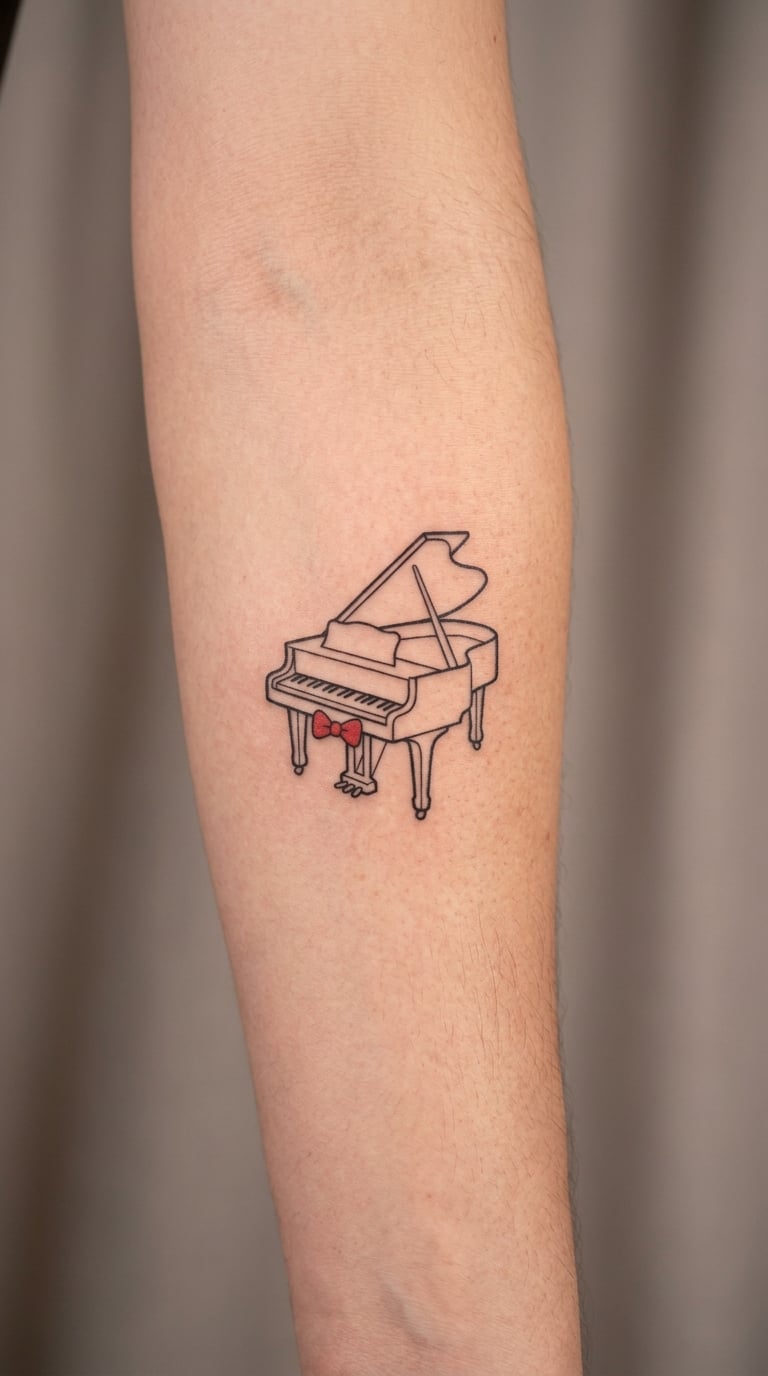
A slightly cartoon-like grand piano with a small bow tie at the front, drawn in clean black line work with rounded corners and a hint of shading on the lid. The bow is the only colour in the piece.
It reads as a tribute with a wink, which makes it a good gift-style design for a performer, a recital, or a teacher. Wearers usually keep the instrument simple and put the personality in the accessory.
Placement: forearm, calf, or upper arm. Size: 2.25–2.75 inches wide. Style: illustrative line work. Pain: low to medium. Ageing note: the bow is the smallest element and loses its edges first, so it needs to be drawn a touch heavier than the piano body to stay balanced.
Make it yours: put a real recital date underneath in small type, or leave the bow untied.
24. Handwritten Piano Pattern on the Rib
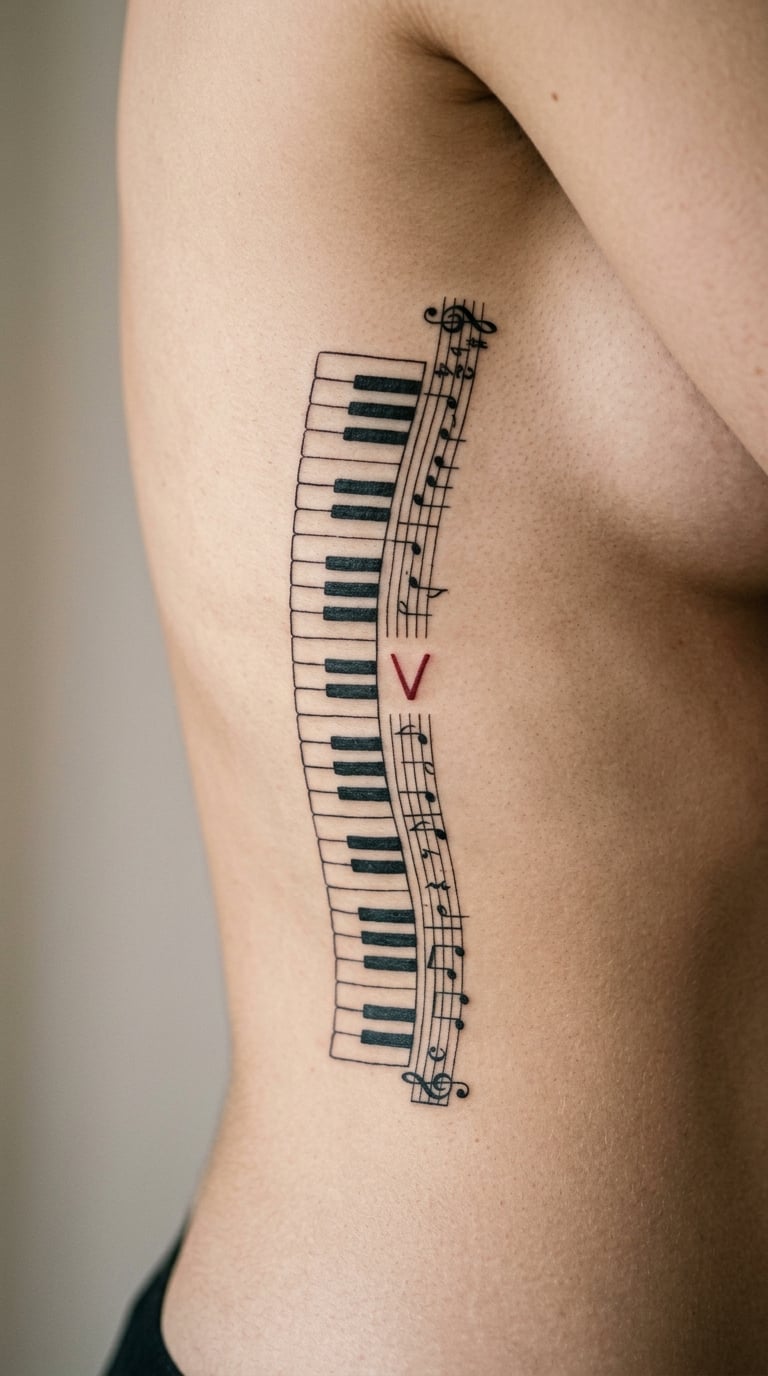
A vertical run of piano keys, four to six inches of them, running up the side of the ribs with handwritten musical notation and small marks filling the space between. Fine black line, one small red accent if you want one.
This is the statement option. It suits pianists who already have a piece or two and want something that takes up real space, and it works well as the anchor for a later sleeve expansion.
Placement: side ribs, following the curve of the ribcage. Size: 6.5–7.5 inches tall. Style: fine line with script notation. Pain: high, and the ribs are the site people most often describe as the worst on this list. Breathing makes the skin move, so the session is longer and a break matters. Ageing note: rib skin stretches with weight change, and long vertical fine line distorts more than a compact design would.
Make it yours: run the notation as a continuous scale rather than random bars, so the piece is playable.
25. Abstract Piano-Inspired Sleeve Detail
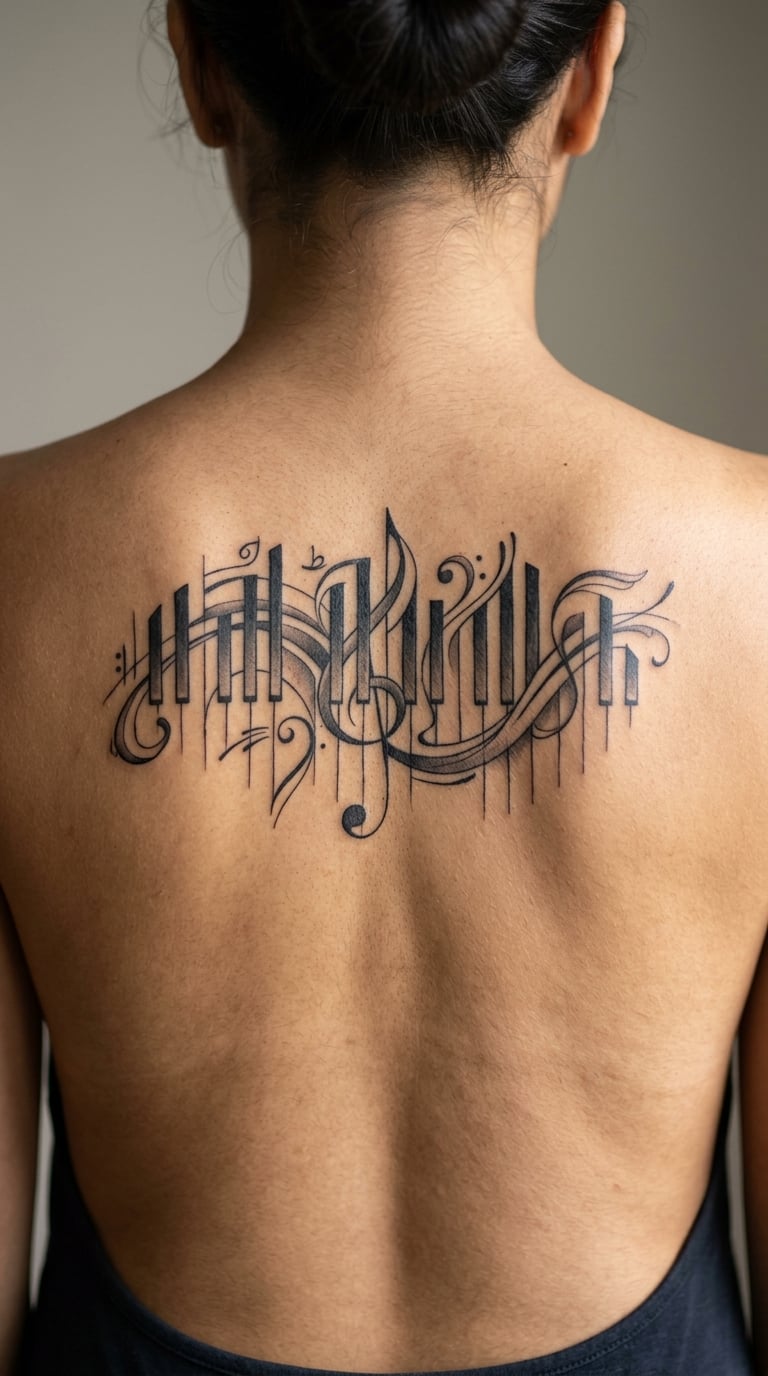
An abstract composition: vertical bars of varying weight that suggest keys without drawing a keyboard, curved shapes that read as notes or sound waves, and black-and-grey washes that tie them together. Nothing in it is a literal piano.
It suits experienced collectors who already have a sleeve in progress, and musicians who find literal instrument art too on-the-nose. Because it is abstract, it can be expanded later without a redesign.
Placement: upper back, shoulder blade, outer upper arm, or as part of a sleeve. Size: 5.5–7 inches wide. Style: abstract blackwork with grey wash. Pain: medium-high over a long session, and grey wash on a large area is demanding work. Ageing note: broad washes even out as they heal, which flatters this design, but soft edges between bar and background can lose definition in sun.
Make it yours: set the bar spacing to match the interval of a chord you play often, so the pattern has a hidden structure.
Piano Tattoo Ideas: How to Personalize the Design
Any of the 25 above becomes unmistakably yours with one change and a still-recognisable design. The most effective options I see work with clients:
- A date. A recital date, a first lesson date, or the year you started playing, set in small type under the instrument. Keep it to four numbers or two lines.
- One real note. A single notehead at a specific pitch, or the four notes of a chord you play constantly. It is a private code nobody else can read.
- A colour accent. One key, one rose, one note, or one bow tie in a single colour while the rest stays black and grey.
- A real chord, spelled out. If you want notation, have the artist copy it from a score rather than drawing it from memory. Wrong notes get tattooed.
- A performance detail. A stage mark, a pedal mark, or the exact silhouette of the instrument you actually play, including its specific curve.
- A matching partner. Identical keys at the same scale, mirrored placement, as covered in number 17.
One caution worth repeating from the r/piano forum: bring references a person made. Tattoo art generated by image tools has no line weight logic, no sense of how ink spreads, and no artist behind it. A drawing by a tattooer, a photograph of a real instrument, or a page from a score will always brief an artist better.
How to Choose the Right Design
Picking well is mostly a three-way conversation between style, size and body site. Get any one of them wrong and the other two cannot save it. If restraint is the goal rather than statement size, our guide to minimalist tattoo ideas for anxiety and calm works through the same small-scale decisions from a different angle.
- Match detail to area. Realistic keys, strings and pedals need 4 inches or more of relatively flat skin. The forearm, calf, upper arm and outer thigh have the room. A wrist or finger has almost none.
- Choose fine line only where it will be seen. Hairline work on an inner forearm ages well. The same line on a hand that gets washed twenty times a day will blur, and you should decide now whether you would get it refreshed.
- Prefer blackwork and geometry for longevity. Solid shapes and hard edges hold their form longer than grey wash, fine line or dotwork. If you care more about how the design looks in fifteen years than about its delicacy, this is the trade.
- Use colour where you will not resent fading. Watercolor and neon glow both look great fresh and settle toward the skin tone. Ask for a saturated palette rather than pastels, and ask what a touch-up costs.
- Budget for a real size preview. Ask your artist to draw the design at the exact size and on paper the size of the body site. Almost every scale problem is caught at that step, and almost none are caught from a phone screen.
- Match the style to your existing work. If you already have a black-and-grey sleeve, a photorealistic upright in the middle of it will look like a mistake. If your collection is small and quiet, a blackwork grand is the piece that sets the tone.
Cost and Session Time
Rates vary a lot by city, artist and shop minimum, so treat these as realistic US ranges rather than quotes.
- Micro (under 1 inch, ideas 8 and 13): roughly 90 to 200 US dollars, usually 20 to 40 minutes.
- Small (1.5 to 2.5 inches, ideas 3, 7, 12, 19, 23): roughly 180 to 400 US dollars, 45 minutes to an hour.
- Medium (3 to 4.5 inches, most of the fine line and traditional work): roughly 350 to 800 US dollars, one to two hours.
- Large (5 inches and up, ideas 2, 9, 24, 25): roughly 800 to 2,000 US dollars, split across two to three sessions.
A simple design with large black shapes can often be finished inside a single one-hour sitting. Realistic and texture-heavy work, like the cracked upright in number 16 or the dotwork in number 22, needs a second pass, and a good artist will tell you that before you start rather than after.
Shop minimums are the thing that surprises people most. A small design at an artist who books full sessions can still cost the minimum, so ask about the shop minimum at the consultation.
Aftercare Basics
- Follow your artist’s aftercare instructions first. They know which products and films they used, and their advice overrides anything general written on a website.
- Keep the area clean and wash it as instructed, then pat dry rather than rubbing. Rubbing a fresh blackwork piano design is the fastest way to scab it badly.
- Do not soak. Pools, hot tubs, baths and swimming in the first weeks can pull ink out of fine lines and soften fresh washes.
- Do not pick flakes. Every fine line, note head and petal in these designs will flake, and picking is what turns a clean heal into a patchy one.
- Keep it out of strong sun while it heals, and remember that healed line work on an exposed arm or hand will fade faster than the same work on a rib.
- Book the touch-up before you think you need one. For fine line and dotwork, most artists recommend coming back within about a year while the original lines are still clearly visible.
Frequently Asked Questions
Do piano key tattoos hurt?
Pain depends far more on the body site than on the design. An inner forearm keyboard is one of the easier placements, while a wrist band or anything on the side of the fingers stings noticeably more because the skin is thin and the bone sits close underneath. Rib designs are the most uncomfortable of all. A wrist piano key tattoo is still very doable, just expect to breathe through it.
How big should a piano tattoo be?
Match the size to the detail, not to the reference photo. A realistic upright with visible keys and pedals needs at least 4 inches of height to read properly, and a grand silhouette can work at 2 inches because it has no interior detail. Anything with sheet music or note heads wants 3 inches or more. Below about 1.5 inches, keep the design to a shape or a silhouette.
Will a fine line piano tattoo blur over time?
Fine line is the first thing to soften, and the rate depends on placement. An inner forearm design usually holds for years with a touch-up here and there. Fingers and hands fade fastest because of daily washing, sun and skin movement. Dotwork spreads into a grey texture, which most wearers come to like. If you want the design to look identical in fifteen years, ask for solid black shapes and hard edges instead.
Can I get a specific song tattooed as piano keys?
Yes, and it is one of the most personal versions of a piano tattoo. Bring a clean scan or a page from the score so the artist can copy the notation accurately rather than drawing it from memory, because wrong notes do get tattooed. Give the notation line weight that matches the keys rather than drawing it as fine as print, or the smallest note heads will fade first.
How do I stop a piano tattoo from looking generic?
Change one element and leave the rest alone. Use an unusual starting note, a broken or yellowed key, an unusual number of keys, the silhouette of your actual instrument, or one colour accent on an otherwise black design. Adding a real date or a specific chord does more than adding more imagery. The common keyboard strip only reads as generic when nothing in it is yours.
Should I bring an image reference to my artist, and what about AI-generated art?
Bring references a person made: a drawing by a tattooer, a photograph of a real piano, a page from a score, or an existing tattoo you admire. AI-generated art has no working line weight, no sense of how ink spreads, and no artist behind it, so it is a poor tattoo source. Tattooers will happily use a photo as mood reference, but they will need to redraw the design properly for skin.
Conclusion
For a first tattoo, the minimalist keyboard on the inner forearm in number 1 is the safest good choice. It is small, low-pain, quick to heal and easy to hide at work, and it still means something specific to anyone who plays.
For a musician adding a distinctive piece to a collection that already exists, the realistic upright in number 2 or the blackwork grand in number 9 has more presence and holds its shape longer. Whichever one you pick, take the size, the placement and the line weight from this list into the consultation rather than a screenshot, and the piece you end up with will look like yours instead of like everyone else’s.