
20 Vinyl Record Tattoo Ideas: Best Retro Designs (October 2026)
A vinyl record tattoo is a design of an LP, a record sleeve, a turntable or a tonearm, usually done in black linework, worn as a permanent marker of how you listen. People choose it because vinyl is the format you commit to when the sound itself matters: you flip the disc, drop the needle, and commit to hearing the whole side in order.
That single motif is flexible enough to carry a lot. Below are 20 vinyl record tattoo ideas, each with the size, placement, style and pain level that will actually work, plus one honest note about how it ages. Most collectors want something more specific than a plain black disc, and the designs that hold up best are the ones with one detail that only means something to you: a date, a colour, a track, a hand-written list.
Bring your artist photos of healed work, not screenshots of fresh ink. And if you already know you want a sleeve later, say so in the first consultation.
20 Vinyl Record Tattoo Ideas: Quick Guide
| Idea | Style | Best placement | Size | Pain |
|---|---|---|---|---|
| 1. Spinning record with fine-line tonearm | Fine line | Inner forearm | 2.5-3.5 in (6-9 cm) | Low |
| 2. Turntable in a blackwork square | Blackwork | Outer upper arm | 3-4 in (8-10 cm) | Medium |
| 3. Record sleeve with peeling half-disc | Illustrative / neo-traditional | Forearm | 4-5 in (10-13 cm) | Medium |
| 4. Groovy record with rainbow grooves | Colour illustrative | Upper arm | 3-4 in (8-10 cm) | Medium |
| 5. Micro-realism record player close-up | Micro-realism | Forearm | 2-3 in (5-8 cm) | Medium |
| 6. Floating heart on a grooved disc | Fine line, black and grey | Inner wrist | 1.5-2 in (4-5 cm) | Medium |
| 7. Headphones wrapped around a record | Blackwork | Outer upper arm | 3.5-4.5 in (9-11 cm) | Medium |
| 8. Botanical record with center-label flowers | Botanical black and grey | Thigh | 3-4 in (8-10 cm) | Low |
| 9. Half record and half waveform | Contemporary fine line | Forearm | 2.5-3.5 in (6-9 cm) | Low |
| 10. Minimal black disc with one shine line | Minimalist | Wrist | 1-1.5 in (2.5-4 cm) | Low |
| 11. Record stack with coffee cup | Playful blackwork | Calf | 3-4 in (8-10 cm) | Medium |
| 12. Crescent record with curved grooves | Fine line | Behind the ear | 2-2.5 in (5-6 cm) | Low |
| 13. Two interlocking records, matching pair | Fine line, matched pair | Inner forearms or wrists | 2-2.5 in (5-6 cm) each | Medium |
| 14. Sunflower record label | Traditional with muted colour | Shoulder | 2.5-3.5 in (6-9 cm) | Medium |
| 15. Watercolor melody swirl | Watercolour | Upper arm | 3-4 in (8-10 cm) | Low |
| 16. Cassette tape transforming into a record | Neo-traditional | Forearm | 3-4 in (8-10 cm) | Medium |
| 17. Butterfly emerging from record grooves | Bold blackwork | Upper back | 5-7 in (13-18 cm) | High |
| 18. Record player with music notes | American traditional | Upper arm | 3-4 in (8-10 cm) | Medium |
| 19. Map-pin record collection | Fine line | Calf | 3-4 in (8-10 cm) | Medium |
| 20. Handwritten track list around a disc | Fine line and script | Upper arm | 3.5-4.5 in (9-11 cm) | Medium |
1. Spinning Record with Fine-Line Tonearm
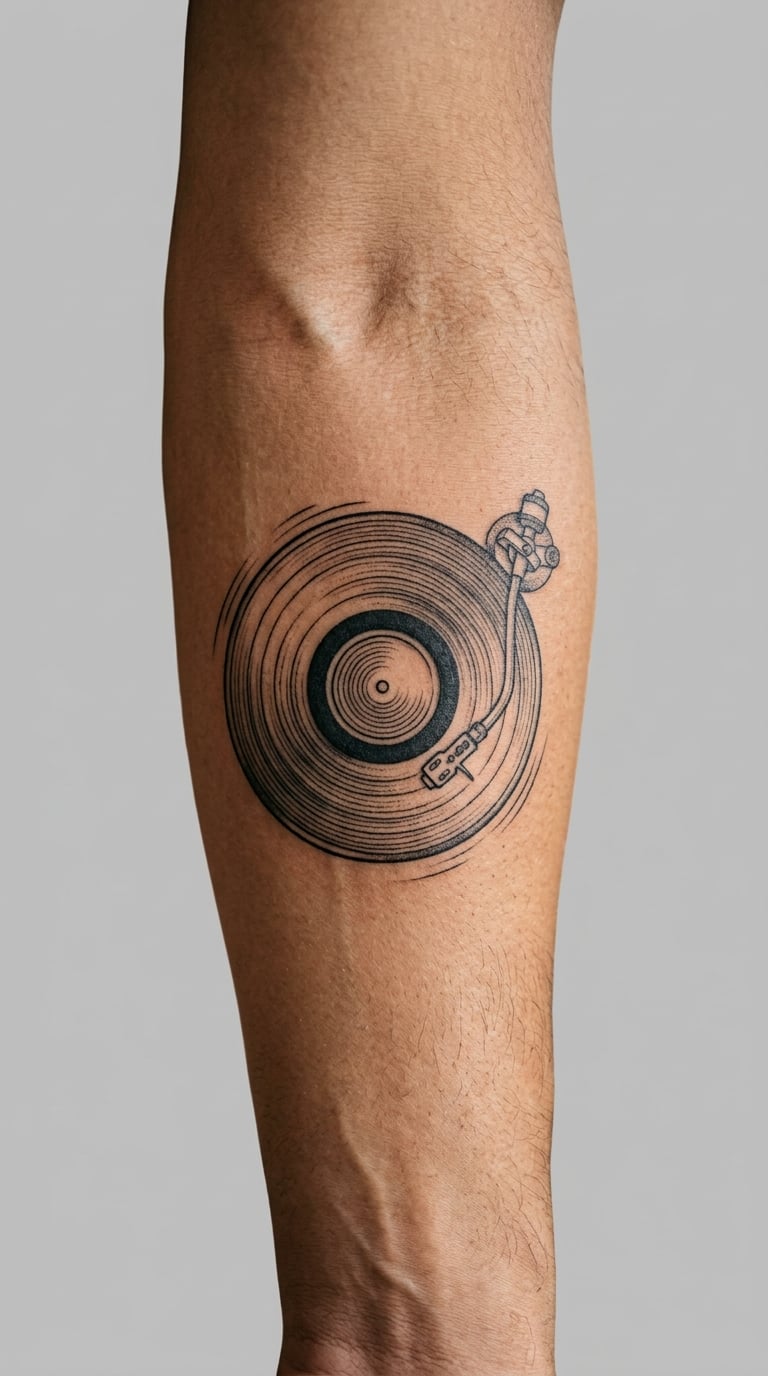
Thin concentric grooves, a solid black label, and a single line for the tonearm reaching in from the top right. That is the whole design, and the restraint is the point. It reads as listening rather than decoration.
People pick it because the needle drop is a small ritual they want to carry. Some connect it to a specific record shop or a first turntable they still own.
Placement: inner forearm, wrist crease inside, or outer forearm. Size: 2.5-3.5 in (6-9 cm) across. Style: fine line, one-needle line weight kept consistent. Pain: low to medium on the inner arm, though the wrist crease and elbow crease both sting more.
Fine line on the inner forearm softens noticeably in five or six years. Make it yours: have the label hand-lettered with a catalogue number rather than a name.
2. Turntable in a Blackwork Square
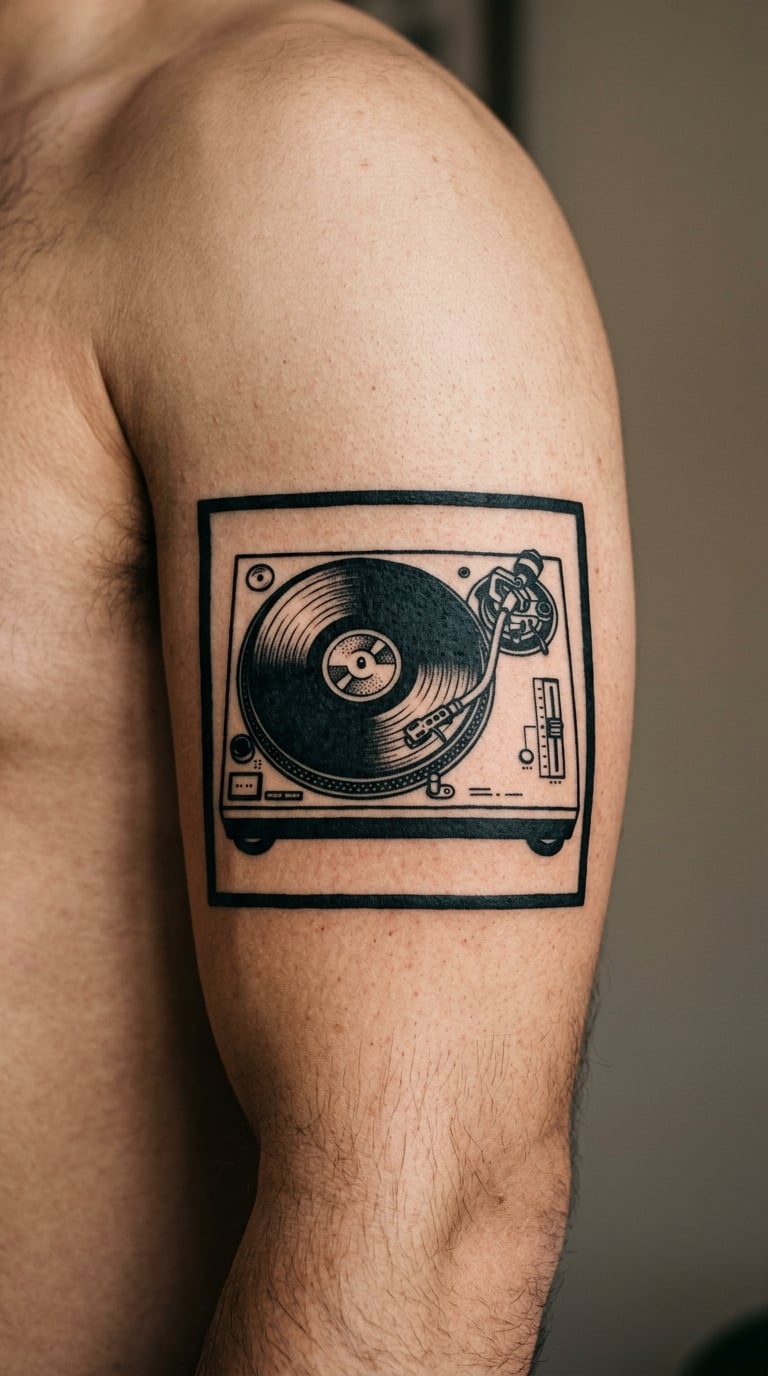
A geometric platter deck drawn from above, set inside a hard black square border with even line weight. The square gives the round turntable something to sit against, and the border makes the piece read from across a room.
It is a home-listening design: the record player on a shelf in someone’s flat, not a club deck. The frame keeps it from looking like a logo.
Placement: outer upper arm, chest, or calf. Size: 3-4 in (8-10 cm) square. Style: blackwork, solid blacks with no grey. Pain: medium on the upper arm and calf.
Solid black linework holds contrast for years better than hairline work. Make it yours: put a second smaller square beside it later with a different record inside, and you have a set rather than a one-off. If you like motif-led pieces more than pure symbols, our tattoo ideas that symbolize freedom covers that style.
3. Record Sleeve with Peeling Half-Disc
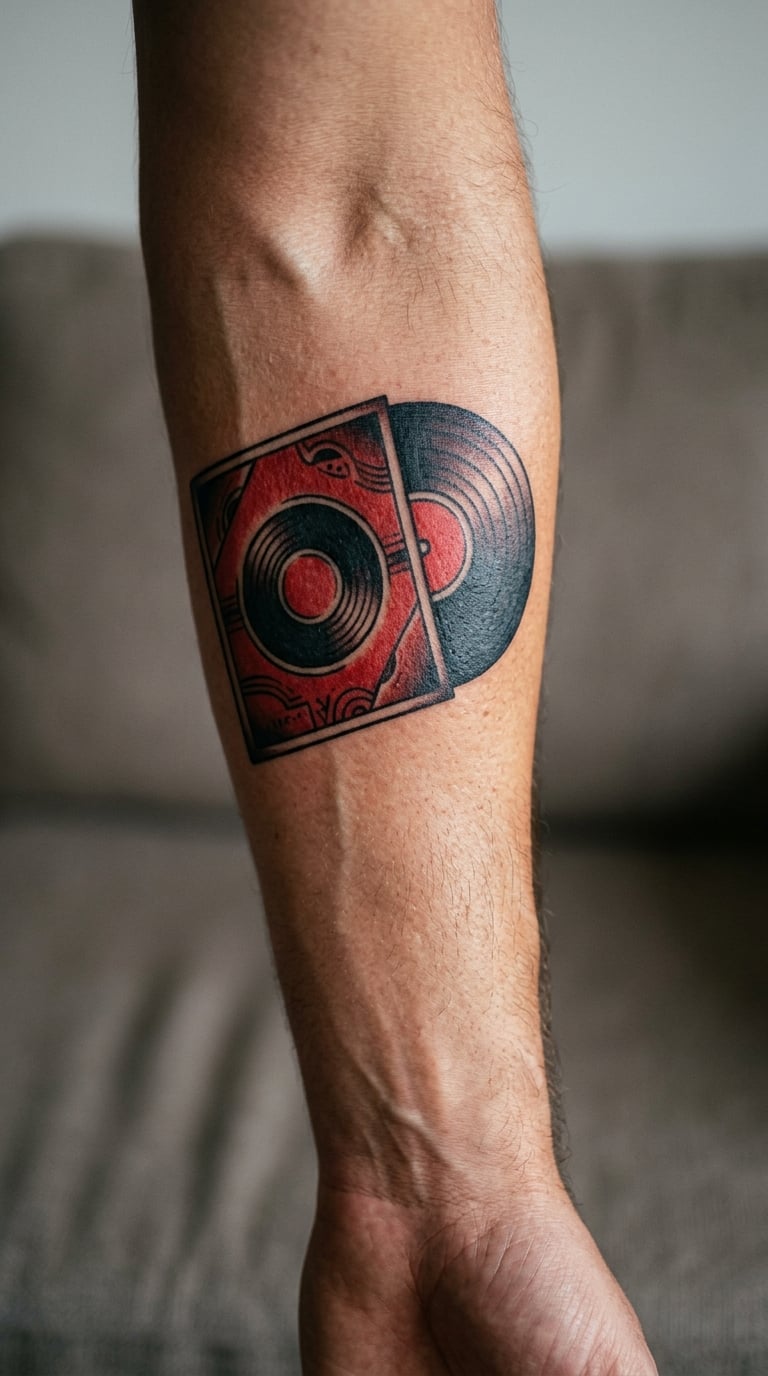
A square sleeve drawn straight-on with a disc sliding halfway out of the top, as if you just pulled it. Add a worn corner on the sleeve and a little shadow under the disc for depth. It is a collector image, the moment before the needle drops.
Collectors tend to land here because it looks like a sleeve, and a sleeve can carry a colour scheme or a title without needing the record itself to do it.
Placement: forearm, thigh, or flat chest. Size: 4-5 in (10-13 cm). Style: illustrative or neo-traditional with bold outlines. Pain: medium; rib-adjacent forearms and the chest are noticeably more sensitive than the thigh.
The corner wear and small text will soften first. Make it yours: keep the sleeve blank inside so the artist can add your actual album title later in a second session.
4. Groovy Record with Rainbow Grooves
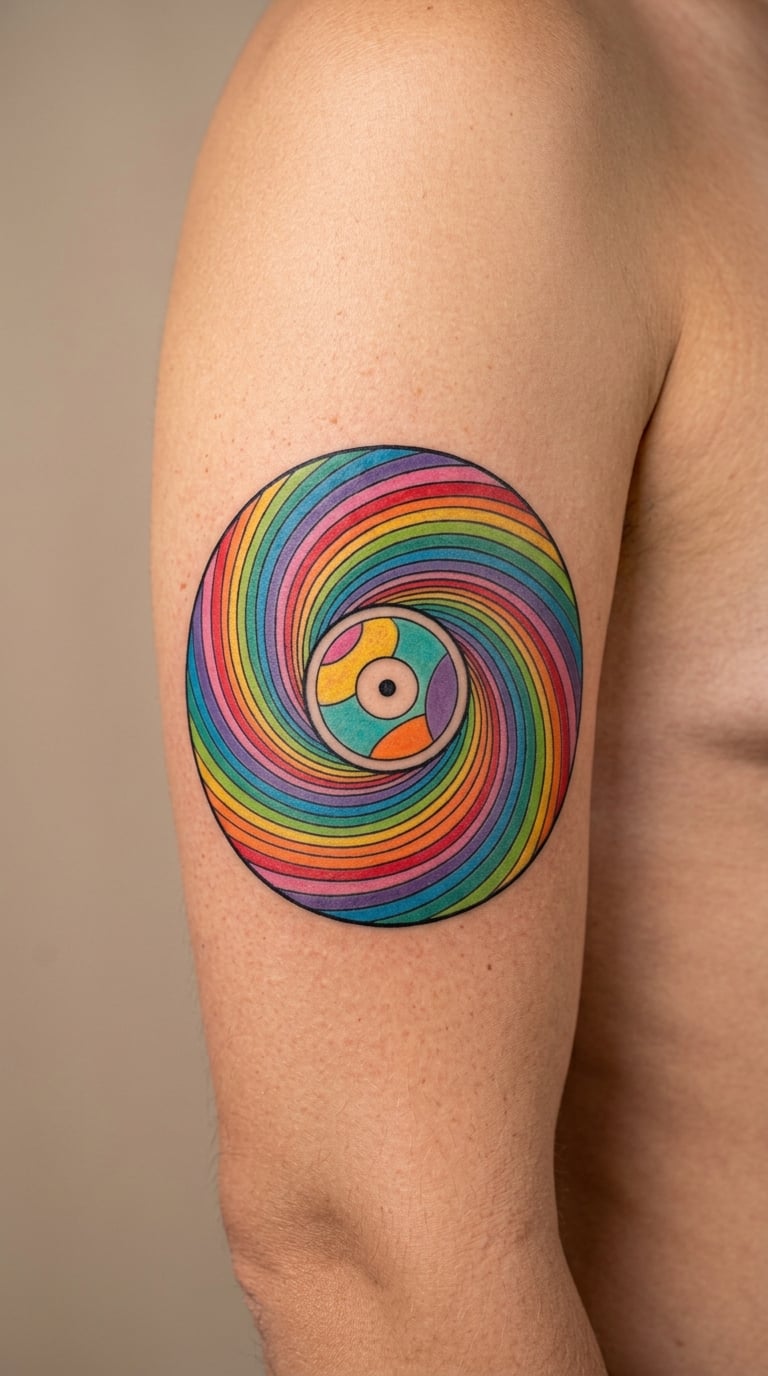
A disc built entirely from curved bands of colour, like a 1970s poster, with the grooves sweeping around the label instead of staying grey. Two or three colours work better than six. The palette is the design.
Colour-as-memory is a real approach here. Someone planning a set of small pieces used each of their favourite albums’ main colour as a tiny shape, and it turned out well, because the colour carried the memory instead of a logo.
Placement: upper arm, shoulder, or calf. Size: 3-4 in (8-10 cm). Style: colour illustrative, no heavy black outline. Pain: medium and long, because coloured areas need more passes.
Pale yellows and light pinks in a groove pattern will fade into the black linework over time. Make it yours: use two colours pulled from a record sleeve you already own.
5. Micro-Realism Record Player Close-Up
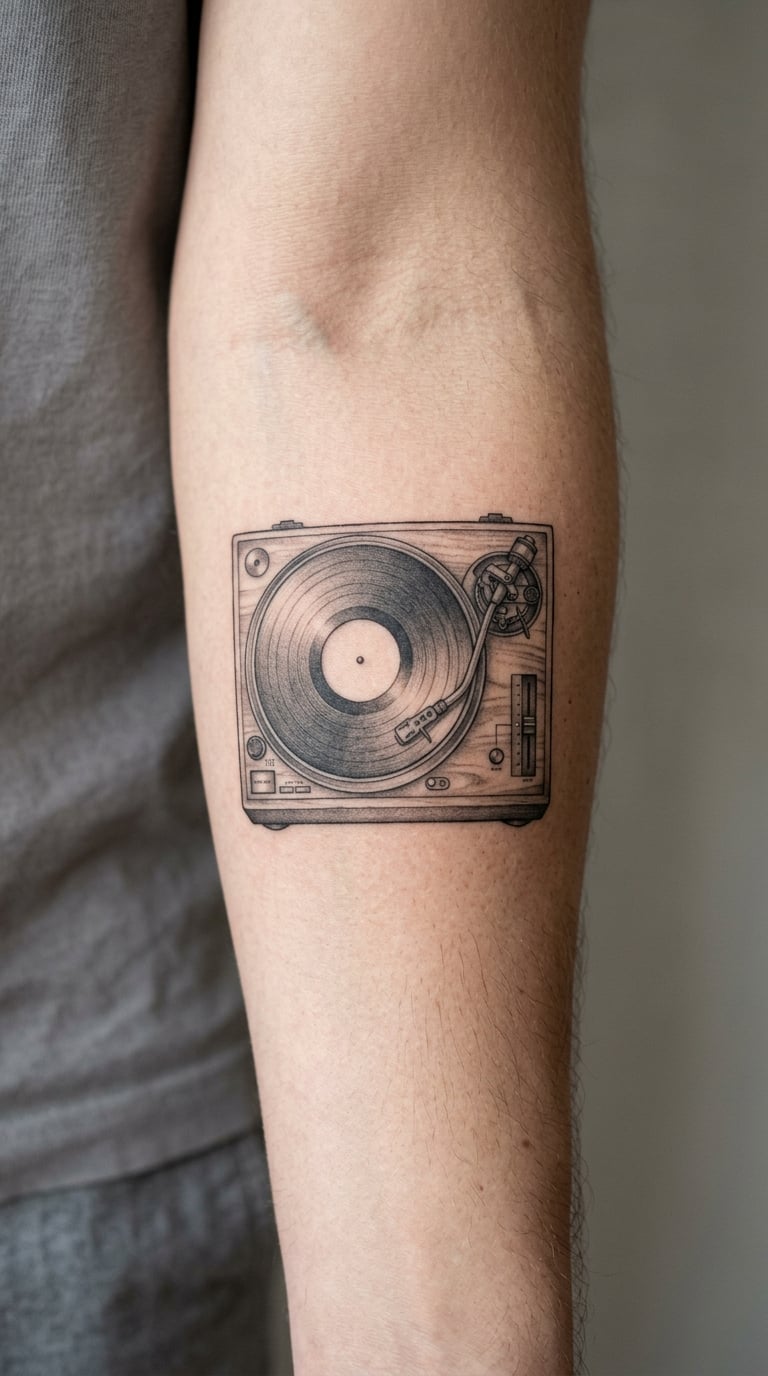
A miniature deck seen from above, cropped tight so you get the platter edge, the pitch fader, and the shape of the tonearm without the whole rectangle. Shading does the work: soft greys under the controls, one dark shadow where the stylus meets the record.
This is a precision design rather than a loud one, so it usually suits someone who wants their music visible and their tattoo quiet.
Placement: inner or outer forearm. Size: 2-3 in (5-8 cm). Style: micro-realism, grey wash plus a few black accents. Pain: medium, and the shading means a long sitting.
Small grey shading fills in and greys out within a few years, so plan on a touch-up. Make it yours: ask for the tonearm to sit on one specific track position, the way it would be if you had just queued it.
6. Floating Heart on a Grooved Disc
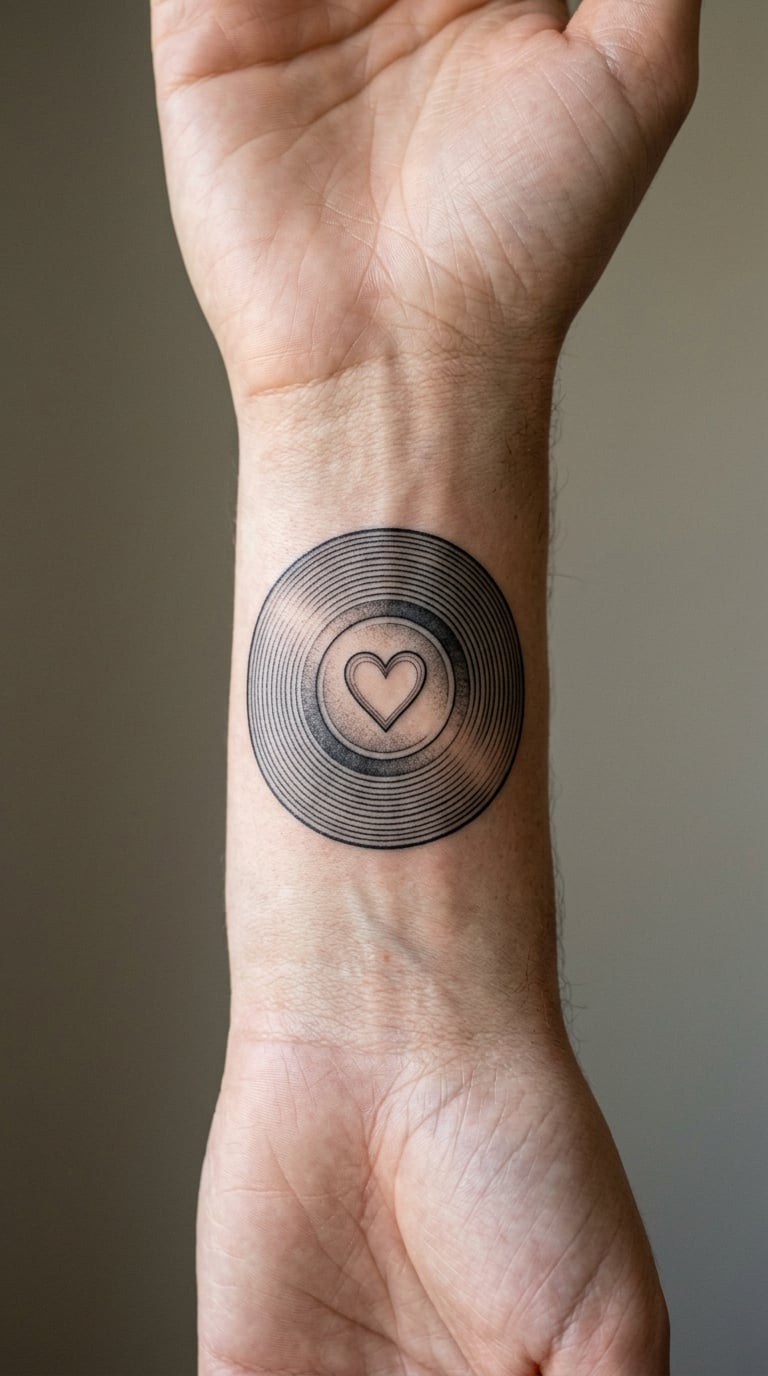
A small solid heart sitting in the middle of a lightly grooved disc, drawn in black and grey. The heart is not given extra decoration, which keeps it from tipping into novelty. It just sits where the label would go.
People choose it when the record is the reason and the heart is the part they say out loud. Any meaning beyond that is yours to attach.
Placement: inner wrist, inner bicep, or behind the ear. Size: 1.5-2 in (4-5 cm). Style: fine line with a soft grey halo. Pain: medium on the inner wrist, low behind the ear.
Inner wrist linework and heart shapes both soften with sun exposure, so cover it. Make it yours: use a heart shape that is slightly off-centre in the groove pattern rather than a symmetrical one.
7. Headphones Wrapped Around a Record
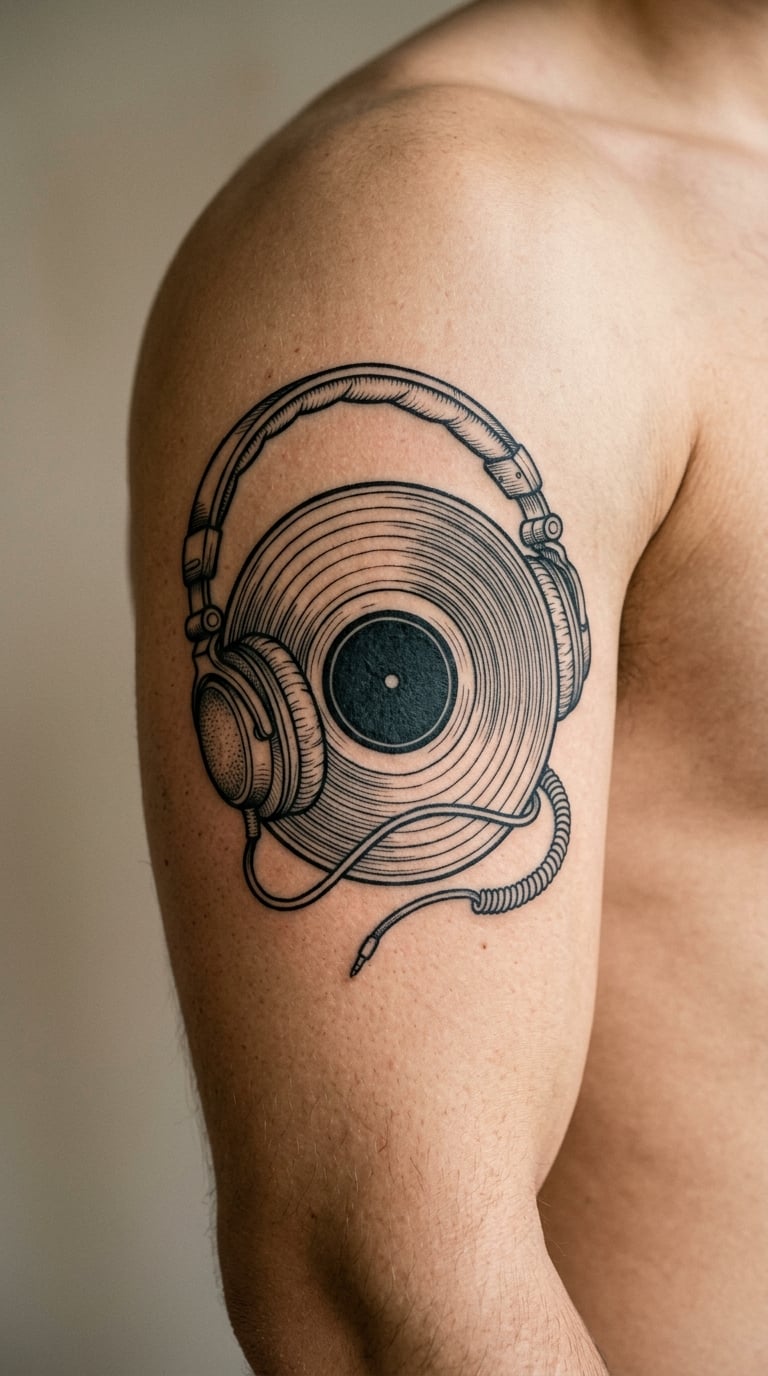
A disc with a pair of over-ear headphones looping around it, the headband arcing over the top and the ear cups sitting on the left and right edges. Balanced, symmetrical, and immediately readable as listening.
It usually turns up on people who moved from streaming to a real setup and now listen with headphones more than speakers.
Placement: outer upper arm, upper back, or calf. Size: 3.5-4.5 in (9-11 cm). Style: blackwork with bold outlines and no grey. Pain: medium, and the upper back is a long sit because you cannot see it.
Thin headband arcs blur where the arm bends, so avoid putting the ear cups right on the inner elbow. Make it yours: add a single cord running out of the design and off the edge of the skin, then continue it in a later session.
8. Botanical Record with Flowers from the Center Label
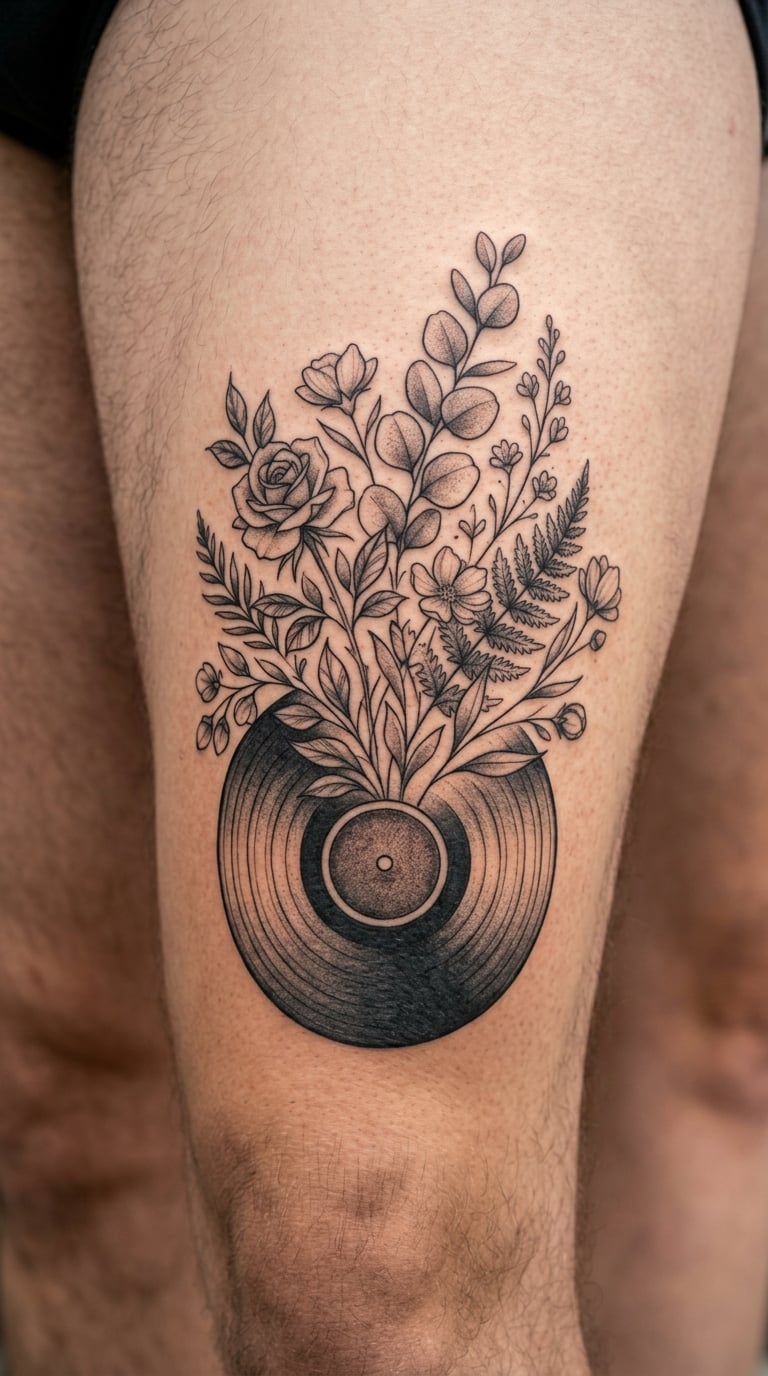
Stems and leaves growing out of the record’s centre label, with the disc itself drawn as a light dotted circle beneath them. Botanical rather than literal: the label is the soil, the flowers come up and out of it.
It is an aesthetic choice more than a message. People who like plant work but want one tattoo to sit in both their flower sleeve plans and their music pieces tend to pick this.
Placement: thigh, hip, or outer arm. Size: 3-4 in (8-10 cm) tall. Style: botanical black and grey. Pain: low to medium, and the thigh is the easiest canvas on this list.
Dotted grooves are among the first things to fill in, so ask for solid hairlines in the disc. Make it yours: name the flower that matters, and let the artist draw that species rather than a generic stem.
9. Half Record and Half Waveform
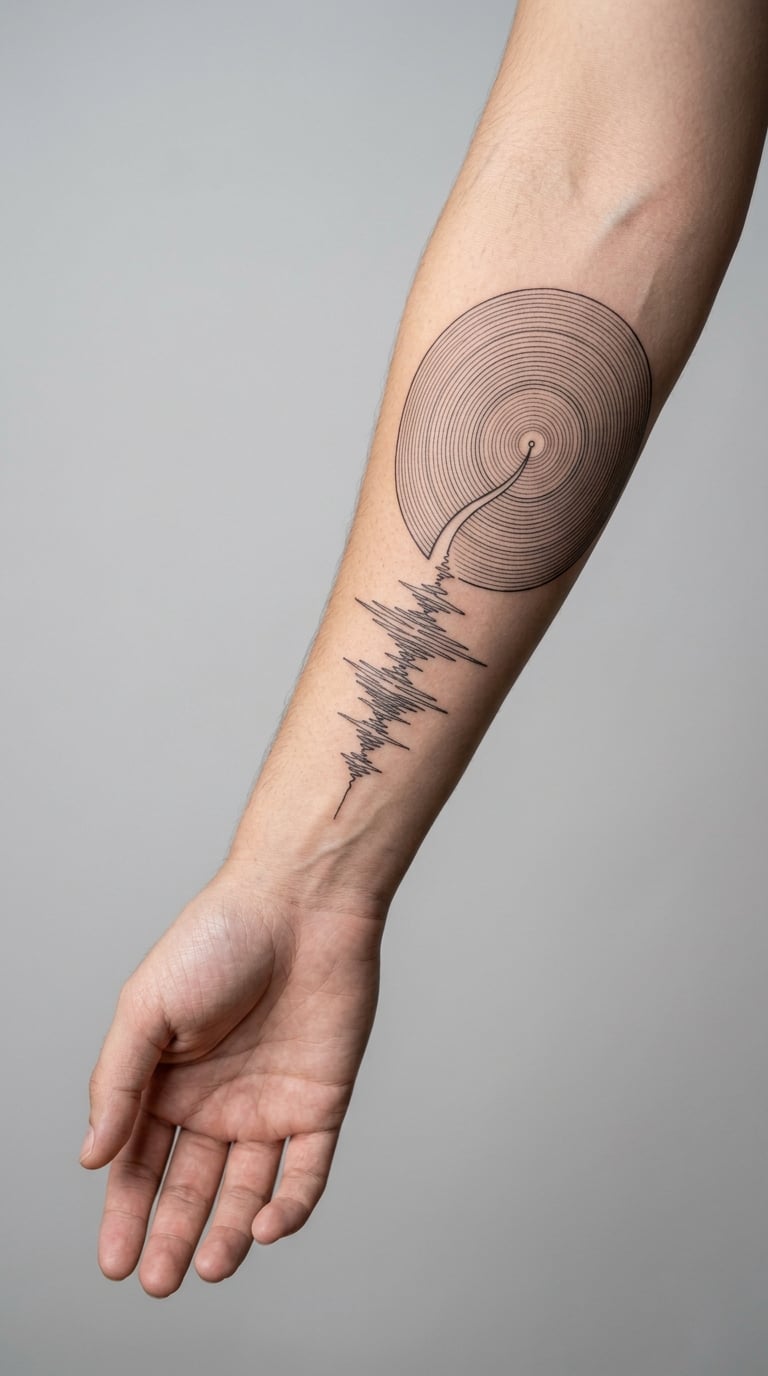
One half of the disc is drawn as grooves. The other half becomes an audio waveform, the spiky kind you see in a music app. A straight vertical line runs down the middle where the two treatments meet.
It reads as old and new listening sitting in the same image, and it looks contemporary without depending on trends.
Placement: forearm, calf, or along the spine in a vertical stack. Size: 2.5-3.5 in (6-9 cm). Style: contemporary fine line. Pain: low on the arm and leg, higher over the spine.
Waveform spikes are narrow shapes, so expect the tiny ones to merge with their neighbours. Make it yours: give the artist the waveform of a song you care about and have them trace the real peaks.
10. Minimal Black Disc with One Shine Line
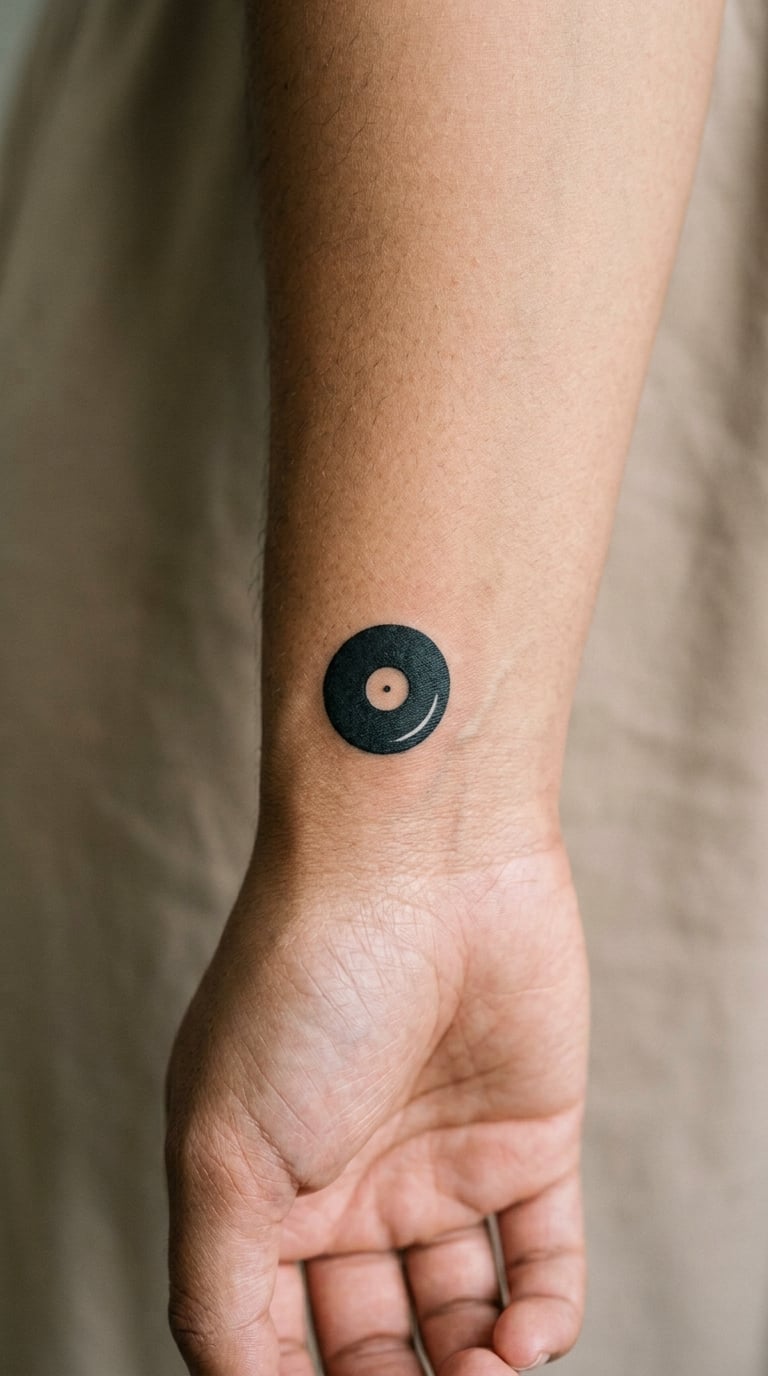
A solid black circle with a small cut-out centre label and one thin white arc across the top. That is the design. It takes under an hour and it is the easiest first tattoo in this whole guide.
Collectors who already have a lot of ink like it because it does not compete. First-timers like it because there is almost nothing to get wrong.
Placement: wrist, ankle, behind the ear, or on a finger alongside a small solid shape. Size: 1-1.5 in (2.5-4 cm). Style: minimalist. Pain: low almost everywhere, but fingers and the bony wrist bump are more noticeable than the soft part of the arm.
Small solid blacks in this style fade to grey first. Make it yours: leave a gap in the centre label shape so it reads as a 7-inch single rather than an LP.
11. Record Stack with Coffee Cup
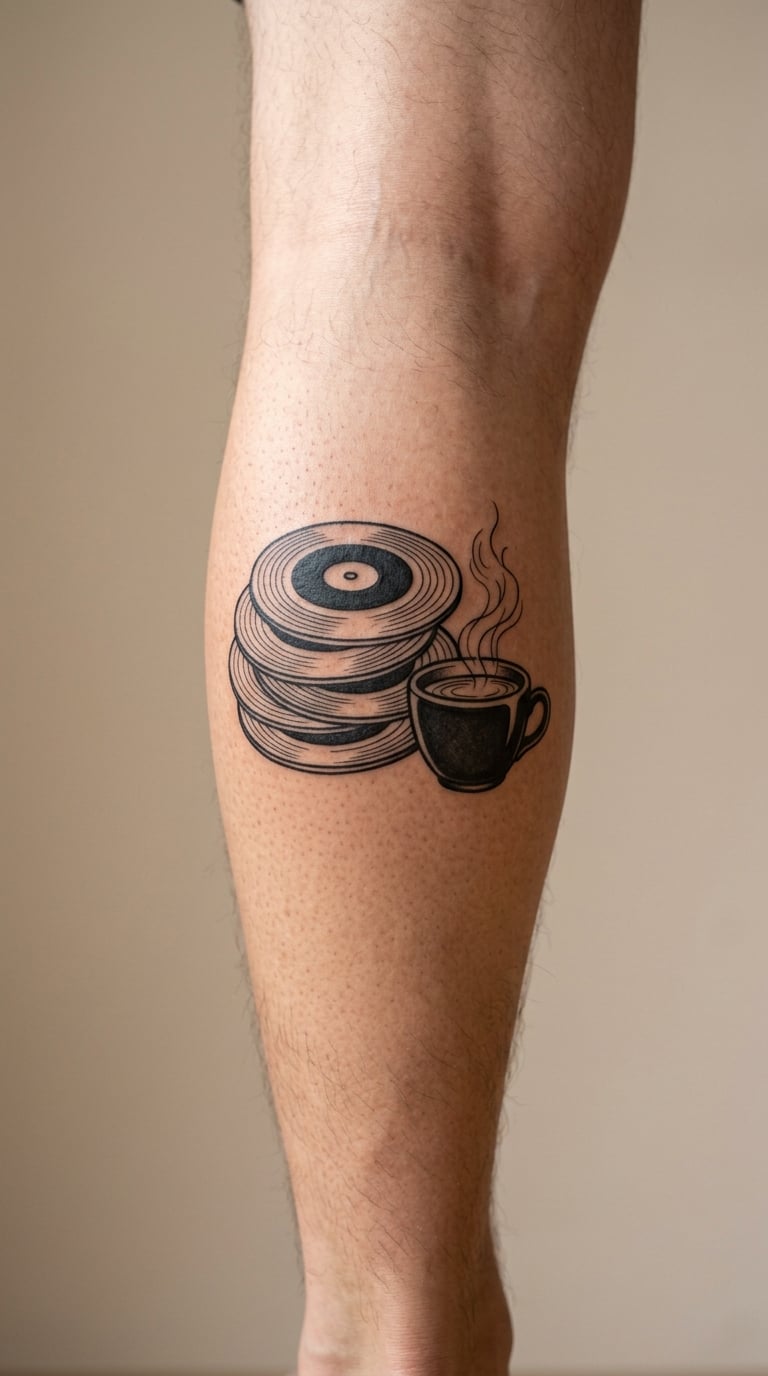
A short leaning stack of records with a cup of coffee beside it, two curved lines of steam rising out of the cup. The humour comes from the steam; everything else is drawn straight.
It is a morning image rather than a music statement. People who have a listening room or a record corner at home tend to recognise their own life in it.
Placement: calf, forearm, or lower back. Size: 3-4 in (8-10 cm). Style: playful blackwork or linework. Pain: medium, and the lower back sits close to bone.
The steam lines are the first detail to blur because they are isolated hairlines. Make it yours: count the records in the stack and match it to the number of records you actually own.
12. Crescent Record with Grooves Following the Curve
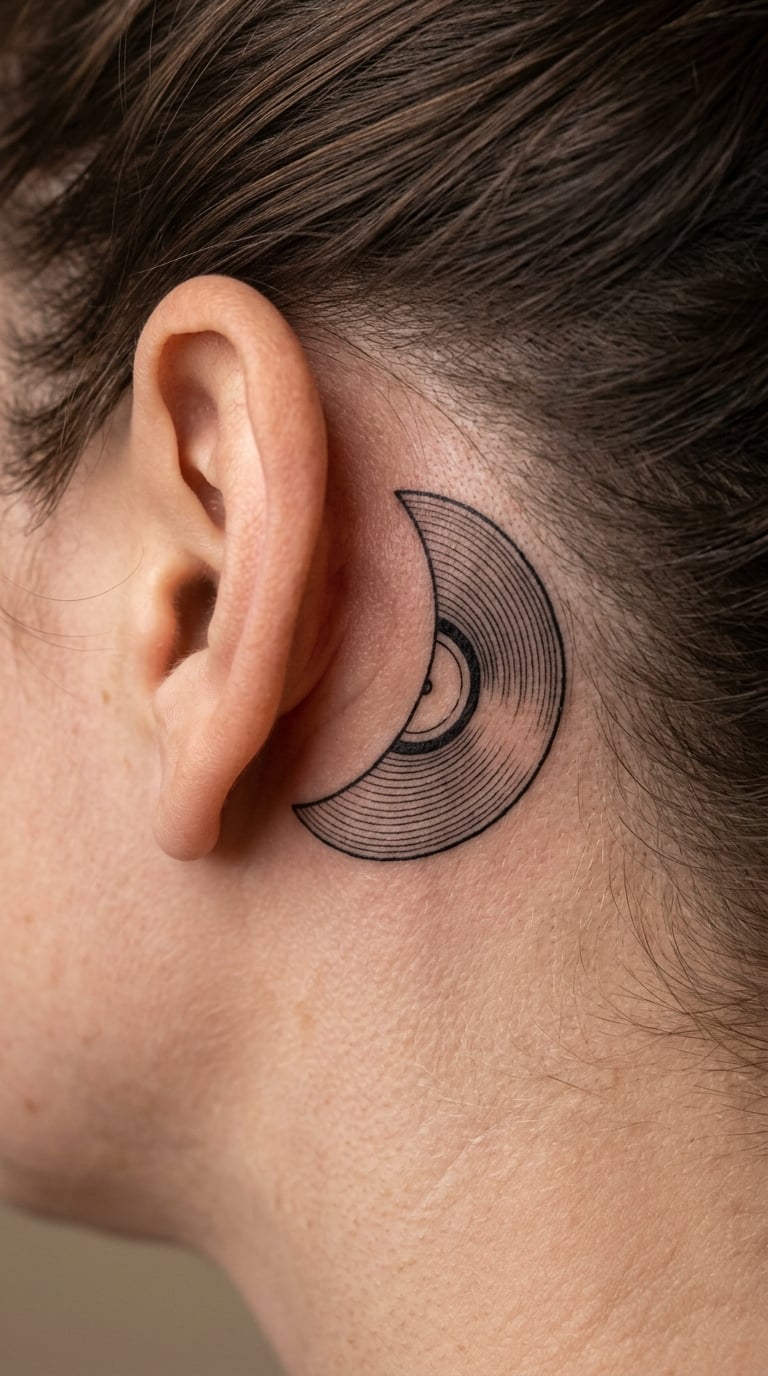
Instead of a full circle, a crescent shape where the grooves curve along with the cut. It is one of the harder shapes to stencil because the artist has to build the groove spacing by hand across an uneven outline.
It shows up on people who already have a straight-line music tattoo and want the second piece to look like it belongs without repeating anything.
Placement: behind the ear, nape of the neck, or the outer shoulder. Size: 2-2.5 in (5-6 cm). Style: fine line. Pain: low behind the ear, medium at the nape.
Fine work behind the ear is high-visibility and low-hide, so plan for people noticing it. Make it yours: mirror the design on the other side with the crescent facing the other way.
13. Two Interlocking Records as Matching Tattoos
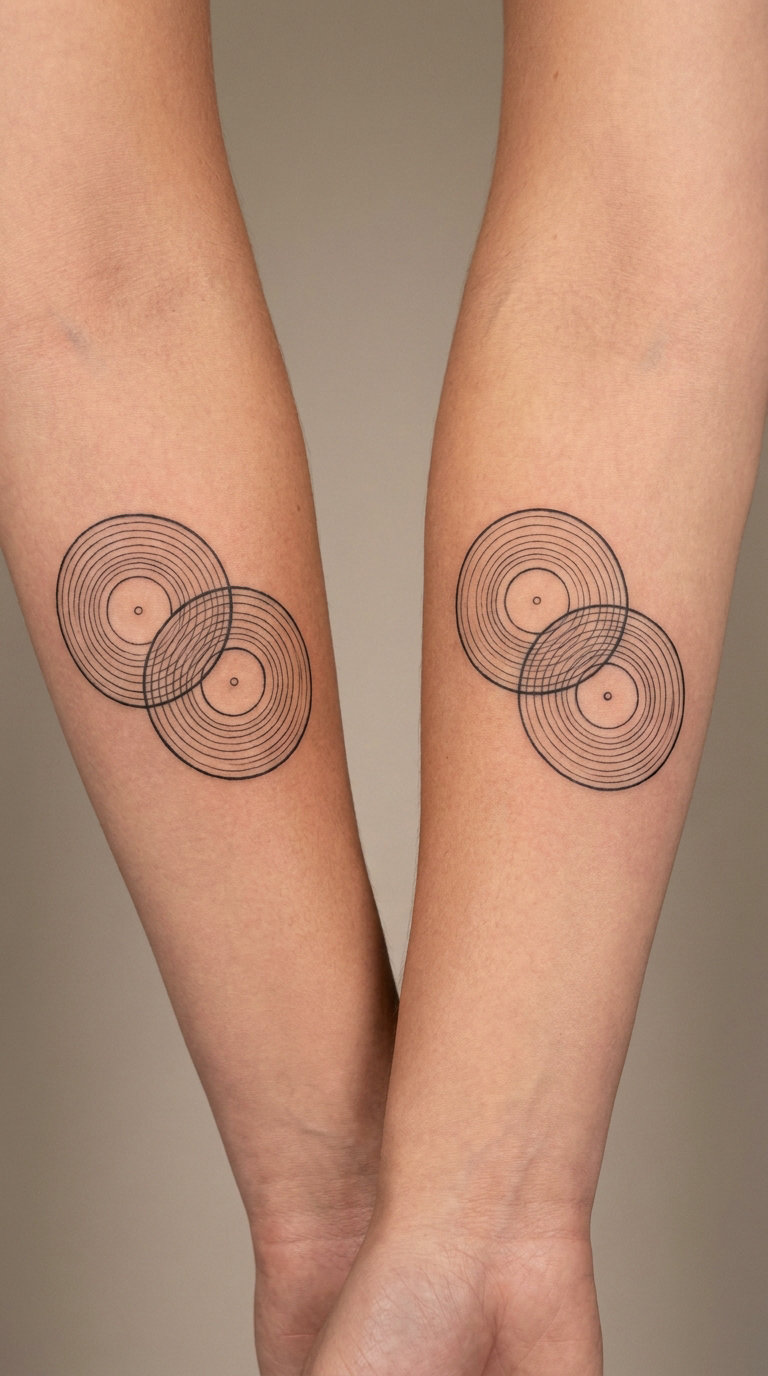
Two discs whose grooves meet in the middle, designed as a pair. One goes on the inner forearm and one on the opposite forearm, or one on each wrist, so the two only read as a set when the arms come together.
It works for friends, siblings, bandmates, or a couple who met at a gig. What it means is whatever you agree it means, which is exactly why it makes a good pair.
Placement: matching inner forearms or inside of both wrists. Size: 2-2.5 in (5-6 cm) each. Style: fine line, identical line weight on both. Pain: medium on the inner arm, and doing both in one sitting is a long appointment.
Inner arms fade at different rates depending on sun exposure, so the pair can drift apart. Make it yours: agree the placement before booking. We have more on matching tattoo ideas for roommates and matching tattoo ideas for a group of five if you are going further than two.
14. Sunflower Record Label
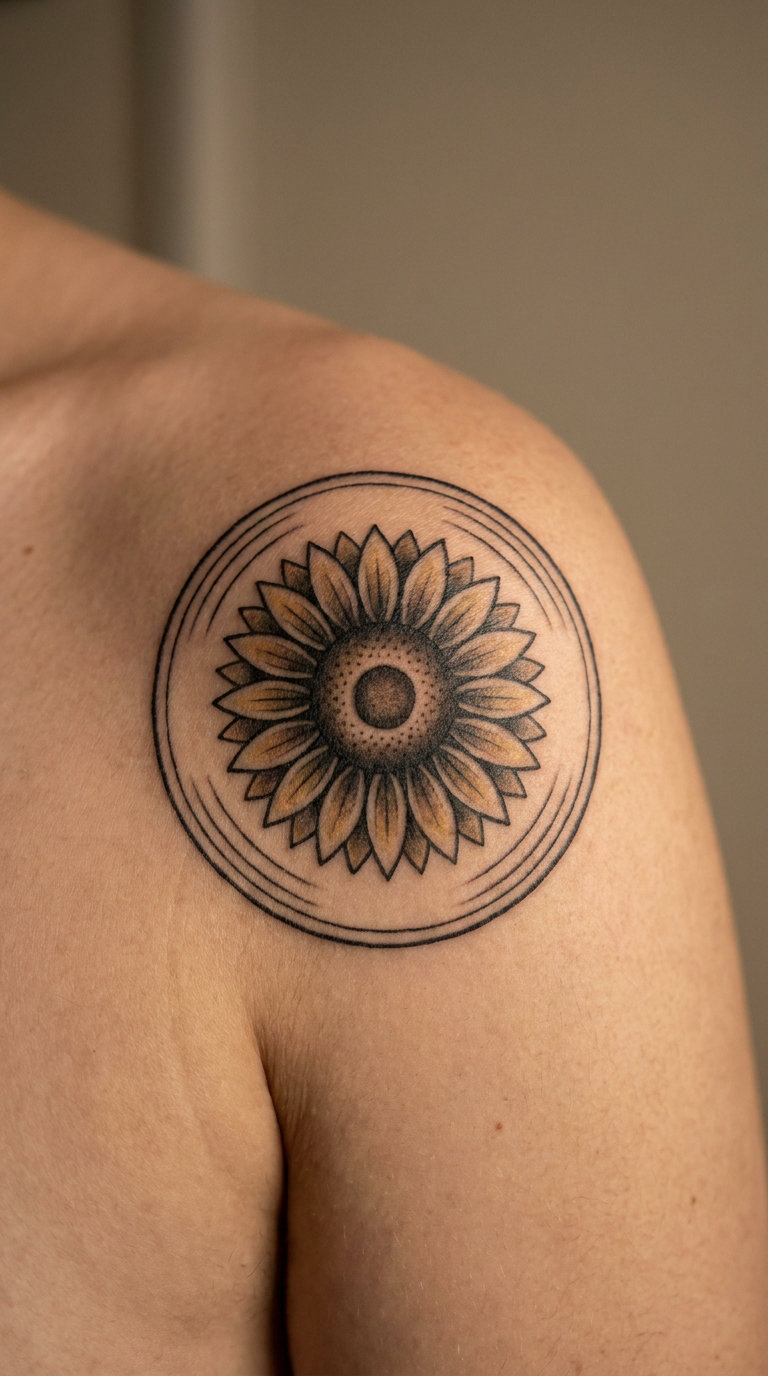
A sunflower drawn in a traditional style, sitting inside the plain centre label of a record. The disc around it stays simple: black outline, a few groove lines, nothing more. One flower carries the piece.
It blends country-folk tattoo language with a music motif, which suits people whose record taste crosses into that world.
Placement: shoulder, upper arm, or calf. Size: 2.5-3.5 in (6-9 cm). Style: traditional with one muted colour, or solid black if you prefer. Pain: medium on the shoulder, lower on the calf.
Traditional petal shading softens into grey blotches when the colour is light. Make it yours: swap the sunflower for a thistle or a poppy that means something local to you.
15. Watercolor Melody Swirl
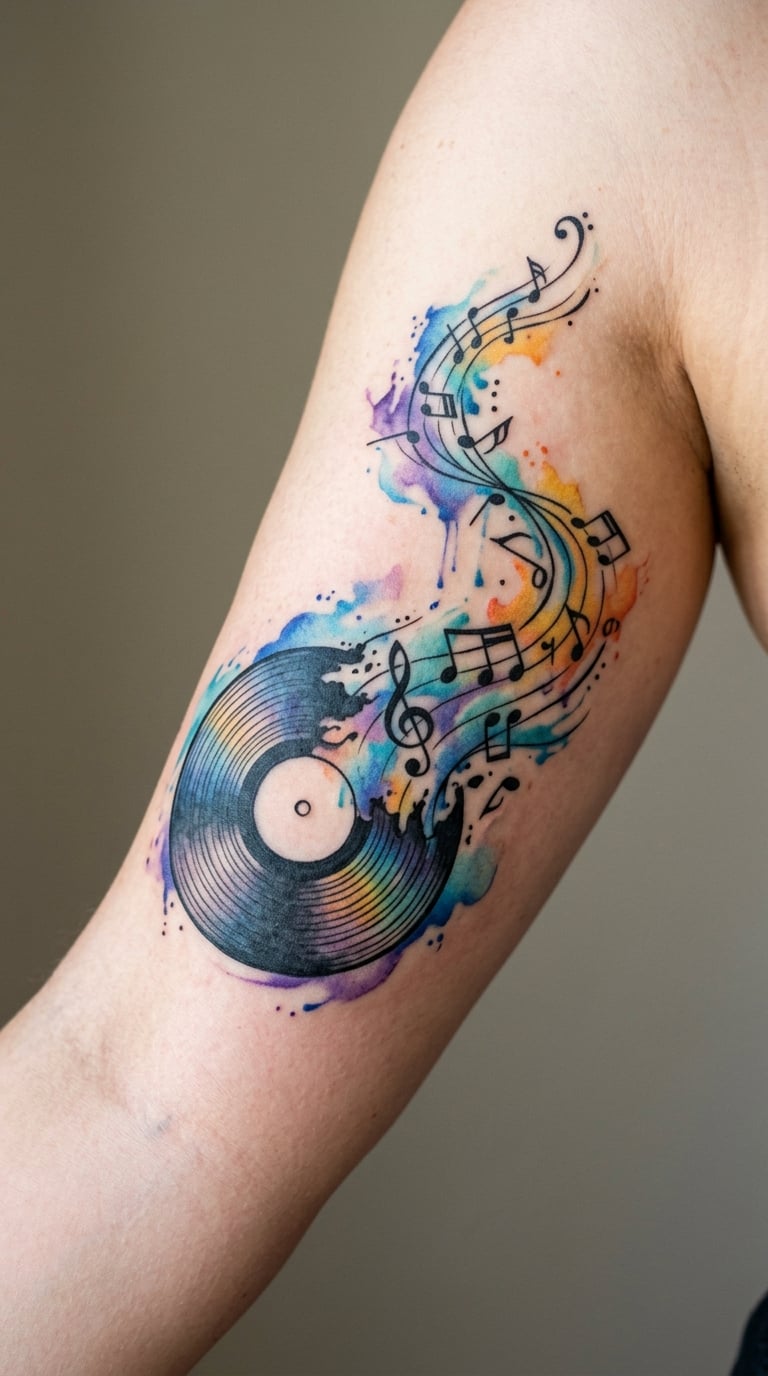
A loose disc in watercolour washes that breaks apart into curving lines, and the curves turn into a few notes floating off the top. Nothing is fully closed, so the piece feels in motion rather than drawn.
It suits people whose collection of tattoos is colourful and expressive rather than neat and lined. A set of three of these in different palettes works well.
Placement: upper arm, thigh, or across the shoulder blade. Size: 3-4 in (8-10 cm). Style: watercolour. Pain: low to medium; the thigh is the easiest.
Watercolour is the first style to fade on this list, especially in high-contrast edges, so expect a refresh every few years. Make it yours: give each piece one dominant colour and keep the rest pale.
16. Cassette Tape Transforming into a Record
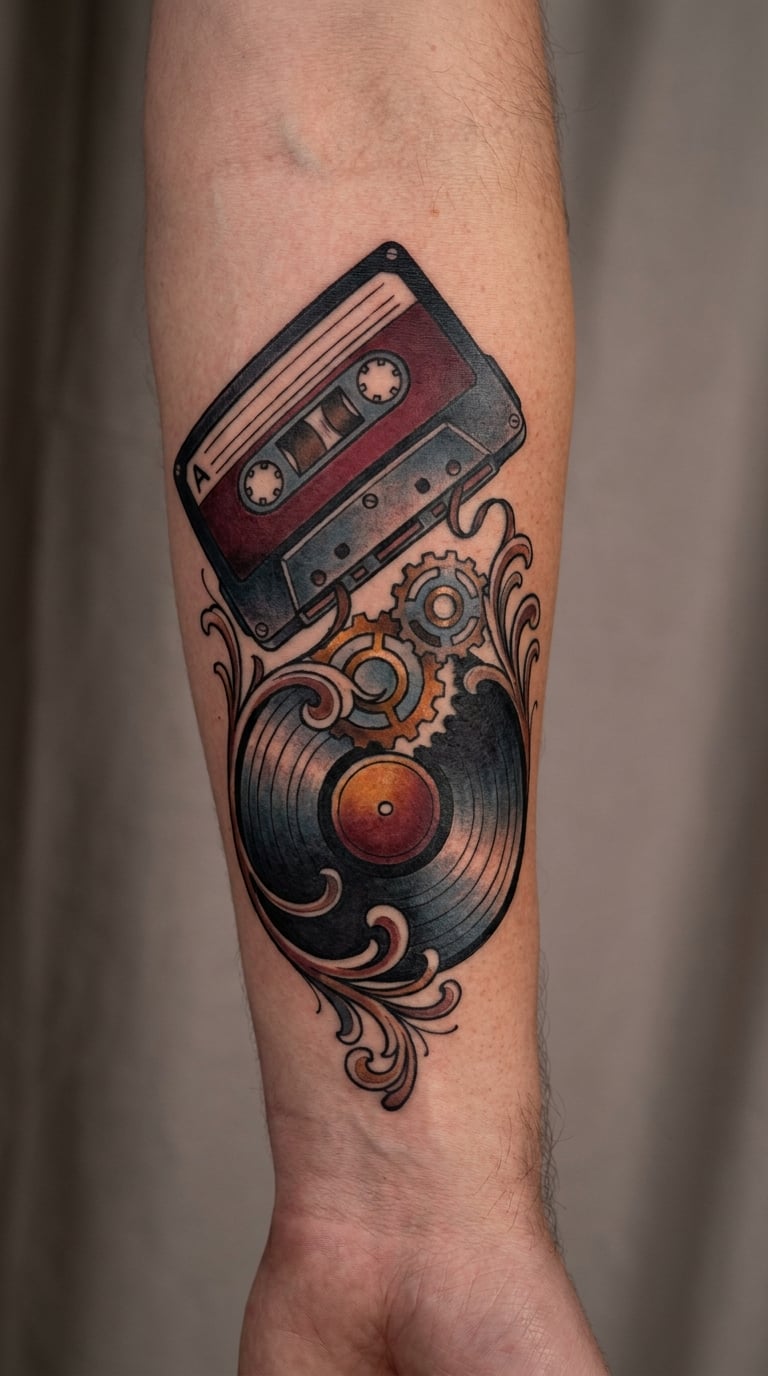
A cassette on the left, a record on the right, and the middle of the image where the tape’s exposed reel smears into the disc’s grooves. The two objects share a single join so the transition reads as one motion.
It is the right choice if you grew up on cassettes and still own some. It also handles a collection that spans formats without looking like two unrelated tattoos.
Placement: forearm, upper arm, or calf. Size: 3-4 in (8-10 cm). Style: neo-traditional with bold outlines. Pain: medium.
The reels and the small window detail fill in fastest. Make it yours: add a strip of tape along one edge that looks torn at one end.
17. Butterfly Emerging from Record Grooves
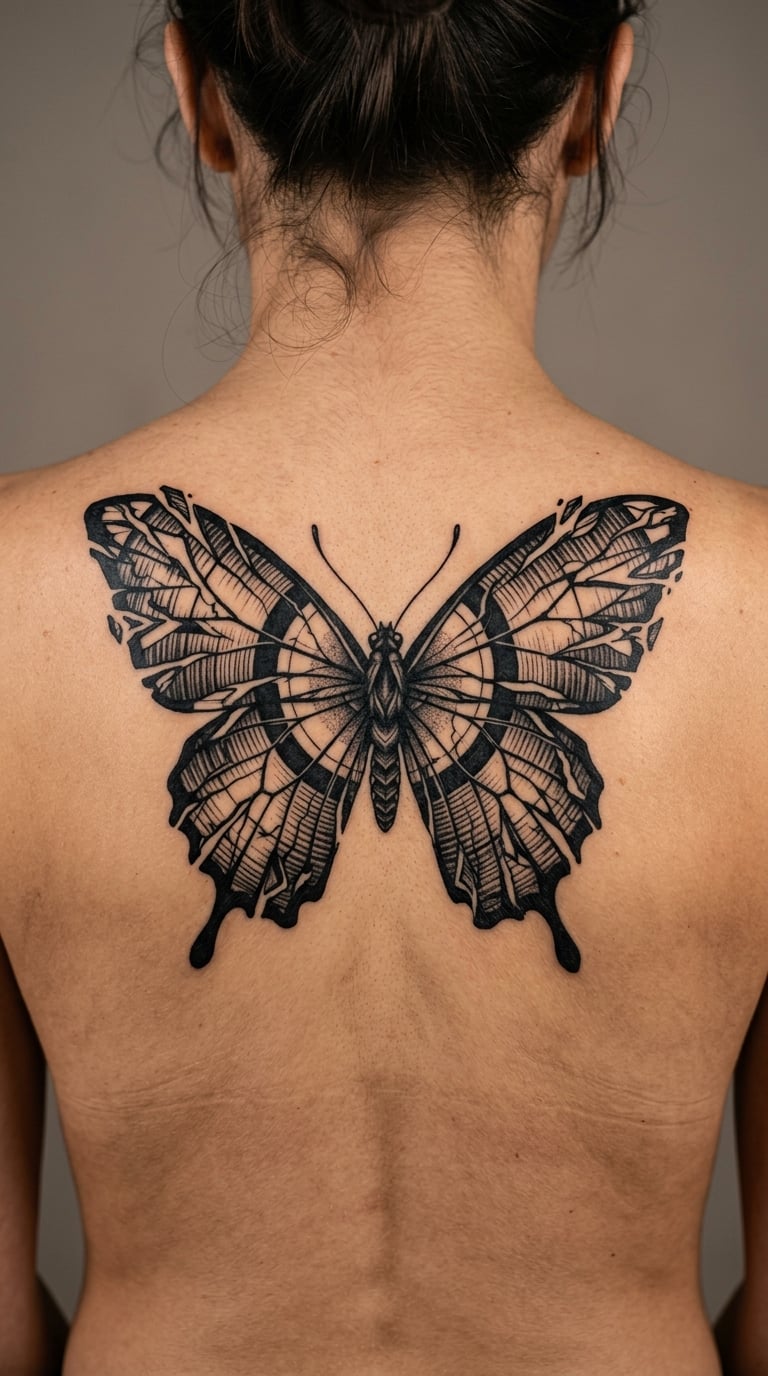
A bold butterfly whose upper wings are still half-made of broken groove lines, lifting away from the disc. Blackwork, heavy saturation, no grey. The contrast between the mechanical half and the organic half is the whole effect.
It reads as change rather than as music, and the record is the source. Plenty of people interpret it their own way, and that is fine.
Placement: upper back, shoulder blade, or mid-back. Size: 5-7 in (13-18 cm). Style: bold blackwork. Pain: high. The upper back is a long, awkward session and you will not see it properly while it is being done.
Bold black fills stay readable, but the fine line where the grooves break up will soften. Make it yours: have the wing tips end in dotwork rather than solid black if you want more texture later.
18. Record Player with Music Notes
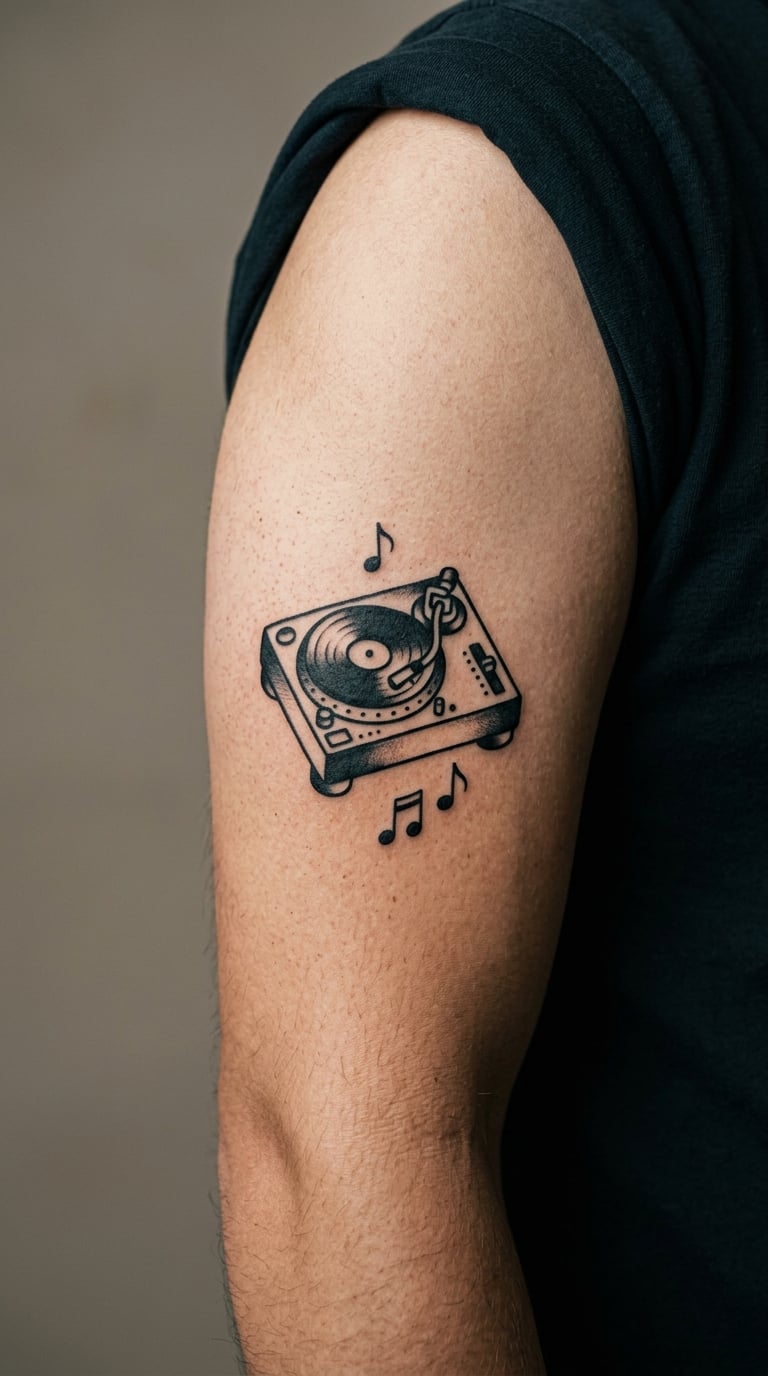
A compact deck drawn in a traditional style: a side or three-quarter view, a platter edge, a dust cover, and two small notes lifting off the tonearm. Heavier line weight than the blackwork examples, with a little flat grey on the body of the machine.
The record player motif is proven in traditional work, not just minimal linework. A real piece in that style has been around for years and holds up well, which is useful to know before you commit to a heavier design.
Placement: upper arm, forearm, or thigh. Size: 3-4 in (8-10 cm). Style: American traditional. Pain: medium.
Traditional grey shading in a machine body turns to mush at small sizes, so resist going below about 3 in. Make it yours: add a small catalogue number on the dust cover, in the same traditional lettering style.
19. Map-Pin Record Collection
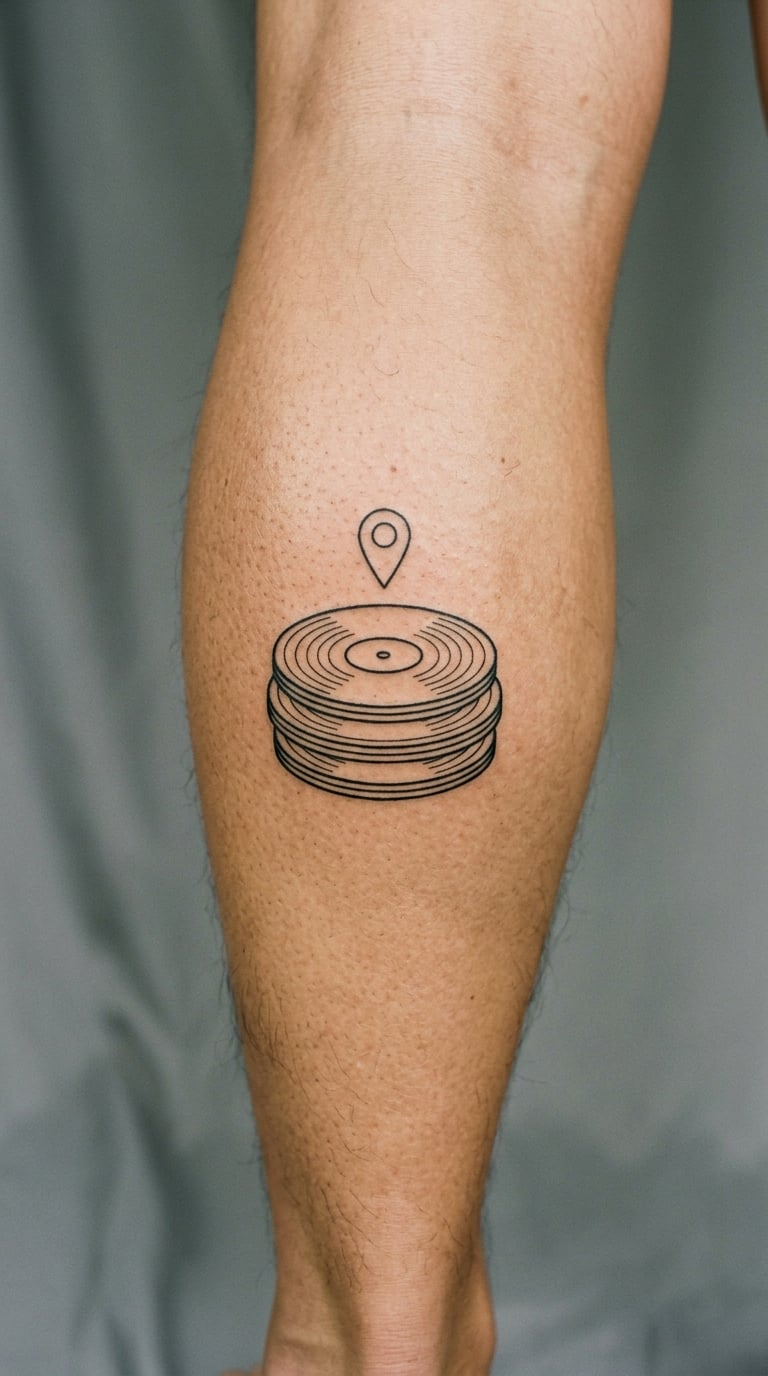
A stack of records with a map location pin above it, drawn in thin line. The pin is the only solid black shape in the piece, so it holds the eye. The stack is loose and slightly uneven, like records actually leaning.
It works for anyone who connects records to places: the shop where you found a pressing, the city a band played, the flat you first played them in. Some people get the pin for a specific venue and the stack for everything else.
Placement: calf, forearm, or lower back. Size: 3-4 in (8-10 cm). Style: fine line with one solid element. Pain: medium, and the lower back sits on bone.
A pin is small and detailed, so it can look thin once healed. Ask for a slightly heavier line in the pin than in the stack. Make it yours: use the coordinates of a place that matters instead of a generic marker.
20. Handwritten Track List Around a Disc
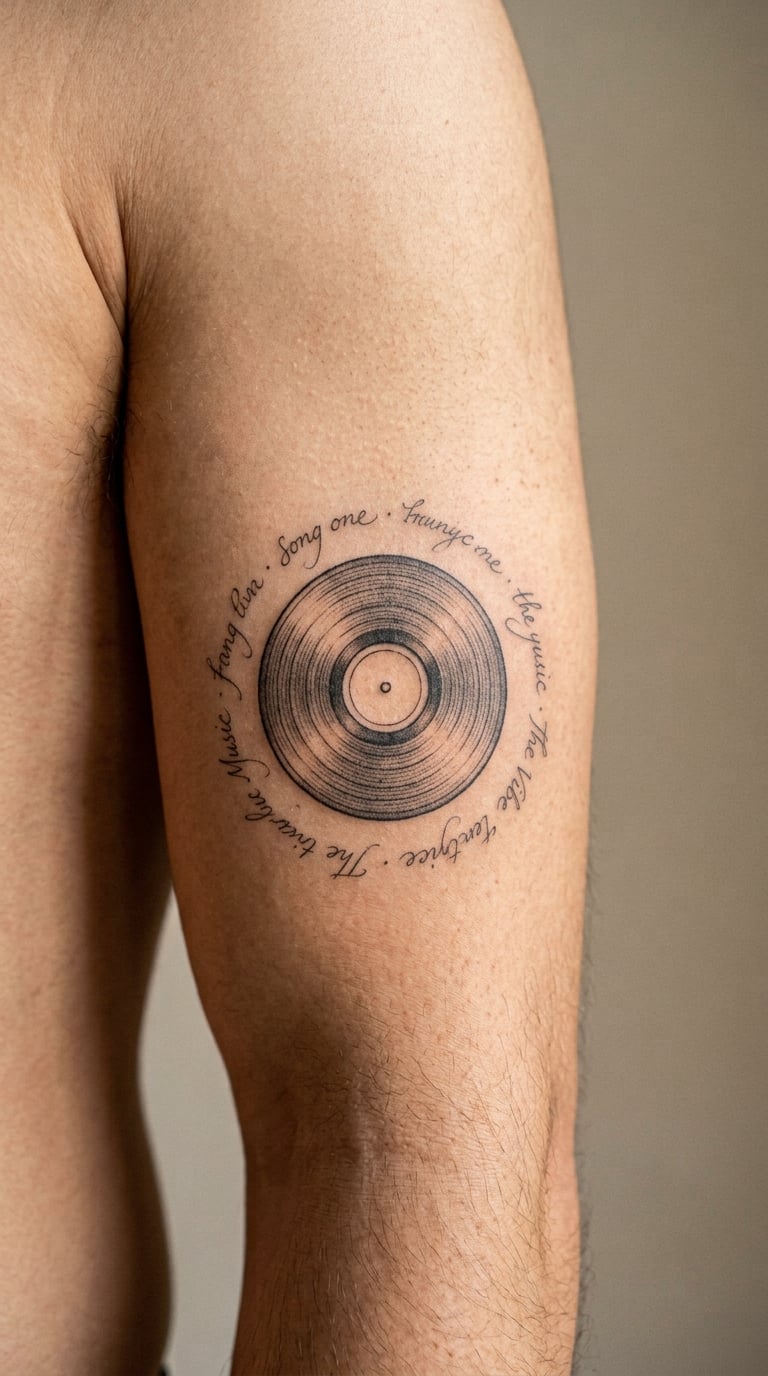
A record disc in the centre with three or four lines of hand-lettered track names curving around it in a loose circle, like a running order written on a sleeve corner. The script is the design; the disc is the frame.
This is the most personal of the twenty, because the words are yours. It suits someone who treats records as a sequence rather than a collection, and it makes a natural pair with a date or a place underneath.
Placement: upper arm, thigh, or flat chest. Size: 3.5-4.5 in (9-11 cm). Style: fine line with hand lettering. Pain: medium, and lettering always takes longer than the drawing does.
This is the design most likely to need a top-up. Script in ink on skin loses definition, so book a free check with your artist a year after healing. Make it yours: three tracks is legible, eight is not. Pick the side.
How to Choose the Right Design
Start from the honest constraints: how big the canvas is, how much detail survives at that size, and whether you will still want a bigger piece later. Everything else is preference.
What Makes a Vinyl Record Tattoo Idea Hold Up on Skin
A circular design has a specific weakness. Round shapes distort on curved and bony skin, so the same disc that looks clean on a flat thigh can look squashed on a wrist, an ankle, or a rib. Ask your artist how they will place the stencil to compensate.
Detail is the second constraint. Album art and label text look fine on a 12-inch sleeve and turn into a grey smudge at 3-4 cm. The rule of thumb most artists use is simple: line weight around 1 mm for anything under 2 in, and no more detail than you could draw with a fine pen on paper at the same size.
Build order matters too. If you might want a sleeve, get the first piece placed so it can sit inside one without being redone. People who got a matching pair years apart learned that the hard way.
A Quick Framework
- Small, under 2 in (5 cm): ideas 6, 10, 12 and 13. A disc, a heart in a disc, a crescent, a matched pair. Fine line, minimal detail.
- Medium, 2-4 in (5-10 cm): ideas 1, 4, 5, 8, 9, 11, 14, 15, 16, 18 and 19. Most of the list lives here, and most styles work at this scale.
- Large, 5 in (13 cm) and up: ideas 3, 7 and 17. Sleeve, upper back, or calf. Two to four hours minimum.
- Colour vs blackwork: blackwork and fine line hold contrast longest. Colour is worth it when the colour carries the meaning, as in ideas 4 and 14.
- First tattoo: start at the small end. Idea 10 takes under an hour and gives you a healed record to build on.
Take a full set of references, including photos of your own records shot flat in daylight, to the consultation. Specifics get you a better tattoo than a mood board.
Cost and Session Time
Record tattoos sit in the middle of the price range because they are geometric, not photorealistic. Typical US shop rates, before tip, look like this.
- Micro, under 2 in (5 cm): roughly 100-250 US dollars, 30-60 minutes.
- Small, 2-3 in (5-8 cm): roughly 200-400 US dollars, 1-2 hours.
- Medium, 3-5 in (8-13 cm): roughly 350-700 US dollars, 2-4 hours.
- Large, 5-7 in (13-18 cm) or sleeve work: roughly 700-1500 US dollars, 4-8 hours, often split across two sessions.
What moves a record piece up the scale is the number of separate decisions in it. A plain disc is quick. A turntable in a blackwork frame, a barcode, a hand-lettered track list, or a colour palette with five shades all add time, and colour always adds time because saturated areas need more passes.
City matters as much as complexity, and so do shop minimums, artist experience and whether you are booking a guest spot or a friend. If a quote sits far outside these ranges, ask what is driving it before you walk away.
Plan for a second session on anything under 4 in. Artists routinely split designs that will not hold up in a single sitting, and a rested sitting beats a rushed one.
Aftercare Basics
Start with your artist’s aftercare instructions, because they know what they did in your skin. Everything below is the general version most studios will give you.
- Keep it clean and gently wash it as directed, usually with unscented soap and lukewarm water, then pat it dry rather than rubbing.
- Let it air dry and stay away from swimming pools, hot tubs, saunas and ocean water until it has healed.
- Cover it loosely with the bandage or wrap your artist applied, and follow their timeline for removing and replacing it.
- Wear loose clothing over the area while it settles. Friction is the most common way a fresh tattoo gets annoyed.
- Do not soak, scrub, pick at flaking skin or use lotions on it while it is healing.
- Once healed, protect it from sun. Linework on the inner forearm, wrist and behind the ear fades fastest because those areas see the most light and move the most.
If anything looks wrong, call the studio. Artists would rather hear from you early than see a problem a month later.
Frequently Asked Questions
Are vinyl record tattoos better in color or blackwork?
Blackwork and fine line hold their contrast longest, which makes them the safer choice if you want the design readable in ten years. Colour is worth it when the colour carries the meaning, such as a palette pulled from an album sleeve you love. Pick colour only if you are happy to book a refresh every few years, and ask your artist which part of the design fades first.
What is a good size for a vinyl record tattoo?
Three to four inches across, roughly 8-10 cm, is the sweet spot. It leaves room for grooves, a label and one personal detail without the piece turning into a grey smudge. Under two inches you are limited to a plain disc or a single shape. Above five inches you are in sleeve territory, which is a different project and usually a different budget.
Can a record tattoo be made very small and simple?
Yes, and it is a good first piece. A solid black disc with a cut-out centre label and one thin shine arc takes under an hour and costs very little. What you give up is the groove detail, so ask the artist to work with a single highlight instead of trying to squeeze in fine lines at that scale.
Where should I place a record player or vinyl record tattoo?
Inner or outer forearm is the most popular spot because it is flat enough for a circle and easy to hide at work. Upper arm, calf and thigh are all good for larger versions. Avoid the inner wrist, ankle and rib if the design has thin detail, because those areas are bony, highly mobile and see a lot of sun.
How can I personalize a vinyl record tattoo without adding too much detail?
Change one thing rather than adding five. A catalogue number in the label, one colour pulled from an album sleeve, the record count in a stack, or coordinates of a place that matters all add meaning without crowding the design. A hand-lettered track list works too, but keep it to three or four titles or the script will blur.
Which One Should You Start With
If this is your first tattoo, go with idea 10, the minimal black disc with one shine line. It is small, it is quick, and it heals into something you will not regret, whatever happens next. Idea 1, the fine-line spinning record with a tonearm, is the natural second piece once you know you want more.
For a collector building a set, start with the blackwork options. Ideas 2 and 7 are solid, high-contrast pieces that keep working next to each other, and they leave room for a sleeve later if you ever want one. If your records matter more than the gear, idea 20 is the one people get tattooed once and never stop being asked about. Just book the touch-up.