
25 Hope Tattoo Ideas: Best Small Symbolic Tattoos (October 2026)
A hope tattoo is any design picked to remind you that better things are still ahead: a rising sun, a steady anchor, a bird lifting off an open heart, a line of light at the end of a path. These 25 hope tattoo ideas are written for real skin at real sizes, with placement, style and pain notes attached to every one.
They suit almost anyone, from someone booking a first small piece to a collector adding a third symbol to an existing arm. What makes a design work in this theme is restraint: one clear idea, enough negative space to breathe, and a size the artist can actually hold steady. If you are still building a shortlist, the 24 constellation tattoo ideas for women pair well with this list for anyone drawn to night-sky pieces.
25 Hope Tattoo Ideas: Quick Guide
Every design below sits in this table in the same order, with its style, best placement, realistic finished size and the pain you can expect there. Read down the columns before you read down the ideas — it is the fastest way to rule out a dozen options in a minute.
| Idea | Style | Best placement | Realistic size | Pain |
|---|---|---|---|---|
| 1. Fine-line sunrise | Fine line | Inner forearm | 2 in wide | Low to medium |
| 2. Minimal compass rose | Minimal blackwork | Inside wrist | 1.5 in wide | Medium |
| 3. Watercolor rainbow | Watercolour | Upper arm | 2.5 in wide | Medium |
| 4. Bird leaving a heart | Fine line | Collarbone | 2 in tall | Medium |
| 5. Blooming flower | Fine line botanical | Outer forearm | 3 in long | Low to medium |
| 6. Open door with light | Blackwork | Inner upper arm | 2 in tall | Low |
| 7. Phoenix rising | Micro-realism | Upper arm | 3 in wide | Medium |
| 8. Mountain peak and sun | Minimal line | Outer forearm | 3 in wide | Low to medium |
| 9. Lighthouse over waves | Fine line, grey wash | Lower calf | 2.5 in tall | Medium |
| 10. Seedling in two hands | Minimal blackwork | Upper arm | 2 in wide | Low |
| 11. Hot air balloon | Fine line with colour | Thigh | 3 in tall | Low |
| 12. Anchor with sunrise | Traditional blackwork | Forearm | 2.5 in tall | Medium |
| 13. Flame made of leaves | Fine line botanical | Inside upper arm | 2 in tall | Low |
| 14. Guiding star with trail | Blackwork | Shoulder blade | 2 in tall | Medium to high |
| 15. Calm waves, bright horizon | Minimal line | Side of forearm | 3 in wide | Low |
| 16. Butterfly and open cocoon | Fine line | Behind the ear | 2.5 in wide | High |
| 17. Tiny heart and pulse | Fine line | Side of forearm | 1.5 in wide | Low |
| 18. River toward open light | Line art | Calf | 4 in long | Medium |
| 19. Old key with flower bow | Antique linework | Wrist | 2 in long | Medium |
| 20. Small house, lit window | Line art | Inner upper arm | 2 in tall | Low |
| 21. Laurel wreath and star | Fine blackwork | Forearm | 2.5 in wide | Low to medium |
| 22. Dotwork path to sunrise | Dotwork | Shin | 3 in long | Medium |
| 23. Two flames forming a heart | Bold blackwork | Inner forearm | 2 in wide | Low |
| 24. Crescent moon with star | Fine line | Ankle | 2 in tall | Medium to high |
| 25. Blossoming branch with birds | Fine line botanical | Upper arm | 4 in wide | Low to medium |
How to Compare 25 Hope Tattoo Ideas
Five filters will narrow this list faster than any other pass. Run them in order and you will usually end up with three or four designs worth an appointment.
- Visibility. Decide whether this is a piece you want strangers to read or one that only you see. Collarbones, outer forearms and the side of the calf are visible; inner arms, ribs and behind the ear are not.
- Detail against size. Count the separate elements in the design, then divide by the finished size in inches. More than three tiny elements under two inches is how fine line turns to grey smudge within a decade.
- Personal meaning. If nobody else would understand the design, that is usually a good sign. If the meaning matters, sketch your own version and give it to the artist as a starting point instead of a pinned reference photo.
- Placement comfort. Wrists, ankles, collarbones and the ribs hurt more than the upper arm, thigh and outer forearm, mostly because skin is thinner and bone is closer.
- Ageing. Fine line on hands and fingers softens fastest. Solid black shapes, heavier linework and watercolour hold their read longest. Ask your artist which of your two options will still be legible in ten years.
1. Fine-Line Sunrise on the Forearm
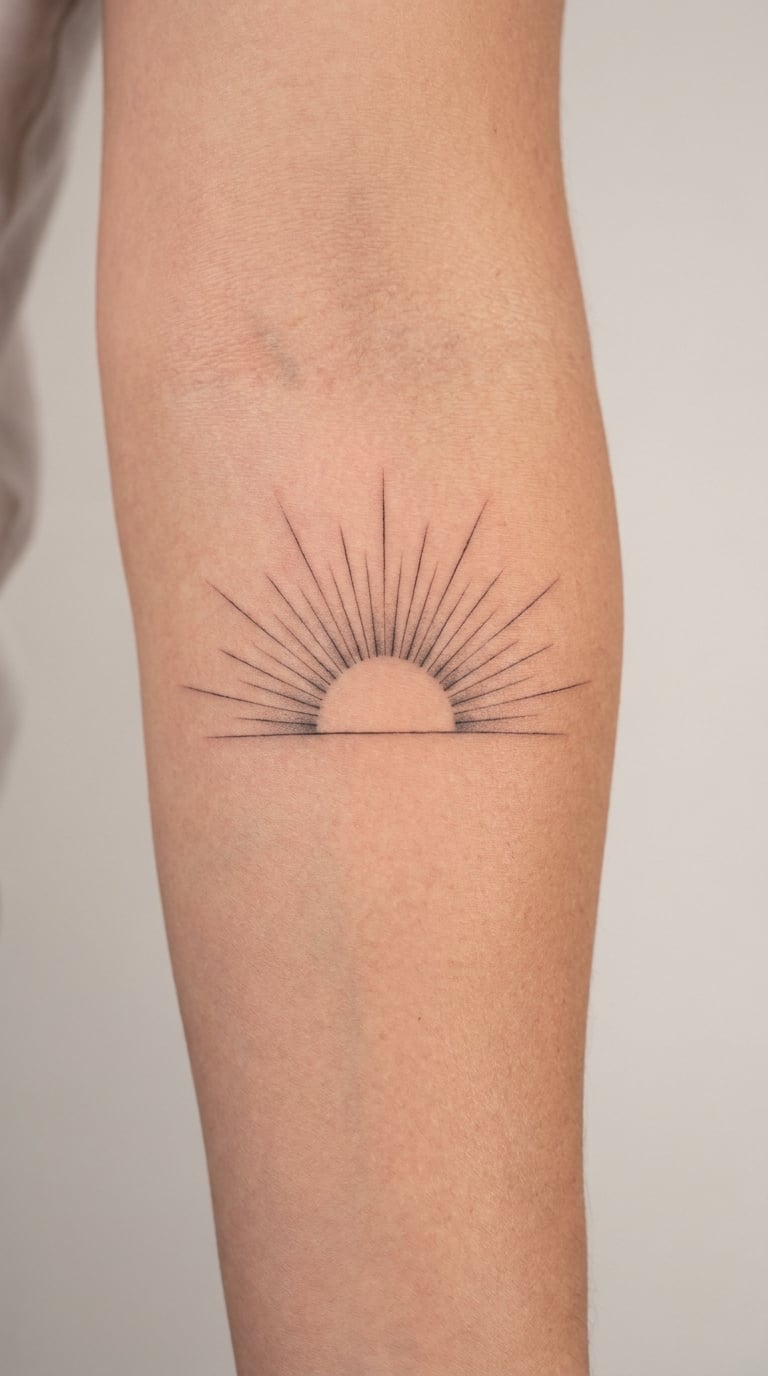
This hope tattoo idea is a thin horizon line with a half-risen sun tucked behind it, a few restrained rays fanning upward in single-needle linework. Nothing wraps the arm, so it reads as one quiet mark rather than a band.
People choose it for fresh beginnings, though how you read the sunrise is entirely your own business. A horizon can mark a move, a new year, a morning you want to remember.
Placement: inner forearm, 2 to 3 inches above the wrist crease, or the outer forearm. Size: 2 inches wide, up to 4 for a wider horizon. Style: fine line, single needle, optional soft grey gradient under the sun.
Pain: low to medium, a scratchy heat that settles once the artist finds a rhythm. Ageing: single-needle hairlines fade unevenly, so ask for a line weight one shade heavier than you think looks right in the chair.
Make it yours: add the sunrise date in tiny numerals tucked under the horizon line, small enough to read only when you look.
2. Minimal Compass Rose on the Wrist
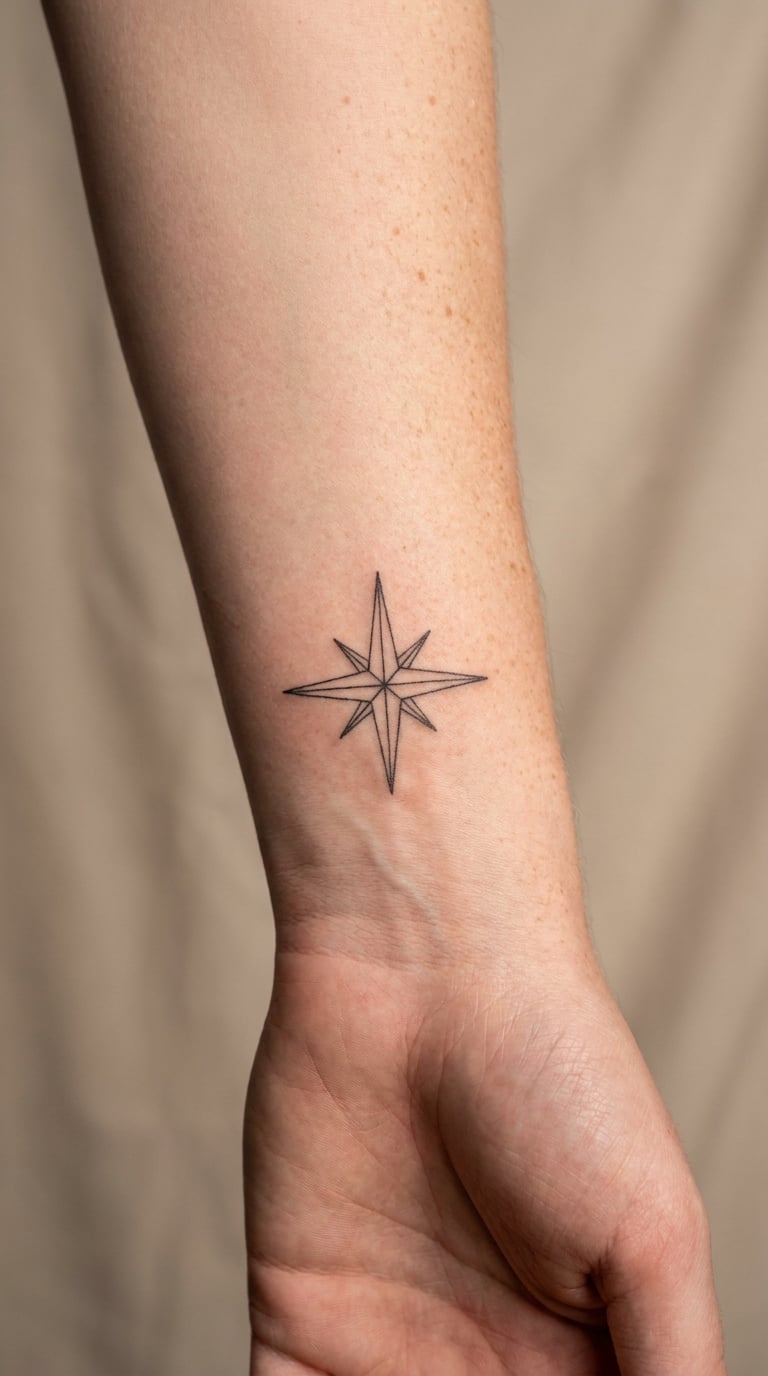
A four-point compass rose with a small circle at its centre and clean tapering points, done in solid black outline with no shading at all. The simplicity is the whole point; anything busier stops being a compass.
It is a common choice when someone wants direction without a written word, a symbol about choosing deliberately rather than drifting.
Placement: inside of the wrist, centred, or along the wrist bone. Size: 1.5 inches wide, up to 2.5. Style: minimal blackwork or fine line outline.
Pain: medium, and wrist work takes longer than most small pieces because the skin is thin and moves under the needle. Ageing: tiny interior details on the wrist tend to soften first; four clean points outlast a full eight-point star.
Make it yours: point one needle north with a single lighter red dot, or have the four directions marked with initials rather than letters.
3. Watercolor Rainbow After Rain
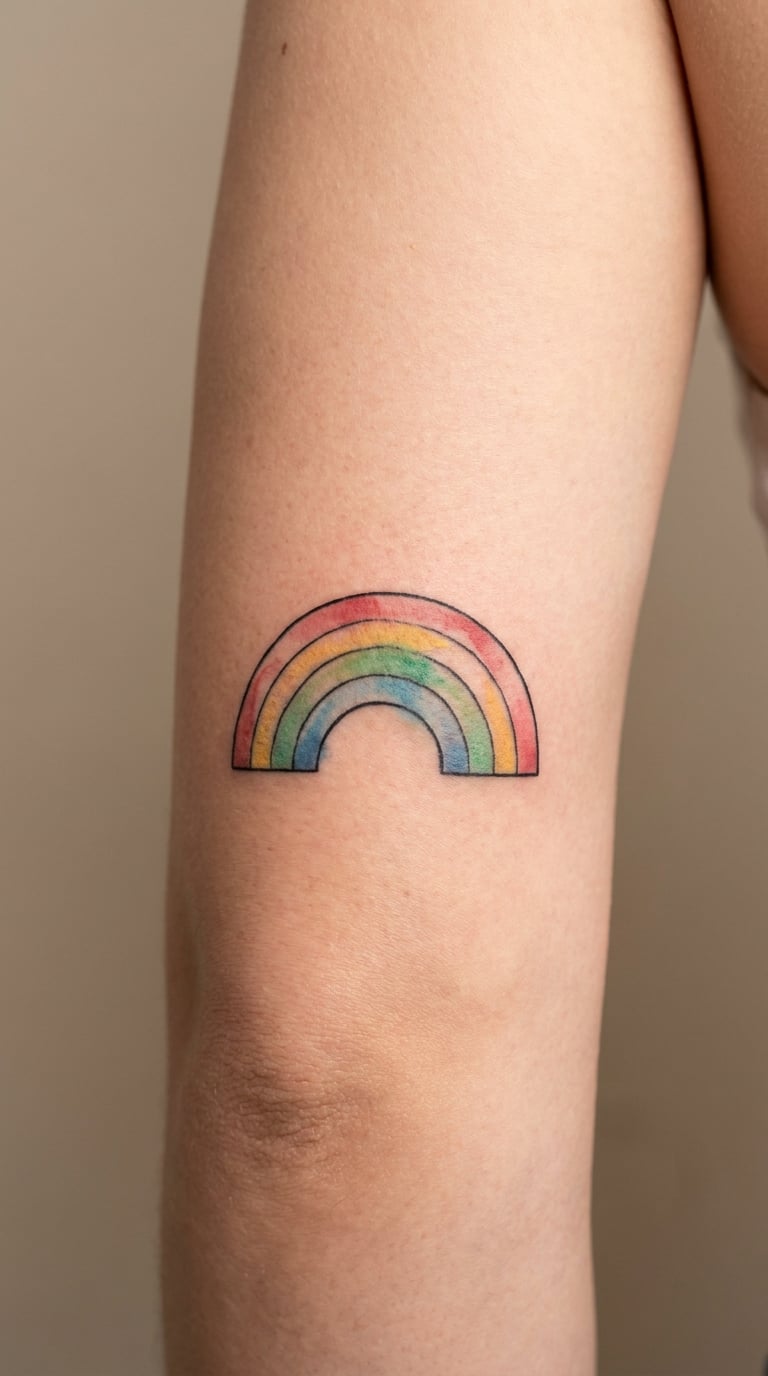
A loose rainbow built from transparent colour washes rather than drawn lines, with a few small raindrop marks falling beneath one side. The edges are allowed to bleed; that bleed is the style, not a mistake.
Plenty of people book this one after a hard stretch, when they want something that literally shows weather passing through.
Placement: upper arm, shoulder, or the back of the calf where there is flat space. Size: 2.5 to 3 inches wide. Style: watercolour with diluted pigment, no black outline.
Pain: medium; colour work means more passes over the same skin. Ageing: pale washes fade noticeably faster than solid black, and the blue usually goes first. Ask for a slightly deeper saturation than the reference photo.
Make it yours: add a raindrop count that means something, or use muted tones from a place that matters to you instead of full-spectrum colour.
4. Tiny Bird Taking Flight from a Heart
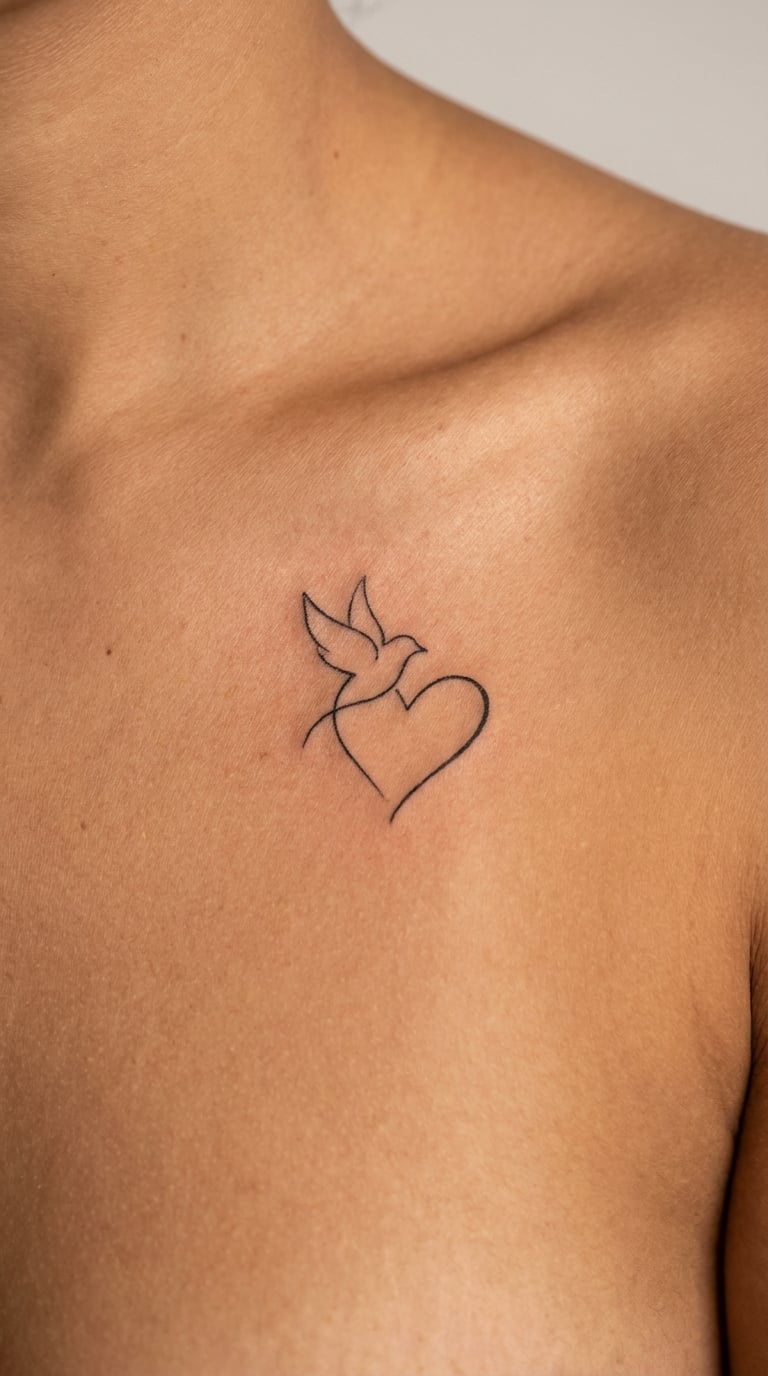
A single bird with wings mid-beat, lifting away from a small open heart drawn in simple line, with no background shading behind either shape. Two subjects, one direction of movement, and a lot of skin left clear.
It sits between care and forward motion, which is why it works for people marking a move away from something they loved anyway.
Placement: just below the collarbone, or the inner forearm. Size: 2 inches tall. Style: fine line, silhouette, or dotwork shading inside the wing.
Pain: medium, with the collarbone noticeably sharper than the arm. Ageing: feather detail in a 2-inch bird blurs within about eight years, so a simplified two-curve wing lasts longer and looks better.
Make it yours: have the heart drawn as a single continuous line so the bird appears to be lifting out of the stroke itself.
5. Blooming Flower with an Upward Stem
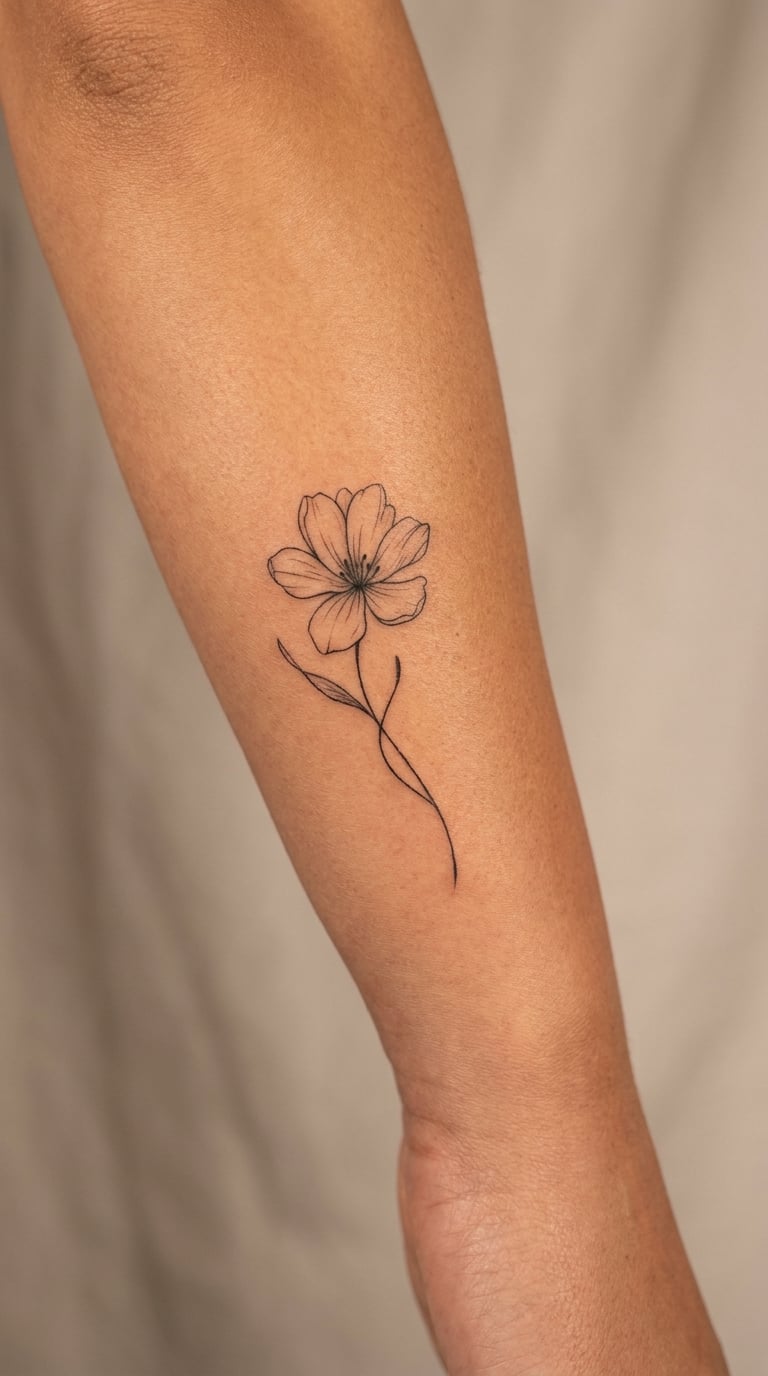
One flower at full open above a gently curving stem, with two or three leaves and light hatching for shadow on the lower petals. Botanical accuracy without the botanical crowding.
Growth and renewal is the usual reading people bring to it, and the single open bloom is what does the work; a bouquet reads as decoration instead.
Placement: outer forearm, vertical, or the inner arm above the elbow. Size: 3 inches long, 1 to 1.5 wide. Style: fine line botanical with restrained stippling.
Pain: low to medium and one of the calmest options here. Ageing: petal veins disappear first; keep the veins on the larger petals only and let the rest be open linework.
Make it yours: use a species that grew somewhere real to you, or add a single thorn on the stem if the story had a difficult edge to it.
6. Open Door with Light in Blackwork
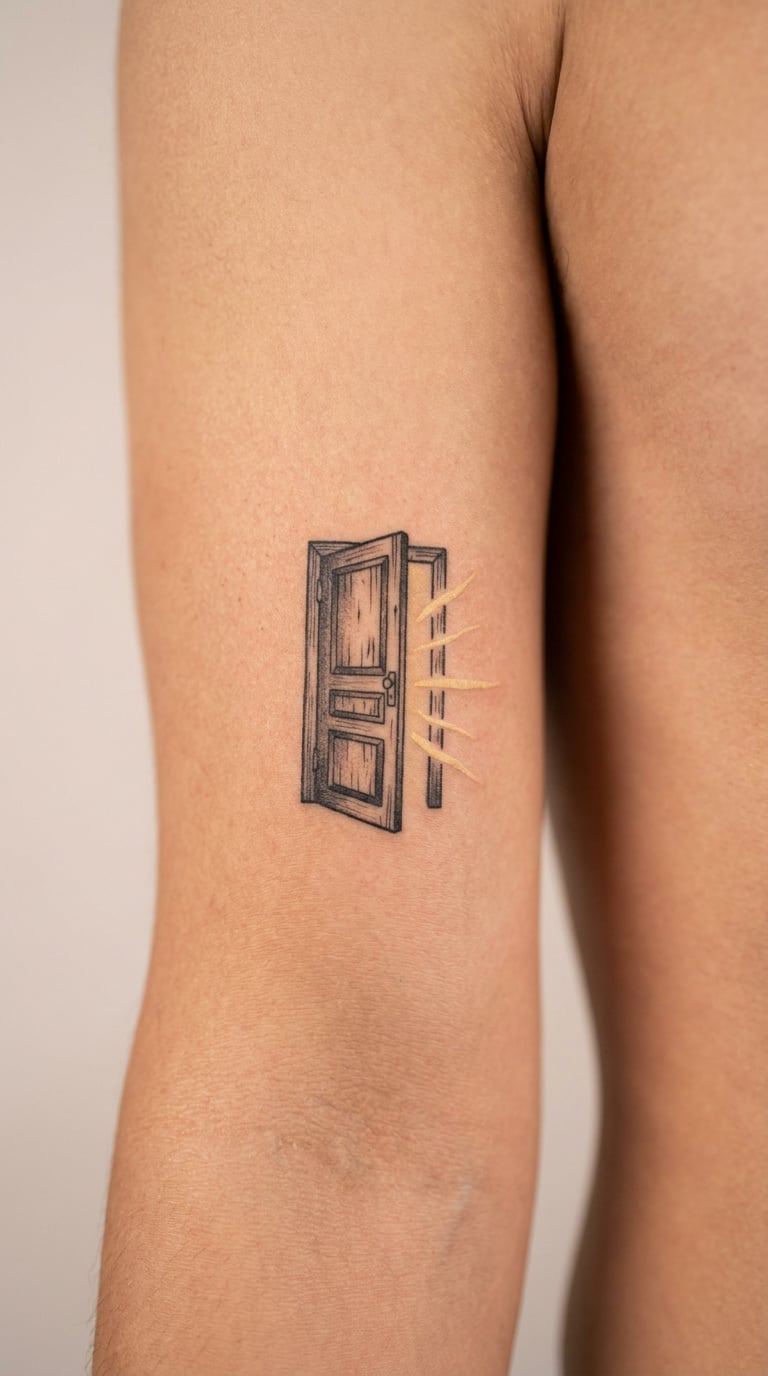
A simple rectangular doorway drawn in black outline, filled with a pale yellow wash, with three straight rays of light extending outward. The rays are the only decorative element; everything else is negative space.
It reads as welcome or a new opening, and plenty of people pair it with a location, a new job or a new country.
Placement: inner upper arm, ribs, or the outer ankle. Size: 2 inches tall. Style: blackwork with a single colour accent.
Pain: low on the upper arm, sharp on the ribs and ankle. Ageing: a flat yellow fill loses punch well before the black line does, so keep the wash thin and let the outline carry the shape.
Make it yours: put a date on the floor of the doorway in numerals small enough to read only from directly above.
7. Phoenix Rising in Fine Detail
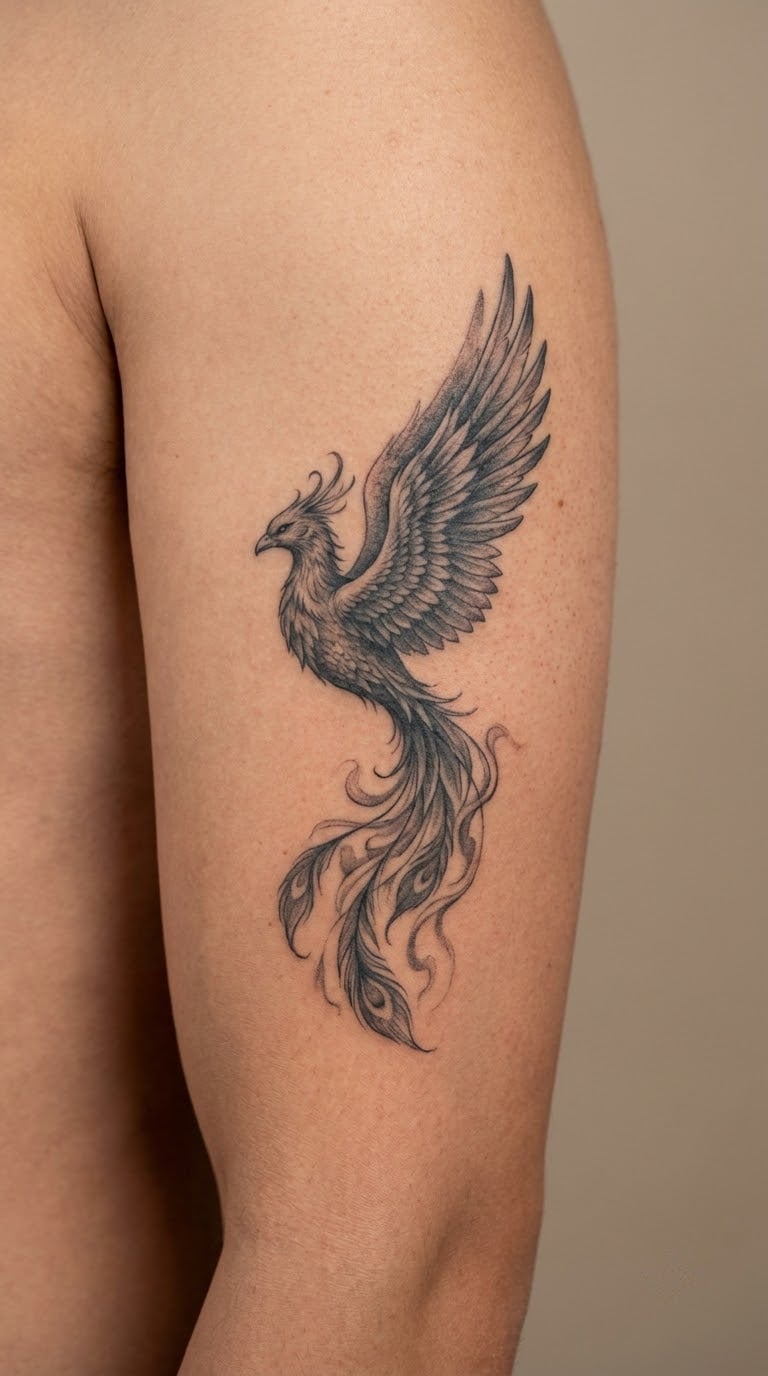
A compact phoenix in black and grey micro-realism with one wing raised and the head turned in profile, built from shading rather than outline. The tail is kept to three tapered feathers instead of the full traditional flare.
Renewal after something that burned is the common reading, and most people choosing it say the same thing: it is about coming back, not about the fire.
Placement: upper arm or the centre of the back. Size: 3 inches wide minimum, 5 if you want real feather detail. Style: micro-realism or illustrative blackwork.
Pain: medium, and grey shading means several passes. Ageing: below 3 inches the feather detail muddies into a grey mass within a few years, so this is the one design on this list worth sizing up rather than down.
Make it yours: add a date tucked into the wing feathers, or a single muted red eye if you want colour without turning it traditional.
8. Mountain Peak Under a Rising Sun
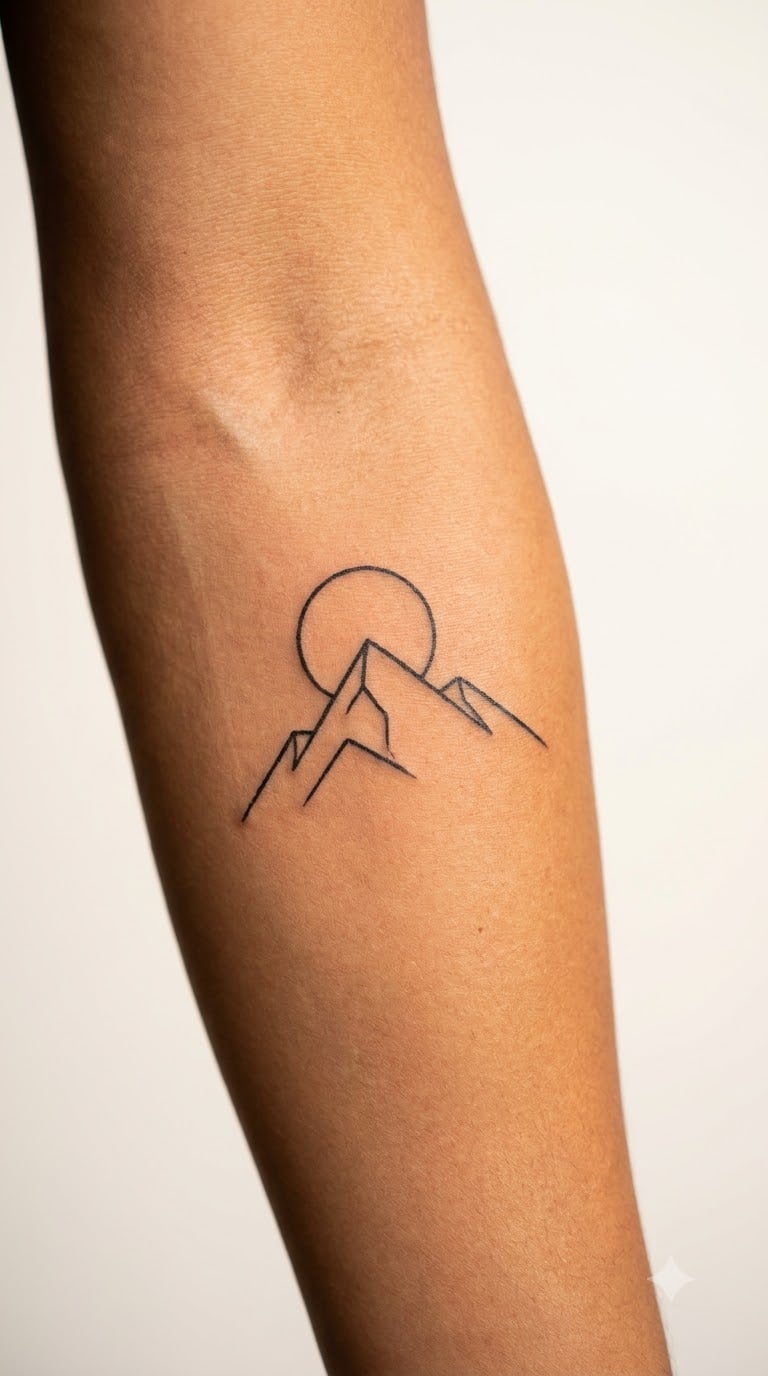
Two or three mountain peaks drawn in clean black line, with a plain circle sun sitting just behind the highest summit. No hatching, no clouds, no text, which is what keeps it from turning into a postcard.
People use it for a place, a climb that got finished, or a goal that took longer than expected.
Placement: outer forearm, the calf, or over the shoulder blade. Size: 3 inches wide. Style: minimalist line or a small black silhouette version.
Pain: low to medium, and the shoulder blade option is a bruise you will feel for a day. Ageing: holds up well, since the design is mostly shape rather than line weight; it just needs clean edges rather than hairlines.
Make it yours: make the silhouette of a specific summit, or hide a small word in the negative space between the two peaks.
9. Lighthouse Shining Over Waves
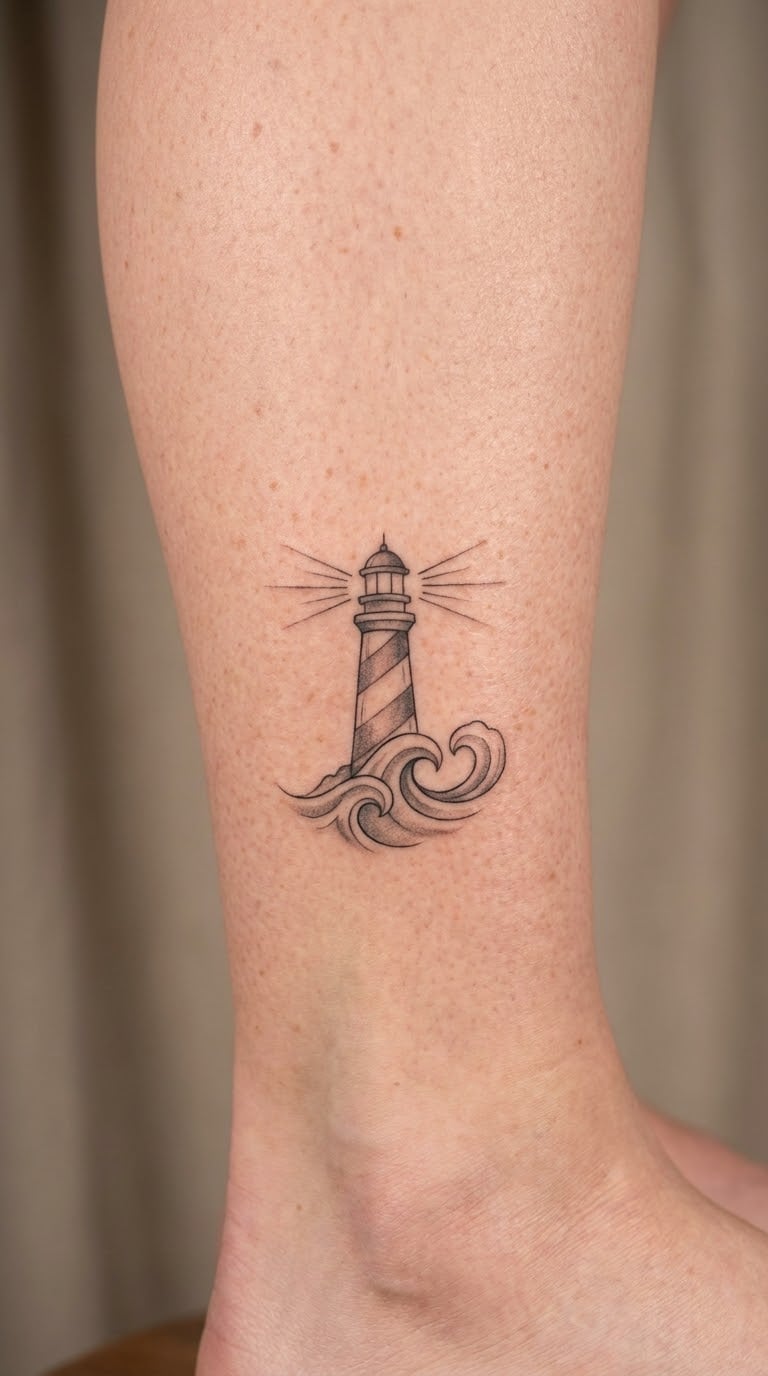
A slim lighthouse with a light beam cut across two or three restrained wave lines, drawn in fine line with light grey wash in the water. The beam is left as empty space rather than drawn as rays.
Guidance through uncertain conditions is the reading most people bring to it, and the beam makes the idea without a single word.
Placement: lower calf or the inside of the forearm. Size: 2.5 inches tall. Style: fine line with grey wash, or small traditional blackwork.
Pain: medium on the calf, where the muscle moves while the artist works. Ageing: the striped bands on the tower are the first thing to blur, so keep the bands wide or drop them for a plain tower.
Make it yours: set the beam at the angle of a real coastline, or use one family colour as a single narrow band on the tower.
10. Seedling Emerging from Two Hands
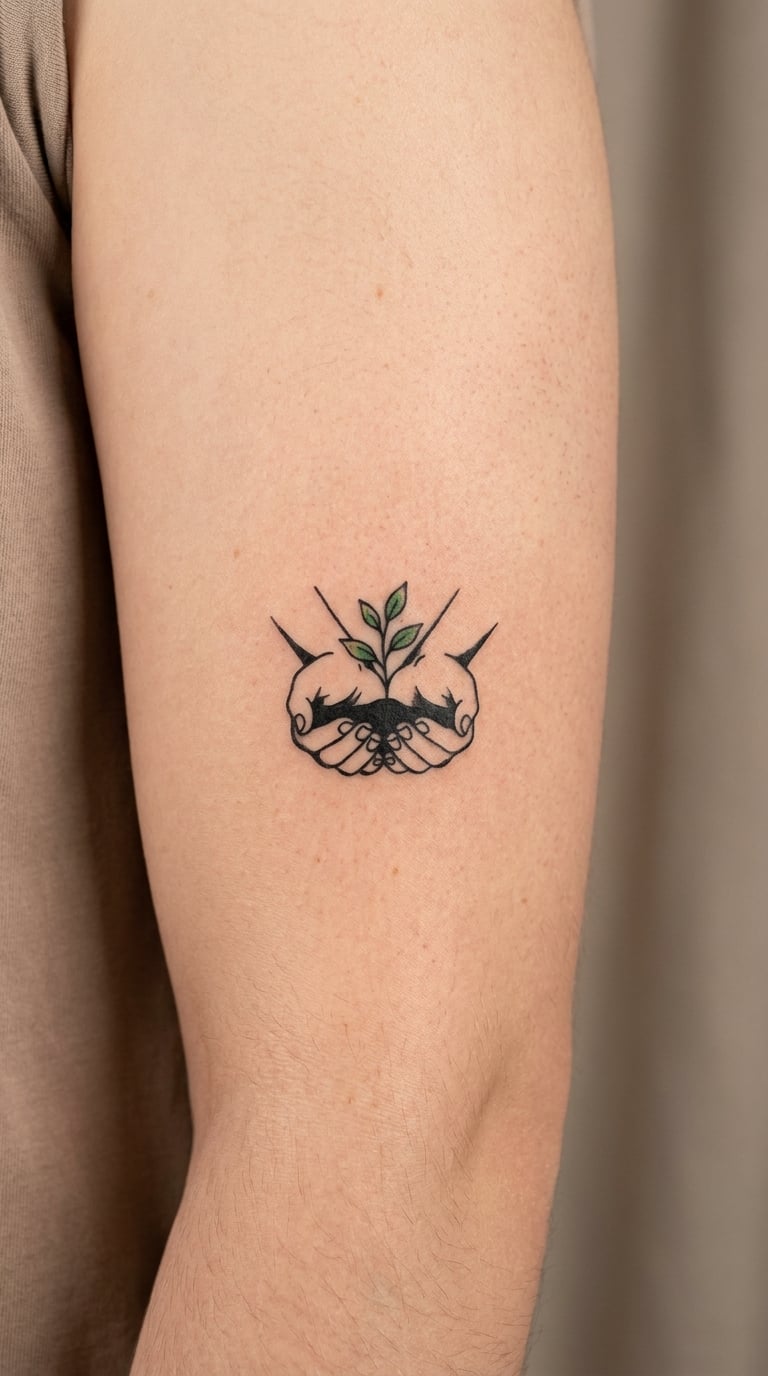
Two simplified cupped hands, drawn as open outlines, holding a small seedling with two leaves. The gap between the hands does most of the work, so the artist leaves it deliberately empty.
It gets read as growth held by someone, which makes it a common gift exchange design and a common family piece.
Placement: upper arm, the back of the hand, or the chest. Size: 2 inches wide. Style: minimal blackwork with a green accent on the leaves.
Pain: low on the arm, medium on the back of the hand because the hand moves constantly. Ageing: the fingers are the vulnerable part; rounded, simplified fingers survive small sizes far better than separated ones.
Make it yours: match it with the same seedling on another person, or replace the two leaves with a small tree at a stage that means something.
11. Hot Air Balloon Above a Tiny Horizon
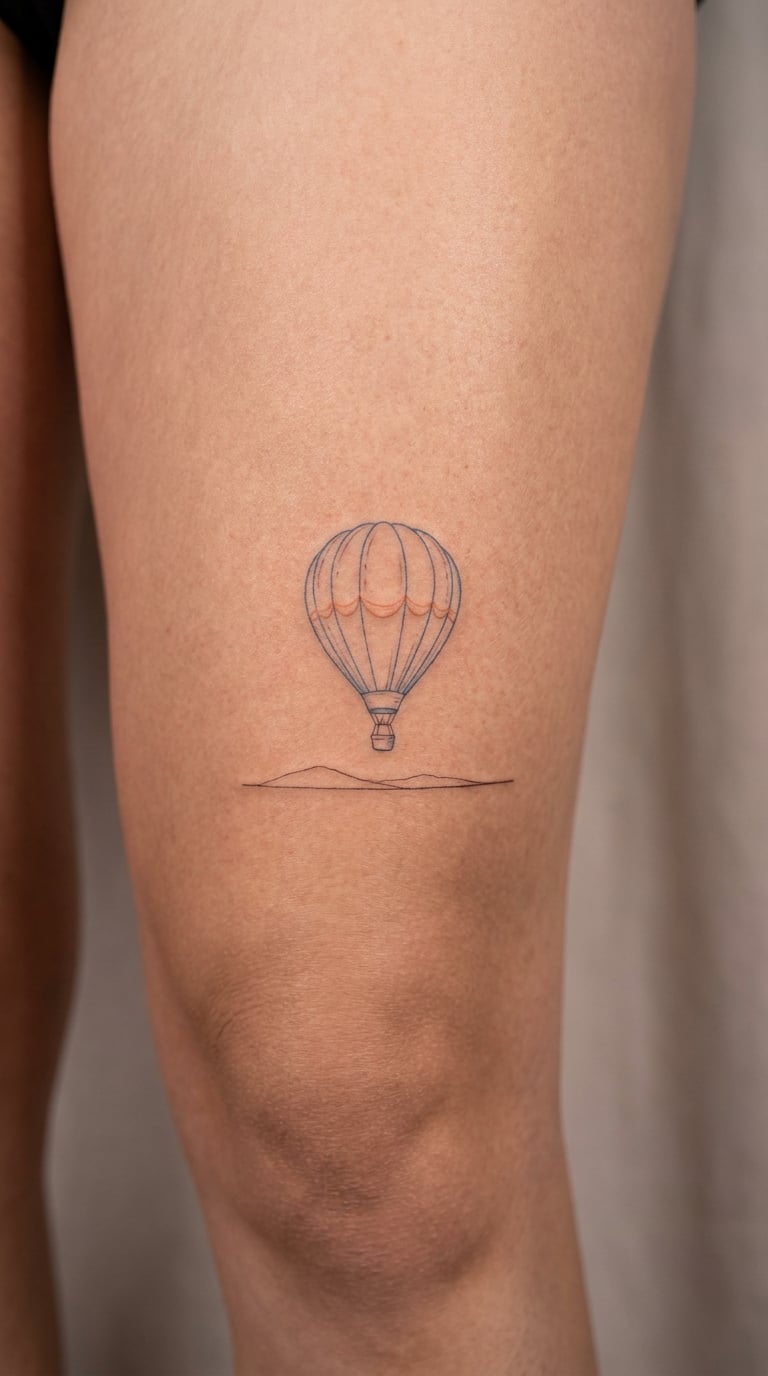
A fine-line balloon basket and envelope in soft blue and muted orange, floating above a single thin horizon line that anchors the composition. The horizon is the only straight edge in the design.
A wider view and something to work toward is the usual reason people pick it, and the small scale of the horizon keeps it from feeling like a travel poster.
Placement: thigh, lower back, or the outer arm. Size: 3 inches tall. Style: fine line with two colours of flat fill in the envelope.
Pain: low, and the thigh is the easiest place on this list. Ageing: the vertical stripes in the envelope blur together at small sizes; broad panels in two colours outlast lots of thin ones.
Make it yours: use the colours of a flag that matters to you, or add a name under the horizon rather than on the balloon.
12. Anchor with a Small Rising Sun
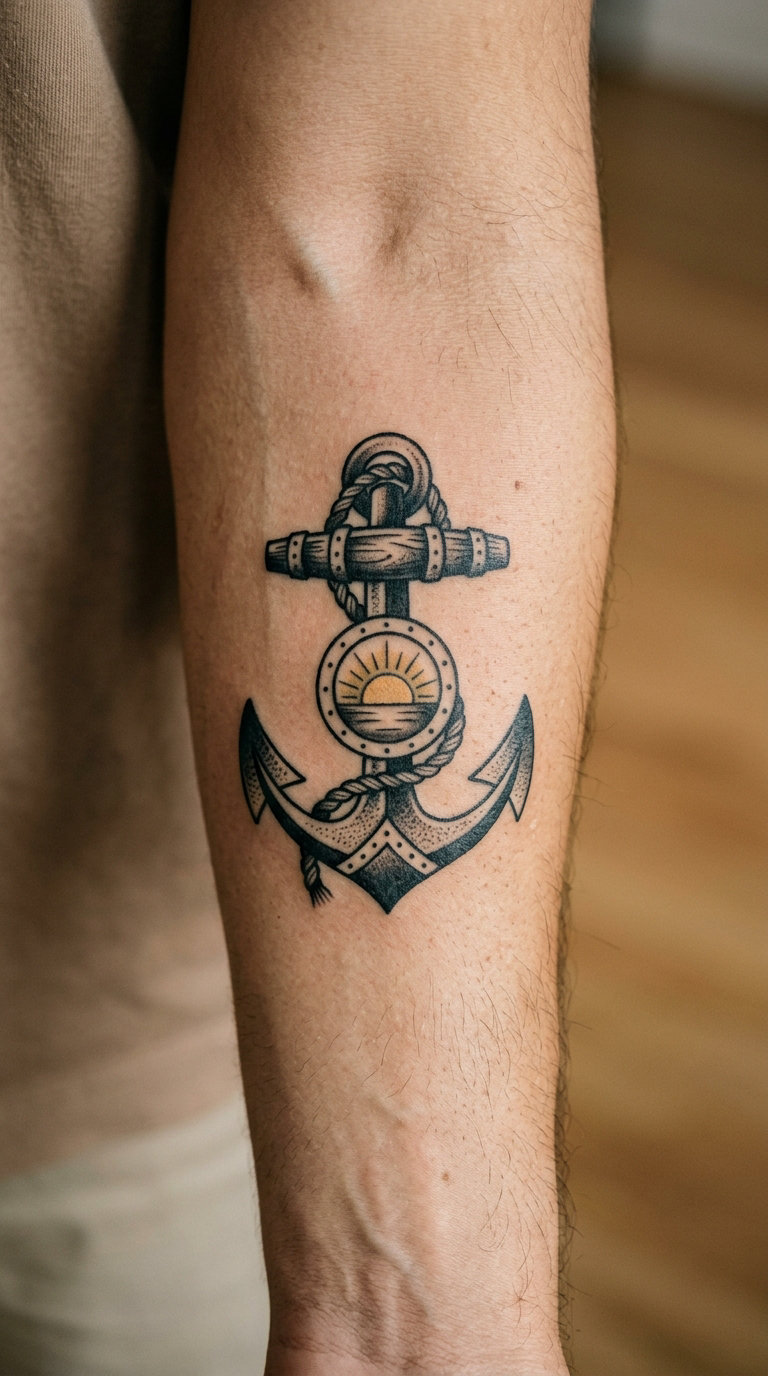
A clean traditional-style anchor with a curved shank and two flukes, drawn in solid black with a small muted-yellow sunrise tucked into the negative space inside the ring at the top. No rope, no banner, no lettering.
The anchor is one of the oldest hope symbols in Western tattooing, and the sunrise inside it turns steadiness into steadiness plus optimism.
Placement: forearm, upper arm, or the ankle. Size: 2.5 inches tall, up to 4. Style: traditional blackwork with one colour accent.
Pain: medium, since the shank and flukes mean solid coverage. Ageing: the anchor is solid black and holds its shape well for years; the yellow sun inside it is the part that fades, so keep that small.
Make it yours: add a real coordinate in the ring where the sun sits, or a single small wave under the flukes.
13. Candle Flame Made of Leaves
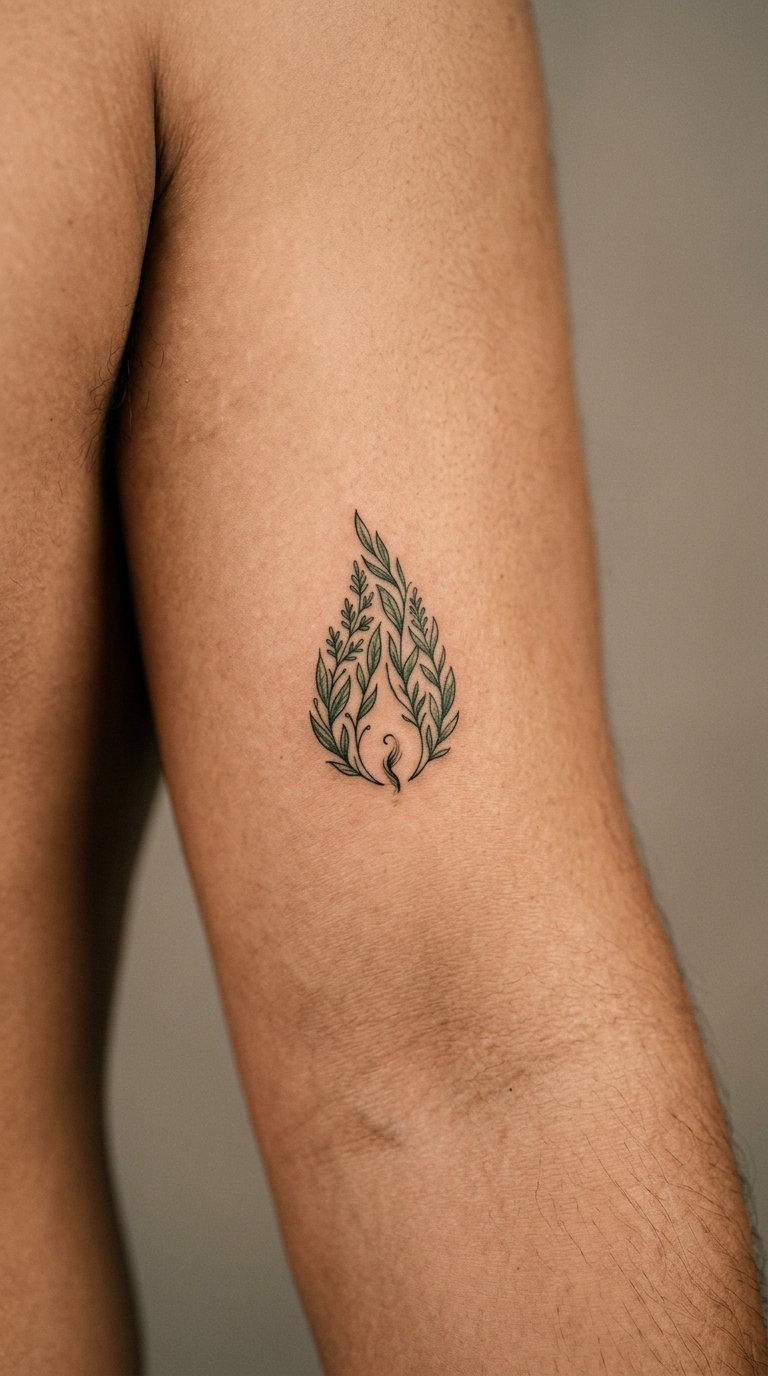
A single flame whose outer shape is drawn by the curves of five or six small leaves rather than a drawn flame outline, with a small filled teardrop at the centre. Green linework, no other colour needed.
Light that keeps going, and something that grows at the same time, which is why it suits people who came through a period of being the one who was sustained by others.
Placement: inside upper arm, the calf, or behind the ear. Size: 2 inches tall. Style: fine line botanical with a touch of stipple shading at the base.
Pain: low on the arm, high behind the ear. Ageing: six separate leaf shapes under two inches is a lot for fine line; five leaves or a slightly larger size keeps it readable.
Make it yours: use a leaf from a species tied to someone, or colour just the centre teardrop in the shade you always wear.
14. Guiding Star with a Minimal Trail
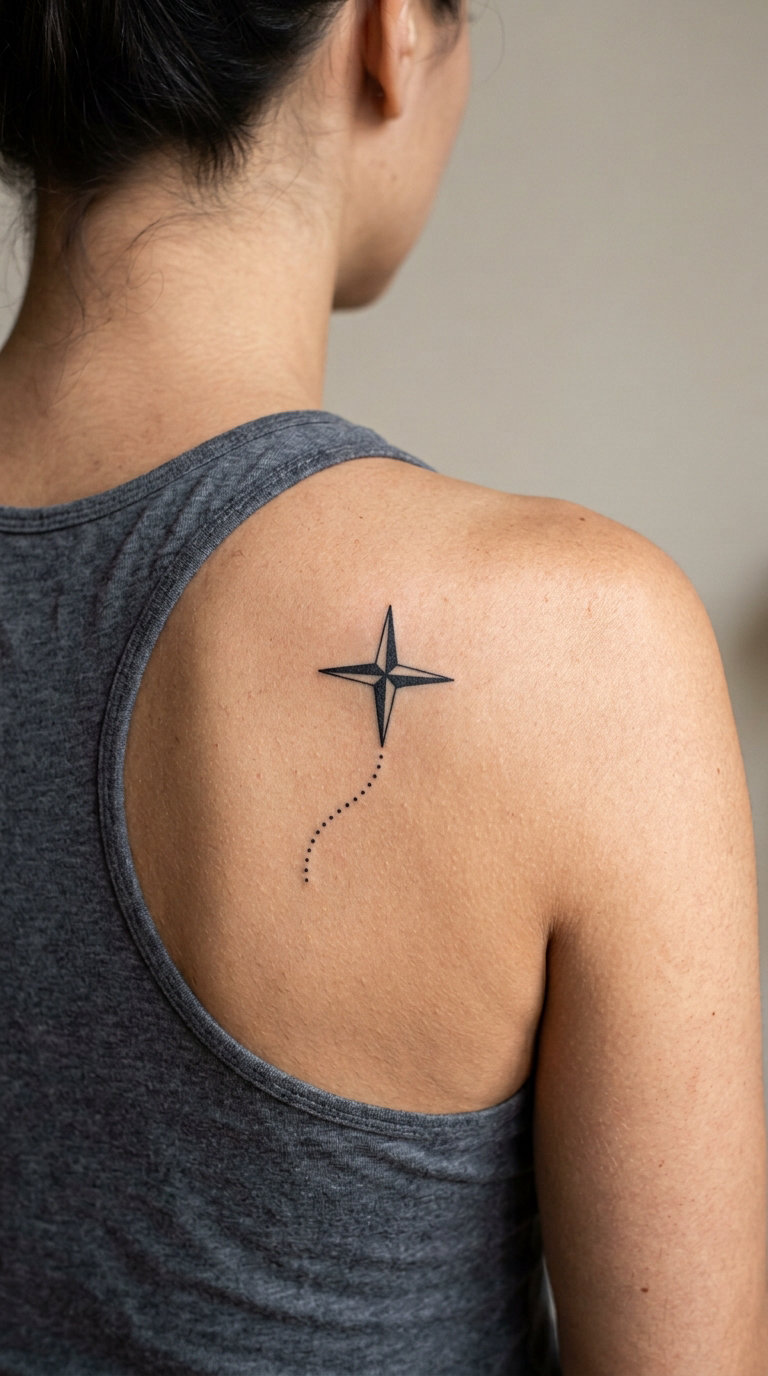
One four-point star in solid black with a sparse dotted trail curving away behind it, spaced so the dots stay separate. It is a nautical star shape more than a starfield.
Being found, or finding the way, is what people say it means. If you like the idea of a fixed point in a moving life, our list of 20 north star tattoo ideas pushes further into the same territory.
Placement: shoulder blade, upper back, or the back of the upper arm. Size: 2 inches tall with a 2-inch trail. Style: blackwork, or fine line with a dotted trail.
Pain: medium to high; the shoulder blade is bony and the position is awkward to hold still. Ageing: the star holds; the dots may fade to faint specks, which most clients end up liking anyway.
Make it yours: match the trail length to a distance you have covered, or add one real star alongside it.
15. Calm Waves and a Bright Horizon
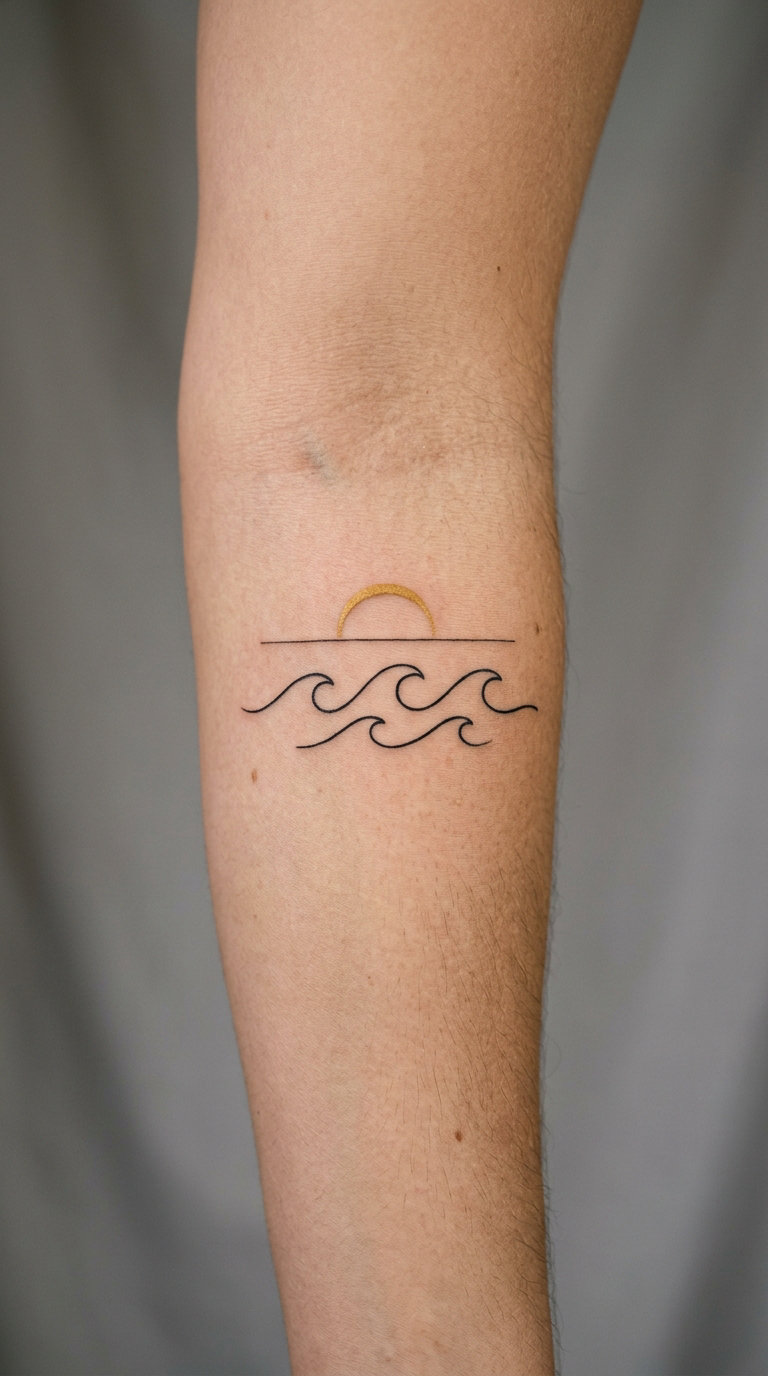
Three controlled wave lines stacked under one clean horizon, drawn with even weight and no foam detail. A thin gold or mustard fill in the sun band is the one optional colour.
Stability, or calmer times after rough ones, is the reading it usually gets, and three lines is enough to say water without saying storm.
Placement: side of the forearm, wrapped slightly, or the rib area. Size: 3 inches wide. Style: minimalist line, optional colour band.
Pain: low on the forearm, sharp if you move it to the ribs. Ageing: the horizon line stays sharp for years; the coloured band dulls first, so a black outline behind it helps.
Make it yours: add a single coordinate on the horizon line, or set it beside a matching piece on the other arm.
16. Butterfly Emerging from a Line-Art Cocoon
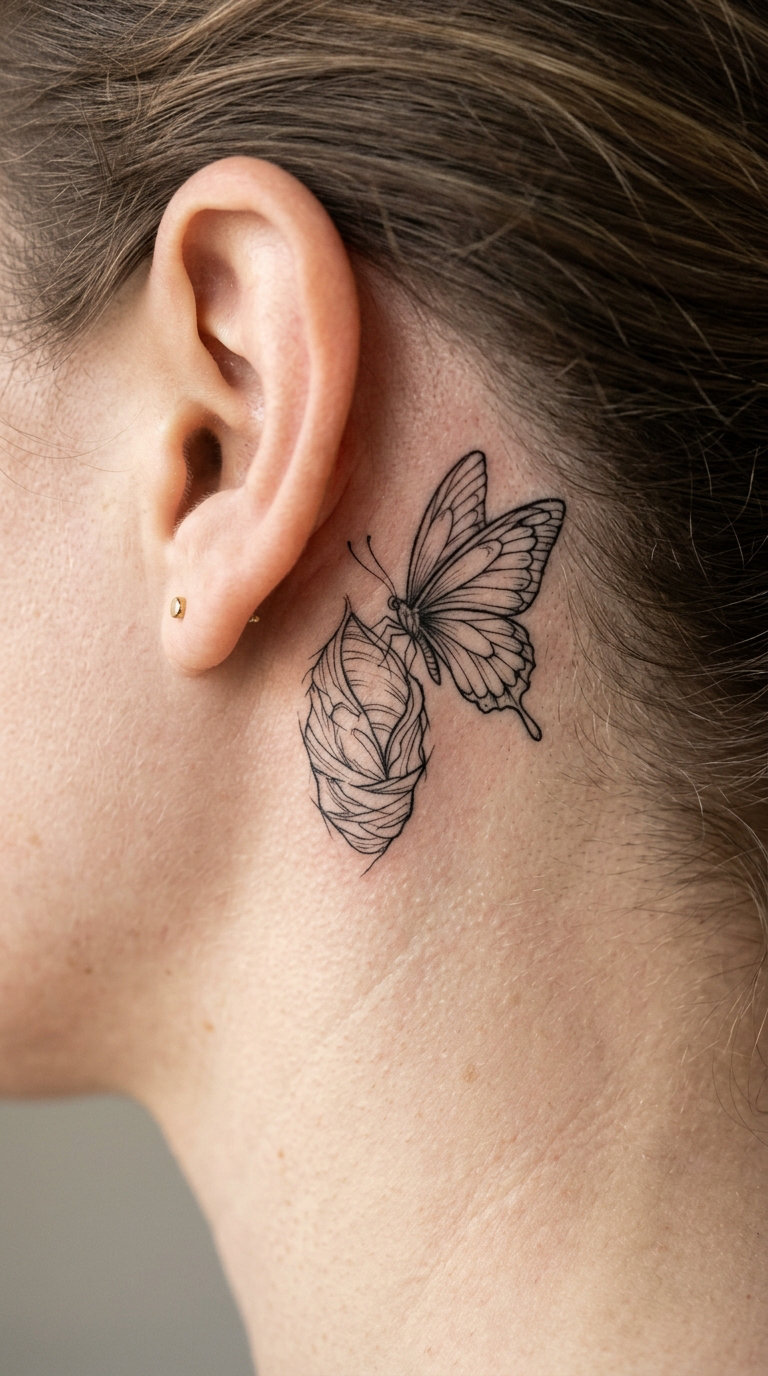
An incomplete cocoon drawn in open linework, split at one side, with one butterfly wing extending out past the break. The asymmetry is what keeps it from being the same symmetrical butterfly tattoo everyone already has.
Coming out of a difficult stage, unfinished rather than perfect, is what most people read into it.
Placement: behind the ear, the ankle, or the inner forearm. Size: 2.5 inches wide. Style: fine line, or illustrative with a light grey wash on the wing.
Pain: high behind the ear, and you will feel it in your jaw for hours. Ageing: the wing edge is fine line and will soften noticeably; going a little bolder on that single edge buys you years.
Make it yours: leave one antenna trailing outside the frame, or add a small date on the unbroken side of the cocoon.
17. Tiny Heart with a Steady Line
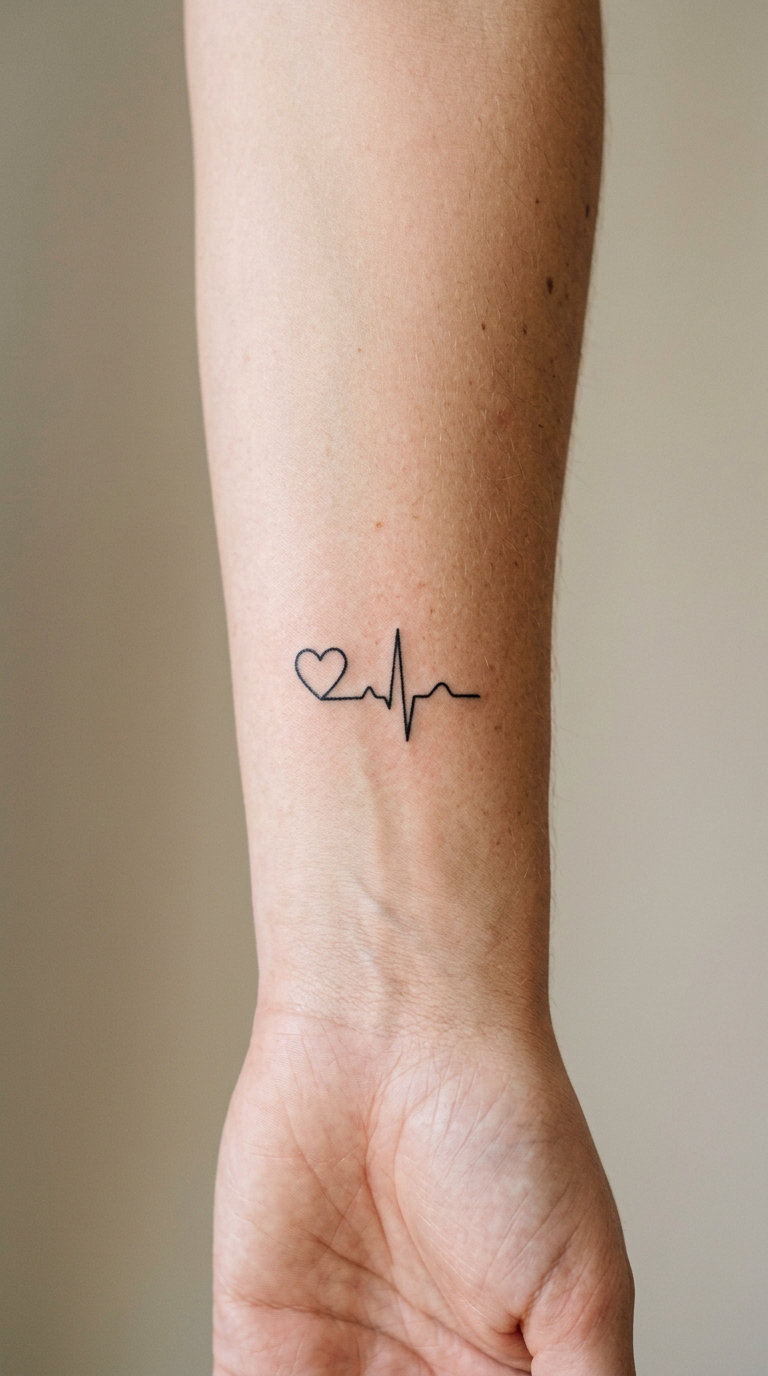
A small heart with one straight pulse line running out of it, stopping cleanly rather than branching into a full medical waveform. One heart, one line, nothing else.
Life continuing, or just love kept simple, is what people say. Several clients have connected this shape to Project Semicolon without adding the semicolon itself.
Placement: side of the forearm, the ankle, or the back of the hand. Size: 1.5 inches wide. Style: fine line, single colour or black.
Pain: low on the forearm, higher on the hand and fingers. Ageing: fine line on the hands softens fastest of any placement, so expect a lighter line in a few years even with careful care.
Make it yours: add the date the line represents in numerals small enough that only you can read them.
18. River Leading Toward Open Light
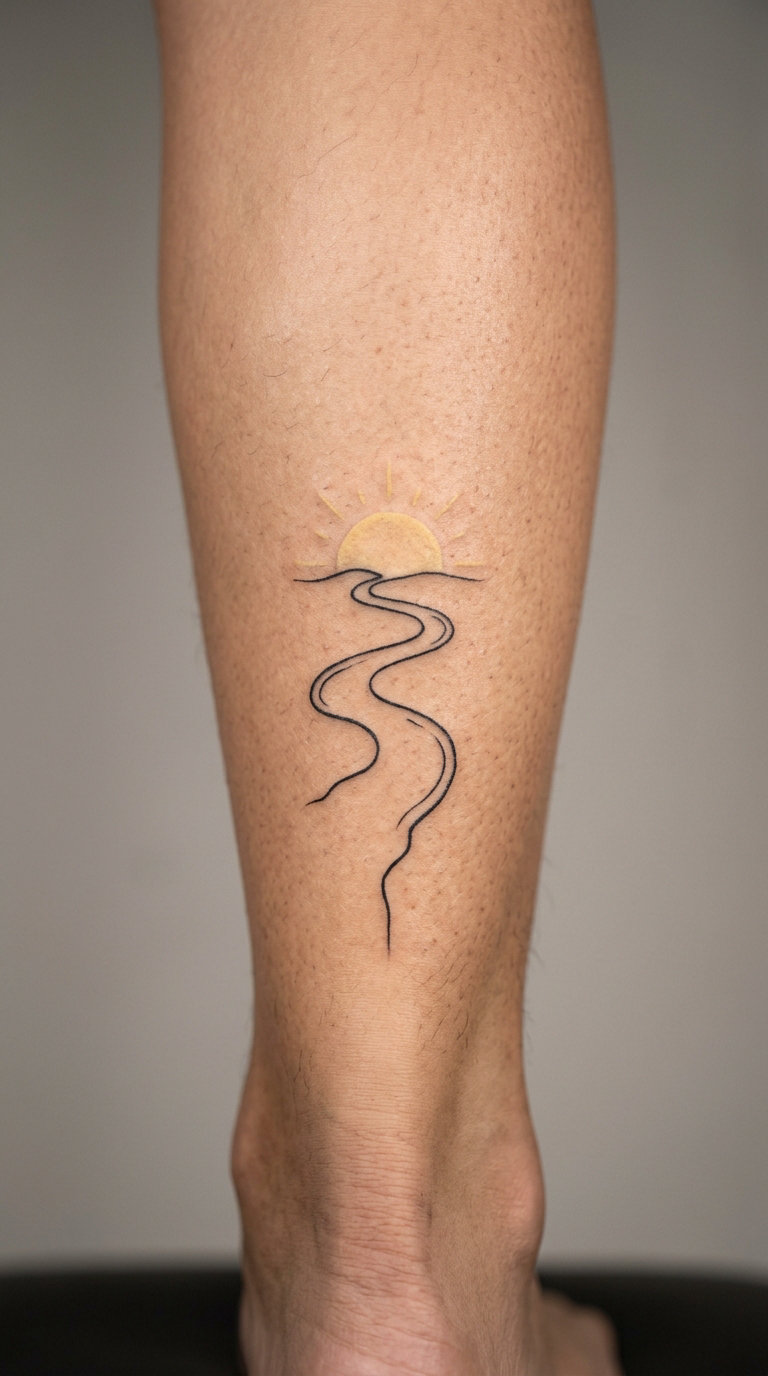
A narrow river drawn with two slightly wavy parallel lines, widening as it travels toward a pale yellow sunrise at the open end. The rest of the design is empty, so the eye follows the water.
It gives a composition a direction without a destination written on it, and people often pair it with a real place they needed to reach.
Placement: calf or inner forearm, running vertically. Size: 4 inches long. Style: line art with a flat colour sun, or pure black line.
Pain: medium on the calf, and the length makes it a longer sitting. Ageing: two long parallel lines are strong at 4 inches but weak at 2; if you want it small, switch to a single tapering stroke.
Make it yours: put the sunrise at a specific place on the river, or match the piece with a second river flowing the other way on the opposite leg.
19. Old Key with a Flower-Shaped Bow
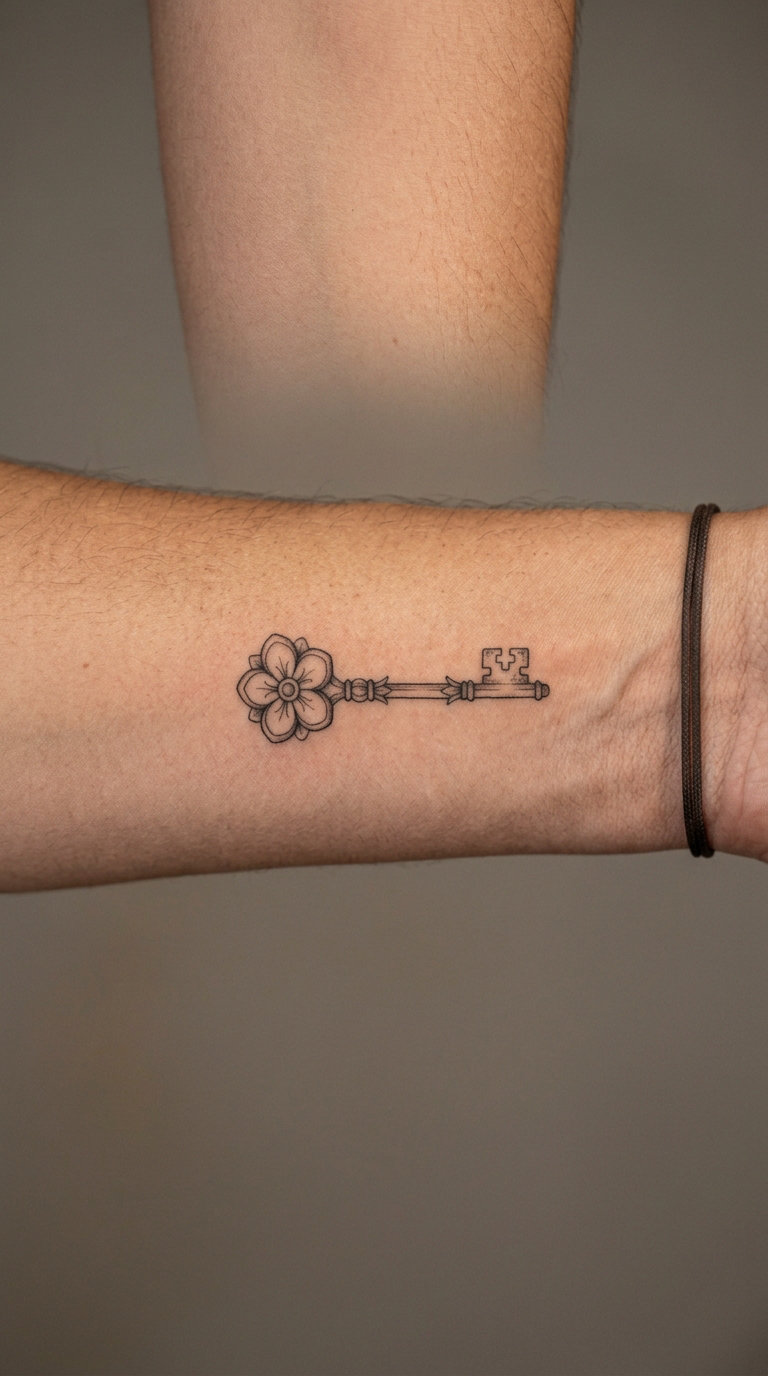
A vintage key drawn with a narrow shaft and simple wards, its bow replaced by a single five-petal flower. Antique linework outside, botanical linework inside, no colour needed.
Access to something that used to be closed off is the reading people give it, and it suits anyone marking a door that finally opened.
Placement: lengthwise on the inside of the wrist, or the forearm. Size: 2 inches long. Style: antique linework, fine line.
Pain: medium on the wrist, where skin is thin. Ageing: the wards, the little teeth on the key, disappear first; simplify them to three rather than six.
Make it yours: give the flower the species that matters most to you, or etch a house number into the shaft.
20. Small House with a Bright Window
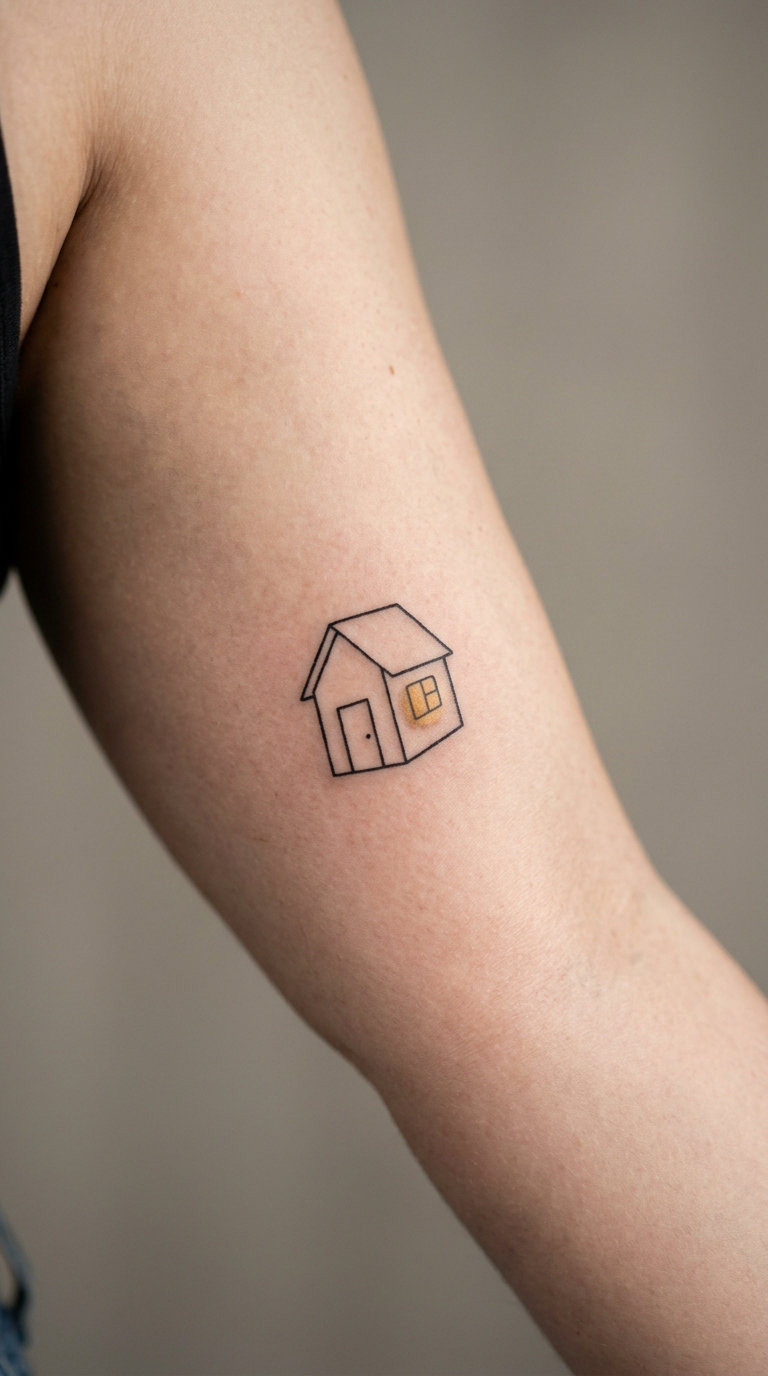
A small line-art house with a pitched roof, one door and a single warm yellow window glowing softly. No garden, no path, no picket fence, which is what makes it read as a small house rather than a drawing of a home.
Belonging somewhere, or the wish for it, is what people choose it for, and it makes a quietly powerful memorial piece as well as a hopeful one.
Placement: inner upper arm, the chest, or the hip. Size: 2 inches tall. Style: line art with one warm colour accent.
Pain: low almost everywhere, higher on the ribs and the side of the hip. Ageing: the window fill fades before the outline does, and once it softens the design can read as an empty house, so a bolder window outline helps.
Make it yours: make the door the colour of a front door you remember, or add the year the house was built underneath.
21. Laurel Wreath Around a Small Star
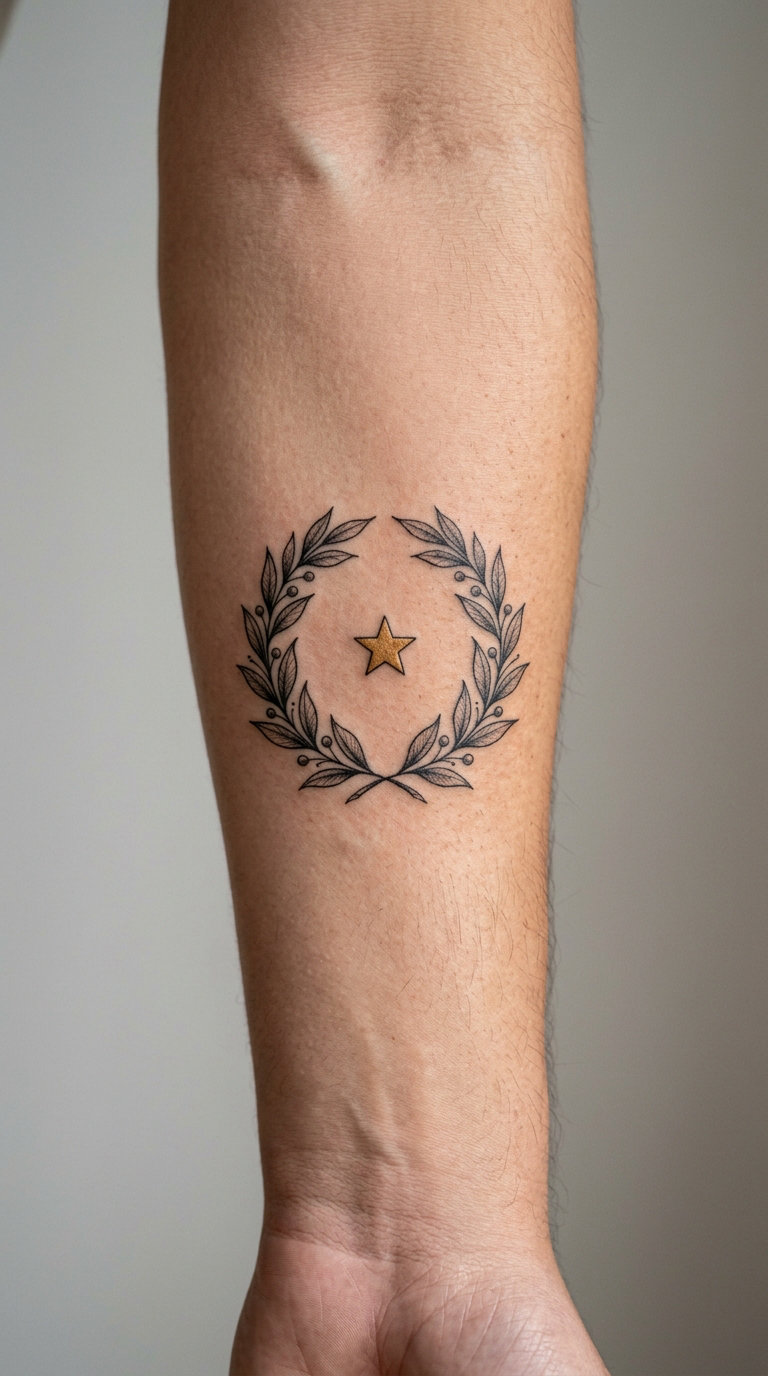
An open laurel wreath of simple leaves around one small star, with a deliberate gap at the top so the circle never closes. The star is the only solid shape in the middle.
Getting through something and still standing is what the wreath usually means here, though plenty of people read it as recognition for a finished goal.
Placement: the forearm, the inner arm, or the calf. Size: 2.5 inches wide. Style: fine blackwork, optional gold star.
Pain: low to medium; count the leaves and expect a longer session. Ageing: overlapping leaves are the vulnerable part, and the open top is what keeps the design from looking sealed and heavy.
Make it yours: give one leaf a different shade, or set a real date in place of the star at the centre.
22. Dotwork Path Leading to a Sunrise
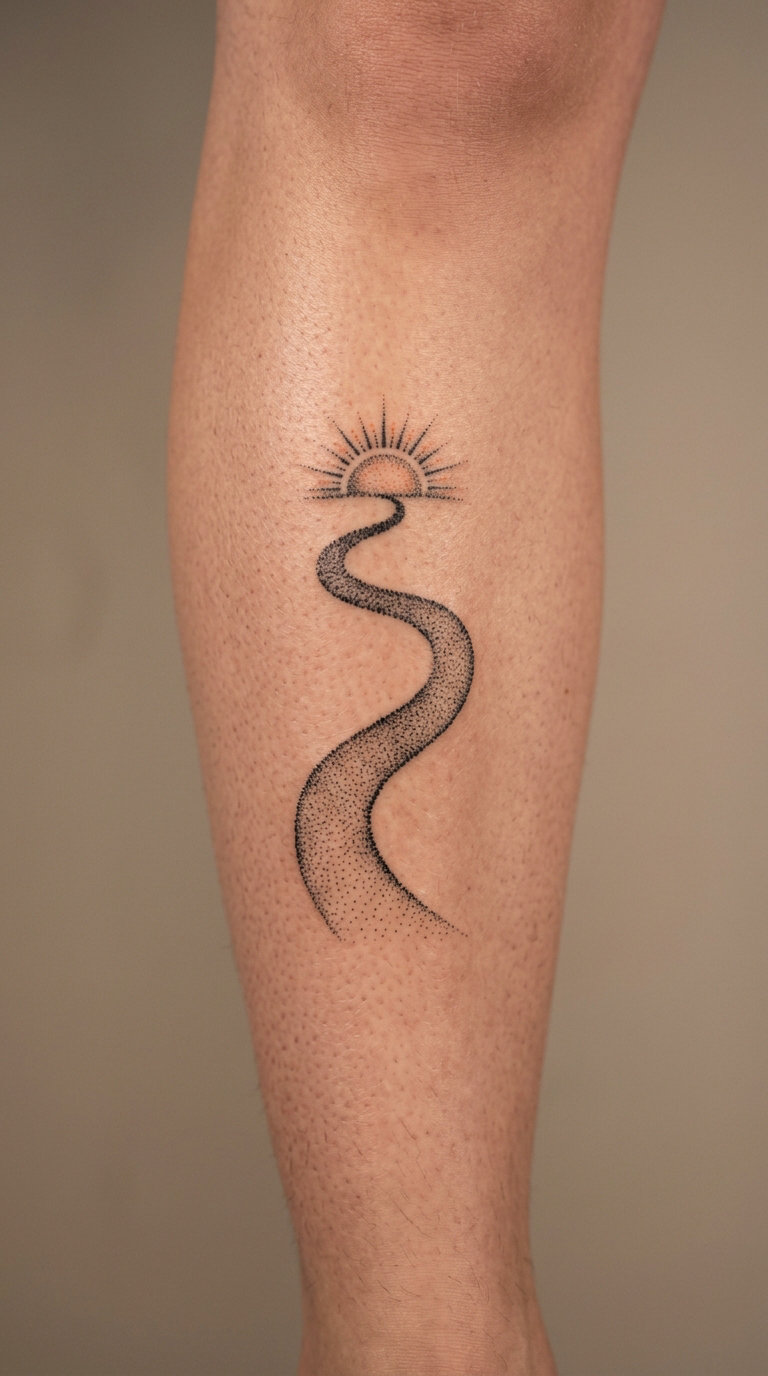
A curved path built from dots that grow gradually larger toward the sunrise, with a small black-and-orange sun at the end. The size gradient is the design; nothing else needs adding.
Moving forward is the plain reading, and the increasing dot size gives the piece motion without a single line of outline.
Placement: the shin, the inner forearm, or the upper arm. Size: 3 inches long. Style: dotwork with a small colour sun.
Pain: medium; dotwork is slow, and the shin is an awkward angle to sit at. Ageing: the smallest dots fade first, so start the gradient larger than the reference looks.
Make it yours: make the path double back on itself, or add one small figure walking it, kept to a silhouette.
23. Two Flames Forming a Heart
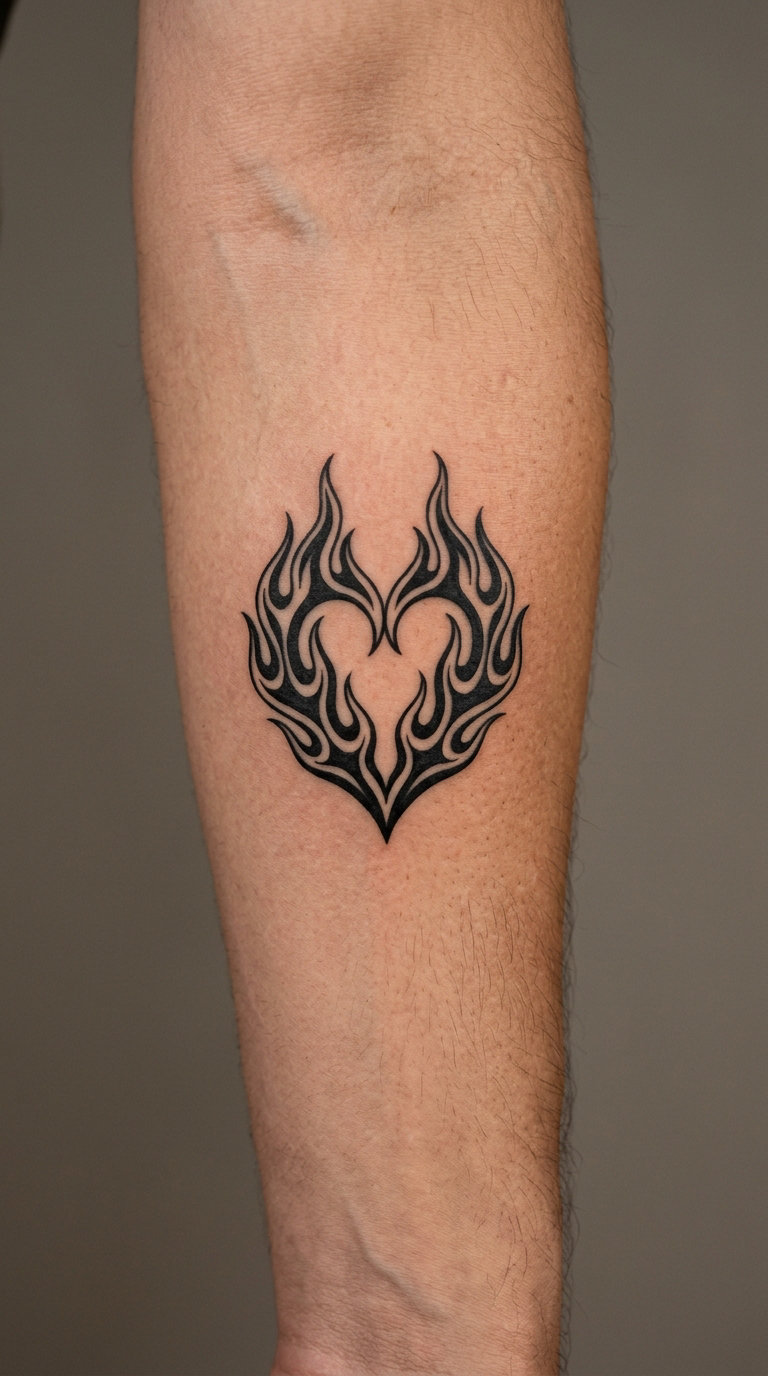
Two flame outlines curving inward until they meet and form a heart shape, done either as bold solid blackwork or as clean fine line. The symmetry is what makes it work at small sizes.
Warmth, resilience and devotion get read into it depending on who is wearing it, and it is one of the more versatile designs on this list for matching with someone else.
Placement: inner forearm, the chest, or the shoulder. Size: 2 inches wide. Style: bold blackwork or fine line.
Pain: low to medium, though solid fills take longer than outlines. Ageing: the solid version ages far better, since the fine line inner flame edges soften into a blur first.
Make it yours: fill one flame in a single warm colour and leave the other black, or split the piece with someone and each takes one side.
24. Crescent Moon Holding a Tiny Star
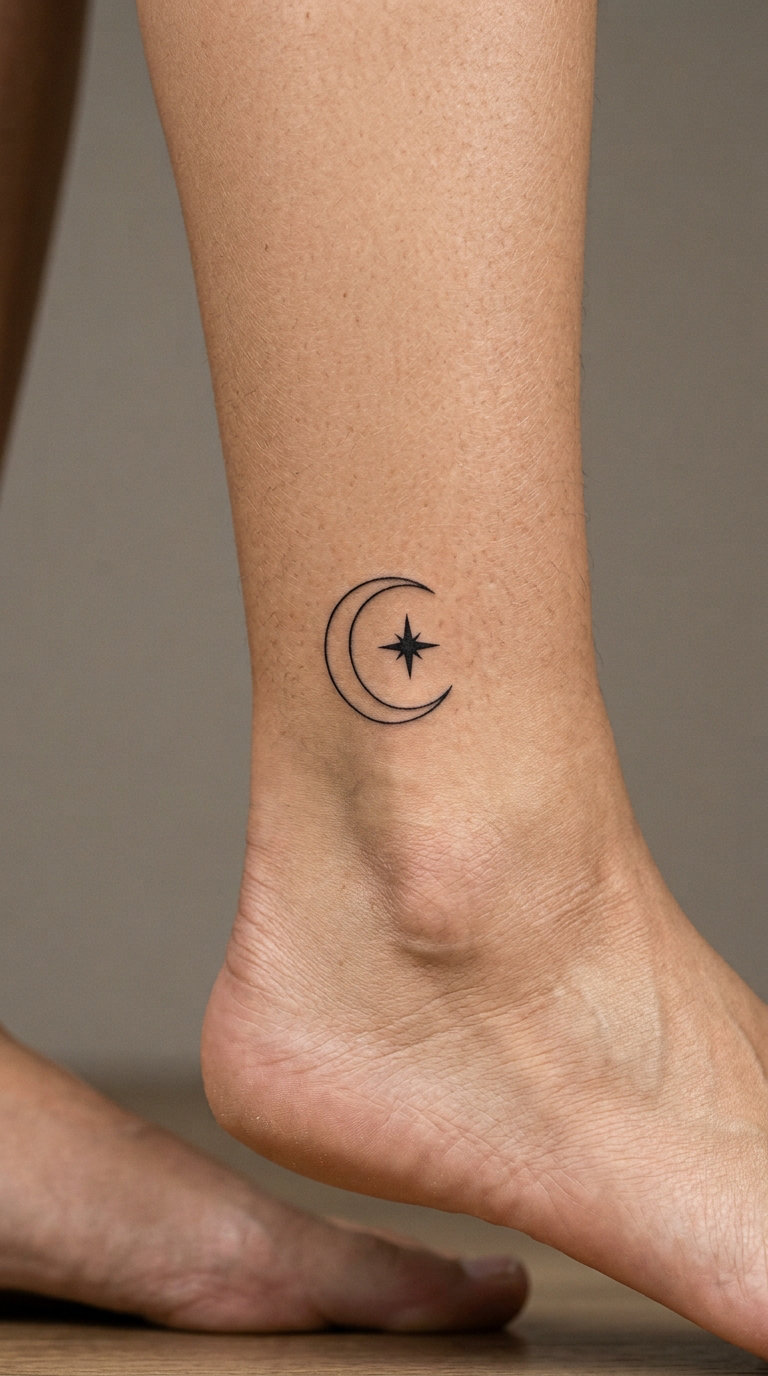
A slim crescent moon, drawn with a single clean curve, holding one small four-point star inside its opening. Two shapes, no scattered starfield around them.
Guidance and something watching over a period of change is the usual reading, and it sits naturally beside a small birth date if you want one.
Placement: the ankle, behind the ear, or the inner wrist. Size: 2 inches tall. Style: fine line blackwork.
Pain: medium to high; the ankle has thin skin over bone and the nerve endings there are close. Ageing: a thin crescent at 2 inches loses its inner edge, so a slightly fuller moon outlasts a delicate one.
Make it yours: add the star as a birth date in numerals, or fill the crescent in a single deep shade rather than outlining it.
25. Branch Blossoming into Line-Art Birds
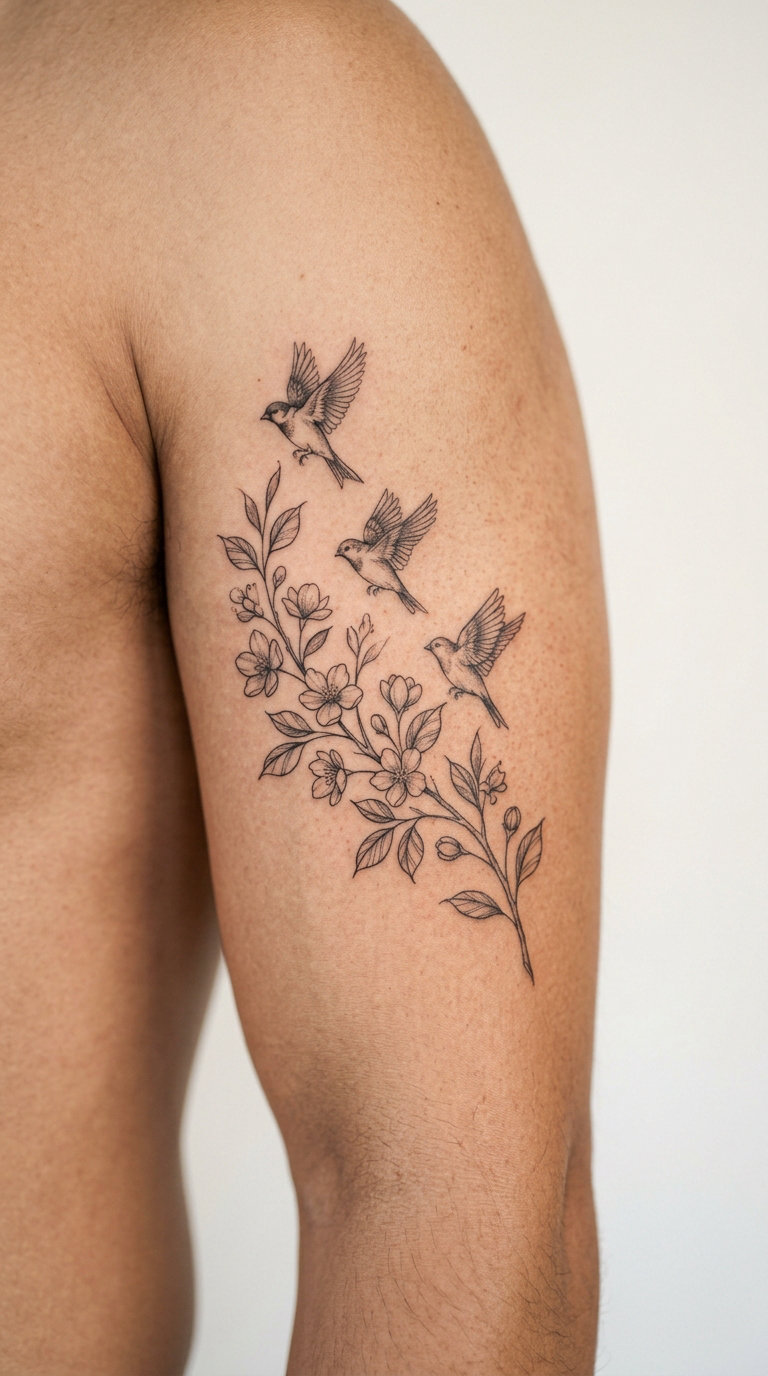
A single branch running diagonally with a few blossoms at one end and three simple birds taking flight from the other, all in fine line. The branch is the anchor and the birds are the movement.
Growth and forward movement together, which makes it a good closing image for someone adding to an existing piece rather than starting one.
Placement: diagonally across the upper arm, along the collarbone, or the side of the calf. Size: 4 inches wide, up to 6. Style: fine line botanical with light pink or white blossom colour.
Pain: low to medium, with the 4-inch length making it a longer sitting than the others here. Ageing: the blossom centres are the first detail to go; simple five-petal shapes with solid centres last far better than stamen detail.
Make it yours: match it with three small birds on the opposite arm in the same positions, or use a species that blooms in a month that counts.
How to Choose the Right Design
Five questions settle it, and they are worth answering in order rather than in the artist’s chair.
- Does it match your existing work? A first tattoo can be anything. Your fifth should match the weight of your first four, not fight them.
- Can the design hold its detail at that size? Ask the artist to tell you what they would cut. If the answer is more than two things, either simplify it or size up.
- Where will you see it? Inner arms and ribs stay private, the outer forearm and calf are always on display, and hands and fingers are noticed constantly.
- Does the meaning actually mean something to you? A symbol that only works for you is stronger than one everyone recognises.
- How will it look in fifteen years? Fine line softens, colour fades and heavy black holds. Choose the ageing you can live with, not just the version in the mirror today.
A design mashup of two symbols stays readable, so two elements is the safe ceiling.
Bring reference images, and ask to see the stencil on your body before the outline starts. Proportion on skin is the single most common thing clients wish they had checked earlier, and it takes thirty seconds.
Cost and Session Time
Small hope tattoo designs are priced by the piece, by the hour, or by a shop minimum, and in the US the usual ranges look like this.
- Tiny designs under 1 inch, such as a small heart with a pulse line: 80 to 150 dollars, 10 to 25 minutes.
- Small designs of 1 to 3 inches, which covers most of the 25 ideas on this list: 150 to 350 dollars, 30 to 90 minutes.
- Medium designs of 3 to 5 inches, such as a phoenix or a blossoming branch: 350 to 800 dollars, 1.5 to 3 hours.
- Larger or more detailed custom work: 700 dollars and up, often booked across two sessions.
Hourly rates commonly run 80 to 200 dollars depending on the artist and the city, and most studios enforce a minimum of 100 to 150 dollars, which is why a ten-minute touch-up is rarely as cheap as it sounds. Two things push a price up: a composition with more separate elements than the sizes here, and colour that needs mixing rather than filling.
Aftercare Basics
Follow your artist’s aftercare instructions first, because skin type, ink depth and the artist’s own technique all change the advice. Beyond that, the basics are consistent.
- Wash gently with unscented soap and lukewarm water, then pat dry with a clean paper towel or a folded cloth. No scrubbing and no loofah.
- Keep friction and water off it while it settles. Loose clothing over the new tattoo matters more than any ointment, especially on the inner forearm and the wrist.
- Skip swimming, hot tubs and saunas until it is properly healed, and be careful shaving around it in the first couple of weeks.
- Leave the film alone. Picking flakes off is the most common route to patchy results, and no cream makes that better.
- Judge nothing before it has settled. Fine line looks softer for the first few weeks and most designs need one free touch-up in the first months for lines that healed unevenly.
Frequently Asked Questions
What does a hope tattoo usually mean?
A hope tattoo is any design chosen as a reminder of optimism, resilience or belief that better things are still ahead. The most common symbols are sunrises, anchors, rainbows, birds in flight, butterflies, lighthouses, stars, open doors and growing plants. There is no fixed dictionary meaning, so the personal reading matters more than the traditional one.
Are hope tattoos better in colour or black and grey?
Black and grey ages best because it holds its shape for decades, and it suits designs built from shape rather than detail. Colour is worth it when one small accent carries the whole idea, such as a yellow window, a green seedling or a red sunrise. Solid black also hides fine line softening, so if you want the design to stay crisp, go dark or go bigger.
Can I get a small hope tattoo on my finger?
You can, and finger tattoos are popular for small symbols, but they fade faster than almost anywhere else. Hands get washed, stretched, exposed to sun and knocked against things constantly, and fine line softens first. If you go ahead, ask for heavier lineweight and a slightly larger design, and expect a touch-up sooner than on an arm or a leg.
What size should a hope tattoo be?
Most of the designs on this list work between 1.5 and 3 inches, which is small enough to feel manageable and large enough for the artist to keep detail clean. Under 1.5 inches, only single-motif designs survive, such as a tiny heart, a star or a single leaf. Measure the finished size, not the reference image, and ask the artist what they would remove at your chosen size.
Which hope tattoo is easiest to get as a first piece?
A fine-line sunrise, an open door in blackwork, or a small house with one lit window are the easiest first tattoos here. They are one shape, they need no colour, and they sit on the upper arm or the thigh where skin is forgiving and the position is comfortable. Avoid a first design with lots of tiny separate elements or a placement on the ribs or the collarbone.
Where to Start With Your Hope Tattoo
If this is your first tattoo, go with a single shape on the upper arm or the thigh: the fine-line sunrise, the open door in blackwork, or the small house with one lit window. One idea, no colour, nothing to lose if you change your mind about the placement later.
If you already have work and you are adding to it, choose a direction piece like the river, the blossoming branch or the dotwork path, and put it where the existing work can lead the eye toward it. Book a consultation, take the stencil check seriously, and pick the design you will still want to look at in fifteen years. That is the only rule that really matters.