
20 Handwriting Tattoo Ideas from a Loved One: Best 2026 Designs
A handwriting tattoo is not text set in a nice font. It is a real sample of one person’s penmanship, traced onto your skin exactly as they wrote it, quirks and all. That is why the 20 handwriting tattoo ideas from a loved one below feel different from a quote tattoo: nobody else on earth has that slant, that particular l, that pressed-down pen stroke on the g.
Most people arrive here with a card, a birthday message scrawled on wrapping paper, a line from a letter, or a signature on an old envelope. Some are doing this for a parent or grandparent who has died. Others want a partner’s handwriting, a child’s first note, or a nickname that only one family uses. Every idea below is built around a specific kind of sample, with the placement, size and pain you can expect.
A word of caution up front. The healed tattoo will never be a photocopy of the original. Skin curves, stretches and heals differently, and an artist has to correct for all three. Expect a faithful version, not an identical one.
20 Handwriting Tattoo Ideas from a Loved One: Quick Guide
| Idea | Style | Best placement | Size | Pain |
|---|---|---|---|---|
| 1. Fine-line signature | Fine line, single needle | Inner wrist | 2 to 3 in | Medium |
| 2. Handwritten note | Fine-line script | Inner forearm | 3 in | Low to medium |
| 3. Initial and date | Loose calligraphy | Inner upper arm | 1.5 to 2.5 in | Low |
| 4. Miniature heart | Micro fine line | Behind the ear | Under 1 in | Low |
| 5. One word | Handwritten script | Outer forearm | 2 in | Medium |
| 6. Coordinates | Fine-line script | Inner bicep | 2.5 in | Low |
| 7. Two dates | Fine line | Inner forearm near elbow | 1.5 in each | Medium |
| 8. First-love message | Fine-line script | Collarbone | 2 in | Medium |
| 9. Matching signature | Fine line | Inner wrists | 2 in each | Medium |
| 10. Birthday wish | Loose handwriting | Outer upper arm | 2.5 in | Low |
| 11. Pet name | Small fine line | Inside of the wrist | 1.5 to 2 in | Medium |
| 12. Family nickname | Fine line | Inner arm below elbow | 2 in | Medium |
| 13. Song lyric | Fine-line script | Outer forearm | 3 in | Medium |
| 14. Place name | Loose handwriting | Calf | 2 in | Medium |
| 15. Two-line promise | Fine black script | Inner upper arm | 3 in | Low |
| 16. Name with tiny heart | Fine line | Wrist, thumb side | 2.5 to 3 in | Medium |
| 17. Initials with dotwork | Fine line and dotwork | Outer upper arm | 2 in | Low |
| 18. Collarbone note | Fine line | Above the collarbone | 2.5 in | Medium |
| 19. Quote with botanicals | Fine line, botanical | Outer forearm | 3 in | Medium |
| 20. Micro phrase | Micro fine line | Behind the ear | 1 to 1.5 in | Low |
1. Fine-Line Signature on the Inner Wrist
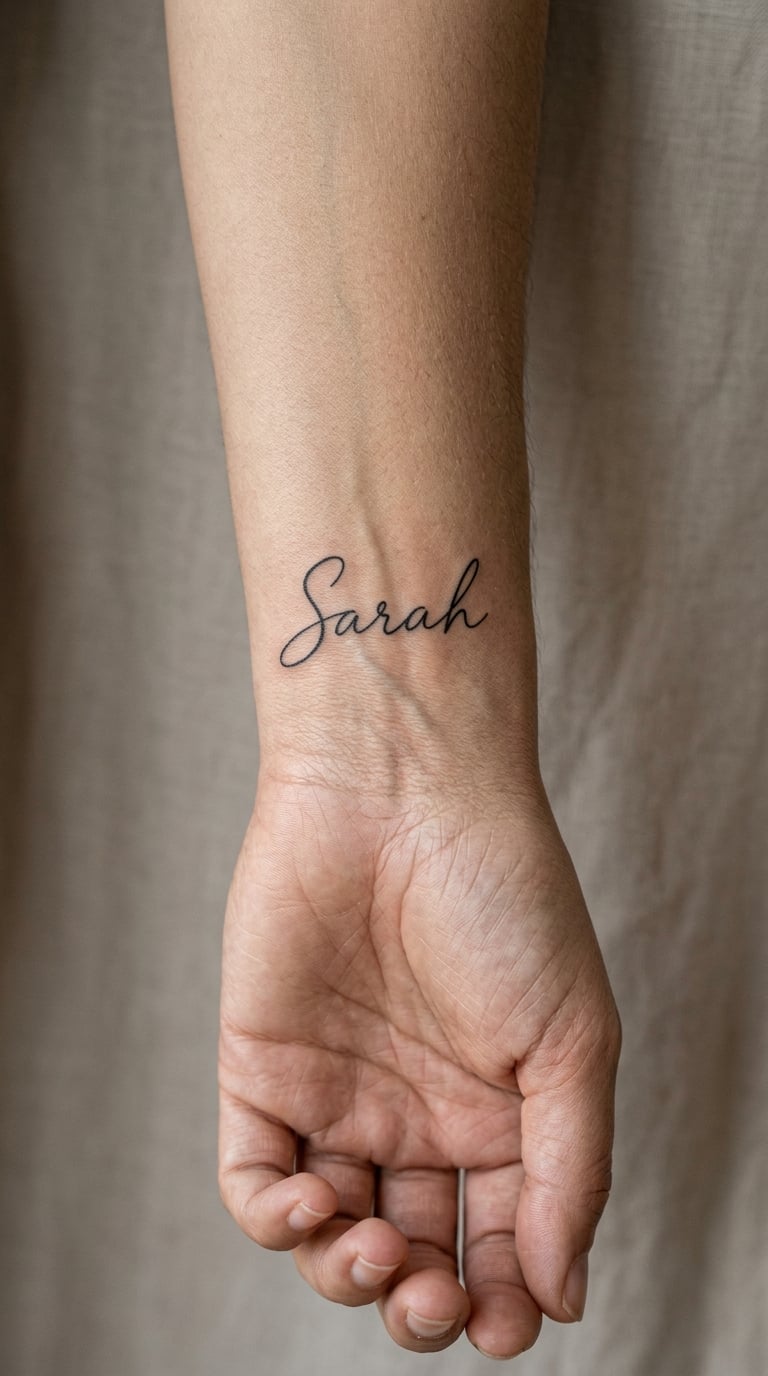
A signature is the most requested handwriting tattoo there is, and the hardest to fake. People choose it for the obvious reason: the shape of someone’s name is the way they signed their own existence, and a printed version of their name never captures it. If you want the wider range of memorial designs, our guide to beautiful tattoo ideas to honor your loved ones covers the non-handwriting side too.
Placement: the inner wrist just above the palm crease, or the outer wrist near the thumb. Size: 2 to 3 inches wide, which is the smallest size that keeps a signature readable. Style: fine line, single needle, no shading.
Pain: medium. The inner wrist is thin-skinned and packed with nerves. It heals well, but fine line on the wrist softens faster than the same script on the upper arm, so plan on a touch-up every few years. Make it yours: sign it in front of the artist so they can capture the actual stroke order, not a guess from a photograph.
2. Handwritten Note on the Forearm
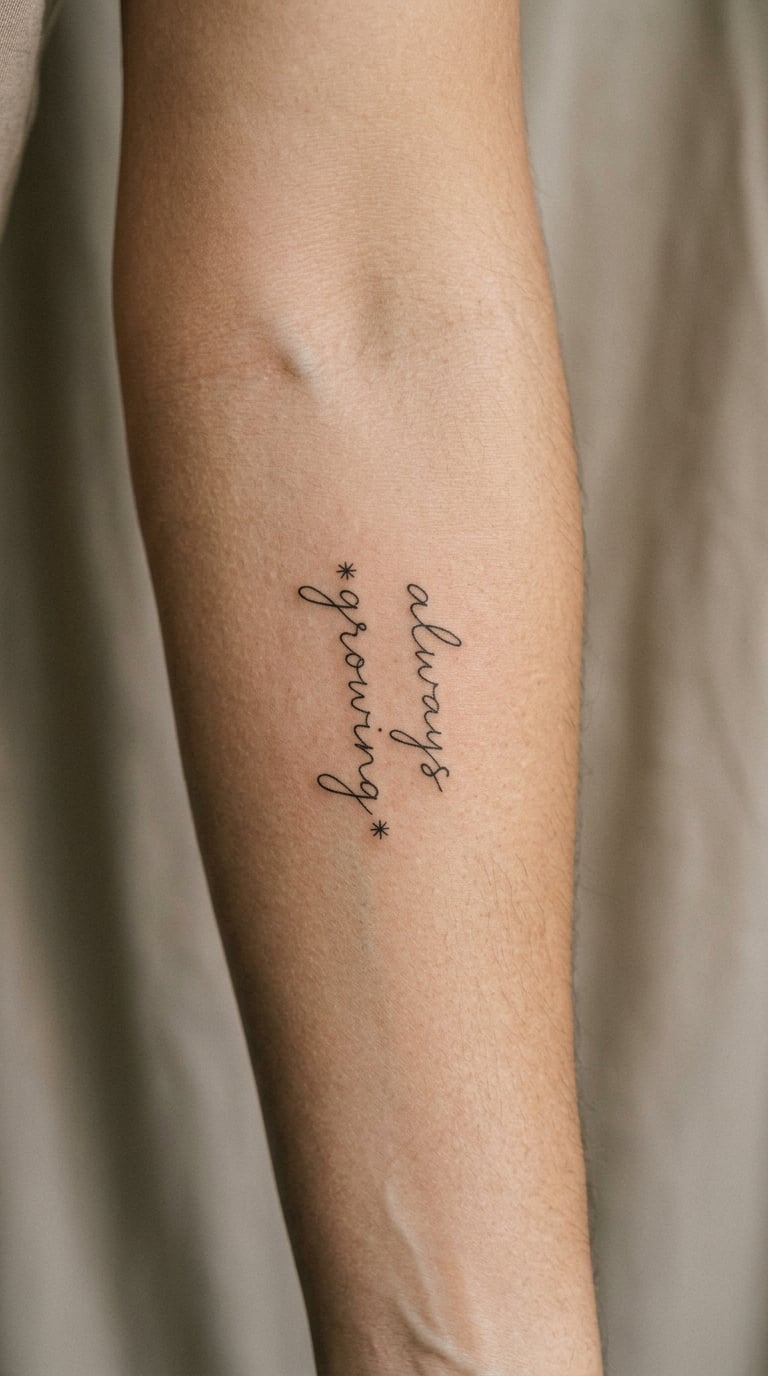
A short note, three to six words, written in someone’s real hand and run down the inner forearm. This one works when the words matter more than the letters: a “call me when you land,” a “you did it,” the first thing someone ever wrote to you.
Placement: inner forearm, running lengthwise toward the elbow. Size: about 3 inches long, two lines maximum. Style: fine-line script with a single-needle line slightly heavier than the original, which is what keeps small cursive legible after healing.
Pain: low to medium on the inner forearm, more uncomfortable than the wrist. Line breaks matter here, since the words sit in skin that bends with you. Make it yours: keep the original line break and capitalisation from the note rather than tidying the wording up.
3. Initial and Date in Flowing Script
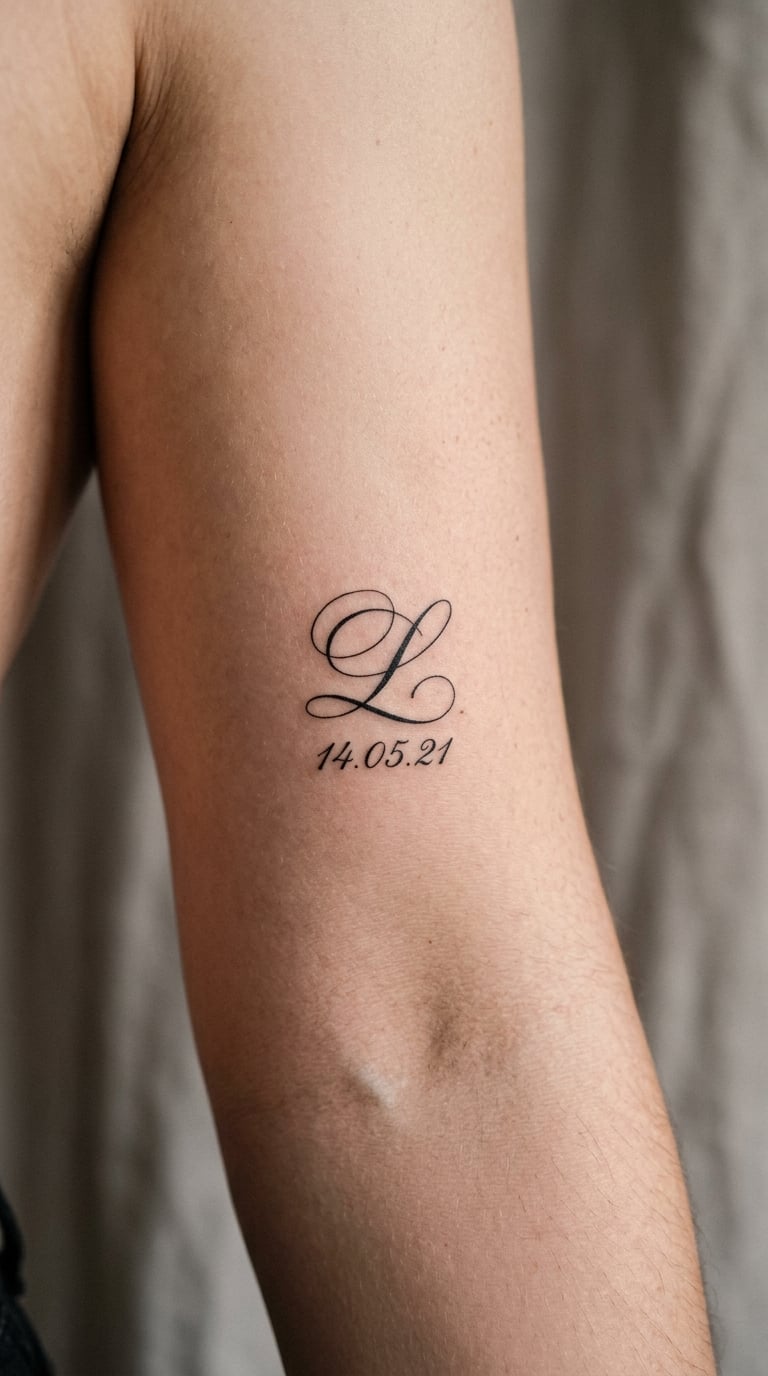
One initial and one date, small enough to read as a private mark rather than a display. A single capital written by someone who had good penmanship is genuinely beautiful, and it carries far less visual weight than a full name.
Placement: inner upper arm, or the back of the shoulder where only you see it. Size: 1.5 to 2.5 inches tall for the initial, with the date about a third of that width beneath it. Style: loose calligraphy, single needle.
Pain: low. The upper arm is one of the more forgiving spots, though the inner side near the armpit gets tender. Make it yours: add a second detail, a small dot or a sprig of something they grew, but keep it under half the size of the letter so the initial still leads.
4. Miniature Handwritten Heart
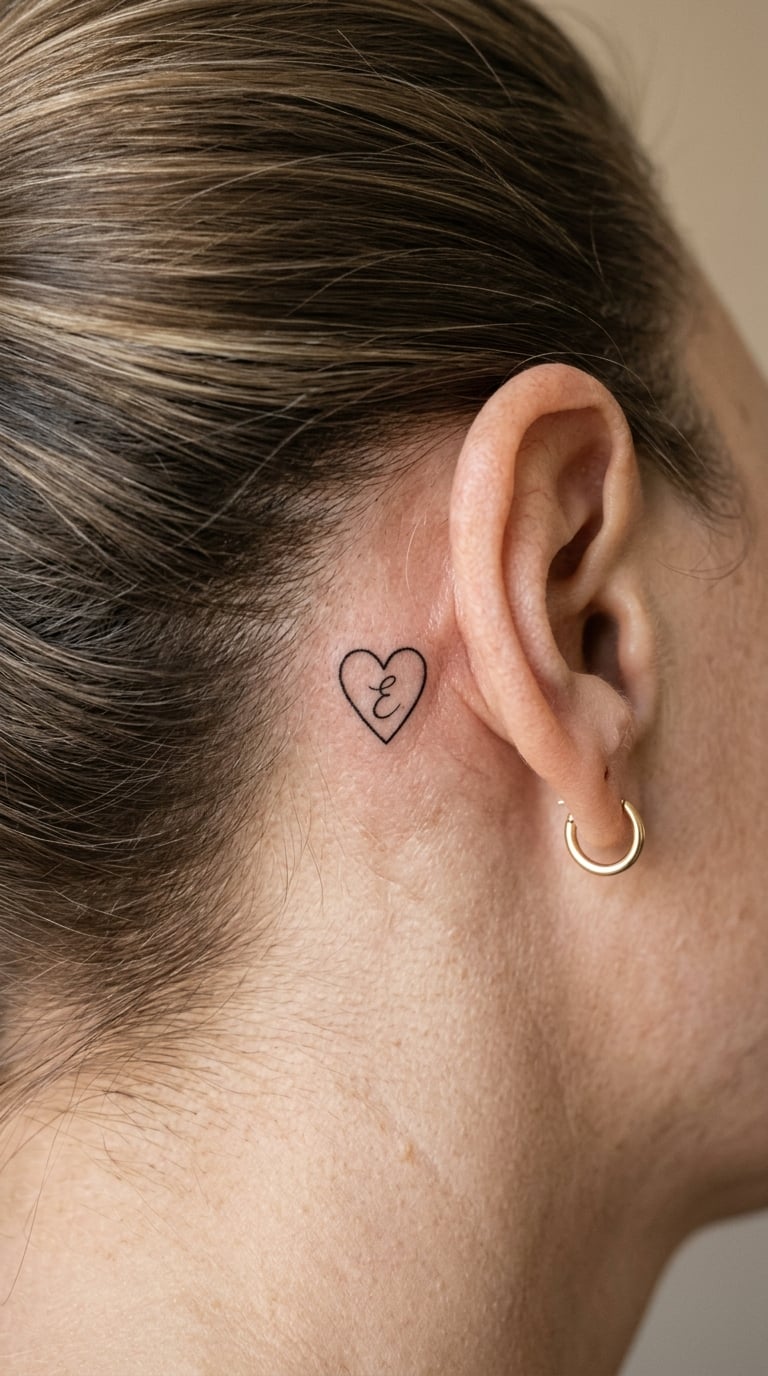
A heart outline drawn by hand, with one initial or one short word tucked inside. The appeal is the awkwardness of it: real people draw lopsided hearts, and a traced version keeps that tilt instead of fixing it.
Placement: behind the ear, the inner forearm near the wrist crease, or behind the ear’s hairline edge. Size: under 1 inch across. Style: micro fine line, no fill.
Pain: low, though skin behind the ear is thin and the session is fiddly because the artist is working on a curve. Make it yours: have the person draw the heart themselves on plain paper rather than picking a clip-art outline. Anything that small needs a bolder line than you would expect, and one touch-up in the first year is normal.
5. One-Word Handwriting Tattoo
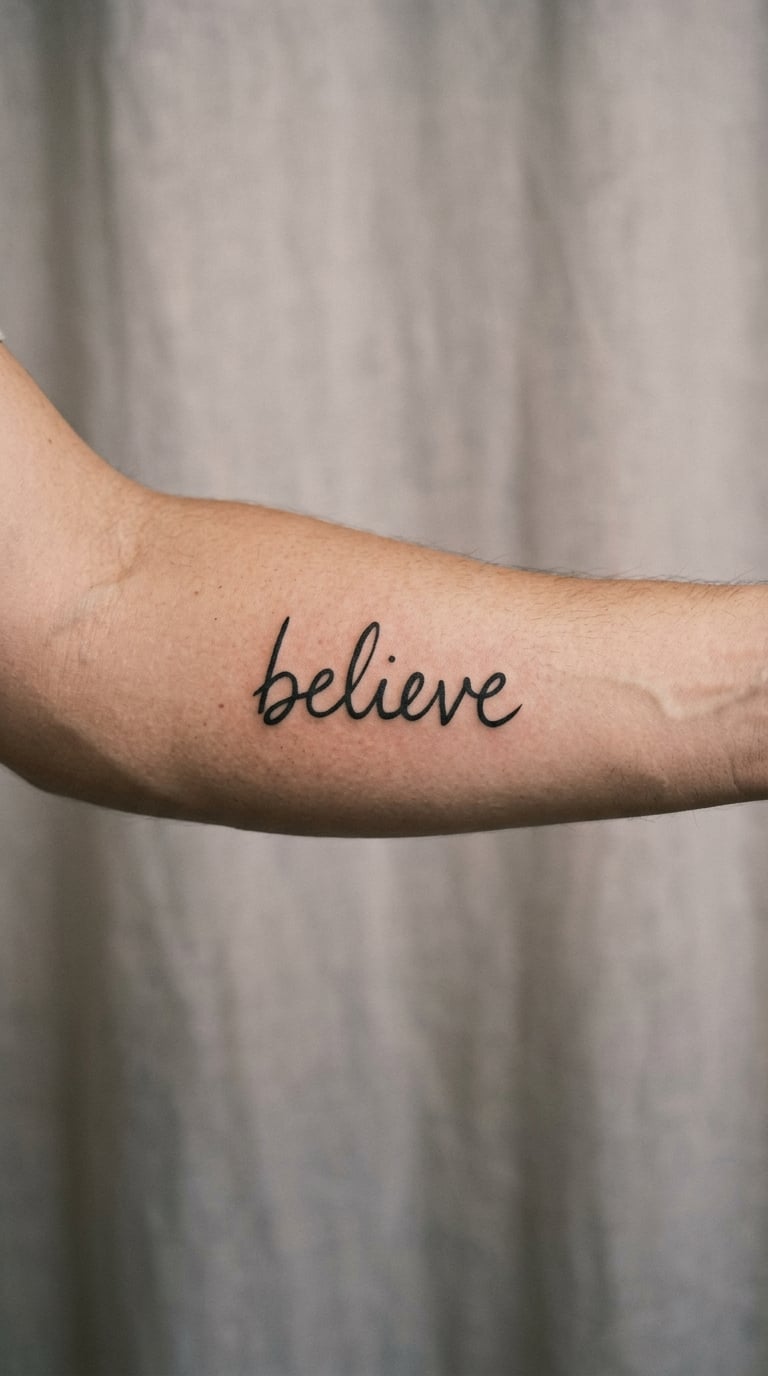
One word in a hand you recognise. It might be a name nobody else uses for that person, a place that meant something to them, or a word they underlined in a letter to you.
Placement: outer forearm reads best for a horizontal word. Size: 2 inches wide, more if the word has long letters like m and w. Style: handwritten script, single needle, no flourish added unless it was in the original.
Pain: medium. The outer forearm has more muscle to work with than the inner, so it feels steadier. Make it yours: pick a word that will still mean the same thing in twenty years. A word tied to a specific inside joke can land beautifully for the family and read as nothing to everyone else, which is fine, but check you want that.
6. Handwritten Coordinates
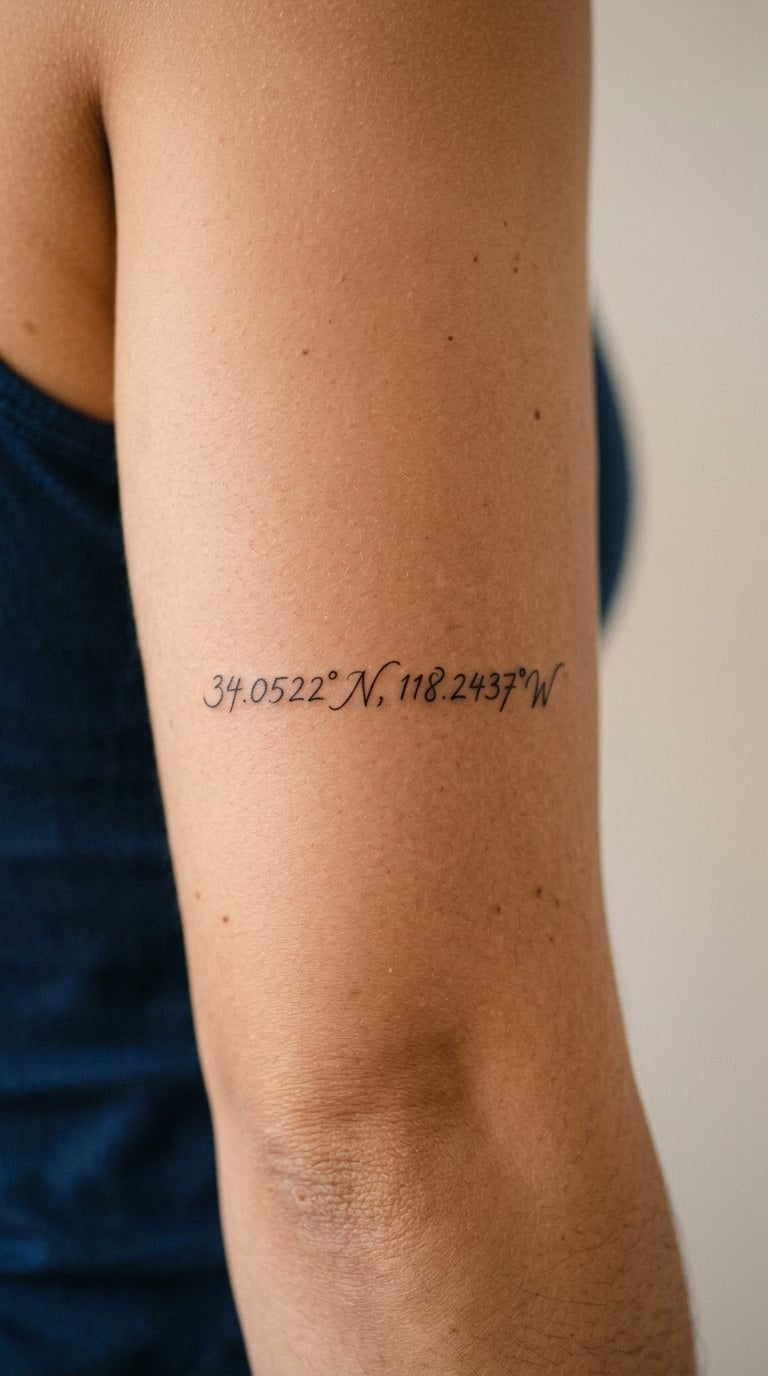
Latitude and longitude of somewhere that matters, written out in someone’s hand. A beach house, a hospital, the spot on a hill where something happened, or just a house address.
Placement: inner bicep, ribs, or the back of the shoulder. Size: about 2.5 inches wide, so the digits stay separate rather than running together. Style: fine-line script or a small hand-lettered numeral style.
Pain: low on the bicep, noticeably higher on ribs. Numbers are the friendliest text for fine line because there are no ascenders or loops to lose. Make it yours: add the place name in small type underneath, and ask the artist to double-check every digit twice. A mistyped coordinate is permanent, and it is the one mistake in this list that is genuinely hard to undo. If direction matters to you more than the location itself, our round-up of north star tattoo ideas works the same way.
7. Two-Date Handwriting Design
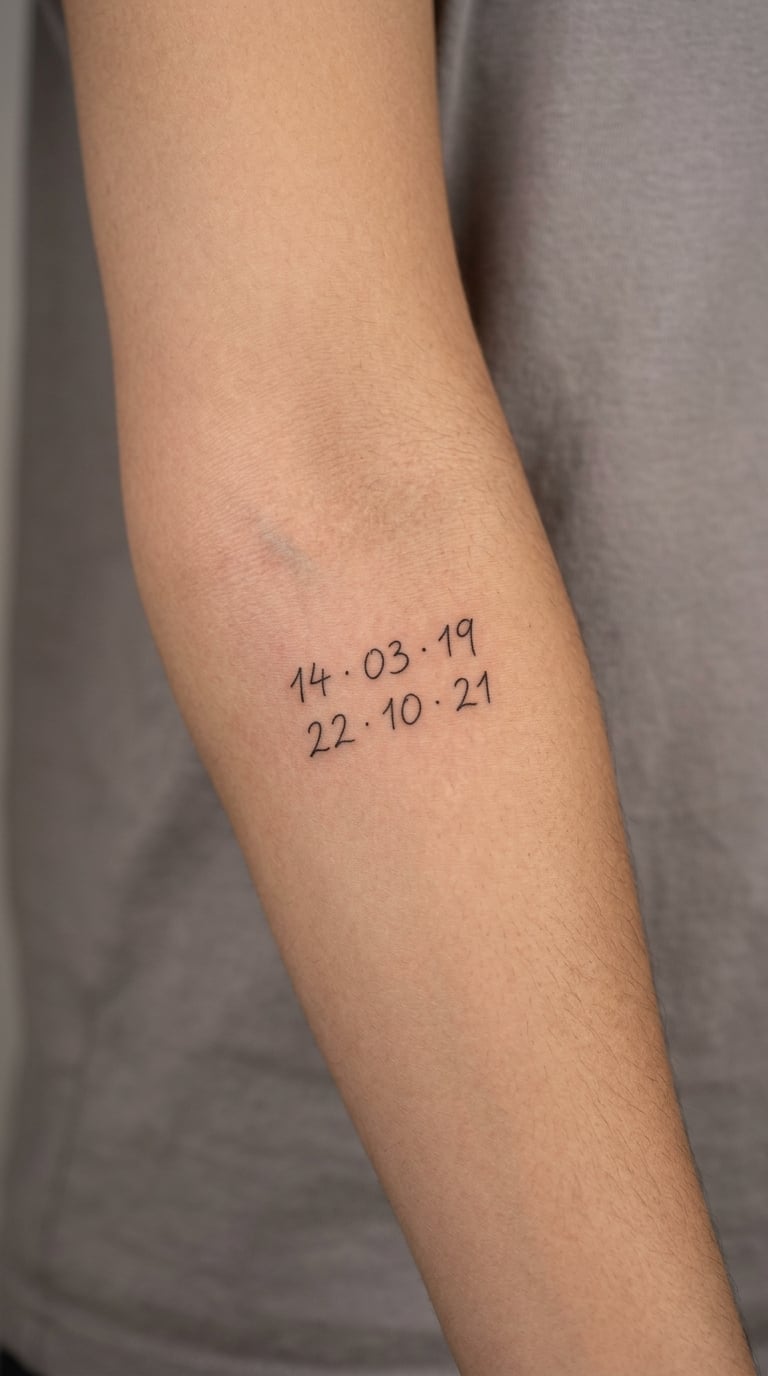
Two dates stacked, usually the day something started and the day it ended or changed: a wedding and an anniversary, a birth and a death, a diagnosis and a recovery.
Placement: inner forearm, spaced about half an inch apart, or the inner upper arm. Size: 1.5 inches wide each. Style: fine line, both dates in the same hand so they look like one piece.
Pain: medium near the elbow, where skin is thinner and harder to stretch. Make it yours: use the same hand for both even if the second date was written years later by a shakier version of that person. Add a hairline divider or nothing at all, and skip a decorative frame, which is what makes dated tattoos look dated.
8. Handwritten First-Love Message
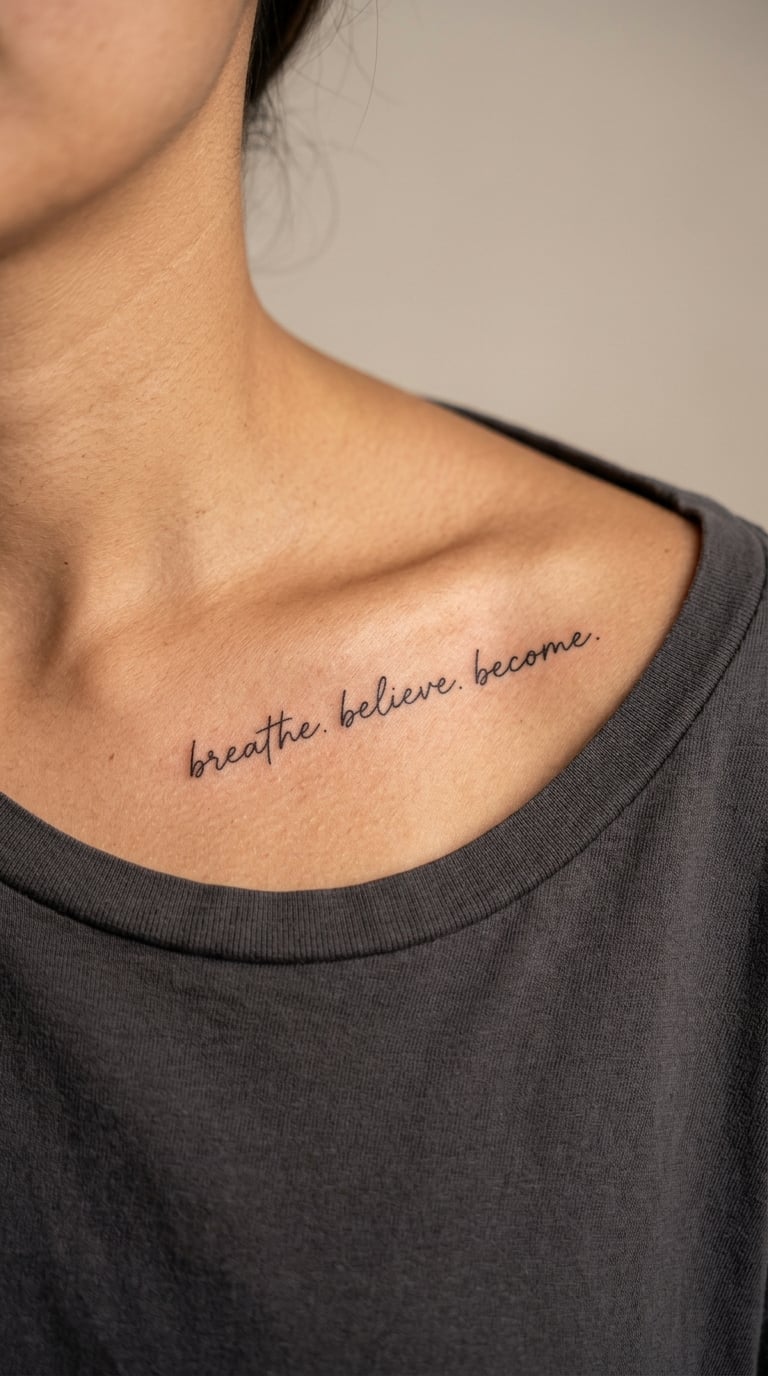
Three words tied to a first meeting, a first conversation or a first love, in that person’s hand. Kept to three words it stays intimate; longer phrases on the same placement start to compete with themselves.
Placement: collarbone near the shoulder, or the inner wrist. Size: 2 inches wide. Style: fine-line script, line weight pushed just past what the sample shows.
Pain: medium, and the collarbone edge can be a sharp reminder that bone is right under the skin. Ageing note: collarbones catch a lot of sun, so this one needs sunscreen discipline more than most. Make it yours: have the artist reproduce the exact spacing between words. Widening the gaps is the most common way a reproduced phrase stops looking like the original.
9. Signature as a Matching Tattoo
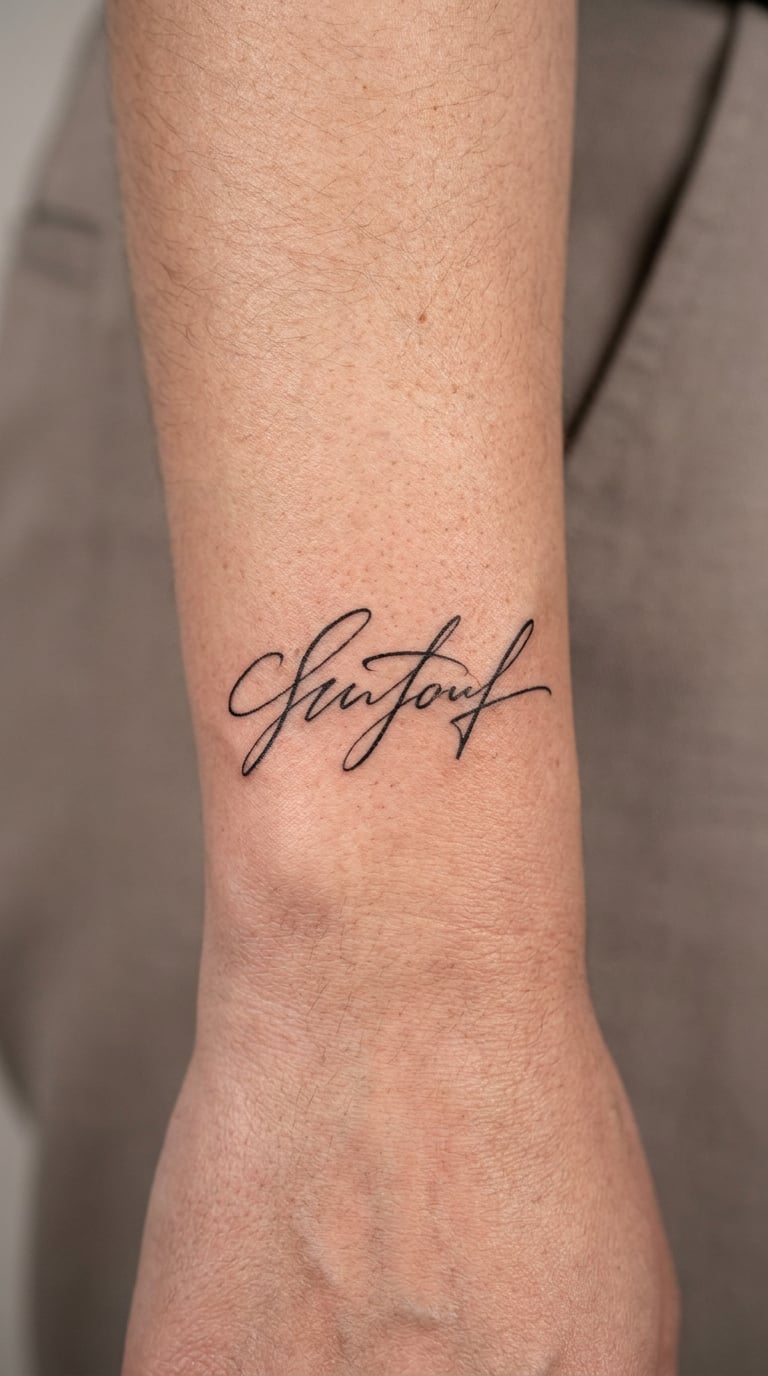
Two people tattooing the same signature from the same piece of paper. Siblings, a couple, a parent and an adult child, or a group of friends after a shared loss.
Placement: inner wrists, or one on the wrist and one on the upper arm depending on what the wearer actually wants to see. Size: 2 inches wide each. Style: fine line, identical placement on both bodies so they read as a pair.
Pain: medium, two sessions. If you are going together, book the same day so the ink ages in step. Make it yours: send both artists the same high-resolution scan, and agree on size in inches beforehand, because two artists working from the same file will still produce two different pieces. Slight differences are part of it. Tell your tattoo artist that in advance so they are not chasing a photocopy.
10. Handwritten Birthday Wish
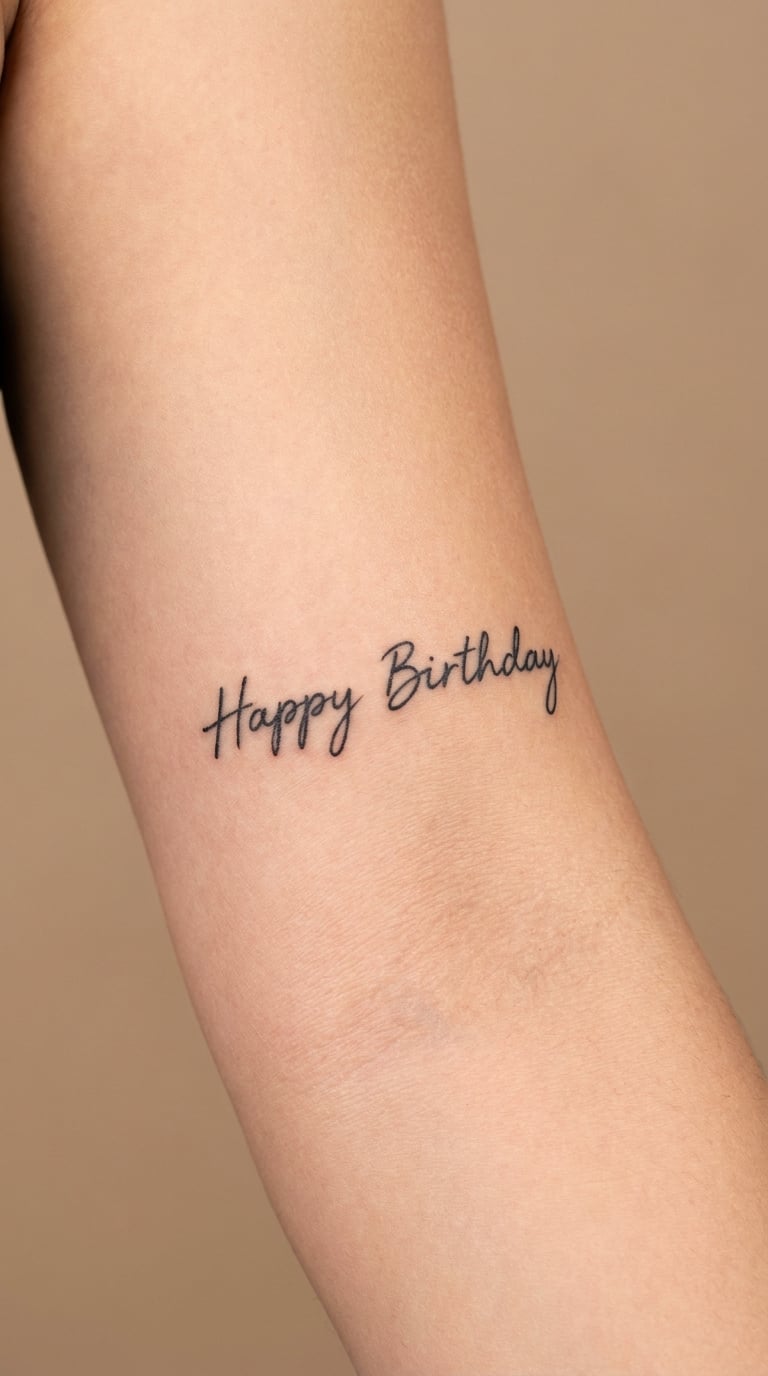
A birthday message or blessing written inside a card, lifted straight from the card. Card messages are usually short, generous and specific, which is exactly why they translate well to skin.
Placement: outer upper arm, or the shoulder blade. Size: 2.5 inches wide. Style: loose handwriting, single needle.
Pain: low. The outer upper arm is a good first session location and easy to photograph for healing checks. Make it yours: keep the informal parts. A lowercase greeting and a crossed t look like the person. Correcting their spelling or capitalisation is the fastest way to make a handwriting tattoo feel like a font.
11. Handwritten Pet Name
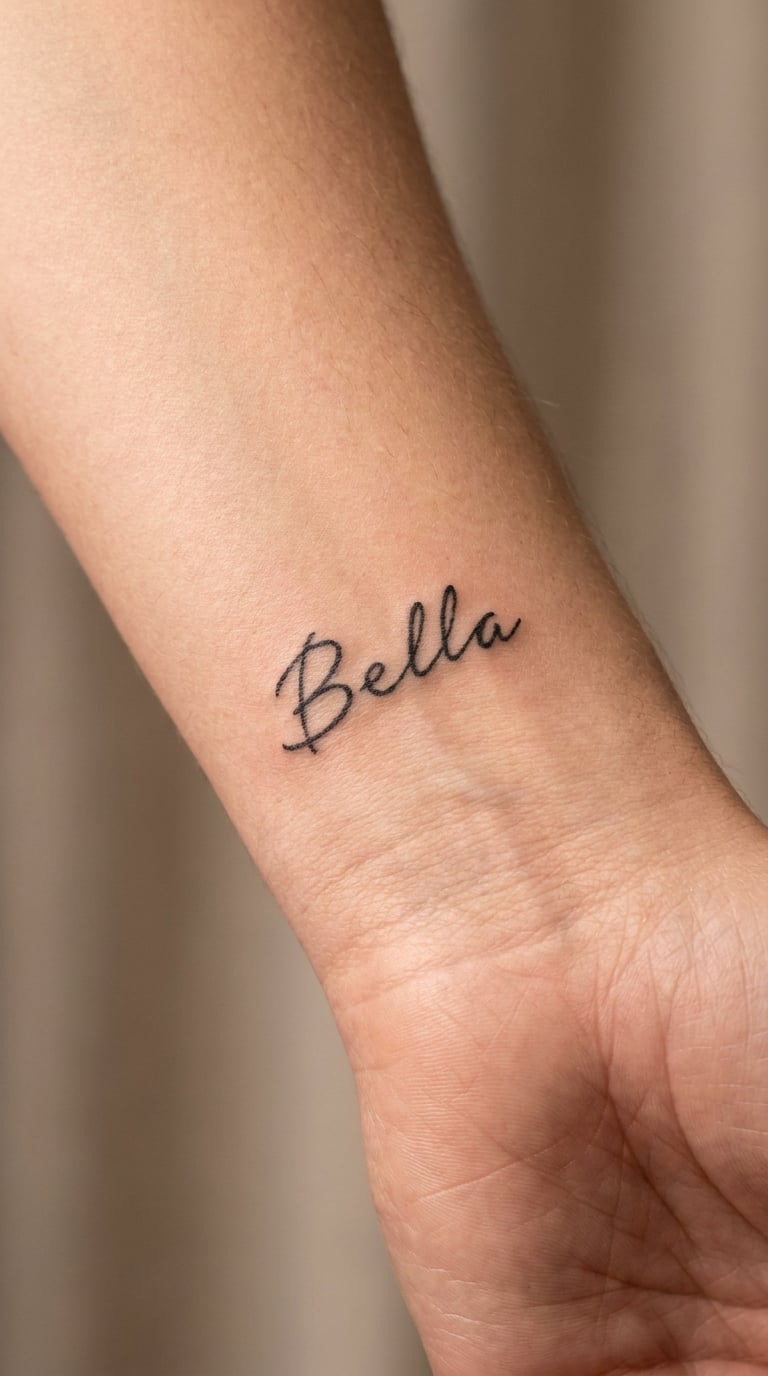
A pet’s name in a person’s handwriting, which means it carries two layers: the animal and the person who wrote the name down. That second layer is the part people miss when they think of a pet tattoo as just a name.
Placement: inside of the wrist, the arch of the foot, or behind the ear. Size: 1.5 to 2 inches wide. Style: small fine line.
Pain: medium on the wrist, low on the arch of the foot for most people though the foot tender point varies. Make it yours: pair it with a small solid paw print or a heart at one end, kept to about a quarter inch so the name stays the main event. A dotted outline paw can look unfinished when it is small, so solid black is the safer choice at this scale.
12. Handwritten Family Nickname
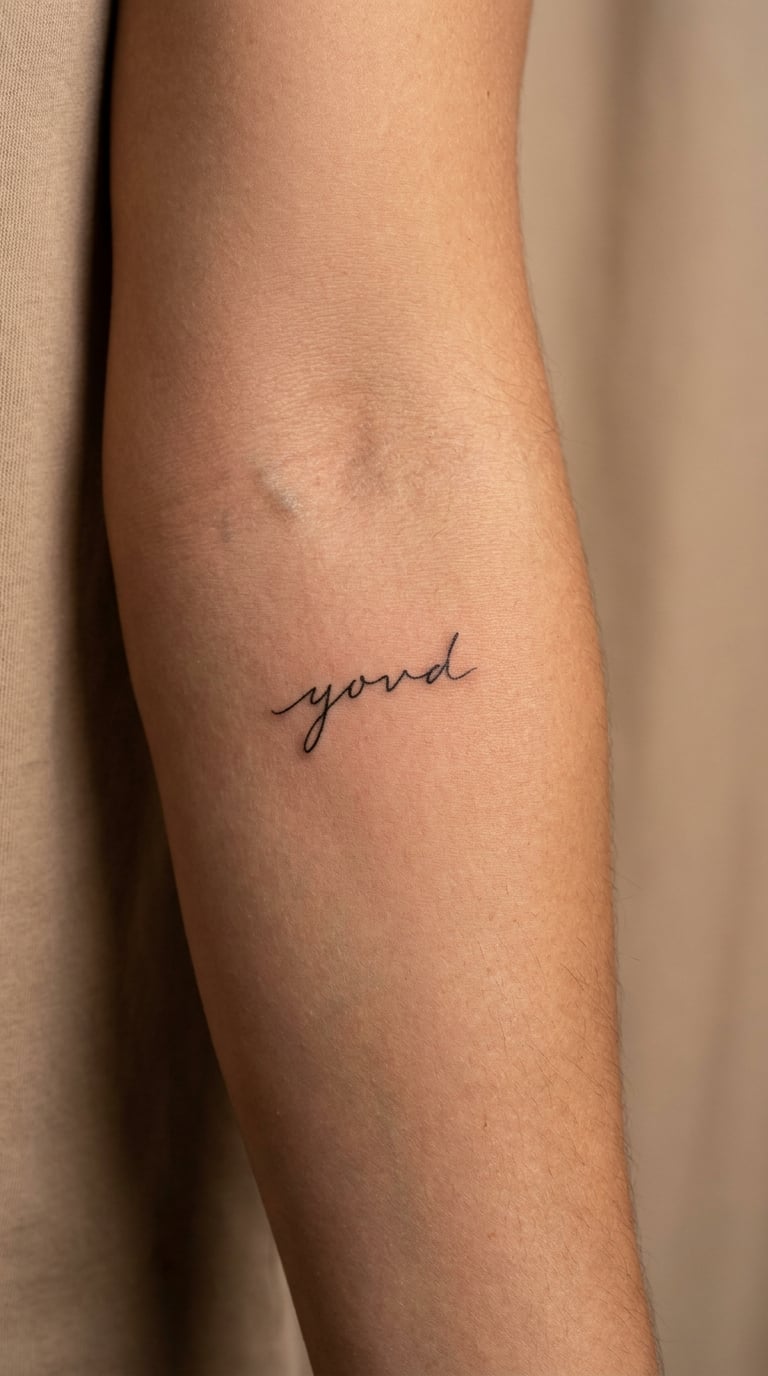
The nickname only your family used, in the hand of the person who gave it to you. These are often the least legible in a normal address book and the most meaningful to the person wearing them.
Placement: inner arm below the elbow, or the outer bicep. Size: 2 inches wide. Style: fine line, black only.
Pain: medium. Below the elbow the skin is soft and forgiving, so the line weight holds better than it would on the wrist. Make it yours: add a small birth flower for that person, a few leaves and a stem, at the end of the word. Keep it black so the two elements match, and ask the artist to overlap the stem into the final letter rather than placing it beside it.
13. Handwritten Song Lyric
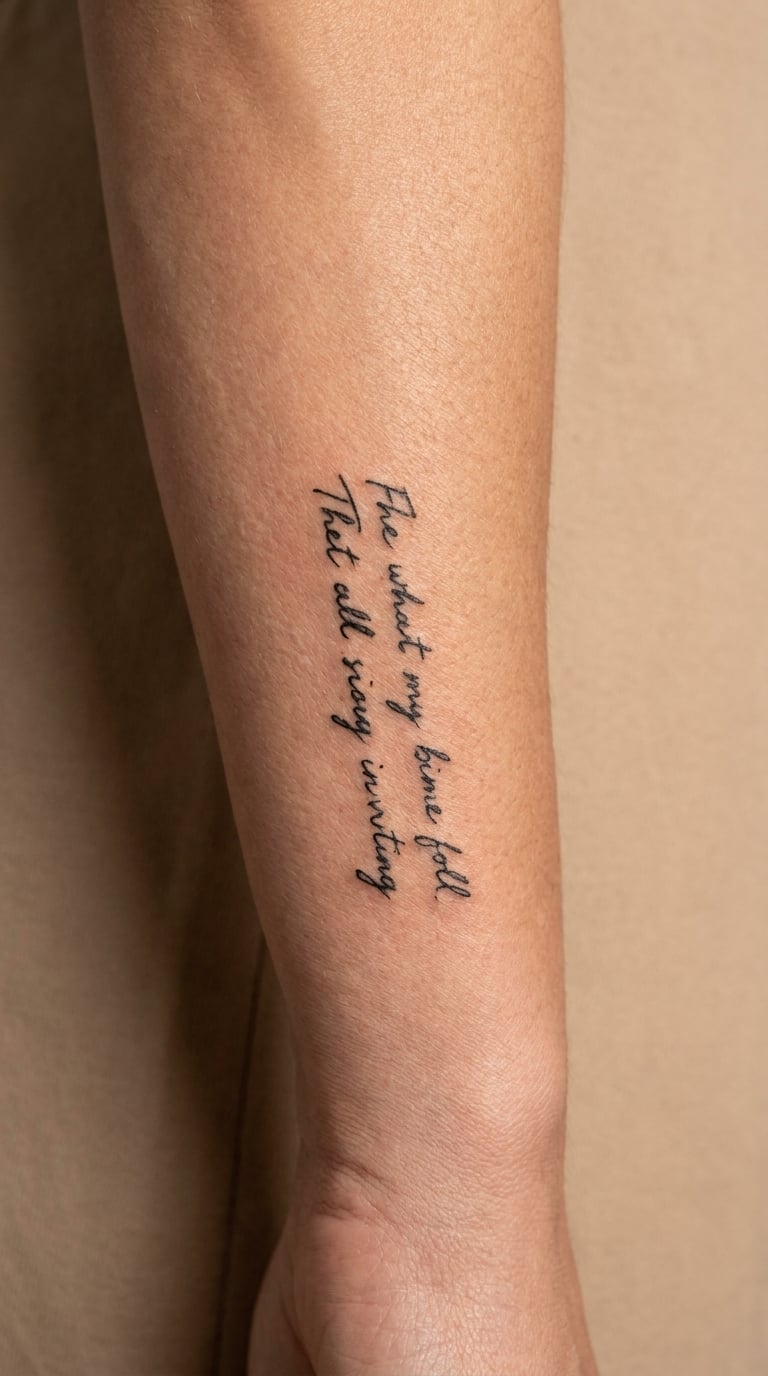
Two short lyric lines copied out of a loved one’s handwriting, usually by hand on the back of a receipt or a notebook page. Copying them out first rather than using a printed lyric keeps the result personal.
Placement: outer forearm along the muscle, or the ribs for a more hidden reading. Size: 3 inches long for two short lines. Style: fine-line script.
Pain: medium on the forearm, high on ribs. The outer forearm is the one to pick if you want it to stay readable for decades, since it is shaded less than the forearm’s sun-facing surface. Make it yours: add a small music detail, an eighth note, a treble clef or a record’s centre circle, in a line weight matched to the script. Ask the artist to draw the clef as a single line rather than a filled shape, or the two halves of the design will not match.
14. Handwritten Place Name
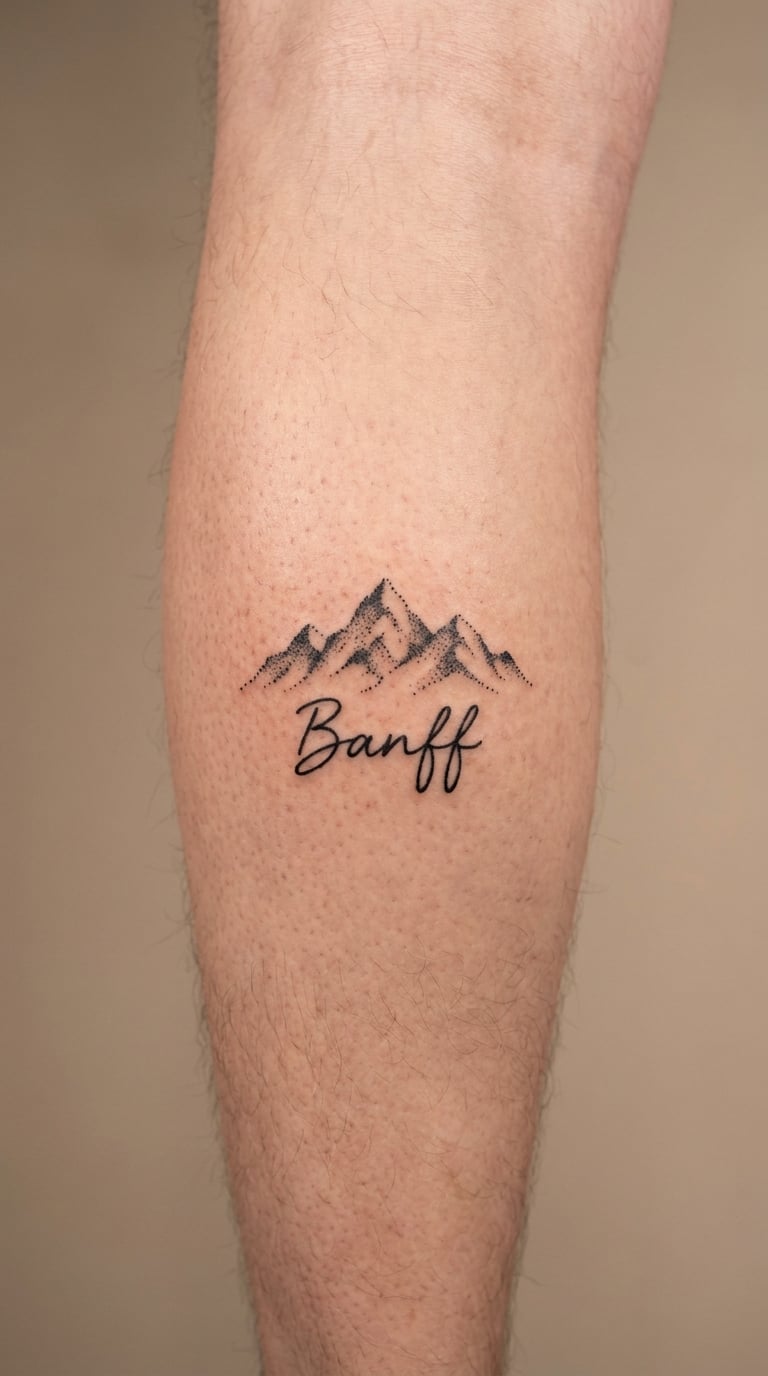
A place name in a loved one’s hand: the town they grew up in, a country they left, somewhere you went together. Travel-inspired, and it pairs naturally with a small landscape element.
Placement: side of the calf, ribs, or the back of the upper arm. Size: 2 inches wide for the name. Style: loose handwriting, black, with a small dotwork element underneath.
Pain: medium on the calf, which is fleshy and steadier than it looks. Calves show movement with age, so anything stacked on top of the name will slowly separate from it. Make it yours: keep the dotwork motif under a quarter of the name’s height and let the name sit on a flat area of skin, with the motif trailing downward.
15. Handwritten Promise in Two Lines
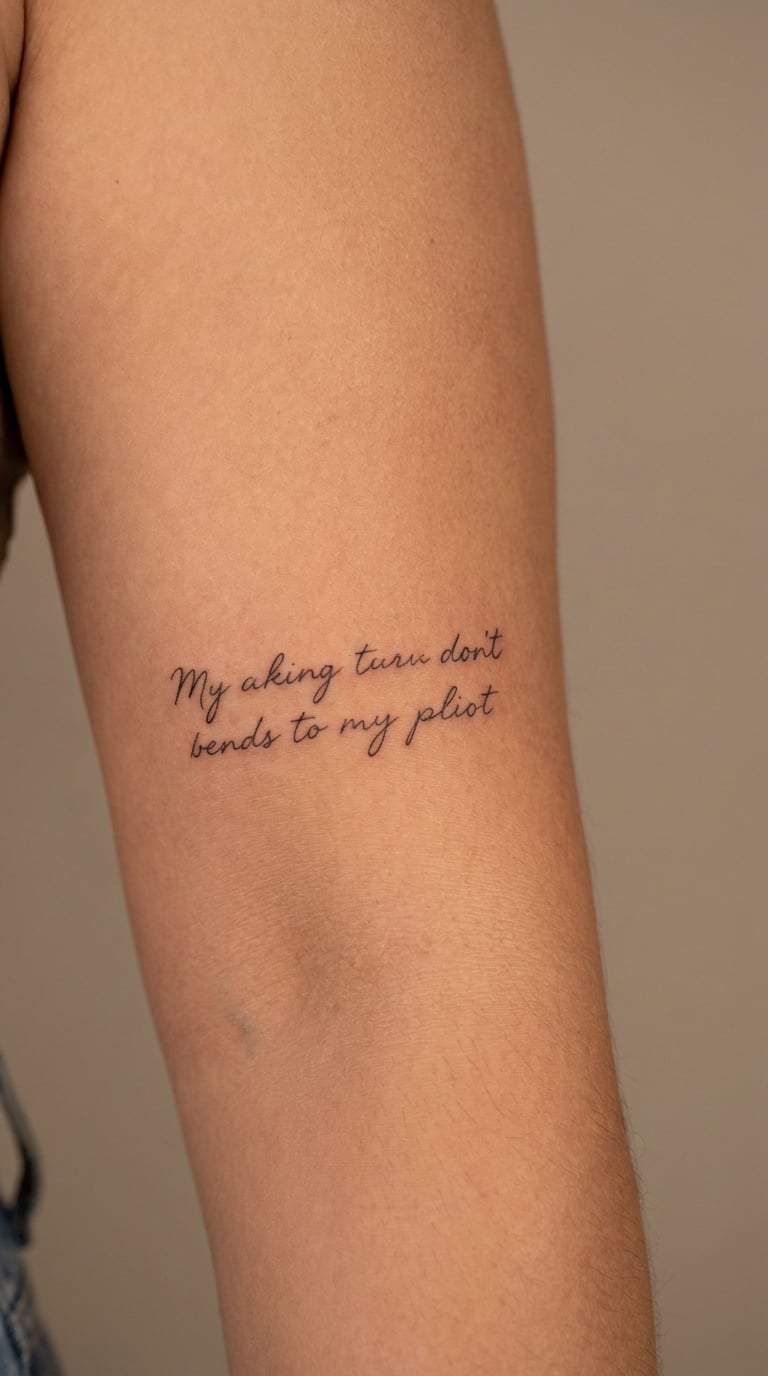
A two-line promise or personal saying in authentic handwriting, set the way the person wrote it rather than the way it would be typeset. Short, declarative lines sit well in two stacked rows.
Placement: inner upper arm centred, or the inside of the thigh for something private. Size: 3 inches wide, two lines of roughly equal length. Style: fine black script.
Pain: low on the upper arm. Two lines in a 3 inch width is about the most script a surface that size can hold before it turns to mud, so resist adding a third line. Make it yours: ask the artist to follow the original pen pressure, not just its outline. A fine-line script that copies the shape but not the weight looks like a printed word in a handwriting costume.
16. Handwritten Name with Tiny Heart
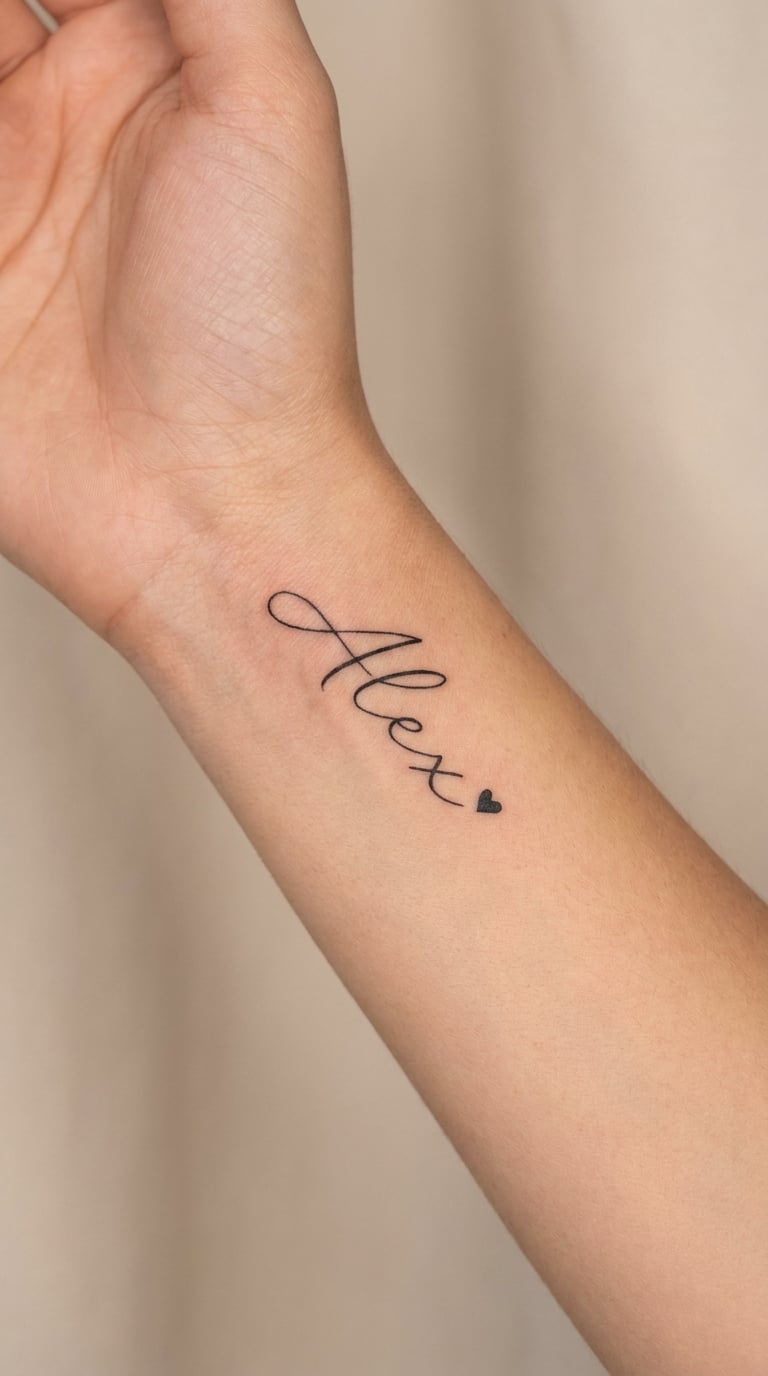
A loved one’s name in their own hand, with one small heart after it. The heart is a symbol that requires no interpretation, which is why it sits so comfortably next to something that carries everything on its own.
Placement: wrist on the thumb side, or the inner forearm. Size: 2.5 to 3 inches wide. Style: fine line with one solid heart, no outline heart at this scale.
Pain: medium. Ageing note: the thumb-side wrist is a high-fade zone because of movement and sun, so ask for a slightly heavier line than the sample and expect a refresh in about three years. Make it yours: add a birth-date accent under the name in a much smaller size, and match its line weight to the heart rather than to the name, so the two details sit together as one group.
17. Handwritten Initials with Matching Dotwork
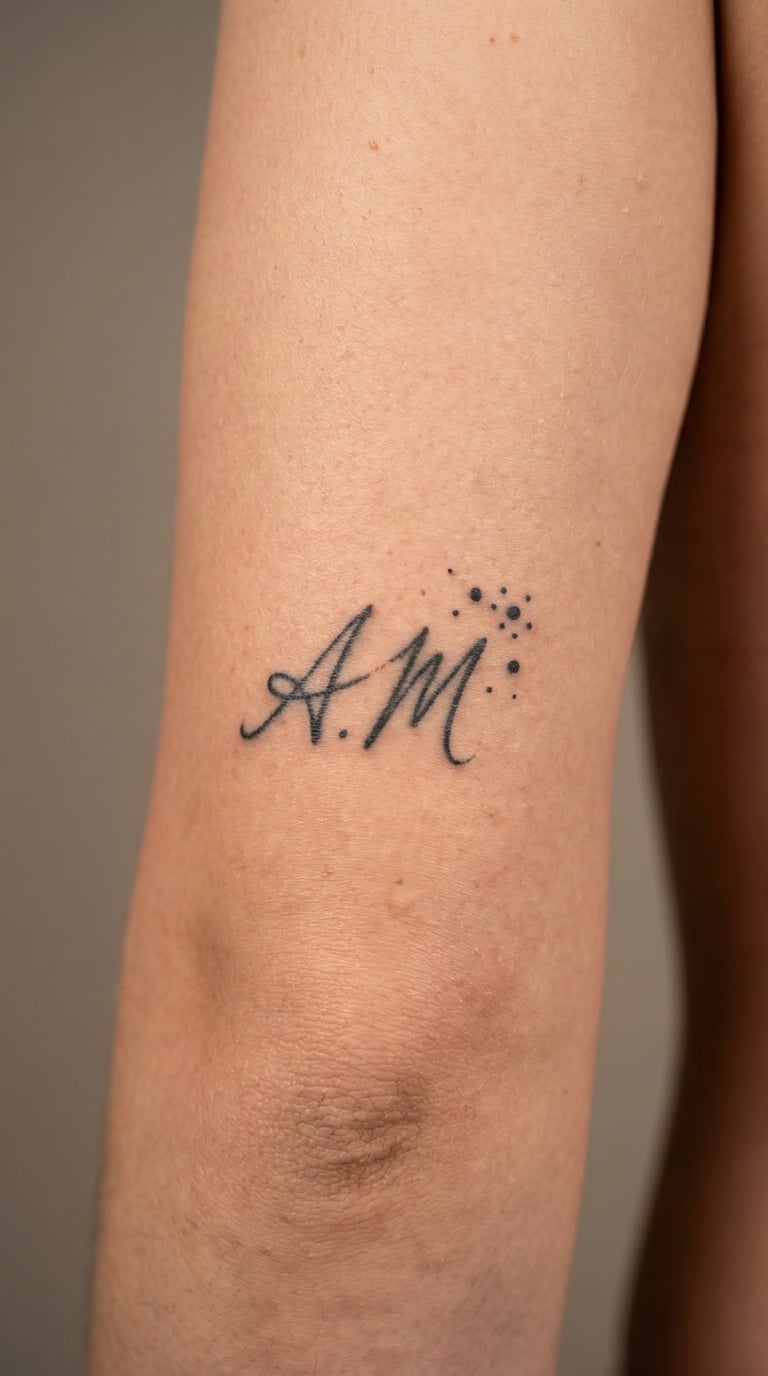
Two initials from someone’s handwriting, paired with a small scatter of dots. Script and dotwork sit together more easily than script and solid illustration, because both are built from dots of ink at different scales.
Placement: outer upper arm, the back of the shoulder, or the calf. Size: 2 inches wide for the initials. Style: fine line with fine dotwork.
Pain: low on the upper arm, medium on the calf. Dotwork takes longer per square inch than script, so a small scatter is a better fit than a full field. Make it yours: use dot size as the connector, keeping every dot smaller than the width of your thinnest letter stroke so the initials stay dominant. Tell the artist in advance that the letters come first.
18. Handwritten Note on the Collarbone
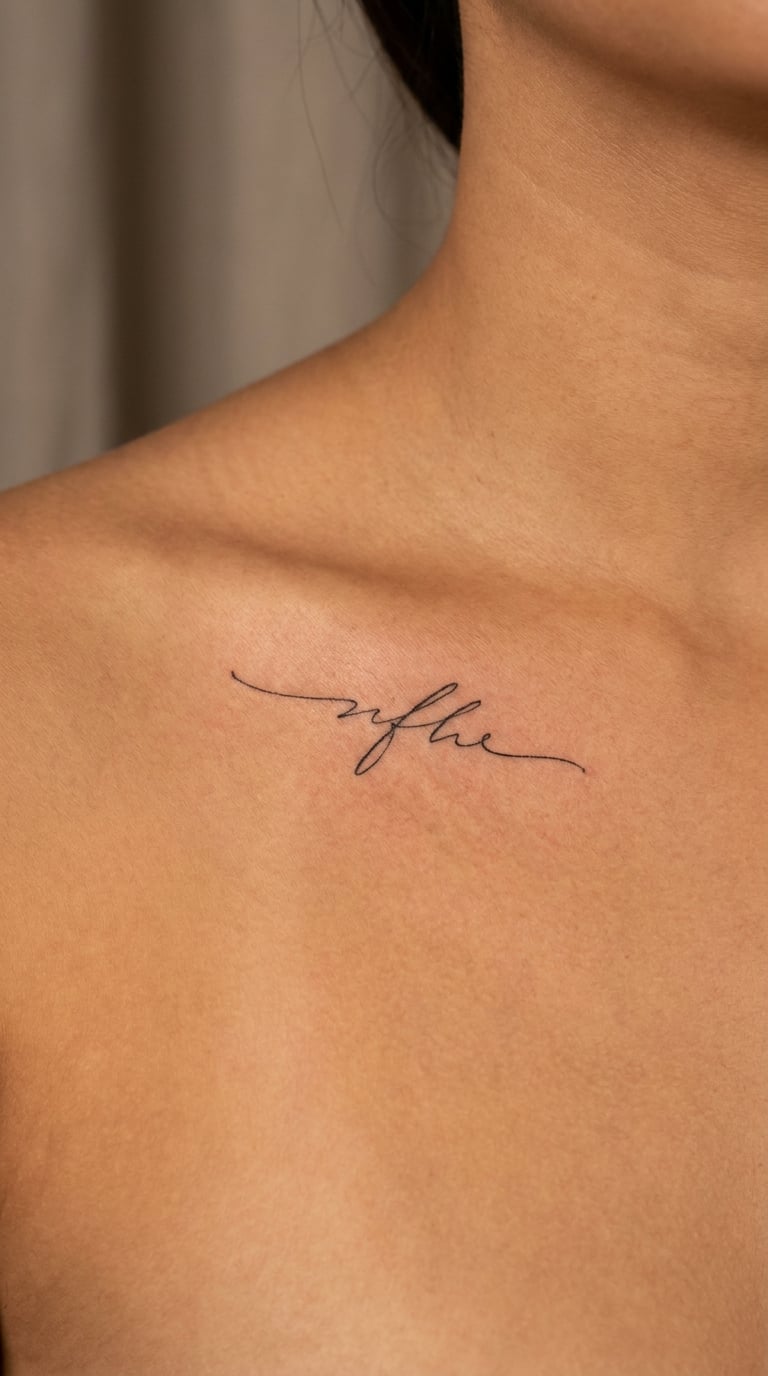
A short note along the collarbone, where the bone creates a natural line for the words to follow. It reads as delicate from a distance and personal up close, which is a good balance for a private message.
Placement: just above the collarbone, running toward the shoulder. Size: 2.5 inches wide. Style: fine line, black.
Pain: medium, and the collarbone edge stays sensitive for the first few days. Fading note: this is one of the most exposed placements on the body. Make it yours: follow the bone’s curve rather than straightening the text to horizontal, since a straightened line looks obviously placed there instead of grown there. If the wording matters more than the hand, a slightly heavier line buys you years of legibility.
19. Handwritten Quote with Botanical Detail
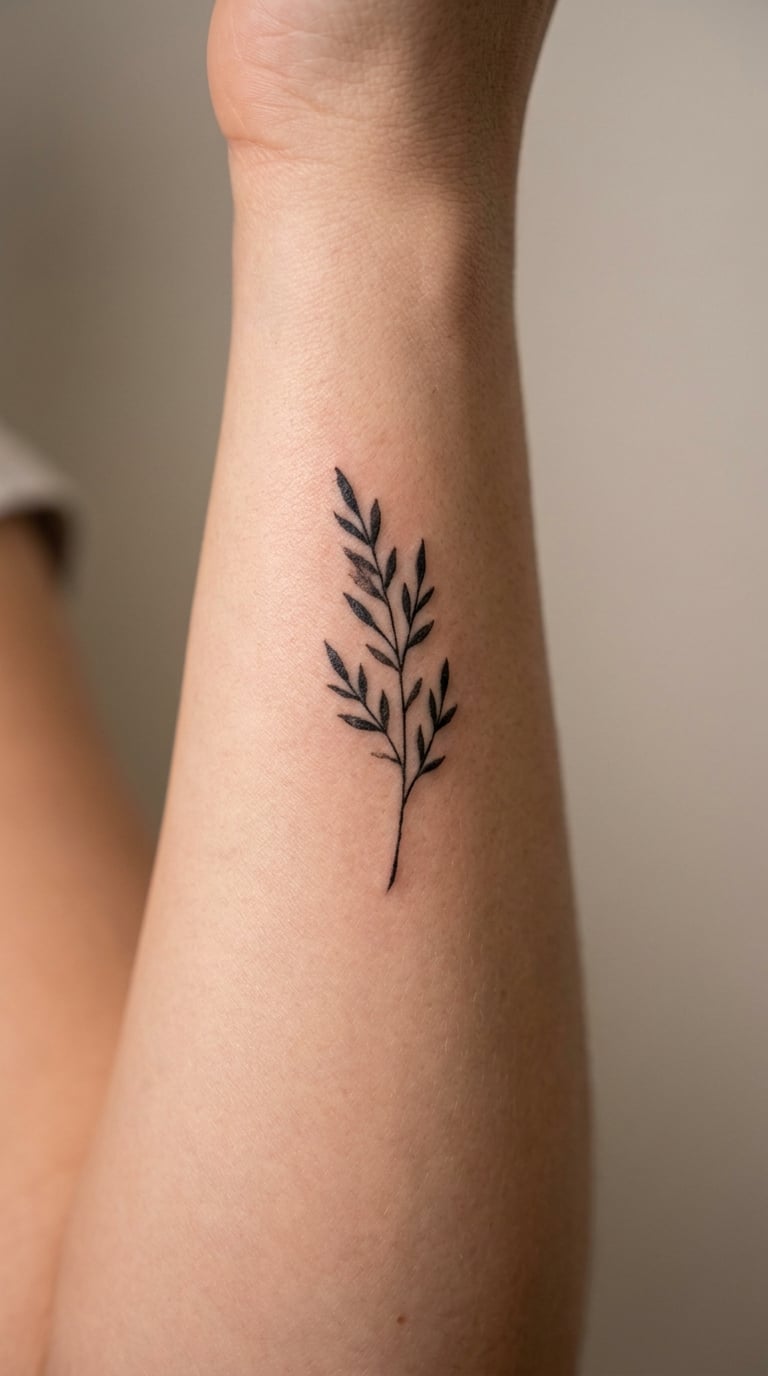
A short quote in a loved one’s writing, with one botanical sprig beside or beneath it. A single stem, drawn in the same line weight as the writing, supports the message instead of competing with it.
Placement: outer forearm set vertically, or the inner upper arm. Size: 3 inches wide overall. Style: fine line, single-needle botanical work in black.
Pain: medium. The outer forearm is a steadier surface than the inner upper arm. Make it yours: choose a plant they actually grew or a flower with a real date behind it, and draw it without shading. A shaded sprig next to unshaded script looks like two tattoos. Fine-line petals on the inner forearm and wrist are among the first details to blur after a decade, so keep the sprig to a stem and a few leaves.
20. Tiny Handwritten Phrase Behind the Ear
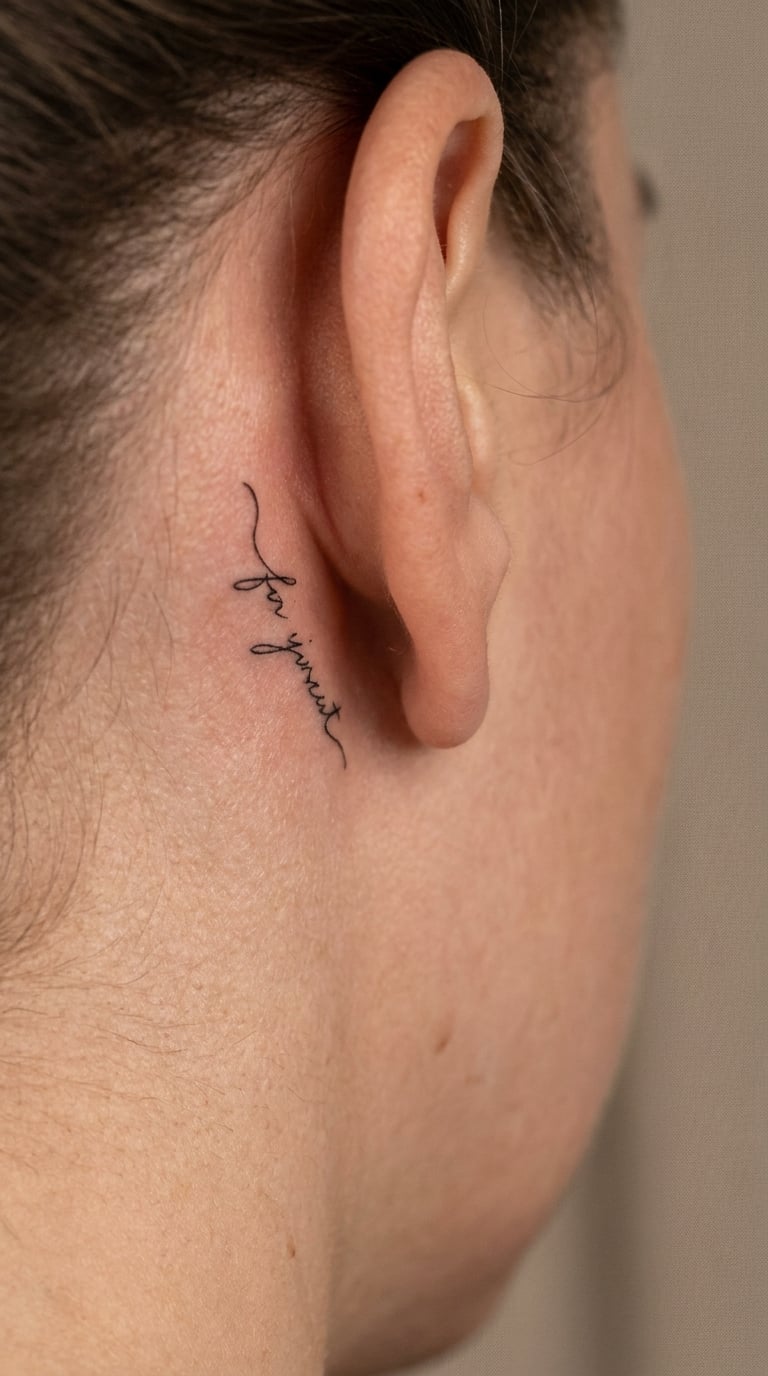
A short phrase or a single word behind the ear, in black fine line, at a size most people will never get close enough to read. It is the most private option in this list and the one most people describe as theirs rather than their tattoo.
Placement: behind the ear, the nape of the neck, or the inner wrist. Size: 1 to 1.5 inches wide. Style: micro fine line, heavier line weight than the sample looks like it needs.
Pain: low, though the work is slow on a curved surface. Fading note: hair, sun and pillow pressure all work on this spot, so expect it to need attention sooner than the same words on an upper arm. Make it yours: choose the two or three words that carry the meaning, since at this size the whole sentence will not survive. Ask the artist to exaggerate the original letterforms slightly, because fine line on a curve loses the loop closures that make a hand recognisable.
How to Choose the Right Design
Six decisions do most of the work. Take them in this order and the consultation goes fast.
1. Get the source right. Photograph the original flat, straight on, in even light, with no shadow across the page and no glare. A phone camera in good light beats a flatbed scan of a curled, yellowed letter. Multiple angles help, but one straight shot at high resolution is the baseline.
2. If the person is alive, ask first. Tattooing someone’s words without asking is a real problem, and asking costs one conversation. A good request is specific: write this phrase in your normal hand, on this paper, however you would write it. Keep the original somewhere safe afterwards, because it will outlast the tattoo.
3. If all you have is a fragment, use it. One line, a signature, half a word, the middle of a sentence, or letters pieced together from a birthday card. Fragments are normal and most artists work from them regularly. Just do not stitch together letters from two different samples, because the pen angle will not match and it shows.
4. Set a legibility floor. Below about 1 inch of height for the smallest letter, fine cursive stops being readable as handwriting and starts being a texture. If the design has to shrink, cut words rather than shrinking them.
5. Choose the placement for how it ages, not how it looks today. Inner forearm, upper arm and calf hold script longest. Wrist, ribs and anything on the hands fade faster. For hands and fingers specifically, expect real loss of detail within a few years and pick a design that still means something when the detail is gone.
6. Pick an artist who does script. Fine-line lettering is a specific skill, separate from general fine-line work. Look at healed work rather than fresh posts on their page, and ask to see a healed piece of lettering at a similar size to yours.
Set one expectation before you book: the healed result will be faithful but not identical. Angle changes, line weight shifts, and skin movement does the rest. People on tattoo advice boards complain about this more than anything else, and the fix is mostly in the conversation beforehand, not the tattoo chair. Plenty of people pair handwriting with a second element instead of relying on words alone, and our genetic-inspired design round-up shows how that pairing can work.
Cost and Session Time
US prices for handwriting tattoos run roughly 80 to 150 dollars for a single word or a small signature, 150 to 300 dollars for a short phrase of three to six words, and 300 to 600 dollars or more for a full sentence, a full letter line, or a design with added illustration. Those are real ranges in the current market, not guarantees, and a custom fine-line script is priced like custom work because it is.
Shop minimums matter more than the hourly rate at this size. Many studios will not start a session for a tattoo that will take 30 minutes, because a tiny piece that goes wrong costs them the whole booking. Ask what the shop minimum is before you agree the design.
Most artists work hourly. A small signature is often 30 to 60 minutes, a short phrase one to two hours, and anything with a botanical or dotwork element longer still. Some studios charge a flat rate per piece for small tattoos instead. The single biggest driver of price is size, followed by how much hand-tuning the letterforms need.
Also worth knowing before you go: a free or cheap consult is normal, and many artists will look at your sample and talk you out of a design that will not hold. A 20 minute conversation before a session has saved people a lot of money and a lot of disappointment.
Aftercare Basics
Follow your artist’s aftercare instructions first. They know what they did to your skin, and this list is general guidance on top of theirs rather than a replacement.
Keep it clean. Wash gently as directed and pat dry rather than rubbing. Do not soak it, and keep the area out of pools, hot tubs and lakes while it heals.
Leave the film alone. Modern artists often wrap fine-line work and may use a second skin film. Follow their timing exactly. Peeling it early or leaving it on too long both pull at the line.
No picking, no scabbing over. When the first flaking starts, the ink underneath is healing. Scratching it off is how fine script loses a stroke that never comes back.
Protect it from sun. Once healed, sunscreen on exposed placements like the collarbone, wrist and outer forearm is the cheapest fade protection available. A shirt does the same job on covered spots.
Do not book a touch-up too early. Wait until the tattoo has fully settled, usually several months, and ask the same artist. A healed piece looked at too soon is not yet the finished piece.
Frequently Asked Questions
Is it possible to get someone’s handwriting tattooed?
Yes. You supply a clear, high-resolution photograph of the original writing and a tattoo artist traces it onto a stencil, transfers it to the skin, then hand-tunes the line weight and letterforms. You do not need the original paper, though a flat, evenly lit photo of it is what makes the result accurate.
How do tattoo artists turn handwriting into a tattoo?
The artist scans or prints your sample, traces the handwriting onto thermal transfer paper, places that stencil on the skin, and removes the transfer leaving a faint guide. They then tattoo over it, following the real stroke order rather than the outline, so the shape and the slants survive. A good artist will also tell you what they are changing and why.
How much does a handwriting tattoo cost?
In the US, expect roughly 80 to 150 dollars for a single word or signature, 150 to 300 dollars for a short phrase, and 300 to 600 dollars or more for a full sentence or a design with added illustration. Shop minimums often set the floor on a very small piece, and most artists work hourly.
Do handwriting tattoos fade faster than other fine line work?
They do fade a little faster. Fine-line script has thin, low-ink lines with lots of small enclosed spaces, and those are the first to soften. Placement matters more than anything: inner forearm and upper arm hold best, while wrists, ribs and hands lose detail sooner. Sunscreen and a heavier line weight make a real difference over a decade.
Will my healed tattoo look exactly like the original handwriting?
No, and any artist who promises an exact photocopy is overselling. Skin curves, stretches and heals differently, and healing thickens fine lines slightly. A faithful artist preserves the slant, the letterforms and the stroke order, so the writing still looks like that person, but it will be a tattoo of the handwriting rather than a copy of it.
Can I use someone else’s handwriting if I only have a fragment?
Yes, and a fragment is most of what people bring. One line from a letter, a signature, a single word or the middle of a sentence all work. Photograph the whole page as well as the close-up, so the artist can judge the pen angle and the spacing. Do not combine letters from separate samples, because the pressure and slant will not match.
If this is your first tattoo, the fine-line signature or the one-word idea is the right call. Both are small, both read clearly at a reasonable size, and neither is hard to place badly. A first design is also the one you learn the healing process with, and fine line gives you a good reason to come back for a touch-up in a year rather than avoiding it.
If you are adding to an existing collection, go for a two-line promise or a note on the inner forearm. There is room for two lines of script there, it ages better than almost anywhere else, and the vertical space on the forearm keeps the composition from fighting a piece you already have. Either way, find the original before you find the design, and let the sample set the size.