
24 444 Tattoo Ideas: Best Simple, Meaningful Tattoos (October 2026)
If you are searching for 24 444 tattoo ideas, you already know the number means something to you. What changes from person to person is how it gets drawn, where it sits and how much of it shows. A plain 444 in one thin line and a blackwork 444 wrapped in feathered wings are the same idea in very different clothes.
Most of these designs suit anyone who wants a small, quiet piece with a reason behind it: a numerology interest, a rough year the number got attached to, a matching set with someone close, or simply digits that look good in a particular font. What makes a number hold up on skin is spacing. Three digits need breathing room, and the line weight has to suit the body part, or the numerals turn to a smudge within a few years.
Each design below gets placement, a realistic size, style, an honest pain note and one way to personalise it, with sizes given in inches and centimeters so you can picture the real thing. A thread on r/TattooDesigns asking what the wave of 444 tattoos was about drew a mixed reply: some people had a reason, some followed what they saw online. That is the bar worth aiming for. Book a consultation with an artist who does fine line or blackwork regularly and bring these pages with you.
24 444 Tattoo Ideas: Quick Guide
Every idea below appears in the same order, with the style, placement, size and pain level you would actually feel in the chair.
| Idea | Style | Best placement | Size | Pain |
|---|---|---|---|---|
| 1. Fine-line behind ear | Fine line | Behind the ear | 0.8-1.5 in (2-4 cm) | Low to medium |
| 2. Minimal wrist 444 | Minimalist | Inner wrist | 1-2 in (2.5-5 cm) | Medium |
| 3. Angel wings around 444 | Fine line or blackwork | Upper back | 4-7 in (10-18 cm) | High |
| 4. Fine-line halo 444 | Fine line | Upper chest | 1.5-2.5 in (4-6 cm) | Medium |
| 5. Geometric finger 444 | Geometric | Side of a finger | 0.5-1 in (1.2-2.5 cm) | High |
| 6. 444 with a small cross | Traditional outline | Inner forearm | 2-3 in (5-8 cm) | Medium |
| 7. Watercolor shoulder 444 | Watercolor | Shoulder or upper arm | 4-6 in (10-15 cm) | High |
| 8. Blackwork 444 heart | Blackwork | Forearm or bicep | 2.5-4 in (6-10 cm) | High |
| 9. 444 with four stars | Fine line | Upper arm | 2-3 in (5-8 cm) | Medium |
| 10. Vertical forearm 444 | Minimalist | Inner forearm | 1.5-2.5 in (4-6 cm) | Medium |
| 11. Dotwork 444 | Dotwork | Outer upper arm | 2-3.5 in (5-9 cm) | Medium |
| 12. Feathered wings 444 | Black and grey realism | Upper back | 6-9 in (15-23 cm) | High |
| 13. Script 444 collarbone | Script | Collarbone | 1.5-2.5 in (4-6 cm) | Medium |
| 14. 444 in a small lotus | Fine line | Ankle or wrist | 1.5-2.5 in (4-6 cm) | Medium |
| 15. Gothic 444 spine | Blackwork | Upper spine | 6-10 in (15-25 cm) | High |
| 16. 444 with a sunburst | Fine line | Forearm or calf | 2-3 in (5-8 cm) | Medium |
| 17. 444 with an angel hand | Fine line | Upper chest or shoulder | 2-3.5 in (5-9 cm) | Medium |
| 18. Blackwork 444 diamond | Blackwork | Outer forearm | 2.5-4 in (6-10 cm) | High |
| 19. 444 with a crescent moon | Fine line | Inner arm or ankle | 1.5-2.5 in (4-6 cm) | Medium |
| 20. Micro 444 on the hand | Micro bold line | Back of the hand | 0.4-0.8 in (1-2 cm) | High |
| 21. 444 with a feather quill | Fine line | Inner forearm | 2.5-4 in (6-10 cm) | Medium |
| 22. 444 in a mandala | Fine line and dotwork | Upper back or thigh | 4-7 in (10-18 cm) | High |
| 23. Traditional 444 rose | Traditional | Forearm or calf | 2.5-4 in (6-10 cm) | Medium |
| 24. 444 with a mountain | Minimalist | Upper arm | 2-3.5 in (5-9 cm) | Medium |
1. Fine-Line 444 Behind the Ear
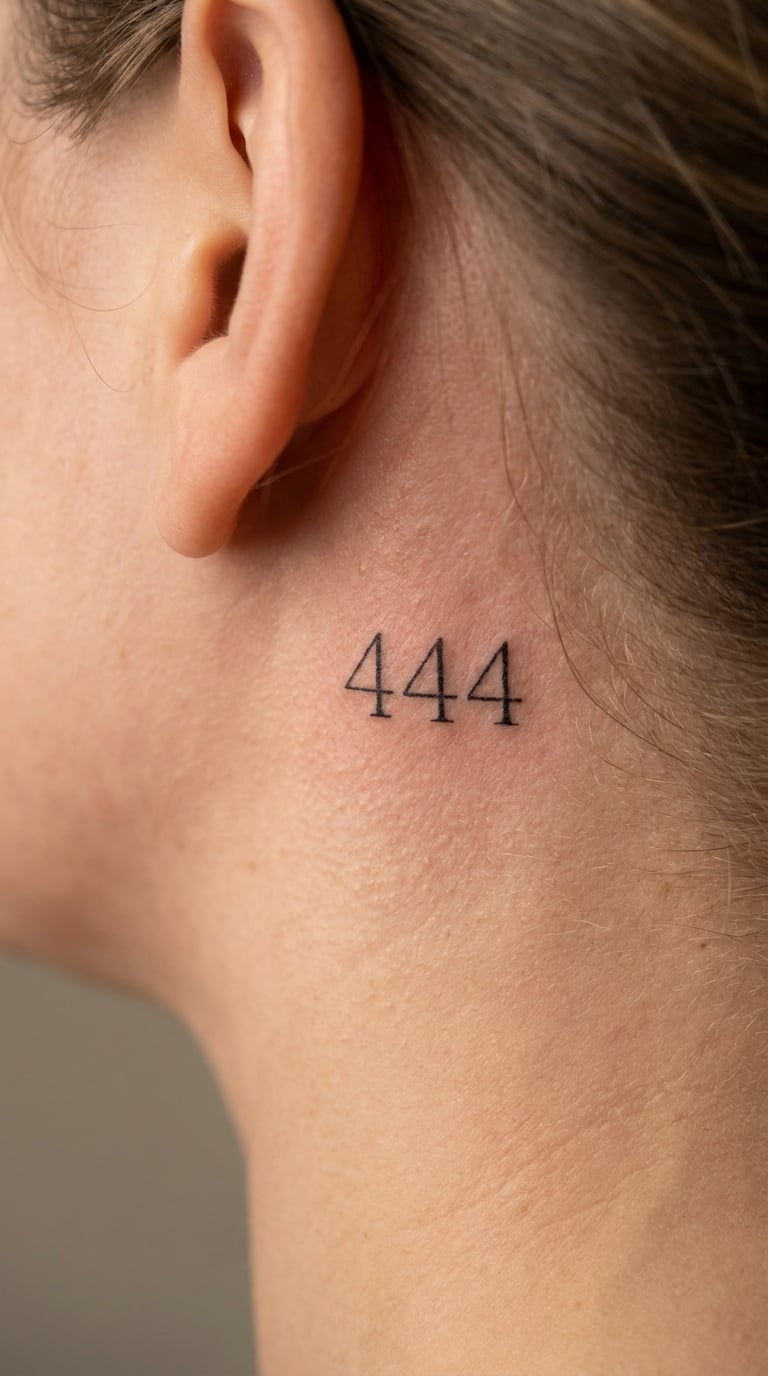
A fine-line 444 behind the ear is three numerals in hairline black ink, set above the neck with generous space between each digit. No shading and no second outline, just a small cluster of precise marks.
You see it when your hair is up, and nobody else does. It usually arrives after a stretch that needed a private reminder.
Placement: Behind the ear, above the cartilage. Size: 0.8 to 1.5 inches (2 to 4 cm). Style: Fine line, single-needle.
Pain: Low to medium, roughly 3 out of 10, since the skin here is thin. This is the fastest-fading placement on the body, so plan a touch-up in 12 to 18 months and ask for a heavier line than feels right. Make it yours: Stack the digits vertically so they follow the curve of the neck.
2. Minimal 444 on the Wrist
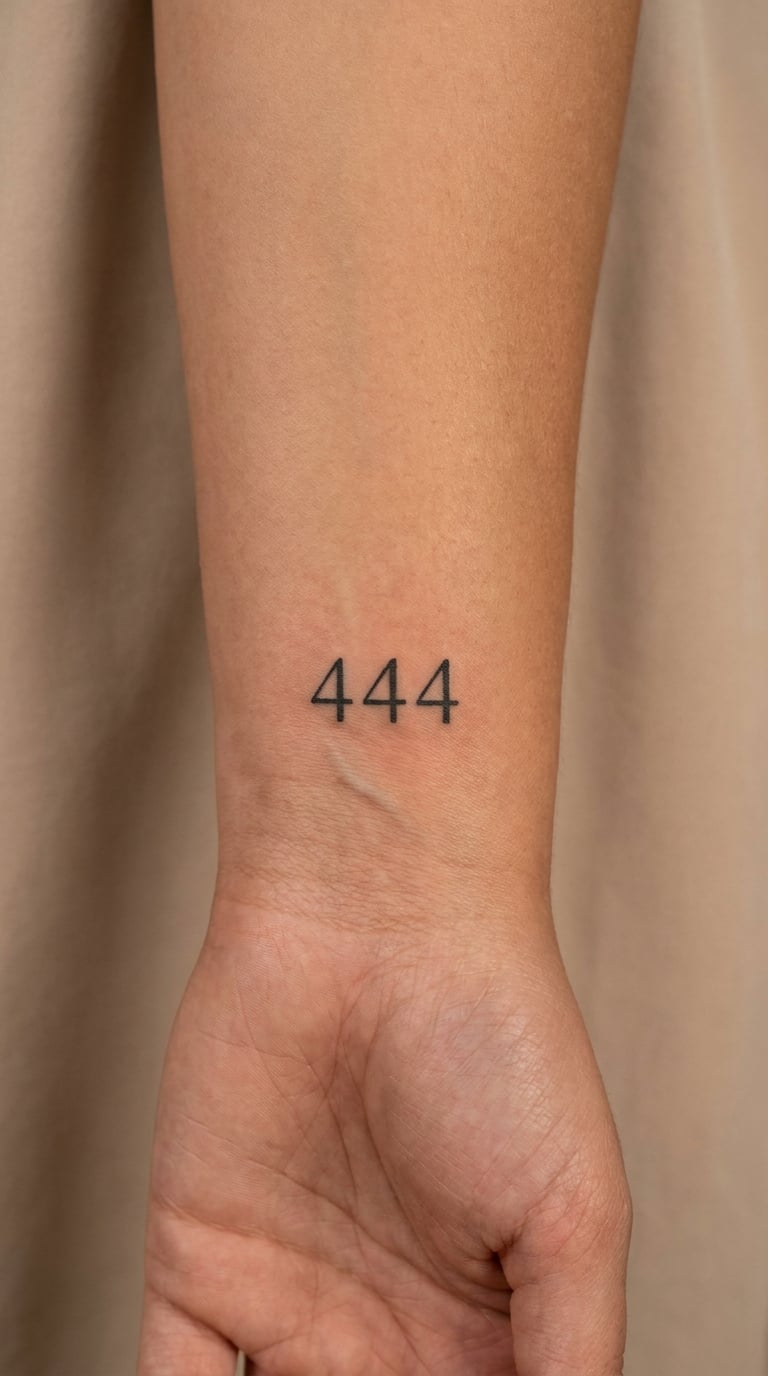
The minimal wrist 444 is three digits in a light sans-serif or one unbroken line, sitting in the soft hollow above the wrist bone. No frame, no flourish, nothing behind it.
Wrist placement turns the number into something you can glance at, which is a large part of why it works. The design does not need a story attached to it to earn that spot.
Placement: Inner wrist, parallel to the forearm. Size: 1 to 2 inches (2.5 to 5 cm). Style: Minimalist, thin or medium line weight.
Pain: Medium, around 5 or 6 out of 10. The inner wrist is thin skin over bone, so the first line stings and the rest settles. Wrists fade faster than arms, so a hairline version softens within a couple of years. Make it yours: Add a thin ring around the middle digit to break up the row without crowding it.
3. Angel Wings Around 444
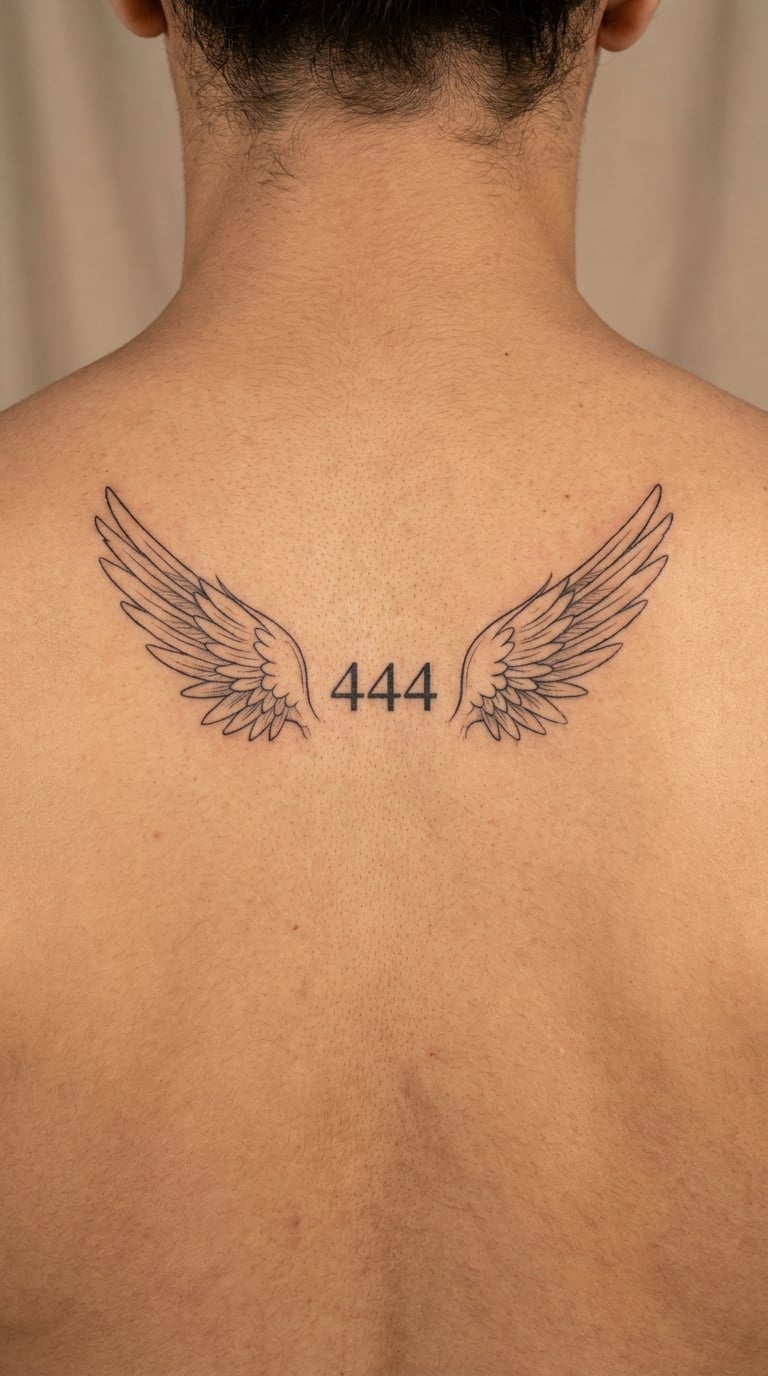
Wings around a 444 give the number a frame without boxing it in. The version worth asking for has the digits in the centre with a pair of wings opening outward, each built from five or six long tapered feathers in one thin line weight.
The wings do the decorative work so the number can stay plain and readable. That matters, because a framed number should read as the subject, not as an accessory.
Placement: Upper back between the shoulder blades. Size: 4 to 7 inches (10 to 18 cm). Style: Fine line, or blackwork for solid wings.
Pain: High, around 8 out of 10, and a long sitting. The back curves in two directions at once, so this usually takes three to five hours, sometimes split over two sessions. Fine feather detail softens with age. Make it yours: Angle the wings up a few degrees so the piece looks like it is rising.
4. 444 in a Fine-Line Halo
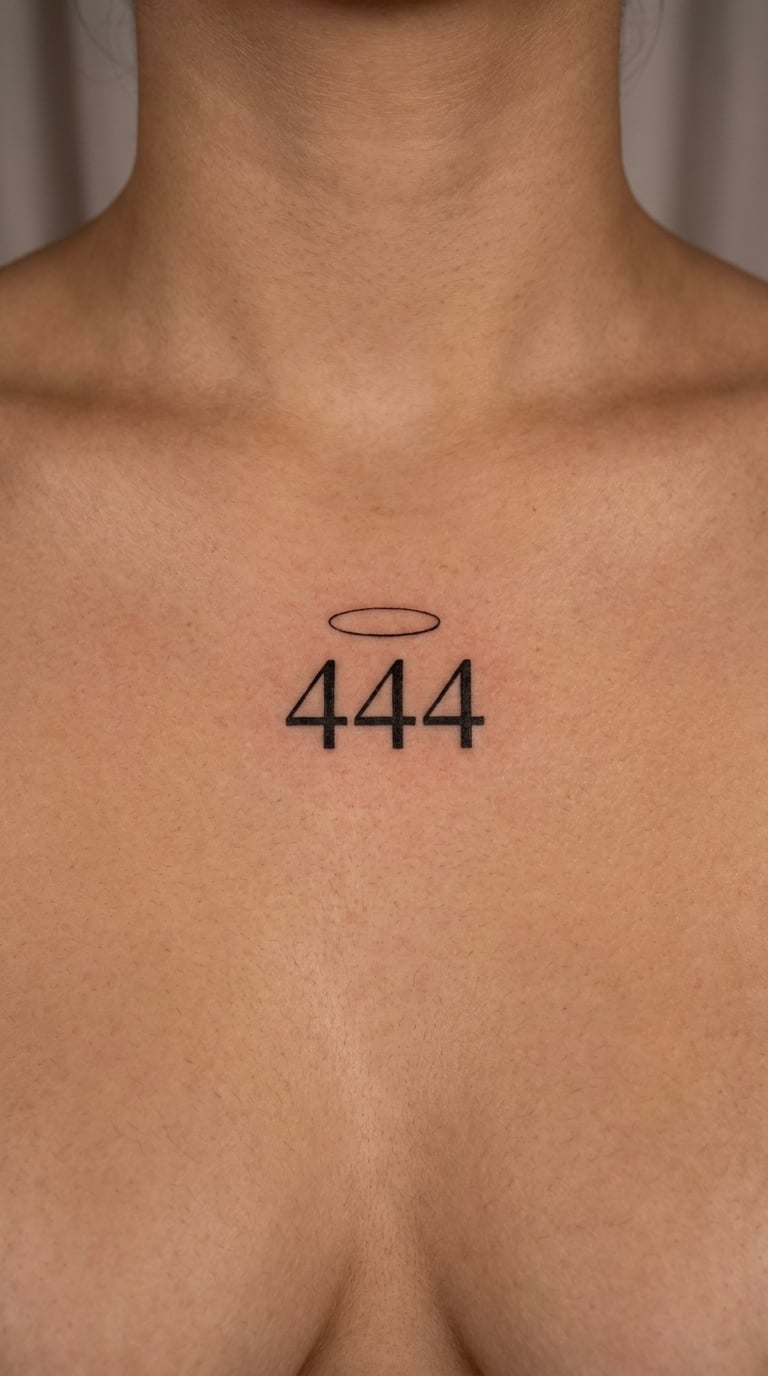
A halo version puts one thin circle above a small 444, drawn in a single stroke and stopped just short of closing at the base. Nothing else. That break is what keeps it from looking like clip art.
It reads as a religious-adjacent image without claiming a faith. Plenty of people want the visual shape rather than any statement, and that is a perfectly good reason.
Placement: Upper chest between the collarbones, or below the sternum. Size: 1.5 to 2.5 inches (4 to 6 cm) including the halo. Style: Fine line, single-needle.
Pain: Medium, around 5 out of 10. The sternum is sensitive and the ribs underneath are firm, so expect a steady scratchy feeling. Chest skin moves constantly, which blurs a very thin circle over time. Make it yours: Offset the halo slightly above the digits rather than sitting it directly overhead.
5. Geometric 444 Finger Tattoo
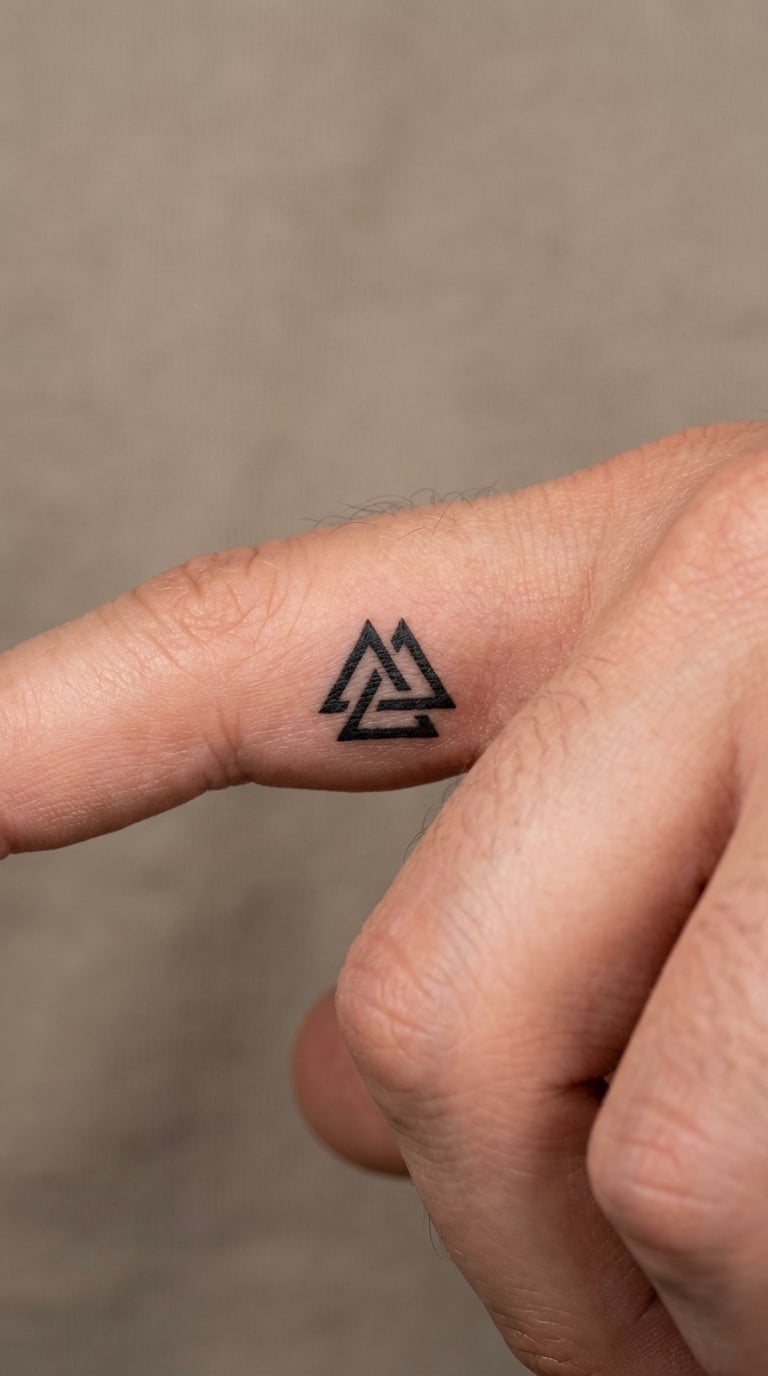
A geometric finger 444 is three digits built from straight segments only, sharing one line weight, set tight against the side of the finger. Some artists run them in a row along the knuckle line, others stack them down the finger.
Fingers are the least forgiving place for a number, because the skin stretches when you grip and relaxes when you do not. Wide spacing is what keeps it legible.
Placement: Side of the index, middle or ring finger. Size: 0.5 to 1 inch (1.2 to 2.5 cm) tall. Style: Geometric, thin line.
Pain: High, around 8 out of 10, from the bone underneath and the awkward angle, though the session is short at under an hour. Fingers blur together with daily use, so a top-up every 12 to 18 months is normal. Make it yours: Run the digits vertically to use the finger’s length and keep the row from curving.
6. 444 with a Small Cross
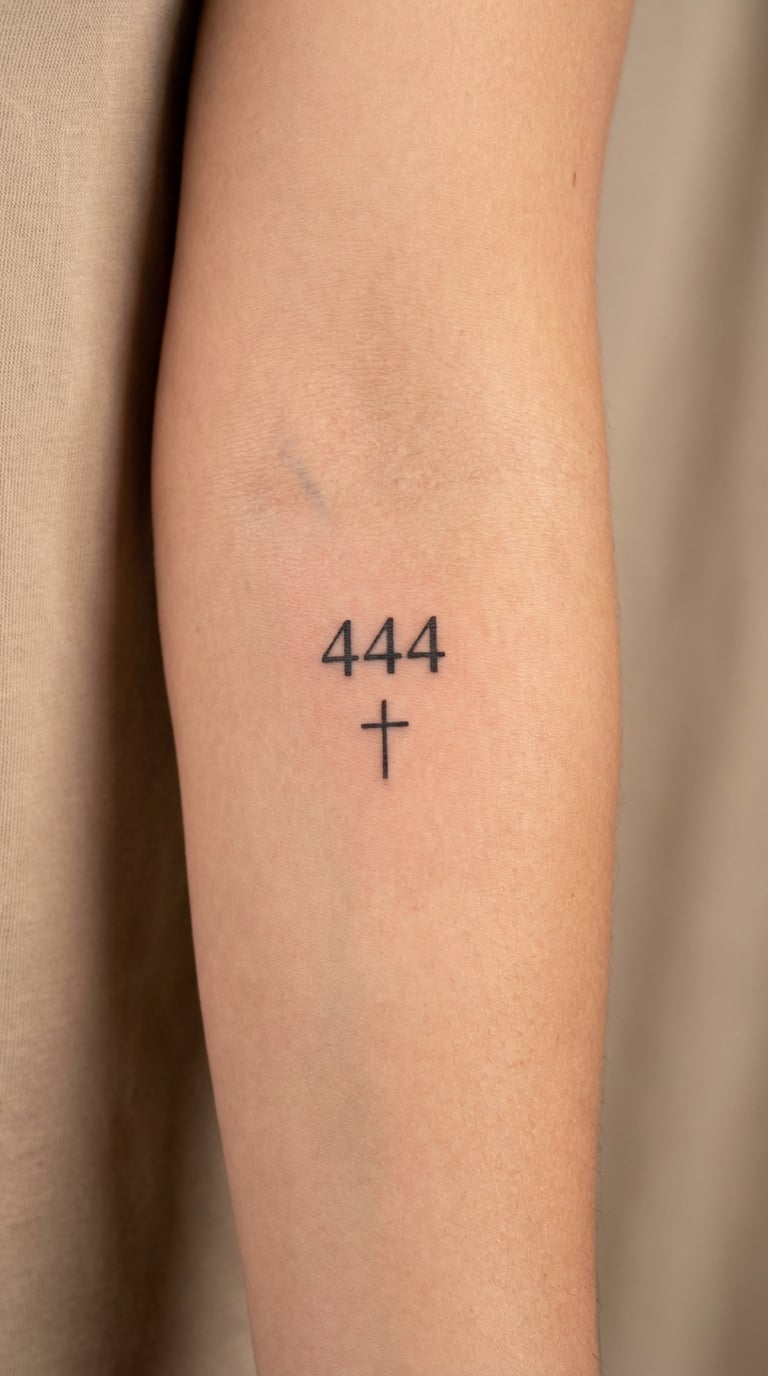
Pairing 444 with a small cross gives a vertical composition: three digits in a row, a plain outlined cross underneath, and a gap between them roughly the height of one digit. Restraint is the point, since cross designs go wrong the moment they get busier than the number.
Faith and numerology sit comfortably together here for a lot of people, and the layout leaves room for a date in small type.
Placement: Inner forearm, or upper arm near the biceps. Size: 2 to 3 inches (5 to 8 cm) tall. Style: Traditional outline, bold and simple.
Pain: Medium, around 5 or 6 out of 10, easier than the wrist because there is more soft tissue over muscle. Bold outlines hold their edges better than hairline work, which matters when two elements have to match in weight. Make it yours: Tuck a short date under the cross bar, readable only up close.
7. Watercolor 444 on the Shoulder
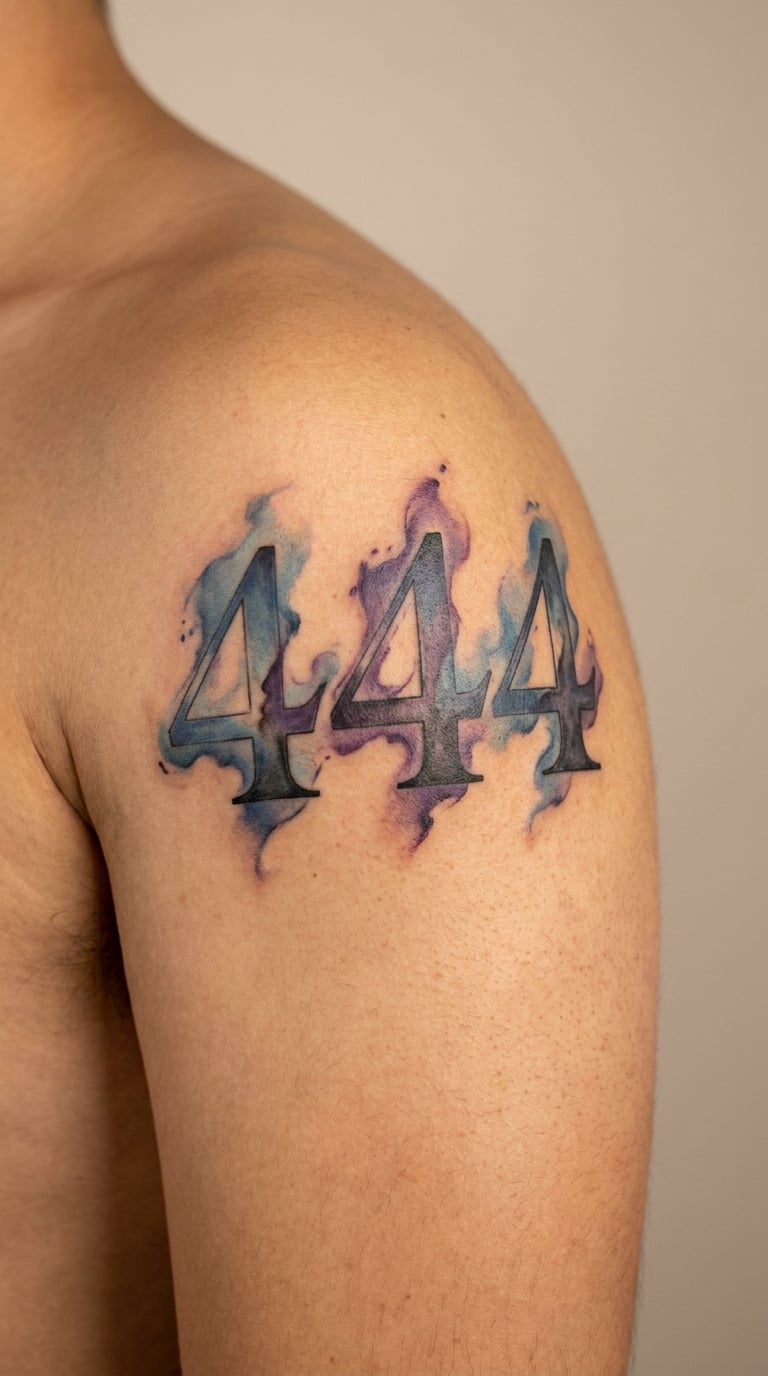
A watercolor 444 keeps the digits legible and lets colour bleed out from them. The numerals are usually drawn in soft black or grey, then violet, blue or a warm ochre is worked into the edges and allowed to run in patches that never quite close.
This is the one design here that changes as it heals. The first week looks sharp and the second month softer, as the pigment settles.
Placement: Shoulder cap or upper arm. Size: 4 to 6 inches (10 to 15 cm). Style: Watercolor with black line digits.
Pain: High, around 7 or 8 out of 10, mostly because of how long it takes. Expect three to four hours. A rushed wash looks flat, so book someone whose portfolio is mostly colour. Make it yours: Choose one accent colour with a reason behind it and keep the rest of the wash neutral.
8. Blackwork 444 Heart
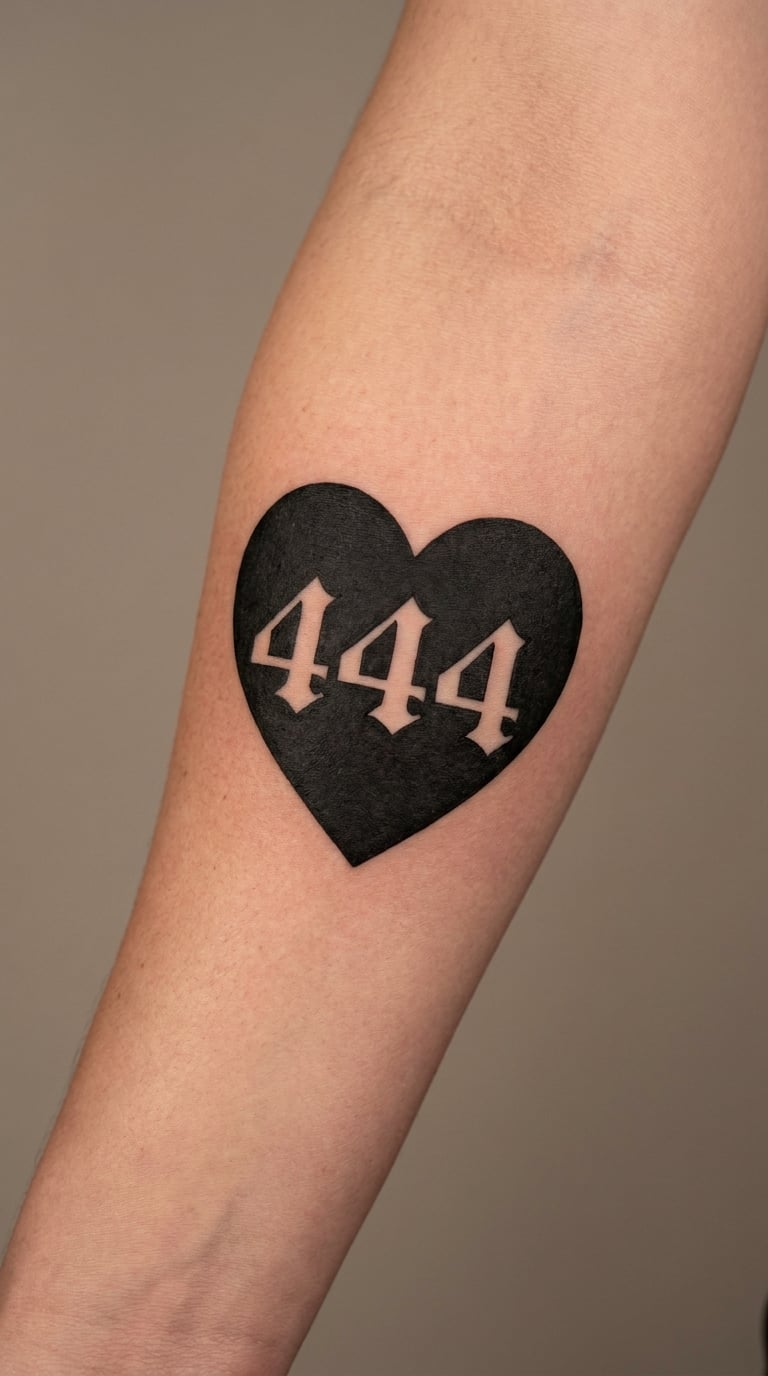
A blackwork heart with 444 inside it is a solid black shape with the digits reserved out of it in skin colour, so the number looks carved from the ink rather than drawn on top. The outline stays smooth, with no filigree.
Solid black ages well, which is the practical reason this version keeps getting booked. Negative-space lettering needs a steady hand and a clean stencil.
Placement: Forearm, bicep, or over the heart on the chest. Size: 2.5 to 4 inches (6 to 10 cm). Style: Blackwork with negative-space numerals.
Pain: High, around 8 out of 10, because solid black takes many passes over the same area. Budget three to four hours. Lines thinner than about a millimetre and a half grey out and muddy the digits. Make it yours: Run a fine outline a few millimetres past the heart on one side.
9. 444 with Four Stars
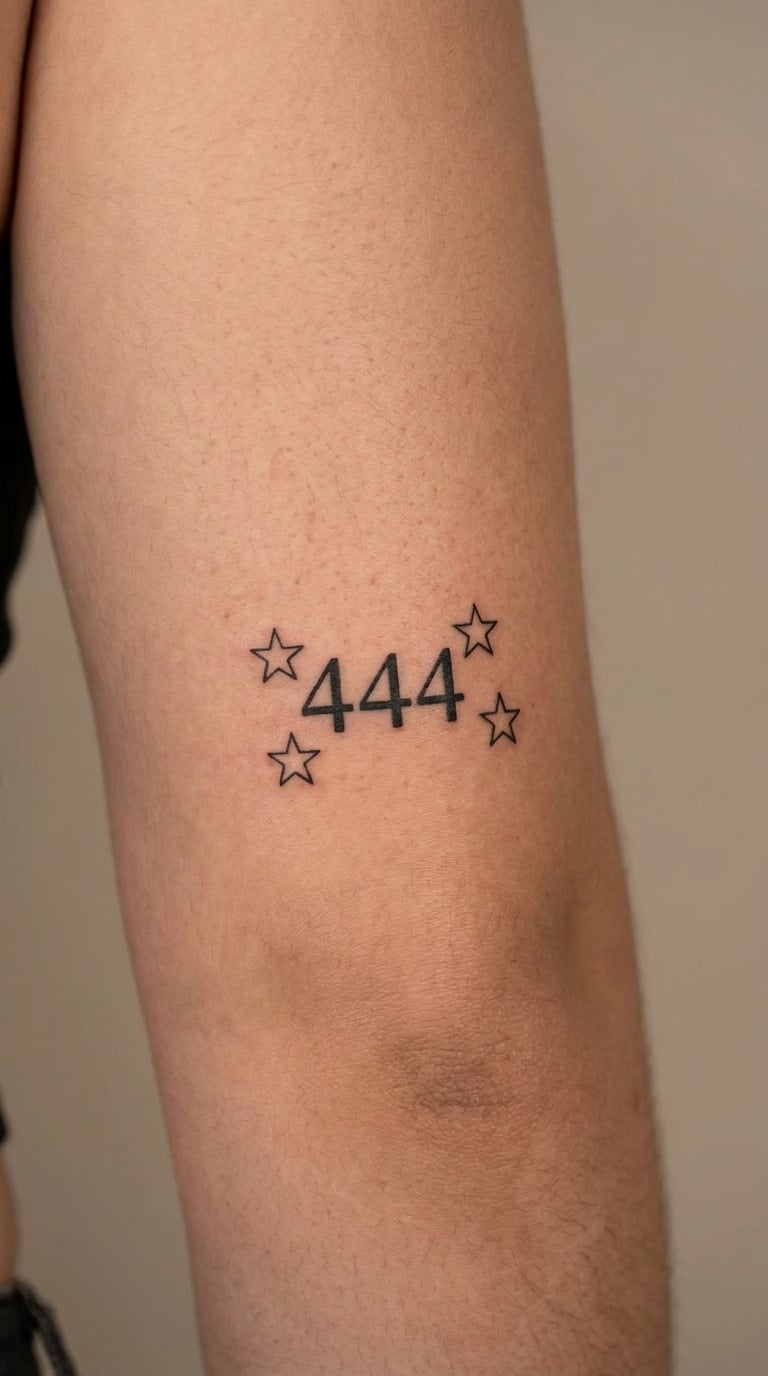
Four stars around a 444 is easy to get right, because the stars can be tiny four-point shapes drawn in a single line. One sits above the number, one below, one on each side, all at equal distance from the digits.
Four points for four digits is one of those neat readings that makes a design feel intentional rather than decorated.
Placement: Outer upper arm or shoulder. Size: 2 to 3 inches (5 to 8 cm) including the stars. Style: Fine line, simple four-point stars.
Pain: Medium, around 5 out of 10. The upper arm is one of the calmer spots and you can usually chat through it. Stars under a quarter inch across close up and become dots, so single-line shapes age far better. Make it yours: Make one star slightly larger than the other three.
If you like the idea of a small symbol carrying the whole meaning, our 20 North Star Tattoo Ideas: Best Designs covers that same approach with a different symbol.
10. Vertical 444 on the Forearm
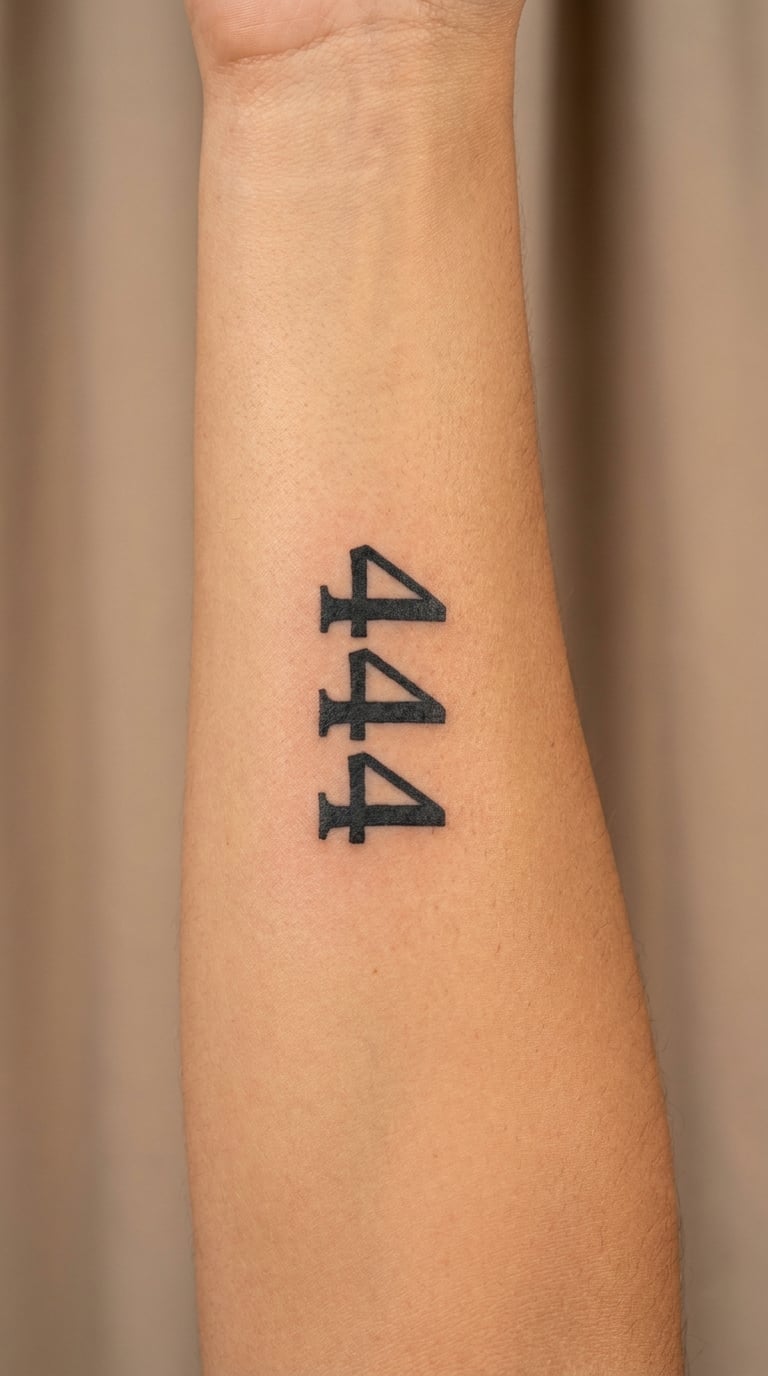
A vertical 444 stacks the three digits down the inner forearm, each about the width of a fingertip. The line weight must be medium at the very least, because thin stacked digits smear into each other and the column stops reading as a number.
This is the layout most 444 tattoo ideas here borrow from, since it uses the length of the forearm instead of fighting it.
Placement: Inner forearm between wrist and elbow. Size: 1.5 to 2.5 inches (4 to 6 cm) tall. Style: Minimalist, medium line weight.
Pain: Medium, around 5 out of 10, and it eases as the session goes on. The forearm is a good first-tattoo spot because you can watch the whole thing. Inner-arm verticals fade a little faster than the same design higher up. Make it yours: Run a date or coordinates in thin type alongside the column, aligned with the digits.
11. Dotwork 444 on the Arm
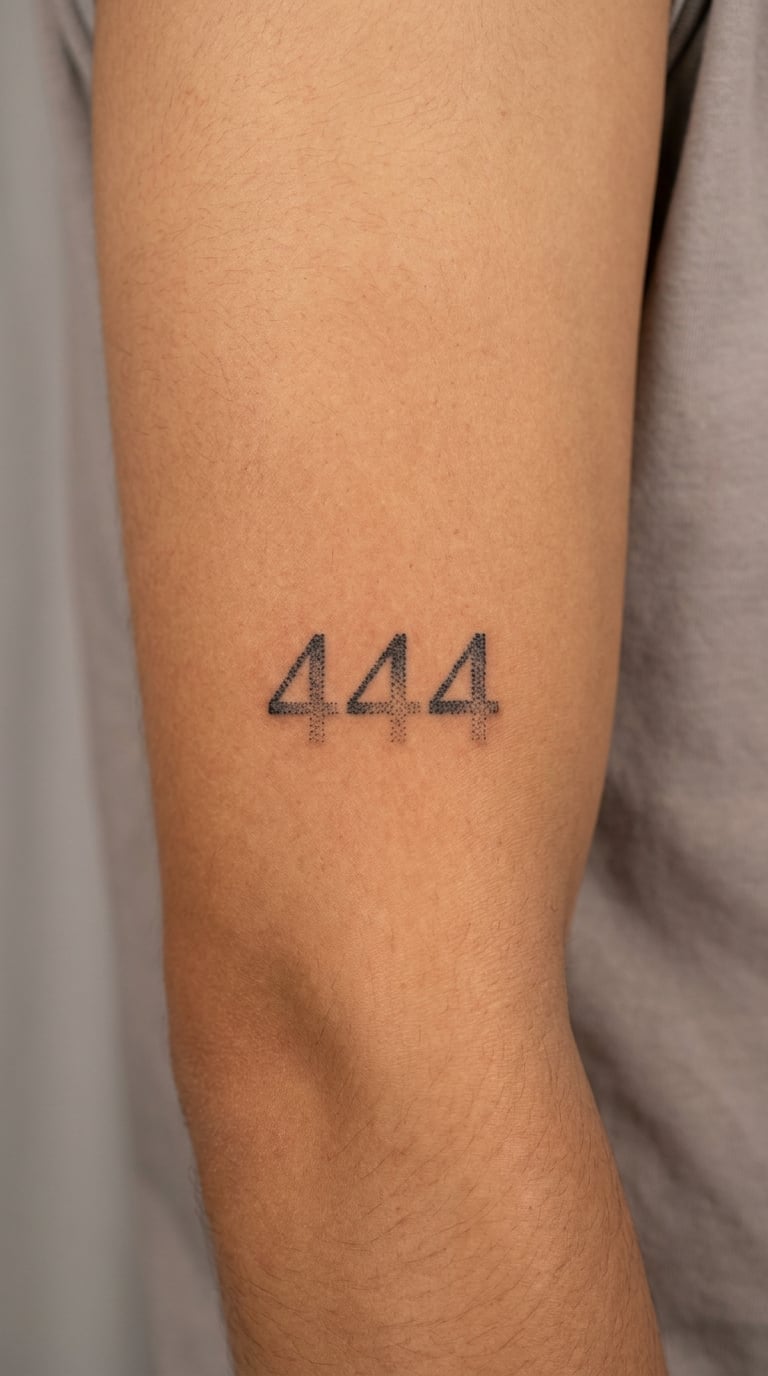
Dotwork 444 builds each digit from dots rather than lines, with density shifting across the design: heavy clusters inside the vertical strokes, sparse dots at the edges.
The texture photographs unusually well, and it works when a plain numeral feels too bare but a fully shaded piece feels like too much. It takes much longer than the line count suggests.
Placement: Outer upper arm, calf or shoulder. Size: 2 to 3.5 inches (5 to 9 cm). Style: Dotwork, shading by density.
Pain: Medium to high, around 7 out of 10, mostly from length rather than location. A 3-inch piece can run three hours. Low-contrast dots lose definition within five years, so keep the densest shading mid-stroke. Make it yours: Fade the dots at the top of the first digit and build toward the bottom.
12. 444 with Feathered Wings
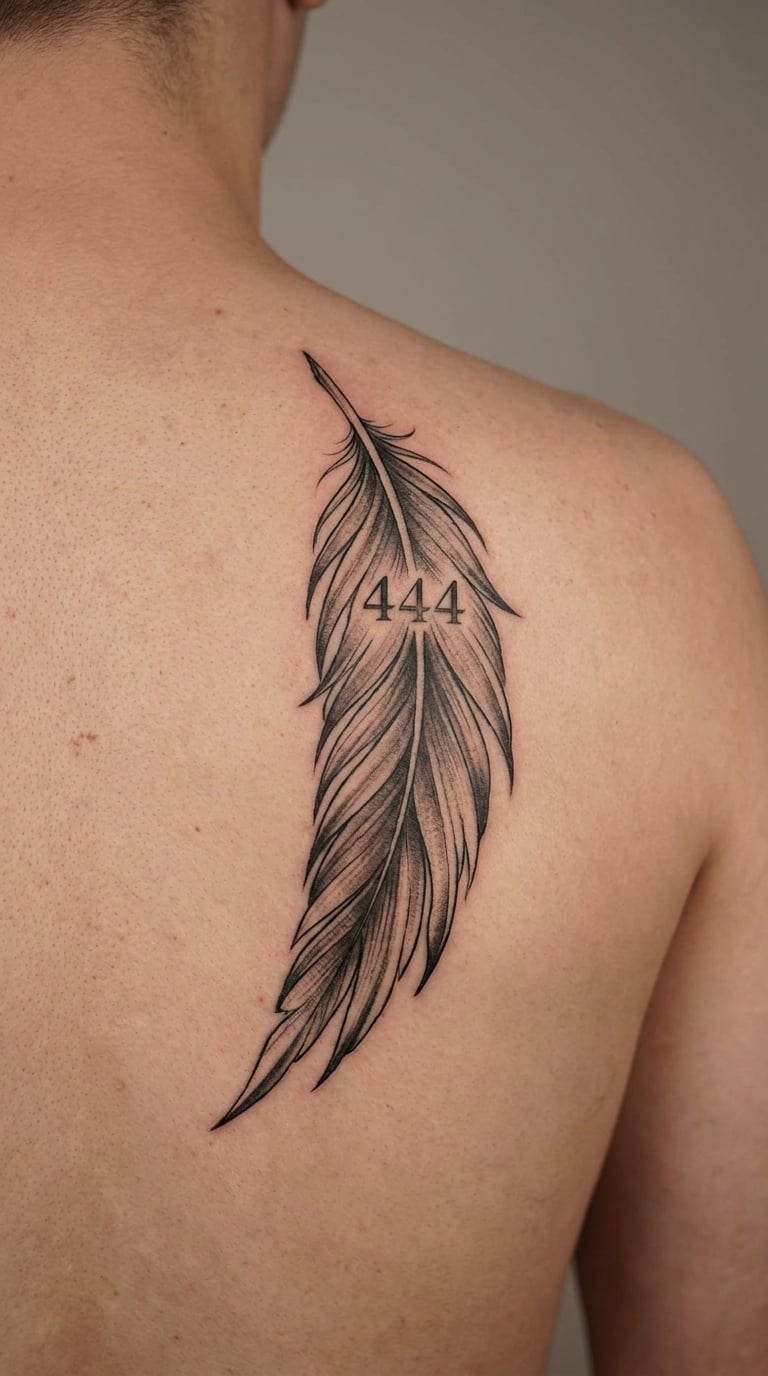
Feathered wings around a 444 is the realistic version of the winged idea: individual feathers shaded in black and grey, layered in overlapping rows, with the digits sitting in clear skin at the centre.
Shading depth separates this from a flash-style wing. Lightly shaded feathers look tired after a few years, while feathers with a real gradient hold their shape.
Placement: Upper back across the shoulder blades. Size: 6 to 9 inches (15 to 23 cm). Style: Black and grey realism.
Pain: High, around 8 out of 10, and a multi-hour piece, commonly six to eight hours over two sessions. Breaks every hour make a difference on the back. Barb lines under a millimetre soften by year five. Make it yours: Repeat the arrangement at a smaller scale on the opposite arm.
13. Script 444 on the Collarbone
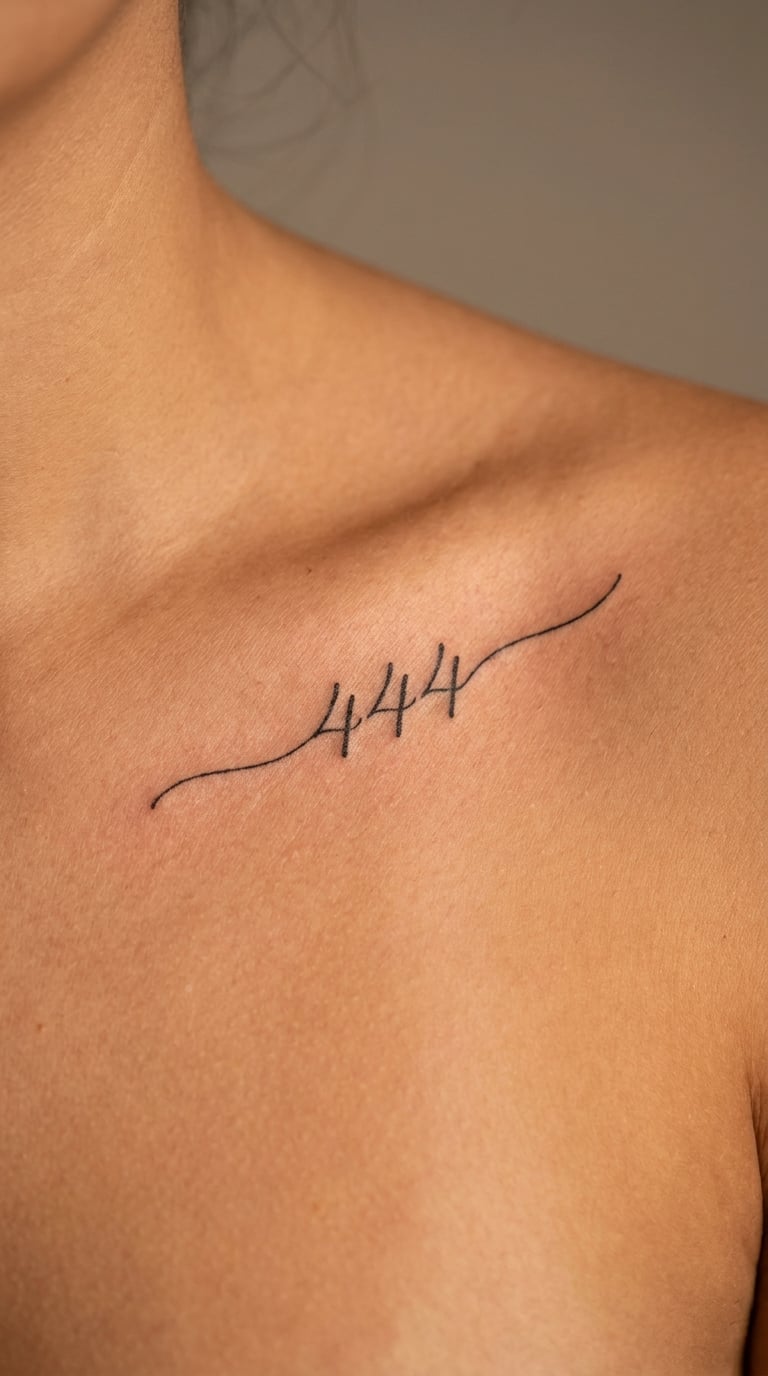
Script 444 means the digits are written rather than printed, usually in a slanted hand with a thick downstroke and a hairline upstroke. Keeping three script digits distinct is the real challenge, since handwriting merges connected letters and you cannot connect numbers.
It suits someone who likes the idea of a signature more than a logo, and the slanted baseline follows the collarbone naturally.
Placement: Along the collarbone, or the ribs below it. Size: 1.5 to 2.5 inches (4 to 6 cm) wide. Style: Handwritten script.
Pain: Medium, around 5 or 6 out of 10, with the bone itself more sensitive than the skin above it. Script is the fastest-fading style here, since hairline upstrokes go first, so plan a refresh every 12 to 18 months. Make it yours: Add an initial and date in the same hand underneath.
14. 444 in a Small Lotus
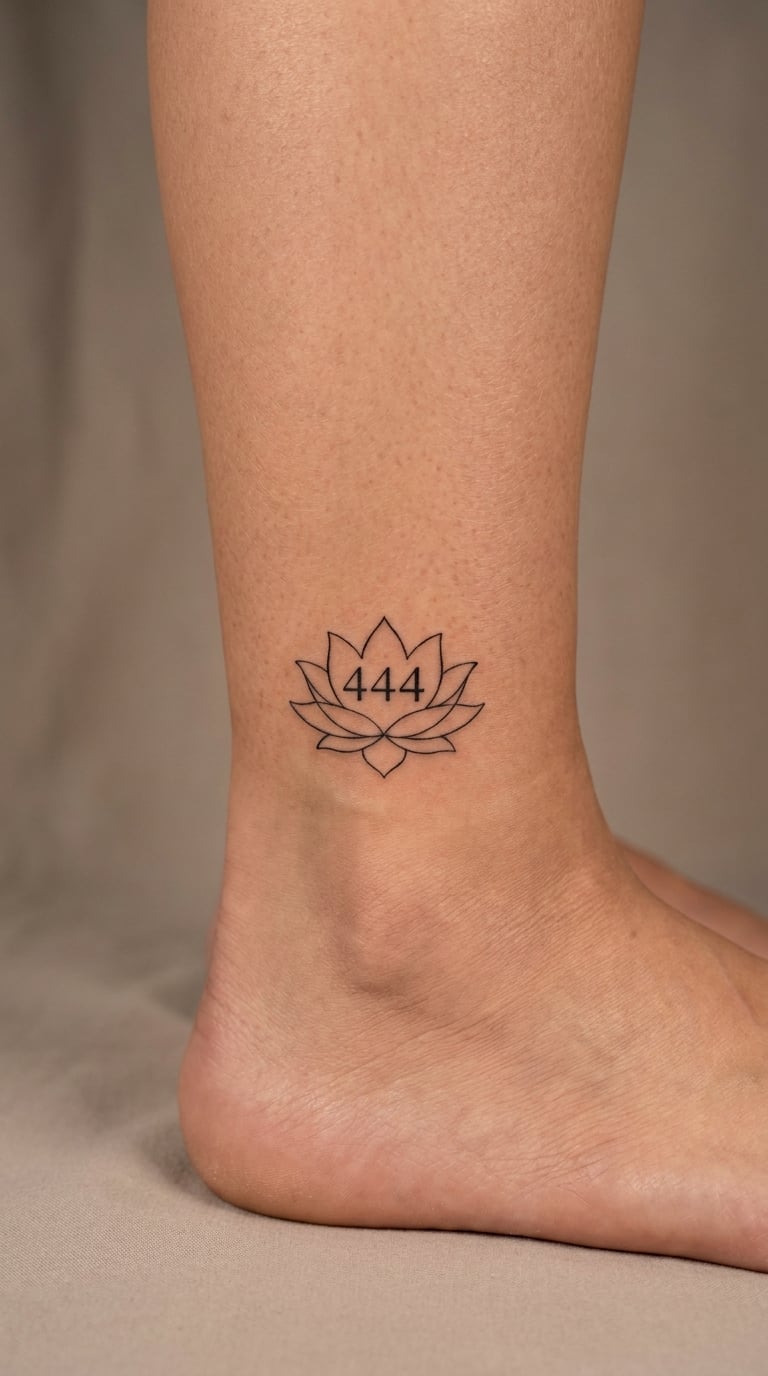
A lotus 444 puts the number in the open centre of a flower, with eight pointed petals radiating around it in one consistent line weight. Petal edges are drawn in a single stroke, and the tips stop well short of the digits.
The lotus gives the piece a shape without needing shading, and the ankle is roughly the right width for a small radial composition.
Placement: Ankle, inner wrist, or back of the hand. Size: 1.5 to 2.5 inches (4 to 6 cm) across. Style: Fine line, symmetrical petals.
Pain: Medium, around 5 out of 10 on the ankle and closer to 6 on the inner wrist. Ankles swell through the day, and skin that stretches daily loosens fine line faster. Keep each petal base at least two millimetres wide. Make it yours: Pair it with a smaller lotus holding a different number.
15. Gothic 444 on the Spine
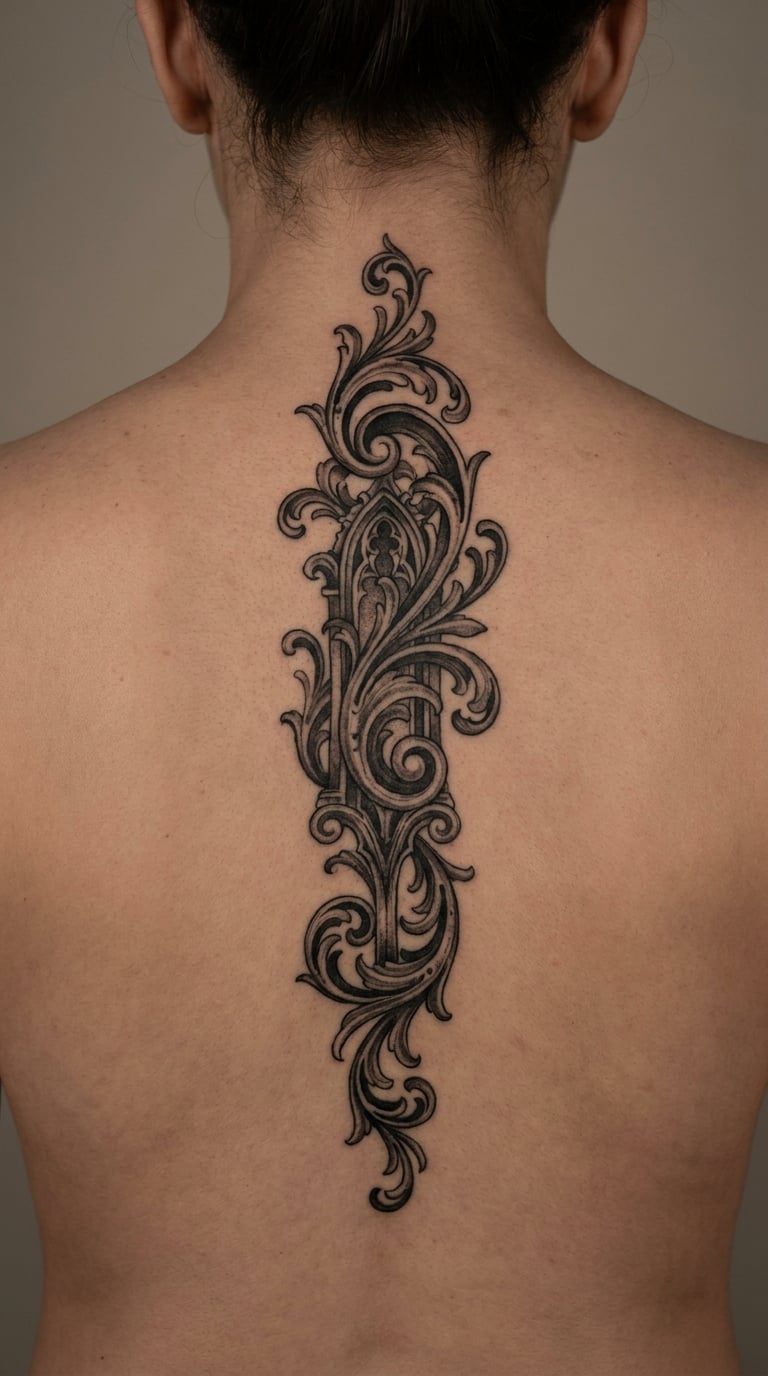
A gothic spine 444 runs the number down the centre of the back with restrained black ornament around it, the dense architectural shading of blackwork rather than a full horror illustration. Restraint matters, because gothic work fails when the ornament competes with the digits.
A spine tattoo is committed in a way most numbers are not, so it suits someone certain about the design and the meaning together.
Placement: Upper to mid spine, vertical. Size: 6 to 10 inches (15 to 25 cm) tall. Style: Blackwork with gothic ornament.
Pain: High, around 8 out of 10. The spine is bony and you lie face down without moving, making it the least comfortable placement here. Five to six hours, usually over two sessions. Avoid very fine detail within an inch of the digits. Make it yours: Frame the number with a symmetrical arch that never touches it, and add a small date low on the back.
16. 444 with a Sunburst
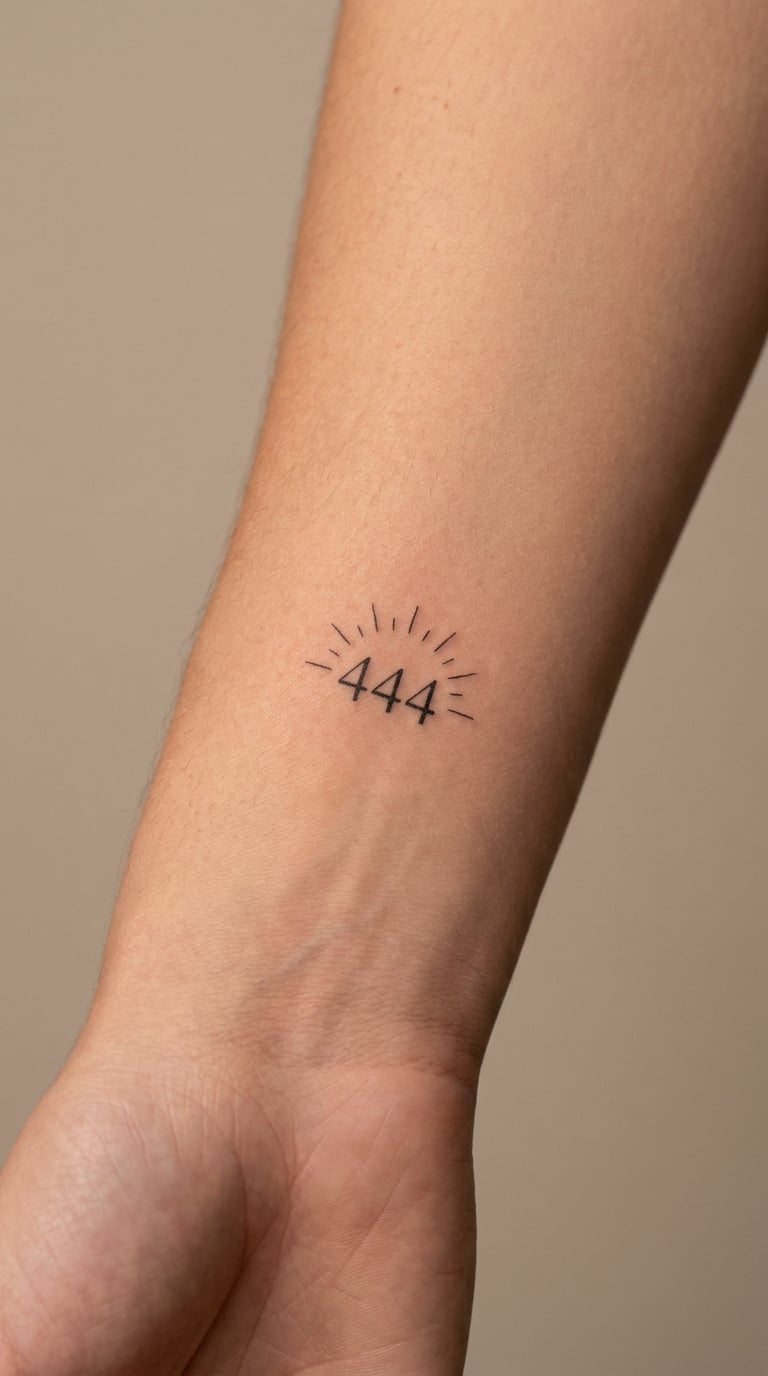
A sunburst 444 puts a small 444 in the middle with straight rays radiating from a circle around it, like a simplified seal. The rays are single lines of even length, and the gaps between them match the rays, which is what keeps the pattern calm.
Sunbursts add light and energy without any shading, and a version with a dozen short rays reads very differently from one with thirty.
Placement: Inner forearm, calf, or top of the shoulder. Size: 2 to 3 inches (5 to 8 cm) across. Style: Fine line, radiating rays.
Pain: Medium, around 5 out of 10. Rays are quick single passes, so the needle moves fast and the discomfort comes and goes. Make the circle a firm line, since it carries the composition and fades first on the inner arm. Make it yours: Set a date along the lower arc, following its curve.
17. 444 with an Angel’s Hand
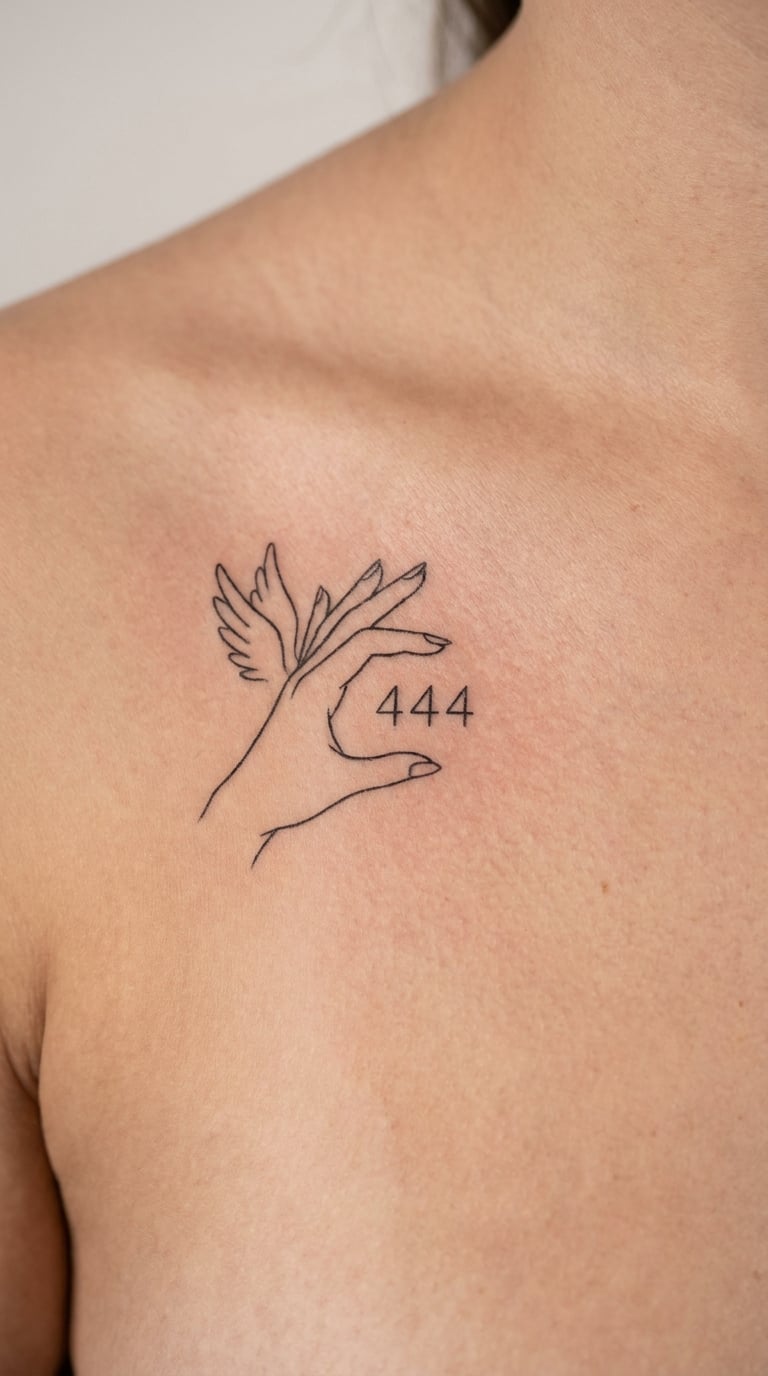
An angel hand here is a stylised hand drawn palm-out with long separated fingers, arcing over the 444 so the fingertips sit just above the digits. The fingers are the hard part: simple, evenly spaced and clearly separated, or the shape reads as a smudge of linework.
This works as a quiet frame rather than an illustration, so the hand should carry no shading.
Placement: Upper chest, shoulder, or upper back. Size: 2 to 3.5 inches (5 to 9 cm) across. Style: Fine line, single-needle.
Pain: Medium, around 6 out of 10 on the chest and closer to 4 on the back. Fine finger outlines are fragile long term, so keep each finger at a millimetre or more and round the tips. Make it yours: Angle the fingertips down toward the number rather than straight over it.
Symbol-driven pieces tend to age better than illustrative ones. Our 25 Science Tattoo Ideas for Curious Minds covers that ground with formulas, atoms and instruments.
18. Blackwork 444 in a Diamond
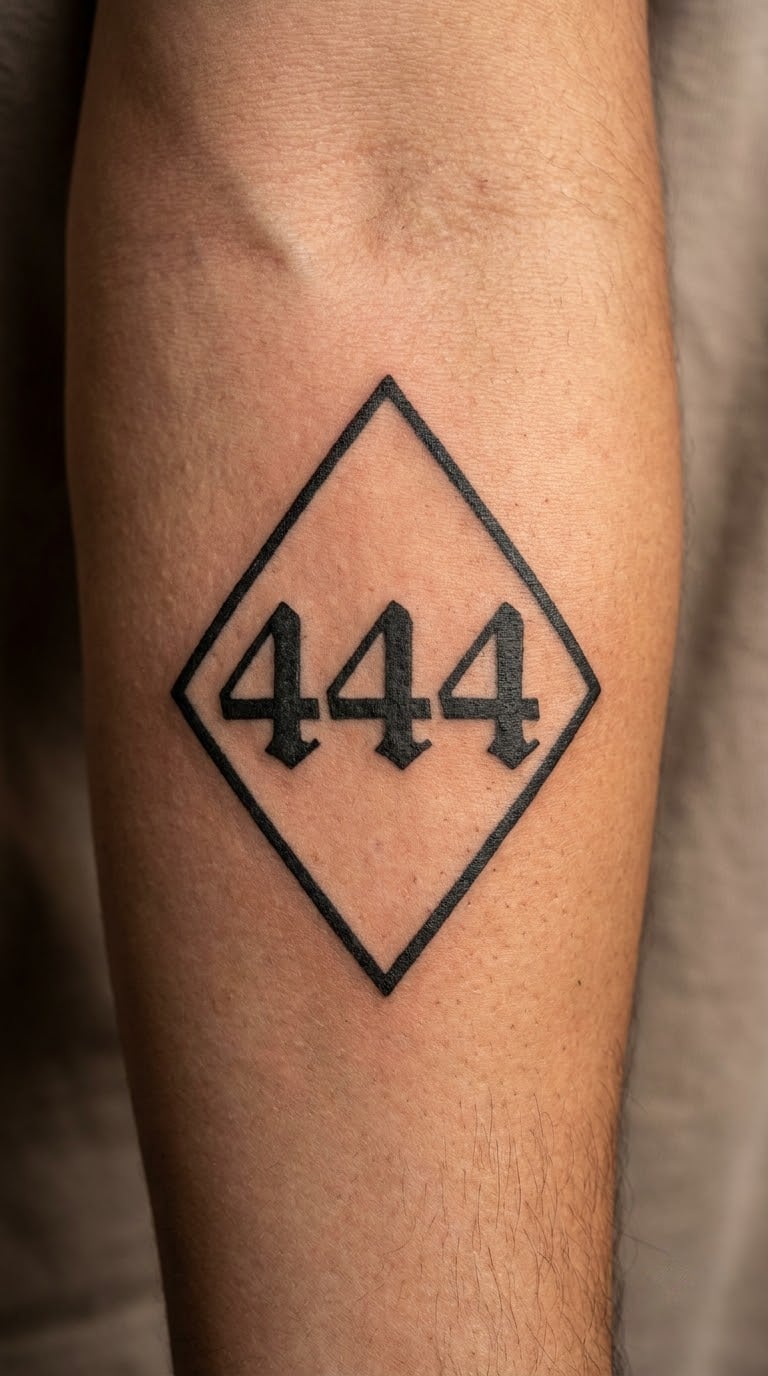
A diamond 444 is a four-sided shape drawn in solid black with the number reserved out of it, so the digits read as if cut from the ink. The diamond is simple, with a clean top point and a slightly wider base, and the number sits centred in the lower half.
Blackwork with negative space holds its shape well, and the composition scales gracefully, working at 2 inches on an arm or 5 on a calf.
Placement: Outer forearm, bicep, thigh or calf. Size: 2.5 to 4 inches (6 to 10 cm) tall. Style: Blackwork, negative-space numerals.
Pain: High, around 8 out of 10, since solid black needs repeated passes. Expect two and a half to four hours. A stencil that shifts mid-session is how reserved digits turn blurry, so skill matters more than speed. Make it yours: Break the outline at one corner and let a fine line run past it.
19. 444 with a Crescent Moon
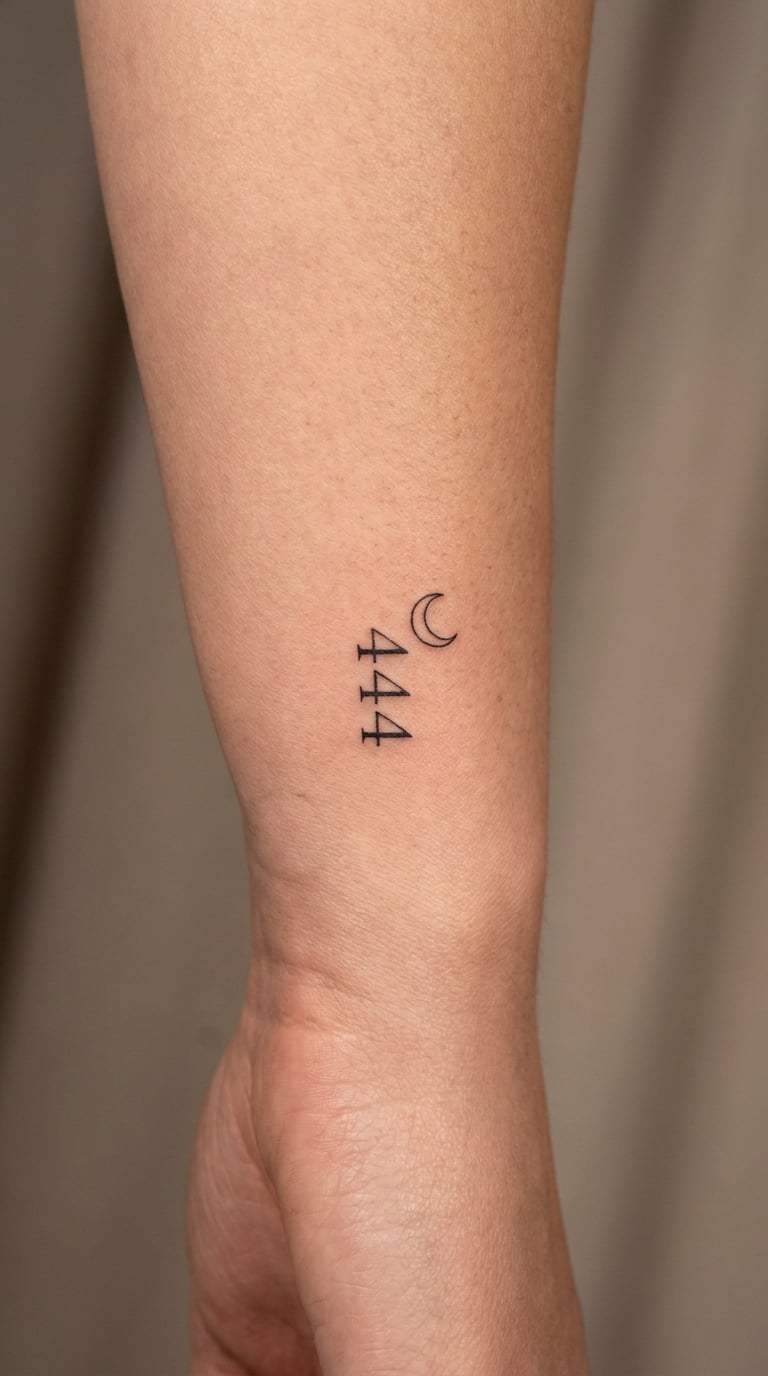
A crescent moon 444 sets a small 444 beside a single crescent drawn with two clean arcs, the moon about the same height as the digits. Two or three tiny dots near it are usually enough, and any more turns the piece into a sky scene.
These compositions last because the elements are large relative to the whole. Keep the crescent thick enough to survive the inner arm.
Placement: Inner arm, behind the ear, or the ankle. Size: 1.5 to 2.5 inches (4 to 6 cm) across. Style: Fine line, optional colour accent.
Pain: Medium, around 5 out of 10. Fine line fades faster on the inner arm than the upper arm, and colour does not hold noticeably better there, so plan a touch-up. A soft grey-blue in the crescent adds depth without turning it into colour work. Make it yours: Show a specific moon phase, which ties the design to a date without extra linework.
20. 444 as a Micro-Tattoo on the Hand
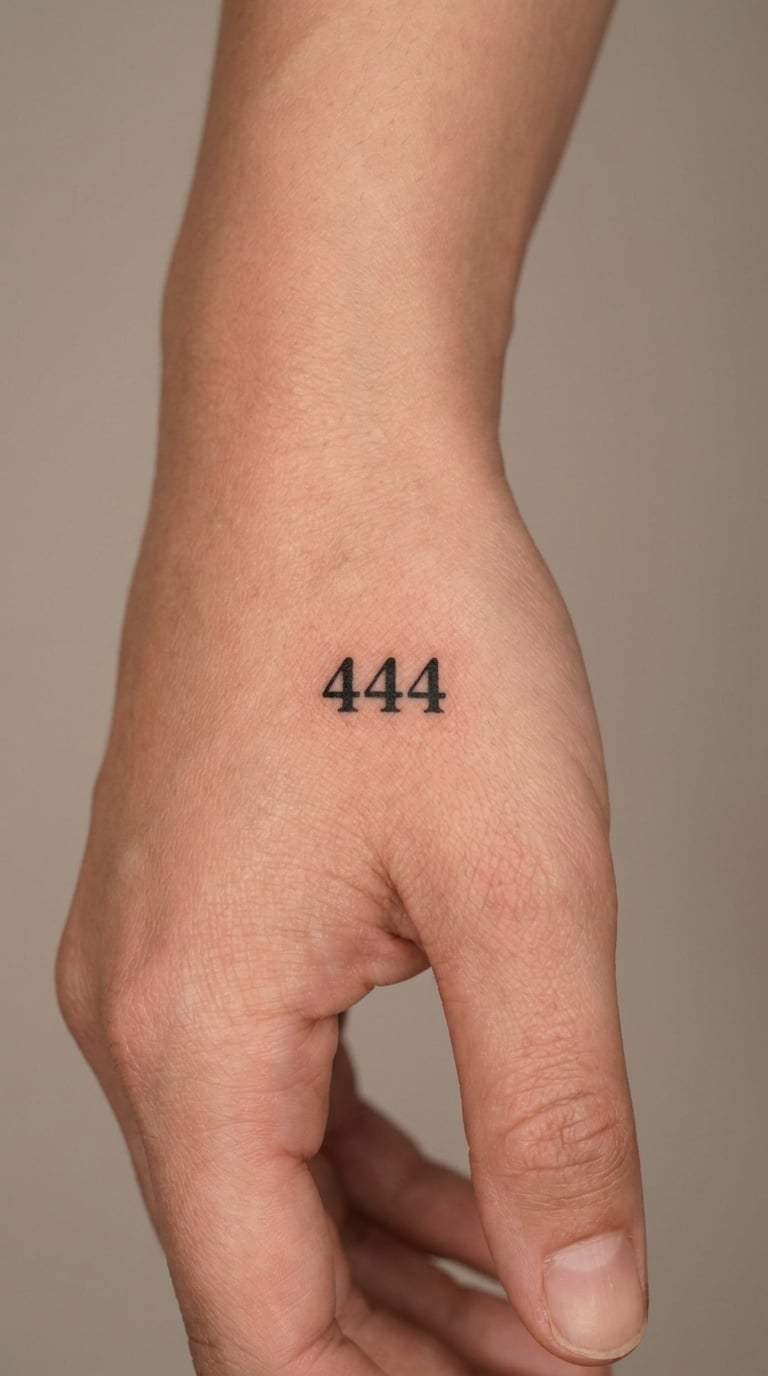
A micro 444 on the back of the hand is three digits under an inch wide, and it only works with a bold line. At this size the weight needs to be near the maximum an artist would normally use, because anything finer disappears into the skin texture within a couple of years.
Hands are the most used surface on the body, so sun and washing hit this design harder than anywhere else.
Placement: Back of the hand, between the knuckles. Size: 0.4 to 0.8 inches (1 to 2 cm) wide. Style: Micro, bold single-needle.
Pain: High, around 8 out of 10, from bony knuckles and being able to watch it, though the session is often under 30 minutes. Fading on hands is the fastest of any placement, so assume a top-up every 12 to 18 months. Make it yours: Keep it as three digits, since anything added crowds the design out at this size.
21. 444 with a Feather Quill
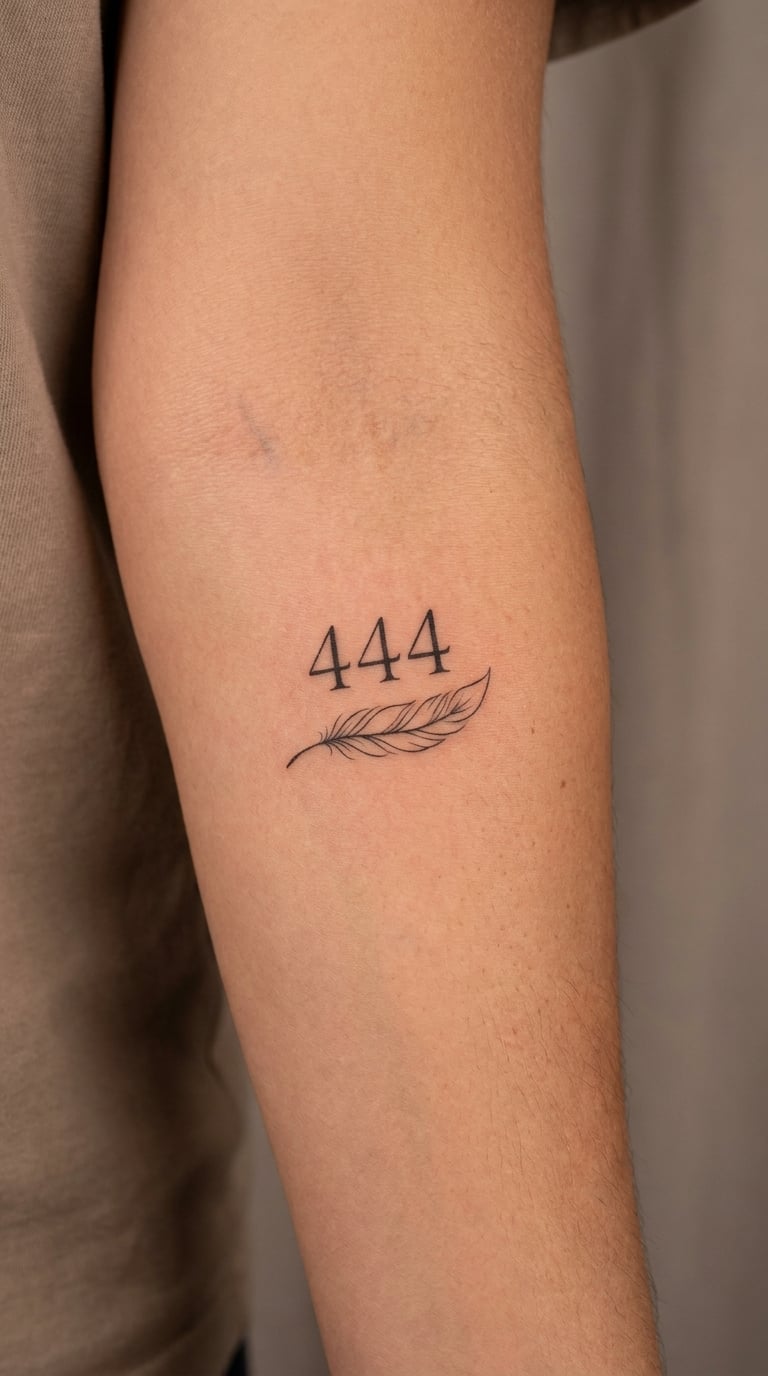
A feather quill 444 places the number above a single quill drawn diagonally, the shaft running as one straight line and the barbs suggested with short strokes on one side only. Half a feather uses a small area better than a whole one.
Quills pair well with numbers because the diagonal shaft balances a horizontal row of digits, and the whole composition sits at an angle that looks deliberate.
Placement: Inner forearm, upper arm, or below the collarbone. Size: 2.5 to 4 inches (6 to 10 cm) tall. Style: Fine line with short barb strokes.
Pain: Medium, around 5 out of 10 on the arm and 6 near the collarbone. Barbs are short single passes, so the session moves quickly. Barbs under a millimetre fill in over the years and the feather turns into a solid grey shape. Make it yours: Add a short inscription under the shaft, kept well under the number in size.
22. 444 in a Circular Mandala
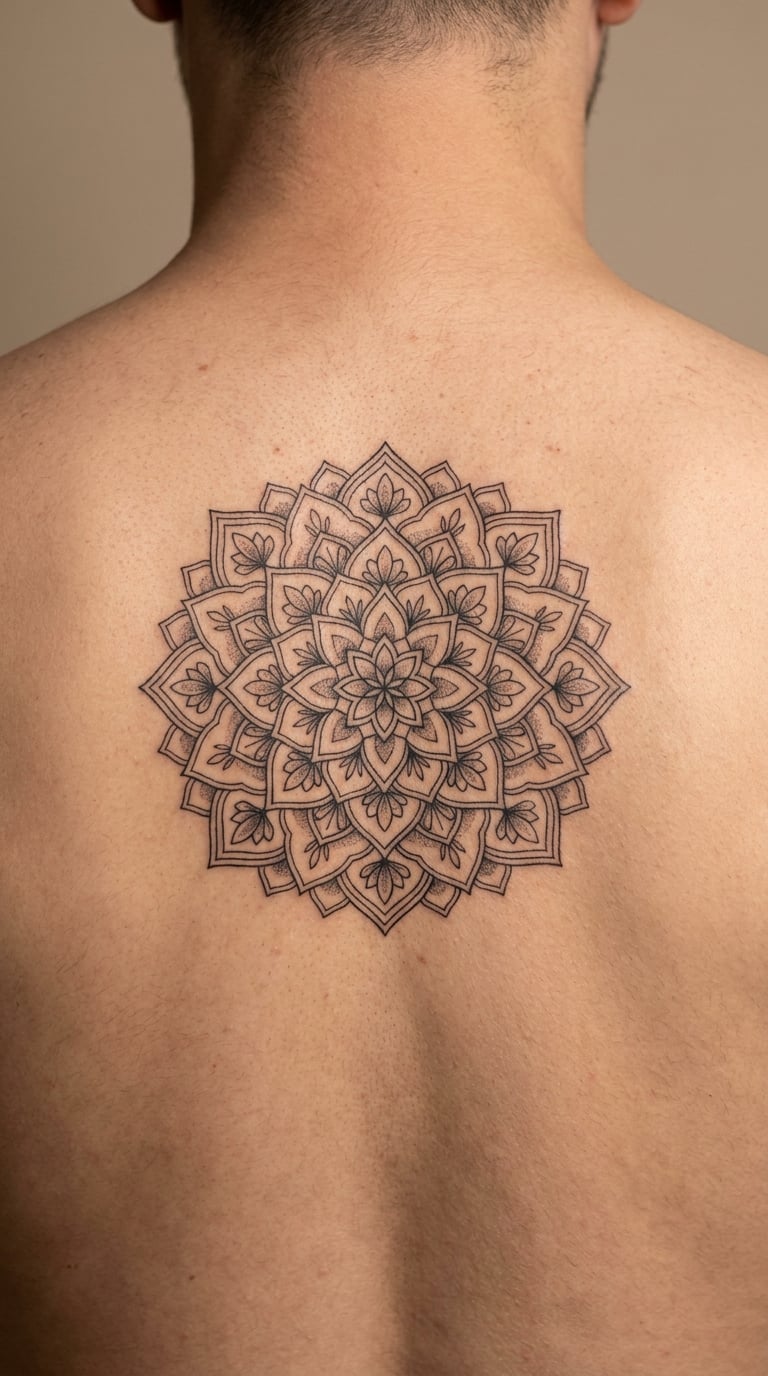
A mandala 444 builds concentric rings of fine line outward from a central 444, each ring using a repeating motif, dots or small arcs, with the whole thing perfectly symmetrical and the centre staying plain black.
Symmetry is what makes a mandala look calm. If one side does not mirror the other it reads as a mistake, so this is a composition worth choosing an artist for rather than improvising.
Placement: Upper back, thigh, calf or mid back. Size: 4 to 7 inches (10 to 18 cm) across. Style: Fine line with dotwork.
Pain: High, around 8 out of 10, and time is the challenge. A 5-inch mandala with several rings can take five hours or more, usually split across two sessions. Medium line and dotwork hold up far better than all-hairline detail. Make it yours: Colour the outermost ring only, pulling the eye inward toward the number.
23. Traditional 444 Rose
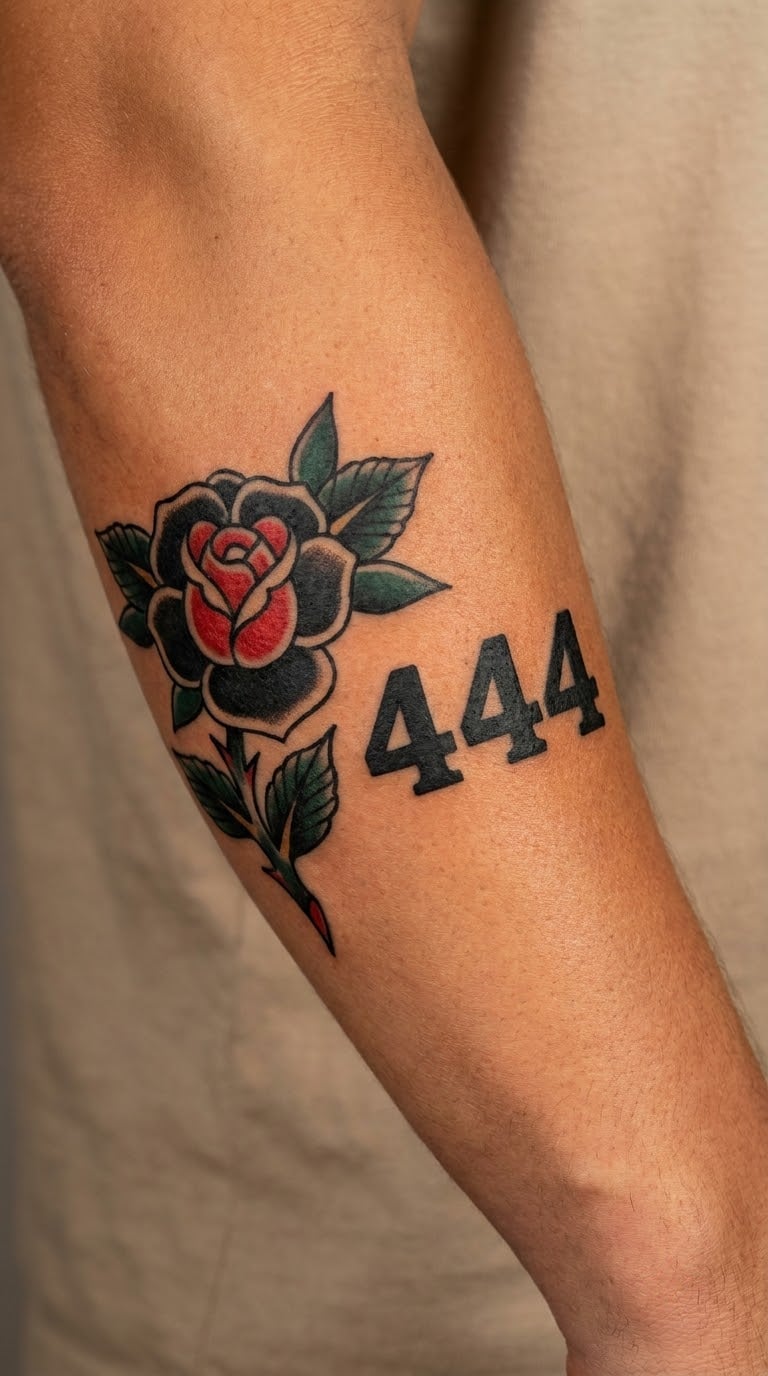
A traditional 444 rose puts a bold outlined 444 beside a single rose in the old school style: thick even outline, red petals shaded darker toward the centre, green leaves with white highlights kept inside the colour. The number stays unshaded black.
Traditional work is the most forgiving style here about ageing, because the outlines are heavy and the colour fills broad.
Placement: Forearm, calf or upper arm. Size: 2.5 to 4 inches (6 to 10 cm) across. Style: Traditional, bold outlines with red and green.
Pain: Medium, around 5 or 6 out of 10, though coloured areas take longer than the line work suggests. Two to three hours for a piece this size. Solid red holds its tone well, while lighter shades fade at very different rates. Make it yours: Add a smaller rose on the other forearm with a different number.
24. 444 with a Minimal Mountain
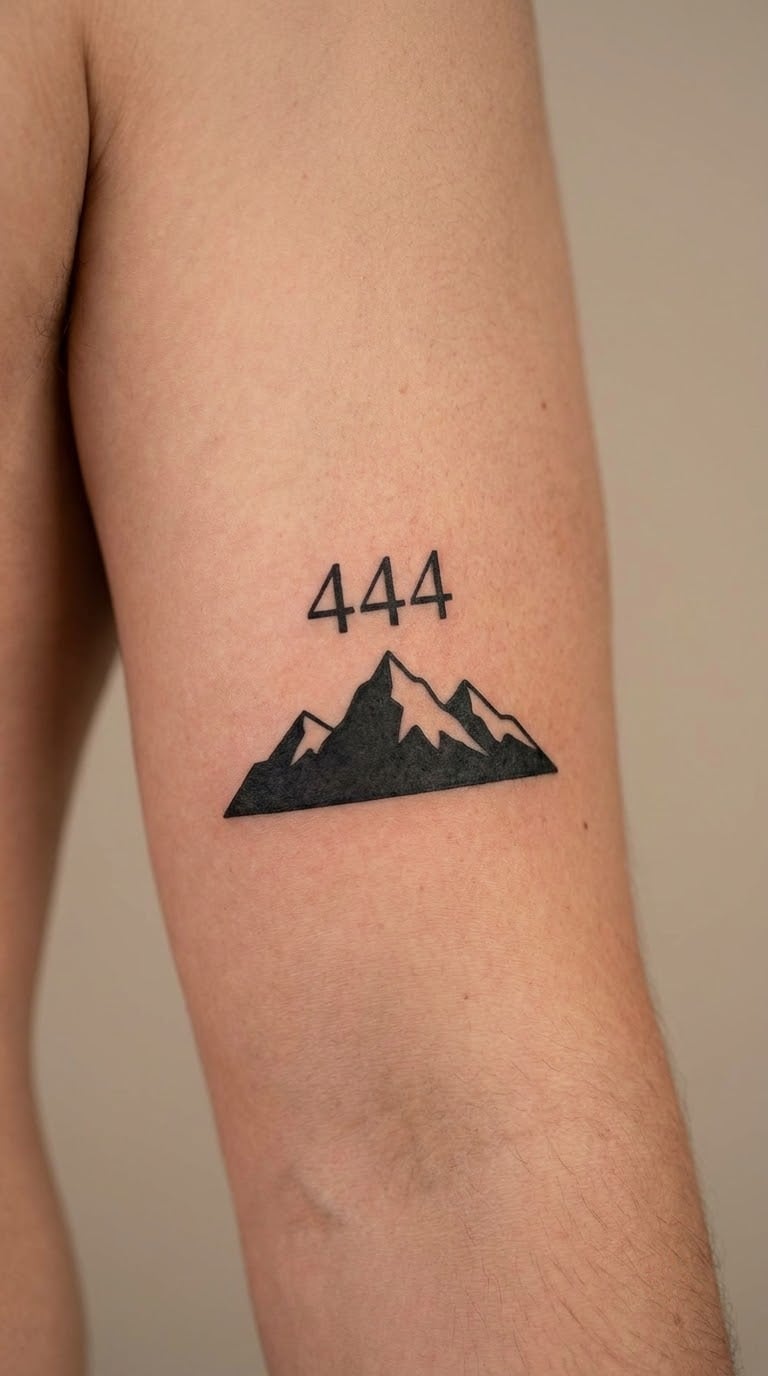
A minimal mountain 444 sets a 444 in plain line above a simple silhouette of two or three angular peaks with a straight base line. The peaks are drawn in a single medium-weight stroke and nothing else, with no trees, sun or texture inside the shape.
It is a landscape reduced to its outline, and that reduction is what makes it work next to a number. The result reads as a place rather than a picture.
Placement: Upper arm, forearm, or over the heart on the chest. Size: 2 to 3.5 inches (5 to 9 cm) wide. Style: Minimalist, single-weight line.
Pain: Medium, around 5 out of 10, and quick because the design is mostly straight lines. The upper arm holds fine line better than hands or the inner wrist, so a delicate version suits this spot. Keep the base line at the same weight as the peaks. Make it yours: Draw the peak of somewhere you have actually been.
How to Choose the Right Design
Most people get the placement wrong first and the design second, and changing your mind about a drawing is far easier than changing your mind about a spot on your body. Start with the place.
Match the line weight to the body part
Hands, fingers, the inner wrist and the collarbone take more wear and movement than the upper arm, back or thigh. Anything on those spots needs a bolder line than your reference photo shows. If you are choosing 24 444 tattoo ideas from this list and your favourite is very fine, check where that fine line will be living.
Decide how much detail you will still like in ten years
Count the smallest elements and ask whether each is still large enough to read in a decade. Dotwork and mandala rings, feather barbs and tiny stars all soften, and fine line numbers blur first. Enlarge a small detail or accept that the piece will read as a simpler shape later.
Size it against the body part, not the reference photo
A design filling a 4-inch space on flat paper looks small on a curved forearm and huge across the shoulder blades. Ask your artist to draw it at actual size on tracing paper and hold it against the skin before any stencil goes down. It is the only step that reliably prevents a piece being larger than you pictured.
Pick a style that matches the artist you can get
Fine line, blackwork with negative space and mandala symmetry are specialist skills. An artist who mostly does bold traditional work can do all of them, with variable results. Look at healed work in their portfolio rather than fresh posts, and check the style is something they do regularly.
Let the meaning do the work
Pick the version that still means something to you in a decade, not the one that looked best on a screen. Most of the regret reported in 444 conversations came from people who got the number because it was everywhere. A real reason, even a private one, changes how you feel about the piece in five years.
Cost and Session Time
A small fine-line 444 usually costs between 90 and 200 US dollars, and most shops set a minimum that a tiny design still has to meet. A wrist or forearm piece with an added element such as a halo, sunburst or small cross lands closer to 150 to 300 dollars. A finger or micro hand piece can cost as much as a larger arm design, because the work is fiddly.
Mid-size pieces run from 250 to 500 dollars. That band covers 3 to 4 inch blackwork pieces and traditional work with colour, all of which take two to four hours in the chair.
Large pieces are a different category. A winged 444 across the shoulder blades or a mandala on the back can run 600 to 1500 dollars or more, and those are almost always booked over two sessions. Ornament, shading and symmetry all add hours, and lots of small repeated detail takes far longer than its size suggests.
Time tracks complexity more than area. A 3-inch mandala can run longer than a 5-inch piece of solid blackwork, because dot placement and mirrored linework are slow. Hourly rates and shop minimums vary widely by city and by artist, so treat these as planning ranges rather than quotes, and ask for a written estimate at your consultation.
Aftercare Basics
- Follow your artist’s aftercare instructions first, since they know exactly what they did in your skin.
- Wash the area gently with lukewarm water and a fragrance-free soap, twice a day, and pat it dry with a clean hand rather than a towel.
- Keep the fresh tattoo clean and dry for the first few days, and remove any wrap or film your artist applied once it is no longer needed.
- Do not soak, swim, or use a hot tub until the tattoo has healed, which takes at least two weeks.
- Leave the flaking skin alone when it comes off, and do not pick, scratch, or peel it early.
- Once healed, keep it out of strong sun and moisturise if the area is dry, since sun exposure and fading are the same conversation.
Frequently Asked Questions
What does a 444 tattoo mean?
In numerology, 444 is called an angel number, and people who get it tattooed usually connect it with protection, guidance and a feeling of being held steady through something difficult. Some wear it as a mental health anchor, something they can see during a hard day. Others simply like how three fours look in a line. The meaning belongs to the person wearing it, and there is no single official interpretation.
Is 444 a good choice for a first tattoo?
Yes, if you pick a simple design and a sensible placement. A single-line or medium-weight 444 on the inner forearm or outer upper arm is small, quick and easy to read, and a good size for a first sitting. Wrist, finger and hand placements fade faster and hurt more, so most artists would steer a beginner toward an arm placement for a first piece.
Where is the best placement for a 444 tattoo?
The inner forearm and outer upper arm are the most forgiving spots because they hold fine line longer and hurt less. The inner wrist, behind the ear and the collarbone work well when you want the number visible to you rather than everyone else. Finger and hand tattoos fade fastest of all, so an arm placement is the safer bet if you want the digits readable for years.
How much does a small 444 tattoo cost?
In the US, a small fine-line 444 usually falls between 90 and 200 dollars, though most shops have a minimum charge that tiny designs still have to meet. Adding an element like a halo, sunburst or small cross pushes it toward 150 to 300 dollars. City and artist rates vary widely, so treat these as planning ranges and ask for a written estimate at your consultation.
Do fine line 444 tattoos fade quickly?
They do, and all small number tattoos fade faster than large bold pieces. Wrists, fingers, hands and the collarbone wear down fastest, and hairline script or single-needle digits blur within a few years. Ask your artist for a bolder line than feels necessary, avoid sun exposure once healed, and plan on a refresh every 12 to 18 months on the more exposed spots.
Can you tattoo over a 444 later?
Usually, yes, but it is easier to work with than around. A tattooer can cover an old number with a denser design, though covering a healed tattoo means going over scar tissue, which takes more time, uses more ink and can leave the old number faintly visible. Many people instead choose a new placement and leave the original alone.
Which 444 Idea Should You Start With
If this is your first tattoo, the minimal wrist 444 or the vertical forearm 444 is where to begin. Both are quick, both read clearly at arm’s length, and neither asks an artist to solve a symmetry or shading problem. If you are adding to an existing collection, the blackwork 444 heart or the feathered wings give you a piece with real visual weight that sits well beside other bold work.
Whichever one you choose from these 24 444 tattoo ideas, settle the reason before the design. The number is the easy part. The meaning, the placement and the line weight decide whether you still like it in ten years.