
20 Best Filigree Tattoo Ideas: Fine-Line Details (October 2026)
A filigree tattoo is an ornate design built from fine, lace-like swirls, scrolls and interlaced lines borrowed from the goldsmith’s bench, where fine wire was twisted into decorative patterns for jewellery and metalwork. That is the whole idea: rhythm, curls and open space rather than a picture.
Filigree tattoo ideas suit anyone drawn to vintage, Victorian, baroque or Art Nouveau aesthetics, and they suit sleeve builders who need connectors between bigger pieces. The trick is scale. Scrollwork that looks lace-sharp in a 6-inch panel turns to soft grey in something 2 inches wide, so the sizes below are the ones that actually hold up. Bring two or three references, ask for honest sizing rather than flattering sizing, and pick a licensed artist whose existing work already looks like your design healed.
Filigree Tattoo Ideas: Quick Guide
| Idea | Style | Best placement | Size | Pain |
|---|---|---|---|---|
| Fine-line rose | Fine line with soft grey | Inner forearm | 3-5 in | Medium |
| Art Nouveau lily | Fine line, illustrative | Outer shoulder | 4-6 in | Medium |
| Ornamental hamsa | Fine line blackwork | Upper arm | 4-6 in | Medium |
| Botanical branch | Fine line, semi-realistic | Side rib | 8-10 in | High |
| Geometric mandala | Dotwork and fine line | Upper back | 5-7 in | Medium |
| Butterfly | Fine line, minimal centre | Behind the ear | 2-3 in | Low |
| Phoenix | Ornamental blackwork | Upper back | 7-10 in | Medium |
| Filigree skull | Blackwork lace detail | Forearm | 4-6 in | Medium |
| Celtic knot | Bold line interlace | Inner wrist | 2-3 in | Medium |
| Koi | Illustrative linework | Calf | 5-7 in | Medium |
| Floral lace panel | Blackwork, illustrative | Outer thigh | 7-10 in | Medium |
| Crescent moon | Fine line, minimal | Outer ankle | 2-3 in | Low |
| Serpent | Neo-traditional linework | Upper arm | 6-8 in | Medium |
| Art Nouveau profile | Illustrative fine line | Side of neck | 4-5 in | Medium |
| Compass rose | Fine line blackwork | Upper chest | 4-6 in | Medium |
| Sunburst | Blackwork and dotwork | Shoulder blade | 6-8 in | Medium |
| Monogram | Calligraphic fine line | Inner bicep | 3-5 in | Low |
| Tree of Life | Illustrative blackwork | Calf | 7-9 in | Medium |
| Eye | Fine line with rays | Forearm | 3-4 in | Medium |
| Bold vine | Blackwork, thick and thin | Wrist and hand | 4-6 in | High |
1. Fine-Line Filigree Rose on the Forearm
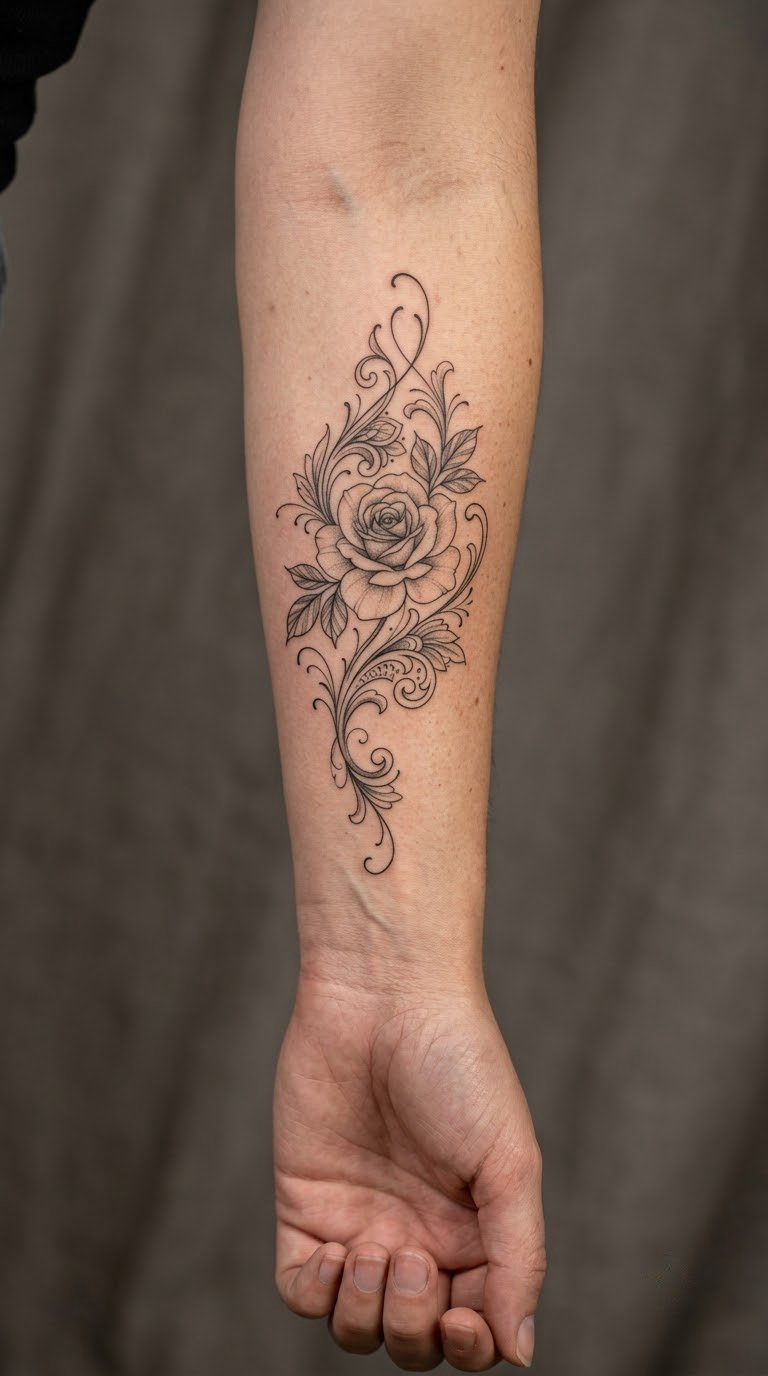
A single rose drawn in one-weight line, with the petals built from open curls rather than solid shading, and two or three stems trailing off into loose scrollwork. Optional grey wash in the deepest petal folds keeps it from looking flat without turning it into a traditional piece.
Most people pick a rose because it is the one flower everybody reads as classic. There is no fixed symbolism attached to filigree roses specifically, so treat any meaning as your own.
- Placement: inner forearm, wrist to elbow, or the outer forearm if you want it visible in short sleeves
- Size: 3-5 inches (7-12 cm) across for a single bloom; a full stem-and-bloom version wants 6 inches
- Style: fine line with black-and-grey shading
- Pain: medium on the inner forearm, with an achy stretch on the wrist end
Fine grey shading on a forearm tends to soften first, so ask for a slightly heavier line than feels necessary in the chair.
Make it yours: add one leaf from a plant that meant something to you, or a tiny date tucked into the trailing scroll.
2. Art Nouveau Lily Filigree on the Shoulder
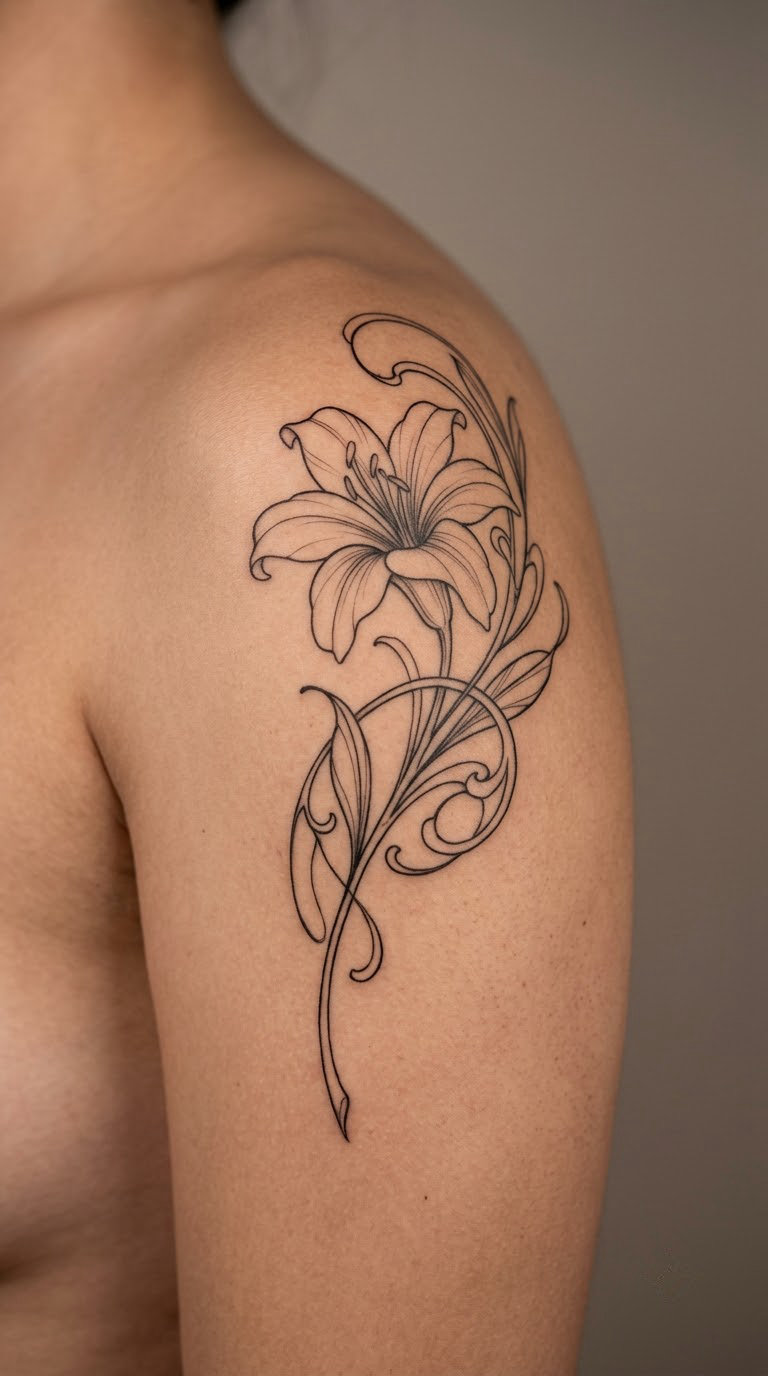
Long lily petals drawn as tapered ribbons, stems that loop back on themselves in the Art Nouveau habit, and generous negative space between the curves so the piece breathes instead of clogging. The stem usually spirals below the bloom to fill the shoulder curve.
Art Nouveau work is chosen for its shape language rather than a message. The long, upward-then-curving lines are the whole appeal, and they follow a shoulder beautifully.
- Placement: outer shoulder or the deltoid cap, angled so the stem runs down the arm
- Size: 4-6 inches (10-15 cm) tall; the loops need room or they close up into a blob
- Style: Art Nouveau fine line, sometimes with a light stipple in the background
- Pain: medium, and the top of the shoulder is a spot most people feel more than they expect
The thin, whip-like petal tips are the first part to blur over a decade. Many artists thicken them on purpose for that reason.
Make it yours: mirror it across the chest as a pair, or leave the stem free so it can later connect into a sleeve.
3. Intricate Filigree Hamsa on the Upper Arm
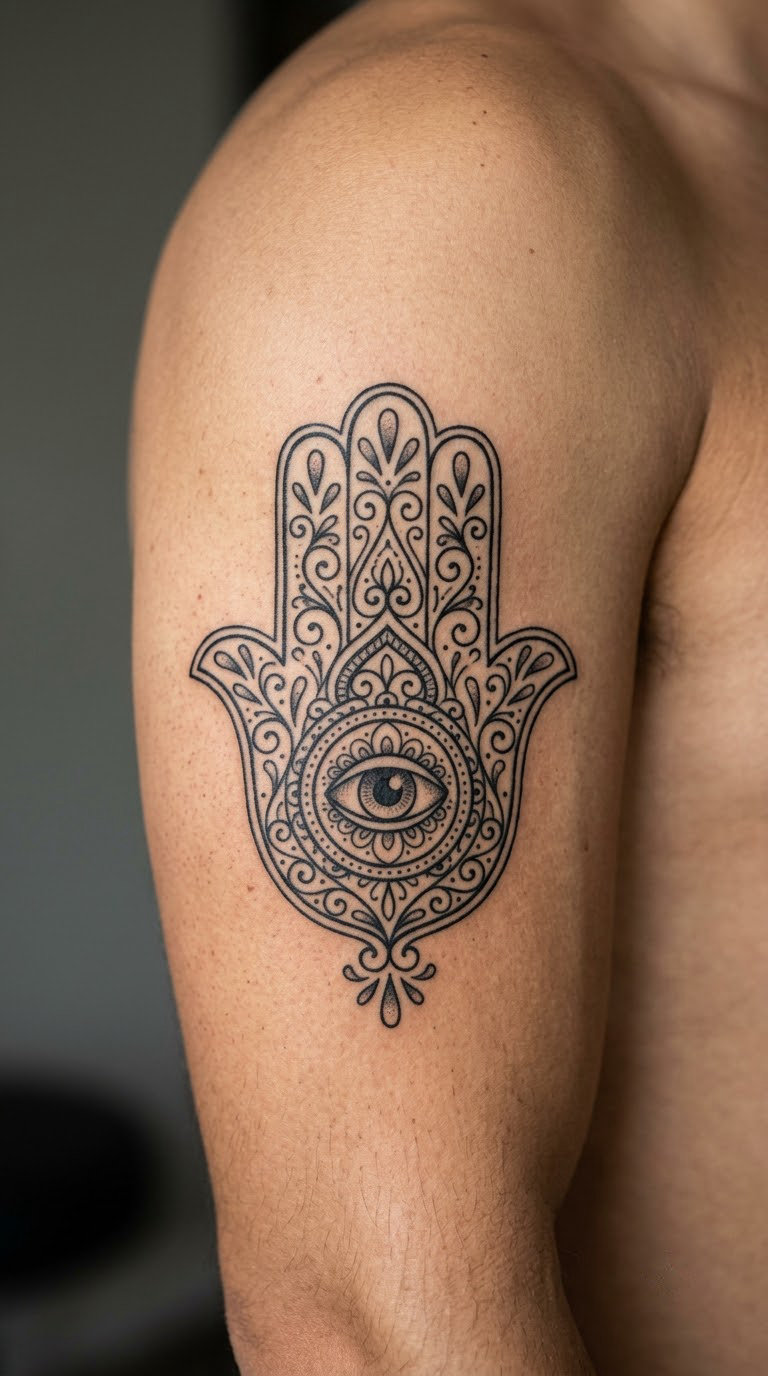
A hamsa shape filled with ornamental teardrops, tiny curls and a lattice of scrollwork, drawn in black line with the palm left mostly open so the shape still reads clearly. Symmetry is the whole game here, and it is the part that needs a steady hand.
The hamsa is widely used as a protective symbol across several traditions, so people often choose it as a wish for protection or good fortune. It is a borrowed cultural symbol, so worth understanding it properly and researching local laws if you are outside its home region.
- Placement: outer upper arm, or inner forearm for a smaller version
- Size: 4-6 inches (10-15 cm) tall; under 3 inches and the interior detail is guesswork
- Style: ornamental blackwork, fine line interior
- Pain: medium, fairly even across the bicep area
Interior scrollwork on the upper arm sits in a spot that flexes and stretches constantly, so expect the inner detail to relax a little over time.
Make it yours: place an eye at the centre of the palm, or set a small birthstone colour in one of the teardrops.
4. Botanical Filigree Branch on the Side Rib
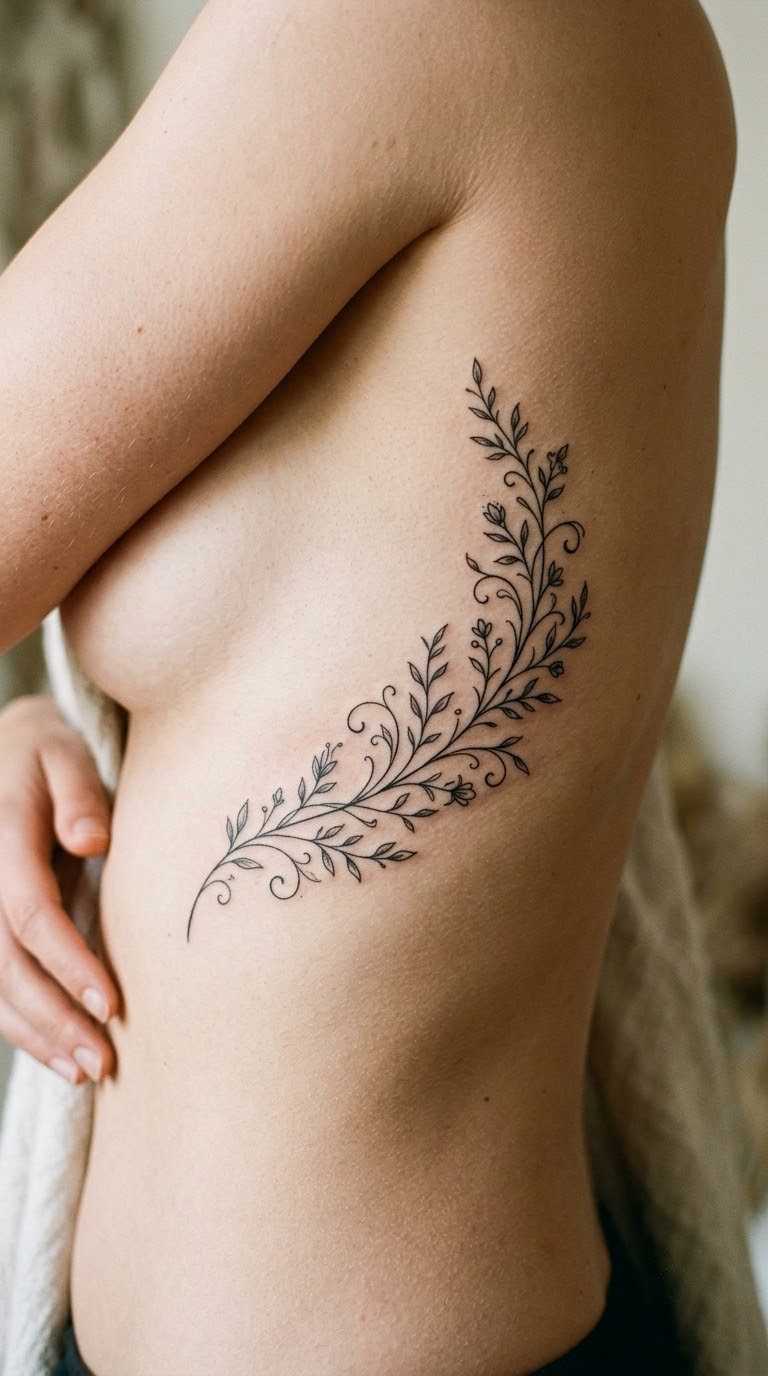
A curved branch that follows the rib line, with small paired leaves and thin tendrils spiralling off the main stem. The branch itself is drawn in a slightly heavier line than the leaves, which keeps the hierarchy readable once everything settles.
Botanical pieces get chosen for the specific plant rather than a general idea, and a branch format suits anyone who likes line work more than a full colour image.
- Placement: side ribs, running from just under the armpit toward the hip; the back of the upper arm also works
- Size: 8-10 inches (20-25 cm) long and 2-3 inches wide
- Style: fine line or light blackwork with stipple shading
- Pain: high. Ribs are bony, the skin moves when you breathe, and this is a long session
Rib and belly areas are where fine line fades fastest on many bodies, because sun exposure and skin movement both work against it. A larger version ages better than a small one here.
Make it yours: use a plant from a specific place, or add a second thinner branch in the opposite direction to make it read as a pair.
5. Geometric Filigree Mandala on the Back of the Shoulder
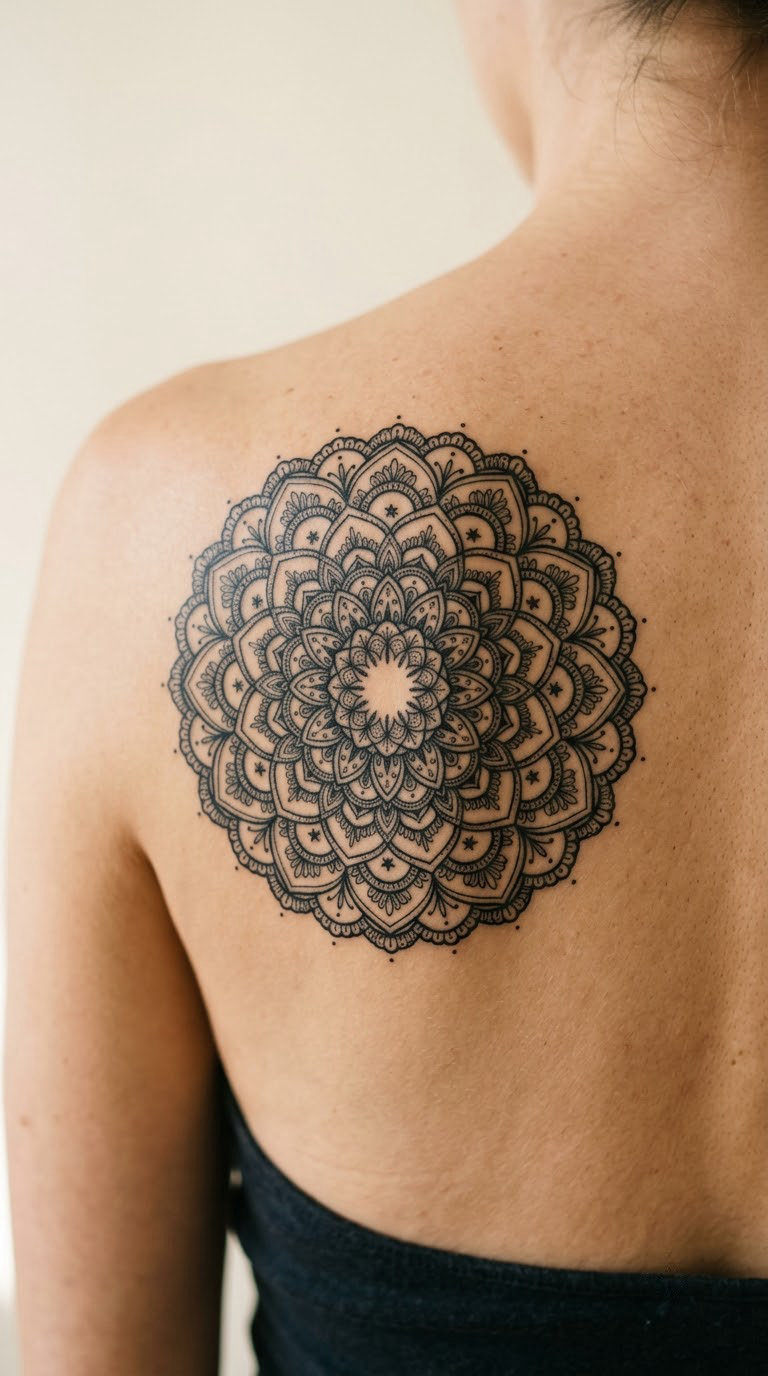
Concentric rings of lace-like shapes building outward from a small centre, mixing strict geometry with loose ornamental curls in the gaps. Dotwork in the negative space adds a soft haze that keeps the hard geometry from looking mechanical.
Mandala designs are usually chosen for their pattern and sense of order rather than a single fixed meaning. The concentric structure appeals to people who like a design that rewards a second look.
- Placement: upper back between or just beside the shoulder blades, centred on the spine for symmetry
- Size: 5-7 inches (13-18 cm) across
- Style: dotwork and fine line combined, sometimes on black
- Pain: medium; the upper back is fleshy but the session is long
Dotwork in the negative space is what softens first, so many artists build it heavier than it looks in a photo.
Make it yours: break the symmetry deliberately, with the outer ring offset, or add a second smaller mandala on the opposite shoulder blade.
6. Delicate Filigree Butterfly Behind the Ear
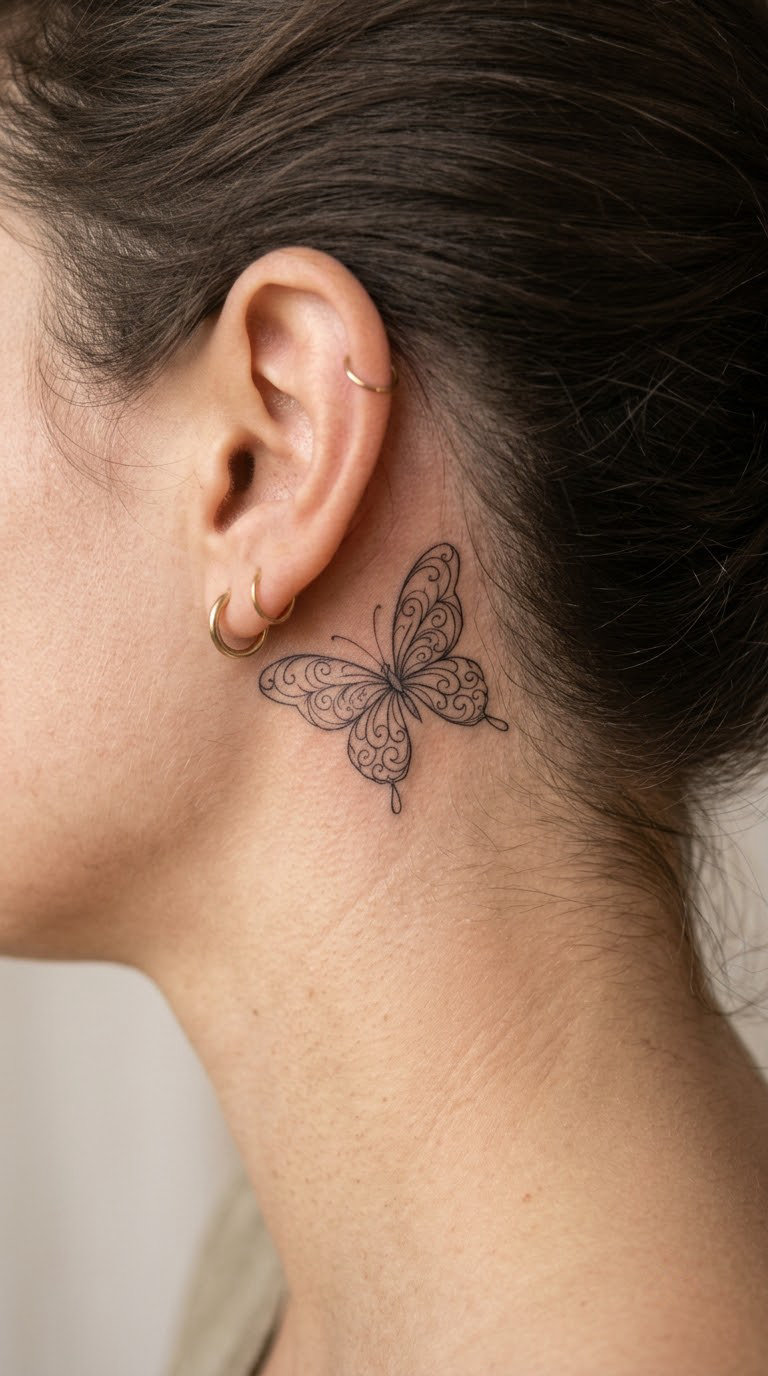
A butterfly with looping, almost lace-like wing edges, a deliberately simple body, and antennae drawn as two fine curls. The contrast between busy wings and a plain centre is what makes the small size work.
Butterfly tattoos are popular enough that they will not turn anyone’s head, and that is often the point. This version is for someone who wants the shape without the obviousness.
- Placement: just behind the ear where the head meets the neck, or the inner wrist
- Size: 2-3 inches (5-7.5 cm) wing to wing
- Style: fine line, single needle
- Pain: low. The skin behind the ear is thin but shallow
Hair washing, sunscreen and daily handling wear this spot out faster than most, so expect a touch-up conversation in a year or two.
Make it yours: add a single colour accent on one wing, or mirror it on the other side for a pair that only reads together.
7. Filigree Phoenix on the Upper Back
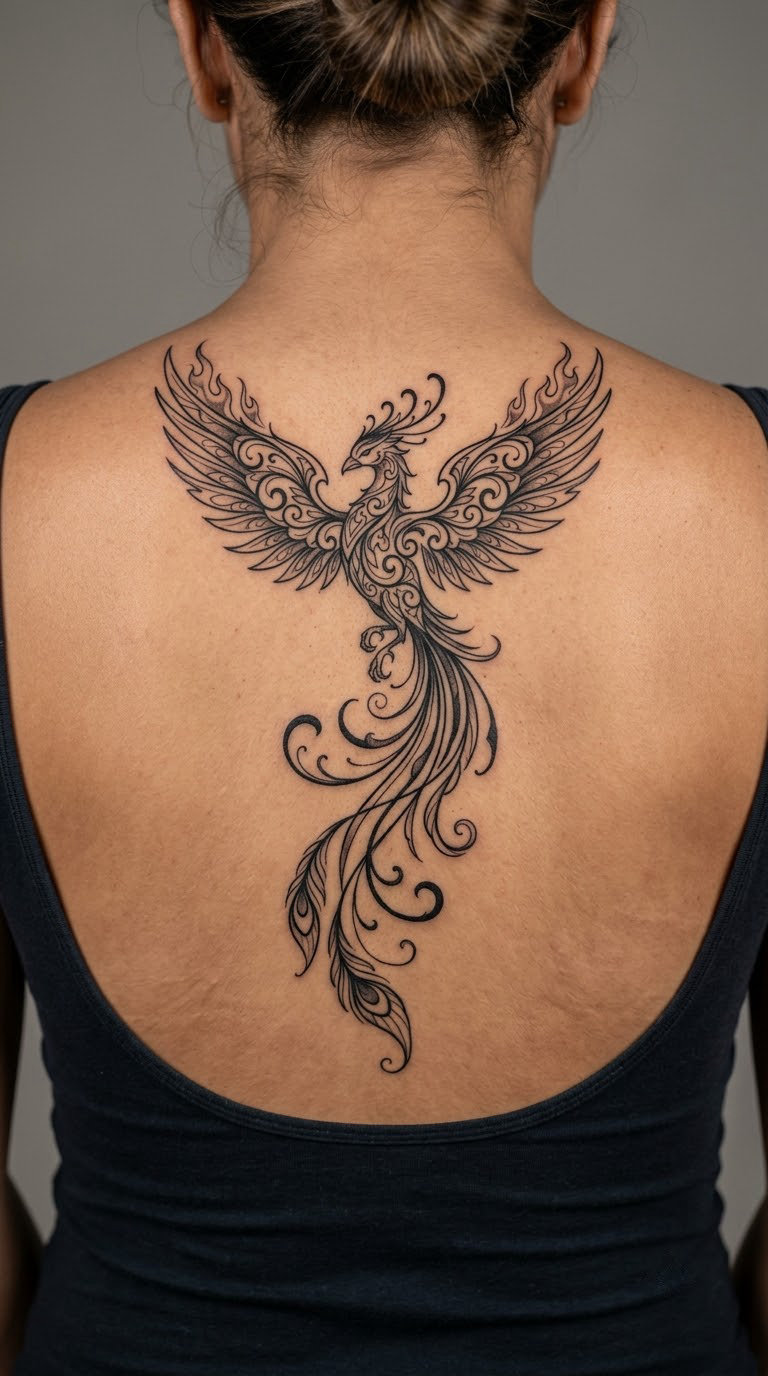
A phoenix built from curling tail feathers and a few restrained flame shapes, drawn as ornament rather than illustration. The body is usually a single clean outline with the filigree doing all the work around it.
Phoenix designs carry a rebirth or renewal association that people borrow deliberately, and many commission this after a major life change. The filigree treatment is the style choice, not the meaning.
- Placement: across the upper back, wings spanning shoulder blade to shoulder blade
- Size: 7-10 inches (18-25 cm) wide
- Style: ornamental blackwork or fine line with a solid outline
- Pain: medium, spread over a long session
Tail-feather detail in the lower back area fades faster than the body outline because of sun exposure. Ask about spacing feathers further out instead of closer in.
Make it yours: tuck a date into the flame shapes, or design the tail so it can later flow into a full back piece.
8. Lace-Like Filigree Skull on the Forearm
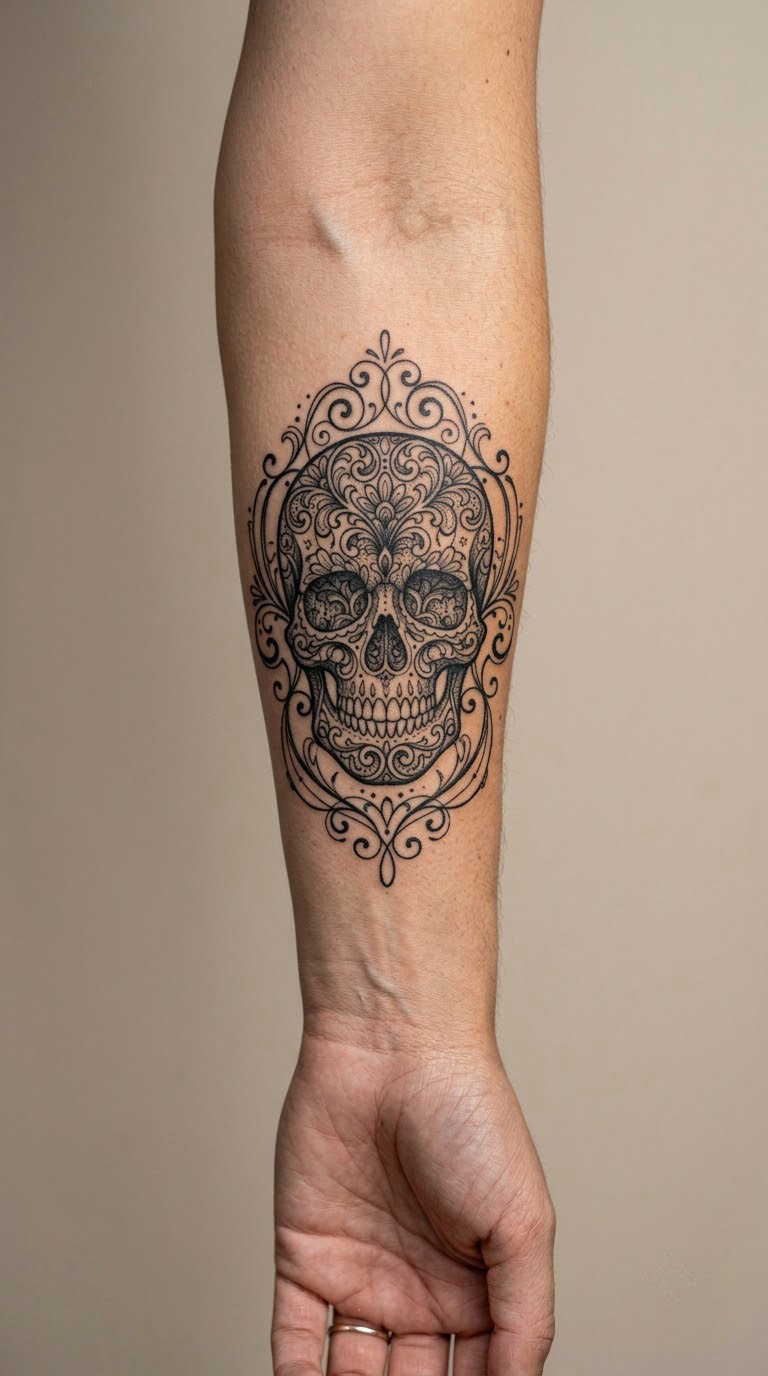
A skull framed by looping ornamental lines rather than rendered as a realistic portrait, with the eye sockets, teeth and jaw described in clean line and the space around them filled with lace-like scrollwork. Often a little dot shading in the sockets gives depth.
Skulls are frequently chosen to mark a death, a loss or a turning point, though plenty of people just like the form. Asking the artist to keep it non-graphic keeps the piece wearable in most settings.
- Placement: forearm, calf, or the front of the upper arm
- Size: 4-6 inches (10-15 cm) front to back
- Style: blackwork with lace detail, or fine line
- Pain: medium on the forearm, more sensitive near the wrist and inner elbow
The tiny teeth and the filigree immediately around them blur first. Many artists simplify the teeth and thicken the surrounding line so the whole still reads at a distance.
Make it yours: add a name or a date inside the scrollwork, or have the frame continue off one end of the forearm toward a sleeve.
9. Celtic Filigree Knot on the Wrist
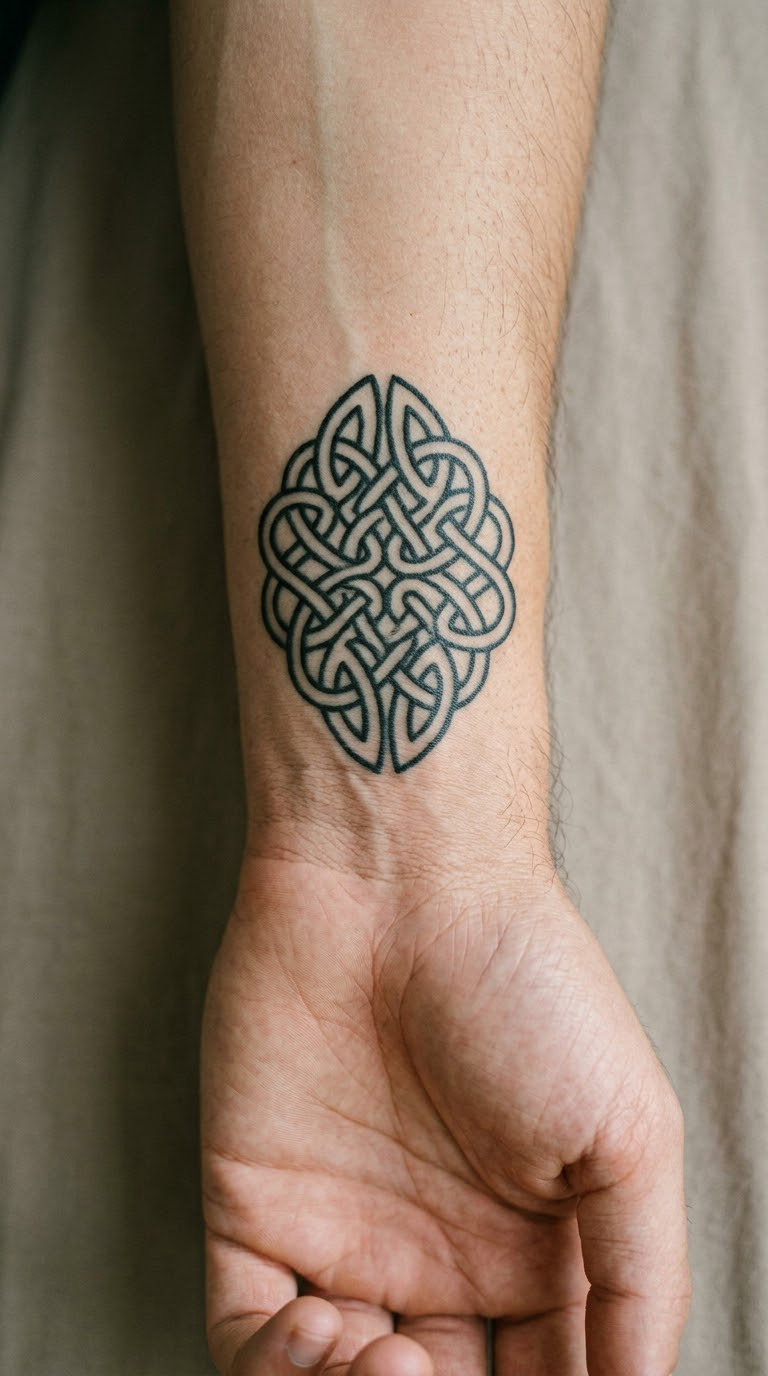
A continuous interlaced knot where one line passes over and under another, with controlled negative space so the crossings read cleanly rather than turning into a black mass. Two or three repeats of the pattern fill the shape.
Celtic knotwork is picked for its visual history and the way it links together, more than for a specific message. Asking for accurate interlacing matters more to most people than any symbolism attached to it.
- Placement: inner wrist, above the elbow crease, or around the ankle
- Size: 2-3 inches (5-7.5 cm) wide, ideally as tall as it is wide
- Style: bold line interlace, sometimes with dotwork in the gaps
- Pain: medium on the inner wrist, and wrist tattoos are fiddly positions that take longer than they look
Wrist line work softens noticeably, partly from daily movement and partly because sleeves and watch straps rub. A touch-up after healing is common here.
Make it yours: choose a knot that echoes a family or place name, or run two knots around the wrist as a band.
10. Filigree Koi on the Calf
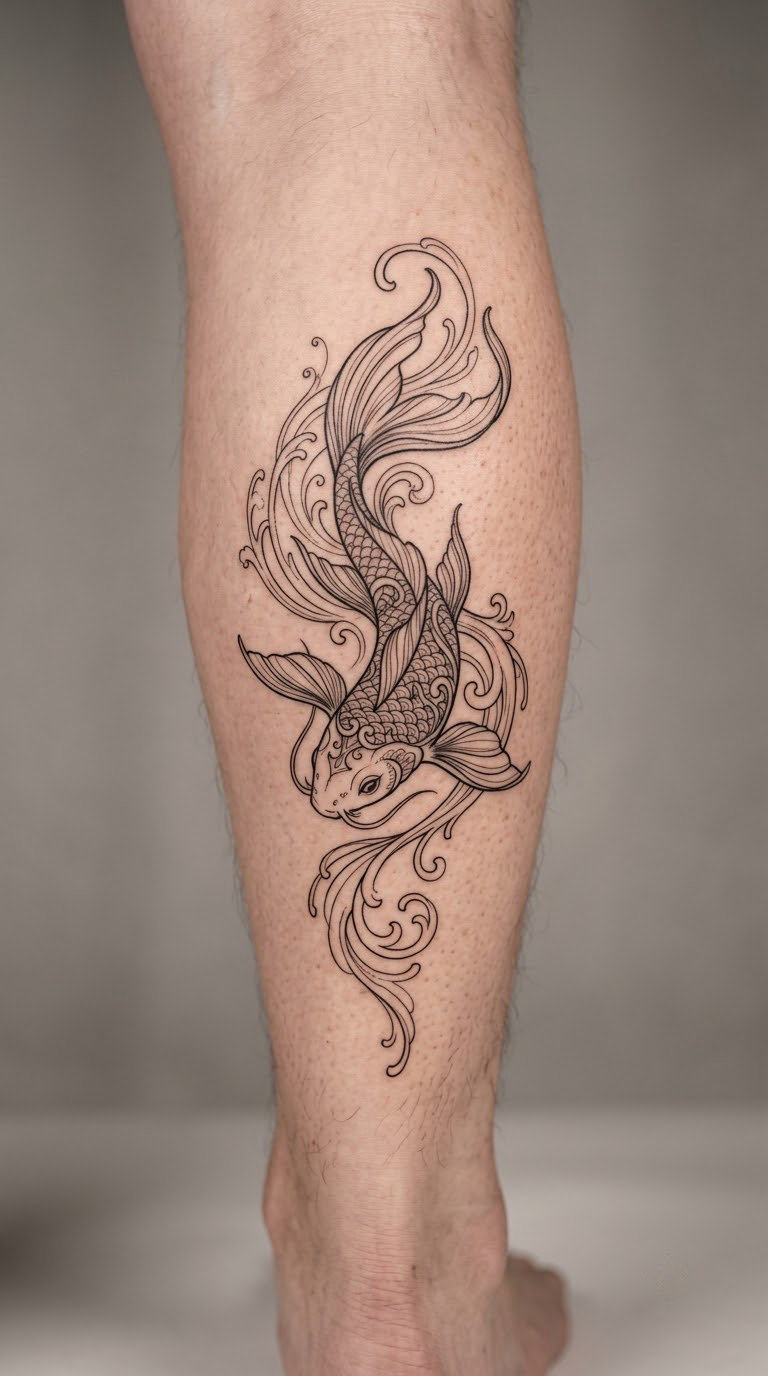
A koi drawn in clean line with looping fins, a lightly scaled body and ornamental water trails curling around it, so the fish looks like it is moving through filigree rather than sitting on top of it. The scales are usually left as an open pattern.
Koi is widely associated with perseverance and with moving against a current, and it is one of the most requested motifs in this style. The ornamental framing is what separates this from a standard Japanese koi.
- Placement: outer or inner calf, which gives a long clean run for the water trails
- Size: 5-7 inches (13-18 cm) long
- Style: illustrative linework, Japanese-inspired composition
- Pain: medium, and the calf curves sharply near the knee
Individual scales are the first detail to disappear. Leaving scale rows a little further apart, or shading alternate rows, keeps the fish legible for longer.
Make it yours: add a single spot of orange or red to one fin, which is enough colour to warm the whole piece.
11. Floral Filigree Lace on the Thigh
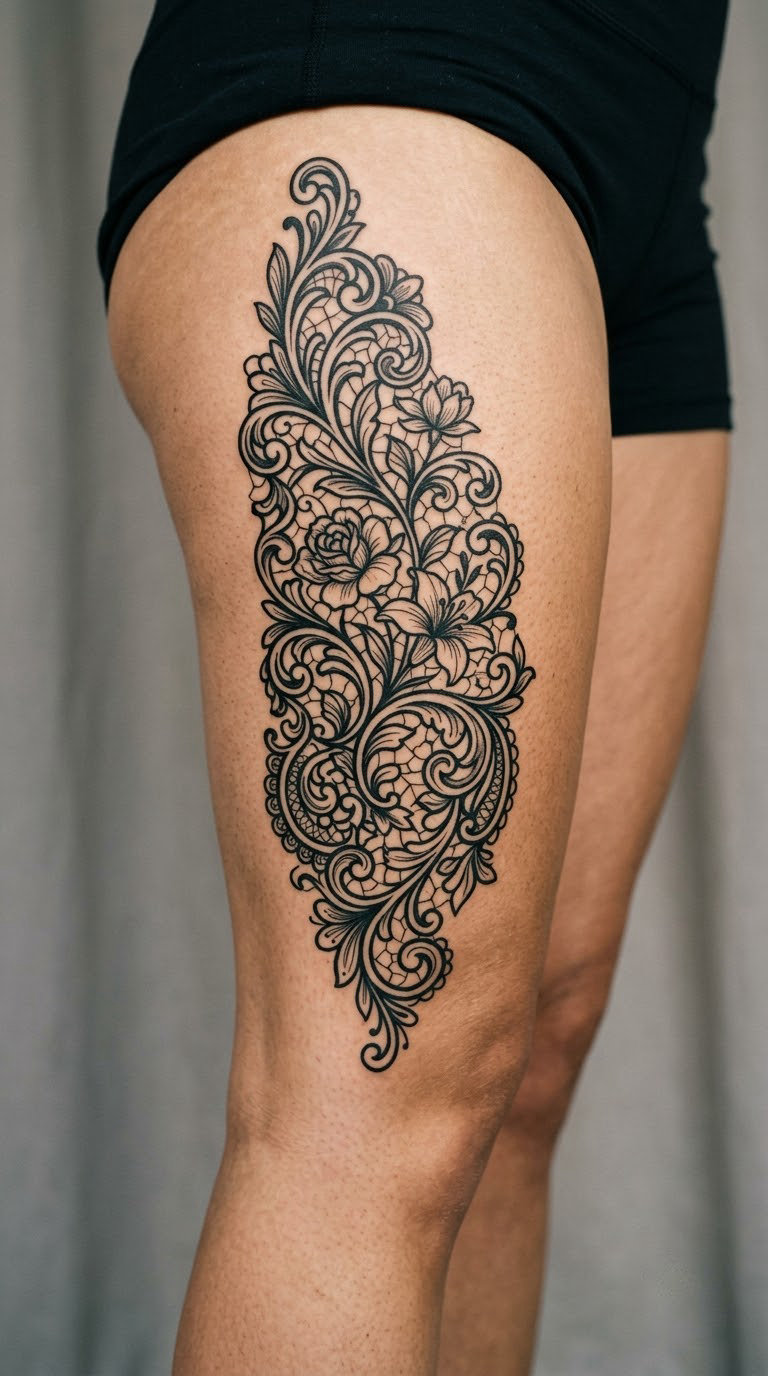
A larger panel of blossoms, buds and scrolling vines connected by fine openwork, arranged so the empty spaces are as important as the lines. This is the one on the list where going big genuinely pays off.
Lace-style panels are chosen for the texture they create on bare skin, and they work well as a standalone piece on a larger canvas or as the base layer of a thigh or hip piece.
- Placement: outer thigh, or across the hip and lower back as a garter band
- Size: 7-10 inches (18-25 cm) across
- Style: blackwork or illustrative with open negative space
- Pain: medium on the outer thigh, and this is a long sitting position
Fine openwork on the thigh fades faster than most areas because of friction and sun. This is the design where a touch-up plan is worth discussing before you start.
Make it yours: coordinate it with a matching band on the opposite thigh in a smaller scale, or add a garter-like line of ribbon beneath the flowers.
12. Minimal Filigree Crescent Moon on the Ankle
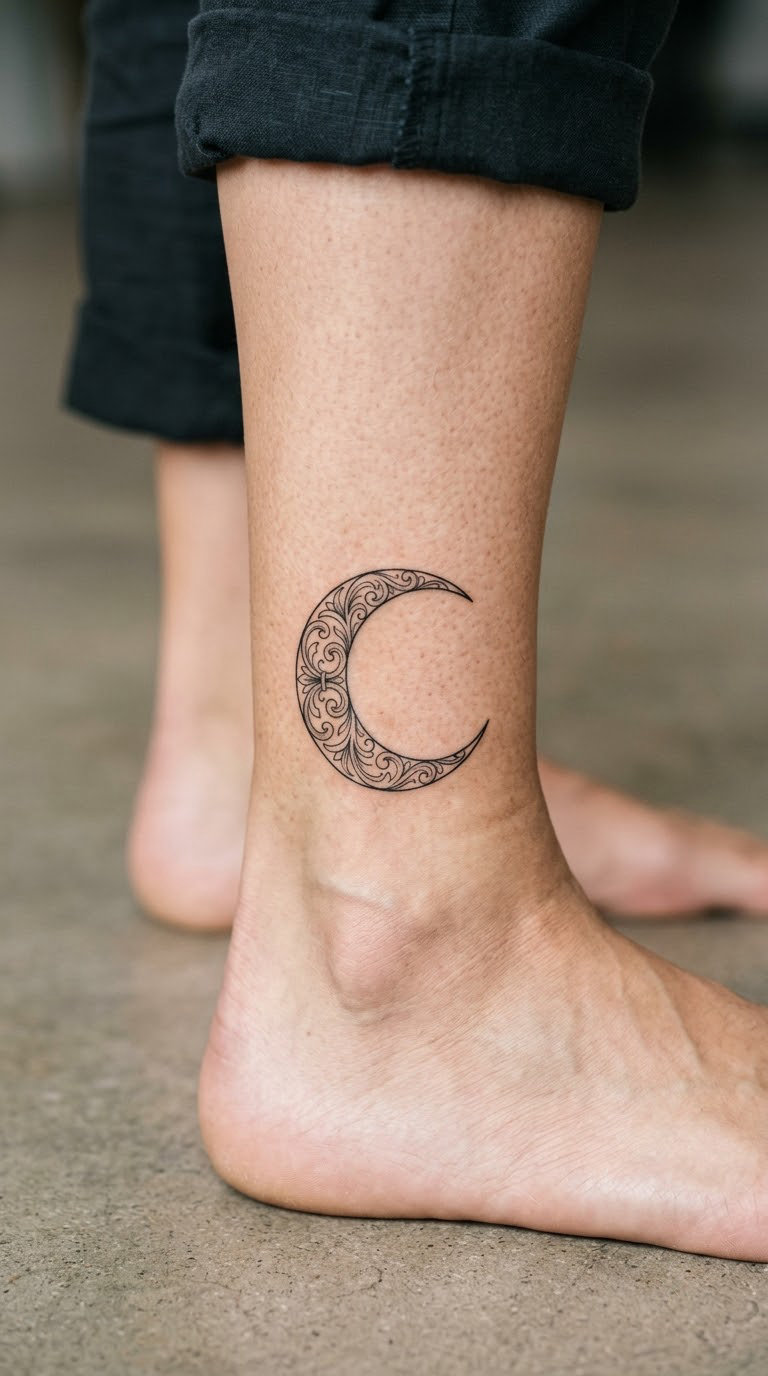
A thin crescent with a small amount of scrollwork tucked into the inner curve, kept sparse so the moon still reads at a glance. One or two tiny stars or dots fill the open side without crowding it.
Moon designs are usually personal rather than symbolic in any fixed way, and this version is aimed at people who want a small piece with a little detail rather than a plain outline.
- Placement: outer ankle above the bone, inner ankle, or behind the ear
- Size: 2-3 inches (5-7.5 cm) tall
- Style: fine line, minimal
- Pain: low to medium; the ankle bone is the sensitive part, so placement matters more than size
Ankle line work takes a beating from socks and shoes. Anything under 2 inches here will need more attention over the years.
Make it yours: add a phase marker in tiny script under the crescent, or a thin chain of dots trailing behind it.
13. Filigree Serpent on the Upper Arm
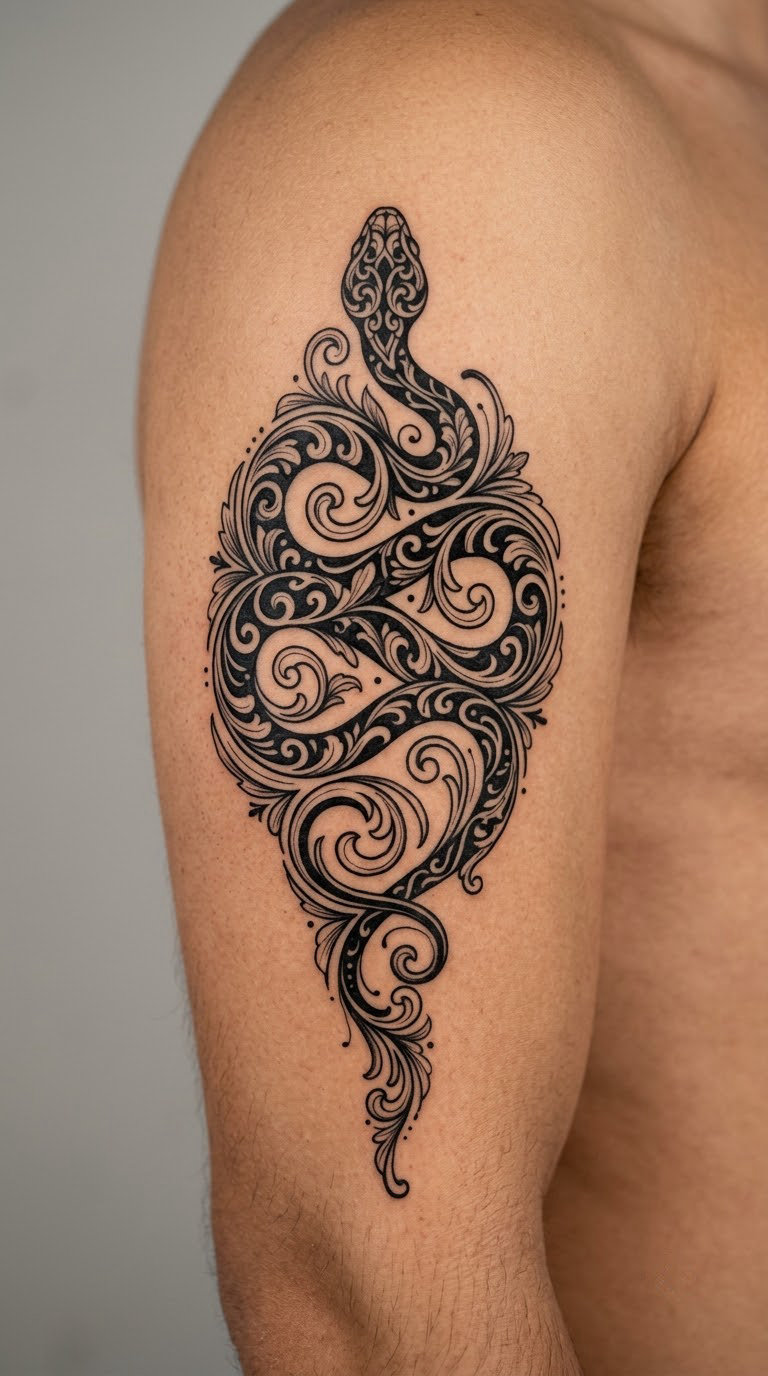
A serpent winding through a handful of ornamental loops, body built from a bold outline with patterned scale fills, head rendered in a non-graphic, natural way. The filigree wraps around the arm rather than sitting flat on it.
Serpent tattoos are chosen for the shedding-skin idea, for transformation, or simply because the shape suits the arm. The winding form is the reason most people pick it over a snake drawn coiled and flat.
- Placement: outer upper arm, or wrapping the forearm
- Size: 6-8 inches (15-20 cm) long
- Style: blackwork with neo-traditional linework, or fine line
- Pain: medium on the outer arm, high right over the bicep crease
Scale patterning in fine dots softens noticeably. A painterly or solid scale style holds its shape much longer than a fine stipple version.
Make it yours: have the tail run around the arm and end under the bicep so it reads as continuing somewhere you cannot see.
14. Art Nouveau Filigree Woman’s Face on the Side of the Neck
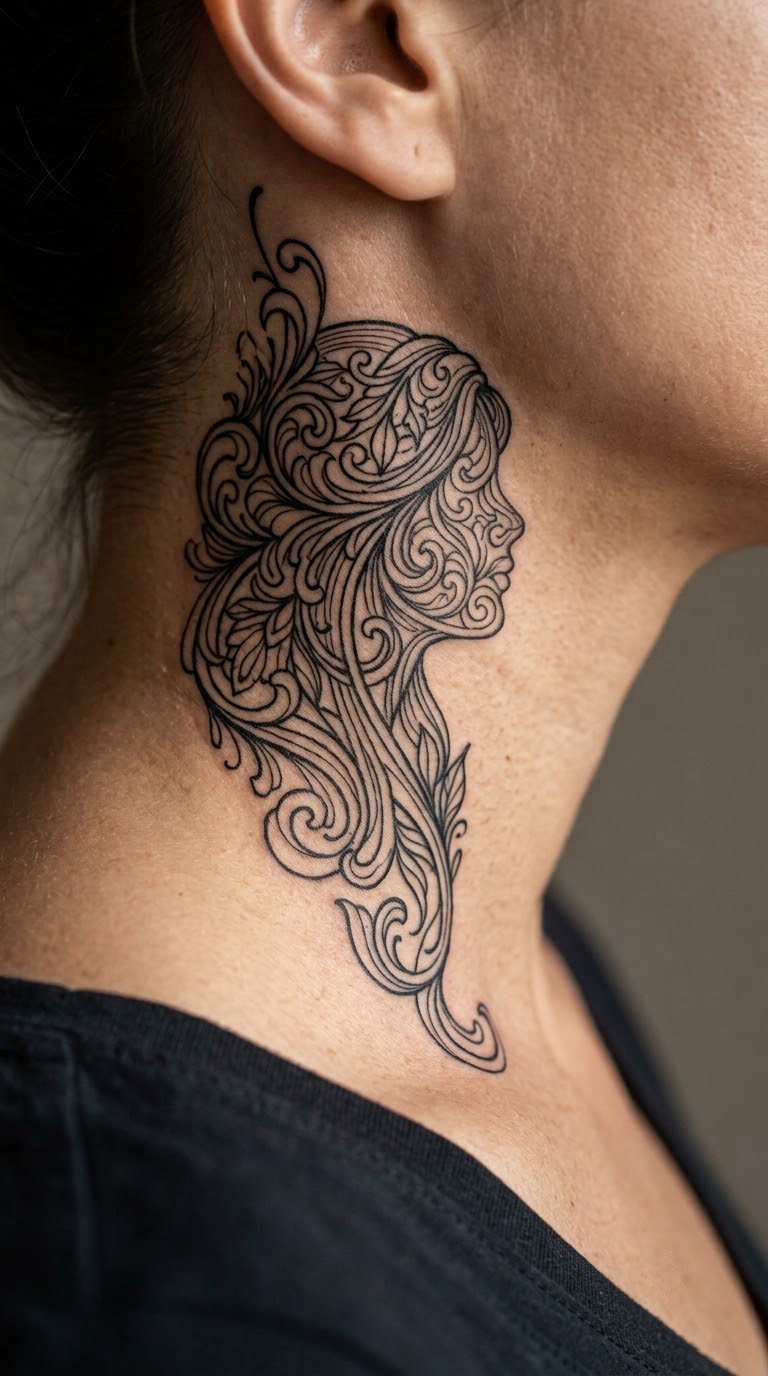
A simplified profile built from flowing hair that turns into leaves and ornamental contours, with the face described in a few confident lines rather than shaded realistically. The hair is where the filigree lives, curling into the neck and jaw.
Profile faces are often about a specific person rather than the style itself. Art Nouveau treatment is the popular choice because the flowing hair hides the construction and looks intentional.
- Placement: side of the neck between the jaw and the collarbone, or behind the ear
- Size: 4-5 inches (10-13 cm) tall
- Style: illustrative fine line, Art Nouveau
- Pain: medium. The neck is thin and mobile, so the position has to be right the first time
Neck lines soften noticeably with age and with sun exposure, and there is little spare skin to move things into. Spend extra time on placement here rather than on the drawing.
Make it yours: turn the profile to face the front, or replace the leaf shapes with small flowers tied to something real.
15. Filigree Compass Rose on the Chest
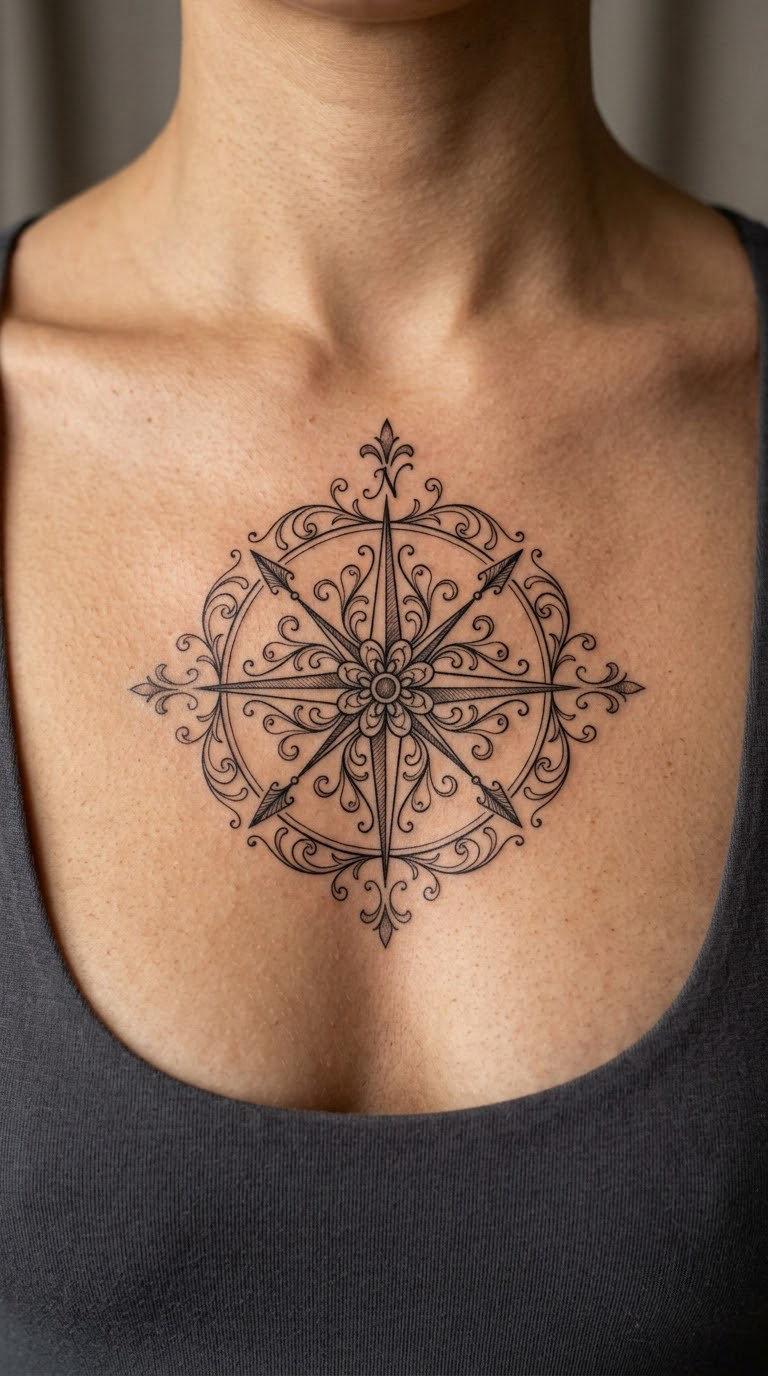
A compass rose with pointed directions and restrained curls between them, drawn in fine line with a slightly heavier outer ring so the shape holds. The centre can carry a small compass rose knot or be left plain.
Compass roses get chosen for direction and for travel, and often for a specific trip or a home place. It is one of the few motifs here where a location story is common.
- Placement: centred on the upper chest, or high on the inner forearm
- Size: 4-6 inches (10-15 cm) across
- Style: fine line blackwork, sometimes with dot shading between the points
- Pain: medium, with the sternum area being the tender part
Symmetrical pieces show any drift in the line over time, so getting it level during the session matters. A slight settle is normal on all tattoos, but it shows more here.
Make it yours: add a latitude and longitude of somewhere that matters, set as tiny text on the outer ring.
16. Filigree Sunburst on the Shoulder Blade
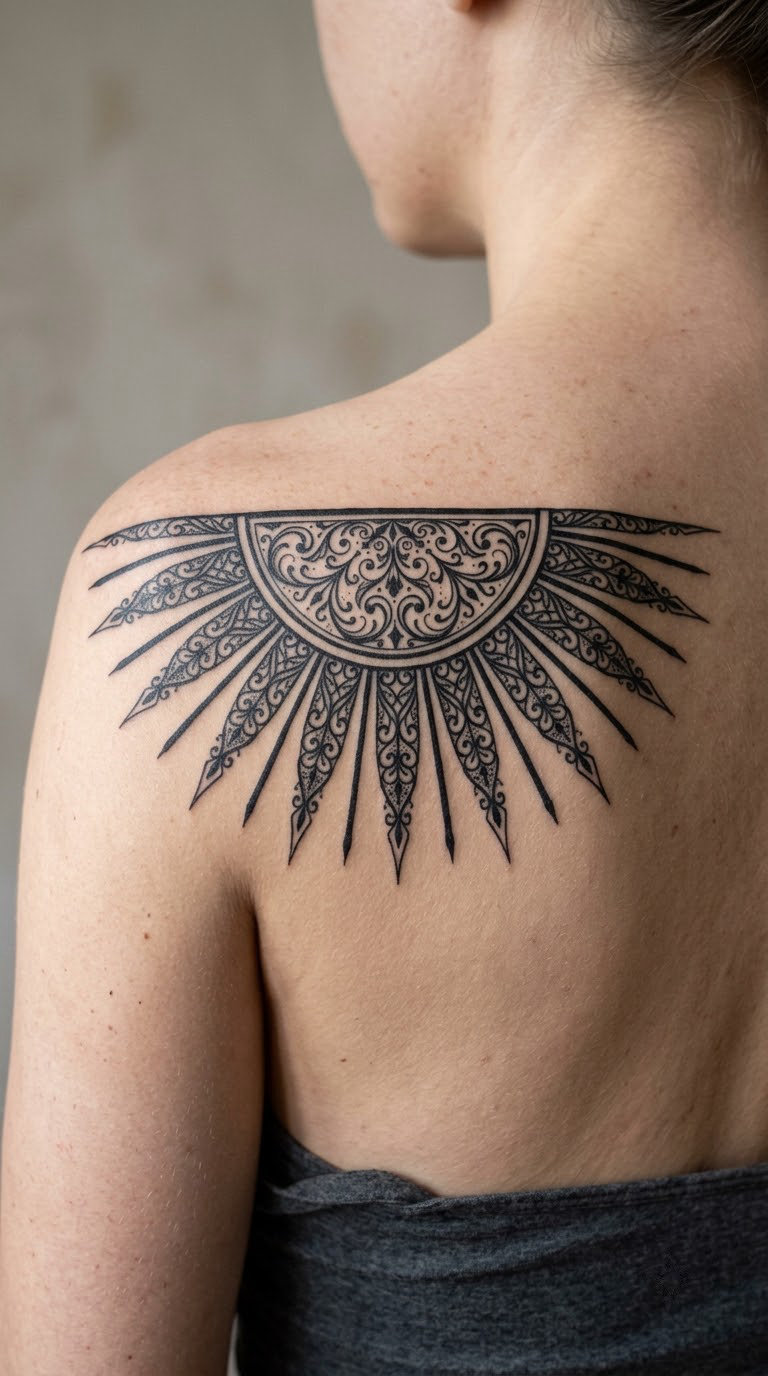
A semicircular sunburst where solid tapered rays alternate with lace-like ones, the way light would fall across a face. The outer edge is usually a simple arc, and the rays narrow towards the base.
Sunbursts tend to be about energy and getting noticed, which is a different intent from most of the quieter pieces on this list. It reads well as the anchor of a back piece.
- Placement: across one shoulder blade, or centred on the sternum
- Size: 6-8 inches (15-20 cm) wide
- Style: blackwork with dotwork in the lace rays
- Pain: medium, and the shoulder blade edge is a sensitive line
The lace rays lose definition faster than the solid ones. Alternating the two styles is partly what makes this design age well, so ask your artist not to make the lace rays too fine.
Make it yours: have the base of the burst sit on a date in script, or repeat it in a smaller form on the opposite blade.
17. Filigree Monogram on the Inner Bicep
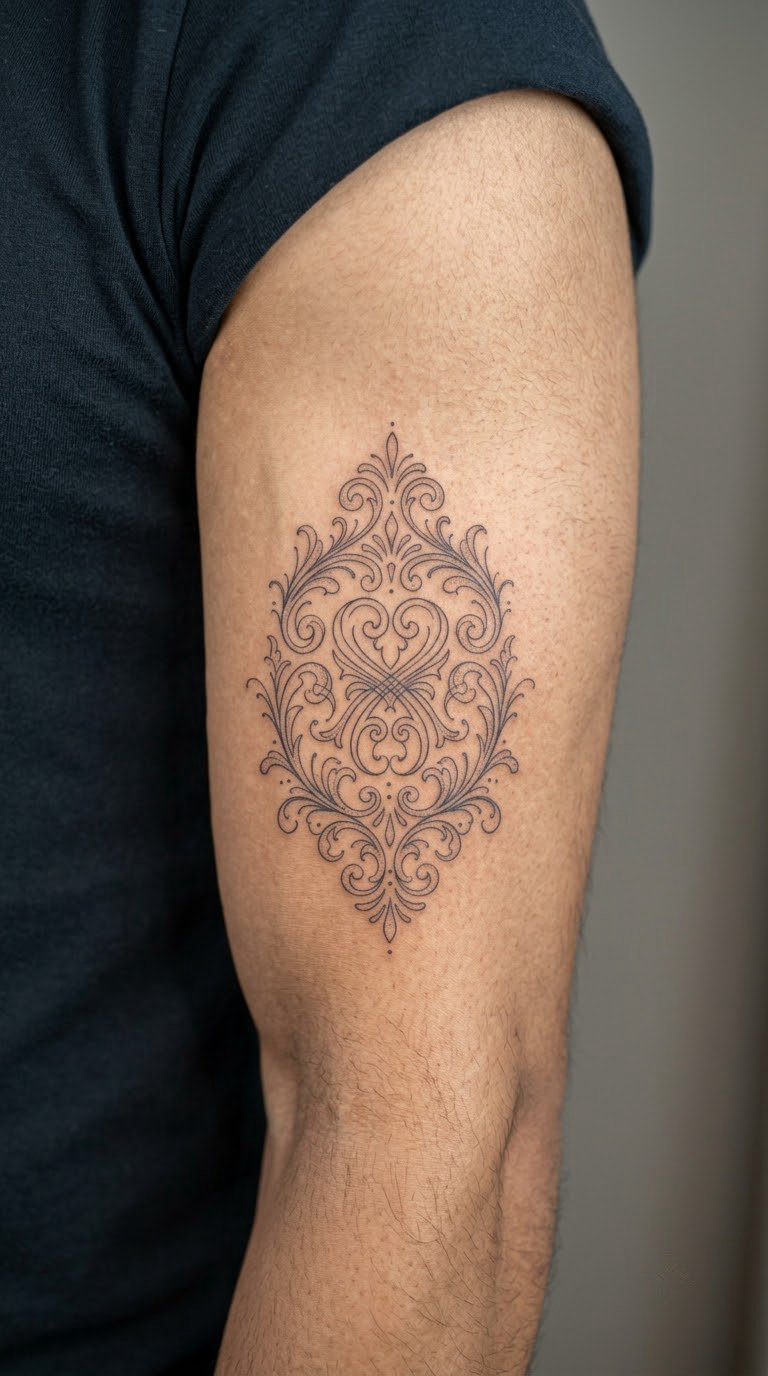
Interlocking initials drawn as calligraphy and framed by restrained scrollwork, with the ornament kept to the corners so the letters stay the loudest part. Thin hairlines and a heavier outline on the letters give the two-part hierarchy.
Monograms are usually about a person, a marriage or an initial someone carries everywhere, and the frame is there to make it look designed rather than stamped.
- Placement: inner bicep, inner forearm, or the back of the shoulder
- Size: 3-5 inches (7.5-13 cm) tall
- Style: calligraphic fine line
- Pain: low to medium. The inner bicep is fleshy and one of the easier spots
Calligraphy hairlines are the first thing to go, so it is worth asking for slightly heavier strokes than the reference shows. The scroll frame should not be finer than the letters.
Make it yours: build the letterforms from a hand you actually sign with, or set a date small enough to read only when you know where it is.
18. Filigree Tree of Life on the Calf
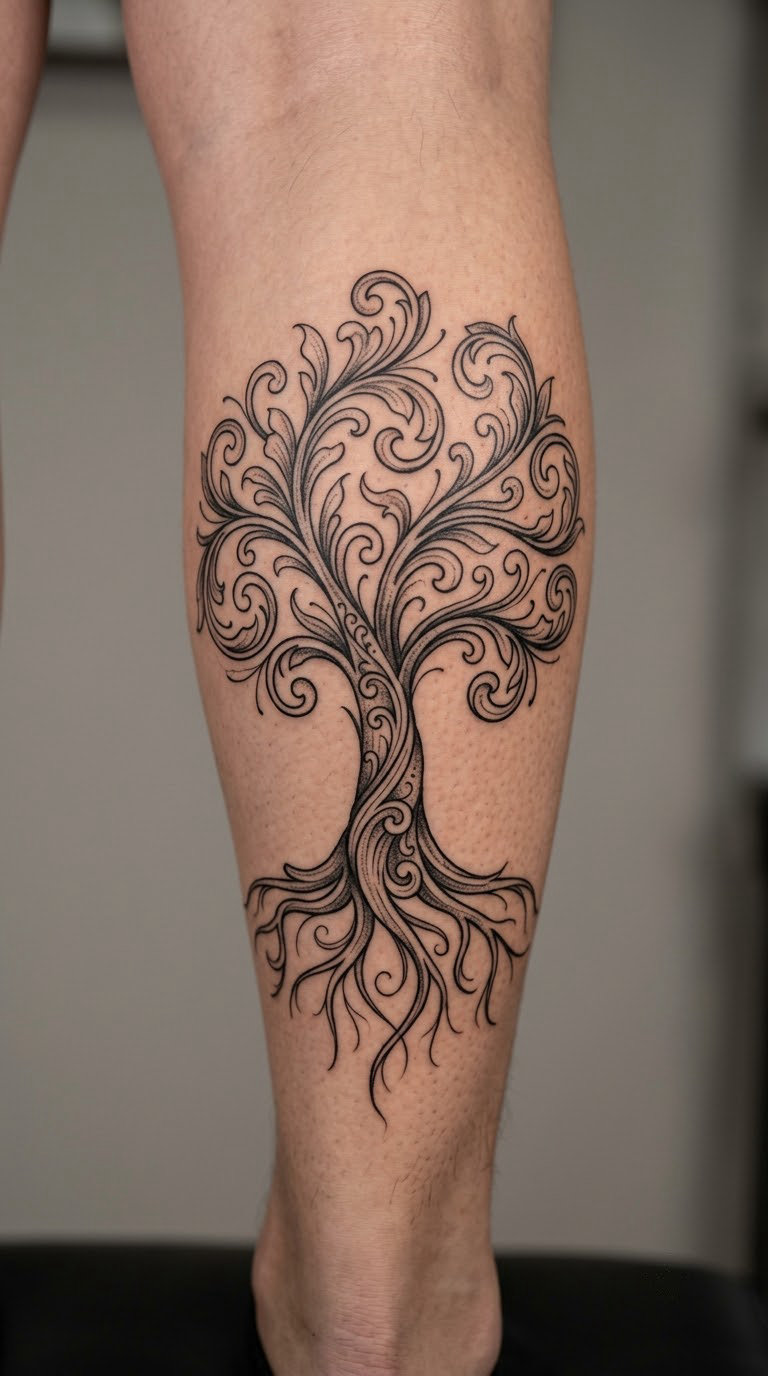
A branching tree with curling leaves and a mirrored root system below, laid out so the branches follow the taper of the calf. Leaves are usually small repeated shapes connected by fine scrollwork, with negative space between the limbs.
The tree of life is one of the most widely recognised growth and longevity symbols, and it is often chosen at a beginning rather than an end, a move to a new place, or a recovery.
- Placement: outer calf, or vertically centred on the back of the arm
- Size: 7-9 inches (18-23 cm) tall
- Style: illustrative blackwork or fine line with stipple
- Pain: medium, on the curve right below the knee especially
The smallest leaves go first, and the calf’s curve compresses detail on the inside of the leg. Keeping leaves larger and slightly fewer makes the tree read better over time.
Make it yours: hang a few small shapes from the branches instead of leaves, or have the roots break into a different pattern on the lower leg.
19. Filigree Eye on the Forearm
A stylised eye with a detailed iris, lashes that turn into rays or petals, and a few decorative marks radiating outward. The almond shape gives the design its structure, and the filigree does the rest.
There is no single agreed meaning for eye tattoos, so people tend to choose it for being watchful, for a person, or simply because they like the shape. Any meaning is worth having worked out before you sit down.
- Placement: inner forearm, sternum, or the back of the hand
- Size: 3-4 inches (7.5-10 cm) across
- Style: fine line with blackwork lashes, or light dotwork in the iris
- Pain: medium, with a sharp pinch on the inner forearm near the wrist
Iris detail is the part that goes grey and indistinct first, so many artists dot it heavily or leave it flatter on purpose.
Make it yours: match the iris colour to a real eye, or build the lashes out of a small repeating motif of your own.
20. Blackwork Filigree Vine on the Hand or Wrist
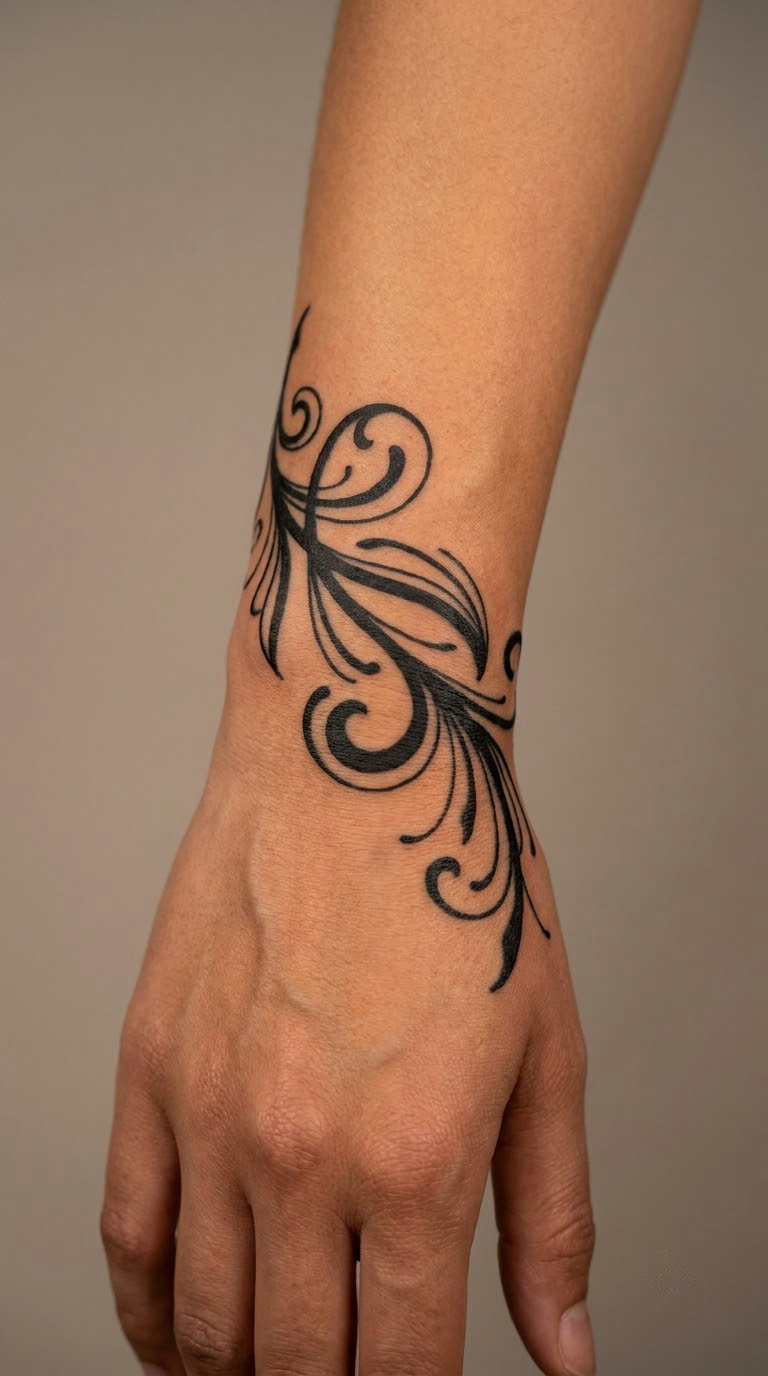
A vine drawn with thick and thin lines rather than single-weight filigree, with a few leaves in solid black and open curls between them. It has the same ornamental logic as the rest of this list, just built heavier for a tough canvas.
Hand and wrist vines are often the first piece in a collection precisely because the skin there is unforgiving. A bolder design saves people from repeating the mistake of a design that blurs within two years.
- Placement: along the wrist and across the back of the hand, or down the inner forearm
- Size: 4-6 inches (10-15 cm) long
- Style: blackwork with thick-and-thin linework
- Pain: high on the hand, where skin, bone and tendon sit right under the needle
Hand tattoos are the fastest-fading placements on this list, through washing, sun and general wear. Planning a touch-up from the start is more realistic than expecting one to be permanent.
Make it yours: grow the vine out from an existing wrist or finger piece, or set the leaves in a dark green that stays quiet at small size.
How to Choose the Right Design
Six things matter more than the motif, and they decide whether the piece still looks sharp in five years.
- Ask for line hierarchy. A heavier primary outline with finer interior detail survives far better than uniform hairlines everywhere. Most good filigree tattoo ideas are built on that two-weight structure.
- Match scale to placement. Fine scrollwork needs 4 inches minimum to stay legible. Below that, choose a bolder or simpler design rather than a smaller version of a detailed one.
- Respect the canvas. Ribs, hands and ankles fade faster than arms and upper backs. If the placement is high-maintenance, either go bigger or go bolder.
- Count the negative space. Open space between curls is what makes filigree look like filigree. A design crammed with detail usually heals into a dark patch.
- Look at healed work, not fresh photos. Ask to see pieces six months healed from the artist you are booking with, not from their Instagram grid. The crispness of healed scrollwork is the real test.
- Plan how it connects. If it is filler or a connector, tell the artist about the existing pieces up front so the flow matches your anatomy rather than ending in a dead end.
Line weight and ageing for filigree tattoo ideas
Fresh tattoo lines always look sharper than healed ones. The realistic expectation is 5 to 10 years before fine detail softens noticeably, and an artist who says otherwise is selling something. Ask what they will do if the piece softens, and whether the design still reads clearly at that stage.
Placement and design scale, side by side
Roughly: anything under 3 inches wants a bold motif, 3 to 6 inches handles a single detailed bloom or knot, and 7 inches or more is where vines, trees and lace panels start to work properly. Pair the size to the part of the body, not to the reference image.
Cost and Session Time
Filigree is priced like any other tattoo: by the piece, the size and how long the artist is sitting with you. Hourly rates in US shops commonly run 120 to 200 dollars, and most studios have a minimum charge in the same region, which covers the smallest designs.
Small pieces: 2 to 3 inches
A butterfly, a crescent or a wrist knot at this size usually runs 150 to 300 dollars and takes well under an hour. The per-hour maths is poor at this size, which is exactly why the shop minimum exists.
Medium and large pieces: 4 to 10 inches
A 4-6 inch motif lands around 400 to 900 dollars, and an 8-10 inch panel or a half-sleeve style piece starts around 1,200 dollars and can go considerably higher with a dedicated artist. Anything past about 5 to 6 hours of detailed line work is normally split across two sessions, which protects both the line quality and your attention span.
Rates vary a lot by city, by artist and by how specialised the work is. Filigree is a specialist skill rather than a walk-in request, and artists who do it well are booked out. Book the consultation and the piece separately, and expect to wait a few months.
Aftercare Basics
Start by following your artist’s aftercare instructions, since they will know exactly how your skin and this piece respond. Everything below is general advice rather than a substitute for that.
- Keep the fresh tattoo clean and gently washed as instructed, then pat it dry rather than rubbing.
- Leave any scabs or flaking skin alone. Picking at it is the most common way a detailed piece ends up patchy.
- Keep it out of direct sun, and once healed treat exposed placements like any other tattoo that needs to keep its colour.
- Skip swimming pools, hot tubs and ocean swimming until the piece is fully healed and closed up.
- Wear loose clothing over it while it settles, since tight fabric catching a fresh scab does real damage to fine line.
- Photograph it at one month, six months and a year. Comparing those shots is how you spot detail loss early and decide whether a touch-up is worth booking.
Frequently Asked Questions
Do filigree tattoos fade over time?
Fine filigree softens faster than heavy blackwork, mostly from sun exposure, movement and daily friction. A realistic expectation is that the smallest curls and dot shading lose definition over 5 to 10 years, while a heavier outer outline holds much longer. Choosing a bolder line weight and avoiding high-exposure placements such as hands, ribs and ankles slows it down noticeably.
Where does a filigree tattoo look best?
Forearms, upper arms, the upper back and outer thighs give filigree the flat, roomy surface it needs. Wrists, ankles, the side of the neck and the area behind the ear work for smaller pieces but see more rubbing, movement and sun. Ribs are popular too, though detail fades faster there than on an arm, so plan for a larger or bolder design in that spot.
Do filigree tattoos hurt more than other tattoos?
Not because of the style itself, but because filigree takes longer. The needle keeps moving through the same area with no rest, so the discomfort builds gradually rather than arriving in one sharp hit. Fleshy spots like the inner bicep and outer thigh are easier than ribs, hands and the inner wrist, where you will feel every pass.
How big should a filigree tattoo be?
Give fine scrollwork at least 4 inches across, otherwise the curls merge as the piece heals. Between 3 and 6 inches suits a single bloom, knot or butterfly. Vine panels, trees and lace designs need 7 inches or more to show their structure. Below 3 inches, choose a bolder motif with a heavy outline rather than a shrunken detailed design.
Can filigree work cover up an old tattoo?
It can, though it is one of the harder cover-ups. Dense ornamental linework and shading absorb older ink far better than an outline alone, so most artists build a dark filigree composition over the old piece. Clearance still depends on the old tattoo’s darkness and colour, and honest artists will tell you at the consultation whether more sessions or a different approach is needed.
Conclusion
For a first filigree tattoo, the fine-line rose or the butterfly behind the ear are the safest bets: small, readable and forgiving if the placement has to change later. For someone already building a collection, the calf tree, the thigh lace panel or the bold hand vine are the ones that become the anchor everything else flows around.
Whichever you pick, bring two or three references, ask the artist to size the design honestly rather than flatteringly, and check healed work from that artist before you book. Filigree is a specialist skill, and the licensed artist whose style already matches your design is the single biggest factor in whether it looks good in five years.