
20 Crescent Moon Tattoo Ideas for Women (October 2026)
If you are searching for crescent moon tattoo ideas for women, the reason this shape keeps coming back is simple: it is small enough to stay quiet, and it carries more meaning than most people expect. The curved lunar form shows a moon in the middle of a cycle, which reads as growth, change and intuition without needing an explanation. For a first tattoo it works because there is nothing cluttered about it. For someone adding to a collection it becomes a base for stars, flowers, script or an entire phase row.
This list covers 20 designs, from a fine-line crescent on the inner wrist to a large composition on the upper arm. Each one tells you what the ink actually looks like, where it sits best, how big to ask for, how it wears over time, and one way to make it yours. If you are booking in the next month or two, talk to a studio early, because spring and summer are when appointment calendars get tight.
Crescent Moon Tattoo Ideas for Women: Quick Guide
| Idea | Style | Best placement | Size | Pain |
|---|---|---|---|---|
| 1. Fine-line inner wrist crescent | Fine line | Inner wrist | 1-2 inch (2.5-5 cm) wide | Low to medium |
| 2. Moon with botanical branch | Fine line botanical | Inner or outer forearm | 2-3 inch (5-7.5 cm) long | Medium |
| 3. Minimal crescent behind the ear | Fine line | Behind the ear | 0.5-1 inch (1.5-2.5 cm) | High |
| 4. Blackwork collarbone crescent | Blackwork | Collarbone | 2-3 inch (5-7.5 cm) wide | Medium |
| 5. Crescent and stars on the shoulder | Fine line celestial | Outer shoulder | 3-4 inch (7.5-10 cm) across | Medium |
| 6. Watercolor upper arm crescent | Watercolor | Outer upper arm | 3-4 inch (7.5-10 cm) tall | Medium |
| 7. Crescent with script on the rib | Fine line script | Side rib | 2-3 inch (5-7.5 cm) tall | High |
| 8. Tiny crescent on a finger | Micro fine line | Side of a finger | 0.4-0.6 inch (1-1.5 cm) | High |
| 9. Dotwork crescent at the ankle | Dotwork | Above the ankle bone | 1.5-2 inch (4-5 cm) | Medium to high |
| 10. Traditional crescent and rose | Traditional | Outer thigh | 4-6 inch (10-15 cm) tall | Medium |
| 11. Crescent with eye on the sternum | Fine line symbolic | Sternum | 2-3 inch (5-7.5 cm) tall | High |
| 12. Geometric crescent on the hip | Geometric | Upper outer hip | 3-4 inch (7.5-10 cm) wide | Medium |
| 13. Crescent and sun on the forearm | Minimal line | Inner forearm | 2-3 inch (5-7.5 cm) across | Medium |
| 14. Floral crescent at the nape | Fine line floral | Back of the neck | 1.5-2.5 inch (4-6 cm) wide | High |
| 15. Moon phase composition on the calf | Fine line illustrative | Outer calf | 4-5 inch (10-13 cm) tall | Medium |
| 16. Gothic blackwork upper back crescent | Ornamental blackwork | Between the shoulder blades | 4-6 inch (10-15 cm) wide | High |
| 17. Crescent above a mountain range on the arm | Fine line illustrative | Outer forearm | 3-4 inch (7.5-10 cm) long | Medium |
| 18. Circular stamp crescent on the bicep | Fine line stamp | Outer bicep | 2-2.5 inch (5-6 cm) diameter | Medium |
| 19. Pastel crescent on the wrist | Soft pastel | Top of the wrist | 1-1.5 inch (2.5-4 cm) wide | Low to medium |
| 20. Large crescent upper arm piece | Black and grey | Outer upper arm | 6-8 inch (15-20 cm) tall | Medium |
1. Fine-Line Crescent Moon on the Inner Wrist
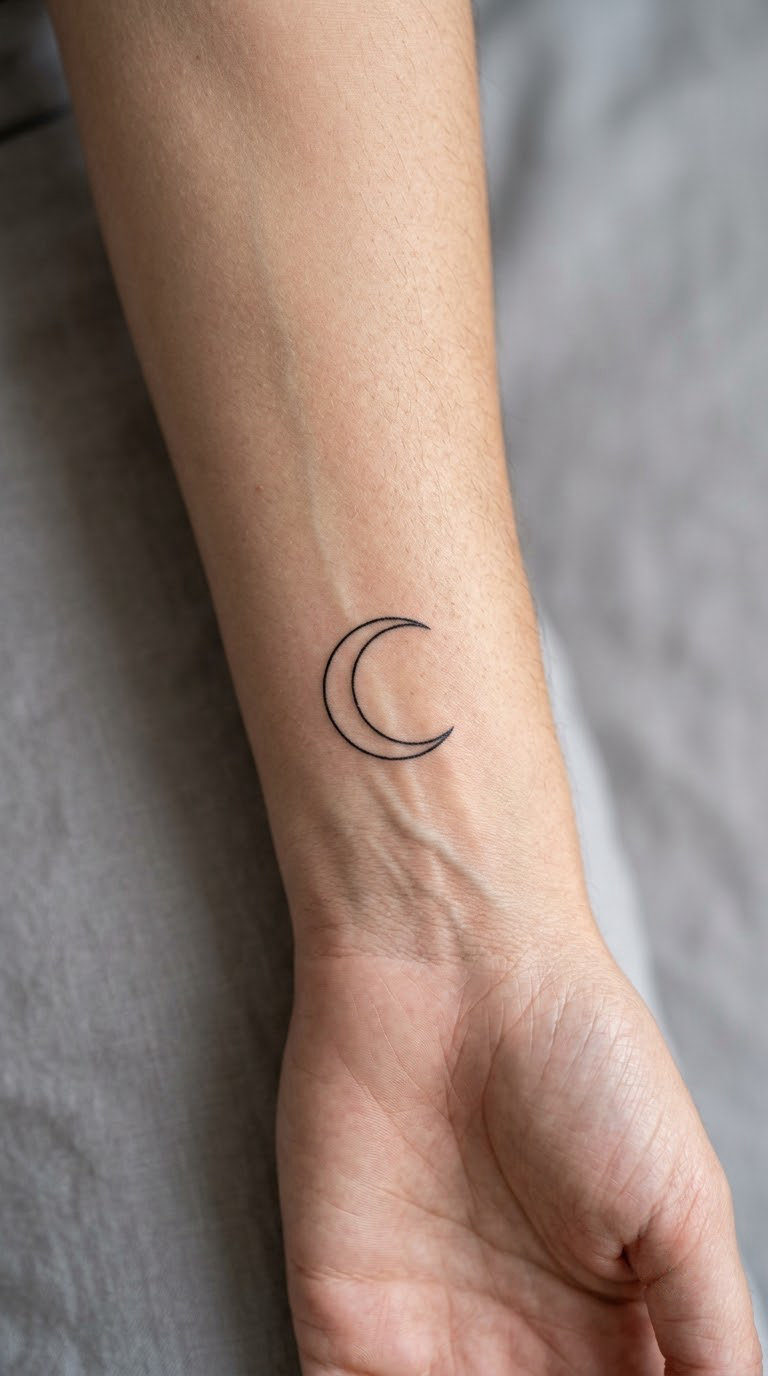
A single crescent drawn with one clean tapered line, thickest at the belly of the curve and thinning toward both horn tips, is the quietest option in this whole list. There is no shading, no frame and no companion imagery, so the eye reads one shape and stops. Most people asking for crescent moon tattoo ideas for women start here, and it is the one I would suggest to someone getting ink for the first time.
Placement: inner wrist just above the bone, or the soft inner forearm a few inches up. Size: 1 to 2 inches (2.5 to 5 cm) wide. Style: fine line. Pain: low to medium, a scratchy feeling that fades once the outline is in. Ageing: wrists get sun and hand washing, so keep the line at least a millimeter wide or it will soften within a couple of years.
Make it yours: add a hairline dot inside the curve for a star, or place the crescent above a small date in the same weight.
2. Crescent Moon with Botanical Branch on the Forearm
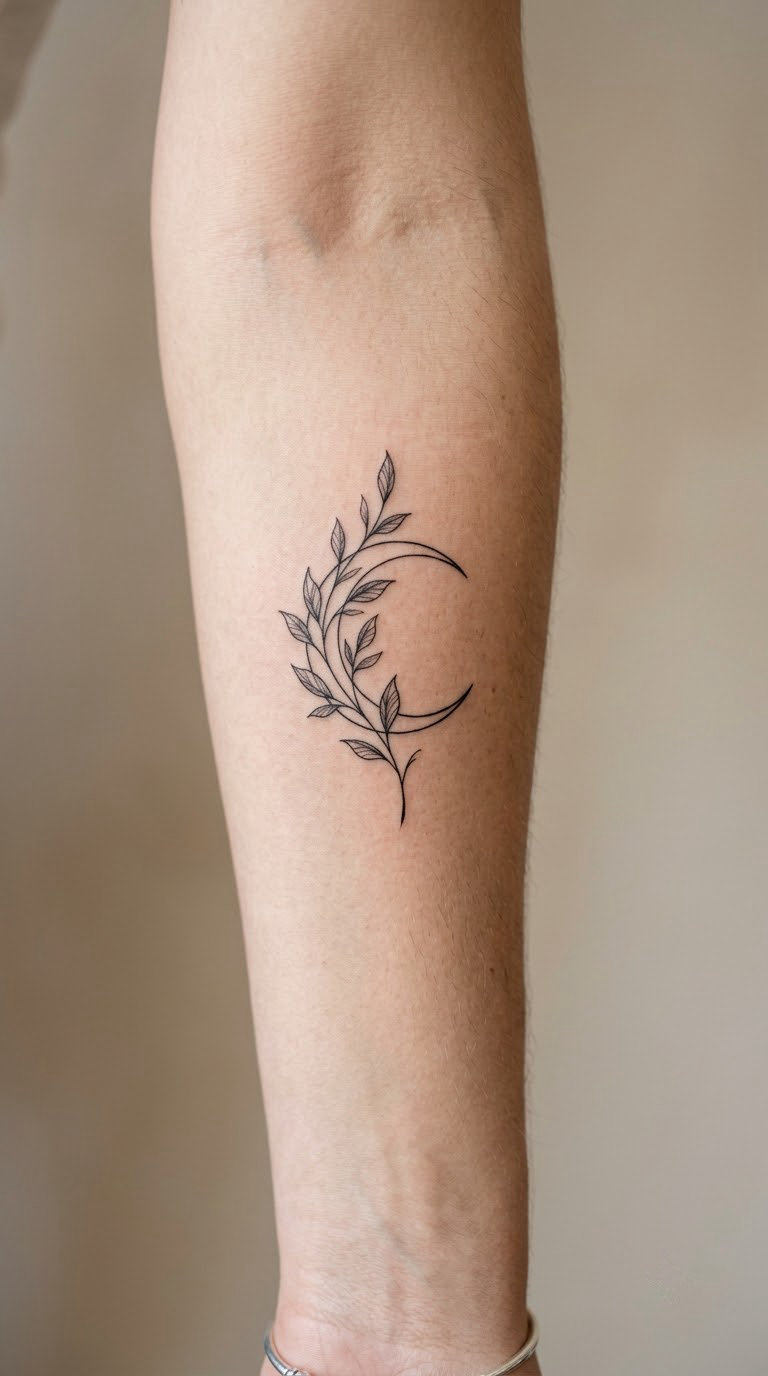
This is a crescent paired with a slim branch of leaves that curves around the outside of the moon, the two shapes meeting at a single point. Botanical work ages well because leaves have natural thickness changes that hide minor line softening, and it softens the geometry of the moon without adding noise. It reads feminine without being floral-heavy, which is why it keeps appearing in searches for crescent moon tattoo ideas for women.
Placement: inner or outer forearm running lengthwise, or along the shoulder blade edge. Size: 2 to 3 inches (5 to 7.5 cm) long. Style: fine line botanical. Pain: medium, mostly a constant scratch over a larger area. Ageing: the moon is the fragile part here, so ask the artist to widen the horn gap.
Make it yours: swap the branch for a sprig of the plant that means something to you, or add one berry or seed in the same line weight.
3. Minimal Crescent Moon Behind the Ear
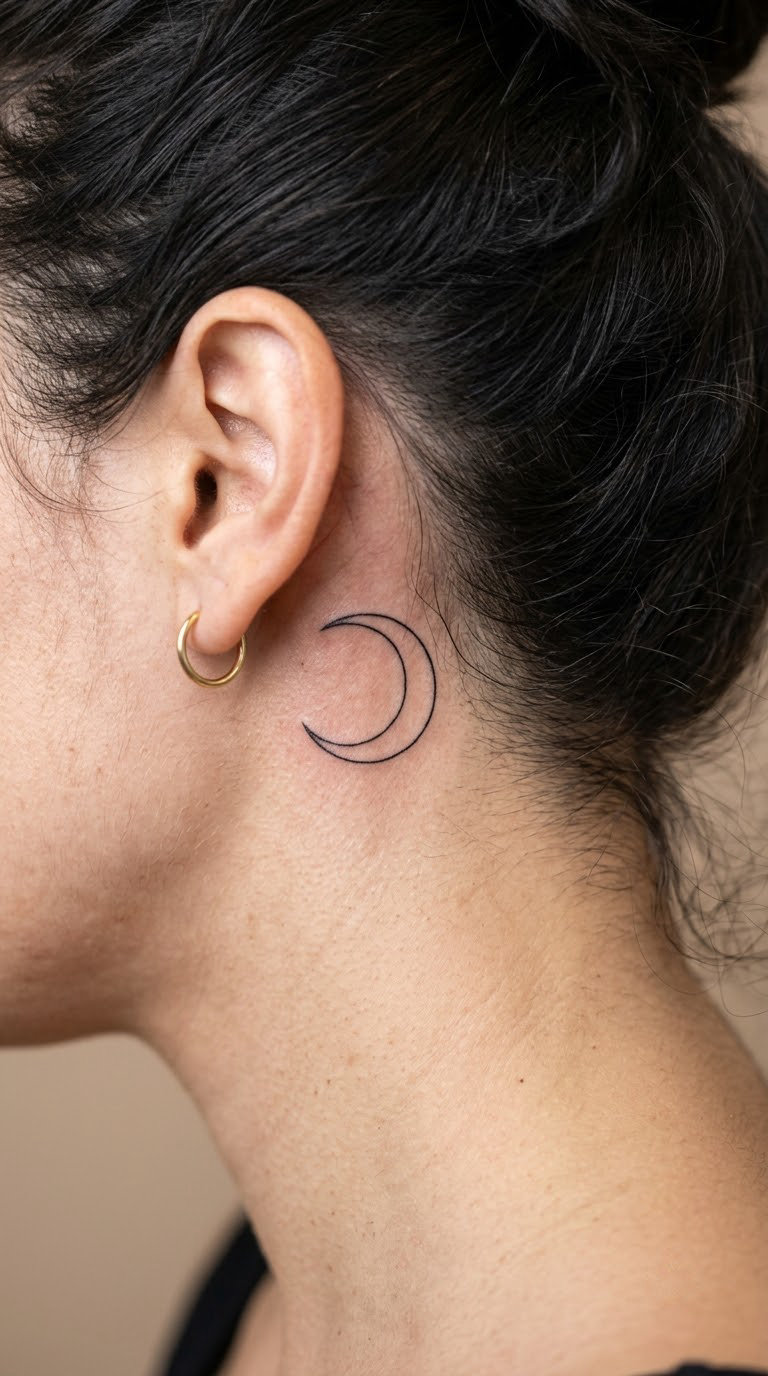
A small crescent tucked behind the ear, with only the lower curve visible from most angles, is the design people ask for when they want a tattoo that is entirely their own business. It shows when your hair is up and disappears when it is down. Our guide to behind the ear tattoo ideas for women covers the mechanics if you have never had one done there.
Placement: directly behind the ear on the flat cartilage, or a few millimetres below the lobe. Size: 0.5 to 1 inch (1.5 to 2.5 cm). Style: fine line, single crescent, no extras. Pain: high, thin skin over cartilage and a spot that never stops moving. Ageing: hair covers it, which is an advantage, but sun exposure on the neck is the one to watch.
Make it yours: place the horns pointing down toward the neck, or up toward the crown, and match it with a second small crescent behind the other ear.
4. Blackwork Crescent Moon on the Collarbone
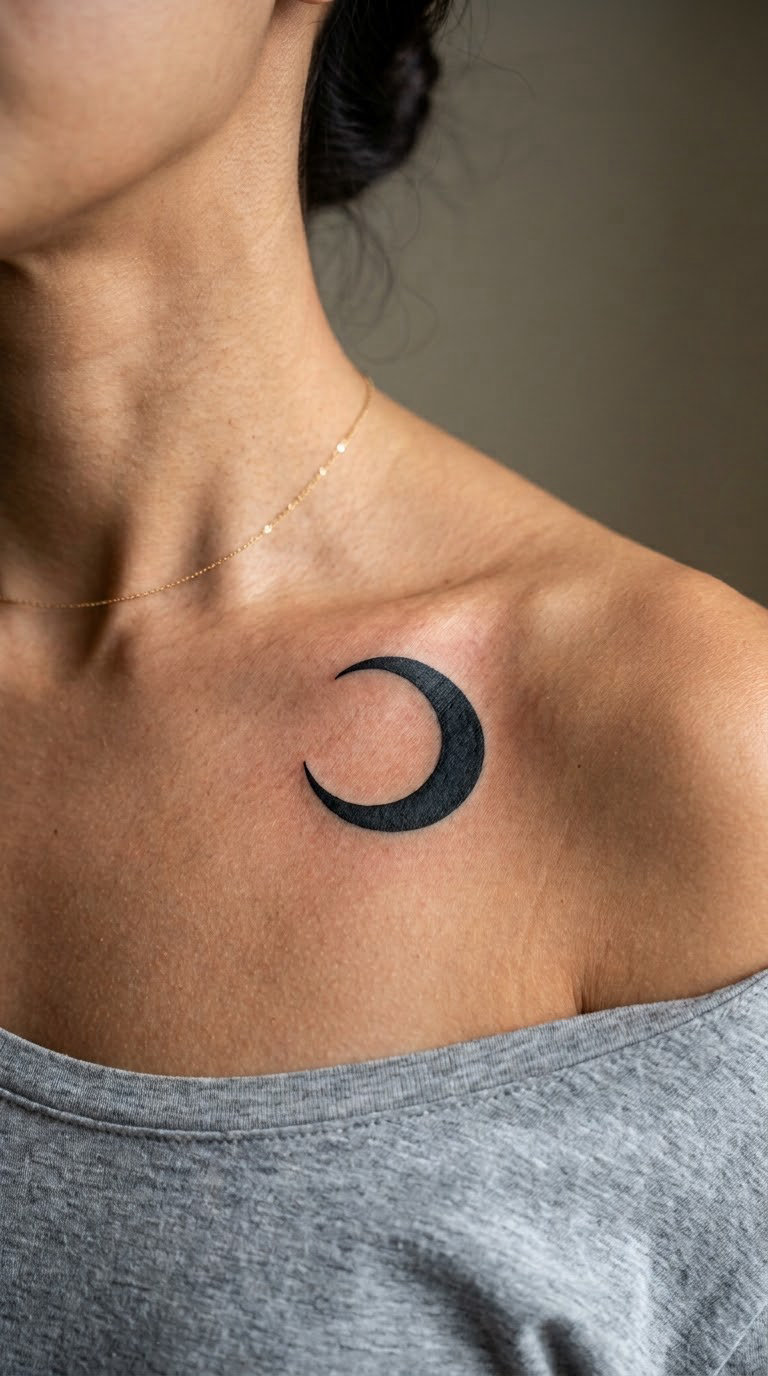
A solid black crescent sitting in the hollow above the collarbone is the high-contrast option, and contrast is exactly what holds up on that bone. The curve follows the natural line under the neck, so it looks intentional rather than placed. It is bolder than the fine-line designs here, which makes it work for someone who wants one tattoo to carry a whole arm of presence.
Placement: above the collarbone on one side, or centred between the collarbones. Size: 2 to 3 inches (5 to 7.5 cm) wide. Style: blackwork. Pain: medium, more vibration than sting. Ageing: filled black holds contrast well, but shoulders move constantly, so ask for clean edges with no paper-thin fill near the horns.
Make it yours: outline the crescent with a thin negative gap inside the black, or reverse it to a waning shape with the opening facing the other shoulder.
5. Crescent Moon and Stars on the Shoulder
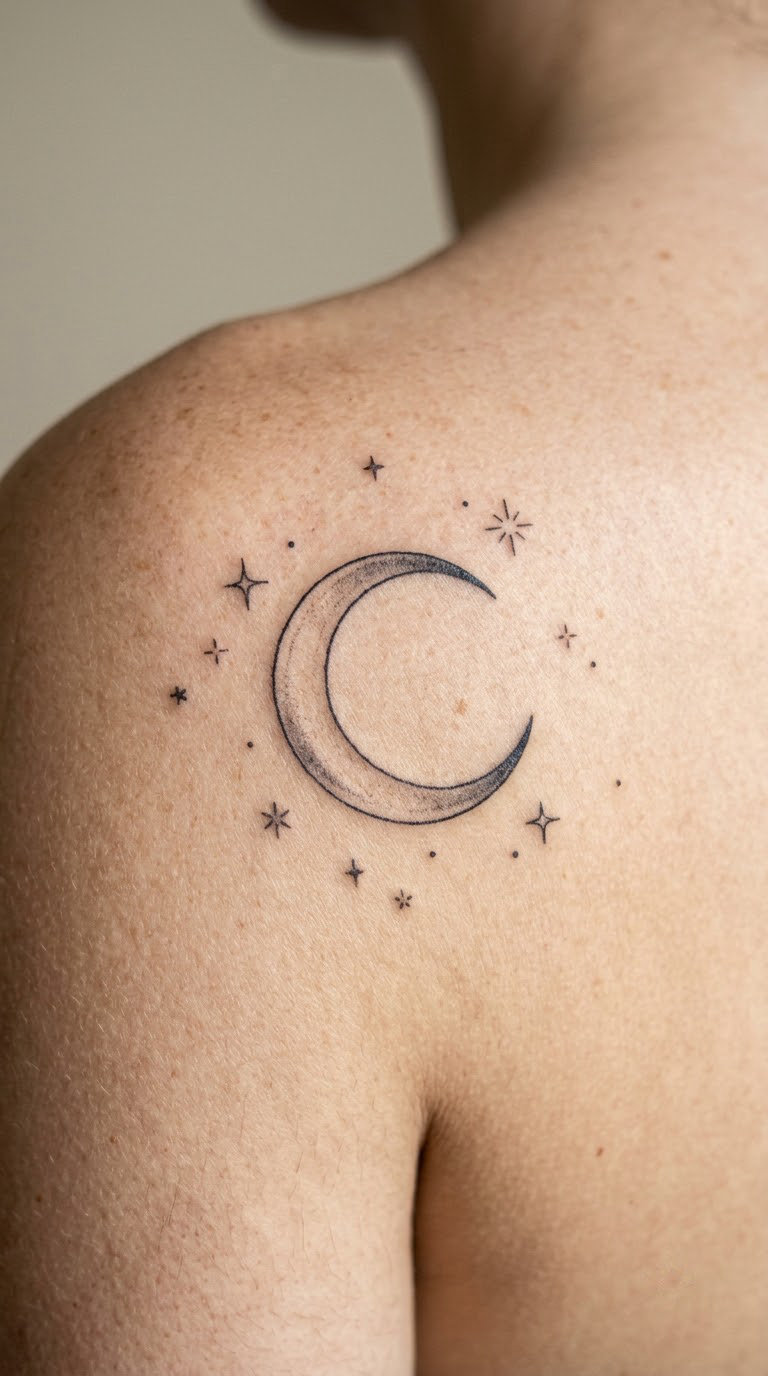
A central crescent with a restrained scatter of four-point stars around it, spaced unevenly so it looks like a sky rather than a sticker sheet. The trick is restraint: too many stars and the moon disappears into a pattern. This composition works on the shoulder because the curve of the deltoid already suggests orbit, so the design looks placed before the first line goes in.
Placement: outer shoulder, or wrapping slightly toward the upper back. Size: 3 to 4 inches (7.5 to 10 cm) across. Style: fine line celestial, mixed weight stars. Pain: medium over the shoulder cap, less sensitive than the inner arm. Ageing: stars are the detail that softens first, so request a minimum dot size of about a millimeter.
Make it yours: use three stars in a row like the three nearest stars from your birth sky, or add a thin connecting line between two of them to make a constellation.
6. Watercolor Crescent Moon on the Upper Arm
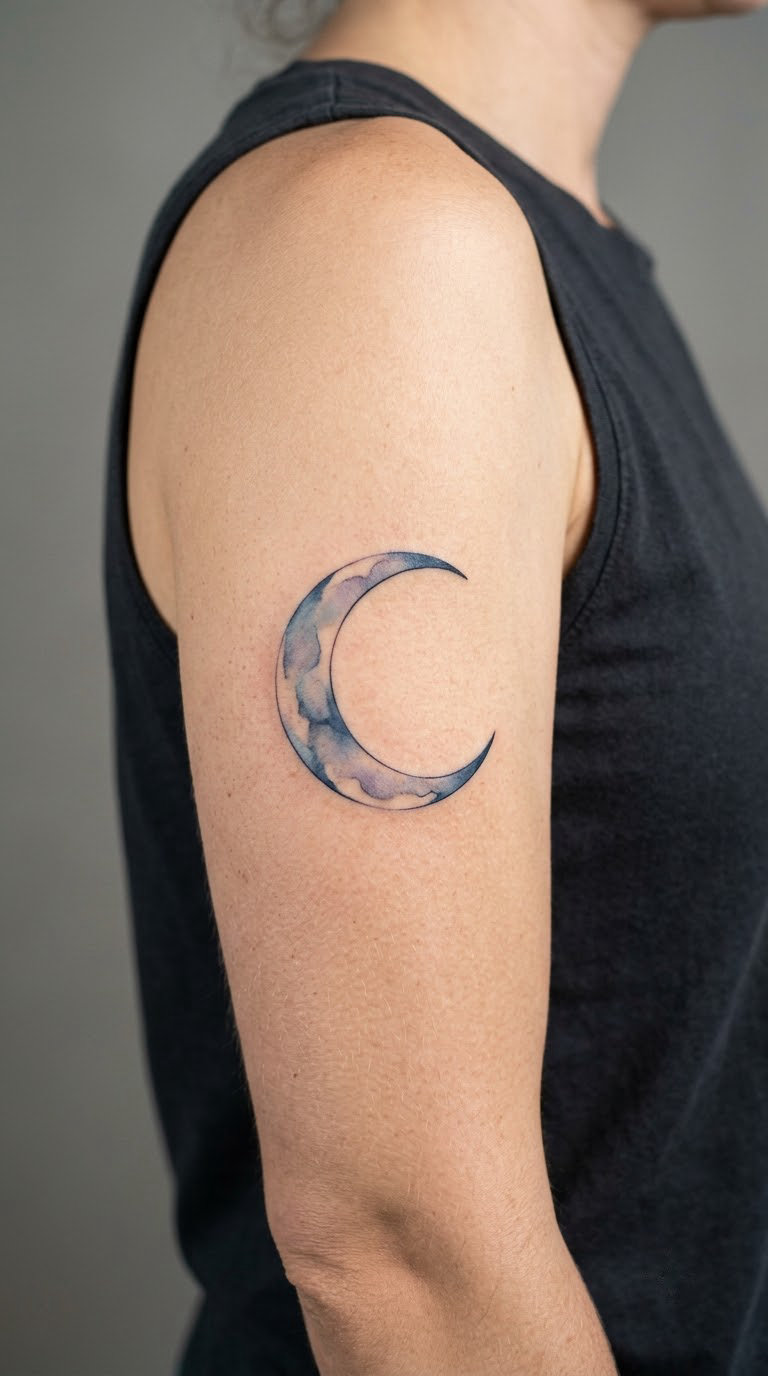
Soft washes of blue, lavender and grey bleeding slightly past the line of the moon give this version a dreamy, hand-painted look rather than a drawn one. Watercolour suits the crescent because the shape already has a soft subject; the medium adds bleed where you want softness and hard line where you want structure. It needs an artist who works in colour regularly, not just someone who can draw black.
Placement: outer upper arm, or the back of the arm near the tricep. Size: 3 to 4 inches (7.5 to 10 cm) tall. Style: watercolor with a light line border. Pain: medium, similar to a solid black pass. Ageing: pale washes fade toward grey in sunlight, so expect the lavender to mute over time.
Make it yours: pick the two colours that match your hair or birth month, and keep the border line thin so the wash is the main event.
7. Crescent Moon with Celestial Script on the Side Rib
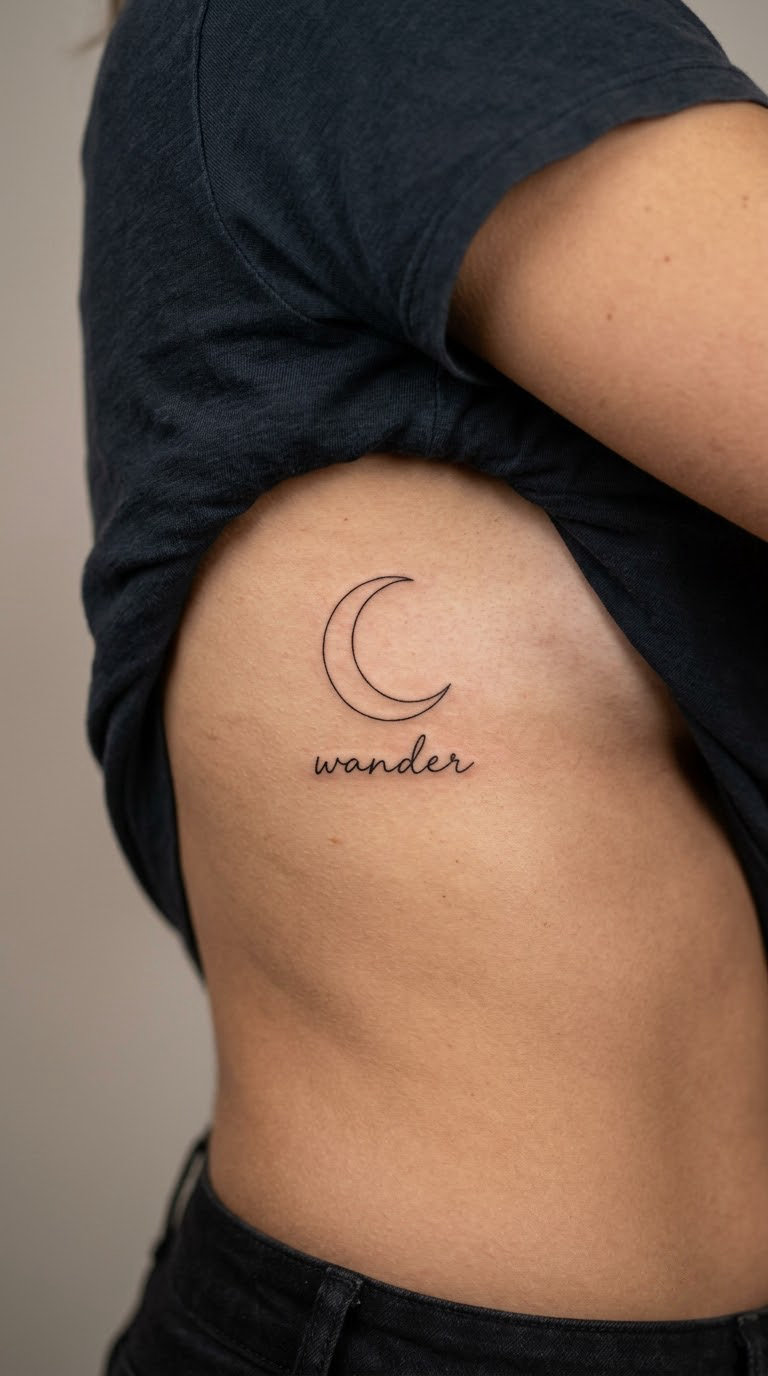
A small crescent at the top with one short handwritten word underneath, such as a name, a date in numerals, or a single word you keep coming back to, creates a vertical piece that follows the rib line. The scale relationship matters more here than anywhere else: the script has to be large enough to read from arm’s length, or it turns into a smudge that no one can make out.
Placement: along the side ribs, or the inner forearm where there is more flat surface for lettering. Size: 2 to 3 inches (5 to 7.5 cm) tall overall. Style: fine line with handwritten script. Pain: high, ribs are close to bone and thin skin. Ageing: script thins out over time more than almost anything else, so ask for a heavier hand than feels right in the chair.
Make it yours: set the word along the curve of the rib so it follows the line rather than sitting straight across it.
8. Small Crescent Moon on the Finger
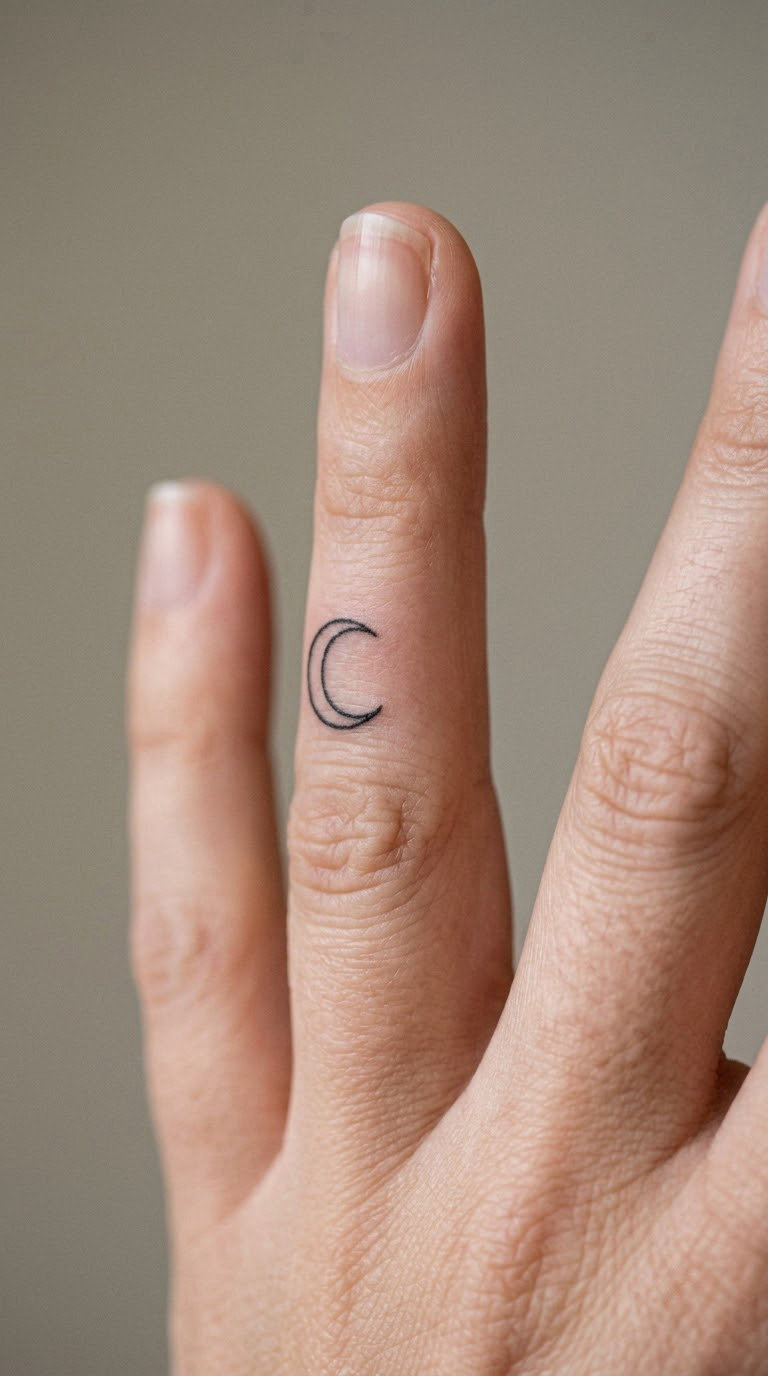
Half a centimetre of solid black crescent on the side of a finger is the smallest, most committed design in this list, and the one that says the most about someone. It works because a crescent is a closed, recognisable shape even at tiny scale, where a detailed design would be unreadable. Bump the size up a little and you can add a single dot inside the curve.
Placement: side of the ring finger, index finger, or thumb. Size: 0.4 to 0.6 inch (1 to 1.5 cm). Style: micro fine line, solid fill. Pain: high, fingers are bony and constantly in use. Ageing: hands fade fastest of any body part, and gloves only go so far, so plan on a touch-up in a few years.
Make it yours: place a matching micro crescent on the opposite hand, or on your partner’s hand, at the same height.
9. Dotwork Crescent Moon on the Ankle
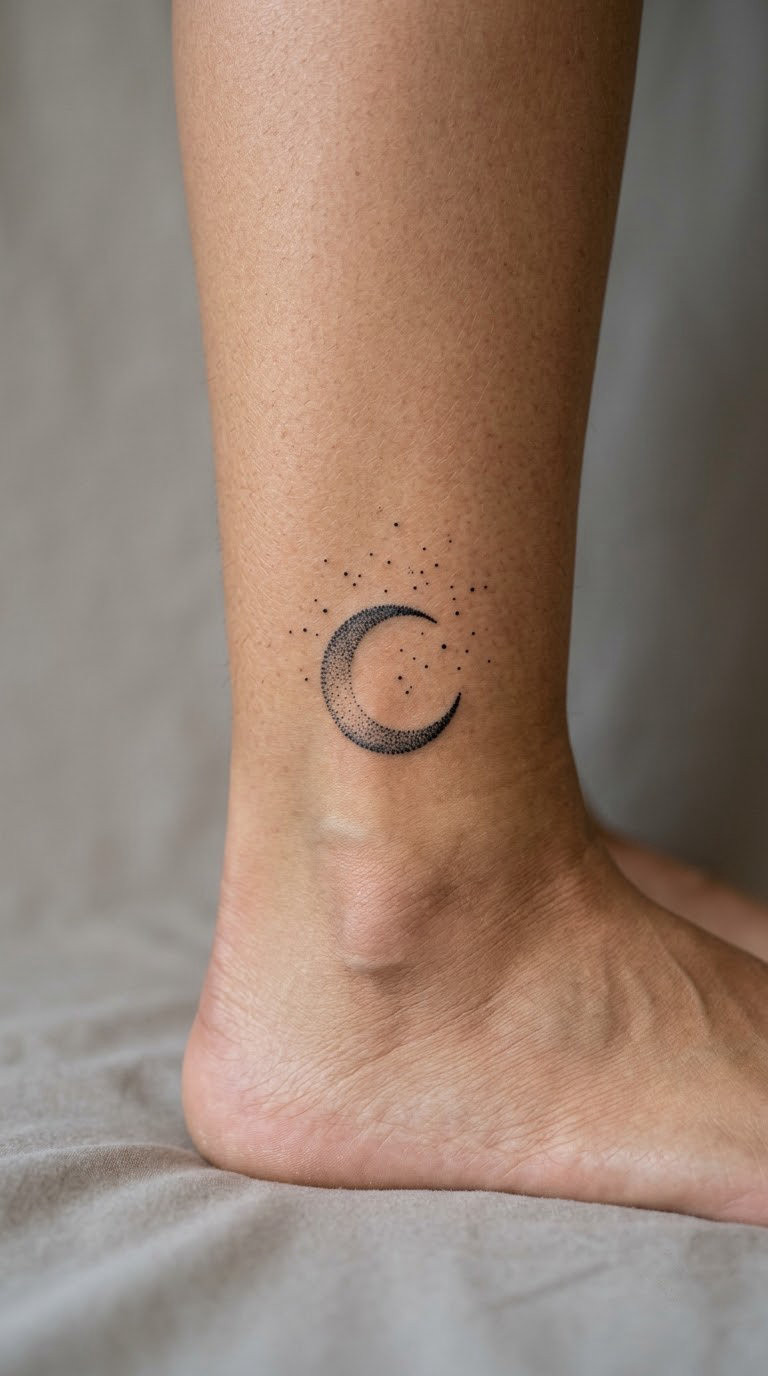
The moon is built from a gradient of dots, dense along the outer arc and thinning toward the horns, with a handful of loose dots scattered outside the curve. Dotwork gives a solid shape the visual softness of shading without relying on grey wash, and it hides minor line spread because there is no single line to thicken. It is a good middle ground for people who find flat blackwork too heavy.
Placement: just above the ankle bone on the inner side, or behind the ankle where the bone line is clean. Size: 1.5 to 2 inches (4 to 5 cm) wide. Style: dotwork. Pain: medium to high, ankle bone is close to the surface and the skin is thin. Ageing: individual dots can blur together over time, so ask for a minimum dot diameter of about a millimeter.
Make it yours: shape the dot density to echo a gradient, such as darkest at the belly and light at the tips, or use it as a companion to a matching dot on the other ankle.
10. Traditional Crescent Moon and Rose on the Thigh
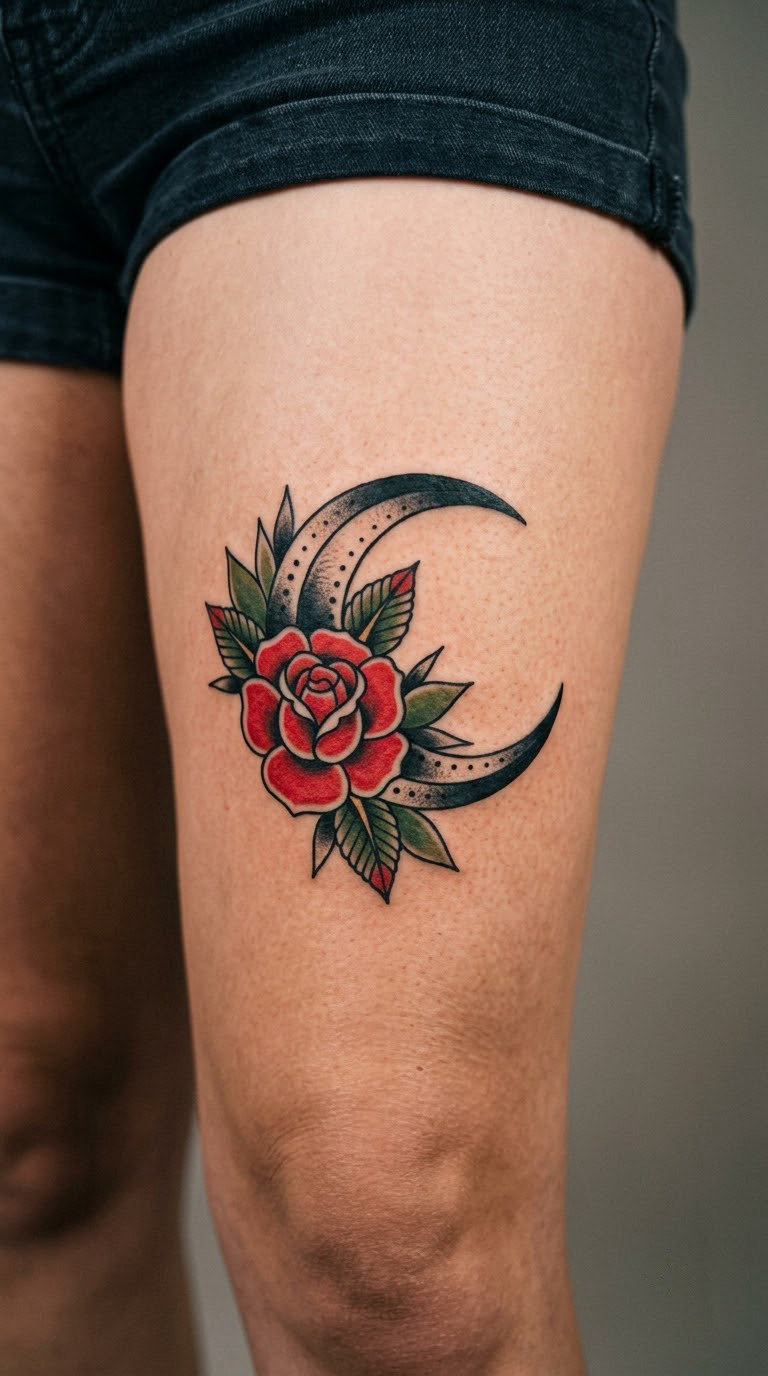
A bold crescent outlined in thick black, paired with a fully coloured red rose with green leaves in the old-school flash tradition, is unapologetically classic. Traditional work has its own rules, with defined outlines, generous spacing and saturated red, and following them is what makes the piece look like traditional ink rather than a copy of one.
Placement: outer thigh, or the front of the thigh where there is room for the composition to breathe. Size: 4 to 6 inches (10 to 15 cm) tall. Style: traditional or neo-traditional. Pain: medium, more of a firm pressure than a sharp sting. Ageing: bold outlines hold up far better than fine line, though red is the first colour to shift over a decade.
Make it yours: swap the rose for a different bloom in the traditional palette, or add a banner with a short phrase beneath it.
11. Crescent Moon with Eye Detail on the Sternum
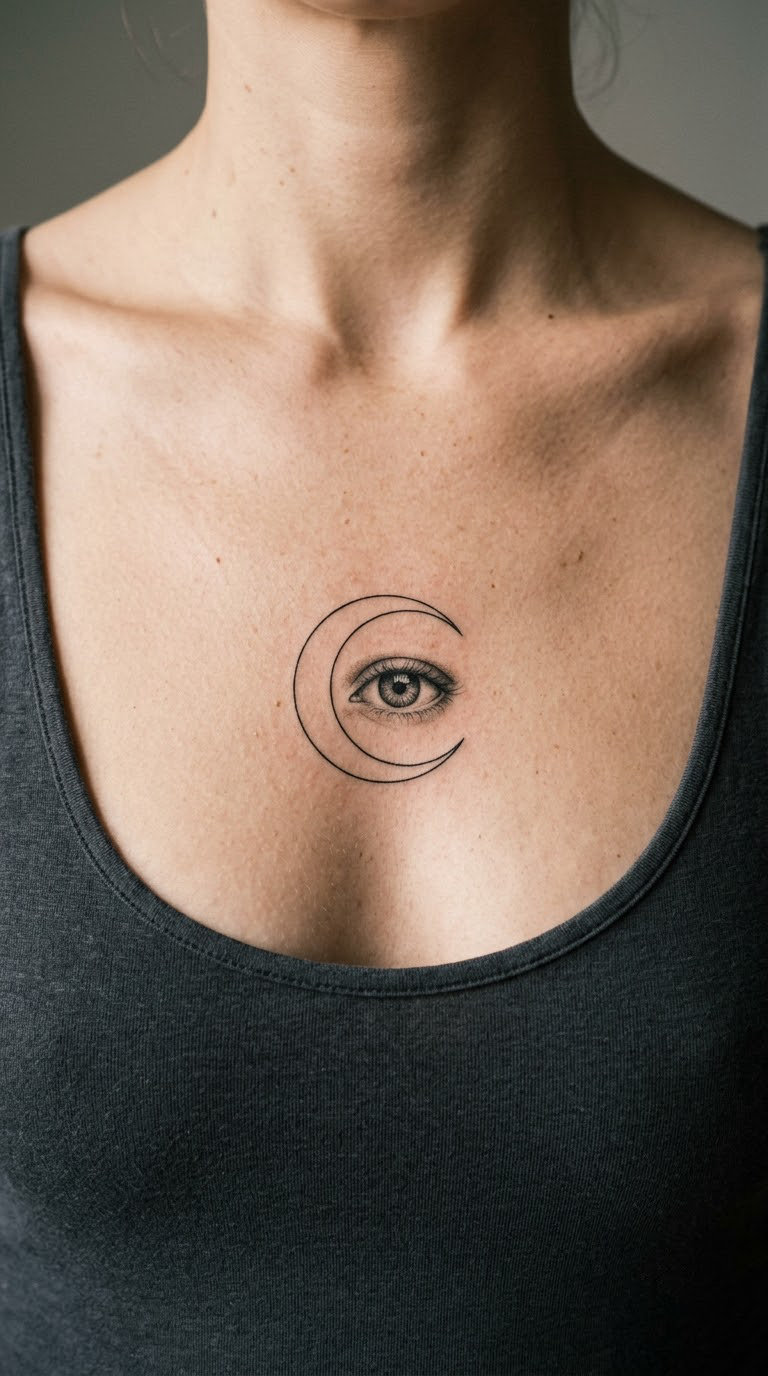
A crescent drawn in fine line with a small realistic eye placed inside the open curve, or tucked into the hollow of the moon, is a more symbolic piece. Eye imagery usually appears in tattoos as attention, watchfulness or being seen, and pairing it with a moon in progress gives the composition a watchful, nocturnal quality. Ask the artist to keep the eye at a size the pupil can actually hold.
Placement: centred on the sternum in the hollow, or just below the collarbones. Size: 2 to 3 inches (5 to 7.5 cm) tall. Style: fine line with light realism. Pain: high, bone right underneath with little soft tissue. Ageing: the eye is the fragile element, and sternum skin stretches, so expect the smallest details to need a touch-up.
Make it yours: add a single tear line below the eye, or set a few dots above the moon as a short star trail.
12. Geometric Crescent Moon on the Hip
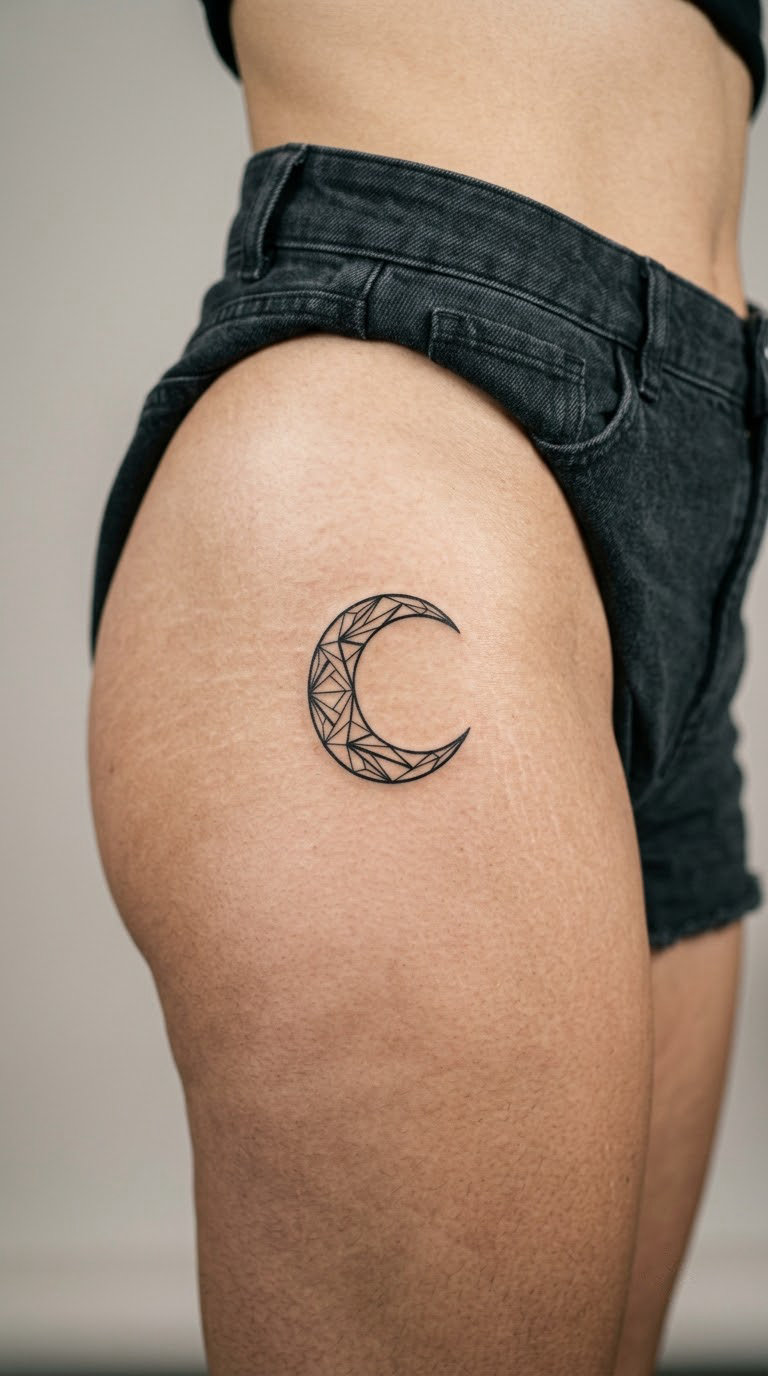
The crescent here is built from clean straight divisions across the curve, with the solid and open sections alternating in flat black. The outer edge stays perfectly smooth while the inside breaks into facets, which keeps the geometry readable from a distance. On a curved area like the upper hip, that mix of curve and straight line flatters the shape rather than fighting it.
Placement: upper outer hip where the bone curves, or along the side of the thigh. Size: 3 to 4 inches (7.5 to 10 cm) wide. Style: geometric. Pain: medium, steadier than the ribs or sternum. Ageing: hip skin stretches with weight and pregnancy, so solid black blocks hold better than thin internal lines.
Make it yours: let the internal divisions follow a specific count, such as the number of a meaningful year, rather than a random split.
13. Crescent Moon and Sun on the Forearm
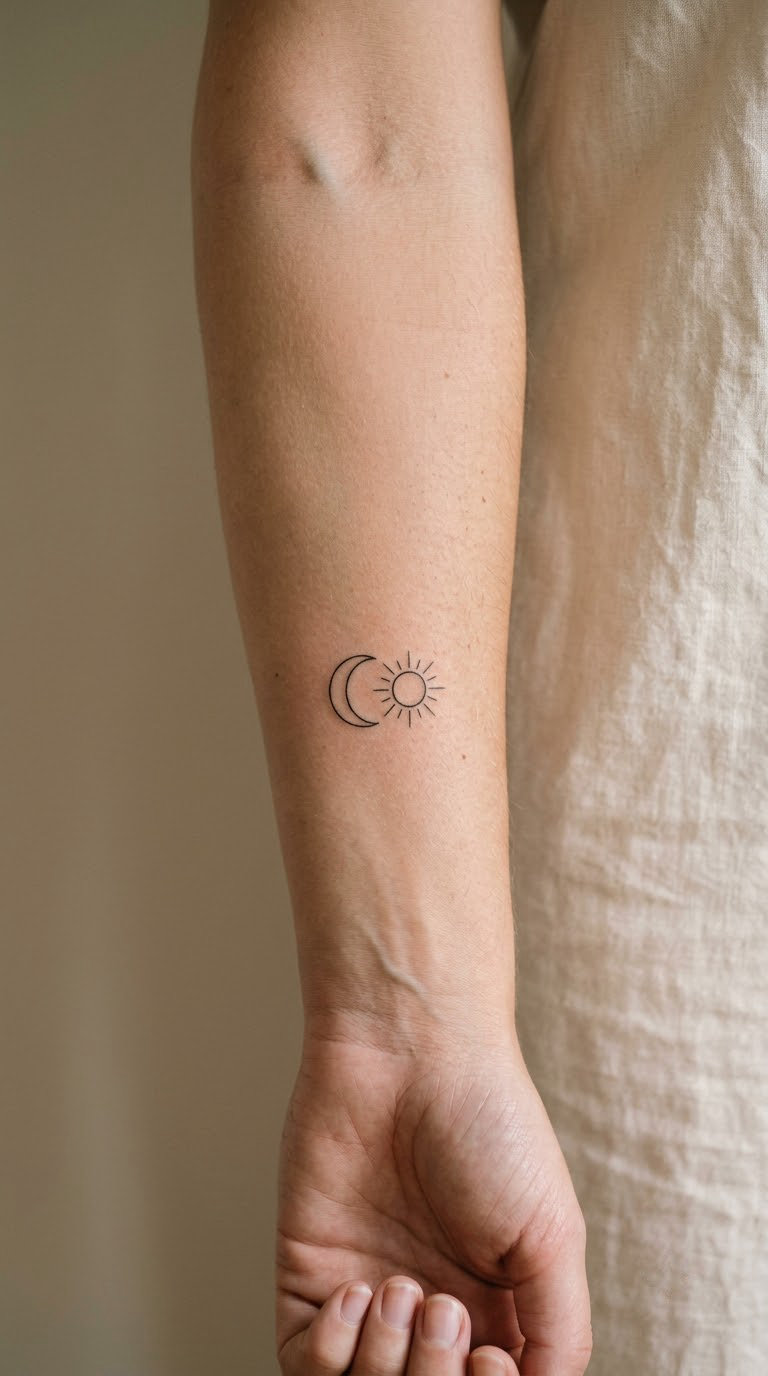
A small crescent paired with a simple rayed sun, spaced about an inch apart with nothing between them, is a balance piece rather than a single image. The sun is usually kept simpler than the moon so the crescent stays the focus, and the two read as opposites without either one being a copy. This is the most common choice among people planning matching moon tattoos with someone close to them.
Placement: inner forearm lengthwise, or side by side on the same line about three inches apart. Size: 2 to 3 inches (5 to 7.5 cm) across the pair. Style: minimal line work. Pain: medium, mostly the forearm’s constant movement. Ageing: forearms catch sun, so the sun’s thin rays are the first element to fade, and a touch-up in two or three years is normal.
Make it yours: angle the sun and moon toward each other, or point the moon’s horns up so both bodies read as rising.
14. Floral Crescent Moon on the Back of the Neck
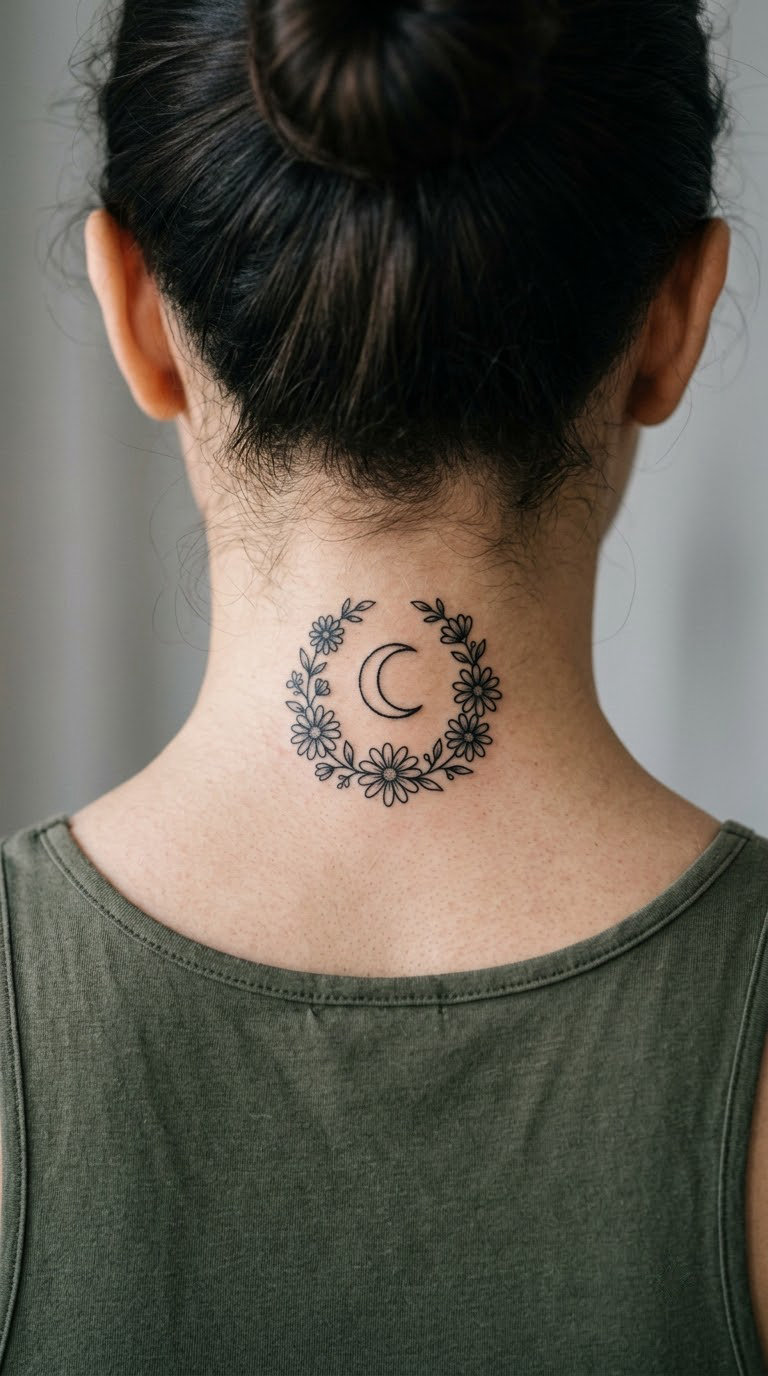
A crescent framed by a few small five-petal flowers, either sitting under the moon or curving around it, gives a nape design more presence than a lone outline. Small repeated flowers balance the composition well because each one is a simple closed shape that stays legible at low detail. Hair covers the piece on a low ponytail and shows it fully on an updo, which makes the placement a kind of switch.
Placement: centred on the back of the neck below the hairline, or low on the nape. Size: 1.5 to 2.5 inches (4 to 6 cm) wide. Style: fine line floral. Pain: high, the neck is thin-skinned and people cannot stop touching it. Ageing: hair gives some cover, but hair dye and sun on the neck still work away at fine lines.
Make it yours: use three or five flowers instead of two, or tuck a small sprig of lavender or olive into the composition.
15. Crescent Moon Phases on the Leg
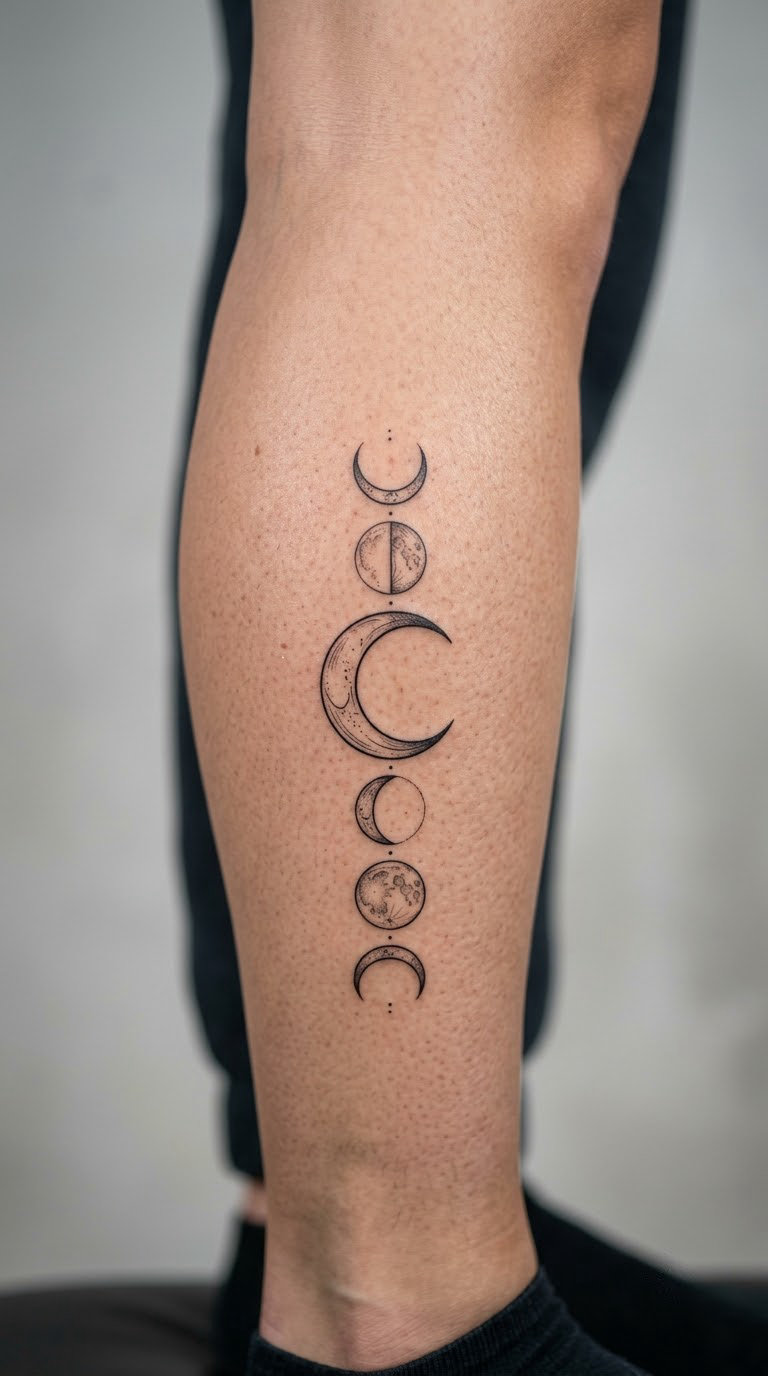
A large crescent at the centre with five smaller phase shapes arranged around or below it, showing the moon moving through its cycle in one composition. This is the idea that gets photographed most, and the one that needs the most simplification. At four to five inches tall there is room for real detail, but each small moon still needs enough width to keep its shape once healed.
Placement: outer calf, the outer thigh, or running down the lower back. Size: 4 to 5 inches (10 to 13 cm) tall. Style: fine line illustrative. Pain: medium on the calf, higher on the inner side. Ageing: tiny phase shapes blur first, so request at least a millimeter of width on every small moon.
Make it yours: have the artist show only the phases that mattered to a specific year for you, rather than all eight, which keeps the piece personal and the linework cleaner.
16. Gothic Crescent Moon on the Upper Back
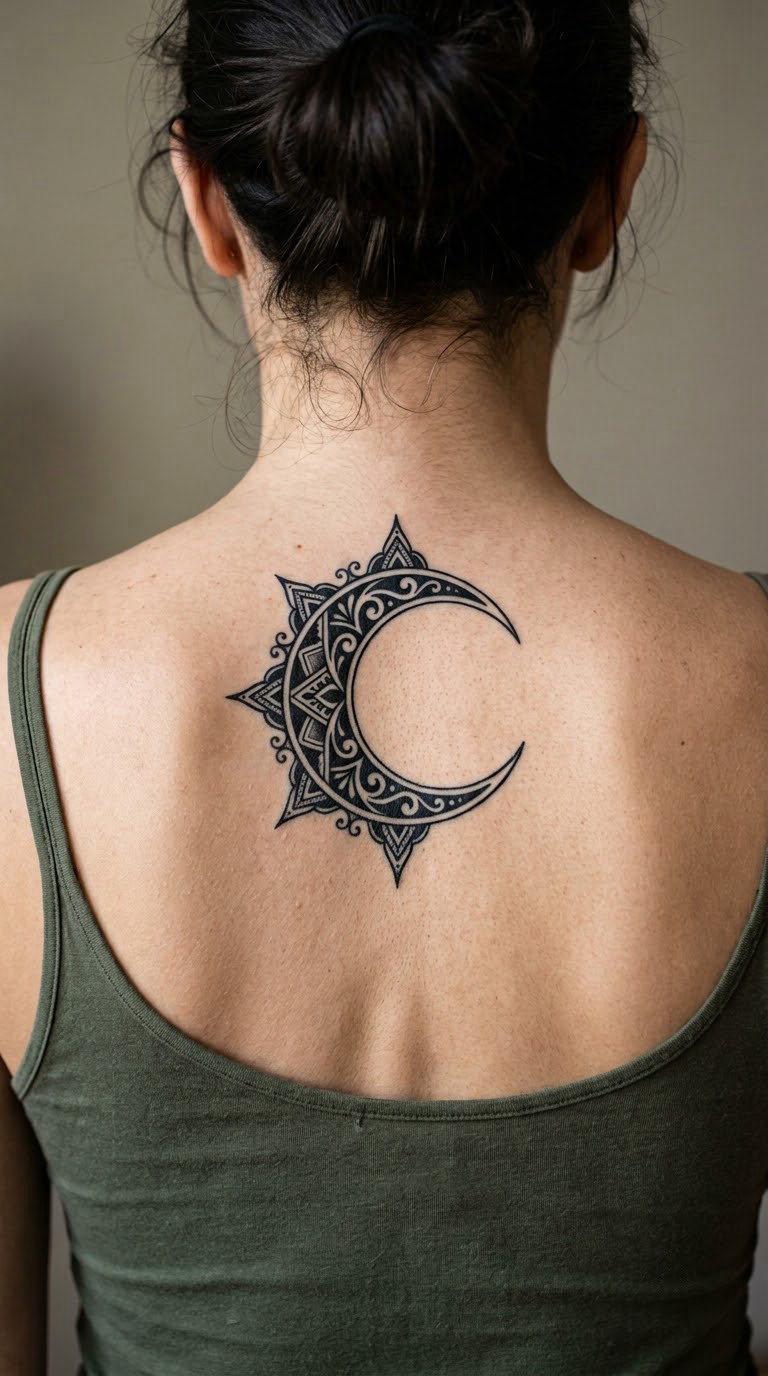
A heavy black crescent with ornamental flourishes, pointed extensions and symmetrical filigree running down from the horns, this one is meant to be seen. Between the shoulder blades gives you a broad flat canvas and a spot where the design is only visible when you move, so the size can go bigger than the line weight of the design suggests. The detail work is where sessions add up, and it shows.
Placement: between the shoulder blades, or centred on the upper back for a wider piece. Size: 4 to 6 inches (10 to 15 cm) wide. Style: ornamental blackwork. Pain: high, upper back skin is thin and the area warms up fast. Ageing: bold black holds contrast well, while the thin filigree lines soften fastest, so scale the detail to a size you will still want in ten years.
Make it yours: add a mirrored piece on the opposite shoulder blade, or put a date in the negative space under the crescent.
17. Crescent Moon with Fine-Line Mountain Range on the Arm
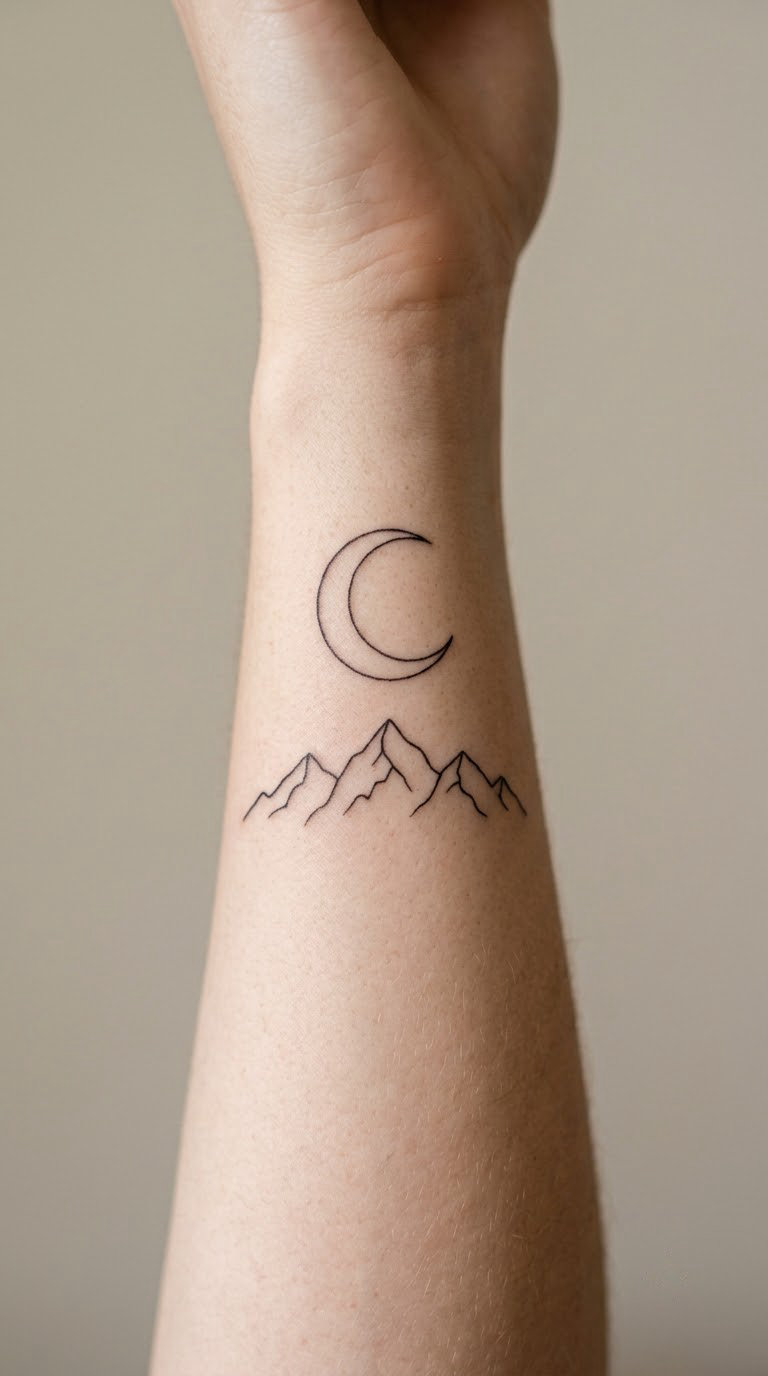
A crescent hovering over a simple row of mountain peaks, sometimes with a single line of horizon under it, turns the moon into a place rather than a symbol. The composition is horizontal, so it suits areas with a natural lengthwise direction such as the outer forearm, the calf or the ribs. It is a personal design more than a decorative one, and it usually comes with a specific place attached to it.
Placement: outer forearm lengthwise, outer calf, or along the rib line. Size: 3 to 4 inches (7.5 to 10 cm) long. Style: fine line illustrative. Pain: medium. Ageing: the horizon line is a single unbroken stroke, so a small bump in that line will be the first thing to show, and hand washing pushes it around on the forearm.
Make it yours: have the peaks drawn from a real skyline or trail you have walked, or add a trail of small dots marking a route between the peaks.
18. Crescent Moon in a Circular Stamp on the Bicep
A crescent centred inside a plain double-ring border gives the design a badge-like quality, more like a maker’s mark than a floating illustration. The circle is the hardest part to keep clean because a hand-drawn line wanders, so the artist will want to draw it freehand or stamp a stencil rather than trace a printed round. It suits a biceps because the muscle keeps the border from folding into itself.
Placement: outer bicep, upper arm, or the back of the arm near the shoulder. Size: 2 to 2.5 inches (5 to 6 cm) in diameter. Style: fine line stamp. Pain: medium, the muscle helps a little. Ageing: arms see sun through short sleeves, so a two-ring border is safer than a single hairline circle.
Make it yours: split the circle with a thin gap at the top and tuck the crescent horns through the break, or add small text around the outer ring in a plain typeface.
19. Pastel Crescent Moon on the Wrist
A crescent filled with soft pastel shading, pink into lavender into pale blue, gives colour without looking loud. Pastel work needs a fine-line border or the wash bleeds past the shape as it heals, and any grey in the mix will read cooler over time than it did in the chair. Wrist placement keeps it visible year-round, which also means it needs the most touch-up of the coloured options here.
Placement: top of the wrist, or the inner wrist where the veins make a nice contrast. Size: 1 to 1.5 inches (2.5 to 4 cm) wide. Style: soft pastel with a light outline. Pain: low to medium. Ageing: pastels fade toward grey within a couple of years, and sitting at a desk means sleeves rarely cover it, so plan on colour refreshes.
Make it yours: match the palette to a birth flower or a specific season you want the tattoo to remember, and ask for a fully saturated colour elsewhere as an anchor.
20. Large Crescent Moon Upper Arm Piece for Women
A large crescent shaded in black and grey, with crater texture along the surface and a soft scatter of stars in the surrounding space, is the most committed design in this guide. At seven inches the moon has room for tonal range and stippled texture that smaller versions cannot hold, and the upper arm is flat enough to make that detail legible. Expect this one to run into a second session.
Placement: outer upper arm, or the back of the arm. Size: 6 to 8 inches (15 to 20 cm) tall. Style: black and grey realism. Pain: medium over such a large area, more of an endurance session than a sharp one. Ageing: grey shading holds better than pale colour, but the star scatter and crater texture are the parts to watch.
Make it yours: use the real surface of the moon from a specific night, and place a small matching crescent at the wrist so the large piece has a companion.
How to Choose the Right Design
Start with the area of the body you actually want to show. Someone who wears short sleeves every day should not plan a neck design, and someone who wants a tattoo nobody spots should look at the ribs, the upper thigh and the inner calf before the wrist. The quick guide table above is sorted the same way, so the simplest filter is to pick the placement first and let the design follow.
Match the line weight to the spot: hairline fine line belongs on the collarbone, the ribs, the inner arm and the back of the neck. Anywhere with daily friction or sun, thicker lines and solid fills last longer.
Size is a longevity decision, not a style decision: a crescent under half an inch wide loses its horns within a few years. One and a half inches is about the floor for a clean standalone shape, and two to three inches gives you room for any detail you want to add later.
Look at what you already have: a small crescent sits better beside an existing line piece than against a large colourful one, and matching weights matter more than matching themes. If your collection is all black and grey, a pastel moon will read as a deliberate single colour accent rather than a mistake, but only if you want it to be the one that stands out.
Think about orientation before the drawing: which way the crescent opens is the question people forget until the stencil is already on the skin. A waxing crescent opens toward the right hand of the person it is drawn for, and a waning crescent opens toward the other side, which is the astronomically accurate arrangement. Body flow is the other half of it, since a crescent that reads correctly from the front can look sideways when you turn.
Check the geometry: the gap between the two horn tips should stay around 3mm at final size, and the inner arc needs to be visibly different in curvature from the outer one. Get the gap too tight and the two arcs merge into a banana shape as ink spreads during healing, which is the single most common complaint about small crescent tattoos in tattoo forums.
Ask to see healed work: a portfolio full of fresh photos tells you nothing about line consistency. Artists who post two-year-old pieces on a bicep or a finger are showing you exactly how their fine line holds up, and for any design on this list that matters more than how the portfolio looks today.
Cost and Session Time
Tattoo pricing in the US is built from an hourly rate plus a shop minimum, so the number depends on how long your crescent takes rather than on the design itself. A micro crescent on a finger might be billed at the shop minimum because it takes twenty minutes to place. A six-inch black and grey moon on the upper arm is billed by the hour and can run into a second session. A good artist will quote you honestly after seeing a reference, and be clear about whether the estimate is fixed or an hourly cap.
| Size and complexity | Typical time in the chair | What moves the price |
|---|---|---|
| Micro crescent, under 1 inch | 15 to 30 minutes | Usually billed at the shop minimum |
| Small crescent, 1 to 2 inches | 30 to 60 minutes | Placement difficulty, behind-ear and rib work take longer |
| Medium composition, 2 to 4 inches | 1 to 2 hours | Number of elements, colour, custom drawing time |
| Large piece, 4 inches and up | 2 to 5 hours, often split | Shading, realism, ornamental detail, second session |
Two things worth asking before you book: whether the shop has a minimum charge that small tattoos are billed against, and whether a free consultation is offered. Most shops do the drawing or stenciling at no charge, and seeing the design on your own skin before anything is permanent is the part people regret skipping.
Aftercare Basics
- Follow your artist’s aftercare instructions first. Every artist has their own protocol based on how they worked on your skin, and it overrides anything generic you have read elsewhere, including this list.
- Keep it clean and gently washed. Rinse with lukewarm water and a fragrance-free cleanser, then pat dry with a clean towel or paper product rather than rubbing.
- Leave the skin alone. No picking at scabs or flakes, and keep loose clothing or bedding from sticking to fresh ink while it settles.
- Do not soak or expose it to sun while it heals. That means no baths, pools, hot tubs or lakes until the artist clears you, and no tanning over a new tattoo for the same reason.
- Moisturise thinly once it has stopped weeping. A thin layer of a plain ointment keeps the skin supple and reduces scabbing, and more product is not better.
- Ask your artist about touch-ups and when to come back. Fine line on the wrist, fingers, ankles and collarbone usually needs a refresh, and knowing the timing in advance beats noticing a blur later.
Frequently Asked Questions
What does a crescent moon tattoo symbolize for a woman?
A crescent shows a moon in the middle of a cycle, so it usually reads as growth, change and intuition. Many women choose it to mark a transition, a new beginning or a period of personal growth rather than for a fixed traditional meaning. It also carries a broadly feminine association, though the symbol itself appears across many cultures and belief systems.
Which way should my crescent moon face?
A waxing crescent, the moon growing toward full, opens toward the right of the person it is drawn for, and a waning crescent opens the other way. Most people pick the direction that matches the meaning they want rather than a rule. Ask your artist to hold the stencil up and turn your arm or torso so you can see how it reads from your normal angle.
How much does a crescent moon tattoo cost?
US pricing is usually an hourly rate with a shop minimum, so a tiny finger crescent often costs the minimum charge while a large upper arm piece is billed by the hour and may need two sessions. Size, detail, colour and placement all matter, and behind-ear and rib work runs slower than flat areas. Get a written quote after the artist sees a reference.
Do moon tattoos age well?
They age as well as any line work of the same weight. Solid black crescents and thick outlines hold contrast for years, while hairline fine line on sun-exposed or frequently washed areas like wrists, fingers and ankles softens noticeably within a few years. Ask for thicker lines on those spots, keep the horn gap wide, and plan on a touch-up rather than a rework.
Where should a crescent moon tattoo be placed?
Small crescents suit the inner wrist, behind the ear, the finger, the ankle and the back of the neck. Larger compositions work better on flatter areas such as the outer forearm, upper arm, hip, thigh, calf, collarbone and the back of the neck. Choose a spot you would be comfortable showing and a spot whose skin suits the line weight you want.
What pairs well with a crescent moon tattoo?
Stars and constellation dots, flowering branches, a small sun, a mountain range, a script word and a full set of moon phases are the most common pairings. Botanicals and stars add texture without competing, while a sun or a phase row tells a fuller story. Leave clear space around the crescent so the added elements do not close the horn gap.
Conclusion: Find the Crescent Moon That Feels Personal
If this is your first tattoo, keep it simple. A single fine-line crescent on the inner wrist or a small blackwork crescent on the collarbone gives you the shape and the meaning without committing to detail you have to live with for years. If you already have a collection, the better choice is something with a story in it, like a mountain range crescent, a phase row on the calf, or a moon and sun pair you plan to match with someone.
Whichever one you land on, take a reference to a consultation, ask to see healed work in the artist’s portfolio, and get the stencil checked before anything permanent. More small moon tattoo ideas are in our guide to tiny moon tattoo designs, and the fine line tattoo gallery for women has plenty of companions if you are building a set. Once you have picked the direction, your artist will handle the geometry so the horns stay sharp.