
25 Science Tattoo Ideas for Curious Minds (October 2026)
Science tattoo ideas cover an enormous range, from atom diagrams and DNA helices to planets, equations, lab glassware and geological layers. These 25 designs are the ones that hold up best on skin, whether you work in a field, teach it, or just like how scientific illustration looks on paper.
What makes a science design work on skin is legibility. A diagram that reads clearly at thumbnail size on a phone screen will blur into grey mush if it is shrunk to two inches, so scale, line weight and placement matter more here than in almost any other tattoo theme. If you are planning a piece for autumn or winter, book your consult now, because sleeves and back pieces need a long runway.
25 Science Tattoo Ideas: Quick Guide
| Idea | Style | Best placement | Size | Pain |
|---|---|---|---|---|
| 1. Fine-line atom | Fine line | Inner forearm | 2-3 in (5-8 cm) | Low |
| 2. DNA double helix | Micro-realism | Outer forearm | 3-4 in (8-10 cm) | Medium |
| 3. Vintage microscope | Black and grey | Outer upper arm | 4-5 in (10-13 cm) | Medium |
| 4. Geometric solar system | Fine line, geometric | Forearm | 3-4 in (8-10 cm) | Low |
| 5. Laboratory beaker | Minimalist line art | Inner wrist | 1.5-2 in (4-5 cm) | Low |
| 6. Periodic table element | Minimalist, typographic | Side of forearm | 1-1.5 in (2.5-4 cm) | Low |
| 7. Chemistry equation | Calligraphy | Inner forearm | 3-4 in (8-10 cm) | Low |
| 8. E=mc2 chalkboard | Blackwork, bold type | Upper arm | 2-3 in (5-8 cm) | Medium |
| 9. DNA blooming into a flower | Blackwork with colour | Calf | 4-5 in (10-13 cm) | Medium |
| 10. Microscope and butterfly wing | Blackwork realism | Outer thigh | 5-6 in (13-15 cm) | Medium |
| 11. Constellation in a flask | Fine line | Below collarbone | 2-3 in (5-8 cm) | Low |
| 12. Rocket from an orbit | Retro illustrative | Outer forearm | 4-5 in (10-13 cm) | Medium |
| 13. Cell membrane | Illustration, blackwork | Upper arm | 4-5 in (10-13 cm) | Medium |
| 14. Neuron network | Micro-realism | Side of thigh | 3-4 in (8-10 cm) | Medium |
| 15. Electron probability clouds | Dotwork | Forearm | 3-4 in (8-10 cm) | Medium |
| 16. Slide with moon phases | Fine line | Inner wrist | 4 in (10 cm) | Low |
| 17. Pythagorean triangle | Geometric fine line | Behind the ear | 2-2.5 in (5-6 cm) | Low |
| 18. Pendulum and wave | Fine line | Outer upper arm | 3-4 in (8-10 cm) | Medium |
| 19. Petri dish specimen | Botanical line art | Forearm | 3 in (8 cm) | Low |
| 20. Telescope and galaxy | Fine line, illustrative | Upper arm | 4-5 in (10-13 cm) | Medium |
| 21. Anatomical heart | Micro-realism, colour | Inner arm near elbow | 3-4 in (8-10 cm) | Medium |
| 22. Geological hourglass | Illustrative realism | Calf | 3-4 in (8-10 cm) | Medium |
| 23. Prism and spectrum | Minimalist, colour | Inner forearm | 2-3 in (5-8 cm) | Low |
| 24. Quartz crystal lattice | Symmetrical dotwork | Shoulder | 3-4 in (8-10 cm) | Medium |
| 25. Mars rover and planet | Fine line with colour | Outer wrist | 2 in (5 cm) | Low |
1. Fine-Line Atom with Orbital Rings
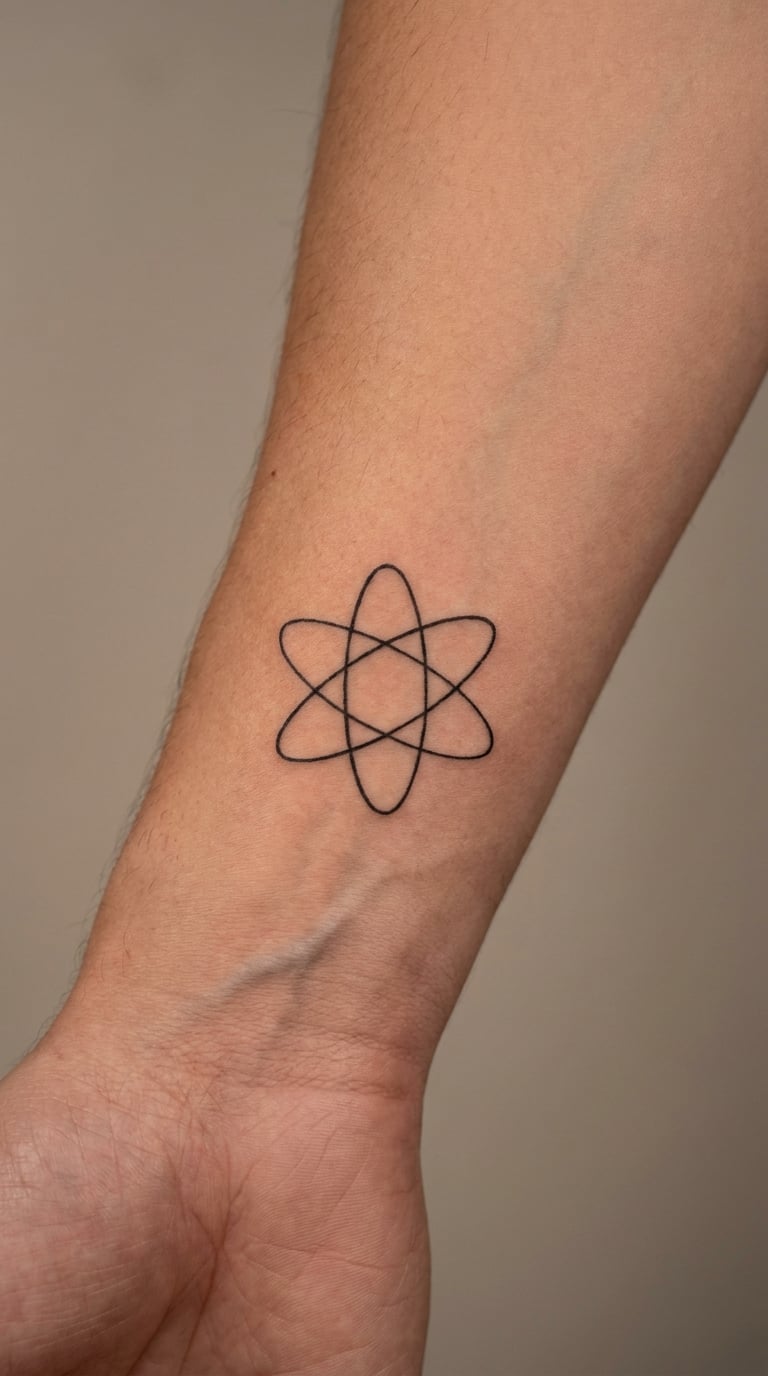
This science tattoo idea is the most requested of the lot, and the reason is simple: it is a symbol people recognise instantly without needing a caption. A single-needle line, three intersecting elliptical rings and a small nucleus at the centre is all it takes.
25 Science Tattoo Ideas: Atom Design Details
Artists usually draw three orbits at slightly different angles, tilted about 30 degrees off horizontal, so the design reads as three dimensional. Electron dots on the rings are optional; at small sizes most tattoo artists drop them because they fill in.
Placement: inner forearm just above the wrist, or the outer forearm. Size: 2-3 inches (5-8 cm) across. Style: fine line, single needle.
Pain: low on the inner forearm, a brief stingy scratch. Make it yours: swap the nucleus dot for a solid dot in a single colour so it reads as a deliberate accent rather than a smudge.
One honest note on ageing: single-needle hairlines on the inner forearm soften noticeably in about five years and usually need a touch-up. That is normal, not a mistake in the tattoo.
2. Micro-Realism DNA Double Helix
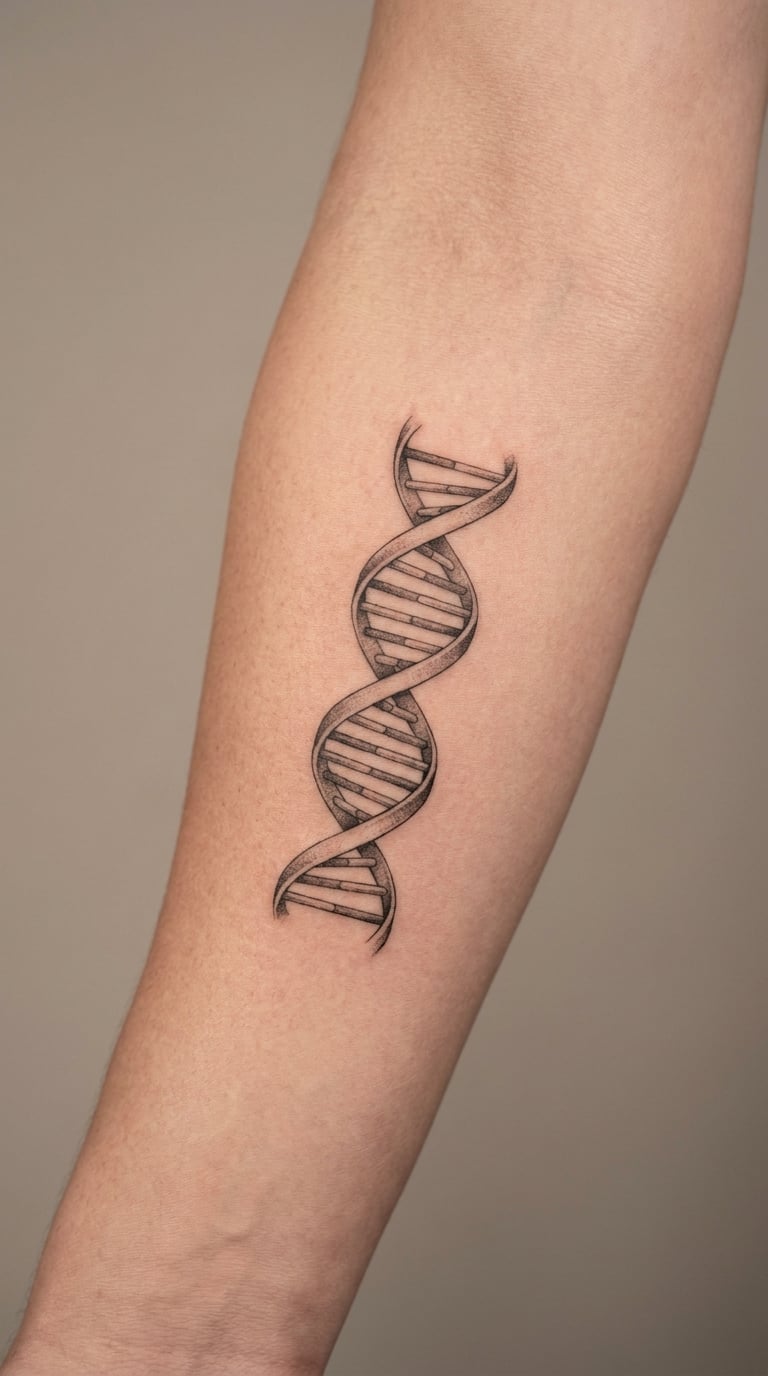
A shaded double helix is the one biology design that works as a standalone piece rather than a filler motif. Grey shading along the sugar-phosphate backbones and a fine line down the centre give it depth on curved skin.
Placement: outer forearm running vertically, or the calf. Size: 3-4 inches (8-10 cm) long. Style: micro-realism, black and grey.
Pain: medium over the forearm’s bony ridge. Make it yours: have the base rungs fade into a single line so the helix appears to run off the skin.
Below about 2 inches the rungs merge. Ask for fewer, thicker rungs rather than a full textbook diagram, and the piece will still be sharp at ten years.
3. Vintage Compound Microscope
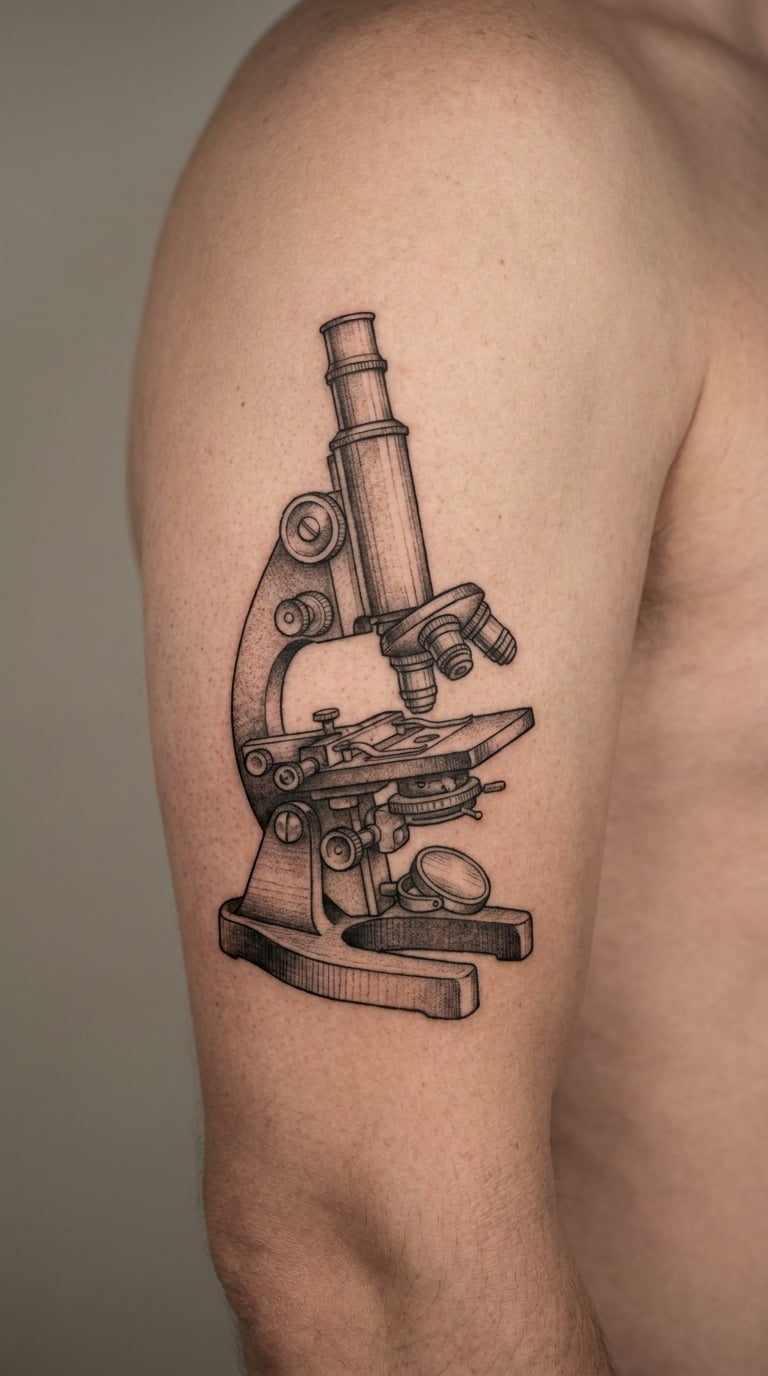
Artists draw the old brass-and-wood laboratory microscopes, not the plastic student ones. Curved body tube, stage with clips, and a weighted base are the details that make it read as an instrument instead of a doodle.
Placement: outer upper arm, the flat area that takes a vertical piece well. Size: 4-5 inches (10-13 cm) tall. Style: black and grey realism with fine shading.
Pain: medium, and the upper arm outer side is one of the friendlier spots on the body. Make it yours: include a slide on the stage, or engrave a small date on the base.
Ageing note: shaded realism holds detail far longer than line work, so this is a good pick if you want something that still reads clearly in a decade.
4. Geometric Solar System with Planet Orbits
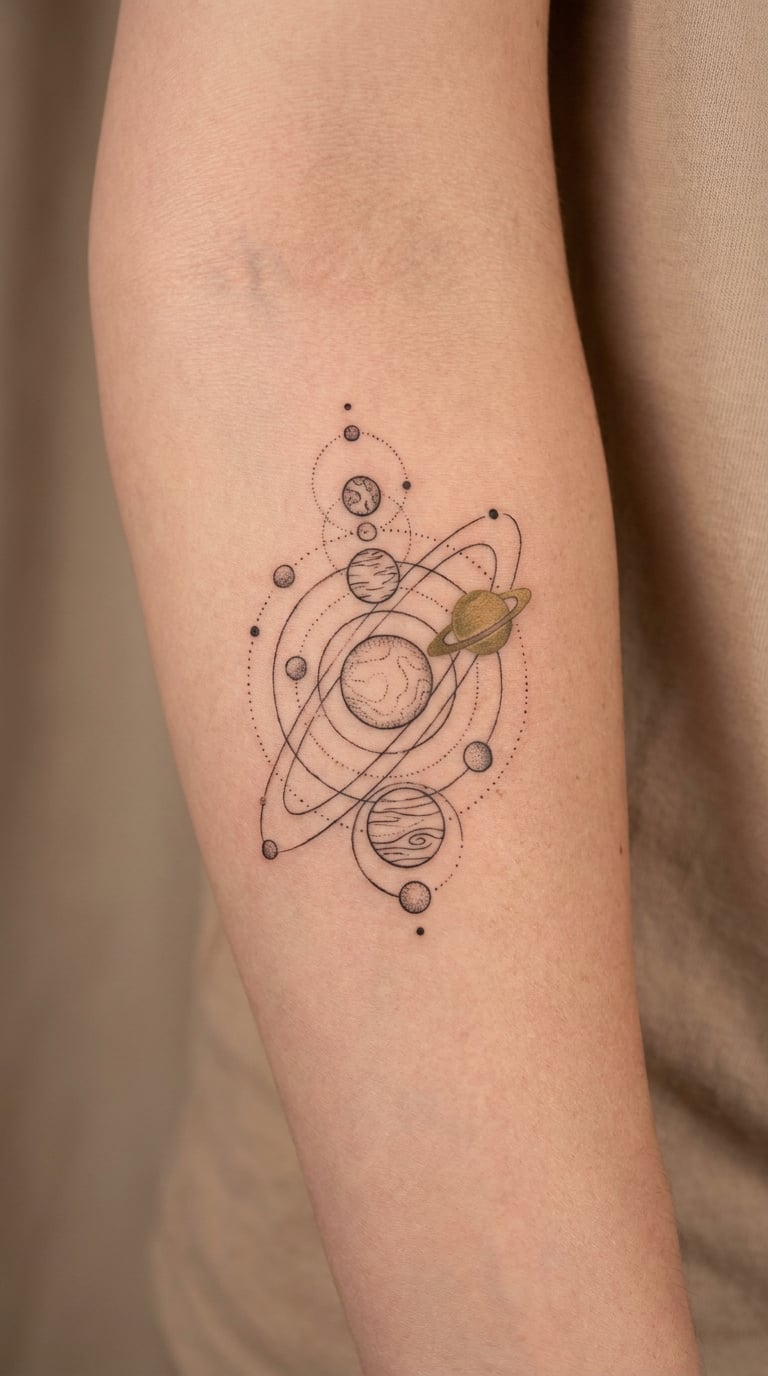
A compact planetary design, drawn as concentric elliptical orbits with small filled circles for planets, reads like an astronomical chart rather than a cartoon. Accuracy is a matter of taste here; most people want the recognisable shape, not the true proportions.
Placement: forearm centre, the classic spot for a chart-style piece. Size: 3-4 inches (8-10 cm) wide. Style: fine line geometric.
Pain: low to medium. Make it yours: have one planet picked out in a single colour, usually a ringed planet, so the eye has somewhere to land.
The narrow gaps between orbits are the first thing to blur. A designer who spaces the rings further apart will get you a design that ages far better than a tight diagram.
5. Minimalist Laboratory Beaker
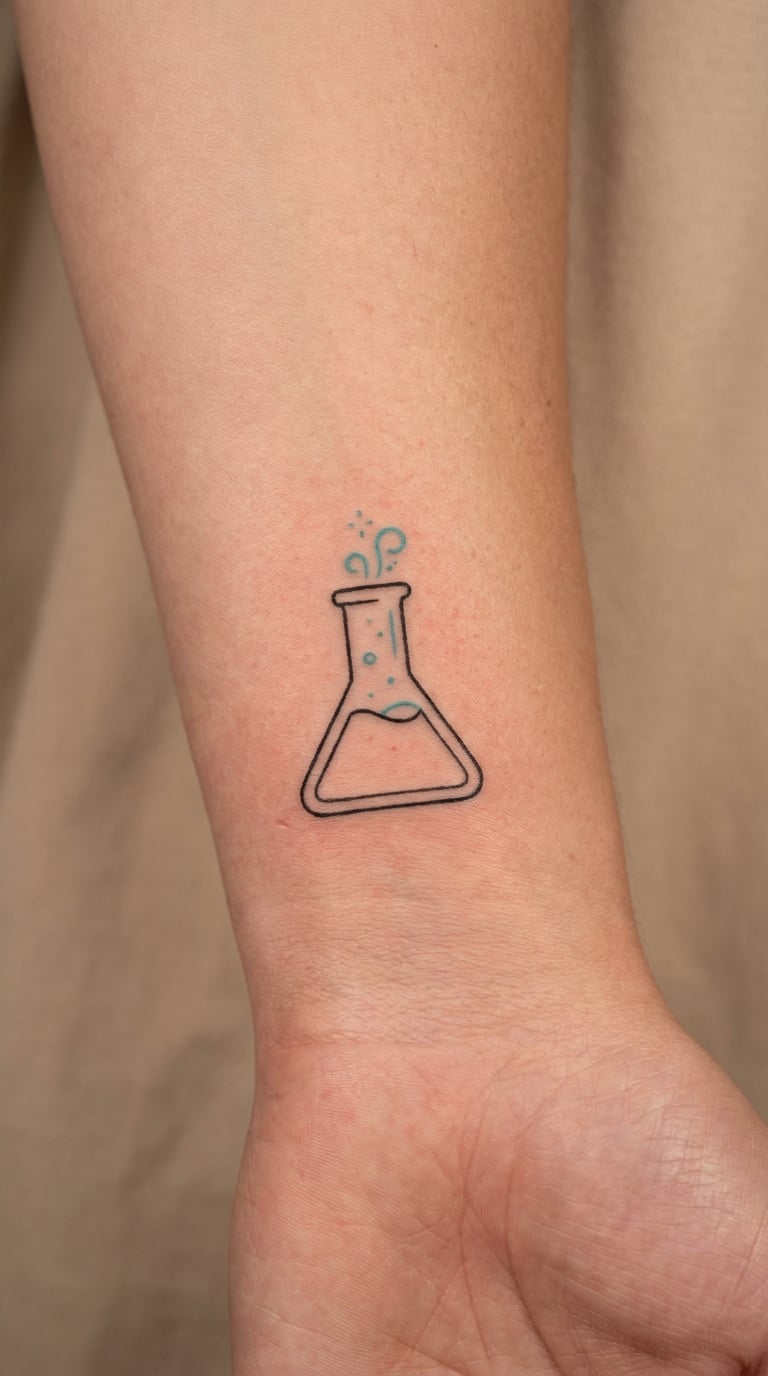
One clean line drawing of a beaker with a few bubble circles and a liquid line is the smallest chemistry design that still looks deliberate. It works because everyone recognises the shape, and the interior stays open enough for colour.
Placement: inner wrist, or paired on the ankle. Size: 1.5-2 inches (4-5 cm) tall. Style: minimalist line art.
Pain: low, wrists are bony and thin. Make it yours: fill the liquid with one muted colour rather than a rainbow, which usually looks busier on a small piece.
Ageing note: thin wrist lines fade faster than arm lines because of sun exposure and skin movement. Ask for a slightly heavier line weight than feels right at the consult.
6. Periodic Table Element Square
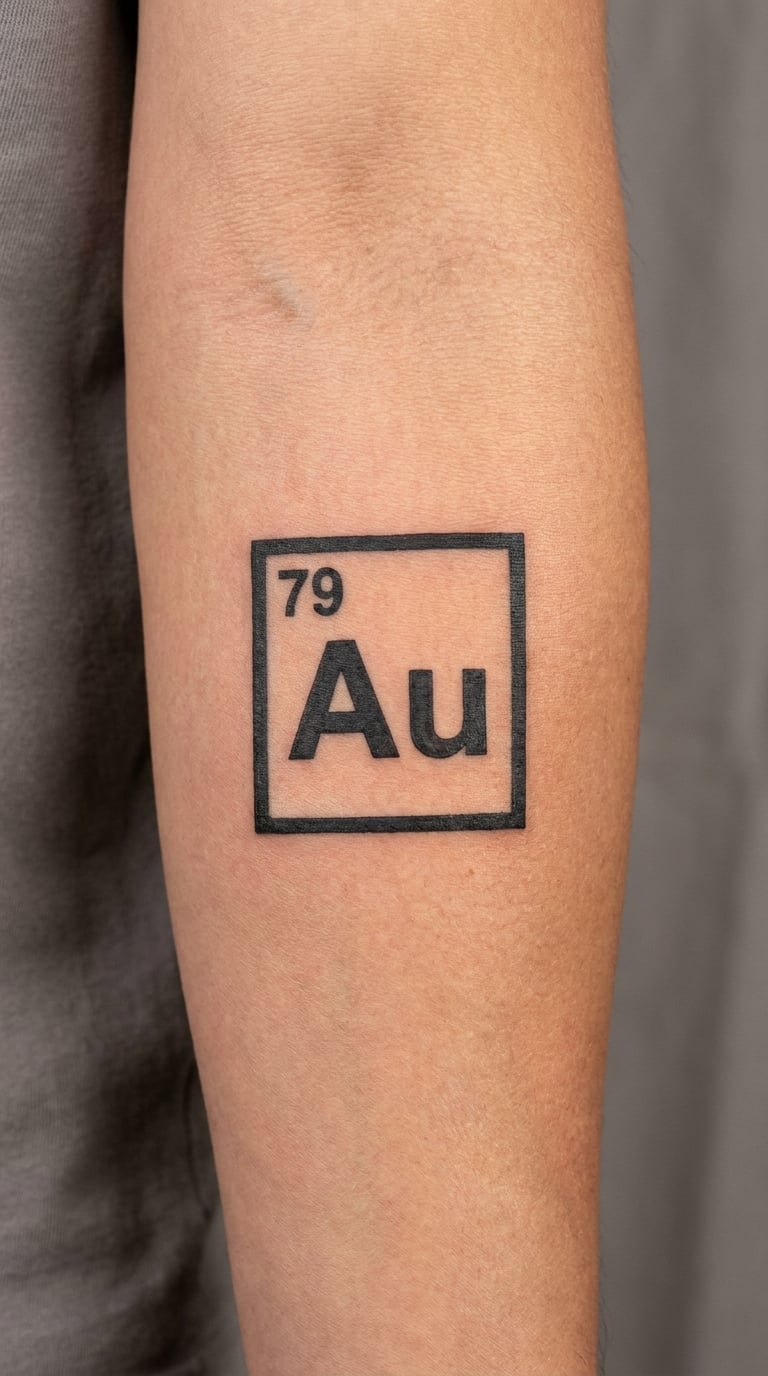
One element rendered as a clean square, with the atomic number across the top, the symbol large in the middle and the atomic weight at the bottom, is a genuinely tiny piece with a lot of information in it. Element 79, gold, is a common pick; so are oxygen and carbon.
Placement: side of the forearm, wrist, or knuckle. Size: 1-1.5 inches (2.5-4 cm) square. Style: minimalist, typographic.
Pain: low almost anywhere. Make it yours: have the symbol cut out of a solid block of black instead of drawn in outline, which holds its shape far better over time.
Typography is the risk here. Below an inch, ask for the symbol only and skip the small numbers, which are the first marks to disappear.
7. Handwritten Chemistry Equation
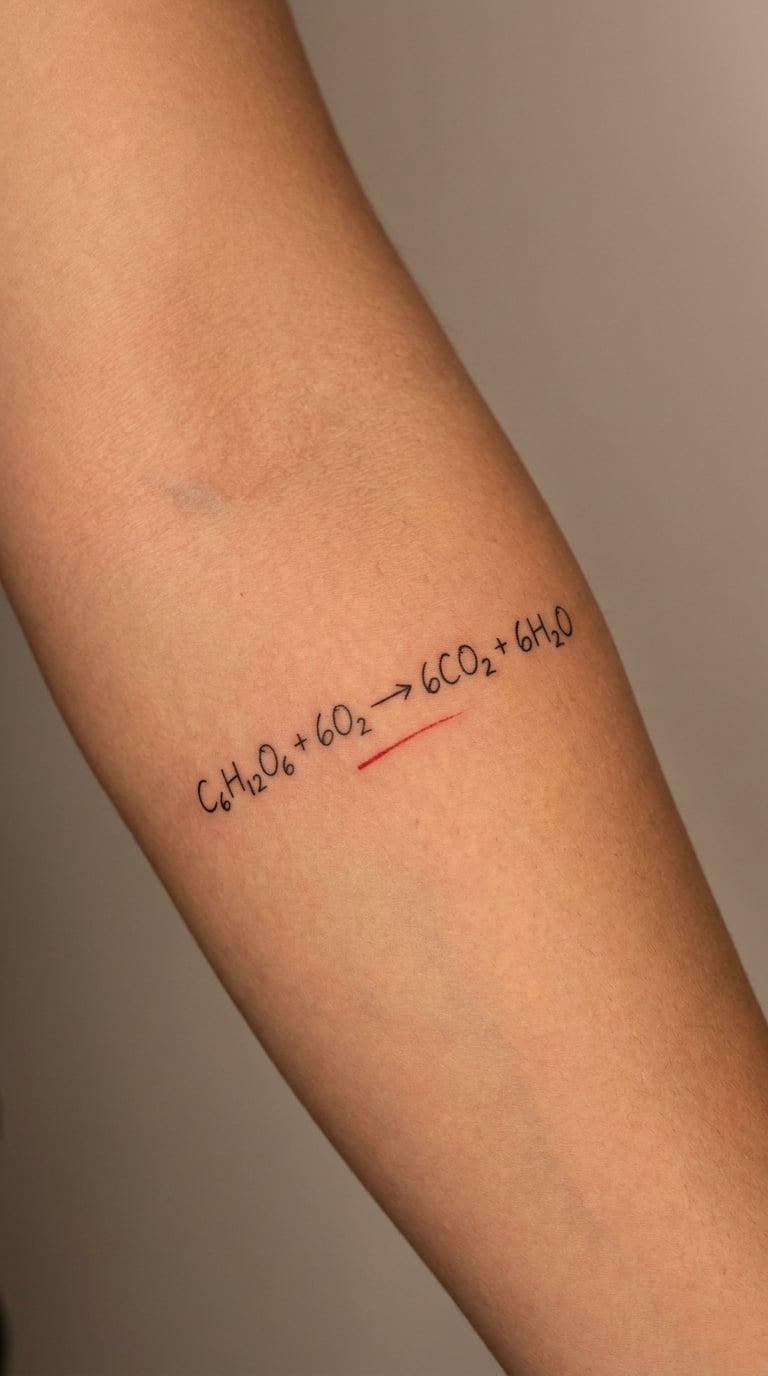
A reaction written the way it appears in a lab notebook, with subscripts, an arrow and a reagent above it, looks like notation rather than decoration. That is the whole appeal: nobody confuses it with a quote tattoo.
Placement: inner forearm, set horizontally across the bone. Size: 3-4 inches (8-10 cm) wide. Style: calligraphy, single needle.
Pain: low. Make it yours: add a single coloured underline in the same ink family as your first science piece so a future sleeve ties together.
Subscripts are fragile. Ask for them slightly larger than the reference image, or they will be a grey smudge within a few years.
8. E=mc2 Chalkboard Design
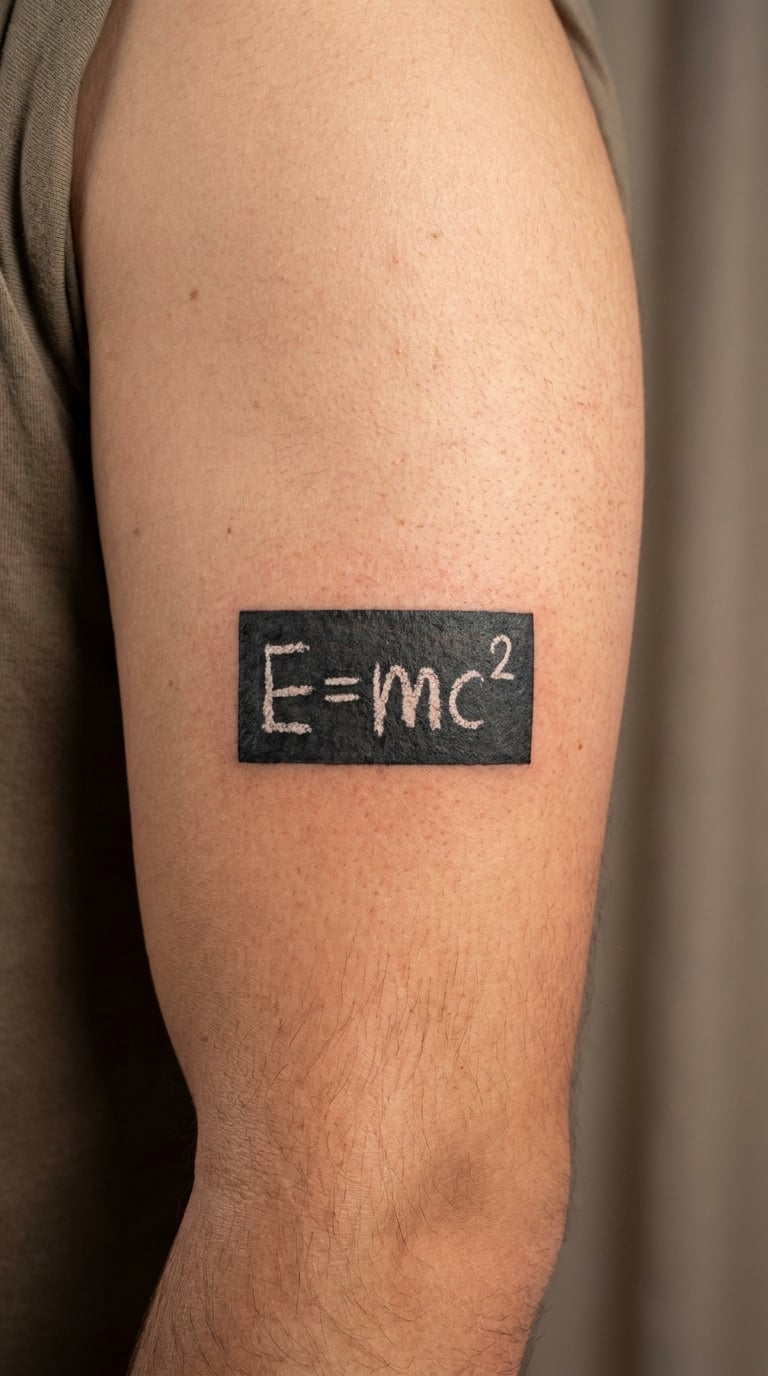
The famous physics formula works three ways: as bold hand-drawn lettering, as chalk-style art on a filled black rectangle, or as delicate fine-line script. The chalkboard version has the most presence and hides small imperfections in the superscript.
Placement: upper arm, or sternum for a small vertical version. Size: 2-3 inches (5-8 cm) wide. Style: blackwork with white highlights.
Pain: medium, since the solid black fill takes more passes. Make it yours: have the artist render the formula in your own handwriting, even if it is not neat. It reads far more personal than a printed equation.
Solid black ages better than thin line but can look heavy over a decade on an arm that changes shape. Ask the artist how the piece will sit when the skin relaxes.
9. DNA Helix Blooming into a Flower
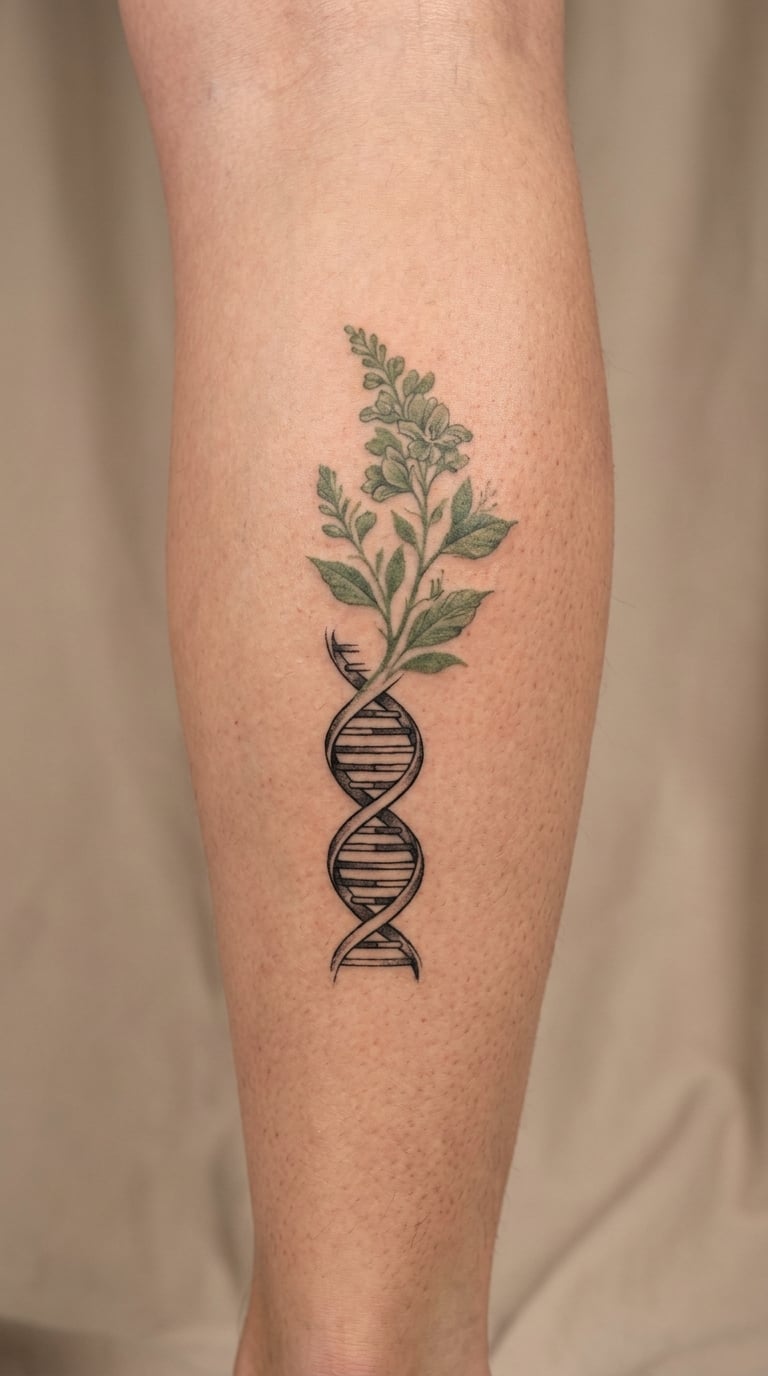
This one splits into two halves: a helix at the base that grows stems and leaves, ending in a single bloom. It sits somewhere between a biology design and a botanical one, which is exactly why it appeals to people who like both.
Placement: calf, inner arm, or along the thigh. Size: 4-5 inches (10-13 cm) long. Style: blackwork line work with one botanical colour.
Pain: medium on the calf. Make it yours: choose a flower with a real meaning in your family rather than whatever the reference image happens to be.
Two colour zones means two things to touch up later. Many people get the line work black and only the bloom in colour, so the touch-up is small and cheap.
10. Microscope and Butterfly Wing
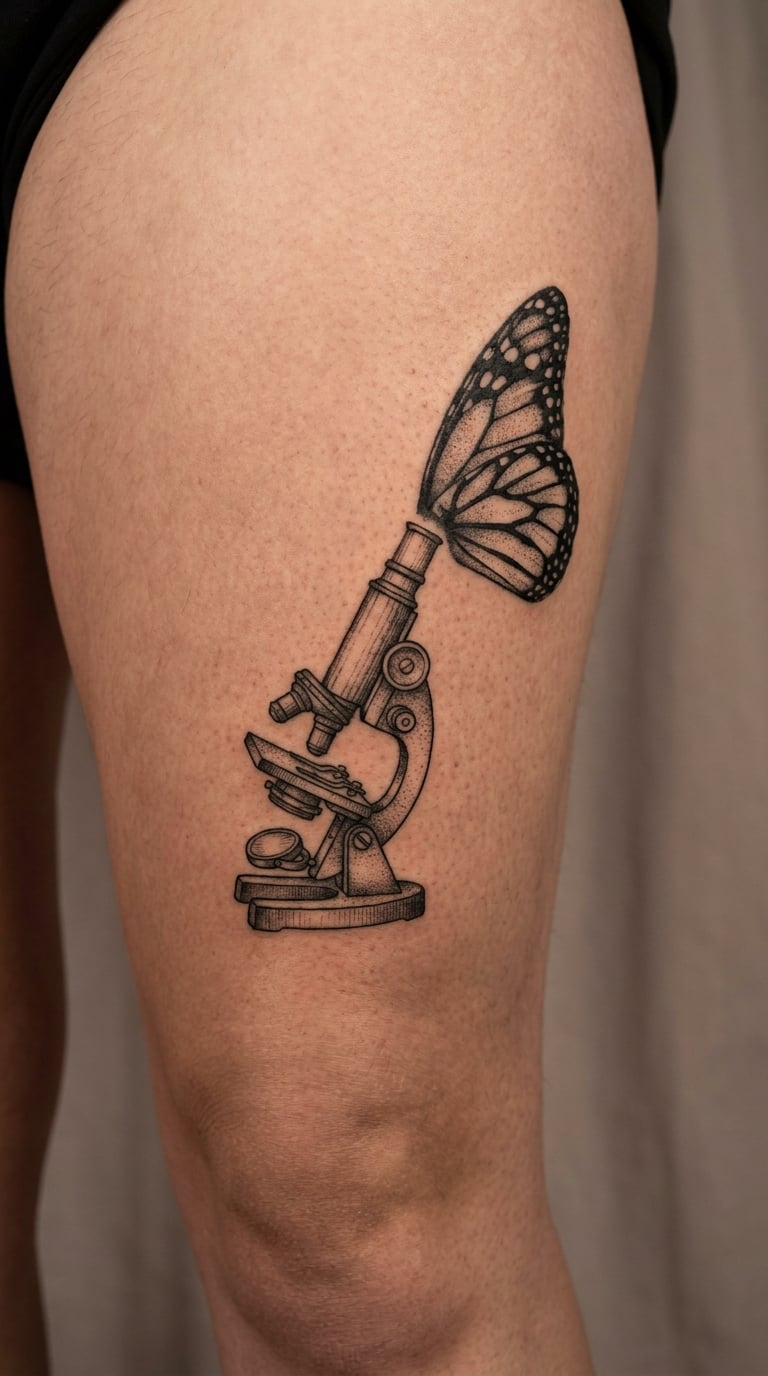
The transition is the design. An artist’s microscope silhouette that gradually becomes a wing pattern, with the eyepiece turning into the wing’s leading edge, is a bigger, more dramatic piece than either subject alone.
Placement: outer thigh or back of the upper arm, where there is flat space for a long piece. Size: 5-6 inches (13-15 cm) long. Style: blackwork realism.
Pain: medium to high on the outer thigh, which is sensitive skin. Make it yours: swap the monarch for a species found where you grew up.
Wing scales are genuinely tiny, so this needs a designer’s hand, not a stock flash. Expect a longer session and a higher hourly rate than the simple line pieces on this list.
11. Constellation Inside a Laboratory Flask
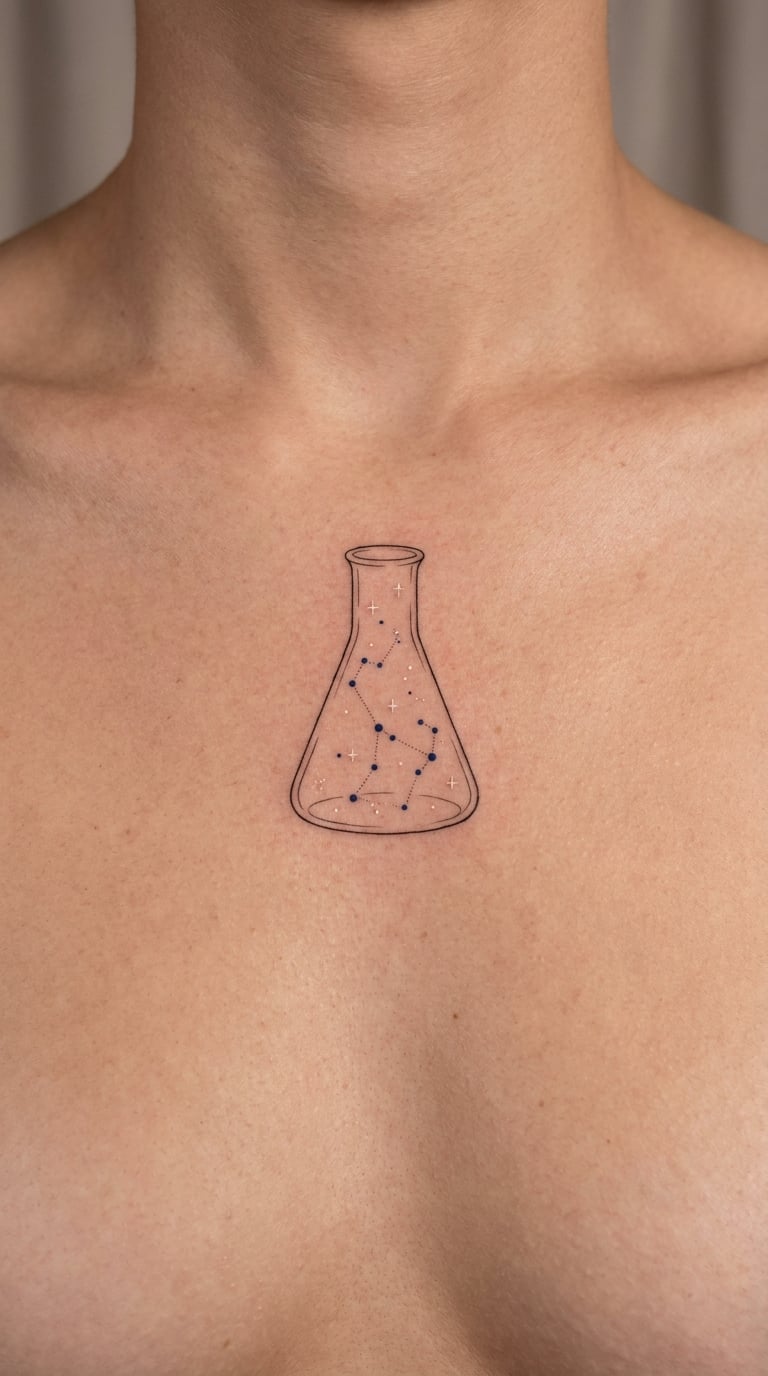
An Erlenmeyer flask outline with a real star pattern suspended inside it, plus a scatter of small stars, is a neat little astronomy and chemistry crossover. Using a genuine constellation means someone who knows the sky will recognise it.
Placement: below the collarbone, upper arm, or back of the hand. Size: 2-3 inches (5-8 cm) tall. Style: fine line with a single dark colour fill.
Pain: low on the chest and upper arm. Make it yours: use a constellation with a date attached to it, such as the star pattern visible from a place that matters to you.
Star points are the vulnerability. Small filled dots spread when they heal, so ask the artist to keep them just slightly larger than the reference.
12. Rocket Launching from an Orbit
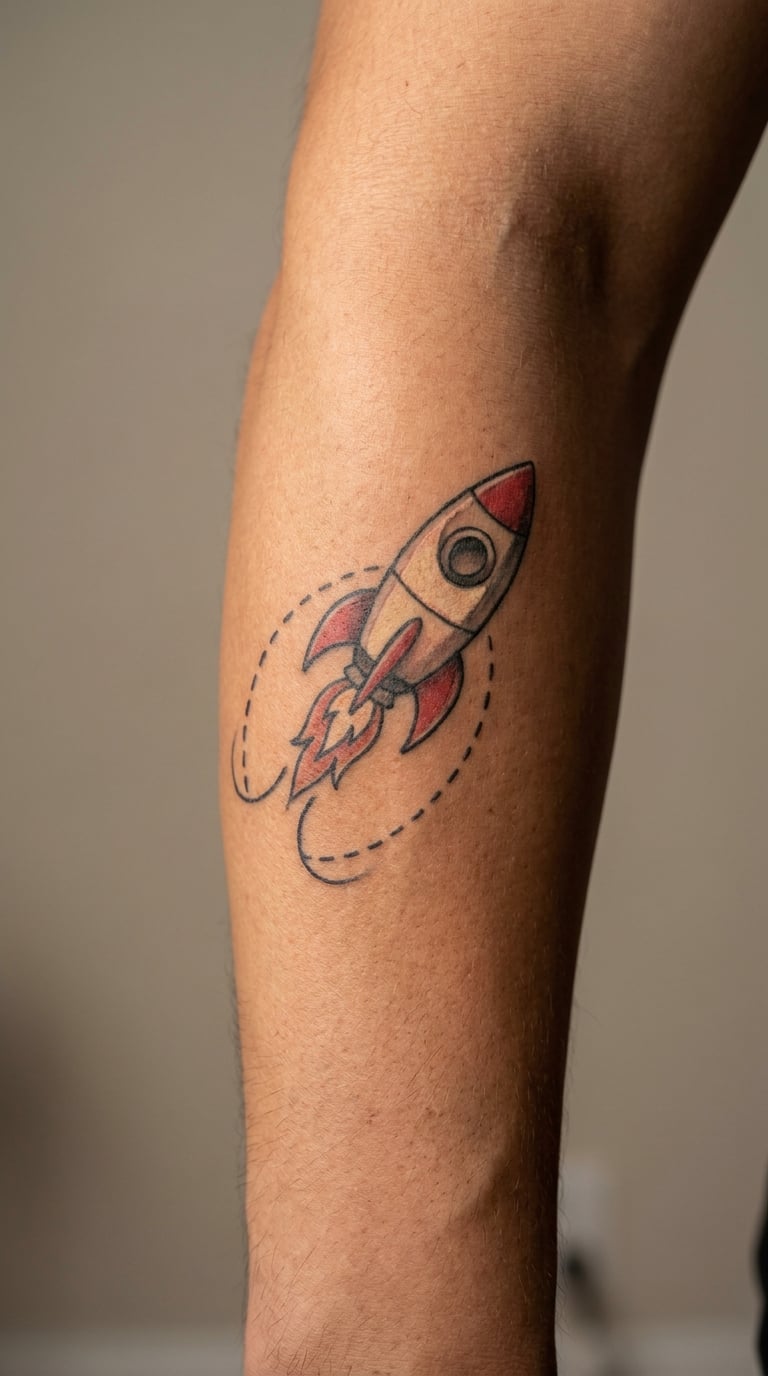
A rocket angled up out of a long sweeping curve, drawn in the flat two or three colour style of mid-century space posters, is an astronomy design with warmth. The retro palette is what separates it from the usual blackwork space stuff.
Placement: outer forearm, running along the muscle. Size: 4-5 inches (10-13 cm) long. Style: retro illustrative, flat colour.
Pain: medium. Make it yours: model the vehicle on a specific rocket you care about, and have the artist put a small date in the launch plume.
Flat colour fills stay crisp for years, though red and orange in skin do shift towards warm brown over time. Choose a palette that still works if the hues darken.
13. Anatomical Cell Membrane
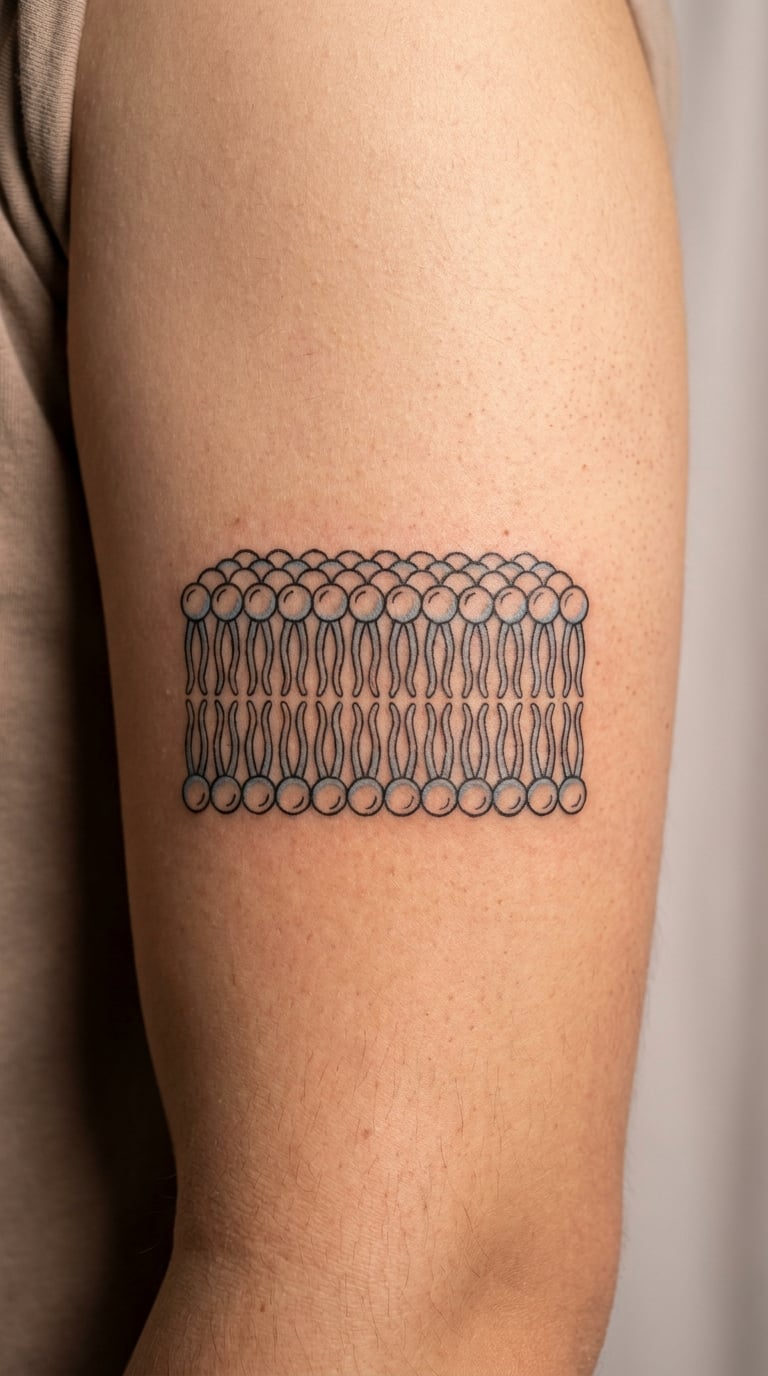
The phospholipid bilayer, two rows of round heads with tails facing each other, is a genuinely striking design because it is a repeating pattern rather than a single shape. It is a favourite with anyone who studied biochemistry.
Placement: upper arm, forearm, or across the back of the shoulder. Size: 4-5 inches (10-13 cm) wide. Style: scientific illustration, fine line with flat colour.
Pain: medium on the upper arm, low on the shoulder. Make it yours: use one molecule in a different colour, a quiet reference only you would catch.
Each circle needs to be at least a few millimetres across to survive healing. Below that the bilayer becomes a single grey line, so size here is not optional.
14. Micro-Realism Neuron Network
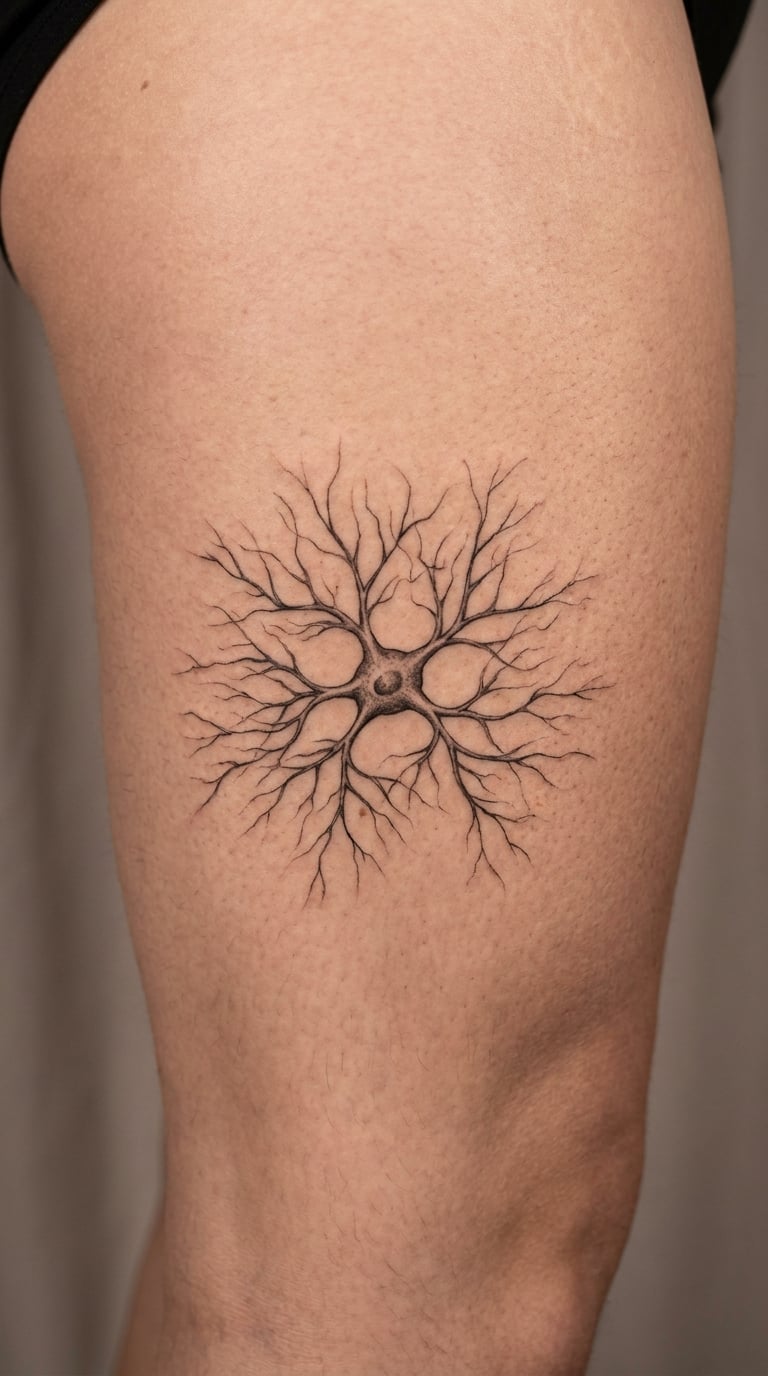
A single neuron with a shaded cell body, branching dendrites and a long axon with myelin beads is a neuroscience design that has become one of the most requested motifs in the last few years. Realism sells it better than a diagram does.
Placement: side of the thigh, calf, or the forearm. Size: 3-4 inches (8-10 cm) wide. Style: micro-realism, black and grey.
Pain: medium on the thigh. Make it yours: have the axon end in a tiny branching tip rather than stopping abruptly, which gives the piece a sense of movement.
Dendrite tips are where detail goes first. A designer who thins the outer branches by a fraction will get much more staying power than one copying a textbook plate.
15. Electron Probability Clouds
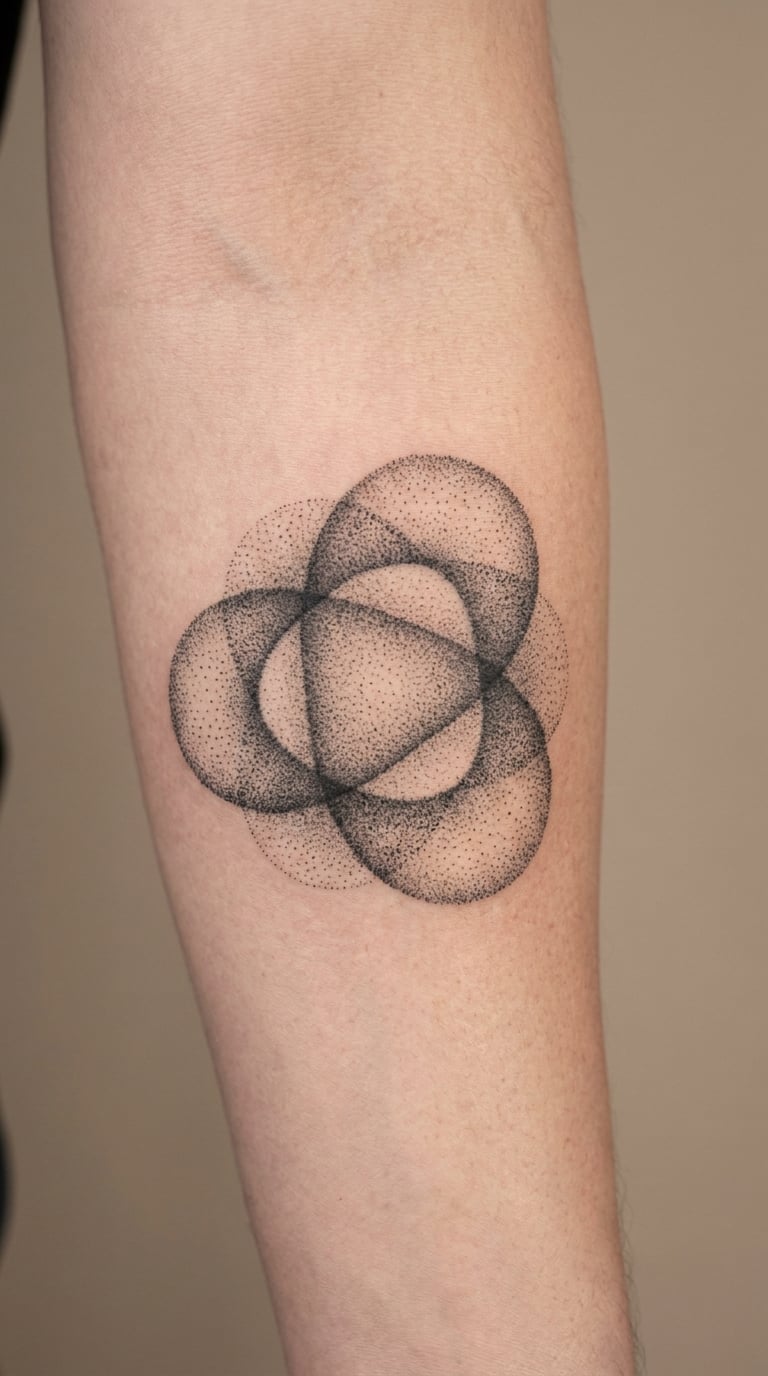
Overlapping clouds of dots, each one denser at the nucleus and fading outward, is a science tattoo idea that also happens to be good abstract art. It is one of the few quantum images that reads well without labels.
Placement: forearm, hip, or thigh. Size: 3-4 inches (8-10 cm) wide. Style: dotwork with grey wash shading.
Pain: medium, since dotwork takes time in one pass. Make it yours: pick the shapes of the orbitals you actually want, s and p are visually distinct and most people choose them for the look.
Dot density fades faster than solid line. Ask for a slightly heavier wash underneath the dots, and the cloud keeps its soft edge long after the individual dots soften.
16. Microscope Slide with Moon Phases
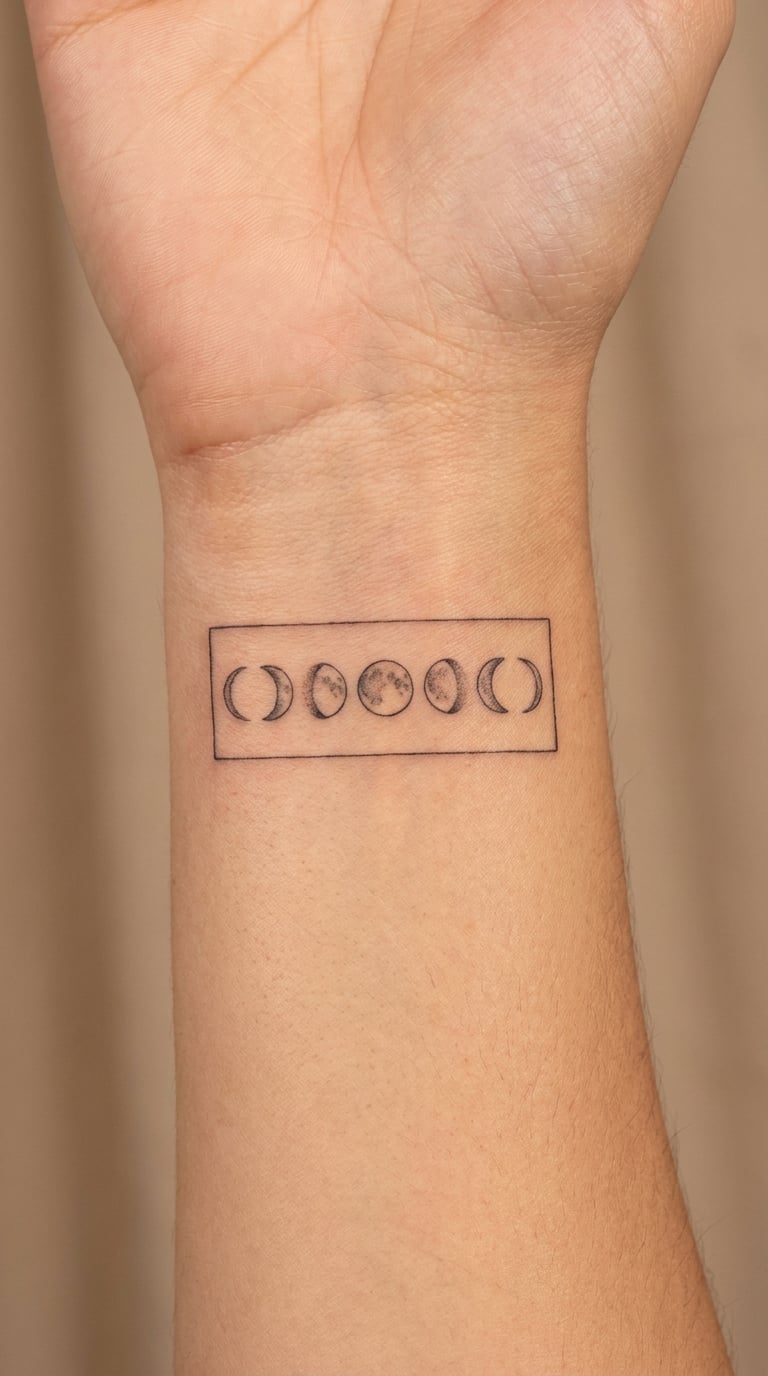
A long glass slide outline holding a row of shaded lunar phases, from a thin crescent to a full disc, is a quiet astronomy design with a laboratory frame around it. The contrast between the scientific object and the thing being studied is the joke, and it works.
Placement: inner wrist laid horizontally, or the forearm. Size: 4 inches (10 cm) long. Style: fine line with grey shading.
Pain: low on the inner wrist. Make it yours: order the phases in their real sequence and add a tiny observation date underneath.
Thin crescents are the first part to go, because there is very little ink holding them. A shaded terminator curve survives better than a hairline crescent.
17. Geometric Pythagorean Triangle
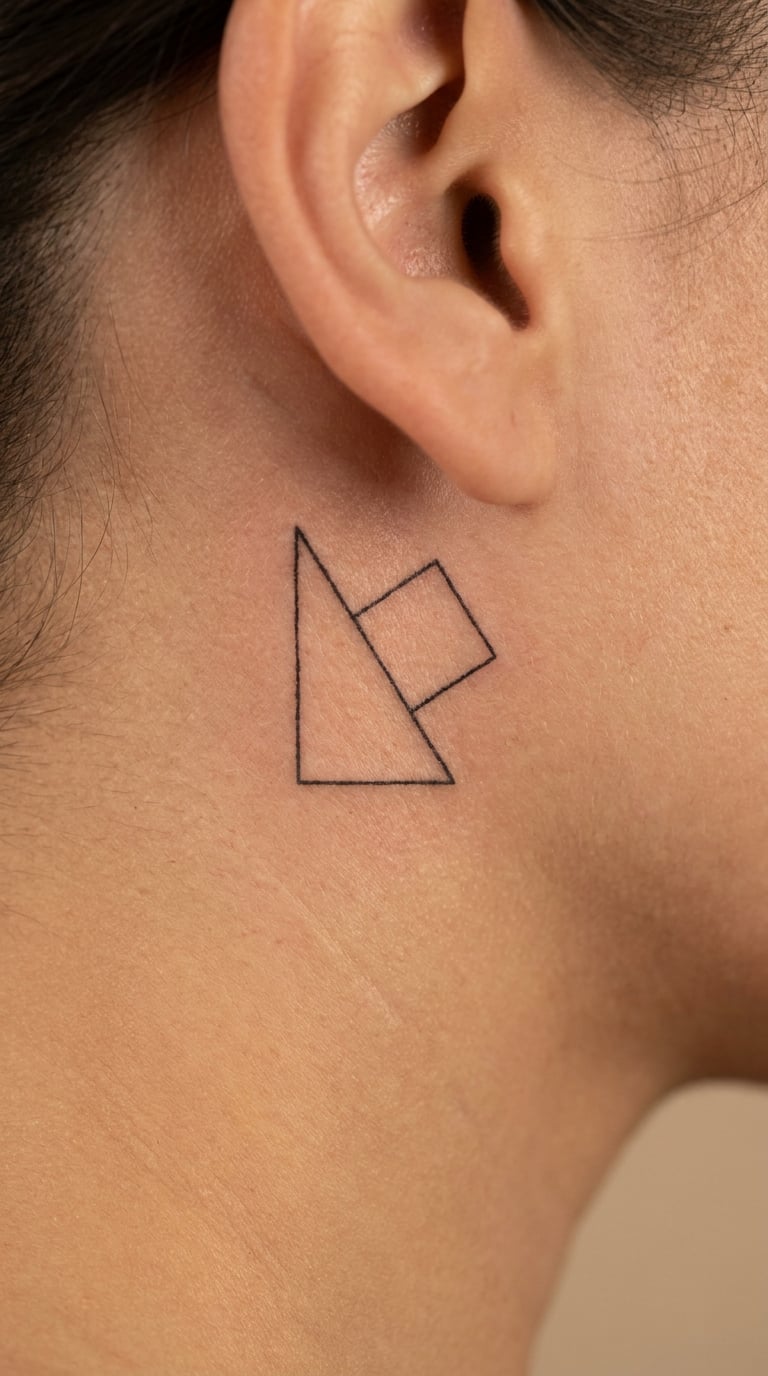
A right triangle with three or four squares built on its sides is mathematics you can wear, and it sits on the body like body geometry rather than an illustration. Behind the ear it is almost invisible unless someone is close.
Placement: behind the ear, inner arm, hip, or ankle. Size: 2-2.5 inches (5-6 cm) wide. Style: geometric fine line.
Pain: low behind the ear, medium on the ribs. Make it yours: have a letter or a number set into one of the smaller squares, a personal date tucked inside a proof.
Behind the ear lines soften faster than anywhere else, partly from sun and partly because the skin moves when you talk. Heavy line weight is worth asking for here.
18. Pendulum Creating a Wave Pattern
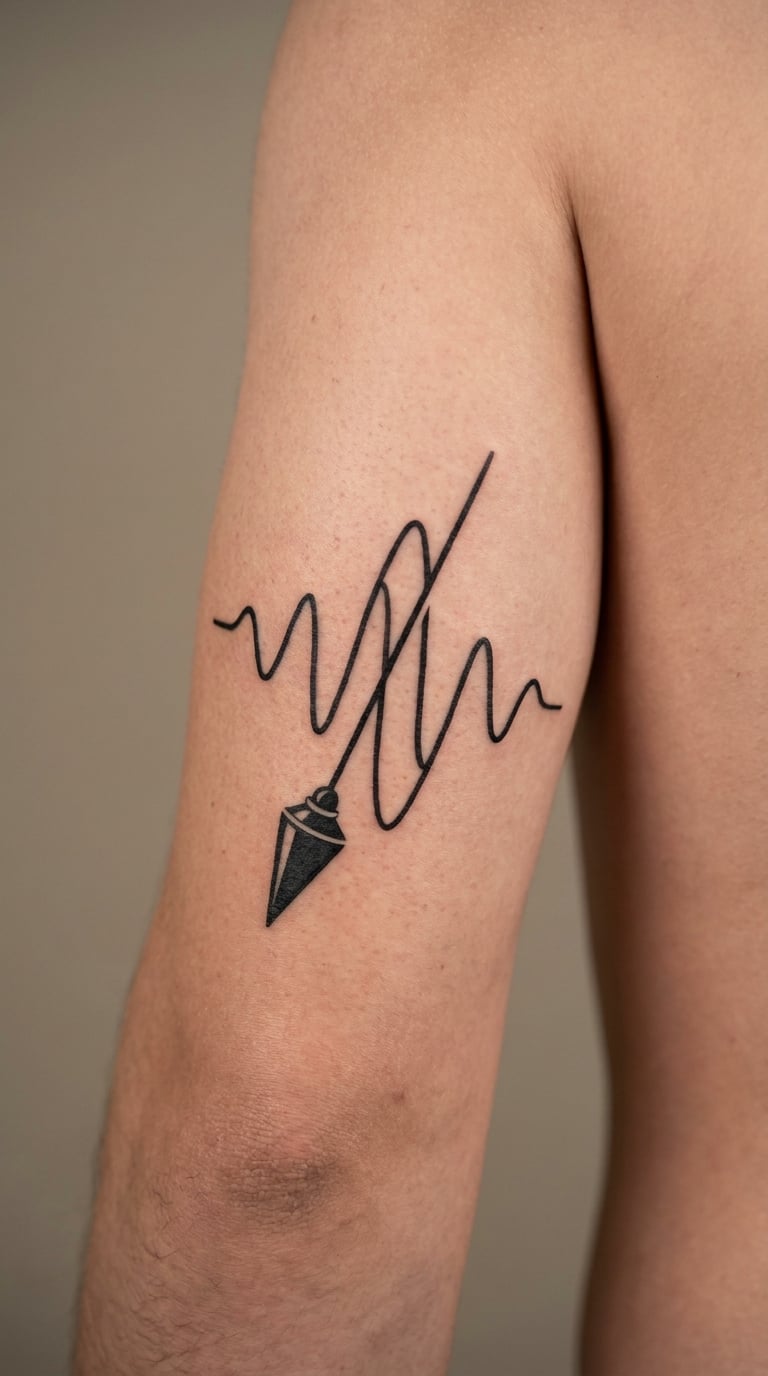
A pendulum bob on a straight line, with a series of wave curves fanning out to one side, is physics and motion in one image. The arc positions can be calculated to be accurate, and some wearers like that accuracy being real.
Placement: outer upper arm, thigh, or the back of the calf. Size: 3-4 inches (8-10 cm) long. Style: fine line, symmetrical.
Pain: medium on the upper arm. Make it yours: have the artist calculate real swing positions for a specific length, then add that length in small type at the base.
Many fine wave curves in a small area blur together. Six or seven arcs is usually the most that stays readable; more becomes texture.
19. Petri Dish Botanical Specimen
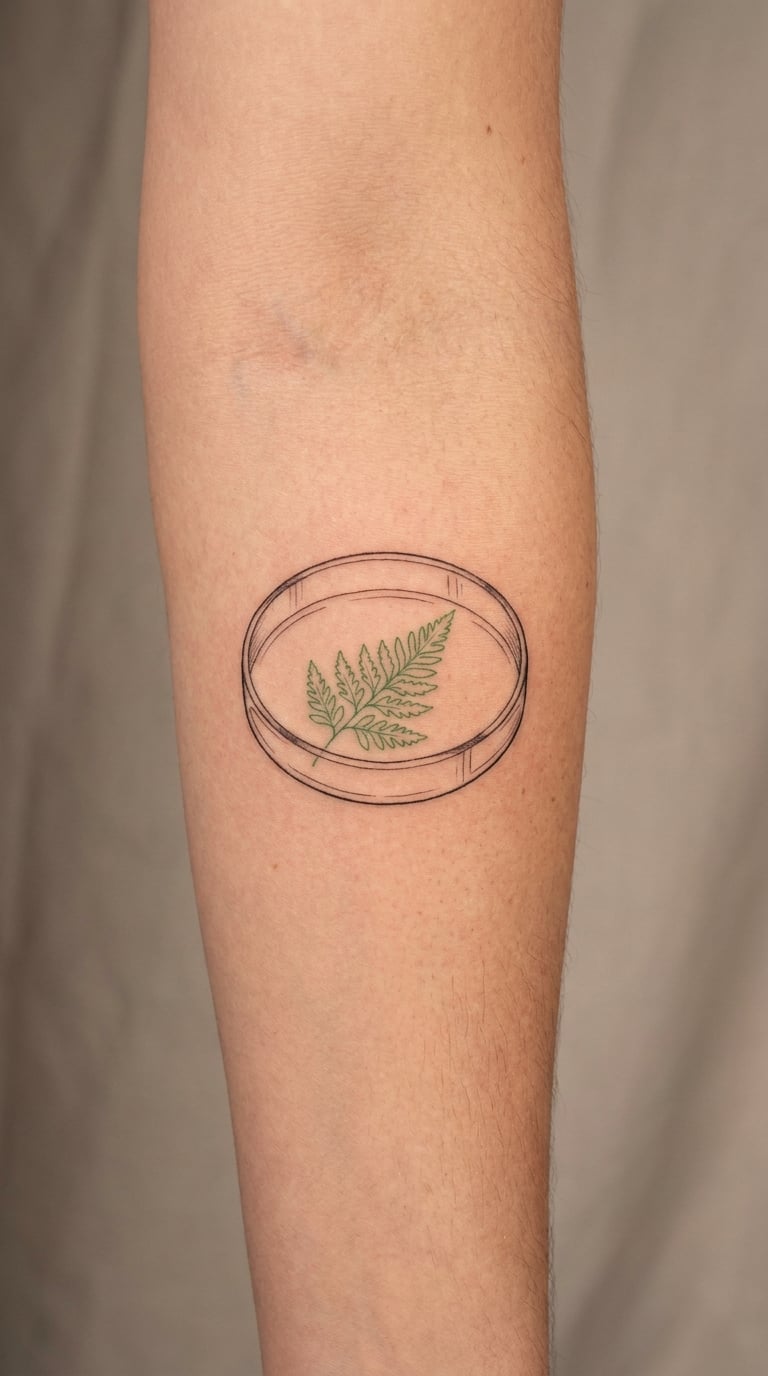
A circular dish drawn as if you were looking down into it, with a small sprig or fern laid out inside like a pressed specimen, crosses botany and lab work in a way that looks intentional rather than themed.
Placement: forearm, calf, or the back of the hand. Size: 3 inches (8 cm) diameter. Style: botanical line art, single colour.
Pain: low on the forearm, higher on the hand. Make it yours: use a plant you gathered yourself and have the leaf edges kept slightly irregular rather than machine-perfect.
The dish rim needs to be a heavier line than the plant inside, or the whole thing reads as a floating flower. That contrast is the design.
20. Telescope Pointing into a Galaxy
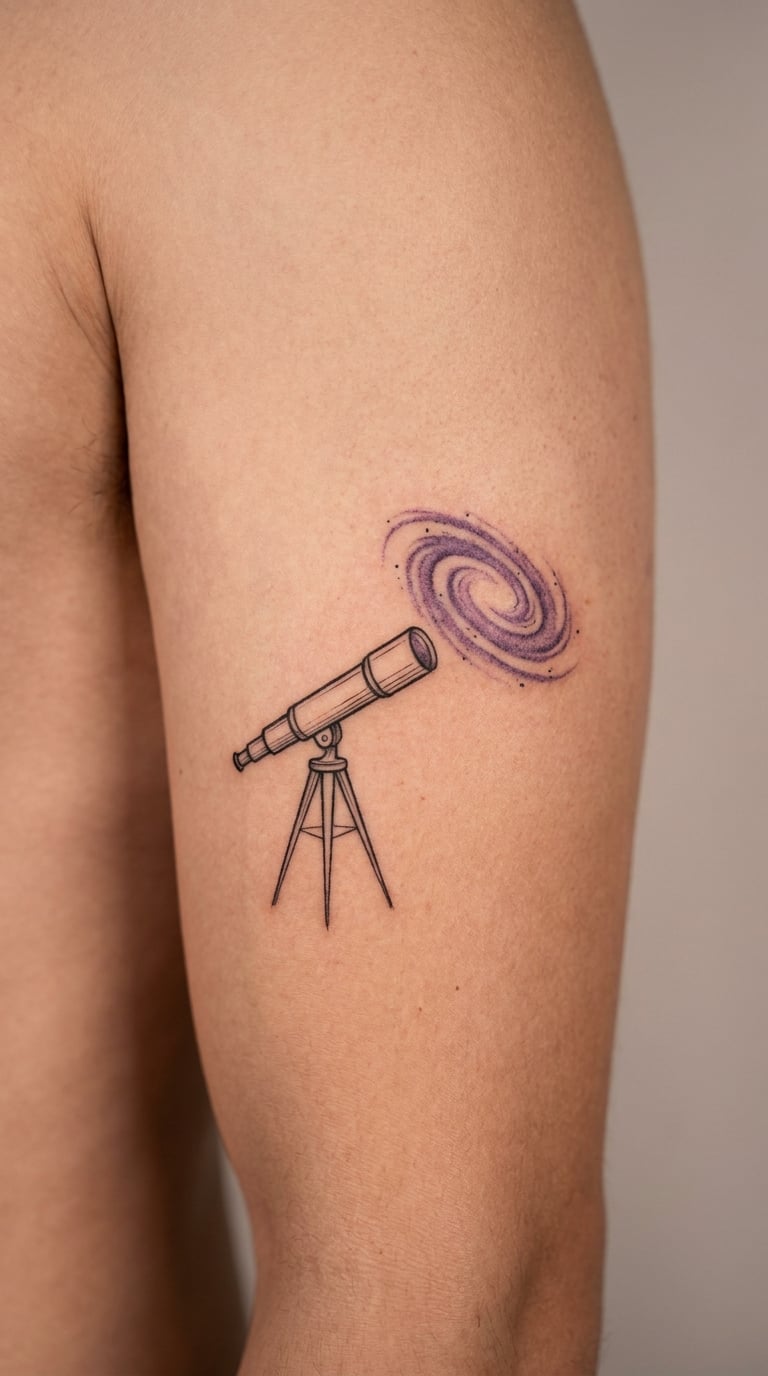
A refracting telescope drawn in profile, its line of sight aimed at a spiral galaxy with visible arms, is a composition rather than a single icon. The angle between the two elements is what gives it movement.
Placement: upper arm set on a diagonal, or the thigh. Size: 4-5 inches (10-13 cm) wide. Style: fine line with one galaxy colour.
Pain: medium on the upper arm. Make it yours: use the spiral of a real galaxy, since the arm structure is recognisable to anyone who has looked at a long exposure photo.
Spiral arms are many thin curved lines in a small area, so they soften early. Fewer, bolder arms look better healed than a photographically accurate swirl.
21. Anatomical Heart Study
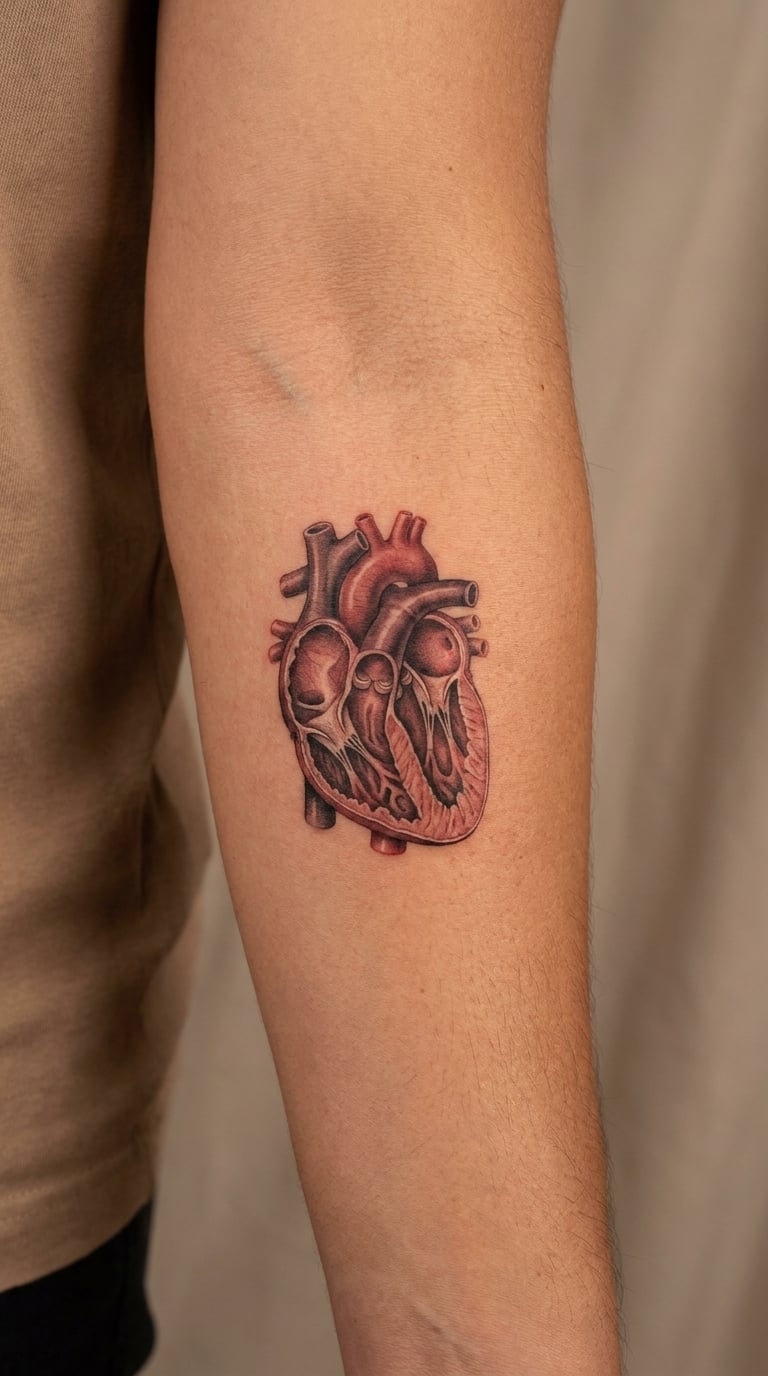
The difference between this and a heart outline is anatomy: chambers, valves, coronary arteries in red, and the vessels cut open at the top. It reads as a medical illustration rather than a symbol, which is usually the point.
Placement: inner arm near the elbow, chest, or the calf. Size: 3-4 inches (8-10 cm) tall. Style: micro-realism, red and black.
Pain: medium, and the inner arm near the elbow is tender. Make it yours: place it anatomically correct relative to your own heart, offset to the correct side, and add your birth year on the base plate.
Red over black is one of the more durable colour tattoos, but fine vessel detail still softens. Larger, fewer vessels beat a dense web every time.
22. Geological Layers in an Hourglass
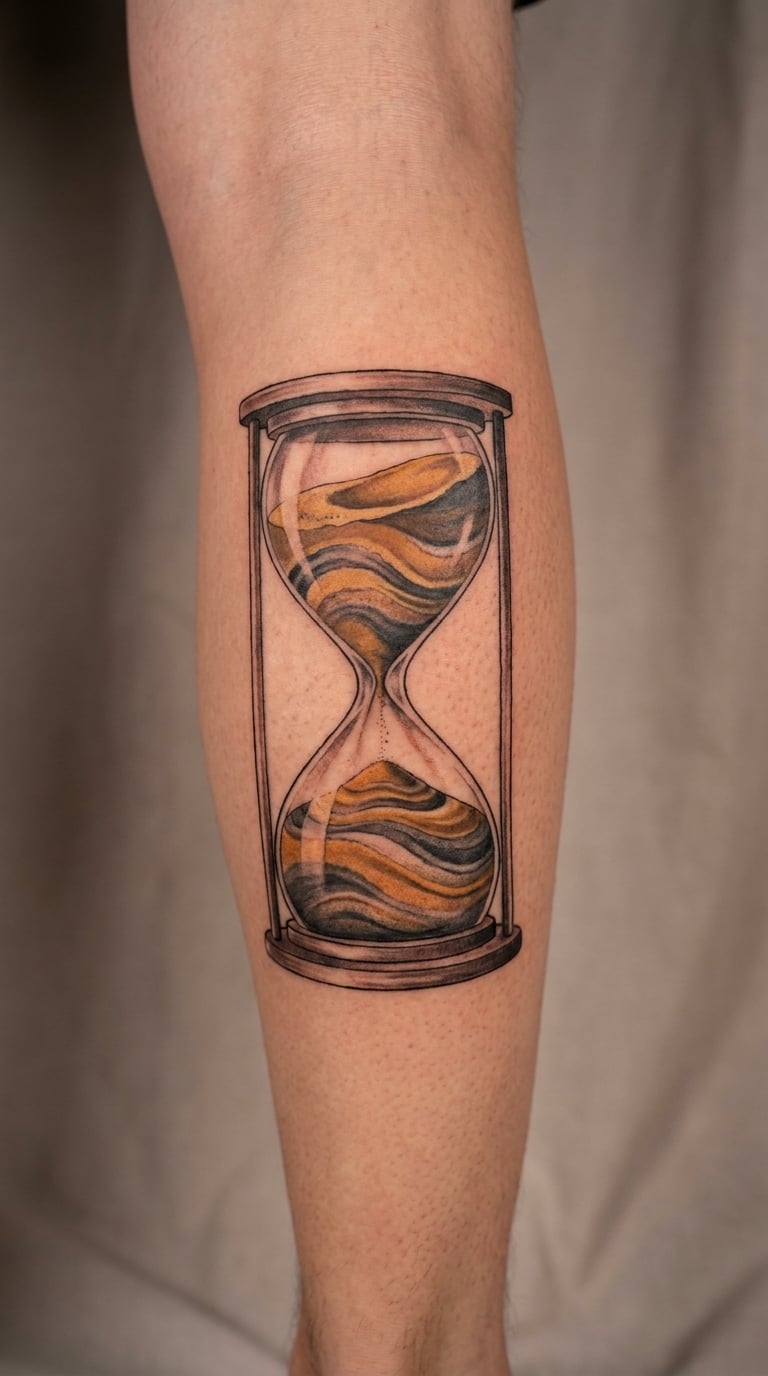
An hourglass whose two chambers are filled with distinct bands of sediment and rock, each layer a different tone, turns a symbol of time into a cross-section. The banding is the design; everything else is just the frame holding it.
Placement: calf, forearm, or the back of the upper arm. Size: 3-4 inches (8-10 cm) tall. Style: illustrative realism, flat earthy colour.
Pain: medium on the calf. Make it yours: use the actual stratigraphy of a place you have visited, band order and all, and keep the colours true to the rock.
Thin light bands inside a dark field lose contrast over time. Anything under a few millimetres wide will eventually disappear, so fewer thicker layers is the safer route.
23. Prism Refracting a Light Spectrum
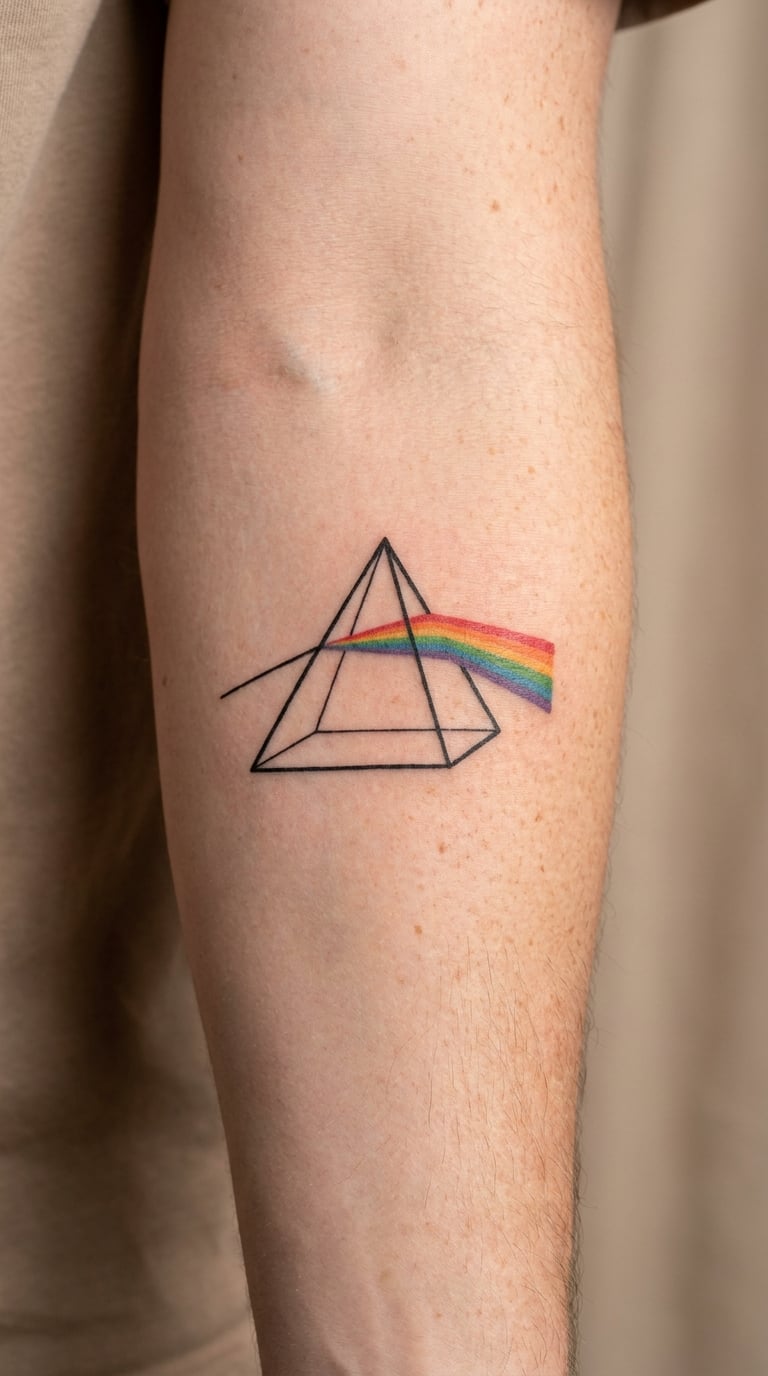
A simple triangle of glass with a white beam entering one side and a small fan of spectrum colours leaving the other is the one physics image that lets you use colour without a sleeve. It is clean, balanced and quick to tattoo.
Placement: inner forearm, or the back of the hand. Size: 2-3 inches (5-8 cm) wide. Style: minimalist line art with a colour spectrum.
Pain: low on the inner forearm. Make it yours: have the spectrum fan run into a second motif, a leaf or a wave, so the light visibly lands on something.
Colour fades note: yellow and pale green in small tattoos are the first hues to wash out. Expect the spectrum to read slightly more muted than the reference within a few years.
24. Quartz Crystal Lattice
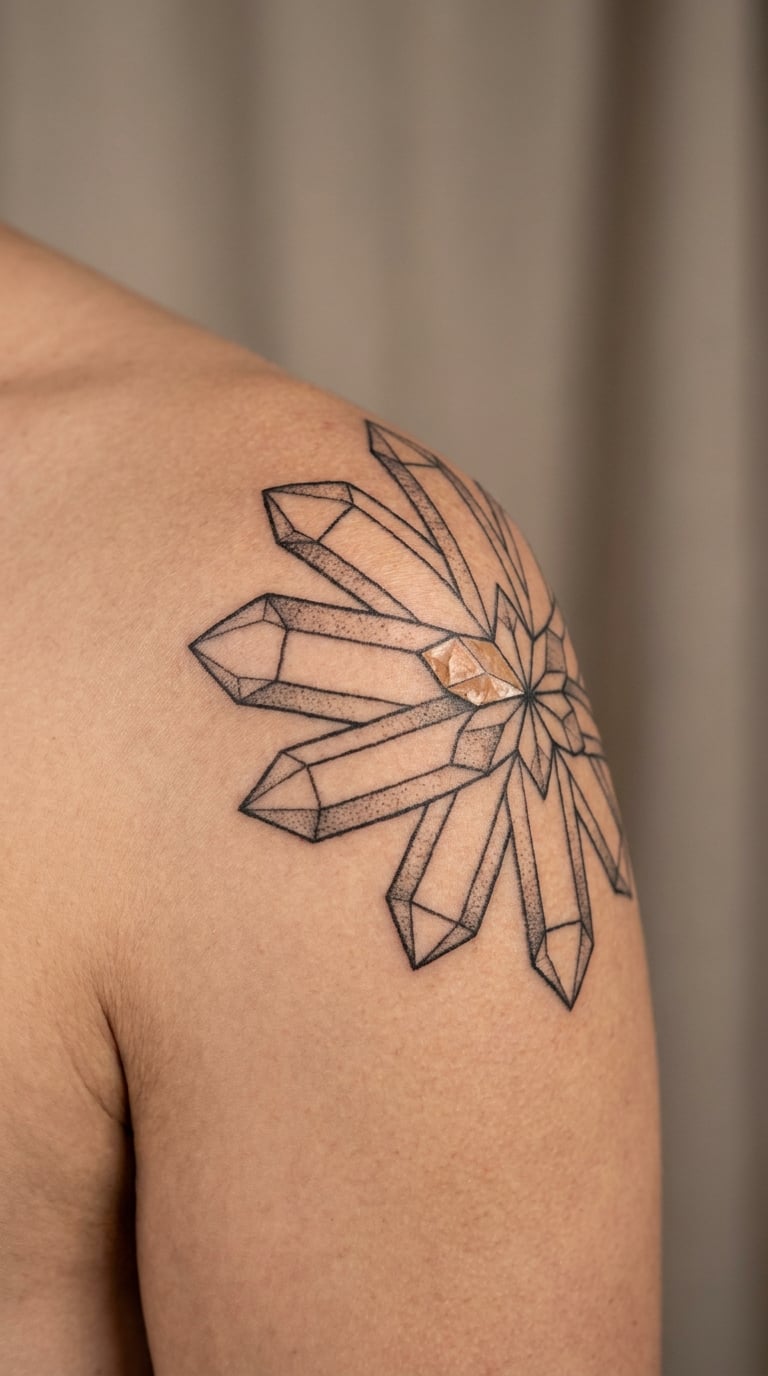
A symmetrical lattice of interlocking points, the geometry behind how a quartz crystal grows, bridges mineralogy, chemistry and mathematics without committing to any one of them. Rendered in dotwork it also happens to be a very good shoulder piece.
Placement: shoulder, upper arm, or the hip. Size: 3-4 inches (8-10 cm) wide. Style: symmetrical dotwork, geometric.
Pain: medium on the shoulder, which is a sensitive area for many people. Make it yours: use the lattice pattern of your birthstone, which is a real crystal habit rather than a decorative invention.
Dotwork in a symmetrical grid needs a steady hand and time. If the piece is rushed, the regularity breaks, and a broken lattice is far more noticeable than an irregular one.
25. Mars Rover and Red Planet
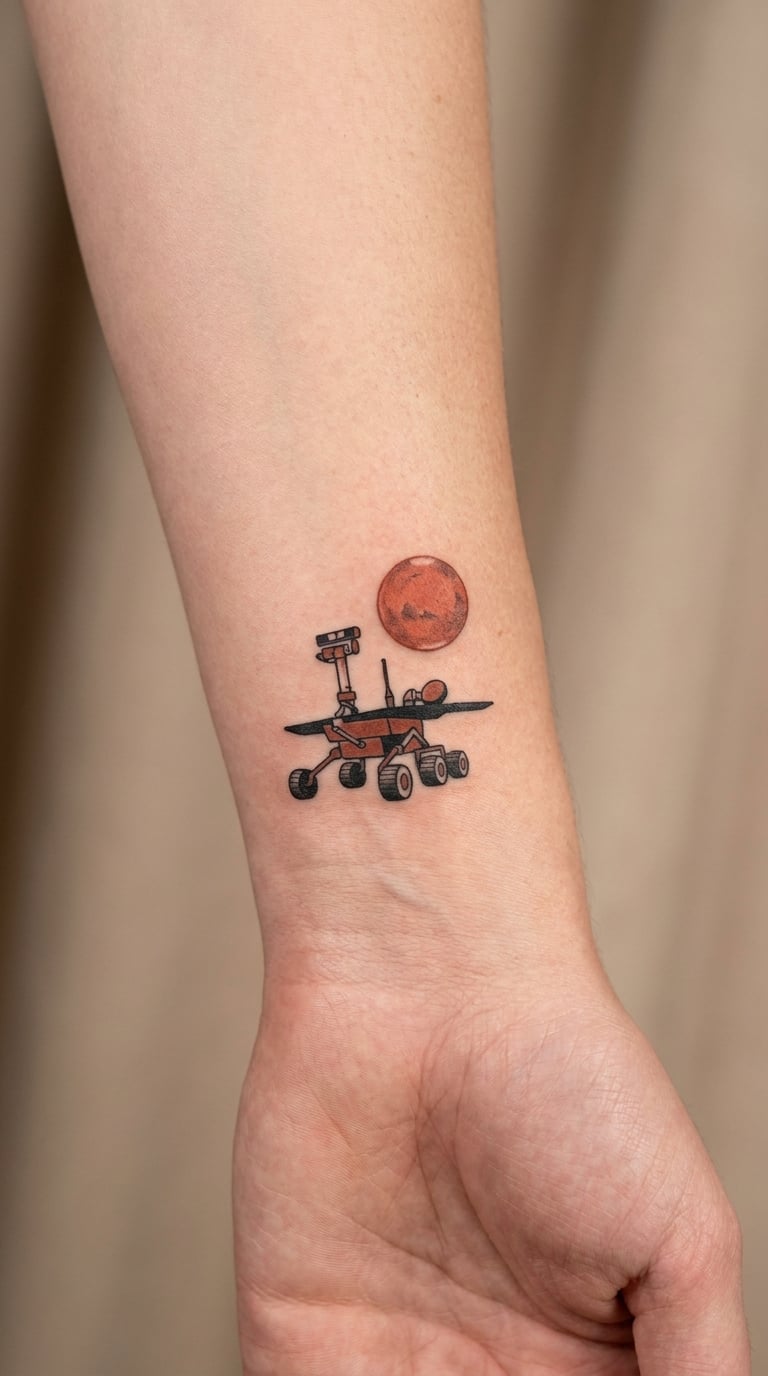
A small six-wheeled rover sitting under a large rust-red planet, drawn in simple black line with one red fill, closes the list and suits anyone who wants space on the body without a large piece. The scale contrast is what makes it work.
Placement: outer wrist, ankle, or the forearm. Size: 2 inches (5 cm) wide. Style: fine line with one colour fill.
Pain: low on the wrist and ankle. Make it yours: model the rover on the real thing with its camera mast raised, and place the planet so it sits on the shoulder of the arm rather than the middle.
Small wheels and joints are the weak point. Two-inch is genuinely the floor here, and a rover drawn any smaller loses the wheels first.
How to Choose the Right Design
Pick the linework before the subject. If the design has more than about a dozen tiny features, it needs to be larger than you pictured, and asking your artist to simplify is cheaper than living with a grey smudge.
Placement: inner forearm and the upper arm are the flattest everyday canvases, and they take a wide diagram without distortion. Wrists and ankles suit small geometric or single-icon pieces, and hands fade fastest of all.
Size: measure the spot before you commit. A two-inch design on a forearm reads as medium in the mirror and as tiny in a photograph, which is the part that surprises people.
Colour: colour is what separates a design from its neighbours, and it is also what fades first. A black and grey piece still looks like itself in fifteen years, while a two-colour piece may need a refresh.
Scientific legibility: decide how accurate you want it. An engineer may want the orbital mechanics right, while most people just want the design to be recognisable to somebody who knows the field.
Solo or collection: if you already have a sleeve, match line weight and style rather than subject matter. A new DNA piece looks wrong next to a bold illustrative style, no matter how much you like it.
If you want inspiration for designs that carry emotional weight rather than a scientific diagram, these tattoo ideas that symbolize growth for first timers are a good place to compare notes.
Cost and Session Time
Tattoo pricing in the US usually runs by the hour, and a single motif is often at or near the shop minimum, so a small piece and a large piece can cost closer together than people expect.
Micro, 1-2 inches: roughly 150 to 300 for a single fine-line icon such as the atom or the beaker, often 30 to 60 minutes of chair time.
Small, 2-4 inches: roughly 300 to 700, one to two hours, covering designs like the DNA helix, the periodic table square or the Mars rover.
Medium, 4-6 inches: roughly 600 to 1,400, two to three hours, typical of the microscope, the neuron and the geological hourglass.
Large, 6 inches and up: priced by the hour, usually split across two or three sessions. Nothing about a science tattoo makes a big piece cheaper; the same line weight costs the same wherever it sits.
Rates vary a lot by city, artist and shop minimum, so treat these as a sense of scale rather than a quote. Your artist will give you a real number at the consultation.
Aftercare Basics
- Follow your artist’s aftercare instructions first. They know the ink and the needle depth they used, and their advice outranks anything general you read online, including this list.
- Wash gently with lukewarm water and a mild unscented soap, twice a day for the first few days, then pat dry with clean hands rather than a towel.
- Keep it covered from sun for the first couple of weeks. UV exposure is the fastest way to soften fine line work, and it matters most in the first months while the piece is still settling.
- Wear loose clothing over the area, especially on the inner forearm where sleeves rub while you work, and avoid anything that binds the skin.
- Do not soak, swim, or use a sauna until the skin is fully healed, and leave any scabs or flaking skin alone.
- Contact the studio, not the internet, if the piece stays red, raised, swollen, or starts leaking after the first few days.
Frequently Asked Questions
What is the best science tattoo for a first-time client?
The fine-line atom with three orbital rings is the safest first choice. It has few enough details to stay crisp, it takes under an hour, and the shape is instantly recognisable. If you want something with more depth, a single element square from the periodic table is nearly as forgiving.
Are small science tattoos likely to blur or fade?
Small ones fade faster, and the honest answer is that anything under about two inches loses fine detail over time. Wrist and hand pieces fade quickest because of sun and skin movement, while forearm and upper arm line work holds up much better. Asking for slightly heavier lines and fewer tiny features buys you years.
Do science tattoos need to be perfectly accurate?
No, and most wearers do not want them to be. An accurate orbital diagram at two inches is illegible anyway, so artists usually simplify to a handful of orbits or planets that read clearly. If accuracy is the point for you, size the piece up and bring proper references to the consultation. Most of the 25 science tattoo ideas here are simplified on purpose for exactly that reason.
Where should I place a science-themed tattoo?
Inner forearm and outer upper arm are the flattest everyday spots and take wide diagrams well. Wrists and ankles suit small geometric pieces and low line work. Hands fade fastest, ribs and the inner elbow hurt most, and the shoulder is comfortable for some people and unbearable for others.
How much does a detailed science tattoo usually cost?
In the US a single fine-line icon around one to two inches often lands between 150 and 300, medium pieces of three to four inches between 300 and 700, and anything six inches or larger is priced hourly and split across sessions. Shop minimums, city and artist rate make a bigger difference than complexity.
Conclusion
For a first tattoo, the fine-line atom or a periodic table element square is the easy win: small, quick, and it still looks right years later. If you are adding to an existing collection, the micro-realism neuron or the vintage microscope gives an artist enough shading to work with and ages better than any thin-line diagram.
Bring references to the consultation, not just a screenshot, and let the artist simplify anything that will not survive at the size you have in mind. If you want more small, quiet designs to weigh up, the minimalist tattoo ideas for anxiety and calm are a good counterpoint to the diagram-heavy stuff here.