
20 Archery Tattoo Ideas (October 2026): Small and Bold
Archery tattoos are about aim, focus and forward motion, and a good bow and arrow design can carry all three in a shape small enough for a wrist. The 20 archery tattoo ideas below run from a single hairline arrow behind the ear to a full forearm scene, and each one lists a real size, a real placement and an honest note on how it ages.
Most people arrive at a bow and arrow because they shoot, or because someone they love shoots. The trap is copying a clip-art logo off a search page, so I have written each design out in enough detail that an artist could sketch it from the text alone. Read the quick guide first, then jump to the designs that match the space you actually have.
20 Archery Tattoo Ideas: Quick Guide
| Idea | Style | Best placement | Size | Pain |
|---|---|---|---|---|
| 1. Fine-line arrow behind the ear | Fine line | Behind the ear, side of neck | 2 to 3 in (5 to 7.5 cm) | Low to medium |
| 2. Minimal bow and arrow on the wrist | Fine line, one weight | Inner wrist | 2 to 2.5 in wide (6 cm) | Medium |
| 3. Traditional target with arrow | Neo-traditional | Outer upper arm | 4 to 5 in across (10 to 13 cm) | Medium |
| 4. Watercolor arrow in motion | Watercolor | Forearm | 3.5 to 4.5 in (9 to 11 cm) | Medium |
| 5. Compound bow forearm portrait | Micro-realism | Inner forearm | 4 to 5 in (10 to 13 cm) | Medium to high |
| 6. Quiver and arrow collarbone design | Fine line | Under the collarbone | 2.5 to 3.5 in (6 to 9 cm) | Medium to high |
| 7. Arrow through a mountain range | Fine line with stipple | Forearm | 3.5 to 4.5 in (9 to 11 cm) | Medium |
| 8. Split arrow matching tattoo | Minimal fine line | Inner forearms, both arms | 2 to 2.5 in each half | Medium |
| 9. Archery glove and arrow | Black and grey realism | Back of the hand | 3 to 3.5 in (8 to 9 cm) | High |
| 10. Geometric arrow pattern | Geometric | Forearm | About 4 in tall (10 cm) | Medium |
| 11. Hand-drawn longbow on the calf | Fine line illustration | Outer calf | 5 to 6 in tall (13 to 15 cm) | Low to medium |
| 12. Red arrow with black fletching | Illustrative realism | Upper arm | 3 to 3.5 in (8 to 9 cm) | Medium |
| 13. Old-school bow and arrow | American traditional | Upper arm | 4.5 to 5.5 in (11 to 14 cm) | Medium |
| 14. Archery target with three arrows | Neo-traditional | Shoulder blade | 4 to 5 in (10 to 13 cm) | Medium to high |
| 15. Minimal arrow spine tattoo | Minimal, one line | Upper spine | 4 to 5 in (10 to 13 cm) | High |
| 16. Dotwork arrow and crosshairs | Dotwork | Forearm | 2.5 to 3.5 in (6 to 9 cm) | Medium |
| 17. Floral arrow on the shoulder | Fine line with botanicals | Shoulder | 4 to 4.5 in (10 to 11 cm) | Medium |
| 18. Ancient-style bow and arrow | Engraving-inspired linework | Calf | 4.5 to 5.5 in (11 to 14 cm) | Low to medium |
| 19. Monochrome bow in a dagger | Blackwork | Outer forearm | 4.5 to 5.5 in (11 to 14 cm) | Medium to high |
| 20. Full-forearm archery scene | Black and grey illustrative | Forearm | 7 to 9 in (18 to 23 cm) | Medium to high |
1. Fine-Line Arrow Behind the Ear
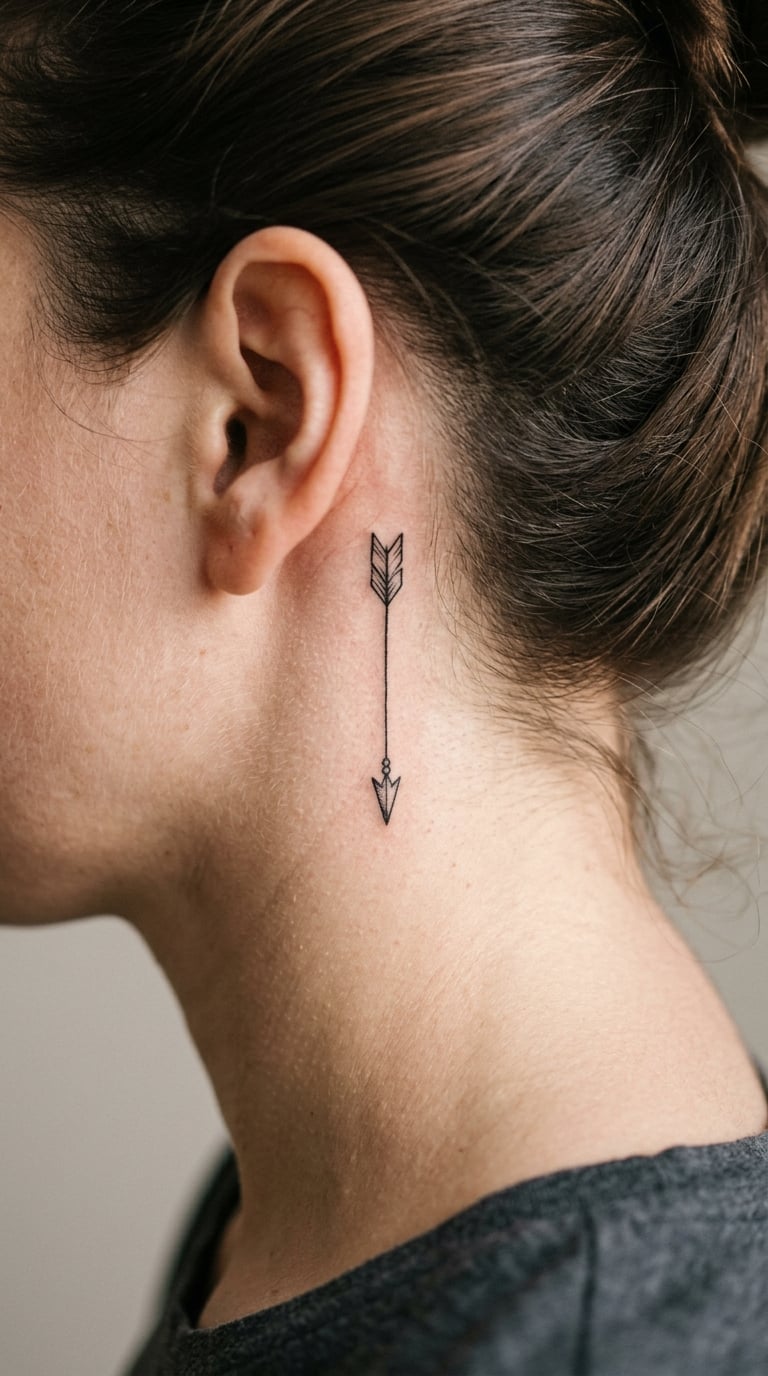
A single arrow in thin black line, no shading, no colour, tucked behind the ear so the fletching sits above the jaw and the point runs down toward the shoulder. It reads as one quiet stroke rather than a picture, which is the whole point. People pick this spot because it stays private until they turn their head.
Placement: behind the ear, or just under the lobe where the arrow can follow the curve of the jaw. Size: 2 to 3 inches (5 to 7.5 cm). Style: fine line at a single consistent weight.
Pain: low to medium. Neck skin is thin and the lobe area stings, and the small curves of the ear cartilage are slow going. Fine work behind the ear softens faster than on the forearm, so ask for one pass of slightly heavier line. Make it yours: add a barbed point or a single dot between the fletching, and book a touch-up at around 12 months.
2. Minimal Bow and Arrow on the Wrist
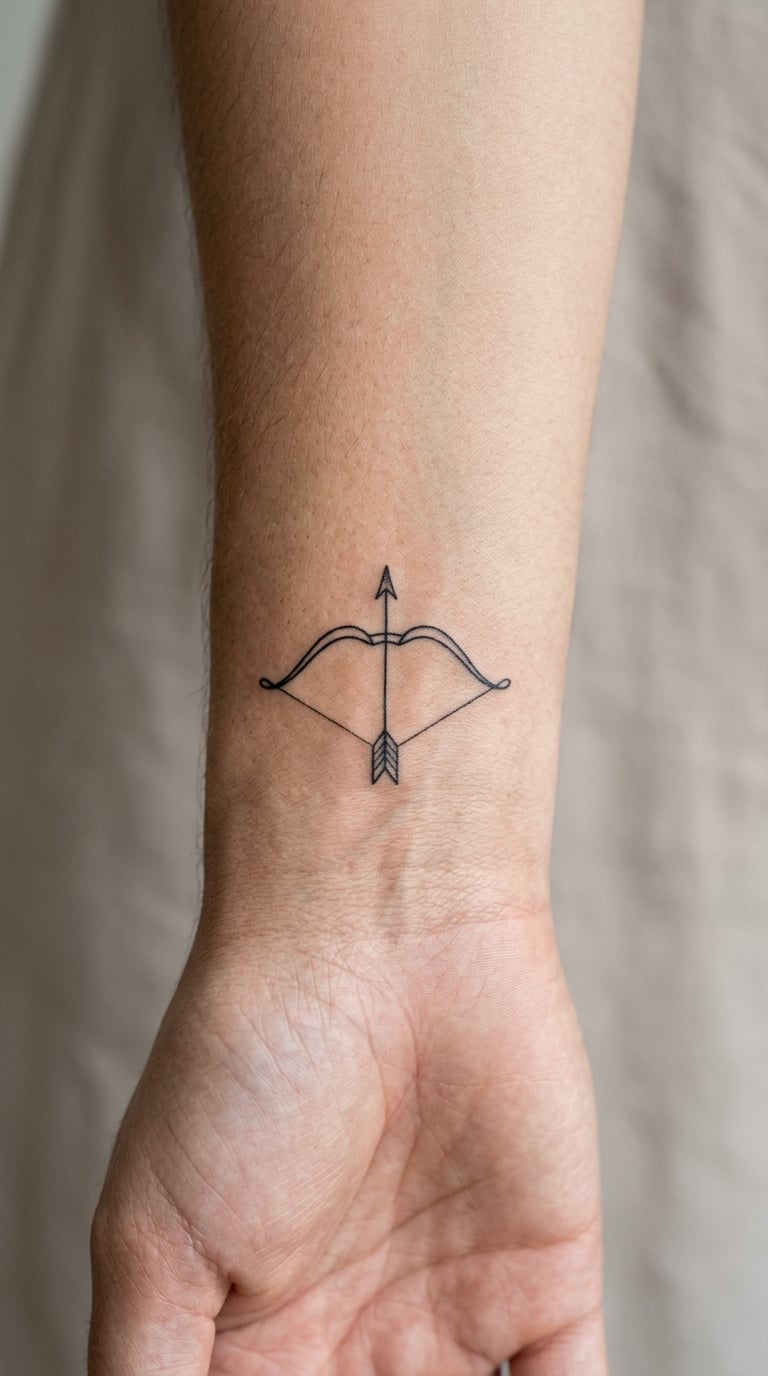
A bow curved like a half circle with a single arrow resting across it, drawn in one clean line with no fill. Keep the arrow slightly longer than the bow so the two shapes do not fight each other. The drawn bow reads as patience and stored force, the arrow as the decision to let it go.
Placement: inner wrist, just above the crease. Size: 2 to 2.5 inches (5 to 6.5 cm) across. Style: minimal fine line, one weight throughout.
Pain: medium. The inner wrist has more nerve endings than the outer arm, and wrist ink moves with the joint every time you type. Make it yours: have the artist hide a small date in the curve of the string, or ask for a thin band of red through the arrow shaft.
3. Traditional Target with Arrow
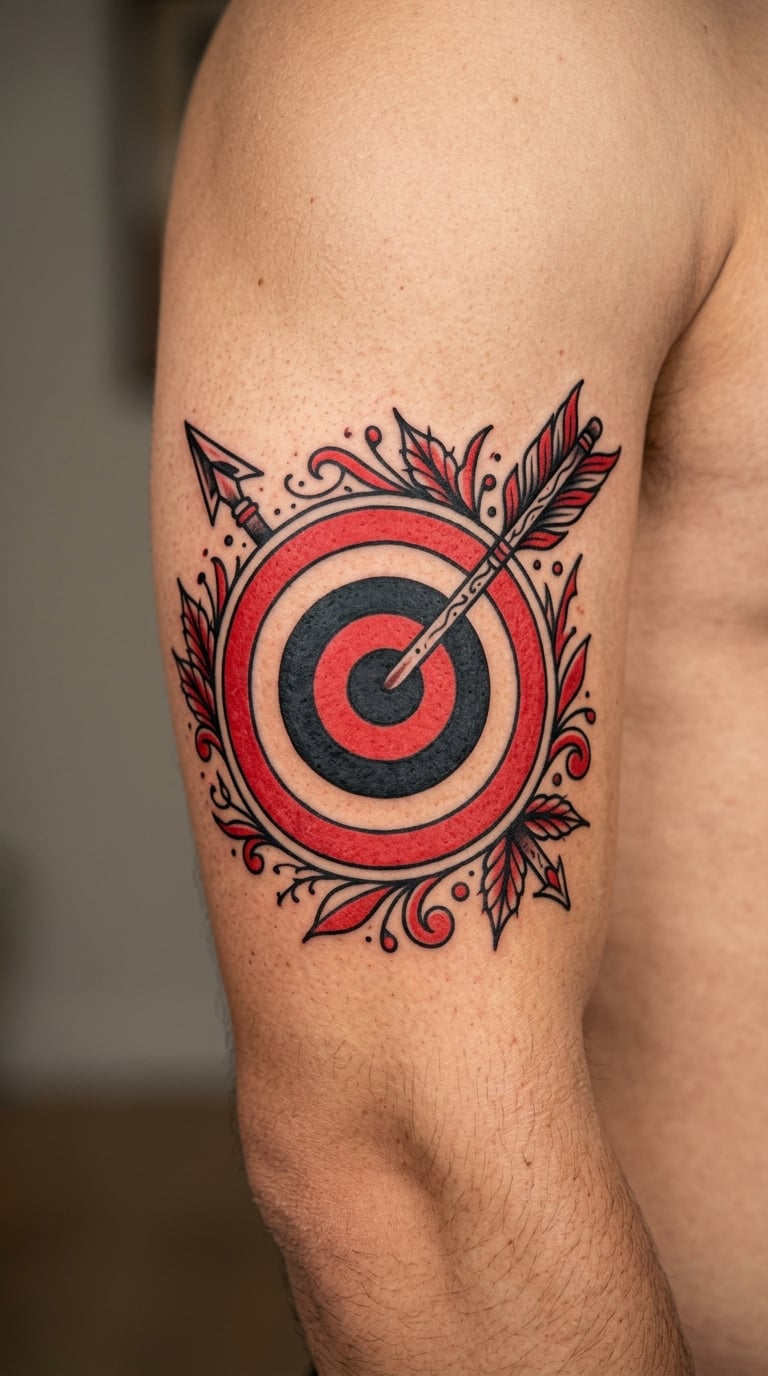
A round target face with concentric rings in alternating red and cream, one thick arrow buried off centre in the gold. Bold black outlines do the work here, the way old-school flash art does, with heavy shading in the outer ring. The off-centre hit is what stops it looking like clip art, because a dead-centre bullseye is far too tidy.
Placement: outer upper arm or the flat of the shoulder. Size: 4 to 5 inches (10 to 13 cm) across. Style: neo-traditional with heavy black line and two or three inks only.
Pain: medium. The outer arm is fleshy and forgiving, and the round shape hides uneven skin texture well. Make it yours: change the ring colours to your club colours, or set the ring count to the number of years you have shot.
4. Watercolor Arrow in Motion
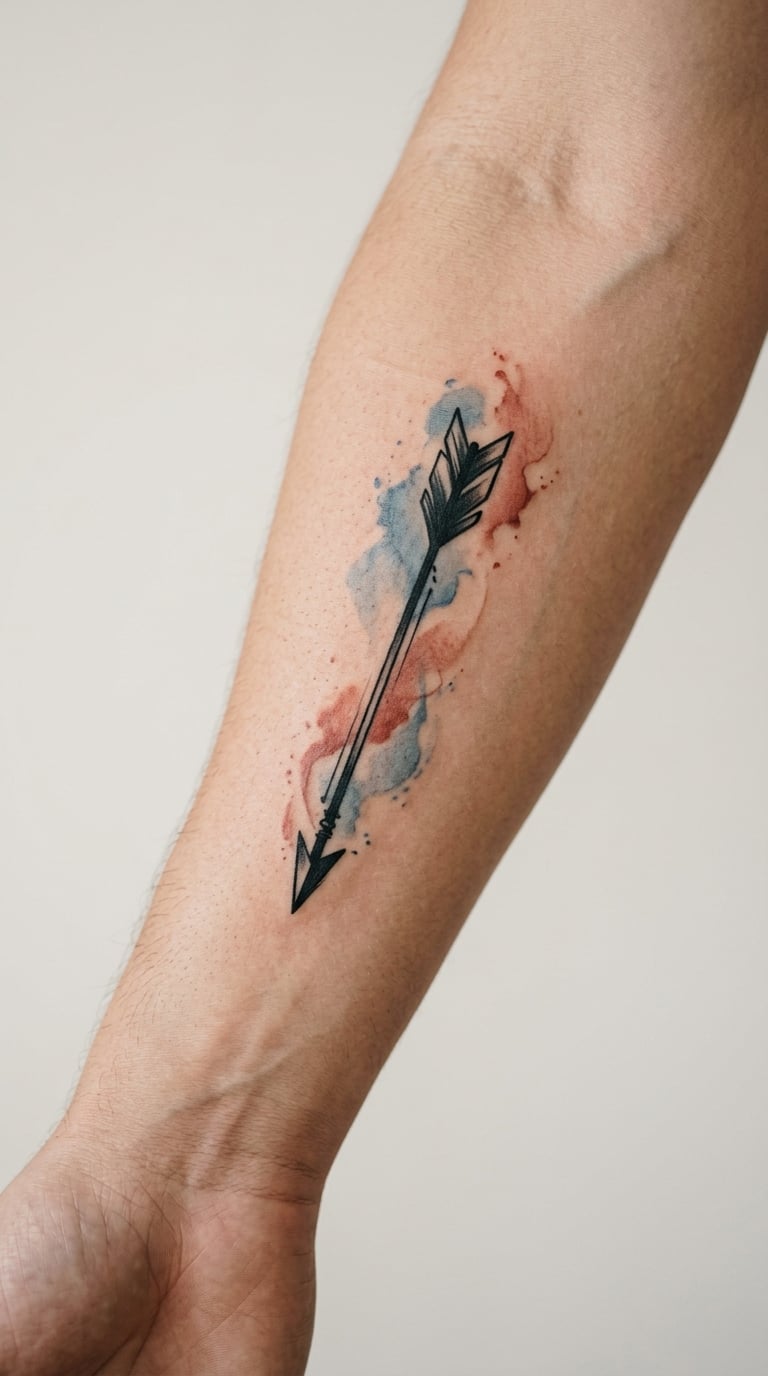
A black arrow angled at about 30 degrees, trailing soft bleeds of blue and red that streak behind the point like movement. The line of the shaft stays crisp while the colour lets go at the edges. This one works when you want a piece that reads colourful but never turns into a solid block of colour.
Placement: forearm, running diagonally along the muscle. Size: 3.5 to 4.5 inches (9 to 11 cm) long. Style: watercolor with a black line core.
Pain: medium. Watercolour means many light passes, so it takes longer but rarely hurts more than a single deep pass. Expect to need a colour refresh every few years, since pale washes fade first. Make it yours: use two colours from a place you care about rather than a full rainbow, and ask the artist to let the colour run past the outline in one direction only.
5. Compound Bow Forearm Portrait
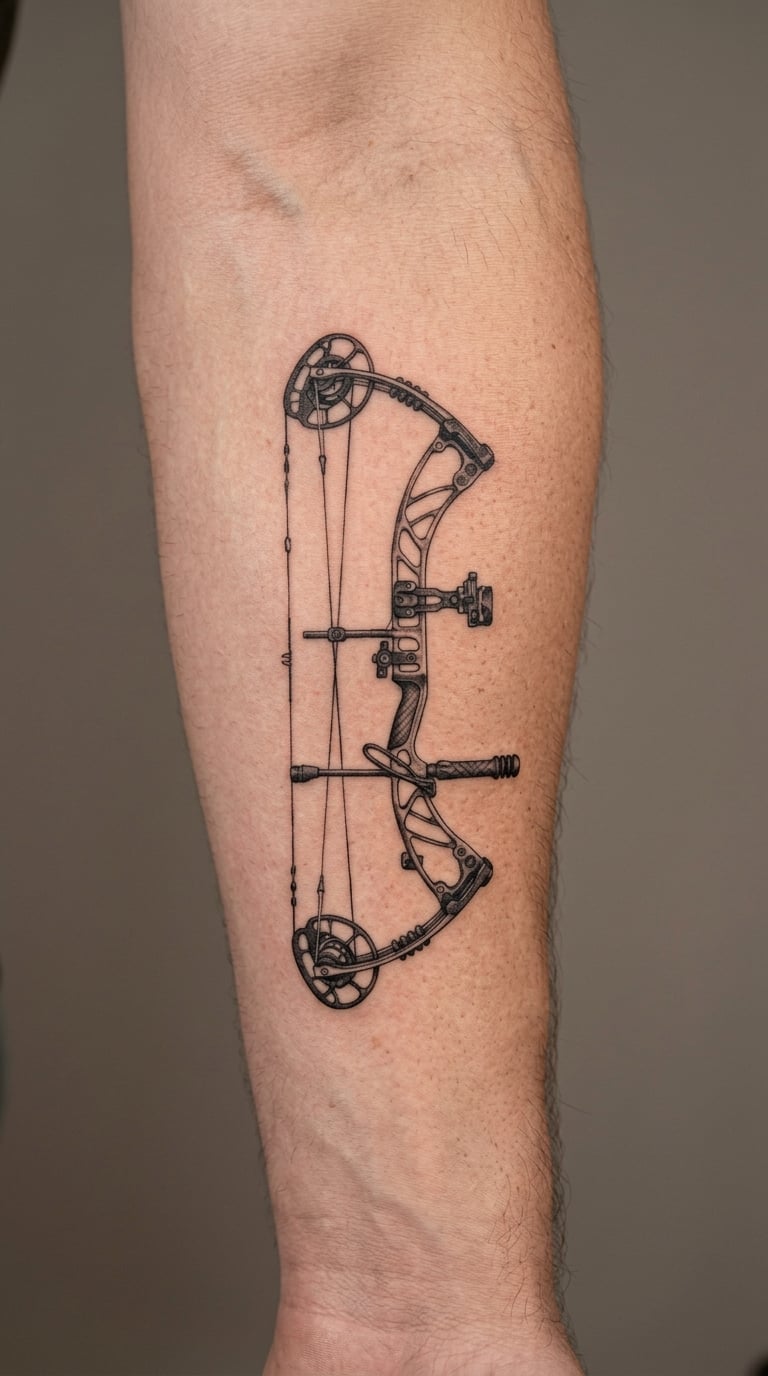
A modern compound bow in side profile, with the cam wheels at the ends, the cable runs and the sight block picked out in light grey shading. Modern equipment is showing up in tattoo requests more than medieval imagery, and real archers tend to recognise an accurate cam layout instantly. Ask the artist to keep it generic rather than copying a specific brand.
Placement: inner forearm, lengthwise. Size: 4 to 5 inches (10 to 13 cm) long. Style: micro-realism in black and grey.
Pain: medium to high. The inner forearm is thin and the cable detail means repeated passes over the same patch. Make it yours: bring photos of the bow you actually shoot, plus the arrow rest and release you use, so the proportions are yours.
6. Quiver and Arrow Collarbone Design
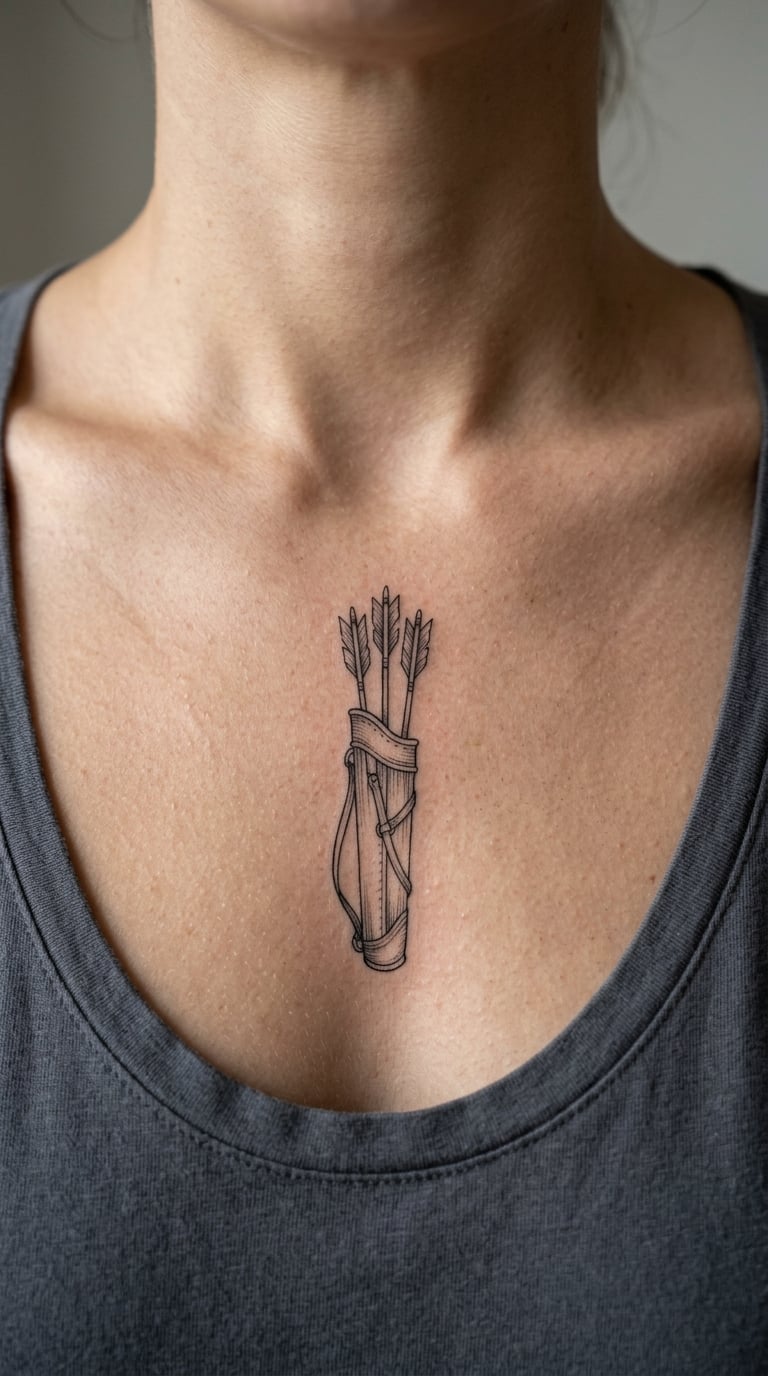
A small quiver holding three arrows, drawn with a simple line for the body of the quiver and one feather detail per arrow. Three arrows rather than a bundle keeps the silhouette readable at collarbone scale. The placement is the hard part: a collarbone design has to be shallow or it sits on bone and changes shape when you smile.
Placement: centred under the collarbone, parallel to it. Size: 2.5 to 3.5 inches (6 to 9 cm). Style: fine line, minimal shading.
Pain: medium to high. Collarbone and sternum skin is thin and the bone underneath makes the needle bite. Make it yours: tilt it a few degrees off horizontal, or swap the arrows for the fletching pattern of your own arrows.
7. Arrow Through a Mountain Range
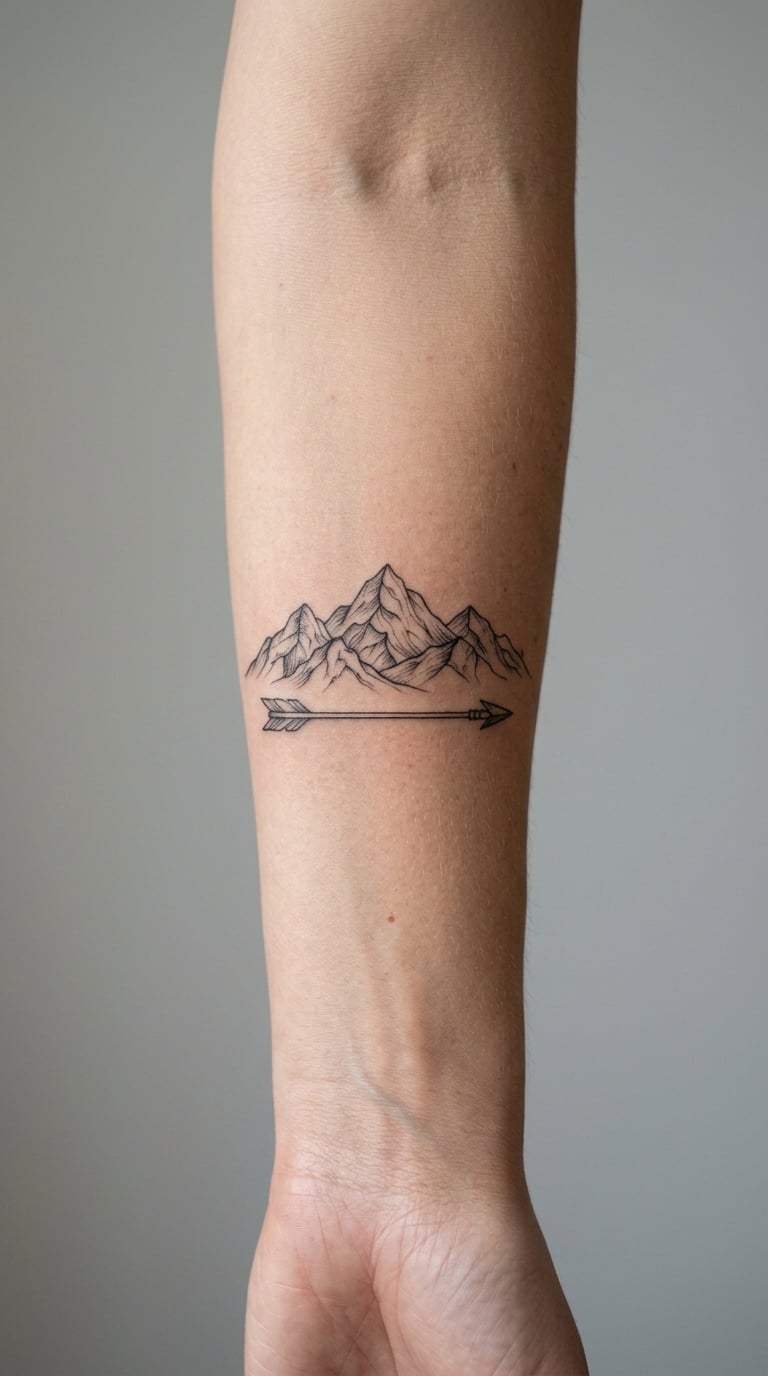
A low mountain silhouette built from a few angular peaks, with one arrow passing horizontally through the whole range so the shaft disappears behind the far peak. The trick is keeping the peaks to three or four simple triangles rather than a detailed mountain scene. It pairs a personal milestone with the outdoors without turning into a scene.
Placement: forearm, across the width. Size: 3.5 to 4.5 inches (9 to 11 cm) wide. Style: fine line with light stipple in the valleys.
Pain: medium. Forearm skin is forgiving, though the inner edge near the elbow is tender. Make it yours: name the actual range you shoot in and have the artist approximate its profile, or add a compass bearing under the arrow.
8. Split Arrow Matching Tattoo
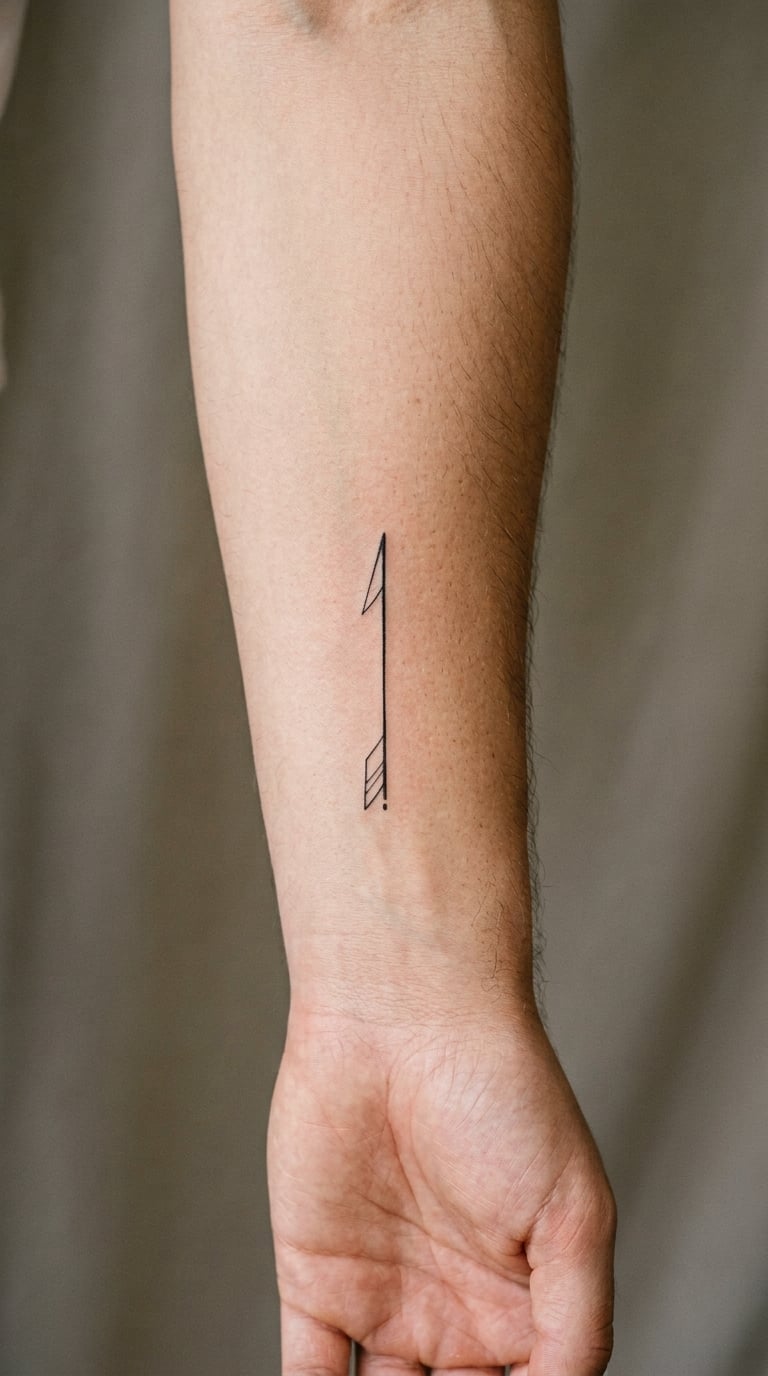
One arrow cut cleanly in half, each half done on a different person, with the cut edge left open so the two pieces read as one when the arms are side by side. It is the version of an archery tattoo that most often works as a couple or friendship piece. The two halves have to be drawn from the same template or the line weight will not match.
Placement: inner forearms, or inner wrists on both arms. Size: 2 to 2.5 inches (5 to 6.5 cm) per half. Style: minimal fine line.
Pain: medium on both arms, so expect two sessions rather than one. Ask the artist to stencil the full arrow first, tattoo one half, then trace the other from that line. Make it yours: put the date of the first session on one side and nothing on the other.
9. Archery Gloves and Arrow
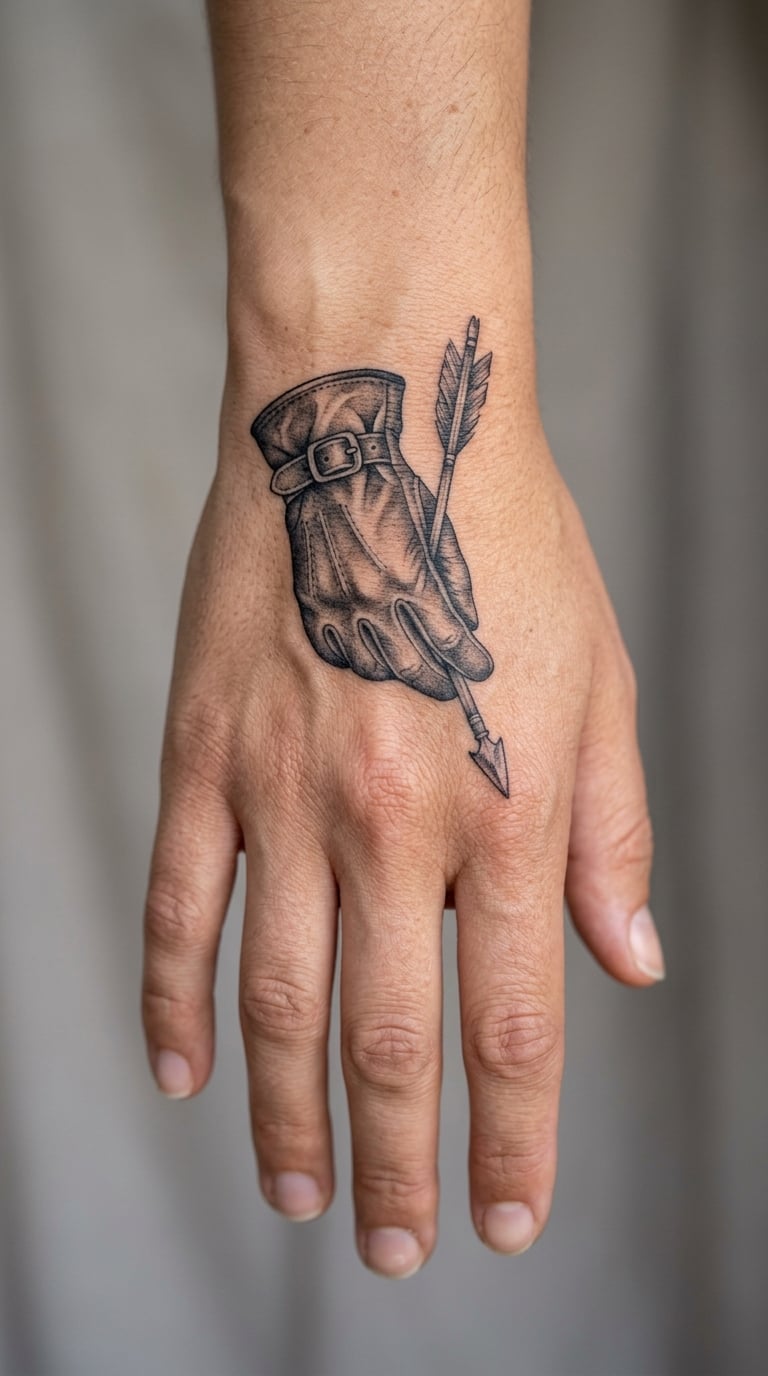
A drawing glove on a relaxed hand, three-finger release style, with the tab and a shallow crease where the leather creases at the draw. Held in it is a single arrow, point down. The detail that sells it is the glove’s stitching, not the arrow, and an artist who has sewn or repaired a glove will know where to put it.
Placement: back of the hand, between the knuckles. Size: 3 to 3.5 inches (8 to 9 cm). Style: black and grey realism, low contrast shading.
Pain: high. Hand skin is thin, the veins sit close to the surface, and knuckles and finger joints are the worst of it. Ink on hands and fingers also softens and spreads faster than anywhere else. Make it yours: have the arrow angled so the point runs toward the wrist, and keep the stitching to two or three lines so the small scale still works.
10. Geometric Arrow Pattern
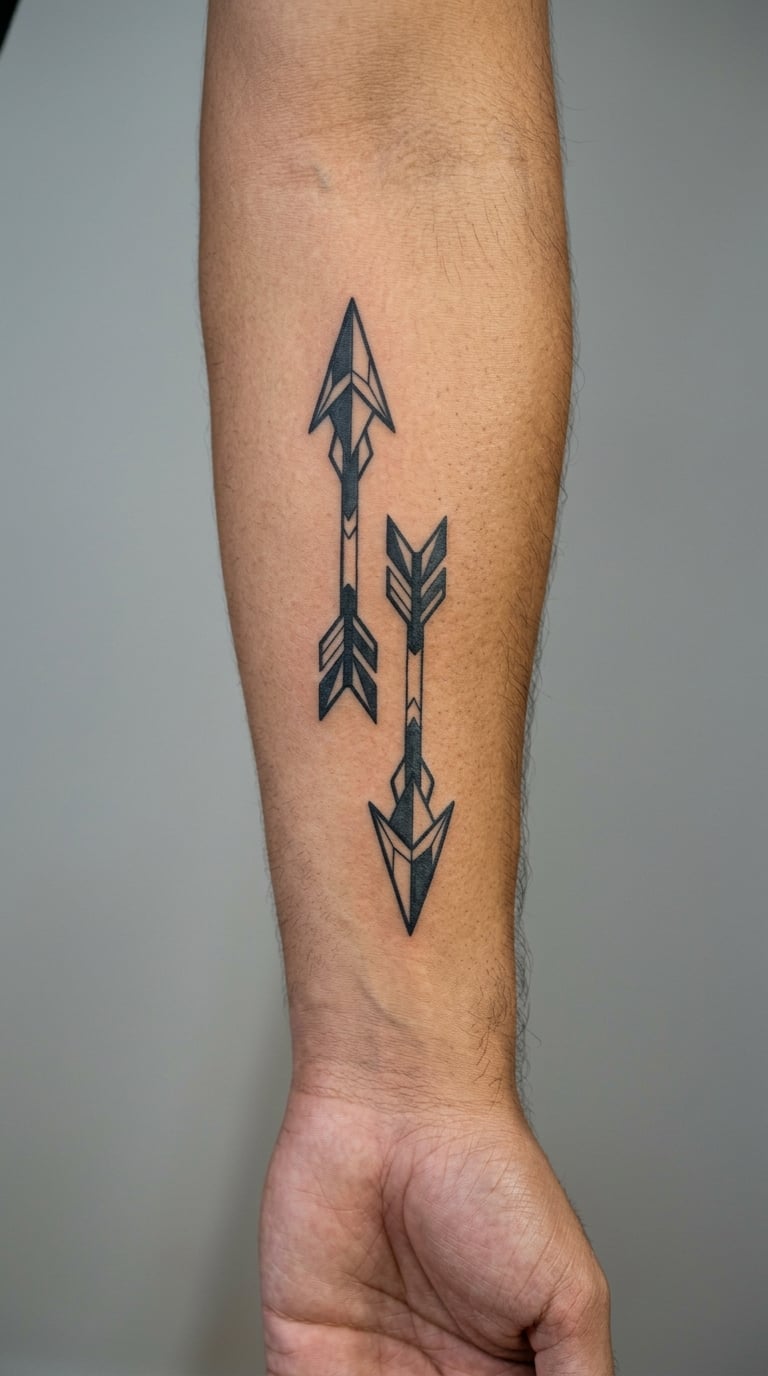
Arrows built entirely from triangles: a solid black head, a shaft made of two thin parallel bars, and fletching cut as nested chevrons. Two or three of them stacked in a row gives the rhythm without turning into a repeating pattern that fights the limb. Geometric work ages well because there is nothing hairlined to spread.
Placement: forearm, stacked along the muscle. Size: about 4 inches (10 cm) tall for the group. Style: geometric, solid black fills.
Pain: medium. Solid black blocks need more passes than outline work, so budget extra time. Make it yours: alternate solid and outline arrows so the group has some air in it, and keep the gaps at least a quarter inch wide.
11. Hand-Drawn Longbow on the Calf
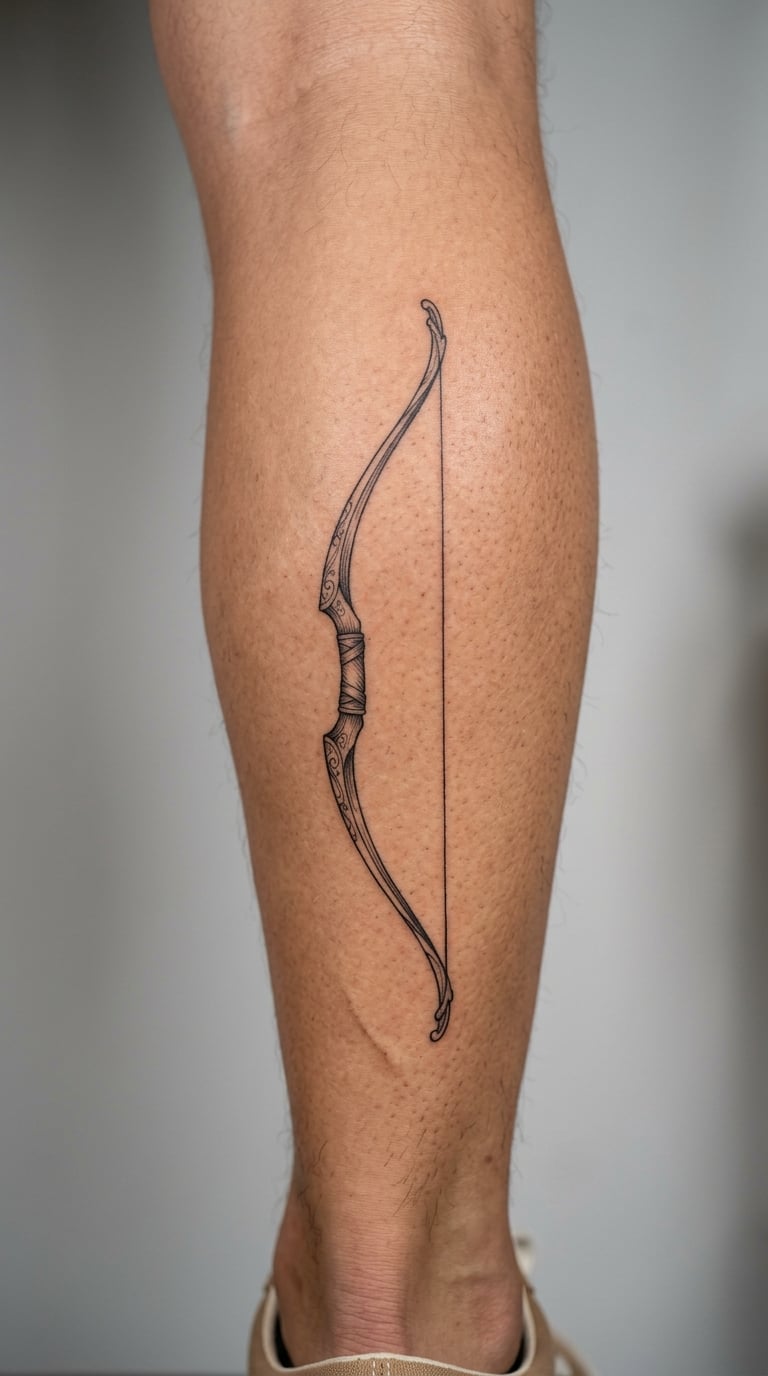
A longbow drawn in side profile, limbs curving away from a straight grip, with a string running the full height and one arrow nocked. This is the design most historical archers ask for, and the calf gives it the length it needs. Below about 5 inches the limbs lose their curve and it starts to look like a coffee cup.
Placement: outer calf, vertical. Size: 5 to 6 inches (13 to 15 cm) tall. Style: fine line illustration with a heavier string.
Pain: low to medium. The outer calf is one of the calmer spots on the body, though the shin-side skin is thinner. Make it yours: have the string drawn thicker than the limbs so it stays visible as the outline fades, or add a small band of colour along the grip wrap.
12. Red Arrow with Black Fletching
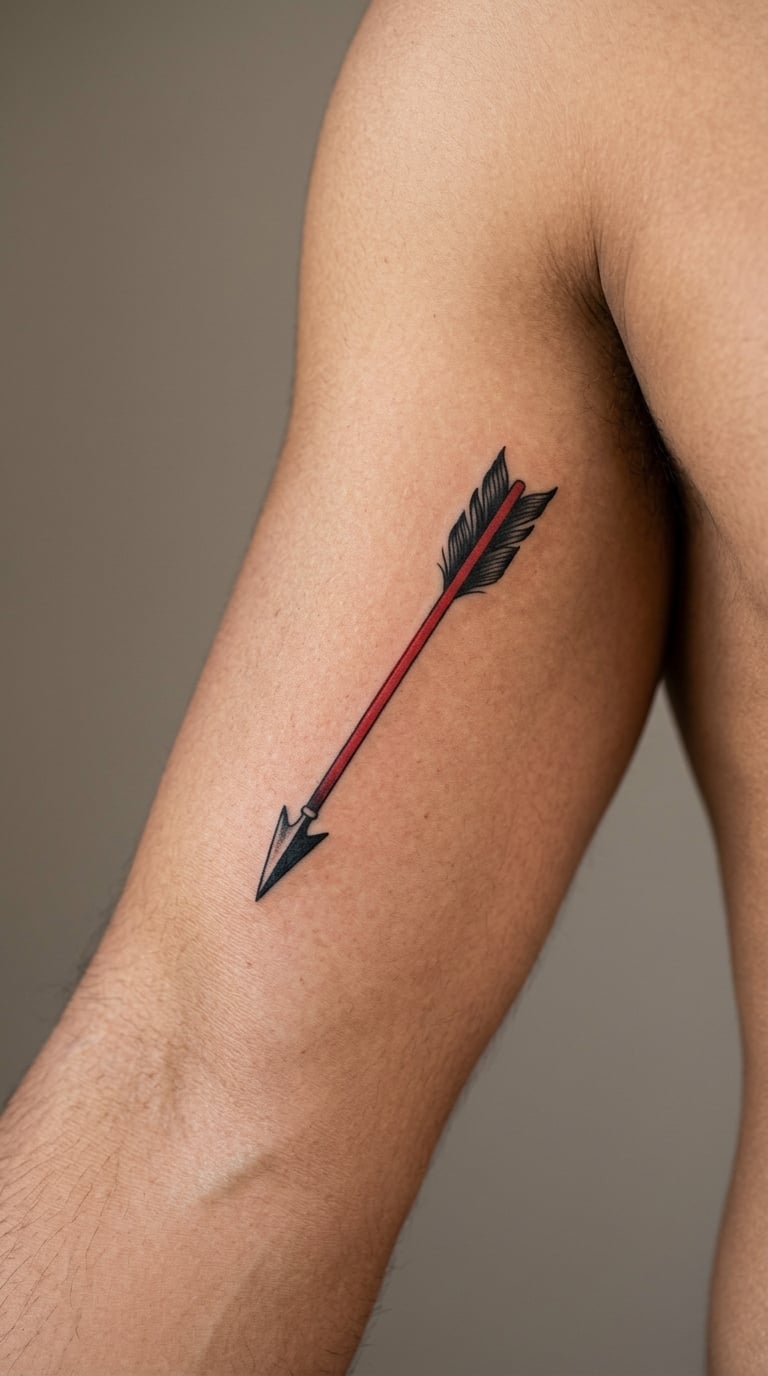
One arrow filled in a single saturated red, with the fletching and the small nock rendered in solid black so the shape stays readable. Restricting the colour to one shape is what makes a small piece look intentional rather than busy. On a small scale, a fully red arrow without the black detail turns into a stick.
Placement: upper arm, angled along the muscle. Size: 3 to 3.5 inches (8 to 9 cm) long. Style: illustrative realism with one bright ink.
Pain: medium. Red fills are patchy to lay down, so take breaks. Make it yours: pick a red that is darker than the bright orange one, since the lighter shade fades much faster, and add your initials inside the shaft.
13. Old-School Bow and Arrow
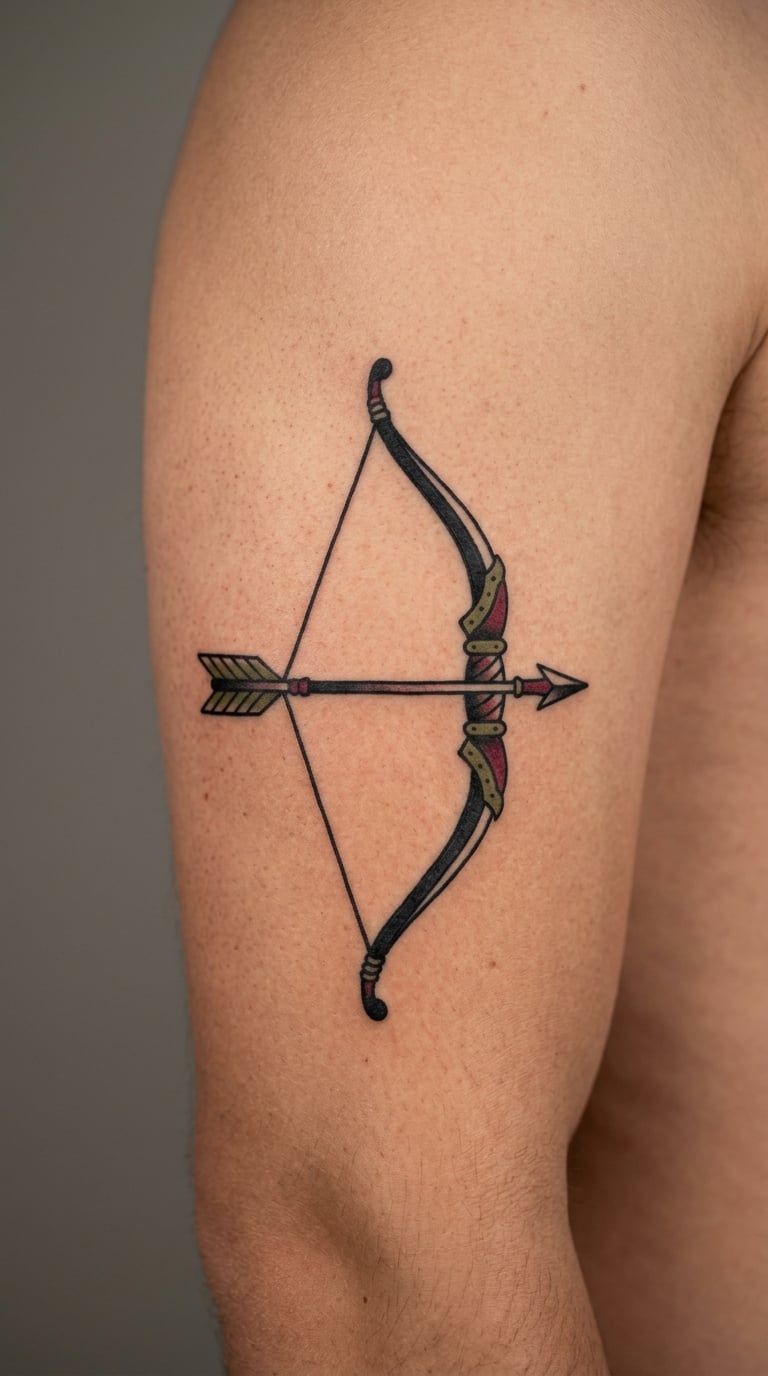
Bow, arrow and a small curling banner, drawn in the American traditional manner with a bold black outline, even line weight and a limited palette of muted green and red. Traditional work is about balance more than detail, and the banner gives the composition something to sit against so the bow is not floating. This is the one that still looks right in fifteen years.
Placement: upper arm, curved around the bicep. Size: 4.5 to 5.5 inches (11 to 14 cm) wide. Style: American traditional.
Pain: medium. The upper arm is comfortable, though the inside near the armpit is not. Make it yours: have the banner hold a short word that matters to you, and keep the palette to two colours plus black so the fill stays solid as it ages.
14. Archery Target with Three Arrows
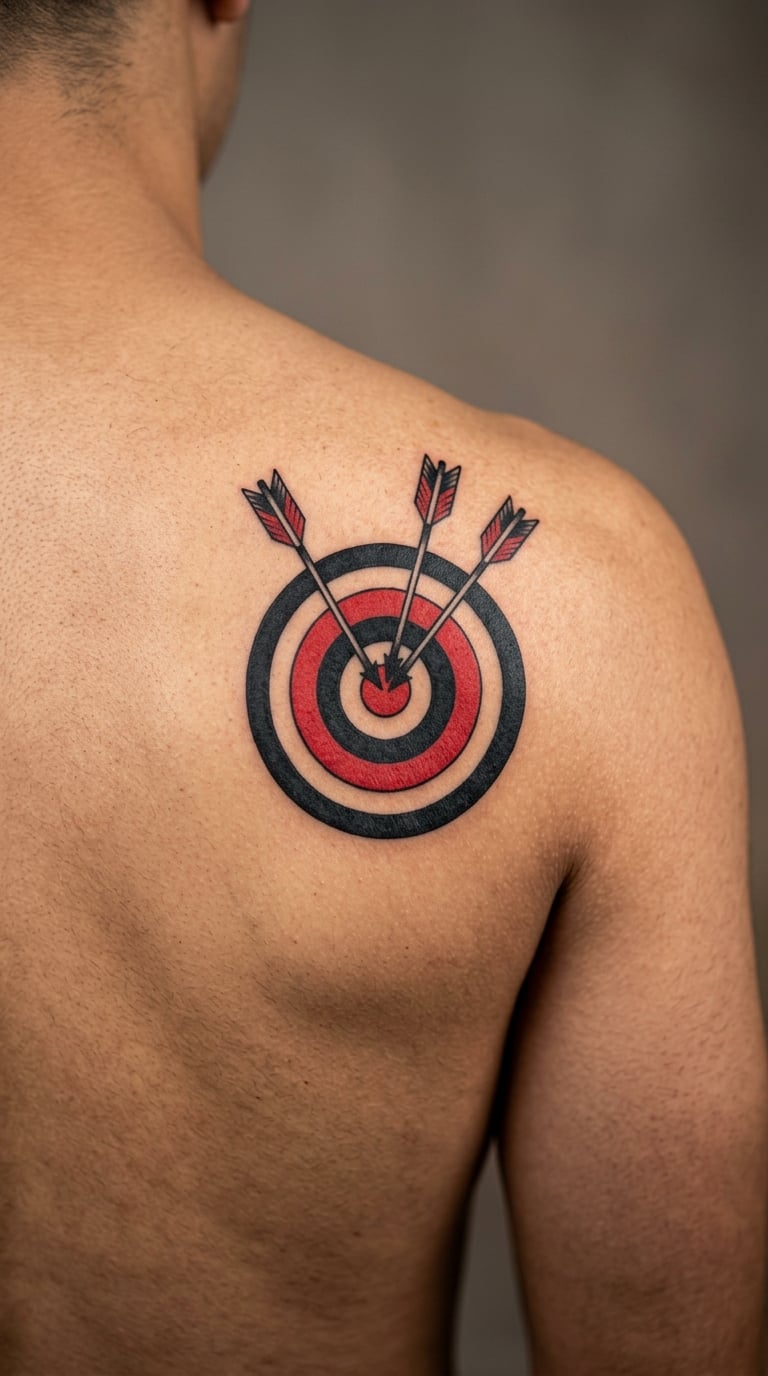
A target face with three arrows entering at different angles, two grouped in the gold and one off in the red, so the eye moves across the piece. Each shaft needs its own clear direction line or the whole thing reads as a smudge. The shoulder blade gives a flat enough surface for a round shape and plenty of room around it.
Placement: shoulder blade, or the upper back. Size: 4 to 5 inches (10 to 13 cm) across. Style: neo-traditional with clean directional linework.
Pain: medium to high. The shoulder blade is bony and the blade itself shifts when you move the arm, so the session position matters. Make it yours: set the three arrows to match three people or three scores you wanted to beat, and have the shafts left bare rather than fletched.
15. Minimal Arrow Spine Tattoo
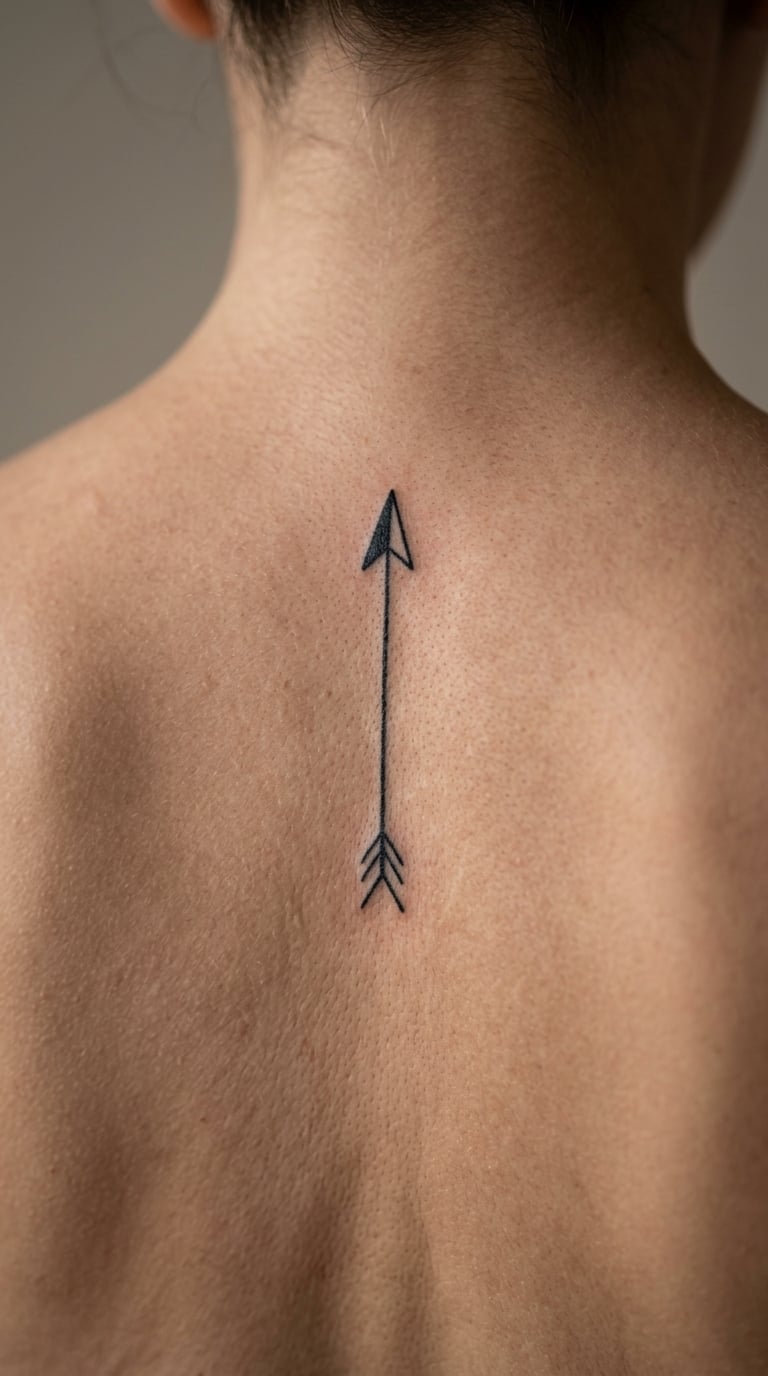
A narrow arrow running down the spine, point up, with the fletching starting between the shoulder blades and the point ending mid-back. Vertical pieces follow the body’s line so they age far better than a curved design, because the skin has less reason to distort them. Line weight matters more than anything else at this size.
Placement: upper spine, centred between the shoulder blades. Size: 4 to 5 inches (10 to 13 cm) long. Style: minimal single-line arrow.
Pain: high. Spine tattoos are among the more painful placements, and the area near the shoulder blades is especially tender. Make it yours: ask for a slightly heavier line than feels necessary, and skip a long arrow shaft so there is less fine detail to blur. Sitting or lying down matters more than anything for comfort here.
16. Dotwork Arrow and Crosshairs
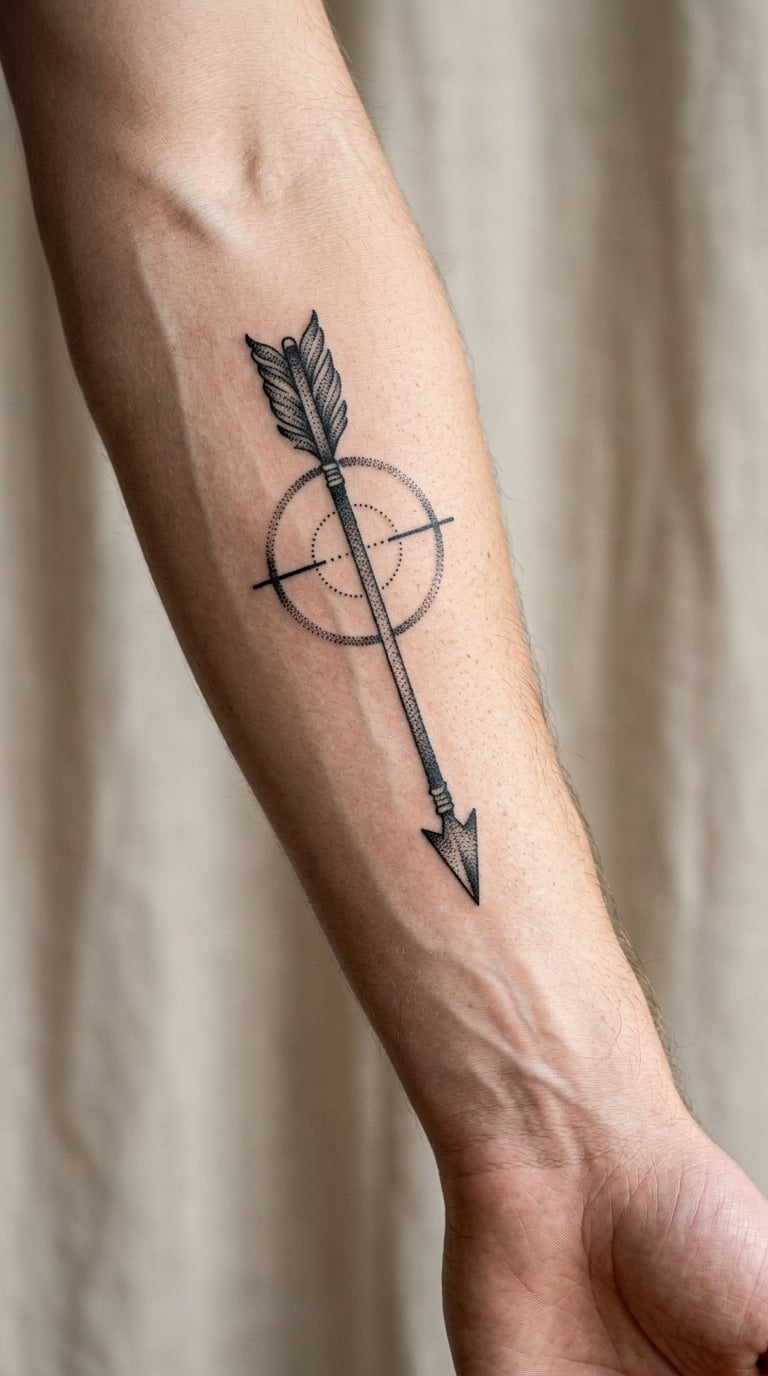
An arrow laid across a set of small circular crosshair marks, with the arrow itself built from tightly packed dots that thicken toward the point. Dot spacing has to be planned, because dots that are too close merge into a solid patch and dots too far apart turn grey. Done well it keeps its tone for a very long time, since there is no single hairline to spread.
Placement: forearm, diagonal. Size: 2.5 to 3.5 inches (6 to 9 cm). Style: dotwork with a solid black tip.
Pain: medium, but it is slow. Dotwork takes longer than its size suggests, and a patient artist will not rush the spacing. Make it yours: set the crosshair rings to the diameter of a target face you shoot at, and let the outermost ring be open rather than closed.
17. Floral Arrow on the Shoulder
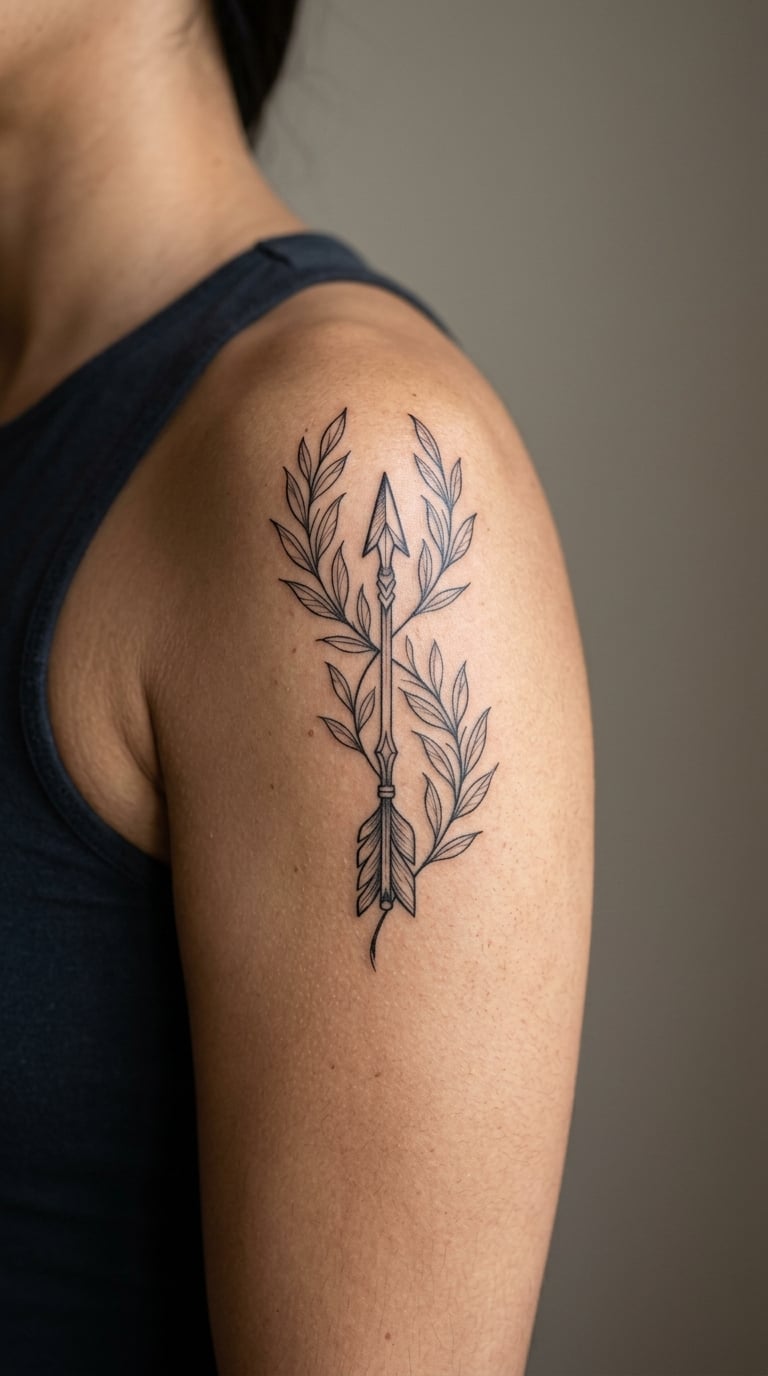
A black arrow laid horizontally with laurel or pine sprigs curling around it, all in fine line so the botanicals stay lighter than the arrow. Vegetation is what stops a plain arrow from looking like a stock symbol, and it gives you room to add a date or an initial in the curve of a stem. Keep the leaves to one species so the piece stays coherent.
Placement: shoulder, following the curve toward the upper arm. Size: 4 to 4.5 inches (10 to 11 cm). Style: fine line botanical.
Pain: medium. The shoulder is a good canvas with an uneven surface, so ask the artist to stretch the skin around the deltoid for cleaner lines. Make it yours: use the plant that grows where you shoot, or the state flower of the range you learned on.
18. Ancient-Style Bow and Arrow
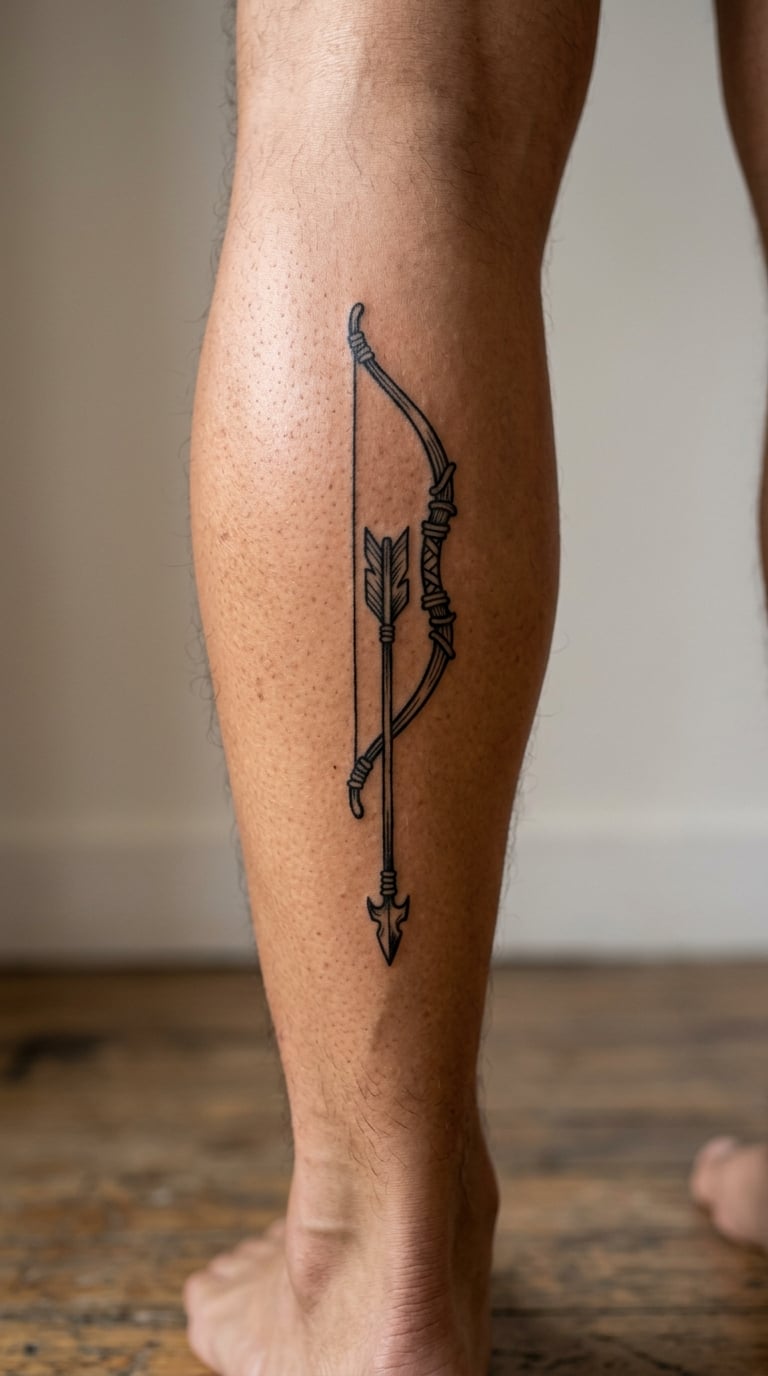
A bow and arrow drawn in the style of old engraved illustrations: even, slightly tapering lines, a double-curved bow and a simple nock, with no modern fittings anywhere. It borrows the visual language of historical records without copying a specific artefact, which matters if the design carries cultural weight. Research first, then have the artist redraw the reference from scratch.
Placement: calf or the flat of the outer thigh. Size: 4.5 to 5.5 inches (11 to 14 cm) tall. Style: engraving-inspired linework.
Pain: low to medium on the calf. Make it yours: bring a museum image or a page from a historical text as the starting point and ask for an original drawing, so the finished piece is yours rather than a traced copy.
19. Monochrome Bow in a Dagger
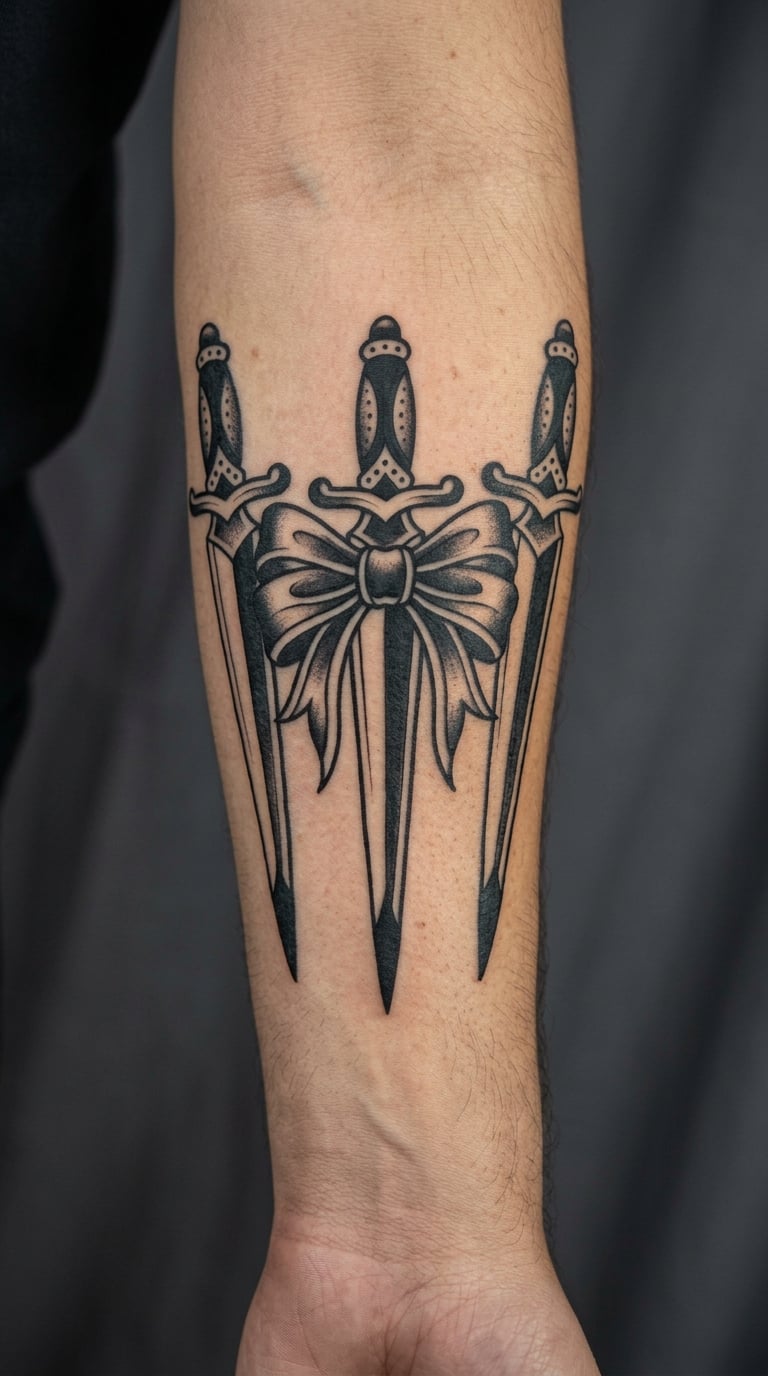
A drawn bow framed inside a dagger shape, with the blade formed from solid black fill and the bow held as negative space inside it. The contrast between the filled frame and the untouched skin is what makes this read from across a room, which is unusual for a design this small. It suits someone already collecting bold pieces.
Placement: outer forearm, vertical or slightly diagonal. Size: 4.5 to 5.5 inches (11 to 14 cm) tall. Style: blackwork with negative space.
Pain: medium to high. Filling the frame means a long session of shading at fairly consistent depth. Make it yours: have the bow’s string break the frame slightly at the top, which stops the composition looking boxed, and keep the dagger detailing to outline and one line of highlight.
20. Full-Forearm Archery Scene
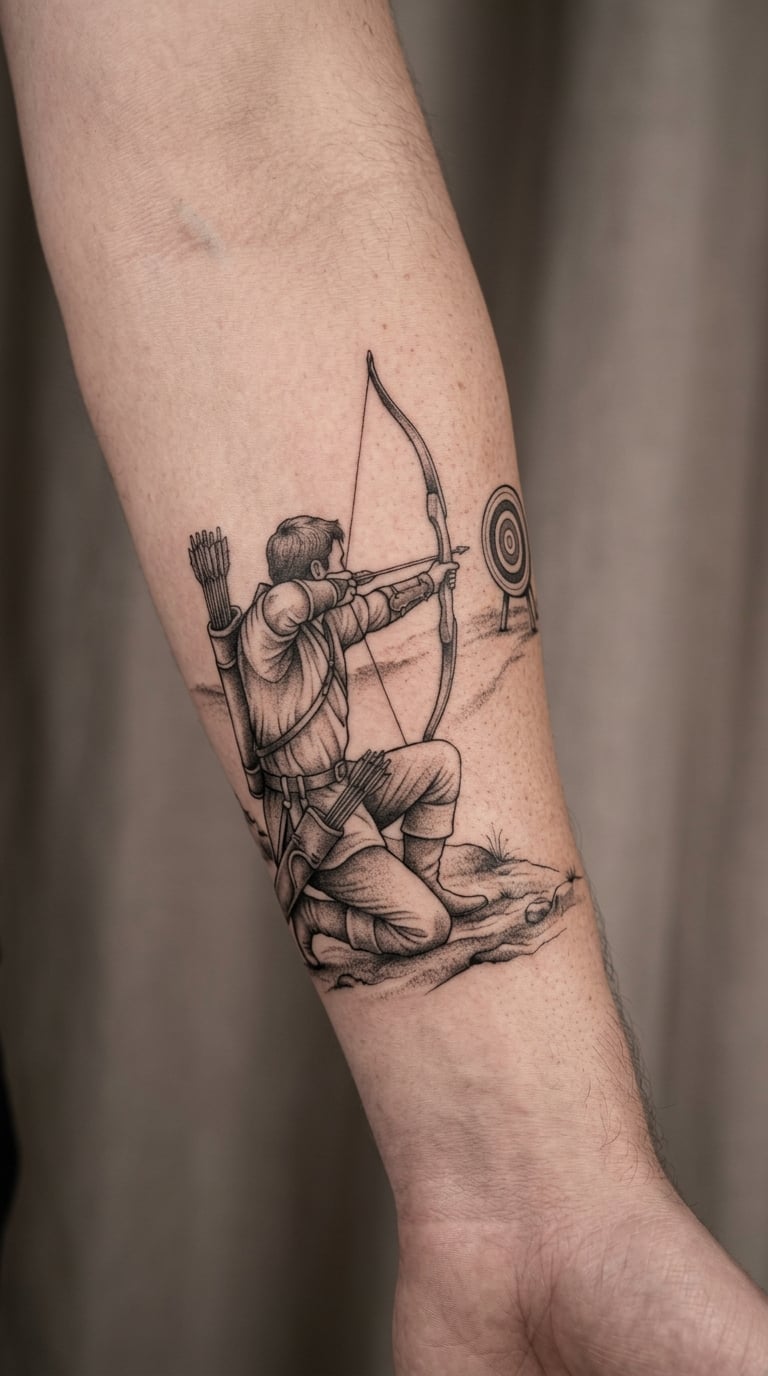
A narrative piece: a hand-drawn bow at the wrist, a quiver running up the forearm, an arrow in flight, and a target face near the elbow, with a low treeline behind it and nothing else. It is the design to pick if you are building a sleeve and want the archery section to carry the story. The composition has to be planned around the forearm’s curve, because the muscle hides detail when it flexes.
Placement: inner or outer forearm, following its length. Size: 7 to 9 inches (18 to 23 cm). Style: black and grey illustrative.
Pain: medium to high across a long session, and it will almost certainly need two appointments. Bring a full-size reference so the artist can plan the layout across both sessions. Make it yours: work with the artist on the order of the elements so the fletching and the bowstring read clearly at arm’s length, and leave a gap for a future addition.
How to Choose the Right Archery Tattoo Design
Five questions settle most of the decisions before you walk into a studio, and answering them saves a redesign later.
How to brief your artist on archery tattoo ideas
Bring equipment photos, not Pinterest saves. Photos of the bow you actually shoot, the fletching pattern on your arrows and a clear idea of the size in inches will get you a far better result than a mood board of clip art, because artists in this genre get asked for bows that could never be strung. Agree the line weight in advance too, since that single decision does more for how the piece looks in five years than any detail in the design.
Then check the canvas. Wrist and inner forearm designs move with every hand movement and are visible all day. The calf and upper arm take a vertical composition well. Hands and fingers look good fresh and disappoint people fastest, since the skin there is thin, creased and constantly exposed.
Finally, decide how much detail you are willing to lose. Anything hairlined, anything tiny and anything in a pale colour will soften. Solid blackwork, geometric fills and traditional work with bold outlines keep their shape longest, which is worth knowing if you are choosing between two designs you like equally.
Cost and Session Time
Session time is easier to predict than cost, and it is the number that actually shapes your calendar. A micro design under 2 inches usually takes 20 to 40 minutes. A small piece around 3 inches takes 60 to 90 minutes. Medium work in the 4 to 6 inch range runs two to three hours and often gets split across two sittings. Anything covering most of a forearm is a multi-session piece with a drawing and layout appointment before the first needle.
Cost follows three things: the shop minimum, the artist’s hourly rate and where you are. Most studios bill a minimum that covers setup, stencil and the first portion of the session, so a tiny design and a small design can cost the same. Hourly rates vary hugely between a small-town shop and a major city, and a well-known blackwork or realism artist will sit well above the general range.
Ask for the total in writing before you book, and ask what a touch-up costs and how long you should wait. A design that needs a free touch-up at twelve months is a better investment than one that needs a full colour session, because colour work is the most expensive kind to redo.
Aftercare Basics
- Follow your artist’s aftercare instructions first. They know what they did in your skin, and the guidance given at the end of a session always outranks anything general you have read.
- Wash gently with lukewarm water and an unscented soap, twice a day for the first few days, then pat dry with something clean rather than a rough towel.
- Apply a thin layer of the moisturiser your artist recommends. Thick layers trap heat and slow things down.
- Keep it out of direct sun while it heals, and once it is healed use sunscreen on exposed placements, since UV light is what takes the red out of an arrow fastest.
- Skip swimming, hot tubs, saunas and heavy gym sessions that would sweat the area until the new skin has closed over.
- Plan the next session at least three to four weeks out, so the first piece has settled before the artist returns to it.
Frequently Asked Questions
What is the best placement for a small archery tattoo?
The inner forearm and the outer upper arm are the safest choices for a small archery tattoo. Both have enough flat area to hold a design at 2 to 3 inches, and the forearm gives the artist a clean straight run to work along. Behind the ear and the wrist work too, but both move constantly and fade faster, so expect a touch-up there. Ask for slightly heavier line work if you pick either of those.
Are bow and arrow tattoos suitable for a first tattoo?
Yes, and a single arrow is one of the easier first designs. It is a simple shape, it heals predictably, and it is forgiving of the slight placement shift every first tattoo gets. The mistake first-timers make is picking a generic logo version from a search page, then regretting it years later. A drawn arrow with one personal detail will age far better than a clip-art bow.
How small can an archery tattoo be without losing detail?
A single arrow with plain fletching stays readable at about 1 inch. Once you add a bow, a nock and fletching detail, 2 inches is the practical floor, and 2.5 inches gives the artist room to draw real line weight. Below that the shapes merge and you get a smudge within a few years. Bring a size reference, like a coin, so everyone is working from the same number.
Should an archery tattoo be done in color or blackwork?
Blackwork ages more predictably, which is why most experienced archers pick it. Red and blue fade first and turn grey inside five years, so colour is a good choice only if you are willing to book refresh sessions. A middle path is a black arrow with one red accent, such as a filled fletching or a red centre ring on a target. That gives you colour without making the whole design depend on it.
How can I personalize an archery tattoo without copying an existing design?
Start from your own gear and your own history. Photos of the bow you shoot, the fletching pattern on your arrows, a target face from your club, the range you learned on, or the date you hit your first gold are all original reference material. Ask the artist to redraw from those rather than tracing a picture, and check the finished line weight with them before you leave the chair.
For a first tattoo, go small and pick one of ideas 1, 2, 11 or 16. A single arrow, a minimal bow and arrow on the wrist or a longbow on the calf are all forgiving shapes, all cheap to fix later, and none of them depend on fine detail that will blur. If you are adding to a collection, the full forearm scene in idea 20 is the piece to book, with the caveat that it needs two sessions and a drawing appointment before the first one.
If you are still narrowing these 20 archery tattoo ideas down, three more reads fit the same mood and the same placement logic: tattoo ideas that symbolize freedom for other directional motifs, mountain and ocean tattoo pairings if you liked the landscape in idea 7, and black sleeve tattoo ideas to see how the blackwork in idea 19 carries into a full sleeve.