
22 Sailboat Tattoo Ideas: Best Nautical Designs (October 2026)
A sailboat tattoo is the easiest nautical design to make personal. One boat reads as freedom, a voyage, a safe return or simply where you grew up, and it works at every scale from a one-inch line drawing behind the ear to an eight-inch scene across the upper back.
Below are 22 sailboat tattoo ideas, each described precisely enough that you could hand the notes to an artist at a consultation. Every entry covers what the design looks like, why people choose it, the placement and size that suit it, what it will feel like, and one way to make it yours.
Updated for October 2026, this is the list to bring to a consultation, whether you have sailed for years or have never been on a boat at all.
If you are still early in the process, spend a few minutes on the 20 best beach tattoo ideas for women and the 20 mountain and ocean tattoo ideas while you decide. Sailboats sit naturally next to both themes.
22 Sailboat Tattoo Ideas: Quick Guide
| Idea | Style | Best placement | Size | Pain |
|---|---|---|---|---|
| 1. Fine-line sailboat | Fine line | Inner forearm | 3 inch (7.5 cm) | Low |
| 2. Traditional full-rigged ship | American traditional | Outer upper arm | 5 inch (12.5 cm) | Medium |
| 3. Minimalist two-sail outline | Minimalist line | Inner wrist | 2 inch (5 cm) | Low |
| 4. Watercolor sailboat at sunset | Watercolor | Shoulder | 4 inch (10 cm) | Low |
| 5. Sailboat with compass rose | Black and grey | Forearm | 4 inch (10 cm) | Low |
| 6. Jib-sailed catamaran | Fine line | Calf | 5 inch (12.5 cm) | Low |
| 7. Blackwork sailing ship | Blackwork | Upper back | 6 inch (15 cm) | Medium |
| 8. Tiny sailboat behind the ear | Micro fine line | Behind the ear | 1 inch (2.5 cm) | Medium |
| 9. Sailboat and lighthouse | Illustrative line | Inner arm | 4 inch (10 cm) | Low |
| 10. Dotwork sailboat constellation | Dotwork | Shoulder | 4 inch (10 cm) | Low |
| 11. Vintage sailboat with pennant | Traditional | Forearm | 5 inch (12.5 cm) | Medium |
| 12. Geometric sailboat | Geometric | Sternum | 3 inch tall | Medium |
| 13. Semi-realistic sailboat | Micro-realism | Shoulder | 4 inch (10 cm) | Low |
| 14. Sailboat with wave banner | Fine line | Forearm | 6 inch (15 cm) | Low |
| 15. Blue watercolor sailboat | Watercolor | Thigh | 5 inch (12.5 cm) | Low |
| 16. Pirate-style sailing ship | Traditional dark | Calf | 6 inch (15 cm) | Medium |
| 17. Single-handed sailboat | Minimalist | Inner wrist | 2 inch (5 cm) | Low |
| 18. Sailboat and mountains | Black and grey | Outer arm | 6 inch (15 cm) | Low |
| 19. Neotraditional red-sailed ship | Neo-traditional | Forearm | 5 inch (12.5 cm) | Medium |
| 20. Sailboat with birds above | Fine line | Calf | 5 inch (12.5 cm) | Low |
| 21. Micro sailboat on a finger | Micro line | Finger side | 1 inch (2.5 cm) | Medium |
| 22. Large nautical scene | Blackwork and grey wash | Back or chest | 8 inch (20 cm) wide | Medium |
1. Fine-Line Sailboat on the Forearm
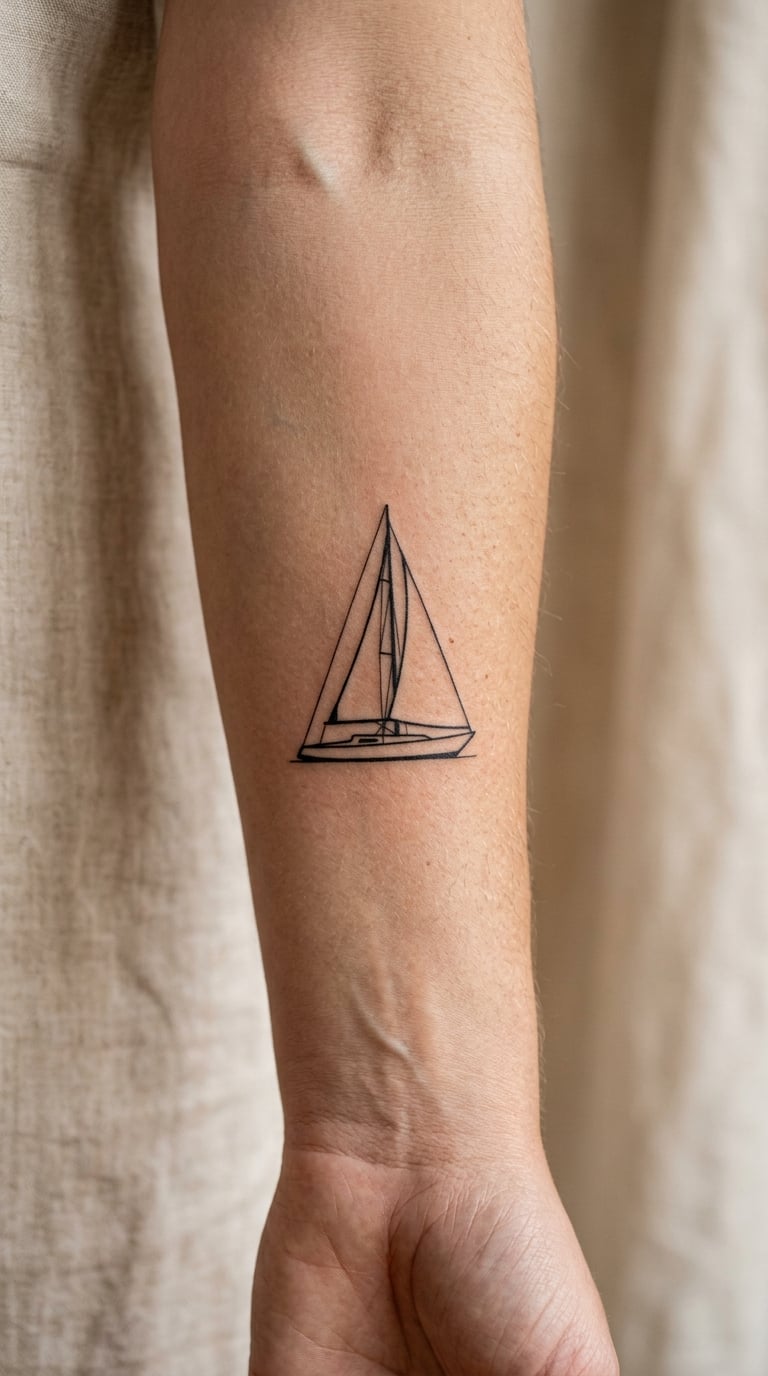
A single-masted boat drawn in one confident line weight, with two triangular sails and a shallow curved hull, is the most useful nautical tattoo a beginner can wear. Nothing is shaded, so the eye reads the shape instantly from across a room.
People usually pick this one for a memory rather than a statement: a summer on a boat, a boat that belonged to someone in the family, a first time on the water. A simple form like this carries meaning without spelling anything out.
Placement: inner forearm, three finger widths above the wrist crease, where the skin is flat and the arm reads long. Size: 2.5 to 3.5 inches (6 to 9 cm) long. Style: fine line.
Pain: low to medium on the inner forearm. Fine forearm lines are among the first tattoos to go grey as skin ages and sun exposure adds up, so ask for slightly heavier line weight than looks right in a drawing. Make it yours: add a date in matching line work under the hull, small enough to read only up close.
2. Traditional Full-Rigged Ship
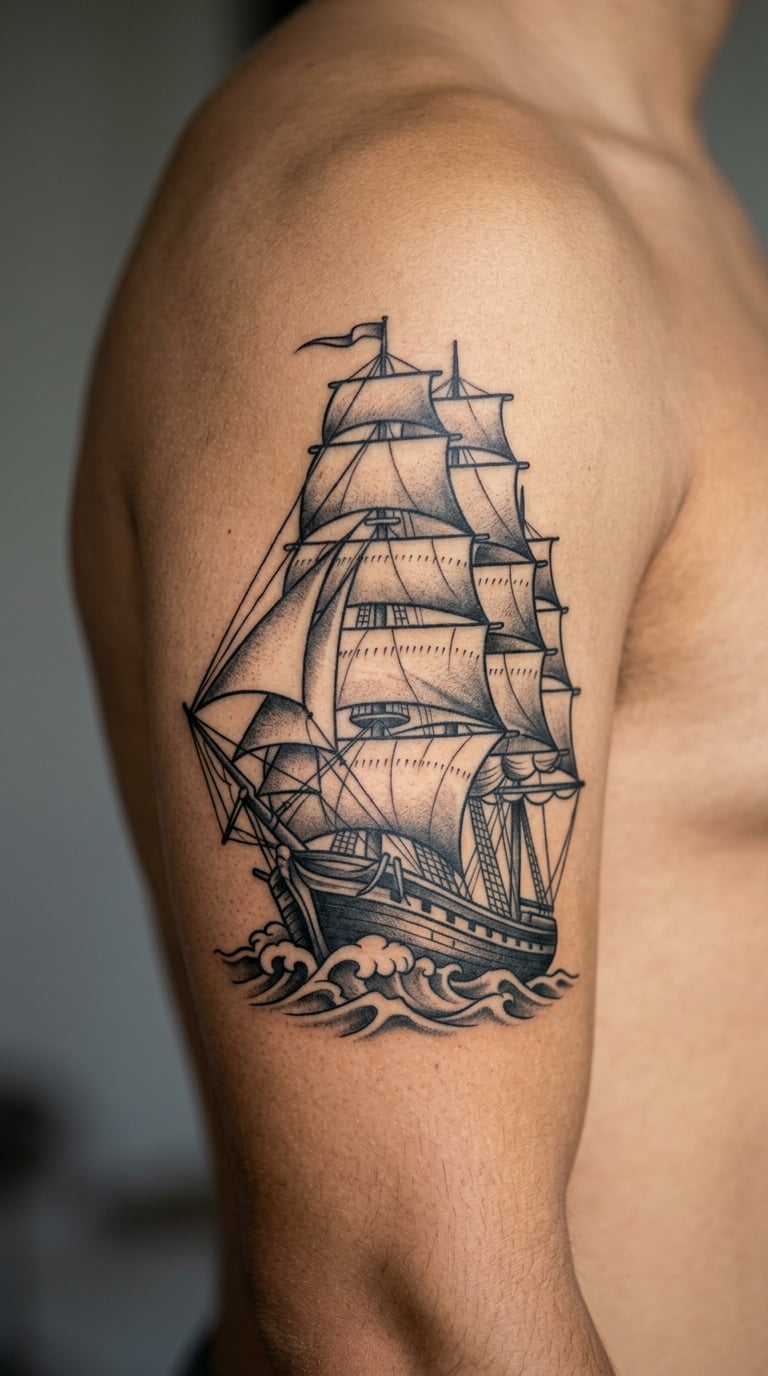
Think of a three-masted tall ship under full sail: multiple square sails stacked up the rigging, a dark shaded hull, and a short band of waves under the keel. Bold black outlines do the work, with grey wash inside the sails and hull for depth.
A full-rigged ship in traditional style is the version of this motif with real historical weight, and sailors have worn the ship as a record of miles travelled for centuries. That background is what gives it weight beyond decoration.
Placement: outer upper arm or shoulder cap, where a tall vertical shape has room to sit. Size: 4.5 to 6 inches (11 to 15 cm). Style: American traditional.
Pain: medium, longer because of the shading passes. Traditional bold line holds its shape well over decades, so this ages better than a fine-line version of the same boat. Make it yours: add a name across the stern banner in a simple script.
3. Minimalist Two-Sail Outline
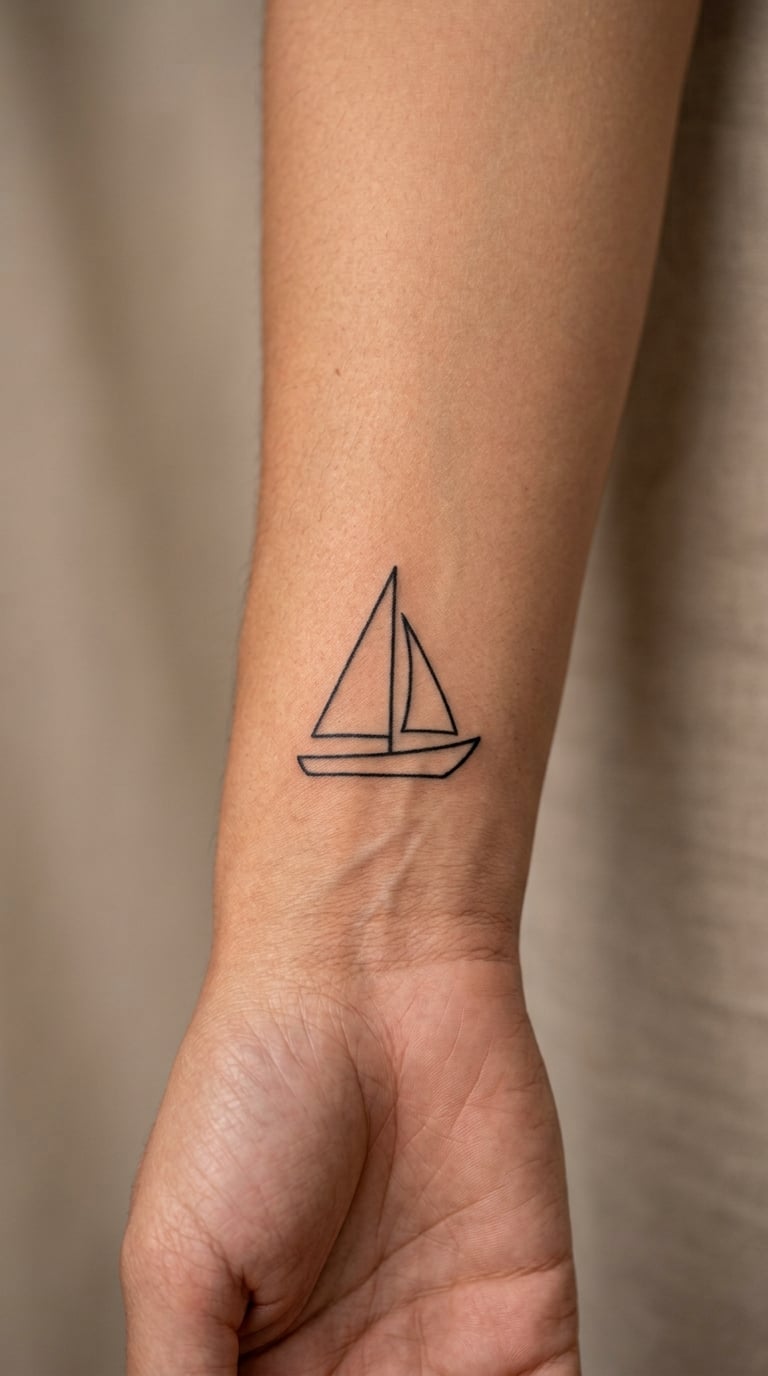
Two sails, one curved hull line, a short straight line for water, and a mast between them. That is the whole design. The restraint is the appeal, and it is the most discreet nautical tattoo that still reads clearly as a boat.
Minimal outlines tend to be chosen for the shape rather than the story, often as a first tattoo or a first nautical piece. A boat under sail moving forward is an easy read for open water and forward motion.
Placement: inner wrist, above the veins, or the outer forearm. Size: 1.5 to 2.5 inches (4 to 6 cm). Style: minimalist line.
Pain: low, and a short session. The one honest note is that wrist line work is on a curved, frequently moved area, so it can soften faster than the same drawing on a forearm. Make it yours: tilt the boat so the hull sits on a slight diagonal, which makes a tiny design feel intentional.
4. Watercolor Sailboat at Sunset
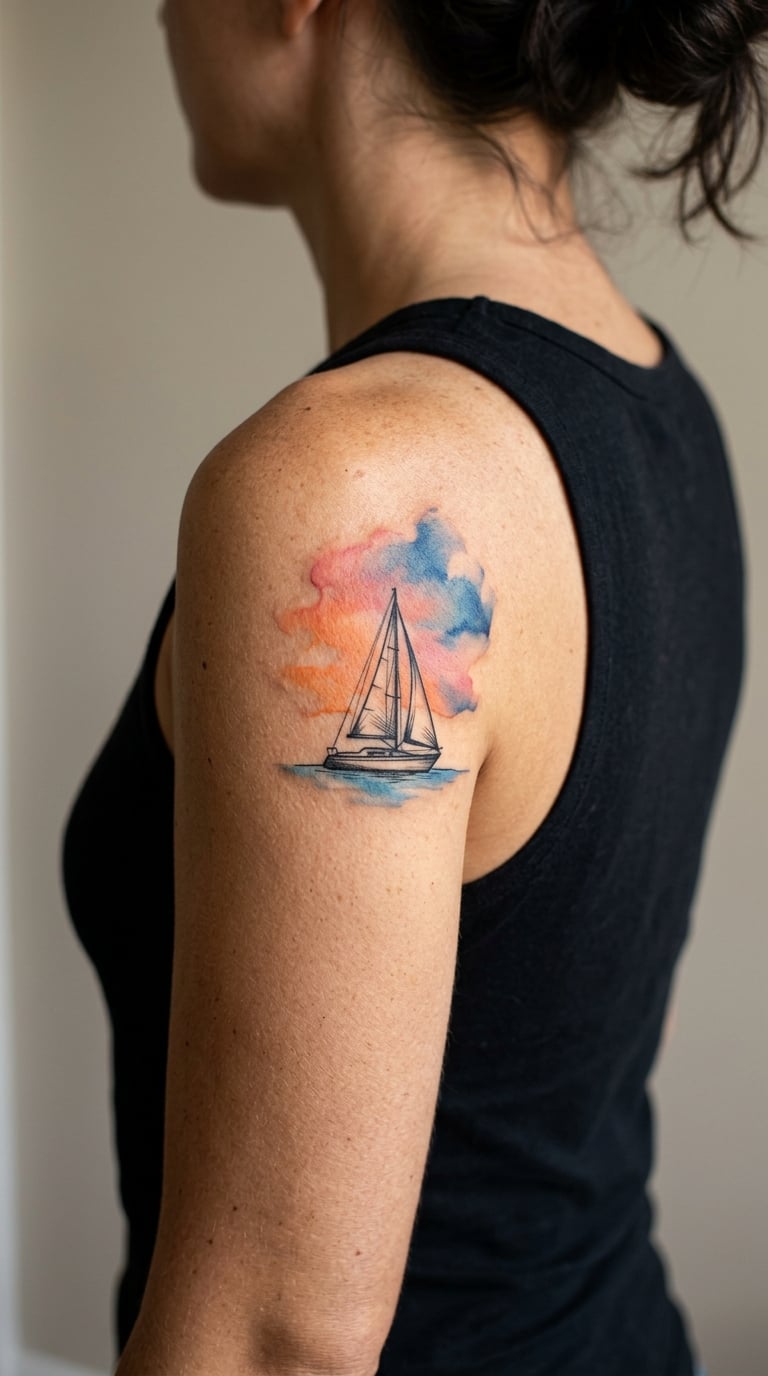
Translucent washes of orange, pink and soft blue drift above a small solid black boat. The boat stays crisp and dark while the colour around it bleeds past the outline, which is the trick to keeping a loose watercolor piece readable.
Sunset scenes get picked when someone is marking a particular evening or a stretch of good weather. The colour carries the feeling; the boat simply gives the composition an anchor point.
Placement: shoulder cap or upper back, where there is skin to let the wash breathe. Size: 3.5 to 5 inches (9 to 12.5 cm). Style: watercolor.
Pain: low, since it is mostly one pass of light colour. Colour tattoos do fade faster than black, particularly in strong sun, so plan on a colour refresh rather than expecting it to hold its first brightness. Make it yours: bring a photo of the sky you are thinking of and let the artist pull the palette from it.
5. Sailboat with Compass Rose
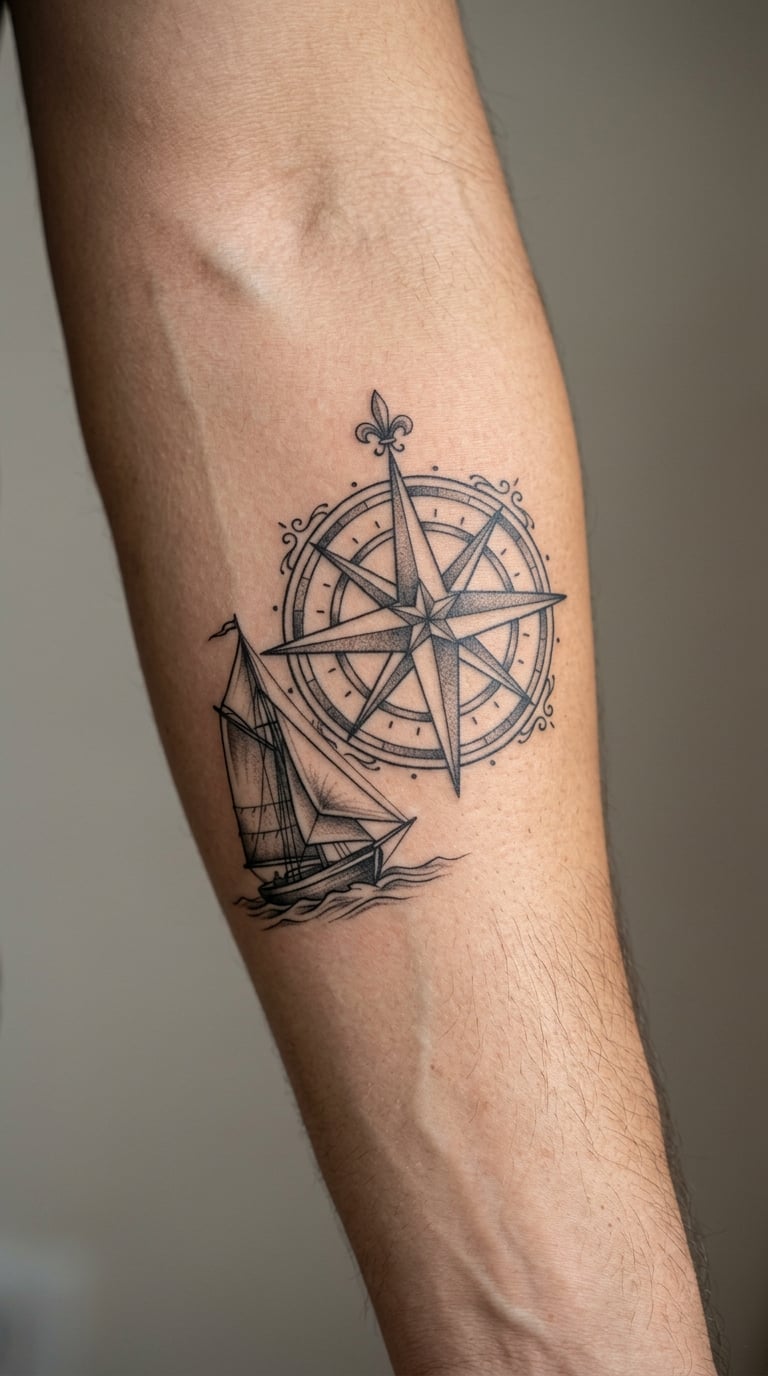
A small solid boat sits beside a detailed eight-point compass rose, both in black line with light grey shading inside the hull. The pairing is a working nautical composition rather than two unrelated objects, and it fills an elbow-side gap that a boat alone would leave empty.
The compass reads as guidance and direction, which is why it turns up next to a boat so often. The meaning is in the combination you choose, not fixed by any tradition.
Placement: forearm, inner or outer, or the side of the calf. Size: 3.5 to 4.5 inches (9 to 11.5 cm) across both elements. Style: black and grey.
Pain: low to medium; the compass points are the fiddly part and take steady needle work. Those eight points are the detail most likely to blur over the years, so keep the rose simple. Make it yours: engrave your actual latitude and longitude in the empty space under the rose.
6. Jib-Sailed Catamaran
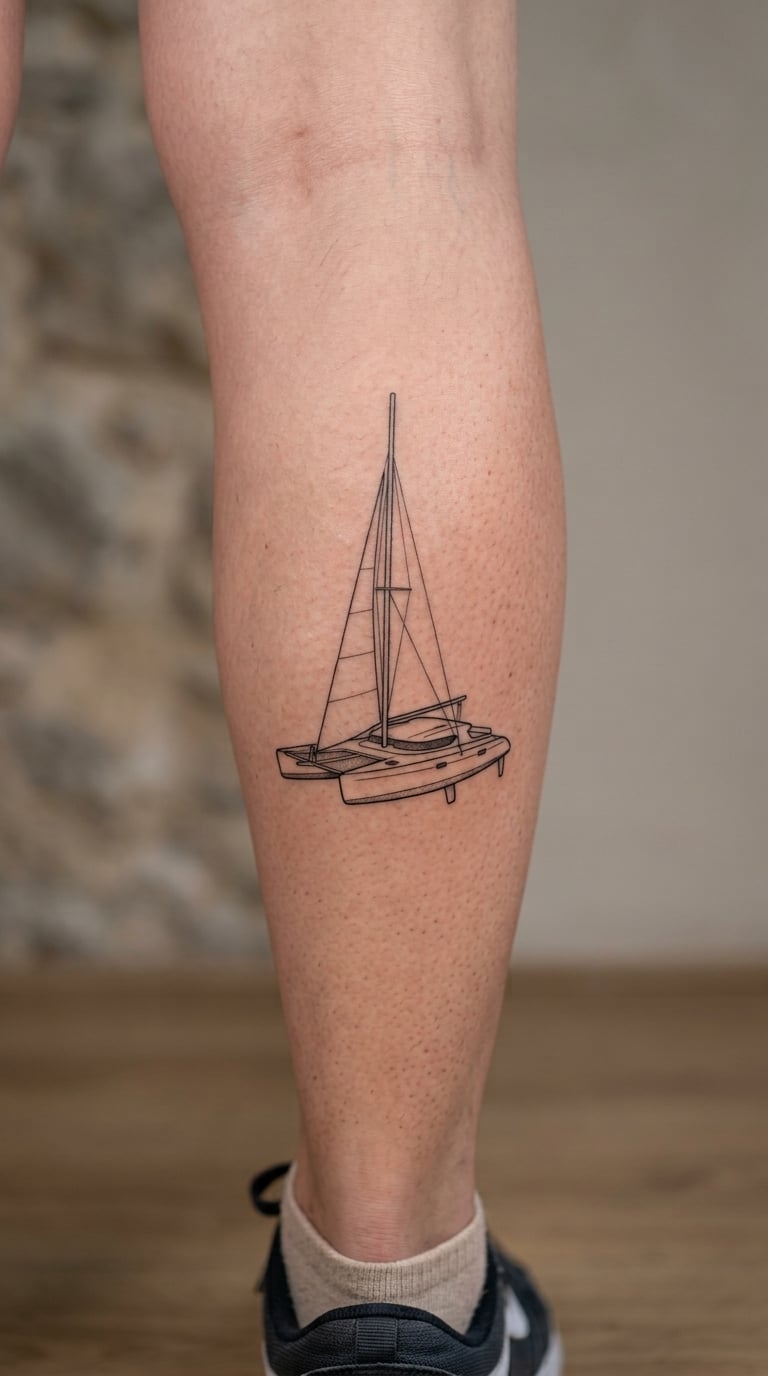
Two parallel hulls under one tall mast and a single triangular jib, all in unfilled black line. It is a modern, performance-shaped boat rather than a romantic one, and the twin hulls give the drawing a wide, stable base that sits well on a leg.
Catamarans show up on people who actually sail modern boats rather than tall ships. The design leans toward speed and open water, without needing any explanation.
Placement: outer calf, or the thigh, where the two hulls can run across the muscle. Size: 4 to 5.5 inches (10 to 14 cm). Style: fine line.
Pain: low, the calf is a forgiving area. Calf skin stretches, so a fine-line boat there softens sooner than one on the forearm. Make it yours: run a single thin waterline under both hulls to tie the pair together.
7. Old-Style Sailing Ship in Blackwork
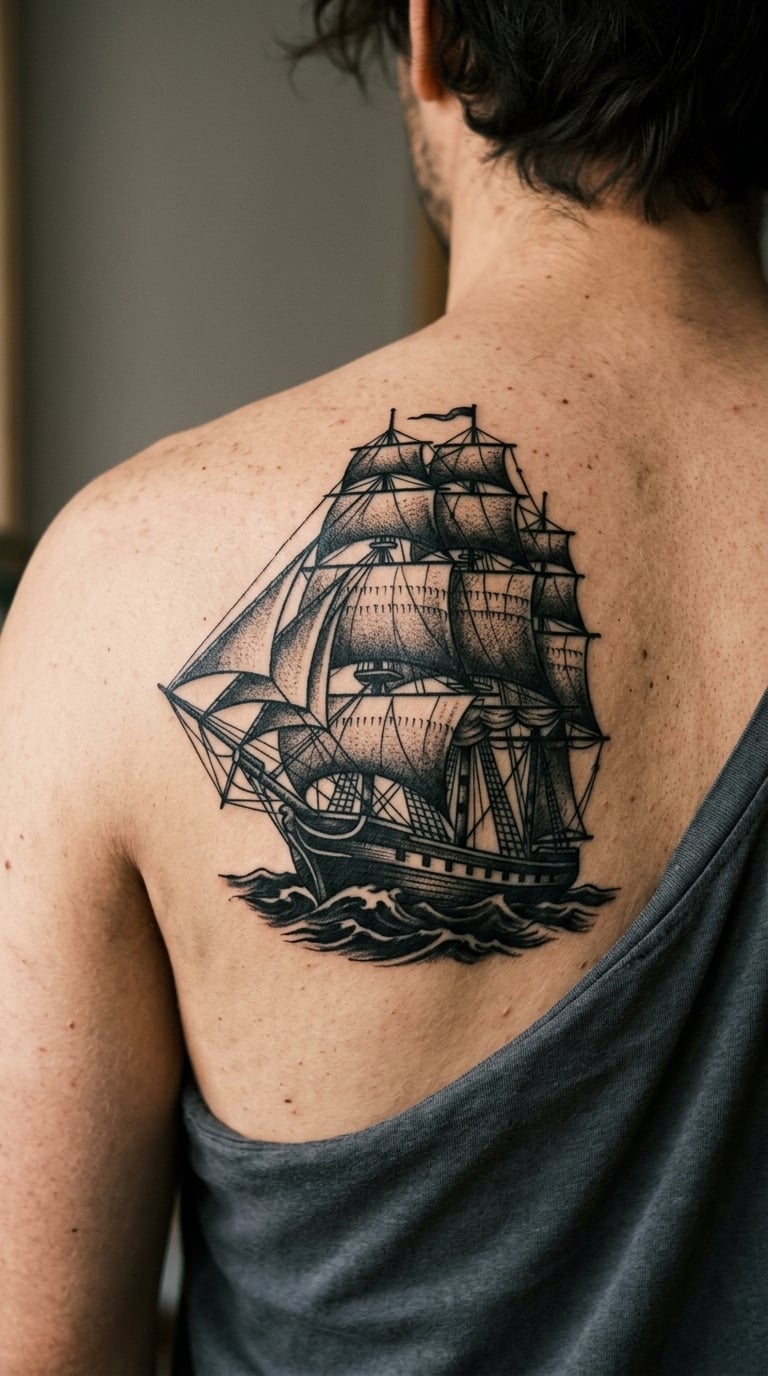
Heavy black sails, a solid dark hull, coiled rope and taut rigging, all packed into a dense composition with very little white space left over. This is the loudest version of the motif and the one that rewards having a flat area to give to it.
Blackwork suits people who want the boat to be the loudest thing in the room rather than a quiet reference. It also gives an experienced collector a piece that can anchor the rest of a back piece later.
Placement: upper back, upper chest, or a thigh panel. Size: 5.5 to 7 inches (14 to 18 cm). Style: blackwork.
Pain: medium, and expect a long sitting because of the solid fills. Dense black is the most durable style on this list; it is the thing that keeps a design looking like itself after fifteen years. Make it yours: break the black field with one thin band of negative space along the waterline.
8. Tiny Sailboat Behind the Ear
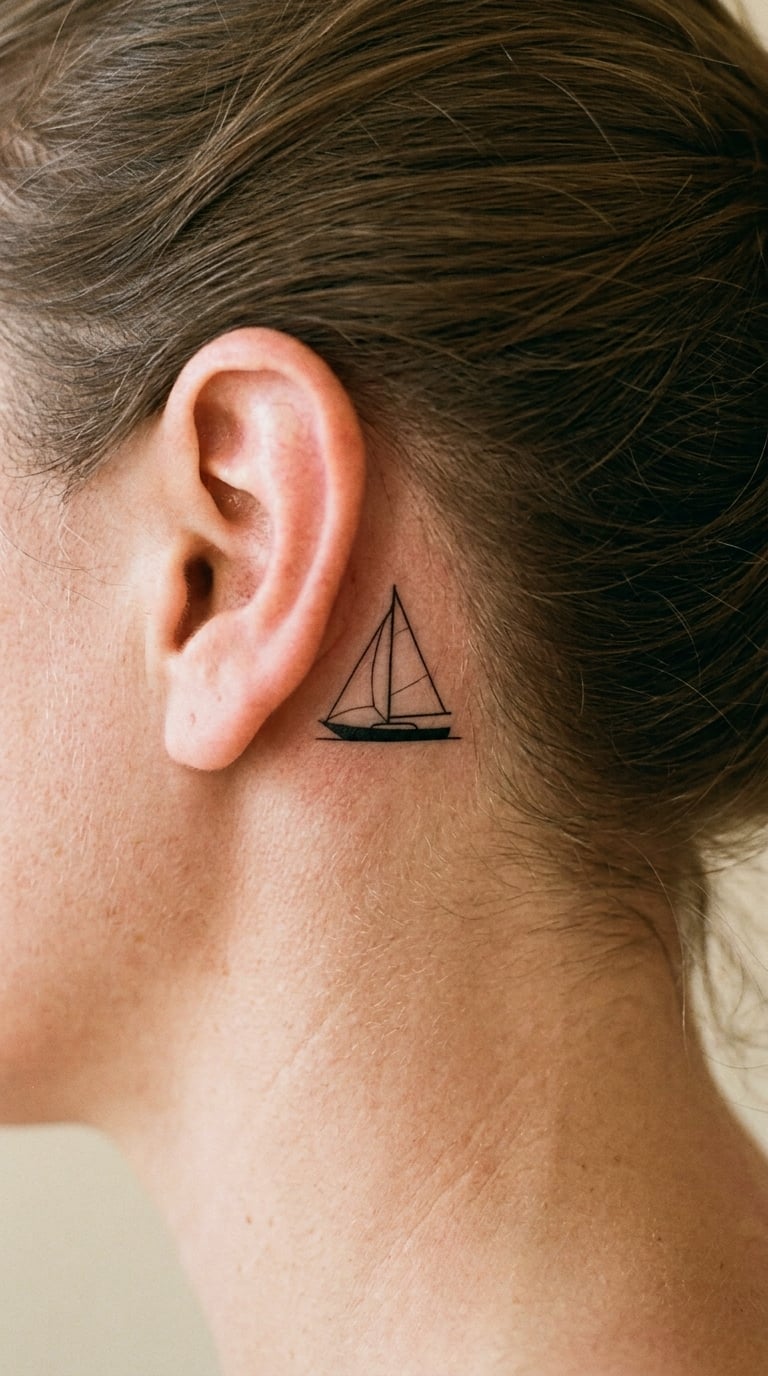
A one-inch boat tucked into the hollow behind the ear, drawn as a plain hull outline and two small sails with nothing inside them. The location is half the design; the drawing itself is deliberately simple because anything more turns to mush at that size.
Behind the ear suits discreet pieces and small mementoes. It is also a spot that gets no sun, so line work there tends to hold its colour better than the same drawing on an exposed arm.
Placement: behind the ear, in the crease where the ear meets the skull. Size: 0.75 to 1.25 inches (2 to 3 cm). Style: micro fine line.
Pain: medium, because the skin folds and the area is bony. Be honest about the trade here: micro detail blurs over the years, and this is the least durable entry on the list. Make it yours: set the boat on a slight tilt so it reads as moving, not parked.
9. Sailboat and Lighthouse
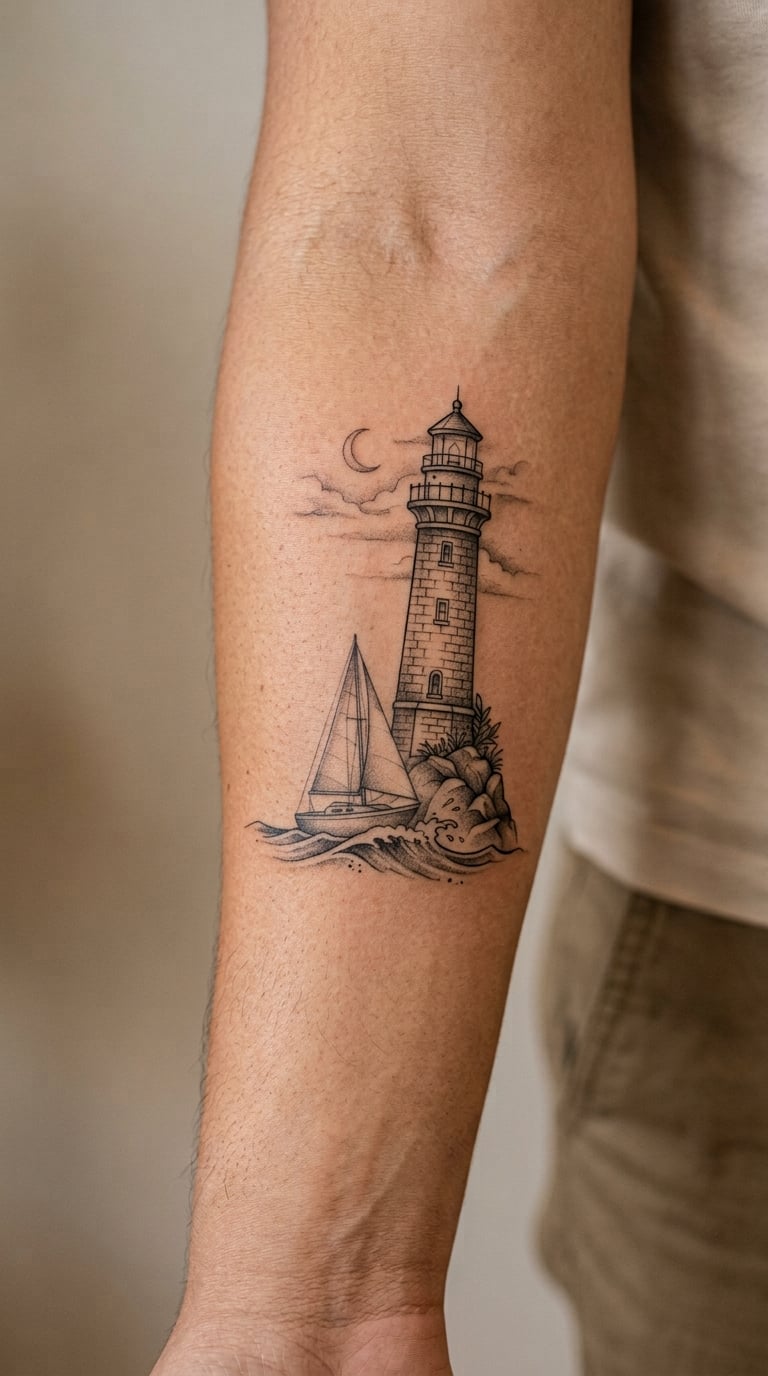
A narrow striped lighthouse stands on one side, a small dark boat crosses in front of it, and a short wave line closes the bottom. Two tones of grey are enough; the lighthouse reads from the vertical stripes alone.
The lighthouse motif is a harbour memory, a safe harbour, or a stretch of coastline that mattered. It is a scene rather than a symbol, which is a different kind of keepsake.
Placement: inner arm or side of the forearm, where the scene can run lengthwise. Size: 3.5 to 4.5 inches (9 to 11.5 cm) tall. Style: illustrative line.
Pain: low to medium, depending on how many grey passes the lighthouse gets. Keep the beam as a soft wash instead of a hard line, since a thin beam is the first detail to disappear. Make it yours: add your home harbour or the name of the lighthouse on the headland.
10. Dotwork Sailboat Constellation
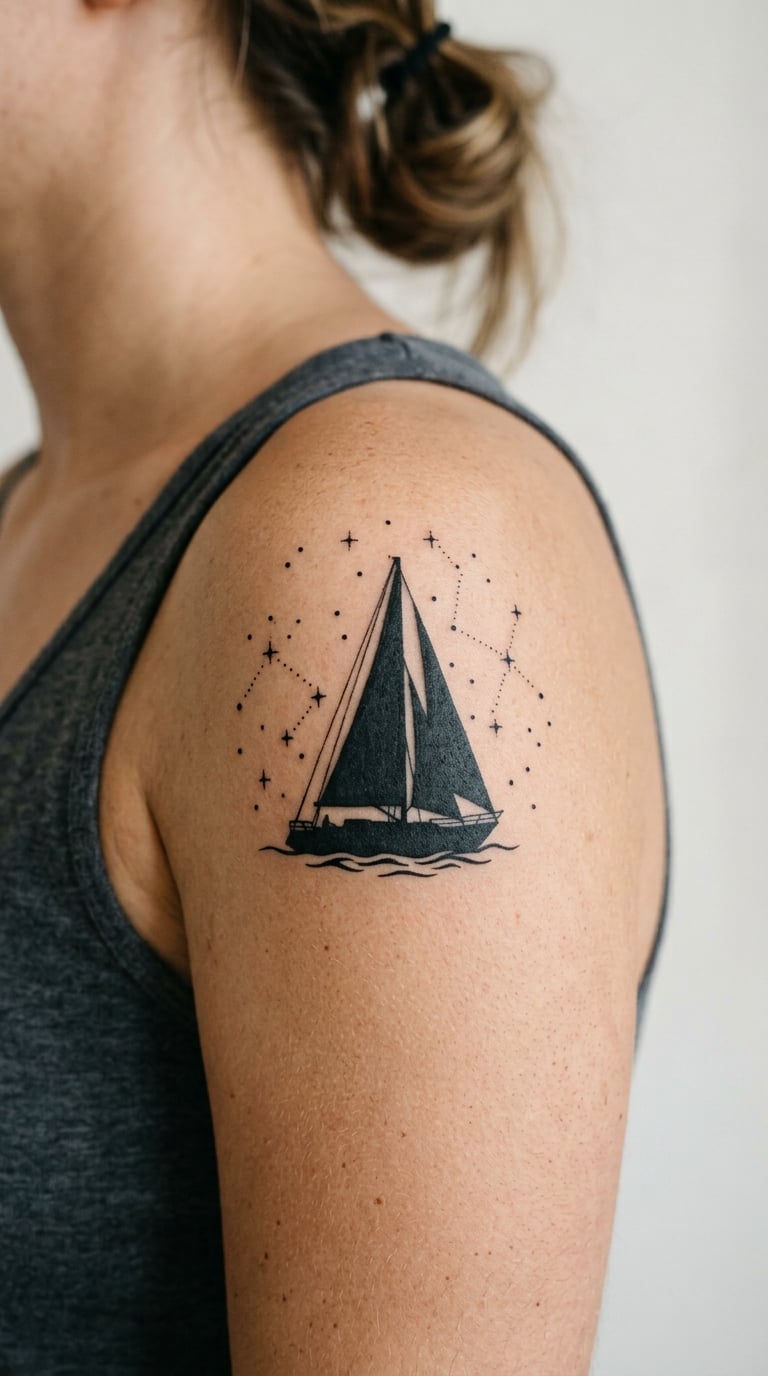
A solid black boat sits at the centre of a field of evenly spaced dots forming stars and a loose arc across the upper back or shoulder. The contrast between the flat silhouette and the soft dot field is what makes the piece work.
Boats under stars point at night passages, distance travelled, or just a preference for the night side of sailing. The dot field gives you somewhere to add more later without reworking the boat.
Placement: shoulder blade, upper back, or thigh. Size: 3.5 to 5 inches (9 to 12.5 cm) across. Style: dotwork.
Pain: low, dotwork is a lot of needle passes but little force. Density is the real issue over time: tightly packed dots spread and grey out, so ask for open spacing. Make it yours: use your actual birth sky as the dot pattern, with the boat below the horizon.
11. Vintage Sailboat with Waving Flag
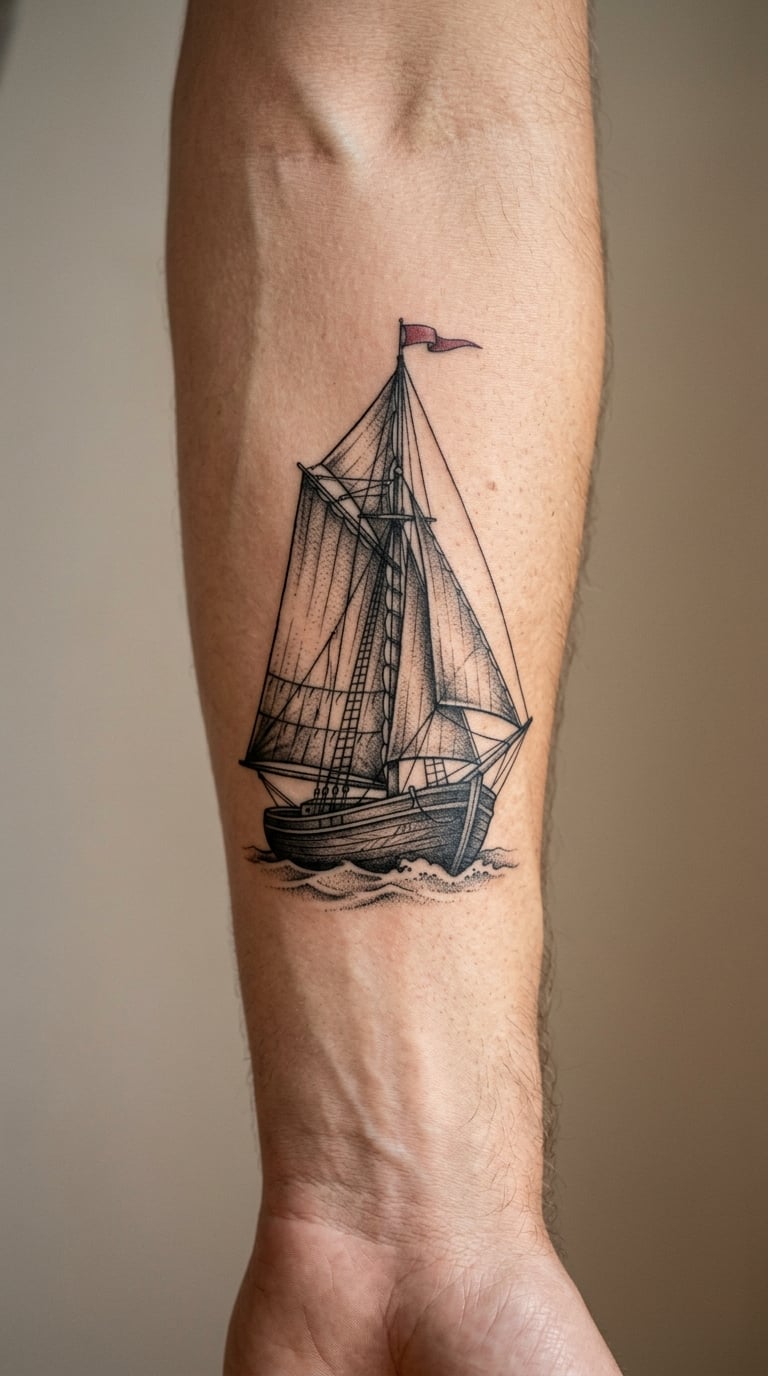
An old wooden hull with aged grey shading along the planks, two worn-looking sails, and a small red pennant streaming off the masthead. The colour is used once, in the flag, and that single accent keeps the whole design from looking flat.
Weathered and slightly beaten-up is a deliberate look for people who like working boats rather than racing yachts. The pennant adds a small movement cue that a plain hull cannot give you.
Placement: forearm or upper arm. Size: 4.5 to 5.5 inches (11 to 14 cm). Style: traditional with light colour.
Pain: medium. The plank shading takes patience, and skin on the forearm is thinner over the bone, which you will feel more than the calf. Make it yours: letter the boat name along the stern in the same line weight as the hull.
12. Geometric Sailboat Triangle
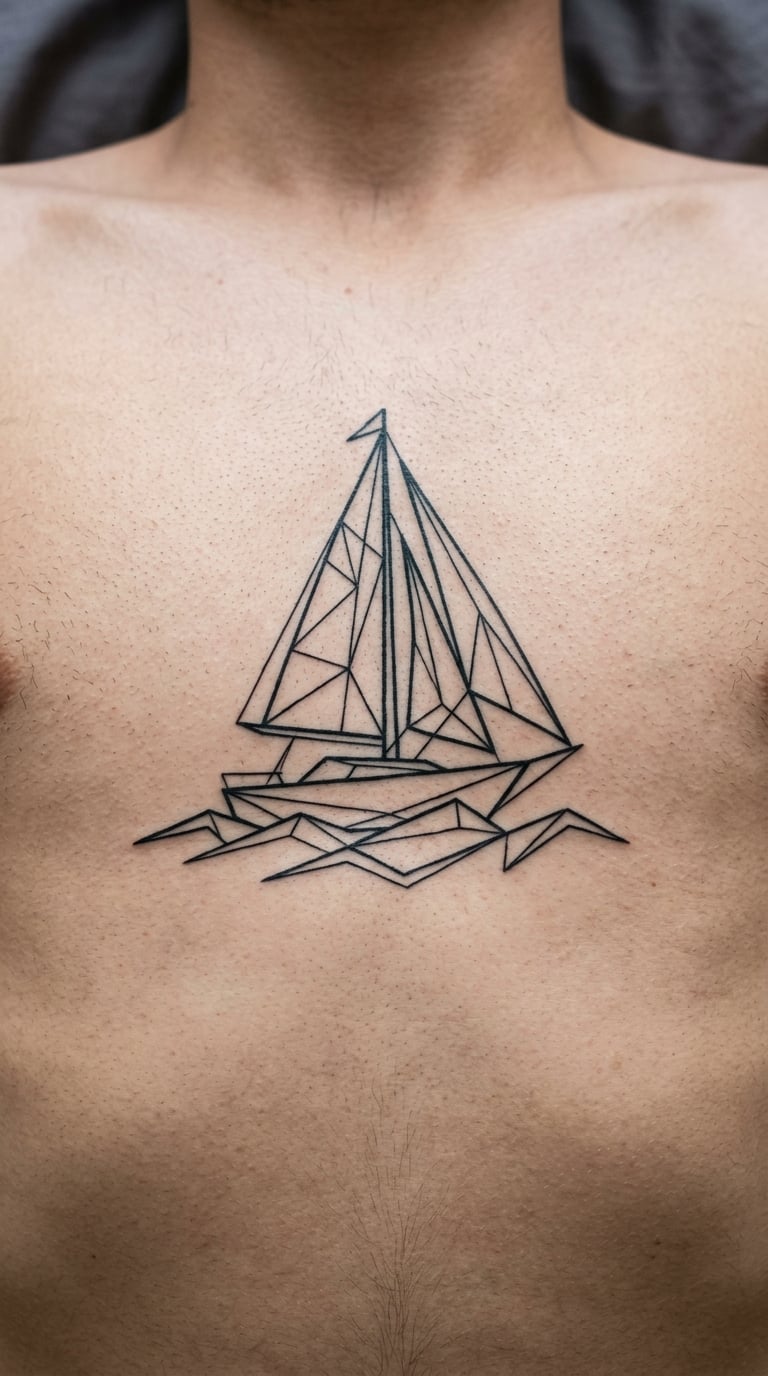
Sails reduced to two triangles, the hull cut into a hard angular shape, and the waves drawn as a row of matching chevrons. Symmetry and negative space do the work, with no shading anywhere in the design.
Geometric versions tend to be chosen for how they fit into a body of existing work rather than for what they depict. This one aligns cleanly with a straight-line sleeve or a symmetrical chest piece.
Placement: sternum, chest, or the inner forearm. Size: 3 inches (7.5 cm) tall, up to 5 wide. Style: geometric.
Pain: medium, the sternum sits over bone and rib, though the session is short. Solid black triangles stay crisp; the chevron waves need slightly heavier line than they look like they need on paper. Make it yours: make the two sails different sizes so the boat still points somewhere.
13. Realistic Sailboat on the Shoulder
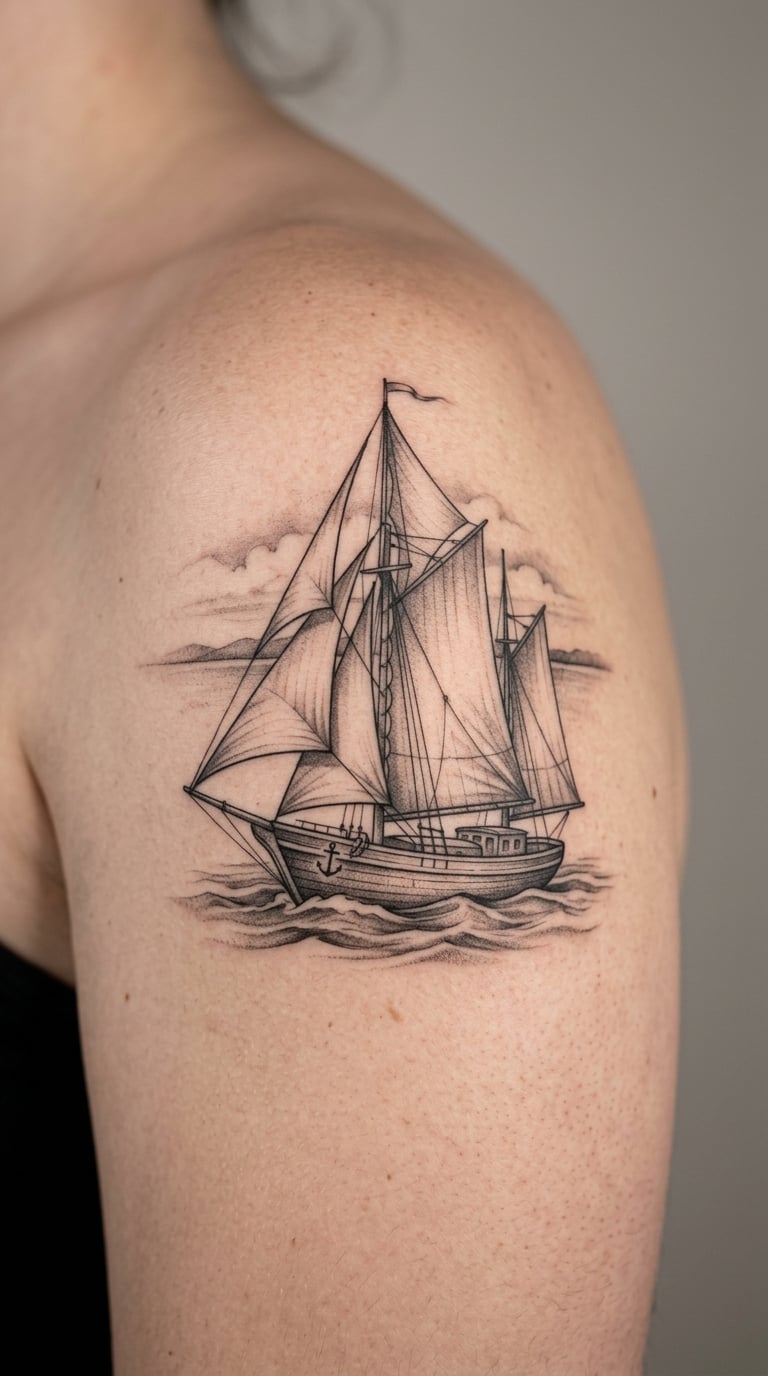
A small semi-realistic boat with believable proportions: a properly curved hull, sails with grey gradient shading, and a faint horizon line behind. The restraint is the point, since realism falls apart quickly when you crowd it.
This is the version people pick when they want a boat that looks like a boat rather than a symbol of one. It suits someone who has seen a real sailing boat up close and wants that specific shape.
Placement: shoulder cap or collarbone area, both of which hold a horizontal composition well. Size: 3.5 to 4.5 inches (9 to 11.5 cm). Style: micro-realism.
Pain: low, but budget two sittings if you want the gradients smooth. Gradient shading is the part that fades unevenly, so a touch-up is normal here. Make it yours: describe your boat’s sail plan to the artist, and have them draw the actual hull curve.
14. Sailboat with Flowing Wave Banner
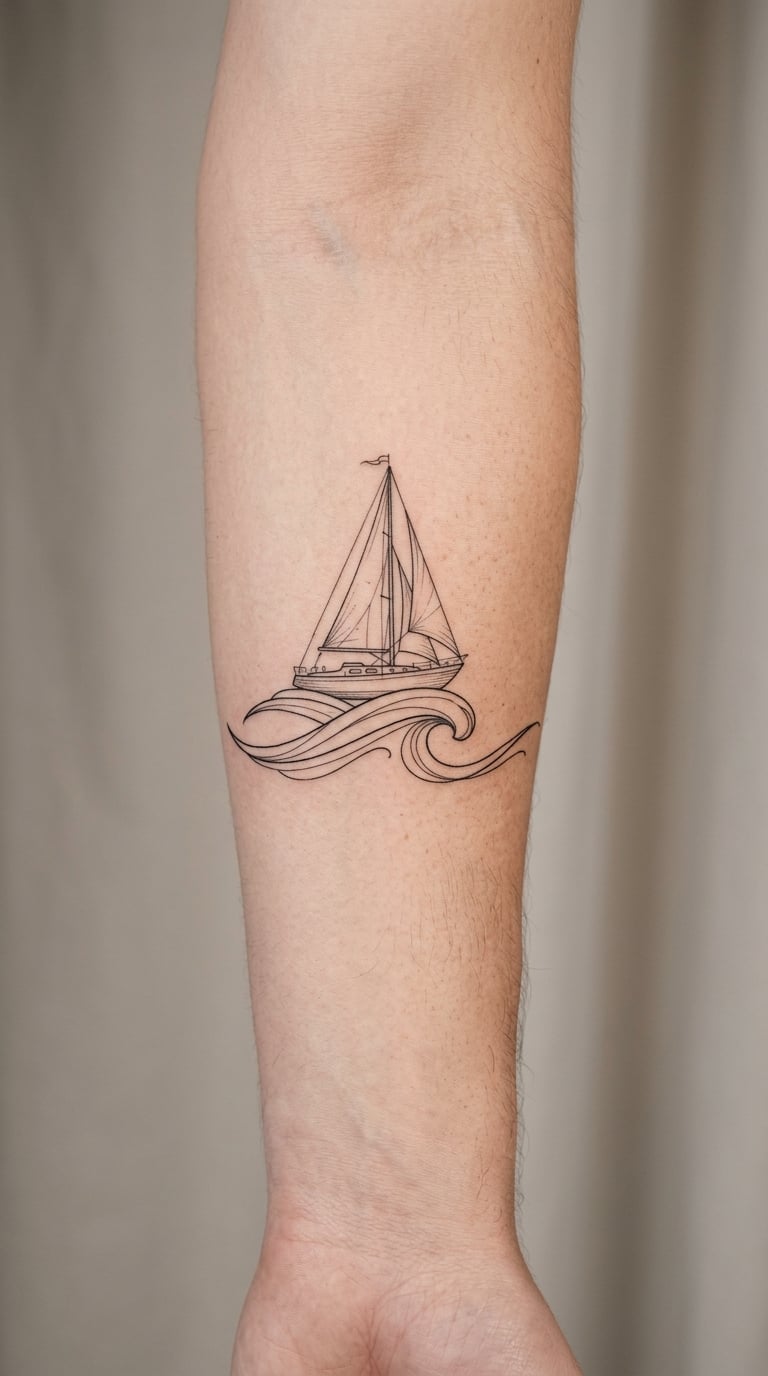
One single-masted boat above a long sweeping wave that runs the length of the piece, the crest breaking into a couple of thin spray lines. The wave does the heavy lifting, filling an elongated area without adding a single extra object to the drawing.
A boat on moving water reads as a voyage under way rather than a boat at rest. It is the most useful design here if you have a long flat panel and want it filled properly.
Placement: forearm or rib area, where the long horizontal shape fits a long space. Size: 5.5 to 7 inches (14 to 18 cm) long. Style: fine line.
Pain: low on the forearm, high on the ribs, which are bone and breathing both. Spray lines are hairlines, so keep them to two or let the artist leave that space open. Make it yours: make the wave break once, in one spot, instead of a uniform ripple.
15. Blue Watercolor Sailboat
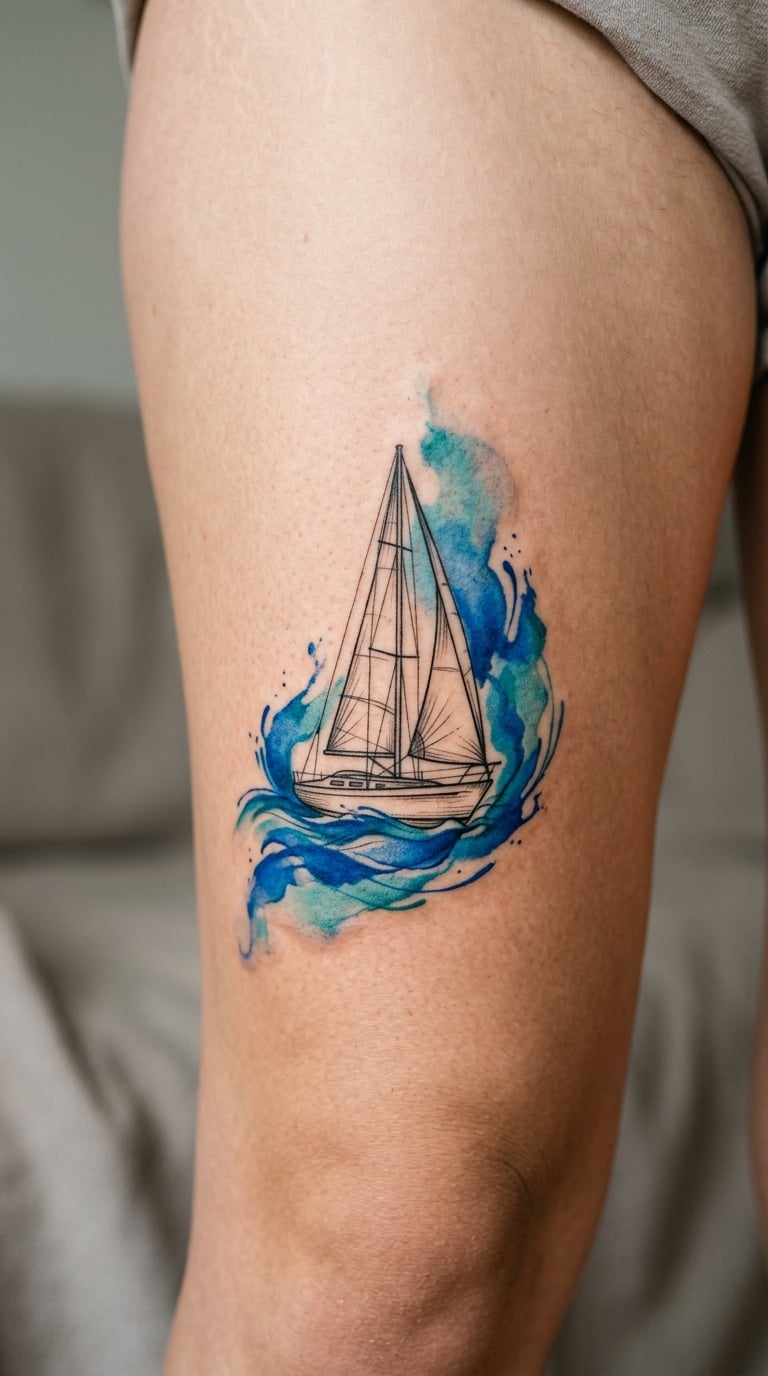
Layered blue and teal brushstrokes sit behind and under a crisp black fine-line boat. The colour is built up in two or three transparent washes rather than one flat blue, which is what gives it movement.
Blue reads as open water without needing waves drawn in. It is a good compromise for someone who wants a colourful piece but not a fully painted traditional tattoo.
Placement: thigh, outer calf, or shoulder. Size: 4.5 to 6 inches (11 to 15 cm). Style: watercolor with fine line.
Pain: low, most of it is one light colour pass. The blue will drift towards a softer tone over time, particularly in summer sun, so pick a shade you will still like slightly greyer. Make it yours: use the colour of water you actually remember, sampled from a photograph.
16. Pirate-Style Sailing Ship
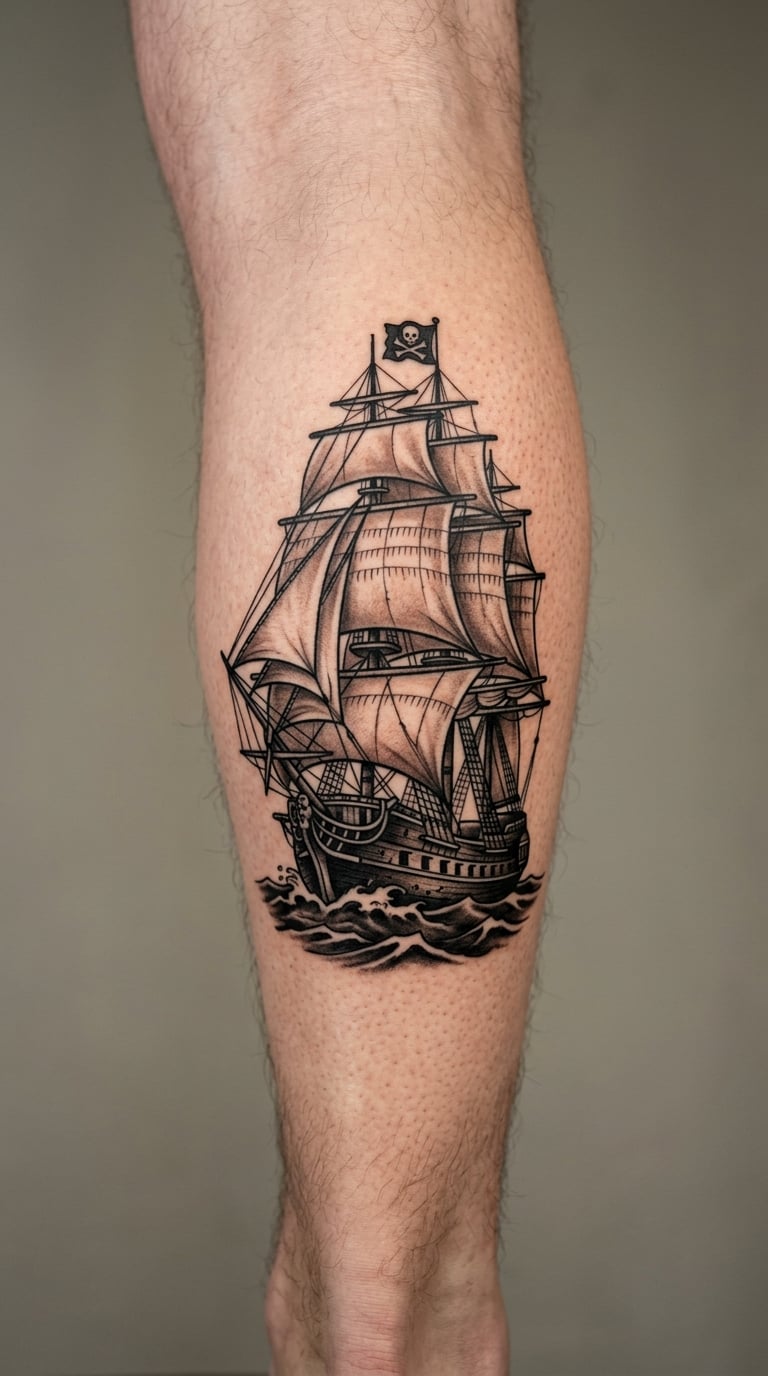
Bold black outlines, a dark heavy hull, sepia-grey sails with visible stitching lines, and rope detailing around the deck. It is a theatrical ship, all silhouette and weight, and it reads clearly at a distance in a way a fine-line boat never does.
The pirate ship is chosen for the story rather than the sailing, and it carries a long history in traditional tattooing as a badge of a hard life at sea. Keep the focus on the vessel itself, not on borrowed characters or flags from films.
Placement: calf, thigh, or forearm. Size: 5.5 to 7 inches (14 to 18 cm). Style: traditional dark.
Pain: medium, and the calf is a bony spot, so expect a few uncomfortable stretches. The sepia tone is worth asking for specifically, since it is a mixed ink that an artist may not otherwise reach for. Make it yours: have the hull planks individually drawn so it looks worked rather than printed.
17. Single-Handed Sailboat on the Wrist
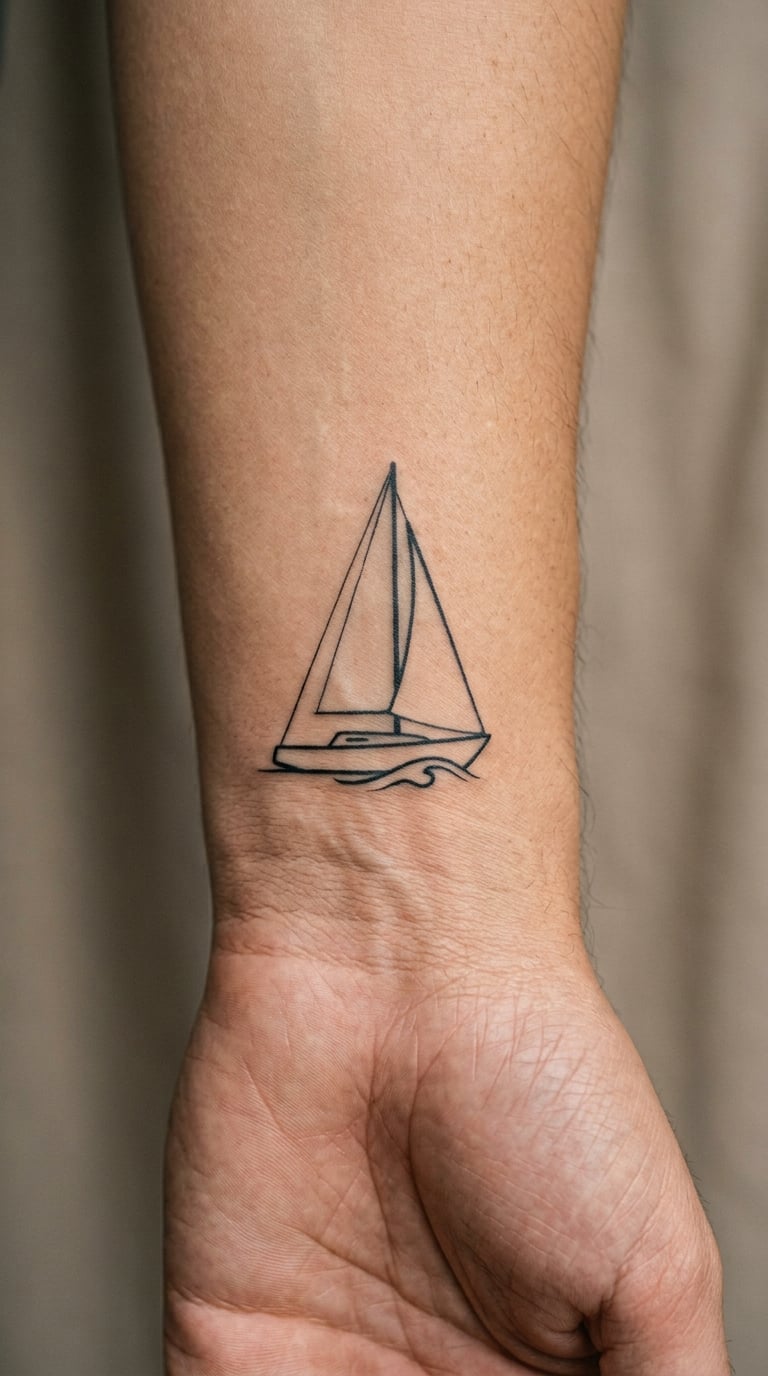
One mast, one triangular sail, a clean shallow hull, and a single short wave accent underneath. At two inches there is no room for rigging, so the whole design is four lines and it still reads instantly.
Small and simple suits a first tattoo, or a wrist that already carries a lot. The single sail is the most economical way to say sailboat and it is the version most often handed to a first-timer.
Placement: inner or outer wrist, along the line of the forearm. Size: 1.5 to 2.5 inches (4 to 6 cm). Style: minimalist line.
Pain: low to medium, wrist skin is thin over bone. Wrist line work fades and softens faster than anywhere else, and you will want it slightly heavier than the drawing suggests. Make it yours: set the hull at a gentle angle rather than flat, so it moves with the wrist.
18. Sailboat and Mountain Range
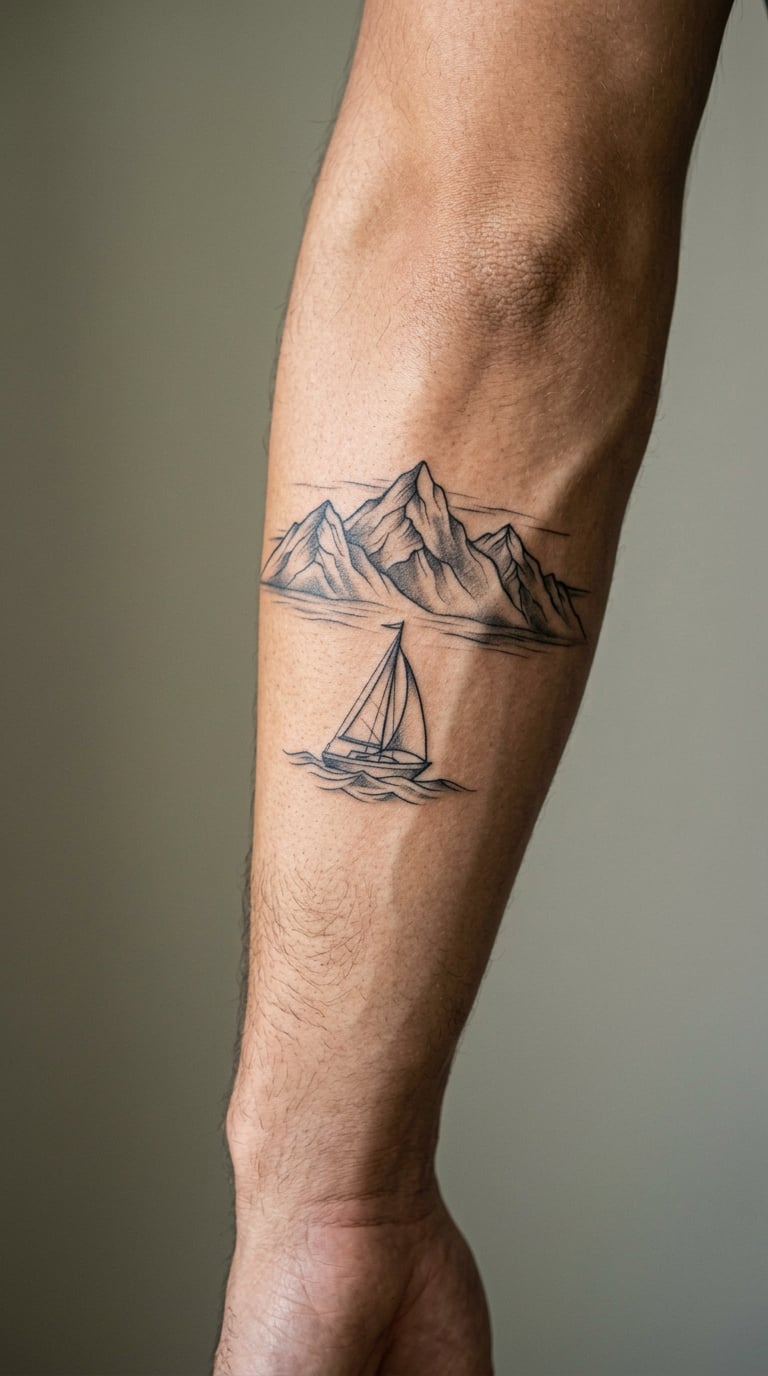
A small dark boat sitting low in the frame beneath a simple row of mountain peaks, with a soft grey gradient pushing the peaks back into distance. The scene is built from a horizon line and two scale jumps, nothing more.
Mountains and water together describe travel and distance rather than any single event. The composition suggests it; it does not commit to a meaning you did not choose. If this pairing is what you are after, the 20 mountain and ocean tattoo ideas list has more scene layouts like it.
Placement: outer arm, chest, or across a flat part of the back. Size: 5.5 to 7 inches (14 to 18 cm) wide. Style: black and grey.
Pain: low to medium; the gradient on the peaks needs more passes than the boat. Keep peaks as simple triangles, because ridgelines drawn in detail turn to noise at this scale. Make it yours: trace the outline of the range from a real place you have been.
19. Neotraditional Red-Sailed Ship
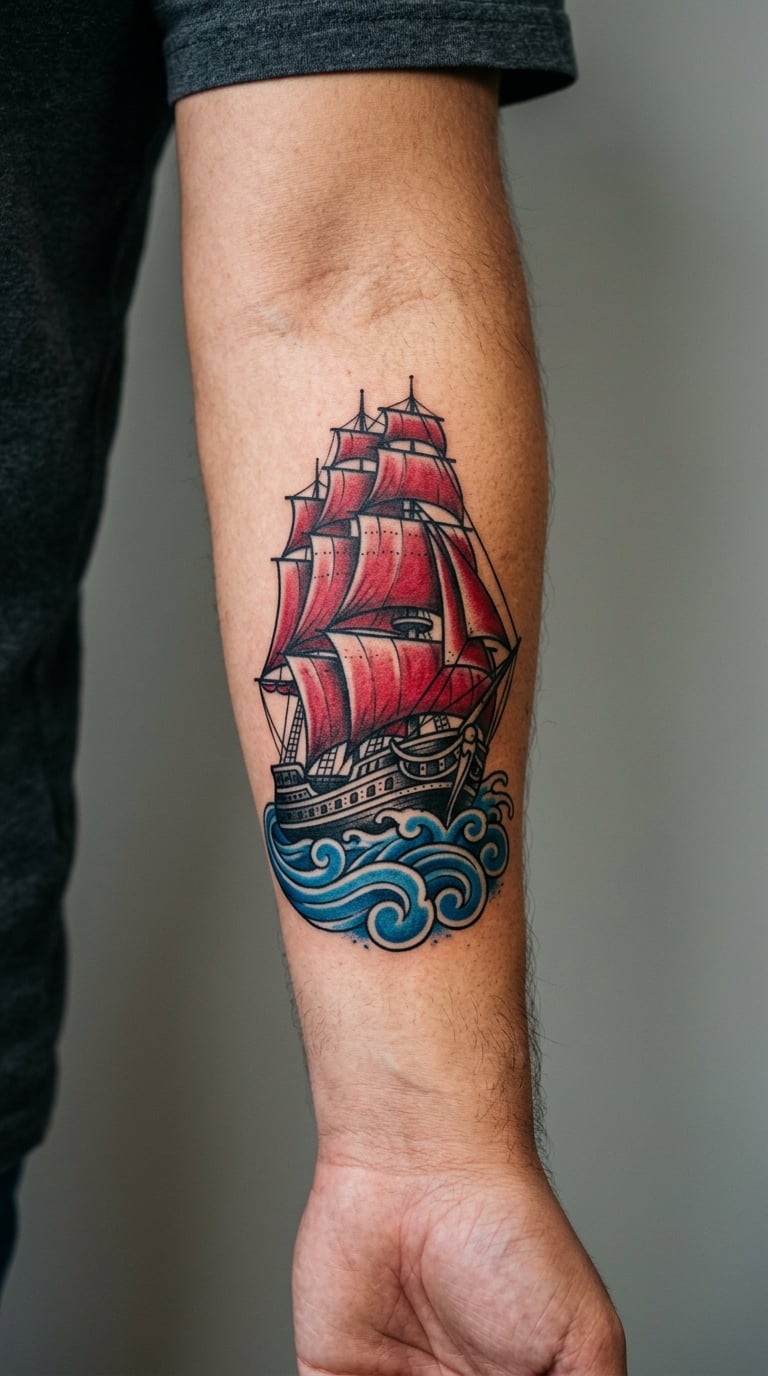
A black-outlined hull with saturated red sails and a narrow band of blue water underneath. Neo-traditional rules apply: heavy outline, limited palette, minimal shading, and two or three strong colours doing the work.
Red sails are a colour choice first and a style statement second, and they make this the most eye-catching boat on the list. It suits someone who wants a nautical tattoo that still reads from the other side of a pub.
Placement: forearm, upper arm, or calf. Size: 4.5 to 6 inches (11 to 15 cm). Style: neo-traditional.
Pain: medium, since solid colour fills take repeated passes and the forearm bone is close to the surface. The bold outline outlasts the red, so expect to refresh the sails eventually while the line stays sharp. Make it yours: make the hull black and the sails red, rather than the usual reverse, for a darker result.
20. Sailboat with Birds Above the Mast
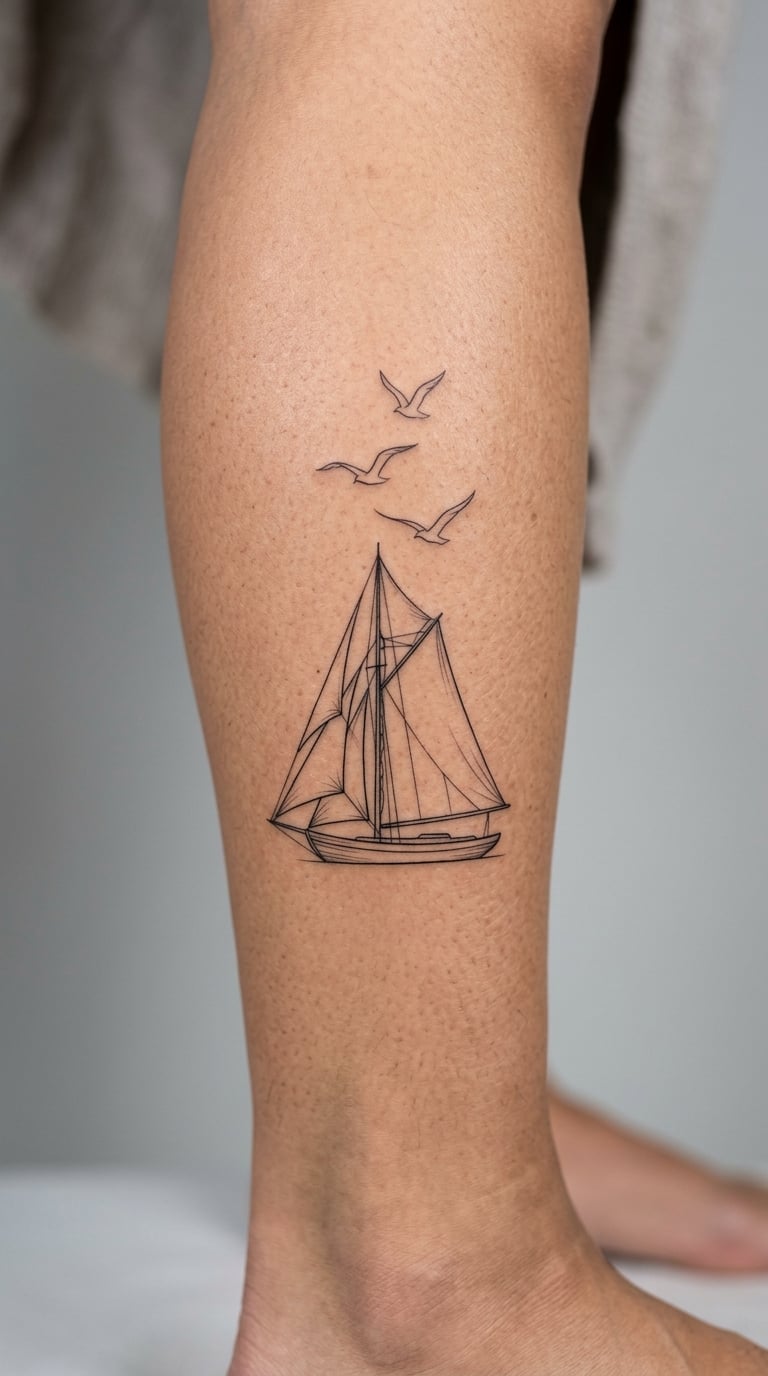
A light black boat with a tall mast, and three simple birds above it in open space. Varying the size of the birds, with one closer and larger and two smaller, gives the composition depth without adding any objects to describe.
Overhead birds add a sense of height and air, which stops a boat from sitting flat on the skin. In traditional tattooing swallows are associated with distance travelled, and that association comes with the shape whether you intend it or not.
Placement: calf, thigh, or the inside of the upper arm. Size: 4.5 to 5.5 inches (11 to 14 cm) including the birds. Style: fine line.
Pain: low, it is a small amount of line work spread over a large area. Tiny bird wings fade first, so keep the wings as two clean strokes and nothing more. Make it yours: use one real shape, a gull or a tern, repeated at two sizes.
21. Miniature Sailboat Finger Tattoo
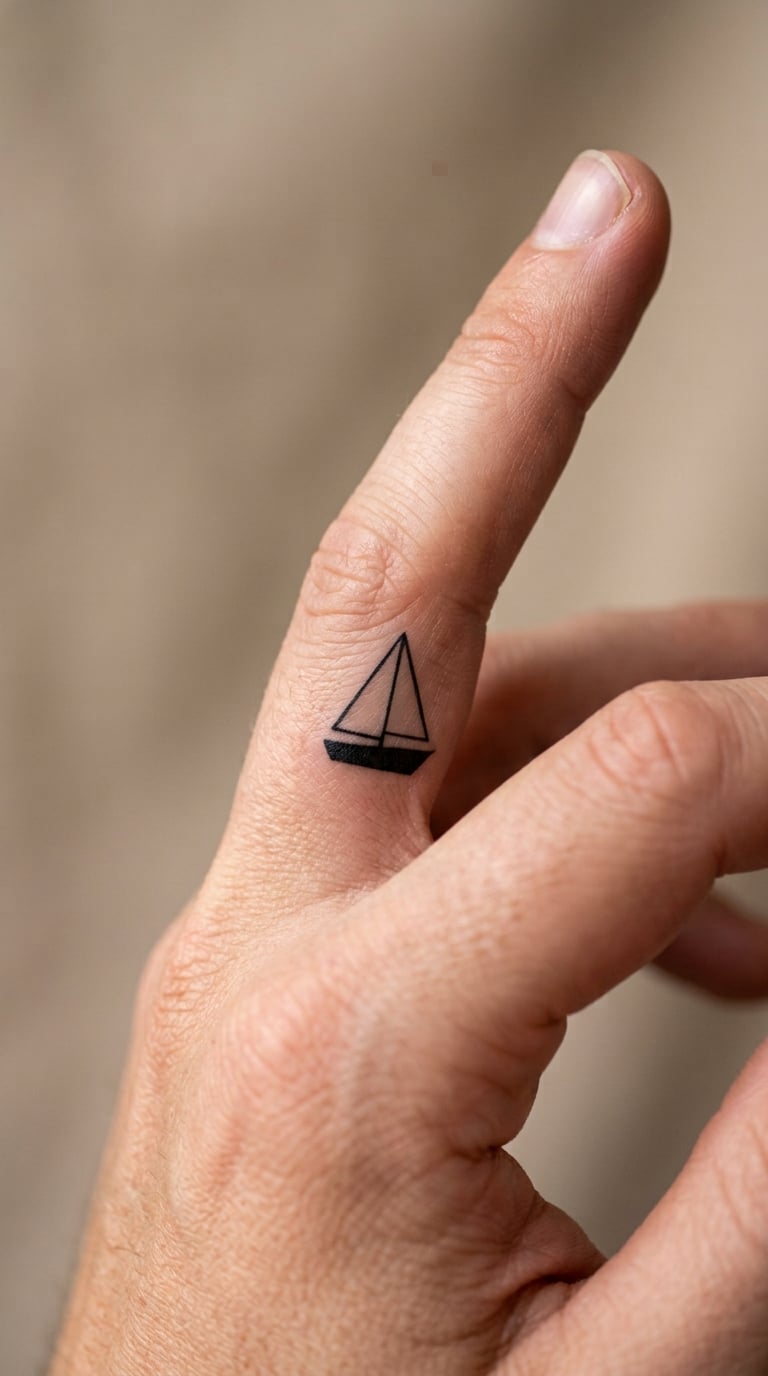
A one-inch hull with a single sail on the side of a finger, in solid black with no interior lines. Finger tattoos get pushed, bumped and washed more than almost any other spot on the body, so the design is reduced to the three shapes that survive that treatment.
Finger placement is a quiet one, mostly seen by the person wearing it. It tends to be a first tattoo or a small addition to an existing hand piece, and it means more to the wearer than to anyone else.
Placement: side of the index or middle finger, or the outer knuckle line. Size: 0.75 to 1 inch (2 to 2.5 cm). Style: micro line.
Pain: medium; fingers are bony and the skin is tight. Be straightforward about longevity here, because hands and fingers fade fastest of all the placements in this list. Make it yours: add a matching wave on the wrist so the small piece has a larger companion.
22. Large Nautical Sailboat Scene
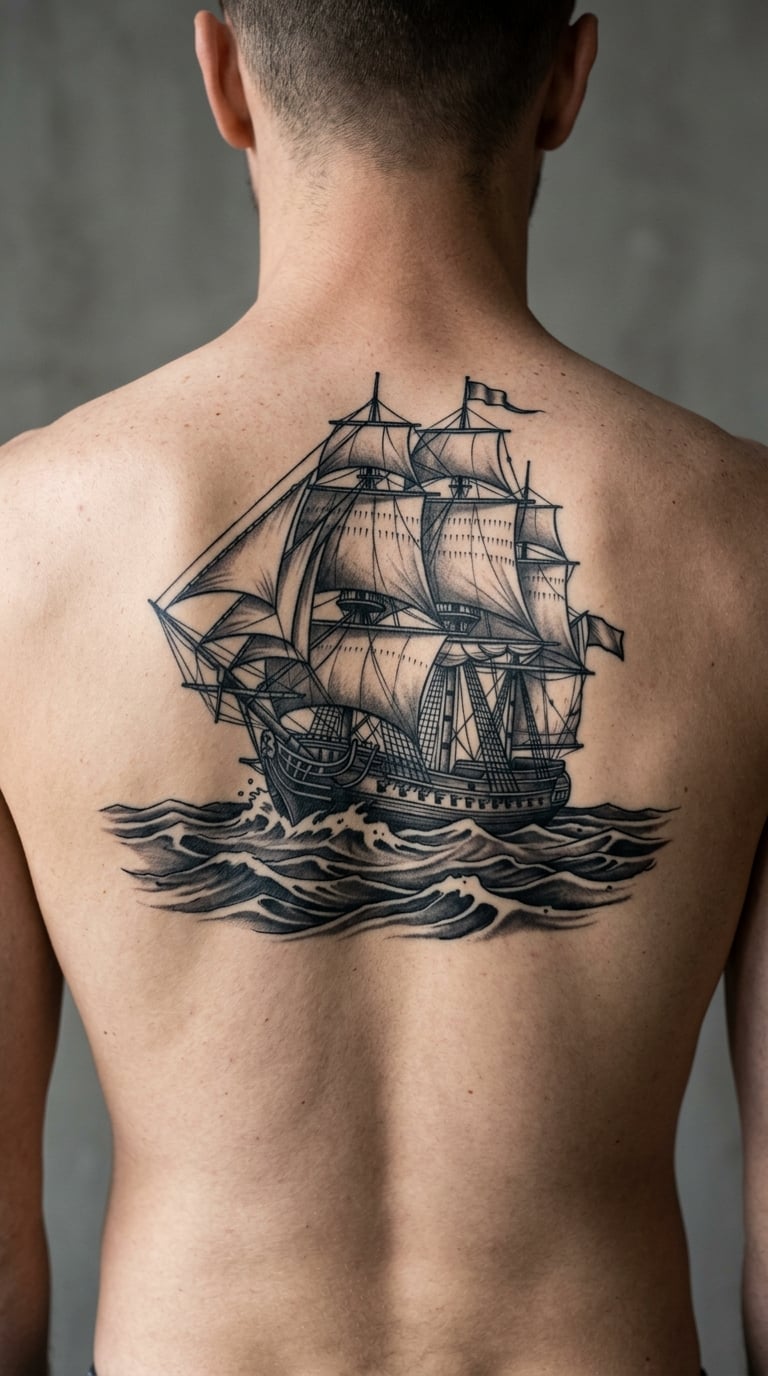
An eight-inch ship under full sail with rigging, hull shading and layered ocean movement beneath it, with real negative space left around the edges so the eye still finds the boat quickly. This is the only design on the list built for a panel rather than a spot.
A scene this size works best for someone already collecting nautical work, or starting a back piece with the boat as the centrepiece. The surrounding water gives you somewhere to add later without repainting the ship.
Placement: upper back, chest, or thigh panel. Size: 7 to 10 inches (18 to 25 cm) wide. Style: blackwork with grey wash.
Pain: medium across several sittings, since no artist will hold a piece this size in one sitting. Plan the whole scene before the first appointment, because resizing a drawn ship later means re-drawing it. Make it yours: include a horizon line at your real latitude, somewhere in the composition.
How to Choose the Right Design
Where the 22 sailboat tattoo ideas break down by size and style
The rule is simple. Detail has to fit the space you are actually tattooing, and a boat that reads as a generic clipper is the most common complaint people bring to a second appointment.
For nautical line work, three inches square is the practical floor. Below that, masts, ropes and rigging merge into a smudge, so the design has to simplify instead: one sail, a plain hull, no rigging. Most artists put that floor at roughly the same number, and it is worth planning around rather than against.
Flat or curved placement matters too. A sternum design, a rib piece and a shoulder cap all curve the drawing in a different direction, and a boat drawn for a flat stomach will distort on a rib. The chest, back, stomach and upper leg give a scene room; the wrist, finger and behind the ear do not.
Match the detail to the size you are getting
Pick the size first, then the design. If you want a wrist piece, choose idea 3, 17 or 8. If you have a forearm panel free, ideas 1, 5, 11, 14 and 19 all fit well. Bringing a design that needs eight inches to an appointment for a two-inch space is how people end up disappointed.
Think about line weight next. Fine line is elegant and unforgiving, because it thins and fades as skin ages and as sun adds up. Blackwork and traditional bold line hold their shape far longer, which is why the large designs on this list lean that way.
Colour is a separate decision. A single red pennant or a blue wash changes the mood completely, and both are easy to add later once a black outline piece has healed and settled.
Check what is already there. A boat fits well beside a compass, an anchor or a set of waves, and it fights a busy piece with no open skin around it. If you are filling a gap in a sleeve, a horizontal design like idea 14 or a small solid boat like idea 21 fits the shape better than a tall one.
Finally, decide what the boat is doing. Under sail means forward motion, on waves means a voyage, at rest with a lighthouse means a safe harbour. Whatever you pick, that reading is yours, not fixed by tradition.
Bring three reference images, the size you have in mind, and a note of where on the body it goes. That conversation at the consultation saves more time than anything else, and your artist will almost certainly redraw part of the reference anyway.
Cost and Session Time
US tattoo prices vary a lot by city and by artist, so treat these as a working range rather than a quote. A shop minimum is common, and plenty of studios will not book a small piece alone.
Small, under 2 inches: roughly 100 to 250 USD, and 20 to 40 minutes. This covers the minimalist, micro and wrist designs, where a single simplified boat fits the session.
Medium, 2 to 4 inches: roughly 200 to 450 USD, and 1.5 to 3 hours. Most of the forearm, inner arm and shoulder pieces on this list fall here, and the compass rose, lighthouse and semi-realistic shading push toward the upper end.
Large, 4 inches and up: roughly 400 to 1200 USD, split across two to five sittings of 3 to 5 hours. The blackwork, traditional, neotraditional and full scene designs all land in this band, and detail level matters more than size does.
Colour adds time, not usually a separate fee, since it is priced into the hourly rate. A flat colour sail or a red pennant is quick. A full blue or sepia wash across five inches is a real addition to the session.
Aftercare Basics
Follow your artist’s aftercare instructions first, since they will know exactly what they put in your skin. The general routine underneath is standard and well established.
Wash the piece gently with unscented soap and lukewarm water twice a day for the first week, then pat it dry with clean hands rather than a towel.
Keep it out of direct sun while it is fresh, and cover it loosely under loose clothing. Tight sleeves and tight waistbands rub new ink.
Do not soak it. Pools, hot tubs, baths and long showers can pull pigment out of a healing tattoo, and for the first few weeks that is a real loss, not a hypothetical one.
Skip the moisturisers that are heavily fragranced while it heals. A plain, unscented product is the safe choice until the surface has settled.
Once the surface is healed, protect the fine-line designs with sunscreen on exposed areas. Sun is the main reason a one-inch fine-line boat behind the ear and a five-inch blackwork ship age so differently.
Frequently Asked Questions
What does a sailboat tattoo symbolize?
A sailboat tattoo most often symbolizes freedom, travel and the hope of a safe return. It carries real history too: sailors in the 1700s used ships, anchors and compass roses to mark voyages, miles travelled and getting home. What it means for you comes from the boat itself, the direction it points, and the story you attach to it. There is no single fixed meaning.
Where do sailboat tattoos look best on the body?
Forearms, upper arms, the shoulder cap and the calf all give a boat a flat enough surface and enough room. The sternum works for wide horizontal designs, and the back takes the largest scenes. Wrists, fingers and behind the ear suit only very small pieces. If you are placing a detailed ship, choose a flat area such as the chest, back or upper leg rather than a curved one.
What size should a sailboat tattoo be?
Three inches by three inches is the practical minimum for a readable boat, and below that the design has to be simplified to a hull, a mast and one sail with no rigging. A minimalist or micro piece can work at one to two inches. Larger traditional, blackwork and scene designs need five inches or more, and should be planned across several sittings.
What does a small sailboat tattoo mean?
A small sailboat usually carries a personal rather than a grand meaning, such as a specific trip, a family boat, or a first tattoo marking something you wanted to keep. Small scale tends to push people toward fine line and minimalist work, which is elegant but fades faster. Hand and wrist placements age quickest, while a shielded spot such as behind the ear holds colour longer.
Do fine line sailboat tattoos fade faster than bold ones?
Yes. Fine line work has less ink in the skin to begin with, so sun exposure and the natural change in skin over the years thin it out sooner. Blackwork and bold traditional outlines hold their shape far longer, and colour sits in between. Asking for slightly heavier line weight than the drawing looks like it needs, and using sunscreen once healed, both help.
Should a sailboat tattoo be black and grey or in colour?
Both work. Black and grey suits realistic shading, gradients and older traditional work, and it ages most reliably. Colour gives a boat more personality, whether that is red neotraditional sails or a loose blue and teal wash, but the colour will soften over time. A good middle path is a solid black boat with one coloured accent, such as a red pennant or a sunset behind the sails.
Conclusion: Choose Your Sailboat Tattoo
If this is your first tattoo, start at idea 3, 17 or 1: a simplified boat in black line at two or three inches, placed on the forearm. It reads clearly, sits comfortably, and needs one short sitting.
If you are adding to a collection, the blackwork and traditional pieces carry the most weight. Idea 7, 19 or 22 gives you something durable to build the rest of a nautical theme around, and idea 2 and 16 give you a real tall ship with history behind the shape.
Whichever you pick out of these 22 sailboat tattoo ideas, decide the size before the design. It is the one decision that decides whether the piece reads in ten years or fades into a smudge.