
20 Hippo Tattoo Ideas: Small and Bold Designs (October 2026)
These 20 hippo tattoo ideas cover everything from a one-inch black silhouette behind the ear to a full river scene, and each one comes with the placement, size and pain detail you need before you book. A hippo works well in ink because the animal is built from rounded mass and a few small features, so even a simple design still reads clearly once it heals.
Most people arrive here already attached to the animal. A lot of hippo tattoos I have seen described in artist captions were done for someone specific, a parent who loved them, a kid who was obsessed with them for two straight years. If that is your reason, the matching pair (number 7) is the one people come back to most often. Book a consultation for a few weeks out if you are planning around a wedding, a birthday or a holiday season, since studios fill up fast in autumn.
20 Hippo Tattoo Ideas: Quick Guide
| Idea | Style | Best Placement | Size | Pain |
|---|---|---|---|---|
| 1. Fine-line swimming hippo | Fine line | Inner forearm | 2-3 in | Medium |
| 2. Micro hippo behind the ear | Minimal silhouette | Behind the ear | 0.75-1 in | Low |
| 3. Sleeping hippo | Fine line contour | Inner wrist | 1.5-2.5 in | Medium |
| 4. Traditional rose-coloured hippo | Traditional American | Outer calf | 3-4 in | Medium |
| 5. Watercolor hippo | Watercolour | Upper shoulder | 4-6 in | Low to medium |
| 6. Blackwork hippo head | Blackwork | Outer thigh | 5-7 in | High |
| 7. Hippo and baby pair | Matching outline | Inner arms | 1-2 in each | Medium |
| 8. Chubby rib hippo | Cartoon bold line | Side of the ribcage | 2.5-3.5 in | High |
| 9. Realistic baby hippo | Micro-realism | Outer ankle | 1.5-2 in | Medium |
| 10. Geometric hippo | Low-poly linework | Outer upper arm | 3.5-4.5 in | Medium |
| 11. Tiny finger silhouette | Solid silhouette | Outer side of finger | 0.5-0.75 in | High |
| 12. Hippo with lotus flowers | Black line with muted pink | Outer hip | 5-6 in | Medium |
| 13. Neo-traditional lily pad hippo | Neo-traditional colour | Outer forearm | 4-5 in | Medium |
| 14. Dotwork hippo | Stippling and dotwork | Inner calf | 3-4 in | Medium |
| 15. Minimal line collarbone hippo | Single-contour line | Along the collarbone | 2-2.5 in | Low to medium |
| 16. Hippo in a bubble | Playful line with one accent | Upper back | 3.5-4.5 in | Low |
| 17. Anatomical hippo study | Vintage scientific line | Forearm | 6-7 in | Medium |
| 18. Black-and-grey swimming hippo | Realism and grey wash | Outer thigh | 5-6 in | Medium |
| 19. Floral hippo on the hipbone | Mixed line and muted colour | Above the hipbone | 4-5 in | Medium |
| 20. Full-sleeve river scene | Illustrative realism | Full arm | Multi-session | High over several sittings |
1. Fine-Line Swimming Hippo on the Forearm
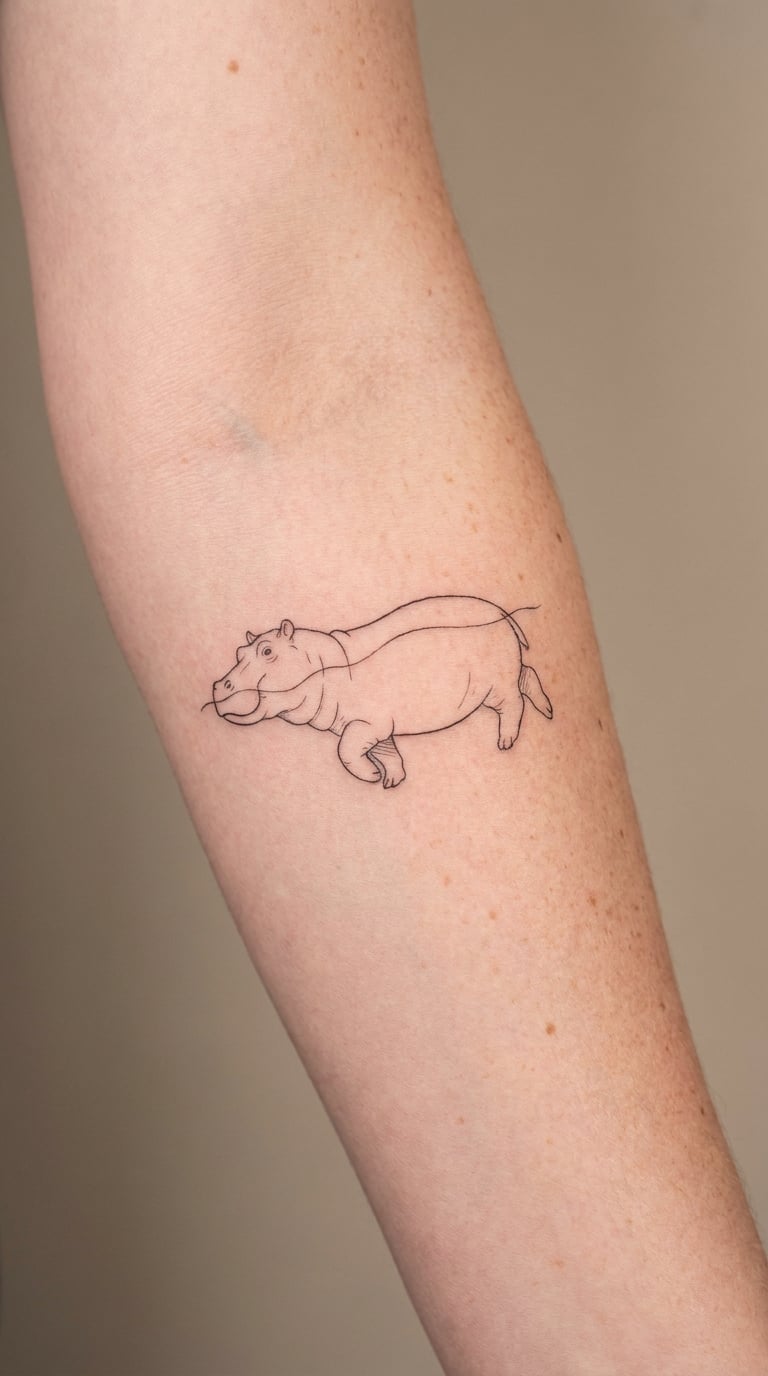
A single hippo in side profile, drawn with one thin unbroken outline, floating above two or three short wavy lines. No shading, no background, nothing competing with the animal. It is the quietest way to wear a hippo and it suits a first tattoo that you still want to look like a grown-up design in ten years.
Most people choose it for how little it says out loud. There is no fixed symbolism attached to it, so it works equally as a personal marker as it does as a nod to a favourite animal.
Placement: Inner forearm, which has good flat surface area and hides under a sleeve. Size: 2 to 3 inches (5 to 7.5 cm) long. Style: Fine line, single weight. Pain: Medium, since the inner forearm is sensitive and the line breaks are constant. Ageing note: hair will grow through a fine line and soften it over the years. Make it yours: add a single slim line of text underneath, or place two at the same scale, one per arm.
2. Micro Hippo Behind the Ear
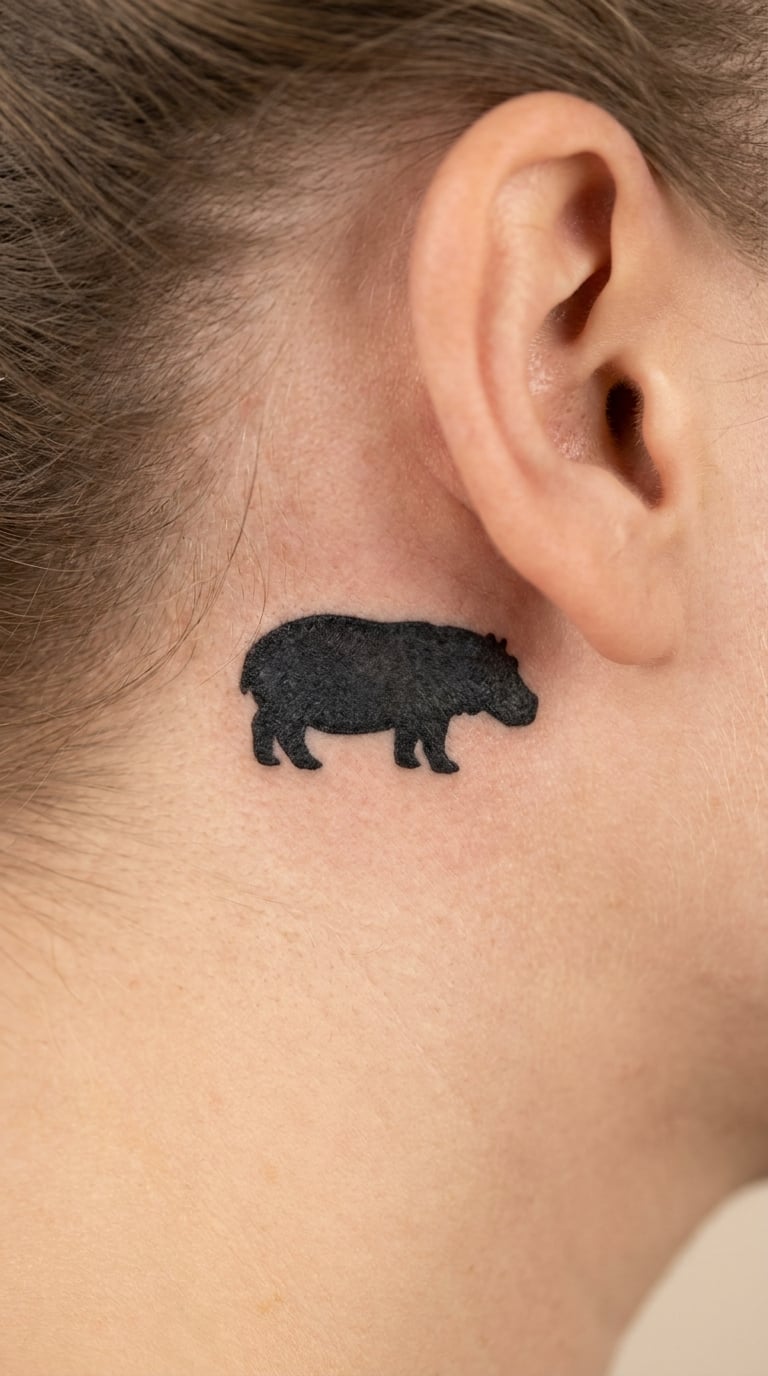
One solid-black hippo shape, no interior detail at all, sitting in the crease behind the ear. Because it is a filled silhouette rather than a drawing, there is nothing to blur. This is the design people pick when they want a hippo tattoo they can hide at a family wedding with hair down.
The reason people get it is usually the same as the reason they get any small animal: it is a quiet thing that is theirs. Ask your artist to lean the animal slightly so it does not look rigid from the side.
Placement: Behind the ear, or along the hairline. Size: 0.75 to 1 inch (2 to 2.5 cm). Style: Minimal solid silhouette. Pain: Low, one of the easier spots on the body. Ageing note: keep the shape simple, because fine facial detail behind the ear disappears within a few years. Make it yours: add a small birth flower tucked behind the hippo, kept under a quarter inch.
3. Sleeping Hippo on the Inner Wrist
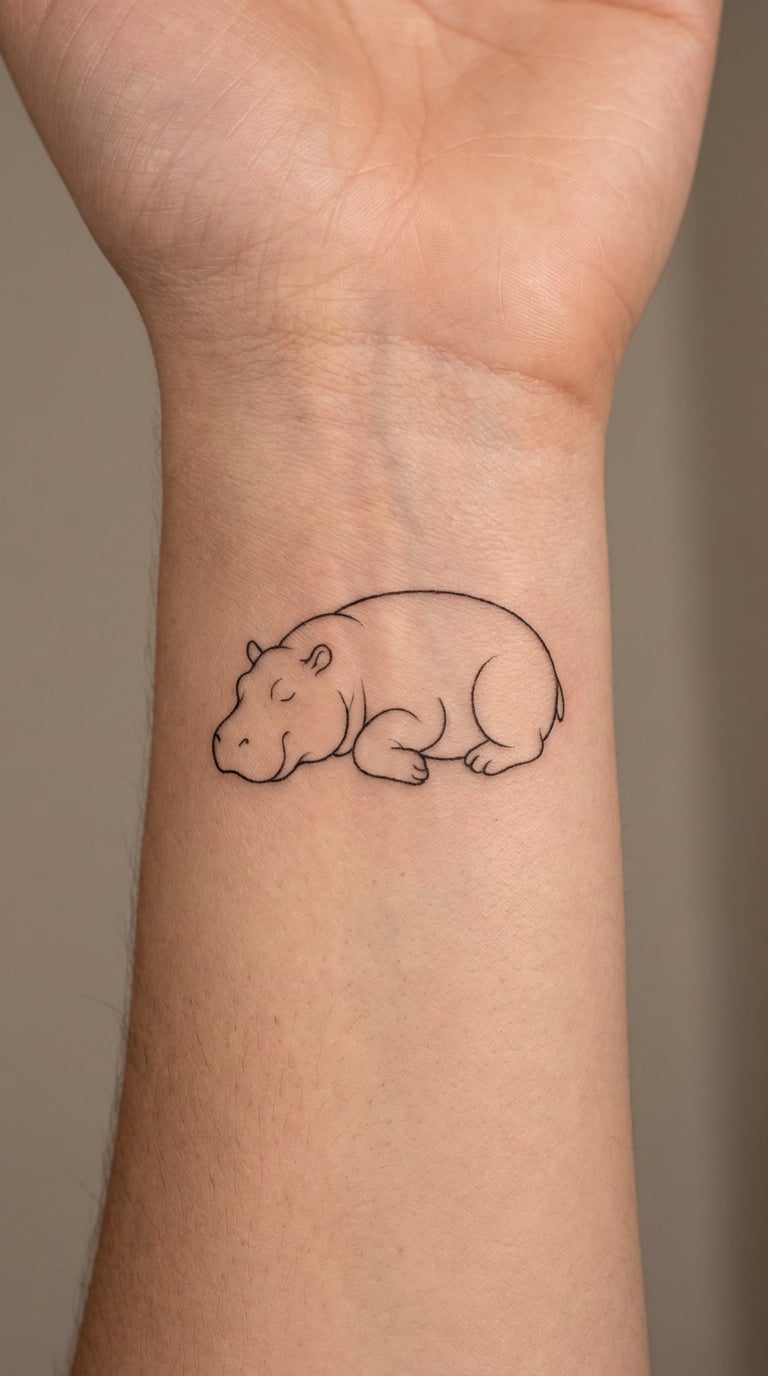
A curled hippo with its head resting on its own back, drawn in economical contour lines that follow the curve of the sleeping body. Maybe a single Z or a tiny closed eye. It has a gentle, slightly comic quality that makes it popular with people who like calm designs but do not want something solemn.
Wearers usually describe it as a mood rather than a message. That is completely fine; the design carries no assigned meaning and reads as restful on its own.
Placement: Inner wrist, above the pulse point. Size: 1.5 to 2.5 inches (4 to 6 cm). Style: Fine line contour, minimal interior detail. Pain: Medium to high near the wrist bone, easing off toward the forearm. Ageing note: wrist ink creases with movement, so avoid hair-fine interior lines. Make it yours: name or date it on the underside of the wrist where only you see it.
4. Traditional Rose-Colored Hippo on the Calf
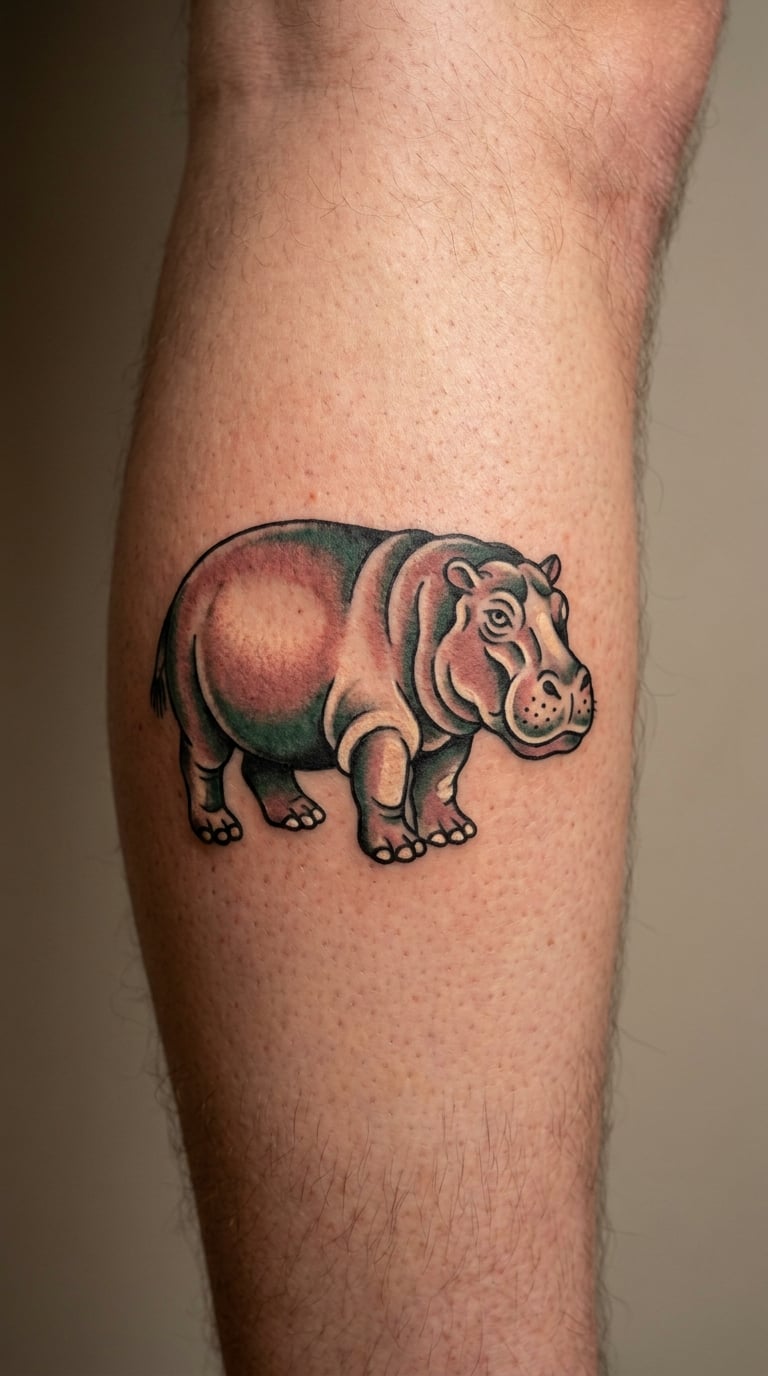
Bold black outlines, flat colour, a chunky body and a friendly expression, sitting on a small patch of ground. Rose and muted green carry most of the colour, with a darker outline holding it together. Traditional work like this is built to age well because the shapes are large and the lines are heavy.
People choose traditional animals when they want something that reads instantly across a room. The hippo version is unusual next to the usual lions and wolves, which is part of the appeal.
Placement: Outer calf or the flat of the upper arm. Size: 3 to 4 inches (7.5 to 10 cm). Style: Traditional American, flat colour. Pain: Medium, the calf is fleshy and forgiving. Ageing note: colour saturation drops in sun-exposed legs, so cover up. Make it yours: change the accent colour to your football team or your daughter’s favourite shade.
5. Watercolor Hippo on the Shoulder
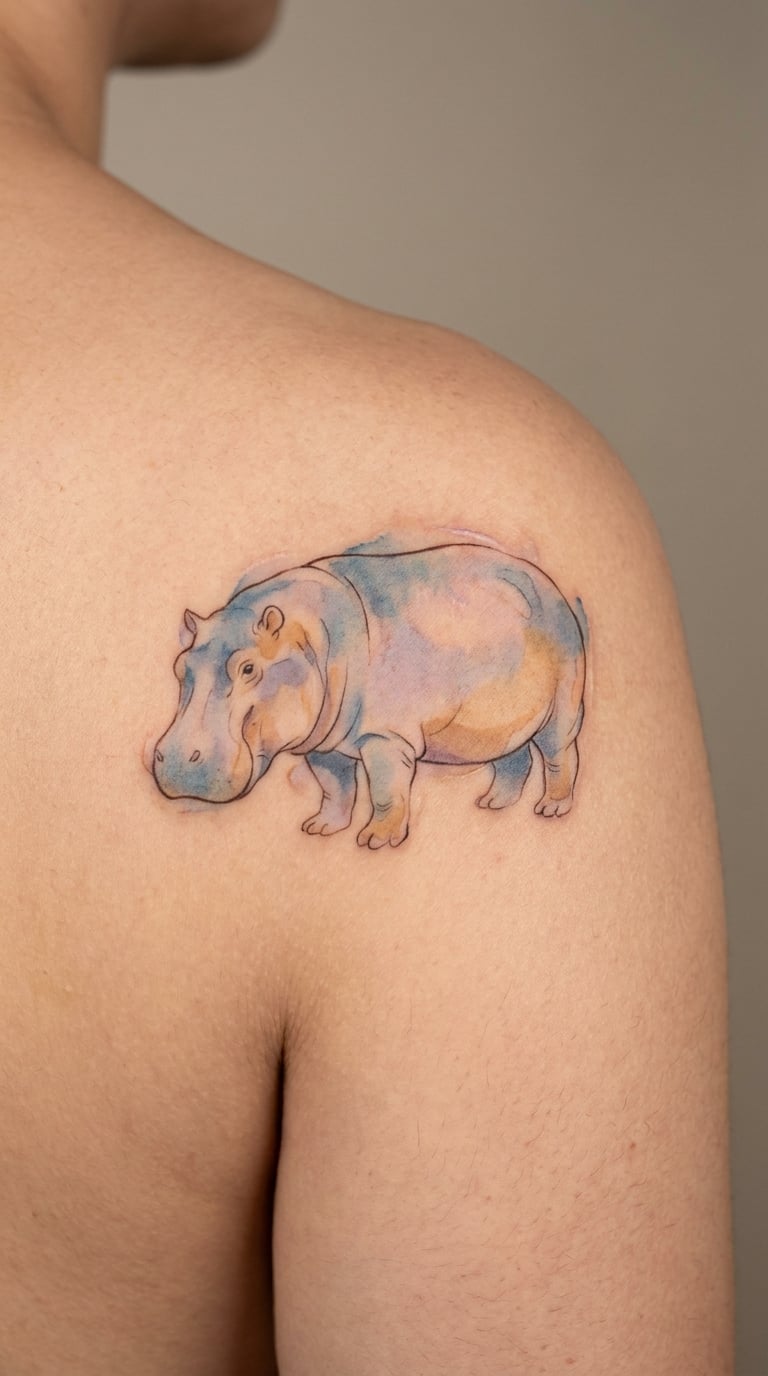
A loosely rendered hippo, more suggestion than portrait, with soft washes of blue, lilac and ochre bleeding out past the edges of the body. The outline is loose and breaks in places on purpose. It looks like a painting that ran slightly, which is exactly the appeal.
The reason people pick watercolour here is mood rather than detail. A hippo in soft colour is a gentler animal than the traditional version, so it suits a shoulder that shows often but should not dominate.
Placement: Upper shoulder or shoulder blade. Size: 4 to 6 inches (10 to 15 cm). Style: Watercolour with minimal line. Pain: Low to medium; shading passes are lighter than line work. Colour-fading note: pale washes soften first, so the composition needs enough contrast to survive. Make it yours: pick your washes from somewhere personal, a beach trip palette or a birth month colour.
6. Blackwork Hippo Head on the Thigh
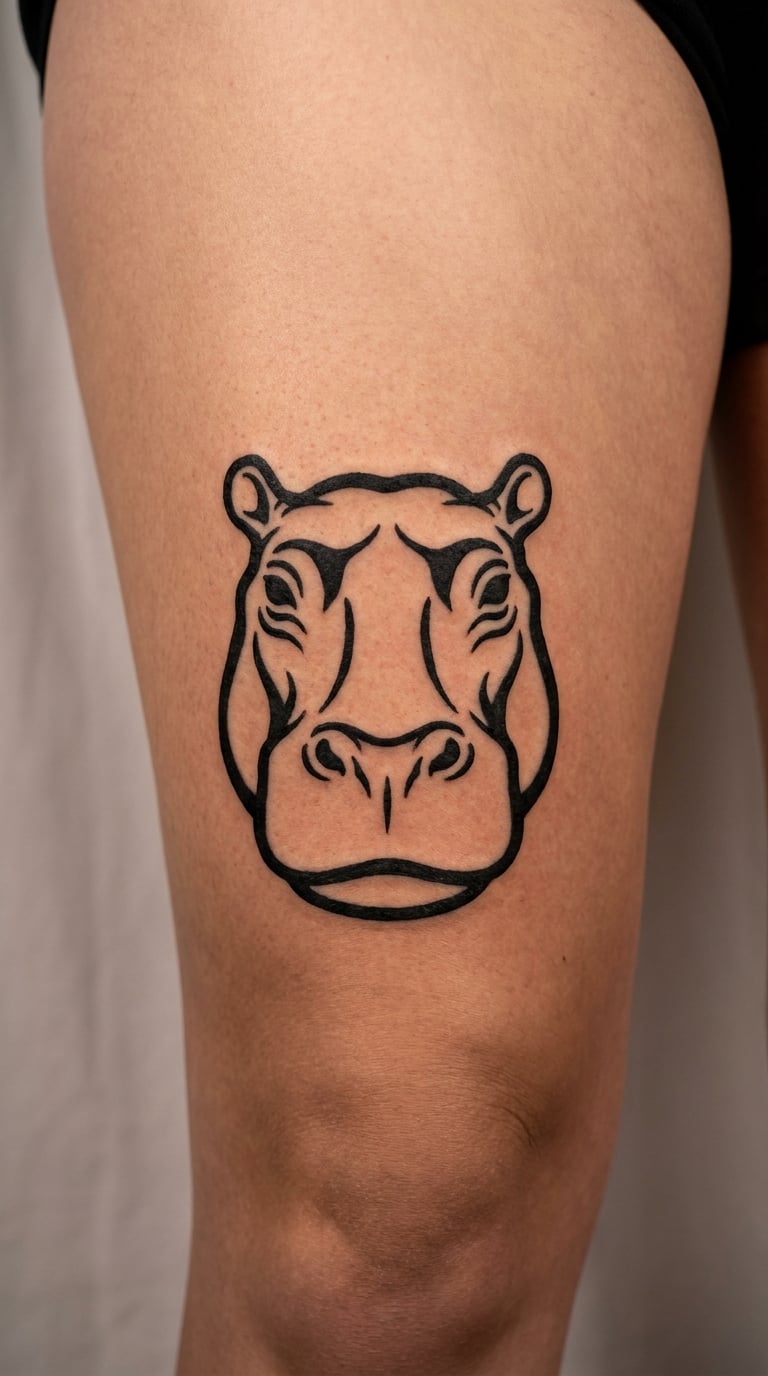
A front-facing hippo head built from dense black shapes and sharp negative space, no grey at all. The eyes sit as small white cuts inside the black. It is the heaviest design in this list and the one that most reads as power rather than cuteness.
Blackwork is chosen by people who want the animal to feel monumental. There is no assigned meaning here, but wearers often describe it as the hippo version of a lion piece.
Placement: Outer thigh, chest or upper back, anywhere with room. Size: 5 to 7 inches (13 to 18 cm). Style: Blackwork, solid black with negative space. Pain: High, solid fills are long sittings over a fleshy area. Ageing note: solid black stays crisp far better than grey, so this ages well. Make it yours: have the nostrils or tusks cut as white negative space instead of outlines.
7. Hippo and Baby Matching Tattoos
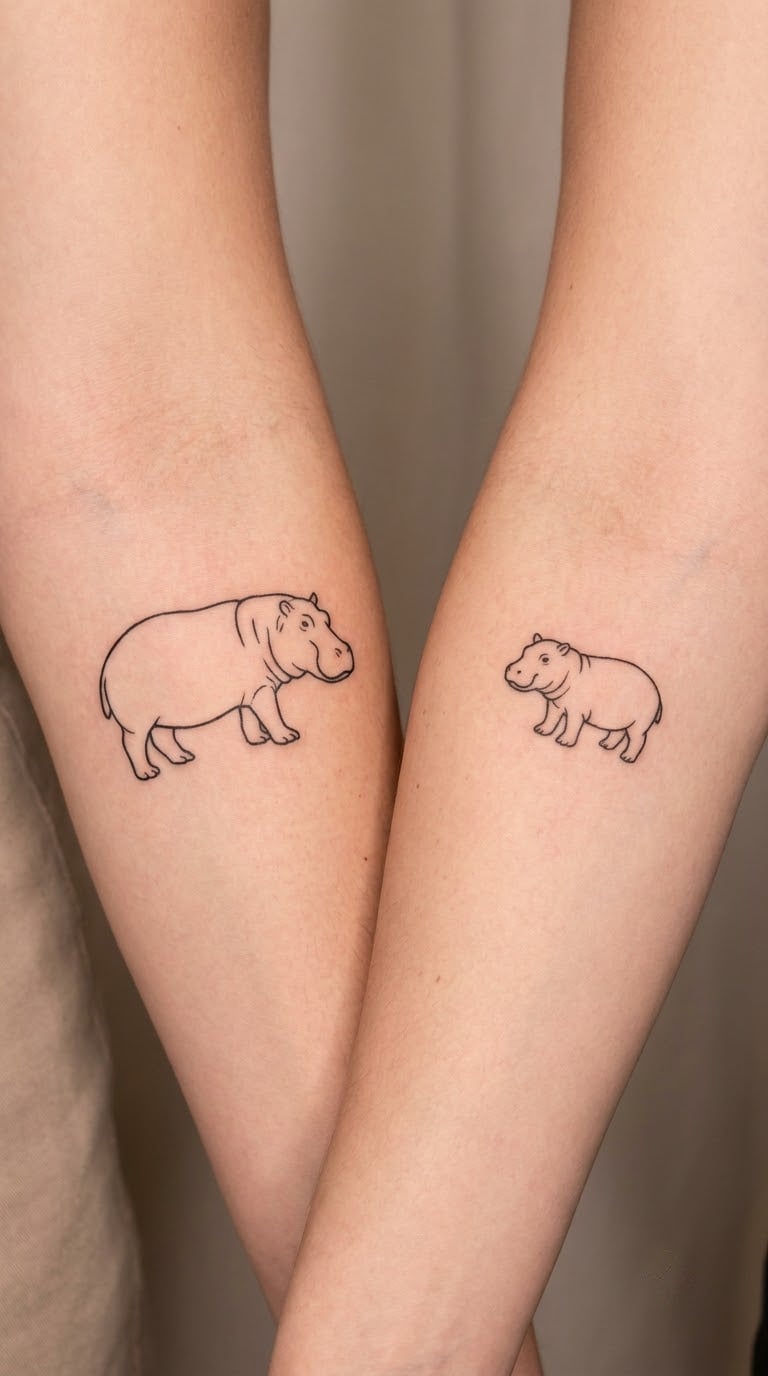
Two pieces, not one: a full-size hippo and a much smaller calf, drawn in the same outline weight and the same style. The pair works on two people or on the same person at different sizes. This is the most requested version of a hippo design, and it is usually tied to a parent and child, or to a grandmother and granddaughter.
Artists in this niche describe the same request over and over, usually someone wanting to mark a parent who loved hippos. The pairing handles that without needing a name or a date.
Placement: Inner arms, or one on the forearm and one on the ankle. Size: Adult piece 1.5 to 2.5 inches, baby piece 1 to 1.5 inches. Style: Bold black outline, both identical in treatment. Pain: Medium. Ageing note: keep the smaller piece at a size where the outline is at least a millimetre wide. Make it yours: match them on the same side of the body so they read together in photos.
8. Chubby Hippo on the Rib
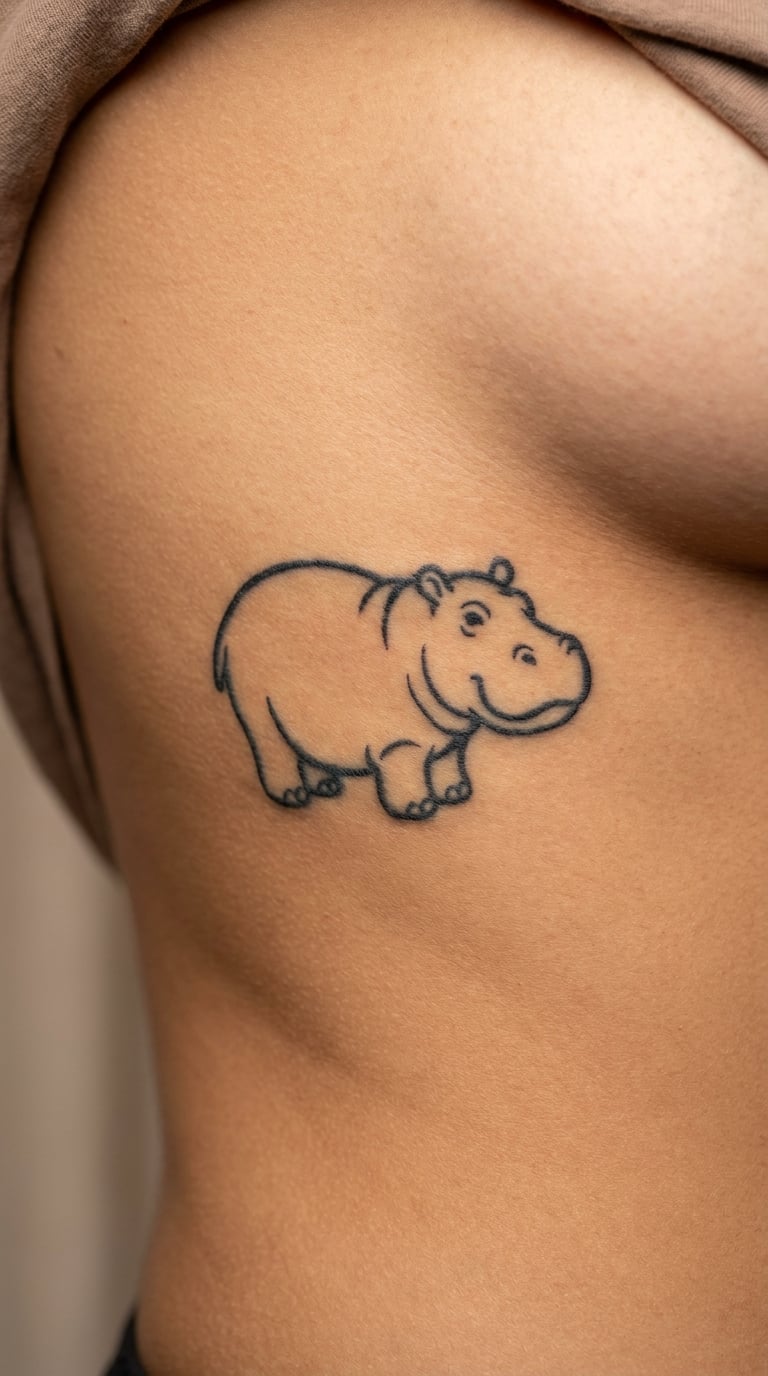
A deliberately round hippo with puffed cheeks and stubby legs, outlined in thick black with just a small amount of shadow under the body. Nothing realistic about it. The whole point is that it looks like a character rather than an animal study.
Playful designs like this get chosen when someone wants the tattoo to start a conversation. The rib placement means it stays private until you want it seen.
Placement: Side of the ribcage, between the lower ribs and the hip. Size: 2.5 to 3.5 inches (6.5 to 9 cm). Style: Cartoon with bold outline and light shadow. Pain: High, ribs are bony and the skin there stretches when you breathe and twist. Ageing note: a stretched area distorts a round shape over time, so keep the composition centred between the ribs. Make it yours: add a tiny grin or a raised eyebrow to change the whole personality.
9. Realistic Baby Hippo on the Ankle
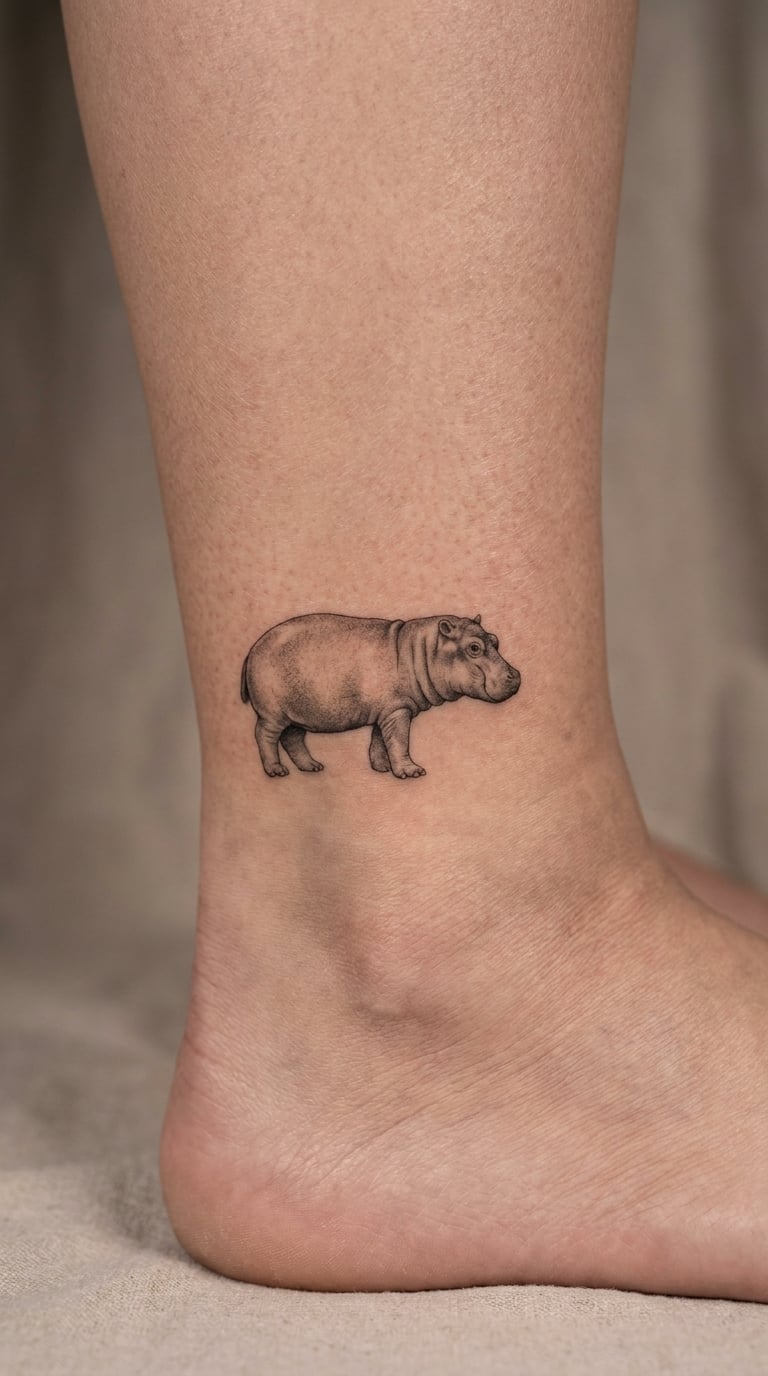
A baby hippo in profile, rendered with delicate realism: soft skin folds, a rounded muzzle, small rounded ears, tiny feet placed on a small mound of ground. The realism is about proportion and a few key folds, not about rendering every hair and wrinkle.
Baby animals are the most popular request in this category. Proportion is what makes the piece work, so agree the angles with your artist before the stencil goes on.
Placement: Outer ankle or inner wrist. Size: 1.5 to 2 inches (4 to 5 cm). Style: Micro-realism. Pain: Medium, the ankle bone makes the first passes sting. Ageing note: fine skin folds soften fastest, so simplify them to two or three lines at final size. Make it yours: add the animal’s name underneath in a small script, no bigger than a few millimetres tall.
10. Geometric Hippo on the Upper Arm
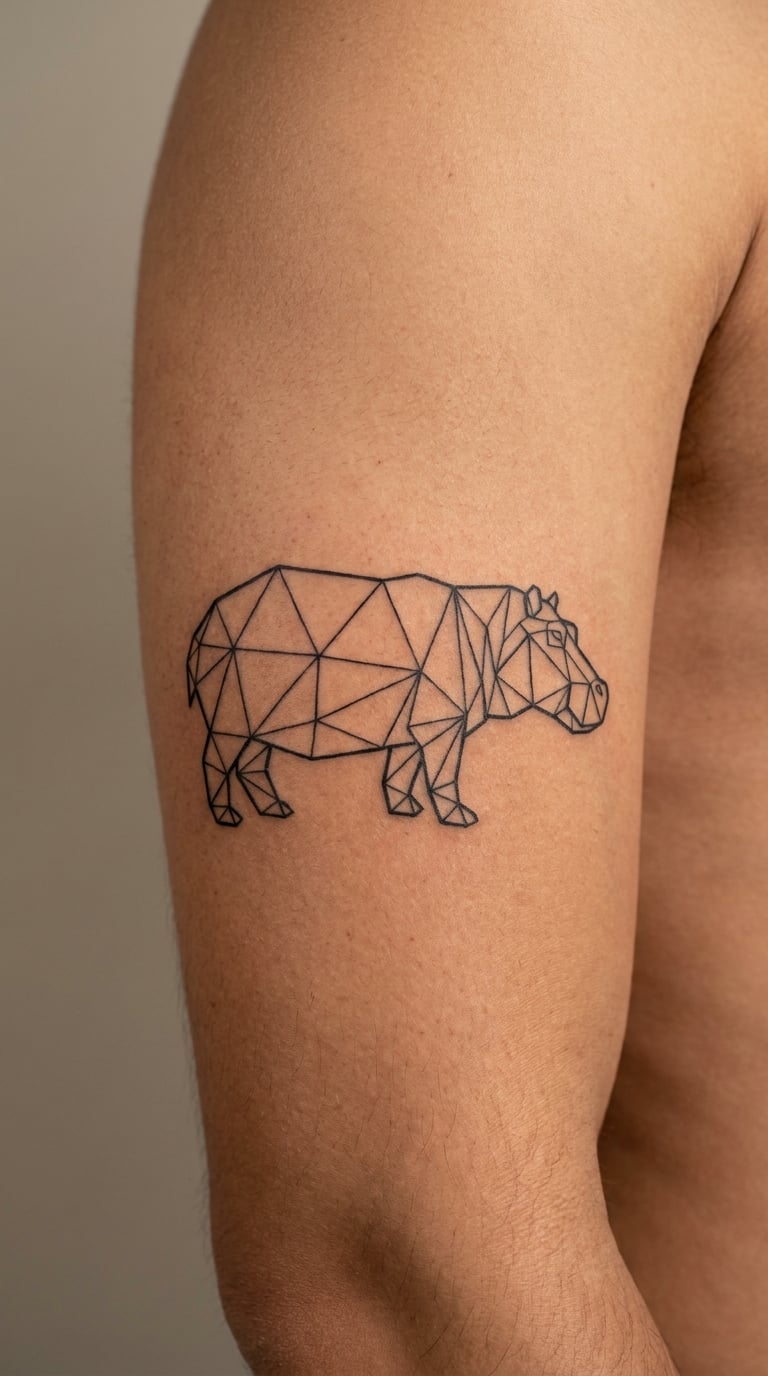
The animal broken into flat polygonal facets, each one a clean black line shape, with the hippo’s rounded back and heavy jaw still clearly readable. Some facets are unfilled, which keeps the design light rather than turning it into a solid block.
Geometric versions get picked because the person likes the design language more than the animal. Once it is on, it reads as a pattern that happens to be a hippo.
Placement: Outer upper arm or shoulder. Size: 3.5 to 4.5 inches (9 to 11 cm). Style: Geometric low-poly linework. Pain: Medium; thin lines over a curving surface need a steady hand. Ageing note: keep facet lines thick enough to survive, half a millimetre or more. Make it yours: have the facets form a larger hidden pattern across the arm when you keep adding pieces.
11. Tiny Hippo Silhouette on a Finger
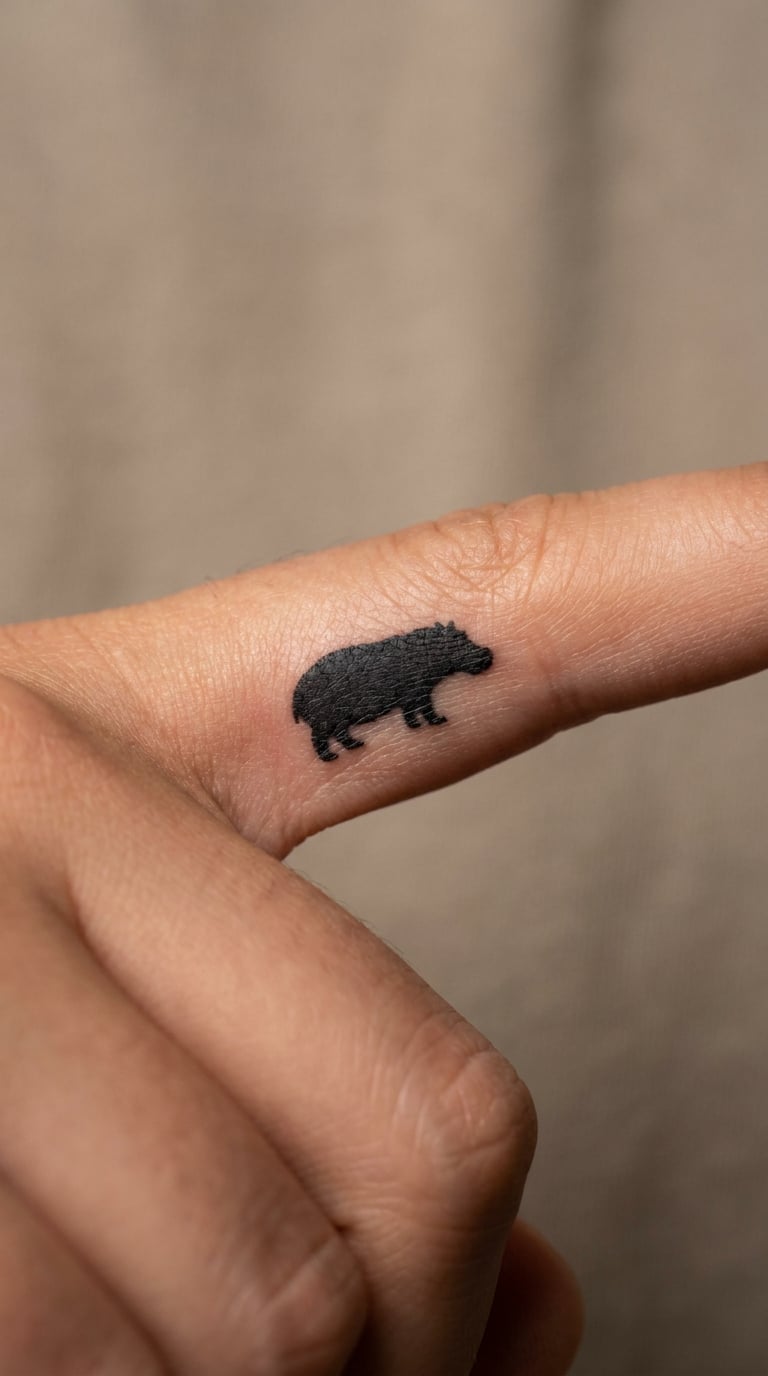
A solid-black hippo shape, about half an inch long, running along the outer side of a finger. It is the smallest item here and the one that needs the most honesty about what survives where. Finger skin is constantly in motion, and it is exposed to sun and washing more than almost anywhere else.
People choose it for the size of the statement rather than the picture. A friend will spot it; nobody else will.
Placement: Outer or inner side of a finger, best on the ring or middle finger. Size: 0.5 to 0.75 inch (1.3 to 2 cm). Style: Solid silhouette with no interior detail. Pain: High, finger skin is thin over bone and the nerve endings are close. Ageing note: expect noticeable fading and softening within a few years, so simplify to pure shape. Make it yours: run a matching silhouette down the same finger in the same size, spaced evenly.
12. Hippo with Lotus Flowers on the Hip
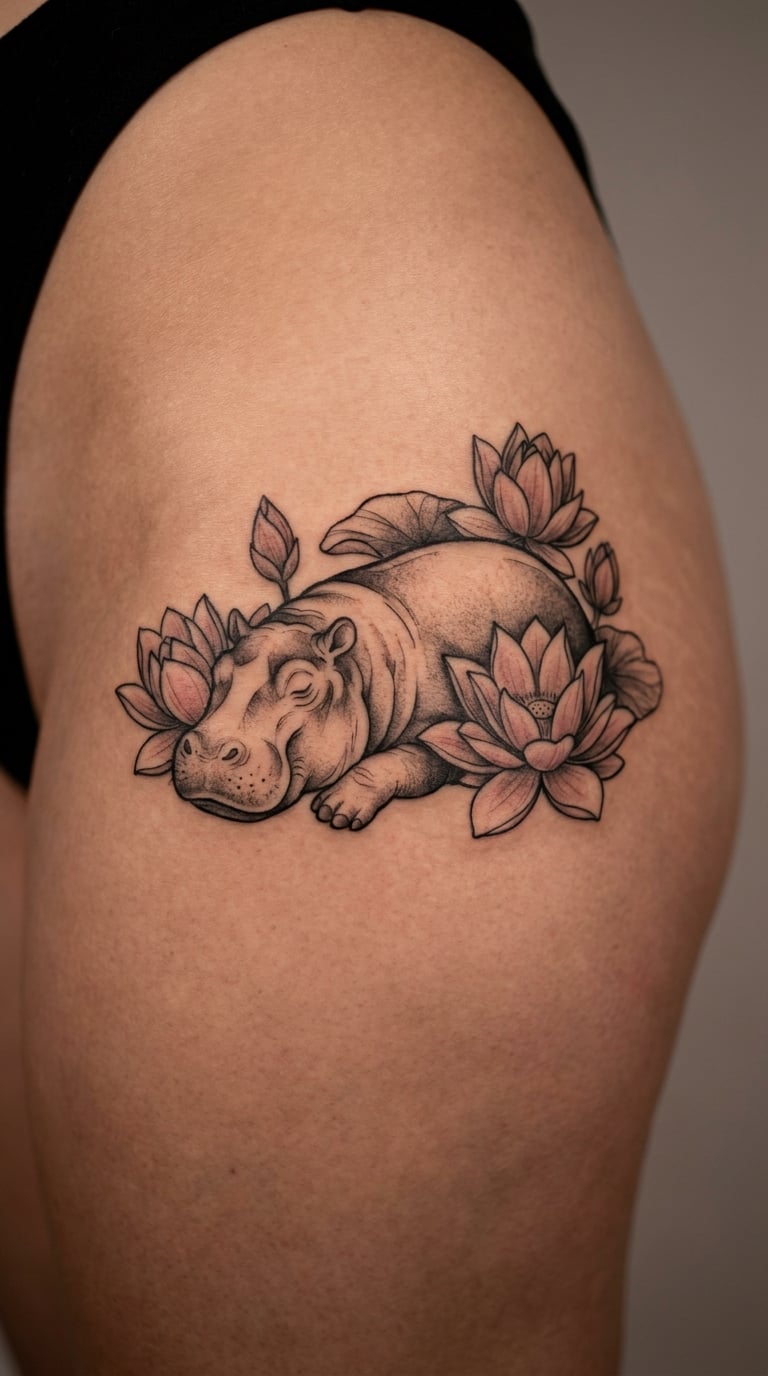
A calm, reclining hippo with a few lotus blossoms arranged around it, all in black line with muted pink added to the petals only. Two or three flowers is the right number; a wreath of blooms around the face is the version that turns to mud after healing.
The lotus is included as decoration here, not as a statement about the wearer. People tend to like the composition and leave the symbolism alone.
Placement: Outer hip or the top of a thigh. Size: 5 to 6 inches (13 to 15 cm). Style: Black line with one muted colour accent. Pain: Medium, the hip is a fleshy area that takes colour well. Ageing note: keep petals solid rather than shaded, since light washes fade first. Make it yours: use a flower that means something to you, or one from a specific person’s garden.
13. Neo-Traditional Hippo Holding a Lily Pad
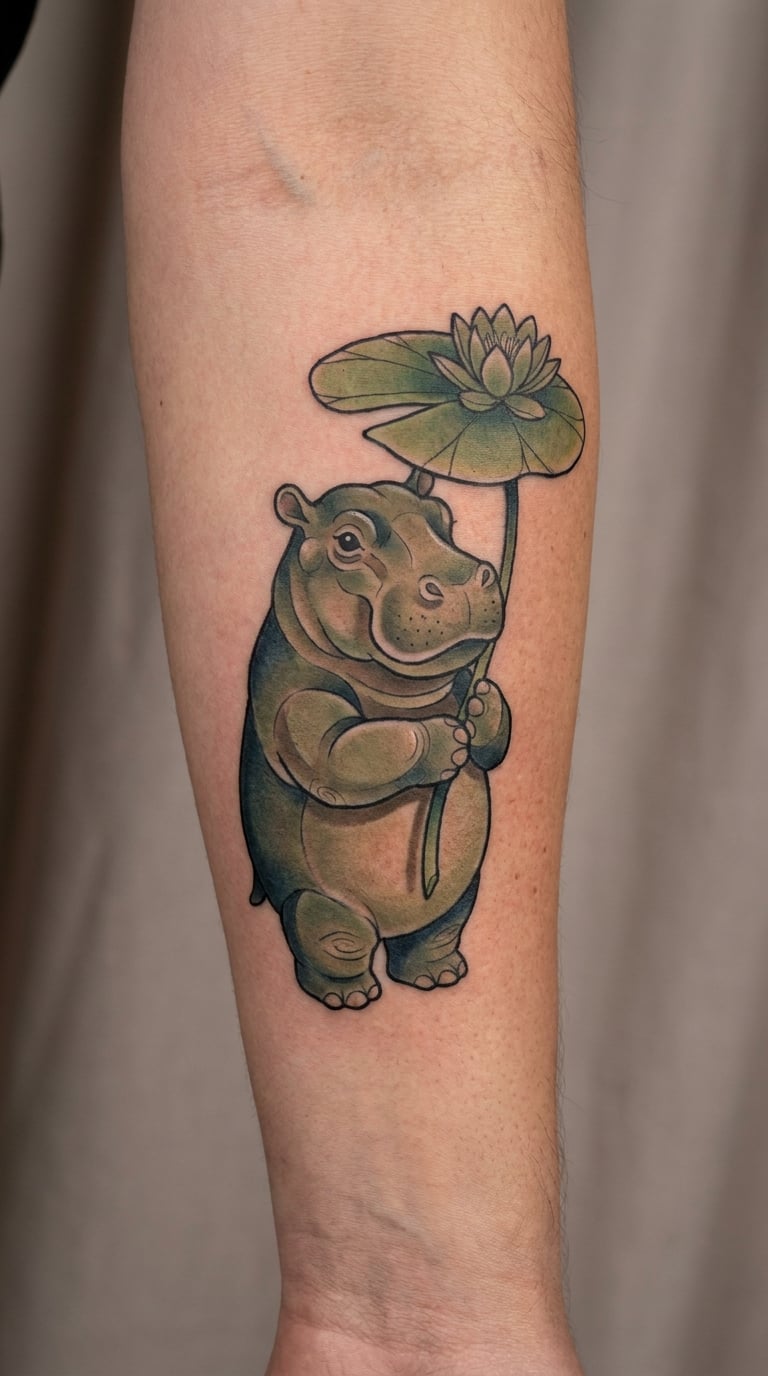
A dimensional hippo in bold colour, one front foot resting on a lily pad floating on rippling water, with clean shading and a proper highlight. Neo-traditional work keeps the flat colour of traditional pieces but adds depth, so the animal looks like it sits in the composition rather than on top of it.
Full-colour animal pieces are usually chosen for the finished look of a portfolio page. This one has enough colour to hold a forearm on its own.
Placement: Outer forearm, or the flat of the calf. Size: 4 to 5 inches (10 to 13 cm). Style: Neo-traditional with shading. Pain: Medium to high, colour saturation takes extra passes. Ageing note: mid-tone greens and blues go dull first in sunlight, so plan for a touch-up. Make it yours: add a small wave line or a dragonfly to fill out the water without crowding the animal.
14. Dotwork Hippo on the Calf
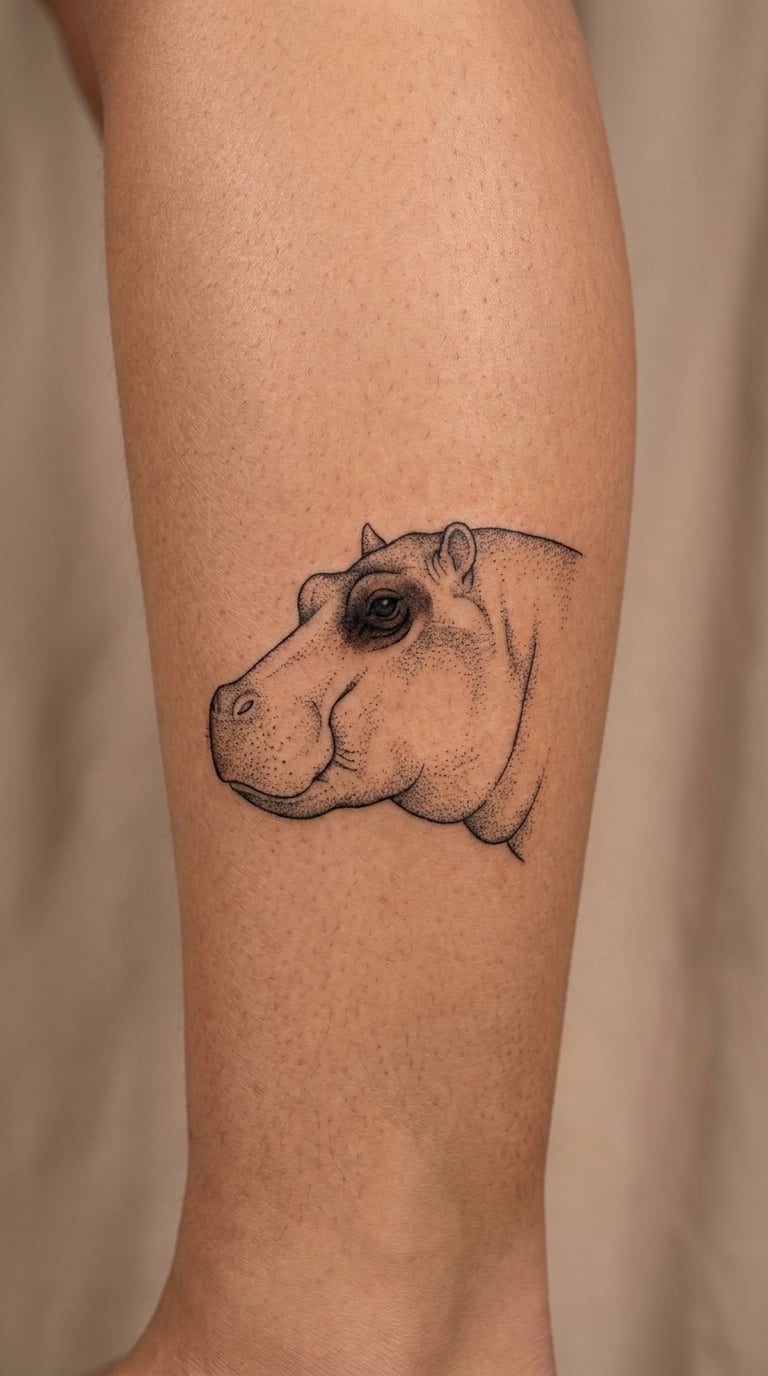
A hippo built entirely from carefully spaced dots, with the density varying to make the shadow side darker, plus a solid outline and a single dark eye. Dotwork rewards patience and looks different from every other design in this list at arm’s length.
Stippled work gets chosen by people who like something quiet and detailed rather than something bold. The tonal build is the appeal, not the animal specifically.
Placement: Inner calf or the back of the upper arm. Size: 3 to 4 inches (7.5 to 10 cm). Style: Dotwork and stippling with a solid outline. Pain: Medium, though dot sessions are long and tiring. Ageing note: dots spread and soften as skin ages, so the tonal range flattens over the decades. Make it yours: carry the dot density into a second piece on the other leg to balance the pair.
15. Minimal Line Hippo on the Collarbone
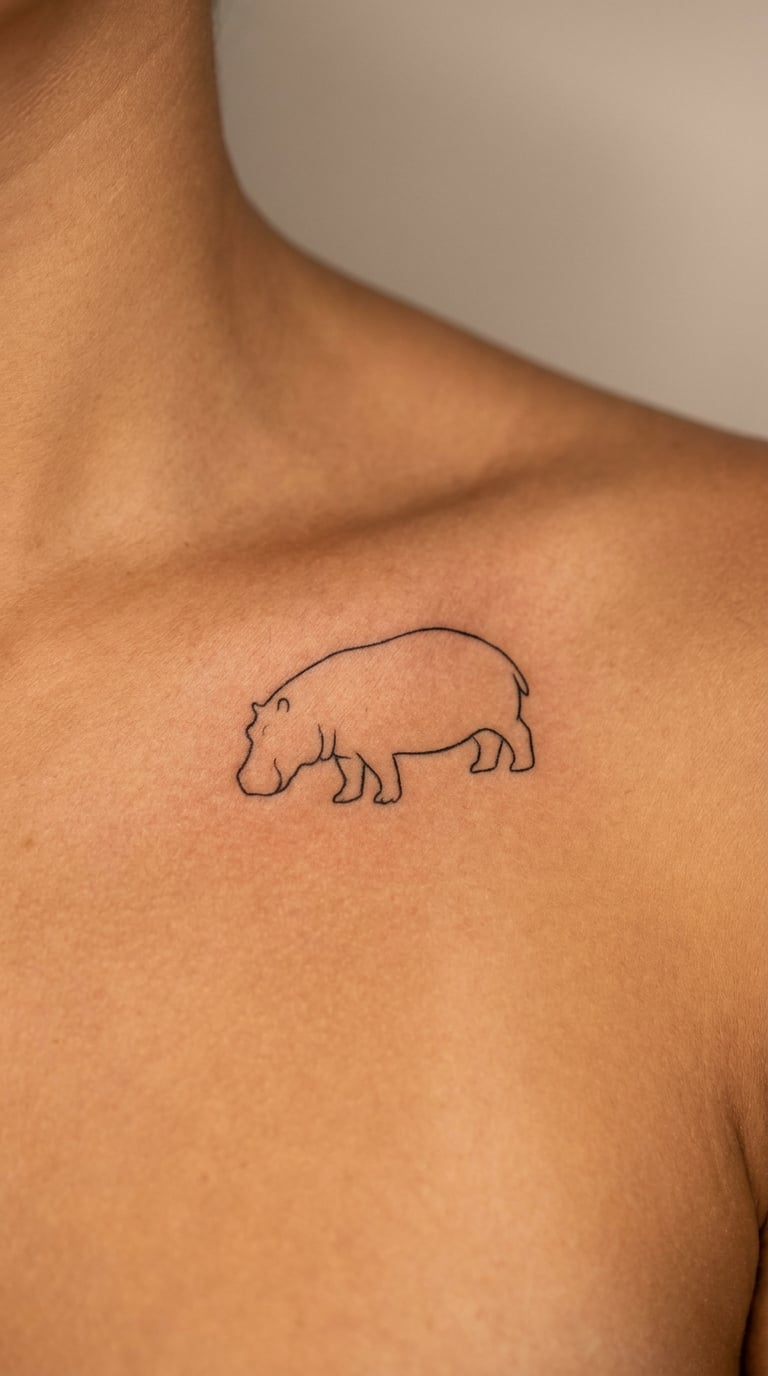
One continuous contour line describing a hippo, no shading and no closure lines, set along the collarbone so the drawing follows the bone. The restraint is the design. On this placement a busy piece would fight the shape underneath it.
Collarbone pieces are picked for the way they read in a top with a wide neckline, subtle but visible. The hippo is often one of a series of small line pieces along the same area.
Placement: Along the collarbone, or just below it on the chest. Size: 2 to 2.5 inches (5 to 6.5 cm). Style: Minimal single-contour line. Pain: Low to medium; the skin here is thin but the bone is broad and flat. Ageing note: a single line softens and looks thinner within a few years. Make it yours: sit down for the first sketch so the artist can draw the line along your actual collarbone, not a generic one.
16. Hippo in a Bubble on the Back
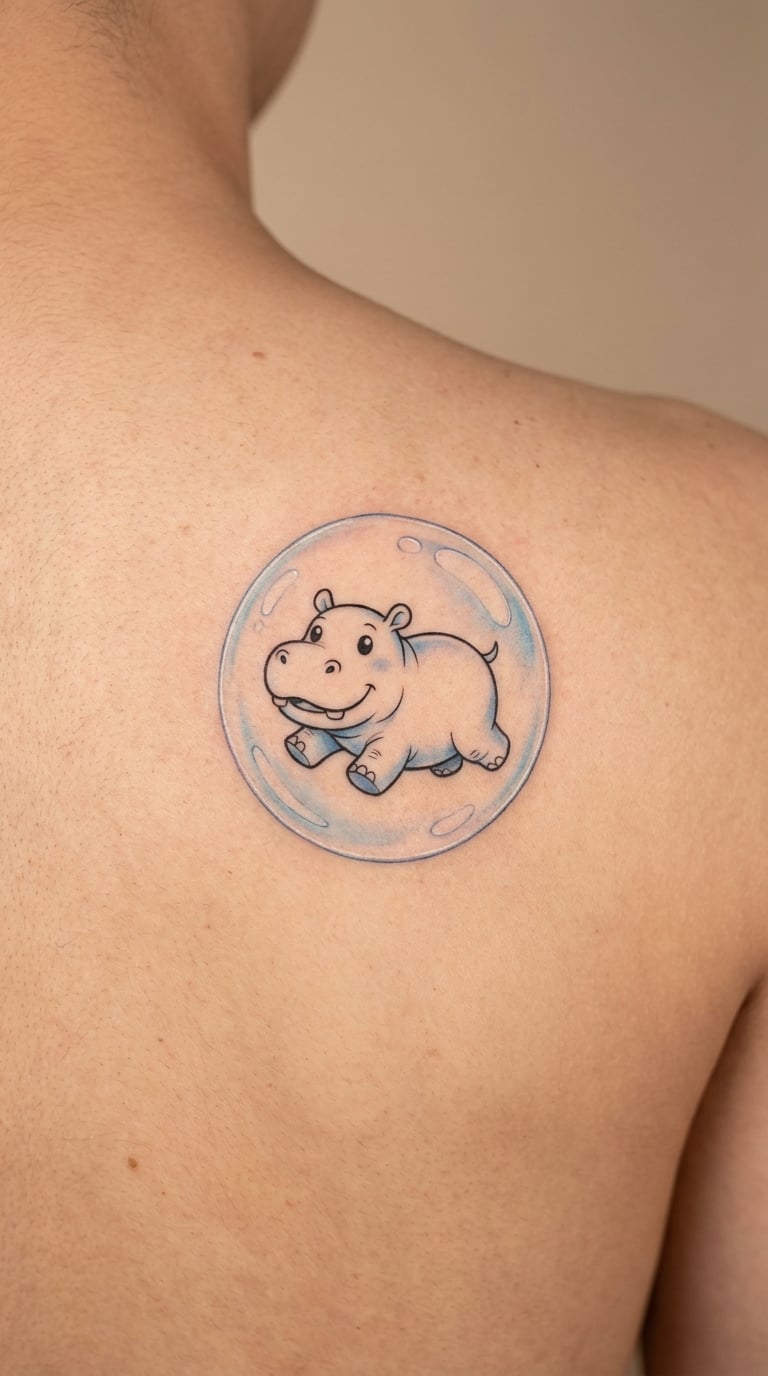
A hippo sitting inside a round soap bubble, drawn with a hard black outline on the bubble and a soft grey contour on the animal, with a single pale blue highlight on the bubble’s edge. The contrast between the two line types is what makes it work.
Cheeky compositions like this are usually chosen as a one-off rather than a lifelong style, and they tend to be the piece people laugh about later. The back suits it because you can fit the whole bubble.
Placement: Upper back between the shoulder blades. Size: 3.5 to 4.5 inches (9 to 11.5 cm). Style: Playful line with one colour accent. Pain: Low, the upper back is one of the more forgiving places to sit. Visibility note: you will not see it yourself without a mirror. Make it yours: add a name or a short date underneath the bubble, or a second smaller bubble later.
17. Anatomical Hippo Illustration on the Forearm
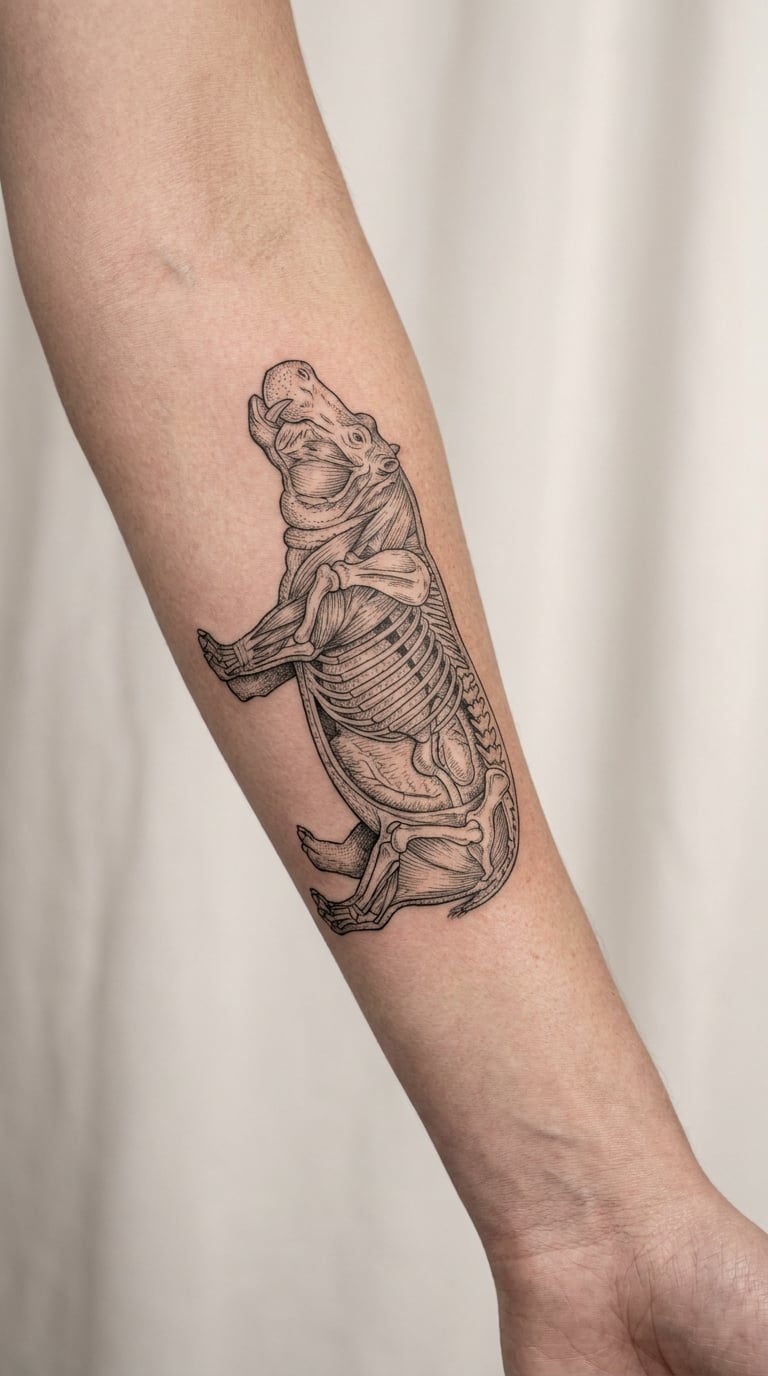
A vintage scientific plate style hippo, built from fine black line work showing the skull, jaw muscles, limb structure and rib cage, with small leader lines and labels arranged like an old natural history illustration. The labels are part of the look rather than medical information.
Anatomical designs get chosen by people who like research and history, or who want a piece that rewards a second look. It is a slow design and the artist needs time on it.
Placement: Forearm or the outer calf, which gives the drawing a flat field. Size: 6 to 7 inches (15 to 18 cm). Style: Vintage scientific linework. Pain: Medium, long but even. Ageing note: fine hatching is the first thing to blur, so ask for bold line weights on the main forms. Make it yours: have the labels set in a language your family reads, or replace them with a date.
18. Black-and-Grey Swimming Hippo on the Thigh
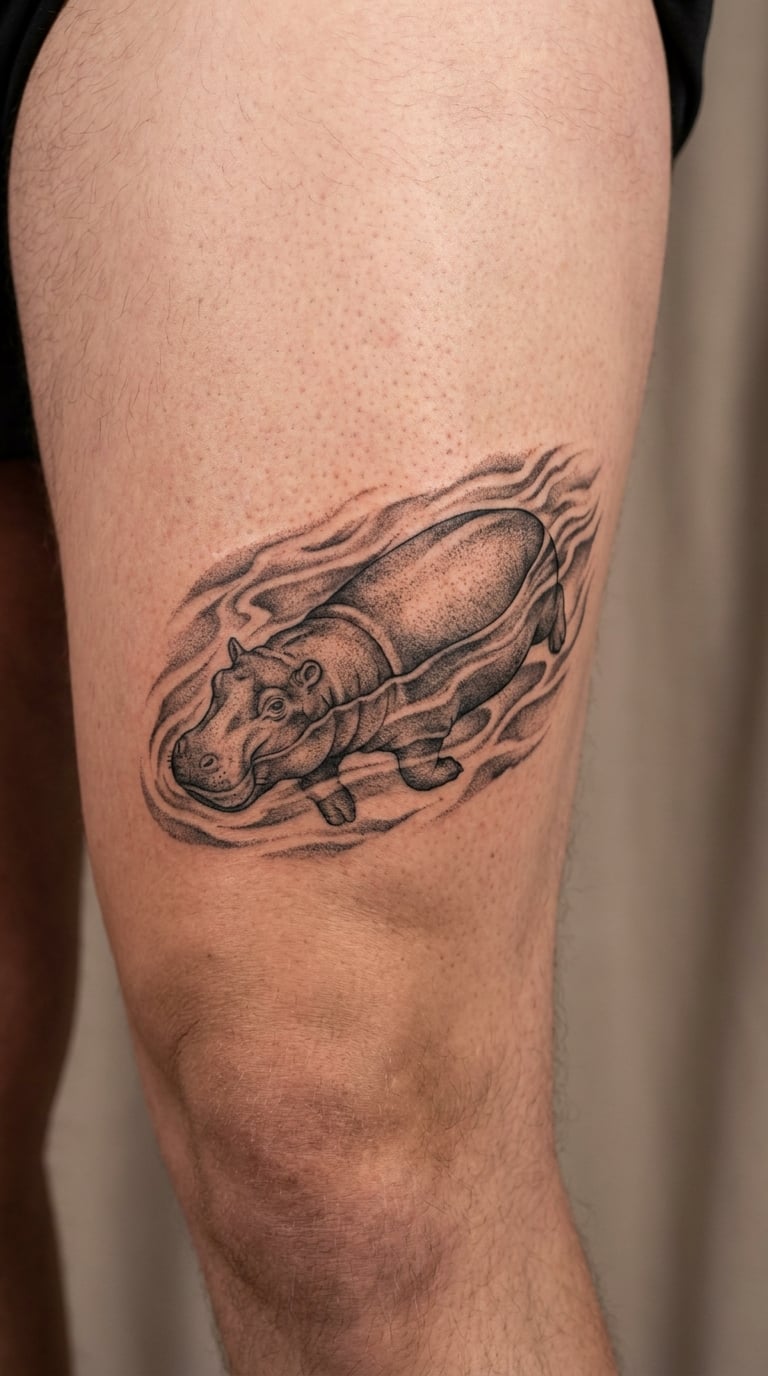
A hippo moving through water in side view, its body breaking the surface, with soft grey wash shading on the wet skin and darker ripples trailing behind. The shading does the work, giving the animal weight and a sense of movement without any colour at all.
Realism-led designs get picked when someone wants a wildlife piece that looks like the animal rather than a version of it. This is the most traditional-looking hippo idea on the list.
Placement: Outer thigh, which has the space to let the water read. Size: 5 to 6 inches (13 to 15 cm). Style: Realism with grey wash. Pain: Medium, shading is lighter work than outline but takes time. Ageing note: pale grey ripples lose contrast first, so ask for a strong dark outline around the animal. Make it yours: put the waterline through a specific height, like a lake you have actually swum in.
19. Floral Hippo on the Hipbone
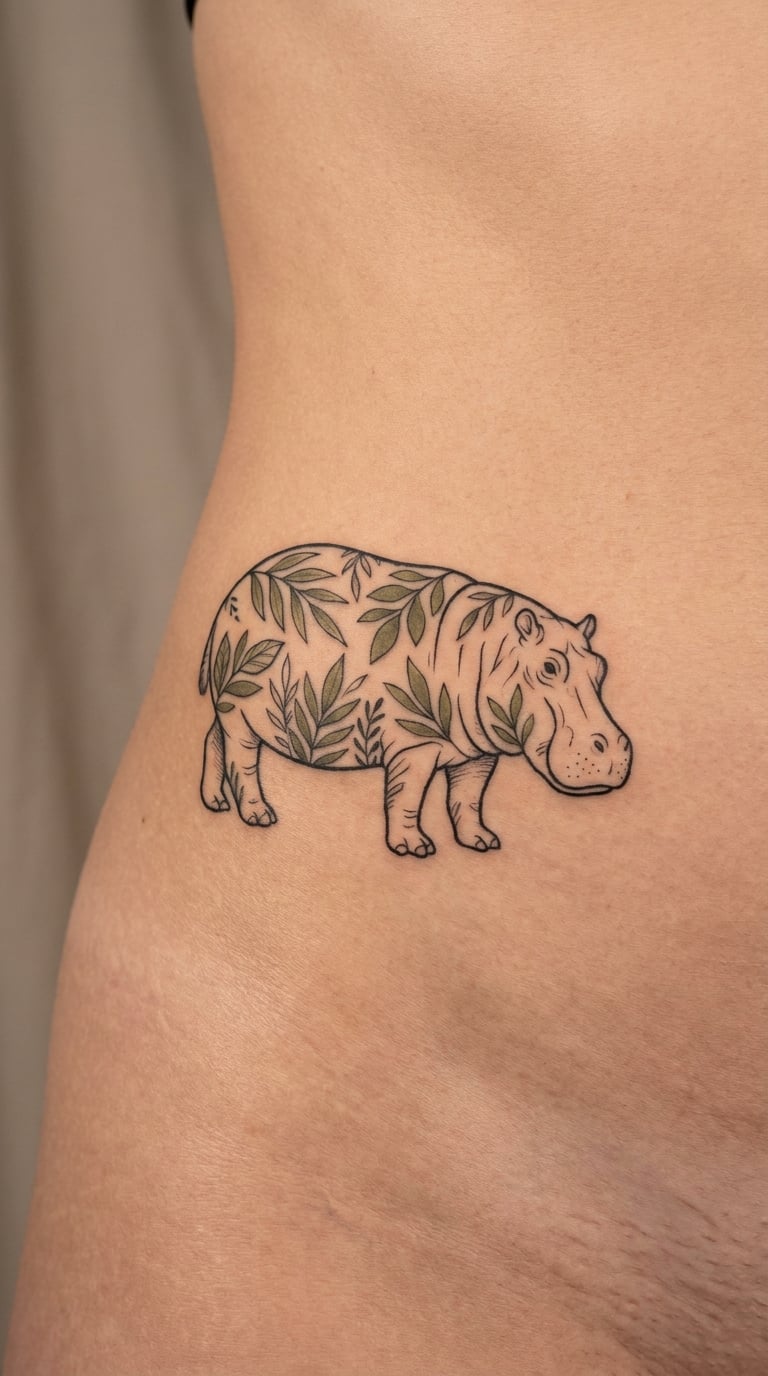
A simplified hippo silhouette wrapped in trailing leaves and small flowers, black line work with muted green on the foliage and one soft colour on a single bloom. The plant matter follows the curve of the hipbone instead of sitting in a circle, which is what makes the placement look intentional.
Mixed florals are a common choice for people who like both the animal and the botanical side. It reads well without becoming a garden piece.
Placement: Above the hipbone or across the upper thigh. Size: 4 to 5 inches (10 to 13 cm). Style: Mixed line and muted colour. Pain: Medium, and the hipbone area is sensitive near the bone. Placement note: expect the design to shift slightly as the body changes, so keep the animal central and let the foliage move. Make it yours: build the leaves from a plant you grew or a place that matters to you.
20. Full-Sleeve Hippopotamus Scene
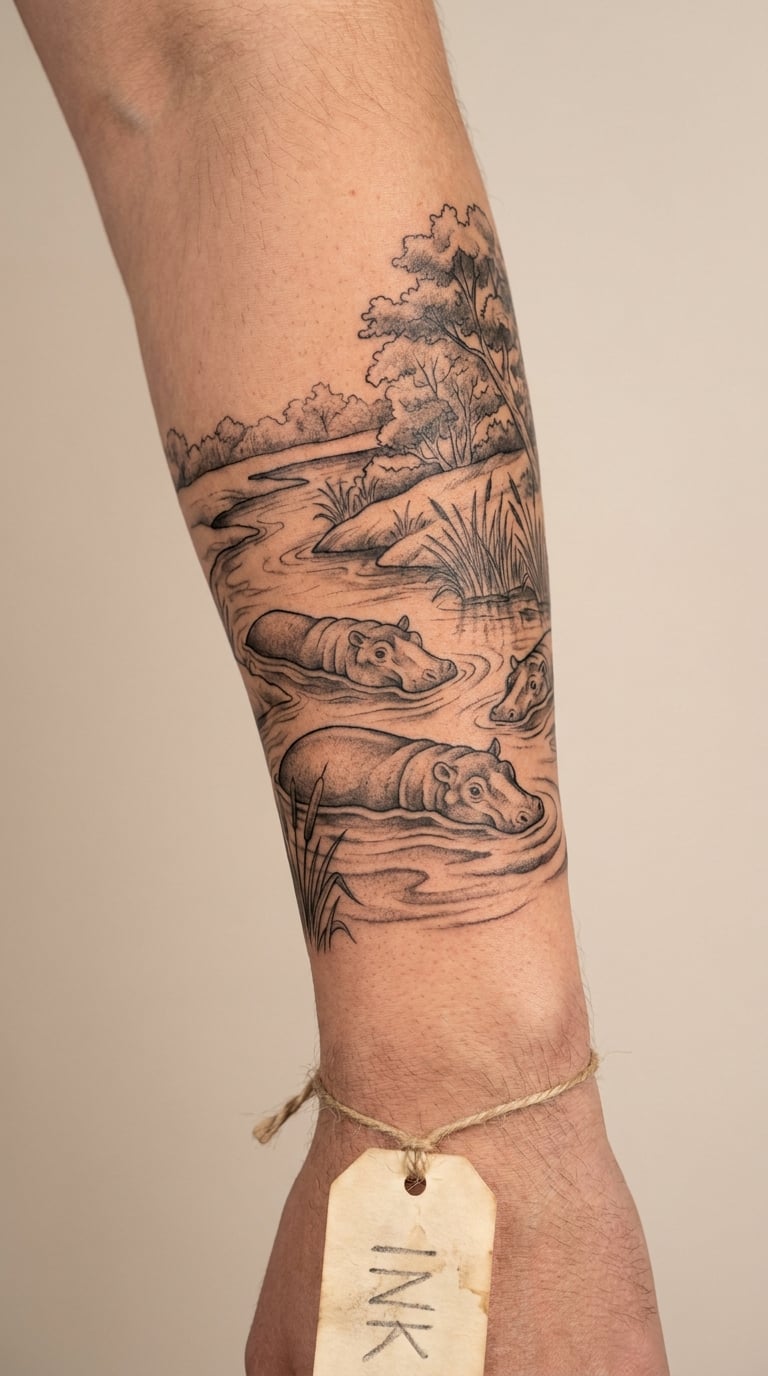
Multiple hippos set in a river landscape: an adult and a calf mid-water, a bank with reeds and low vegetation, layered depth so the far bank reads as distant. Black and grey throughout, with the composition scaled to the arm rather than drawn as a flat image and stretched to fit.
Sleeves are usually the piece someone builds towards, either as a first big project or as an addition to an existing arm. If you already have work, an artist will map the scene into the gaps you have rather than starting fresh.
Placement: Full forearm, upper arm, or a half sleeve running wrist to elbow. Size: Whole-arm coverage. Style: Illustrative realism in black and grey. Pain: High in total, spread across several sittings of two to four hours. Ageing note: large grey areas on an inner arm are the first to soften, so ask for solid blacks for the foreground. Make it yours: design the river to echo a river you know, then use a small motif from it as a separate piece elsewhere. You will find plenty of large-scale sleeve ideas in our black sleeve tattoo roundup and our ocean sleeve collection.
How to Choose the Right Design
Five things decide whether a hippo design works on your body. Go through them in order and the options thin out fast.
Start with the placement, not the picture
A design that looks right on a phone screen often fails on a curved surface. Ribs, fingers and the inner calf all distort a shape. Find the spot you actually want first, then pick a design that suits its curve, or ask your artist to redraw it for that spot.
Match detail to size honestly
Skin folds, tusks and eye detail need real room. Below two inches, strip the design back to outline and silhouette. Below one inch, a solid shape is the only version that will still be clear in ten years.
Pick a line weight and a style together
Fine line suits small, quiet placements. Bold traditional or blackwork suits larger areas. A design that mixes three styles at once usually looks unresolved, especially at small sizes. Commit to one and let the artist handle the rendering.
Think about colour before you fall in love with the render
Colour needs more passes, more sessions and more touch-ups. Pale grey and light blue fades first. If you want a piece that stays low maintenance, black and grey with solid blacks holds up better than a soft watercolour wash. If you want the colour, go in knowing it will need attention.
Decide whether it is a first tattoo or an addition
A first piece should be small enough to heal without a long commitment and simple enough that you will not be disappointed by it. An addition can carry more detail and a heavier style. If you already have an arm of work, get an artist to plan the hippo around what is there.
Cost and Session Time
Most US shops charge by the hour, and a hippo is priced by size and how long it takes to ink. These are realistic ranges, and every artist quotes differently. Shop minimums often apply to small pieces, and those minimums vary widely between studios.
Micro pieces, under 1.5 inches: usually 80 to 200 dollars and about 20 to 45 minutes. A behind-ear silhouette or a finger shape sits here.
Small pieces, 1.5 to 3 inches: around 150 to 350 dollars and 45 minutes to an hour and a half. Wrist, ankle and collarbone designs land in this band.
Medium pieces, 3 to 6 inches: roughly 300 to 800 dollars and two to four hours. Most of this list sits here, and colour work or dense blackwork pushes toward the top of the range.
Large single-session pieces, 6 inches and up: around 700 to 1500 dollars and four to six hours. Anything past that gets scheduled as a second sitting.
Full or half sleeves: budget in the thousands across several sittings, with each session two to four hours. Ask for a staged plan, because a sleeve drawn as one finished picture gets built a piece at a time.
Two practical notes. Watercolour and full-colour pieces take longer than the drawing suggests, so expect the quote to include extra passes. And if you want a small design but the shop minimum is higher than it sounds reasonable, that is normal. Many artists would rather do a simplified version of your idea now than a rushed detailed one.
You can find longer ideas in our full leg tattoo roundup if the hippo is the first piece in a larger body plan.
Aftercare Basics
- Follow your artist’s aftercare instructions first. They know exactly what they did in your skin, and their advice takes priority over anything general you read online.
- Wash gently, twice a day. Lukewarm water and a fragrance-free cleanser, then pat dry. Clean skin is what stops scabbing.
- Moisturise thinly and often. A plain unscented lotion or balm in a thin layer, reapplied whenever it feels tight or dry.
- Keep it out of sun, water and friction. No swimming pools or long hot showers for the first couple of weeks, and cover it under loose clothing when you are out in strong sun.
- Do not pick or scratch. Flakes and scabs are part of healing, and pulling them is how people end up with patchy ink that needs a touch-up.
- Message the artist if something still worries you. A photo of the area after a few days is usually enough for them to tell you whether it is on track or needs attention.
Frequently Asked Questions
Are hippo tattoos suitable for small or delicate placements?
Yes, a hippo suits small placements well, because the animal is mostly rounded mass with very few features. A solid silhouette under about 1.5 inches stays clear for years, while a detailed portrait below two inches tends to blur as the skin heals. Behind the ear, on a finger and at the inner wrist are the easiest small spots, and the wrist and ankle are the most forgiving mid-size spots.
What is the least painful body placement for a hippo tattoo?
The upper back, the outer upper arm and the thigh are usually the least painful, because there is more muscle and less bone and nerve surface underneath. The ribcage, the finger and the inner wrist sit at the other end, since the skin there is thin and stretched over bone. A smaller design on a fleshy spot is almost always easier than a large one on a bony area.
Should I choose a coloured or black-and-grey hippo design?
Black and grey is the lower-maintenance choice. Solid blacks and strong outlines hold their contrast for years, while pale blue and light grey washes fade noticeably first. Colour is the better choice if the design is about the image rather than the longevity, since it needs more passes, longer sessions and usually a touch-up. Decide which matters more before you book.
What tattoo style works best for a realistic-looking hippo?
Realism and grey-wash shading give the most lifelike result, because they build volume with tone rather than with flat blocks of colour. Micro-realism works at small sizes, but it depends entirely on accurate proportion rather than texture, so a simplified rendering usually reads more realistic than a detailed one. Line-heavy styles like traditional and neo-traditional give a stylised animal instead.
How should I prepare for a hippo tattoo consultation?
Bring references, not a finished idea. Two or three images that show the angle, the expression and the general mood are more useful than one picture you want copied exactly. Tell the artist the placement you are leaning toward, the size you want in inches, and how long you can sit. Say who the design is for, because artists read that and shape the design around it.
Conclusion
If this is your first tattoo, go with number 2 or number 3. A micro silhouette behind the ear or a small sleeping hippo on the inner wrist is simple, heals predictably, and still means something every time you see it.
If you are adding to an existing collection, the blackwork head in number 6 or the anatomical study in number 17 gives an artist something substantial to work with and suits a body that already carries ink. Either way, bring two or three references and talk through the size in inches before anything gets drawn.