
20 Cheetah Tattoo Ideas: Best Designs for Every Style (2026)
A cheetah tattoo works on skin better than most big cats, and these 20 cheetah tattoo ideas cover everything from a 1 inch wrist eye to a full sleeve panel. Cheetahs symbolize speed, agility, focus and an untamed, resilient spirit, and the animal’s long lean body fits the natural line of a forearm, calf or thigh without being shrunk into an awkward shape.
Whether this is your first tattoo or the sixth piece in a collection that already has a lot of blackwork, the useful part is the same: where it sits, how big it needs to be, and how long it takes to heal. If speed and open space are themes you enjoy elsewhere, our tattoo ideas that symbolize freedom roundup has related ground to cover.
20 Cheetah Tattoo Ideas: Quick Guide
| Idea | Style | Best placement | Size | Pain |
|---|---|---|---|---|
| Fine-line cheetah profile | Fine line | Inner forearm | 3 in | Low to medium |
| Realistic cheetah portrait | Micro-realism / black and grey | Upper arm | 4 in | Medium |
| Minimalist cheetah paw print | Minimalist | Wrist | 2 in | Low |
| Walking cheetah in blackwork | Blackwork | Outer forearm | 7 in | Medium |
| Traditional cheetah head | Traditional | Shoulder | 5 in | Medium to high |
| Neo-traditional cheetah and flower | Neo-traditional | Upper arm | 6 in | Medium |
| Watercolor cheetah in motion | Watercolor | Calf | 6 in | Medium |
| Cheetah and geometric patterns | Geometric | Forearm | 5 in | Medium |
| Small cheetah behind the ear | Fine line | Behind the ear | 2 in | Medium |
| Cheetah paw print matching design | Minimalist | Ankle | 1.5 in | Low |
| Cheetah in a circular frame | Black and grey | Upper arm | 4 in across | Medium |
| Roaring cheetah | Neo-traditional | Outer thigh | 7 in | Medium to high |
| Cheetah portrait on the collarbone | Fine line | Collarbone | 3 in | Medium |
| Dotwork cheetah | Dotwork | Forearm | 4 in | Medium |
| Cheetah and savannah sunset | Illustrative | Lower leg | 4 in | Medium |
| Fine-line cheetah and cub | Fine line | Inner arm | 3 in | Low |
| Blackwork cheetah face | Blackwork | Upper arm | 5 in | Medium |
| Cheetah in a desert botanical style | Illustrative | Forearm | 6 in | Medium |
| Micro-realism cheetah eye | Micro-realism | Wrist | 1 in | Low |
| Full cheetah sleeve panel | Black and grey realism | Outer arm | 10 in | High |
1. Fine-Line Cheetah Profile
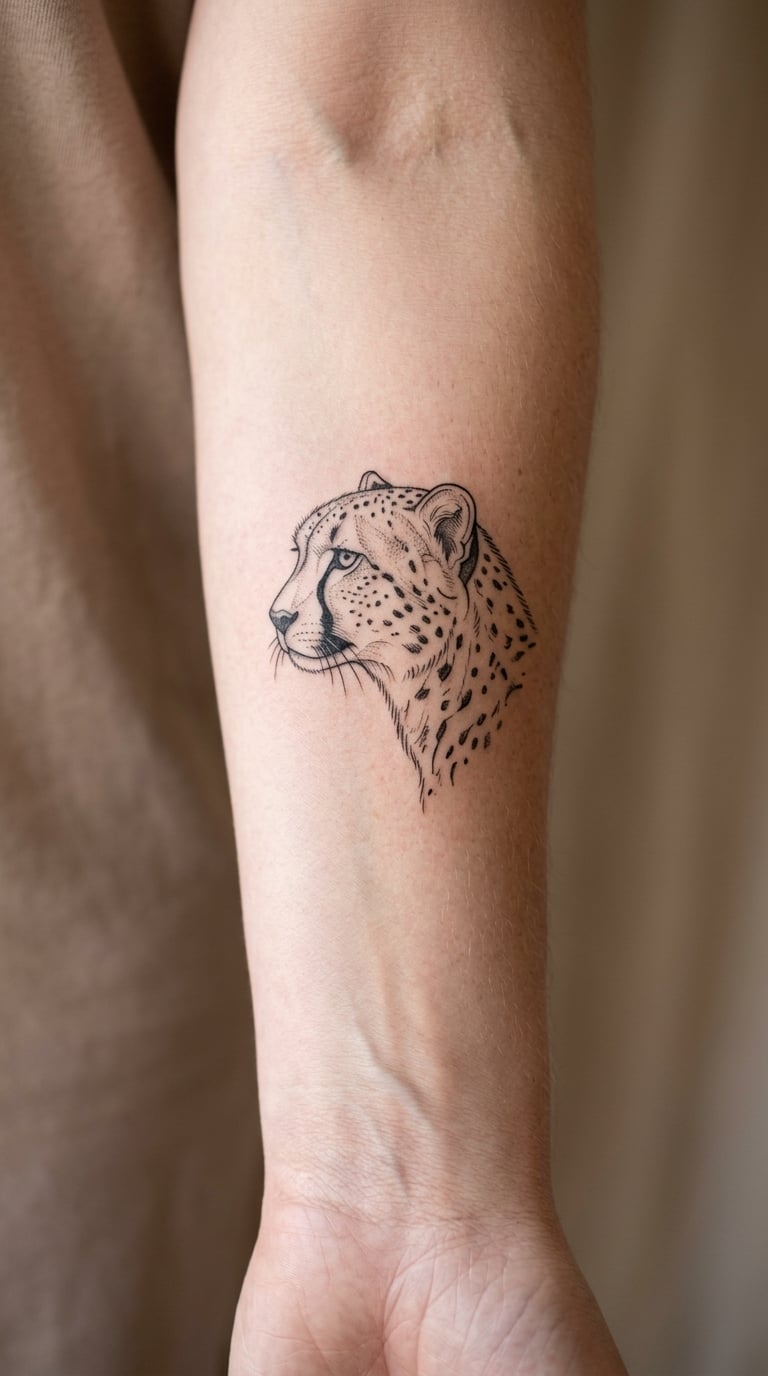
A fine-line cheetah profile is one solid black outline, a few whisker strokes and a lightly dotted cheek, so the cat reads as a cheetah rather than a generic big cat. People choose it for the delicacy, because it looks considered on a small quiet area instead of loud. The tear mark running from eye to muzzle is the detail that sells it.
Placement: Inner forearm, inner bicep, rib cage, or the calf. Size: 2.5 to 4 inches (6 to 10 cm). Style: Fine line. Pain: Low to medium, gentle on the inner arm, slightly sharper over the rib bone. Hairline strokes on the fingers and hands fade fastest of anywhere, so keep it off the knuckles. Make it yours: Add the date the animal became yours, tucked under the front paws.
2. Realistic Cheetah Portrait
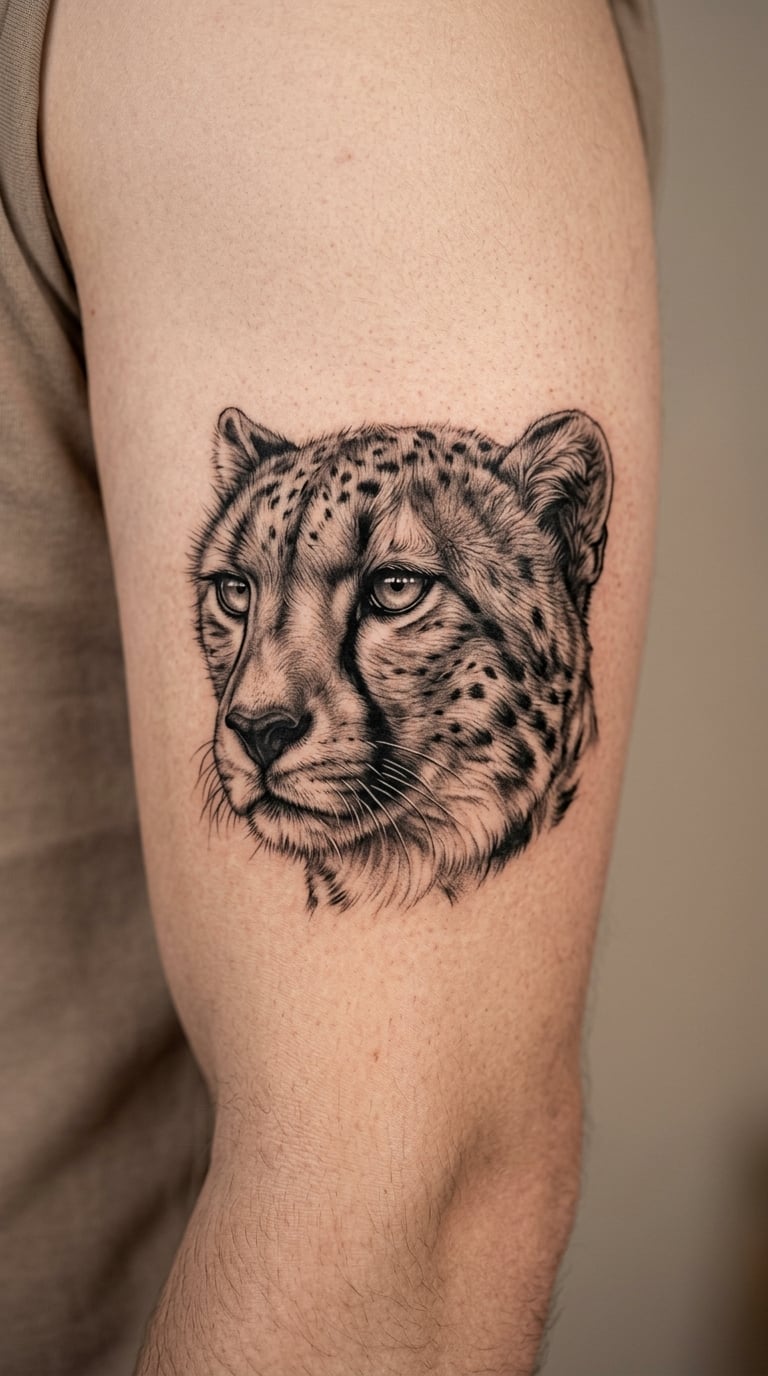
This is the cheetah tattoo most people picture: a head rendered in black and grey with individual fur strokes, a bright amber eye and the black tear lines. The fur texture is what makes it expensive, so resist shrinking it. Ask for the eyes last, because that is where the likeness lives.
Placement: Outer upper arm, shoulder blade, back of the calf, or the thigh. Size: 3.5 to 6 inches (9 to 15 cm). Style: Micro-realism or photorealism in black and grey, or full colour. Pain: Medium, and shading passes over tender spots take their time. Grey shading softens and diffuses with age, so plan for a touch-up in five years. Make it yours: Have the artist copy the spot pattern from a reference photo of your own cat, if the animal means something specific.
3. Minimalist Cheetah Paw Print
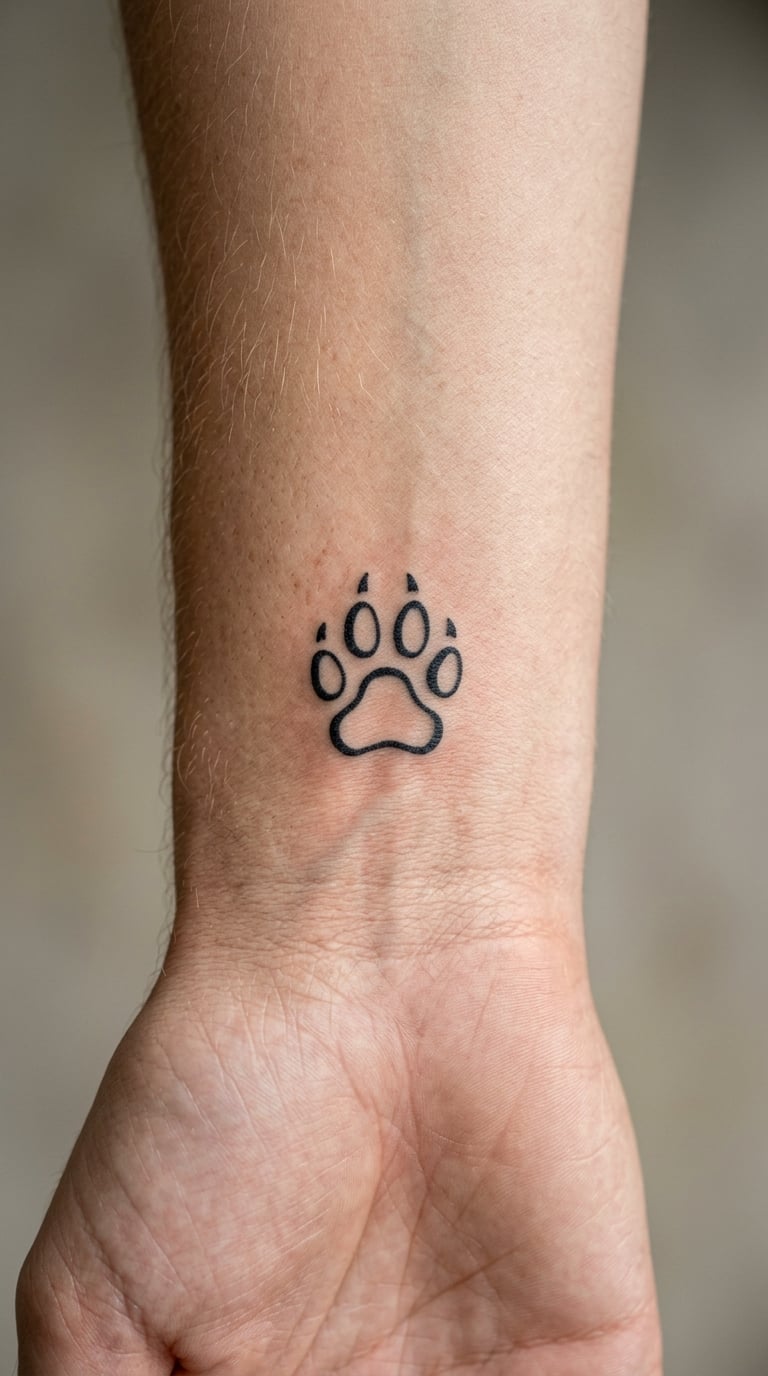
A minimalist cheetah paw print strips the idea down to one pad and four toes in clean black shapes with almost no interior detail. It carries the same meaning as a full animal without committing a whole forearm to it, which is why it turns up so often as a first tattoo. The small central pad can take an initial or a single date.
Placement: Wrist, inner ankle, behind the ear, or the side of the hand near the thumb. Size: 1.5 to 2.5 inches (4 to 6 cm). Style: Minimalist line and solid black. Pain: Low, mostly a scratching itch that settles quickly. Wrist and ankle detail softens with sun exposure and skin movement, so expect a refresh every few years. Make it yours: Use the paw as the anchor for a small trail that leads somewhere meaningful on your body.
4. Walking Cheetah in Blackwork
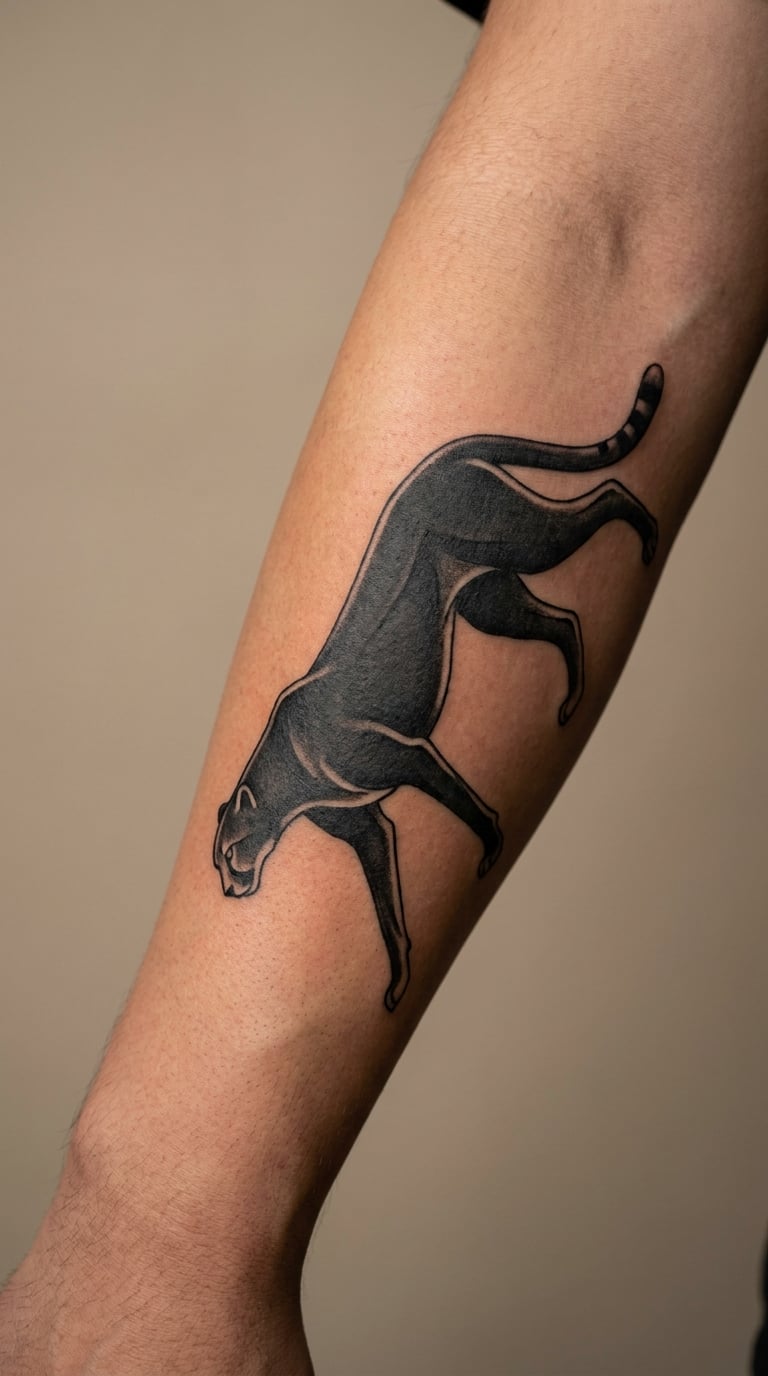
A blackwork walking cheetah is built from solid black masses: the shadow side of the body filled in, the spots left as skin, the face reduced to a few white cutouts for the eye and jaw. It reads at a distance and holds its shape for decades, which is the real argument for the style. Big cats mean what they mean without needing a caption.
Placement: Outer forearm from wrist toward elbow, outer arm, or the calf. Size: 6 to 8 inches (15 to 20 cm) long. Style: Blackwork with negative-space detail. Pain: Medium, the long solid fills are insistent but quick. Black holds colour well, so ageing is mostly about softening edge lines. Make it yours: Add a collar, a bell, or a single geometric band behind the animal to set the scene.
5. Traditional Cheetah Head with Spots
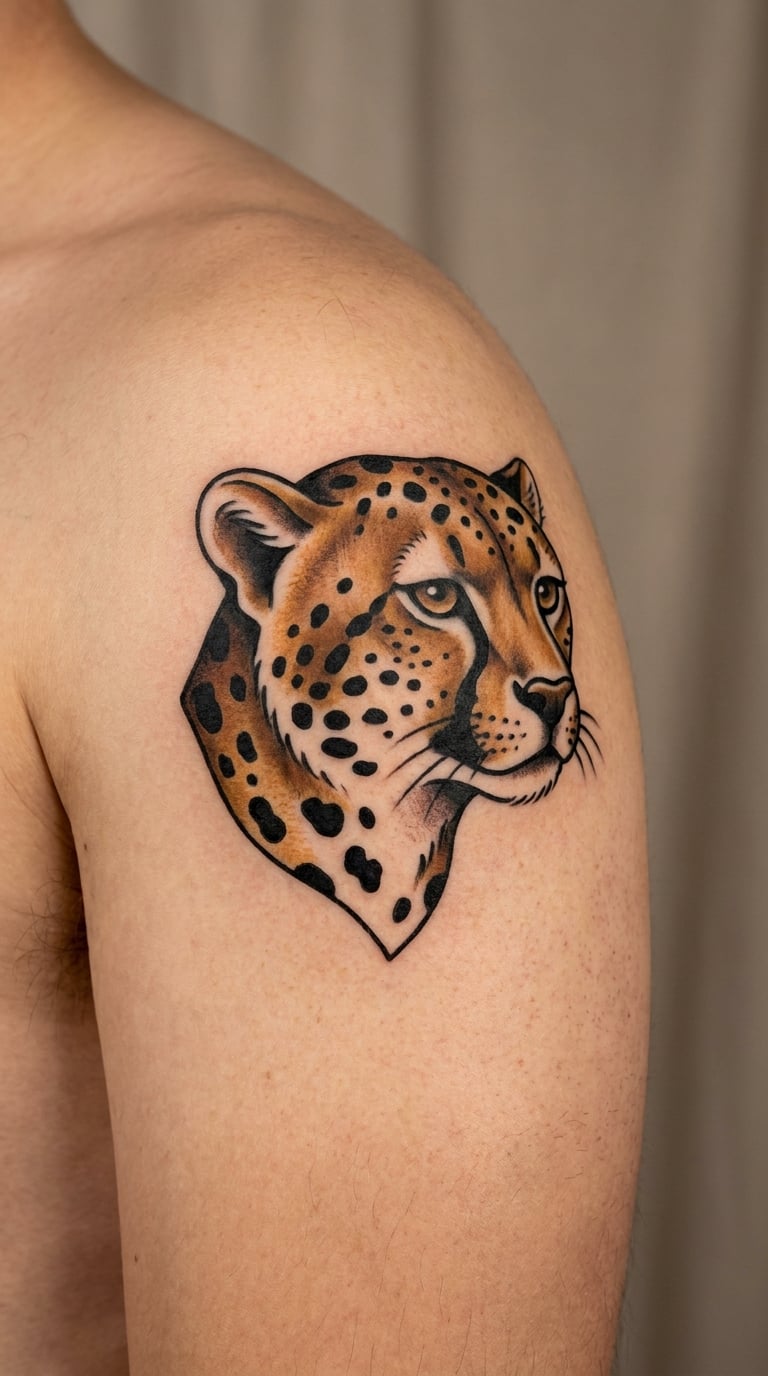
A traditional cheetah head goes back to the old American tattoo vocabulary: heavy black outline, warm ochre and brown shading, and the spots as distinct solid dots rather than blended markings. It is a loud design and it commits, so pick the shoulder or the upper chest rather than a small visible area. Old tattooers drew these constantly, which means good references exist.
Placement: Shoulder cap, upper chest, or upper arm. Size: 4 to 6 inches (10 to 15 cm). Style: Traditional / neo-traditional line work. Pain: Medium to high, the shoulder and collarbone area are bone-heavy and unforgiving. Bold outlines age better than fine colour shading, which is one reason this style stuck around. Make it yours: Choose the background instead of the animal: a banner, a name, a set of coordinates.
6. Neo-Traditional Cheetah and Flower
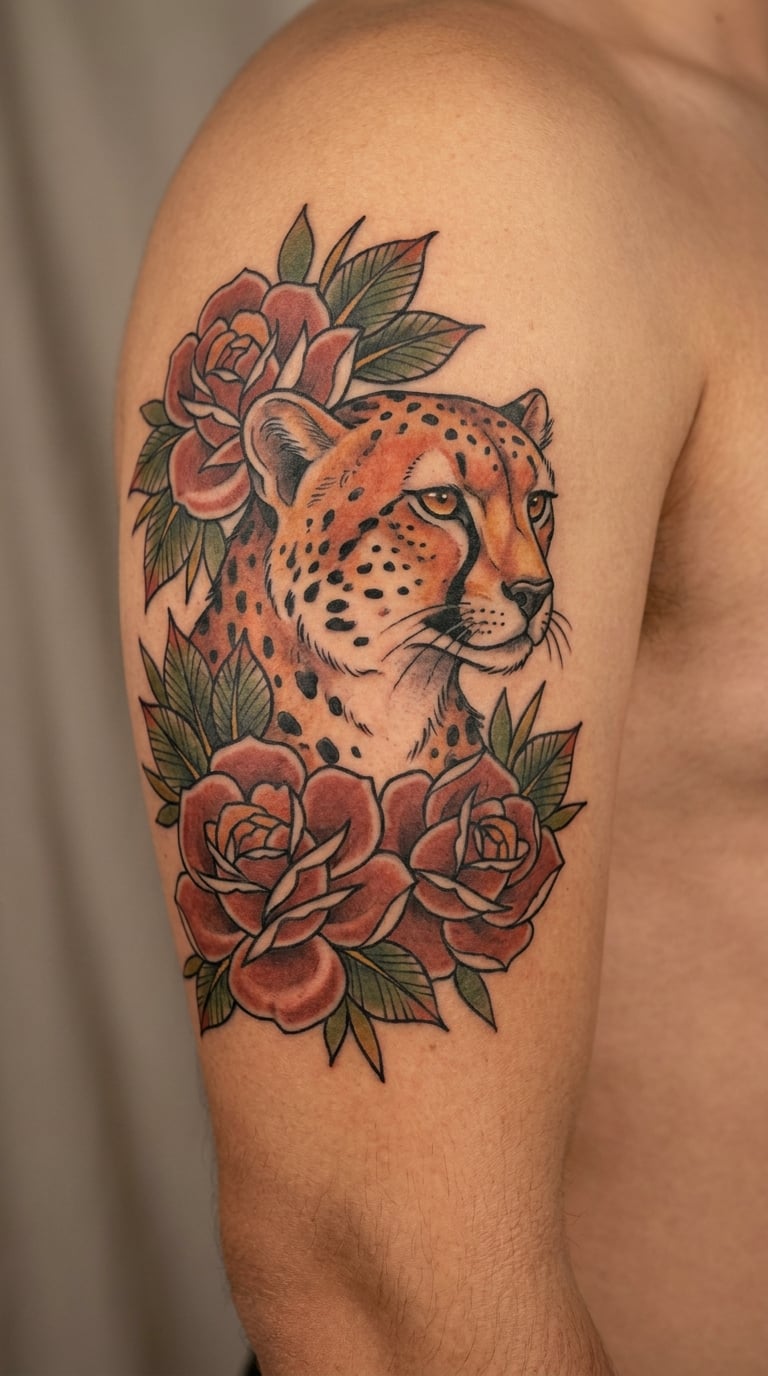
Neo-traditional puts saturated red and green around a cheetah with smooth gradient shading and a thick, even outline. Flowers are the standard partner because they fill the corners of a curved limb and soften an animal that reads severe on its own. This is the version most people end up with when they ask for a colourful cheetah tattoo.
Placement: Upper arm, shoulder, thigh, or along the spine. Size: 5 to 7 inches (13 to 18 cm). Style: Neo-traditional colour. Pain: Medium, mostly the tediousness of large colour fills rather than the sting. Reds and greens shift as they age, so pick a palette your artist has tattooed before. Make it yours: Pick flowers tied to someone or something specific, which turns a generic colour piece into a memorial one.
7. Watercolor Cheetah in Motion
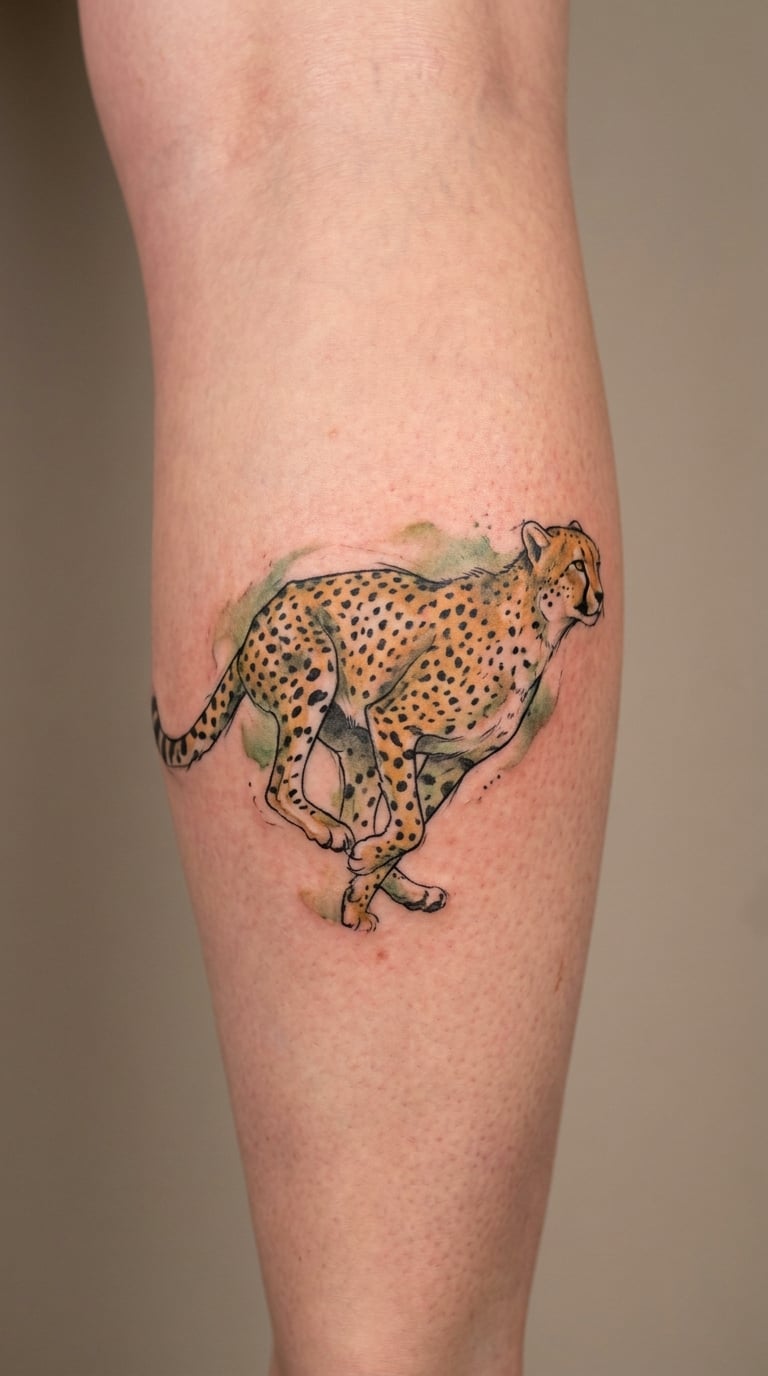
A watercolor cheetah in motion has a running body with wet edges, pigment blooms and a few deliberate splashes trailing off the back legs. The style suits a sprinting pose because the loose edges imply speed in a way hard black lines cannot. It is the softest-looking big cat design on this list and the least committed long term.
Placement: Calf, forearm, shoulder blade, or the ribs. Size: 5 to 7 inches (13 to 18 cm). Style: Watercolor with soft shading. Pain: Medium, though watercolor tattoos often take two sessions to build up. Light washes fade noticeably and the edge definition softens within a few years, so this one wants maintenance more than most. Make it yours: Choose a single accent colour that matches an existing tattoo rather than using the whole palette.
8. Cheetah and Geometric Patterns
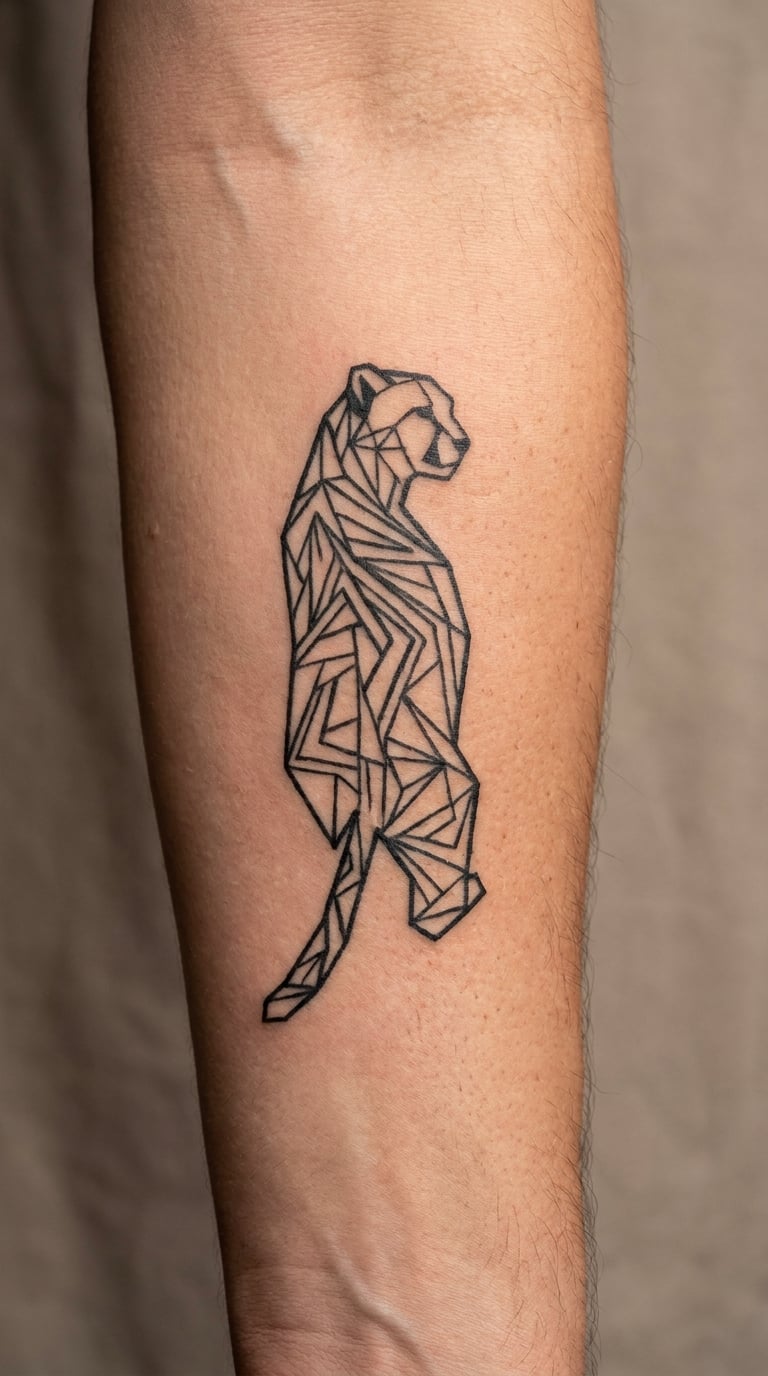
Here the cheetah becomes a silhouette broken into triangles and arcs, with repeated geometry running behind or under it like a graphic background. Angular facets suit the animal well because the real thing is built for acceleration, every line pointing forward. It looks designed rather than sketched.
Placement: Forearm, calf, outer arm, or the side of the thigh. Size: 4 to 6 inches (10 to 15 cm). Style: Geometric and abstract. Pain: Medium, mostly from the repeated linework in the background. Straight lines hold their shape far longer than organic fine detail, so this style ages well. Make it yours: Change the geometry itself: arcs for water, hard angles for a particular city or building.
9. Small Cheetah Behind the Ear
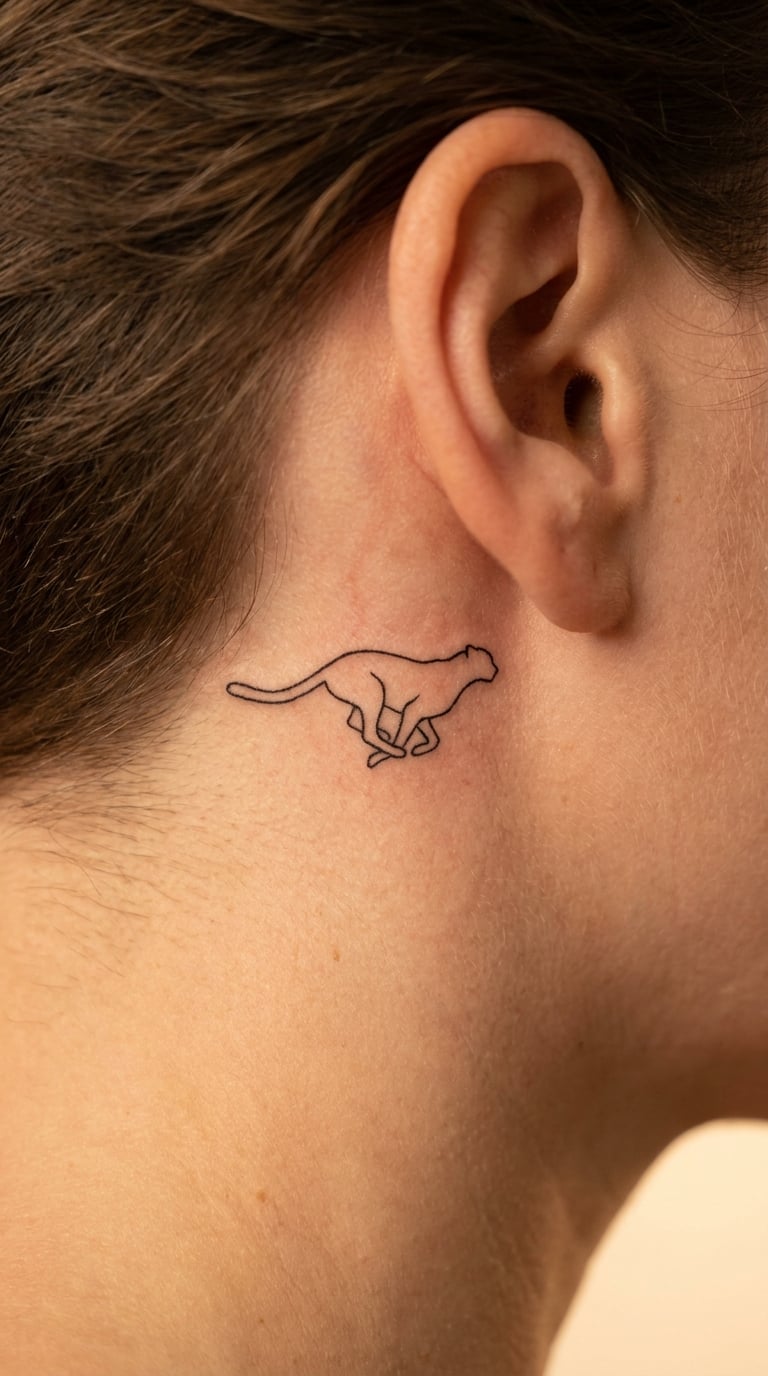
A small cheetah behind the ear is a compact curled or side-profile cat in a single weight of black line, placed in the hollow where the ear meets the skull. It is visible only when you turn your head or tuck hair back, which is exactly the point. Ask for fewer, thicker strokes here because anything finer turns to grey at this scale.
Placement: Behind either ear, or the nape of the neck. Size: 1.5 to 2.5 inches (4 to 6 cm). Style: Fine line, single weight. Pain: Medium, thin skin over cartilage feels sharper than most areas, though the session is short. Sun and shampoo thin fine line behind the ear faster than anywhere else on the body. Make it yours: Have the artist hide a small detail, such as a date, inside the curl of the body.
10. Cheetah Paw Print Matching Design
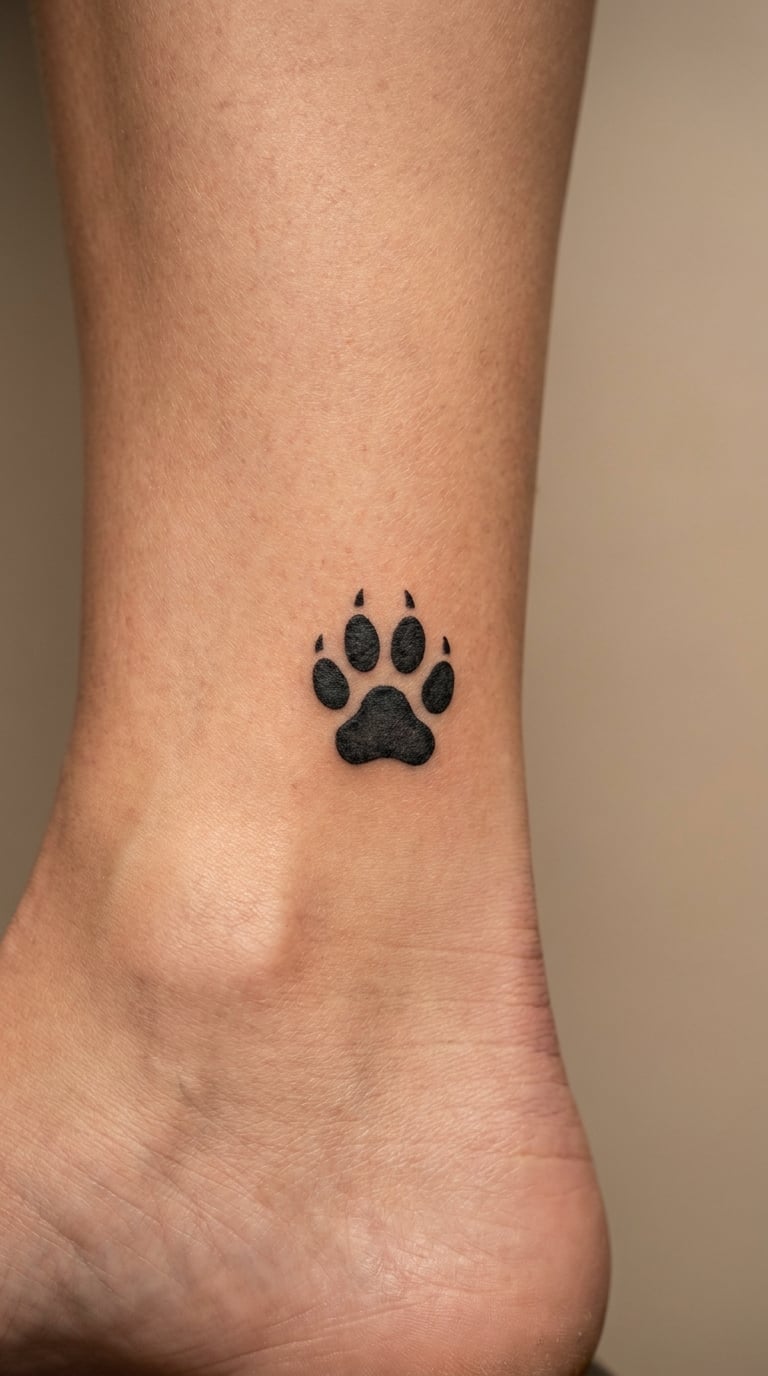
A coordinated set of cheetah paw prints is the most practical cheetah design for groups. Each person takes one print in the same style, and the set reads as connected without matching exactly, which matters when you are booking with different artists in different cities. We covered that wider angle in our matching tattoo ideas for a group of five guide.
Placement: Ankle, wrist, inner arm, or along the spine as a trail. Size: 1.5 to 2 inches (4 to 5 cm) each. Style: Minimalist solid black. Pain: Low to medium, ankle bones sting a little more. Prints are small so they hold better than expected, provided the black is packed. Make it yours: Vary the placement on each person and keep the style identical, which is the trick to a matching set that never looks copied.
11. Cheetah in a Circular Frame
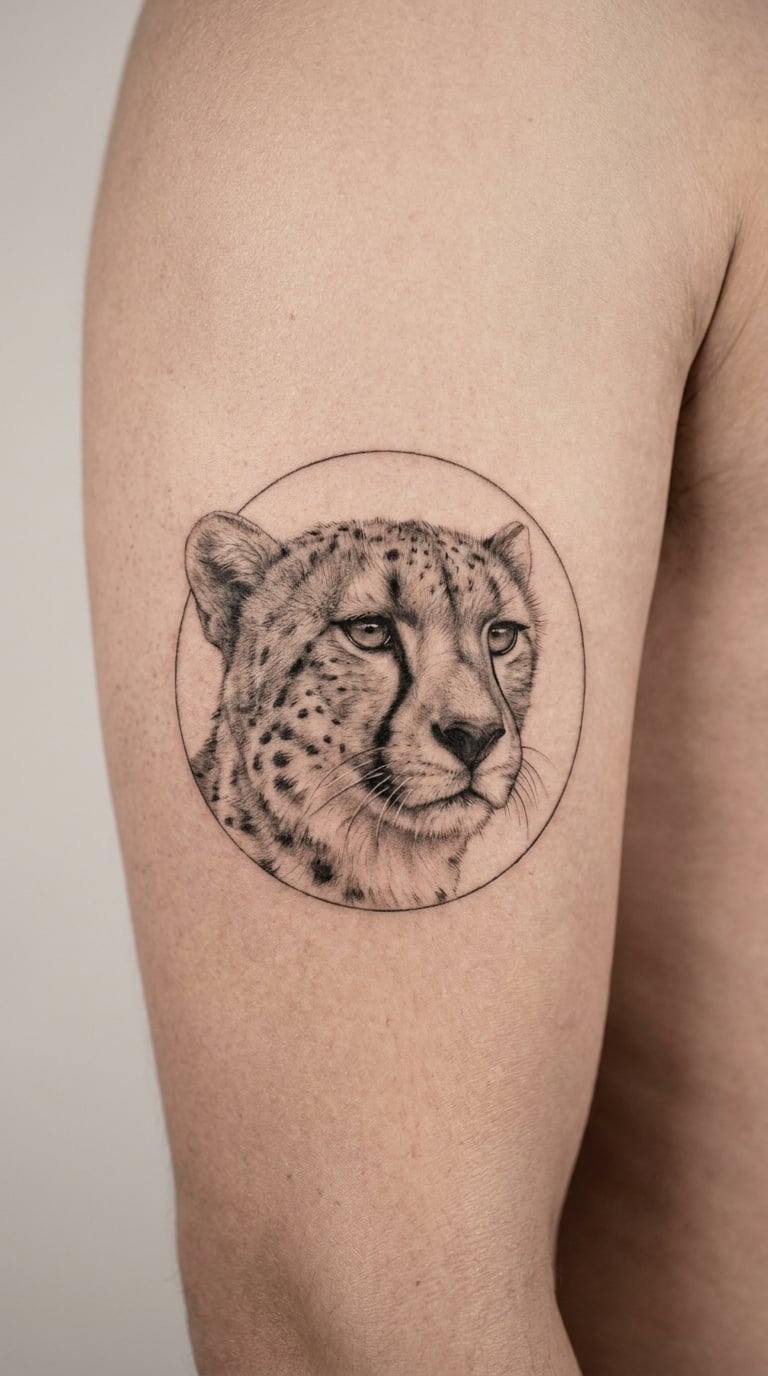
A circular frame gives a cheetah portrait a finished edge, like a coin or a seal, which makes it much easier to place on a flat surface such as the outer arm. The circle forces the artist to balance positive and negative space evenly, and a cheetah head is one of the few animal designs that fits inside a round boundary without losing its shape.
Placement: Outer upper arm, forearm, calf, or the back of the shoulder. Size: 3.5 to 5 inches (9 to 13 cm) in diameter. Style: Black and grey with a fine line frame, or reversed for a negative space version. Pain: Medium. The frame line is thin and takes a steady hand, so allow extra time. A circle holds its shape well as the skin changes with age. Make it yours: Break the circle in one place, or add a single line of text following its curve.
12. Roaring Cheetah Neo-Traditional Design
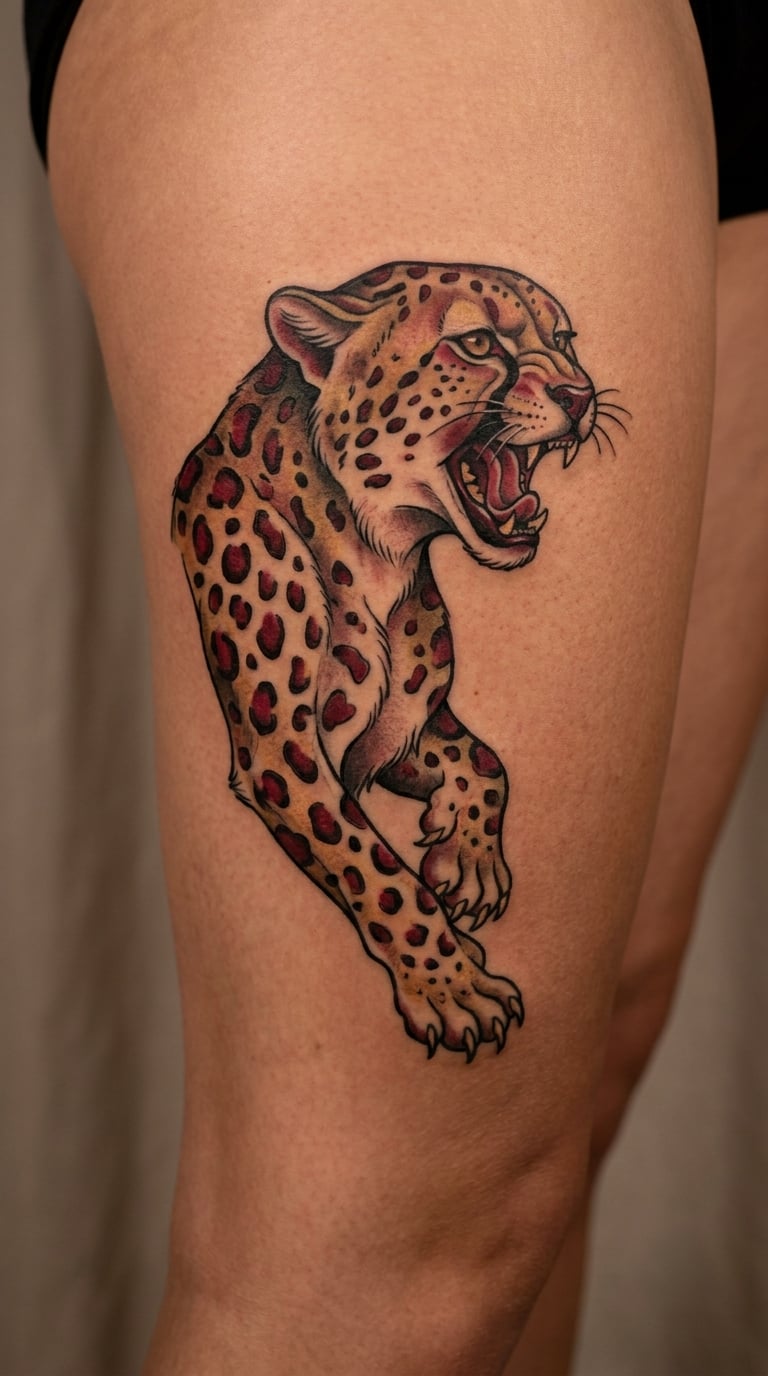
A roaring cheetah gets an open mouth, bared teeth and a deep red wash inside the mouth and behind the jaw, which is the neo-traditional shortcut for intensity. The anatomy has to be right: a small head, long muzzle, deep chest, tear lines. Get that right and it reads fierce rather than snarling-pet-store.
Placement: Outer thigh, calf, back, or across the shoulder. Size: 6 to 8 inches (15 to 20 cm). Style: Neo-traditional with heavy outline. Pain: Medium to high, the thigh is fleshy and easier, the ribs and shoulder blade are not. Large colour areas across a joint will soften as the skin moves. Make it yours: Set the roar against a background element, such as tall grass or a low sun, rather than leaving it floating.
13. Cheetah Portrait on the Collarbone
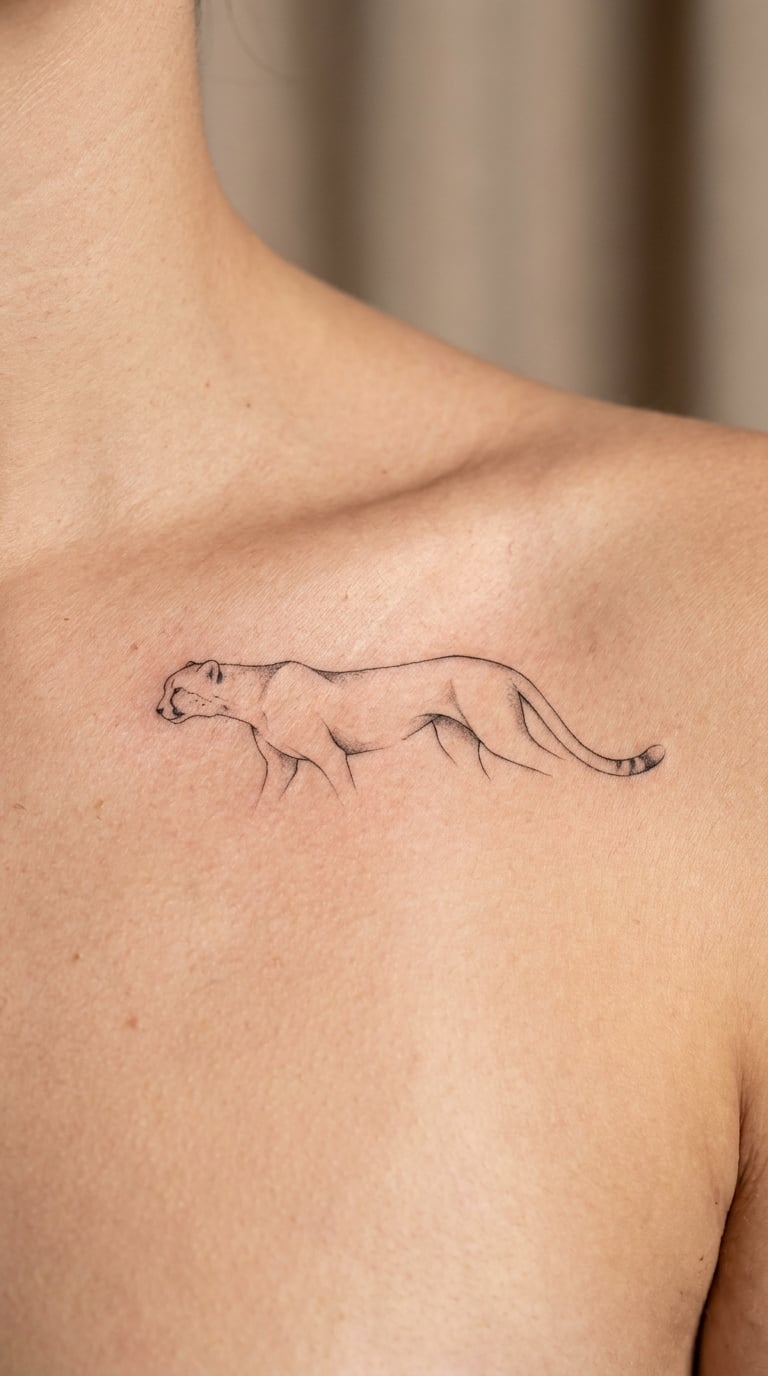
A collarbone cheetah has to be drawn horizontally, which actually suits the animal better than most shapes because the stretched-out running pose is naturally long. Fine line works best here, and the drawing should follow the curve of the bone rather than sit across it square. A longer body with smaller paws reads more elegant.
Placement: Along the collarbone, on the sternum, or the top of the foot. Size: 3 to 4 inches (8 to 10 cm) across. Style: Fine line or minimal black and grey. Pain: Medium, the collarbone is direct bone contact and you will feel every pass. Collarbone lines blur a little faster than forearm work as the skin moves with every arm position. Make it yours: Angle the pose so the head points toward your dominant hand or away from it, depending on the look you want.
14. Dotwork Cheetah
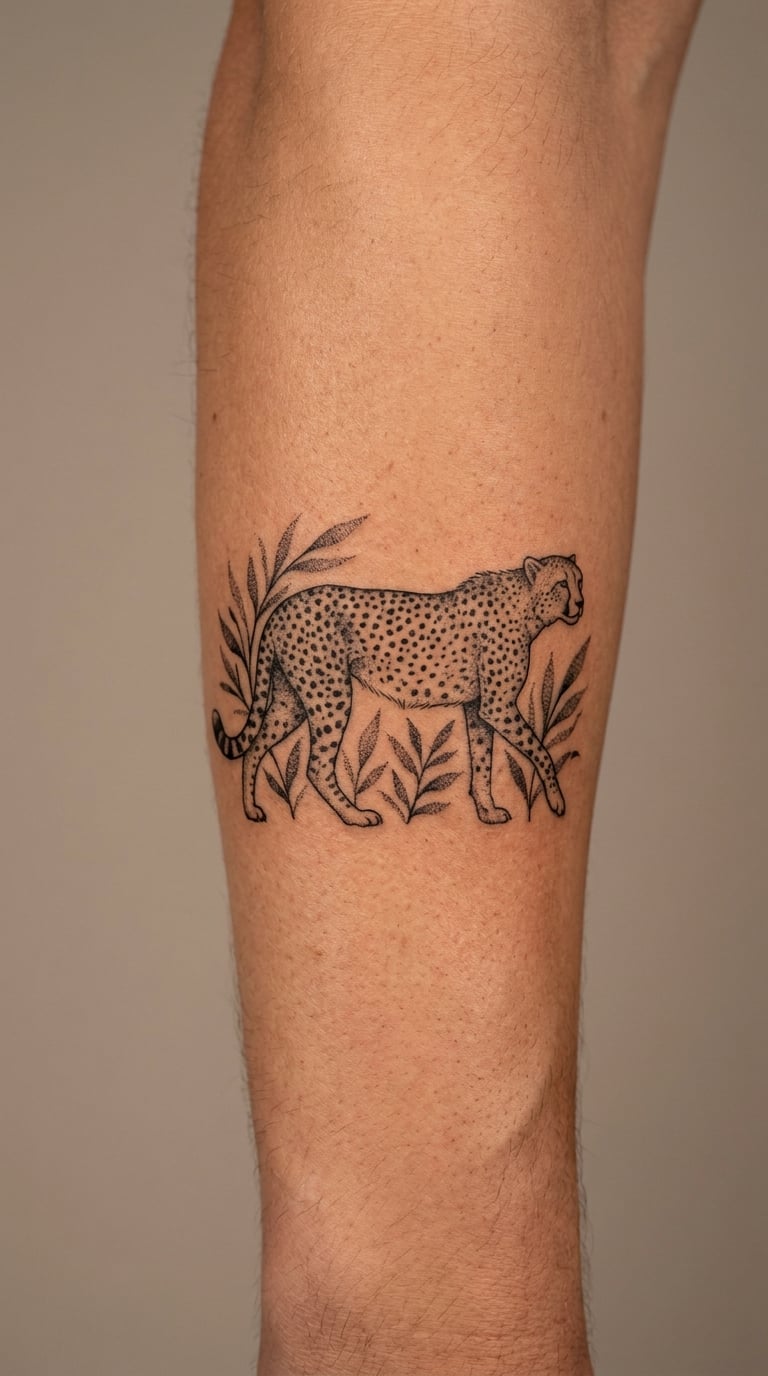
Dotwork cheetahs are built from a controlled density of dots: packed tight for the shadow side, sparse for the lit side, with a few solid blacks holding the silhouette together. It is a completely different animal to a solid silhouette, and the texture reads as tone rather than shape. Stipple shading softens more than linework over the years, so it drifts toward grey.
Placement: Forearm, upper arm, calf, or along the ribs. Size: 3.5 to 5 inches (9 to 13 cm). Style: Dotwork and stippling. Pain: Medium, dotting is repetitive and a long session tests your sitting tolerance. Gradients spread slightly as the years pass, which many people prefer to the sharp contrast of linework. Make it yours: Change the dot density so the pattern itself forms a secondary image, such as a paw shape hidden in the shadow.
15. Cheetah and Savannah Sunset
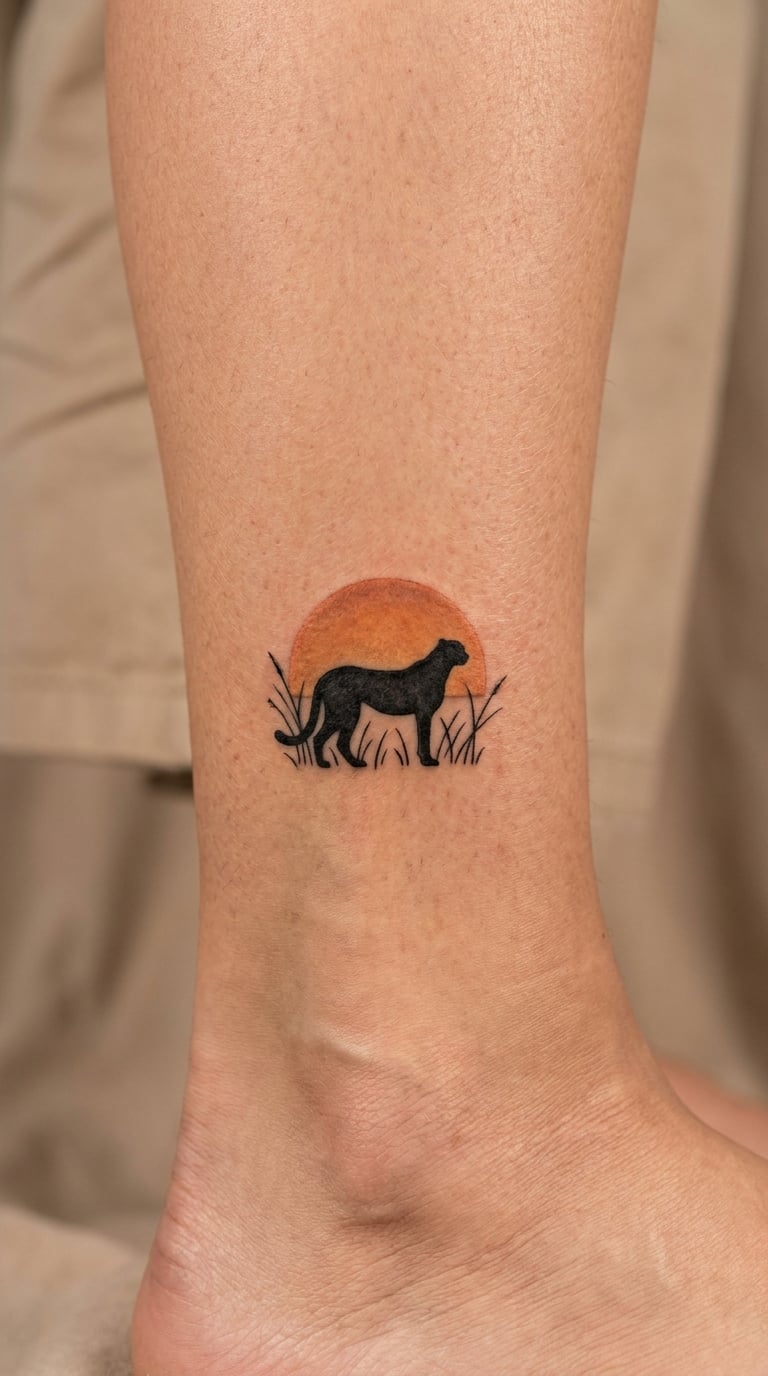
A landscape composition puts a small cheetah silhouette on a low horizon line under a warm sunset, with a few blades of grass breaking the bottom edge. The focal point is the animal, and the sunset is framing, so the background has to stay simple or it eats the cat. Colour carries this one; it feels flat in pure black and grey.
Placement: Lower leg, calf, forearm, or the side of the rib cage. Size: 3.5 to 5 inches (9 to 13 cm). Style: Illustrative with colour. Pain: Medium. Yellows and oranges fade fastest, so the sunset will soften into the sky within a few years and look warmer in the process. Make it yours: Change the landscape to match somewhere real: your home state, a national park, a coastline you have actually stood on.
16. Fine-Line Cheetah and Cub
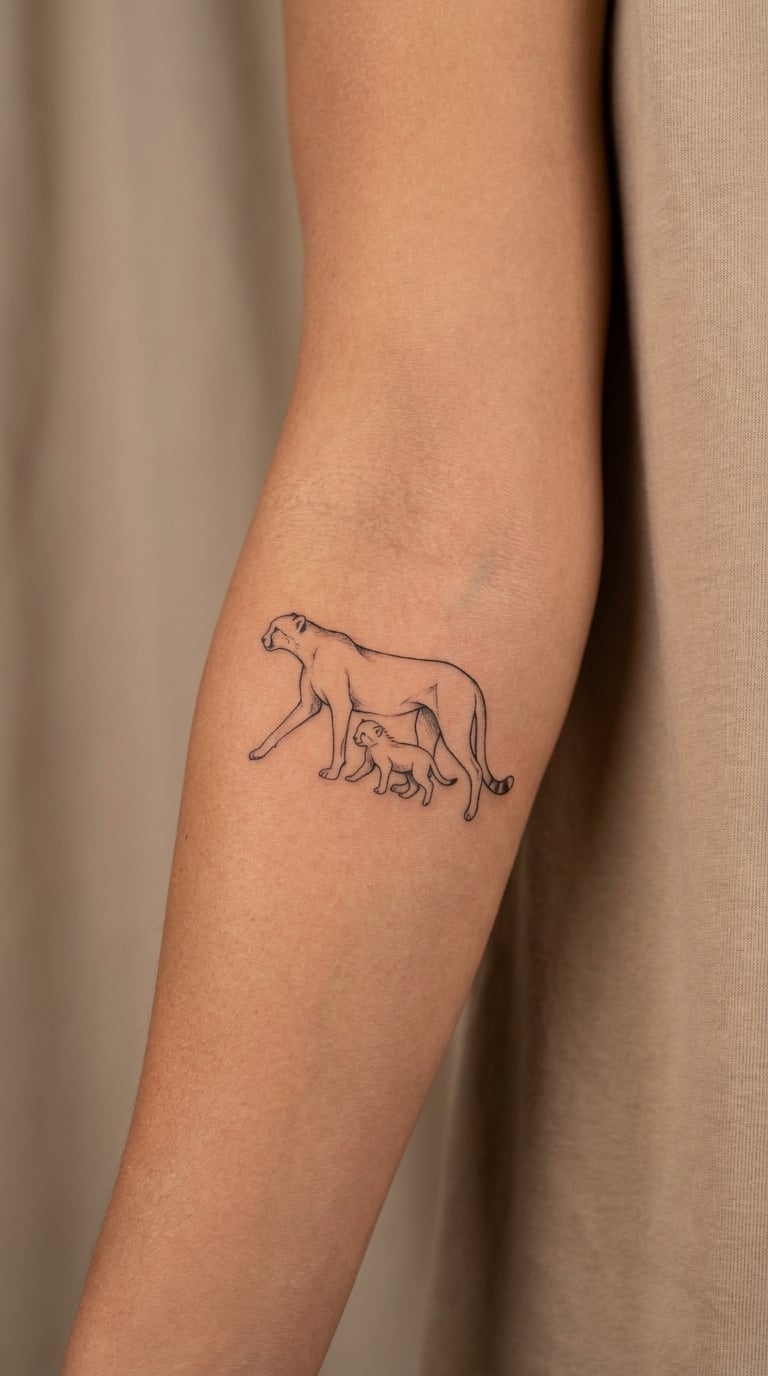
An adult and cub in fine line is the softer, more personal version of the brief. It usually comes from a real relationship: a parent and child, or a memory. The composition is two simple outlines overlapping slightly, which needs very little ink and reads clearly at small scale. The safest version is the two profiles facing each other.
Placement: Inner arm, forearm, rib cage, or the upper chest. Size: 2.5 to 4 inches (6 to 10 cm). Style: Fine line, minimal detail. Pain: Low, a short session on soft areas. Fine details at this size blur noticeably after five to seven years, so simplify before you start rather than after. Make it yours: Have the cub mirror the adult’s head angle, or keep one small spot pattern as the only colour on an otherwise black design.
17. Blackwork Cheetah Face
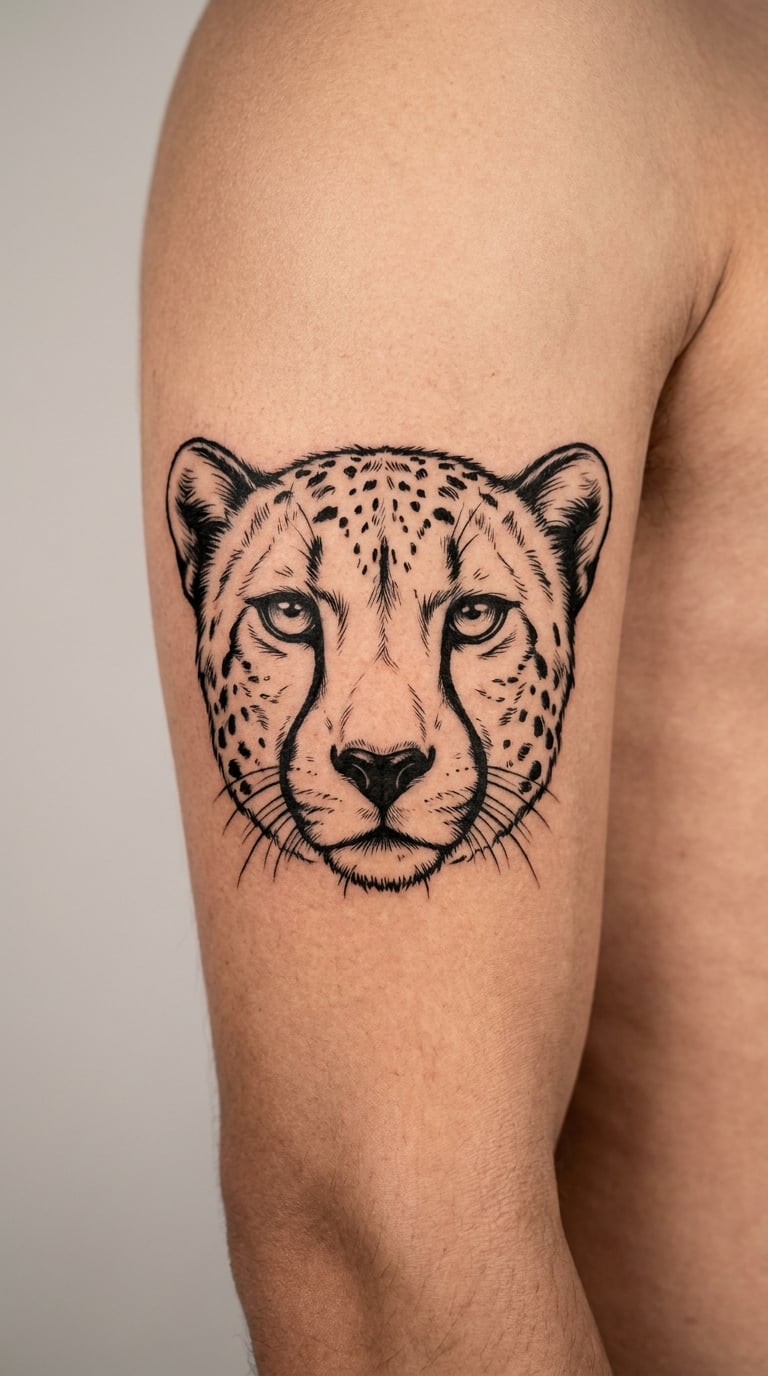
A blackwork cheetah face is all contrast: heavy filled blacks across the forehead and cheek, with the eyes and muzzle cut out as white skin and a few hard grey transitions. The style is unforgiving, because a cheek that reads round instead of lean turns it into a different cat entirely.
Placement: Outer upper arm, thigh, calf, or the chest. Size: 4 to 6 inches (10 to 15 cm). Style: Blackwork with negative-space highlights. Pain: Medium, solid fills are uncomfortable but fast. Solid black ages very well; the thin white gaps are what soften. Make it yours: Add a thin band or a small date inside one of the negative space gaps instead of adding extra symbols beside the face.
18. Cheetah in a Desert Botanical Style
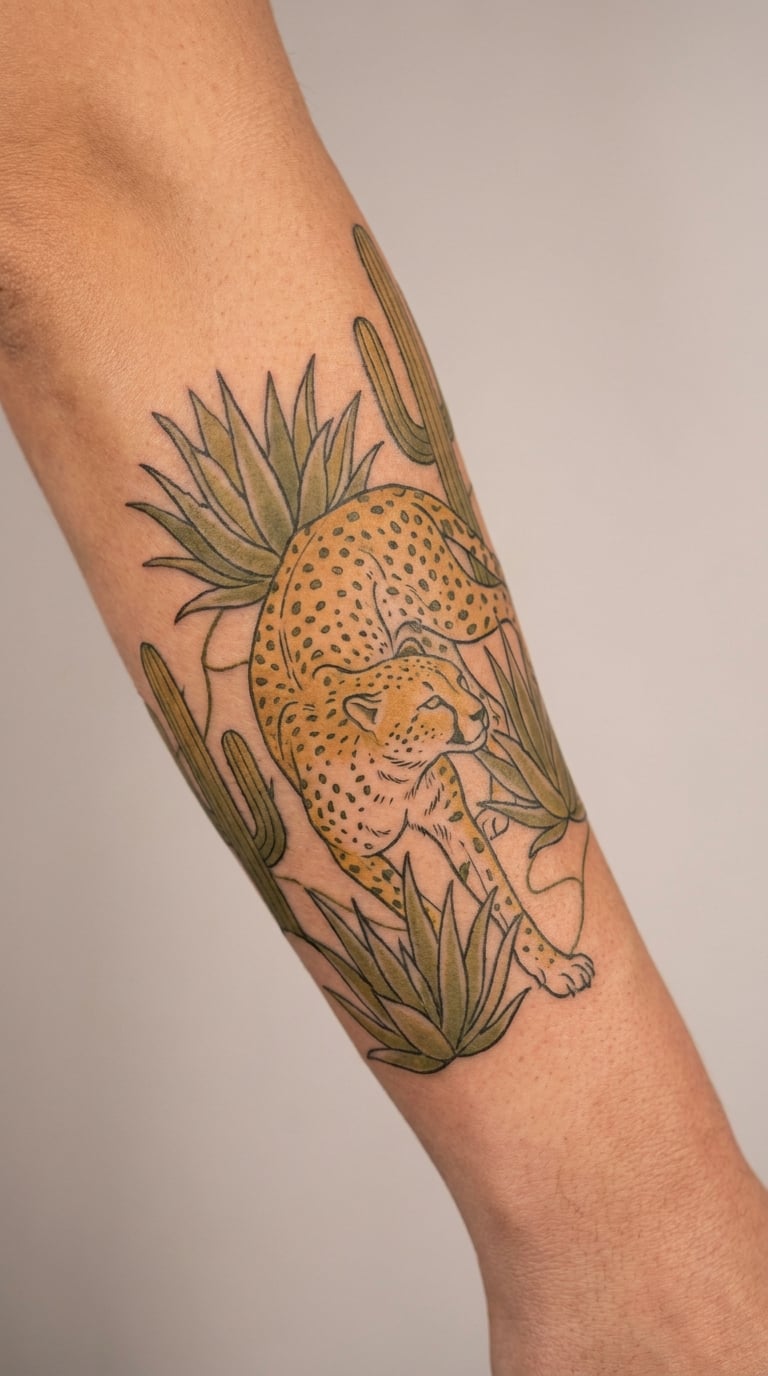
A desert botanical design treats the cheetah as part of a habitat: agaves, yucca, small grasses in muted ochre and olive, with the animal threading through them rather than sitting on top. It suits a lower leg or a forearm panel and it hides the boundaries of an older tattoo if you already have work nearby. Illustration style keeps it from reading as a nature print.
Placement: Forearm, lower leg, calf, or the inner arm. Size: 5 to 7 inches (13 to 18 cm). Style: Botanical illustration, muted colour. Pain: Medium, many small elements means a long sitting. Fine leaf lines fade first, so keep plant details slightly bolder than you think you need. Make it yours: Grow the plants in the direction of a real place, or pick species that only occur in one region you have a connection to.
19. Micro-Realism Cheetah Eye
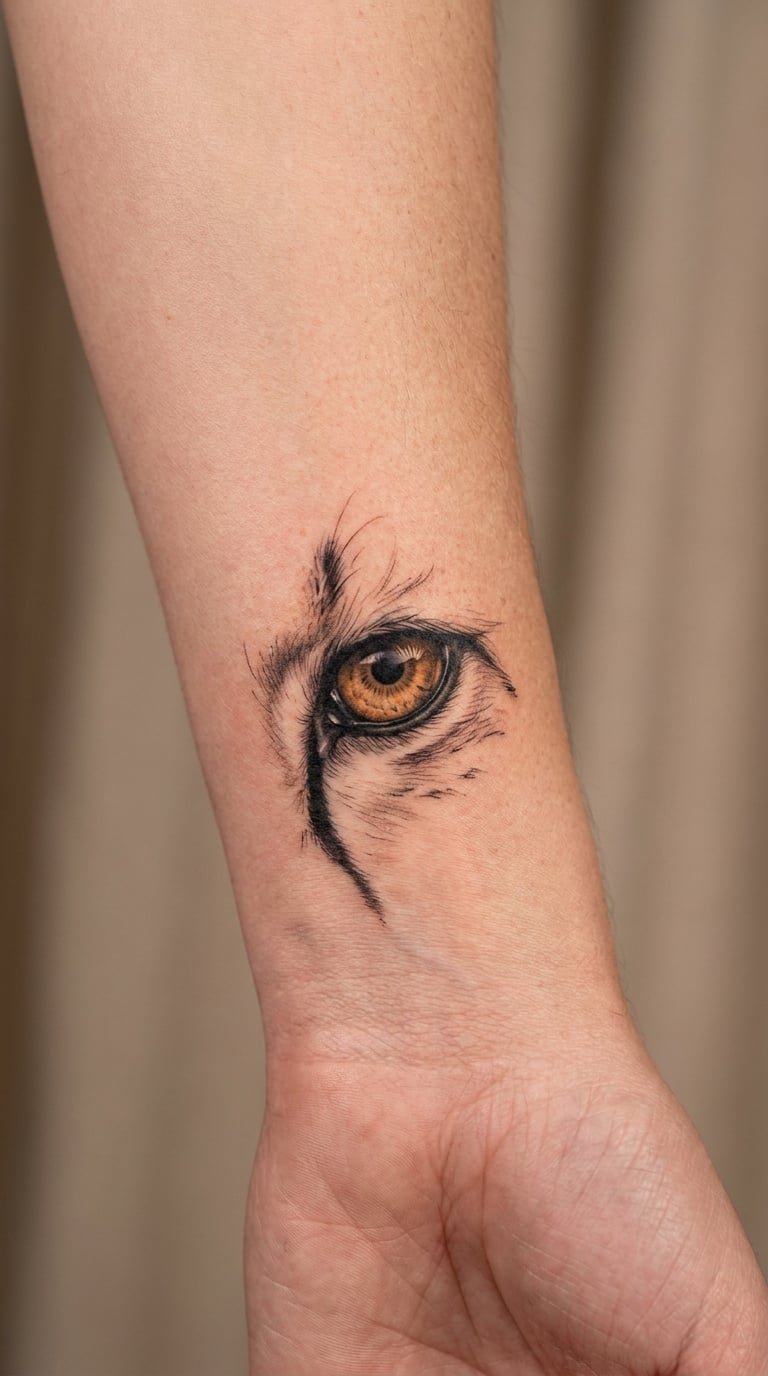
A single cheetah eye in micro-realism is the smallest design on this list and the hardest to get right. Amber iris with radial fibres, a sharp pupil, the tear marking trailing down from the inner corner. There is no room for fudging, which is exactly why people choose it: it looks like a photograph in a spot most people would put a tiny symbol.
Placement: Wrist, inner forearm, ankle, or the back of the shoulder blade. Size: 1 to 1.5 inches (2.5 to 4 cm). Style: Micro-realism with fine colour shading. Pain: Low, the session is usually under an hour. Detail at this scale will blur over the years no matter how it is done, so choose an artist who works small daily rather than once in a while. Make it yours: Pair it with a single paw print elsewhere on the body so the two read as one piece.
20. Full Cheetah Sleeve Panel
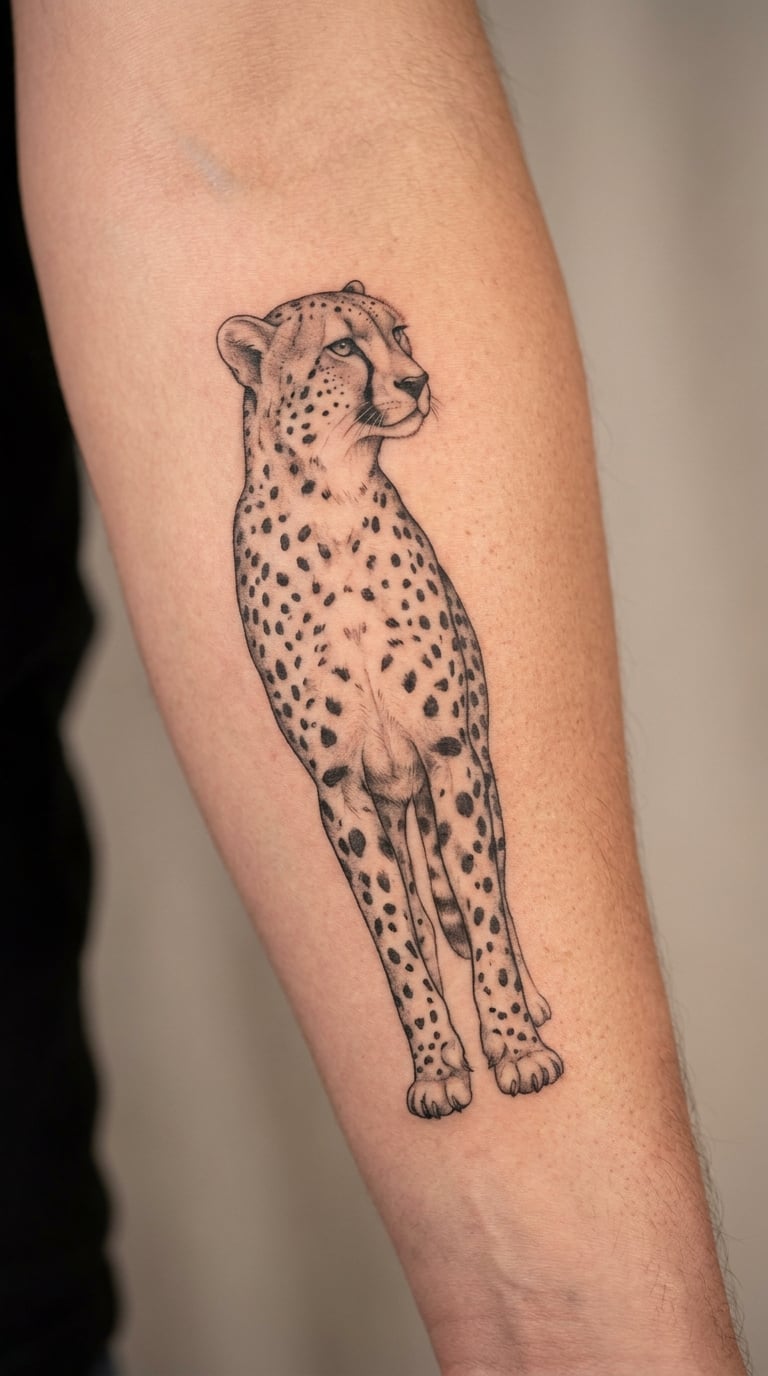
A sleeve panel is the cheetah at full length: a running animal spanning most of the outer arm, coat spots rendered individually, with negative space kept open around the legs so the movement is visible. Panelling it into a larger sleeve means the cheetah sits inside a composition instead of floating alone, and the surrounding elements decide the mood.
Placement: Outer arm from shoulder to elbow, outer thigh, or a back piece. Size: 9 to 12 inches (23 to 30 cm). Style: Realism in black and grey. Pain: High, expect two to four sessions and a break after each one. Big grey wash areas soften noticeably, so build in room for a refinement session later. Make it yours: Decide what runs alongside the cheetah, such as grass, dust or other animals, since that is what turns a panel into a sleeve.
How to Choose the Right Design
Pick the design that survives your body and your future, not the one with the best reference photo. Six checks cover most of it.
- Start with the placement, not the image. A design composed for a calf has to be redrawn for a shoulder. Measure the flat area in inches first, then find designs that fit it.
- Match detail level to size. Tear markings and individual fur strokes need roughly 4 inches or more. Below that, ask for a simplified drawing with bolder lines.
- Decide how loud it should be. Colours, solid black fills and florals read from across a room. Fine line and minimal paw prints read at close range only.
- Check what you already have. Adding a grey realistic cheetah next to an existing black and grey sleeve changes how both look as they settle.
- Think ten years out. Fine line on hands, wrists, ankles and behind the ear fades fastest. If the design matters to you, either accept a refresh every few years or choose a bolder style.
- Look at the artist’s portfolio in the style you want. Realism and blackwork are different skills. A portfolio full of florals is not a portfolio of cheetahs.
Cost and Session Time
US prices move with size, detail and the hourly rate of the artist, but the ranges below are what most people actually pay for a cheetah piece in a mid-range city shop.
- Small, 1 to 2 inches: about 80 to 200 dollars, one session of roughly an hour. Paw prints and micro eyes sit here.
- Medium, 3 to 5 inches: about 200 to 600 dollars, one to two sessions. Most portraits, fine-line profiles and circular designs land here.
- Large, 6 to 10 inches: about 600 to 2,000 dollars, two to four sessions. Sleeve panels and full-body blackwork live here.
Four things move the number most: apparent size on the body, how many times the needle has to go over the same shading, whether you want colour or black and grey, and the shop’s hourly rate. Shop minimums are common, so a small design in a high-rent city can cost the same as a medium one elsewhere. Regional prices vary widely, and a grey-wash cheetah with fur texture takes far longer than a silhouette of the same size.
If you are planning a sleeve, book it as a series rather than a single appointment, and change the design only between sessions, never mid-way through one.
Aftercare Basics
- Follow your artist’s aftercare instructions first. They watched the session and know how your specific tattoo settled.
- Wash the area daily with unscented soap and lukewarm water, then pat it dry rather than rubbing.
- Keep it covered with a clean, non-stick dressing for the first few days, especially on the thigh, ribs and back where clothing rubs.
- Expect a fine scab or peeling skin in the first week. Pick at nothing and do not scratch or peel it off.
- Skip swimming, saunas and heavy soaking until the skin is fully healed, and keep sun exposure off a fresh tattoo for a few weeks.
- Once healed, moisturise the area and keep it covered when you are out in strong sun, which is what keeps black lines sharp.
Frequently Asked Questions
What does a cheetah tattoo symbolize?
A cheetah tattoo usually stands for speed, agility, focus and an untamed, resilient spirit. People also read it as ambition, quiet strength and adaptability, since the animal is built for bursts of power rather than a long fight. The one detail that makes a cheetah design distinct is the spot pattern, which is unique to each animal, and that gets used as a symbol of individuality.
Will my cheetah tattoo just look like a leopard?
It can, if the drawing misses the details. Cheetahs have solid spots rather than rosettes, a long thin muzzle, small rounded ears, an elongated spine, and black tear lines running from the eye down the cheek. Leopards have rosettes and stockier bodies. Point those features out in your reference and the design reads as a cheetah every time.
Do cheetah tattoos hurt, and which placements are the worst?
A cheetah tattoo feels the same as any other tattoo of that size and style. The painful spots are the ribs, collarbone, inner arm, spine and the shoulder blade, all thin skin over bone. The thigh, upper arm, calf and back are comparatively forgiving. Pain also rises in long sessions, so a four-hour design hurts more than two shorter ones covering the same area.
What size should a cheetah tattoo be?
Match the size to the detail you want and to the space you have. A single paw print works at 1.5 inches, a fine-line profile needs at least 3 inches to stay readable, and a realistic portrait with tear markings and fur texture needs 4 inches or more. Anything under 2 inches should be simplified, because detail at that scale blurs as it ages.
Which lasts longer, a colour cheetah tattoo or a black and grey one?
Black and grey usually lasts better. Yellows, oranges and light greens fade noticeably within a few years, while solid black holds its punch and grey shading softens gracefully. Fine-line cheetah designs fade fastest wherever skin is thin and exposed, especially behind the ear, on the wrists, ankles and over the knuckles. If longevity matters to you, go bolder and darker.
Conclusion
If this is your first tattoo, start with the minimalist cheetah paw print or the fine-line profile. Both sit at 2 to 3 inches, heal quickly and leave room for a larger piece later without crowding the same area. If you are building a collection and already have solid black or grey work, a realistic cheetah portrait or a full blackwork walking cheetah has the detail to reward the space it takes up.
First step: measure the flat area you have in mind, pick two or three ideas from this list that fit that measurement, and bring those references plus a note on tear markings and spot pattern to your consultation.