
20 Nautical Star Tattoo Ideas: Best Coastal October 2026 Picks
A nautical star tattoo is an eight-pointed star drawn with alternating shaded and unshaded points, a design sailors have carried for generations as a way to keep their bearing and come home safe. Most people come to it for that clean symmetry and a bit of maritime history, not because they want a loud nautical set.
The 20 nautical star tattoo ideas below each come with a real size, a body site that suits the design, a style name an artist will recognise, and an honest note on pain and ageing. If you are planning a tattoo for late October or over the winter, most studios book three to six weeks out, so you have time to settle on a design that ages well rather than one that photographs beautifully in week two.
20 Nautical Star Tattoo Ideas: Quick Guide
Here is every design on the list at a glance. Rows run in the same order as the numbered sections, so you can jump straight to the one you want to show your artist.
| Idea | Style | Best placement | Size | Pain |
|---|---|---|---|---|
| 1. Traditional eight-point star | Traditional black and grey | Outer forearm | 3-4 inch (8-10 cm) | Medium |
| 2. Compass rose | Fine line with solid fills | Inner forearm | 3-4 inch (8-10 cm) | Medium |
| 3. Star wrapped on an anchor | Bold blackwork | Outer forearm | 4-5 inch (10-13 cm) | Medium-high |
| 4. Lighthouse with star | Traditional with one colour | Outer upper arm | 4-6 inch (10-15 cm) | Medium |
| 5. Ship wheel hub star | Black and grey realism | Upper arm | 4-5 inch (10-13 cm) | Medium |
| 6. Star with sailor knot | Fine line | Wrist or inner arm | 2-3 inch (5-8 cm) | Medium-high |
| 7. Star through waves | Blackwork with grey wash | Forearm | 4-5 inch (10-13 cm) | Medium |
| 8. Antique chart star | Illustrative engraving | Upper arm | 5-7 inch (13-18 cm) | Medium-high |
| 9. North star with rings | Minimalist fine line | Inner arm | 2-3 inch (5-8 cm) | Low-medium |
| 10. Star with coastal constellation | Dotwork and fine line | Shoulder blade | 4-6 inch (10-15 cm) | Medium |
| 11. Star map destination | Minimal fine line | Upper back | 6-8 inch (15-20 cm) | Medium |
| 12. Star inside a lifebuoy | Bold traditional with colour | Upper arm | 3-4 inch (8-10 cm) | Medium |
| 13. Whale tail under a star | Blackwork illustrative | Forearm | 4-6 inch (10-15 cm) | Medium |
| 14. Sea serpent around a star | Neo-traditional | Outer thigh | 6-9 inch (15-23 cm) | Medium |
| 15. Crescent moon and star | Fine line | Collarbone | 2-4 inch (5-10 cm) | Medium-high |
| 16. Star with coordinates | Minimal with clean type | Inner wrist | 1.5-2.5 inch (4-6 cm) | Medium-high |
| 17. Star with pennant flag | Clean linework | Outer forearm | 3-4 inch (8-10 cm) | Medium |
| 18. Star on sea glass | Illustrative with soft colour | Forearm | 2.5-3.5 inch (6-9 cm) | Medium |
| 19. Vintage seal emblem | Engraving-inspired traditional | Upper arm | 3-5 inch (8-13 cm) | Medium-high |
| 20. Blackwork starburst | Solid black blackwork | Outer upper arm | 4-6 inch (10-15 cm) | Medium |
1. Traditional Eight-Point Nautical Star
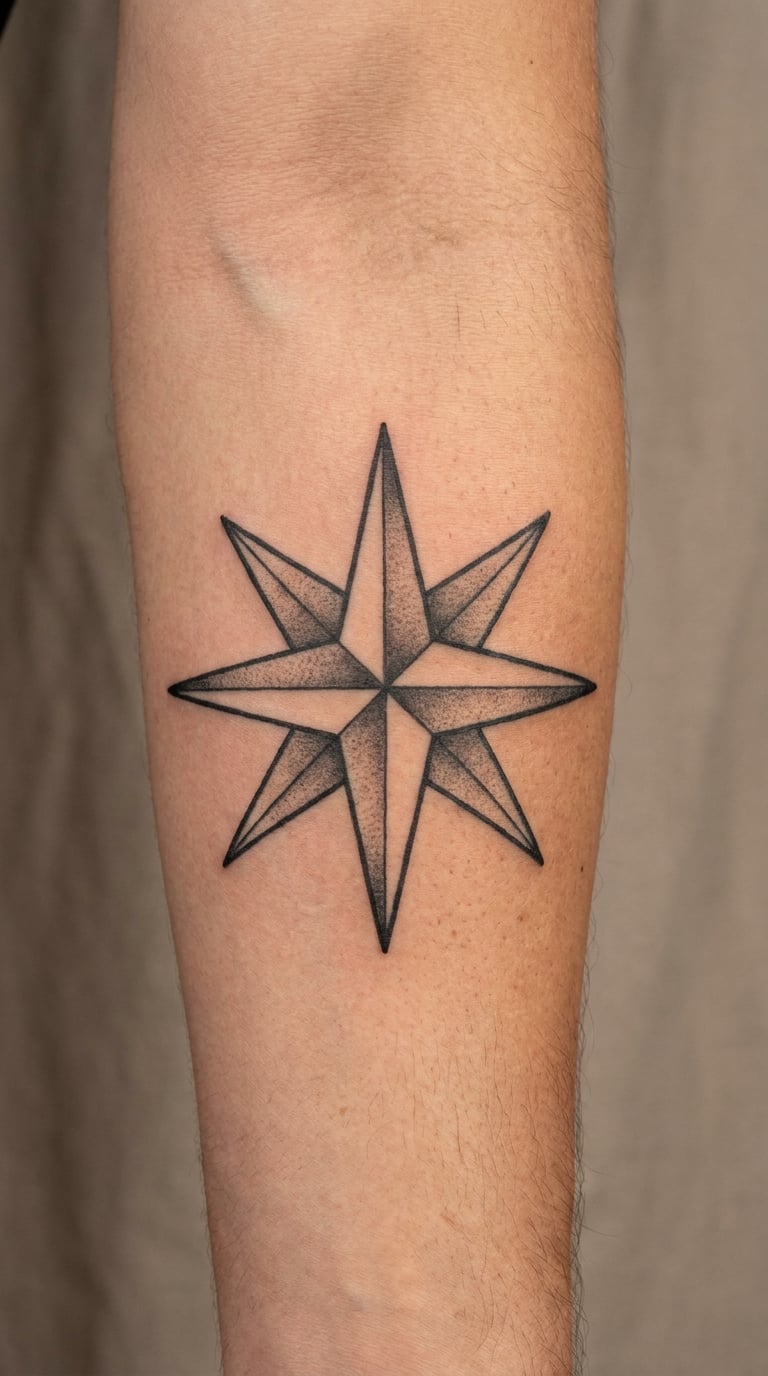
The classic version is a symmetrical eight-point star with a thick black outline, clean interior edges and grey shading in alternating points so the shape reads as dimensional. No background, no script, no frame. It is the design most people picture when they hear the words nautical star tattoo, and it is the easiest one to get right at a competent shop.
People choose it for the seafaring history it carries, and plenty of sailors still ask for it as a nod to a working tradition. Others just like a shape that looks considered without being loud.
Placement: outer forearm, upper arm, or centre chest. Size: 3-4 inch (8-10 cm) across the points. Style: traditional black and grey with alternating shaded points. Pain: medium, mostly the inner forearm near the elbow crease. Make it yours: add the year you first went to sea, or a small wave line under the lower points.
Traditional Nautical Star Tattoo Design Details
Linework is where this design lives or dies. Even line weight across all eight points, sharp tips that stay sharp, and grey shading that stays inside the outline. Amateur flash found online is the most common complaint I hear, because the points come out different lengths and the interior shading wanders.
The same star works as a small standalone piece on the elbow or as the anchor of a much larger chest or back composition. At 2 inches it still reads clearly as long as the tips are left solid. Past 5 inches, the interior can open up with extra rope, wave, or compass detail without crowding.
2. Compass Rose with Alternating Points
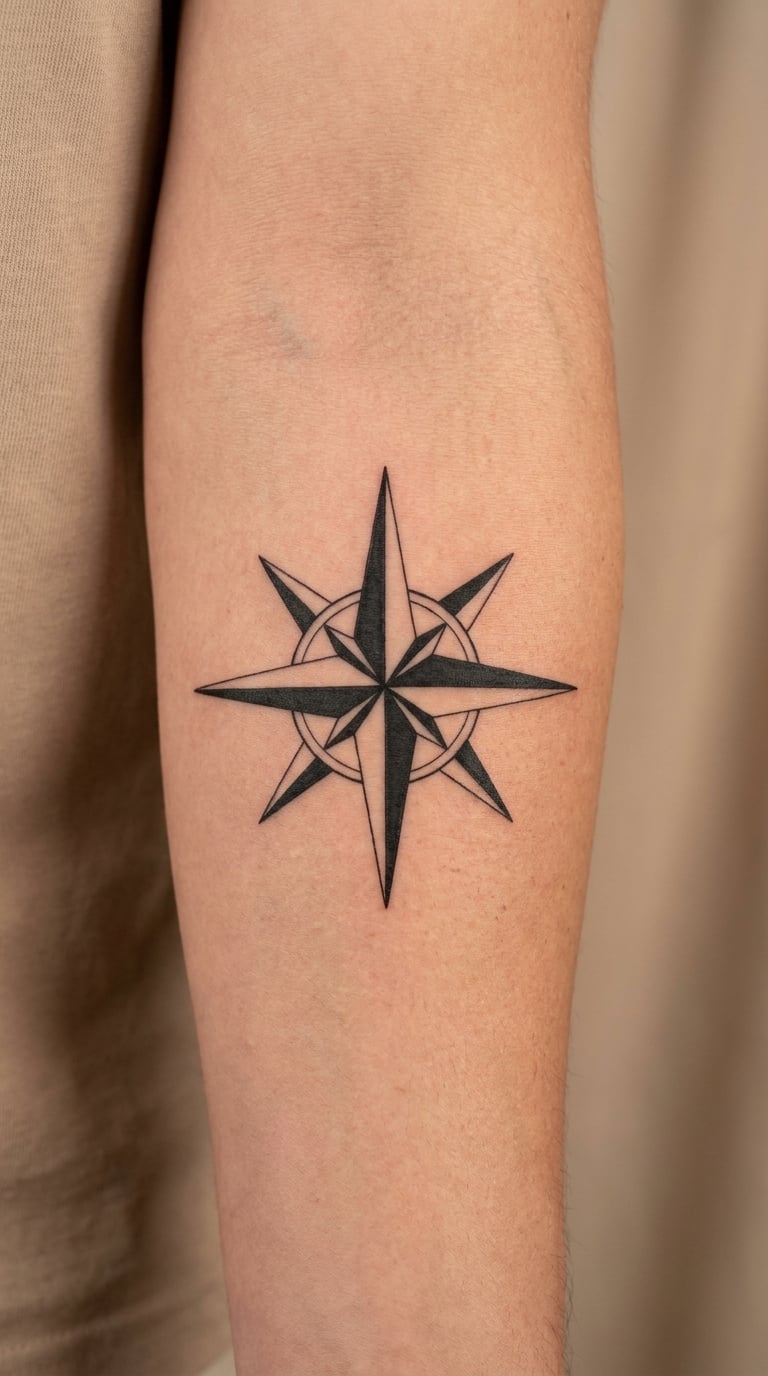
A compass rose takes the nautical star and stretches it into a direction instrument: narrow cardinal points, shorter points between them, and alternating filled and outlined sections so it spins visually. A small cross at the centre keeps it anchored. This is the design to pick if you care about the wayfinding part of the story more than the sailor part.
Placement: inner forearm or inner upper arm. Size: 3-4 inch (8-10 cm). Style: fine line with solid black fills, or traditional with grey. Pain: medium. Ageing: very thin tick marks between the points blur first, so ask for a slightly heavier line. Make it yours: letter the four cardinal points with a real home town or a family surname.
3. Nautical Star Wrapped Around an Anchor
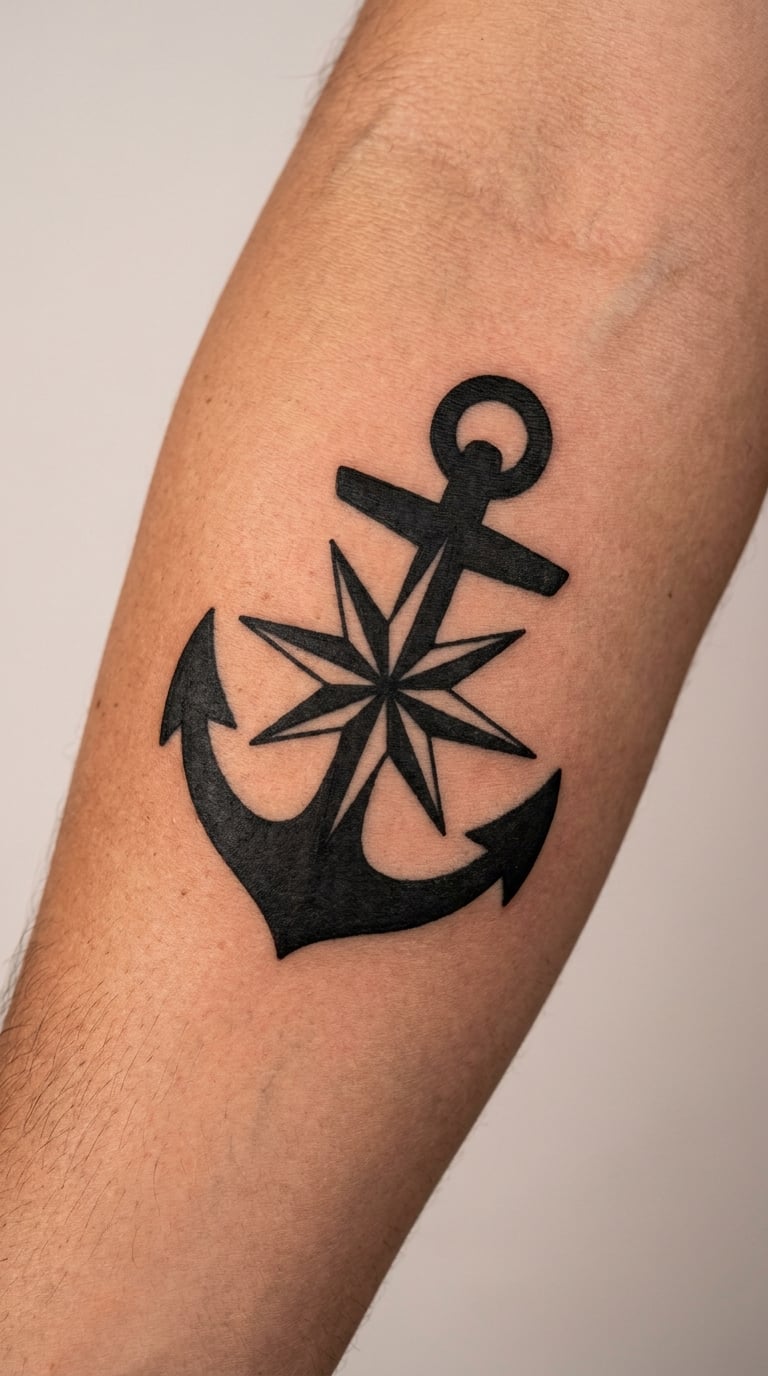
Here a compact eight-point star overlaps the shank or frames the flukes of a small anchor, drawn in solid black linework with no shading. The overlap is the whole trick: the star sits on top of the anchor stock so the two shapes share a line instead of sitting side by side looking pasted together.
It reads as pure maritime imagery, and it is a common request from people with any family or work connection to the sea.
Placement: outer forearm, calf, or upper arm. Size: 4-5 inch (10-13 cm) tall. Style: bold blackwork. Pain: medium-high, more on the inner arm and near the elbow. Ageing: solid black stays crisp where hair coverage is thin, but expect a soft edge after ten years. Make it yours: have a date tucked into the ring of the anchor, or a thin rope spiralling up the shank.
4. Lighthouse and Nautical Star
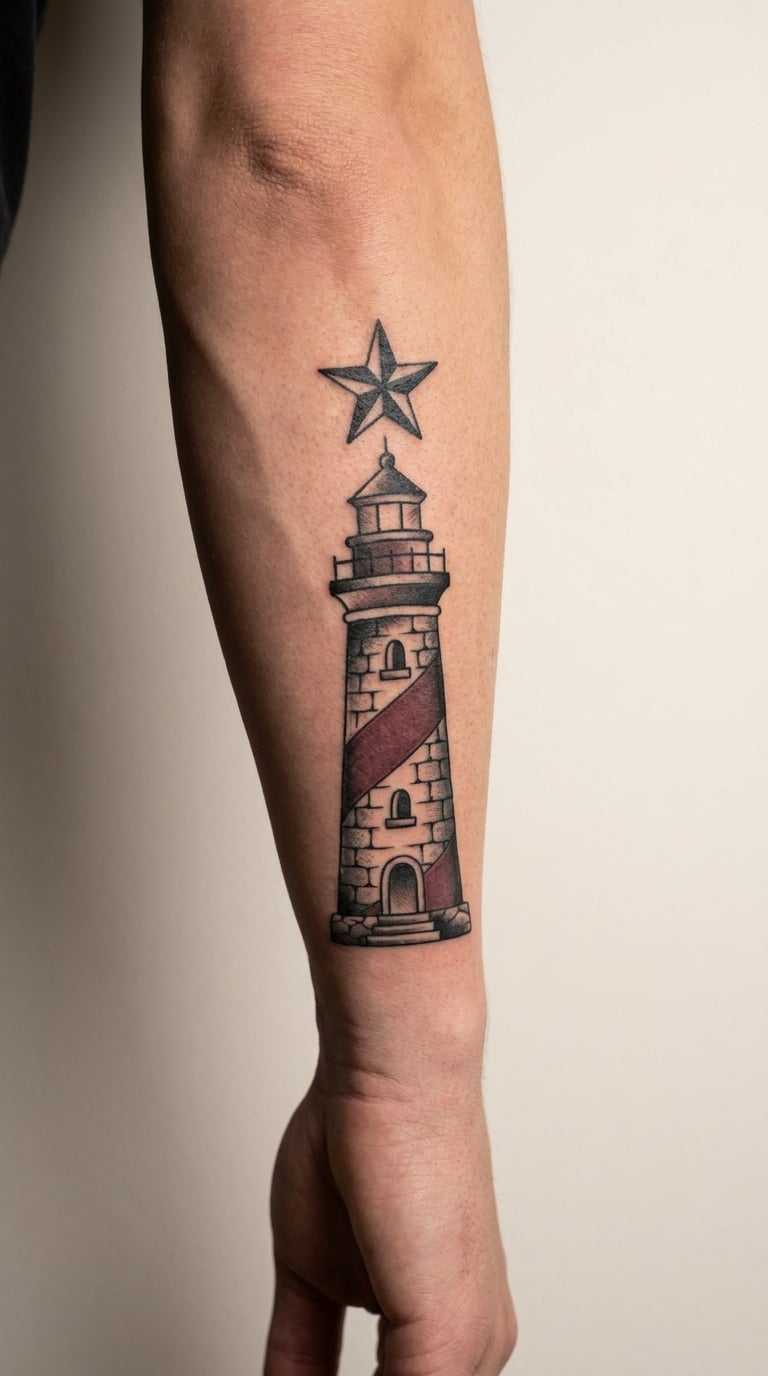
A vertical composition with a striped lighthouse tower, a few small windows, restrained beams, and a nautical star sitting at the lantern room or floating above the beams. Most artists keep the tower to three or four bands so the star stays the focal point rather than the building.
It suits people who grew up near a coast, sailed commercially, or want a safe-harbour reference without a slogan attached to it.
Placement: outer upper arm, calf, or ribs. Size: 4-6 inch (10-15 cm) tall. Style: traditional or neo-traditional, one accent colour. Pain: medium; the ribs hurt noticeably more than the arm. Ageing: thin window lines and small rays fade before the tower does. Make it yours: use the striped pattern of a specific lighthouse, or place it where you can see it when you swim.
5. Ship Wheel with Central Nautical Star
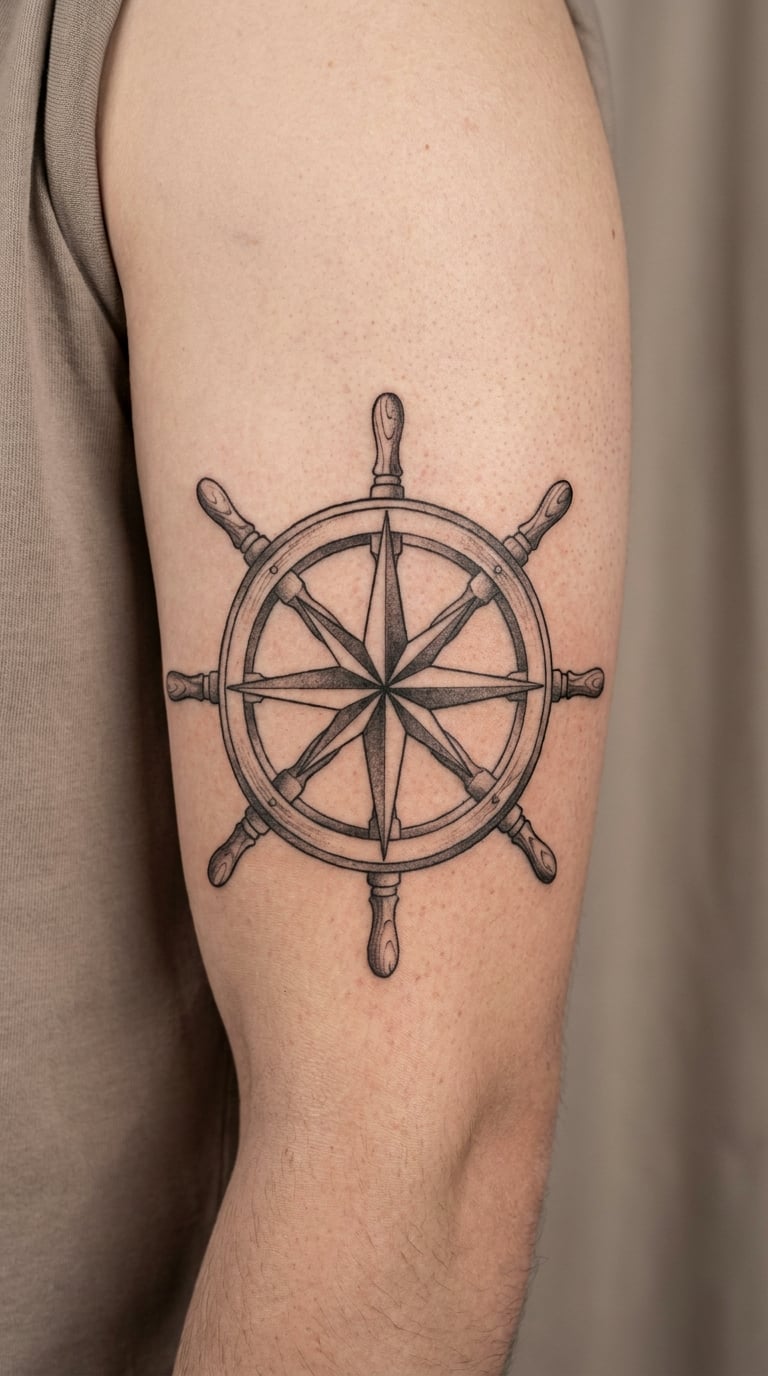
The ship’s wheel is drawn as a circle with eight handles, and the hub becomes the middle of the nautical star so the star’s points line up with the spokes. Getting that alignment right is the whole design, and it separates a good version from the usual clip art.
It connects to seamanship and to a life spent travelling or working at sea, and it scales up nicely as the centrepiece of a nautical arm piece.
Placement: upper arm or centred on the chest. Size: 4-5 inch (10-13 cm) across. Style: black and grey realism. Pain: medium. Ageing: the small rope texture between the spokes is the first thing to soften. Make it yours: have the hub star carry a date, or reduce the handle count on smaller versions so the drawing stays clean.
6. Nautical Star and Sailor Knot
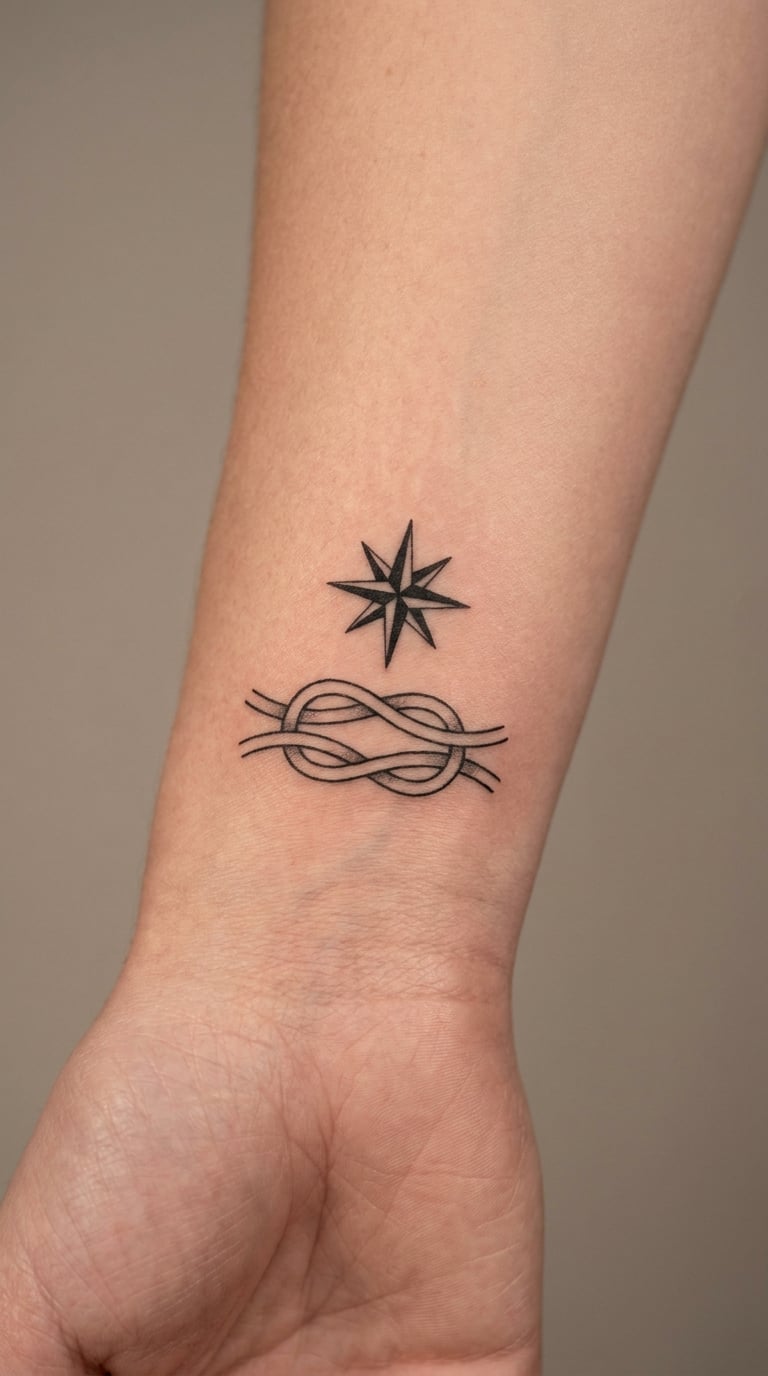
A small star sits above a neatly drawn sailor knot or a single loop of rope, with the rope tails running long and loose rather than tied off in a tidy bow. The gap between the two is what makes it work; the rope should read as separate from the star, not merged into it.
It appeals to people who like rope work and hand skills as much as star imagery, and it stacks well with a later anchor or wave piece.
Placement: inner wrist, wrist crease, or inner forearm. Size: 2-3 inch (5-8 cm) tall. Style: fine line. Pain: medium-high, the wrist crease and inner forearm are sensitive areas. Ageing: the thinnest rope highlights soften within a few years. Make it yours: swap in a knot you actually tied, or a rope colour that matches the sea you grew up near.
7. Nautical Star Breaking Through Ocean Waves
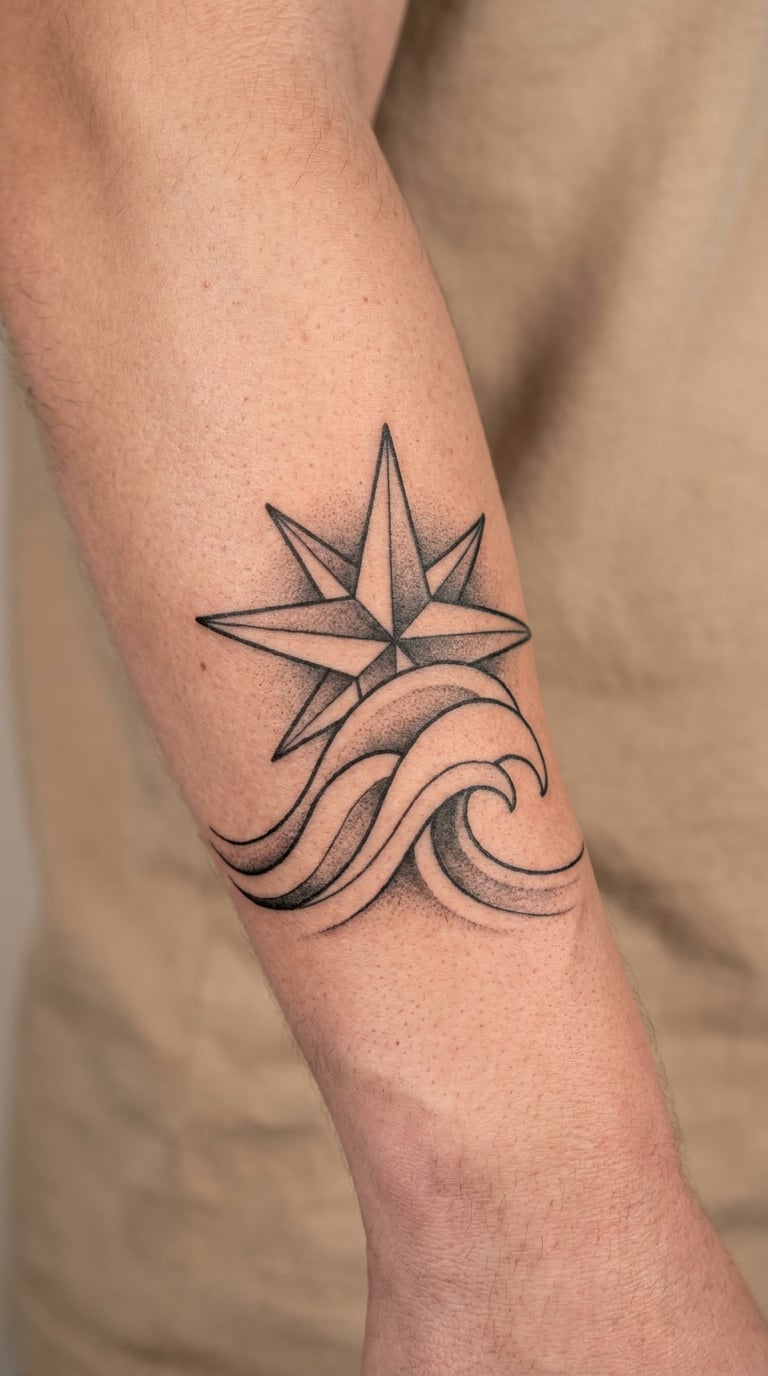
A star rises out of or pushes through three or four stylised waves, drawn in black linework with grey wash under the crest lines. The waves curve the same direction throughout, which is what gives the piece movement instead of making it look like a clip-art stack.
It is a straightforward ocean piece for surfers, swimmers, and anyone who picked the star for the sea connection rather than the seafaring history. If the wave work is not your thing, pine forest tattoos for the forearm use the same forearm real estate in a completely different register.
Placement: forearm, calf, or ribs. Size: 4-5 inch (10-13 cm). Style: blackwork with grey wash. Pain: medium. Ageing: grey wash under the crests spreads slightly, so expect a softer look than the black lines after a decade. Make it yours: have the coordinates of a favourite break, cove, or swimming spot worked into the lowest wave.
8. Antique Nautical Chart Nautical Star
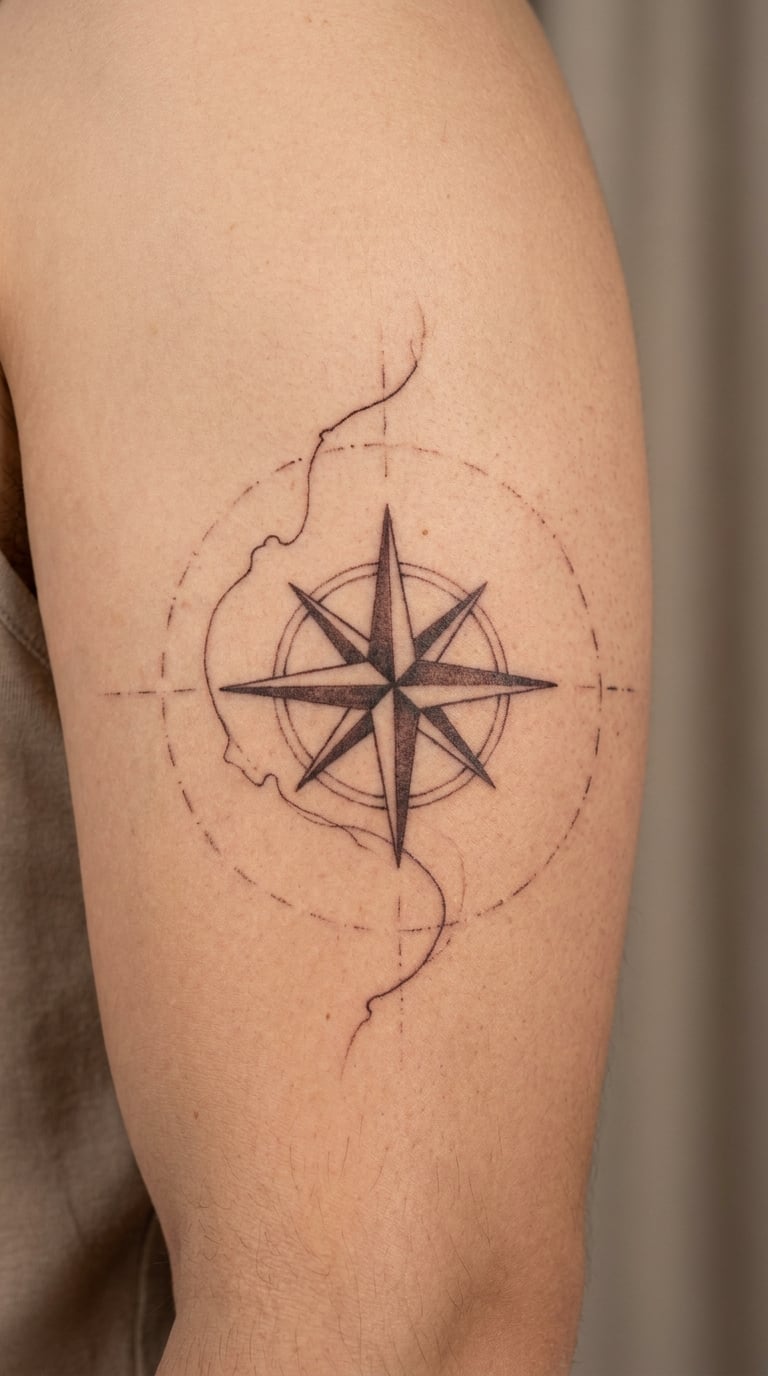
This one places the star inside a fragment of an old sea chart: thin latitude and longitude lines, a sliver of coastline, small tick marks, and one fine route line running past the star. The drawing is illustration rather than flash, with hairline strokes and an aged sepia-black tone.
Chart imagery usually gets chosen because of a real place rather than a fixed meaning, so people tend to bring their own coordinates to the appointment.
Placement: upper arm, back, or thigh. Size: 5-7 inch (13-18 cm) wide so the chart detail has room. Style: illustrative engraving. Pain: medium-high, a long session on the back. Ageing: hairline chart lines are the first casualty, which is why this suits a slightly larger version. Make it yours: bring the exact coordinates of a harbour, a dive site, or where you were born.
9. North Star with Concentric Compass Marks
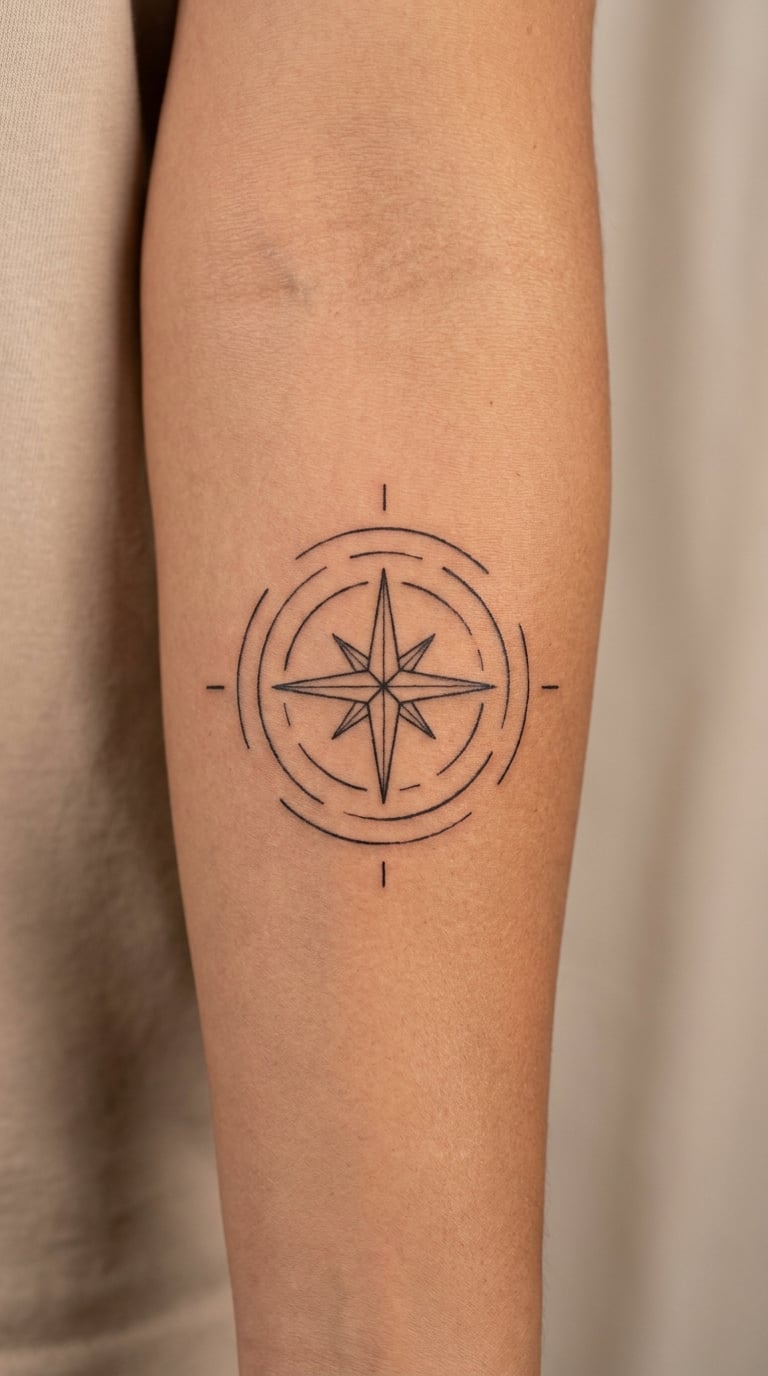
A five-pointed star with one or two shaded points, set inside two incomplete concentric circles with four short cardinal ticks. The broken rings are what stop it looking like a dartboard, and the ticks are drawn long enough to read as compass marks rather than stray dashes.
It is the quietest version on the list, and it works as a first tattoo because the silhouette survives even when the detail softens.
Placement: inner arm, behind the ear, or ankle. Size: 2-3 inch (5-8 cm). Style: minimalist fine line. Pain: low to medium. Ageing: fine line on hands, wrists, and ankles fades fastest in sun and salt water, so keep it covered. Make it yours: set the gaps in the rings to different widths, one per person you are thinking about.
10. Nautical Star and Coastal Constellation
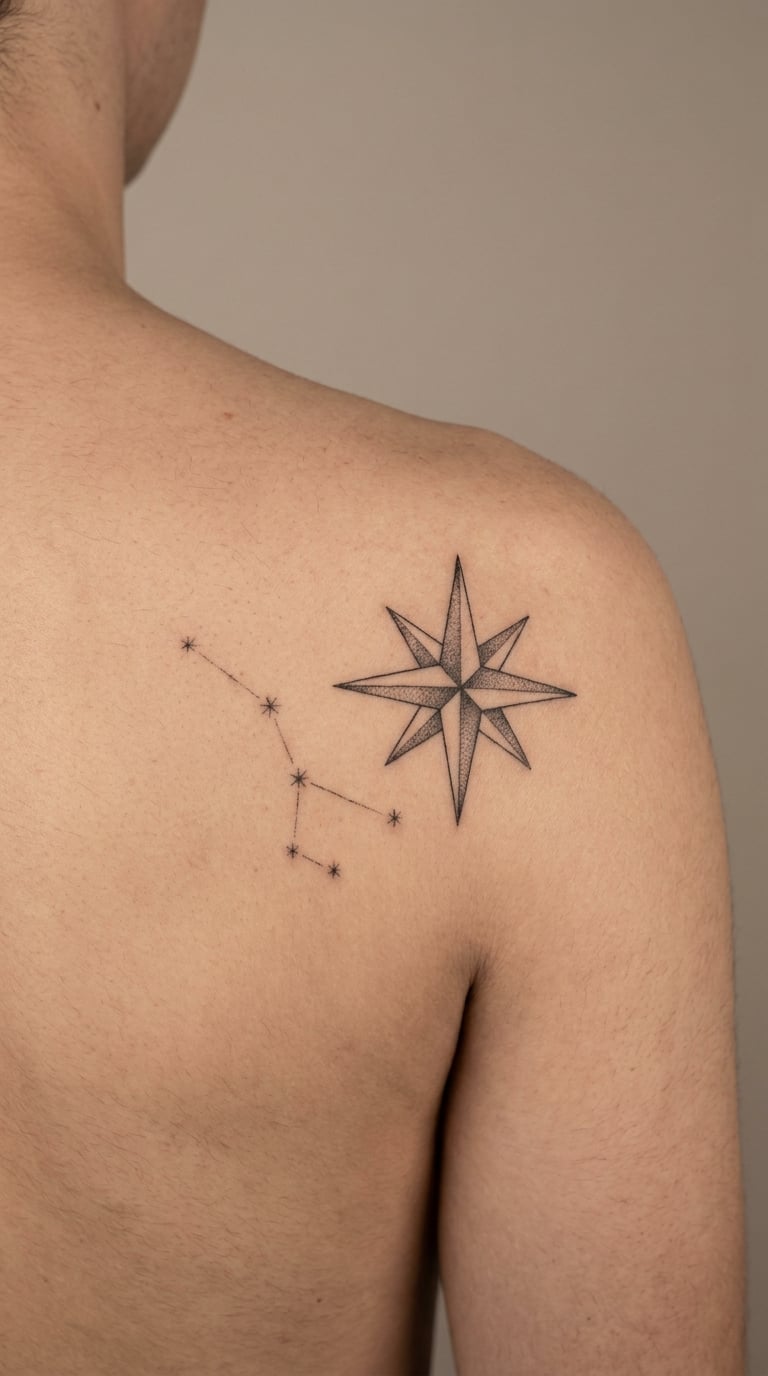
A clean nautical star sits near a sparse arrangement of dots joined by hairline strokes, matching a constellation you can actually see from a specific spot. Keeping the constellation to five or six stars is the trick; a full chart turns into a grey smudge quickly.
The constellation is always a personal pick, usually the sky over somewhere that mattered, which makes this a good design for a coastal childhood or a long relationship with one place. For a matching or complementary upper-body piece, our roundup of star tattoos for women’s shoulders has options that sit well next to this one.
Placement: shoulder blade, upper back, or rib. Size: 4-6 inch (10-15 cm) across. Style: dotwork and fine line. Pain: medium. Ageing: dots spread over time and the connecting lines fade first, so the design drifts from a chart into an abstract shape. Make it yours: add the date you first saw that sky, or the name of the beach.
11. Star Map with Highlighted Destination
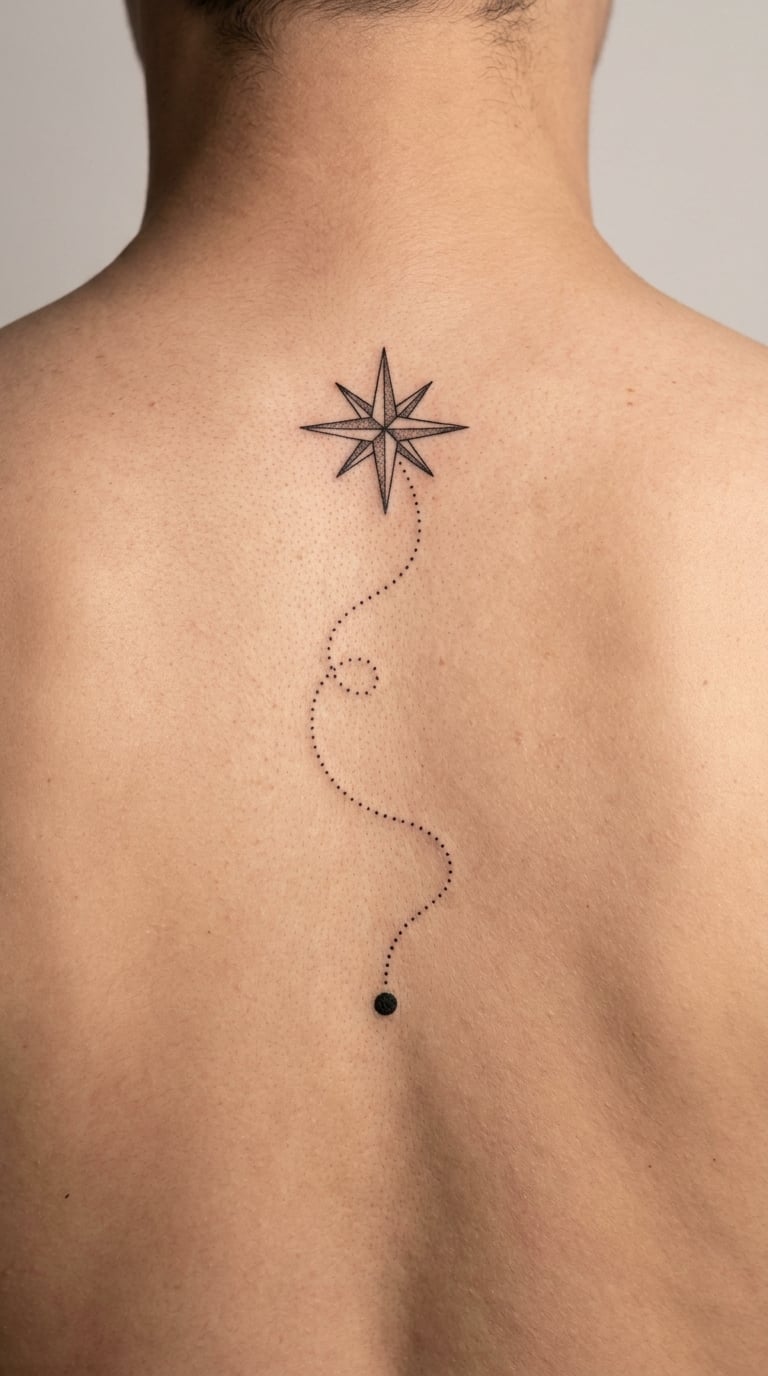
A large sparse star field with one eight-point nautical star at the centre, a dotted route line, and a single solid dot marking where the route ends. The design is mostly empty space, which is exactly why it works: nothing competes with the one meaningful point.
It turns up for people marking a voyage, a birthplace, or a relationship, and it reads as a design with a hidden explanation rather than an obvious nautical set.
Placement: upper back, shoulder blade, or thigh. Size: 6-8 inch (15-20 cm) wide. Style: minimal fine line. Pain: medium; back work is uncomfortable but steady. Ageing: tiny stars thin out, so ask the artist to keep the smallest dots off the sun-exposed areas. Make it yours: use real coordinates for the destination dot, or plot a route you actually took.
12. Nautical Star Inside a Lifebuoy
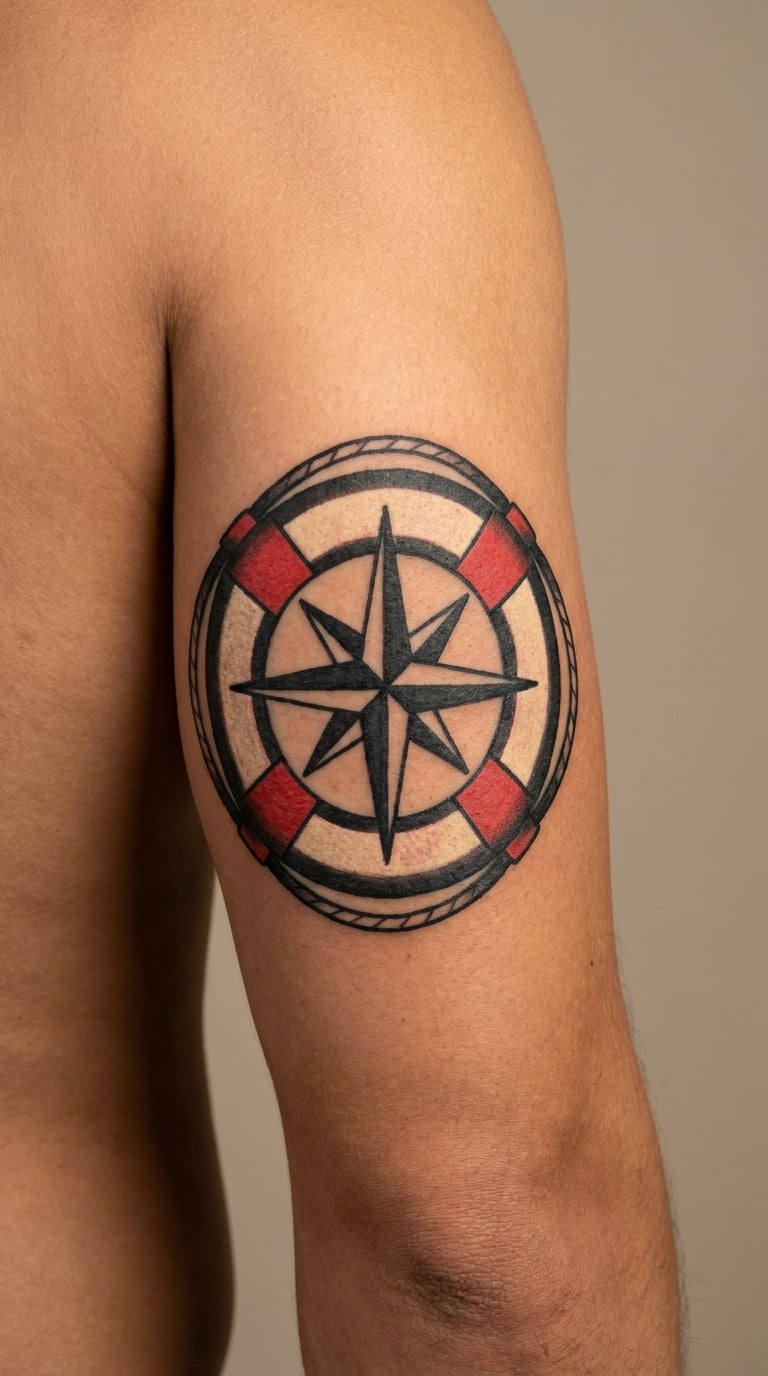
A clean ring of a lifebuoy with an eight-point nautical star at its centre, drawn with bold geometry and restrained colour. Traditional versions use four red bands on a cream ring; a modern take drops the colour and keeps the ring in black with grey shading.
It carries maritime and safety-at-sea associations, and the round shape makes it easy to place on a curved area like the shoulder or upper arm. If the beach-motif side of it appeals more, starfish tattoo ideas cover the same coastal ground with a lighter hand.
Placement: upper arm, shoulder, or calf. Size: 3-4 inch (8-10 cm) across. Style: traditional or neo-traditional with one or two colours. Pain: medium. Ageing: the cream and red need more sun protection than pure black. Make it yours: have a vessel name or a home port curved along the top of the ring.
13. Whale Tail Beneath a Nautical Star
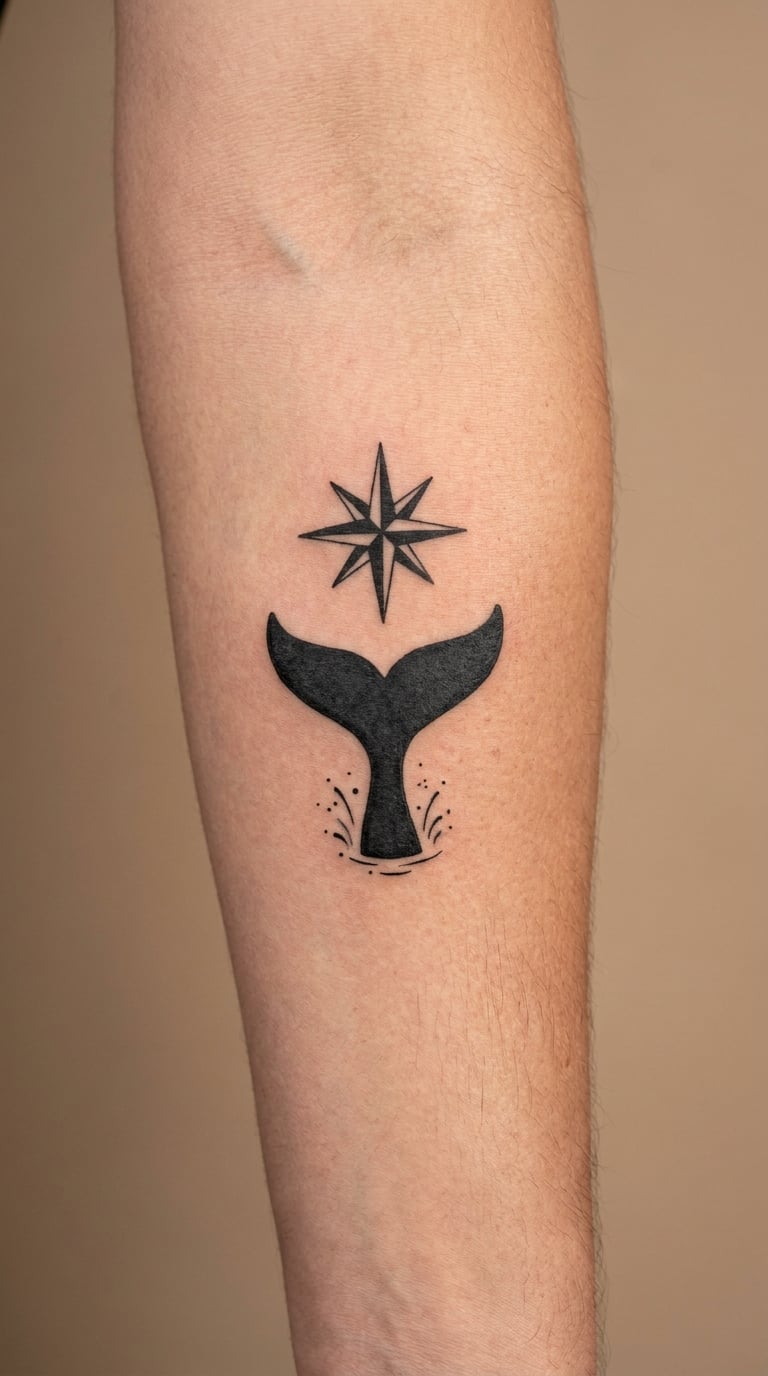
A stylised whale tail rising below the star with a small burst of spray, both drawn in solid black linework and no background. Leaving out the ocean is deliberate: the tail reads as marine life on its own, and the empty space keeps it from looking like a sticker.
It is a good partner for people who care about ocean ecosystems rather than shipping, and it sits well in a vertical forearm or calf layout.
Placement: forearm, calf, or ribs. Size: 4-6 inch (10-15 cm) tall. Style: blackwork illustrative. Pain: medium. Ageing: the spray droplets are the smallest element here and fade first. Make it yours: add a soft watercolour wash behind it, or set the wave line to your birth year in Roman numerals.
14. Sea Serpent Coiling Around a Nautical Star
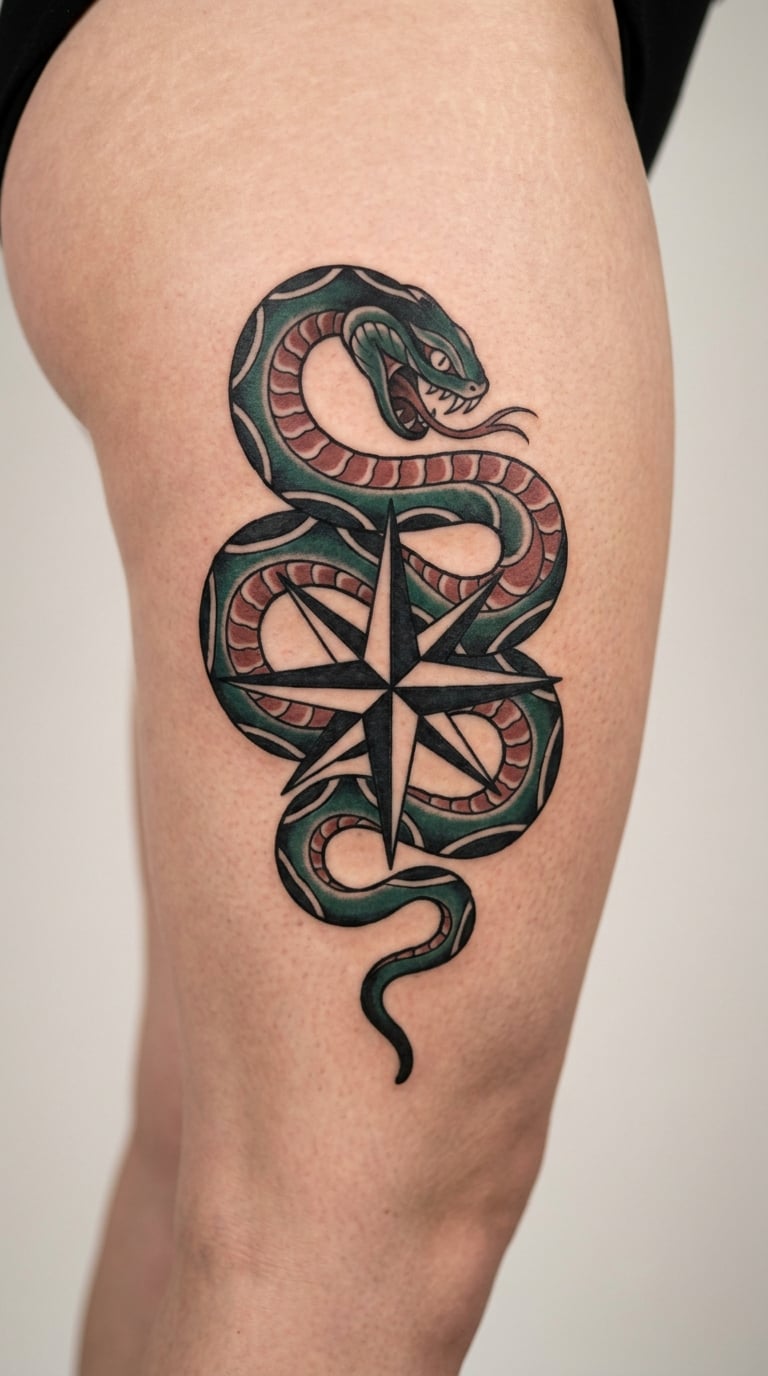
A simplified sea serpent curves around a crisp nautical star without covering it, leaving at least two of the eight points fully visible. Scale texture, a small dorsal fin, and a split tail separate it from the eastern dragons that use the same body shape.
Myth and sea meet here, which is the appeal. It is a story-piece rather than a symbol piece, so there is no fixed reading to worry about.
Placement: outer thigh, calf, or ribs. Size: 6-9 inch (15-23 cm) long. Style: neo-traditional with colour. Pain: medium, thigh sessions run long. Ageing: green and red shift fastest, so expect the palette to drift toward brown over time. Make it yours: add a small wave under the coil, or give the serpent a sea-green belly.
15. Crescent Moon and Nautical Star
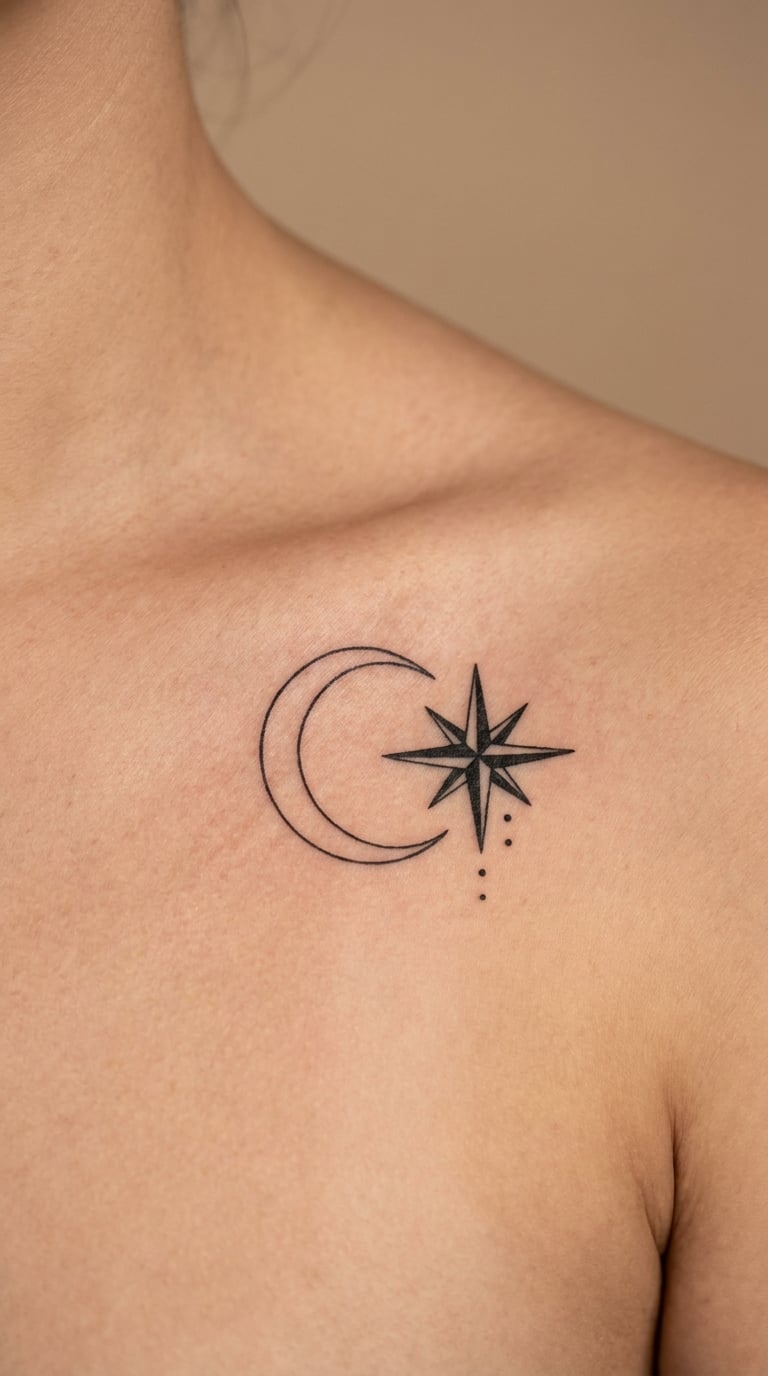
A slender crescent moon facing a single nautical star, balanced with three small dot accents and nothing else. The trick is the spacing: the moon and star sit at the same height with a real gap between them, and adding more elements kills the balance.
It usually shows up as a night-sailing or coastal-nights reference, and the pairing works well as a matching design when both are placed at the same height.
Placement: collarbone, inner arm, or behind the ear. Size: 2-4 inch (5-10 cm) wide. Style: fine line, or a soft moon gradient if you want more shading. Pain: medium-high, the collarbone sits right on bone. Ageing: the dot accents disappear first. Make it yours: add a soft green or grey gradient to the moon, or set the dots to a latitude and longitude.
16. Nautical Star with Coordinates
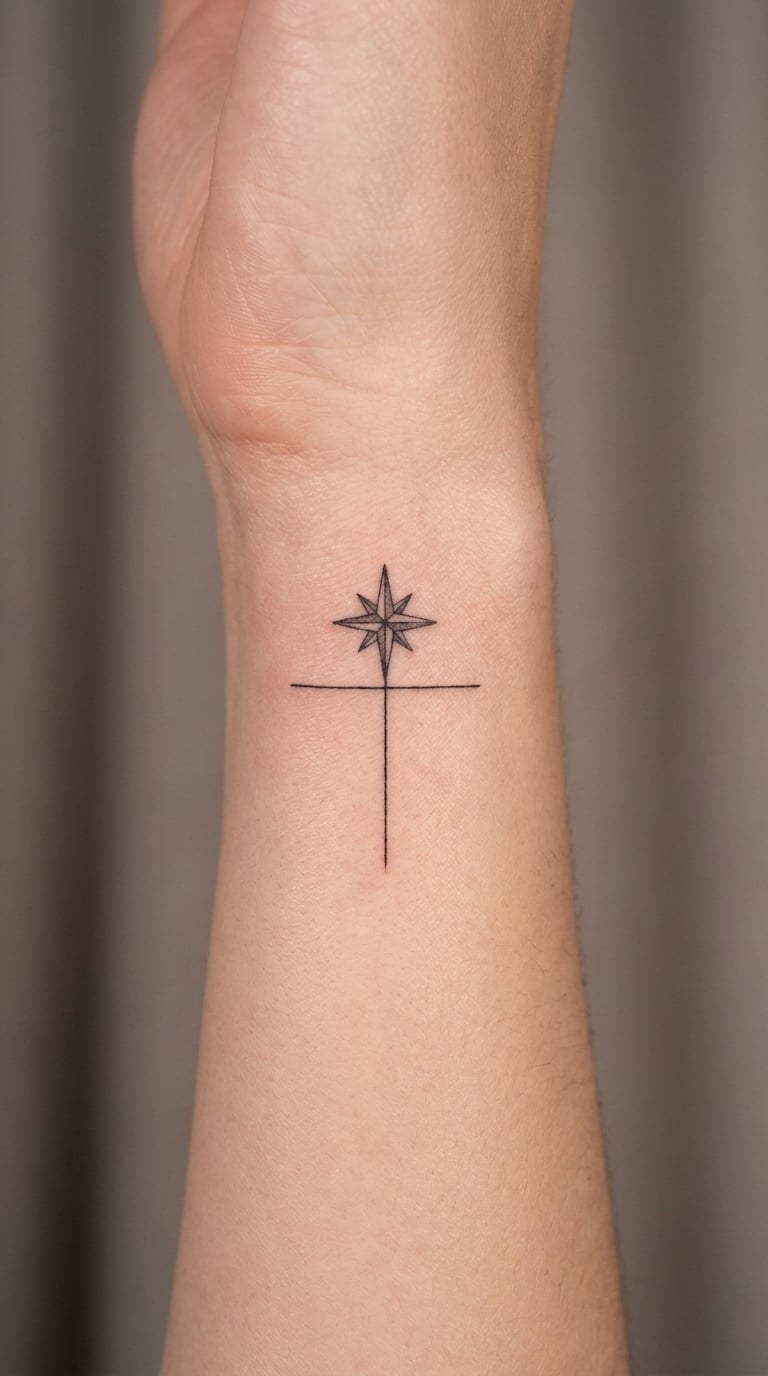
A compact star with a single line of real or invented coordinates set in clean type underneath it. Artists usually pick a plain sans-serif, keep the type the same visual weight as the star outline, and leave a clear gap between the two.
This is the most personal of the twenty, and the coordinates are almost always somewhere real: a first boat, a dive site, a hospital, a house.
Placement: inner wrist, inner arm, or ankle. Size: 1.5-2.5 inch (4-6 cm) tall including the type. Style: minimal with clean type. Pain: medium-high on the inner wrist. Ageing: small lettering blurs first, so ask for slightly larger characters than look necessary in the drawing. Make it yours: have a second person carry the matching coordinate, and keep it at the same scale.
17. Nautical Star and Pennant Flag
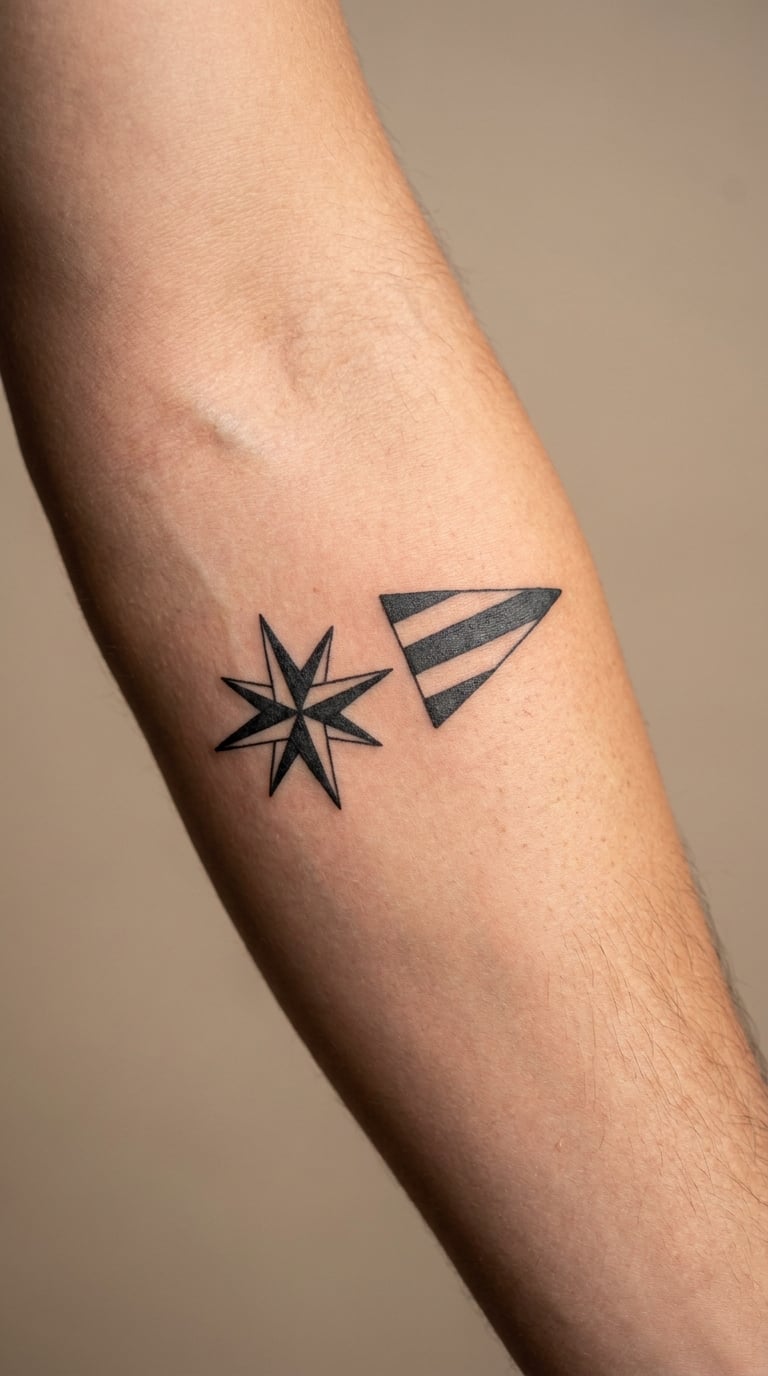
An eight-point star paired with a simple triangular signal pennant on a short angled staff, with two or three plain stripes and no emblem. The diagonal line from the lower star point up to the flag tip keeps a two-element design from looking like two separate tattoos.
Signal flags get chosen as a personal code, and it is a useful design for anyone who wants maritime imagery without a full nautical set.
Placement: outer forearm, calf, or upper arm. Size: 3-4 inch (8-10 cm) wide. Style: clean linework, traditional if you add colour. Pain: medium. Ageing: narrow flag stripes fade unevenly, so keep them wider than they look on paper. Make it yours: set the stripes to initials, or use the colours of a boat you actually sailed on.
18. Star Emerging from a Sea Glass
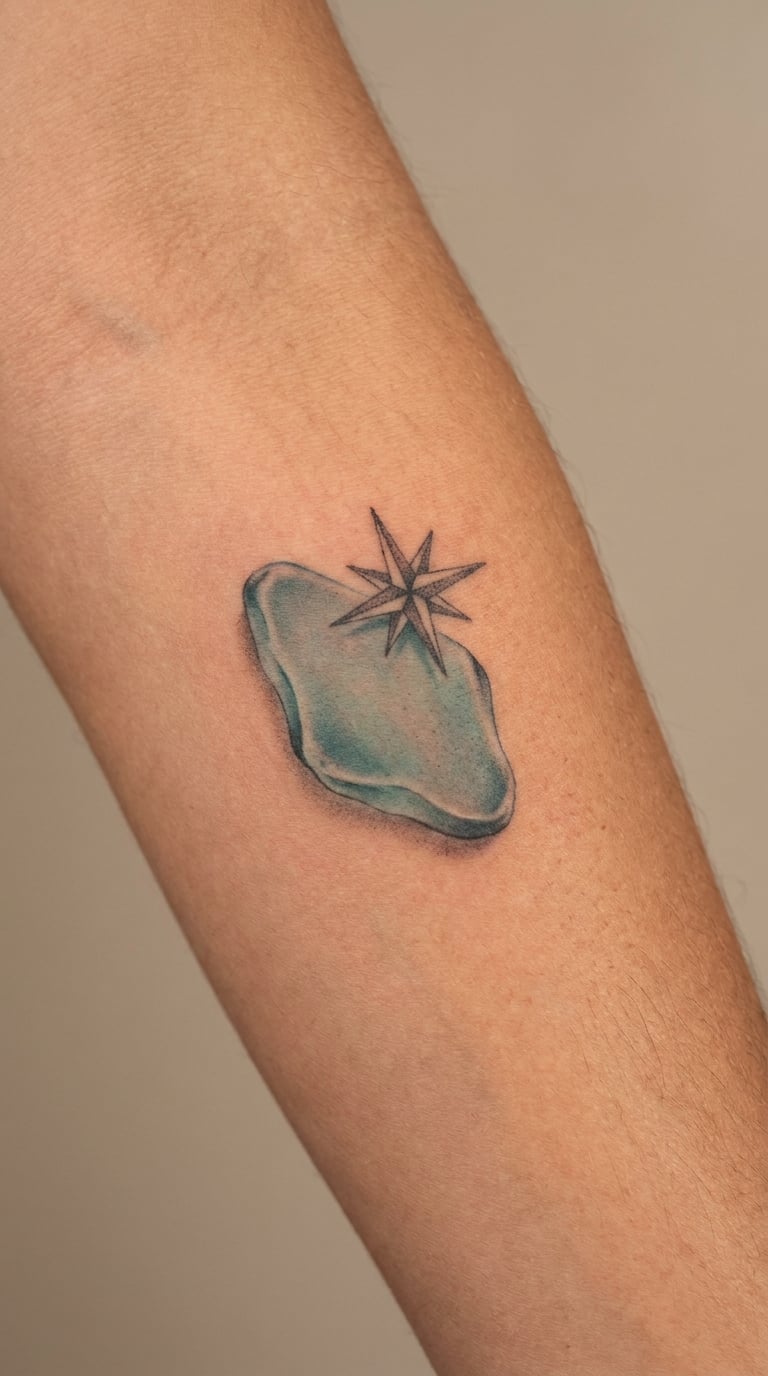
A softly shaded piece of sea glass with a small nautical star resting on it, the star drawn crisply so it stays the sharpest thing in the piece while the glass edges fade out. Soft greens and blues are the usual palette, sometimes with a warm amber edge.
Beach finds and coastal keepsakes are the reason behind most of these. A lot of people are working from a specific piece of glass they actually picked up.
Placement: forearm, shoulder, or calf. Size: 2.5-3.5 inch (6-9 cm). Style: illustrative with soft colour. Pain: medium. Ageing: the soft colour is the weak point, so this one wants a larger version than you might first expect. Make it yours: bring or photograph the actual glass so the artist can match the colour and the chipped edge.
19. Vintage Seal with Nautical Star
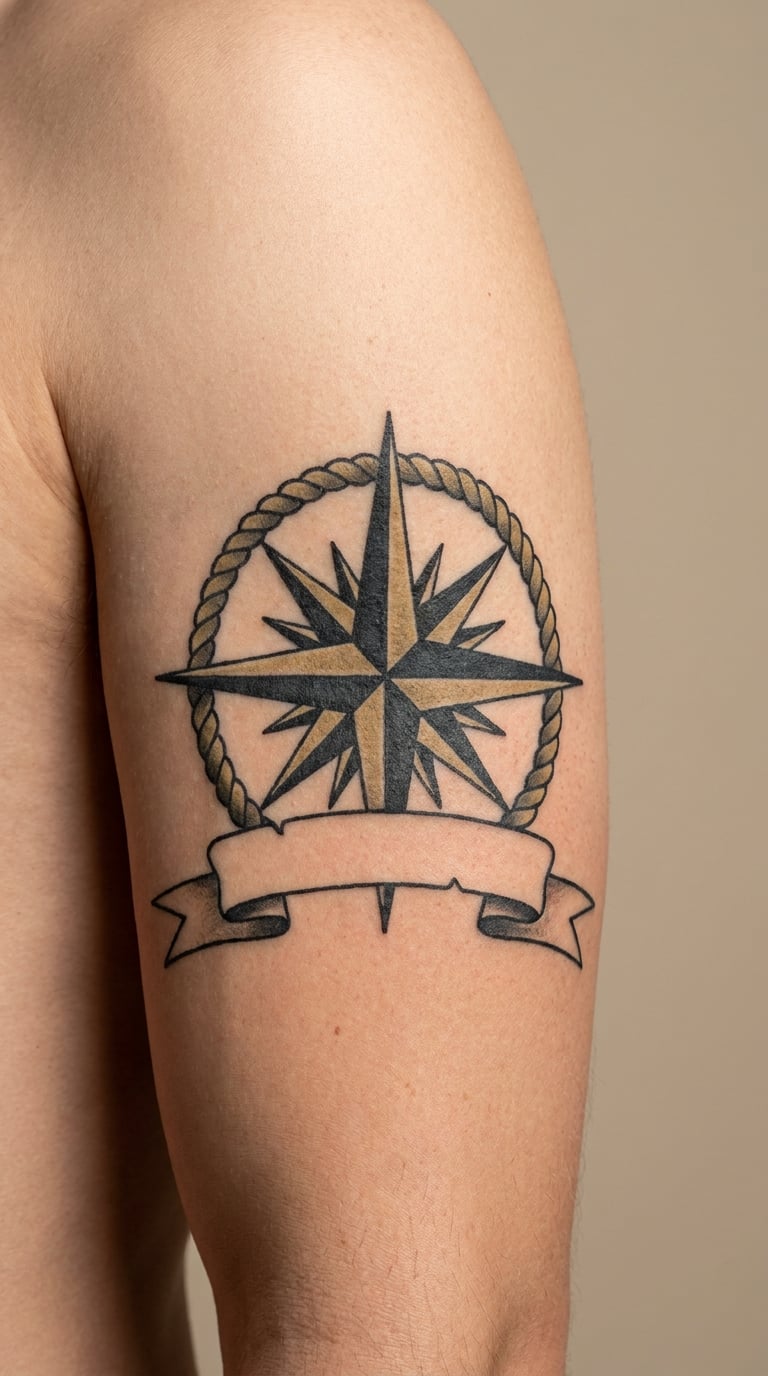
A compact old-world emblem: an eight-point star at the centre, a rope border looping around it, a small blank ribbon banner, and restrained references to a ship or a rope coil. It borrows from engraved seals rather than from any one real institution, so nothing in it carries a heraldic claim.
It suits people who want a nautical piece that looks older than they are, and it fills a forearm or upper arm without needing to be huge.
Placement: upper arm, chest, or thigh. Size: 3-5 inch (8-13 cm). Style: engraving-inspired traditional. Pain: medium-high, the rope border takes time. Ageing: the tiny inner line work in the rope and banner softens first. Make it yours: have initials or a birth year fitted into the banner before the artist locks the drawing.
20. Blackwork Nautical Starburst
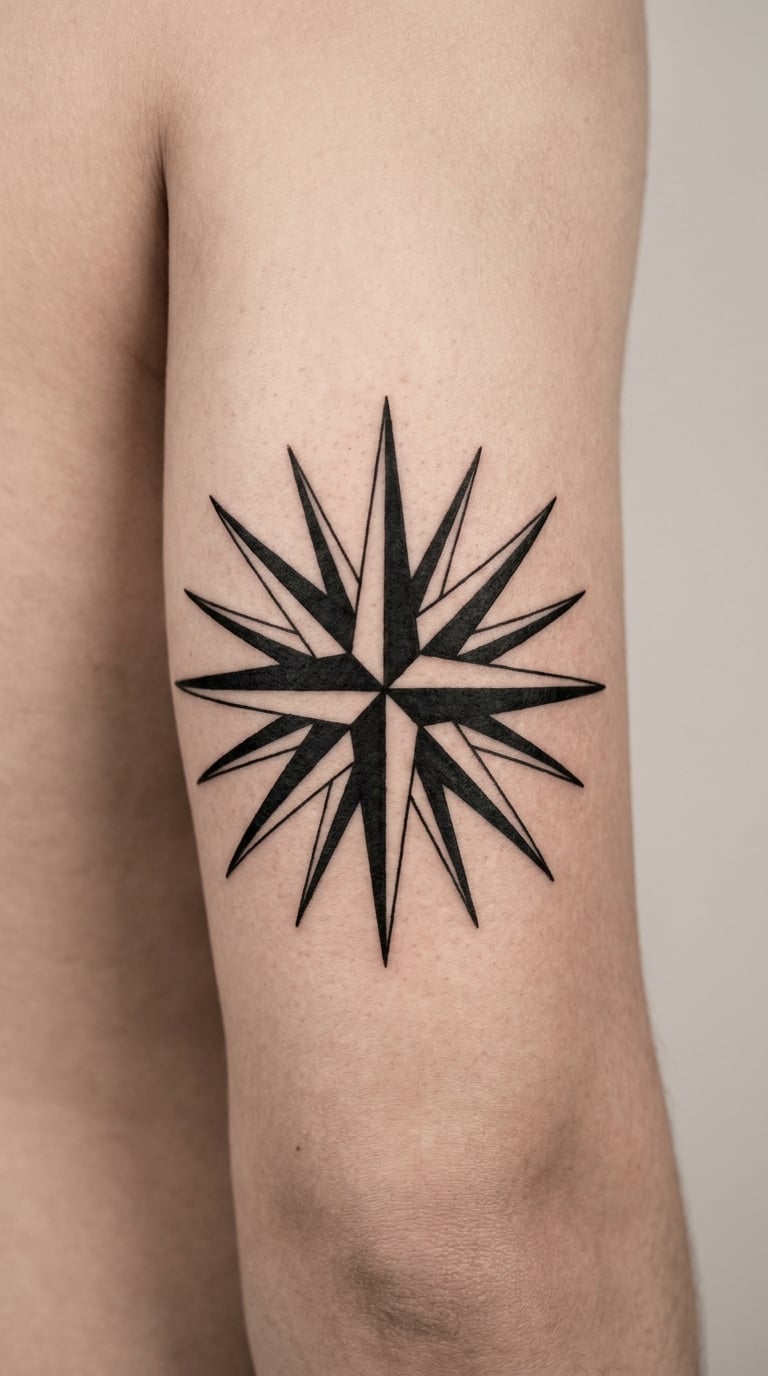
The high-contrast version builds the eight-point star out of solid black wedges with negative space doing the work between them, plus a few short rays cut from the surrounding skin. Nothing is shaded, nothing is grey, and there is no background at all.
It is the right pick for someone building a bold monochrome collection, and it is the most readable of all twenty from across a room.
Placement: outer upper arm, chest, or thigh. Size: 4-6 inch (10-15 cm). Style: solid black blackwork. Pain: medium. Ageing: solid black softens at the edges over time, and the fine rays between wedges need a full black outline. Make it yours: have the negative space between two of the wedges cut as a small wave or a pair of coordinates.
How to Choose the Right Design
Start with the silhouette. If you want a first tattoo that still reads clearly in ten years, pick one of the bolder options on this list: the traditional star, the blackwork starburst, the lifebuoy, or the anchor pairing. Fine line and chart work reward a bigger size and a steady hand, and they are a poor first choice if you want something that survives sun and swimming.
- Style first. Traditional black and grey suits a sailor reference, fine line suits a quiet minimal piece, blackwork suits a bold monochrome set, and illustrative or neo-traditional suits a story piece.
- Size second. Ask for the size in inches at the point of the design, not the overall bounding box. A star that measures 4 inches across the tips still looks cramped on a 4-inch forearm, so most artists will scale it up before they scale it down.
- Placement third. Match the design to how much room the body site gives you. Rounded shapes such as the lifebuoy and the ship wheel work better on curves, and vertical pieces such as the lighthouse and the whale tail suit a forearm or calf.
- Ink colour. The old rule is red and black, or nothing. It comes from sailor tradition, and plenty of studios still work that way, but plenty of good work is black and grey only, and the blackwork options on this list have no colour at all.
- Detail density. The chart, star map, and constellation designs need a body site that can hold them, usually back, thigh, or upper arm. Move them smaller and the fine line detail turns to grey.
- What is already there. If you have an existing nautical set, check the line weight and the shading style of the healed work before adding a star. Matching an old healed piece exactly is harder than starting fresh.
One thing worth knowing before you book: in the 1940s the nautical star on the inner wrist was used by some lesbians to signal sexuality, and that reading still follows the design around. If that is not what you want people to assume, an outer forearm, upper arm, or chest placement keeps the meaning with the people who know you.
Cost and Session Time
Tattoo pricing in the US usually works on an hourly rate with a shop minimum, and both vary a lot between a small town and a big city. Most studios charge somewhere around $120 to $200 an hour, with a shop minimum that usually covers the first half hour, so a tiny 2-3 inch star often lands somewhere in the low hundreds and a detailed chart, star map, or sea serpent at 6-9 inches can run into the low thousands once it needs a full session or two.
A small nautical star of 2-3 inches is often a single short session of 30 to 60 minutes. Mid-size pieces at 4-6 inches commonly take an hour to an hour and a half. Anything at 6-9 inches, or anything with grey wash and colour, is more likely a two-to-three-hour sitting or a planned series.
The factors that actually move the number: total size in inches, whether the design needs grey wash or colour, how long the sitting will be, the shop minimum, and how experienced the artist is. Fine line and dotwork cost less per hour than solid blackwork or detailed illustrative work, and touch-ups are sometimes included and sometimes not, so ask about that on day one rather than after.
Get the quote before the stencil goes on, in writing if you can. A clear rate card up front means you can walk away from a shop that quotes you after the design is already placed.
Aftercare Basics
Follow your artist’s aftercare instructions first, since they will know what they put in your skin. The general routine after that is simple and mostly about not bothering it.
- Follow your artist’s aftercare instructions, and if anything conflicts with this list, follow theirs.
- Wash the area gently with unscented soap and lukewarm water, then pat it dry with clean hands or a paper towel rather than rubbing.
- Keep it covered loosely with a clean garment or gauze for sleeping, and let it breathe rather than sealing it under plastic.
- Stay out of swimming pools, hot tubs, and the sea while the surface is still healing, and keep it out of direct sun once the tattoo is healed.
- Wear loose clothing over it for the first few days, especially on the forearm, inner wrist, and ribs.
- Watch how it settles rather than fussing with it. Minor flaking and fading of the surface lines in the first fortnight is normal, and the real settle happens over several months.
One practical note for this particular design: solid black in a nautical star holds contrast far better than grey wash, so if fading bothers you, that is one more argument for the blackwork options over the shaded ones.
Frequently Asked Questions
What size should a nautical star tattoo be?
Most people land between 2 and 4 inches across the points for a standalone star. On the inner wrist or behind the ear, stay at the small end. On a forearm, chest, or back, go 3-4 inches so the interior shading survives. Sizes under 2 inches lose the alternating points to blurring within a few years, and anything over 5 inches needs a much flatter area of skin.
Do nautical star tattoos fade quickly?
Not faster than other black and grey work, but the design has weak spots. The fine interior lines between the points, tiny chart details, constellation dots, and small lettering blur first. Solid black wedges hold their contrast for many years. Sun, swimming pools, and salt water speed up fading on every placement, so cover the healed tattoo when you are out in it.
Is a wrist nautical star tattoo painful?
Moderately. The inner wrist and the wrist crease are bony with thin skin, and most people rate them a 6 to 7 out of 10 for a fine line star. The outer forearm, upper arm, chest, and thigh sit closer to a 4 or 5. Sessions are short, so the discomfort is over quickly. Expect 30 to 60 minutes for most wrist sizes.
Should a nautical star tattoo be blackwork or coloured?
Black and grey or solid blackwork ages best. The traditional colourway is red shaded points with black unshaded points, which is still a valid choice and still common, but red and any light cream or yellow will shift first. A solid black starburst or a traditional black and grey star holds its contrast longest. Ask to see healed examples of whichever version you are considering.
Which nautical star design works best for a first tattoo?
The traditional eight-point star or the blackwork starburst. Both have a bold, symmetrical silhouette that still reads clearly if the fine detail softens, and both finish in one short session at most body sites. Avoid chart, star map, and constellation designs for a first piece, since all three depend on hairline detail that a beginner rarely wants to lose.
If this is your first piece, go with idea 1 or idea 20. Both are symmetrical, both hold their shape, and neither depends on hairline detail. Take the size to your artist as a number in inches rather than a feeling, look at healed examples in the style you want, and let the artist scale the drawing to your body site before you commit.
If you already have nautical ink and you are adding to it, the antique chart, the star map, and the sea serpent give you the most room to build a theme. Check the line weight of your healed work against the new drawing, and be honest with yourself about whether the sun has softened the pieces you already have.