
20 Simple Tattoo Ideas for Beginners: Small Picks (October 2026)
These 20 simple tattoo ideas for beginners all share one thing: a low line count, one colour or none, and a design an artist can finish in under an hour. That means a short session, a straightforward healing, and a tattoo that still reads clearly years later.
They suit anyone sitting in the “should I actually do this” stage, plus anyone who wants something easy to hide at work. Most people book a first tattoo a few weeks ahead, so bring a reference photo and your rough size, and let the artist draw the stencil for you.
20 Simple Tattoo Ideas for Beginners: Quick Guide
Every design below sits in a small, legible size range. The pain column reflects the suggested placement, not the design itself.
| Idea | Style | Best placement | Size | Pain |
|---|---|---|---|---|
| 1. Fine-line paper plane | Fine line | Behind the ear | 1-1.5 in | Medium |
| 2. Tiny black heart | Blackwork | Inner wrist | 0.5-0.75 in | Medium |
| 3. Single cherry | Illustrative, one colour | Inner forearm | 1.5-2 in | Low to medium |
| 4. Sunbathing cat | Fine line, one accent | Outer ankle | 2-2.5 in | Medium |
| 5. Laurel sprig | Botanical line art | Collarbone | 2.5-3 in | Medium |
| 6. Tiny mountain peak | Geometric | Inner forearm | 1.5-2 in | Low to medium |
| 7. Single outline wave | Illustrative, blue accent | Outer calf | 2-3 in | Medium |
| 8. Ringed planet | Minimal, black and grey | Upper arm | 1-1.5 in | Low |
| 9. Daisy chain | Soft illustrative | Ankle | 2.5-3 in | Medium |
| 10. Tiny coffee cup | Cute line art | Inner wrist | 1-1.5 in | Medium |
| 11. Crescent moon | Fine line, blackwork | Behind the ear | 1-1.5 in | Medium |
| 12. Open semicircle | Geometric | Inner wrist | 0.75-1 in | Low to medium |
| 13. Candle flame | Neo-traditional, one colour | Inner arm | 1.5-2 in | Medium |
| 14. Tiny lightning bolt | Blackwork | Inner wrist | 1-1.5 in | Medium |
| 15. Mini eye | Micro-realism | Upper arm | 1.5-2 in | Medium |
| 16. Simple house outline | Architectural line art | Forearm | 1.5-2 in | Low to medium |
| 17. Four-point star | Blackwork | Shoulder | 0.5-1 in | Low |
| 18. Tiny mushroom | Illustrative, dotwork | Calf | 1.5-2 in | Medium |
| 19. Minimal sparrow | Fine line | Side of neck | 1.5-2 in | Medium |
| 20. Small butterfly | Fine line, one colour | Back of hand | 2-2.5 in | High |
1. Fine-Line Paper Plane Behind the Ear
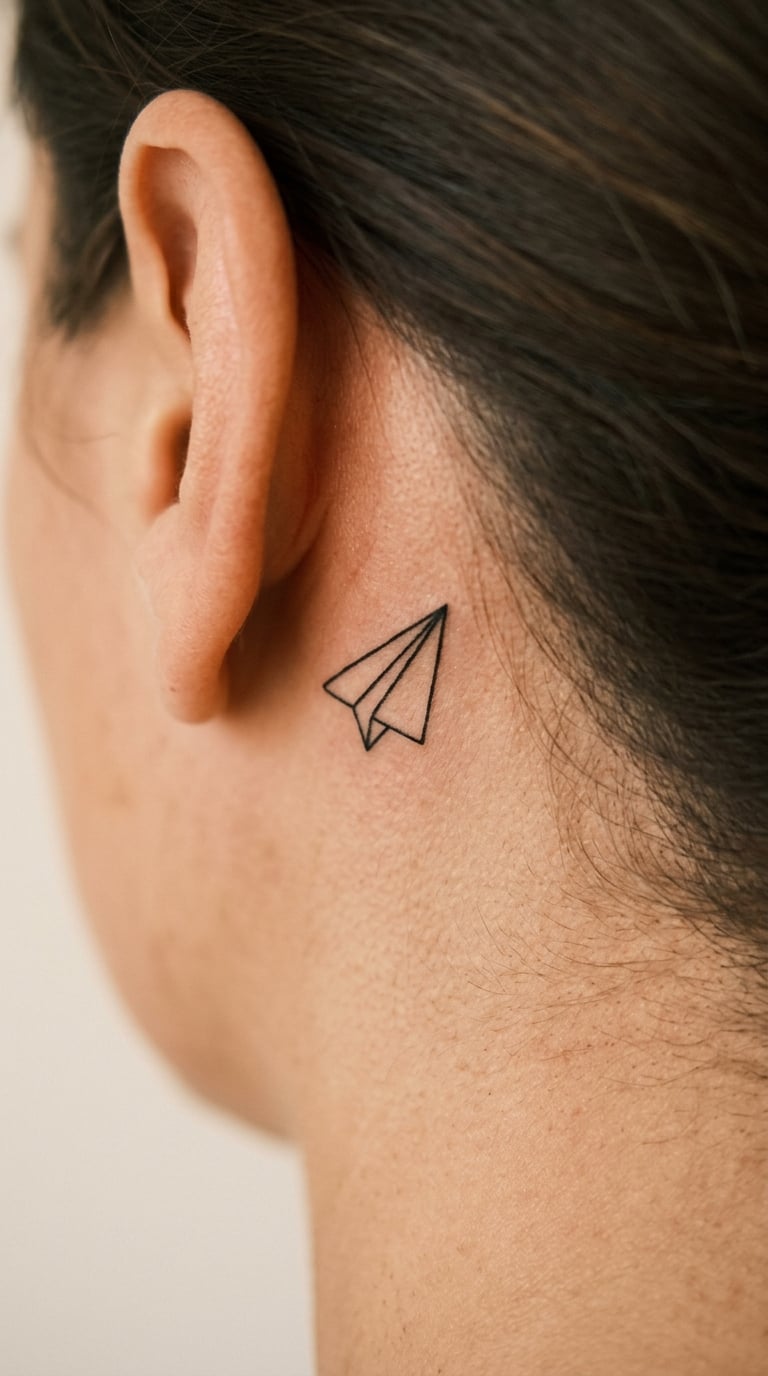
The paper plane is drawn as one continuous line that folds back on itself to form two wings and a short body. No shading, no colour, no background.
People usually reach for it because it hints at travel, moving somewhere new, or leaving a chapter behind. It carries no fixed meaning, so whatever it means to you is the meaning it keeps.
Placement: behind the ear, tucked into the curve between ear and skull. Size: 1 to 1.5 inch (2.5 to 4 cm) nose to tail. Style: fine line, single-needle weight.
Pain: medium. The neck skin is thin and the area near the ear has little cushion, so expect a scratchy, sustained feeling rather than a sharp one. Fine line on the neck fades faster than the same design on an arm, so ask your artist to keep the line confident rather than hair-thin.
Make it yours: add a tiny dot trailing behind the plane, like a flight path.
2. Tiny Black Heart on the Inner Wrist
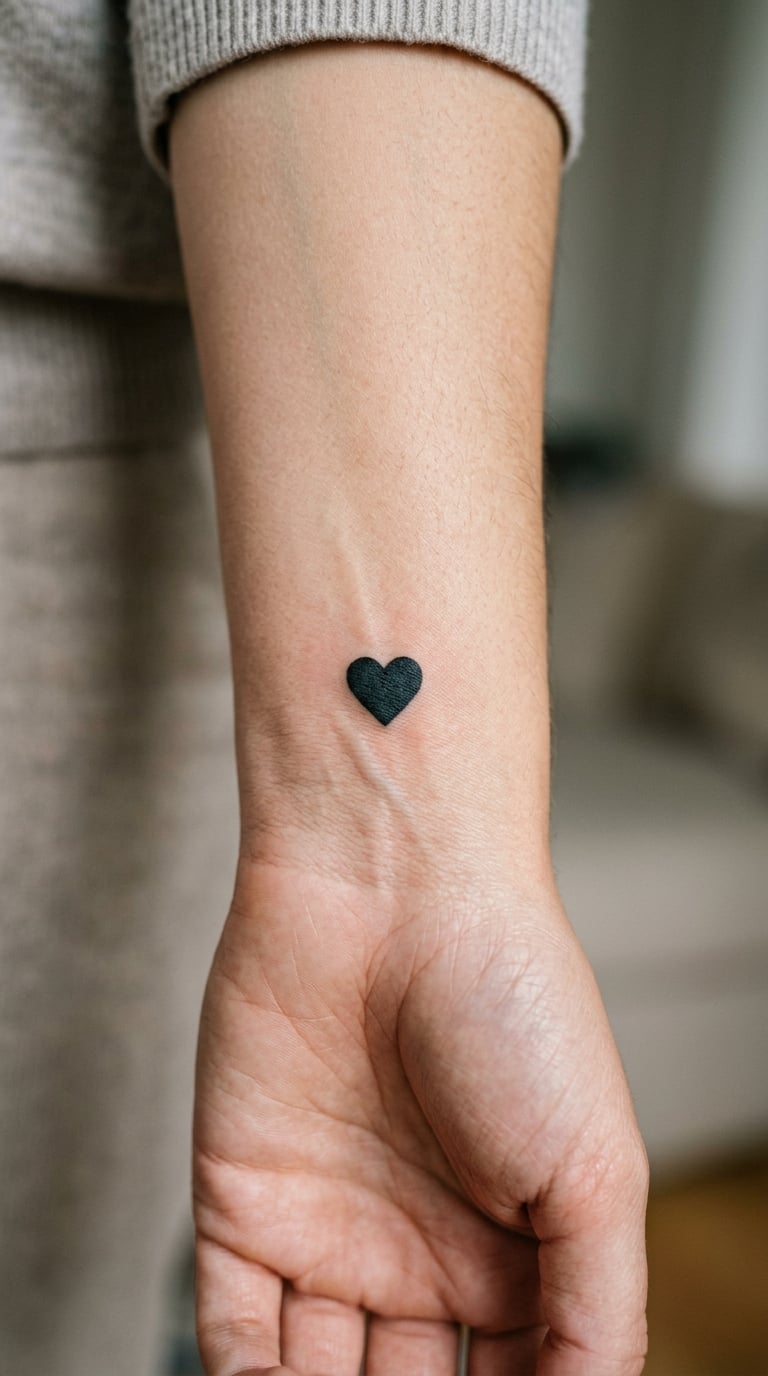
Two options here: one solid black heart, packed with ink, or a single outline heart with clean open space inside. The solid version survives time better because there is no thin line to wear away.
A heart on the inner wrist is often a private reminder rather than a public love statement. People choose it for self-affection, for a person who will always know what it means, or as a small daily check-in.
Placement: inner wrist, just above the crease and slightly to one side of the forearm’s centre line. Size: 0.5 to 0.75 inch (1.5 to 2 cm) across. Style: solid blackwork or bold outline.
Pain: medium, and wrist bones make it more noticeable than the same design on the upper arm. Most people describe the discomfort as a constant scratching that you learn to breathe through. A solid black fill also tends to spread very slightly as it heals, so the size is worth checking with your artist before the stencil goes on.
Make it yours: a tiny numeral or initial tucked inside an outline heart turns it into something only you read.
3. Single Cherry on the Forearm
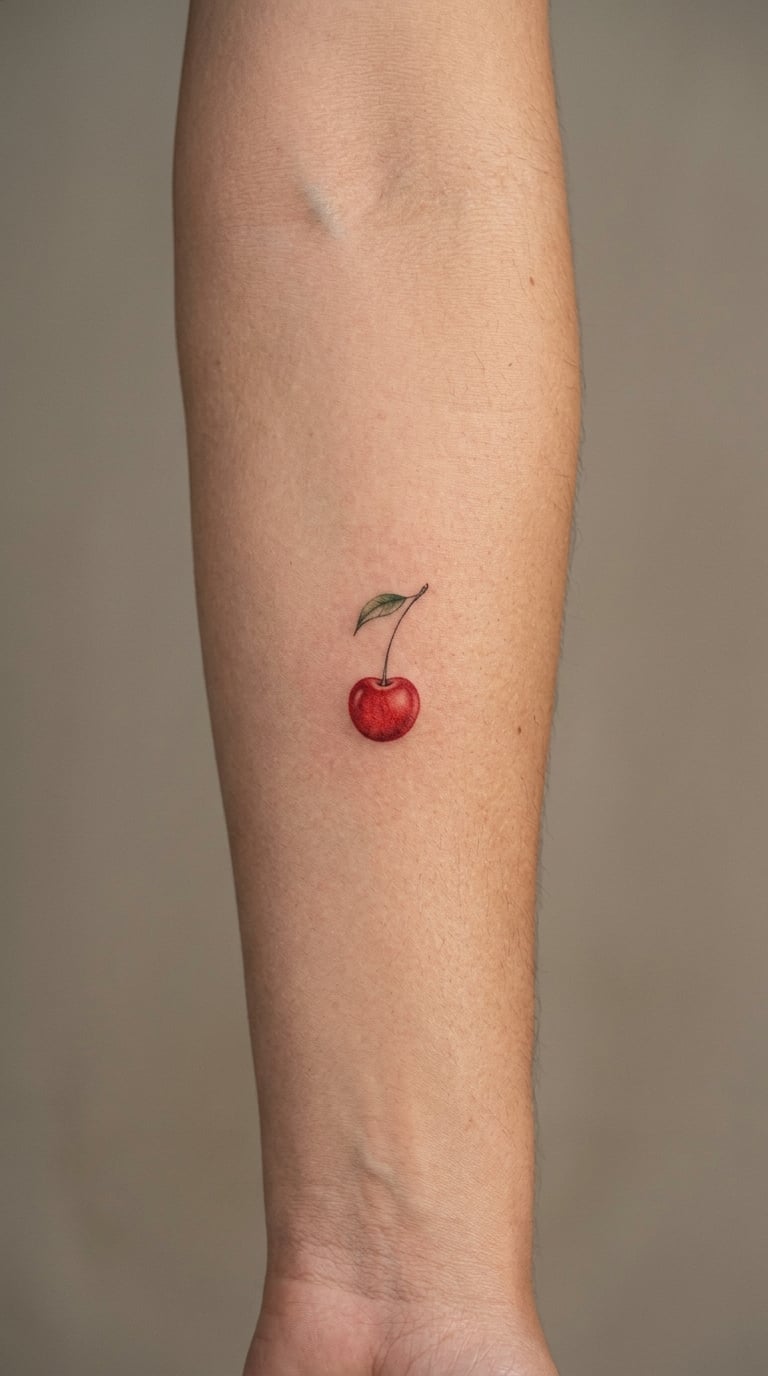
One cherry with a curved stem, done in a single warm red with a small black outline and one white highlight on the fruit. Black and grey works too, and gives a more graphic look.
It reads as playful and a little cheeky. Many people pick it for the colour rather than a message, which is a perfectly good reason for a first tattoo.
Placement: inner forearm, resting between wrist and elbow. Size: 1.5 to 2 inch (4 to 5 cm) including the stem. Style: illustrative or light neo-traditional, single colour.
Pain: low to medium on the inner forearm, which has decent muscle and fat under it. Red ink can feel a little warmer than black because of how it sits on the skin. The stem is the fiddly part, so let your artist keep it short rather than ornate.
Make it yours: a second cherry on the other forearm, slightly different in size, reads as a pair without looking like a copy.
4. Sunbathing Cat on the Ankle
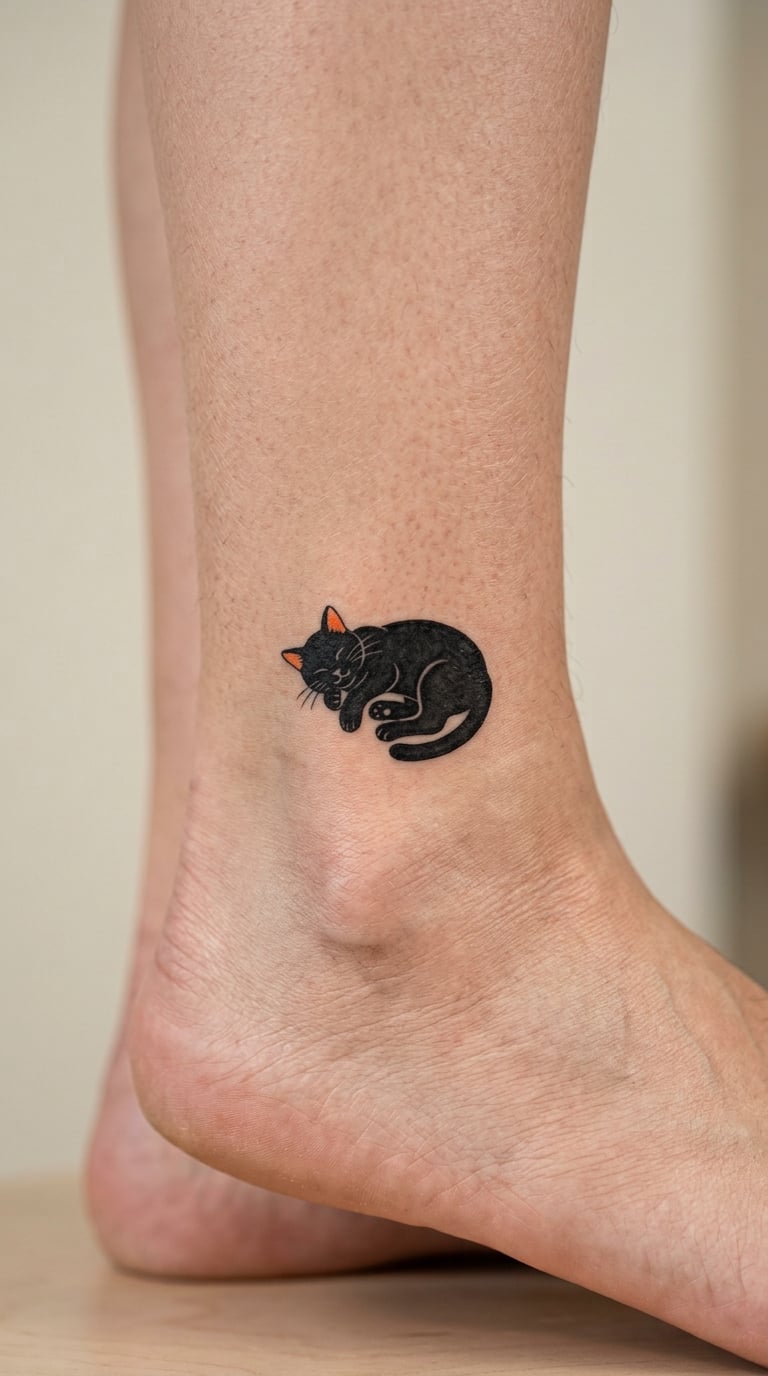
A cat stretched out on its side, belly up, one paw over the head. It is drawn in fine black line with maybe twenty strokes total, and a single orange patch on the ear or tail is the only colour.
Sunbathing cats are chosen for the actual personality behind them. It is a low-effort likeness that says something about you without needing a portrait.
Placement: outer ankle, above the bone, angled to follow the leg. Size: 2 to 2.5 inch (5 to 6 cm) nose to tail. Style: fine line with one small colour accent.
Pain: medium. The ankle is bony, so the needle bites more noticeably than on a forearm. Ankle tattoos also rub against shoes and waistbands while they heal, which is where a lot of beginner irritation comes from. Loose footwear for a couple of weeks is the practical fix.
Make it yours: a single-line collar tag carrying the cat’s name, or a matching set of two so both ankles look deliberate.
5. Laurel Sprig on the Collarbone
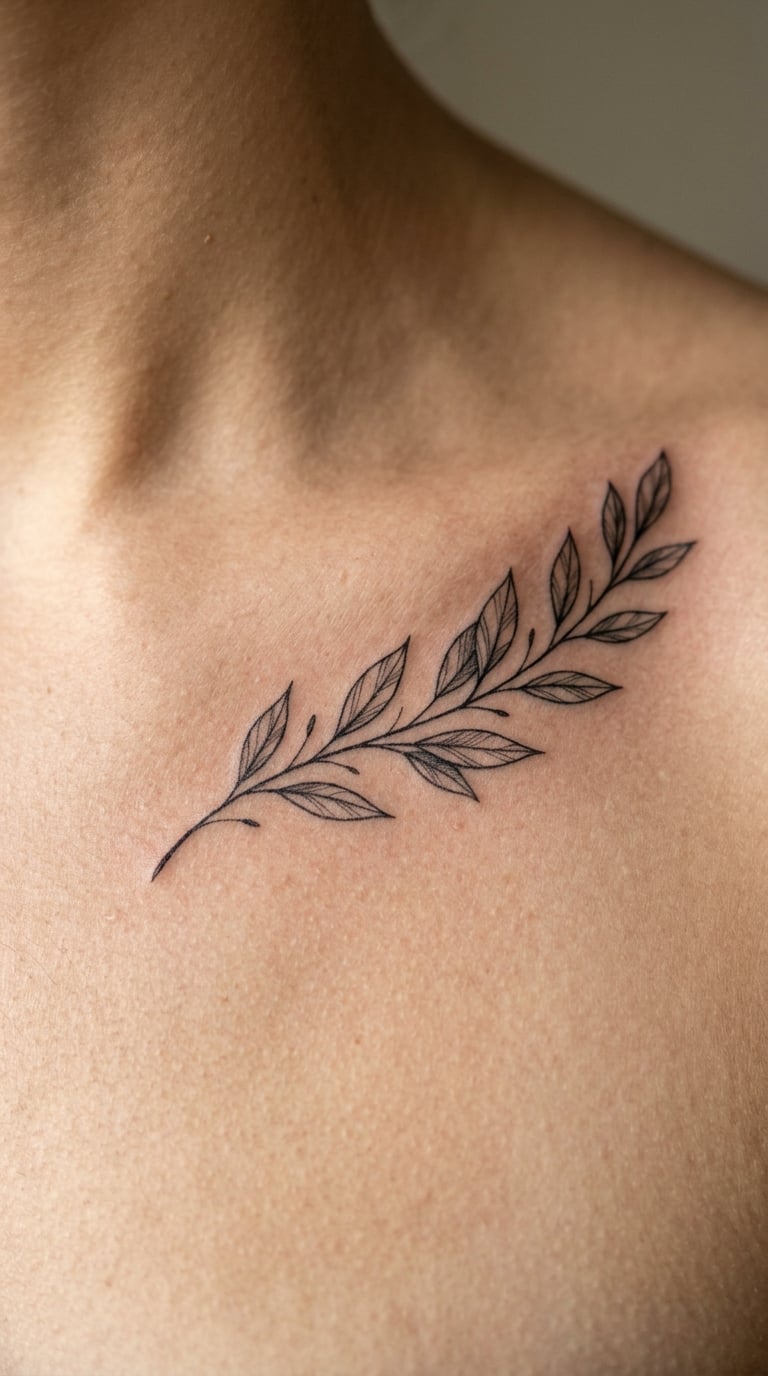
One curved branch with leaves alternating along both sides, drawn in clean botanical linework with no fill. Some artists add a second shorter sprig the other way for balance.
Laurel is one of those motifs people attach to growth or achievement, though plenty of people just like the shape. Meaning is personal here more than almost anywhere else on this list. If line art is the lane you are shopping in, our 20 line art tattoo ideas for women covers the same style with more variety.
Placement: collarbone, following the bone’s curve. Size: 2.5 to 3 inch (6 to 7.5 cm) along the bone. Style: botanical line art.
Pain: medium and slightly stingy, because the collarbone sits close under the skin with almost no padding. This is one placement people get cold feet about, and the skin over bone does tend to stay pink longer. Not a dealbreaker, just worth knowing.
Make it yours: count the leaves to match a year, or add one berry for a specific person.
6. Tiny Mountain Peak on the Forearm
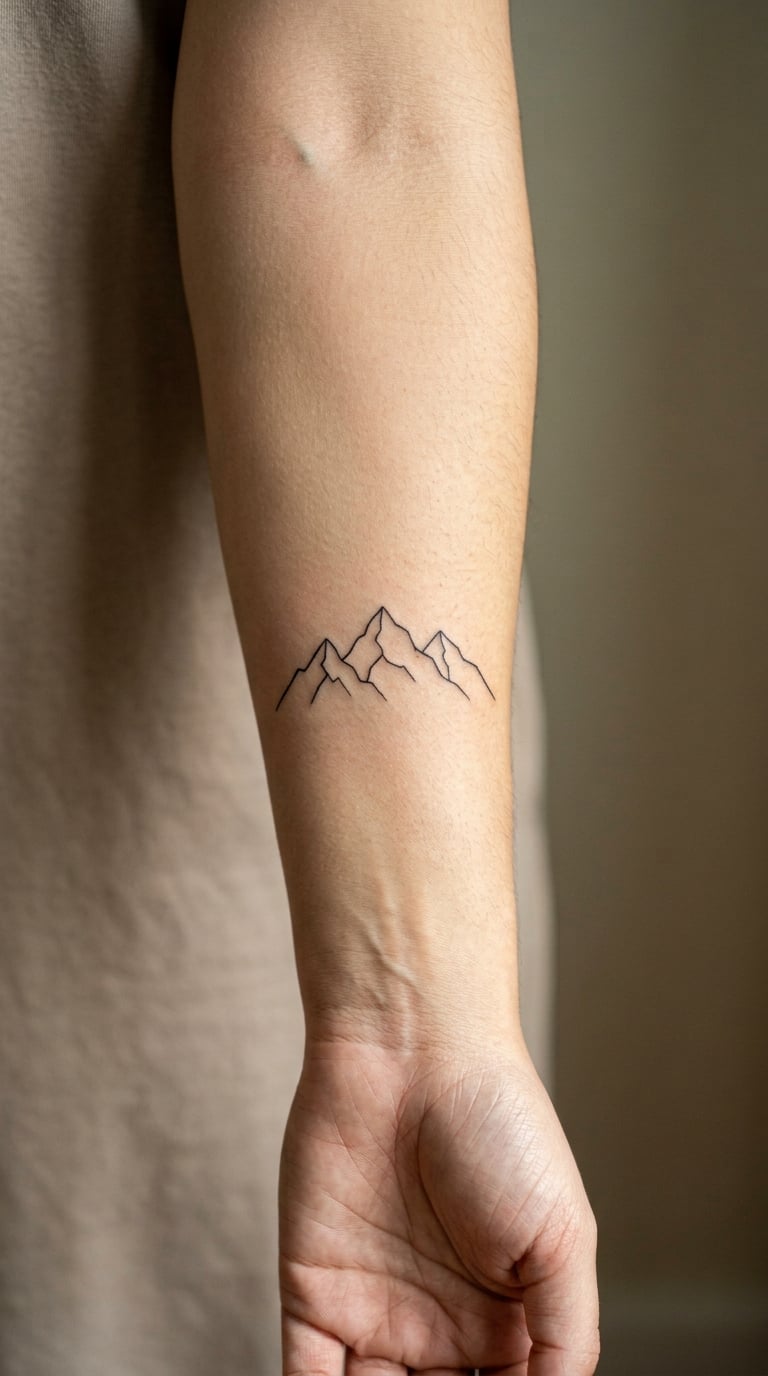
Two or three peaks in a row, drawn with crisp black outlines and a thin band of grey shading down one face. Flat black silhouette versions are simpler and age better.
Mountains usually trace back to a place that mattered, a trip, or a general restlessness about being outdoors. Any of those readings is fine.
Placement: inner forearm or the soft area just above the wrist. Size: 1.5 to 2 inch (4 to 5 cm) wide. Style: geometric or fine line with light shading.
Pain: low to medium, and one of the more forgiving spots on this whole list. Keep the shading in a single grey pass and the session stays short.
Make it yours: put the coordinates of a real summit underneath in 6-point type, small enough to read only up close.
7. Single Outline Wave on the Calf
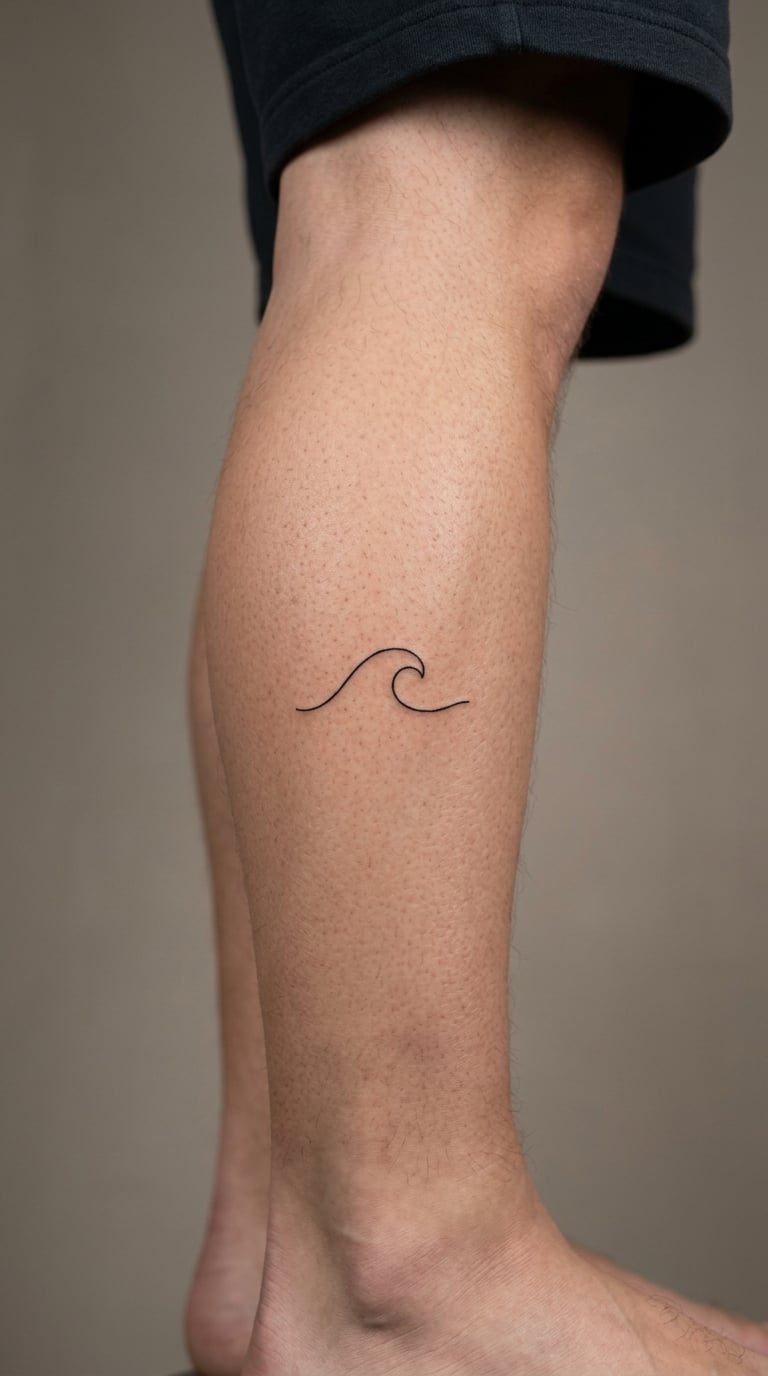
One long curling wave with a hollow crest, drawn in a single black outline. The body of the wave stays empty, so the skin inside it shows through. One pale blue line in the curl is the usual colour addition.
Surf, a specific beach, or just water. Plenty of people who have never surfed still want a wave, which says how much the shape appeals on its own.
Placement: outer calf, running horizontally. Size: 2 to 3 inch (5 to 7.5 cm) across. Style: illustrative, minimal linework, optional colour.
Pain: medium. The calf has muscle but the needle still catches on the small bumps of the skin, which makes the sensation more scratchy than the arm. Most artists keep the wave to one pass, so it is a short sit.
Make it yours: a small set of coordinates under the wave, in the same line weight so it looks like one drawing.
8. Tiny Planet with One Ring on the Upper Arm
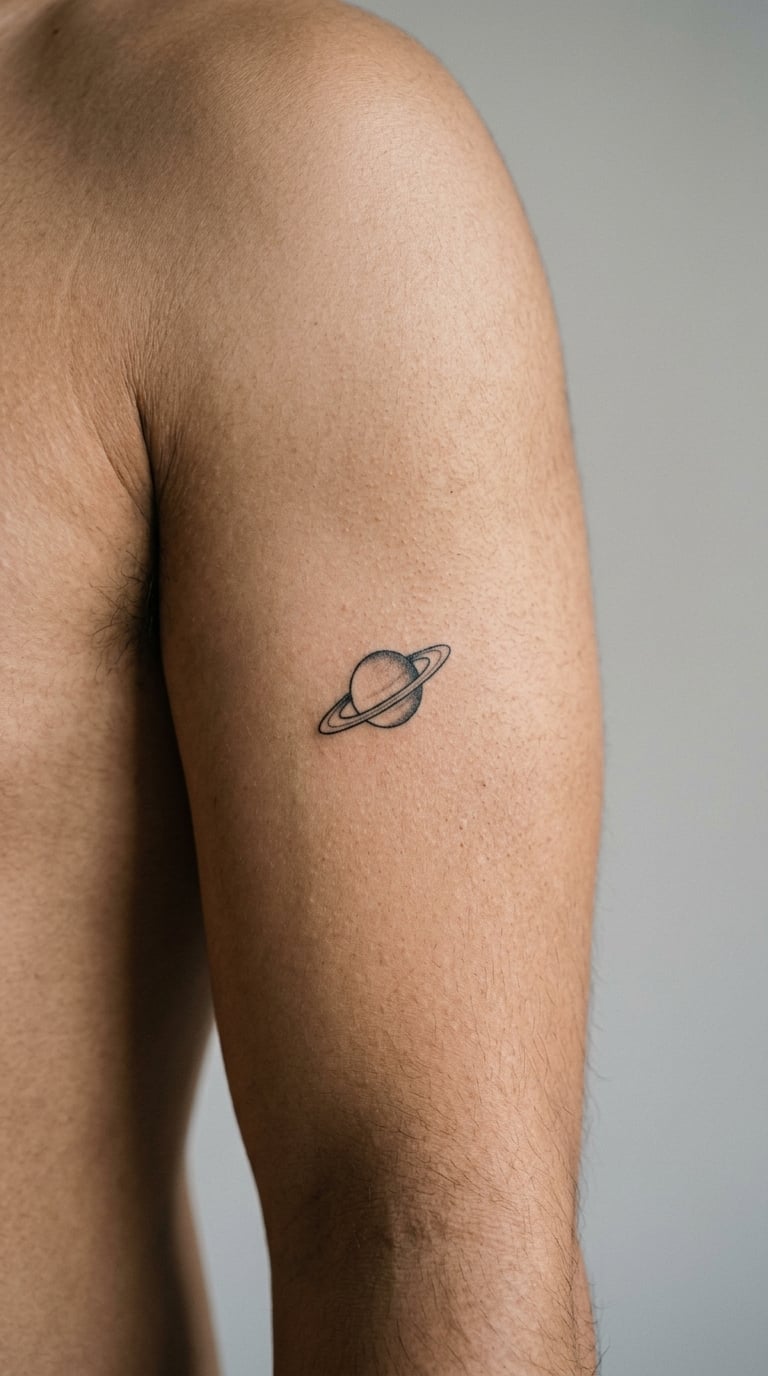
A circle with one elliptical ring cutting across it at an angle, plus two or three dot stars. Black and grey shading on the planet body gives it dimension without a single colour.
Space imagery is a common choice for people who like a bit of distance from everyday life. It is also one of the few motifs that looks good in almost any size.
Placement: upper arm or the back of the shoulder. Size: 1 to 1.5 inch (2.5 to 4 cm) across including the ring. Style: minimal illustrative, black and grey.
Pain: low. The upper arm is the softest, most forgiving spot most people get, which is why it turns up so often as a first placement.
Make it yours: the ring can be drawn as a birthdate in tiny numerals, or a single constellation dot can be added near the planet.
9. Daisy Chain on the Ankle
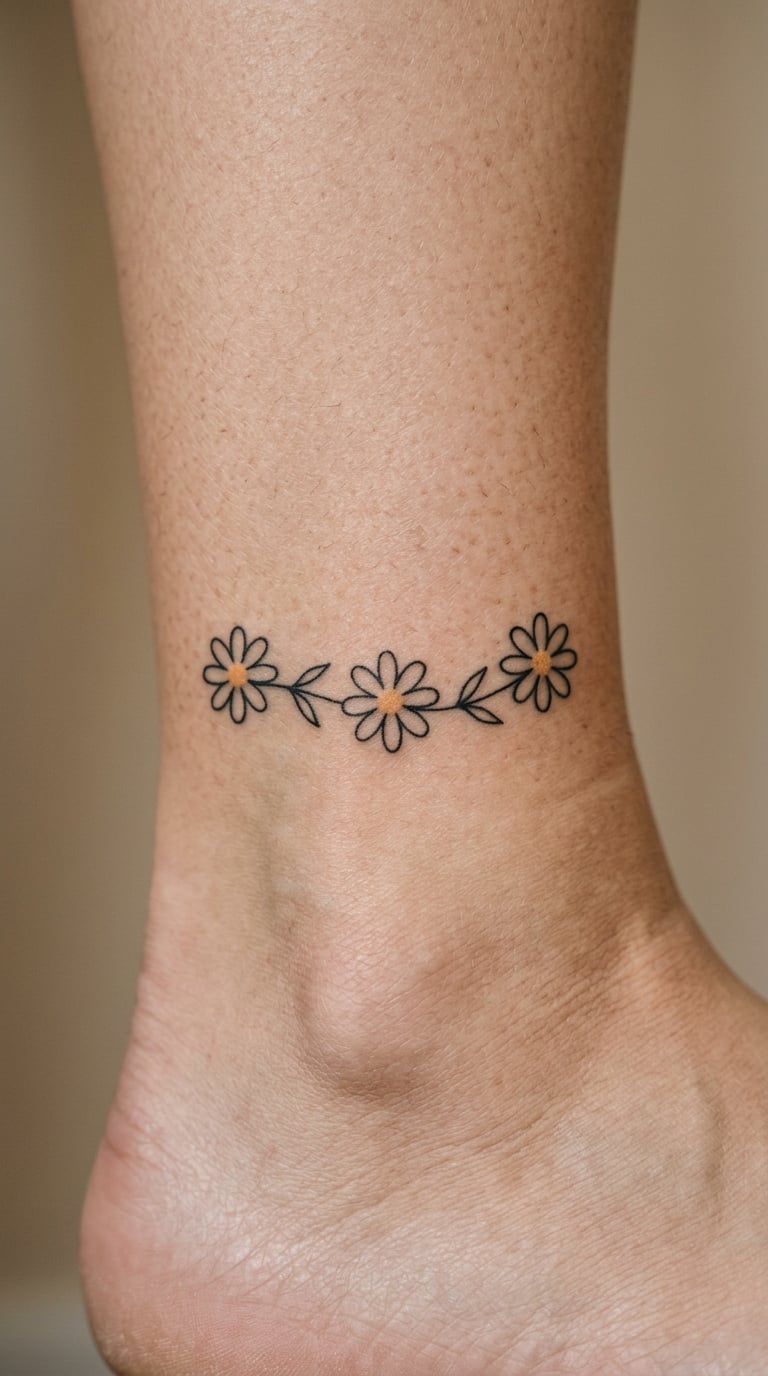
Three to five simple daisies linked along a thin stem line, each one a ring of short petals around a small centre. Black outlines do most of the work, with soft yellow in the centres.
People tend to choose this one for its cheerful, low-stakes look. It is nature imagery that stays friendly and readable as it fades. If the ankle is where you want to start, our 20 simple ankle tattoo ideas for women maps out more placements for that spot.
Placement: ankle, wrapping slightly around the bone. Size: 2.5 to 3 inch (6 to 7.5 cm) as a group. Style: soft illustrative or traditional.
Pain: medium, in the same way the sunbathing cat is. Ankle bones are prominent, so ask for a break halfway through if it starts to grate. Shoes are the other thing to plan around during healing.
Make it yours: give each bloom a different colour so the chain reads as a row of individuals rather than a repeat.
10. Tiny Coffee Cup on the Wrist
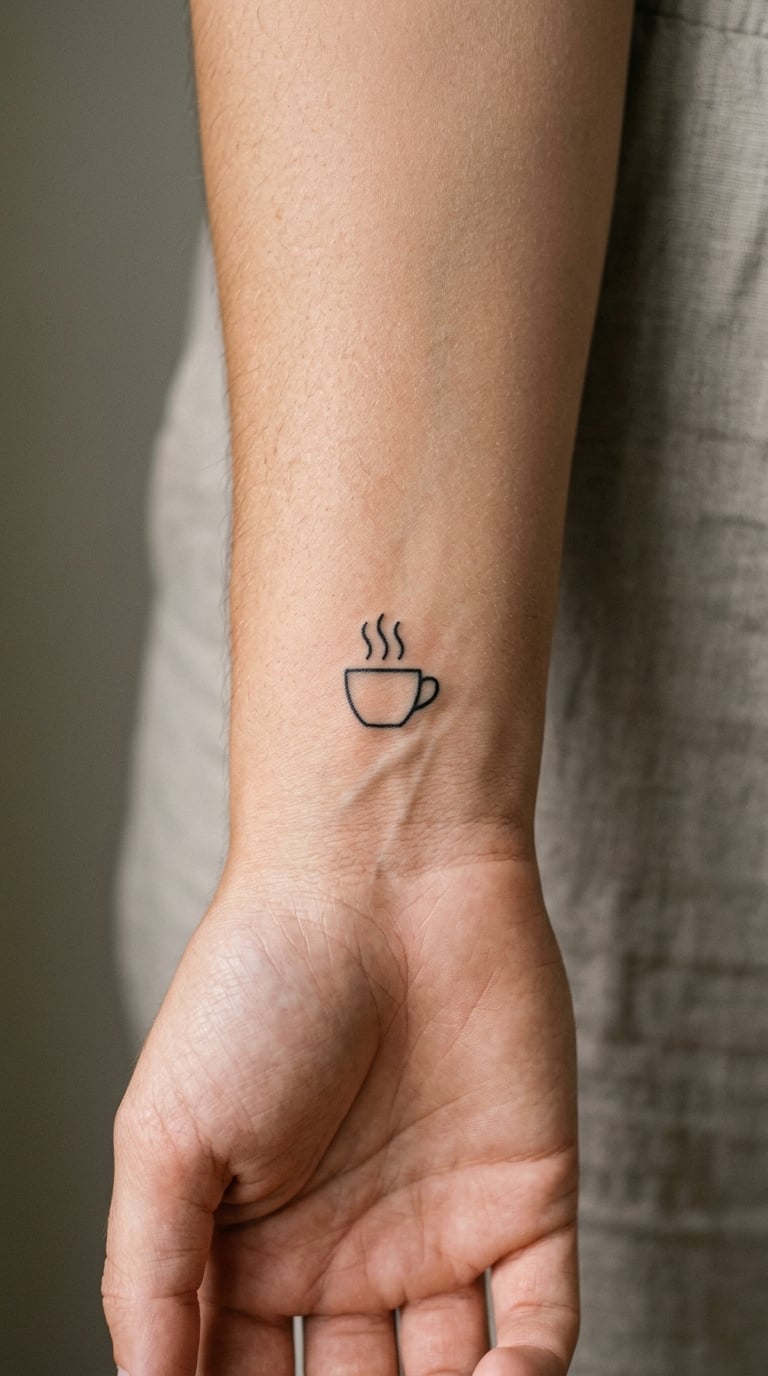
A small cup and saucer with three short steam lines curling upward. Drawn in one weight of black line, sometimes with a single warm brown wash inside the cup.
It is a daily-ritual tattoo. People choose it for the thing that already runs their morning, which makes it easy to live with and easy to explain.
Placement: inner wrist. Size: 1 to 1.5 inch (2.5 to 4 cm). Style: cute illustrative or line art.
Pain: medium, wrist bone again. The steam lines are the risky part at this size, since three thin strokes that blur together make a smudge.
Make it yours: a small date under the saucer, or a colour that matches the mug you actually use every day.
11. Crescent Moon Behind the Ear
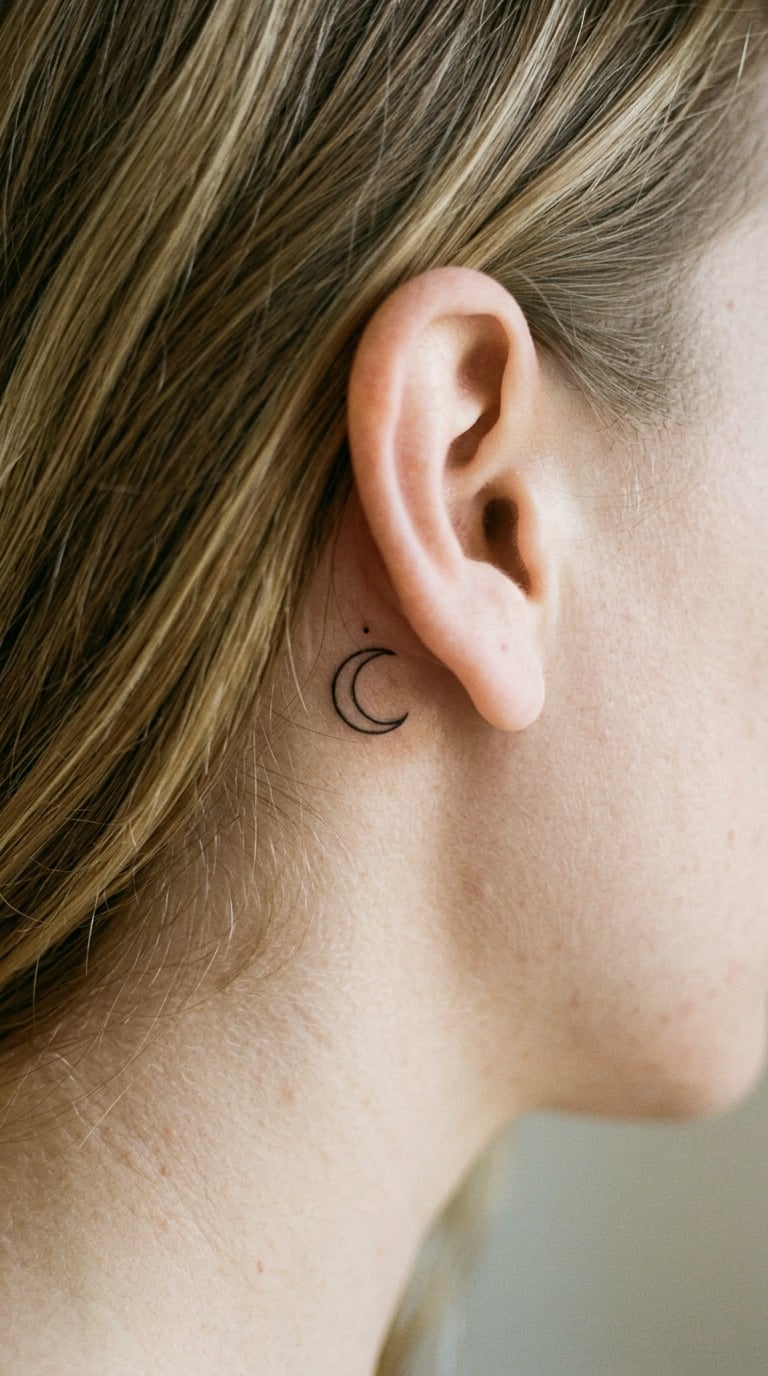
A clean crescent with two tapered points, thick at the base and thin at the tips. One or two tiny dots nearby give it a night-sky feel without crowding the design.
Moon imagery shows up for people drawn to night, cycles, or something that feels constant without being loud. The crescent shape is the simplest version and it holds up best.
Placement: behind the ear, either alone or following a second small shape down the neck. Size: 1 to 1.5 inch (2.5 to 4 cm) tall. Style: fine line or blackwork.
Pain: medium. Skin behind the ear is thin and the spot gets bumped by pillows and hoods. Fine-line work here softens faster than the same lines on an arm, so a slightly heavier line weight is the smarter choice for a first attempt.
Make it yours: a second crescent at a different size, placed at the opposite ear, pairs without matching exactly.
12. Open Semicircle on the Wrist
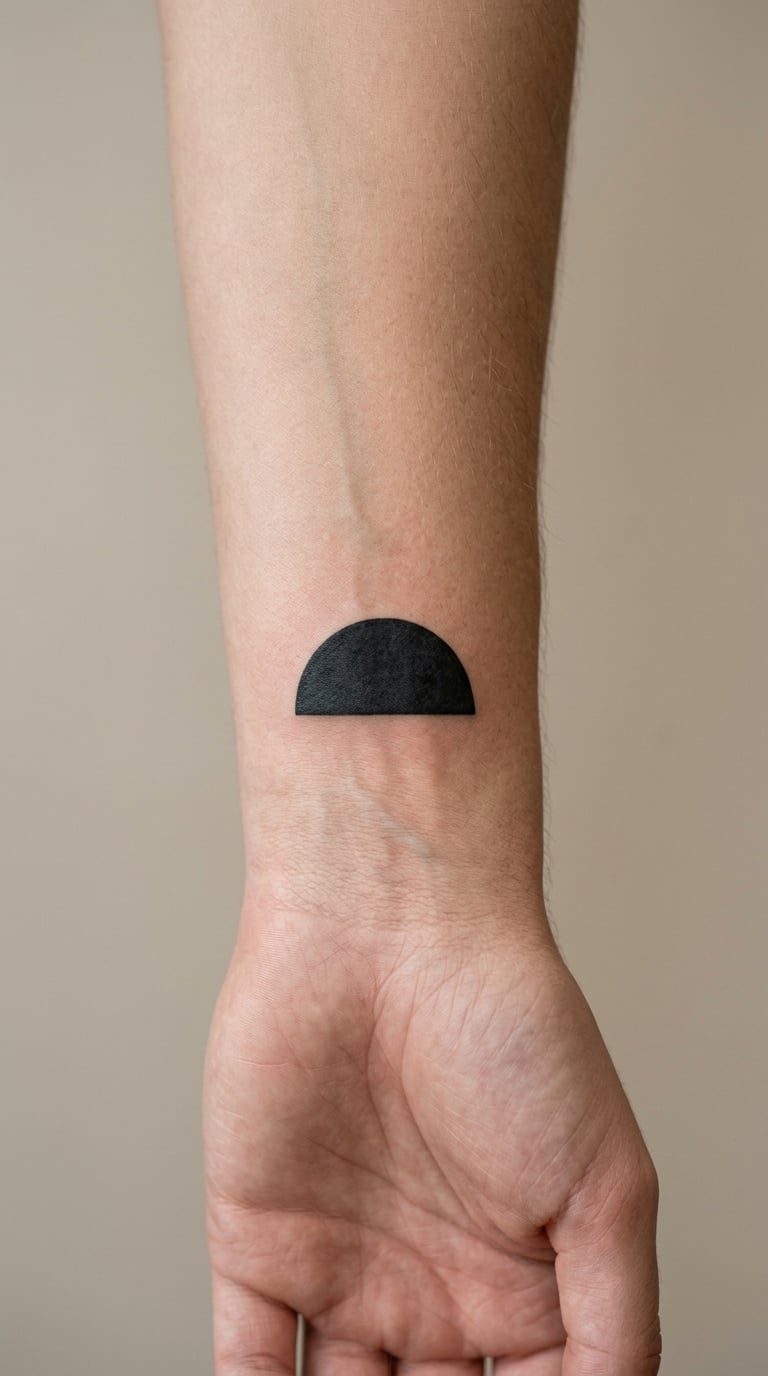
A half circle resting on a straight line, drawn with even line weight and nothing else. Some versions leave the top edge open entirely, so the shape is defined by two strokes and a curve.
It is geometry with no assigned meaning, which is exactly the point. Some people treat it as a horizon, some as a smile, and that is personal rather than symbolic.
Placement: inner wrist, aligned to the forearm’s length. Size: 0.75 to 1 inch (2 to 2.5 cm) across. Style: geometric or fine line.
Pain: low to medium, and one of the fastest designs here to complete. Because it is pure linework, it also hides small imperfections better than a shaded design. Two or three matched pieces make a set look deliberate.
Make it yours: a soft gradient fill in one half, or a thin parallel line running underneath the flat edge.
13. Small Candle Flame on the Inner Arm
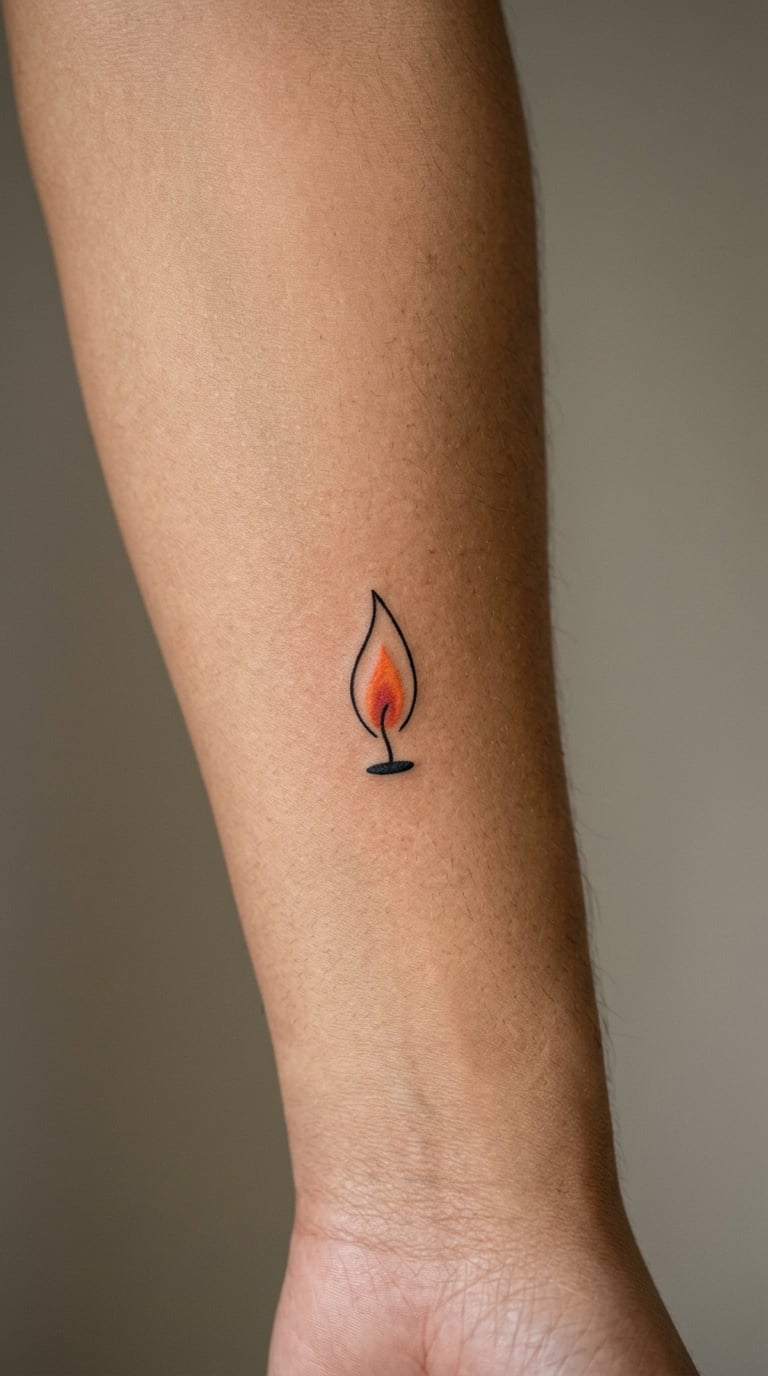
A single teardrop flame with a rounded base and a curl at the tip, outlined in black with orange or red shading kept to the centre of the shape. No candle body underneath, just the flame on its own.
It is usually tied to warmth, a person, or a hard stretch of time that turned out fine. The colour is what makes it feel warmer than the rest of the blackwork on this list.
Placement: inner arm, above the elbow crease. Size: 1.5 to 2 inch (4 to 5 cm) tall. Style: illustrative or neo-traditional with a single colour.
Pain: medium. The inner arm is sensitive but has more cushion than the wrist, so it sits between the forearm and the ribs in difficulty. Colour shading takes a second pass, which adds a few minutes rather than a whole session.
Make it yours: a colour tied to a specific year or a team, or a small wick line that runs into the lettering of a date.
14. Tiny Lightning Bolt on the Wrist
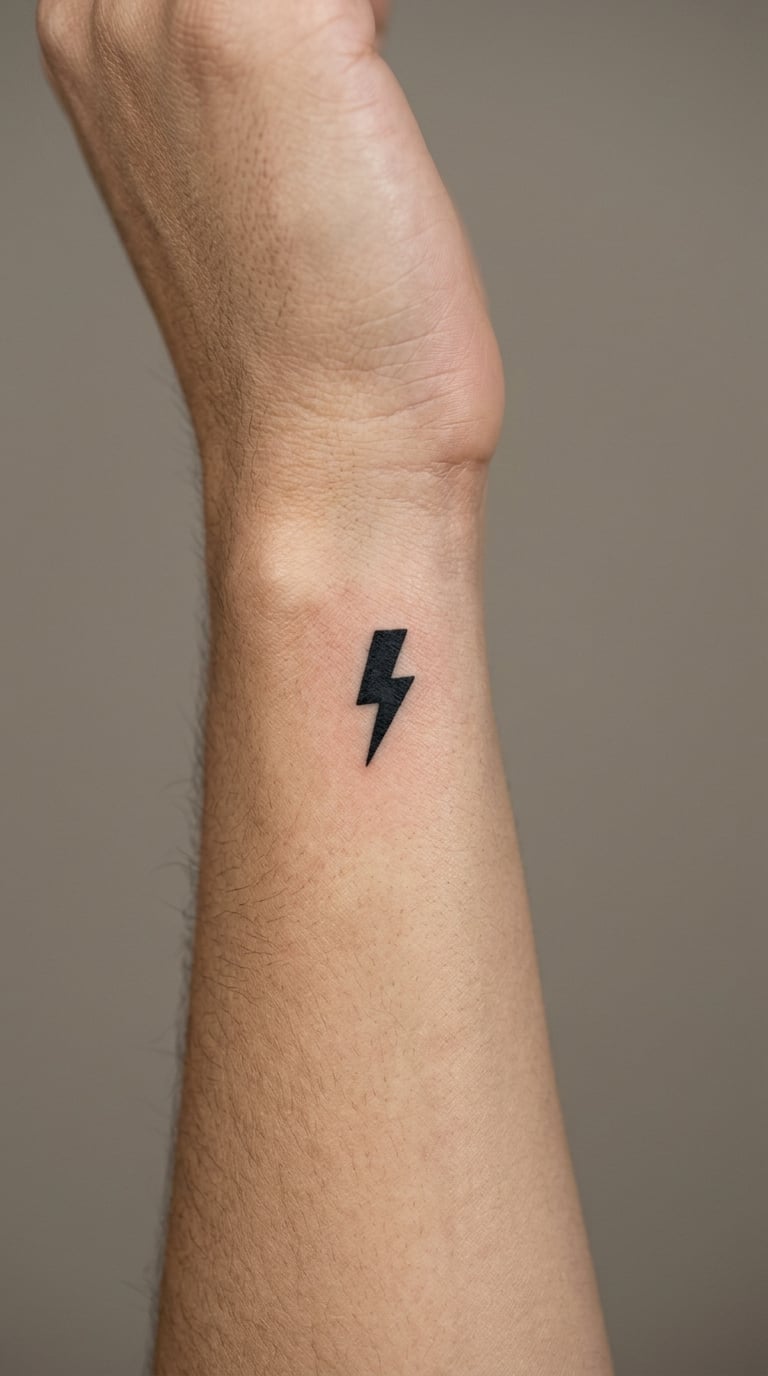
A compact angular bolt filled in solid black, with sharp points at the top and bottom. Some artists outline it instead of filling it, but solid black survives sun and age far better.
It reads as energy and independence more than anything fixed. Plenty of people get it as the first of several small symbols rather than as a one-off.
Placement: inner wrist or the outer forearm. Size: 1 to 1.5 inch (2.5 to 4 cm) tall. Style: blackwork, solid fill.
Pain: medium. Straight edges and hard angles are quicker to tattoo than curves, so this is one of the shorter appointments on the list. Solid black packing takes longer than lining, so budget half an hour to an hour.
Make it yours: a thin coloured outline around a black bolt, or a second smaller bolt next to it at a different scale.
15. Mini Eye on the Upper Arm
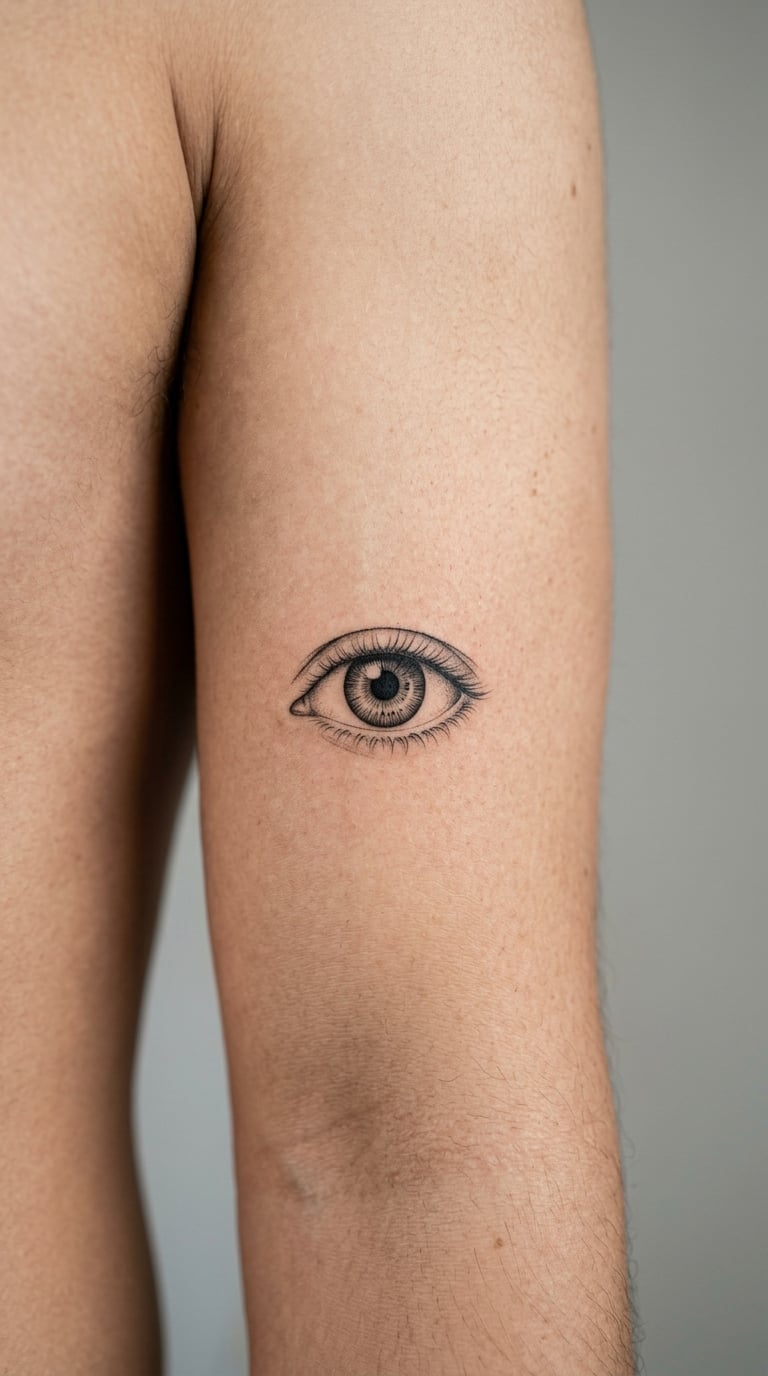
An almond shape with a rounded iris, a small highlight dot, and short lash marks along the upper line. Kept simple on purpose, because eyes are where first-timers most often pick a design too small for the detail it needs.
People choose it for watchfulness, for noticing things others miss, or for reflection. It is a common symbol in conversations about self-awareness.
Placement: upper arm or the inside of the bicep. Size: 1.5 to 2 inch (4 to 5 cm) across, and not smaller. Style: micro-realism or fine line.
Pain: medium on a soft upper arm, close to low. Size is the real issue rather than pain. Below about 1.5 inch the iris and lash marks have nowhere to live, and the shape can blur into a smudge within a few years.
Make it yours: colour the iris a single shade, or add one small detail inside the almond that only makes sense to you.
16. Simple House Outline on the Forearm
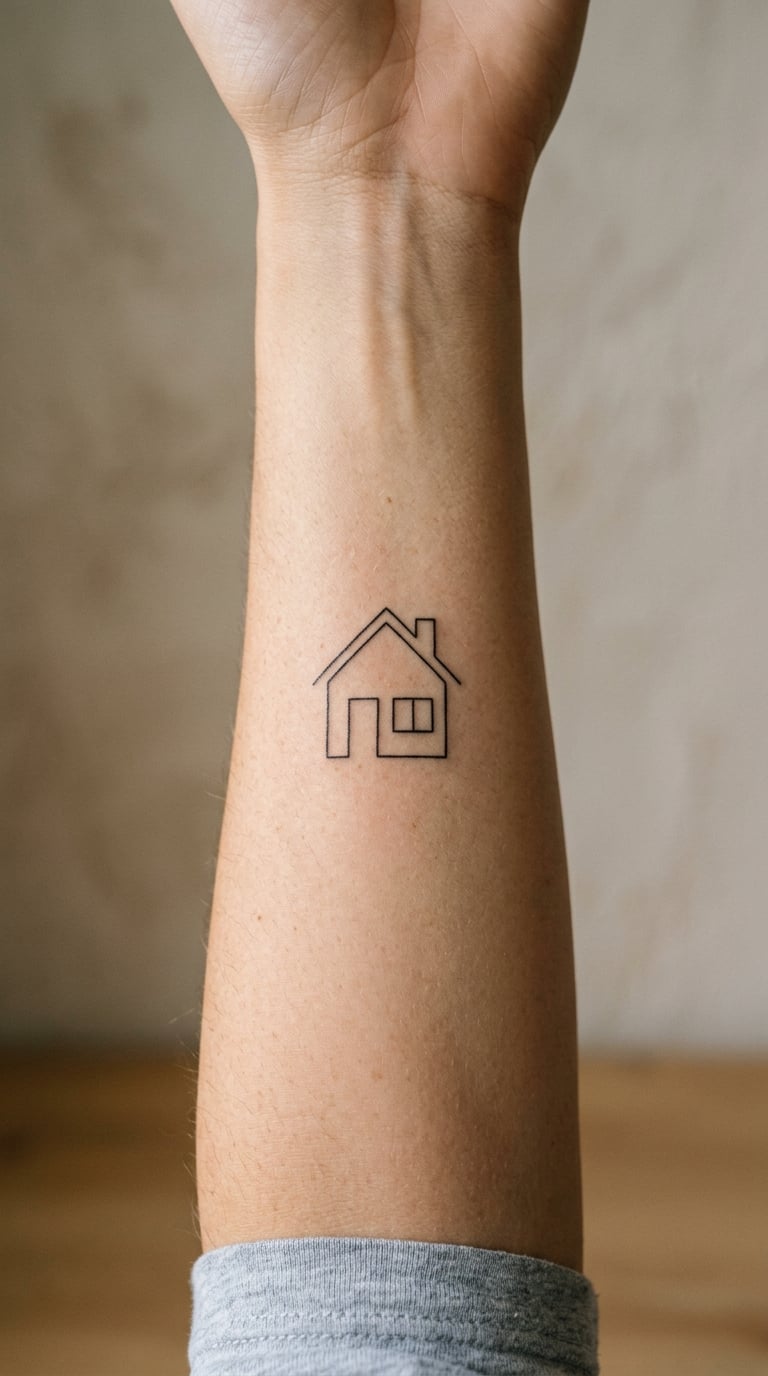
A pentagon roof on a square base, with one door and one window, all in one weight of black line. Clean architectural line art rather than a doodle-style house with a wonky roof.
Home, family, or the place someone came from. It is one of those symbols that tends to get more meaningful the older the person wearing it.
Placement: inner or outer forearm. Size: 1.5 to 2 inch (4 to 5 cm) wide. Style: architectural line art.
Pain: low to medium, depending on how much of the arm is muscle. Straight lines and right angles are fast work, so a clean version can be finished in well under an hour. If you want the house to look like a real one, bring a photo and let the artist add a roofline detail.
Make it yours: the house number, a set of initials, or a single lit window.
17. Four-Point Star on the Shoulder
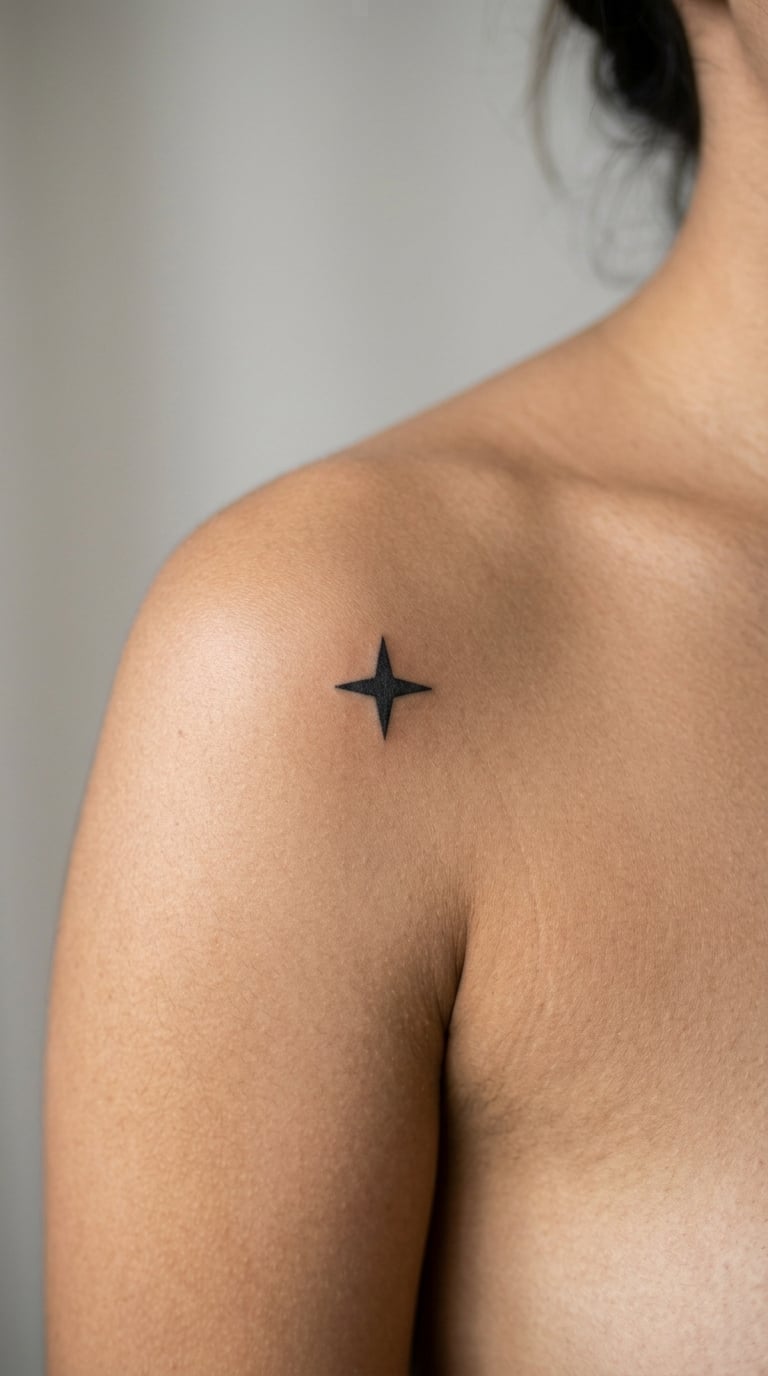
A four-point star with long thin points and concave sides, filled in solid black. It is the sparkles-and-stars shape rather than the five-pointed schoolhouse kind, which gives it a lighter, more graphic feel.
Used as a small marker of hope, a person, or a moment someone wants to mark. It is a placeholder that carries whatever you load into it.
Placement: upper shoulder, near the edge where the deltoid starts. Size: 0.5 to 1 inch (1.5 to 2.5 cm) across. Style: blackwork or fine line.
Pain: low. The shoulder is soft in most spots, and this is a quick fill. The one caution is size: a star this fine disappears at half an inch or below, so ask for the 1-inch version and let the artist keep the points sharp.
Make it yours: a second star a little larger or a few inches away, so the two look like a small constellation across the shoulder.
18. Tiny Mushroom on the Calf
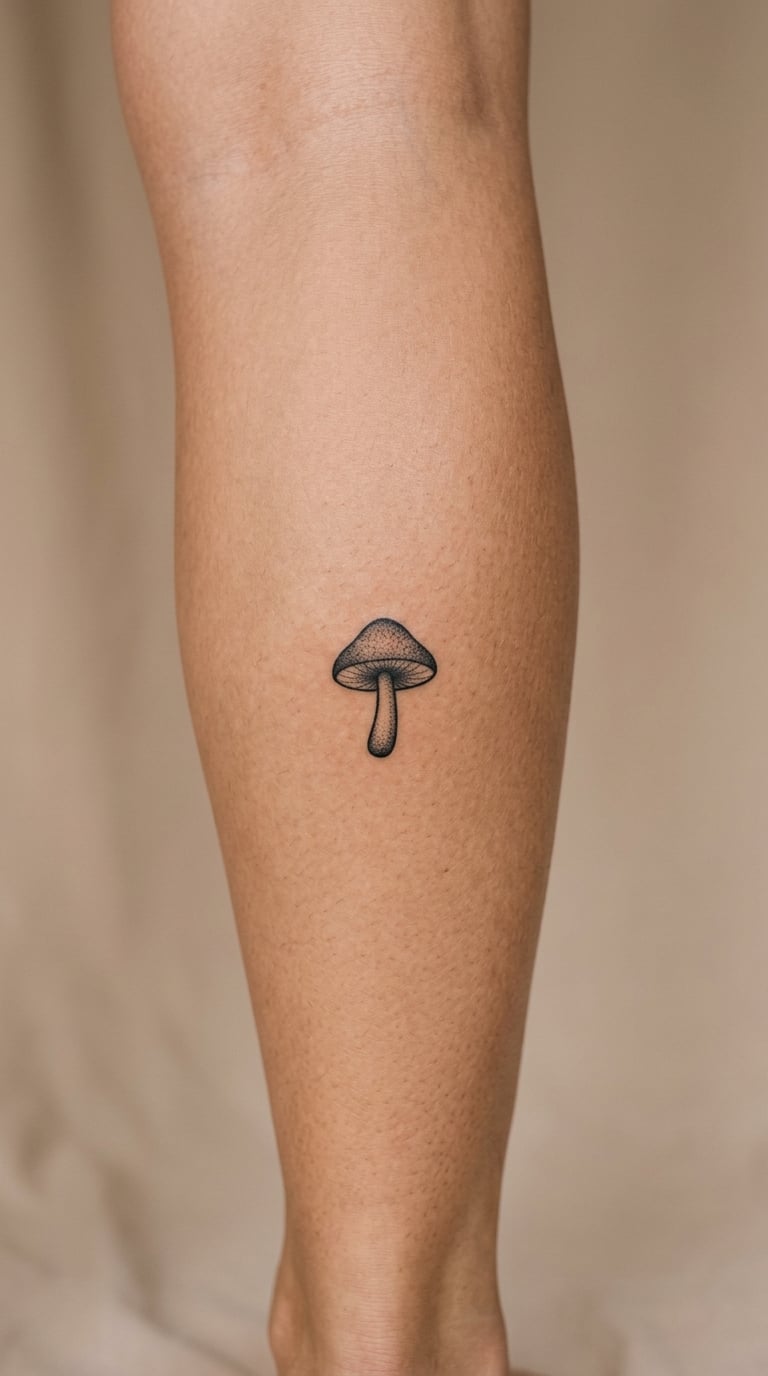
A rounded cap on a slim stem, with stippling or dotwork texture across the cap and a couple of gill lines under the edge. Some artists add two very small mushrooms beside it.
Nature, growth, or a quiet kind of joy. The motif reads as much about forests and walking as about anything symbolic.
Placement: calf or the back of the upper arm. Size: 1.5 to 2 inch (4 to 5 cm) tall. Style: illustrative with dotwork shading.
Pain: medium. Dotwork is repetitive passes over the same area, which some people find more irritating than a single sweep. If you are sensitive to repeated passes, ask for solid black on the cap instead of stippling. The calf itself is one of the more forgiving spots.
Make it yours: a single colour on the cap, or a location where you first found one as a child.
19. Minimal Sparrow on the Neck
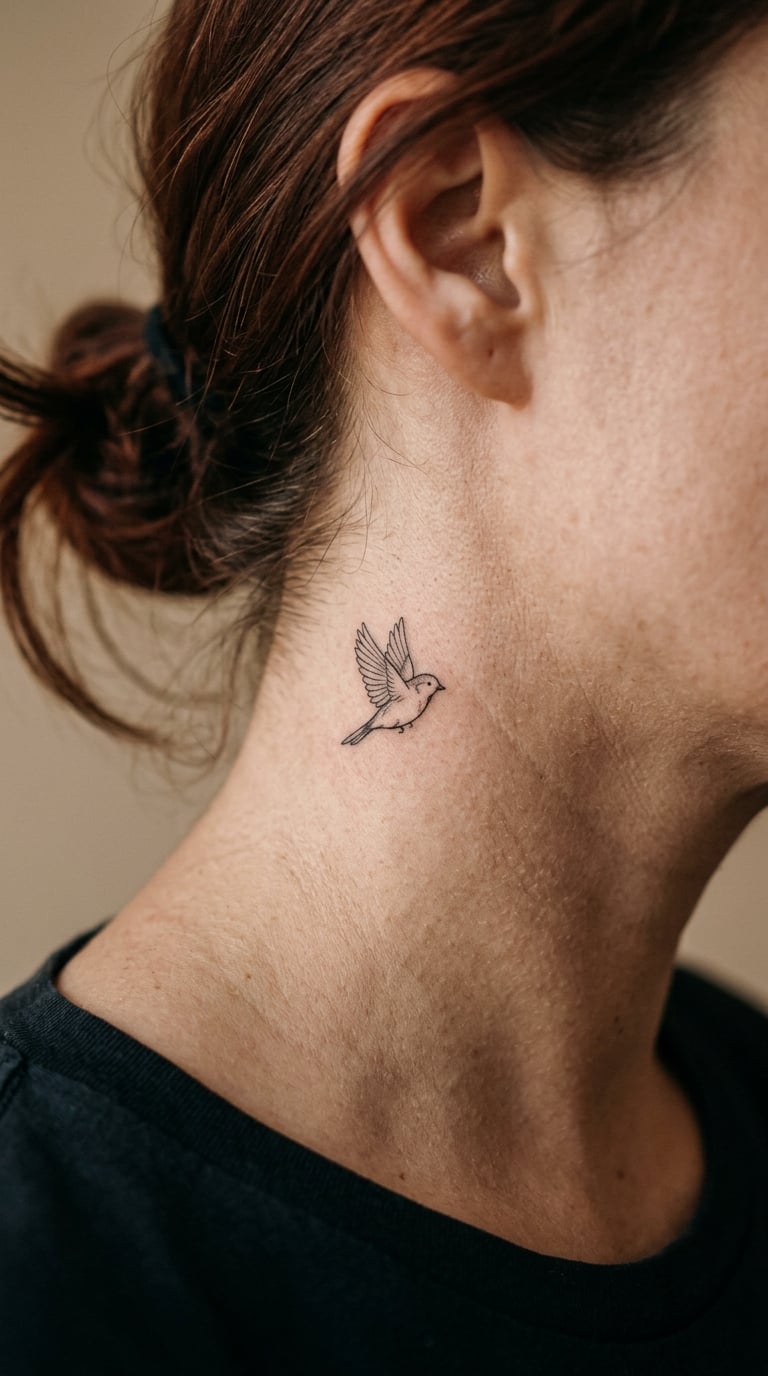
A small perched bird in profile with a rounded body, a short beak, and three or four restrained feather marks on the wing. Side profile is more forgiving than a front-facing bird, where the head and wings have to line up symmetrically.
Small birds are chosen for the feeling they give, not a fixed meaning. It tends to be freedom, or simply something small and living.
Placement: side of the neck, just below the ear. Size: 1.5 to 2 inch (4 to 5 cm) long. Style: fine line or light micro-realism.
Pain: medium, and it goes up from there. The neck is one of the more sensitive placements, and the skin there is visible from every angle in a way a forearm tattoo is not. Fine line here also softens faster than the same work lower down, so a slightly bolder line lasts longer.
Make it yours: a short Latin name, a one-word state bird, or an olive branch the size of a single line.
20. Small Butterfly on the Hand
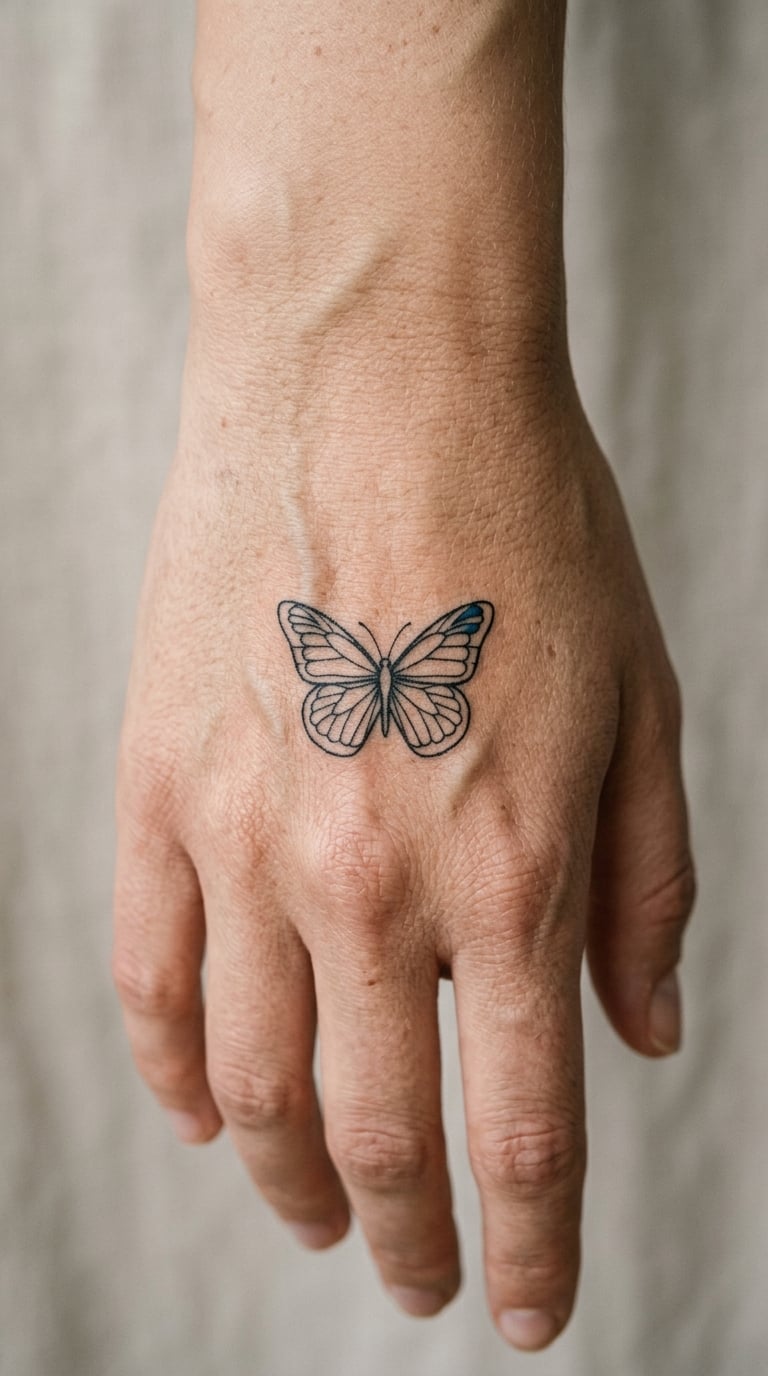
A compact butterfly with balanced wings, drawn symmetrically so both sides mirror each other. Black outline with a single blue accent across the upper wings, or all black for the most durable version.
Change and freedom are the usual associations, and they are the most overused ones. Plenty of people pick it anyway because the shape suits a hand better than anything else.
Placement: back of the hand, between the knuckles and the wrist. Size: 2 to 2.5 inch (5 to 6 cm) across the wings. Style: fine line or illustrative, optional single colour.
Pain: high, and the highest rating on this list. Hands have thin skin, dense nerves, and knuckle bone right under the surface, and the back of the hand rubs against everything you do. Worth it for the placement, harder than most for a first sitting.
Make it yours: two colours on the wings, or a matching butterfly on the other hand slightly smaller so the pair feels alive rather than mirrored.
How to Choose the Right Design
Going through 20 simple tattoo ideas for beginners, the useful question is not which one is the prettiest. It is which still makes sense to you in five years, and which suits the skin it lands on. I would rather you pick the second-best-looking flash in the shop and live with it happily than choose the perfect drawing and regret it.
Choosing From 20 Simple Tattoo Ideas for Beginners
- Pick the style first. Bold blackwork and solid fills hold up better than single-needle fine line. Fine line looks delicate now and softens faster, which matters most on fingers, wrists and the neck.
- Keep the size readable. Below roughly 1 inch (2.5 cm) a design with interior detail turns to mush. Solid shapes like the heart, star and semicircle work smaller than anything with lines inside it.
- Let placement decide for you. Outer forearm, upper arm and calf are forgiving. Wrist, ankle, collarbone, neck and hand have bone close to the surface, and you will feel every pass.
- Count the detail, not the idea. One cherry with a short stem is a 20-minute tattoo. The same cherry with shading, a leaf, a bug and a background is an hour of work and a much higher chance of something to touch up.
- Weigh meaning against readability. A design nobody else understands is often the better tattoo. A clever idea that needs 6-point lettering at 1 inch is the one that softens into noise first.
Cost and Session Time
Most US studios charge by the hour and apply a shop minimum, so a ten-minute heart often costs close to a forty-minute cherry. Typical hourly rates across the US sit roughly in the low hundreds, and they climb in expensive city shops and for artists with a waiting list.
A rough guide for a first small tattoo: a single solid shape such as a heart, star or bolt is one of the quickest options and usually lands at the shop minimum. A clean line design like the paper plane, coffee cup or mountain outline runs a bit longer, still comfortably under an hour. Anything with colour, dotwork, symmetrical butterfly wings or an eye’s iris needs more passes, so expect closer to an hour or a little beyond.
Custom work costs more than flash because the artist draws the design for your placement. Tipping is common in the US, and the usual guidance is around ten to twenty percent of the total, more if the session went well. If you want a second opinion on sizing, bring a printed reference and ask what the artist would change about it before the stencil goes on.
Aftercare Basics
- Follow your artist’s aftercare instructions first. They know the needle depth and ink they used, and their advice outranks anything general, including this list.
- Wash the area with clean water and a mild unscented soap, then pat it dry rather than rubbing it. Most artists suggest doing this a couple of times a day while it is still healing.
- Let it breathe uncovered for the first stretch. Artists are consistent here: wash well, air dry for half an hour to an hour, then keep it lightly moisturised. Leaving a bandage on for days traps heat under the plastic.
- Use a thin layer of whatever ointment or lotion your artist recommends, and stop as soon as the skin stops feeling dry. Heavy creams trap ink and are a common cause of a muddy-looking first tattoo.
- Protect it from sun and friction. Loose clothing, no tight waistbands over an ankle piece, no shaving over it, and sunscreen on exposed areas once it is healed.
- Contact your artist, not the internet, if something looks wrong. A tattoo that stays dark, scabs over, or bleeds heavily well past the first week is a conversation for the person who tattooed you.
Frequently Asked Questions
What is the easiest tattoo for a beginner?
A single solid shape with no interior detail is the easiest option, because the artist fills one area and stops. Small hearts, four-point stars and lightning bolts on the inner wrist or shoulder all fit that description. They heal simply, take under an hour, and are easy to cover later. A clean line design like a paper plane or mountain outline is a good second step if you want a bit more character.
How small should a first tattoo be?
Aim for something roughly 1 to 2 inch (2.5 to 5 cm) across, and use 3 by 3 inch (7.5 by 7.5 cm) as the upper limit for a first sitting. Under about 1 inch, any interior detail starts to blur. Around 3 by 3 inch is the size most first-tattoo advice converges on, since anything larger risks a session overrun. Shapes with no detail inside can safely go smaller.
Do small tattoos hurt less than larger ones?
Not really. Size affects how long you sit there, not how hard it lands. Pain tracks skin thickness, bone proximity and nerve density, so a tiny inner wrist heart can sting more than a large design on a fleshy upper arm. Upper arm, outer forearm and calf are the softest spots. Wrist, ankle, collarbone, neck and the back of the hand sit on bone and feel it most.
How long does a small tattoo take to heal?
Most small surface tattoos look settled in two to three weeks, though the skin underneath keeps rebuilding for two to three months. The visible part is the first stretch of flaking and peeling, which usually starts around day three or four and tapers off by week two. Keep it clean, keep it lightly moisturised, and give it the same sun protection you would give any new tattoo.
Can I personalize one of these simple tattoo designs?
Yes, and personalising is what stops a small tattoo from looking generic. Add a date, a set of coordinates, initials inside a heart, a house number, or a cat’s name on a collar tag. Change the colour to something specific rather than generic. Two smaller pieces at different sizes read as a set. The one rule: any added detail needs space, so customising means growing the design slightly.
Where to Start With Your First Tattoo
If you want the least risky first tattoo on this list, start with a tiny black heart, a four-point star, or the open semicircle. Solid fill, no interior detail, a short session, and a shape that still reads at half an inch.
Save the ringed planet, the eye and the butterfly for when you are building a collection and want more visual weight. Those three are better second or third tattoos than first ones, and picking the eye too small is the mistake I see most often. Walk into the shop with a reference, ask what the artist would change about it, and let them size it to your placement. Still browsing? Our 30 simple tattoo ideas that first-timers will love widens the list before you commit to a stencil.