
30 Meaningful Tattoo Ideas for Women With Deep Symbolism (2026)
A meaningful tattoo is one built around a symbol that maps to something real in your life, whether that is healing, grief, faith, a person, a place or simply the kind of strength you want to carry. These 30 meaningful tattoo ideas for women with deep symbolism are compared by style, placement, size and pain, so you can see the whole field at once before you book a consultation.
Symbols work as shortcuts. A motif carries a public meaning that cultures assigned to it over centuries, and you layer a private story on top of it that nobody else needs to know. What makes a design age well is that second layer: the personal part stays true even when the trend that carried it there disappears. Here is what each design looks like, where it sits best, how it hurts, and one way to make it yours.
30 Meaningful Tattoo Ideas for Women With Deep Symbolism: Quick Guide
| Idea | Style | Best placement | Size | Pain |
|---|---|---|---|---|
| 1. Fine-line phoenix | Fine line | Inner forearm | 2.5-3.5 in | Medium |
| 2. Tree rings, cross-section | Botanical blackwork | Outer arm | 2-3 in | Medium |
| 3. Minimal compass | Single-line minimal | Inner wrist | 1.5-2 in | Medium |
| 4. Wave with birthstone colour | Fine line with colour accent | Forearm | 2-2.5 in | Low to medium |
| 5. Crescent moon and stars | Fine line black and grey | Behind the ear | 1.5-2.5 in | Medium |
| 6. Five-phase moon cycle | One-line art | Inner arm, vertical | 3-3.5 in | Medium |
| 7. Infinity with botanical fill | Fine line botanical | Ankle or wrist | 1.5-2 in | Low to medium |
| 8. Personal birth constellation | Dotwork | Shoulder blade | 2.5-3.5 in | Medium |
| 9. Sprout from a geometric seed | Minimal fine line | Inner wrist | 1-1.5 in | Low to medium |
| 10. Watercolour lotus | Watercolour | Lower back or hip | 3.5-5 in | Medium to high |
| 11. Three butterflies, three stages | Fine line | Collarbone | 1 in each, 4 in run | Medium |
| 12. Hummingbird over a flower | Neo-traditional | Upper arm | 2.5-3.5 in | Medium |
| 13. Elephant with floral trunk | Minimal fine line | Outer forearm | 3-3.5 in | Medium |
| 14. Two birds, opposite directions | Fine line | Upper chest | 1.5 in each | High |
| 15. Mountain range, one red peak | Fine line with colour accent | Forearm | 2.5-3.5 in | Medium |
| 16. Half sunrise over a horizon | Minimal with colour | Calf or shoulder | 2-2.5 in | Low to medium |
| 17. Blackwork anchor with rope | Blackwork | Inner arm | 1.5-2.5 in | Medium |
| 18. Three fine feathers | Fine line | Outer arm | 2 in each | Low to medium |
| 19. DNA helix, fine line | Fine line geometry | Forearm | 2.5-3.5 in | Medium |
| 20. Coordinates in handwritten type | Handwritten script | Rib or wrist | 2-2.5 in | High on ribs |
| 21. Morse-code pulse line | Fine line technical | Inner wrist | 2.5-3 in | Medium |
| 22. Semicolon with a leaf dot | Minimal type detail | Forearm | 1-1.5 in | Low to medium |
| 23. Curved arrow through a dotted path | Minimalist line | Calf or arm | 2.5-3 in | Low to medium |
| 24. Hourglass with a falling petal | Fine line | Inner forearm | 2-2.5 in | Medium |
| 25. Ringed planet, one orbit line | Minimal fine line | Shoulder | 1.5-2 in | Low to medium |
| 26. Open hand with a sprouting flower | Fine line illustrative | Outer thigh | 3.5-4.5 in | Medium |
| 27. Celtic-style endless knot | Geometric linework | Forearm | 2-3 in | Medium |
| 28. Personal birth flower | Watercolour botanical | Wrist or ankle | 2.5-3.5 in | Medium |
| 29. Koi above water droplets | Illustrative colour | Calf | 3-3.5 in | Medium |
| 30. Moth with moonlit antennae | Black and grey illustrative | Upper back | 3.5-4 in | Medium |
1. Fine-Line Phoenix Rising From a Small Flame
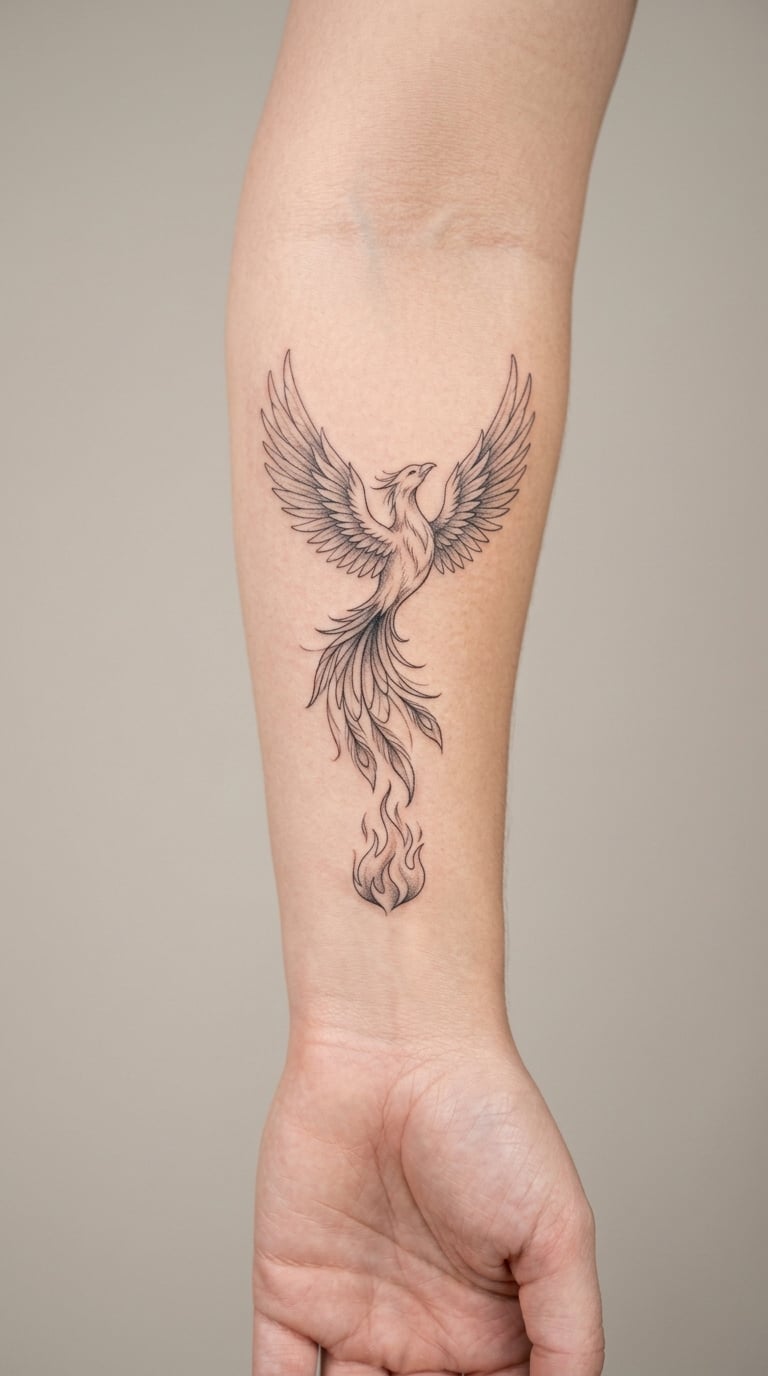
The design is a small flame at the base with a single bird lifting out of it, wings open, drawn in one consistent needle weight with a few shaded feather tips. Keep the flame small, maybe a third of the bird’s height, or the piece tips into a stock flame-and-bird composition.
The phoenix is one of the oldest and most widely recognised symbols of rebirth and renewal: destruction first, rising second. People choose it after a recovery, a divorce, a new career or the end of a chapter that took years to close.
Placement: inner forearm, outer upper arm or along the ribs. Size: 2.5 to 3.5 inches (6-9 cm) tall. Style: fine line with light black-and-grey shading.
Pain: medium on the forearm, and it stings more on the rib area. Ageing note: fine shading on the feather tips softens over a decade, so ask for slightly heavier lines in the body of the bird rather than delicate gradient work.
Make it yours: have the artist place one tiny mark in the negative space under the wing, a date, a child’s initial or the number of years you were healing.
2. Botanical Tree Rings Shown in Cross-Section
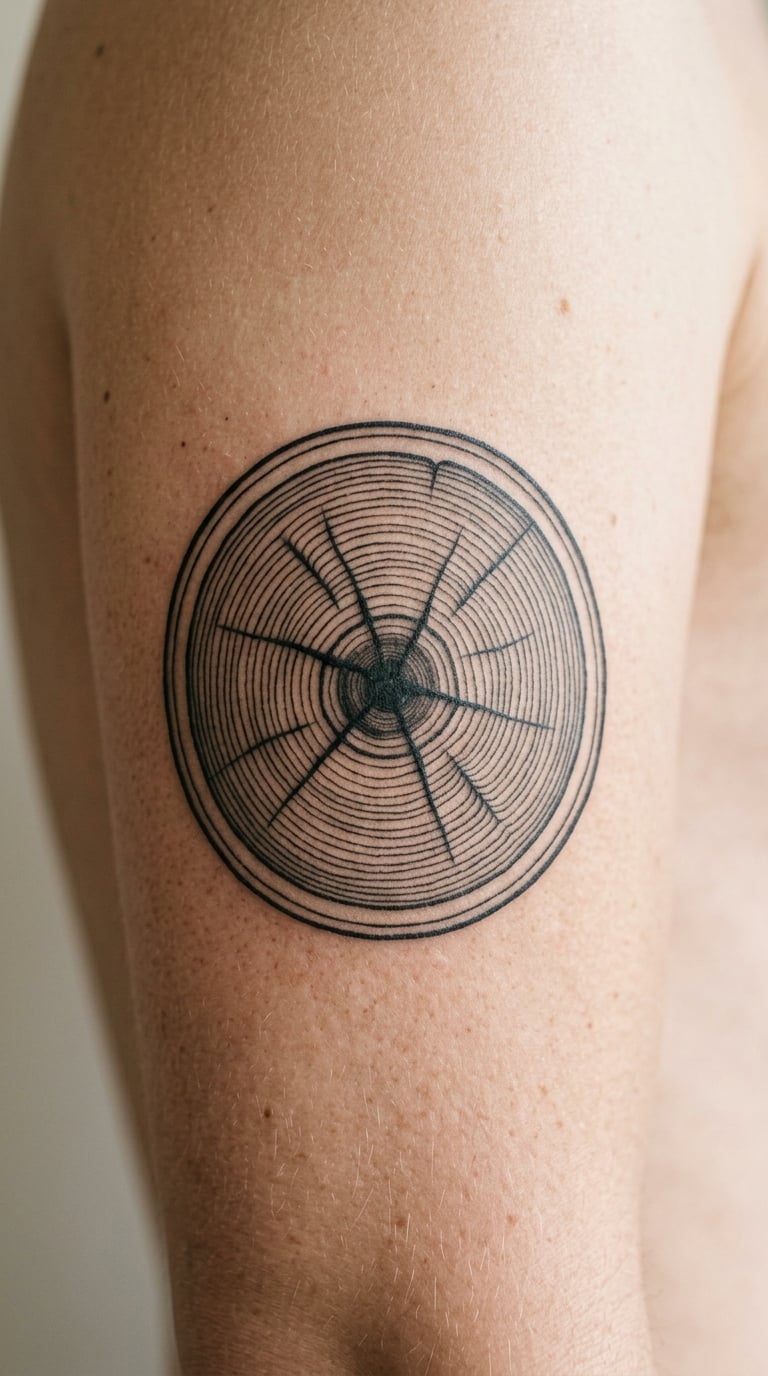
This is a slice of a trunk seen from above: a clean outer circle, two or three uneven growth rings, and a small pith at the centre drawn with fine radiating lines. Rings that are close at the edge and wide near the middle read as a real tree, not a target.
Tree rings carry the idea of growth you can count rather than feel: slow seasons, hard winters, and the fact that good years are the wide ones. It suits anyone who thinks about their own history in markers rather than adjectives.
Placement: outer arm, flat of the forearm or high on the thigh. Size: 2 to 3 inches (5-7.5 cm) across. Style: botanical blackwork with fine interior linework.
Pain: medium, and the centre pith is the stingiest part. Ageing note: interior ring lines blur together if the artist goes too thin, so ask for line weight that matches the outer edge.
Make it yours: use the real ring count of a tree that mattered to you, or widen one ring where a hard year was.
3. Minimal Compass with a Personal North Direction
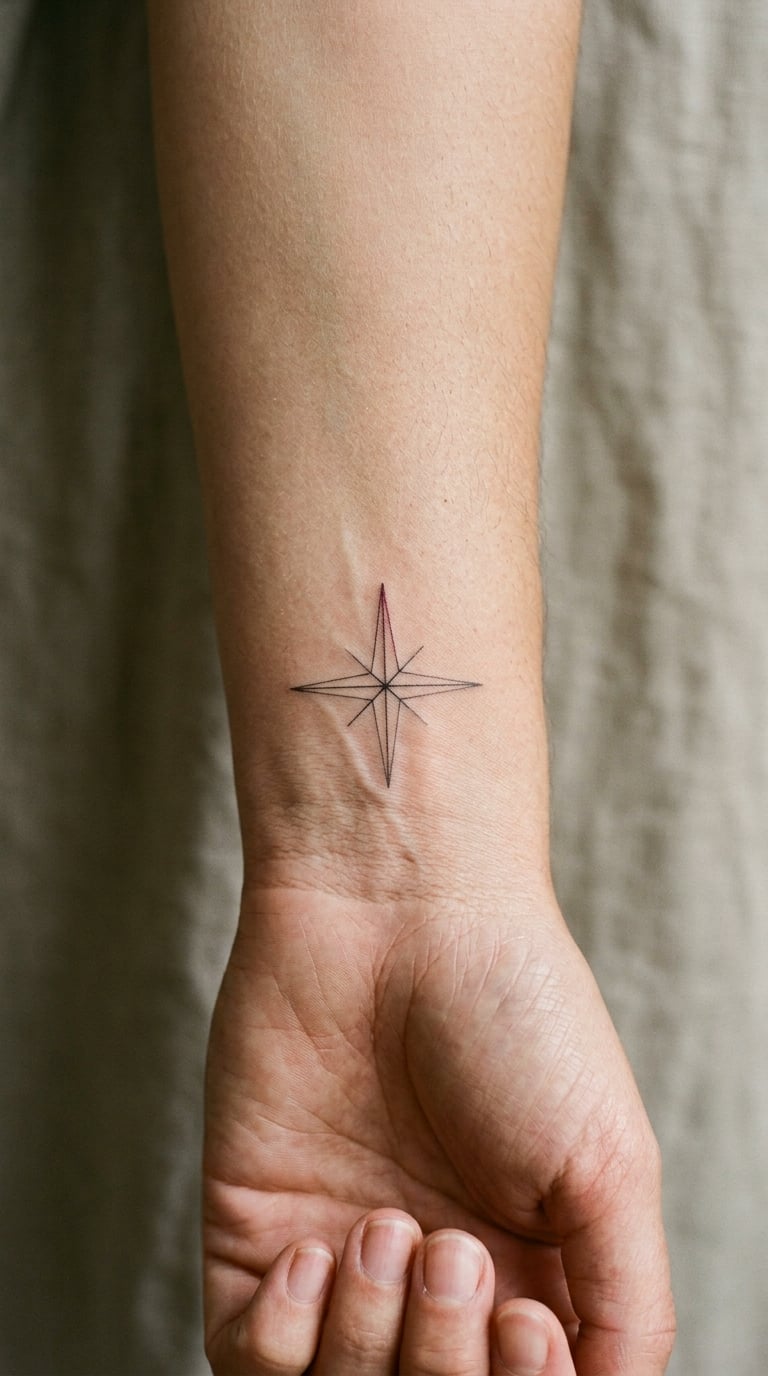
Four fine points radiating from a small centre circle, drawn in one continuous line weight, with the north point slightly longer than the rest. One point can hold a single colour, and nothing else needs to be added for the design to hold together.
Compasses stand for direction and for coming home, and a compass on a wrist often means the direction is still being chosen rather than already found. Plenty of women carry one as a quiet reminder to keep deciding.
Placement: inner wrist, inner arm, or behind the ear. Size: 1.5 to 2 inches (4-5 cm) across. Style: single-line minimal with one optional colour accent.
Pain: medium on the inner wrist, and wrist work is a wriggly spot for anyone who fidgets. Ageing note: very thin single lines on the wrist wear down fastest, so keep the weight consistent and avoid a hairline centre circle.
Make it yours: have the north point point toward a real place, or have the four points marked with a word only you will know.
4. Flowing Wave with a Hidden Birthstone Colour
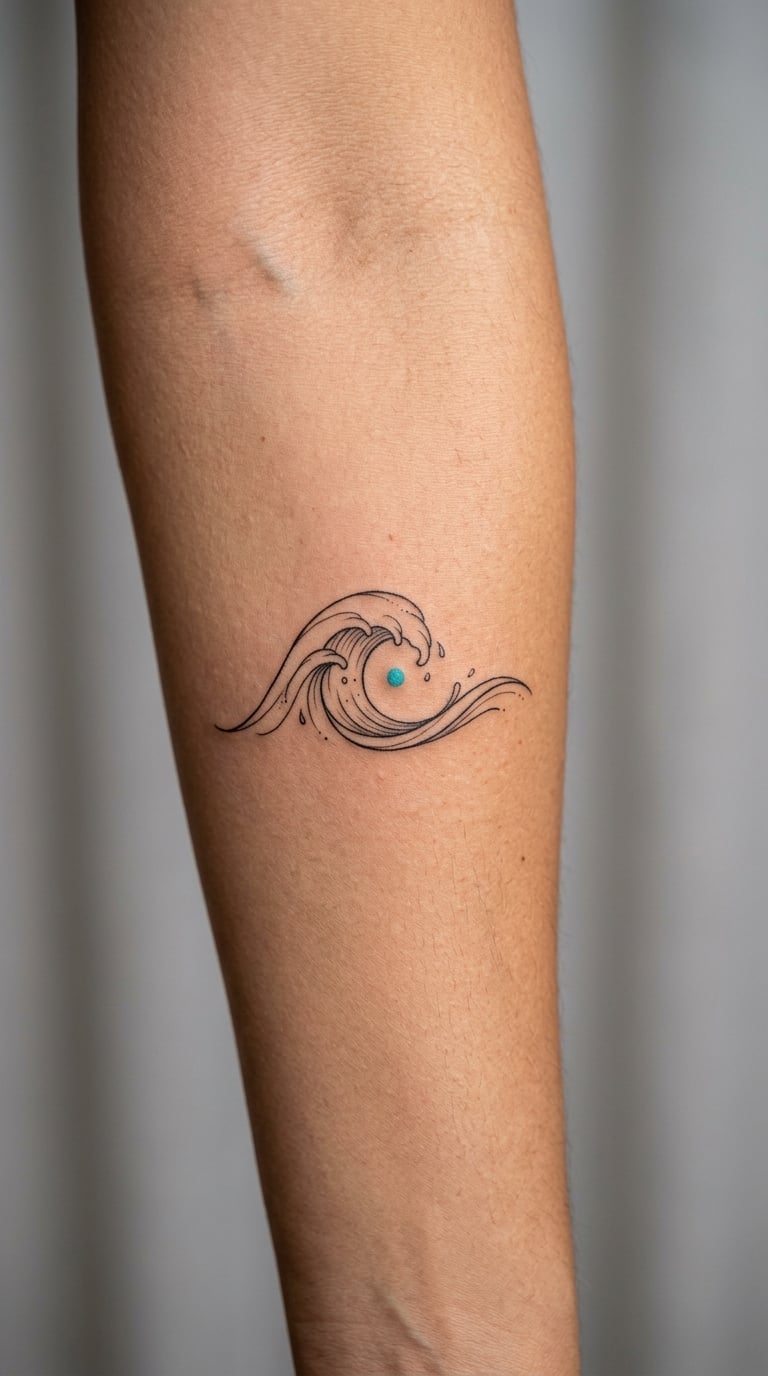
One curling wave drawn in a loose single-needle line, with a few short inner lines suggesting foam, and a single coloured dot or wash placed inside the curl. The colour does the emotional work and the line does the drawing.
Water is a long-standing stand-in for change, resilience and the emotional depth people keep under the surface. A birthstone colour quietly ties the design to a person, a birth month or a birth.
Placement: forearm, inner arm or behind the ear. Size: 2 to 2.5 inches (5-6 cm) long. Style: fine line with one small colour accent.
Pain: low to medium on the outer arm, higher over the inner elbow where skin is thinner. Ageing note: one soft wash of colour fades faster than line work, so expect the accent to soften and the wave to stay sharp.
Make it yours: pick your own birthstone shade, or add a second, thinner wave behind the first to suggest a chapter behind the chapter.
5. Crescent Moon and Delicate Star Cluster
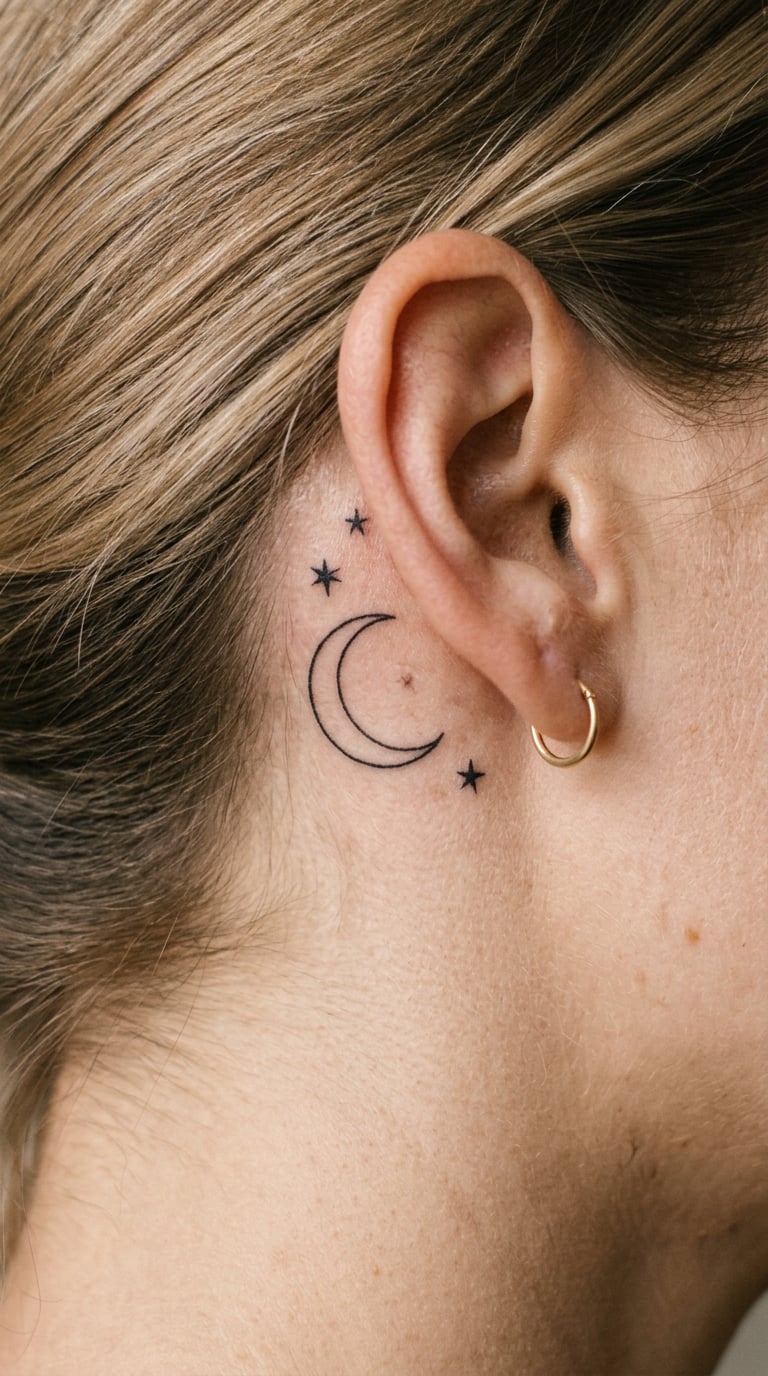
A thin crescent facing one direction, drawn with a soft inner curve, and three to five small four-point stars scattered at uneven distances. Open spacing is the whole point; crowding the stars together makes the moon disappear.
The moon has been tied to cycles, intuition and the parts of life that happen in the dark for a very long time. Combined with stars, it often reads as something guiding without being visible.
Placement: behind the ear, on the shoulder, or at the wrist. Size: 1.5 to 2.5 inches (4-6 cm) tall including the stars. Style: fine line black and grey.
Pain: medium behind the ear, which is thin skin over bone, and it keeps you aware of the tattoo for a few days. Ageing note: tiny star points soften first, so ask for stars that are slightly larger than looks right in a reference photo.
Make it yours: place a star where it lands on your personal chart and leave the rest of the cluster generic.
6. Five-Phase Moon Cycle in One-Line Art
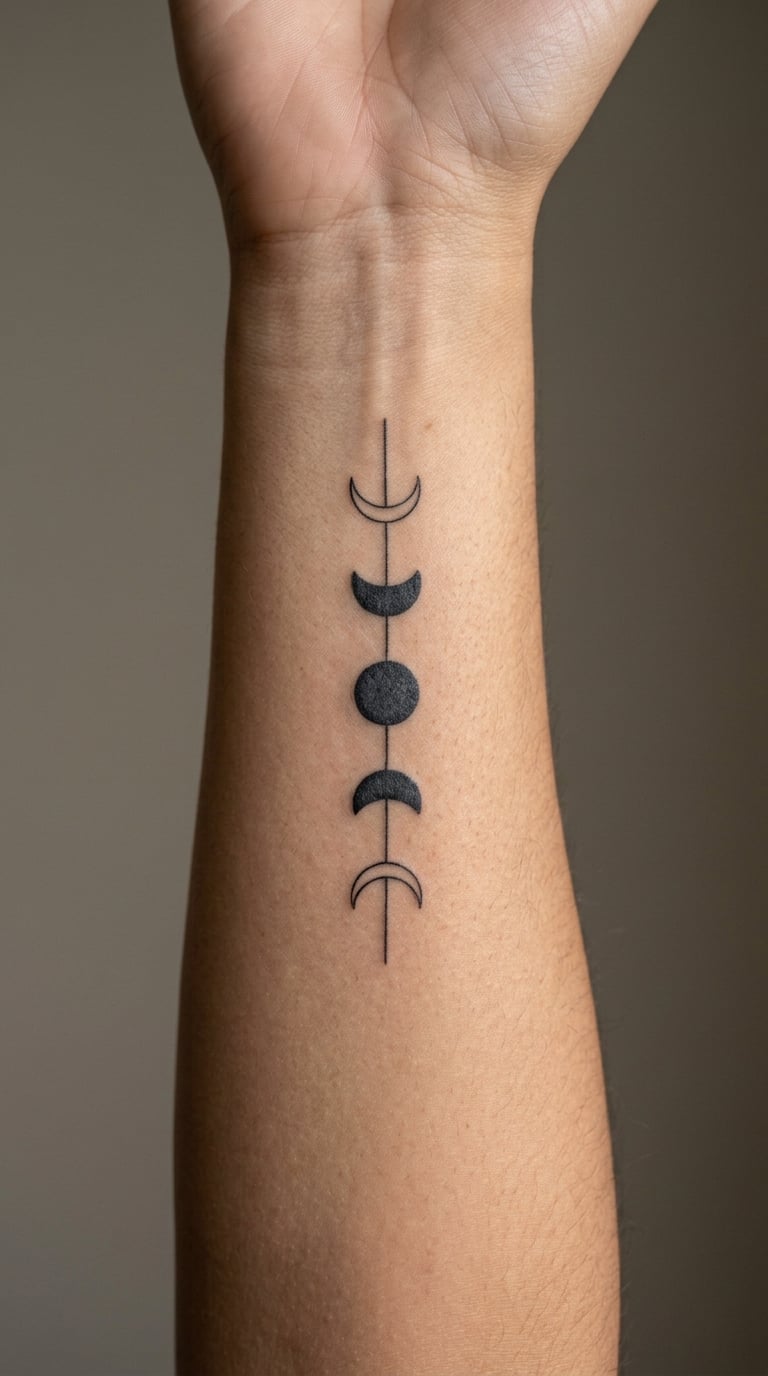
Five moon stages stacked in a vertical run: new moon as an empty outline or a simple circle, then a thin crescent, half, gibbous and full. Consistency matters more than detail here; all five should share one line weight and one spacing rule.
Showing the whole cycle instead of one phase points at process rather than a single mood: things beginning, filling, emptying and starting again. It often lands well for people marking a long transition rather than one moment.
Placement: inner arm running vertically, outer forearm, or along the calf. Size: 3 to 3.5 inches (7.5-9 cm) long. Style: one-line art.
Pain: medium along the inner arm. Ageing note: the new moon outline is the weakest mark in the run and can look like a missed detail in ten years, so a filled dot works better than an empty circle.
Make it yours: have the full moon mark a year that mattered, and leave the other stages unnamed.
7. Interlocking Infinity Symbol with Fine Botanical Detail
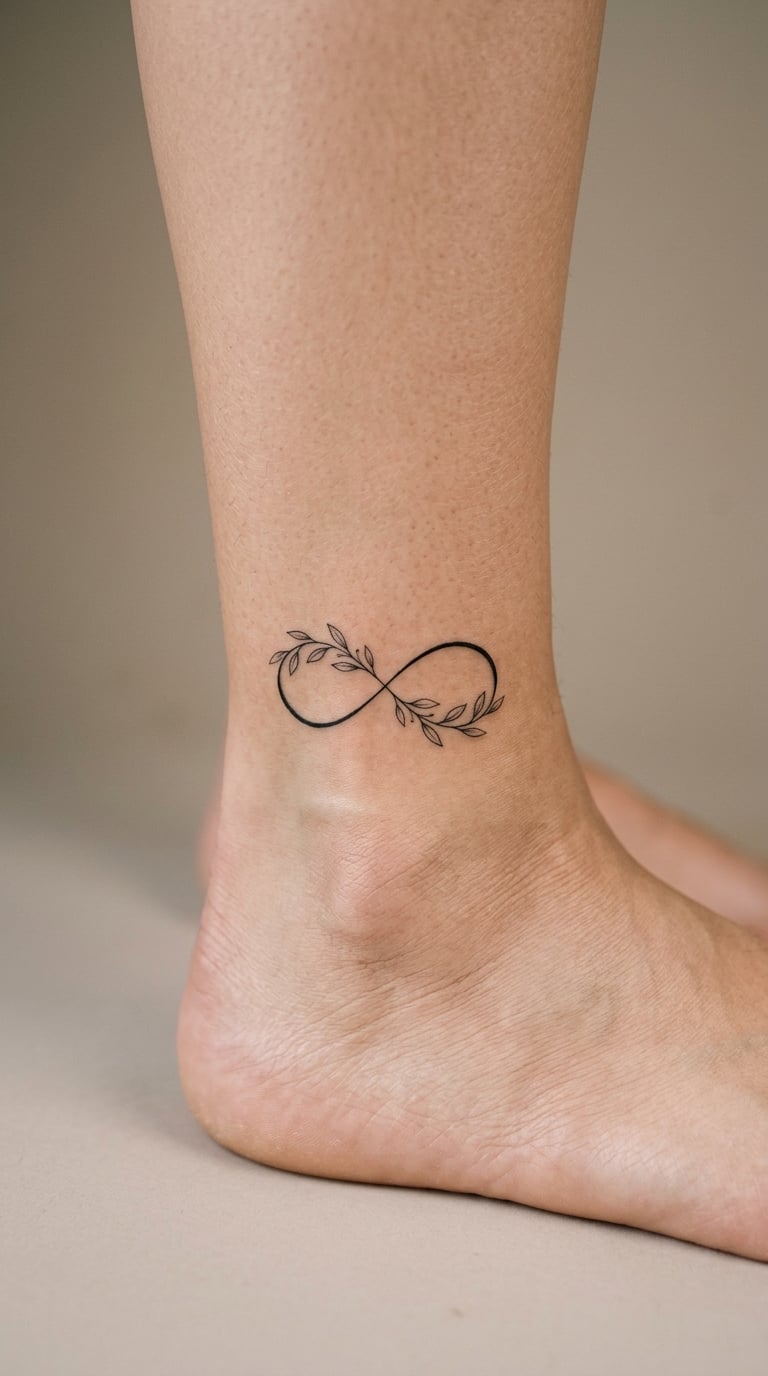
A clean horizontal figure-eight with even line weight, and tiny uncoloured leaves tucked into the curves so the stems pass over and under the loop. The leaves stay black; the colour goes nowhere.
The infinity symbol is widely read as lasting connection and continuity, often between two people or inside one person. The botanical infill turns a very common motif into something specific to you, which is the only way this design avoids looking borrowed.
Placement: ankle, inner wrist, behind the ear or at the nape. Size: 1.5 to 2 inches (4-5 cm) wide. Style: fine line botanical.
Pain: low to medium at the ankle, though ankle skin is bony and the session feels sharper than the placement suggests. Ageing note: fine leaves inside the loop blur together over time, so keep them sparse.
Make it yours: use one plant that only makes sense to the two of you, and note that if you plan a matching pair, get both done in one sitting.
8. Miniature Personal Birth Constellation
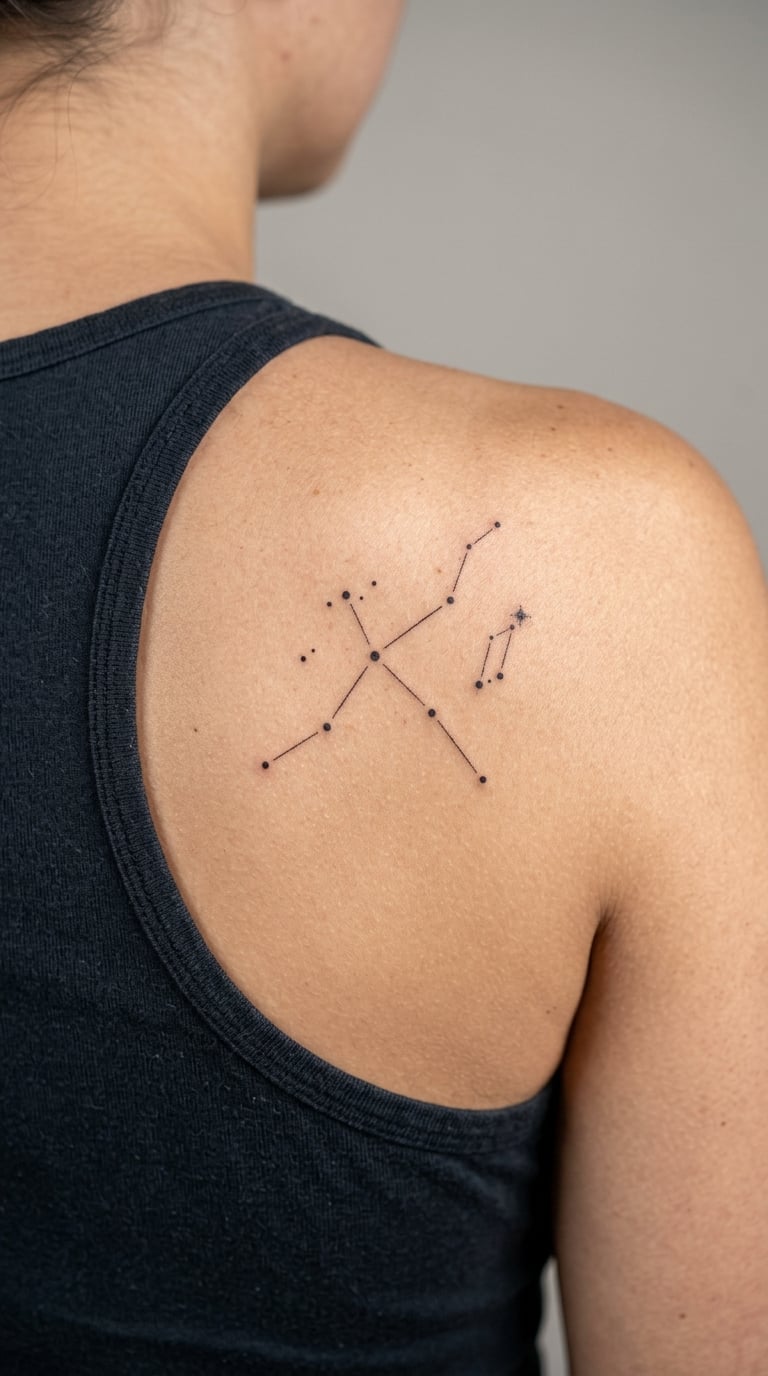
Small black dots placed at the real positions of stars visible from a specific place and date, joined by hairline connecting lines that form a recognisable but abstract shape. The map is the point; the shape is a bonus.
Constellations tie a tattoo to a sky someone actually stood under, often a birth night, a first home or a place that mattered to someone who is gone. It is the most quietly personal design on this list and the hardest to duplicate accidentally.
Placement: shoulder blade, upper back, thigh or forearm. Size: 2.5 to 3.5 inches (6-9 cm) wide. Style: dotwork with fine connecting linework.
Pain: medium on the shoulder blade, and the back is a hard place to sit still through. Ageing note: connecting lines on dotwork fade before the dots do, so ask the artist to keep every line at one weight.
Make it yours: order the star map for a date and coordinates that mean something real, and print it large so the dot placement stays accurate.
9. Single Sprout Emerging from a Geometric Seed
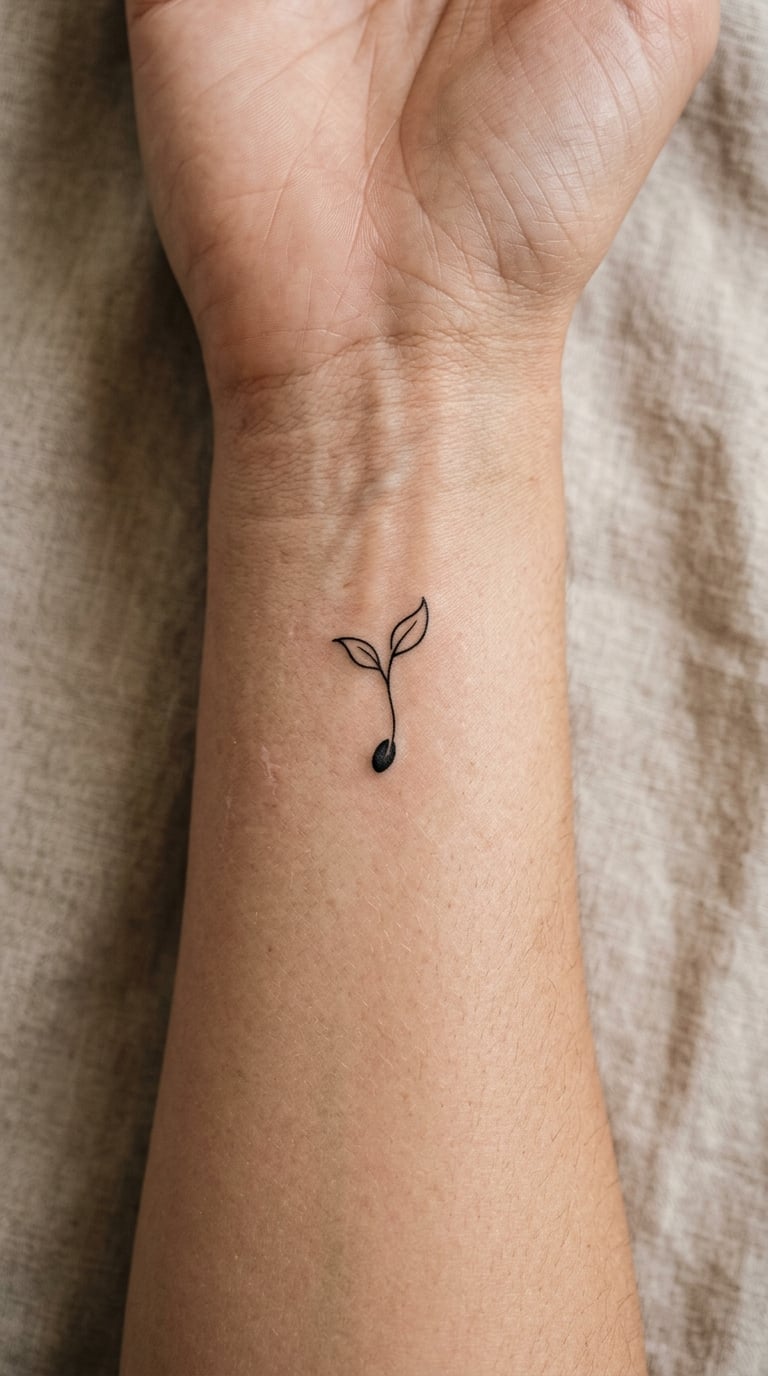
A simple almond-shaped seed drawn with a hairline outline, splitting at the top, with two small leaves on short stems above it. Four or five lines total; anything more turns it into a generic vine piece.
It reads as potential and personal growth without promising an outcome, which is why it works so well for a first tattoo or for someone starting something new in a way they cannot name yet.
Placement: inner wrist, behind the ear, or the ankle. Size: 1 to 1.5 inches (2.5-4 cm) tall. Style: minimal fine line.
Pain: low to medium, one of the gentlest placements on this list. Ageing note: at one inch, the leaves are near the limit of what stays legible, so this is a design to keep small and simple rather than to add detail to.
Make it yours: place the seed where a plant actually grew in your life, or leave a gap below it now and add a second sprout in a few years.
10. Watercolour Lotus with Imperfect Petals
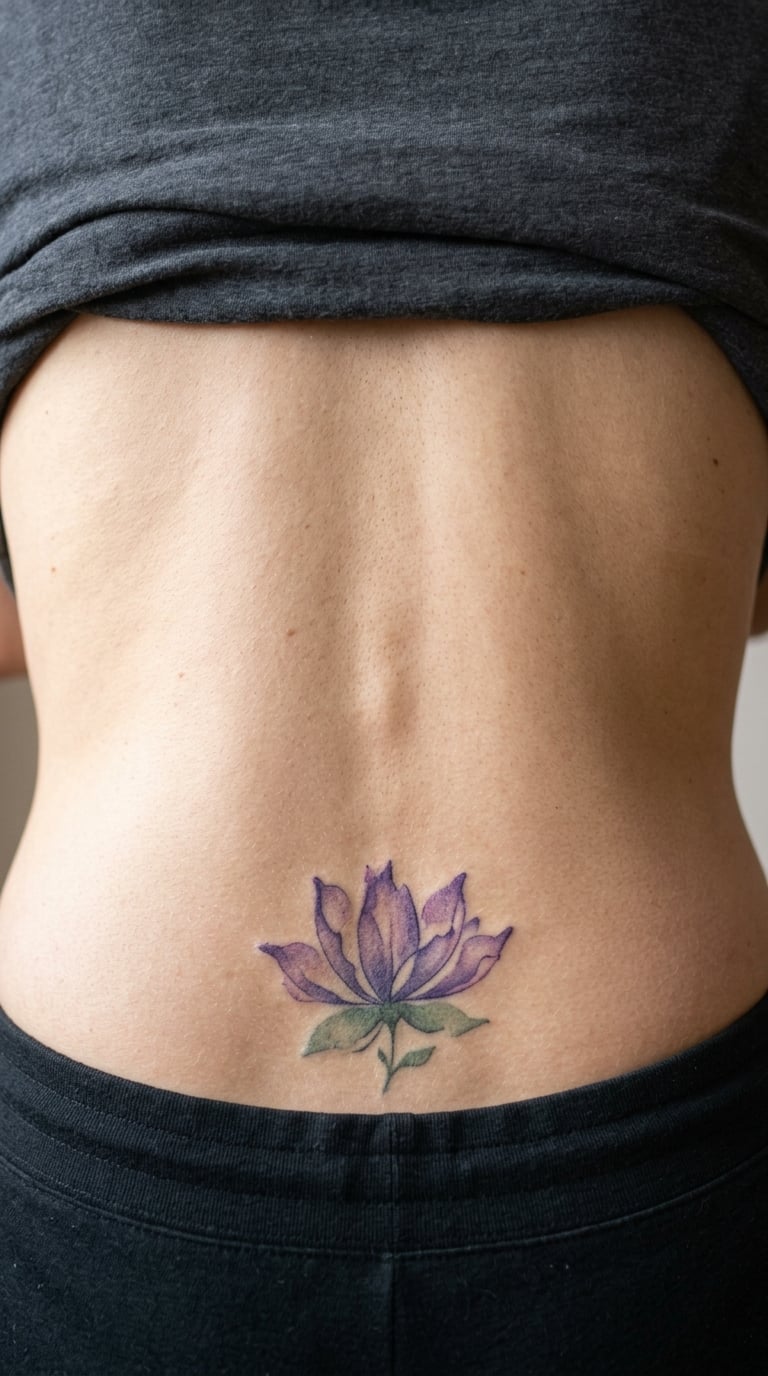
Loose translucent washes in violet, sage and a soft yellow, with petal edges left slightly uneven and pigment visibly pooled in places. A polished, symmetrical lotus reads as clip art; the mess is what makes it feel like a painting.
The lotus has broad cultural associations with growth and renewal, particularly rising clean out of difficult conditions, and it carries spiritual weight in several traditions. Translation matters here, so a designer who has studied the imagery is worth the extra asking.
Placement: lower back, hip, thigh or the back of the shoulder. Size: 3.5 to 5 inches (9-12.5 cm) wide. Style: watercolour.
Pain: medium to high on the lower back, and the position is uncomfortable for long stretches. Ageing note: watercolour is the fastest-fading style on this list, since soft washes have no solid line to hold them together. Expect a touch-up within a few years.
Make it yours: ask the artist to mix the colour from a flower in your own garden, and keep the number of petals odd so the flower is not a repeated design.
11. Three Butterflies at Different Flight Stages
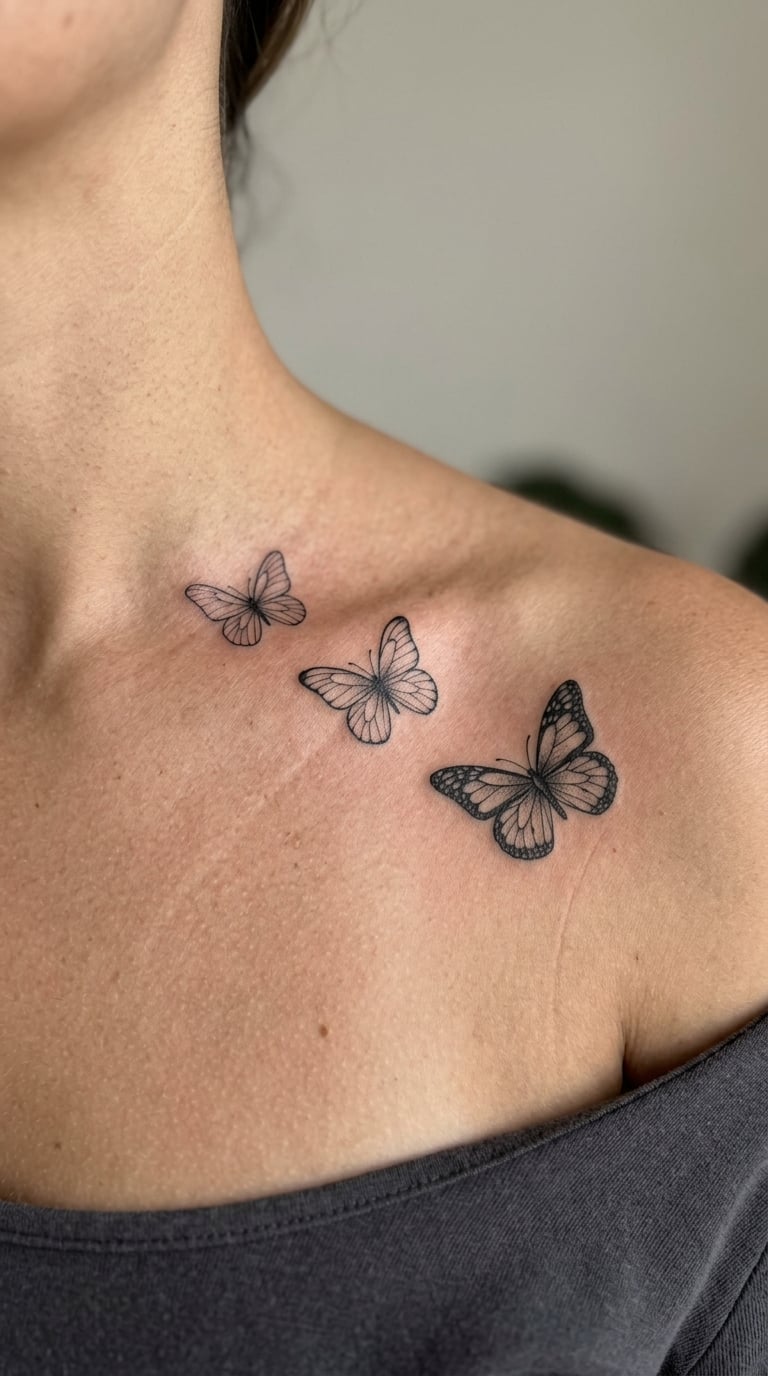
Three butterflies in a diagonal run: the first a tight, folded-wing shape, the second half open, the third fully spread with fine antennae. Each one is drawn with the same line weight so the growth reads in the wings, not the ink.
Butterflies are the most familiar symbol of change and transformation, which is useful and also why this design gets skipped over by people who want something less expected. Running the three stages in order turns a common motif into a specific story about a process.
Placement: collarbone in a diagonal, inner arm, or across the shoulder. Size: about 1 inch (2.5 cm) each, roughly 4 inches (10 cm) across the whole run. Style: fine line.
Pain: medium; collarbone skin sits over bone and the run crosses two different planes of the body. Ageing note: tiny wing antennae vanish first, so ask for slightly exaggerated antennae on the smallest butterfly.
Make it yours: have the smallest butterfly mark the year a change started rather than the year it finished, which is the more honest version of the story.
12. Hummingbird Hovering Over a Real Flower
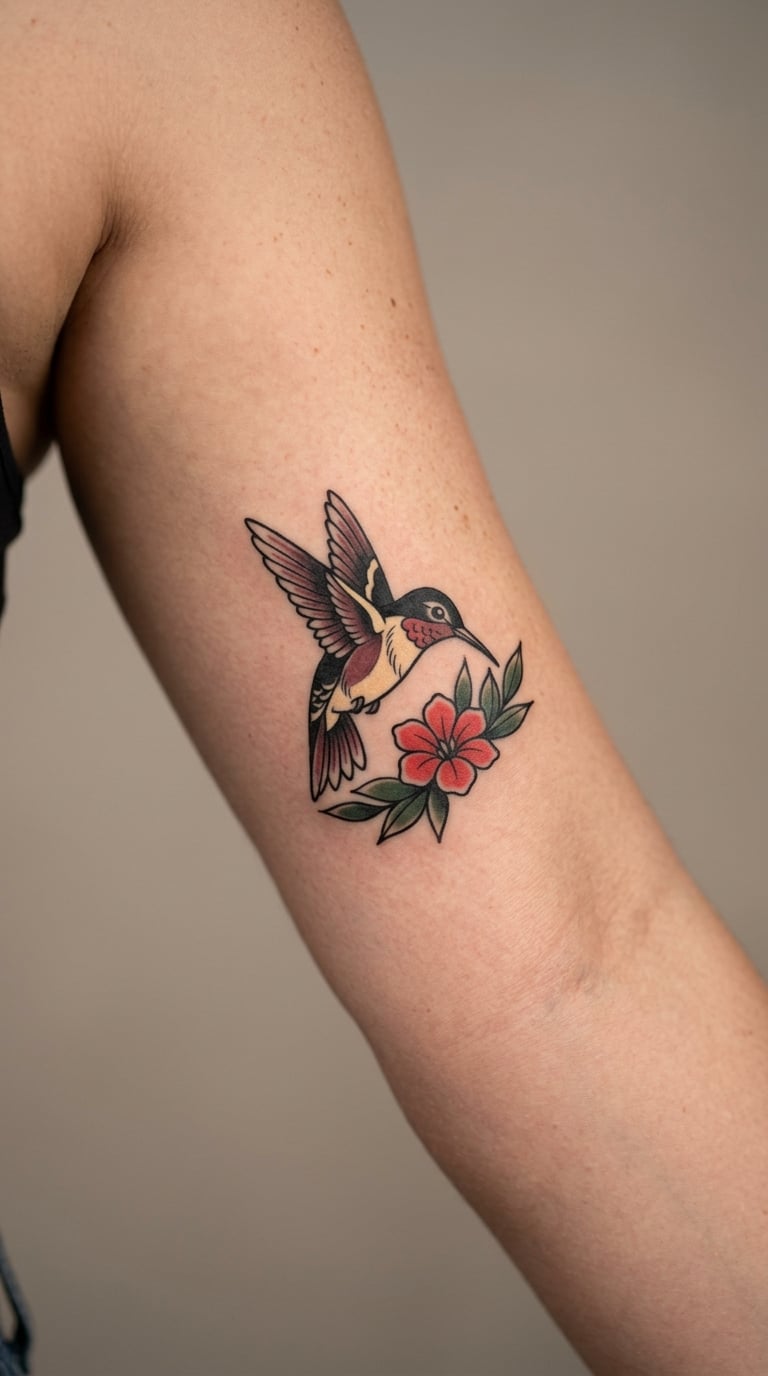
A compact bird with a long beak, wings blurred into two shapes rather than individual feathers, and one flower beneath it in muted red with a pale yellow centre. Bold outline, flat colour, minimal shading.
The hummingbird is associated with vitality, energy and joy, and it is a rare piece of symbolism that stays genuinely cheerful instead of turning solemn. It also suits a body area that benefits from a shape with movement in it.
Placement: upper arm, back of the shoulder, or calf. Size: 2.5 to 3.5 inches (6-9 cm) long. Style: neo-traditional with bold outline and flat colour.
Pain: medium on the upper arm, and colour passes mean a longer session. Ageing note: bold outline and flat colour age far better than fine shading, which is the main reason this style suits a piece meant to last.
Make it yours: swap the generic flower for something that grows where you live, and use a colour that is genuinely yours rather than a trend of the year.
13. Minimal Elephant with a Floral Trunk
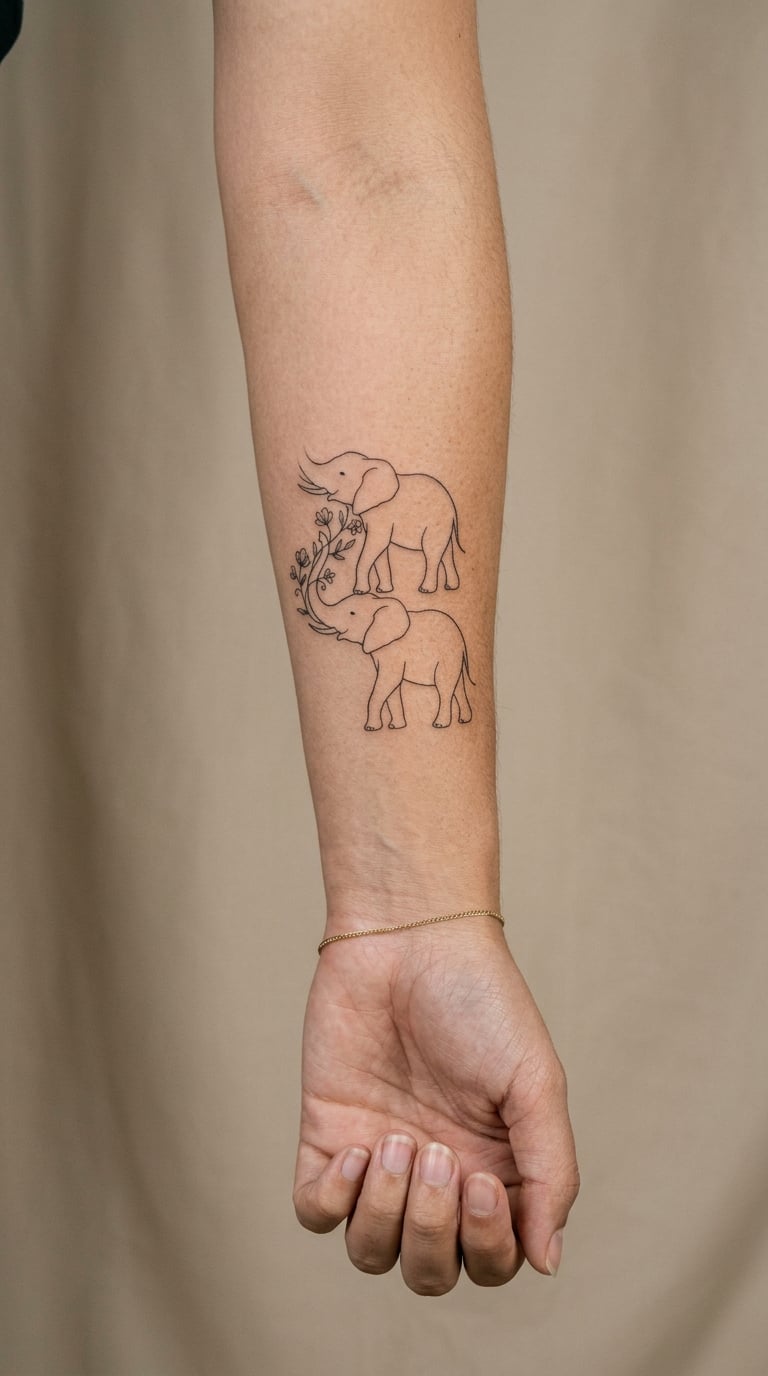
An elephant in side profile, simplified to a rounded head, one visible ear, four legs and a curved trunk, with small flowers and leaves wrapping up the trunk. Line weight stays even; no background, no ground line.
Elephants carry broad associations with wisdom, strength and protection, and in several cultures the trunk alone is a sign of good fortune. Drawn small and side-on, the design stays graceful rather than heavy.
Placement: outer forearm, calf, or along the rib. Size: 3 to 3.5 inches (7.5-9 cm) long. Style: minimal fine line with light botanical detail.
Pain: medium on the outer forearm. Ageing note: the ear is a large empty shape that can look flat as the design softens, so ask for a single defining line inside it rather than shading.
Make it yours: have the wrapping flowers be one specific plant, and keep the count of flowers meaningful rather than decorative.
14. Two Birds Flying in Opposite Directions
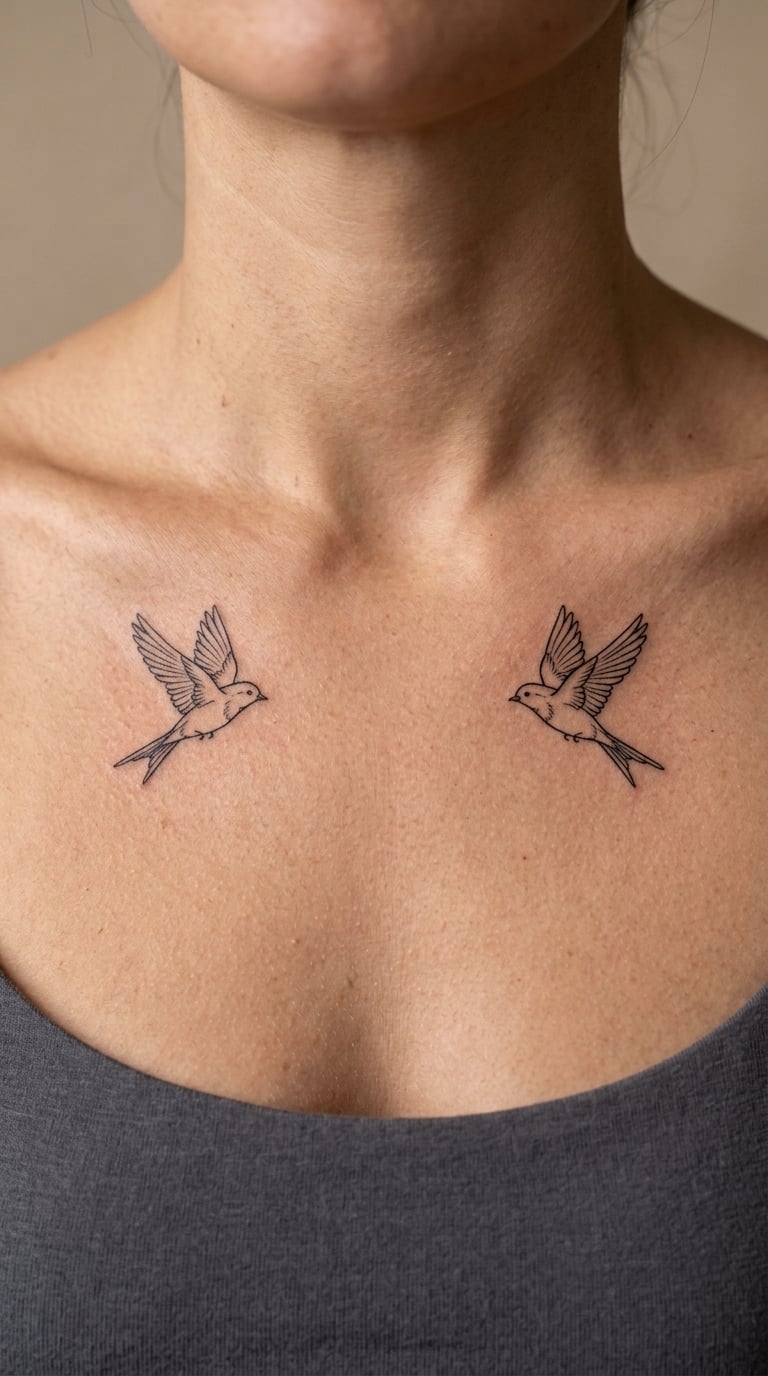
Two small birds in flight, mirrored left and right, wings up, bodies angled away from each other with a clear gap between them. Fine outline with a single shaded wing each for balance.
Paired birds can carry connection, freedom, or two lives moving forward in different directions, sometimes all three at once. On the chest, the separation between the two becomes part of the meaning rather than just spacing.
Placement: upper chest near the collarbone, upper back, or the tops of both arms. Size: 1.5 inches (4 cm) each, with 2 to 3 inches (5-7.5 cm) of space between them. Style: fine line.
Pain: high on the chest, and it is one of the placements most people describe as a jolt rather than a sting. Ageing note: fine wing lines on the chest hold well, but symmetry gets harder to check if the two sides heal at different rates.
Make it yours: have the birds angled slightly rather than perfectly mirrored, which reads more like two real lives and less like a logo.
15. Mountain Range with One Peak in Red
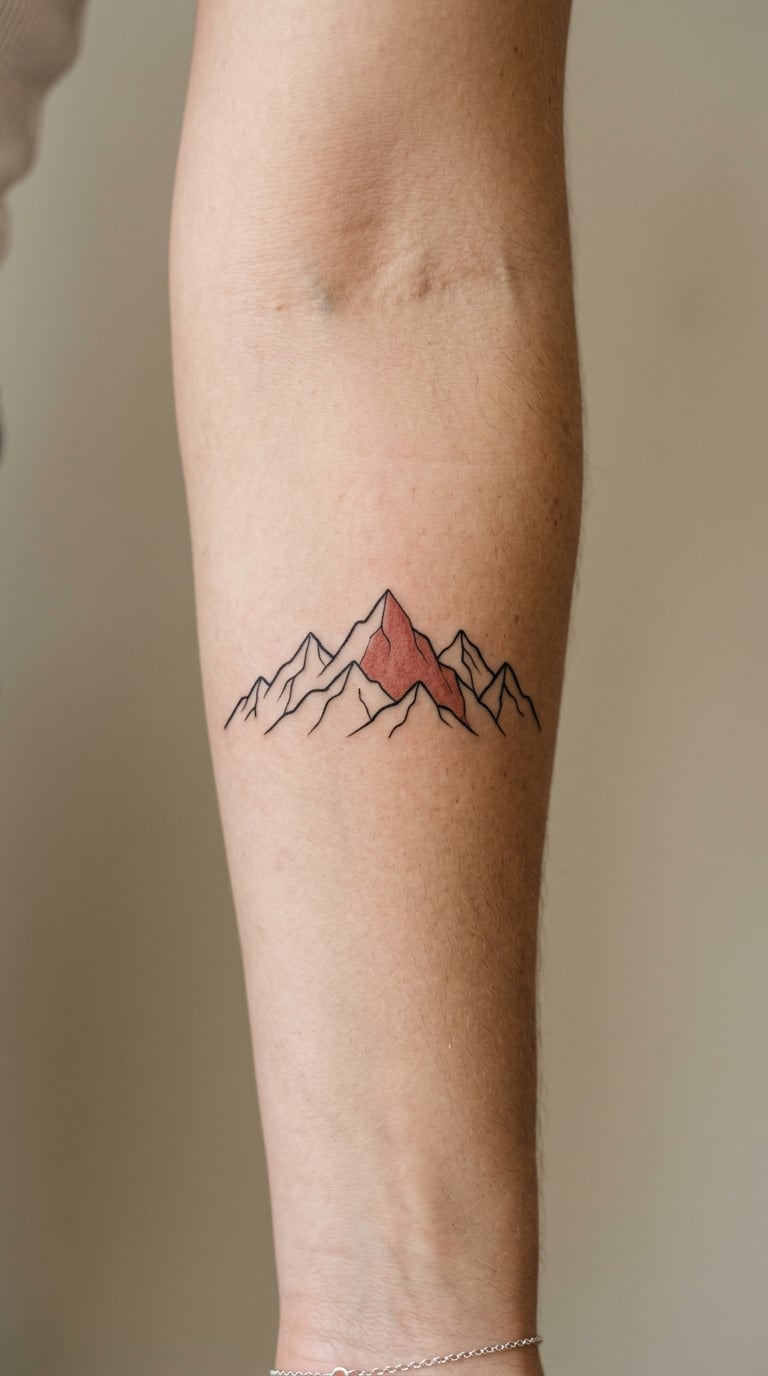
Three or four simplified peaks drawn in clean angular lines, with the tallest peak filled in a muted red while the rest stay black outline. No snow line, no sky, no landscape detail underneath.
Mountains are associated with endurance, aspiration and the journeys that mattered, and the single coloured peak marks the one that stays in the foreground. It works as a quiet piece rather than an outdoor-trophy one.
Placement: forearm, calf, or across the upper back. Size: 2.5 to 3.5 inches (6-9 cm) wide. Style: fine line with one colour accent.
Pain: medium on the forearm. Ageing note: sharp angular peaks stay crisp for years, but a small red fill inside a thin outline can look thin; ask for solid fill rather than a wash.
Make it yours: colour the peak you actually climbed rather than the one you only planned, and keep the rest of the range generic.
16. Half Sunrise Emerging from a Fine-Line Horizon
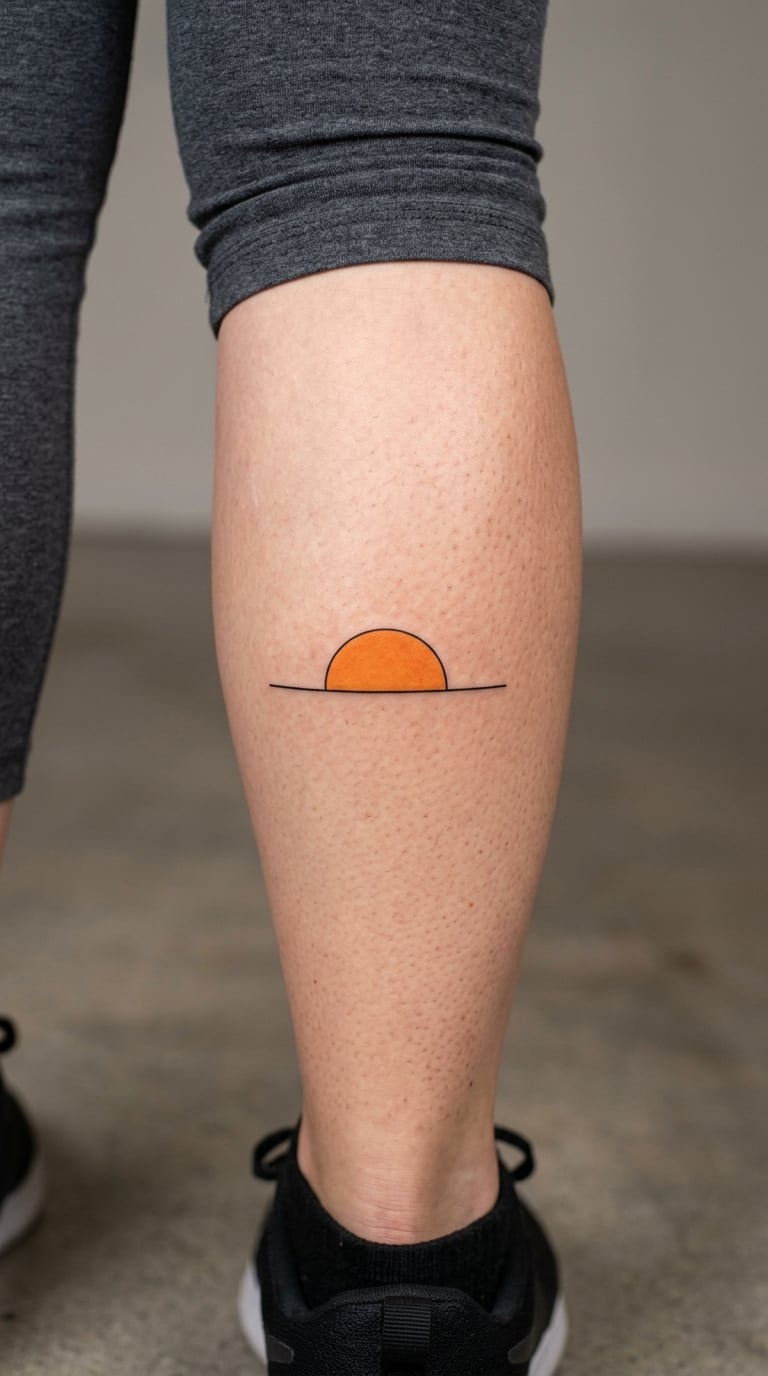
A semicircle sitting on a single straight horizon line, drawn as a half-disc in black outline with a warm orange wash inside the lower half, plus a few short radiating ticks above. One horizon line, nothing else.
A sunrise is the plainest symbol of hope and new beginnings, and the half-sun version is quieter than a full sunburst, which is often what people want when the feeling is real but they would rather not announce it.
Placement: calf, shoulder, forearm or across the back of the ankle. Size: 2 to 2.5 inches (5-6 cm) wide. Style: minimal with one warm colour wash.
Pain: low to medium on the calf. Ageing note: the soft orange wash fades faster than the outline, so the sun may look paler than you remember even while the line stays sharp.
Make it yours: put it on a body part that gets seen, and keep the horizon line perfectly level with the bone so it sits naturally as the arm or leg moves.
17. Small Blackwork Anchor with Rope Detail
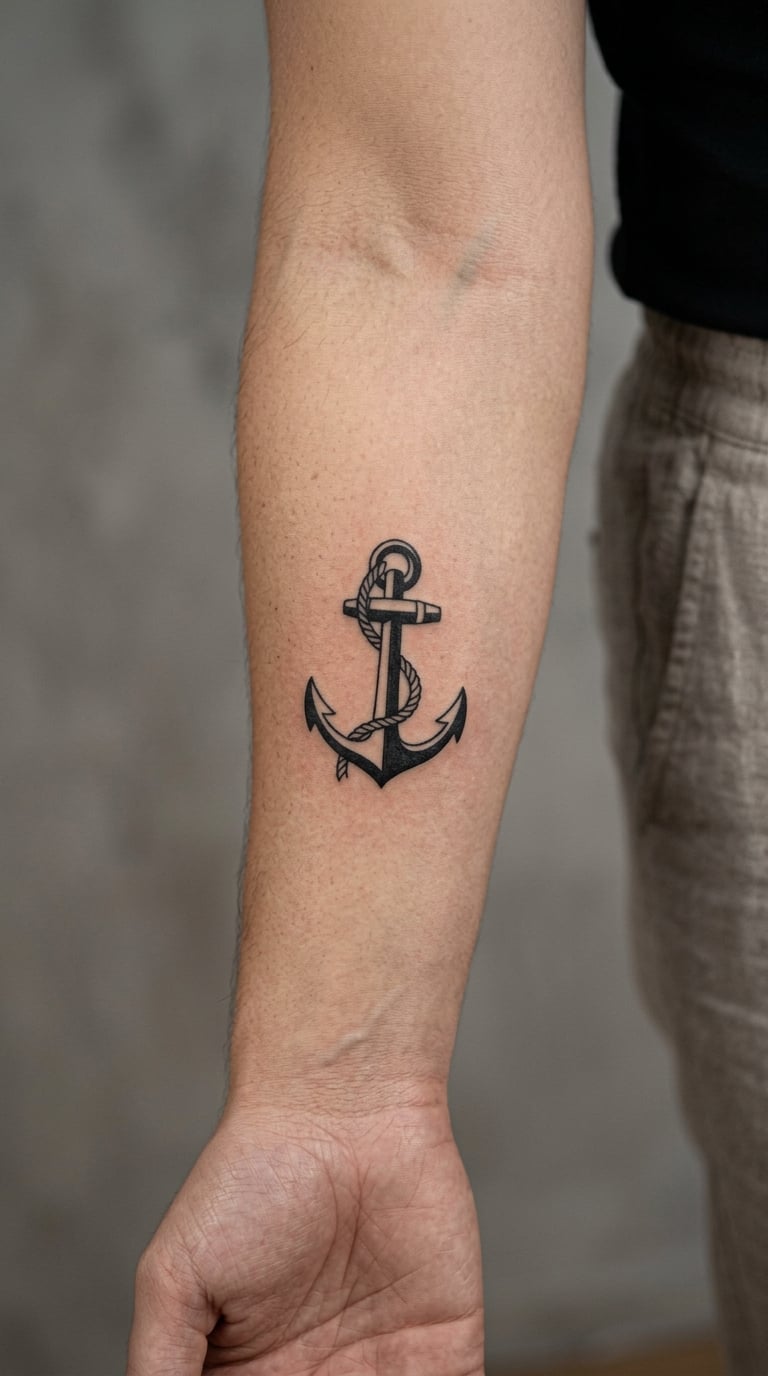
A solid black anchor with a single loop of rope crossing the shank once, drawn in flat black with negative space doing the work. No chain, no star, no banner, no surrounding symbols.
Anchors are long associated with stability, staying grounded and holding fast, and they read as steadiness rather than strength. The restraint is what keeps it from drifting into nautical decoration.
Placement: inner arm, outer forearm, or the ankle. Size: 1.5 to 2.5 inches (4-6 cm) tall. Style: blackwork with solid fill.
Pain: medium on the inner arm, and solid black takes longer because the area has to be packed. Ageing note: solid fill is the most durable option here; the rope loop is the first part to soften, so keep it simple.
Make it yours: have the rope loop sit slightly loose rather than tight, which reads as holding on without being trapped.
18. Three Fine Feathers in a Balanced Trio
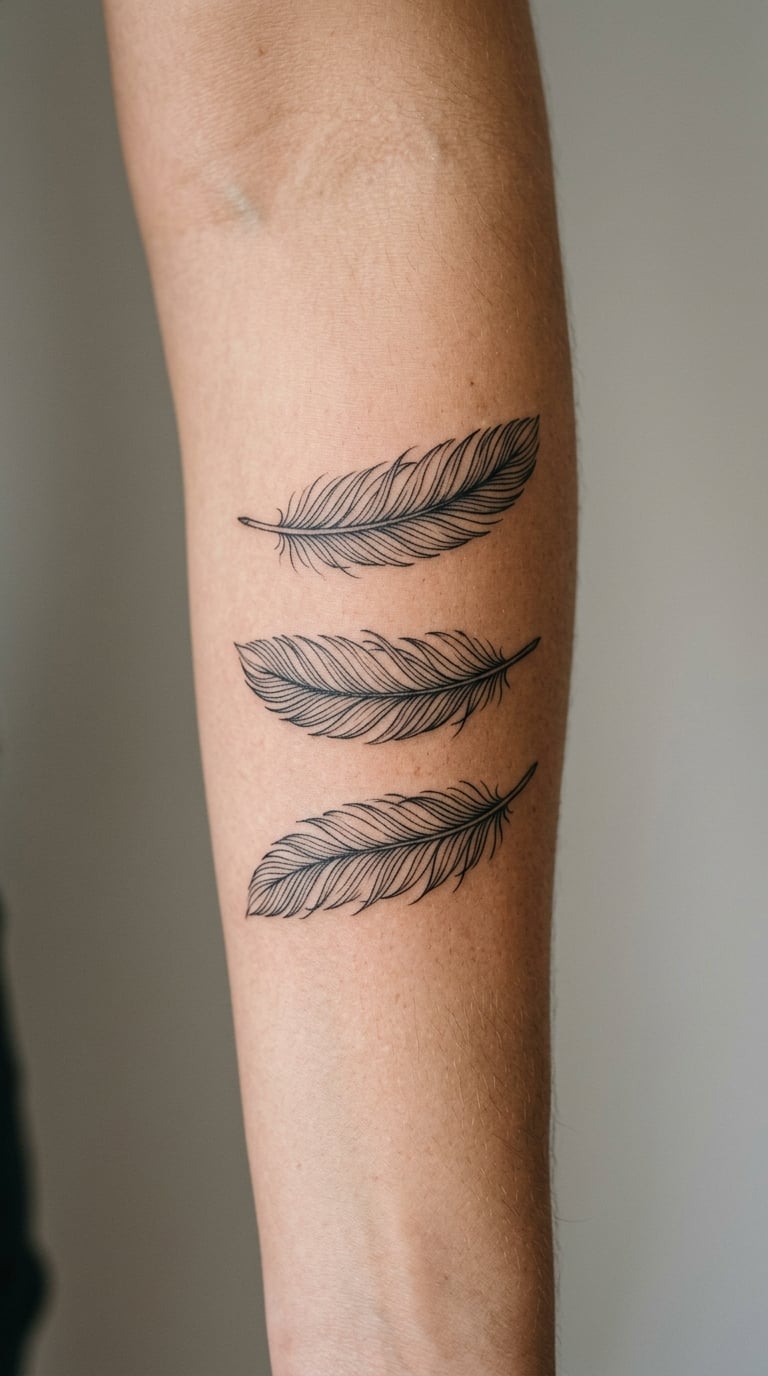
Three feathers of equal length, each with a central shaft and separated barbs on both sides, spaced evenly in a row or a loose triangle. The barbs are drawn as individual lines, never as a filled shape.
Feathers carry broad associations with freedom, honour and the ability to move through something difficult without being changed by it, though what a feather means to you is entirely your own business. The trio version is more balanced and calmer than a single feather.
Placement: outer arm, upper back, or the back of the calf. Size: 2 inches (5 cm) each, 5 to 6 inches (12.5-15 cm) across the trio. Style: fine line.
Pain: low to medium on the outer arm. Ageing note: individual barbs are the first detail to blur, so ask for fewer, slightly heavier barbs rather than more fine ones.
Make it yours: use a real feather from a place that matters, and have the artist copy its actual asymmetry instead of drawing a textbook-perfect one.
19. Double-Stranded DNA Helix in Fine Line
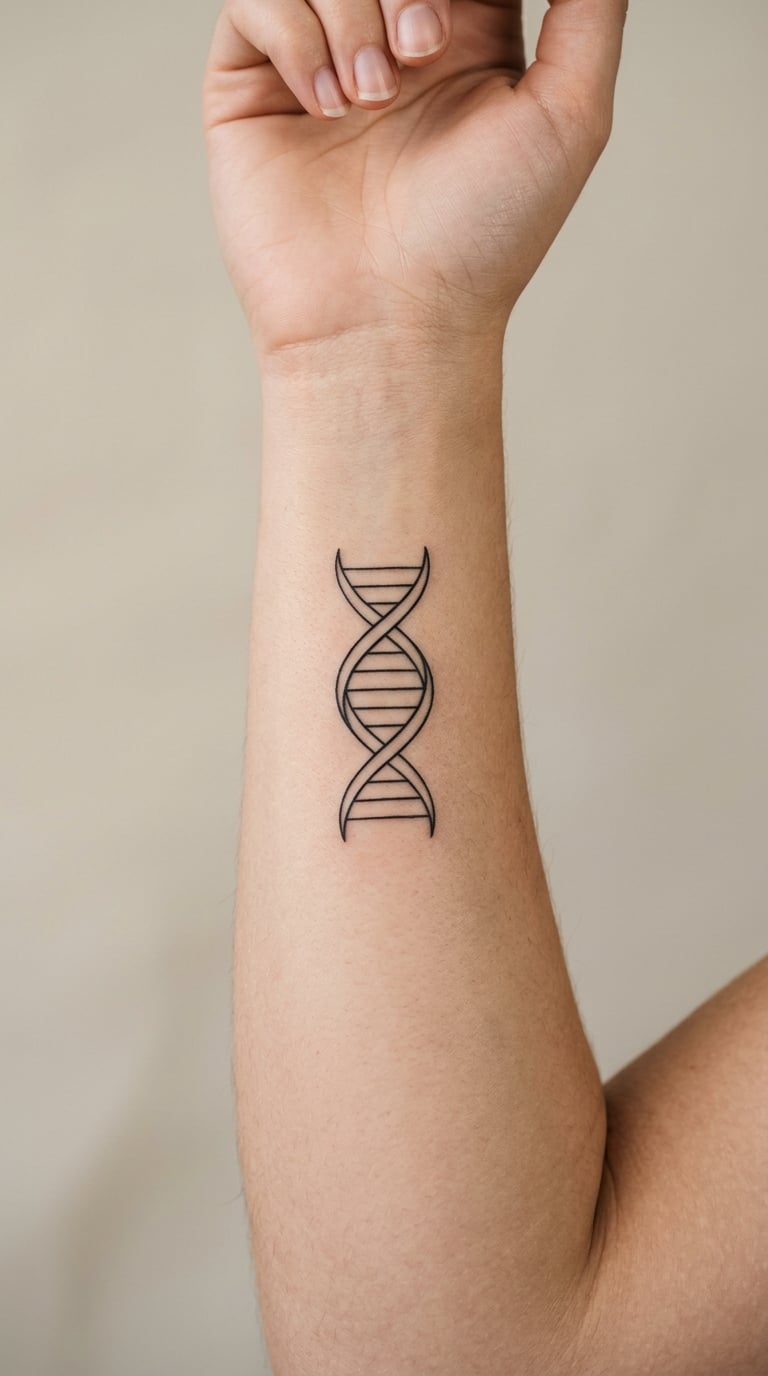
Two continuous black lines twisting around each other, joined by evenly spaced horizontal rungs, with the spacing widening and narrowing as the curve turns. The rhythm of the rungs matters more than the accuracy of the twist.
The helix is a symbol of identity, inheritance and life itself, and it often suits tattoos marking family, a child, a diagnosis or a chosen identity. It sits close to the body in a way that reads as personal rather than decorative.
Placement: forearm, inner arm, or the calf. Size: 2.5 to 3.5 inches (6-9 cm) long. Style: fine line geometry.
Pain: medium on the forearm, and the rungs mean multiple passes over the same skin. Ageing note: close-spaced rungs can merge into a solid band within a decade, so ask for a helix with fewer, more open rungs.
Make it yours: have one rung drawn in a second colour, marking a person, and leave the rest of the structure plain.
20. Coordinates in Discreet Handwritten Type
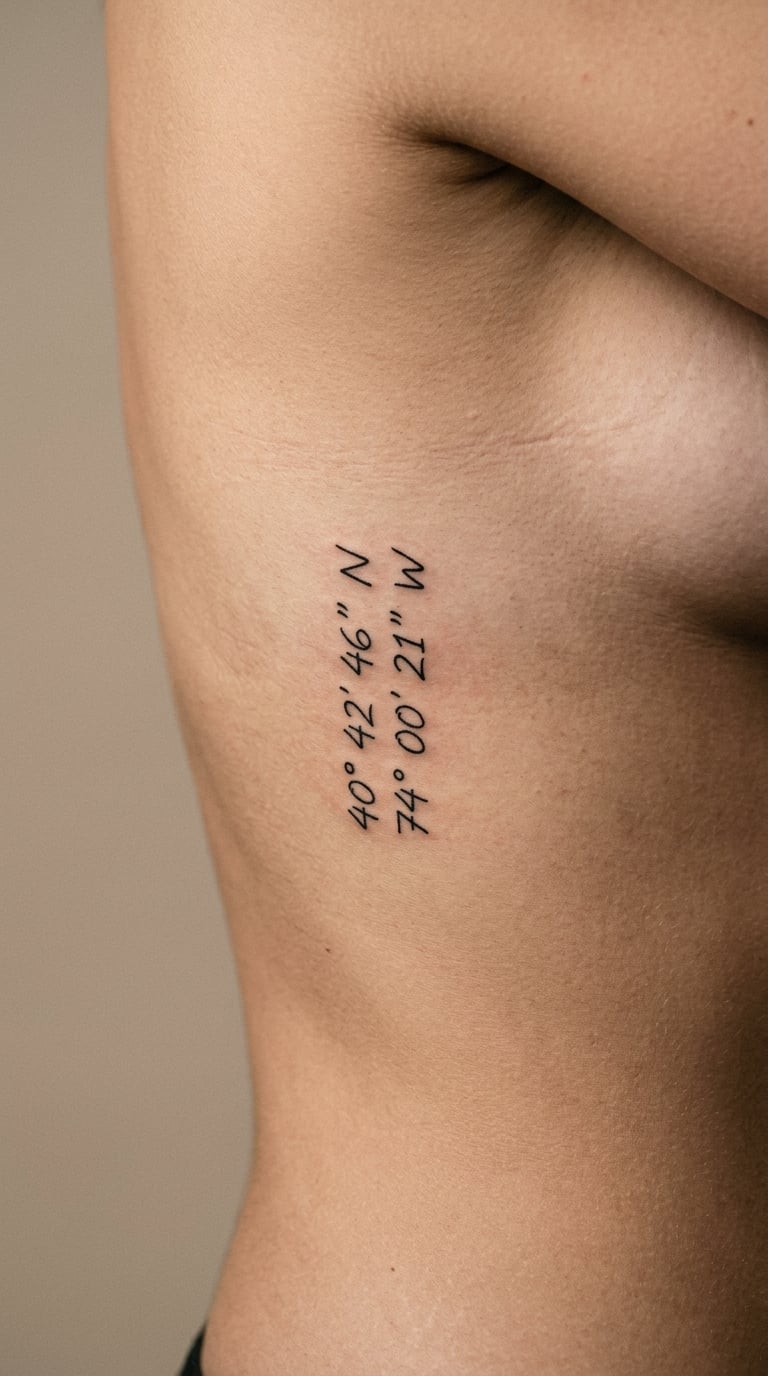
Two compact lines of hand-drawn numerals and degree symbols, set in a small looping hand with consistent slant and no map, pin or label. Legibility of the actual numbers matters more than elegance of the letterforms.
Coordinates mark a place where something happened, where someone you love lives, or simply where you began. It is one of the most requested designs on this list precisely because it means something that cannot be Googled by a passer-by.
Placement: rib area, inner arm, or the back of the shoulder. Size: 2 to 2.5 inches (5-6 cm) long. Style: handwritten script in black.
Pain: high on the ribs, and low to medium on the arm if you would rather not sit through that. Ageing note: script is one of the first things to blur as skin changes, so keep the numbers larger than looks necessary and ask for a single consistent hand rather than very thin hairlines.
Make it yours: convert the numbers to a different format you alone will recognise, and have the artist write out the full coordinates so no digit is guessed at.
21. Morse-Code Pulse with a Hidden Message
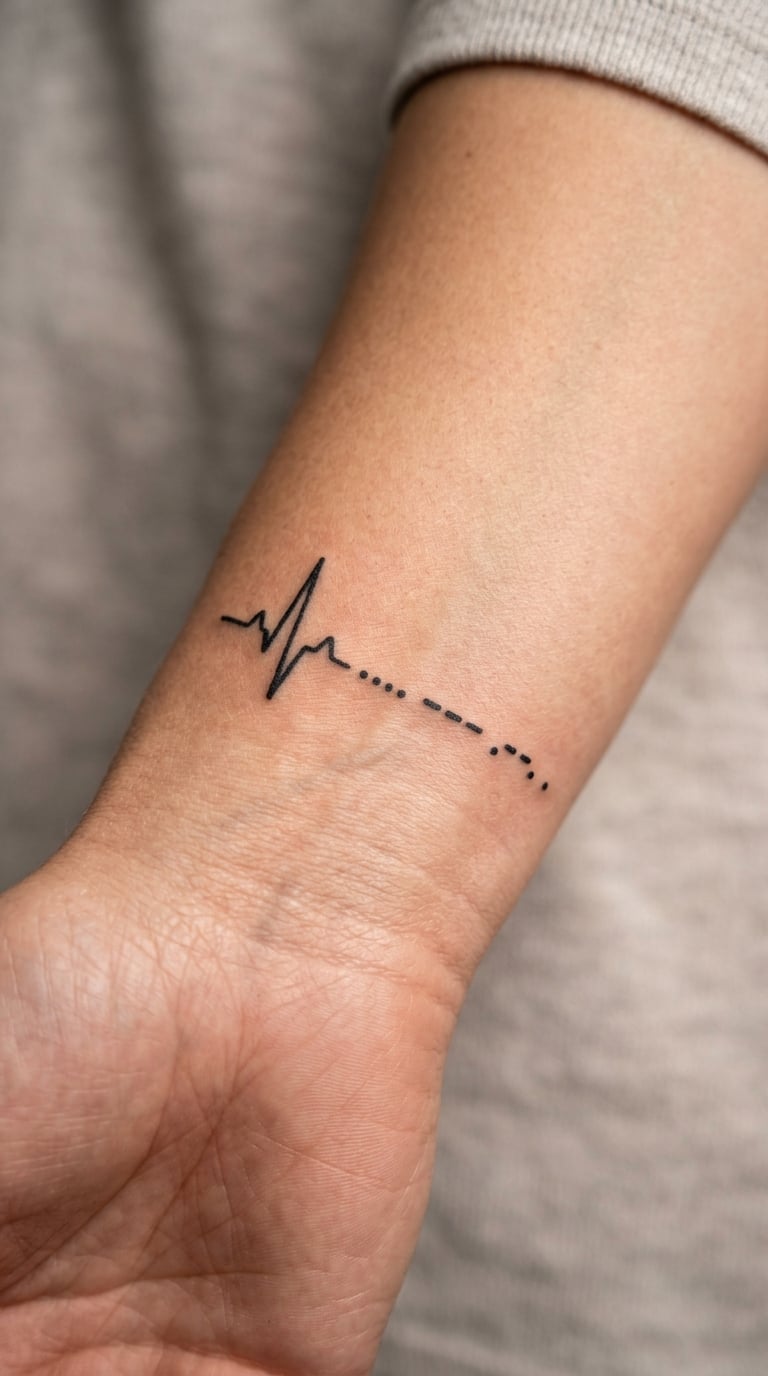
A single ECG-style line that runs flat, spikes once, dips, and then continues as a sequence of precise dots, dashes and gaps, ending back on a flat line. The transitions have to be clean or the message becomes unreadable.
It is a private message in a language most people do not read, which is exactly the appeal. It suits a name, an initial, a date or a short word that only the people in it will ever know is there.
Placement: inner wrist, inner arm, or behind the ear. Size: 2.5 to 3 inches (6-7.5 cm) long. Style: fine line technical.
Pain: medium on the inner wrist. Ageing note: the smallest dots and the tightest gaps are the parts that blur first, so choose a short message with few letters rather than a long one rendered small.
Make it yours: have the artist write the decoded message on paper and check it against your Morse reference before the stencil goes on, then keep that paper.
22. Semicolon Marked by a Fine Botanical Dot
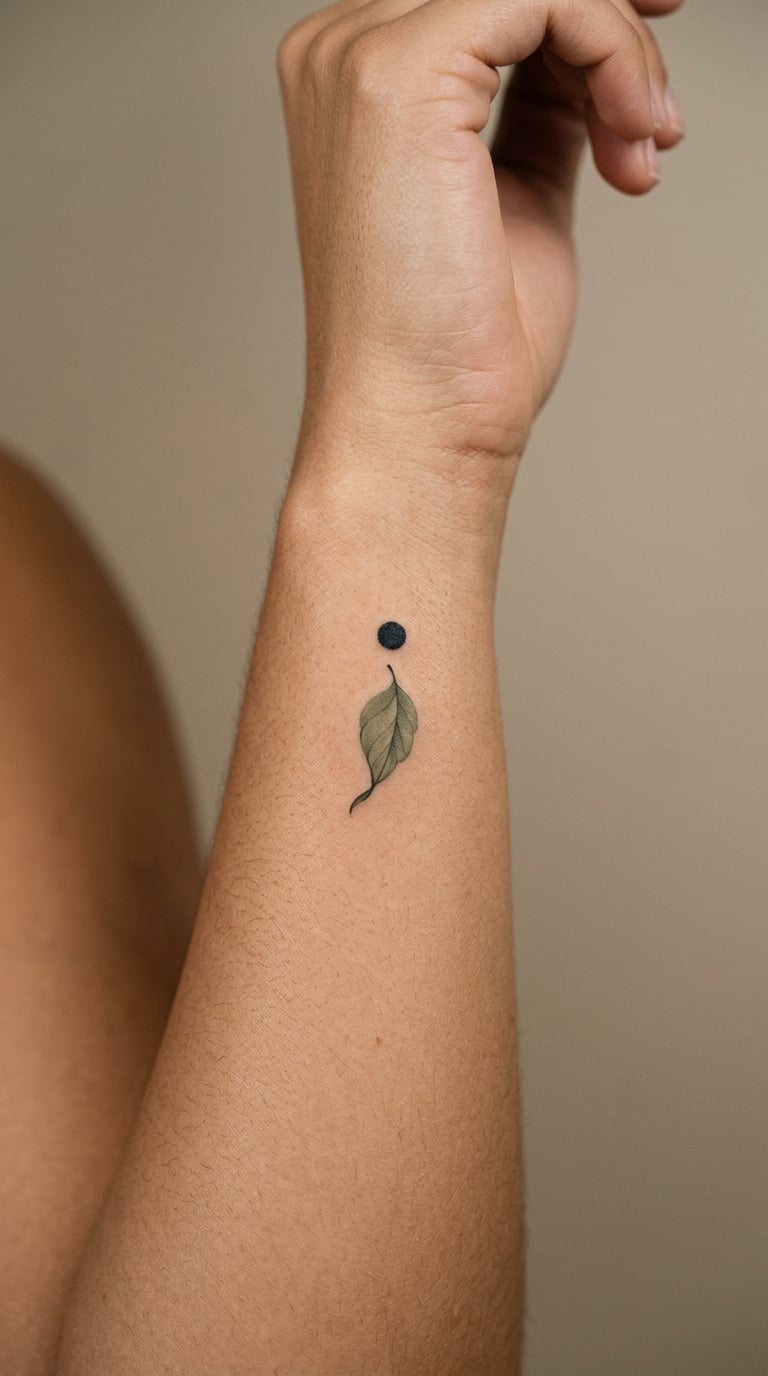
A clean semicolon in one plain weight, with the lower dot replaced by a small muted green leaf, and nothing else added around it. The leaf stays small enough that the mark still reads as a semicolon first.
The semicolon project uses the mark for mental health awareness and for survival through difficult periods, so it carries a widely recognised association that many wearers choose deliberately and some wear for someone else. It is a symbol with a specific community behind it rather than a general one.
Placement: forearm, inner wrist, or behind the ear. Size: 1 to 1.5 inches (2.5-4 cm) tall. Style: minimal type detail with one colour accent.
Pain: low to medium. Ageing note: at one inch the mark is small enough that the two dots stay legible, but keep the type plain rather than a thin font that breaks up at the counters.
Make it yours: let the leaf be a real plant rather than a decorative shape, which keeps a widely used symbol connected to your own story rather than the trend around it.
23. Curved Arrow Passing Through a Dotted Path
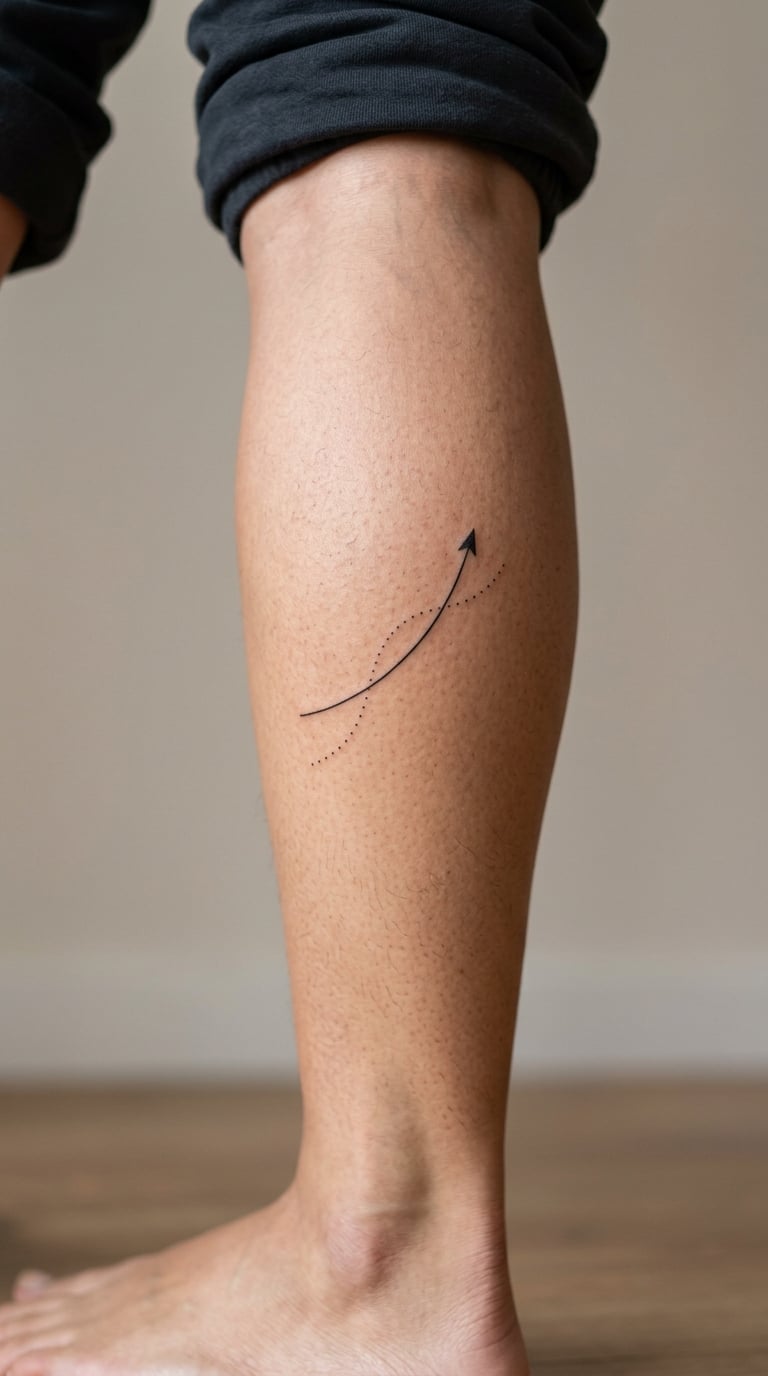
One clean curved line ending in a small solid arrowhead, crossing a sparse line of evenly spaced dots that run in a different direction. Two elements, no text, no frame.
The arrow is a common symbol of forward movement and personal direction, and the dotted path gives it something to leave behind. Together they suggest progress that cost something, which is a different tone from a plain arrow.
Placement: calf, outer arm, or along the hip. Size: 2.5 to 3 inches (6-7.5 cm) long. Style: minimalist line.
Pain: low to medium on the calf. Ageing note: dots are small and fade before lines do, so ask for dots with slightly more spacing than you think looks right in a reference.
Make it yours: have the dotted path bend once, at the point where your own story changed direction, and leave the arrow pointing somewhere new.
24. Hourglass with a Falling Petal Instead of Sand
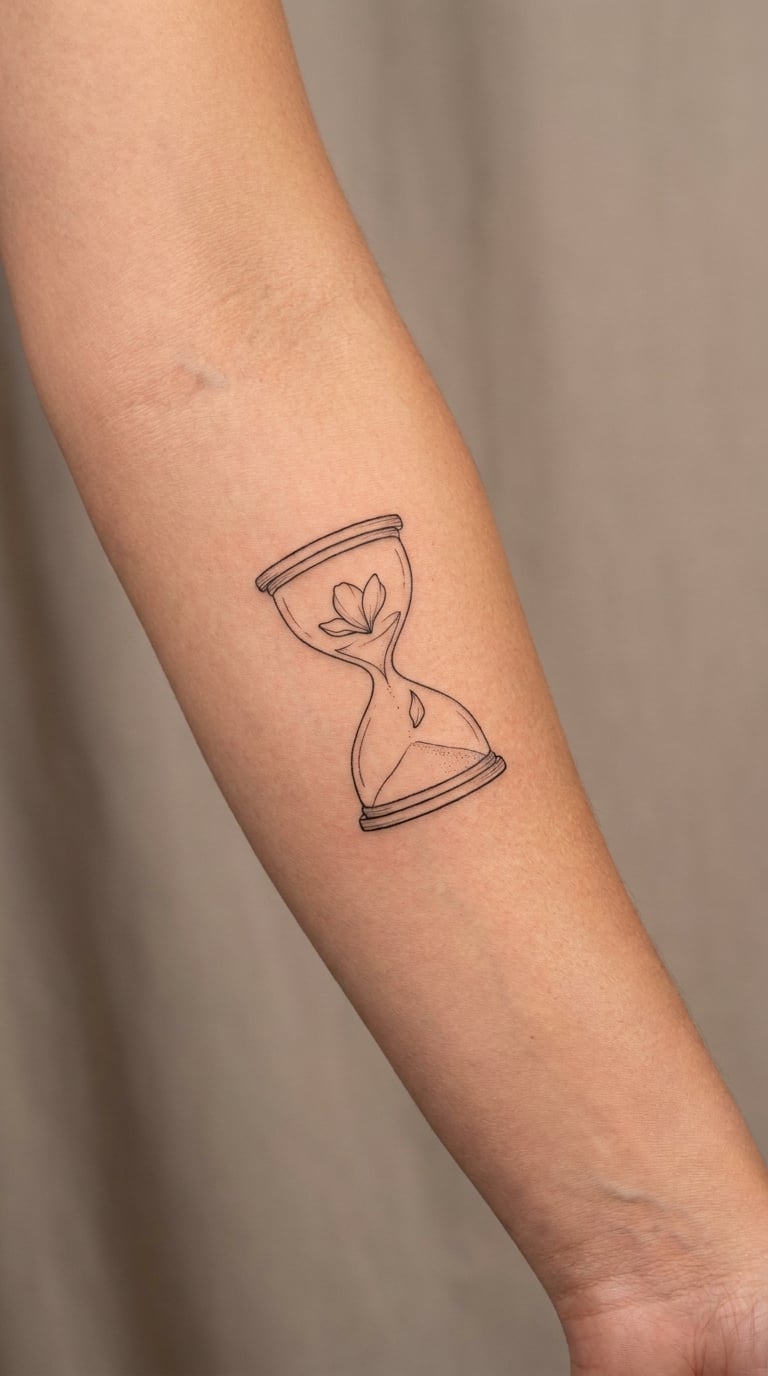
An hourglass frame in fine black line, drawn with four straight posts and two flat ends, with three small petals falling through the waist instead of a sand stream. Entirely black; no shading inside the glass.
Time and finiteness are the usual associations with an hourglass, and swapping sand for a petal softens that into something about limited moments rather than running out. It reads as a memorial piece without being one.
Placement: inner forearm, inner arm, or the back of the calf. Size: 2 to 2.5 inches (5-6 cm) tall. Style: fine line.
Pain: medium on the inner forearm. Ageing note: the frame lines are fine and the interior is empty, so keep the posts at a consistent medium weight or the whole shape can look wobbly in ten years.
Make it yours: use the flower species connected to whoever the piece is for, and ask for the petals to be slightly irregular so they read as falling rather than printed.
25. Ringed Planet with One Fine Orbit Line
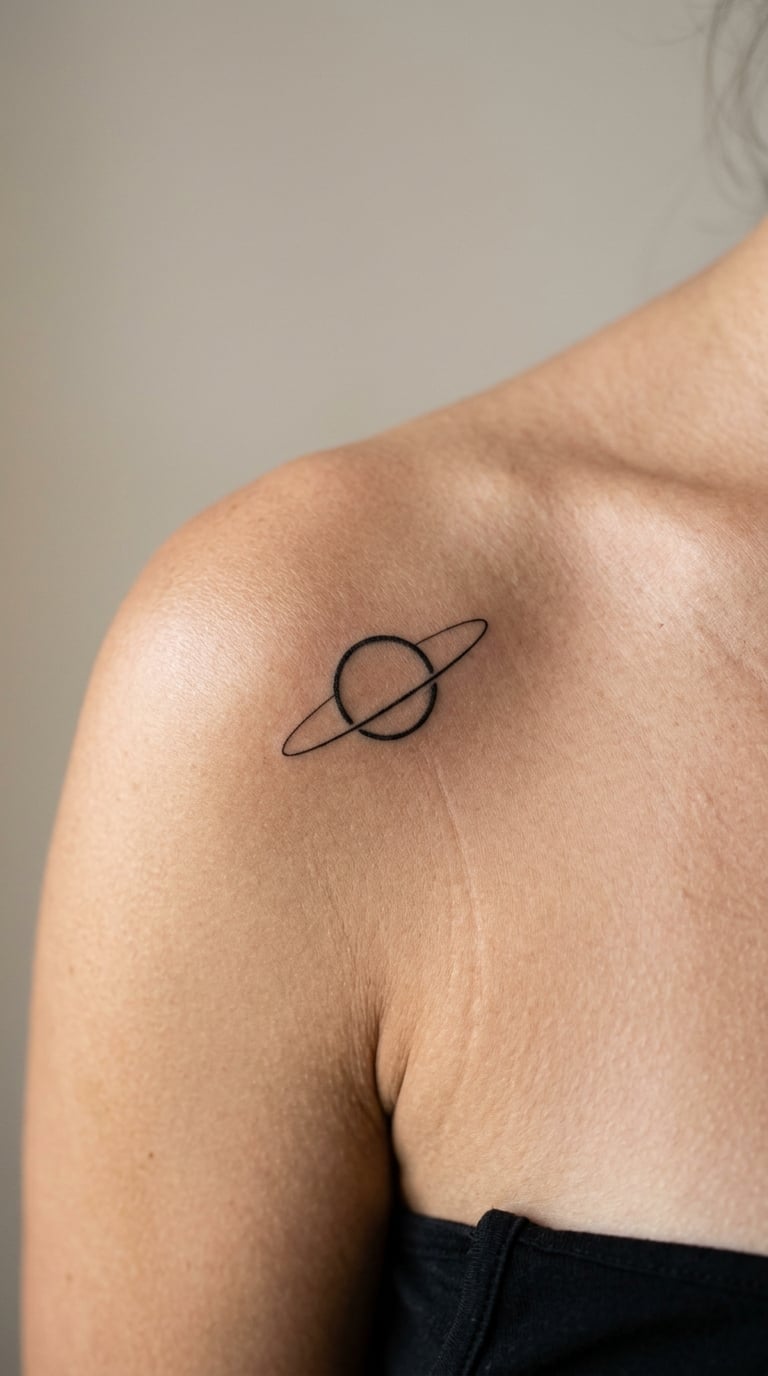
A plain circle crossed by one thin elliptical orbit line, tilted so the ring passes in front of the lower half and behind the upper half. No stars, no shading, no second ring.
A ringed planet is a symbol of wonder, possibility and a perspective wider than ordinary concerns, and it does some of the work a landscape would without needing a landscape. The single orbit line is the detail that keeps it from looking like a clip-art planet.
Placement: shoulder, upper arm, or the outer thigh. Size: 1.5 to 2 inches (4-5 cm) wide. Style: minimal fine line.
Pain: low to medium on the shoulder. Ageing note: the ring crosses the body of the planet, so those two thin overlaps are the parts to watch; ask for the ring line to match the circle’s weight exactly.
Make it yours: add one small dot off to one side as the thing you are heading toward, positioned asymmetrically so the piece is not symmetrical.
26. Open Hand with a Small Sprouting Flower
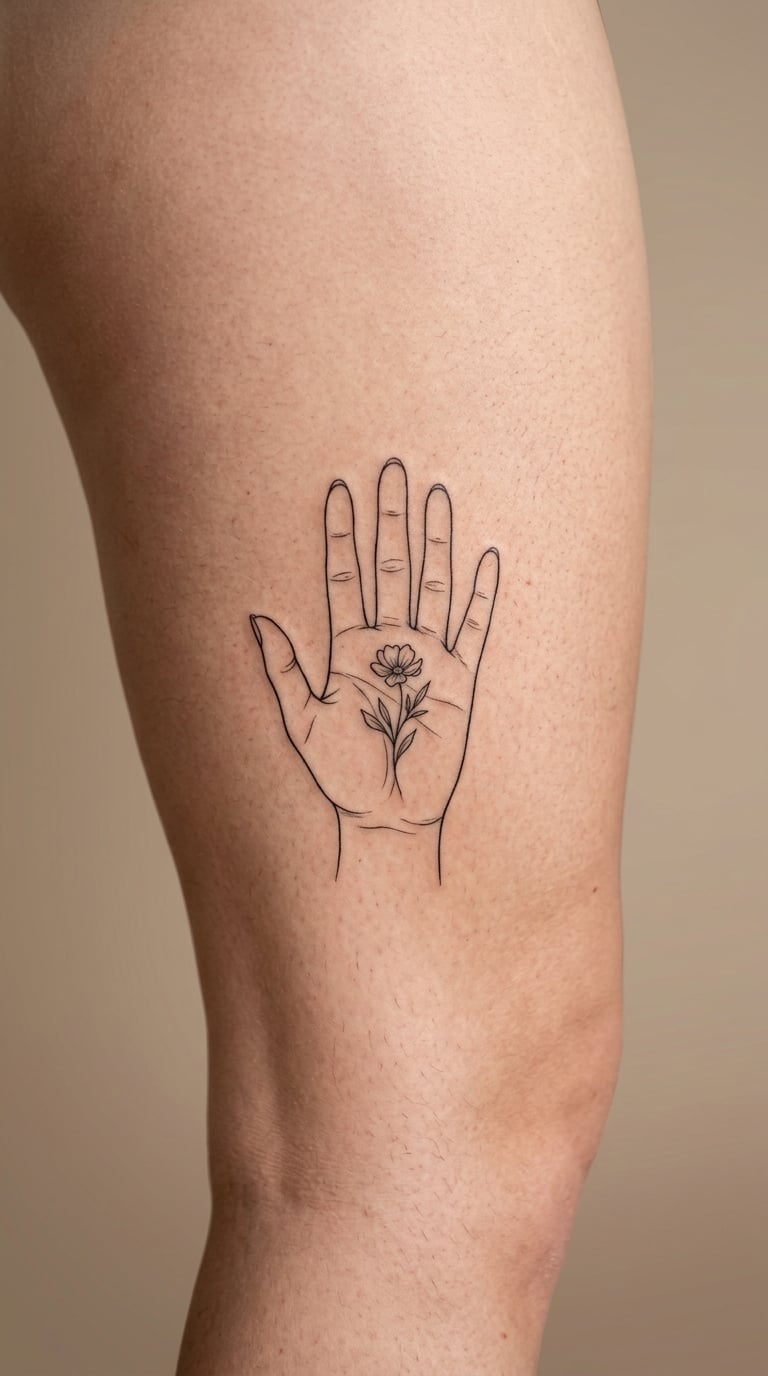
An open hand drawn palm-out in fine outline, fingers slightly apart with realistic spacing, thumb relaxed, and a small five-petal flower with a short stem rising from the centre of the palm. No jewellery, no cuff, no second hand.
An open hand carries associations of care, receiving and offering, and the flower growing from the palm shifts it toward renewal and what you are making rather than what you are holding. A thigh or forearm placement gives the hand the space the drawing needs.
Placement: outer thigh, forearm, or the side of the hip. Size: 3.5 to 4.5 inches (9-11 cm) long. Style: fine line illustrative.
Pain: medium over a long stretch of skin, so the session is more tiring than sharp. Ageing note: finger separations are narrow gaps that can close up as lines change, so keep the fingers clearly separated rather than nearly touching.
Make it yours: have the flower match a real bloom connected to the piece, and add nothing else; the restraint is what keeps the hand readable at four inches.
27. Interlocking Celtic-Style Endless Knot
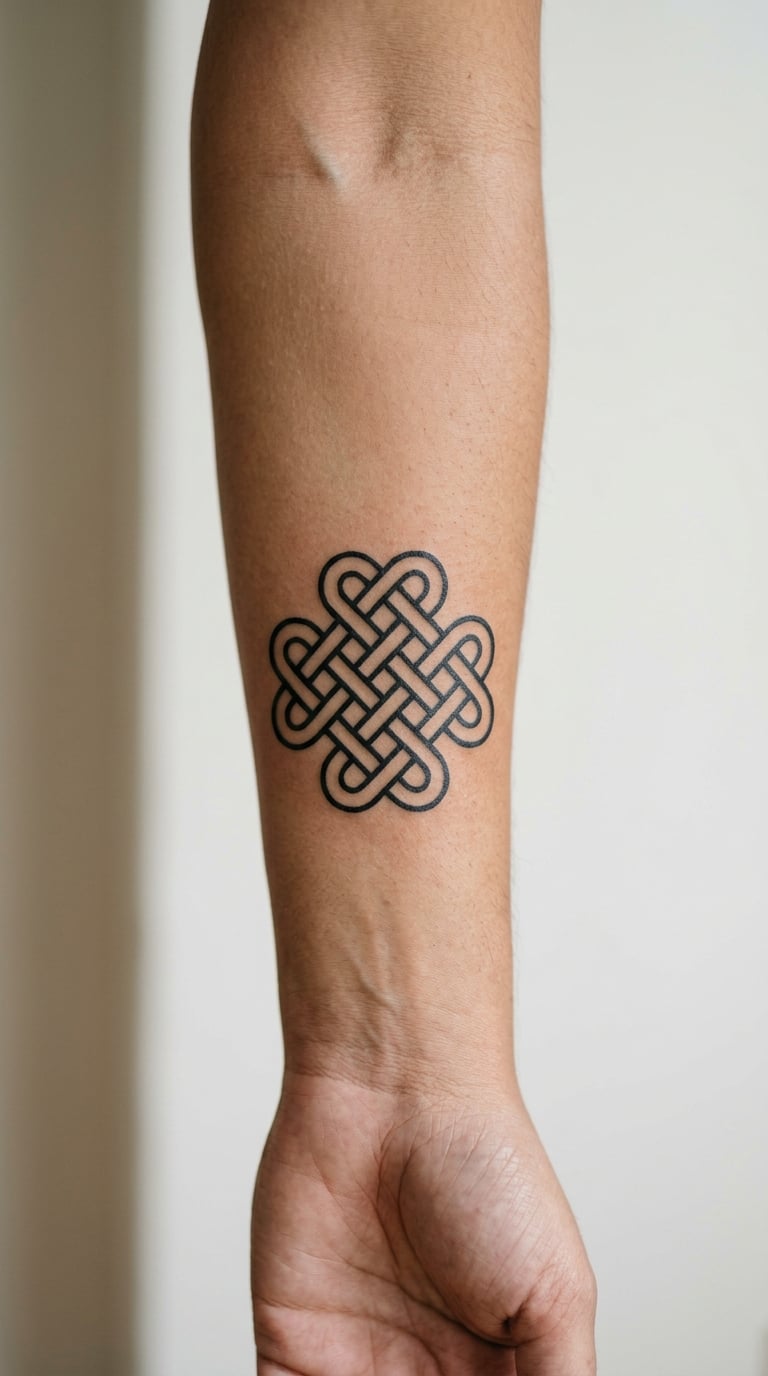
A continuous woven line looping over and under itself in a symmetrical pattern, drawn with even black line weight and clean crossings, with the ends closed into the weave rather than left open. No border, no caption.
Endless knot patterns are widely associated with continuity, interconnectedness and bonds that do not break, though what a Celtic-style knot means varies between sources and traditions. If it matters to you, ask the artist where their pattern comes from rather than assuming a single reading.
Placement: forearm, upper arm, or the back of the shoulder. Size: 2 to 3 inches (5-7.5 cm) across. Style: geometric linework.
Pain: medium, and tight inner corners in the weave take repeated passes. Ageing note: even line weight across every crossing is what holds the pattern together, so avoid versions drawn with a hairline in the tight spots.
Make it yours: keep the knot itself traditional and personalise through placement and size rather than adding a name or a date around it, which usually weakens the geometry.
28. Personal Birth Flower in Watercolour
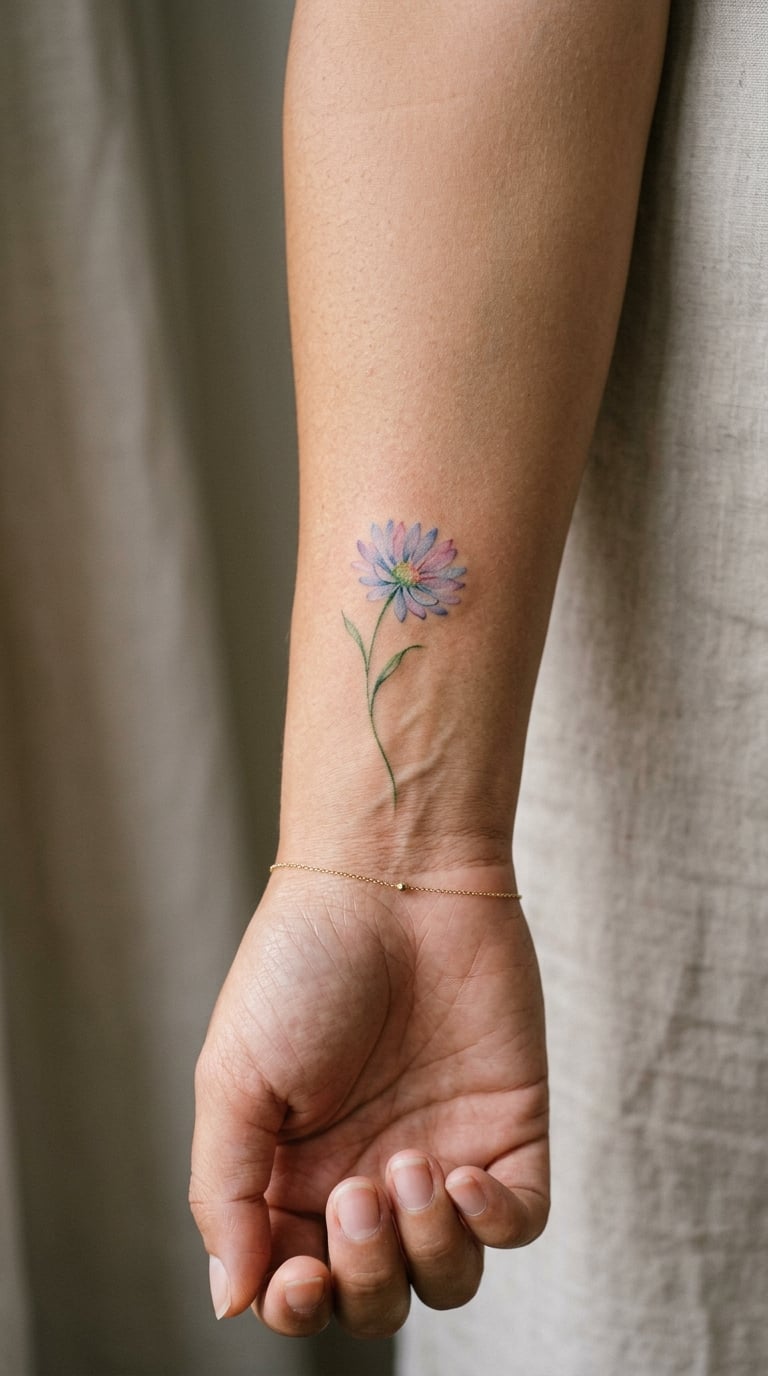
One flower with translucent petals in soft botanical colour, a single curved green stem and one or two leaves, painted loosely with visible water spread and no outline around the petals.
Birth flowers connect a design to a birth month, and more often than not to the birth month of someone other than the wearer. It is a quiet way to carry a date or a person without writing anything down.
Placement: wrist, ankle, or behind the ear. Size: 2.5 to 3.5 inches (6-9 cm) long. Style: watercolour botanical.
Pain: medium on the wrist. Ageing note: watercolour fades faster than line work, and petal edges are the first thing to go soft, so this is a style that benefits from a planned touch-up rather than an unplanned one.
Make it yours: bring a photograph of the real flower, or a pressed specimen, so the shape and petal count are accurate rather than a generic version of the species.
29. Koi with a Simple Wave and Water Droplets
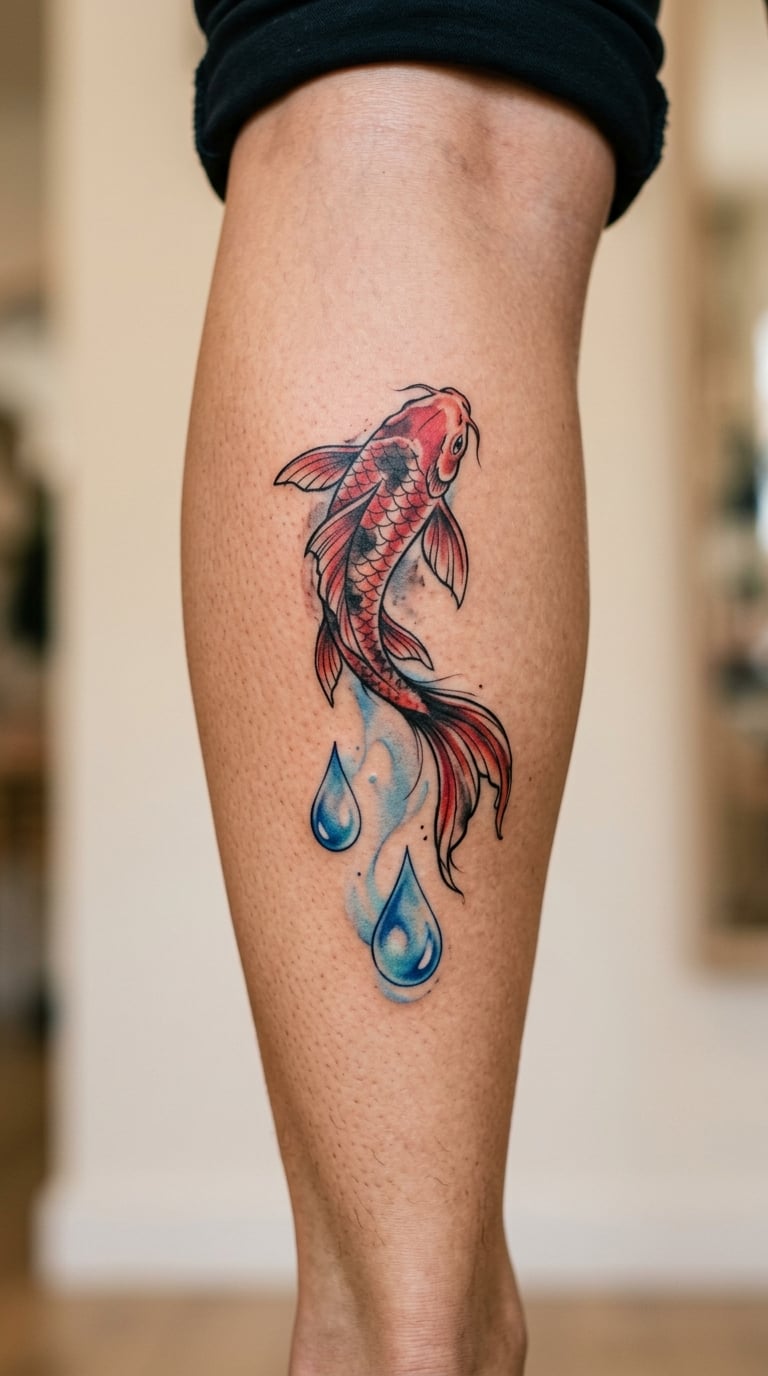
One koi drawn in red and black with defined scales, curving through a light blue watercolour wash, with two or three clean droplets falling below it. The water is loose; the fish is precise.
Koi are commonly associated with perseverance and transformation, drawing on the story of the carp that swims upstream. It reads as resilience rather than softness, and it holds up well on a larger area of skin.
Placement: calf, thigh, or the back of the shoulder. Size: 3 to 3.5 inches (7.5-9 cm) long. Style: illustrative colour with a light wash.
Pain: medium on the calf. Ageing note: red and black hold far better than pale blue, so expect the wash to fade first while the fish stays legible; a touch-up on the water is normal.
Make it yours: use a koi pattern associated with a specific person or place if one exists, and have the water droplets carry a count that means something to you.
30. Moth with Moonlit Antennae
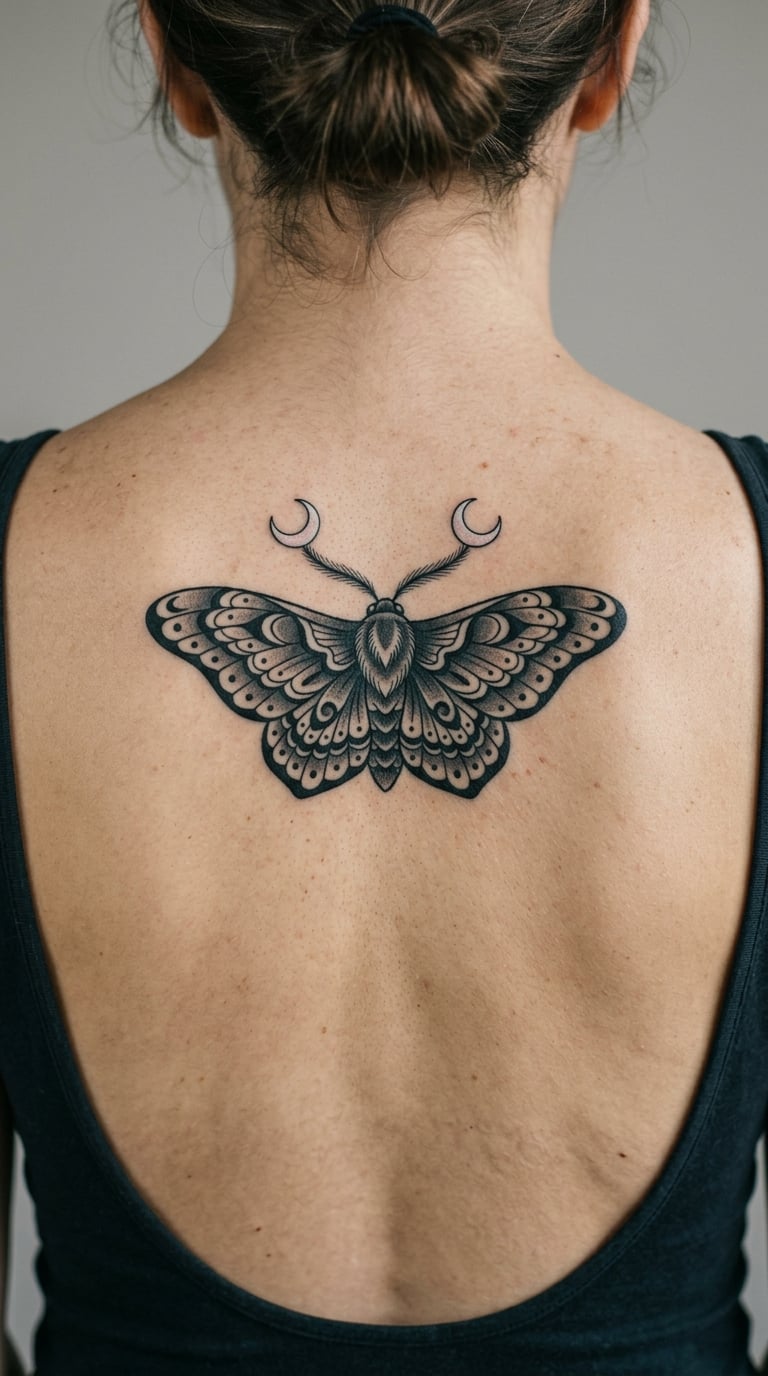
A symmetrical moth drawn in black and grey with patterned wings, fine body segments and feathery antennae that end in small pale crescent shapes. The wing pattern is the detail work; the moonlit antennae are the personal signature.
Moths are widely read as transformation and as finding your way when things are dark, which is why they are often chosen over butterflies by people whose change was private rather than celebrated. In tattoo circles the moth-versus-butterfly question comes up constantly, and the answer is that the moth suits the quieter story.
Placement: upper back between the shoulder blades, upper arm, or thigh. Size: 3.5 to 4 inches (9-10 cm) wide. Style: black and grey illustrative with fine line detail.
Pain: medium, and upper-back work requires good positioning and breaks. Ageing note: dense wing patterning is where fine grey washes soften first, so ask for defined line separation between the wing sections.
Make it yours: choose the species you actually saw, whether that is a luna moth, a death’s-head moth or an atlas moth, since the wing shape changes the piece more than the size does.
How to Choose the Right Design
Most people do not have a symbol problem. They have forty saved references and no way to tell which one is actually theirs. These five checks narrow that down faster.
- Start with the story, not the symbol. Write two sentences about the thing you want to carry. The symbol usually appears on its own once you know the words, and if it does not, a borrowed design will always feel slightly off.
- Match scale to the area, not to the reference photo. Most disappointment comes from shrinking a design that needed room. A design that works at four inches on a forearm often needs six on a rib, and vice versa.
- Pick the style before the artist. Fine line, blackwork, watercolour and neo-traditional age very differently, and an artist working in one of those styles will do it better than an artist you picked for availability.
- Decide how much detail you are willing to lose. If a piece only works while every line is crisp, it is a design that will need touch-ups. If it works in a bold simplified form, it is a design for a decade.
- Check where it sits in five years, not five months. Chest, neck and hand placements read differently later in life. Wrist, upper arm and thigh pieces are easier to cover if your taste changes, and easier to live with at work.
For more placement-specific ideas, our forearm tattoo ideas for women with meaning covers the arm specifically, and the line art tattoo ideas for women round-up goes deeper on single-needle work if that is the style calling you.
Cost and Session Time
Most artists charge by the hour, and a custom design is priced differently from a flash drawing, so the honest answer is that only a quote will be accurate. As a rough US guide for planning, a small single-symbol piece in fine line or one colour often lands somewhere around $80 to $180, a design with several elements, a colour pass or tight geometry runs $150 to $400, and larger watercolour or illustrative work can pass $500 once a session is split across two appointments. A small single-symbol piece is also the shortest sitting, often an hour or two; a multi-element design usually runs two to four hours.
Watercolour, large illustrative work and anything on the ribs or upper back push the session longer, because the work is slower and the position is harder to hold. Pieces over roughly four hours are usually split across two appointments, which also gives the skin a rest and the design a chance to settle before you commit to the finish.
Shop minimums, hourly rates, artist experience and location all change the number you are quoted, and a custom design may cost more than a design the artist already draws. If you want more of this kind of planning before you book, our watercolour tattoo ideas for women covers how that style is usually structured.
Aftercare Basics
Always follow your own artist’s aftercare instructions first, since they know exactly what they did in your skin. The general guidance below is what most tattooers will tell you anyway.
- Follow your artist’s aftercare instructions, including anything specific to a watercolour or fine-line piece.
- Keep the area clean and wash it gently; let it dry rather than soaking it or soaking in a bath, pool or hot tub while it heals.
- Do not pick, peel or scratch the healing skin, and leave any scabs alone.
- Sleep on clean bedding and avoid rubbing the tattoo against tight fabric, which is what causes satin or waistband marks on new pieces.
- Keep sun out of it while it heals, and remember that sun exposure is what fades fine line and watercolour fastest over the years.
- Touch up faded line work or colour with the same artist if you can, since they will know how the original was built.
Frequently Asked Questions
What is the most meaningful tattoo for a woman?
There is no single correct answer, because the meaning is entirely personal. In practice the most meaningful tattoos are the ones tied to something specific in your own life, such as a birth constellation for a place that mattered, coordinates for a moment, or a semicolon for a period of mental health recovery. What matters is that you can still explain the piece in one sentence years from now.
Which meaningful tattoo works best for a first tattoo?
A small, simple design with one element and consistent line weight is the safest first piece, because there is less that can go wrong and the session is short. The fine-line sprout, the minimal compass and the blackwork anchor are all good candidates. Avoid tiny hyper-detailed work and anything on the ribs or chest for a first sitting.
Do small symbolic tattoos fade quickly?
Small tattoos fade faster than large ones because there is less ink holding the design together, and hands, fingers and feet wear down quickest of all. Style matters more than size: bold linework and solid blackwork hold for decades, while single-needle fine line and watercolour soften noticeably within a few years. Choose a design that still reads well at a lighter weight.
Should a meaningful tattoo include a date or name?
It depends on how you will feel about it later. Names and dates are the two most common things people regret, because they are the hardest to cover if the relationship or the moment changes. If you want that element, a symbol derived from it, such as coordinates, a birth constellation or a birth flower, carries the same meaning with more flexibility.
How do I choose a symbolic tattoo that will age well?
Pick a design that still reads clearly when simplified. Bold outlines, solid black fill and a small number of recognisable shapes hold their shape for decades, while very fine detail, hairline script and soft watercolour blends lose definition first. Test it by imagining the design at half its size in ten years; if it no longer makes sense, change it before you book.
Can meaningful tattoo ideas be personalised without adding too much detail?
Yes, and the restraint is usually what makes the piece better. A single colour accent, one small added mark, a specific star map or a real plant species gives you a private layer without crowding the linework. Adding detail to make a design unique tends to shorten its lifespan, because fine elements blur before the bold ones do.
Conclusion
For a first small symbolic tattoo, the fine-line sprout from a geometric seed is the safest bet: it is quick, forgiving and still readable at an inch. If you are adding to a collection and have the patience for a longer sitting, the birth constellation gives you something no one else can have, because the star map is genuinely yours.
Start by saving the three or four references that still mean something to you in a month rather than an afternoon. Then take them to a consultation and ask the artist what will happen to those lines in ten years.