
20 Forest Tattoo Ideas for the Arm: Best Designs to Try 2026
A forest tattoo is body art that shows trees, woodland plants, animals or a whole scene of undergrowth, and it works best when the design is built to follow the shape of the arm rather than pasted onto it flat. These 20 forest tattoo ideas for the arm cover every zone of the limb, from the inner wrist up to the bicep, with a style, a realistic size and an honest pain note for each one.
Arm skin is a curved, tapering surface, so a design that looks flat and perfect in a reference photo can end up stretched once it is wrapped around a forearm. These 20 options are written to be sketched rather than just admired, with placement, size, style, pain and one way to make each piece personal. Updated for October 2026, and worth pairing with our pine forest forearm tattoo ideas if you want to go deeper on trees.
20 Forest Tattoo Ideas for the Arm: Quick Guide
| Idea | Style | Best arm placement | Size | Pain |
|---|---|---|---|---|
| 1. Fine-line pine forest | Fine line | Inner forearm, lengthwise | 6-9 in (15-23 cm) | Medium |
| 2. Oak tree and roots | Illustrative realism | Inner wrist to lower forearm | 4-6 in (10-15 cm) | Medium-high |
| 3. Mountain and pine silhouette | Minimalist | Outer forearm | 3-5 in (8-13 cm) | Low-medium |
| 4. Fox in a woodland clearing | Traditional | Outer upper arm | 5-7 in (13-18 cm) | Medium |
| 5. Fern and bracket foliage | Blackwork | Inner arm, vertical panel | 7-10 in (18-25 cm) | Medium-high |
| 6. Watercolor birch grove | Watercolor | Outer forearm | 7-9 in (18-23 cm) | Medium |
| 7. Woodland bird on a branch | Micro-realism | Inner forearm | 2-4 in (5-10 cm) | Medium |
| 8. Japanese-style forest stream | Japanese | Outer arm, vertical | 8-12 in (20-30 cm) | Medium-high |
| 9. Dotwork forest path | Dotwork | Outer forearm | 5-8 in (13-20 cm) | Medium |
| 10. Dead tree and new growth | Blackwork | Inner bicep | 6-8 in (15-20 cm) | Medium-high |
| 11. Deer beneath tall trees | Neo-traditional | Outer upper arm | 6-9 in (15-23 cm) | Medium |
| 12. Geometric triangle forest | Geometric | Inner forearm | 5-8 in (13-20 cm) | Medium |
| 13. Mushroom and moss study | Botanical realism | Inner forearm | 3-5 in (8-13 cm) | Medium |
| 14. Full-forearm forest map | Illustrative realism | Wrist to elbow | 12-16 in (30-40 cm) | High, split over sessions |
| 15. Butterfly emerging from leaves | Fine line | Wrist or inner bicep | 4-6 in (10-15 cm) | Medium |
| 16. Owl in a moonlit forest | Traditional | Outer upper arm | 5-7 in (13-18 cm) | Medium |
| 17. Monstera and palm panel | Blackwork | Outer arm, vertical | 7-10 in (18-25 cm) | Medium-high |
| 18. Circular forest scene | Fine line, illustrative | Outer forearm or bicep | 3-4 in (8-10 cm) | Medium |
| 19. Raven and bare branches | Blackwork | Outer bicep | 5-7 in (13-18 cm) | Medium-high |
| 20. Forest silhouette arm band | Silhouette, bold black | Wraps the upper arm | Full circumference, 2-3 in tall (5-8 cm) | Medium |
20 Forest Tattoo Ideas for the Arm by Style
Fine line covers ideas 1, 15 and 18, and they are the quietest option on the list. Blackwork carries 5, 10, 17 and 19, where solid ink does the heavy lifting instead of shading. Traditional and neo-traditional take 4, 11 and 16, and they are the ones that take colour well. Dotwork is idea 9 alone, and idea 12 is the geometric outlier. Everything else, the watercolor grove, the Japanese stream, the micro bird, the mushroom study and the full-forearm map, is illustrative work where the artist’s hand matters more than the style label.
1. Fine-Line Pine Forest Along the Forearm
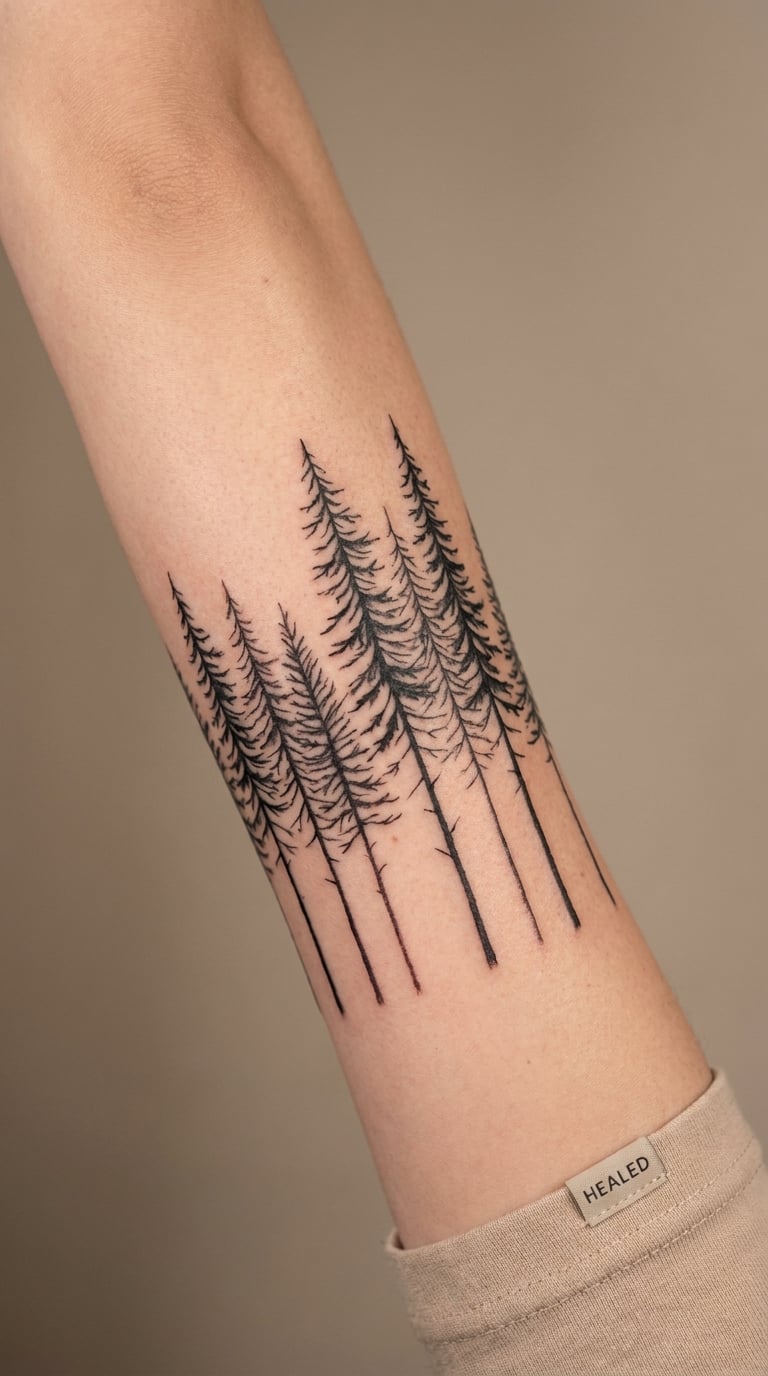
This design is a single horizontal line of slender pines running along the forearm, each tree a few thin lines tall with nothing between them. The emptiness matters as much as the trees. A row of pines reads as steady, unhurried growth, so people usually pick it to mark a stretch of years that felt slow and good rather than fast.
Placement: inner forearm, running lengthwise from just above the wrist toward the elbow, or across the lower forearm. Size: 6-9 in (15-23 cm) long, 1-2 in (3-5 cm) tall. Style: fine line. Pain: medium, higher near the elbow crease, and single-needle lines on the inner forearm are the first thing to blur as the skin stretches over a lifetime of movement. Make it yours: give each tree a different height so the row reads as a timeline of years or a row of dates.
2. Realistic Oak Tree and Roots Wrist Design
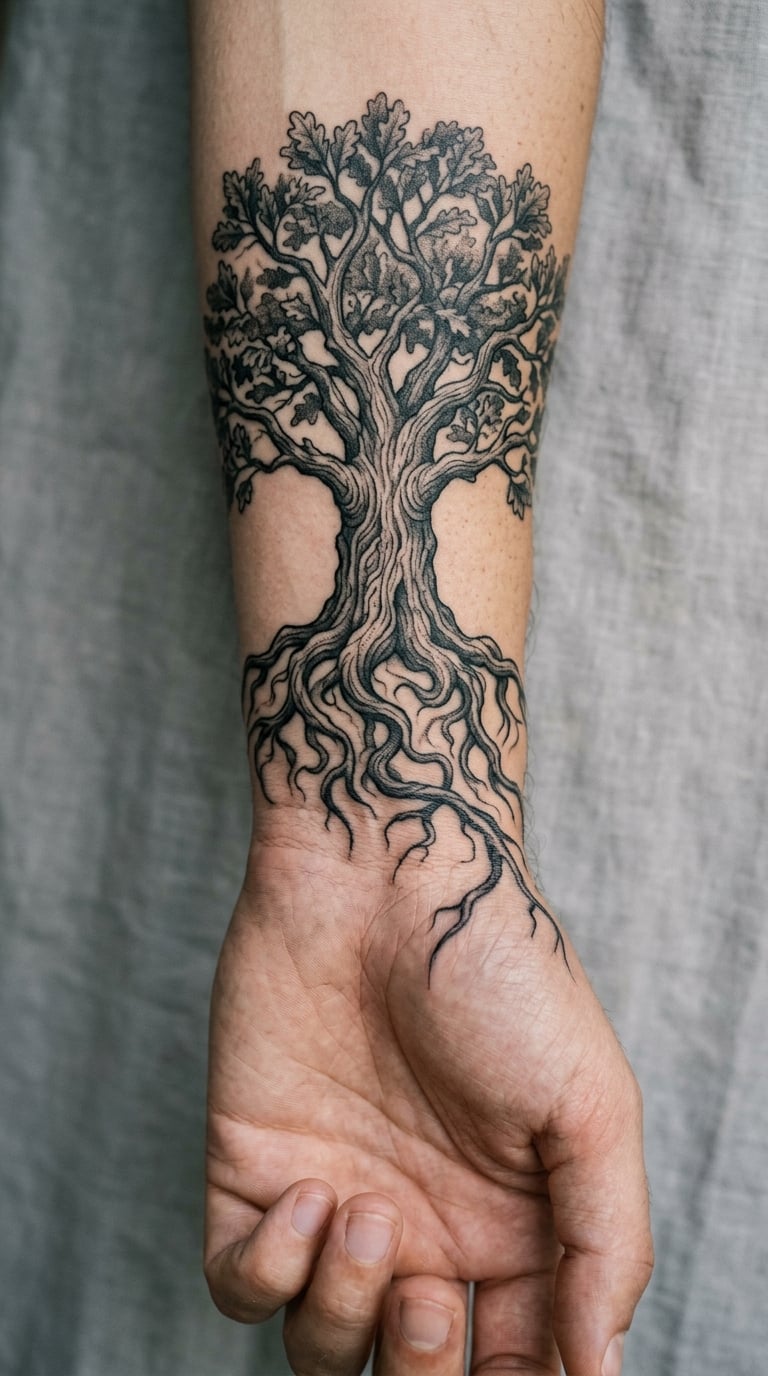
An oak drawn in black and grey, with the canopy above the wrist and roots spreading down toward the hand. Bark texture is what makes or breaks this one; an oak rendered with smooth outlines looks like clip art, while an artist who breaks the trunk into rough vertical strokes gets something that looks like an actual tree. People choose the oak because it is the tree that stays standing, so the design tends to be a stubbornness or endurance marker.
Placement: inner wrist or lower inner forearm, roots pointing down. Size: 4-6 in (10-15 cm). Style: illustrative realism. Pain: medium to high, since the inner wrist is bony and the roots fall right on top of a vein. Ageing note: the roots are fine lines over a moving joint and soften first. Make it yours: add a family surname worked into the root structure.
3. Minimalist Mountain and Pine Silhouette
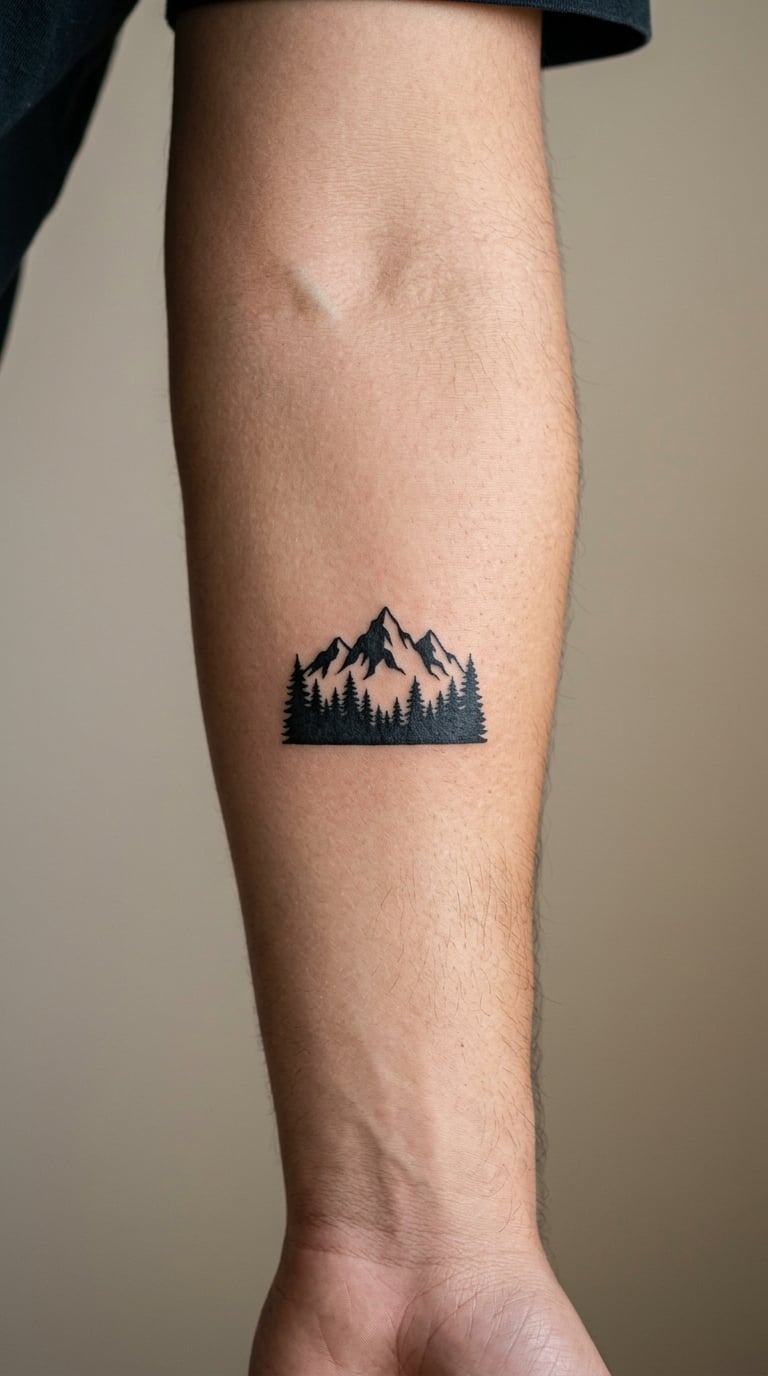
Two mountain peaks in flat black with three or four pines at their base, and a lot of bare skin around it. It is the smallest design in this list that still says a whole place. The pairing of mountain and tree is the most copied arm tattoo there is, and its associations are travel, altitude and places worth the drive. If you are building something bigger, our mountain and ocean tattoo ideas cover the other half of that combination.
Placement: outer forearm, centred. Size: 3-5 in (8-13 cm) wide. Style: minimalist, solid black. Pain: low to medium, and bold solid shapes hold their edge far better than hairlines. Make it yours: have the artist copy the outline of a peak that means something to you, or tuck a small date into the negative space under the ridge.
4. Traditional Red Fox in a Woodland Clearing
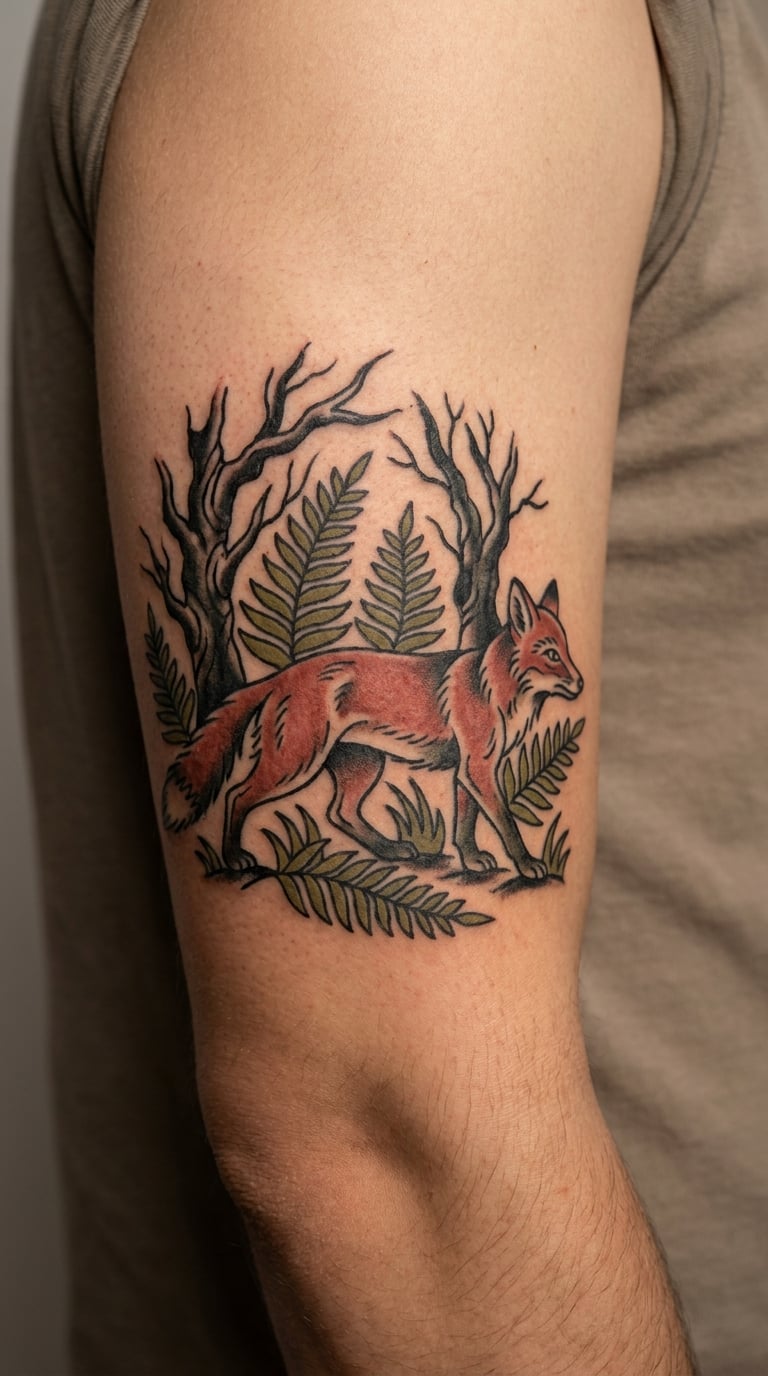
A fox in a patch of clearing, ringed by small trees, ferns at the feet and a pale moon above, drawn with the bold outlines and flat colour packs of traditional work. The fox is the reason this one gets booked; woodland is the setting, not the subject. Foxes carry cunning, adaptability and a certain trickster energy, which is what most people are after.
Placement: outer upper arm, where there is flat enough muscle for a full scene. Size: 5-7 in (13-18 cm). Style: traditional. Pain: medium. Colour note: the red is the first thing to fade, so agree on a muted brick tone rather than a bright orange, and expect a touch-up on the greenery later. Make it yours: add a paw print trail through the ferns.
5. Blackwork Fern and Bracket Foliage
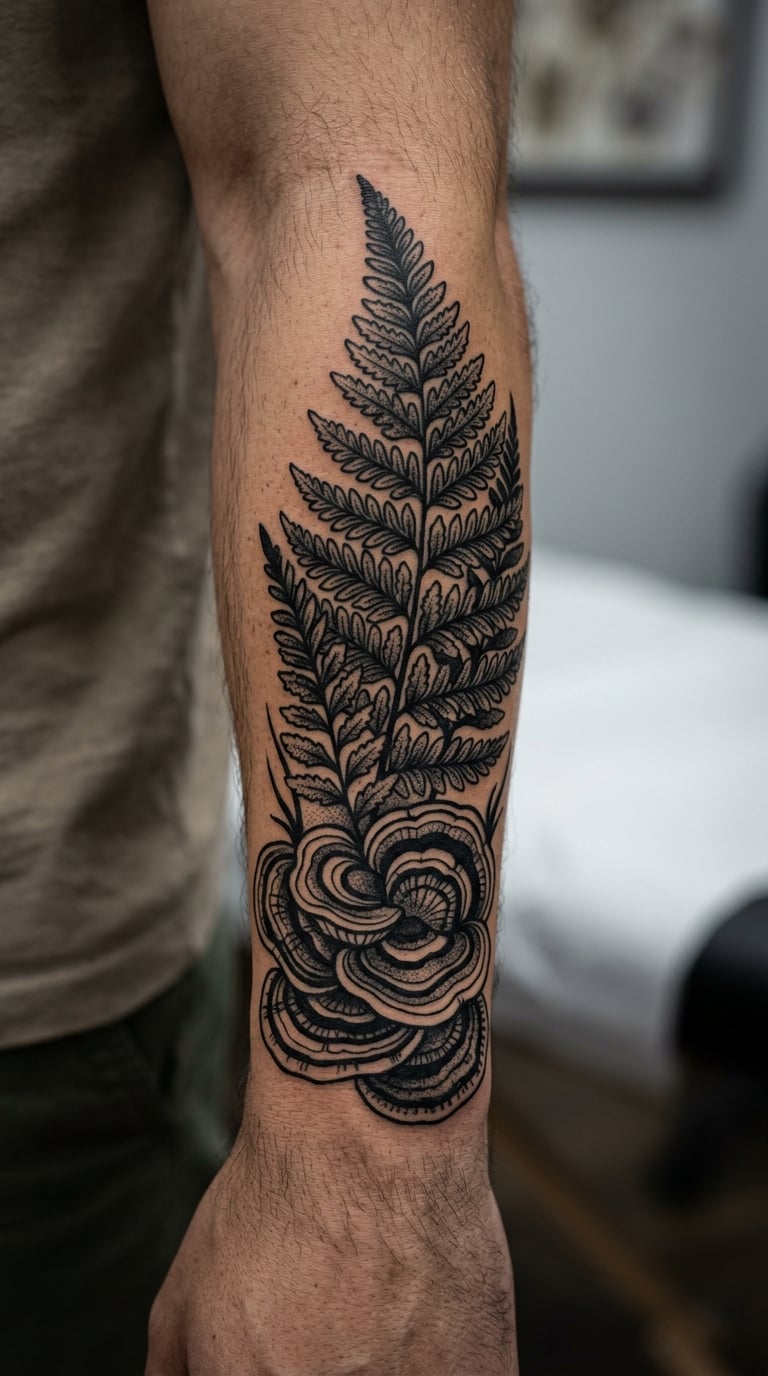
Solid black fern fronds and fan-shaped bracket fungi stacked into a vertical panel, with no shading at all. Blackwork relies on the contrast between filled shapes and bare skin, so the design reads from across a room and stays readable when the arm moves. It is a botanical piece more than a forest scene, chosen for its graphic weight rather than for a scene you can walk into.
Placement: inner arm in a vertical column, or a forearm panel. Size: 7-10 in (18-25 cm) tall. Style: blackwork. Pain: medium to high, because solid black means several passes over the same spot. Make it yours: skip the full panel if you are new to heavy blackwork and start with one fern frond at 3 in (8 cm), then add to it later.
6. Watercolor Birch Grove
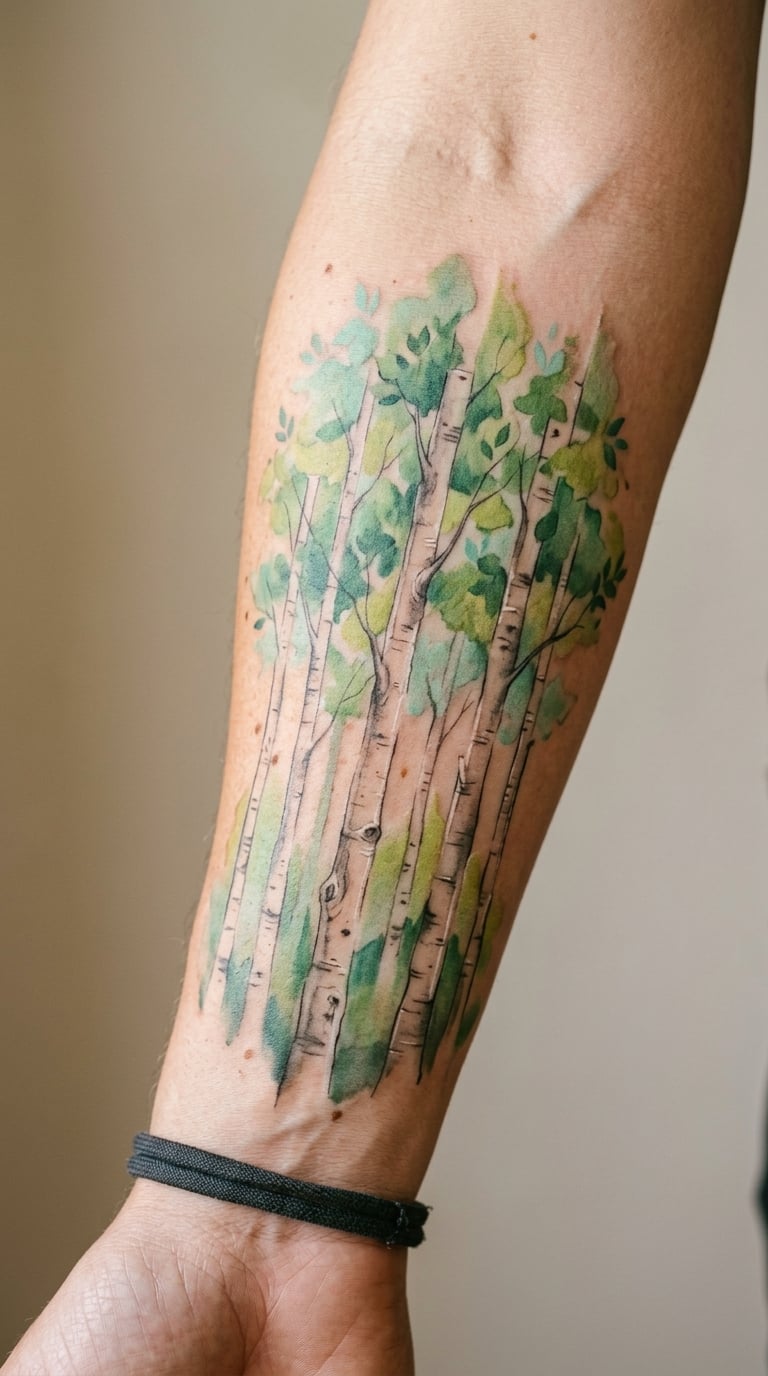
White birch trunks with a green canopy bleeding above them in soft washes, the ink feathered at the edges so it looks brushed rather than tattooed. The pale trunks leave the skin showing through, which keeps the whole thing light and works beautifully on an arm that already has other pieces. Most people choose it for mood, not meaning.
Placement: outer forearm or a full forearm wrap. Size: 7-9 in (18-23 cm). Style: watercolor. Pain: medium. Colour note: washes fade toward grey-green within a few years, and you cannot get that colour back with a top-up. Make it yours: name the season or the park the birch stand came from and have it recorded in your notes, or add one falling leaf in a warmer tone as an accent.
7. Micro-Realism Woodland Bird Perched on a Branch
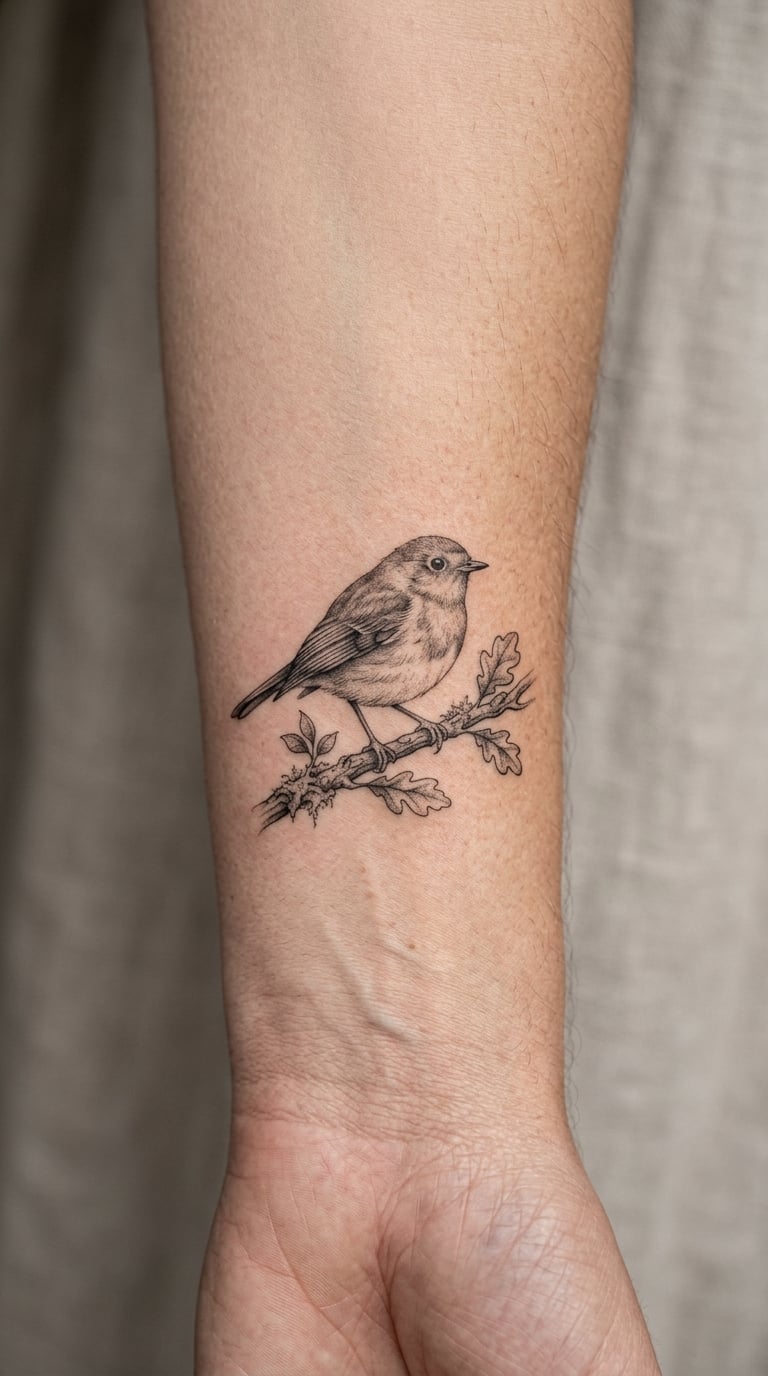
A single small bird, maybe three inches tall, perched on a bare branch with two leaves. Feather rendering is where the money goes: overlapping strokes on the wing, a lighter breast, a dark eye. It is a small design doing a big job, and it suits people who want something detailed without a piece that covers the arm.
Placement: inner forearm or inner bicep. Size: 2-4 in (5-10 cm). Style: micro-realism. Pain: medium. Ageing note: the feather detail merges into soft grey over a decade, so pick an artist who knows how much detail survives at that size. Make it yours: use the actual species from where you grew up rather than a generic songbird.
8. Japanese-Style Forest Stream
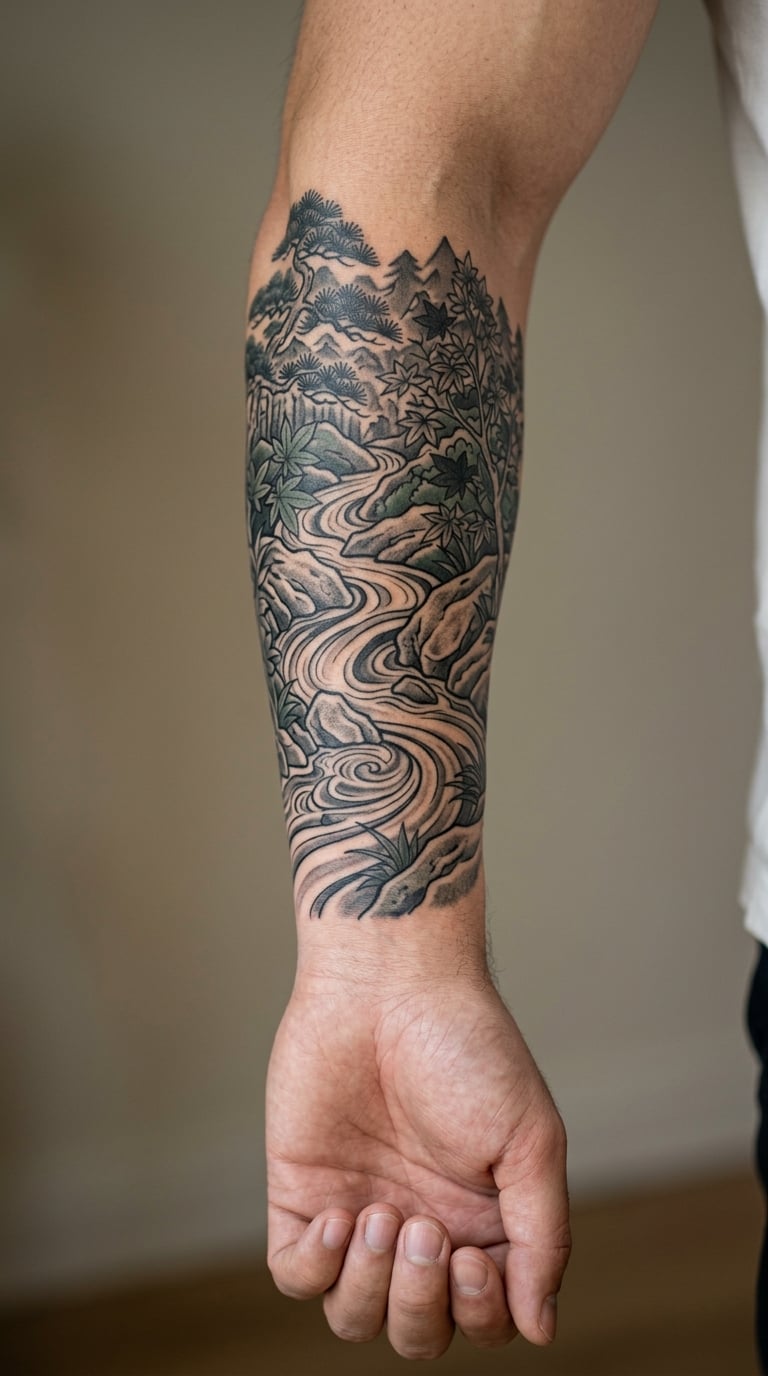
A stream running between rocks and layered trees, drawn with the flowing outlines and open composition of Japanese work rather than dense shading. Water lines curve with the arm and the trees stack in receding planes, which is what gives the piece depth on a narrow surface. It usually carries travel or a season in mind, sometimes a specific walk.
Placement: outer arm running vertically from wrist toward elbow. Size: 8-12 in (20-30 cm). Style: Japanese. Pain: medium to high over a long session. Ageing note: the thinnest water lines fade first, so ask the artist to build them from a slightly heavier line. Make it yours: add a specific native plant from the place the stream stands for.
9. Dotwork Forest Path Disappearing Into Trees
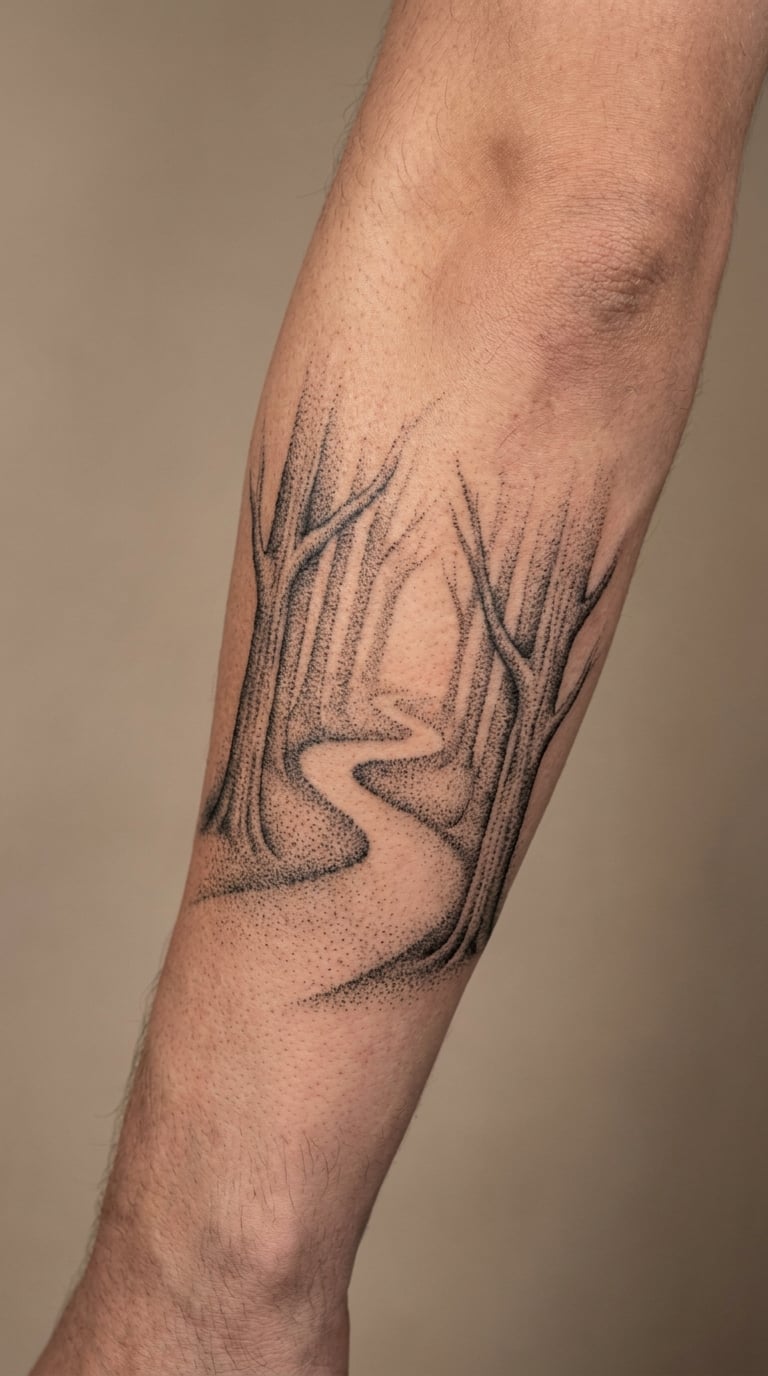
A path running between tree trunks into shaded woodland, built from thousands of small dots rather than lines. The dots get denser as the trees come forward and thin out toward the elbow, so the path seems to disappear into depth. People usually read it as moving forward, putting something behind, or a place they still go back to.
Placement: outer forearm. Size: 5-8 in (13-20 cm). Style: dotwork. Pain: medium, and stippling takes longer than you would guess. Ageing note: dots spread slightly with sun exposure and knit back together, so the design softens into a grey haze over time. Make it yours: hide a small set of initials in the darker mass of dots along one edge.
10. Blackwork Dead Tree and New Growth
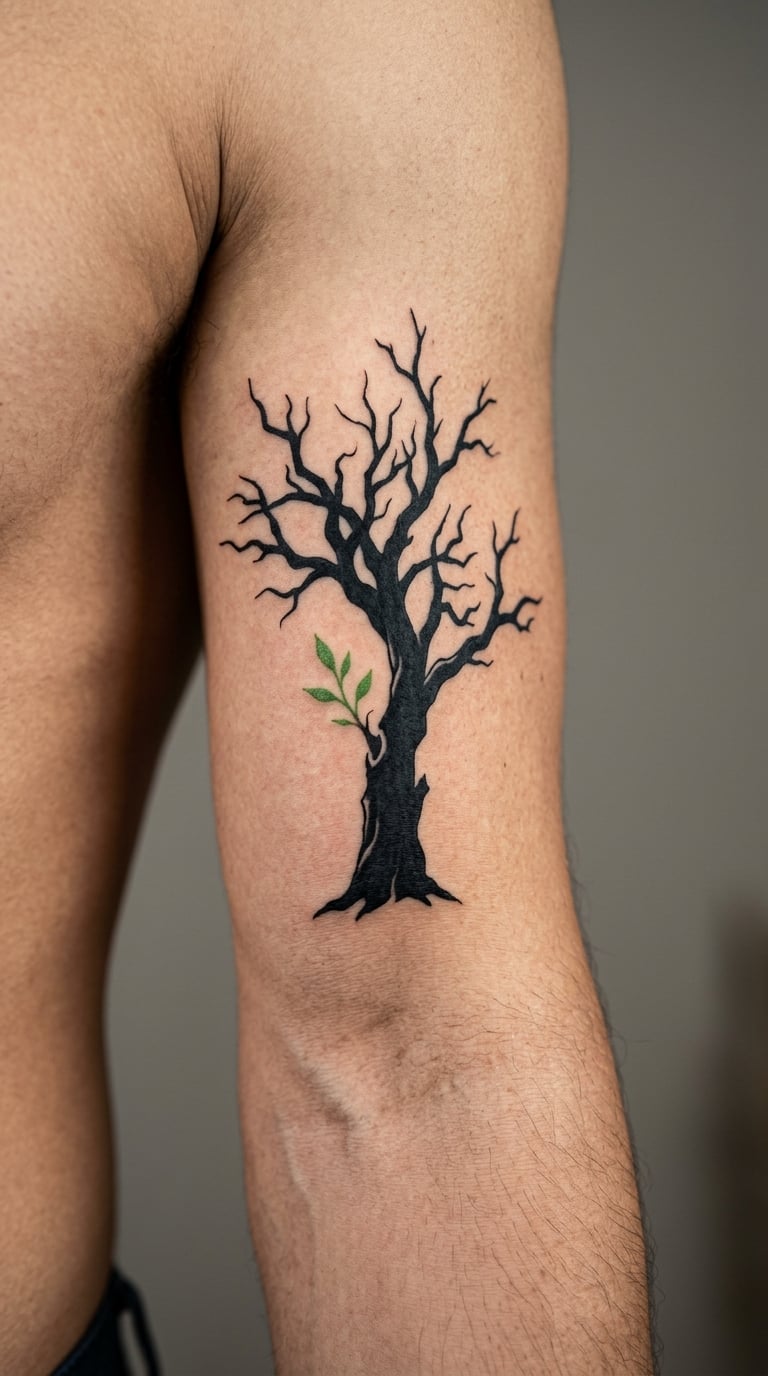
A bare tree in heavy black, with a single green shoot coming out of the trunk. The dark mass and the bright green leaf are the whole design, and the contrast is what makes people stop and look. Renewal and resilience are the readings that come up most, though plenty of people just like the shape of it.
Placement: inner bicep, where the bicep gives the silhouette a clean surface. Size: 6-8 in (15-20 cm). Style: blackwork with one colour accent. Pain: medium to high across the heavy black areas. Make it yours: have the shoot be a specific plant your family kept, which gives the piece a story you can explain in one sentence.
11. Neo-Traditional Deer Beneath Tall Trees
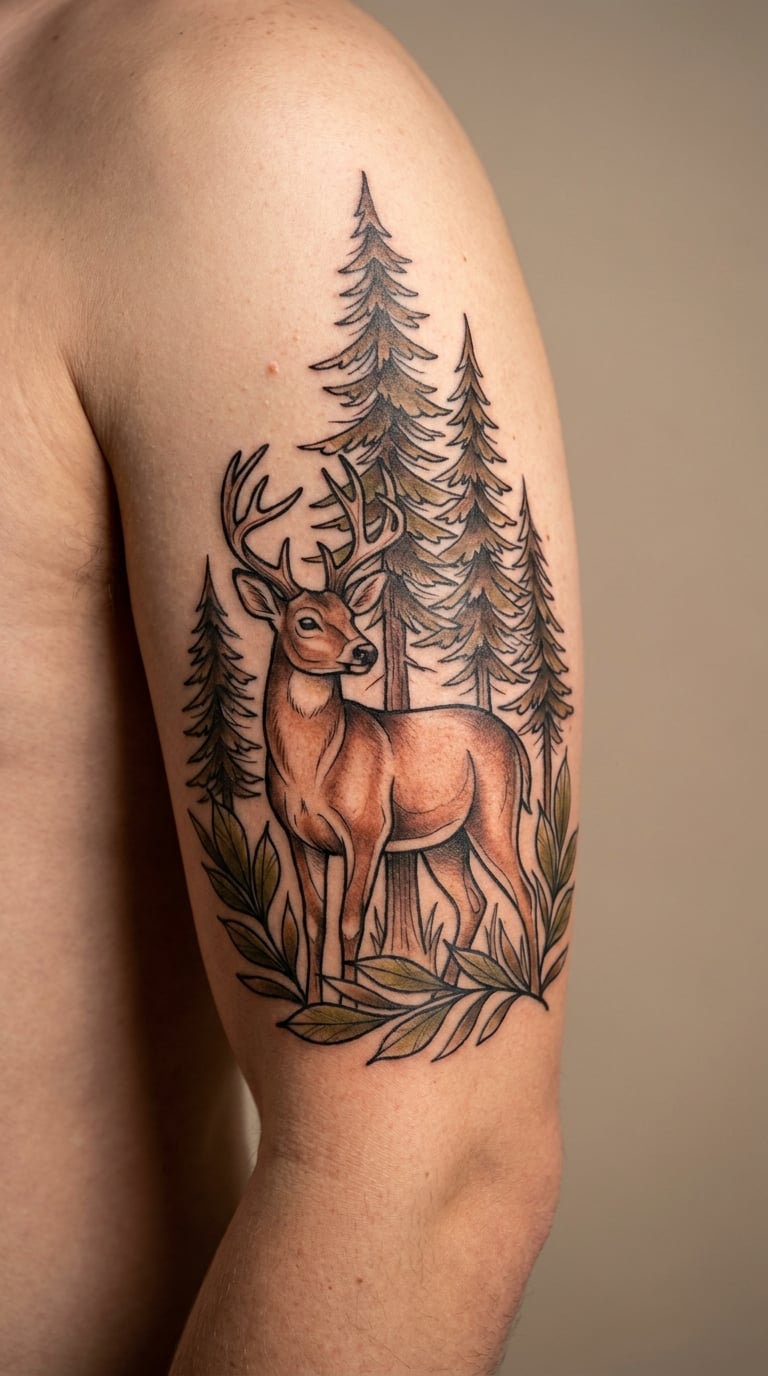
A deer standing under tall conifers, with clean black outlines, restrained shading and a single restrained colour accent. Neo-traditional keeps the traditional framing but tightens the drawing, so the animal reads clearly at a distance instead of dissolving into the trees. Wilderness and open ground are the themes people name most often.
Placement: outer upper arm or forearm. Size: 6-9 in (15-23 cm). Style: neo-traditional. Pain: medium. Ageing note: the thin fur strokes on the neck are the first detail to go. Make it yours: have the artist work a small flower into the antlers or add the antler count of a real buck you have seen.
12. Geometric Forest Made of Triangles
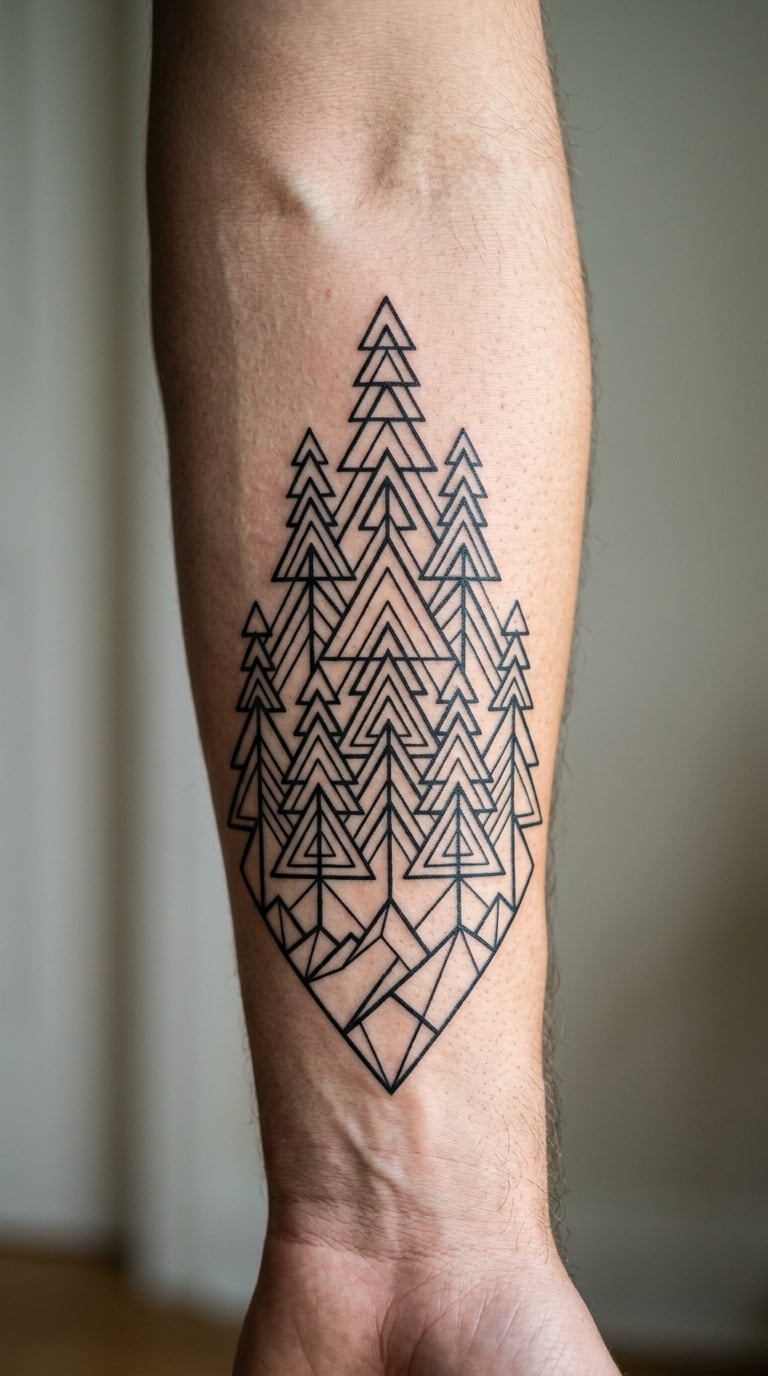
Fir trees reduced to triangles, stacked in rows and joined by straight lines, all in black. It is a forest drawn the way a diagram would draw it, and that restraint is the appeal for anyone who finds botanical realism too busy. The angular edges also age well because there is no shading to grey out.
Placement: inner forearm or inner bicep. Size: 5-8 in (13-20 cm). Style: geometric. Pain: medium, and the lower inner arm hurts more than people expect. Make it yours: add a geometric moon or a straight horizon line to tie the trees into a single shape, or mirror the pattern on the other forearm.
13. Mushroom and Moss Study
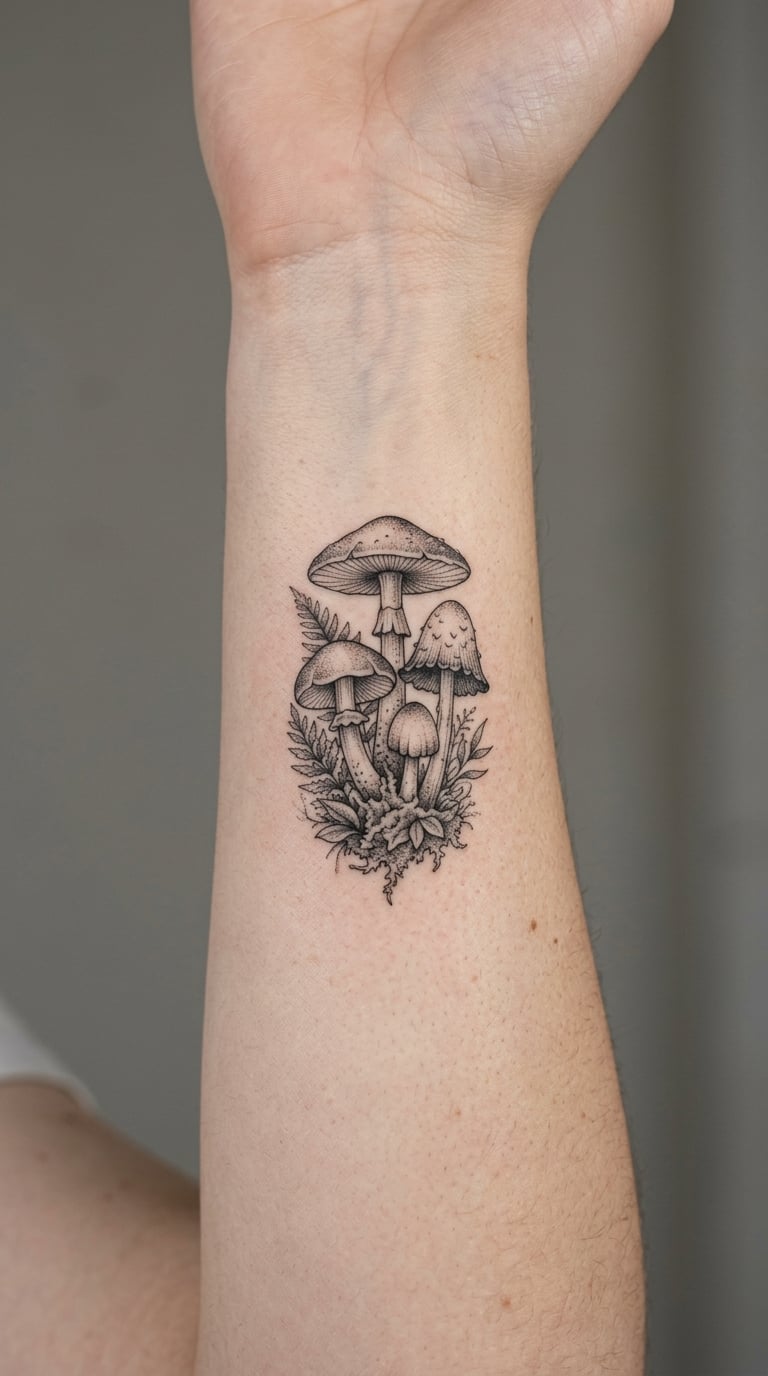
Three or four mushrooms of different heights growing out of a patch of stippled moss, with a bit of leaf litter at the base. It is the quietest woodland design in the list, and people tend to choose it for the specific feeling of walking a trail and noticing what is underfoot. The scale is small, so it fits a first-tattoo budget without looking like a placeholder.
Placement: inner forearm. Size: 3-5 in (8-13 cm). Style: botanical realism with stippling. Pain: medium. Ageing note: stippled shading is one of the first things to lose definition, so keep the contrast strong at the time of the tattoo. Make it yours: name the fungus you actually saw and the forest it grew in, or hide a date in the moss.
14. Full-Forearm Forest Map
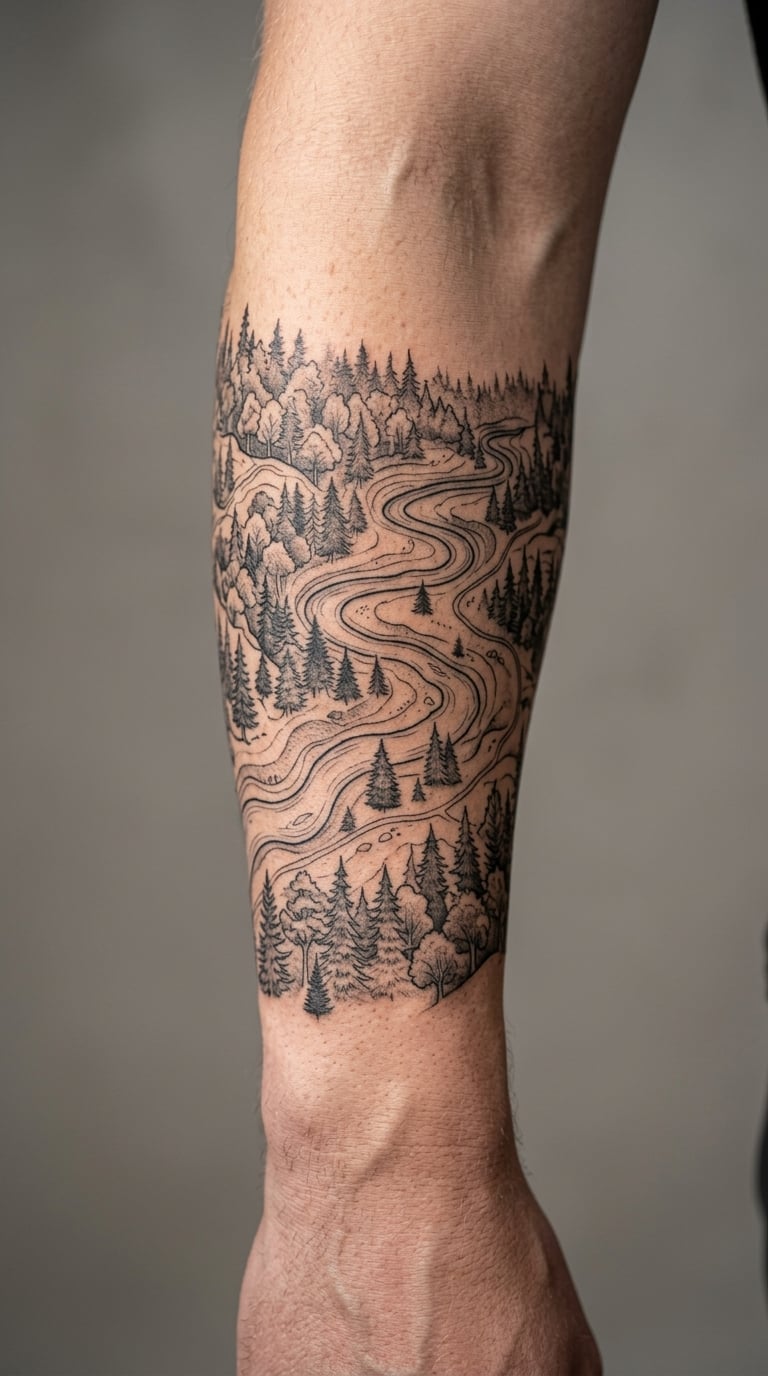
A continuous scene running from wrist to elbow: a band of trees, low hills, a river cutting through, a small compass rose near the elbow. The design is planned around the taper of the limb, so the trees narrow as they approach the wrist and the composition reads correctly from every angle. It is the piece people book to mark a place, a trail or a stretch of travel.
Placement: the whole forearm, wrist to elbow, sometimes continuing onto the bicep. Size: 12-16 in (30-40 cm). Style: illustrative realism. Pain: high, and almost always split across two or three sessions. Ageing note: the small map symbols need a bolder line weight than a flat reference suggests. Make it yours: add the coordinates of somewhere that matters, or the name of a trail you walked.
15. Fine-Line Butterfly Emerging From Leaves
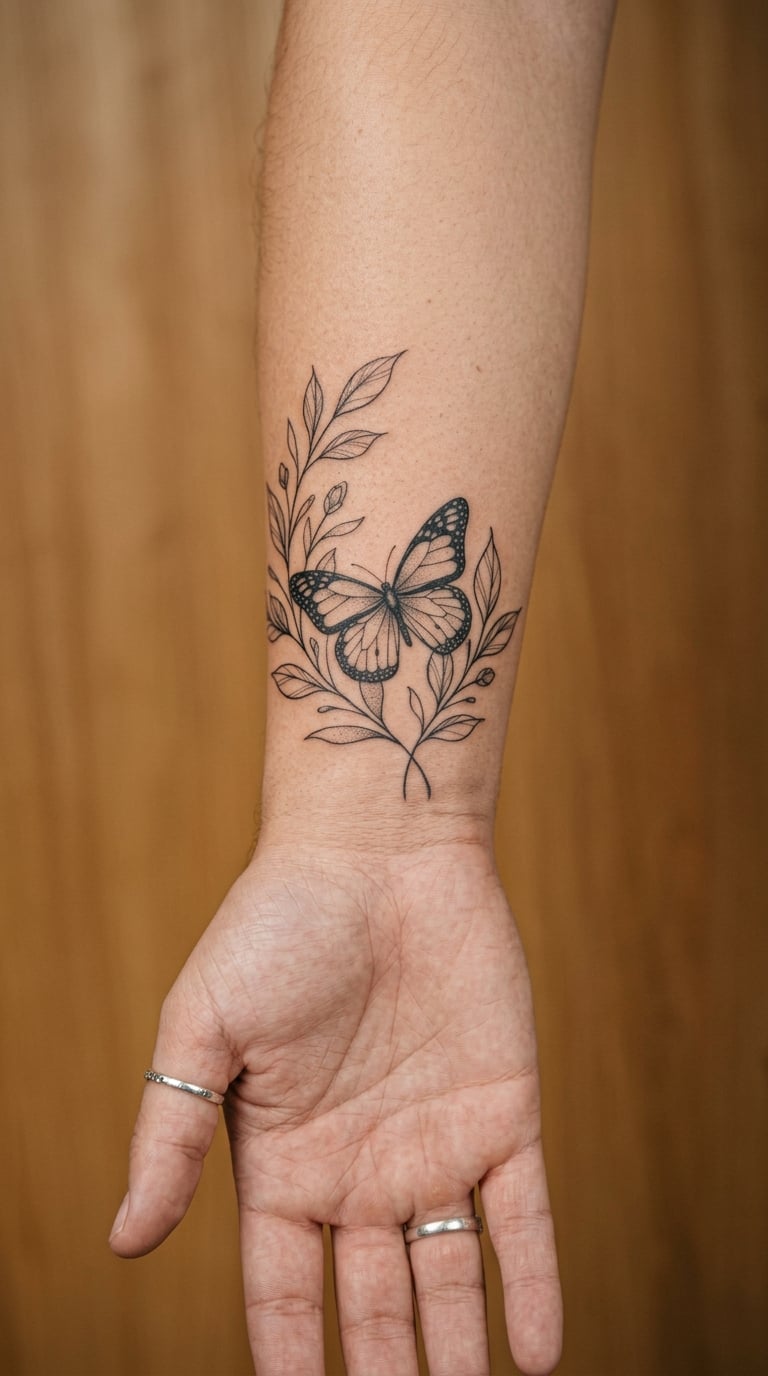
A butterfly framed by two leafy branches, wings open as if it has just come out of them, drawn in thin black lines with very little shading. Change and growth are the associations people bring to it, and the light line weight keeps the piece delicate rather than heavy. It sits well on the inner forearm where the veins show through the negative space.
Placement: inner forearm, wrist or inner bicep. Size: 4-6 in (10-15 cm). Style: fine line with botanical accents. Pain: medium. Fading note: single-needle line on the inner forearm fades fastest of anywhere on the arm, so expect a refresh every few years or choose a heavier line. Make it yours: use a real butterfly species from your region, or add one colour only in the wings.
16. Traditional Owl in a Moonlit Forest
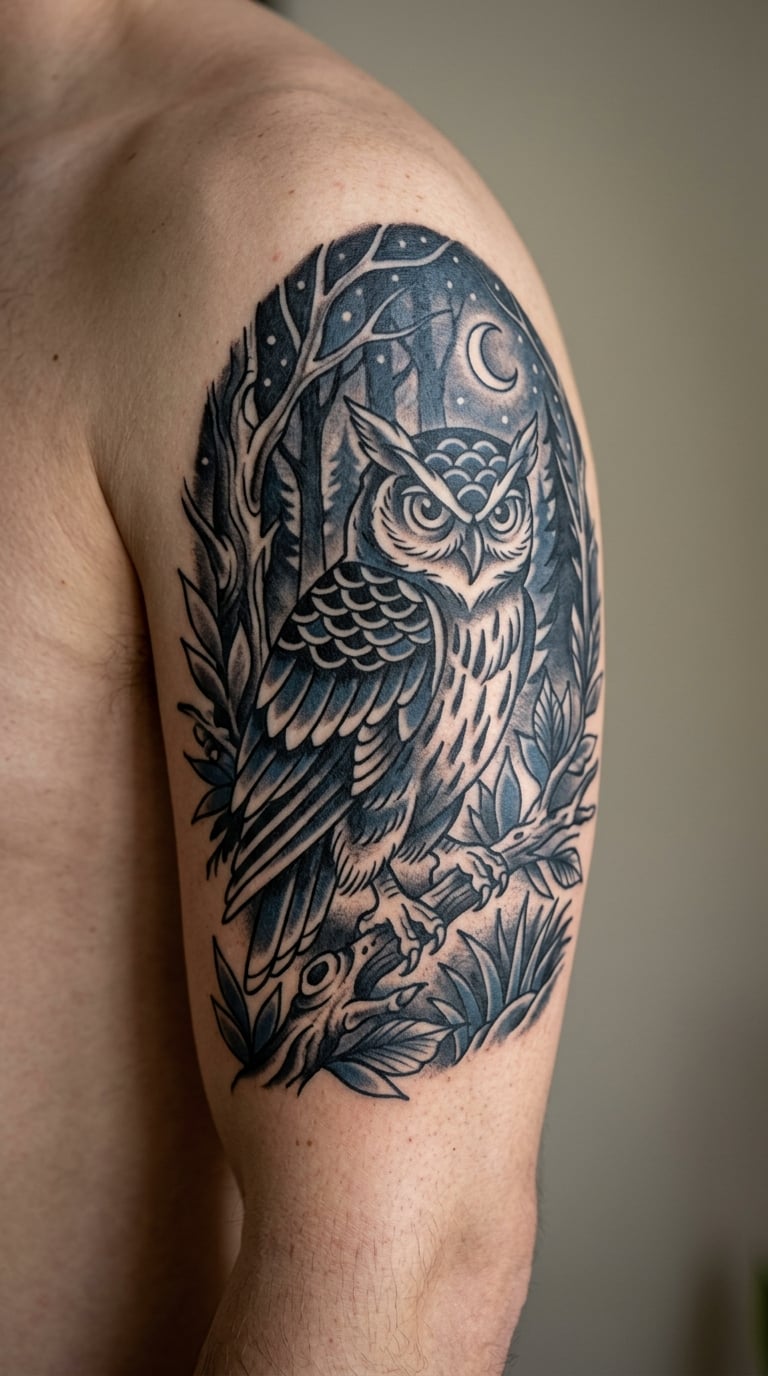
An owl on a branch with layered trees behind it fading into a dark background and a crescent moon off to one side. The dark background is the point; it turns a small bird into a night scene. Owls get chosen for their association with seeing clearly in the dark, which people tend to read as perception rather than as any fixed symbol.
Placement: outer upper arm. Size: 5-7 in (13-18 cm). Style: traditional, black and grey with an optional muted blue accent. Pain: medium, and the black background takes the time. Make it yours: show a specific moon phase, or use the owl species that actually lives near you.
17. Monstera and Palm Arm Panel
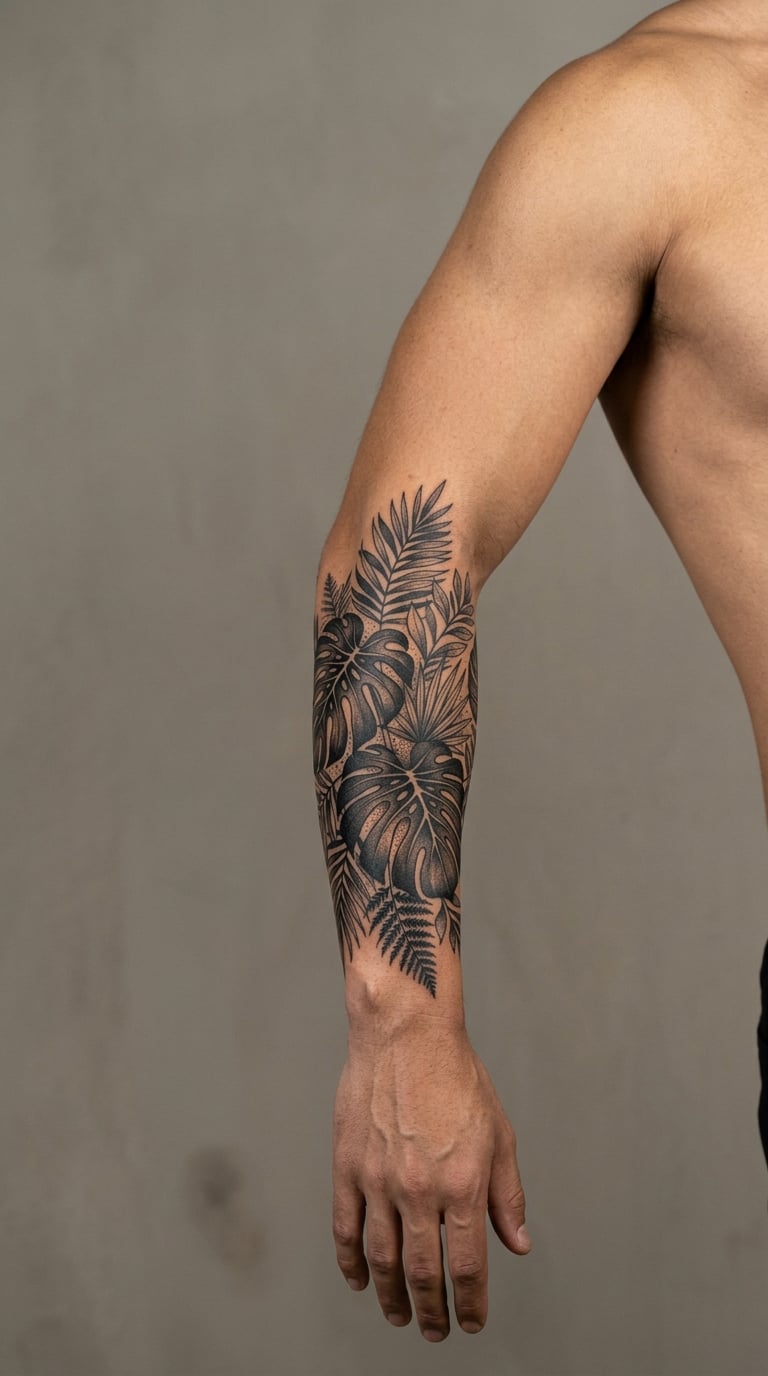
Large monstera leaves overlapping palm fronds, stacked into a vertical panel in solid black with the leaf splits left as negative space. Big shapes mean the design stays legible from a distance, which is a real advantage over fine botanical work. It suits people who want a forest without a literal scene in it.
Placement: outer arm in a vertical arrangement, or wrapping the forearm. Size: 7-10 in (18-25 cm). Style: blackwork. Pain: medium to high, mostly from the solid fill. Make it yours: pair it with a matching leaf on the other arm so the two read as one when both hands are in view.
18. Miniature Forest Scene Inside a Circular Frame
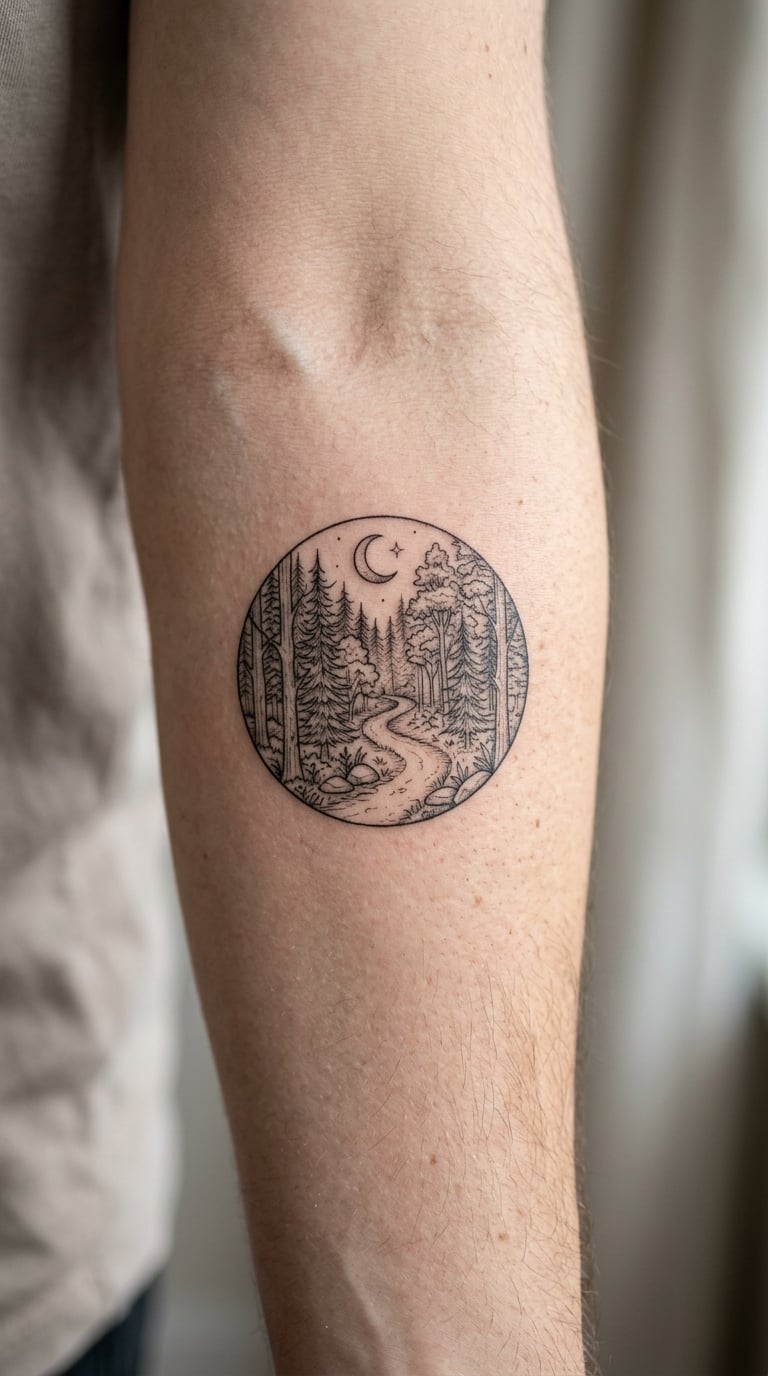
A round frame about the size of a coin, with layered trees, a small moon and a narrow path inside it. The circle does something clever: it turns a scene that would need a whole arm into something that reads at any size, and the border keeps the composition tight. It is a good choice for someone who wants a scene but not the commitment of a sleeve.
Placement: outer forearm or outer bicep. Size: 3-4 in (8-10 cm) across. Style: fine line with illustrative detail. Pain: medium. Ageing note: the small trees inside the frame blur together over time, so the artist should keep the layers well separated. Make it yours: put a date, an initial or the tree you grew up under inside the circle.
19. Blackwork Raven and Bare Branches
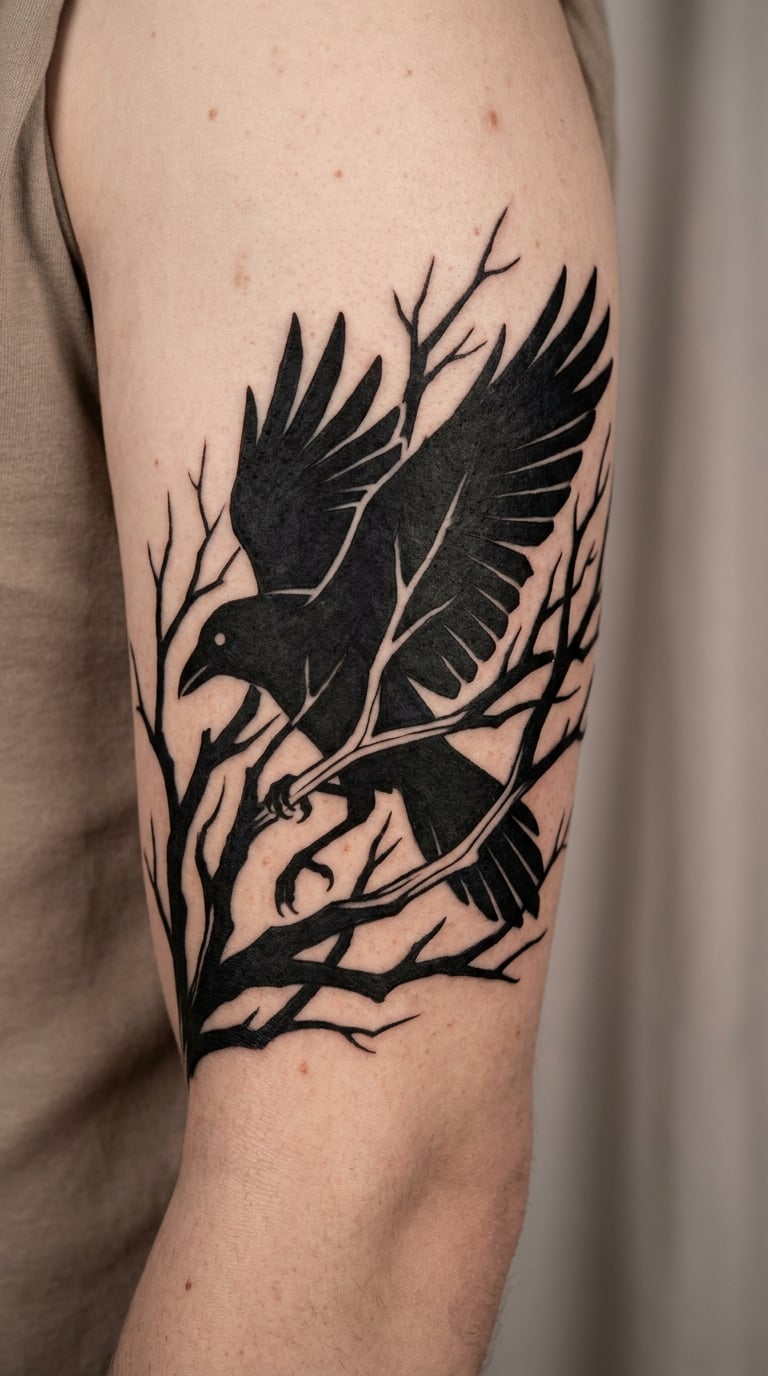
A raven built from solid black, wrapped through bare angular branches with the white of the skin left as negative space between them. It is the darkest design here, and that is the appeal for anyone going for an edgy, slightly mysterious look. The bird is usually chosen for intelligence, memory or a winter mood rather than for anything the wearer has to explain. If the solid blacks are the part you like, our black sleeve tattoo ideas show how that weight carries across a whole arm.
Placement: outer bicep or shoulder. Size: 5-7 in (13-18 cm). Style: blackwork. Pain: medium to high. Make it yours: point the branches in a direction that means something, or cut the negative space into a shape rather than leaving it random.
20. Forest Silhouette Arm Band
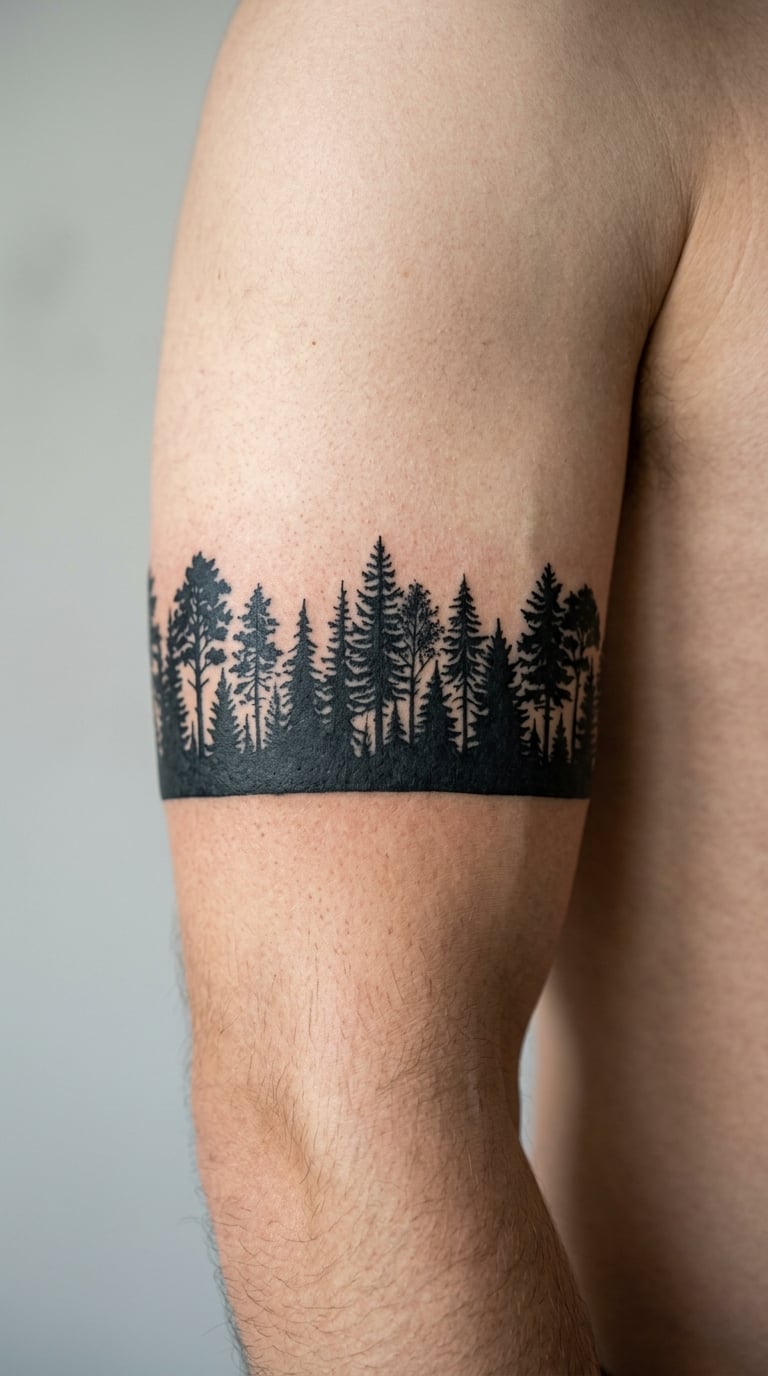
A horizontal band of tree silhouettes wrapping the arm, with the tree heights varied so it looks like a real treeline rather than a repeating border. One line for the horizon, solid black above it, and that is the whole design. The band format has stayed popular because it reads as belonging to a place, and it can be extended later into a full sleeve without a redesign.
Placement: wrapping the lower upper arm or the forearm. Size: full circumference, 2-3 in (5-8 cm) tall. Style: silhouette in bold black. Pain: medium. Ageing note: the thin tree tips on the top edge fade first, so ask for a solid horizon line underneath. Make it yours: include one tree that is recognisably different from the rest, or add a single colour accent in the sky gap above the treeline.
How to Choose the Right Design
- Match the detail to the zone. The inner forearm is visible, moving and prone to fading, so it wants fewer, heavier marks. Bold silhouette and blackwork hold up there better than hairlines or stipple. The outer forearm and upper arm take detail well because they see more sun and take less bending.
- Start at the size you will actually be happy with. A 3-5 in (8-13 cm) design like the circular scene or the mushroom study is a realistic first tattoo on the arm. A full-forearm forest map is a multi-year commitment, not a first session.
- Decide colour before the reference. Black and grey ages more predictably, fades more gracefully and hides a touch-up. Watercolour greens and traditional reds shift towards grey within a few years, and that is normal, not a mistake.
- Pick the style, not the mood. Bring references that match an artist’s actual work. Inspiration gathered from image boards often shows a soft illustrative style being handed to a blackwork artist, and the result rarely looks like either thing.
- Plan for the arm’s curve. Ask the artist to map the design to your forearm before the stencil goes on, because a flat reference stretched around a tapered limb distorts. Long horizontal scenes work; small square compositions do not.
- Think about what comes next. If you plan more arm work, an arm band or a vertical panel leaves clean skin above and below to extend into. A one-off micro piece in the middle of the forearm is harder to build around later.
Cost and Session Time
Forest arm tattoos are priced by the hour, so what drives cost is detail density and how much skin the scene covers. A small design in this list, like the mountain and pine silhouette or the mushroom study, is usually a single short sitting. A medium piece such as the fern panel or the watercolour birch grove runs longer, often two to three hours, and heavy blackwork takes more passes over the same area than a line piece of the same size.
Rough US rates tend to sit between $80 and $200 an hour depending on the shop and the city, and most studios set a shop minimum that can push a tiny piece up to the low hundreds before much tattooing happens. On that basis a small design lands somewhere in the low hundreds, a medium arm piece in the mid to high hundreds, and a full-forearm map in the low thousands once multiple sessions and custom drawing are counted. Treat those as a starting range, not a number to hold anyone to.
A full-forearm forest map is a different project. It is normally booked as two or three sessions of a few hours each, with a healing period in between, and the artist will want to see how the first session settles before planning the next. Shop minimums, hourly rates and location all change the final figure, so ask for an estimate for your specific design and size rather than a generic number. Custom work costs more than a design the artist has already drawn, and travelling to an artist whose portfolio matches your reference usually costs more than settling for a local artist who does not.
Aftercare Basics
- Follow your artist’s aftercare instructions first, because they know how their own work was made and how it is healing.
- Wash gently with lukewarm water and unscented soap, then pat dry with clean hands rather than a rough towel.
- Keep it covered with a clean, non-stick dressing for as long as your artist tells you to, especially for the first few hours.
- Avoid sun on the area for the healing period and afterwards, and be careful with clothing that rubs across a forearm, a sleeve or a watch band.
- Expect some flaking and tenderness in the first week or two. Do not pick at it.
- Contact your artist, not the internet, if the tattoo stays swollen, feels hot, or develops blisters that do not settle.
Frequently Asked Questions
How do I fit a forest tattoo onto the shape of my arm?
Work with the taper, not against it. A scene that reads correctly on a flat page will stretch across a rounded forearm, so long horizontal bands and vertical columns suit the limb better than a small square composition. Bring references and ask your artist to map the design onto your arm before the stencil is placed, adjusting the scale at the wrist and elbow so nothing looks squeezed.
Do small forest tattoos age well?
Small pieces usually age well because there is less fine detail to lose, and bold silhouette designs survive longest. Fine line work on the inner forearm fades fastest because that skin is pale, moves constantly and often sits in sunlight. Stippling and micro-realistic detail soften into grey over a decade. Choose heavier lines in that zone, or accept a touch-up every few years.
Is colour necessary for a forest tattoo?
No. Most forest arm tattoos are black and grey, and they age more predictably because the greys shift gradually rather than turning flat. Colour works well when you want a specific mood, such as a muted green canopy or a brick-red fox, but green and red shift towards grey over a few years and cannot be restored to their original tone.
How do I make a forest design personal?
Anchor it to something specific rather than to the forest in general. Add a date, coordinates, a trail name, or the tree species that grew outside your childhood home. Matching a narrative element to a tree or path, the way one wearer built a timeline of dates into a single pine, keeps the piece from reading as decorative.
Which arm zone shows a forest design best?
The outer forearm and upper arm suit detailed, illustrative forest scenes because they see more sun and take less movement. The inner forearm suits small, restrained pieces with negative space, and it is where a fine-line band of pines looks cleanest. The bicep has enough flat muscle for a full scene, and the wrist works for compact designs that follow the arm’s narrowest point.
Conclusion
If this is your first arm tattoo, the fine-line pine forest or the minimalist mountain and pine silhouette is the safer place to start. Both are small, both read clearly from a distance, and neither asks for a multi-year commitment. If you are adding to a collection or you already have a sleeve in progress, the full-forearm forest map gives you the most room to build, and a bold blackwork piece like the fern panel or the raven and bare branches gives you something that looks deliberate from across the room. Whatever you pick, bring references that match the artist’s actual work, and let the arm’s shape have a say in the final size.