
24 Tattoo Ideas for Travel Lovers: Small, Stunning (October 2026)
Travel tattoos work when one specific detail does the work, not a generic globe. A small compass rose and a set of latitude and longitude coordinates are the two designs that carry meaning most clearly, because the object is instantly readable to other travellers and the coordinates point at one real place only you recognise.
This list of 24 tattoo ideas for travel lovers runs from a fine-line paper plane you could hide under a cuff to a bookmark-shaped city skyline that reads like a favourite book. Each entry gives you the design, the placement, a realistic size, the style, what it feels like, and one way to make it yours.
Two things worth knowing before you pick. Almost every tiny travel design needs a line weight your artist can actually hold, so check the drawing at the size it will really be rather than blown up on a screen. And if you are still torn, a temporary tattoo is a cheap way to live with the design for a week before you commit. The trend right now in 2026 is thin single-line work and small illustrative pieces, so the ideas below are all drawn to survive that.
24 Tattoo Ideas for Travel Lovers: Quick Guide
Scan this table first, then jump to the design that fits. Every idea appears below in the same order.
| Idea | Style | Best placement | Size | Pain |
|---|---|---|---|---|
| 1. Fine-Line Paper Plane | Fine line | Inner forearm | 2 to 3 in (5 to 7 cm) | Low to medium |
| 2. Minimalist Passport Stamp | Line art, black and grey | Outer upper arm | 1.5 to 2 in (4 to 5 cm) | Medium |
| 3. Tiny World Map With Route | Fine line with colour dot | Shoulder blade | 3 to 4 in (8 to 10 cm) | Low to medium |
| 4. Retro Airline Tag | Vintage line art | Outer upper arm | 2.5 to 3.5 in (6 to 9 cm) | Medium |
| 5. Watercolor Mountain Range | Watercolour | Forearm, along the bone | 4 to 6 in (10 to 15 cm) | Medium |
| 6. Blackwork Airplane Window | Blackwork | Upper back | 4 to 5 in (10 to 13 cm) | Medium to high |
| 7. Coordinates and Compass Rose | Fine line | Inner wrist or forearm | 1.5 to 2.5 in (4 to 6 cm) | Medium to high |
| 8. Mini Suitcase With Travel Tags | Line art with one colour | Forearm | 2 to 3 in (5 to 7 cm) | Low to medium |
| 9. Coastal Map Line Art | One-line drawing | Rib area | 2.5 to 4 in (6 to 10 cm) | Medium to high |
| 10. Vintage Postcard Frame | Line art, muted ink | Outer thigh | 3 to 4 in (8 to 10 cm) | Low to medium |
| 11. Dotwork Globe | Dotwork and stippling | Upper arm | 3 to 4 in (8 to 10 cm) | Low to medium |
| 12. Minimalist Tent Under Stars | Fine line | Behind the ear | 1 to 1.5 in (2.5 to 4 cm) | Medium to high |
| 13. Tropical Passport Illustration | Illustrative with colour | Upper arm | 3 to 4 in (8 to 10 cm) | Medium |
| 14. Traditional Hot Air Balloon | Traditional | Upper arm | 3 to 4 in (8 to 10 cm) | Medium |
| 15. Micro-Realism Lighthouse | Micro-realism, black and grey | Outer forearm | 2 to 3 in (5 to 7 cm) | Low to medium |
| 16. Map Pin With Heart | Minimalist with one colour | Wrist or bicep | 1 to 1.5 in (2.5 to 4 cm) | Medium |
| 17. Watercolor Wave And Sun | Watercolour | Ankle | 2 to 3 in (5 to 7 cm) | Medium |
| 18. Old Train Ticket | Vintage line art | Inner arm | 2.5 to 3.5 in (6 to 9 cm) | Medium |
| 19. Fine-Line Hiking Boot | Fine line | Lower calf | 2.5 to 4 in (6 to 10 cm) | Medium to high |
| 20. Celestial Travel Constellation | Fine line with stippling | Shoulder blade | 2.5 to 4 in (6 to 10 cm) | Low to medium |
| 21. Mini Camera With Film Strip | Blackwork or line art | Forearm | 2 to 3 in (5 to 7 cm) | Low to medium |
| 22. City Skyline Bookmark | Silhouette | Side of calf or forearm | 3 to 5 in (8 to 13 cm) | Medium |
| 23. Minimalist Plane Route Pin | Icon, fine line | Inner forearm | 1.5 to 2 in (4 to 5 cm) | Low to medium |
| 24. Watercolor Sunset Horizon | Watercolour | Collarbone | 4 to 5 in (10 to 13 cm) | Medium |
1. Fine-Line Paper Plane
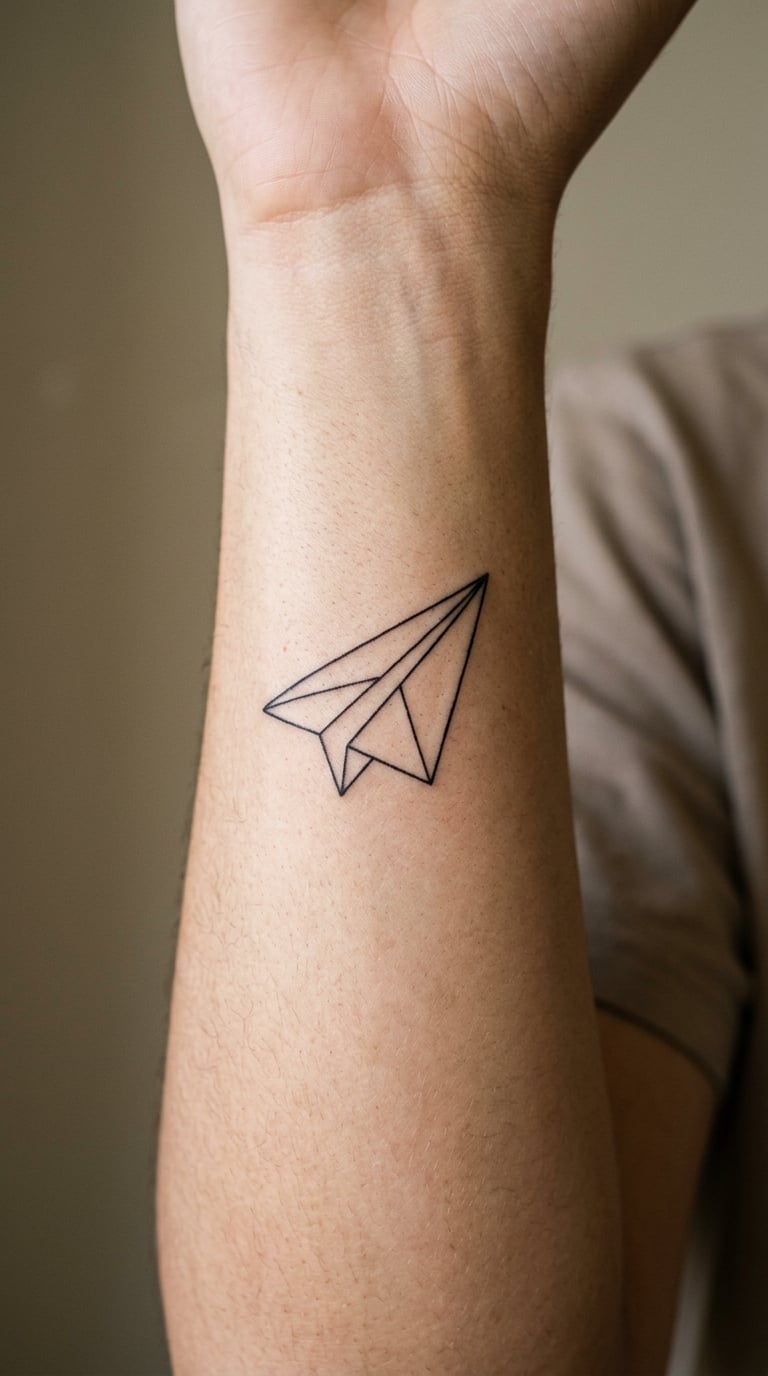
A single unbroken line draws a paper plane in profile, sometimes with one short curve behind it suggesting a trail. One hairline stroke for the fuselage, one for the fold, and the whole thing stays under three inches.
People choose it for the bit that isn’t a plane at all. A paper plane is something you send off, and the trail is usually where the real meaning hides. It reads as movement and curiosity without claiming anything fixed.
Placement: inner forearm, inner bicep, or just above the ankle · Size: 2 to 3 in (5 to 7 cm) · Style: fine line, single-needle
Pain: low to medium. The inner forearm is thin-skinned and sensitive but shallow, so it feels more like a scratch than a deep sting. Ageing note: hairline work on the inner arm softens faster than on the upper arm, so a slightly heavier line now saves you a blurry version later.
Make it yours: add one short dashed line trailing behind the plane, or a single small dot where the plane is going.
2. Minimalist Passport Stamp
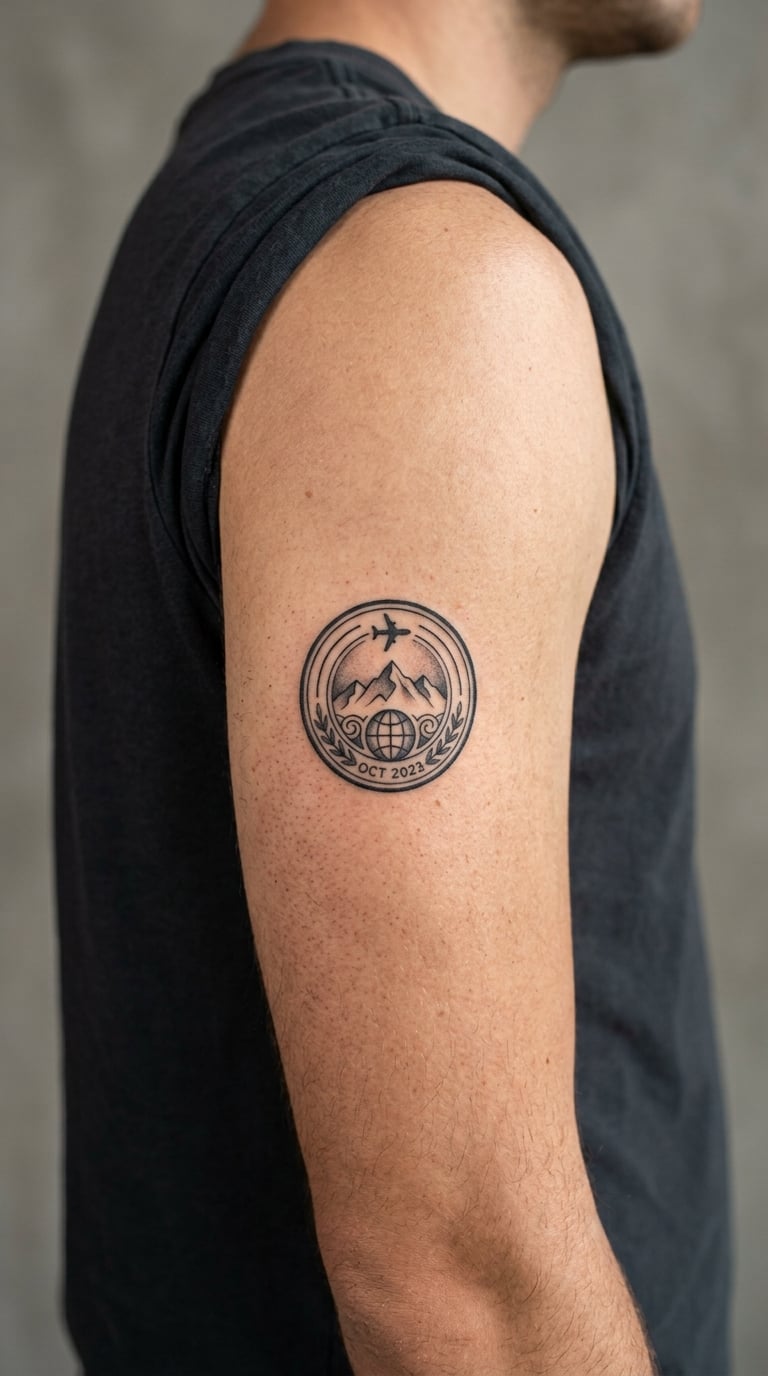
A circle with a broken or double outer ring, a destination name in small caps across the middle, and a date tucked under it. The stamp look comes from slightly uneven line weight and one or two deliberate gaps, as if the ink never took evenly.
It suits anyone who thinks of a trip as a stamp in a booklet. The details are what make it work: a city nobody recognises gives you something to explain, and a plain globe gives you nothing.
Placement: outer upper arm, back of the calf, or top of the foot · Size: 1.5 to 2 in (4 to 5 cm) diameter · Style: line art, black and grey
Pain: medium. The upper arm is one of the more comfortable spots, though the circle means a longer session of repeated passes over the same skin. Small lettering blurs with age, so keep the date short.
Make it yours: use the city where you first flew solo, or the airport code rather than the full name.
3. Tiny World Map With Route
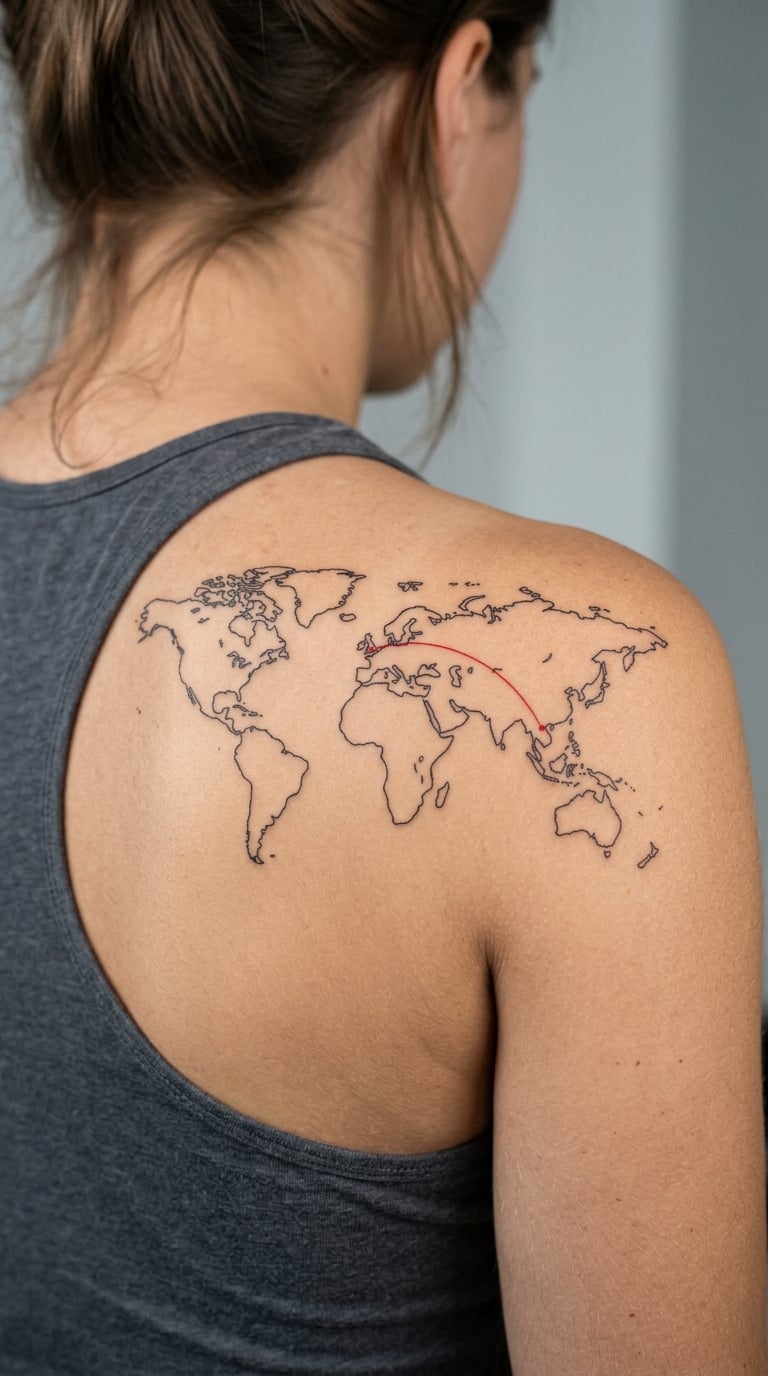
A simplified world outline in one thin line, with a single dashed arc joining two points and a small filled dot at each end. The trick is restraint. Two destinations read as a story; eight read as a globe tattoo you could buy anywhere.
Most people add this to an existing map or globe piece once a second trip matters to them. It is the easiest design on this list to extend later without it looking like an afterthought.
Placement: shoulder blade, upper back, or outer thigh · Size: 3 to 4 in (8 to 10 cm) wide · Style: fine line with one colour accent
Pain: low to medium. The shoulder blade curves away from the bone, so the needle travels across a changing surface. The line stays even. Watch how the dashed route sits; tiny dashes can fill in as they heal.
Make it yours: put the year you took the route under the arc in tiny numerals, or add a third dot years later.
4. Retro Airline Tag
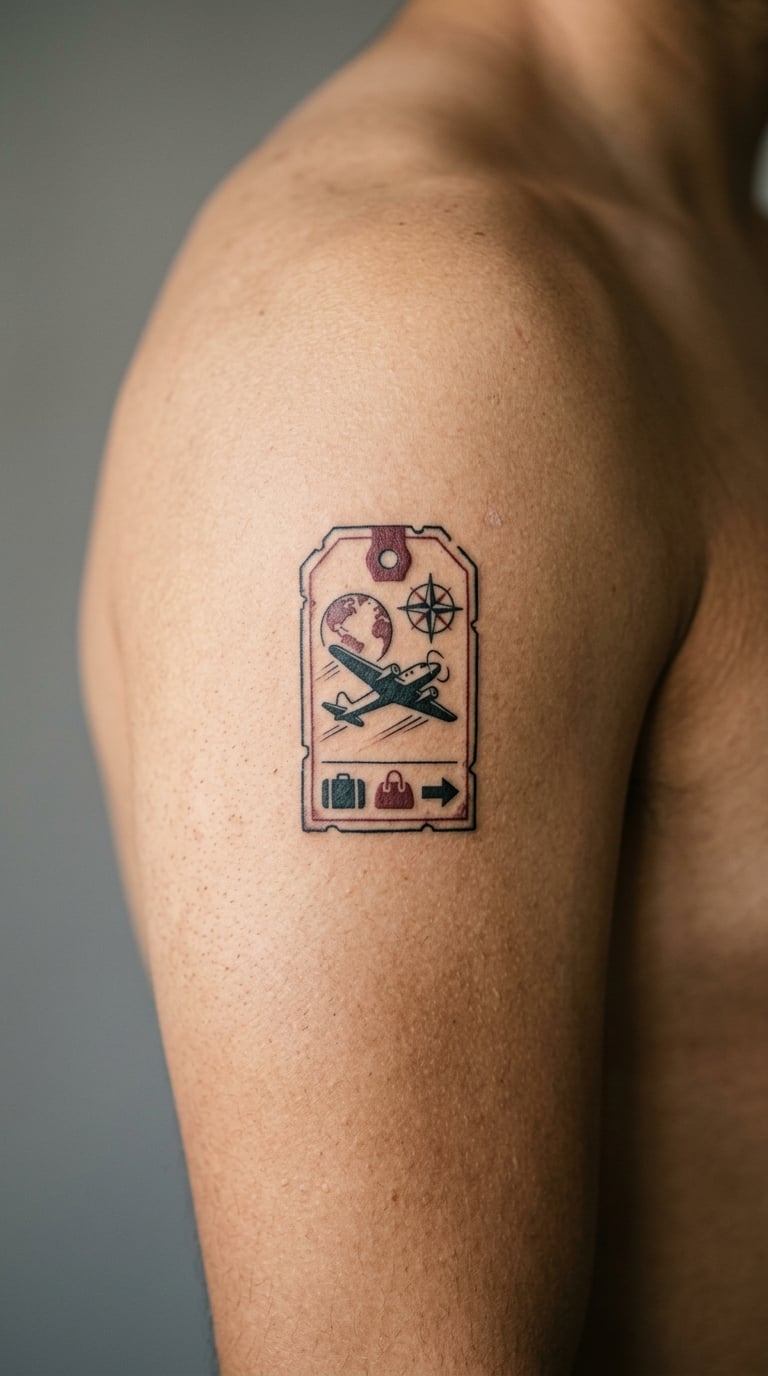
A rounded rectangular tag with a reinforced top edge, a hole for the string, and two or three lines of blocky lettering: a city, a date, maybe initials. A thin cord or a small stub of string can be added, and one muted red accent is enough.
The appeal is nostalgia rather than aviation. People who were born too late to remember flying with the tag are usually the ones booking it, which is a nice thing to carry around.
Placement: outer upper arm, forearm, or calf · Size: 2.5 to 3.5 in (6 to 9 cm) long · Style: vintage line art, one muted colour
Pain: medium. Lettering means going over the same patch repeatedly, and skin there reacts visibly for a couple of days. Printed-style text is hard to read once it softens, so fewer words hold up better.
Make it yours: use your initials as the tag’s code instead of a destination, or ask for a code that only your travel partner would get.
5. Watercolor Mountain Range
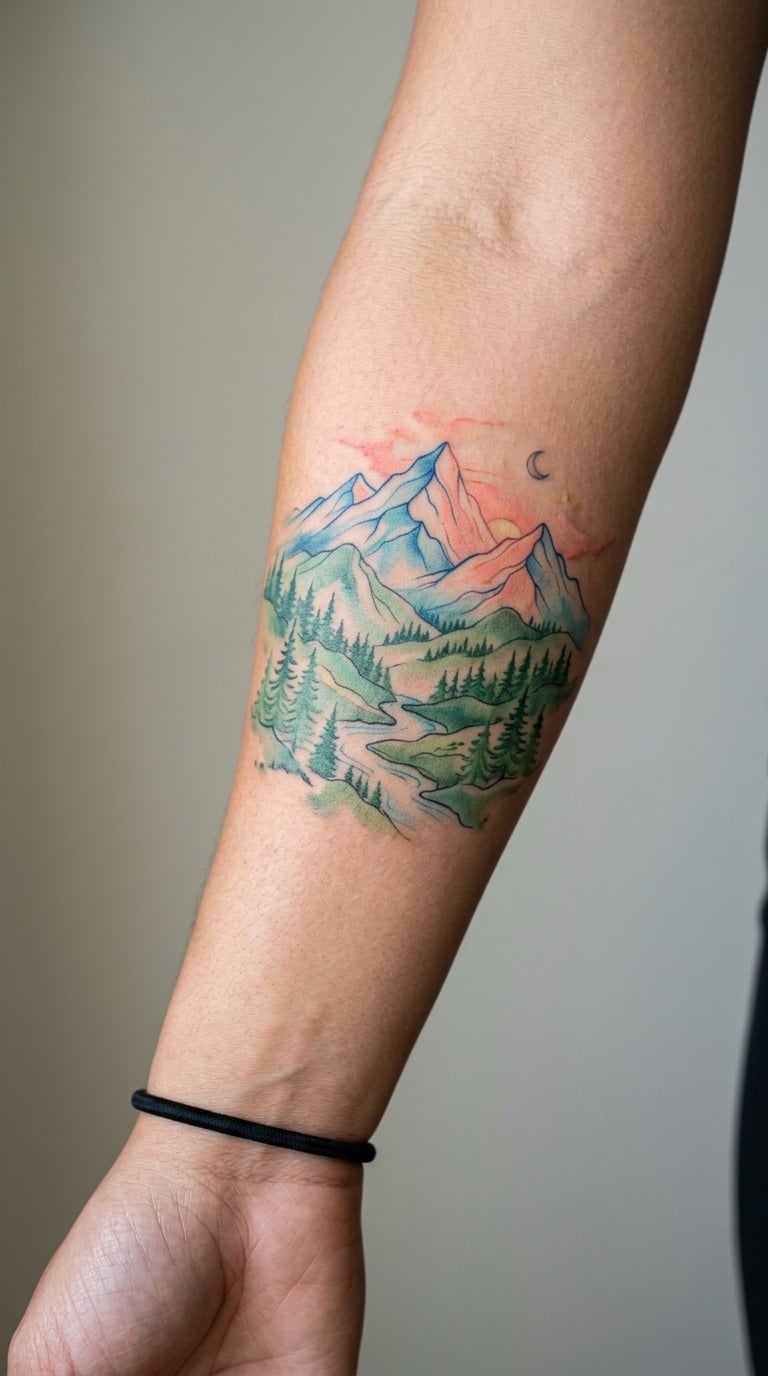
Loose translucent washes rather than outlined peaks: one warm layer for a sunset, one cool blue behind it, a hint of green at the base, and a few darker ridge lines drawn on top to hold the shape. Nothing has a hard border.
Mountains work as a personal landmark rather than a universal symbol. The ridge that meant something to you will mean nothing to anyone else, and that is exactly the point.
Placement: forearm along the bone, calf, or across the shoulder blade · Size: 4 to 6 in (10 to 15 cm) wide · Style: watercolour
Pain: medium, and expect a longer session since colour layering means going over the same area. Colour notes: pale washes fade first, so pick two or three strong tones instead of a full spectrum. Sun exposure speeds that up, so cover it or wear a shirt.
Make it yours: use the sunset colours from the exact evening you were standing there, or add a tiny line of trees along the base.
6. Blackwork Airplane Window
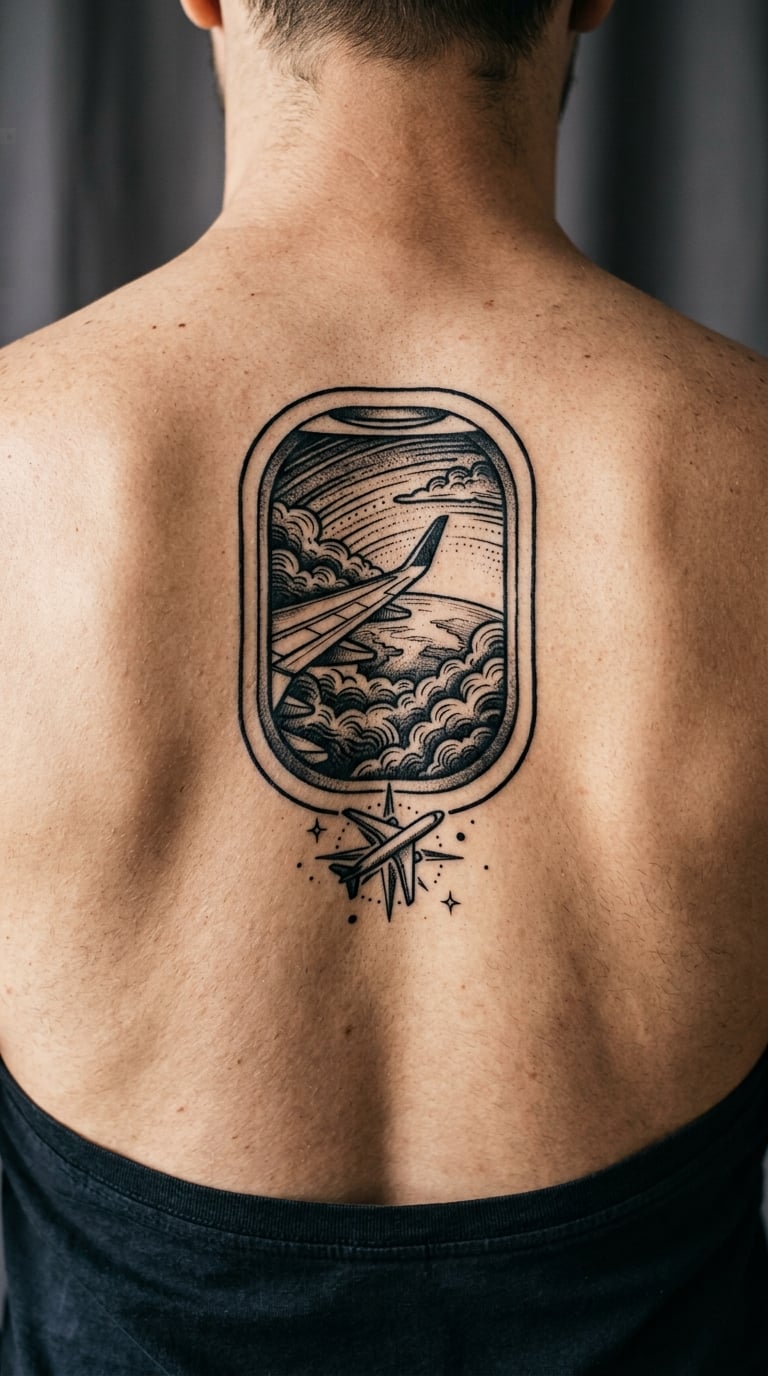
A solid black rounded-square frame with the wing, a slice of cloud, and a hard horizon line outside it, built from blocks of black rather than shading. The contrast between the dense frame and the open view outside is the whole design.
This is the one to get if you fly often and want the tattoo to read at a distance. People who take a window seat on every flight tend to be the ones who recognise it immediately.
Placement: upper back, outer upper arm, or thigh · Size: 4 to 5 in (10 to 13 cm) · Style: blackwork
Pain: medium to high. Large solid black on the back is a long sitting in an awkward position. Solid black also raises more than line work does. It holds its shape well, and it is one of the easier designs to cover later if you change your mind.
Make it yours: have the destination name curved along the bottom of the frame in small caps, or leave the view empty so it stays open.
7. Coordinates and Compass Rose
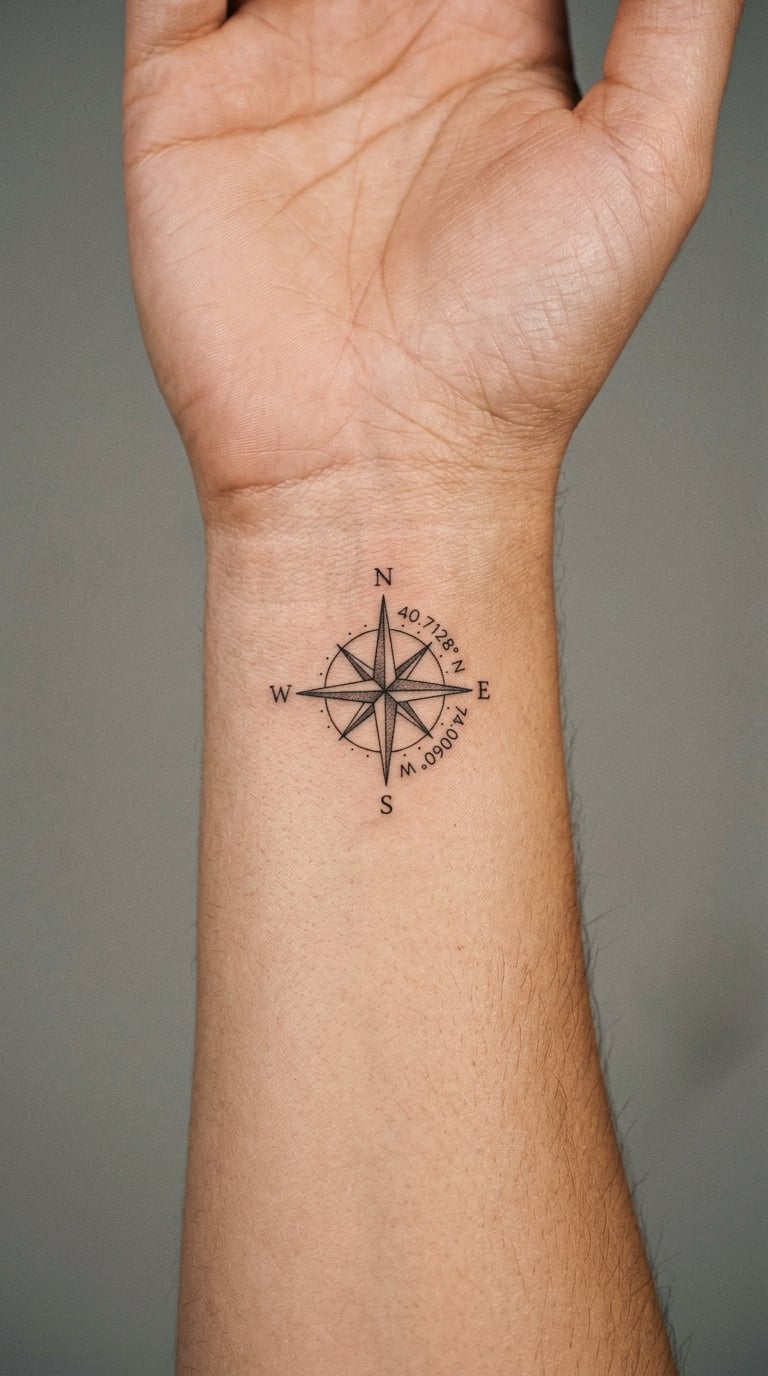
A four-point or eight-point compass rose drawn in fine line, with the cardinal letters optional, and one line of small numerals beneath it: 46.2044 N, 6.1432 E. The rose carries the meaning, the numbers carry the specificity.
The compass is one of the oldest traveller emblems there is, worn for centuries to mark a road taken. Most people today are not being romantic about it. They are pointing at one place that matters.
Placement: inner wrist, inner forearm, or behind the ear · Size: 1.5 to 2.5 in (4 to 6 cm) · Style: fine line, black and grey
Pain: medium to high. The inner wrist is sensitive, and this design usually lands there because the numbers stay readable. Ageing note: numerals are the first thing to blur. Ask for a line weight heavy enough to survive a decade, and check the digits with the artist before the stencil comes off.
Make it yours: use the coordinates of the place you were born, or of the spot where you decided to keep travelling.
8. Mini Suitcase With Travel Tags
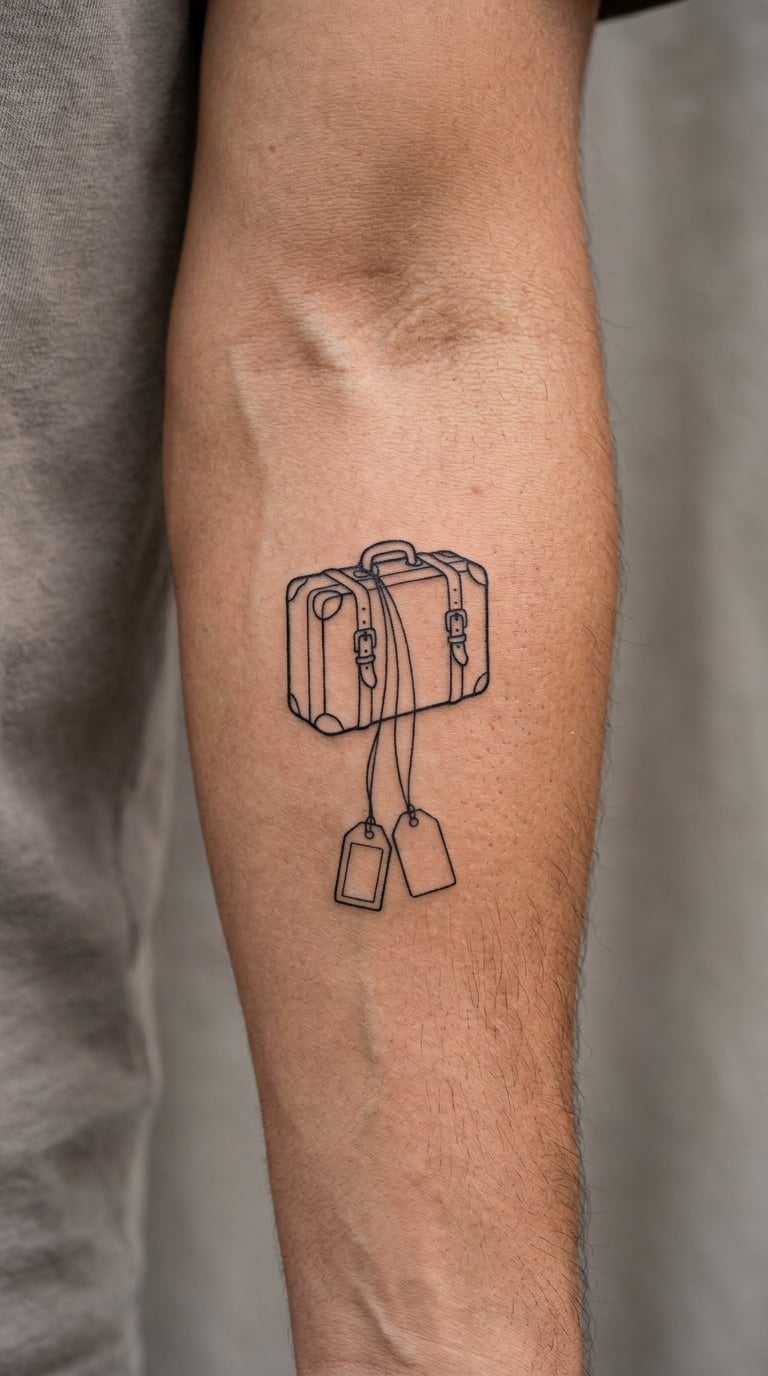
A simple rounded rectangle for the case, a thin arched handle, two small wheels or none at all, and one or two tags hanging from the handle on short strings. Each tag can carry a single word or number.
It is about packing and leaving rather than arriving, which makes it a slightly different mood from a map or a skyline. People who take the same kit on every trip often choose this one.
Placement: forearm, outer arm, or back of the hand · Size: 2 to 3 in (5 to 7 cm) · Style: line art with one colour on the tags
Pain: low to medium. One or two tags is a comfortable sitting. Tiny tag lettering is the part that fades first, so a single initial or two-digit number ages better than a full city name.
Make it yours: make one tag for each of two people you travel with, or engrave a trip number instead of a place.
9. Coastal Map Line Art
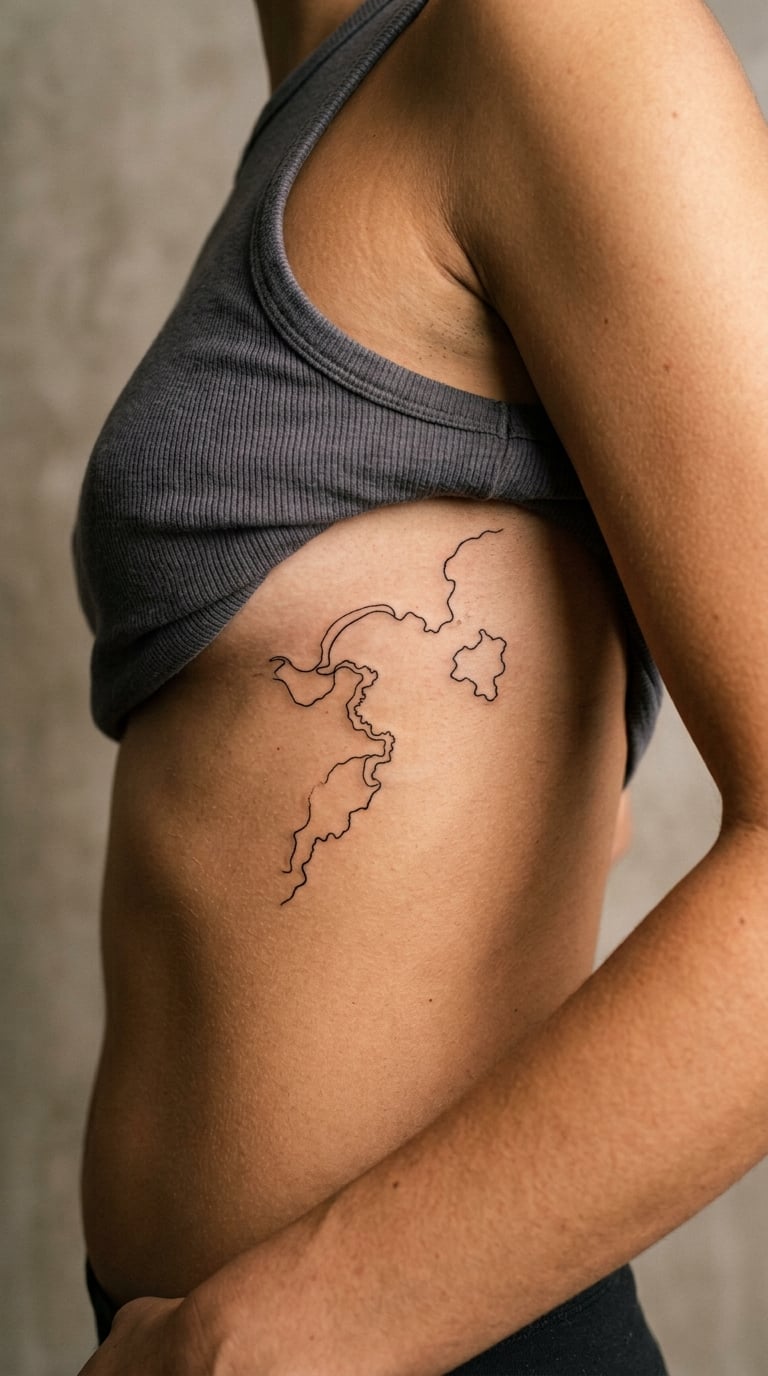
One continuous line that forms a stretch of shoreline, a bay, maybe a small island, without lifting off the skin. The line varies in thickness at the turns, which is what makes it look drawn rather than traced.
A coastline is a place you can actually recognise, and recognisable is the thing people chase most often. Other travellers see a map; you see a specific cove.
Placement: rib area, side of the thigh, or inner arm · Size: 2.5 to 4 in (6 to 10 cm) · Style: one-line drawing
Pain: medium to high. Ribs are bony and the skin moves when you breathe, so an unbroken line takes longer and the artist has to follow the stretch. Worth it for this design, and a common choice for a second or third piece.
Make it yours: add a single small cross or dot where you actually stood, or trace your route along the coast instead of the whole outline.
10. Vintage Postcard Frame
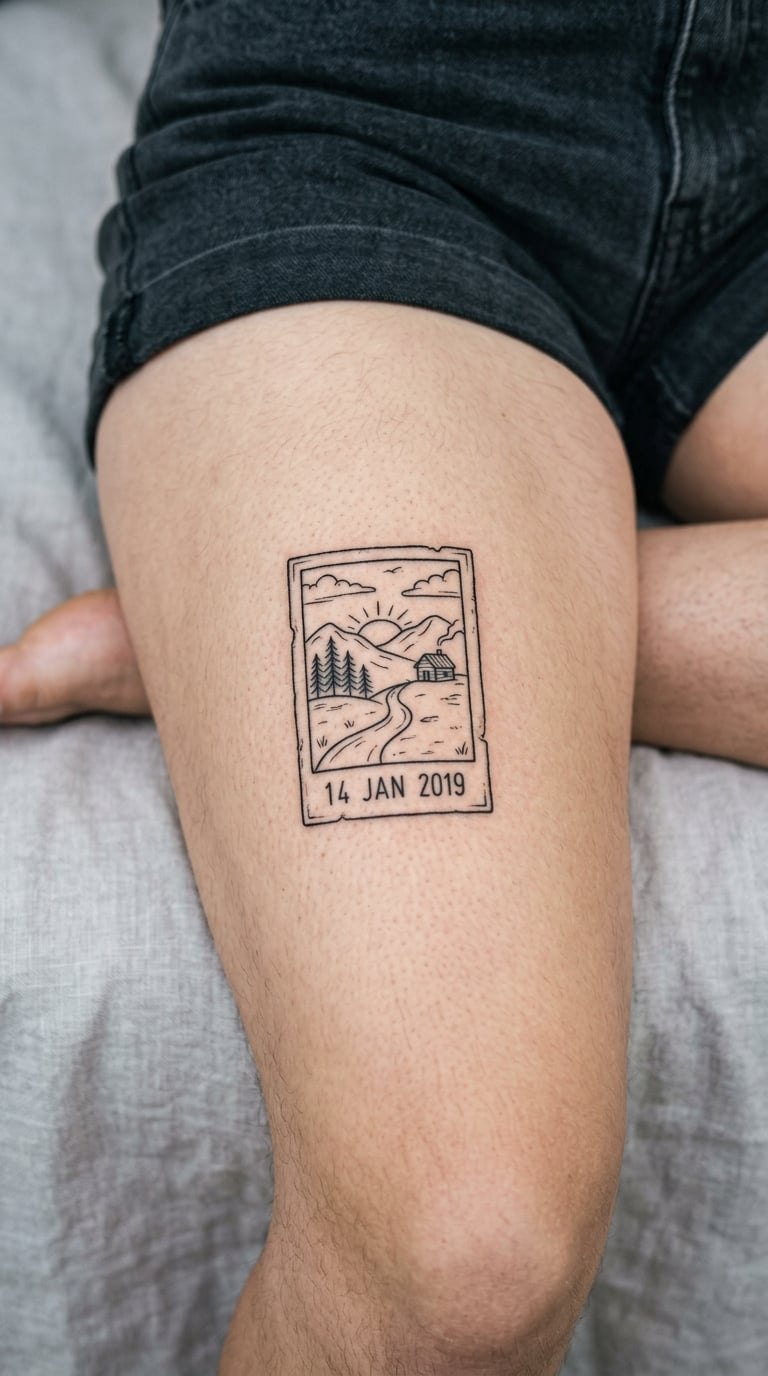
A horizontal rectangle, wider than it is tall, with a thin double border and a small scene inside: a hill, a horizon, a building. A short date sits in the lower corner in the same lettering as an old printed stamp.
It differs from a passport stamp by shape and mood. The stamp is circular, official and compressed; the postcard is landscape-oriented, open, and a bit nostalgic.
Placement: outer thigh, upper back, or flat of the forearm · Size: 3 to 4 in (8 to 10 cm) wide · Style: line art with muted ink
Pain: low to medium on the thigh, since there is more soft tissue to work with. A rectangular border means four straight runs, and straight lines are where a shaky first pass shows. Straight edges are the part that ages most gracefully, so ask the artist to keep them crisp.
Make it yours: put the date in a corner instead of a greeting, or use a one-word place name in the border itself.
11. Dotwork Globe
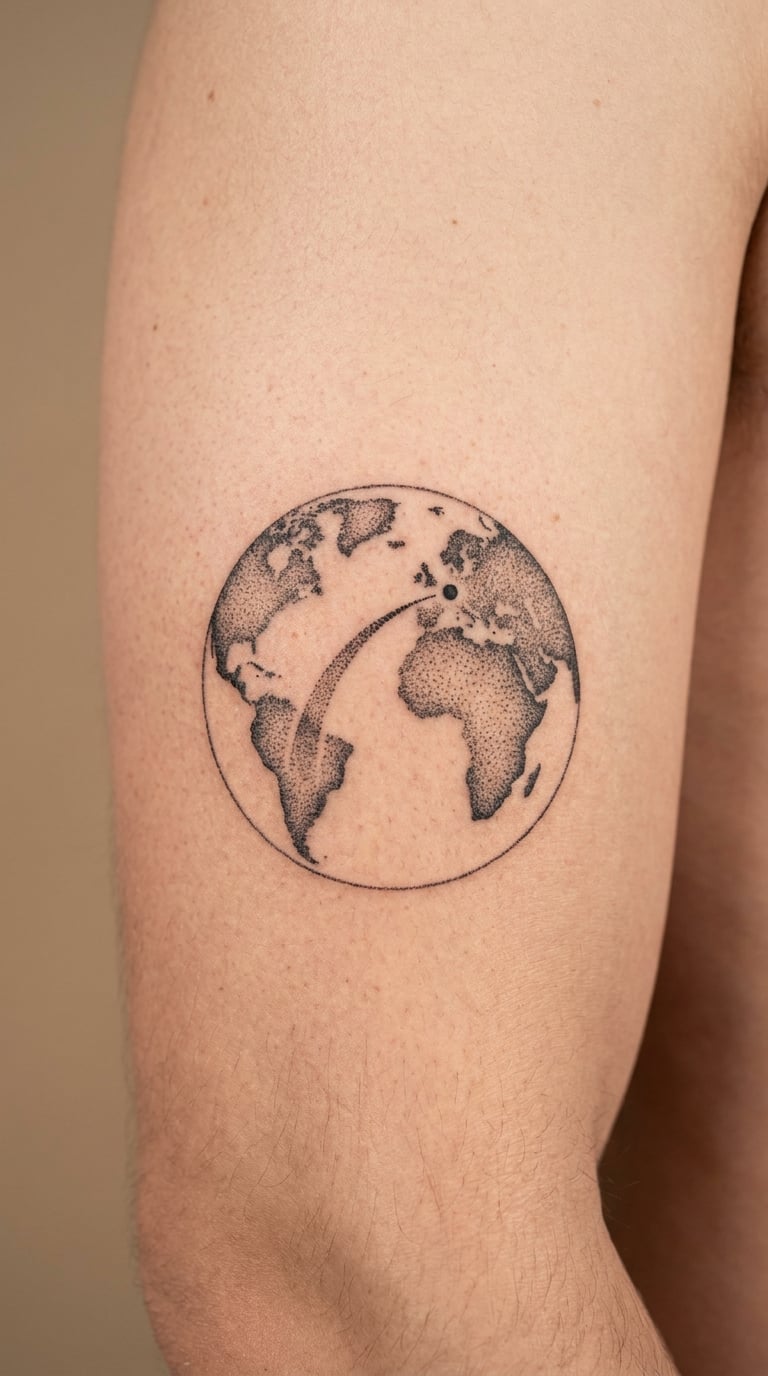
A sphere built from stippling rather than outline, with denser dot clusters suggesting land masses and a sparser field for the oceans. One route crosses it in fine line with a single filled dot where it lands.
Dotwork rewards patience and holds shape better than almost anything at this size, because the density does the work instead of a single line. That makes it a good pick for a forearm you can see every day.
Placement: upper arm, shoulder, or outer thigh · Size: 3 to 4 in (8 to 10 cm) · Style: dotwork and stippling
Pain: low to medium, but the session runs long. Thousands of individual dots means many passes over the same skin, and the area stays tender far longer than the clock suggests. Plan a free evening afterwards.
Make it yours: leave the continents as a blank outline and dot only the water, or dot a single city you have lived in rather than whole land masses.
12. Minimalist Tent Under Stars
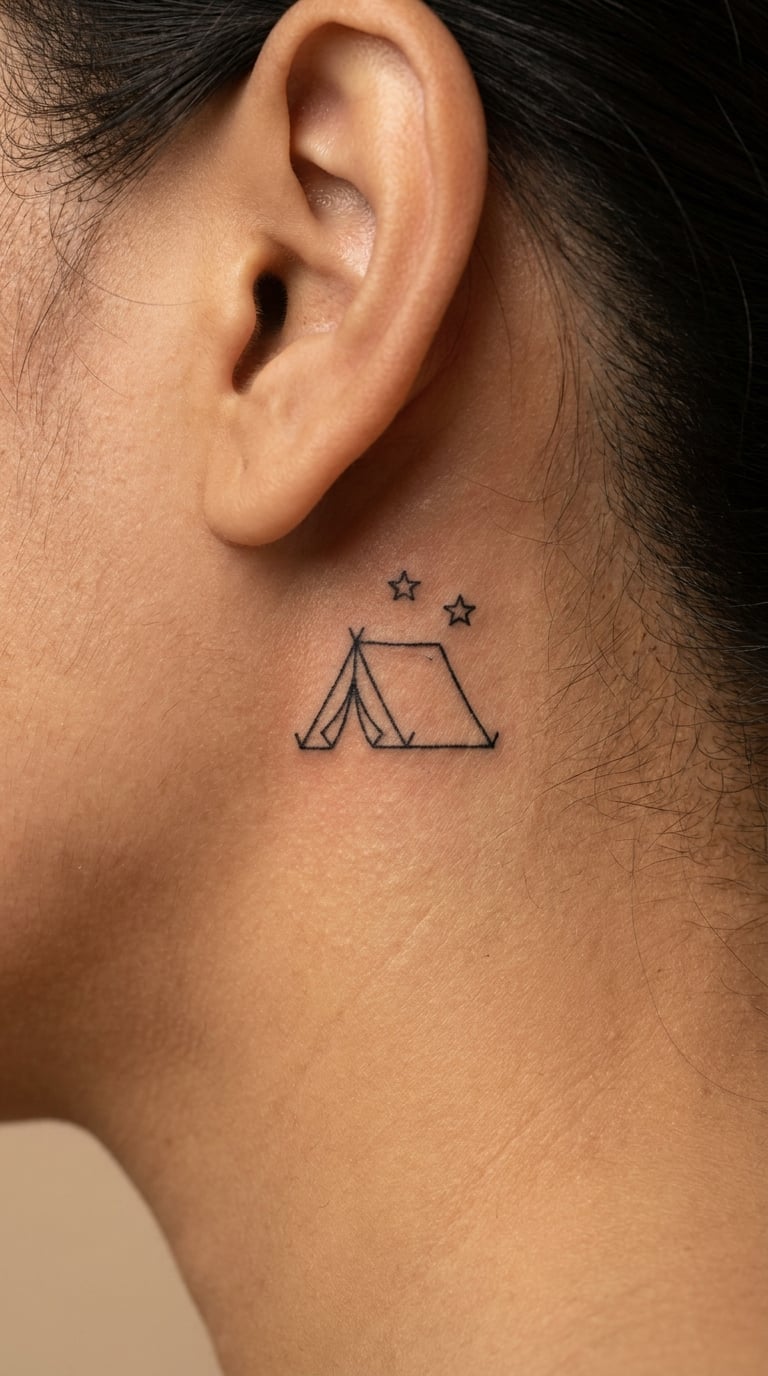
A triangular tent with one open flap, two four-point stars above it, and a short horizontal line for the ground. Five or six strokes in total, all the same fine weight.
It is the one for people who travel to be outside rather than to arrive somewhere. Two stars is enough; a sky full of them turns into clutter at this scale.
Placement: behind the ear, inner arm, or ankle · Size: 1 to 1.5 in (2.5 to 4 cm) · Style: fine line
Pain: medium to high. Behind the ear feels sharper than people expect because the skin is thin and the bone is close. Tiny stars blur faster than any other element here, so ask for slightly heavier lines even at that size.
Make it yours: add the date of one specific night you sat outside, or put a single small tree beside the tent.
13. Tropical Passport Illustration
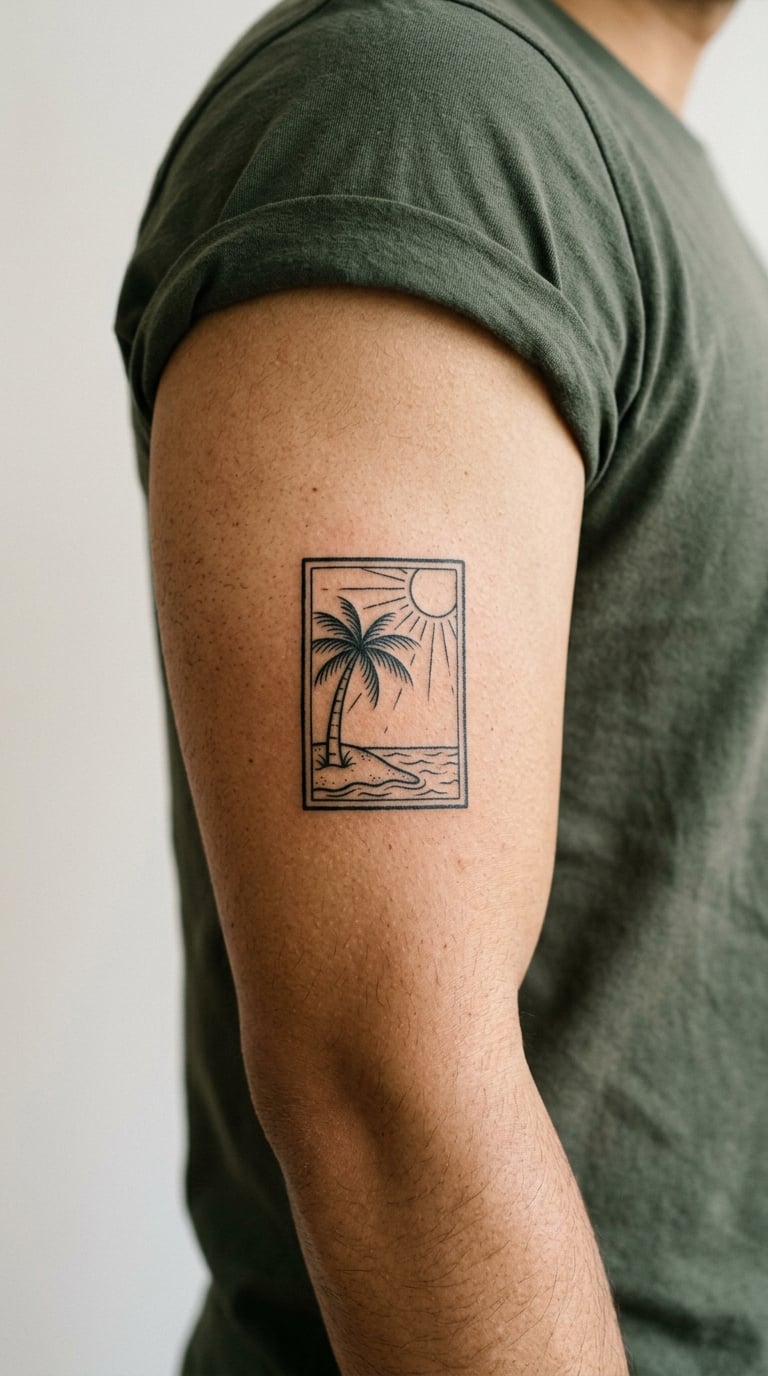
A taller rectangular passport frame with a small illustrated scene inside: a palm tree in profile, a half sun, a wave line, and a date across the bottom. The frame is drawn straight and thin, the scene inside it is loose and coloured.
It is a passport idea for people who want colour. Where the minimalist stamp is a single impression in black and grey, this is an illustrated page, so it needs a little more room and a little more commitment to upkeep.
Placement: upper arm, forearm, or calf · Size: 3 to 4 in (8 to 10 cm) tall · Style: illustrative with colour
Pain: medium. Two straight borders plus a coloured scene inside means a longer session than the outline suggests. Colour ages in layers, so the sun and the wave will soften before the frame does. In a hot climate, cover it when you are out in the sun.
Make it yours: swap the generic palm for a plant native to somewhere you have actually been.
14. Traditional Hot Air Balloon
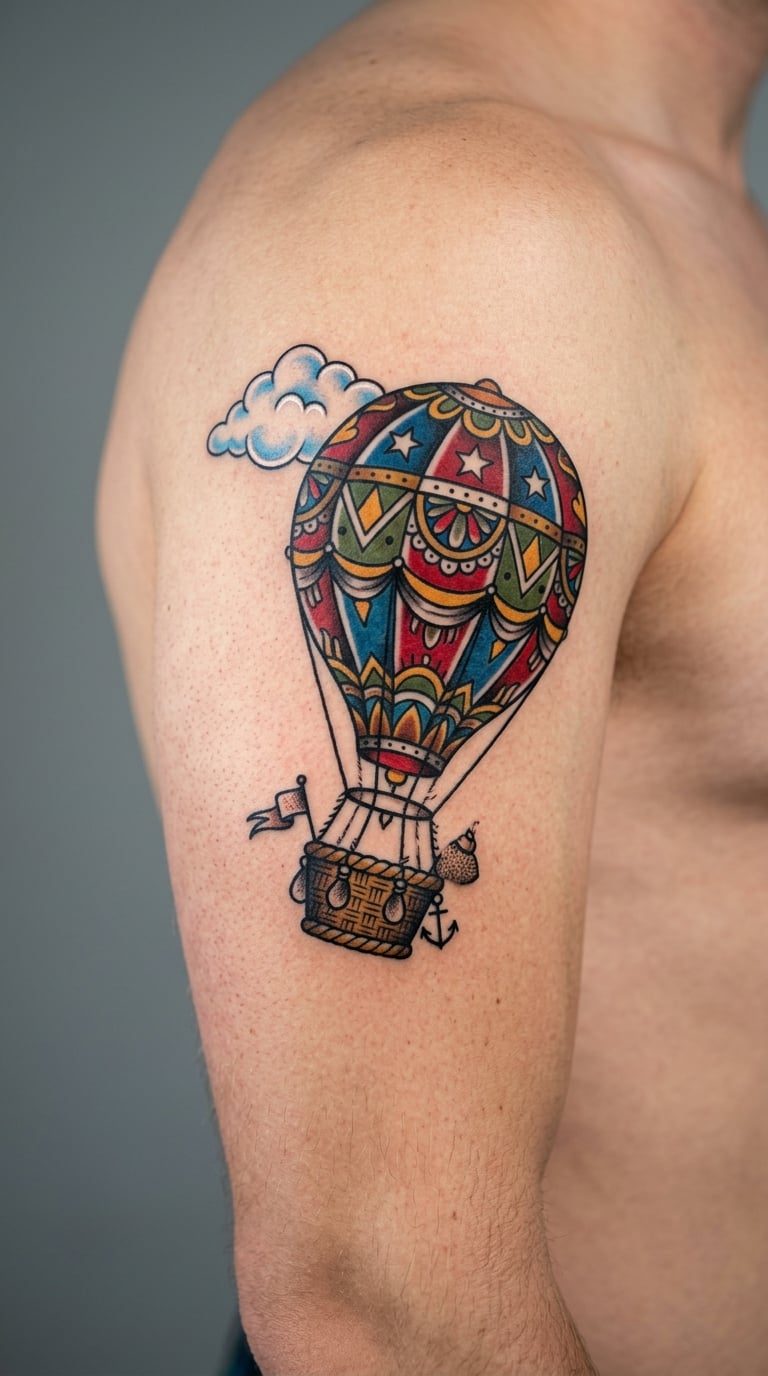
A balloon with vertical panel stripes, a small basket, and one cloud beneath it, built with clean black outlines and flat colour. The outlines are the signature of the style, so they stay even rather than feathered.
It is the traditional-style option on this list, and it is the one that reads well from across a room. People pick it for sightseeing trips and hot-air balloon flights, or simply because it looks like an illustration instead of a symbol.
Placement: upper arm, calf, or shoulder · Size: 3 to 4 in (8 to 10 cm) · Style: traditional
Pain: medium, and the shading takes the time. Solid colour packing is a lot of passes, so expect a sitting of a couple of hours rather than twenty minutes.
Make it yours: use the colours of a national flag you have a connection to, or add a small banner underneath with one word.
15. Micro-Realism Lighthouse
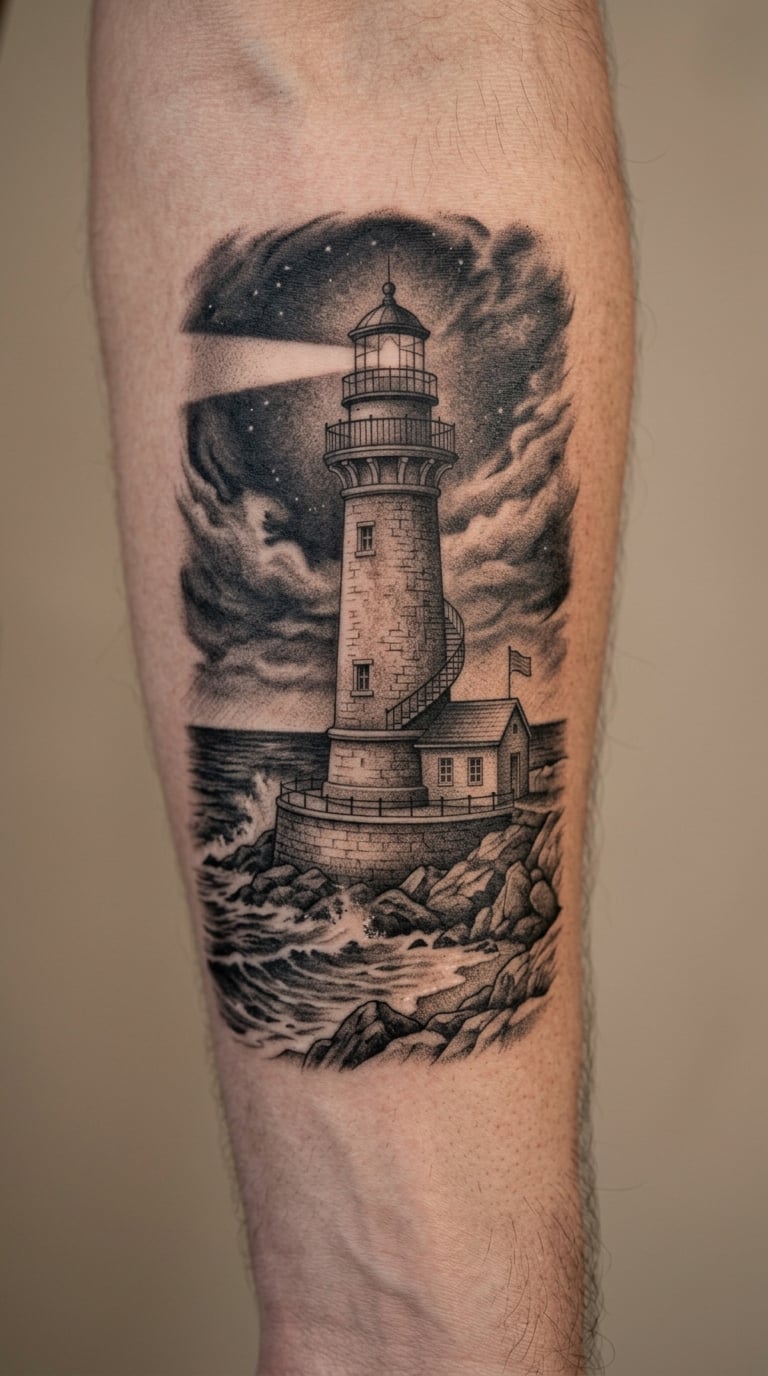
A narrow striped tower in black and grey with a light beam cutting across it, a few horizontal wave lines at the base, and soft shading on one side only. Realism at a scale where every extra shade has to be tiny.
It reads as a specific kind of travel memory: coastal roads, ferry crossings, long drives past lighthouses. A lighthouse is a landmark you either drove past deliberately or still think about.
Placement: outer forearm, calf, or upper arm · Size: 2 to 3 in (5 to 7 cm) tall · Style: micro-realism, black and grey
Pain: low to medium. Grey wash shading is repetitive rather than deep, so it stings less per pass but goes on longer. Ageing note: the light beam is the first thing to fade because it is built from a soft gradient with no hard edge to anchor it.
Make it yours: ask for the beam to point in a direction that means something to you, or add the sea height from one specific cliff.
16. Map Pin With Heart
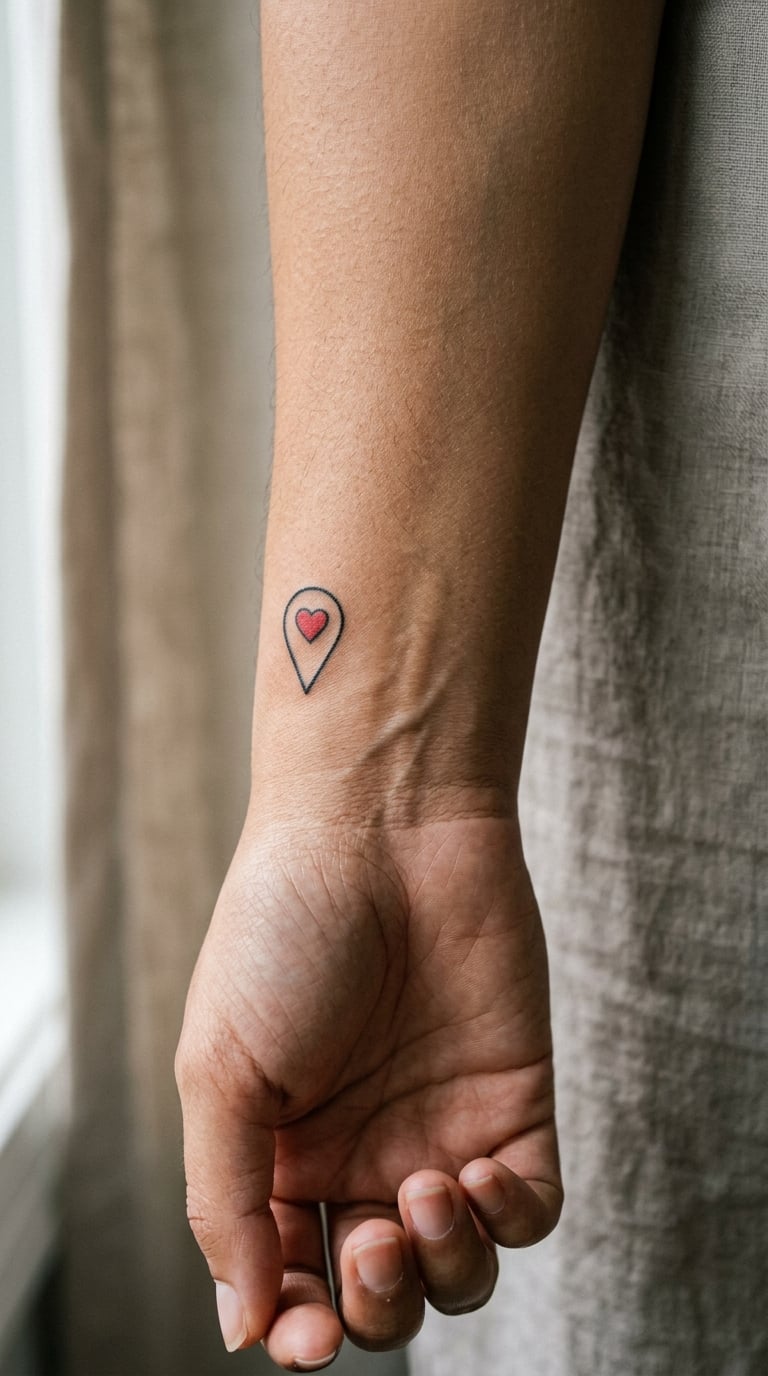
A classic map pin shape drawn in a clean black outline, a small heart set inside the round head, and nothing else. One flat colour inside the heart, or one red stroke through the whole design.
It is a place-first design, not a romance-first design. The pin points at somewhere; the heart says you have a reason for caring about it. People usually have a specific spot in mind.
Placement: wrist, bicep, or behind the ear · Size: 1 to 1.5 in (2.5 to 4 cm) · Style: minimalist with one colour
Pain: medium on the wrist, and the curved head of the pin means the artist is working on a rounded surface. A solid colour heart at this size needs a heavier line than you would expect. Ageing note: a heart outline has nothing inside it, so it fades faster than a filled shape next to it.
Make it yours: mark a home coordinate rather than a destination, so it points at where you keep coming back to.
17. Watercolor Wave And Sun
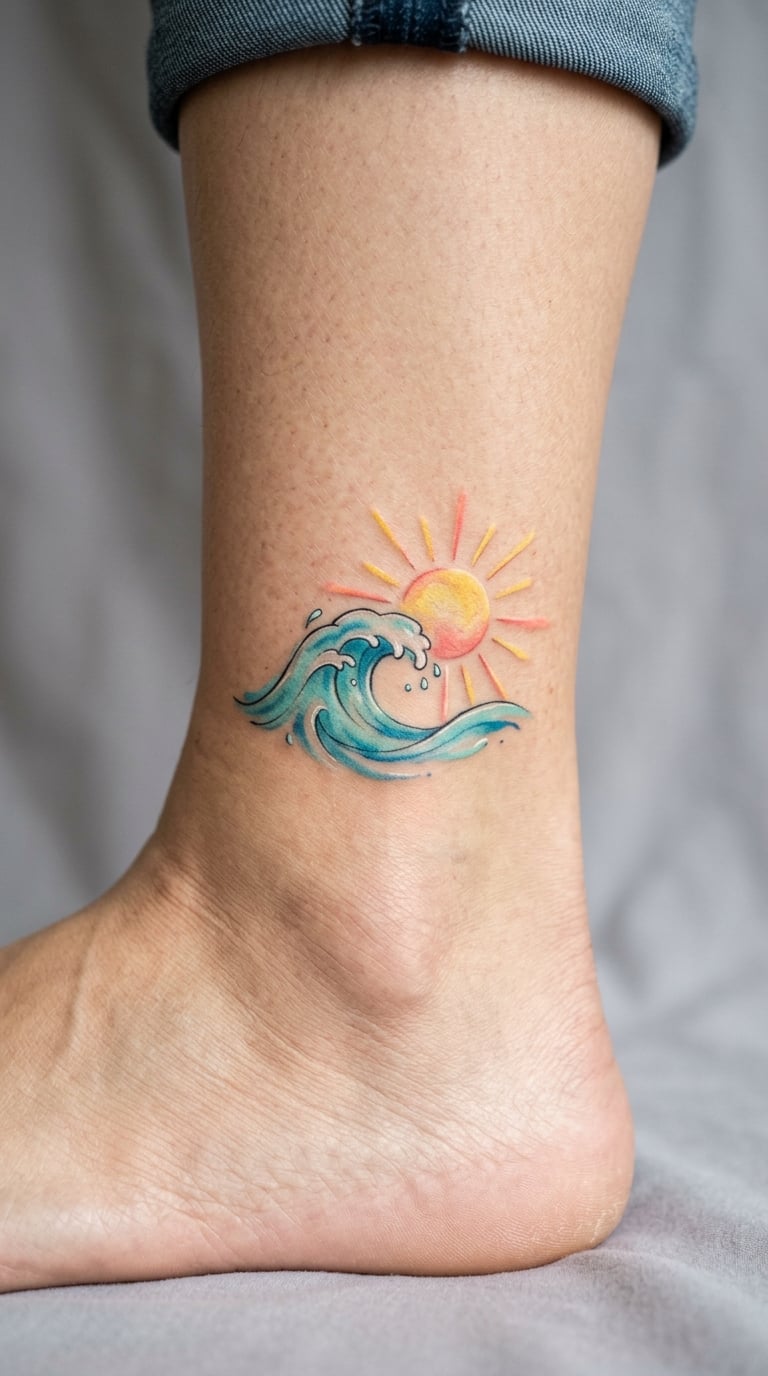
A breaking wave built from two or three transparent colours bleeding into each other, with a round sun above it in warm yellow or coral. No black outline anywhere, so the shape is defined entirely by where the colour stops.
It is the beach version of the mountain piece, and it suits people who think of travel in terms of water. Soft edges are the point here, so a hard outline would ruin it.
Placement: ankle, calf, inner arm, or shoulder blade · Size: 2 to 3 in (5 to 7 cm) · Style: watercolour
Pain: medium. Watercolour takes a freehand pass with no guide, which means slower work and more passes. Colour notes: turquoise fades first of the three, so expect the warm tones to outlast it. Saltwater and sun are both hard on colour work.
Make it yours: pick a colour that only exists in one sea you have swum in and use it as the only colour in the piece.
18. Old Train Ticket
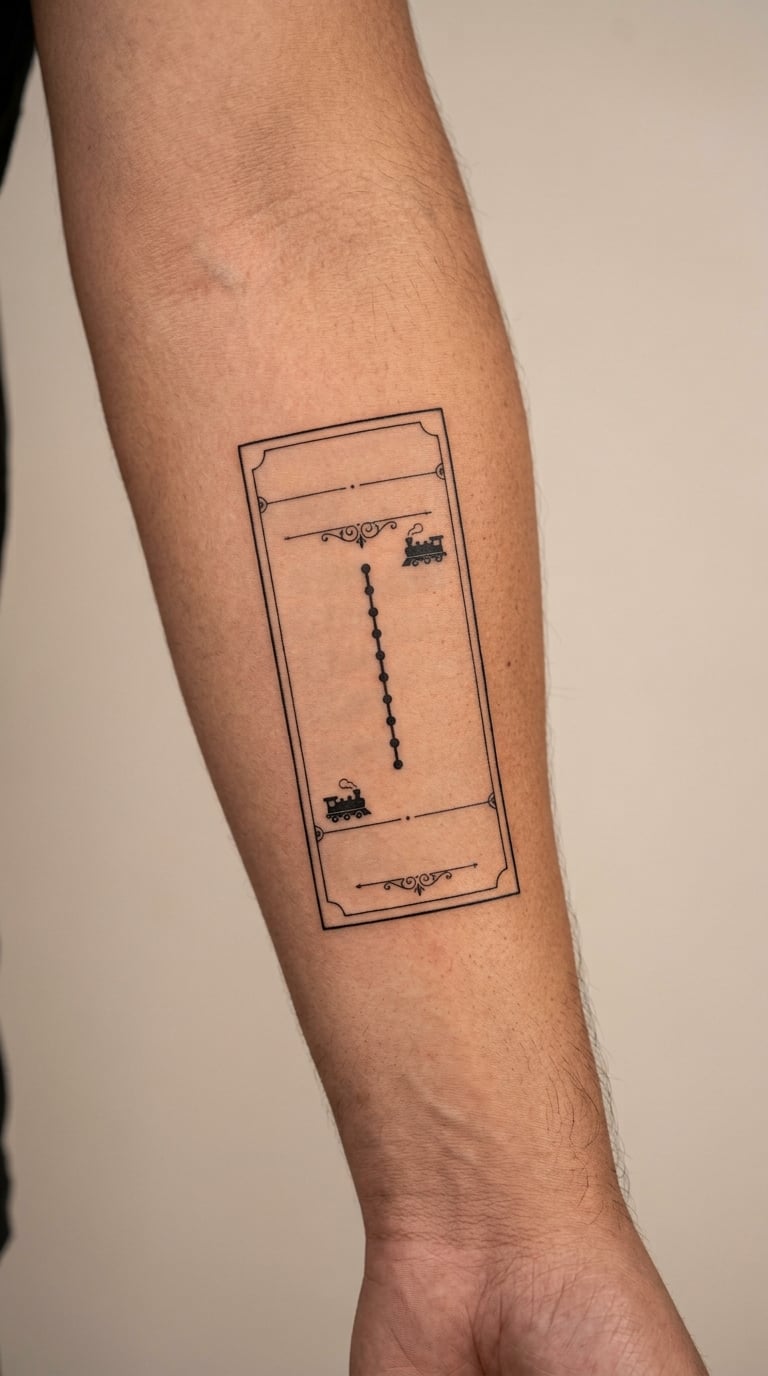
A tall narrow rectangle with perforated edges, a route line across the middle, small station names at either end, and a date at the bottom. Vertical orientation, like a real platform ticket.
Rail is a different memory from flying. People who remember slow overnight trains, or who still take them on purpose rather than out of necessity, usually reach for this one.
Placement: inner arm, forearm, or calf · Size: 2.5 to 3.5 in (6 to 9 cm) tall · Style: vintage line art
Pain: medium. The perforations along the edges are a lot of small repeated taps, and that is the part that takes longer than the outline does. Edge detail softens with age, so keep the perforation marks as short dashes rather than tiny circles.
Make it yours: use the two station names from a route you actually took, or reduce it to a single destination and date.
19. Fine-Line Hiking Boot
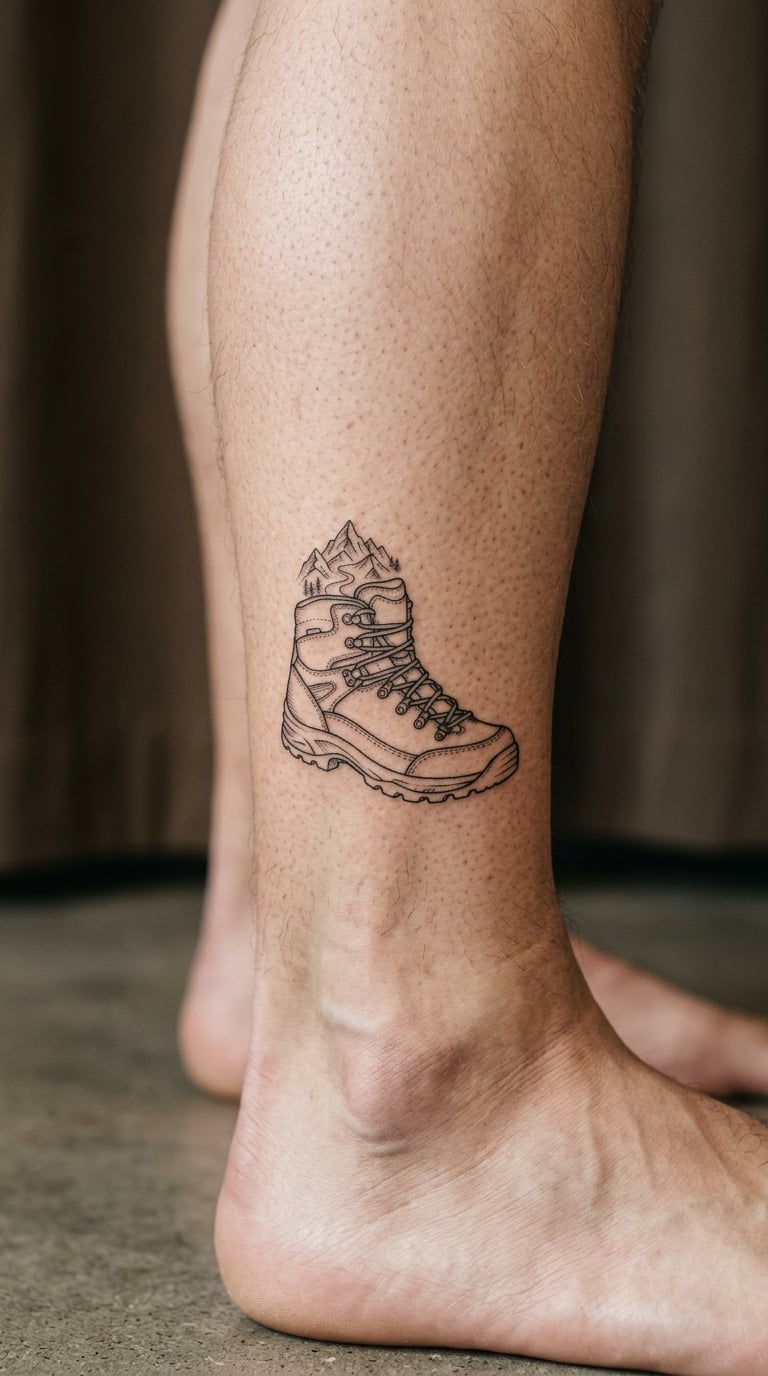
A boot in side profile drawn in a single fine line, with a mountain-shaped sole line and one small trail or ridge line behind it. The lace area can be three crossing strokes rather than a full lacing diagram.
It is the walking version of a travel tattoo. People who measure trips in kilometres rather than nights tend to choose it over anything with a plane in it.
Placement: lower calf, forearm, or ankle · Size: 2.5 to 4 in (6 to 10 cm) · Style: fine line
Pain: medium to high. The calf gives the artist a decent surface, but bone is close to the skin in places and the shape curves away at the ankle. Ageing note: the lacing and the sole texture go soft long before the boot outline does, so keep the outline heavier than the detail.
Make it yours: add a small flag or summit marker at the toe, or put the trail name in tiny script under the heel.
20. Celestial Travel Constellation
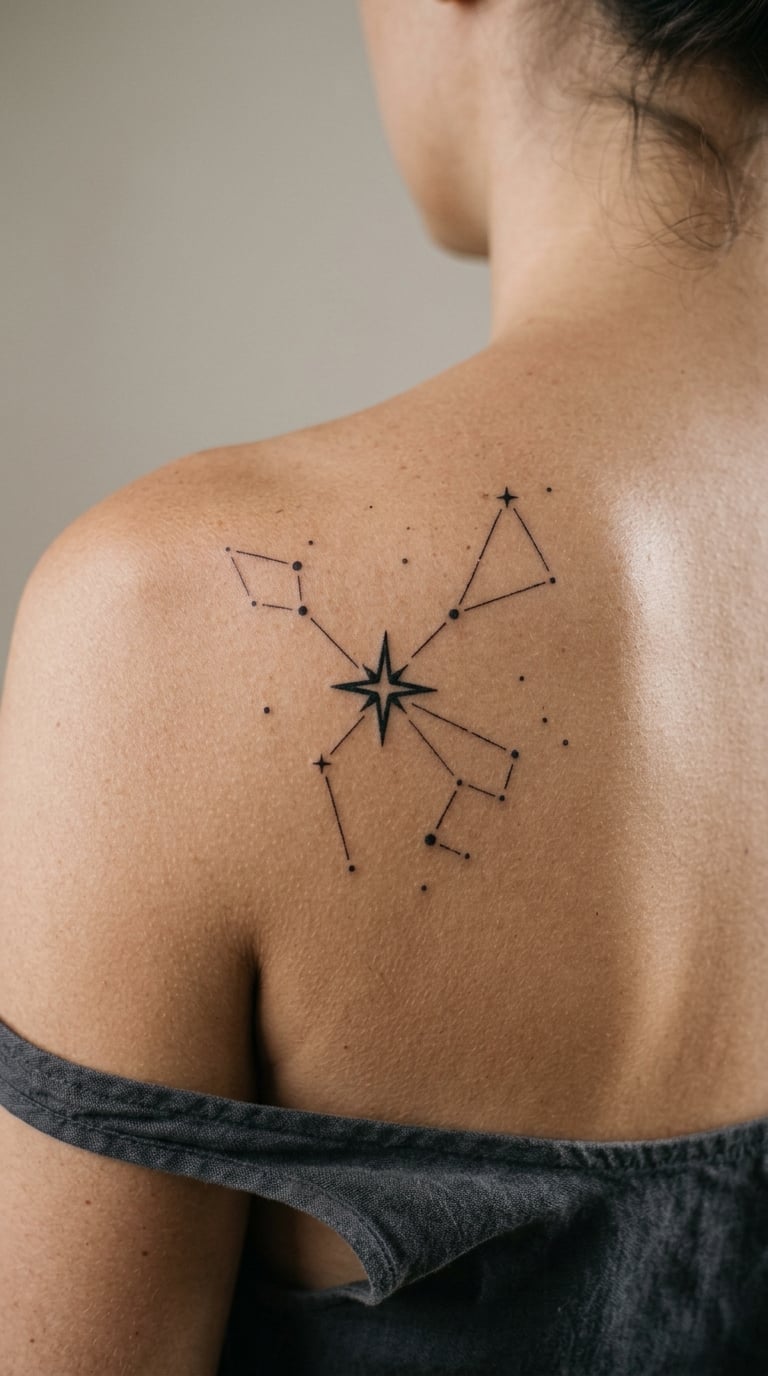
A small star map in fine line, a handful of connected points, with one star drawn larger and solid while the rest stay small and open. A few stippled dots fill the gaps so it reads as a sky rather than a diagram.
It can be the night sky from somewhere you have actually stood, and it can equally be a made-up pattern. The meaning sits with you, which is why it works for people who do not want a literal travel mark.
Placement: shoulder blade, upper back, or side of the thigh · Size: 2.5 to 4 in (6 to 10 cm) · Style: fine line with stippling
Pain: low to medium. The shoulder blade gives a broad, relatively flat area. Fine connecting lines are the first thing to soften, so ask for a consistent needle depth rather than a light pass.
Make it yours: name the star after the place, or use the coordinates of the nearest town to where you saw it.
21. Mini Camera With Film Strip
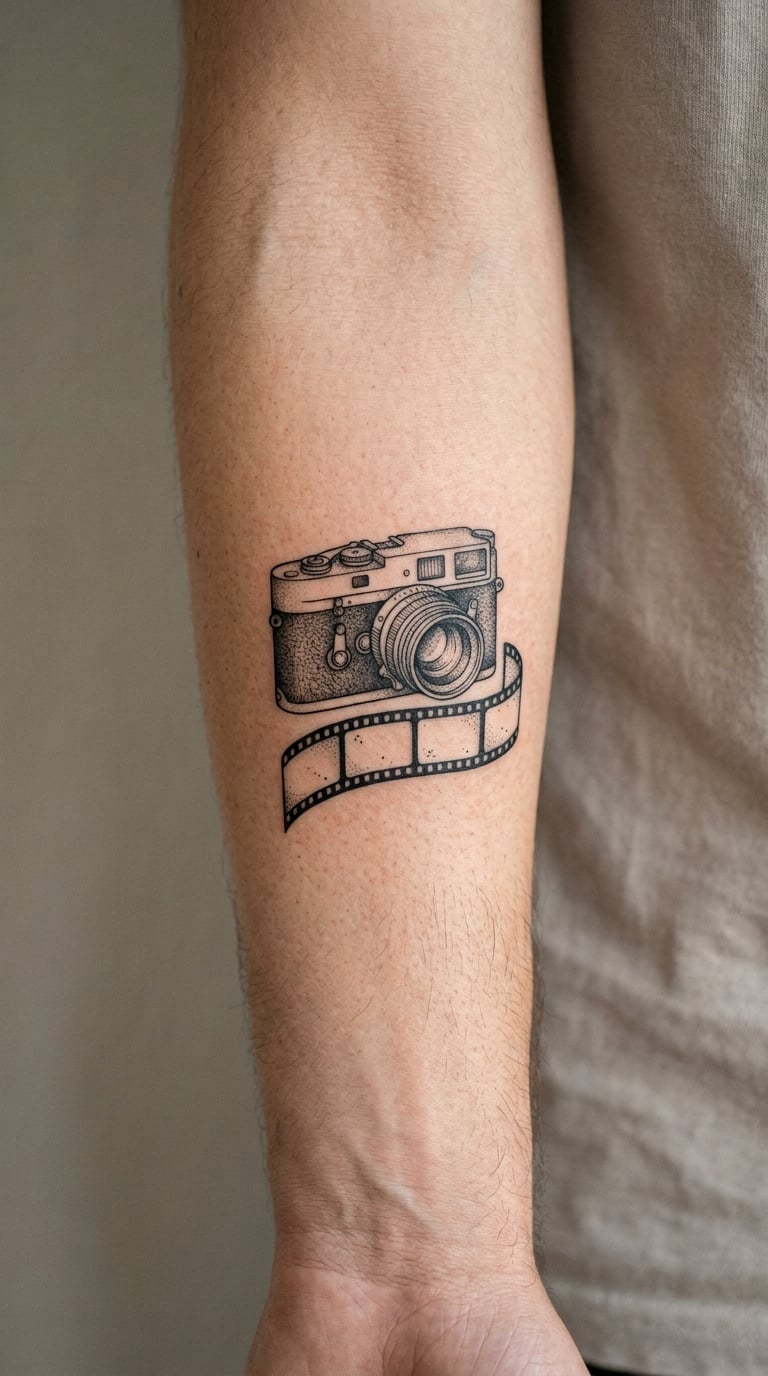
A compact camera body in outline or soft blackwork, with a lens as a single circle and a short film strip curling out of the side with three or four frame boxes. Small, dense, and readable at a glance.
It is about documenting rather than arriving. People who filled a camera roll on one trip rather than a whole year of travel often choose this shape.
Placement: forearm, upper arm, or back of the hand · Size: 2 to 3 in (5 to 7 cm) · Style: blackwork or line art
Pain: low to medium. A forearm is a forgiving place for a first tattoo of this size. The film strip boxes are small and square, and tiny squares are harder to keep crisp than curves, so expect the strip to be the part that softens.
Make it yours: leave the film frames blank, or fill two of them with a date and a single letter.
22. City Skyline Bookmark
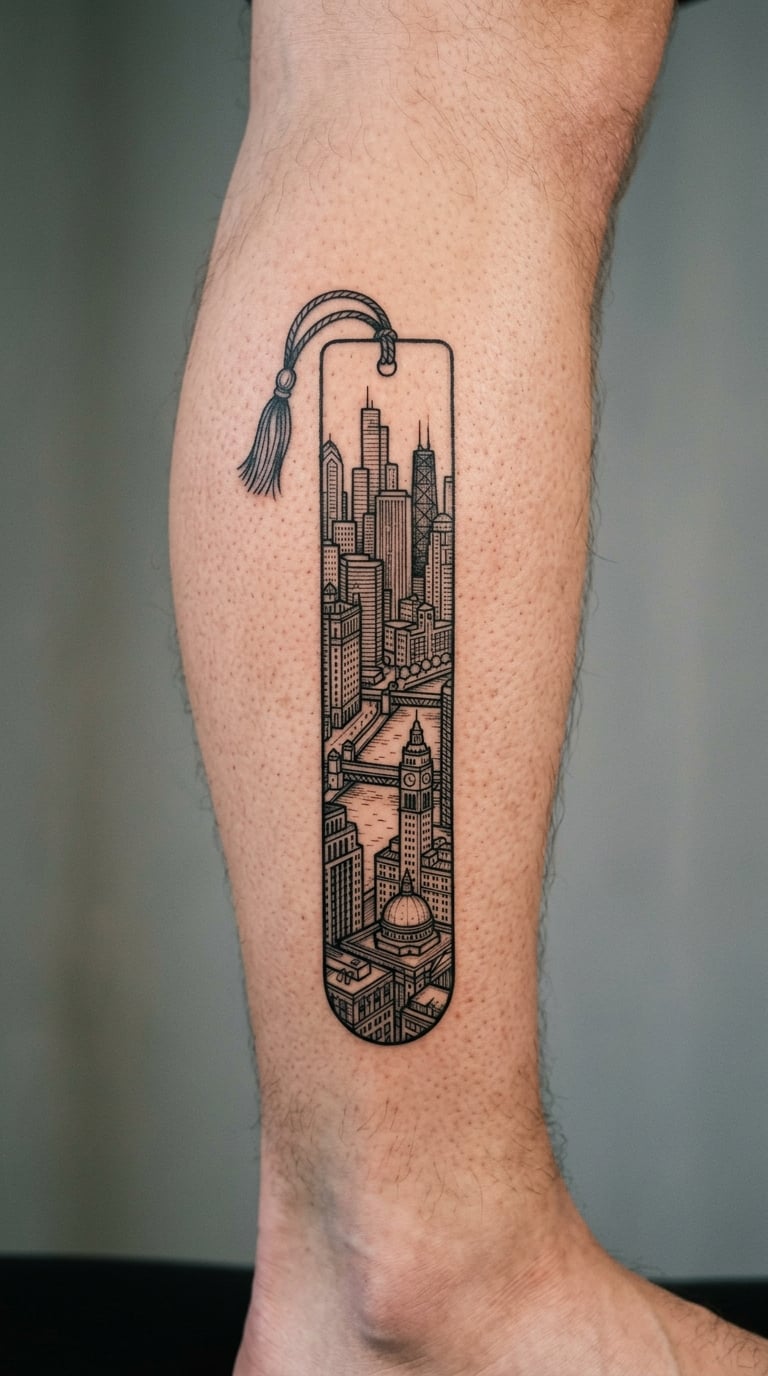
A tall narrow rectangle with a notch cut into the bottom edge, a ribbon or a pointed tab at the top, and a simplified skyline filling the inside. Buildings vary in height and one or two have antenna lines or a spire.
The bookmark shape is the part that does the extra work. It says the city is a chapter rather than a stop, which is how a lot of people feel about a place they keep going back to.
Placement: side of calf, forearm, or outer arm · Size: 3 to 5 in (8 to 13 cm) tall · Style: silhouette
Pain: medium. A long vertical shape means a long continuous fill, and solid silhouette work is repetitive rather than deep. It holds its edge well, and the skyline still reads clearly as a shape even after the window detail fades.
Make it yours: leave one building taller than any real one and add a date in the frame, or name the city along the top edge.
23. Minimalist Plane Route Pin
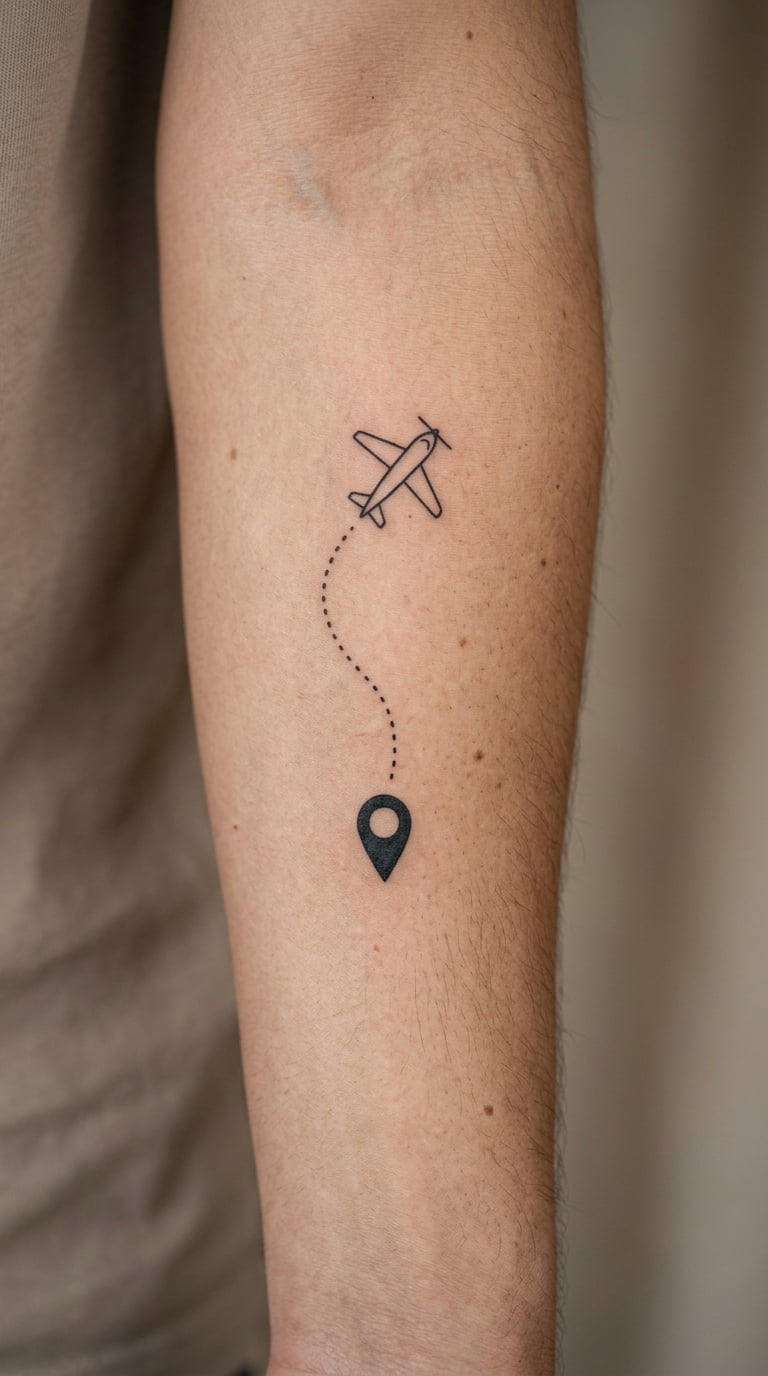
Three simple elements in a row: a small plane silhouette, a dotted arc, and a map pin. Built from flat icon shapes with no shading and no detail inside the plane. It reads as a symbol rather than an illustration.
This is probably the most practical first travel tattoo on the list, because it is small, simple, and easy to place anywhere. If you are nervous about committing to something detailed, this is the safe version.
Placement: inner forearm, wrist, or ankle · Size: 1.5 to 2 in (4 to 5 cm) · Style: icon, fine line
Pain: low to medium. Small shapes mean a short session, which helps when nerves are the bigger problem. Ageing note: the dotted route fills in a little as it heals, so ask for slightly wider dots than looks right on the stencil.
Make it yours: angle the plane along the line of the forearm so the whole design follows the body rather than sitting across it.
24. Watercolor Sunset Horizon
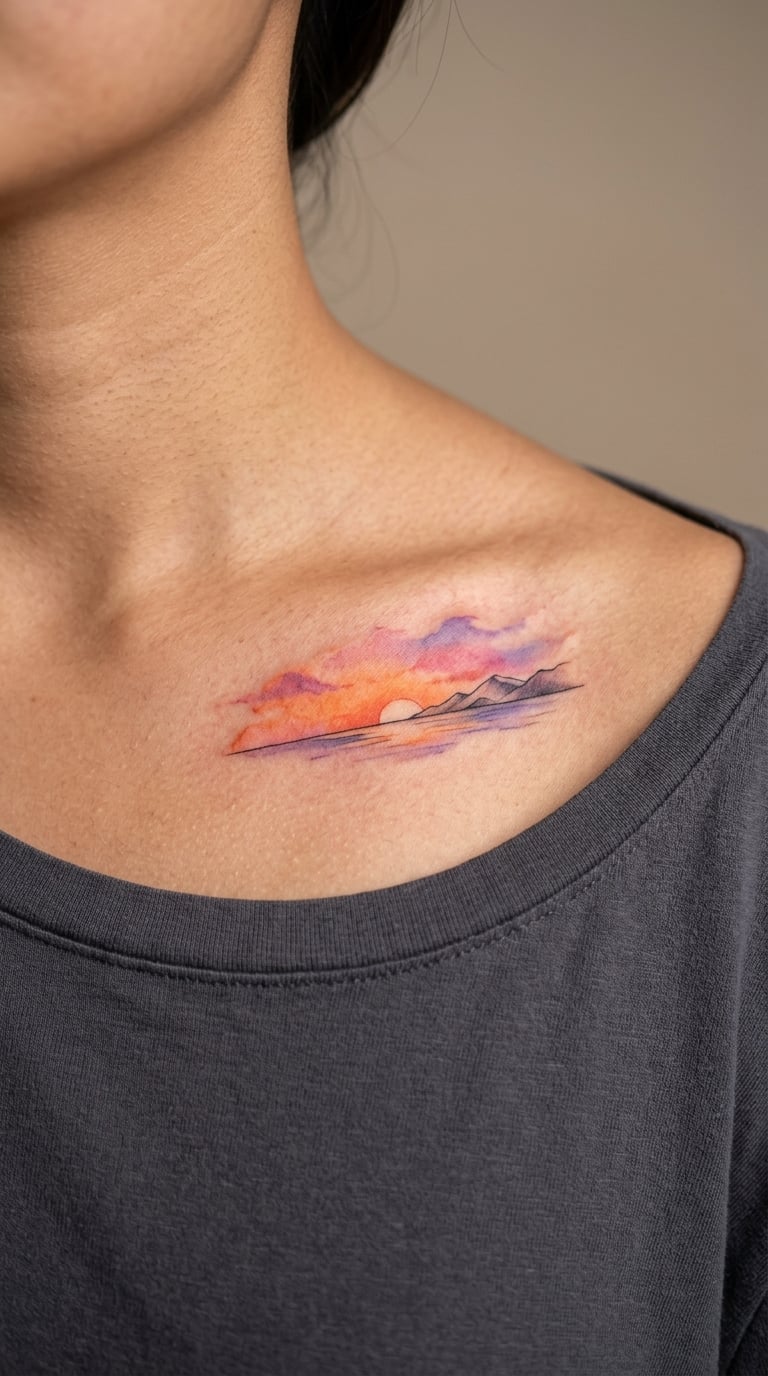
A low band of layered hills in soft violet, a sun sitting on or just behind them, and a wash of orange and pink above it. The colours bleed into each other with no hard edges, and the horizon line stays the only defined element.
It can be one specific evening or a composite of several. People who cannot pick a single place often choose a horizon instead, because it holds the feeling of arrival without naming somewhere.
Placement: collarbone, forearm, or across the back of the shoulder · Size: 4 to 5 in (10 to 13 cm) wide · Style: watercolour
Pain: medium. Broad soft washes take longer than they look, since each layer has to dry before the next goes on. Colour notes: pale pinks lose saturation first, so the violet and the darker hill line are what will keep the piece readable.
Make it yours: use the actual colours of one sunset you photographed, or match it to a second piece you already have.
How to Choose the Right Design
How to choose a tattoo idea for travel lovers that ages well
Start with the place, not the object. A symbol tied to somewhere real is the one that still means something to you fifteen years in, and a plain plane or globe is the version people tend to cover. Tattoo advice communities say the same thing over and over: specificity ages better than iconography.
- Check the drawing at real size. Ask to see the stencil, or a print of the exact line weight, before anything starts. A design that reads on a phone screen can turn to mush at two inches.
- Pick line weight to match the size. Tiny designs need heavier lines than the reference image shows, and that is the single biggest factor in whether a small travel tattoo is still legible in five years.
- Match the design to the placement, then have the artist confirm it. A design that looks right flat on a screen can distort badly over a wrist or a ribcage. Nobody can promise a placement suits everyone until they see your skin and your movement.
- Decide how much detail you want to maintain. Every tiny element is another thing that softens. Three elements hold up far longer than twelve.
- Think about sun and water. If the placement will see a lot of light, plan on the colour fading or lean to black and grey from the start.
- Have the artist look at your idea and improve it. Bring the reference, then let them tell you what will not work at your chosen size. They have seen the designs that failed.
Where do you put a travel tattoo?
Placement changes the whole design more than most people expect. Wrist and inner arm are visible and read clearly, but they bend, fade faster and hurt more. The upper arm and forearm are the easy options. The ribs and collarbone are where a design sits best if you want it to look like part of the body. Behind the ear and the nape are the discreet ones, and the ankle is where a small colour piece disappears under a shoe until you want it seen.
If you are a frequent flyer, it is worth knowing that most airlines do not have visibility rules about tattoos, and the ones that did have largely dropped them. Check the current policy of any airline you fly often if it matters to you, but design choice is the more common concern.
Cost and Session Time
Tattoo cost is driven less by the subject than by size, detail, colour and the artist. A small fine-line travel design is often at a shop’s minimum charge, which means the price barely changes whether the design takes fifteen minutes or forty-five. A watercolour piece at four to six inches is a completely different job, because each wash is a separate pass and a colour piece needs more sessions to finish properly.
Session length follows the same logic. Small line work usually fits into one sitting of under an hour. Anything involving shading, dots, lettering or colour layers tends to run two to three hours, and detailed pieces are commonly split across sessions.
What moves the number most: the hourly rate, which varies widely by city and by reputation; the shop minimum, which small pieces are billed against; how much grey shading or stippling is involved; whether colour is packed or blended; and how far the design sits from the nearest realistic artist. Get a quote for the finished size, not a rough idea of the subject.
If the artist you want is somewhere else, that is a normal trade-off rather than a mistake. People book a second trip specifically for a piece. Factor the travel into the cost, and ask whether the design can be split so the first session is usable on its own.
Aftercare Basics
- Follow your artist’s aftercare instructions first. They know what they did in your session. Everything below is general, and their advice overrides it.
- Wash it gently. Clean lukewarm water, a mild unscented soap, and pat it dry with something clean. No harsh soaps, no scrubbing, no picking at scabs or flaking skin.
- Protect it from clothing and friction. Loose, clean fabric over the area for the first few days. Tight waistbands, straps and boots rub a fresh tattoo and are the most common cause of irritated lines.
- Keep it out of sun and water for a while. Avoid swimming, hot tubs and saunas while it is healing, and keep it covered or in shade. UV exposure is the main reason colour travel tattoos lose saturation.
- Let it heal before judging it. Fresh ink sits raised, red and slightly swollen. The settled version appears after a couple of weeks, and the final settle takes months.
- Contact the artist or a healthcare professional with concerns. Redness that spreads, swelling, heat, pus, a fever, or a line that blows out into the skin are reasons to get advice rather than wait it out.
Frequently Asked Questions
What is a good first tattoo for someone who loves to travel?
A small, simple design with no lettering and one or two elements is the safest first tattoo, because there is less to soften over time. The minimalist plane route pin, the fine-line paper plane, or a small map pin are all good candidates. Choose a placement away from the wrist or ribs for the first one, since those hurt more and are harder to hide while it heals.
Do small travel tattoos fade over time?
Yes, and it is mostly about line weight. Hairline work fades and blurs faster than bold line or solid black, and tiny lettering goes first of all. Ask your artist to run slightly heavier lines than the reference image shows, and expect a hand-drawn or small-colour travel tattoo to need a touch-up eventually. Placement matters too, with inner arm and hand placements fading ahead of the upper arm.
Do travel tattoos hurt more than other tattoos?
Pain tracks placement and size, not subject. A small travel design on the upper arm or forearm is on the mild end of the scale, while the inner wrist, ribs, collarbone, ankle bone and behind the ear are noticeably sharper. Travel tattoos also sometimes get requested as a first piece at the last minute before a trip, which adds nerves to the discomfort. Session length and sleep are bigger levers than the design itself.
How do I personalise a travel tattoo so it is not generic?
Change one specific element rather than the whole motif. Use real coordinates, a date, a station name, or a plant native to a place you have been. Tattoo communities consistently favour a symbol from an actual place over a stock globe or plain plane. A temporary tattoo is a low-commitment way to test a design before it becomes permanent.
How should I prepare a reference for a tattoo artist?
Bring three or four images in a similar style, plus a note on size and placement, and say what you like and what you do not about each one. Artists work from a direction rather than a copy, so an explicit brief helps more than one perfect reference photo. Ask to see the design drawn at its actual size before the session, and tell the artist straight away if the line weight looks too thin.
Where to Start
If this is your first tattoo, the minimalist plane route pin or the fine-line paper plane will give you the least second-guessing. Both are small, both are made of shapes your artist can hold, and both sit well somewhere you can cover while it settles.
If you already have a few pieces and travel tattoos are what you actually want, go bigger and more specific. The tiny world map with a route, the retro airline tag, or the city skyline bookmark give you room for a real detail, and they read as part of a collection rather than an addition to one.
Whichever you choose, take the design to an artist at the size you intend it to be, and change anything they tell you will not hold up. That conversation is where a good travel tattoo actually gets made.