
20 Best Beach Tattoo Ideas for Women: Stunning (September 2026)
Beach tattoo ideas for women run from a single fine-line wave behind the ear to a seven-inch watercolor break across the shoulder, and the right one depends on how much detail you want to live with and how much space you have.
Most people who come in asking for a beach piece want the coast without the souvenir-shop feel. That usually means fewer elements, cleaner linework, and a placement that follows the shape of the body. September bookings fill up for next summer, so it is a good month to talk to an artist and get a drawing done before the rush.
Below are 20 designs with real sizes, placements, and honest notes on how they wear. If you are starting from scratch, the 18 best fine line tattoo ideas for women (September 2026) cover the gentlest version of this style, and the 20 simple ankle tattoo ideas for women (September 2026) are a good place to start if the lower leg is your preferred canvas.
Beach Tattoo Ideas for Women: Quick Guide
| Idea | Style | Best placement | Size | Pain |
|---|---|---|---|---|
| 1. Fine-line wave | Fine line | Behind the ear | 1.5-2.5 in | Low to medium |
| 2. Scallop shell | Black and grey | Collarbone | 2-3 in | Medium |
| 3. Watercolor sunset | Watercolor | Outer ankle | 3-4 in | Medium |
| 4. Blackwork palm leaf | Blackwork | Outer forearm | 4-6 in | Medium |
| 5. Realistic starfish | Micro-realism | Outer shoulder | 2.5-3.5 in | Medium |
| 6. Dotwork sea turtle | Dotwork | Rib or hip | 3.5-5 in | Medium to high |
| 7. Compass and anchor | Traditional | Upper arm | 4-6 in | Medium |
| 8. Spiral conch | Fine line | Outer hip | 2.5-3.5 in | Medium |
| 9. Red coral branch | Illustrative colour | Inner forearm | 5-7 in | Medium |
| 10. Jellyfish | Micro-realism | Back of hand | 2-3 in | Medium to high |
| 11. Palm-tree pair | Minimalist | Outer calf | 3.5-5 in | Medium |
| 12. Breaking wave | Watercolor | Shoulder | 6-8 in | Medium |
| 13. Shark fin | Blackwork | Outer calf | 3.5-5 in | Medium |
| 14. Seagull in flight | Line art | Inner wrist | 2-3 in | Medium |
| 15. Colour starfish | Watercolour | Top of foot | 2.5-3.5 in | Medium |
| 16. Sailboat | Traditional | Inner arm | 3.5-5 in | Medium |
| 17. Moon and waves | Fine line | Upper to mid spine | 4.5-6 in | Medium to high |
| 18. Beach grass | Botanical fine line | Outer thigh | 5-7 in | Medium |
| 19. Blue crab | Illustrative colour | Shoulder blades | 3.5-5 in | Medium |
| 20. Shoreline walk | Black and grey realism | Lower calf | 4.5-6 in | Medium |
1. Fine-Line Wave Behind the Ear
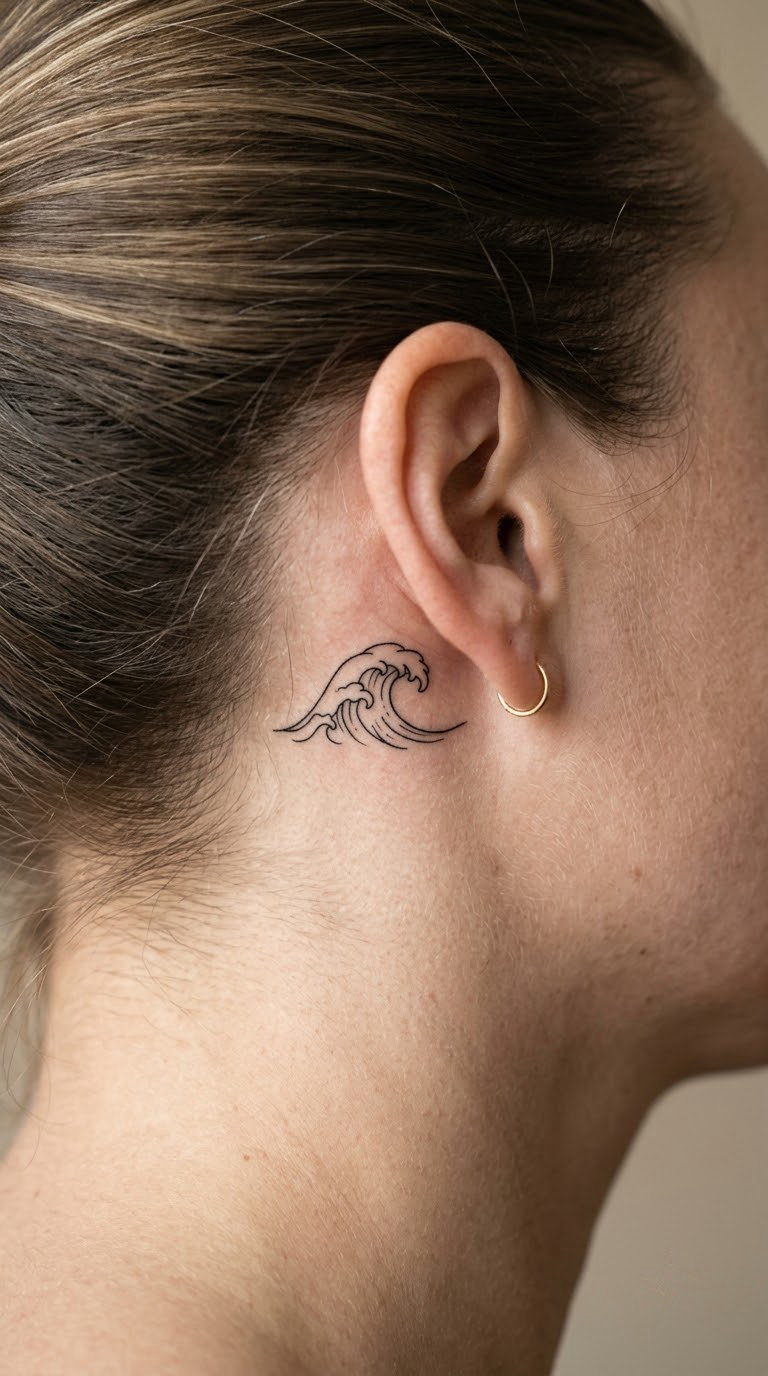
A single wave drawn with one confident black line, maybe two, curling once and stopping. There is no foam, no shading, no second wave. The restraint is the whole point.
People choose it because a wave says coast without spelling anything out, and because it sits where hair covers it on a bad hair day. Behind the ear is also a spot where a design curves with the body instead of fighting it.
Placement: behind the ear, along the hairline, or on the neck just under the jaw.
Size: 1.5 to 2.5 inches wide (4 to 6 cm). Below that, the curl tends to close up.
Style: fine line, single-needle work.
Pain: low to medium, a scratchy, dragging feeling. Thin single-needle detail is the first thing to soften over the years, so keep the line weight honest and expect a touch-up every few years.
Make it yours: add a small date in the same line weight underneath, or a second wave that breaks in the opposite direction.
2. Minimal Shell Collarbone Tattoo
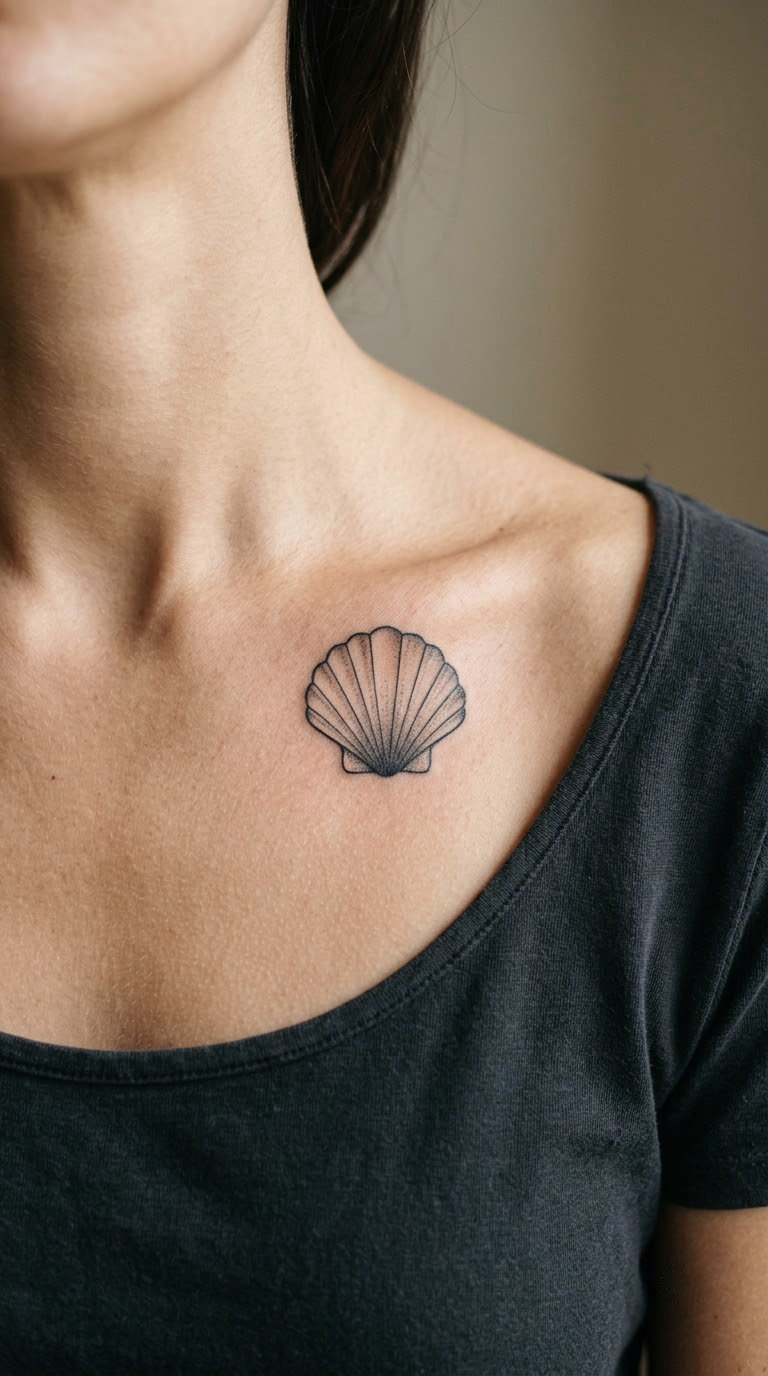
A scallop shell with a clean outline and a light grey shadow inside the ribs, no colour. Ribbed lines fan out from a small hinge point at the base, which is what stops it reading as a plain outline.
It is a common first coastal piece because a shell is symmetrical, so it sits neatly in the middle of the collarbone without looking oversized.
Placement: centred between the collarbones, or offset along one of the bone lines, or at the top of the sternum.
Size: 2 to 3 inches wide (5 to 7.5 cm).
Style: black and grey realism, light whip shading.
Pain: medium. The collarbone itself is bony, and the ribbed shading needs more passes than an outline. The grey wash softens a little in the first year, so a touch-up on the shading is normal.
Make it yours: add a single birthstone colour in the hinge, or a tiny conch beside it at half the size. Pair it with the 20 best back of neck tattoo ideas for women (September 2026) if you want the shell visible from the front.
3. Watercolor Sunset on the Ankle
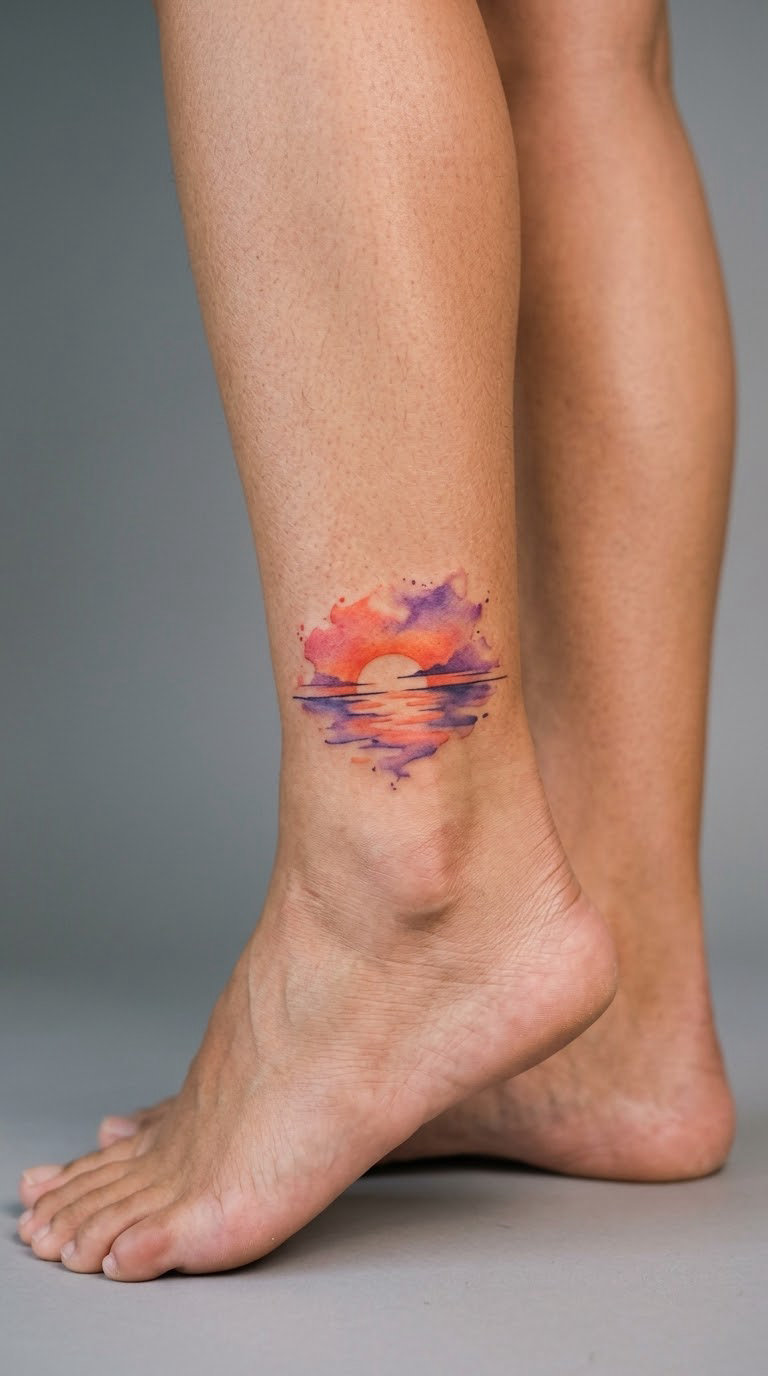
A loose sunset built from wet colour: coral bleeding into orange, a violet wash underneath, and a hard horizon line where the pigment dries. The edges are meant to be uneven. A clean-edged sunset just looks like a gradient sticker.
The appeal is colour without a big commitment, and the ankle gives the design a natural curve to follow. Plenty of people place a coastal design here to mark a stretch of coast that matters to them.
Placement: outer ankle above the bone, inner ankle, or across the top of the foot.
Size: 3 to 4 inches wide (7.5 to 10 cm).
Style: watercolor wash with a few defined line details.
Pain: medium, and the ankle bone is one of the more tender spots on the lower leg. Colour inks settle noticeably in the first year, so plan on a refresh rather than expecting the wash to stay exactly as drawn.
Make it yours: keep only two colours from a specific sunset, or have the horizon line double as a wave under it.
4. Blackwork Palm Leaf on the Forearm
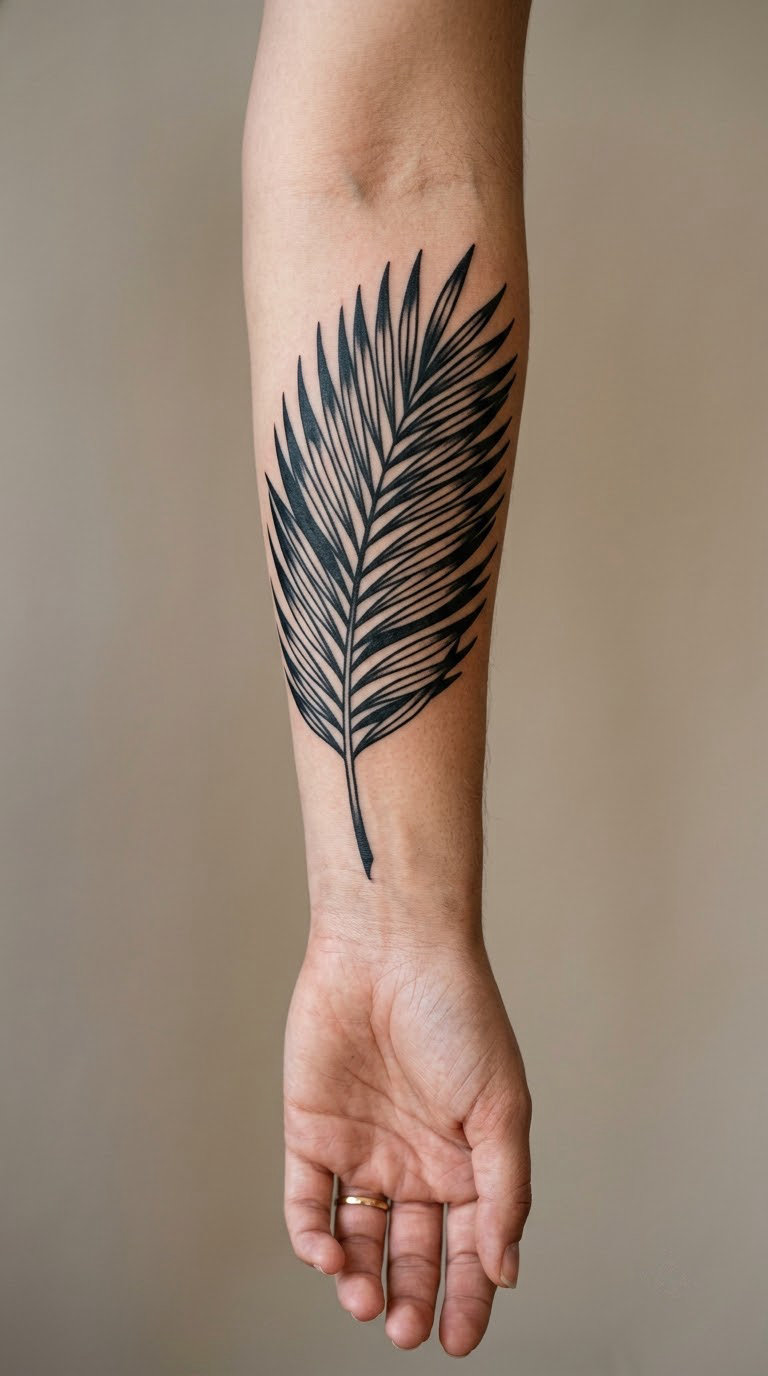
One frond filled in solid black, with the leaf veins cut out of the fill as negative space so the skin does the drawing. The base is a thick stem that anchors the piece, and the tip tapers to a point.
Solid blackwork reads graphic rather than busy, which is why a single leaf can cover a good stretch of forearm without needing a tropical scene around it. It also holds its shape when everything finer around it starts to fade.
Placement: outer forearm from wrist toward elbow, inner forearm, or along the shoulder-to-elbow line.
Size: 4 to 6 inches long (10 to 15 cm).
Style: blackwork with negative-space detail.
Pain: medium. Filling a large solid area takes longer and feels more like sustained scratching than a line does. Black lines are among the most durable inks, though heavy fills can lighten at the centre after a few summers of sun.
Make it yours: angle the leaf to follow the forearm curve, or add a second smaller leaf at the wrist to run the composition down the arm.
5. Realistic Starfish Shoulder Tattoo
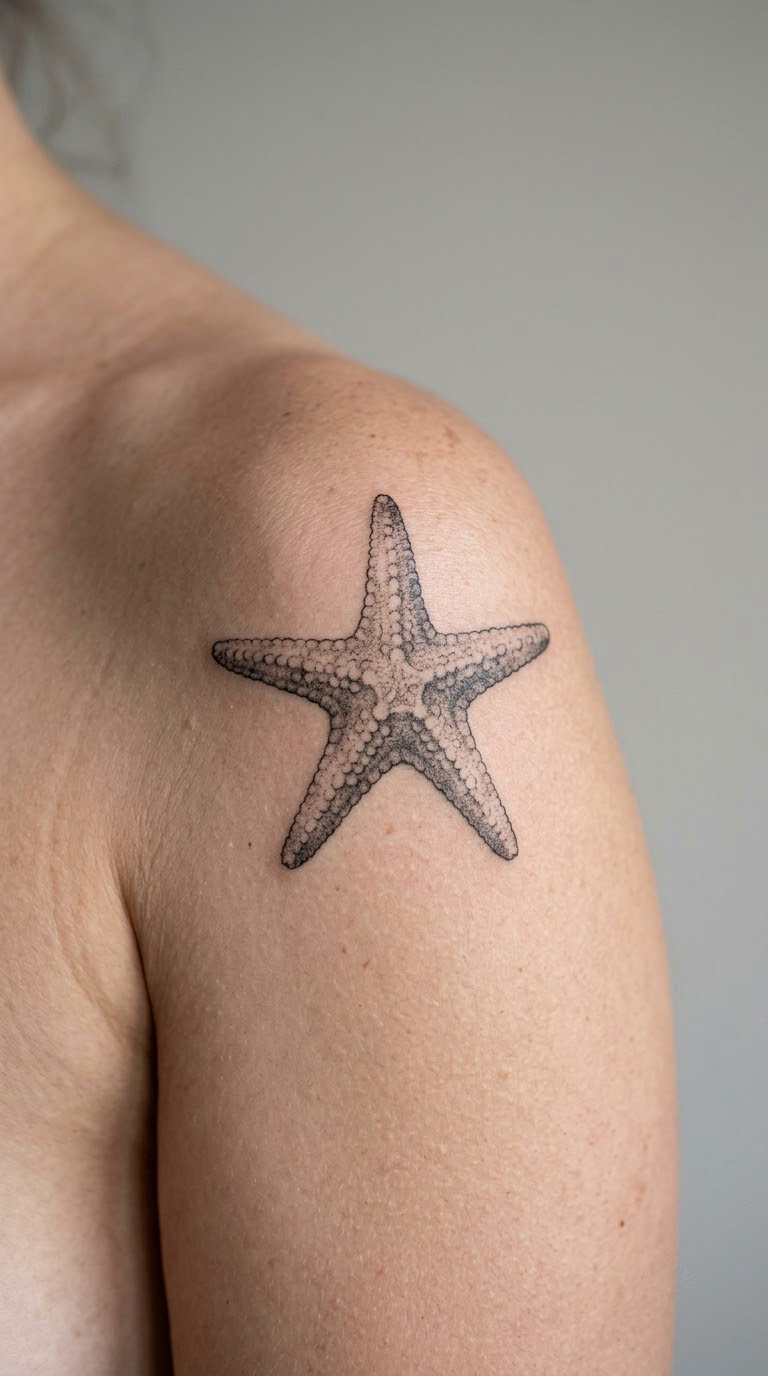
A five-armed starfish with a slightly lopsided outline, soft stippling for the bumps along each arm, and a faint shadow underneath one edge. The imperfection is what makes it read as an object rather than a cartoon.
The shoulder is a friendly spot for a rounded motif because the deltoid already curves the way a starfish does. It shows in a sleeveless top and disappears entirely under a t-shirt.
Placement: outer shoulder, top of the upper arm, or the shoulder-blade area.
Size: 2.5 to 3.5 inches across (6 to 9 cm).
Style: micro-realism in black and grey, light stippling.
Pain: medium. Stippled texture means more needle passes, and the shoulder moves a lot when you sleep on that side. Fine stipple is the first part to blur, so expect a soft grey look rather than sharp dots within a few years.
Make it yours: wash the whole design in a single muted tone, or add a small sand-coloured shadow beneath one arm.
6. Dotwork Sea Turtle on the Rib
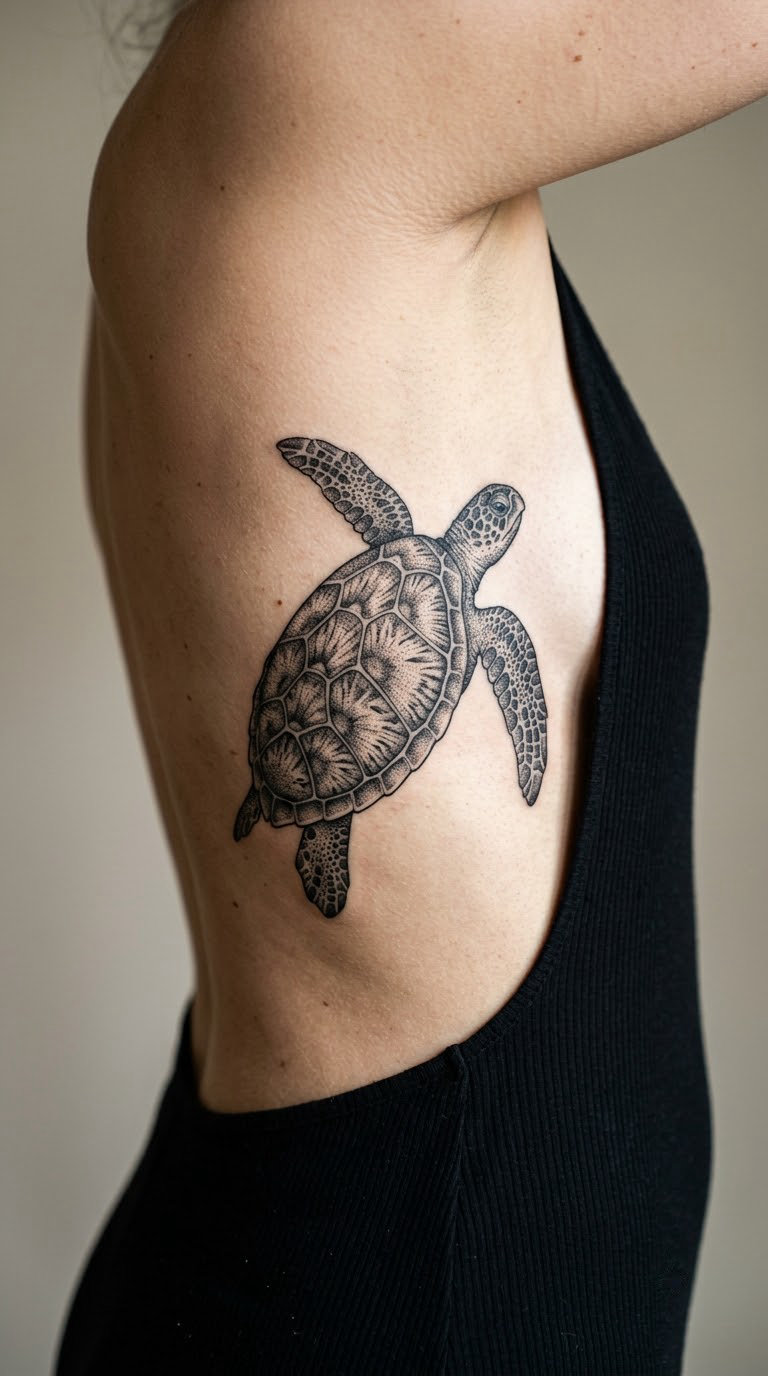
A sea turtle built from tightly graduated dots, with two or three fine contour lines for the shell edge and the leading flippers. The dot density does the shading work, so the whole thing reads soft even though there is no grey wash.
Because a turtle is long and narrow, it suits the curve of the rib cage better than a round motif, and the open space inside the shell keeps a larger area from looking crowded.
Placement: along the floating ribs on one side, wrapping slightly toward the back, or on the upper hip along the curve.
Size: 3.5 to 5 inches long (9 to 12.5 cm).
Style: dotwork with light linework.
Pain: medium to high. The ribs are bony and the skin moves with breathing, which makes long straight sections awkward for both artist and client. Breathing through it helps more than bracing does.
Make it yours: add the coordinates of a beach that matters, or a single initial hidden in the shell pattern.
7. Traditional Anchored Compass on the Upper Arm
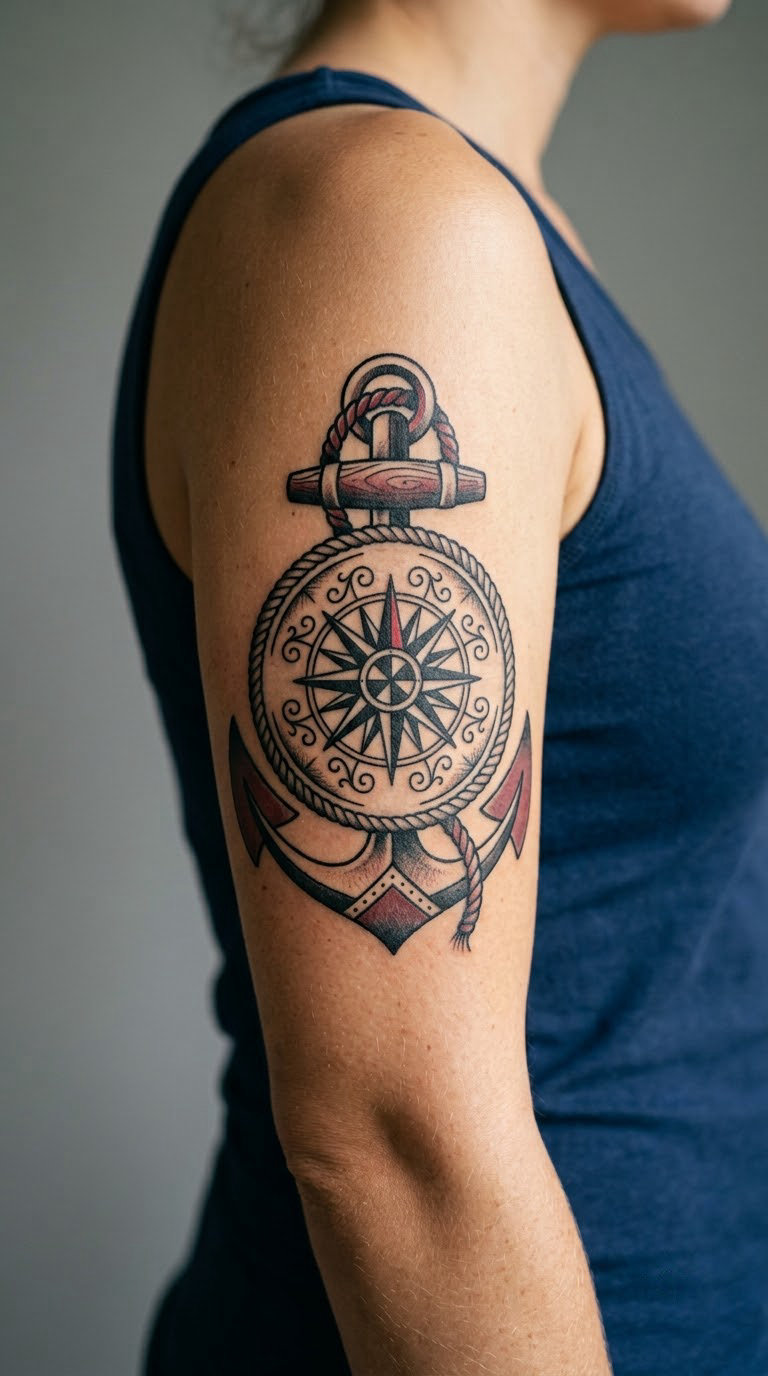
A compass rose with a small anchor tucked beneath it, heavy black outlines, a few bands of muted red or deep blue, and just enough shading to give the metal some weight. Traditional style lives or dies on clean line control.
Nautical motifs have been worn for centuries, and that familiarity is the appeal. A compass and anchor together reads as a nautical badge rather than a single symbol with one fixed meaning.
Placement: outer upper arm, deltoid, or upper back.
Size: 4 to 6 inches tall (10 to 15 cm).
Style: traditional American, bold line and flat colour.
Pain: medium, with a long steady session on the upper arm. Colours fade at different rates, so reds often need a touch-up sooner than the black linework that defines the shape.
Make it yours: replace the compass point with a letter, or work in a birth direction in place of the cardinal letters.
8. Fine-Line Seashell on the Hip
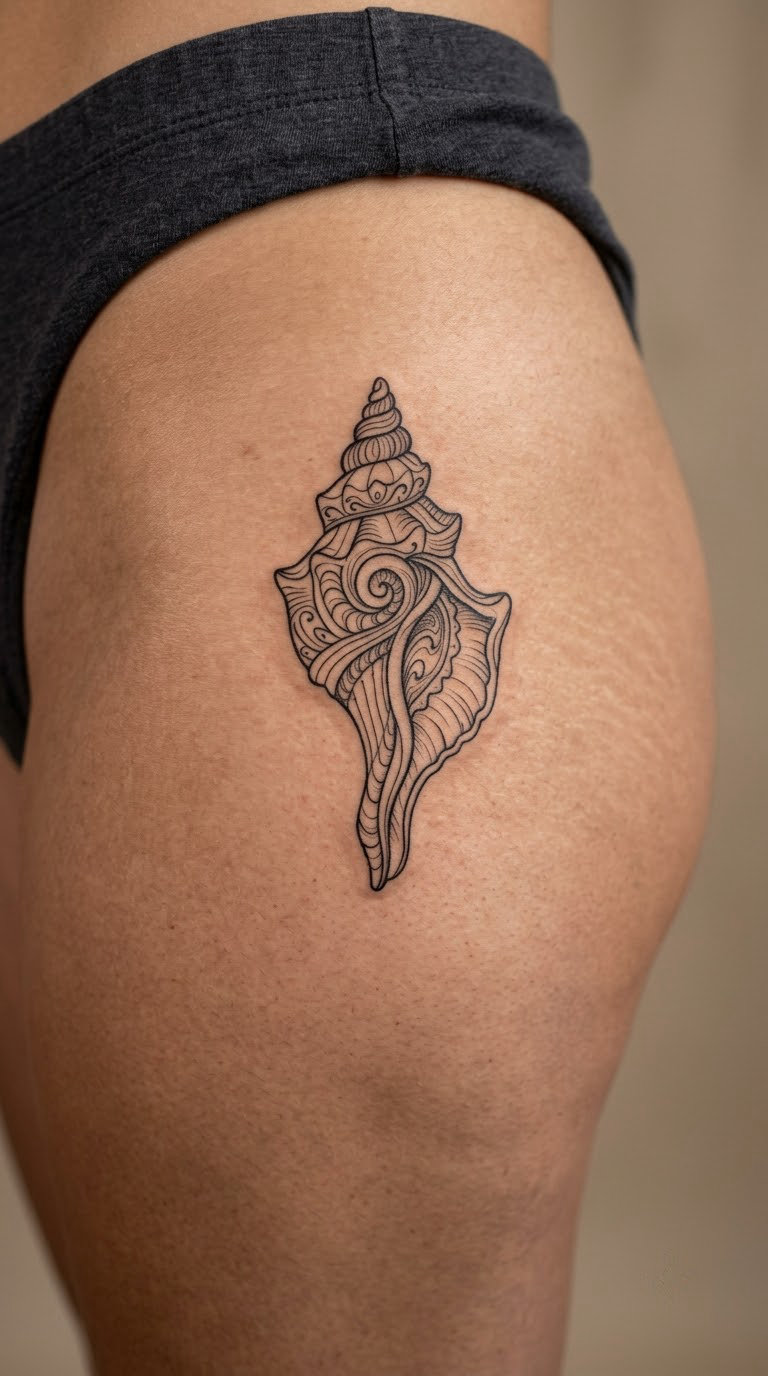
A conch or spiral shell drawn with a single flowing line that follows the spiral from the outer edge inward, with a few short hatch marks to separate the sections of the coil. The line does most of the work, so the detail stays open rather than crowded.
A spiral is one of the easier coastal motifs to keep clean at small sizes, and the hip gives it a broad flat area to sit on. It stays under clothing most of the year, which some people prefer.
Placement: outer hip, the dip above the hip bone, or the side waist between the ribs and the pelvis.
Size: 2.5 to 3.5 inches long (6 to 9 cm).
Style: fine line with light hatching.
Pain: medium, and the hip has thin skin over sensitive areas. Very fine hatching can soften noticeably within a few years, so a slightly heavier main line is the part that survives best.
Make it yours: add a birthstone shade at the centre of the spiral, or repeat a second smaller shell on the opposite hip.
9. Coral Branch in Red Ink on the Forearm
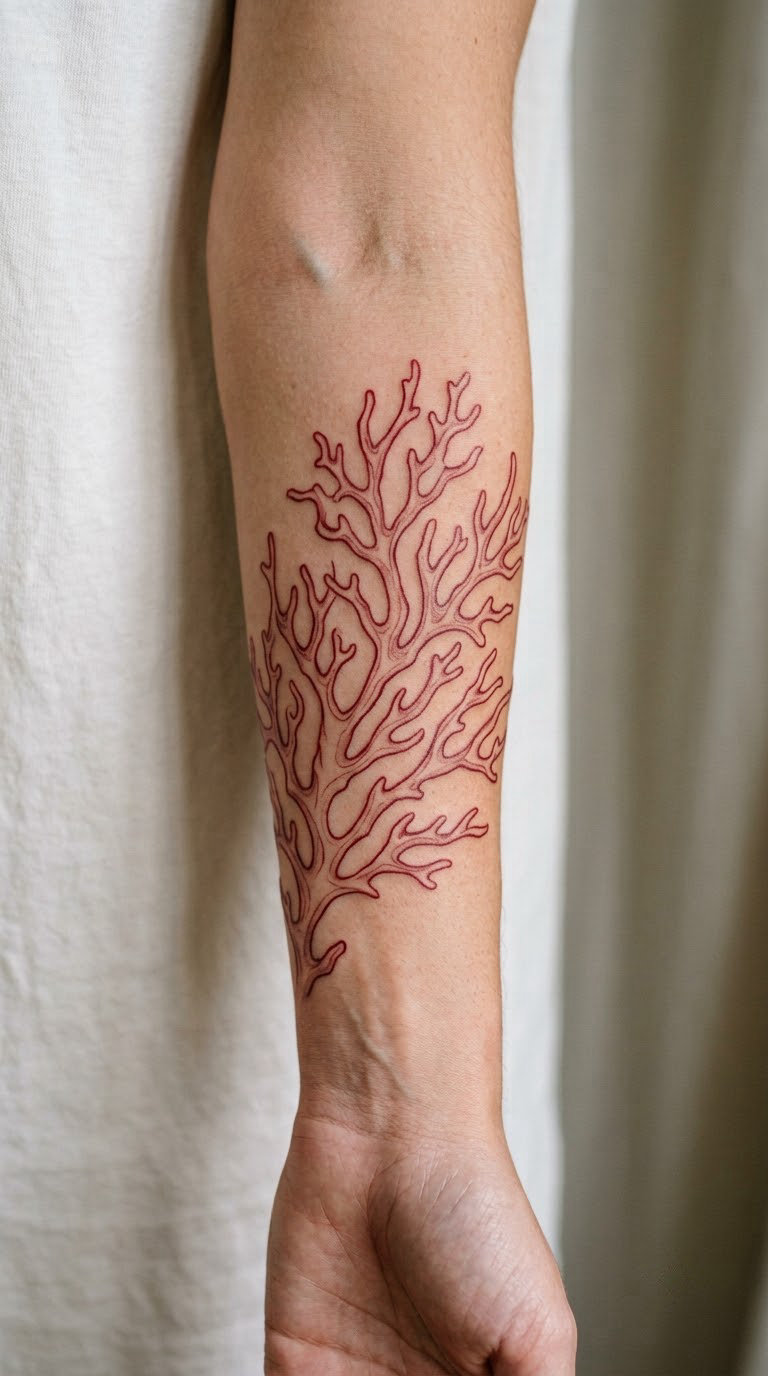
Branching coral in a limited red palette, drawn as clean illustrative shapes with plenty of skin left open between the branches. It is a drawing of coral rather than a photograph of a reef, and that difference is what makes it wearable.
Red ink on bare skin gives the design depth without adding a second colour to fade. It also suits people who find a full-colour tropical piece too loud for everyday wear.
Placement: inner forearm from wrist to elbow, outer forearm, or the calf.
Size: 5 to 7 inches long (12.5 to 18 cm).
Style: illustrative colour, single-ink red.
Pain: medium over the forearm, on a long stretch. Reds and warm tones in sunnier skin tones can shift a little towards orange as they heal, so pick a shade with your artist rather than copying a photo exactly.
Make it yours: use a second accent shade for just the tips of the branches, or add one tiny fish shape in the open space.
10. Micro-Realism Jellyfish on the Back of the Hand
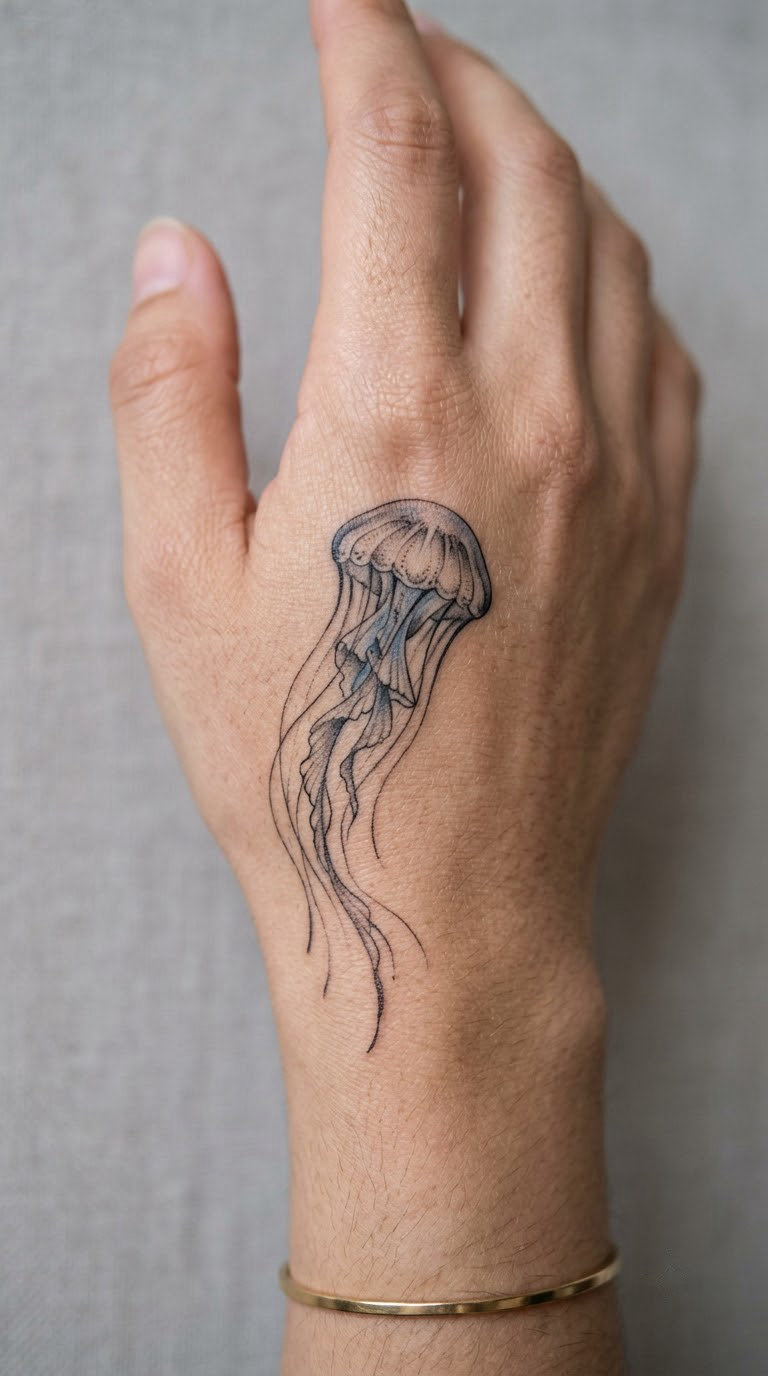
A translucent jellyfish with soft grey shading that fades toward the trailing tentacles, and one small blue accent on the bell. The trick is leaving the edges undefined so it looks suspended rather than outlined.
For someone who wants something people notice but cannot name from across the room, this works. The hand is a visible spot, and the design reads as movement rather than a flat object.
Placement: back of the hand, wrist, or behind the ear.
Size: 2 to 3 inches long (5 to 7.5 cm).
Style: micro-realism with a single colour accent.
Pain: medium to high. Hand skin is thin over bone, and people who dislike the sensation usually feel it most there. Hands also get more sun, water, and friction, so fine shading and the blue accent fade noticeably faster than the same work on an arm.
Make it yours: add one tiny dot below it, or set the date of a dive or swim underneath in tiny numerals.
11. Minimal Palm-Tree Pair on the Leg
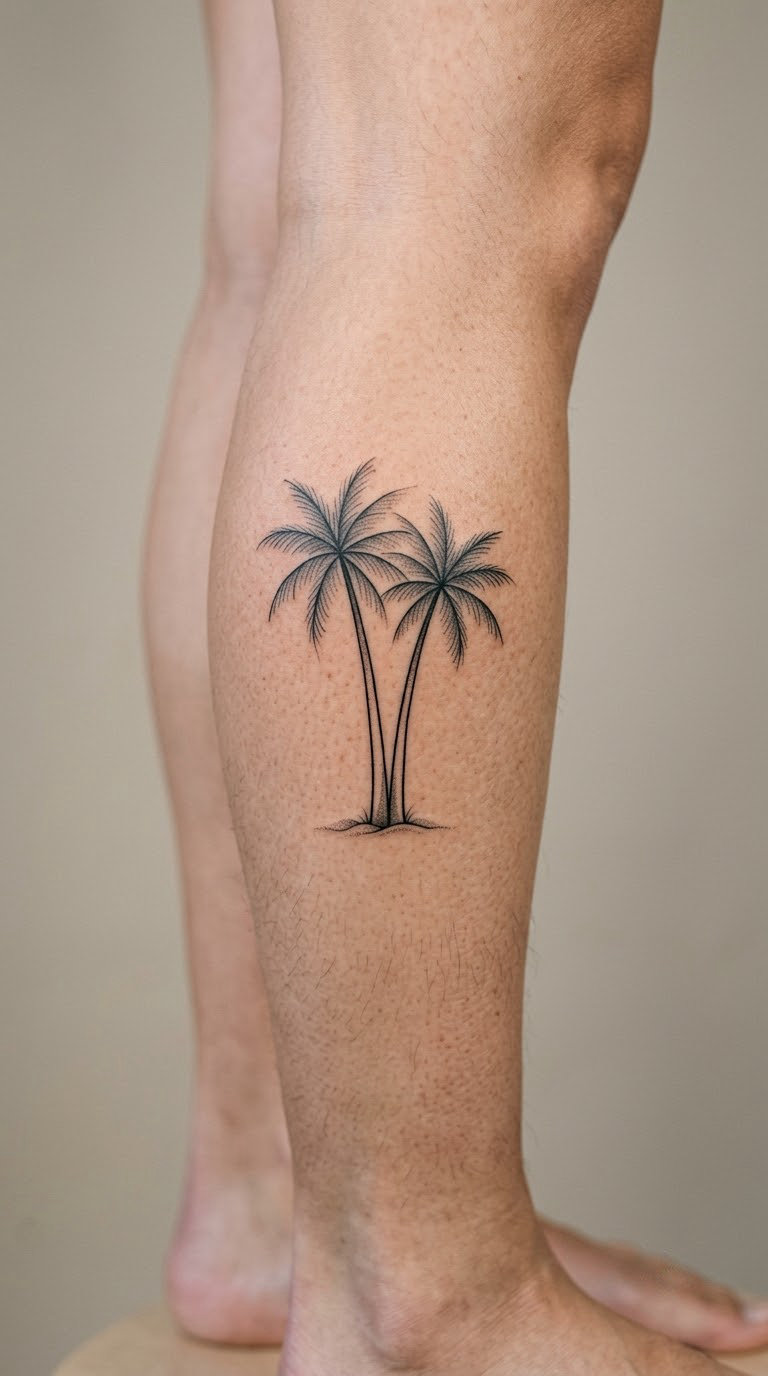
Two simplified palm trees with narrow trunks that lean apart, and fronds suggested with a few grey strokes rather than drawn leaf by leaf. The pair is balanced rather than mirrored, so it looks composed instead of stamped.
A pair of thin verticals suits the leg well, and the simplified fronds keep the design from turning into a beach scene with a horizon line and a sun.
Placement: outer calf, inner calf, or the outer thigh.
Size: 3.5 to 5 inches tall (9 to 12.5 cm).
Style: minimalist illustrative with light grey shading.
Pain: medium. The calf is fleshy and usually one of the easier large spots, though the session runs long at this size. Thin trunks are less durable than heavier lines, so keep the main stems confident rather than hair-thin.
Make it yours: fill the fronds with a sunset gradient so the pair matches a later sunrise piece, or add two small wave lines at the base.
12. Watercolor Wave Across the Shoulder
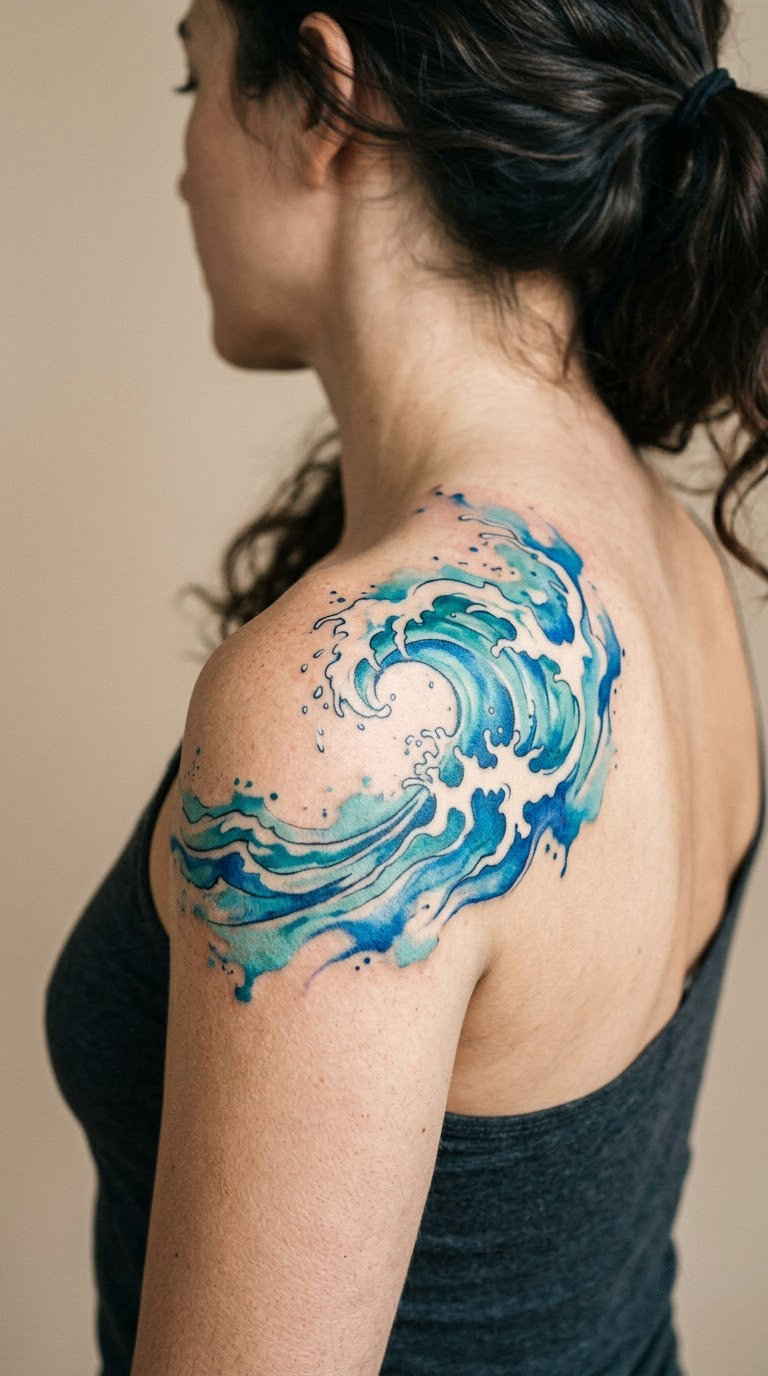
A breaking wave in blue and teal. The crest is white negative space, so the foam is the absence of ink rather than white paint. A darker line along the back of the wave gives it the push of moving water.
Surf culture is the obvious reference, and many people choose this after a season that involved a lot of water. It is a statement piece without being a sleeve.
Placement: across the shoulder, the upper back between the shoulder blades, or over the collarbone.
Size: 6 to 8 inches wide (15 to 20 cm).
Style: watercolor with negative-space foam and a few line details.
Pain: medium, and a bigger canvas means a longer sitting. The blues and teals are among the first beach colours to fade, especially on a shoulder that sees regular sun, so decide now whether you are happy to keep it refreshed.
Make it yours: keep the wave shape from a specific break, or add a small surfer silhouette on the face of the wave.
13. Blackwork Shark Fin on the Calf
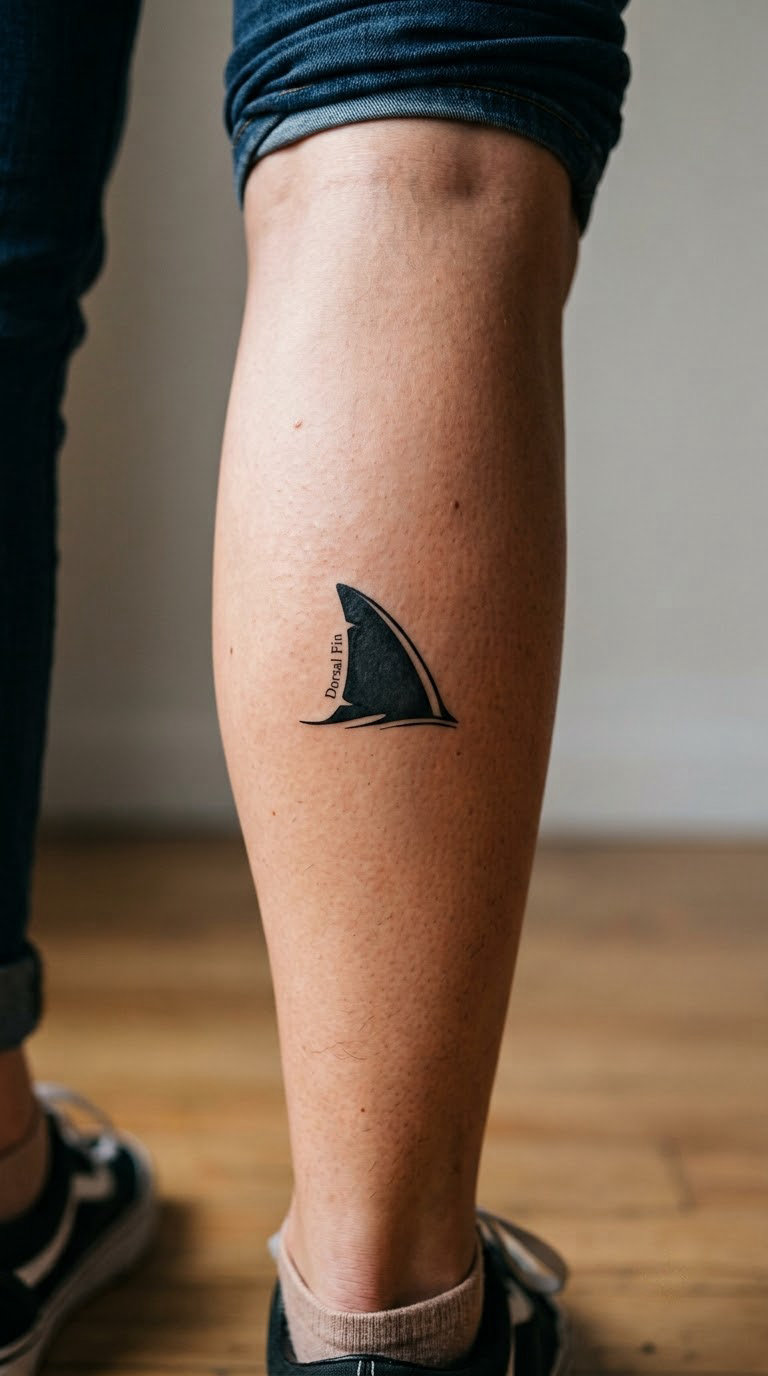
A single shark fin as a solid black silhouette with a clean curved base and one or two short gill lines. Nothing else in the frame, no water, no shark, no teeth.
It is the quietest ocean reference in this list. A lot of people who like the sea do not want a full animal on their body, and a fin gives them the theme with a single shape.
Placement: outer calf running vertically, lower leg, or the outer arm.
Size: 3.5 to 5 inches tall (9 to 12.5 cm).
Style: blackwork silhouette.
Pain: medium, on a reasonably forgiving area. Solid black holds its density well, so this is one of the designs here that still looks close to the drawing a decade on.
Make it yours: add a single small wave line under the fin, or repeat the shape smaller on the opposite calf.
14. Line-Art Seagull on the Wrist
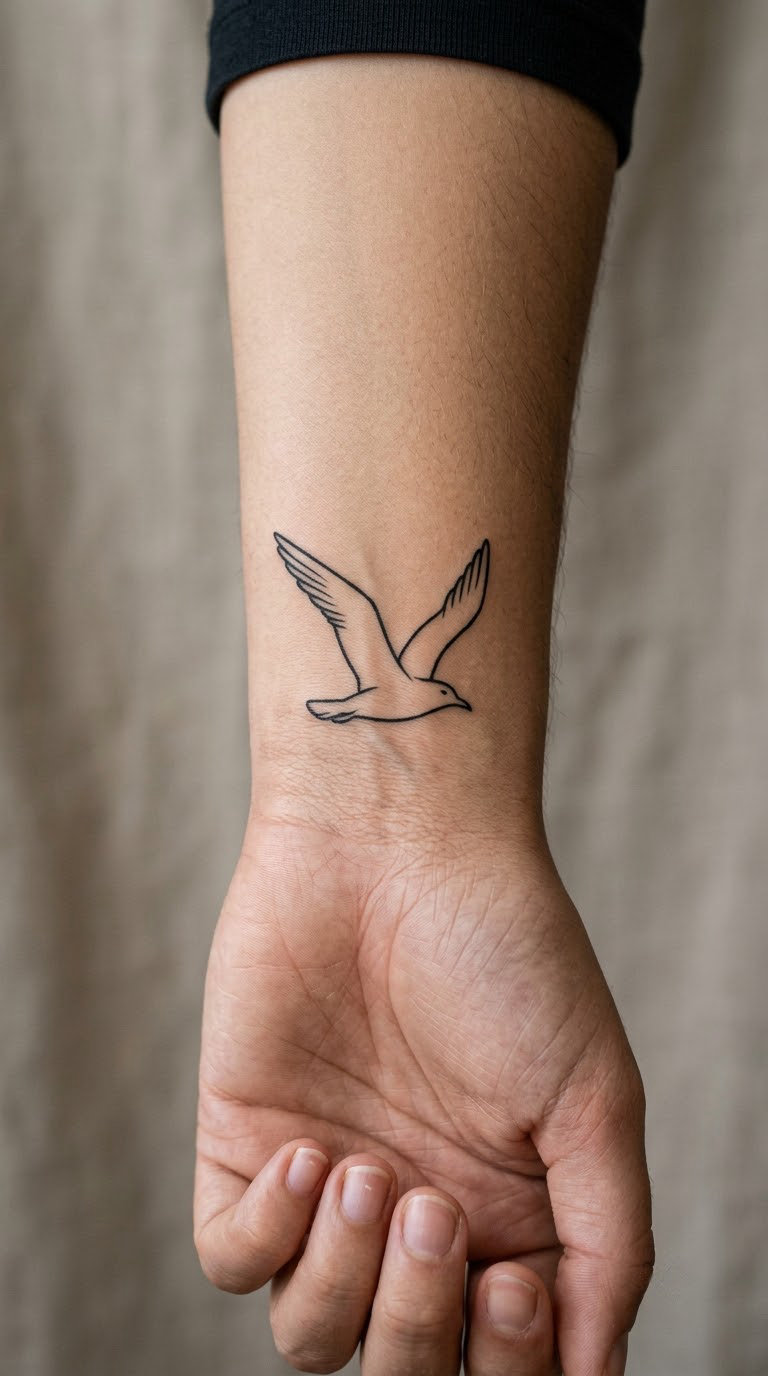
One seagull mid-flight, wings open, drawn with economical lines and a slight lean through the body so it reads as caught in motion rather than perched. A few short strokes at the wing tips suggest feathers without detailing each one.
It suits people who want a small design with a bit of character on an everyday spot. The wrist shows when your hands are doing things, which is either the appeal or the deal breaker.
Placement: inner wrist, the forearm above it, or above the ankle bone.
Size: 2 to 3 inches wide (5 to 7.5 cm).
Style: minimal line art.
Pain: medium. Inner wrist skin is thin and the area moves constantly, so a fine line here changes shape as the wrist bends and creases with age. Choosing a slightly heavier line than you think you need helps.
Make it yours: add a small date underneath, or mirror the bird on the other wrist as a matching pair.
15. Colorful Starfish on the Foot
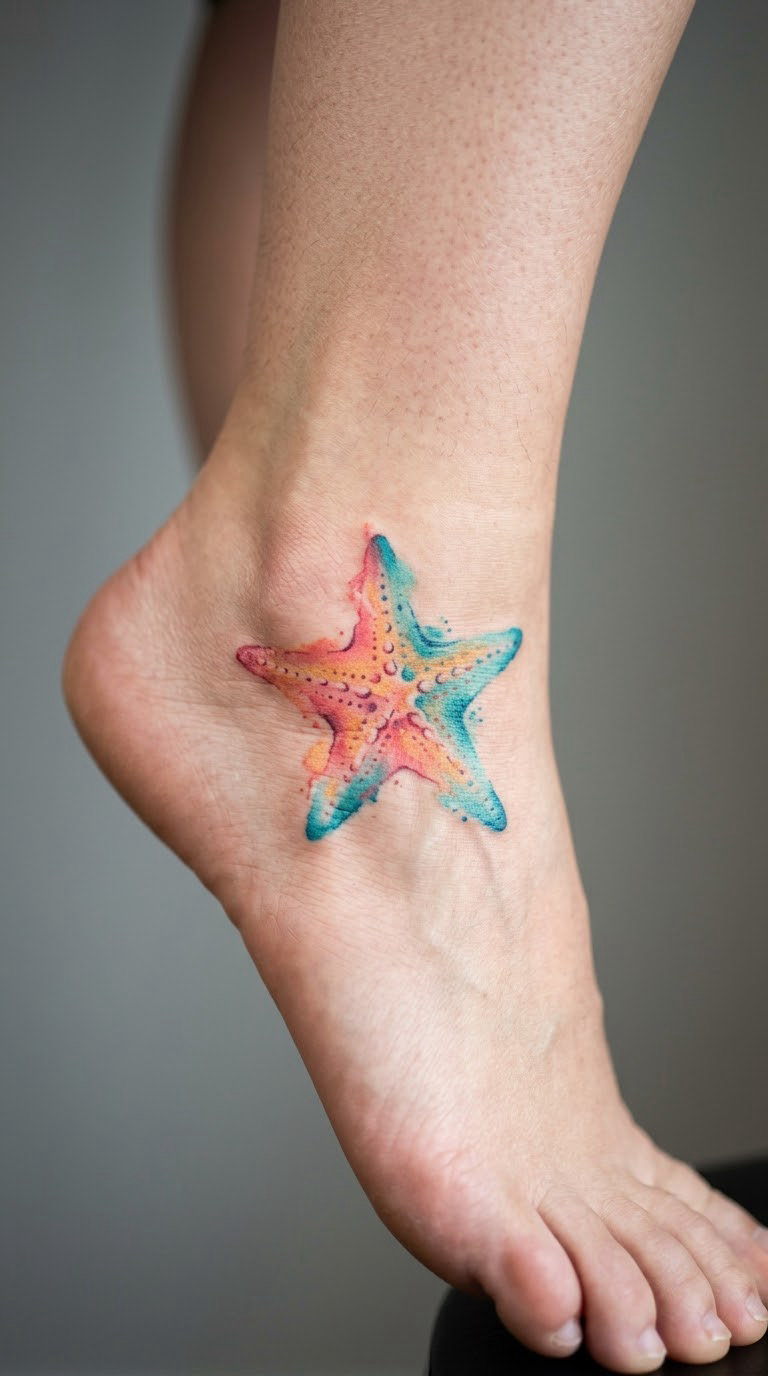
A five-armed starfish filled with coral, yellow, and turquoise, and the soft irregular edges keep it organic instead of symmetrical. One arm can be a different colour from the rest.
The top of the foot is one of the few places a colourful design feels natural to wear, and it pairs easily with sandals or bare feet in summer.
Placement: top of the foot near the ankle, outer ankle, or lower leg.
Size: 2.5 to 3.5 inches across (6 to 9 cm).
Style: watercolor colour with soft edges.
Pain: medium, and the foot holds fine colour detail less well than a covered area because of shoes, sun, and salt. Bright yellows and light turquoise typically need refreshing first.
Make it yours: use the colour of your birth month, or match the palette of a beach you have actually been to.
16. Traditional Sailboat on the Inner Arm
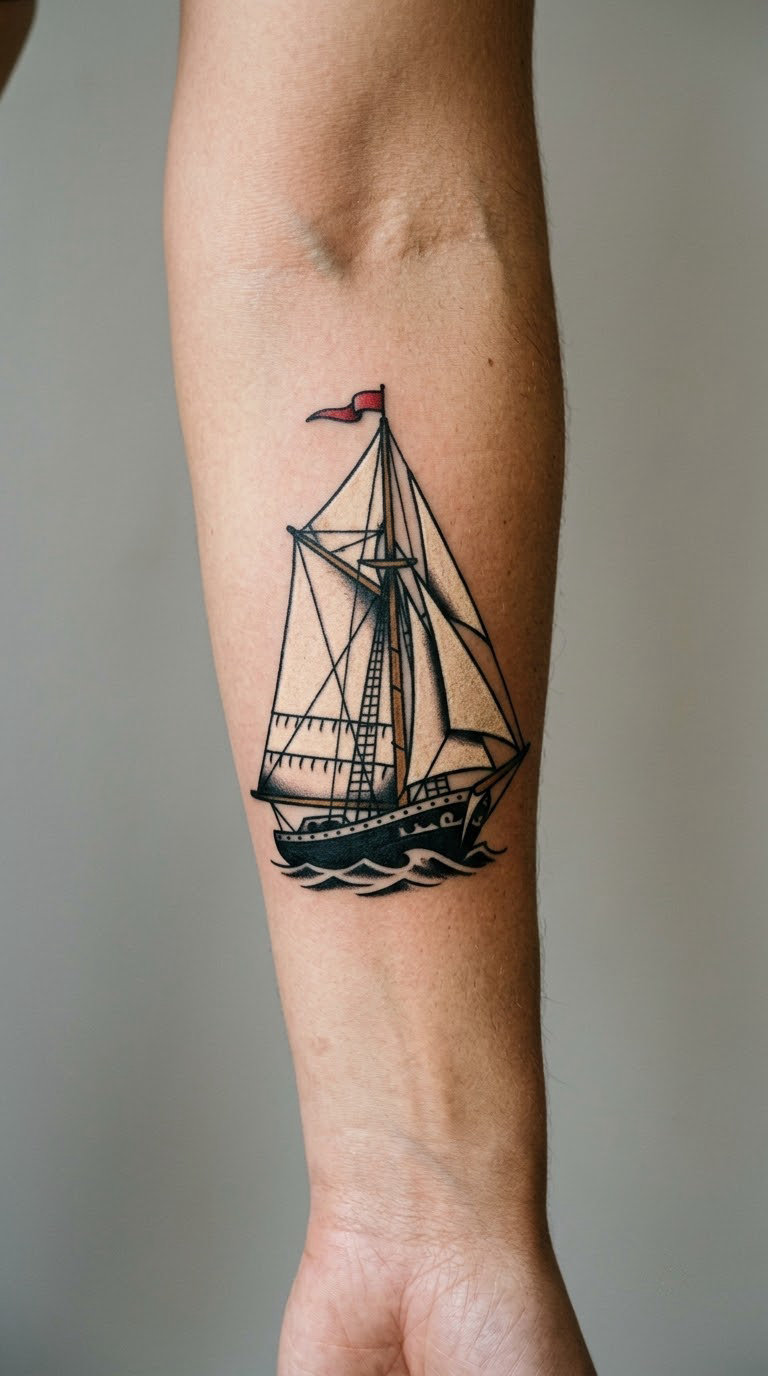
A compact sailboat with a heavy black hull, two sails in cream, and a single red band or flag for contrast. The whole thing sits inside a clean outline, which is what gives traditional work its graphic punch.
Travel and sailing are the usual reasons, along with a particular coastline. A boat also works as a memorial piece for someone connected to the sea.
Placement: inner forearm, inner upper arm, or the calf.
Size: 3.5 to 5 inches long (9 to 12.5 cm).
Style: traditional American with flat colour and bold outline.
Pain: medium on the forearm. Cream sails are a large light area, and light inks are the ones that shift most as they heal and fade first, so a touch-up on the sails is worth budgeting for.
Make it yours: name a real port of call under the hull, or use the year you learned to sail.
17. Fine-Line Moon and Waves on the Spine
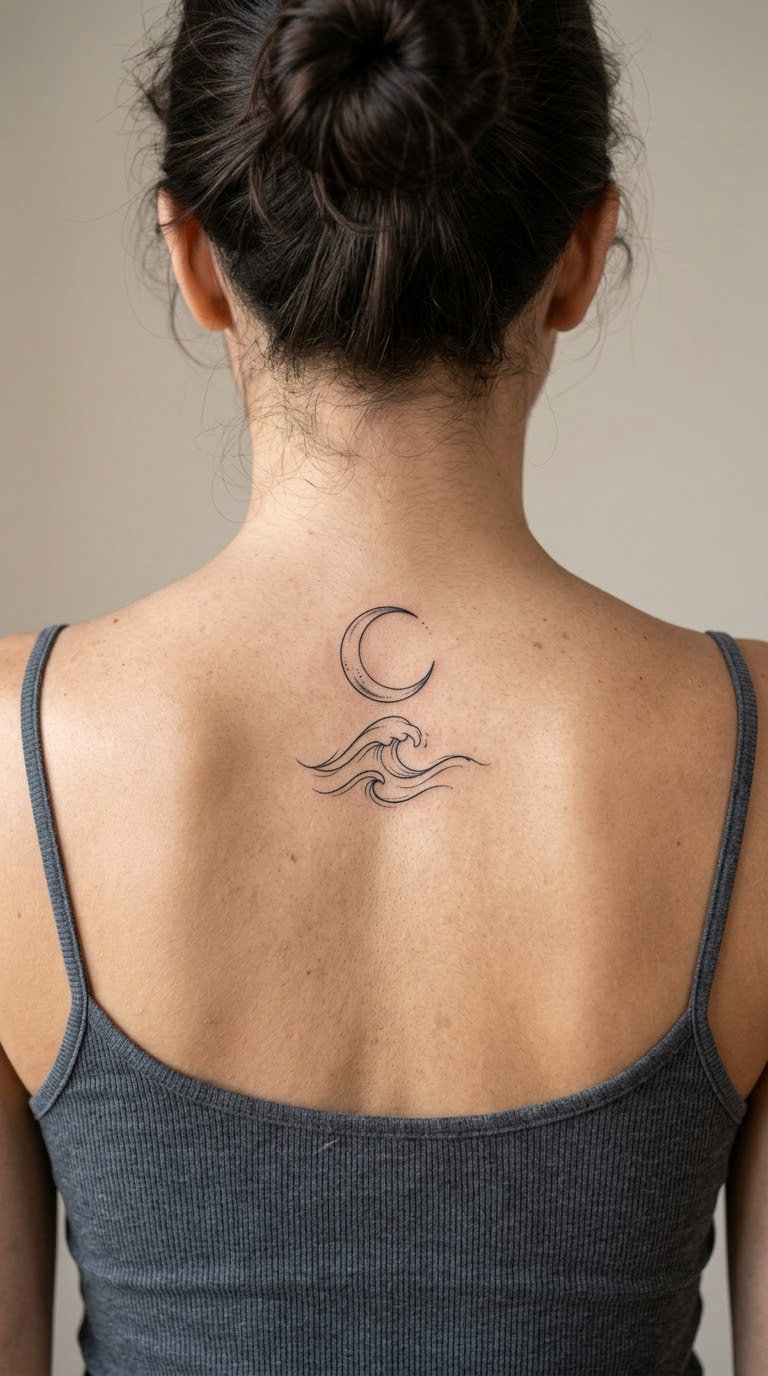
A thin crescent moon above two understated wave lines, arranged vertically with plenty of empty skin between each element. The whole composition is about negative space, and any extra detail would close it up.
A moon-and-sea pairing gives a night version of the beach, which is the mood people describe when they want coastal ink that is calm rather than bright.
Placement: upper spine between the shoulder blades, mid spine, or the back of the calf.
Size: 4.5 to 6 inches long (11 to 15 cm).
Style: fine line, single needle.
Pain: medium to high. Spine tattoos are uncomfortable in a specific, deep way, and a long vertical design means the needle travels a considerable distance. Sitting still for that takes some people by surprise.
Make it yours: add a single star above the moon, or put a small date at the base in the same line weight.
18. Botanical Beach Grass on the Side Thigh
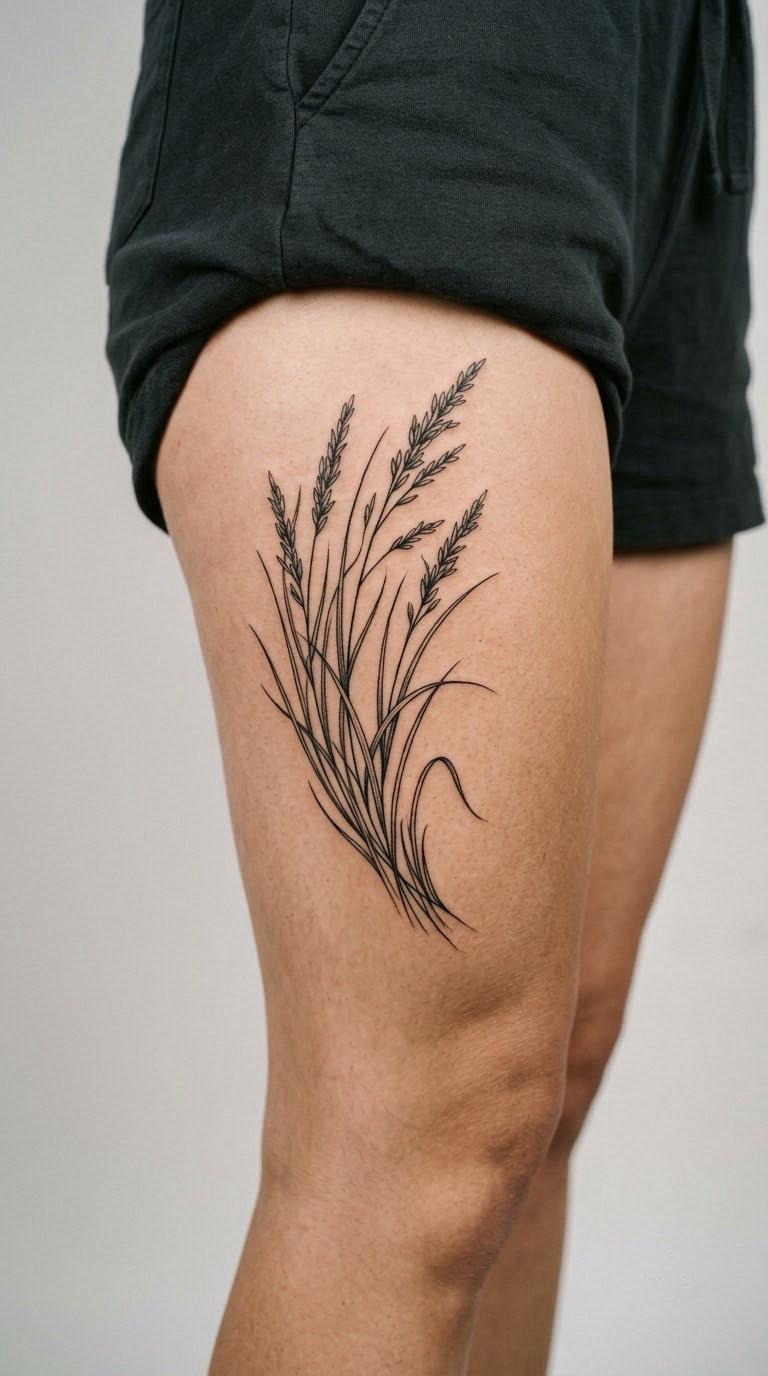
Wispy beach grass with thin stems bending in one direction, seed heads drawn with short broken strokes, and a few stems fading out before they reach the bottom. The movement comes from an uneven baseline rather than from a curve in every stem.
It is a quiet, nature-based design that fits women who want the coast represented without an obvious motif. The thigh also gives the artist a big flat area for a taller composition.
Placement: outer thigh, hip, or the side of the lower leg.
Size: 5 to 7 inches long (12.5 to 18 cm).
Style: botanical fine line, light stippling for the seed heads.
Pain: medium on the thigh, one of the more comfortable large areas, though the session is long at this size. Botanical linework ages faster than solid black, so the seed heads are the detail to watch over the years.
Make it yours: name a specific beach along the bottom stem, or add a single shell at the base of the tallest stem.
19. Blue Ink Crab on the Shoulder Blade
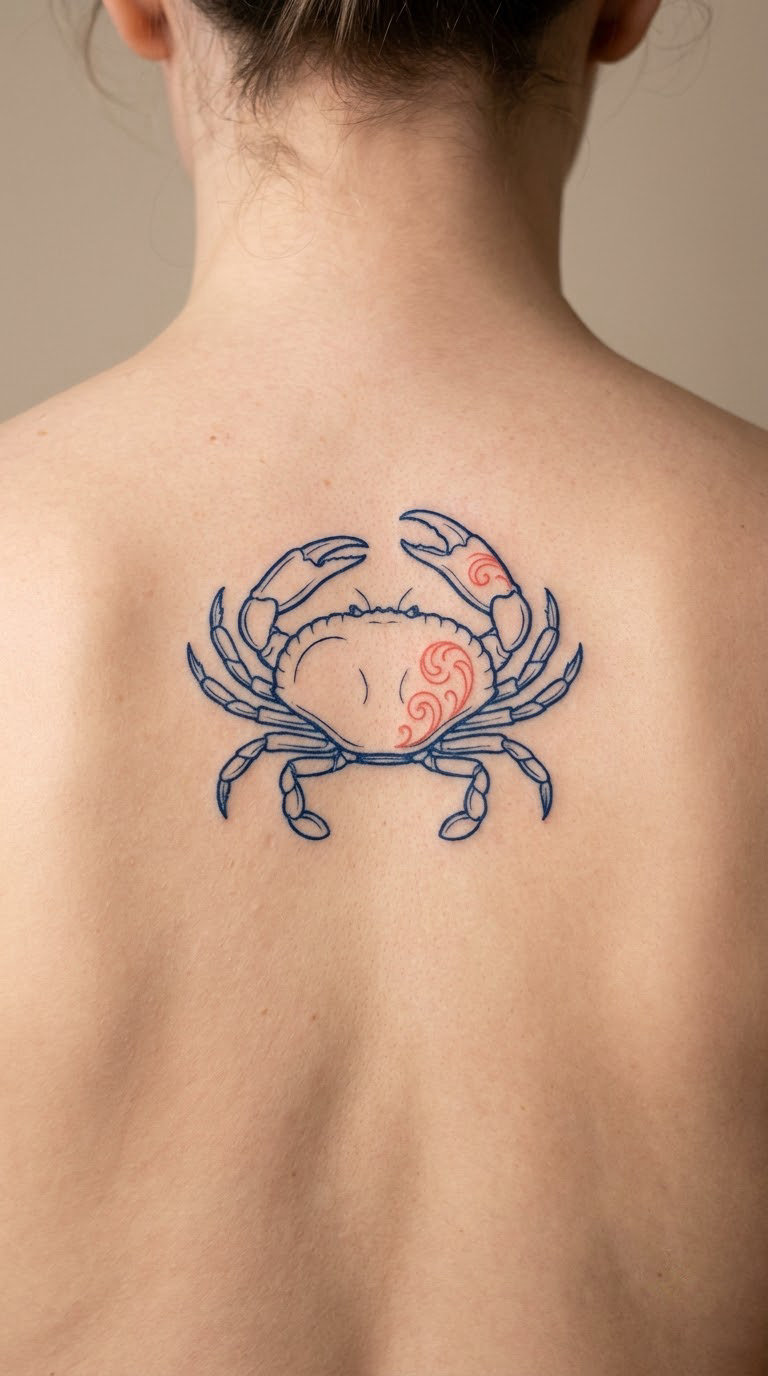
A crab in blue ink with clean illustrative outlines, legs angled to suggest a live stance rather than a flat symmetrical shape, and one small coral-coloured accent on the shell edge.
The back between the shoulder blades is a good spot for something with movement, and it gives the design a surface that stays fairly still and unwrinkled. The fine line tattoo ideas for women (September 2026) guide covers more understated options if colour is not what you want.
Placement: between the shoulder blades, upper back, or the top of the shoulder.
Size: 3.5 to 5 inches wide (9 to 12.5 cm).
Style: illustrative colour, mostly a single ink.
Pain: medium. Backs are sensitive and you cannot see the work being done, which matters for a design that depends on leg placement. Taking a phone photo of the drawing first helps.
Make it yours: use a birthstone shade as the main ink, or swap the accent colour for one that matches a piece you already have.
20. Black-and-Grey Beach Walk on the Lower Leg
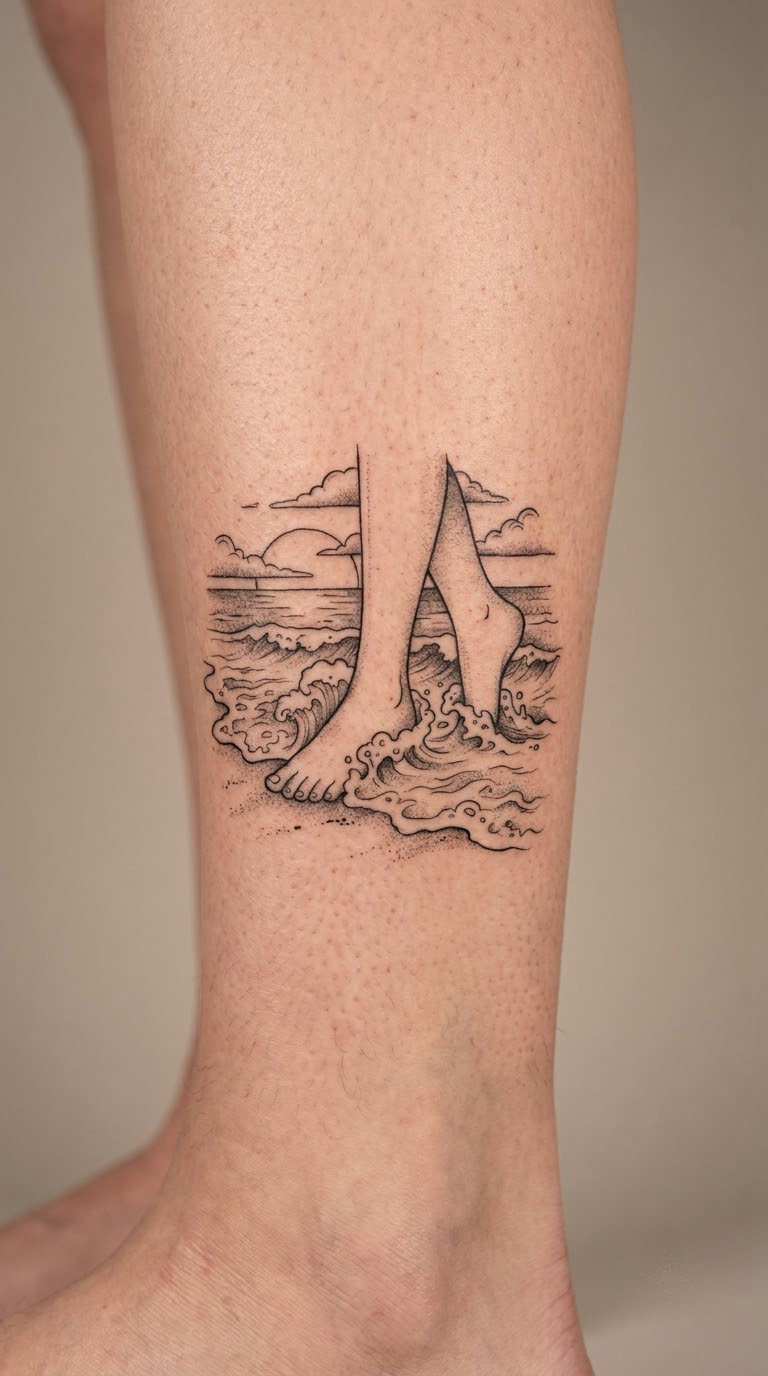
A small scene of bare feet stepping through foamy shoreline water under a low sun, simplified into a balanced vertical composition with a strip of wet sand at the bottom and open sky above. The foam is suggested with a few pale grey edges rather than drawn in detail.
Scenes like this usually come from a real place, and people describe them as a piece of home. It reads as reflective without needing a date or a name to explain it.
Placement: lower calf, inner calf, or the outer forearm.
Size: 4.5 to 6 inches long (11 to 15 cm).
Style: black and grey realism, simplified.
Pain: medium on the calf. Fine shoreline details such as individual foam edges are the parts that blur first, so ask the artist to keep the sharpest contrast on the feet and let the background stay soft.
Make it yours: add the name of the beach below the composition, or work in the date of the trip.
How to Choose the Right Design
Start with the canvas, not the picture. A design that looks balanced on a flat screen often needs simplifying once it is drawn onto a calf, a rib, or the curve behind the ear.
Pick a style that matches the detail you want to keep. Fine line and botanical work need a touch-up every few years. Blackwork and traditional pieces hold their shape longest, while watercolor and colour work depend on how much sun the area sees.
Decide the size before the style. Most designs here work between 2 and 7 inches. Below roughly 1.5 inches, a shell or a wave loses its structure, so ask your artist what the smallest workable version is before settling on a placement.
Match the shape of the design to the shape of the body. Long, narrow motifs suit the forearm, spine, calf, and thigh. Rounded motifs such as a starfish or a shell suit the shoulder, hip, and top of the foot. This is also why a canvas-profile drawing from an artist beats a straight copy of a reference photo.
Think about contrast with what you already have. If you have a blackwork piece, a fine-line coastal design can look accidental beside it. Either go bolder or give the styles a body region between them.
Be honest about visibility and sun. Shoulders, outer arms, and the top of the foot are seen constantly and catch the most sun. A design placed there will be discussed by more people and will need colour refreshing sooner.
For a first tattoo, choose small and simple. The most common regret we hear about is a detailed micro design that blurred, not a small one. A single wave or a single shell is a better first coastal piece than a full beach scene.
Asking for a portfolio that matches the final style matters more than asking for a famous artist. A tattooer who does fine-line botanical work daily will draw a cleaner shell than someone whose book is mostly bold blackwork.
Cost and Session Time
Tattoo pricing in the US is usually quoted by the hour or by the piece, and the ranges below are what most shops charge for coastal work. Your artist will give you a real number; treat these as a ballpark for planning your budget.
- Small fine-line pieces, under 2 inches: roughly 80 to 200 dollars, usually one session of about an hour.
- Small linework and dotwork, 2 to 4 inches: roughly 150 to 350 dollars, one to two hours.
- Traditional or illustrative colour pieces, 3 to 6 inches: roughly 250 to 600 dollars, and often two sessions for the larger sizes.
- Large colour pieces, 6 inches and up: roughly 450 to 1200 dollars, usually spread over several sessions.
Shop minimums matter more than people expect. Many studios have a minimum charge that covers the setup and stencil time, so a tiny design can cost the same as a slightly larger one.
Colour, fine detail, and large solid fills all add time. A seven-inch watercolor wave takes far longer than a two-inch fine-line shell with the same subject, and a full solid black palm leaf takes longer than its outline. Geography, artist experience, and how busy the shop is all move the number as well.
Aftercare Basics
- Follow your artist’s aftercare instructions first. They know how deep your particular tattoo went and when the skin is ready.
- Wash gently with a mild, fragrance-free soap and lukewarm water, then pat dry with a clean towel rather than rubbing.
- Wear loose clothing over the area while it heals, especially over a shoulder, rib, or foot where fabric rubs.
- Keep the new tattoo out of swimming pools, hot tubs, and the sea until it has healed as your artist describes. Salt and chlorine irritate healing skin.
- Once healed, use sunscreen on exposed tattoos such as shoulders, arms, and legs. Sun is the biggest long-term reason colour tattoos look flat.
- Contact your artist, not a forum, if the tattoo stays red, raised, painful, or flaking long after the timeline they gave you.
Frequently Asked Questions
How small is too small for a beach tattoo?
Most coastal designs stop working below about 1.5 inches because the curl of a wave or the ribs of a shell close up as skin heals. A single fine-line wave works at 1.5 to 2.5 inches, while a starfish or conch needs at least 2.5 inches. Ask your artist what the smallest workable version of your design is, and consider going bolder with line weight instead of adding more detail.
Do beach tattoos fade in the sun, salt water, and chlorine?
Yes, and it is mostly the colour. Blue, teal, and yellow inks in a watercolor wave or starfish fade fastest in direct sun, while black linework and blackwork silhouettes hold their density far longer. Salt water and chlorine irritate fresh skin, so keep new work out of the sea and pools until your artist says it has healed. Sunscreen on exposed shoulders, arms, and legs is the simplest protection.
What is the least painful placement for a beach tattoo?
The forearm, outer upper arm, and the fleshy part of the thigh are usually the most forgiving spots, and most of the designs in this list work well there. Wrist, ankle, collarbone, and the spine sit near bone and thin skin, so expect a sharper, more persistent feeling there. The rib area also moves with every breath, which makes long sessions uncomfortable. If pain is a real concern, choose a larger, fleshy area over a small bony one.
Should a first beach tattoo be fine line or bold?
Fine line is the softer starting point and easier to hide, but it needs a touch-up every few years because hairlines soften. Bold blackwork and traditional pieces last longest without maintenance, which suits someone who wants one strong piece and little upkeep. Watercolour sits in between. If you cannot decide, a small solid black motif such as a shark fin or a simplified shell gives you the lowest long-term commitment.
Which beach tattoo designs suit different body types?
Match the shape of the motif to the shape of the area rather than worrying about overall proportions. Long narrow designs such as waves, palm leaves, and coral suit forearms, calves, thighs, and the spine. Rounded designs such as shells, starfish, and crabs suit the shoulder, hip, and top of the foot. Placement matters more than size: a design that follows the natural curve of the area will look balanced at almost any build.
What do beach tattoos mean?
Beach tattoos draw on coastal imagery, so what they mean depends on the motif and on the person wearing it. Waves are often chosen for the coast itself, anchors and compasses for a nautical or travelling reference, and shells or sunsets for a particular beach and the memories attached to it. There is no single fixed meaning, which is part of why so many people feel free to claim their own.
Which Beach Tattoo Idea Is Right for You?
If this is your first tattoo, start with a fine-line wave behind the ear or a small scallop shell on the collarbone. Both are simple to draw, sit well on their own, and hide easily at work.
For a first beach tattoo, keep it under three inches and pick one element rather than a scene. I would also look for a healed photo of that exact design in the artist’s portfolio before booking.
If you are already building a collection, the watercolor wave across the shoulder or the blackwork palm leaf on the forearm gives you a piece with enough scale to set the tone. Both are visible in a way a micro piece is not, so plan where the rest of your ink sits before you commit.
Whichever direction you take, choose an artist whose finished work matches the style you want. A fine-line shell in a portfolio full of heavy blackwork will not come out looking like the reference photo, and no amount of care afterwards fixes that.