
20 Best Dolphin Tattoo Ideas for Women: Stunning September 2026
Dolphin tattoo ideas for women split into two camps: people who want one clean animal drawn well, and people who want the whole ocean built around it. Both work. A dolphin is one of the easiest sea creatures to read from a distance, which is exactly why it still works at two inches as well as at eight.
What follows is twenty distinct designs, each with a real placement, a realistic size in inches, a style label and an honest note on how it ages. Start with the quick guide if you want to compare all twenty at once, then jump to the ones that match where you want the ink. I have kept the sizes conservative on purpose, because a dolphin drawn too small loses its eye and its dorsal fin within a few years.
One thing to plan around early: bookings. Give yourself four to six weeks before a session, and skip hand, finger or ankle pieces in the month before a beach trip, because those spots are still settling long after the ink looks healed.
Dolphin Tattoo Ideas for Women: Quick Guide
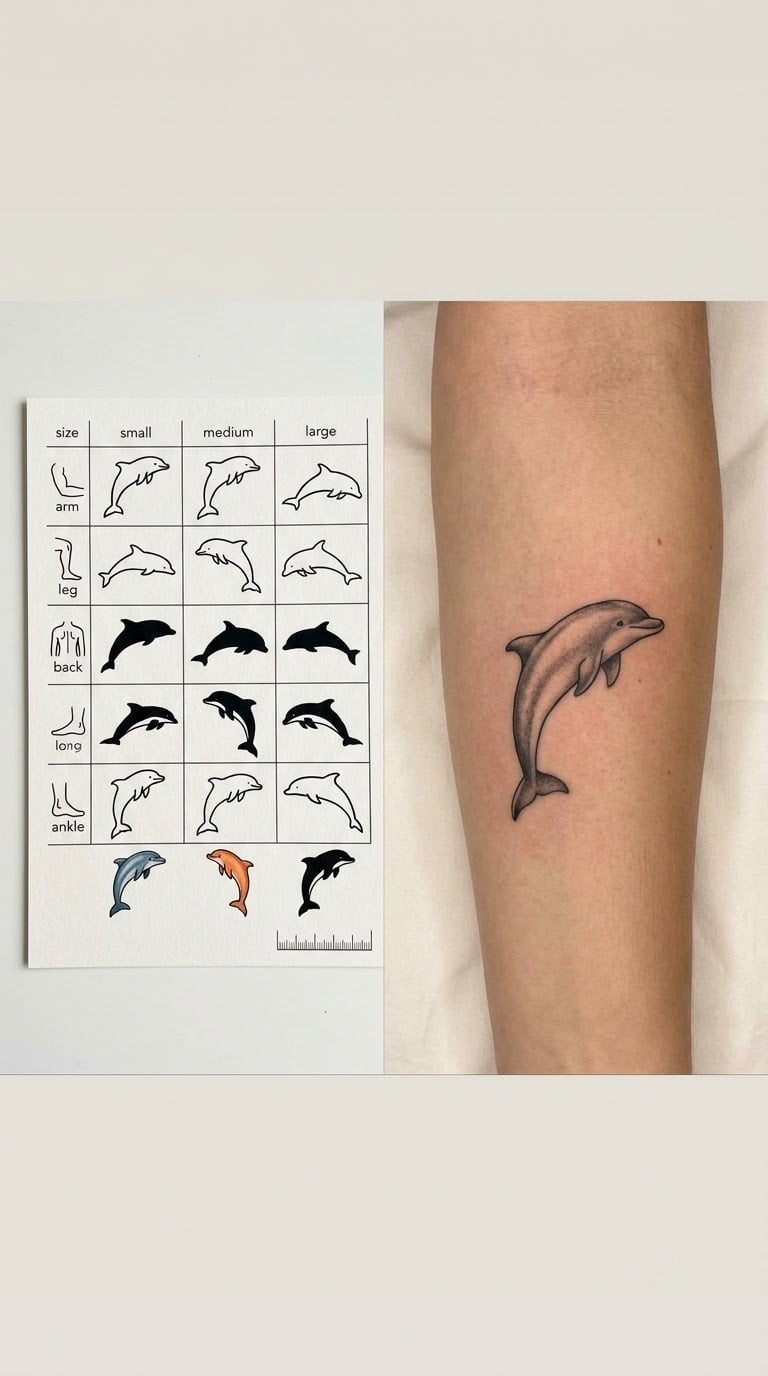
All twenty designs below in order, with the practical numbers attached. Size is the finished length of the dolphin itself, not counting waves, bubbles or frames.
| Idea | Style | Best placement | Size (inches) | Pain |
|---|---|---|---|---|
| 1. Fine-line leaping dolphin | Fine line | Behind the ear | 1.5-2.5 | Low |
| 2. Minimal outline dolphin | Minimalist | Inner wrist | 1.5-2 | Medium |
| 3. Dolphin and wave in watercolor | Watercolor | Collarbone | 3-4 | Medium |
| 4. Realistic dolphin portrait | Black and grey realism | Outer forearm | 5-7 | Medium |
| 5. Traditional dolphin with splash | Traditional | Outer upper arm | 4-5 | Medium |
| 6. Silhouette with bubbles | Black and grey | Outer ankle | 2-3 | Medium |
| 7. Negative-space rib dolphin | Negative space | Side ribs | 5-6 | High |
| 8. Dolphin pair on the shoulder | Black and grey | Shoulder blade | 3-4 each | Medium |
| 9. Micro dolphin on a finger | Micro fine line | Side of a finger | 0.75-1 | High |
| 10. Blue dolphin with floral accent | Colour realism | Outer hip | 4-5 | Low |
| 11. Blackwork back silhouette | Blackwork | Between shoulder blades | 6-8 | Low |
| 12. Dolphin under a moonline | Fine line | Inner forearm | 3-4 | Medium |
| 13. Dotwork bubble dolphin | Dotwork | Outer upper arm | 4-6 | Medium |
| 14. Dolphin curled around a pearl | Illustrative | Upper chest | 3-4 | Medium |
| 15. Tiny dolphin heart | Micro line | Back of the hand | 1.5-2 | Medium |
| 16. Dolphin in a geometric frame | Geometric | Forearm | 3-4 | Low |
| 17. Two dolphins in an oval | Black and grey | Outer thigh | 5-7 | Low |
| 18. Dolphin with compass rose | Line work | Shoulder | 4-5 | Medium |
| 19. Bold calf dolphin | Black and grey | Calf | 6-8 | Low |
| 20. Star-accented neck dolphin | Minimalist | Behind the ear | 1.5-2.5 | Low |
1. Fine-Line Leaping Dolphin Behind the Ear
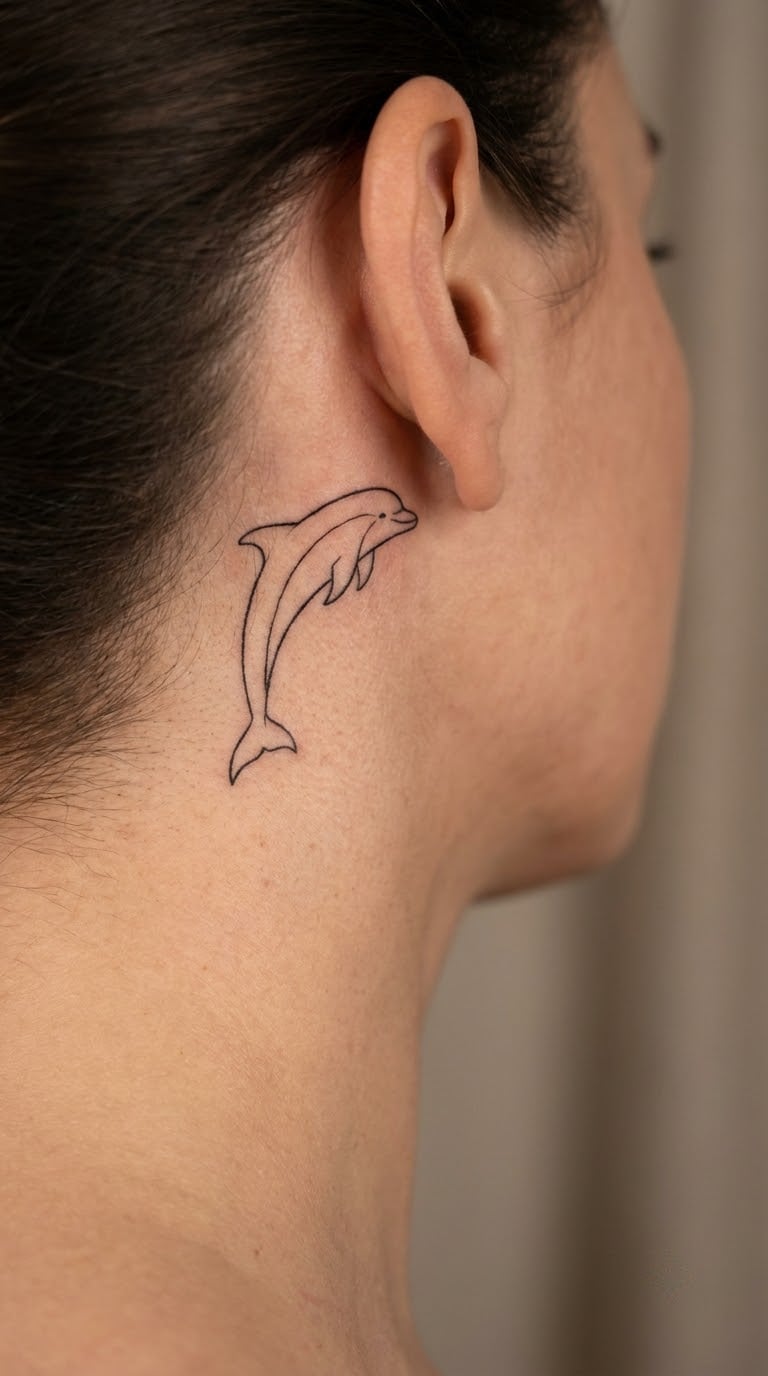
A single dolphin caught mid-leash, drawn with one confident contour and a single line for the pale belly. The whole animal is about eight line changes, which is exactly what fine line needs to stay readable at a small scale. People choose this shape because a leaping dolphin reads as movement without needing any water behind it.
Placement: behind the ear on the neck, just below the hairline where the skin is soft. Size: 1.5 to 2.5 inches (4-6 cm). Style: fine line. Pain: low to medium, more of a scratchy constant pull than a sharp sting.
Ageing note: neck fine line softens faster than most people expect, and a thin line behind the ear can blur into the jawline over a decade. Make it yours: add a small wave curl under the tail, or take the dolphin as a matching pair with a sister or a friend. Have a look through 18 Best Fine Line Tattoo Ideas for Women before your consultation.
2. Minimal Dolphin Outline on the Wrist
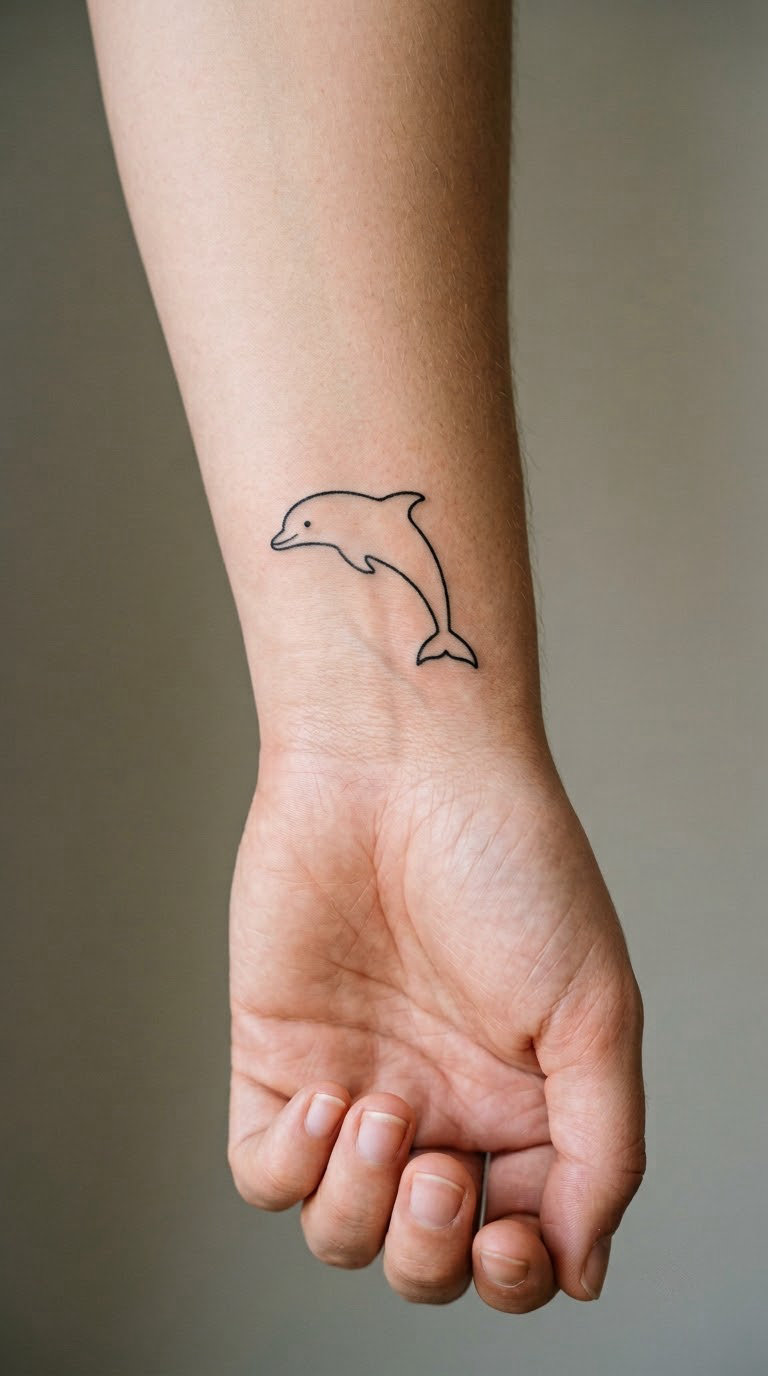
One closed contour, no shading, plenty of skin showing through the body. The eye is a single dot and the dorsal fin is implied rather than drawn, so the design survives wrist scale. This is the first dolphin tattoo I recommend to anyone nervous about committing to ink, and it doubles easily as a matching piece.
Placement: inner wrist, angled along the forearm’s line rather than across it. Size: 1.5 to 2 inches (4-5 cm). Style: minimalist outline. Pain: medium, since wrist skin is thin and moves constantly with the joint.
Ageing note: wrist line work stretches and softens as the wrist bends, and sunscreen rarely reaches that spot, so fade comes sooner than on an upper arm. Make it yours: place a fine dot where a birthmark sits, or add a second dolphin a few millimetres behind the first so the piece reads as a pair.
3. Dolphin and Wave Watercolor on the Collarbone
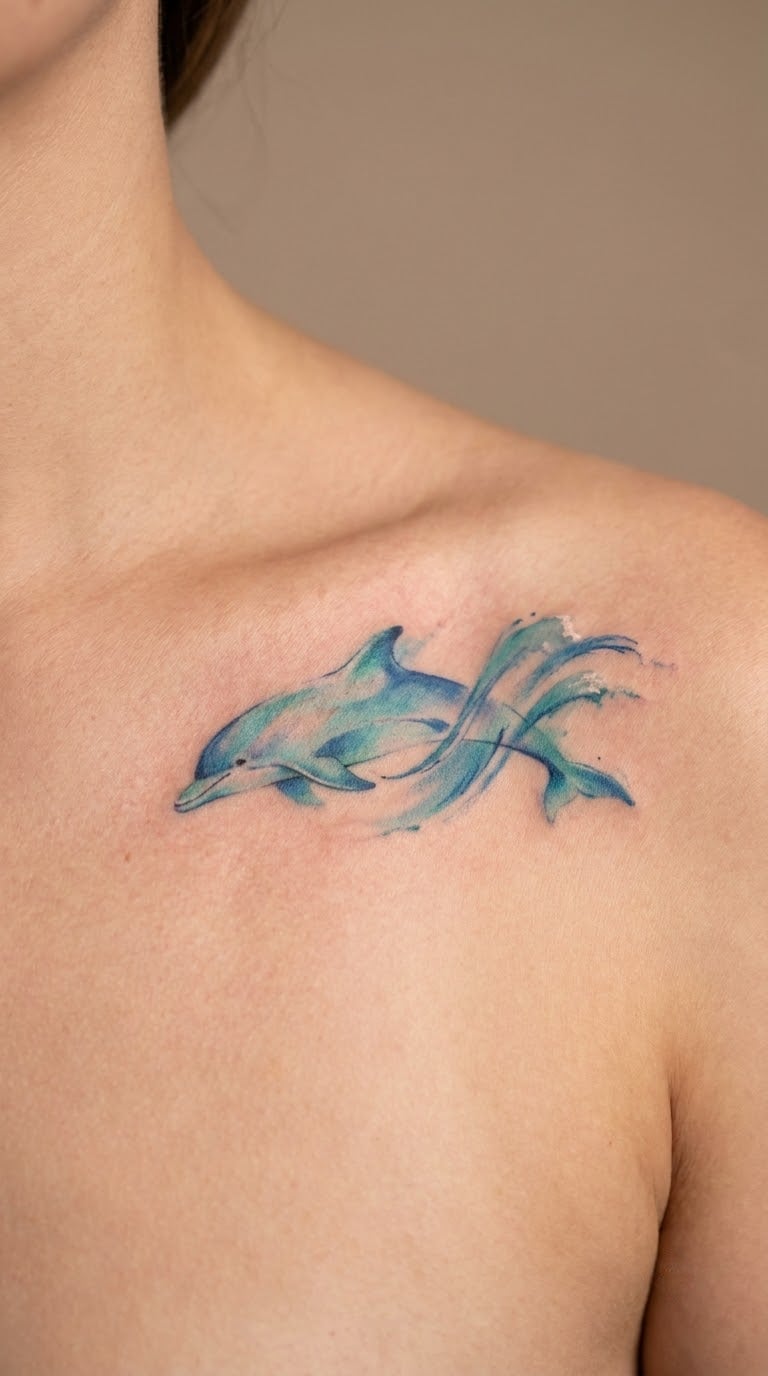
A loose blue and teal dolphin breaking through two curved wave strokes, painted rather than outlined. Watercolour suits the collarbone because the pigment drifts into the skin and softens the edges, which works against the straightness of the bone. It reads more illustrative than realistic, and that looseness is what makes it work.
Placement: along the collarbone following its curve, or just below it on the chest. Size: 3 to 4 inches (8-10 cm) wide. Style: watercolor. Pain: medium, and the collarbone itself is one of the more sensitive areas to work on.
Ageing note: pale washes fade faster than any other style on this list, so expect a colour refresh every few years. Make it yours: skip stock blue and mix two custom inks instead, then add a single pale violet bloom behind the wave for depth.
4. Realistic Dolphin Portrait on the Forearm
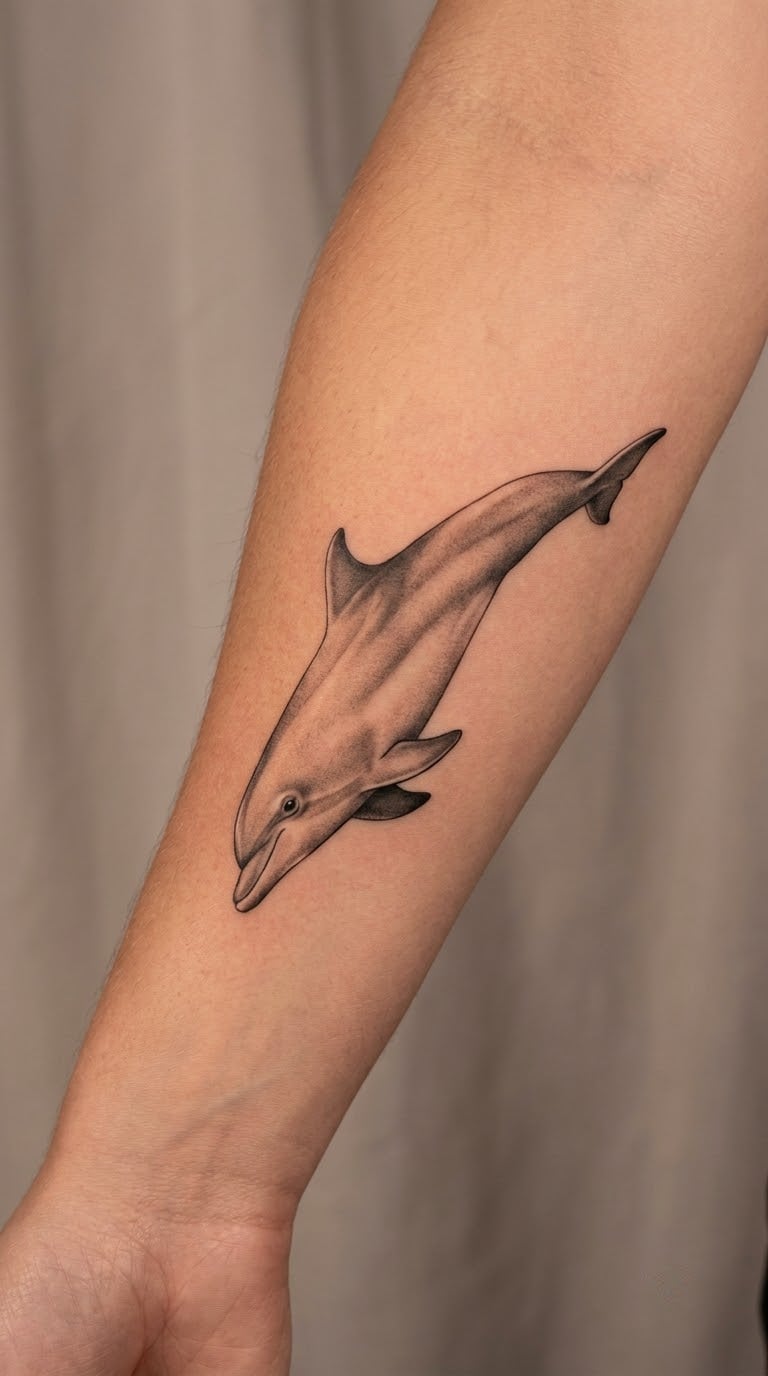
A dimensional dolphin with grey shading rolling along the back, a light belly, a clearly rendered eye and a mouth line that curves the way the real animal’s does. No waves, no splashes, nothing competing for attention. This is the option for someone who wants a recognisable animal tattoo rather than a symbol.
Placement: outer forearm, running lengthwise from below the elbow toward the wrist so the artist has a flat surface for the gradients. Size: 5 to 7 inches (13-18 cm). Style: black and grey realism. Pain: medium, and shading passes take longer than line work, so the session runs longer too.
Ageing note: grey wash usually wants a touch-up within two or three years, mainly across the darkest areas. Make it yours: ask the artist to keep your own eye tone in the dolphin’s eye, and mirror a second dolphin on the opposite arm. More placement-specific options in 20 Forearm Tattoo Ideas for Women With Meaning.
5. Traditional Dolphin with Water Splash
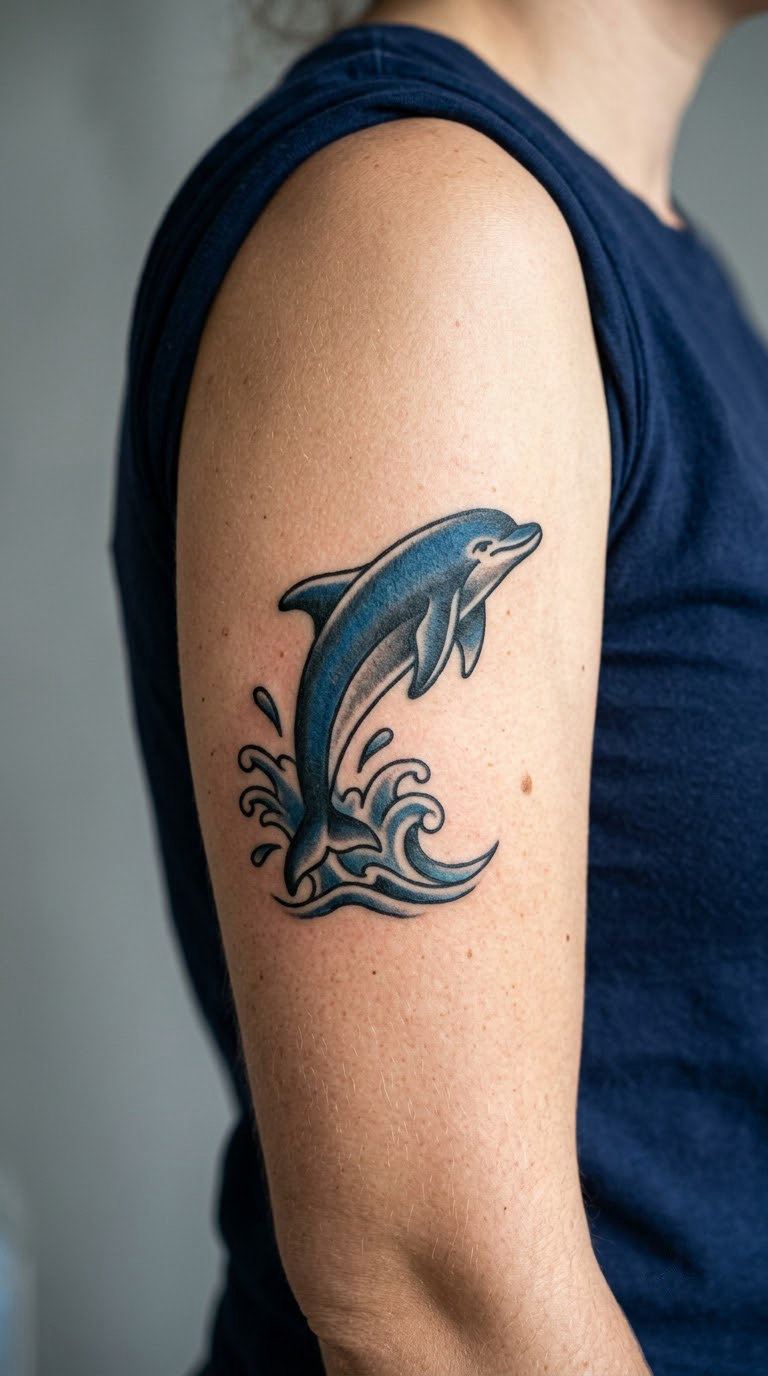
A bold dolphin with heavy black outlines, saturated blue and charcoal fills and a white highlight cut across the head, leaping out of a stylised splash. Traditional work has been drawn for a century and it holds its shape at almost any size, which is why so many people end up with one eventually.
Placement: outer upper arm, bicep or calf, anywhere with a flat enough area for the splash to sit underneath. Size: 4 to 5 inches (10-13 cm). Style: traditional. Pain: medium, with a solid burning feeling from the saturated colour packing.
Ageing note: heavy outlines last well, but fully saturated blue softens and reddens within about five years. Make it yours: replace the stock splash with waves from a coastline that matters to you, and ask for a warmer ink mix so the piece does not read as borrowed clip art.
6. Dolphin Silhouette with Bubbles on the Ankle
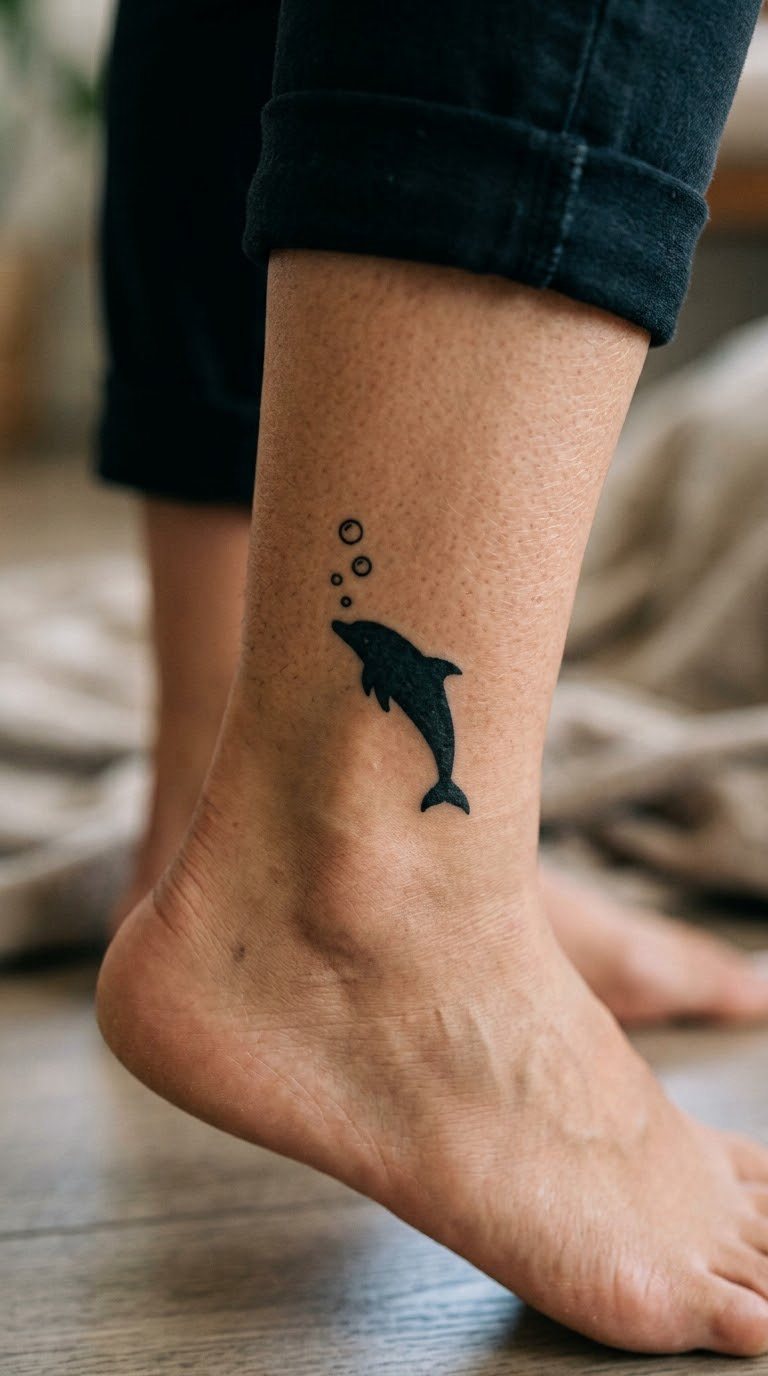
A compact silhouette swimming upward with three small bubbles trailing off its nose, kept simple enough that the shape carries the design on its own. The bubbles give the eye a path upward and stop the piece from looking like a stamp. It is a small, slightly playful design that suits a warm-weather ankle placement.
Placement: outer ankle, just above the bone or slightly higher on the calf. Size: 2 to 3 inches (5-8 cm). Style: black and grey. Pain: medium, more because the ankle is bony and sensitive than because of the design.
Ageing note: ankles are constantly in motion and often in sandals, so expect faster softening and more sun fade here than almost anywhere else. Make it yours: make the third bubble a tiny heart, or run it as the first of three small dolphins on the same leg.
7. Sideways Dolphin in Negative Space on the Ribs
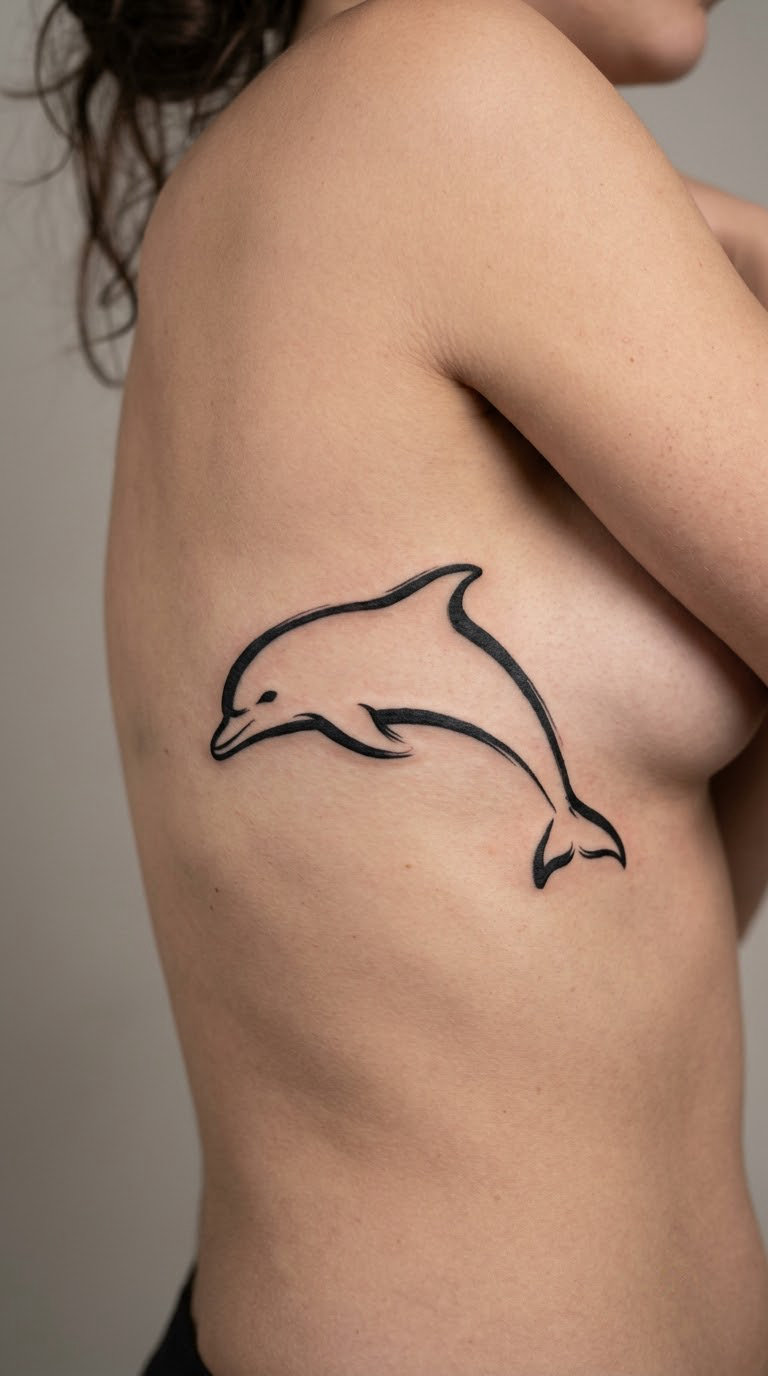
A dolphin built from a few directional black strokes and a lot of untouched skin, angled so the negative space itself forms the body. It looks like the animal is swimming through the ribs rather than lying on top of them. This is the most ambitious placement on the list and the one people are most excited about after it is done.
Placement: side ribs, following the curve of the cage, usually on the left side. Size: 5 to 6 inches (13-15 cm) wide. Style: negative space. Pain: high, because ribs are thin, shifting and close to bone.
Ageing note: the design distorts visibly when you bend, stretch or breathe deeply, and that movement is part of why people choose it. Make it yours: add three short water lines along the bottom edge so the strokes read as a current rather than as marks.
8. Dolphin Pair Curving Around the Shoulder
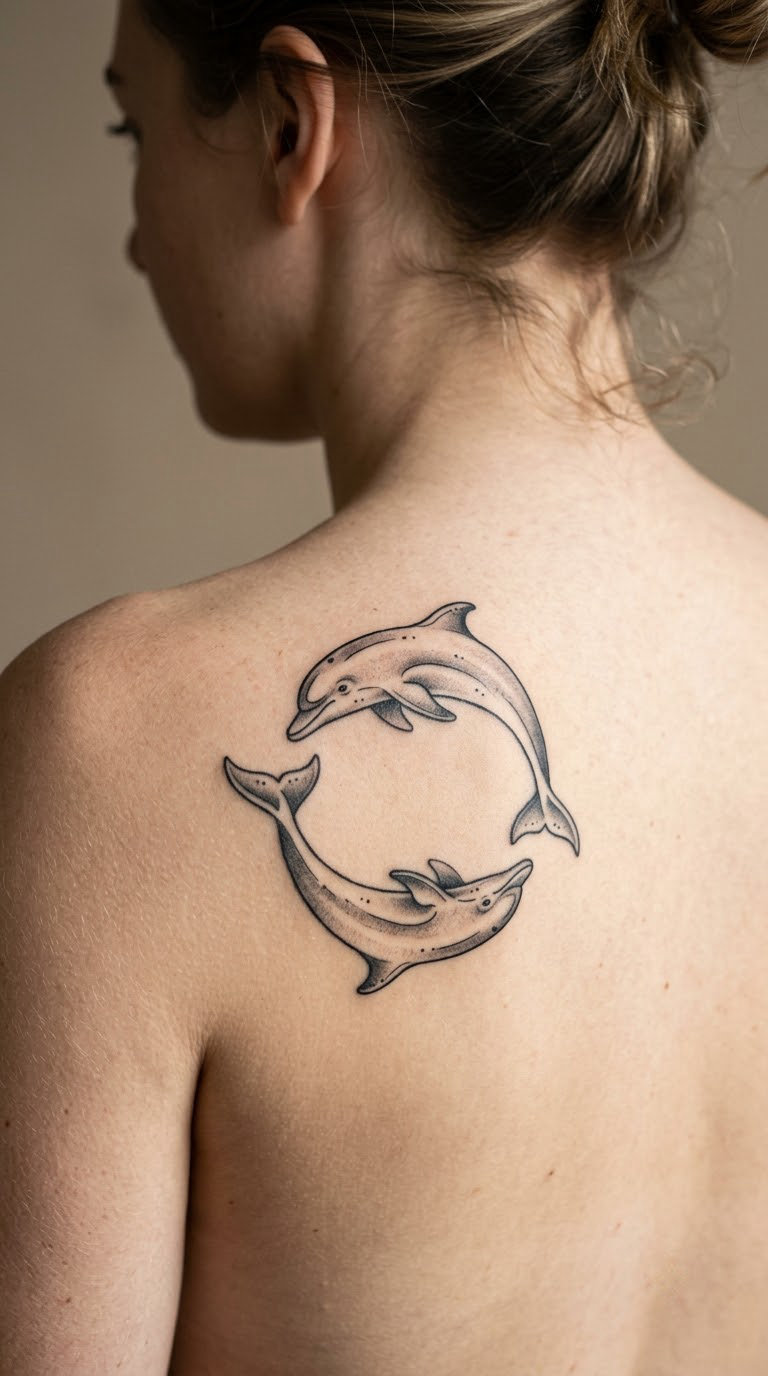
Two dolphins of different sizes following the same arc, the larger leading and the smaller trailing, so the pair reads as one movement rather than two separate animals. Placing them on a curve is what makes this work: the composition follows the shoulder instead of fighting it.
Placement: shoulder blade or the outer shoulder, wrapping slightly toward the upper arm. Size: 3 to 4 inches (8-10 cm) each. Style: black and grey. Pain: medium, with the awkward curved surface being the main factor rather than sensitivity.
Ageing note: shoulders are a visible spot, and shading on a curve catches stretch marks and sun exposure over time. Make it yours: make one dolphin noticeably smaller for a parent and child, or add a third tiny one for a pregnancy.
9. Micro Dolphin on the Finger
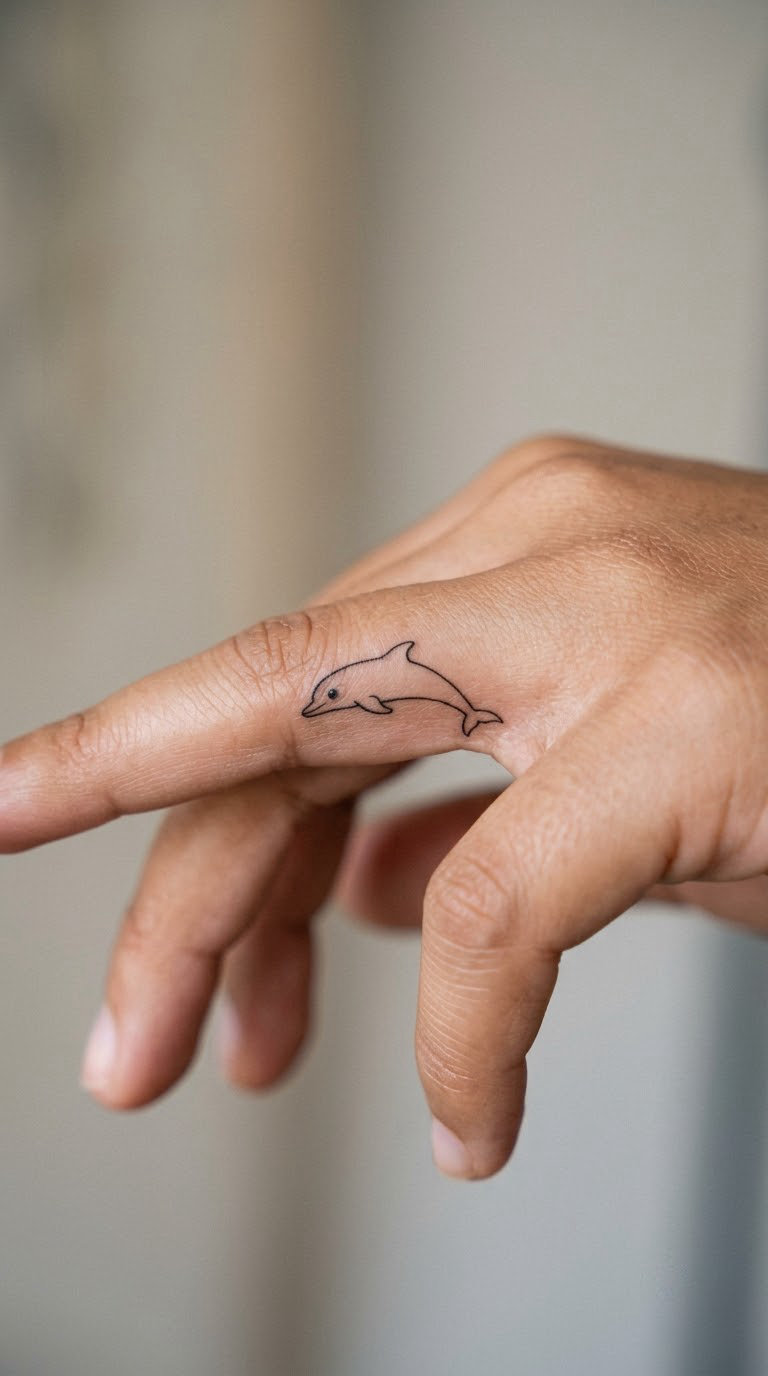
A tiny simplified dolphin reduced to a contour, a dorsal fin and one readable eye, running along the side of a finger. At this scale the artist has to strip the design back hard, because anything you cannot draw in a millimetre will not survive the first year. It suits people who want something only they know is there.
Placement: the side of a finger, usually the index or middle, between knuckle and knuckle. Size: 0.75 to 1 inch (2-2.5 cm). Style: micro fine line. Pain: high, since finger skin is thin over bone and every millimetre registers.
Ageing note: hand and finger tattoos blur and fade faster than any other placement, largely because of washing, sun and constant movement. Make it yours: match it to a ring on the same hand, or place one small dolphin on each hand in the same position so they line up when your palms meet.
10. Blue Dolphin with Floral Water Accent on the Hip
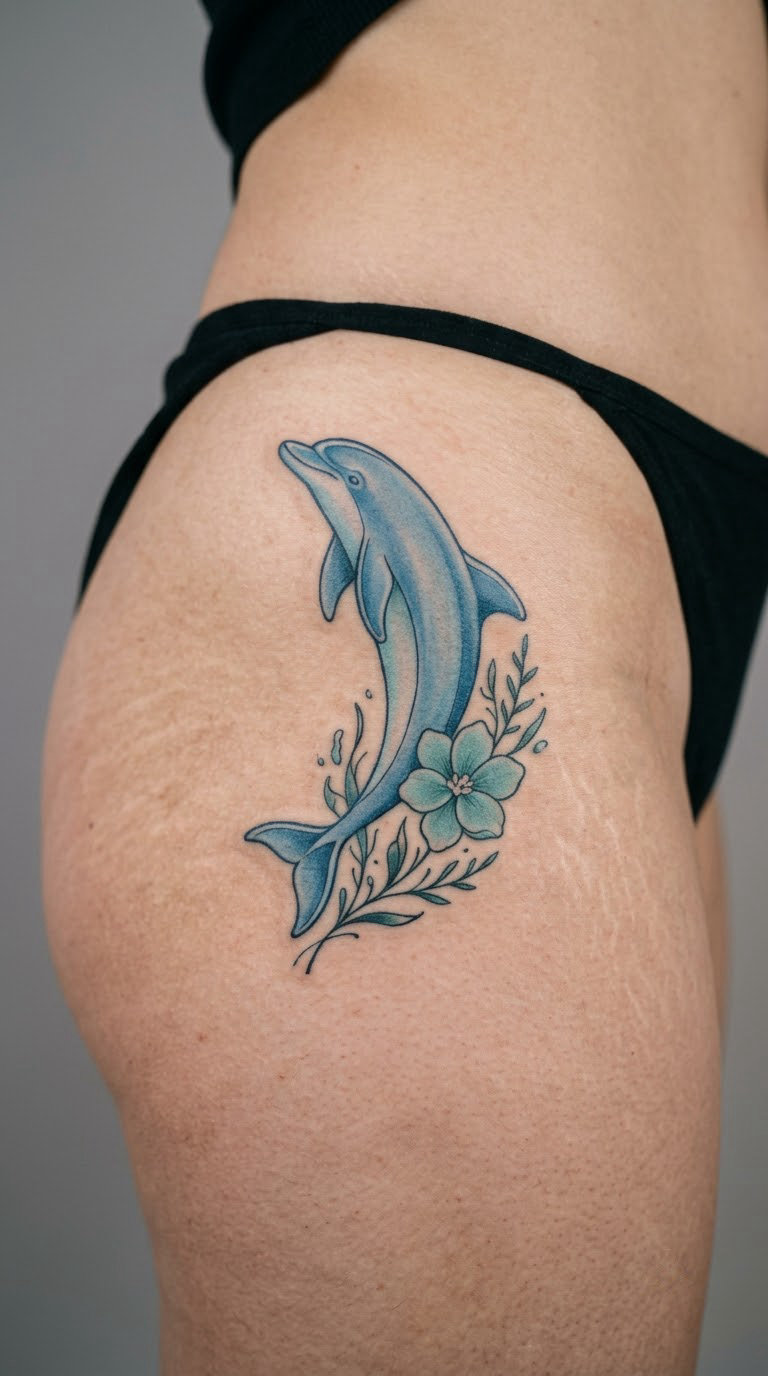
A clean blue dolphin with a restrained teal flower and a few underwater stems trailing behind it, the accent noticeably smaller than the animal so the dolphin stays the subject. The hip gives the artist enough flat surface for colour work and enough curve to make the design feel like it belongs to the body.
Placement: outer hip or high thigh, angled slightly so the dolphin points down toward the knee. Size: 4 to 5 inches (10-13 cm). Style: colour realism. Pain: low, and one of the more relaxing spots to sit through.
Ageing note: hips are often covered, which is good for the ink and bad for noticing change, so check it annually. Make it yours: use a flower tied to something real, a hydrangea from a garden or a frangipani from a trip, rather than a generic blossom.
11. Blackwork Dolphin Silhouette on the Back
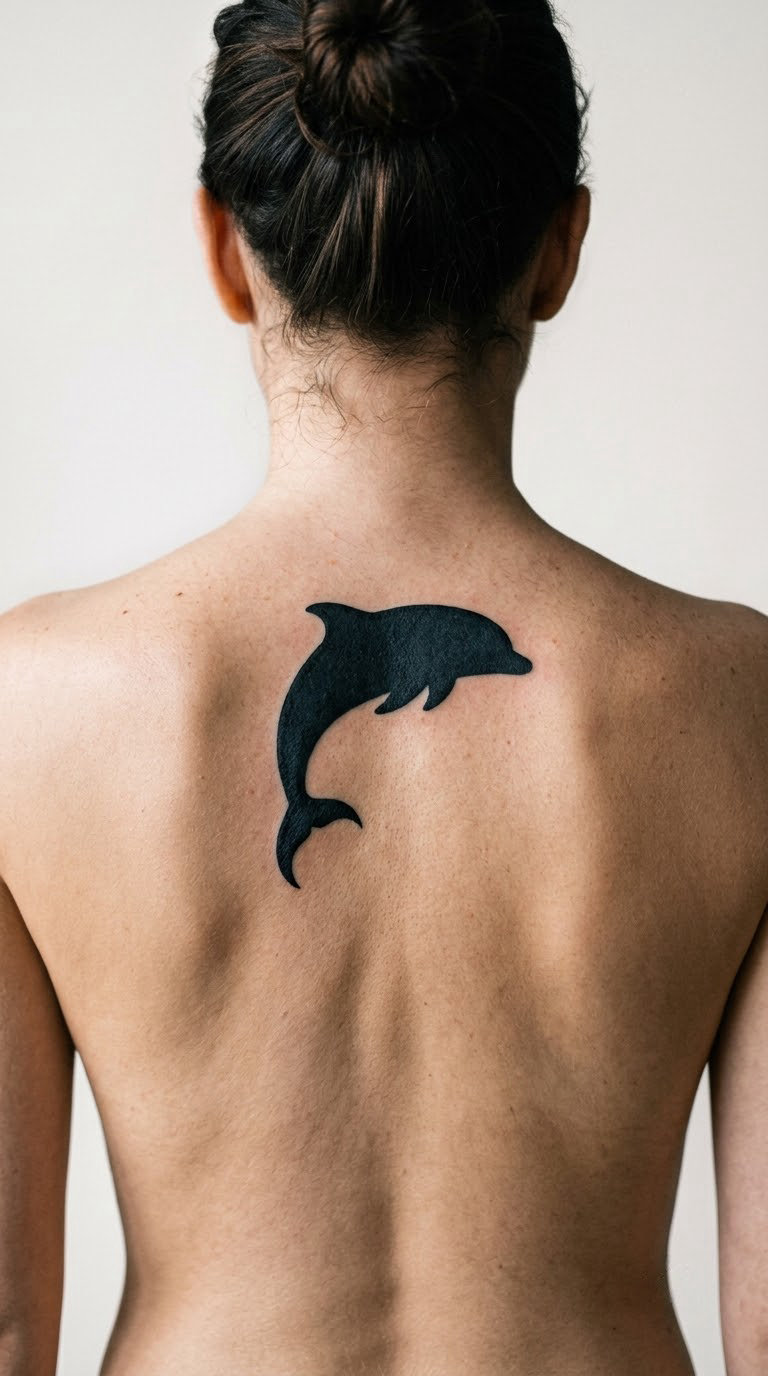
A dense black silhouette with a curved tail and a strong body shape, filled solid with no shading inside. Blackwork reads clearly from across a room and from behind, which no other style on this list manages quite as well. It is graphic rather than realistic, and it holds its edges for years.
Placement: between the shoulder blades, or across the upper back for a wider version. Size: 6 to 8 inches (15-20 cm) wide. Style: blackwork. Pain: low, because the back is fleshy and the client can lie flat.
Ageing note: solid black lasts longer than shading but the edge can soften into a grey halo over ten years or so. Make it yours: cut the negative space inside the tail into a small wave, or flip the dolphin so it points down towards the waist.
12. Dolphin and Moonline on the Inner Arm
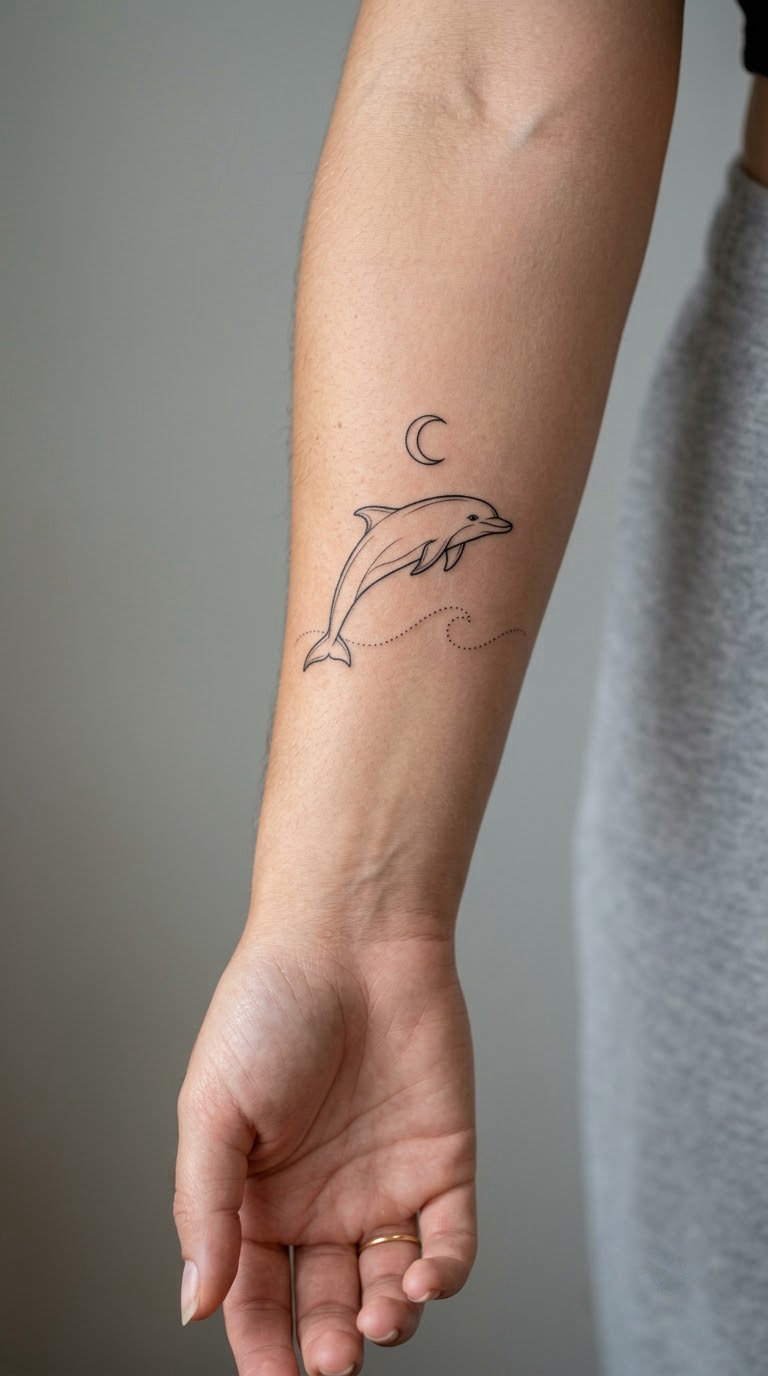
A fine-line dolphin swimming below a thin crescent and a dotted water line, with a good amount of open skin between the three elements. The dotted line does a lot of the work here: it separates the composition without needing a second solid shape. It suits people who like quiet, symbolic-looking pieces rather than decoration.
Placement: inner forearm between wrist and elbow, where the dotted line can run straight without following a curve. Size: 3 to 4 inches (8-10 cm) long. Style: fine line. Pain: medium, and inner arms bruise visibly for a few days afterwards.
Ageing note: single hairline details are the first thing to disappear, so agree on the lightest line weight that still reads, not the thinnest possible. Make it yours: extend the dotted line into a full forearm piece later, using the first dot as the starting point.
13. Dotwork Dolphin Made of Bubbles
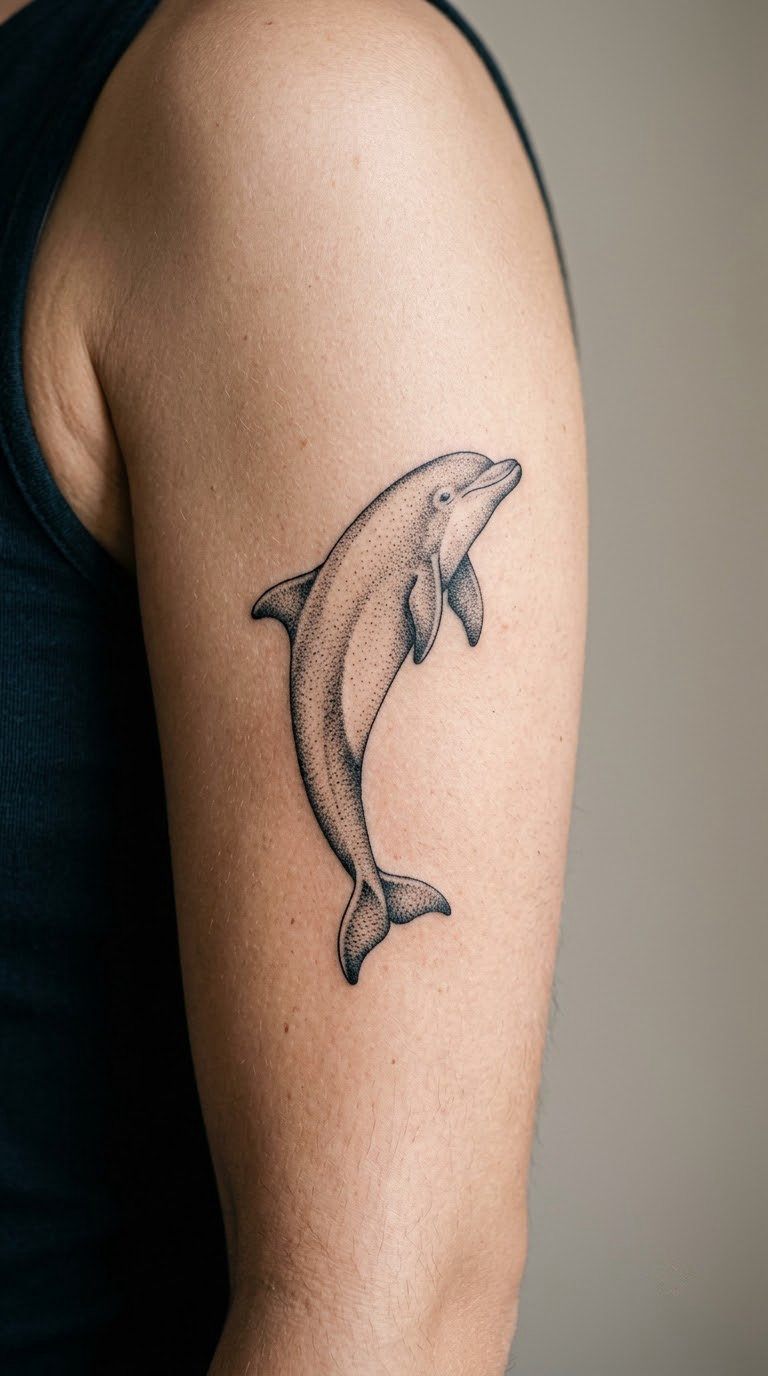
A dolphin built from graduated dots rather than solid lines, densest along the back and sparser near the belly, with a few contour lines through the head. It is a texture study as much as an animal, and the gradient is what gives it depth. Dotwork rewards patience and a steady hand, so plan for a longer sitting.
Placement: outer upper arm, forearm or thigh, anywhere with room for the gradient to breathe. Size: 4 to 6 inches (10-15 cm). Style: dotwork. Pain: medium, and stippling is a repetitive sensation that gets uncomfortable rather than sharp.
Ageing note: dots stay distinct well, but sun exposure greys them noticeably, so this style shows ageing honestly. Make it yours: let the dot gradient double as a halftone fade into open skin on one end of the dolphin.
14. Dolphin with Pearl Detail on the Chest
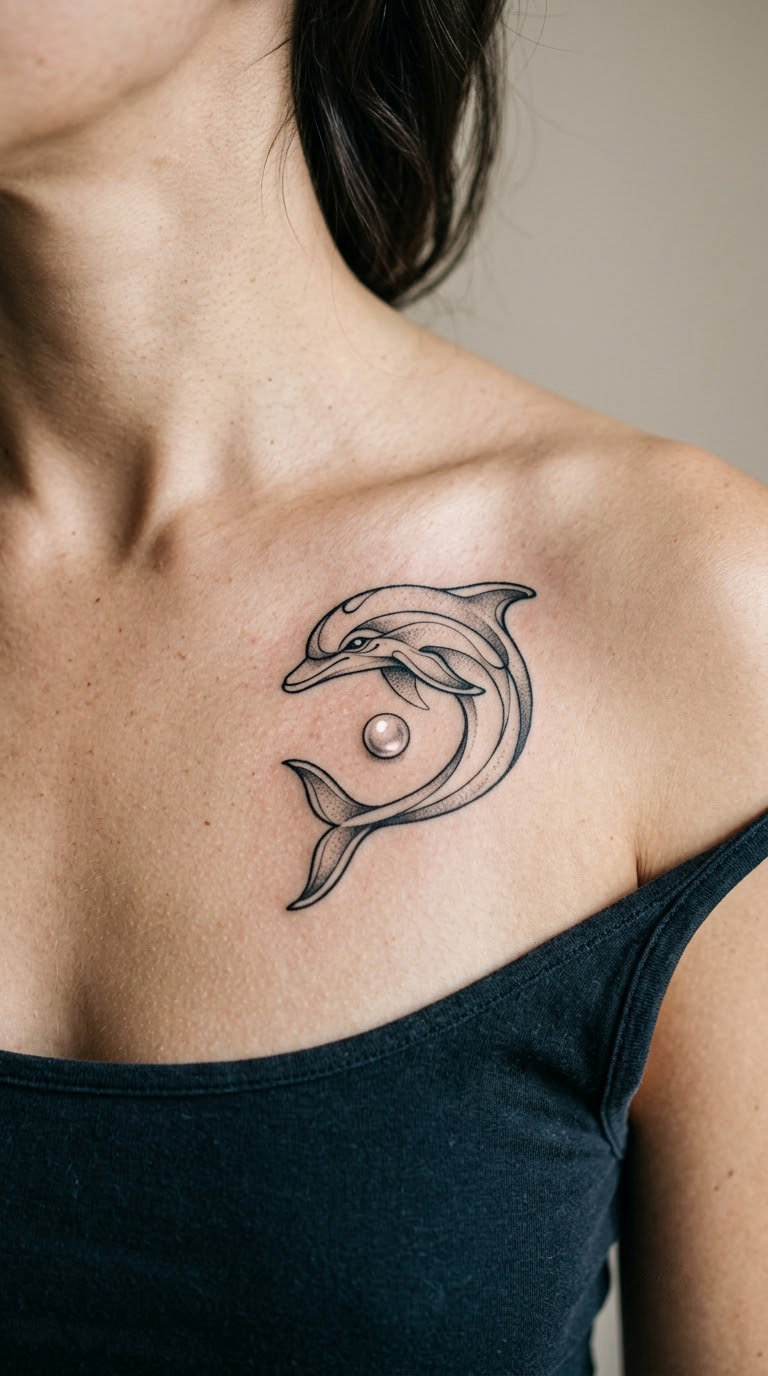
A stylised dolphin curving around a small pearl-like circle, its tail pointing back toward its own head so the composition closes. The circle is left white rather than shaded, which makes it glow against the grey. Chest work sits close to the sternum, so the artist needs to check how the design moves when you breathe.
Placement: upper chest, just off the centre line so it does not sit directly on the sternum. Size: 3 to 4 inches (8-10 cm) wide. Style: illustrative. Pain: medium, with sternum-adjacent skin noticeably more sensitive.
Ageing note: a small white circle inside a shaded area can fill in over time, so the artist should outline it to protect the highlight. Make it yours: make the pearl a shell from somewhere you have actually swum, or set the whole composition inside a thin circle.
15. Tiny Dolphin Heart on the Hand
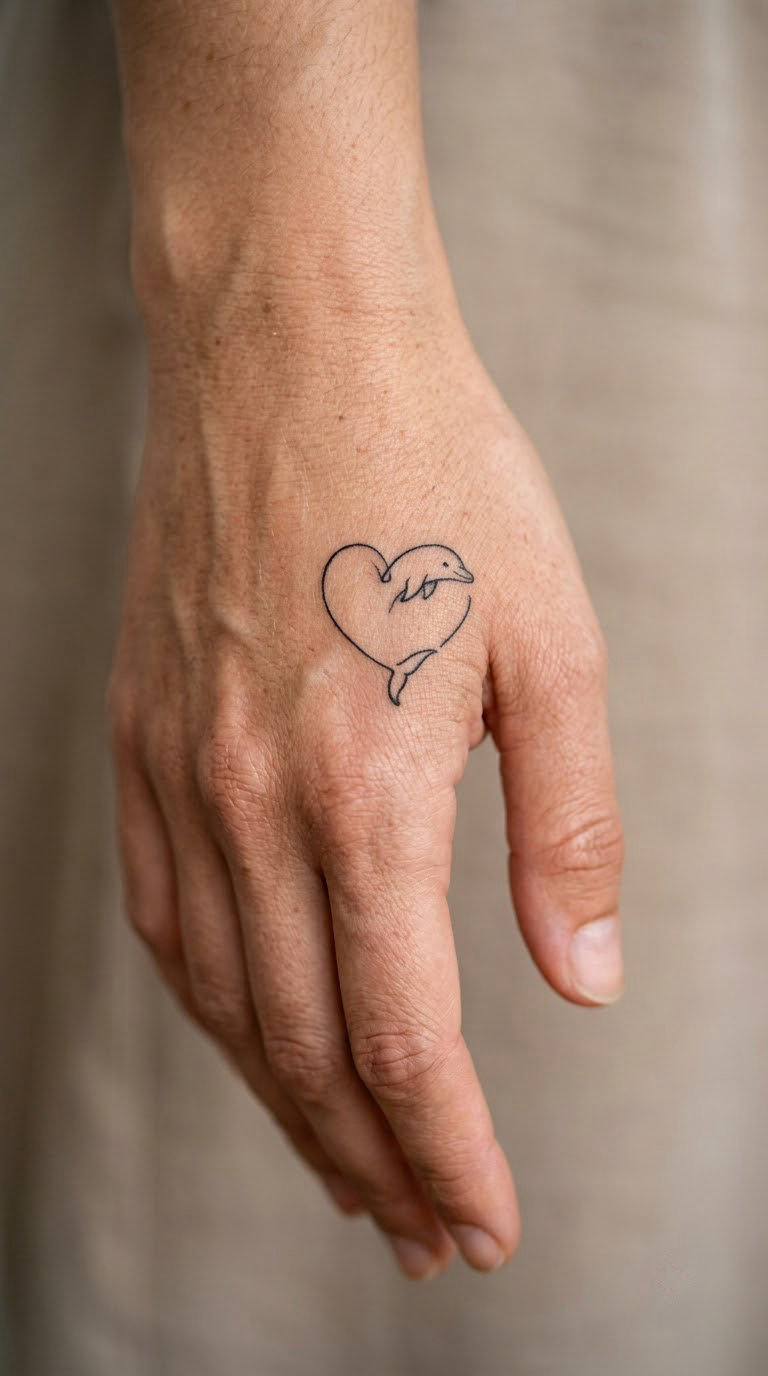
A compact dolphin whose arched back and curled tail meet at a point, so the body reads as a heart without drawing an actual heart shape on top. It is romantic in a restrained way and works as a first piece on the hand for someone who wants a visible but quiet design.
Placement: back of the hand between the knuckles and the wrist. Size: 1.5 to 2 inches (4-5 cm). Style: micro line. Pain: medium, and hand skin is sensitive even at this size.
Ageing note: hand tattoos need the most long-term planning of any placement. Frequent washing and sun both hit them, and knuckles stretch the design when you close your fist. Make it yours: add an initial into the open half of the heart, or keep the point of the shape as a place for a later date.
16. Dolphin in a Small Geometric Frame
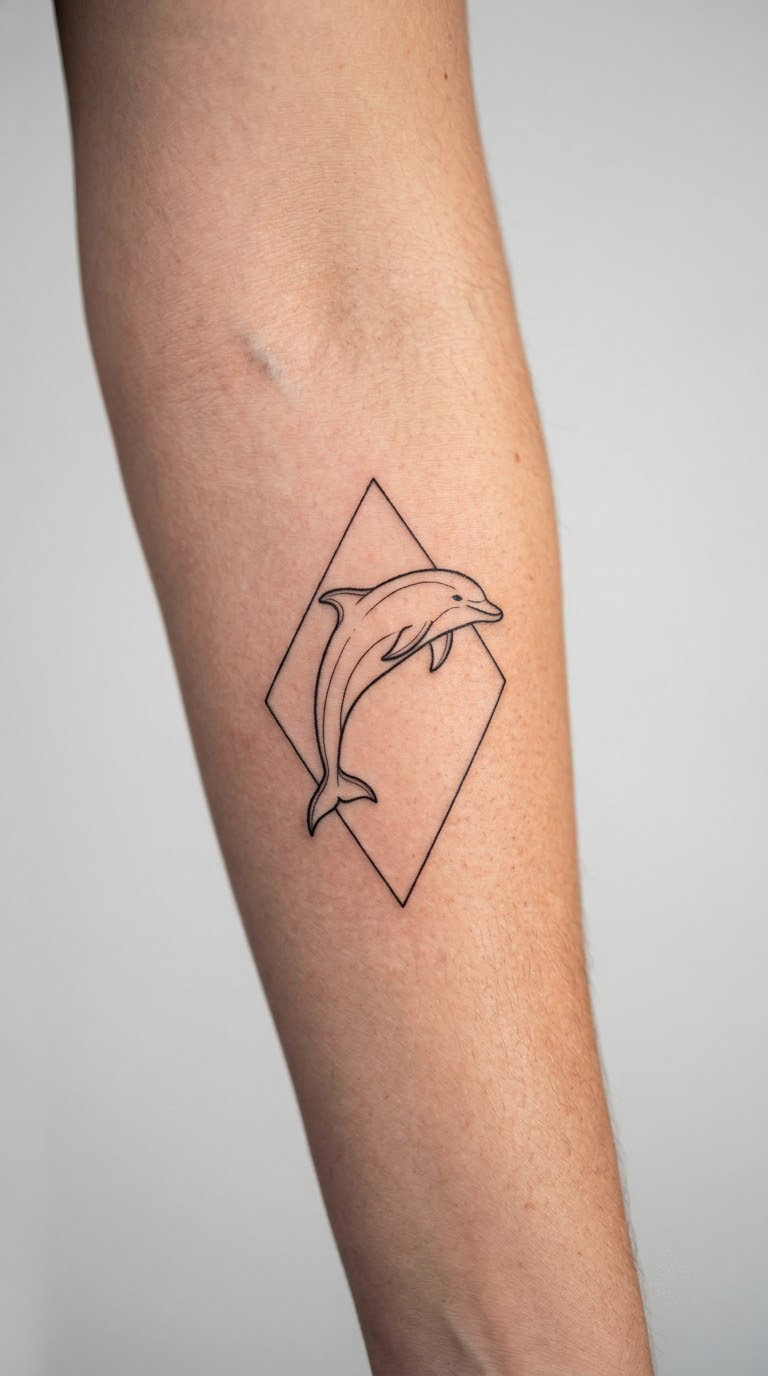
A simplified dolphin centred inside a thin diamond or circle frame, with the lines of the frame carrying the design so the animal can stay plain. Geometry suits people who like structure and symmetry, and it also makes a small piece look deliberate rather than unfinished.
Placement: forearm, calf or outer upper arm, ideally on a limb with a cylindrical shape so the frame stays even all the way round. Size: 3 to 4 inches (8-10 cm) across. Style: geometric. Pain: low, since it is mostly straight line work over a fairly flat surface.
Ageing note: frames distort visibly if you put on weight or build muscle nearby, because the straight lines are the first thing to bow. Make it yours: put a real date or a set of coordinates inside the frame beneath the dolphin.
17. Two Dolphins Swimming in an Oval on the Thigh
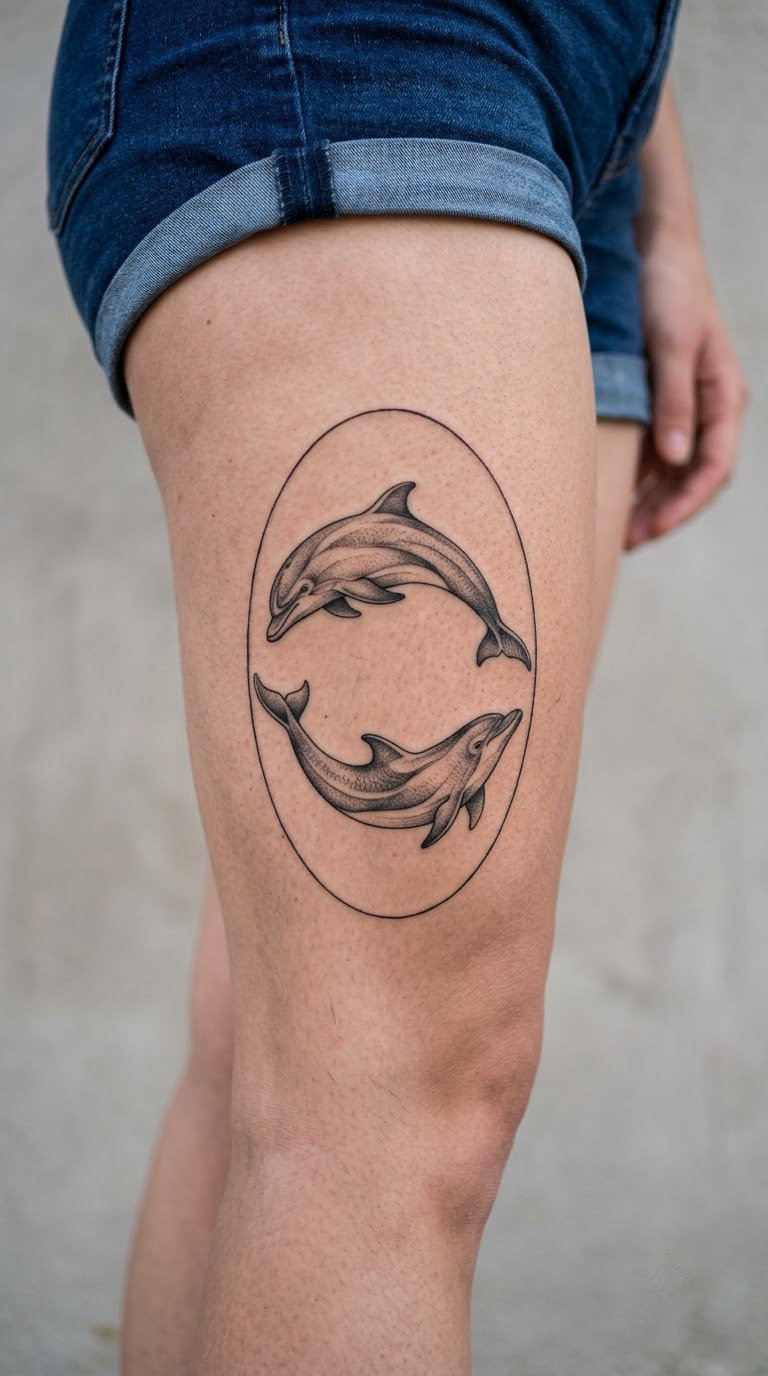
An oval frame containing two dolphins of different sizes swimming in opposite directions, the composition contained enough to feel finished on its own. The oval is the trick: it turns two separate animals into one design and gives the thigh piece a defined edge. The thigh is forgiving skin that stretches and settles well.
Placement: outer thigh, high enough that the whole oval stays visible when standing. Size: 5 to 7 inches (13-18 cm) wide. Style: black and grey. Pain: low, and thigh skin is one of the more comfortable areas to work on.
Ageing note: thighs change shape more than most placements, so a framed piece may need a rework in a few years. Make it yours: make the two dolphins a matching set with someone, same frame, mirrored sides of the body.
18. Dolphin with Compass Rose on the Shoulder
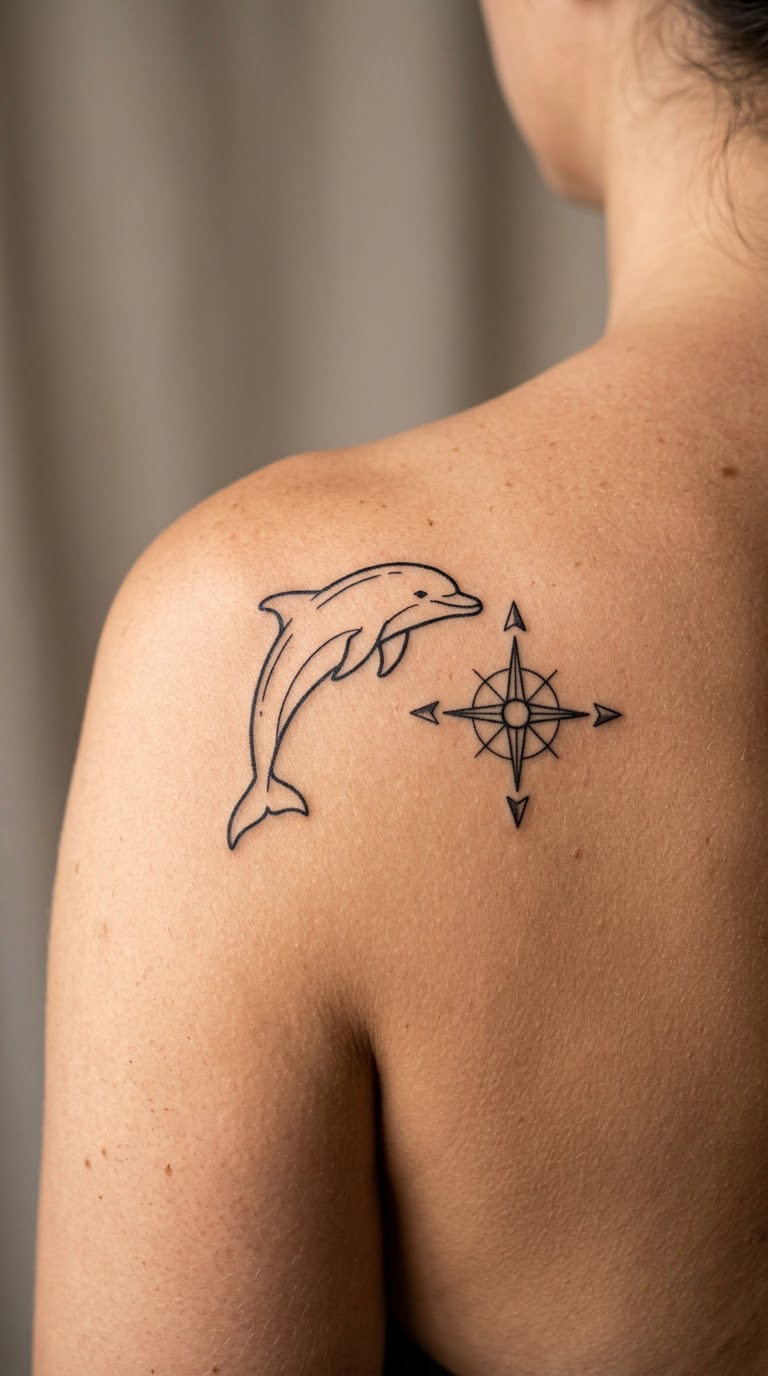
A simplified linework dolphin swimming past a small four-point compass rose, the two elements kept at similar weights so neither disappears. The combination reads as travel and open water without needing a map or coordinates. It works best where there is room for both shapes rather than one tucked behind the other.
Placement: shoulder or upper back, where a wide flat area lets the dolphin and the rose sit side by side. Size: 4 to 5 inches (10-13 cm) wide. Style: line work. Pain: medium, due to the awkward curve over the deltoid.
Ageing note: fine compass lines are fragile; ask the artist to weight them slightly heavier than they look best in a drawing. Make it yours: point the rose to a real coordinate, or use the direction of a place you have always wanted to visit.
19. Bold Dolphin Sleeve Element on the Calf
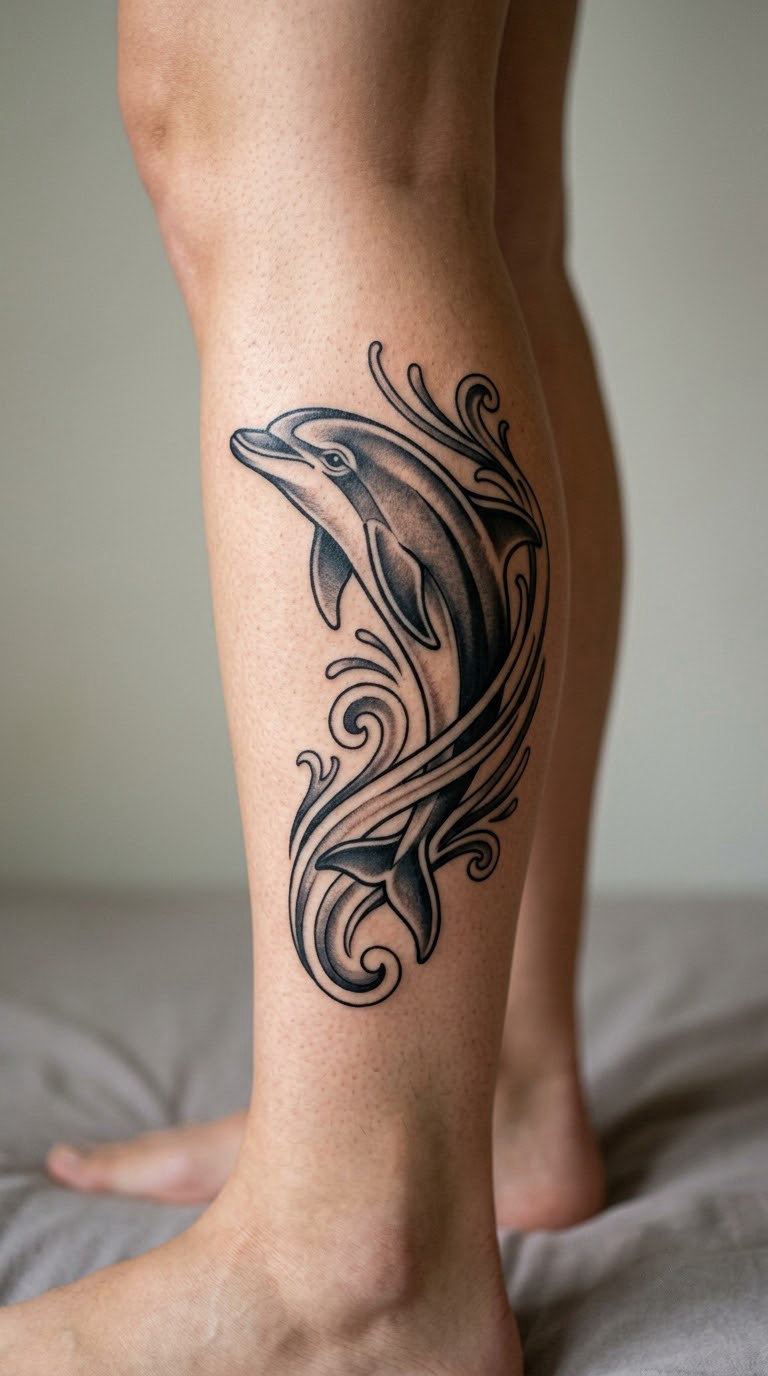
A larger black-and-grey dolphin as the focal point of a calf composition, with sweeping water lines running around it and plenty of open skin left so it does not feel crowded. Left alone it is a strong standalone piece, and it also sits happily inside a developing sleeve if you decide to build on it later.
Placement: outer or inner calf, centred between knee and ankle. Size: 6 to 8 inches (15-20 cm) long. Style: black and grey. Pain: low, and the calf gives a large flat canvas for shading.
Ageing note: calf work often changes shape with activity and pregnancy, so leave generous open skin around the dolphin. Make it yours: design the water lines now so they can be filled in later, then treat the dolphin as the anchor of a gradual sleeve.
20. Minimal Dolphin Behind the Ear with Star Detail
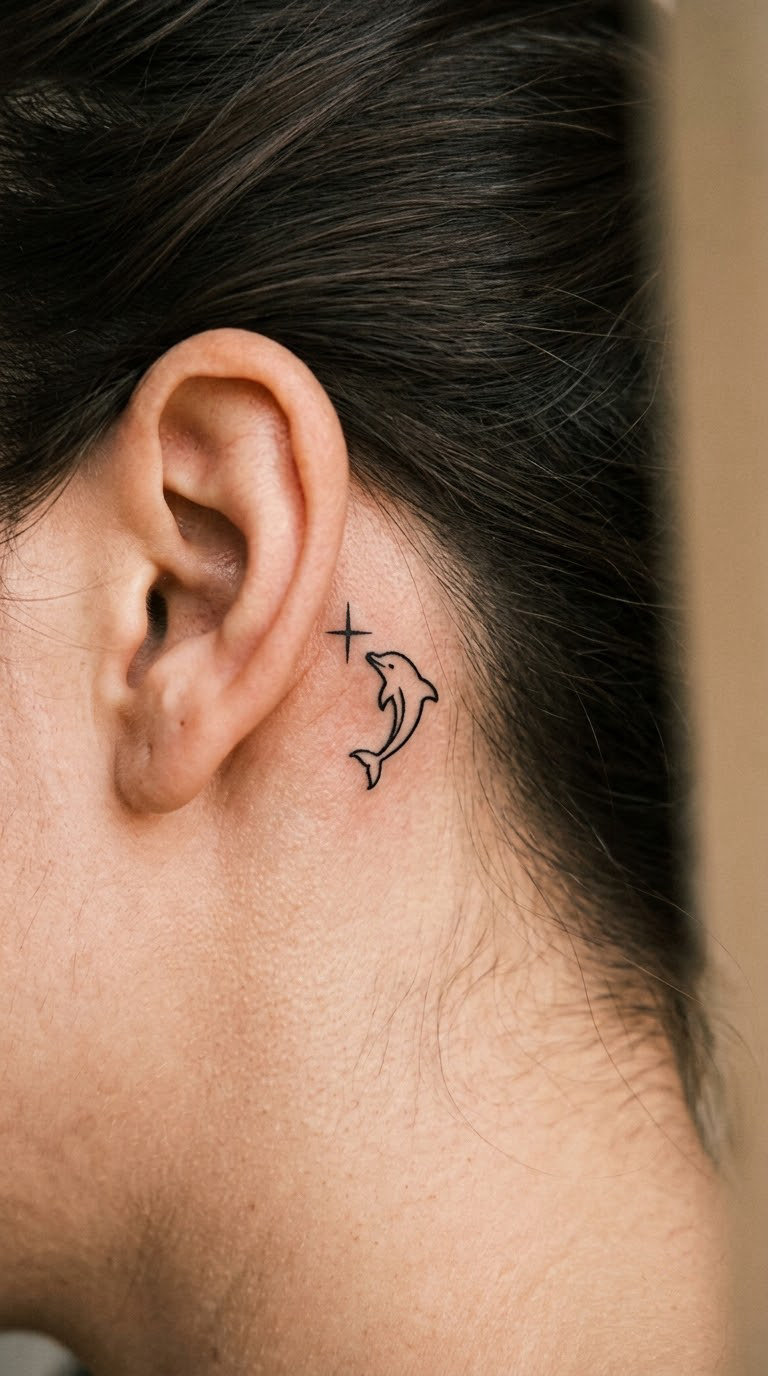
A single small dolphin paired with one restrained four-point star, positioned so the star sits near the tail rather than competing with the body. The whole design is a contemporary take on the classic neck dolphin, and the extra element makes a small piece look considered. It is the easiest design here to keep discreet at work.
Placement: behind the ear or at the nape of the neck. Size: 1.5 to 2.5 inches (4-6 cm). Style: minimalist. Pain: low, and the neck sits on soft skin.
Ageing note: the star is the first element to fade because of its small size, so consider slightly larger points than look necessary in a drawing. Make it yours: choose the star shape you actually like rather than a generic sparkle, and pair it with a second piece on the other side of the neck. More neck options in 20 Best Back of Neck Tattoo Ideas for Women.
How to Choose the Right Dolphin Design
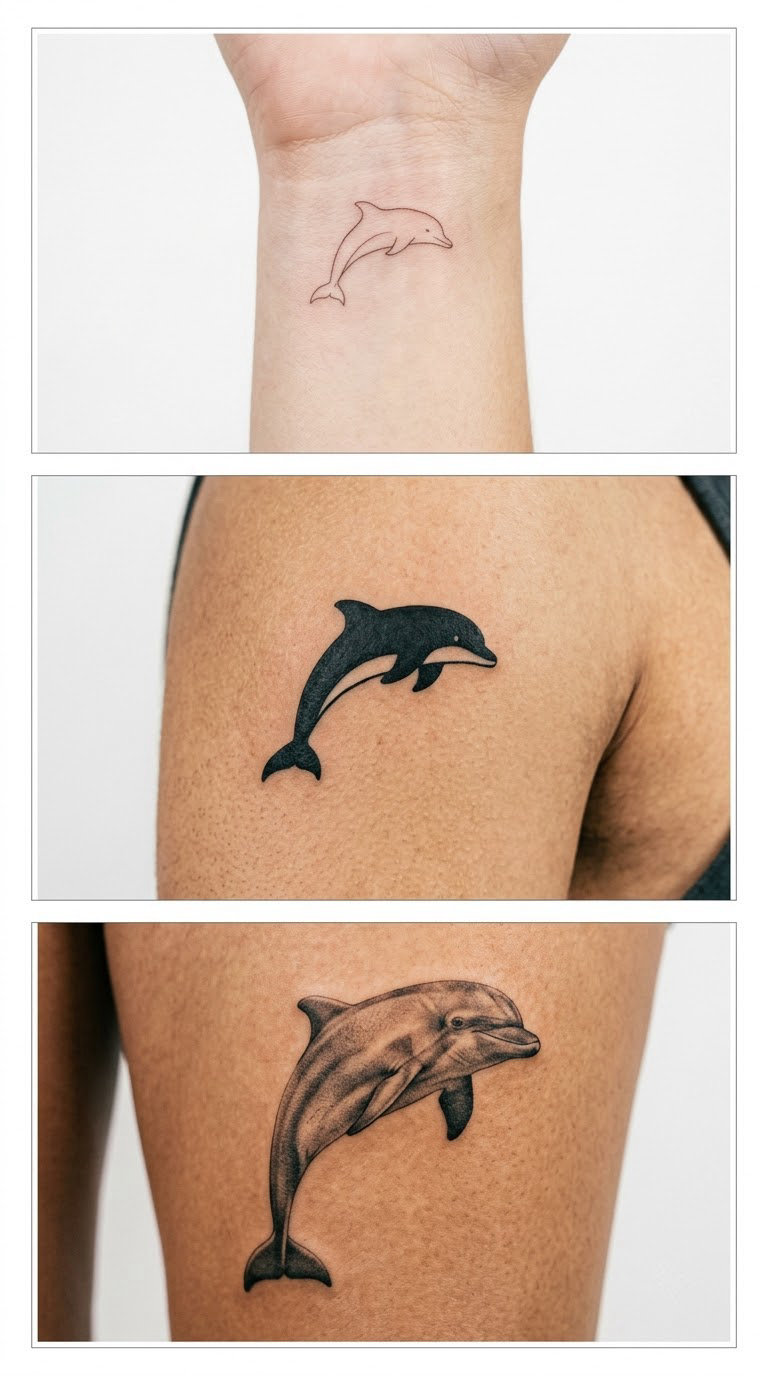
If you are narrowing dolphin tattoo ideas for women down to one design, work through these five questions in order, because the answer usually picks itself. The most common mistake is choosing the picture first and then forcing it onto a spot that cannot hold the detail.
- How much skin can you actually give it? Measure the area before you fall for a design. A five-inch realistic dolphin does not fit behind an ear, and squeezing it in is how details turn to grey.
- How visible do you want it to be? Wrist, fingers, the back of the hand and the inner forearm show constantly. Ribs, thigh and upper back stay yours until you choose to show them.
- How much detail do you want to keep in ten years? Fine line and micro work look best now and fade first. Blackwork and traditional outlines hold their shape longest, and grey realism sits in between.
- Does the spot move? Ribs and fingers distort with every breath and fist. If you care about the design staying true, choose somewhere quieter or accept the movement as part of it.
- What is it for? A matching piece, a memorial, a first tattoo and a travel memory all point to different sizes. A first tattoo wants something small and simple; a memorial usually wants room for a name or a date.
Honest note for anyone still undecided: not everyone likes dolphins, and a few people find the design too common for an adult. If that is you, a stylised or geometric version reads far more personal than a realistic portrait, and nobody will recognise the source image.
Cost and Session Time
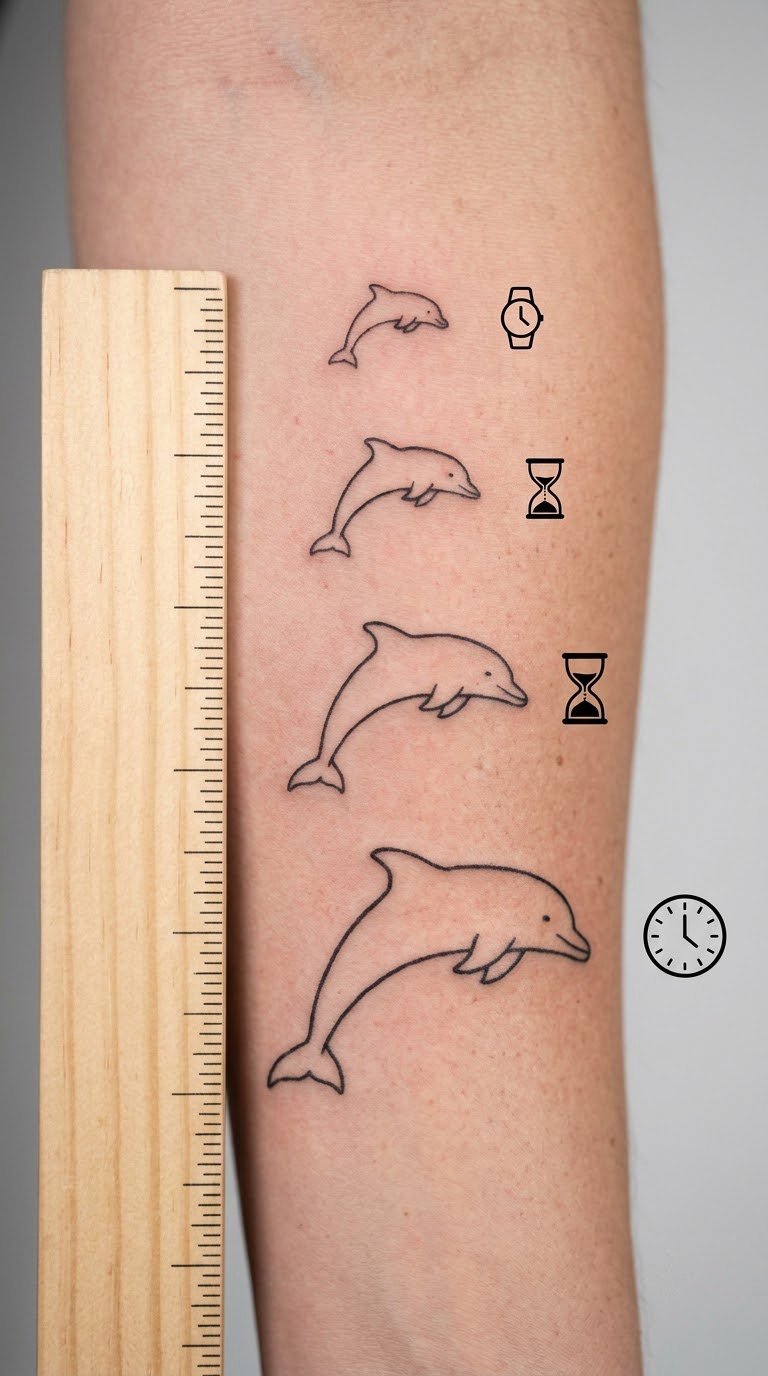
Most studios quote by the hour with a shop minimum, so the smallest dolphin tattoo on this list and the largest differ more in booking time than in price. In the US you will mostly see an hourly rate somewhere around $80 to $200, a shop minimum of roughly $50 to $120, and a final bill driven by size and detail rather than by the animal itself.
- Tiny pieces, under 2 inches: often ten to thirty minutes, but the shop minimum can still apply, so expect roughly $50 to $120. Some artists will not book sub-one-inch work at all.
- Small pieces, 2 to 4 inches: roughly 45 to 90 minutes for line work, commonly $120 to $250. Watercolour and dotwork take longer than their size suggests.
- Medium pieces, 4 to 6 inches: about 90 minutes to two hours, especially if there is shading or colour saturation, and usually $250 to $450.
- Large pieces, 6 to 8 inches and up: two hours or longer, and realistically a second session for a design with heavy black packing or grey wash, which pushes the total past $400.
Two practical notes. Ask whether touch-ups within the first months are included or billed separately, because colour and fine line work almost always need one. And if a quote comes back far below the going rate for the size, the artist is probably drawing less detail than the reference, so agree on a stencil before starting.
Aftercare Basics
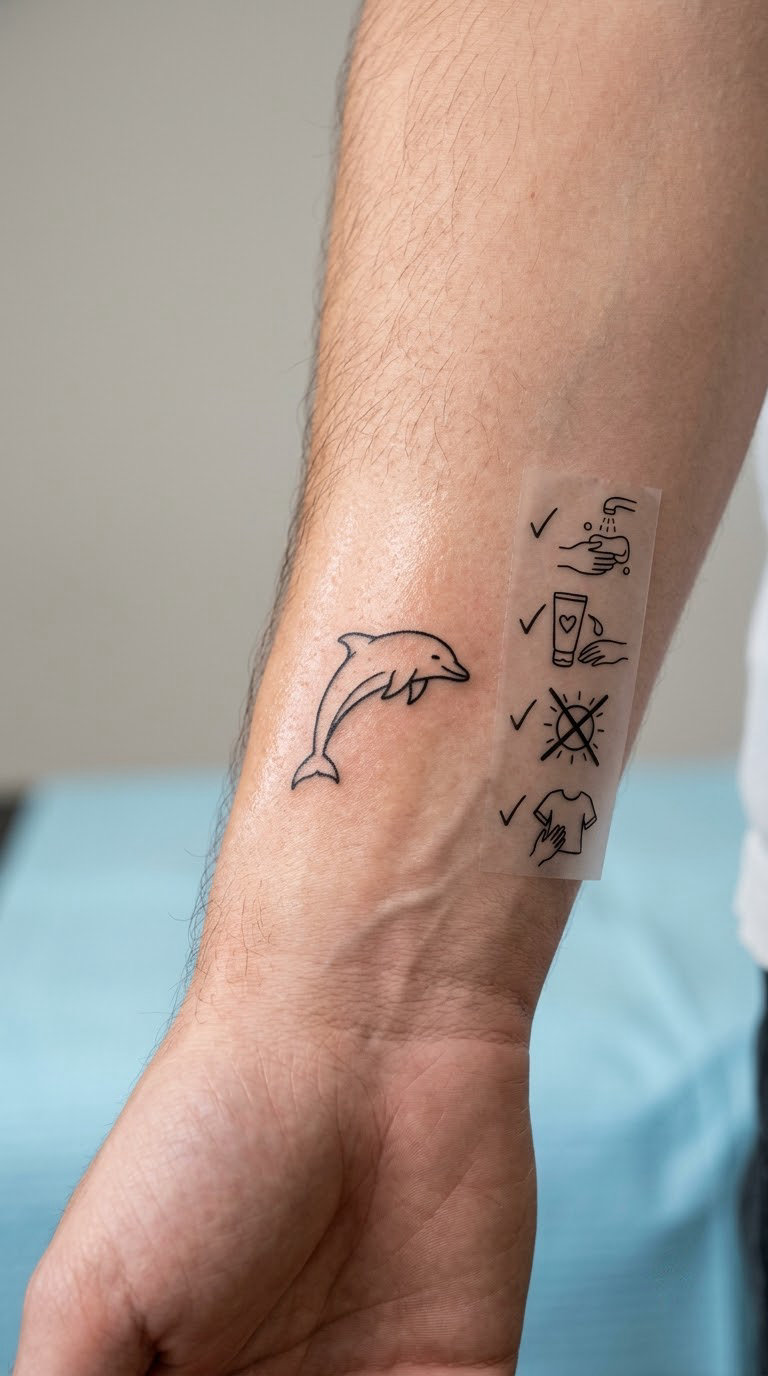
Start with your artist’s aftercare instructions, because they know how deep they went. Everything below is the general baseline, not a replacement for that advice.
- Wash gently. Clean the area with lukewarm water and unscented soap, then pat dry with clean paper rather than a towel. Patting keeps the skin from being dragged.
- Keep it covered and then leave it alone. A breathable cover for the first stretch protects it from friction. After that, resist picking or scratching the flaking skin, because that is how patchy healing starts.
- Protect it from sun. No tanning and no direct sun while it heals, and keep sunscreen on it for the life of the tattoo. UV is the single biggest cause of fade.
- Choose your clothing carefully. Loose fabric over the area for the first week or so. Bras, waistbands and tight straps rubbing a fresh piece are the most common cause of an unhappy heal.
- Wash away from it. Baths, swimming pools and hot tubs are worth skipping while the skin is still settling.
- Contact the studio if something looks wrong. Spreading redness, a hot spot, a yellow crust or a line that has blown out are reasons to call the artist or your doctor, not to wait it out.
Frequently Asked Questions
What does a dolphin tattoo symbolize for a woman?
Most people read a dolphin tattoo as freedom, intelligence, joy and playfulness, with an added sense of guidance and protection drawn from the dolphin’s historic role guiding sailors home. For women it is often chosen as a marker of resilience and a bond to the ocean rather than as a symbol with one fixed meaning. The meaning comes mostly from what you pair it with.
Where is the best placement for a small dolphin tattoo?
Behind the ear, the inner wrist, the ankle and the nape of the neck are the most reliable small placements, because each has soft, thin skin and a shape that suits a compact animal. The inner forearm and the outer hip work well if you want a little more room. Wrist, finger and hand pieces fade fastest, so choose them knowing that.
How small can a dolphin tattoo be before it looks like a blob?
One to two inches is the practical floor for a recognisable dolphin. Below about three-quarters of an inch there is no room for the eye, dorsal fin and curved mouth line, and it will read as a smudge within a few years. If you want smaller than that, change the subject to a dolphin tail or a wave rather than shrinking the animal.
Does a dolphin tattoo hurt more on the ribs or the wrist?
Ribs usually hurt more than most people expect, since the skin is thin over bone and shifts with every breath. Wrist work is a sharp, quick sensation that comes and goes with movement. Collarbone and sternum-adjacent chest work sit in the middle. Ankle and thigh pieces are among the more comfortable spots to sit through.
Is a dolphin tattoo a good first tattoo?
A small fine-line or minimalist dolphin on the inner wrist, behind the ear or on the ankle is a good first tattoo, because the session is short and the design is hard to over-detail. A realistic portrait or a sleeve element is a poor first choice, since both need more sessions and more commitment than most beginners want. Book small, and go bigger later.
Should I choose a fine line or a bold dolphin design?
Choose fine line if you want something discreet, small and delicate, and be prepared for more frequent touch-ups because thin lines soften and fade first. Choose blackwork or a traditional bold outline if you want the design to keep its edges for years and to read clearly from a distance. Grey realism sits in between and usually needs a colour refresh every few years.
Conclusion
For a first tattoo, the fine-line leaping dolphin behind the ear is the one I would pick: short session, forgiving placement and a design that still reads in ten years. If you are adding to an existing collection, the realistic forearm portrait or the bold calf dolphin gives you room to build on later without an awkward gap.
Before the consultation, compare the quick guide above against how much skin you can give the piece, how much detail you want to keep, and what the dolphin means to you. Then bring two or three references, a rough size in inches, and a placement you can point at on your own body. Those three things make a much better appointment than a full folder of saved images.