
20 Octopus Tattoo Ideas for Men: Best September 2026 Picks
An octopus tattoo is a strong pick for men because the animal does something most marine designs cannot: eight arms that wrap and follow almost any contour, drawn from a hand, a calf, a chest or a whole back. These 20 octopus tattoo ideas for men run from a three-inch fine-line tentacle you could almost miss to a full sleeve that takes months to finish, and every one comes with the practical numbers you need before you sit down.
Octopuses change colour, squeeze through gaps and solve problems other animals cannot, so the motif usually reads as adaptability and intelligence rather than decoration. Whatever you pick, book a consultation well ahead of a holiday. Artists book out, and the piece you want in September is often a September 2026 booking.
Octopus Tattoo Ideas for Men: Quick Guide
The best octopus tattoo for a man depends on the canvas, not the animal. A flat surface like the outer forearm or calf handles a full eight-arm composition; a narrow forearm suits a single wrapping tentacle; the inner bicep rewards fine line. Here are 20 designs with their style, placement, realistic size and expected pain.
| Idea | Style | Best Placement | Size | Pain |
|---|---|---|---|---|
| 1. Single-Tentacle Octopus | Fine line | Inner forearm | 2-3 in (5-8 cm) | Low |
| 2. Traditional Red Octopus | Old school traditional | Outer upper arm | 4-5 in (10-13 cm) | Medium |
| 3. Blackwork Arm Wrap | Blackwork | Forearm to elbow | 5-7 in (13-18 cm) | Medium |
| 4. Japanese Octopus and Wave | Irezumi-inspired | Outer forearm | 5-7 in (13-18 cm) | Medium |
| 5. Octopus and Anchor | Black and grey realism | Outer bicep | 4-6 in (10-15 cm) | Medium |
| 6. Kraken Tentacle Sleeve | Realistic black and grey | Forearm, wrist to elbow | 10-14 in (25-35 cm) | Medium-high |
| 7. Geometric Octopus | Geometric blackwork | Upper arm | 3-5 in (8-13 cm) | Medium |
| 8. Octopus Behind the Ear | Micro fine line | Behind ear | 1.5-2.5 in (4-6 cm) | Medium |
| 9. Octopus and Ship Helm | Black and grey realism | Outer forearm | 5-6 in (13-15 cm) | Medium |
| 10. Celtic Octopus | Celtic knotwork | Calf | 4-6 in (10-15 cm) | Medium |
| 11. Blue-Ring Octopus | Micro realism | Outer calf | 2.5-3.5 in (6-9 cm) | Low-medium |
| 12. Octopus in a Lighthouse Beam | Illustrative grey wash | Outer upper arm | 6-8 in (15-20 cm) | Medium |
| 13. Eight-Arm Composition | Symmetrical blackwork | Upper back | 8-12 in (20-30 cm) | Medium-high |
| 14. Dotwork Octopus | Dotwork | Inner upper arm | 3-4 in (8-10 cm) | Medium |
| 15. Neo-Traditional Tentacles | Neo-traditional | Outer forearm | 4-6 in (10-15 cm) | Medium |
| 16. Octopus and Compass Rose | Black and red realism | Outer calf | 4-6 in (10-15 cm) | Medium |
| 17. Watercolour Octopus | Watercolour | Shoulder | 3-5 in (8-13 cm) | Low-medium |
| 18. One-Line Octopus | Single line | Inner wrist | 2-3 in (5-8 cm) | Medium |
| 19. Octopus and Star Chart | Blackwork illustration | Upper back | 5-7 in (13-18 cm) | Medium |
| 20. Full Octopus Sleeve | Full sleeve blackwork | Full arm | 18-24 in (45-60 cm) | High |
1. Minimalist Single-Tentacle Octopus
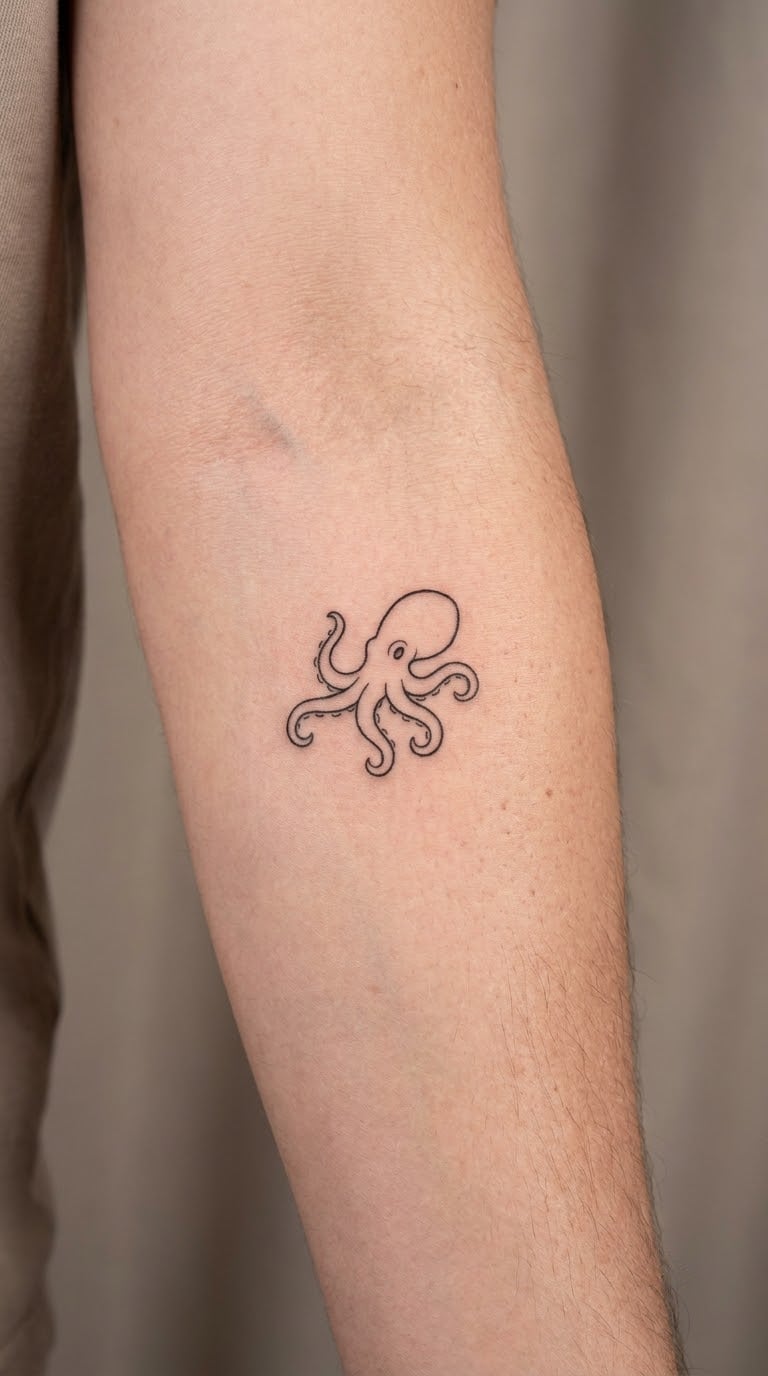
One arm loops out from a small domed head, drawn in a single weight of black line with nothing shaded and no background. Because there is no grey and no colour, the eye reads the curve of the tentacle first and the animal second, which is exactly why men who like marine work but not decoration keep coming back to it. The suckers can be left as a light stipple along one edge instead of drawn as circles, which keeps the line readable at small scale.
Placement: inner forearm, inner bicep or along the rib line Size: 2-3 in (5-8 cm) Style: fine line Pain: low to medium. The inner forearm has thin skin over bone and gets tender around hour two, so take a break before that point rather than pushing through. Fine line softens and spreads over the years, more here than on a shoulder.
Make it yours: run the tentacle into a compass bearing or a set of coordinates, or have the head face a date you care about.
Where to Place Octopus Tattoo Ideas for Men
Placement decides more than taste. Three things matter: the shape of the area, how much the skin moves, and how much black the design carries. A single fine tentacle works on a narrow strip like the inner forearm because there is room for a curve to run without touching an edge. A dense blackwork wrap needs a full circumference, so it belongs on a forearm that the sleeve can actually follow. Tall, flat areas such as the outer calf, the outer upper arm and the back handle circular compositions with room around all eight arms.
Movement is the other half of it. Wrists, inner arms and ankles flex all day, so fine line there blurs faster than the same design on a shoulder or chest. Heavy ink and soft, moving skin are a bad pairing if you want crisp sucker detail. If you already have a forearm band or an inner bicep piece, matching ink weight matters more than matching subject. Our forearm band tattoo ideas for men gallery covers the shapes that pair well with a wrap-style octopus.
2. Traditional Red Octopus
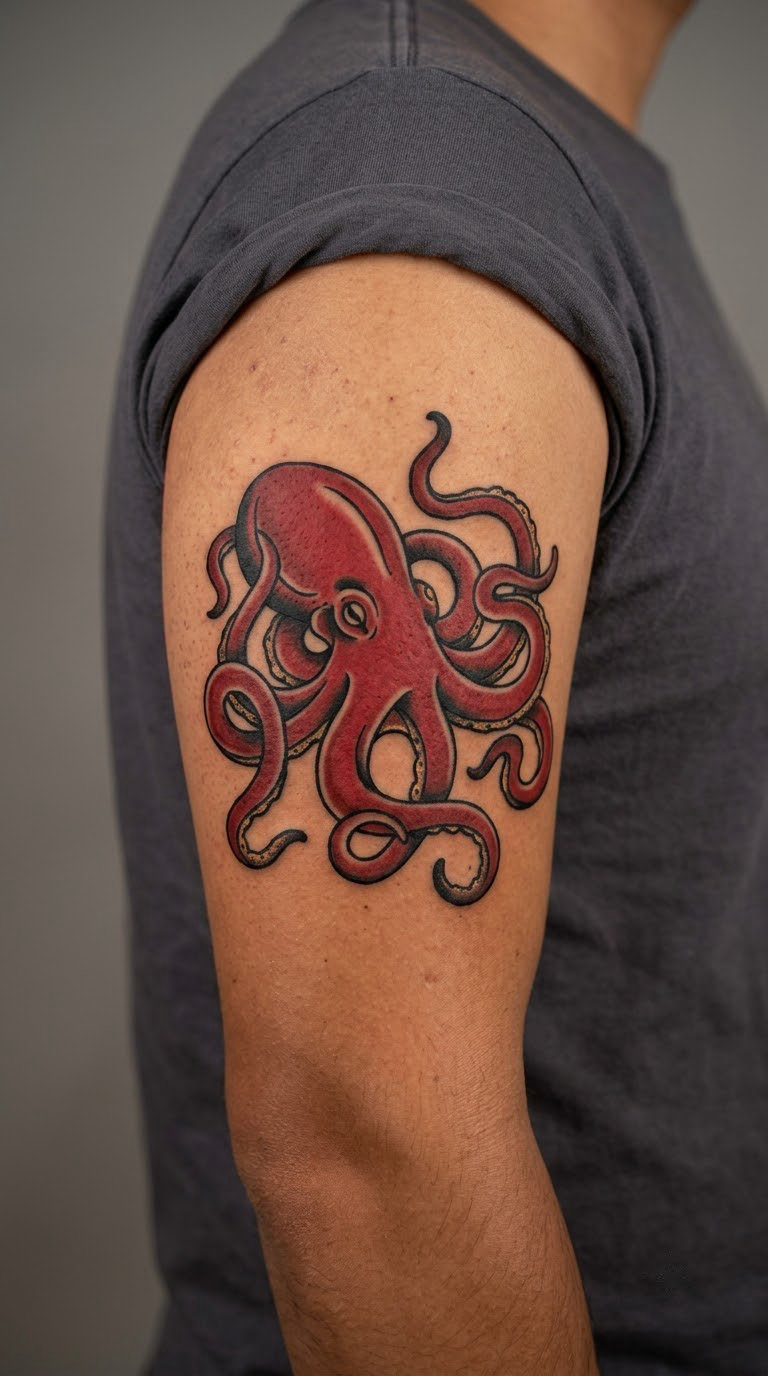
Flat red fill, thick black contour lines, a rounded mantle and arms that curl in clear separated shapes rather than merging. Old school traditional work relies on bold, readable forms, and an octopus suits it because the silhouette is dramatic without needing realism. There is no gradient anywhere, which also means it holds its shape when a shoulder flexes, a problem that plagues softer rendered pieces in exactly this spot.
Placement: outer upper arm, shoulder or upper back Size: 4-5 in (10-13 cm) Style: old school traditional Pain: medium. Broad red fills take more passes than line work, so budget time for a break partway through.
Make it yours: switch the red for a deep sea green or keep a single yellow sucker accent to break up the field.
3. Blackwork Octopus Around the Arm
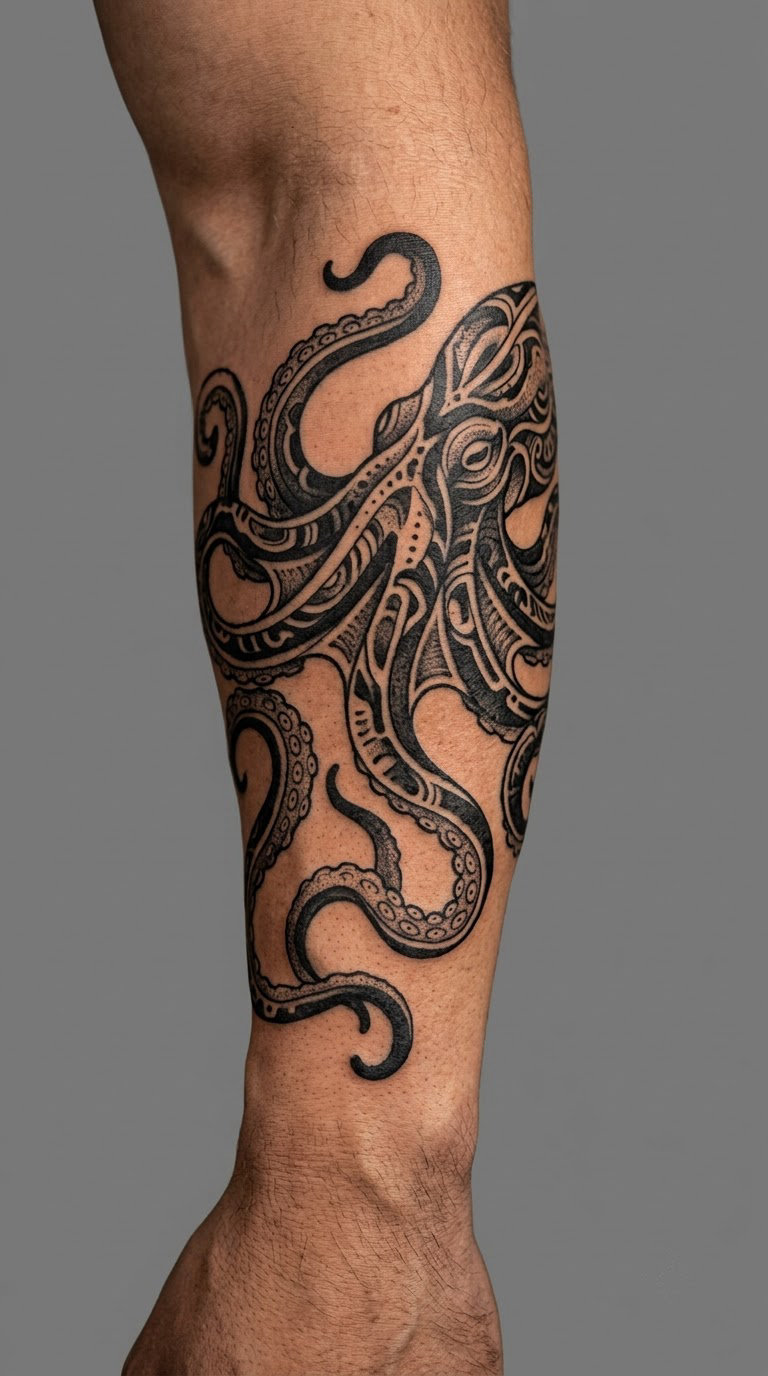
Solid black shapes with arms of different widths and curls of untouched skin left as negative space inside them. Because the design has no grey scale at all, contrast does the work, and a bold wrap reads clearly from across a room. This is a good option for a man adding to an existing blackwork arm rather than starting from nothing, since the ink density already matches. Ask the artist to let two or three arms disappear under the arm and reappear, which stops the piece looking pasted on.
Placement: forearm wrapping to the elbow, or the upper arm Size: 5-7 in (13-18 cm) Style: blackwork Pain: medium. Long stretches over the elbow crease and the wrist pull the skin tight and are the roughest part.
Make it yours: carry a wave line or a rope motif from an existing piece into the negative space so the two read as one arm.
4. Japanese Octopus and Wave Design
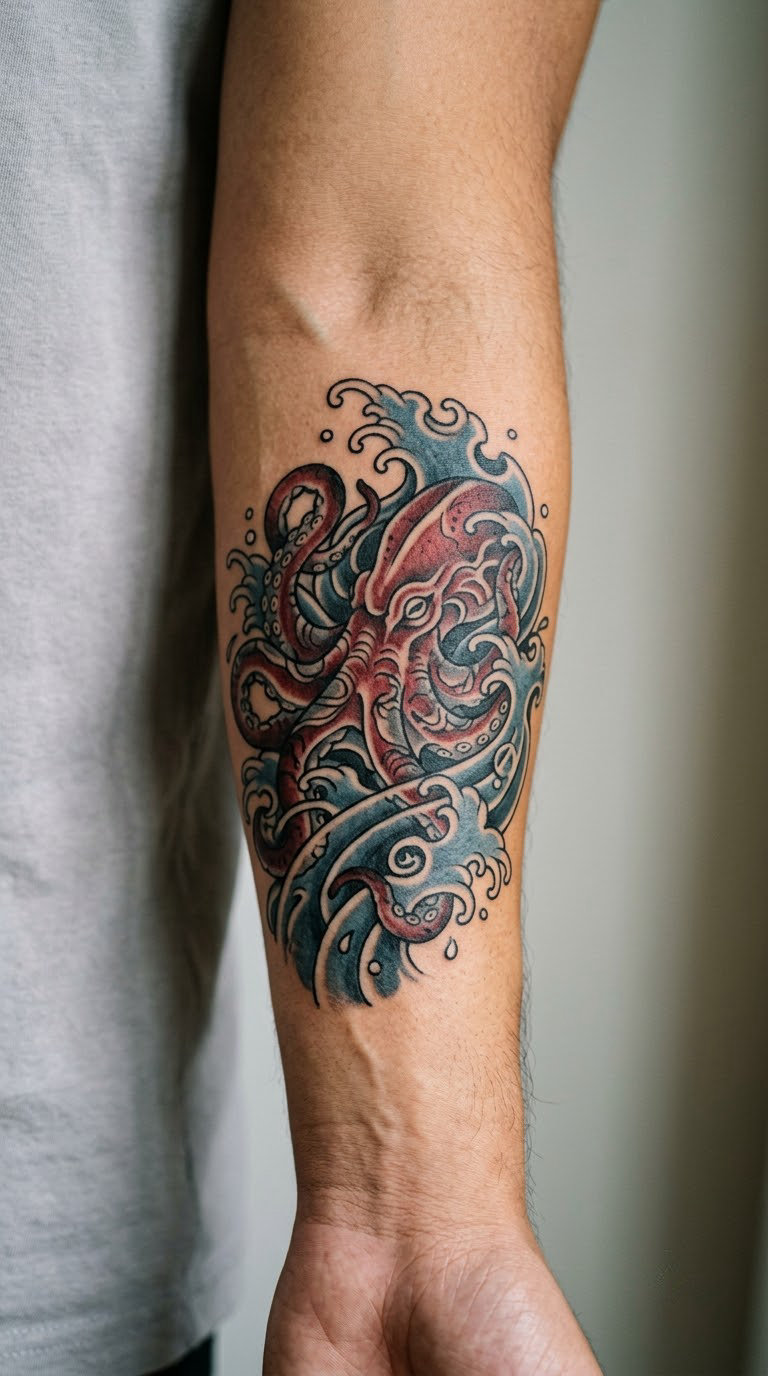
Red and grey octopus rendered with a hand-style eye and curling arms, framed by stylised blue-grey waves and a circular border. Irezumi compositions rely on flow and on the relationship between the animal and the water around it, so the wave is not decoration, it is the frame that makes the octopus move. This is a single-piece version of the style rather than a full sleeve, which is the practical choice if you are not ready to commit a whole arm.
Placement: outer forearm, upper arm or calf Size: 5-7 in (13-18 cm) Style: Irezumi-inspired Pain: medium to medium-high, since the wave shading needs several passes.
Make it yours: add a small rising sun or a wave crest in the style you already like. If you are working in Japanese conventions, look for an artist who works in that tradition and be clear about what you want rather than asking for a generic version.
5. Octopus with an Anchor
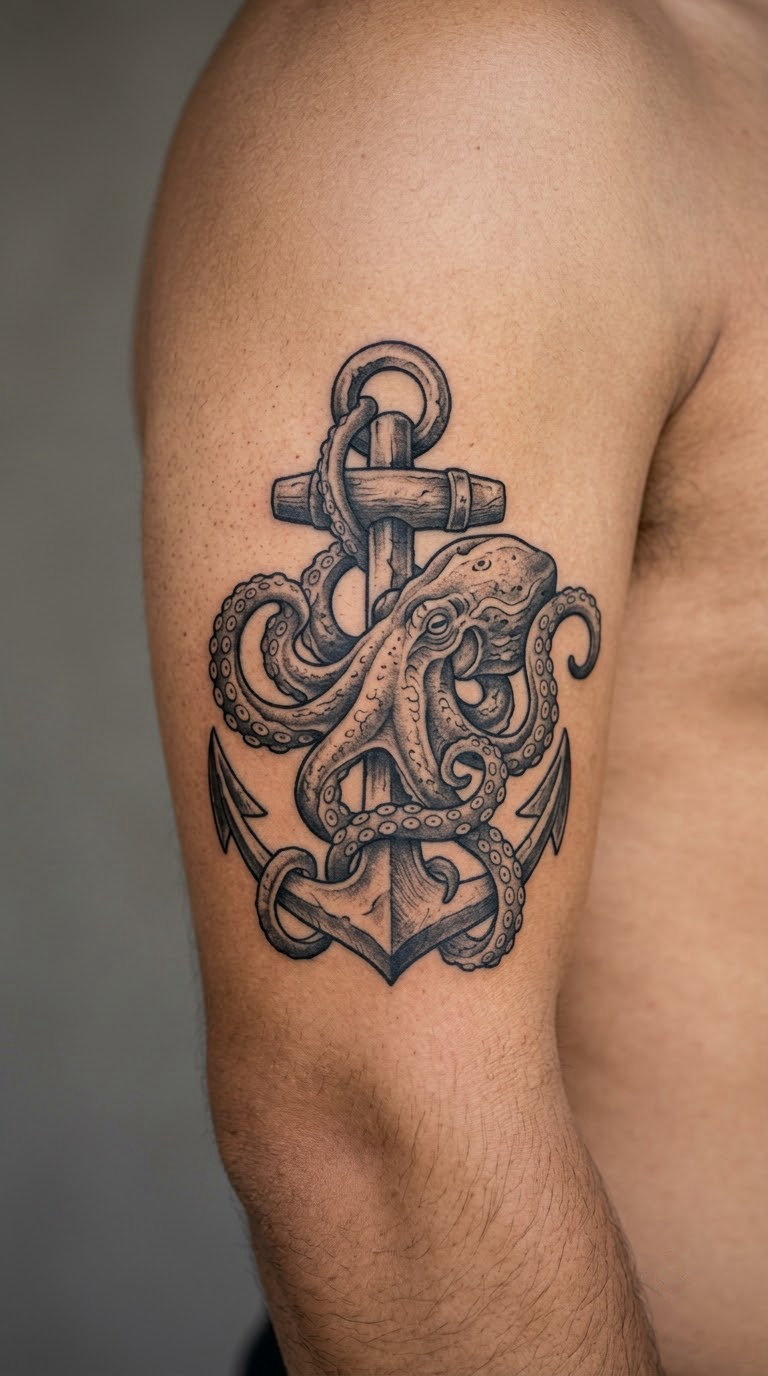
A black and grey octopus coiled through the shank and flukes of a classic anchor, with the tentacles crossing in front of the metal to build depth. The overlap is what sells it: where an arm passes in front of the anchor the line gets heavier and the shadow underneath deepens, so the two objects feel tangled rather than stacked. Realism here is doing a lot of work, so give the artist proper reference photographs rather than a single flat drawing.
Placement: outer bicep, outer forearm, chest Size: 4-6 in (10-15 cm) Style: black and grey realism Pain: medium. The chest side of the bicep is sensitive, so expect to need a pause.
Make it yours: engrave a real coordinate or a home port on the anchor’s stock.
6. Kraken Tentacle Sleeve
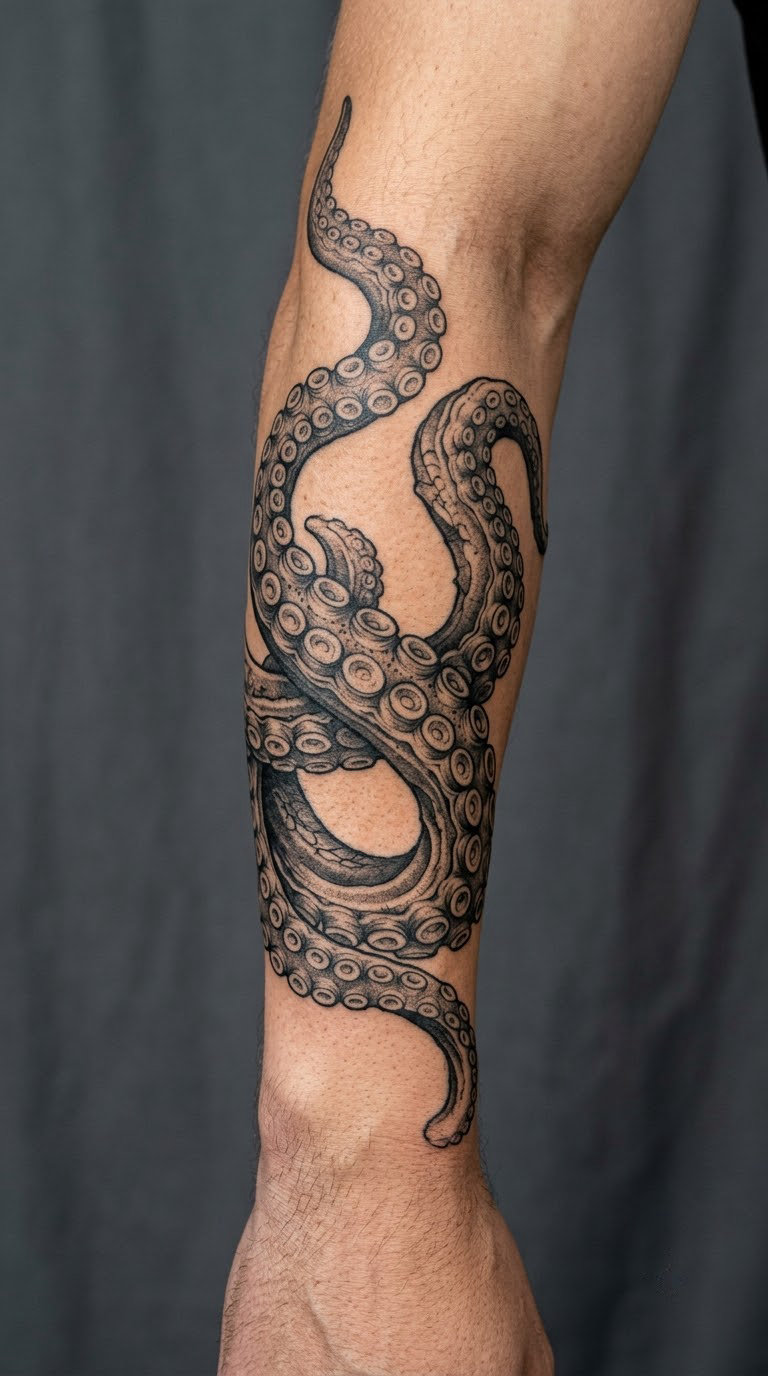
Two or three enormous tentacles rather than a whole animal, each one running the length of the arm with visible suckers and grey shading that fades toward the tips. Building a sleeve from a single limb rather than a full octopus gives the composition movement, because the tentacles can follow the forearm’s curve and disappear behind it. Tapered tips work better than blunt ones, and leaving the wrist partly open means you are not committing to a piece that ends in a hard band.
Placement: forearm from wrist to elbow, or a quarter sleeve Size: 10-14 in (25-35 cm) Style: realistic black and grey Pain: medium to high, and it is a long session. Plan on two to three sittings rather than one.
Make it yours: follow the sleeve later with a second, smaller octopus in black ink so the two read as a pair.
7. Geometric Octopus
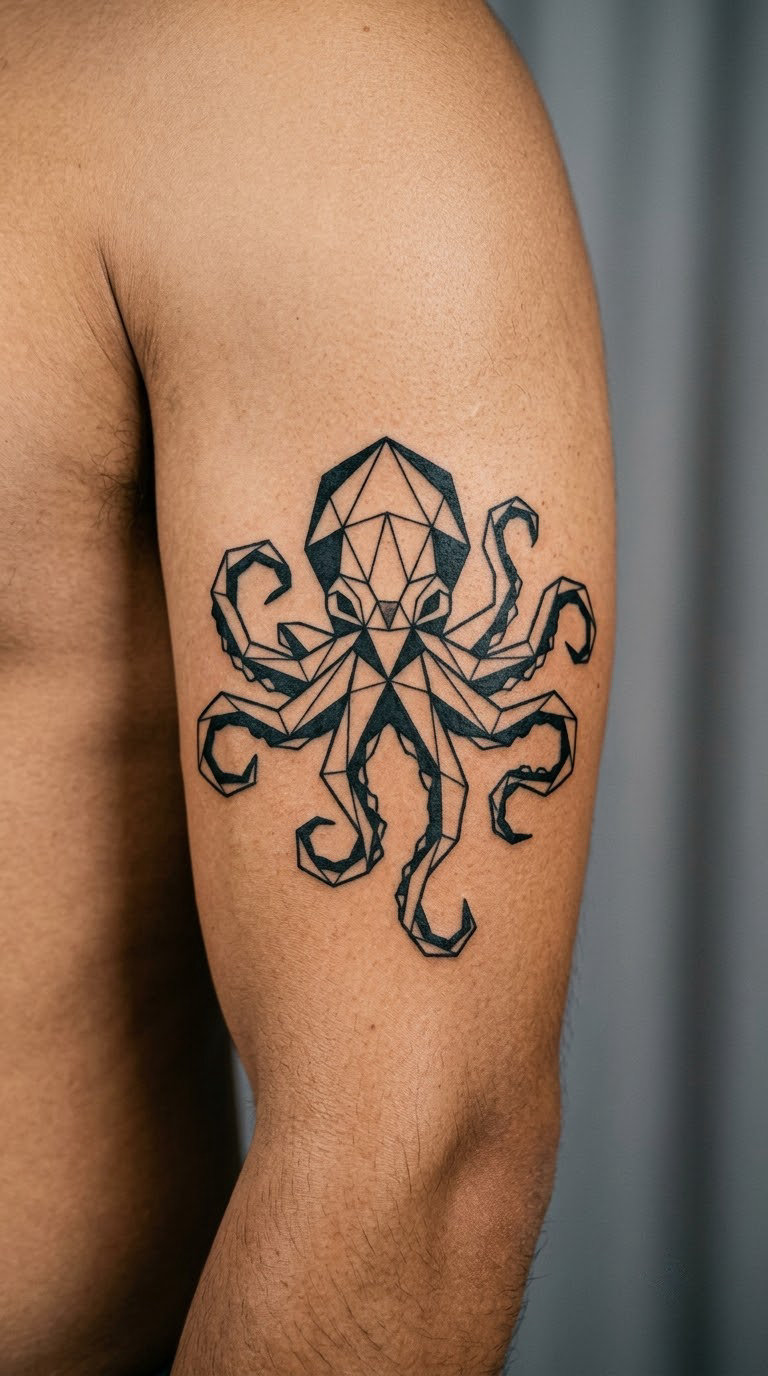
The mantle and arms built entirely from triangles, hexagons and straight segments, with the gaps between shapes doing the shading. Geometric work and organic anatomy pull in opposite directions, and the design only works when the artist keeps the sucker rows as small repeated circles within the angular frame. A pure polygon version can read as a pattern rather than an animal, so ask for one recognisable head and eye in the composition.
Placement: upper arm, outer forearm, thigh Size: 3-5 in (8-13 cm) Style: geometric blackwork Pain: medium. Filling larger polygons means repeated passes over the same area.
Make it yours: use sacred geometry proportions, or fill the polygons with a repeating pattern that matches another piece you own.
8. Small Octopus Behind the Ear
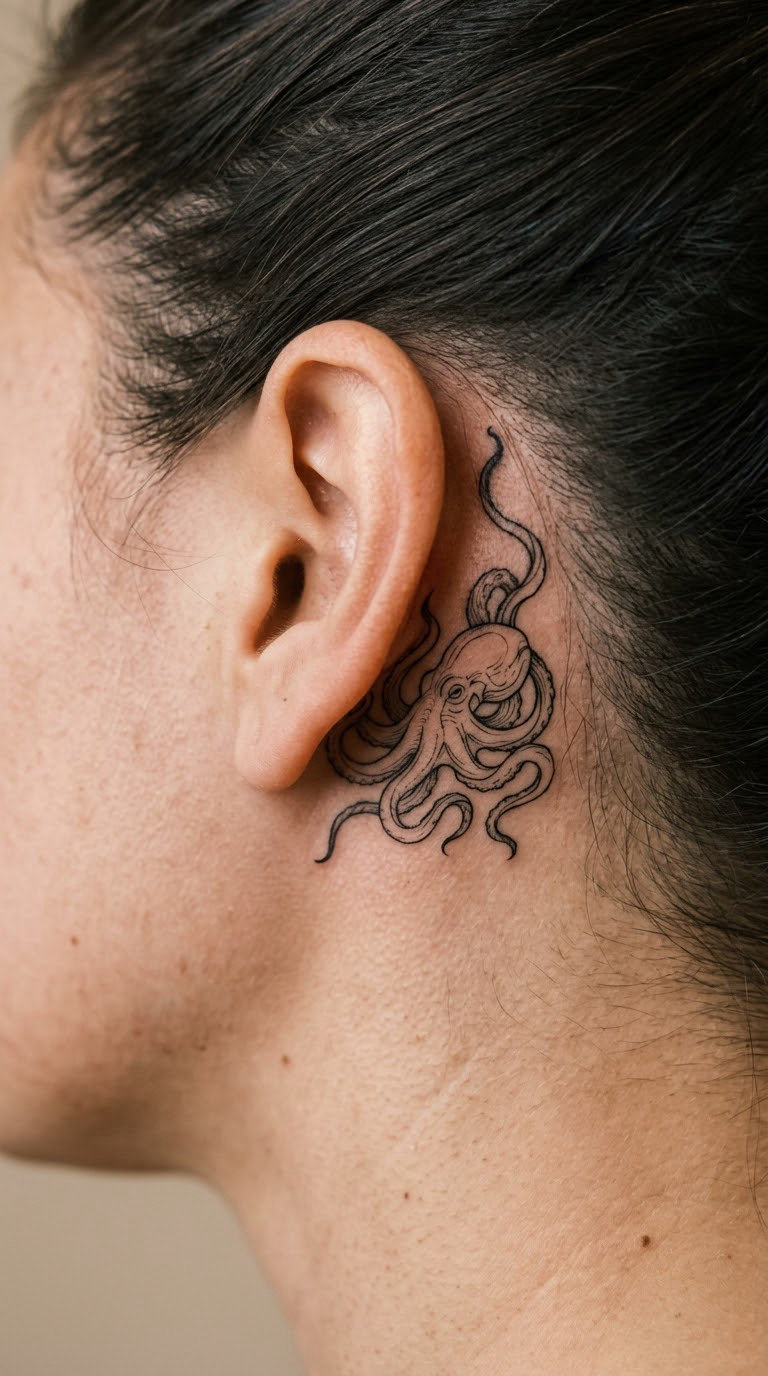
A compact head with one or two arms trailing down toward the neck, tucked behind the ear so it appears when your hair moves. It is discreet in a way most sleeve work is not, which makes it popular with men who want a marine piece without announcing it at a wedding. Behind-ear placements are also among the most awkward to tattoo, since the artist works on a curve with skin that moves constantly and almost no flat reference surface.
Placement: behind the ear, along the hairline, or on the upper neck Size: 1.5-2.5 in (4-6 cm) Style: micro fine line Pain: medium. The area is thin and sore and fiddly at once. Tiny detail blurs noticeably over the years at this scale, so keep it to line and a single eye rather than full sucker detail.
Make it yours: put the number of arms you had when you got it, and let one arm disappear behind the earlobe.
9. Octopus and Ship Helm
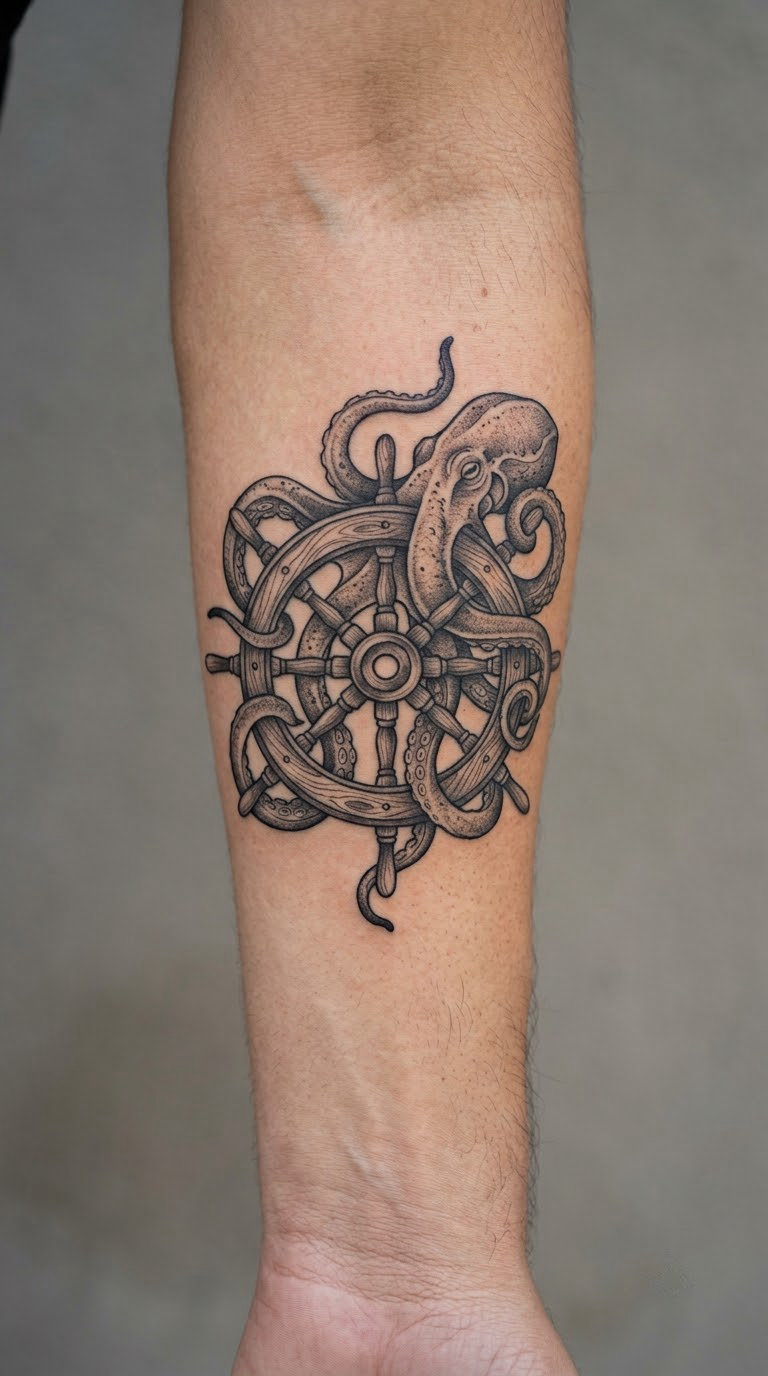
An octopus wound through the spokes and handles of a traditional ship wheel, drawn in black and grey with the wood suggested by stipple rather than colour. Helm designs are symmetrical and detailed, so the composition gets crowded fast, and the fix is to keep the wheel crisp and let the arms be simpler shapes. Men drawn to sailing, dive crews or old maritime imagery tend to land here because it is a specific reference rather than a generic sea monster.
Placement: outer forearm, upper back, calf Size: 5-6 in (13-15 cm) Style: black and grey realism Pain: medium. Eight spokes plus a full animal is a long sitting.
Make it yours: have the wheel carry a real vessel’s name, or add a small wave line beneath it to close the composition.
10. Celtic Octopus
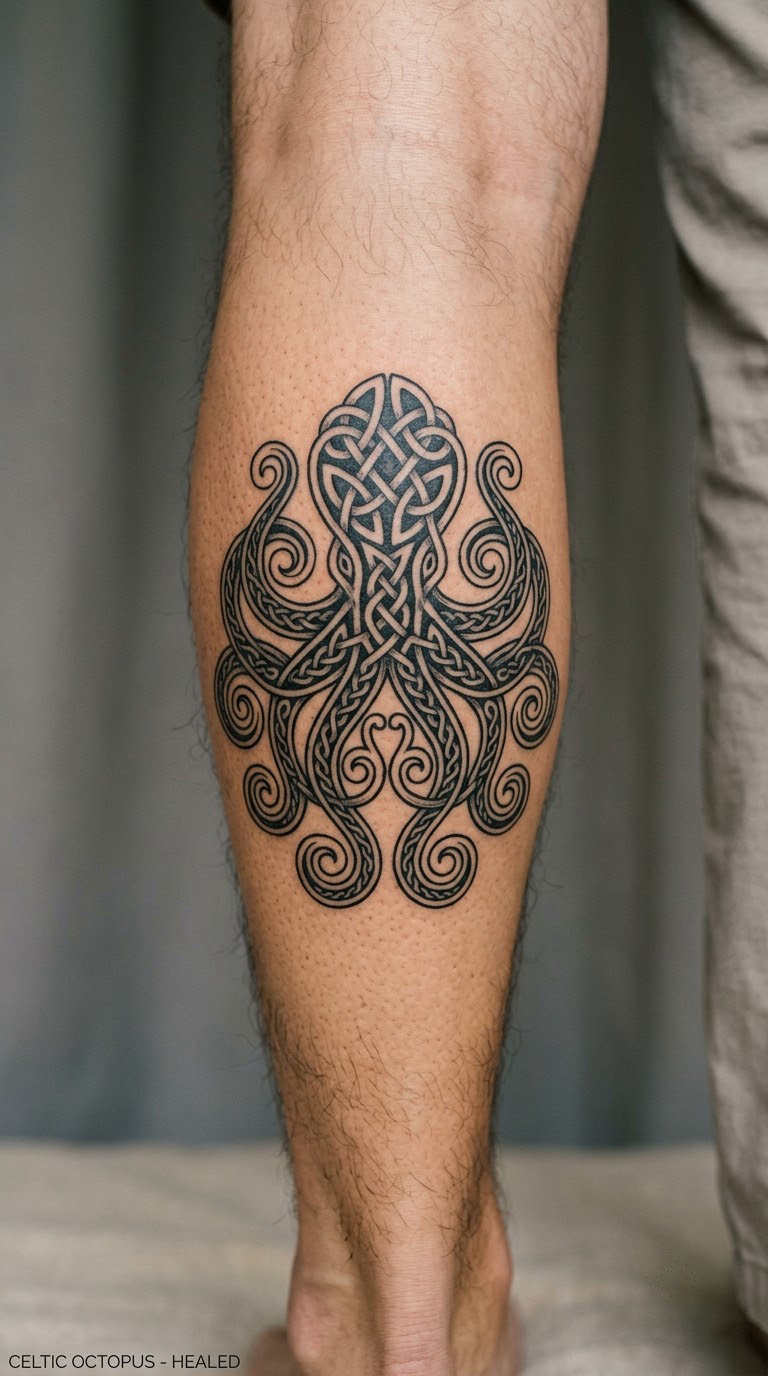
An octopus drawn as interlaced knotwork, the arms looping over and under each other in controlled ornamental linework with the mantle filled by a woven pattern. Knot density is the whole game: too many crossings and the animal turns into a texture block that is hard to read at arm’s length, too few and it loses the Celtic character. Your artist’s job is to decide that ratio for the space, and it is worth agreeing it at the consultation rather than after the stencil is down.
Placement: calf, upper arm, thigh Size: 4-6 in (10-15 cm) Style: Celtic knotwork Pain: medium, and consistent because you are working the same line weight the whole way.
Make it yours: choose a knot pattern from something that matters to you, or repeat a three-strand braid through the arms only.
11. Realistic Blue-Ring Octopus
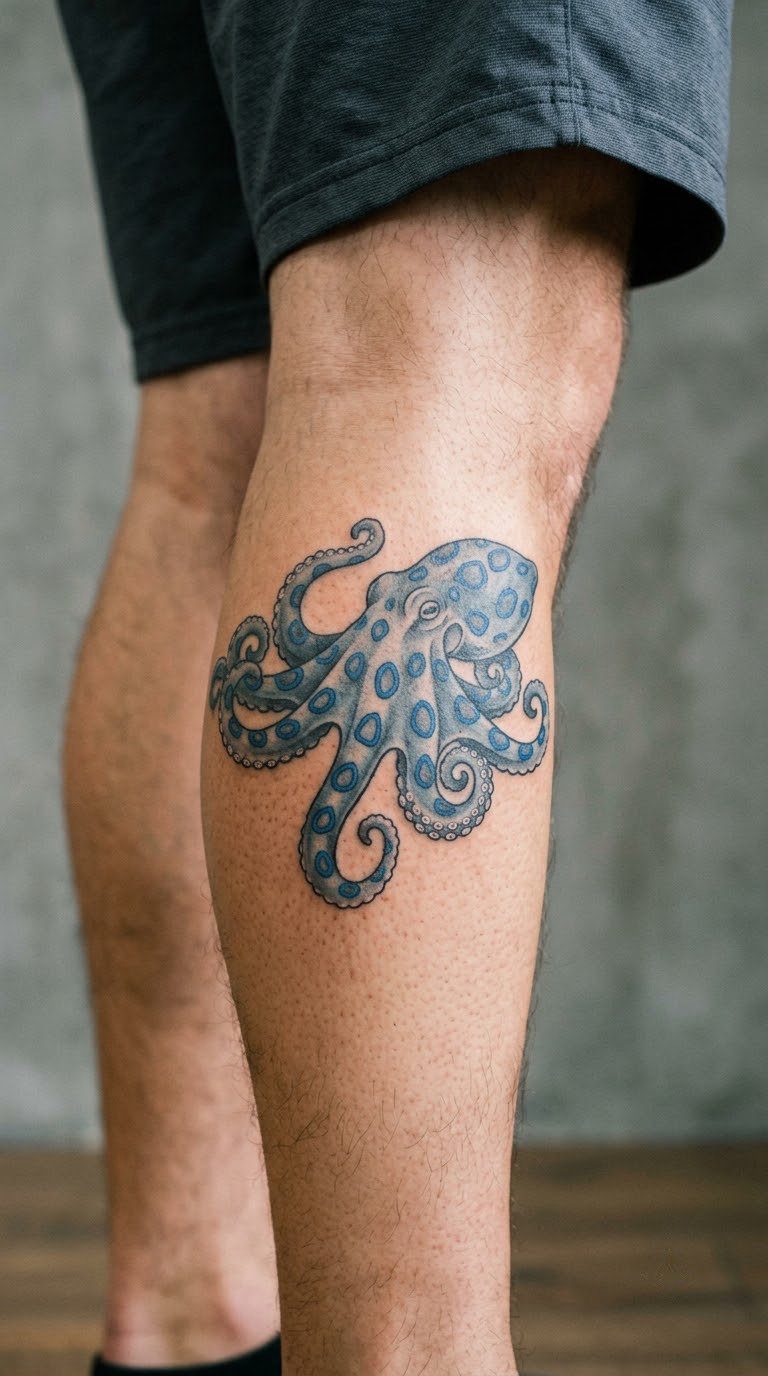
A small realistic octopus with muted blue-grey colouring, the ring markings picked out in pale blue, and every sucker defined with a tiny shadow. It is the deadliest octopus species in the world, and the appeal of the design is that contrast: something beautiful carrying real danger. Because the animal is naturally compact, the design works at a smaller size than a realism octopus with a full mantle, which means you get real detail without needing a large flat panel.
Placement: outer calf, forearm, shoulder blade Size: 2.5-3.5 in (6-9 cm) Style: micro realism Pain: low to medium. Fine colour work is less physically hard than large black fills, just slower.
Make it yours: add a date or a small wave beneath it, and ask the artist to keep the ring markings pale so the blue does not turn grey as it ages.
12. Octopus in a Lighthouse Beam
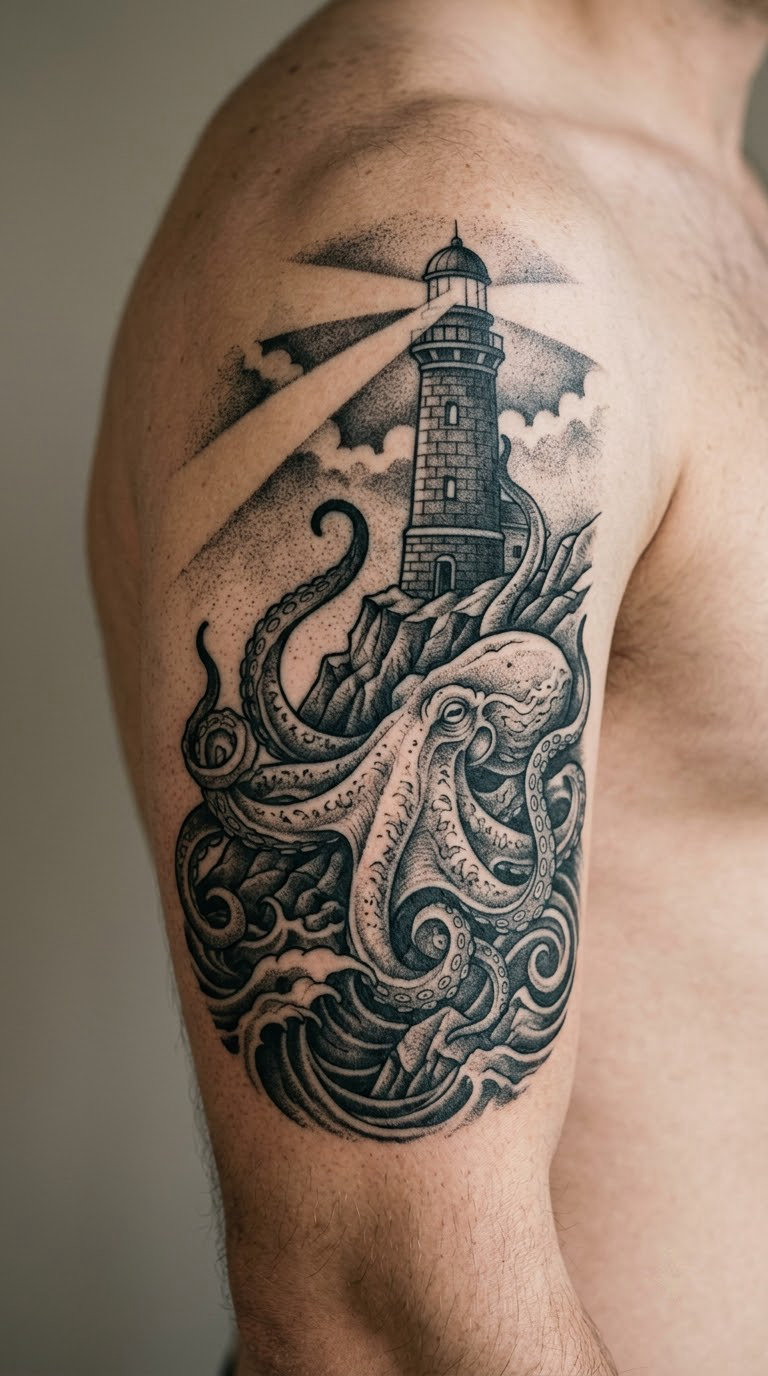
A narrative scene in grey wash: a lighthouse on one side, a sweeping beam of light cutting across, and an octopus rising out of the water beneath it. It is one of the more story-driven designs in this list, which means it needs room for both subjects, and it reads best where the skin is flat enough to hold a horizon line. Grey washes are quiet and age well, but the beam only stays visible if the artist leaves the surrounding water open and unshaded.
Placement: outer upper arm, chest, back Size: 6-8 in (15-20 cm) Style: illustrative grey wash Pain: medium. Larger grey areas are multiple long passes.
Make it yours: have the lighthouse modelled on a real one, or place a small date on the base of the tower.
13. Eight-Arm Composition
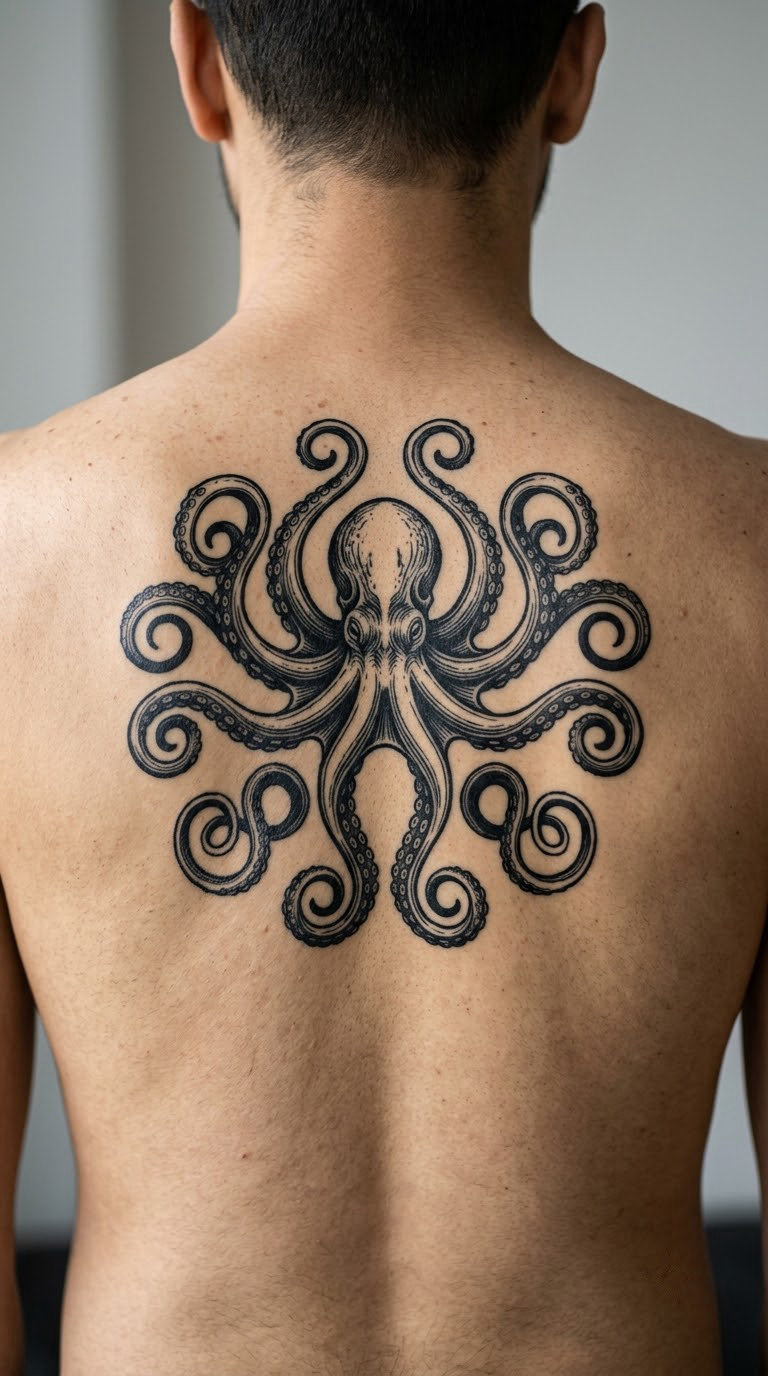
A symmetrical octopus laid out radially so all eight arms are visible at once, each one separated by a clear line of skin. This is the version that commits to the whole animal rather than a fragment of it, and it needs a broad surface: a back, a chest or a large upper arm. Spacing is the hard part, since arms that touch at any point read as a black mass within a few years. The design is usually finished in black with grey depth in the mantle, keeping the eye on the radial structure.
Placement: upper back, chest, outer thigh Size: 8-12 in (20-30 cm) Style: symmetrical blackwork Pain: medium to high, and back pieces are awkward positions to sit in for hours.
Make it yours: set the arms in a circle and put a date, a set of coordinates or a short word at the centre.
14. Dotwork Octopus
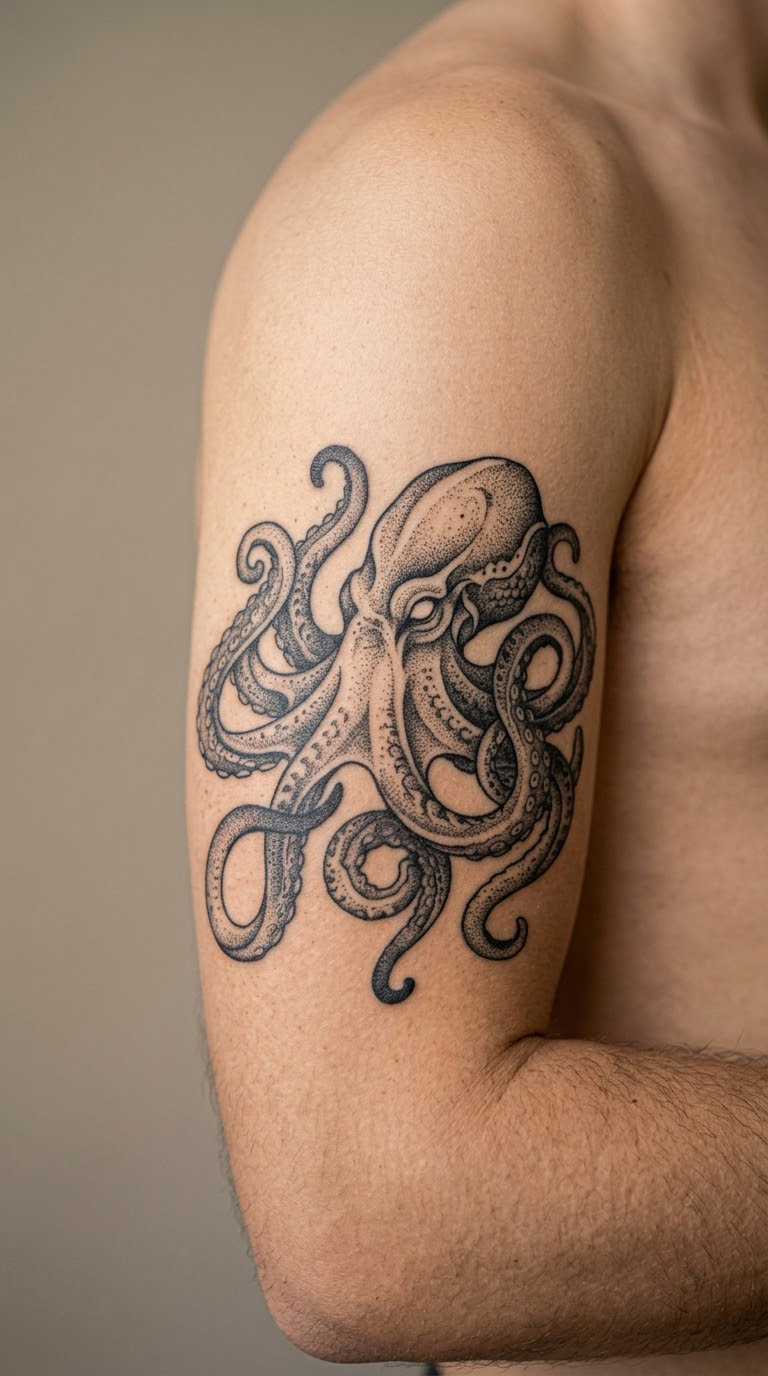
The entire octopus built from dots, with density doing the work that shading does in a normal piece. Tight clusters of dots make the mantle read as solid, sparse dots fade the arms into the skin, and the negative space between them keeps the shape from turning into a grey cloud. Dot work is slow to tattoo and slow to fade, and it is a good match for a man who likes visible craft rather than a big solid block of ink.
Placement: inner upper arm, forearm, calf, ribs Size: 3-4 in (8-10 cm) Style: dotwork Pain: medium, and it takes longer than the size suggests because every dot is a separate pass.
Make it yours: set the dot count to a number that means something, or carry a dot pattern from a healed piece so the two match.
15. Neo-Traditional Octopus Tentacles
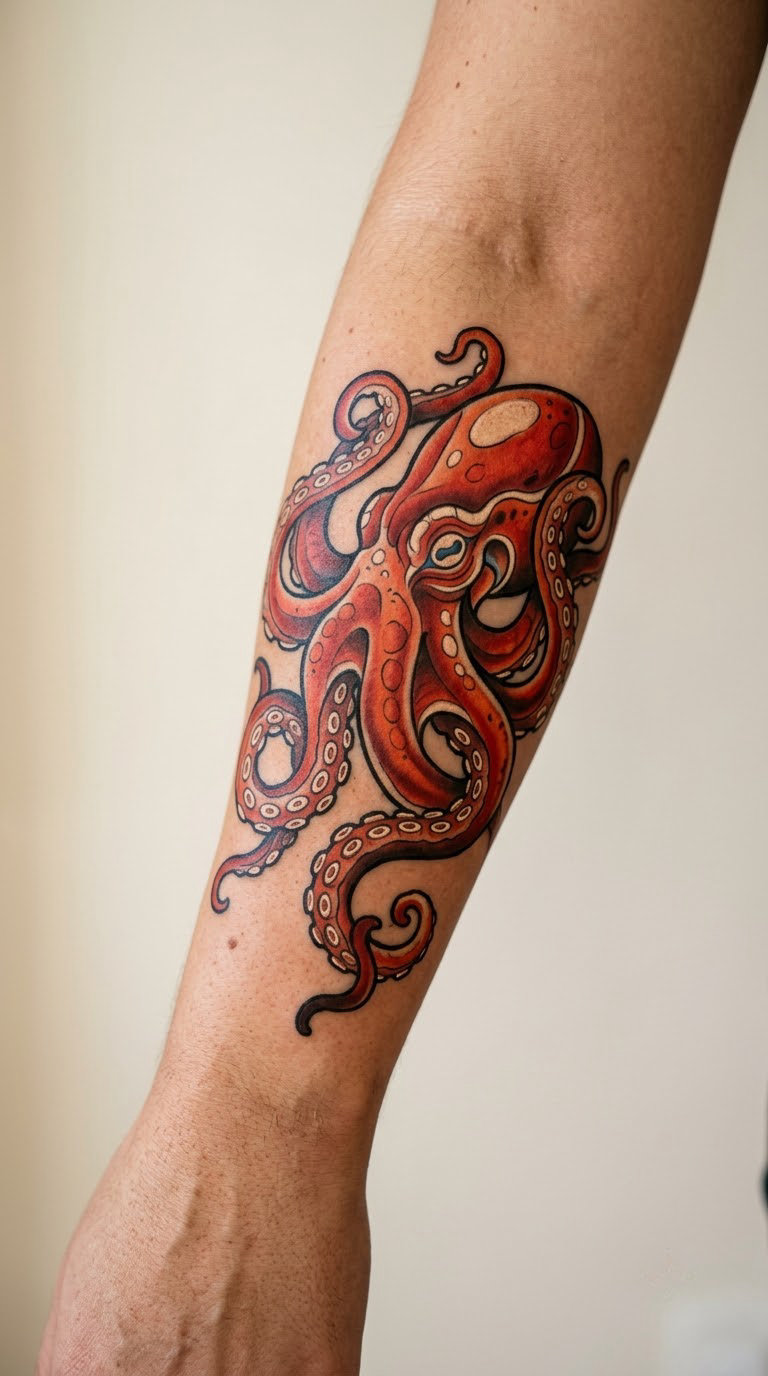
Saturated red-orange tentacles with heavy black contour lines, cream highlights and a drop shadow underneath each arm so they look like they lift off the skin. Neo-traditional work is about controlled colour packing: the artist lays in a solid base, then drops the highlights into it, and getting that second step right is what separates it from flat traditional work. On a narrower arm the arms can be arranged to fan out slightly, which keeps the colour from looking squeezed.
Placement: outer forearm, upper arm Size: 4-6 in (10-15 cm) Style: neo-traditional Pain: medium. Saturated colour means more passes, so a long sitting.
Make it yours: bring three or four reference images of the intensity you want. A first-time client saying “make it colourful” gives the artist very little to work with.
16. Octopus and Compass Rose
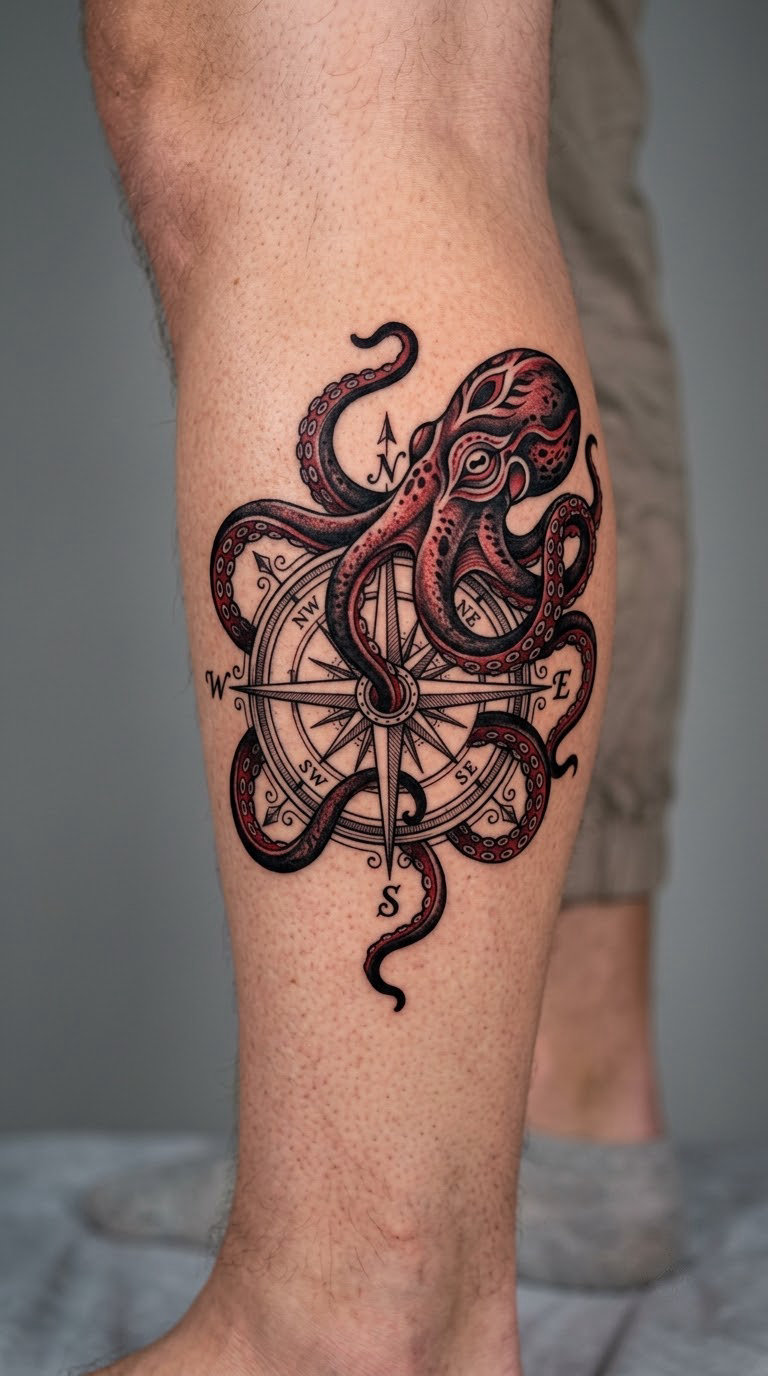
An octopus coiled around a compass rose, drawn with heavy black line and one restrained red accent in the mantle. A compass rose is a dense geometric object with lettering and tick marks, so the design depends on line hierarchy: the rose gets the crispest, heaviest line, and the arms get softer edges. Without that separation the two halves fight and the piece looks cluttered from more than a foot away.
Placement: outer calf, forearm, upper arm Size: 4-6 in (10-15 cm) Style: black and red realism Pain: medium. Small lettering and tick marks are fiddly rather than painful.
Make it yours: have the compass point at a real bearing, or use a coordinate you have never told anyone.
17. Watercolour Octopus
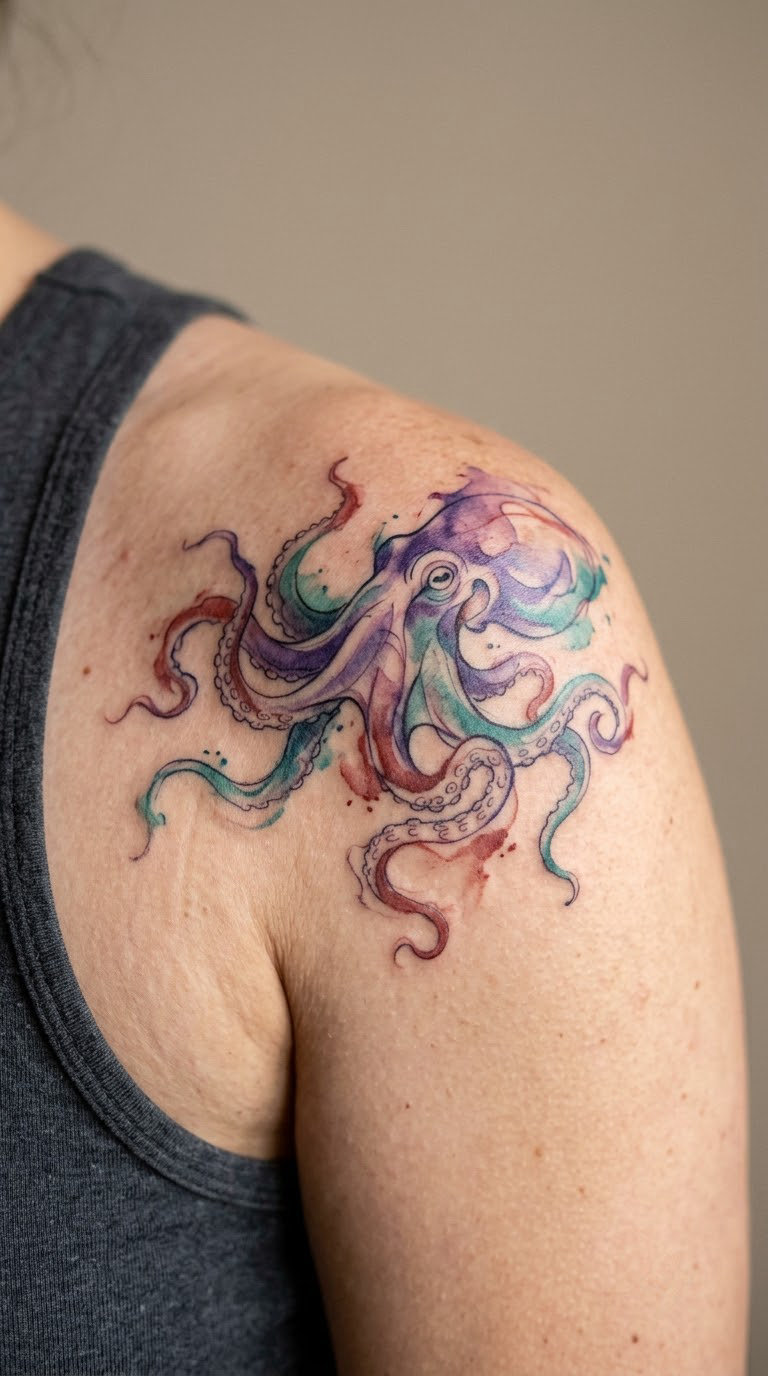
Loose translucent washes in purple, teal, blue and muted red, with soft bleeding edges and no black outline anywhere. The form is held together by negative space rather than contour, so the artist leaves the body of the octopus mostly clear and lets colour gather around it. It suits men who want a colourful piece without the visual weight of a traditional one, and the shoulder gives a broad enough surface for the washes to breathe without a hard border.
Placement: shoulder, upper back, thigh Size: 3-5 in (8-13 cm) Style: watercolour Pain: low to medium, since most of the work is light passes.
Make it yours: choose a palette from somewhere that matters to you, or add a single splatter that reads as spilled ink behind the arms.
18. One-Line Octopus
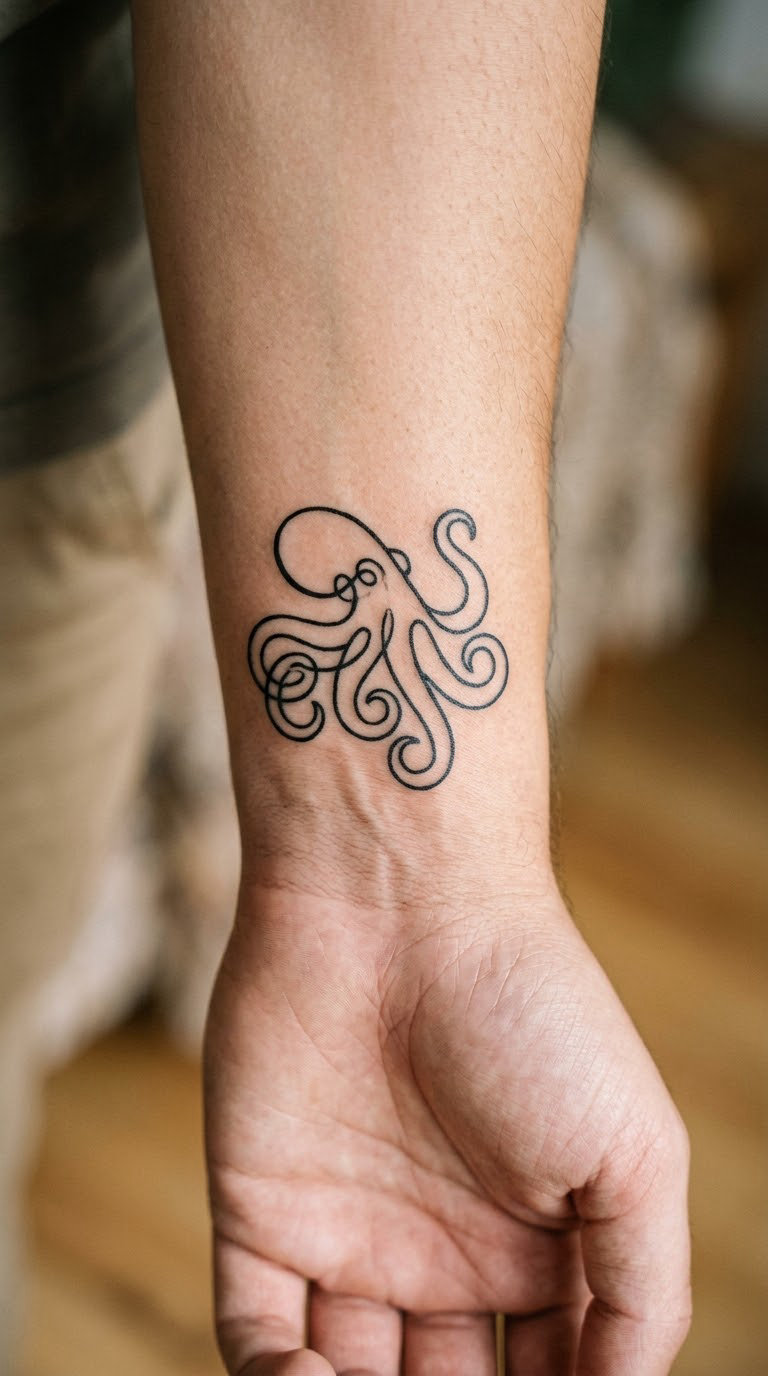
The whole animal drawn with one continuous black stroke that never lifts from the skin, loops forming the mantle and the arms, no shading and no second line. The skill is in loop spacing: the loops have to stay far enough apart to read as separate arms rather than a tangle. Worn on the inside of the wrist it follows the crease when you turn your hand, and the effect changes with every movement, which is most of the appeal.
Placement: inner wrist, inner forearm, behind the ear Size: 2-3 in (5-8 cm) Style: single line Pain: medium. Wrists are bony and tender, and you will feel this one for several hours. Single thin lines on hands and fingers blur fastest of any placement, so keep it off the fingers if you want it crisp in ten years.
Make it yours: end the line with a small loop that forms a letter, or have the whole octopus trace the outline of a personal shape.
19. Octopus and Astronomical Chart
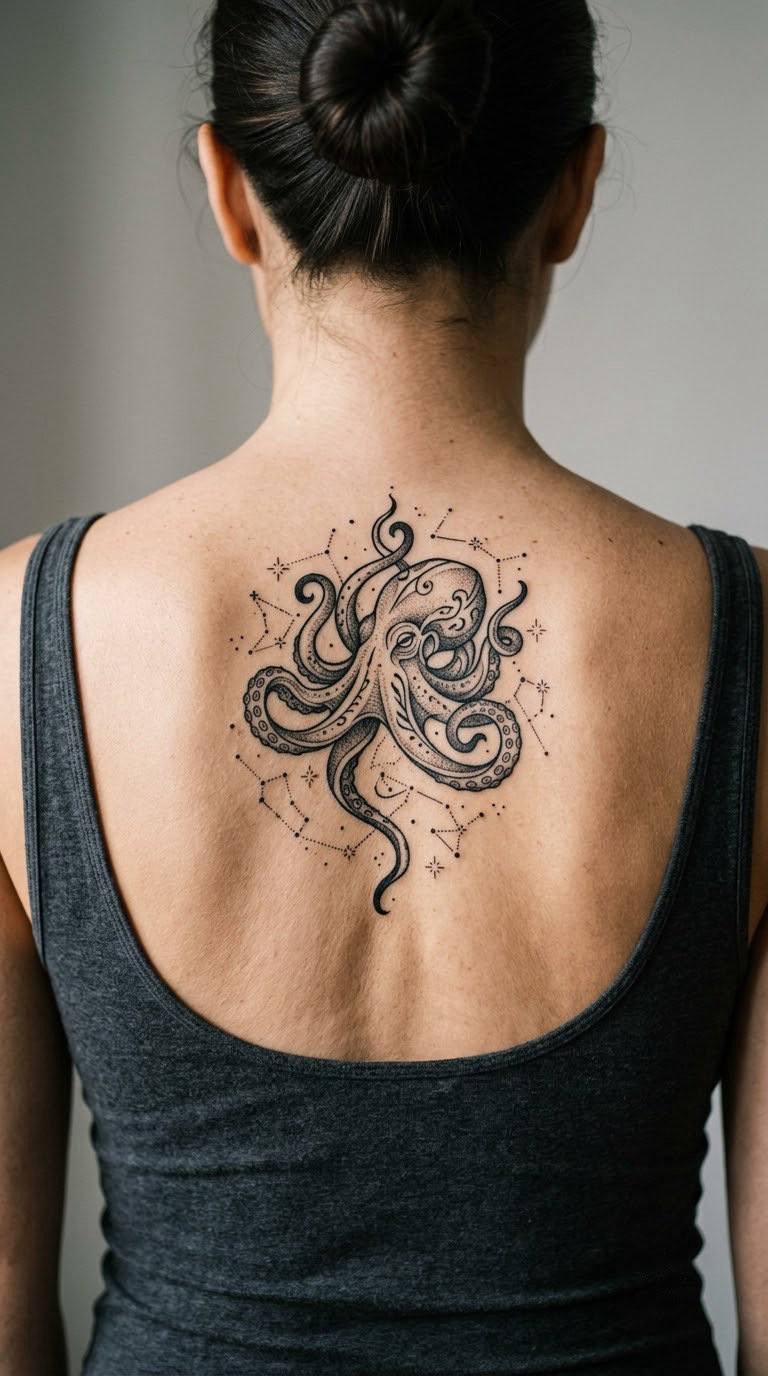
A blackwork octopus tangled through constellation lines and star points, the way an antique celestial chart looks. Both elements are dense, which is the difficulty: the artist has to separate them with different line weights, leaving the constellations as thin connected dots and the arms as heavy black shapes, so each still reads. The combination works for men who are into space and sea at once, and the back gives the chart enough surface to look like a chart rather than a symbol.
Placement: upper back, shoulder, forearm Size: 5-7 in (13-18 cm) Style: blackwork illustration Pain: medium. Many small marks rather than a few large fills.
Make it yours: use a real constellation set from your birth date, or add a zodiac mark in one corner of the design.
20. Full Octopus Sleeve
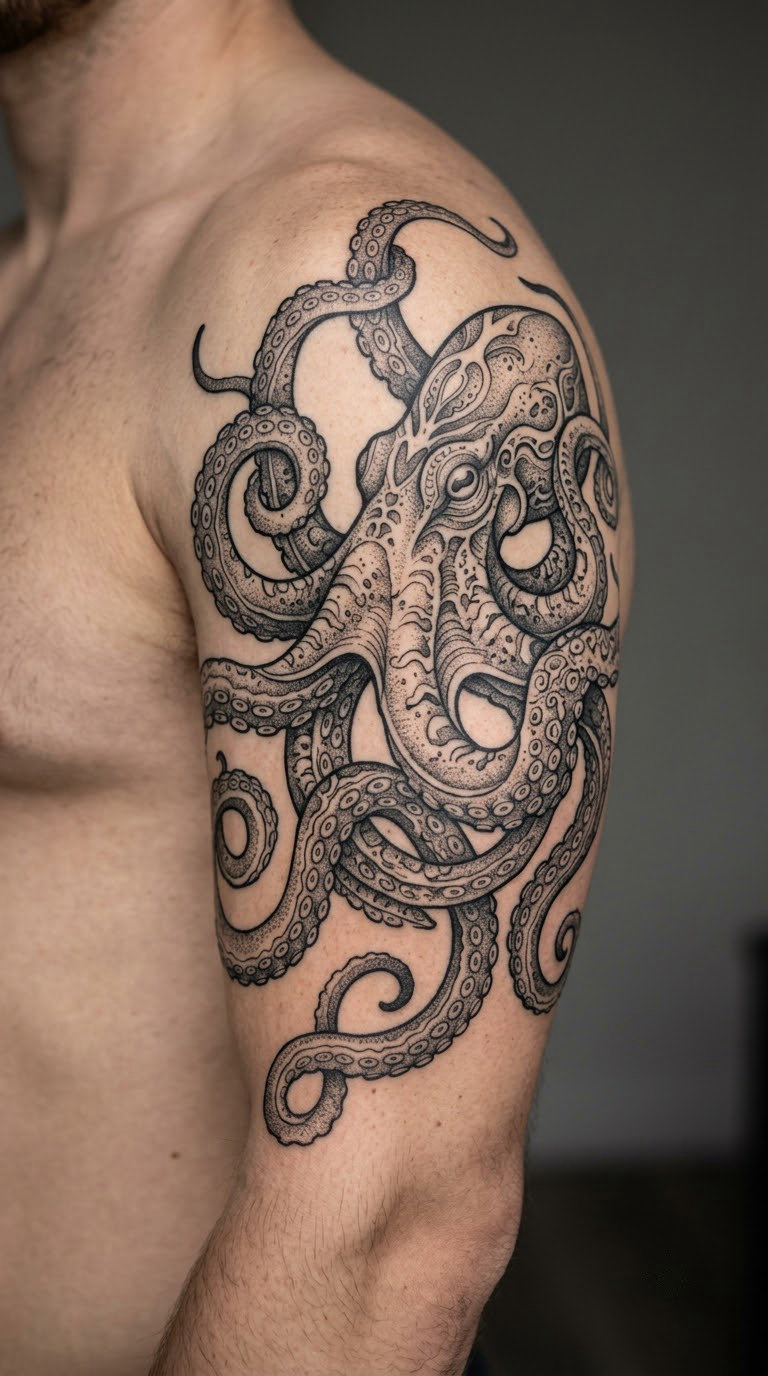
A complete octopus sleeve: one head centred on the upper arm with arms wrapping, crossing and reappearing through blackwork, grey stippling and a small amount of colour. This is the most ambitious option here and the one that most rewards a good arm shape, because the composition can be built around the biceps and forearm rather than forced onto them. Talk through the arm’s real proportions at the consultation and expect two to four sessions over several months, with a healing break between each.
Placement: full arm, shoulder to wrist Size: 18-24 in (45-60 cm) Style: full sleeve blackwork Pain: high over a full session, though the pain is more cumulative than sharp. Sitting through a first long session is the part people underestimate, not the needle.
Make it yours: build the design around one existing piece on the same arm, or leave a band of open skin at the wrist so the sleeve can grow later.
How to Choose the Right Design
Five questions narrow twenty options down to one.
- Match the style to the artist. Look for healed work in the style you want. A studio with beautiful fine line and no blackwork portfolio is a poor home for a blackwork arm wrap, however good the shop looks.
- Count the ink you already carry. Bold colour next to thin line work looks like two different people. Grey and black shading blends into almost anything, which is why realism and blackwork are easy additions to an existing arm.
- Pick the placement before the drawing. A narrow forearm suits a wrap or single tentacle. A broad back or chest handles a full eight-arm composition. A finger or wrist takes almost no detail.
- Scale detail to the size honestly. Sucker rows, thin tentacle tips and small star points blur first. Below two inches, cut the detail or plan on a touch-up in five years.
- Go bolder for a first arm piece, simpler for hands and neck. A bolder design holds up over decades. On fingers, hands or the neck, use a shape that survives constant movement.
If you want more arm-specific options while you decide, the inner bicep tattoo ideas for men roundup covers placements that work well next to a fine-line tentacle. If what you are picturing is a narrow band running around the arm instead, the wrist band tattoo ideas for minimalist looks gallery sits closer to the restrained end of this list.
Cost and Session Time
Octopus work is priced by size, detail and colour rather than by the animal, and the range is wide. As a rough US guide, micro pieces under two inches sit in the 100-250 USD range, small pieces around three to four inches run 300-700 USD, a medium five to eight inch piece lands between 700 and 1,500 USD, and a full sleeve or large back piece starts around 2,500 USD and climbs with the session count. Many shops work on an hourly rate rather than a fixed piece price, so a design quoted at 900 USD can move if the artist needs an extra sitting. Most studios also have a shop minimum, commonly a couple of hundred dollars, which is why one small tattoo and a small tattoo plus a full wrist band can cost the same.
Time is the more useful number for planning. A small fine-line piece is usually a single session of one to two hours. A five-inch black and grey design is two to four hours. A full octopus sleeve is commonly split across two to four sessions, because a large piece tattooed in one sitting on a shoulder or back tends to need a break before quality drops. Ask your artist for their estimated hours and session plan in writing at the consultation rather than after the stencil is already on your arm.
Aftercare Basics
- Follow your artist’s aftercare instructions first. Every studio’s advice is specific to your skin, your placement and the ink they used, so start there rather than with anything you have read online.
- Wash it gently. Clean water and whatever cleanser your artist recommends, washed off with clean hands. A mild unscented option is usually the safest if you have sensitive skin.
- Cover it when you need to, then leave it alone. A loose covering helps with clothing, pets and sun for the first while, but leaving a plastic wrap on for hours encourages irritation. Follow your artist’s timings.
- Protect it from sun and friction. Fresh tattoos fade fastest in their first months, so sunscreen on exposed placements and loose sleeves on a healing forearm are worth the small effort.
- Contact the studio with any care or healing question. If something looks unusual to you, a message or a phone call to the artist who did the work is the right first move, not a forum thread or a guess.
One honest note on ageing, because almost every gallery shows fresh work. Thin fine line and small sucker detail spread and soften over the years, and loose colour washes fade faster than anything else here. Ask your artist for healed photos of their own octopus work, ideally pieces two years old, so you can see how their line weight holds up on skin like yours. Judge the individual artist rather than the shop, because that is the part you can actually compare before booking.
Frequently Asked Questions
Are octopus tattoos suitable for men?
Yes. The octopus is one of the most requested marine motifs for men, because it reads as intelligent and adaptable rather than decorative. You will find it in blackwork, traditional, irezumi and realistic portfolios, and the eight wrapping arms suit arm, chest and back placements that smaller animals cannot fill. Choose the weight of ink you like and let the design follow your body shape.
What is the best placement for an octopus tattoo?
The outer forearm and outer upper arm are the most versatile, because a flat surface handles both a wrapping tentacle and a full eight-arm composition. A broad back or chest suits a symmetrical radial design, the calf works for geometric and realistic work, and the inner forearm suits a small fine-line piece. Avoid fingers and hands for anything with sucker detail, since that fine work blurs quickly.
How much should an octopus tattoo cost?
Cost tracks size, detail and colour rather than the animal. Small simple pieces under two inches are usually a few hundred dollars, a medium five to eight inch design with colour and shading runs several hundred more, and a full sleeve starts in the low thousands and is normally split across two to four sessions. Hourly rates and shop minimums mean the final figure moves with the design.
Will fine-line octopus tattoos fade quickly?
They change more than flat colour work does, and it is worth planning for. Single thin lines, tentacle tips and small sucker rows spread and soften over the years, especially on fingers, hands and wrists where skin moves constantly. A slightly heavier line weight, a bolder design, or placement on a shoulder, chest or calf slows that down noticeably. Plan on a touch-up of the smallest details every few years.
How many sessions does an octopus sleeve take?
Most full octopus sleeves need two to four sessions, spread over a few months with healing time between them. A quarter or half sleeve of two or three oversized tentacles is often a single long sitting or two. Large back pieces take similar planning. Budget the healing time into your calendar too, since a second sitting booked too early gives you a sore arm and rushed work.
Should I get a realistic or illustrative octopus tattoo?
Realistic suits men who want detail, texture and a specific species, and it ages better than colour because grey shading holds. Illustrative, traditional and blackwork designs are stronger statements, easier for an artist to execute at a distance, and often better value at a large size. Judge by the artist rather than the style: a specialist in one of these is worth more than a generalist who offers everything.
Conclusion
If this is your first large tattoo, the single-tentacle fine-line octopus on the inner forearm is the least risky way in: small, quick to heal and easy to live with while you decide you want more. If you are already collecting ink, a blackwork arm wrap or a full sleeve is the version that rewards an experienced artist and a patient booking calendar.
Comparing octopus tattoo ideas for men on paper, most of the hard part is really three decisions. Placement comes first, because the canvas decides what the design can be. Then choose how much black the piece carries, since that determines how it sits next to your existing work. Detail level is last, and it should match the size honestly, because thin sucker detail is the first thing to blur. Get those three right and the consultation writes itself.