
26 Sunflower Tattoo Ideas for the Forearm: Best (October 2026)
A sunflower sits on the forearm better than almost any other flower, because the limb is long, gently curved and visible from more angles than a flat surface. These 26 sunflower tattoo ideas for the forearm are planned around that shape, with a named zone, a realistic size in inches, a pain note and one way to make the design your own. Pick a few you like, then bring them to a consultation as a starting point rather than a finished decision.
Most people choosing a forearm sunflower are trying to solve the same three things: where exactly it goes, how big it should be, and how much detail survives at that size. This guide answers all three for every design below, and I’ve kept the guidance general so you can walk into any studio and talk to the artist. Updated for 2026. If you have never been tattooed, start with idea 1, 2, 8 or 23. If you already have a forearm piece and want something with more presence, start at 22 or 26.
26 Sunflower Tattoo Ideas for the Forearm: Quick Guide
Every design in the list appears in the table below in the same order it is explained, so you can scan the placement and pain columns first and jump straight to the ones that fit your arm.
| Idea | Style | Best placement | Size | Pain |
|---|---|---|---|---|
| 1. Single fine-line sunflower | Fine line | Inner forearm, lengthwise | 2.5-3.5 in | Low to medium |
| 2. Two small sunflowers | Fine line | Inner forearm, spaced | 1.5-2 in each | Low |
| 3. Watercolour splash | Watercolour | Outer forearm | 3.5-4.5 in | Medium |
| 4. Realistic with wrapped stem | Micro-realism | Outer forearm, diagonal | 4-5 in | Medium |
| 5. Blackwork bold petals | Blackwork | Outer forearm | 3.5-4.5 in | Medium |
| 6. Sunflower and script | Realism plus script | Inner forearm | 3.5-4.5 in | Medium |
| 7. Geometric sunflower | Geometric | Outer forearm | 3.5-4.5 in | Medium |
| 8. One-bloom line art | Minimal line art | Wrist-side inner forearm | 1.5-2 in | Low |
| 9. Traditional bold outline | Traditional | Outer forearm | 2.5-3.5 in | Medium |
| 10. Neo-traditional palette | Neo-traditional | Broad outer forearm | 4.5-5.5 in | Medium to high |
| 11. Bird perched above | Illustrative realism | Outer forearm, diagonal | 3.5-4.5 in | Medium |
| 12. Sun and horizon | Minimal illustrative | Inner forearm, horizontal | 3.5-4.5 in | Medium |
| 13. Dotwork stippled centre | Dotwork | Outer forearm | 2.5-3.5 in | Medium |
| 14. Sunflower with roots | Botanical | Inner forearm, vertical | 4.5-5.5 in | Medium |
| 15. Loose wreath | Botanical colour | Outer forearm | 4.5-5.5 in across | Medium |
| 16. Black-and-grey study | Black and grey | Outer forearm | 3.5-4.5 in | Medium |
| 17. Sunflower with compass | Realism plus line detail | Inner forearm, lengthwise | 3.5-4.5 in | Medium |
| 18. Branch with two blooms | Botanical | Outer forearm, flowing | 4.5-5.5 in | Medium |
| 19. Butterfly accent | Colour realism | Outer forearm | 3.5-4.5 in | Medium |
| 20. Sunflower under a branch | Fine line with colour | Inner forearm | 2.5-3.5 in | Low to medium |
| 21. Torn paper-colour edge | Graphic colour | Outer forearm | 3.5-4.5 in | Medium |
| 22. Sunflower mandala | Mandala linework | Broad outer forearm | 5.5-6.5 in | High |
| 23. Sunflower with an initial | Realism plus script | Inner forearm | 2.5-3.5 in | Low to medium |
| 24. Sunflower behind a book | Illustrative line and colour | Outer forearm | 3.5-4.5 in | Medium |
| 25. Three sunflowers, minimal field | Minimal colour | Inner forearm, horizontal | 4.5-5.5 in | Medium |
| 26. Large colour statement piece | Detailed colour realism | Broad outer forearm | 6-7 in | High |
26 Sunflower Tattoo Ideas for the Forearm: Placement and Sizing Notes
The inner forearm is the flattest and most forgiving surface, and the skin there is thin, so small and light designs sit well on it. The outer forearm has more muscle and more curve, which gives a round bloom room to look three-dimensional. The elbow crease is mobile, stretchy and closer to bone, so designs there fade and warp faster than anywhere else on the arm.
Use your own forearm as the ruler. Lay your hand flat and measure from the wrist crease to the elbow crease, then a flower that covers roughly a quarter of that length reads as medium on you, not small. Anything past six inches starts reading as a half-sleeve, and that changes the session count, the price and how much the arm moves with the design.
If you want the meaning behind the flower before you choose, the site’s guide to What Does a Sunflower Tattoo Mean? Symbolism, Ideas & covers the common readings without pretending a single flower carries one fixed message.
1. Single Fine-Line Sunflower on the Inner Forearm
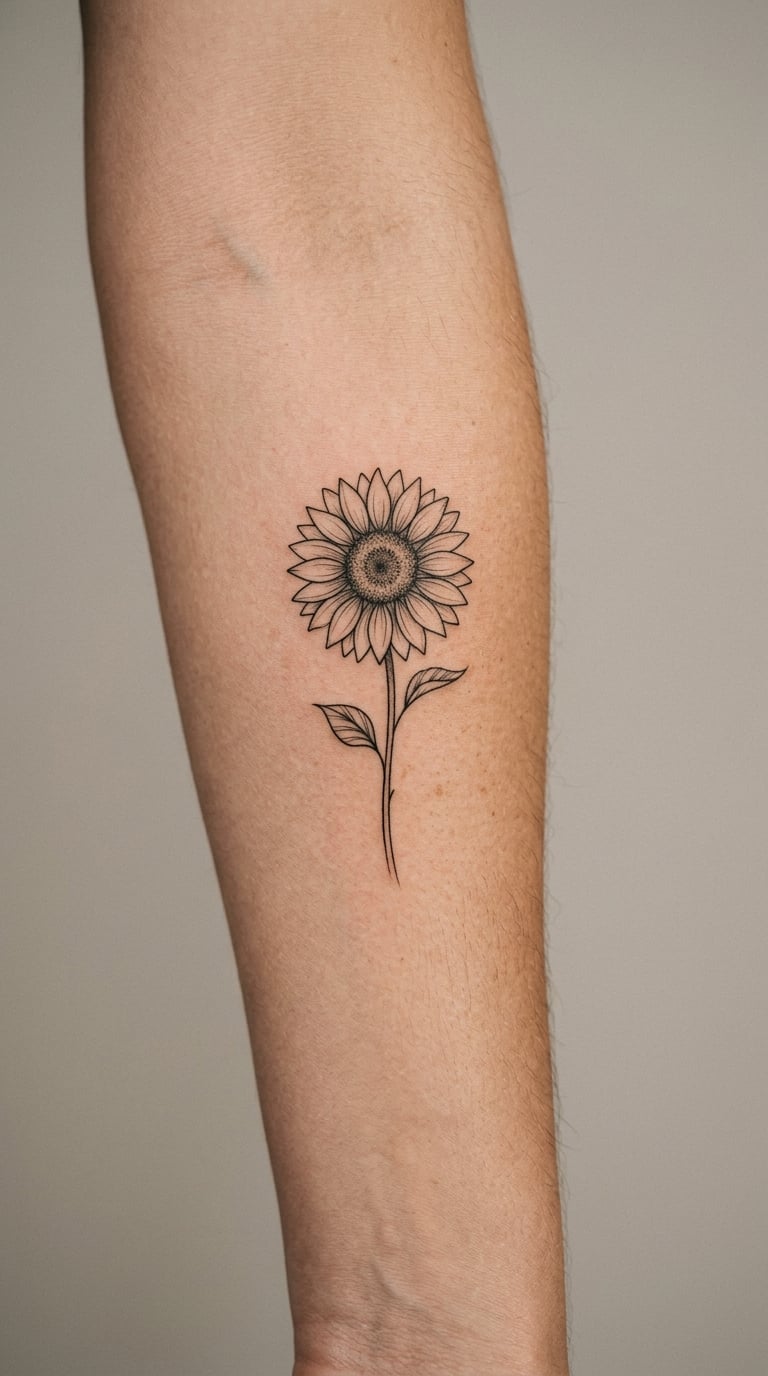
A single-stem sunflower drawn in one thin line, with petals suggested by light inner contour lines and a lightly stippled seed head. No shading, no colour, no background elements, just the flower and a slightly curved stem. The whole thing sits lengthwise along the inner forearm so the stem follows the natural line of the arm.
People choose this one because it looks considered without shouting, and because a single bloom reads as deliberate rather than decorative. It also holds up at a small size, which is where most forearm florals fall apart.
Placement: inner forearm, mid-length, angled slightly with the wrist. Size: 2.5 to 3.5 inches (6 to 9 cm) tall. Style: fine line, single-needle weight. Pain: low to medium, since the inner forearm has thin skin over soft tissue. Fine line on the inner arm softens with sun exposure over the years, so plan a refresh if you spend time outdoors.
Make it yours: add a single leaf on the stem, or a tiny date in matching line weight beneath the bloom.
2. Two Small Sunflowers as a Matching Pair
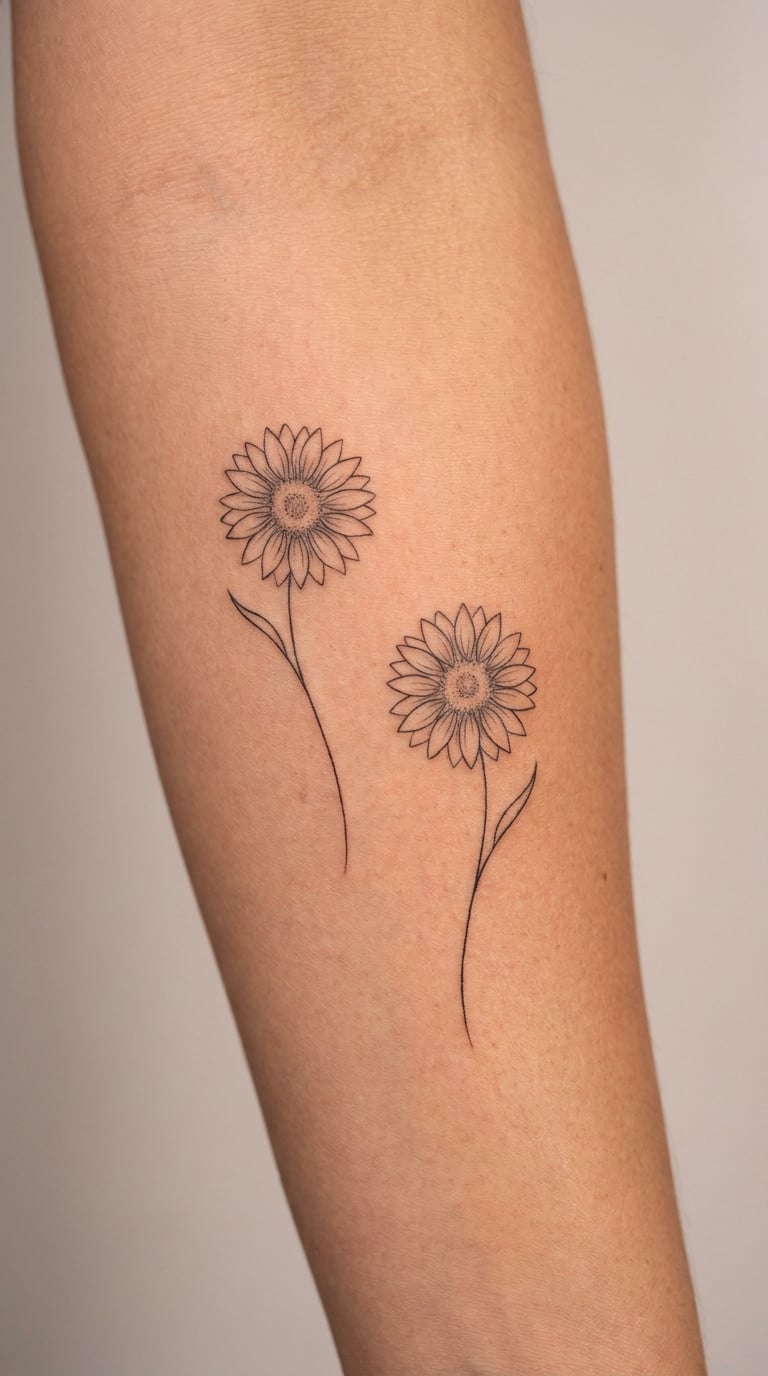
Two separate fine-line sunflowers, each roughly the same size, spaced a few inches apart along the inner forearm. Some versions angle the second one in the opposite direction so the pair reads as a loose diagonal rather than a row. The stems stop short and stay separate, which is what keeps it looking clean.
Two blooms often read as companionship, a pair of people, or simply a design that suits an arm that already has one small piece on it. The spacing is doing the work here, so the flowers never touch.
Placement: inner forearm, one toward the wrist and one toward the elbow, or one on the inner and one on the outer forearm. Size: 1.5 to 2 inches (4 to 5 cm) each. Style: fine line. Pain: low, and each flower is quick to tattoo. Watch the wrist-side one, where skin is thinnest and the lines can blur fastest.
Make it yours: keep one flower at a different height from the other, or match a second flower on the opposite forearm with the same stems.
3. Watercolour Sunflower Splash
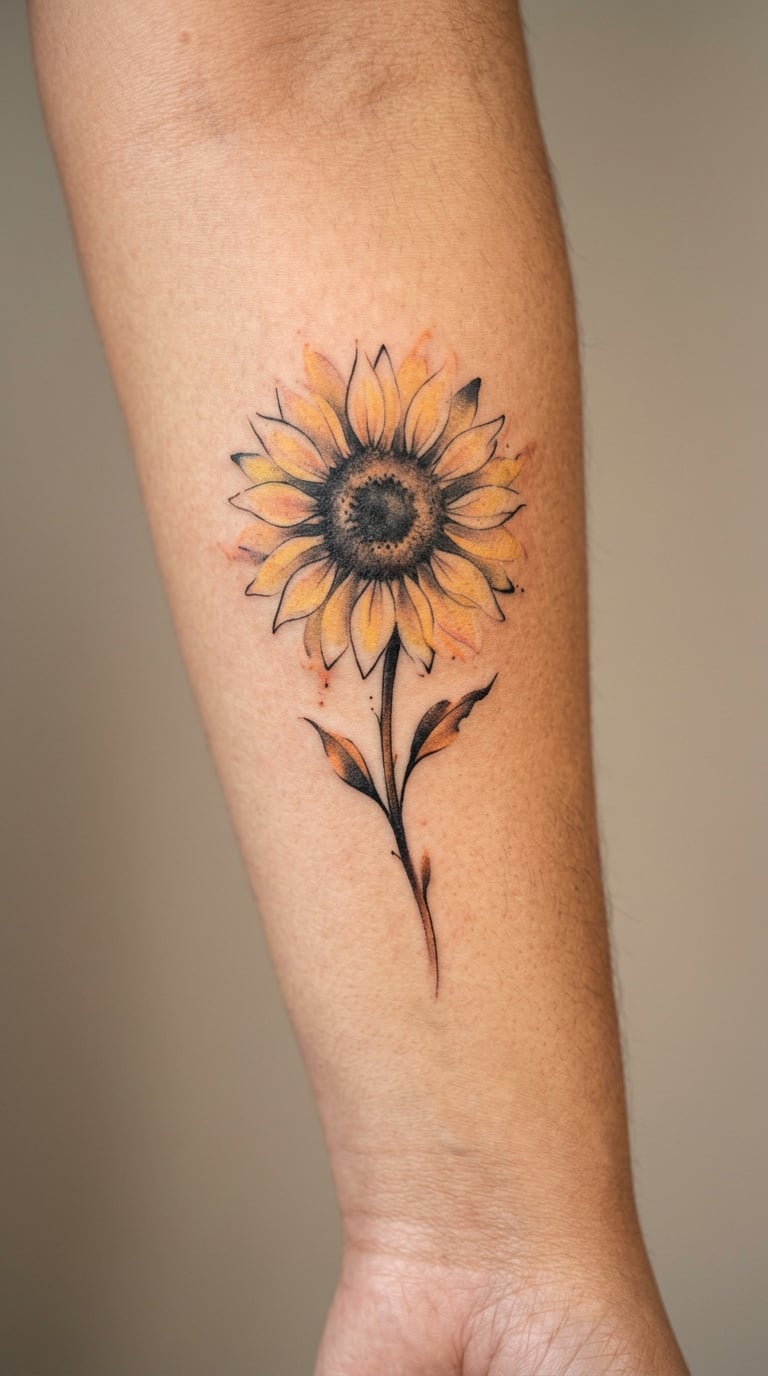
A loose sunflower painted in translucent yellow, ochre and soft orange, with pigment feathering past the petal edges into the skin like wet paper. A few black line accents define the stem and one or two petals, and the seed head is left as a warm blur rather than a detailed texture. Nothing has a hard outline, which is the point.
Watercolour appeals to people who want colour without the solid block of a traditional piece. On the forearm it also travels well as part of a larger composition later, since the edges are forgiving to add to.
Placement: outer forearm, mid-length, where the muscle gives the bloom some lift. Size: 3.5 to 4.5 inches (9 to 11 cm). Style: watercolour, black line accents. Pain: medium, and colour work means more passes over the same skin. The soft wash hides a faded edge well, so this ages more gracefully than a hard-lined colour piece.
Make it yours: choose one accent colour beyond yellow, such as dusty pink or teal, and let it run into the wash.
4. Realistic Sunflower with a Wrapped Stem
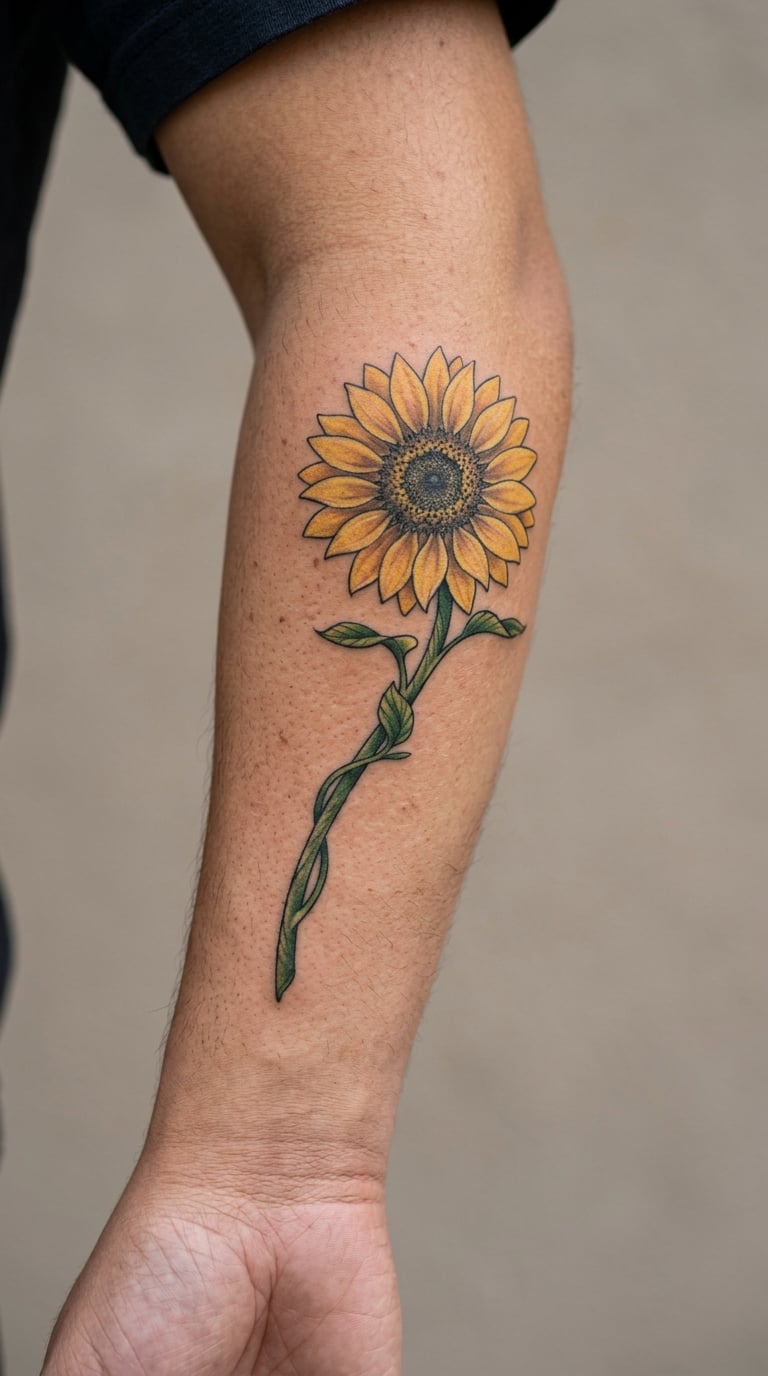
A micro-realistic bloom with layered petals shaded from deep amber at the base to bright yellow at the tips, and a seed head built from hundreds of tiny directional marks. The stem curves down and wraps once around the forearm, finished with two veined leaves. It should look like a real flower someone laid on your arm, not a drawing of one.
This is the version people point at when they say they want a sunflower that will still be recognisable in twenty years. Realistic petals have internal shading, and internal shading is what holds together as the outline softens.
Placement: outer forearm, diagonal from elbow side toward the wrist, so the stem wrap has somewhere to sit. Size: 4 to 5 inches (10 to 13 cm) including the stem. Style: micro-realism with colour. Pain: medium over a long stretch, and realistic detail usually needs more than one sitting. Colour on the forearm fades noticeably sooner than black, so plan on a refresh.
Make it yours: have the wrap include a thin vine with two small leaves, which makes the stem look deliberate rather than decorative.
5. Blackwork Sunflower with Bold Petals
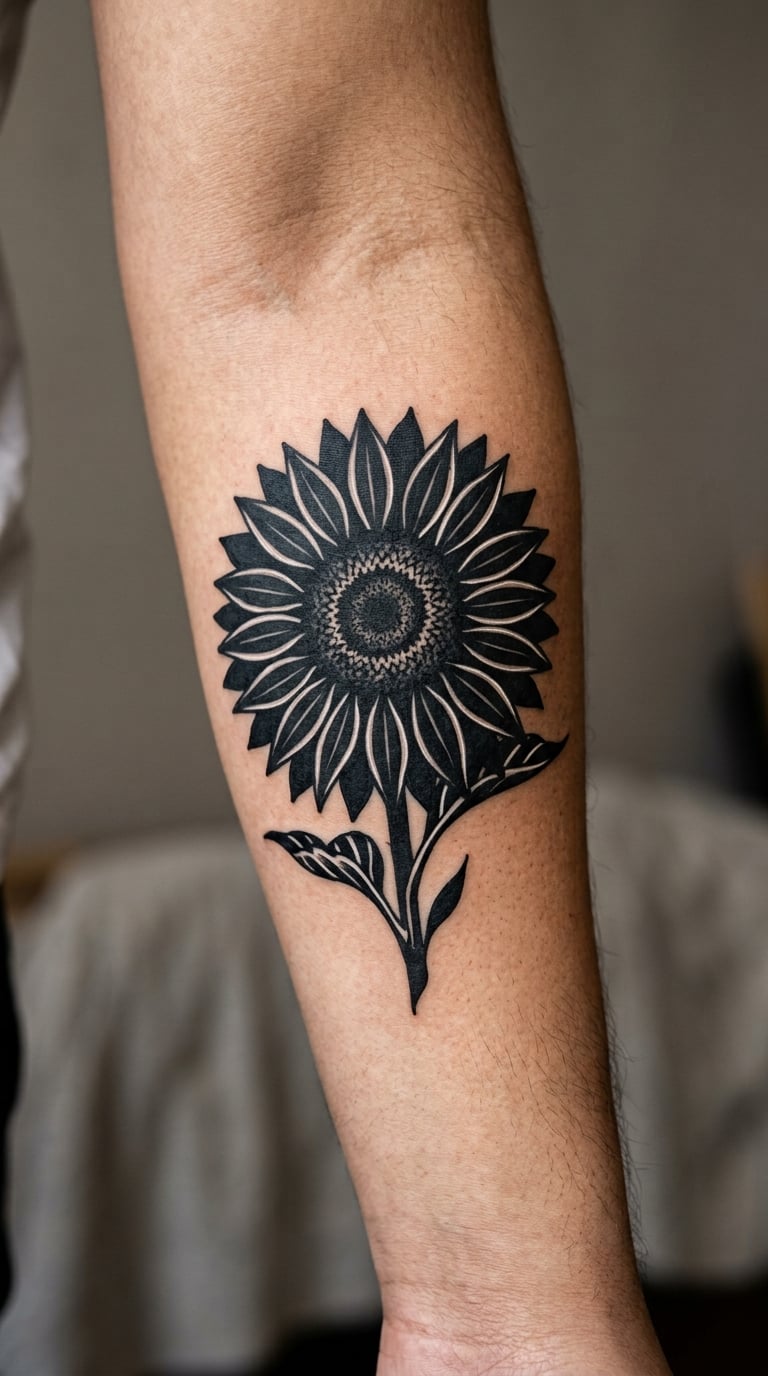
Solid black petals radiating from a dense centre, with narrow white lines cut through for petal separation and a ring of small white dots standing in for pollen. The stem is a thick black shape with a hard edge, no grey anywhere. It is graphic and high contrast, closer to a poster than a botanical study.
Blackwork gets chosen when someone wants a forearm piece with visual weight that still looks like one flower. Because there is no colour, there is nothing to fade, which makes it the most durable sunflower on this list.
Placement: broad outer forearm, where a circular shape has room to sit flat. Size: 3.5 to 4.5 inches (9 to 11 cm) across. Style: blackwork with negative space. Pain: medium, and the solid fill is the heavy part, since a full petal takes repeated passes. Give the skin a break mid-session if you can.
Make it yours: add a second, smaller outline-only sunflower below it, so the pair has different visual weights.
6. Sunflower-and-Script Forearm Tattoo
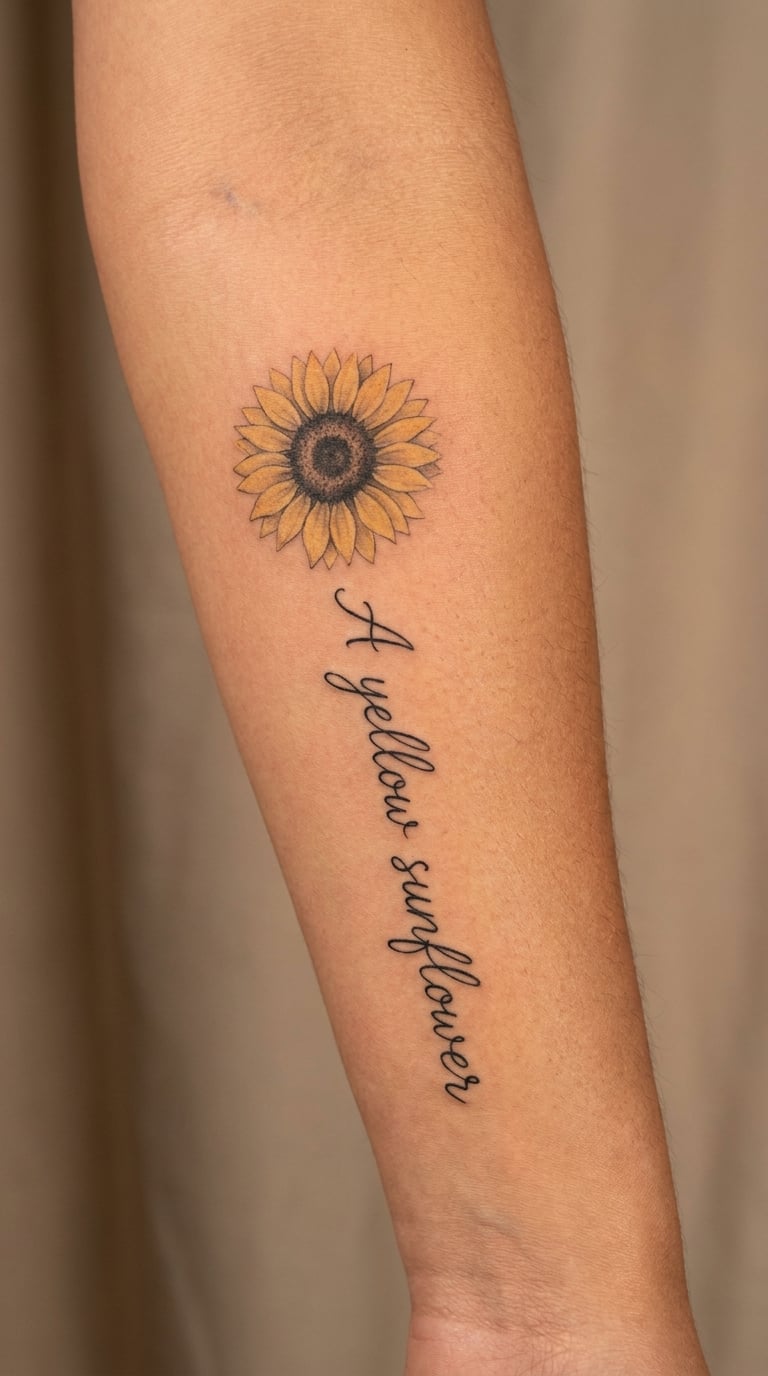
A small realistic sunflower at one end and a line of flowing script running lengthwise beneath or beside it, with the letters spaced so they breathe. The flower carries the colour and the text carries the meaning, so the two elements do not compete. Keep the script to a handful of words rather than a full phrase.
Meaning-plus-script is the most requested sunflower format in tattoo communities, usually because a generic bloom on its own feels like it belongs to everybody. One short line fixes that, and it is the easiest design here to make genuinely personal.
Placement: inner forearm, running from the wrist crease toward the elbow. Size: 3.5 to 4.5 inches (9 to 11 cm) total width across both elements. Style: realism plus script. Pain: medium, and script on the inner arm needs a steady hand because small shakes are visible at that scale. Test how the words look bent over your wrist before approving the layout.
Make it yours: use a name, a date, or one word you keep coming back to, in your own handwriting rather than a font.
7. Geometric Sunflower on the Outer Forearm
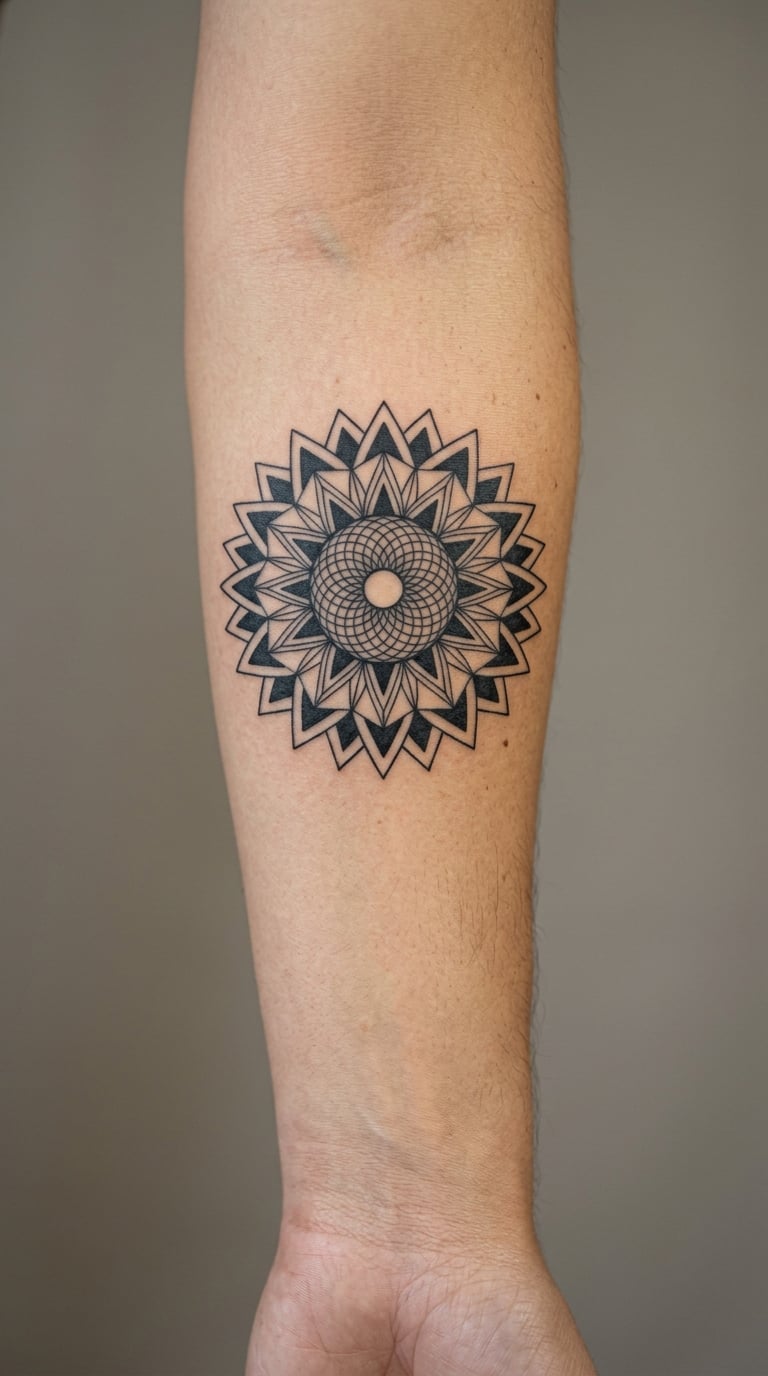
A symmetrical bloom built from triangles, arcs and concentric circles, with each petal reduced to a clean geometric shape and the centre rendered as a spiral of small facets. Every line is the same weight, the geometry is exact on both halves, and there is no shading anywhere.
Geometric florals tend to suit people who like maths as much as botany, and they sit well next to other linework-heavy pieces later. The symmetry is the appeal and also the hard part, which is why the artist matters here.
Placement: outer forearm, centred, so the two halves balance as the arm turns. Size: 3.5 to 4.5 inches (9 to 11 cm) across. Style: geometric linework. Pain: medium, mostly from the long unbroken lines. Fine geometric detail on the outer arm can soften with age if it sits in direct sun, so placement near the elbow crease is worth avoiding for this style.
Make it yours: have the background filled with a faint repeating grid of small triangles, or leave it empty for a quieter result.
8. Minimal Line-Art Sunflower With One Bloom
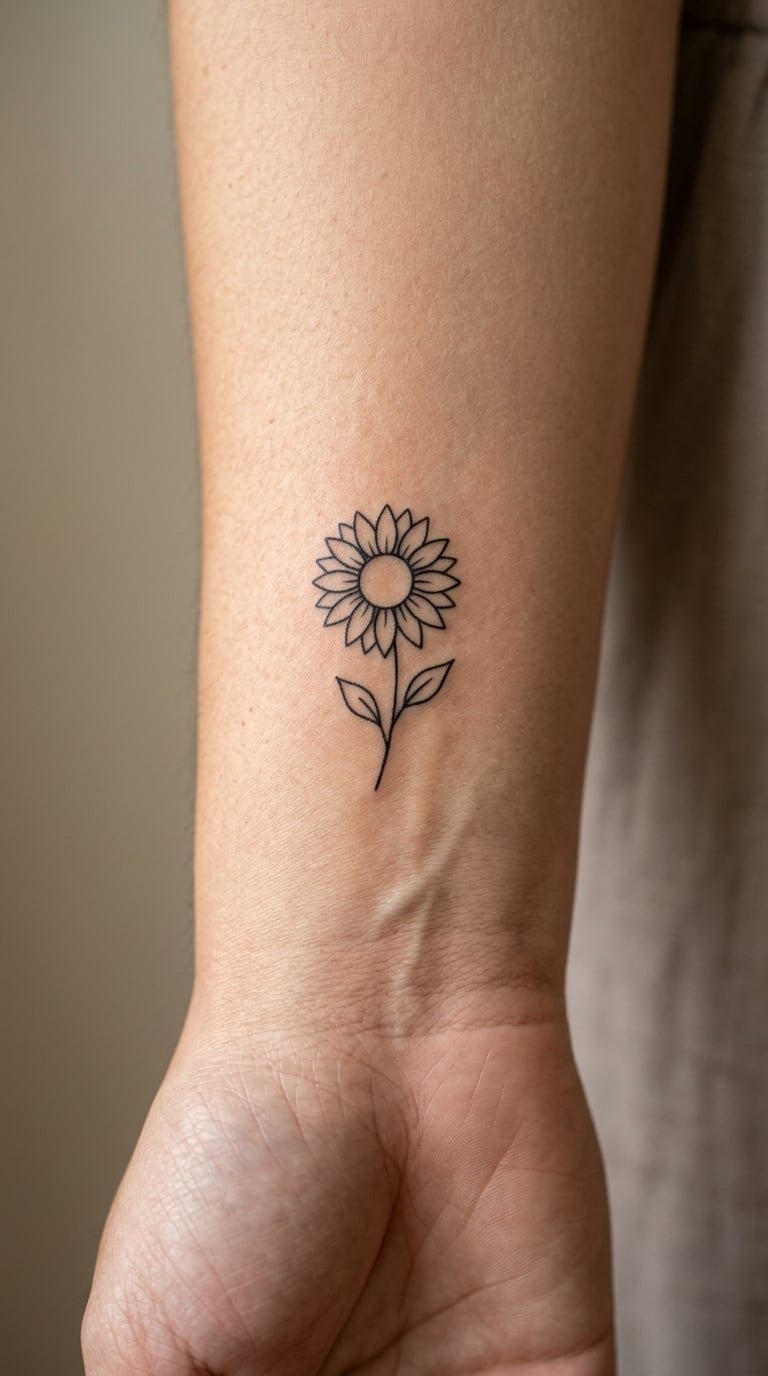
One bloom, one short stem, one leaf, drawn in the thinnest line your artist is comfortable holding. The petals are simple rounded outlines and the centre is a small circle, nothing more. Most of the design is skin, and that is the whole style.
Below about two inches a sunflower starts to lose its identity and read as a generic daisy, so this is close to the floor for how small a bloom can go. It is a good first tattoo on the forearm, and easy to add to later.
Placement: wrist-side inner forearm, or just above the elbow on the outer arm. Size: 1.5 to 2 inches (4 to 5 cm). Style: minimal line art. Pain: low, and often over in an hour. Thin wrist-side lines blur fastest of anywhere on the arm, so expect to need a touch-up sooner than elsewhere.
Make it yours: add a second bloom at half the size, or put a tiny date underneath in the same line weight.
9. Traditional Sunflower With Bold Outlined Petals
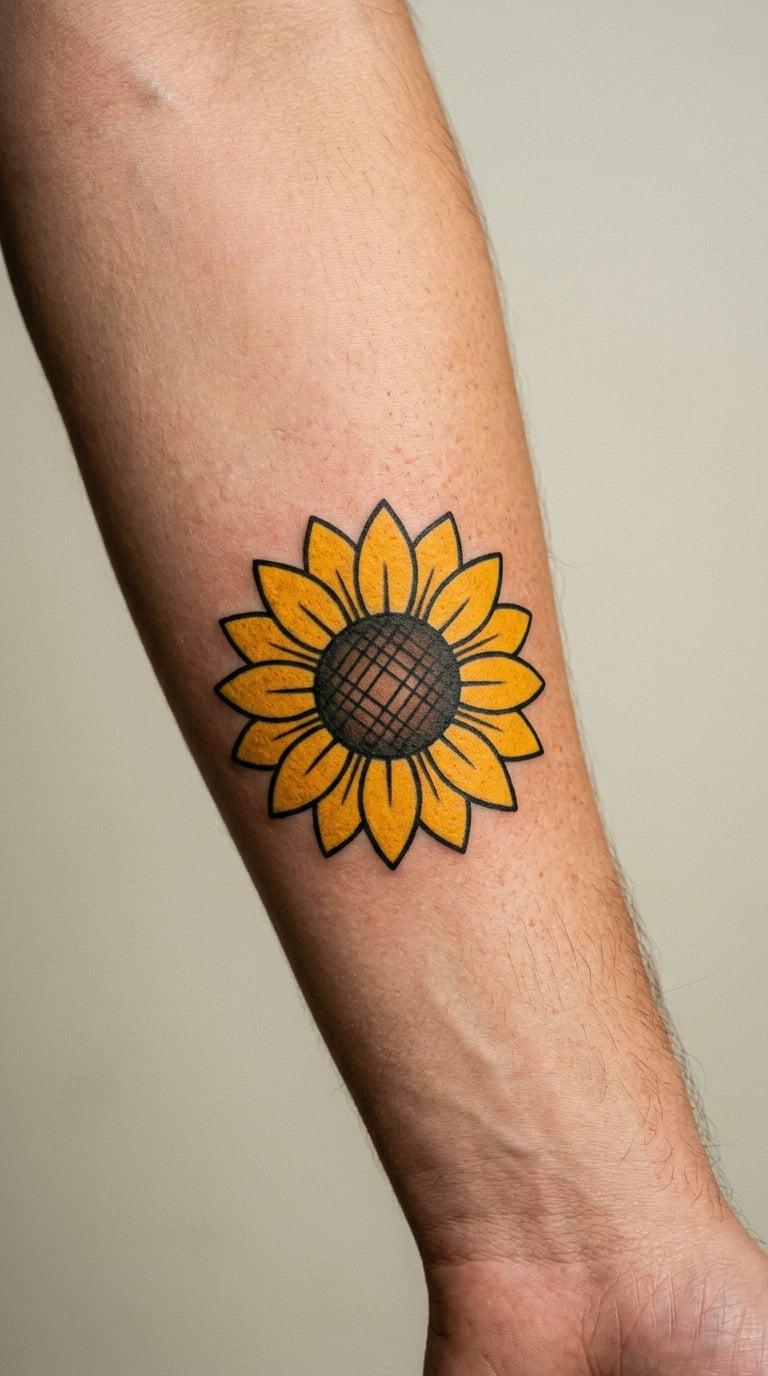
Saturated yellow fills, heavy black outlines and petals simplified into a clean repeating shape, with a brown-green centre and a thick stem. The look is closer to a classic American tattoo flash sheet than to a painting, and every element is bold enough to read across a room.
Traditional sunflowers are chosen for colour and permanence. A heavy outline holds the shape even after the yellow dulls, which is a practical reason to lean on black lines if the arm gets regular sun.
Placement: outer forearm, mid-length. Size: 2.5 to 3.5 inches (6 to 9 cm) across. Style: traditional, bold outlined colour. Pain: medium, and the yellow fills need several passes. Colour drops out faster than black on the forearm, so a refresh in year two or three is normal.
Make it yours: shift the palette toward orange and red for an autumn look, or keep the classic yellow and add a banner beneath.
10. Neo-Traditional Sunflower in a Colour Palette
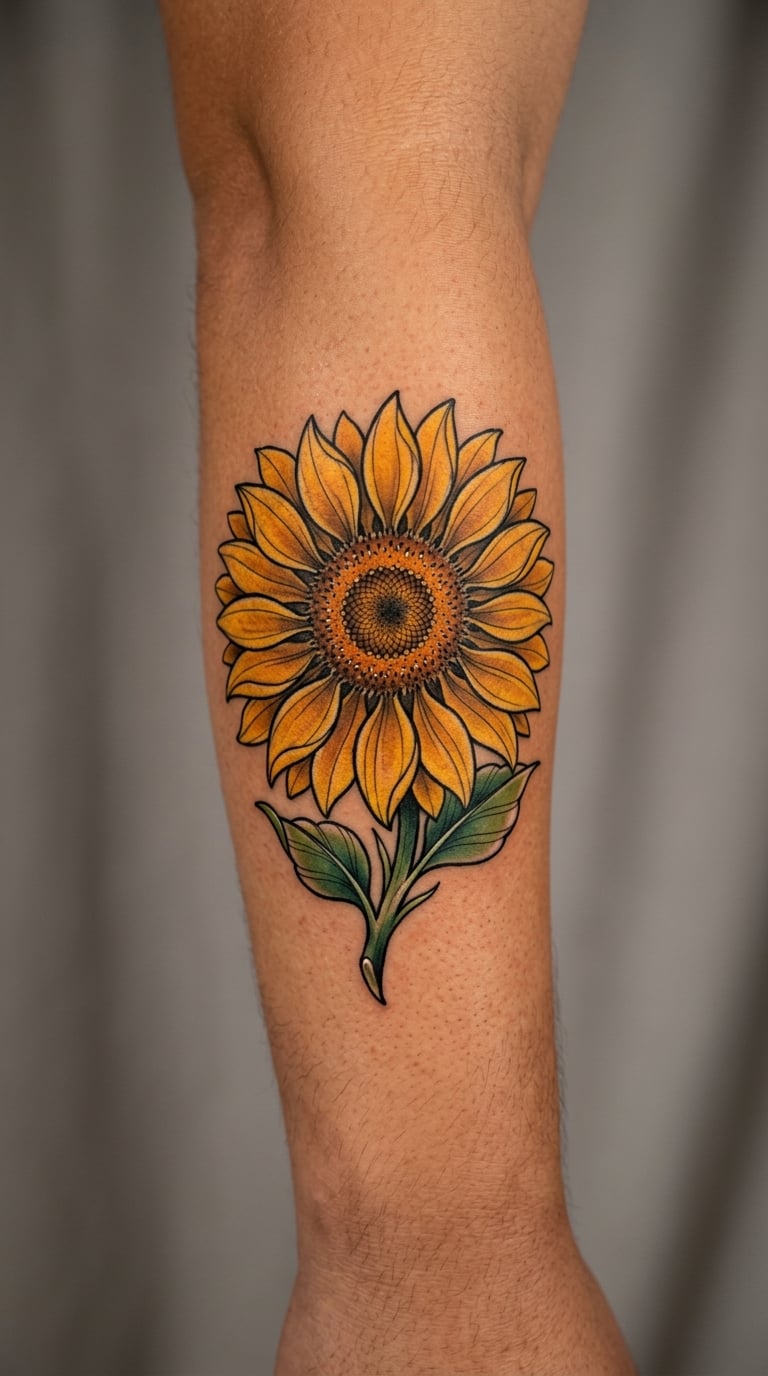
A bloom with real dimension: petals shaded from orange at the base to pale yellow at the edges, a deeply textured seed head, and a glossy green leaf with a highlight. Small decorative accents sit in the negative space, and the palette is deliberate rather than whatever yellow was on the shelf.
Neo-traditional is the middle ground between realism and flash, and it suits people who want shading without a photographic result. The extra detailing in the centre is what makes the piece hold up close.
Placement: broad outer forearm, where the bloom can sit flat and show its shading. Size: 4.5 to 5.5 inches (11 to 14 cm) across. Style: neo-traditional. Pain: medium to high, since the shading and highlights are slow work over a large area. Fine shading will blur more than bold fill over time, so lean on strong outlines.
Make it yours: pick a two-colour palette with the artist before the stencil goes on, and keep the background free of colour.
11. Sunflower With a Bird Perched Above
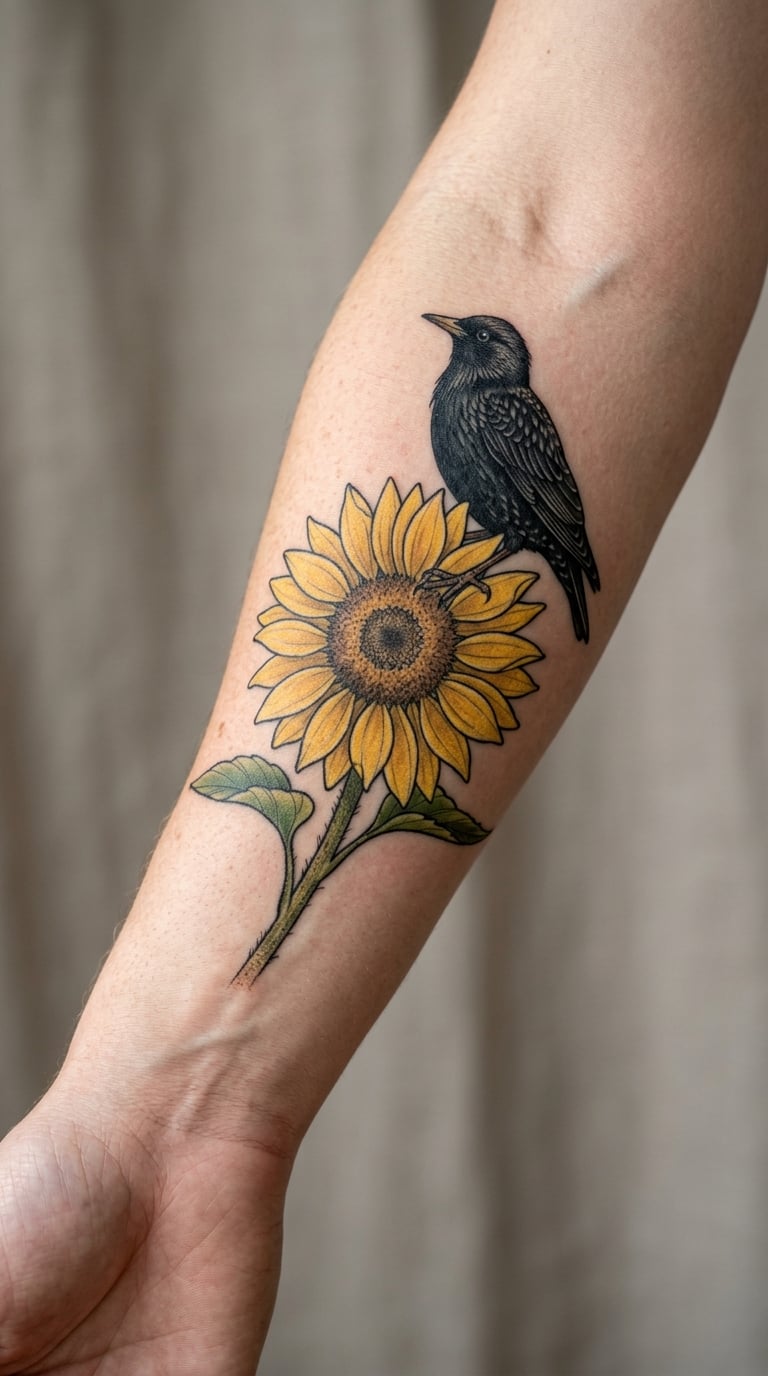
A sunflower in the lower two thirds of the design with a small bird perched on the topmost petal, the bird rendered in flat black with one clean eye and a short beak. The bird is a supporting element, not the subject, so it stays simple while the flower carries the detail.
Adding a living creature gives a single flower a small scene around it, which stops the design feeling like an icon. People usually pick this one when they want a floral piece that has a bit of story in it.
Placement: outer forearm, angled diagonally so the bird sits higher up the arm. Size: 3.5 to 4.5 inches (9 to 11 cm) long. Style: illustrative realism. Pain: medium. The bird’s small eye and beak are the fiddliest part and will soften first, so keep them simple and let the flower take the detail.
Make it yours: have the bird be a specific local species you recognise, which makes the piece quietly specific to you.
12. Sun-and-Sunflower Horizon Design
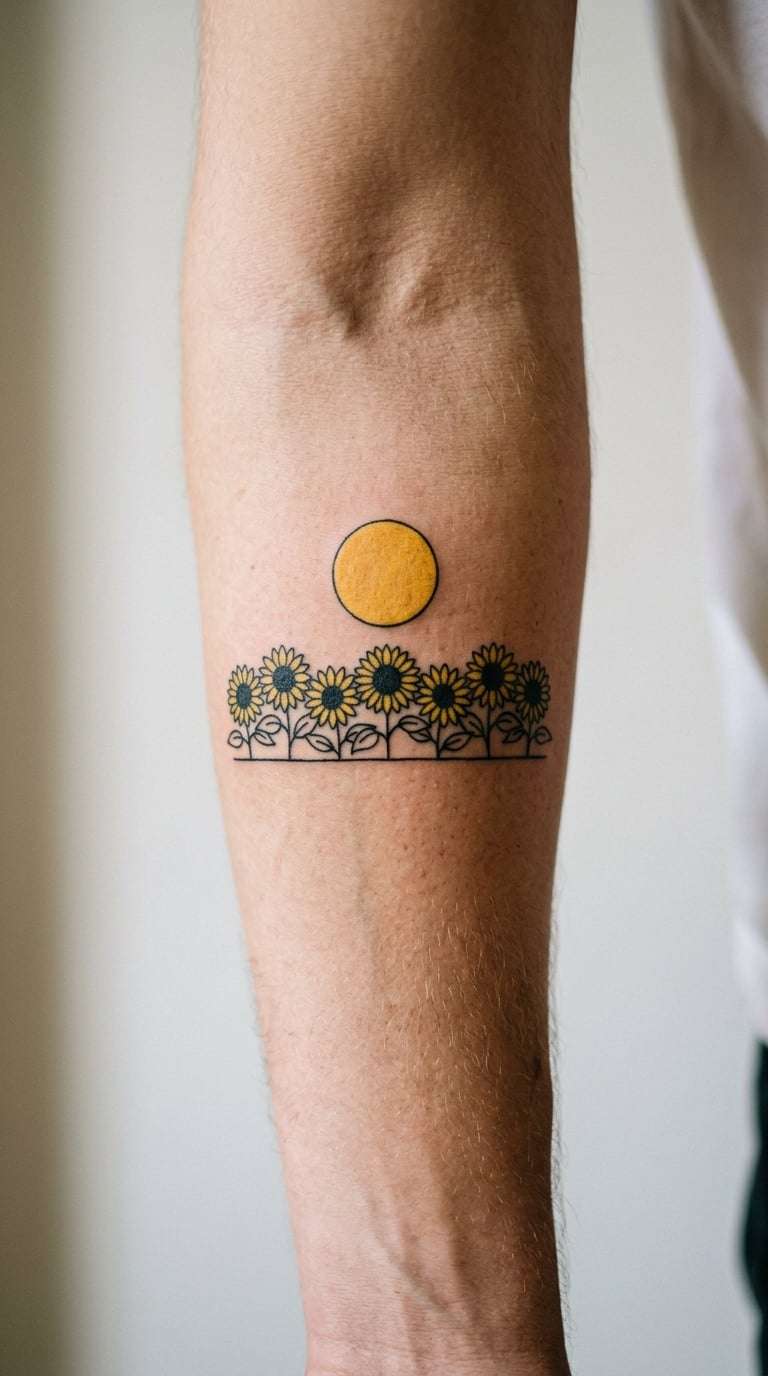
A low half-sun in flat yellow sitting on a horizon line, with a single sunflower growing up in front of it and a few short grass marks at the base. Everything is flat colour and clean shapes, laid out horizontally so it reads like a small wide scene rather than a single object.
The sun and the flower rhyme with each other, which is the appeal. It suits someone who wants a scene rather than a botanical specimen, and it packs a lot of meaning into very little space.
Placement: inner forearm, running horizontally across the width rather than along it. Size: 3.5 to 4.5 inches (9 to 11 cm) wide. Style: minimal illustrative, flat colour. Pain: medium. Horizontal layouts on the inner arm stretch and compress as you flex, so the artist will want to check the line with your arm in motion.
Make it yours: add a small date at the horizon line, or a location name tucked into the grass marks.
13. Dotwork Sunflower With a Stippled Centre
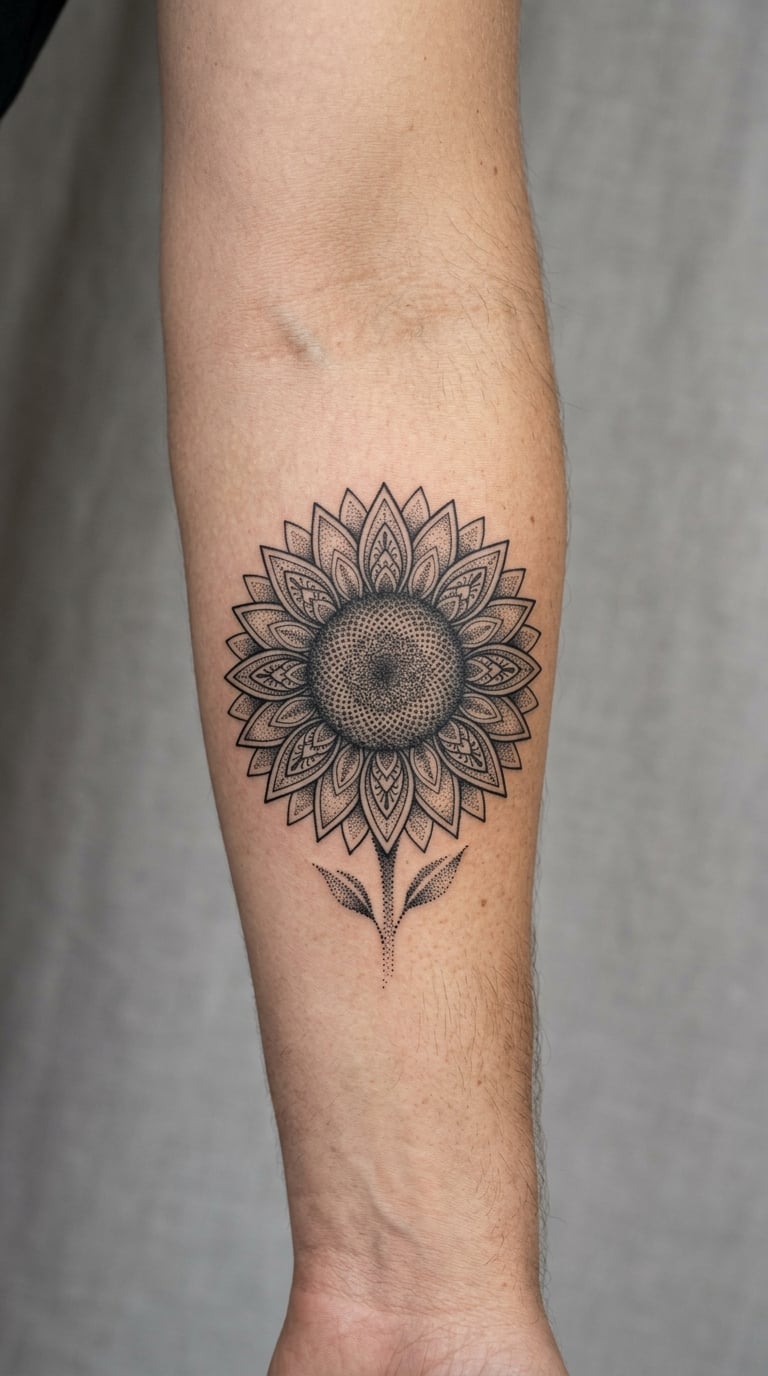
An outline sunflower where the centre is filled with dense stippling that fades from dark to light across the bloom, and each petal carries a small repeating dot pattern along its length. The stem is a single thin line with a few leaves. No solid black areas at all.
Dotwork reads as texture rather than drawing, so it is a good choice if you want an intricate-looking piece with a light footprint. It also sits well next to other stippled work later.
Placement: outer forearm, mid-length. Size: 2.5 to 3.5 inches (6 to 9 cm) across. Style: dotwork and stippling. Pain: medium, and dotwork is slow going, so budget more time than the size suggests. Fine dot patterns blur into grey over the years, so a slightly bolder stipple holds up better than the thinnest version.
Make it yours: have the stipple density form a shape, a small symbol or an initial inside the seed head.
14. Minimal Sunflower With Botanical Roots
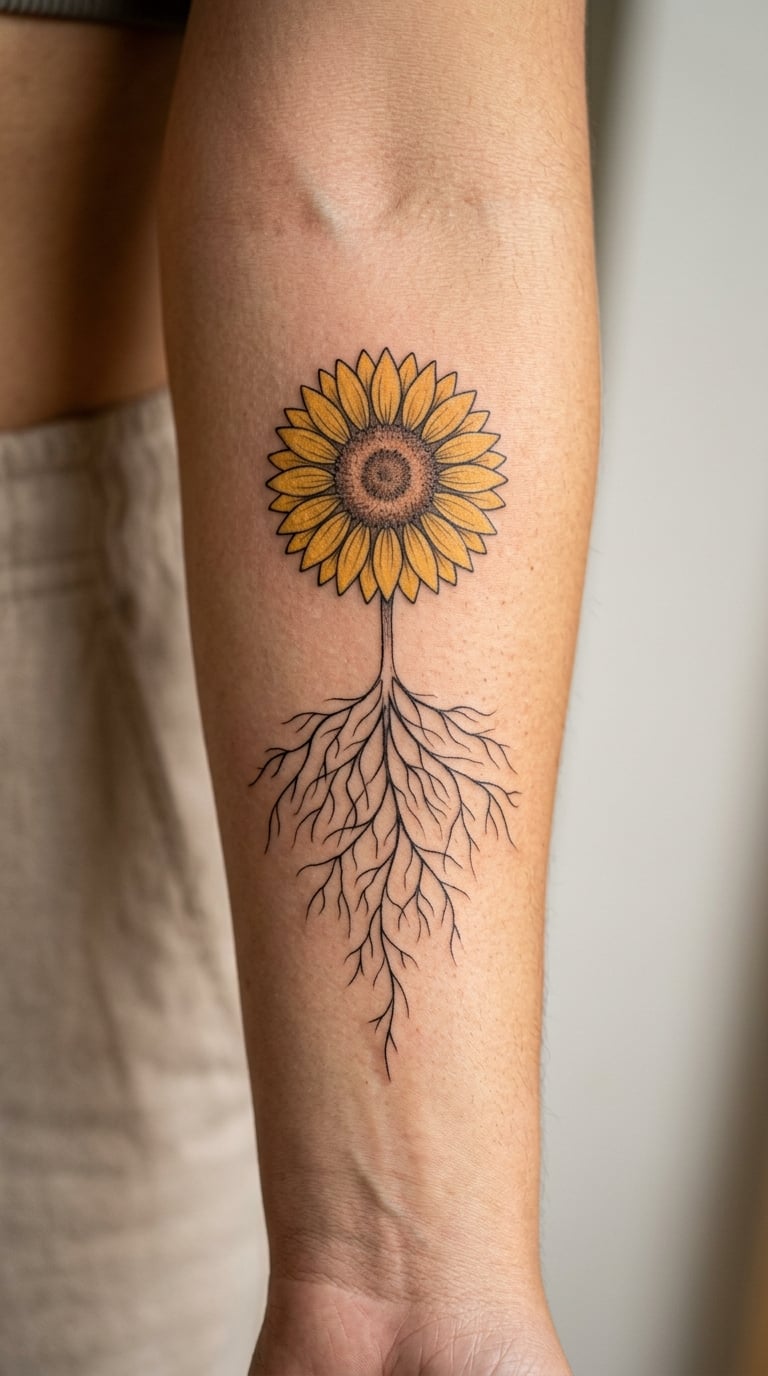
A simple sunflower bloom at the top with a thin stem running down into a spread of fine, tapering roots, the whole thing drawn as one vertical line of growth. The bloom is the only coloured part, and the root system is fine black linework that thins out towards the tips.
Showing the roots is the part most sunflower tattoos leave out, and it is what turns a decorative flower into something about staying grounded. Keep the root work simple so it reads cleanly at arm’s length.
Placement: inner forearm, running vertically from the elbow crease toward the wrist. Size: 4.5 to 5.5 inches (11 to 14 cm) long. Style: botanical, fine line roots with one colour bloom. Pain: medium. The thinnest root tips near the wrist are the first thing to blur, so ask the artist to hold a slightly heavier line there.
Make it yours: have the roots mirror an actual plant you grew, or simplify them into three or four strong lines rather than a fine network.
15. Sunflower Wreath for the Forearm
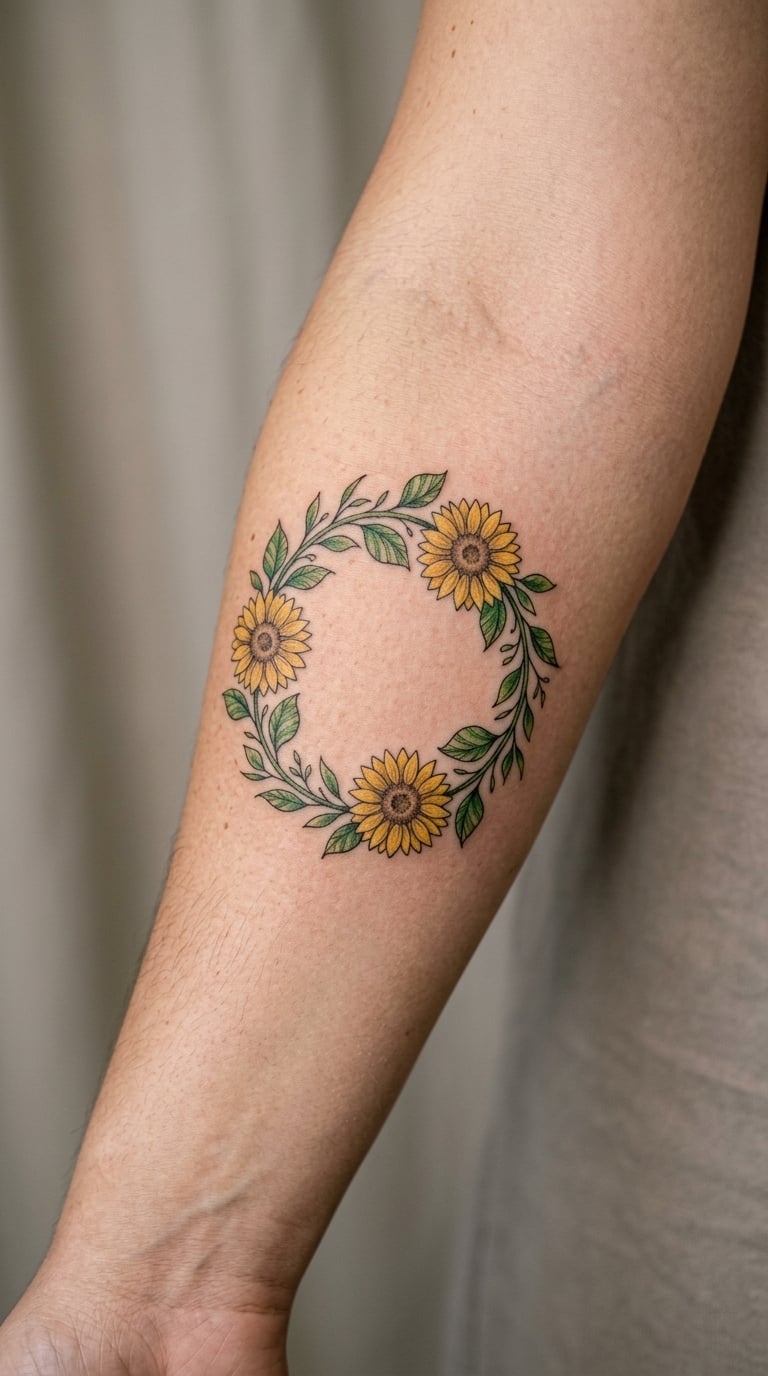
Three sunflowers at different sizes, loosely gathered with leaves and small filler flowers into an open circle, with gaps left in the ring so it does not look like a badge. The blooms carry the colour and the foliage carries the movement, so the arrangement reads as hand-gathered rather than symmetrical.
A wreath works well when the arm is already busy, because the circle gives the eye somewhere to rest. It also gives you room to add a fourth flower years later without disturbing the composition.
Placement: outer forearm, centred so the circle sits on the muscle. Size: 4.5 to 5.5 inches (11 to 14 cm) across. Style: botanical colour. Pain: medium, and the filler flowers and leaves add a lot of small separate hits. Balance is the hard part, so ask to see the stencil on your arm before any colour is committed.
Make it yours: use flowers native to somewhere you grew up, so the ring reads as a place rather than a pattern.
16. Black-and-Grey Sunflower Study
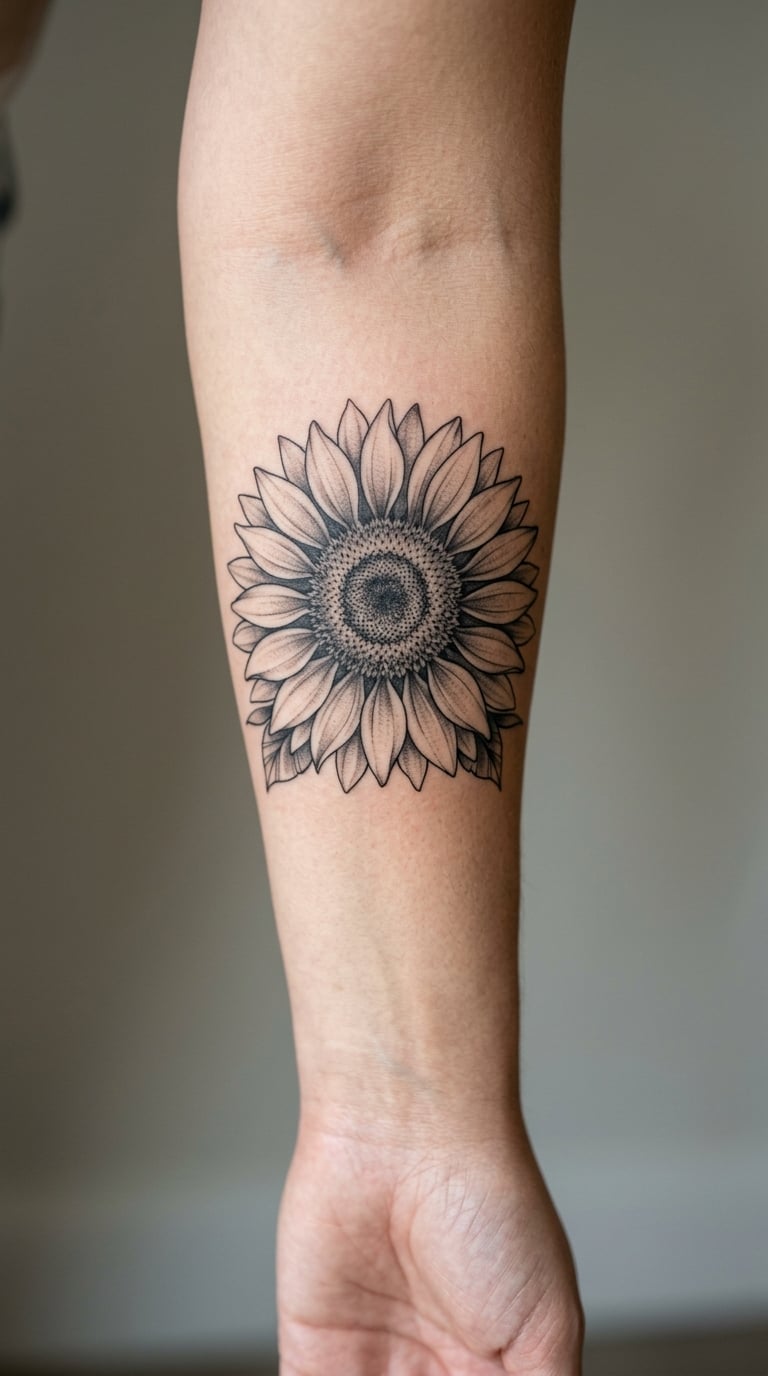
A monochrome flower study with petals shaded in smooth greys, a heavily textured centre built from stipple and line work, and a stem with two leaves in flat black. No colour at all, but enough tonal range that it still looks like a real bloom in low light.
Black-and-grey is the practical choice for an arm that takes a lot of sun, since ink without colour has far less to fade. It also sets up cleanly for a colour piece added later, if you ever want one.
Placement: outer forearm, mid-length. Size: 3.5 to 4.5 inches (9 to 11 cm) across. Style: black and grey realism. Pain: medium, and the smooth petal shading takes a while. Grey washes on the inner elbow crease fade faster than anywhere else, so avoid placing this one there.
Make it yours: have the stem break into a single falling petal below the bloom, which adds movement without adding colour.
17. Sunflower With a Small Compass Detail
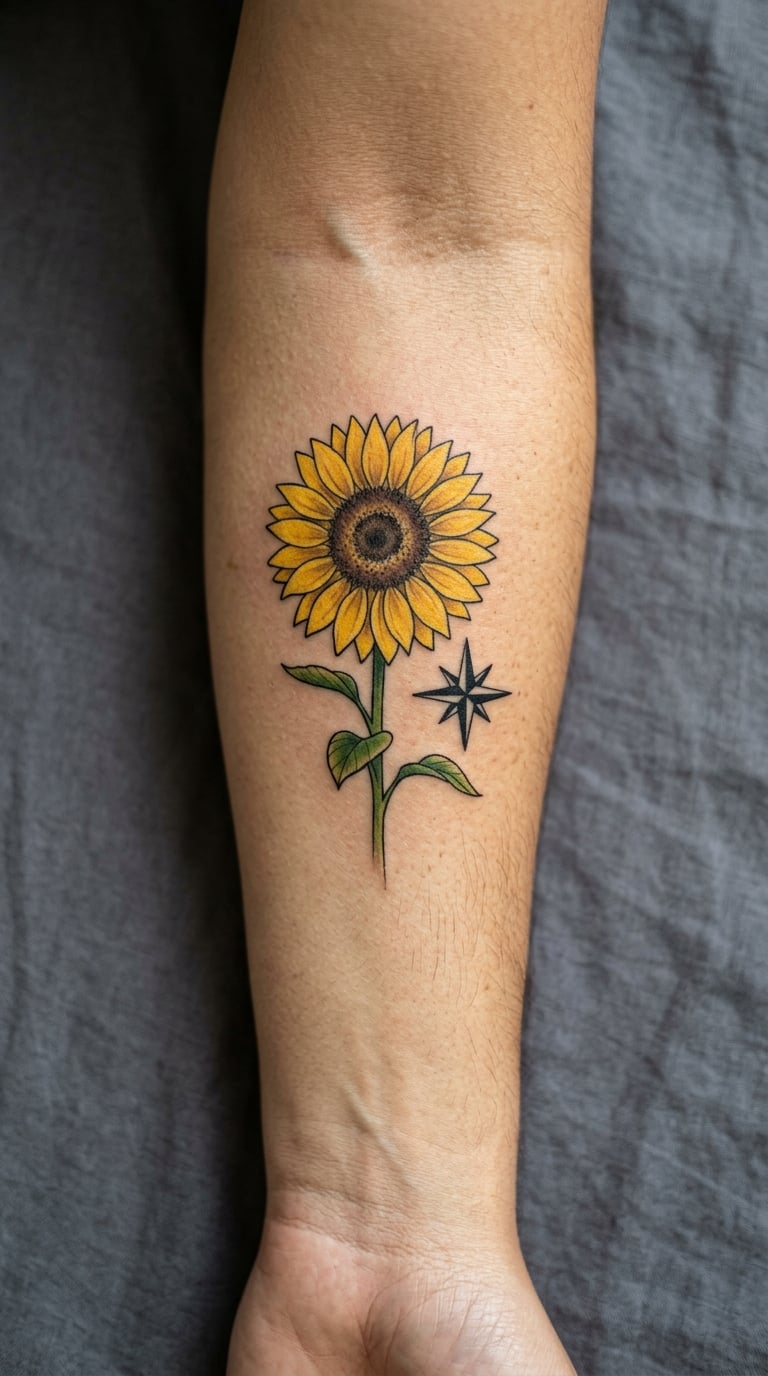
A realistic sunflower in colour with a small four-point compass star in fine black line beside it, sized so the star reads as a detail rather than a second subject. The flower keeps the visual weight and the compass stays subordinate.
People usually add a compass because of where something happened, not because of a fixed symbolic dictionary. If that is your reason, keep the star small so the flower stays the point.
Placement: inner forearm, lengthwise, with the star near the elbow end so the text-free composition still has a direction to it. Size: 3.5 to 4.5 inches (9 to 11 cm) long. Style: realism plus fine line detail. Pain: medium. The compass points are small and high-contrast, so keep them simple or they will soften into blobs first.
Make it yours: set the star to the direction of a place that matters, or letter a single coordinate underneath.
18. Sunflower Branch With Two Blooms
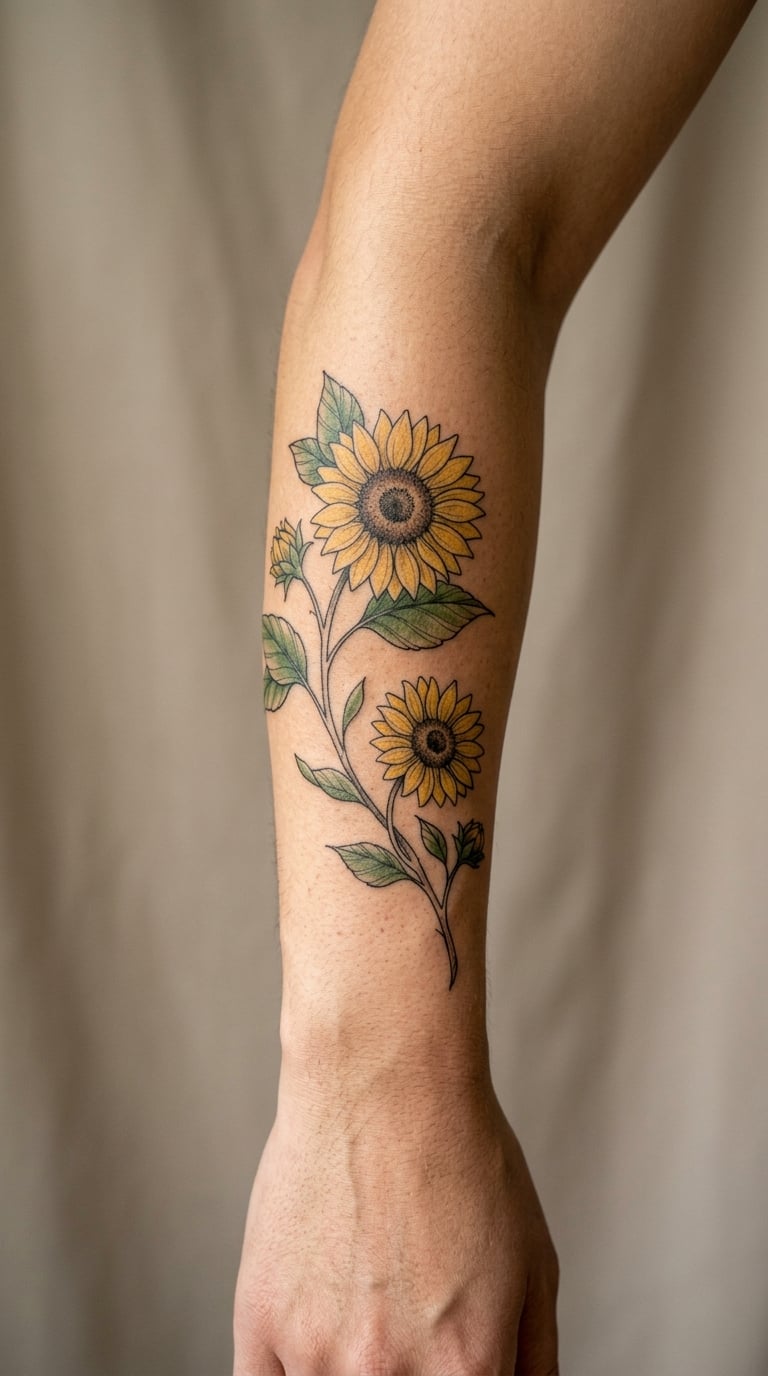
A branching stem with two blooms, one larger and one about half its size, and a run of leaves along the branch that thins towards the tip. The composition leans diagonally so the branch has somewhere to grow toward, and the two blooms are spaced far enough apart to read separately.
Two blooms at different sizes is an easy way to show progression without a symbol, and it gives the arm more movement than a single flower on a stem. It suits a first forearm piece that you might extend later.
Placement: outer forearm, following the line from the elbow side down toward the wrist. Size: 4.5 to 5.5 inches (11 to 14 cm) long. Style: botanical, colour. Pain: medium, spread over a long area. Leaves at the thin end of the branch are the first detail to blur, so the artist may simplify the smallest ones.
Make it yours: have the second bloom face a different direction from the first, so the branch looks like it is growing rather than repeating.
19. Sunflower With a Small Butterfly Accent
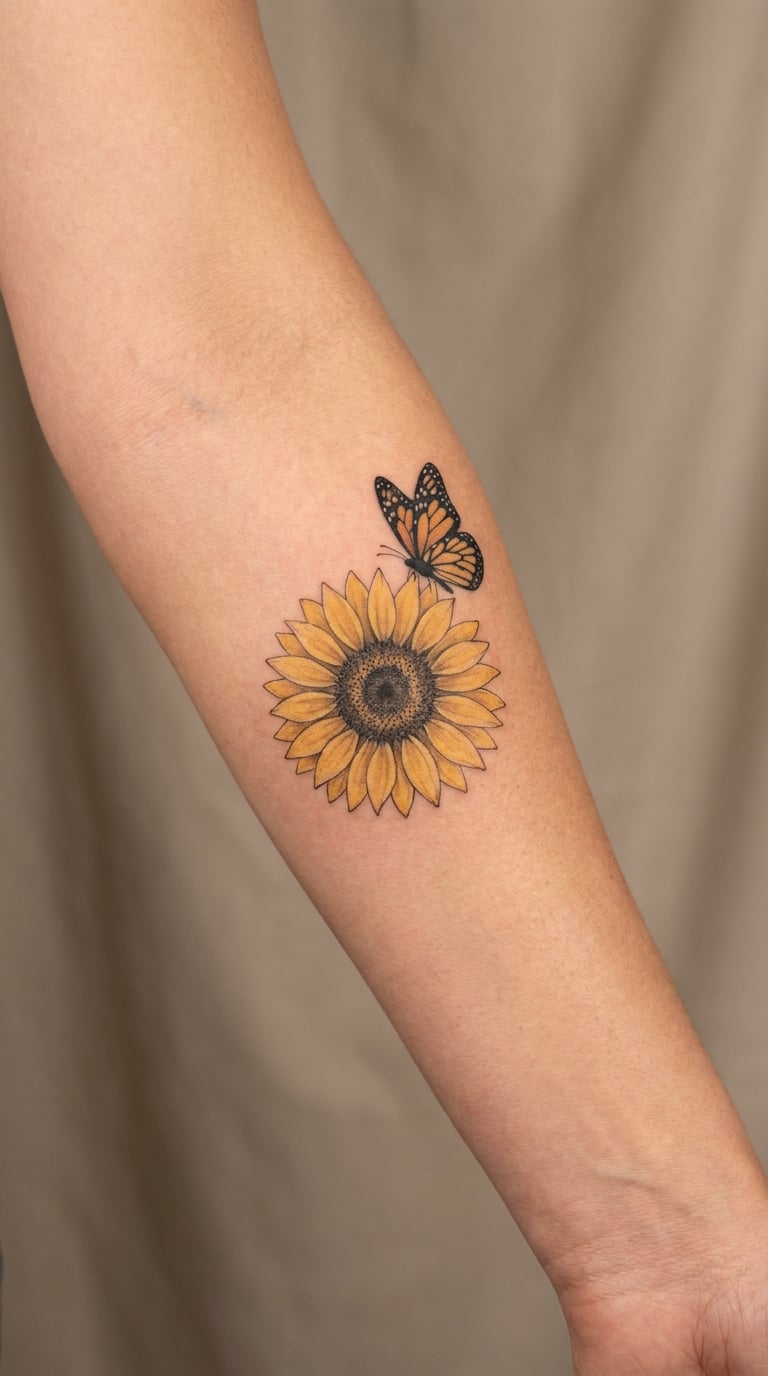
A full-colour sunflower with a single butterfly above the petals, the butterfly rendered in black, orange and white with clean wing edges. One insect, positioned at the top rather than scattered around, so the eye goes from the flower to the butterfly and back.
A butterfly turns a botanical study into something in motion, and it is the companion element people ask about most often when a plain bloom feels empty. One is enough. Three reads as clip art.
Placement: outer forearm, centred, with the butterfly toward the elbow side. Size: 3.5 to 4.5 inches (9 to 11 cm) across. Style: colour realism. Pain: medium. Wing detail is the part that softens first, so ask for a simple wing pattern rather than fine veining.
Make it yours: match the butterfly to a species you have actually seen, or add a second much smaller one near the stem years from now.
20. Small Sunflower Beneath a Fine-Line Branch
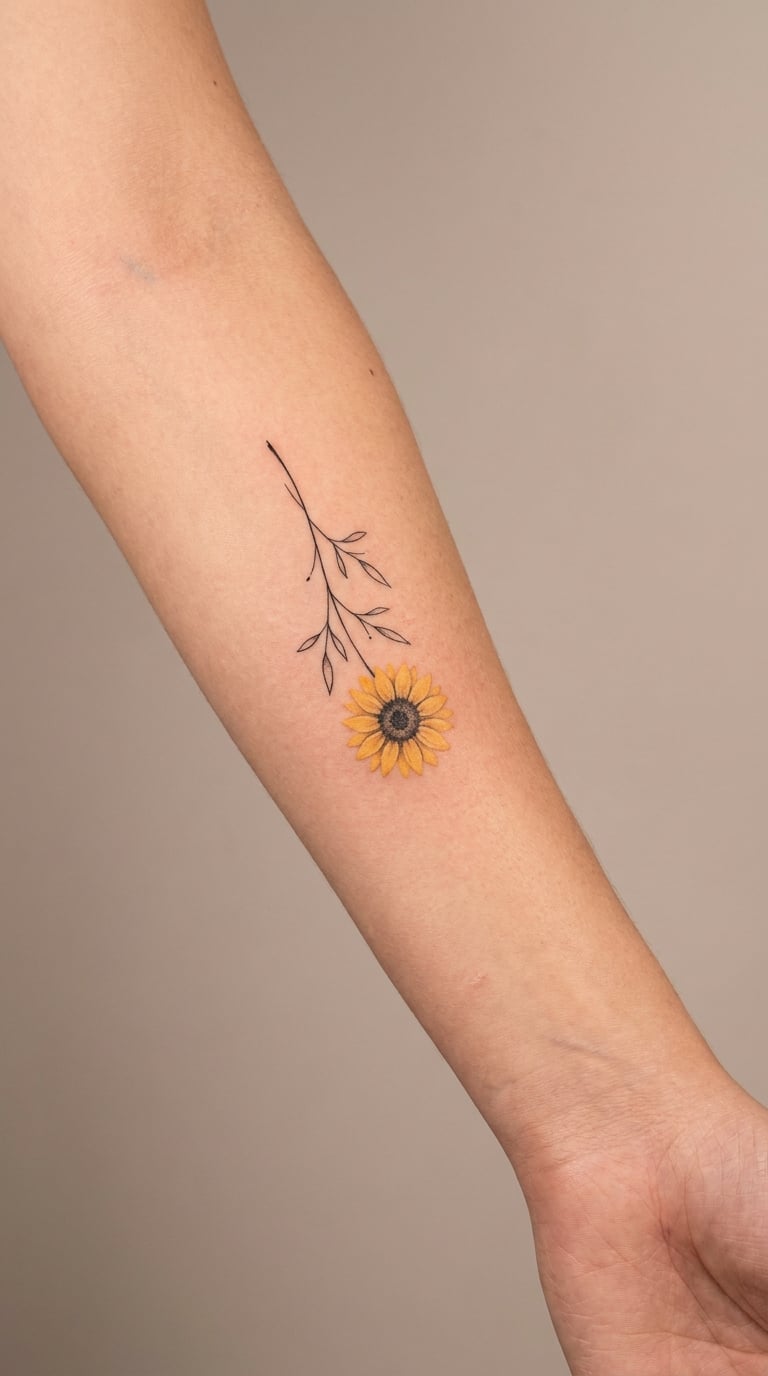
A small sunflower in colour with one fine-line branch arching over it in black, the branch carrying a handful of tiny leaves. Most of the design is empty skin, and the branch and the flower are visually separate elements sharing a small patch of forearm.
Airiness is what makes this one work on a smaller arm or a busy inner forearm. It reads as considered rather than crowded, and it sits comfortably next to existing work.
Placement: inner forearm, mid-length, with plenty of clear skin around it. Size: 2.5 to 3.5 inches (6 to 9 cm) long. Style: fine line with one colour accent. Pain: low to medium. The fine branch on the inner arm is the part to watch, since thin lines there blur quickest, so a slightly heavier weight is worth asking for.
Make it yours: have the branch carry a single small leaf in the same yellow as the flower, so the two elements tie together.
21. Sunflower With a Torn Paper-Colour Edge
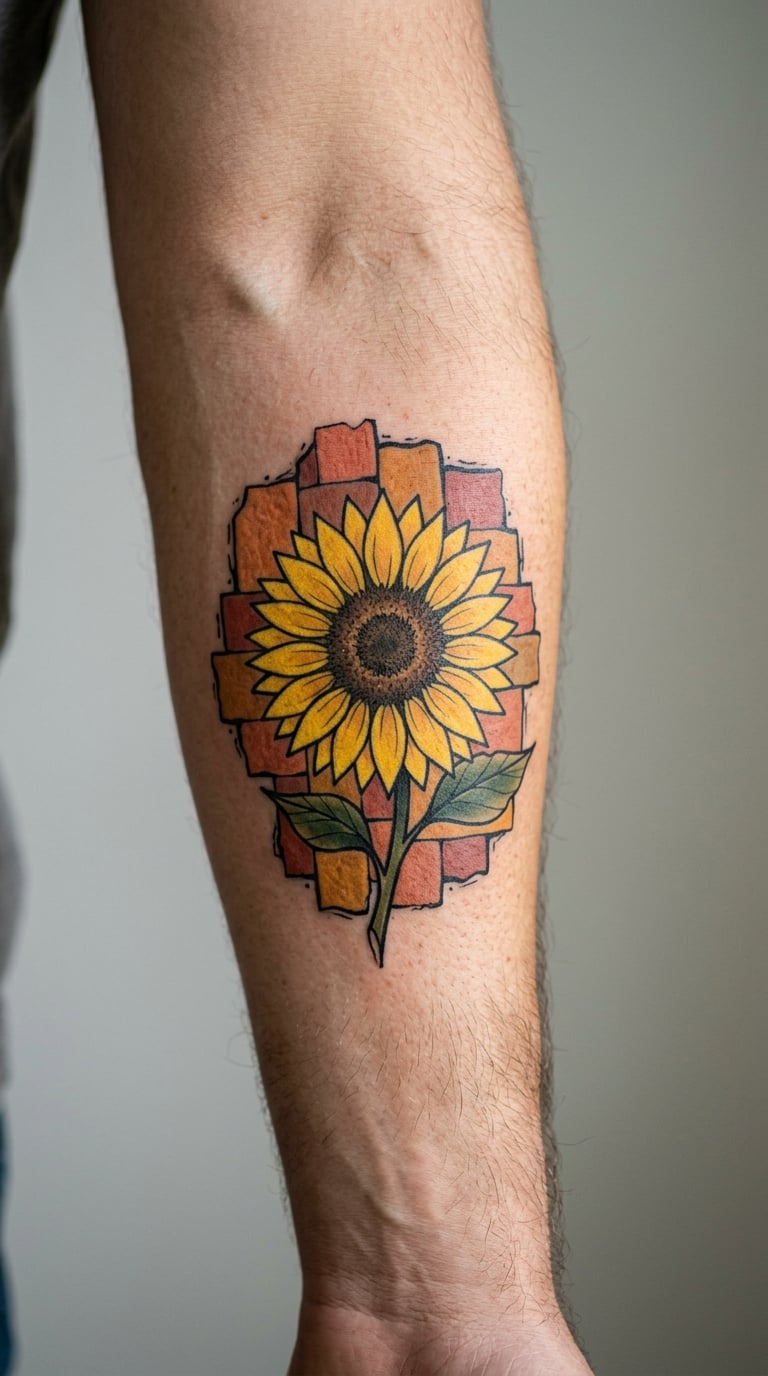
A yellow sunflower in the centre with irregular blocks of muted orange, red and cream around it, edges left rough and torn like cut paper rather than airbrushed smooth. The shapes overlap the petal edges in places, so the flower appears to sit inside the colour rather than on top of it.
The torn-edge treatment is contemporary and graphic, and it is a good way to add colour interest without going fully realistic. It also hides uneven colour saturation well, since the blocks are meant to be flat.
Placement: outer forearm, mid-length. Size: 3.5 to 4.5 inches (9 to 11 cm) across. Style: graphic colour. Pain: medium, and the large filled blocks take real time. The soft torn edges blend as the ink ages, which works in your favour here, but the flat colour will dull sooner than outlined work.
Make it yours: use a palette pulled from a flag, a football kit or a room you grew up in, rather than generic autumn tones.
22. Sunflower Mandala for a Statement Forearm Tattoo
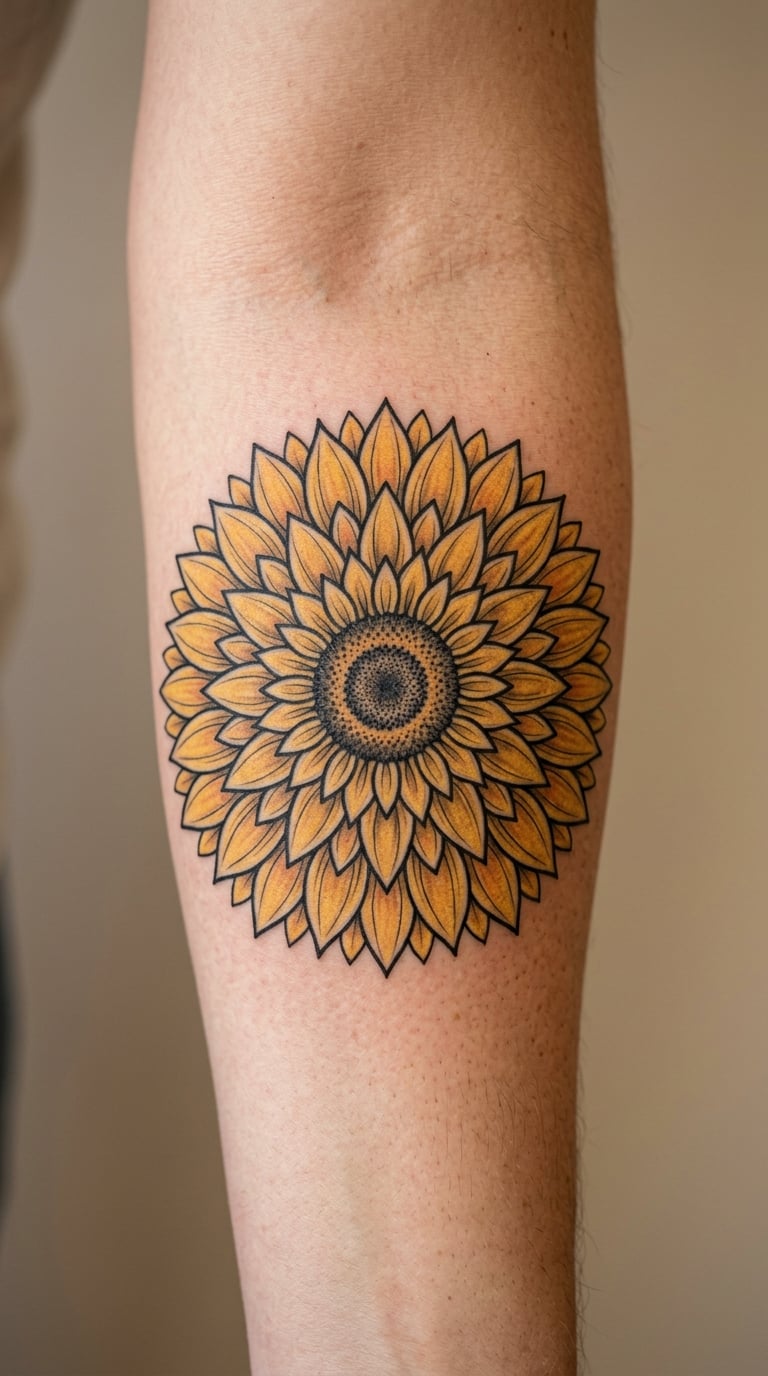
A symmetrical mandala built from repeating layers of petal shapes, with a seed-head circle at the centre and rings of geometric detail radiating outward. Every line is crisp black on clean skin, the two halves mirror each other precisely, and there is no shading to lose definition.
This is the statement option. A mandala uses the sunflower’s radial structure as a starting point and scales it up into something that fills the forearm and reads as one shape from across a room.
Placement: broad outer forearm, centred, where the muscle can carry the width. Size: 5.5 to 6.5 inches (14 to 17 cm) across. Style: mandala linework. Pain: high, because it is a long session over a large area with little give. Expect two sittings for anything at this size, and protect the new tattoo from sun and friction afterwards.
Make it yours: adapt one outer ring into a repeating pattern based on something personal, a date sequence or a family motif.
23. Sunflower With a Simple Initial
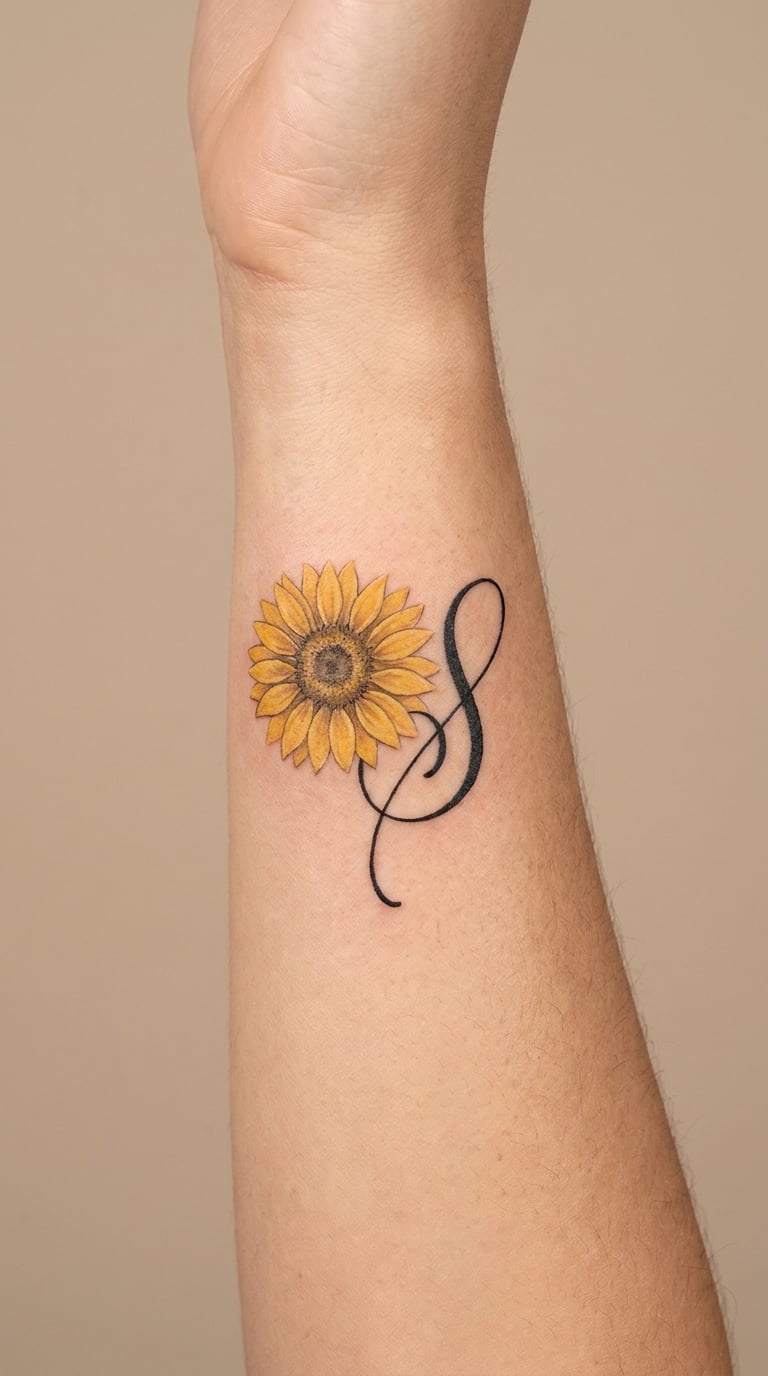
A small realistic sunflower in colour with one elegant script initial beside it, the letter scaled so it sits at about the same height as the bloom. Two elements, one colour, plenty of skin around both, and nothing else competing for attention.
An initial gives a design its point of focus without a full line of text, and it is the version most people pick for a first forearm tattoo. The letter is the personal part, so let the handwriting be genuinely yours.
Placement: inner forearm, wrist-side, small and neat. Size: 2.5 to 3.5 inches (6 to 9 cm) tall including the letter. Style: realism plus script. Pain: low to medium, and quick. Wrist-side script is the first thing to blur, so consider placing it a little higher up the inner arm instead.
Make it yours: write the initial in your own hand, even if it is untidy. A slightly imperfect letter looks better on skin than a template one.
24. Sunflower Behind an Open Book
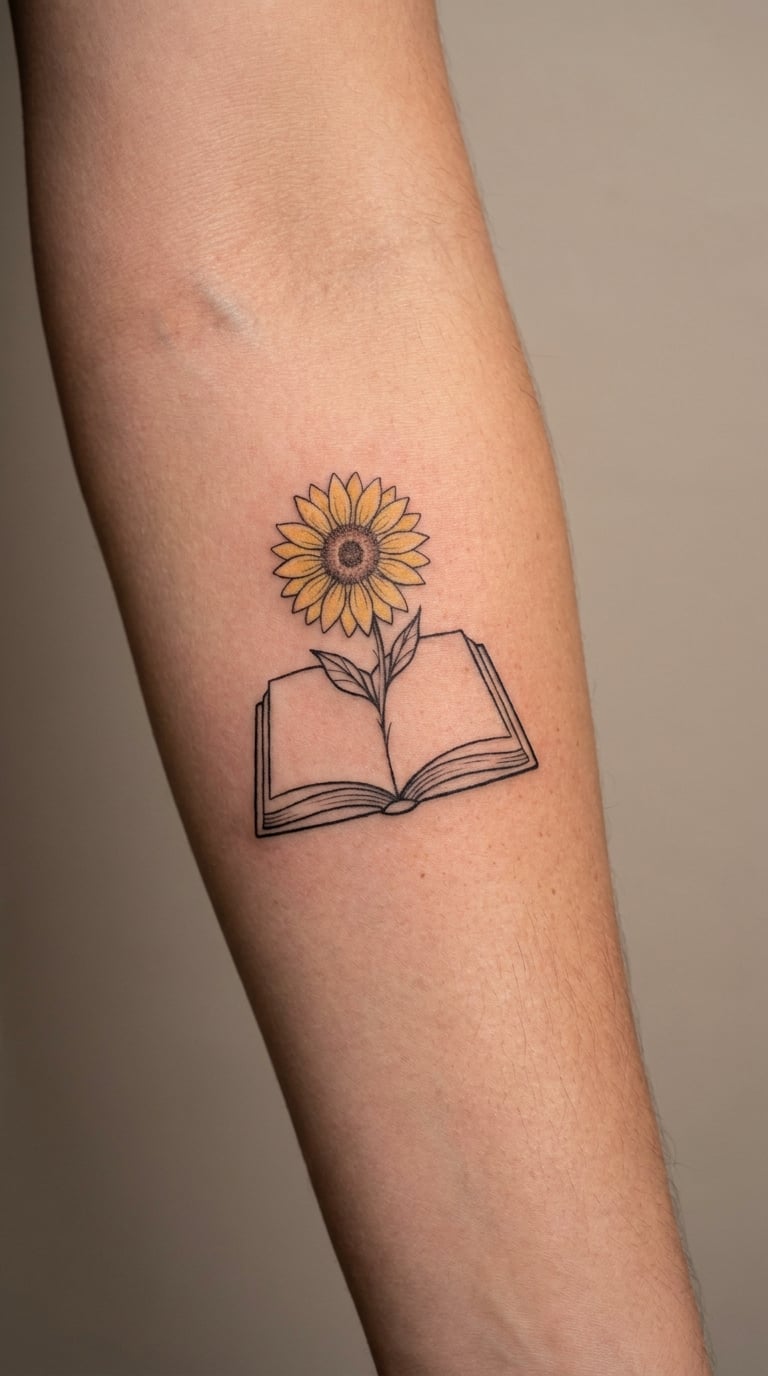
A small open book drawn in black linework at the base with a sunflower rising behind it, the bloom and a few leaves appearing above the pages while the stem disappears behind the book. The layering is the whole idea, and it works because the book is simple line work and the flower carries the colour.
Sunflowers behind objects that matter to you is a familiar format, and the book version is common among people who read. It layers cleanly, which means it can extend into a larger piece later if you want.
Placement: outer forearm, mid-length, upright. Size: 3.5 to 4.5 inches (9 to 11 cm) wide. Style: illustrative linework with colour. Pain: medium. Small page lines are the detail that softens first, so ask for a simplified book with a few bold lines rather than fine page edges.
Make it yours: have a small detail on the open page, a pressed flower or a line of text, that only you would recognise. If roses belong on your arm too, our 20 Rose Tattoo Ideas for the Forearm has pairings that work alongside this one.
25. Three Sunflowers in a Minimal Field
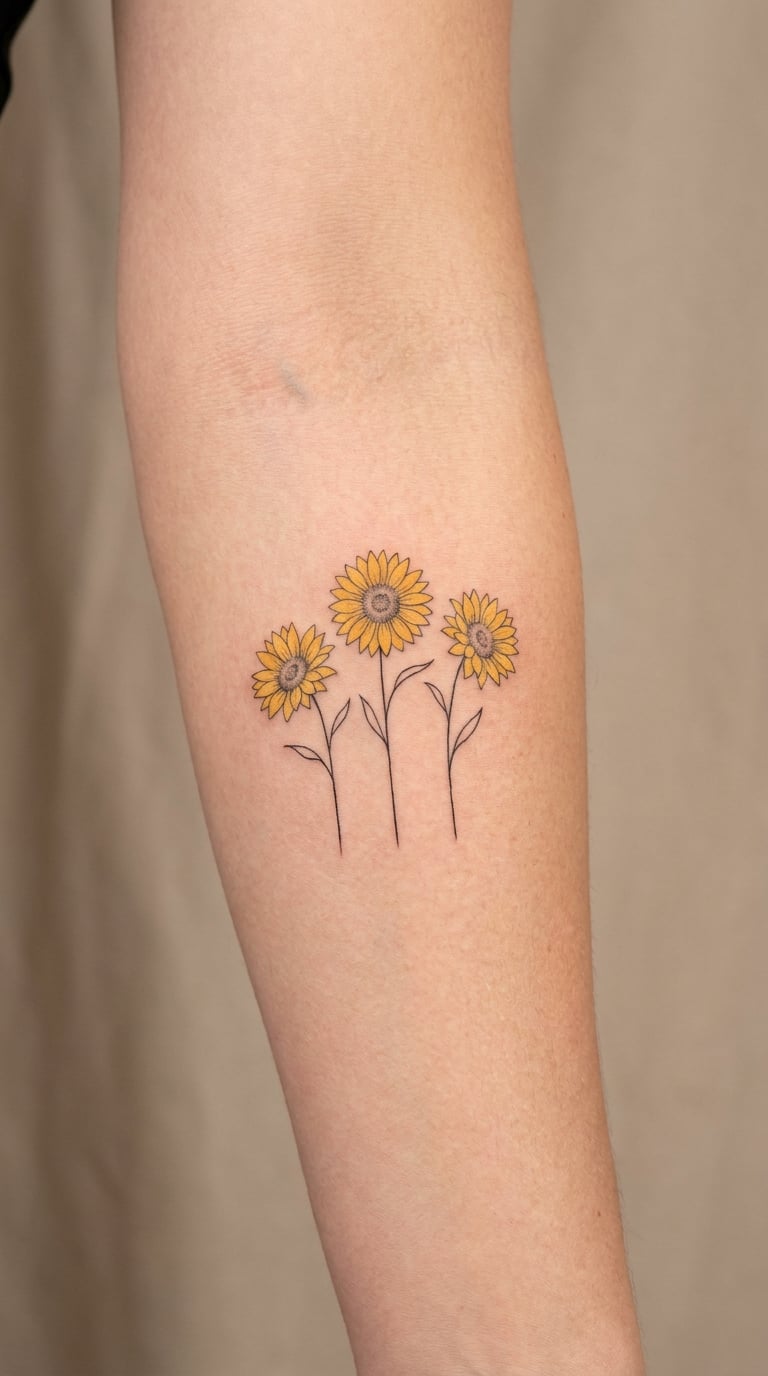
Three sunflowers standing at three different heights on thin black stems, spaced evenly across a horizontal line, with a few short grass marks at the base. The blooms are flat colour with simple outlines, and the stems stay thin enough to keep the whole thing light.
Three heights is what makes this composition balanced rather than repetitive, and it is the easiest way to fill a stretch of forearm without going big. It suits an arm that has other work above it.
Placement: inner forearm, running horizontally across the width. Size: 4.5 to 5.5 inches (11 to 14 cm) wide. Style: minimal colour illustration. Pain: medium, with the thin stems being the fiddliest part. Horizontal designs on the inner arm shift as you flex, so check the layout with your arm both straight and bent.
Make it yours: stagger the heights to match three real flowers you grew, or leave the tallest one off-centre for a less formal look.
26. Large Colour Sunflower Statement Piece
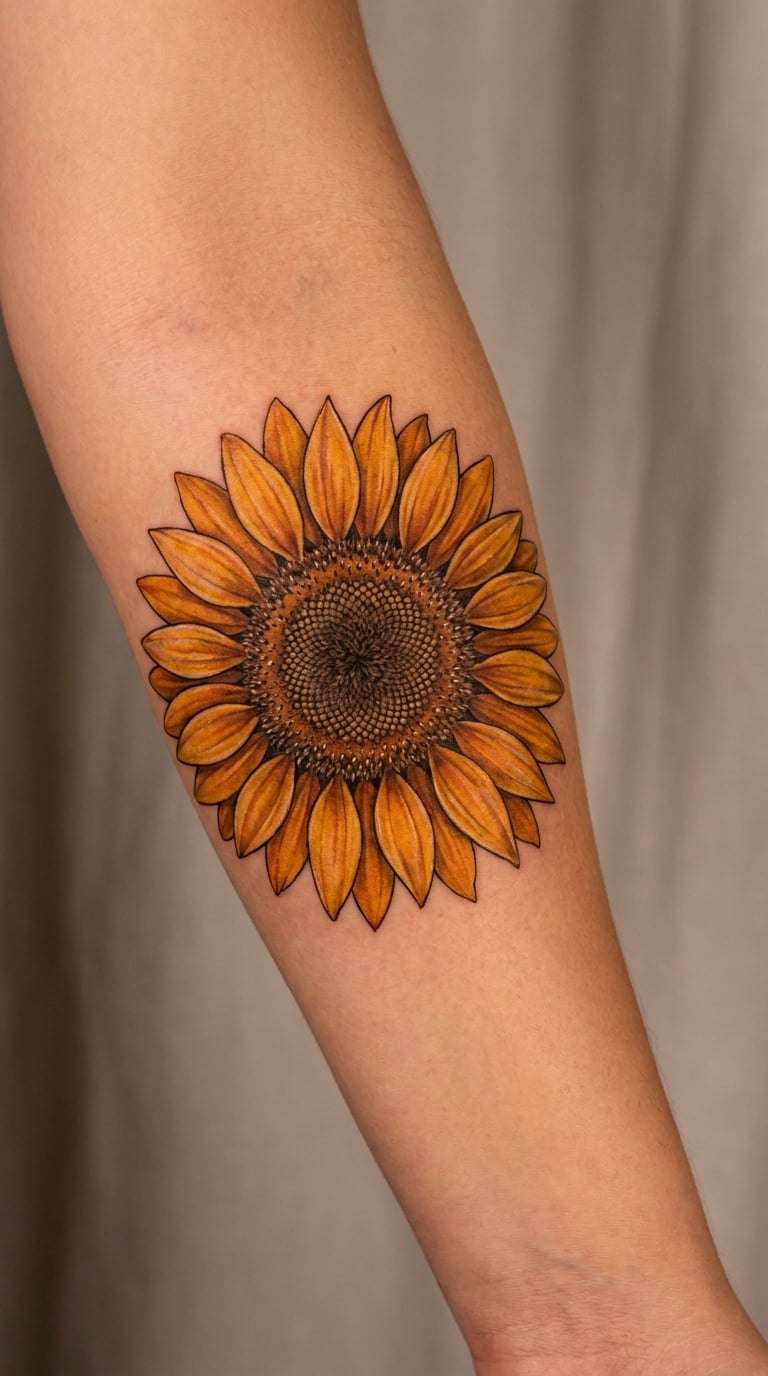
A large bloom in layered yellows and oranges with individually shaded petals, a deeply textured seed head, and a full composition of stem, leaves and a curling vine. It fills the space rather than sitting in the middle of it, and it is built to be looked at from more than an arm’s length away.
This is the one to choose if the forearm is your main canvas and you want a piece that reads as a serious tattoo, not an accent. It is also the design most likely to need more than one sitting.
Placement: broad outer forearm, elbow side to mid-forearm, taking up the full width. Size: 6 to 7 inches (15 to 18 cm) across. Style: detailed colour realism. Pain: high, over a long session on a large area. Yellow is the fastest-fading ink in the palette, so commit to a refresh every few years rather than expecting the first session to last.
Make it yours: add a small second element later, a bee or a falling petal, to fill the negative space without reworking the main bloom.
How to Choose the Right Design
Work through these in order and the decision gets much easier, because each one rules out options before you get attached to a particular design.
- Style first. Fine line and minimal work look best small and high on the inner arm. Realism, traditional and mandala work need the outer forearm and more width. If you cannot decide, look at a portfolio before you decide, not after.
- Measure your forearm. Wrist crease to elbow crease gives you the total canvas. A medium sunflower takes about a quarter of that. Anything over six inches across is a half-sleeve in planning terms, with the time and cost that implies.
- Match the placement to how visible you want it. The outer forearm shows when you flex your arm and is easier for other people to see. The inner forearm stays mostly to you, which suits smaller, more personal designs.
- Check what is already there. Existing forearm work sets the scale of what looks good. A small fine-line sunflower beside a large bold piece will look like an afterthought, so either match the scale or wait.
- Decide how much colour you want to maintain. Black and black-and-grey hold their shape with far less upkeep. If you want the yellow, plan for touch-ups and think about sun exposure on that arm.
- Bring references, not a finished design. Save five or six images and let the artist adapt the composition to your arm’s proportions. Designs lifted straight from a screen often fail on skin because nobody accounted for the curve.
For forearm placement ideas beyond sunflowers, 20 Forearm Tattoo Ideas for Women With Meaning covers other motifs that suit the same zones.
Cost and Session Time
US shops usually charge by the hour, and the rate is the artist, not the design. A small piece like idea 8 typically runs well under an hour, while a large statement piece like idea 26 is a multi-hour job. A mid-size forearm sunflower usually takes one to three hours depending on the detail and the artist’s line speed.
As a rough guide, a small piece in a lower-cost area might run 80 to 150 dollars, a mid-size forearm sunflower 150 to 300 dollars, and a large realistic or mandala piece 300 dollars and up. High-demand cities and artists with strong realism portfolios sit at the top of those ranges, and most studios have a minimum charge that covers the first hour.
These are planning ranges, not quotes. Get your actual number from the studio during the consultation, and ask whether a multi-hour piece is split across two sittings, because that changes the total.
Aftercare Basics
Follow your artist’s aftercare instructions first, since they know exactly what they did. On top of that, the general rules for a forearm sunflower are straightforward.
- Follow your artist’s aftercare instructions, and wash the area gently with unscented soap and lukewarm water twice a day for the first few days.
- Keep the forearm clean and dry while the surface is healing, and change or rinse anything that touches it, like sleeve cuffs or gym towels.
- Do not soak, swim or use a sauna until the tattoo has fully healed, which your artist will give you a timeline for.
- Once healed, use sunscreen on a colour forearm tattoo. UV exposure is the main reason yellow and orange sunflowers lose their punch first.
- Avoid friction from a tight watch band, a gym strap or a laptop sleeve pressed against the inner forearm while the piece is still tender.
- Book a free check-in if the surface stays raised, feels warm or looks dull well past the healing window your artist gave you.
Frequently Asked Questions
What is the best sunflower tattoo placement for the forearm?
The inner forearm suits small, delicate or text-based designs because the skin is flat and the surface stays quiet. The outer forearm has more muscle and curve, so it carries rounder, more dimensional blooms and anything bold. The elbow crease is the least forgiving zone, since the skin stretches with every bend and detail there softens fastest.
Are sunflower tattoos suitable for a first tattoo?
Yes, and a sunflower is a forgiving first subject because the radial petal shape still reads clearly at small sizes. Ideas 1, 2, 8 and 23 are the easiest starting points because they use light linework and need under an hour. The one thing to avoid is going large on your first session, since forearm skin reacts more than you expect.
How large should a sunflower forearm tattoo be?
Measure from your wrist crease to your elbow crease, then aim for about a quarter of that for a medium design. That usually lands between three and four inches tall for a single bloom. Anything past six inches across reads as a half-sleeve and will need more sessions and a bigger budget.
Do colour sunflowers fade faster than black-and-grey designs?
They do. Yellow and orange are the least stable inks in a tattoo palette, and a forearm gets regular sun exposure, so a colour sunflower dulls noticeably within a few years. Black linework around the same design holds its shape far longer, which is why most artists keep strong outlines under the colour.
Is a forearm sunflower tattoo painful?
Most people rate it low to medium, roughly a three or four out of ten, because the forearm has soft tissue under the skin over most of its length. The elbow crease and the area right at the wrist are the sore spots, since both sit close to bone or over thinner skin. A long session on a large piece gets uncomfortable through endurance rather than sharpness.
How many sessions does a realistic sunflower tattoo take?
A single realistic bloom of about four inches usually fits into one session of two to three hours. The large statement version at six inches or more, and the mandala, are the ones that get split, usually into two or three sittings. Fine line and minimal designs almost always finish in a single short sitting.
Conclusion
If this is your first forearm tattoo, start with a fine-line single bloom like idea 1, or the tiny one-bloom line art in idea 8, and let the flower be small enough that you can move it later if you change your mind. Idea 23, a sunflower with a single initial, adds personal meaning without adding size or pain.
If you are adding to an existing arm or you have already had a few pieces, the mandala in idea 22 and the large colour bloom in idea 26 give you the visual weight a collected forearm needs. Whichever you choose, take measurements to the consultation, and let the artist adjust the composition to your arm rather than copying a picture exactly.