
25 Panda Tattoo Ideas: Best October 2026 Tattoo Designs
These 25 panda tattoo ideas cover the whole range, from a black-line panda that fits behind your ear to a full-colour piece with a waterfall behind it. If you are searching panda tattoo ideas, you will notice something quickly: most of what comes back is the same cute head, repeated, with no idea whether it will actually hold up on skin.
That is what this list fixes. Every entry names the style, the size that stays legible, the placement that suits it, how much it hurts and one honest note about how it ages. Pandas work as a first tattoo because the silhouette is simple, and they work as a collection piece because the same animal supports wildly different treatments, from micro fine line to blackwork. Come in with a reference photo and a rough idea of the size, and any artist will tell you the same thing I would: proportion matters more than detail.
25 Panda Tattoo Ideas: Quick Guide
Here is the short version before the long version. Sizes are realistic healed measurements, and pain assumes the placement listed, since the same design feels different on a rib than on an upper arm.
| Idea | Style | Best placement | Size | Pain |
|---|---|---|---|---|
| 1. Black-line sitting panda | Minimal line art | Inner forearm | 2 in (5 cm) | Low |
| 2. Sleeping panda on a branch | Black and grey | Outer forearm | 3 in (8 cm) | Low |
| 3. Panda peeking over a heart | Illustrative, one red accent | Wrist | 2.5 in (6 cm) | Medium |
| 4. Panda in a crescent moon | Fine line | Upper arm | 3 in (8 cm) | Low |
| 5. Micro panda behind the ear | Micro fine line | Behind the ear | 1.5 in (4 cm) | Medium |
| 6. Panda cub holding bamboo | Black and grey | Inner arm near the elbow | 3 in (8 cm) | Medium |
| 7. Panda in a circular frame | Blackwork | Upper arm | 4 in (10 cm) | Medium |
| 8. Geometric panda head | Geometric low-poly | Forearm | 2.5 in (6 cm) | Low |
| 9. Watercolour panda portrait | Watercolour | Shoulder | 4 in (10 cm) | Medium |
| 10. Traditional panda with red seal | Traditional | Upper arm | 4 in (10 cm) | Medium |
| 11. Panda climbing bamboo | Bold outline | Outer forearm | 5 in (13 cm) | Medium |
| 12. Realistic panda portrait | Micro-realism | Upper arm | 5 in (13 cm) | Medium |
| 13. Two panda cubs hugging | Soft black and grey | Forearm | 4 in (10 cm) | Medium |
| 14. Dotwork panda and moon | Dotwork | Calf | 3 in (8 cm) | Medium |
| 15. Red ink panda accent | Black with red detail | Wrist | 3 in (8 cm) | Medium |
| 16. Panda in a teacup | Playful illustrative | Forearm | 3 in (8 cm) | Low |
| 17. Panda paw print | Minimal | Side of the hand | 1.5 in (4 cm) | Medium |
| 18. Panda and lucky coin | Bold graphic | Calf | 4 in (10 cm) | Medium |
| 19. Panda among bamboo leaves | Botanical blackwork | Outer arm | 6 in (15 cm) | Medium |
| 20. Jade-green botanical panda | Colour botanical | Shoulder | 5 in (13 cm) | Medium |
| 21. Panda with cherry blossoms | Illustrative with pink | Upper arm | 4 in (10 cm) | Medium |
| 22. Dancing panda | Blackwork | Outer calf | 5 in (13 cm) | Medium |
| 23. Tiny panda and sprout | Fine line with one colour | Inner wrist | 2 in (5 cm) | Medium |
| 24. Panda in a traditional cloud | Traditional graphic | Thigh | 4 in (10 cm) | Low |
| 25. Full-colour panda with waterfall | Colour realism | Outer arm | 8 in (20 cm) | High |
1. Minimal Black-Line Panda Sitting Pose
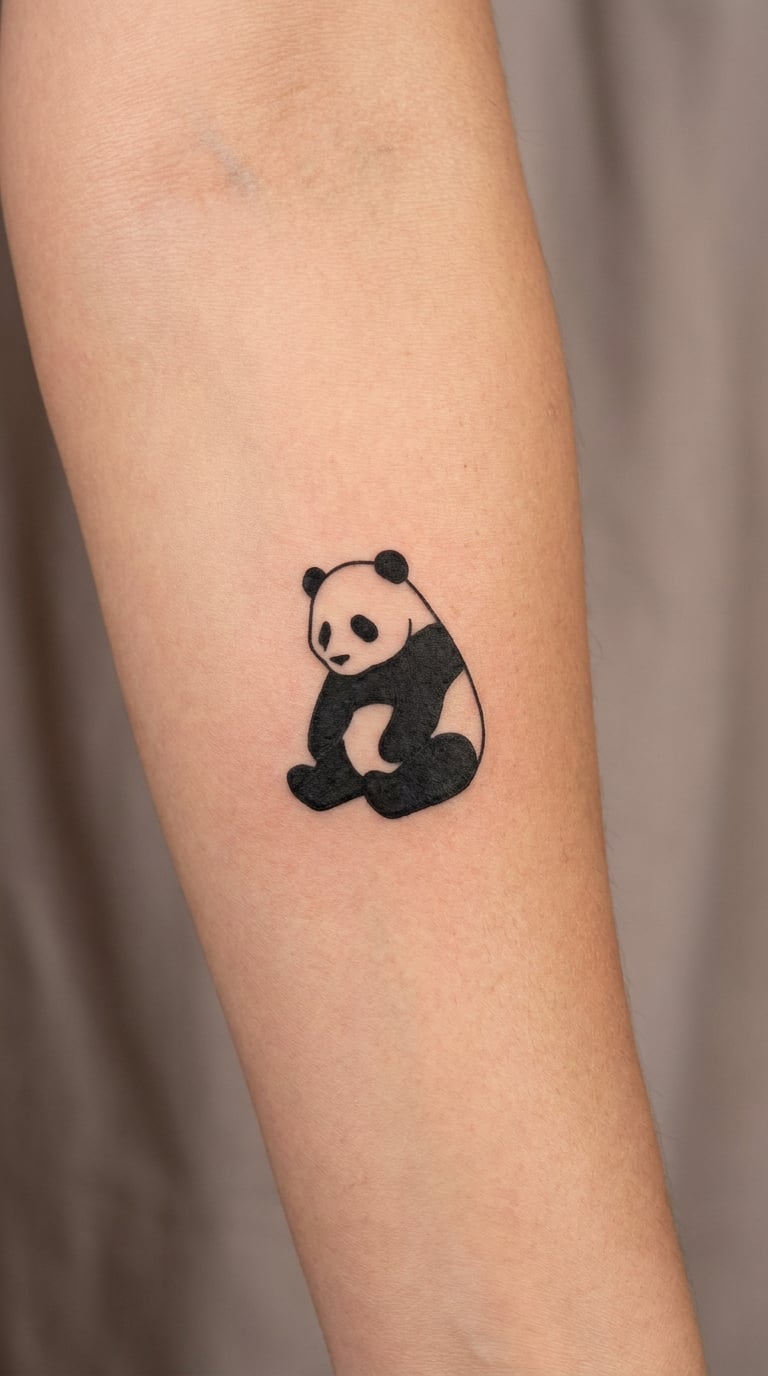
A seated panda drawn with clean black contours, a rounded head, two solid ear shapes and economical black patches for the eye patches and limbs. There is no shading at all, which is the point: the design reads at a glance even from across a room, and it holds its shape long after softer styles have blurred.
People pick the sitting pose because it is a calm animal in a calm posture, which reads as steadiness rather than noise. It is also the easiest panda drawing to get right, so it works as a first piece.
Placement: Inner forearm, wrist or the outer bicep of a smaller arm. Size: 1.5 to 2.5 inches (4 to 6 cm). Style: Minimal line art. Pain: Low, a scratchy sustained feeling. Ageing note: Keep line weight above a full millimetre or it will soften noticeably in a few years.
Make it yours: Put a real date underneath in matching line weight, or place the two initials of whoever gave you your first panda plush.
2. Sleeping Panda Curled on a Branch
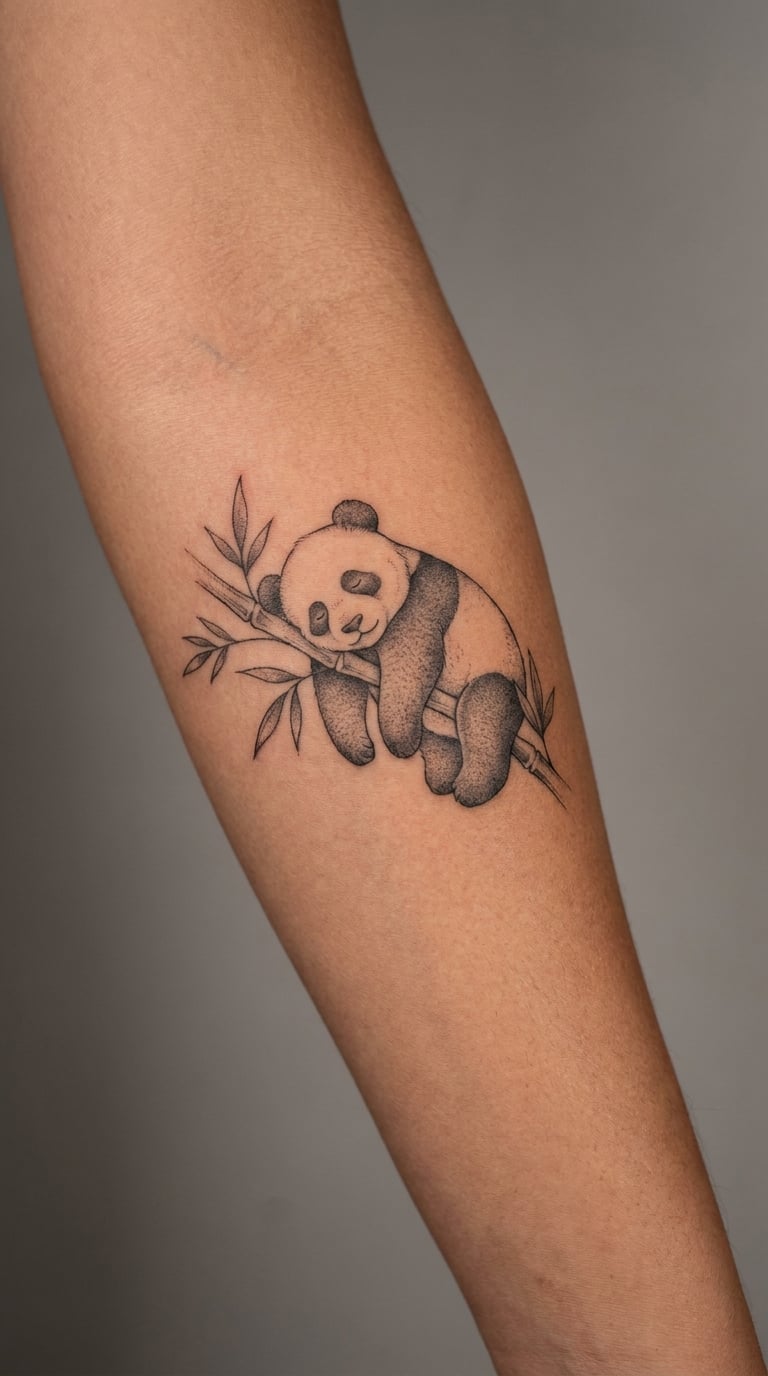
A panda curled on its side with eyes closed, wrapped loosely around a thin bamboo branch that curves away beneath it. Soft grey shading does the work of describing the fur, and the whole composition is deliberately low and horizontal so it follows the line of a forearm.
This one gets chosen for rest and comfort, and it suits people who want a piece with a settled feeling instead of an energetic one. A cub asleep on a branch also reads as someone asleep somewhere they feel safe.
Placement: Outer forearm, calf or the side of a ribcage. Size: 2.5 to 3.5 inches (6 to 9 cm). Style: Black and grey realism-lite. Pain: Low to medium, more an itch than a sting. Ageing note: The thin branch end can fade first, so ask for the line to be slightly heavier there.
Make it yours: Add a small engraved date on the branch, or put the design where you can see it when you rest your head back.
3. Panda Peeking Over a Heart
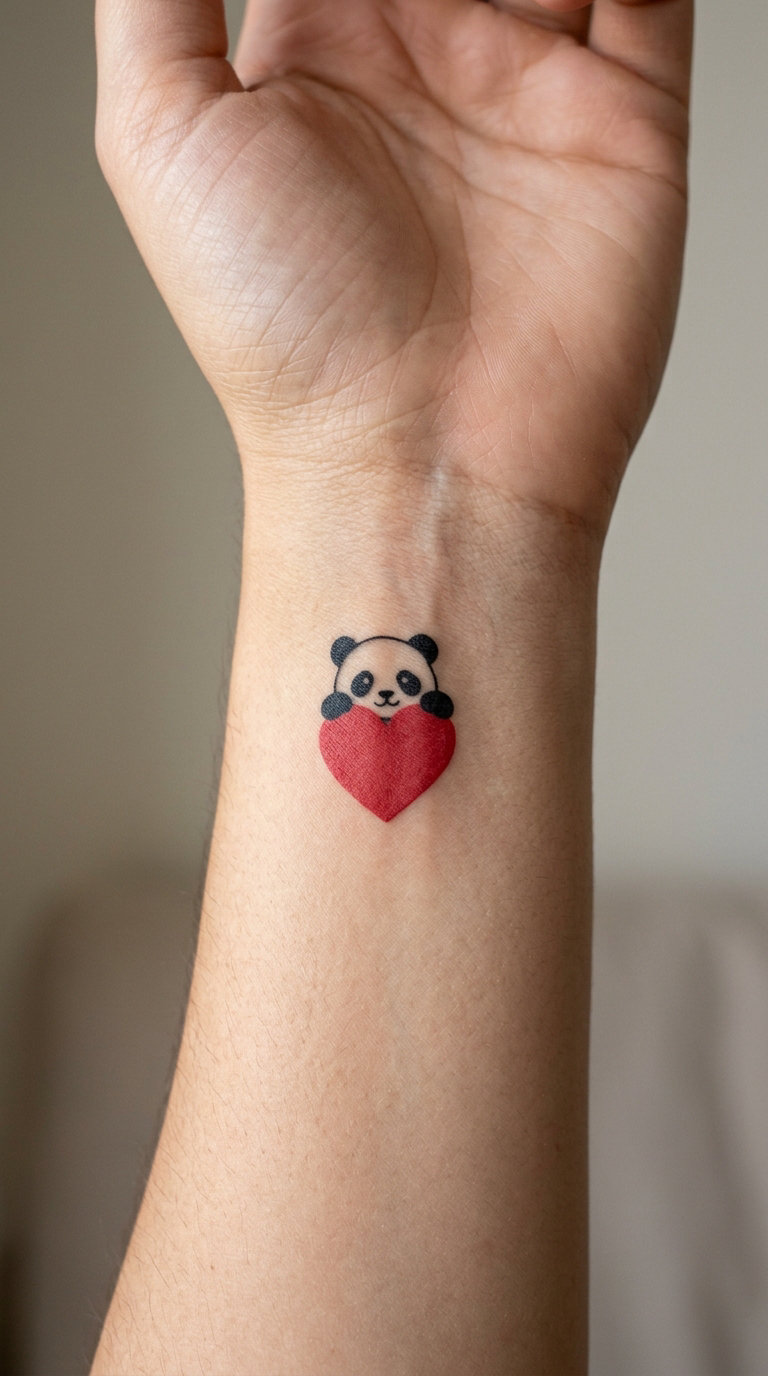
A rounded heart in black outline with a panda crouched behind the top edge, only the head, ears and two paws visible. The surprise is the overlap: because the panda sits behind the heart rather than inside it, the design has depth that a flat heart never gets.
It is a straightforward love design, but the panda makes it less formal than a plain heart, which is usually the reason people end up here. Plenty of people combine it with a second, matching piece later.
Placement: Inner wrist, sternum or the ankle bone. Size: 2 to 3 inches (5 to 8 cm). Style: Illustrative with one colour. Pain: Medium, the wrist is more sensitive than the arm. Ageing note: Red on skin fades noticeably faster than black, so expect a touch-up on the heart.
Make it yours: Skip the red and fill the heart in a single deep green, or outline it instead of solid so it reads as a sketch.
4. Fine-Line Panda in a Crescent Moon
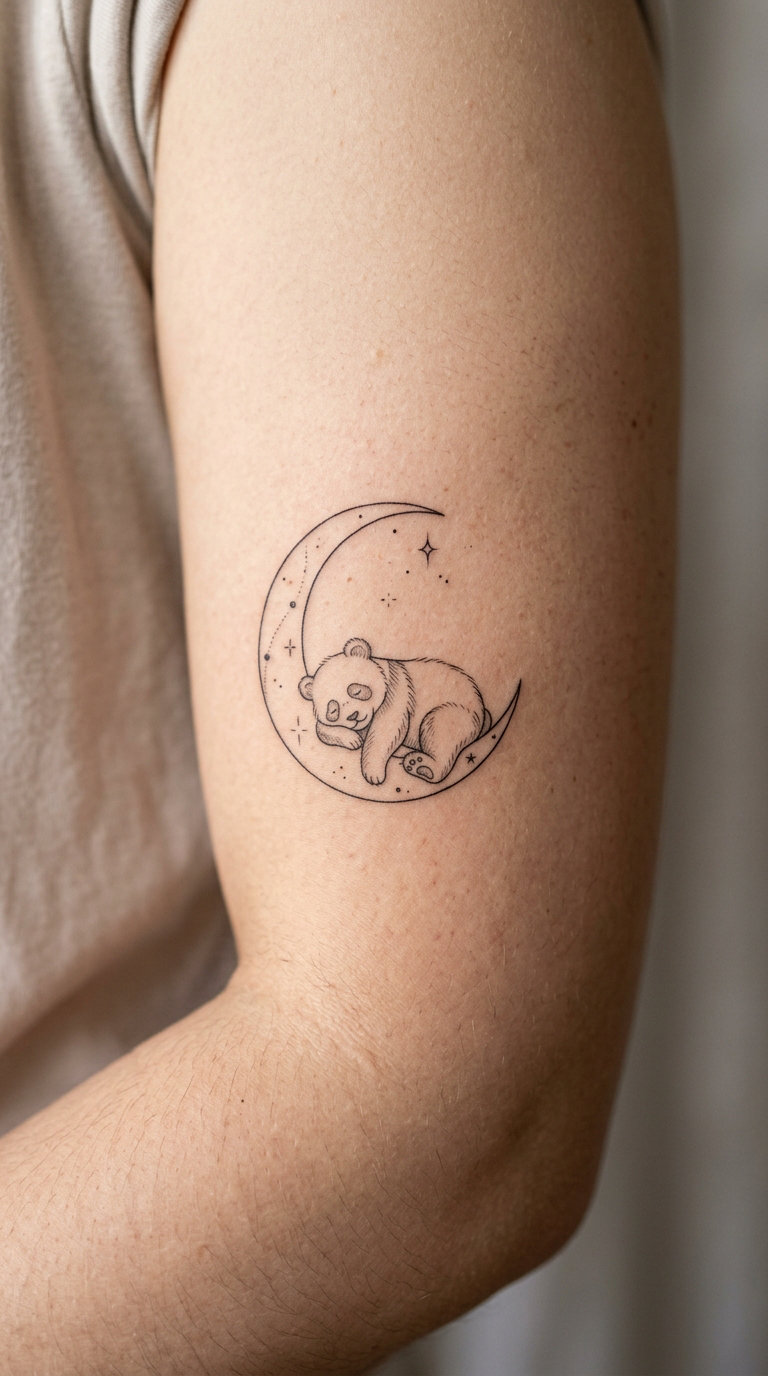
A slim crescent moon drawn in one continuous line, with a small panda curled inside the curve. The linework is thin and even, and the artist leaves plenty of empty skin inside the crescent rather than filling it with stars or texture.
The pairing is popular for the gentler symbolism, a night-time animal resting somewhere quiet. People also choose it simply because a crescent is an easy shape to wrap around a limb.
Placement: Upper arm, ribcage, behind the shoulder or the inner calf. Size: 2.5 to 3.5 inches (6 to 9 cm). Style: Fine line. Pain: Low. Ageing note: Fine line on the ribcage and inner arm fades faster than on the upper arm, because skin movement breaks the line up.
Make it yours: Add one tiny star outside the moon rather than inside it, so the panda keeps its quiet space.
5. Micro Panda Behind the Ear
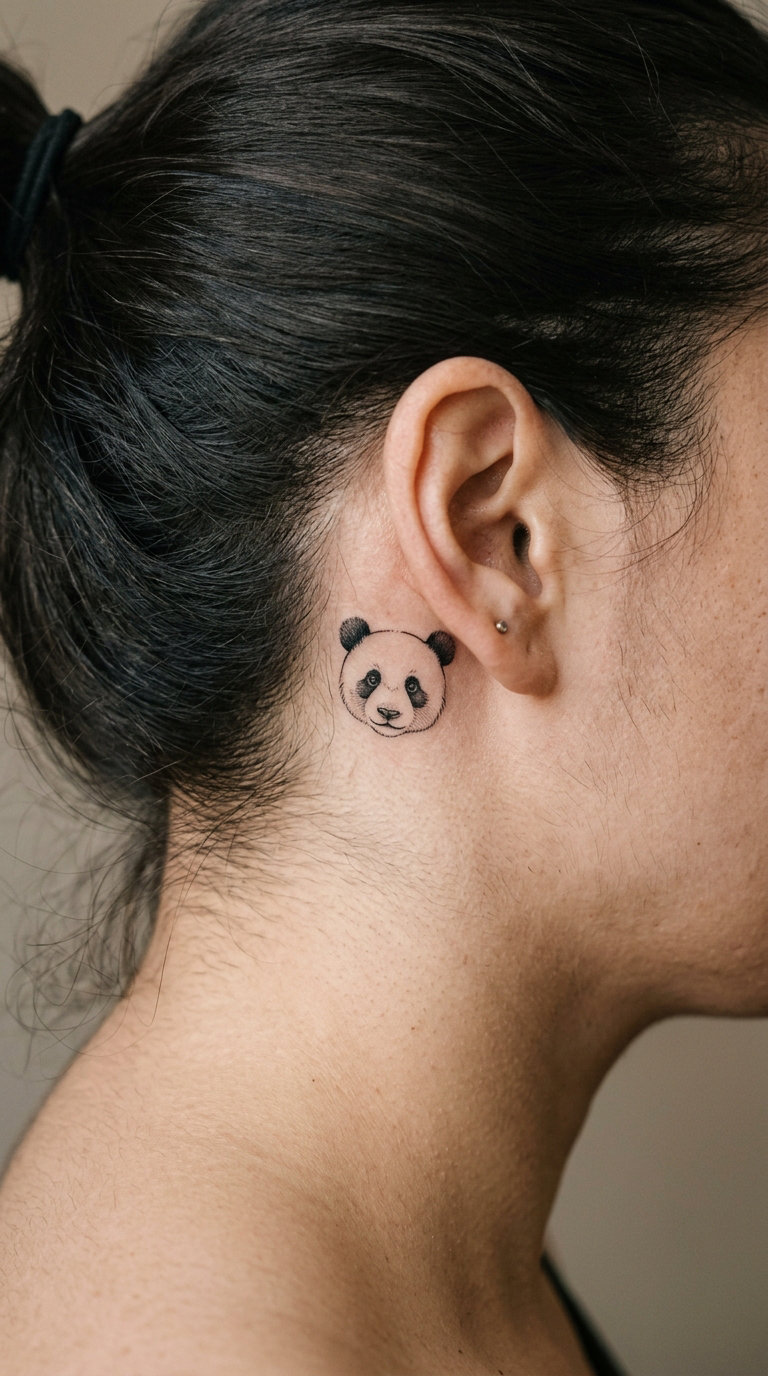
A simplified panda head, nothing but the two ears, the head shape and the eye patches, tucked into the space just behind the ear. At roughly 1.5 inches there is no room for fur, shading or expression, so the design depends entirely on proportion being correct.
It is the least conspicuous way to carry a panda, and the partly hidden position suits people who like a tattoo that is not the first thing anyone notices. The panda peeking out matches the joke of the design nicely.
Placement: Behind the ear, the nape of the neck, or the inner ankle. Size: 1 to 1.75 inches (3 to 4.5 cm). Style: Micro fine line. Pain: Medium, the neck and the bony area behind the ear both sting more than they should for such a small design. Ageing note: Anything this small loses interior detail first, so the artist should simplify the eyes rather than dot them.
Make it yours: Use a matching micro panda on the other side, or add a second tiny bamboo leaf below it for balance.
6. Panda Cub Holding Bamboo
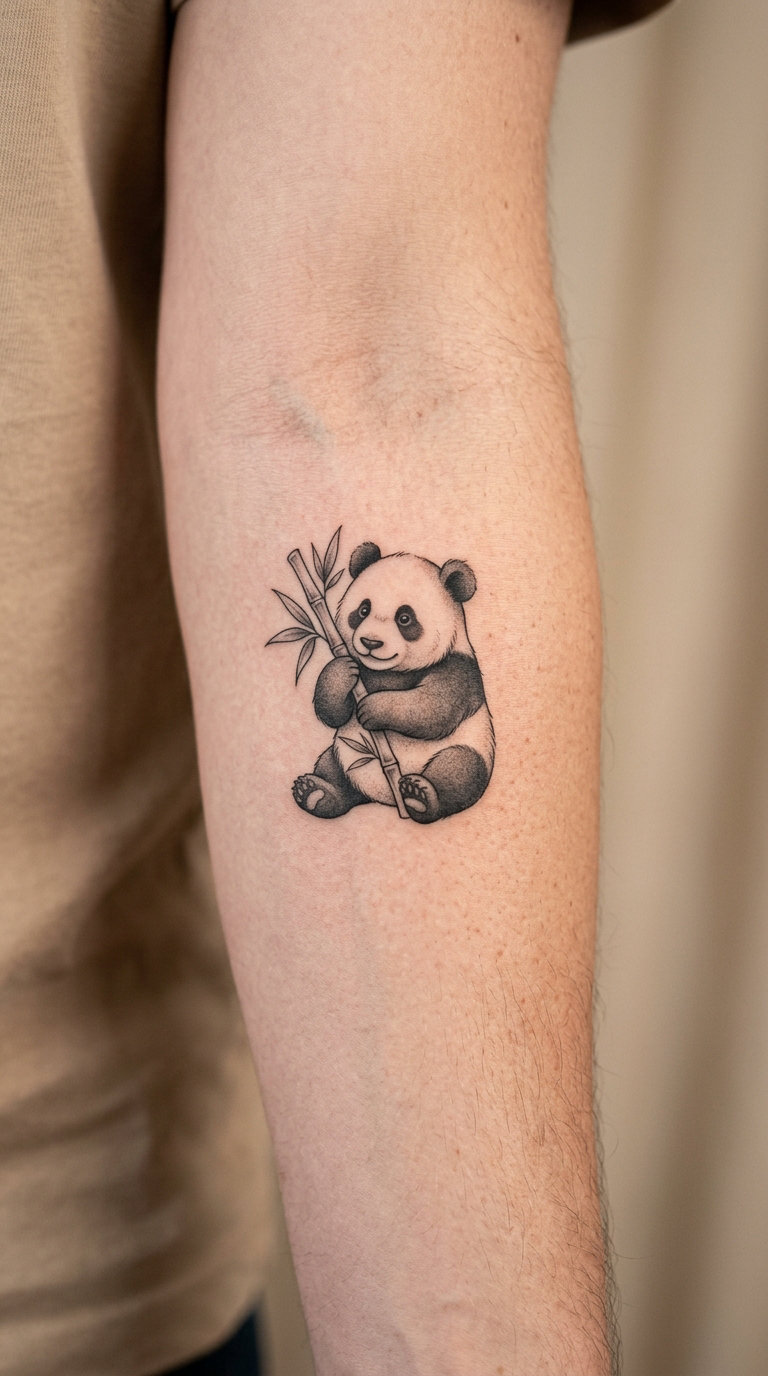
A panda cub sitting with both paws around a single bamboo stalk, the leaves fanning above its head. The body is drawn in soft grey with clean black outlines, and the leaves are spaced rather than layered so the piece breathes while it heals.
Bamboo is the standard companion to a panda, so this is the most traditional choice on the list. People tend to pick it when the panda represents something they grew up with rather than something newly discovered.
Placement: Inner arm near the elbow, outer thigh, or the side of the calf. Size: 2.5 to 3.5 inches (6 to 9 cm). Style: Black and grey illustrative. Pain: Medium, the inner elbow is sensitive and the bamboo line runs a long way. Ageing note: The thin leaf tips are the first thing to soften, so keep the leaf count low.
Make it yours: Have the artist hide a small year inside one leaf, or add a second shorter stalk behind the first.
7. Blackwork Panda in a Circular Frame
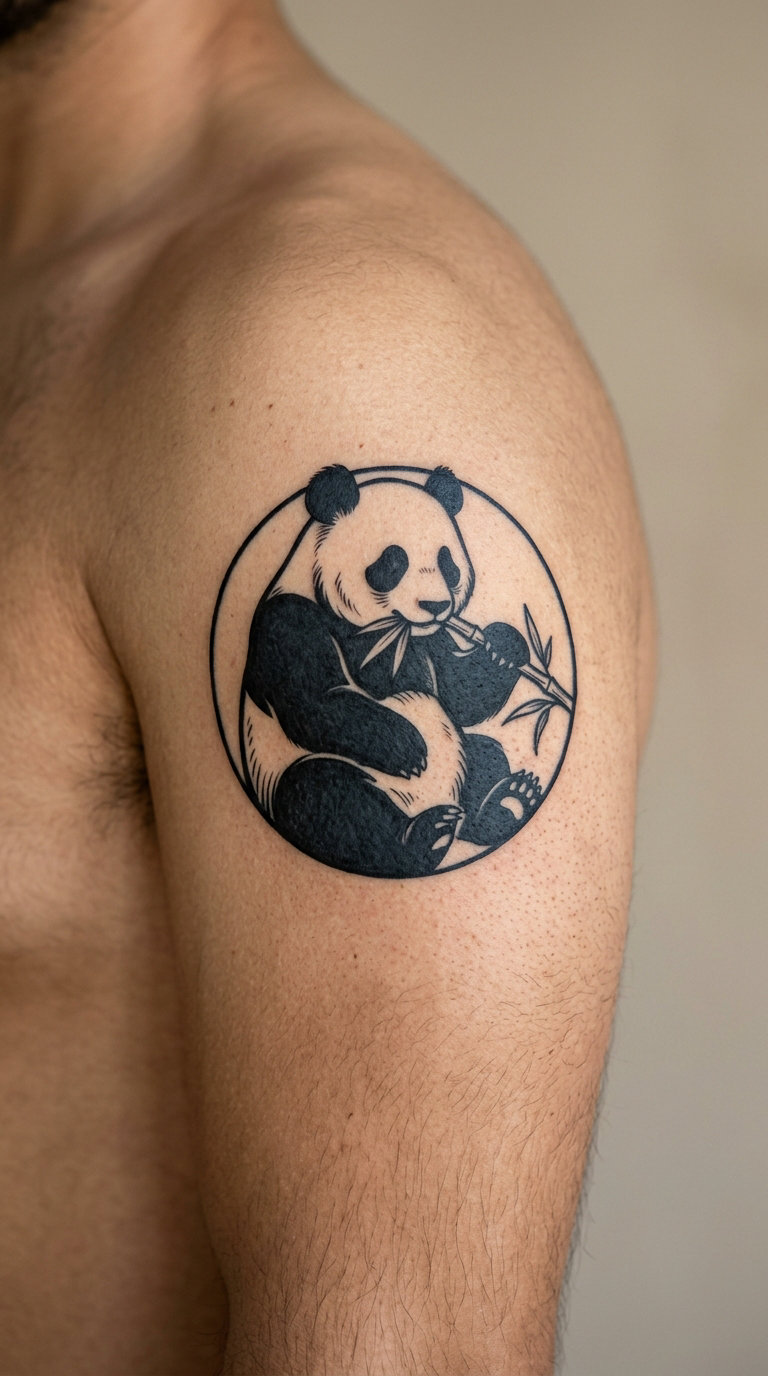
A panda built from solid black shapes, with the white fur left as bare skin, set inside a clean thin circle. The artist is working with contrast instead of shading: large black masses for the ears, limbs and eye patches, skin for everything else.
The circle makes it read as a finished object rather than a sketch, which is why this version photographs so well. It is also easy to extend later, since the frame gives you a shape to build a sleeve around.
Placement: Upper arm, thigh, calf or the centre of the back. Size: 3.5 to 5 inches (9 to 13 cm). Style: Blackwork. Pain: Medium to high, solid black fill is a long, heavy pass. Ageing note: Black is the most durable ink there is, so this style ages better than anything else on the list.
Make it yours: Double the inner line so the frame reads as two concentric rings, or break the circle at one point and run a bamboo stem through the gap.
8. Geometric Panda Head
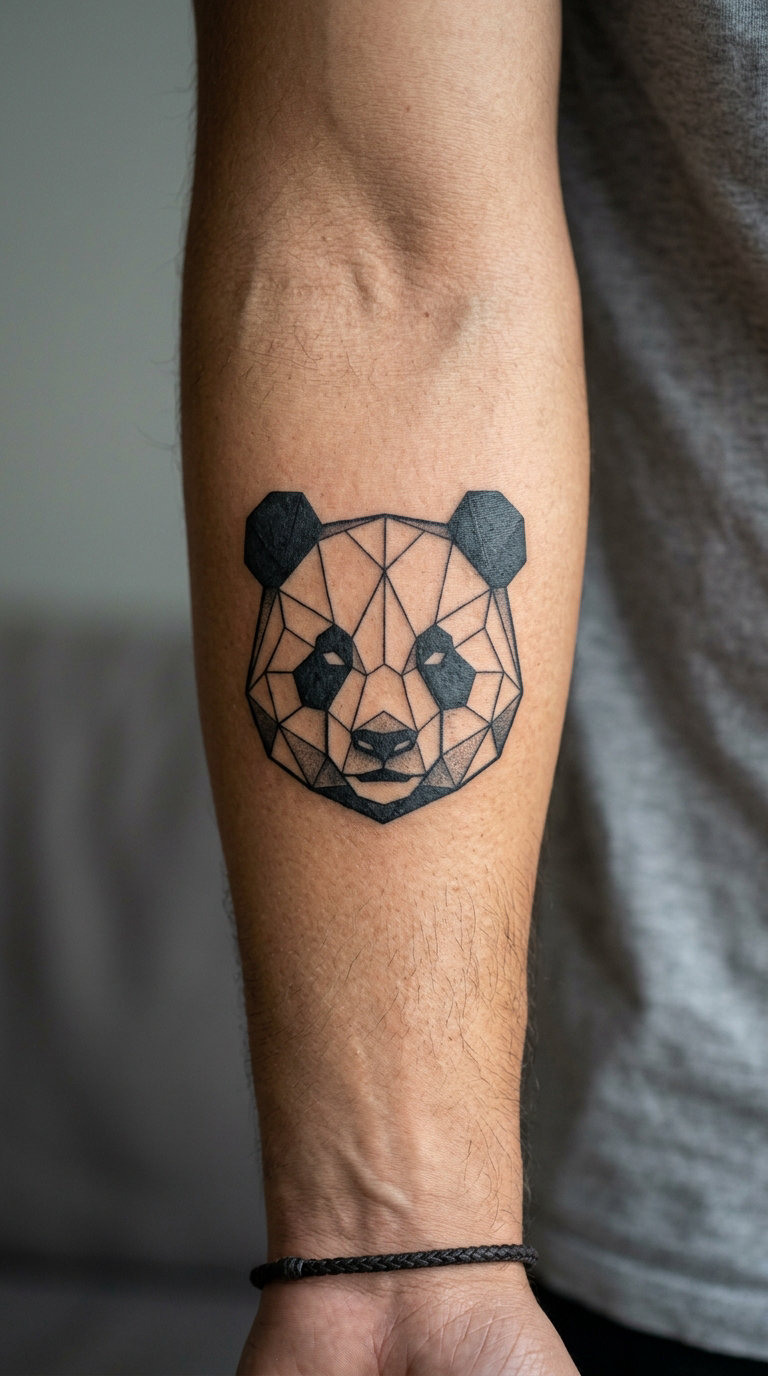
The panda head broken into flat triangles and quadrilaterals, with a few shapes filled solid black and the rest left as outlined facets. It is a low-poly approach, and the readability comes from keeping the eye patches on clean diagonals.
People choose this when they want the panda to look designed rather than drawn, a piece that matches straight-line and architectural work elsewhere on the body. It pairs very easily with sleeve pieces that share the same angles.
Placement: Forearm, calf, the upper chest or the back of the hand. Size: 2 to 3 inches (5 to 8 cm). Style: Geometric low-poly. Pain: Low. Ageing note: Interior outlines of thin triangles are the first casualty, so fewer, larger facets last longer than many small ones.
Make it yours: Add a thin geometric bamboo grid behind the head, or colour one facet only, a single red or green triangle inside the black.
9. Watercolour Panda Portrait
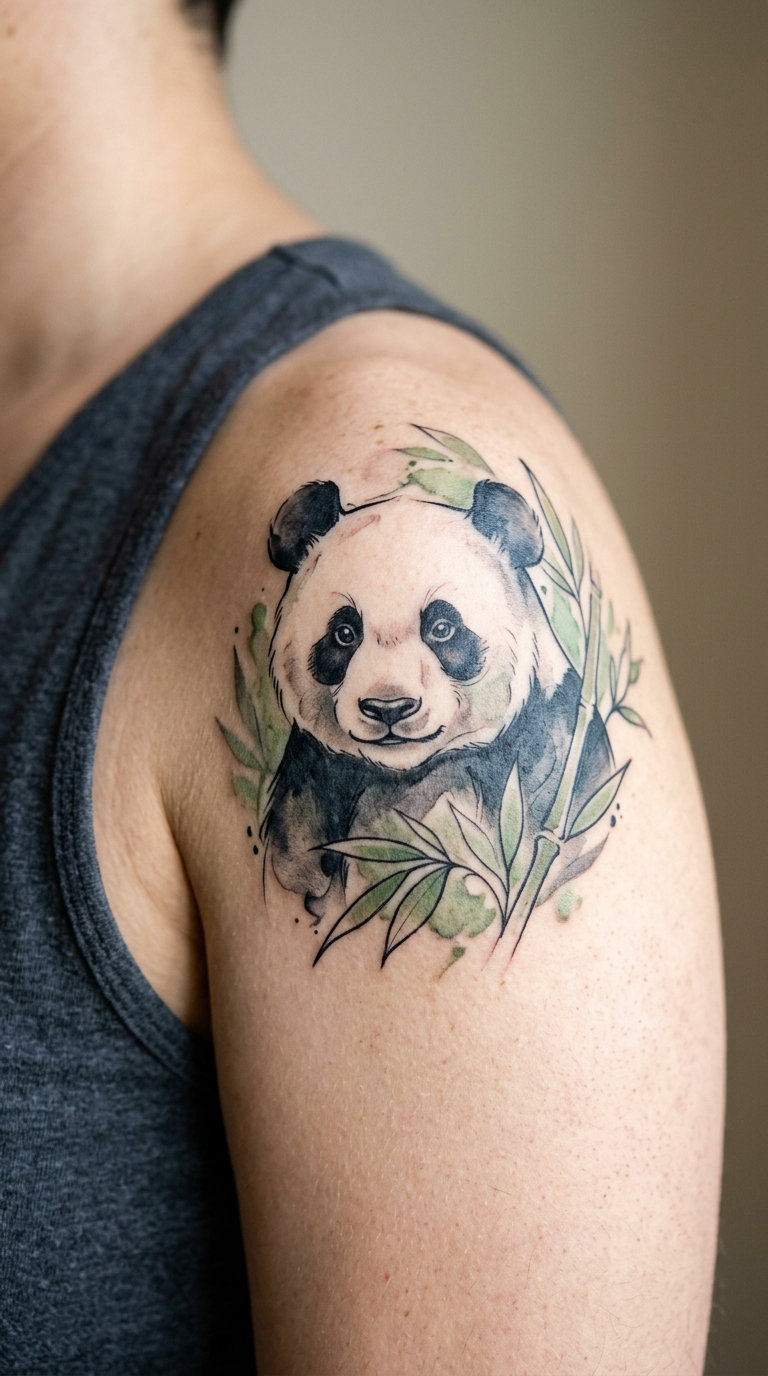
A panda head built from loose washes of grey and black bleeding into each other, with soft edges and very little hard outline. Small muted green touches at the edges suggest leaves without drawing them, and the white of the fur is left as bare skin rather than filled in.
Watercolour panda ink suits people who want something expressive and unfinished-looking, closer to a painting than a logo. It hides small imperfections better than line work, which is a real advantage on a curving part of the body.
Placement: Shoulder, upper back, the outer thigh or the calf. Size: 3.5 to 5 inches (9 to 13 cm). Style: Watercolour. Pain: Medium, a wash means many light passes. Ageing note: Pale wash edges fade toward grey, so keep contrast between the black areas and the skin higher than feels natural.
Make it yours: Ask the artist to run the wash slightly outside the outline on one side, as if the ink kept going after the drawing stopped.
10. Traditional Panda with Red Seal
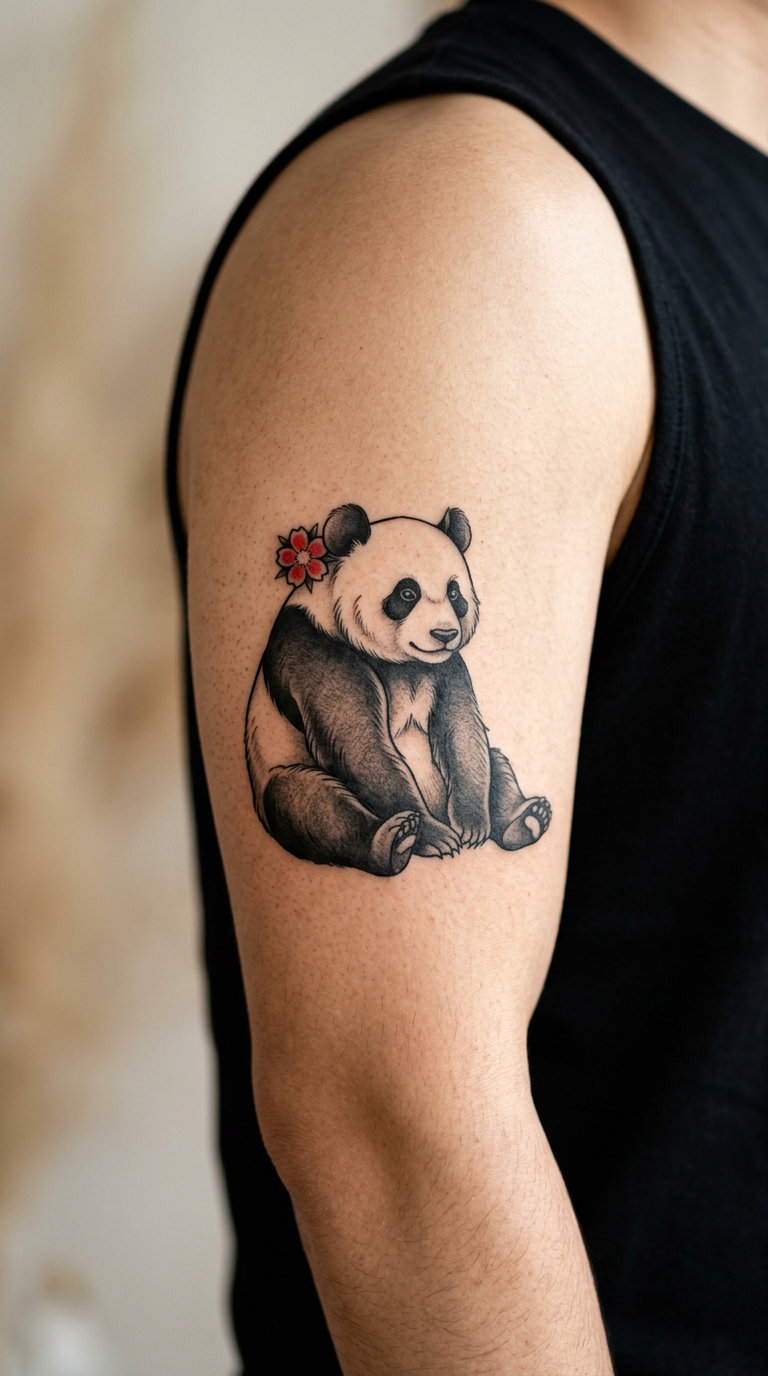
A bold black panda with heavy outlines and flat shaded areas, drawn in the style of classic traditional tattoo flash, with a single small red square mark tucked beside it. The red is the only colour in the piece, which is exactly why it reads as a seal rather than decoration.
Traditional flash styling gives a panda weight and permanence, which is what people who are adding to an existing collection usually want. The red accent is drawn freely rather than copied from an existing emblem, which keeps it original.
Placement: Upper arm, thigh, calf or the shoulder blade. Size: 3.5 to 4.5 inches (9 to 11 cm). Style: Traditional. Pain: Medium, consistent line work. Ageing note: The red square will fade to a warmer, duller shade, so plan for a red touch-up in a couple of years.
Make it yours: Use your initials in the red mark instead of a character, or ask for the panda to hold a specific object that means something to you.
11. Panda Climbing a Bamboo Stalk
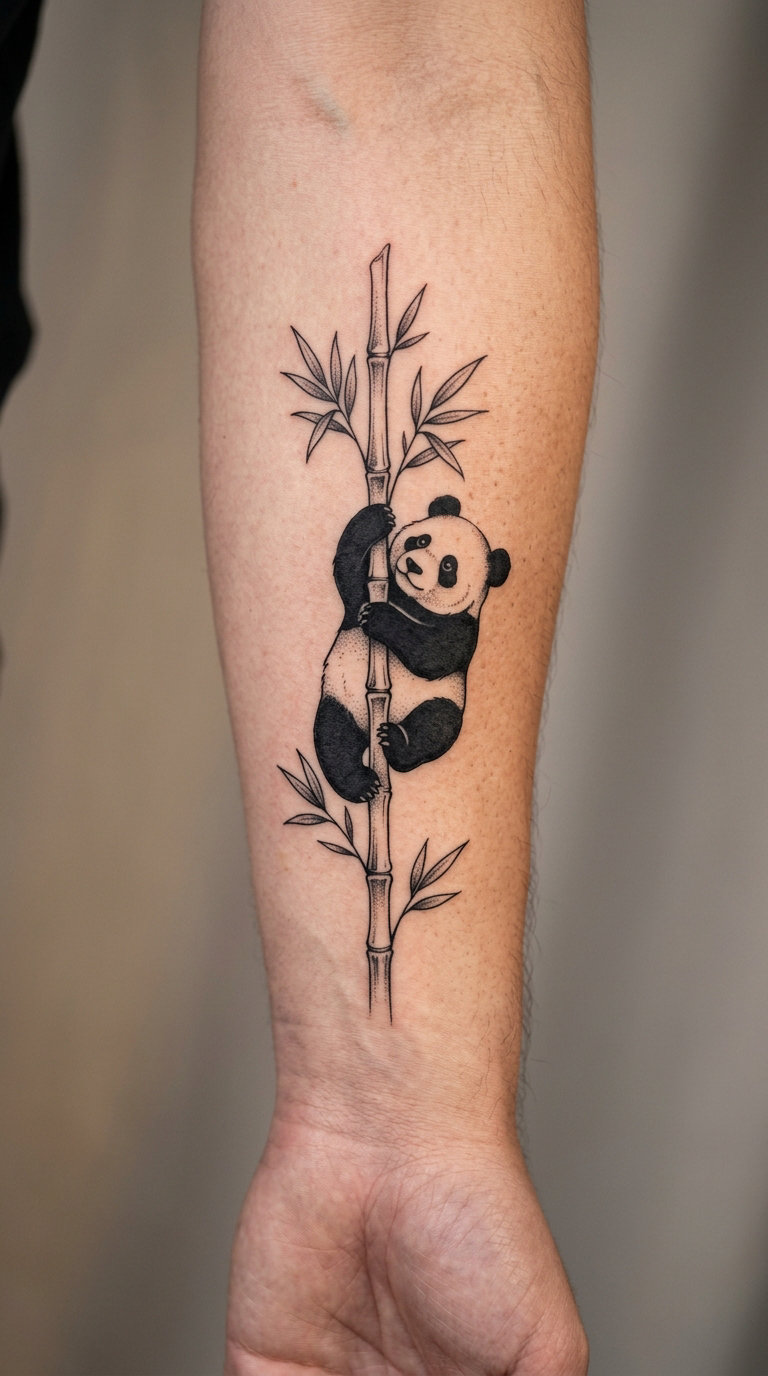
A vertical composition with a tall bamboo stalk running the length of the design and a panda part-way up it, limbs spread for grip. Strong black outlines and a little grey shading in the stalk segments keep it readable, and the pose gives the whole piece real movement.
The climbing pose is the active one, so it usually turns up on people who like a panda that looks busy and alive rather than resting. A vertical design also fills a narrow strip of body much better than a square one.
Placement: Outer forearm, inner arm, calf or the side of the ribcage. Size: 4 to 6 inches (10 to 15 cm). Style: Bold outline illustrative. Pain: Medium, longer session because the stalk carries the design along its length. Ageing note: The node lines on the bamboo are thin and should be inked a touch heavier than they look on paper.
Make it yours: Add tiny paw prints climbing the stalk below the panda, or run the bamboo from the wrist so the piece follows the arm’s line.
12. Realistic Panda Portrait
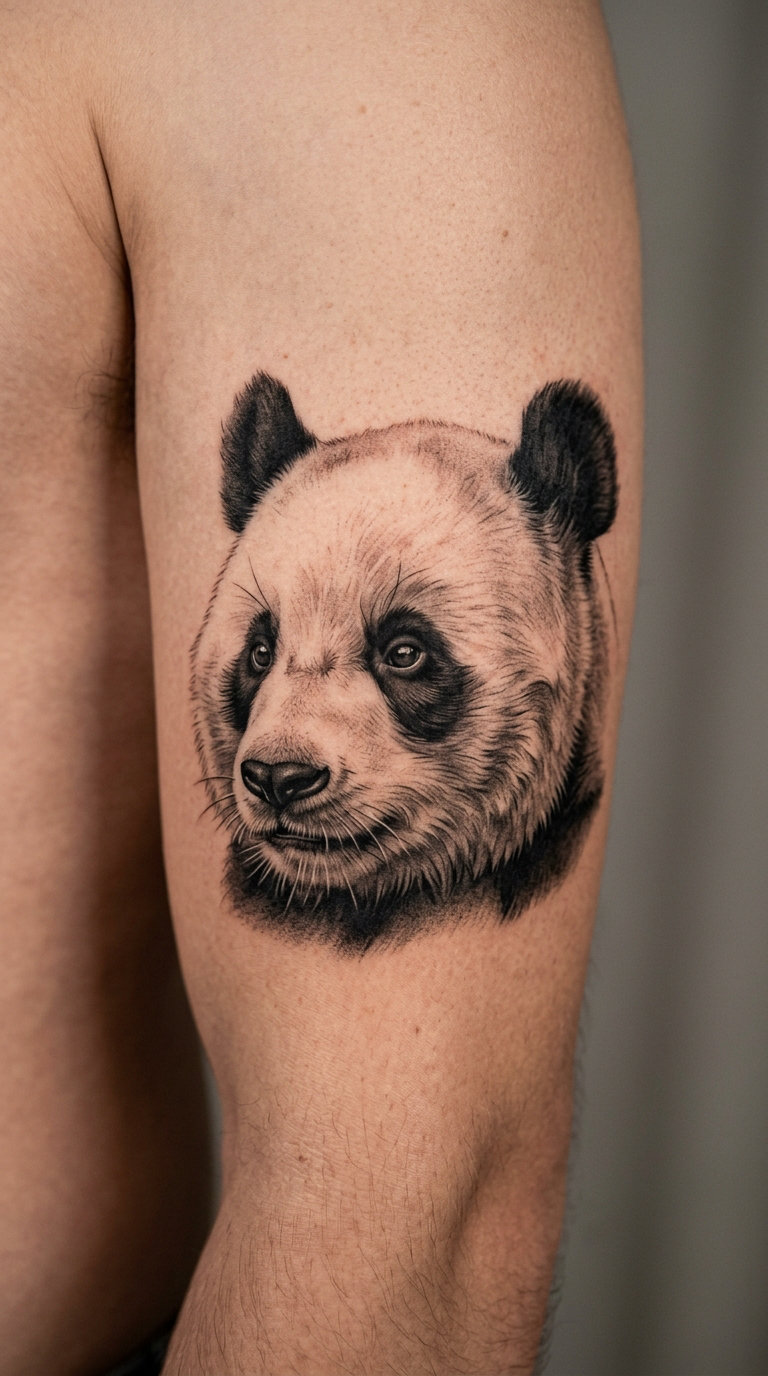
A portrait built on fur direction: fine grey strokes fanning out from the cheeks and crown, soft transitions where black meets white, and eyes that are the only hard detail in the piece. It is the one design here that needs a real portfolio, not a flash sheet.
Realistic panda work tends to be chosen for a memorial, for someone who has a genuine bond with the animal, or simply because fur is the thing a tattoo artist most wants to prove they can do.
Placement: Upper arm, shoulder, back or the outer thigh, anywhere flat enough to hold a face. Size: 4 to 6 inches (10 to 15 cm). Style: Micro-realism. Pain: Medium, shading is repetitive rather than sharp. Ageing note: The lightest fur greys out first, so a good artist builds contrast in before they start.
Make it yours: Bring a photograph of a panda you have actually met, and ask for the eye colour and head angle from that specific frame.
13. Two Panda Cubs Hugging
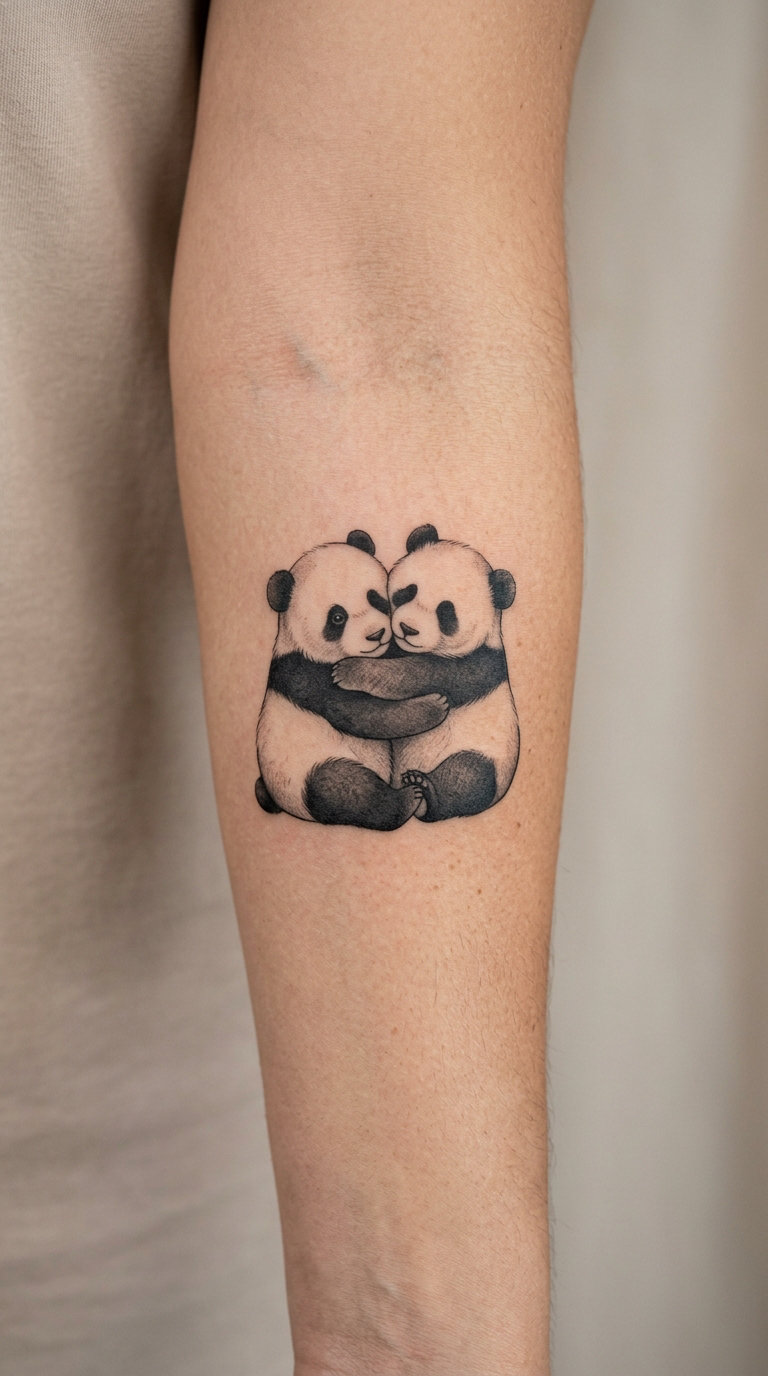
Two cubs sitting upright with their arms around each other, drawn in soft black and grey with rounded, simplified bodies and no background. The two heads lean slightly toward each other, and that small tilt is what makes the design read as affectionate rather than merely two animals.
Pairs like this are usually chosen for a relationship, a friendship or a parent-and-child bond, and they work well as a matching design. The symmetry also makes it a natural candidate for the inner arms of two people.
Placement: Forearm, inner upper arm, ribs or the back of the calf. Size: 3.5 to 4.5 inches (9 to 11 cm). Style: Soft black and grey. Pain: Medium, more surface area than a single head. Ageing note: Where the two bodies meet, keep the outline firm so the shapes do not merge over time.
Make it yours: Give the two cubs different poses, or tuck a small heart or bamboo sprig between them.
14. Dotwork Panda and Moon
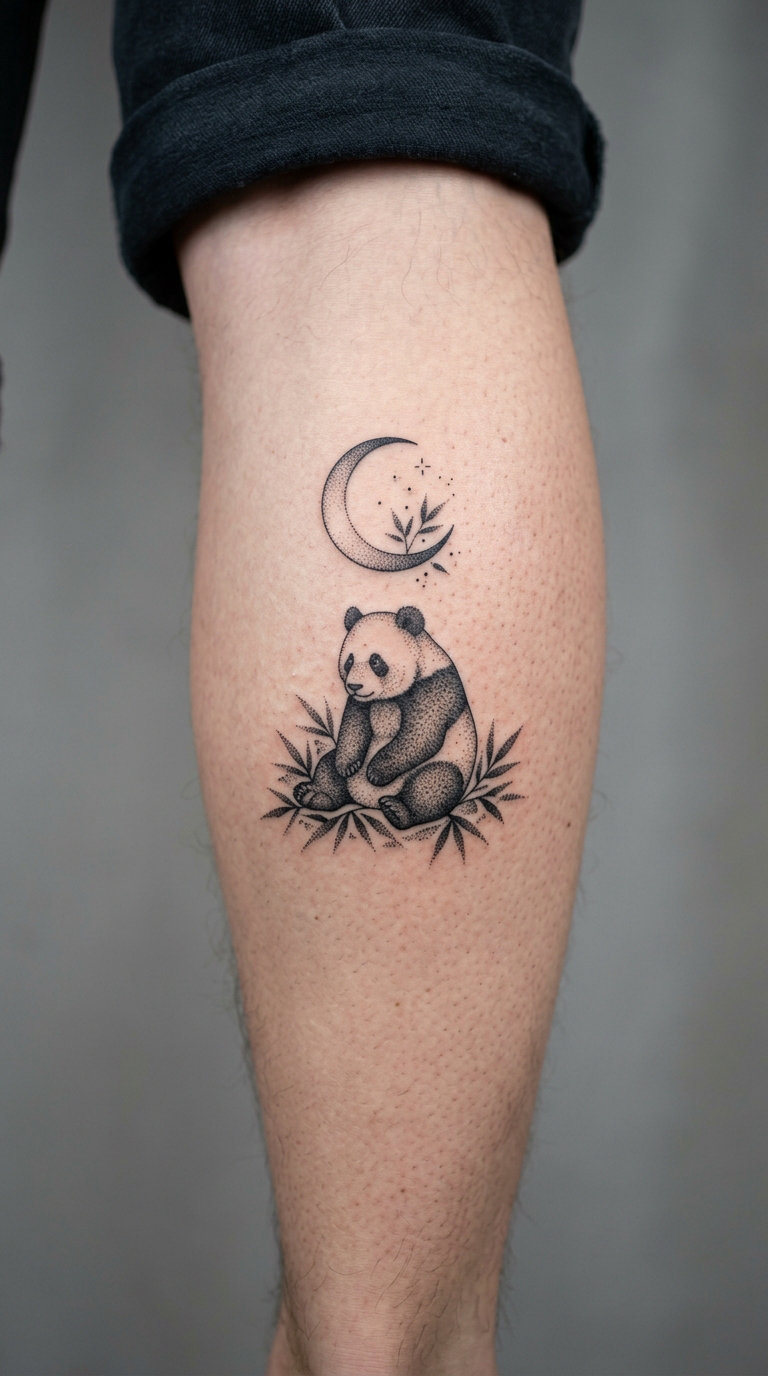
A panda sitting under a crescent, both built entirely from dots at varying density. Tight clusters make the black areas, wide spacing makes the grey, and the artist builds the whole image by changing the spacing rather than the size of the dot.
Dotwork reads as texture rather than line, so it holds its character better than fine line work in some places and needs more space in others. It suits people who like pattern and are willing to sit for a longer session.
Placement: Calf, outer arm, the back of the shoulder or the ribs. Size: 3 to 4 inches (8 to 10 cm). Style: Dotwork. Pain: Medium, dotting is repetitive and takes its time. Ageing note: Dots spread slightly as they heal, so a very fine dot pattern will need a second pass to sharpen.
Make it yours: Scatter a few loose dots off the main shape like drifting dust, or fade the bottom of the panda out rather than ending it on a hard edge.
15. Red Ink Panda Accent
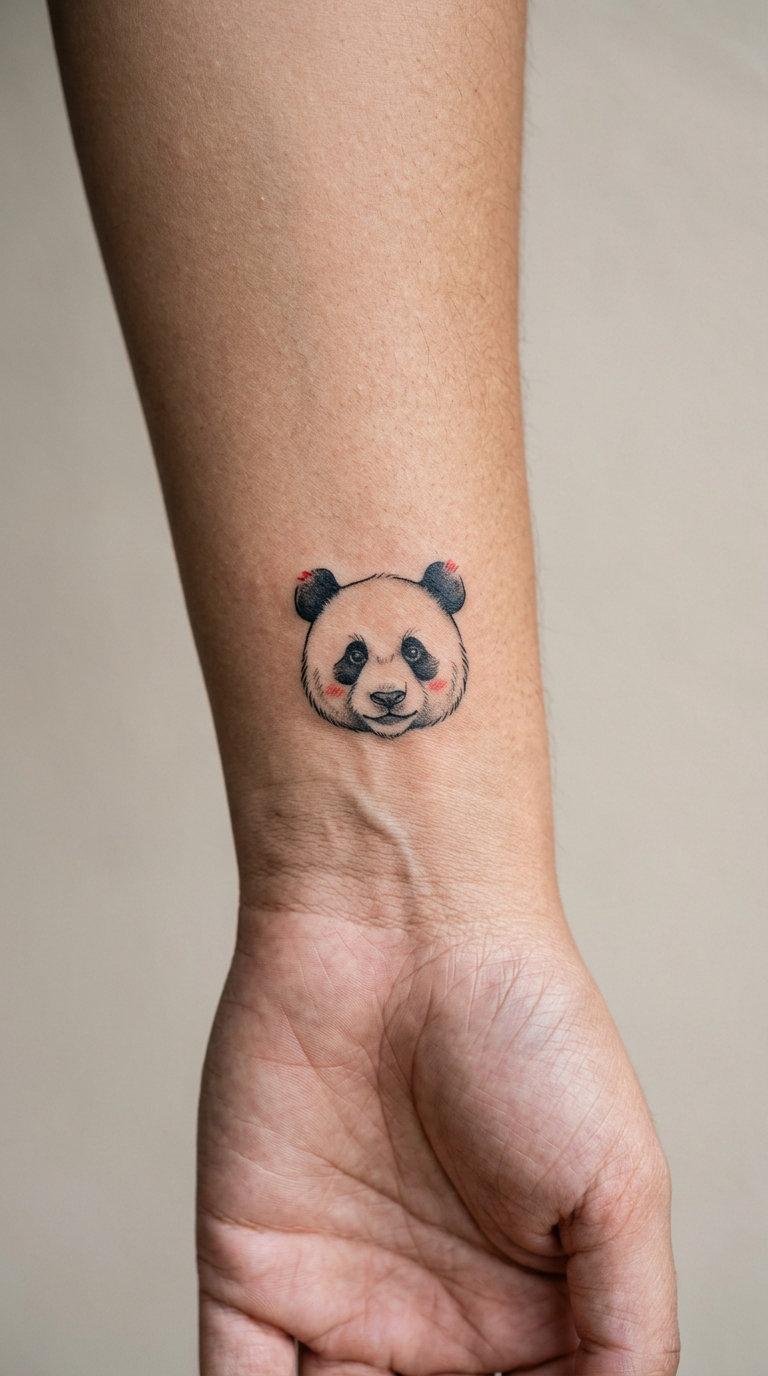
A mostly black panda face with red used in three small places only: the inner ears, the cheeks and a thin line of the mouth. Because red is used sparingly, the whole design feels deliberate, and the black areas stay dominant and graphic.
Colour without a full colour palette is a good middle ground for someone who wants a panda that is not another blackwork piece but does not want a rainbow. Red panda ink is the one colour tattooists recommend most often for a reason.
Placement: Wrist, inner forearm, behind the ear or the ankle. Size: 2.5 to 3.5 inches (6 to 9 cm). Style: Black line with colour accent. Pain: Medium, the wrist is sensitive. Ageing note: Red fades fastest of all the common inks, so expect a colour refresh in a year or two.
Make it yours: Put a real blush on each cheek rather than a perfect circle, or use your birth flower colour instead of red.
16. Panda Sitting in a Teacup
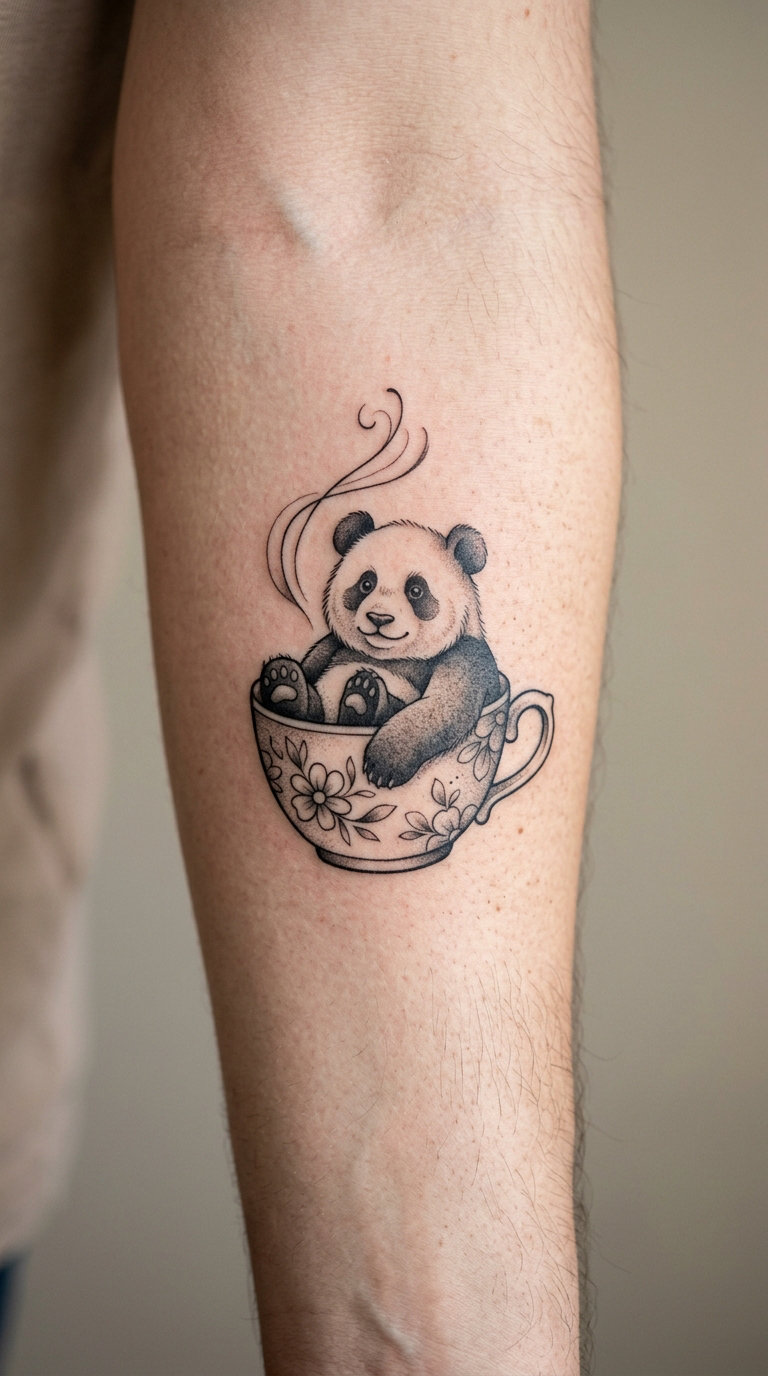
A round panda sitting inside a wide teacup, its head and paws above the rim, with two or three curved lines of steam rising behind it. The cup gives the design a clean frame and lets the artist use one simple curve instead of a rectangle or circle border.
It is a light, slightly funny piece, and people usually choose it to soften a spot where a more serious design would feel heavy. It also works as a second tattoo for a matching pair.
Placement: Forearm, calf, the back of the calf or the hip. Size: 2.5 to 3.5 inches (6 to 9 cm). Style: Playful illustrative. Pain: Low. Ageing note: Steam lines are the detail to watch, since they are long, thin and easy to lose. Keep them to two, not five.
Make it yours: Name your tea, your city or a date on the cup, or swap the steam for a small paw print drifting upwards.
17. Minimal Panda Paw Print
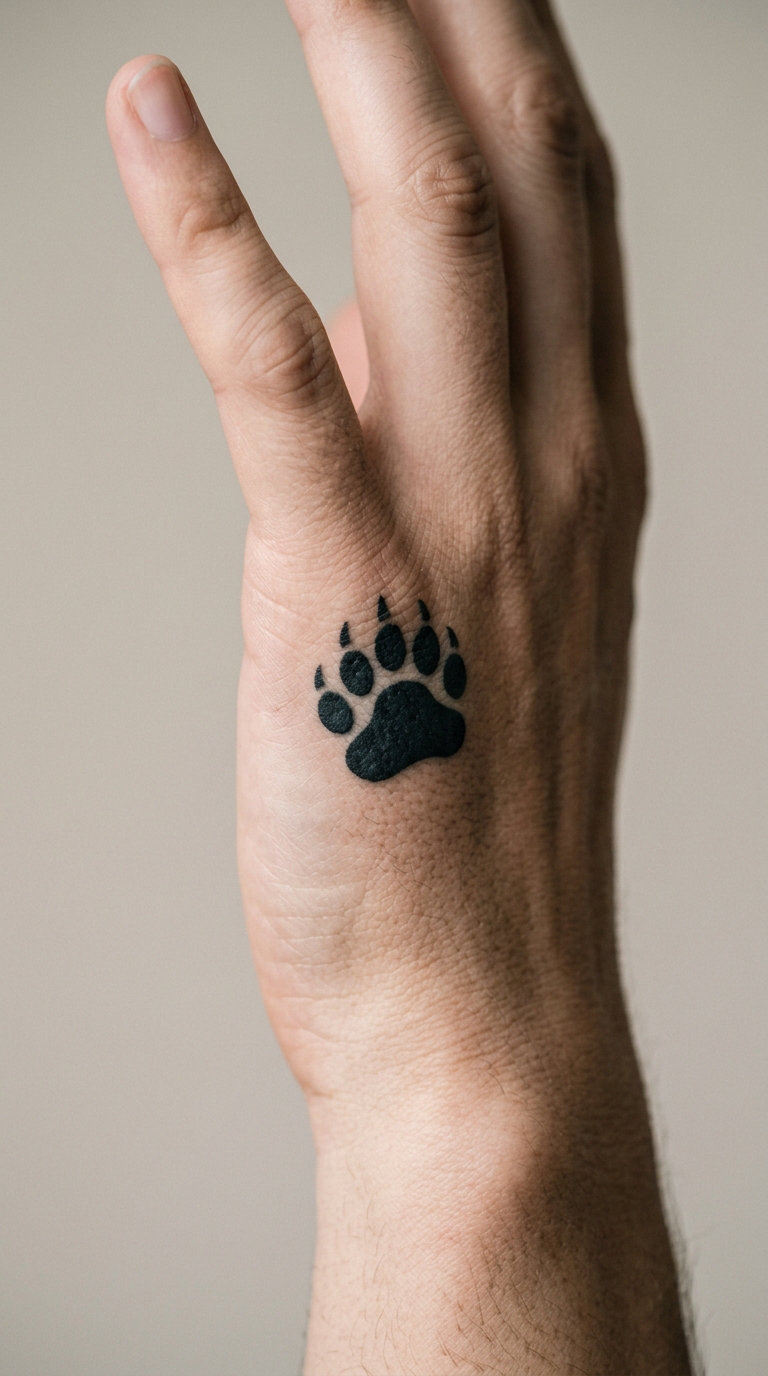
One paw shape: a large rounded pad, a smaller pad above it and four toes, drawn with thick black lines and nothing else. Panda prints are recognisable from the shape alone, so this needs no panda face, no bamboo and no fur.
A paw print is the version for people who want the panda idea without the animal, and several small prints in a line up a forearm or the side of the ankle look intentional rather than accidental.
Placement: Side of the hand, the instep, inner wrist, or in a line along the forearm or spine. Size: 1.25 to 1.75 inches (3 to 4.5 cm) each. Style: Minimal. Pain: Medium to high, hands and wrists are bony and sensitive. Ageing note: Hand and finger tattoos fade fastest of anywhere on the body, so expect more frequent touch-ups here.
Make it yours: Use a real paw size from a panda you have met, or trail three prints in different sizes to suggest a walk.
18. Panda and Lucky Coin Motif
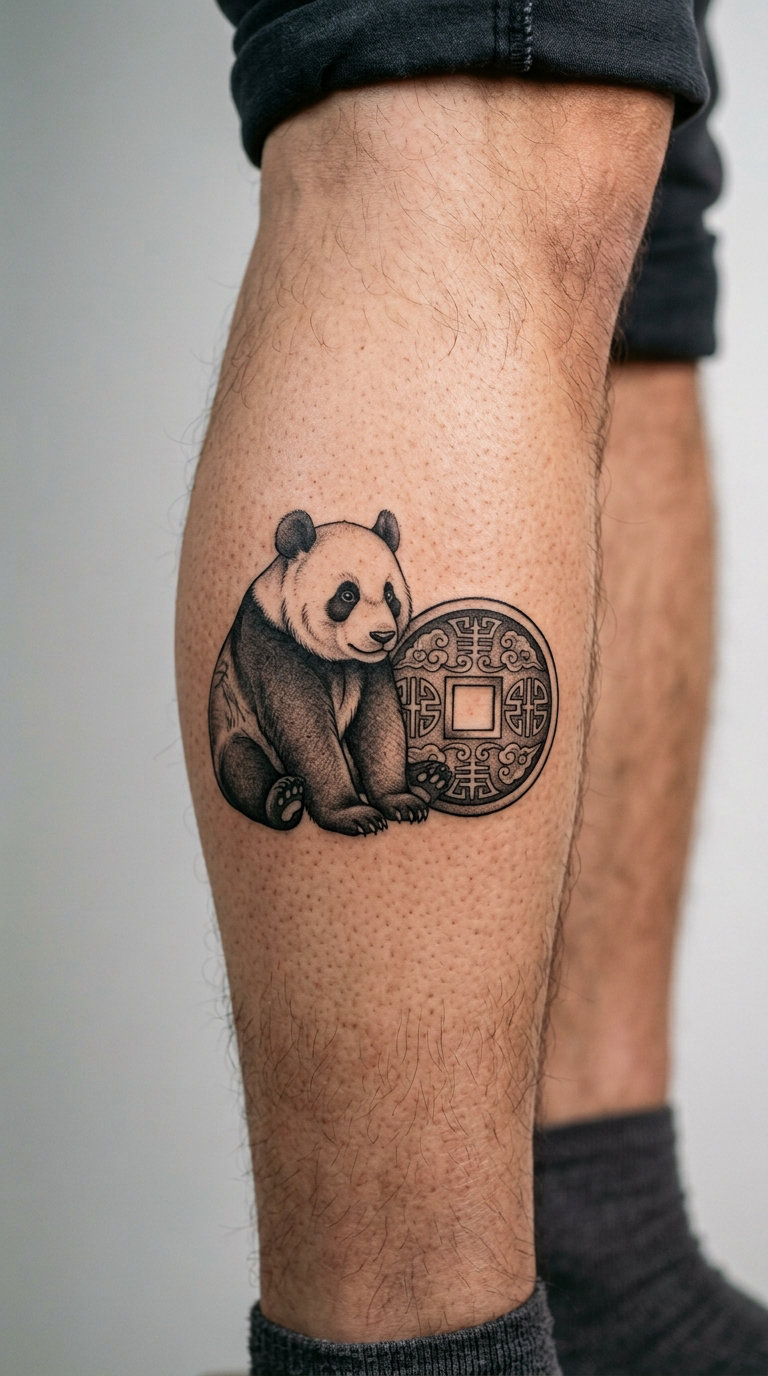
A panda sitting beside a plain round coin with a square opening in the middle, drawn in bold black and grey with clean graphic contrast between the two shapes. The panda holds or touches the coin, which ties the two together instead of leaving them as separate clip art.
The coin is a luck and prosperity motif that reads clearly in a lot of cultural contexts, and people often add a panda for protection and gentleness alongside it. Bring your own reference for the coin detail rather than copying an existing design.
Placement: Calf, forearm, outer arm or the upper back. Size: 3.5 to 4.5 inches (9 to 11 cm). Style: Bold graphic. Pain: Medium. Ageing note: Coin details are usually fine concentric rings, which blur over time. Ask for the rings to be spaced wider than you think they need.
Make it yours: Add a year to the coin face, or use a square-holed coin from a family story you want to keep.
19. Panda Among Bamboo Leaves
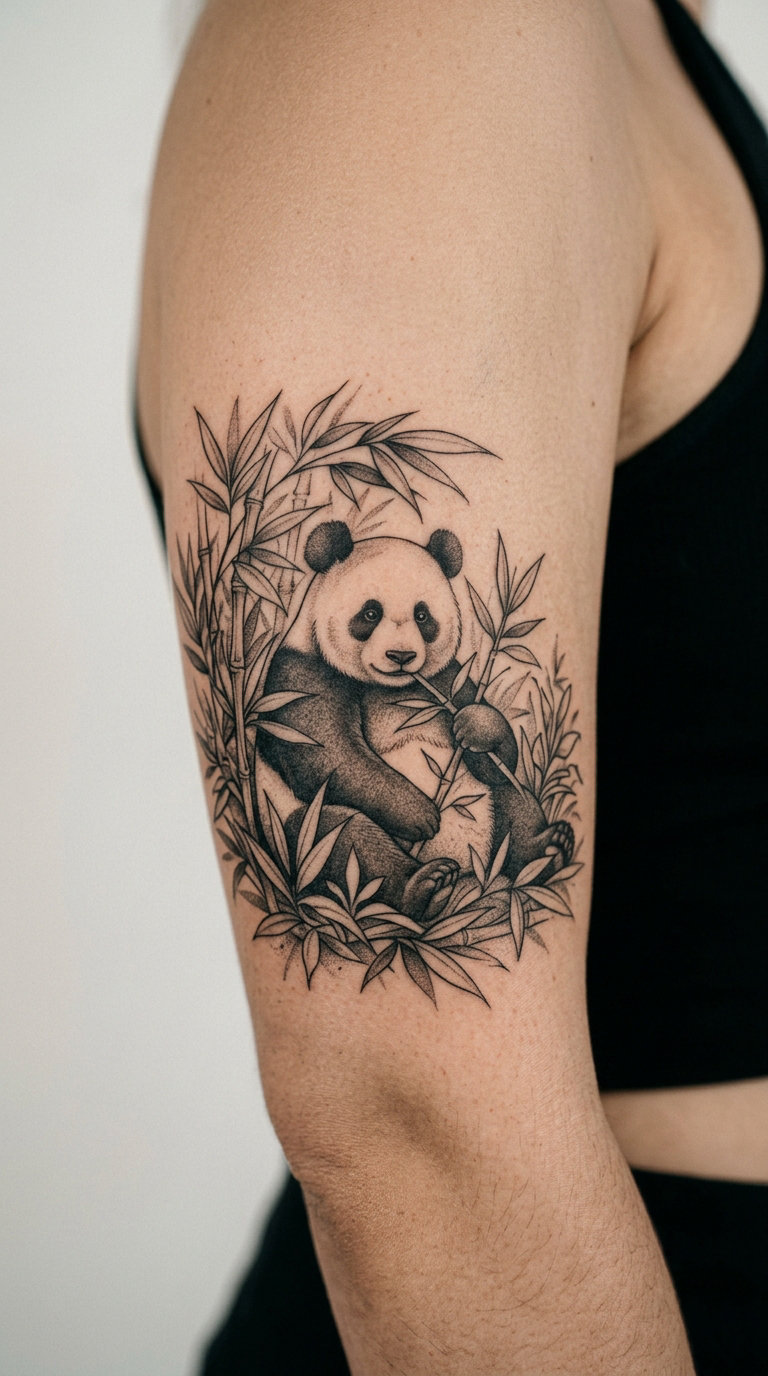
A fuller botanical composition: a panda sitting low among several layers of bamboo leaves, with leaf veins drawn in and a mix of solid black, mid grey and light grey. Line thickness varies from stem to tip, which is what stops a piece like this looking flat.
This is the one on the list that rewards a larger size, because the detail is the point and there is no way to compress it. It suits a forearm or calf piece you will be adding to over a few years rather than a small standalone tattoo.
Placement: Outer arm, thigh, back of the calf or the side of the ribcage. Size: 5 to 7 inches (13 to 18 cm). Style: Botanical black and grey. Pain: Medium to high, expect a long session or a two-session piece. Ageing note: The lightest grey veins soften first, so keep the mid tones and let the lightest ones go rather than the other way round.
Make it yours: Build it around an existing piece, leaving a deliberate gap for a second panda later. That is the easiest way to make a big design feel intentional from day one.
20. Jade-Green Panda Botanical Tattoo
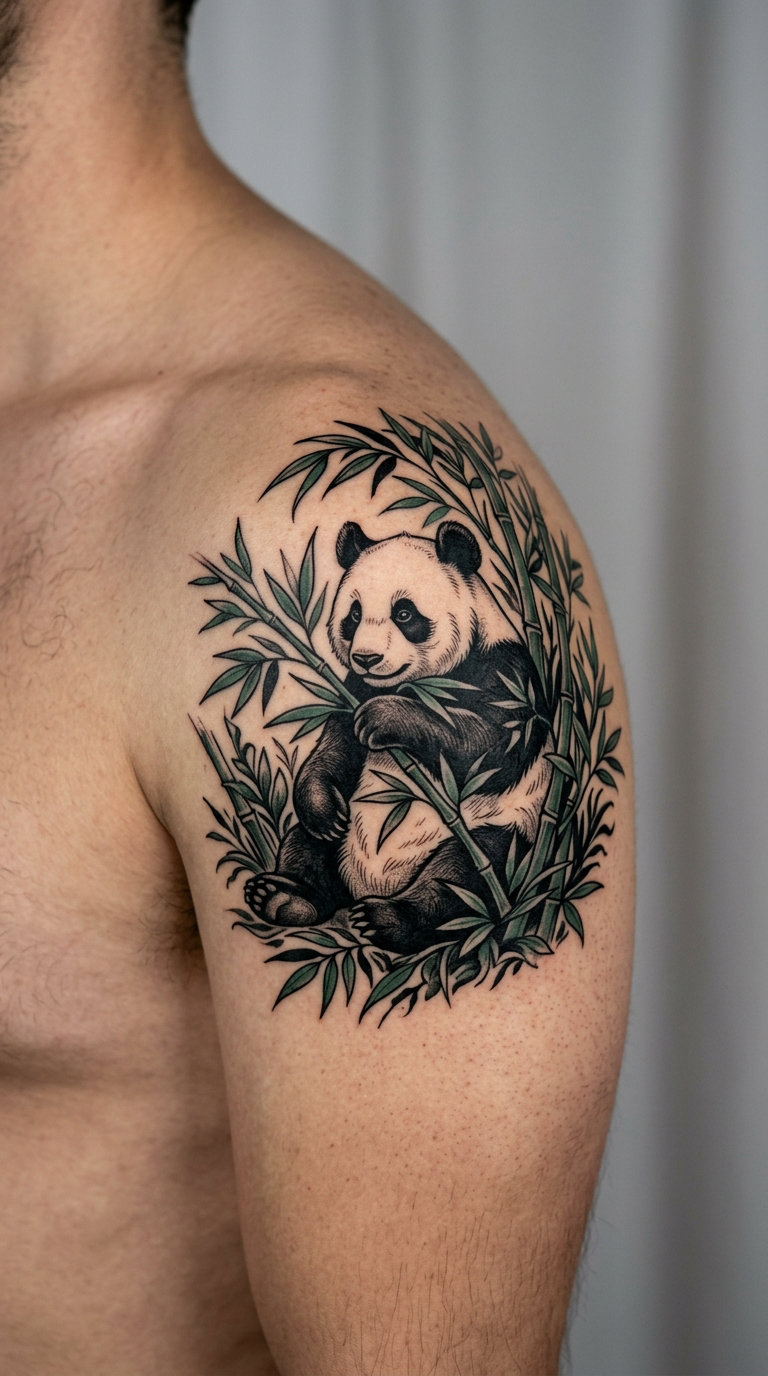
A panda and bamboo stalk rendered in black and a muted jade green, with the green used on the leaves and the stalk nodes rather than spread across the whole piece. Soft grey shading on the panda keeps the animal the focus.
Green keeps the botanical feeling without the sweetness of a bright palette, and it sits well against skin that will not carry heavy colour. It is also an easy design to extend later with a second green element.
Placement: Shoulder, upper arm, outer thigh or the upper back. Size: 4.5 to 6 inches (11 to 15 cm). Style: Colour botanical. Pain: Medium. Ageing note: Green ink in a muted tone stays steadier than a bright green, which usually turns yellow over a few years.
Make it yours: Pick a green from something you own, a plant, a paint chip or a jade piece, and bring it to the appointment so the artist can mix to it.
21. Panda with Cherry Blossoms
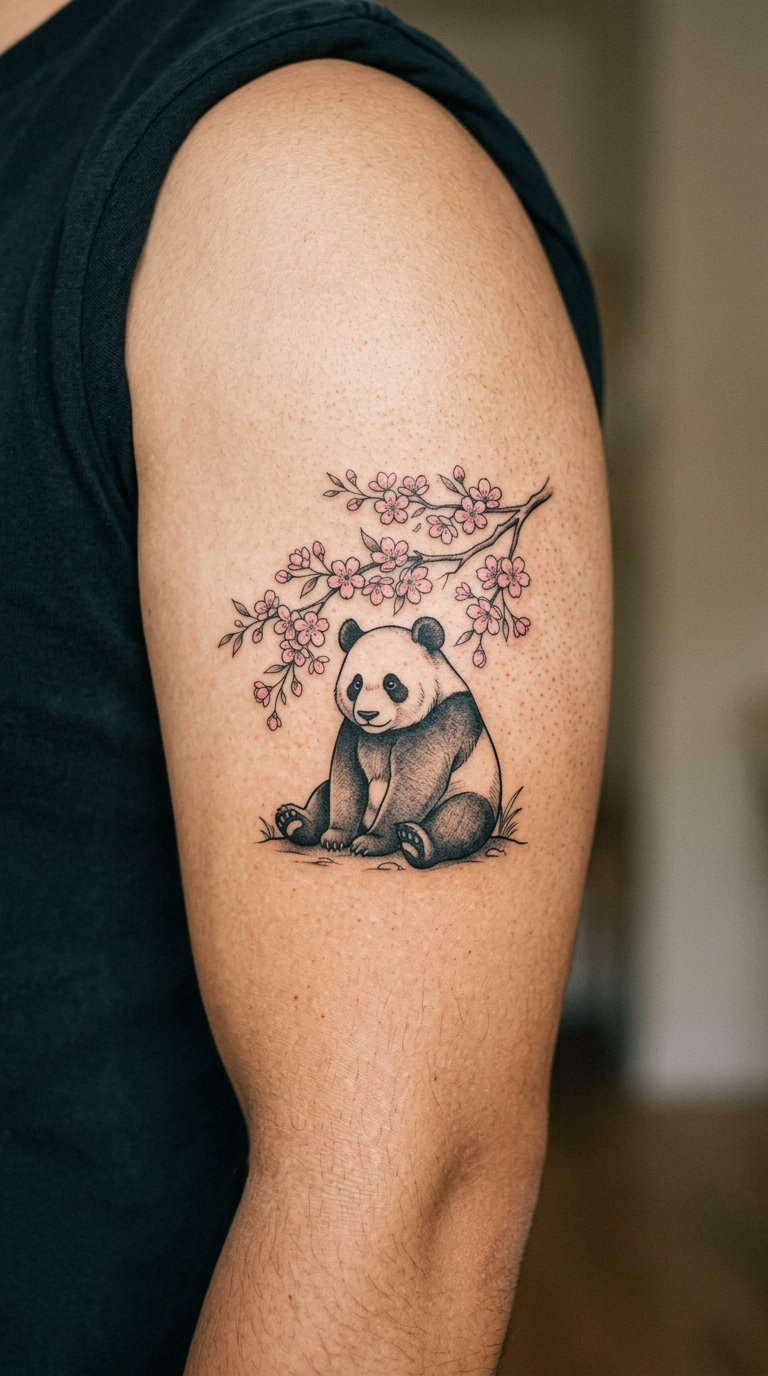
A black-and-grey panda with a branch of small pink blossoms crossing the composition, five-petalled flowers drawn simply with a darker pink centre. The branch enters from one edge rather than sitting behind the panda, so the design has a direction to it.
Blossoms bring a seasonal, softer note to an animal that is usually drawn heavy, and people often choose it as a spring piece. It is a common request, so bring a reference that is yours rather than a screenshot of a composition you have seen a dozen times.
Placement: Upper arm, shoulder, calf or the ribs. Size: 3.5 to 4.5 inches (9 to 11 cm). Style: Illustrative with pink detail. Pain: Medium. Ageing note: Pale pink in a soft skin tone can look tired after a few years, so ask for a mid pink with a defined edge rather than a wash.
Make it yours: Use a specific flowering date, a branch from a garden you know, or one bloom rather than a whole spray.
22. Dancing Panda in Blackwork
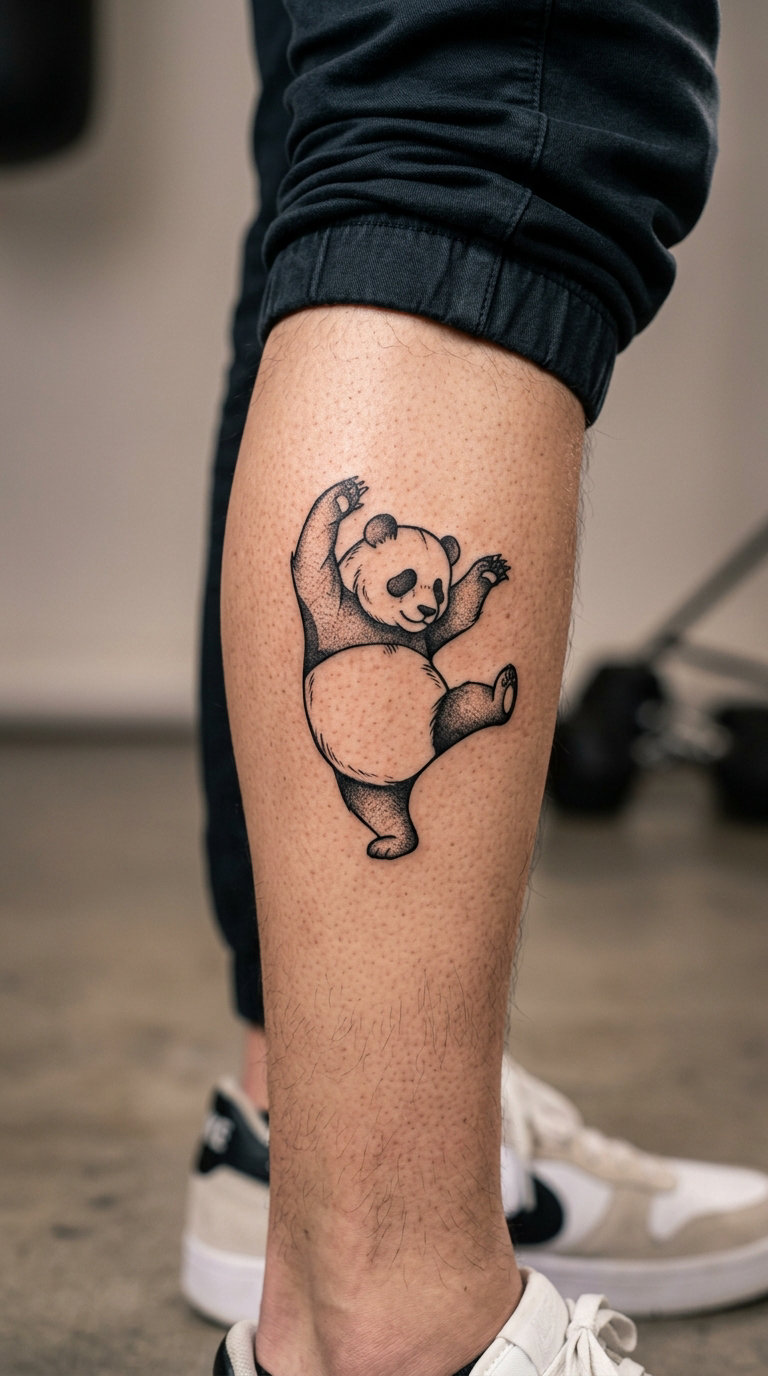
A panda mid-motion with its arms out and one leg lifted, built from sweeping black shapes with wide skin gaps defining the face and belly. The pose does the work, so the piece can be fairly simple in technique and still read as energetic.
An upright moving panda fills a tall space better than a sitting one, so it does well on a calf or the outer arm where a square design would leave empty room. It also pairs naturally with music, flames or ink splashes if you are building a sleeve.
Placement: Outer calf, outer forearm, thigh or the back of the upper arm. Size: 4.5 to 5.5 inches (11 to 14 cm). Style: Blackwork. Pain: Medium to high, a long black fill. Ageing note: The thin limb outlines are the vulnerable part here, so keep the body shapes bold and the details chunky.
Make it yours: Add a few ink splashes or motion lines behind it, or copy the pose from a photograph of your own dog.
23. Tiny Panda and Matching Sprout
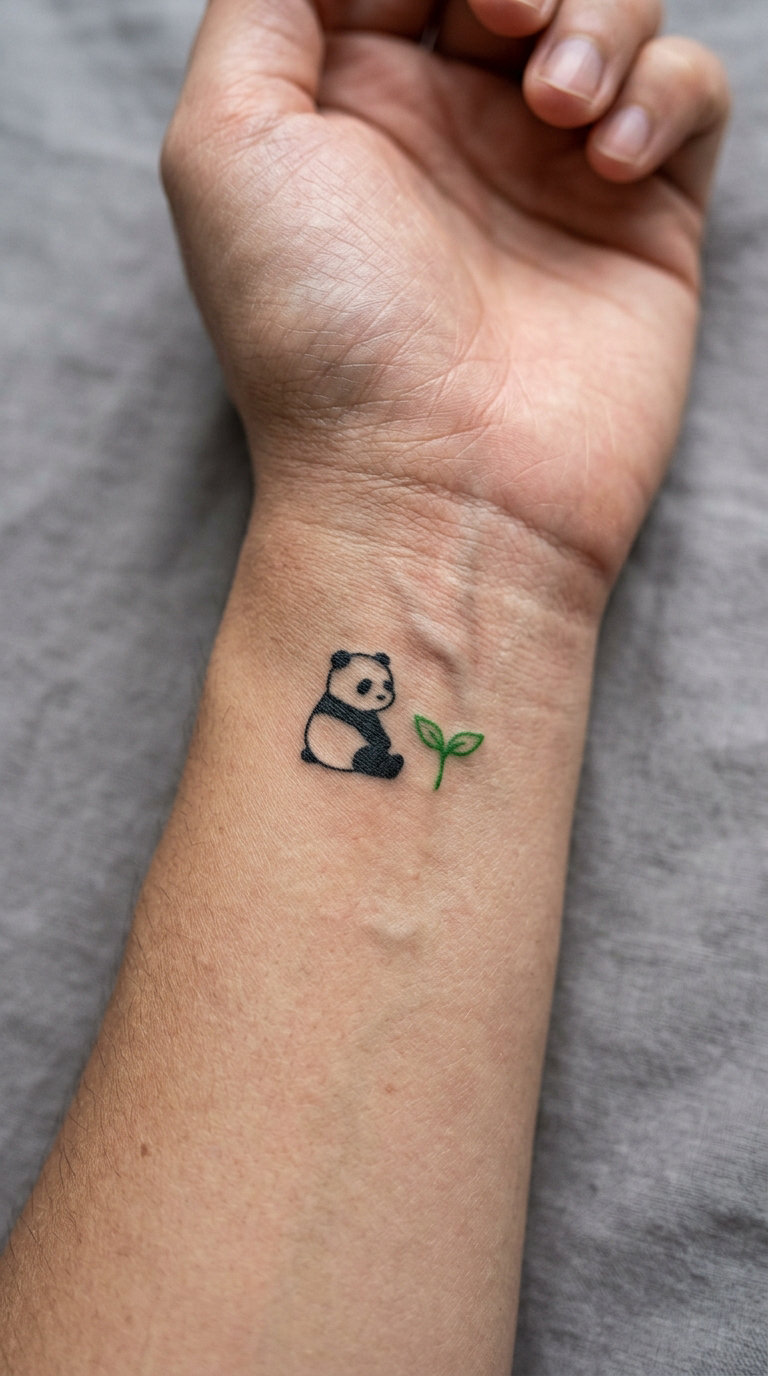
A small panda in fine black line sitting beside a single sprout with two leaves, the only colour in the design being the green on those leaves. The scale is intimate, and the pairing is the point: a small animal and a small growing thing, side by side.
Growth is the reading most people take from it, so it works well as a first tattoo, as a discreet everyday piece, or as something a parent and child get matched. Small and green also travels well as a first piece on a wrist.
Placement: Inner wrist, behind the ear, ankle or the inner arm. Size: 1.75 to 2.5 inches (4.5 to 6 cm). Style: Fine line with one colour accent. Pain: Medium, the inner wrist bruises easily. Ageing note: Fine line and green are both prone to fading, so ask for the leaf outlines to be a solid shade darker than you think.
Make it yours: Grow the plant that inspired it and bring a pressed leaf, or use the number of leaves on the sprout to count something.
24. Panda in a Traditional Cloud
A panda drawn in bold black line and flat grey, framed by a rounded traditional-style cloud form with a scalloped edge and a few interior lines to give it weight. The panda sits in the middle of the shape rather than on top of it, so the whole thing reads as one object.
Cloud framing is a good way to give a simple animal more presence without adding detail to the animal itself. It is also an easy shape to mirror later, which makes it a sensible first piece in a symmetrical leg or back piece.
Placement: Thigh, calf, upper back or the shoulder. Size: 3.5 to 4.5 inches (9 to 11 cm). Style: Traditional graphic. Pain: Low to medium, the thigh is one of the easier spots to sit through. Ageing note: The scalloped cloud edge is a long, curving line, so it is worth asking for slightly heavier weight than feels natural.
Make it yours: Add a second smaller cloud beside it in the same style, or put a real place name or date along the base of the shape.
25. Full-Color Panda with Waterfall Background
A naturalistic panda in full colour sitting beside bamboo, with a restrained blue-green waterfall and rock forms behind it. The colour stays muted rather than cartoon-bright, which is what keeps a piece this large from looking like clip art.
This is a big design and it should be treated like a small painting: more than one session, a proper reference set and an artist who works in colour realism regularly. If you are planning something at this scale, it is worth reading our 20 best black sleeve tattoo ideas for men first, because the same planning applies.
Placement: Outer arm, thigh, back or the calf. Size: 7 to 9 inches (18 to 23 cm). Style: Colour realism. Pain: High, expect several long sessions. Ageing note: Blue and green in a background will fade softer than the panda, so plan on a colour refresh every few years if you want the waterfall to stay vivid.
Make it yours: Use a real landscape you have been to as the background, or add a second panda at the base of the design later.
How to Choose the Right Design
Most disappointing panda tattoos are not badly drawn, they are badly scaled. Start with the spot on your body, then work backwards to the size that fits there, then to the style that survives at that size.
- If it is your first tattoo: pick something on the larger side of small, at least 2 inches, on the forearm, the outer arm or the calf. A head with confident lines beats a detailed face at a size where the detail will not survive healing.
- If you are building a collection: choose a style that is visibly different from what you already have. Another black-and-grey piece next to blackwork looks like an accident; blackwork next to colour reads as a decision.
- If you want meaning to carry the piece: let the symbolism pick the composition. Bamboo for growth, a pair for a relationship, a sprout for something you are starting, a panda and coin for luck.
- If you care about discretion at work: the wrist, the ankle and behind the ear all hide well under a shirt or a long sleeve, though hands and fingers fade fastest wherever you put them.
- If you want a matching piece: agree on a shared style and a fixed size with your partner before either of you books. Matching works best when both people get the same design, not when one gets a version of it.
If your taste runs toward simple marine pieces, the 20 best starfish tattoo ideas for simple, coastal looks are a good comparison for the same minimal approach taken in a different direction.
25 Panda Tattoo Ideas by Style and Placement
Styles behave differently on different skin, and matching the style to the body part is the difference between a piece that ages well and one that does not.
| Style | How it behaves | Smallest workable size | Best placements |
|---|---|---|---|
| Minimal line art | Cleanest and most durable, needs a confident line weight | 1.5 in (4 cm) | Forearm, wrist, bicep, behind the ear |
| Fine line and micro | Softens fastest; simplest shapes hold up longest | 1 in (2.5 cm) | Wrist, nape, ankle, ribs |
| Blackwork | Most durable, heaviest in the session | 3 in (8 cm) | Upper arm, thigh, calf, back |
| Traditional | Reads at a distance, ideal for larger flat areas | 3.5 in (9 cm) | Upper arm, thigh, shoulder blade |
| Geometric | Few large facets age better than many small ones | 2 in (5 cm) | Forearm, calf, chest |
| Watercolour | Soft edges hide skin irregularity, fades toward grey | 3.5 in (9 cm) | Shoulder, upper back, thigh |
| Realism | Needs the most skill and the most space | 4 in (10 cm) | Upper arm, shoulder, back, thigh |
| Colour and botanical | Needs planning around which colour carries the design | 3.5 in (9 cm) | Shoulder, outer arm, thigh, calf |
One practical note on the wrist and the hand: both are popular for small pandas and both take more pain than people expect, because the skin is thin over bone with almost no soft tissue to absorb the needle. If you are nervous, the inner forearm gives the same delicacy with a much easier sitting.
Cost and Session Time
Tattoo prices follow size, detail and the artist’s rate, so the honest answer is a range rather than a number. What you can control is the size you walk in asking for, and small simple pandas sit comfortably at the lower end of any shop’s scale.
- Micro and fine line work, 1 to 2 inches: usually a short single session, often done as an add-on to another piece. Most shops have a minimum that a small tattoo still has to meet, so ask before you book.
- Small to medium pieces, 2 to 4 inches: one session of roughly an hour to an hour and a half for black and grey, and a little longer if colour is involved.
- Larger illustrative or botanical work, 5 to 7 inches: plan on two sessions rather than one, and ask the artist where they intend to stop the outline.
- Full-colour pieces, 7 inches and up: a multi-session project. Colour realism and backgrounds take longer per square inch than black and grey because every area needs its own pass.
Artist hourly rates and shop minimums vary widely by city and by reputation, and the cheapest option is rarely the one you want for a design this personal. Ask what your artist charges per hour, ask for an estimate of total time, and treat that number as a conversation rather than a quote, because the design usually gets drawn as it is tattooed.
Aftercare Basics
Start by following your artist’s aftercare instructions, because they will know how your specific ink and skin are behaving. Everything below is general guidance that most artists agree with, not a substitute for that.
- Wash gently, twice a day, for the first week or two. Lukewarm water and unscented soap, then pat dry with something clean rather than rubbing.
- Moisturise thinly. A thin layer of whatever product your artist recommends keeps the skin from drying and flaking. Thick layers trap ink and are the most common self-inflicted problem.
- Wash with your hands for two weeks. No baths, no swimming pools, no hot tubs. Showers are fine, and so is a careful swim later once the skin has sealed.
- Sleep on clean sheets and loose clothing. Fabric imprinting on a fresh tattoo is normal and fades as the skin settles.
- Do not pick or scratch. Flakes come off on their own. Pulling them is what causes patchy areas and scarring, and it is the one rule that really matters.
- Use sun protection for the life of the tattoo. Once healed, daily sunscreen on exposed areas is what keeps fine line and colour from fading early.
Expect the surface to look slightly bruised or raised for the first few days, then to flake and settle. The colour you see on day three is not the colour you will have in a month, which is why tattooists judge their work after two weeks rather than immediately.
Frequently Asked Questions
What does a panda tattoo symbolize?
A panda tattoo usually symbolizes gentleness, peace, playfulness and loyalty. In Chinese culture the giant panda is a national symbol and has been used as a diplomatic emblem of friendship, so the design can carry that reading too. People also choose pandas for conservation reasons, and some wear one as a memorial to a panda they knew. Most wearers pick it because the animal is calm and friendly rather than aggressive.
What are the best panda tattoo ideas for a first tattoo?
For a first tattoo, choose a minimal black-line panda around 2 inches on the forearm, calf or upper arm. That size is big enough to keep its shape, small enough to finish in one short session, and simple enough that you will not be disappointed by a detail that healed differently than you pictured. Avoid a detailed face at half an inch, which will blur, and consider waiting if you have never seen healed work in person.
How small can a panda tattoo go and still look good?
A simplified panda head stays recognisable at about 1 inch, and a micro paw print works at 1.5 inches. Below that, the eye patches and the face disappear into grey during healing. The rule of thumb is that detail below roughly 2 cm will not hold, so the artist should simplify the design rather than squeeze a full portrait into a tiny space.
What is the least painful placement for a panda tattoo?
The outer forearm, the upper arm, the calf and the thigh are the easiest spots to sit through because they have more soft tissue and fewer sensitive nerves. The inner wrist, the ribs, the neck, the ankle bone and the hands all hurt noticeably more. If you are nervous, an outer forearm panda is a good first sitting, and going second helps a lot too.
Do panda tattoos fade faster than other designs?
It depends entirely on the style, not on the animal. Fine line and micro work fades fastest, especially on the hands, fingers and inner arm, and pale pink and light green fade toward grey within a few years. Solid blackwork is the most durable style there is, and medium-value greys sit somewhere in the middle. Daily sunscreen on exposed areas makes a noticeable difference over the years.
What should I avoid when getting a panda tattoo?
Avoid a detailed realistic panda at a very small size, because the fur shading greys out during healing. Avoid copying a famous cartoon panda or an existing composition, since a well-known character or another artist’s drawing is not yours to wear. Avoid light grey washes over bare skin, and avoid sun exposure on a fresh or faded piece for the first summer after it heals.
Conclusion: Choose the Panda That Fits Your Style
If this is your first tattoo, go with a minimal black-line panda on the forearm or calf at around 2 inches, or a micro panda behind the ear if you want it discreet. Keep it simple, follow the aftercare, and let the size do the work that detail would have done if you had gone larger.
If you are already collecting, the blackwork circular frame, the traditional panda with a red seal and the realistic portrait are the three that reward a bigger, more considered piece. Bring references to a consultation, talk through what the design will look like at five years rather than five days, and these 25 panda tattoo ideas give you somewhere to start the conversation.