
24 Japanese Flower Tattoo Ideas: Best Floral Styles (October 2026)
These 24 Japanese flower tattoo ideas cover the blooms tattooers draw most often, from the sakura branch almost everyone starts with to the peony, lotus and chrysanthemum pieces that anchor bigger collections. Cherry blossom is the most requested, with chrysanthemum and peony close behind. Every entry below gives you the design in plain language, the placement that suits it, a realistic size, and an honest note on what fades first.
A Japanese floral tattoo lives or dies on restraint. The flowers that age well have a few confident lines, clear negative space and a colour decision made early. What I would not do is bring three reference images of wildly different scales to a consultation and expect one of them to translate. Pick the idea, then let the artist set the line weight for the spot you are actually getting inked.
24 Japanese Flower Tattoo Ideas: Quick Guide
If you want the short version before you scroll, this table holds the whole list. Same order as the numbered sections below.
| Idea | Style | Best placement | Size | Pain |
|---|---|---|---|---|
| Minimal cherry blossom branch | Fine line | Outer forearm, wrist, shoulder | 2-4 inch (5-10 cm) | Low to medium |
| Layered sakura spray | Black-and-grey or soft colour | Shoulder, upper arm, upper back | 3-5 inch (8-13 cm) | Medium |
| Red peony with curving leaves | Neo-traditional or colour | Forearm, thigh, hip | 4-7 inch (10-18 cm) | Medium |
| Lotus in black-and-grey | Blackwork, black-and-grey realism | Forearm, calf, upper back, sternum | 4-7 inch (10-18 cm) | Medium |
| Chrysanthemum with radial petals | Traditional or neo-traditional | Calf, shoulder, upper arm, back | 4-6 inch (10-15 cm) | Medium |
| Plum blossom on a dark branch | Blackwork with limited colour | Forearm, calf, side of torso | 3-6 inch (8-15 cm) | Medium |
| Hanging wisteria cluster | Watercolour or fine-line colour | Shoulder, forearm, back of leg, ribs | 4-7 inch (10-18 cm) | Medium |
| Camellia with open petals | Fine line with grey leaves | Wrist, collarbone, upper arm, hip | 3-5 inch (8-13 cm) | Low to medium |
| Iris with a single sword leaf | Traditional, fine line or watercolour | Calf, forearm, shoulder, ribs | 4-6 inch (10-15 cm) | Medium |
| Magnolia bud and bloom pair | Black-and-grey with soft blush | Inner arm, wrist, shoulder, calf | 3-5 inch (8-13 cm) | Low to medium |
| Japanese anemone in motion | Watercolour, fine line, micro-realism | Shoulder, wrist, ribs, outer arm | 2-4 inch (5-10 cm) | Low to medium |
| Higanbana spider lily | Red ink, blackwork or traditional | Forearm, calf, thigh, ribs | 3-5 inch (8-13 cm) | Medium |
| Bellflower trail | Fine-line colour or illustrative | Collarbone, side of arm, ribs, spine | 2-4 inch (5-10 cm) | Low to medium |
| Cosmos in a minimal bouquet | Fine line or minimal watercolour | Wrist, back of hand, shoulder, calf | 2-4 inch (5-10 cm) | Low |
| Japanese poppy in red ink | Red realism or watercolour | Forearm, calf, ribs, shoulder | 3-5 inch (8-13 cm) | Medium |
| Ranunculus spiral | Fine line, illustrative, neo-traditional | Forearm, shoulder, thigh, lower back | 3-5 inch (8-13 cm) | Medium |
| Sweet pea stem | Fine-line watercolour | Wrist, ankle, calf, side of arm | 2-4 inch (5-10 cm) | Low to medium |
| Jasmine bud pair | Blackwork, micro-realism, limited green | Inner arm, shoulder, ribs, ankle | 2-4 inch (5-10 cm) | Low to medium |
| Morning glory vine | Traditional, neo-traditional, dotwork | Forearm, calf, ribs, shoulder | 3-6 inch (8-15 cm) | Medium |
| Rose in sumi-ink style | Blackwork, sumi-inspired illustrative | Forearm, calf, upper back, thigh | 3-5 inch (8-15 cm) | Medium |
| Sunflower with muted washi texture | Illustrative colour or neo-traditional | Calf, upper arm, shoulder, back | 4-6 inch (10-15 cm) | Medium |
| Dahlia in dotwork shading | Dotwork or blackwork | Forearm, shoulder, thigh, ribs | 3-5 inch (8-13 cm) | Medium |
| Ikebana-style peony arrangement | Fine line, blackwork or watercolour | Inner arm, ribs, calf, back of hand | 3-6 inch (8-15 cm) | Low to medium |
| Monstera leaf with sakura accent | Blackwork with one colour accent | Thigh, calf, side of torso, forearm | 4-7 inch (10-18 cm) | Medium |
1. Minimal Cherry Blossom Branch
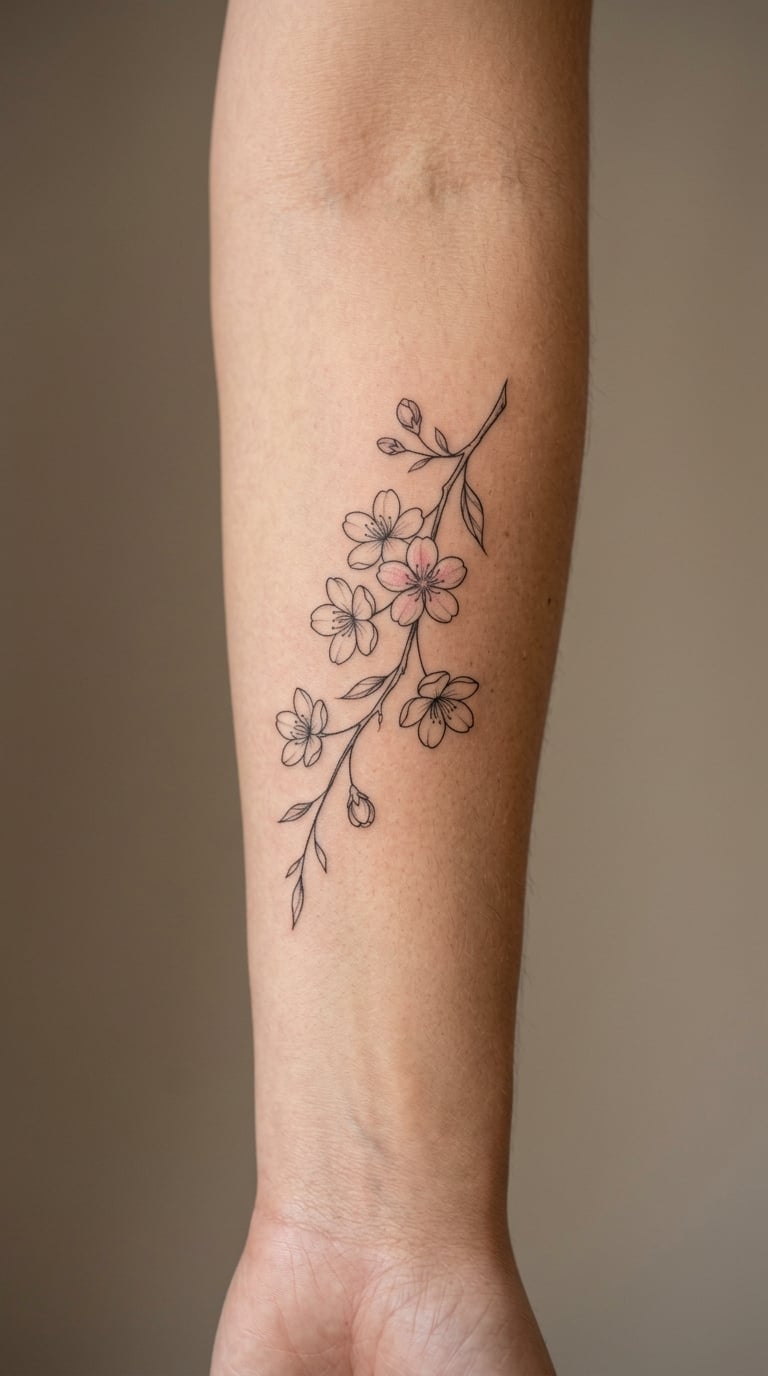
This is the branch version of the classic cherry blossom tattoo, drawn as a single curved twig carrying five or six five-petal flowers, a couple of unopened buds and nothing else. Linework stays light and even, mostly black with a whisper of pale pink in the centre of one bloom. Cherry blossom is commonly linked to spring, beauty and the fleeting nature of a bloom that opens and drops within a week, though that reading belongs to the wearer as much as the tradition. For a first Japanese flower piece it is the safest one to book and the easiest to hide later.
Placement: outer forearm, inner wrist or shoulder. Size: 2-4 inch (5-10 cm) across. Style: fine line. Pain: low to medium, and the forearm and wrist sit near bone so expect a sharper scratch on the inner side.
Ageing note: the tiny gaps between petals and any fingertip detailing soften first, so ask for slightly heavier lines than look right in a photo. Make it yours: add a small date at the base of the stem, or keep it monochrome and let a matching branch appear on the other arm years later.
24 Japanese Flower Tattoo Ideas in Fine-Line Form
Fine line is where most of these 24 Japanese flower tattoo ideas start, because it is the style that survives a small size. A cherry blossom stays legible in fine line when the petal count stays honest at five, the flowers are spaced far enough apart that the skin between them stays clean, and the curves are drawn with a heavier pressure on the outer edge of each petal. What kills a fine-line floral is the opposite choice: six crowded blooms packed into two inches, each petal split with an inner line. That version photographs beautifully for about two years and then turns into a grey smudge. Ask your artist to draw the design at the size it will actually be, not at the size on the reference sheet.
2. Layered Sakura Spray
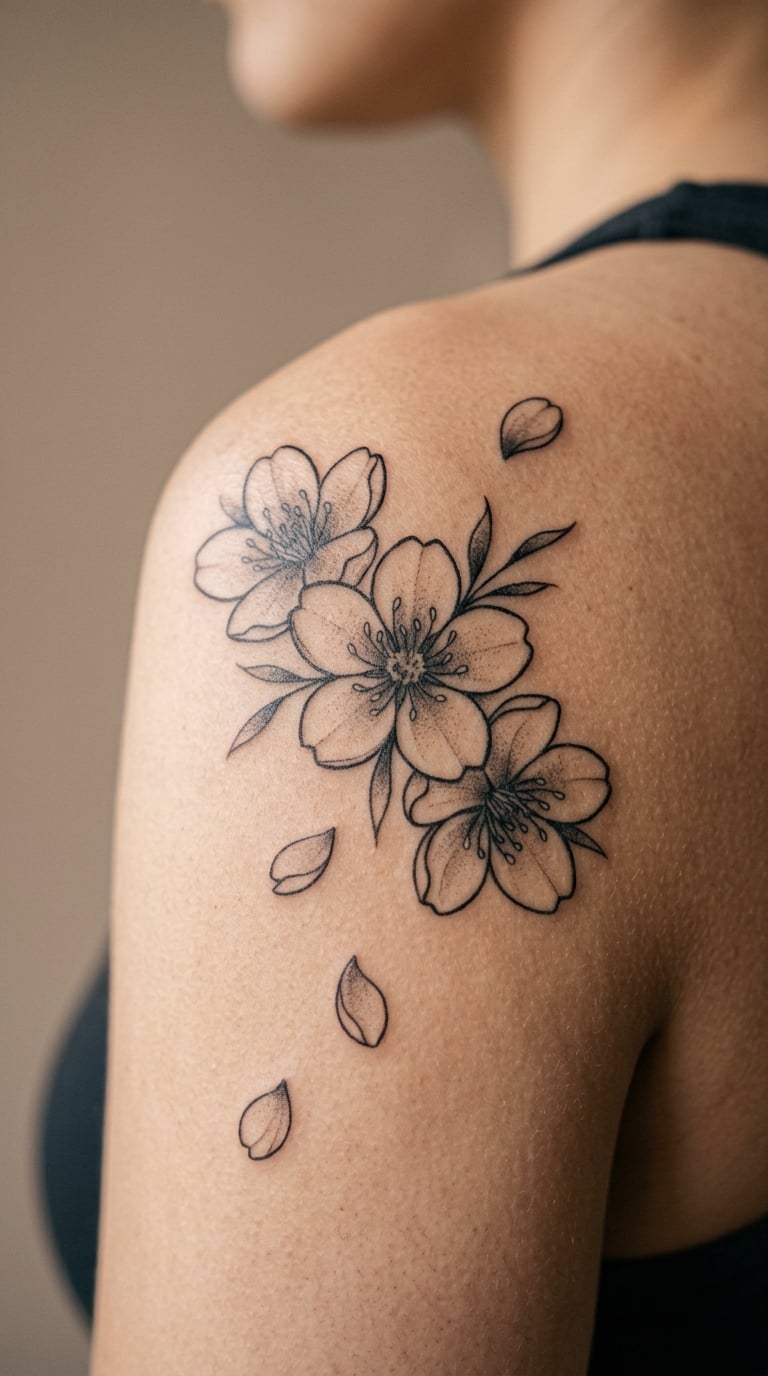
A sakura spray is the fuller sibling of the single branch: three or four overlapping five-petal flowers seen from above, joined by short stems, with loose petals falling away from the cluster. Most tattooers build it in black-and-grey with soft grey shading in the petal centres, or in a pale watercolour that looks almost airbrushed. The design reads as decorative and springlike, and any meaning comes from the person wearing it rather than from the flower itself, which is exactly why it stays so popular.
Placement: shoulder, upper arm or upper back, where a rounded area lets the cluster sit naturally. Size: 3-5 inch (8-13 cm). Style: black-and-grey or subtle watercolour. Pain: medium, and the shoulder cap is more sensitive than most people expect.
Ageing note: dense petal centres and narrow gaps between overlapping flowers need careful spacing at healing, otherwise they close up into a dark mass. Make it yours: work your birth month into the number of blossoms, or repeat the same spray on the opposite shoulder as a deliberate pair.
3. Red Peony with Curving Leaves
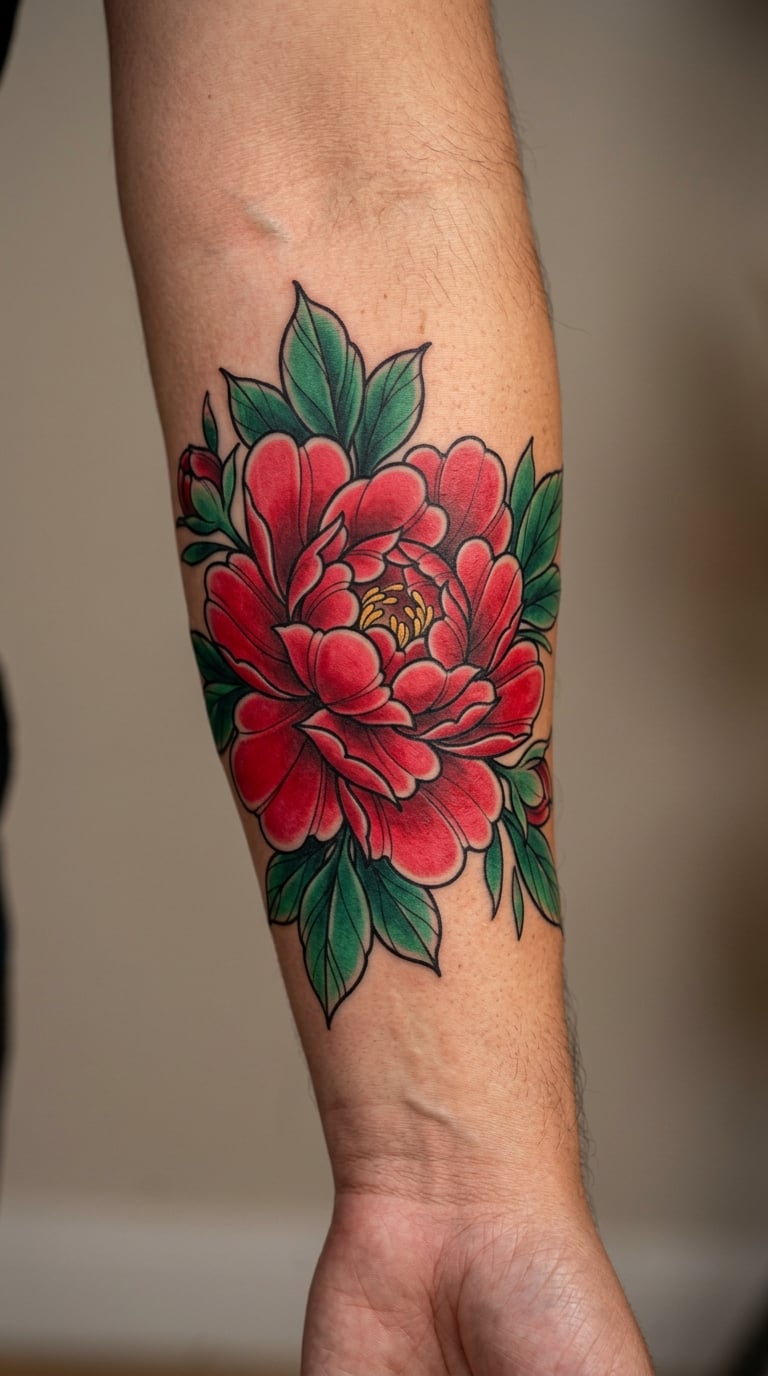
The peony, botan in Japanese, is the showpiece of Japanese floral tattooing, and this version keeps it to one open flower rather than a packed bouquet. Layered rounded petals build from a dark centre outward, with two or three broad leaves curling away on long stems. Red is the most requested colour, usually a warm crimson with a deeper shade under the overlapping petals and a black outline holding the whole shape together. People choose the peony for how rich it looks on skin, and it is often described as standing for beauty or prosperity, though those associations vary by source and by person.
Placement: forearm, thigh or hip, all of which give a single flower room to breathe. Size: 4-7 inch (10-18 cm). Style: neo-traditional or watercolour. Pain: medium across a broad area, worse over the thigh.
Ageing note: soft watercolour edges on petals can fade unevenly, so a version with a defined outline holds its shape longer. Make it yours: pick a peony colour from a place that matters to you rather than defaulting to red.
4. Lotus in Black-and-Grey
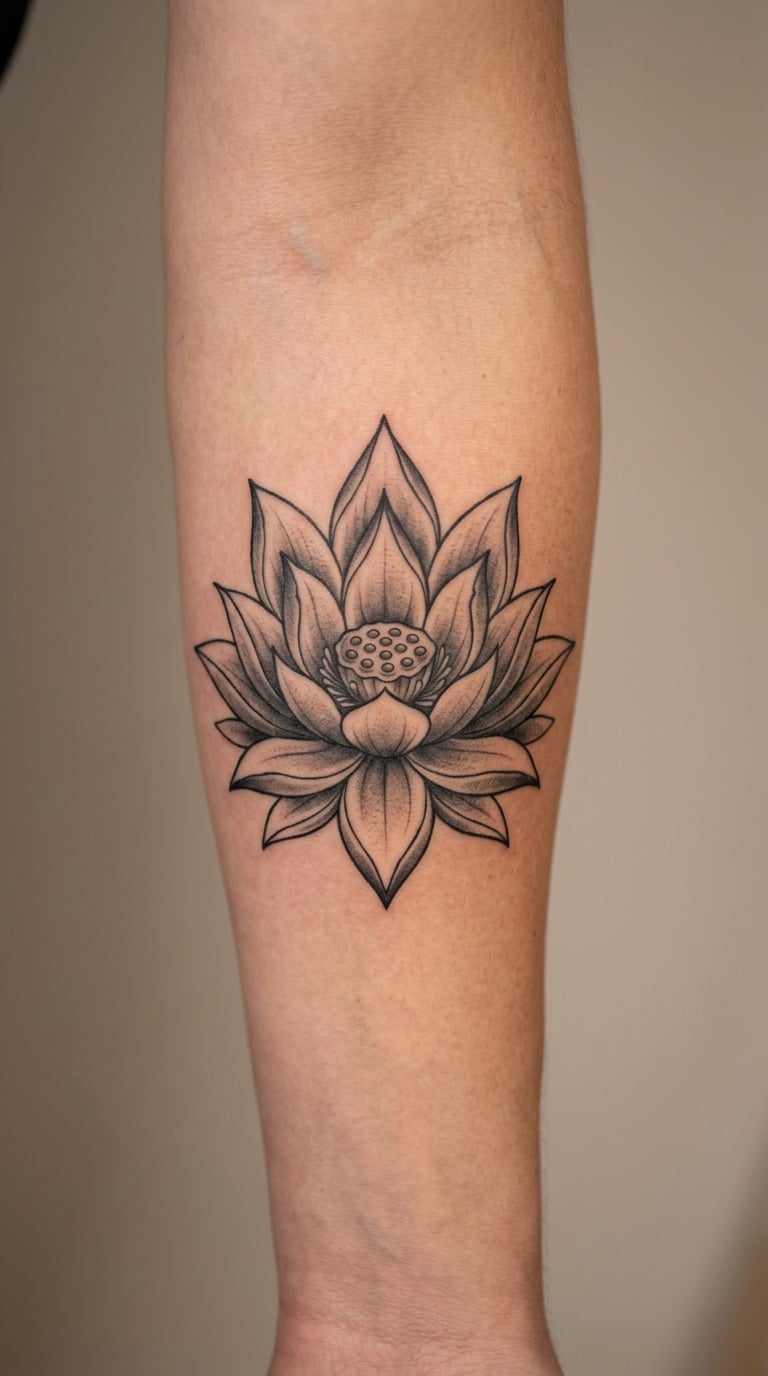
A symmetrical lotus, hasu, is drawn here without colour: pointed petals rising in tiers, a clean seedpod with a scatter of small seed dots at the centre, and soft grey shading under each overlap. The lotus has established Buddhist and wider spiritual associations, and in Japan it is tied to the idea of rising clean from muddy water. Confirm the intended meaning with whoever is wearing it, because the flower reads differently depending on the belief behind it. Visually it is one of the easiest blooms to make look elegant, since the geometry does most of the work.
Placement: forearm, calf, upper back or sternum, all of which suit the vertical symmetry. Size: 4-7 inch (10-18 cm). Style: blackwork or black-and-grey realism. Pain: medium, and the sternum is a bony spot that tends to sting.
Ageing note: strong contrast keeps the petal edges sharper than a soft gradient does, so ask for defined black at the outer petals. Make it yours: coordinate the lotus with a band of water ripples or a pair of small koi at the base once the flower is healed. Our guide to lotus flower tattoo meanings and placements goes deeper on where that one sits best.
5. Chrysanthemum with Radial Petals
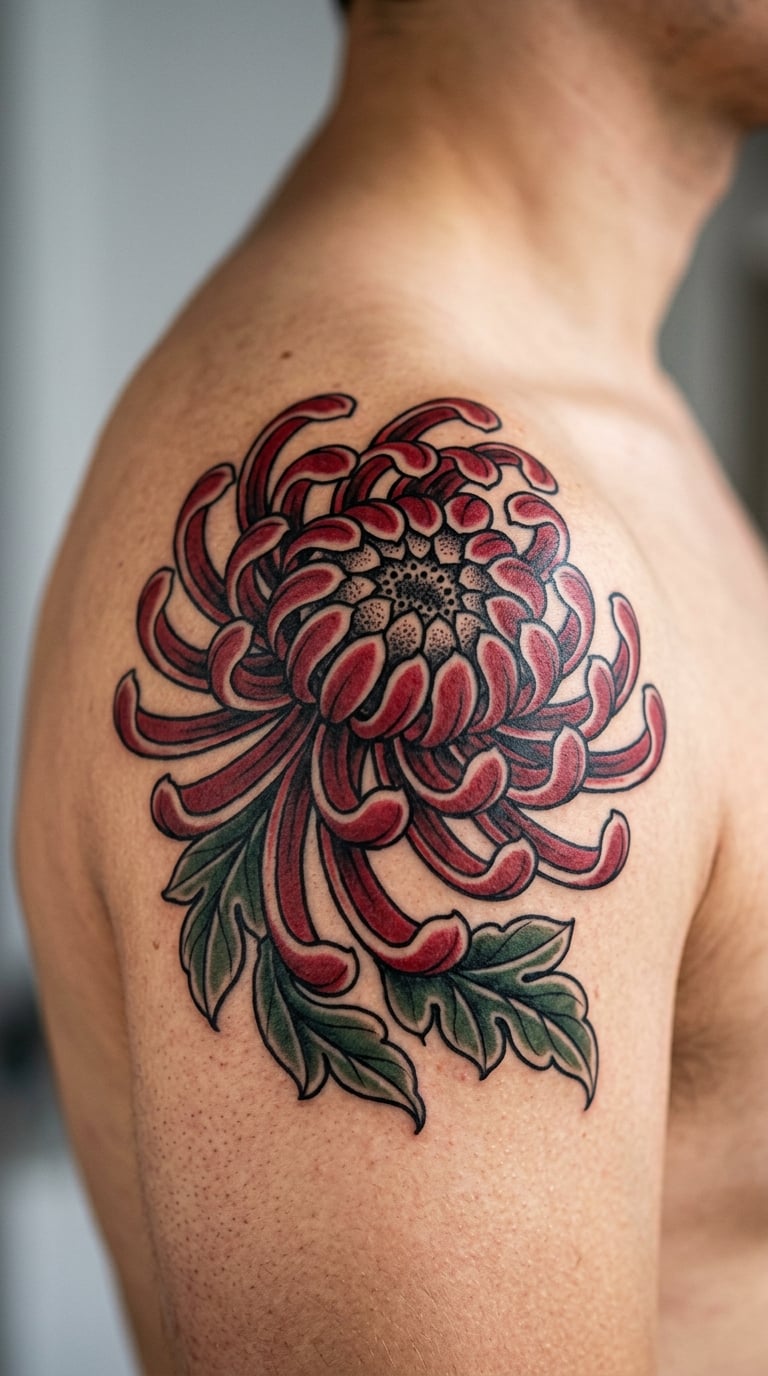
One chrysanthemum, kiku, with long spoon-shaped petals radiating evenly from a textured centre, balanced by two curved leaves on short stems. Traditional work fills the petals in red, yellow or white with a defined outline, and the centre gets stippled shading to hold the eye in the middle. In Japan the chrysanthemum carries a strong imperial and seasonal weight, and people often select it for the flower itself, for a family connection, or for something personal that has nothing to do with symbolism at all.
Placement: calf, shoulder, upper arm or back, which all handle a round flower well. Size: 4-6 inch (10-15 cm). Style: traditional or neo-traditional. Pain: medium, with the inner calf noticeably more tender.
Ageing note: numerous thin petals can blur together, so a bolder centre and simplified outer edges are the difference between a crisp flower and a grey disc after a decade. Make it yours: add a single curved line of small petals arcing over the top, like wind, to turn the bloom into motion.
6. Plum Blossom on a Dark Branch
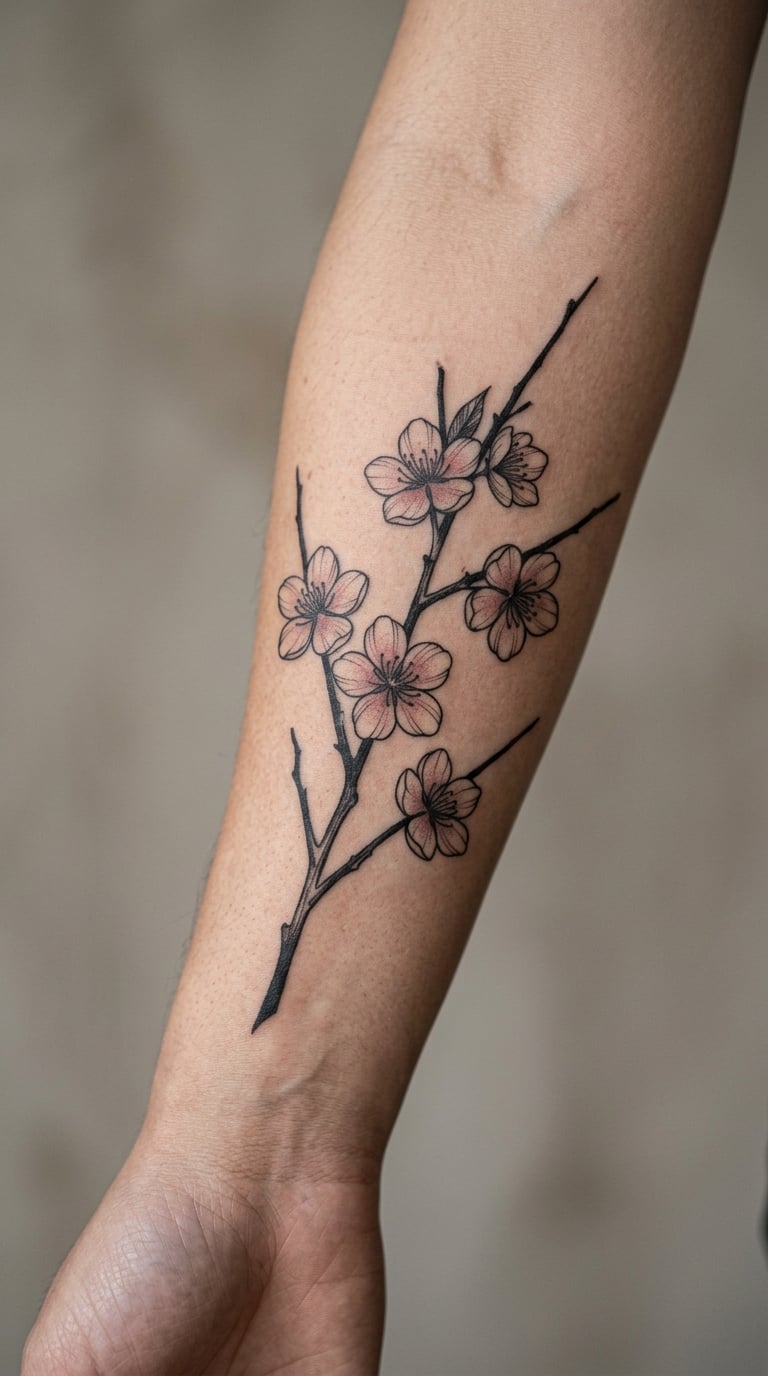
Plum blossom, ume, is the earliest of the Japanese seasonal blooms, which is part of why it carries a sense of endurance. This version sets five small five-petal flowers along an angular black branch, the twigs rendered as solid dark shapes against open skin, with muted pink or red only in the petal centres. Depending on who is wearing it, the flower can evoke resilience, renewal or simply a specific season and a specific year. The strong black branch is doing the visual work, not the blossom.
Placement: forearm, calf or side of the torso, where a diagonal branch has room to run. Size: 3-6 inch (8-15 cm). Style: blackwork with limited colour. Pain: medium, and the ribs make it a longer sitting.
Ageing note: very fine stamen details fade first and should be enlarged rather than shrunk at sketch stage. Make it yours: add a small initial hidden in the negative space between two twigs.
7. Hanging Wisteria Cluster
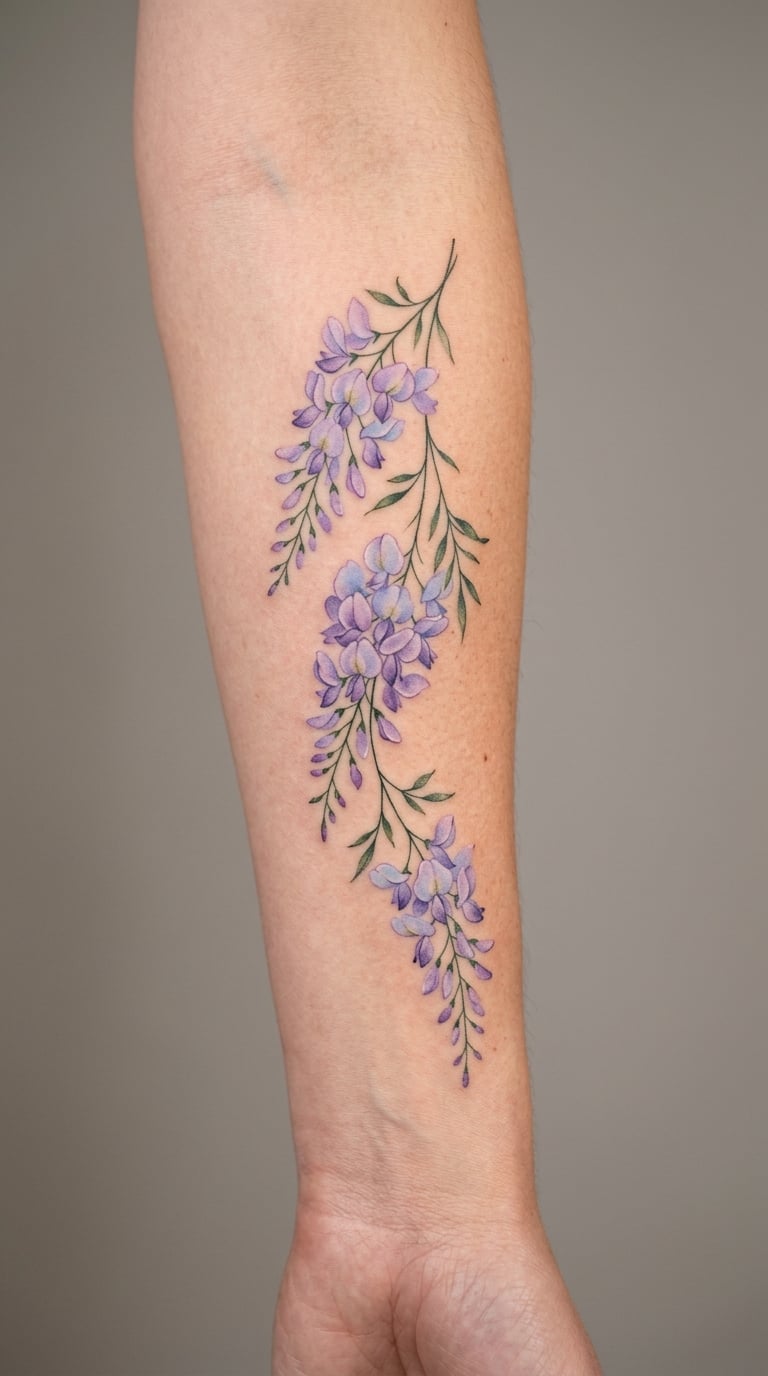
Wisteria, fuji, hangs in long lavender drops, and the tattoo version stacks three or four tapering clusters connected by thin stems and loose pointed leaves. The cascade is the whole point: the top cluster is widest and the bottom tapers to a single bud, so the shape reads as falling even on a static piece of skin. Most artists work it in watercolour with soft violet edges, though a fine-line colour version holds up well too. Wisteria turns up constantly in Japanese-inspired floral compositions, and its grace is usually the reason, not a fixed translation.
Placement: shoulder, forearm, back of the leg or ribs, ideally somewhere vertical. Size: 4-7 inch (10-18 cm). Style: watercolour or fine-line colour. Pain: medium, and rib work needs breaks.
Ageing note: tiny hanging blossoms become indistinct if spaced too closely, so insist on visible gaps between each drop. Make it yours: add the month you met someone as a small separate bud at the end of the cascade.
8. Camellia with Open Petals
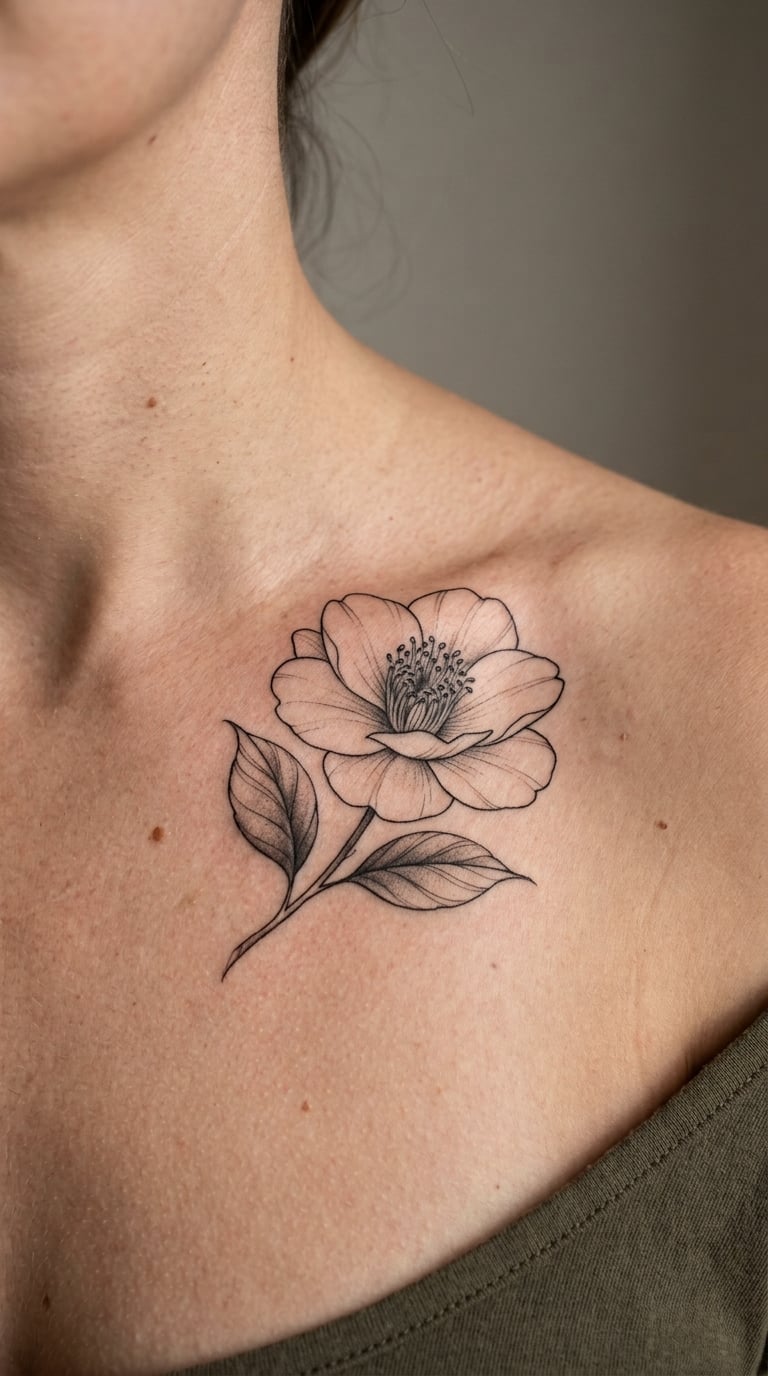
Camellia, tsubaki, has a clean geometry that rewards a light touch. One open bloom sits here with broad overlapping petals, a cluster of fine black stamens in the middle and two leaves shaded in grey. The trick is the negative space: instead of outlining every fold, the artist leaves cream skin between petals so the flower stays open and light. People pick camellia for its tidy form, for a family name, or for a personal association, and it is one of the least loaded of the Japanese blooms if you want a design that reads as decoration.
Placement: wrist, collarbone, upper arm or hip. Size: 3-5 inch (8-13 cm). Style: fine line with black-and-grey leaves. Pain: low to medium, though collarbone and wrist are both sensitive over bone.
Ageing note: fine wrist detail softens faster than the same art on a forearm, so expect a touch-up in the first couple of years. Make it yours: keep the flower uncoloured and add a single red stamen, or a matching small camellia on the other wrist.
9. Iris with a Single Sword Leaf
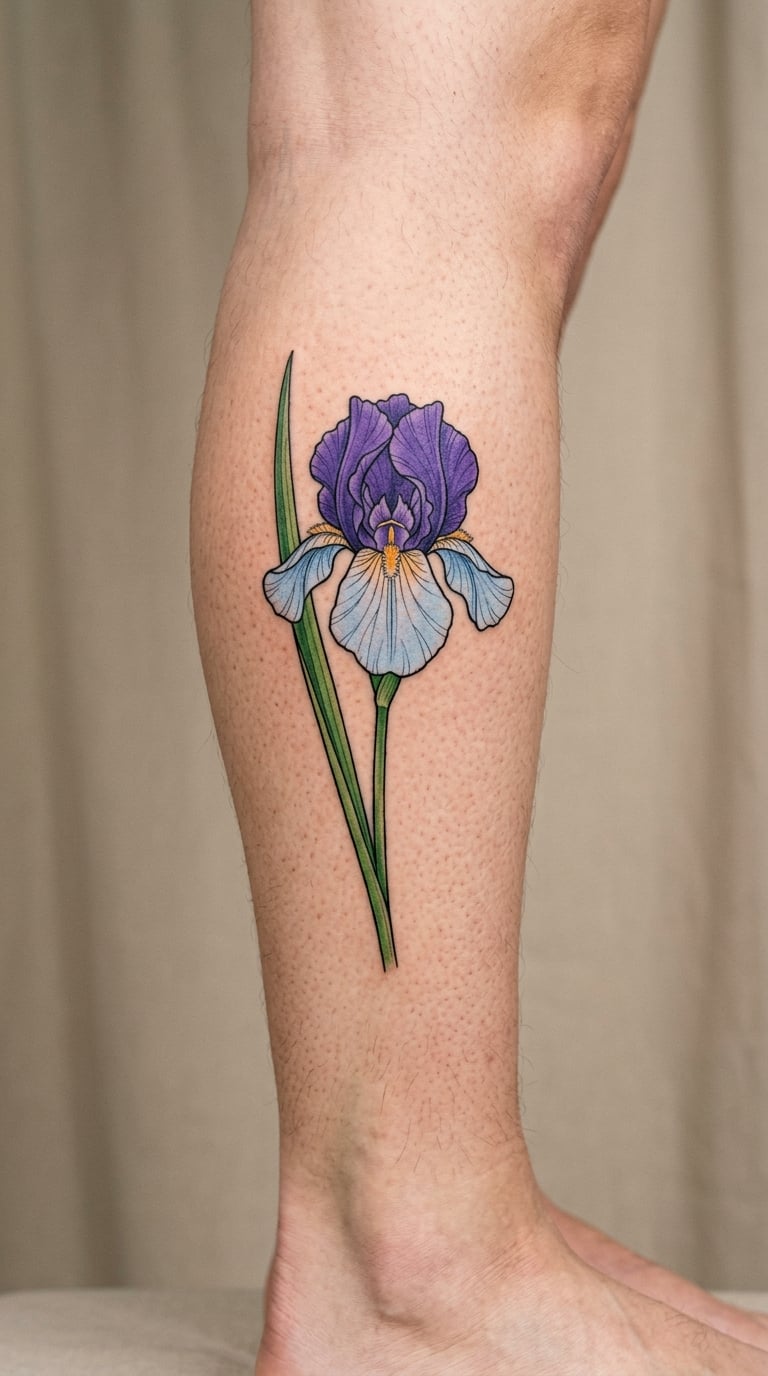
The iris, ayame, is built from two distinct parts: upright standards that stand above the flower and drooping falls that hang below it. This version keeps the petal veining to a few restrained lines and pairs the bloom with one long sword-shaped leaf, which is usually what makes the composition feel finished. Three colours work well, a deeper violet up top and a paler blue underneath, though plenty of tattooers keep it to two. The iris is a classical Japanese floral subject, and the personal meaning behind it often comes from a family, a name or simple admiration for the flower.
Placement: calf, forearm, shoulder or ribs. Size: 4-6 inch (10-15 cm). Style: traditional, fine line or watercolour. Pain: medium.
Ageing note: narrow divisions between petals need enough space or they fill in, which is the usual reason an iris loses definition. Make it yours: add a faint water line beneath the flower to suggest the wet ground irises grow in.
10. Magnolia Bud and Bloom Pair
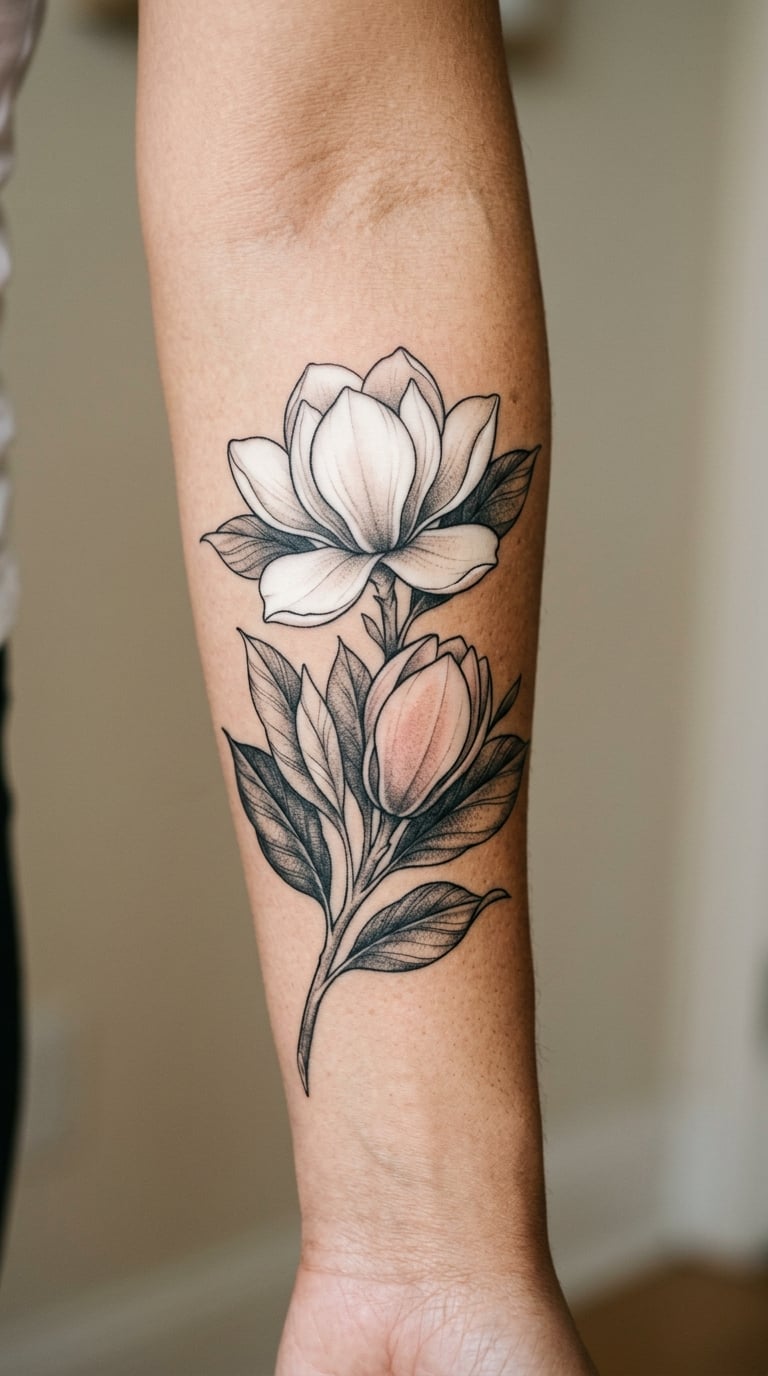
This composition pairs one open white magnolia with a single unopened pink bud below it, connected along a short stem with broad leaves shaded in soft grey. Drawing the two stages side by side is the idea: the bloom open on one end, the bud still closed on the other, with plenty of skin left between them. The pairing can stand for renewal, a personal transition, or simply a favourite flower, and the wearer decides which reading it carries. It is a quiet piece that rewards being small.
Placement: inner arm, wrist, shoulder or calf, set along the line of the limb. Size: 3-5 inch (8-13 cm). Style: black-and-grey with soft blush colour. Pain: low to medium.
Ageing note: pale watercolour blush becomes less visible over time, so keep grey shading underneath for the petal shape. Make it yours: add a short date along the stem in tiny lettering, or work a coordinate into the leaf veins.
11. Japanese Anemone in Motion
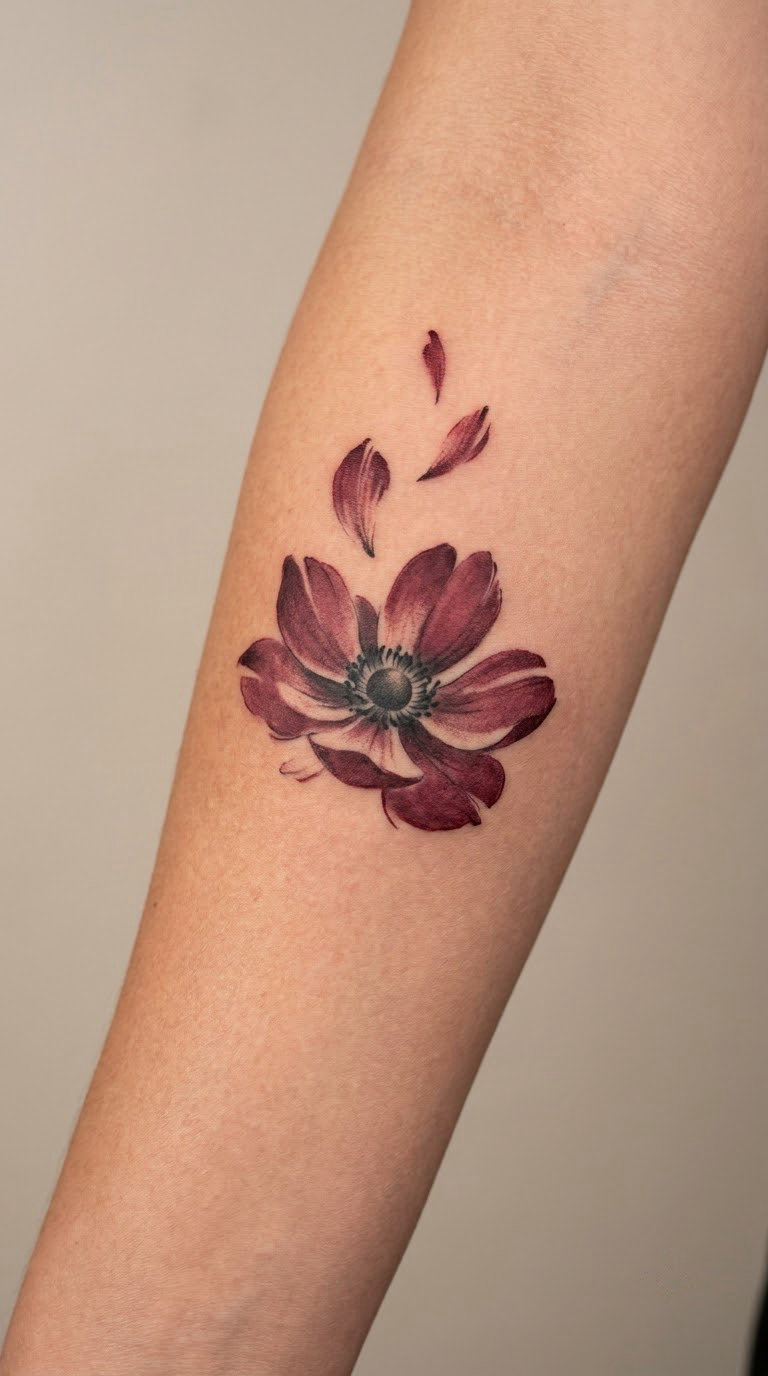
A Japanese anemone, shumeigiku, is drawn here as one flower with a dark round centre and clearly separated petals, plus a few small petal fragments blown away from the bloom to give it movement. The petals are usually burgundy or deep red, either in soft watercolour or with a few loose fine lines. Keep the fragments bold, not wispy, since tiny windblown elements are the first to disappear. People often choose this flower for the sense of movement, for its resilience, or for an individual memory rather than any fixed reading.
Placement: shoulder, wrist, ribs or outer arm. Size: 2-4 inch (5-10 cm). Style: watercolour, fine line or micro-realism. Pain: low to medium.
Ageing note: loose details need strong contrast because they blur among the first elements. Make it yours: angle the whole flower along the line of the arm so the drifting petals follow the body’s movement.
12. Higanbana Spider Lily
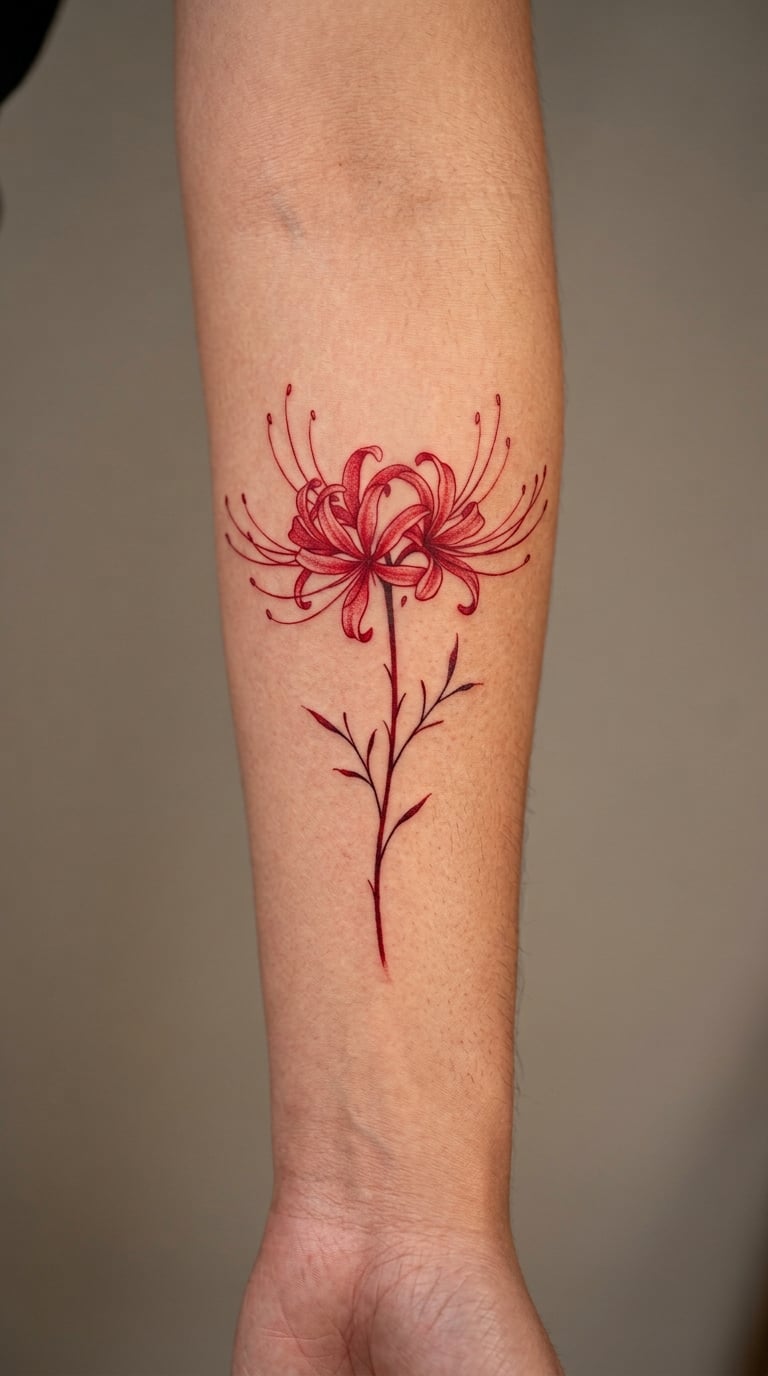
Higanbana is the spider lily, with six long recurved red petals curling away from a cluster of six prominent stamens on a sparse branching stem. It is the boldest shape on this list and it photographs well from a distance. In Japan the flower is associated with the afterlife and is often seen at the equinoxes in cemeteries, so it is worth knowing that before booking it. Plenty of people choose it deliberately as a memorial or for the drama, and others simply love the form, but going in surprised is worth avoiding.
Placement: forearm, calf, thigh or ribs. Size: 3-5 inch (8-13 cm). Style: red ink, blackwork or traditional. Pain: medium.
Ageing note: the thin stamens need slightly heavier lines than the petals or they disappear first. Make it yours: add a small emblem or a date at the base of the stem without crowding the flower. If you want the wider cultural frame, Japanese-inspired tattoo ideas beyond flowers covers the motifs this one usually sits beside.
13. Bellflower Trail
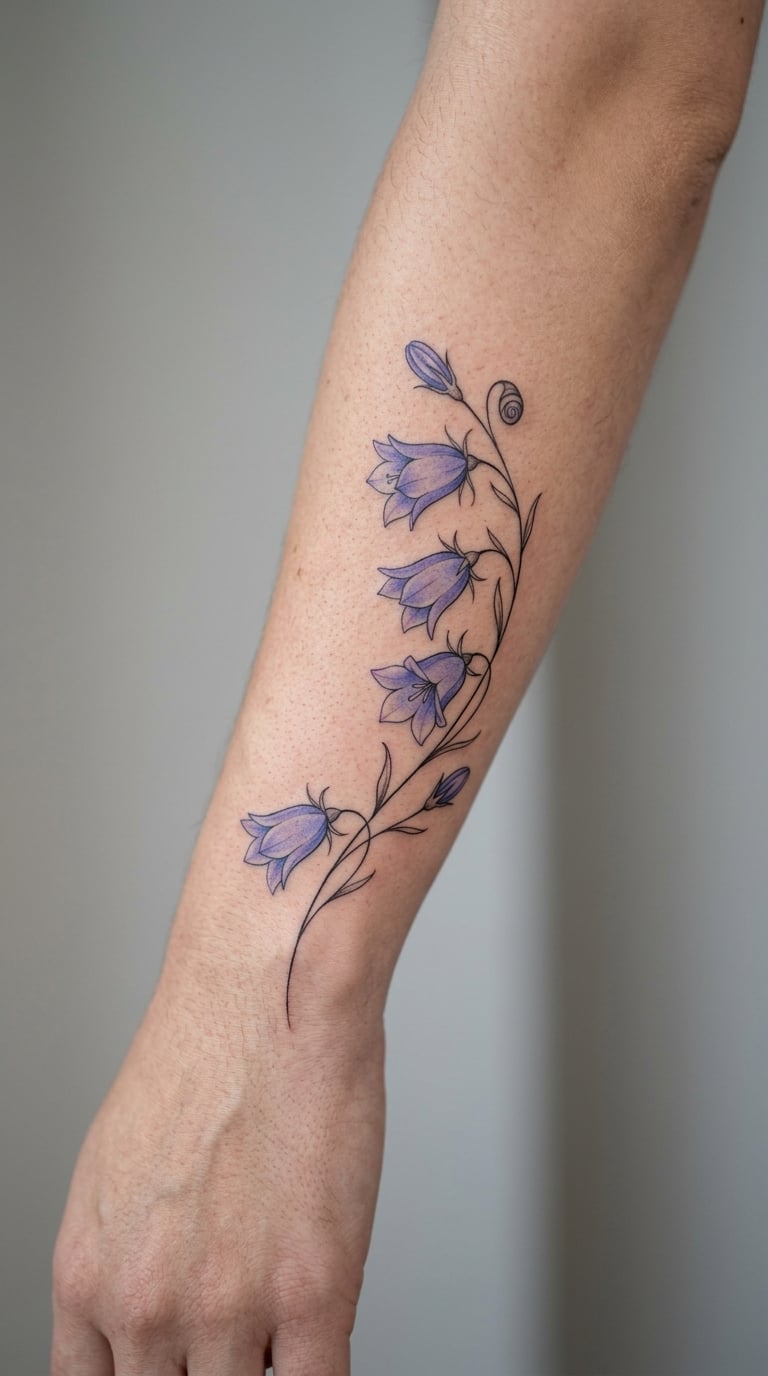
A bellflower, kikyo, is drawn as a curved stem carrying several hanging bell-shaped blossoms, with open flowers and closed buds alternating along the line so the stem reads as a sequence rather than a repeat. Each bell is a simple open shape, usually violet-blue with a lighter throat, and the whole trail curves along the limb. The design tends to be chosen for grace, continuity or one specific memory, and the person wearing it sets the meaning. It suits a thin arm or a side placement where the curve has somewhere to go.
Placement: collarbone, side of the arm, ribs or spine. Size: 2-4 inch (5-10 cm). Style: fine-line colour or illustrative. Pain: low to medium.
Ageing note: tiny stamens inside the bells disappear quickly, so omit them entirely on very small versions. Make it yours: add one bud in a contrasting colour to mark a specific person.
14. Cosmos in a Minimal Bouquet
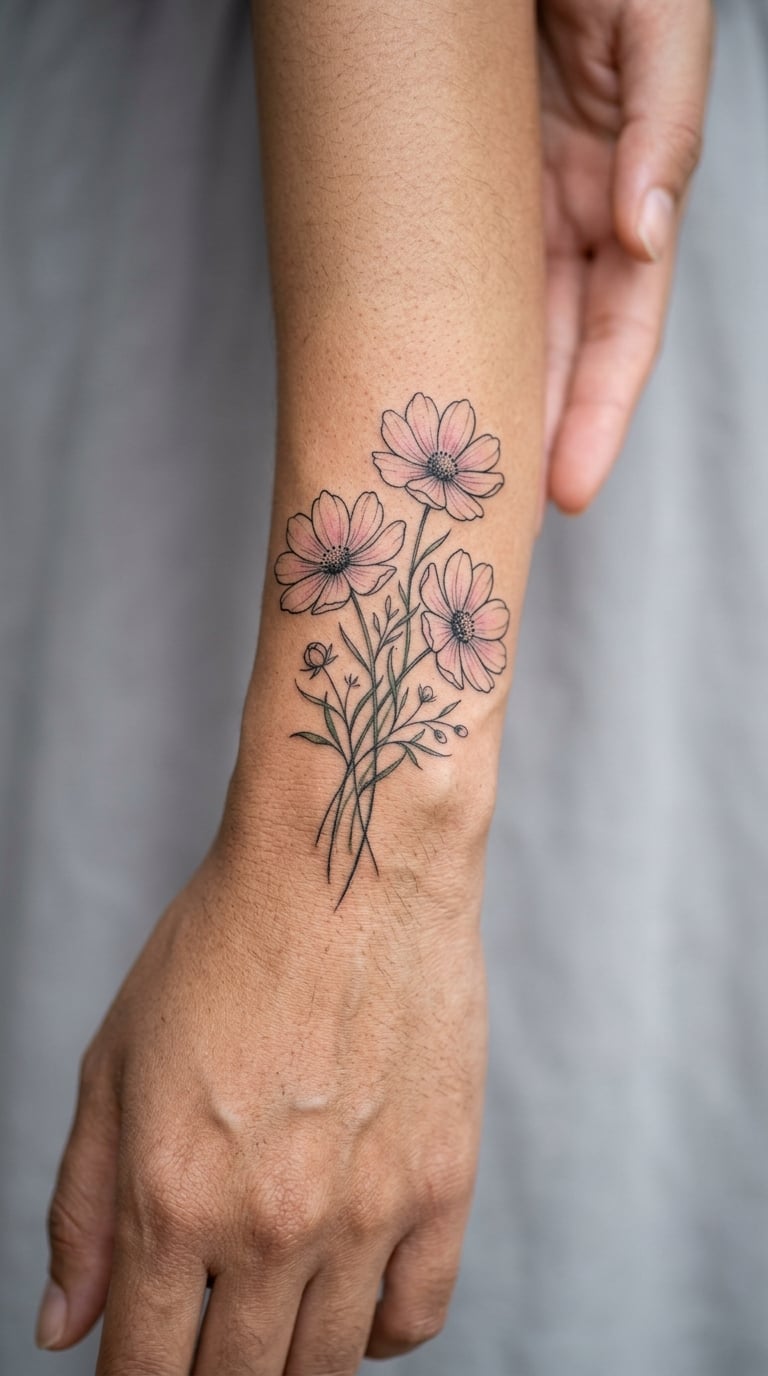
Three cosmos flowers with open rows of petals, small textured centres and loosely gathered stems, done in fine line or very light watercolour. The forms are wide and flat, which makes them easy to read at a small size, and the gathered stems give the composition a bit of movement without adding density. This one works particularly well as a first small floral tattoo because there is very little for the needle to do. People tie cosmos to a season, a place or a personal story, and the flower itself is not loaded with fixed symbolism.
Placement: wrist, back of the hand, shoulder or calf. Size: 2-4 inch (5-10 cm). Style: fine line or minimal watercolour. Pain: low.
Ageing note: hand and finger versions fade and blur faster than the same art elsewhere, because of movement and sun exposure. Make it yours: tie the number of stems to a number that means something, and keep the stems loose rather than bound. For more pieces at this scale, delicate flower tattoo ideas for the wrist are worth a look.
15. Japanese Poppy in Red Ink
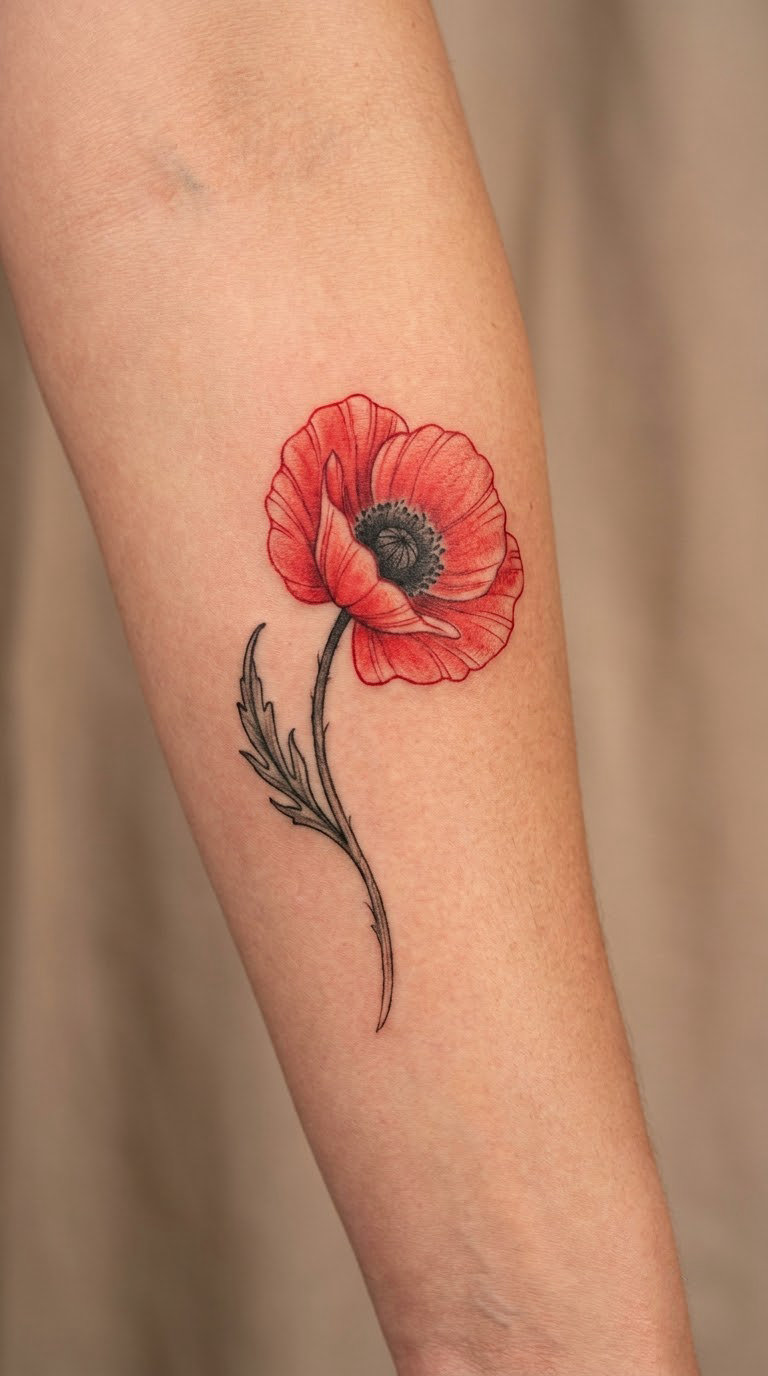
A side-profile poppy with crinkled red petals, a dark charcoal centre and one curved stem carrying a few sparse leaves. Side profile is the whole trick here: the flower reads clearly from a single silhouette, so it holds up at a modest size where a front-facing poppy would turn to mush. Red is the obvious choice, either as a soft watercolour wash or as denser ink with darker edges. The flower is often linked to remembrance or love, though plenty of people choose it purely for the colour and the delicacy.
Placement: forearm, calf, ribs or shoulder. Size: 3-5 inch (8-13 cm). Style: red-ink realism or watercolour. Pain: medium.
Ageing note: very light red washes can fade towards orange or yellow, so ask for a deeper base under the wash. Make it yours: add a meaningful date or a small healed scar alongside the stem rather than inside the flower.
16. Ranunculus Spiral
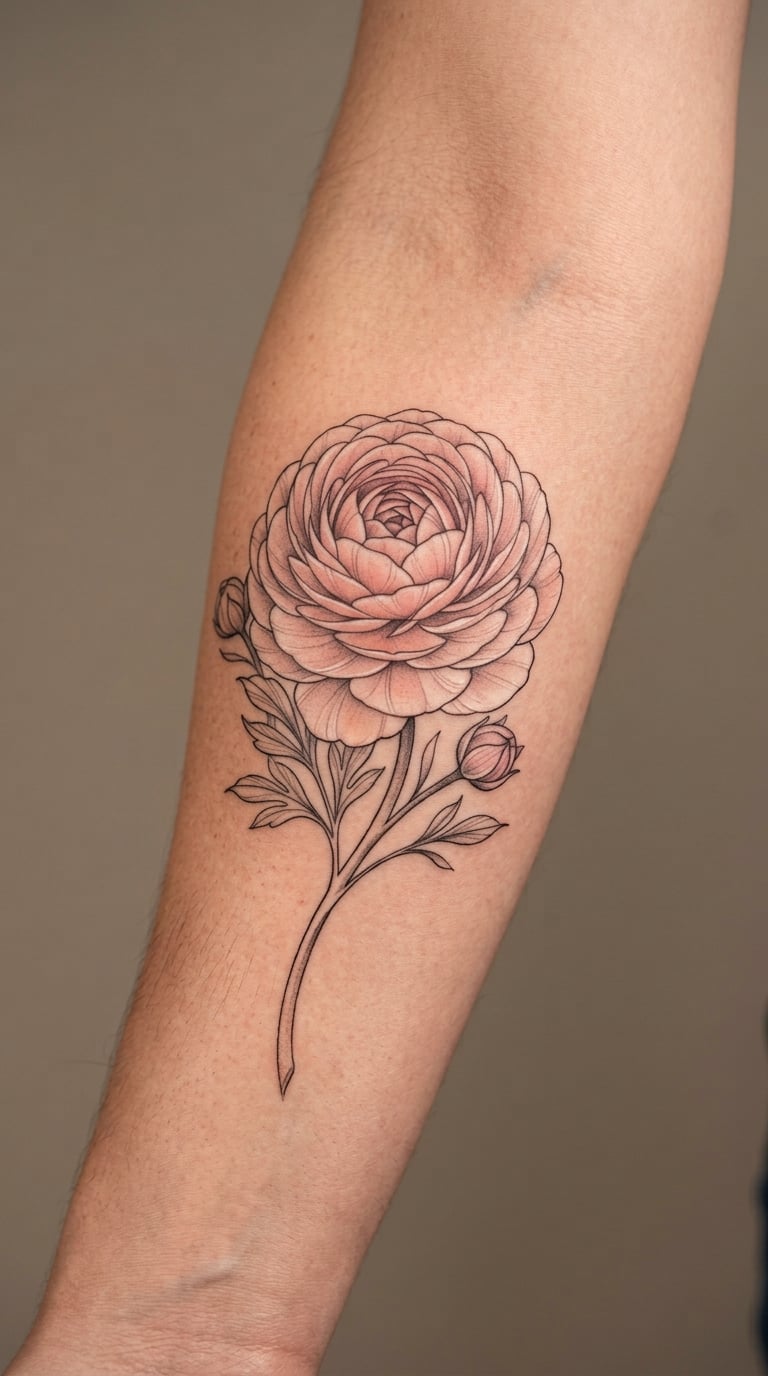
The ranunculus is built from curved petal tiers wrapping tightly around a small centre, and the design leans into the spiral rather than fighting it. Fine black contours define each layer, with a light blush-pink fill and just enough grey shading to separate the tiers. It is a single-statement piece: the whole flower is the composition, and it reads better alone than surrounded by other elements. The appeal is structural, the repeated curves stacking into a shape that is quite unlike a rose, and most wearers pick it for that geometry.
Placement: forearm, shoulder, thigh or lower back. Size: 3-5 inch (8-13 cm). Style: fine line, illustrative or neo-traditional. Pain: medium.
Ageing note: nested petal lines need real width between tiers or they merge into a solid shape over time. Make it yours: keep the outer tier lighter and add a deeper shade at the centre to make the spiral turn inward.
17. Sweet Pea Stem
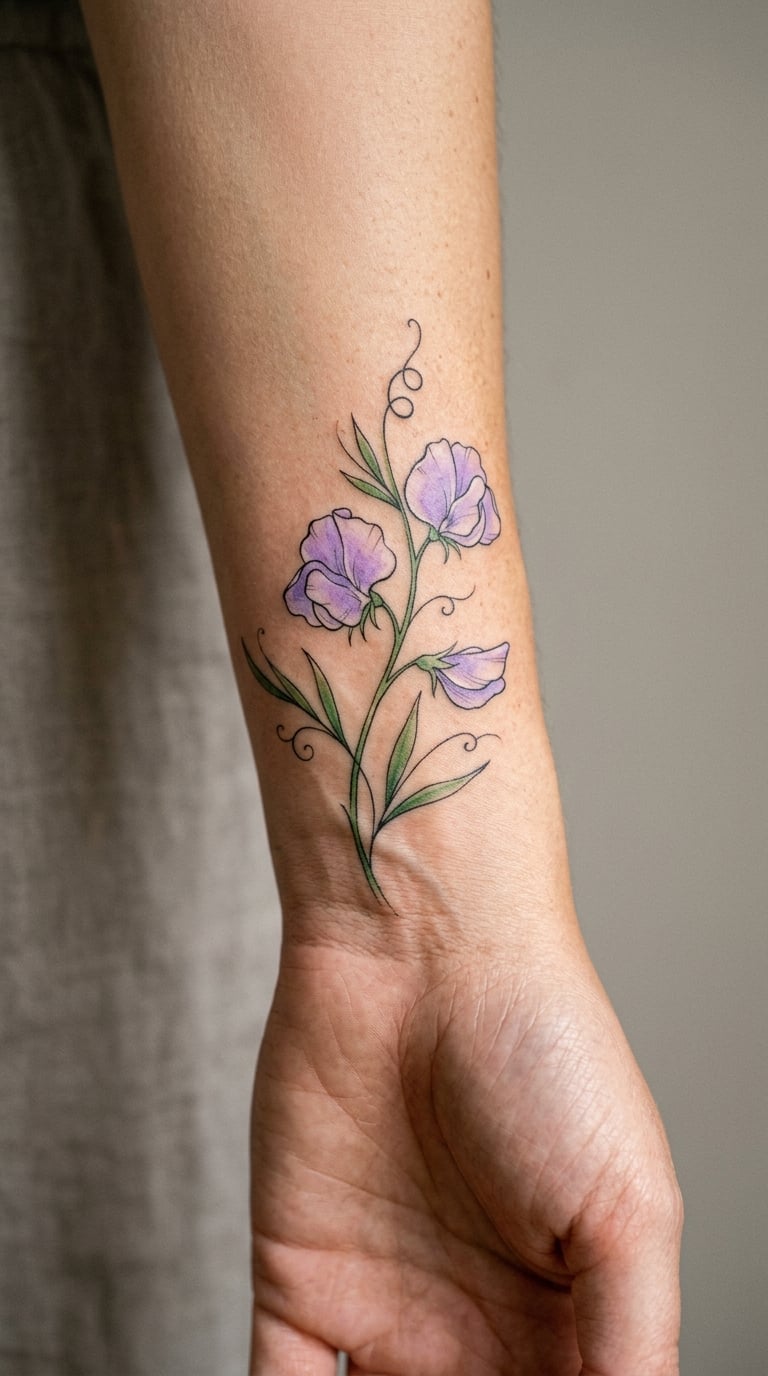
A sweet pea stem runs diagonally across the placement, carrying three fluttering pea-shaped flowers in lavender, a couple of curling tendrils and a few narrow leaves. The appeal is asymmetry: the stem leans, the flowers face different directions and the tendrils trail off rather than sitting square to the design. Most tattooers work it in fine-line watercolour where the colour is barely there, which suits a wrist. Wearers tend to choose it for the movement, and any deeper meaning gets attached afterwards.
Placement: wrist, ankle, calf or side of the arm. Size: 2-4 inch (5-10 cm). Style: fine-line watercolour. Pain: low to medium.
Ageing note: tiny tendrils and pale colour transitions are vulnerable, especially on the wrist, so keep the line confident. Make it yours: add a birth-month colour, or mirror the stem on the opposite ankle later.
18. Jasmine Bud Pair
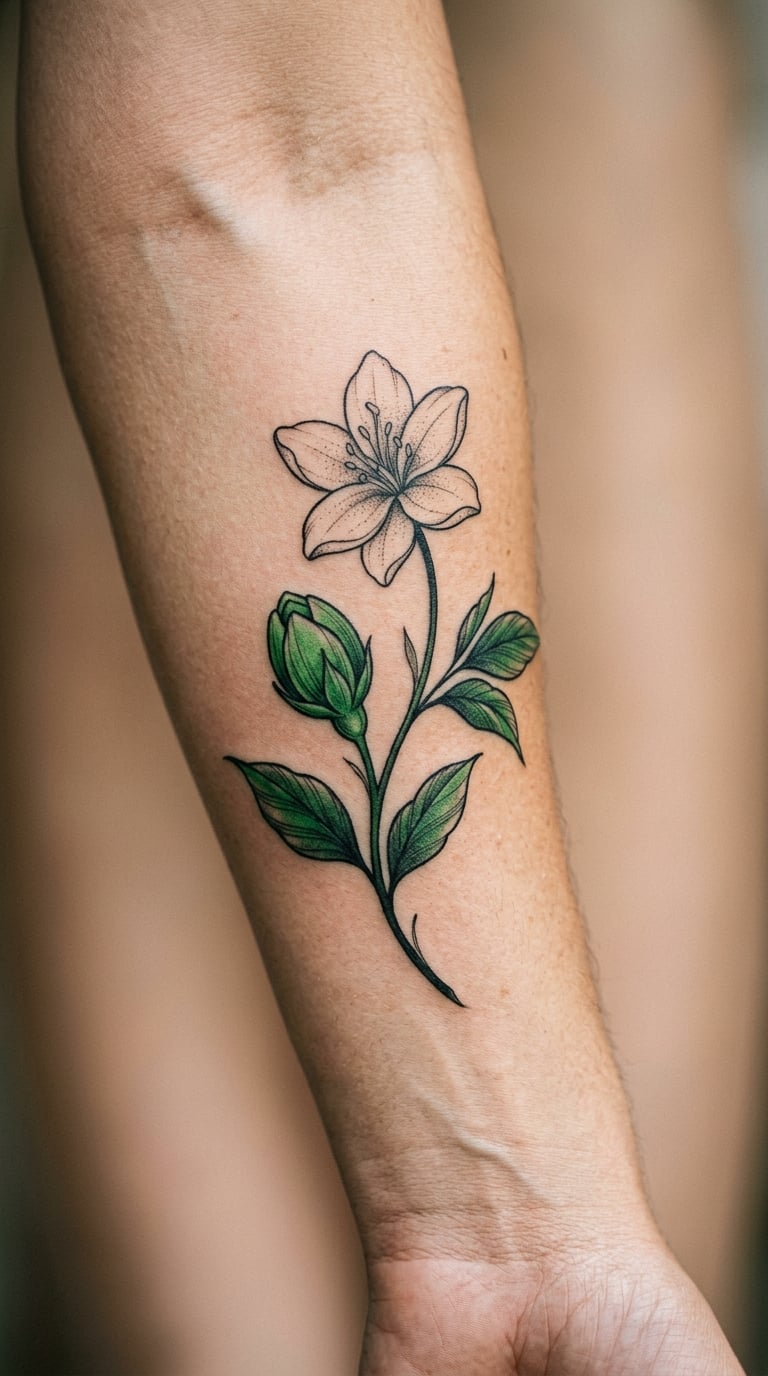
Two jasmine buds at different stages, one starting to open and one still closed, joined by a curved stem with two glossy leaves rendered in blackwork with a touch of green. The small size is the point, and the artist has to be economical: soft white highlights on the leaves and clean petal seams are what separate a jasmine from a generic bud. People choose jasmine for fragrance associations, for a meaningful place, or for a family connection. It is a common choice for a first small piece and it sits well on a slim inner arm.
Placement: inner arm, shoulder, ribs or ankle. Size: 2-4 inch (5-10 cm). Style: blackwork, micro-realism or limited green. Pain: low to medium.
Ageing note: small petal seams and narrow white highlights can disappear over time, so keep the highlights broader than they look necessary at sketch stage. Make it yours: place the open bud over a small scar once healed, or match the pair on the other arm.
19. Morning Glory Vine
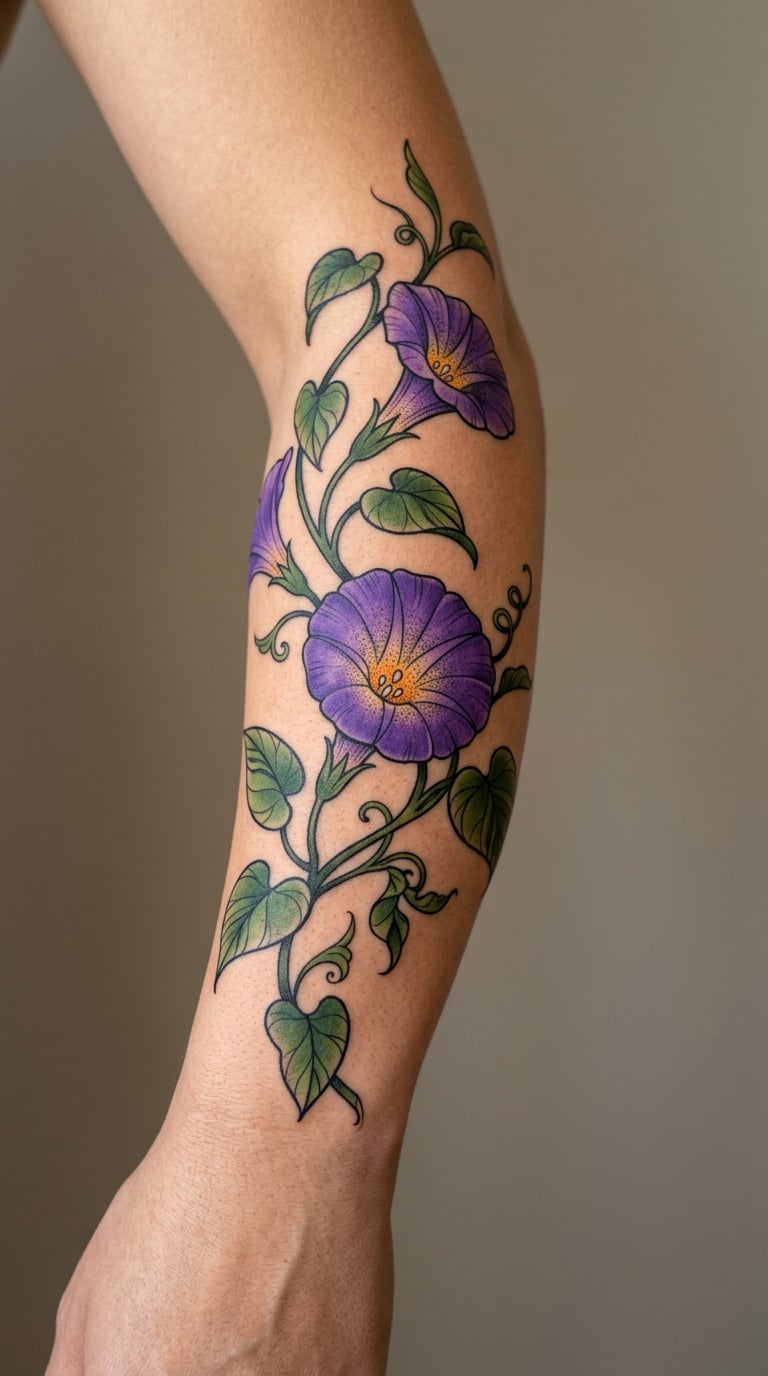
A climbing morning glory, asagao, with several trumpet-shaped purple flowers, heart-shaped leaves and a vine that curls along the limb in a loose S-curve. The design mixes filled petal areas with open ones, which is what keeps a climbing composition from looking like wallpaper. Yellow stippling in the flower throats adds the one warm accent. The upward movement of the vine is the main draw, and the flower carries no single fixed meaning that any two wearers would agree on.
Placement: forearm, calf, ribs or shoulder, following the line of the limb. Size: 3-6 inch (8-15 cm). Style: traditional, neo-traditional or dotwork. Pain: medium.
Ageing note: tiny stippling should be made large enough to stay distinct, otherwise it flattens into a dull patch. Make it yours: add a climbing date along the vine, or a contrasting bud in a second colour to break the purple.
20. Rose in Sumi-Ink Style
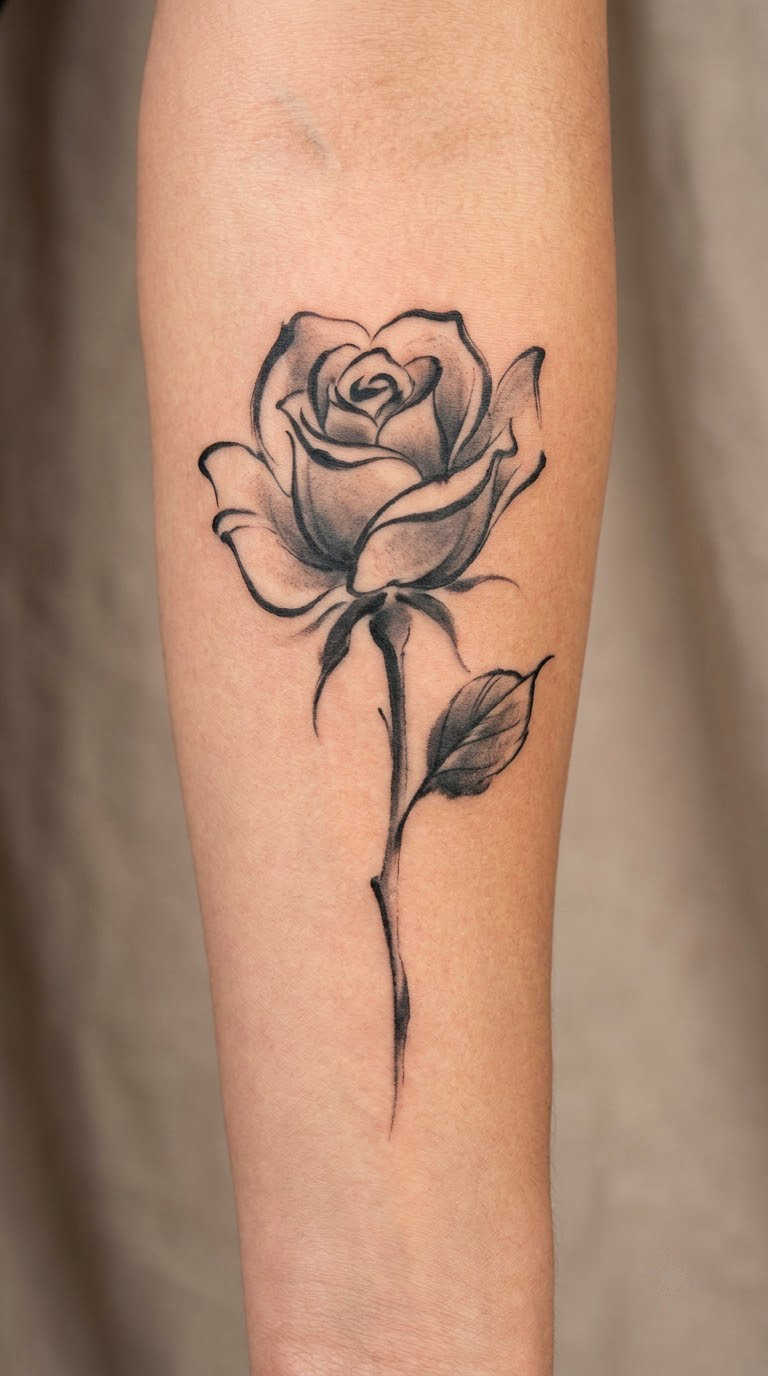
A single rose rendered with loose black brush edges, dry-brush gaps and a minimal grey wash, paired with one spare stem and a single leaf. The look borrows from ink-painting aesthetics rather than from traditional Japanese tattoo practice, so it is worth calling it what it is: a contemporary illustrative approach, not a historical style. The appeal is the unfinished quality. Where a neo-traditional rose is outlined and fully shaded, this one lets the edges break away and lets the paper or skin show through.
Placement: forearm, calf, upper back or thigh. Size: 3-5 inch (8-15 cm). Style: blackwork or sumi-inspired illustrative. Pain: medium.
Ageing note: sparse brush marks can fade or start to read as unfinished, so check the healed contrast after a few months. Make it yours: add one red wash in the centre of the bloom to keep the palette from going entirely grey.
21. Sunflower with Muted Washi Texture
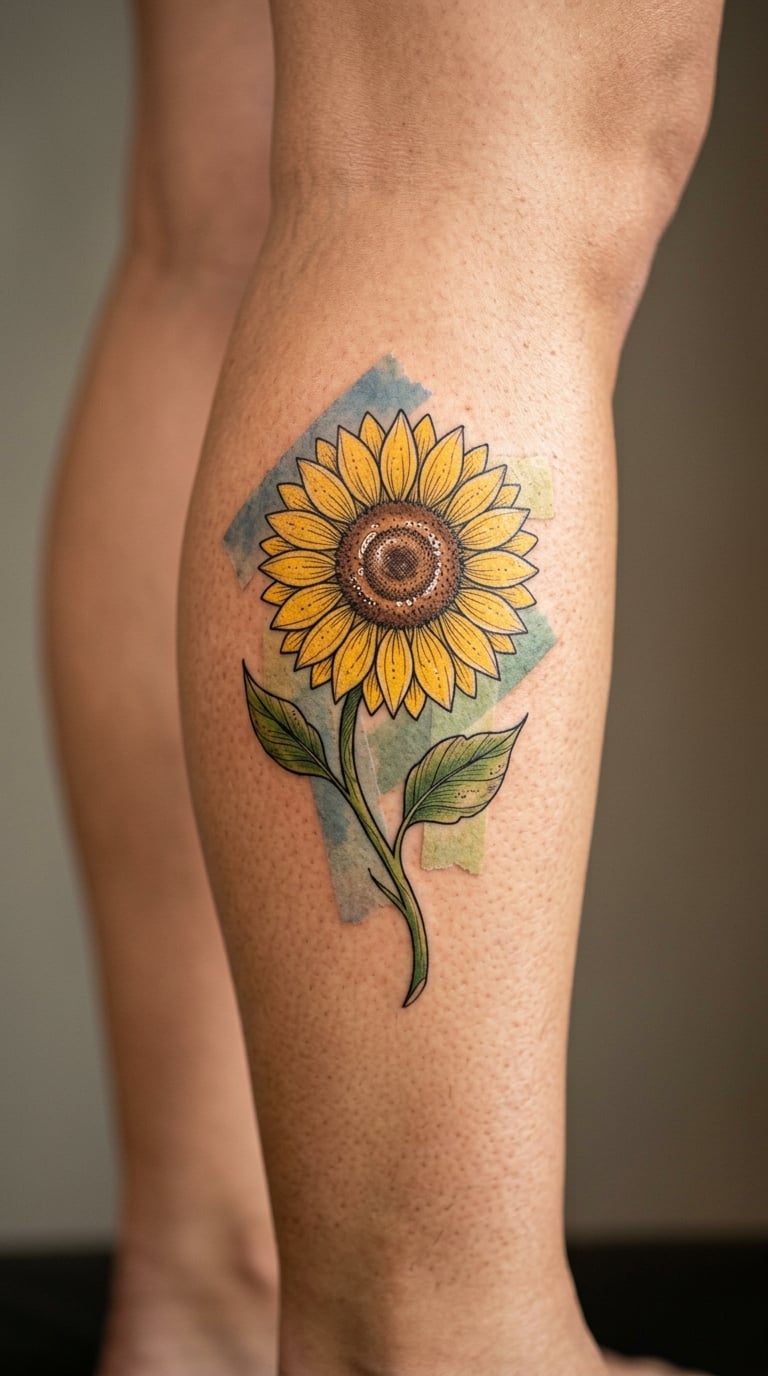
A sunflower with broad yellow petals, a brown seed head and a lightly distressed border that suggests handmade washi paper behind it. The texture is a contemporary illustrative choice rather than a reference to any historical Japanese paper tradition, and it works because it gives the flat yellow field something to sit against. Two green leaves anchor the stem, and the whole thing has more air around it than a traditional sunflower would.
Placement: calf, upper arm, shoulder or back. Size: 4-6 inch (10-15 cm). Style: illustrative colour or neo-traditional. Pain: medium.
Ageing note: pale yellows and delicate paper-edge effects soften early, while a solid dark centre holds its contrast. Make it yours: add a local flower in the background texture, or reduce the palette to two colours so the yellow reads louder.
22. Dahlia in Dotwork Shading
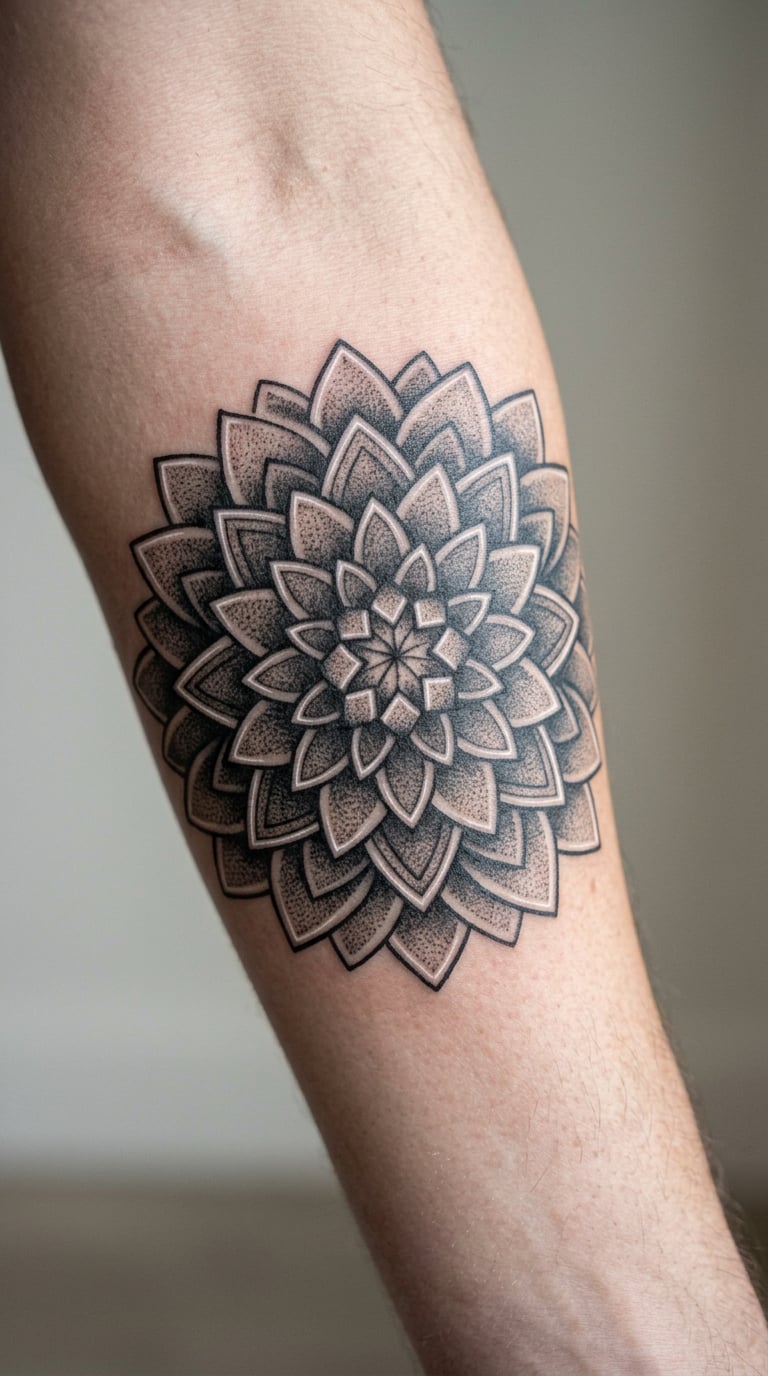
A dahlia built from geometric layered petals with stippled shadow areas and clean negative-space highlights left white. Dotwork is a stylistic choice here rather than a rule, and the flower itself is picked for its structure, the way each tier of petals steps inward, or simply for a personal memory. The shading does the heavy lifting: dense stippling in the lower petals, open white in the upper ones, which gives the bloom a sense of roundness without any grey wash.
Placement: forearm, shoulder, thigh or ribs. Size: 3-5 inch (8-13 cm). Style: dotwork or blackwork. Pain: medium.
Ageing note: individual dots need to be larger on a smaller tattoo, otherwise they merge into flat grey as they heal. Make it yours: add one meaningful colour accent, or a birth date in tiny lettering where the stem meets the bloom.
23. Ikebana-Style Peony Arrangement
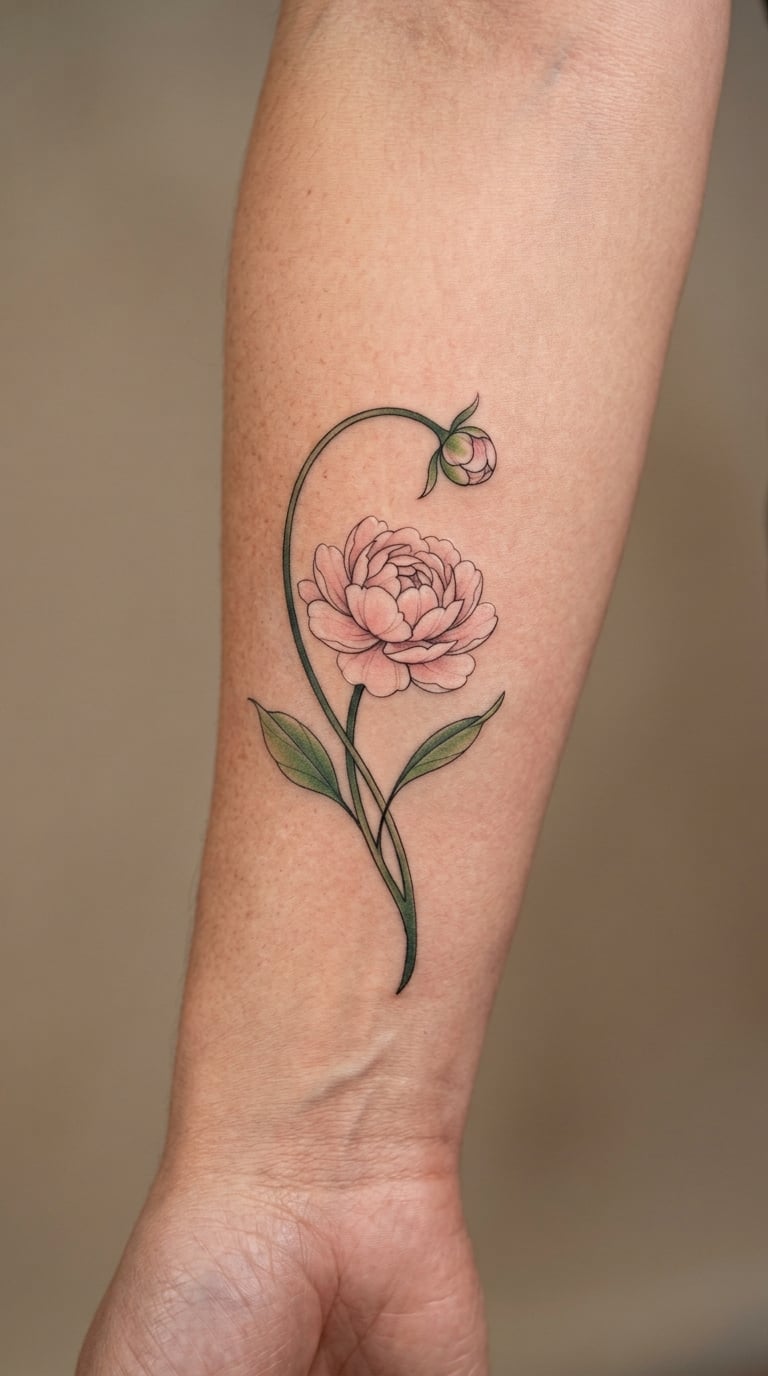
A contemporary floral composition with one open peony, one closed bud, a curving stem and two asymmetric leaves, leaving deliberate negative space around the whole thing. The arrangement is ikebana-inspired without attempting to reproduce a specific formal school or tradition, so treat it as a modern arrangement rather than a documented one. What makes it work is the empty space: only three elements, spread across the placement, with the stem doing the connecting. It reads as considered rather than decorative.
Placement: inner arm, ribs, calf or back of the hand. Size: 3-6 inch (8-15 cm). Style: fine line, blackwork or watercolour. Pain: low to medium.
Ageing note: a sparse stem needs confident line weight, since thin lines are the first thing to disappear on a design with so little else holding it together. Make it yours: move the bud to the opposite end of the composition from the way you first imagined, and see if the balance improves.
24. Monstera Leaf with Sakura Accent
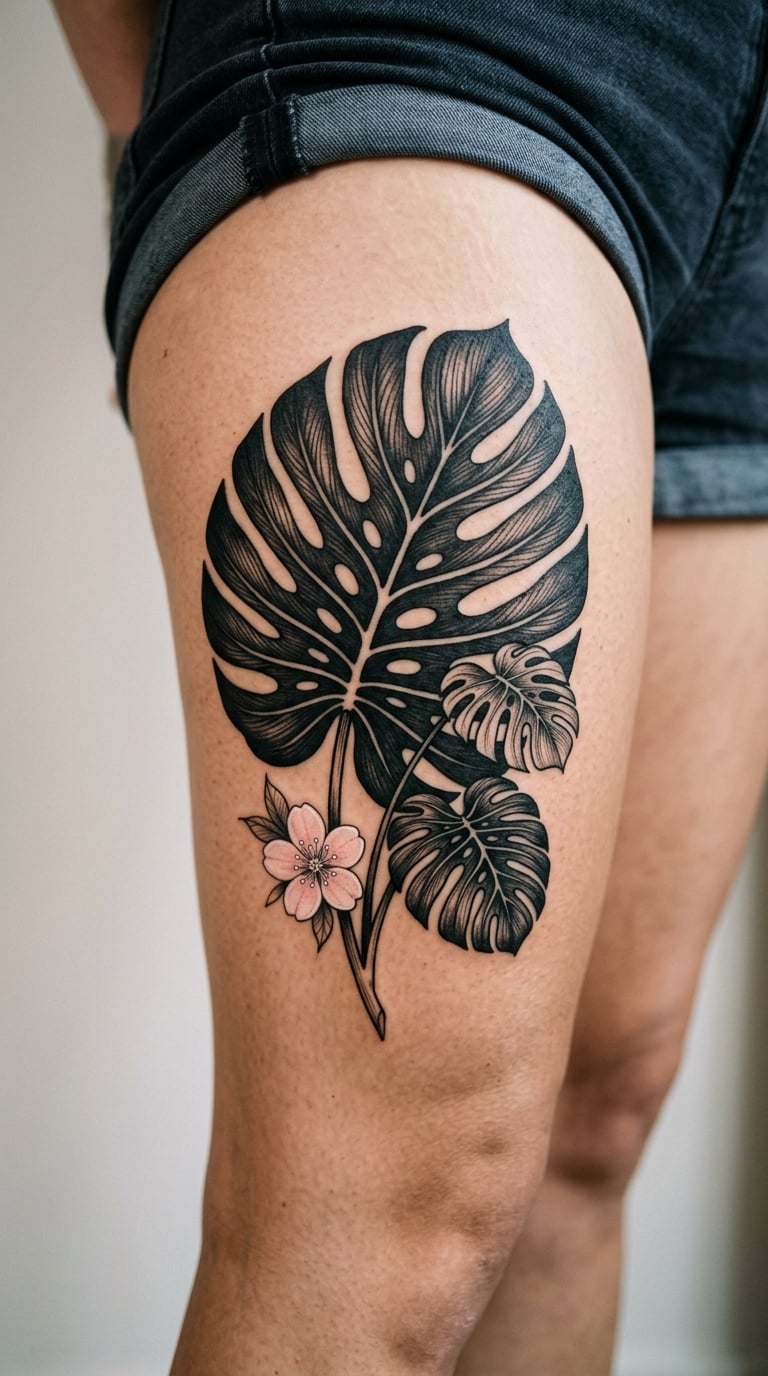
A tropical-leaning composition with one large split monstera leaf, a smaller inner leaf and a single restrained sakura accent. This mixes botanical references rather than representing a strictly traditional Japanese motif, and it suits someone who wants the irezumi composition without the strict flower canon. Blackwork handles the monstera well, since the cutouts and notches give the artist plenty of edge to work with, and the pale-pink blossom is the single warm point that keeps the piece from reading as flat.
Placement: thigh, calf, side of the torso or forearm. Size: 4-7 inch (10-18 cm). Style: blackwork with one colour accent. Pain: medium, and the thigh runs long for a piece this size.
Ageing note: interior cutouts need clean edges and careful hand planning, since a healed line that closes up a cutout changes the whole leaf. Make it yours: swap the sakura accent for a peony in red, or leave the leaf alone and make the single blossom the entire point.
How to Choose the Right Design
Most disappointing floral tattoos are not bad drawings, they are good drawings in the wrong place at the wrong scale. Work through these six checks before you book anything.
- Style first. Fine line and botanical watercolour are different disciplines, and a portfolio that is strong in one is not automatically strong in the other. If you want this 24 japanese flower tattoo ideas list to land properly, pick the style first and then find an artist who does exactly that work.
- Size follows the detail. Count the smallest element in the design, then measure it against the smallest line an artist can hold steady. If the stamens are thinner than a pencil line at your chosen size, they need simplifying rather than shrinking.
- Check the body part, not the design. Wrist, ribs, collarbone and sternum are all bony and all feel worse than the same work on a thigh. Ask what the placement looks like stretched, because a forearm design drawn for a resting arm can distort badly when the arm bends.
- Simplify petals, keep the outline. Every bloom in this list works better with fewer petals and a defined edge. Fill-in shading ages worse than clean line, and it is the first thing that turns a flower into a grey circle.
- Decide colour early. Black-and-grey ages more predictably and hides small imperfections. Colour buys you the reason you wanted the flower in the first place, and it needs a bigger piece to stay readable.
- Fit the collection. If you already have a forearm piece, choose a line weight and colour depth that sit with it. A fine-line bloom next to a dense sleeve looks like a mistake rather than a contrast.
Cost and Session Time
Tattoo pricing in the US is usually worked out by the hour, so size and complexity drive the number more than the flower does. These are realistic ranges to plan with, not quotes.
- Small flash or simple fine-line designs: roughly 80 to 200 US dollars, and often done in one sitting of an hour or less.
- Medium single-flower pieces around 4 to 6 inches: roughly 200 to 500 US dollars, usually one session of two to three hours.
- Larger detailed or coloured floral designs: roughly 500 to 1,200 US dollars or more, frequently split across two sessions.
Shop minimums matter more than people expect. A studio with a 150 dollar minimum means a small wrist cosmos costs the same as a forearm lotus, so get the total agreed in writing before you start. Custom work, artist rates, city, and how much of the composition is colour will all move that number, and large pieces rarely fit into a single sitting because tattooing in long sessions produces worse results than splitting the work.
Aftercare Basics
Start with your artist’s own aftercare instructions, because they will account for the exact technique and ink used. Beyond that, the general rules are straightforward.
- Follow your artist’s aftercare instructions first, including anything specific about washing and product choice for your piece.
- Wash gently with clean water and a mild unscented soap in the first days, then pat dry with something clean rather than rubbing.
- Use only the product your artist recommends, and keep it thin rather than caking the area.
- Protect the tattoo from unnecessary sun and from friction, which covers sleeves under clothing, waistbands, bra straps and backpacks in week one.
- Do not pick or scratch, even once a scab or flake appears. Loose skin comes away on its own with washing.
- If something unexpected happens, contact your artist first, and seek professional advice from a qualified clinician for concerns you would take to a doctor for any other skin problem.
Frequently Asked Questions
What are the most popular Japanese flower tattoos?
Cherry blossom, or sakura, is the most requested, usually as a single branch or a soft spray of overlapping blooms. Chrysanthemum and peony follow closely, often for a larger piece, and lotus is common when someone wants a symmetrical vertical design. The popularity of each one depends more on the shape it gives you on skin than on the meaning attached to it.
Do Japanese flower tattoos need to include kanji?
No. Kanji, or any other lettering, is entirely optional and plenty of Japanese floral tattoos carry no text at all. If you do want characters, bring correct writing from a reliable source and have the tattooist check the stroke order before the stencil goes on, because a single wrong stroke changes the word. Many people add a small character later, after the flower has healed.
Where is the best placement for a small Japanese flower tattoo?
The inner wrist, the outer forearm and the collarbone are the most forgiving spots for something in the 2 to 4 inch range. They all have enough flat surface for a clear composition and all move enough that a small piece sits naturally rather than looking pinned on. Avoid the knuckles and fingers if the design has fine detail, since those areas wear fastest.
How long should I expect my Japanese flower tattoo to last?
Most tattooed skin settles into a stable look over the first year or so, and from there it changes slowly. Light colour and fine lines fade sooner than bold black or strong contrast, and sun exposure speeds it up considerably. Colours usually need a touch-up eventually, and fine-line wrist and hand work is the first thing to soften. Plan for maintenance rather than expecting a piece to stay untouched.
How can I personalize a Japanese flower tattoo?
Pick the flower for a reason you can explain out loud, then change one specific element rather than adding more. A date in the stem, one blossom in a different colour, a birth month reflected in the number of flowers, or a matching piece on the other arm all work well. The 24 japanese flower tattoo ideas here are starting points, and the personal detail is what makes a design read as yours rather than as a trend.
Conclusion
If this is your first Japanese floral piece, start small and simple. A minimal cherry blossom branch, a small cosmos bouquet or a compact sakura spray gives you something you can heal quickly, hide under a sleeve if you want to, and build on later. If you are adding to an existing collection, the layered peony, the black-and-grey lotus or a hanging wisteria cluster has the scale and detail to hold its own against other work.
Whichever direction you take, choose an artist whose portfolio matches the final style, the placement and the level of detail. Book a consultation, bring the design you actually want at the size you actually want it, and let the artist tell you which parts of it will not survive. That conversation is the difference between a tattoo that still reads in ten years and one that has turned into a grey smudge.