
22 Coyote Tattoo Ideas: Best Small and Bold (October 2026)
These 22 coyote tattoo ideas cover everything from a 1 inch silhouette behind your ear to a realistic coyote built for a full sleeve, and each one comes with a real placement, a real size, and an honest note about how the detail holds up over the years. If you have never been tattooed before, start with one of the smaller designs. If you already collect pieces, jump to the blackwork and realism sections.
A coyote is a good first animal to commit to on paper. It is less common than a wolf, it works small, and it suits any skin tone because most of these designs lean on shape and contrast rather than colour. Look for a healed photo before you book, not a fresh-ink shot. Most artists post years-old work, and that is the version you are actually getting.
22 Coyote Tattoo Ideas: Quick Guide
Here is the whole list on one page. Read it top to bottom, then come back to the two or three that made you stop scrolling.
| Idea | Style | Best placement | Size | Pain |
|---|---|---|---|---|
| 1. Fine-line howl | Fine line | Behind the ear | 1-2 in (2.5-5 cm) | Low |
| 2. Walking line-art | Minimalist | Inner wrist | 2-3 in (5-7.5 cm) | Medium |
| 3. Faceted head | Geometric | Inner forearm | 3-4 in (7.5-10 cm) | Medium |
| 4. Realistic profile | Micro-realism | Outer calf | 3-5 in (7.5-12.5 cm) | Medium |
| 5. Blackwork howl | Blackwork | Outer upper arm | 4-6 in (10-15 cm) | Medium |
| 6. Small silhouette | Solid black | Above the ankle | 1-2 in (2.5-5 cm) | Low |
| 7. Desert scene | Traditional | Upper arm | 5-7 in (12.5-18 cm) | Medium |
| 8. Leaping watercolor | Watercolor | Shoulder blade | 4-5 in (10-12.5 cm) | Medium |
| 9. Ornamental moon head | Neo-traditional | Outer upper arm | 3-4 in (7.5-10 cm) | Medium |
| 10. Mountain range | Illustrative black and grey | Forearm | 5-7 in (12.5-18 cm) | Medium |
| 11. Micro with paw tracks | Micro fine line | Side of a finger | Under 1 in (2.5 cm) | High |
| 12. Full moon silhouette | Blackwork | Thigh | 3-5 in (7.5-12.5 cm) | Medium |
| 13. Rib profile | Fine line | Outer ribs | 3-4 in (7.5-10 cm) | High |
| 14. Old-west sun | Old western | Forearm | 4-6 in (10-15 cm) | Medium |
| 15. Starry sky walk | Illustrative | Upper back | 5-6 in (12.5-15 cm) | Medium |
| 16. Desert florals | Neo-traditional | Upper arm | 3-5 in (7.5-12.5 cm) | Medium |
| 17. Dotwork run | Dotwork | Outer calf | 4-5 in (10-12.5 cm) | Medium |
| 18. Red-ink eye | Illustrative | Upper arm | 2-3 in (5-7.5 cm) | Medium |
| 19. Collar-bone pair | Fine line | Both collar bones | 2 in each (5 cm) | Low |
| 20. Chrysanthemum portrait | Traditional | Shoulder | 4-5 in (10-12.5 cm) | Medium |
| 21. Breaking the circle | Blackwork | Forearm | 3-4 in (7.5-10 cm) | Medium |
| 22. Cactus sleeve element | Realistic | Upper arm | 5 in (12.5 cm) | High |
1. Fine-Line Howling Coyote Behind the Ear
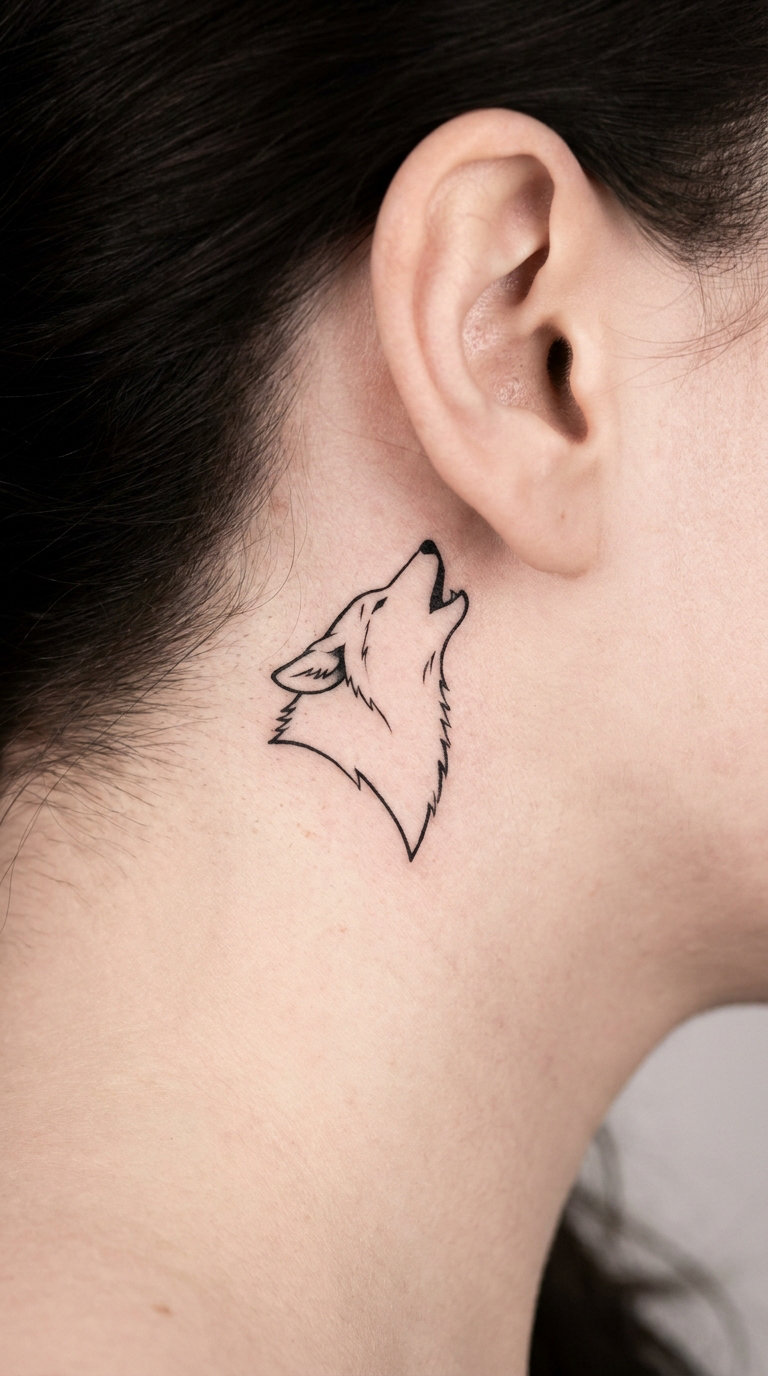
A fine-line howling coyote behind the ear is the smallest design on this list with a real silhouette. The artist draws a single-weight outline of a coyote with its muzzle tipped up, no shading, no fill, nothing inside the body except maybe two short strokes for the ear and haunch. Most people who choose it are marking an outdoorsy stretch of life or a stubborn, on-your-own kind of period.
Placement: Behind the ear, following the curve of the neck. The neck angle does half the work, since the design already points upward.
Size: 1-2 inches (2.5-5 cm) long.
Style: Fine line, single weight, no shading.
Pain: Low to medium. The neck skin moves a lot, which makes it feel more like constant scratching than sharp pain. Fine hairlines here soften noticeably in about three years, so expect a refresh or a re-wrap later.
Make it yours: Add a single date in the same line weight under the jaw, set small enough to read only when someone is close.
2. Minimal Line-Art Coyote on the Wrist
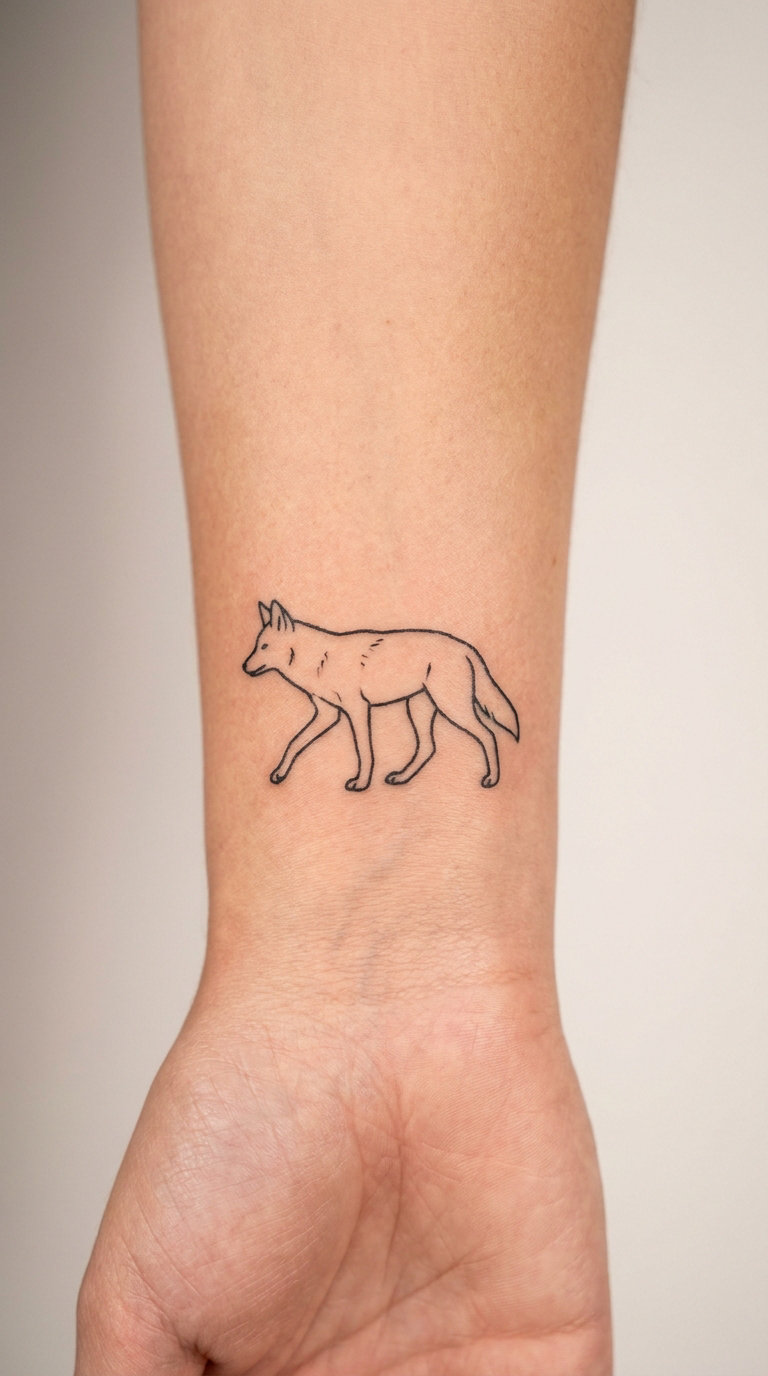
A walking coyote in one continuous contour is the version most first-timers end up with. There is a single unbroken line from nose to tail, legs indicated by two short marks, no interior detail at all. It reads clean at arm’s length and rewards anyone who leans in.
Placement: Inner wrist, running along the forearm direction so it sits flat rather than wrapping.
Size: 2-3 inches (5-7.5 cm) long.
Style: Minimalist line art.
Pain: Low to medium. Inner wrists sting more than most people expect, and skin there stretches every time you move your hand. Thin wrist lines also fade faster than the same line on an upper arm, so plan for a touch-up in a few years.
Make it yours: Ask the artist to point the coyote forward, walking out of the wrist, rather than toward you. It changes the whole feel.
3. Geometric Coyote Head on the Forearm
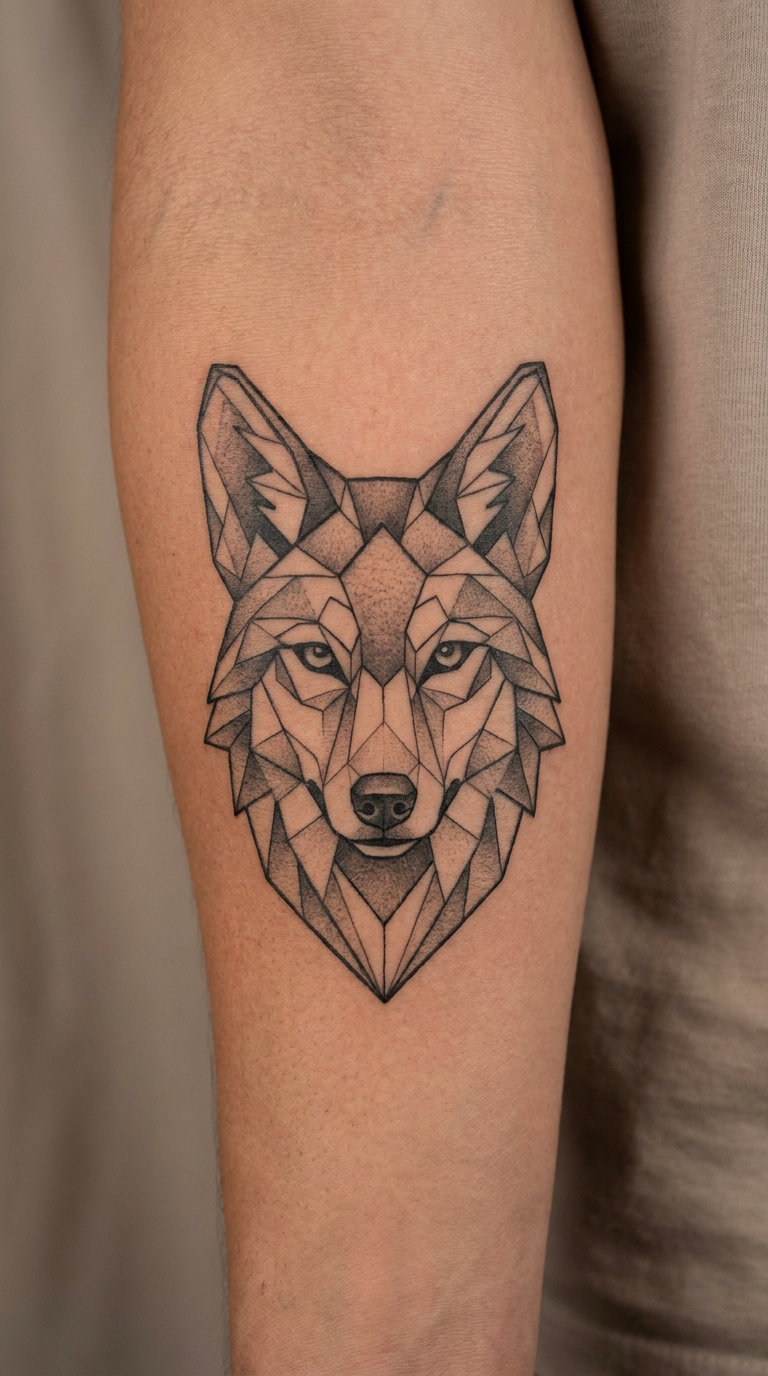
This design takes a coyote head portrait and breaks it into flat angular planes, each one filled with a different grey or left blank. The result is a coyote face tattoo that looks built rather than drawn, and it suits people who like structure more than softness.
Placement: Inner forearm, flat and centred between wrist and elbow.
Size: 3-4 inches (7.5-10 cm) tall.
Style: Geometric with black and grey shading.
Pain: Medium. The forearm is a forgiving spot and you can watch the whole thing happen. The small facet edges stay sharp because there is no fine shading to blur.
Make it yours: Pick a single accent colour for one facet only, or have the geometry follow the angles of a real coyote skull you photograph for reference.
4. Realistic Coyote Profile on the Calf
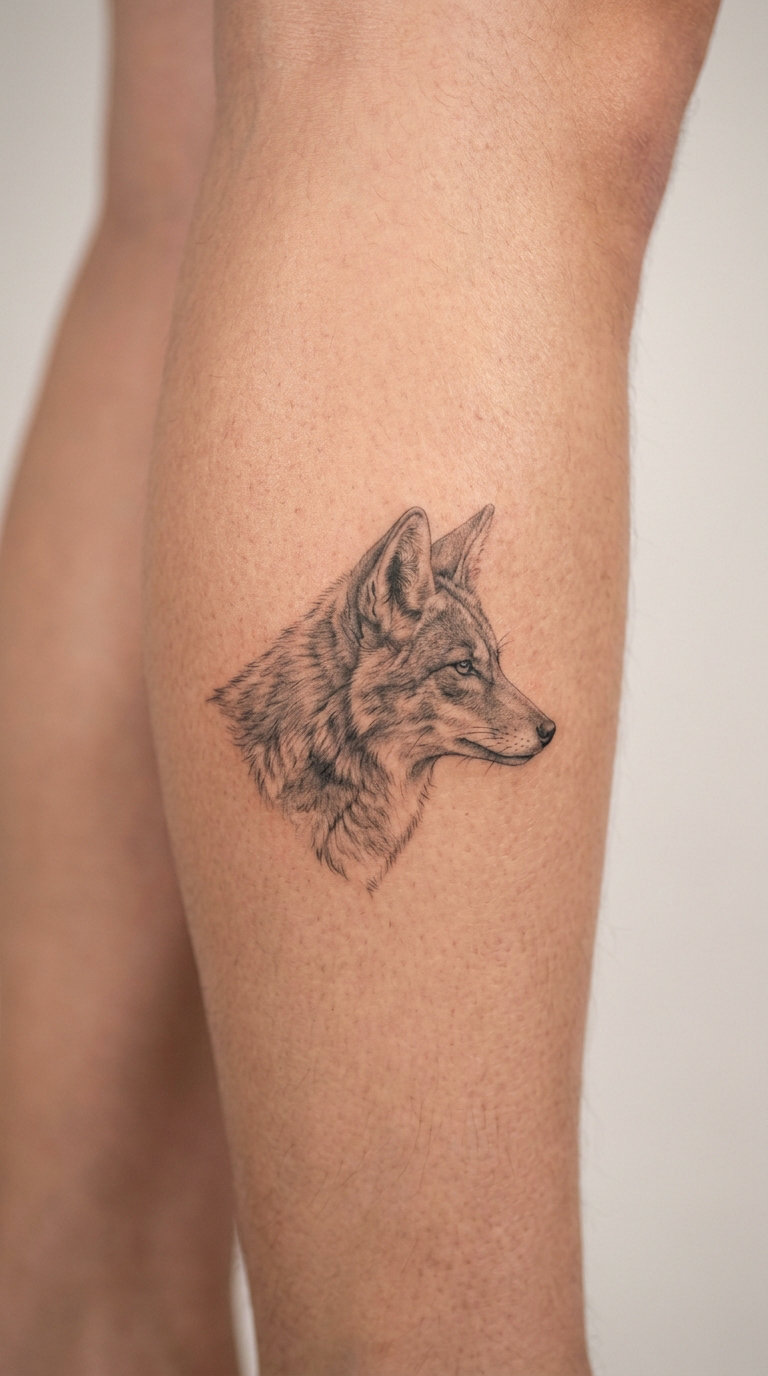
A micro-realistic profile is the version that looks like a photograph pinned to your leg. The artist builds up short directional strokes for the cheek ruff, keeps the eye to a single dark dot, and lets the muzzle fade into untouched skin instead of outlining it. Interpretation varies a lot here, so ask yourself what you actually feel about it before you commit.
Placement: Outer calf, where the muscle gives the lines a slight curve.
Size: 3-5 inches (7.5-12.5 cm) tall.
Style: Micro-realism, black and grey.
Pain: Medium. The calf feels more sensitive than the upper arm but sits well. The softest fur shading is the first thing to blur, usually within five years.
Make it yours: Photograph the exact coyote you want copied, from the same angle, so the artist matches a real animal rather than a generic one.
5. Traditional Blackwork Coyote Howl
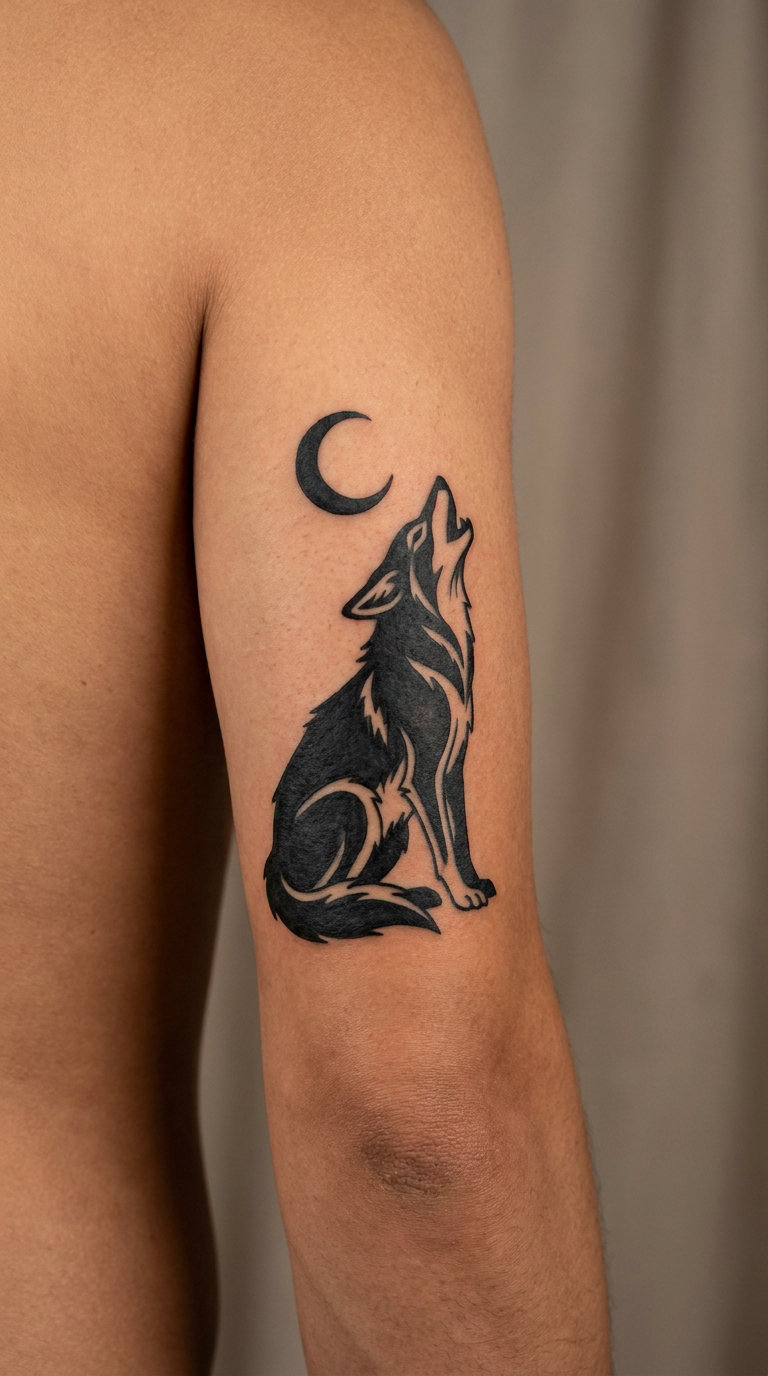
Traditional blackwork uses a heavy outline with the inside of the animal left mostly dark, shaded fur pulled out in a few clean bands. Add a crescent moon behind it and the piece reads instantly from across a room. This is the version that holds its weight best over decades.
Placement: Outer upper arm, or the back of the upper arm where the moon can sit behind the head.
Size: 4-6 inches (10-15 cm) long.
Style: Traditional blackwork.
Pain: Medium. Bigger pieces take longer, so expect the discomfort to build rather than spike. Blackwork ages better than any style here, it just softens at the edges and gets a little greyer.
Make it yours: Give the coyote a pine tree or a small ridge line so the moon is not the only background element.
6. Tiny Black Coyote Silhouette on an Ankle
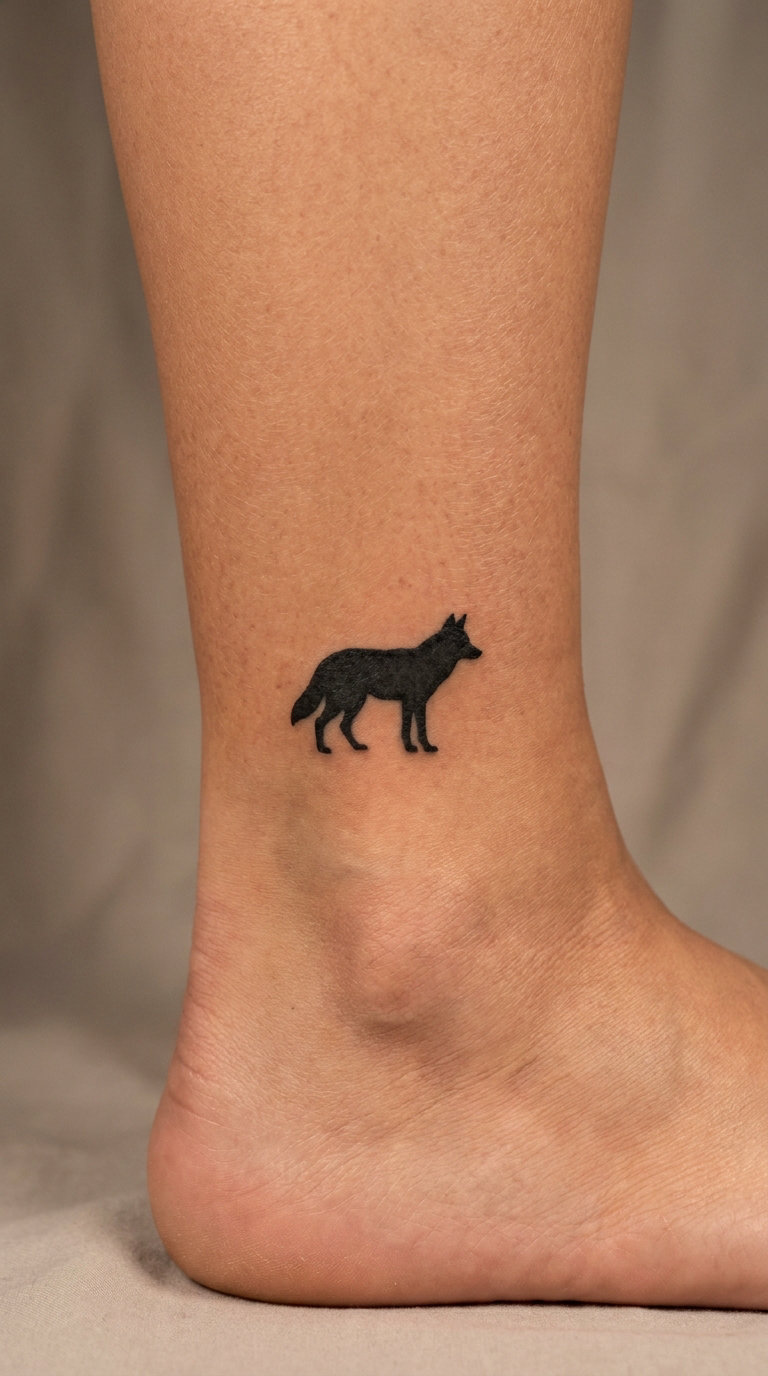
A solid black silhouette is a flat side-profile shape with nothing inside it, which is exactly why it works at one inch. At that scale you are not getting fur detail, you are getting a distinct animal outline that still reads from a few feet back.
Placement: Above the outer ankle bone or on the inner ankle. It sits well inside a shoe line, though it will show more in sandals.
Size: 1-2 inches (2.5-5 cm) long.
Style: Minimalist solid black.
Pain: Low to medium. Ankles are bony and the skin is thin, so the sensation is sharp rather than deep. Keep it above the bone and the whole piece stays quick to tattoo and quick to heal.
Make it yours: Have the coyote mid-stride rather than standing, which gives a small design more energy.
7. Traditional Coyote in a Desert Scene
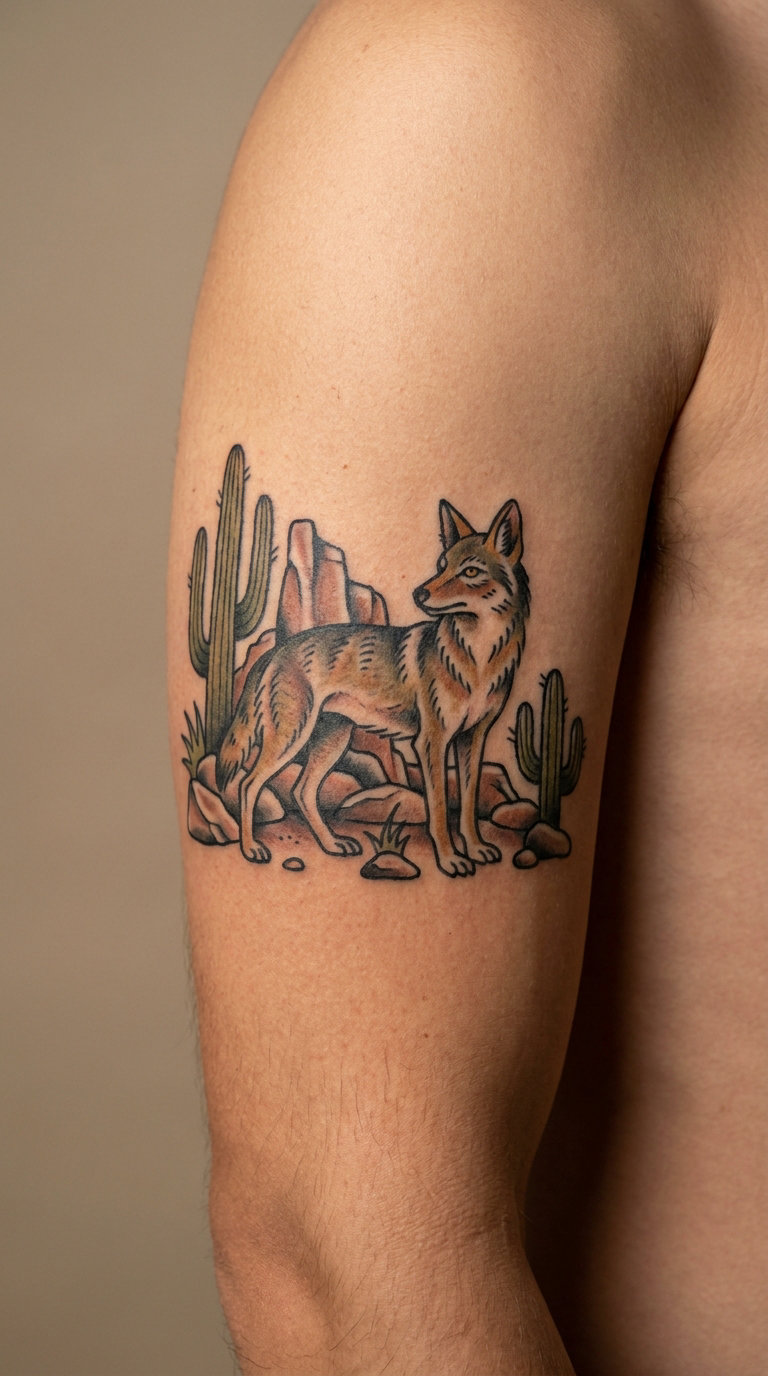
When the design includes ground, it stops being a portrait. Here the coyote stands in profile on a low ridge with rocks, a saguaro and dry brush behind it, drawn in bold traditional linework with muted earth colour. It suits anyone who wanted a scenery piece and needed a reason to get one.
Placement: Upper arm or outer thigh, wherever the scenery has room to spread.
Size: 5-7 inches (12.5-18 cm) wide.
Style: Traditional with muted colour.
Pain: Medium, and expect two sessions. Background elements are what push a piece past the easy range. The colour in a desert scene sits light, so it will soften faster than the black outlines around it.
Make it yours: Use a real desert you have been to. One specific plant from that ground says more than any generic cactus.
8. Watercolor Coyote Leaping on the Shoulder
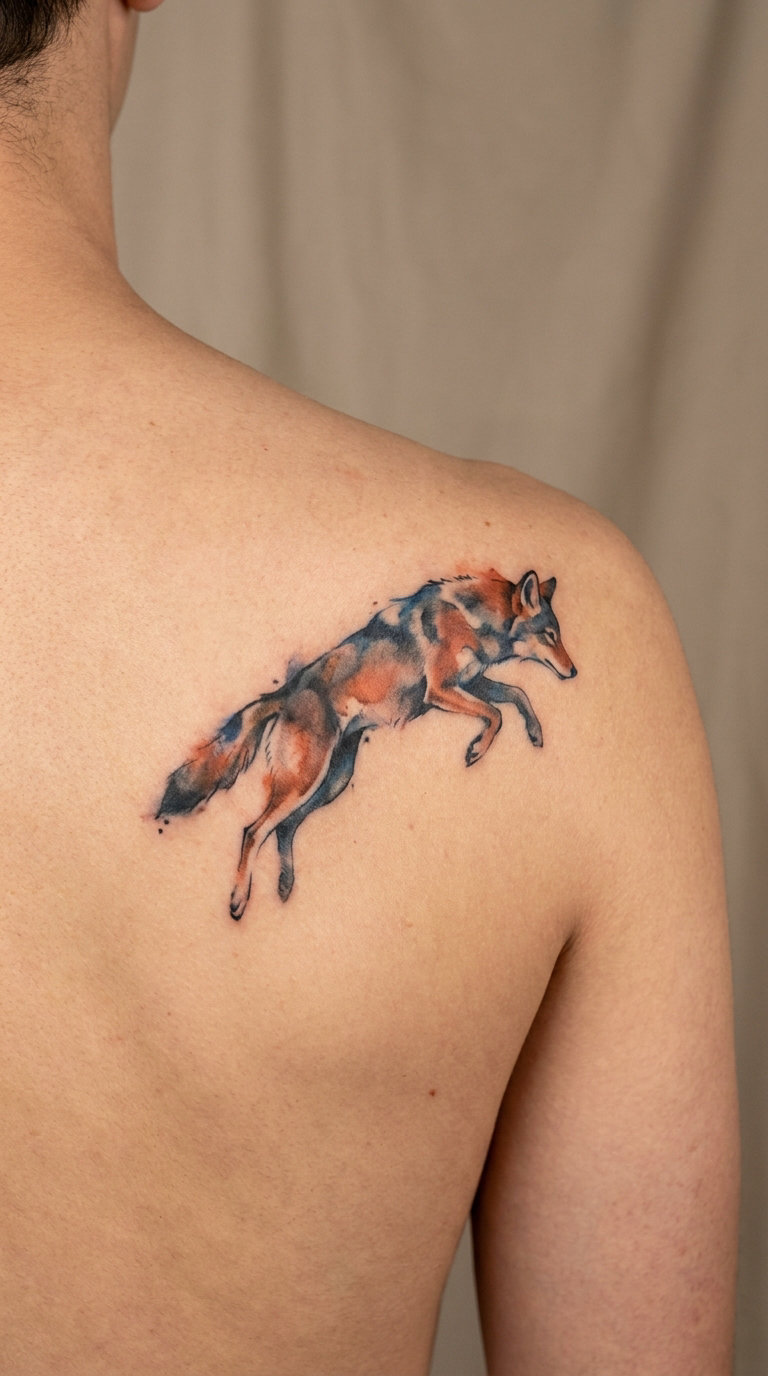
A watercolor coyote is drawn with loose washes bleeding into each other, so the animal has a soft edge instead of a hard one. Most artists keep the eyes, ear and paws in solid black and let rust and blue carry the rest. There is movement in the leap that a static profile never has.
Placement: Shoulder blade, where the curve gives the leap room to stretch.
Size: 4-5 inches (10-12.5 cm) long.
Style: Watercolor.
Pain: Medium. The shoulder is bony near the top and softer lower down. Pale washes can look tired if the pigment settles too deep, so a touch-up within the first year is common and worth budgeting for.
Make it yours: Choose your colours from somewhere real, a sunset you drove through, a jacket you own, and pass them to the artist as swatches.
9. Neo-Traditional Coyote Head with a Moon
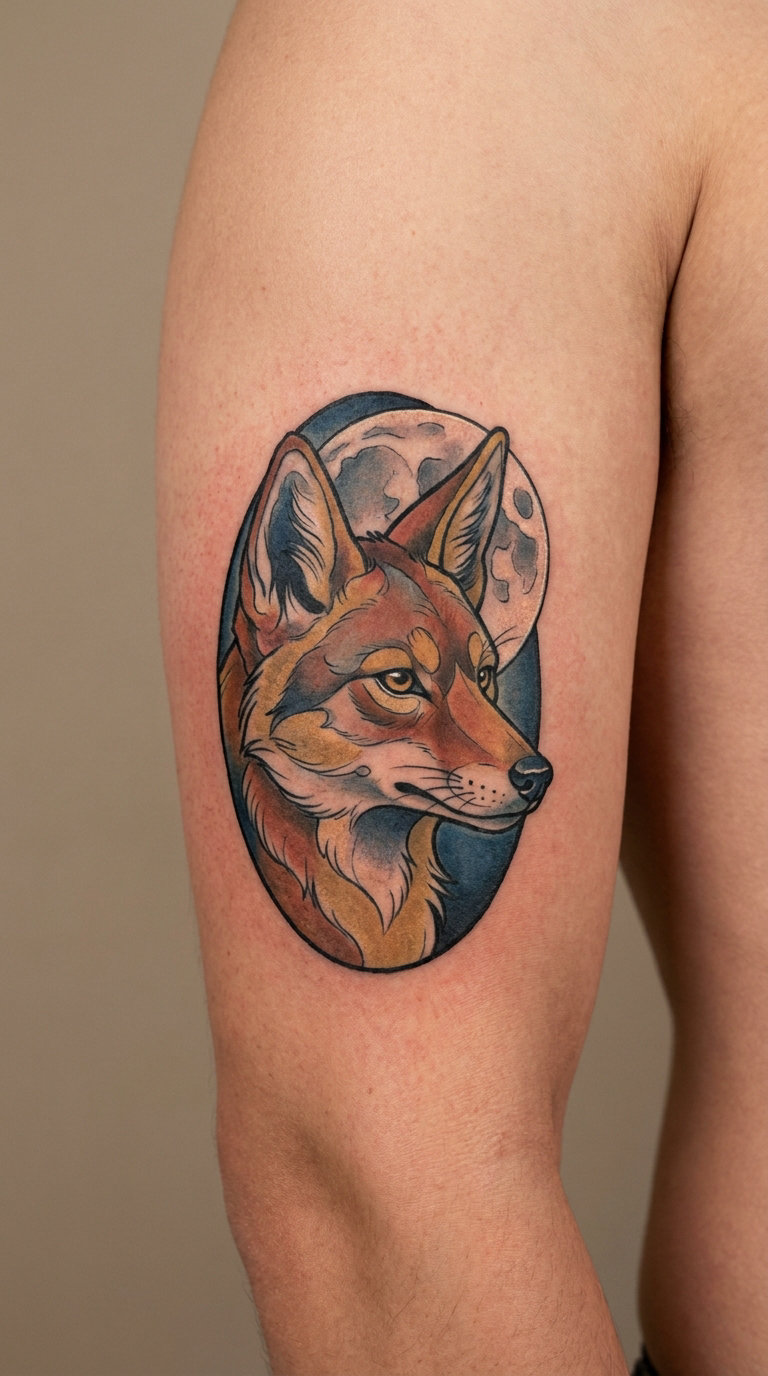
Neo-traditional is the ornate cousin of traditional: heavy black shading, a decorative moon behind the head, and small ornamental curls or dots filling the empty corners. People usually pick the head-on version when they want the animal to feel watchful, and the moon gives it a quiet night-time mood.
Placement: Outer upper arm or upper chest, both of which handle a round composition well.
Size: 3-4 inches (7.5-10 cm) tall.
Style: Neo-traditional.
Pain: Medium. Dense shading in the face means more passes over the same spot. Heavy black like this stays readable long after fine detail would have blurred.
Make it yours: Pick a moon phase that matches something you already have, and use it on the opposite forearm as a quiet pair.
10. Howling Coyote and Mountain Range
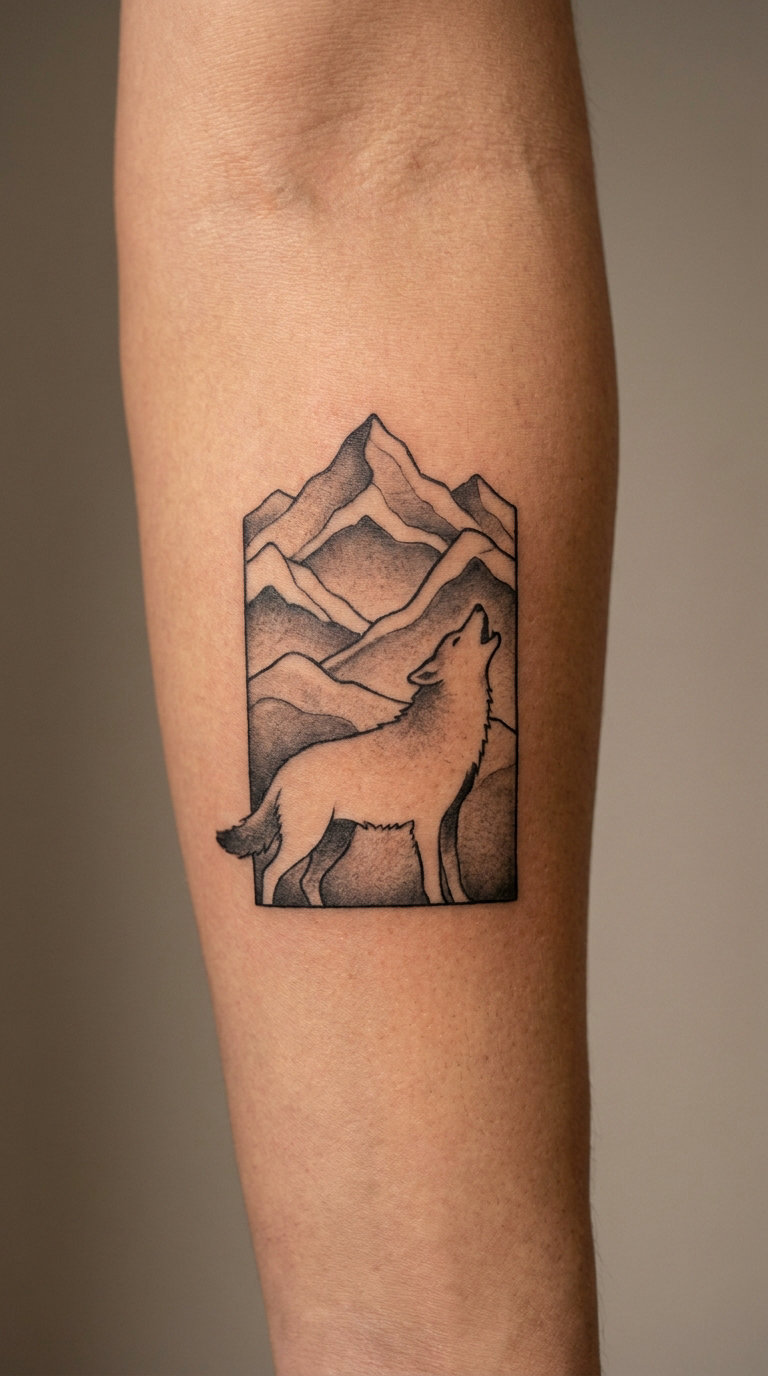
This is a composition rather than a portrait. A black coyote silhouette howls from a rocky ledge while three or four mountain ridges layer behind it in decreasing contrast, with a scatter of stars if you want them. The depth comes from the layering, and the horizon line is where the piece stops being generic.
Placement: Forearm, inner or outer, so the ridges can run around the arm.
Size: 5-7 inches (12.5-18 cm) wide.
Style: Illustrative, black and grey.
Pain: Medium to high, mostly because of the time. This is a two-session design in most cases, and asking for a mountain range in one sitting is how detail suffers.
Make it yours: Use a real skyline you grew up near or a range you have hiked, and say so at the consultation. It takes ten seconds and changes the whole drawing.
11. Micro Coyote Between Two Paw Tracks
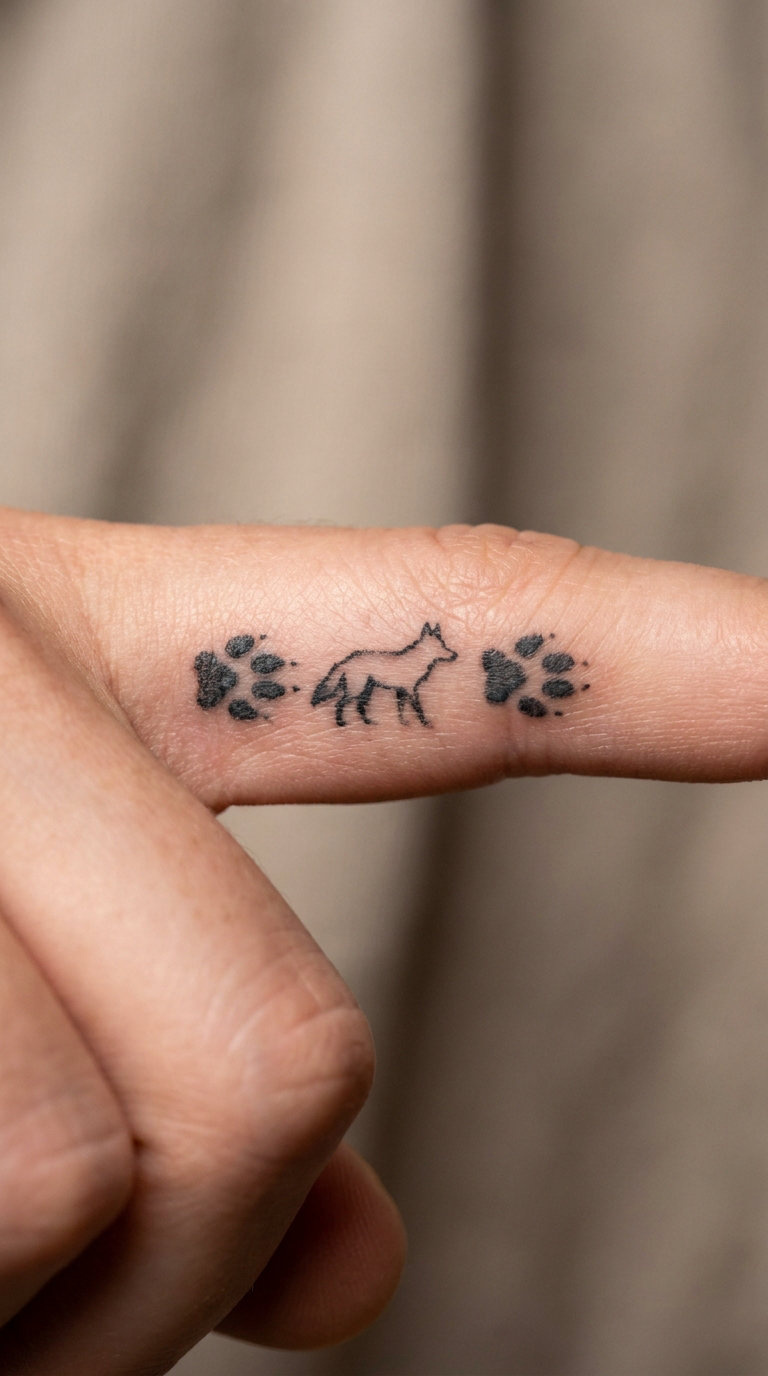
A micro piece puts a tiny coyote in the middle with two abstract track marks on either side of it. The tracks are a visual frame, not a fixed symbol, and plenty of people just like the shape of them. Ask for the thinnest line your artist is comfortable running at that size.
Placement: Side of a finger or the inner hand, which is where the piece reads as delicate rather than crowded.
Size: Under 1 inch (2.5 cm) wide.
Style: Micro fine line, solid black.
Pain: High. Fingers and hands sting constantly and you cannot stop the movement. Micro detail on fingers softens faster than anywhere else, so this is a piece to love while it is sharp.
Make it yours: Have the two tracks mirror each other perfectly, which keeps the whole thing looking deliberate even as the centre softens.
12. Blackwork Coyote in a Full Moon
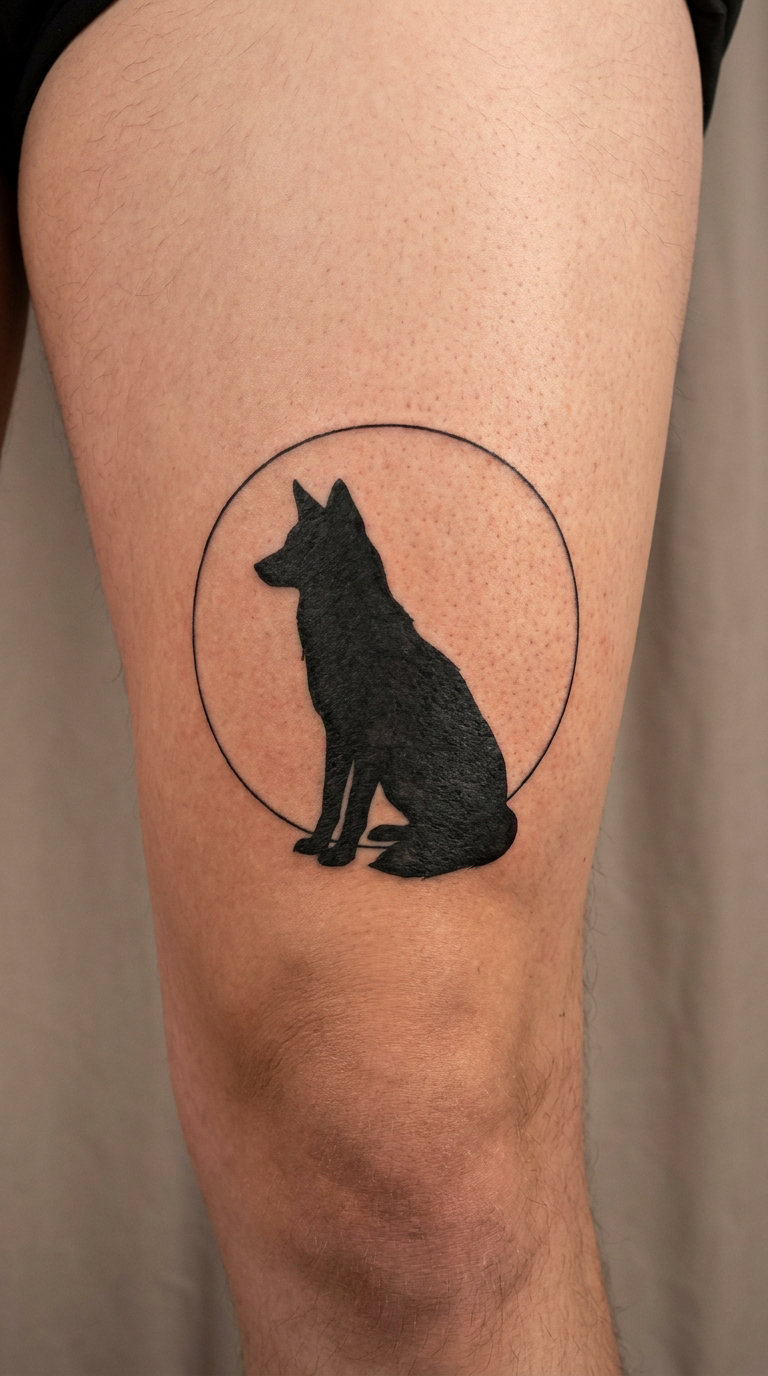
A seated silhouette inside a moon disc is one of the calmest designs here. The coyote is solid black with a clean outline, the moon is a simple grey circle, and the contrast between the two shapes does all the work. There is a lot of visual weight for very little line work, which is why it holds up so well.
Placement: Outer thigh or upper arm, anywhere the disc has an even curve to sit on.
Size: 3-5 inches (7.5-12.5 cm) tall.
Style: Blackwork silhouette.
Pain: Medium, on the softer side for thigh and upper arm. The solid black fills go down quickly and then rest there, which means longer stretches of solid sensation but fewer needle changes.
Make it yours: Choose the moon phase with the artist, a new moon and a full moon read very differently even at the same size.
13. Side-Profile Coyote on the Ribs
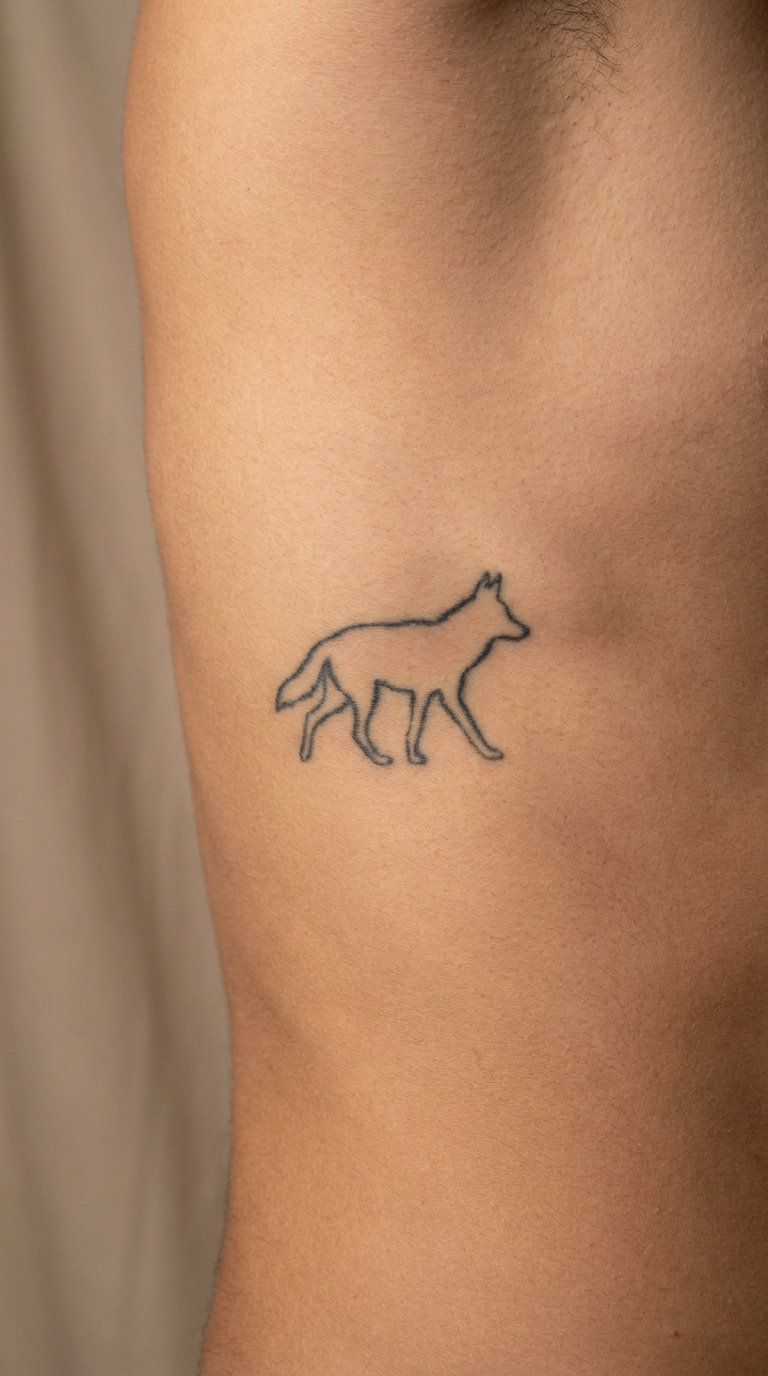
A rib placement runs a clean profile along the natural curve of the cage, usually angled so the coyote looks out along your side. Plenty of people choose this spot because it is private and sits close to something personal, and the meaning they attach to it is their own rather than any agreed one.
Placement: Outer ribs, following the line from hip toward armpit.
Size: 3-4 inches (7.5-10 cm) long.
Style: Fine line profile, minimal shading.
Pain: Medium to high. Ribs are bony and the skin stretches when you breathe and laugh. Fine lines here also stretch with the body, so ask for slightly heavier line weight than you would elsewhere.
Make it yours: Add a small birthdate in matching type at the leading end of the design, angled with the rib line rather than straight across it.
14. Old-West Coyote with Desert Sun
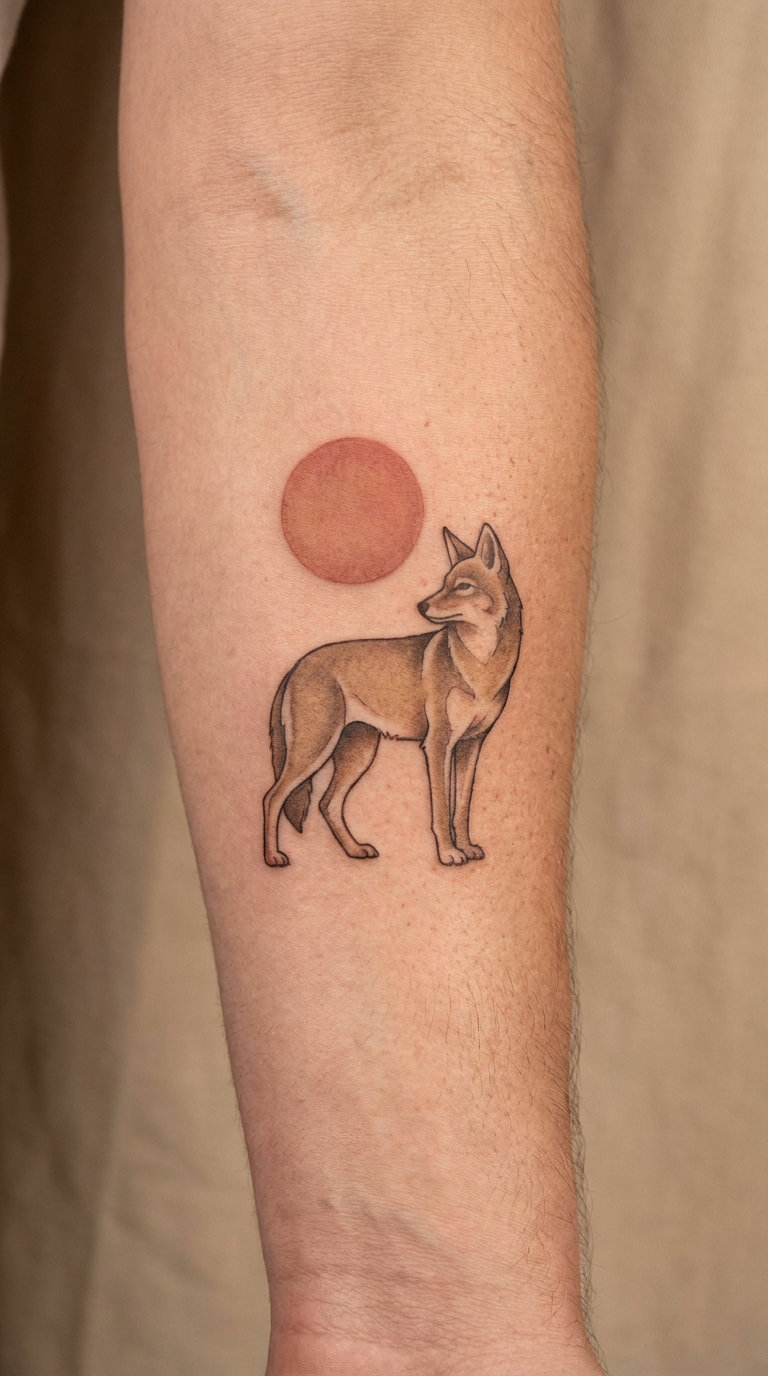
The old-west version wears its history in the linework: a coyote in profile, thick confident outlines, flat colour blocks in muted red and ochre, and a large sun disc behind everything. It is bold in a way that stays readable, which is why this style keeps coming back for arms.
Placement: Forearm or outer upper arm, oriented so the sun sits above the coyote’s head.
Size: 4-6 inches (10-15 cm) long.
Style: Old western, limited colour.
Pain: Medium. Two to three hours of solid fill on the arm is uncomfortable but manageable. Muted red is a light pigment and will fade toward the skin tone faster than black, so plan for colour touch-ups.
Make it yours: Swap the horizon line for a specific place, a stretch of road or a state line you have driven, and let the artist build the sun around it.
15. Dreamlike Coyote Under a Starry Sky
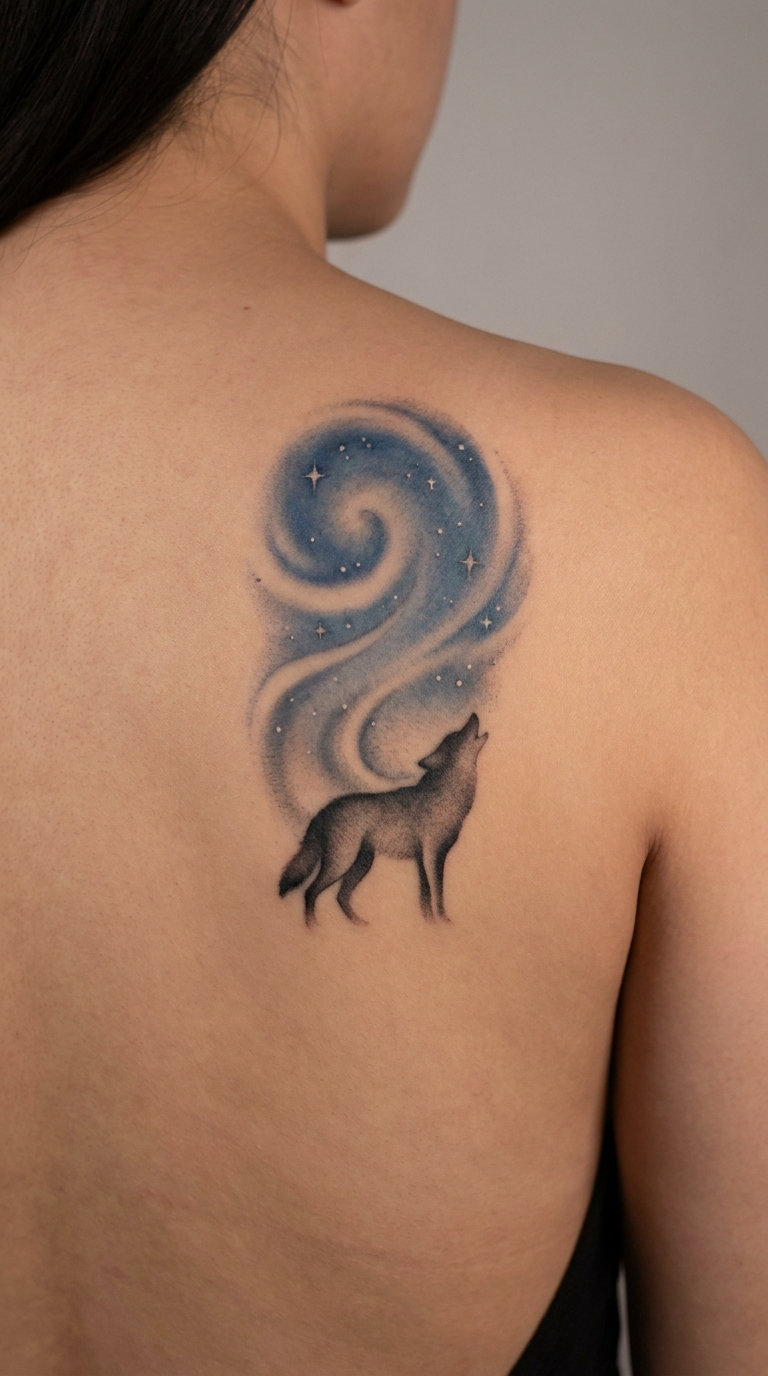
This one is quieter than most. A coyote walks through the lower third of the design while dots scatter above it into a loose constellation pattern and a soft gradient fades upward. It suits people who like a tattoo to tell a small story rather than announce something.
Placement: Upper back or outer thigh, both give the sky room to open up.
Size: 5-6 inches (12.5-15 cm) wide.
Style: Illustrative with soft black and grey.
Pain: Medium. The upper back is sensitive near the spine and easier toward the shoulders. Fine star dots over the shoulder blade will blur within a couple of years, so ask the artist to keep them slightly larger.
Make it yours: Add one real constellation, positioned where it actually sits in the sky on the date that matters to you.
16. Neo-Traditional Coyote with Desert Flowers
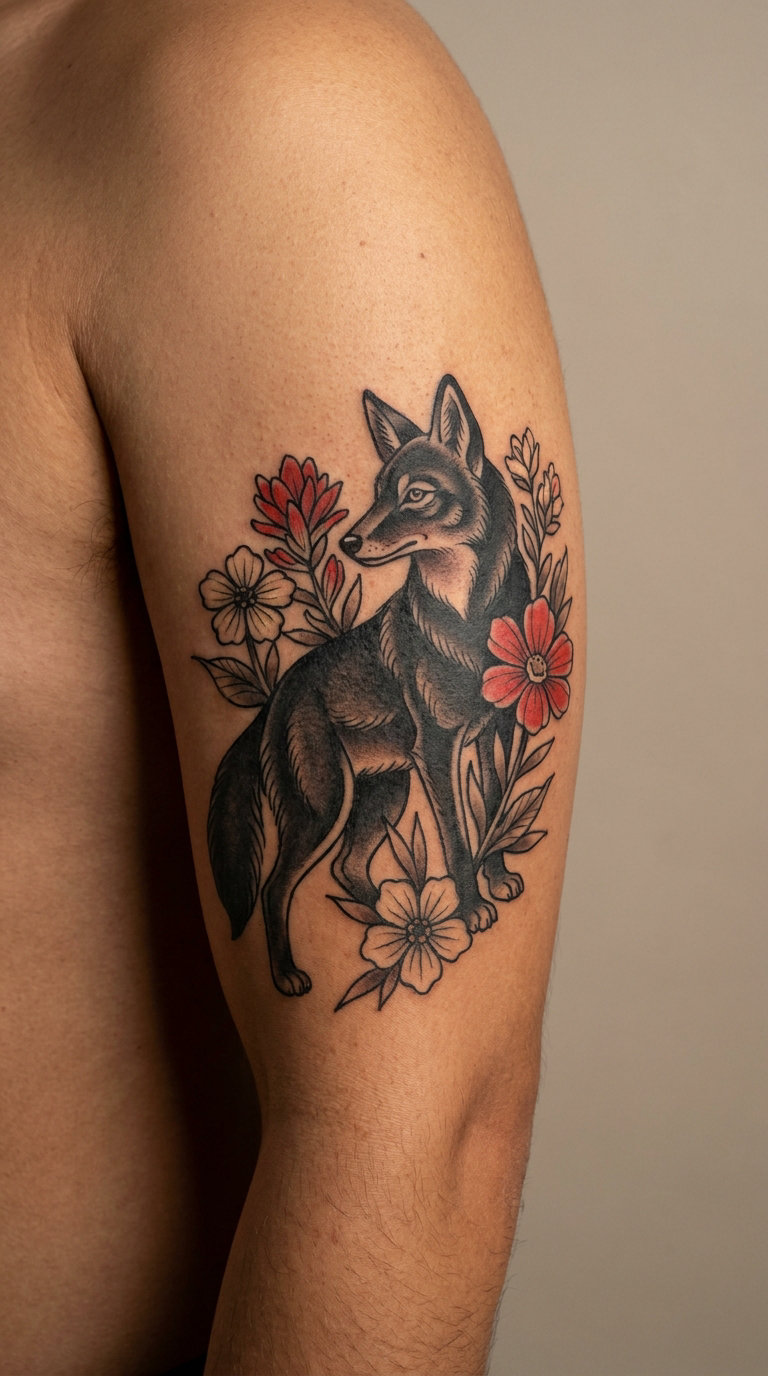
Florals soften an animal design fast. Here a shaded coyote portrait sits inside a ring of stylised desert blooms, mostly red and cream, which balances the weight of the black shading without competing with it. It reads as a completed piece rather than an animal waiting for background.
Placement: Outer upper arm or outer thigh, where the flower ring has space to close properly.
Size: 3-5 inches (7.5-12.5 cm) tall.
Style: Neo-traditional with colour florals.
Pain: Medium. Colour work means more passes and more stops, especially on the flower petals. Petal edges held at a medium thickness keep their shape far longer than hairline floral work.
Make it yours: Use flowers that actually grow where you live, which turns a generic ring into something that could only be yours.
17. Running Coyote in Dotwork on the Calf
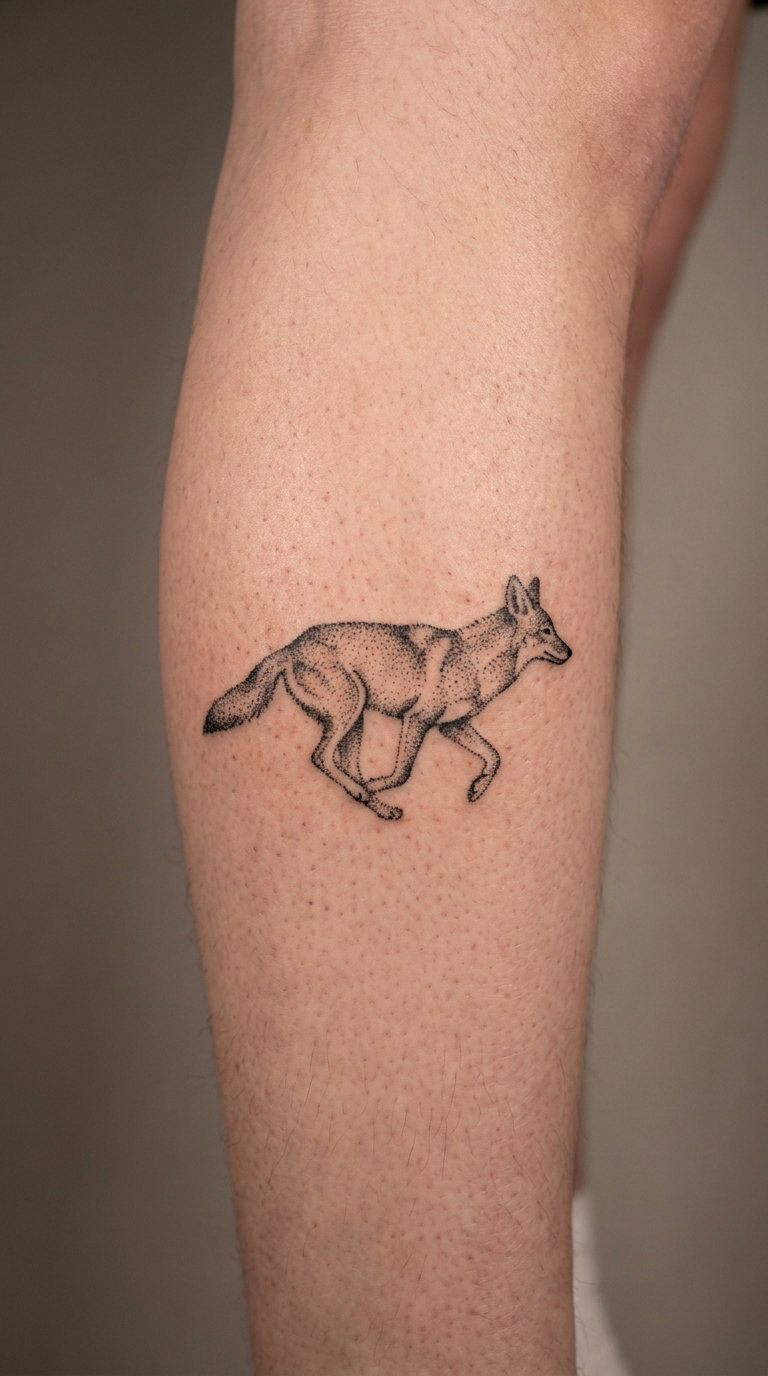
Dotwork builds form entirely out of placed dots, with density doing the shading work. A running coyote in this style gets its sense of speed from the gap between the dots rather than from motion lines, and it looks completely different under a tight shirt than in daylight.
Placement: Outer calf, which handles a tall narrow shape well and usually has clean skin around it.
Size: 4-5 inches (10-12.5 cm) long.
Style: Dotwork, black only.
Pain: Medium. Dotwork is slow, so the session is long but not deep. Individual dots spread and soften over time, so ask for slightly heavier spacing at the start than the reference photo seems to need.
Make it yours: Vary the dot density so the background thins toward the top of the piece, which makes the animal appear to be running out of the frame.
18. Red-Ink Coyote Eye on the Upper Arm
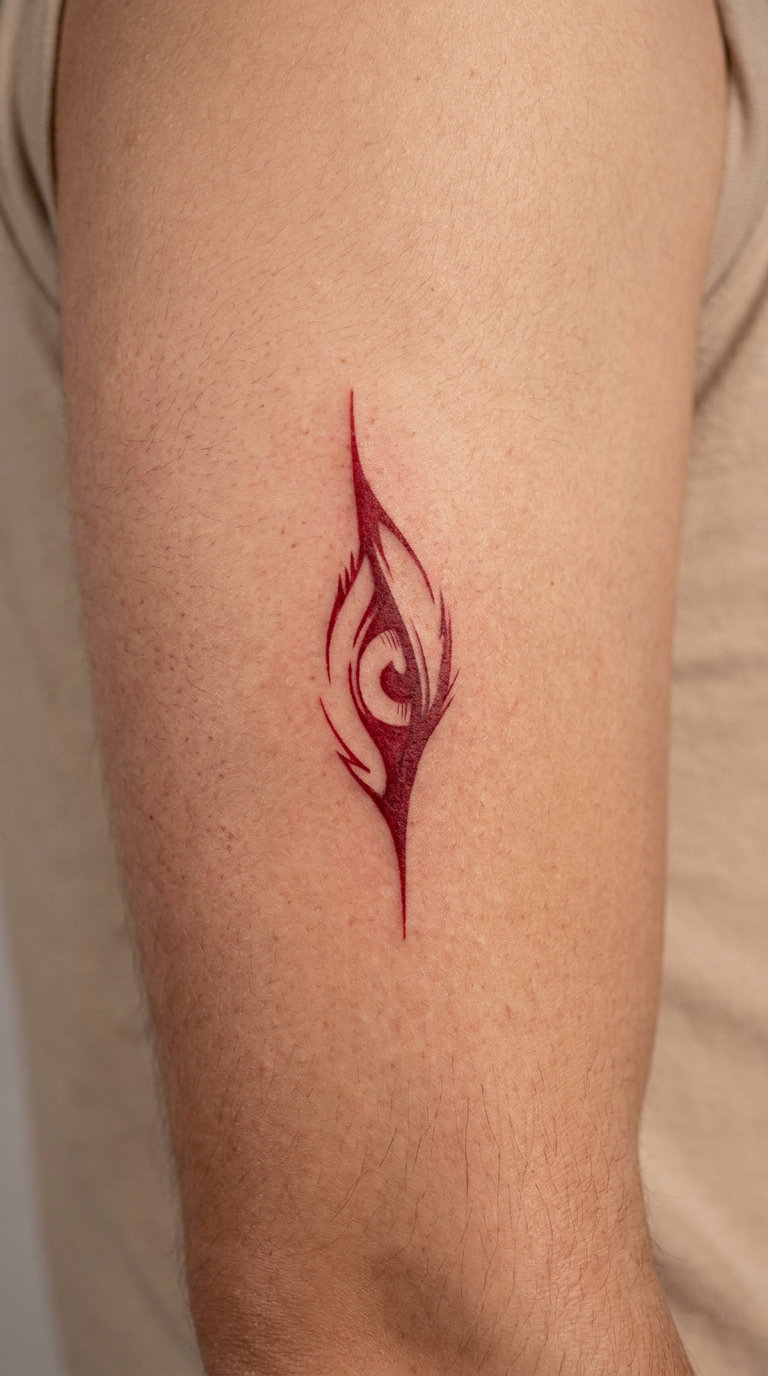
This is an anatomically inspired eye shape rendered entirely in red, with no black line around it at all. Because there is no pupil outline, it reads as an eye and something else at once, and the single colour makes it the loudest small design on this list.
Placement: Outer upper arm or inner bicep, where a narrow almond shape sits flat.
Size: 2-3 inches (5-7.5 cm) long.
Style: Illustrative, single-colour red.
Pain: Medium. Deep red needs more passes than black to reach the same depth, so the session runs a bit longer than the size suggests. Red fades faster than black, noticeably within three years, so budget for a refresh.
Make it yours: Choose the red with your artist using ink swatches on skin, and stay away from anything sun-sensitive while it settles.
19. Howling Coyote as a Matching Collar-Bone Tattoo
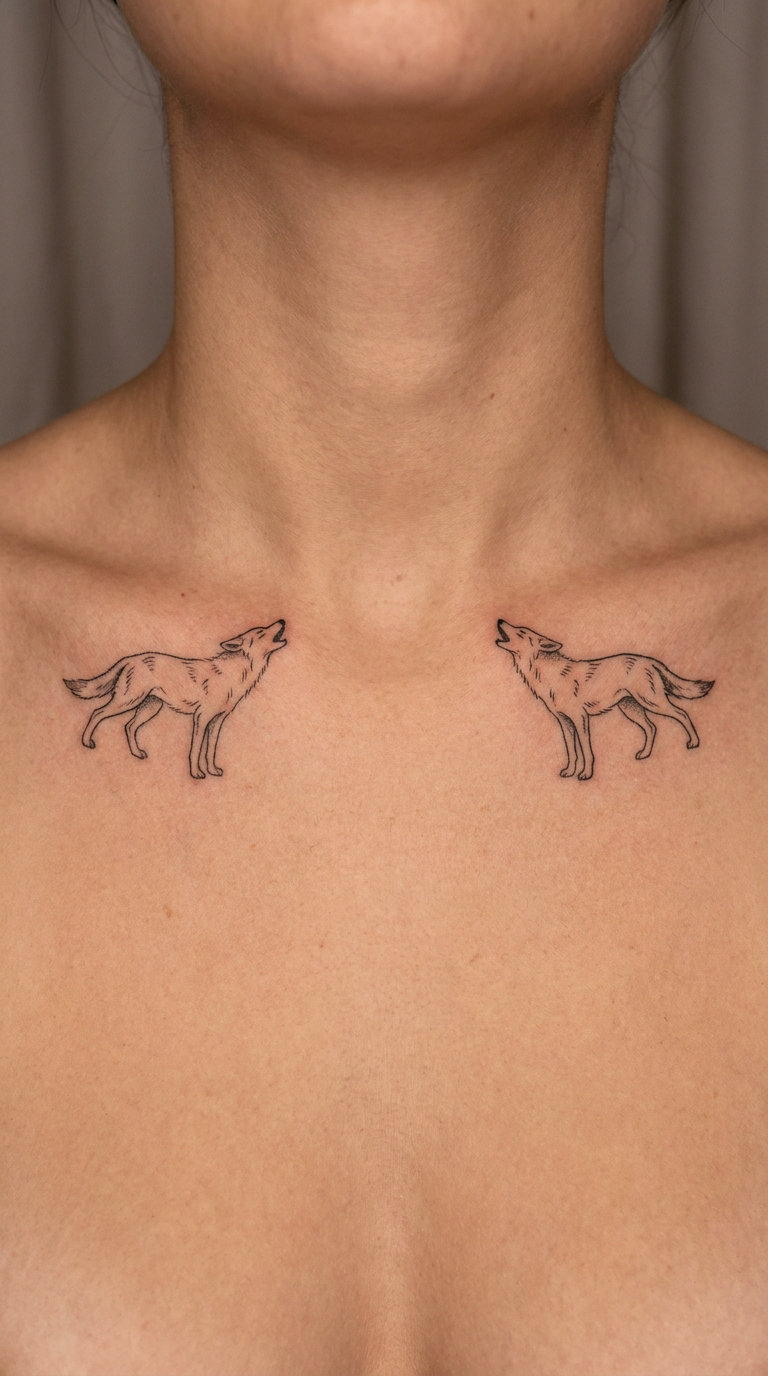
Two mirrored howling coyotes sitting along the collar bones make a matched pair, and it is one of the easiest ways to share a design without copying the same tattoo twice. Each coyote faces inward toward the neck, which pulls the eye to the centre of the chest.
Placement: Above both collar bones, mirrored, a small gap between them.
Size: About 2 inches (5 cm) each.
Style: Fine line, matched pair.
Pain: Low to medium. The collar bone is a bony ridge, so it stings, but it is a short sit and it heals quickly. Both halves fade together if you care for them the same way, and drift apart if one side gets more sun than the other.
Make it yours: Have both coyotes howl at one shared moon motif added later, or match the pair with a single small symbol on the wrist.
20. Traditional Coyote with Chrysanthemum Flowers
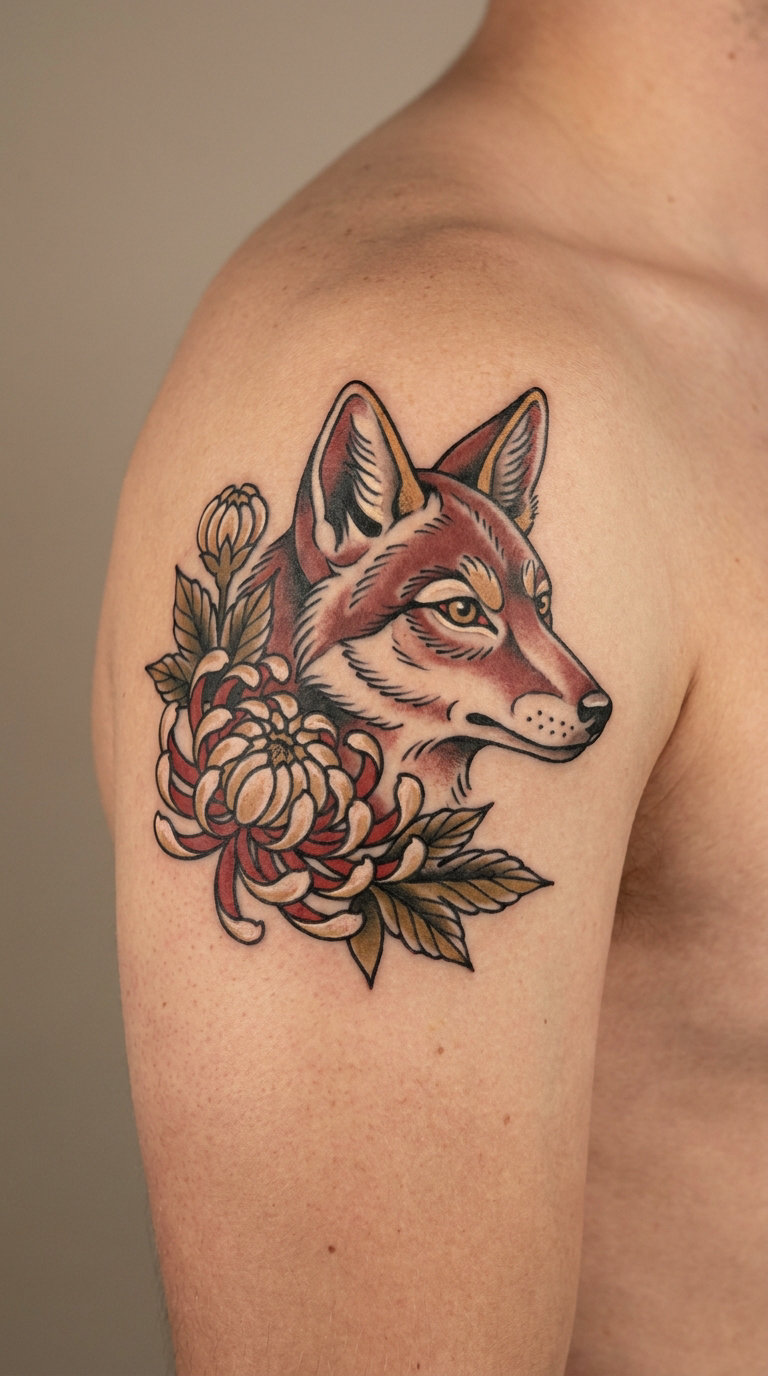
Chrysanthemums bring a dense, layered petal texture that no desert plant can match, and they hold their own next to a traditional coyote portrait without tipping the design into decoration. Cream petals against red centres keep the colour balance heavy on one side and light on the other.
Placement: Shoulder or outer thigh, where the bouquet can spill toward the back without being cut off.
Size: 4-5 inches (10-12.5 cm) tall.
Style: Traditional with colour florals.
Pain: Medium, over a longer session because each petal layer is its own pass. Petal line work is thin by nature, so ask the artist to keep the outer petal edges at a workable weight from the start.
Make it yours: Ask for the chrysanthemums in a colour you already wear, then let the coyote stay black and grey so the eye goes to the flowers.
21. Blackwork Coyote Emerging from a Circle
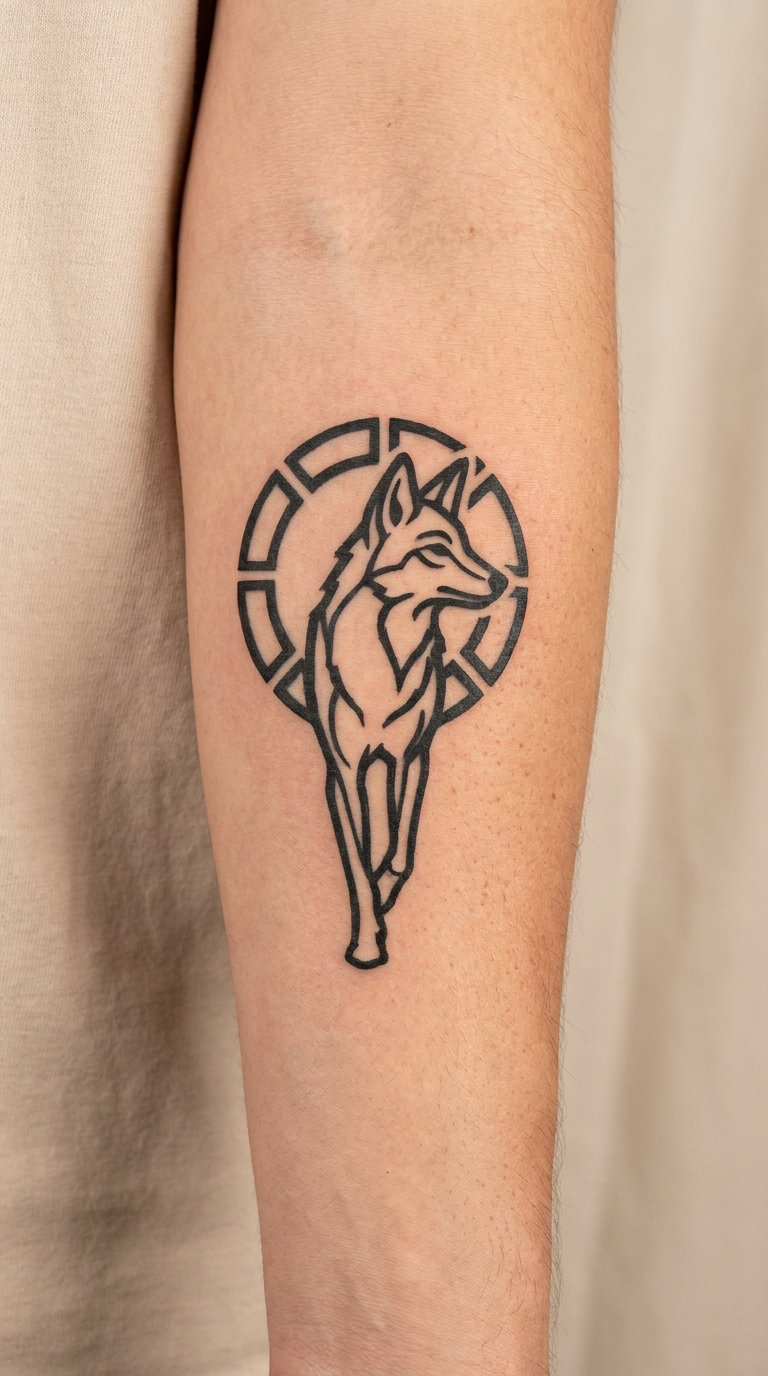
A coyote breaking through a geometric circle uses negative space as the main idea. The circle is drawn as a clean black line, the coyote pushes out through one section of it, and the untouched skin around both shapes keeps the design from feeling crowded. It is a modern composition that scales down surprisingly well.
Placement: Inner forearm or outer calf, flat areas where the circle can sit true.
Size: 3-4 inches (7.5-10 cm) tall.
Style: Blackwork and geometric.
Pain: Medium. The forearm is comfortable, though the calf is less so. The hard outline of the circle stays crisp for years, which makes this one of the longer-lasting designs here.
Make it yours: Change the shape of the circle itself, a hexagon, a half-moon arc or a ring made of your own repeating mark.
22. Realistic Coyote-and-Cactus Sleeve Element
This is a component piece rather than a standalone design. A realistic coyote stands beside tall cactus forms and desert ground, drawn to sit inside the middle of a nature sleeve with sky above and ground below. It can absolutely stand alone, but it was designed to have neighbours.
Placement: Upper arm, positioned where the sleeve’s horizon line will run.
Size: About 5 inches (12.5 cm) long.
Style: Realistic, black and grey.
Pain: Medium to high. Realistic shading means a long, occasionally gruelling session, and you should expect this element alone to need more than one sitting. Fine texture in the fur will soften first, so it is worth planning a touch-up before the whole sleeve is finished.
Make it yours: Match the vegetation to the rest of the sleeve before it is inked, so the cacti share the same shading weight as everything around them.
How to Choose the Right Design
Matching 22 coyote tattoo ideas to the space you have
Start with the space, not the picture. Every one of these 22 coyote tattoo ideas scales up and down, but the smaller ones lose detail rather than meaning. Measure the area you want before you fall in love with a design, then pick something that fits with room around it.
- How much room do you actually have? Under 2 inches, go for a silhouette or a single contour. Above 4 inches, you can afford shading, background and colour. If you are unsure, a 3 inch piece on the forearm or calf gives you almost any option on this list.
- What style matches the detail you want to keep? Blackwork and traditional hold their shape best over time. Fine line and micro work need more frequent refreshing, especially on hands, fingers and ribs where skin stretches.
- Where does it sit in your day? Wrist, ankle and collar bone pieces are easy to cover and easy to forget. Anything on the forearm or calf is visible constantly, so pick a design you would be happy to explain to a stranger.
- What is already on your body? If you have existing line work in the same area, tell the artist at the consultation. A design that matches the weight of neighbouring pieces will look deliberate, one that does not will look pasted on.
- Single colour or full colour? Colour gives you more to look at and costs more time and money. It also fades sooner, which is a fair trade if you like changing work up over the years.
- What should you bring to the consultation? Two or three saved references, not a folder of forty. Say what you liked about each one, the pose, the line weight, the shading. An artist can build from a clear description of your taste far better than from a stack of mixed styles.
Cost and Session Time
Most artists price by the hour, and in the US you will see roughly these bands for a coyote piece in 2026. Treat them as a starting conversation rather than a quote, because your artist will have their own rate and their own shop minimum.
- Tiny pieces, 1 inch or under: often a flat minimum, commonly 80-150 dollars.
- Small pieces, 1-3 inches: roughly 150-300 dollars, usually one short session.
- Medium pieces, 3-5 inches: roughly 300-700 dollars, one session up to three hours.
- Detailed pieces with colour or background, 5-7 inches: roughly 700-1500 dollars, usually two sessions.
- Sleeve elements like idea 22: priced as part of the whole sleeve, and a full nature sleeve commonly runs well into the thousands.
Four things move the total more than size does: hourly rate, shop minimum, city, and how much colour is in it. A piece with real shading in two colours can take three times as long as the same silhouette in solid black.
If you are still weighing symbolism against the animal itself, our guides to tattoo ideas that symbolize freedom and tattoo ideas that symbolize protection cover the meanings side in more depth.
Aftercare Basics
- Follow your artist’s aftercare instructions first. They know exactly what they did to your skin, and their advice outranks anything general you read online, including this list.
- Wash the area with clean water and unscented soap as directed, then pat it dry with something soft. Paper towels leave fibres in the skin while it is still tender.
- Use only the cream or ointment your artist recommends, in thin layers. Too much product traps heat and slows things down.
- Keep the tattoo out of strong sun while it settles, and once it is healed use sunscreen on exposed placements. Sun is the fastest way to fade both black and coloured work.
- Wear loose clothing over a fresh piece, and change anything that gets damp or stuck to the skin. Do not soak it in pools, hot tubs or long baths until it has healed.
Frequently Asked Questions
What does a coyote tattoo usually mean?
A coyote tattoo usually stands for adaptability, survival and sharp instinct. The coyote thrives in harsh terrain near people, so the animal reads as quiet resilience rather than aggression. In several Indigenous traditions of North America it is a trickster and teacher figure linked with craft and moral instruction. Many people choose it to mark a hard season they got through. There is no single agreed meaning, so your own reason is the one that counts.
Can I get a coyote tattoo in a very small size?
Yes, and a small coyote is one of the easier first tattoos. At one to two inches the design has to be a silhouette or a single contour with no interior detail, because shading that small blurs within a few years. Bring a healed photo of the size you want and let the artist adjust the drawing so the outline stays readable. Behind the ear, above the ankle and the inner wrist all suit small work well.
What style of coyote tattoo is best for a first tattoo?
For a first tattoo, a simple outline or a small silhouette is usually the easiest choice. You get a finished piece in one short sitting, the design is easy to change later if you want to grow into a larger one, and there is less detail to disappoint you. A fine-line walking coyote or a tiny howling profile are both good starting points. Save heavy blackwork and realistic shading until you already have a healed tattoo under your belt.
Is a coyote tattoo painful?
Most people rate a coyote tattoo as mild to medium, depending on where it goes. Wrists, ankles and the inner bicep are sharper because the skin is thin, while the upper arm, thigh and calf feel deeper and easier to sit through. Fingers, ribs and the spine are the exceptions and genuinely hurt. Longer sessions build discomfort gradually, so take a break before you need one rather than pushing into it.
How should I prepare a coyote design for my artist?
Bring two or three references you actually like and tell the artist what each one contributes, whether it is the pose, the line weight or the shading. Say clearly how small or how large you need it and which way you want it facing. Skip celebrity images and anything you cannot explain. Healed photos from that artist’s portfolio will tell you more than a fresh-ink picture ever could, and your consultation is the right place to ask for one.
Conclusion: Where to Start
If you have never been tattooed, the fine-line howling coyote behind the ear is the most straightforward of these 22 coyote tattoo ideas. It is small, it takes one short sitting, and it is the easiest design on the list to change your mind about later.
If you already collect animal pieces, the realistic profile or a blackwork composition gives you something with real depth to work with. Pick your reference, pick your placement, decide what you are willing to spend, then book the consultation. If you like scenery rather than portraits, our mountain and ocean tattoo ideas guide covers the scenery direction well.