
22 Moth Tattoo Ideas for the Chest: Best October 2026
These 22 moth tattoo ideas for the chest cover the range most people actually search for, from a three-inch fine-line moth between the collarbones to a nine-inch realistic polyphemus spanning both pectorals. Each design below comes with a real chest placement, a realistic size in inches, a style name your artist will recognise, and an honest pain note.
A moth on the chest is one of those rare designs where the anatomy cooperates. Moths have wide, near-symmetric wings, and the chest has a natural mirror line running down the sternum, so a moth drawn centered here reads as balanced rather than pasted on. If you are planning ahead for a piece, book your consult four to six weeks out and settle the species before you go.
If you want the short version of the meaning first: a moth tattoo usually stands for transformation, drawn to light in the dark, resilience, and getting through a hard season. The [moth tattoo meaning and the species behind them](https://thewe.cc/moth-tattoo-meaning-explained/) is worth a read before you commit to a design.
22 Moth Tattoo Ideas for the Chest: Quick Guide
Every design on this list is drawn around the sternum unless the placement says otherwise. Sizes are the finished width across the wings, not the height.
| # | Idea | Style | Best chest placement | Size | Pain |
|---|---|---|---|---|---|
| 1 | Fine-Line Death’s-Head Hawkmoth | Fine line | Upper chest, between collarbones | 4-6 in | Medium |
| 2 | Monarch Moth with Amber Wings | Semi-realistic colour | Center chest, above sternum | 5-7 in | Medium |
| 3 | Blackwork Luna Moth Pair | Blackwork | Upper center chest | 6-8 in | Medium-high |
| 4 | Atlas Moth in Botanical Blackwork | Blackwork with linework | Full upper chest | 7-9 in | High |
| 5 | Minimalist Moth Outline | Single-line minimal | Sternum notch, high placement | 2-4 in | Medium-high |
| 6 | Watercolor Pink and Purple Moth | Watercolour | Upper chest, off-center left | 5-7 in | Medium |
| 7 | Moth and Moon Chest Piece | Fine line | Upper chest, centered | 4-6 in | Medium |
| 8 | White Ink Moth on Dark Skin | White ink highlights | Upper chest, centered | 4-6 in | Medium |
| 9 | Dotwork Emperor Moth | Dotwork | Center chest across sternum | 5-7 in | High |
| 10 | Traditional Hornet-Moth Hybrid | American traditional | Upper chest, centered | 6-8 in | Medium-high |
| 11 | Gothic Death’s-Head Moth | Blackwork and grey wash | Center chest | 7-9 in | High |
| 12 | Micro-Realism Luna Moth | Micro-realism | Below one collarbone | 2-4 in | Medium |
| 13 | Moth with Floral Wings | Illustrative fine line | Upper chest, centered | 5-7 in | Medium |
| 14 | Celestial Atlas Moth | Realism with line accents | Full upper chest | 6-8 in | High |
| 15 | Symmetry-Interrupted Moth | Fine line with colour accent | Upper chest, centered | 5-7 in | Medium |
| 16 | Moth with Map-Pin Wings | Fine line illustrative | Center chest, slightly high | 5-7 in | Medium |
| 17 | Fossil-Embossed Moth | Textured grey and charcoal | Center chest | 6-8 in | High |
| 18 | Moth Silhouette with Fine-Line Halo | Blackwork plus fine line | Between the collarbones | 4-6 in | Medium |
| 19 | Large Realistic Polyphemus Moth | Realism, full colour | Spanning upper chest | 8-10 in | High |
| 20 | Blackwork Moth with Empty Body | Graphic blackwork | Upper chest, centered | 7-9 in | High |
| 21 | Moth and Rose Colour Tattoo | Colour illustrative | Center chest | 6-8 in | Medium-high |
| 22 | Abstract Two-Wing Moth | Abstract linework | Center chest | 5-7 in | Medium |
A note on the meaning before you pick. Moth symbolism splits into a few short buckets, and almost every design on this list draws from one of them:
- Transformation: a moth spends weeks as a caterpillar and then rebuilds itself entirely, which is why it turns up in tattoos about change you survived rather than change you wished for.
- Light in the dark: moths steer by light and end up drawn to things that burn, so the moth reads as attraction to something dangerous.
- Resilience: quiet endurance rather than loud courage. People pick it after a long illness, a rough year, or a hard job.
- Mystery: nocturnal, rarely seen properly, drawn to what hides in the dark.
- Moth versus butterfly: butterflies get the transformation story because they are colourful and obvious. Moths get the version that says you came through something unremarkable and came out the other side anyway.
1. Fine-Line Death’s-Head Hawkmoth
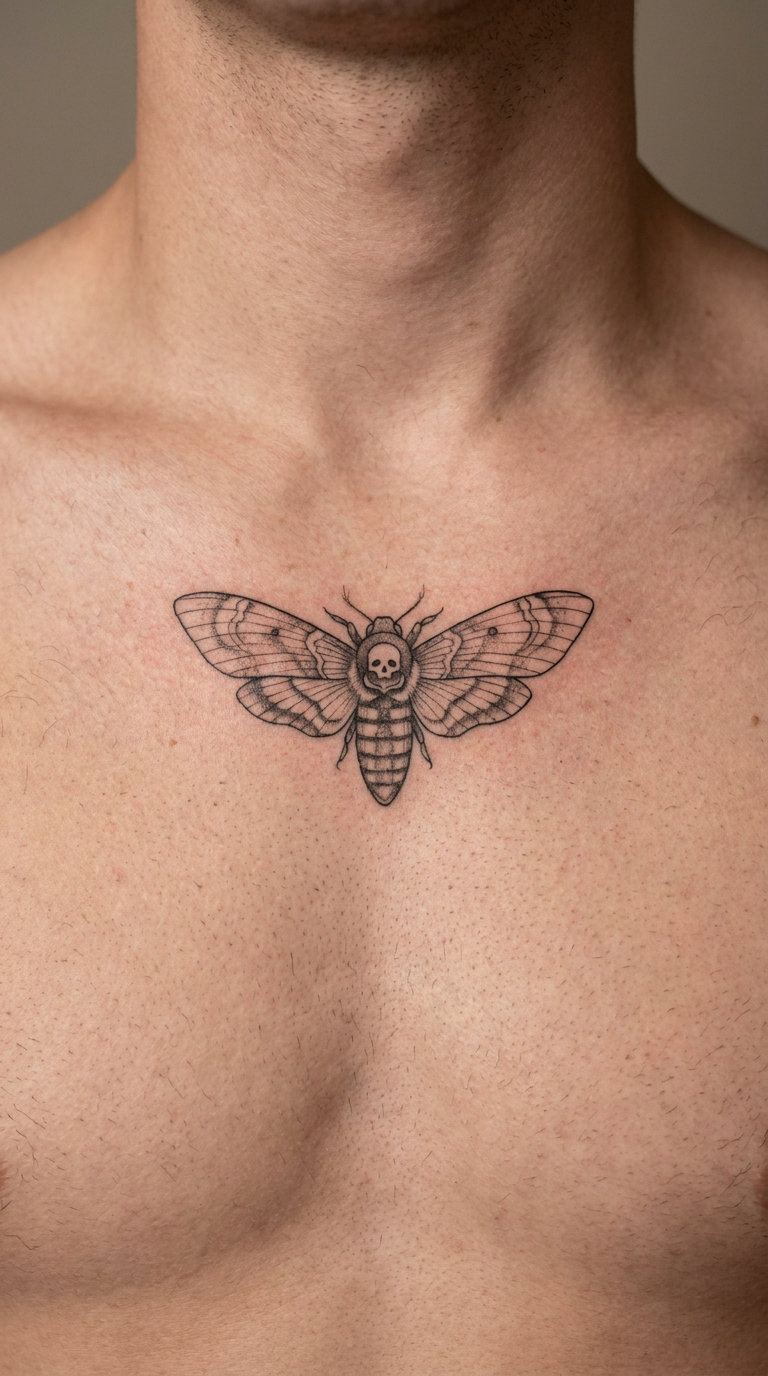
A fine-line death’s-head hawkmoth is the most-requested chest moth on this list, drawn with hairline black linework, feathered antennae and the pale skull marking on the thorax rendered as light shading rather than a solid shape. Wing veins get one thin line each, nothing more, so the whole thing stays legible at arm’s length.
The skull on the thorax is where the meaning usually comes from. People who choose this one tend to be honest about mortality rather than fascinated by death itself, and they like that the moth still looks soft while carrying that mark.
Placement: upper chest, centered between the collarbones with the body running straight down the sternum. Size: 4-6 inches (10-15 cm) across the wings. Style: fine line. Pain: medium, edging up to medium-high right at the collarbone. Fine line fades faster than shading, so expect a refresh every few years if you want it crisp.
Make it yours: put the year something ended in tiny numerals under the thorax, or replace the skull marking with a small heart outline the same size.
2. Monarch Moth with Amber Wings
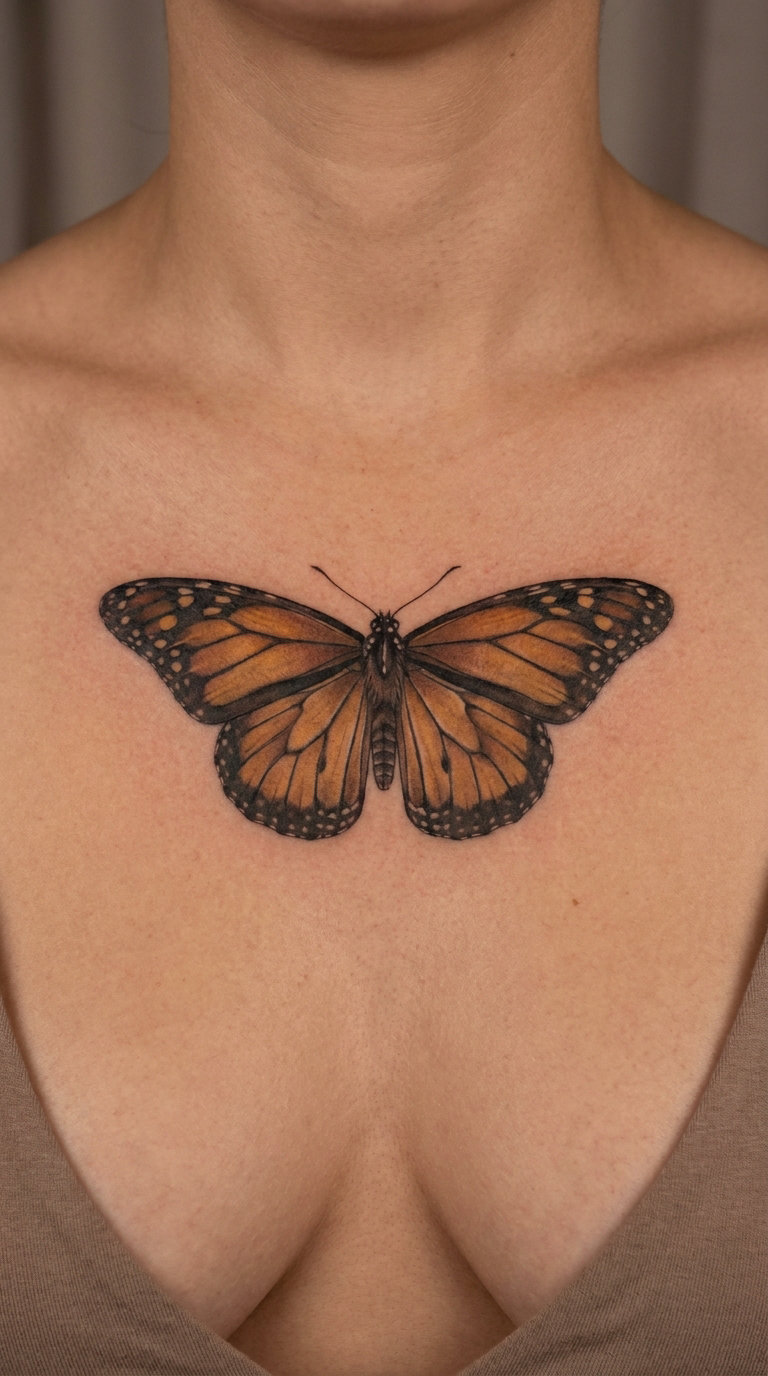
Warm, semi-realistic monarch-style moths are drawn with amber, rust and soft brown washes layered between thin black vein lines, so the wings keep their pattern without turning into flat blocks of colour. The body is left slightly fuzzy and unfinished at the edges rather than drawn sharp.
This is the warmest option here, and it suits people who want a chest piece that reads as gentle rather than dark. Monarchs also carry the migration story, which some people use for a move, a relationship or a stage of life they finished.
Placement: center chest, sitting slightly high so the lower edge clears the sternum dip. Size: 5-7 inches (13-18 cm). Style: semi-realistic colour. Pain: medium across the pec, more once the artist reaches the collarbone. Colour shading needs more passes, so budget extra time.
Make it yours: run one wing in a single deeper amber and the other in pale gold, so the symmetry breaks in a way only you would read.
3. Blackwork Luna Moth Pair
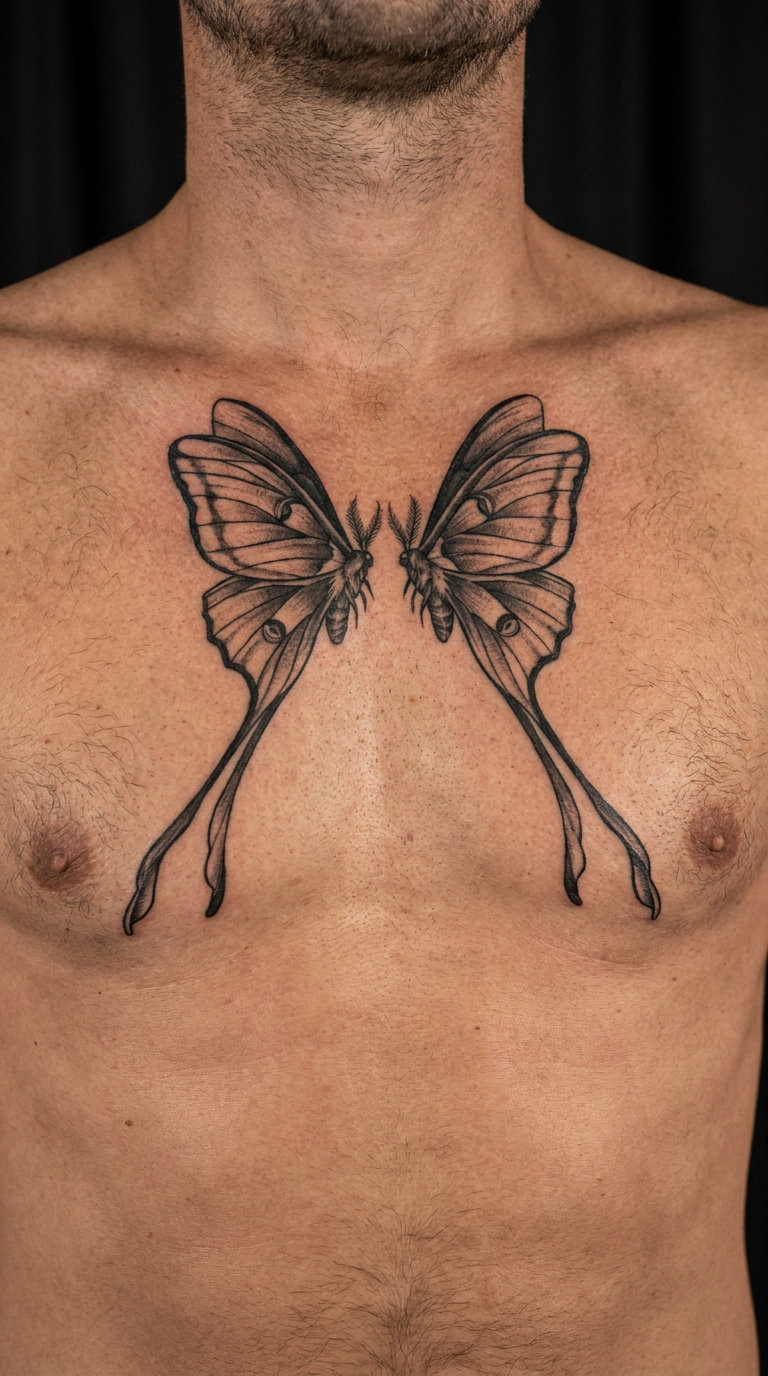
Two luna moths in dense blackwork, wings angled slightly upward and slightly apart, tail streamers running down toward the ribs. The wing scales get left as solid black with thin white lines carved through for the veins, which is the trick that makes blackwork read as detailed without a needle chasing every hair.
Luna moths are pale green in life, which is why they get drawn in black and grey. Two of them facing each other reads as companionship without being literal, and the long tails work nicely on a vertical chest line.
Placement: upper center chest, wings above the nipples and tails trailing down. Size: 6-8 inches (15-20 cm) total across both moths. Style: blackwork. Pain: medium-high. Solid black is a hard pass over bone, and the sternum is bone. Ageing note: the carved white veins are the first thing to soften, so keep the design bolder than looks comfortable in the chair.
Make it yours: angle the two moths toward each other so their tails nearly meet, leaving a small gap that can later hold a date.
4. Atlas Moth in Botanical Blackwork
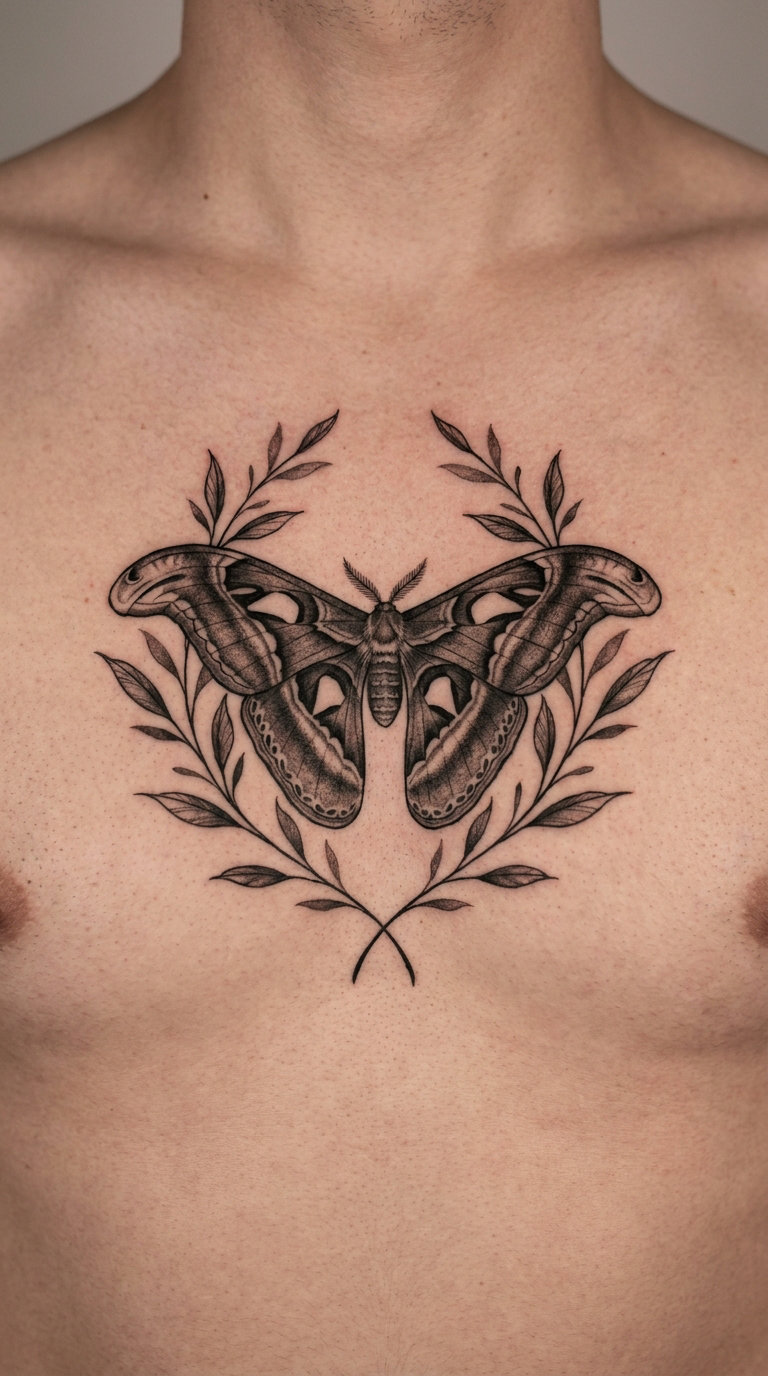
An atlas moth in botanical blackwork gives you the wing shape first: those broad triangular forewings with the hooked tips, filled with flat black and a few translucent windows of bare skin where the real moth’s pattern is see-through. Thin stems and leaves rise behind it without crowding the edges.
The species matters to collectors. Atlas moths are among the largest in the world, and someone who picks this one usually wants the specific animal, not a generic moth. Bring a real photograph to the consult.
Placement: full upper chest, wide enough that the wingtips reach toward each shoulder. Size: 7-9 inches (18-23 cm). Style: blackwork with fine line. Pain: high. This is a large solid-black piece across bone, and people regularly break it into two sessions. The more you sit, the worse the last hour feels.
Make it yours: let one botanical stem break out of the composition and run down toward your waist, so the piece has a tail of its own.
5. Minimalist Moth Outline
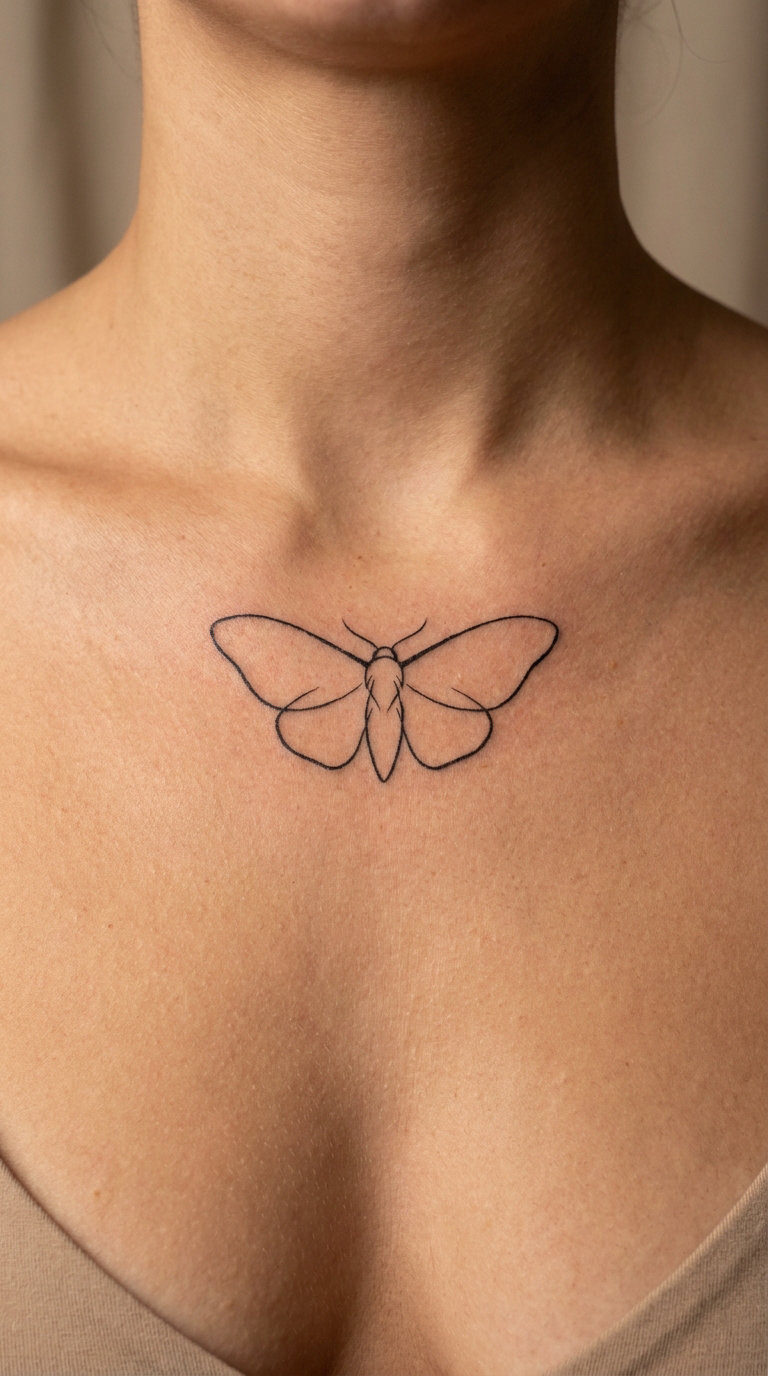
The minimalist moth is one continuous line: two antennae curves that flow straight into the wing edges, one dip for the thorax, one dip for the abdomen, and nothing else. No veins, no shading, no fill. At three inches it reads as a moth at arm’s length and as an elegant mark up close.
People choose it when they want the shape of a moth without committing to a specimen. It sits well on a first tattoo because there is almost nothing to get wrong and nothing that will blur badly.
Placement: high on the sternum, just below the throat, in the notch between the collarbones. Size: 2-4 inches (5-10 cm). Style: single-line minimal. Pain: medium-high despite the tiny size, because the skin there is thin and directly over bone. A single unbroken line also means the artist cannot pause halfway through, so the discomfort is continuous rather than in bursts.
Make it yours: redraw it in reverse, wings up instead of down, so it reads as a moth lifting off rather than resting.
6. Watercolor Pink and Purple Moth
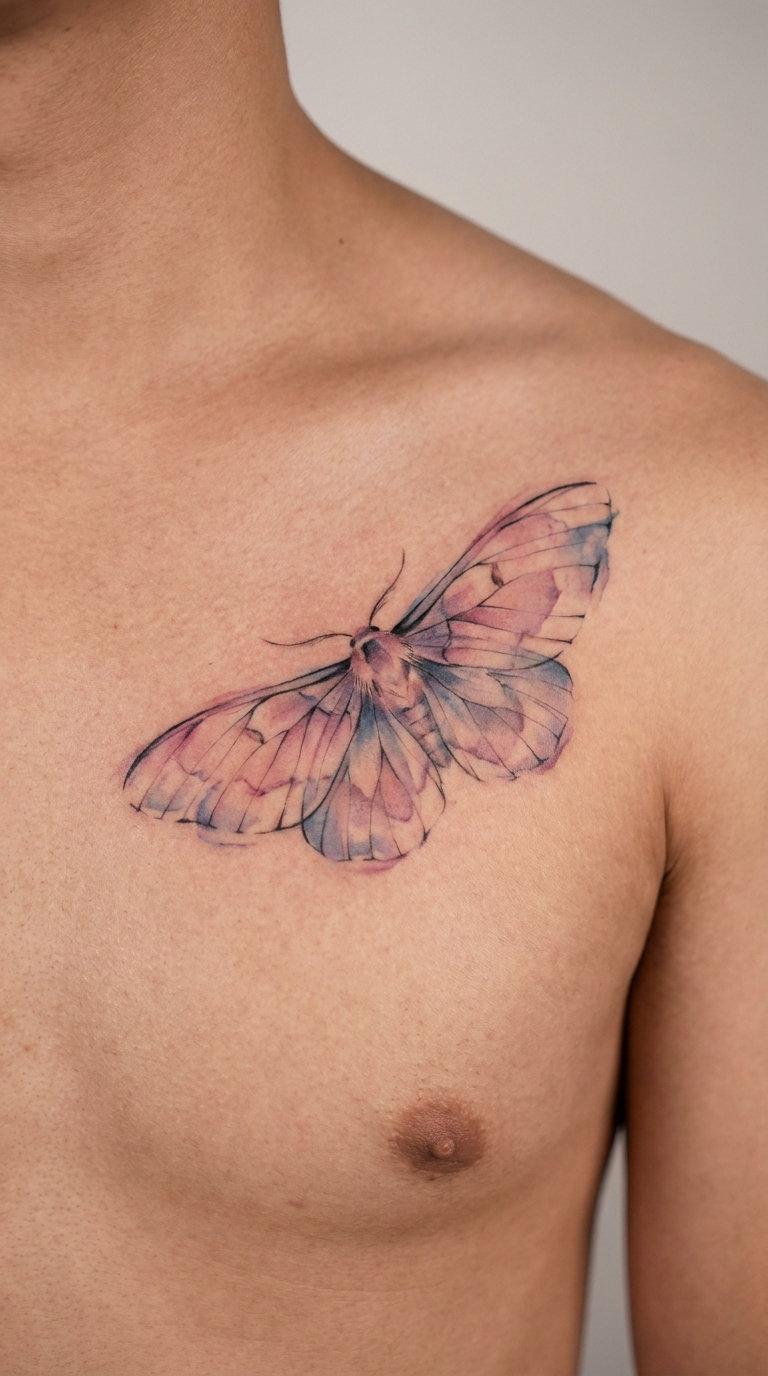
Watercolour moths are built from translucent washes that overlap into new colours, with hard black linework only on the body and antennae. The edges stay soft and slightly uneven, and a good artist leaves parts of the wing with almost no pigment so skin shows through like paper.
On the chest, this style looks like a bruise of colour, which can be exactly the point. People often pick it for something emotional rather than decorative, and the softness suits the curved surface better than heavy geometric work.
Placement: upper chest, offset left of the sternum so the asymmetry suits the style. Size: 5-7 inches (13-18 cm). Style: watercolour. Pain: medium, since needle depth stays shallow. Ageing note: pale watercolour is the first thing to fade; ask for saturated pigment rather than a pastel wash.
Make it yours: pick your colours from something specific, the sky on one day or the two shades in an old paint tin, and hand the artist the reference.
7. Moth and Moon Chest Piece
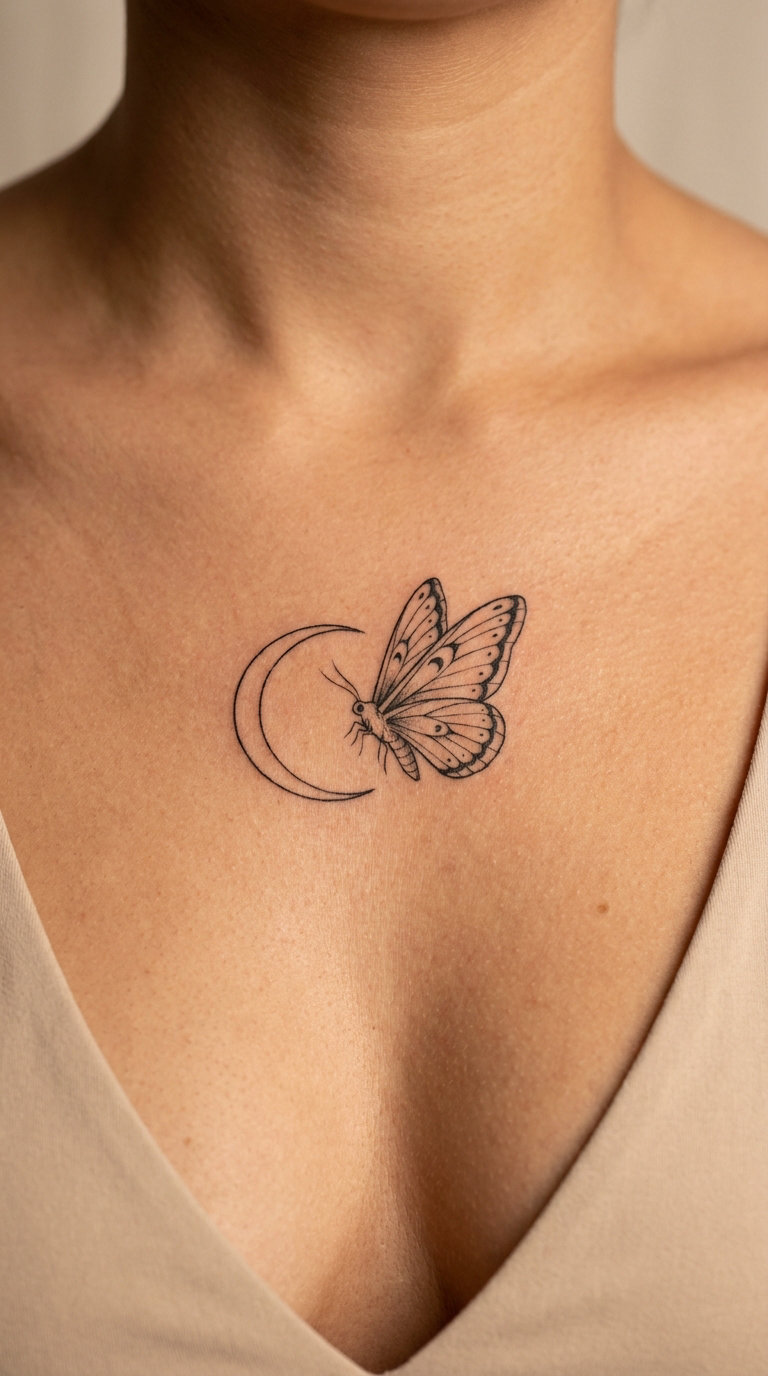
A fine-line moth flying beside a slim crescent moon, the two elements separated by a small gap so each keeps its own outline. The moon is usually an unbroken thin curve rather than a filled disc, and a couple of dot stars sit in the empty space between them.
The pairing works because both creatures are night shapes. Nobody agrees on a single meaning for it, but most people describe it as direction rather than symbolism, a reminder of something they orient by.
Placement: upper chest, centered, with the moon sitting above the wing on one side. Size: 4-6 inches (10-15 cm) combined. Style: fine line. Pain: medium. The thin crescent is quick work; the moth body is where it bites.
Make it yours: use a real new moon date from your life as the moon phase instead of a decorative crescent.
8. White Ink Moth on Dark Chest Skin
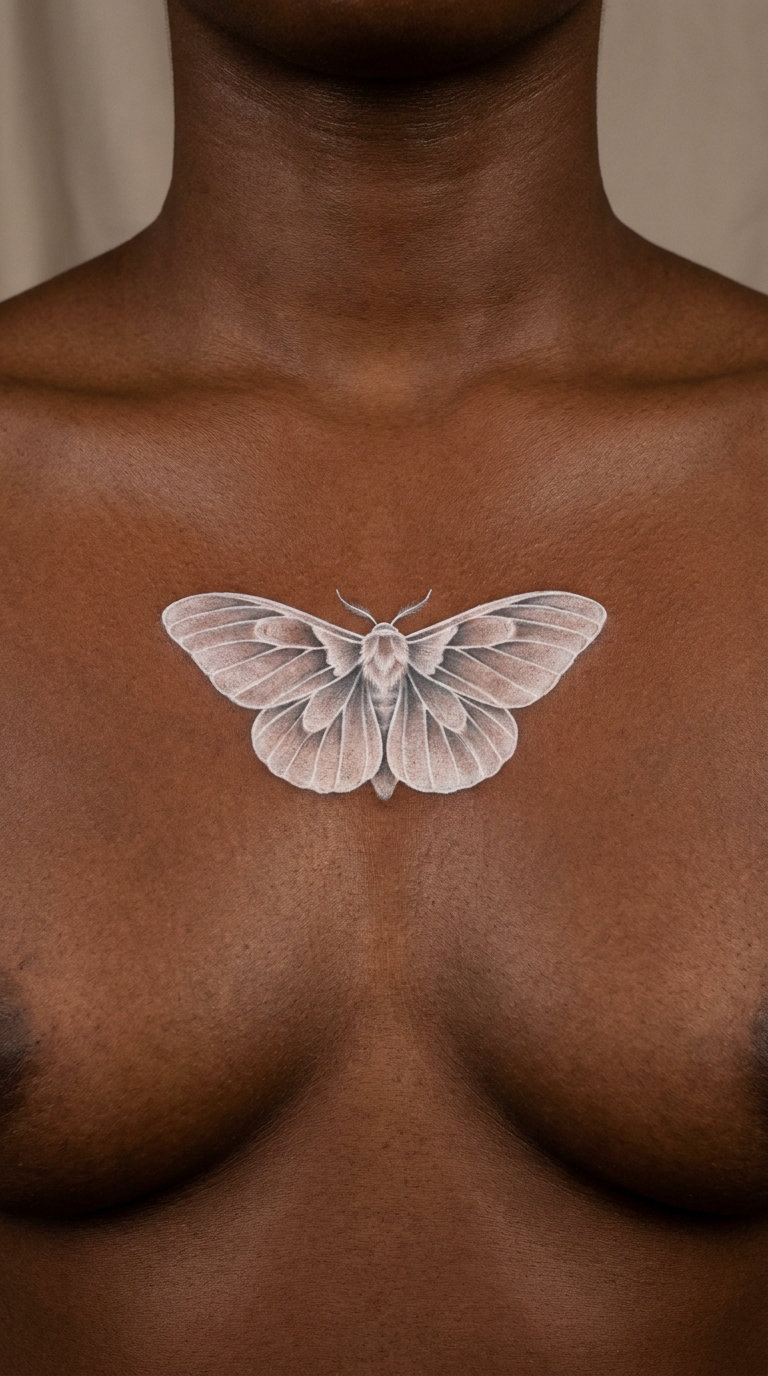
White ink moths are drawn with pale grey linework and small highlight spots, built from the shadow rather than the outline. On deeper skin tones this approach gives you a moth that sits lighter than the surrounding skin, so it holds its shape without needing heavy black.
This is the one design on the list where your skin tone changes the drawing rather than just the contrast. Bring your artist a healed photo, not a fresh one, since fresh skin is redder than you want to design against.
Placement: upper chest, centered, where the piece is visible in normal clothing. Size: 4-6 inches (10-15 cm). Style: white ink with grey shading. Pain: medium. Any honest artist will tell you white ink needs more passes to cover, so expect the session to feel longer than the size suggests.
Make it yours: keep the eye spots on the wings as the only bright white and let the rest sit in soft grey, so the pattern does the work.
9. Dotwork Emperor Moth
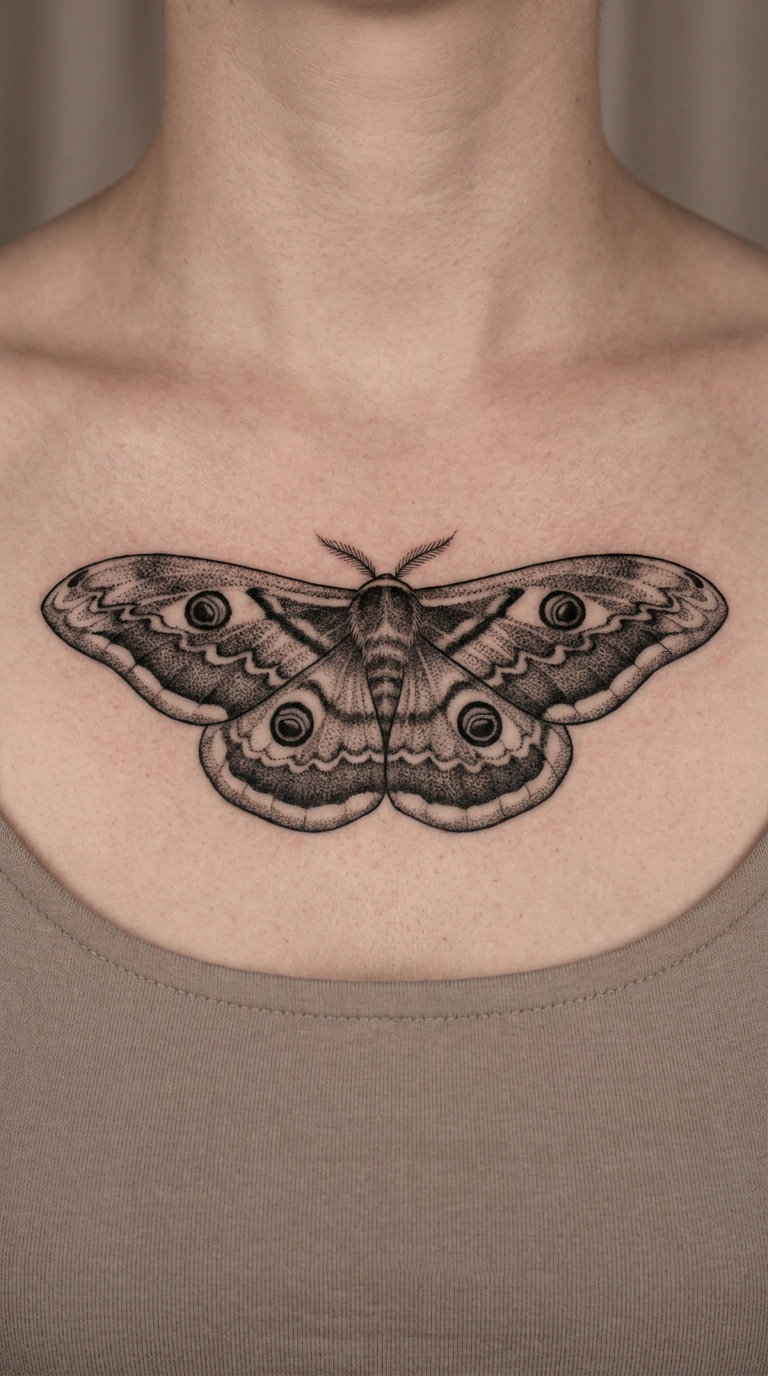
Dotwork emperor moths use hundreds of evenly weighted dots to build symmetrical wing patterns, with bands of negative space separating the eyespots from the body. The dots get smaller toward the wing edges, which gives the whole thing depth without any black fill.
Emperor moths are already patterned, so dotwork suits them better than it would a plain species. People tend to pick this after seeing one in person rather than online, which is a good sign.
Placement: center chest, spread across the sternum. Size: 5-7 inches (13-18 cm). Style: dotwork. Pain: high. Dotwork is slow, repetitive work over bone and people run out of patience well before the artist runs out of dots. Ask for a stencil reference if you want a full dot pattern rather than a simplified one.
Make it yours: let one eyespot be picked out in a single warm colour, which survives touch-ups better than a fully colour piece.
10. Traditional Hornet-Moth Hybrid
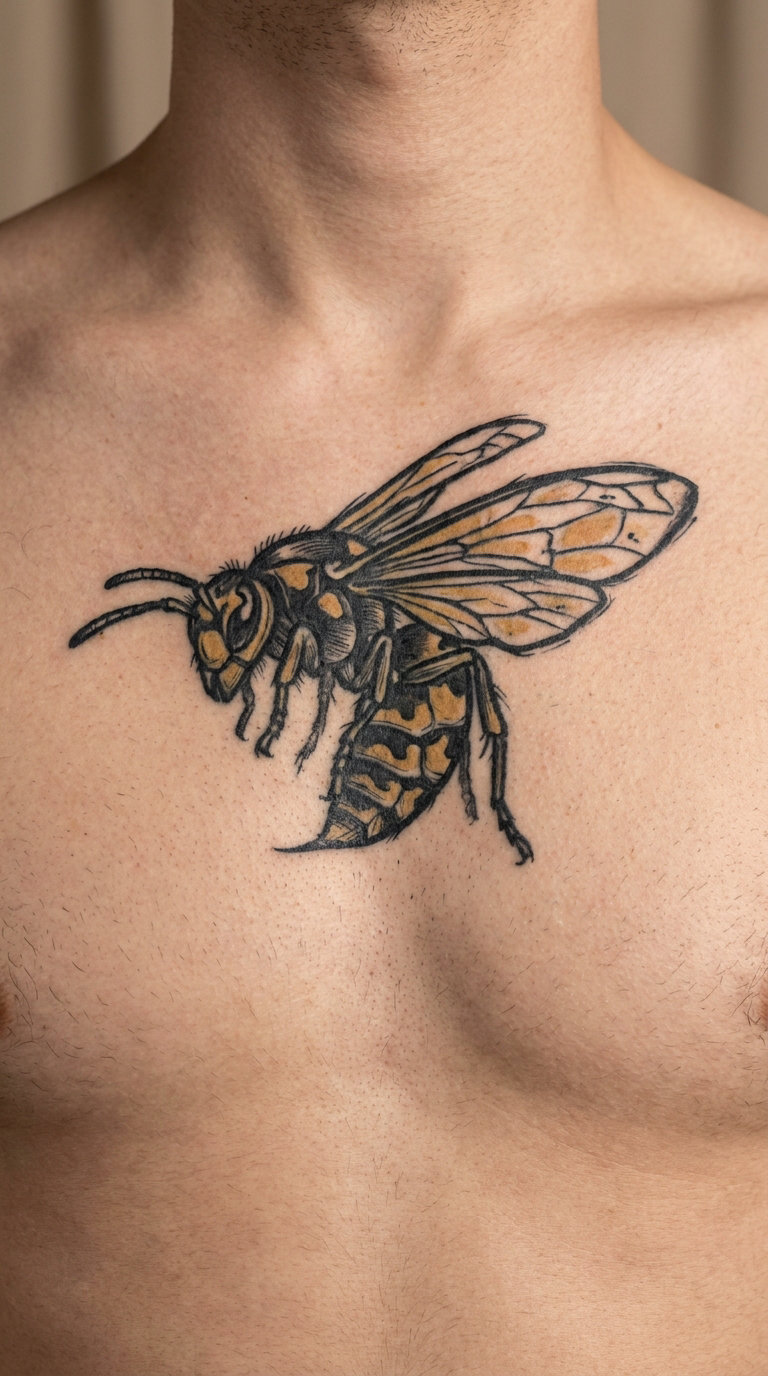
A hornet-moth hybrid takes a moth silhouette and gives it the striped abdomen, heavy black outline and flat yellow fill of American traditional work. Bold outer contour lines and a few hard-edged shadow blocks do the rest, with almost no fine detail anywhere.
It reads as confident and slightly aggressive from across a room, which is a change of pace from the soft naturalistic designs most moth searches return. The colour is the point, so find an artist whose traditional work you have actually seen healed.
Placement: upper chest, centered and sitting proud of the sternum dip so the shape stays readable. Size: 6-8 inches (15-20 cm). Style: American traditional. Pain: medium-high. Bold fills come fast, but the shading passes over the collarbone add up.
Make it yours: swap the yellow for a single deep red if you want traditional colour without the classic bee reading.
11. Gothic Death’s-Head Moth
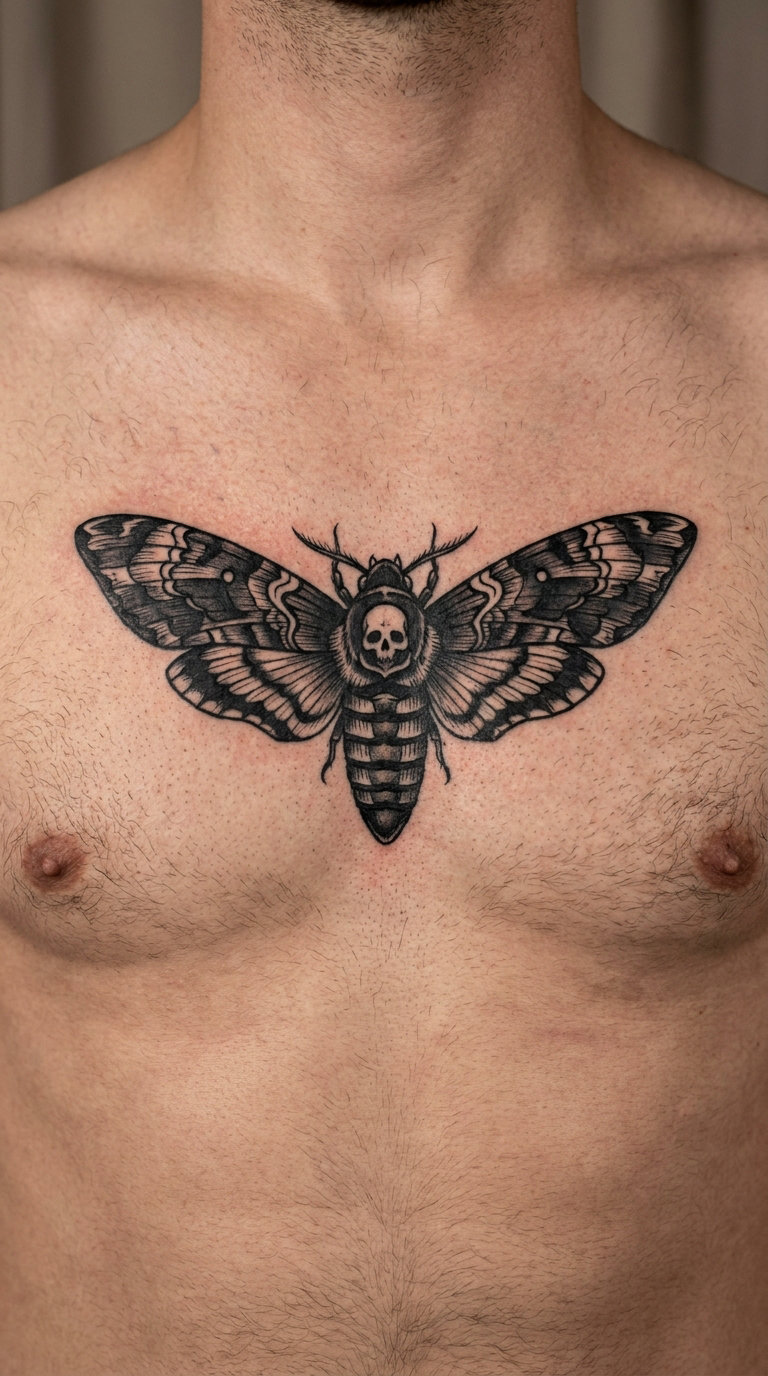
The gothic version of the death’s-head hawkmoth pushes contrast hard: solid black wings, deep grey wash gathered under the body, and the skull marking on the thorax left stark and pale against the dark. Background shading sweeps up behind the wings so the moth reads as emerging from it.
Same species as idea 1, completely different emotional register. This one is for people who want the moth to feel heavy rather than delicate, and it holds up as a large statement piece better than almost anything else in a gothic collection.
Placement: center chest, vertical, with the grey wash filling the gap above the collarbones. Size: 7-9 inches (18-23 cm). Style: blackwork with grey wash. Pain: high, and the deep shading is where most people need a break. Plan on two sessions rather than one long one.
Make it yours: let the grey wash carry a single thin line of red through it, which stays legible even after years of fading.
12. Micro-Realism Luna Moth
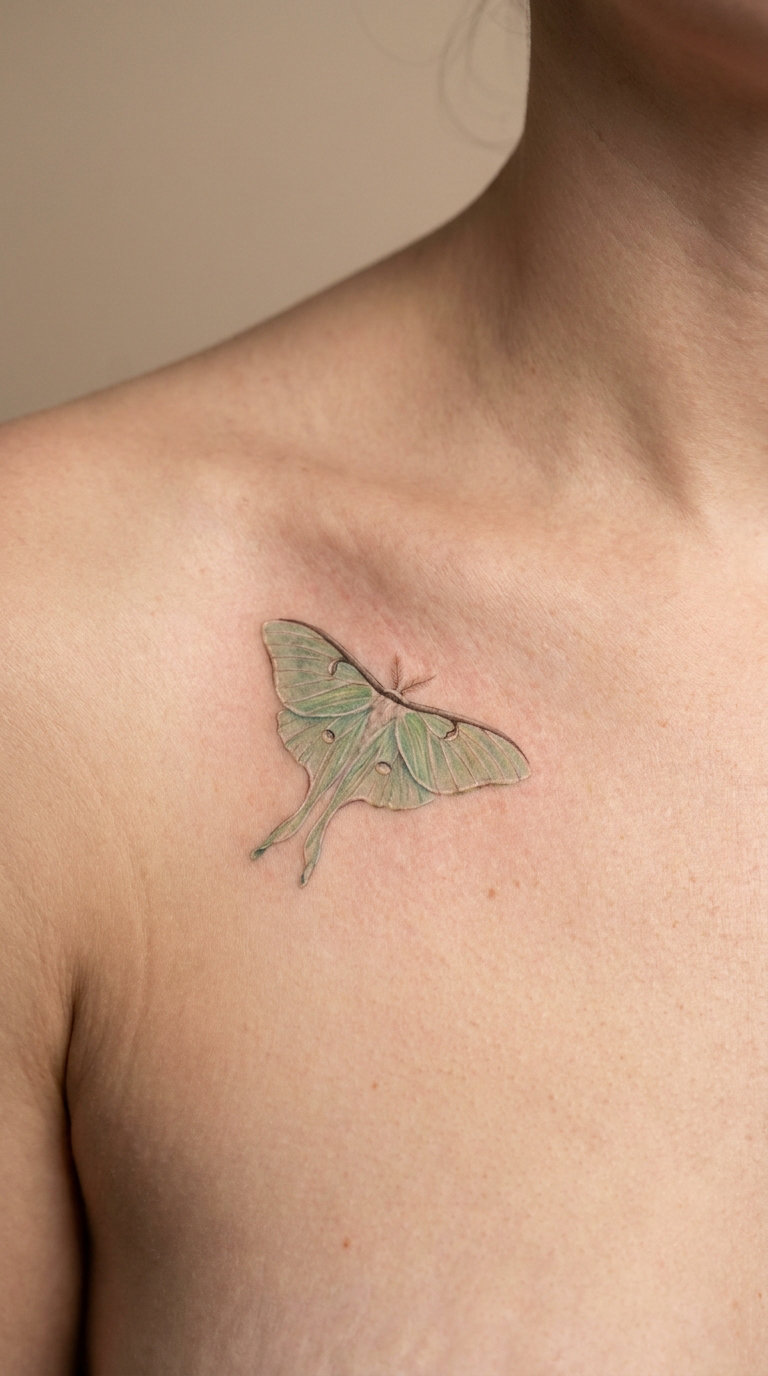
A micro-realism luna moth at three inches is all vein work and restraint. The wing veins are individually drawn, the pale green body is suggested with two soft grey tones, and there is no background at all, so it sits on the skin like a specimen pinned in place.
This is the best fine detail option here that is still big enough to see. Below four inches, wing veins start merging into grey once you are a few feet away, so the artist has to simplify earlier than instinct says to.
Placement: just below one collarbone, or centred high on the sternum if you want it visible under a collar. Size: 2-4 inches (5-10 cm). Style: micro-realism. Pain: medium, though the collarbone edge is a sharp reminder of what is underneath. Ageing note: tiny detail blurs over ten years or so, which is a fair trade for a first piece.
Make it yours: place it on the side where your hand falls when you rest your chin, so you see it in the mirror without turning.
13. Moth with Floral Wings
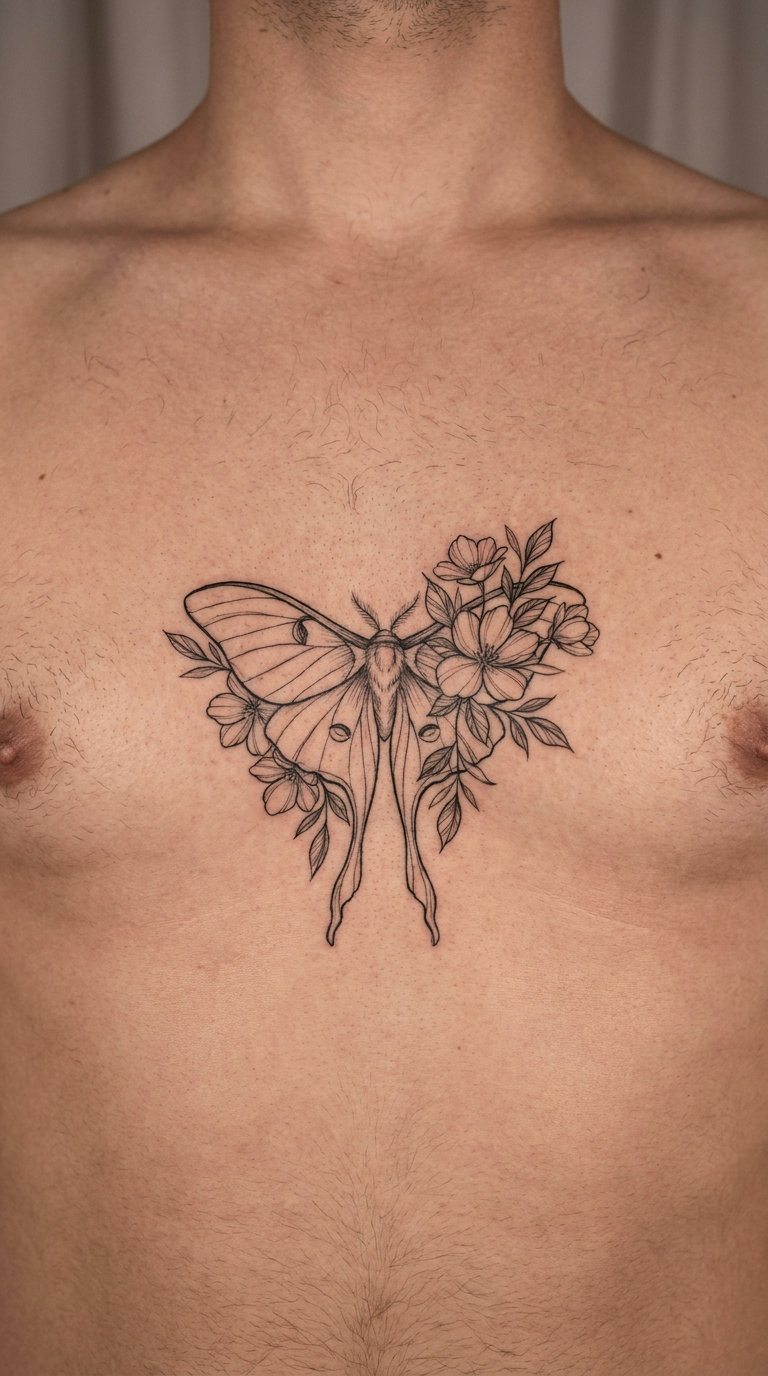
Floral wing moths let stems and small blossoms grow out from the wing edges while the inner wing keeps a recognisable moth pattern. Petals overlap the wing outline slightly so the two halves read as one image instead of a bug with a plant next to it.
It suits people who want a nature piece without a pure botanical design, and it pairs naturally with a smaller matching motif elsewhere on the body.
Placement: upper chest, centered, with the growth running outward toward the shoulders rather than downward. Size: 5-7 inches (13-18 cm). Style: illustrative fine line. Pain: medium. Thin stem work on a curved surface needs a steady hand and usually takes longer than the outline suggests.
Make it yours: choose a plant with its own meaning, like rosemary for remembrance, and keep the species to that one plant.
14. Celestial Atlas Moth
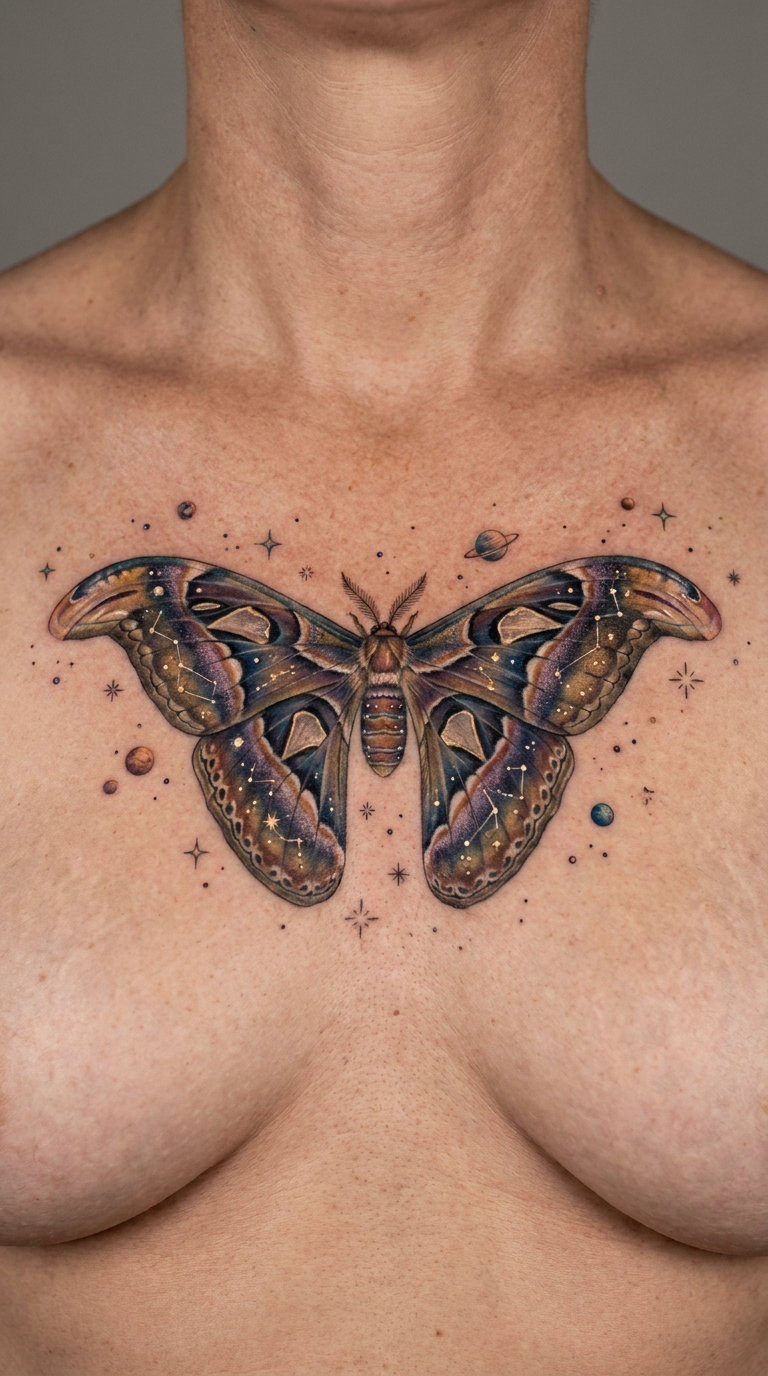
A celestial atlas moth keeps the species accurate in the wings and surrounds it with small stars, a few planet dots and a thin orbit line that arcs behind the moth. The stars are different sizes and none of them is a standard five-point shape, which stops the piece feeling like clip art.
Collectors who pick the atlas moth usually want the animal first, so keep the wing pattern right and treat the stars as framing. People who pick it for the night sky rarely mind a slightly simplified wing.
Placement: full upper chest, with the orbit line running behind the wings and out toward each shoulder. Size: 6-8 inches (15-20 cm). Style: realism with fine line accents. Pain: high, because the moth itself is large and detailed and the star field adds more passes over bone.
Make it yours: use the coordinates or the constellation that sits above your childhood home rather than a generic star field.
15. Symmetry-Interrupted Moth
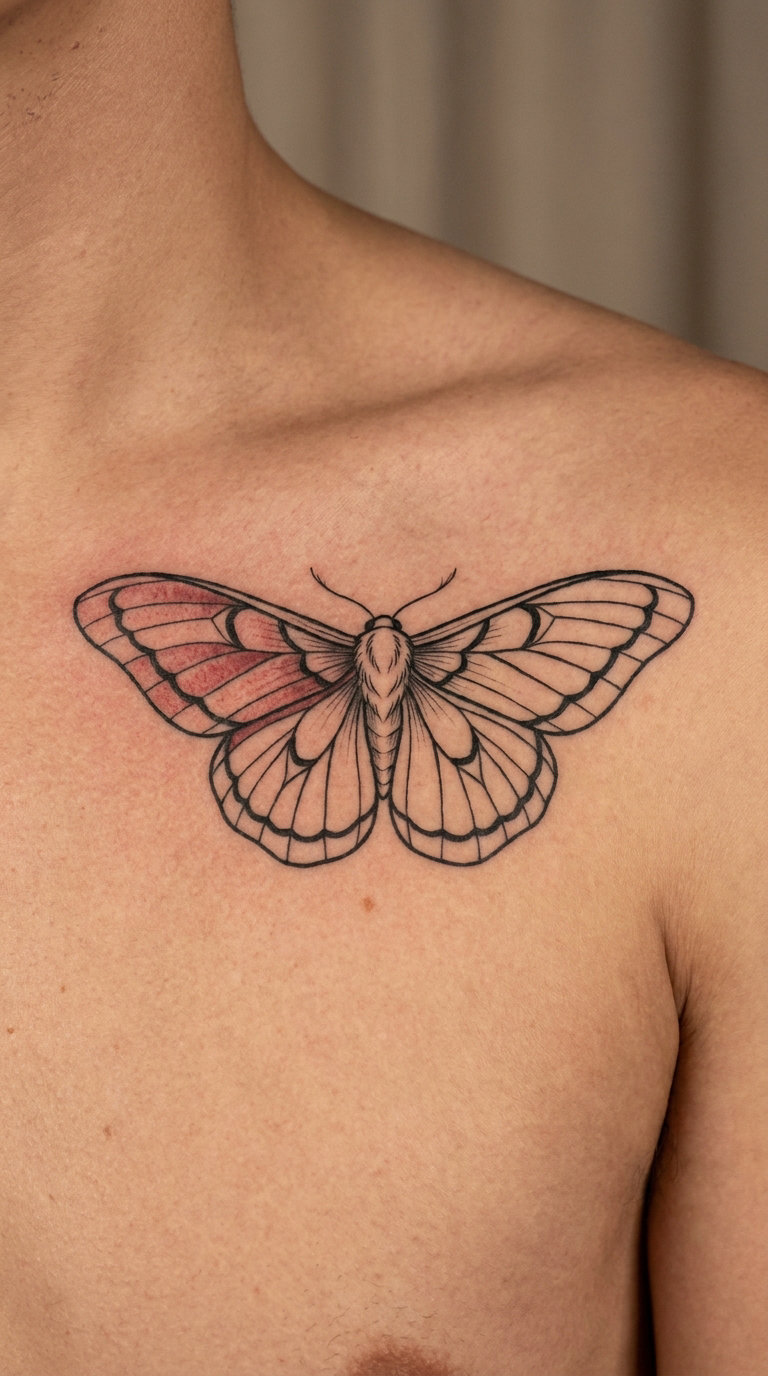
Almost everything mirrors except one thing. In the most common version, the whole moth is drawn in clean black linework and a single wing is filled in muted red, so the composition is symmetrical until the instant it is not.
That one break is the meaning. People use it for a life that mostly followed a plan, or for a change they could not unmake. It is the design here that most reliably stops a stranger asking what it means.
Placement: upper chest, centered. Size: 5-7 inches (13-18 cm). Style: fine line with a colour accent. Pain: medium. The filled wing takes one solid pass; the outline is quick. A line artist’s hand drifting even slightly on the curved chest is the real risk, so check the stencil position before the first pass.
Make it yours: choose the colour from something that matters to you rather than from what looks best online.
16. Moth with Map-Pin Wings
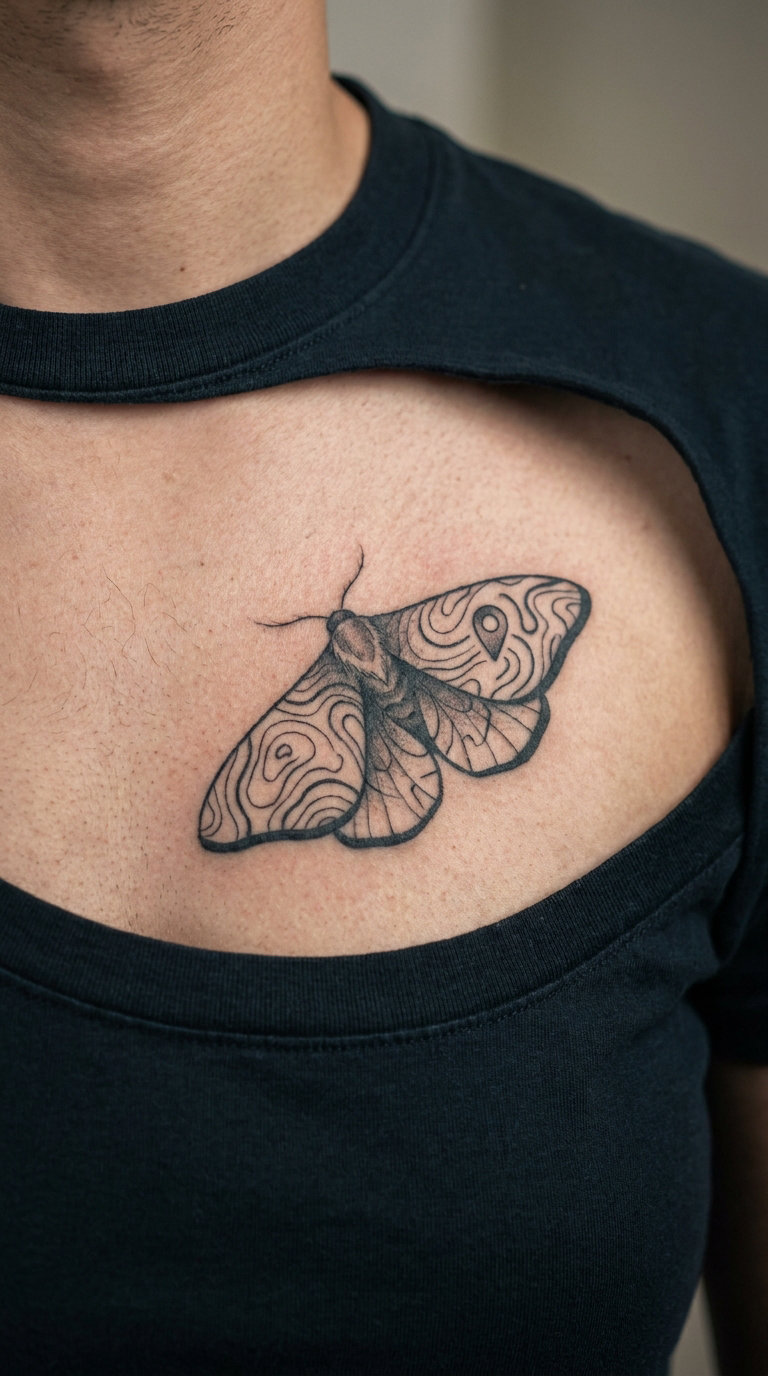
Map-pin moths fold coordinates, a coastline or a route line into the wing shape, with one plain location pin sitting on the wingtip. The line work is left abstract so it reads as travel without spelling out a country name in small text nobody can resolve at six inches.
These are common on people with a lot of miles in them, often paired with a small matching coordinate set on a rib or an ankle. The abstraction is deliberate, and it keeps the piece readable.
Placement: center chest, sitting slightly high so the route line has room to run down the sternum. Size: 5-7 inches (13-18 cm). Style: fine line illustrative. Pain: medium. Long unbroken route lines need a steady pace and are hard to stop and restart on a moving surface.
Make it yours: put the coordinates of one place that changed your life in the lower wing and leave the rest as coastline.
17. Fossil-Embossed Moth
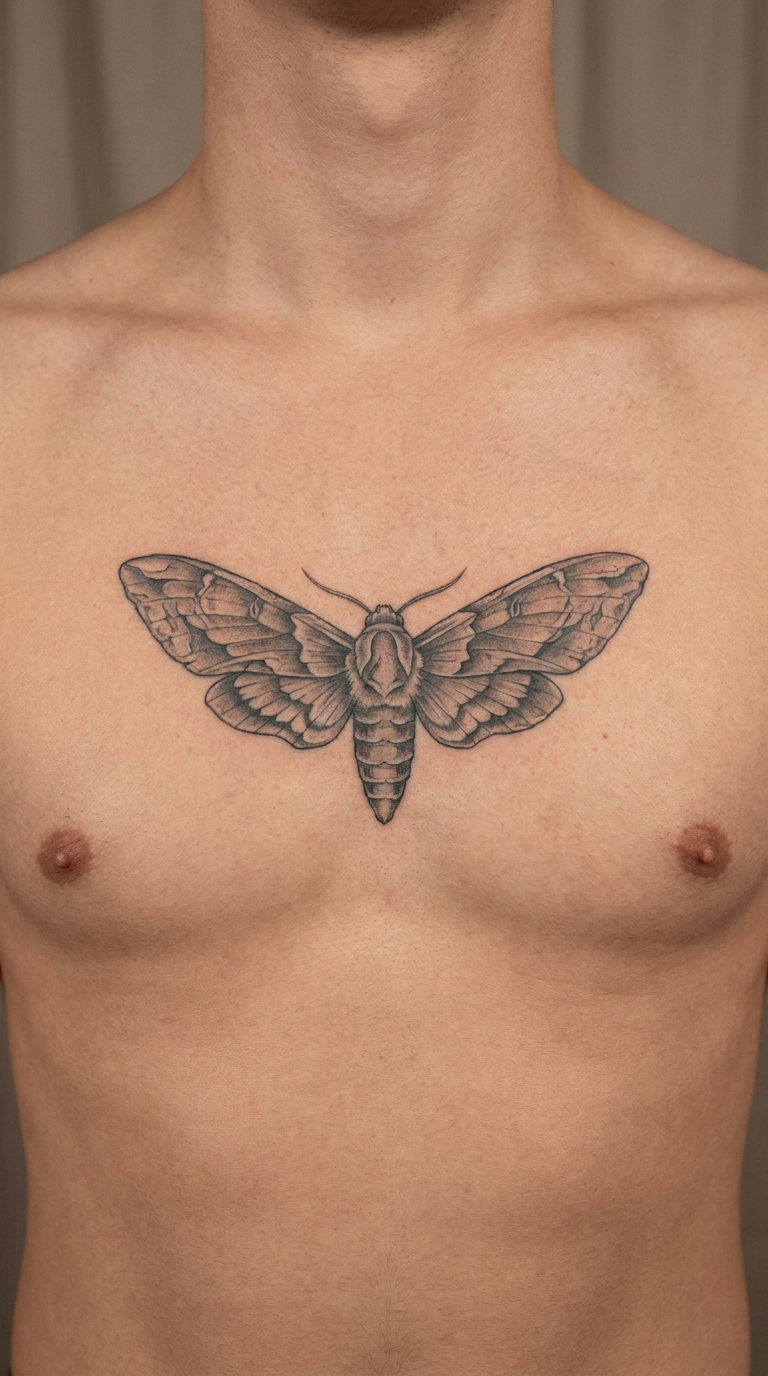
A fossil-embossed moth is drawn as if pressed rather than alive: muted grey and charcoal texture, the wing edges slightly broken, and thin crack lines running through the whole shape so it reads like a specimen preserved under a sheet rather than a moth about to fly.
It suits people who want a moth design that looks old without being distressed or skull-heavy. The texture keeps it quiet, which is unusual for a motif most search results render dramatically.
Placement: center chest, vertical. Size: 6-8 inches (15-20 cm). Style: textured grey and charcoal. Pain: high, since layered texture over bone means many overlapping passes. Most people split this across two sessions comfortably.
Make it yours: set a real birthstone colour as the only warm tone in an otherwise grey piece, kept small enough to survive as a detail.
18. Moth Silhouette with Fine-Line Halo
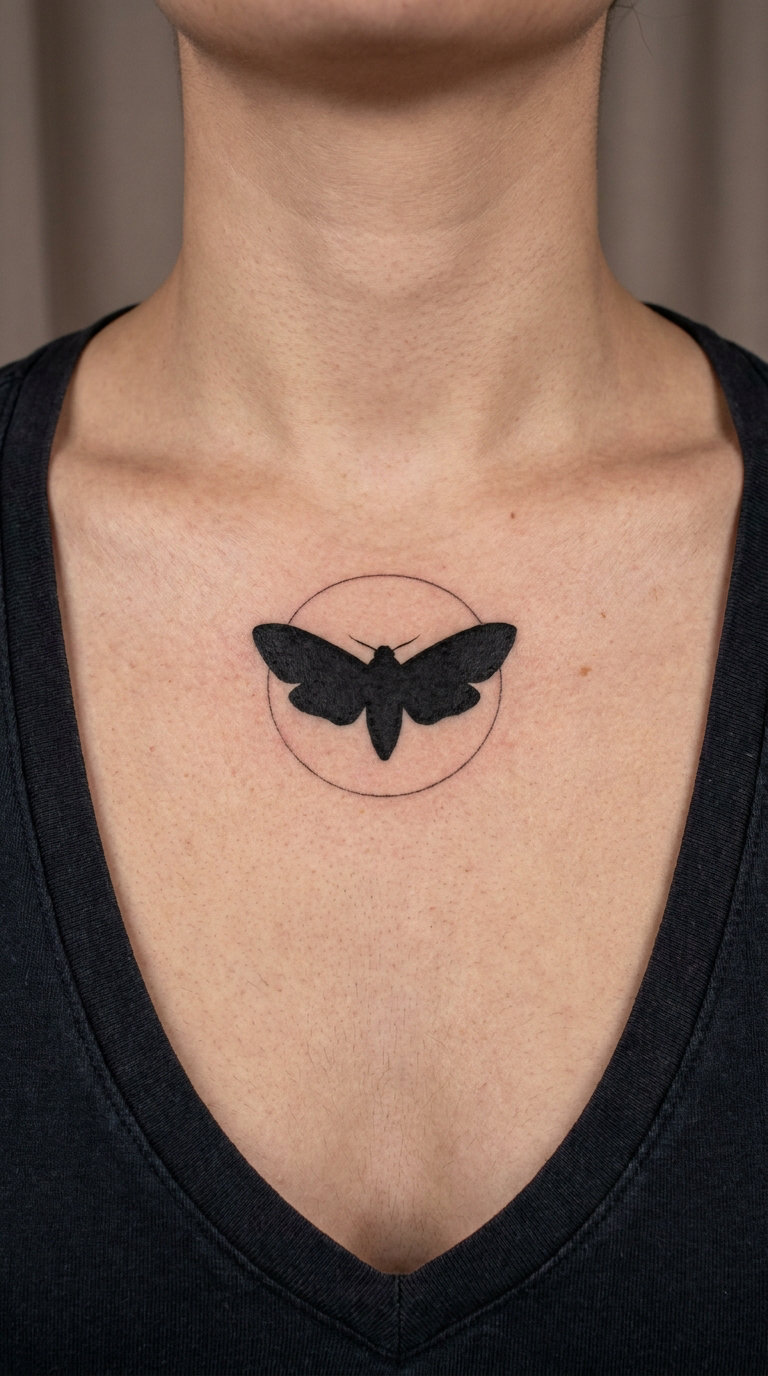
A solid black moth silhouette sits inside a thin, hand-drawn halo circle, and the contrast between the two is the whole design. The silhouette needs no detail at all, which is what makes it readable at a distance and forgiving of body changes later on.
The halo is drawn freehand in a single line, so it reads as something added by a person rather than a printed ring. That slight unevenness is the detail worth asking for.
Placement: between the collarbones, high and centered, where a circle frames well. Size: 4-6 inches (10-15 cm) including the halo. Style: blackwork with fine line. Pain: medium. The solid silhouette is fast; the halo line is a single continuous pass over the most sensitive area on the chest.
Make it yours: break the halo circle at one point and place a small symbol in the gap, which keeps it open rather than religious.
19. Large Realistic Polyphemus Moth
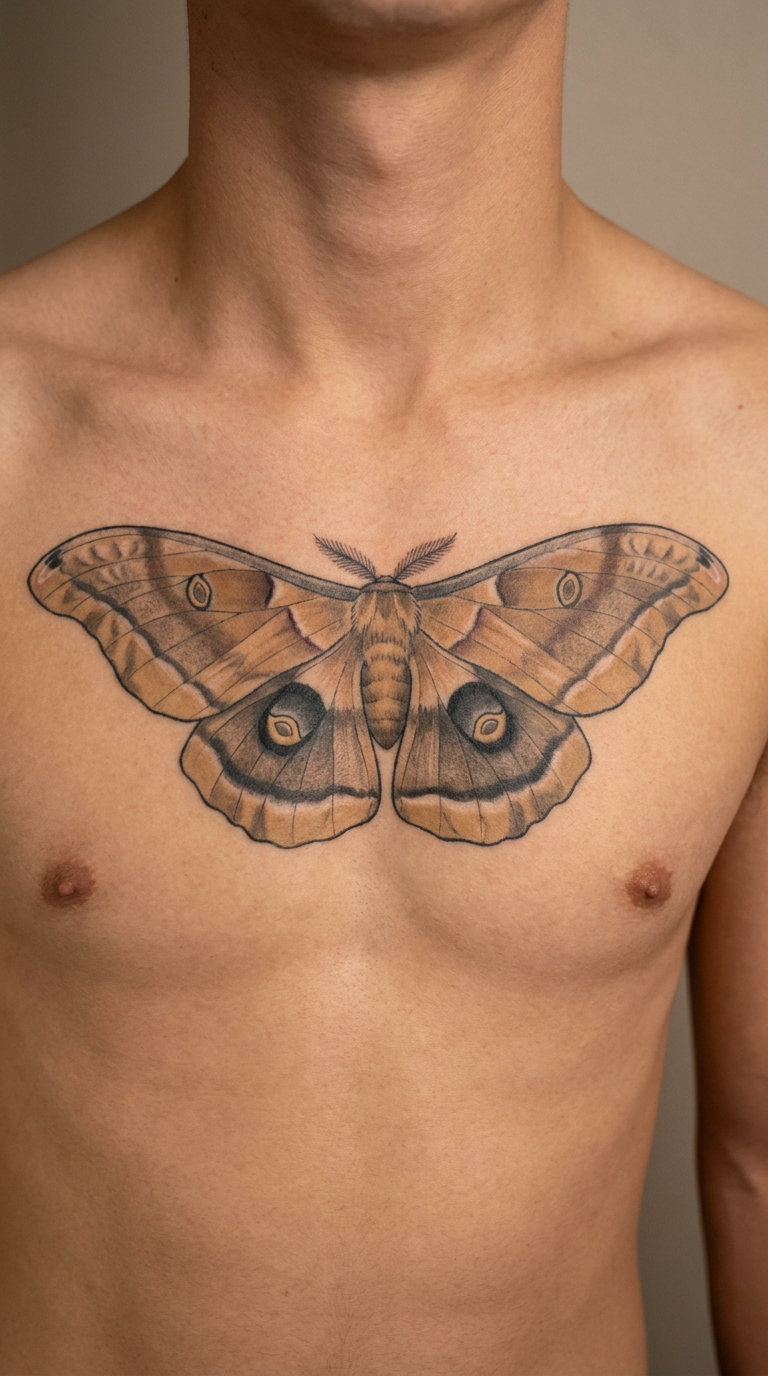
The large polyphemus is the full commitment piece here: layered tan, brown and charcoal shading across four big eyespots, fine fuzz on the thorax and antennae that actually reads as feathered. The wing pattern is followed closely, which is why it needs more session time than anything else on this list.
Polyphemus moths are a collector favourite and the eyespots give the composition a natural focal point that works dead centre on a chest. This is the design to pick if your piece is going to be the one people notice.
Placement: spanning the upper chest, wingtips reaching toward each shoulder. Size: 8-10 inches (20-25 cm). Style: realism, full colour. Pain: high across the whole piece and low tolerance by the end of a long session is the norm. Ask your artist to stop while the line work is still crisp rather than pushing to finish shading.
Make it yours: have the four eyespots match a family or friend group, with one left different if someone is missing.
20. Blackwork Moth with Empty Body
This design draws the wings as heavy, confident black shapes and then leaves the body open, sometimes as a single outline, sometimes almost empty. The gap in the middle becomes the focal point, and the wing pattern is simplified into two or three graphic bands.
It reads as graphic rather than illustrative, so it sits comfortably next to other bold work in a collection. People who dislike the softness of the naturalistic styles usually end up here.
Placement: upper chest, centered, with the open body sitting over the sternum so the empty area falls on bone. Size: 7-9 inches (18-23 cm). Style: graphic blackwork. Pain: high, since solid black across the upper chest is a lot of surface over bone. Ageing note: bold shapes hold up better than fine ones, so this one rewards you over time.
Make it yours: put a short word or a single date in the open body, in a size your artist confirms will still be readable.
21. Moth and Rose Colour Tattoo
A single rose beside a colourful moth, both in the same illustrative style with matching line weight. The rose leans toward the moth so the two shapes meet, and the colour palette stays to two or three tones rather than the rainbow a mixed composition usually drifts into.
Rose and moth together read as beauty that still works at night, and the pairing suits people who want a traditional motif pair without the heavy symbolism of a full floral chest piece.
Placement: center chest, with the rose on the lower outer side so it does not push the wings off the sternum line. Size: 6-8 inches (15-20 cm) for both elements. Style: colour illustrative. Pain: medium-high, and colour work takes longer than the size suggests because of the layering.
Make it yours: use a rose in a colour that matches something real in your life, then keep the moth in black and grey so the flower is the only saturated element.
22. Abstract Two-Wing Moth
The abstract version reduces a moth to two sweeping wing shapes built from long black curves and the skin left bare between them. You get the silhouette, the antennae and a sense of motion, with no species reference at all. It is the least literal design here and the easiest to fit around existing chest work.
Because it carries no species, it also borrows no fixed meaning, which is exactly why some people prefer it. If you want the shape without the story, this is the one.
Placement: center chest, and it adapts better than almost any other design here to an awkward space between existing tattoos. Size: 5-7 inches (13-18 cm). Style: abstract linework with negative space. Pain: medium. Few lines mean a shorter session, and there is very little to heal slowly.
Make it yours: have the two wings mirror each other in shape but not in line weight, so one reads as drawn and one as erased. There are plenty more in our [82 moth tattoo designs](https://thewe.cc/moth-tattoo/) if this direction feels too spare.
How to Choose the Right Design
Start with the chest zone, because it decides more than taste does.
- Upper chest, between the collarbones: best for fine line, minimalist and small realistic designs. This is the highest-sensitivity area, so keep the work simple.
- Center chest over the sternum: the natural home of the symmetric moth. Wide wings and a vertical body line up with the body’s own centre here.
- Over the pec, lower down: the least sensitive part of a chest session. Larger pieces and heavier blackwork sit here more comfortably.
- Underboob: works well for a single moth angled slightly off-axis, and it uses the curve under the breast rather than fighting it.
- Collarbone line: good for a horizontal design rather than a symmetric one, such as idea 16.
Symmetry is the one thing to settle before anything else. A moth is a mirror-image design on the most curved common placement, and a stencil placed an eighth of an inch off centre shifts visibly once the skin moves. Ask your artist to transfer the stencil, stand back, and check it in a mirror before the first line.
Second thing: match detail level to size. Wing veins that look precise at three inches blur into grey by four, and fine line on the chest fades faster than shading does because thinner deposits heal with less pigment in them. If you want something that still reads in ten years, go bolder than feels necessary in the chair.
Third: check what is already there. A symmetric design in the middle of the chest is unforgiving of a neighbouring piece, because one side always looks fuller. If you already have chest ink, the abstract two-wing version or an off-centre realistic design will sit far more comfortably.
Finally, bring a real reference. A photograph of the actual species, printed or on a phone, saves an hour of describing pale green wings in the wrong shade. The chest tattoo ideas for men breakdown covers how sizing tends to differ on wider chests.
Cost and Session Time
Most US studios charge by the hour, and rates commonly sit somewhere between 120 and 250 US dollars an hour depending on the shop and how established the artist is. A few clients in the forums have asked whether 200 an hour is normal, and it is at the higher end but not unusual for a well-booked realist or blackwork artist.
Rough ranges by finished size, for a piece like these:
- Small, 2-4 inches: 150 to 400 US dollars, usually one session of an hour or two.
- Medium, 5-7 inches: 350 to 900 US dollars, one long session or two shorter ones.
- Large, 8-10 inches: 800 to 2000 US dollars, almost always split across two sessions.
Shop minimums explain a lot of the spread. Plenty of studios have a minimum of 200 or 250, which is why small fine-line pieces still land near the top of that range. Colour realism, heavy blackwork and long route lines all add hours; a single black outline does not.
On time, one r/tattooadvice poster described a chest piece taking two sessions of three and a half hours each, and a woman on Lemon8 documented hers at roughly 250 US dollars with frequent breaks needed. Both finished. The pattern is consistent enough to plan around: anything past seven inches, expect two visits, and ask the artist where they want to stop rather than trying to push through a long single sitting.
Aftercare Basics
Follow your artist’s aftercare instructions first, because advice varies by skin and by ink. Beyond that, chest-specific care comes down to a few things.
- Wash it like your artist said, for as long as they said. Most will tell you to wash with lukewarm water and unscented soap, then pat dry rather than rub.
- Keep it moisturised but not shiny. A thin layer of whatever they recommend, reapplied a few times a day, keeps the skin from tightening and flaking into the new linework.
- Watch friction. A chest piece rubs against a shirt collar, a seatbelt, a backpack strap and, for many people, a pillow all night. Loose cotton clothing for the first couple of weeks is the simplest fix.
- Sleep position matters more than people expect. If you sleep on your front, expect the healed lines to soften in the sternum centre first.
- Sun exposure fades colour and softens black. A new chest piece is often covered by a shirt anyway, but a low neckline leaves it exposed. Use sunscreen on it once healed if it stays visible.
- Do not pick flakes, and do not soak. Long hot showers and swimming are where fresh chest pieces get into trouble.
Frequently Asked Questions
What does a moth tattoo on the chest symbolize?
A moth tattoo on the chest usually symbolizes transformation, resilience and being drawn to light in the dark. Because moths rebuild themselves completely and steer by light at night, people choose the motif after a hard season rather than a happy one. On the chest specifically the design reads visibly, since the sternum line lets wide wings sit symmetrically and the meaning is seen rather than hidden.
How badly do sternum tattoos hurt?
Sternum tattoos sit on thin skin directly over bone, and most people rate them high on the scale. Forum posters commonly report eight or nine out of ten for the sternum itself, while the pec below feels comparatively fine and the collarbone edge hurts in a different, sharper way. Breathing through it and asking for short breaks make more difference than numbing cream, which most artists decline to use on the chest.
What size should a moth tattoo be on the chest?
Most chest moth tattoos land between 4 and 8 inches across the wings. Under 4 inches, individual wing veins blur together within a few years, so fine detail has to be simplified. Above 8 inches you are covering most of the upper chest, which usually means two sessions and a good deal of work over bone. Match the detail level to the size rather than shrinking a detailed design.
Will chest skin movement distort a symmetrical moth design?
It can, which is why the stencil check matters. A moth is a mirror-image design and the chest is curved, so a stencil placed even slightly off centre looks visibly wrong once the body moves and once the skin stretches over the pec. Artists usually centre on the sternum and check the stencil from standing height before starting. Body weight changes and breast changes can also shift symmetry over time, so slightly looser spacing ages better than tight mirror precision.
Are moths an LGBTQ symbol?
There is no established moth symbol in LGBTQ culture, and claiming one would oversell it. What does happen is that the moth reads as nocturnal, liminal and attracted to light in the dark, which many queer people find resonant with their own experience of visibility and hiding. Artists in these communities also lean on moth-to-flame imagery. Treat it as a personal reading rather than a shared emblem.
How long does a chest moth tattoo take to heal?
Plan on two to three weeks of visible healing and about two months before it looks settled. The chest takes slightly longer than an arm or a rib because it moves constantly and rubs against clothing all day. Fresh reds and yellows usually look brightest after two to three weeks, then even out. A monthly moisturiser through the first few months keeps the linework from looking dry and flat.
Choosing Your First Chest Moth Tattoo
If this is your first tattoo, keep it small and keep it thin. Idea 5, the minimalist outline at three inches between the collarbones, or idea 12, the micro-realism luna just below a collarbone, both finish quickly, sit well under a shirt and leave you room to decide what chest ink you actually want in five years. The chest is a sensitive spot to spend a first piece on, so let it be a lesson rather than a statement.
If you already have a collection and want this one to count, go the other way. Idea 19, the large realistic polyphemus, or idea 11, the gothic death’s-head, are the two designs here that change how a room reads a person. Budget two sessions, bring a real species photo, and confirm the stencil symmetry in a mirror before anything else happens.
Either way, the next step is a consultation, not a session. Send your artist two or three of these designs, the finished size you have in mind, and a photo of your own chest at the angle you want covered. That single message saves an hour of guessing, and it is the difference between a moth that suits you and one that simply looks good on somebody else.