
24 Robin Tattoo Ideas: Best Small and Bold Bird Art (October 2026)
A robin is one of the easiest birds to recognise and one of the hardest to draw badly. That orange-red breast, the upright stance, the round belly: get those three right and a small tattoo still reads as a robin rather than a generic songbird. That is exactly why 24 robin tattoo ideas keep working as a theme, and why the best ones are often the quietest.
Below I have split 24 robin tattoo ideas by style, placement and size, with an honest note on pain and how each design ages. If you are planning a spring or summer piece, give it a few weeks of lead time: most people book out, and the ones worth waiting for are the ones you still want in two years. Every design here is described precisely enough that you can hand it to an artist, but the shape of the drawing should always be adapted to the exact body site.
A note on scale first, because it decides more than style does. A robin needs roughly 2 inches (5 cm) of height before the breast colour and posture are visible enough to identify it. Below that it turns into a smudge, and the one thing a robin tattoo cannot afford is being mistaken for a wren.
24 Robin Tattoo Ideas: Quick Guide
| Idea | Style | Best placement | Size | Pain |
|---|---|---|---|---|
| 1. Fine-line with cherry blossom | Fine line | Collarbone or inner forearm | 2–4 in (5–10 cm) | Low to medium |
| 2. Traditional redbreast | Traditional American | Forearm or upper arm | 4–7 in (10–18 cm) | Low to medium |
| 3. Watercolour in flight | Watercolour | Outer upper arm | 4–6 in (10–15 cm) | Medium |
| 4. Blackwork silhouette | Blackwork | Forearm | 3–6 in (8–15 cm) | Low to medium |
| 5. Micro-realism portrait | Micro-realism | Inner or outer wrist | 1.5–3 in (4–8 cm) | Medium |
| 6. Dotwork with flight path | Dotwork | Shoulder blade | 4–7 in (10–18 cm) | Low to medium |
| 7. Single-line minimal | Minimal line | Behind ear or neck | 1.5–2.5 in (4–6 cm) | Low to medium |
| 8. Robin with nest and eggs | Old school | Upper arm or thigh | 5–8 in (13–20 cm) | Low to medium |
| 9. Neo-traditional thorn branch | Neo-traditional | Forearm or calf | 4–7 in (10–18 cm) | Low to medium |
| 10. Celestial robin and stars | Illustrative with gold | Inner upper arm | 3–5 in (8–13 cm) | Medium |
| 11. Two robins on a curve | Fine line | Collarbone or sternum | 3–5 in (8–13 cm) | Low to medium |
| 12. Botanical engraving | Engraving illustration | Outer calf | 5–9 in (13–23 cm) | Medium |
| 13. Geometric planes | Geometric | Forearm or thigh | 3–6 in (8–15 cm) | Low to medium |
| 14. Robin over a dotted map | Fine line with blackwork | Forearm or calf | 4–7 in (10–18 cm) | Low to medium |
| 15. Robin with red peonies | Black and grey with colour | Outer thigh | 4–7 in (10–18 cm) | Low to medium |
| 16. Winter robin on snow | Illustrative | Forearm or upper arm | 3–6 in (8–15 cm) | Low to medium |
| 17. Robin with a heart breast | Illustrative minimal | Inner forearm or wrist | 2–4 in (5–10 cm) | Medium |
| 18. Holly and robin on the hand | Traditional seasonal | Back of the hand | 2–4 in (5–10 cm) | Medium to high |
| 19. Rainbow watercolour | Watercolour realism | Rib or side torso | 4–7 in (10–18 cm) | Medium to high |
| 20. Cherry-blossom canopy | Flowery illustrative | Shoulder or upper arm | 5–8 in (13–20 cm) | Low to medium |
| 21. Robin with a red mushroom | Whimsical fine line | Calf, inner arm or ankle | 2–4 in (5–10 cm) | Low to medium |
| 22. Singing robin and notes | Fine line illustrative | Side neck | 2–4 in (5–10 cm) | Medium |
| 23. Robin branch sleeve element | Bold illustrative | Outer forearm | 6–9 in (15–23 cm) | Low to medium |
| 24. Small flying robin at the ankle | Minimal illustrative | Above the ankle bone | 1.5–3 in (4–8 cm) | Medium |
1. Fine-Line Robin with Cherry Blossom on the Collarbone
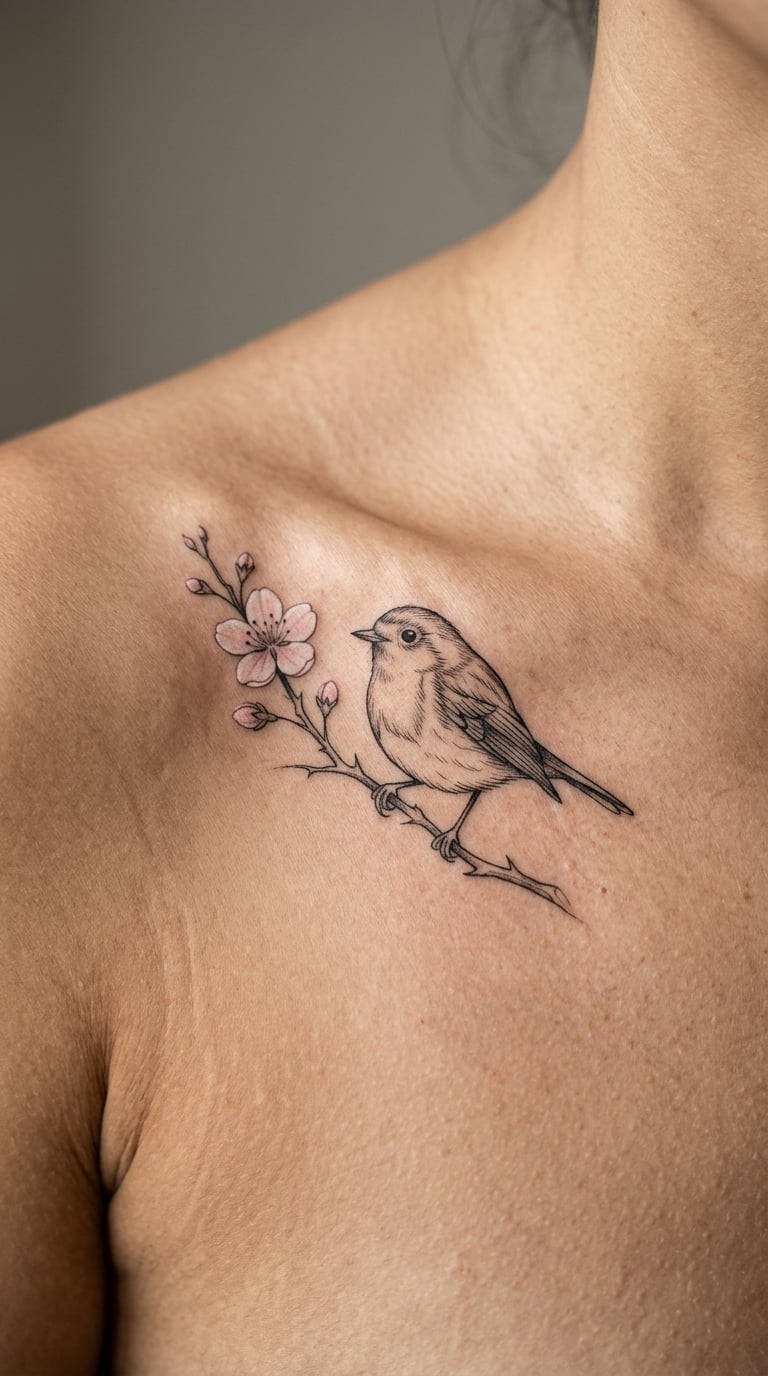
This fine-line robin tattoo is a black outline of a robin perched on a thin flowering branch, with restrained grey shading in the wing and a single pale pink blossom placed near the bird rather than across it. The restraint is the point: less ink means it ages more gracefully.
People pick this version for the spring and renewal reading that robins quietly carry, and the collarbone line makes it feel like something kept rather than displayed.
Placement: collarbone or inner forearm. Size: 2–4 inches (5–10 cm). Style: fine line with one pale colour accent. Pain: low to medium, since the collarbone area is mostly thin skin over a bony ridge. Fine lines and pale colour soften first on skin that sees a lot of sun, so cover the collarbone in summer if you keep the piece pale. Make it yours: add a meaningful date in the same line weight beneath the branch.
2. Traditional Redbreast on a Mossy Branch
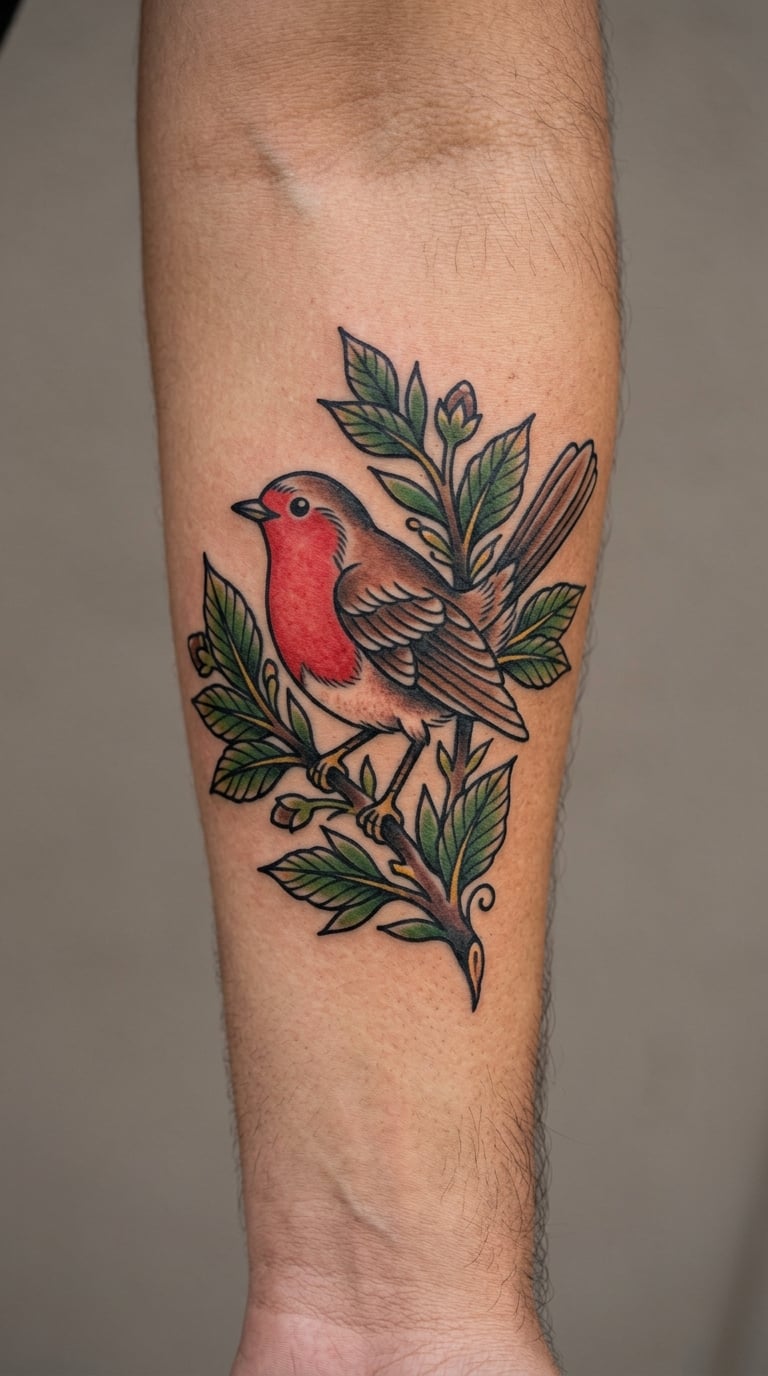
The traditional redbreast robin tattoo is drawn in the American traditional style: a vivid red-orange breast, a dark head, layered green leaves and confident black outlines with even black shading. Moss or small shadowed clumps can sit under the branch to anchor it.
This is the version people choose when the robin is a garden bird rather than an idea: home, a childhood garden, a place that mattered.
Placement: forearm or upper arm. Size: 4–7 inches (10–18 cm). Style: traditional American. Pain: low to medium on the forearm. The red breast is the first thing to soften on a forearm that rolls up every day and sits in summer sun, so expect a colour refresh rather than a redraw. Make it yours: work a family garden flower or a meaningful initial into the branch line.
3. Watercolor Robin in Flight on the Upper Arm
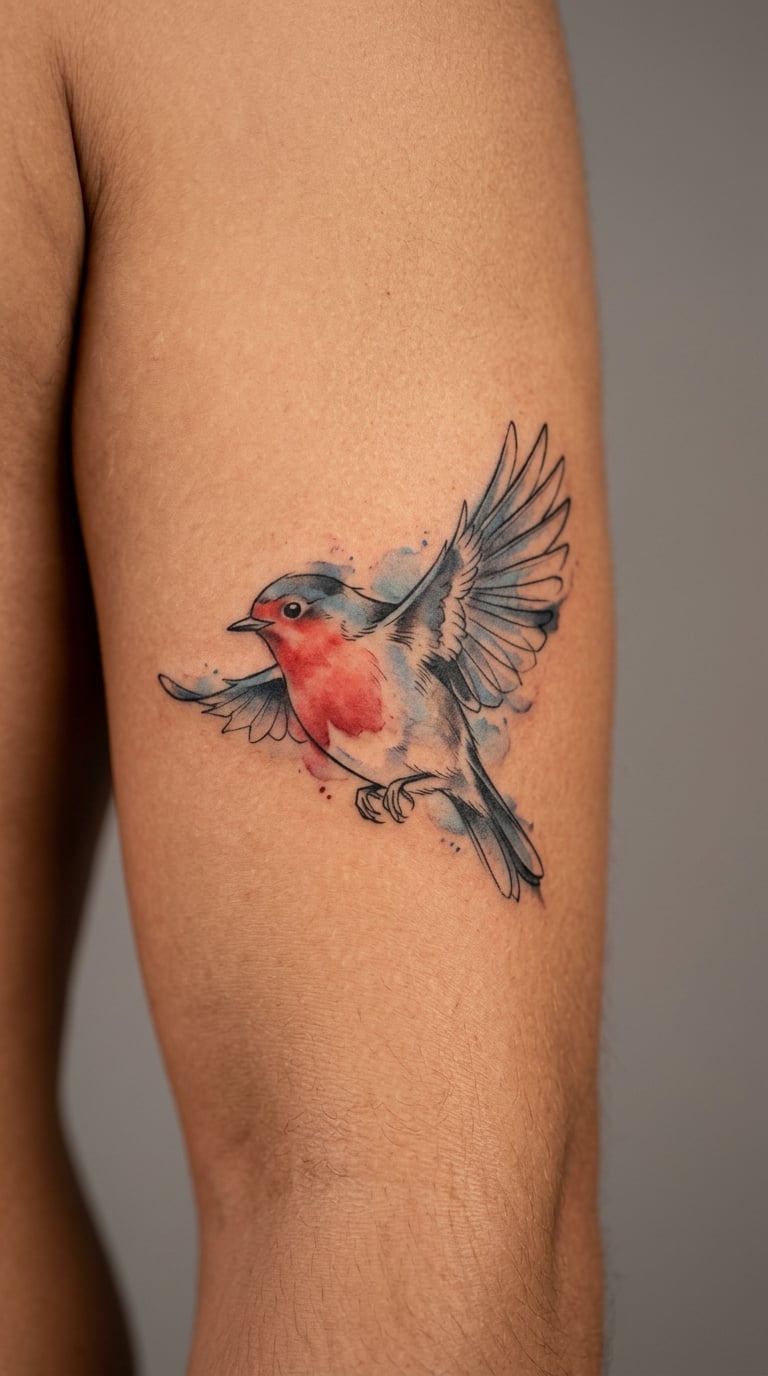
A watercolour robin in flight is a side-view bird with wings up, painted in loose black, grey, red and muted blue washes that trail off the wingtips like brush strokes rather than feathers. Nothing inside the body needs to be anatomically exact for the effect to work.
It suits someone who wants movement and colour without committing to a full traditional piece, and it pairs naturally with larger-scale nature collection work. If you are building that kind of set, our mountain and ocean tattoo ideas cover the same planning at larger scale.
Placement: outer upper arm. Size: 4–6 inches (10–15 cm). Style: watercolour. Pain: medium, because the upper arm is a broad fleshy area and the needle stays in one place longer. Soft watercolour edges and the smallest colour details fade first, so treat it as a piece that will need refreshing. Make it yours: limit the palette to three colours pulled from a painting you already own.
4. Bold Blackwork Robin Silhouette on the Forearm
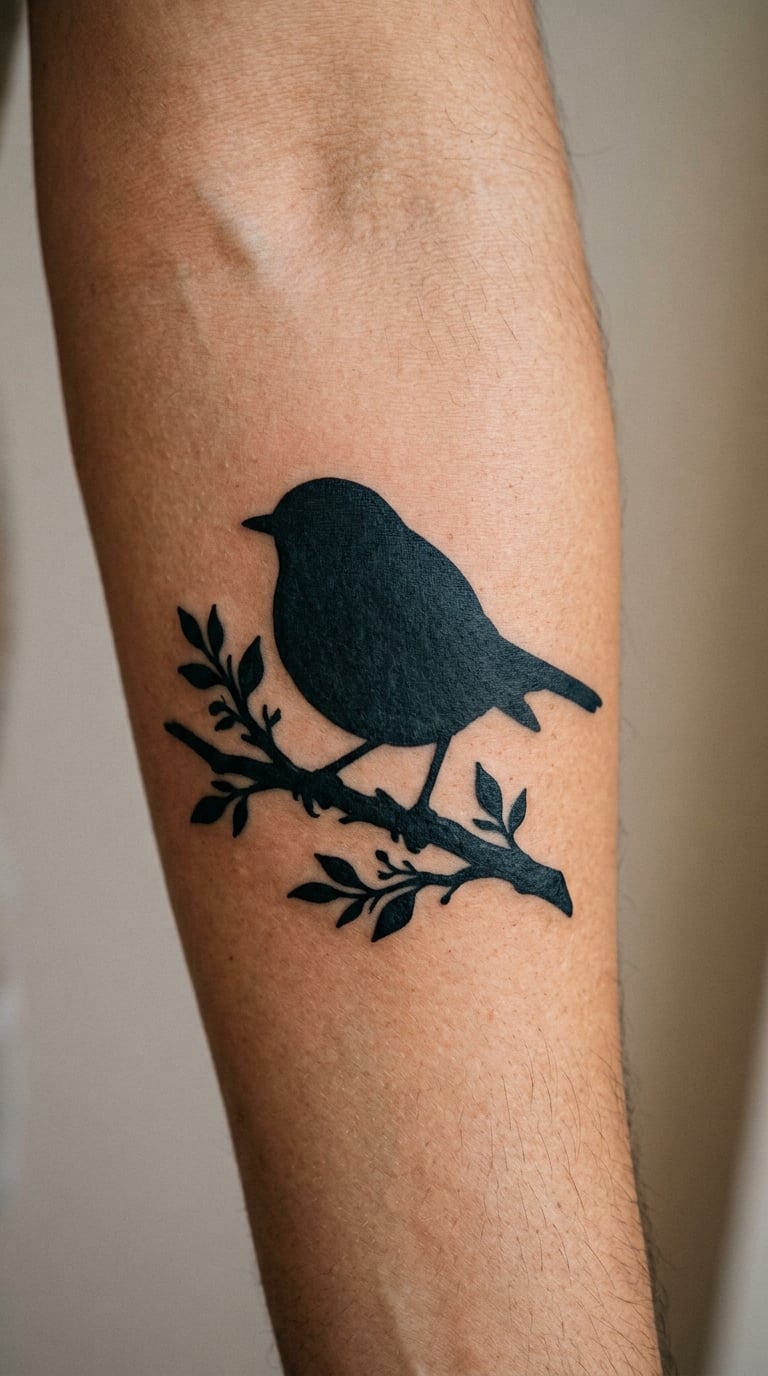
The bold blackwork robin silhouette is one solid shape: the breast curve, the pointed beak, the tail and a branch formed from black negative space, with a few white gaps carved out of the wing. It reads from across a room, which is more than most small bird tattoos can claim.
Choose this when you want a graphic, confident bird rather than a sentimental one. Reviewers consistently point at blackwork as the style that still looks right years later.
Placement: forearm. Size: 3–6 inches (8–15 cm). Style: blackwork. Pain: low to medium, and quick going, because a solid shape means fewer passes. Solid black areas hold their weight as the skin changes more gracefully than tiny feather marks. Make it yours: cut a coordinate, an initial or a birth year out of the negative space without crowding the silhouette.
5. Micro-Realism Robin Portrait on the Wrist
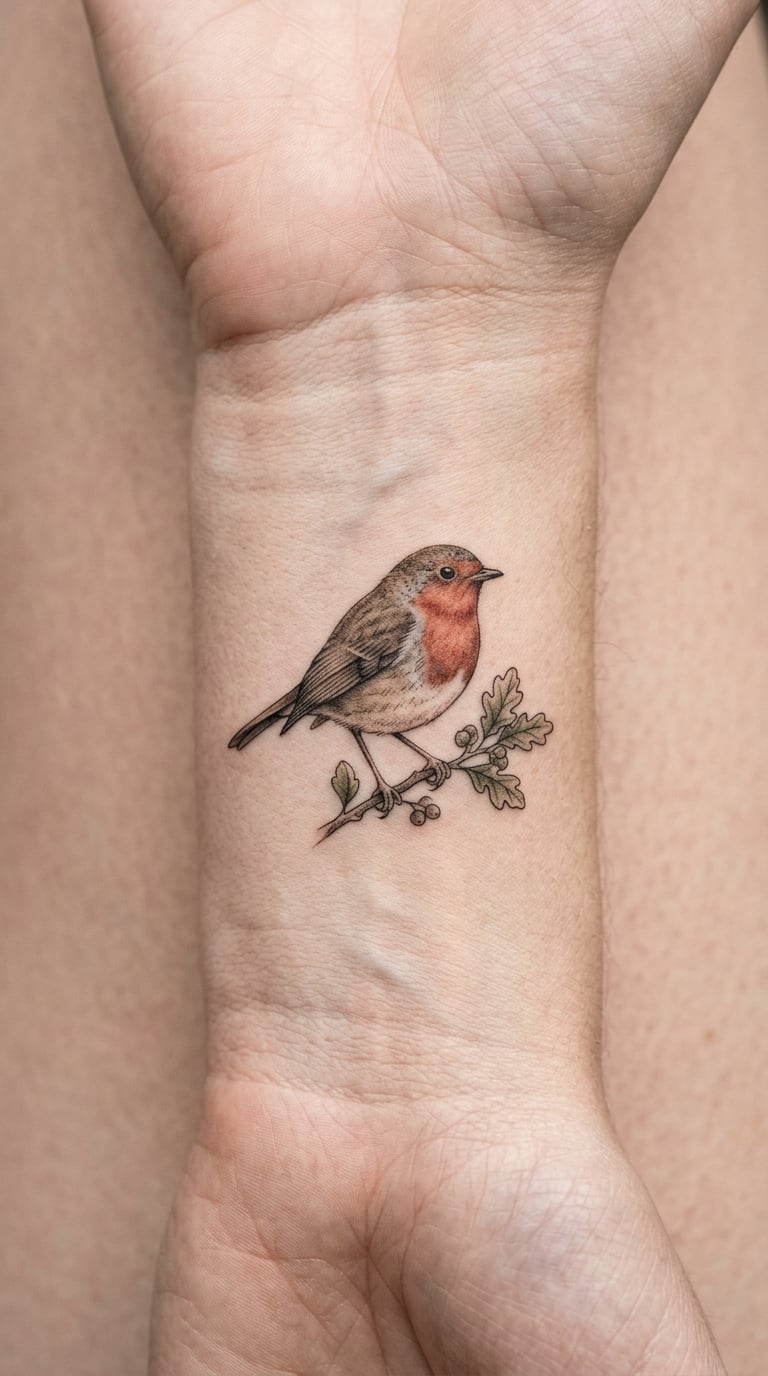
A micro-realism robin portrait is a small side-profile bird built from fine feather texture, a subtle red wash across the breast and enough open space around it that the shape stays legible. The eye is usually the only dark, sharp element.
People choose it to mark a real encounter with robins, a specific place, or a period of change they want to keep visible.
Placement: outer or inner wrist. Size: 1.5–3 inches (4–8 cm). Style: micro-realism. Pain: medium. Wrist skin moves constantly and the hand area shows wear, so feather detail and a small red patch will soften noticeably over time. Make it yours: match the breast colour to an eye colour that means something to you, even if no one else ever notices.
6. Dotwork Robin and Flight Path on the Shoulder Blade
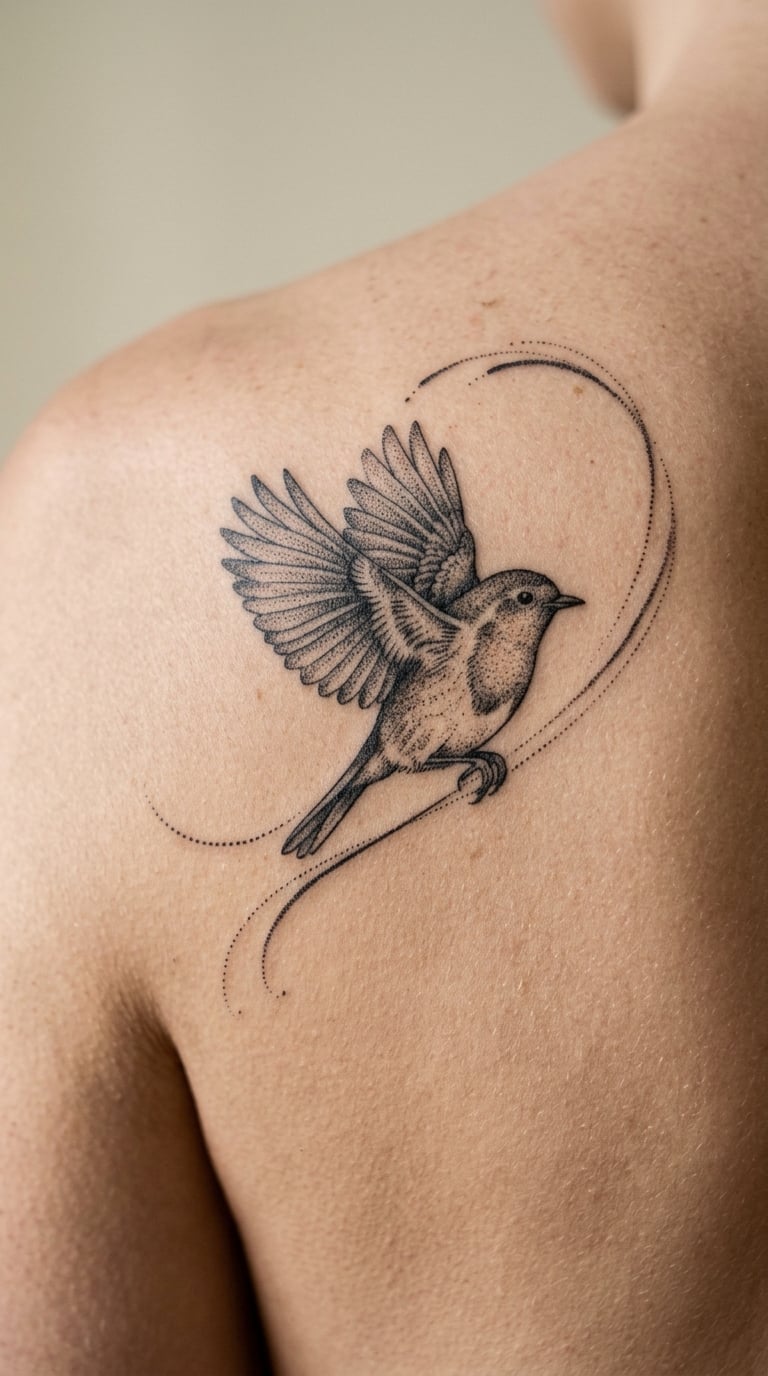
The dotwork robin and flight path is built from graduated black dots: dense and dark under the breast, lighter and more open through the wing, with a sparse curved trail of dots sweeping away behind the bird to suggest flight.
It is a good fit for someone who likes pattern and repetition, and the trail gives you room to extend the design later without starting a new one.
Placement: shoulder blade or upper back. Size: 4–7 inches (10–18 cm). Style: dotwork. Pain: low to medium. Dots must stay large and evenly spaced, because tiny points blur together within a few years and turn grey. Make it yours: arrange the trail dots into a half-mandala or a soft wave so the pattern reads as deliberate.
7. Minimal Single-Line Robin Behind the Ear
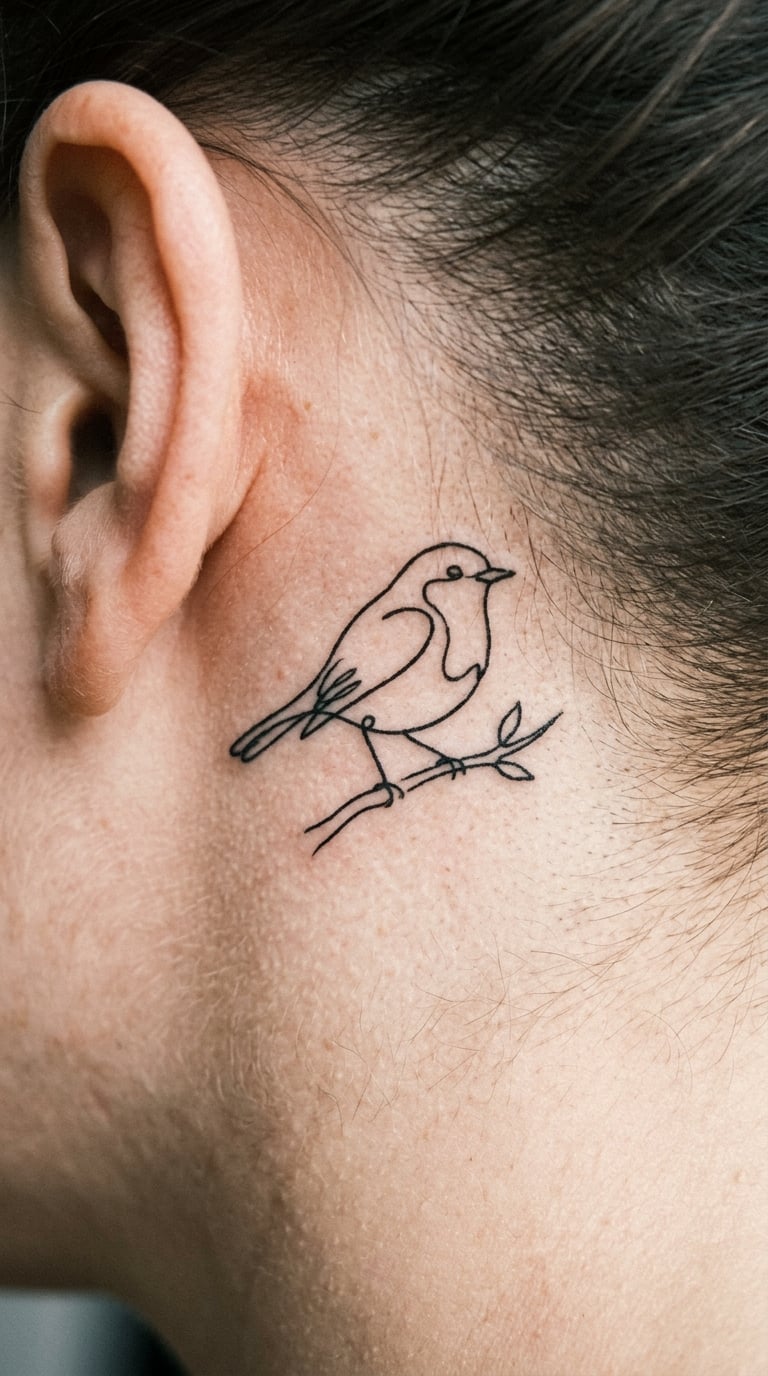
A minimal single-line robin is one economical stroke: the body curve, the branch, the beak, and a single small mark for the breast. There is no shading, no colour and nothing to fill in. Less than most people expect, and that is the appeal.
It suits collectors who prefer discreet, contemporary body art over detailed feathers, and it is an easy first tattoo that still feels like a decision.
Placement: behind the ear or along the side of the neck. Size: 1.5–2.5 inches (4–6 cm). Style: minimal single line. Pain: low to medium, and a very short session. A line that thin can fade or soften, and skin near the face ages visibly, so keep the stroke bold enough to survive. Make it yours: extend the branch into a second element later, or place one tiny meaningful colour dot behind the bird.
8. Old-School Robin with a Nest and Speckled Eggs
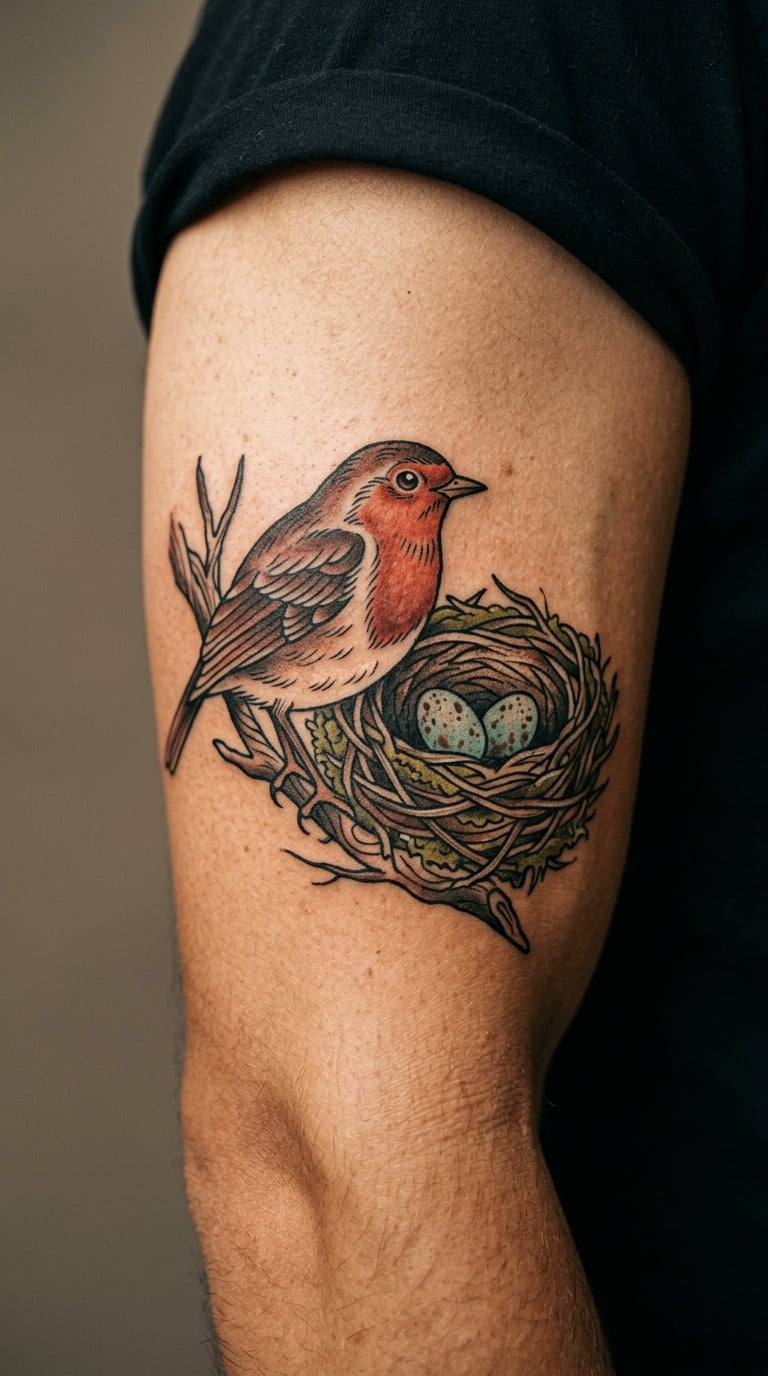
The old-school robin with a nest is a bigger scene: a robin beside a woven nest holding two speckled eggs, drawn with bold outlines, stippled shading and a warm red breast. Stipple dots in the nest walls give it the texture that separates old school from flat traditional.
Nests tend to bring out home and family stories, and a lot of people are tattooing a grandparent’s garden, a childhood house or a place they are homesick for.
Placement: upper arm or thigh. Size: 5–8 inches (13–20 cm). Style: old school. Pain: low on the thigh, low to medium on the upper arm, mostly a long sitting rather than an intense one. Stippling spreads and softens with age, so the texture that looks crisp on day one turns slightly grainy. Make it yours: have a family surname engraved on a small ribbon beneath the nest.
9. Neo-Traditional Robin on a Thorn Branch
The neo-traditional robin on a thorn branch uses saturated red and black colour, dimensional shaded leaves, strong shadow under the bird and a dark thorny perch that cuts diagonally through the composition. The colour work is heavier than a fine-line piece by design.
Plenty of people choose the thorny perch for its protective character rather than any fixed reading, which is a fair reason on its own.
Placement: forearm or calf. Size: 4–7 inches (10–18 cm). Style: neo-traditional. Pain: low to medium. Dense black shading is durable, but the heavier high-contrast work can look bold as the body changes over the years. Make it yours: use your birth-month flower in place of one of the leaves.
10. Celestial Robin with Stars on the Inner Arm
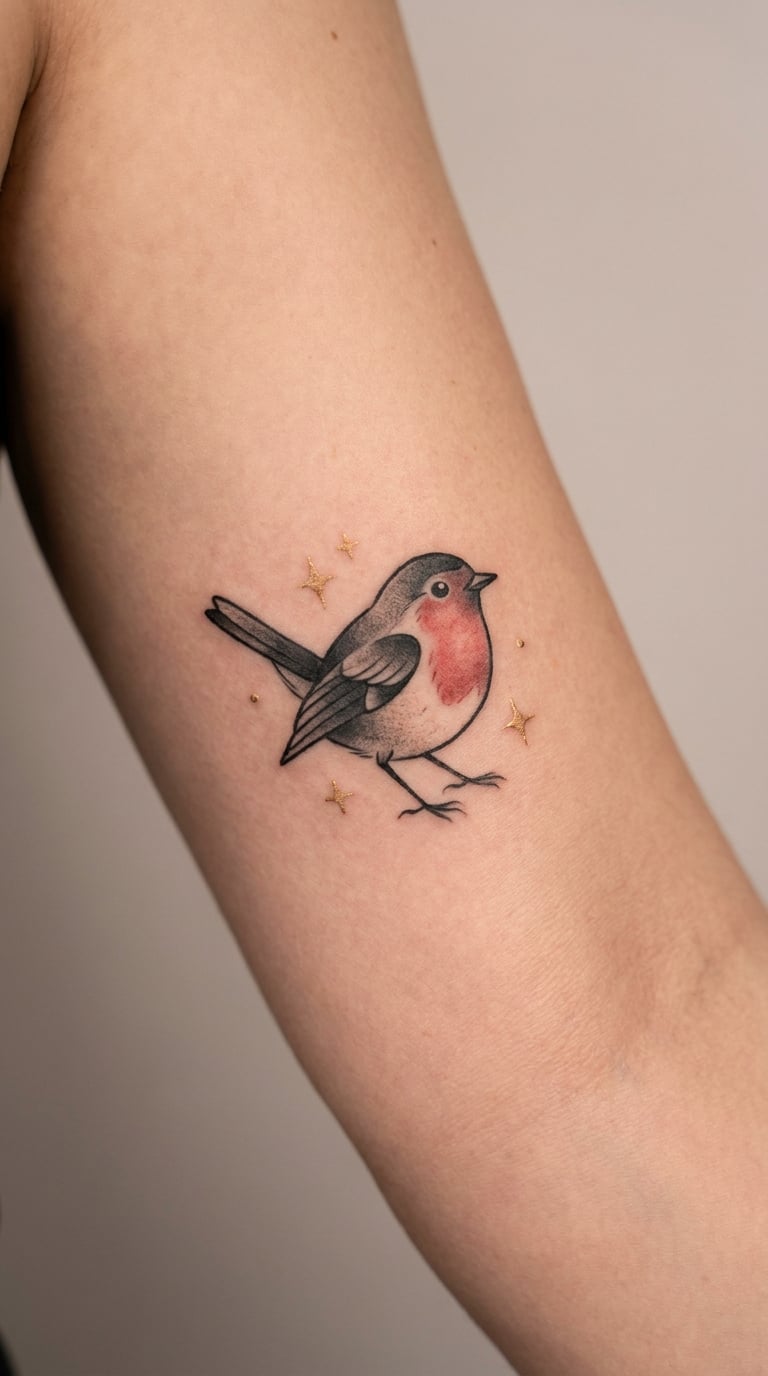
The celestial robin is drawn in deep charcoal with a red chest, curled or perched among small five-point stars with selective gold accents. Fewer stars, spaced further apart, look far better than a cluster of tiny ones.
Night-sky imagery often gets picked for the hopeful, expansive feeling it carries, or as a quiet marker of a person who is no longer physically there.
Placement: inner upper arm. Size: 3–5 inches (8–13 cm). Style: illustrative with metallic accents. Pain: medium. Metallic gold shifts noticeably in tone as the skin ages, and small stars need bold sizing or they fill in. Make it yours: trace a constellation that was visible on a night that mattered to you.
11. Two Fine-Line Robins on a Curved Collarbone Line
Two fine-line robins sit along a lightly curved branch, drawn in black outline with sparse feather marks and one small red accent on each breast. The birds can face each other, face the same way, or face outward along the line.
It is a companion-style design that works for love, friendship or a shared memory, and it also holds together as a single piece if you never do match it. We cover the planning side of that in our guide to matching tattoos for roommates.
Placement: collarbone, sternum or inner forearm. Size: 3–5 inches (8–13 cm). Style: fine line. Pain: low to medium. Two small birds plus two red details need real spacing or the middle turns to mush, so this is a design your artist will want to lay out before it starts. Make it yours: give each bird a slightly different branch so the pair matches without looking copied.
12. Botanical Engraving Robin on the Calf
The botanical engraving robin follows the format of a vintage field guide: fine cross-hatching across the breast and wing, muted brown shadows, and carefully observed leaves filling the space around the bird. It rewards close looking, which is the whole point of the style.
This suits someone who likes natural-history illustration rather than a cartoon bird, and it is one of the few robin designs that holds up as a genuine display piece.
Placement: outer calf. Size: 5–9 inches (13–23 cm). Style: engraving illustration. Pain: medium. The lower leg is sensitive and the calf area is bony near the edges, so expect a long, moderate session. Tiny hatch marks and brown pigment lose definition with prolonged sun exposure. Make it yours: label the leaf with the name of a plant that grows near you.
13. Geometric Robin Made from Straight Lines
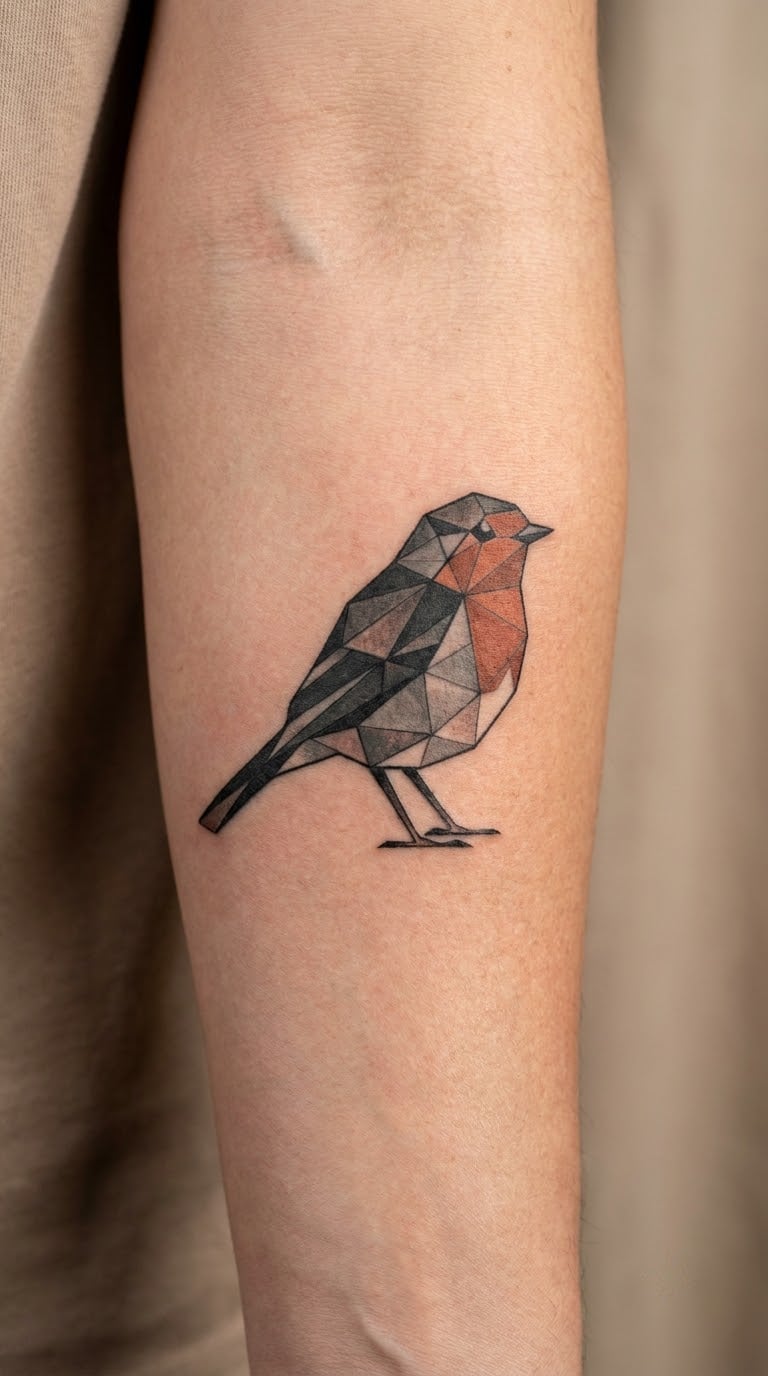
The geometric robin is built from angular planes: triangular wings, a faceted body, a straight beak and a restrained palette of black, grey and rust. Keep the triangles large and the palette to three colours, otherwise the bird turns into a pattern with no bird in it.
It works for someone drawn to modern, architectural form, and it is a better fit for an existing blackwork collection than a soft watercolour piece would be.
Placement: forearm, thigh or upper arm. Size: 3–6 inches (8–15 cm). Style: geometric. Pain: low to medium. Very narrow separators and tiny triangular infills blur over time, so the design needs generous line gaps. Make it yours: repeat one chosen feather angle as a matching element on another body site later.
14. Robin Flying Over a Dotted World Map
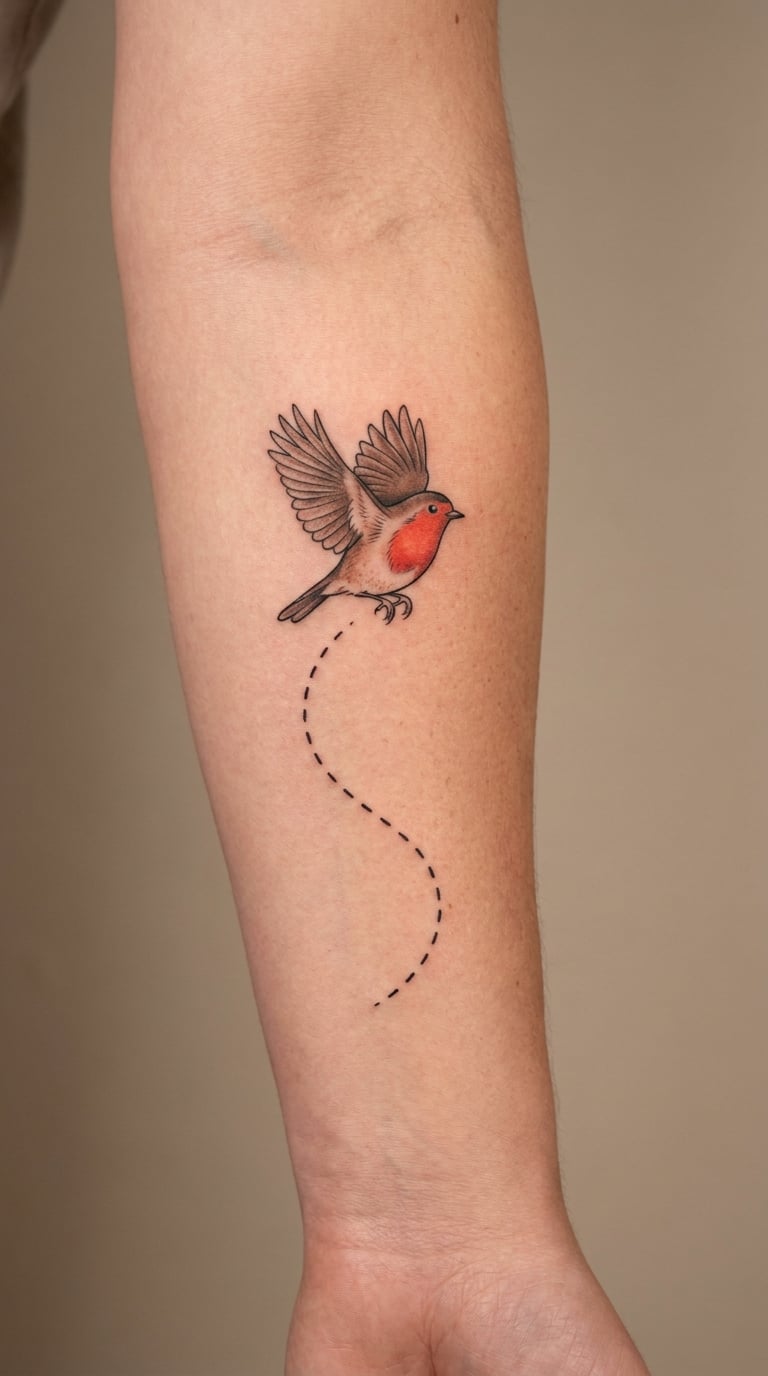
In this composition a small side-view robin flies above a simplified map of the world drawn in dots, with one dotted route running between two places. The route is the storytelling element, not the bird.
It reads as travel, distance, home or a particular year of your life, and it works for people who already have a location tattoo and want something quieter alongside it.
Placement: forearm or calf. Size: 4–7 inches (10–18 cm). Style: fine line with blackwork. Pain: low to medium. Map dots and the bird’s fine feather lines both have to stay large enough to age well, and small dots fill in first. Make it yours: replace the route with a single discreet coordinate for somewhere that matters.
15. Robin with Red Peony Blossoms on the Thigh
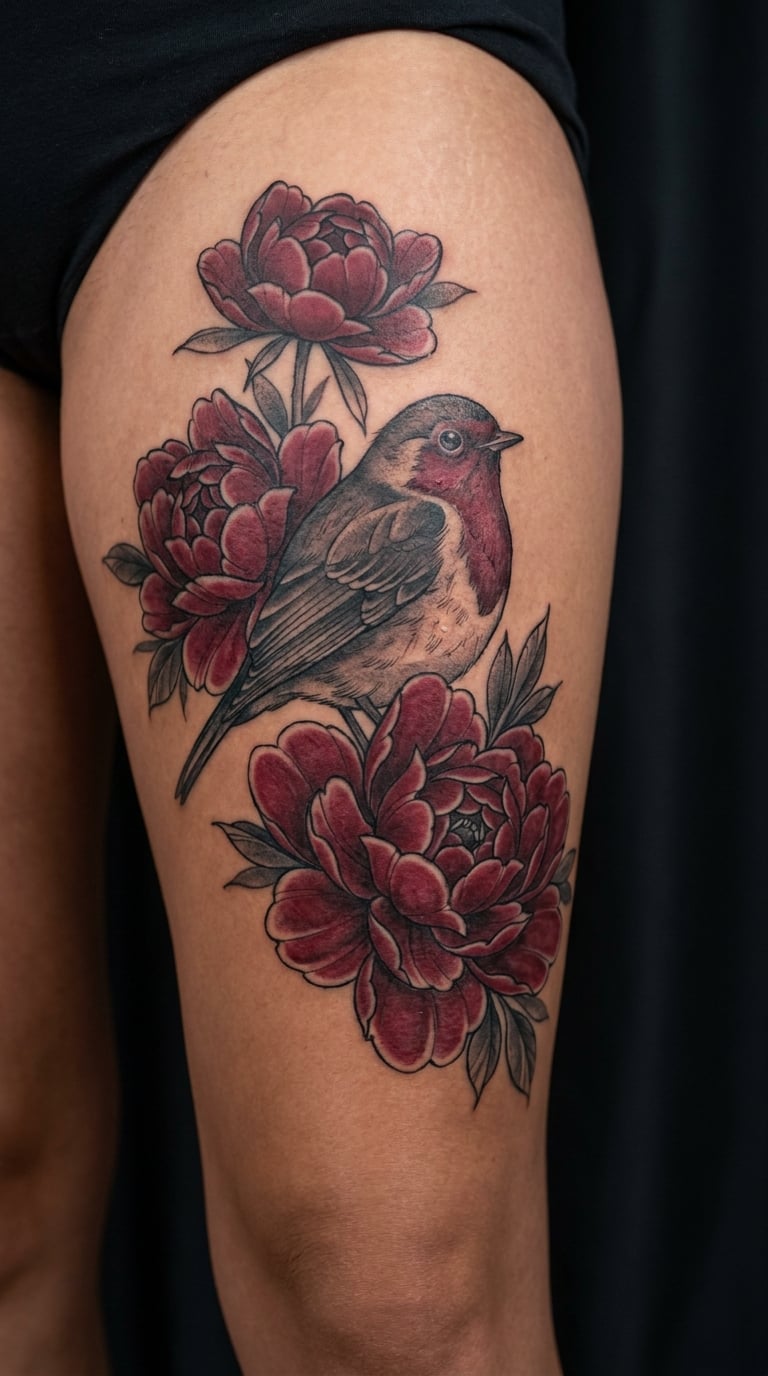
The peony robin is a black-and-grey bird with soft feather texture nestled among large red peonies, with the flower shading carrying most of the colour. Big blossoms give the piece weight so the bird does not get lost.
Blossoms are usually chosen for their beauty or a personal connection rather than a guaranteed cultural reading, which is worth saying plainly in a consultation.
Placement: outer thigh. Size: 4–7 inches (10–18 cm). Style: black and grey with colour accents. Pain: low to medium, and the thigh hides a fresh piece well. Broad red blossoms age better than tiny petal details, so keep the smallest petals simple. Make it yours: pick a flower tied to a family member or a specific event.
16. Winter Robin on a Snow-Capped Branch
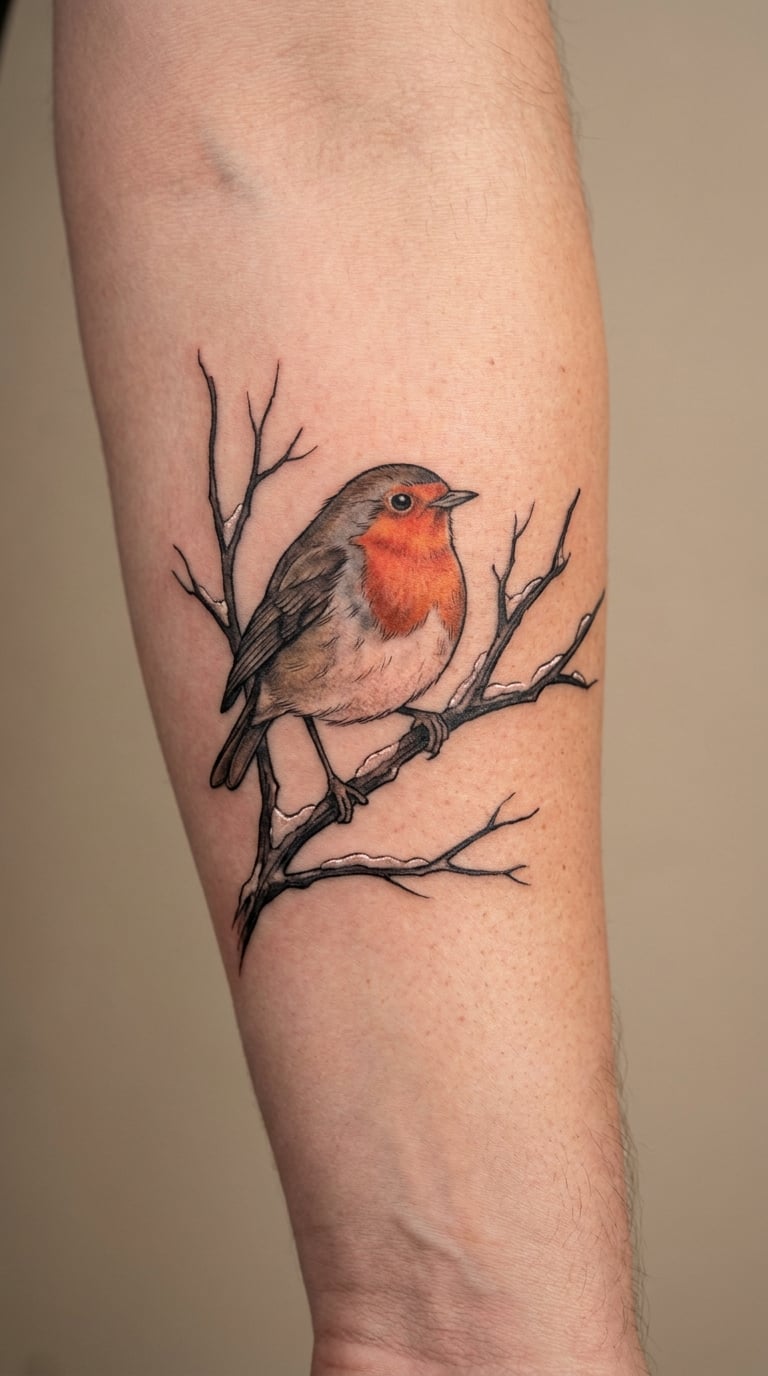
The winter robin sits on a bare branch under a light dusting of snow, drawn in black and grey linework with a warm red-orange breast and restrained white highlights. The branch should be angular and bare, with no leaves competing for attention.
Winter framing often gets chosen for resilience, warmth or simply a favourite season, and it reads well as a November or December booking.
Placement: forearm or upper arm. Size: 3–6 inches (8–15 cm). Style: illustrative. Pain: low to medium. White highlights and thin snow lines are the first marks to disappear, so ask for slightly heavier whites than feels natural. Make it yours: add your birth month’s snowflake shape tucked into the branch fork.
17. Side-Profile Robin with a Red Heart Breast
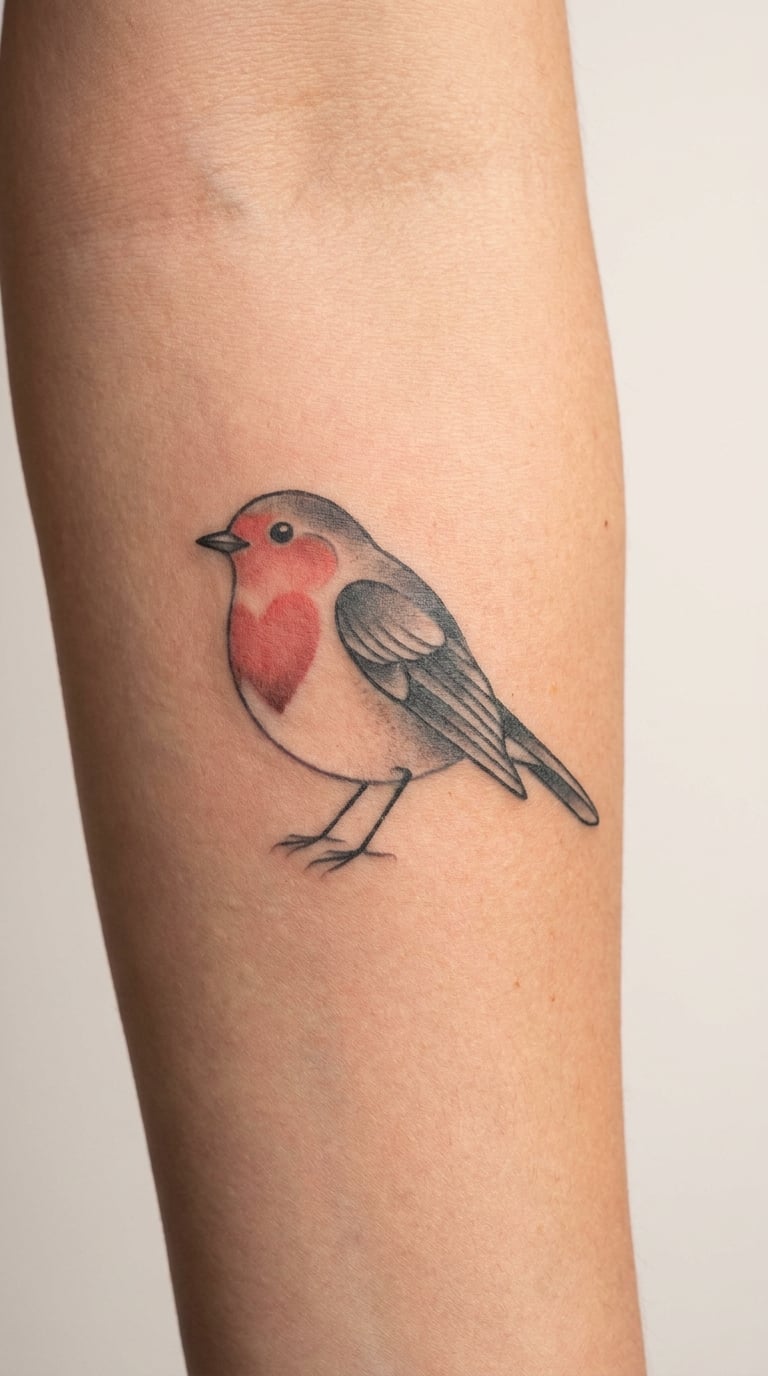
This side-profile robin keeps a clean black head, grey wing and a red breast shaped so the top notch reads as a heart without the bird turning into a symbol. The trick is subtle: the curve has to still be a bird’s chest.
It tends to get chosen for love, family or plain self-affection, and it is a small piece that carries more than its size suggests.
Placement: inner forearm or wrist. Size: 2–4 inches (5–10 cm). Style: illustrative minimal. Pain: medium, mostly from wrist movement holding the skin tense. A solid red shape ages better than fine feather texture, so expect a colour touch-up rather than a full refresh. Make it yours: add an initial or a date in the negative space above the branch, not underneath it where the arm will fold across it.
18. Holly and Robin Holiday Design on the Back of the Hand
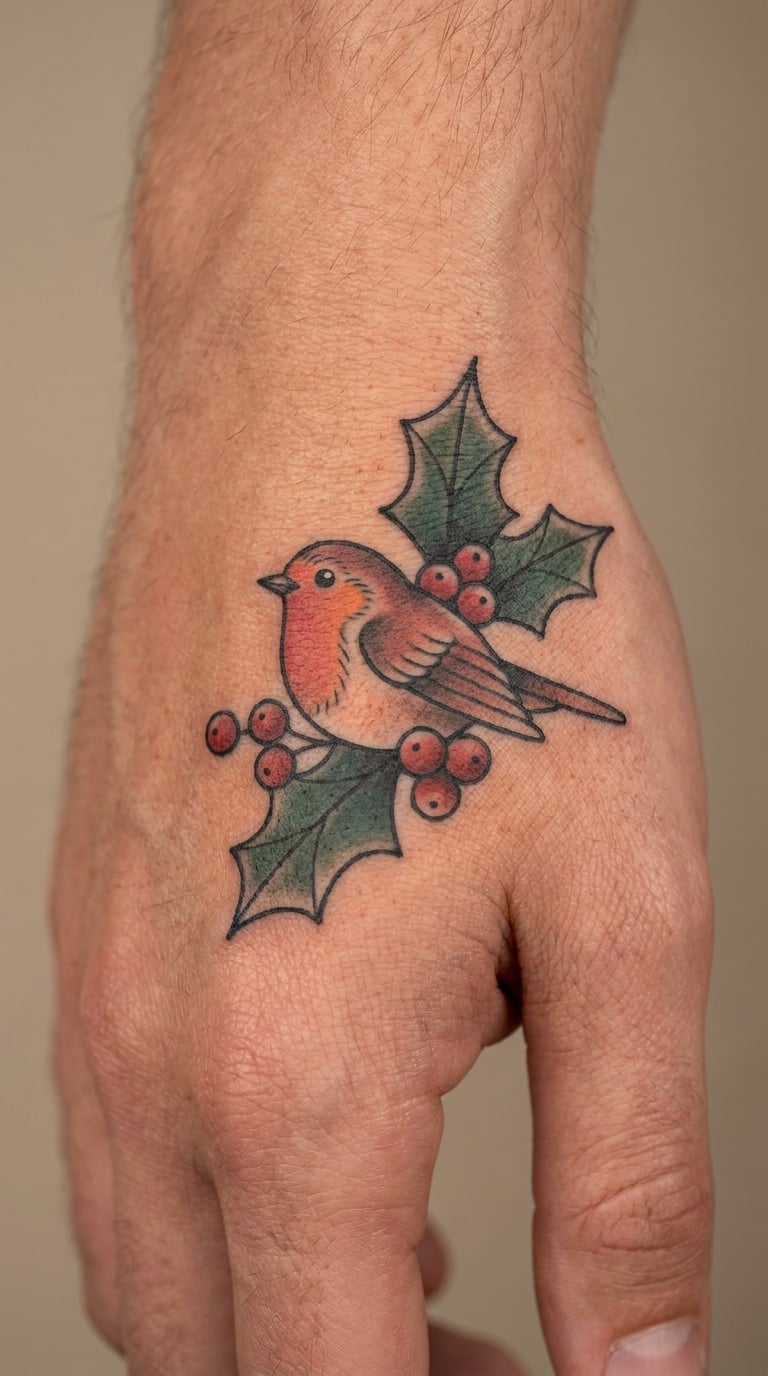
The holly robin is a compact red-breasted bird tucked between dark green holly leaves and two red berries, finished in a traditional illustrative style. The leaves should be larger than the berries so the shape holds together at small size.
It can mark a family winter tradition or simply the bird itself, and it looks like jewellery when it is small and neatly placed.
Placement: back of the hand. Size: 2–4 inches (5–10 cm). Style: traditional seasonal. Pain: medium to high, and worth expecting. Hand placement is bony and constantly in use, and finger movement plus frequent washing both affect fine detail. Make it yours: match it with a family member using the same bird and a different leaf.
19. Rainbow-Colour Robin on the Rib
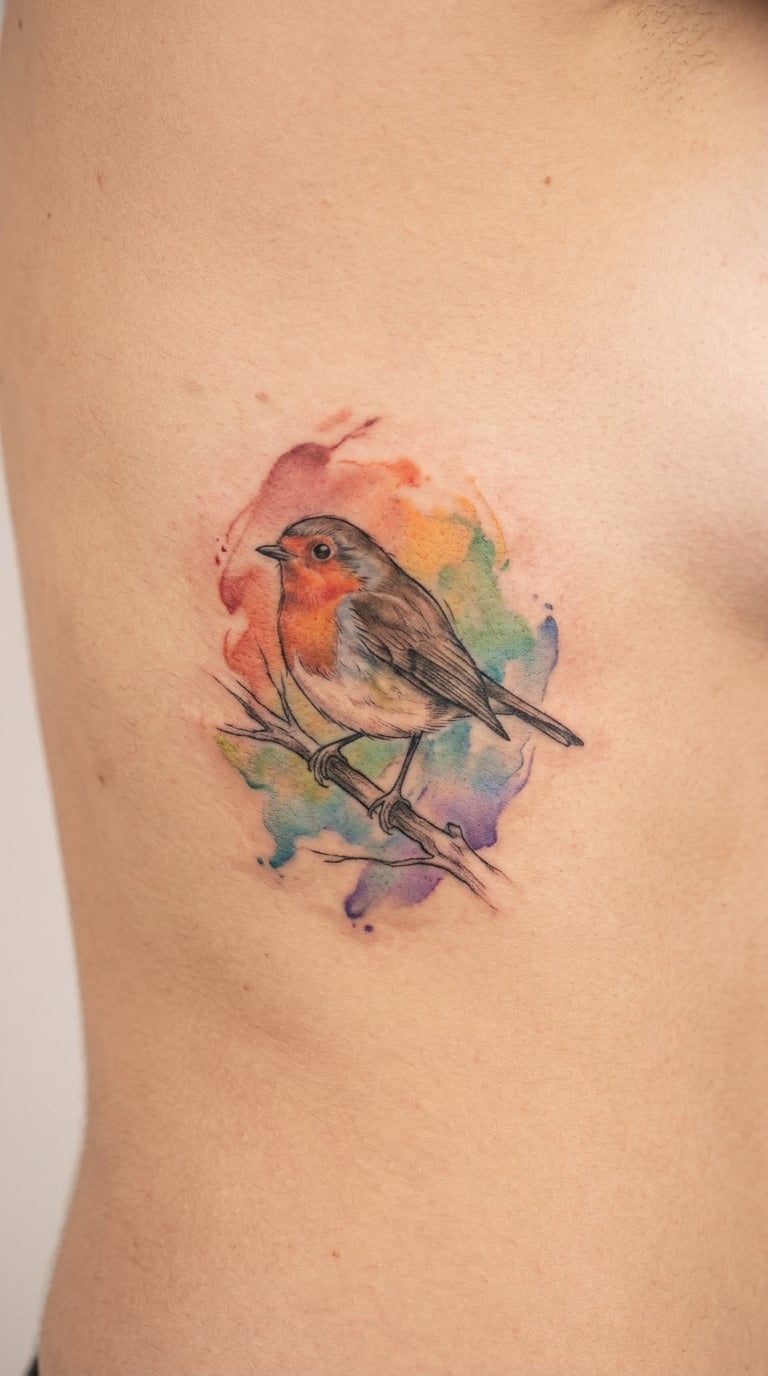
The rainbow robin keeps a realistic bird silhouette with a clear breast and beak while loose watercolour bleeds outward behind it in red, orange, yellow, green, blue and violet. Letting the colour run past the outline is what stops it looking like a cartoon.
It suits someone who wants a colourful bird without a fully traditional piece, and it is an easy match with an existing colour sleeve.
Placement: rib or side torso. Size: 4–7 inches (10–18 cm). Style: watercolour realism. Pain: medium to high, and a long session over a curving area. The rib has more skin movement than a forearm, and soft colour fades faster than hard black line. Make it yours: choose the colour order from something personal rather than a rainbow standard.
20. Robin in a Cherry-Blossom Canopy on the Shoulder
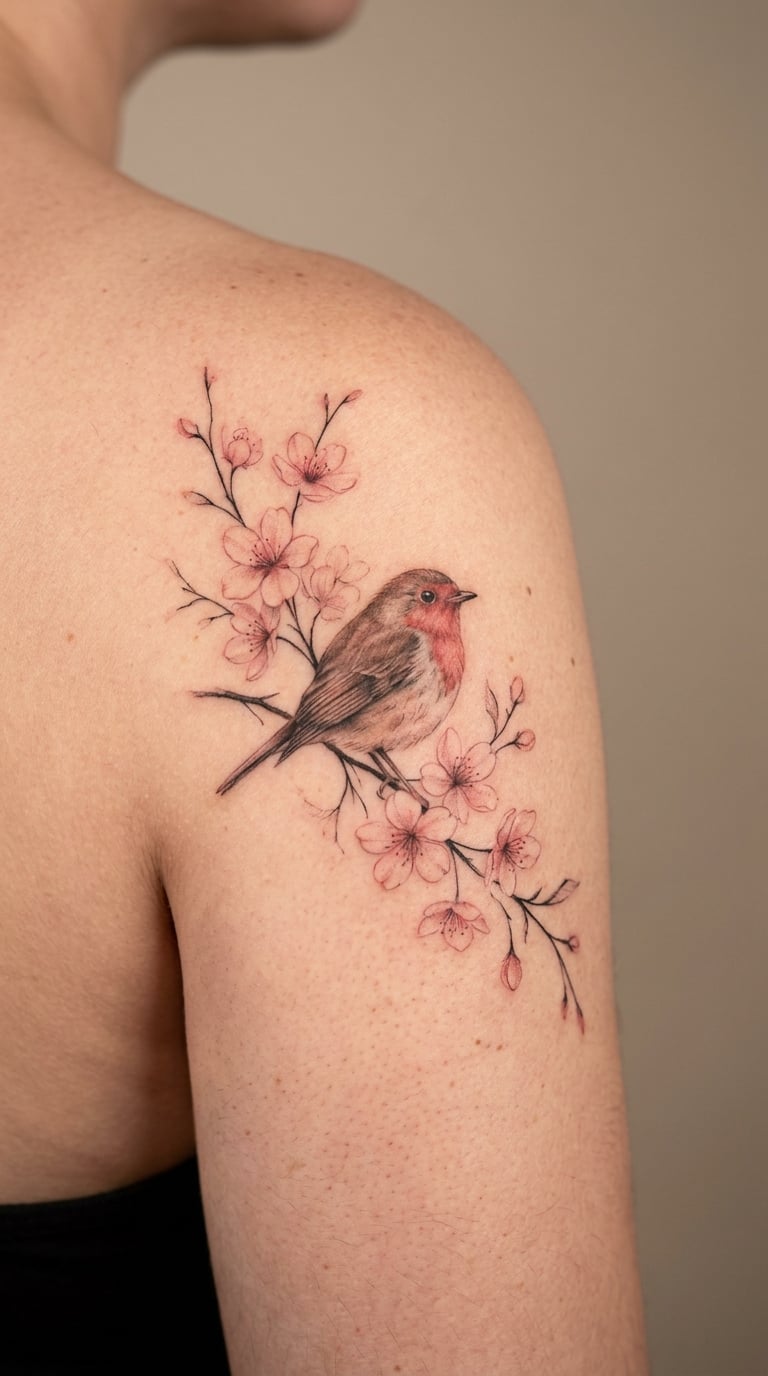
The cherry-blossom canopy robin is a flowing shoulder piece: a robin partly framed by airy pink blossoms on fine black branches, with real open skin left between clusters so it never looks crowded. The composition should follow the curve of the shoulder.
The spring canopy can reflect renewal, home or a Japanese-inspired aesthetic, and the interpretation stays personal rather than fixed.
Placement: shoulder or upper arm. Size: 5–8 inches (13–20 cm). Style: flowery illustrative. Pain: low to medium, mostly a long sit in one area. Many very fine petals soften with sun exposure and age, so the artist should keep each petal shape distinct rather than repeating one. Make it yours: hide a small family initial inside the branch structure.
21. Whimsical Robin with a Tiny Red Mushroom
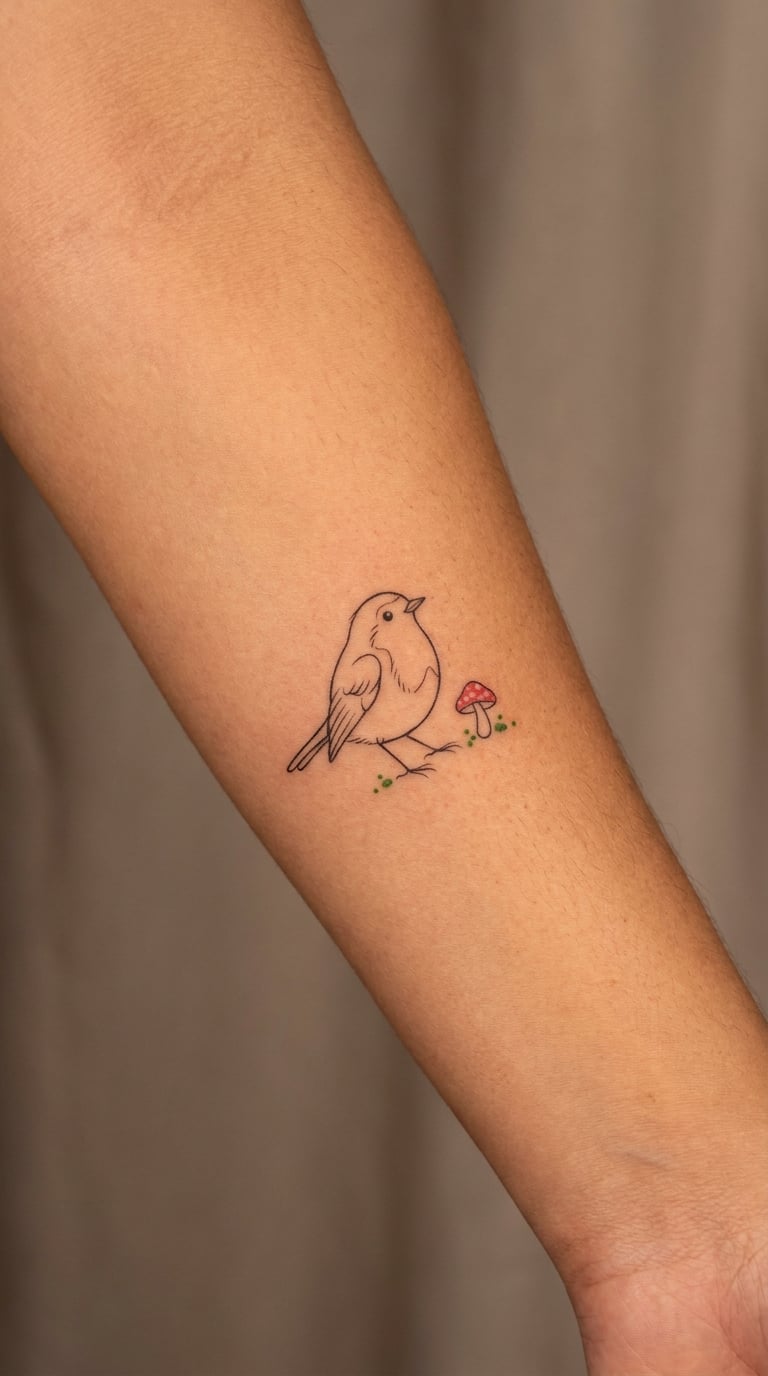
The whimsical robin is a playful fine-line scene: a robin beside one small red mushroom, drawn with clean black contours, a red breast and sparse mossy dots. It is storybook nature rather than cartoon outlines, and one mushroom is the right number.
It suits someone who likes small invented details in their tattoos, and it works as a first piece because the drawing is simple to execute well.
Placement: calf, inner arm or ankle. Size: 2–4 inches (5–10 cm). Style: whimsical fine line. Pain: low to medium. The mushroom cap and dot shading need forms bold enough to stay legible, or they disappear within a couple of years. Make it yours: use a mushroom that actually grows where you live, or add a small year marking.
22. Robin Singing with Musical Notes on the Neck
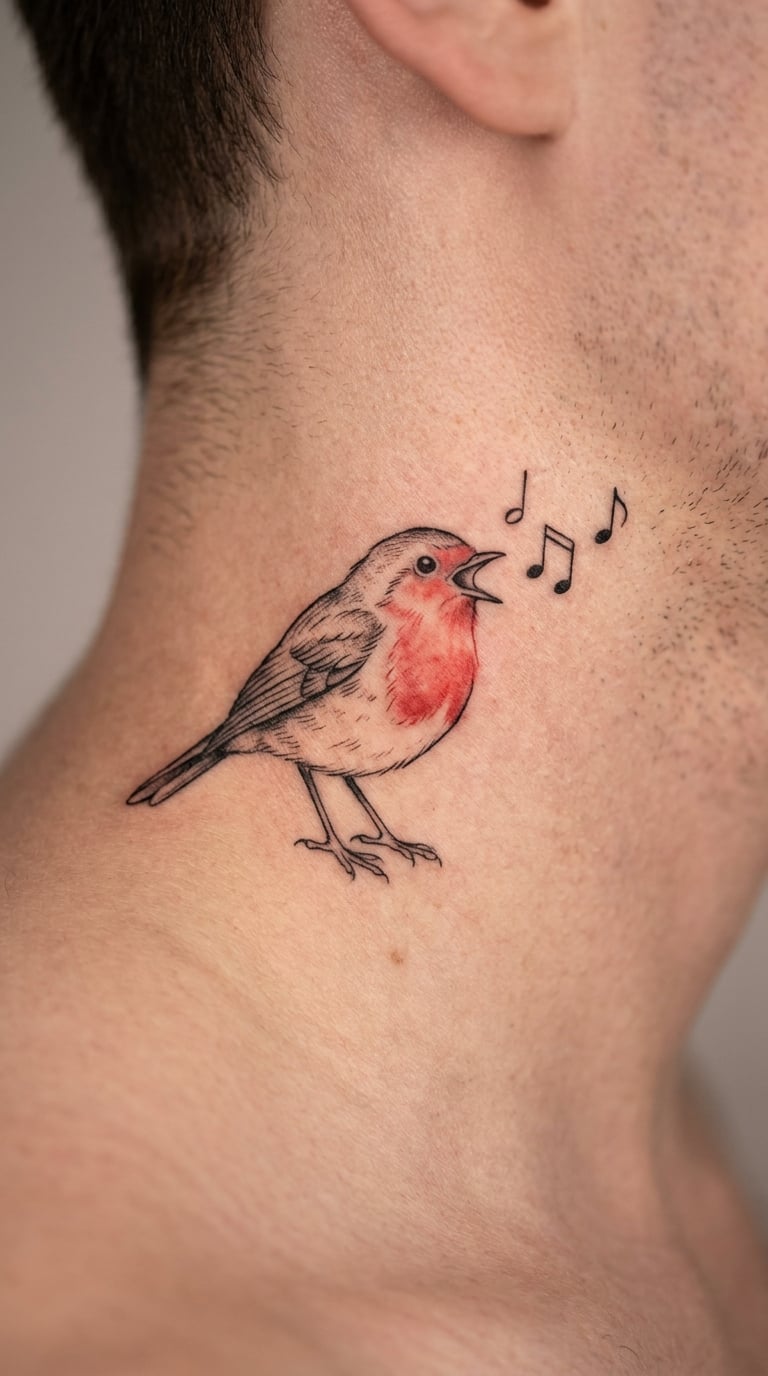
The singing robin is a cheerful side-view bird with its beak open and three restrained music notes rising into empty space, with black linework, a red breast and one muted green leaf. Notes floating into blank skin is the detail that sells it.
For a music teacher, a singer or someone with a favourite performance, the notes are a literal reference rather than a symbolic layer.
Placement: side neck. Size: 2–4 inches (5–10 cm). Style: fine line illustrative. Pain: medium. Neck details look softer as the skin changes, and the notes have to be simplified to three or they turn into smudges. Make it yours: replace the notes with a lyric fragment in a matching script, kept short.
23. Robin Branch Sleeve Element on the Outer Forearm
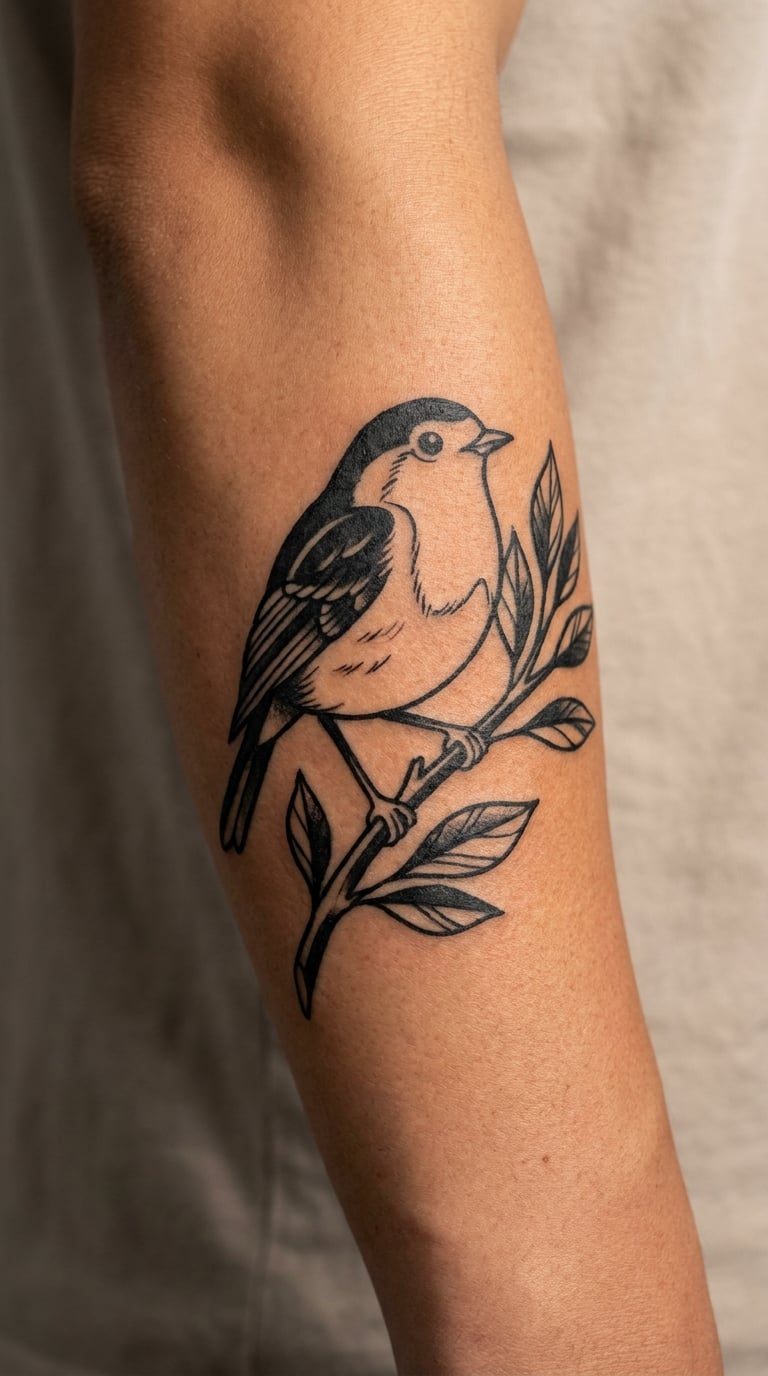
The robin branch sleeve element is a standalone composition of a robin on a branch with several leaves, drawn with bold outlines and balanced negative space so it can sit beside an existing sleeve without covering it. Think of it as the first panel, not the finished piece.
It makes sense if you already collect birds or branches, because the branch naturally extends into whatever comes next.
Placement: outer forearm. Size: 6–9 inches (15–23 cm). Style: bold illustrative. Pain: low to medium, and a longer session at this scale. Anything added later has to match the same line weight and healed colour, so agree the palette now. Make it yours: pick a branch from somewhere you have actually walked.
24. Small Flying Robin Above the Ankle
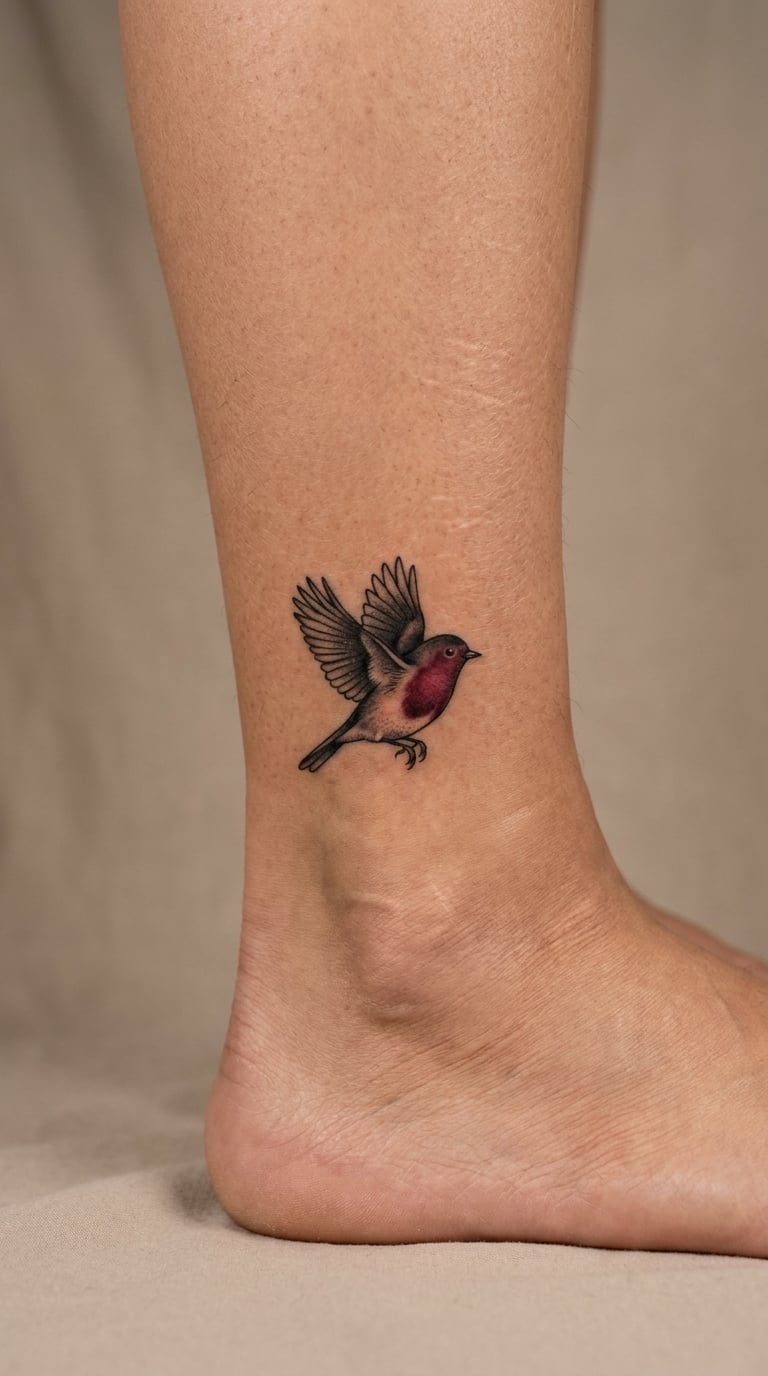
The small flying robin is a compact bird in upward flight, drawn with a few confident curves, a red breast and a tapered motion trail rather than full feather detail. Three or four strokes, and the shape does the work.
Upward movement tends to read as light and mobile, though you are free to attach your own reason to it.
Placement: above the ankle bone or on the inner ankle. Size: 1.5–3 inches (4–8 cm). Style: minimal illustrative. Pain: medium. Ankle movement, footwear and sun all affect the lower leg, and the shape of the foot changes over the years, so keep the trail abstract enough to survive. Make it yours: add a small date at the end of the trail.
How to Choose the Right Design
Almost every disappointing bird tattoo I have seen traced back to a mismatch between the reference image and the body site. These five checks catch most of that before the appointment.
Match the style to the skin you actually show
If your arms are out most days, a fine-line robin on the inner forearm will be seen and will fade faster. A blackwork silhouette on a covered upper arm ages more quietly. Think about a normal Tuesday, not the photo you take when you first get it.
Check it still reads as a robin at the smallest size you would accept
Ask your artist to draw the bird at final size, not enlarged on a screen. The breast, the beak and the upright stance are the three things that make it a robin, and if they survive at 2 inches they will survive anywhere.
Be honest about how much colour you will maintain
Colour is a maintenance choice. Fine line and watercolour robins are the prettiest in year one and the ones that need a refresh; blackwork and heavy black-and-grey hold their shape with far less effort.
Decide what happens to your body shape in ten years
Ribs, waists and upper arms change more than forearms and calves. Large compositions on those areas need enough size and enough negative space to distort gracefully rather than stretch.
Bring a story, not only a reference picture
Artists do better work when they know the reason. A robin for a grandmother, a robin for a first flat, a robin for the year everything turned around: that sentence changes spacing, scale and how much detail the design can carry. A date or an initial is worth adding only if the design has room for it, and if it does not, leave it out.
Cost and Session Time
Small line and micro designs usually sit at a shop minimum, which in the US runs roughly $80 to $200. A small but detailed bird lands closer to $150 to $350, because the hours drive the price more than the size does. Medium illustrative and traditional pieces sit somewhere between $300 and $800, and a large 6–9 inch composition runs $700 to $1,500 or more depending on the artist you book.
One session is usually enough for small or simple work. Detailed, colourful and highly personalised pieces are often split across two appointments, so the artist is not rushing a face or a feather pattern. What actually moves a quote: shop minimum, the artist’s hourly rate, how many sessions the piece needs, colour count, and whether you are booking somewhere with a waiting list. Travel to a different city adds a second trip, so ask whether the first session leaves room to finish later.
Bring healed photos of the artist’s own work in the style you want, not just fresh posts. Fresh work looks better than healed work for everyone, and healed work is what you will be living with.
Aftercare Basics
Follow your artist’s aftercare instructions first; the list below is the general shape of it.
Wash the fresh tattoo gently with lukewarm water and a mild unscented cleanser, then pat it dry with clean hands or a paper towel rather than rubbing it.
Keep it out of direct sun, avoid friction from tight clothing, and leave it alone when it flakes. Picking flakes is the most common way a good line work ends up patchy.
Do not soak, swim or cover it in plastic for long stretches until it has healed. If you need to cover it for work, use loose clothing.
Skip lotions, oils and perfumed products on the area while it heals.
If you notice spreading redness, warmth, swelling, pus or a fever, contact a qualified medical professional rather than searching online for a diagnosis.
Frequently Asked Questions
How can I make sure my tattoo looks like a robin and not another small bird?
Three details do the work: the orange-red breast, the upright posture, and a short fine beak. Ask your artist to draw the bird at its final size before you agree, because an enlarged drawing hides problems that appear once it is small. If the breast colour, the head shape and the stance all survive at that size, it will read as a robin.
What is the least painful placement for a robin tattoo?
The inner upper arm, the thigh and the calf are usually the calmest options, because they are fleshy and easy to work across. The wrist, the neck, the ribs and the back of the hand tend to be sharper, mostly from bone and from skin that moves constantly. Placement matters more than size for how a session feels.
Will a small fine-line robin tattoo fade quickly?
Faster than most people expect. Thin single-needle lines soften in a few years, and a small red breast is the first thing to blur, especially on wrists, fingers and anywhere that sees regular sun. A bolder line weight and slightly larger bird help. If the piece is mostly fine line, plan on a refresh rather than treating it as permanent line work.
Should I choose a coloured or black-and-grey robin tattoo?
Choose colour if the red breast is the point of the tattoo, since the orange-red breast is what makes a robin recognisable. Choose black and grey if you want the bird to stay legible for a decade with less upkeep. A good middle ground is a realistic bird in black and grey with a single red breast, which keeps the identifying feature without making the whole piece colour-dependent.
Do robin tattoos have a specific meaning?
No single fixed one. Robins commonly carry hope, renewal, new beginnings and the arrival of spring, and the widespread belief that a robin’s appearance means a loved one is nearby makes it a frequent memorial choice. Some people use the bird for that reason, some for a garden or a place. The meaning is whatever you decide it is.
How small can a detailed robin tattoo realistically be?
About 1.5 inches (4 cm) for a simple silhouette or single-line bird, and closer to 2 inches (5 cm) before you can hold visible breast colour and feather texture. Under an inch, detail turns into a smudge and the bird stops reading. If you want small, the artist should simplify the design rather than shrink a detailed drawing.
Conclusion
If this is your first bird, start with idea 7, the single-line robin behind the ear, or idea 5 on the wrist. Both are simple enough to heal well and small enough to hide at work. If you are already building a nature collection, the bold blackwork silhouette, the botanical engraving calf piece and the traditional mossy branch all have enough scale to hold their own against existing work.
Whichever you choose, find a qualified artist, look at healed examples rather than fresh posts, and adapt the drawing to the body site before you settle on a size. A robin is a forgiving subject, and these 24 robin tattoo ideas give you a good place to start. If you want a hopeful or scenic theme around the bird, our guides to sunrise tattoo ideas with meaning and mountain and ocean pairings cover the same small-scale planning.