
25 Crane Bird Tattoo Ideas: Best Nature Designs (October 2026)
These 25 crane bird tattoo ideas cover one bird in every direction it can take: a fine-line crane in flight, a black silhouette, a red-crowned crane in traditional style, a pair facing each other, and a crane tucked behind the ear. Each one comes with placement, size, style, pain and a personalisation note, so you can tell whether it suits the spot you had in mind before you book a consultation.
A crane is an unusually forgiving motif for skin. Long neck, long legs, wide wings, a beak that reads at a glance. That silhouette stays recognisable from a finger to a half sleeve, and it carries real meaning without you having to explain it to anyone. Below is the full list, ordered by how often people ask for each design.
25 Crane Bird Tattoo Ideas: Quick Guide
| Idea | Style | Best placement | Size | Pain |
|---|---|---|---|---|
| Fine-line flying crane | Fine line | Inner forearm | 4-5 in | Low |
| Minimal crane silhouette | Solid black graphic | Outer upper arm | 2-3 in | Low |
| Traditional crane in flight | Traditional Japanese | Shoulder | 4-6 in | Medium |
| Watercolor crane portrait | Watercolor | Upper arm | 5-7 in | Medium |
| Blackwork crane, extended wing | Blackwork | Outer forearm | 6-8 in | Low |
| Two cranes in a circle | Fine line | Inner upper arm | 3-4 in each | Low |
| Crane and mountain horizon | Fine line landscape | Forearm | 5-6 in | Low |
| Crane with lotus flower | Fine line with soft colour | Calf | 4-5 in | Low |
| Red-crowned crane, Japanese style | Irezumi-inspired | Back of upper arm | 5-7 in | Medium |
| Micro crane behind the ear | Micro fine line | Behind ear | 1-1.5 in | Medium |
| Crane on the wrist | Fine line | Inner wrist | 2-3 in | Medium |
| Crane in a circular frame | Bold graphic | Upper back | 4-5 in | Low |
| Dotwork crane feathers | Dotwork | Thigh | 4-6 in | Low |
| Crane on a finger | Micro silhouette | Side of finger | About 1 in | High |
| Crane and rising sun | Fine line with colour | Forearm | 3-4 in | Low |
| Floral crane sleeve accent | Illustrative colour | Outer arm | 8-12 in with sleeve | Medium |
| Grey crane with soft shading | Black and grey realism | Calf | 6-8 in | Low |
| Neo-traditional crane, bold colour | Neo-traditional | Upper arm | 5-6 in | Medium |
| Crane in a blackwork triangle | Geometric blackwork | Ankle | 2-3 in | Medium |
| Crane and wave | Fine line | Forearm | 4-6 in | Low |
| Flying crane across the shoulder | Fine line | Shoulder cap | 6-8 in span | Medium |
| Crane with one gold feather | Black and grey with metallic | Upper back | 5-6 in | Low |
| Minimal crane on the collarbone | Fine line | Collarbone | 2-3 in | Medium |
| Crane with a small date | Fine line with lettering | Inner arm | 2.5-3.5 in | Low |
| Watercolor crane with ink wash | Watercolor wash | Outer thigh | 8-10 in | Low |
1. Fine-Line Flying Crane
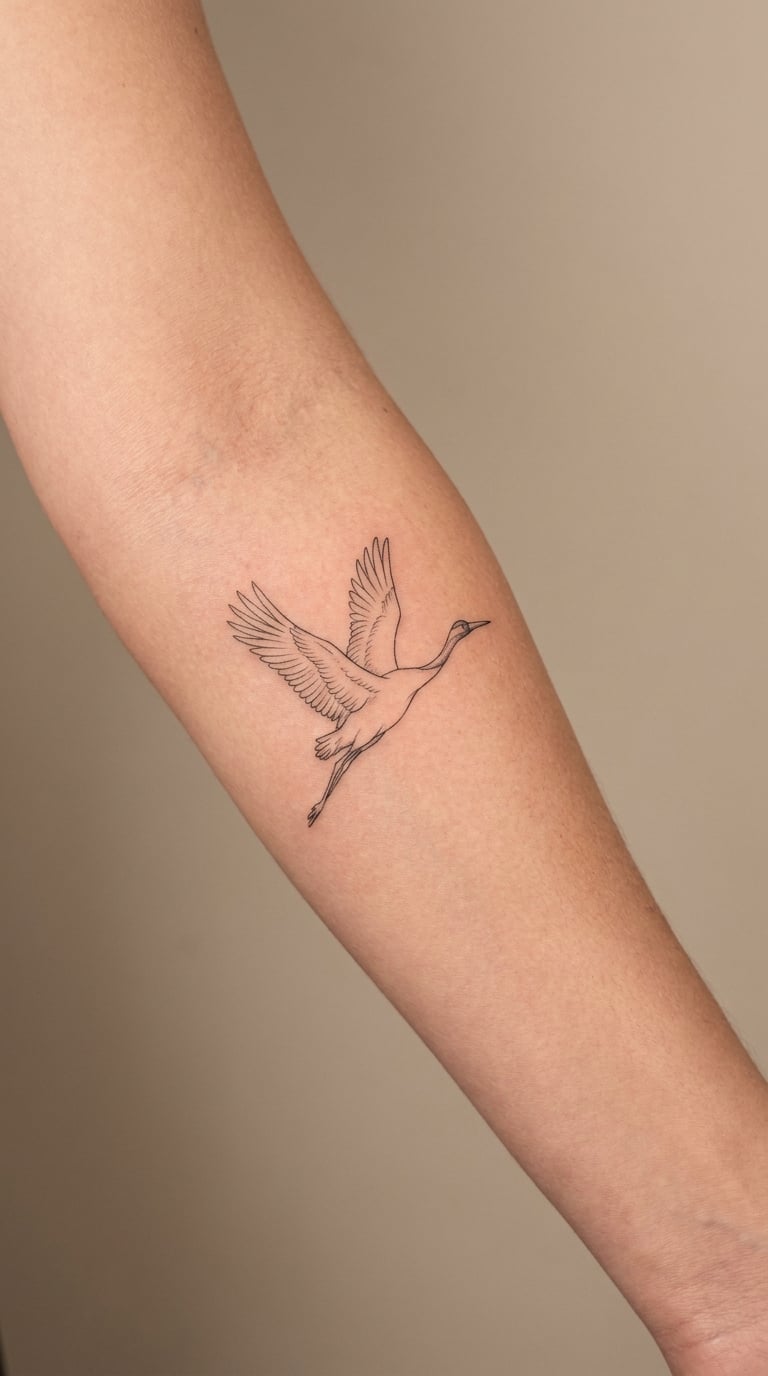
This fine-line crane bird tattoo is one clean bird drawn with sparse, thin linework and nothing behind it. The wing is a single long curve rather than a row of separate feathers, the neck bends back in an S, and the legs trail behind. It looks best with a single unbroken line for the body and a second thinner pass for the wing.
People usually pick it because cranes read as graceful rather than aggressive, and because a bird in flight suits a life that feels like it is moving forward. It is also the easiest crane design to get right at small scale.
Placement: Inner forearm reads best, where the wrist and elbow curve give the bird some shape. Upper arm and inner bicep also work.
Size: 4-5 inches (10-13 cm) from beak to tail. Under 2 inches and the wing detail turns to mush.
Style: Fine line, single-needle weight.
Pain: Low to medium on the forearm. Fine lines blur over the years, so expect a touch-up every few years.
Make it yours: Angle the bird along the forearm curve, or add two dates under the wingtip.
2. Minimal Crane Silhouette
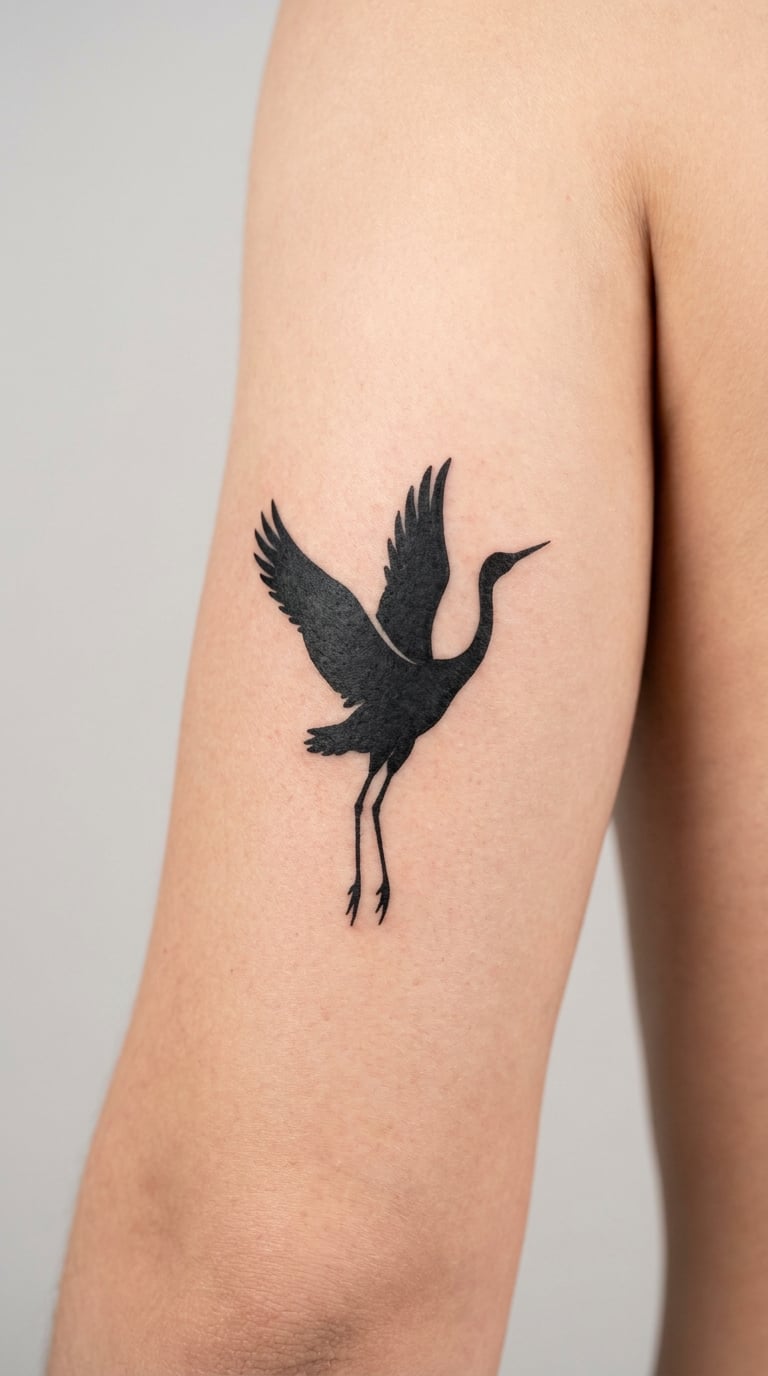
A solid black silhouette is the most graphic crane design on this list. The whole bird is one flat shape: a rounded body, two straight wings spread wide, a long neck pulled forward and two thin legs dropping down. No feather detail, no gradient, no background.
Because there is nothing to lose at small size, this is the version people choose for a first tattoo. Solid shapes also hold their edge years later better than hairlines do.
Placement: Outer upper arm gives the silhouette room. Calf, shoulder blade and outer thigh also suit the wide wing shape.
Size: 2-3 inches (5-8 cm) tall is enough for the shape to read clearly.
Style: Solid black graphic, bold contour.
Pain: Low. Large filled areas go faster than people expect since the needle moves without stopping.
Make it yours: Use the negative space inside the wings for a hidden word, or place it over an existing scar on the upper arm.
3. Traditional Crane in Flight
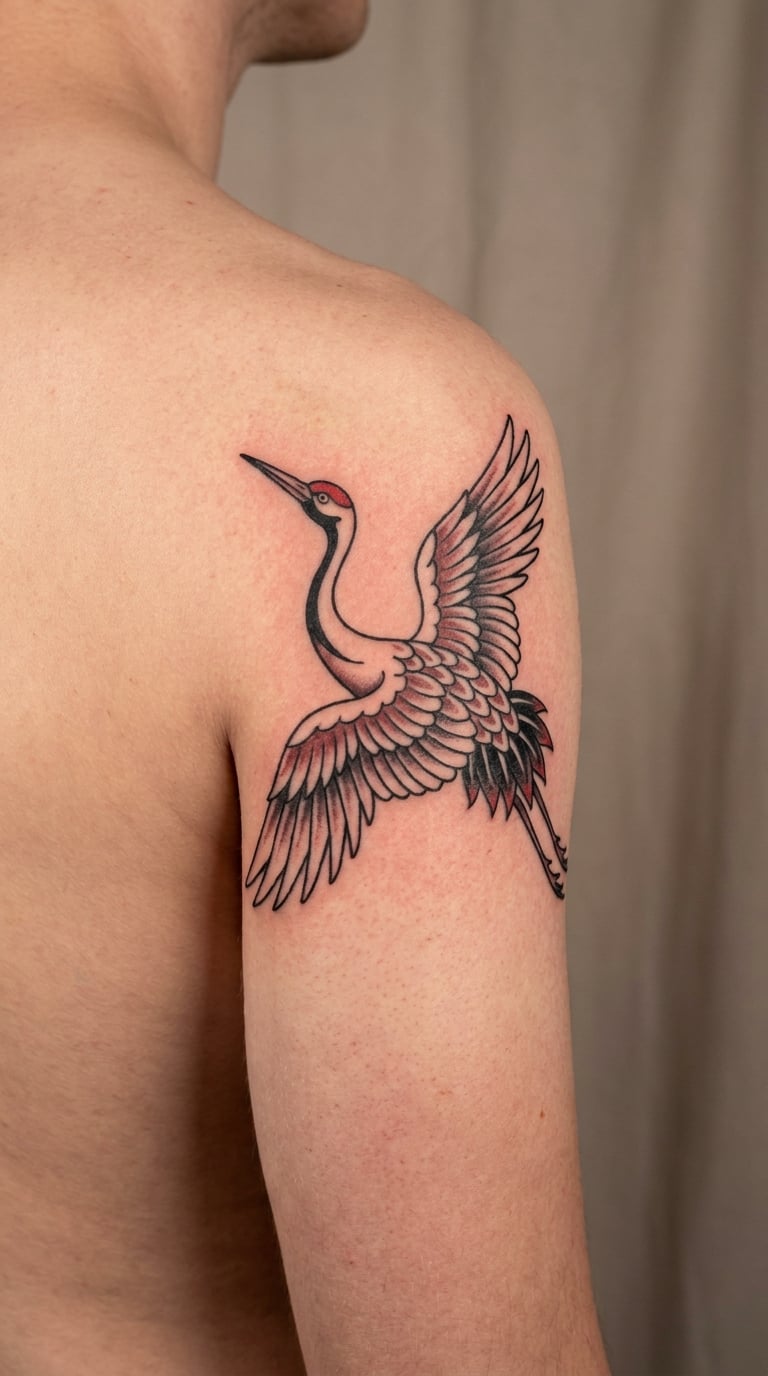
This traditional crane is drawn the way a tattoo flash sheet would draw it: strong black outlines, flat areas of colour, and feathers suggested in tidy rows rather than soft gradients. Red usually carries the crown and a few wing tips, with black for the neck and legs and white left as bare skin for the body.
Traditional style exists to be readable from across a room, and a crane in flight is one of the strongest shapes for that. People often choose it to add a coloured piece to an arm that already has blackwork.
Placement: Shoulder cap or outer shoulder, where the bird can spread across the deltoid. Upper arm works at a smaller scale.
Size: 4-6 inches (10-15 cm) wingspan minimum. Traditional linework needs room or it turns muddy.
Style: Traditional Japanese, bold outline, flat colour.
Pain: Medium on the shoulder, more on the bony collarbone side. Solid colour fills also mean a longer sitting.
Make it yours: Choose the red crown shade carefully, or swap it for a single deep blue wing to match other work.
4. Watercolor Crane Portrait
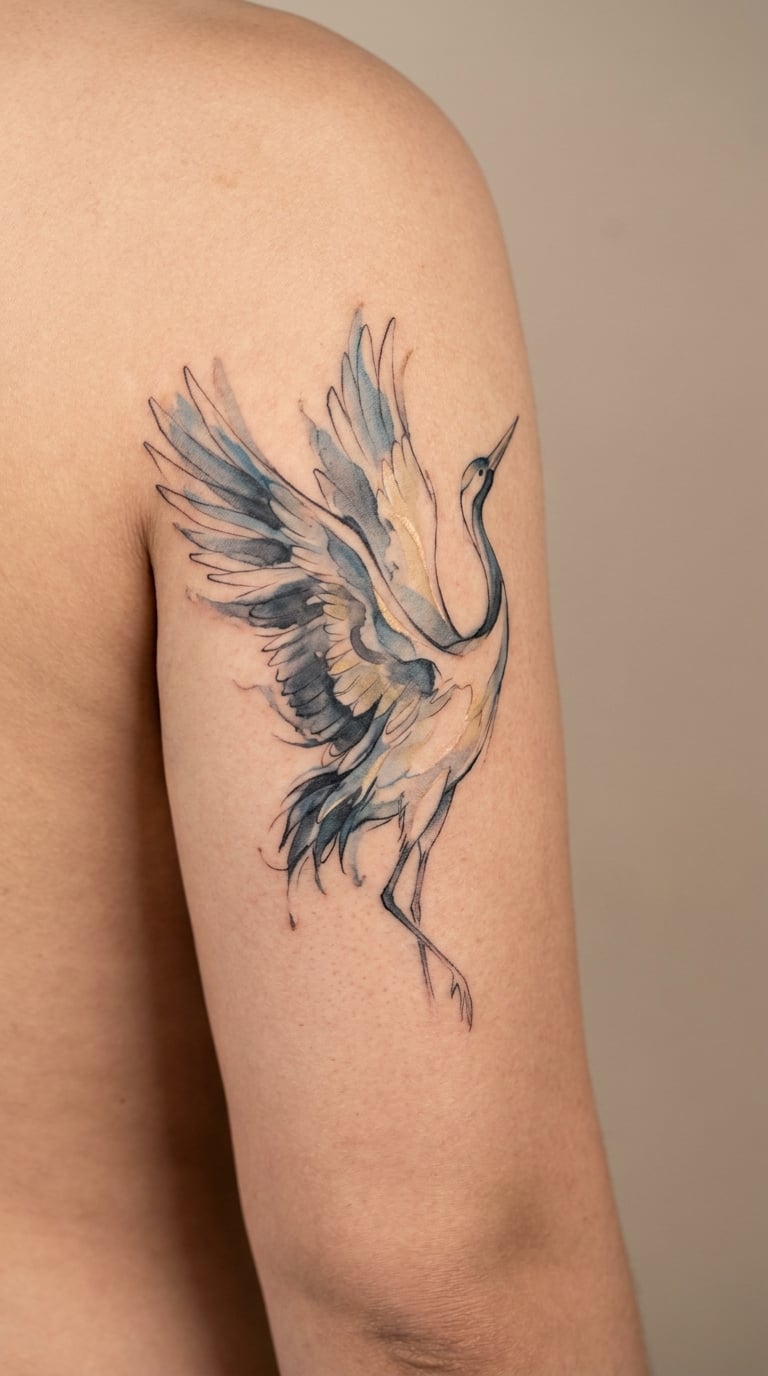
A watercolor crane portrait is less about accuracy and more about movement. Translucent blue and grey washes bleed outward from the body, pale gold sits under the wing, and the feather edges dissolve instead of stopping. The head and neck stay sharper than the wings so the bird still reads.
It suits anyone who wants colour but not a heavy saturated piece. Watercolor also hides healed touch-up work well, since the whole thing is soft anyway.
Placement: Upper arm and outer thigh give the washes room to spread. Avoid joints, where skin movement pulls colour lines.
Size: 5-7 inches (13-18 cm) so the wash has space to breathe.
Style: Watercolor with loose ink edges.
Pain: Medium, mostly because a wash needs several light passes. Fine colours fade fastest, so the blue and gold need sun care.
Make it yours: Pick two colours only. Three or more washes and the bird starts to disappear into them.
5. Blackwork Crane with Extended Wing
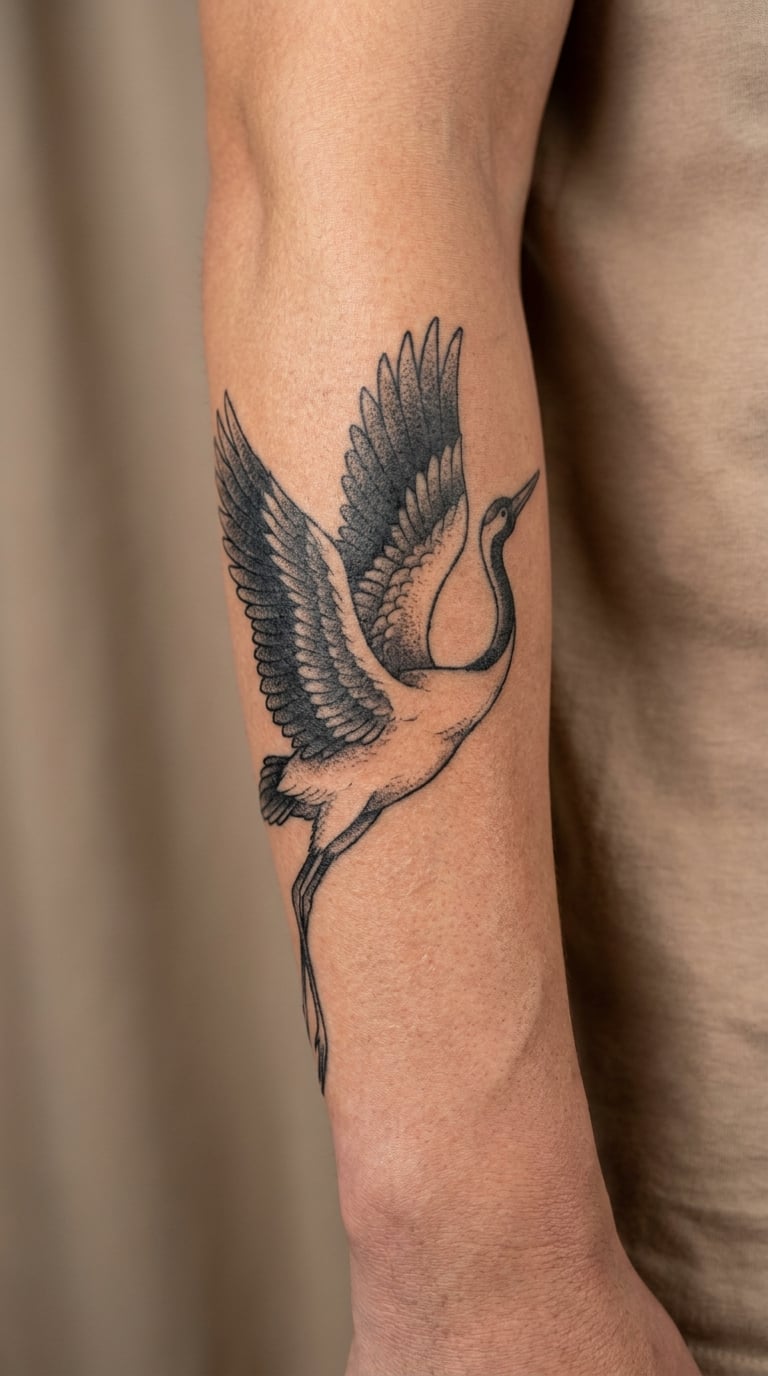
This blackwork crane is built from dark, layered feather shapes. One wing is almost solid black, built from overlapping teardrop forms, while the other stays lighter so the body keeps a readable outline. The neck runs long and curves down into a sharp beak.
Dense black reads strongly at a distance and looks deliberate from close up. It is a good pick if you want a piece that does not need colour to hold attention.
Placement: Outer forearm for a classic read. Outer arm and thigh give the black mass more space.
Size: 6-8 inches (15-20 cm). Blackwork looks thin and patchy below 4 inches.
Style: Blackwork with negative-space feather separation.
Pain: Low on the forearm, though solid black takes longer than linework and often needs a break partway.
Make it yours: Ask the artist to fade the trailing wing into dots so the piece ends softly instead of stopping flat.
6. Two Cranes in a Circle
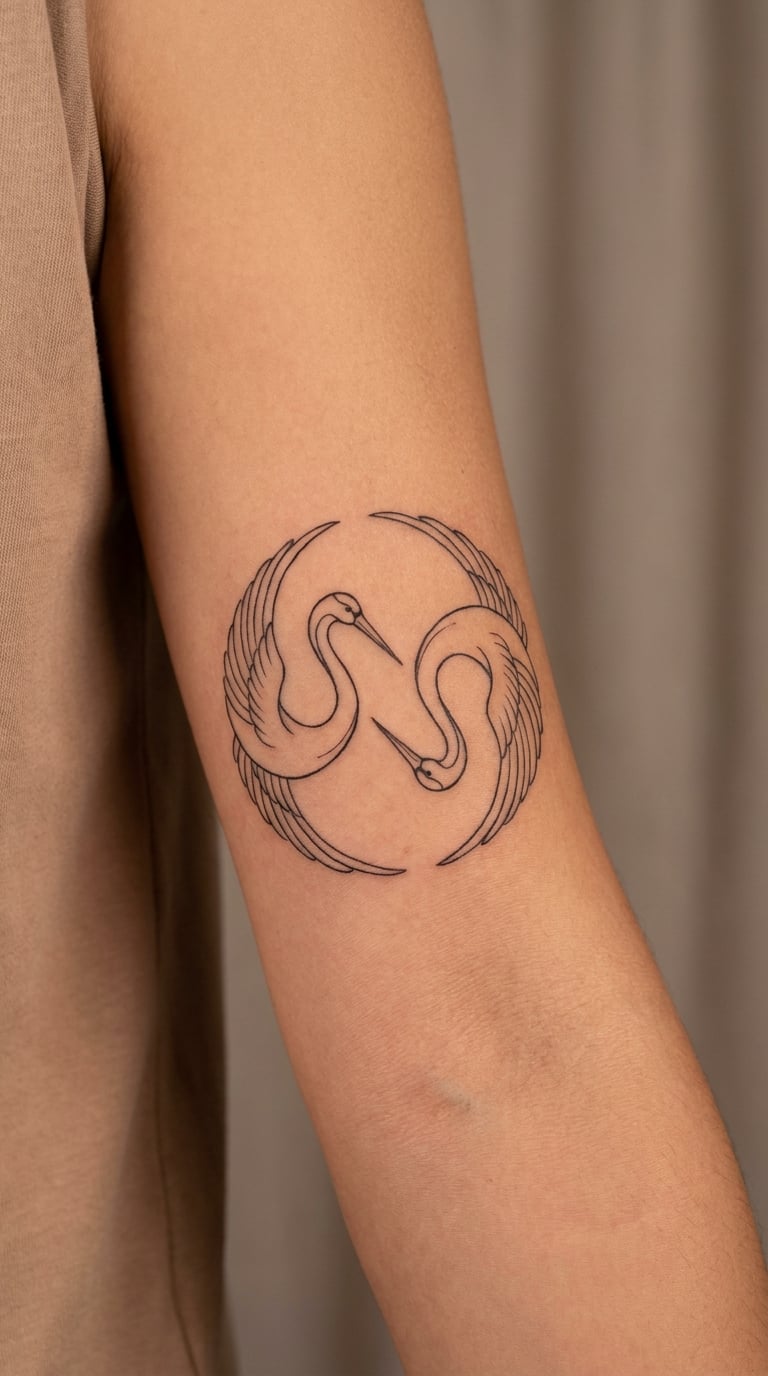
Two cranes facing each other, necks curved so the two birds close a near-circle, is the most requested pairing on this list. Both birds are drawn in the same thin line weight, with one wing on each raised slightly so the composition stays symmetrical without feeling stiff.
Cranes pair for life, and people mostly read two of them as companionship, fidelity or a shared chapter. It is also the easiest crane tattoo to turn into matching work with someone else.
Placement: Inner upper arm or inner forearm. Matching versions on opposite forearms sit well together without looking duplicated.
Size: 3-4 inches (8-10 cm) per bird, so the circle reads as one shape.
Style: Fine line, symmetrical.
Pain: Low to medium. Bilateral symmetry takes longer to draw than a single bird, so book a longer sitting.
Make it yours: Put one bird slightly higher than the other, which reads as movement instead of a stamp.
7. Crane and Mountain Horizon
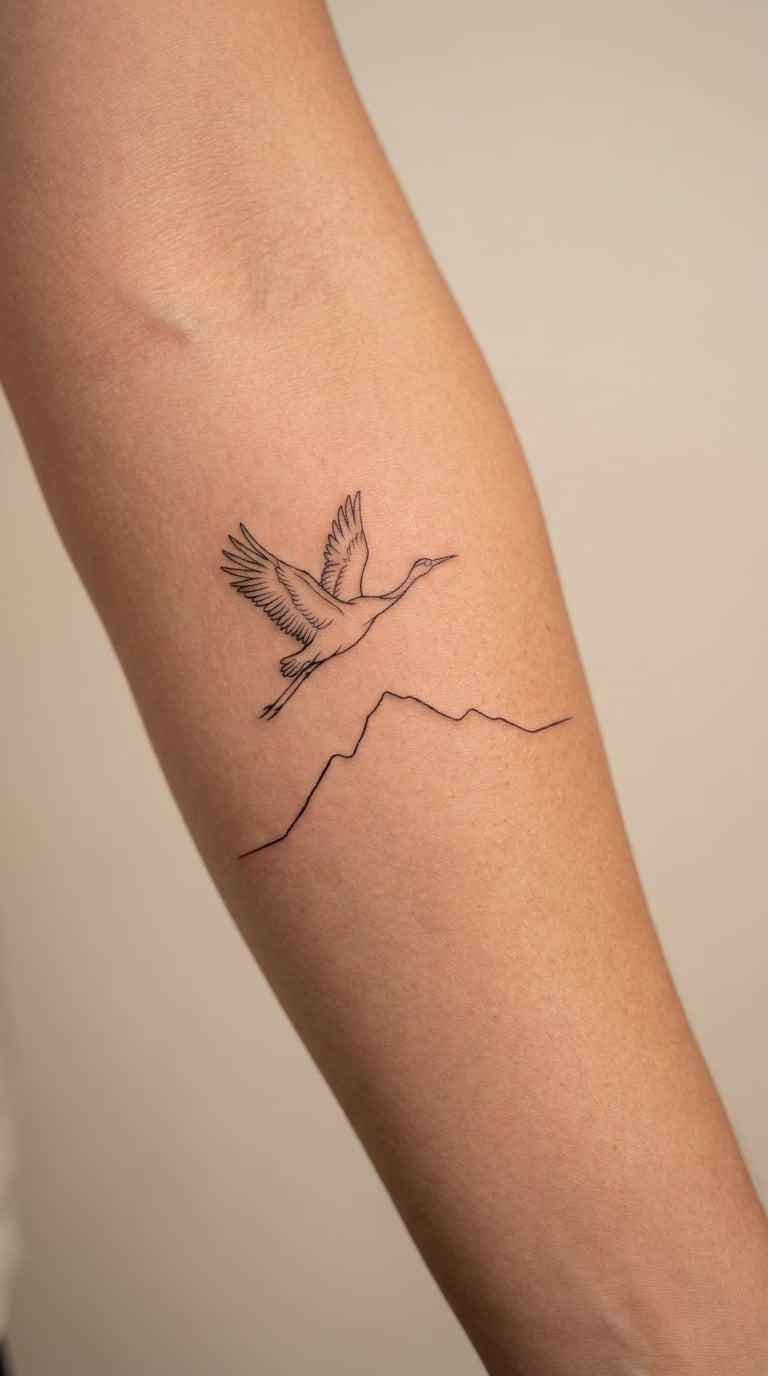
The crane flies above a low ridge line drawn with a few straight peaks, no trees and no clouds. The horizon sits under the bird rather than behind it, so the negative space does the work. A thin band of hatching under the peaks keeps the mountains from looking like scribbles.
People choose this when a plain bird feels a bit plain. The horizon gives the piece a sense of distance without adding clutter, and horizontal compositions sit well on a forearm.
Placement: Across the forearm works best, since the horizontal line matches the arm’s length. Outer calf is another good match.
Size: 5-6 inches (13-15 cm) wide, with the crane taking up roughly half of it.
Style: Fine line with light hatching.
Pain: Low. Thin one-line peaks go quickly, though many separate lines add time.
Make it yours: Use a real ridge from somewhere you have been, described in a few words so the artist can sketch it.
8. Crane with Lotus Flower
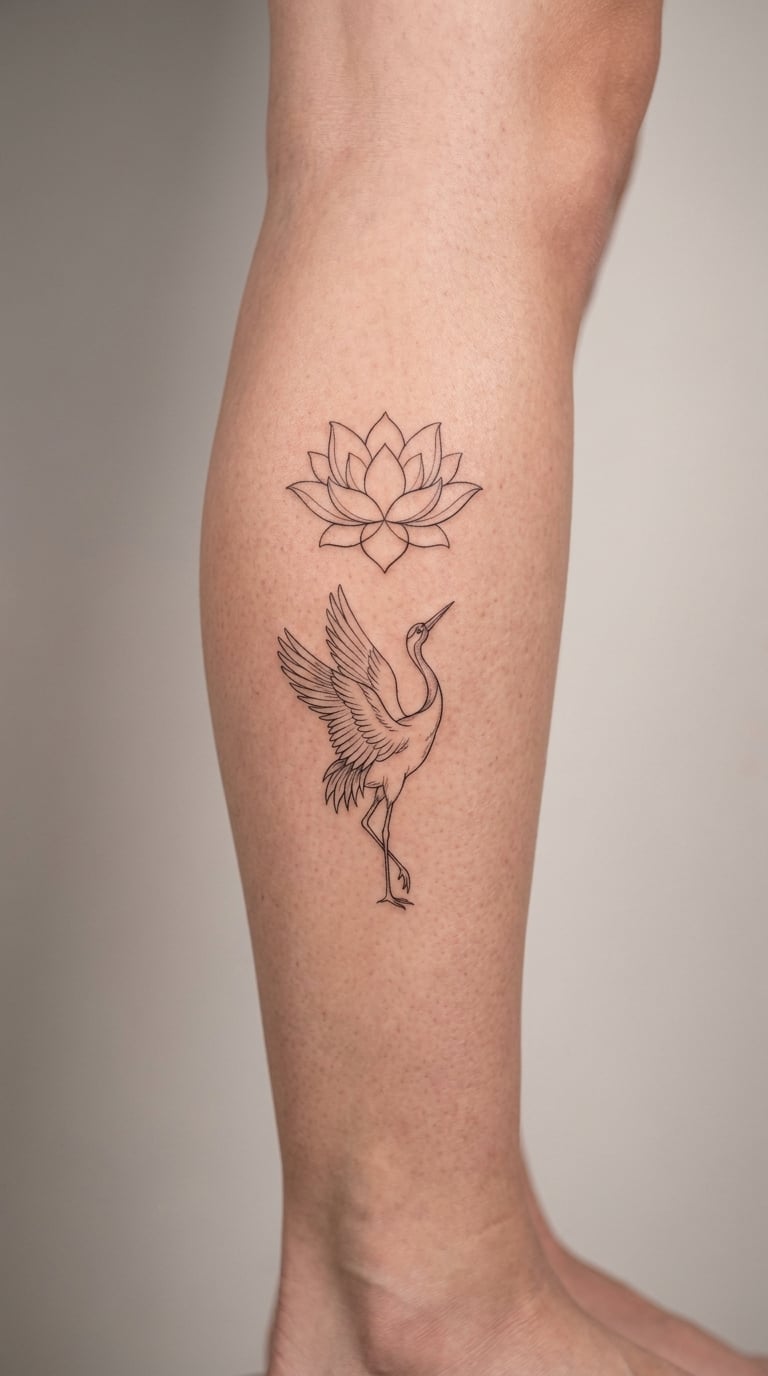
A crane beside a single lotus is a clean two-element piece. The bird is drawn in fine outline with one wing open, and the lotus sits slightly lower with separated petals and a few short stem lines. The two shapes stay apart so neither one has to shrink to make room.
Lotus roots in several traditions in very different ways, so the reason people pick this pairing is usually personal rather than symbolic. It is a good match for a piece about recovery or starting over.
Placement: Calf, outer thigh or inner arm, where both shapes fit side by side. Stack them vertically on a forearm if the skin is narrow.
Size: 4-5 inches (10-13 cm) tall overall.
Style: Fine line, optionally with a muted wash in one element only.
Pain: Low on the calf and thigh. Petal edges are fine detail and can soften with age, so keep line weight even.
Make it yours: Colour only the lotus and leave the crane black, so the flower reads as the personal note.
9. Japanese-Style Red-Crowned Crane
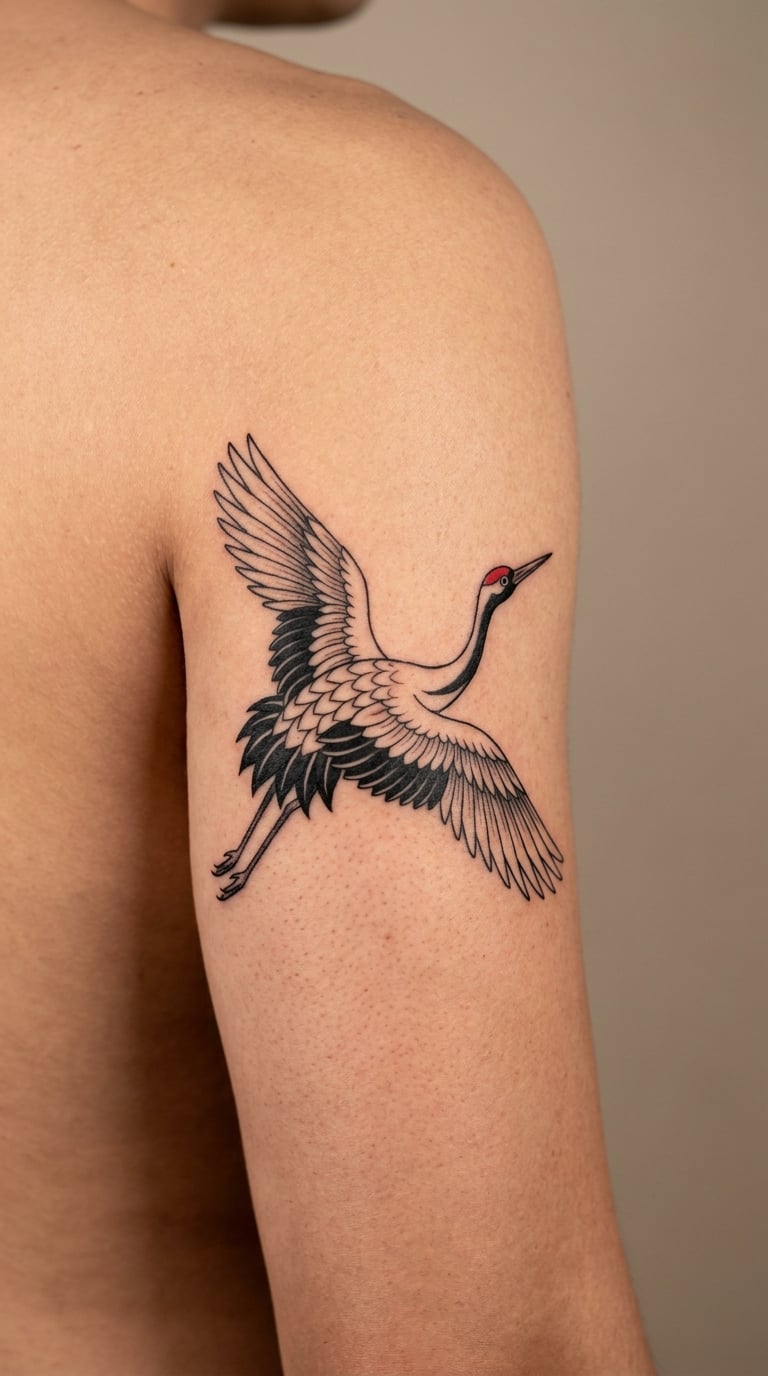
A red-crowned crane is drawn with its own recognisable markers: a small red patch on the crown, a black throat and neck running down to the chest, black trailing tertials over a mostly white body, and long black legs. Feather groups are simplified into clean shapes rather than soft shading.
Specific meanings for this bird differ across Japanese, Chinese, Korean and Vietnamese traditions, and none of them is a fixed rule you have to follow. What people reliably say is that it marks longevity, good fortune and calm. If you take this route, study the tradition you are borrowing from rather than calling it generic.
Placement: Back of the upper arm, upper back, or calf. A shoulder placement lets the trailing feathers flow with the muscle.
Size: 5-7 inches (13-18 cm).
Style: Irezumi-inspired with black, white and one red accent.
Pain: Medium. The white body is usually bare skin, so the working areas are the neck, tertials and legs.
Make it yours: Ask for the red crown to be the only warm colour in the piece, which keeps the drawing quiet.
10. Micro Crane Behind the Ear
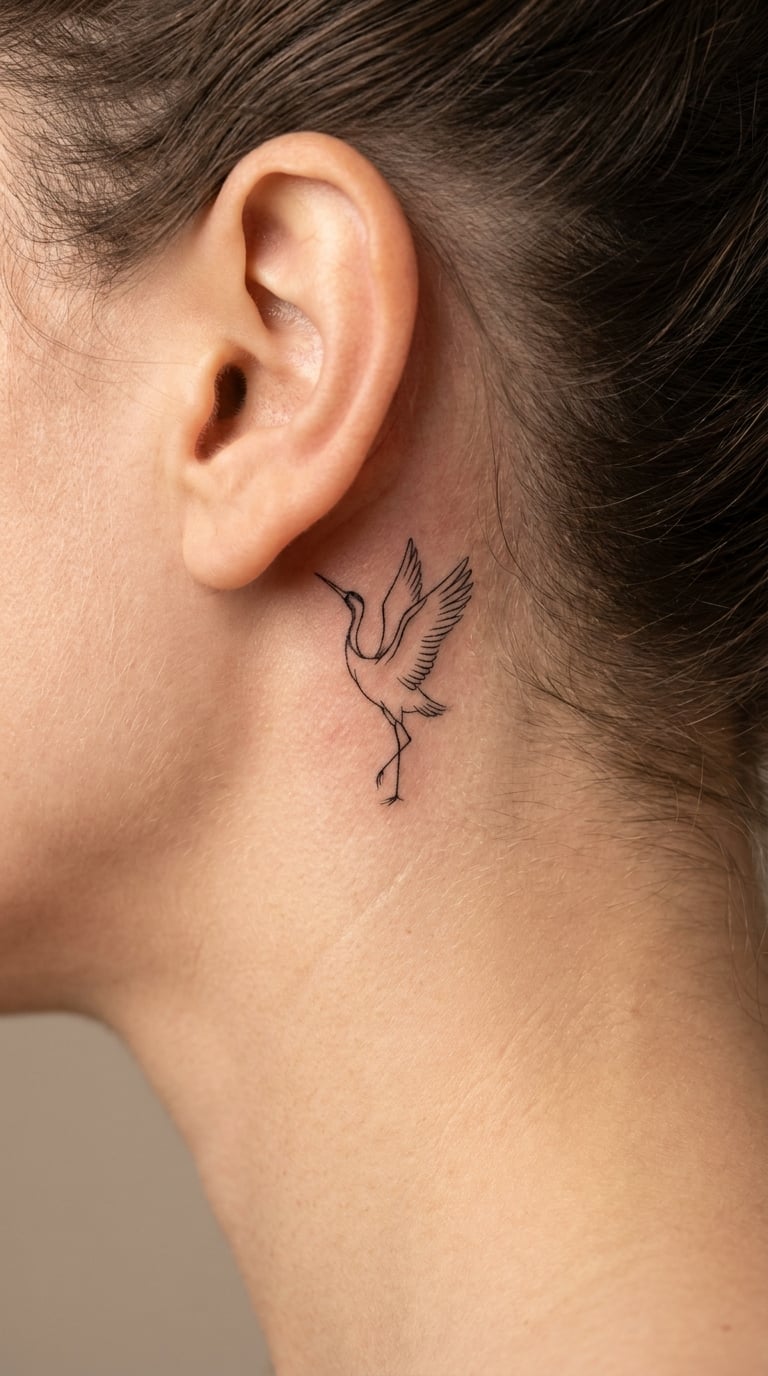
This micro crane is a side profile that follows the curve behind the ear: long beak pointing forward, one wing raised, legs tucked so the bird reads as a compact shape. It is drawn with a single thin line and no shading at all, which is the only way this size stays legible.
It is the discreet option here, for people who want the bird but not a statement. Plenty of wearers add a matching one on the other side months later.
Placement: Behind the ear, along the curve of the neck. The inner arm and the ankle bone are other spots that take a micro piece like this.
Size: 1-1.5 inches (2.5-4 cm).
Style: Micro fine line.
Pain: Medium. Thin skin over cartilage and a bony spot behind the ear both push back. Tiny detail blurs within a few years, so ask for a heavier line than feels right.
Make it yours: Angle it so the beak points toward the ear rather than away, which most people prefer.
11. Crane on the Wrist
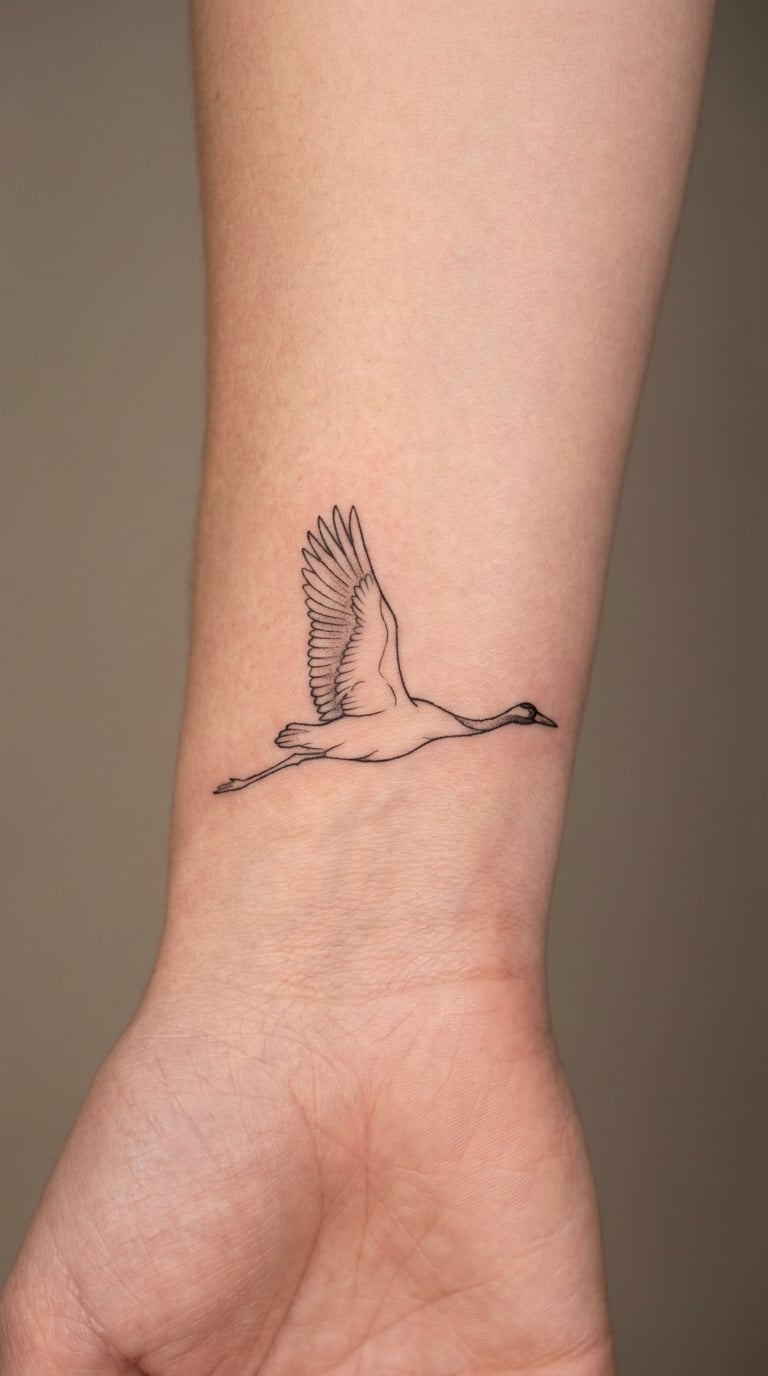
A wrist crane has to be horizontal, because that is the shape the wrist gives you. The body is compact, one wing is raised above the back, the neck stretches forward, and the tail is kept short so it does not run into the forearm. Line weight stays even from end to end.
This is a good first tattoo for anyone who wants something that shows when they wear a short-sleeve shirt but disappears under a jumper. It suits a hand with small enough dimensions for a 3-inch bird.
Placement: Inner wrist, running parallel to the forearm. Ankle works the same way for a matching pair.
Size: 2-3 inches (5-8 cm).
Style: Fine line, minimal detail.
Pain: Medium on the wrist. The veins and the inner wrist bone both make it more sensitive than the forearm, and fine lines on hands and wrists fade fastest of anywhere on the body.
Make it yours: Have the artist thicken the outline slightly and drop the shading. It costs nothing visually and holds far better.
12. Crane in a Circular Frame
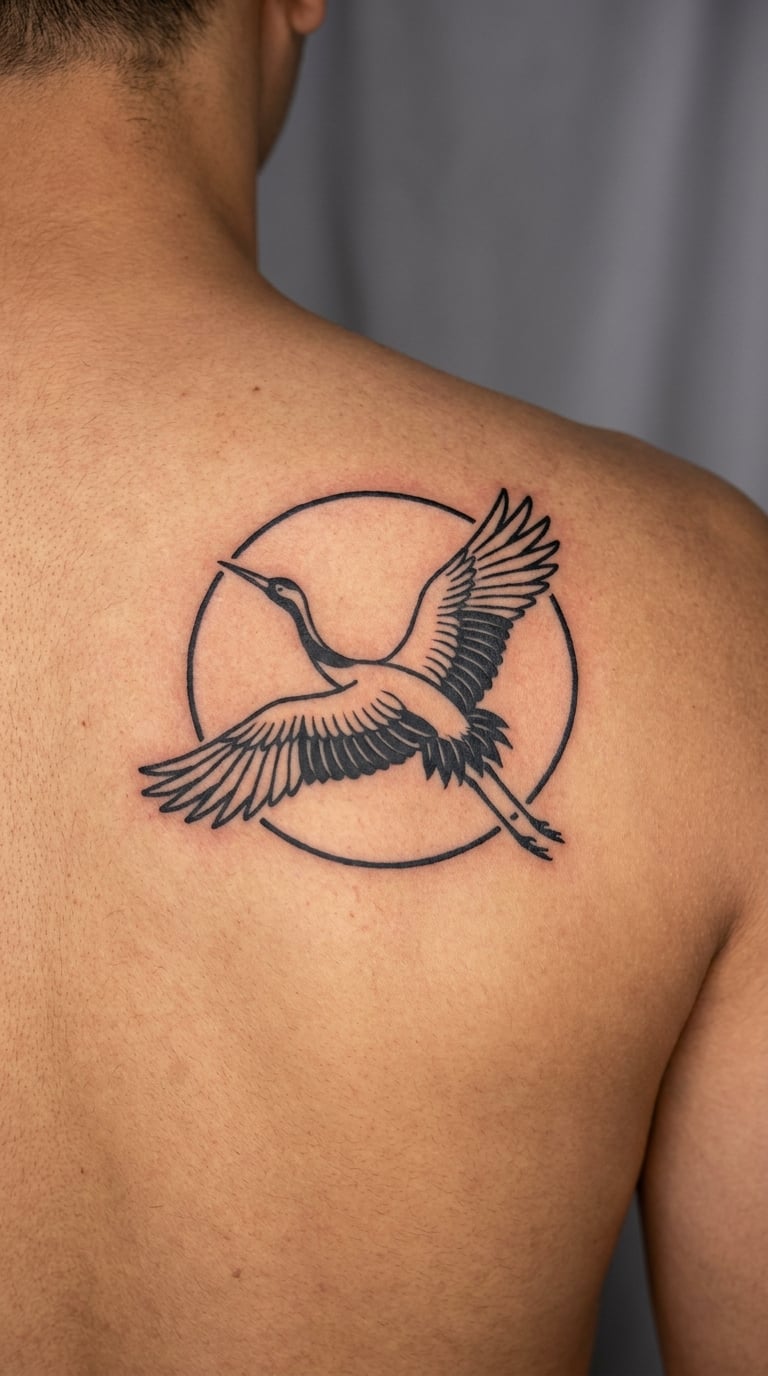
The circular frame gives this crane its structure. A single bold ring holds a black bird with wings spread almost edge to edge, beak lifted, legs tucked. The wing tips stop short of the ring so the negative space between bird and frame stays even all the way round.
Frames are popular because a border makes any design look finished. People also like that the circle reads well from a distance, which a free-floating fine-line bird does not always do.
Placement: Upper back between the shoulder blades is ideal. Outer arm and outer thigh also work.
Size: 4-5 inches (10-13 cm) diameter.
Style: Bold graphic blackwork.
Pain: Low over the shoulder blades. The bony outer shoulder is more noticeable.
Make it yours: Break the ring at the bottom so the bird appears to fly out of the frame.
13. Dotwork Crane Feathers
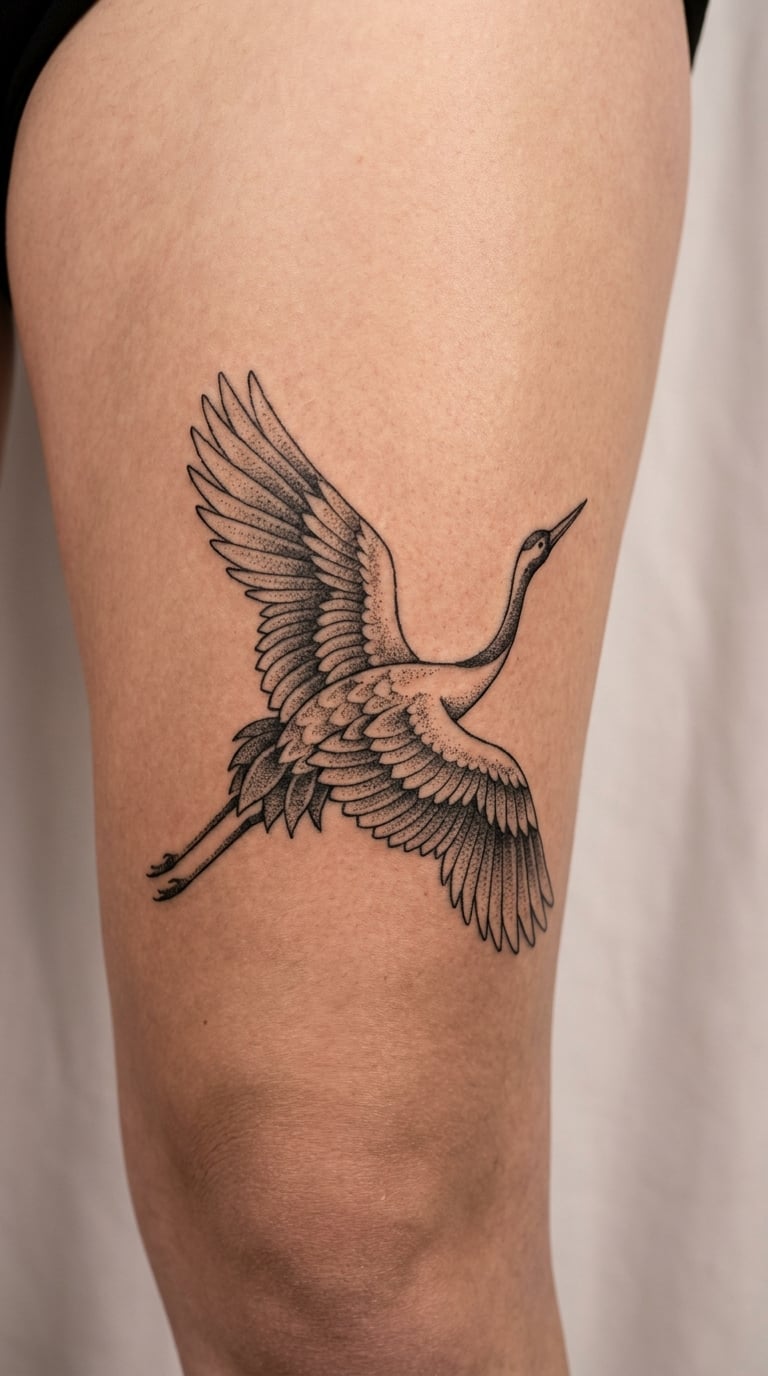
Dotwork builds the bird out of density rather than line. Tight small dots form the shaded wing, the dot spacing widens across the body, and the lightest areas fade into bare skin with no outline at all. The neck is often the only part kept solid so the shape holds together.
It reads as soft and detailed from a distance, then as texture up close. Dots suit large flat areas like a thigh, where there is nothing pushing the design out of shape.
Placement: Outer or inner thigh, upper arm, or lower back. Flat areas without much bone give the artist a steadier surface.
Size: 4-6 inches (10-15 cm).
Style: Black-ink dotwork with graduated dot size.
Pain: Low, but slow. Each dot is a separate poke, so a full crane is a long sitting and the skin gets warm.
Make it yours: Ask for graduated dots rather than uniform ones, which keeps fine feathers visible after healing.
14. Small Tattoo on the Finger
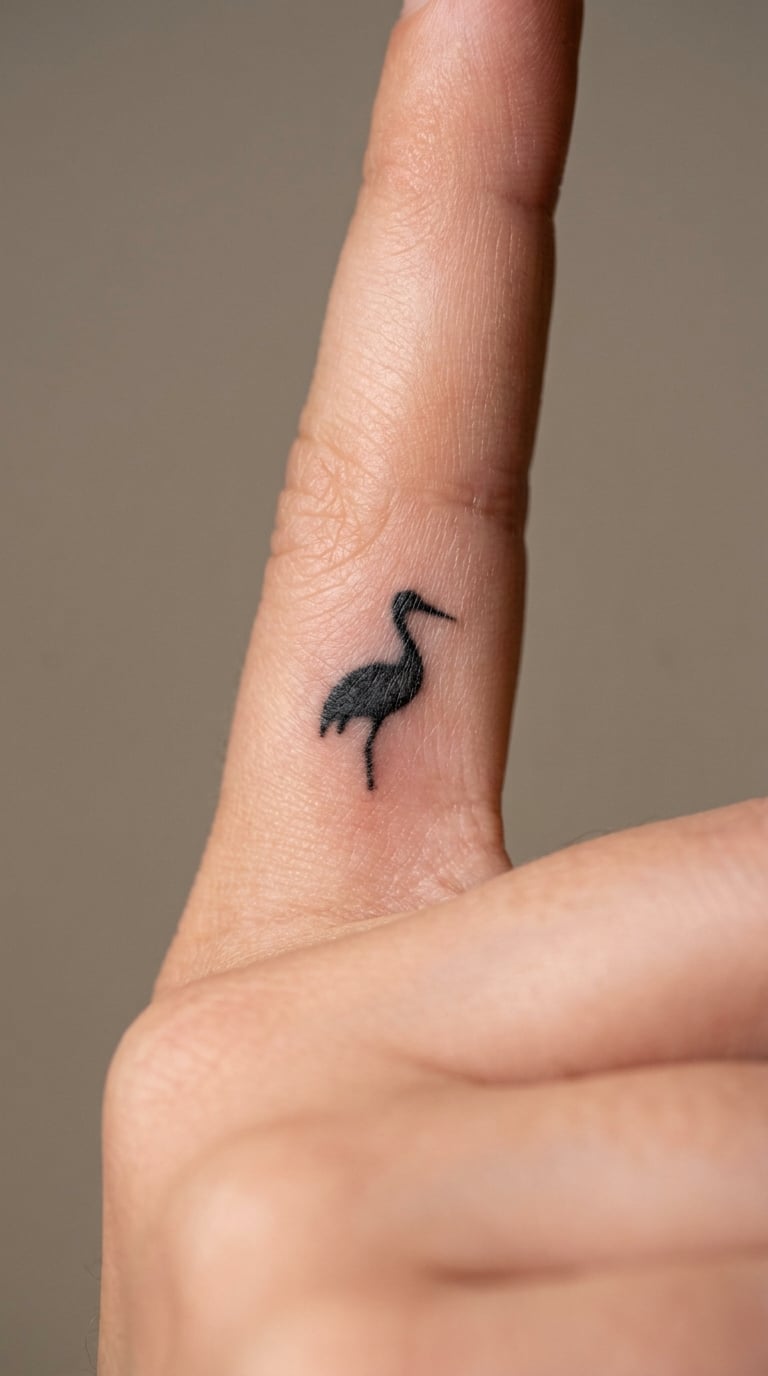
A finger crane has to give up almost everything. What survives is a body, a pointed beak, one raised wing and a suggestion of legs. Silhouette or heavy line is the only reliable approach, because anything thinner washes out within a couple of years.
Finger tattoos fade and blur faster than any other placement. Hands get used, washed and sun-exposed constantly, so people who want a crane that stays crisp for decades put it somewhere quieter.
Placement: Side of the index or ring finger. The knuckle side of the thumb also works for a slightly larger version.
Size: About 1 inch (2.5 cm) tall.
Style: Micro silhouette, solid black.
Pain: High. The fingers carry a dense bundle of nerves and very little soft tissue. Expect a short sitting and a shaky moment.
Make it yours: Keep it to one solid shape with no interior lines, and accept that you may want it redone in five years.
15. Crane and Rising Sun
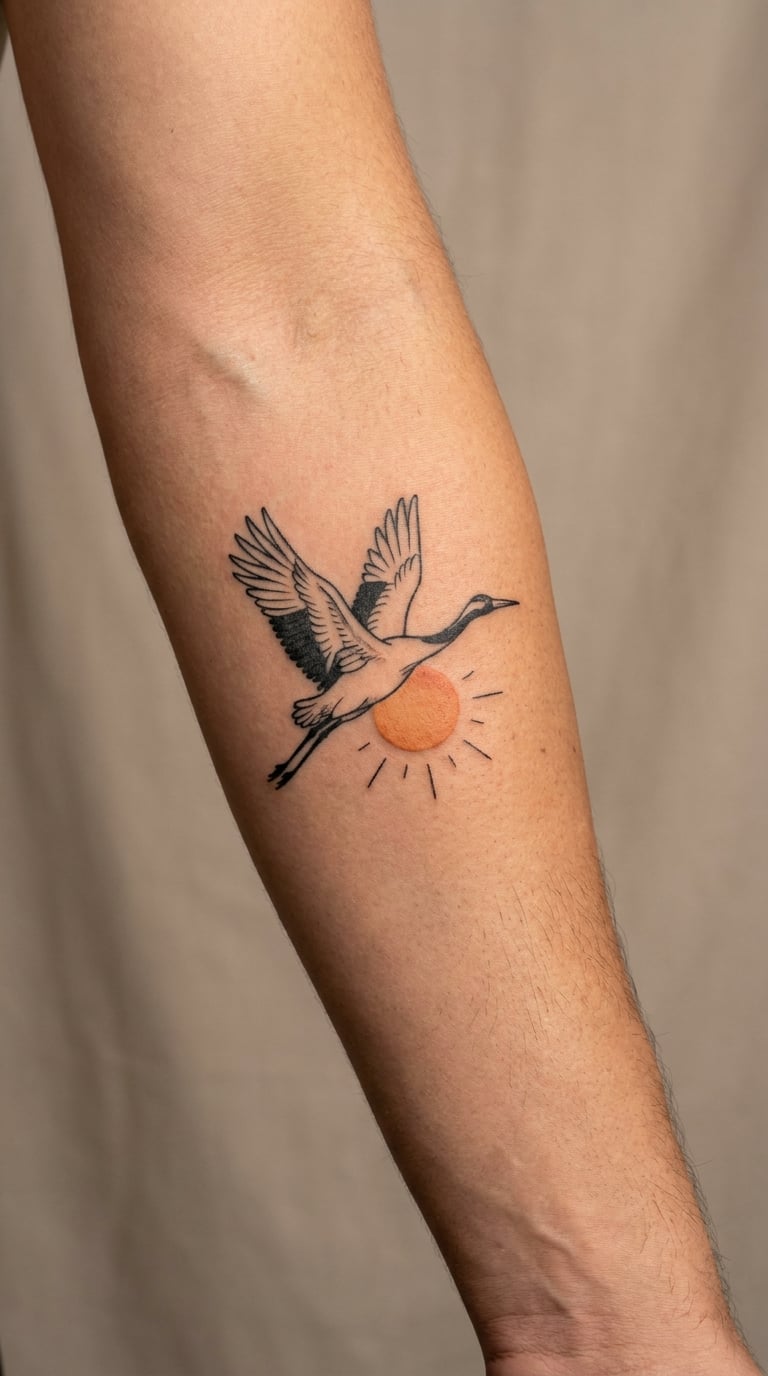
A small warm orange disc sits under a gliding crane, with three or four short rays rather than a full sunburst. The bird is fine-lined with wings held level, which makes it read as calm movement instead of a dramatic swoop. Keeping the rays short stops the piece turning into a sun motif.
Sunrise is the most obvious choice for a new chapter, a move to a new city, or a first year in a new job. The warm colour keeps it from feeling like the heavier Japanese compositions.
Placement: Forearm with the disc below the bird, or the outer arm with both elements stacked. Chest also works for a vertical version.
Size: 3-4 inches (8-10 cm) tall in total.
Style: Fine line with one colour accent.
Pain: Low on the forearm. The orange disc needs a light pass only, so it adds very little time.
Make it yours: Move the sun to the beak side so the bird appears to be flying into the light.
16. Floral Crane Sleeve Accent
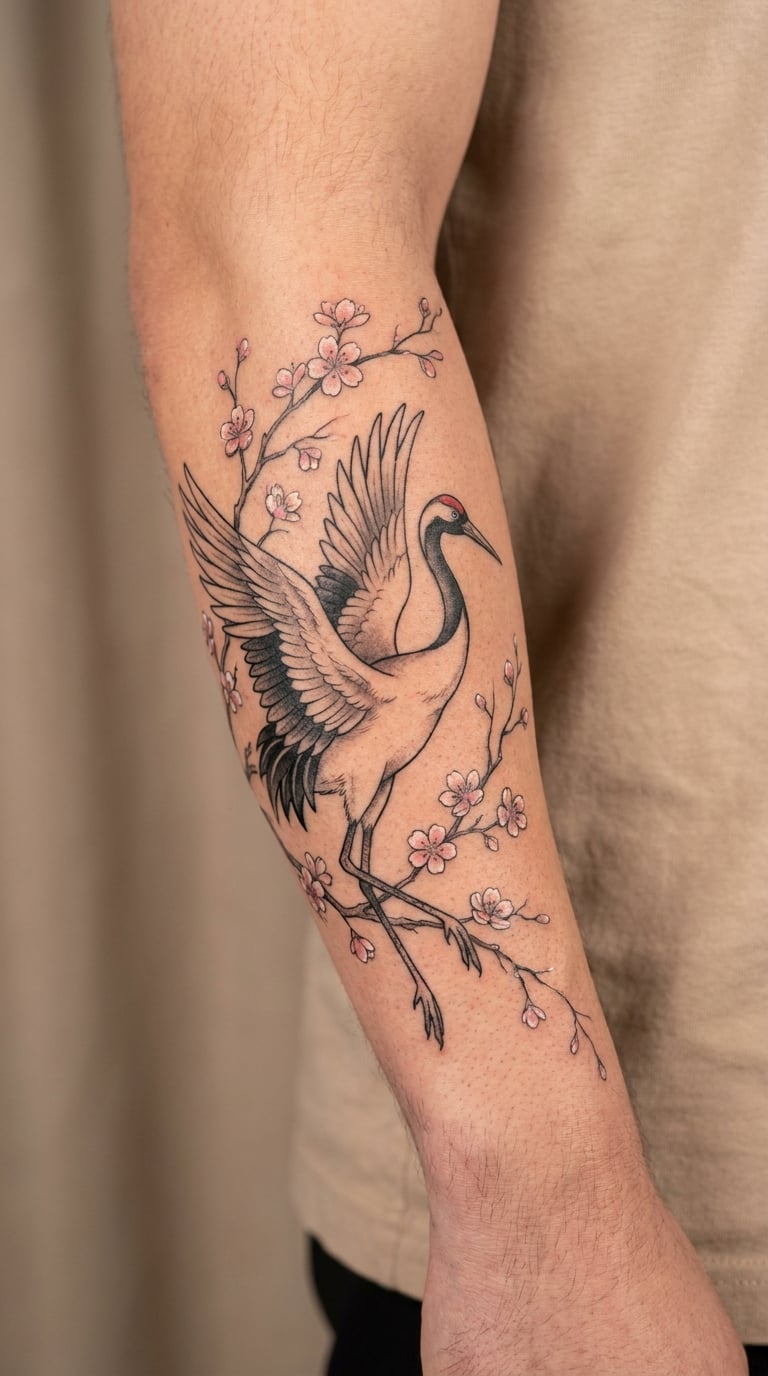
Here the crane is the subject and the blossoms are the ground it sits on. Two or three sparse branches curve in from one side with small five-petal flowers and open buds, and the bird occupies the clear centre with more ink than any branch. The gap between bird and branches is what keeps it readable.
Blossoms on skin tend to fade to a pale pink within a few years, while the black bird stays sharp, so plan for a two-tone tattoo that still works after the pink goes.
Placement: Outer arm as the focal piece in a larger composition, or standalone on the upper arm.
Size: 8-12 inches (20-30 cm) if it is part of a sleeve. Standalone on the upper arm, 6-8 inches works.
Style: Illustrative colour with fine-line branches.
Pain: Medium, and spread over a long session if it is sleeve work. Branches need many separate passes.
Make it yours: Fix one branch as the constant in your design and let later additions follow its angle.
17. Grey Crane with Soft Shading
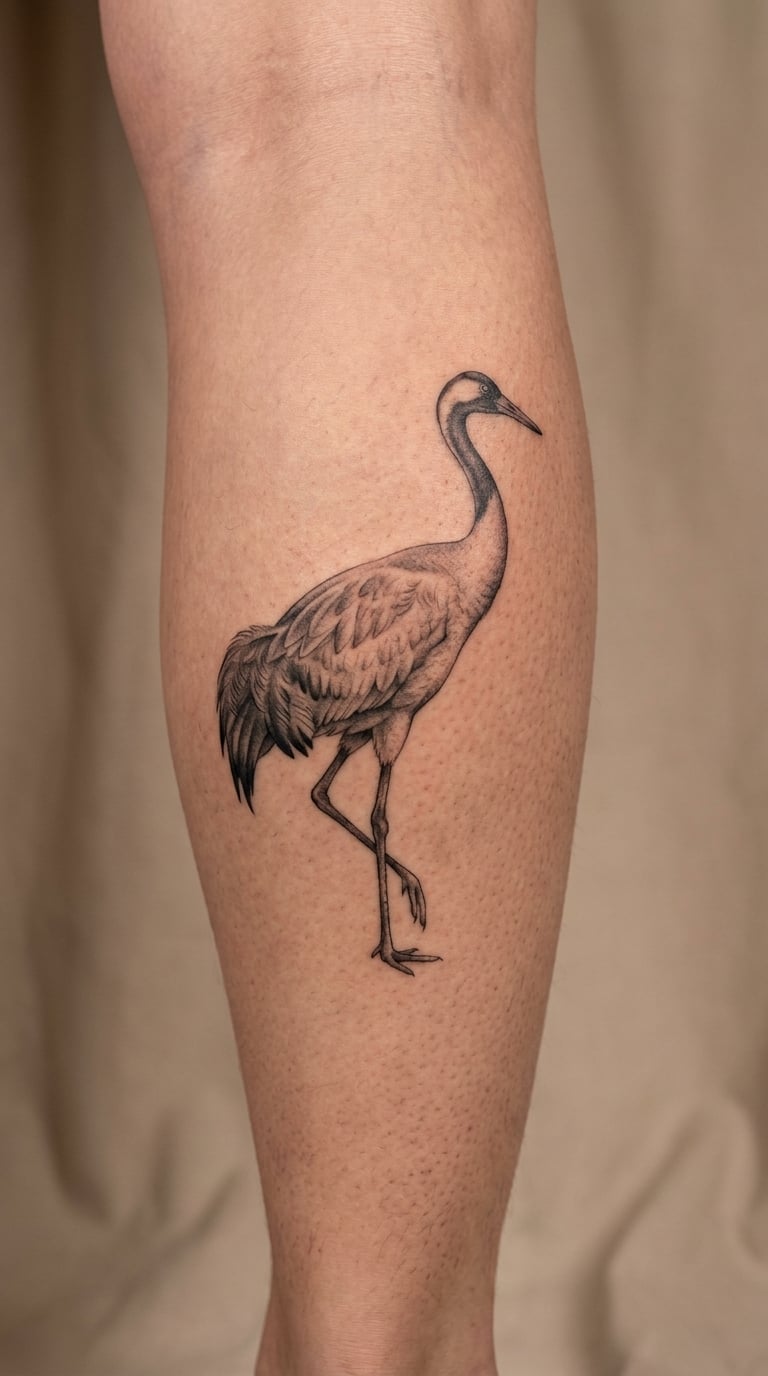
This is a realistic bird without going photoreal. Black-and-grey gradients build the wing, a few hard lines define the primary feathers, and the face gets just enough detail around the eye and beak. The body stays clean so it reads as a bird rather than a smudge.
Realistic birds tend to be the choice for people who want a portrait rather than a symbol. Without colour, it also sits easily next to other grey work.
Placement: Calf, outer thigh or upper arm, anywhere with a flat enough surface for the gradient to blend.
Size: 6-8 inches (15-20 cm). Under 4 inches, the shading has nowhere to go.
Style: Black and grey realism.
Pain: Low on the calf and thigh, and the shading needs several passes so plan a long sitting with breaks.
Make it yours: Ask for one fully shaded wing and one left lighter, which keeps the bird from looking flat.
18. Neo-Traditional Crane with Bold Colour
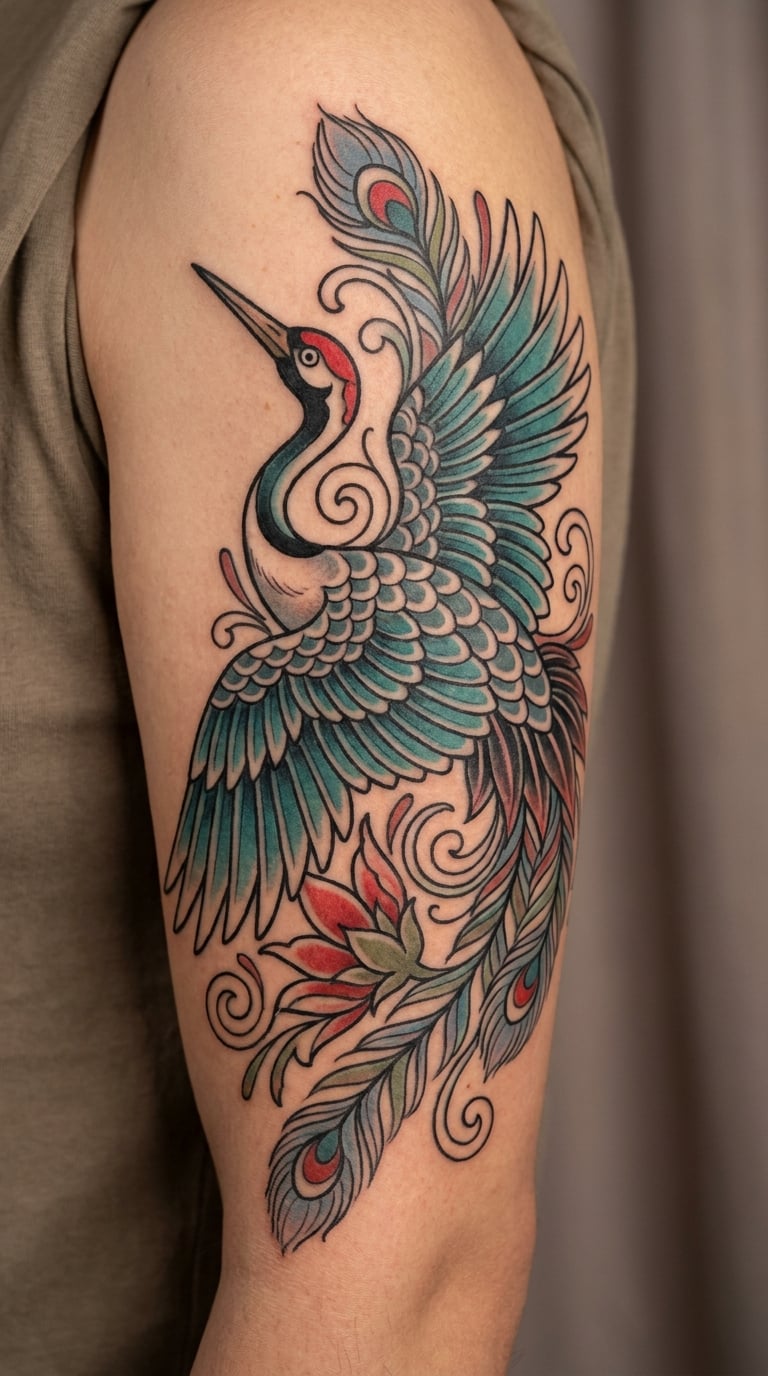
Neo-traditional takes the bold crane and gives it depth. The outline stays thick and confident, but the fills break into decorative feather shapes with teal and deep red layered over a black shadow block. A few hard highlight lines sit on top so the colour looks lit rather than flat.
It is a good match for a person whose other pieces are colourful but not soft. The style holds detail well and hides minor fading better than a pale palette.
Placement: Upper arm, outer thigh, or chest. Flat muscle areas suit the layered fills best.
Size: 5-6 inches (13-15 cm).
Style: Neo-traditional, thick outline, saturated colour.
Pain: Medium. Two or three colour changes mean the artist switches needles often, which stretches the sitting.
Make it yours: Keep the palette to two colours plus black so the piece stays bold instead of busy.
19. Crane in a Small Blackwork Triangle
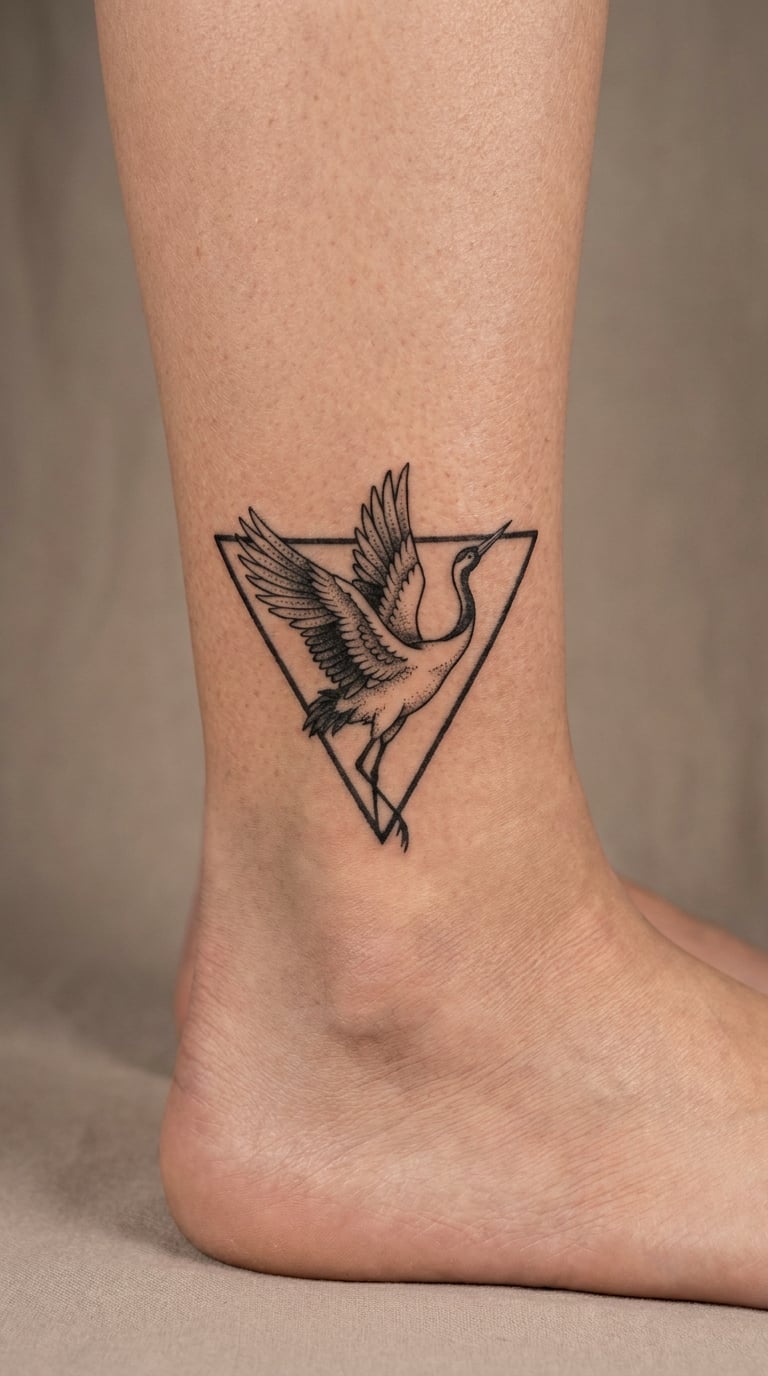
The triangle does the work here. A clean outlined frame holds a compact blackwork crane with both wings raised toward the top point, so the bird looks like it is pushing out of the shape. The bottom of the frame stays open or breaks, which stops it feeling boxed in.
Geometric framing suits people who like structure in their tattoos, and it makes a small design look deliberate rather than unfinished.
Placement: Ankle, inner forearm, or behind the ear. Anywhere with a flat enough patch for three straight lines.
Size: 2-3 inches (5-8 cm) tall.
Style: Geometric blackwork.
Pain: Medium. The ankle is bony and sensitive, and straight frame lines need steadiness, so book a short sitting with a break.
Make it yours: Have the crane break through one side of the triangle so the frame feels like a frame rather than a cage.
20. Crane and Wave Tattoo
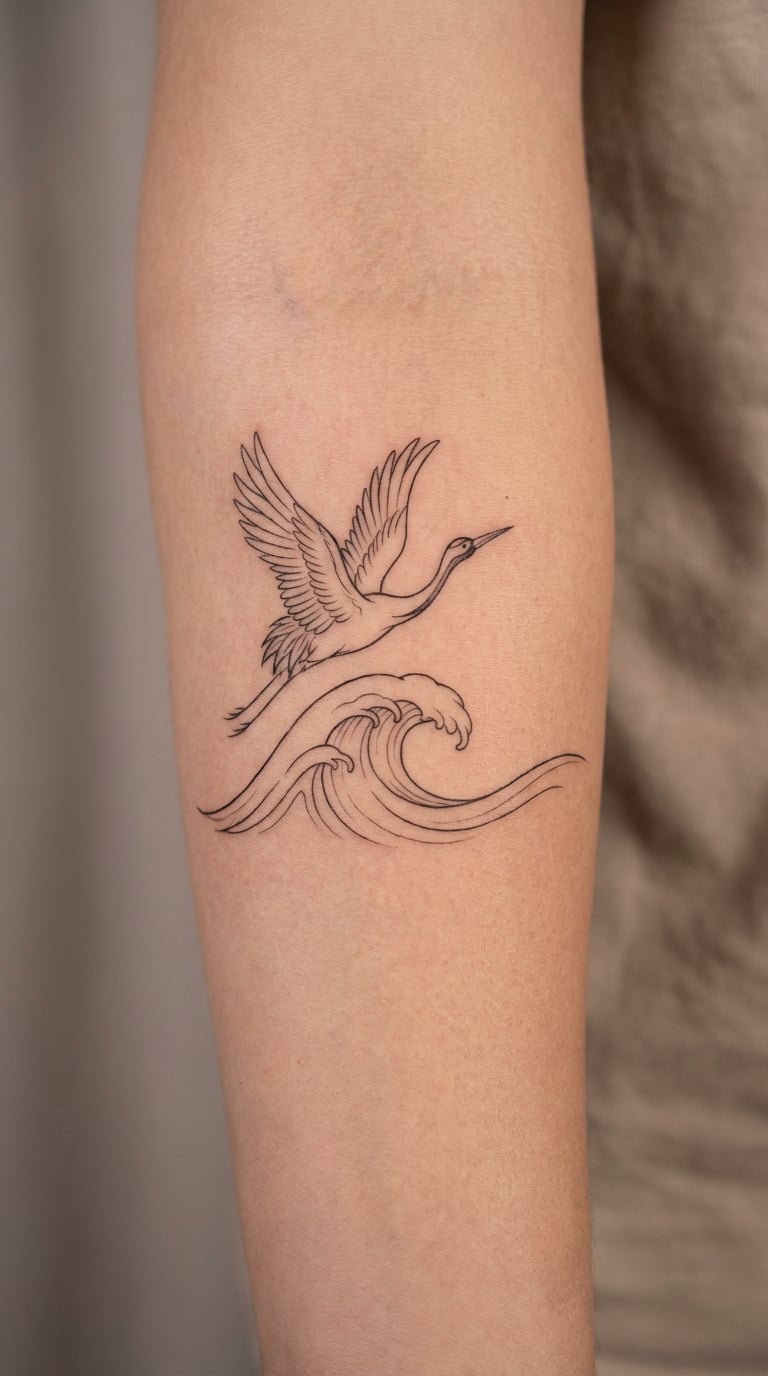
One wave, one bird, nothing else. The wave is drawn as a single sweeping curve with three or four short crest lines beneath it, and the crane flies above with its wings held level. The bird is drawn darker than the water so the two shapes never compete.
Water under a bird is an easy pairing because one is weightless and the other is not, and people tend to pick it for a sense of motion rather than a specific meaning.
Placement: Forearm with the wave running along the length of the arm. Inner arm works if you want the bird facing the wrist.
Size: 4-6 inches (10-15 cm) across.
Style: Fine line, two-weight contrast.
Pain: Low on the forearm. The wave is mostly long single lines, so it goes faster than it looks.
Make it yours: Keep the wave to a single crest line rather than a full set of curls, so the bird stays the focus.
21. Flying Crane Across the Shoulder
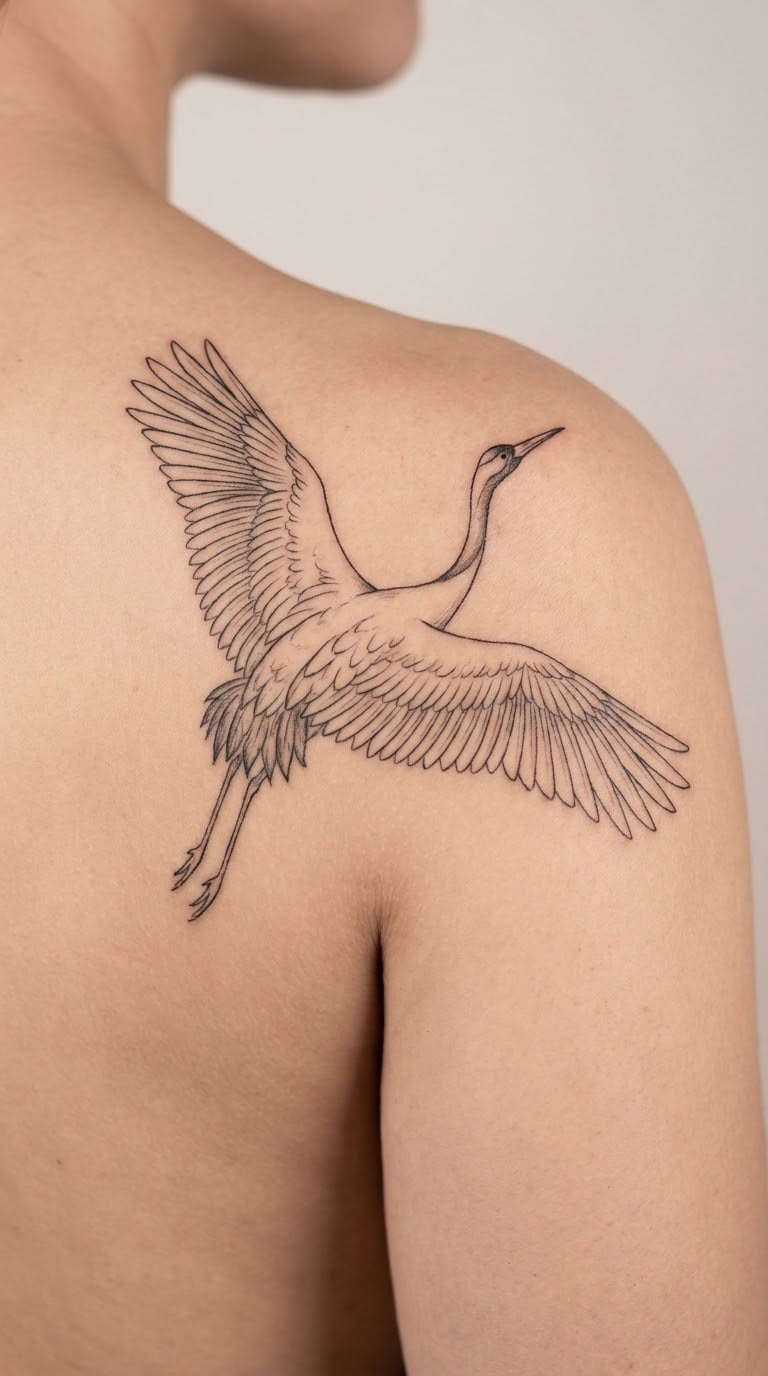
This composition uses the shoulder as the frame. The crane’s wingspan runs across the deltoid so the two wing tips land on the front and back of the shoulder, and the body sits high on the muscle with the neck angled down. The lower edge stays clean with no background, which keeps the shape sharp.
A wide bird across the shoulder takes a lot of room and reads instantly from a distance, so it works when you want a piece that fills a flat gap between existing work.
Placement: Shoulder cap, front to back. The chest and upper back are the alternatives when the deltoid is too small.
Size: 6-8 inches (15-20 cm) wingspan. Below 5 inches the wing tips cannot clear the shoulder curve.
Style: Fine line with a bolder outline on the near wing.
Pain: Medium. The shoulder moves constantly and the muscle shifts the skin under the needle, which most wearers notice more than the pain.
Make it yours: Have the wing tips curve slightly downward so the bird follows the shoulder instead of fighting it.
22. Crane with One Gold Feather
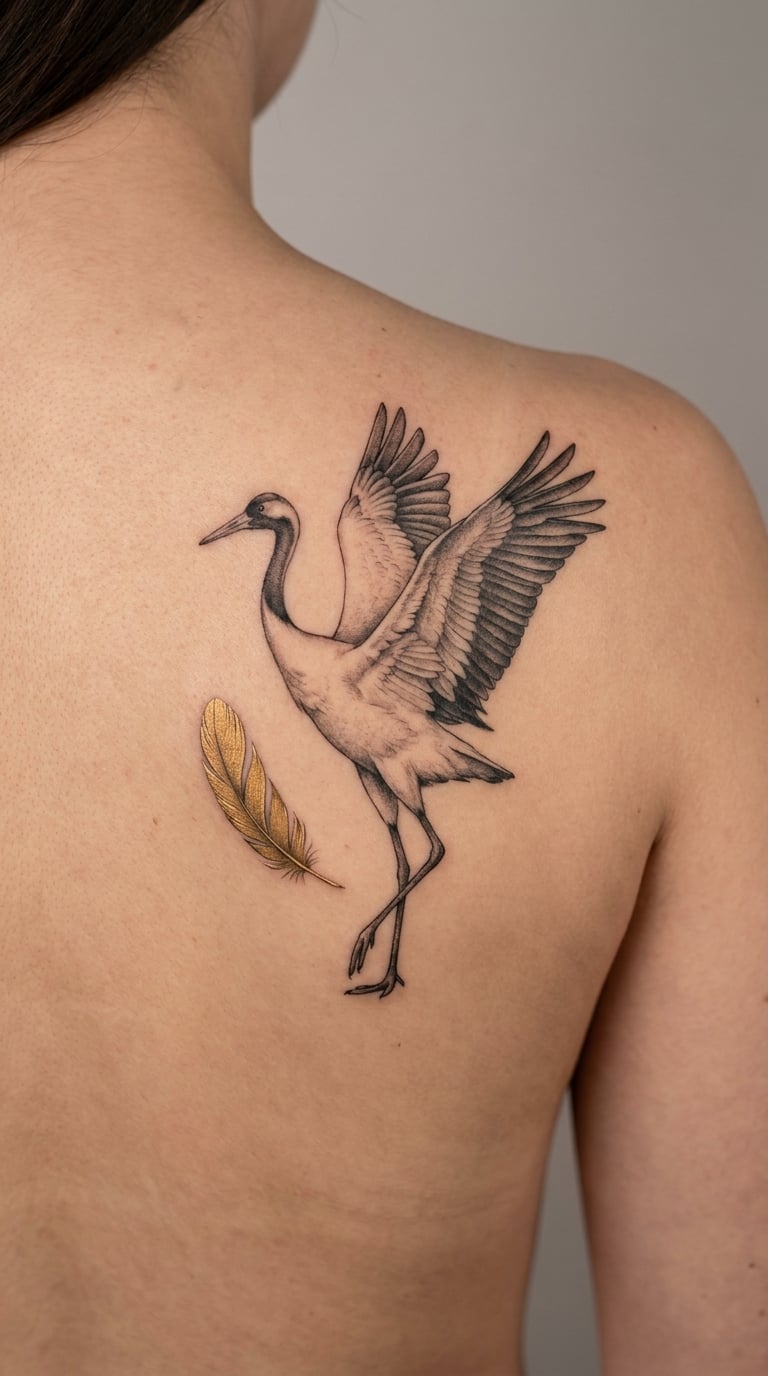
A grey crane with a single metallic gold feather on the near wing. Everything else is black and grey shading, so the one feather reads as the point of the whole piece. The feather is usually placed mid-wing where the eye lands first.
One accent colour is an easy way to make a monochrome bird feel finished without committing to a full colour piece. It also works as a follow-up to an existing grey tattoo.
Placement: Upper back, upper arm, or outer thigh. Areas of even colour take metallic ink most cleanly.
Size: 5-6 inches (13-15 cm).
Style: Black and grey with one metallic feather.
Pain: Low. Metallic ink is laid like any other colour, so the added time is minimal.
Make it yours: Ask whether the artist has a yellow-based or white-based gold on hand, since it changes how bright the feather looks against grey.
23. Minimal Crane on the Collarbone
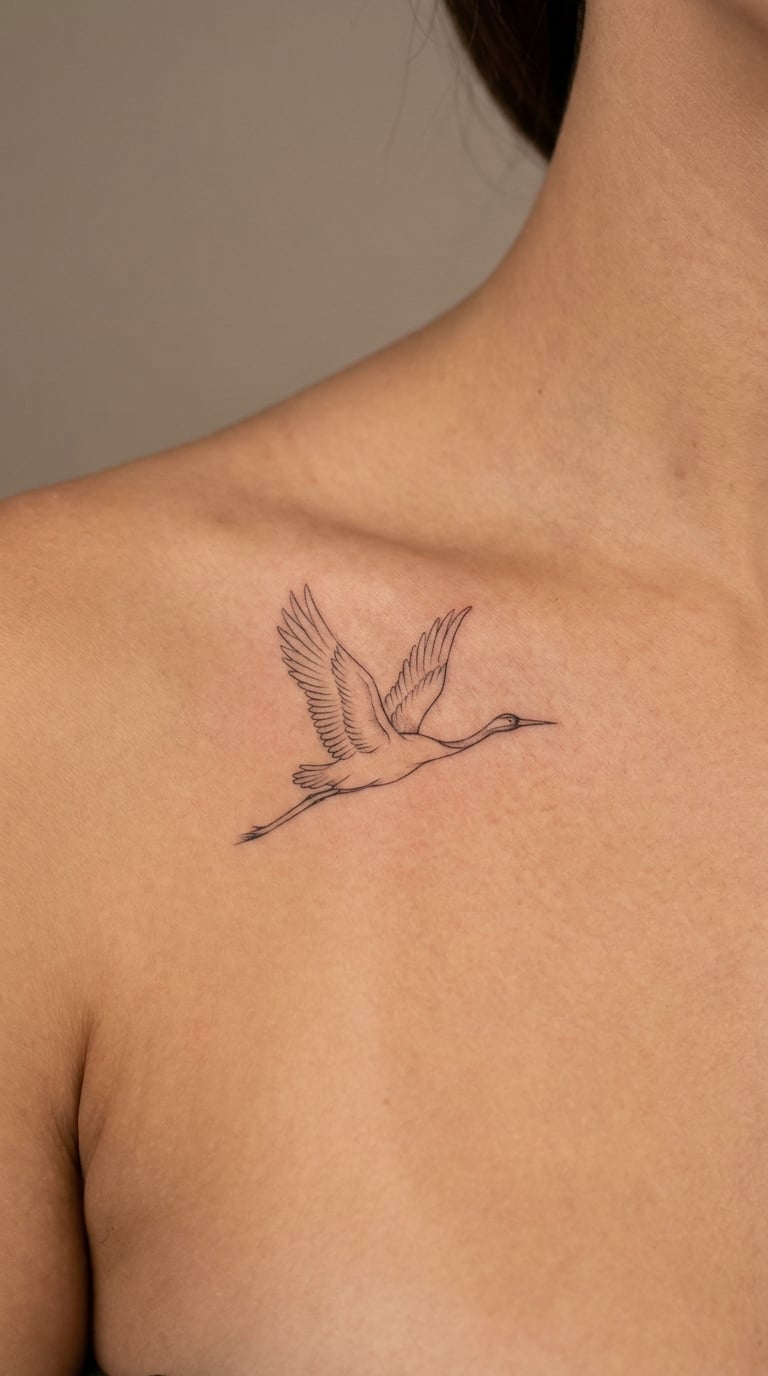
A collarbone crane runs horizontally along the bone, wings slightly open and neck kept delicate. The body sits just under the hollow at the centre of the collarbone, with the wingtips angled up rather than straight out, so the bird follows the dip in the bone instead of bridging it.
This placement shows when a collar is open and disappears under almost everything else, which is why it works for people who like a design they control the visibility of.
Placement: Collarbone, centred in the hollow. The sternum just below also works if the collarbone dips sharply.
Size: 2-3 inches (5-8 cm).
Style: Fine line, thin detail.
Pain: Medium to high. You are sitting on bone with very little tissue, and the skin moves when you breathe. Fine lines here also soften faster than almost anywhere else.
Make it yours: Have the line weight built up over two passes so the bird survives the movement of the collarbone.
24. Crane with a Small Date
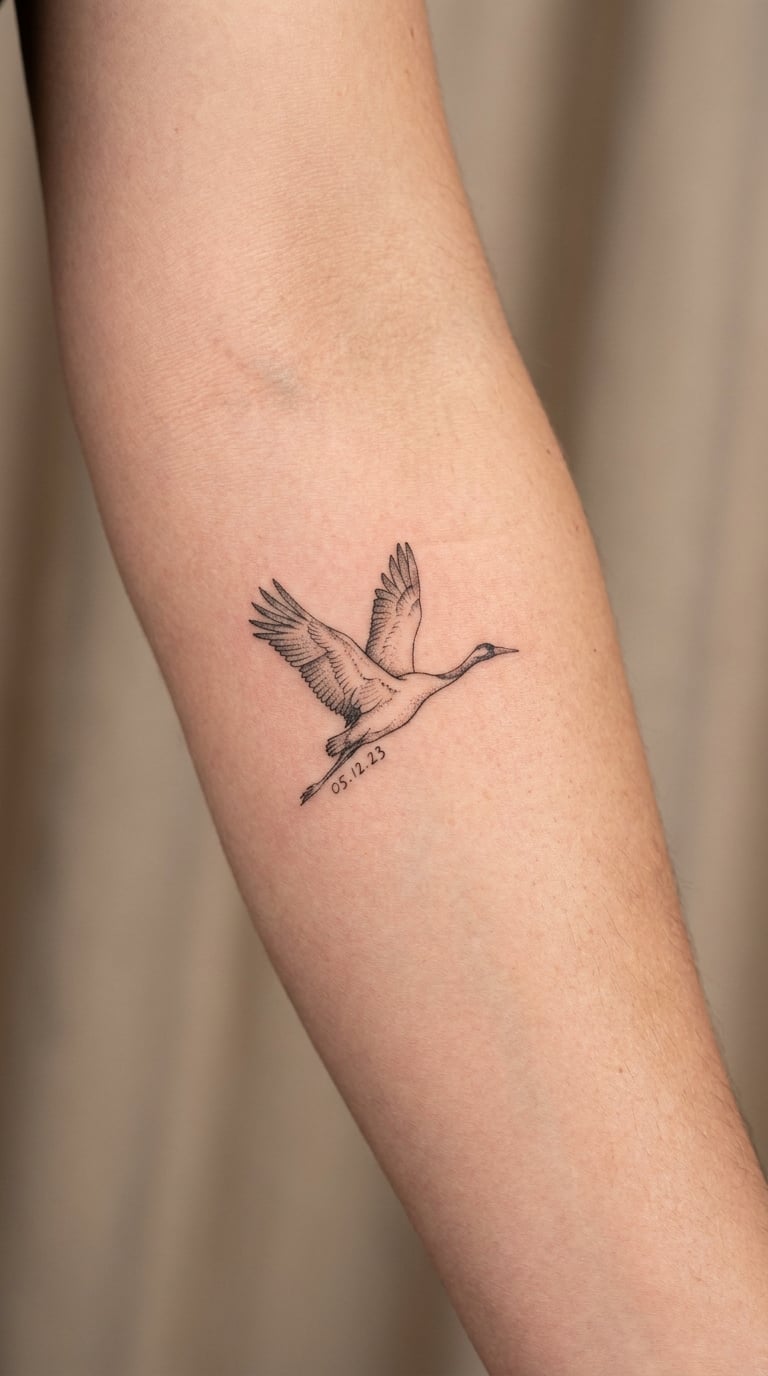
The bird leads and the text supports it. A black-line crane takes most of the space, with a short date set beneath the body in small plain lettering that is clearly secondary at a glance. Lettering that competes with the bird is the usual mistake in this design.
Dates usually mean something specific rather than symbolic: a wedding, a birthday, the day someone died, the day a chapter closed. Say plainly what it is when you book, because it changes how the artist should weight the two elements.
Placement: Inner arm below the elbow, inner forearm, or under the collarbone.
Size: 2.5-3.5 inches (6-9 cm) including the lettering.
Style: Fine line with small lettering.
Pain: Low to medium on the inner arm. Small lettering needs a steady hand, so the sitting takes longer than the size suggests.
Make it yours: Give the artist the exact date and the exact characters, then check the spelling before they start.
25. Watercolor Crane with Ink Wash Background
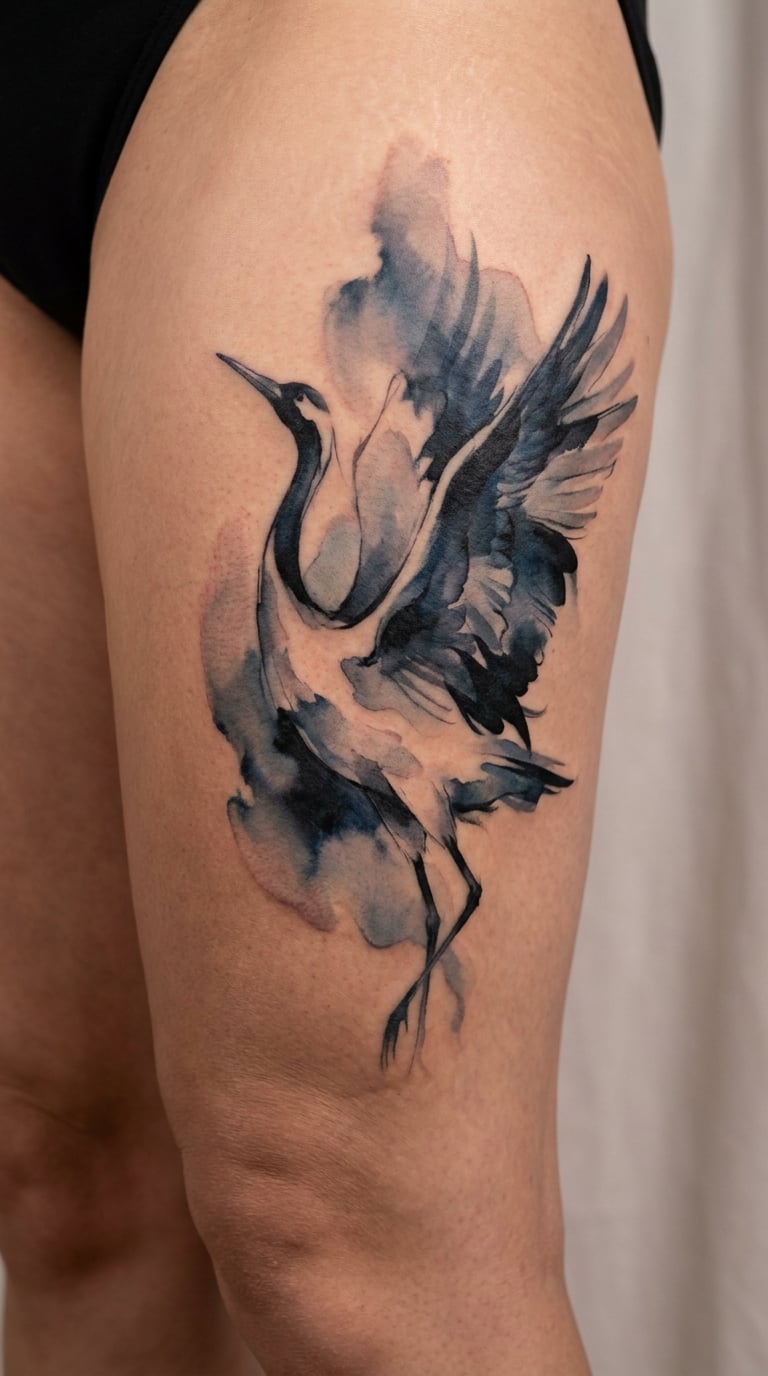
The largest design here. A black-and-blue crane is drawn with expressive, bleeding feather edges, and behind it sits a controlled abstract wash in soft grey and deep blue. The wash stops short of the bird’s outline on three sides so the crane stays cut out against it.
This is the piece for someone building a collection, because it fills a thigh or a large back area on its own. Background handling is the hard part, and it is exactly where most wash tattoos go wrong.
Placement: Outer thigh, large back area, or lower abdomen. Flat skin with little bone is what makes it work.
Size: 8-10 inches (20-25 cm).
Style: Watercolor with an ink wash background.
Pain: Low on the thigh, but this is a multi-hour piece. Plan two sittings rather than one.
Make it yours: Bring a photo of an ink wash you like and let the artist build the background around your crane, not the other way round.
How to Choose the Right Design
Choosing a Style and Placement
Work from the spot, not the picture. A design that looks right on a phone screen often sits badly on a collarbone or an ankle, so decide the placement first and then pick a style that fits the surface.
- Follow the body shape: A bird with a long wingspan wants a long flat surface like a forearm or upper back. A curve like the shoulder or calf suits a bird with one wing raised rather than both spread.
- Match line weight to size: Below about 2 inches, use solid shapes. Between 2 and 5 inches, single-needle fine line works. Above 6 inches you can carry gradients and feather detail.
- Check visibility against your own habits: Hand and finger work shows constantly and wears fastest. Upper arm, back and thigh give you a piece you control the visibility of.
- Count the work you already have: A bare area suits a large single bird. Between existing tattoos, a framed or circled design fills a gap neatly and hides the edges of older work.
- Brief the anatomy, not just the picture: Tell the artist whether the beak points up, forward or down, whether the bird stands on one leg or two, and where the wing sits. Most disappointing crane tattoos come from a vague reference rather than a difficult design.
- Ask the artist to adjust: If they say a detail will not read at the size you want, listen before the stencil goes on. A thinner neck, fewer feather rows or a simpler beak fixes most size problems.
- Plan colour early: Pale washes and soft pinks fade noticeably faster than saturated reds and blacks. If longevity matters to you, go deeper or stay monochrome.
Cost and Session Time
Tattoo cost is set by size, detail and placement, and most artists work by the hour rather than quoting a fixed price per design. Hourly rates vary a lot by city, by shop and by how well known the artist is, and a bigger city will always sit at the top of the range.
For a rough US range, a small crane of 1-3 inches usually lands somewhere around $150 to $300 for the whole piece, and a single fine-line crane at 4-6 inches with clean detail sits closer to $250 to $450. Colour, gradients and heavy blackwork push a medium piece toward $500 to $900, and a large wash piece like the watercolor crane on the thigh starts around $900 and climbs well past $1,500 once you add extra sittings. Those are ballpark figures, not quotes.
Placement changes the clock more than size does. A collarbone or rib piece takes longer at the same dimensions because the skin is thinner and the artist has to work around bone. Fingers are short in time and intense in sensation, so they are still an awkward first appointment.
Three things move the total beyond the hourly rate: shop minimums, which set a floor on every appointment regardless of size, travel, and any touch-up session. Bring a clear idea and a reference photo to your consultation, because design changes made after the quote are where the surprise usually comes from.
Aftercare Basics
- Follow your artist’s aftercare instructions first. They know which inks and products were used on your skin, and their advice overrides anything generic on this page.
- Wash gently and often for the first few days. Clean lukewarm water and unscented soap, then pat dry with something disposable rather than a towel you use on your face.
- Use a thin layer of whatever your artist recommends. A thick coat traps heat and ink and is the most common cause of a patchy result.
- Wear loose clothing over the area. Cotton shirts and waistbands rub new work and pull scabs off early.
- Keep the sun off healed colour work. Once healed, sunscreen on exposed pieces is the single best thing you can do to keep blues, greys and pinks from washing out.
- Give it the full healing window before judging it. A fine-line crane looks faint and patchy for the first two weeks while the line settles into the skin. Judge it after that, and book a touch-up rather than worrying at it yourself.
Frequently Asked Questions
What does a crane bird tattoo symbolize?
Crane tattoos usually point to longevity, fidelity, good fortune and calm. Cranes pair for life, migrate enormous distances and stand on one leg, and in Japanese art the bird is associated with a very long life. The origami crane adds a postwar meaning of hope and recovery. Many wearers pick it for a specific person or chapter rather than the general symbolism.
Where is the best placement for a crane bird tattoo?
The forearm suits most designs because it is long, flat and easy to work on. The upper back and outer thigh suit large birds with wide wingspans, while the collarbone, wrist and ankle suit small fine-line versions. Shoulder and calf placements work well for a single raised wing. Pick the placement before the design, since the shape of the area changes what reads clearly.
Do crane tattoos work as a first tattoo?
Yes, and the fine-line flying crane is a common choice for that reason. A solid silhouette or a single-line bird has few details to lose, heals predictably and needs only one short sitting. Pick a spot with some soft tissue, such as the upper arm or thigh, and avoid starting on a finger or the collarbone where bone makes the experience much harder.
What size should a crane tattoo be so the detail holds up?
Below about 2 inches, a crane needs to be a solid silhouette because fine feathers turn into a blob. Between 2 and 5 inches, clean single-needle line work holds well. Above 6 inches, gradients, feather rows and colour washes have enough room to show. If you want detail, move the size up or drop the detail, not both.
What does a two-crane tattoo mean?
A pair of cranes most often represents companionship, fidelity or a shared chapter, drawn from the fact that cranes pair for life. People also use matching pairs with siblings, partners or friends, sometimes with one bird slightly higher than the other to suggest movement. Many wearers connect the pair to a specific person rather than to the general symbolism.
Is a Japanese-style crane tattoo suitable without Japanese heritage?
Plenty of people wear crane tattoos without Japanese heritage, and there is no rule against it. What matters is care with the details: a red-crowned crane drawn with its true markings, and traditions treated as separate things rather than one generic Asian meaning. Japanese, Chinese, Korean and Vietnamese traditions each carry their own associations, so pick the one you actually know about.
Conclusion
If this is your first tattoo, go with the fine-line flying crane or the minimal silhouette on the upper arm. Both have fewer details to lose, need one short sitting, and still look like a crane ten years on.
Adding to a collection, the two-crane circle gives you a matching piece to work with, and the large watercolor crane on the thigh fills an area on its own without needing anything around it. Either way, settle the placement and the level of detail with your artist before the stencil goes on, and let them tell you what will read at the size you have in mind. Those 25 crane bird tattoo ideas cover the range, so bring the one you like most to a consultation and let the artist adjust it to fit your skin.