
What Age Can You Get a Tattoo? State Laws & Rules 2026
If you are in the United States, 18 is the age at which you can be tattooed anywhere in the country without asking anyone. Below 18, the answer changes at every state line, and in a handful of states no consent form, parent or court order will get a minor through the door.
That is the short version. If you have ever typed what age can you get a tattoo into a search bar at midnight, the rest matters too, because the legal minimum and the shop’s own policy are two different gates, and plenty of readers only discover that after they have walked in. Here is how the rules actually work, what to bring with you, and what to do while you wait.
What Age Can You Get a Tattoo? Legal Rules Explained
Eighteen is the baseline because it is the age of majority almost everywhere, and a tattoo is a permanent change to a body that may still be growing. The UK is the same: 18 in England, Scotland, Wales and Northern Ireland. If you have read that Scotland allows tattooing at 16, that chart is wrong.
Below 18 in the US, states fall into three groups. Knowing which group your state is in tells you whether you are looking at a permission problem or a wall.
| Rule type | What it means | What it feels like in practice |
|---|---|---|
| Total ban | No one under 18 may be tattooed for any reason, including a parent standing beside them | The answer is no before the conversation starts |
| Consent required | A minor may be tattooed once a parent or legal guardian completes a specific process | Possible, but paperwork, ID and often physical presence are required |
| Age-tiered | The state sets a floor, commonly 16, that consent cannot go below | At 15 the answer is no no matter who signs |
Physician-authorized exceptions exist in a small number of states and are worth knowing about if you are looking at medical marking. Oregon’s tattoo practice standards are explicit on this point, allowing tattooing of a person younger than 18 when authorized or prescribed by a physician’s statement.
Two other rules apply no matter which group you are in. Consent never overrides the statute, and a shop that offers a smaller age than the law allows in your state is not doing you a favour.
What Age Can You Get a Tattoo in Your Area?
Start with your state health department, then your county or city health department. Tattoo licensing sits with local and state health bodies rather than a single federal agency, and city ordinances can add rules on top of the state code. The National Conference of State Legislatures tracks body art statutes if you want a second read.
What follows is the subset of states where a primary code citation is available to me, last verified in October 2026. Where I cannot point to a code, I am telling you so rather than filling the gap.
| State | Minimum age without consent | Under 18 with consent | What the parent must do | Code cited |
|---|---|---|---|---|
| Texas | 18 | No | Not applicable | Tex. Admin. Code Title 25 Ch. 229 |
| California | 18 | No | Not applicable | Cal. Penal Code 653 |
| South Carolina | 18 | No | Not applicable | S.C. Code 44-34-100 |
| New York | 18 | No | Not applicable | Verify with your city health department |
| Illinois | 18 | Physician only | Licensed physician authorization | 720 ILCS 5/12C-35 |
| Oregon | 18 | Physician only | Physician’s statement | Or. Admin. Code 331-915-0065 |
| Pennsylvania | 18 | Yes | Parent physically present for the procedure | 18 Pa. C.S. 6311 |
| Ohio | 18 | Yes | Parent in person to sign off | Ohio Rev. Code 3730.06 |
| New Jersey | 18 | Yes | Written parental permission on file | N.J. Stat. 2C:40-21 |
| Georgia | Confirm locally | Confirm locally | Ask the shop and the district health office | O.C.G.A. 16-5-71 |
| Delaware | 18 | Yes | Notarized consent, the clearest case of that requirement | Verify with the Division of Public Health |
| Idaho | 18 | Reported floor of 14, unverified | Confirm with the Idaho health district | Not verified |
| Nevada | 18 | Reported floor of 14, unverified | Confirm with your county health district | Not verified |
| Florida | 18 | Reported floor of 16, unverified | Confirm with the county health department | Not verified |
| Kentucky | 18 | Reported floor of 16, unverified | Confirm locally | Not verified |
| West Virginia | 18 | Reported floor of 16, unverified | Confirm locally | Not verified |
| Iowa, North Carolina, Utah | 18 | Published charts disagree with each other | Do not rely on a chart, call the shop | Not verified |
| All other states and DC | 18 in the overwhelming majority | Varies | Ask before you book | Check your state health department |
That table was last verified in October 2026. State body art codes get amended, and a few get amended quietly, so treat any row as something to confirm on the phone rather than a fact to print out.
Where published charts disagree. Several widely copied guides contradict each other on the same states, which is why you see confident answers that are not right. On Texas, one chart lists parental consent as available and another cites Tex. Admin. Code Title 25 Chapter 229 as 18 with no exceptions; the code is the one that counts. On Iowa and North Carolina, charts flatly disagree with each other, so neither is worth relying on. On notarization, one guide states that a consent document must be notarized as a general US rule, which is overbroad, while Delaware is a genuine and specific example. The pattern to follow is the same: primary code first, chart second, social video never.
Under-18 Tattoo Rules: ID, Consent and Local Exceptions
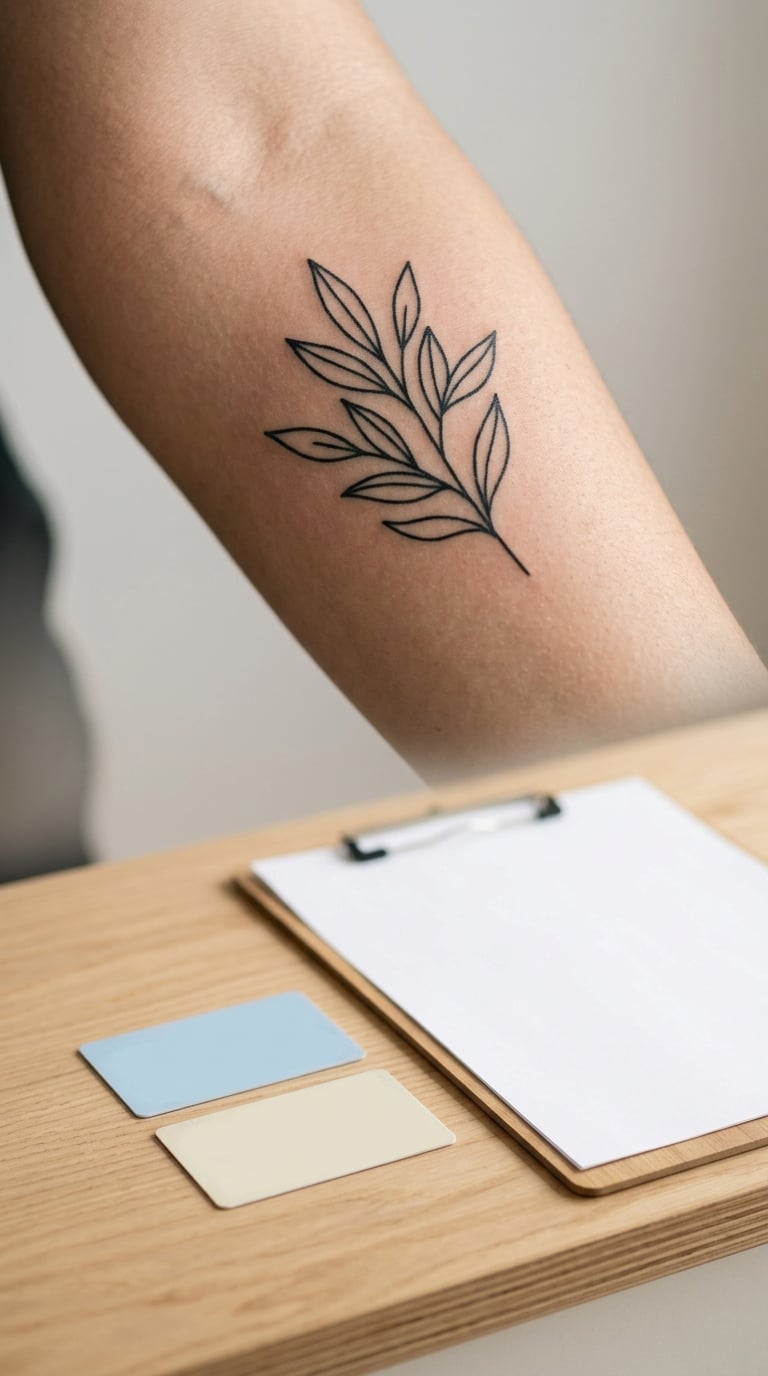
Parental consent does not mean a signature. That is the single most expensive misunderstanding on this topic, and it is why so many 16-year-olds arrive with a signed piece of paper and get turned away.
In a consent-required state, the process usually means all four of these: a government-issued photo ID for the parent, proof that the adult is actually your legal parent or guardian, the shop’s own signed consent form, and the parent physically in the building for the procedure. Pennsylvania is the clearest example of the presence requirement in its code, and Ohio pairs consent with an in-person sign-off. Other states accept written permission on file and let the parent leave, which is genuinely different and worth asking about specifically.
Some shops also ask for a birth certificate, a custody order or adoption papers, particularly when the adult signing is a step-parent, an aunt, or a parent whose name is not on the birth certificate. In blended families this is where appointments quietly fall apart. A signature from someone without legal guardianship is worse than no signature, because the shop has now documented that they knew.
A note that surprises people: a minor can change their mind after the form is signed. Guardianship is not an override of the minor’s own willingness, and a good studio will stop if the person in the chair hesitates.
If the requirement in your state includes a signed form, print your state’s requirement and bring it with you. Reputable artists will turn you down if you cannot show you did the homework, and they are right to.
Are You Ready for a Tattoo? Signs to Consider
Legality and readiness are separate questions, and passing the first one does not clear the second. The list below is the version I would hand to a friend.
- You understand that this is permanent and that removal is laser, expensive, and slow.
- You can follow aftercare for two to four weeks without skipping it.
- You have a real budget set aside, not what is spare once the session is paid for.
- You chose a licensed studio you checked, not one that advertised cheap.
- You and the artist agree on placement, and you understand that body shape changes it.
- You can name a reason for the design that still makes sense in ten years.
- Nobody is pushing you, including yourself on a bad day.
- You have looked at healed work by that specific artist, not just fresh photos.
Two practical warnings. A design placed on a forearm or ribs at 16 will not sit the same at 25, because the body changes around it. And taste moves faster than people expect, which is why our what to do before getting a tattoo checklist puts design choice above everything else.
If you are not legally eligible yet, or you are not sure, nothing is lost by waiting. A temporary transfer or henna-style tester on the exact placement shows you the scale and the curve on your own body. Six months of saved reference images costs nothing and gets you a better appointment when you are ready.
Tattoo Pain by Placement
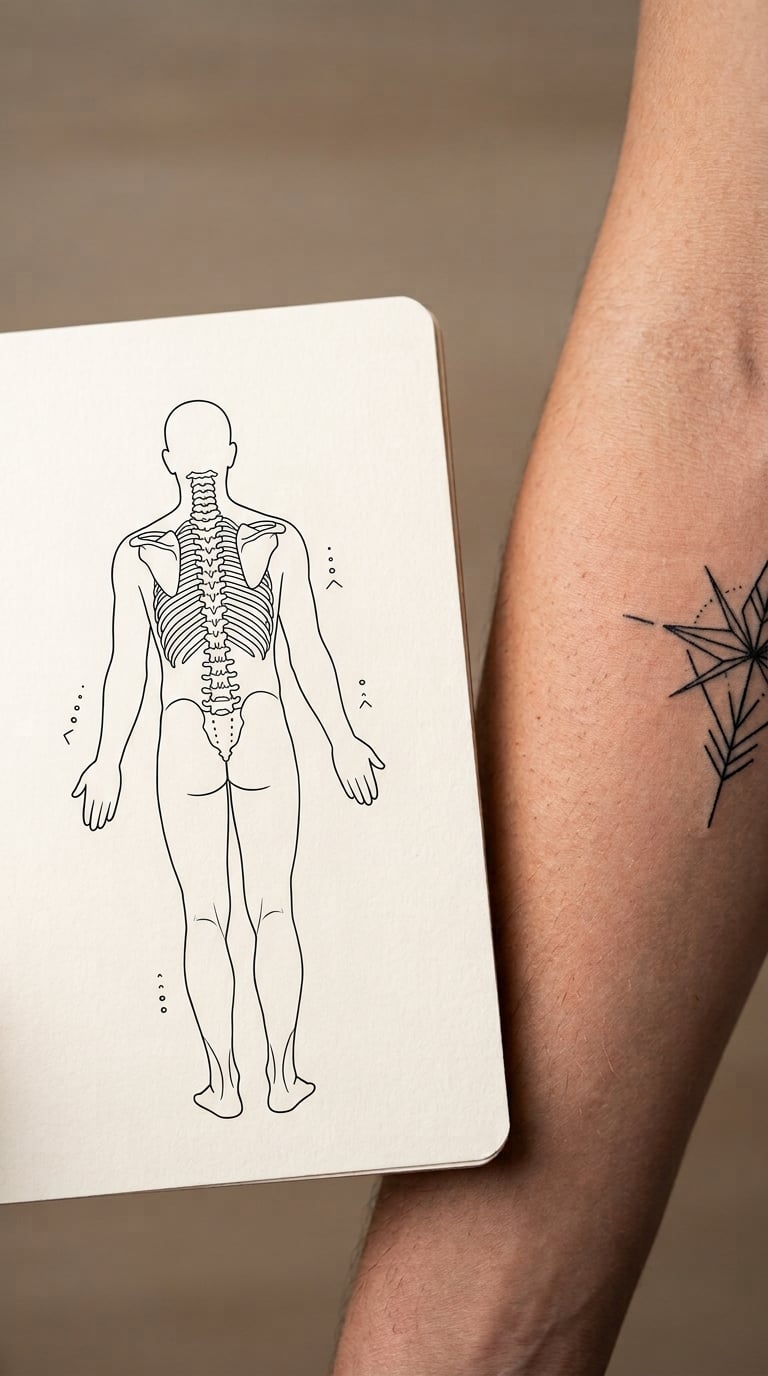
Nothing on this list is painless, and anyone who tells you a foot is fine is describing their own tolerance rather than yours. Session length, size, sleep, and how recently you ate all move the number around more than the placement does.
| Placement | Typical pain | What it actually feels like | Session note |
|---|---|---|---|
| Upper arm, outer thigh | Low | Dull and repetitive, easy to sit through | Common first-tattoo site |
| Forearm | Low to medium | Noticeable near the wrist and elbow | Good visibility while it heals |
| Calf, back of the shoulder | Medium | Steady aching, muscle warms up | Easy to cover, easy to sit |
| Lower back, ribs, chest | Medium to high | Sharp, breath-catching, waves rather than a line | Worst during long shading passes |
| Inner arm, armpit, behind the knee | High | Thin skin over sensitive tissue | Short sessions only |
| Foot, ankle, fingers, collarbone | High | Bone-close, intense, distracting | Small designs only |
Our placement pain chart breaks the same areas down further, and it is worth a look before you commit to a spot. Eat properly, sleep the night before, and take the break your artist offers instead of proving something.
How Much Does a Tattoo Cost by Size?
Tattoo pricing moves constantly and differs by city, so I am deliberately not putting numbers on this page. What does not change is how the quote is built, and once you understand that you can read any quote you are given.
| Size | Typical time in the chair | What usually drives the quote |
|---|---|---|
| Tiny, single symbol | Under an hour | Shop minimum, which is the floor even for five minutes of work |
| Small, hand-sized | One to two hours | Hourly rate multiplied by detail level |
| Medium, palm-sized | Two to four hours | Detail, colour count, and whether it needs a second session |
| Large, several inches across | Four to six hours | Shading passes, artist experience, custom drawing time |
| Half sleeve | Multiple sessions | Flat hourly rate across several appointments |
| Full sleeve or back piece | Many sessions over months | Longest project, highest total, most custom work |
A shop minimum is a real and normal thing, and it is why a tiny tattoo can cost the same as a slightly larger one. Custom work costs more than flash because the drawing time is not tattooing time. Travel, parking and taking a whole day off add up quietly too.
Touch-ups within a short window are usually included or discounted, but ask whether that is written down before you sit down. And a very low advertised price is not a bargain, it is a signal that something is being skipped.
Tattoo Healing Timeline by Week
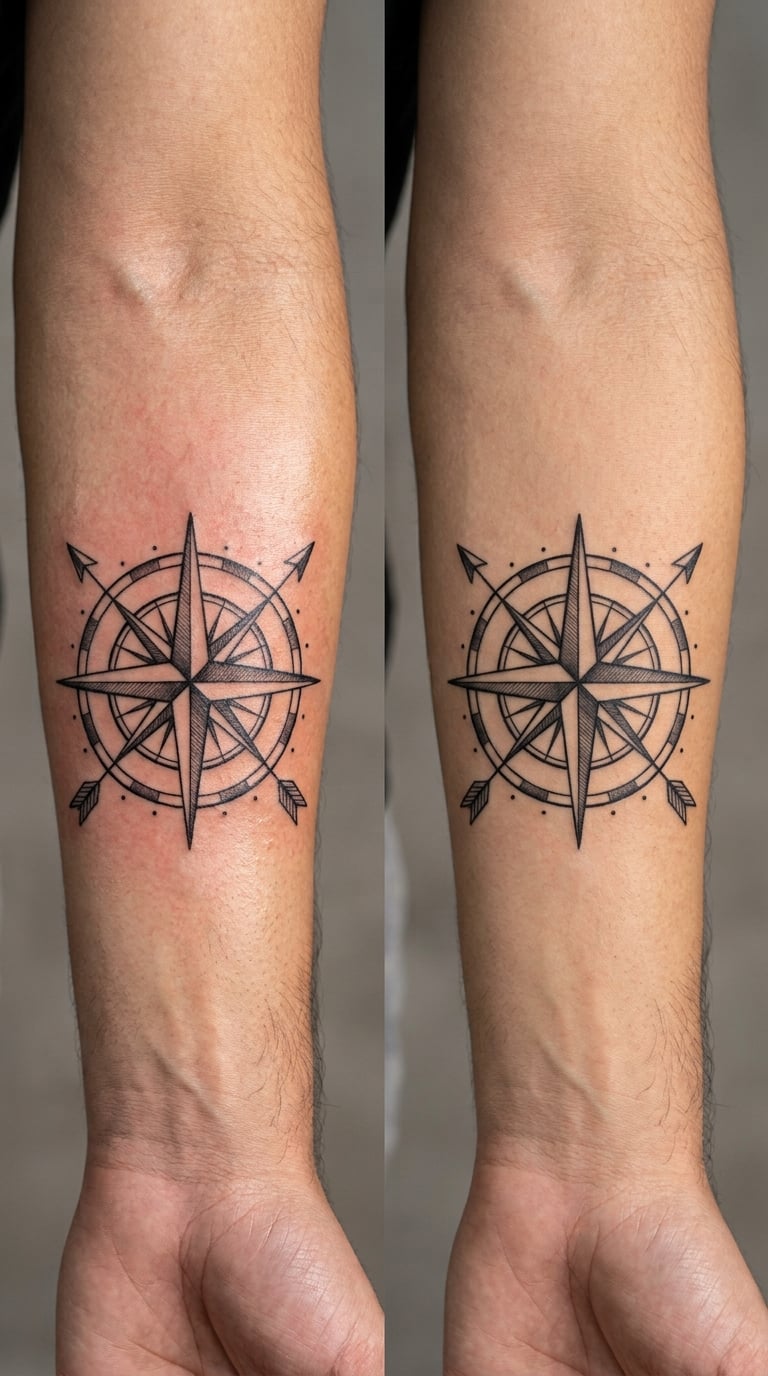
Healing is slower than most first-timers expect and faster than the internet claims. A general week-by-week picture looks like this. Your artist’s aftercare instructions override all of it.
| When | What you see | What to do |
|---|---|---|
| Days 1 to 3 | Red, tender, slightly raised, may ooze clear fluid | Follow your artist’s cleaning and covering instructions exactly |
| Days 4 to 10 | Itching, dryness, flaking begins, colour looks duller than day one | Do not scratch or pick. Moisturise only if instructed |
| Weeks 2 to 3 | Flaking finishes, top skin settles, lines look slightly softer | No swimming, baths, sun or saunas while the surface is healing |
| Weeks 4 to 6 | Most of the surface healed, the tattoo sits flatter in the skin | Book a free check if a line looks patchy or a spot stayed scabbed |
| Months 2 to 6 | True colour appears, lines settle, minor fading becomes visible | Touch-ups usually happen here if they are needed at all |
New skin over a fresh tattoo is not fully healed for weeks, so plan sun exposure carefully even after the flaking stops. If our tattoo ink healing guide shows you what each stage should look like, it will save you a lot of anxious checking in the mirror.
Mistakes to Avoid
These are the mistakes that actually show up, most of them repeated in forum threads by people who learned them the hard way.
Turning up without confirming the rule. The legal minimum and the shop’s policy are different things, and the only way to know both is to ask. A short phone call saves an embarrassing walk across a shop floor in front of people you know.
Booking on a low advertised price. Unregulated artists working out of rented rooms are the real risk here, not the price. Bloodborne infection risk is the reason licensing exists at all.
Choosing a design under pressure. If you cannot explain why you want it in a sentence that still makes sense in ten years, wait. Friends and partners are the most common source of this pressure.
Picking an artist from one generic photo. Judge a portfolio of healed work, ideally from clients with similar skin tone and placement to yours.
Ignoring placement changes. Ribs, forearms and lower backs change shape as you age, and a piece that looks intentional now can look stretched later.
Skipping the consultation. It is where placement, scale and design get adjusted before anything permanent happens.
Leaving without written aftercare. Get the instructions in writing or on a card. That is how you know what to do at 11pm when the shop is closed and the skin is sore.
One more worth naming: lying about your age. It exposes the artist to fines and licence action, and in some states lying to obtain a service as a minor is itself a charge aimed at you, not just the shop.
Frequently Asked Questions
Can I get a tattoo at 16 with parental consent?
It depends entirely on your state. A number of states will tattoo a 16-year-old when a parent or legal guardian shows government-issued photo ID, signs the shop’s consent form, and stays in the building for the procedure. Other states set a hard floor of 18 and refuse regardless of consent. A few accept written permission without presence. Call the shop and your state health department before you book anything.
What ID do I need to get a tattoo?
If you are 18 or over, a government-issued photo ID showing your date of birth is the norm, and a driver licence or passport both work. If you are under 18, you will usually need your own ID plus a parent or legal guardian’s photo ID, sometimes a birth certificate or custody order, and the shop’s own consent form. Some studios want a second form of ID. Ask for the list before you travel.
Can I get a tattoo with a passport instead of a driver’s license?
Yes. A valid passport is a government-issued photo ID and is accepted in place of a driver’s licence at most studios, in or out of the US. Some shops accept a state ID or a certified birth certificate alongside it. The key is that the document shows a photograph and a date of birth, and that the name matches what you give at the counter. Have the original with you, not a photo of it on a phone.
Can I get a tattoo in the same place as a piercing?
Technically yes, but most artists advise against it and many refuse. A fresh tattoo is an open wound, and putting one over a healing piercing traps moisture and raises infection risk. The healing timelines also clash, since piercings can take months in some placements. If you want both, use a different area and let each one finish healing before the artist works near the other.
Does a tattoo artist have the right to refuse me because I am under 18?
Yes, and a good one will. A licensed studio can set house policy stricter than your state statute, which means 18-only even in a state that permits minors with consent. Artists regularly refuse because they judge the request impulsive, because the design is unsuitable, or because they are not confident in the placement. Being turned away is disappointing, but a shop that says yes to everything is the one to worry about.
Can I get a tattoo while traveling or serving in the military?
Tattoo rules are set where you are sitting, not where you are from, so a US state statute tells you nothing about getting inked abroad. Outside the US the legal age is commonly 18, though some countries regulate the artist rather than the client, and enforcement varies. In the military, branch policy and tattoo location rules apply on top of the law, and some countries restrict visible tattoos at their border. Check both before you go.
What to Do First
If you take five things from this page, take these. Confirm the legal age where you live, from your state or county health department rather than a chart. Ask a licensed studio what identification and consent paperwork it requires, and whether the parent must be present. Look at healed portfolios, not fresh posts, for an artist whose work suits your placement and your skin. Then talk through design, placement and the total cost before anything is booked.
And then give it time. Nobody has ever been harmed by waiting another season, and a decision you were not pushed into is one you are far less likely to regret. When you are ready, the question of what age can you get a tattoo will already be settled, and the only hard part left is choosing the design.