
20 Tiny Sun Tattoo Ideas (September 2026): Sizes and Meanings
Tiny sun tattoo ideas are the easiest way to get the meaning of a sun without the commitment of a big piece. A micro sun is a circle or half circle with a handful of rays, usually under 2 cm, and it wears better than most small tattoos because there is so little ink to blur.
Book two months out if you can, because tattooers fill their calendars for the spring and summer rush and you want a spot for a late-summer heal. I have had small suns healed beautifully on a wrist and badly on a finger, and the difference had almost nothing to do with the artist.
If you want the short version first: a tiny sun tattoo symbolizes warmth, vitality, new beginnings and the sense that things are going somewhere. Pick the placement that suits how much you want people to see it, keep the ray count low, and let your artist push back if you ask for something too small.
Quick Picks: 7 Tiny Sun Tattoos Worth Saving
- Fine-line half sun behind the ear – about 12 mm, sits in the dip below the ear, low pain, hidden at the office.
- Single-arc half sun, inner wrist – 15 mm, one clean curve with short rays, the most popular tiny sun placement going.
- Sun with closed eyes, ankle – 14 mm, calm rather than loud, reads like a small face once healed.
- Twelve-ray sunburst, collarbone – 18 mm, the one to pick if you want it visible in summer.
- Plain circle sun, finger knuckle – 8 mm, the most committed spot on this list and the first to need a touch-up.
- Sun and small moon, inner arm – 20 mm each, keep them 3 cm apart so neither crowds the other.
- Sunrise over one line, inner forearm – 22 mm, half a disc rising above a single horizontal line.
Each of these tiny sun tattoo ideas gets a real size and a placement further down, so you can walk into a consultation with a number instead of a vague idea.
What Does a Tiny Sun Tattoo Symbolize?
A tiny sun tattoo symbolizes warmth, vitality, hope and new beginnings. Drawn as a circle or half circle with radiating lines, it is the oldest symbol in human art, and at small scale it works as a quiet reminder of optimism, a good-luck charm, or simply a love of summer. The version paired with a moon usually stands for balance; the one over water reads as calm and renewal.
One caution before you pick a deity reference. Solar gods appear in Egyptian, Inca, Shinto, Aztec and Polynesian traditions, and a design lifted from one of those cultures carries a meaning that belongs to that culture rather than to you. If that is the route you want, talk to an artist who works in the tradition, or choose the plain geometric sun and keep it yours.
20 Tiny Sun Tattoo Ideas, With Sizes and Meanings
1. Fine-Line Half Sun Behind the Ear
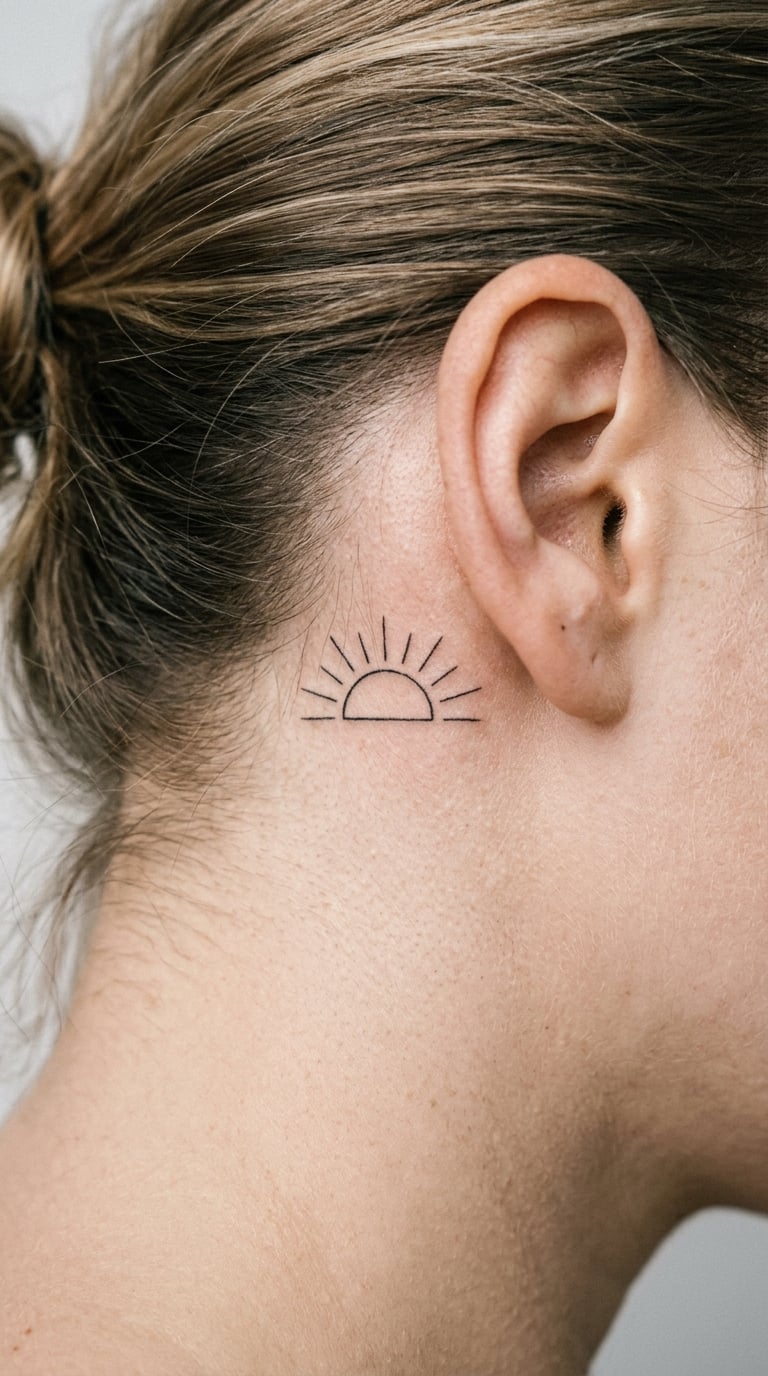
A half sun tucked into the dip behind the ear is the quietest version of this design. It reads as a sunrise breaking over a horizon you cannot quite see.
Keep it near 12 mm with no more than seven short rays. Behind the ear skin is thin and moves constantly, so anything over 15 mm starts to look blurry within a couple of years.
Pain and time: about 3 out of 10, 15 to 25 minutes. It is the easiest first tattoo I would recommend.
2. Single-Arc Half Sun on the Inner Wrist
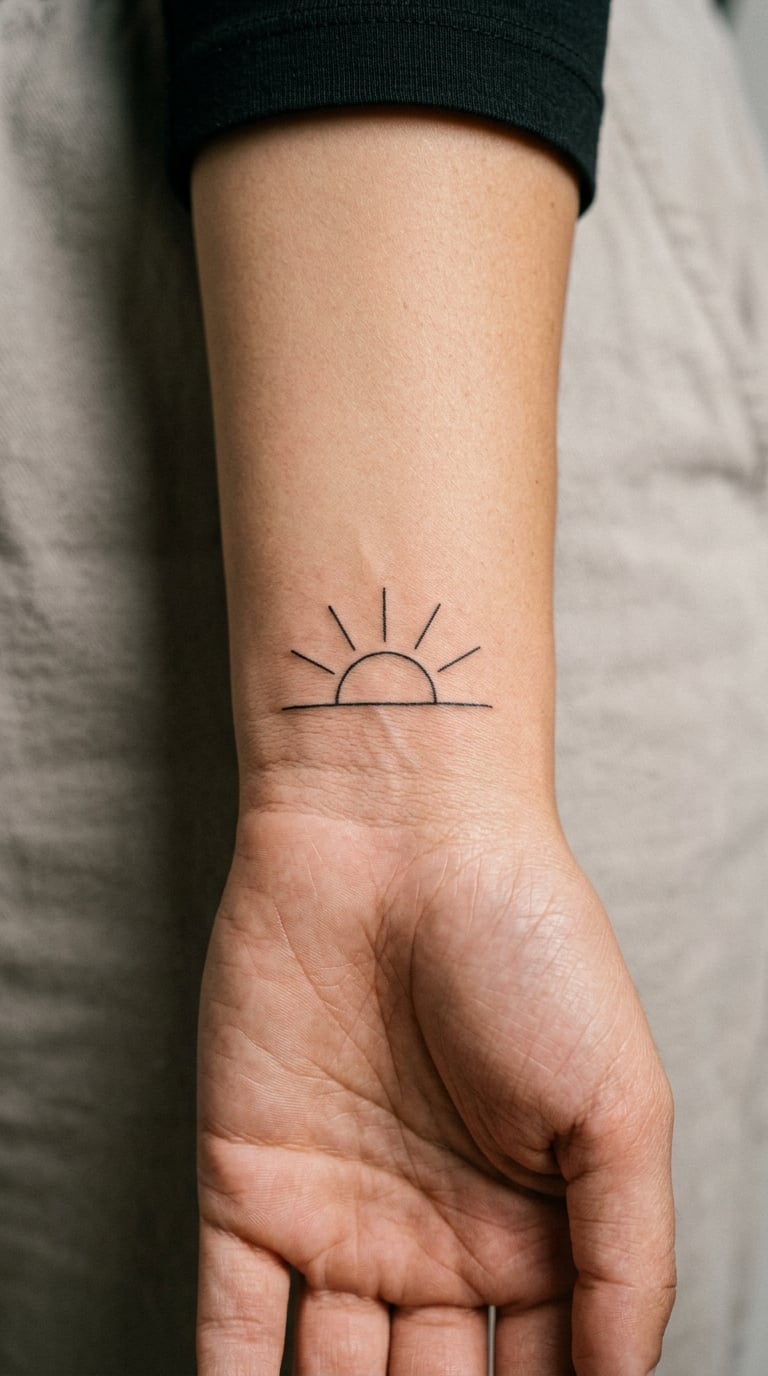
One clean semicircle with a few even rays, sat on the inner wrist where you read your pulse. The meaning people describe most often is optimism they can physically check on a hard day.
Fifteen millimetres is the sweet spot. The inner wrist takes sun all day, so this one wants sunscreen even after it heals.
Pain and time: 5 out of 10 on the wrist, 20 to 30 minutes.
3. Sun With Closed Eyes, Ankle
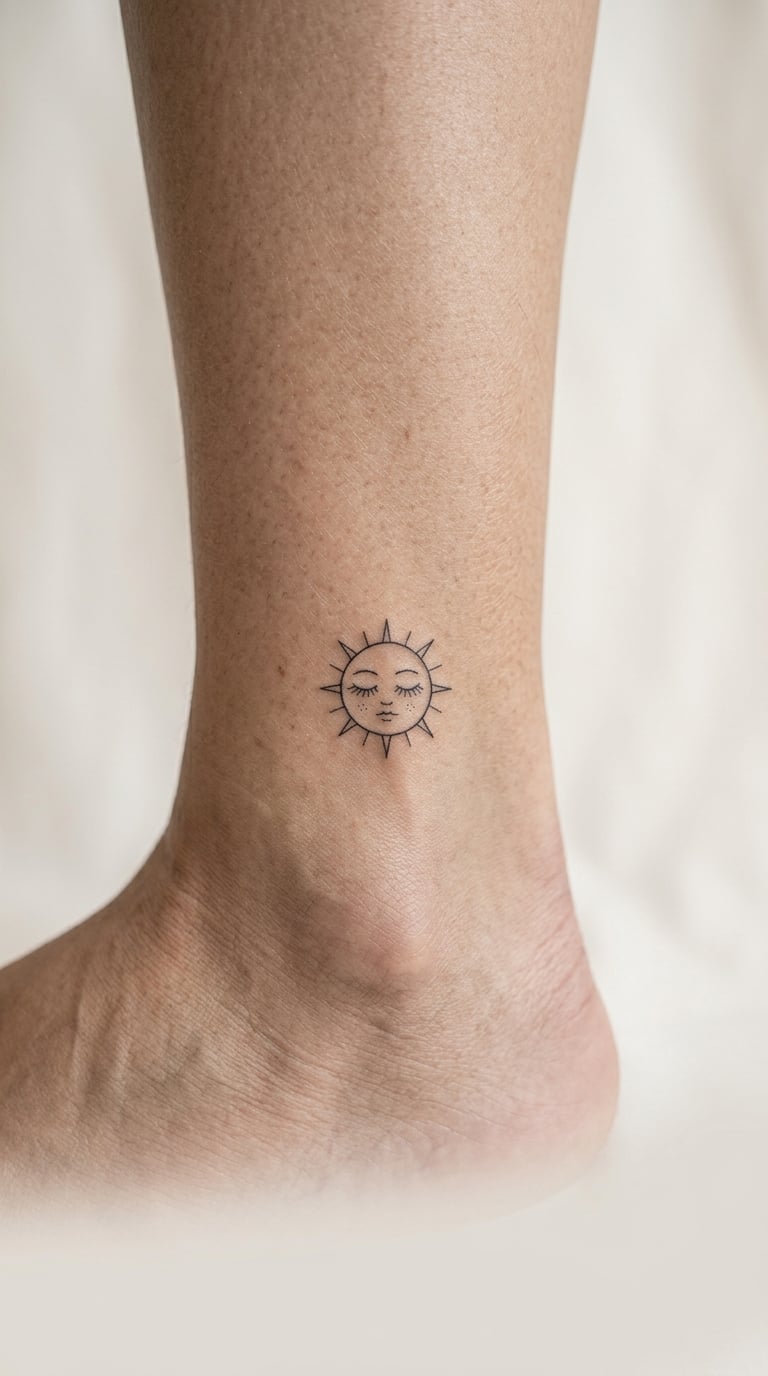
A tiny sun with lashes and closed eyes is the calmest idea on the list. People read it as rest, a nap in the middle of a busy life, or just a friendly face.
At 14 mm you get the lashes if your artist draws them as two or three strokes. Ask for the eyes as simple arcs, not full detail.
Pain and time: 3 out of 10, 20 to 30 minutes. Ankle skin is bony but forgiving.
4. Twelve-Ray Sunburst on the Collarbone
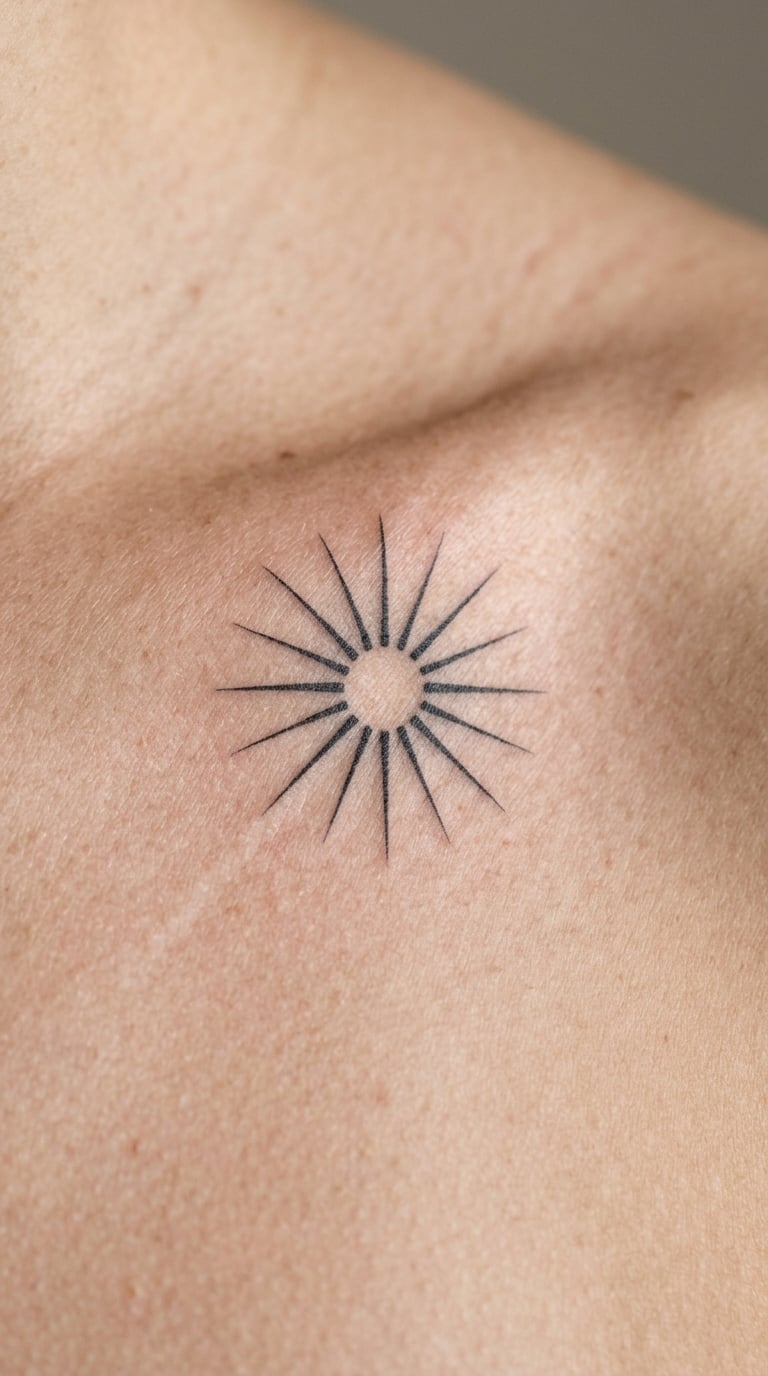
A full sunburst with twelve even rays is the classic choice, and the one that catches light well. It suits people who want the sun to be legible in a swimsuit photo.
Eighteen millimetres is the floor for twelve rays. Below that the rays merge, and you end up with a solid black dot within a year.
Pain and time: 5 out of 10, 25 to 35 minutes.
5. Plain Circle Sun on a Finger Knuckle
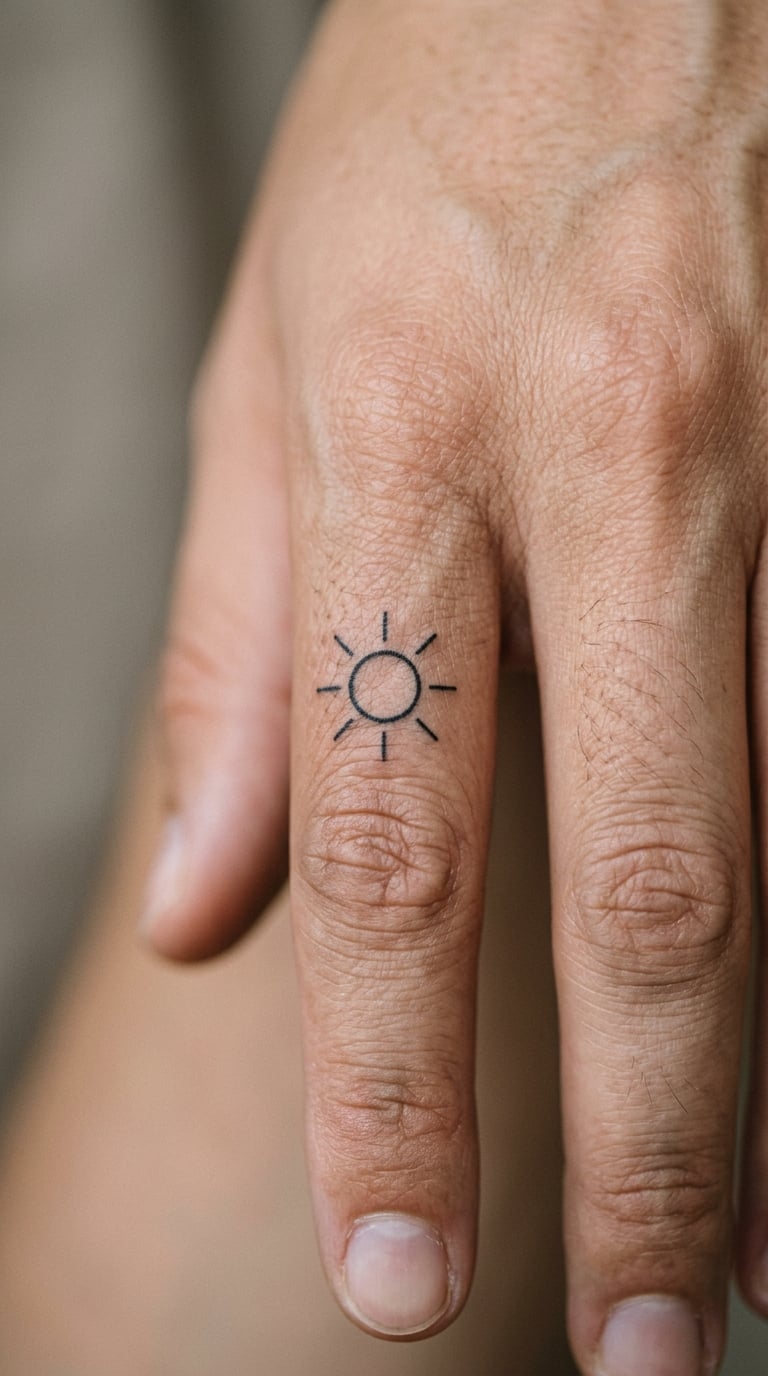
A plain circle with eight stubby rays is a good first tattoo because there is nothing to overthink. Small commitment, small patch of skin, easy to cover.
Eight millimetres is already pushing it. Finger ink fades faster than anywhere else on the body, so plan on a free touch-up within a year.
Pain and time: 7 out of 10, 15 to 20 minutes. Bony and quick.
6. Sunrise Over One Line, Inner Forearm
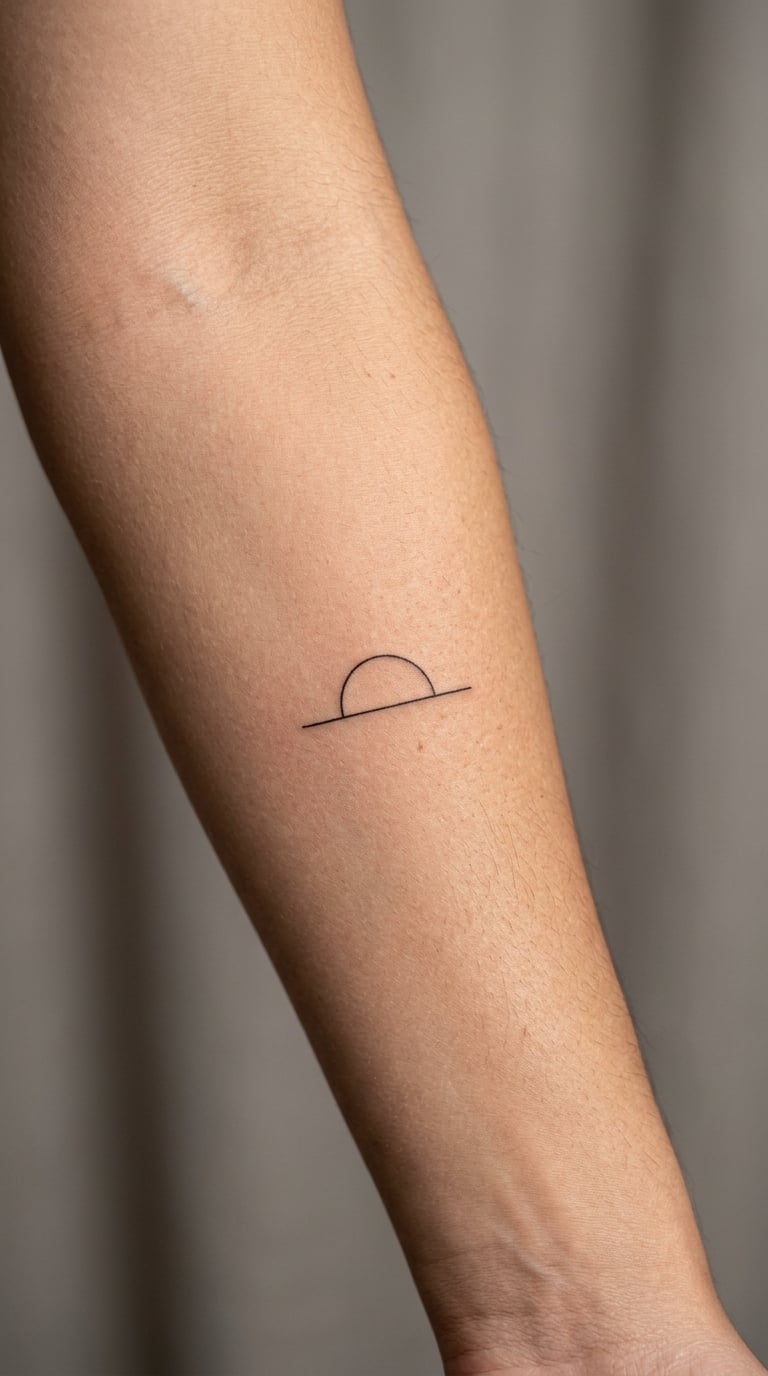
A half disc rising above one straight line is a sunrise drawn with the fewest possible marks. It reads as a beginning, often tied to a move, a new job or a new year.
Twenty-two millimetres across, with the rays pointing up only. The line underneath should be no thinner than the disc outline or it disappears first.
Pain and time: 5 out of 10, 20 to 30 minutes.
7. Geometric Ray Sun on the Rib
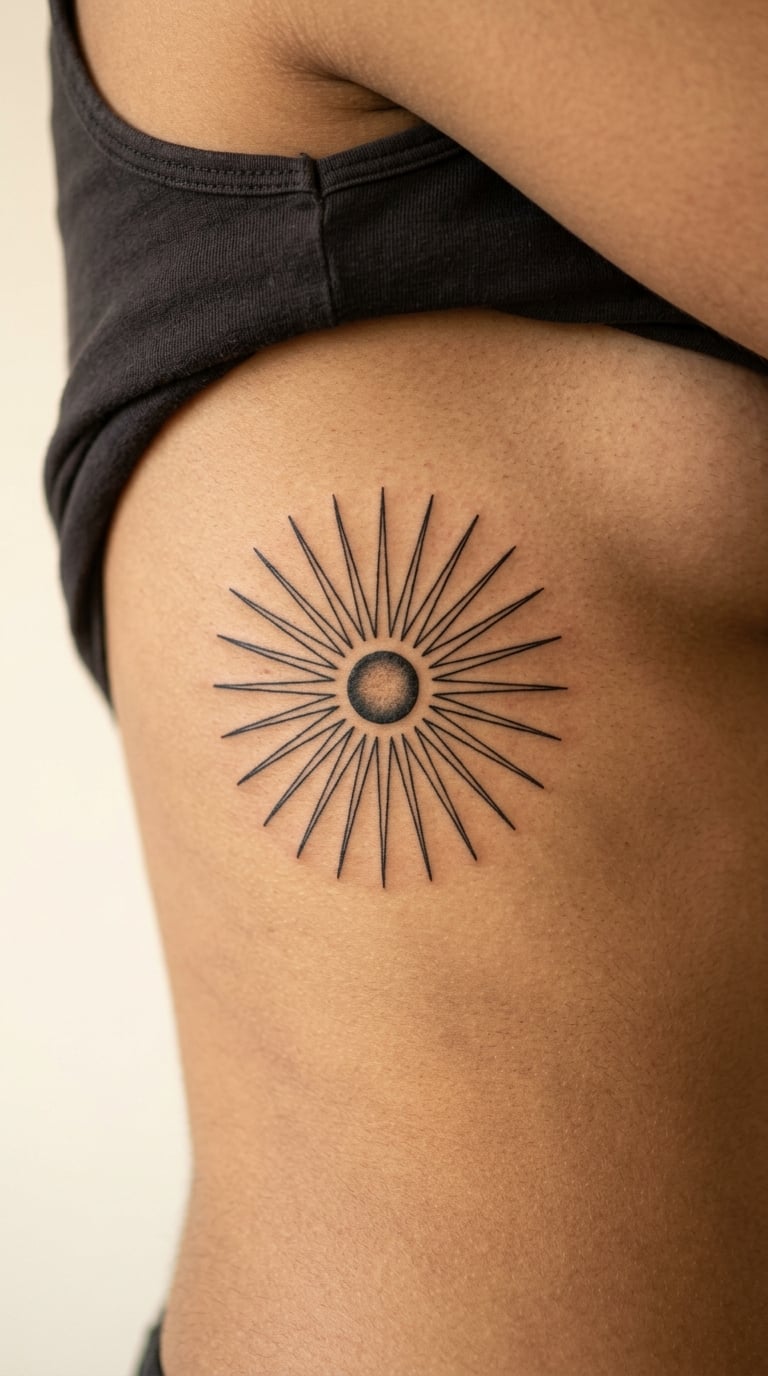
A sun built from straight triangular rays rather than curvy ones looks sharper and slightly harder. People tend to read it as discipline or a source of stubborn energy.
The rib is a curved surface, so keep it under 20 mm or the outer rays stretch and the design ends up lopsided. This placement hurts and it shows.
Pain and time: 7 out of 10, 25 to 40 minutes.
8. Sun and Small Moon on the Inner Arm
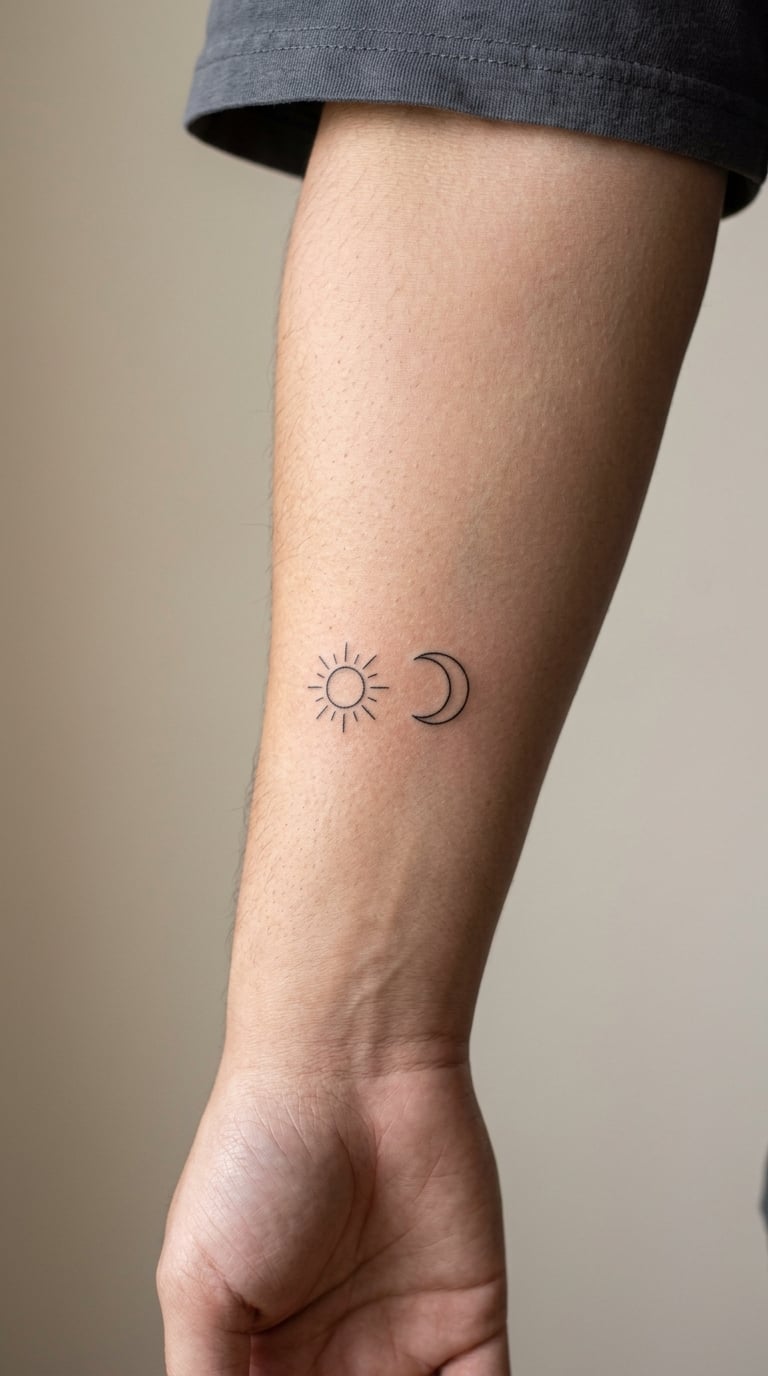
The sun beside a crescent moon is the most-requested pairing in the sun tattoo world. The meaning is usually balance, two halves, or a relationship that has found its rhythm.
Twenty millimetres each, with at least 3 cm of space between them. Closer than that and the two shapes fight each other rather than reading as a pair.
Pain and time: 5 out of 10, 40 to 50 minutes for both.
9. Smiling Sun on the Shoulder Blade
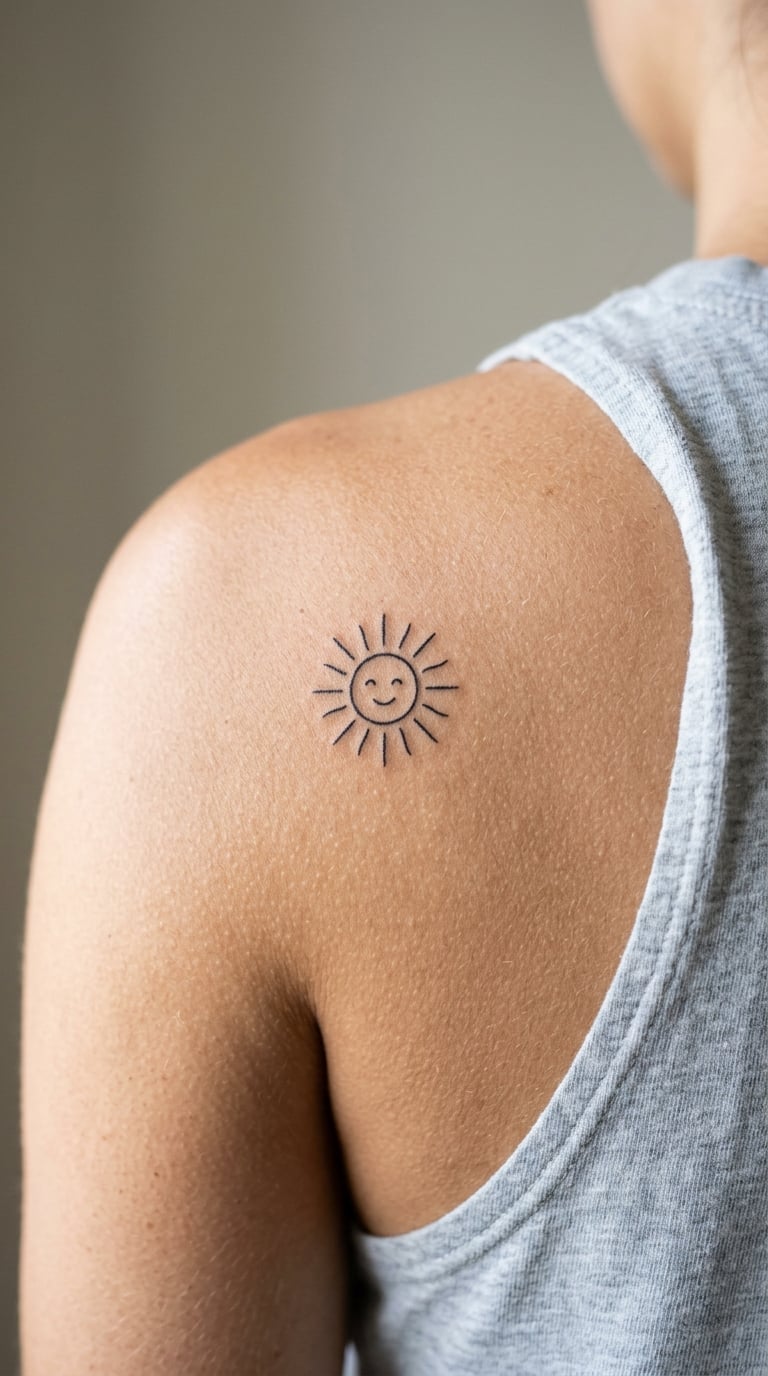
A smiling sun is cheerful in a way most small tattoos are not. It suits summers, holidays and anyone who would rather have a joke on their back than a motto.
At 16 mm the mouth is one shallow curve. Anything more and you are asking for a portrait, not a tiny tattoo. Shoulder blades move a lot when you sleep on your side.
Pain and time: 5 out of 10, 20 to 30 minutes.
10. Sun With One Wildflower, Ankle Bone
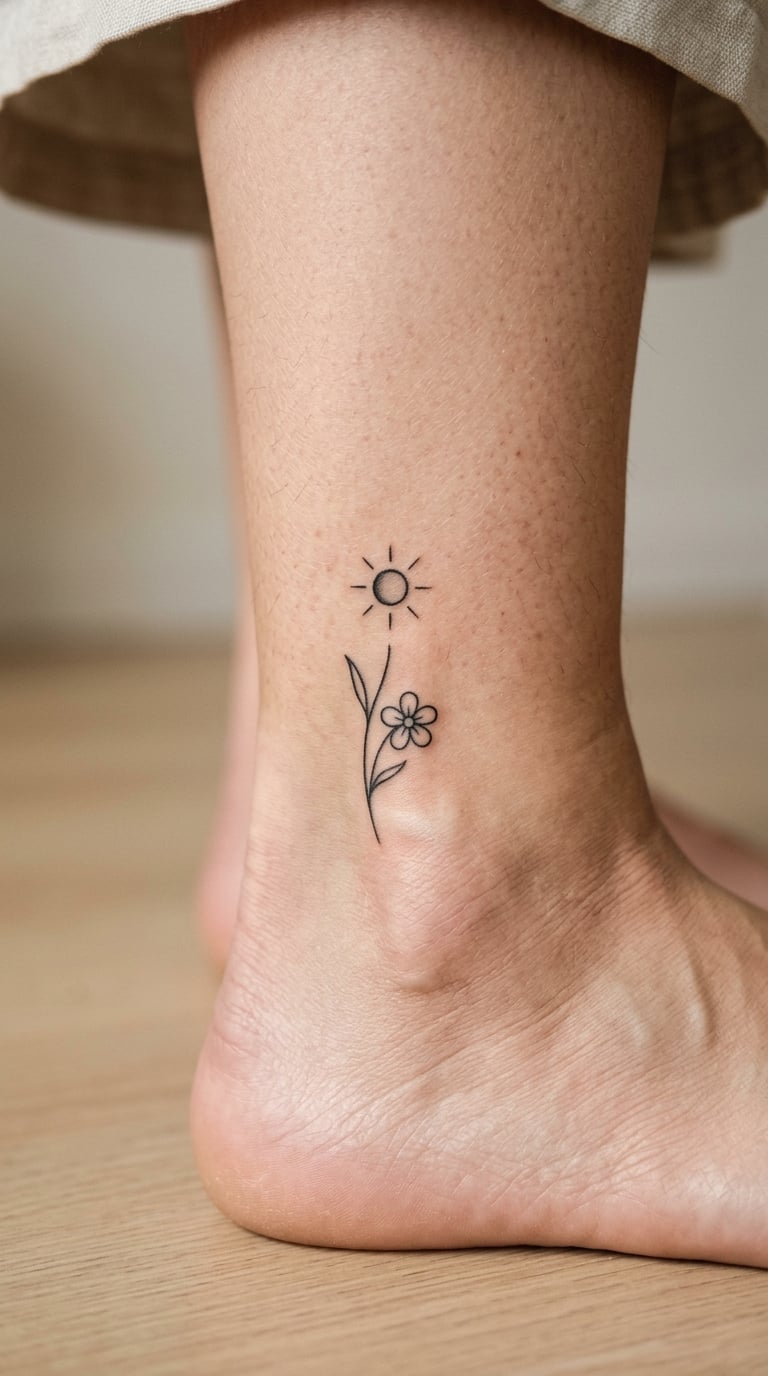
A sun above one wildflower says something about growing things and good luck. It is warmer than a plain sun and still small enough to wear to work.
Fifteen millimetres for the sun, a stem of about 10 mm below it. Two flowers is the most this design survives at that scale.
Pain and time: 3 out of 10, 25 to 35 minutes.
11. Dot-Work Sun on the Sternum
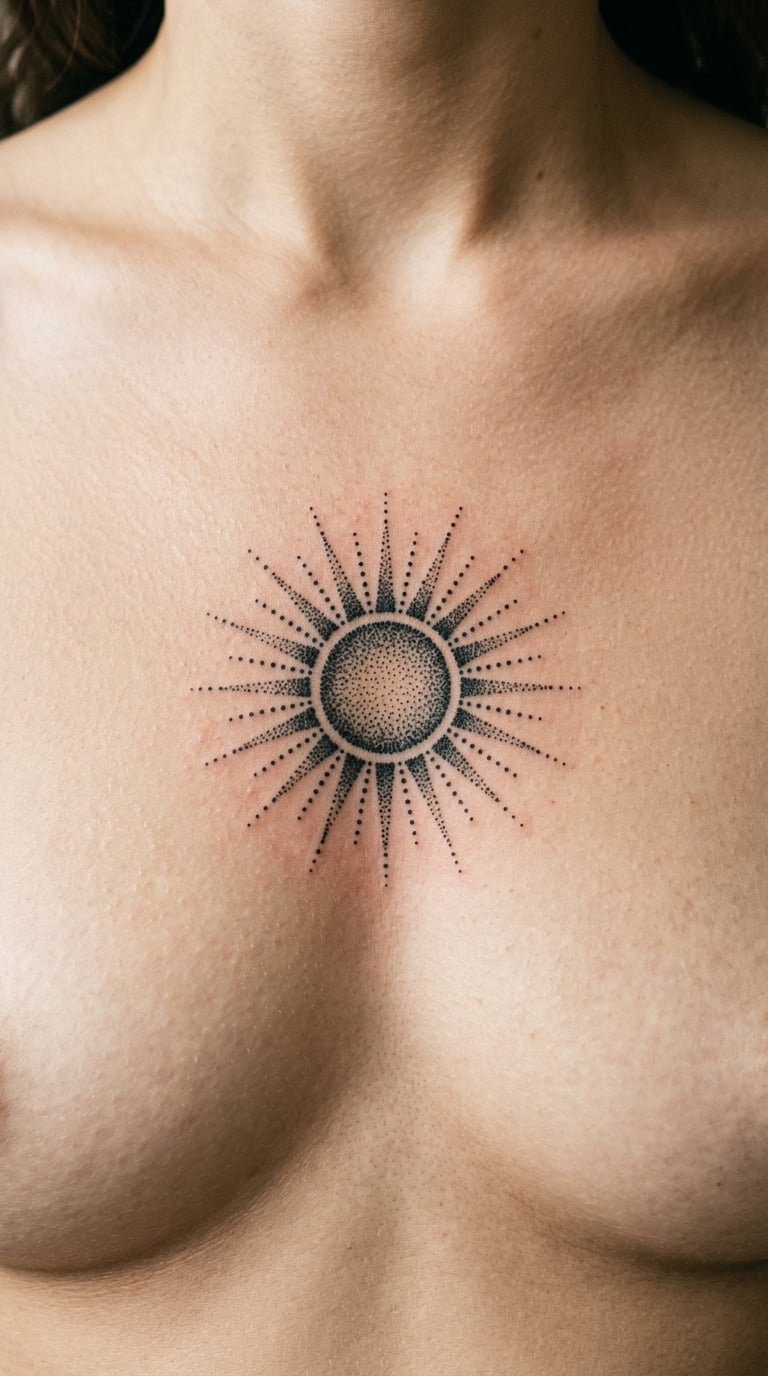
A sun made of scattered dots rather than lines is the one to pick if your skin has healed a fine-line piece quickly before. Dots are less forgiving, so ask for a slightly wider diameter.
Twenty-five millimetres minimum, centred between the collarbones. This placement sits close to bone and takes longer than the size suggests.
Pain and time: 6 out of 10, 35 to 45 minutes.
12. Tiny Sun Over a Wave, Calf
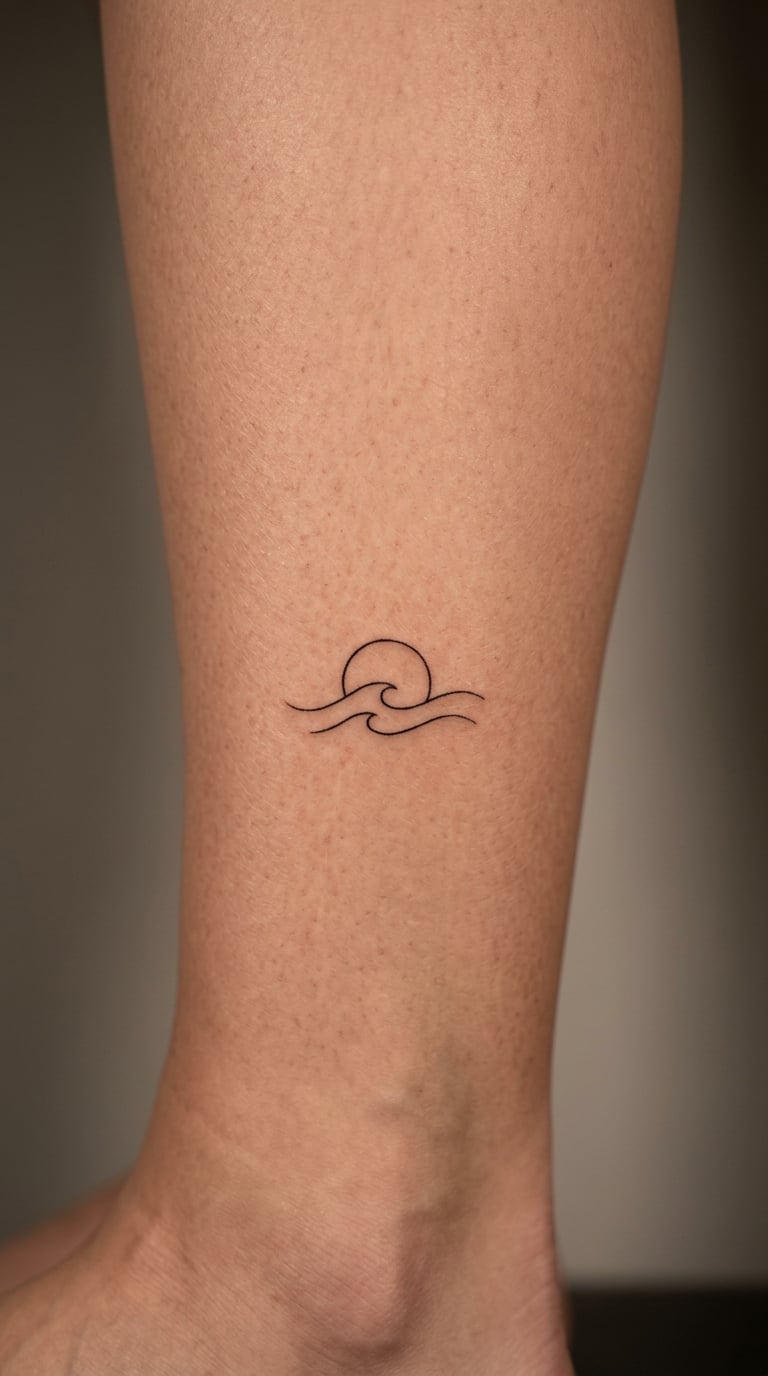
A sun sitting over two wave lines is a summer day in one mark. The meaning people give it is calm and renewal, a good companion to a sun-and-moon pair.
Twenty millimetres for the sun and a wave line about twice that length. On a calf you have room, so this is one place where going slightly larger pays off.
Pain and time: 6 out of 10, 30 to 40 minutes.
13. Half Sun, Half Moon on the Outer Wrist
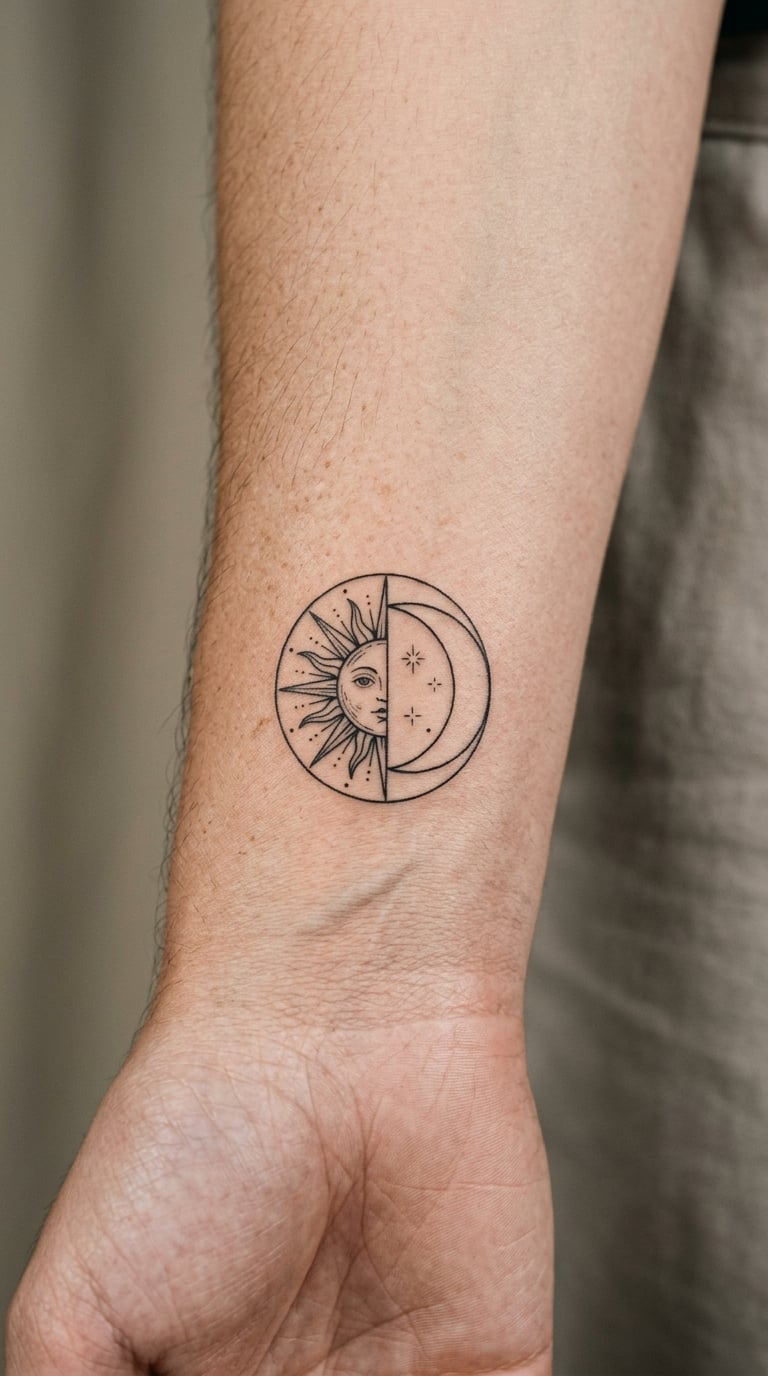
One circle split down the middle, sun on one side and moon on the other, says the same thing as a pair with none of the spacing problems. It is my favourite version for a matching set.
Twenty-two millimetres gives the split enough room to read. Below 18 mm the two halves blur into one grey smudge within a couple of years.
Pain and time: 5 out of 10, 25 to 35 minutes.
14. Sun With a Heart Centre, Upper Chest
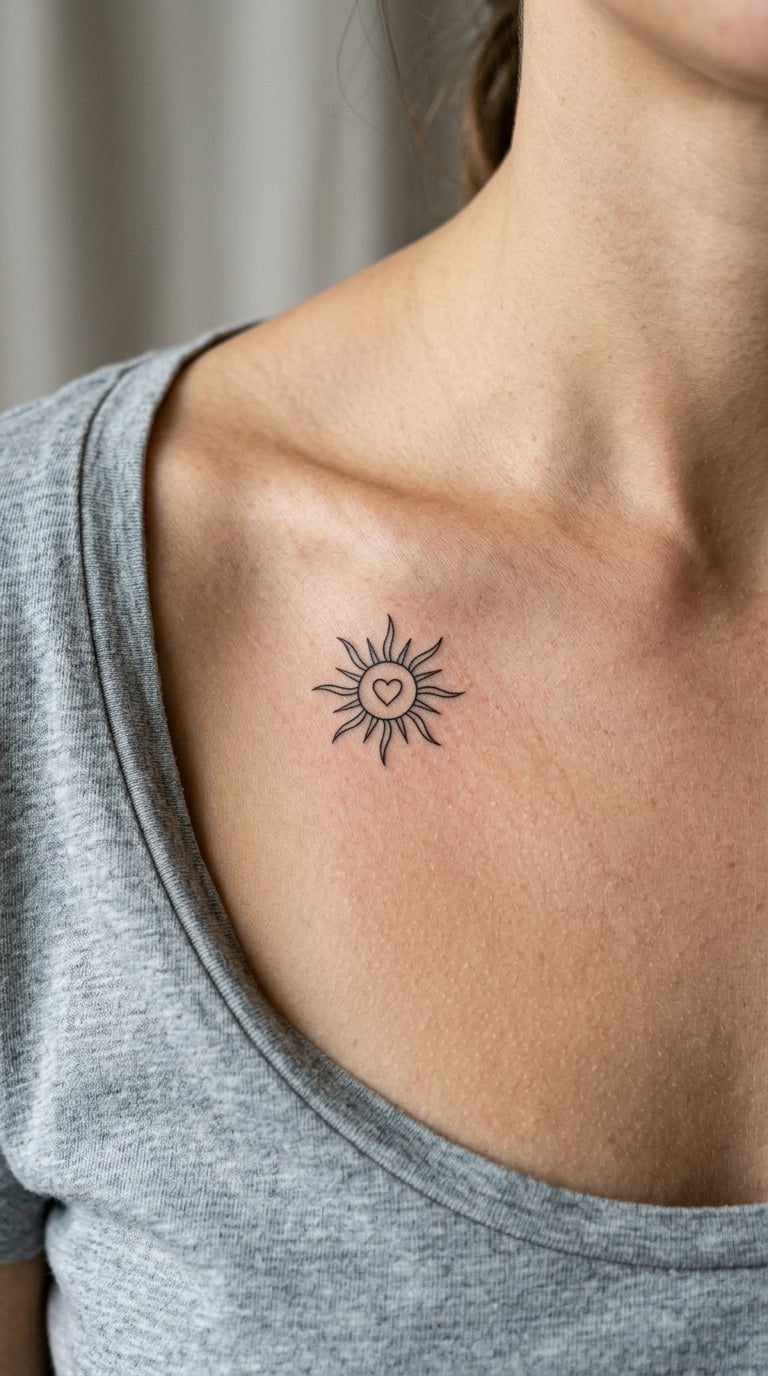
A sun with a small heart at the centre reads as love carried openly. It is the softer option if you want the symbol to say something specific rather than generic warmth.
The heart needs about 4 mm of its own space, so the whole thing sits near 18 mm. Ask for the heart as an outline, not a filled shape, or it turns into a blob.
Pain and time: 6 out of 10, 25 to 35 minutes.
15. Spiral Sun on the Nape of the Neck
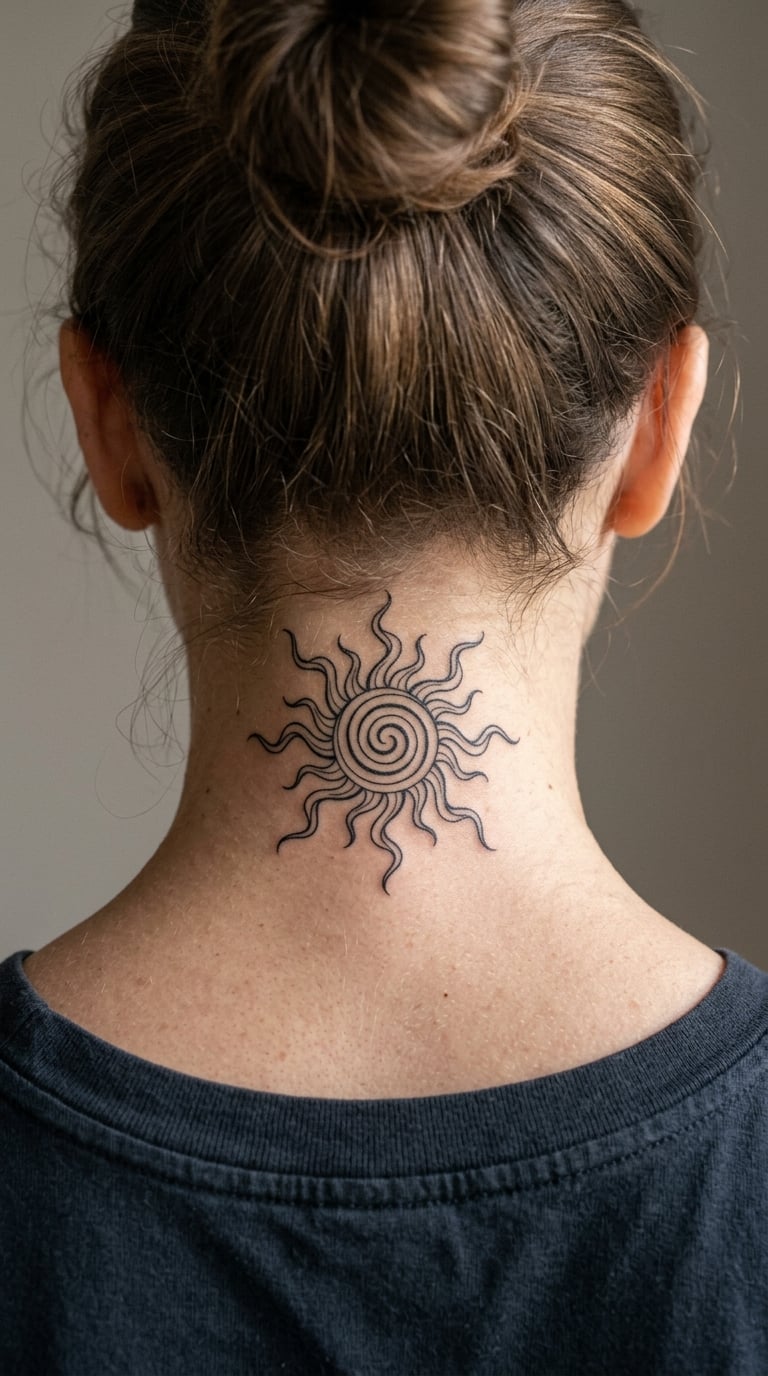
Rays drawn as curls rather than lines give the sun movement. It reads as growth or a slow turn of the year rather than a static emblem.
Eighteen millimetres, and the curls need real spacing. Tight spirals at 12 mm fill in during healing and turn into a dark circle, which is a common disappointment I see people plan around.
Pain and time: 4 out of 10, 25 to 35 minutes. The nape is an easy spot to sit still for.
16. Sun With Long Lashes, Outer Bicep
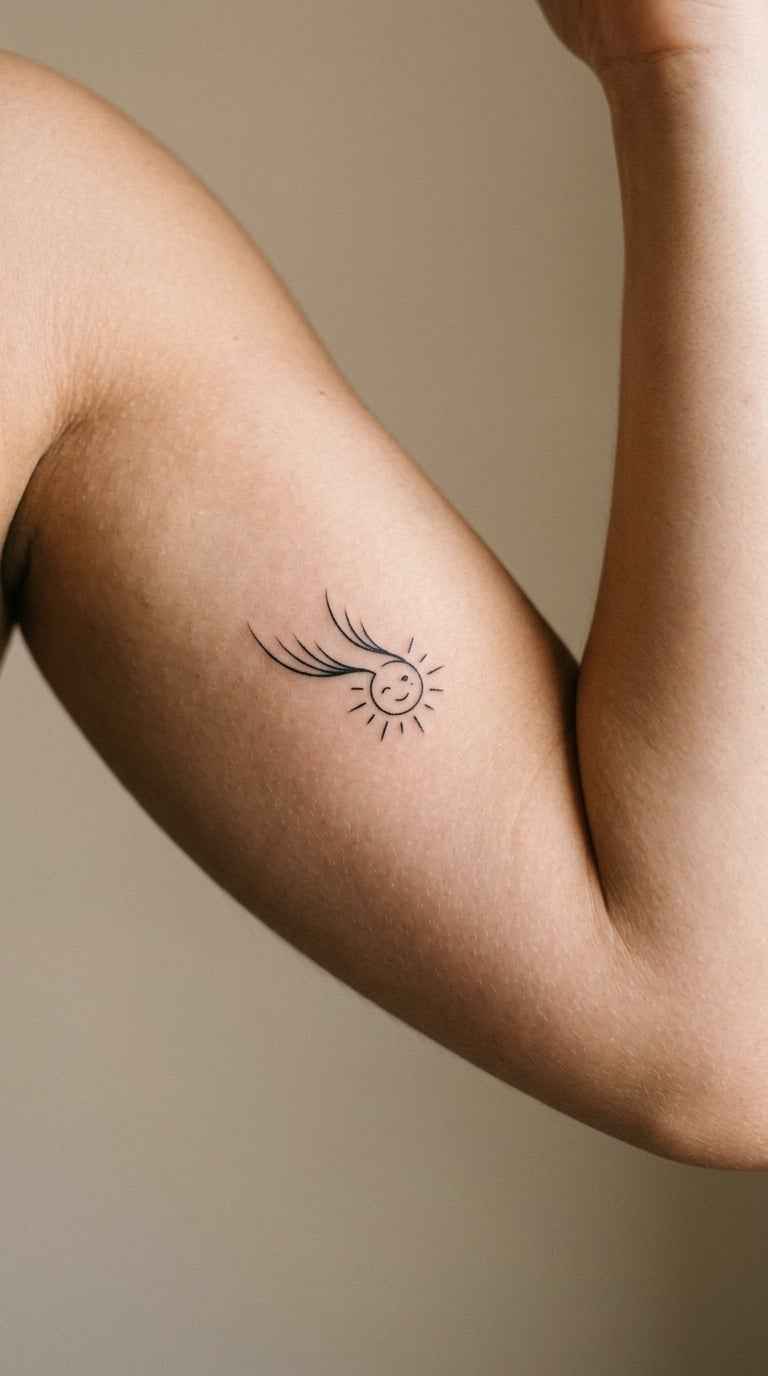
Long lashes radiating from a circle is a playful take that reads as a face once it heals. A lot of people get it as a first tattoo because the subject is cheerful.
Sixteen millimetres is realistic. The lashes are lines, so count them and make sure your artist spaces them at least 1 mm apart.
Pain and time: 5 out of 10, 20 to 30 minutes.
17. Micro Mandala Sun, Lower Back
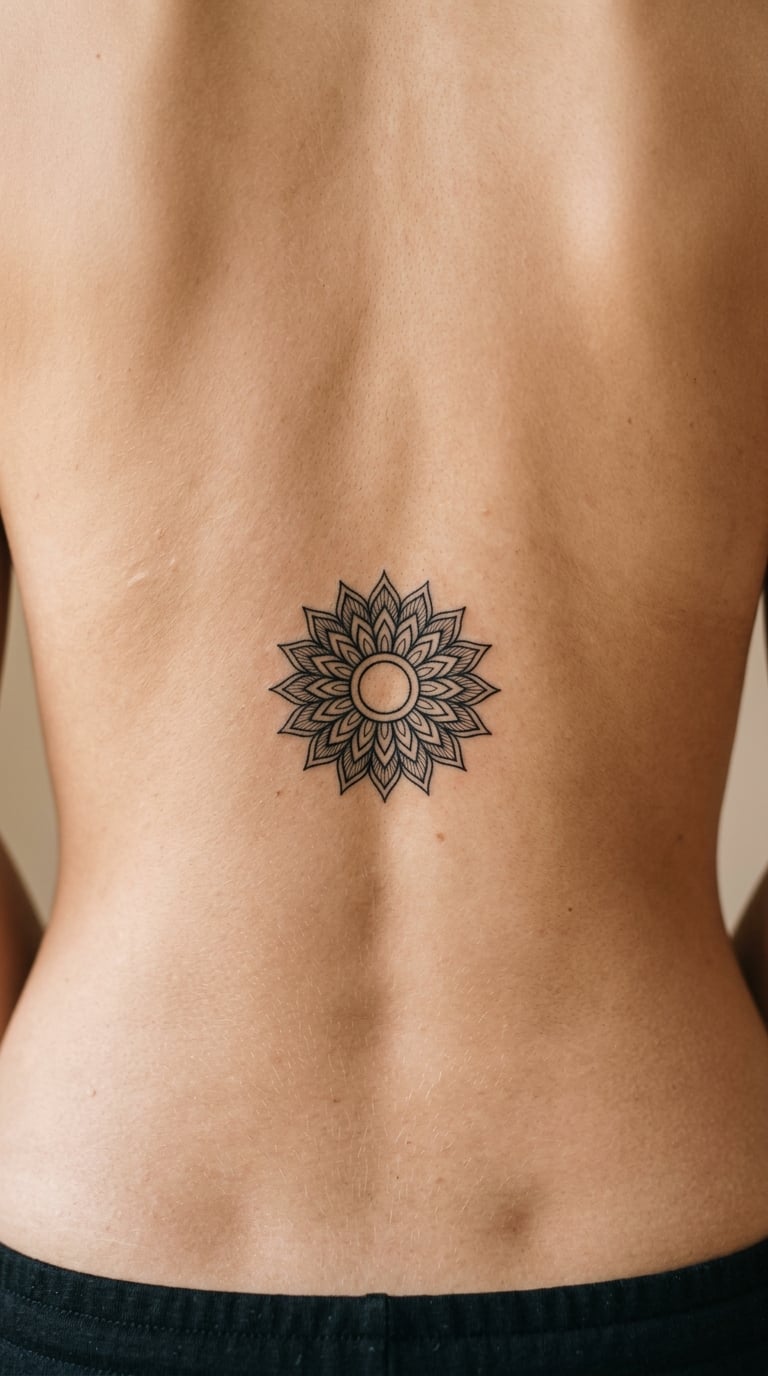
A mandala sun is the one design here that is genuinely hard to shrink. The symmetry is the whole point, and symmetry collapses the moment the lines get too thin.
Plan for 40 mm, not 15, even if you are keeping everything else micro. Below 25 mm you are better off with idea 4.
Pain and time: 6 out of 10, 50 to 70 minutes. The longest session in this gallery.
18. Sun With an Arrow, Forearm
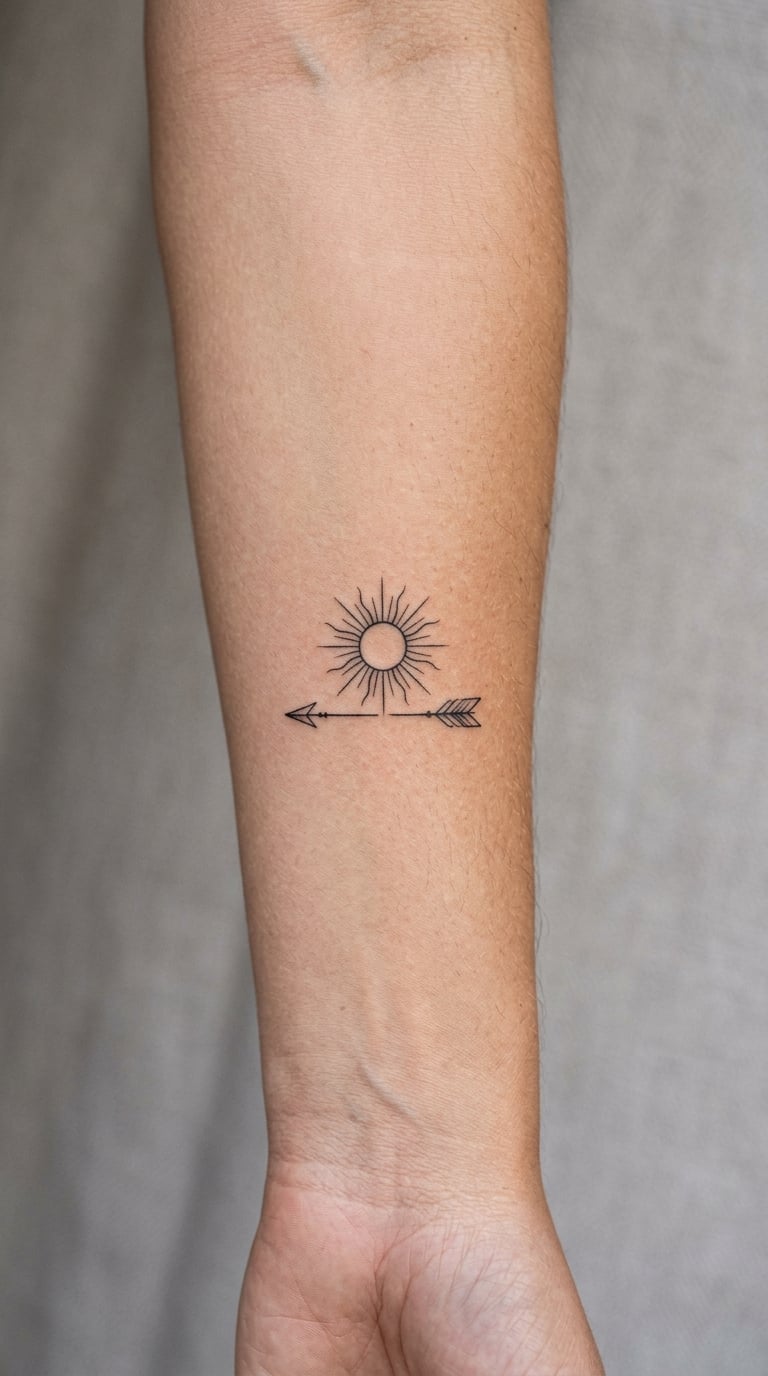
A sun with one arrow running under it carries the idea of aiming at something. It is the sun with a bit of intent, and it suits a morning person.
Twenty-five millimetres for the sun and a short arrow the same width, not longer. A long arrow on a small sun turns into a scribble in a year.
Pain and time: 5 out of 10, 30 to 40 minutes.
19. Sideways Sun on the Side of the Index Finger
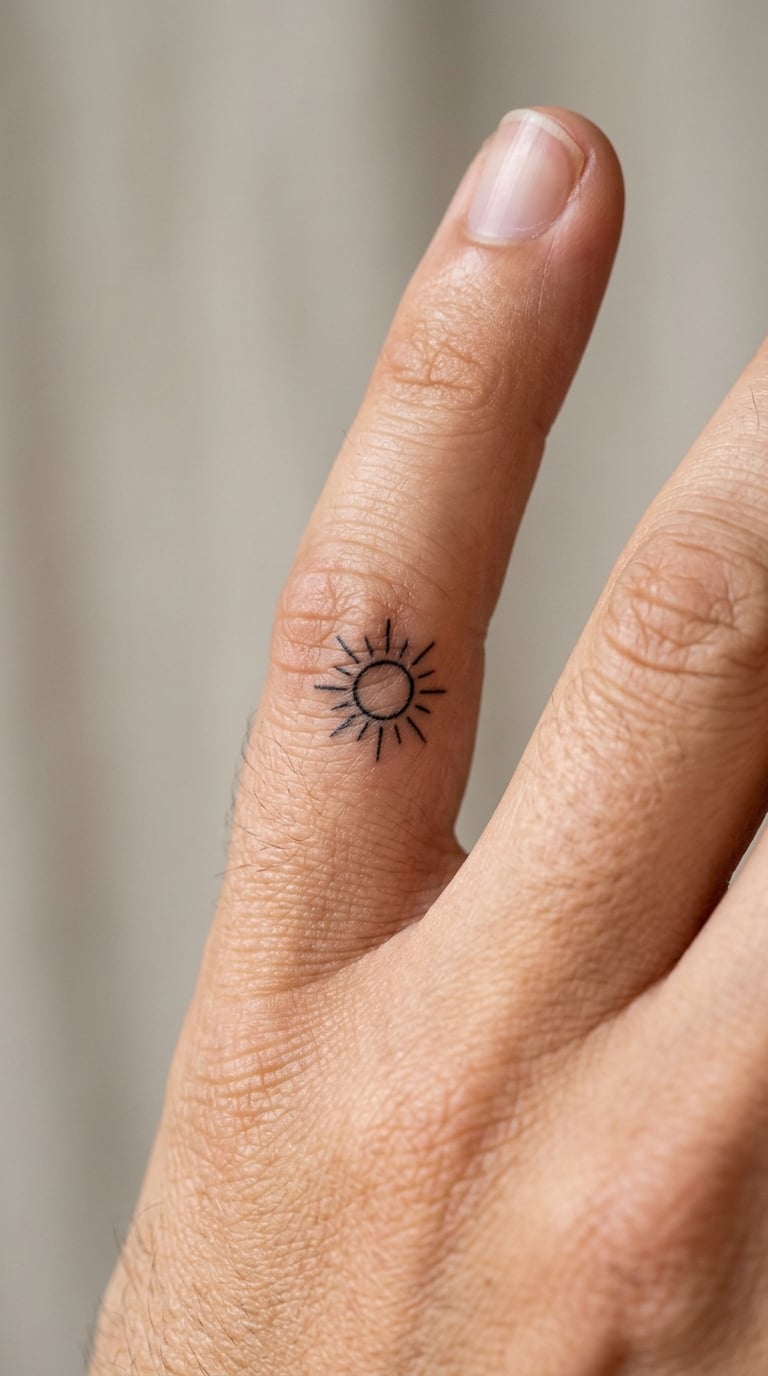
A sun turned on its side, with rays running left and right, is a small design that fits the flat panel of a finger better than a top-down sun does.
Nine millimetres is about the limit here. Like all finger work, expect a touch-up, and keep it covered at work if you work with your hands on camera.
Pain and time: 7 out of 10, 20 to 25 minutes.
20. Open-Eye Sun on the Back of the Hand
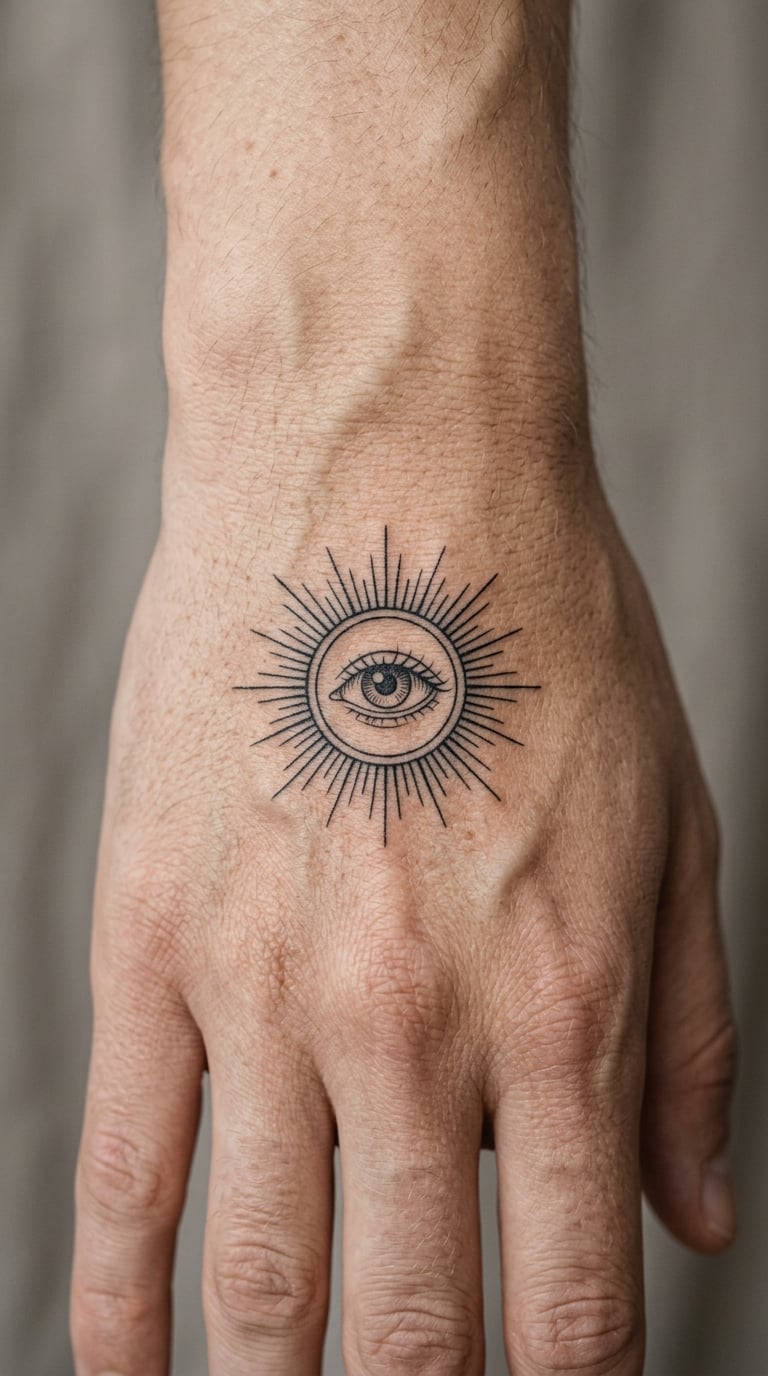
An open eye at the centre of the sun is the most watchful design here. People describe it as clarity or as looking straight at a new start.
This one is the least forgiving. The iris needs 5 mm of room, so the full sun should be at least 20 mm or the eye becomes a dot.
Pain and time: 6 out of 10, 30 to 40 minutes.
Where to Put a Tiny Sun Tattoo: Placement, Pain and Visibility
The right spot depends on how visible you want it to be and how much sun it will see. Wrist, collarbone and ankle cover and uncover easily, while the nape stays hidden unless you pull your collar down.
- Inner wrist – 5 out of 10 pain, visible in almost every gesture, heavy sun exposure, 12 to 20 mm.
- Outer wrist – 4 out of 10, easy to hide with a watch band, 12 to 22 mm.
- Behind the ear – 3 out of 10, invisible at work, 10 to 15 mm is the usable range.
- Finger or knuckle – 7 out of 10, always visible, fastest fading, 7 to 10 mm.
- Collarbone – 5 out of 10, visible in summer, 15 to 20 mm.
- Ankle or ankle bone – 3 out of 10, easy to cover, sandal season is the problem, 12 to 18 mm.
- Rib or side – 7 out of 10, hidden by clothing, 15 to 20 mm.
- Nape of the neck – 4 out of 10, hidden by default, 15 to 20 mm.
How Small Is Too Small? Line Spacing and Ray Count Rules
Small tattoos do not fade because they are small. They fade because the lines inside them are too close together, and healed skin has no space left to push apart.
- Leave at least 1 mm of clean skin between any two lines. Under that, the healing fills the gap.
- Eight rays is the comfortable maximum under 15 mm. Twelve rays need 18 mm or more.
- Do not scale a small reference down. Send your artist the picture at full size and ask for the size that suits it.
- Skip watercolour, heavy blackwork fills and anything with 20-plus rays. These are the styles that lose definition first.
- Ask to see healed work from the same artist, not a fresh-day photo. Fresh work always looks sharper than the final result.
- Expect a touch-up on fingers, wrists and ankles, and budget your calendar for a 15-minute free session six months after healing.
If someone tells you there is a rule about how much of your body a tattoo can cover, that rule comes from the 1/3 method, an old rule of thumb for covering-up work, not from tattooing itself. It has nothing to do with how big your first piece should be.
Things to Know Before You Book Your Tiny Sun Tattoo
- Bring references, not decisions. Two or three saved images of the same style beat a folder of ten mixed ideas, and they stop the consult drifting.
- Say the size in millimetres, not in “tiny”. Artists read tiny as anywhere from 8 to 30 mm, and you may end up with something twice what you pictured.
- Let the artist refuse a too-small version. Tattooers push back on squeezed ray counts every week. That push-back is a good sign.
- Healing takes two to three weeks, not two days. The skin flakes, looks dull, then settles. Ink that looks faint at week two usually comes back.
- Plan around sunlight. For the first two weeks, keep it covered and skip tanning. After that, sunscreen on exposed placements is the difference between a crisp sun at year five and a grey smudge.
- Ask about touch-ups in writing. Most studios include one free session for a faded line, and asking now means asking politely later.
One more note people rarely hear in advance. Owners of older sun tattoos say the sun damage is far less dramatic than the warnings suggest, and the ones that look tired after a decade are the over-detailed ones, not the plain ones. Simple is what holds up.
Frequently Asked Questions
What does a tiny sun tattoo symbolize?
A tiny sun tattoo symbolizes warmth, vitality, hope and new beginnings. Drawn as a circle or half circle with radiating lines, it is the oldest symbol in human art. Paired with a moon it usually stands for balance, and over water it reads as calm and renewal. Most people also just like how small and unobtrusive it is.
What does a sun tattoo on the wrist symbolize?
On the wrist a sun tattoo is read as daily optimism, something you see every time you check the time. The inner wrist is the more meaningful spot because it is close to your pulse, and the outer wrist reads as a more casual choice. Either way the sun itself carries the meaning of warmth and forward motion.
Do tiny tattoos age well?
Simple ones do. Plain outlines, eight-ray bursts and half suns with generous line spacing usually look good after ten years. Fine, tightly packed linework fades first, and finger tattoos fade fastest because the skin there regenerates constantly. Plan on one touch-up, and use sunscreen on exposed placements.
How small can a sun tattoo be?
A circle sun with eight short rays works at about 8 mm on a finger, but 12 to 15 mm is where the design still reads as a sun rather than a dot. Leave at least 1 mm of clear skin between every line. Below 10 mm you lose the rays first, and a mandala sun needs closer to 40 mm to stay symmetrical.
Is a sun tattoo a good idea for a first tattoo?
Yes, and it is one of the safest first tattoos. A small sun is quick to heal, easy to cover, and a simple design has nothing to go wrong. The two risks are asking for too small a size and picking a spot you cannot see. Both are easy to avoid at the consultation.
Does a sun tattoo fade faster in the sun?
Ultraviolet light fades every tattoo, and it fades fine black linework faster than bold colour. Wrists, fingers and ankles get the most direct sun, so those placements need daily sunscreen once healed. During the first two weeks of healing keep the tattoo covered and out of tanning entirely.
Conclusion: Where to Start With Your Tiny Sun Tattoo
Start with idea 2 or idea 4 if this is your first piece. A half sun on the inner wrist or a twelve-ray burst on the collarbone both survive healing well, both cost you half an hour, and neither asks your artist to fight the size.
Bring two references at the size you actually want, say the measurement out loud in millimetres, and let the artist tell you if the ray count will not fit. That conversation is the whole difference between a tiny sun tattoo that still reads in five years and one that turns into a grey dot.