
16 Tiny Butterfly Tattoo Ideas for the Wrist (September 2026)
A tiny butterfly tattoo for the wrist is a miniature butterfly design, usually 1 to 3 centimetres across, placed on the inner, outer or side of the wrist, most often in fine-line black ink. It symbolizes transformation, rebirth, freedom and new beginnings, and the whole session can be over before your coffee goes cold.
If you are planning a small butterfly wrist tattoo for September 2026, give yourself four to six weeks of lead time. Artists book out, wrists swell in the heat and sleeves get layered from late autumn, which is when the good micro specialists have the shortest wait. These tiny butterfly tattoo ideas for the wrist run from a single hairline stroke to a colour block that reads from across a room.
What to Expect From a Tiny Wrist Butterfly
Three things surprise people more than the pain does. None are bad, but all three are easier to plan for than to react to.
- Visibility: easy to show off or hide with a watch, a bracelet or a long sleeve. A 2 cm butterfly on the inner wrist disappears under a shirt cuff and reappears every time you reach for something.
- Pain: wrist skin is thin and sits close to bone, so the sensation is sharp rather than dull. A tiny design takes minutes, not hours, which is a genuine relief on a sensitive spot.
- Healing and care: hands and wrists move constantly and get washed all day. Watchbands, cuffs and gym friction are what ruin small wrist pieces, not sunlight alone.
1. Single Fine-Line Outline Butterfly
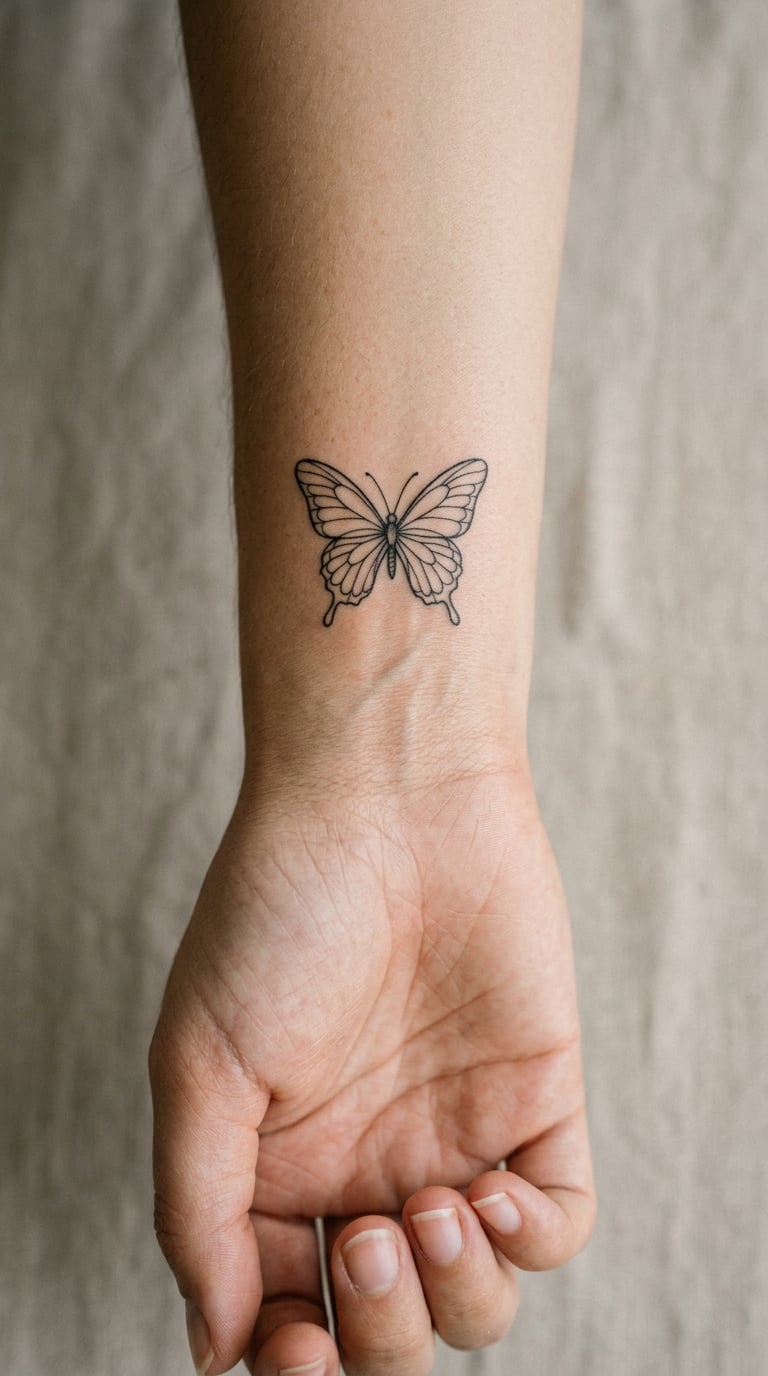
One continuous line traces the upper wing, breaks for the notch, picks up the lower wing, then adds two antennae and a slim body. It reads as a butterfly before it has any detail.
Best on the inner wrist at 2 to 2.5 cm. Ask for a 0.5 to 0.7 mm needle and no shading inside the wings. It wants a touch-up in the two to three year range, because that inner crease rubs against everything you do.
Pain and time: 2 out of 10, about 20 to 30 minutes including the stencil.
2. Monarch in Blackwork
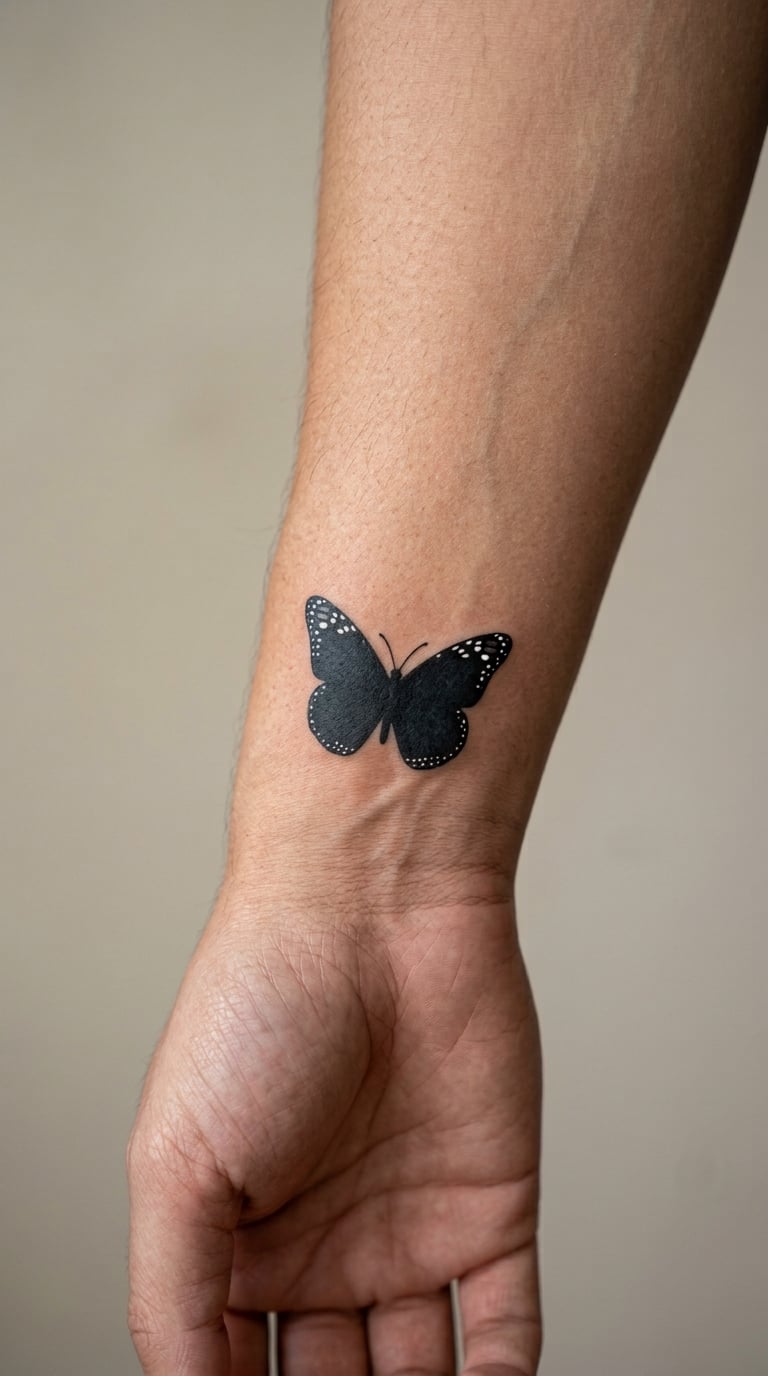
The wings fill with solid black, thin white gaps trace the spotted border, and the body stays chunky enough to read across a room. It is the least conventionally feminine option here and works on any skin tone.
Best on the outer wrist at 2.5 to 3 cm; below 2 cm the border spots disappear. The white cut-outs are negative space and never refill, so a rushed artist leaves nicks that stay.
Pain and time: 3 out of 10, 40 to 60 minutes.
3. Watercolour Splash Butterfly
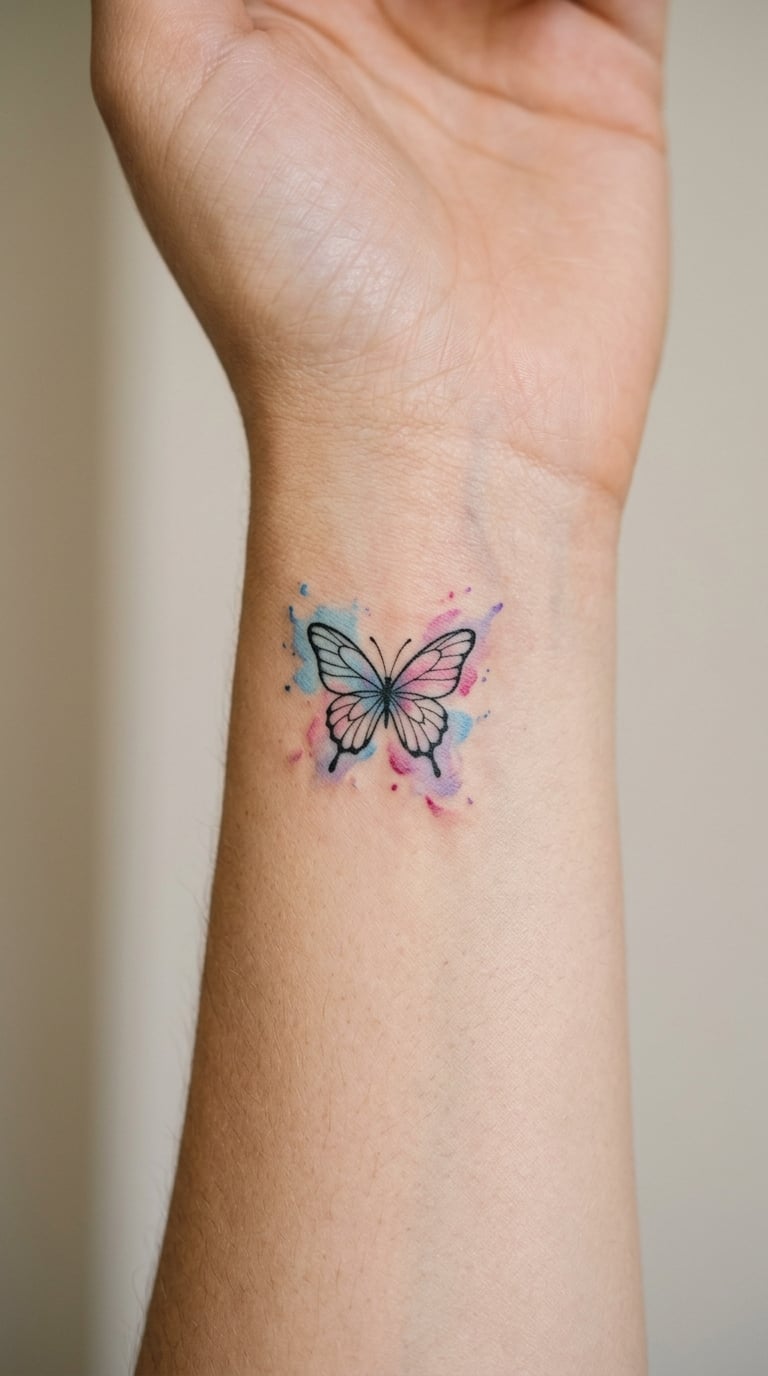
Black linework for the wings with colour bleeding past the outline, like ink dropped in water. Blue, lilac and dusty pink stay quiet. On the wrist it looks as though the pigment moved while the skin healed.
Best on the inner wrist at 2 cm with the splash a few millimetres past the wing edge. Here the budget runs opposite to the outline version: less interior line, more soft edge. Expect the outer bleed to soften within about a year unless the black line can stand alone.
Pain and time: 3 out of 10, 30 to 45 minutes.
4. Butterfly on a Vine Wrist Wrap
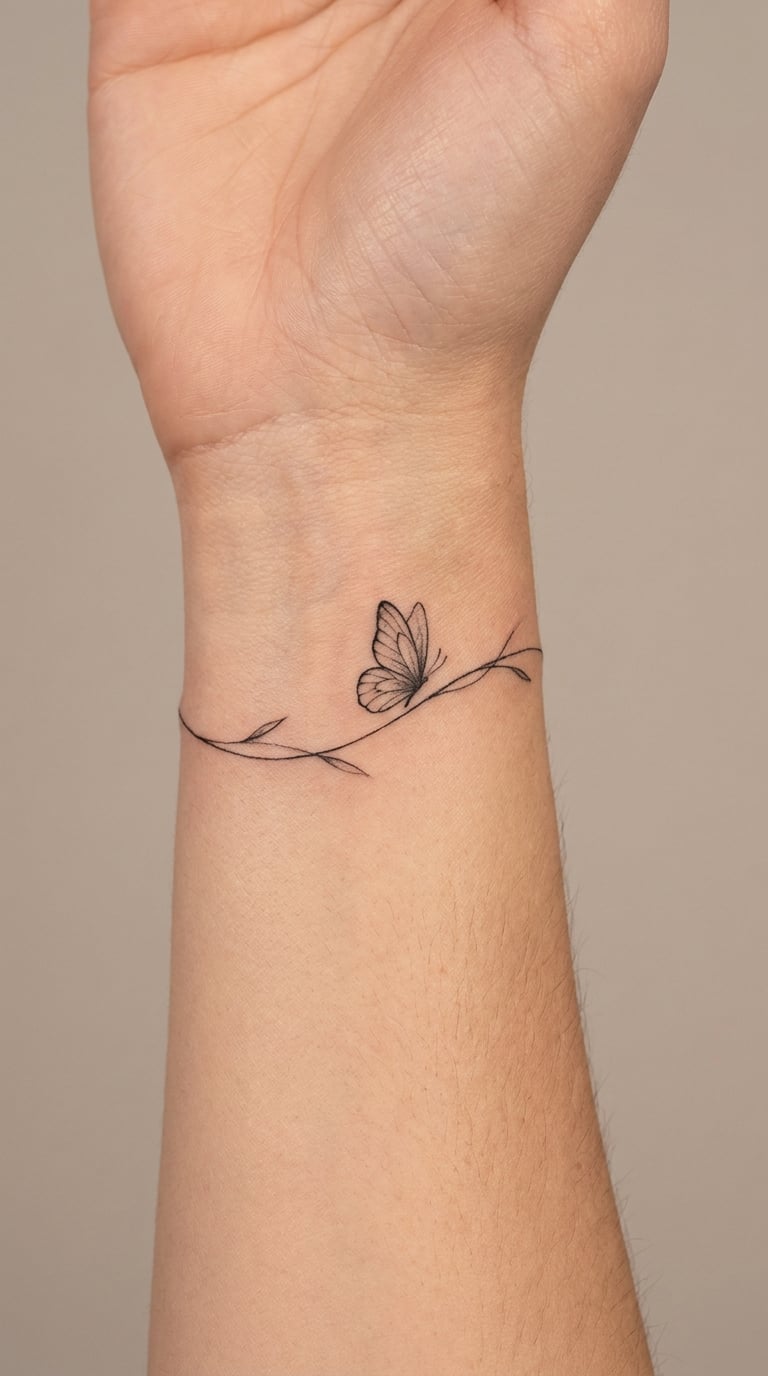
A butterfly perched on a thin vine that circles the wrist fills the space between wrist bone and forearm without becoming a full band. The vine is one 0.5 mm line with a few small leaves.
Best on the outer wrist or just above it, 4 to 5 cm total. Wrist anatomy bites here: on a protruding bone the vine dips as the hand flexes, so the design follows the natural curve. Leaf spacing is the detail that fades first.
Pain and time: 4 out of 10, 60 to 90 minutes.
5. Two Butterflies in Flight
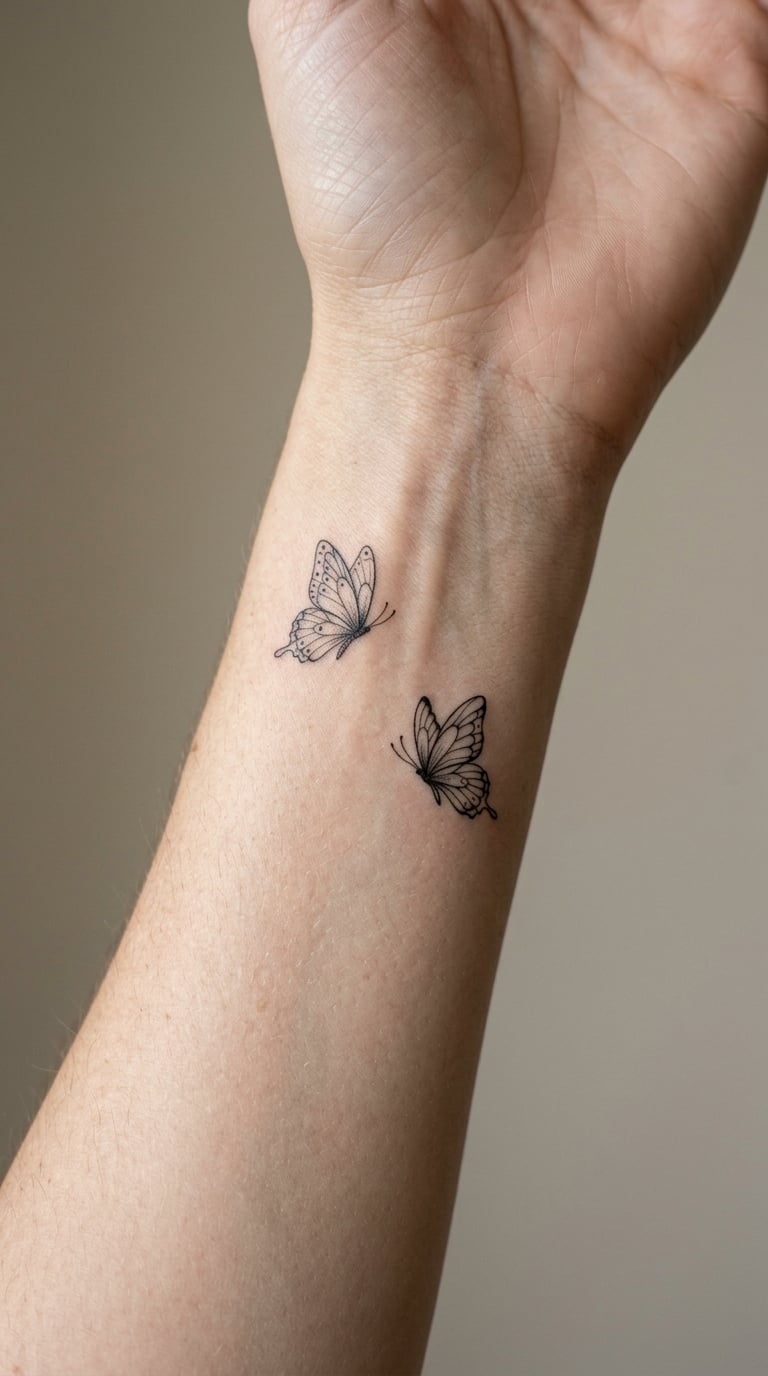
One higher, one lower, turning away. The size difference matters more than it sounds: matching sizes read as a logo, one distinctly smaller reads as movement. The small one usually goes above and behind.
Best on the inner wrist, 1.5 cm each with about 1.5 cm between them, so the pair covers roughly 4 cm. Two outlines have more edges to blur than one, so line weight is non-negotiable. On a narrow wrist, run them along the forearm side.
Pain and time: 3 out of 10, 40 to 50 minutes.
6. Semicolon Butterfly
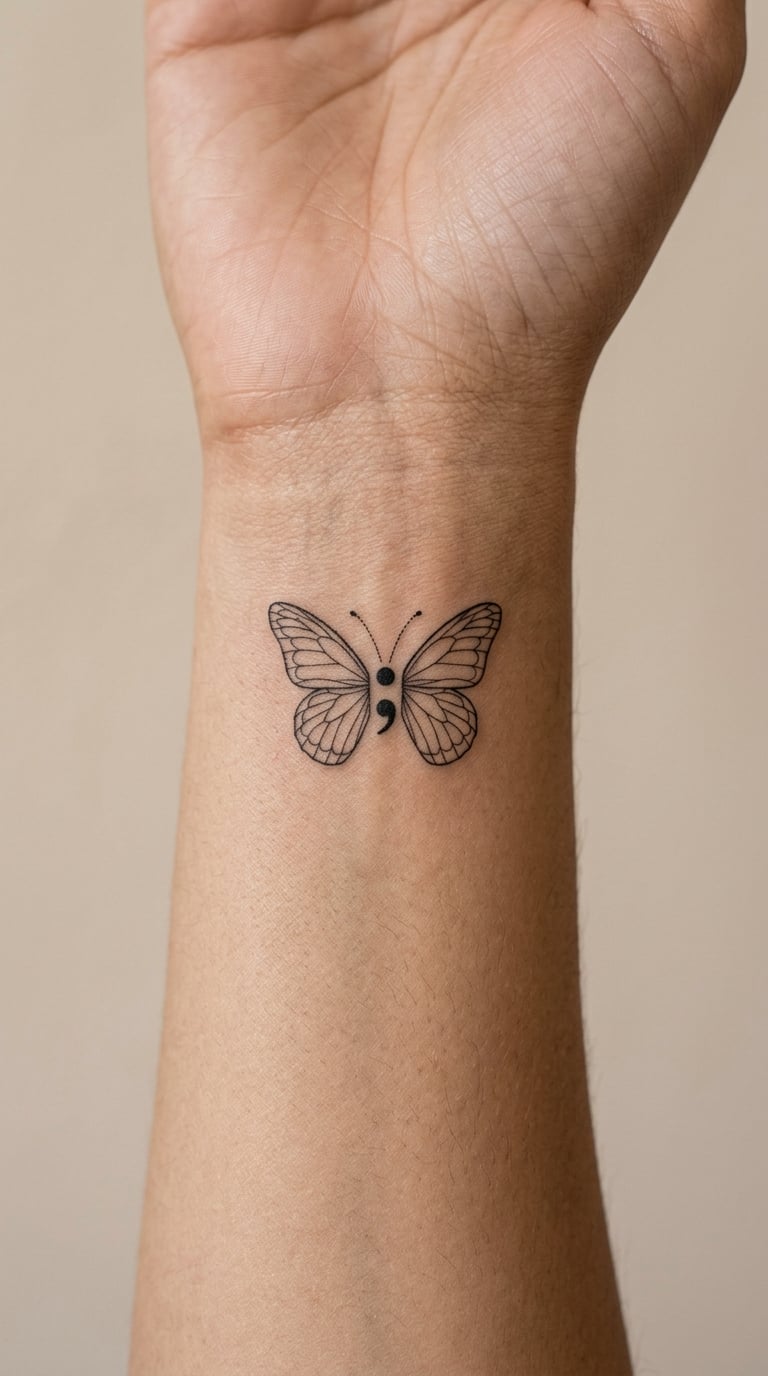
The semicolon grows wings, so the mark becomes the body rather than a label stuck underneath. Usually for a specific reason: mental health, a recovery milestone, or a person you have lost. Worth explaining out loud, because it has to stay legible as a semicolon.
Best on the inner wrist at about 1.8 cm, low on the forearm side. Wings open, or closed and stacked into a comma shape, which disguises the punctuation and ages better. Keep it out of the wrist crease, where a comma shape compresses. Black only.
Pain and time: 3 out of 10, 30 to 45 minutes.
7. Dotwork Butterfly with a Star Trail
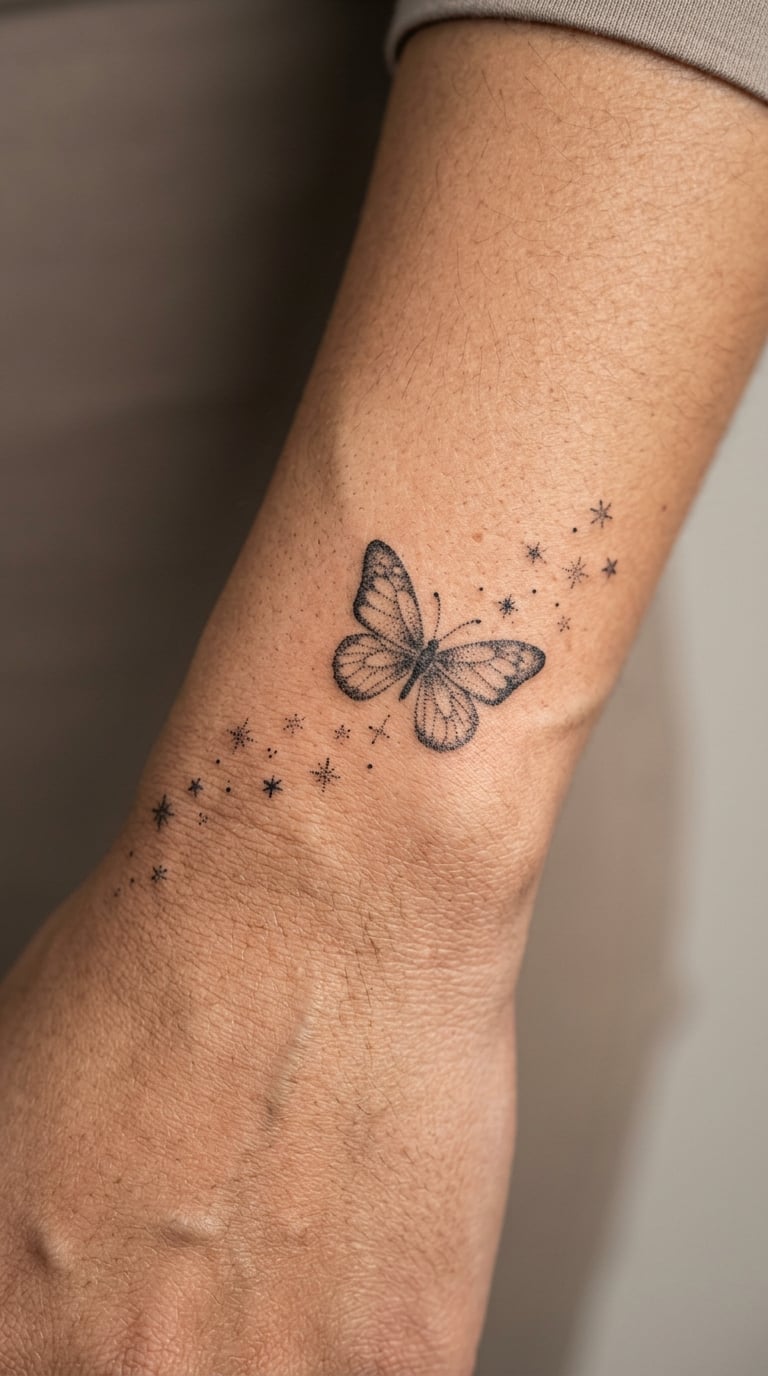
Dotwork uses dots of varying size and spacing instead of lines, and a butterfly built that way has a soft, clouded quality no line work can fake. A short trail of stars drifting off the wing edge keeps it from looking like a smudge.
Best on the outer wrist at 2.5 to 3 cm. This is the one style here that genuinely should not go smaller. Dots too close bleed into grey, dots too far apart lose the wing, and there is no outline to rescue the shape. The outer stars blur first.
Pain and time: 4 out of 10, 60 to 90 minutes.
8. Micro Realism Blue Morpho
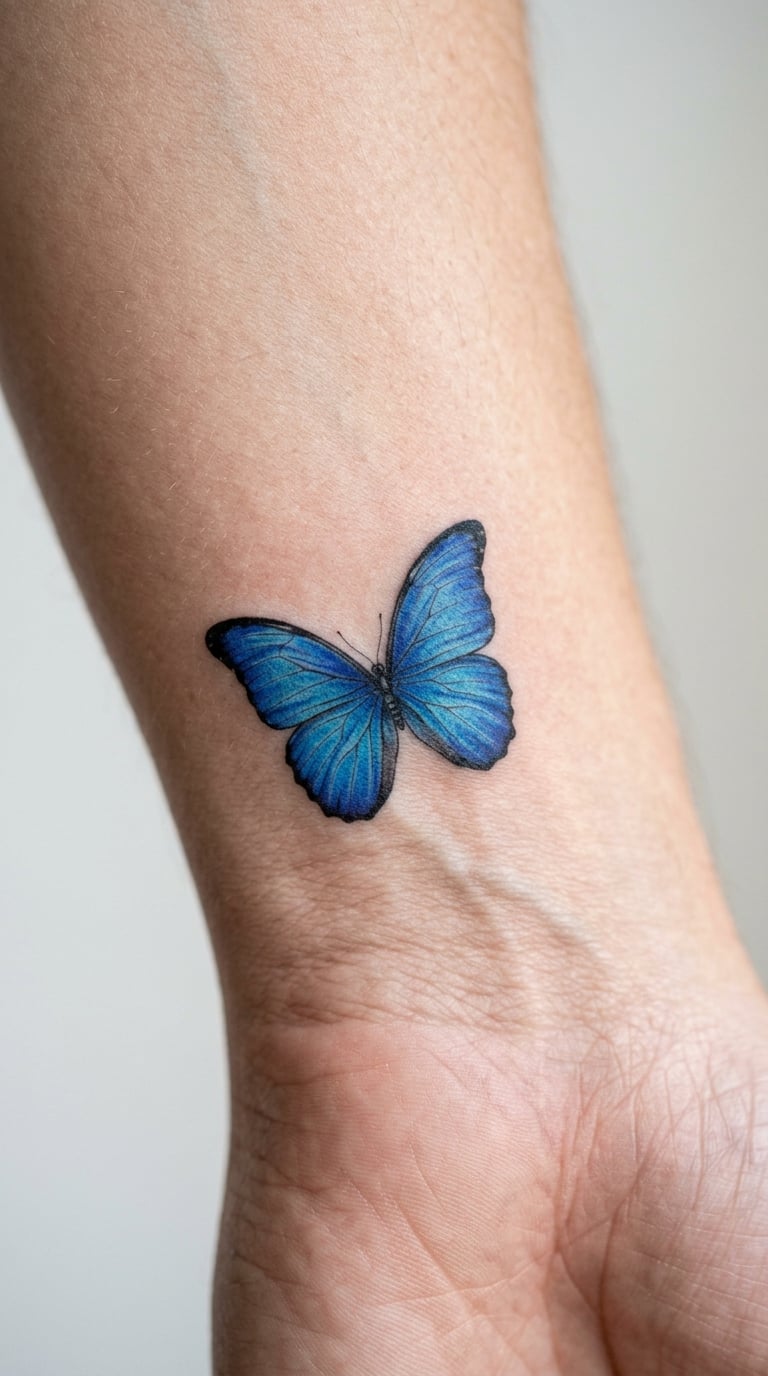
The hardest thing to do at wrist scale and the most rewarding when it works. At 1.5 cm the artist keeps the wing edge, three or four vein lines, and drops the rest. Colour is non-negotiable; a grey morpho that size is a smudge.
Best on the side of the wrist, the bony strip most people forget counts as a placement, where flat skin holds a shape without wrapping it round a curve. Expect the most touch-ups of anything here: fine veining and pale blue are first out, and at this size the artist has no spare ink to lay down later.
Pain and time: 4 out of 10, 60 to 90 minutes.
9. Floral Wing Butterfly for a Nature Sleeve
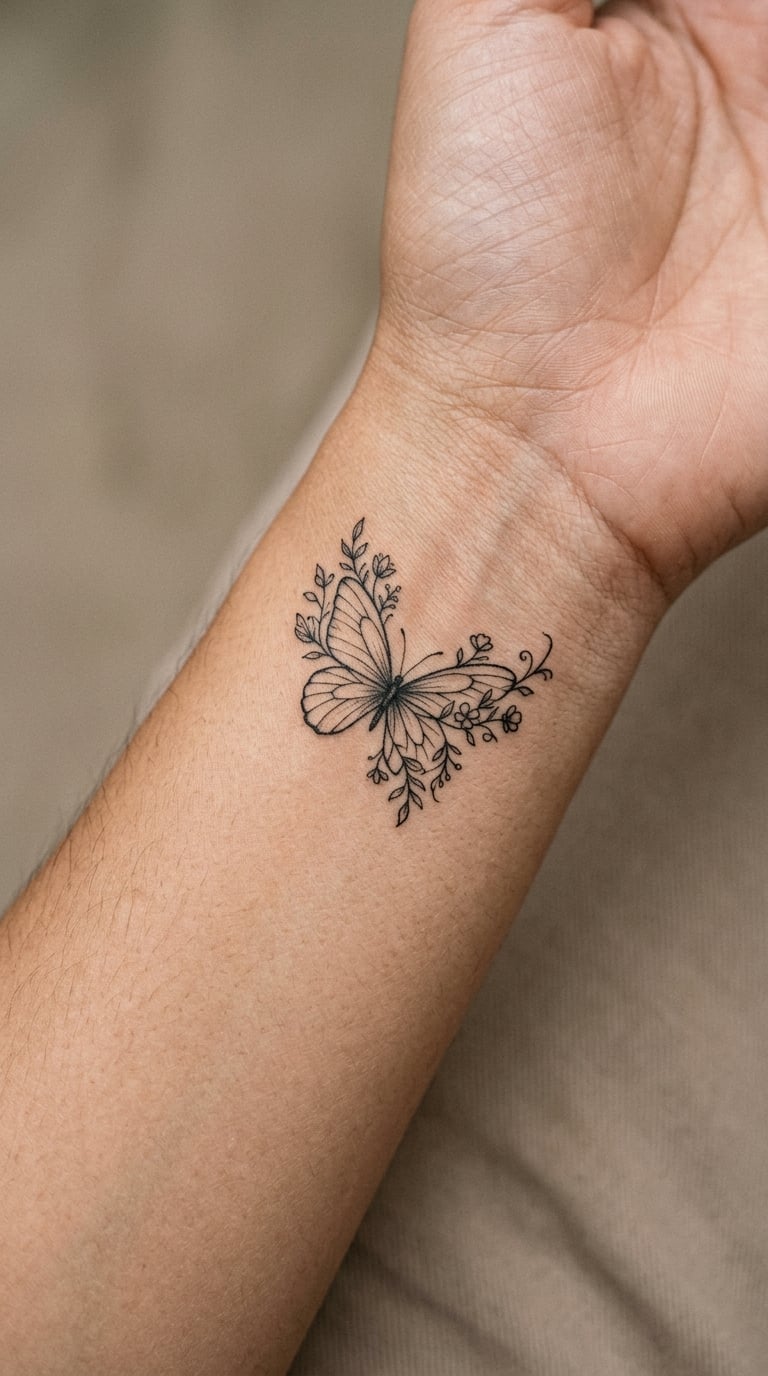
When a butterfly fills a gap in an existing botanical sleeve, it has one job: share a line weight with everything already there. Fine-line wings opening into small leaf and stem shapes do that without looking pasted on.
Best on the outer wrist or forearm at 2 to 2.5 cm, set so one line of the wing echoes a line in the neighbouring foliage. If the existing sleeve runs at 0.4 mm and the butterfly goes on at 0.8 mm, it reads as a sticker for the rest of your life. Placement also has to account for a protruding wrist bone, which distorts any wing edge running across it.
Pain and time: 3 out of 10, 40 to 60 minutes.
10. Moon Phase Butterfly
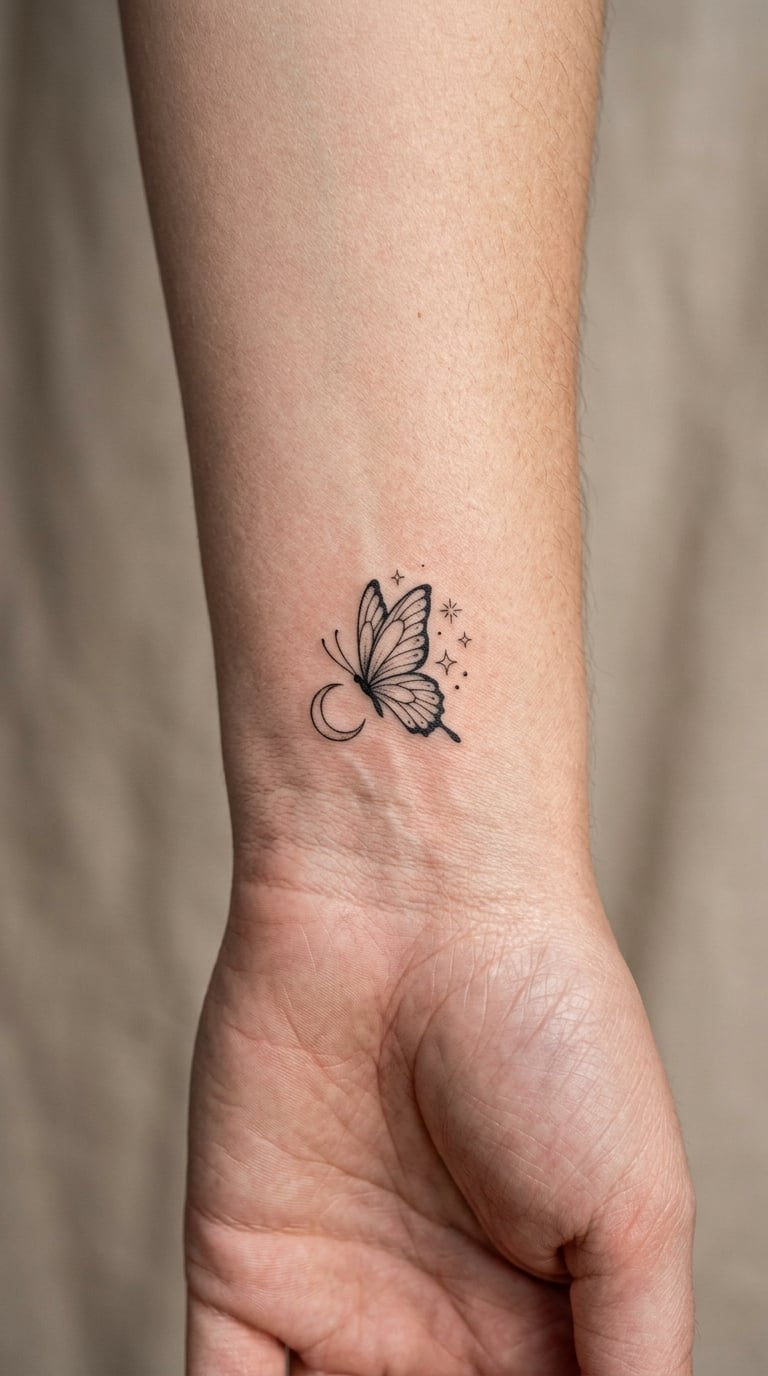
Moon phases and butterflies pair because both are cyclical, and it is quietly one of the most requested small wrist designs. A crescent sits behind the wing, three or four stars scatter along the top edge, and the butterfly carries the movement.
Best on the outer wrist at 2 cm, moon behind the wing, stars trailing toward the hand. The risk is line weight competition: a crescent and a butterfly drawn at the same weight turn into one grey shape once healed. The stars fade first, so a design that works without them ages better.
Pain and time: 3 out of 10, 40 to 55 minutes.
11. Single-Stroke Minimal Butterfly
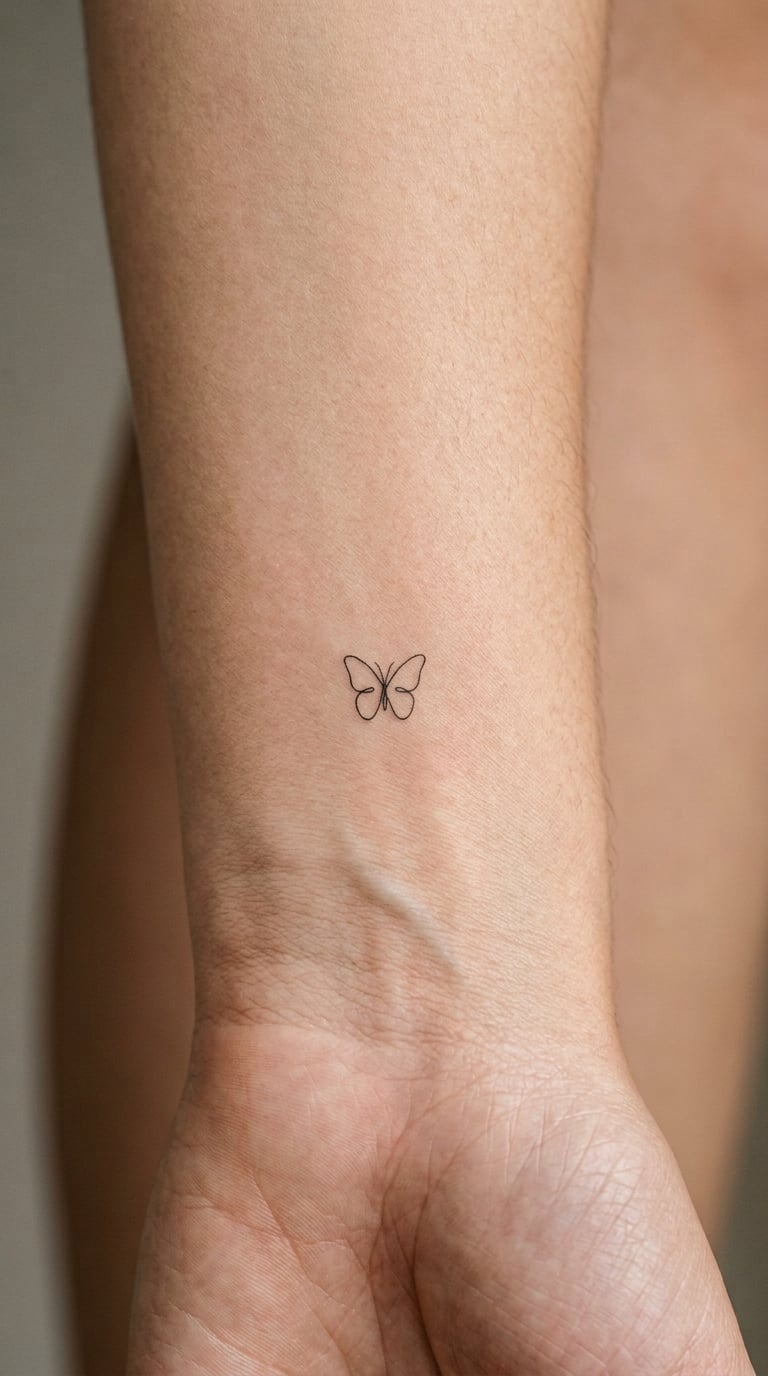
The floor of the whole idea: one line, one pass, a wing shape implied rather than drawn. It looks like a sketch someone left unfinished. If you have never been tattooed, this is the least nerve-wracking way to start.
Best on the inner wrist, and here size can go smaller than anywhere else on this list at 1.2 to 1.5 cm, because the design has no detail to lose. It is also the least durable thing in this article. A single hairline line that small has almost no pigment in the skin to fall back on, and inner-wrist movement softens it fast. Think first tattoo with a known shelf life, not a lifelong piece.
Pain and time: 2 out of 10, 10 to 15 minutes.
12. Lace Wing Monochrome Butterfly
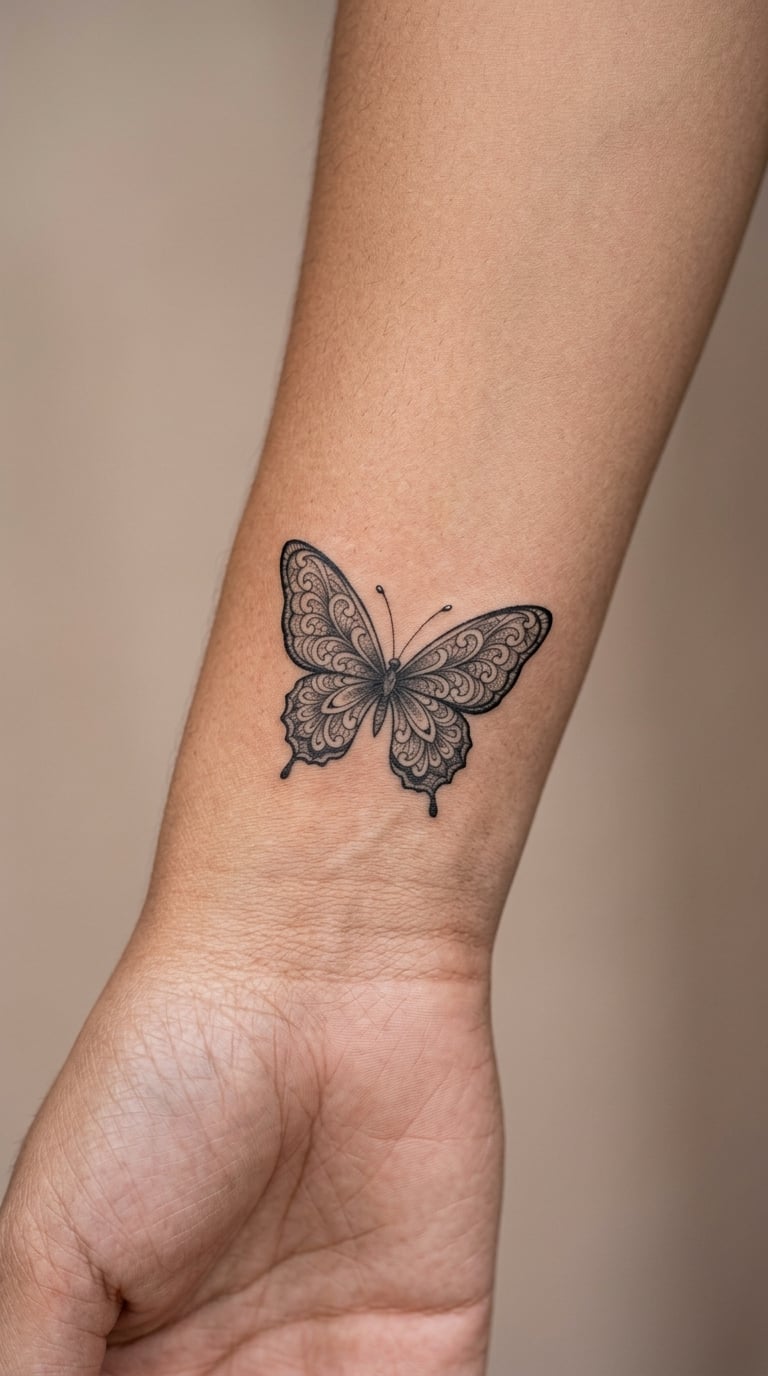
Lace wing work fills the wings with looping, net-like ornament rather than veins or spots, and in monochrome it looks like old fabric pinned to the skin. The prettiest option here and the least forgiving: every loop needs a clean exit.
Best on the outer wrist or the back of the hand at 3 cm, the practical minimum. Below 2.5 cm the lace fills in and the wing turns into a grey patch within a few years. A protruding wrist bone stretches skin across the design, so lace drawn straight over it distorts into ovals as the wrist flexes. Asking to see that adjustment before the stencil goes on is a fair question.
Pain and time: 4 out of 10, 90 to 120 minutes.
13. Pastel Painted Wing Butterfly
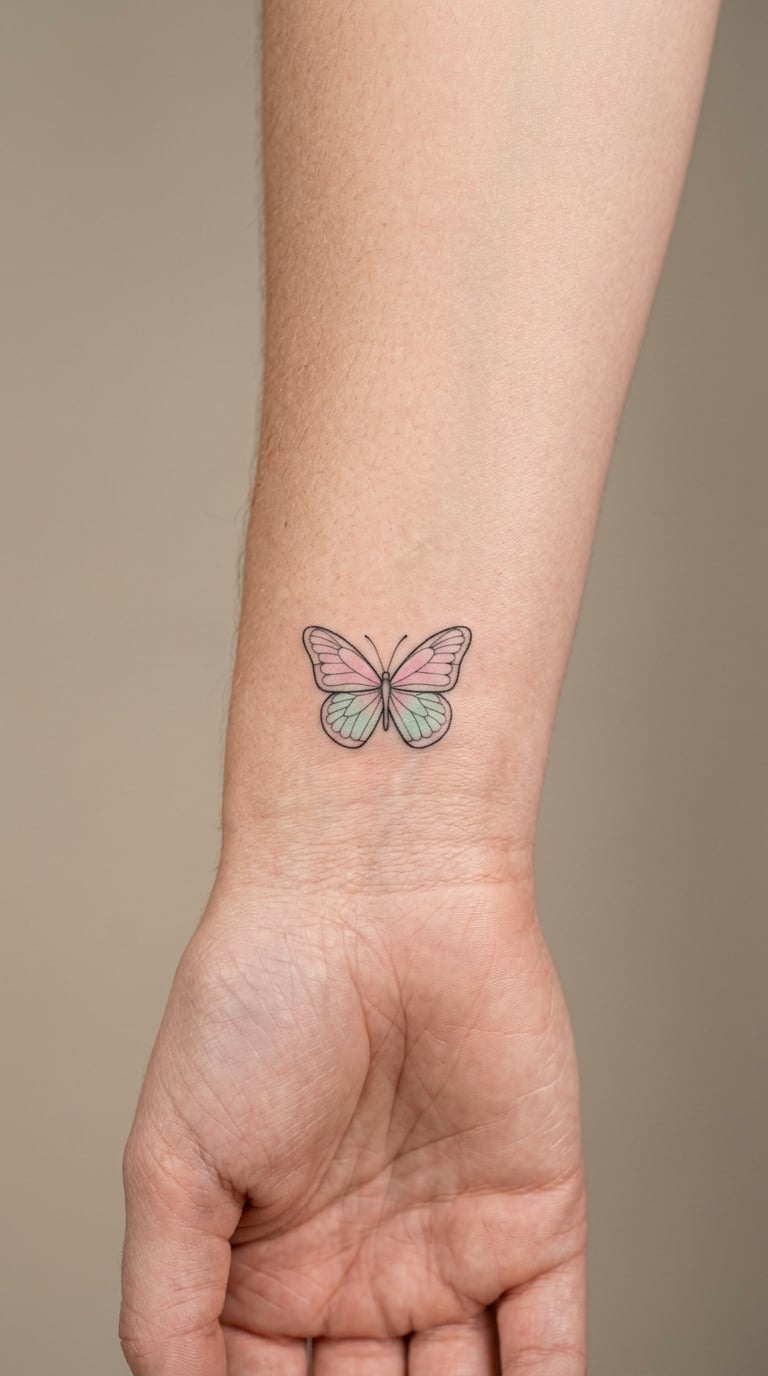
Pastel wings depend entirely on how the skin takes colour. Pale pink, mint and butter yellow work when the artist washes them in rather than packing them solid, and the outline has to stay dark enough to hold the shape once the wash fades.
Best on the inner wrist at 2 cm with a fine black outline, and expect that outline to do about half the work forever. Pastel is thin pigment, so budget a colour touch-up every 12 to 18 months, or accept the piece as a design that settles into a softer version of itself. Plenty of people prefer the muted version once the first year is over.
Pain and time: 3 out of 10, 45 to 60 minutes.
14. Butterfly Inside a Fine-Line Circle
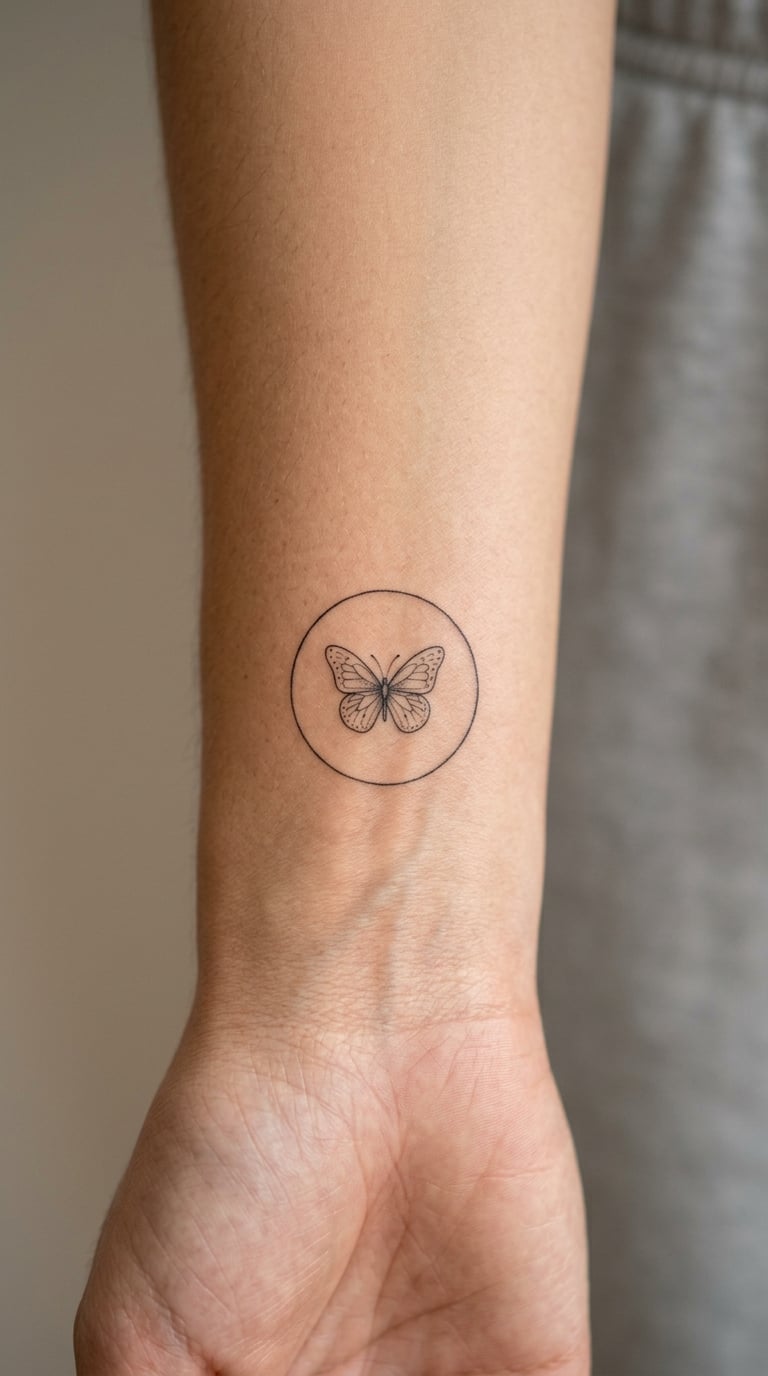
A single fine-line circle with the butterfly centred inside gives the most flexible placement here, because it can sit anywhere the circle fits flat. It is also the fix for a protruding wrist bone: position the circle along the curve so the butterfly sits square to the eye.
Best on the outer wrist or the back of the hand, a 2 cm circle drawn with one 0.5 mm line. Keep the butterfly simple, since a small butterfly inside a small circle is already two pieces of information in a small area. The circle fades first, being one hairline around a curved surface. A slightly heavier line on the circle and a lighter one inside is a choice most tattooers make on their own.
Pain and time: 3 out of 10, 30 to 45 minutes.
15. Butterfly with a Name or Date Beneath
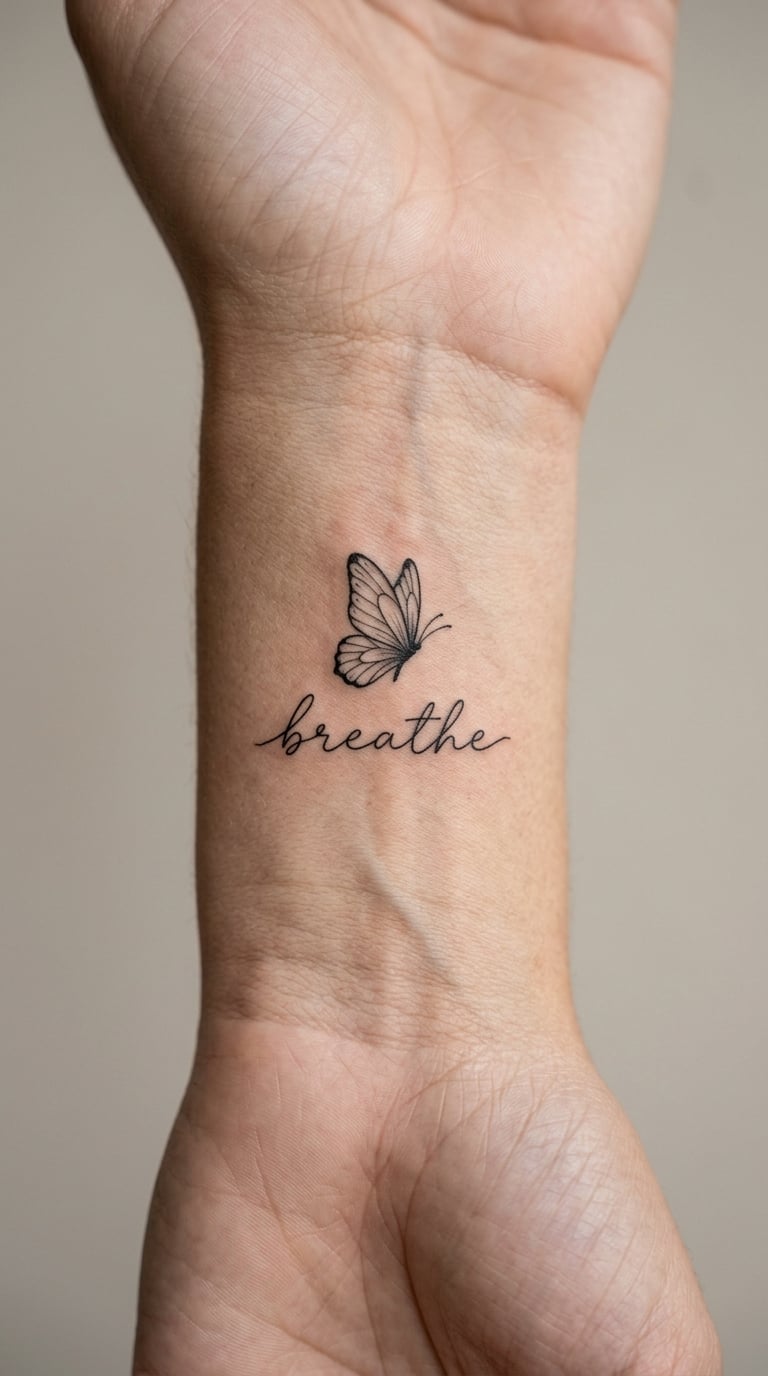
Handwriting-style lettering under a butterfly is the remembrance version, and where micro work most often goes wrong. Script has a size floor of its own, and on the inner wrist that floor and the butterfly’s floor do not always agree.
Best on the inner wrist, butterfly at 1.5 to 2 cm and text no shorter than 5 mm tall, or the loops fill in. Check the stencil in a wall mirror, not only a hand mirror, because the wrist foreshortens. Slight unevenness in a tiny script line is normal, and worrying about it mid-session is how lines end up thicker than you wanted.
Pain and time: 3 out of 10, 45 to 70 minutes.
16. Colour Block Pop Butterfly
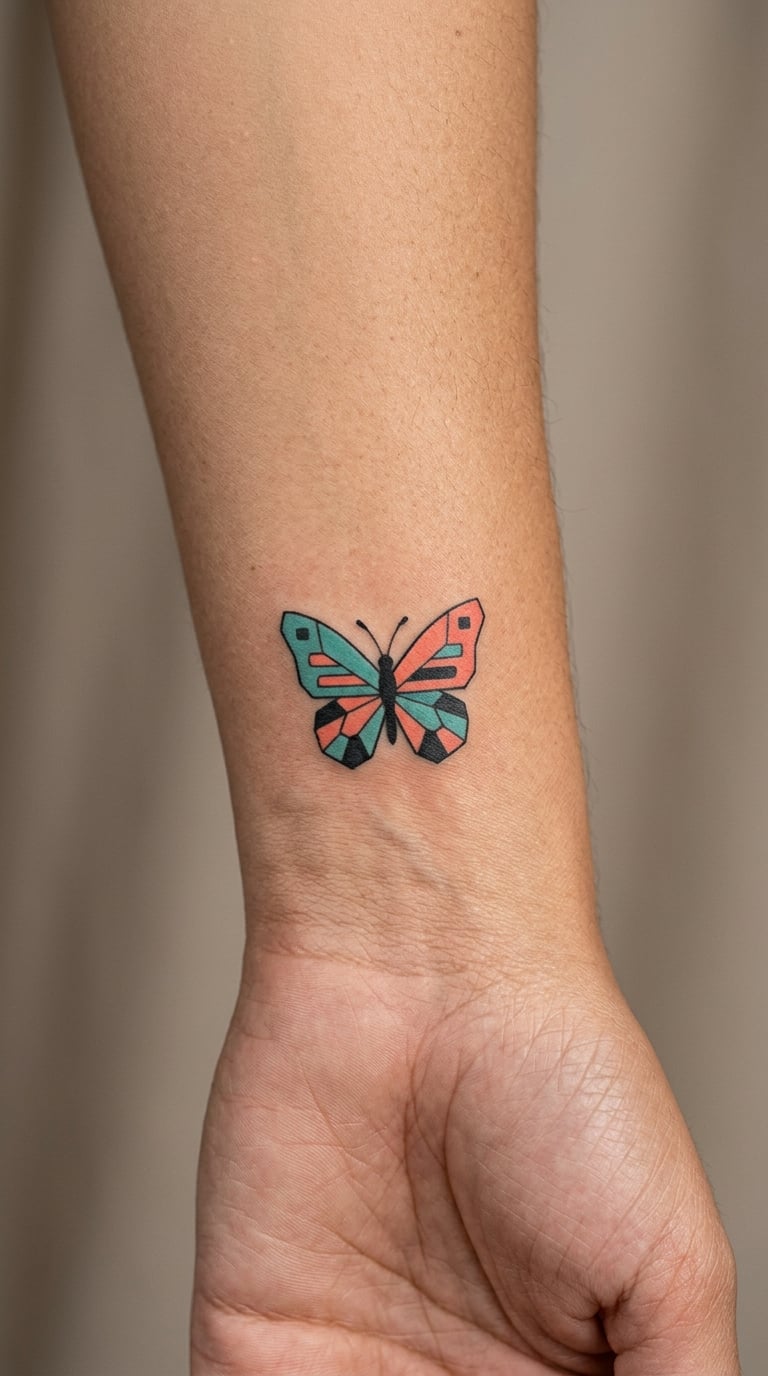
The colour block butterfly drops shading entirely and builds the wings from flat shapes in two or three contrasting colours. Graphic, loud for its size, and the least conventional choice here. It also holds its shape longest, because flat colour carries far more pigment than a gradient.
Best on the outer wrist at 2.5 cm, blocks meeting along clean black edges. Saturated teal, coral, deep blue and warm yellow all survive better on a wrist than pastels, and the black separators keep the shapes defined as the skin moves. Expect a longer life than any fine-line piece here, with a touch-up still worth doing around the one-year mark to push the colour back up.
Pain and time: 3 out of 10, 45 to 60 minutes.
Where to Place a Tiny Butterfly on the Wrist
The wrist is not one spot. It is four, and inner versus outer decides whether your design is a daily sight or a private one.
- Inner wrist: the most requested and the most exposed. Sensitive, high movement, visible every time you gesture. Best for fine-line outlines and semicolon pieces, placed slightly above the crease rather than in it.
- Outer wrist: flatter, less painful, better at holding a design with structure. Where dotwork, blackwork, lace wing and colour block belong, and it hides under a watchband more neatly than the inner side.
- Side wrist: the bony strip on the thumb side. Least-used, so it ages slowest, but the bone sits right under the skin and distorts anything drawn straight across it. Ideal for micro realism, which needs a flat plane.
- Back of the hand: visible, ages quickly, genuinely the hardest place to keep a tiny design sharp. Good for the circle piece, poor for script.
- Behind the ear: not the wrist, but the most popular alternative. Hides under hair and reads beautifully small, with more fading and more tenderness.
- Ankle: works well above the ankle bone under a trouser cuff, though it fades faster than the wrist.
One sizing request worth copying: if you want the butterfly under a watchband, give the artist the band width before the session. Half-inch bands need a design under about 1 inch long, and a 2 cm butterfly fits with room to spare. The wrist bone decides a lot of the rest: a bone that sticks out slightly will bend a straight line drawn across it, so stand up, flex your hand and look at the stencil from more than one angle before the needle comes out.
What a Tiny Butterfly Symbolizes
The butterfly is the oldest symbol on this list and the one people ask about least before booking and most after. It covers transformation, rebirth, freedom, new beginnings, remembrance, and the idea of a soul leaving the body. Every one of those readings fits a wrist placement, where the design sits where you can read it daily.
Transformation and new beginnings come up most often, tied to a move, a new job, a finished course, or leaving something behind. Remembrance is why a lot of people choose black line over colour: it carries a name, a date, a semicolon or a set of initials. Freedom and letting go usually sit alongside a breakup or a difficult family chapter.
What does a small butterfly tattoo on the wrist mean?
A small butterfly on the wrist usually means personal transformation, rebirth, freedom or a new beginning, and often a specific person or chapter of life the wearer is carrying with them. The wrist placement reinforces it, since it sits in plain view, close to the hand that acts and writes. What it means to the person wearing it is the only reading that counts.
Butterfly tattoos are often read as feminine, and that is a social habit rather than a design fact. Plenty of men ask for a micro butterfly, most of them a blackwork monarch or a single-stroke line, and none of them read as anything other than what they intend. A butterfly on a wrist is a design choice, not a gender signal, and liking the shape is reason enough.
How Small Is Too Small? Sizing and Line Weight
Below about 1 cm across, a butterfly stops being a butterfly and starts being a smudge with antennae. That is the honest floor, and the artists who will go under it are telling you something. What matters more is line weight, not size: fine-line means 0.5 to 0.7 mm, and anything thinner on a wrist blurs within a few years.
How the styles described above stack up on the details that change the outcome:
- Fine-line outline, 2 to 2.5 cm: survives best. One strong line, minimal interior detail, touch-up somewhere in the two to three year range.
- Blackwork monarch, 2.5 to 3 cm: holds colour well, but the white border spots are negative space and do not refill. Flattest surface, outer wrist.
- Dotwork, 2.5 to 3 cm: needs the most room of any style here. Spacing is everything, and it reads as texture first, shape second.
- Micro realism with colour, 1.5 to 2 cm: beautiful and the highest-maintenance. Vein detail and pale colour go first.
- Watercolour, 2 cm: soft bleeding edges, planned colour refresh at 12 to 18 months, or accept the settled version.
- Single-stroke minimal, 1.2 to 1.5 cm: the smallest thing that still reads, and the shortest-lived.
The detail budget at 1.5 cm is roughly two antennae, a body, and one or two interior wing lines. At 2.5 cm you get veins. At 3 cm and above you get pattern. Anything that needs more than that is a design for the forearm, and it is better there.
Things to Know Before You Book
Six things worth settling first, most of which nobody tells you until you are already there.
- Choose the artist by the work, not the price: look for healed micro butterflies on the wrist, in healed photographs rather than fresh-day posts. Healing is the only honest portfolio.
- Bring a size constraint: the watchband width, the sleeve gap, the exact measurement you have in mind. Artists adjust for a stated number far better than for a vague idea.
- Eat, hydrate and sleep: a five-minute session on an empty stomach is a bad five minutes.
- Wear a shirt you can roll past the elbow: a tight cuff presses exactly where the tattoo is going.
- Do not book in the two weeks before a beach trip: fresh wrist tattoos and salt water do not mix.
- Book a consultation, not a walk-in: it costs little or nothing, it lets the artist talk you out of a design that will not age well, and it is the only place the sleeve-gap and watchband questions get answered properly.
How much does a tiny butterfly tattoo cost?
Almost every studio prices a very small piece by the session minimum rather than the hour, so a 30-minute butterfly gets charged close to a full appointment. The driver is the shop minimum, not the design: drawing time and colour count are near identical between a simple outline and a monarch at the same size. Differences between two studios in one city come down to booking minimums, hourly rates, and whether a consultation is included. If a quote looks high for a piece this small, ask what the minimum is and compare it against a studio with a lower one.
How bad does a small wrist tattoo hurt?
Most people put a wrist micro butterfly at 4 to 5 out of 10. The skin is thin and the radius sits close to the surface, so the sensation is sharp and arrives fast rather than building slowly, but a tiny design is over in minutes. The inner wrist is the sharper end of the scale, the outer side noticeably easier. Breathe out slowly through your nose rather than holding your breath, and keep your hand loose.
How long does a small wrist tattoo take to heal?
- Days 1 to 2: tender, warm, slightly raised and darker than you expected. Wash it twice a day, pat dry, nothing else.
- Days 3 to 5: the itch starts. This is the stage where people scratch and ruin things. It means the skin is rebuilding, and it stops.
- Days 6 to 10: flaking, dry skin lifting off the design. Do not help it along. It looks worse than it is.
- Days 11 to 14: the new skin settles, redness goes, the lines soften slightly. This is when you judge it honestly.
- Three to six months: the real reveal. Fresh tattoos are always a little bolder than the settled version.
Wrist pieces are harder to heal than torso work, mostly for boring mechanical reasons: constant washing, constant movement, and friction from watchbands, bracelets, cuffs and gym straps. Leave the wrist bare for a few days. If you wear a watch, wear it on the other arm until the surface stops being shiny, then loosen the band rather than fastening it as you did before.
Will a tiny butterfly wrist tattoo need touch-ups?
Roughly three out of four do, and expecting it beats being disappointed. A fine-line outline on the inner wrist usually wants a touch-up in the two to three year range, colour work sooner, and a single-stroke minimal piece earliest of all. If it ages badly you are not stuck: a blurred micro butterfly can be reworked into something with more ink behind it, or a tiny blackwork butterfly laid over a faded outline. Go back to the artist who did it, since they know how much room the original has left.
Frequently Asked Questions
What does a small butterfly tattoo on the wrist mean?
A small butterfly on the wrist usually symbolizes transformation, rebirth, freedom or a new beginning, and it is often tied to a specific person or chapter of life. Because the wrist is visible every day and sits close to the hand, it works as a quiet personal marker rather than a loud statement. Many people add a name, date or semicolon underneath to make the meaning specific.
How small can a butterfly tattoo be and still read?
About 1 cm across is the practical floor, though 1.5 to 2.5 cm is the range most people are happy with. Below 1 cm the wing shapes blur into each other and the piece reads as a smudge rather than a butterfly. Line weight matters more than size: ask for 0.5 to 0.7 mm so the outline survives years of wrist movement and washing.
Where do butterfly tattoos look best on the wrist?
The outer wrist is the most forgiving flat surface and suits blackwork, dotwork and colour block designs. The inner wrist is the most visible and the most personal, and it suits fine-line outlines and semicolon pieces placed slightly above the crease. The side of the wrist is the least-used and ages slowest but the bone sits close and distorts any design drawn straight across it.
How bad does a small wrist tattoo hurt?
Most people rate a micro butterfly on the wrist around 4 to 5 out of 10. The sensation is sharp rather than dull because wrist skin is thin and close to the radius, but a tiny design takes only minutes, which makes it much easier than a long session on a forearm. The outer wrist hurts noticeably less than the inner side. Keep your hand loose and breathe out slowly.
How long will a small wrist tattoo take to heal?
Fourteen days to surface healing, then three to six months for the settled look. It is tender and raised for two days, itchy and flaking from around day three to day ten, and it softens visibly after that. Wrist tattoos heal slower than torso work because of constant washing, movement and watchband friction, so keep the wrist bare for a few days if you can.
Do wrist tattoos fade faster than other placements?
They do. Wrist and finger work fades and softens faster than torso tattoos because of frequent washing, sun exposure, constant movement and changes in skin elasticity. Fine-line outlines on the inner wrist typically want a touch-up somewhere in the two to three year range, and colour work sooner. A daily moisturiser once the skin is fully healed helps more than most people expect.
Conclusion
Start with the size, not the style. Decide the measurement and the placement first, because a 2 cm butterfly and a 3 cm lace-wing butterfly are different tattoos with different costs, session lengths and expectations for five years out. Then pick the design that already matches your line work or your sleeve, and take a healed portfolio to the consultation rather than a screenshot of someone else’s fresh ink.
These tiny butterfly tattoo ideas for the wrist are built to outlive a trend, and the ones that do are almost always the simplest. Book the consultation, bring your watchband measurement, and let the artist talk you down to a size the skin can actually hold.