
20 Best Space Sleeve Tattoo Ideas for Cosmic Art (September 2026)
A space sleeve tattoo is one continuous design that wraps a large part of an arm or leg, built from galaxies, planets, astronauts, rockets and starfields rather than a pile of separate small pieces. Most people arrive at these 20 space sleeve tattoo ideas holding two or three references they like and no idea how to connect them. That gap between what you save and what ends up on your arm is where most sleeve regrets come from.
What makes a space design work on skin is flow. An arm is a moving cylinder, so a planet that reads perfectly flat on paper will distort across the elbow. The best concepts have one anchor image, a background field that carries the eye around the limb, and enough open skin that the composition breathes.
Sleeves take months, not days, so plan ahead if you are starting in autumn or winter. New skin needs to be calm before the next session, and color work especially wants a gap between visits. If you want broader inspiration first, our bold sleeve tattoo ideas cover heavier masculine layouts, and the botanical sleeve collection is worth a look if you want something softer than deep space.
Space Sleeve Tattoo Ideas: Quick Guide
| Idea | Style | Best placement | Size | Pain |
|---|---|---|---|---|
| 1. Realistic planet and orbital map | Realism, black and grey | Outer forearm to elbow | 10-14 in (25-35 cm) | Medium |
| 2. Fine-line moon phases | Fine line | Inner forearm, elbow to wrist | 8-10 in (20-25 cm) | Low to medium |
| 3. Traditional rocket and nebula | Traditional American | Upper arm, shoulder cap | 12-16 in (30-40 cm) | Medium to high |
| 4. Blackwork galaxy and black hole | Blackwork | Full forearm wrap | 16-20 in (40-50 cm) | High |
| 5. Watercolor nebula arm | Watercolor | Upper arm to elbow | 10-14 in (25-35 cm) | Low to medium |
| 6. Celestial compass and star map | Illustrative, fine detail | Outer forearm | 9-12 in (23-30 cm) | Medium |
| 7. Micro-realism Earth and moon | Micro-realism | Outer forearm band | 5-7 in (13-18 cm) | Medium |
| 8. Retro atomic space | Traditional, retro | Upper arm | 10-13 in (25-33 cm) | Medium |
| 9. Astronaut floating through stars | Illustrative realism | Shoulder to upper arm | 10-14 in (25-35 cm) | Medium |
| 10. Dotwork solar system | Dotwork, stippling | Forearm, elbow to wrist | 12-16 in (30-40 cm) | Medium to high |
| 11. Japanese moon and sea of clouds | Japanese-inspired | Upper arm to elbow | 13-17 in (33-43 cm) | High |
| 12. Minimal linear constellations | Minimal fine line | Inner forearm | 7-9 in (18-23 cm) | Low |
| 13. Traditional UFO and Saturn storm | Neo-traditional | Forearm wrap | 11-14 in (28-35 cm) | Medium to high |
| 14. Botanical moon and flowers | Fine line, botanical | Shoulder cap to upper arm | 10-13 in (25-33 cm) | Low to medium |
| 15. Geometric solar eclipse | Geometric, blackwork | Forearm or calf | 9-12 in (23-30 cm) | Medium |
| 16. Planetary collision | Color realism | Upper arm to shoulder | 12-15 in (30-38 cm) | Medium |
| 17. Blackwork alien landscape | Blackwork, illustrative | Full arm or leg | 16-22 in (40-56 cm) | High |
| 18. Fine-line shooting star trail | Fine line | Inner forearm | 6-9 in (15-23 cm) | Low |
| 19. Neon outer space | Neon illustrative | Full forearm wrap | 14-18 in (35-45 cm) | Medium to high |
| 20. Celestial map and antique compass | Illustrative, antique | Full arm, shoulder to wrist | 18-22 in (45-56 cm) | Medium to high |
Space Sleeve Tattoo Ideas by Style and Placement
Read the table by style family first, then by placement, because those two decisions drive everything else. Realistic and illustrative work (1, 6, 7, 16, 20) rewards a big flat area like the outer forearm or upper arm where an artist has room for shading. Line-based work (2, 12, 18) suits narrow runs of skin such as the inner forearm, where thin single-needle lines can be kept clean.
Blackwork (4, 15, 17) is the boldest and the heaviest on the needle, and it holds its shape for decades because it does not depend on color. Traditional and neo-traditional (3, 8, 13) are the safest bet for a first sleeve: bold outlines, saturated fills and forgiving linework that reads well from across a room.
Watercolor and neon (5, 19) are the two styles most likely to need touch-ups, because pale washes and bright synthetic tones dull first. Botanical crossover work (14) suits smaller arms and lighter tattoos, and if that is more your direction, our sleeve ideas for women round it out with non-space layouts.
1. Realistic Planet And Orbital Map Sleeve
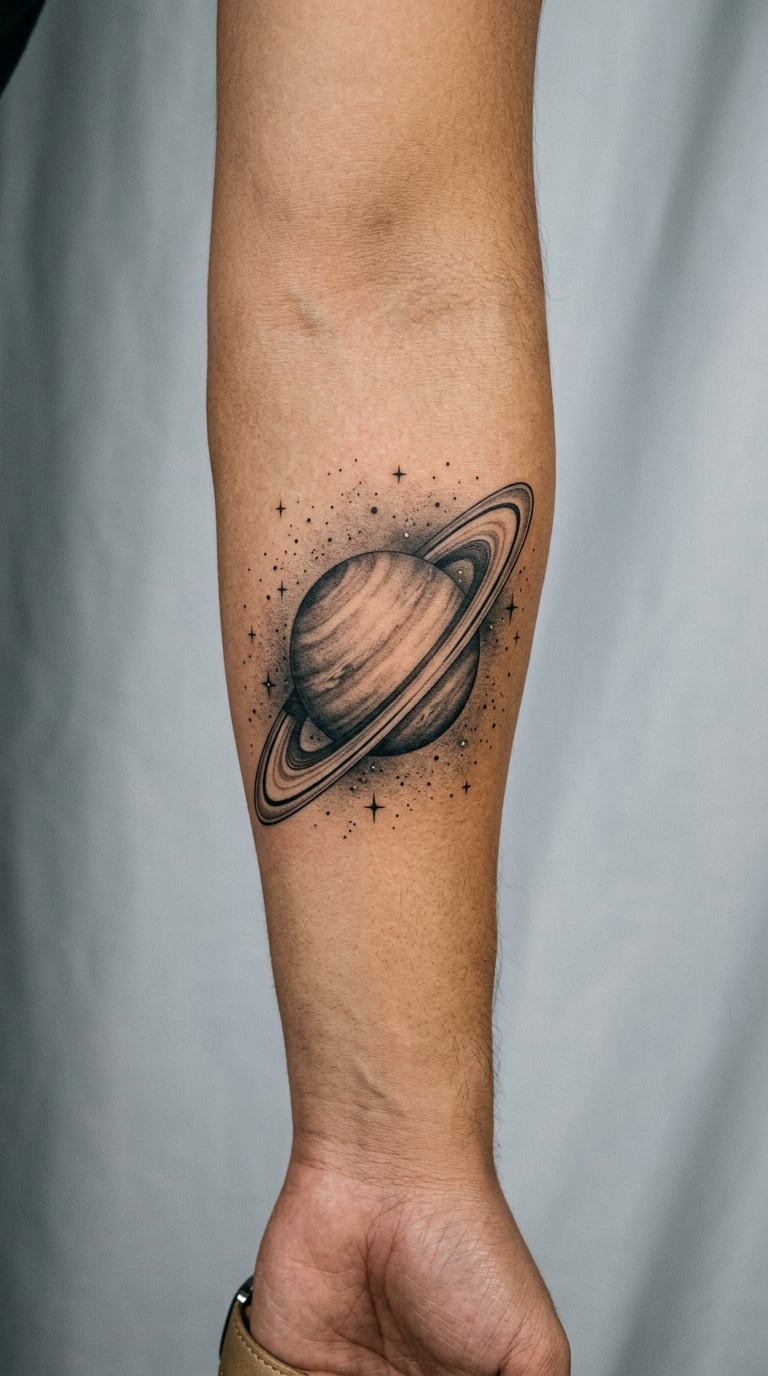
A ringed planet rendered in black and grey sits as the anchor of this design, with hairline orbital paths looping out from it and a scatter of pinpoint stars filling the gaps. Fine cross-hatching builds the shadow side so the sphere looks lit from one direction.
People choose this one for the documentary feel. A sleeve of accurate orbital maps reads like a field study rather than a decoration.
Placement: Outer forearm running to the elbow, where the widest muscle gives the planet room. Size: 10-14 inches (25-35 cm) long. Style: Realism, black and grey. Pain: Medium, with the elbow and inner forearm the sharpest spots. The orbital hairlines will soften over the years if the forearm is a sun-exposed area.
Make it yours: Name a real planet and have the artist draw its actual ring tilt and axial lean.
2. Fine-Line Moon Phase Sleeve
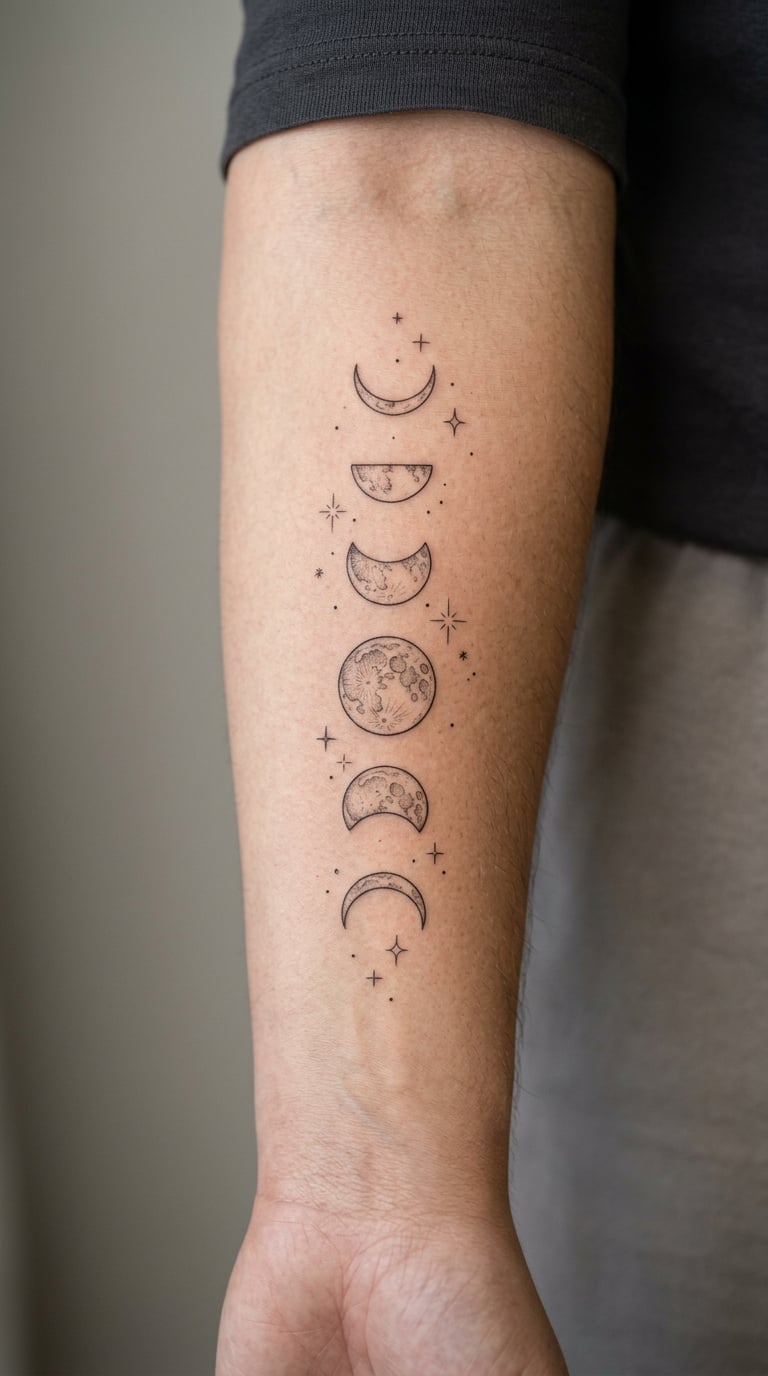
A row of moon phases runs from the elbow down toward the wrist, each disc drawn with a single consistent line weight, with small stars scattered in the negative space between them. Nothing is filled, so the design stays light and airy.
The lunar cycle is the oldest recurring symbol in this whole category, and it reads as change and patience rather than as science fiction. It is also the least committed-looking design here, which matters if you are nervous.
Placement: Inner forearm, elbow to wrist. Size: 8-10 inches (20-25 cm). Style: Fine line, single needle. Pain: Low to medium. Fine line is the one style that fades fastest, especially on the inner arm, so expect a refresh every few years.
Make it yours: Add the exact dates of a birth, a wedding, or a recovery under the corresponding phase.
3. Traditional Rocket And Launch Nebula Sleeve
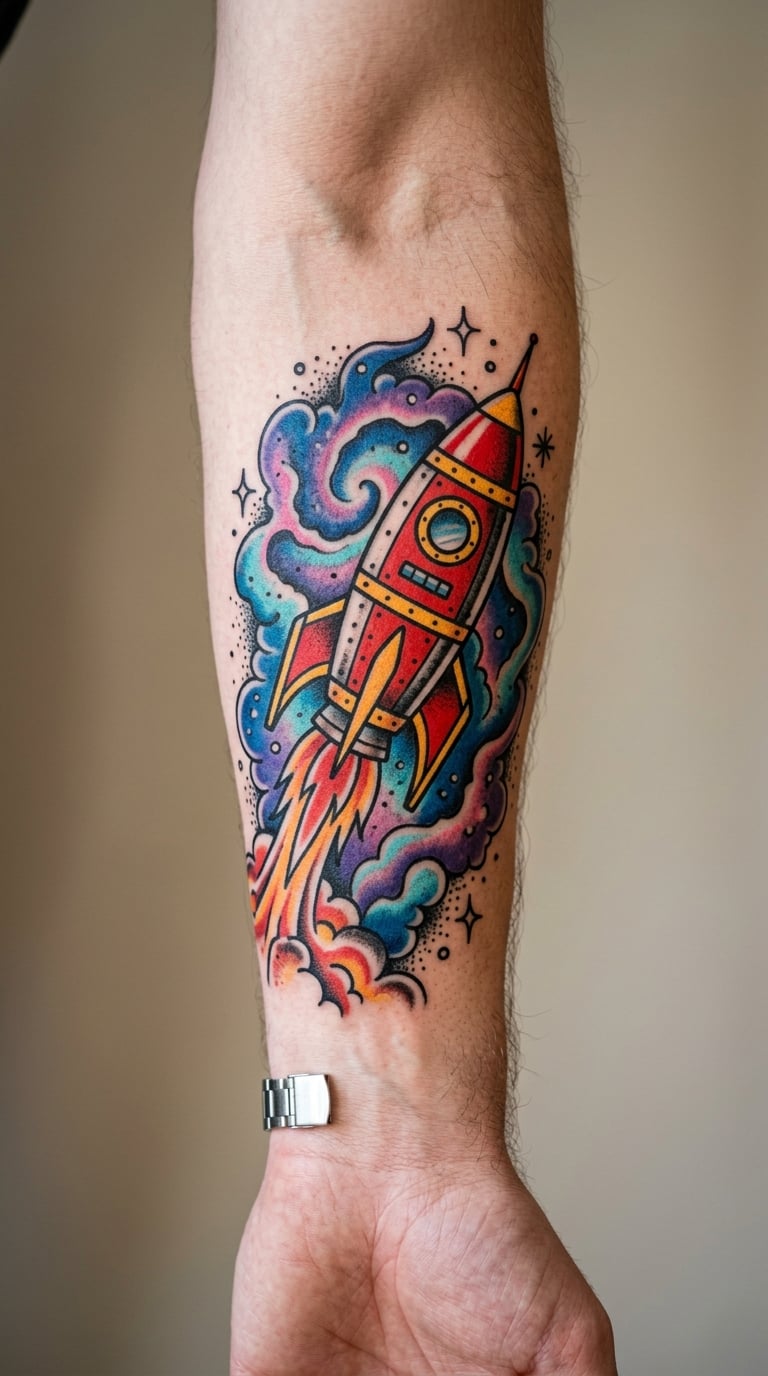
A vintage-style rocket climbs on a diagonal, trailing orange and yellow flame that dissolves into a blue and purple nebula at the top of the arm. Everything is wrapped in a confident black outline, with flat saturated color and almost no soft shading.
It is a hopeful image, and traditional flash is forgiving enough to tattoo well. This is the version most people picture when they first search space sleeve tattoo ideas.
Placement: Upper arm finishing at the shoulder cap, so the rocket points up toward the neck. Size: 12-16 inches (30-40 cm). Style: Traditional American. Pain: Medium to high, and the shoulder cap is the roughest part. Bold outlines hold their shape longer than any other space style.
Make it yours: Put a mission-style name and a single date on the rocket’s body as a banner.
4. Blackwork Galaxy And Black Hole Sleeve
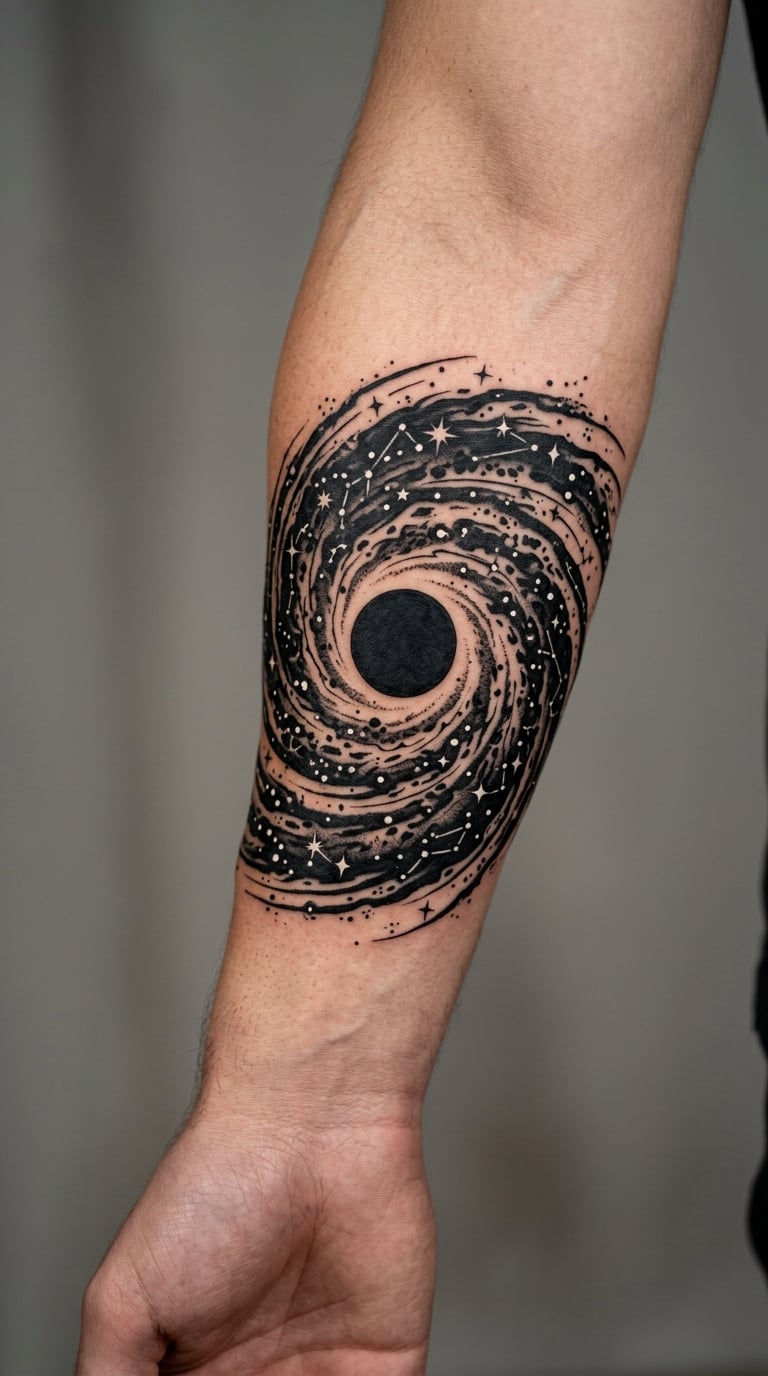
Dense black ink builds a spiral galaxy that wraps the forearm, pulling into a solid black circle at the elbow with a hard white edge around it. Stars appear as untouched skin rather than as drawn dots, so the negative space is doing the work.
Blackwork is the style that never fades out of fashion, and a design this dense hides older ink and texture well. It is also the boldest option on the list.
Placement: Full forearm wrap from wrist to elbow, ideally continuing slightly onto the upper arm. Size: 16-20 inches (40-50 cm). Style: Blackwork. Pain: High, and a solid black area is a long needle pass that can feel intense around hour three. The black itself will not fade, so the risk is line softness at the edges.
Make it yours: Ask for the black hole to swallow one specific small element, such as a rocket, from an older tattoo.
5. Watercolor Nebula Arm Sleeve
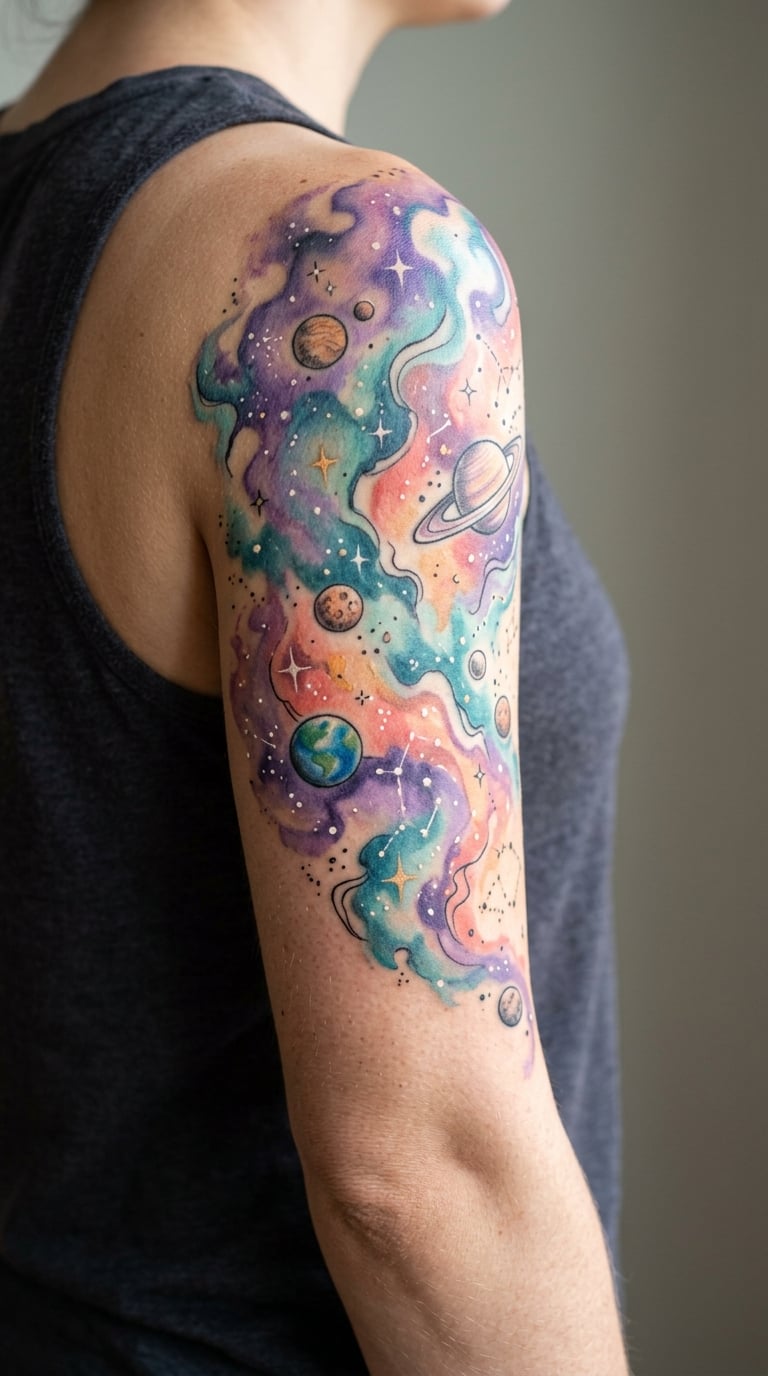
Layered clouds of violet, teal, coral and gold drift across the upper arm with soft bleeding edges, and a few small planets sit inside the wash. Some areas are deliberately left as bare skin, which is what makes it read as watercolor rather than as a print.
It is a softer, more decorative take on the galaxy look, and it flatters smaller arms because there is no heavy outline to carry. The trade-off is fade.
Placement: Upper arm down to the elbow. Size: 10-14 inches (25-35 cm). Style: Watercolor. Pain: Low to medium, since the work is light. Pale washes lose saturation first, and a sleeve is usually a few sessions, so color may drift between visits unless your artist matches the first session closely.
Make it yours: Pick two colors that already appear elsewhere in your tattoos and let the nebula run only in those hues.
6. Celestial Compass And Star Map Sleeve
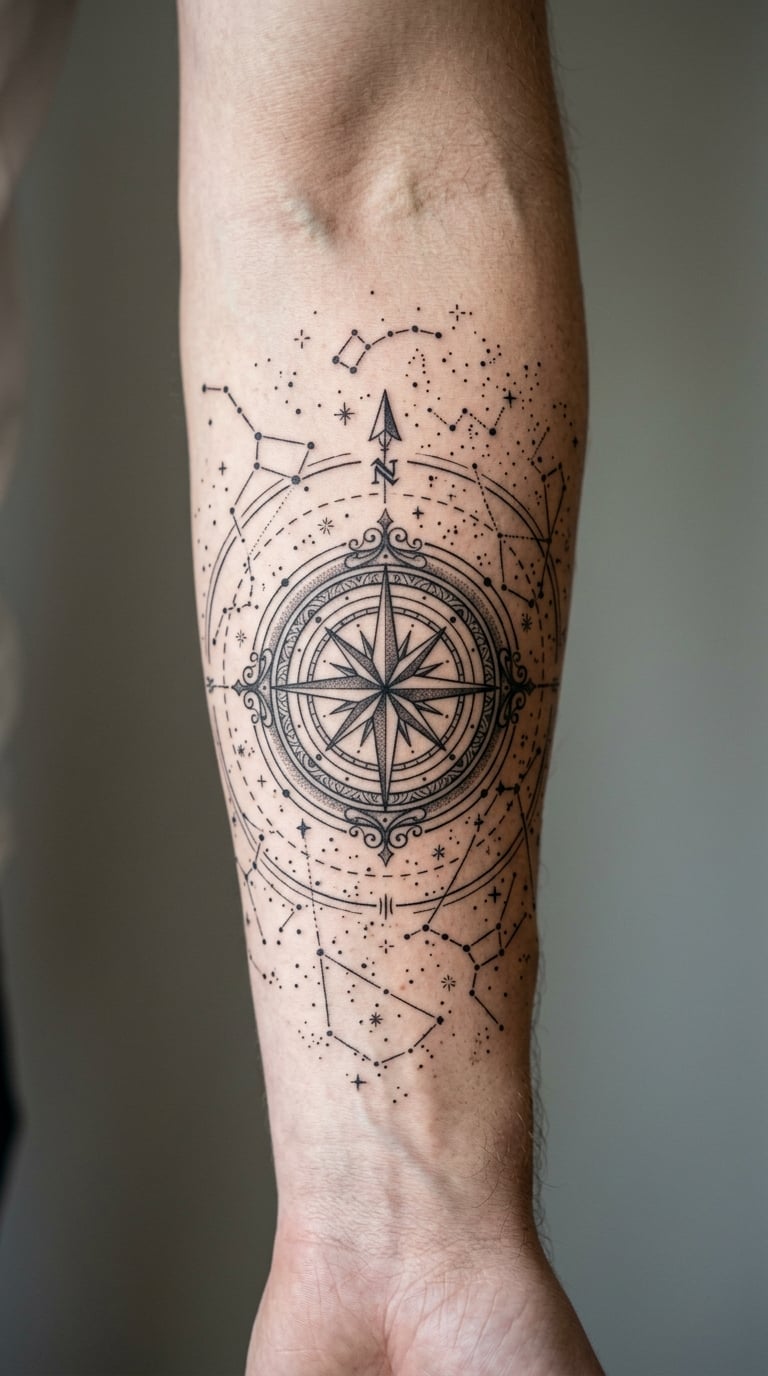
An ornate compass with an aged brass face is surrounded by fine constellation lines, small latitude ticks and a hand-drawn star chart that curves away along the arm. Fine stipple shading gives the metal a worn, handled look.
The compass is the oldest symbol in this list and it points at navigation, protection and getting your bearings. It suits people who like the history of mapmaking rather than the science fiction side of space.
Placement: Outer forearm. Size: 9-12 inches (23-30 cm). Style: Illustrative with fine detail. Pain: Medium. The small latitude marks are the elements that blur first, so a well-inked pass matters here.
Make it yours: Add a real coordinate for somewhere that matters to you, written in a thin hand along one edge.
7. Micro-Realism Earth And Moon Sleeve
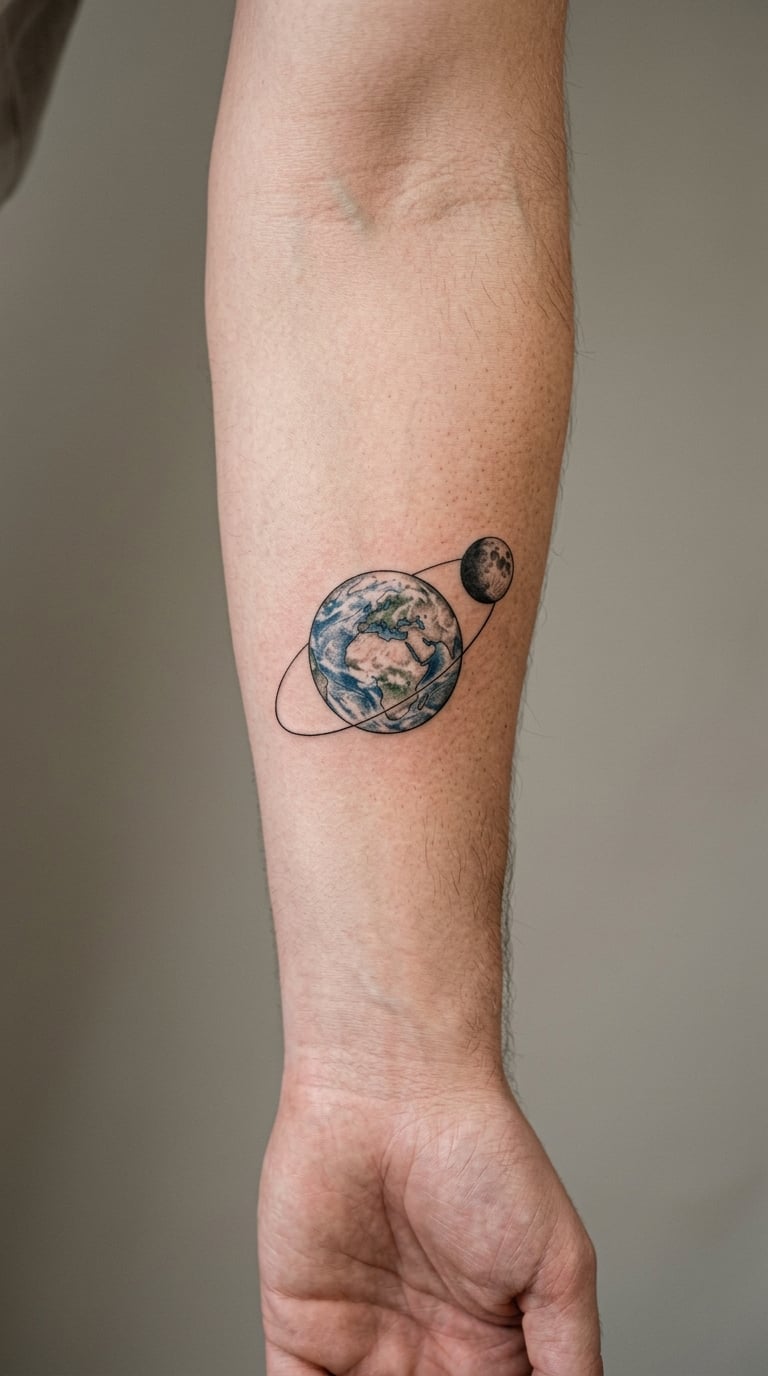
A single highly detailed Earth is paired with a partially shadowed moon and one thin orbital line, with just a few stars around the outside. Everything sits inside a narrow horizontal band rather than filling the arm top to bottom.
It is the most compact option here and the easiest to place, which makes it a sensible starting point for a half sleeve. Micro-realism is about density in a small area, not about covering skin.
Placement: Outer forearm band. Size: 5-7 inches (13-18 cm). Style: Micro-realism. Pain: Medium, and the detail means more time in one spot, so the forearm fatigues quickly. Very fine shading softens noticeably after several years, especially with sun exposure.
Make it yours: Use a photo of Earth at night, with the city lights you grew up near faintly visible.
8. Retro Atomic Space Sleeve
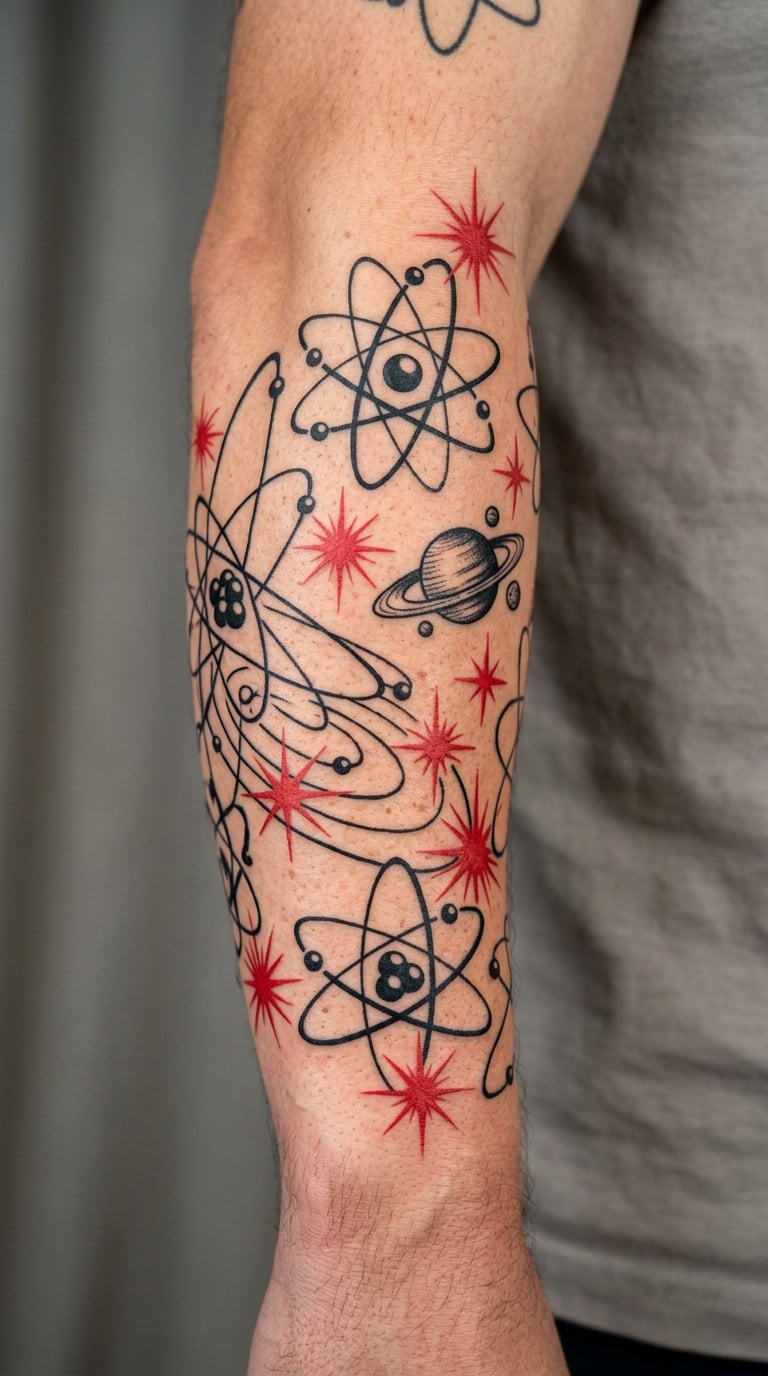
Mid-century atomic-age imagery fills the upper arm: looping orbit diagrams, atom symbols with their elliptical electrons, a small ringed planet and red starbursts. The linework is confident and slightly vintage, with limited flat color.
It borrows from the visual language of 1950s science fiction and early space programs, and it has a graphic, poster-like quality that photographs well. Nobody has to guess whether you meant it as a joke.
Placement: Upper arm. Size: 10-13 inches (25-33 cm). Style: Traditional with retro illustration. Pain: Medium. The looping lines cross the arm at a lot of angles, and thin red can look patchy if it is not saturated properly.
Make it yours: Reuse a phrase from an old launch announcement, set in the same block lettering as a 1960s badge.
9. Astronaut Floating Through Stars Sleeve
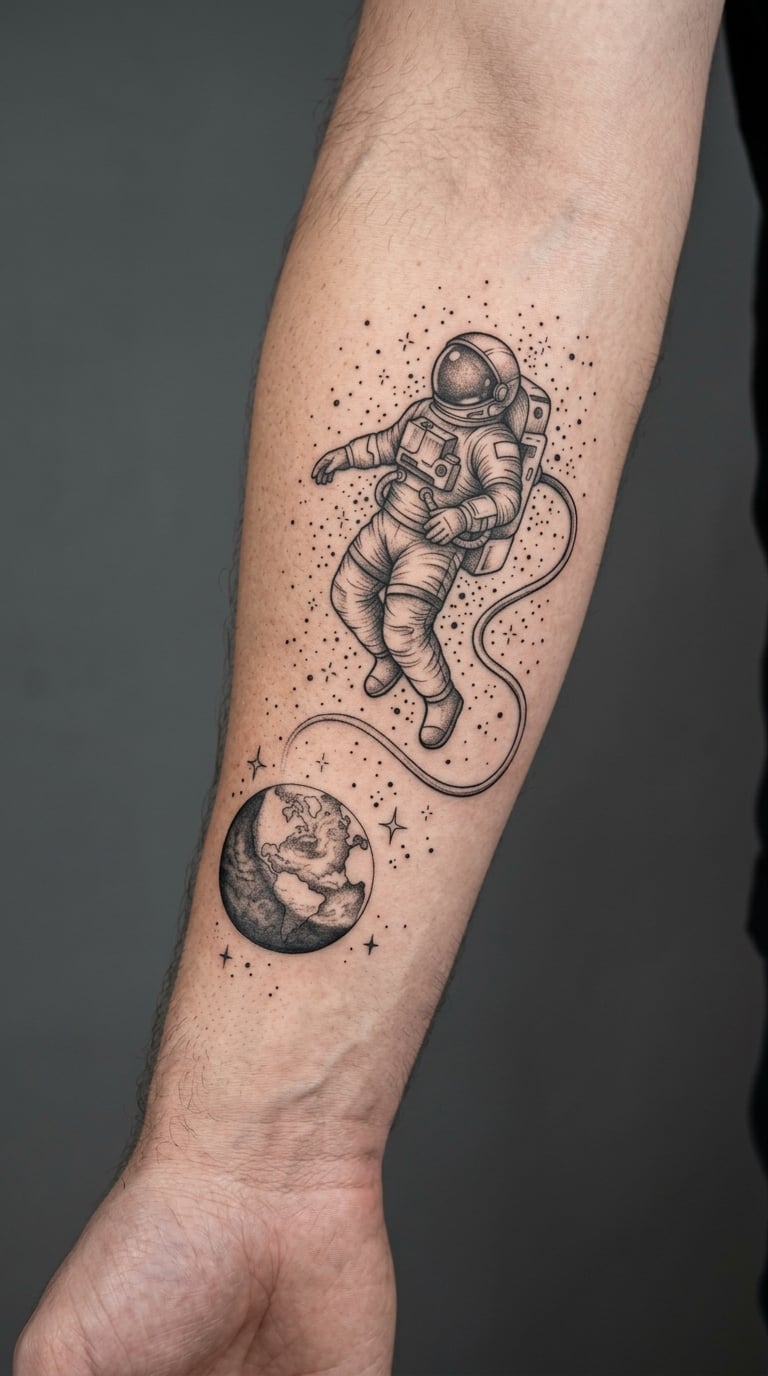
An astronaut drifts diagonally across the upper arm in a suit with a reflective helmet visor, one arm trailing a curved safety tether, with a distant planet small in the corner. Small stars are scattered around the figure without crowding it.
It is the most requested motif in this whole category and the least abstract. A lot of people pick it for someone they have lost, and others just want the sense of weightlessness.
Placement: Shoulder to mid upper arm, angled so the figure appears to be floating rather than standing. Size: 10-14 inches (25-35 cm). Style: Illustrative realism. Pain: Medium, and the helmet reflections are fiddly, which adds time. Fine visor detail is the first thing to soften with age.
Make it yours: Have the tether loop down toward a matching small element on your other arm or leg.
10. Dotwork Solar System Sleeve
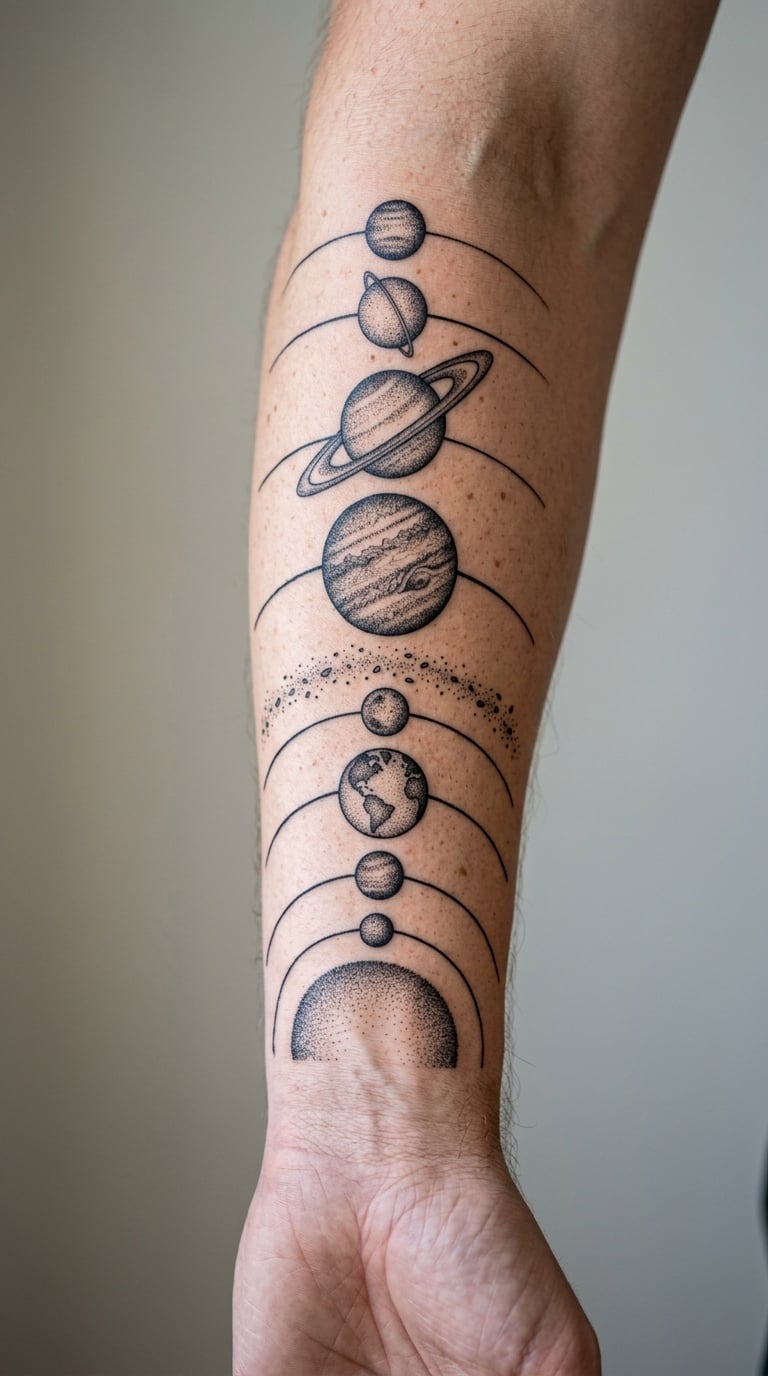
Every planet is built from thousands of tiny dots of varying density, with clean elliptical orbital paths drawn between them and generous bare skin around each body. The rhythm of the stippling is what carries the piece.
It is a patience-heavy design that rewards an artist who specializes in dotwork, and it reads as considered rather than loud. Dotwork also covers a lot of ground without needing color.
Placement: Forearm, elbow to wrist. Size: 12-16 inches (30-40 cm). Style: Dotwork and stippling. Pain: Medium to high, because dotting is many small passes over the same skin. Dots stay crisp for a long time if the shading is layered properly, but a rush job blurs into gray.
Make it yours: Order the planets by something personal, such as the years your family members were born.
11. Japanese-Style Moon And Sea Of Clouds Sleeve
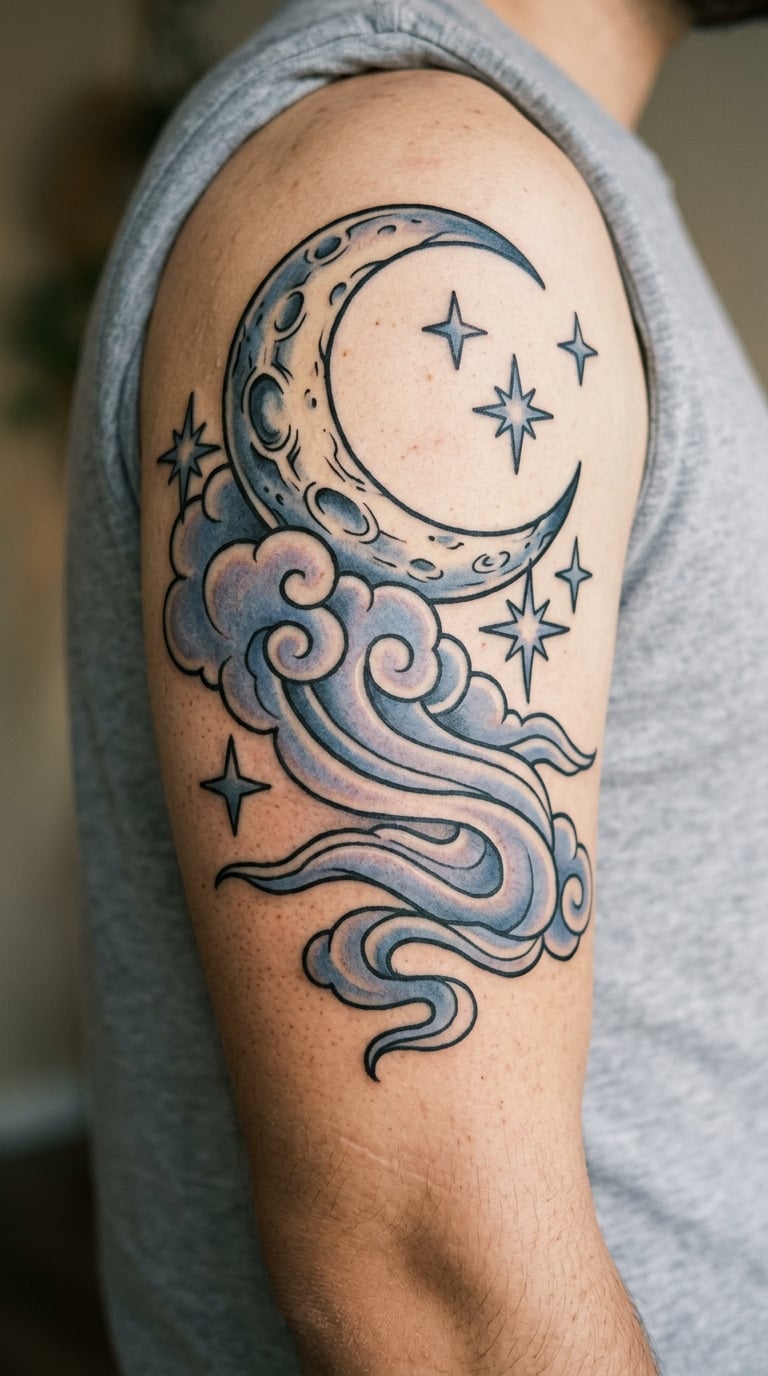
A large moon sits above flowing stylized sea-of-clouds forms, with a few stars placed in the open sky. Bold black outlines define the shapes and muted blue shading gives the clouds depth without competing with the moon.
Japanese-style tattooing is built around flow, and clouds are one of the strongest tools for carrying the eye around a curved limb. This is a substantial piece, but it holds together better than almost anything else on the list.
Placement: Upper arm down to the elbow, where the broad deltoid gives the moon room. Size: 13-17 inches (33-43 cm). Style: Japanese-inspired, large-scale. Pain: High, and this should be a planned series of shorter sessions rather than one marathon. The linework is the draw here, and thin lines need many passes, so it does not age as gracefully as bold work.
Make it yours: Add a personal seal-style mark in the negative space near the elbow, a common placement in this tradition.
12. Minimal Linear Constellation Sleeve
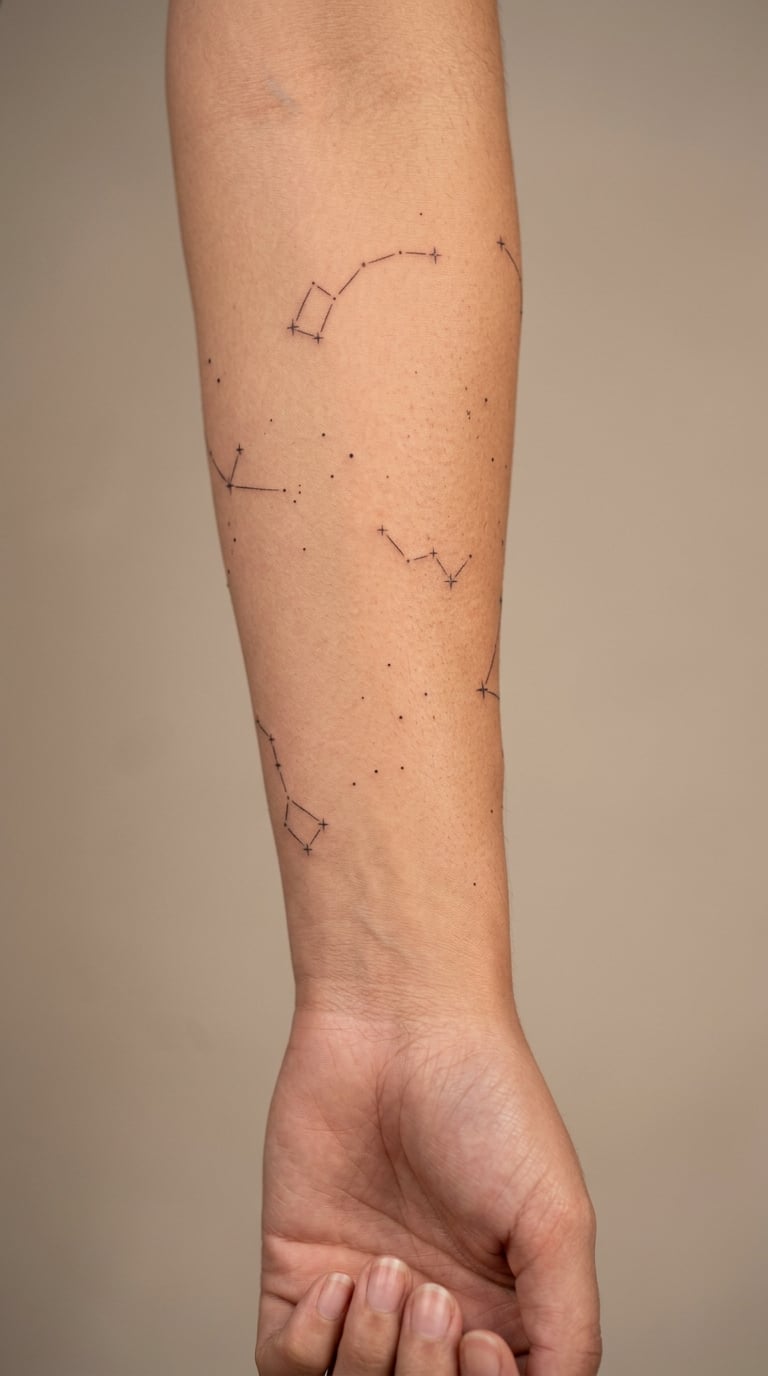
Two or three constellations are connected with hairline rules and small star points, with wide stretches of untouched skin between them. The restraint is the whole point: the design uses less ink than any other idea here.
Constellations are chosen for their names and their shape, and many clients pick the same star pattern for very different reasons. It looks expensive and simple rather than small.
Placement: Inner forearm, elbow to wrist. Size: 7-9 inches (18-23 cm). Style: Minimal fine line. Pain: Low. This is the least invasive design on the list and the one that fades quickest on the inner arm, so a touch-up every few years is normal.
Make it yours: Use the constellation that sits behind your birth sign’s coordinates, or the sky from the night of a specific event.
13. Traditional UFO And Saturn Storm Sleeve
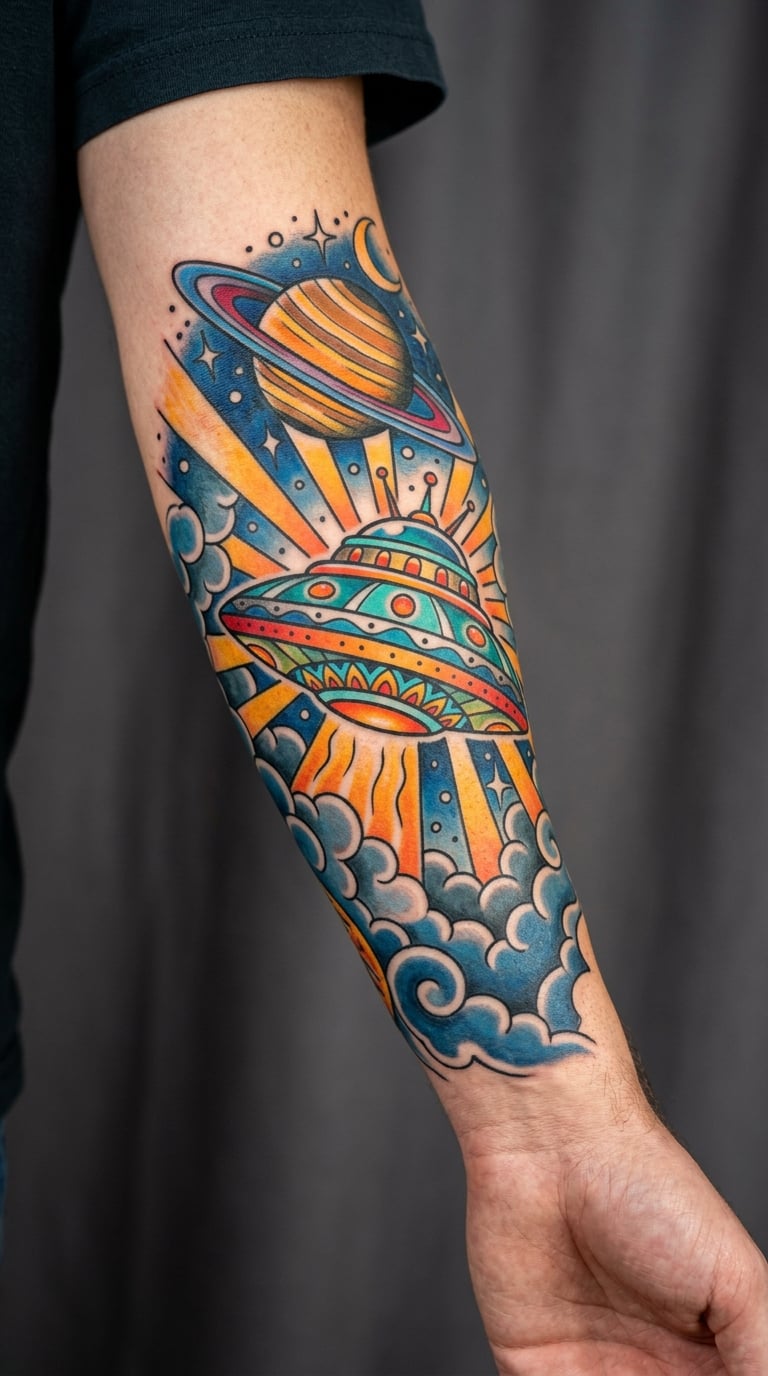
A classic flying saucer with a domed cockpit passes a striped Saturn that sits over stylized clouds, with sharp rays radiating out from behind the planet. Heavy black outlines and a tight, saturated palette keep the whole scene readable.
The saucer adds a bit of playfulness to a subject that is usually treated seriously, and the composition has a clear focal point that makes it work as a wrap. It is also a genuinely popular traditional flash subject.
Placement: Forearm wrap, with the saucer on the outer side and Saturn visible from underneath. Size: 11-14 inches (28-35 cm). Style: Neo-traditional. Pain: Medium to high on the inner forearm. Yellows in a striped planet are the first color to fade, so expect that area to need attention first.
Make it yours: Put a small figure on the shoulder facing the saucer, at a scale that only works if you look closely.
14. Botanical Moon And Flower Sleeve
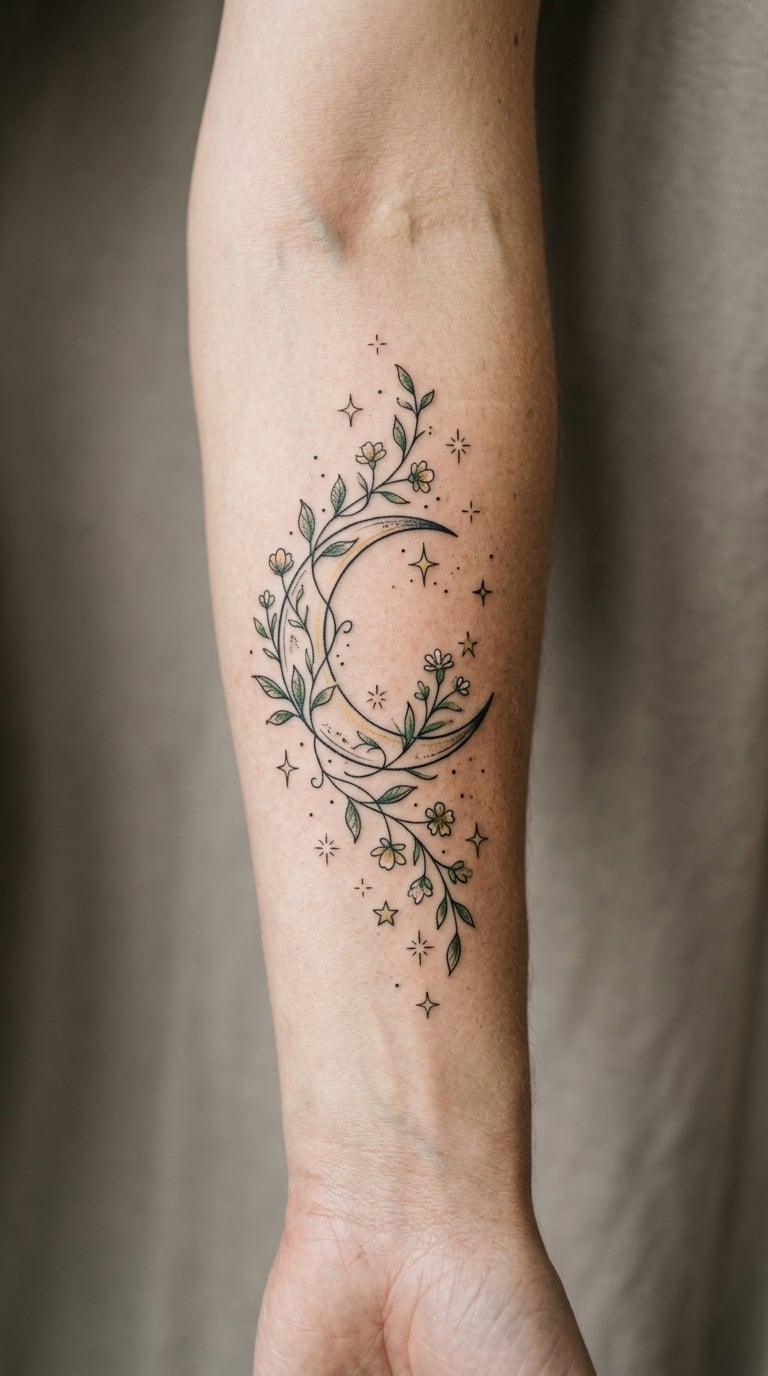
A crescent moon is wrapped in small flowers, winding vines and delicate stars, worked mostly in fine black line with restrained green and muted yellow filling. The density stays low, so skin shows between every stem.
It is the gentlest crossover in this collection, and it suits anyone who finds a full cosmic scene too dark. The botanical element is a good stand-in if you already have a nature sleeve you want to extend.
Placement: Shoulder cap running down the upper arm. Size: 10-13 inches (25-33 cm). Style: Fine line with botanical elements. Pain: Low to medium. Fine vine lines on the upper arm fade less than inner forearm work but still soften, and thin green shading is the weak point after a few years.
Make it yours: Use a flower native to somewhere you have lived, so the piece carries a place rather than just a theme.
15. Geometric Solar Eclipse Sleeve
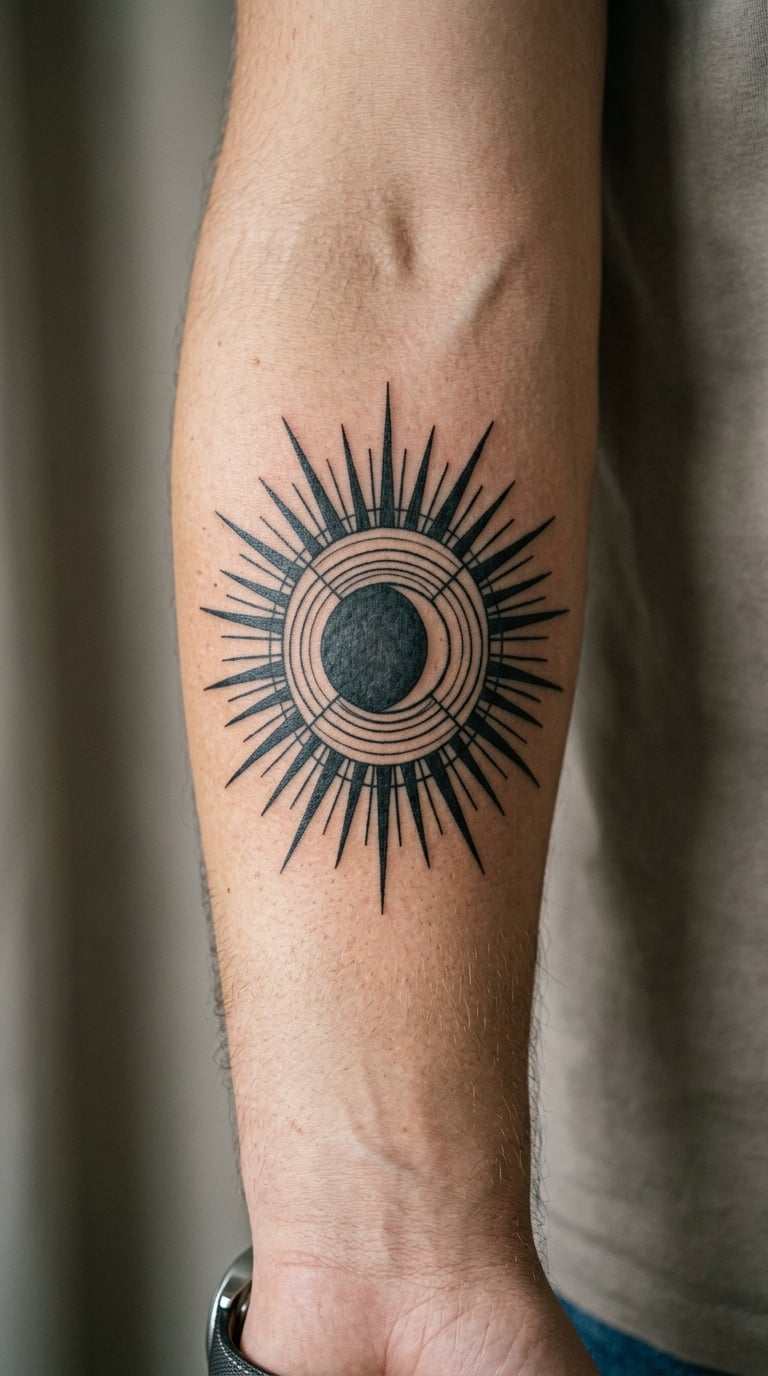
Concentric circles build a total solar eclipse with sharp black rays stepping out from the corona, all in a restrained black palette. The geometry is precise and the negative space between rays does most of the visual work.
Eclipse imagery carries ideas about endings and new beginnings, and the graphic construction means it suits an arm with some definition. It also sits well beside existing blackwork without clashing.
Placement: Forearm, or the calf where the limb is straighter. Size: 9-12 inches (23-30 cm). Style: Geometric blackwork. Pain: Medium. Long clean black rays need a steady hand, and any wobble in a straight ray is obvious once healed.
Make it yours: Add the eclipse date as a ring of small numerals around the outermost circle.
16. Colorful Planetary Collision Sleeve
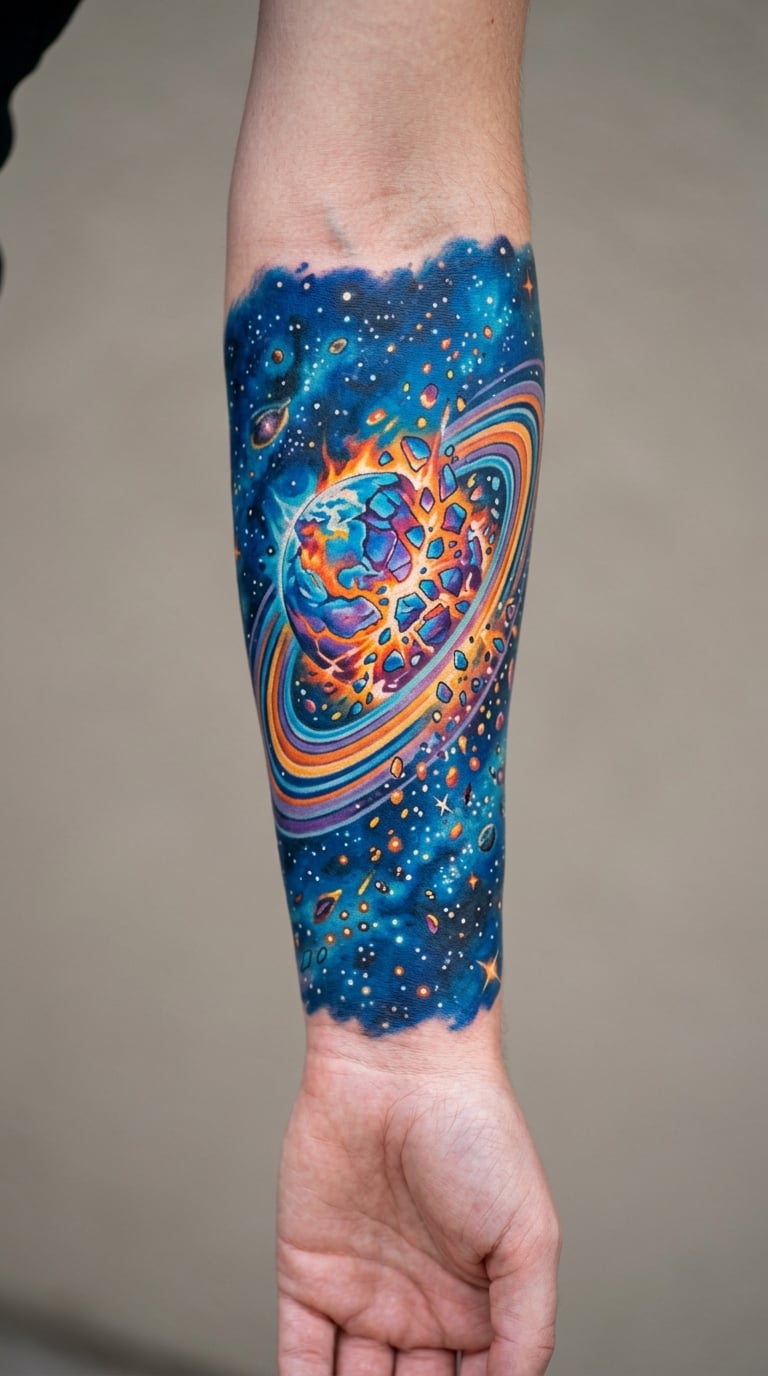
A planet is caught mid-break, splitting into bright rings, shards and glowing orbital debris against a deep blue star field. Color is packed hard in the debris and left softer in the background, which creates the sense of movement.
It is a dynamic scene rather than a static object, and it gives a sleeve a clear narrative moment to hang on. This is the most color-intensive design here, which is exactly why it also needs the most sessions.
Placement: Upper arm to shoulder, with the fragmentation pointing downward. Size: 12-15 inches (30-38 cm). Style: Color realism. Pain: Medium, though the shading is time-consuming. Saturation is the issue to plan around: bright blues and yellows dull noticeably, so ask what the design will look like in ten years rather than on day one.
Make it yours: Use a color story built from two complementary shades instead of a full rainbow, which holds up far better.
17. Blackwork Alien Landscape Sleeve
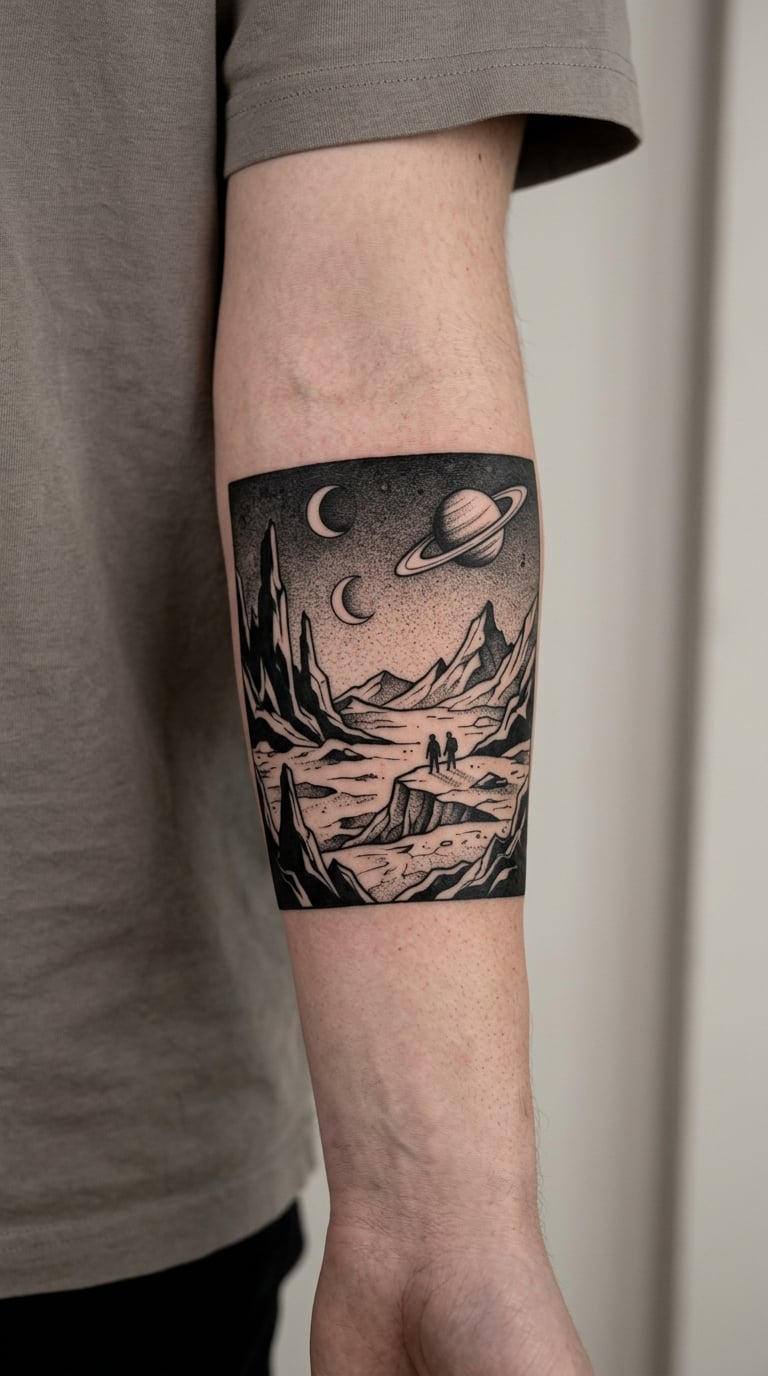
A dark alien horizon fills the arm: jagged terrain in the foreground, two moons at different phases in the sky, a distant ringed planet low on the horizon, and small silhouetted figures for scale. Dense black areas are broken by sharp white gaps.
It is storytelling rather than decoration, and the silhouettes give you a whole other world to build a collection around. As full-arm or leg work it is the biggest canvas on this list.
Placement: Full arm or a full leg, because the scene needs a horizon line to read. Size: 16-22 inches (40-56 cm). Style: Blackwork illustrative. Pain: High over that area, and the solid black terrain is heavy. Black is the most permanent ink you can ask for, so the small silhouette figures and moon phases are what will need redrawing eventually.
Make it yours: Design the two moons as the same phases from idea 2 in reverse, so a small piece and the big piece match.
18. Fine-Line Shooting Star Trail Sleeve
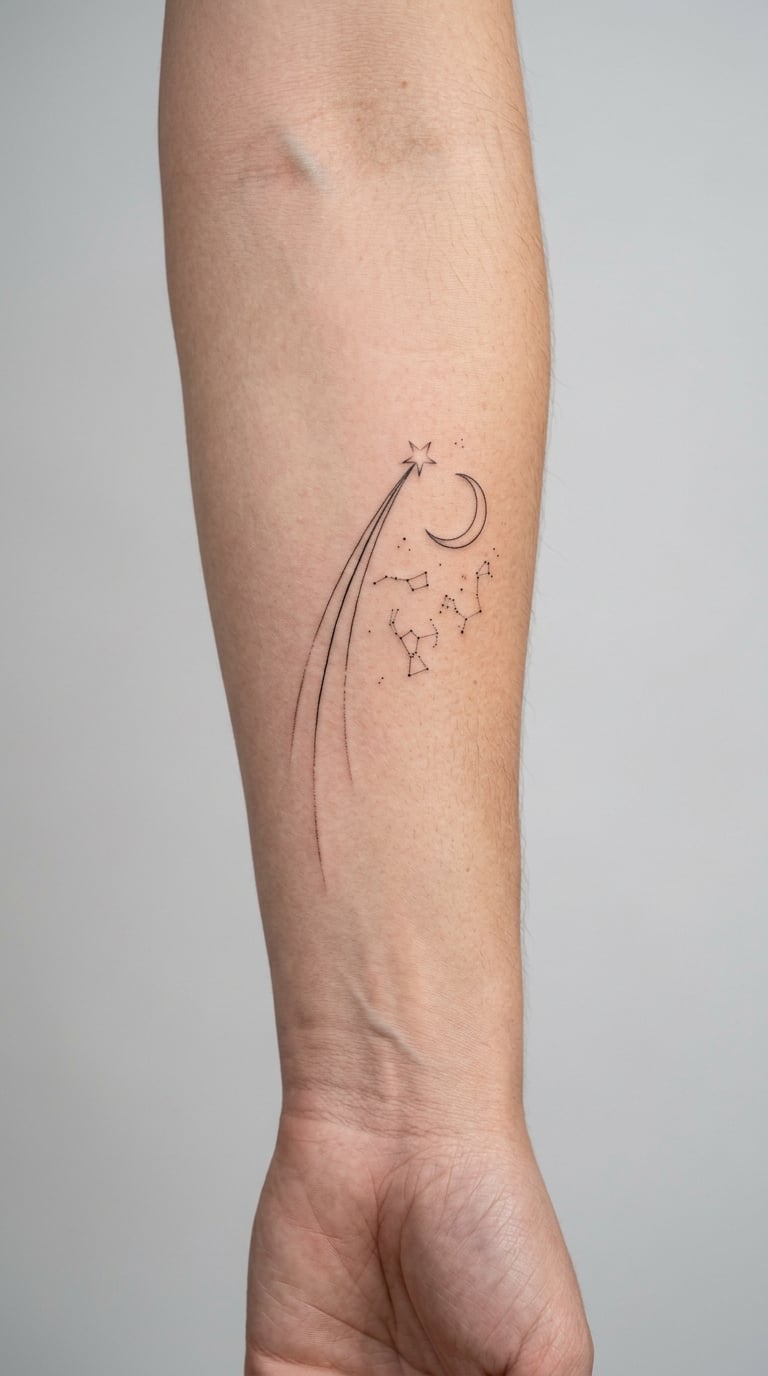
A shooting star crosses the inner forearm with a trail that fades from solid to almost nothing, ending near a slim crescent and a scatter of tiny constellations. The line weight tapers deliberately, which is what makes it feel fast.
It is a wish, a quick gesture, something that happened once. Small and delicate, it works for a first tattoo or as an add-on to an existing inner arm piece.
Placement: Inner forearm. Size: 6-9 inches (15-23 cm). Style: Fine line. Pain: Low. This fades faster than anything else in the list, and the tapering trail will blur first, so keep the star head and crescent solid.
Make it yours: Put a short date under the trail, kept very small so it reads as a private detail rather than a caption.
19. Neon Outer Space Sleeve
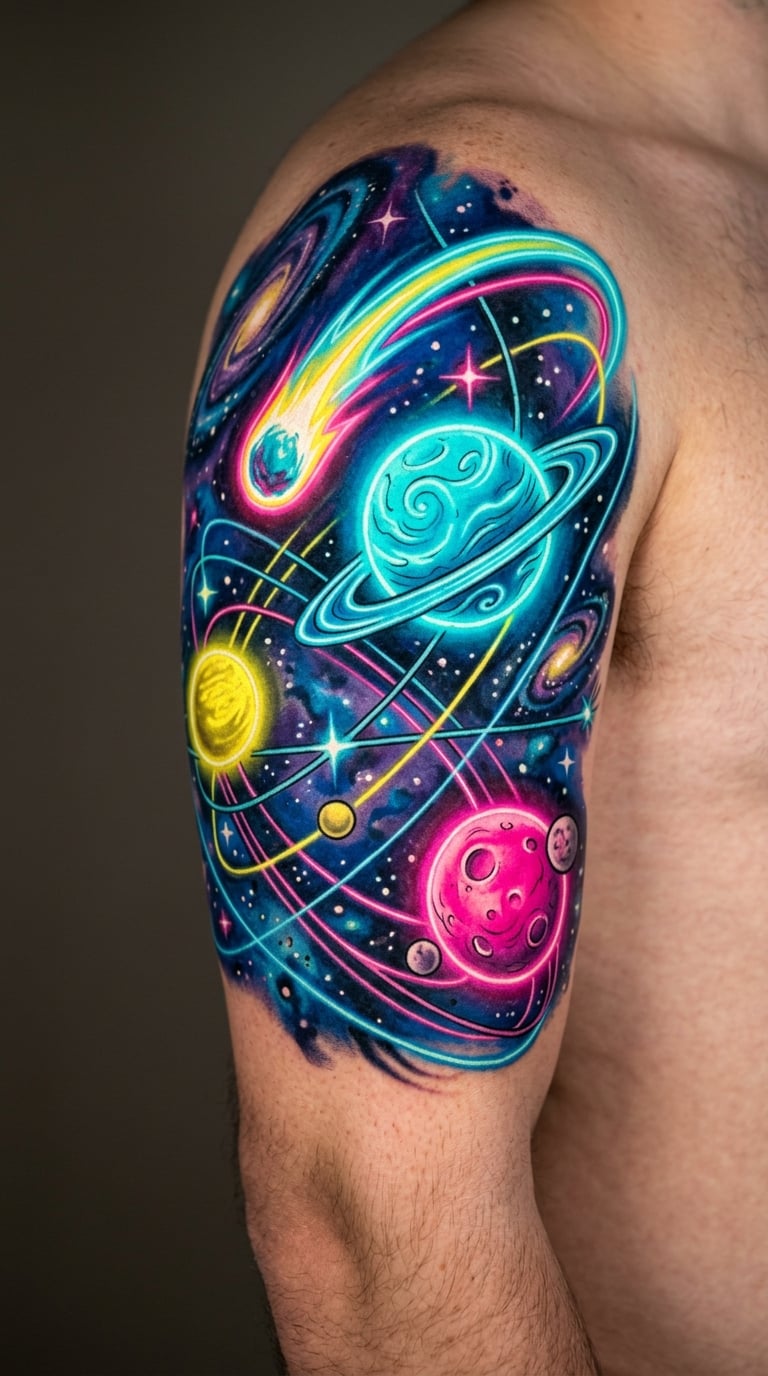
Glowing planets in cyan, pink and yellow float inside luminous orbital lines, with a bright comet cutting across and a dark field behind everything. The effect comes from high-contrast color rather than from soft blending.
It reads as the universe rendered as signage, which is a departure from the realistic end of the spectrum. It is the design people comment on most at a bar.
Placement: Full forearm wrap. Size: 14-18 inches (35-45 cm). Style: Neon illustrative. Pain: Medium to high, since the dark background field means covering a lot of skin before any motif appears. Bright neons are the least permanent color category in tattooing, so treat this as a piece that changes noticeably over a few years.
Make it yours: Give the artist a sign reference to work from so the glow has a real source rather than being an outline with a bright edge.
20. Celestial Map And Ancient Compass Sleeve
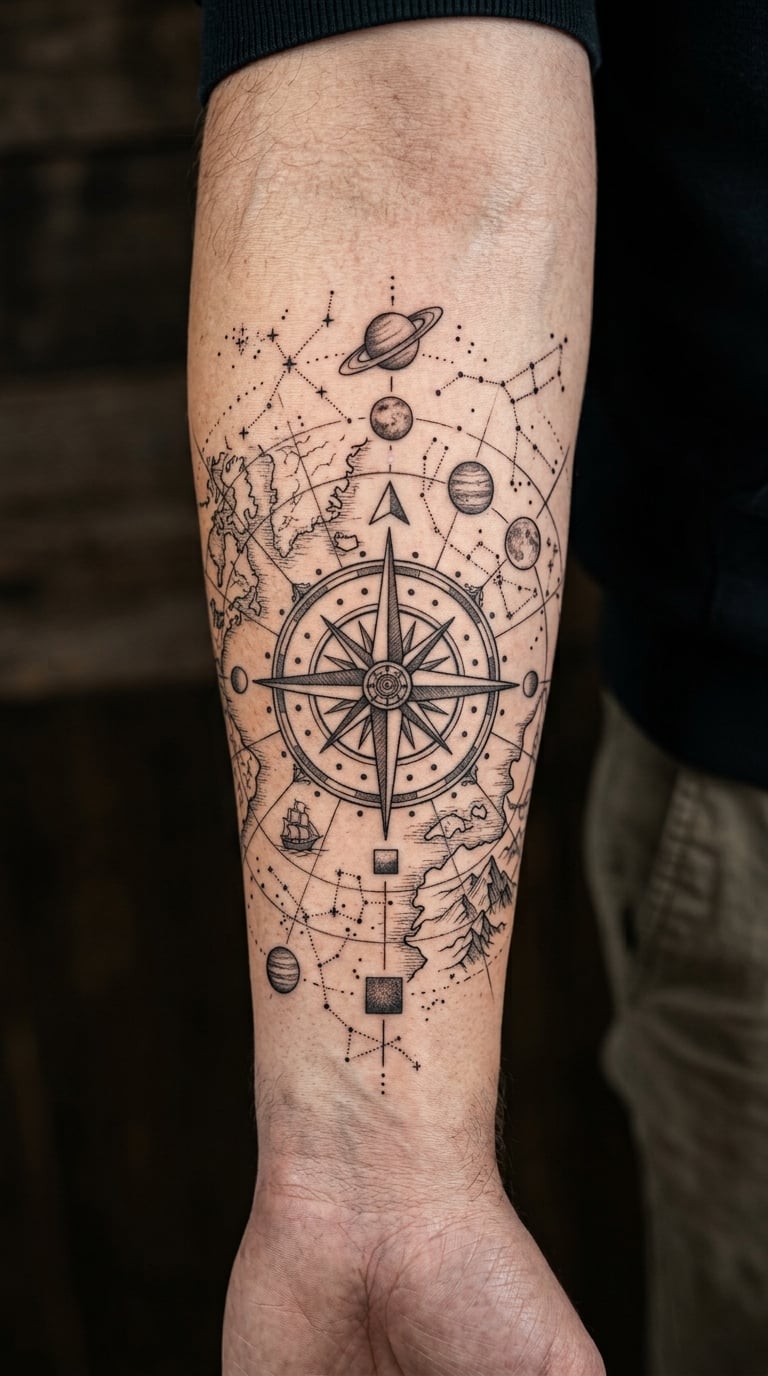
An antique compass with a weathered face is layered over old star-chart markings, hand-drawn map lines and small planets, all sitting on a lightly darkened background so the paper elements glow against it.
It is a collector’s piece. Clients usually arrive with several saved references and a clear sense that the finished arm should look like a used thing rather than a new one, which is a different brief from most tattoo requests.
Placement: Full arm from shoulder to wrist. Size: 18-22 inches (45-56 cm). Style: Illustrative with antique treatment. Pain: Medium to high, and the darkened background means this is never a small job. The layered map elements will lose some crispness, and a light background field will slowly lighten, so the piece settles rather than fades.
Make it yours: Bring in a document that matters to you, such as an old letter or a chart, and have its actual layout traced into the background.
How to Choose the Right Design
Start with the decision that is hardest to reverse, which is coverage. A full arm sleeve is a years-long commitment and leaves no clean edges to hide; a quarter or half sleeve gives you a finished-looking piece now and an exit if life changes. If you already have work on that arm, check the composition against it before anything else.
- Match the style to the artist, not the other way round. Micro-realism, dotwork, Japanese-scale linework and heavy blackwork are specialist skills. A generalist working outside their comfort range will produce something looser than the reference you saved.
- Count your anchor images. One strong focal point per session keeps a sleeve from turning into a stack of unrelated pieces. Three or more competing hero images in a quarter sleeve is the most common planning mistake.
- Decide the flow before the first session. Tell your artist which direction the design should read, and where the background field runs between motifs.
- Plan the filler before you need it. Half sleeves leave open gaps. Starfields, dotwork constellations, orbit lines and small planet clusters are what fill them, and they need to be designed in from the start rather than added later.
- Match contrast to your skin tone. Fine pale linework and soft watercolor washes disappear on lighter skin over time, while dense blackwork reads on almost everyone.
- Test it as a collection piece. If you already collect tattoos, check that the palette and line weight can sit beside your existing work. A sleeve in a completely different style often reads as a mistake rather than a set.
If your arm already has space-themed pieces and gaps, the honest fix is usually a background field that ties them together rather than adding another hero image. The most common regret in planning threads is a patchwork that nobody deliberately designed.
Cost and Session Time
Most studios quote by the hour rather than by design, and tattoo prices vary enormously by region, artist reputation and shop minimums, so any figure you find online is a starting point for a conversation rather than an answer. A simple small space piece is often priced as a single short session. A half sleeve of traditional or fine-line work is a mid-range multi-session job. A full color sleeve with dense background coverage is a serious commitment, and it should be budgeted as a series of sessions over many months rather than one fee.
The four things that push a quote up are size, color saturation, the number of sessions needed to keep skin healthy, and the artist’s hourly rate. Color is the big one: a nebula wash takes far longer per square inch than black outline work, and each color may need a second pass.
For a realistic timeline, a full arm sleeve usually runs four to six sessions spread across three to six months, so the skin can fully settle between visits. Some collectors take the whole build across a year rather than a season, and that is completely normal. Ask your artist to sketch the session breakdown in writing before the first sitting, including which parts of the design land in which session.
Set aside budget for touch-ups as part of the original cost rather than as an extra. Color work in particular usually needs one return visit once the sleeve is complete, and that is normal practice rather than something going wrong.
Aftercare Basics
- Follow your artist’s aftercare instructions first. Everyone’s advice differs slightly because skin, needle depth and ink saturation differ, and the person who tattooed you knows what they put in there.
- Wash gently, twice a day, with clean lukewarm water and unscented soap. Pat dry with something soft rather than rubbing.
- Moisturize a thin layer as the skin dries out. A plain, fragrance-free lotion is enough; skip anything with heavy fragrance.
- Protect it from sun. Once healed, UV exposure is the fastest route to a dull sleeve, and a color cosmos fades noticeably faster than blackwork. Sleeves on the arm are the easiest place to forget this, since long sleeves are already on.
- Avoid swimming, hot tubs and saunas while the sleeve is healing. Soaked skin and heat both irritate fresh ink.
- Treat the space between sessions as part of the process. Let the previous session heal fully before the next one, and keep moisturizing through the whole build so your skin is in good condition each time.
Frequently Asked Questions
What does a space tattoo mean?
Space imagery usually points at scale and perspective: the feeling of looking at something enormous from very far away. Depending on the design it can read as exploration, solitude, wonder, a memorial to someone lost, or simply an interest in science and science fiction. The meaning comes from what you put in the design, so an Earth and moon reads very differently from a UFO flying past Saturn.
How long does a full space sleeve take to finish?
Plan on months rather than weeks. A color cosmic sleeve usually needs four to six sessions, often spread across three to six months so the skin can settle between visits. Blackwork and fine-line designs often run shorter because coverage is lighter. The calendar is set by healing as much as by the art, so book the next session only when your artist says the skin is ready.
Are space sleeve tattoos more painful than other sleeves?
Not because of the theme, but because of where you place it and how much black is packed in. Dense blackwork across a full forearm or a leg is a high-pain job, mostly from sustained needle passes over one area. The inner forearm, elbow crease and shoulder cap are the sharpest spots on the arm, and these designs are usually long enough to hit all three.
Do galaxy and nebula colors fade?
Yes, and sooner than most people expect. Pale watercolor washes and bright neon tones lose saturation fastest, while bold traditional color packed at full strength holds up much better. Blackwork and black-and-grey space sleeves barely fade at all. After a sleeve is complete, plan one return visit for color work and keep the arm covered in strong sun.
How do you care for a tattoo sleeve between sessions?
Heal each session normally, then wait until the skin is fully settled before booking the next one, usually several weeks for lighter work. Keep moisturizing through the whole build so your skin stays in good condition. Between appointments there is nothing special to do, but do not scratch, soak the area, or go swimming until your artist says it is healed.
Is a space sleeve a good choice for a first tattoo?
A whole sleeve is rarely the right first move, because it cannot be reversed and it takes months. A better starting point is one of the smaller ideas here, such as a fine-line moon phase run or a micro-realism Earth band, placed where it can grow into a sleeve later. Book a consultation and map the arm before committing to full coverage.
Conclusion
If this is your first tattoo, start with the fine-line moon phase run or the micro-realism Earth band. Both are compact, both read clearly from a short distance, and both sit in a spot on the arm that can grow later without rework.
If you already collect tattoos, the retro atomic layout or the antique celestial map gives you something to build on rather than just add to. Bring your references to a consultation, talk through coverage and flow before anyone puts a needle down, and plan the calendar for months.