
16 Snake Tattoo Meaning and Design Ideas (September 2026)
A snake tattoo is one of those designs that gets read differently depending on who is standing in front of you. Snake tattoo meaning runs from rebirth and renewal to danger, luck and sacred protection, and the same coiled serpent can land as wisdom in one culture and as a warning sign in another. Most people who book a snake know exactly which version they want, and it is rarely the evil one.
This guide covers the meanings first, then 16 design ideas you can take to an artist, with placement, size and style notes for each. It runs September 2026 and includes the questions tattoo collectors ask most: which way should the snake face, what hurts most, and how it ages.
What Does a Snake Tattoo Mean?
A snake tattoo usually stands for transformation, rebirth, duality, protection, wisdom, hidden knowledge and eternity, all drawn from the animal’s ability to shed its skin, to be both venomous and medicinal, and to live alongside humans for thousands of years. The exact reading shifts with culture, species and style, so a Japanese hebi reads very differently from a biblical serpent in Eden.
That single point is why the same tattoo can be seen as luck by one person and as danger by the next. Once you know the meanings, you can pick the one that fits your story and design toward it on purpose.
The core meanings at a glance
- Transformation and rebirth — the shed skin is the oldest association, and the most personal for most wearers.
- Duality — venom and medicine, threat and protector, life and death, held in one body.
- Protection — naga, hebi and uraeus traditions all treat the serpent as a ward against harm.
- Wisdom and hidden knowledge — the secretive, silent animal that watches without being watched.
- Power and survival — an apex predator that has outlasted almost every species it shares ground with.
- Fertility and life force — the phallic shape and the endless cycle of skin renewal both feed this reading.
- Eternity — most strongly carried by the ouroboros, the snake eating its own tail.
- Rebirth, or an ending — depending on whether the head is raised, lowered or gone entirely.
One thread runs through the whole list: the snake is a symbol of change you have already survived, not a threat you are inviting. People on r/TattooDesigns describe snake pieces as timeless rather than trend-driven for exactly that reason, and experienced collectors mostly shrug off the generic danger reading.
Snake Symbolism in Culture and Religion
Borrowing a snake from one tradition and asking it to carry another tradition’s meaning is the most common mistake people make with this motif. Here is where the big ones come from.
Egyptian snakes: the uraeus and Wadjet
The uraeus, the rearing cobra worn on the crown of pharaohs, signalled divine authority and the ability to strike at an enemy. Wadjet, the cobra goddess of the Nile, protected the king and the delta itself. A uraeus-inspired design reads as sovereign and protective rather than evil.
Greek and Roman snakes: Asclepius, Medusa and Laocoon
Asclepius, the healing god, carried a staff with a single serpent coiled around it, and that emblem is the origin of the medical symbol still used today. Medusa is the dangerous branch: her serpent head turns observers to stone, which is why snake hair and snake motifs on Greek-influenced work read as a warning to look away. Laocoon and his sons, killed by serpents sent into Troy, pulled the same symbol into drama and tragedy.
Hindu and Buddhist snakes: naga, Mucalinda and Kundalini
Naga are serpent spirits of water and fertility, guardians of rain, wells and rivers, and Mucalinda is the serpent that sheltered the meditating Buddha from a storm, shown coiled around him. In Tantric practice the coiled serpent at the base of the spine represents kundalini energy waiting to rise. These designs are devotional, not decorative, and carry a specific respect requirement.
Japanese snakes: hebi, Benzaiten and the dragon-snake
Hebi, the Japanese snake, is associated with good fortune, prosperity and protection from evil, and it appears in irezumi alongside dragons as a symbol of control over water and weather. Benzaiten carries a snake as one of her attributes. A hebi rendered in a traditional Japanese composition is a positive symbol, and it is very different in mood from a Western horror-styled serpent.
Chinese snakes: the zodiac and the White Snake
The snake is the sixth of the twelve Chinese zodiac animals, and people born in a snake year are described as wise, intuitive and careful with money. The White Snake legend, in which a serpent spirit becomes a woman and falls in love with a mortal, is a love story about transformation and choosing your own nature, not a cautionary tale about a monster.
Norse snakes: Jormungandr at Ragnarok
Jormungandr, the Midgard Serpent, circles the entire world in the sea and is released at Ragnarok, when it fights the god Thor and often wins. A Norse snake tattoo is about the end of an order, immense scale and something that cannot be contained. That is a heavier meaning than most people are after, but it is the honest one.
Christian snakes: the serpent in Eden and the medical emblem
In Christian tradition the serpent in the Garden of Eden represents temptation, the fall and the enemy, which is why some people read a snake tattoo as a dark or occult statement. The same tradition also inherited the Rod of Asclepius as a symbol of healing. If your family reads the Bible literally, this is the context worth raising with them before you book, not after.
Mesoamerican serpents: Quetzalcoatl
Quetzalcoatl, the Plumed Serpent, is a feathered serpent deity connected with wind, rain, learning and the arts. A feathered snake in Aztec or Maya-inspired work is a god, not a symbol of evil. Mesoamerican imagery carries real sensitivity too, since living communities still hold these traditions, so treat borrowed religious art with more care than a generic serpent.
Snake Tattoo Meaning on a Woman and on a Man
Placement and subject change the reading more than most people expect. A snake wrapping a forearm reads as control and restraint, while the same snake across a collarbone reads as intimacy and restraint of a different kind.
Snake tattoo meaning on a woman
A snake on a woman is usually read as reclaiming power that was taken from feminine figures, which is why Cleopatra, Medusa and the naga show up so often. If a girl has a snake tattoo, most people read it as transformation, sensuality or protection, not as a warning. Smaller placements like the wrist, collarbone or behind the ear lean delicate, while a snake on the ribs or a full back piece reads as deliberate and hard to shake.
Snake tattoo meaning on a man
On men, snake tattoos skew toward power, protection and restraint, and a coiled or striking serpent on an arm or leg carries a more martial weight. On the body it tends to get read as a symbol of control over a dangerous thing, and a snake wrapped around the arm or hand is a common shorthand for that. The style still sets the tone: a fine-line single-line snake looks quiet, an American traditional cobra with bold outlines looks loud.
Should a Snake Tattoo Go Up or Down?
Short answer: face the snake upward, toward the head or the heart, if you want growth, protection and forward motion. Point it downward if you want the piece to read as grounding, letting go, or the shedding of something finished. Coiled and striking poses carry their own meaning too, and most wearers pick direction for how the body flows rather than for the symbolism, which is a perfectly good reason.
- Head up, toward the face or heart — reads as growth, awakening, protection and forward movement. Fits the forearm, arm, calf, spine and ribs.
- Head down, toward the hand or feet — reads as grounding, releasing the past and letting go. Fits the spine, back of the arm and thigh.
- Coiled in a circle — reads as eternity, cycles and the ouroboros meaning. Fits the shoulder blade, thigh, back and calf.
- Striking with the hood flared — reads as defence, warning and power on display. Fits the upper arm, shoulder and chest.
- Horizontal across the body — reads as steady and protective, with less direction to it. Fits the ribs, sternum and forearm.
- Sliding behind the ear — reads as intuition, secrecy and keeping something close. Fits behind the ear and the nape.
Direction also affects the drawing itself. A downward snake on a forearm can pull the eye toward the hand and make the piece read as falling, and some artists will flip it so the movement goes back up the arm instead.
Where to Put a Snake Tattoo
The forearm is the first choice for most first-timers because a vertical snake follows the natural line of the arm. Beginners on r/tattooadvice tend to land there for that reason, and it is a good instinct.
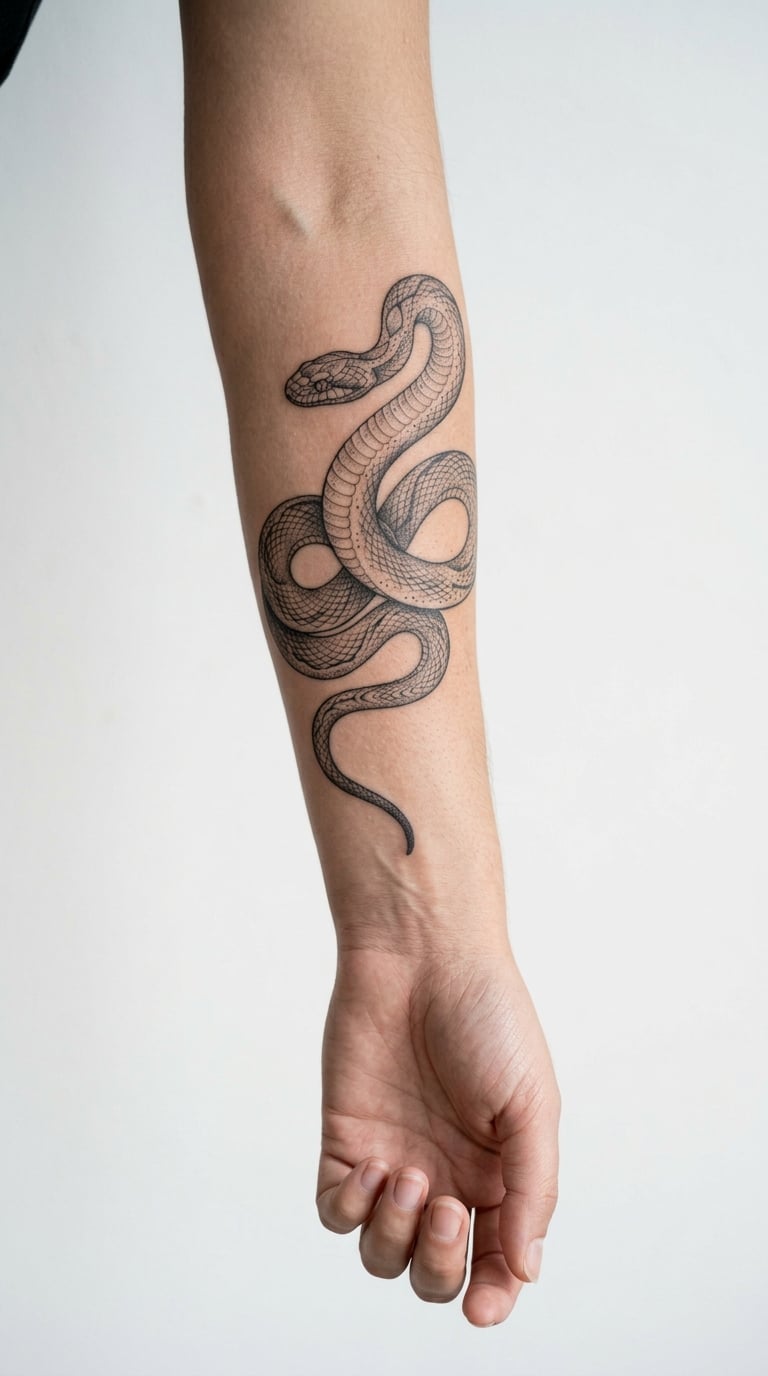
- Forearm — the classic first placement, easy to hide under a sleeve, and the shape suits a vertical or wrapping serpent.
- Full arm sleeve — a coiled snake handles a large canvas well, because the coil fills negative space without needing background scenery.
- Spine — a snake running down the back is the most dramatic placement and hides wear surprisingly well.
- Thigh and calf — thick enough for detail, and the curve lets the coil wrap naturally.
- Ribs and sternum — a horizontal snake sits well here, and breath movement makes the tail move with you.
- Hand and fingers — high contrast, high visibility, and hands age and change the most, so fine lines drift.
- Wrist and ankle — small, personal, easy to cover, and a coil reads clearly at that size.
- Neck and behind the ear — the most misread placement, because the snake sits right under the jaw.
16 Snake Tattoo Design Ideas to Take to Your Artist
1. Fine-Line Snake Wrapping the Forearm
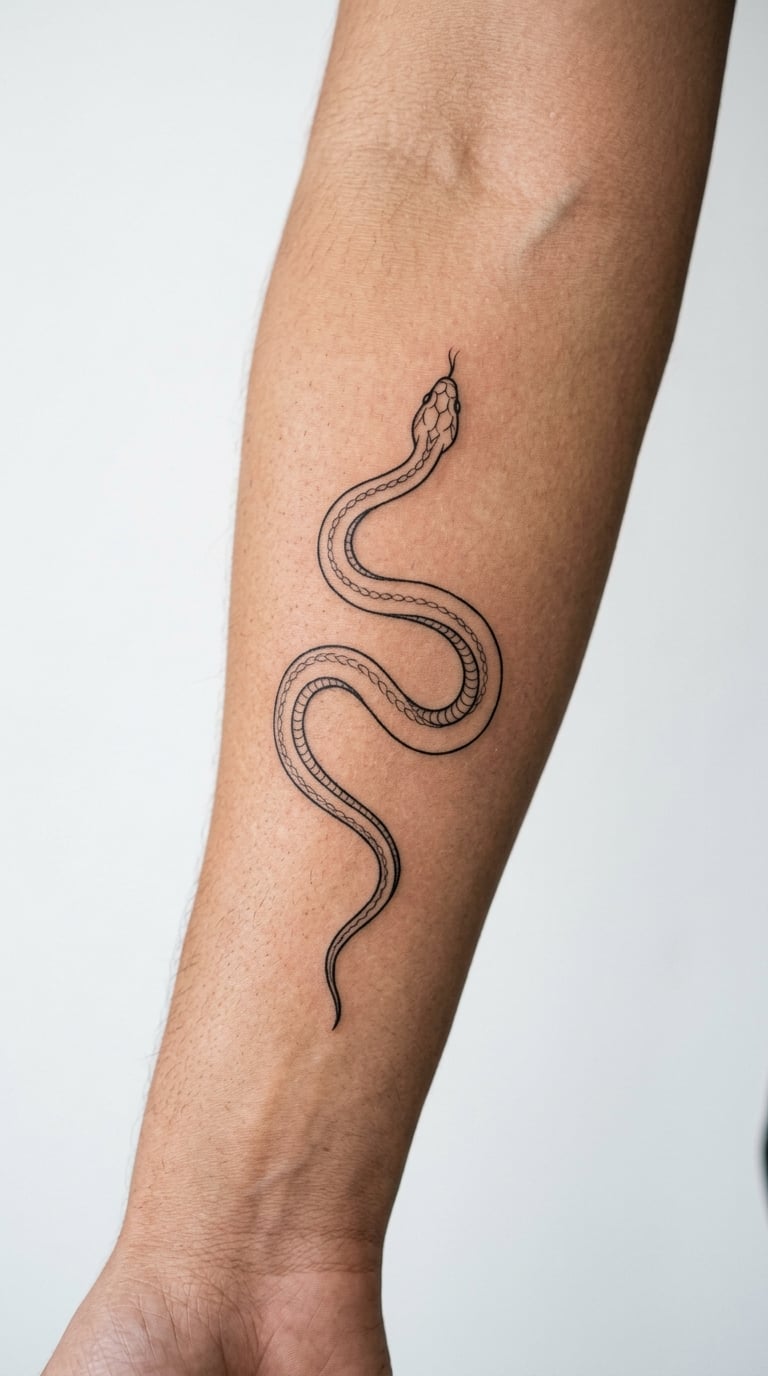
The first design is the quiet one: a single hairline snake curling along the forearm in one continuous line, no shading and no background. Snake tattoo meaning here stays subtle, which is the point, since the piece reads as a private mark rather than a statement. People who worry the motif is too aggressive usually start here.
Size is small, around 15 to 20 cm in length, and it sits best on the inner or outer forearm where the skin is flat. Fine line work softens and greys over the first few years, and a touch-up after a year keeps the line crisp. Skin that gets sun on it daily will fade faster than you expect.
Pain and time: Mild to moderate, mostly the forearm’s inner arm near the elbow. Usually a single session of an hour or two.
2. Coiled Cobra on the Upper Arm
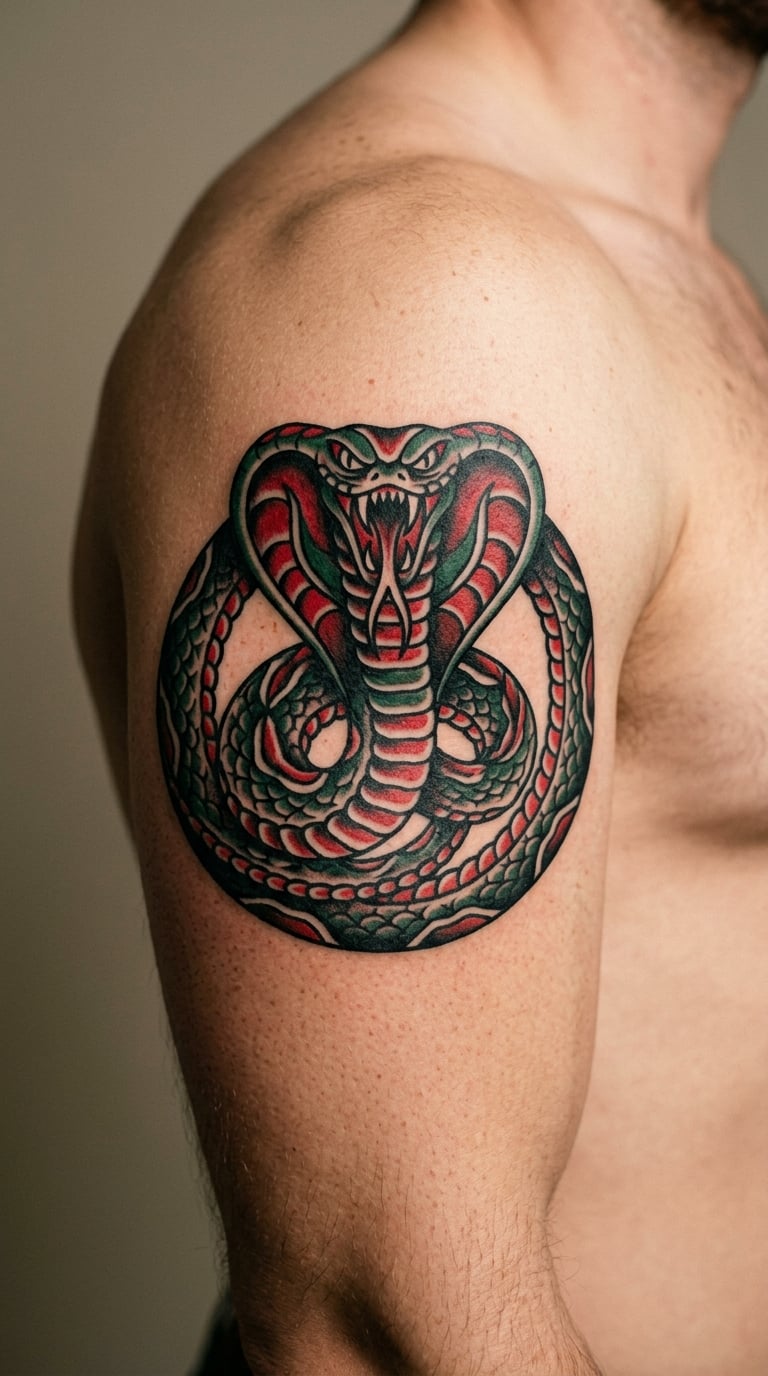
A coiled cobra in American traditional style is the loudest option in this list: thick black outline, hood flared, limited palette of reds and greens. Cobra tattoo meaning leans toward power, protection and a warning kept on permanent display, so it suits people who like a piece that gets read from across a room.
On the upper arm the coil sits inside a roughly 20 to 25 cm circle, and the bicep gives the artist a smooth surface to work with. Traditional shading ages well, though the bright reds go first and can be refreshed in a single sitting. Skip the wrapping-in-a-bracelet look unless you want it, because that has been a flash cliché for a long time.
Pain and time: Moderate, and the inner bicep near the armpit is the sensitive edge. One long session, possibly split in two.
3. Ouroboros on the Shoulder Blade
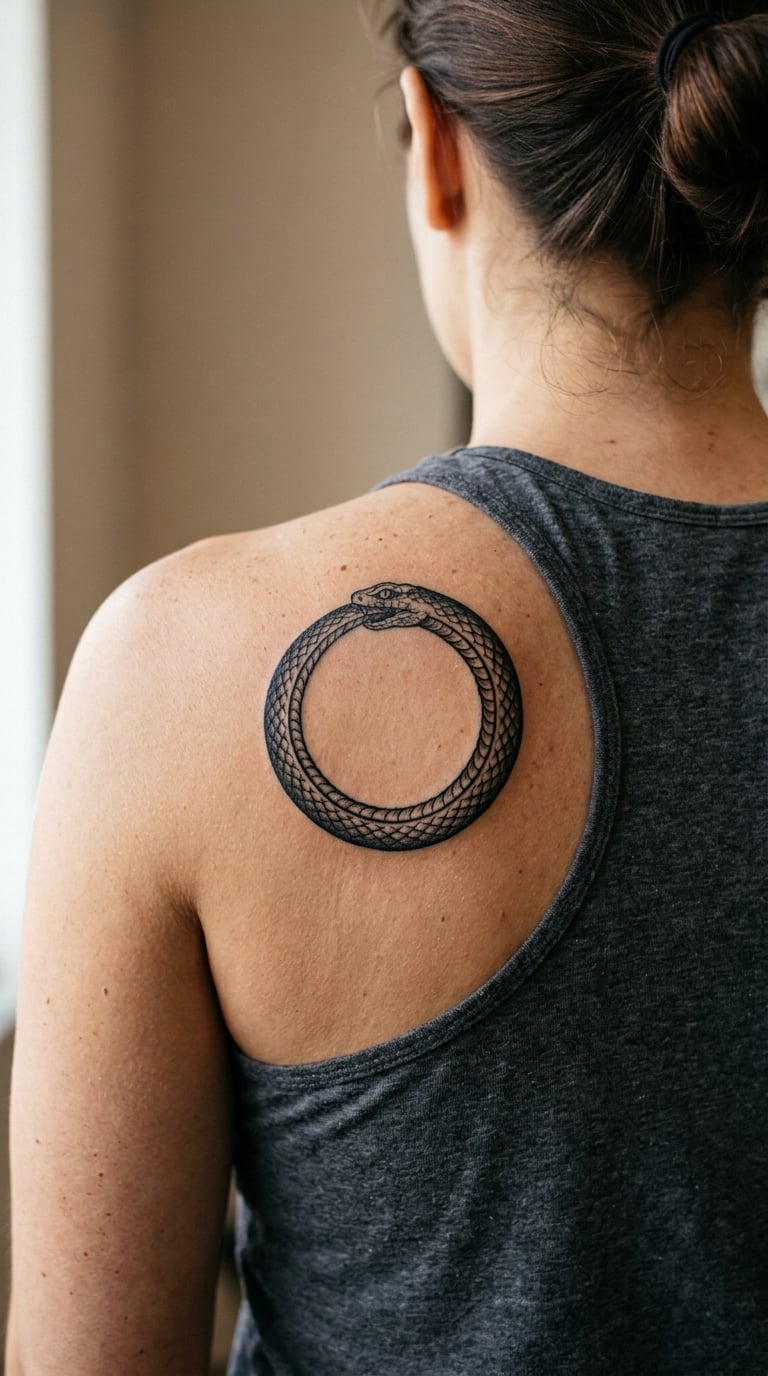
The ouroboros is the snake eating its own tail, an old Egyptian funerary image and one of the earliest circular symbols in tattooing. Ouroboros tattoo meaning is eternity, self-containment, the cycle of death and renewal, and for some people a personal year that started and ended in the same place. It is a circular design, so it wants a round placement.
The shoulder blade is the classic spot because the blade is already roughly oval and the flat bone takes fine detail well. Budget around 20 to 30 cm across for a full coil with detail, and keep the tail separate from the head so the eye can follow the loop. Sleeves and shirts sit over it without much fuss.
Pain and time: Moderate. The shoulder blade is bony and the skin moves, so expect a long sitting and a lot of stretching breaks.
4. Japanese Hebi on the Calf
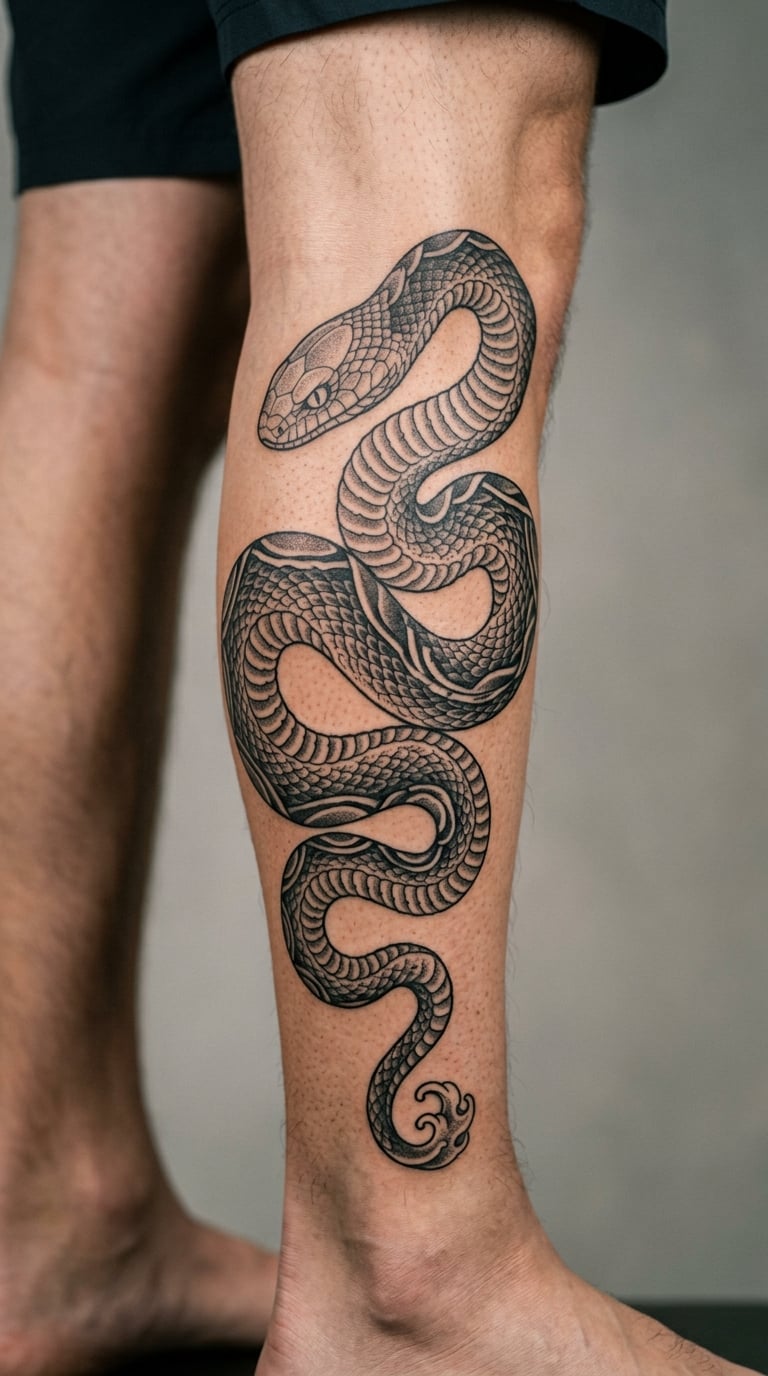
A Japanese hebi on the calf is the design for people who want positive symbolism rather than an edge. In Japanese tradition hebi brings good fortune and protection, and the composition usually places the snake winding vertically with clouds or water filling the gaps, which makes a tall narrow canvas the natural fit.
The calf gives you roughly 25 to 35 cm of usable vertical height, enough for a snake with scale detail and a wave or cloud base. Traditional Japanese work is built on a limited grey wash, so it ages more gracefully than heavy colour. Make sure the artist is actually trained in irezumi conventions, because a snake drawn badly in this style looks flat rather than calm.
Pain and time: Moderate to high, since the calf has little bone under the skin and plenty of nerve. Two or three sessions are normal.
5. Micro-Realism Rattlesnake on the Ankle
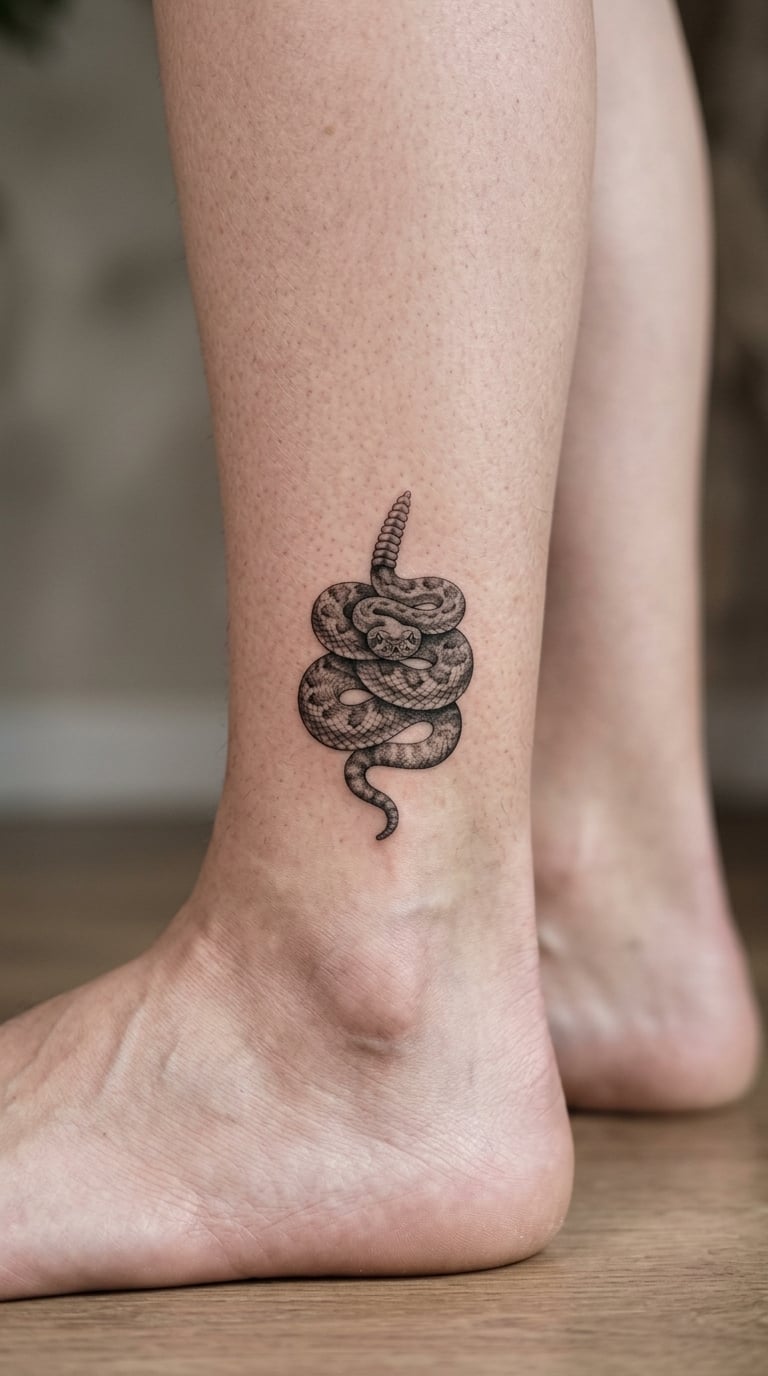
A rattlesnake in micro realism is the study in contrast: a small, extremely accurate snake with a rattle raised, done in a patch no bigger than a coin or a hand span. Rattlesnake tattoo meaning centres on a warning that is honest rather than aggressive, a clear signal delivered before the strike. People who want detail without a loud image tend to land here.
The outer ankle and the space just above it are the usual spots, and the bone is close to the surface so the piece stays small. Around 5 to 10 cm is realistic at this level of detail. Ankle tattoos that sit on the bone can look a little raised for a while, and side sleeping will press on it, so sleep on the other side for the first two weeks.
Pain and time: High for its size, because the ankle is all nerve endings. One session, and you will want to stop before you have to.
6. Blackwork Serpent Down the Spine
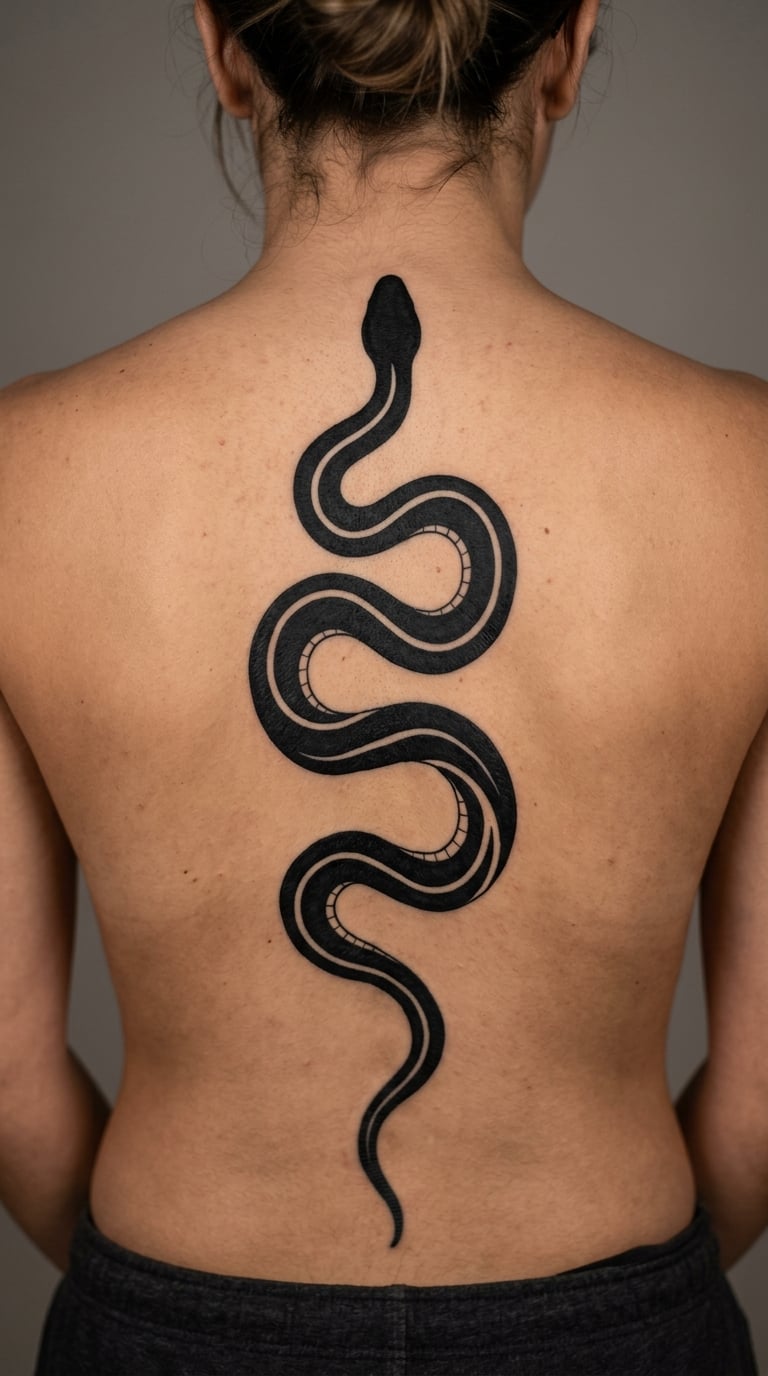
A solid black serpent running the length of the spine is the biggest statement in this list, and the only one that genuinely changes how a person carries themselves in a room. Snake tattoo meaning here is endurance, because the piece sits on the part of the body that holds you upright. Blackwork with no shading and a single white belly line is the cleanest way to draw it.
From the nape to the upper back this runs 30 to 45 cm, and it can continue to the lower back on a full back piece, which is a multi-session project. The back is a good canvas because the surface is broad and flat, but your position in the chair will get awkward. Plan for three to five sessions and a night or two off between them.
Pain and time: Moderate. Bony, ticklish and hard to sit still for, but quick per session since the area is large.
7. Cobra and Dagger Across the Chest
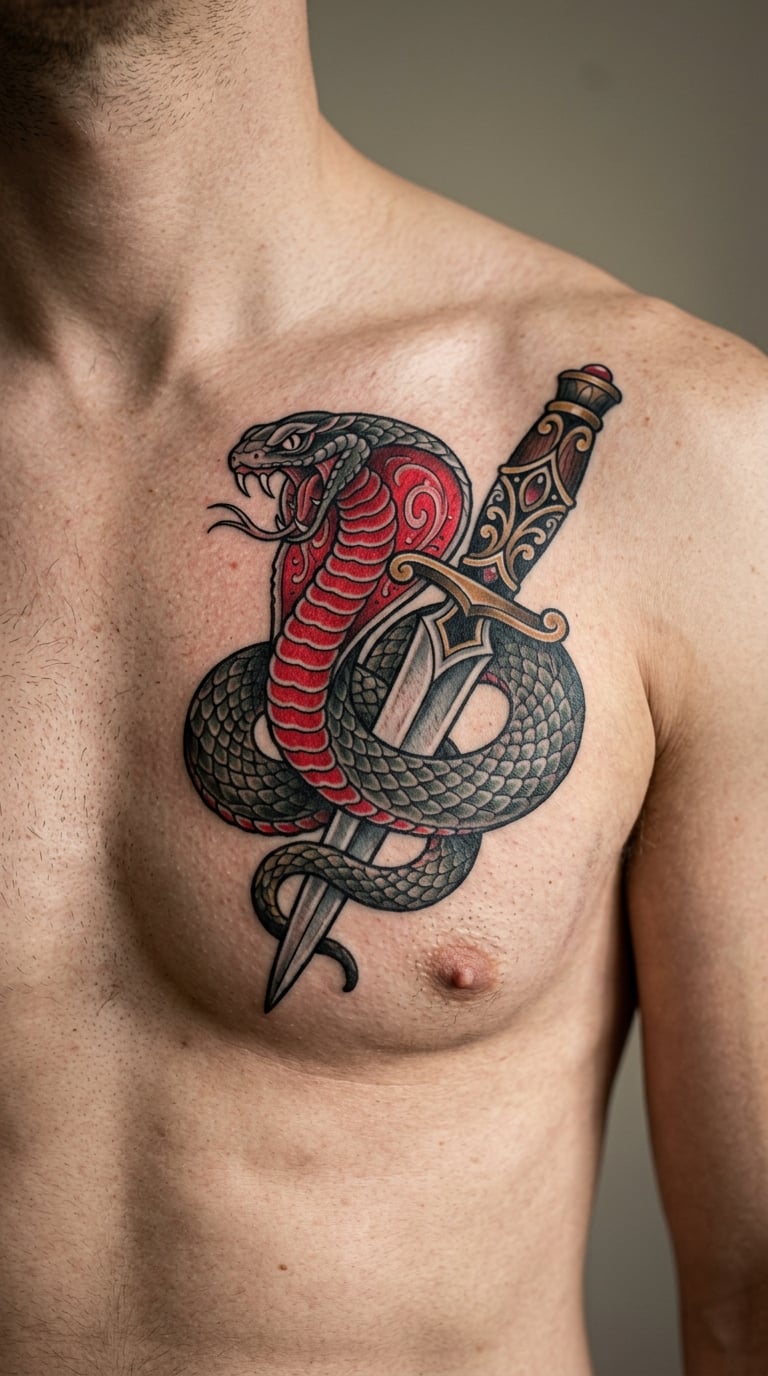
The cobra wrapped around a dagger is a tattoo with a long history in sailor and military pieces, and the snake rising through the blade is the classic version. Snake tattoo meaning here is defensive: the danger gets neutralised rather than displayed. It is a chest-centre design, so it reads immediately and does a lot of work in a plain outfit.
Across the pectorals you have roughly 30 cm of width, and the composition is strongest when the snake and dagger mirror each other rather than sitting side by side. Bold line and flat colour age better than soft shading on the chest, which stretches with movement. The sternum is the sensitive bit, so the first few centimetres from the centre take the most pain.
Pain and time: High near the sternum and collarbone, moderate over the muscle. Expect a long session with breaks.
8. Geometric Serpent on the Outer Thigh
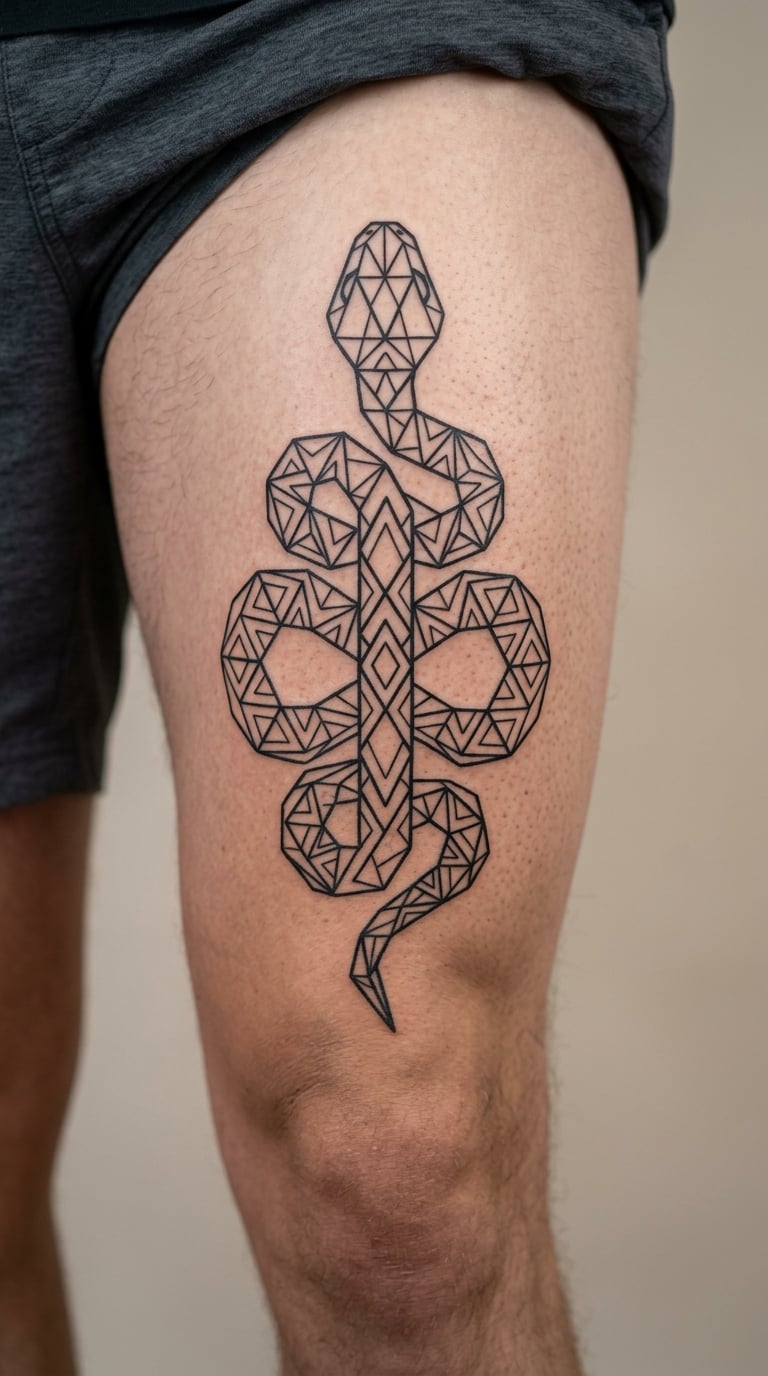
A geometric serpent strips the snake down to triangles, straight segments and repeating angles, and keeps the slithering movement without any realism. The meaning shifts with that choice, away from a living animal and toward a diagram of one, which reads as controlled, structural and design-minded rather than raw or aggressive.
The outer thigh gives you a large, flat panel, and the piece can run 25 cm or more without crowding, which a detailed drawing would need. Geometric line work with fine strokes shows wear faster than heavy black fills, so plan a refresh rather than expecting it to stay razor sharp. Placement above or beside the knee is worth avoiding, because that skin creases.
Pain and time: Moderate to high on the inner thigh, moderate on the outer. Usually two sessions for a piece this size.
9. Two Intertwined Snakes on the Wrist
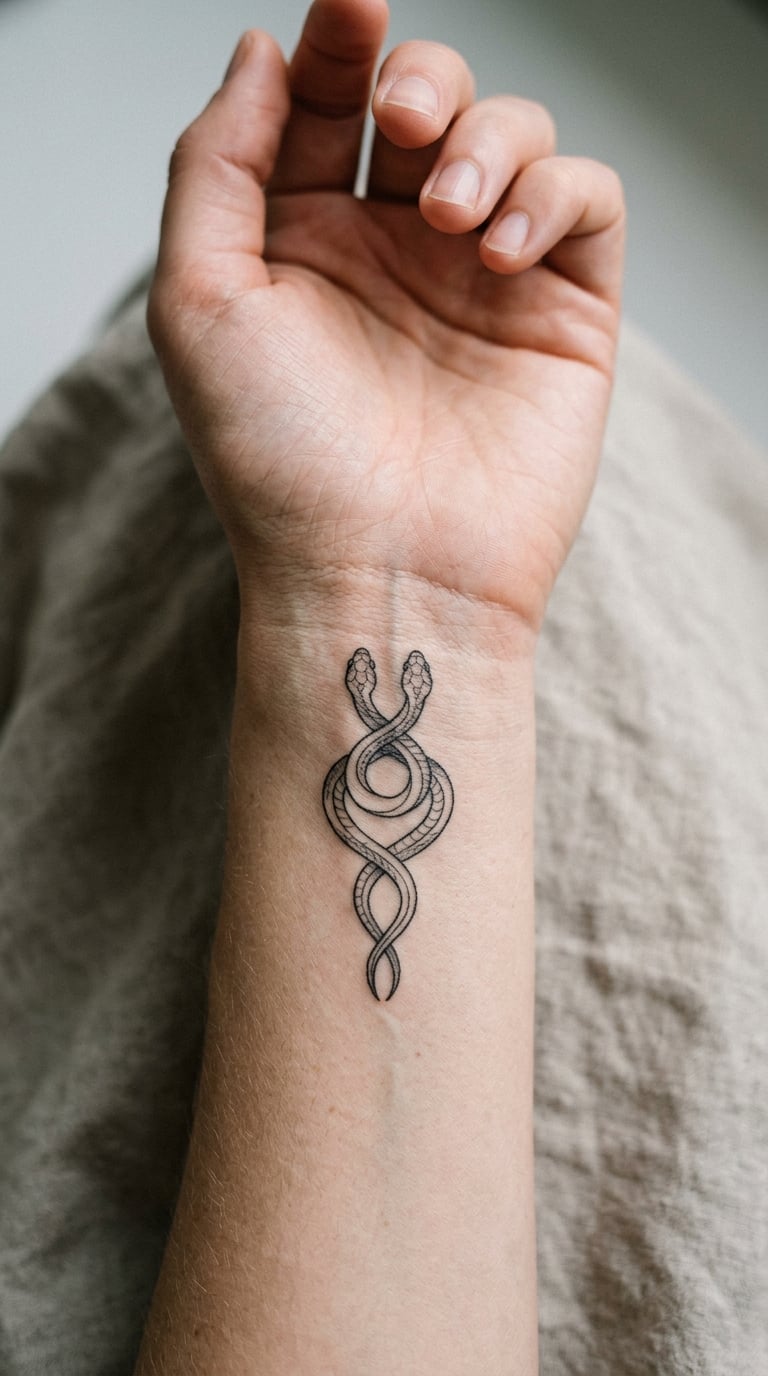
Two snakes woven around each other form the caduceus shape, and they are the natural choice for a matching pair or a couple’s tattoo. Snake tattoo meaning here is balance, partnership and the two halves of one idea, which is why people often have one snake each in the same style. As a bonus, two thin lines read more delicate than one thick outline.
Inside the wrist, each snake is roughly 8 to 12 cm, and they need enough space that the loops do not touch the wrist crease. Wrist ink on the inner arm fades faster than almost anywhere else because of hand washing, movement and sun when the sleeves roll up. Getting this small right is harder than it looks, so pick an artist who does fine line daily rather than occasionally.
Pain and time: High, the inner wrist is thin and full of nerves. One short session, and it goes fast.
10. Snake and Rose on the Back of the Hand
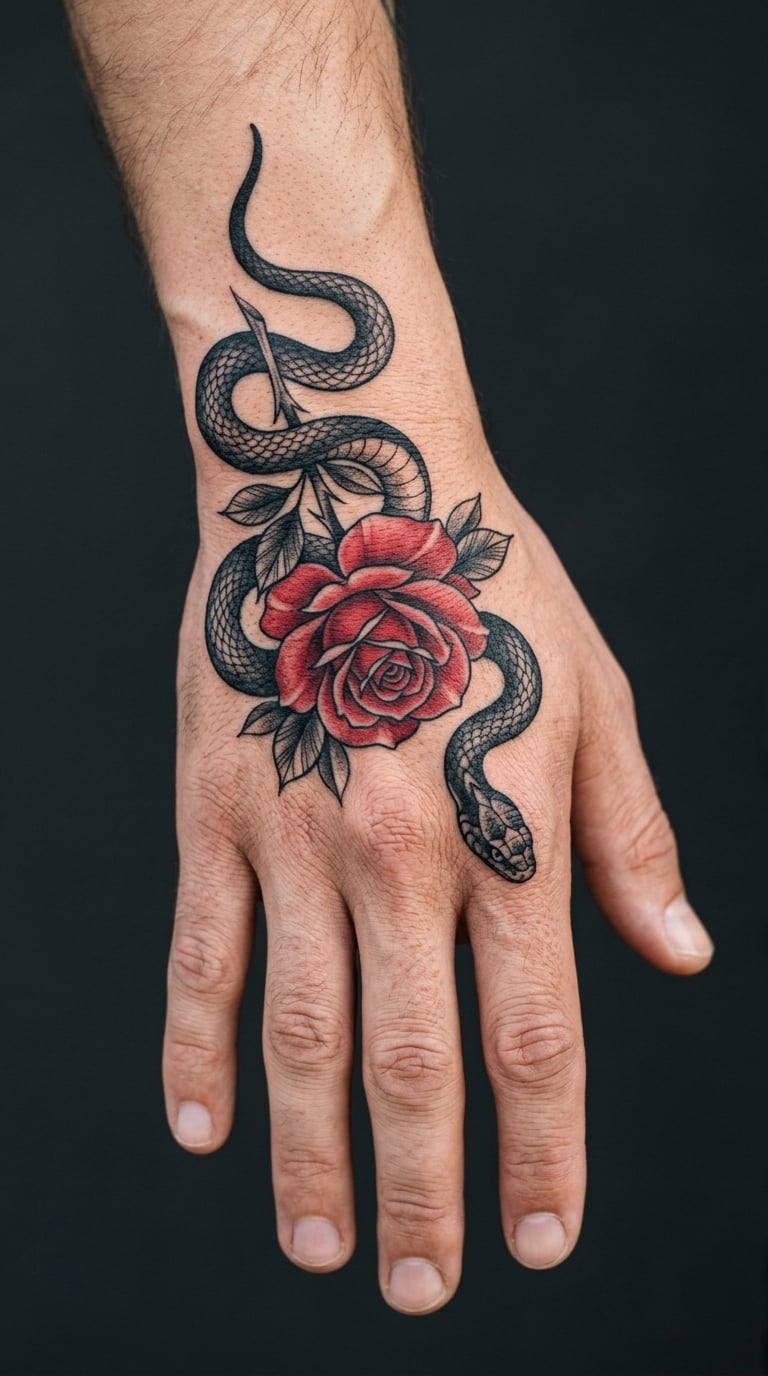
Snake and rose is the most requested pairing in the whole motif, and the contrast does the work: the rose stands for love, beauty and pain, the snake for transformation and danger, and together they make one line about wanting something that can hurt you. On the back of the hand it becomes a piece people notice, which is either the point or the opposite.
Hands wrinkle constantly, so a 10 to 15 cm design will soften noticeably over the first couple of years and will not return to razor edges. Keep the composition loose, with fewer hard outlines than you would use on an arm. Knuckles are rough and catch ink unevenly, so the artist will likely place the bulk of the design between the knuckles and the wrist.
Pain and time: High across the knuckles and the back of the hand. One session, done slowly.
11. Small Collarbone Snake for a First Piece
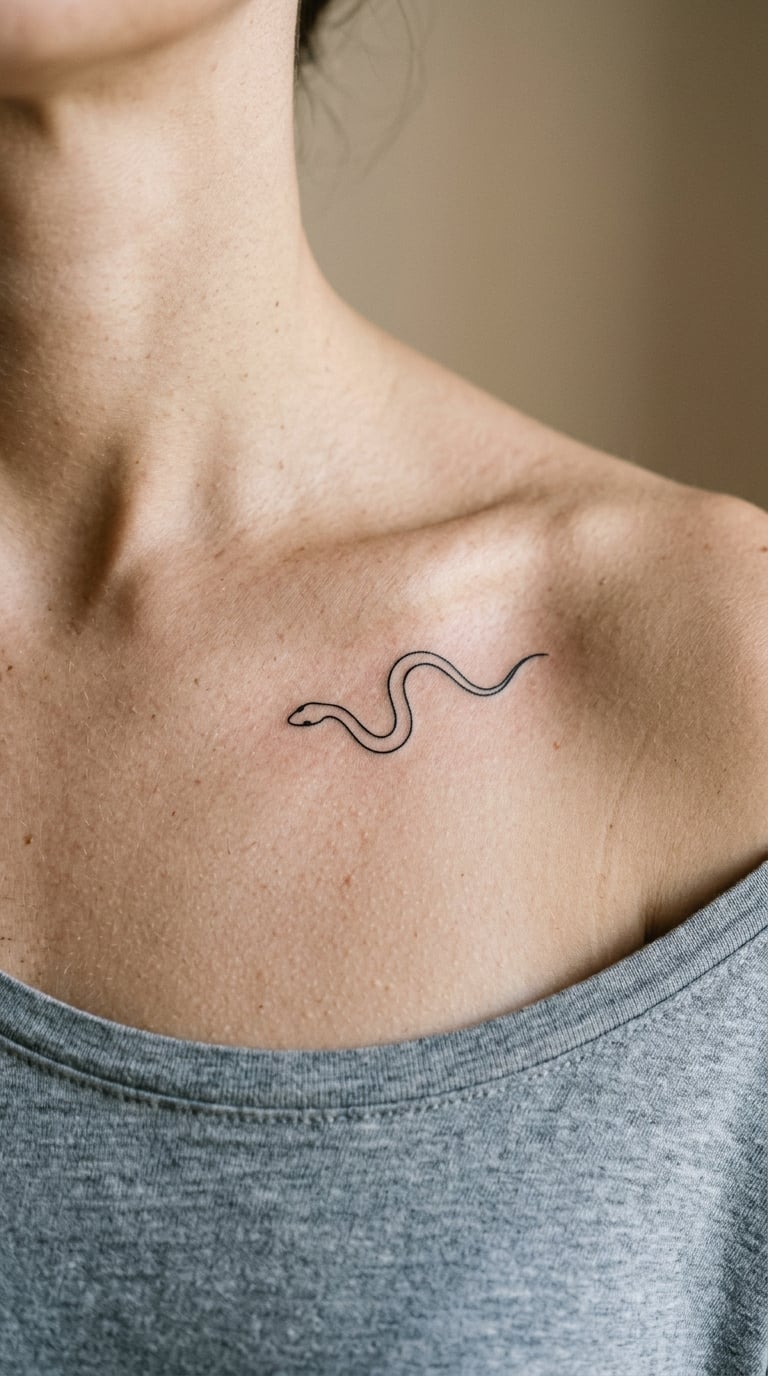
This is the one to suggest if someone is nervous about a snake as their first tattoo, and it answers the question that comes up most on r/tattooadvice about whether a snake is too bold to start with. A 7 to 10 cm single-line snake under the collarbone is quiet, quick to heal and easy to cover with a t-shirt.
Collarbone skin is thin and moves when you breathe and shrug, so bold outline will blur there faster than almost anywhere. Fine single lines survive better. The bone makes the placement slightly tender, and a small piece here can look unfinished if the artist treats it as a walk-in doodle rather than a considered design.
Pain and time: Mild to moderate. Forty-five minutes to an hour, and one of the fastest heals of any placement.
12. Watercolour Snake Along the Ribs
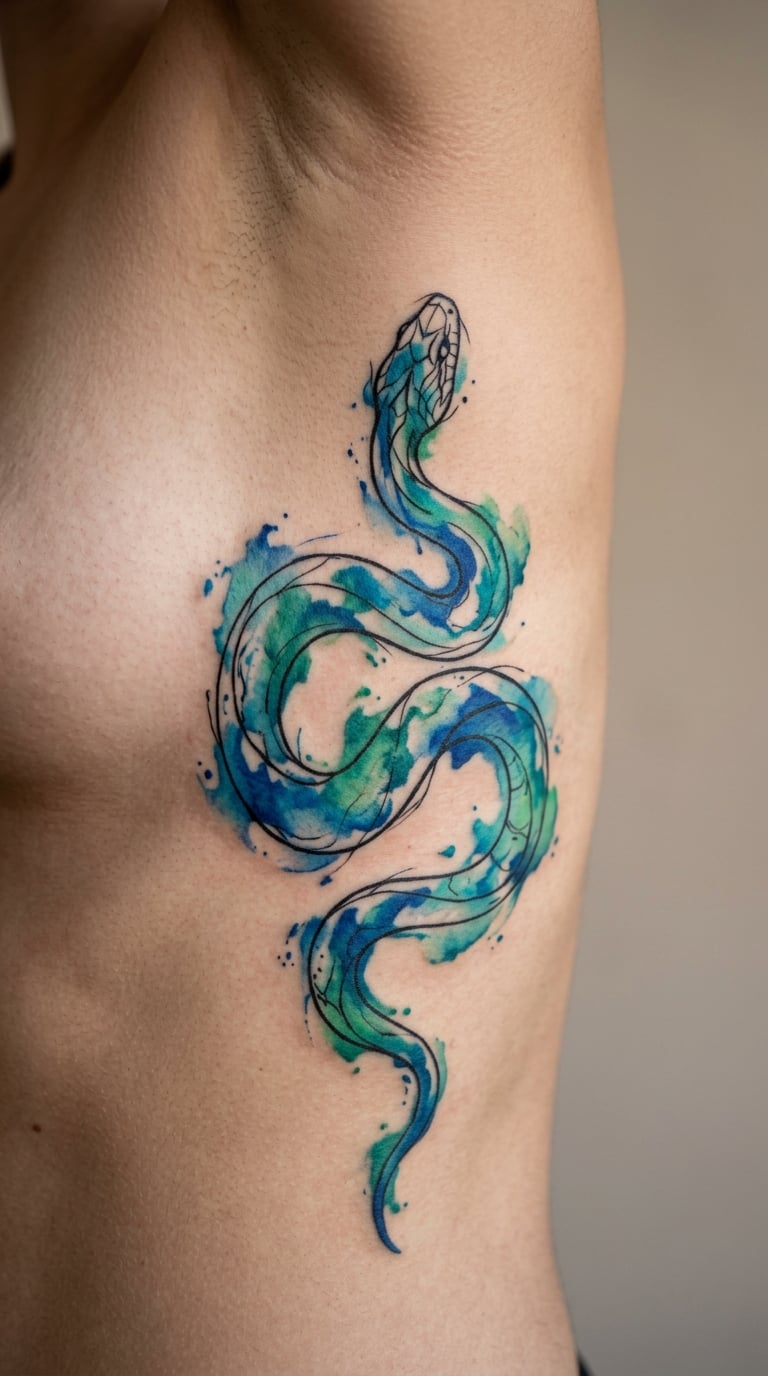
A watercolour snake is drawn with loose washes that bleed outside the line, so the body looks like it is dissolving into the skin. That is not an accident, and it suits a specific reading of snake tattoo meaning: change mid-process, something half-revealed, an identity that is still being worked out. Nobody mistakes it for a traditional serpent, which also means nobody misreads it.
Ribs give you about 30 cm of vertical run, and the natural curve of the cage makes a horizontal snake look like it is following the body. Watercolour fades and spreads faster than solid line work, so expect a softener or a refresh within two years. The skin over the ribs is thin, and the ink shows every rib through the colour.
Pain and time: High, the ribs are sensitive and the twitch makes it hard to sit still. Two sessions, with breaks.
13. Rattlesnake Wrapped Around the Shoulder
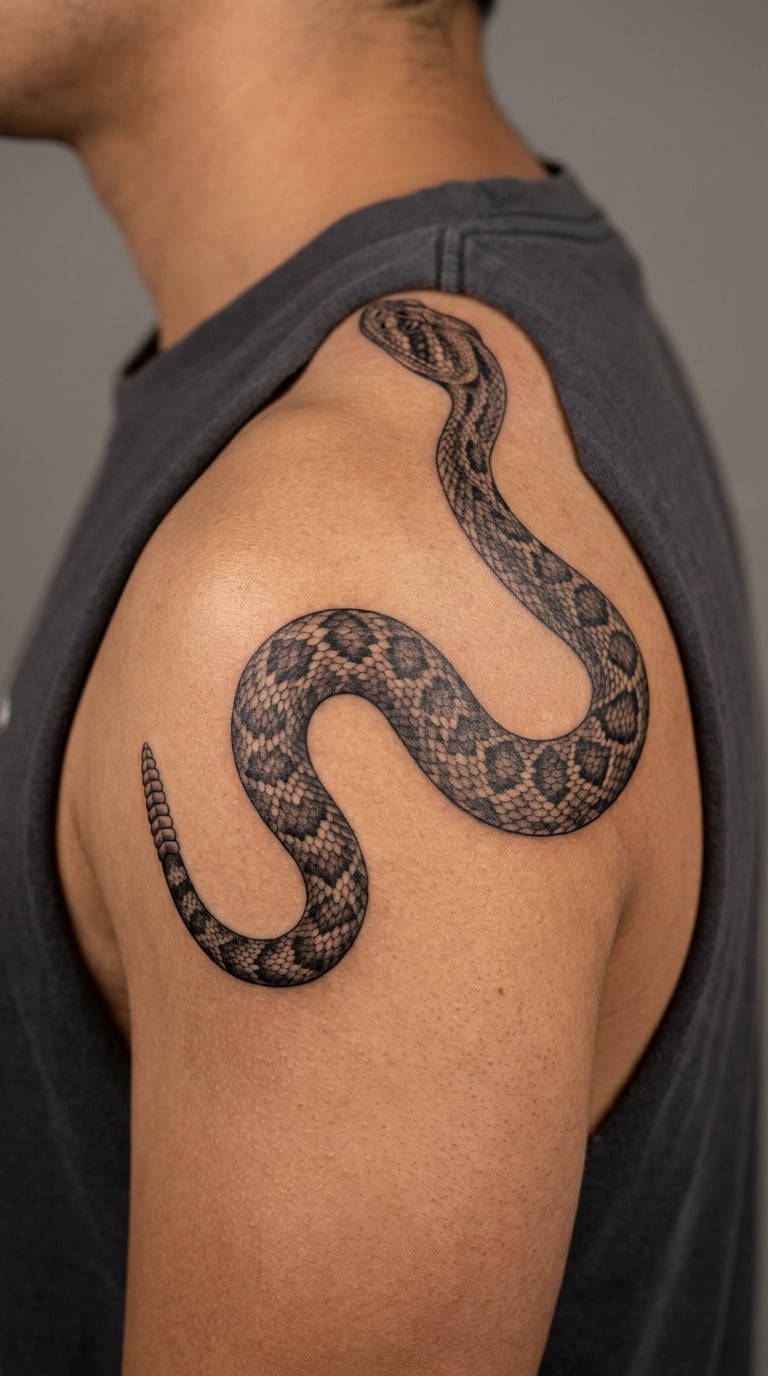
A rattlesnake coiled over the shoulder cap uses the body itself as the coil, and the rattle raised over the trapezius gives the piece a natural focal point. The reading is the honest warning sign, a creature that tells you it is dangerous before it does anything, which suits people drawn to clarity rather than menace. The shoulder cap gives a domed surface to work with, so the coil looks three-dimensional.
This one runs about 20 cm across the deltoid and the top of the back, and it reads well from the side rather than head-on. Detailed scale work on a rounded shoulder shifts a little as the muscle moves, so the artist will build the design around that. If you are drawn to Hopi or Native American serpent imagery, go to someone from that community or do not take it; those motifs belong to specific traditions and are not free to borrow.
Pain and time: Moderate, with the sensitive area at the back of the shoulder near the spine. One to two sessions.
14. Skeleton Serpent on the Leg
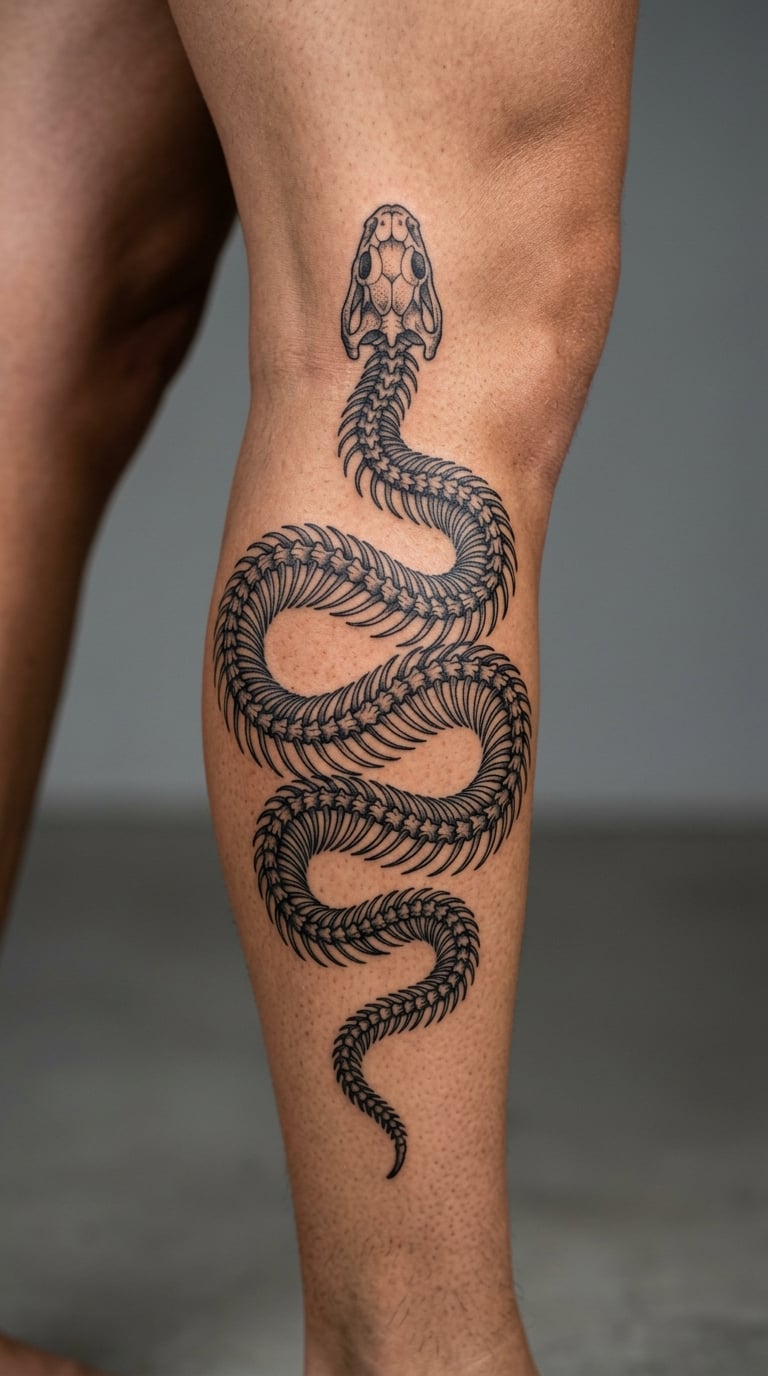
The skeleton serpent is the version for people who like the symbolism and not the animal. A snake skeleton on the leg reads as the same transformation idea with the life drained out of it, which some wearers describe as a reminder that change is not optional. It is also the easiest snake design to get tattooed cleanly, because there is no fur, scale or shading gradient to fight.
On the outer leg or the calf, this runs 20 to 25 cm and works as a single black line with white gaps for the bones. Bones hold their edges well, so it ages more predictably than a shaded animal. The calf version will show every muscle change you make over the next few years, so a slightly looser line is a smart choice.
Pain and time: Moderate on the calf, higher on the inner thigh. One session of a couple of hours.
15. Fine-Line Snake Coiling Around One Finger
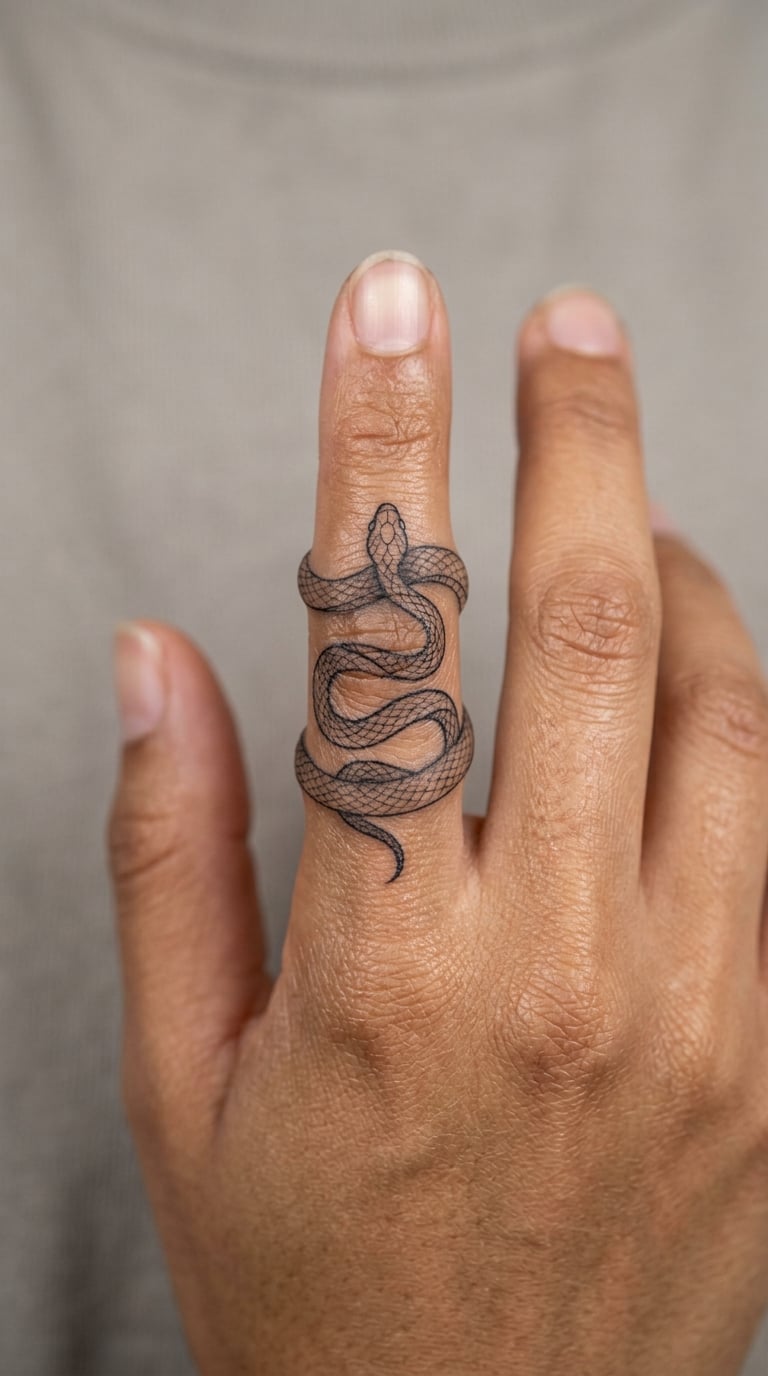
A fine-line snake circling a single finger is the smallest, quietest option here, and it is a discreet way to carry the motif if you work somewhere that would rather not see it. Snake tattoo meaning stays intact because the coil is the point, and a finger coil reads as holding something, guarding it, or being held by it.
Each finger takes a snake no bigger than 7 cm, and you can do one finger, two, or every finger, which becomes a set that only shows when you spread your hand. Finger skin stretches and creases constantly, so a fine line drifts faster here than on an arm. The side of the finger holds the line better than the top, and most artists will suggest that for a reason.
Pain and time: High, the sides of the fingers are thin and very sensitive. One short session per finger.
16. Micro Snake Sliding Behind the Ear
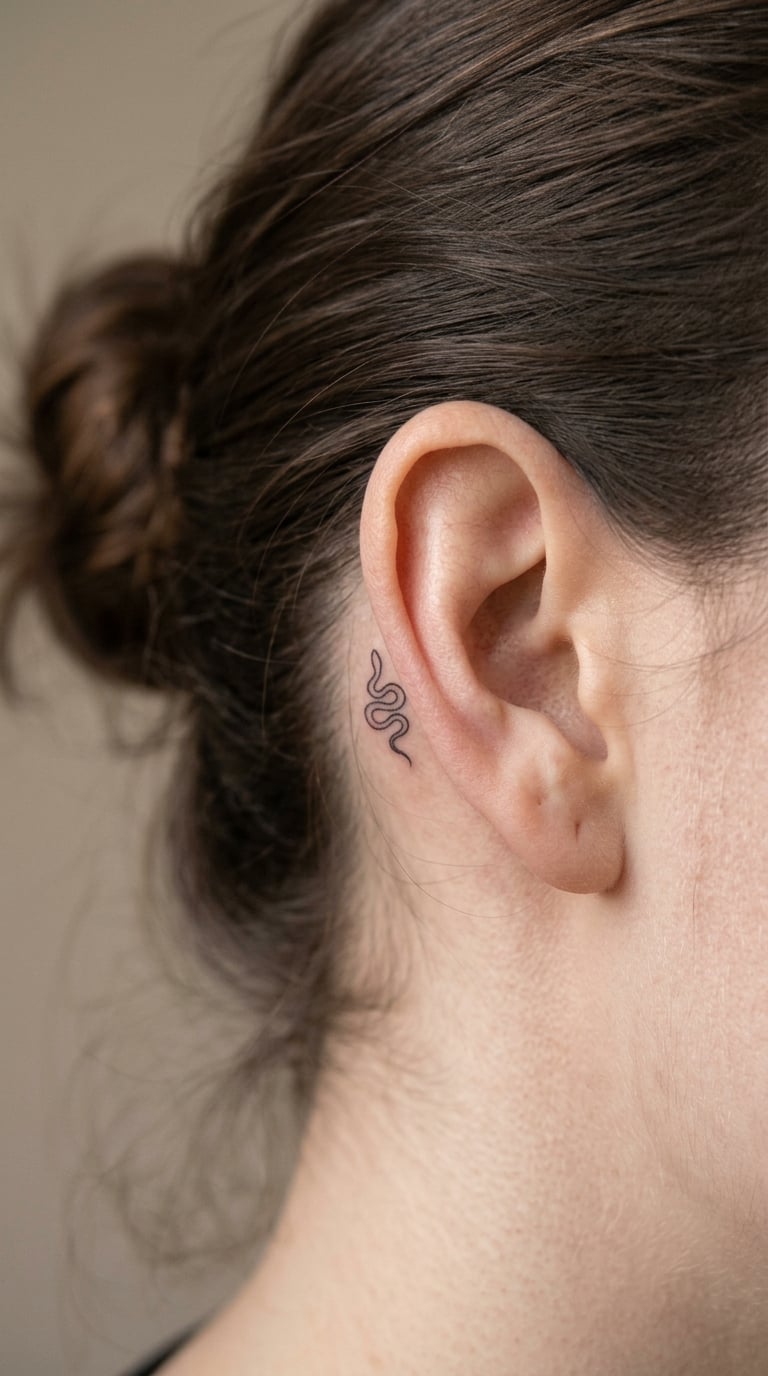
The last design is also the smallest: a micro snake emerging from behind the ear, head visible and body disappearing under the hairline. It carries the intuition and secrecy reading more than any other design in the list, and it is visible only when you turn your head, which is exactly why people choose it. It also reads as a secret to the people who already know what it is.
Behind the ear gives you maybe 5 to 7 cm of usable skin, so the design has to be one continuous line with no shading. The skin there is thin, warm and moves when you talk, and the neck tattoo flu is worth using while the artist plans the composition. Hair regrowth and sun exposure both affect how the line looks, so keep it covered or expect a refresh sooner rather than later.
Pain and time: Mild to moderate, surprisingly. The area is small and the attention is the hard part. Forty-five minutes to an hour.
Things to Know Before You Book a Snake Tattoo
- Choose the artist for the style, not the shop. A fine-line snake and a Japanese hebi are different jobs. Look for a portfolio that already contains the style you want, and check healed work rather than fresh work posted the same week.
- Bring references, not a finished drawing. Two or three images of the mood, a photo of the placement on a body similar to yours, and a written sentence about what the tattoo means to you will give an artist more to work with than a traced design.
- Start small if it is your first. The collarbone snake, the wrist coil and the single-line forearm are the least risky first pieces. A full sleeve or a spine piece is a two-year relationship, not an appointment.
- Ask about size and sessions early. Anything past about 15 cm usually needs more than one sitting. Large blackwork pieces are commonly split into three to five sessions, and the price is usually quoted per piece rather than per hour for a job that size.
- Plan for the healing and the sun. A fresh tattoo is a wound for the first two weeks. Keep it out of direct sun while it heals, wash it twice a day with plain soap and water, and do not soak it in pools or the sea. After that, the main thing that fades ink is sunlight, so a sleeve that stays covered ages visibly better than one that does not.
- Expect it to be read before it is understood. Colleagues, strangers and family will interpret it, and some of those readings will be wrong. If that matters to you, think about placement and size before you commit, and be ready to explain it once without getting defensive about it afterwards.
Frequently Asked Questions
Should a snake tattoo go up or down?
Face the snake up if you want growth, protection and forward motion. Face it down if you want grounding, release or the sense of finishing something. Coiled poses read as cycles and eternity, and a striking pose reads as a warning. Most wearers choose direction by how the design flows across the body, which is a perfectly valid reason too.
What does it mean if a girl has a snake tattoo?
It is usually read as transformation, sensuality or reclaimed power, especially when the design draws on Cleopatra, Medusa or the naga. Small placements like the wrist, collarbone or behind the ear read as delicate and private. Larger pieces across the ribs, chest or back read as deliberate and hard to dismiss. What almost nobody infers is a negative meaning.
What looks good with a snake tattoo?
Roses and daggers are the most common pairings and they work because they contrast tenderness with danger. Skulls read as mortality, flowers as growth, the moon as intuition, and mandalas as balance. Two intertwined snakes form a caduceus shape and suit couples or a partner tattoo. Whichever you choose, keep the second element from competing with the snake for size.
What does a snake tattoo mean in Christianity?
In Christian tradition the serpent in Eden represents temptation, the fall and the enemy, which is why some people read a snake tattoo as dark or occult. The same tradition also inherited the Rod of Asclepius, a serpent on a staff, as a symbol of healing. If your family reads the Bible literally, it is worth raising this before you book.
Why do so many people get snake tattoos?
Because the motif does a lot of work in a small area. A single coiled snake carries transformation, duality, protection, wisdom and eternity at once, and it suits almost any style from a hairline wrist coil to a solid black back piece. Tattoo collectors also tend to describe it as timeless rather than trend-driven, which is not something most animal motifs can claim.
Where does a snake tattoo hurt the most?
Hands, fingers, ribs, chest over the sternum, the inner wrist, the ankle and the inner thigh are the roughest, because all of them have thin skin over bone or a lot of nerve endings. The forearm, upper arm, shoulder, calf and outer thigh are comparatively easy. Backs of hands and fingers also fade and distort fastest, so plan for a touch-up there.
Conclusion
Snake tattoo meaning is not fixed, and that is the freedom in it. Decide which reading is yours, then pick the species, style and placement that carry it without you having to explain anything to anyone.
Start with the one design in this list that matches the meaning you want, then find an artist whose healed portfolio already looks like it. If it is your first tattoo, the collarbone or the fine-line forearm is the low-risk place to begin, and you can go bigger later once you know how your skin takes ink.