
12 Lotus Flower Tattoo Meaning and Placement Ideas (September 2026)
Lotus flower tattoo meaning and placement ideas are easier to work through once you split the decision in two: what the flower says, and what its position on your body adds. A lotus already carries a lot — purity, rise, recovery — so the placement is not decoration. It changes who sees it and what it emphasises.
The lotus grows up through mud and still opens clean, which is why it shows up in Buddhist, Hindu and Jain imagery and in a growing number of personal tattoos. Below is the meaning, the colour options, a placement breakdown by body area, and twelve design ideas you can take straight into a consultation. Read the meaning section first, then the placements, then pick a number or two to take with you.
What a Lotus Flower Tattoo Means
A lotus flower tattoo means purity, resilience and spiritual awakening, because the flower roots itself in muddy water and blooms above the surface without staining. That single image is the reason people choose it: something difficult became something beautiful, and the difficulty is not being hidden.
Here are ten meanings that are actually distinct from each other, rather than ten ways of saying the same thing.
Purity that comes out of difficult conditions
The oldest reading of the flower. It is not innocence, exactly — it is the idea that you can move through something messy and still come out clean.
Spiritual awakening and enlightenment
In Buddhist art a lotus is the seat of enlightenment, so a lotus tattoo often marks a practice, a meditation habit, or a genuine shift in how you live.
Rebirth and new beginnings
Most people book this one after a chapter ends: a breakup, a move, a new job, a first child, the first year after something ended.
Resilience after a hard season
Less philosophical, more personal. The flower bends with the current and does not break, which reads as survival rather than victory.
Letting go without holding on
A closed bud or a lotus shedding a petal is the design that carries this one. It suits people who have done the work of releasing something.
Divine feminine energy
Linked to Lakshmi, Saraswati and the crown chakra. A lot of people choose a layered, feminine bloom for this reading alone.
Recovery, healing and mental health
This is the least traditional meaning and the one people are most often searching for quietly. A lotus is used as a marker of getting through something — sobriety, treatment, therapy, grief.
Beauty in impermanence
A bloom at its peak is also a bloom that will close. In Buddhism this echoes the teaching that nothing holds its shape forever, and it is a steadier mark than a promise of forever.
Cultural heritage and identity
For a lot of people the lotus is simply home — Indian, Thai, Cambodian, Sri Lankan. That is a real and valid reason, and it does not need a spiritual gloss.
Hope for better days
Plenty of people get one as a quiet promise to themselves. Nobody else needs to know that is what it is.
What the Lotus Means in Buddhism, Hinduism, Jainism and Egypt
In Buddhism the lotus is the ground the Buddha sits on. It is also associated with Avalokiteshvara, the bodhisattva of compassion, and the eight petals of a lotus are often read as the Noble Eightfold Path. A bud that has not opened is the one still to come; a full bloom is enlightenment already arrived.
Hinduism gives the flower its own roster. Vishnu is described as lotus-eyed, Brahma is shown rising from a lotus at the centre of creation, and both Lakshmi and Saraswati are associated with the bloom. The lotus is also the Sahasrara, or crown chakra, which ties it directly to meditation and energy practice. Lotus seeds have been found in dried lakebeds where nothing else survived, and in several traditions that is the reason it stands for a soul that keeps its shape through long dry spells.
Jainism uses the flower too, where it points to purity of conduct and the steady progress of a person working toward release rather than arriving already finished. And in ancient Egypt the blue lotus closed at night and opened with the sun, so it became a sign of rebirth and of the sun returning, alongside the ankh and the Eye of Horus.
One caution if you are drawing from a living tradition. If you are not a practitioner, avoid copying a specific deity’s iconography, scriptural verses, or a lotus with a mudra on it, and skip the Om symbol unless it sits alongside work that already connects you to that practice. A plain flower means what you decide it means. A borrowed religious image asks you to represent something you may not.
Lotus Flower Tattoo Meaning by Colour
Colour is the second layer of the message, and the easiest one to change once the design is fixed.
White lotus
Pure spiritual awakening and the eight petals of the path. Choose white if the meaning is about mind and quiet rather than a specific story. White linework on skin is also the easiest to keep clean-looking over the years.
Pink lotus
The most popular version, usually pointed at love, compassion and the heart. Pick pink when you want a soft, clearly floral read rather than a heavy black one.
Red lotus
Compassion and vitality rather than romance, and the open heart. Red works well for a realistic or watercolour style, where the shading can carry the depth.
Blue lotus
Wisdom, calm and meditation, and it is the colour that carries the most weight in the Egyptian rebirth reading. A blue lotus is a good pick for someone who wants a colder, quieter tattoo.
Purple lotus
Spiritual awakening and the crown chakra, often paired with a mandala or an unalome. Purple is the trickiest to keep looking vivid on skin, so keep the areas of solid colour small.
Black lotus
Strength, grief and protection. Black is a good choice if you want a design that reads as one shape from across a room, and it never fades to a flat grey the way pale colour does.
Gold lotus
Divine energy, the sun, and the sun-return version of the Egyptian story. Gold reads warm and slightly rare, and it suits a smaller, detailed piece better than a large one.
Where to Put a Lotus Flower Tattoo: Placement Ideas by Body Area
Where to put a lotus flower tattoo depends on how loud you want the meaning to be. A wrist or nape piece is read privately, mostly by you. A sternum or spine piece is offered to whoever is looking. The table below maps each body area to what it tends to emphasise, along with a workable size, how it usually feels, and how visible it is day to day.
| Body area | What the placement emphasises | Good size | Usually feels | Visibility |
|---|---|---|---|---|
| Inner wrist | A private, personal promise | 5-8 cm / 2-3 inch | Mild to moderate, steady sting | Seen when hands are turned up |
| Spine and upper back | Growth, the climb, the long road | 15-25 cm / 6-10 inch | Moderate, sensitive near the shoulder blades | Hidden in daily life |
| Sternum | Open-hearted courage, worn close to the heart | 10-18 cm / 4-7 inch | Moderate to high, bone and rib | Very visible |
| Forearm | Balance and everyday strength | 8-15 cm / 3-6 inch | Mild, one of the easier spots | Visible when sleeves roll |
| Shoulder | Grace, growth, room to move | 10-20 cm / 4-8 inch | Moderate, dull ache | Visible in warmer weather |
| Chest over the heart | Love, memory, protection | 10-18 cm / 4-7 inch | High, close to bone | Visible when open |
| Nape and back of the neck | Quiet faith, nothing to prove | 4-8 cm / 2-3 inch | Moderate, hard to sit still for | Seen when hair lifts |
| Ankle and foot | Groundedness, going your own pace | 4-8 cm / 2-3 inch | Mild, though the ankle bone stings | Seen in summer and sandals |
| Thigh | Strength, the biggest canvas | 15-30 cm / 6-12 inch | Mild, one of the least sensitive areas | Visible in shorts |
| Finger and back of the hand | Brave, self-contained, understated | 3-6 cm / 1-2 inch | Sharp but very quick | Constantly visible |
Spend a week checking the shape on yourself before you commit. Print the reference at the right size, stick it on with a temporary tattoo sticker, and see it in daylight, in a mirror, and at work. Placement regret is far cheaper to fix than a covered-up tattoo.
1. Fine-Line Lotus on the Inner Wrist
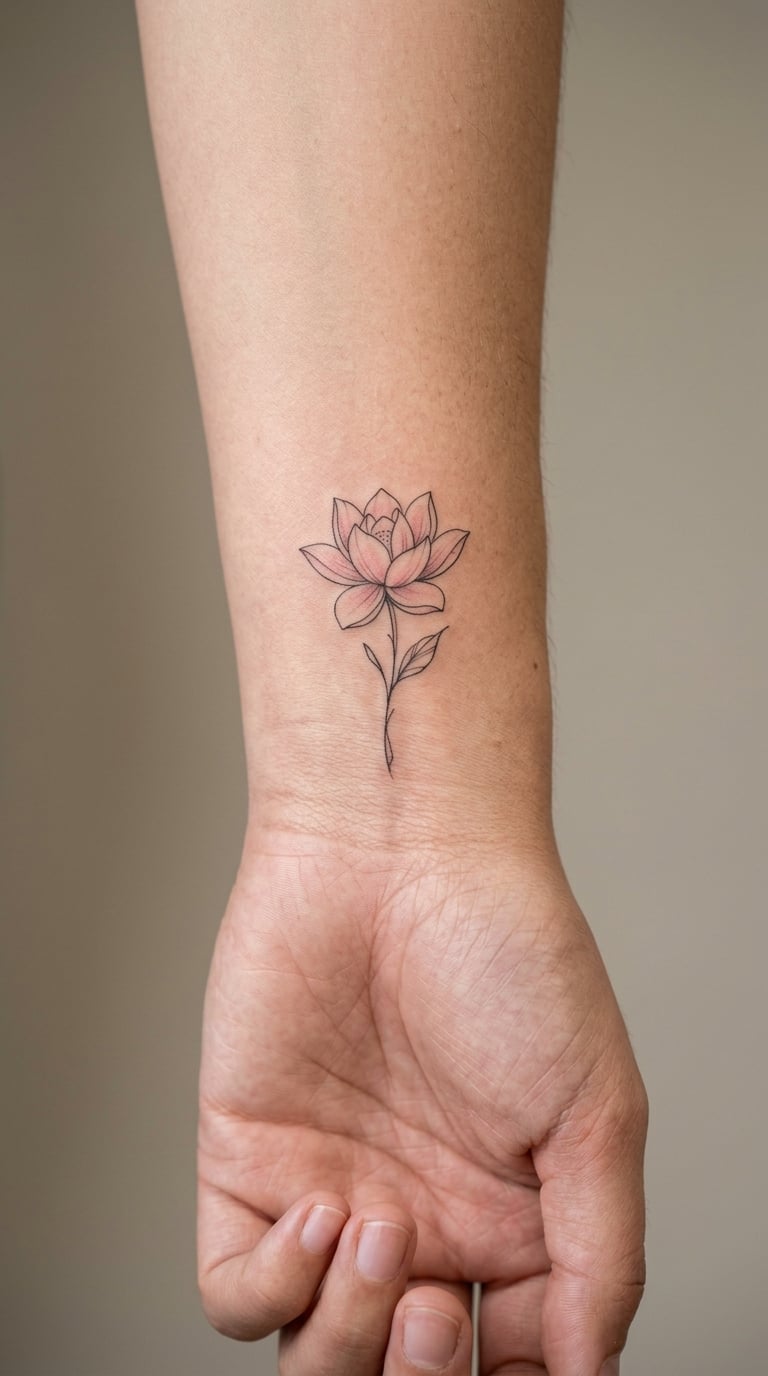
A fine-line lotus on the inner wrist is the quietest way to wear the symbol. Small, single-colour, and easy to ignore, which is usually exactly what people want from a meaning tattoo.
Keep it between 5 and 8 cm across, because anything bigger starts to crowd the forearm. Fine line fades faster than solid black, so a touch of shading in the petal folds ages much better than an outline on its own.
Pain and time: The inner wrist is thin-skinned, so expect a persistent scratchy sting rather than sharp pain. A piece this size is usually a single sitting of 30 to 60 minutes.
2. Half-Bloom Lotus Climbing the Spine
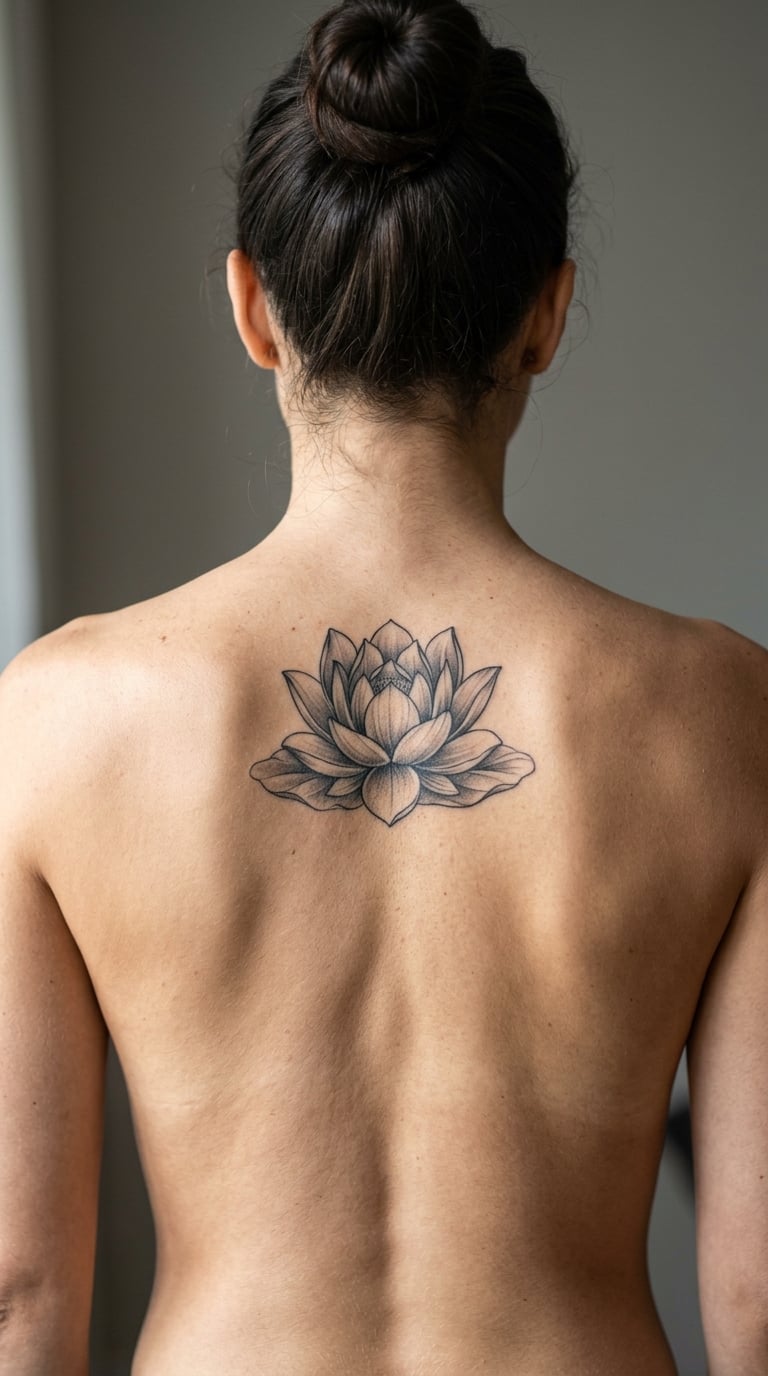
A half-bloom lotus running up the spine is the version most people picture, and it works because the flower reads as movement. A closed bud sits low, the bloom opens as it climbs, and the top petal breaks the shoulder line.
Plan it as a vertical column, about 15 to 25 cm, and let the artist overlap the petals so the line carries the eye upward. This one wants black and grey shading rather than colour, or the spine will disappear.
Pain and time: Across the shoulder blades the skin moves, so sitting still is the hard part. Expect a moderate burn and a session of one and a half to three hours, or a two-session job.
3. Mandala Lotus Across the Sternum
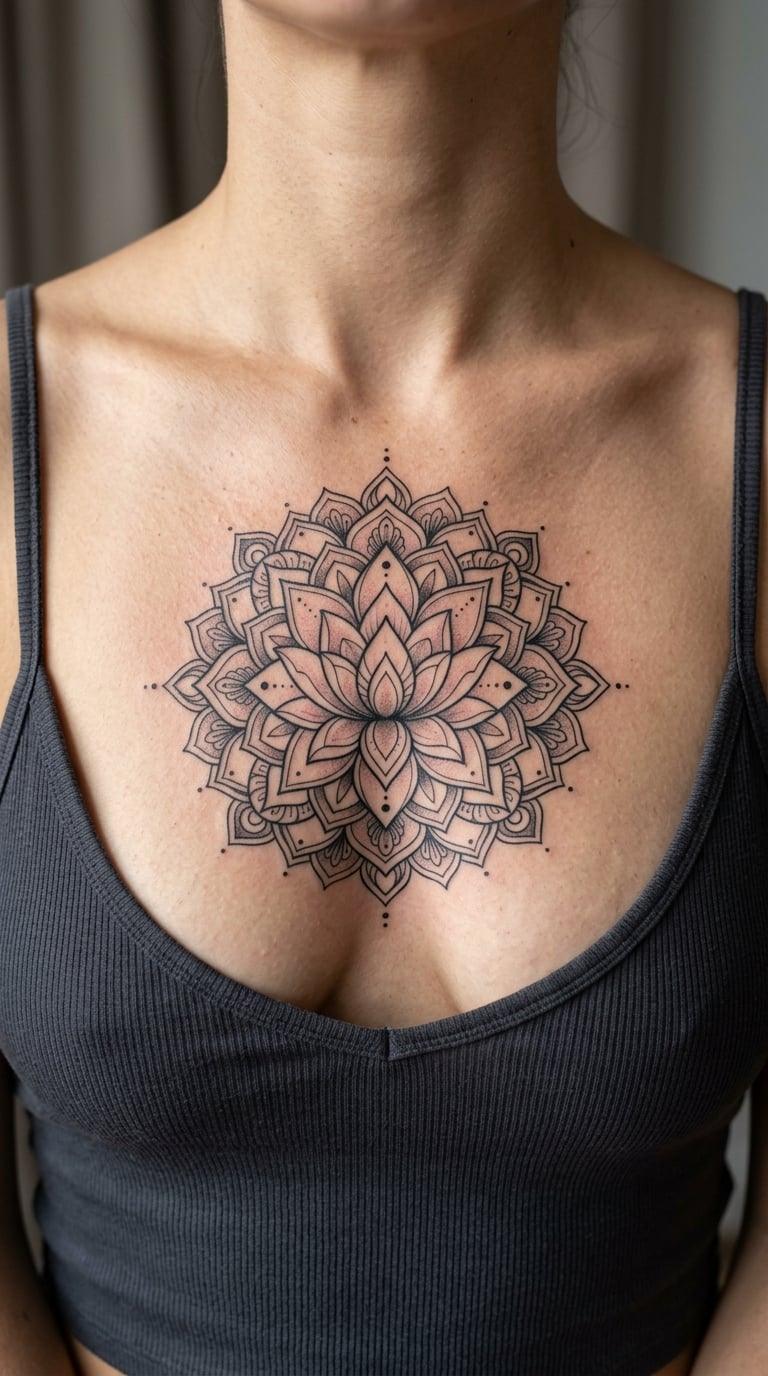
A mandala lotus on the sternum combines the flower with geometric wholeness, and it sits directly over the heart, which is why so many people choose it. The geometry gives you something to look at closely, not just a symbol to recognise from across the room.
Symmetry is everything here. A sternum mandala needs perfect mirroring around the centre line, so ask to see the stencil and check the spacing yourself before any ink goes down.
Pain and time: The sternum is bone-close and one of the more reactive spots, and it tends to swell and flush. Budget two to four hours, and do not plan a session that ends right before a night out.
4. Realistic Watercolour Lotus on the Shoulder
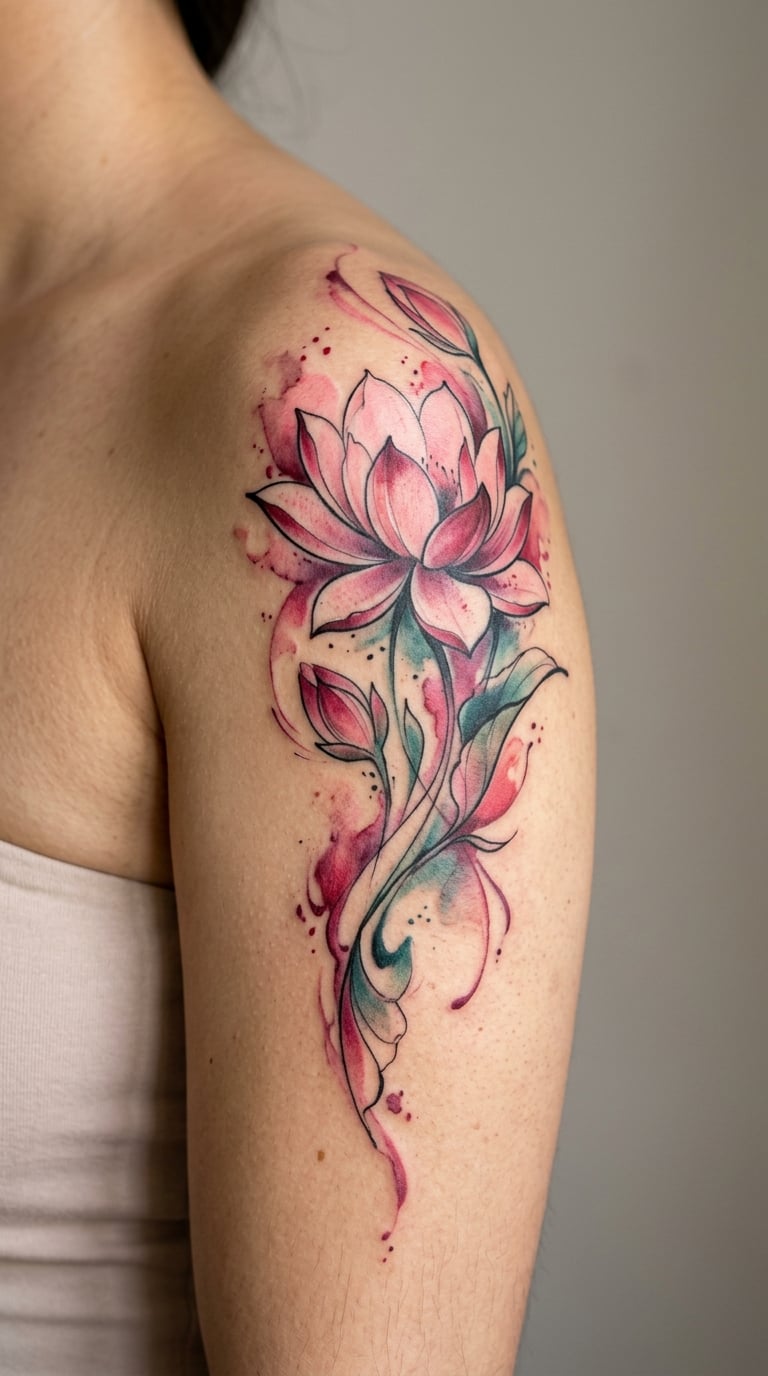
A watercolour lotus on the shoulder is a softer, larger piece that suits people who find solid blackwork too heavy. The style reads as painted rather than inked, with colour that fades into bare skin at the edges.
Watercolour is beautiful and it is also the least durable style there is. Colours shift toward yellow over the first couple of years, so pick petals you can accept turning warmer, and expect a refresh every few years if you want it crisp.
Pain and time: The outer shoulder is fleshy and relatively forgiving, but a large piece means a long sit. Ten to 20 cm of colour realistically takes two to three hours and often more.
5. Blackwork Lotus With an Unalome on the Thigh
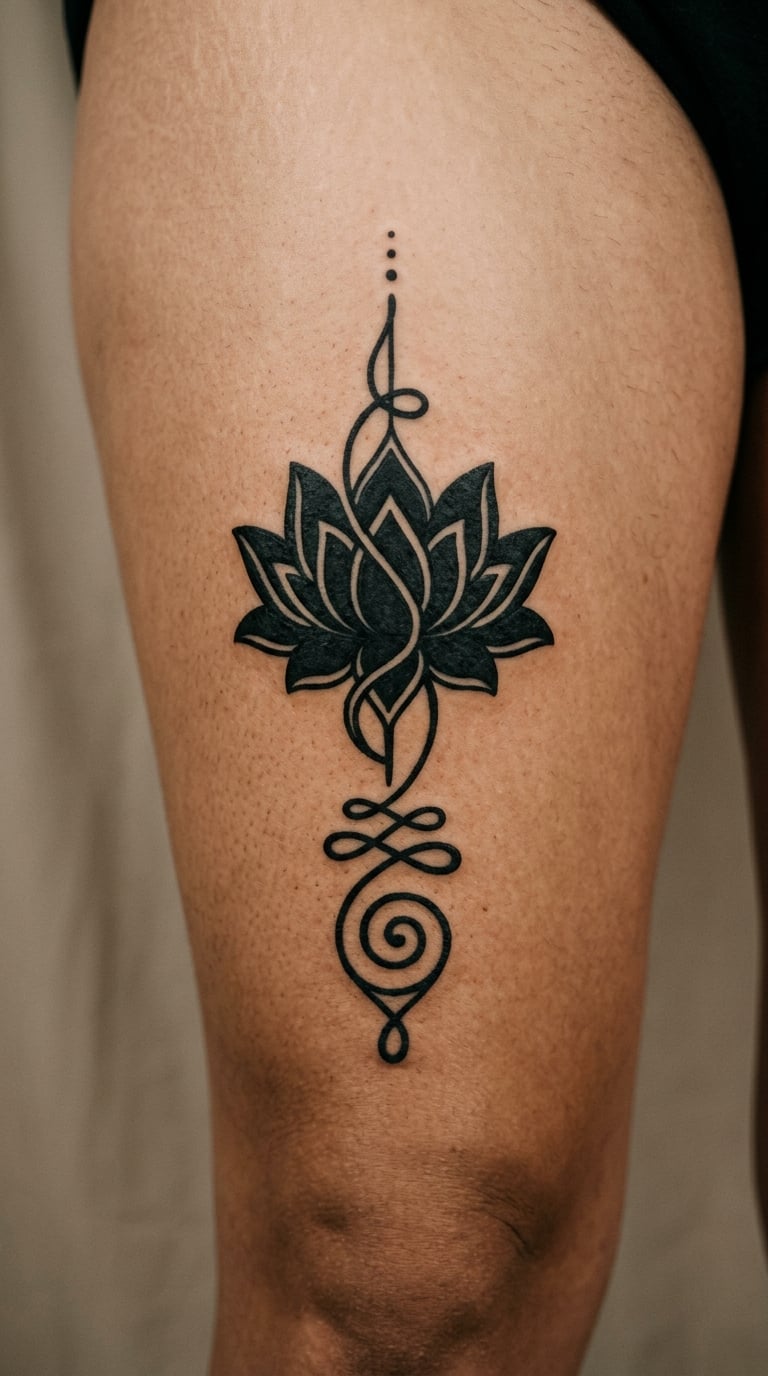
The unalome is a line that spirals, gathers into a knot, and carries on, and it means the journey rather than the arrival. Paired with a lotus it is the design for someone who is very much in the middle of something.
On the thigh you have room to let the black breathe. A 15 to 30 cm design can use solid fills, negative space, and fine chains of dots without turning to mud, and this is one of the least sensitive areas on the body.
Pain and time: Thighs are among the easier places to get tattooed, a scratchy heat more than a sting. A piece this size is commonly split across two sessions of two to three hours.
6. Eight-Petalled Lotus at the Base of the Neck
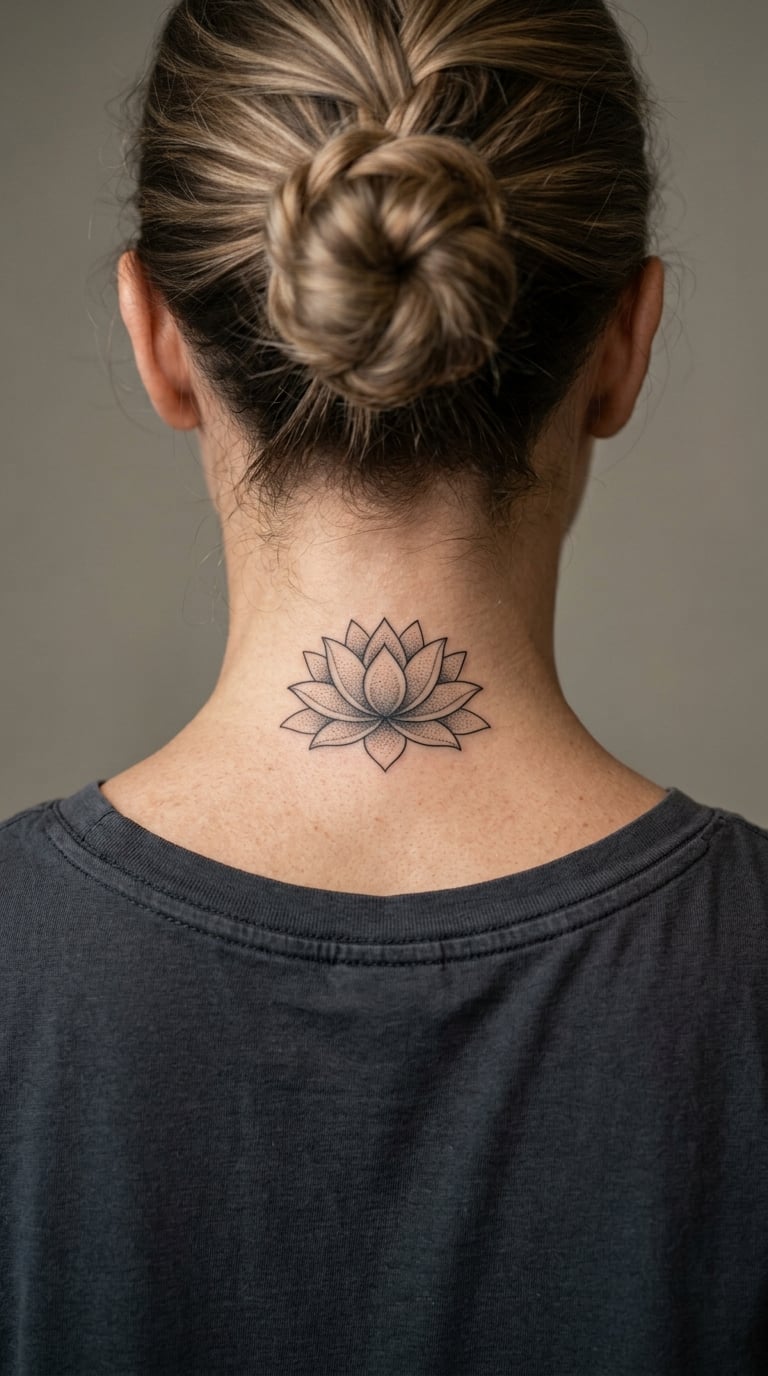
Eight petals is a deliberate choice rather than an accident, because the eightfold path is the Buddhist framework of practice. Someone who counts petals is usually drawing on that.
Keep this one small, 4 to 8 cm, and let the base of the neck do the framing. Hair covers it, which makes it a piece for yourself rather than for a room.
Pain and time: You cannot lean back or rest properly, and the neck keeps moving, so the artist will take breaks. A piece this size runs 45 to 90 minutes.
7. Micro Lotus Behind the Ear or on the Ankle
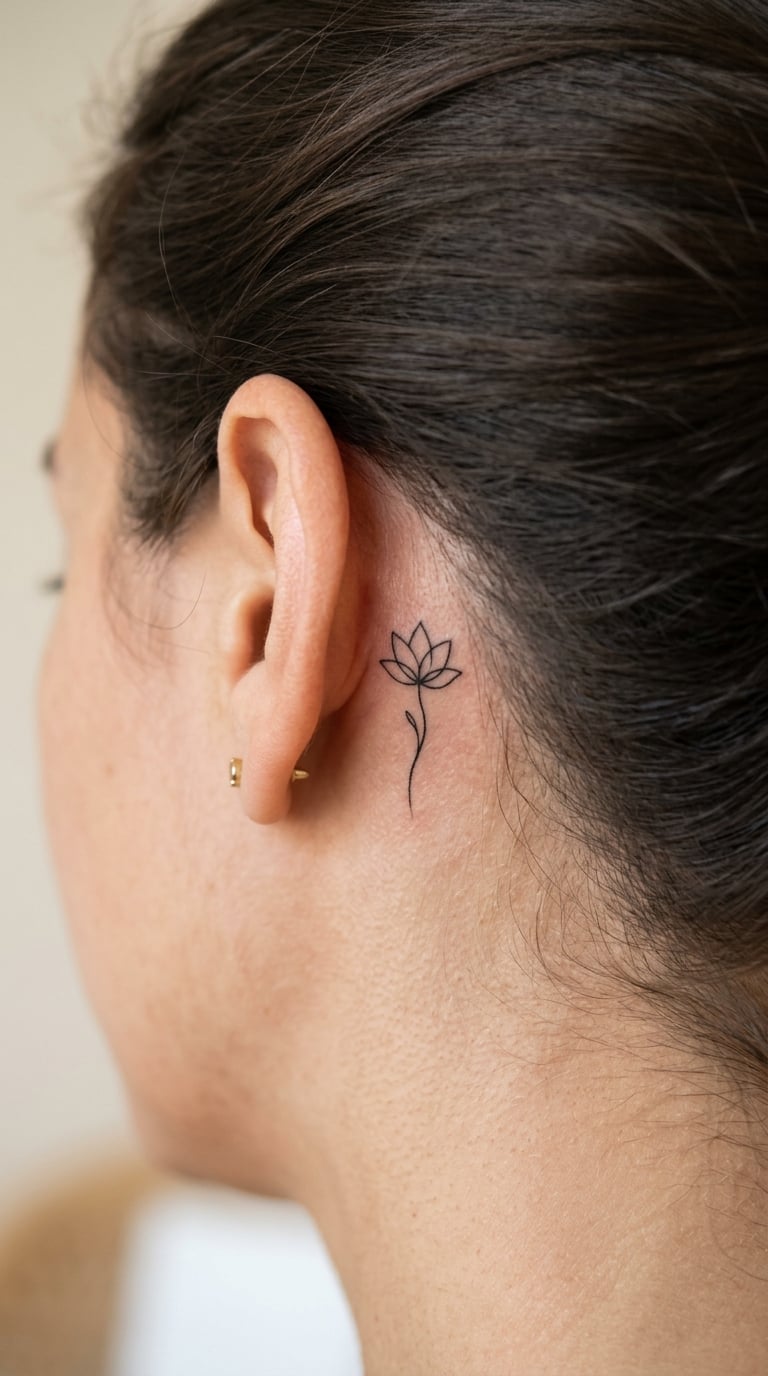
Micro lotus designs are for people who want the meaning and would rather not announce it. Behind the ear and the inner ankle are the two classic hiding spots, and a single-line bloom about 3 to 4 cm across is enough to read clearly.
The risk at this size is over-detailing. Ask for fewer petals and a slightly thicker line so it holds its shape, and expect the artist to talk you out of anything more complex.
Pain and time: Behind the ear is thin and sensitive, the ankle bone stings on contact, and both are quick. Twenty to forty minutes covers it.
8. Lotus and Koi Wrapping the Forearm
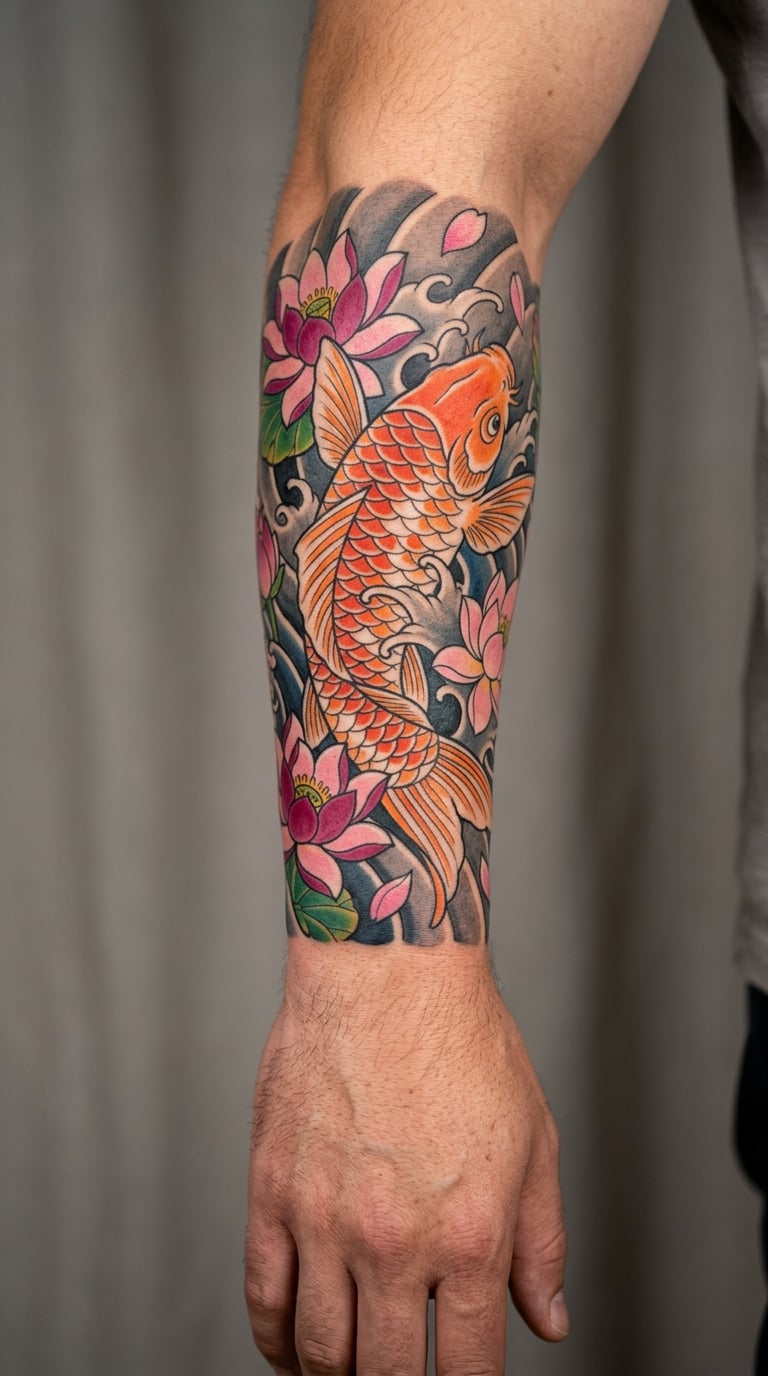
Koi and lotus travel together in Japanese tattooing for a reason: the fish represents perseverance, and the flower represents rising clean out of trouble. Together they say you kept going.
On the forearm, plan the water and the current first and let the lotus sit inside it. Colour suits this design because koi without colour loses its character, though a black and grey version works if you want it quieter.
Pain and time: The inner forearm is more reactive than the outer side. A wrap of this scale is a half-day piece, often three to five hours, and you will want breaks.
9. Closed Lotus Bud Circling the Upper Arm
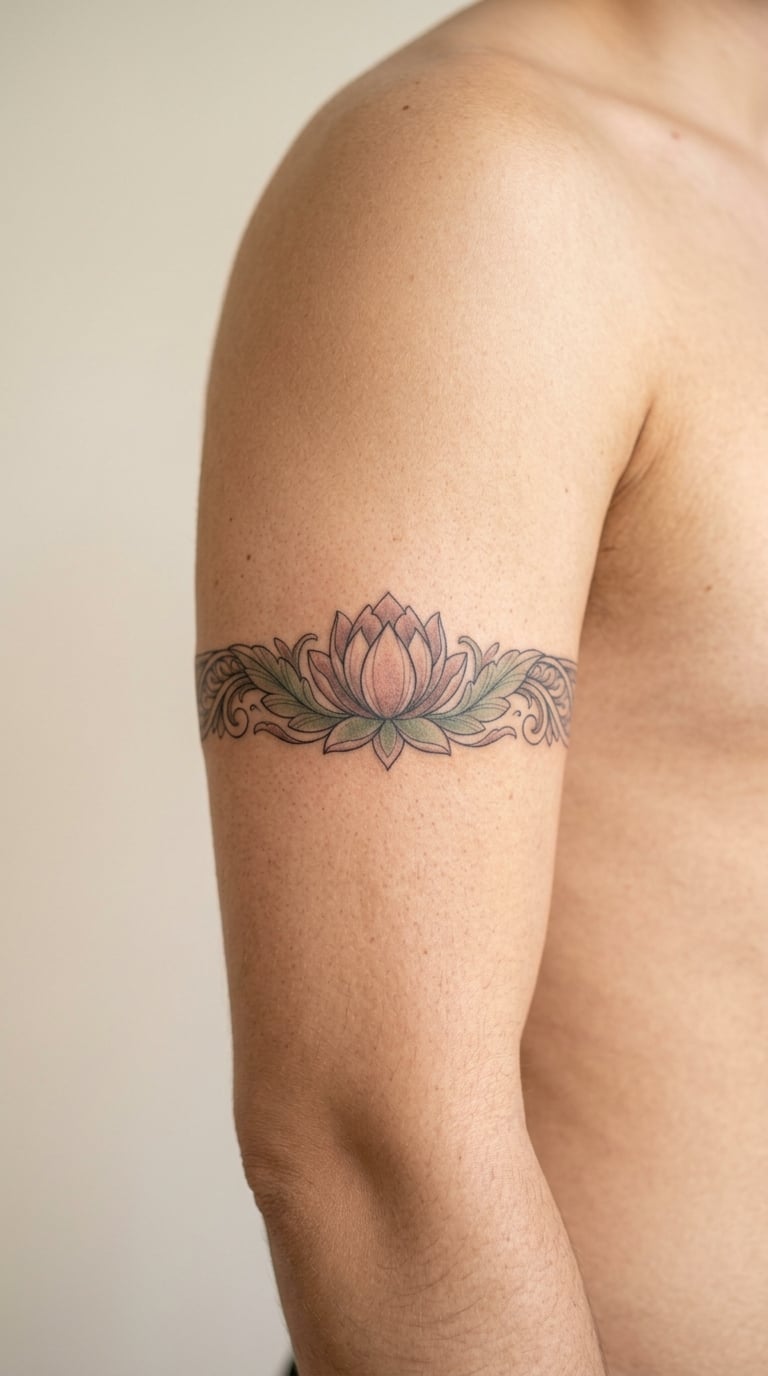
A closed bud armband says the work is in progress, and it is a good fit for recovery, sobriety, or the first year of anything. The circular shape also turns the flower into something continuous rather than a single event.
Give the band a set height, around 6 to 10 cm, and let the artist run the stems around the arm to close the loop. Colour in muted greens and pinks ages more gracefully than a bright full-colour piece.
Pain and time: The upper arm is mostly fleshy, so this is an easy area. A wrap band is usually one to two hours.
10. Crescent Moon and Lotus on the Rib
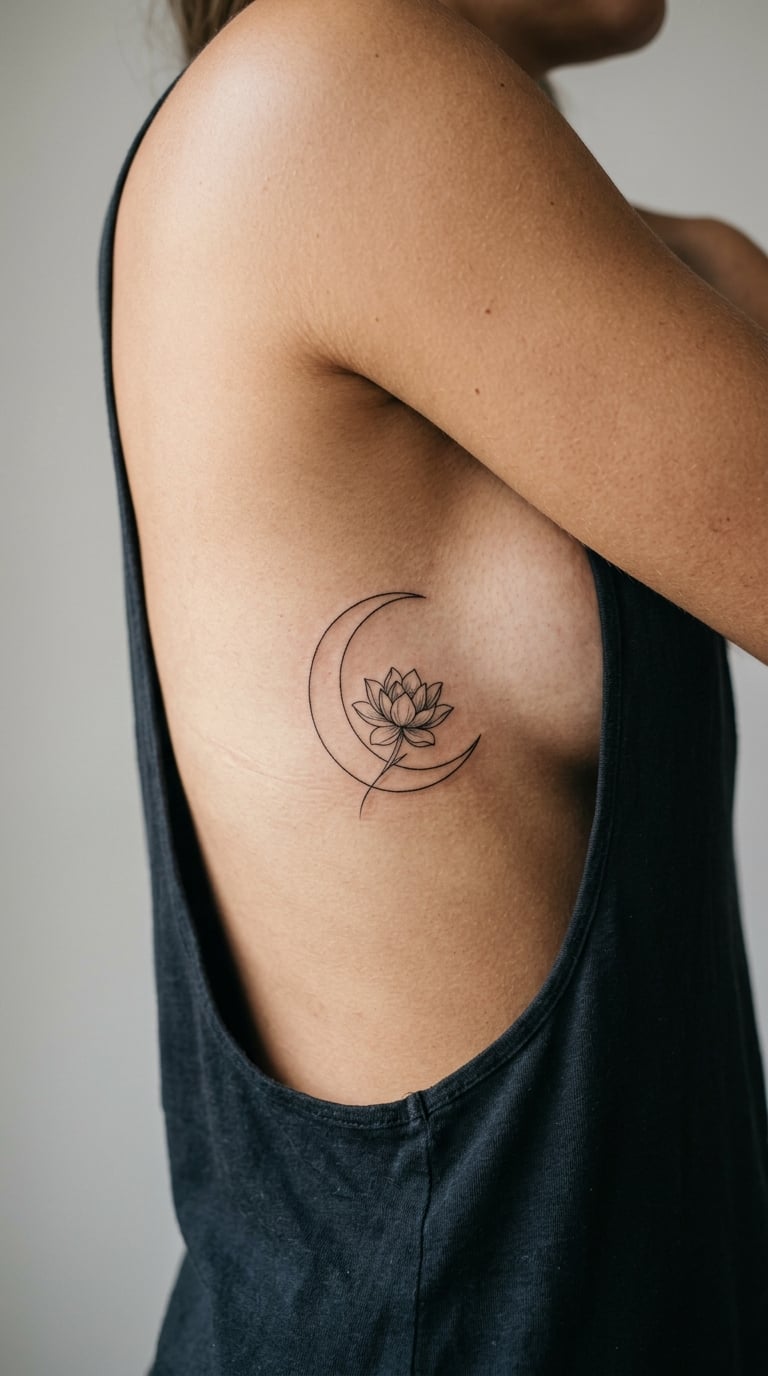
Moon and lotus together is a quiet night-time design, and it reads as cycles rather than endings. People choose it for the tides, for a new moon, or simply because they want something that looks considered in a small area.
Rib tattoos need a drawing position. If you can lie still and breathe shallowly without fidgeting, it will be fine; if you cannot, pick a forearm or thigh version instead.
Pain and time: Ribs are stretchy skin over bone and the sensation moves around as you breathe. Two hours is a realistic floor for a piece this size.
11. Geometric Lotus on the Finger or Back of the Hand
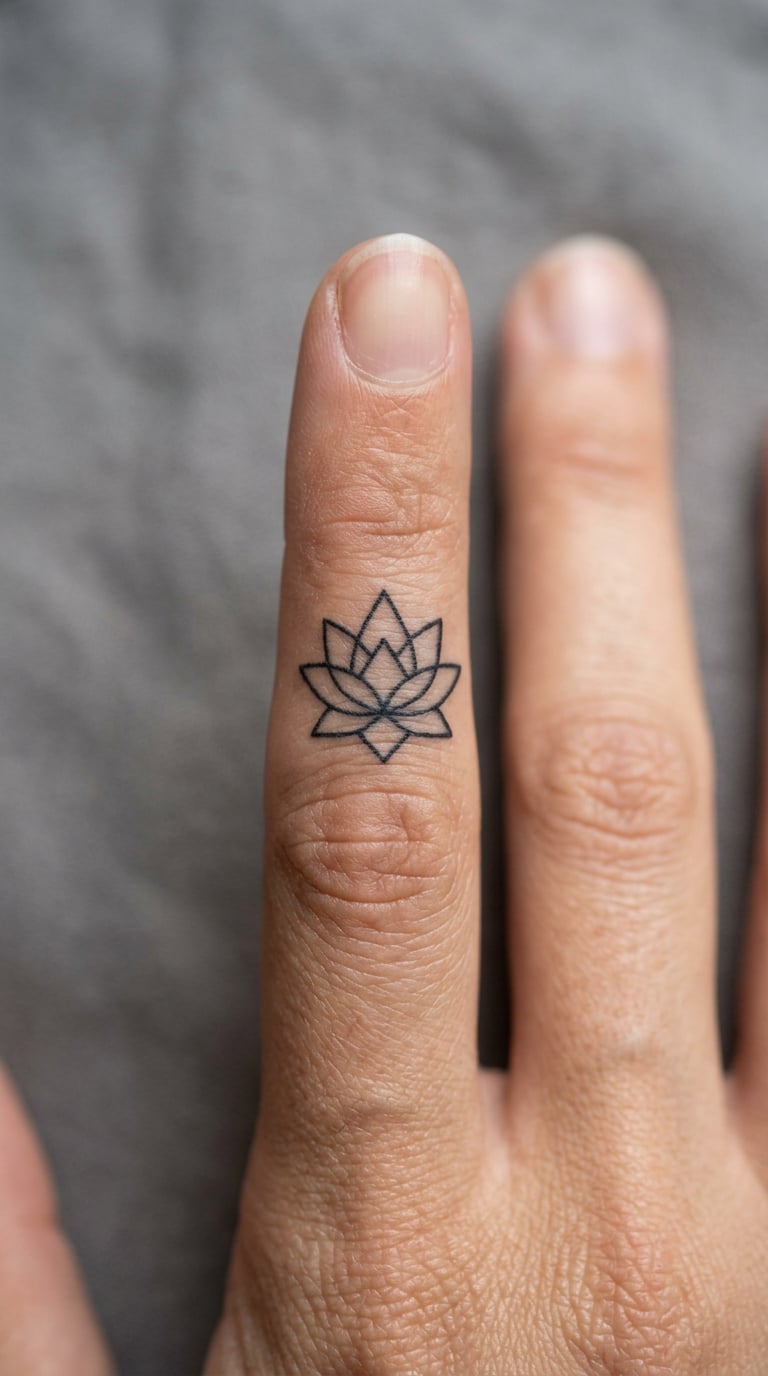
A geometric lotus on a finger is the smallest confident version of this tattoo. Straight lines, no shading, one or two petals, about 3 cm. It suits a first tattoo, and it turns a very visible spot into something that still feels private.
Ask the artist to design for the finger’s curve, because skin there moves with every gesture and fine detail fades faster on hands than anywhere else on the body.
Pain and time: Fingers hurt in a sharp, immediate way, but the area is tiny. Fifteen to thirty minutes, and you will be done before the adrenaline wears off.
12. Two Small Lotuses on the Inner Forearms
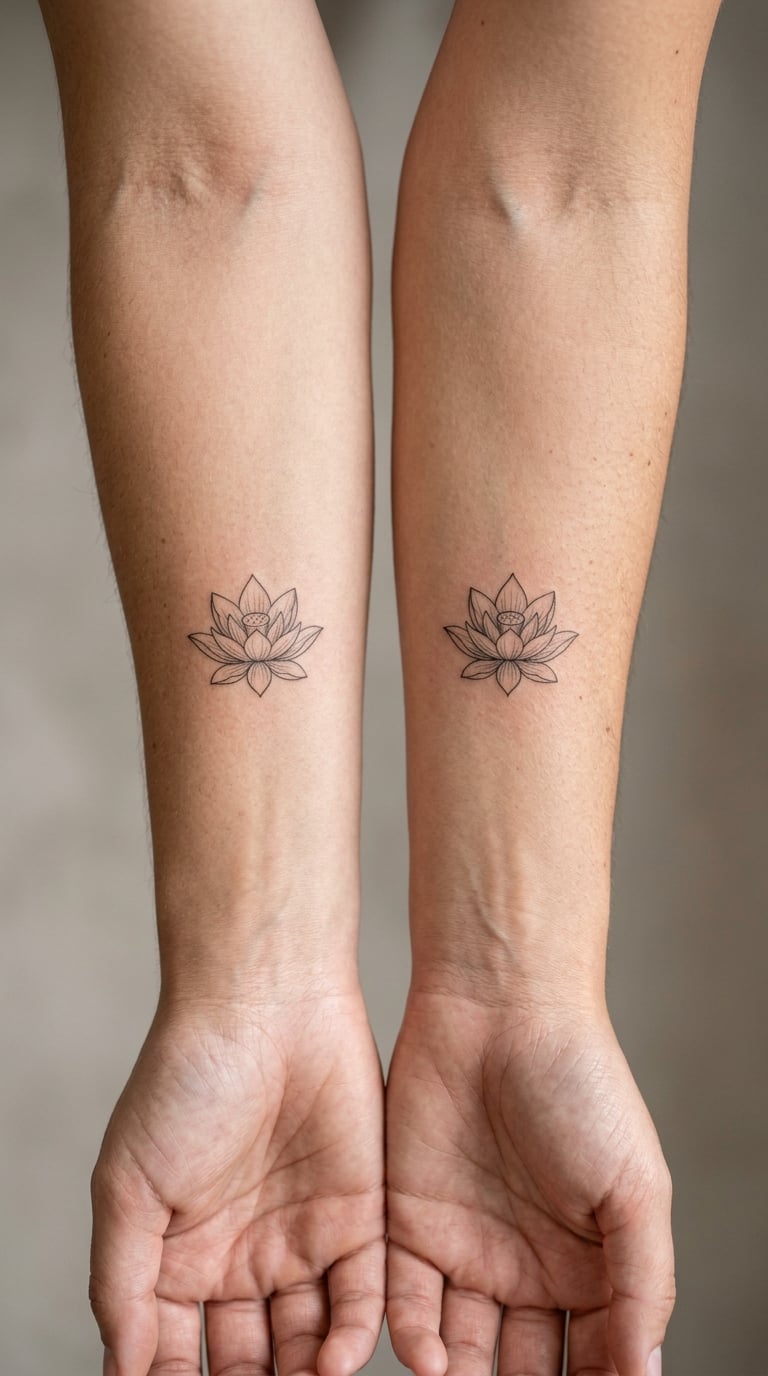
Matching tattoos on both inner forearms are a commitment to someone or something, and pairing them keeps the piece soft rather than a matching-sleeve cliché. Same flower, mirrored, one on each arm.
Keep them around 5 cm and mirror them exactly, ideally tattooed in the same sitting so the skin tone and line weight match. If you only want the idea and not the pairing, one forearm works just as well.
Pain and time: Mild to moderate, and doing both together is often kinder than two separate appointments. Ninety minutes to two hours for the pair.
Things to Know Before You Book a Lotus Tattoo
- Choose the artist for the style, not the flower. A micro fine-line lotus and a large blackwork thigh piece need completely different hands. Look at a full healed portfolio in that exact style, and check reviews for healed work rather than fresh-day photos.
- Bring more references than you think you need. Three or four images that genuinely appeal to you, plus one or two you are unsure about, is a much better brief than a single pin. Say what you like about each.
- Decide the size before the design. A lotus that is too small for the detail you want ends up muddy, and one that is too large for the placement looks accidental. Bring your placement and let the artist scale to it.
- Give it time to heal before judging it. Most placements need two to three weeks of careful aftercare, and colour looks dull and slightly different for the first month. A full return to normal for watercolour and fine line can take six months.
- Plan for sun and fading from day one. Upper back, shoulder, forearm and chest are all exposed areas. Once healed, cover the design on a beach or whenever you are out in strong sun for a long stretch, or expect the colour to shift faster than the black.
- Get a licensed artist and a clean studio. Ask to see the licence and the sterilisation setup before you sit down. Where you live determines which licensing body to check, and it is always reasonable to ask.
- Respect the tradition if it is not yours. A flower is a design. A deity image, a mantra, or a lotus with a mudra is a representation, and those come with expectations. If the meaning is cultural, consider asking an artist who works in that style regularly.
- Test the placement first. A temporary tattoo sticker at the right size, worn for a full week at work, answers the question faster and cheaper than any consultation can.
Frequently Asked Questions
What does a lotus flower tattoo symbolize?
A lotus flower tattoo symbolizes purity, resilience and spiritual awakening, because the flower grows up through muddy water and opens above the surface without taking on the mud. In Buddhism it is the seat of enlightenment and a symbol of the Noble Eightfold Path. In Hinduism it is associated with Brahma, Lakshmi, Saraswati and the crown chakra. For most wearers the personal reading is simpler: something difficult became something beautiful.
Where is the best place to put a lotus flower tattoo?
The best placement depends on how visible you want the meaning to be. Inner wrist, nape and finger pieces are mostly read by you. Forearm, shoulder and thigh sit in between. Sternum, chest and spine are offered to whoever is looking and read as open-hearted courage. The table earlier in this article maps ten body areas to what each one tends to emphasise.
What does the lotus flower tattoo mean in mental health?
In this context a lotus flower tattoo usually marks recovery rather than a diagnosis: getting through sobriety, treatment, a hard diagnosis, therapy, or a grief that has not lifted. The flower still rooted in mud, standing up straight, is the reason people reach for it. A bud rather than a full bloom is often chosen to signal that the work is still in progress, not finished.
How many petals should a lotus tattoo have?
It depends on whether you are counting on purpose. Eight petals is the most meaningful number, usually read as the Noble Eightfold Path in Buddhism. Three, five and eight are common in decorative work without a fixed reading. A closed bud is taken as potential, a half bloom as progress, and a fully open flower as a state already arrived rather than still being worked toward.
Is a lotus flower tattoo disrespectful?
A plain flower tattoo is not disrespectful to any tradition, because a flower is a widely shared image. It gets more complicated when you borrow specific religious elements: a deity image, a mantra in script, an Om symbol, or a lotus carrying a mudra. If you are not a practitioner, keep the design botanical and leave those elements out, or work with an artist who makes that iconography regularly.
How long does a small lotus tattoo take to heal?
A small lotus on the wrist, finger or behind the ear usually feels settled within two to three weeks if you keep it clean, moisturised and out of the sun. Full colour and watercolour work takes noticeably longer to look like itself, often six months before the true tone shows. Most artists will ask you to send a healed photo at around four weeks so they can check how the ink settled.
Conclusion
Start with the meaning, not the picture. Decide whether your lotus is about purity, recovery, a beginning, a loss, or a heritage, then let the colour and the bloom stage follow from that. Once the meaning is clear, the placement becomes obvious: a quiet promise goes on the wrist or the nape, and something you want worn openly goes on the sternum or the spine.
Take two or three of the twelve lotus flower tattoo meaning and placement ideas above that fit, bring them to a consultation along with the placement table, and let the artist tell you honestly which one their style suits. That conversation takes an hour and saves you from a design you would have to cover for the rest of your life.