
20 Best Ignorant Style Tattoo Ideas for Bold Minimalists 2026
Ignorant style tattoo ideas are deliberately rough, simple black-ink designs that look like notebook doodles, stick-and-poke work or old prison tattoos. The roughness is the point. Nothing in this list is trying to be beautiful, and that is exactly why it works.
These 20 concepts are built for anyone who wants a small, funny, slightly rebellious tattoo that reads as a private joke rather than a display piece. Every one includes the practical bits: where it sits, how big it should be, what it will look like healed, and how to make it yours without turning it into a copy of someone else’s flash. If you are just starting out, jump to the question mark first and work outward from there.
Ignorant Style Tattoo Ideas: Quick Guide
All twenty designs below work in a confident single-line black ink with no shading and no colour. The table compares each one by style, placement, realistic size and expected pain.
| Idea | Style | Best placement | Size | Pain |
|---|---|---|---|---|
| 1. Fine-line question mark | Fine line | Inner forearm | 1.5-2.5 inch | Low |
| 2. Hand covering one eye | Minimal black | Upper arm | 3-4 inch | Low |
| 3. Unread open book | Micro-realism | Inner forearm | 2-3 inch | Low |
| 4. Question mark behind the ear | Micro fine line | Behind the ear | 0.5-1 inch | Medium |
| 5. Maze with an exit | Blackwork | Forearm | 3-4 inch | Medium |
| 6. Blackout question-mark cluster | Blackwork solid | Outer arm | 2.5-3.5 inch | Medium |
| 7. Finger counting wrong | Fine-line illustrative | Forearm | 2-3 inch | Medium |
| 8. Chalkboard with no answer | Black and grey | Calf | 2.5-3.5 inch | Low |
| 9. Owl reading a closed book | Neo-traditional | Upper arm | 3-4 inch | Medium |
| 10. Eye under a curtain | Fine line | Inner forearm | 2-3 inch | Low |
| 11. Lightbulb missing its filament | Minimal outline | Forearm | 1.5-2.5 inch | Low |
| 12. Stack of unread books | Fine line | Outer forearm | 2-3 inch | Low |
| 13. Broken compass | Blackwork | Chest or forearm | 3-4 inch | Medium |
| 14. Cat sleeping on a textbook | Micro-realism | Calf | 2.5-3.5 inch | Low |
| 15. Empty speech bubble | Cartoon line | Arm | 2-3 inch | Low |
| 16. Cloud blocking the answers | Black and grey | Upper arm | 3-4 inch | Medium |
| 17. Locked cabinet of facts | Line art | Forearm | 2.5-3.5 inch | Low |
| 18. Finger to the lips in dotwork | Dotwork | Inner forearm | 2-2.5 inch | Medium |
| 19. Random map with no label | Abstract line | Calf | 3-4 inch | Low |
| 20. Two envelopes, one unopened | Fine line | Upper arm | 3-4 inch | Low |
How to Read the 20 Design Directions
Ignorant style, sometimes called naive style, is a look rather than a strict set of rules. Linework is bold and unbroken, colour and shading are usually left out entirely, proportions are whatever the drawing felt like, and the subject matter does the joking. A smiling face next to a knife means the same thing it would mean on a napkin.
Each of these ignorant style tattoo ideas can stand alone as a single small piece, or they can be collected slowly into a patchwork of stickers scattered along an arm or a leg. There is no correct order. Most people start with something small and easy to hide, then add one more every time another idea sticks with them.
1. Fine-Line Question Mark on the Forearm
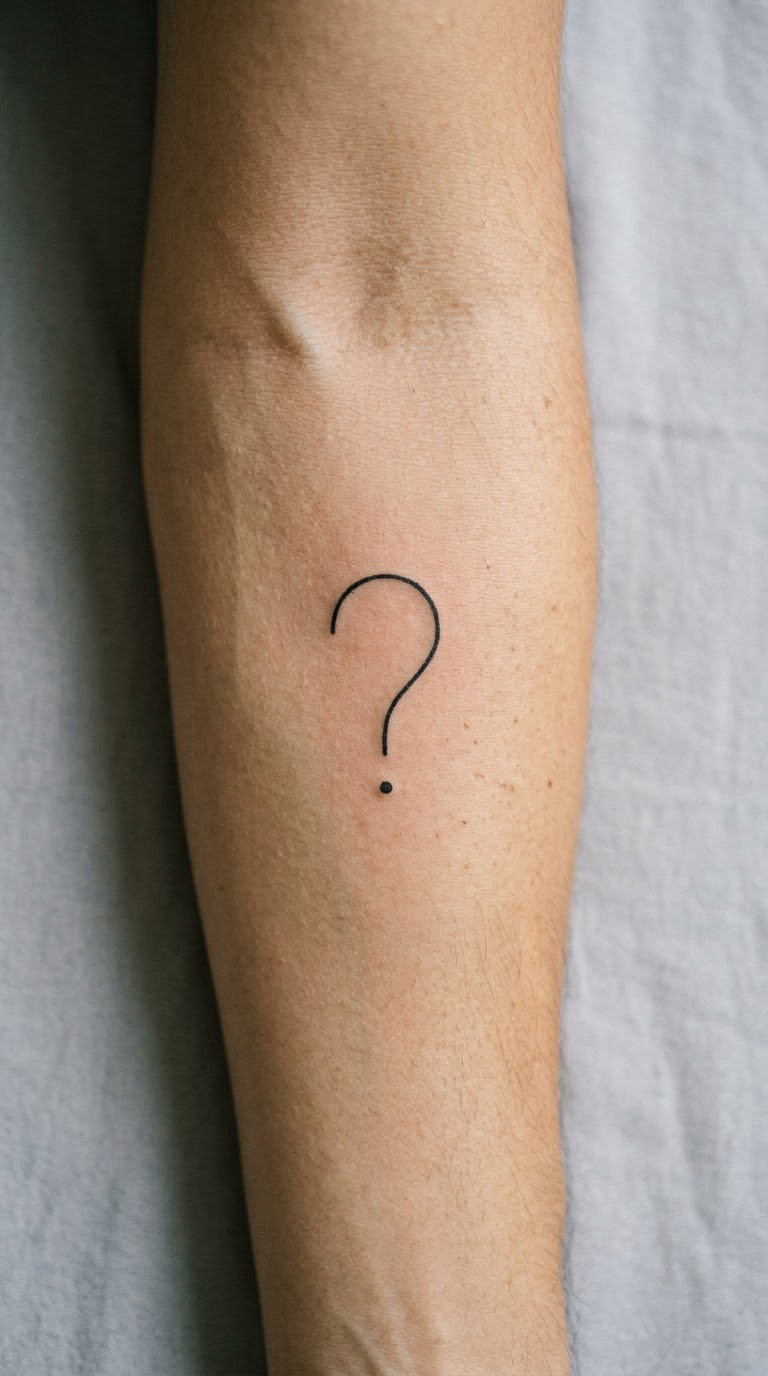
A single confident question mark is the friendliest starting point in this whole list. The design is one unbroken line, a small dot below it, and nothing else. Keep the curve slightly uneven and let the dot sit a little off-centre, because a perfectly geometric mark will look like clip art rather than something a person drew on purpose.
Most people choose it as a reminder to keep asking, or as a joke about never having the answer ready. It is the least demanding design here to explain to an artist, and it pairs easily with a second small piece years later.
Placement: Inner forearm near the elbow crease, or the soft area just above the wrist. Size: 1.5 to 2.5 inch tall (4 to 6 cm). Style: Fine line, single needle, black only. Pain: Low on the inner forearm, though the wrist side is a little stingier than most people expect. Fine line on the inner arm softens noticeably within a couple of years, so ask for a slightly heavier line weight than feels right in the drawing.
Make it yours: Add a second, smaller question mark beside it at a different height so the pair reads as an unfinished thought. If you like the collection angle, our 20 Best Wrist Band Tattoo Ideas for Minimalist Looks covers placements that suit the same scale of work.
2. Hand Covering One Eye
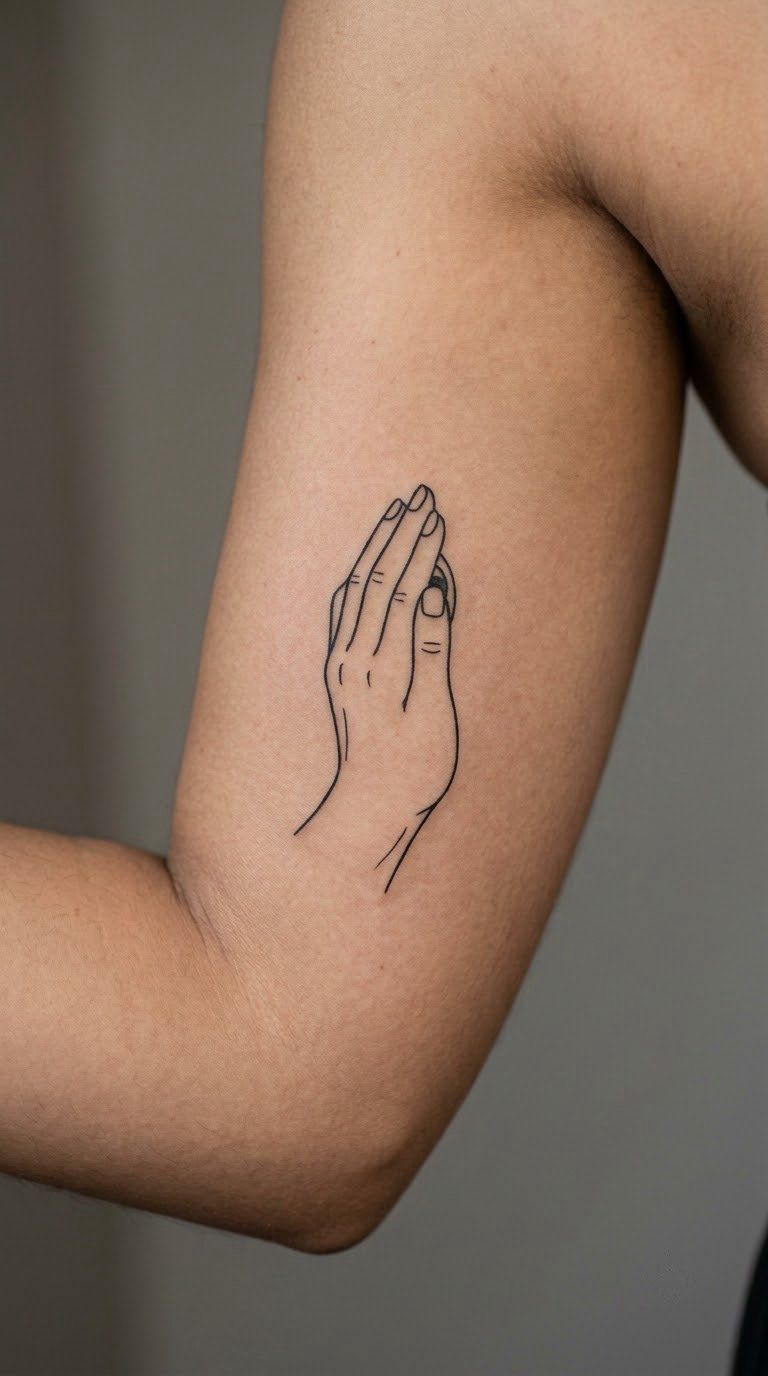
Here the design is a simple open hand laid across a face, with the fingers covering one eye. Draw the hand in outline only, slightly too large for the face beneath it, and let the hidden side of the face stay blank or suggested by two short lines. The mismatch between the two halves is what makes it funny.
It reads as choosing not to see something, or refusing to deal with a question you already know the answer to. People also pick it for the visual trick alone, since the scale change takes a second to work out.
Placement: Upper arm, outer side, where there is flat space for the head-and-hand composition. Size: 3 to 4 inch wide (8 to 10 cm). Style: Minimal black outline with no fill. Pain: Low to medium on the outer upper arm. Hands and fingers hold detail badly over time, so keep the fingers simple and slightly thickened rather than anatomically careful.
Make it yours: Make the hidden eye visible as a single open circle peeking between two fingers. That one extra line changes the whole reading of the piece.
3. Unread Open Book
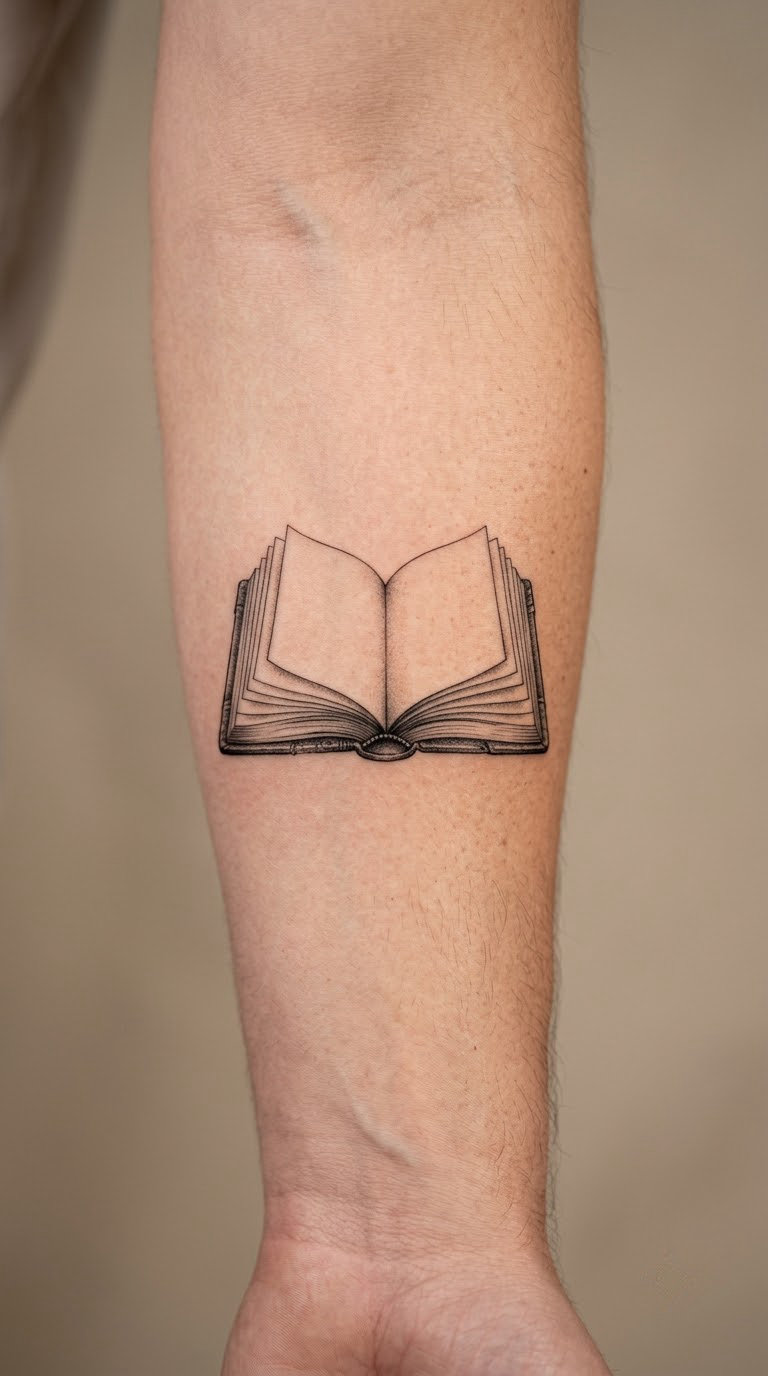
An open book with two blank pages is a small, quiet design that rewards a closer look. The page edges are the important part: a handful of short parallel lines suggesting stacked paper, with a curved spine down the middle and nothing written on either side.
People read it as unread knowledge, forgotten material or a preference for finding out by doing rather than by reading about it. It is one of the more philosophical pieces in the collection without being heavy about it.
Placement: Inner forearm, or the flat area just below the outer elbow. Size: 2 to 3 inch wide (5 to 8 cm). Style: Micro-realism line work, no shading. Pain: Low. Page-edge detail blurs with age, so the artist should space those lines far enough apart to still read in ten years.
Make it yours: Give the book a slight curve so one page lifts away from the other. A flat book looks like a symbol; a lifted page looks like something that was put down mid-sentence.
4. Tiny Question Mark Behind the Ear
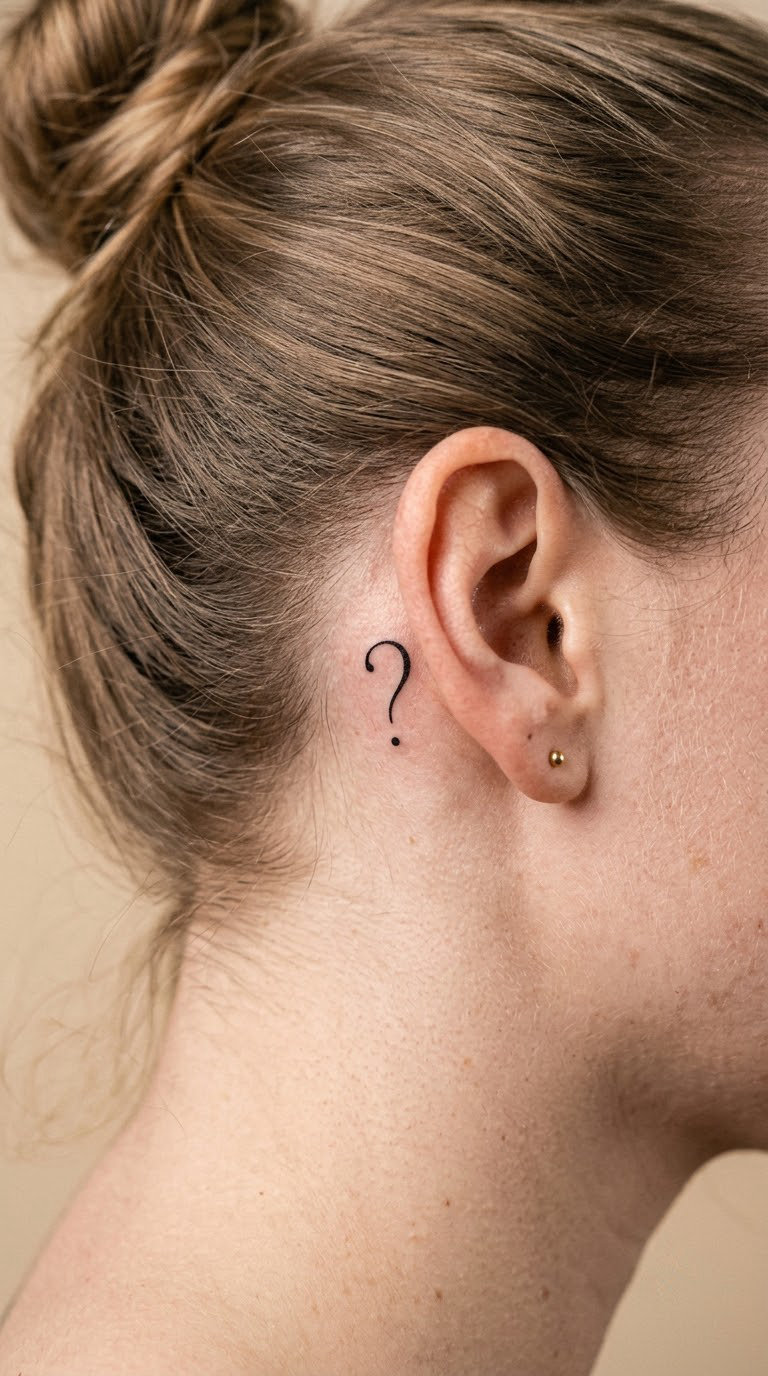
The smallest design in the set, and the most discreet. It is a single-line question mark no bigger than a fingertip, placed in the skin behind the ear where hair and the curve of the skull hide it from most angles.
It works as a private reminder rather than a conversation piece. Nobody sees it unless you show them, which makes it a good pick if you like the idea of the tattoo and not the attention that comes with it.
Placement: Directly behind the ear, above the neck, or tucked into the hairline behind the lobe. Size: 0.5 to 1 inch tall (1.5 to 2.5 cm). Style: Micro fine line, black only. Pain: Medium. Behind the ear is thin skin over bone and it stings more than the size suggests. Fine line in this spot is the first thing to fade, so a bold single line matters more here than anywhere else on the body.
Make it yours: Place it in the same spot as a small line on the neck or a stud piercing so the two read as a deliberate cluster.
5. Maze With an Exit
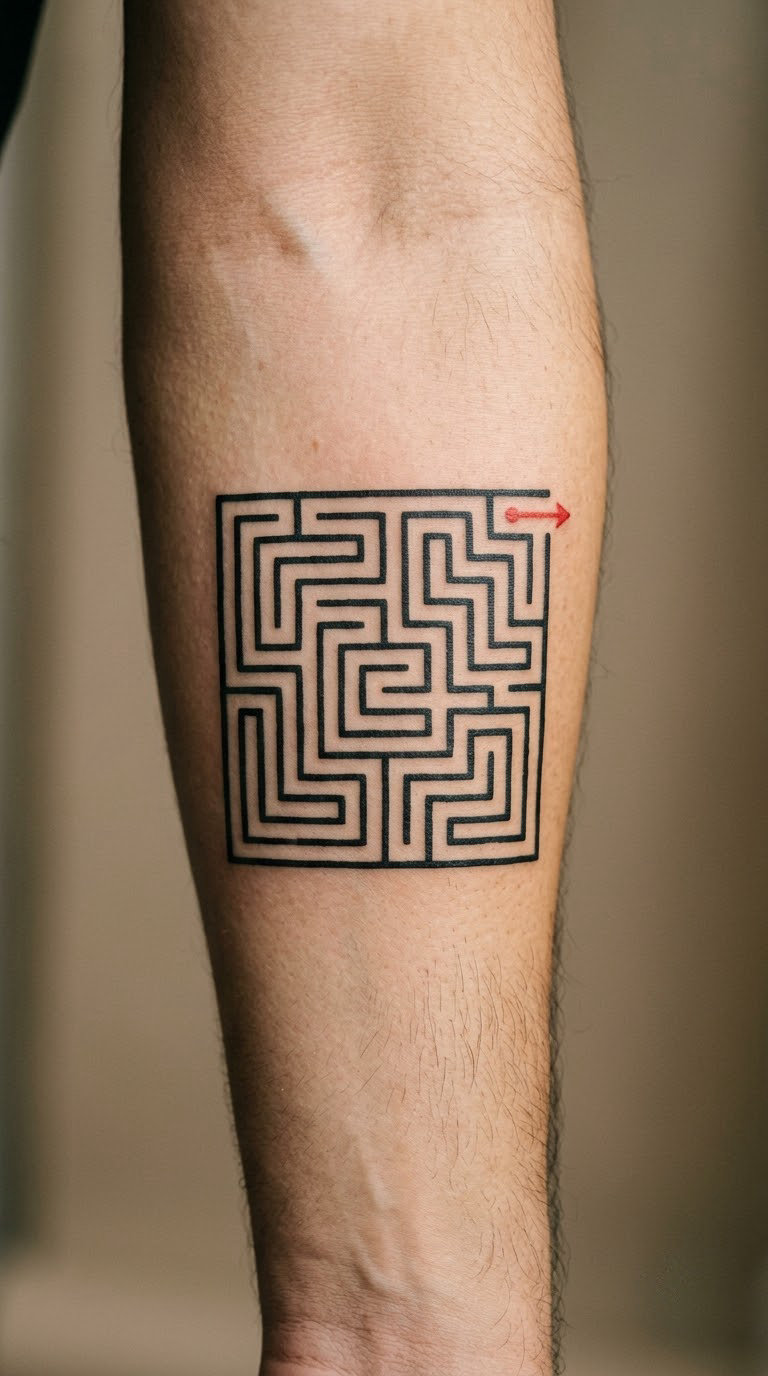
A square maze built from one confident black line, with a single small opening cut into the outer edge. That opening is the whole design. Without it the piece is just geometry; with it, the maze becomes a decision.
It is usually about moving forward without knowing the route, and it says that without assigning a fixed meaning. Because the metaphor is open, people keep it long after the original reason has faded.
Placement: Flat forearm, upper arm or outer thigh. Size: 3 to 4 inch square (8 to 10 cm). Style: Blackwork single line, optional single colour accent. Pain: Medium. The corridors need to be wide enough to hold ink, and a tight maze turns into a solid black block once it is done.
Make it yours: Have the exit marked with a small arrow or a single dot of colour so there is one clear way out of an otherwise confusing design.
6. Blackout Question-Mark Cluster
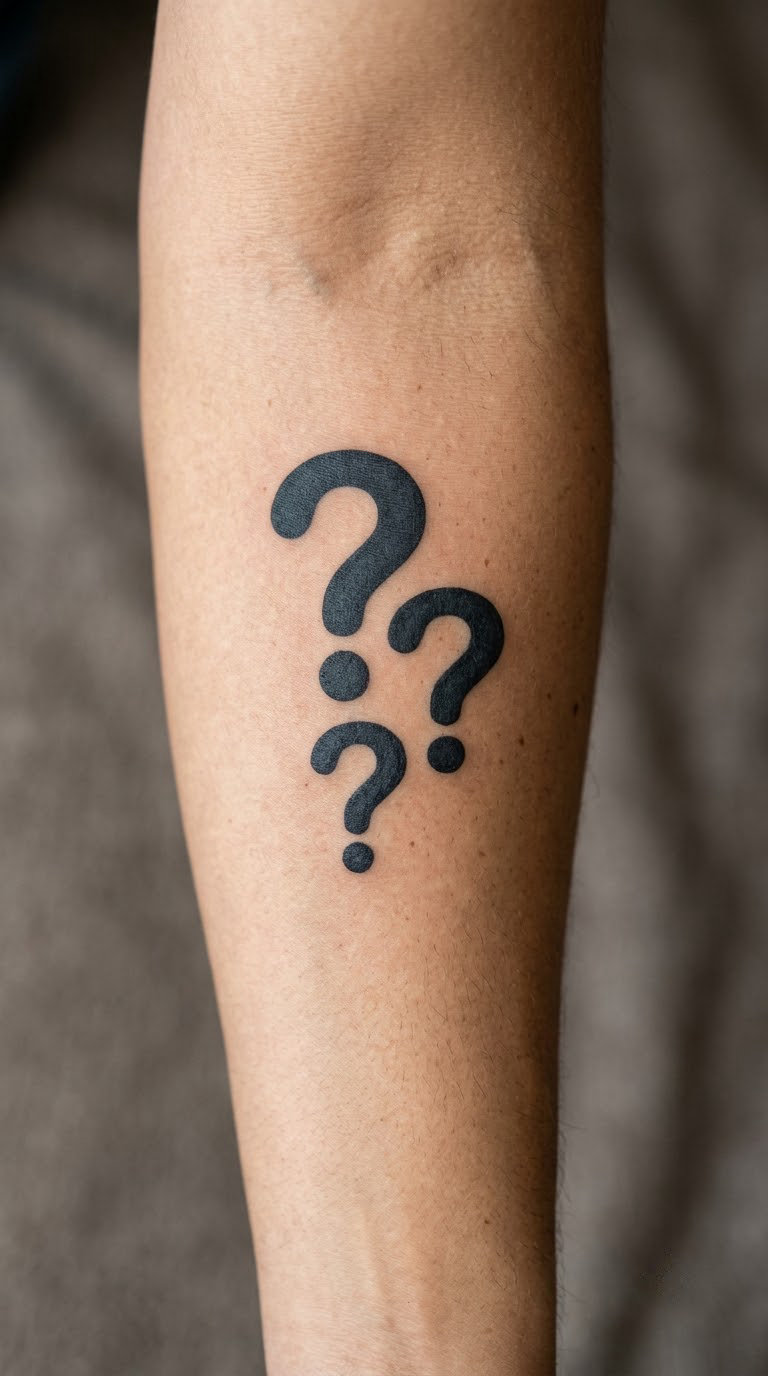
Three solid black question marks in different sizes, stacked loosely like stickers slapped on a wall. Because they are filled shapes rather than outlines, the cluster has a graphic weight that the single fine-line version never has.
It reads as a visual pause, the punctuation at the end of a sentence nobody finished. The mix of sizes keeps it from looking like a pattern, which is the difference between this and a printed sticker sheet.
Placement: Outer arm, shoulder or upper back. Size: 2.5 to 3.5 inch tall overall (6 to 9 cm). Style: Solid blackwork fill, no outline needed. Pain: Medium. Solid fill is a bigger single pass than a line, and the buzz is deeper on the upper arm than most first-timers anticipate.
Make it yours: Let the artist tilt the three marks at slightly different angles. Straight, evenly spaced marks look like a logo instead of a doodle.
7. Finger Counting the Wrong Answer
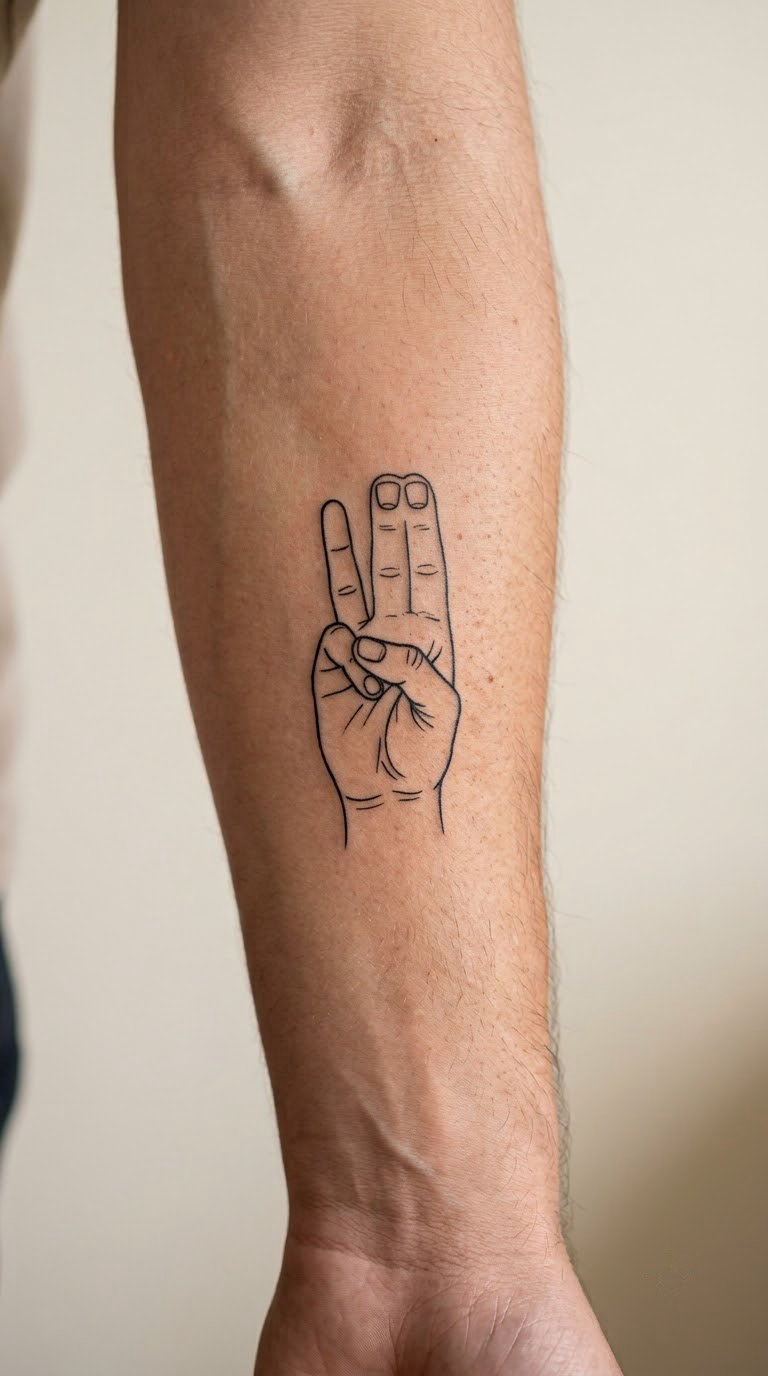
A drawn hand confidently holding up fingers in a gesture that clearly does not add up to anything. The fingers are sticks, the palm is a rounded square, and the whole thing is drawn in one pass with a slightly wrong thumb.
The joke is the confidence. It looks like someone who has done the maths, got the answer, and is certain about it. People also get it as a straight reference to a specific badly counted group photo or a running joke between friends.
Placement: Forearm or the back of the hand. Size: 2 to 3 inch tall (5 to 8 cm). Style: Fine-line illustration, black only. Pain: Medium, higher on the knuckles and along the finger bones. Hand tattoos fade fastest of all, so keep the line weight generous.
Make it yours: Have the artist draw the gesture slightly differently from any real hand sign, so it reads as a private joke rather than a copied reference.
8. Chalkboard With No Answer
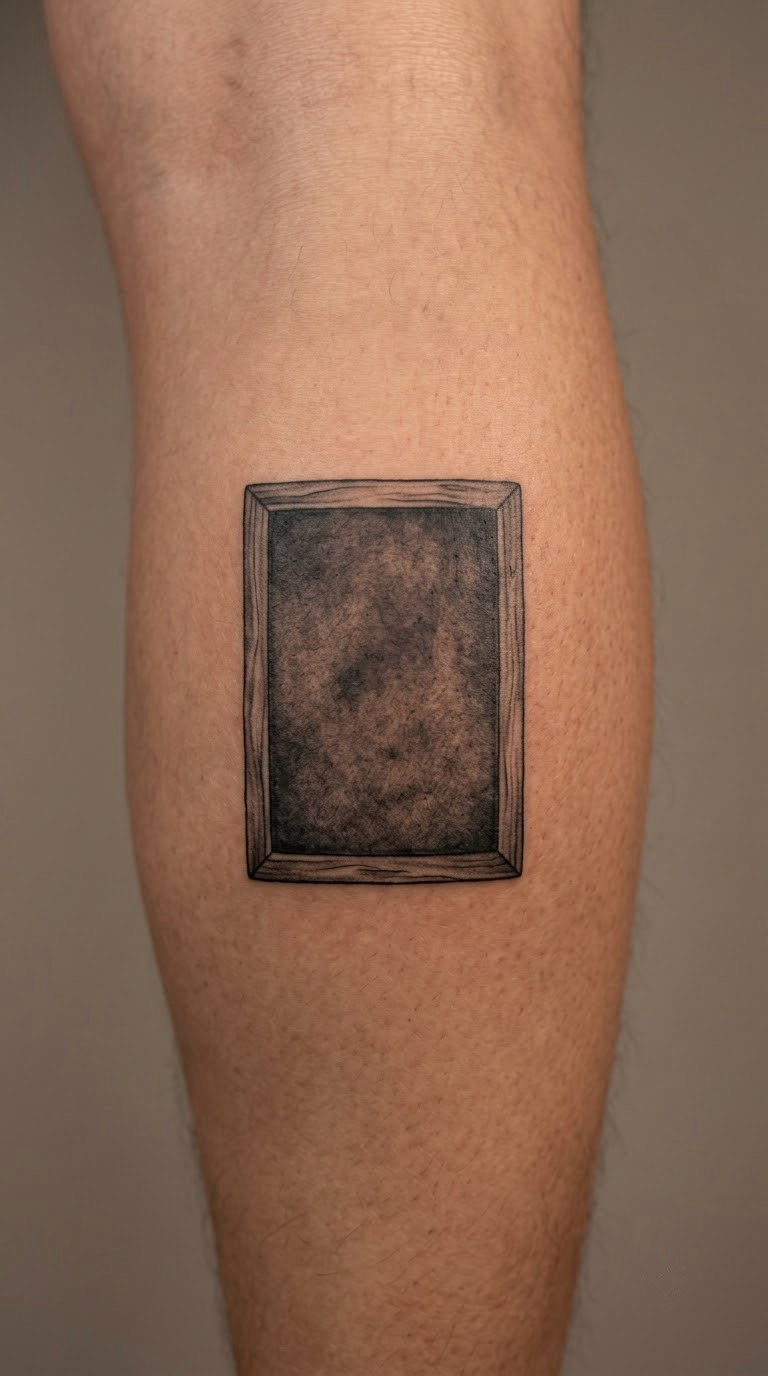
A small classroom chalkboard in a simple wooden frame, wiped clean. There might be a faint smear of grey where an answer used to be, and that smear is the only hint that anything was ever written there.
It is the visual punchline to getting to the end of a lesson with nothing to show. People who found the joke in a specific bad teacher, course or meeting tend to get it for that reason alone.
Placement: Calf, outer thigh or lower back. Size: 2.5 to 3.5 inch tall (6 to 9 cm). Style: Black and grey with light shading in the frame. Pain: Low on the calf, one of the easier places to sit through. The grey smear fades first, so ask for it to be slightly darker than you think you want.
Make it yours: Leave one small chalk mark in the corner, a single squiggle that never resolves into a word.
9. Owl Reading a Closed Book
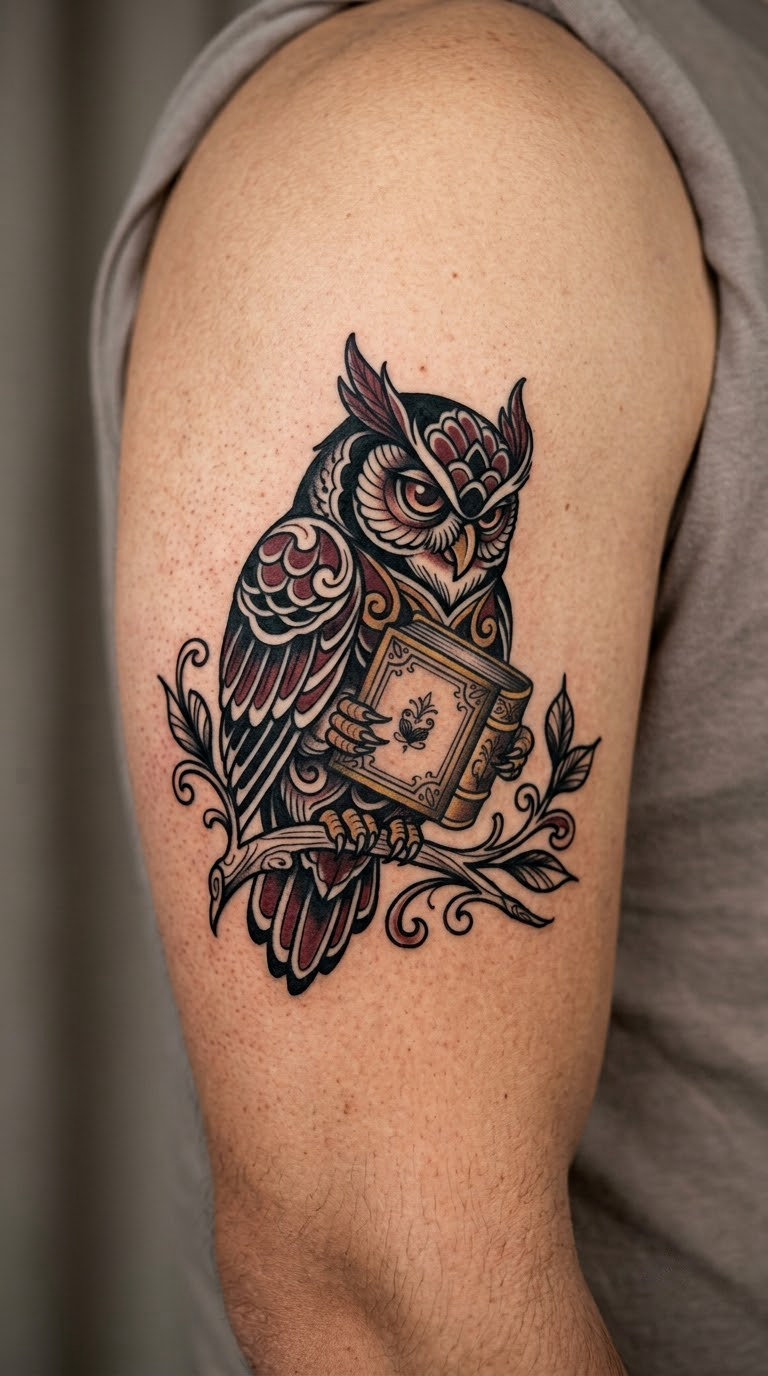
An owl with a wide-eyed, slightly cross expression, head bent over a book that is firmly shut. The contrast between the bird built for seeing in the dark and the closed book is the entire joke, and the drawing should lean into it.
This is the one design on the list that works in traditional blackwork, so it suits people who want something with a bit more presence than a plain line. Some wearers read it as the rejection of being told what to think.
Placement: Upper arm, thigh or back of the calf. Size: 3 to 4 inch tall (8 to 10 cm). Style: Neo-traditional with bold outline and one or two flat colour areas. Pain: Medium, mostly from the outline on the upper arm. Fine feather detail disappears within a few years at this size, so stylise rather than illustrate.
Make it yours: Add a single red accent on the book cover, which reads clearly from across a room and nowhere else.
10. Eye Under a Peek-a-Boo Curtain
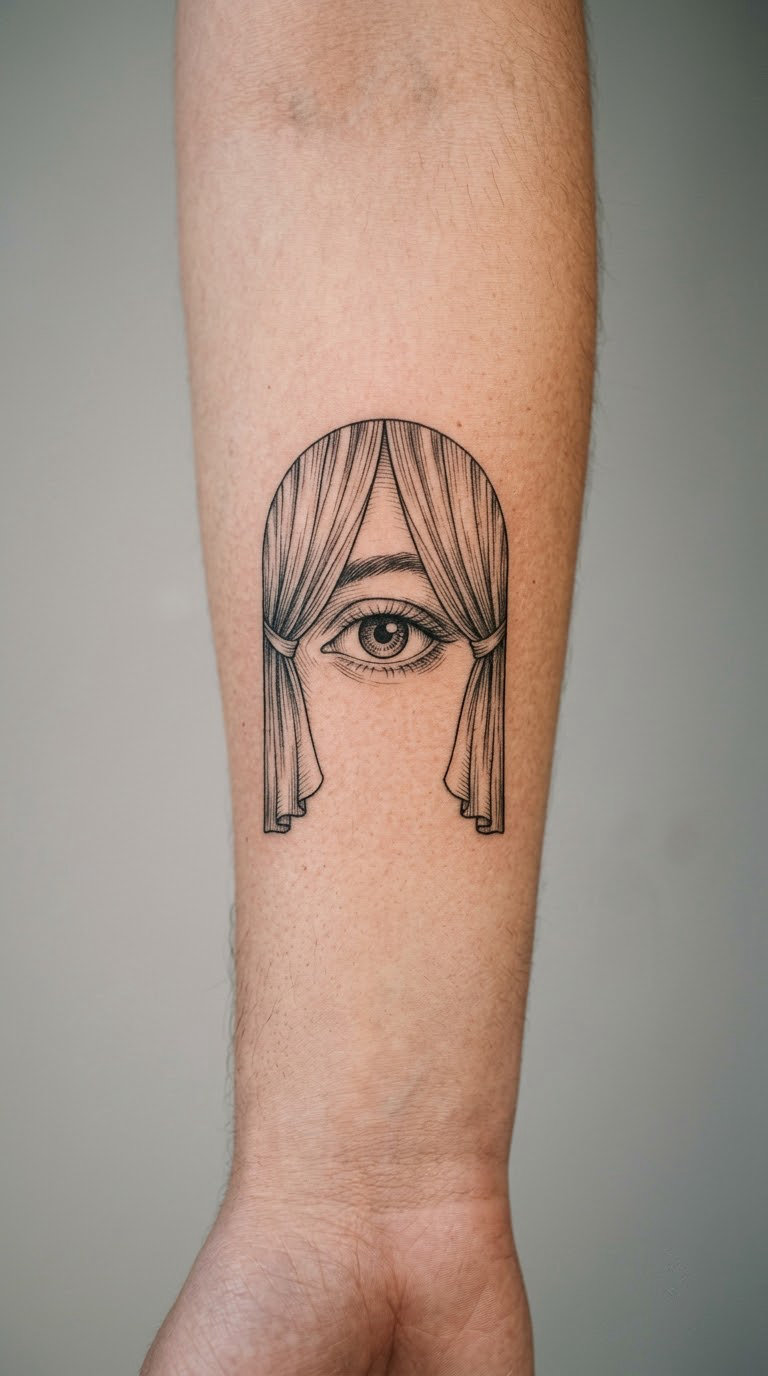
One eye looking out from between the edge of a gathered curtain, with the rest of the face left out entirely. The curtain is a few loose folds in a single line, and the eye is the only detailed part of the drawing.
It sits somewhere between curiosity and deliberate not looking, and which one people intend is usually left open. The eye is the only realistic element in the composition, which makes the surrounding mess look deliberate by comparison.
Placement: Inner forearm, inner upper arm or behind the shoulder blade. Size: 2 to 3 inch wide (5 to 8 cm). Style: Fine line with one simple iris, no lashes, no shading. Pain: Low. The eye is the only part worth protecting long-term, so it should be the largest element rather than the smallest.
Make it yours: Have the curtain fall across the eye so it is only half visible, which turns a simple eye into a more interesting optical trick.
11. Lightbulb With Missing Filament
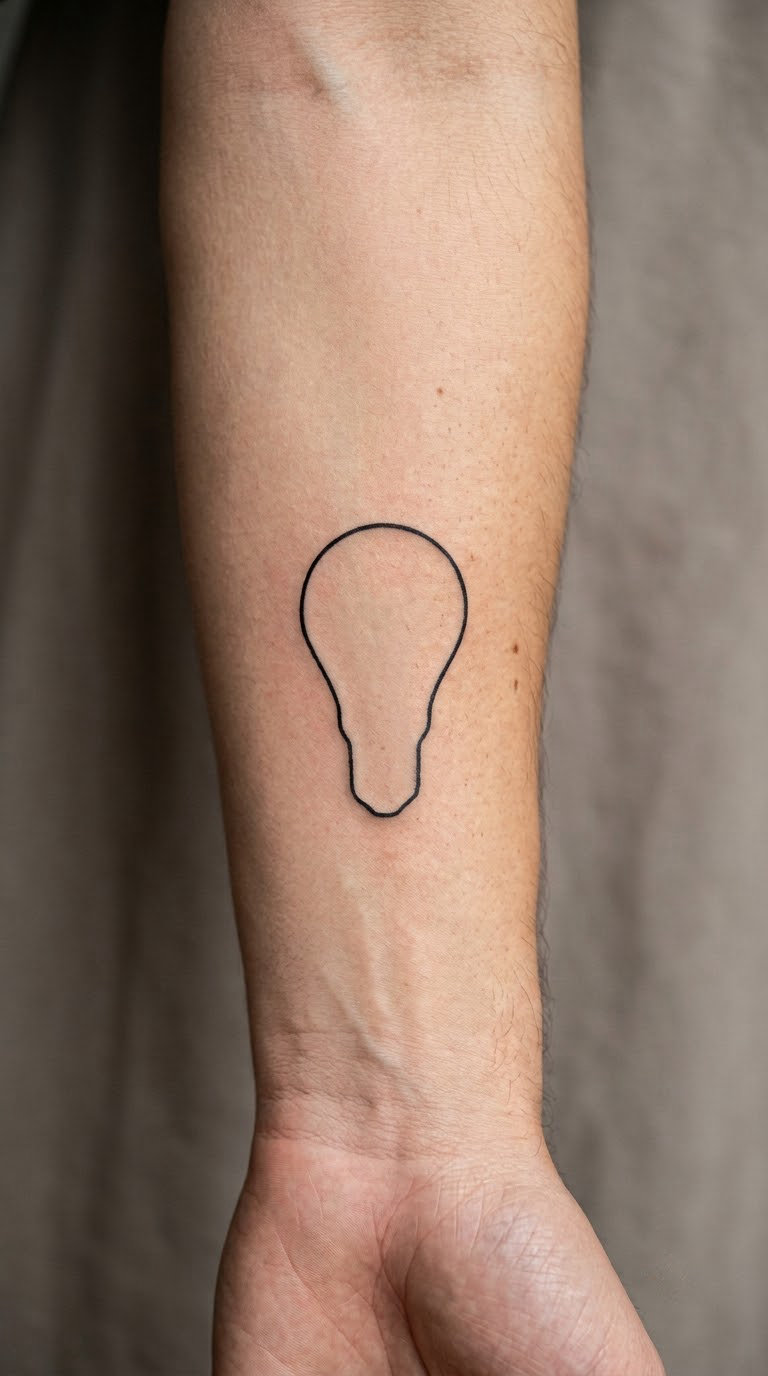
A lightbulb drawn as a plain circle with a small base, and nothing inside it. The filament, which is the entire point of every other lightbulb drawing, is simply absent. The screw base is usually three short lines and it is the only place with any detail.
It plays on the idea of an idea that has not landed yet, or a mind that has decided not to have it. It also works as a plain graphic shape, which is why it photographs well and reads at a distance.
Placement: Forearm, upper arm or the inside of the upper arm. Size: 1.5 to 2.5 inch tall (4 to 6 cm). Style: Minimal black outline, no fill. Pain: Low. A simple closed outline is one of the quickest sessions in this list.
Make it yours: Leave three tiny dots floating above the bulb where the filament should be, as though the thought just left.
12. Stack of Unread Books
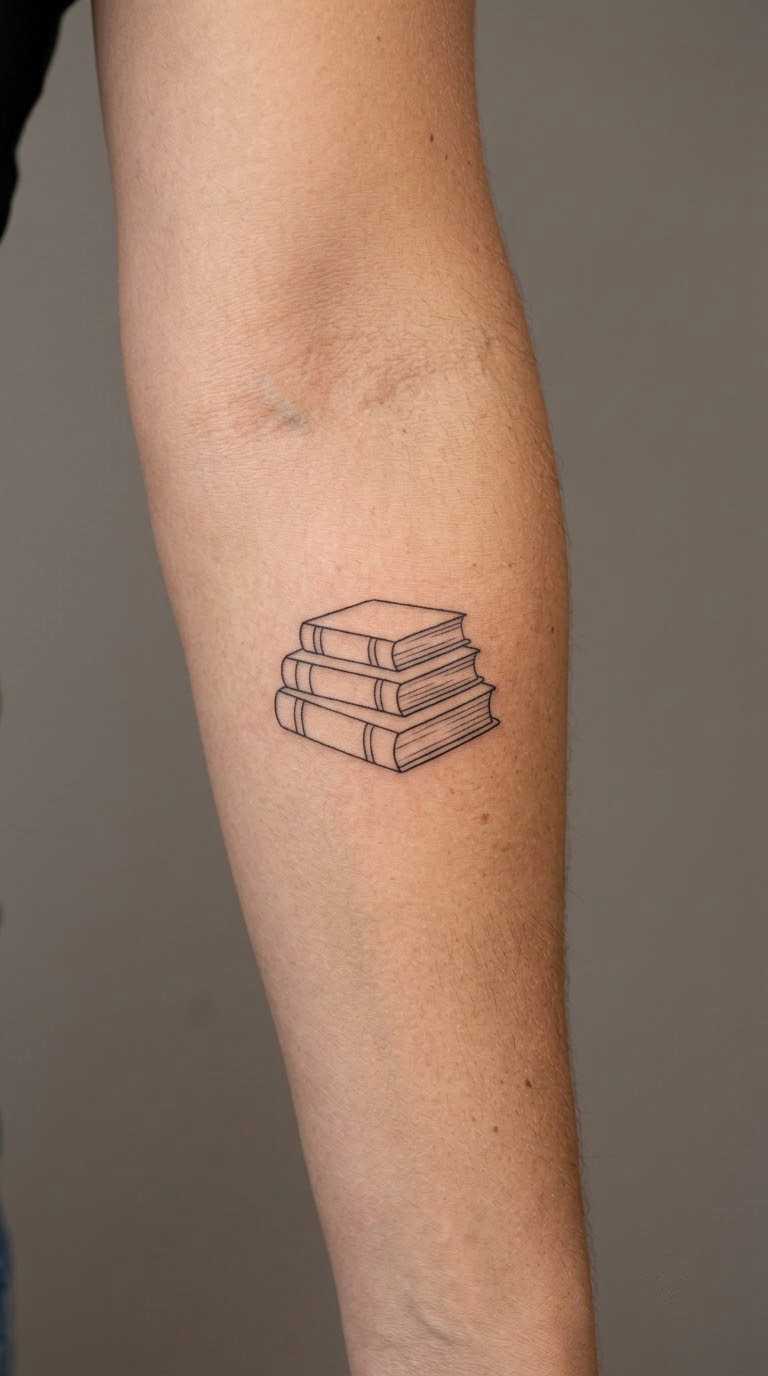
Three books stacked slightly out of alignment, drawn in outline with the page edges shown as short lines on the visible sides. No titles, no lettering, no writing anywhere on the covers. The uneven lean of the top book does most of the work.
It is procrastination, overwhelm or simply a refusal to be interested, depending on who is wearing it. Because it is all outline, it can be scaled down further than almost anything else here and still read clearly.
Placement: Outer forearm, wrist or the flat of the upper arm. Size: 2 to 3 inch tall (5 to 8 cm). Style: Fine line, black only. Pain: Low. The stacks of page lines are where the fading shows, so give them a little more spacing than feels necessary when the stencil goes on.
Make it yours: Add a bookmark ribbon trailing out of the middle book and running off the edge of the design, as though someone meant to come back to it.
13. Broken Compass
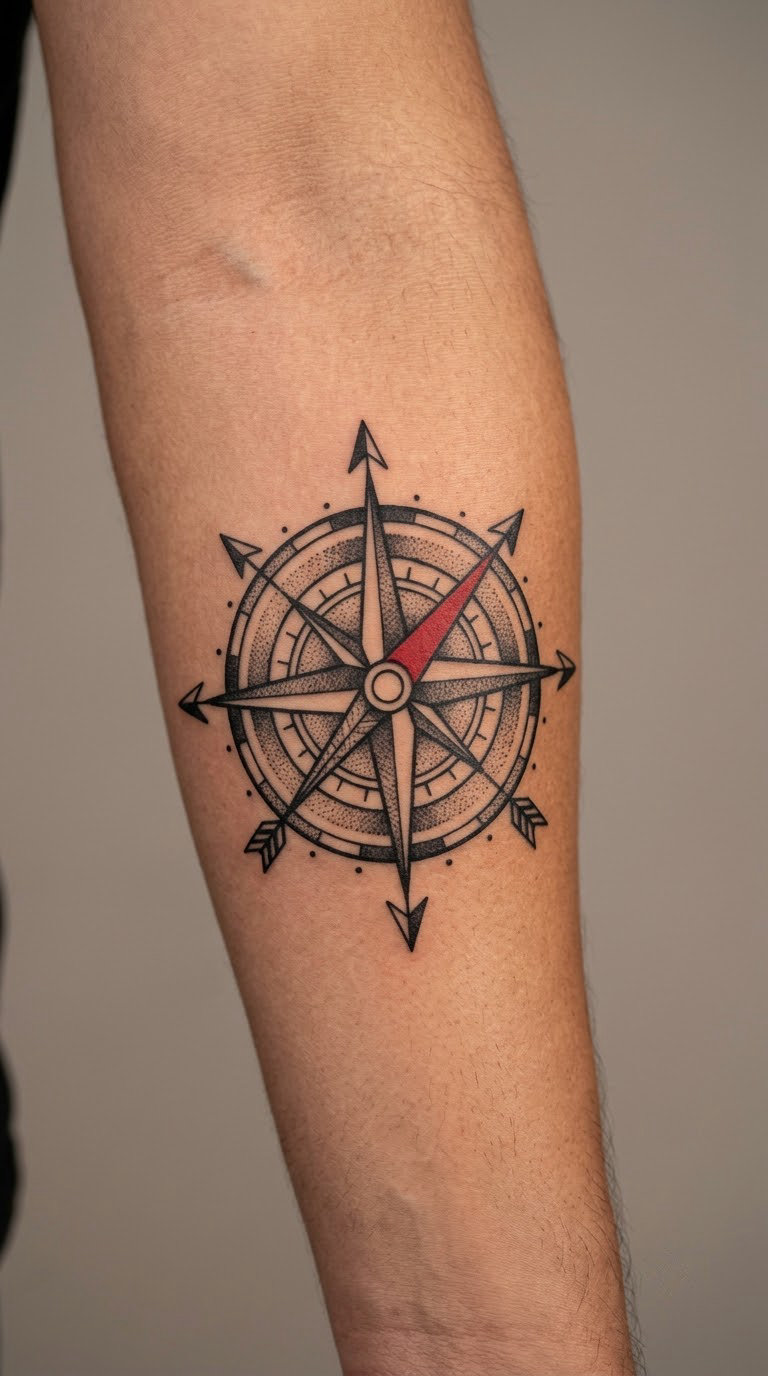
A standard compass rose with a needle that is pointing somewhere it should not be. The circle, the cardinal points and the tick marks are all drawn straight, so the only wrong thing in the whole design is the one element that was supposed to be reliable.
It stands for moving without certainty, getting lost on purpose, or refusing a direction somebody else picked. The broken needle is also the only place red appears, which makes it impossible to miss.
Placement: Centre chest, inner forearm or the inside of the upper arm. Size: 3 to 4 inch wide (8 to 10 cm). Style: Blackwork line with a single colour accent. Pain: Medium on the chest, lower on the forearm. The sternum and collarbone area bruises noticeably and stays tender for a couple of days.
Make it yours: Add a small arrow in the direction the needle is actually pointing, so the design has somewhere to be going even if it is not north.
14. Cat Sleeping on a Textbook
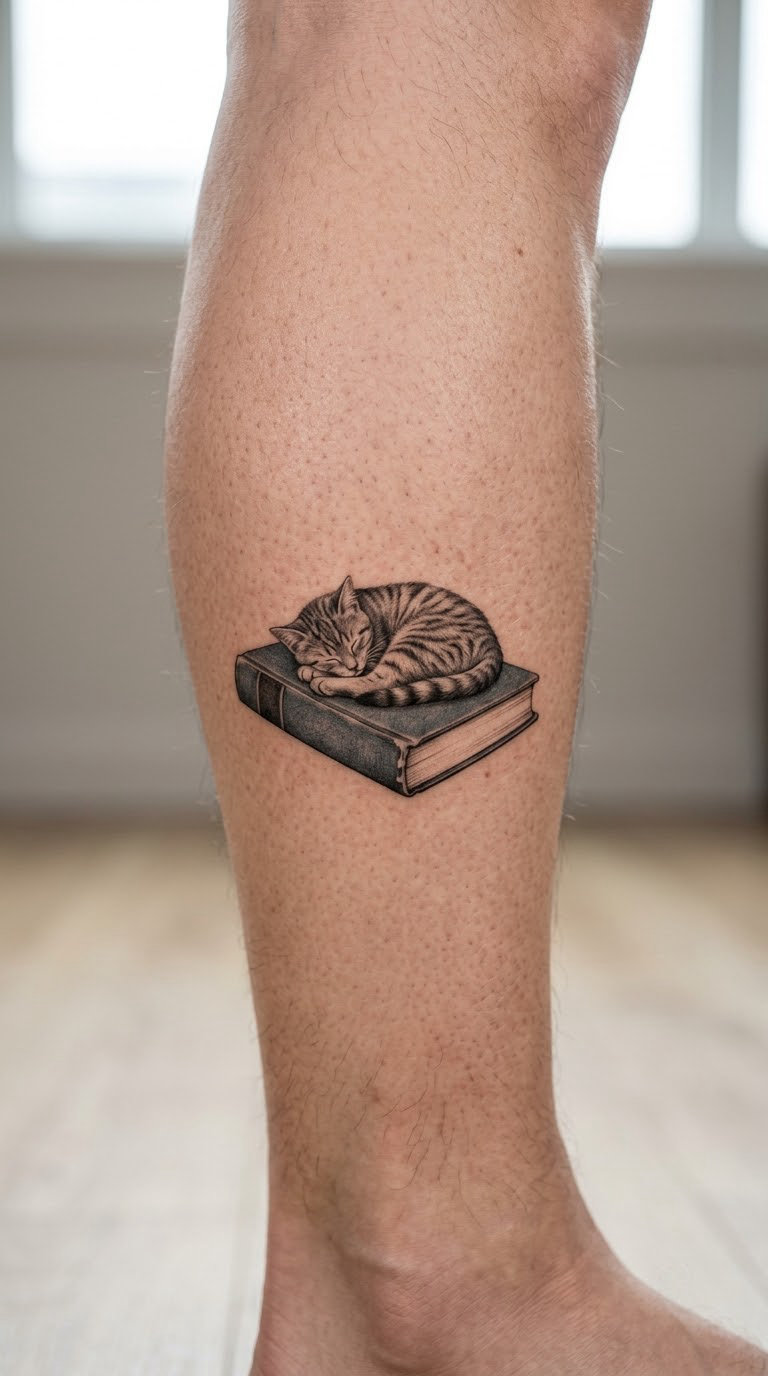
A cat curled up asleep on top of a closed book, drawn in loose line work with a few soft strokes for fur. The book stays a simple outlined rectangle under the cat, almost ignored, which is the joke in the composition.
It is the most light-hearted design here and the one people tend to explain least. Practical knowledge being peacefully ignored in favour of rest is a sentiment most wearers recognise immediately.
Placement: Calf, thigh or the inner forearm. Size: 2.5 to 3.5 inch wide (6 to 9 cm). Style: Micro-realism with restrained line work. Pain: Low on the calf and thigh. Fur detail is the part that softens first, so keep it as a suggestion of texture rather than individual hairs.
Make it yours: Have the artist draw the cat asleep in a curled position that mirrors something you actually do, like a sleeping dog shape. If you prefer animals on skin, our 20 Best Cat Silhouette Tattoo Ideas for Minimalists is the natural next step.
15. Empty Speech Bubble
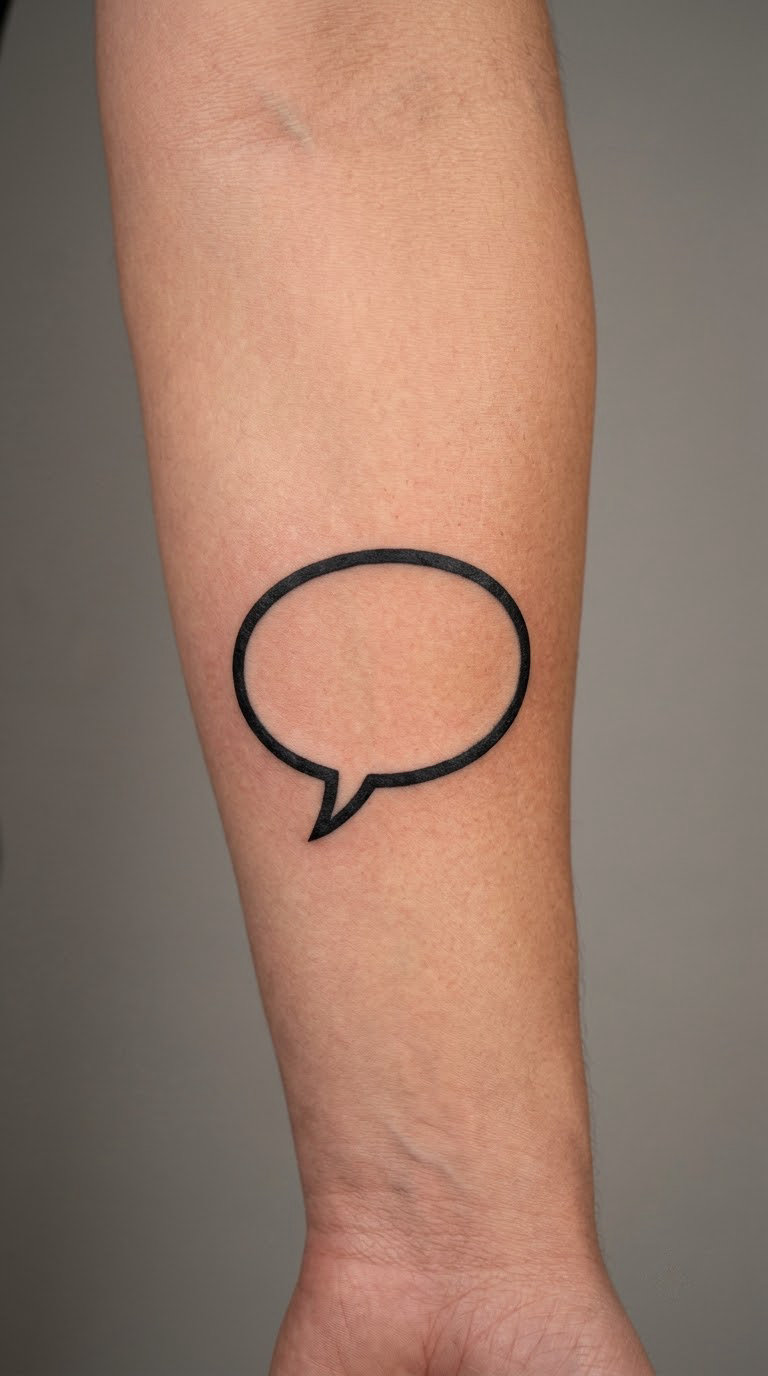
A comic book speech bubble drawn with a thick black outline and a small pointed tail, and completely empty inside. The tail points down and to one side at an angle that implies someone is talking, without anyone in the frame at all.
It can mean having nothing certain to say, choosing silence over an argument, or simply letting a joke sit there without explaining it. Wearers tend to laugh differently about it depending on who asks.
Placement: Anywhere flat: outer arm, thigh, upper back, side of the ribs. Size: 2 to 3 inch wide (5 to 8 cm). Style: Cartoon line with a bold uniform outline. Pain: Low almost everywhere it is likely to go. A thick even outline is one of the more forgiving things an artist can tattoo.
Make it yours: Put the tail pointing towards a specific part of your body, so the direction of the speech does the work instead of any words.
16. Cloud Blocking the Answers
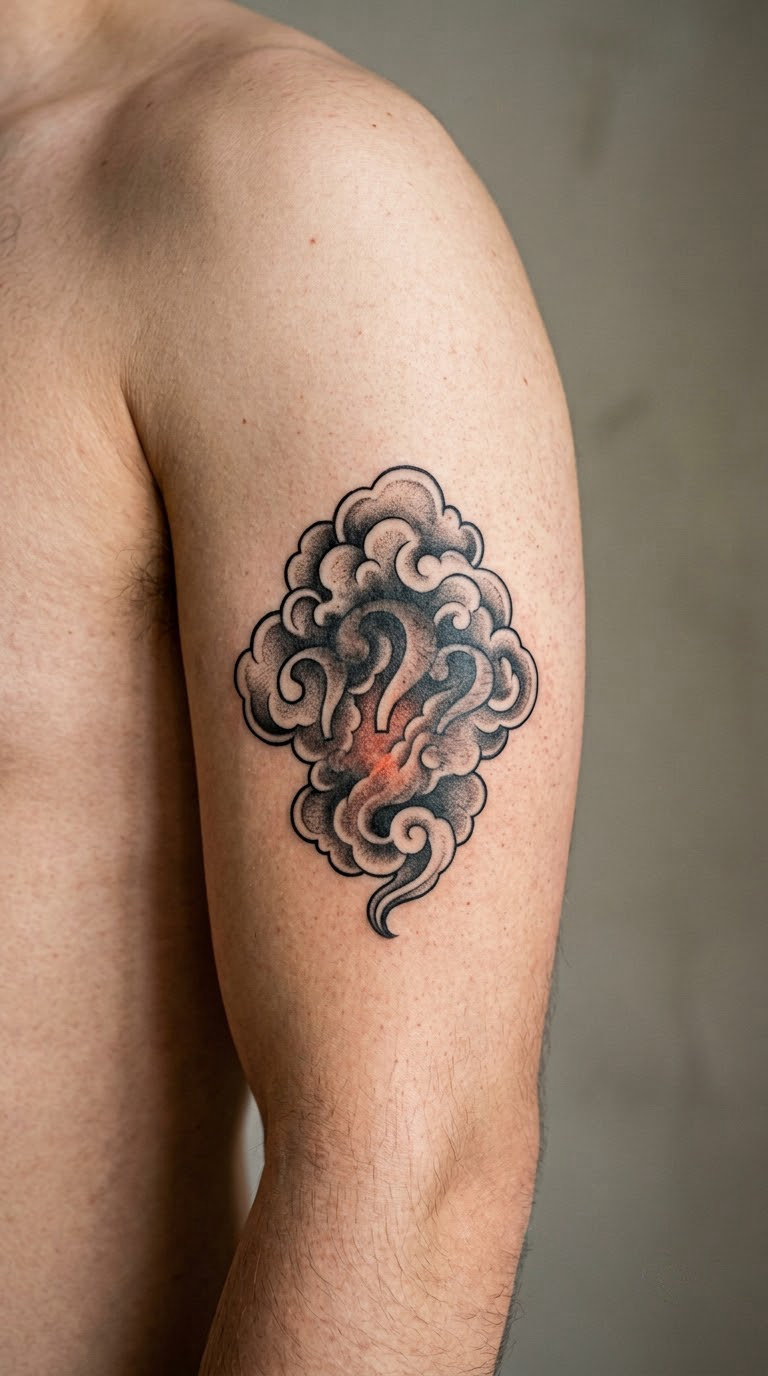
A soft cloud drawn with rounded black and grey shading, and three question marks tucked just behind its lower edge so that only their tops are visible. The cloud is the subject. The question marks are what it is sitting on top of.
It is a visual riddle with no solution printed underneath, and it creates the deliberate feeling of an answer that is being withheld. The hidden marks do the joke without anyone having to explain the design, which is what makes this one of the most tattooable of the ignorant style tattoo ideas on the list.
Placement: Upper arm, shoulder or the outer chest. Size: 3 to 4 inch wide (8 to 10 cm). Style: Black and grey with soft shading. Pain: Medium, mostly from the shaded areas which need more passes. Light grey shading is the first thing to disappear, so ask the artist to keep the darkest values solid.
Make it yours: Let a single red accent sit on one visible question mark, marking the only piece of the answer still in view.
17. Locked Cabinet of Facts
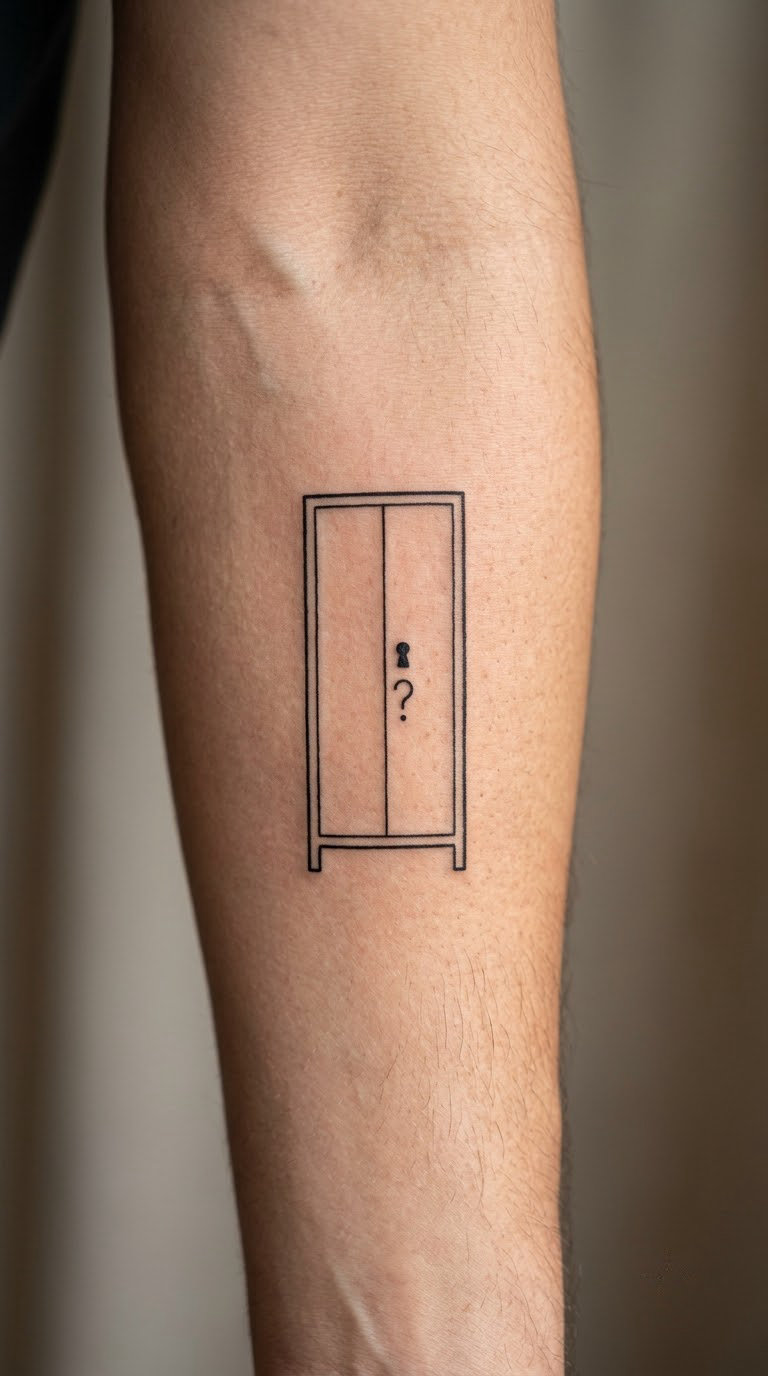
A small cabinet or filing drawer drawn in simple line art, with a round keyhole in the centre of the door and one drawer slightly pulled open. Inside the open drawer there is nothing. The keyhole does the work of saying the contents are unavailable.
It is information that exists and stays closed, which people tend to link to their own habits rather than to any grand idea. It is one of the more useful designs to have a reason behind.
Placement: Forearm, upper arm or the flat of the calf. Size: 2.5 to 3.5 inch tall (6 to 9 cm). Style: Minimal line art, black only. Pain: Low. Straight vertical and horizontal lines over a flat area are comfortable work.
Make it yours: Use a drawer pull shaped like a small question mark rather than a round knob. It is a subtle detail, visible mostly to you.
18. Finger to the Lips in Dotwork
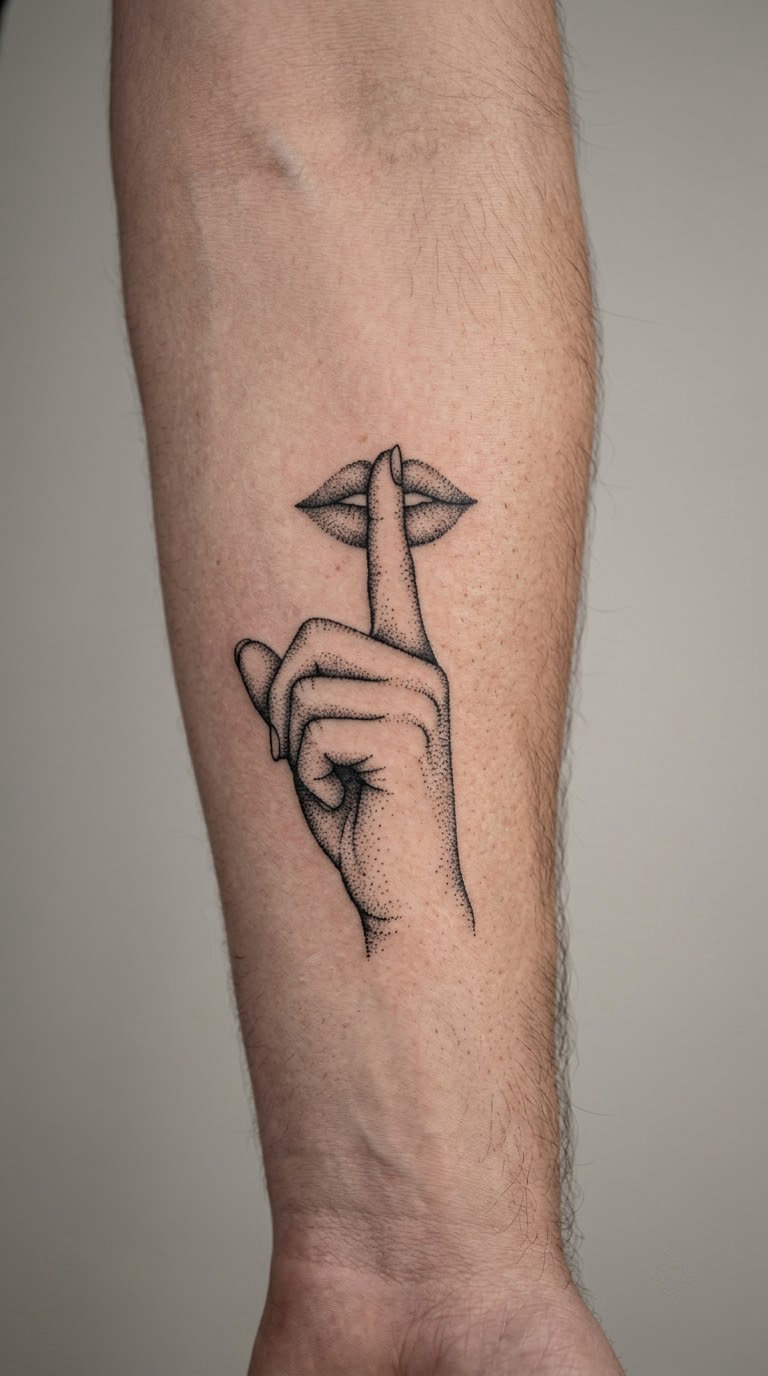
A hand with one finger across the lips, rendered entirely in dotwork rather than outline. The dots grow denser in the shadow areas, which is the only shading technique in this list that stays readable over time because it is made of black pigment rather than grey wash.
It is a restraint gesture, a request for silence, or a way of saying that some questions are staying unanswered. Dotwork suits anyone who wants the design to look quieter and more considered than a plain line.
Placement: Inner forearm, upper arm or the sternum. Size: 2 to 2.5 inch tall (5 to 6 cm). Style: Dotwork or black-and-grey dot shading. Pain: Medium. Each dot is a separate placement, so the session runs longer than the size suggests.
Make it yours: Ask for a wider dot spread in the open areas so the fade has somewhere to go, and a solid black accent on the finger to hold the shape.
19. Random Map With No Label
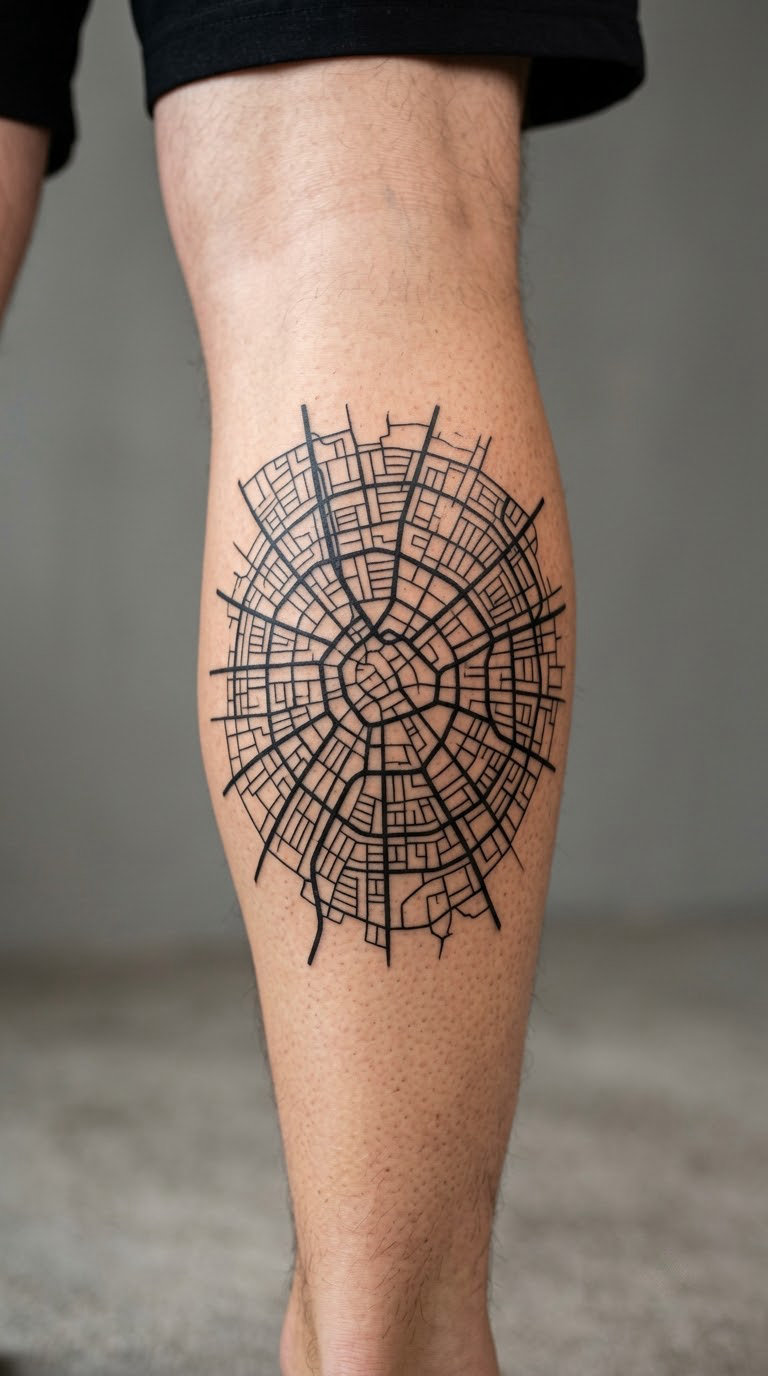
A map-like tangle of streets, blocks and a river line, drawn with no place names, no compass and no borders. It looks like a real map of somewhere until you look closely and realise there is nothing to read.
Curiosity, wandering, or a deliberate refusal to know where you are going. It also works well as a matching piece, since two maps from the same imaginary city can share street layouts without sharing coordinates.
Placement: Calf, thigh or across the shoulder blades. Size: 3 to 4 inch wide (8 to 10 cm). Style: Abstract single-line linework. Pain: Low on the calf and thigh. Fine interior street lines will blur, so the main routes should be noticeably heavier than the small ones.
Make it yours: Build the street layout around a real route you walk often, then leave every name off it. You will still recognise the shape to yourself.
20. Two Envelopes, One Unopened Question
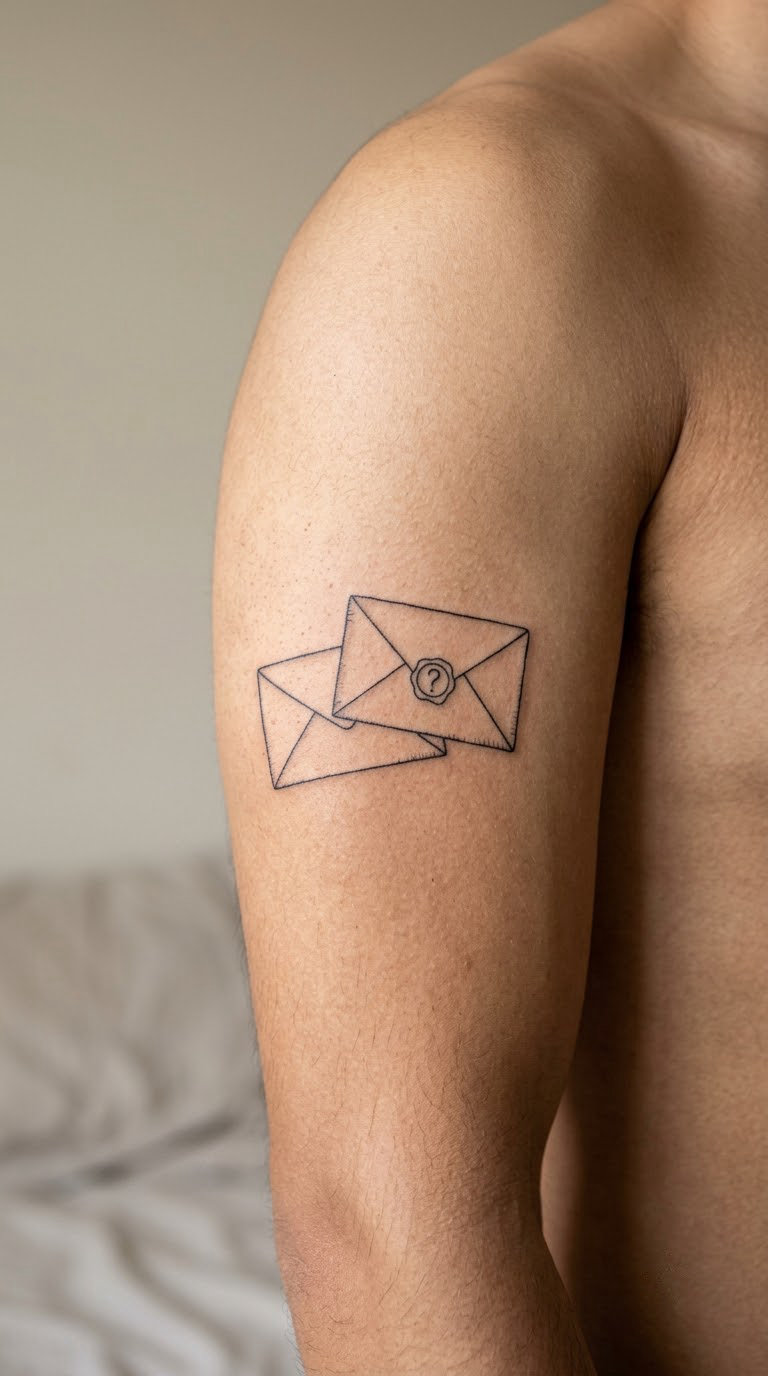
Two envelopes side by side. One is torn open and empty, drawn with a ragged flap. The other is sealed shut, with a small wax-style seal on the back carrying a single question mark. The contrast between the opened and the unopened one is the whole design.
It turns uncertainty into something you are carrying rather than something being done to you, and it works as a narrative piece in a way most of the simpler designs here do not. It is the most personal option in the collection.
Placement: Upper arm, back of the forearm or the upper back. Size: 3 to 4 inch wide (8 to 10 cm). Style: Fine line with one solid black accent in the seal. Pain: Low to medium. The torn flap is quick work; the sealed envelope needs a steadier hand across a larger area.
Make it yours: Make the opened envelope hold something tiny and specific, such as a folded scrap of blank paper, so the piece has a private detail only you know about.
How to Choose the Right Design
The best of these ignorant style tattoo ideas are usually the ones you can describe in one sentence. Five things decide whether a design like that works once it is on skin, and it is worth going through them before the consultation rather than after.
- Theme before image. Decide whether you are after the idea of not knowing, the joke, or the honest imperfection of the drawing. Two very different designs can carry the same theme, and the theme is the part that has to age well.
- Line weight over detail. Ask what happens in fifteen years. Thin single-needle lines soften, especially on inner arms, behind the ear and anywhere on the hands. Chunky confident lines with generous spacing survive far better.
- Size you can see. If you want to read the design from across a room, it needs to be at least three inches. If it is for yourself only, anything under an inch works and heals far more cleanly.
- Placement you will actually see. A design behind the ear or on the inner arm is private. On the outer arm it is a conversation. Both are valid, but they are different commitments and it is worth deciding which one you want.
- A real reason underneath. Designs with a specific personal reason behind them tend to survive a bad patch far better than purely aesthetic ones, because the reason is not a matter of taste.
Cost and Session Time
Realistic United States ranges, which vary a great deal by city and by the hourly rate of the artist you choose.
- Micro, under 1 inch: roughly 60 to 150 USD, 10 to 20 minutes. Many shops apply a minimum that sits well above the per-hour rate, so micro work is often priced as a full short session.
- Small flash, 1 to 3 inch: roughly 120 to 300 USD, 20 to 45 minutes.
- Medium composition, 3 to 4 inch: roughly 250 to 600 USD, 45 minutes to 90 minutes. Designs with several elements, such as the envelope pair or the owl with a book, sit at the upper end.
- Dotwork, per session: 2 to 3 hours for roughly a 2 inch piece, because the dots are placed individually. Many artists offer a session cap rather than a finished-piece price for this.
Shop minimums, artist rates, city and complexity all move the final number, and the only reliable figure is the one your artist quotes after seeing the design. Ask what the minimum is before you agree, especially for anything small.
Aftercare Basics
Always start from your artist’s aftercare instructions, since they know exactly what they put in your skin. The general version looks like this.
- Follow your artist’s aftercare guidance first, including any specific wash timing they give you on the day.
- Wash gently with clean water and a mild unscented soap, then pat the area dry rather than rubbing it.
- Use nothing else on the fresh tattoo for the first few days unless your artist told you otherwise. No creams from a shop shelf, no fragranced products, no heavy lotions.
- Keep it out of direct sun, and skip swimming pools, hot tubs and the sea while the skin is still healing.
- Wear loose clothing over the design for the first two weeks so fabric does not stick to the ink.
- Watch for warning signs such as spreading redness, swelling, heat, discharge or a fever, and contact a doctor or your artist if any of them appear. Do not wait it out.
Frequently Asked Questions
What does an ignorant style tattoo mean?
Ignorant style tattoos are intentionally simple, crude black-ink designs with confident linework, no shading and often no colour. They look like notebook doodles, stick-and-poke work or old prison tattoos, and the roughness is deliberate rather than a mistake. People usually choose them for the humour, the anti-aesthetic joke, or the sense of a private joke that nobody else is in on. The style is sometimes also called naive style.
What is a good ignorant style tattoo for a first tattoo?
A single question mark or a small lightbulb outline are the safest first choices. Both use one unbroken line, need very little detail and heal quickly, which matters more than it sounds for your first session. Avoid anything on the hands or fingers as a first piece, because that skin fades and smudges faster than anywhere else on the body.
Where should a small ignorance-themed tattoo be placed?
Inner forearm, behind the ear, the outer arm and the calf are the most practical spots for small work in this style. Inner forearm and behind the ear keep it private, while the outer arm and calf read clearly from a distance. The hand and fingers fade the fastest and should be avoided unless you are prepared for the design to soften noticeably within a few years.
How much do ignorant style tattoos cost?
In the United States, micro work under one inch usually runs from about 60 to 150 USD, small flash from 1 to 3 inches roughly 120 to 300 USD, and larger 3 to 4 inch compositions roughly 250 to 600 USD. Dotwork takes longer because each dot is placed by hand, so artists often charge per session. Shop minimums and city rates move these numbers more than complexity does.
Which ignorance tattoo design will age best?
Solid black shapes and heavy single lines age best, because the design only needs a small amount of pigment to stay legible. Thin fine-line work, light grey shading and small interior details such as book page edges or map streets lose definition within a decade. A good test is to squint at the stencil: if the design still reads as a shape, it will age well. If it only reads up close, it will not.
Can I personalize an ignorant style tattoo without adding text?
Yes, and it is usually better. Scale, rotation and one altered detail do most of the work: tilt a cluster of marks, enlarge the hidden element in a composition, or add a single colour accent somewhere unexpected. Matching pieces work well, since two designs from the same imaginary set can share shapes without being identical. Text is the one element that dates a design fastest, so most wearers skip it.
Conclusion
If this is your first tattoo, the fine-line question mark on the inner forearm is the easy way in: small, quick, low pain, and easy to place where only you will see it. If you are already collecting pieces, the envelope pair or the cloud with hidden question marks give you something with a bit more to it and a story to explain. Either way, pick from the ignorant style tattoo ideas that still look like something to you a year from now, not just today.
Whichever direction you take, pick an artist whose portfolio actually contains this style, check healed work rather than fresh posts, and agree on placement, scale and line weight at the consultation. Those three decisions matter more than which design you pick.