
How Much Does a Full Sleeve Tattoo Cost? October 2026
Most full sleeve tattoos in the US cost between $1,500 and $4,000, and highly detailed or premium work regularly runs past $5,000. The number is built from time: the artist’s rate multiplied by the hours your design actually needs, plus the complexity of the style, how much of the limb you are covering, and the extras most people forget. If you are planning this for 2026, book a consultation rather than a session. A half sleeve is a much smaller commitment, and our half sleeve pricing guide covers that side of the budget.
I have watched a lot of people get their first big quote and assume they are being taken advantage of. Usually the sticker shock is not the artist gouging you — it is that nobody had told the client how many hours go into a piece that looks like one drawing on skin. That gap is what this guide closes.
How Much Does a Full Sleeve Tattoo Cost?
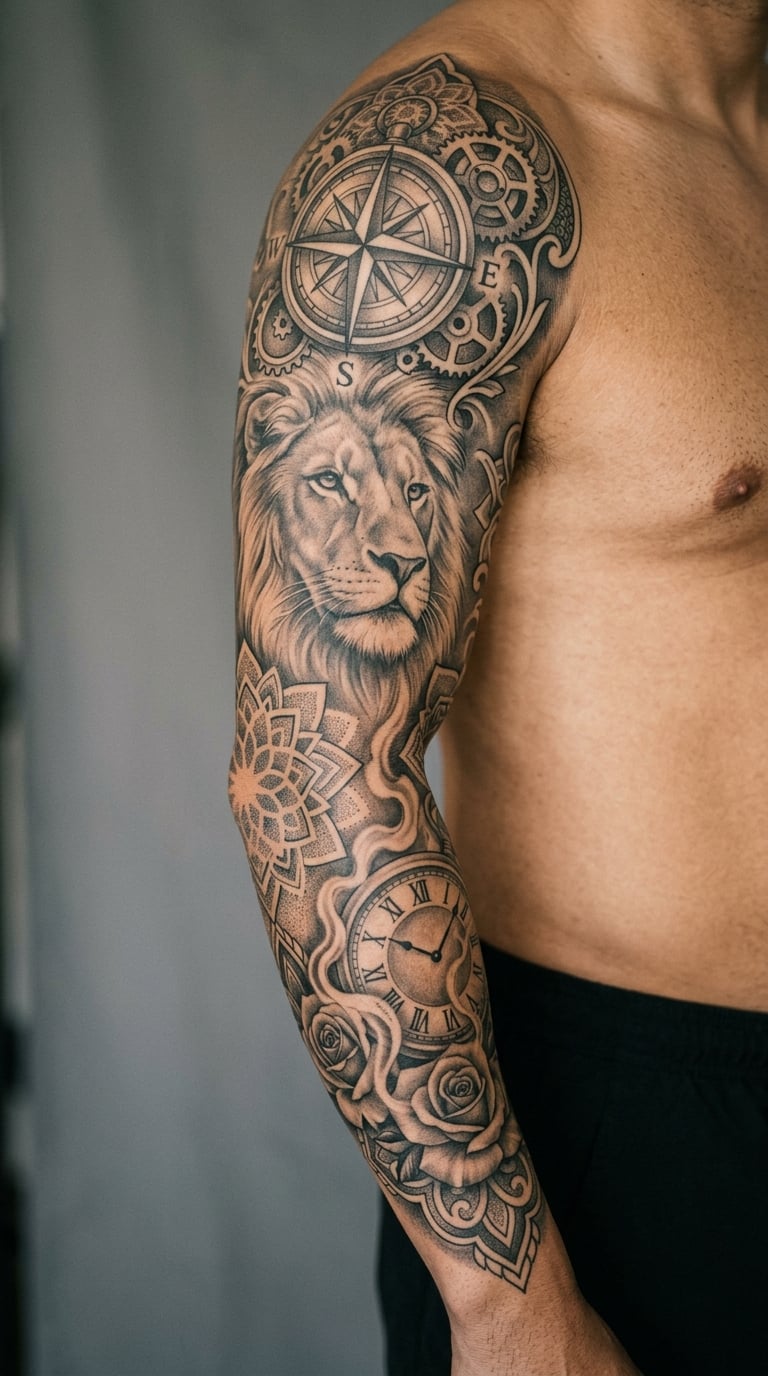
Here is the honest range, reconciled. Individual artists often quote $1,000 to $4,000 for a full sleeve and say $5,000 is not unusual above that. Shops and booking guides tend to quote $2,000 to $6,000, because they count consultation time, tip and aftercare into the total. Premium and celebrity-tier artists run $8,000 to $10,000 and beyond.
Those three numbers are not in conflict. They are measuring different things. An artist’s figure is usually the session bill alone. A shop’s figure is the whole project. The premium figure is a different market entirely, where booking is waitlisted by the year.
The 20 to 40 hours of actual tattooing is where the consensus sits, spread across 4 to 8 or more healing-separated sessions. At a normal working rate of $150 to $200 an hour, twenty hours is $3,000 before you tip and forty hours is $8,000. The hours are the price. Everything else is a multiplier on top of them.
One last framing that helps more than any formula: most people underestimate the hour count, not the rate. Nobody has ever told a client their sleeve would go faster than they thought.
Full Sleeve Tattoo Price Ranges by Size and Detail
Detail density is the single biggest driver. A bold blackwork sleeve that reads clearly at a distance uses a fast, confident hand. Soft grey wash realism and packed colour packing do not.
| Sleeve type | Tattooing hours | Sessions | Typical US total | What moves the number |
|---|---|---|---|---|
| Simple blackwork sleeve, bold shapes, little shading | 12-18 | 3-4 | $1,200-$2,500 | Line weight, how much open skin the design leaves |
| Balanced black and grey sleeve with grey wash shading | 20-30 | 4-6 | $2,500-$4,500 | Shading depth, background coverage, background drops |
| Traditional or Japanese sleeve, heavy colour packing | 30-45 | 6-9 | $4,000-$7,000 | Colour saturation, wraparound fit, hand and neck work |
| Highly detailed realism or illustrative sleeve | 40-60+ | 8-12 | $6,000-$12,000+ | Detail density, micro-work, session length limits |
Now the question people actually type: how big is a tattoo for a given budget. This is the most useful table on the page, so here it is straight.
| Total budget | What it realistically buys | Hours | Sessions |
|---|---|---|---|
| Under $500 | A small piece, or one section of a sleeve planned in stages | 2-4 | 1 |
| Around $1,000 | A quarter to half sleeve of simple blackwork | 5-8 | 1-2 |
| Around $2,000 | A half sleeve, or a simple full sleeve with an experienced artist at a moderate rate | 10-14 | 2-3 |
| Around $3,000 | A solid full sleeve of moderate detail, most commonly a black and grey or simple traditional | 15-20 | 3-5 |
| Around $5,000 | A detailed full arm sleeve with a wraparound back piece, or a full leg sleeve at a good rate | 25-35 | 5-8 |
| Around $10,000 | A premium-tier full sleeve with full colour realism, wraparound flow and hand or neck integration | 45-60 | 8-12 |
Two honest caveats on that table. A $10,000 sleeve is not a ripoff — it is a normal price for a well-known artist, and asking whether it is too much depends entirely on whose hand you want on the work. And a low budget spent on a better artist and a simpler design almost always beats a bigger budget spent on a weak portfolio.
What Determines the Price of a Full Sleeve?
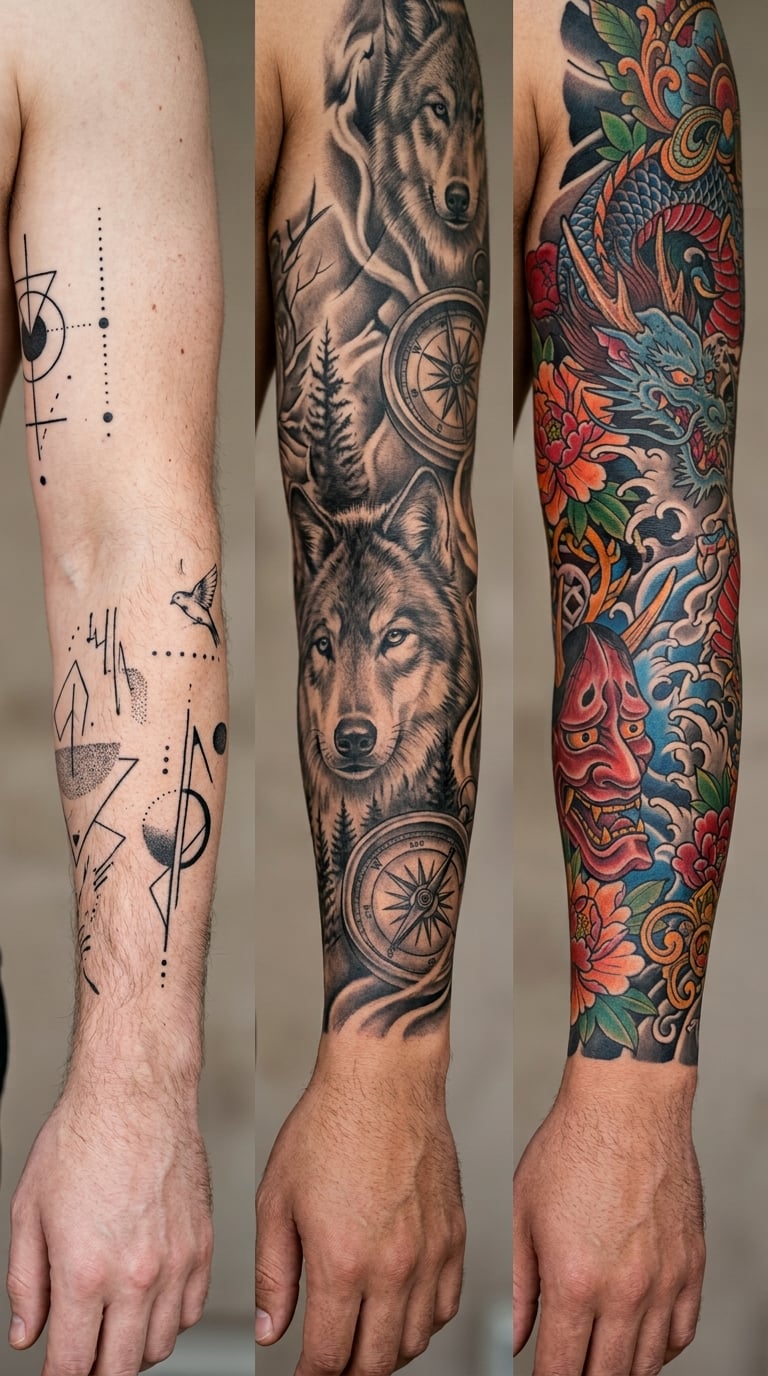
Six factors do most of the work. Read them in order and you can estimate your own sleeve before you ever make contact with a shop.
- Hours of actual tattooing. The base unit of every quote. A full sleeve is roughly 20 to 40 hours, and highly detailed work runs past 60.
- Artist rate. Beginner artists commonly charge $50 to $100 an hour, solid professionals $100 to $200, sought-after specialists $200 to $500, and celebrity-tier names $600 and up. A full day rate usually falls somewhere between $1,000 and $2,500.
- Detail and style. Fine line and blackwork go fast. Grey wash realism, colour realism and illustrative detail take two to three times as long for the same coverage.
- Colour count and packing. Every colour transition is a separate pass. Saturated traditional colour and Japanese work add meaningful hours over black and grey.
- Body coverage and placement. Shoulder to wrist on an arm is the reference point. Anything that wraps the back, crosses the elbow, climbs the neck or adds the hand costs more because the artist is working around bone, joints and awkward angles.
- Location and shop minimum. Rates run roughly 20% above the national average on the West Coast, about 10% above on the East Coast, and 5 to 10% below in the Midwest and South. Most shops also enforce a minimum charge, commonly $100 to $200, which sets the floor for any session.
Two more sit behind those. Existing tattoos in the area have to be worked around or covered, which adds hours. And custom design labour — the hours your artist spends drawing and revising before a single needle touches you — is usually unpaid and unbilled, typically 3 to 8 hours or more on a piece this size.
How Tattoo Artists Calculate Sleeve Quotes
Most shops run one of two models. Hourly is simpler: you pay a rate times the hours sat in the chair. Project or flat rate is a single agreed price for a defined scope, which is common on small pieces but rarer on a custom full sleeve. The tattoo community consensus is that hourly is safer for large custom work, because scope creep on a flat rate is absorbed by the artist and you have no visibility into how long a session ran.
A real quote needs five things from you: the placement, an approximate size, a style reference, your colour plan, and images you actually like. Without those, a good artist will give you a range instead of a number, and that is a sign of competence, not evasion.
Here is the arithmetic end to end, because nobody on the search results page does it properly.
An artist at $175 an hour quotes a colour sleeve at 32 hours across 5 sessions. That is $5,600 for the tattooing. Add a $300 deposit (credited against the final bill), a 15% tip spread across sessions (about $840), a $75 consultation (usually deducted), and $35 of aftercare product. Real total: $6,250.
Now the same sleeve at $250 an hour and 26 hours, because the artist works faster and the design is simpler: $6,500 before extras, $7,600 after them. The cheaper rate produced the bigger bill. That is the thing nobody warns you about, and it is why the hours matter more than the rate.
Community cost reports follow the same pattern. On r/tattoo, a full sleeve quoted at $691 for 4.5 hours — about $154 an hour — was checked by commenters and treated as completely normal. On r/Unexpected, one client described a sleeve built over two sessions a month for six months at roughly $100 an hour, totalling about $3,000. Working artists on r/TattooArtists put a half day at $400 to $600 and a full day at $800 to $1,000, and one widely shared reality check puts a full leg sleeve at 80 hours over 9 days at $1,400 a day — about $12,600.
That last number is the outlier that proves the rule. Long projects get scheduled months apart, and rates do not always hold still across them. Ask whether your quote locks the rate for the whole project.
How Much Does a Full Sleeve Tattoo Cost by Placement?
Coverage is the difference between a quote and a bill. Two pieces that look identical on a portfolio page can be an hour apart on skin because of where they sit.
| Placement | Coverage | Hours | Typical US total | Planning note |
|---|---|---|---|---|
| Half sleeve, shoulder to elbow | Upper arm | 10-16 | $1,200-$2,500 | Good first step; easy to extend later into a full sleeve |
| Three-quarter sleeve, shoulder to mid-forearm | Upper arm and most of the forearm | 16-26 | $2,000-$4,000 | Crosses the elbow, which slows the artist down |
| Full arm sleeve, shoulder to wrist | Entire arm | 20-40 | $2,500-$6,000 | With a back piece, add 25-40% |
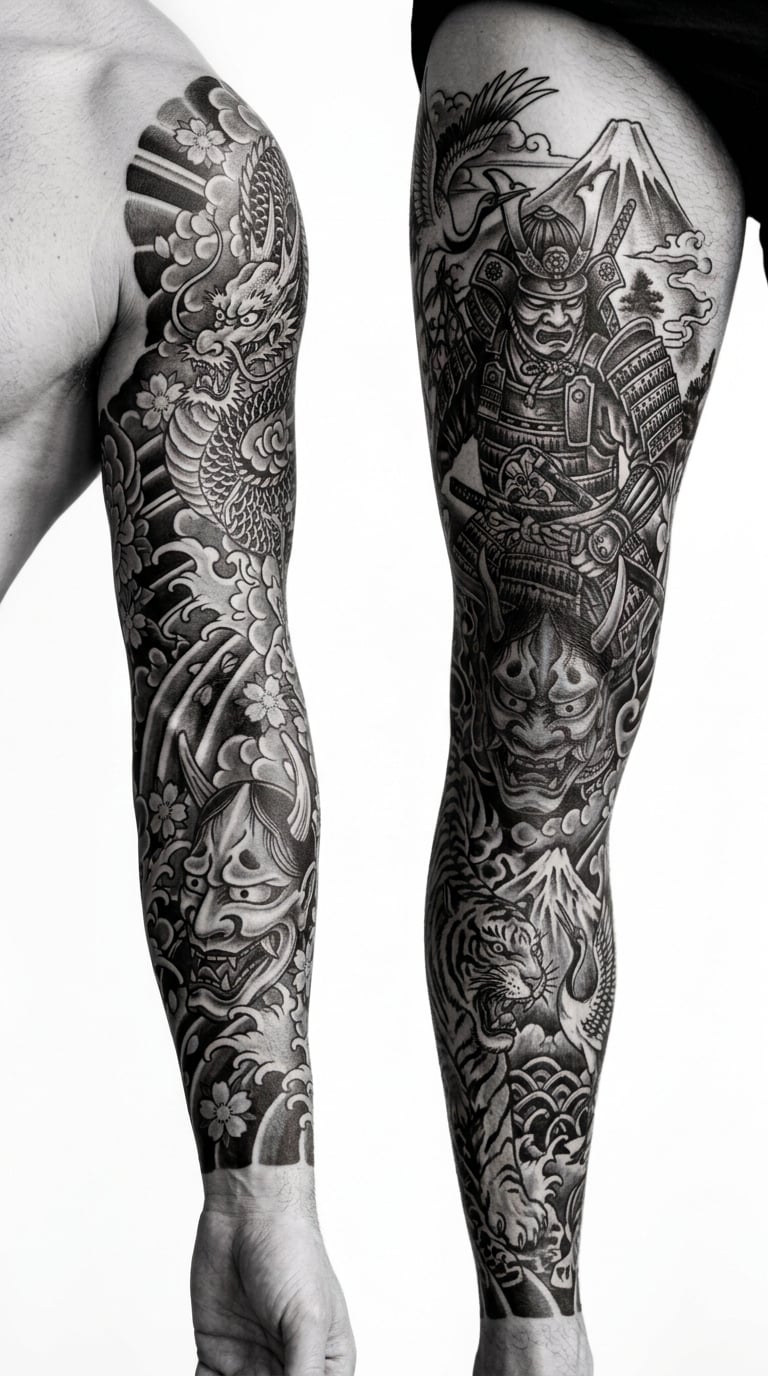
| Full leg sleeve, thigh to ankle | Entire leg | 35-60 | $4,500-$9,000+ | Larger canvas than an arm; usually more sessions |
| Sleeve plus hand, neck or shoulder cap | Arm plus extra | 30-50 | $4,000-$8,000 | Bony, high-visibility and slow to work |
Leg sleeves run dearer for a simple reason: more surface. Thigh, knee, calf and ankle together cover considerably more skin than shoulder to wrist, and the knee in particular slows an artist down badly. If you have been quoted a full leg sleeve for the same money as a full arm sleeve, ask why before you accept it.
If you want a fuller picture of how the hours break down by body part, how long a sleeve tattoo takes walks through the session structure in detail.
Does a Full Sleeve Tattoo Hurt?
Yes, and it is a long conversation rather than a sharp one. Most people describe a full sleeve as a deep, persistent scratch that comes in waves, with the elbow and inner forearm as the difficult stretches. Pain varies enormously between people and between sessions, so treat any table as a rough map rather than a promise.
| Placement | Reported discomfort | What it feels like |
|---|---|---|
| Shoulder and upper arm | Low to medium | Bony at the top of the arm, easing into muscle below |
| Elbow | High | Bone right under the skin; the most commonly dreaded spot on an arm |
| Inner forearm | High | Thin skin over sensitive tissue, especially near the wrist |
| Outer forearm and wrist | Low to medium | Typically the easiest part of an arm sleeve |
| Ribs and side | High | Only relevant if your sleeve climbs higher than the arm |
| Thigh | Low to medium | Large muscle mass; the most forgiving part of a leg sleeve |
| Knee | High | Directly over bone, same problem as the elbow |
| Calf and ankle | Medium to high | Tendons and thin skin near the ankle |
Two things worth knowing. Numbing cream helps on the outer arm and hurts more than it helps on the elbow, and many artists will not use it on a full sleeve because it restricts how long they can work. And the elbow stretches are the reason a four-hour session often turns into three and a half — artists stop before a fresh tattoo is overworked, which is also why session count and cost are so closely linked. For comparison, single small pieces are a completely different budget conversation; our guide to what small tattoos cost covers those.
How Many Sessions Does a Full Sleeve Take?
Plan on 4 to 8 sessions for a standard full sleeve, and more for a traditional or highly detailed one. Sessions are separated by healing time, usually two to three weeks minimum, so a six-session sleeve is a four to six month project.
| Complexity | Hours | Sessions | Realistic project length | US planning range |
|---|---|---|---|---|
| Simple blackwork | 12-18 | 3-4 | 2-3 months | $1,200-$2,500 |
| Balanced detail | 20-30 | 4-6 | 3-5 months | $2,500-$4,500 |
| Traditional or Japanese, full colour | 30-45 | 6-9 | 5-8 months | $4,000-$7,000 |
| High detail or realism | 40-60+ | 8-12 | 6-12 months | $6,000-$12,000+ |
Two effects inflate this. Scheduling does: a popular artist’s calendar can add weeks between sessions that have nothing to do with healing. And project length does: if your sleeve stretches across eight months, ask now whether the rate is fixed for the duration. Clients report real frustration when the price moves between the first and the last session of one project.
The opposite also happens. Someone who saves steadily and commits to a single block of days can compress a five-session sleeve into two long sessions, and at a flat day rate that can cut the total noticeably. It also means a longer sitting each time, which is harder work.
What Is Included in a Full Sleeve Tattoo Quote?
A quote should be itemised, not a single number spoken in a shop. Nine things belong in writing before you pay a deposit:
- Consultation. Usually $50 to $100, and normally deducted from the final total if you book with that artist.
- Custom design work. Ask how many revisions are included. Three to eight hours of drawing time is normal for a sleeve, and it is often unpaid.
- Stencilling. Placement, proportion and rotation on your actual skin before any ink goes down.
- Session time. Four hours is the most common block, with breaks built in. Confirm the rate and whether the shop minimum applies to the last short session.
- Materials and shop minimum. A floor of $100 to $200 per visit, covering setup, sterile single-use supplies and breakdown time.
- Aftercare. Usually just instructions, sometimes a $20 to $50 care product such as a wash or ointment.
- Touch-up window. Most artists include one free session within 6 to 12 months for line work that healed out. Later touch-ups run $50 to $200 or more.
- Travel and parking. A full sleeve means five or more visits. The fuel and parking add up faster than people expect.
- Estimate or fixed price. Ask directly. If it is an estimate, ask what triggers a change and what the hourly rate is if it shifts.
Then check the quote against a few fair-price signals, which are the same ones tattooers themselves point to: a clear and consistent rate structure, a written breakdown by session, a deposit policy stated up front and applied to the final cost, and a willingness to explain the pacing plan. The deal breakers are a refusal to quote at all, surprise no-show fees, and pressure to book without a consultation.
How to Budget for Your Sleeve Without Surprises
Work backwards from the hourly math rather than forwards from a total. Pick the hours you think your design needs, multiply by a rate you have verified, then add 20% for the things you have not counted yet. That 20% is not padding — it is the tip, the touch-up and the session that runs an hour long.
Then do four things that make the number hold.
Get the estimate in writing with the rate, the hours and the number of sessions on it. Hold back 10 to 20% for complexity you discover mid-project. Ask directly about the deposit: what it covers, whether it comes off the final bill, and what happens if you need to reschedule. Community consensus is that a deposit equal to about one hour of session time is normal, usually $100 to $500, and a 40% figure raises fair questions unless the artist is explaining it.
For the saving itself, pick a monthly figure you can live with and leave it alone. One artist makes the point simply: if $400 a month is realistic, get tattooed once a month and the project finishes without the savings plan collapsing. The number people choose should come from your budget, not from the quote.
If $2,500 to $4,000 is not in reach, the honest alternative is a half sleeve now and an extension later. Artists do this all the time, and a planned seam between the two stages is far less costly than a rushed full sleeve that needs a cover-up. On rate tiers, $150 to $200 an hour is a normal, non-gouged figure for a full sleeve; $100 an hour suggests a developing artist, and $300 an hour is entirely reasonable for a well-known name, particularly in a high-cost city.
Mistakes to Avoid
Most expensive sleeve regrets come from the same handful of decisions.
Choosing the design before the artist. A design should be drafted around the artist who will execute it. Taking a finished image to someone whose style does not match produces either a compromise or a quote for a total redraw.
Underestimating coverage. “Shoulder to wrist” means different physical sizes on different people. Ask the artist to mark the boundary on your arm in a photo or in person before you commit.
Assuming one long session finishes it. Four hours is a working limit. A designer who promises a full sleeve in one sitting is describing something you will regret.
Using copied or unlicensed artwork. Art taken from another artist’s flash, a film frame, a logo or a book page creates a legal problem and produces work that looks borrowed. Original linework or a properly licensed piece costs the same to execute.
Skipping the consultation questions. The consult is where hours get estimated. Skip it and the estimate becomes a guess made in the chair.
Budgeting only the deposit. A deposit is one to several hours of work. It is not the price of a sleeve, and treating it as the number to save toward is how people arrive at a session with a third of the money they need.
Picking by the lowest advertised rate. A cheap studio with a weak sleeve portfolio is not a saving. It is a cover-up priced later, and cover-ups cost more per hour than the original work would have.
Frequently Asked Questions
How much does a full sleeve tattoo cost in total?
Most US full sleeves land between $1,500 and $4,000 all in, and detailed or premium work regularly runs past $5,000. That figure should include the design, all sessions, the tip and any touch-up. If a quote is much lower, it usually covers one session or excludes the design labour.
Is $200 an hour a lot for a tattoo artist?
No. $200 an hour is a normal, non-gouged rate for an experienced artist working on a full sleeve, and around $150 to $200 is the range most community checks treat as standard. Below $100 usually means a developing artist, and $300 an hour is common for a well-known name in a high-cost city.
Do I need to tip on every session of a sleeve?
Yes. Tipping runs 15% to 20% and it is paid at the end of each session, not once at the end of the project. On a six-session sleeve that adds up to several hundred dollars, so build it into the total from the start rather than being surprised at the final appointment.
Are full colour sleeves more expensive than black and grey?
Usually, and it is the hours, not a surcharge. Every colour transition takes an extra pass, and a traditional or Japanese sleeve can run 30 to 45 hours against 20 to 30 for grey wash work of the same coverage. A well-executed black and grey sleeve is not a cheaper version of colour — it is a different design brief.
Is the custom design included in the price?
It depends on the artist, so ask. Some include the design and a set number of revisions, some bill separately, and many do the drawing unpaid as portfolio-building, which is common but not a given. A sleeve design can take 3 to 8 hours before any ink is placed, and you should know who is paying for those hours before you book.
Conclusion
So: how much does a full sleeve tattoo cost? Between $1,500 and $4,000 for most people in the US, with detailed colour and premium-tier work reaching $6,000 and beyond. The rate matters, but the hours decide.
Start with a style you actually want, gather five or six references, and ask an artist for an itemised quote based on your exact arm or leg and how much of it you want covered. Bring that quote back and check the rate, the hours and the session count against the ranges above. If the math does not work at the quality you want, a half sleeve in 2026 is a far better decision than a rushed full one.