
20 Best Desert Tattoo Ideas: Simple Designs for October 2026
A desert tattoo is really a scenery piece with an attitude. Sparse, hot, wide open, and easy to read from across a room. Most people who book one grew up somewhere dry — Arizona, New Mexico, Southern California, Nevada — or they just like how much empty space the design leaves on the skin.
These 20 desert tattoo ideas run from a two-inch cactus you can get done in an hour to a full lower-leg map that takes several sessions. Every entry tells you the style, the honest size, where it sits best, what it feels like, and one way to make it yours. Bring your favourites to a consultation and you’ll skip half the conversation.
Desert Tattoo Ideas: Quick Guide
Scan the table first, then read the full breakdown on any design that catches your eye.
| Idea | Style | Best placement | Size | Pain |
|---|---|---|---|---|
| 1. Saguaro with small sun | Fine line | Inner forearm | 2-3 in | Low |
| 2. Layered dune sunset | Blackwork | Outer forearm | 5-6 in | Medium |
| 3. Desert horse portrait | Micro-realism | Upper arm | 3-4 in | Medium |
| 4. Tumbleweed | American traditional | Inner forearm | 4 in | Medium |
| 5. Star map over a dune | Dotwork | Upper back | 5-7 in | Medium |
| 6. Cactus bloom oval | Watercolour | Above elbow | 3 in | Low |
| 7. Mountain range with sun | Fine line | Outer calf | 4-5 in | Low |
| 8. Horned toad on sand | Neo-traditional | Thigh | 4 in | Medium |
| 9. Barrel cactus drawing | Minimal line | Wrist | 2-3 in | Low |
| 10. Joshua tree red sunset | Single-colour red | Shoulder blade | 3 in | Low |
| 11. Coiled rattlesnake | Micro-realism | Outer arm | 3-4 in | Medium |
| 12. Pyramid with sand lines | Geometric | Inner bicep | 4 in | Low |
| 13. Old-West desert road | Black and grey | Forearm | 6 in | Medium |
| 14. Phoenix from a sun | Blackwork | Upper back | 5 in | Medium |
| 15. Succulents in a pot | Illustrative line | Forearm | 3-4 in | Low |
| 16. Crescent moon over rocks | Fine line and stipple | Behind the ear | 3 in | Low |
| 17. Fox between cacti | Illustrative | Calf | 4 in | Low |
| 18. Monoline moon and dunes | Monoline | Wrist | 3 in | Low |
| 19. Coyote at a red moon | Blackwork | Outer upper arm | 5 in | Medium |
| 20. Full desert map | Illustrative | Lower leg | 7-9 in | High |
1. Minimal Saguaro Cactus Under a Small Sun
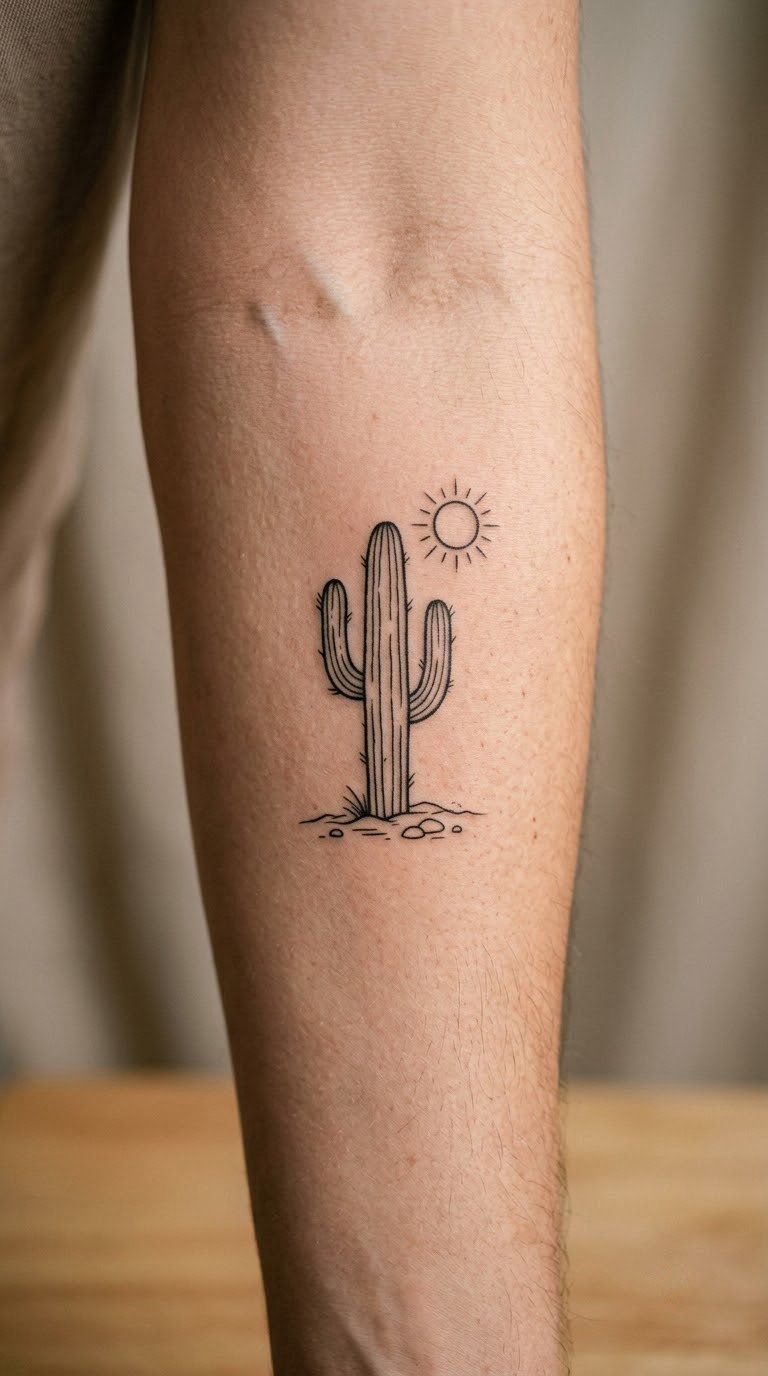
One continuous outline up the trunk, two short arms, and a small open circle sun floating near the top. That is the whole design, and it works because there is nowhere for the eye to get lost.
People usually pick this one for its calm. It reads as a plant, not a statement, which is a relief if you are not ready to explain a tattoo to your coworkers.
Placement: inner forearm, wrist, or the flat of the calf. Size: 2-3 inches tall (5-7 cm). Style: fine line, single needle. Pain: low — the inner forearm is fleshy and the line count is small. Fine line on the hand or fingers softens fastest, so keep it off there.
Make it yours: put the sun at a specific height, or replace it with a small date tucked under the base.
Desert Tattoo Ideas in Fine Line
Restrained linework is the secret to putting a wide scene on a small, curved or very visible part of the body. A two-inch forearm has room for maybe a dozen confident strokes, so every line has to earn its place.
Fine line suits a saguaro, a low dune contour, a crescent, a single Joshua tree. Skip anything with texture that depends on shading. The lines will spread a fraction as they heal, and thin grey marks that sat a millimetre apart can merge into a smudge within five years.
Ask your artist to draw the design at final size on paper before the stencil goes on. If it looks crowded at 1:1, it will look worse healed.
2. Blackwork Desert Sunset With Layered Dunes
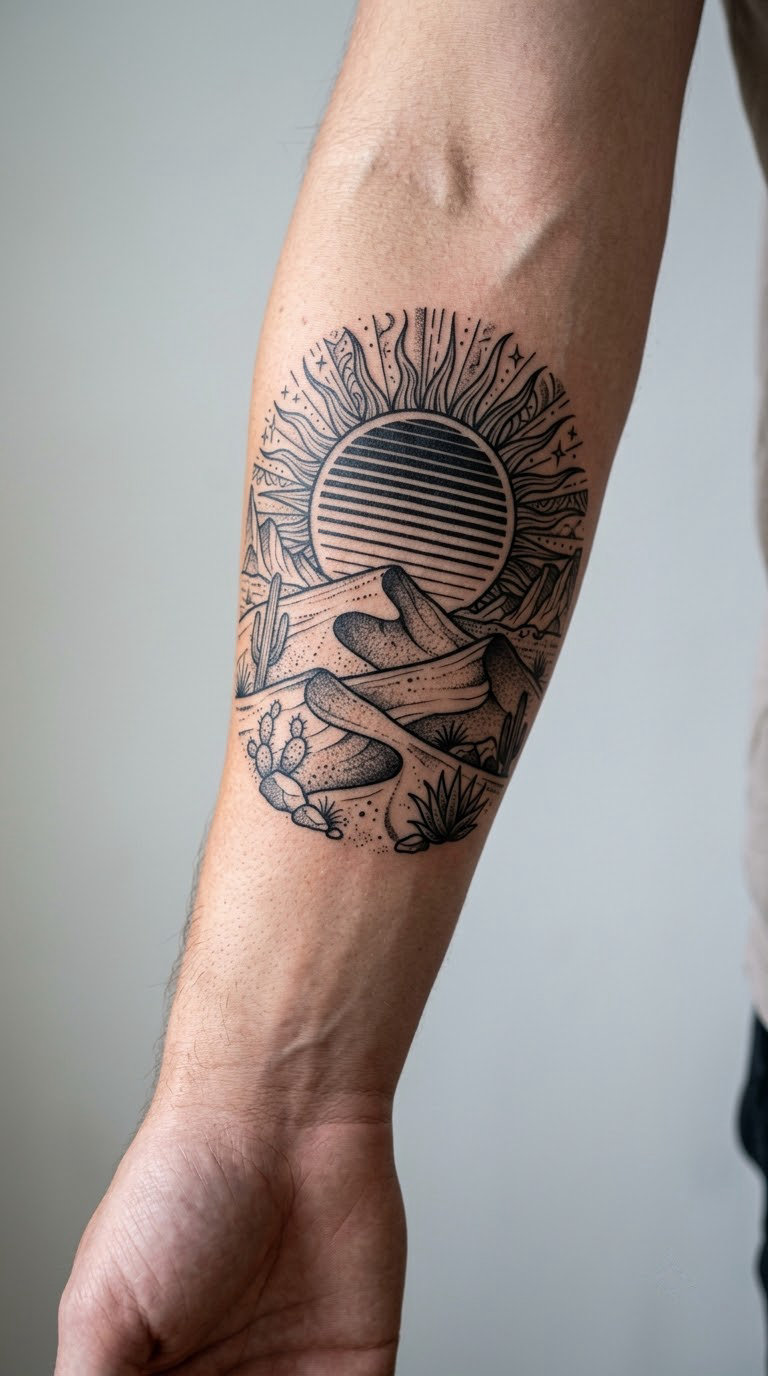
Three dunes stacked front to back, each a solid black mass, with a striped sun sitting low behind them. Nothing is shaded and nothing is coloured. The depth comes entirely from how the shapes overlap.
This is the design people end up building a forearm around, so it pays to get the composition right early. Dunes running lengthwise along the arm with the sun at one end, rather than across it, will follow the muscle instead of fighting it.
Placement: outer forearm, calf, or outer upper arm. Size: 5-6 inches wide (13-15 cm); below 4 inches the dune edges start to close up. Style: blackwork with negative space. Pain: medium, and the solid fills are the long stretch — expect a break. Large black areas can trap heat and come out slightly grey after healing.
Make it yours: carve one narrow band of untouched skin through the black so a dune ridge reads as light.
3. Micro-Realism Desert Horse in Side Profile
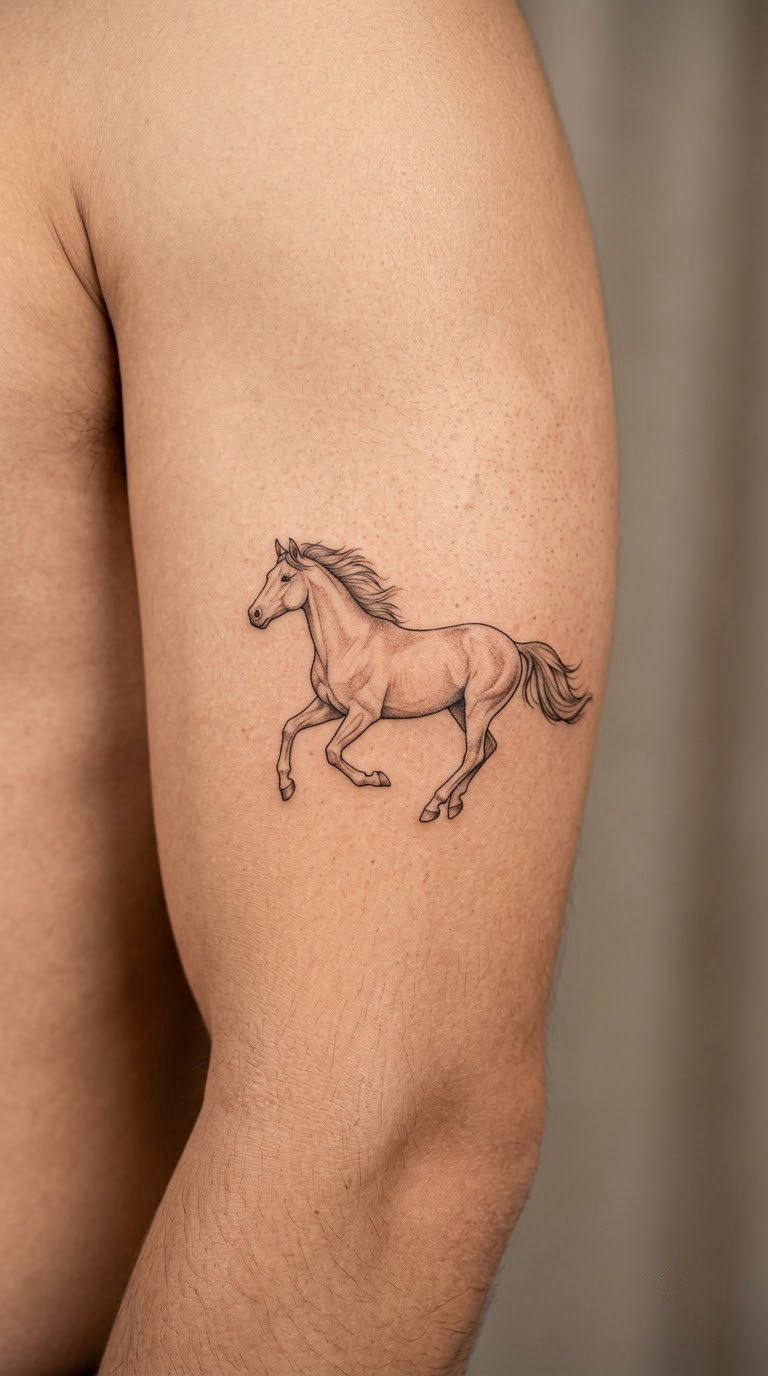
A head and neck in profile, muzzle turned slightly away, rendered in soft brown and grey washes with a few darker hairs along the mane. The eye is the whole picture — get that right and the rest can stay loose.
Horses on desert pieces usually mean something personal: a horse from a ranch, a childhood, a ranching town on the map. A Reddit thread about Arizona work on r/TattooDesigns shows how often a desert piece is really about a place, and a horse gives the artist something to anchor it.
Placement: upper arm, inner calf, or ribs. Size: 3-4 inches long (8-10 cm). Style: micro-realism with a muted brown palette. Pain: medium; the neck on the inner arm is tender. Brown pigment holds its tone but can warm up noticeably after a few summers in the sun.
Make it yours: have the artist match a specific horse, or put your home state’s outline behind the head in fine line.
4. Traditional Tumbleweed on a Curved Forearm
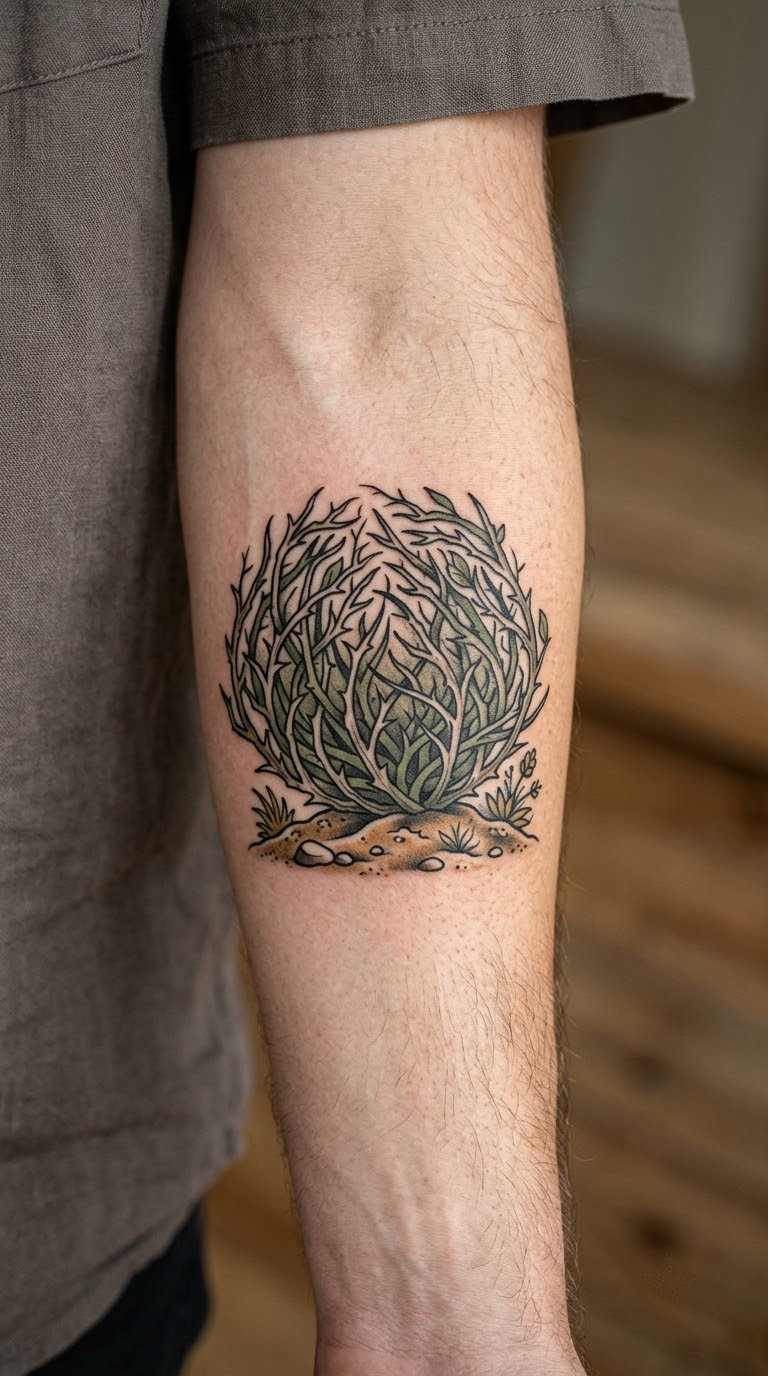
A round, tangled ball of brush rendered in the old American way: thick black contour, flat colour inside, and visible tattoo-style shading bands rather than soft gradients. Muted green with a small patch of ochre ground underneath.
It is a funny subject done seriously, which is exactly why it works as traditional flash. This style holds up best where the linework can spread, so avoid the fingers and the inside of the wrist where skin moves constantly.
Placement: inner or outer forearm, upper arm. Size: 4 inches wide (10 cm). Style: American traditional. Pain: medium, a steady all-over needle sensation. Bold outlines are far more forgiving over time than fine ones.
Make it yours: add a name banner beneath it in the traditional style, or swap the ochre patch for a rust-red desert floor.
5. Dotwork Star Map Over a Sand Dune
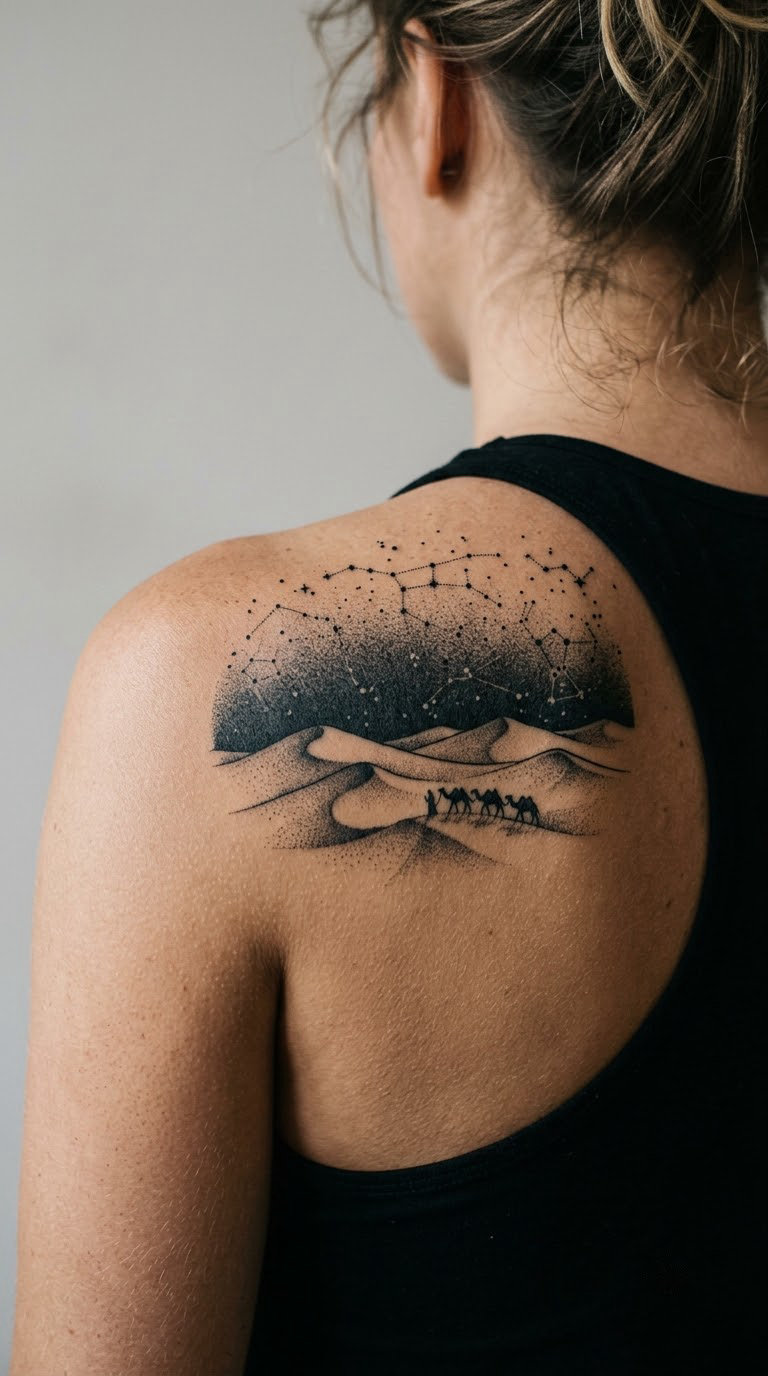
One long dune contour curving across the lower third, a scatter of dot clusters above it sized to real star magnitudes, and nothing else. The gap between the dots is doing most of the work.
Dot density is the whole conversation at the consultation. Dots too close together heal into a flat grey patch, so ask your artist to space them at a size that still reads as separate marks.
Placement: upper back and shoulder, chest, or outer thigh — anywhere with a broad flat area. Size: 5-7 inches wide (13-18 cm). Style: dotwork with negative space. Pain: medium on the back, higher on the ribs. Dot work softens and diffuses with age, so ask for a slightly bolder dot than looks right on paper.
Make it yours: use the sky on the night of a real date or a specific desert sky you have seen.
6. Watercolor Cactus Bloom in a Loose Oval
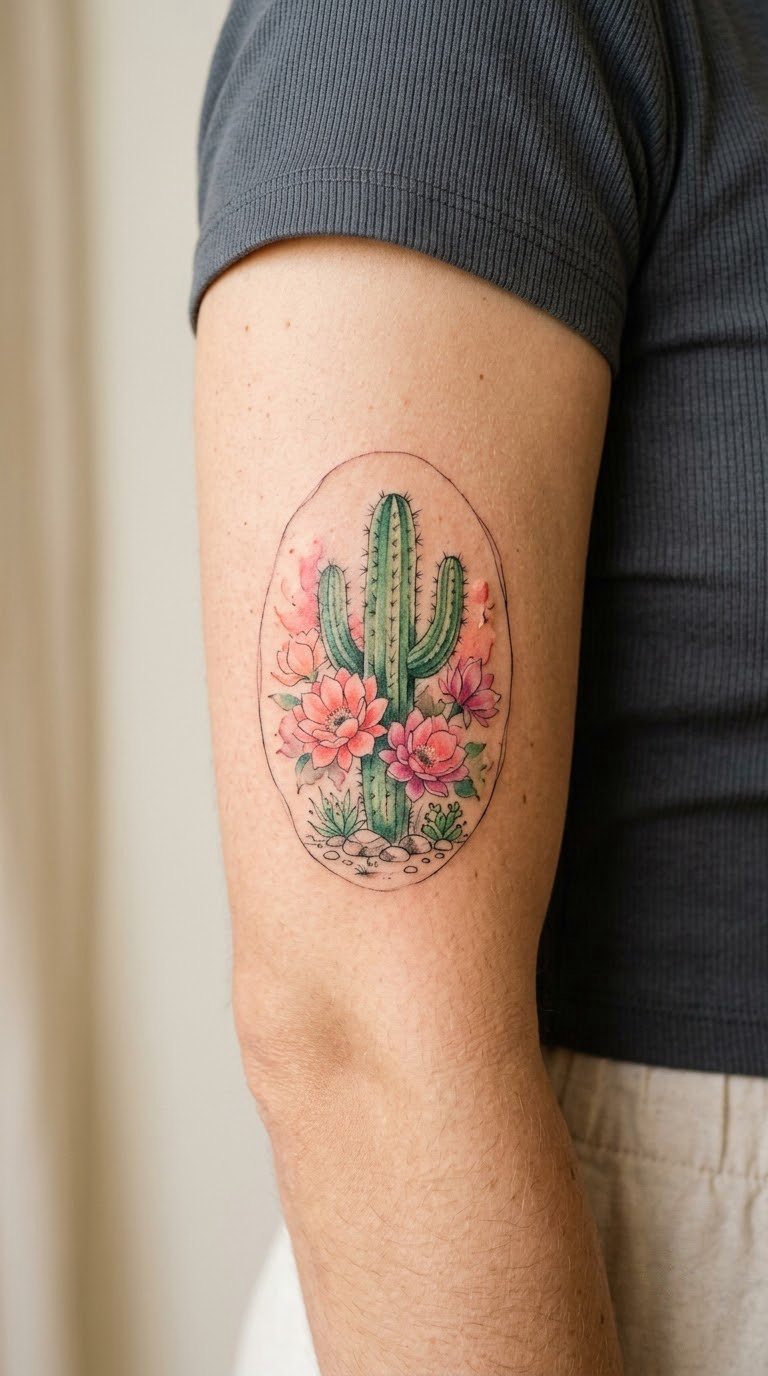
Translucent magenta, coral and yellow bleeding into soft green, with a minimal cactus sitting in the middle of it. The colour is allowed to run past the edge in places, and the outline is thin and broken rather than closed.
Watercolour is the least permanent style on this list. Pale washes fade toward skin tone within a few years, so pick it if you like the idea of a tattoo that quietly changes rather than one that stays identical.
Placement: above the elbow, shoulder, or the flat of the forearm. Size: 3 inches (7 cm), kept tight, because loose edges need somewhere to go. Style: watercolour. Pain: low; colour packing over a small area is quick. Bright yellow is the first thing to fade, so the flower centre may need a touch-up sooner.
Make it yours: use a desert marigold yellow as the dominant wash instead of pink.
7. Fine-Line Mountain Range With a Tiny Sun
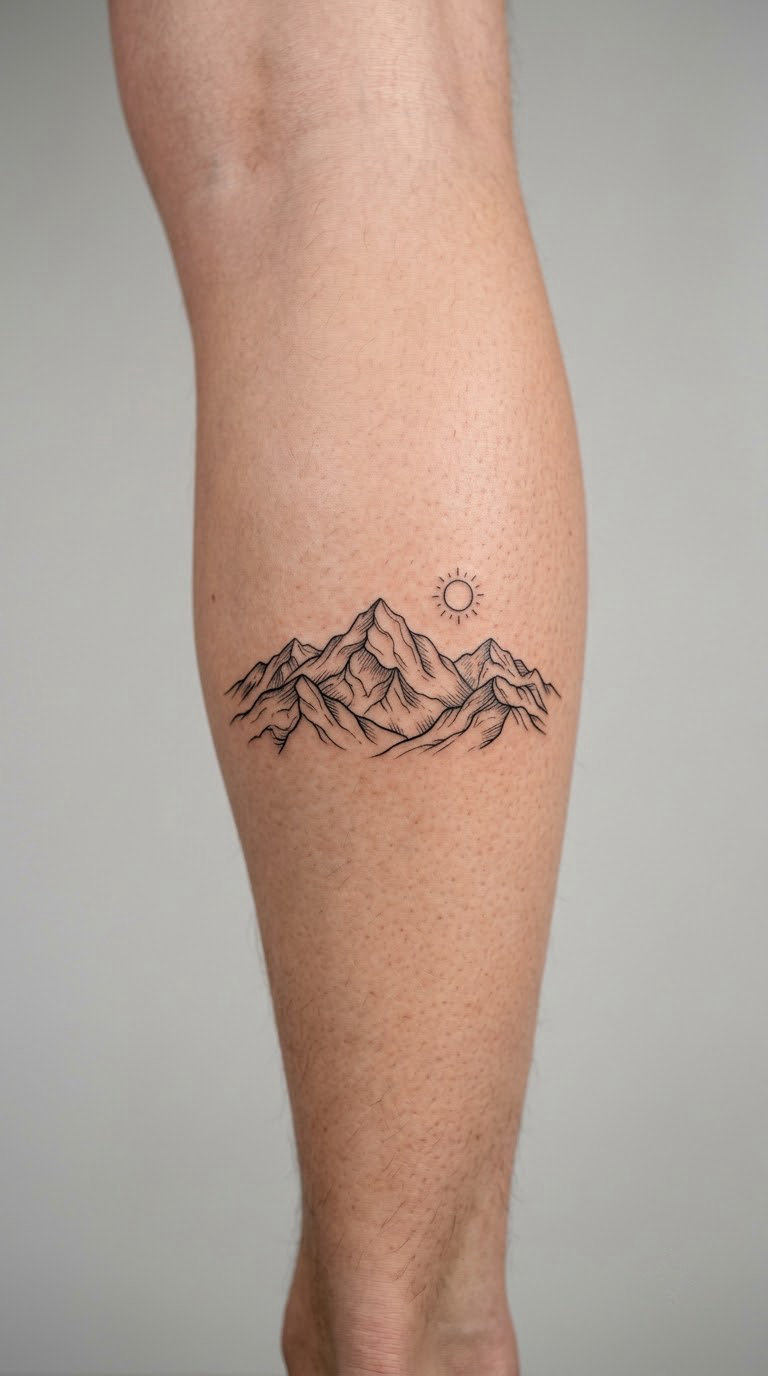
Uneven peaks drawn with a single wandering contour, light hatching in the valleys, and one small outlined sun floating just above the highest ridge. Quiet, more scenery than motif.
Mountains in tattoo work usually stand for the climb rather than the view, and they sit well next to a date or an initial. This version is built for scenery, so the peaks can stay irregular — even a sketch of a real local range is better than generic triangles.
Placement: outer calf, inner forearm, ribs, or across the shoulder blades. Size: 4-5 inches wide (10-13 cm). Style: fine line with light contour shading. Pain: low to medium, depending on the ribs. Hatching in the valleys blurs first — keep shading sparse enough that the peaks still read after a decade.
Make it yours: bring a photo of the range you actually grew up near and have the artist trace the skyline from it.
8. Neo-Traditional Horned Toad on Sand
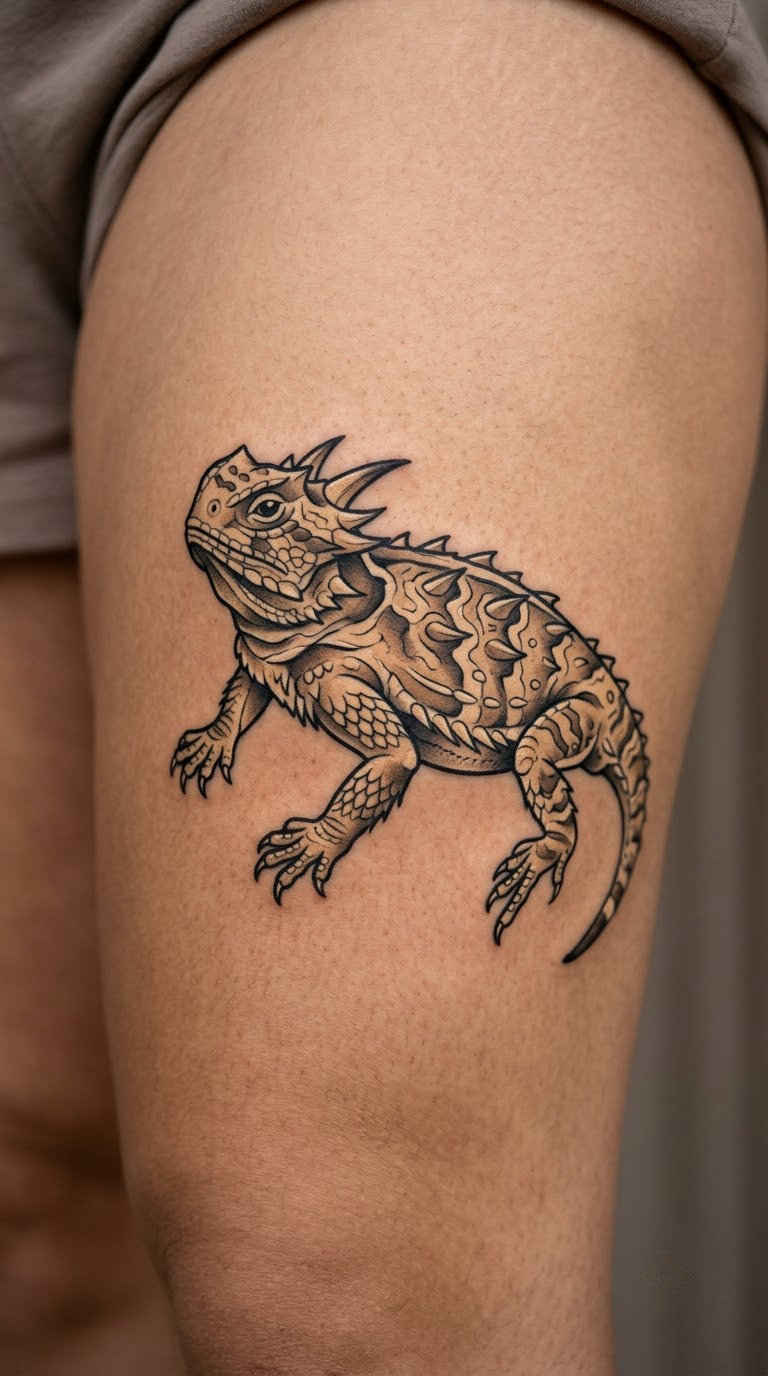
A horned toad seen from above, with a wide flat head, patterned skin, and thick black outlines around every shape. Warm beige shading below it suggests sand without drawing actual dunes.
Neo-traditional sits between old-school flash and illustrative realism, and the toad is a favourite subject because the patterning gives an artist something to show off. Keep the outline weight even so the design doesn’t get top-heavy in the head.
Placement: thigh, calf, or upper arm. Size: 4 inches long (10 cm). Style: neo-traditional. Pain: medium; the thigh is one of the more forgiving spots for a sitting design. Skin patterning drawn too finely can lose definition, so a bold scale pattern beats tiny detail.
Make it yours: have the sand shading shifted to a rust tone that matches another piece you already have.
9. Minimal Barrel Cactus Line Drawing
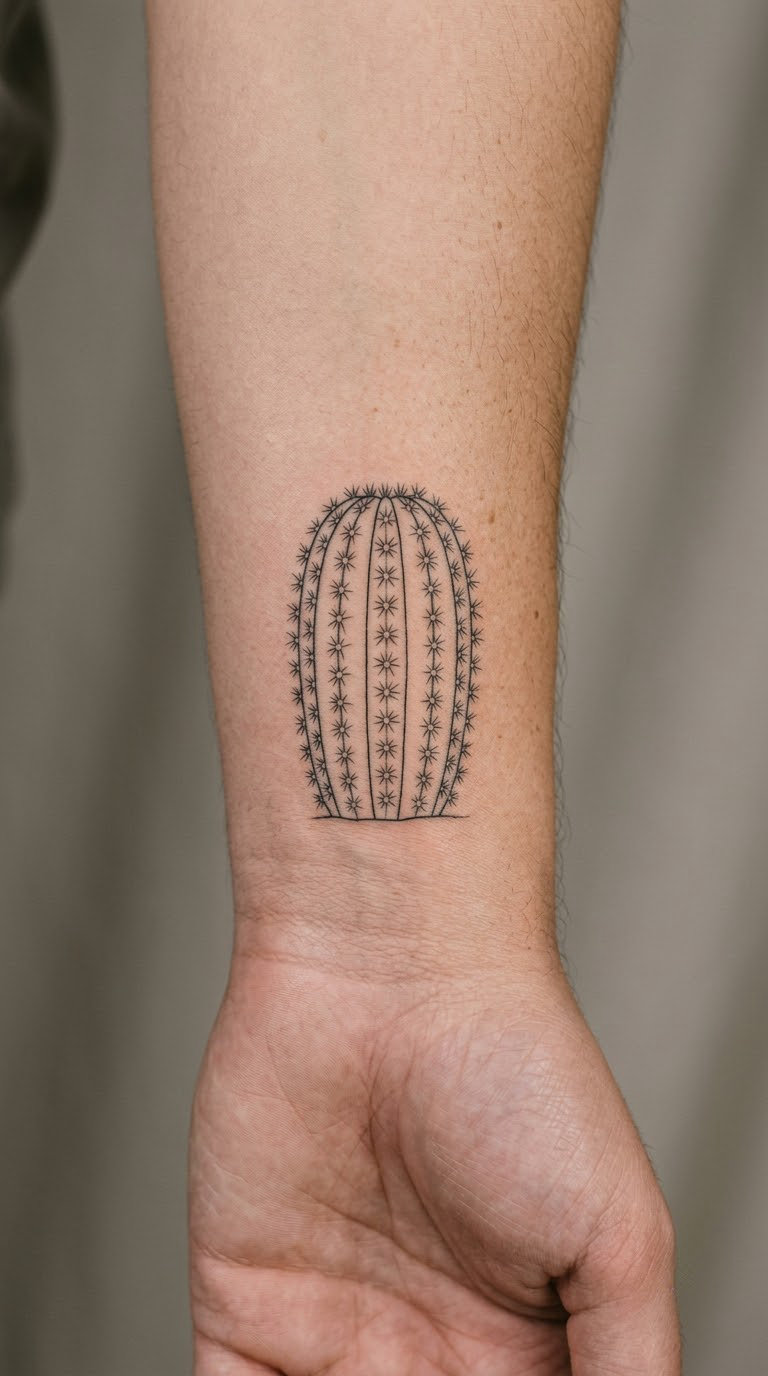
A rounded barrel form built from evenly spaced curved ribs, a few short spine marks radiating from each rib, and one small crown of spines at the top. No shading at all.
Even spacing is the skill here. A barrel cactus drawn slightly wonky looks like a mistake rather than a study, so this is a good design to book with an artist who enjoys economical line construction.
Placement: side of the wrist, inside of the arm, or behind the ear. Size: 2-2.5 inches tall (5-6 cm). Style: minimal line, single needle. Pain: low. Ribs on the inside of the wrist sit over moving skin, so ask for a slightly bolder line and expect the design to shift a little as you flex.
Make it yours: have the spine count per rib reduced to a few clean marks, or add a very small shadow on one side only.
10. Sunset With Joshua Trees in Red Ink
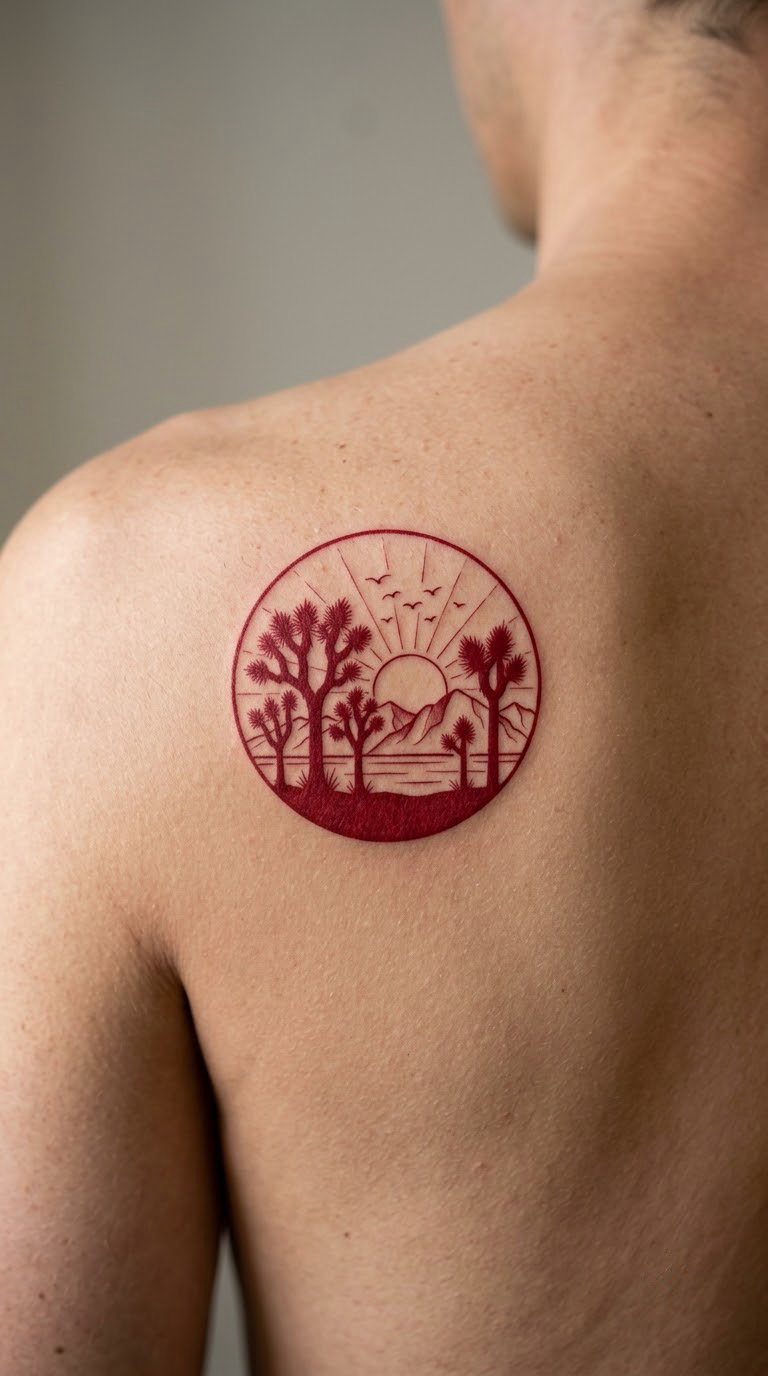
A circular frame holding a low sun with a band of horizontal lines beneath it and three silhouetted Joshua trees in solid red. One colour doing all the work.
Red ink ages to a warm brick tone, which suits a sunset piece far better than it would suit a portrait. The Joshua trees should be silhouettes, not botanical drawings — the whole point is that they read as shapes first.
Placement: shoulder blade, upper back, outer forearm, or the flat of the upper arm. Size: 3 inches (7 cm) across. Style: single-colour graphic. Pain: low, and quick because the areas are small. Red lines on the hand soften faster than black, so keep it above the wrist.
Make it yours: draw the trees as they look from a specific road you have driven.
11. Micro-Realism Rattlesnake Coiled in Sand
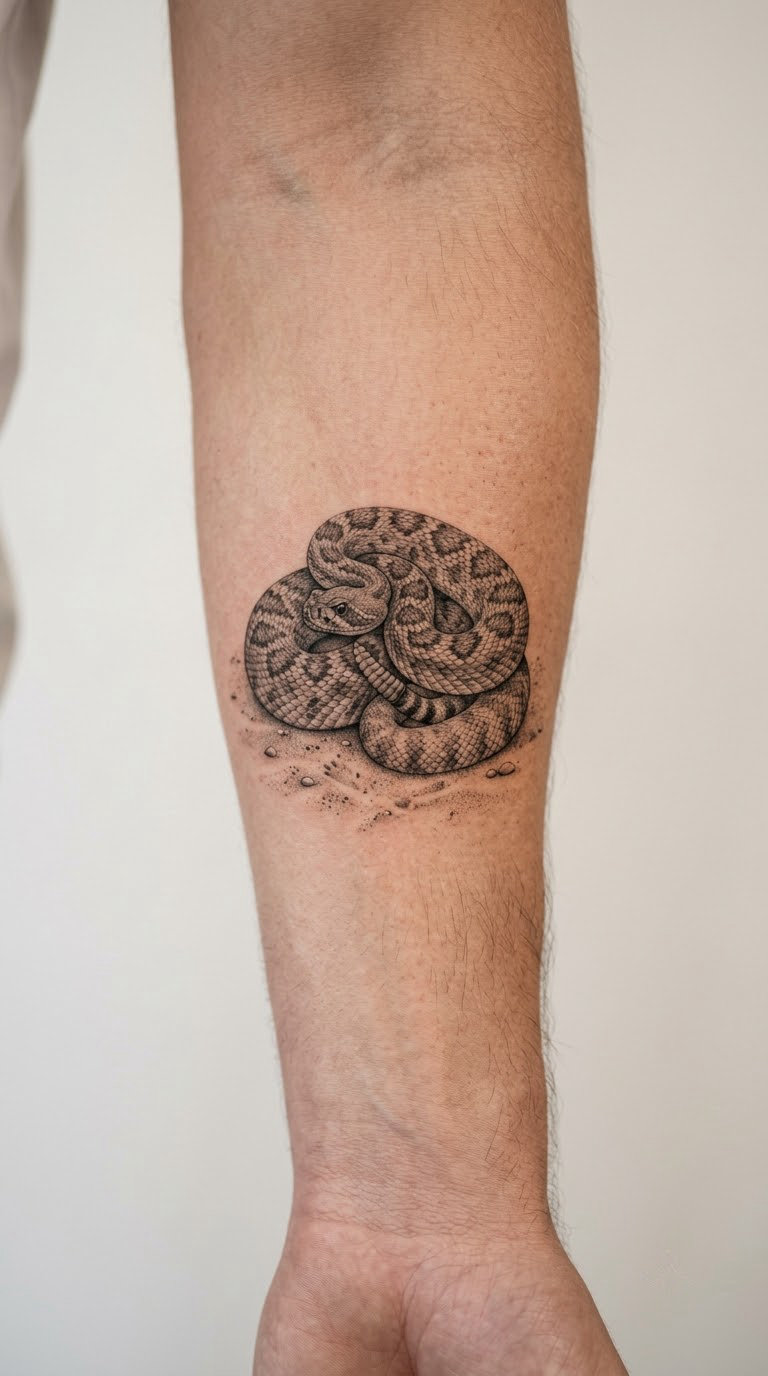
A tight coil seen from slightly above, each scale picked out in fine dark marks, a rattle lifted at the top of the curve, and a small patch of grainy sand under the lowest loop.
Snakes come up constantly in colour and design requests, and this one is genuinely achievable at small sizes because the coil does all the visual work. Keep the middle of the loop open — negative space there keeps it from reading as a dark disc.
Placement: outer arm, outer thigh, or the calf. Size: 3-4 inches long (8-10 cm). Style: micro-realism. Pain: medium. Anywhere the design wraps a joint — the elbow, the back of the knee — will distort, so keep the coil on a flat stretch.
Make it yours: have the rattle drawn with a specific count matching the number of rattles you spot on a real snake photo.
12. Geometric Pyramid and Shadowed Sand Lines
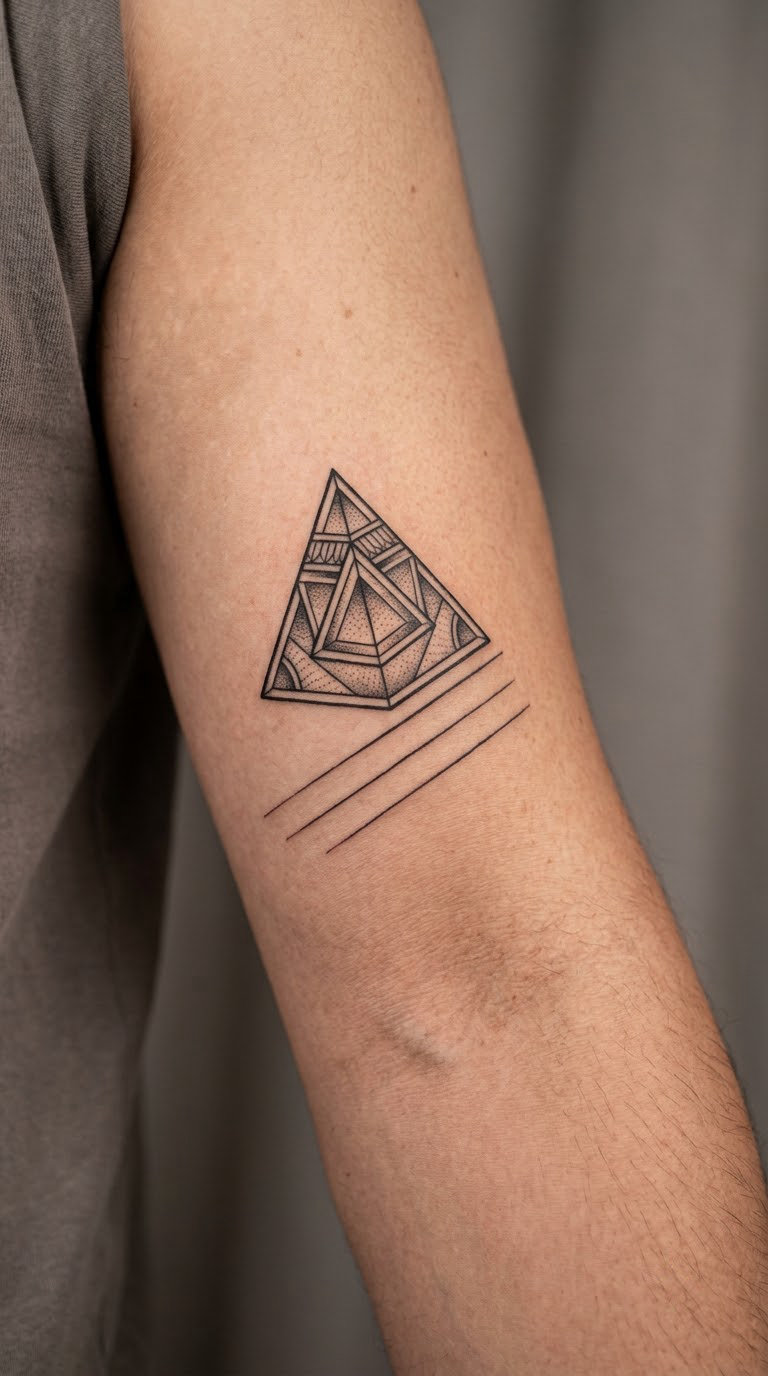
A symmetrical triangle divided into a few clean planes, three diagonal sand lines beneath it, and generous empty space around the whole thing. No ornament, no texture, no hieroglyphs.
Geometry gives this design its strength, and it is also the reason to keep the decoration out. Adding pattern bands or carved figures to a geometric composition usually breaks the symmetry that makes it work — and motifs taken from living cultures carry weight you cannot borrow just because the lines look good.
Placement: inner bicep, forearm, chest, or calf. Size: 4 inches tall (10 cm). Style: geometric blackwork. Pain: low, with a brief sting on the bicep’s inner edge. Hair over a geometric piece is the real issue — ask for a design that still reads with partial growth.
Make it yours: split the pyramid’s planes with a thin line of untouched skin so the shadow reads as light.
13. Old-West Desert Road in Black-and-Grey
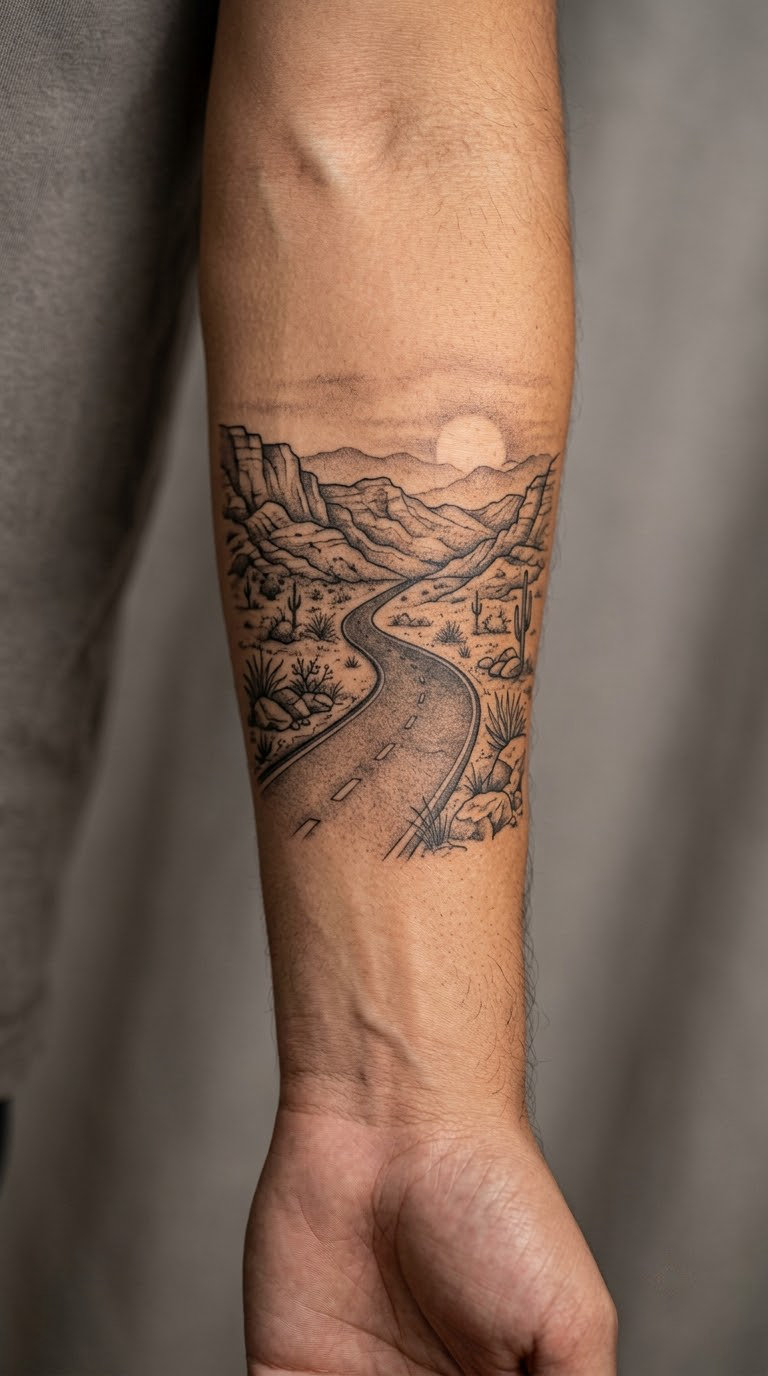
A road running from the base of the forearm to a vanishing point, tyre tracks fading out into grey, low hills on the horizon, and a pale sun that barely registers. The depth comes from the gradient, not from outlines.
Black-and-grey realism is the safest desert style long term because nothing fades noticeably. It does need a real gradient though — a road rendered as flat grey looks unfinished, and this is the most common complaint I hear about healed scenery work.
Placement: inner forearm, calf, or the bicep. Size: 6 inches long (15 cm) or more; the perspective needs length. Style: black and grey realism. Pain: medium, on a long sitting. Plan a break around the two-hour mark.
Make it yours: base the vanishing point on a photograph of the road rather than letting the artist invent one.
14. Phoenix Rising From a Minimal Sun
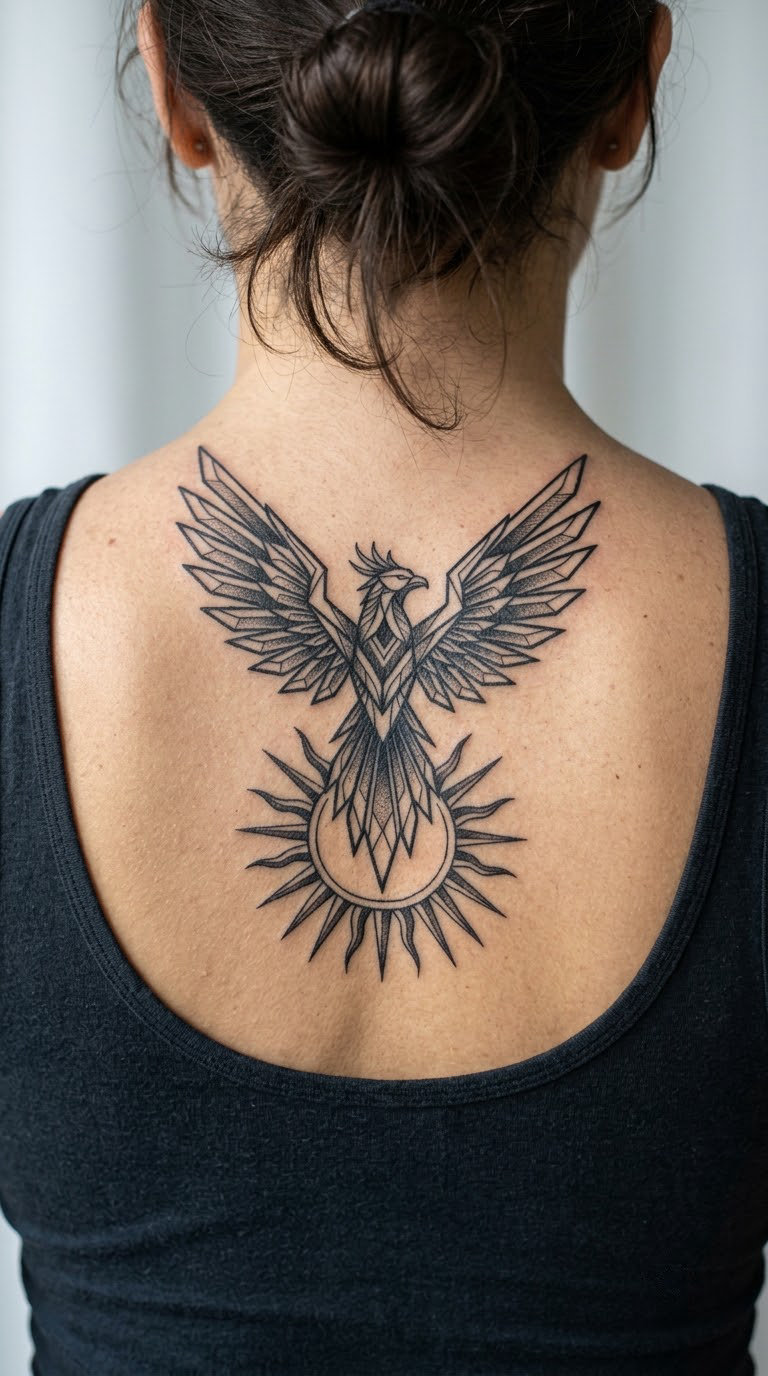
Broad angular wings with a few interior cut-outs for feathers, a half-circle sun beneath the tail, and black shapes held apart by clean white gaps. The sun is a plain arc, not a striped ball.
Phoenix work is usually chosen for the idea of renewal, but the design lives or dies on the negative space between the wings. When those gaps fill in with black, the bird becomes a blob — ask to see the drawing with the gaps kept open.
Placement: upper back and shoulder, chest, or the outer upper arm. Size: 5 inches tall (13 cm). Style: blackwork. Pain: medium, and the broad areas take patience. Feathers drawn as fine parallel lines lose separation over time, so solid shapes with cut-outs age better.
Make it yours: replace the sun arc with a half circle of your birth month or a state line.
15. Succulent Cluster in a Geometric Pot
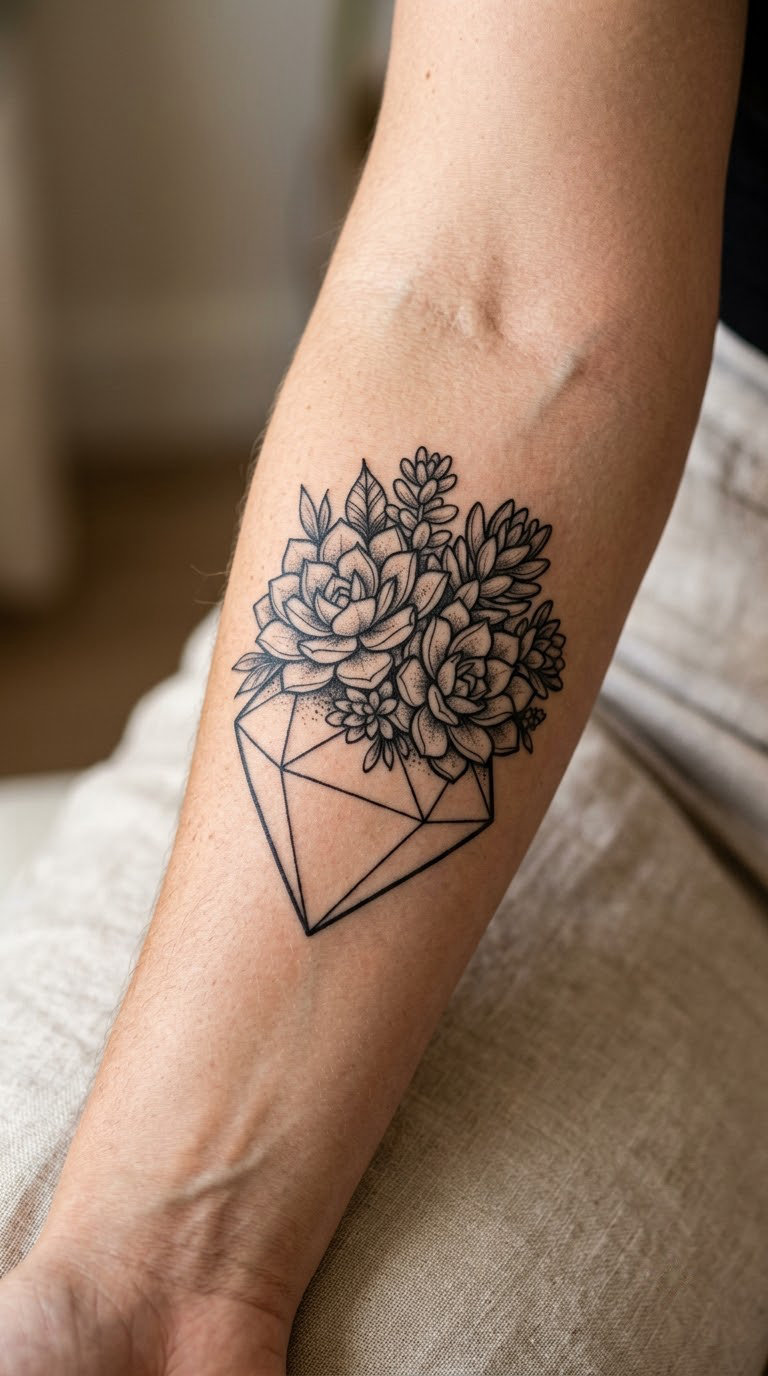
Three or four recognisable rosette succulents at different heights, each one built from a few clean petal lines, sitting in an angular container drawn as a diamond or a faceted hexagon. Selective stippling only under the pot.
Botanical line work is easy to copy badly, so the individual plants need to be identifiable rather than decorative. Ask for the rosettes to overlap slightly instead of floating apart — that single change makes the cluster look planted instead of scattered.
Placement: inner forearm, wrist, or the calf. Size: 3-4 inches wide (8-10 cm). Style: illustrative line with light stippling. Pain: low. Fine petal lines are among the first details to blur, so your artist should bump the line weight up from the drawing.
Make it yours: use a plant that actually grows where you live instead of a generic rosette.
16. Crescent Moon Floating Over Desert Rocks
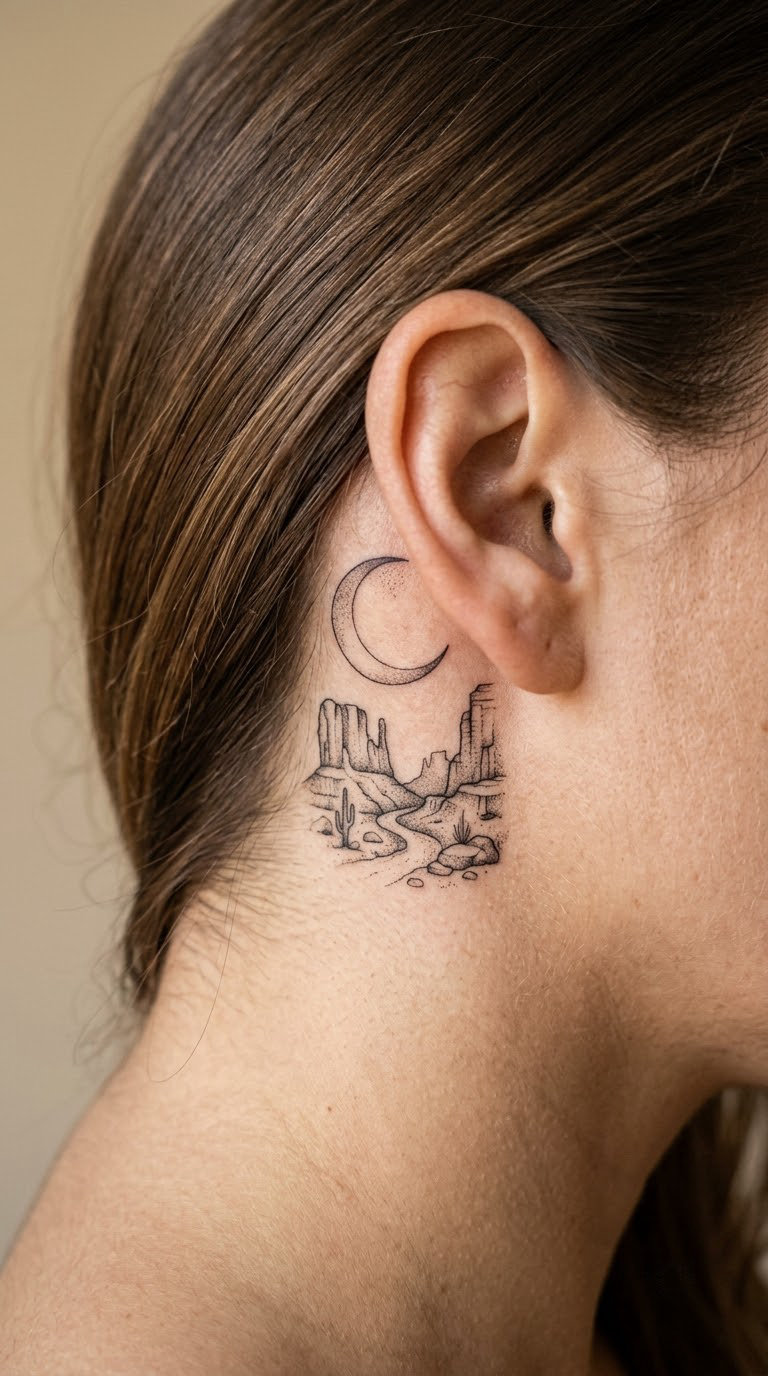
A thin crescent drawn with a clean outer curve, a few low irregular rock forms underneath, and light stippling in the gaps. Quiet and slightly nocturnal, with no hard border around the composition.
Night scenes work because the dark is implied rather than filled. Behind the ear is a good home for it — small, mostly hidden, and it curves with the neck so the rocks follow the natural line of the shoulder. If you want more of the sky rather than the ground, our guide to 20 Sun Moon and Rising Sign Tattoo Ideas is worth a look.
Placement: behind the ear, the nape of the neck, inner wrist, or the ankle. Size: 3 inches tall (7 cm). Style: fine line with stippling. Pain: low, though behind the ear is a sensitive spot and people often tense up. Stipple patches fade into a grey haze faster than line work, so keep the dots sparse and spread out.
Make it yours: have the crescent shaped to match a real phase from a date that matters to you.
17. Desert Fox Emerging From Sparse Cacti
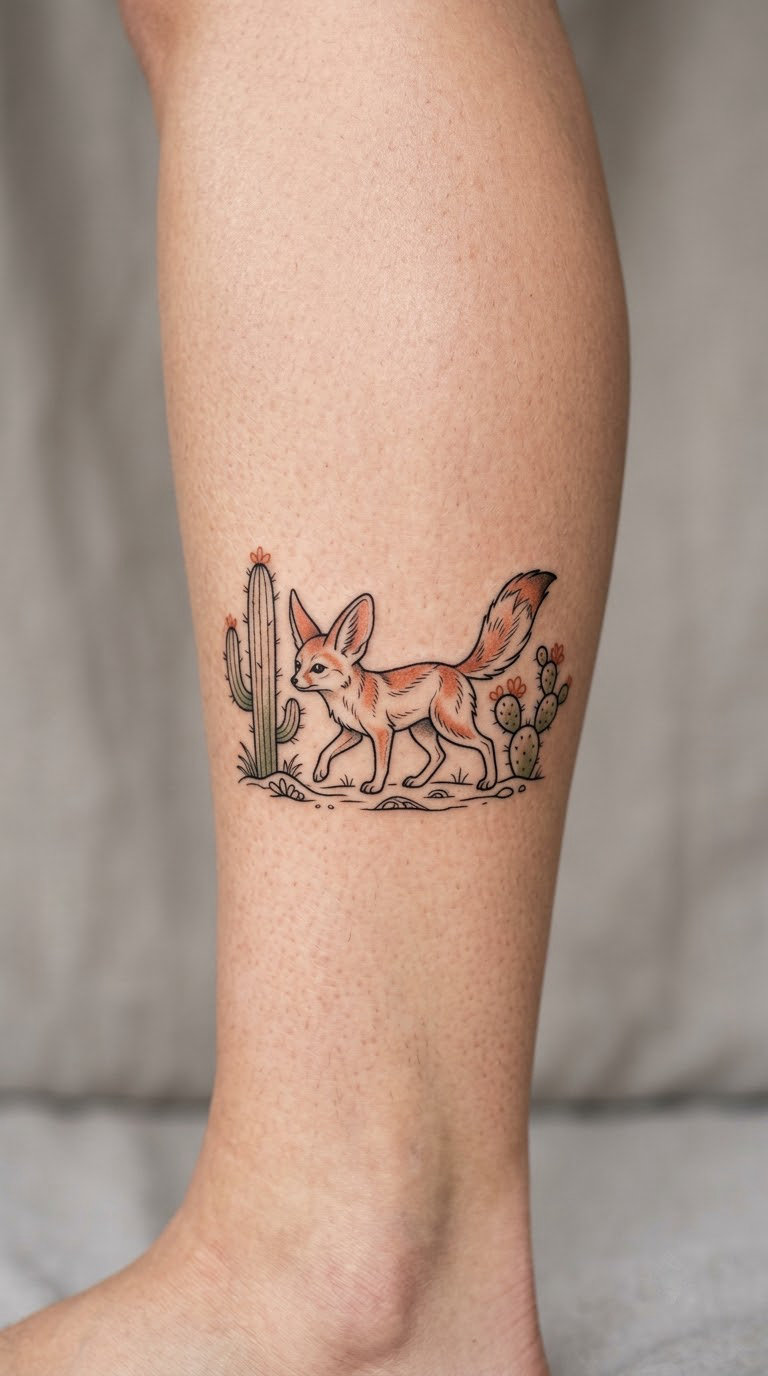
A fox head and shoulders in three-quarter view, framed by two understated cactus plants, with illustrative line work through the fur and rust-orange restricted to the ears, chest and tail tip.
Keeping the colour to two or three small areas is what makes this one age well. A fully coloured fox looks great in the studio photo and slightly washed out a few years in, whereas a mostly black piece with three rust accents holds its shape. If you want a stripped-back animal piece instead, our 20 Best Cat Silhouette Tattoo Ideas for Minimalists uses the same restraint.
Placement: calf, outer arm, or the thigh. Size: 4 inches long (10 cm). Style: illustrative with restricted colour. Pain: low to medium. Furry areas take a little longer than a plain fill, and fur strokes placed too close together can merge into a solid patch.
Make it yours: swap the fox for a coyote, a rabbit, or a small horned lizard in the same framing.
18. Monoline Half-Moon and Hand-Drawn Dunes
A half circle for the moon and three flowing lines beneath it, all of a similar weight, none of them crossing. Simple enough to be a filler, specific enough to stand alone.
Monoline is a good match for desert themes because the subject is already made of few elements. The one thing to insist on is even line weight — a monoline piece shows inconsistency immediately, and the artist should be varying pressure rather than needle depth.
Placement: wrist, inner forearm, or the collarbone. Size: 3 inches wide (7 cm). Style: monoline. Pain: low, and quick. On the wrist the design moves and distends when you flex, so a small composition holds up better than an ambitious one.
Make it yours: have the three dune lines continue into a matching piece on the other wrist.
19. Blackwork Coyote Howling at a Red Moon
A coyote in full silhouette, head lifted, throat open, sitting under a muted red full moon with a few small stars around it. The body is solid black with almost no interior detail.
Silhouettes forgive a lot. When a design is built from one solid shape, you are not relying on fine detail that will soften, which makes this a strong choice for a piece you want to still look right in fifteen years.
Placement: outer upper arm, calf, or the back of the shoulder. Size: 5 inches tall (13 cm). Style: blackwork with a single red accent. Pain: medium — a large solid fill needs a break and a good surface to rest on. Get the moon filled as a flat colour rather than shaded, or the red will look patchy next to the black.
Make it yours: put the moon in a colour you already carry in another piece so the two read as a set.
20. Full Lower-Leg Desert Map With Cacti and Mountains
A drawn map rather than a photograph of one: dunes and mountain ranges in line, several cactus forms scattered through, a winding route line connecting small landmarks, and ochre used for the ground and the route.
This is a project, not an appointment. An eight-inch illustrated map on the lower leg usually runs three to four sessions, and the design has to be broken into pieces that work when the artist has to stop.
Bring a real map or a route you have driven. A map tattoo of a place you have never seen is the version most likely to look generic.
Placement: outer or inner lower leg, or the upper back. Size: 7-9 inches long (18-23 cm). Style: illustrative with a limited two-colour palette. Pain: high — the lower leg aches in the second hour and the shin area is bony. Agree the session split in advance.
Make it yours: make it a real map of a state, park, or route that means something to you.
How to Choose the Right Design
Five checks before you commit. They will save you a redesign later.
1. Can you see the lines at final size? Draw the design at 1:1 on paper and step back a few feet. If the details merge from arm’s length, they will merge permanently once healed. Forum users consistently say the same thing: designs are judged by how they look after healing, not in the studio photo.
2. Does it fit the shape of the part you chose? A horizontal dune scene wants a horizontal surface. A tall cactus wants a vertical one. Ask to see the stencil on your own body before anything else happens.
3. How much detail does the spot hold? Wrists, ankles and hands have less flat surface than a thigh or a back. Fewer elements, larger, always.
4. What is already there? A small desert piece can be extended later. Ask your artist to keep one edge open, the way sleeve plans do — that gives you somewhere to go without covering work you already like.
5. Why this one? A specific place, a real plant, a range of low hills you grew up near. Place is the most common reason people give for desert work, and it is the reason that survives a change of taste.
Request the stencil adjusted to your anatomy, and give your artist something to work from. Photographs, screenshots, a paper sketch, a map — anything that communicates the shape beats trying to describe it in words. If two of these desert tattoo ideas still feel close, ask for both at final size on the same day and you will settle it in ten minutes.
Cost and Session Time
Rough US ranges, since artists price by the hour and the size of the piece drives everything else.
Micro work under two inches, like the saguaro or the barrel cactus: roughly 90 to 180 US dollars, often a shop minimum, and usually done in a single sitting of 30 to 60 minutes.
Small pieces from two to four inches: around 150 to 400 dollars, one to two hours.
Medium scenes four to seven inches, like the layered dune sunset or the blackwork coyote: 400 to 900 dollars, and often two sessions.
Large illustrative work including the full desert map: 900 dollars upward, spread across three to four sessions.
Two things push the total further than the artwork itself. Shop minimums mean a small tattoo can still cost the minimum, and travel adds up if your artist charges for the appointment rather than the hour. Colour and custom work both add time; a flash design copied exactly is usually the cheapest way in.
Aftercare Basics
Follow your artist’s aftercare instructions first — they know what went into your skin. Beyond that, five basics cover most cases.
Wash the area gently with unscented soap and clean water, then pat it dry with something soft. Don’t scrub and don’t soak it.
Keep it covered with a clean, non-stick dressing for as long as your artist specified, and change the covering if it lifts or gets wet.
Do not touch it. No picking at flaking skin, no scratching, no soaking it in a pool or hot tub while the surface is still healing.
Keep fresh or healed colour out of strong sun. Sunscreen on a healed desert tattoo matters more than most people expect, because reds, yellows and ochres fade first.
Send your artist a photo if anything looks wrong, rather than trying to fix it yourself. That is what the aftercare follow-up is for.
Frequently Asked Questions
Are desert tattoo ideas suitable for a first tattoo?
Yes, if you pick a small design and keep the line count low. The saguaro with a sun, the barrel cactus drawing and the monoline dunes all work as first tattoos because they are simple, they hold up at small sizes, and they finish in one short sitting. Skip a big desert scene as a first piece, since fine detail tends to blur and you will want the stencil right before committing to a large commitment of time.
What is the best placement for a small desert landscape tattoo?
The inner forearm, the outer calf and the upper back shoulder are the strongest options. All three give you a flat enough surface for a horizon line or a dune contour, and none of them sit over a joint that will bend the composition every time you move. The wrist works too, but skin there moves a lot, so keep the design to two or three elements rather than a full scene.
Should I choose blackwork or colour for a desert design?
Choose blackwork or black and grey if you want the piece to look the same in fifteen years. Solid blacks and grey gradients fade very little. Colour gives you sunset bands, watercolour washes and rust accents, but expect the yellows, oranges and pale greens to soften noticeably within a few years. If you go colour, ask which element stays as black line work and which part carries the colour, so the design still reads once the colour fades.
How much do desert tattoos cost in the US?
Micro work under two inches usually runs 90 to 180 dollars, small pieces from two to four inches around 150 to 400, medium scenes from four to seven inches roughly 400 to 900, and large illustrative work such as a full desert map starts around 900 and climbs. Shop minimums mean even a tiny tattoo can cost the minimum, and hourly rates vary widely between cities and between artists, so confirm the price and the session length before you sit down.
Can a desert scene be added to an existing scenery tattoo?
Yes, and it is a common request, especially for people who got a small piece years ago and now want more. The usual approach is to build from the open edge of the existing work rather than starting over, adding a scenery layer, a border or a horizon line that the original design can grow into. Ask your artist to plan two or three steps ahead, and mention any motifs you would rule out so the extension stays a deliberate choice.
If this is your first tattoo, start with the saguaro and the small sun, or the crescent moon behind the ear. Both are simple, both hold their shape, and neither one needs a big commitment of time or money.
Adding to a collection, you have more room to think. The layered dune sunset or the blackwork coyote give you a strong central piece that you can build a sleeve around later, and asking your artist to keep one edge open now means the next piece has somewhere to go.