
25 Feather Tattoo Ideas for the Forearm (October 2026)
If you have been scrolling through feather references for a while, the useful part is usually buried under a hundred near-identical pins. Here are 25 feather tattoo ideas for the forearm, sorted by the two things that actually decide whether a design works on your arm: the style of the feather, and the stretch of forearm it sits on. Every entry tells you where it fits, how big it runs, what it hurts like, and one honest note about how it ages.
Feathers split into two camps. Small, minimal, single-feather pieces in fine line sit quietly and forgive a bony arm. Detailed realistic and blackwork versions need a flatter, wider stretch of forearm and a longer session. I have put both camps in one list so you can see the trade-off instead of scrolling between two galleries.
If you are booking this autumn, most artists run a queue of six to ten weeks out. Save your references now and consult before the year fills up.
25 Feather Tattoo Ideas for the Forearm: Quick Guide
Every feather in the list appears in this table in the same order, so you can jump straight to the one that fits your arm and your patience.
| Idea | Style | Best placement | Size | Pain |
|---|---|---|---|---|
| 1. Single Fine-Line Feather | Fine line | Inner forearm, vertical | 3 in (7.5 cm) | Low |
| 2. Realistic Flying Feather | Micro realism | Inner forearm, diagonal | 4 to 5 in (10 to 13 cm) | Medium |
| 3. Blackwork Feather with Bold Spine | Blackwork | Outer forearm, lengthwise | 5 to 6 in (13 to 15 cm) | Medium |
| 4. Watercolor Feather Spray | Watercolor | Inner forearm, diagonal | 3 to 4 in (7.5 to 10 cm) | Low |
| 5. Dotwork Feather Half-Moon | Dotwork | Upper inner forearm, curved | 2.5 to 3 in (6 to 7.5 cm) | Medium |
| 6. Traditional Feather with Red Accent | Traditional | Outer forearm, vertical | 4 to 5 in (10 to 13 cm) | Medium |
| 7. Minimal Feather Line Art | Line art | Near the wrist crease | 2 in (5 cm) | Medium |
| 8. Botanical Feather Study | Botanical black and grey | Inner forearm, vertical | 4 in (10 cm) | Medium |
| 9. Geometric Feather Pattern | Geometric | Outer forearm, lengthwise | 4 to 5 in (10 to 13 cm) | Medium |
| 10. Feathers in Motion | Fine line | Inner forearm, scattered | Three at 1.5 in (4 cm) | Low |
| 11. Phoenix Feather | Illustrative with colour | Inner forearm, vertical | 4 to 5 in (10 to 13 cm) | Medium |
| 12. Native-Inspired Feather Motif | Ornamental | Inner forearm, vertical | 3 to 4 in (7.5 to 10 cm) | Medium |
| 13. Feather with Floral Accent | Fine line with colour | Inner forearm, diagonal | 3.5 in (9 cm) | Low |
| 14. Blackwork Feather Silhouette | Solid blackwork | Outer forearm, lengthwise | 5 in (13 cm) | Medium |
| 15. Violet Gradient Feather | Gradient blackwork | Inner forearm, vertical | 4 in (10 cm) | Medium |
| 16. Quilled Feather Detail | Realism | Lower forearm, horizontal | 4 in (10 cm) | Medium |
| 17. Feather Wrist Wrap | Fine line | Wrist and lower forearm | 5 in curve (13 cm) | Medium to high |
| 18. Split-Color Feather | Two-tone realism | Inner forearm, vertical | 4 to 5 in (10 to 13 cm) | Medium |
| 19. Feathertip Arm Flourish | Fine line ornament | Outer forearm gap | 3 in (7.5 cm) | Low |
| 20. Mandala-Inspired Feather | Ornamental linework | Centre of forearm | 4 to 5 in (10 to 13 cm) | High |
| 21. Small Micro Feather | Micro fine line | Inner forearm near wrist | 1.5 in (4 cm) | Medium |
| 22. Layered Feather Sleeve Detail | Composite blackwork | Outer forearm within a sleeve | 3 to 4 in (7.5 to 10 cm) | Medium |
| 23. Feather with Script | Fine line and script | Inner forearm | 3 in plus text (7.5 cm) | Medium |
| 24. Torn-Paper Feather Collage | Graphic collage | Outer forearm, diagonal | 4 in (10 cm) | Medium |
| 25. Ornate Feather Crest | Ornate illustrative | Centre of forearm | 5 in (13 cm) | High |
If you would rather browse the wider field first, 70+ forearm tattoo ideas shows how feathers sit next to other motifs before you commit to one.
1. Single Fine-Line Feather
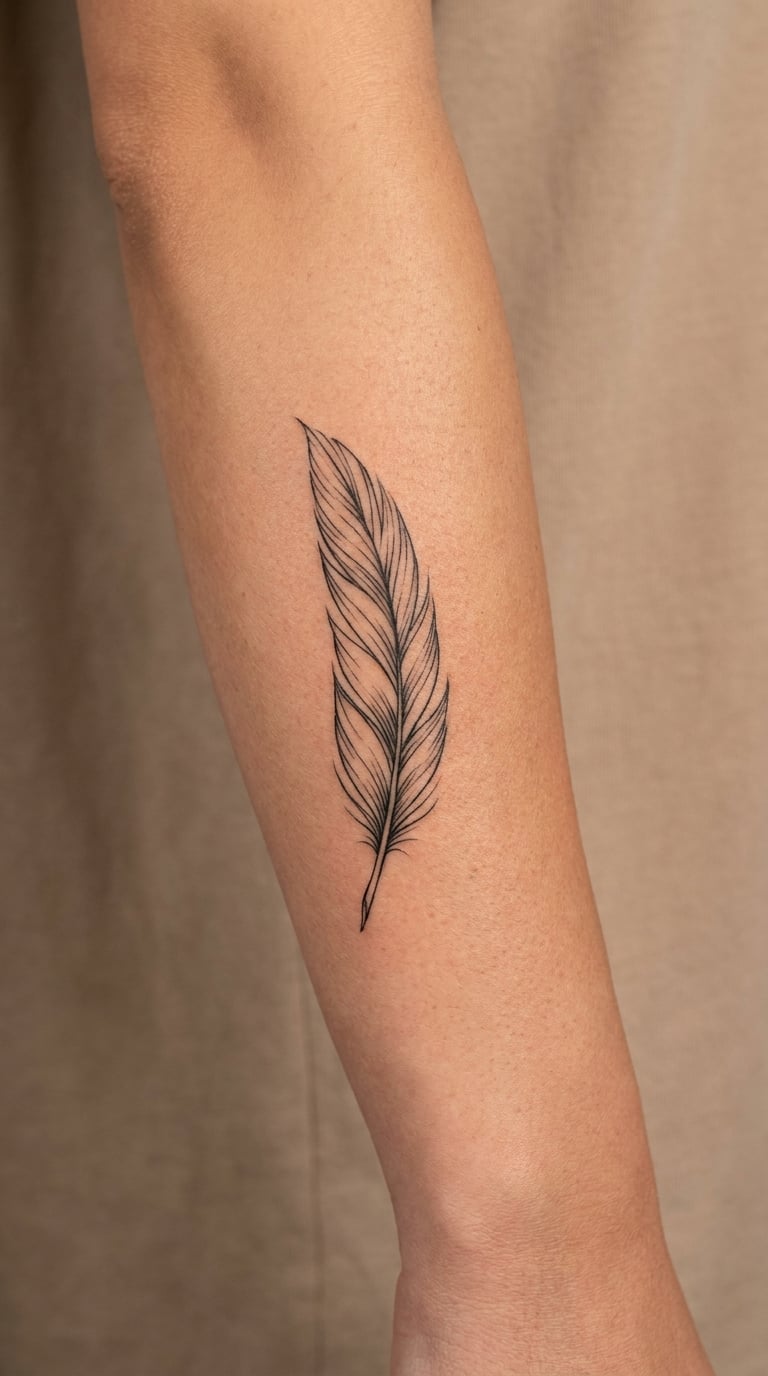
One outer contour, a straight shaft, and a handful of tapered barb strokes in a single-needle weight that stays readable from across a room. The gap between strokes is what makes it look delicate rather than thin and tired. This is the design most first-timers book, because the shape reads as a feather without needing to be spelled out.
Placement: Inner forearm, vertical from mid-forearm toward the wrist. Size: 3 to 3.5 in (7.5 to 9 cm). Style: Fine line. Pain: Low to medium. Fine line on the inner arm softens faster than on the upper arm, and the wrist crease is the first place to blur, so keep it clear of that crease. Make it yours: Angle it five degrees off vertical so it follows the line of your arm.
2. Realistic Flying Feather
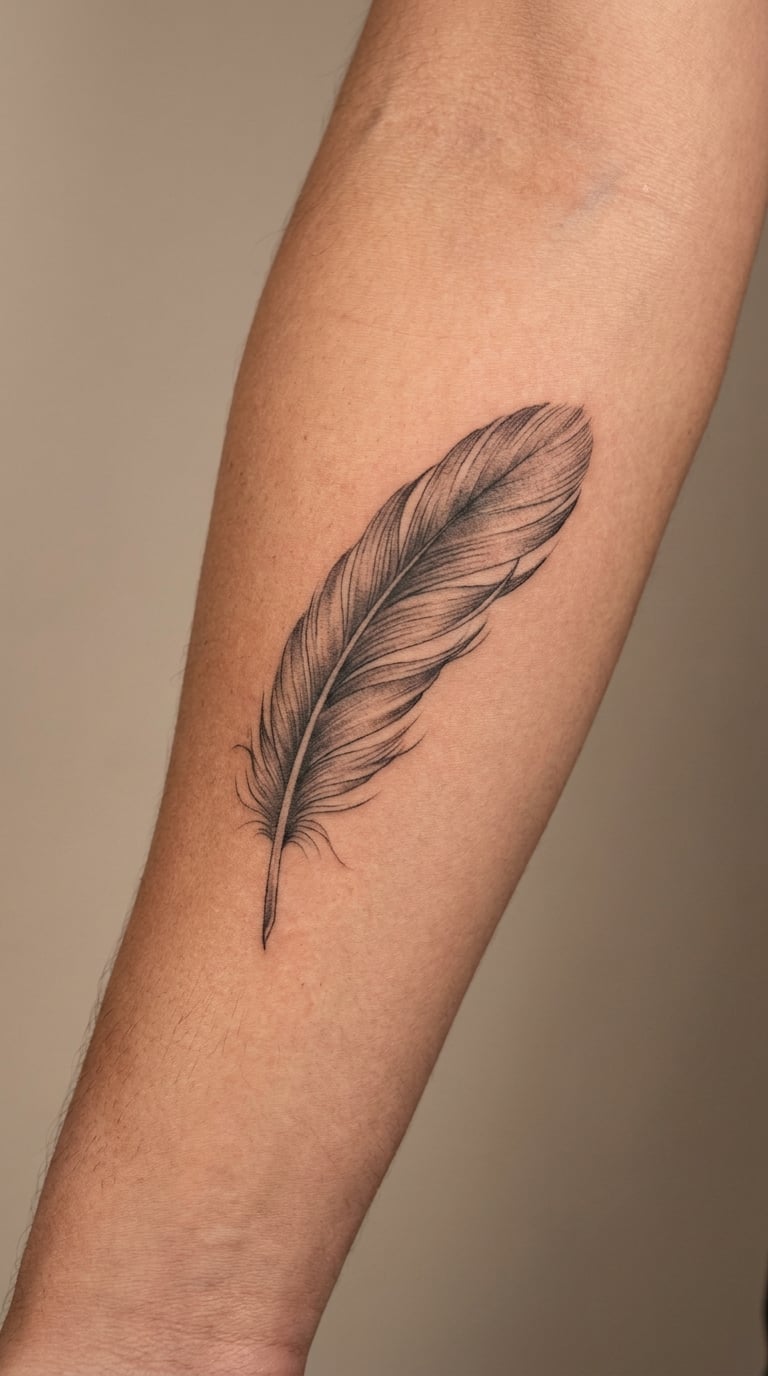
A micro-realistic feather suspended mid-fall, barbs separated one by one, with a soft grey wash building shadow along one side of the shaft. Leaving the tip slightly soft is what makes it read as movement rather than a specimen pinned to skin. People pick a realistic feather when they want an object instead of a symbol.
Placement: Inner forearm, diagonal with the tip pointing toward the elbow. Size: 4 to 5 in (10 to 13 cm). Style: Micro realism with black and grey wash. Pain: Medium. Grey wash on the inner forearm bruises visibly for about a week, which is normal. Make it yours: Ask for a faint background wash behind the feather so it reads as moving through air.
3. Blackwork Feather with Bold Spine
Heavy black line runs from a thick central spine into solid tapered barbs, with the background kept as bare skin. That negative space is the whole design. It holds its shape for decades and hides small imperfections better than anything else here, and the outer forearm takes the weight of the spine without buckling.
Placement: Outer forearm, lengthwise from the elbow crease toward mid-forearm. Size: 5 to 6 in (13 to 15 cm). Style: Blackwork. Pain: Medium, with brief sharper spots where skin runs tight near the wrist side. Solid black holds best over time. Make it yours: Cut two or three barbs short so the silhouette is uneven, or leave the tip in a dry brush.
4. Watercolor Feather Spray
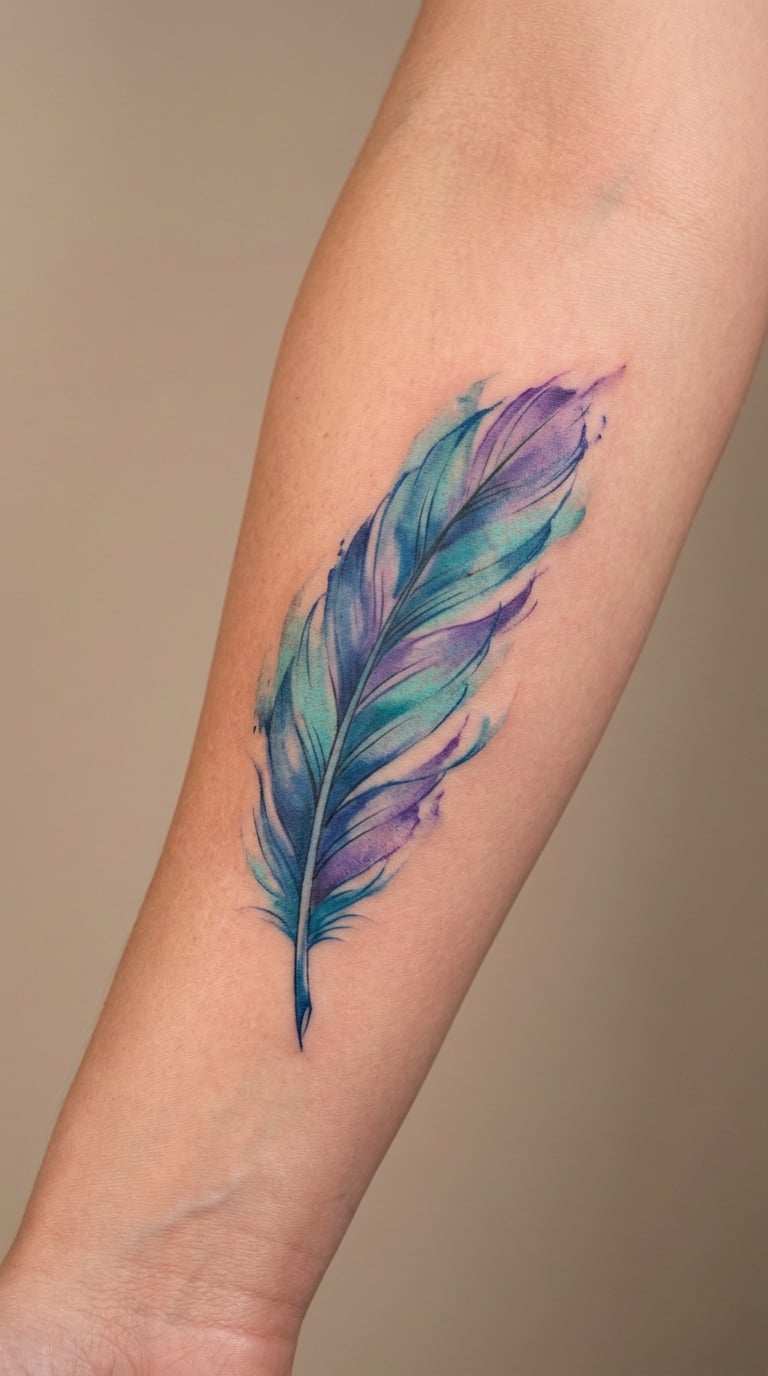
Loose feather where colour pools and runs past the outline in soft blue, teal and violet, with a few dry-brush edges that look spilt rather than drawn. Artists build this in washes and tighten the shaft last, so the eye lands in the right place. It suits anyone who found black-and-grey galleries flat.
Placement: Inner forearm, diagonal, colour runs pointing away from the elbow. Size: 3 to 4 in (7.5 to 10 cm). Style: Watercolor. Pain: Low, because light washes mean fewer passes. Forearms see a lot of sun and sleeve friction, so colour here fades sooner than black and pale violets go first. Make it yours: Bring a photo of a real sky or a palette and ask for those three or four colours only.
5. Dotwork Feather Half-Moon
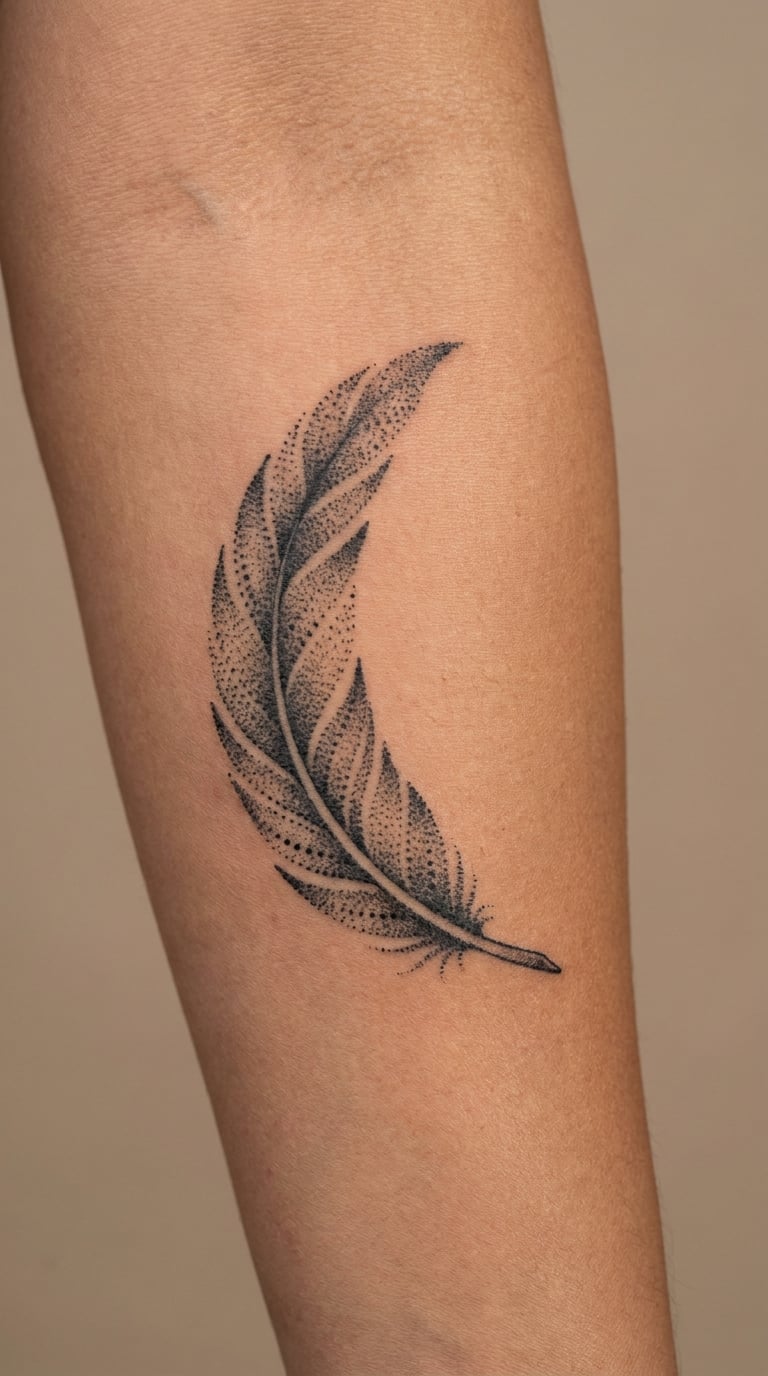
A feather bent into a half-moon curve, built entirely from graduated dots that tighten toward the shaft and thin at the outer edge. Because there are no lines to break, the design stays legible even when individual dots soften. Dotwork gets picked by people who want texture instead of an outline.
Placement: Upper inner forearm, curving around the belly of the arm. Size: 2.5 to 3 in (6 to 7.5 cm) across the curve. Style: Dotwork stipple. Pain: Medium and slow going, since dotwork takes a long session to build density. It ages more gracefully than fine line because softened dots read as shading. Make it yours: Have the gradient run darkest at the shaft and fade to nothing at the tip.
6. Traditional Feather with Red Accent
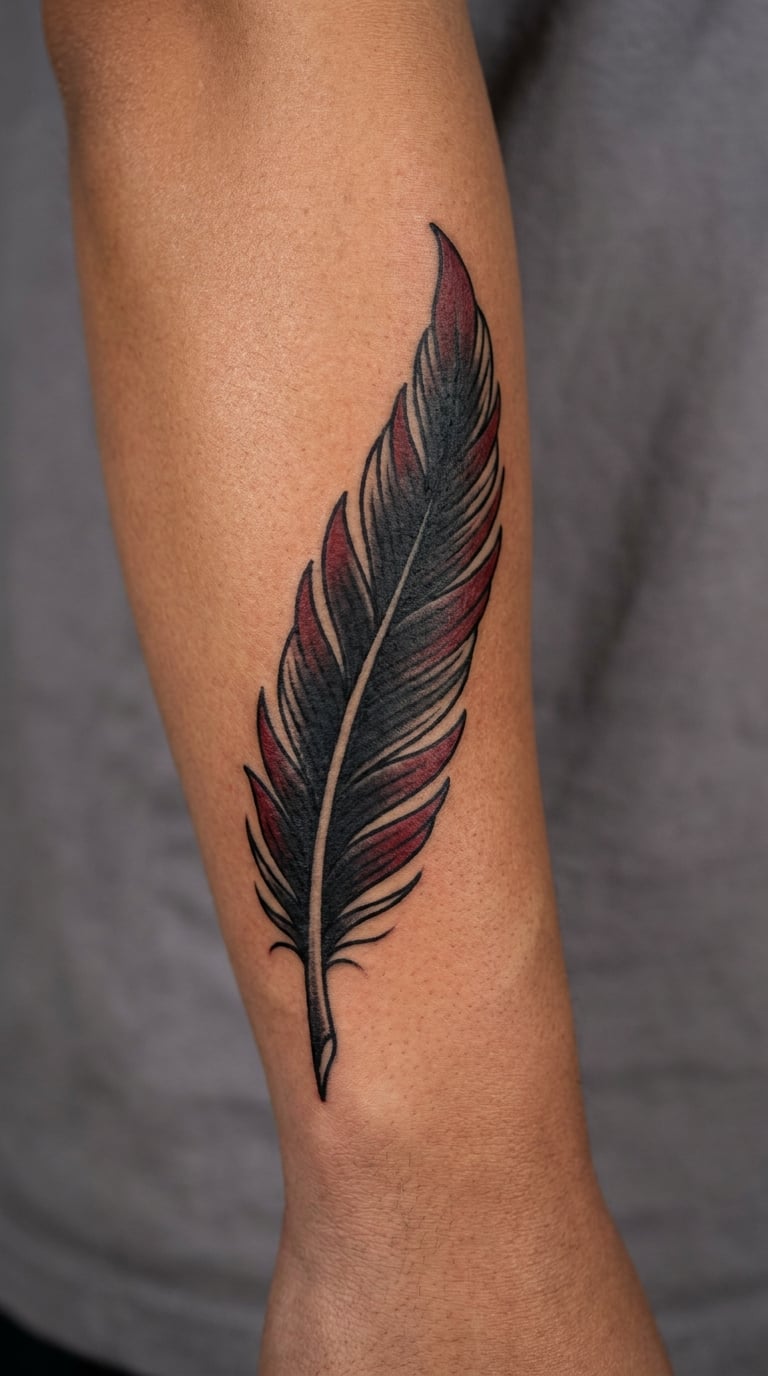
Bold black outlines, a solid spine, and a saturated red wash along the barb tips, in the old-school style that holds its edge for years. The red does the work, so the feather still reads at a distance even once the black softens slightly. Most people asking for it want something still recognisable to somebody who never saw the reference.
Placement: Outer forearm or upper inner forearm, vertical. Size: 4 to 5 in (10 to 13 cm). Style: Traditional with one colour accent. Pain: Medium. Solid red needs more passes to hold, and heavier saturation can settle into the skin with a faint edge over time. Make it yours: Swap the red for one deep green or a sun-faded blue that suits your skin better.
7. Minimal Feather Line Art
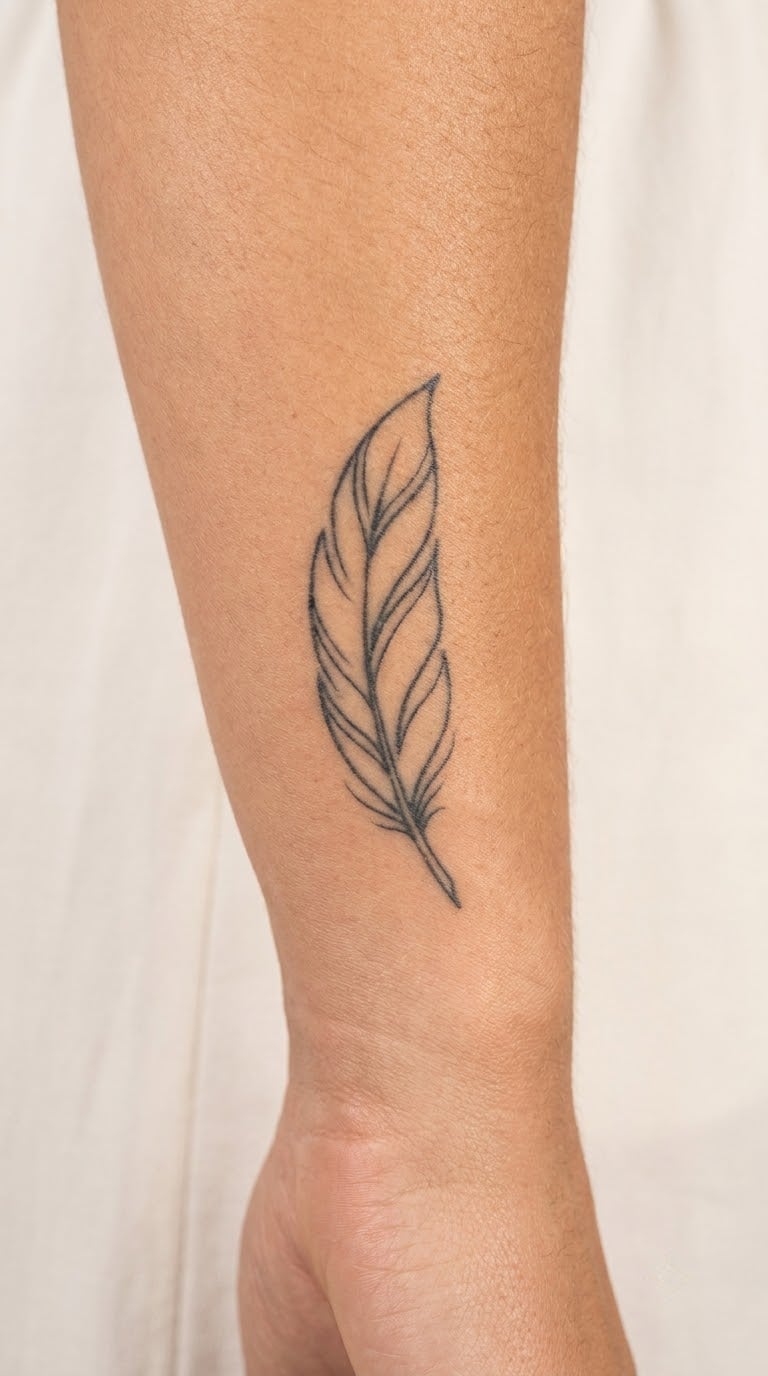
One outer contour, two or three interior strokes, nothing else. This works as a first tattoo, as filler, or as a quiet addition to an arm that already has a lot going on. It is the one to pick when you want the shape of a feather without the visual weight.
Placement: Near the wrist crease, or in a small gap on the outer forearm. Size: 1.5 to 2 in (4 to 5 cm). Style: Minimal line art. Pain: Medium near the wrist, where skin is thin over bone. This is the first size where ageing really shows, so keep the strokes confident and few. Make it yours: Place it where a watch band sits, so the feather only appears when you push your sleeve up.
8. Botanical Feather Study
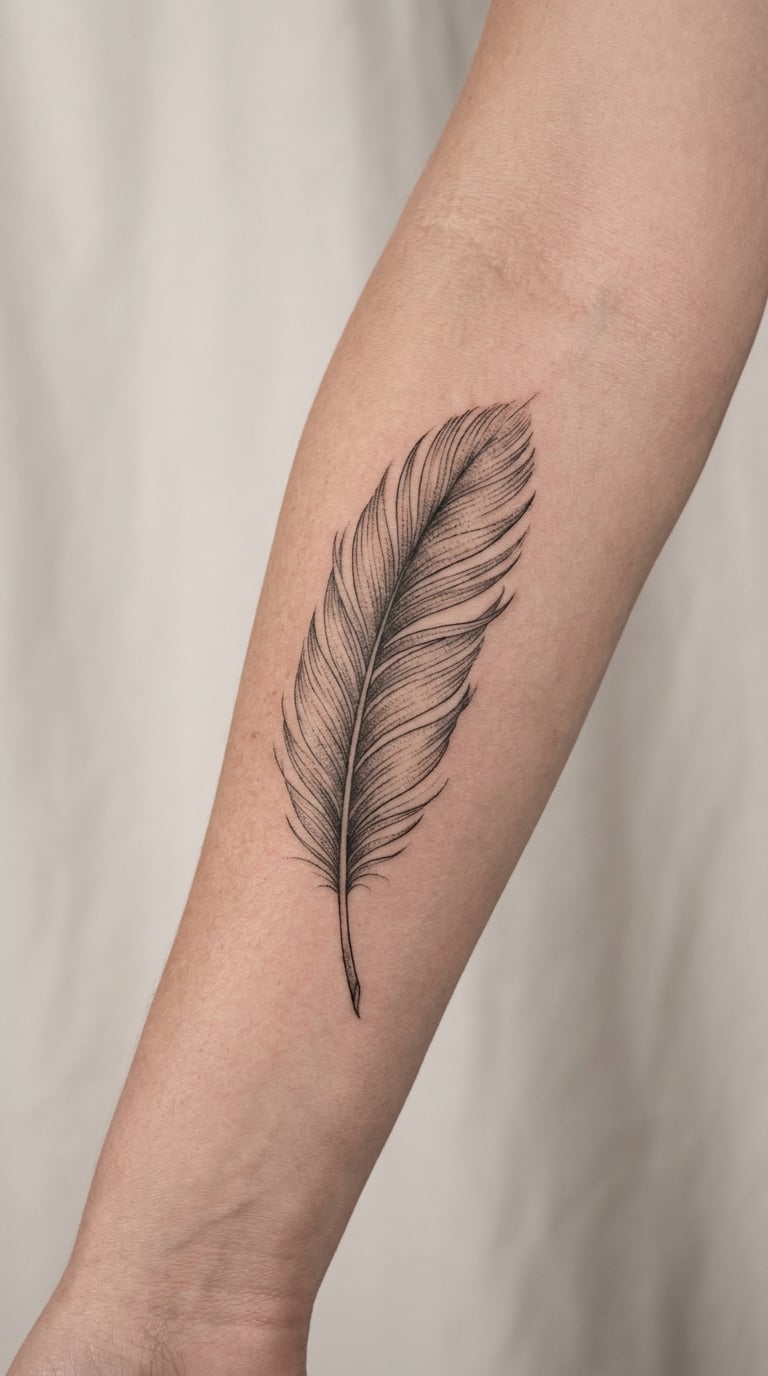
A natural-history approach: barbs separated into distinct strands, a delicate stem, light grey shading along the lower half. It is drawn the way an illustration in a field guide would be, which is a different mood from tattoo realism. Useful for anyone who finds realistic feathers too glossy.
Placement: Inner forearm, vertical, tip up. Size: 3.5 to 4 in (9 to 10 cm). Style: Botanical black and grey. Pain: Medium. Separated barbs mean many single-needle passes, and the bony inner forearm gives fine line less depth to sit in, so ask for a slightly heavier needle gauge than you expect. Make it yours: Work from a real bird you have a connection to, rather than a generic crow or dove.
9. Geometric Feather Pattern
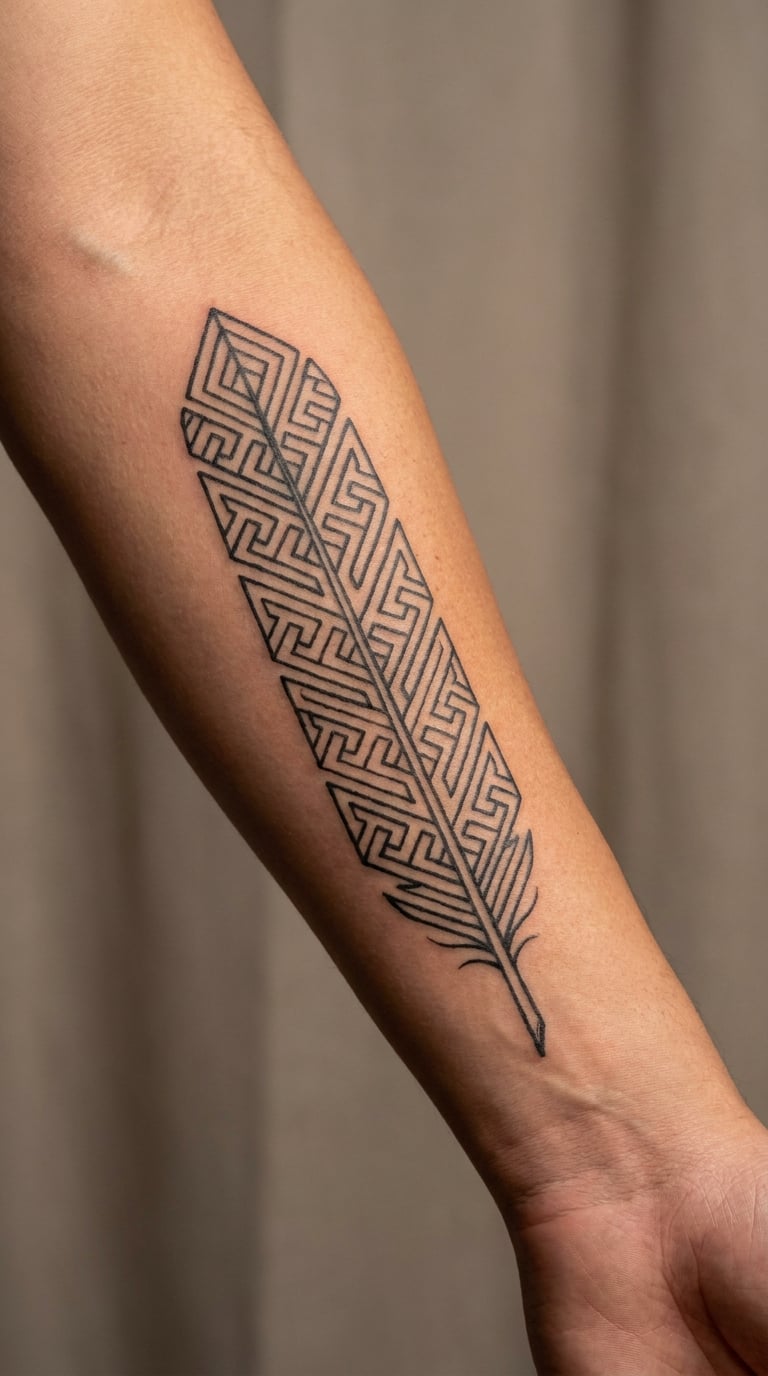
The feather broken into angular symmetrical segments, each a triangle or tapered wedge, with the shaft as one straight axis through the middle. The structure does the work and stays crisp longer than shading. Feather is a forgiving subject for geometry, because the natural shape is already symmetrical.
Placement: Outer forearm, lengthwise. Size: 4 to 5 in (10 to 13 cm). Style: Geometric linework. Pain: Medium. Repeated straight lines over the wrist curve will bow when the wrist bends, so keep the piece above the crease if the geometry is the point. Make it yours: Add a mirrored feather on the other arm, offset by an inch so they only line up when both arms are straight.
10. Feathers in Motion
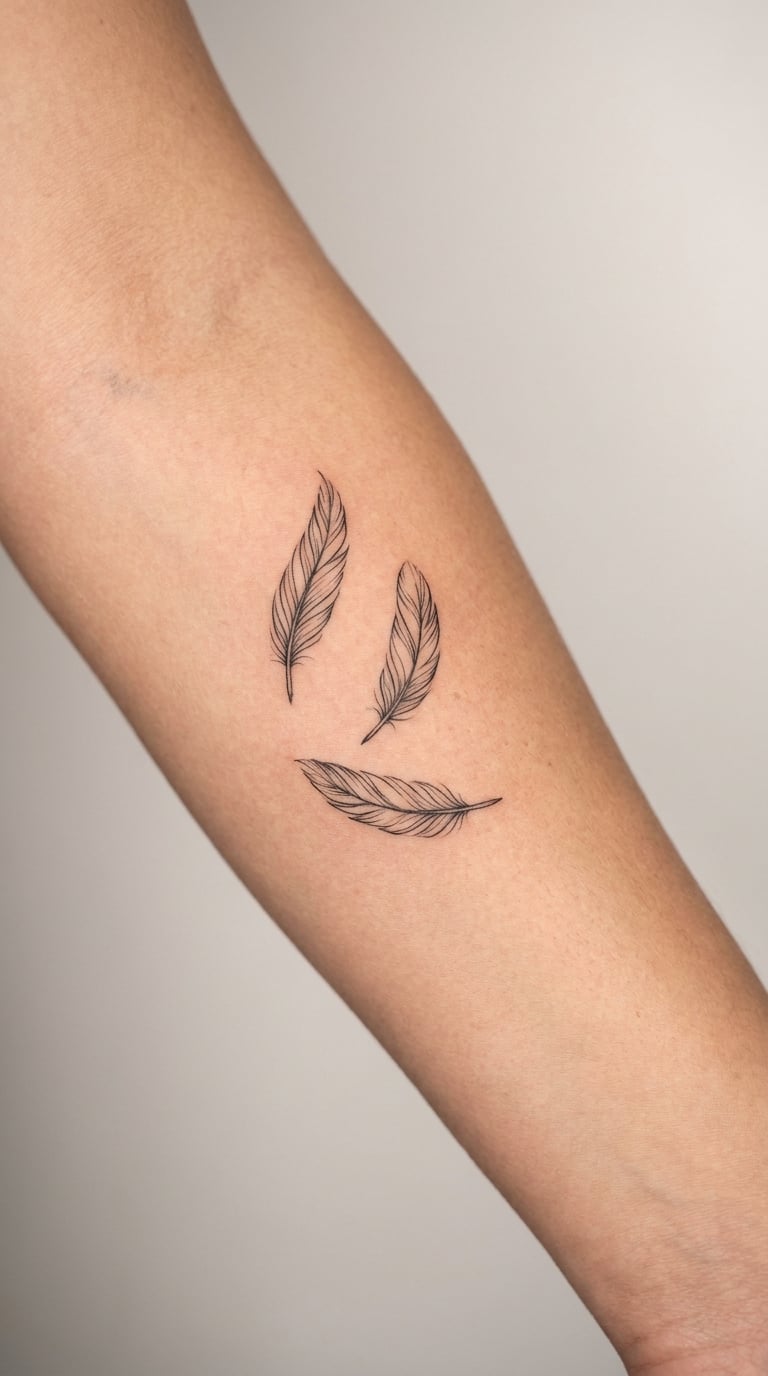
Three small feathers placed as though they are drifting, each angled a few degrees off the last, with the spacing doing as much work as the drawing. It fills a forearm without committing to a full sleeve, and it scales, so you can add a fourth later.
Placement: Inner forearm, scattered along a diagonal from wrist toward elbow. Size: Each feather 1.5 to 2 in (4 to 5 cm), the group spanning about 5 in (13 cm). Style: Fine line. Pain: Low to medium, since there is less ink overall. Three small pieces mean three healing spots to keep clean, and tiny fine line feathers lose definition first. Make it yours: Have the spacing follow the natural line of your tendons, so the group sits in the shape of your arm rather than on top of it.
11. Phoenix Feather
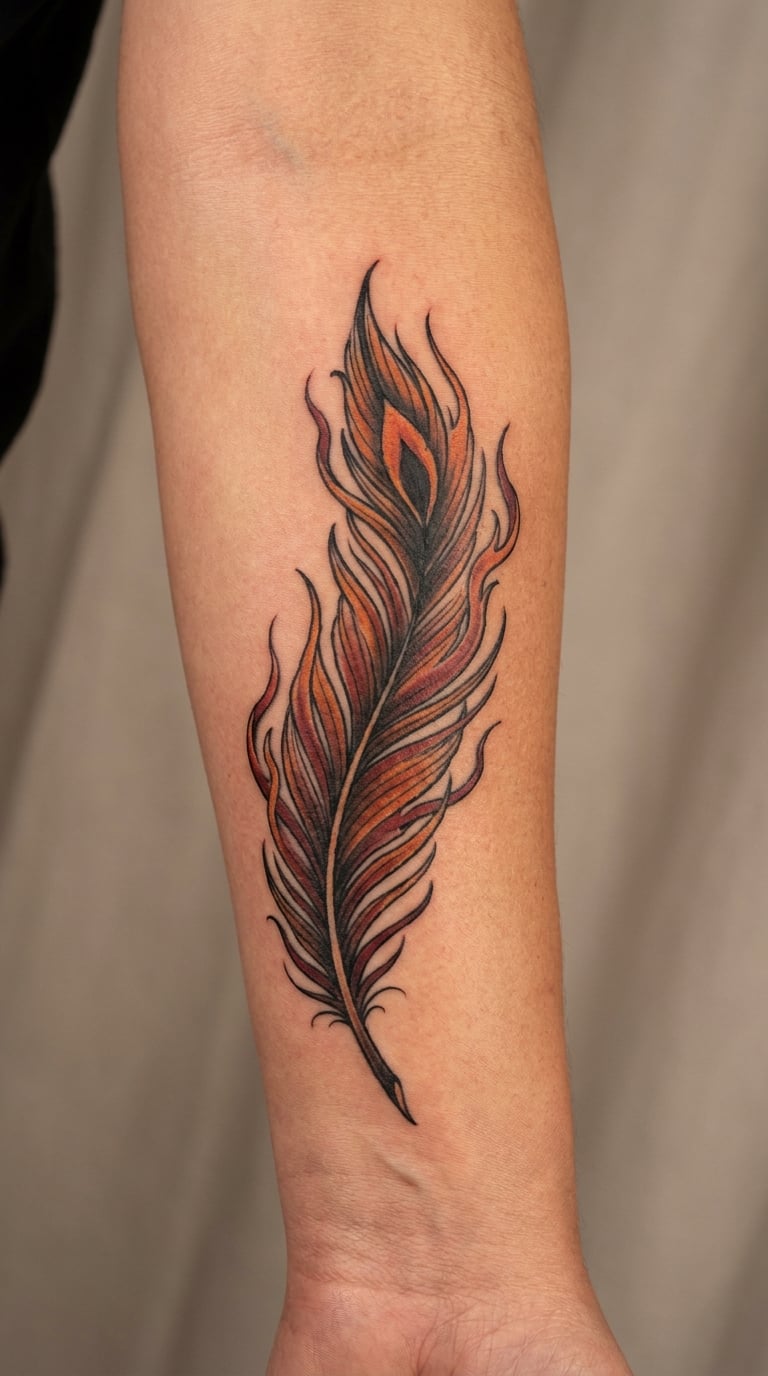
A feather whose barbs flare outward in flame shapes rather than lying flat, usually black with orange and red pushed into the tips. It reads as a feather from across the room and as fire up close. Rebirth and transformation are the meanings people attach, though the reading is personal rather than fixed.
Placement: Inner forearm, vertical, flame tips pointing up. Size: 4 to 5 in (10 to 13 cm). Style: Illustrative with colour. Pain: Medium. Orange and red on sun-exposed forearms fade toward yellow, so plan on a colour refresh every few years. Make it yours: Keep the black outline and let the flame tips carry the colour, so the piece still works as black and grey if you re-ink it flat later.
12. Native-Inspired Feather Motif
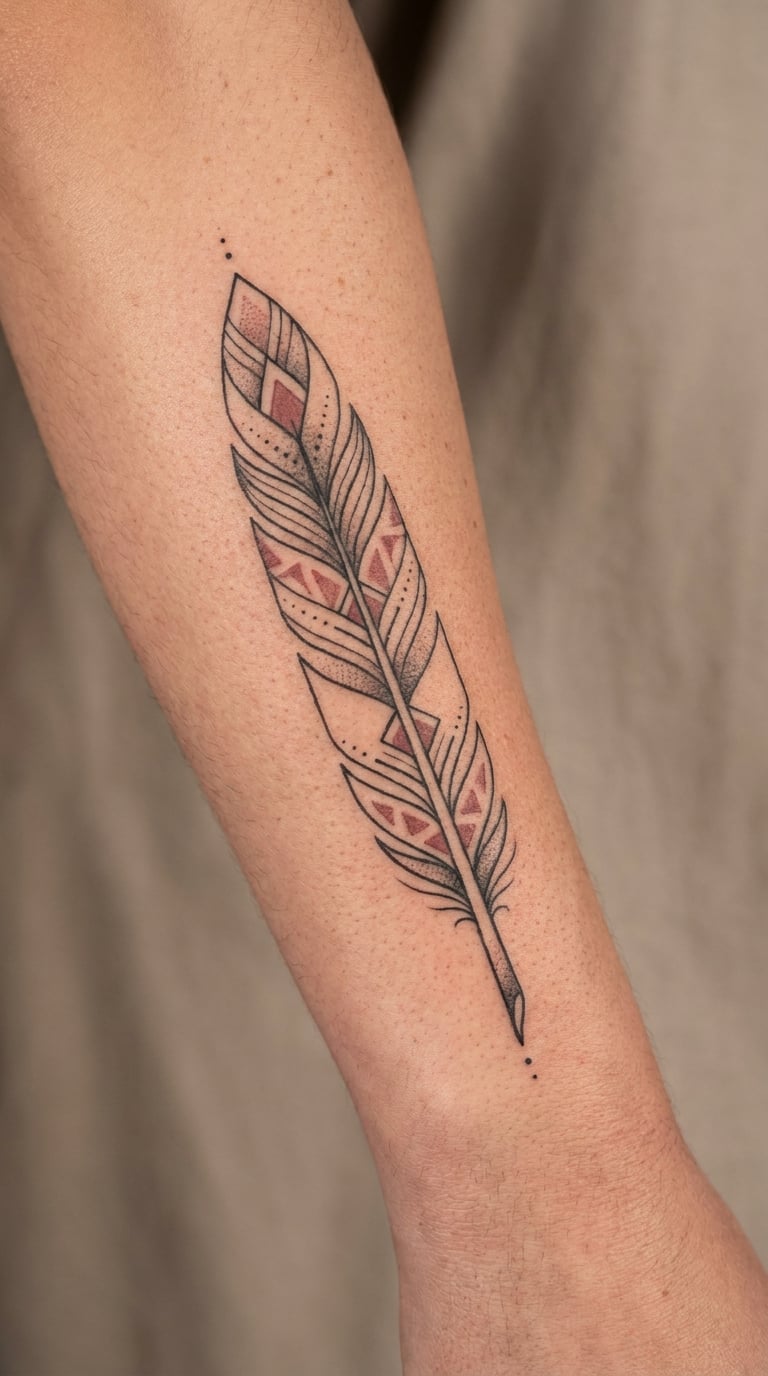
A simplified ornamental feather: restrained geometric detailing inside the outline, a clean tapered shape, one muted accent colour. The restraint matters, since heavy imitation is where this kind of design most often goes wrong. Ask your artist to explain every element before you approve it.
Feathers carry deep significance in a number of Indigenous North American traditions, and those meanings are not interchangeable or decorative. Research the specific tradition behind any motif you are considering, and go to an artist who can tell you where the design comes from rather than one who will improvise it.
Placement: Inner forearm, vertical. Size: 3 to 4 in (7.5 to 10 cm). Style: Ornamental. Pain: Medium. Fine interior detail on the inner forearm spreads slightly, so the detailing should be simplified further than the reference shows. Make it yours: Drop any element the artist cannot account for, and ask which tradition each remaining element comes from.
13. Feather with Floral Accent
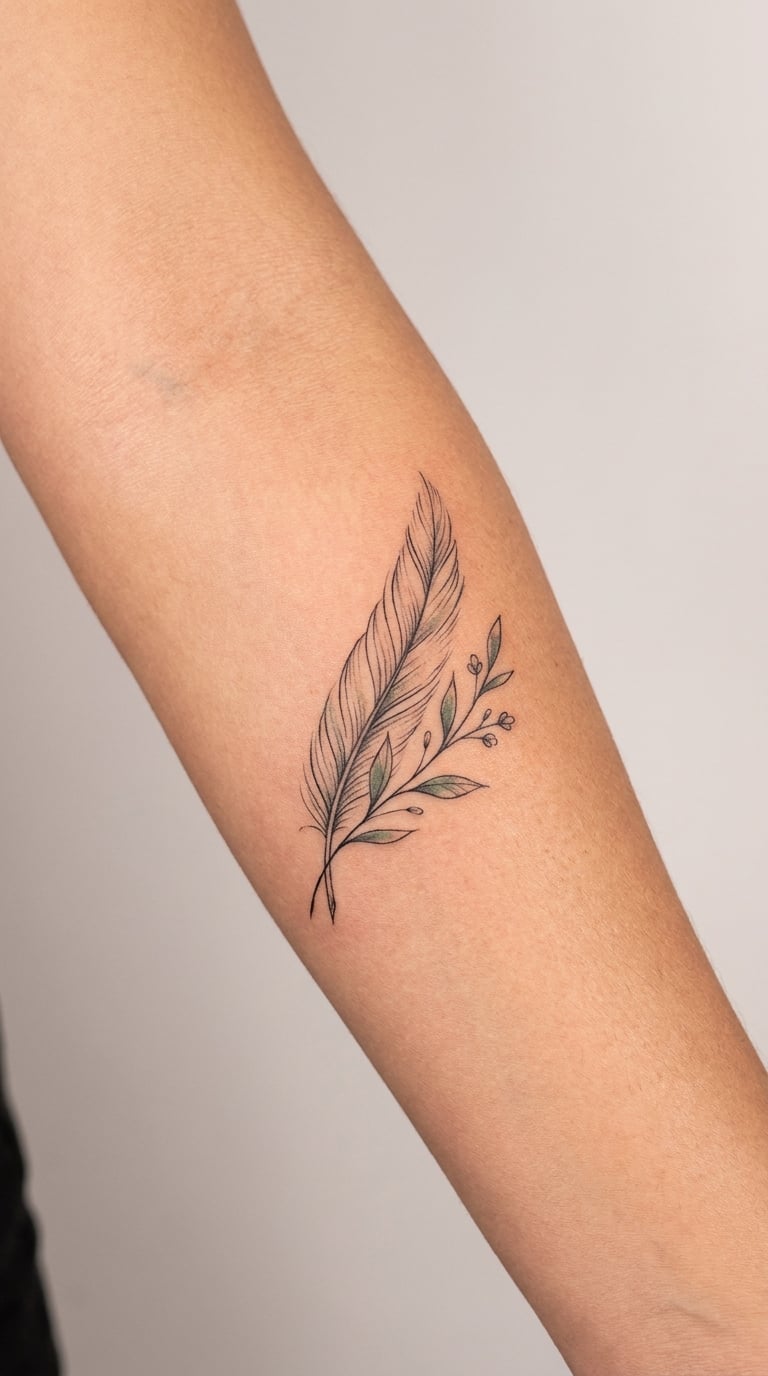
A fine-line feather with a small sprig or single bloom where the quill ends, tucked in low so it supports the feather rather than competing with it. The proportions matter more than the detail. This suits someone who wants a nature piece without a full botanical sleeve.
Placement: Inner forearm, diagonal. Size: 3.5 in (9 cm) for the whole composition. Style: Fine line with one small colour accent. Pain: Low to medium. Colour sits shallower than black and fades first on a forearm, so keep the accent small enough that its fading stays unobvious. Make it yours: Use one plant that means something to you, a sprig from the garden you grew up in, rather than a generic bloom.
14. Blackwork Feather Silhouette
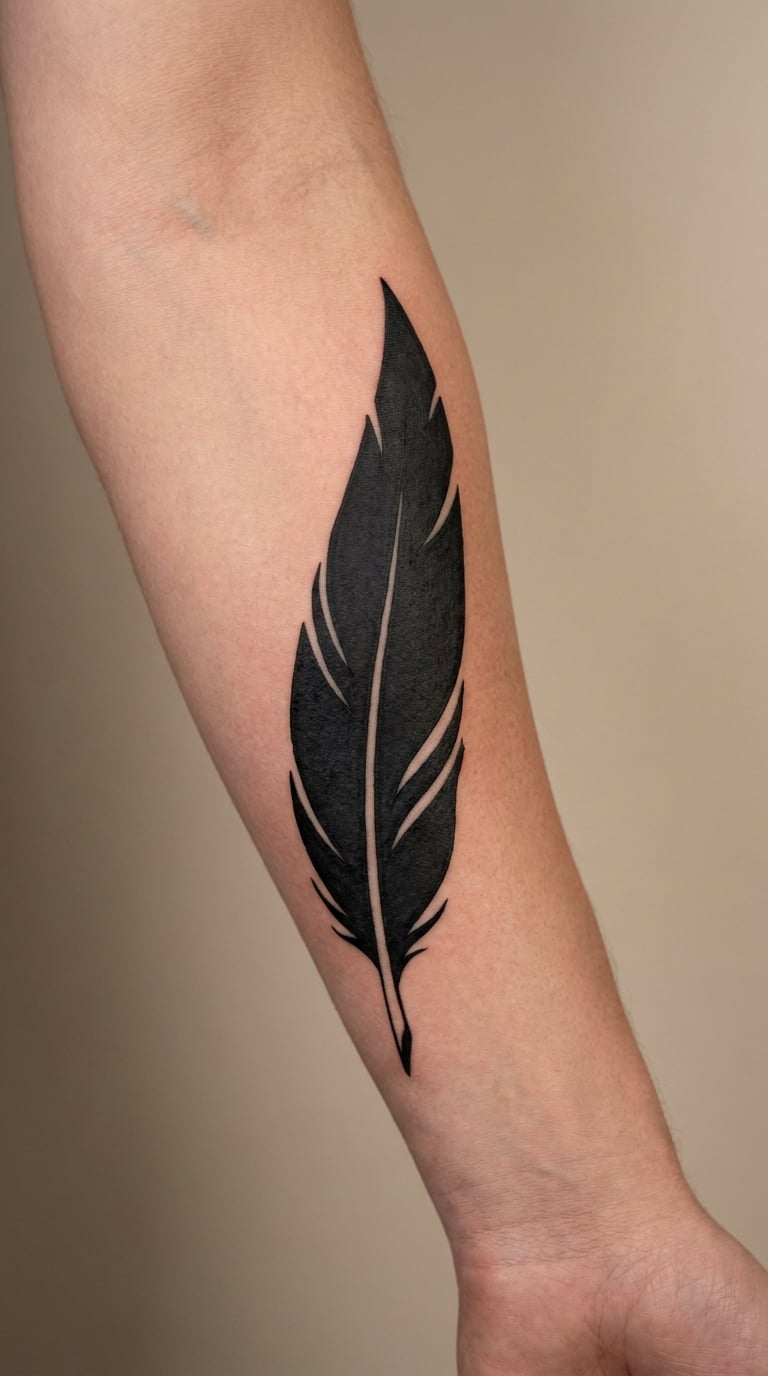
A single solid black shape with a clean pointed tip and two or three cutouts inside the barbs, so the design is one mass of ink with a little breathing room. It is the boldest thing here and the least fussy to execute, and it reads as one graphic mark rather than a fading gradient.
Placement: Outer forearm, lengthwise from elbow toward wrist. Size: 4.5 to 5 in (11 to 13 cm). Style: Solid blackwork. Pain: Medium and long, since filling solid black takes a full pass per area. It is the most durable ink on a forearm and softens to a dark grey rather than blurring away. Make it yours: Cut a small initial or date into the negative space near the quill, where the solid ink gives the letters a clean frame.
15. Violet Gradient Feather
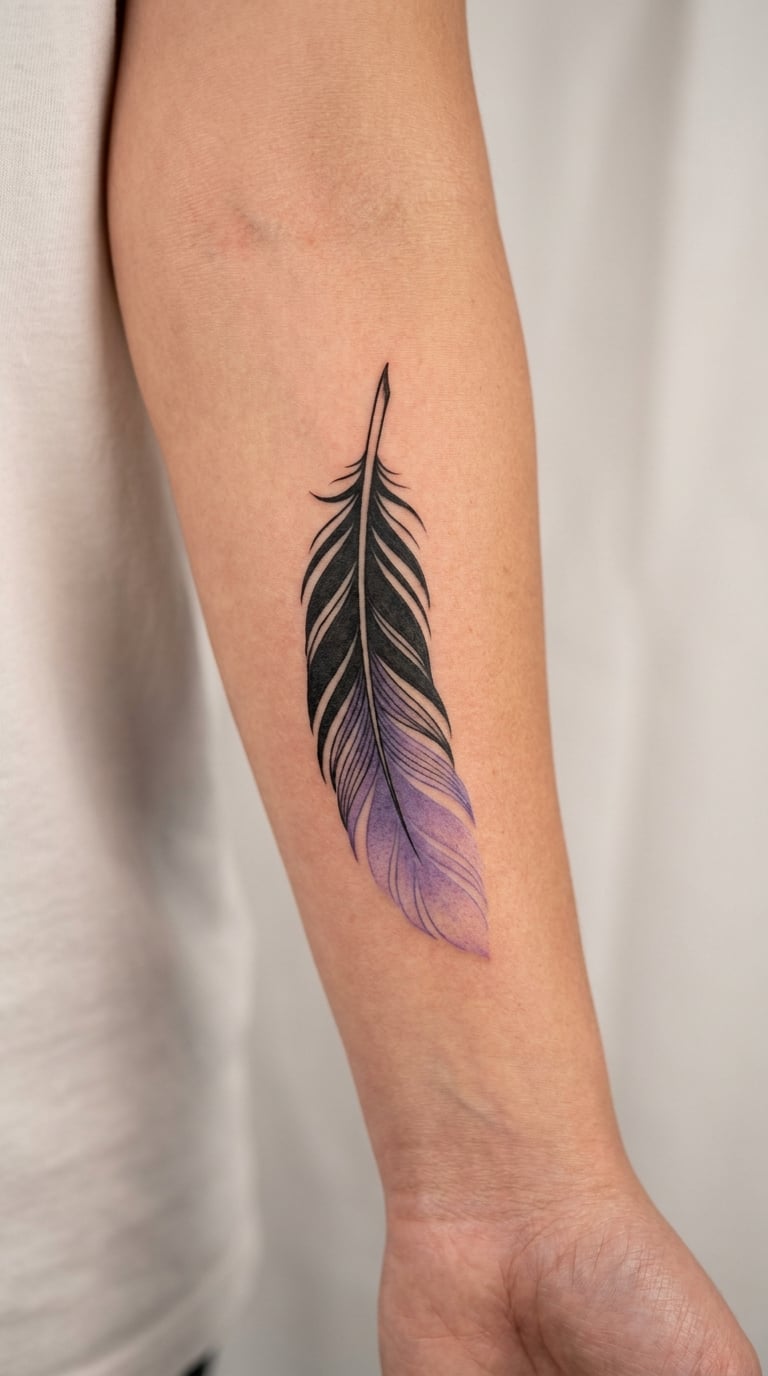
A black feather that dissolves into a violet gradient toward the lower barbs, so the top stays crisp and solid while the bottom fades into colour and then into bare skin. It is colour without committing to a full-colour piece, and violet suits most skin tones.
Placement: Inner forearm, vertical, fade toward the wrist. Size: 4 in (10 cm). Style: Gradient blackwork with colour. Pain: Medium. A gradient takes many light passes, and the lightest part is always the first to disappear, so the fade will compress and deepen over the years. Make it yours: Decide now where you want the gradient to end, because that is the spot you will want touching up later rather than removing.
16. Quilled Feather Detail
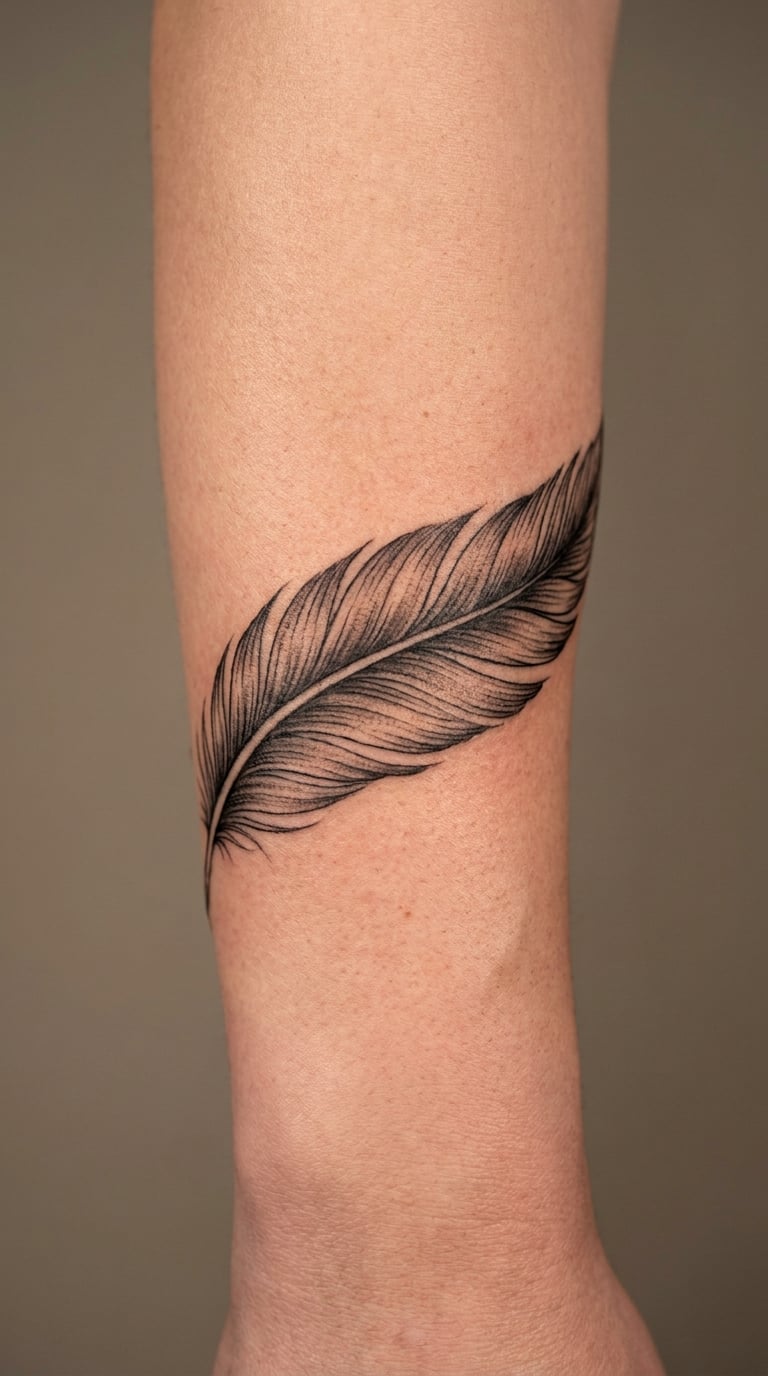
A realistic feather where the quill carries the drawing: a textured shaft, barbs packed tightly around it, shading running along the shaft rather than across it. Horizontal placement makes the shaft read as a band across the forearm, and the structure is what holds a feather together once the barbs soften.
Placement: Lower forearm, horizontal, above the wrist crease. Size: 4 in (10 cm) across. Style: Black and grey realism. Pain: Medium. A horizontal piece flexes every time you reach for something, and packers work best on still skin, so expect breaks. Make it yours: Angle it slightly off horizontal so the shaft follows the natural line from wrist bone to elbow.
17. Feather Wrist Wrap
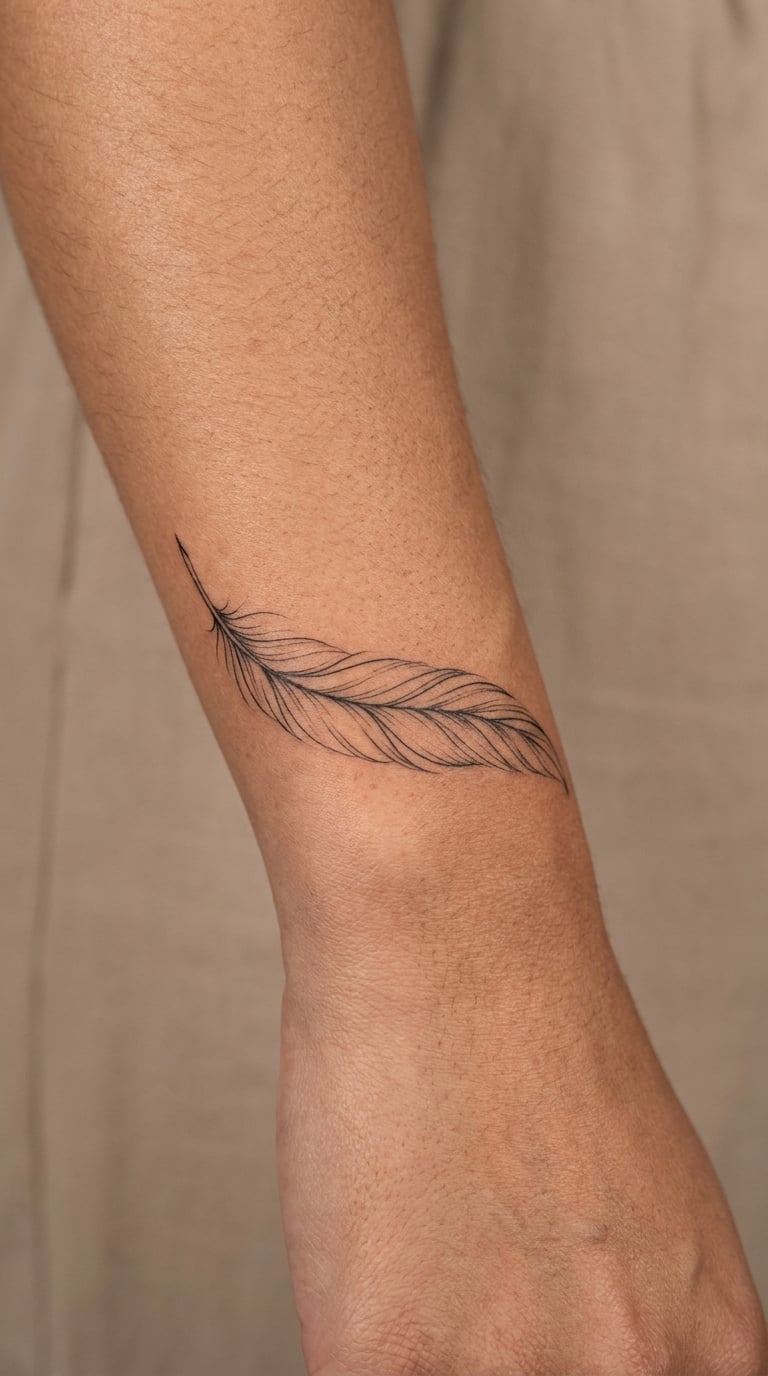
A wispy feather drawn along the contour of the wrist so the tip curves toward the lower forearm, reading as though it is wrapping the arm. The design changes shape as you turn your wrist, which is the whole appeal. Wrap designs are also the ones most often commissioned as gifts.
Placement: Wrist and lower forearm, following the contour. Size: 5 in of curve (13 cm). Style: Fine line. Pain: Medium to high, the highest of the small designs here, because the wrist is thin, bony and sensitive. Fine line curves also run into the wrist crease and blur there noticeably. Make it yours: Ask for the wrap in two halves, one healed and photographed before the second is drawn, so the curve stays level.
18. Split-Color Feather
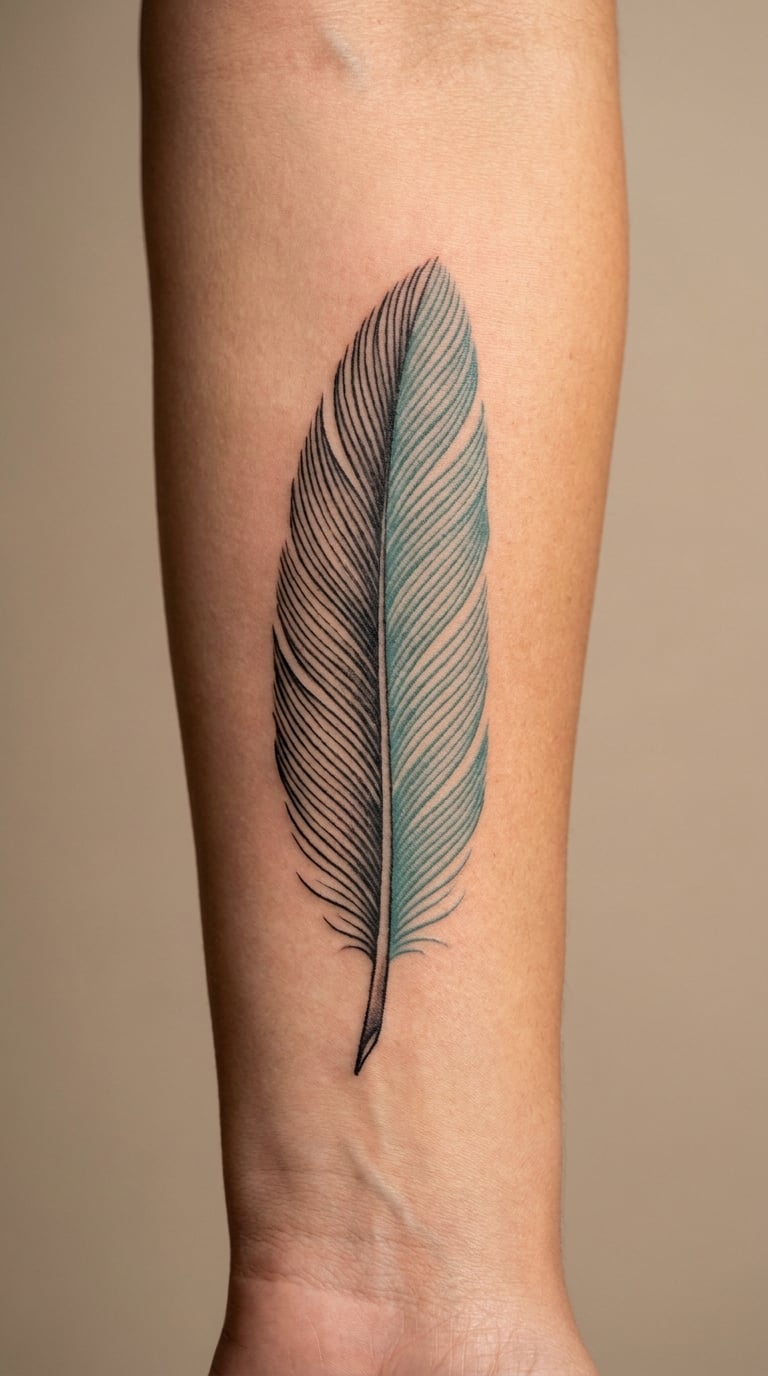
A feather divided down the shaft, one half in black barbs and the other in muted teal, the split running straight through the quill. That join down the centre gives it depth, and it suits anyone who wants colour but refuses a full-colour piece.
Placement: Inner forearm, vertical. Size: 4 to 5 in (10 to 13 cm). Style: Two-tone realism. Pain: Medium. The teal fades noticeably faster than the black on a sun-exposed forearm, and the two halves slowly stop agreeing with each other, which clients do not expect. Make it yours: Put the colour half on the side of the arm that sees less sun if you keep your sleeves down most of the day.
19. Feathertip Arm Flourish
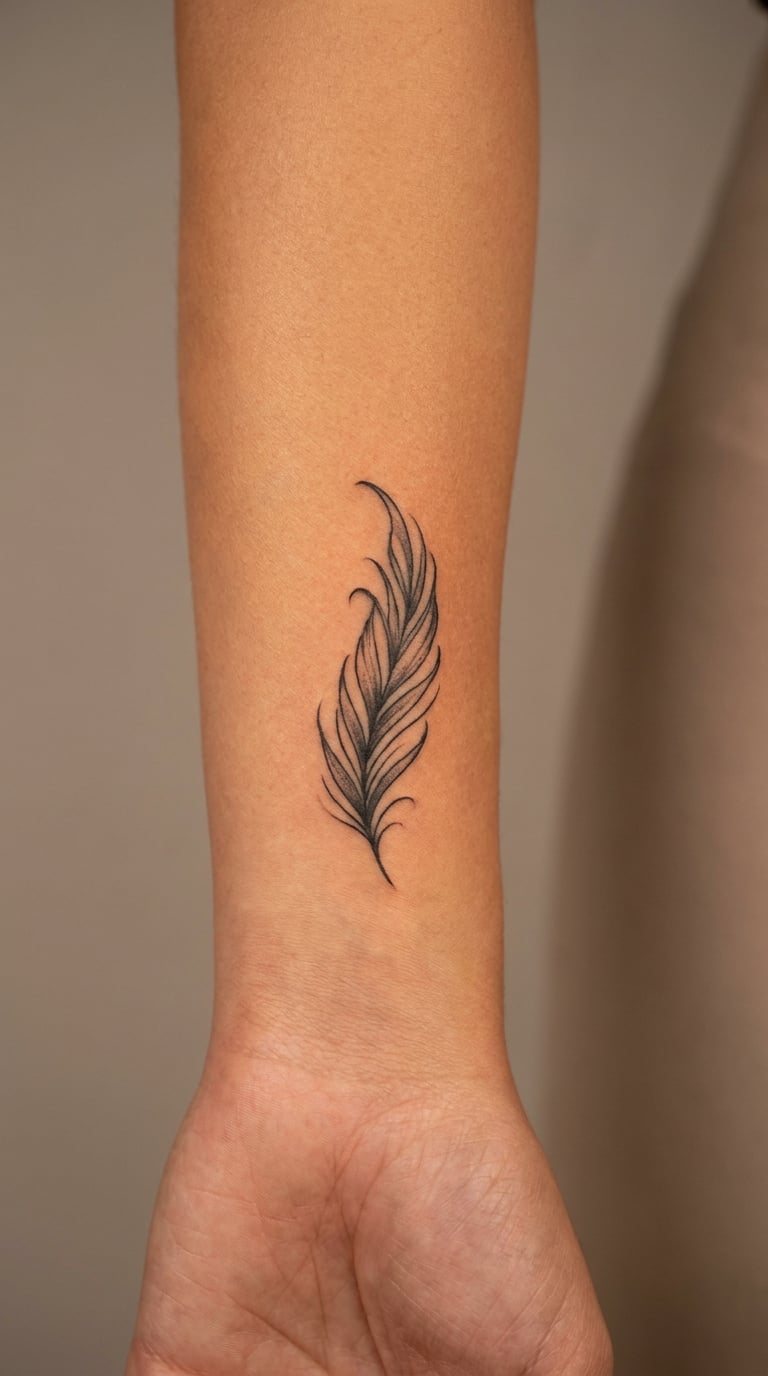
A narrow flourish shaped from a feather outline, with tapered curved barbs sweeping to one side and a loose tail that thins into nothing. It is designed to fit a gap rather than command the arm, which makes it the right pick for a forearm that is already tattooed.
Placement: Outer forearm, in an open area between wrist and elbow. Size: 2.5 to 3 in (6 to 7.5 cm). Style: Fine line ornament. Pain: Low, since it is small and takes a short sitting. Fresh filler beside healed linework can sit slightly raised for a few weeks, which is normal. Make it yours: Ask your artist to run a short test line next to it first and compare before committing to the full piece.
20. Mandala-Inspired Feather
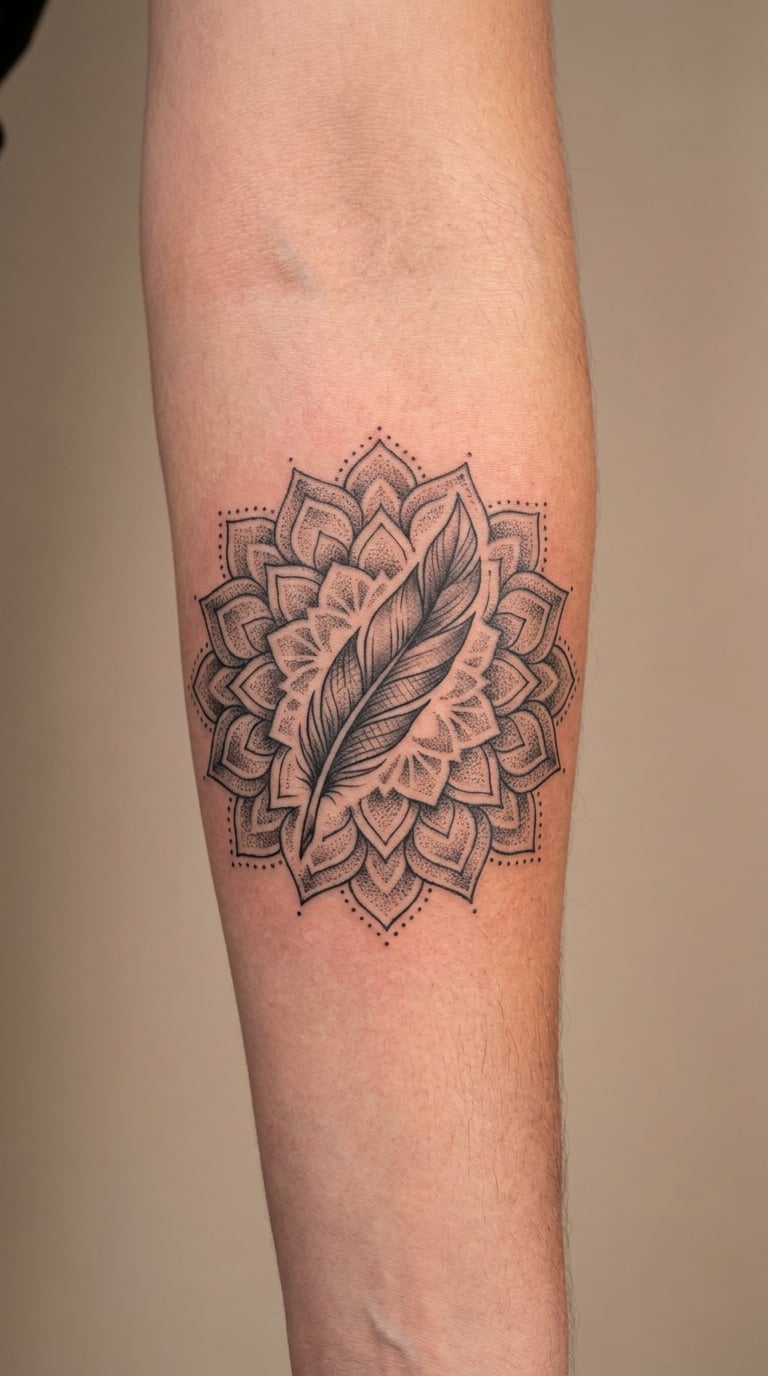
A feather set at the centre of an ornamental mandala-inspired frame, with symmetrical arcs and repeating petal shapes radiating from the shaft. The symmetry demands even spacing, and that is the hard part. It suits an arm with no competing large work nearby.
Placement: Centre of the forearm, vertical, clear skin on all sides. Size: 4 to 5 in (10 to 13 cm) across the whole frame. Style: Ornamental linework. Pain: High, because the session is long and the outer ring of fine arcs passes over more sensitive areas. The smallest interior detail softens first, so ask for it slightly larger than the reference shows. Make it yours: Set the frame so the feather tip points at your elbow crease, lining the geometry up with the arm’s own axis.
21. Small Micro Feather
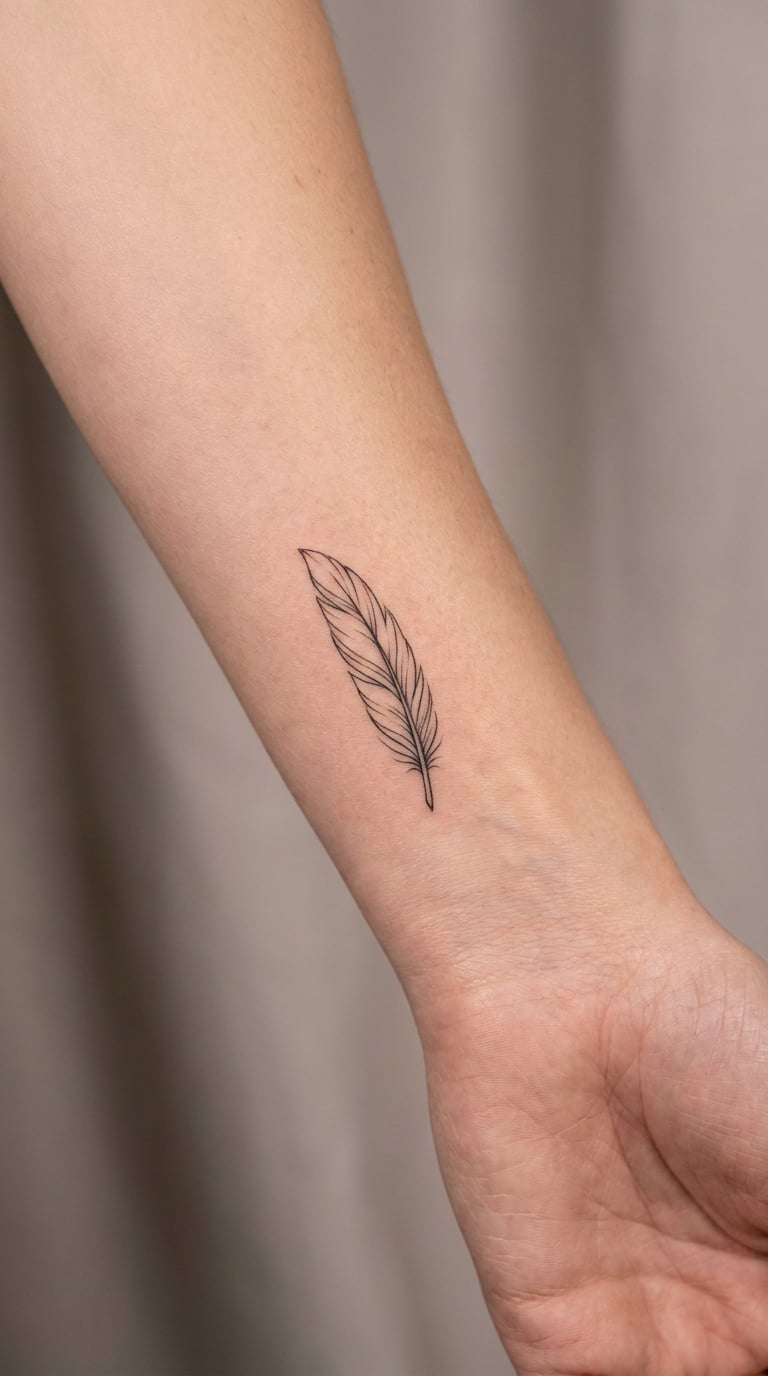
A tiny feather with a few clean strokes and enough negative space to read as a feather rather than a smudge. Micro work is a genuine craft category, not a small version of a large design. It suits a first tattoo somebody wants to keep private, or a detail inside a larger composition.
Placement: Inner forearm near the wrist, or tucked inside the elbow crease. Size: 1 to 1.5 in (2.5 to 4 cm). Style: Micro fine line. Pain: Medium, because near-bone skin reads as sharp rather than deep. At this size healing decides the result, not the session, and the interior barbs blur noticeably within a couple of years. Make it yours: Ask your artist which strokes they would cut to make it still read clearly in five years.
22. Layered Feather Sleeve Detail
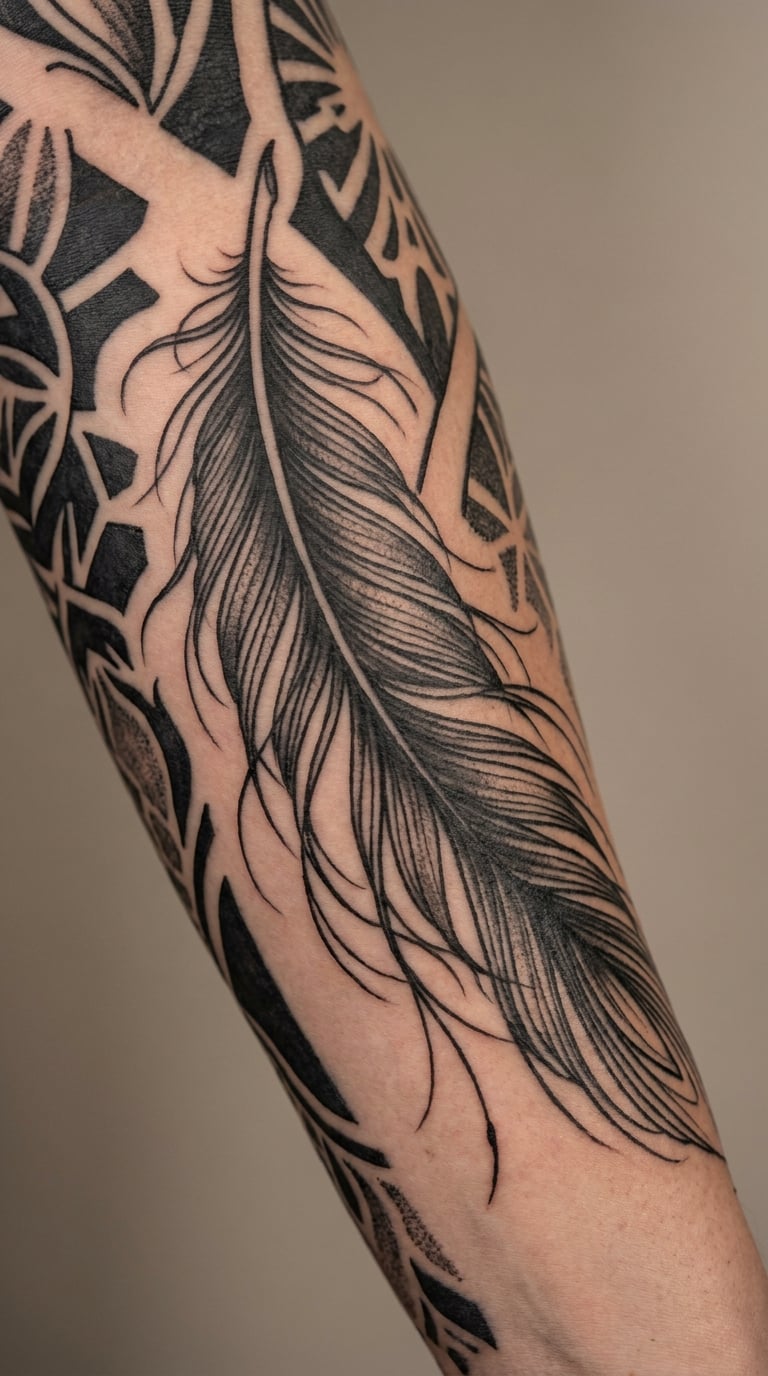
A feather drawn around what is already there, with trailing barbs that lead the eye into open skin instead of ending in the middle of another shape. Collectors pick these because a feather is one of the easier motifs to extend later, since barbs can grow into whatever space opens up.
Placement: Outer forearm, inside the existing composition. Size: 3 to 4 in (7.5 to 10 cm) at the outset, extendable later. Style: Composite blackwork. Pain: Medium. A sleeve session means longer sittings and more breaks, and fresh feather barbs beside healed solid black can look slightly different in tone for a few months. Make it yours: Ask for a pencil sketch of the whole forearm, feather included, before any ink goes in.
23. Feather with Script
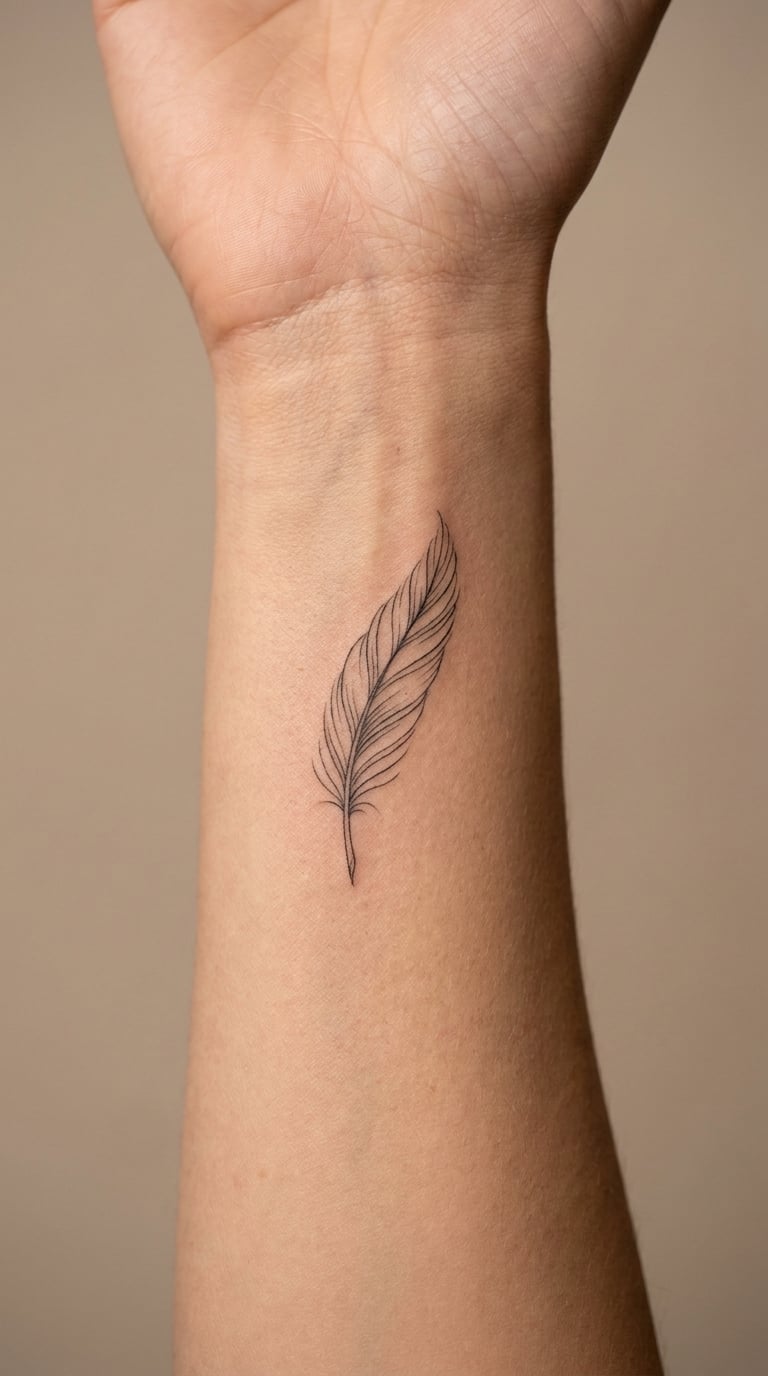
A fine-line feather paired with one short word or a date in script, set as the feather’s shadow or along its shaft, with enough spacing that both stay readable at reading distance. The text is what personalises the piece, and it is the fix for anyone worried a feather reads as generic.
Placement: Inner forearm, script beneath the feather or running along its length. Size: 3 in (7.5 cm) for the feather plus space for the text. Style: Fine line and script. Pain: Medium. Script and fine line both blur, and the wrist end of a word softens first, so keep lettering clear of the wrist crease. Make it yours: Have the artist hand-draw your word and adjust the letterforms to your arm, rather than picking a font and forcing the arm around it.
24. Torn-Paper Feather Collage
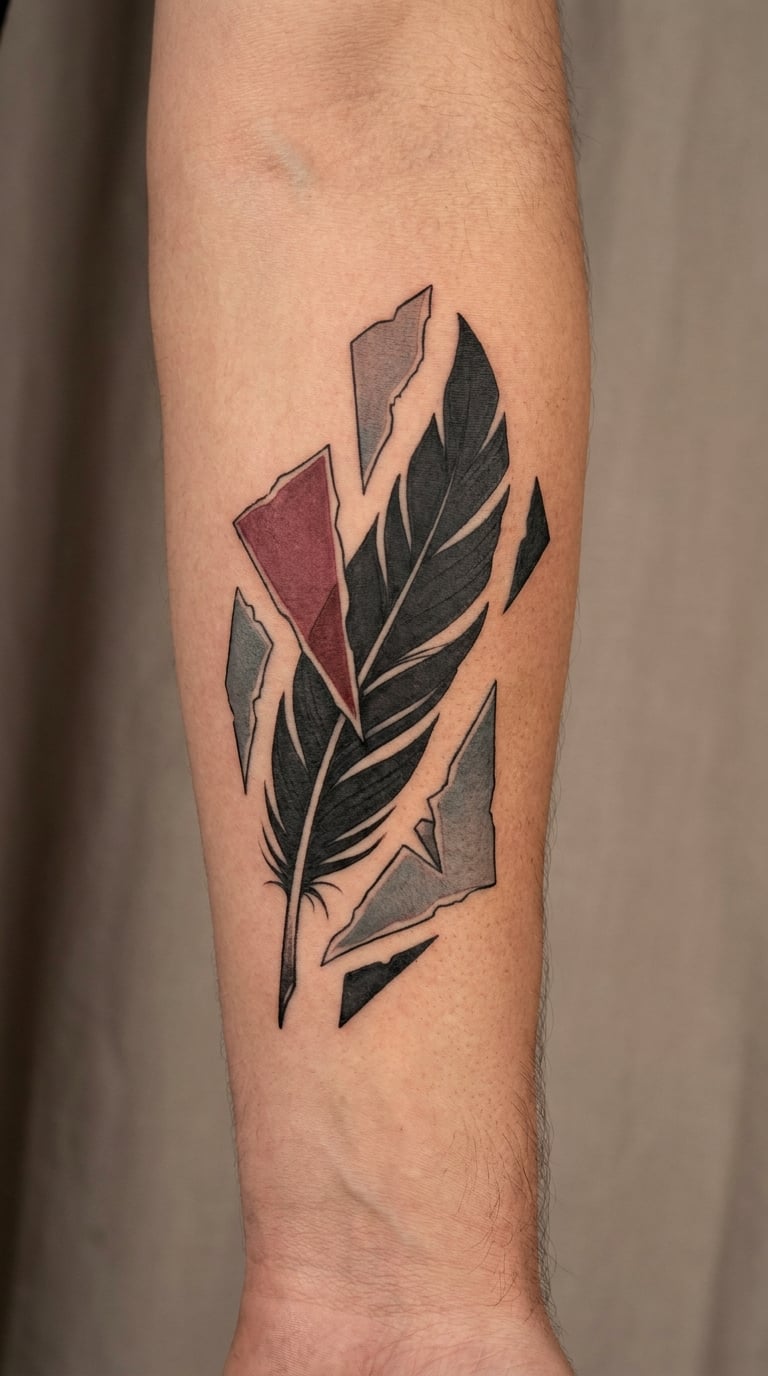
A black feather framed by irregular torn-paper shapes, hard angular edges, one flat colour block, as though the feather were laid on a ripped page. The contrast between the organic feather and the geometric frame is the effect, and it hides a lot of forearm with one design.
Placement: Outer forearm, set on a diagonal so the torn edges echo the arm. Size: 4 in (10 cm) across the composition. Style: Graphic collage with black and one accent colour. Pain: Medium, mostly from the flat solid shapes, which need a full pass each. The colour block fades faster than the black, and as it does the torn edge softens. Make it yours: Use a shape that echoes something real, a torn ticket or a map edge, and ask for it reproduced exactly.
25. Ornate Feather Crest
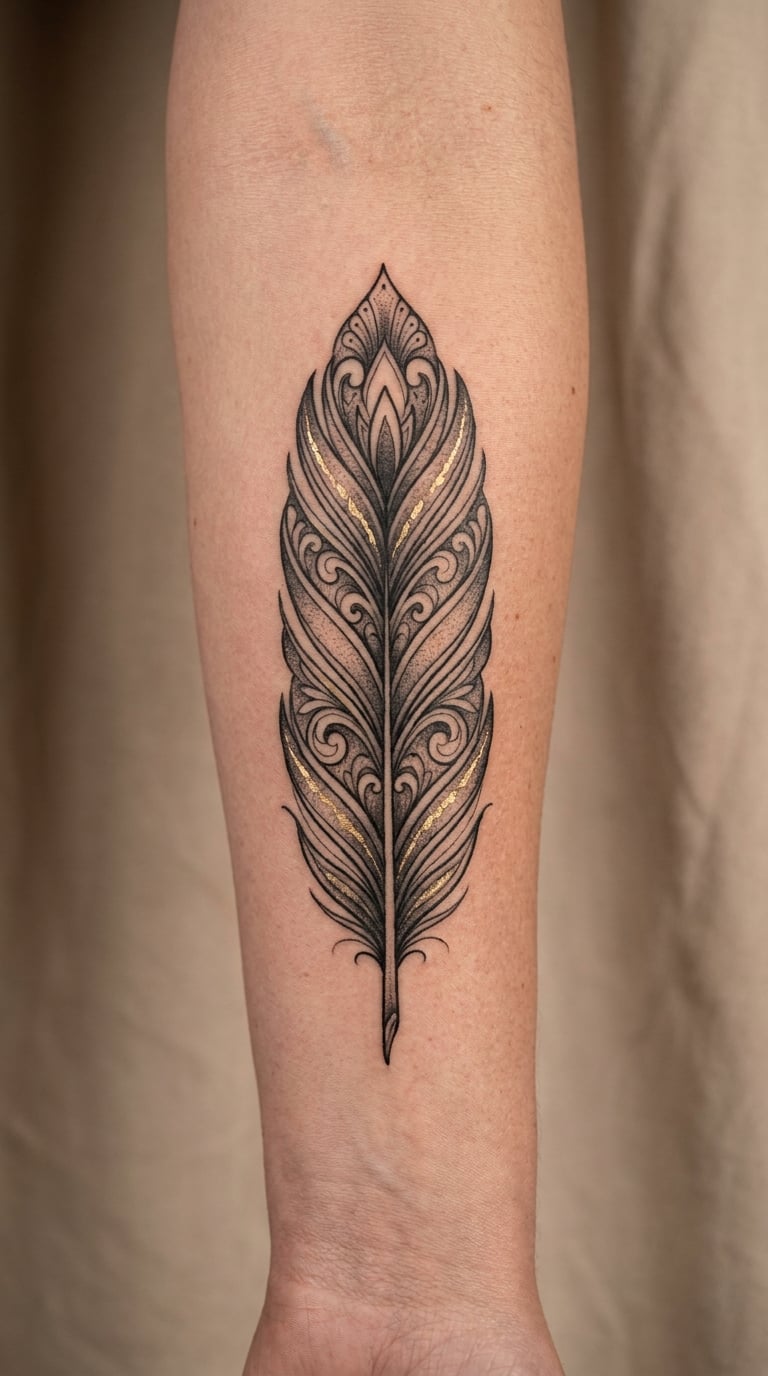
A decorative crest-style feather with internal patterning worked into the barbs, a formal tapered outline, a restrained gold accent along the shaft. It is closer to a coat of arms than to a bird, and it is the one to pick when you want the forearm to be the first thing somebody notices.
Placement: Centre of the forearm, vertical, clear skin above and below. Size: 5 in (13 cm) at minimum. Style: Ornate illustrative. Pain: High, because the internal pattern means a long session with many fine passes. Gold takes more passes than black to hold its tone and shifts toward brass over the years. Make it yours: Look at it at arm’s length, standing, and from a couple of metres back, then cut any detail that disappears at the farthest distance.
How to Choose the Right Feather Tattoo
The single most useful thing to decide before a consultation is the zone, because it constrains everything else. A framework that works:
- Pick the zone by how the arm moves. A design oriented along the forearm shaft distorts every time the wrist bends. The outer forearm is the flattest, most stable plane and takes a straight, bold feather best. The inner forearm is softer skin over tendons and veins, so it suits smaller, lighter work.
- Match size to your forearm, not to the reference photo. Hold your arm out, flex the wrist, and see how much length stays straight. Ask to see the design sketched on your arm at rest and at full bend before you approve it.
- Match line weight to the build of the arm. Fine line needs a flat, unbroken stretch of skin. On a bony inner forearm every tendon and vein shows through the design, and a petite forearm gives a 4 inch feather very little room. Muscular forearms give a bold feather more space and more curve to follow.
- Set your own detail tolerance. If you want the feather to read clearly in ten years, choose fewer elements. Bold blackwork and solid silhouettes age best, fine line ages worst, and colour on a sun-exposed forearm needs refreshing.
- Be honest about the sitting. A 5 inch blackwork feather with realistic barb treatment is a multi-hour job; small fine line pieces are quick. Knowing which one you are booking helps when you compare artists.
- Bring references and ask about them. Artists working in a specific style will tell you honestly which parts of a reference they can execute. A lot of disappointment in this genre comes from assuming a photo will be matched exactly, so ask directly.
Once the feather is sorted, the rest of the arm matters too. Inner forearm tattoo ideas for men shows how a feather sits alongside heavier blackwork, and forearm tattoo ideas for women with meaning covers the styling choices around a first piece.
Cost and Session Time
One thing worth knowing about how forearm feathers are priced: it is almost never a flat fee per design. Most studios price by the hour or per square inch, and since a feather is a shape rather than a square, the estimate depends on the size you agree on, the amount of barb detail, and whether there is colour.
Small fine line pieces of 1 to 2 inches are usually a short visit of under an hour. Mid-size realistic or blackwork feathers of 3 to 4 inches commonly run two to three hours and may need a second sitting. Pieces above 5 inches, particularly the ornate and mandala-framed designs, are most often booked as a full session or split across two appointments.
Colour adds time, since every colour area means additional passes, and a gradient or solid block takes more work than the same area in black. Shop minimums also apply, so a small piece can cost disproportionately at a studio where the minimum covers an hour of chair time. Regional rates and individual artist rates vary widely, so get two or three estimates in writing, and ask what each one includes and whether touch-ups are covered.
Aftercare Basics
- Follow your artist’s aftercare instructions first. Every artist has a method they trust, and their advice beats any general guide, including this one.
- Wash gently, twice a day at most. Use lukewarm water and mild unscented soap, then pat dry with a clean towel rather than rubbing. Let the plasma on the surface come away on its own.
- Keep it moisturised but not wet. A thin layer of whatever your artist recommends keeps skin from drying and flaking. Thick creams and occlusive products trap heat and irritate fresh ink.
- Protect it from sun and friction. Cover the area with clothing for the first couple of weeks and use sunscreen once it has healed. Loose sleeves and gym straps rub exactly where the design is still settling.
- Leave the flaking skin alone. Peeling is normal in the first week or two, and pulling it can lift pigment with it.
- Skip swimming, saunas and hot baths while it heals. Standing water, heat and chemicals are more irritation than a healing tattoo needs. If anything looks wrong beyond ordinary soreness, contact your artist rather than treating it yourself.
Most forearm feathers are surface healed within two weeks and settle into their final look over a couple of months, so do not judge the result from week one.
Frequently Asked Questions
What does a feather tattoo on the forearm symbolize?
A feather tattoo most often points to freedom, hope, travel and a connection to nature, because feathers come from something that leaves and returns. On the forearm specifically it also reads as something carried with you every day, and the side matters: an inner forearm feather is visible and personal, an outer one is easier to keep private. Meaning varies by person, so ask them about the one they chose.
Where should a feather tattoo go on the forearm?
The outer forearm is flatter and takes a straight, bold feather lengthwise without distorting when the wrist bends. The inner forearm is softer skin over visible tendons and veins, so it suits smaller, lighter work. Sit with your arm straight and place the feather on the stretch of skin that stays flat, and keep anything oriented along the arm away from the wrist crease.
How big should a feather tattoo be on the forearm?
Roughly, 1 to 2 inches suits the wrist area, 3 to 4 inches sits well on the mid-forearm, and 5 inches or more needs the full elbow-to-wrist stretch. Hold your arm out, flex the wrist, and see how much length stays straight on your skin, because that measurement beats any reference photo. Bigger is not better if the design bows every time you reach for something.
How bad does an inner forearm feather tattoo hurt?
The inner forearm ranks among the more sensitive forearm spots, especially near the wrist where skin is thin over bone. Expect a sharp, scratchy feeling that comes and goes in pulses rather than a steady ache. A distraction helps, and taking short breaks slows nobody down. If you are nervous, book a small piece first and see how you handle it.
How long does an inner forearm tattoo take to heal?
Surface healing on the inner forearm usually takes one to two weeks, until flaking stops and the skin looks settled. The ink keeps settling and sharpening for two to three months after that, so week one tells you nothing about the healed result. The inner forearm bruises and stays tender slightly longer than the outer, and sleeve and washing friction are what prolong it.
Do fine line feather tattoos fade on the forearm?
Yes, and sooner than on the upper arm. The forearm gets more sun, more sleeve friction and more gym equipment contact than almost anywhere else, and fine line has little ink to lose. Bold blackwork and solid silhouettes age best, colour sits in the middle and will want a refresh, and tiny fine line feathers blur fastest. Ask for slightly heavier line weight than the reference shows.
Conclusion: Choose Your First Feather Tattoo
For a first tattoo, the single fine-line feather, the minimal line art version and the small micro feather are the three that age best and forgive the most. Each is a short session, a modest commitment and easy to place somewhere you can watch it heal.
For someone adding to an existing collection, the realistic flying feather, the blackwork spine version and the layered sleeve detail are worth the longer sitting. They hold up next to heavier work and give you something to extend later.
Whichever way you go, save the references you like, mark the zone on your own arm, and take them to a consultation. The artist can tell you in ten minutes which of these designs your forearm can actually carry, and that conversation costs far less than a cover-up.